IX Magic and Magicians
Reading edition
Concerning sorcery on the west coast, the Travancore Census Commissioner, 1901, writes as follows:—
“The forms of sorcery familiar to the people of Malabar are of three kinds:—(1) kaivisham, or poisoning food by incantations; (2) the employment of Kuttichāttan, a mysteriously-working mischievous imp; (3) setting up spirits to haunt men and their houses, and cause illness of all kinds. The most mischievous imp in Malabar demonology is an annoying quip-loving little spirit, as black as night, and about the size of a well-nourished twelve-year-old boy. Some people say that they have seen him vis-à-vis, having a forelock. There are Nambūtiris (Brāhmans) in Malabar to whom these are so many missiles, which they may throw at anybody they choose. They are, like Shakespeare’s Ariel, little active bodies, and most willing slaves of the master under whom they happen to be placed. Their victims suffer from unbearable agony. Their clothes take fire; their food turns to ordure; their beverages become urine; stones fall in showers on all sides of them, but curiously not on them; and their bed becomes a bed of thorns. With all this annoying mischief, Kuttichāttan or Boy Satan does no serious harm. He oppresses and harasses, but never injures. A celebrated Brāhman of Changanacheri is said to own more than a hundred of these Chāttans. Household articles and jewelry of value may be left in the premises of homes guarded by Chāttan, and no thief dares to lay his hand on them. The invisible sentry keeps diligent watch over his master’s property, and has unchecked powers of movement in any medium. As remuneration for all these services, the Chāttan demands nothing but food, but that in a large measure. If starved, the Chāttans would not hesitate to remind the master of their power, but, if ordinarily cared for, they would be his most willing drudges. As a safeguard against the infinite power secured for the master by Kuttichāttan, it is laid down that malign acts committed through his instrumentality recoil on the prompter, who dies either childless or after frightful physical and mental agony. Another method of oppressing humanity, believed to be in the power of sorcerers, is to make men and women possessed with spirits. Here, too, women are more subject to their evil influence than men. Delayed puberty, permanent sterility, and still-births, are not uncommon ills of a devil-possessed woman. Sometimes the spirits sought to be exorcised refuse to leave the victim, unless the sorcerer promises them a habitation in his own compound (grounds), and arranges for daily offerings being given. This is agreed to as a matter of unavoidable necessity, and money and lands are conferred upon the mantravādi Nambūtiri to enable him to fulfil his promise.”
“The presence of large glands in connection with the eye afford some justification for the Malay’s belief that the dugong weeps when captured. They regard the tears of the īkan dugong (dugong fish) as a powerful love-charm. Muhammadan fishermen of the Gulf of Manaar appeared to be ignorant of this usage, but told me that a ‘doctor’ once went out with them to collect the tears of a dugong, should they capture one.”
Native physicians in the Tamil country are said to prepare an unguent, into the composition of which the eye of the slender Loris (Loris gracilis), the brain of the dead offspring of a primipara, and the catamenial blood of a young virgin, enter, as an effective preparation in necromancy. The eye of the Loris is also used for making a preparation, which is believed to enable the possessor to kidnap and seduce women. The tail of a chamæleon, secured on a Sunday, is also believed to be an excellent love-charm.
A station-house police officer informed Mr S. G. Roberts that first-born children, dying in infancy, are buried near the house, lest their heads should be used in sorcery, a sort of ink or decoction (mai) being distilled from them. This ink is used for killing people at a distance, or for winning a woman’s love, or the confidence of those from whom some favour is required. In the last two cases, the ink is smeared over the eyebrows. It is believed that, if an infant’s head is used for this purpose, the mother will never have a living child. When Mr Roberts was at Salem, he had to try a case of this practice, and the Public Prosecutor informed him that it is believed that, if a hole is made in the top of the head of the infant when it is buried, it cannot be effectively used in sorcery. In the Trichinopoly district, the police brought to Mr Roberts’ notice a sorcerer’s outfit, which had been seized. There were the most frightful Tamil curses invoking devils, written backwards in “looking-glass characters” on an olai (strip of palm leaf), and a looking-glass to read them by. Spells written backwards are said to be very potent. There was also a small round tin, containing a black treacly paste with a sort of shine on it, which was said to have been obtained from the head of a dead child. There is a Tamil proverb “Kuzhi pillai, madi pillai,” meaning grave child, lap child, in reference to a belief that, the quicker a first-born child is buried, the quicker is the next child conceived.
“Let a sorcerer obtain the corpse of a maiden, and on a Saturday night place it at the foot of a bhuta-haunted tree on an altar, and repeat a hundred times: Om! Hrim! Hrom! O goddess of Malayāla who possessest us in a moment! Come! Come! The corpse will then be inspired by a demon, and rise up; and, if the demon be appeased with flesh and arrack (liquor), it will answer all questions put to it.”
A human bone from a burial-ground, over which powerful mantrams have been recited, if thrown into an enemy’s house, will cause his ruin. Ashes from the burial-ground on which an ass has been rolling on a Saturday or Sunday, if thrown into the house of an enemy, are said to produce severe illness, if the house is not vacated.
From Malabar, a correspondent writes as follows:—
“I came across a funny thing in an embankment in a rice-field. The tender part of a young cocoanut branch had been cut into three strips, and the strips fastened one into the other in the form of a triangle. At the apex a reed was stuck, and along the base and sides small flowers, so that the thing looked like a ship in full sail. My inspector informed me, with many blushes, that it contained a devil, which the sorcerer of a neighbouring village had cut out of a young girl. Mrs Bishop, in her book on Korea, mentions that the Koreans do exactly the same thing, but, in Korea, the devil’s prison is laid by the wayside, and is carefully stepped over by every passer-by, whereas the one I saw was carefully avoided by my peons (orderlies) and others.”
In the Godāvari district, a sorcerer known as the Ejjugadu (male physician) is believed, out of spite or in return for payment, to kill another by invoking the gods. He goes to a green tree, and there spreads muggu or chunam (lime) powder, and places an effigy of the intended victim thereon. He also places a bow and arrow there, recites certain spells, and calls on the gods. The victim is said to die in a couple of days. But, if he understands that the Ejjugadu has thus invoked the gods, he may inform another Ejjugadu, who will carry out similar operations under another tree. His bow and arrow will go to those of the first Ejjugadu, and the two bows and arrows will fight as long as the spell remains. The man will then be safe.
When a Malayan exorcist is engaged in propitiating a demon, a fowl is sometimes waved before him, and decapitated. He puts the neck in his mouth, and sucks the blood. By the Tiyans of Malabar a number of evil spirits are supposed to devote their attention to a pregnant woman, and to suck the blood of the child in utero, and of the mother. In the process of expelling them, the woman lies on the ground and kicks. A cock is thrust into her hand, and she bites it, and drinks its blood.
It is noted by Mr L. K. Anantha Krishna Iyer that by the Thanda Pulayans of the west coast “a ceremony called urasikotukkuka is performed with the object of getting rid of a devil, with which a person is possessed. At a place far distant from the hut, a leaf, on which the blood of a fowl has been made to fall, is spread on the ground. On a smaller leaf, chunam and turmeric are placed. The person who first sets eyes on these becomes possessed by the devil, and sets free the individual who was previously under its influence. The Thanda Pulayans also practise maranakriyas, or sacrifices to demons, to bring about the death of an enemy. Sometimes affliction is supposed to be brought about by the enmity of those who have got incantations written on a palm leaf, and buried in the ground near a house by the side of a well. A sorcerer is called in to counteract the evil charm, which he digs up and destroys.”
“A figure representing the enemy to be destroyed is drawn on a small plate of metal (gold by preference), and to it some mystic diagrams are added. It is then addressed with a statement that bodily injury, or the death of the person, shall take place at a certain time. This little sheet is wrapped up in another metal sheet or leaf (of gold if possible), and buried in some place which the person to be injured or destroyed is in the habit of passing. Should he pass over the place, it is supposed that the charm will take effect at the time named.”
“Make an image of wax in the form of your enemy; take it in your right hand at night, and hold your chain of beads in your left hand. Then burn the image with due rites, and it shall slay your enemy in a fortnight. Or a figure representing an enemy, with his name and date of his birth inscribed on it, is carved out of Strychnos Nux-vomica wood. A mantram is recited, a fowl offered up, and the figure buried in glowing rice-husk embers. Or, again, some earth from a spot where an enemy has urinated, saliva expectorated by him, and a small tuft of hair, are placed inside a tender cocoanut, and enclosed in a piece of Strychnos Nux-vomica. The cocoanut is pierced with twenty-one nails and buried, and a fowl sacrificed.”
A police inspector, when visiting a village a few years ago, was told by one of the villagers that a man was going to bury two wax dolls, in order to cause his death. The inspector accordingly went to the house of the suspected enemy, where he found the two dolls, and some books on witchcraft.
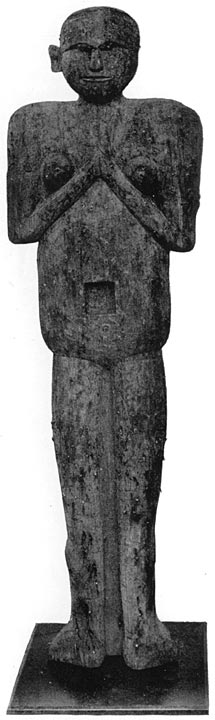
Figure Washed Ashore at Calicut.
To face p. 249.
The Native servant of a friend in Madras found buried in a corner of his master’s garden the image of a human figure, which had been deposited there by an enemy who wished to injure him. The figure was made of flour, mixed with “walking foot earth,” i.e., earth from the ground, which the servant had walked over. Nails, fourteen in number, had been driven into the head, neck, and each shoulder, elbow, wrist, hip, knee, and ankle. Buried with the figure were fourteen eggs, limes, and balls of camphor, and a scrap of paper bearing the age of the servant, and the names of his father and mother. A Muhammadan fortune-teller advised the servant to burn the image, so at midnight he made an offering of a sheep, camphor, betel nuts, and cocoanuts, and performed the cremation ceremony.
A few years ago, another wooden representation of a human being was washed ashore at Calicut. The figure is 11 inches in height. The arms are bent on the chest, and the palms of the hands are placed together as in the act of saluting. A square cavity, closed by a wooden lid, has been cut out of the abdomen, and contains apparently tobacco, ganja (Indian hemp), and hair. An iron bar has been driven from the back of the head through the body, and terminates in the abdominal cavity. A sharp cutting instrument has been driven into the chest and back in twelve places.
A life-size female figure, rudely scratched on a plank of wood, with Arabic inscriptions scrawled on it, and riddled with nails, was washed ashore on the beach at Tellicherry in Malabar. In the same district, a friend once picked up on the shore at Cannanore a wooden figure about 6 inches high, riddled with nails. His wife’s ayah implored him to get rid of it, as it would bring nothing but misfortune. He accordingly made a present of it to a recently married friend, whose subsequent career was characterised by a long series of strokes of bad luck, which his wife attributed entirely to the possession of the dreadful image.
A grāndha (palm-leaf book), describing how an enemy may be struck down, gives the following details. The head of a fowl with dark-coloured flesh is cut off. The head is then split open, and a piece of cadjan (palm-leaf), on which are written the name of the person to be injured, and the name of the star under which he was born, is stuck in the split head, which is then sewn up and the tongue stitched to the beak. The head is then inserted into a certain fruit, which is tied up with a withe of a creeper, and deposited under the enemy’s gateway.
A few years ago, a Native servant was charged with beating with a cane a woman who was suffering from malarial fever after her confinement, in order to drive out a devil, which was said to be the spirit of a woman who was drowned some time previously. The woman died three days after the beating, and various abrasions were found on the head and body. The sub-magistrate held that the hurt was part of the ceremony, to which the husband and mother of the woman, and the woman herself, gave their consent. But, as the hurt was needlessly severe, the servant was fined twenty-five rupees, or in default five weeks’ rigorous imprisonment.
The practice of extracting or knocking out some of the teeth of a magician is widespread throughout Southern India. In connection therewith Mr R. Morris writes to me as follows:—
“A sorcerer’s spells depend for their efficacy upon the distinctness with which they are pronounced. The words uttered by a man, some or all of whose front teeth are damaged, are not so clear and distinct as those of a man whose teeth are intact. Consequently, if a sorcerer’s front teeth are smashed, he is ruined as a sorcerer. And, if the front teeth of his corpse are broken or extracted, his ghost is prevented from bewitching people. It is necessary to mutilate a corpse, in order to prevent the ghost doing what the live man unmutilated could have done. For example, when a man is murdered, he is hamstrung, to prevent the ghost from following in pursuit.”
1. Take the head of a dog and burn it, and plant on it a vellakuthi plant. Burn camphor and frankincense, and adore it. Then pluck the root, mix it with the milk of a dog, and the bones of a cat. A mark made with the mixture on the forehead will enable a person to assume the form of any animal he thinks of.
2. Worship with a lighted wick and incense before a stick of the malankara plant. Then chant the Sakti mantram one hundred and one times. Watch carefully which way the stick inclines. Proceed to the south of the stick, and pluck the whiskers of a live tiger. Make with them a ball of the veerali silk, string it with silk, and enclose it within the ear. Stand on the palms of the hand to attain the disguise of a tiger, and, with the stick in hand, think of a cat, white bull, or any other animal. Then you will appear as such in the eyes of others.
The name Chedipe (prostitute) is applied to sorceresses in the Godāvari district. The Chedipe is believed to ride on a tiger at night over the boundaries of seven villages, and return home at early morn. When she does not like a man, she goes to him bare-bodied at dead of night, the closed doors of the house in which he is sleeping opening before her. She sucks his blood by putting his toe in her mouth. He will then lie like a corpse. Next morning he feels uneasy and intoxicated, as if he had taken ganja, and remains in this condition all day. If he does not take medicine from some one skilled in the treatment of such cases, it is said that he will die. If he is properly treated, he will recover in about ten days. If he makes no effort to get cured, the Chedipe will molest him again, and, becoming gradually emaciated, he will die. When a Chedipe enters a house, all those who are awake will become insensible, those who are seated falling down as if they had taken a soporific drug. Sometimes she drags out the tongue of the intended victim, who will die at once. At other times, slight abrasions will be found on the skin of the victim, and, when the Chedipe puts pieces of stick thereon, they burn as if burnt by fire. Sometimes she will find him behind a bush, and, undressing there, will fall on any passer-by in the jungle, assuming the form of a tiger with one of the legs in human form. When thus disguised, she is called Marulupuli (enchanting tiger). If the man is a brave fellow, and tries to kill the Chedipe with any instrument he may have with him, she will run away; and, if any man belonging to her village detects her mischief, she will assume her real form, and say blandly that she is only digging roots. The above story was obtained by a Native official when he visited a Koyi village, where he was told that a man had been sentenced to several years’ imprisonment for being one of a gang who had murdered a Chedipe for being a sorceress.
I am informed by Mr G. F. Paddison that, in cases of sickness among the Savaras of Vizagapatam, a buffalo is tied up near the door of the house. Herbs and rice in small platters, and a little brass vessel containing toddy, balls of rice, flowers, and medicine, are brought with a bow and arrow. The arrow is thicker at the basal end than towards the tip. The narrow part goes, when shot, through a hole in front of the bow, which is too small to allow of the passage of the rest of the arrow. A Bēju (wise woman) pours some toddy over the herbs and rice, and daubs the patient over the forehead, breasts, stomach, and back. She croons out a long incantation to the goddess, stopping at intervals to call out “Daru,” to attract the attention of the goddess. She then takes the bow and arrow, and shoots twice into the air, and, standing behind the kneeling patient, shoots balls of medicine stuck on the tip of the arrow at her. The construction of the arrow is such that the balls are dislodged from its tip. The patient is thus shot at all over the body, which is bruised by the impact of the medicine balls. Afterwards the Bēju shoots one or two balls at the buffalo, which is taken to a path forming the village boundary, and killed with a tangi (axe). The patient is then daubed with the blood of the buffalo, rice, and toddy, and a feast concludes the ceremonial. Mr Paddison once gave some medicine to the Porojas of Vizagapatam during an epidemic of cholera in a village. They took it eagerly, but, as he was going away, asked whether it would not be a quicker cure to put the witch in the next village, who had brought on the cholera, into jail. In the Koraput tāluk of Vizagapatam, a wizard once had a reputation for possessing the power of transplanting trees, and it was believed that, if a man displeased him, his trees were moved in the night, and planted in some one else’s grounds.
In another case, a young Koyi was employed to teach a few children in his village, but ere long he was attacked by a strange disease, which no medicine could cure. As a last resource, a magician was called in, who declared the illness to have been brought on by a demoness at the instigation of some enemy, who was envious of the money which the lad had received for teaching. The magician produced a little silver, which he declared to be a sure sign that the sickness was connected with the silver money he was receiving for teaching.
A few years ago, a Muhammadan fakir undertook to drive away the plague in Bellary. Incantations were performed over a black goat, which was sacrificed at a spot where several roads met. A considerable sum of money was collected, and the poor were fed. But the plague was not stayed.
On one occasion, an old woman hearing that her only son was dangerously ill, sought the aid of a magician, who proceeded to utter mantrams, to counteract the evil influences which were at work. While this was being done, an accomplice of the magician turned up, and, declaring that he was a policeman, threatened to charge the two with sorcery if they did not pay him a certain sum of money. The woman paid up, but discovered later on that she had been hoaxed.
Two men were, some years ago, sentenced to rigorous imprisonment under the following circumstances. A lady, who was suffering from illness, asked a man who claimed to be a magician to cure her. He came with his confederate, and told the patient to place nine sovereigns on a clay image. This sum not being forthcoming, a few rupees and a piece of a gold necklace were accepted. These were deposited on the image, and it was placed in a tin box, which was locked up, one of the men retaining the key. On the following day the two men returned, and the rupees and piece of gold were placed on a fresh image. Becoming inspired by the god, one of the men announced that the patient must give a gold bangle off her wrist, if she wished to be cured quickly. The bangle was given up, and placed on the image, which was then converted into a ball containing the various articles within it. The patient was then directed to look at various corners of the room, and repeat a formula. The image was placed in a box, and locked up as before, and the men retired, promising to return next day. This they failed to do, and the lady, becoming suspicious, broke open the box, in which the image was found, but the money and ornaments were missing.
A case relating to the supposed guarding of treasure by an evil spirit came before the Court in the Coimbatore district in 1908. Two Valluvans (Tamil astrologers) were staying in a village, where they were foretelling events. They went to the house of an old woman, and, while telling her fortune, announced that there was a devil in the house guarding treasure, and promised to drive it out, if twenty rupees were given to them. The woman borrowed the money, and presented it to them. In the evening the Valluvans went into the kitchen, and shut the door. Certain ceremonies are said to have been performed, at the conclusion of which the woman and her son entered the room, and, in the light of a flickering torch, were shown a pit, in which there was a copper pot, apparently full of gold sovereigns. One of the astrologers feigned a sudden attack from the devil, and fell down as if unconscious. The other pushed the people of the house outside the door, and again shut it. Eventually the men came out, and announced that the devil was a ferocious one, and would not depart till a wick from an Erode paradēsi was lighted before it, for obtaining which a hundred rupees were required. If the devil was not thus propitiated, it would, they said, kill the people of the house sooner or later. The old woman borrowed the sum required, and her son and the two astrologers went to Karur to take the train to Erode, to meet the paradēsi. At Karur the two men took tickets for different places, and the son, becoming suspicious, informed the police, who arrested them. On them were found some circular pieces of card covered with gold tinsel.
A few years ago, a Zamindar (landowner) in the Godāvari district engaged a Muhammadan to exorcise a devil which haunted his house. The latter, explaining that the devil was a female and fond of jewelry, induced the Zamindar to leave a large quantity of jewels in a locked receptacle in a certain room, to which only the exorcist, and of course the devil, had access. The latter, it was supposed, would be gratified by the loan of the jewels, and would cease from troubling. The exorcist managed to open the receptacle and steal the jewels, and, such was the faith of his employer, that the offence was not suspected until a police inspector seized Rs. 27,000 worth of jewels in Vizagapatam on suspicion, and they were with difficulty traced to their source.
In a note on wonder-working in India, the Rev. J. Sharrock narrates the following incident.
“A Sanyāsi (ascetic) was ordered with contempt from the house of a rich Zemindar. Thereupon, the former threatened to curse his house by despatching a devil to take possession of it that very night. On one of the doors of the inner courtyard he made a number of magical passes, and then left the house in high dudgeon. As soon as it grew dark, the devil appeared on the door in flickering flames of phosphorus, and almost frightened the Zemindar and the other inmates out of their five senses. Wild with terror, they fled to the Sanyāsi, and begged and entreated him to come and exorcise the devil. Of course he refused, and of course they pressed him with greater and greater presents till he was satisfied. Then he came with kungkuma (a mixture of turmeric, alum, and lime-juice), and rubbed the fiery demon off with the usual recitation of mantras. During the rest of his stay, the Sanyāsi was treated with the most profound respect, while his sishyas (disciples) received the choicest food and fruits that could be obtained.”
The following cases are called from the annual reports of the Chemical Examiner to the Government of Madras, in further illustration of the practices of pseudo-magicians.
(a) A wizard came to a village, in order to exorcise a devil which possessed a certain woman. He was treated like a prince, and was given the only room in the house, while the family turned out into the hall. He lived there for several days, and then commenced his ceremonies. He drew the figure of a lotus on the floor, made the woman sit down, and commenced to twist her hair with his wand. When she cried out, he sent her out of the room, saying she was unworthy to sit on the lotus figure, but promising nevertheless to exorcise the devil without her being present. He found a half-witted man in the village, drugged him with ganja, brought him to the house, and performed his ceremonies on this man, who, on becoming intoxicated with the drug, began to get boisterous. The wizard tied him up with a rope, because he had become possessed of the devil that had possessed the woman. The man was subsequently traced by his relatives, found in an unconscious state, and taken to hospital. The wizard got rigorous imprisonment.
(b) Some jewels were lost, and a mantrakāra (dealer in magical spells) was called in to detect the thief. The magician erected a screen, behind which he lit a lamp, and did other things to impress the crowd with the importance of his mantrams. To the assembly he distributed betel-leaf patties containing a white powder, said to be holy ashes, and the effect of it on the suspected individuals, who formed part of the crowd, is said to have been instantaneous. So magical was the effect of this powder in detecting the thief, that the unfortunate man ultimately vomited blood. When the people remonstrated with the magician for the severity of his magic, he administered to the sufferer an antidote of solution of cow-dung and the juice of some leaf. The holy ashes were found to contain corrosive sublimate, and the magician got eighteen months’ rigorous imprisonment.
I may conclude with a reference to an interesting note on the Jesuits of the Madura Mission in the middle of the seventeenth century by the Rev. J. S. Chandler, who writes as follows:—