Part 2 — CHAPTER IX. (continued 2)
Reading edition
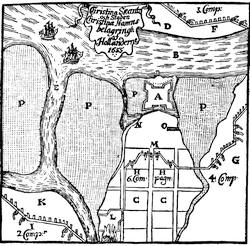
SIEGE OF CHRISTINA FORT.
This follows the rude plan given in Campanius, p. 81, extracted from Lindström’s manuscript account of the affair.
A. Fort Christina.
B. Christina Creek.
C. Town of Christina Hamn.
D. Tennekong Land.
E. Fiske Kil (now Brandywine Creek).
F. Snake Battery, of four guns.
G. Gnat Battery, of six guns.
H. Rat Battery, of five guns.
I. Fly Battery, of four guns.
K. Timmer Öland (Timber Island).
L. Kitchen.
M. Position of the besiegers.
N. Harbor.
O. Mine.
P. Reed flats.
Comp., Compagn.,—Companies of Dutch soldiers.
The next morning Factor Elswich, Sergeant Van Dyck, and Peter Rambo were sent to reply to Stuyvesant, with an assertion of the right of Sweden to the Delaware, exhorting him to refrain from acts which might lead to a breach between their sovereign and the States-General, and protesting his responsibility for all shedding of blood at Fort Christina. The Dutchman did not yield to their arguments, and on the 9th despatched a letter to Rising of similar import to that of the 6th, which was answered with a proposal that their boundaries be settled by their sovereigns, or by commissioners authoritatively appointed for that purpose. No regard was paid to this, however, by Stuyvesant, and the peculiar quasi siege was still continued, although no attempt was made to harm the garrison, notwithstanding, says Rising, there was not a spot upon the walls where they could have stood with safety. Meanwhile the Swedish force, which numbered only about thirty men, some of whom were sick and others ill-affected, noting the progress of the works of the enemy, and anticipating the speedy exhaustion of their supplies, began to entertain thoughts of surrender.
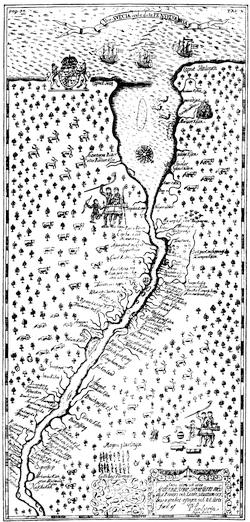
LINDSTRÖM’S MAP, 1654-1655.
[This is a reduction from the map given in Campanius, which is in itself a reduction from an original draft of the Swedish engineer. It is likewise given in Nouv. Annales des Voyages, Mars, 1843; in Memoirs of Pennsylvania Historical Society, vol. iii. part i.; in Gay’s Popular History of the United States, ii. 154, etc. Armstrong, in establishing the position of Fort Nassau, examined the following maps, which include, he thinks, all early maps of the bay and river: De Laet’s “Nova Anglia, Novum Belgium et Virginia,” 1633; Blaeu’s Theatre du Monde, 1645, marked “Nova Belgica et Anglica Nova,” which apparently follows De Laet. Also, the map of Virginia by Virginia Farrer (in Vol. III.), dated at London in 1651, and bearing this legend: “This River the Lord Ployden hath a Patten of, and calls it new Albion, but the Sweeds are planted in it and have a great trade of Furrs.” Lindström’s manuscript map of 1654, twenty-seven inches long, in the Swedish Royal Archives, of which Armstrong saw a copy in the library of the American Philosophical Society (and another copy of which, made for the late Joseph J. Mickley, has been engraved in Reynolds’s translation of Acrelius). The map of Visscher, without date (? 1654), “Novi Belgii, Novæque Angliæ necnon partis Virginiæ tabula.” Vanderdonck’s 1654, given in the preceding chapter. The map in Ogilby’s America, and in Montanus’s Nieuwe Onbekende Weereld, 1671, both from the same plate, “Novi Belgii ... delineatio,” which follows Visscher and Vanderdonck. Dancker’s “Novi Belgii,” etc. Ottens’s “Totius Neobelgii ... tabula,” following Visscher. A map, “Edita Totius Novi Belgii cura Matthæi Seutteri.” Another, “Nova Anglia ... a Baptista Homerus (Homans?).” Again, “Pennsylvania, ... cum regionibus ad flumen Delaware sitis ... per M. Scutterum.” Arent Roggeveen’s chart, 1675, which Armstrong calls the “first comparatively correct map of the bay and river.” The three types in these maps are Lindström’s, Visscher’s, and Roggeveen’s; the others are copies more or less closely. Armstrong did not, however, quite thoroughly scan the field. De Laet’s map of 1633 appeared earlier in his 1630 edition, and is given in fac-simile in Vol. III, where will also be found the map accompanying The Relation of Maryland, 1635. Blaeu’s map appeared earlier in his Nieuwe Atlas, 1635. There is also the map of the Mercator-Hondius series, reproduced in Hexham’s English translation in 1636. Sanson’s map of 1656 is also sketched in Vol. III. A map entitled Pascaerte van Nieu Nederland is in Van Loon’s Atlas of 1661. There are also two maps showing the bay in Speed’s Prospect of the most famous Parts of the World, London, 1676, which very blindly follow the Dutch maps; and we do not get any better work till we come to Gabriel Thomas’s map of 1698, which is given in fac-simile in Vol. III.—Ed.]
On the 13th Rising and Elswich had an interview with Stuyvesant, and made a last appeal on behalf of the jurisdiction of their sovereign over the territory of New Sweden, but were answered as before by the Director-General. The Dutch now brought the guns of all their batteries to bear upon the fort, and the following day formally summoned the Swedish governor to capitulate within twenty-four hours,—a proposal to which the garrison unanimously acceded, and articles of surrender were drawn up on the 15th. In accordance with these, all artillery, ammunition, provisions, and other effects belonging to the Crown of Sweden and the South Company were to be retained by them; while officers, soldiers, ministers, and freemen were permitted to keep their personal goods and have liberty to go wherever they pleased, or remain upon the Delaware, protected in the exercise of their Swedish Lutheran religion. Such of the colonists as desired to return to their native country should be conveyed thither on suitable vessels, free of expense; while Rising and Elswich, by secret agreement, were to be landed in France or England. After accepting these conditions, the Governor of New Sweden was approached by the Director-General with a proposition singularly differing from that authorized, as stated, by the Directors of the Dutch West India Company; namely, that the Swedes should reoccupy their fort and maintain possession of the land higher up the river, while the Hollanders merely reserved for themselves that south of Christina Creek,—the two nations at the same time entering into an offensive and defensive alliance with one another. It is not easy to account for this action on the part of the victorious Dutchman, unless we attribute it to the news of the invasion of New Amsterdam by a large body of Indians, just learned through a letter from his Council, urging his speedy return home, and the fear lest the Swedes might take advantage of the predicament to retake all their territory. The unexpected offer was reduced to writing at the desire of Rising, and was made the subject of a consultation with his people, who rejected it, however, fearing duplicity on the part of Stuyvesant, and dreading to incur the animosity entertained by the English and the Indians towards the Hollanders. They also thought they might thereby compromise the claim of their sovereign to the whole territory of New Sweden, and preferred to leave it to their “most worthy superiors,” as the Governor expressed it, “to resent and redress their wrongs in their own time, and in such way and with such force as might be requisite.” The delivery of this answer to the Director-General terminated negotiations. As had been stipulated, Rising, Elswich, Lindström, and other officers were allowed to remain in Fort Christina, while the common soldiers were quartered on Timber Island, until the time allotted for their departure for Manhattan. Those of the colonists who determined to stay on the Delaware were required to take oaths of allegiance to the States-General and the Dutch West India Company, and to the Director-General and Council of New Netherland. An article of the capitulation provided for the trial of Captain Schute for his surrender of Fort Trinity. This took place presently, at a courtmartial held by Governor Rising on Timber Island. The Swedish officer denied the charges preferred against him; and there is no evidence that he ever suffered punishment for them. During Stuyvesant’s sojourn in New Sweden, and particularly while he was besieging Fort Christina, the Dutch soldiers committed ravages upon the settlers, not only in this vicinity and around Fort Trinity, but at New Gottenburg, Printzdorp, Upland, Finland, and other points along the river, which were estimated by Rising at over 5,000 florins, involving incidental losses very much greater. On the 1st of October the Governor of New Sweden and his companions, among whom were Engineer Lindström and Factor Elswich, with the clergymen Nertunius and Hjort, embarked on “De Waag,” and “bade farewell” to the Delaware. After arriving at New Amsterdam, they sailed on three merchantmen in the beginning of November. Among the incidents of their voyage was the unfortunate loss of Lindström’s chest of instruments, maps, and professional papers, which fell overboard through the carelessness of the sailors, and sank to the bottom of the sea. Rising landed at Plymouth, England, from whence he went to London, on the 22d of December, reporting the conquest of New Sweden to Johan Leyonberg, the Swedish ambassador, while Lindström and his associates continued their course to Holland. After suffering many hardships, both parties finally reached their own country, and on the 17th of April certain of them appeared before the College of Commerce, to render their accounts and make their claims for services. On inquiry into the manner of the overthrow of the colony, it was determined to present a detailed report of it to his Majesty, and the returned emigrants were instructed to appeal for the settlement of their demands to the Directors of the American Company. The funds of the latter were estimated, April 27, 1655, at 158,178 riksdaler, the chief items accredited, however, being “stock for building ships,” “the cargo of ‘Örnen,’” “damages for ‘Kattan,’” “the territory of New Sweden and its forts,”—securities which did not justify such a hopeful valuation. At the present period their indebtedness was stated at 19,311 riksdaler, their assets being augmented by claims against the Dutch West India Company for the seizure of “Gyllene Hajen,” and afterward by the receipts from the “Mercurius.” Their property was found to be insufficient to discharge their many obligations, and for several years demands continued to be presented on behalf of Printz, Rising, Anckerhelm, and others, which there is little reason to think were ever fully satisfied.
During the occurrence of these events the “Mercurius” was wending her way across the Atlantic, bearing the last hope of safety for the colony, whose subjugation by the Dutch was not learned by her passengers until their arrival in the Delaware, March 14, 1656. They were denied permission to land until commands were received from Director-General Stuyvesant, either to return at once to Sweden, or, in case they needed to lay in provisions and other commodities for a fresh voyage, to repair with their vessel to New Amsterdam. So unexpected a termination of their long and arduous journey was naturally most distasteful to the emigrants, and Commissary Huygen endeavored to change the purpose of the Dutch authorities by paying them a visit and addressing to them a petition on the subject. This was without avail, however, and he was obliged to order his ship, with people and cargo, to Manhattan. The command was disobeyed by the captain, who was compelled by Papegåja and other Swedes, who boarded the vessel, to put passengers and goods ashore on the Delaware, deterring the Hollanders from firing at them from Fort Casimir by carrying along some friendly Indians, whom the Dutch were afraid to hurt. On the 3d of May, therefore, two councillors were deputed to proceed to the South River on “De Waag,” accompanied by Huygen, to enforce the command of the latter; and in July the “Mercurius” was finally brought to New Amsterdam by the Commissary, who obtained leave to sell her cargo there by payment of a satisfactory duty. How many emigrants of this last Swedish expedition to the Delaware remained in New Sweden is not known.[934] The vessel bore back Herr Matthias, and probably Papegåja, and arrived at Gottenburg in September of the same year.
In conclusion, it remains for us to indicate, very briefly, the measures taken by the Government of Sweden to regain possession of their colony, or, at least, to obtain compensation for the loss of it. As early as March, 1656, the Swedish Minister (Harald Appelboom) presented a memorial to the States-General, demanding the re-establishment of the old situation on the Delaware or the payment of indemnity to the American Company; and on the 3d of the following June Governor Rising submitted to his sovereign a plan for the reconquest of that river, supported by an array of arguments maintaining the right of Sweden to her settlement.
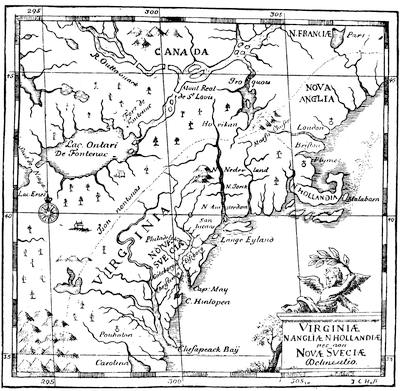
MAP OF THE ATLANTIC COLONIES.
This is the curious map given in Campanius, p. 52. It was probably suggested by, although it does not follow, a detailed and interesting manuscript map of the Atlantic coast from Cape Henry to Cape Ann, by Peter Lindstrom, 19¼ x 6⅞ inches in size, including “Virginia,” “Nova Suecia,” “Nova Batavia,” and “Nova Anglia,” which will soon be printed by the Historical Society of Pennsylvania. [The New England region has some reminiscences of John Smith’s map of 1614, though that first explorer did not place Mount Massachusetts (Chevyot Hills,—that is, the modern Blue Hills of Milton) on the borders of Lake Champlain; but he did give the entities of London and Bristow to non-existing towns. The early Dutch maps are responsible for the curiously-shaped shoal off Cape Cod, and for the southern line of New England running west from Pye Bay (Nahant). There was, of course, a necessity of bringing “Massa Chuser” in some way above that line.—Ed.]
About this time, however, the King’s attention was absorbed by enterprises in Poland, and soon after by the first war with Denmark, and nothing was accomplished; but at a meeting of his Council, April 15, 1658, his Majesty “decided, en passant, that New Sweden was well worth endeavoring to recover;” and in a decree concerning the tobacco trade, of the 22d of May, the monopoly of the West India Company was further defined, “chiefly, that the important colony of New Sweden might be preserved now and hereafter to the great advantage” of the kingdom, “and that the settlements of subjects in that region be not entirely abandoned.” Still nothing was attempted on behalf of the colony, doubtless in consequence of the breaking out of the second war with Denmark. The Company was dissolved and the tobacco trade enfranchised in 1662. The next year a fruitless demand upon the States-General for damages was made by the Swedish Regency,[935] which was followed, on the rise of difficulties between England and Holland in 1664, by the issue of orders to Appelboom to give heed to the negotiations of these powers, and to protest against the formal relinquishing of New Sweden to either nation before the indemnification of his own. During the latter year attention was still further attracted to the colony by the arrival in the spring at Amsterdam, on a Dutch ship from Christiania, of a hundred and forty Finns from the region of Sundsvall, who had been encouraged to emigrate by letters from relatives and friends who were living on the Delaware. The Swedish Government, not knowing of this correspondence, and supposing the Finns had been enticed by secret emissaries from Holland, instructed Resident Peter Trotzig and Appelboom to remonstrate against the enterprise, and to demand that the people should be returned “at the cost of those who had deceived them.” Nevertheless, the emigrants sailed in June for New Sweden in a vessel furnished by the city of Amsterdam; and the Swedish authorities were obliged to content themselves with requiring strict surveillance on the part of the governors of certain provinces in Finland to prevent such actions in the future. The matter was not referred to in the memorials addressed by Appelboom to the States-General the same month, although these boldly claimed restitution of the territory of New Sweden to the Swedish West India Company, with reimbursement of all damages sustained by it,—in support of which demands the Government also solicited the countenance and aid of France and England. This topic was renewed on occasion of the embassy of Isbrandt to Sweden; and at a conference held Nov. 16, 1665, after some attempts to defend the conduct of his countrymen on the Delaware, the Dutch envoy actually proposed that Swedes and Hollanders should endeavor, “junctis viribus,” to retake the territory from the English, who then controlled it. Isbrandt afterward requested proofs of the Swedish claims, for presentation to his Government. On Dec. 24, 1666, the College of Commerce was commanded to furnish these evidences to Count Christoffer Delphicus von Dohna and Appelboom, who were appointed to treat with the States-General upon the subject. A paper was drawn up, therefore, by that body, Feb. 27, 1667, comprising the usual arguments and copies of documents, with specifications of the losses of the Swedish West India Company, including interest amounting to the sum of 262,240 riksdaler. On the other hand, the Dutch negotiators, among whom were Isbrandt and John de Witt, produced counter claims and complaints of the Dutch Company, and demanded that “the pretensions on both sides be reciprocally dismissed.” At the final convention at the Hague, July 18, it was “ordered and decreed” that these controversies “be examined as soon as possible by his Majesty’s envoy, according to the principles of justice and equity, and satisfaction then, immediately and without delay, be given to the injured party.” It could hardly be expected, however, that the Hollanders would pay claims on property no longer theirs, especially when the loss of New Netherland had well nigh ruined the Dutch West India Company, which ought, ordinarily, to have met the obligations thus incurred. That nothing was done is evident from the fact that the Swedish Government soon afterward exerted itself, with unrepining zeal, to obtain indemnity from the power now exercising dominion over their former territory. Before the terms of the Peace of Breda were known, instructions had been issued to Dohna “to inquire whether England or Holland was in possession of New Sweden, and treat with the proper nation for the restoration of it to Sweden;” and April 28, 1669, Leyonberg, still Swedish minister at London, was required, “without attracting attention, secretly, adroitly, and cautiously” to endeavor to discover what England designed to do with her new acquisition. Subsequently papers were drawn up, setting forth the grounds of the Swedish claim to the territory in dispute, and the English ambassador at Stockholm promised “to contribute his best offices with his sovereign” to procure its recognition. From a response of Leyonberg to his Swedish Majesty, dated July 24, 1669, we learn that the question had been mooted by him, but was always put aside with assertions of the rights of England, in view of the neglect of Sweden to demand her colony at the conclusion of peace. Concerning the condition of the settlement, he had heard great praise of “the diligence and industry, the alacrity and docility of the Swedes” then dwelling on the Delaware, and had been told “their lands were the best cultivated in all that region.” Since we do not meet with any evidence that the Swedish claims were ever again referred to, we presume that at last the subject was dropped, and that henceforth the American colony was universally regarded as finally lost to Sweden.
Thus terminates the history of New Sweden under Swedish sovereignty. Although for twenty-five years after the departure of the last governor the people whose immigration to our continent has been related were almost the only civilized residents on the shores of the Delaware, and were practically nearly as independent as their fathers under the rules of Queen Christina and King Charles X. (Gustavus), they were now nominally subjects of their High Mightinesses the Lords States-General, and later of King Charles II. of England, and their career is properly included in accounts of the Dutch and English dominions of that epoch. Henceforth their connection with the mother country was confined to the limited ecclesiastical sphere of the Swedish Lutheran religion; and this was only ultimately brought to a close at the death of the Reverend Nicholas Collin, the last Swedish pastor of Gloria Dei Church in Philadelphia, in 1831, a hundred and seventy-six years after the conquest of New Sweden by Governor Stuyvesant. During all this period of perpetual contact with an enormously increasing population of other races, certain of the descendants of the Swedes who first cultivated this region sedulously observed ancestral customs, and preserved the knowledge and use of their maternal tongue within family circles. And if, on the other hand, intermarriage with their neighbors eventually confounded many of the old stock with English and German colonists of later immigrations, this merely extended the influence of that virtuous and industrious people, who became the progenitors of not a few citizens of note of several of our chief provinces and commonwealths. The colonization scheme we have endeavored to portray failed, without doubt, of the significance anticipated for it in the enlargement of the empire and the development of the trade and commerce of Sweden; but it formed the nucleus of the civilization which afterward acquired such expansion under William Penn and his contemporaries through the founding of Pennsylvania, Delaware, and New Jersey, and was the first impulse of that modern movement,—in strong contrast with the wild spirit of the ancient Scandinavian sea-kings and pre-Columbian discoverers of America,—which has contributed so large and useful a population to Illinois and Wisconsin and other Western States of our Republic.

CRITICAL ESSAY ON THE SOURCES OF INFORMATION.
THE earliest information we possess concerning New Sweden is found in the charter granted by King Gustavus Adolphus in 1624 to the Australian Company.[936] During the ensuing decade were published other documents mentioned in the beginning of the preceding narrative.[937]
The subject is referred to in a few of the Resolutien van de Staten van Holland en West Vriesland. Beauchamp Plantagenet’s Description of the Province of New Albion,[938] the Breeden-Raedt aende Vereenichde Nederlandsche Provintien,[939] and the Vertoogh van Nieu Nederland,[940] and Beschrijvinge van Nieuw-Nederlant[941] of Adriaen van der Donck give brief accounts of the settlement. Several statements with regard to it are to be found in the Historia Suecana of Johan Loccenius.[942] David Pieterszen de Vries[943] relates the circumstances of a visit he paid to it in 1643. Lieuwe van Aitzema[944] supplies copies of treaties and negotiations between Sweden and the States-General with respect to the dominion over the Delaware, an Antwoordt[945] of the latter to Resident Appelboom also appearing separately. Something of interest may be gleaned from De Hollandsche Mercurius. This, with sundry maps elsewhere referred to, constitutes, it is believed, all the contemporaneous printed matter which is still preserved to us.
A short account of the colony is contained in Samuel Puffendorf’s Commentarii de Rebus Suecicis, published at Utrecht in 1686. It was not, however, until 1702 that a book appeared professedly treating of the settlement. This was the Kort Beskrifning om Provincien Nya Sverige of Thomas Campanius Holm.[946] The fact that the author was a grandson of the Rev. Johan Campanius Holm, who accompanied Governor Printz to New Sweden, both accounts for his interest in the topic and indicates the value of much of his material.
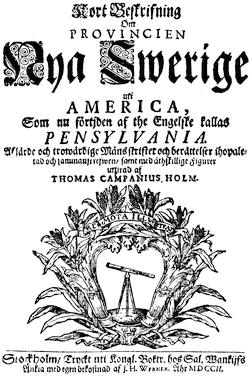
PRINTED TITLE OF CAMPANIUS.
This is chiefly drawn from manuscripts of Campanius’s grandfather and oral communications of his father, Johan Campanius Holm, who was with the former on the Delaware, and the writings of Governor Rising and Engineer Lindström, preserved among the Archives of the Kingdom of Sweden. From the latter are also taken a drawing of Fort Trinity, a plan of the siege of Fort Christina by the Dutch (both reproduced in the preceding narrative), and a pictorial representation of three Indians. There is likewise a map of New Sweden (appearing in this chapter) engraved by Campanius from a reduction (made by order of King Charles XI. of Sweden in 1696) of a map of the Swedish engineer, four Swedish ells in length and two in width, which was destroyed in the conflagration of the royal palace at Stockholm, May 7, 1697. Unfortunately, some inaccuracies occur in the work, which have been repeated by later historians, both European and American.[947]
The Dissertatio Gradualis de Svionum in America Colonia of Johan Danielson Svedberg[948] cites Campanius, and makes the first mention of Papegåja as provisional Governor of New Sweden. The author was a nephew of Jesper Svedberg, Bishop of Skara, who had the supervision of the Swedish Lutheran congregations in America,[949] and cousin-german to Emmanuel Swedenborg, the heresiarch, and his brother Jesper Svedberg, who taught school for over a year at Raccoon in New Jersey.
In the diplomatic correspondence of John de Witt[950] mention is made of the attempts of Sweden to obtain compensation for the loss of her colony from the States-General.
The Dissertatio Gradualis de Plantatione Ecclesiæ Svecanæ in America of Tobias Eric Biörck[951] cites Campanius and speaks of all the governors of New Sweden, giving a particular account of Minuit from statements of the Rev. Provost Andreas Sandel, who was pastor of the Swedish Lutheran church at Wicacoa from 1702 to 1719, and married a descendant of early Swedish colonists. The author himself was born in New Sweden, being the son of the Rev. Provost Eric Biörck, who built the Swedish Lutheran church at Christina in 1698 (his mother being a scion of old Swedish families on the Delaware), and cousin to the Rev. Provost Andreas Hesselius,[952] who succeeded his father in the charge of the church at Christina in 1713, and who commends the writer in a letter prefixed to his work.
The Breviate, Penn vs. Baltimore,[953] contains extracts from several of the Dutch Records in the Secretary’s Office at New York, including Kieft’s letter to Minuit, dated May 6, 1638, Hudde’s Report to Stuyvesant of 1648, an Indian deed of sale to the Dutch of land on the east side of the Delaware, dated April 15, 1649, and so forth.
Anders Anton von Stiernman’s Samling utaf Kongl. Bref, Stadgar och Förordningar etc., angående Sveriges Rikes Commercie, Politie, och Œconomie uti gemen[954] and Monumenta Politico-Ecclesiastica[955] comprise documents relating to the Swedish West India Company and their colony.
Peter Kalm’s Resa til Norra America[956] imparts some information concerning the settlement gathered by that illustrious Swede from Maons Keen, Nils Gustafson, and other descendants of ancient Swedish colonists, during a visit paid by him to the Delaware in 1748-1749.
William Smith, in his History of New York,[957] gives a brief account of New Sweden, citing the Beschryvinghe van Virginia, Nieuw Nederlandt, etc. He says that the English who were driven from the Schuylkill in 1642 were Marylanders, without, however, indicating his authority for the statement, which cannot be corroborated.
In 1759 appeared the Beskrifning om de Svenska Församlingars Tilstånd uti Nya Sverige of the Rev. Israel Acrelius,[958] Provost over the Swedish congregations in America and pastor of the church at Christina from 1749 to 1756. Although the greater part of this work is devoted to the subsequent history of the Swedes on the Delaware, the first eighty-eight pages of it relate to the period of the supremacy of Sweden over her colony, and contain the most complete and accurate account of the settlement till then published. The author cites and criticises Van der Donck and Campanius, and imparts fresh information derived from manuscripts in the Archives of the Kingdom of Sweden, Dutch Records in New York, and manuscripts of the Rev. Anders Rudman, pastor of the Swedish Lutheran congregation at Wicacoa from 1697 to 1701, and builder of the present Gloria Dei Church of Philadelphia.
Modeer’s Historia om Svea Rikets Handel[959] embraces facts relating to the Swedish West India Company.
Bulstrode Whitelocke’s Journal of the Swedish Embassy in the Years 1653 and 1654[960] mentions the convention entered into by Sweden and England for the observance of friendship between their colonies in America.
The Journal of John Winthrop, first Governor of Massachusetts, first printed at Hartford in 1790,[961] the second volume of Ebenezer Hazard’s Historical Collections, comprising “Records of the United Colonies of New England,” consisting of Acts of the Commissioners,[962] printed at Philadelphia in 1794, and the Rev. Benjamin Trumbull’s History of Connecticut, printed at Hartford in 1797, cast light on the relations between the colonies of New England and New Sweden.
In Professor Christoph Daniel Ebeling’s history of Delaware, in the fifth volume of his Erdbeschreibung und Geschichte von America,[963] occurs a good summary account of New Sweden, compiled from nearly all the works then published.
The Rev. William Hubbard’s General History of New England[964] includes references to the settlements on the Delaware.
In 1825 appeared Carl David Arfwedson’s De Colonia Nova Svecia Historiola,[965] giving scarcely any account of the settlement itself, but containing a fuller notice of the origin of the enterprise, with the events which led to the formation of the Swedish West India Company. It is also especially valuable as comprehending several important documents relating to the history of New Sweden not elsewhere printed. Such are parts of Een Berättelse om Nova Suecia uthi America and Relation öfwer thet ahnfall thermed the Hollendske under P. Stüvesant, Directors öfwer N. Nederland, anförande then Swenske Colonien i N. Svecia, oförmodeligen, med fiendteligheet, öfwerfalla monde,[966] both by Governor Rising, a paper concerning the Finnish emigration to America in 1664, referred to in the preceding narrative, and a short Promemoria angående Nya Sverige i America, all of which are comprised in the Palmskiöld Collections in the Royal Library of the University of Upsala. The work likewise includes a Series Sacerdotum, qui a Svecia missi sunt in Americam,[967] and a map of New Sweden.
Joseph W. Moulton’s History of New Netherland[968] contains nothing new except a reference to the Report of Andries Hudde among the Dutch Records in New York, and an estimate of the value of the writings of Campanius and Acrelius.
James N. Barker’s Sketches of the Primitive Settlements on the River Delaware[969] is based on earlier publications.
In The Register of Pennsylvania, edited by Samuel Hazard, volumes iv. and v.,[970] are printed manuscripts which are in the possession of the American Philosophical Society, and among them (particularly valuable) are translations from a French version of copies of Swedish documents procured at Stockholm by the Hon. Jonathan Russel, Minister of the United States to the Court of Sweden.
The Annals of the Swedes on the Delaware, by the Rev. Jehu Curtis Clay, Rector of the Swedish churches in Philadelphia and its vicinity,[971] shows no new matter save a short account of the colony from manuscripts of the Rev. Anders Rudman, translated by the Rev. Nicholas Collin.
Erik Gustaf Geijer’s Svenska Folkets Historia[972] makes slight references to the formation of the Ship and West India Companies of Sweden.
George Bancroft’s History of the United States[973] gives a brief account of the settlement, drawing more largely than former works upon the Argonautica Gustaviana, and magnifying the religious and political motives of Gustavus Adolphus and Axel Oxenstjerna in attempting the enterprise.
John Leeds Bozman’s History of Maryland[974] cites the statement in Smith’s History of New York, that the English residents on the Schuylkill who were dispossessed in 1642 were colonists from Maryland, but qualifies it by affirming that the Maryland Records make no mention of the settlement. Other references are made in the work to the relations between New Sweden and Maryland.
William Huffington’s Delaware Register and Farmers’ Magazine[975] contains a translation of a grant of land on the Delaware from Director-General Kieft to Abraham Planck and others in 1646 (referred to by Acrelius), preserved among the State Papers at Dover.
The first volume of the second series of the Collections of the New York Historical Society[976] has a translation of a Report of Andreas Hudde, Commissary on the Delaware, from the Dutch Colonial Records.
In 1843 appeared the Notice sur la Colonie de la Nouvelle Suède, by H. Ternaux-Compans,[977] believed to be the first and only French book on the subject. It gives a summary history of the settlement, drawn from the Argonautica Gustaviana, Loccenius, Campanius, and Acrelius, and contains a copy of Lindström’s map.
A History of the Original Settlements on the Delaware, by Benjamin Ferris,[978] gives a very full account of New Sweden, extracted from works already published in English, and is interesting and valuable as identifying and describing many of the places mentioned.
The History of New Netherland, by E. B. O’Callaghan, M.D.,[979] imparts fresh information about the relations between the Swedes and Dutch on the Delaware, and gives a translation of a “Memorial delivered by His Swedish Majesty’s Resident to their High Mightinesses, in support of the good and complete Right of the Swedish Crown and its subjects to Nova Suecia in America, June, 1664,” from the original in Aitzema.
Handlingar rörande Skandinaviens historia, tjugondenionde delen,[980] contains some letters of the Swedish Government regarding New Sweden.
Samuel Hazard’s Annals of Pennsylvania[981] supply a comprehensive history of New Sweden, derived from several of the preceding works, and comprising new matter drawn from manuscripts of the American Philosophical Society, Albany Records, translated by Van der Kemp, the Holland and London Documents, procured by J. R. Brodhead, New Haven Court and Colony Records, Records of the United Colonies of New England, and Trumbull and other manuscripts.
The Documentary History of the State of New York, edited by E. B. O’Callaghan, M.D., vol. iii.,[982] gives a letter addressed to the Classis of Amsterdam, Aug. 5, 1657, by the Reformed Dutch clergymen at New Amsterdam, Johann. Megapolensis and Samuel Drisius, referring to the circumstances of the submission of the Swedes to Director-General Stuyvesant; and the same work, vol. iv.,[983] contains a description of New Netherland in 1643-1644, by the Rev. Isaac Jogues, S. J.,[984] mentioning the Swedes on the Delaware.
In Proceedings of the New Jersey Historical Society,[985] vol. vi., are published the report of a committee appointed by that body to make explorations and researches as to the site of Fort Nassau, with a letter on the same subject, and a paper, entitled “The History and Location of Fort Nassau upon the Delaware,” by Edward Armstrong, Recording Secretary of the Historical Society of Pennsylvania. The latter is clear upon the periods of occupancy of that stronghold by the Dutch, and is especially valuable as comprising an attempt to give a complete list of maps of the Delaware River previous to 1675.[986]
In Records of the Governor and Company of the Massachusetts Bay in New England, vol. ii.,[987] is found the action of the General Court in 1644 on the petition of Boston merchants for a charter for a company to trade near the Delaware.
Documents relative to the Colonial History of the State of New York, vol. iii.,[988] procured by John Romeyn Brodhead in England, include a letter of Jerome Hawley, of Virginia, to Secretary Sir Francis Windebanke, referred to in the preceding narrative, “A Declaration shewing the illegality and unlawfull proceedings of the Patent of Maryland,” dated 1649, mentioning the great trade of the Swedes and Dutch with the Indians, and the singularly inaccurate “Relation of Mr. Garrett Van Sweeringen, of the City of St. Maries, concerning his knowledge of the seateing of Delaware Bay and River by the Dutch and Swedes,” subscribed in 1684.
John Romeyn Brodhead’s History of the State of New York[989] gives the best Dutch account of the relations between the Swedes and Hollanders, amply citing authorities on the subject. It also contains a map of New Netherland by the author.
Fredrik Ferd. Carlson’s Sveriges Historia under Konungarne af Pfalziska Huset[990] makes a brief reference to the colony, imparting fresh information from Printz’s letters and report of 1647, and the Minutes of the Royal Council, in the archives of Sweden.
Among Documents relative to the Colonial History of the State of New York, vols. i. and ii.,[991] procured by J. R. Brodhead in Holland, are many papers concerning the relations between the Swedes and Dutch on the Delaware.
Records of the Colony or Jurisdiction of New Haven[992] contain information with regard to attempts of inhabitants of New England to settle in New Sweden.
De Navorscher[993] for 1858 prints two letters from Johannes Bogaert, “Schrijver,” to Schepen Bontemantel, Director of the Dutch West India Company, dated Aug. 28 and Oct. 31, 1655 (N. S.), relating the arrival of the ship “De Waag” at New Amsterdam, and mentioning some details concerning the conquest of New Sweden by the Hollanders not elsewhere recorded.
In the Introduction to The Record of the Court at Upland (1676-1681),[994] by Edward Armstrong, a brief account of New Sweden is presented, with citations from copies of a letter and the Report of 1647 of Governor Printz in the Library of the Historical Society of Pennsylvania; while the Editor’s Notes are valuable as identifying many places on the Delaware, and comprising personal references to several of the colonists.
The History of Delaware County, Pennsylvania, by the late George Smith, M.D.,[995] contains a summary history of New Sweden, with corrections of former authors and additional information upon questions of topography, besides biographical notices of some of the Swedish inhabitants. Its illustrations include the reproduction of a part of Roggeveen’s map of New Netherland, an original “Map of the Early Settlements of Delaware County,” and a “Diagram” and “Draft of the First Settled Part of Chester, before called Upland.”
Professor Claes Theodor Odhner’s Sveriges Inre Historia under Drottning Christinas Förmyndare[996] is valuable for its account of the Swedish South, Ship, and West India Companies, and its statement of the origin of the scheme of colonizing the Delaware, drawn from original documents in the archives of Sweden.
G. M. Asher’s Bibliographical and Historical Essay on the Dutch Books and Pamphlets relating to New Netherland[997] was “intended,” says the Preface, “to be as complete a collection as the author was able to make it of the printed materials for the history and description of New Netherland.” It mentions several works connected with the history of New Sweden, particularly those of Willem Usselinx, whose character and aims in promoting the formation of the Dutch and Swedish West India Companies are cordially appreciated by the writer;[998] and its account of maps embracing the Delaware admirably supplements the essay of Armstrong already spoken of.
Although Francis Vincent’s History of the State of Delaware[999] contains no new information on New Sweden, it is worthy of notice as offering a good, if not, as the title announces, “a full account of the first Dutch and Swedish settlements.”
Professor Abraham Cronholm’s Sveriges Historia under Gustaf II. Adolf[1000] may be consulted with reference to the South Company and other subjects.
The New England Historical and Genealogical Register, vol. xxviii.,[1001] contains an article on “The Swedes on the Delaware and their Intercourse with New England,” by Frederic Kidder, giving a résumé of the statements of earlier authors, and including an English translation of a Dutch copy of an “Examination upon the letters of the Governor of New England to the Governor of New Sweden,” in the presence of Governor Printz and others, Jan. 16, 1644, and letters of Governors Printz and Winthrop[1002] never before printed. The article was also published separately with heliotype fac-similes of the letters cited.
The Illustrated History of the Commonwealth of Pennsylvania, by William H. Egle, M.D.,[1003] imparts no fresh information on the early Swedish settlements on the Delaware; but it records the discovery in the autumn of 1873, in a grave near Washington, Lancaster County, in that State, of certain so-called “Indian relics,” one of which, now in the possession of the Historical Society of Pennsylvania (represented in a cut in the book), so nearly resembles the helmet of the Swedish soldier of the seventeenth century (shown in a figure at the late Centennial Exhibition of Philadelphia), as to suggest the possibility that it may have been worn by a soldier of New Sweden. The book reproduces Campanius’s map of New Sweden after Nicolas Visscher.
In Historiskt Bibliotek, Ny Följd, I.,[1004] appeared a paper entitled “Kolonien Nya Sveriges Grundläggning, 1637-1642,” by C. T. Odhner, Professor of History in the University of Lund, which gives the most complete account of the founding and early history of the colony of New Sweden yet written, based on the Oxenstjerna manuscripts and numerous other documents preserved in several departments of the archives of Sweden. At the end of this invaluable contribution to our knowledge of the settlement is given nearly the whole of Printz’s Relation to the Swedish West India Company of 1644, with its accompanying Rulla of all the people then living on the Delaware.
Documents relating to the Colonial History of the State of New York, vol. xii.,[1005] edited by B. Fernow, Keeper of the Historical Records of New York, consists of “Documents relating to the History of the Dutch and Swedish Settlements on the Delaware River, Translated and Compiled from Original Manuscripts in the Office of the Secretary of State at Albany, and in the Royal Archives at Stockholm,”—a title sufficiently indicative of the scope and value of the book.
Pennsylvania Archives, second series, vol. v.,[1006] comprises a reprint of some papers concerning New Sweden extracted from Documents relative to the Colonial History of the State of New York, vols. i., ii., and iii., and other sources; and the same series, vol. vii.,[1007] embraces a selection of similar matter from the twelfth volume of the same New York Documents.
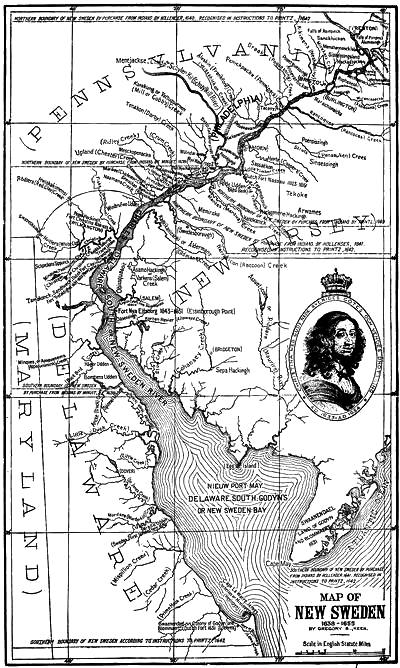
Historiskt Bibliotek of 1878 contains “Kolonien Nya Sveriges Historia,” by Carl K. S. Sprinchorn,[1008] constituting a very worthy complement to Professor Odhner’s Kolonien Nya Sveriges Grundläggning, already spoken of. After briefly capitulating the statements of the latter treatise with regard to the origin of the enterprise, and the history of the first four Swedish expeditions to the Delaware, and the one from Holland under Swedish auspices, the author proceeds to give the only account yet written of the equipment of the last six expeditions from Sweden, with fresh details as to their fate, drawn chiefly from unpublished manuscripts in the archives of his country. He also supplies the Swedish version of the difficulties with the Dutch and English, and recites the several endeavors of Sweden either to recover possession of her colony or to obtain satisfactory compensation for her loss of it. In the Appendix are printed documents relating to purchases of land from the Indians, and the Report of Governor Rising, dated July 13, 1654. A map of New Sweden, which accompanies the dissertation, indicates the principal places and the boundaries of the settlement.
The Pennsylvania Magazine of History and Biography,[1009] vols. ii. et seq., contains a series of articles, by the writer of this essay, on “The Descendants of Jöran Kyn, the Founder of Upland,”—the only genealogical account of the posterity of an early Swedish settler on the Delaware yet printed. Besides speaking of persons who bore the family name, it includes sketches of, or references to, Captain Sven Schute, Lieutenant Anders Dahlbo, the Rev. Lars Carlson Lock, Doctor Timon Stiddem, and Justices Peter Rambo, Peter Cock, and Olof Stille, inhabitants of New Sweden whose offspring intermarried with members of the Kyn (or Keen) family, and supplies instances of matrimonial alliances between the latter and many distinguished Americans of English, Scotch, Irish, French, Dutch, and German ancestry, as well as noblemen and gentlemen of Europe.
Benjamin H. Smith’s Atlas of Delaware County, Pennsylvania,[1010] affords accurate maps of Tinicum, Upland, Marcus Hook, and their vicinities, indicating tracts of land originally held by Swedes, as publicly recorded. It also includes an excellent essay on land titles in the county, with translations of Swedish grants to Governor Printz and other settlers.
Some Account of William Usselinx and Peter Minuit, by Joseph J. Mickley,[1011] is valuable from the fact that “most of the materials used in it were taken from original unpublished documents preserved in the libraries of Sweden.”
The short paper entitled “Nya Sverige,” in Svenska Bilder,[1012] by R. Bergström, comprises little of interest not included in works above mentioned.
The Pennsylvania Magazine of History and Biography, vol. vi.,[1013] contains a translation of the letter of Peter Minuit proposing the founding of New Sweden, given in a note to the preceding narrative, and an obligation of Jacob Svenson, “agent for the Swedes’ Governor of Delaware Bay,” and John Manning, of Boston, in favor of the Colony of Massachusetts, dated August 2, 1653, binding them not to carry certain provisions, obtained in New England, to either Dutch or French in those parts of America.
The above list of printed authorities on the history of New Sweden is designed to comprise all books within the knowledge of the writer which present either new facts or noteworthy opinions in relation to that subject. It only remains for him to add that all the unpublished manuscripts concerning the topic still extant are in Sweden, the greater part among the archives of the Kingdom at Stockholm, some among those of Skokloster, and others in the Palmskiöld Collections of the Library of the University of Upsala, and in the Library of the University of Lund. These embrace papers of Usselinx, correspondence of Oxenstjerna with Spiring, Blommaert, and Minuit, documents with regard to the Swedish West India Company and the equipment of the several expeditions to the Delaware, commissions and instructions for officers of the colony, letters and reports of the governors, and other records of the settlement, and diplomatic intercourse between Sweden and foreign nations about colonial questions of mutual interest.[1014] Copies of many of these (including nearly the whole of Lindström’s writings) have been procured by the late Mr. Mickley and other worthy antiquaries for the Historical Society of Pennsylvania, and are in process of translation for publication under the auspices of that body. From those manuscripts was extracted much of the material of a discourse on “The Early Swedish Colony on the Delaware,” read by the writer of this essay at the annual meeting of the same Society in May, 1881,[1015] and before the Historical Society of Delaware the following November; and from them has also been derived whatever appears in print for the first time in the preceding narrative.[1016]
