Part 2 — CHAPTER VII.
Reading edition
FRONTENAC AND HIS TIMES.
BY GEORGE STEWART, JR., F.R.S.C.
COURCELLE was succeeded as governor of New France by a man of remarkable individuality, energy, and purpose. Louis de Buade, Count of Palluau and Frontenac, is beyond any doubt the most conspicuous figure which the annals of early colonization in Canada reveal. He was the descendant of several generations of distinguished men who were famous as courtiers and soldiers. He was of Basque origin, and the blood of nobles flowed in his veins. His grandfather was Antoine de Buade, a favorite of Henri IV., and one who performed the delicate mission, in 1600, of carrying to Marie de Médicis the portrait of her royal lover. He stood high in his sovereign’s estimation, was a counsellor of state and chevalier of the noble order of the King, and the wearer of several other titles of dignity and honor. By his wife, Jeanne Secontat, he had several children, among whom was Henri de Buade, an officer of the court of Louis XIII., who succeeded to the barony of Palluau, and became colonel of a Navarre regiment. This Henri married, in 1613, Anne Phélippeaux, the daughter of the Secretary of State. The future governor of New France, the fruit of this union, was born in 1620. The King acted as godfather to the babe, and bestowed on him his own name. When the child had attained his fifteenth year he entered the army, and was sent to Holland to fight under the Prince of Orange. Four years later he was conspicuous among the volunteers at the stubborn siege of Hesdin; and at the age of twenty he displayed great gallantry during a sortie of the garrison at Arras. In 1641 he conducted himself with equal bravery at the siege of Aire, and one year later, when he was only twenty-two years of age, he took part in the struggles before Callioure and Perpignan. He was colonel of his regiment at twenty-three, and during the sharp campaign in Italy commanded in several hard-contested battles and sieges. Through all this martial career he was often wounded, and at Orbitello had an arm fractured. He became a maréchal de camp (brigadier-general) in 1646, and shortly after this the first part of his military career came to a close, and he lived for a while in his father’s house in Paris.
In October, 1648, Frontenac espoused the young and beautiful Anne de la Grange-Trianon, a maiden of imperious temper, lively wit, and marvellous grace. She was one of the court beauties of the period, the intimate friend and companion of Mademoiselle de Montpensier, grand-daughter of Henri IV. Her portrait, painted as Minerva, now adorns one of the galleries at Versailles. The marriage, which took place at the church of St. Pierre aux Bœufs, in Paris, was contracted without the knowledge of the bride’s parents. Some of Frontenac’s relatives witnessed the ceremony; but the young Countess’s friends were greatly chagrined when they were informed of the event, though their anger did not last long, and a reconciliation soon followed. Not many months had elapsed before the painful discovery was made that the young couple were unsuited to each other. The bride conceived a positive dislike of her husband; and very soon after her son[692] was born she left his roof, and accepted Mademoiselle de Montpensier’s friendly offer to join her suite. But the attachment between the two high-spirited ladies did not continue long. They quarrelled, and the fair Countess was dismissed from the court. The parting caused her some real sorrow. Afterward, it is said, she intrigued to have her husband sent out of the country. The Count had the ear of the King. He was a fine courtier, polished in manner and chivalrous in spirit. He was reputed to be one of the many lovers of the haughty beauty, Madame Montespan, the favorite mistress of Louis XIV. He had, however, a most ungovernable temper, and extravagance had left him a poor man. In 1669 Turenne, the great soldier of Europe, selected him to conduct a campaign against the Turks in Candia, where he displayed much of his wonted courage and dash, but to small purpose, for the infidels triumphed in the end. The prestige of Frontenac, however, remained untarnished, and his reputation as a military leader increased. In 1672 the King further rewarded his fidelity by appointing him Governor and Lieutenant-General of New France. Various stories have been told as to the immediate cause of his appointment. Several chronicles affirm that the King had detected his intimacy with Madame de Montespan, and resolved at all hazards to get his dangerous rival out of the way. Saint-Simon takes a different view of the situation, and says that Frontenac “was a man of excellent parts, living much in society, and completely ruined. He found it hard to bear the imperious temper of his wife, and he was given the government of Canada to deliver him from her, and afford him some means of living.” The Countess had no mind to brave the rigors of her husband’s new seat of power, and accordingly she accepted the offer of a suite of rooms at the Arsenal, where she went to live with her congenial friend, the lively Mademoiselle d’Outrelaise. During her long life at the Arsenal, she and her friend gave a tone to French society; her salon became famous for its wit and gayety, and les Divines, as the ladies were called, were sought after by the first people of the kingdom. Though she did not live with her husband, and held him in some aversion, she never forgot that she was his wife. She corresponded with him on occasion, and it is established that often she proved of signal service to him in the furtherance of his ambitious plans and projects. It was at the Arsenal she died, at the advanced age of seventy-five.
When Frontenac sailed for the colony he was a matured man of the world, and fifty-two years of age. “Had nature disposed him to melancholy,” says Parkman, “there was much in his position to awaken it. A man of courts and camps, born and bred in the focus of a most gorgeous civilization, he was banished to the ends of the earth, among savage hordes and half-reclaimed forests, to exchange the splendors of St. Germain and the dawning glories of Versailles for a stern gray rock, haunted by sombre priests, rugged merchants and traders, blanketed Indians, and the wild bushrangers. But Frontenac was a man of action. He wasted no time in vain regrets, and set himself to his work with the elastic vigor of youth. His first impressions had been very favorable. When, as he sailed up the St. Lawrence, the basin of Quebec opened before him, his imagination kindled with the grandeur of the scene. ‘I never,’ he wrote, ‘saw anything more superb than the position of this town. It could not be better situated as the future capital of a great empire.’” Such was the striking condition of Quebec when Frontenac sailed into the port to assume the functions of his office. The King, his powerful minister Colbert, the Intendant Talon, and the Governor himself regarded the colony as a great prize, and one destined for a future which should in no small degree reflect the glory and grandeur of the old monarchy. Vast sums of money had been expended in colonizing and defending it. Some of the best soldiers of the kingdom and many desirable immigrants, inured to toil and hard work, were sent by Louis to build up the new country and to develop its resources. Frontenac, imbued with the same spirit as his sovereign, proceeded to bring his enormous territory to a state of order. He convened a council at Quebec, and administered an oath of allegiance to the leading men in his dominions. He sought to inaugurate a monarchical form of government. He created, with much pomp and show, three estates of his realm,—the clergy, nobles, and commons. The former was composed of the Jesuits and the Seminary priests. To three or four gentilshommes then living in Quebec he added some officers belonging to his troops; and these comprised the order of nobility. The commons consisted of the merchants and citizens. The magistracy and members of council were formed into a distinct body, though their place properly belonged to the third estate. This great convocation took place on the 23d of October, 1672, and the ceremonies were conducted in the church of the Jesuits, which had been decorated for the purpose by the Fathers themselves.
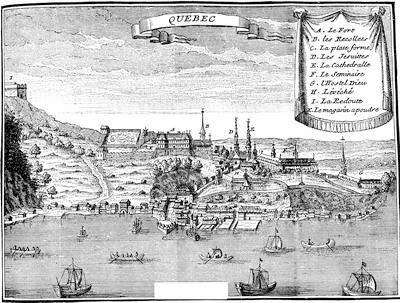
FROM LA POTHERIE.
[This view appears in the 1722 edition, i. 232; 1753 ed. ii. 232. It is also in Shea’s Le Clercq, ii. 313. Harrisse (no. 240) notes a view on the margin of a map in 1689.
Faillon, in his Histoire de la Colonie Française (iii. 373), speaks of two early plans of Quebec which are preserved, one of 1660, the other of 1664. They resemble each other, except that the last represents a projected line of fortifications across the peninsula; and in engraving the latter, Faillon’s engraver has given the plate the date of 1660, instead of 1664: Plan du Haut et Bas Québec comme il est en l’an 1660. The Catalogue of the Library of Parliament, 1858, p. 1614, shows copies of plans of these dates copied from originals in the Paris Archives. Cf. Harrisse, nos. 192-195, and no. 199 for a manuscript map of 1670, La ville haute et basse de Quebeck, also preserved in the same Archives; while the Catalogue (p. 1614) of the Canadian Parliament gives three of 1670, copies from originals at Paris.
Harrisse also notes (no. 220) as in the French Archives a Carte du Fort St. Louis de Québec, dated 1683; (no. 221) a Plan de la basse ville de Québec (1683),—both by Franquelin: (no. 224) a Plan de la Ville et Chasteau de Québec, fait en 1685, ... par le Sr. de Villeneuve; and (no. 230) a Carte des Environs de Québec ... en 1685 et 1686, par le Sr. de Villeneuve. Cf. also the Catalogue of the Library of Parliament, pp. 1615, 1616.
Plans growing out of Phips’s attack in 1690 are mentioned elsewhere. Of subsequent plans, Harrisse (no. 249) cites a Plan de la Ville de Québec, 1693, as being in the French Archives, and others (nos. 252-254, 369) of 1694, 1695, and 1699. The Catalogue of the Library of Parliament also gives manuscript plans of 1693, 1698, 1700, and 1710. Cf. J. M. Le Moine, Histoire des Fortifications et des Rues de Québec, 1875 (pamphlet).—Ed.]
Frontenac, who spoke and wrote well, made a speech to the citizens, indicating the policy which he meant to pursue, and scattering advice to the throng before him with a liberal hand. The three estates which he had founded listened to an exhortation of some length. The priests were urged to continue their labors in connection with the conversion of the Indians, whom they were advised to train and civilize while they converted. The nobles were praised for their culture and valiant conduct, and urged to be assiduous in the improvement of the colony. To the commons he recommended faithfulness in the discharge of their duties to the King and to himself. After solemnly taking the oath, the assembly dissolved. The Count next established municipal government in Quebec, on a model which obtained in several cities of France. He ordered the election of three citizens as aldermen, the senior of whom should rank as mayor. This body was to take the place of the syndic, and it was provided that one of the number should retire from office every year. The electors would then fill the vacancy with some one of their choice, though the Governor reserved the right to confirm or reject the successful candidate. He then, with the assistance of some of the chief people about him, framed a series of regulations for the government of the capital, and notified the inhabitants that a meeting would be held twice a year, where public questions would be discussed. Frontenac’s reforms were exceedingly distasteful to the King, and the minister very clearly conveyed his Majesty’s views on the subject, in a despatch written on the 13th of June, 1673. Talon, who knew the temper of the Court in such matters, had wisely abstained from taking an active part in the Governor’s scheme, and feigned illness as the cause for his non-attendance at the convention. Colbert wrote: “The assembling and division of all the inhabitants into three orders or estates, which you have done, for the purpose of having them take the oath of fidelity, may have been productive of good just then. But it is well for you to observe that you are always to follow, in the government and management of that country, the forms in force here; and as our kings have considered it for a long time advantageous to their service not to assemble the States-General of their kingdom, with a view perhaps to abolish insensibly that ancient form, you likewise ought very rarely, or (to speak more correctly) never, give that form to the corporate body of the inhabitants of that country; and it will be necessary even in the course of a little time, and when the colony will be still stronger than it now is, insensibly to suppress the syndic, who presents petitions in the name of all the inhabitants, it being proper that each should speak for himself, and that no one should speak for the whole.” Louis’ policy was unmistakable. He assumed to be the autocrat of his dominions, and anything which might be construed into an attempt to weaken the principles of his policy met with a stern rebuke. Frontenac’s colonial system might have benefited New France: it was capable of being wisely administered, and rich developments might have ensued; but the King would not have it, and the Governor was forced to withdraw his plan.
Arbitrary and domineering to a degree, always anxious to preserve his dignity and to exact respect from his subordinates in office and from those about his court, whether lay or clerical, and a martinet in compelling the observance of all rules of social and military discipline, Frontenac, as may be supposed, did not get on well with all parties in the colony. He made the fatal mistake of quarrelling with the Jesuits and the Seminary priests,—the two religious orders which at that time held the greater sway in Canada, and whose influence among the people, and sometimes at court, was important, and not easy to dispel. An enemy was also found in the Intendant Talon, who suspiciously watched every movement which the Governor made, and regularly reported his impressions to France. Talon, however, was recalled before the quarrel had assumed very formidable proportions, and Frontenac was well rid of him. A more dangerous element, and one which could thwart him and upset his schemes, remained, however, to tantalize him. He had his religious convictions, and was accounted a good-living man, in the ordinary acceptance of the term. He regularly went to Mass, and followed the observances of the Church; but his Catholicism was framed in a more liberal school than that of the followers of Loyola. His enemies said that he was a Jansenist. He leaned towards the Recollect Fathers, attended their place of worship, and often called on the King for additional priests of that order, and took every opportunity to show them attention and marks of his favor. When the Jesuits appeared too strong in number, he sent to France for more Recollects, and through them he neutralized to some extent the influence of the former. But the Jesuits were powerful, diplomatic, and insidious. They constantly watched their opportunity, and changed their mode of warfare according to the circumstances of the hour. When the gloved hand answered their purpose, they used it; but they had no scruple to strike with stronger weapons. Had Frontenac chosen at the outset of his career to conciliate them and to play into their hands, his administration might have been less fretful to himself and vexatious to others. He might have fulfilled his original intention, and bettered his fortunes in the way he desired. He might have carried out some of his cherished reforms, for his zeal in that direction was really very great, and he had his heart in his task; but his haughty disposition would not be curbed, and he preferred to be aggressive towards the Jesuits rather than conciliatory. The result may be foreseen. Enemies sprang up about him on every side, and often they were more dangerous than the Iroquois tribes who constantly menaced the colony, and far more difficult to check than the English of Massachusetts or of Albany. He early began writing letters to the minister about his trials with the clergy. On the 2d of November, 1672, he wrote: “Another thing displeases me, and this is the complete dependence of the Grand Vicar and the Seminary priests on the Jesuits, for they never do the least thing without their order; so that they [the Jesuits] are masters in spiritual matters, which, as you know, is a powerful lever for moving everything else.” He complained of their spies, and proceeded to resist their influence wherever he found it asserting itself. The Sulpitians fared no better at his hands, and he waged as bitter a warfare against them and those who followed their teachings. He befriended the Recollects so warmly, that it is not strange that they eagerly lent him all the assistance they could to further his efforts in breaking down the power of their rivals. It is said that at first he favored them out of a mere spirit of opposition to the Bishop and his allies, the Jesuits; but as time wore on, his favor deepened into affection, and he more than once declared to the King that the Recollects ought to be more numerous than they were. He told Colbert that their superior was a “very great preacher,” and that he had “cast into the shade and given some chagrin to those in this country who certainly are not so able.” He charged the clergy with abusing the confessional and intermeddling with private family affairs, and expressed his dislike in strong terms of their secret doings in the colony, and their attempts to set husbands against wives, and parents against children,—“and all,” he wrote to the minister, “as they say, for the greater glory of God.” It is clear that the Count distrusted the “Black Gowns” from the very first, and resolved to hold them at arm’s length. Much of his energy was wasted in trying to lessen their influence at court; and the King and his minister were kept pretty busy reading and answering the recriminatory letters of the Governor and his unsympathetic intendants, whose feelings always prompted them to side with the Jesuits and the Church, and against Frontenac.

A policy of Louis XIV. was the civilization of the Indians, and Frontenac was, early in his career, instructed to take means to civilize them, to have them taught the French language, and to amalgamate them with the colonists. At that time the Count knew very little about Indian nature; but he embarked in the scheme with all his energy and zeal. He soon gained a mastery over the most savage tribes, taught the warriors to call him father, and succeeded in inducing the Iroquois to intrust him with the care of eight of their children,—four girls and four boys. The former were given to the Ursulines, while he kept two of the boys in his own house, and placed the others, at his own cost, in respectable French families, and had them sent to school to be educated. He tried to get the Jesuits to assist him in this task, but they failed to respond cordially to his urging; and he complained bitterly of their want of sympathy with the movement, even charging them—not very accurately, it must be admitted—with “refusing to civilize the Indians, because they wished to keep them in perpetual wardship.”
But a new question now arose, and Frontenac’s mind was turned towards western exploration. He warmly favored the idea, and, relinquishing for the moment all thought of his trials with the priests, he gave his whole attention to the proposals of that bold and self-reliant explorer, the Sieur Robert de la Salle. This young man was poor in pocket, but his head was full of schemes. There was much in common between the two men. Both had strong will and ability of no mean calibre. They were not easily discouraged, and having once engaged in an undertaking, they had sufficient determination to carry it through. Frontenac greatly liked La Salle, and the two remained fast friends for many years. A short time before the Governor arrived in Canada, the Iroquois had made an attack on the French, and Courcelle had been compelled to punish them. To keep them in check and to facilitate the fur-trade of the upper country, he decided that a fort should be built near the outlet of Lake Ontario. This determination had also been reached some time before by the Intendant Talon, and both officers had submitted the suggestion to the King. Frontenac was not long in perceiving the advantages which the establishment of such a fort presented, and he resolved to build it, as much to protect the colony as to augment his own slender resources, which were running very low. La Salle had gained the confidence of the Governor, who had listened to his overtures, and manifested great interest in everything he said. “There was between them,” says Parkman, “the sympathetic attraction of two bold and energetic spirits; and though Cavelier de la Salle had neither the irritable vanity of the Count nor his Gallic vivacity of passion, he had in full measure the same unconquerable pride and hardy resolution. There were but two or three others in Canada who knew the western wilderness so well. He was full of schemes of ambition and of gain; and from this moment he and Frontenac seem to have formed an alliance which ended only with the Governor’s recall.” The fort recommended by Courcelle, if built, might be employed in intercepting the trade which the tribes of the upper lakes had begun to carry on with the Dutch and English of New York. This trade Frontenac resolved to secure for Canada, though it must be said that those who would have control of the fort would monopolize the larger share of the traffic to themselves, to the great displeasure of the other merchants, who resolutely set their faces against the project. Frontenac knew this perfectly well, for it was principally with a desire to benefit himself that he had given the plan countenance. La Salle understood the western country, and was familiar with Lake Ontario and its shores. He soon convinced the Governor that the most suitable spot for the contemplated fortified post was at the mouth of the River Cataraqui, and there, where the city of Kingston now stands, the fort[693] was built, in July, 1673. La Salle had told Frontenac that the English were intriguing with the Iroquois and the tribes of the upper lakes to get them to break the treaty with the French and bring their furs to New York. This statement was true, and it hastened the Governor’s action. With his usual address, he announced his intention of making a tour through the upper parts of the colony with a strong force of men, that the Iroquois and their associates might be intimidated, and with a view to the securing of a more permanent peace. He had no money to carry on this crusade, so he issued an order to the people of Quebec, Montreal, and Three Rivers, and other settlements within his jurisdiction, calling on them to supply him, at their own cost, with men and canoes as soon as the spring sowing had passed. The officers in the colony were requested to join the expedition, and they dared not refuse. On the 3d of June Frontenac left Quebec, accompanied by his guard, his staff, some of the garrison of the Castle of St. Louis, and a band of volunteers. Arriving at Montreal, he tarried there thirteen days with his following. There were some matters which required his attention, and he speedily set about to arrange them in a manner which should at least be satisfactory to himself.
La Salle had been despatched to Onondaga, the political stronghold of the Iroquois, on a mission to secure the attendance of their chiefs at a council convened by the Governor, to be held at the Bay of Quinté, situated on the north of Lake Ontario. While the intrepid traveller was on his way, Frontenac changed his mind about the place of rendezvous, and sent a messenger after him, calling the sachems to meet at Cataraqui, where he decided to construct the fort. The Governor of Montreal received Frontenac with suitable honors. He met him on shore with his soldiers and people, a salute was fired, and the judge and the syndic pronounced speeches of interminable length, but loyal and patriotic in sentiment. The priests of St. Sulpice received him at their church, where an address of welcome was presented. The Te Deum was sung, and the Count then retired into the fort, and began preparing for his coming journey. It was not long before he discovered that his project found little favor in the eyes of the people of Montreal, who feared that much of their trade might be diverted from them by the construction of the new post. The Jesuits, too, were opposed to the rearing of forts and trading posts in the upper districts, and they did what they could to discourage the scheme. Frontenac was warned that a Dutch fleet had captured Boston, and would soon proceed to attack Quebec. Dablon was the author of this last rumor; but the Count turned a deaf ear to remonstrance and report, and continued his preparations. His followers and their stores were already on the way to Lachine, and on the twenty-eighth of June the Governor-General himself set out. His force consisted of four hundred men, including the Mission Indians, and one hundred and twenty canoes and two flat-bottomed boats. The voyage was an arduous and difficult one. Without the Indians, it is a question whether it could have been accomplished at all. The fearful journey was full of perils and hardships, and, to add to their discomfiture, before the place of destination was reached rain fell in torrents. Frontenac’s management of the Indians approached the marvellous. They worked for him with genuine zeal, and showed by their toil as much as by their manner that they respected his authority and admired him as a man. He divined the Indian nature well, though he had been in the country but a few months; and the longer he remained in the colony, the greater his influence over them became. He knew when to bully and when to conciliate, when to apply blandishments and when to be stern. It was a happy thought which prompted him to call himself their father. It gave him the superiority of position at once. Other Onontios were brothers; but the great Onontio was the father.[694] He really liked the Indians, and could enter into their ways and customs with a spirit born of good-will. He was a frank, and often fiery soldier, and a true courtier; but he could be playful with the Indian children, and it was not beneath his dignity to lead a war-dance, should policy demand, as it did sometimes. He seemed to know the thoughts of his dusky friends, and they felt that he could read what was passing through their minds. His control over the tribes, friends and foes alike, was certainly never surpassed by any white man.

He was, moreover, true to his allies; and on more than one occasion refused to make peace for himself with the ferocious Iroquois, when he could easily have done so, unless they complied with his terms, and included in the treaty the Indians friendly to the French. He would never abandon his friends to save himself; and the tribes, hostile and friendly, early in his career learned this, and it served to establish his fame as a man of fair dealing and chivalrous principle. He never yielded his point even when his savage enemies were many and his own forces few and feeble. He maintained his ascendency always, and lecturing his children, pointed out the duties they should observe. Such was his personal magnetism, that they listened and obeyed him when their following was five times as great as his own. The secret of Frontenac’s supremacy over savage nature seemed to lie in the fact that he never ceased to have perfect faith and belief in himself. He had fiery blood in his veins, and an iron will, that the blandishments which he employed at times never quite concealed. Even when reduced to severe straits, he did not lose that boldness of demeanor which carried him through so many perils. The Iroquois gave him most trouble. They were fond of fighting, and when they were not attacking the French, they were waging war on the Illinois and Hurons, and on other tribes whose aid was often found on the side of Frontenac. The Confederacy preferred to sell their peltries to the English and Dutch of Albany, than to the French. They drove with the English better bargains and secured higher prices, and the English encouraged them to bring to them their beaver skins. But the tribes who were friendly to their white enemies had by far the richest product of these furs, and La Salle’s fort of St. Louis, the mission of Michillimackinac, and other posts really controlled the trade. To gain this traffic, and to divert it into the hands of their newly-found friends, the English and Dutch, the five tribes of the League proceeded in 1673 to make war on the Indians who engrossed it. Great anxiety was felt in the colony when this determination on the part of the Confederacy became known, and the tribes interested—the Illinois, the Hurons, and Ottawas—manifested the utmost fear. Frontenac deemed a conference advisable, and he invited the Iroquois to come to him and discuss affairs; but the arrogant warriors sent back an insolent answer, and told the messenger that Frontenac should come to them,—a suggestion which some of the French, who were terror-stricken, urged the Governor to act upon. But the Count had no such intention, and refused to make any concession. He sent them word that he would go no farther than Montreal, or, at the utmost, to Fort Frontenac, to meet them. In August, he met the Hurons and Ottawas at Montreal in council. There had been jealousy among the tribes, but the Count warned them against dissension among themselves, called them his children, and exhorted them to live together as brethren. A celebrated Iroquois chief came next, with several of his followers. This was Decanisora, who invited Frontenac to Oswego to meet the Five Tribes. The Count, determined to hold his ground, replied with firmness, “It is for the father to tell the children where to hold council, not for the children to tell the father. Fort Frontenac is the proper place, and you should thank me for going so far every summer to meet you.” He then conciliated the chief with presents and a wampum belt, telling him that the Illinois were Onontio’s children, and therefore his brethren, and that he wished them all to live together in harmony. There was peace for a brief space, but it did not continue many months.
When Frontenac neared the end of his toilsome journey, and had reached the first opening of Lake Ontario, he made up his mind to show the Iroquois the full extent of his power, and to make as imposing a display as possible. He arranged his canoes in line of battle, and disposed of them in this wise: four squadrons, composing the vanguard, went in front and in one line; then the two bateaux followed, and after them came the Count at the head of all the canoes of his guard, of his staff, and of the volunteers attached to his person. On his right, the division from Three Rivers, and on his left, the Hurons and Algonquins were placed. Two other squadrons formed a third line, and composed the rear-guard. In this order they proceeded about half a league, when an Iroquois canoe was observed to be approaching. It contained the Abbé d’Urfé (who had met the Indians above the River Cataraqui, and notified them of the Count’s arrival) and several Iroquois chiefs, who offered to guide their visitors to the place of rendezvous. After an exchange of civilities, their offer was accepted, and the whole party proceeded to the spot selected. The Count was greatly pleased with the locality, and spent the rest of the afternoon of the 12th of July in examining the ground. The Iroquois were impatient to have him visit them that night in their tents; but he sent them word that it was now too late, but that in the morning, when it would be more convenient to see and entertain each other, he would gladly do so. This reply was considered satisfactory. At daybreak the next morning, the réveillé was sounded, and at seven o’clock everybody was astir and under arms. The troops were drawn up in double file around Frontenac’s tent, and extended to the cabins of the Indians. Large sails were placed in front of his tent for the savage deputies to sit on, and to the number of sixty they passed through the two files thus formed to the council. They were greatly impressed with the display, and “after having sat, as is their custom, and smoked some time,” says the journal of the Count’s voyage, “one of them, named Garakontie, who had always been the warmest friend of the French, and who ordinarily acted as spokesman, paid his compliment in the name of all the nations, and expressed the joy they felt on learning from Sieur de la Salle Onontio’s design to come and visit them. Though some evil-disposed spirits had endeavored to excite jealousy among them at his approach, they could not, they said, hesitate to obey his orders, but would come and meet him in the confidence that he wished to treat them as a father would his children. They were then coming, they continued, as true children, to assure him of their obedience, and to declare to him the entire submission they should always manifest to his command. The orator spoke, as he claimed, in the name of the Five Nations, as they had only one mind and one thought, in testimony whereof the captain of each tribe intended to confirm what he had just stated in the name of the whole.” The other chiefs followed, and after complimenting Frontenac, each captain presented a belt of wampum, “which is worthy of note,” says the chronicle, “because formerly it was customary to present only some fathoms of stringed wampum.”
The Count replied in a form of address very similar to theirs. He assured them that they did right in obeying the command of their father, told them to take courage, and not to think that he had come to make war. His mind was full of peace, and peace walked by his side. After this harangue, he ordered six fathoms of wampum to be given to them, and a gift of guns for the men, and prunes and raisins for the women and children. The great council took place later on. Meanwhile, the construction of the fort began, and the workmen pursued their task with such ardor and speed, that by the 17th of July, the date fixed for the grand council, it was well advanced. The work was done under the supervision of Raudin, the engineer of the expedition. The Indians watched the building of the fort with curious interest. The Count regularly entertained two or three of the principal Iroquois at each meal, while he fondled the children and distributed sweetmeats among them, and invited the squaws to dance in the evenings. The great council assembled at eight o’clock in the morning. The ceremony was the same as that which had been observed at the preliminary meeting. Frontenac wore his grandest air. He entreated them to become Christians, and to listen to the instructions of the “Black Gowns.” He praised, scolded, and threatened them in turn, and drawing their attention to his retinue, said: “If your father can come so far, with so great a force, through such dangerous rapids, merely to make you a visit of pleasure and friendship, what would he do if you should awaken his anger, and make it necessary for him to punish his disobedient children? He is the arbiter of peace and war. Beware how you offend him.” He further warned them not to molest the allies of the French, on pain of chastisement. He told them that the storehouse at Cataraqui was built as a proof of his affection, and that all the goods they needed could be had from there. He could not give them the terms yet, because the cost of transportation was so far unknown to him. He cautioned them against listening to men of bad character, and recommended the Sieur de la Salle and such as he as persons to be heeded. He asked the chiefs to give him a number of their children to be educated at Quebec, not as hostages, but out of pure friendship. The Indians wanted time to consider this proposition, and the next year they acceded to it. At intervals, during the delivery of his speech, Frontenac paused and gave the Indians presents, which seemed to please them. The council closed, and three days later, the Iroquois started on their journey homeward, while Frontenac’s party returned in detachments. The fort was finished, and the barracks nearly built. Frontenac would have left with his men for home sooner than he did, but a band of Indians from the villages on the north side of Lake Ontario being announced, he remained with some troops to receive them. He treated them as he had treated the others, and pronounced the same speech. Leaving a garrison in the fort, he then set out for Montreal, which he reached on the 1st of August.[695]
The enterprise cost the King ten thousand francs, and Frontenac regarded the investment as a good one indeed. He hoped that he had impressed the savages with fear and respect, that he had obtained a respite from the ravages of the Iroquois, and that the fort would be the means of keeping the peltry trade in the hands of the French, its situation affording the opportunity of cutting it off from the English, who were making efforts to secure it for themselves. Frontenac wrote to the minister in November, that with a fort at the mouth of the Niagara and a vessel on Lake Erie, the French could command all the upper lakes.
François Perrot, the Governor of Montreal, owed his position to Talon, his wife’s uncle, who had induced the Sulpitians, the proprietors and feudal lords of Montreal and the island, and in whom the appointment rested, to give the place to him. Knowing that the priests could at will depose him, he sought to protect himself by asking the King to give him a royal appointment. This Louis did; and the Sulpitians could now make no change without consent of the King. Perrot was a man of little principle, selfish and unscrupulous, who turned every movement to his own advantage. His passion was for money-making, and his position as governor gave him many opportunities. One of his first acts, with that object in view, was to set up a storehouse on Perrot Island, which gave him full command of the fur-trade. This post was situated just above Montreal, and directly in the route of the tribes of the upper lakes and their vicinity. A retired and trusted lieutenant, named Brucy, was placed in charge, whose chief business it was to intercept the Indians and secure their merchandise, to the no small profit of the Governor and himself, and the great scandal of the neighborhood. The forests were ranged by coureurs de bois, who also trafficked with the savages, and bore off the richest peltries before the real merchants of Montreal had had the opportunity. King Louis had in vain attempted, by royal edicts of outlawry and stringent instructions to his representatives and subordinates, to dislodge the bushrangers and to put an end to their doings. The coureurs de bois, however, were hardy sons of the soil; some of them were soldiers who had deserted from the army; all of them were men of endurance, and accustomed to brave the sternest hardships. They loved their wild life and the adventurous character of their calling. They were, moreover, on very excellent terms with Perrot, who connived at their escapades and shut his ears to all complaint. He had no motive to heed the order of his sovereign, so long as the wayward rangers shared with him the proceeds of their dealings with the Indians. This, on their part, they were very willing to do.
Frontenac was jealous of Perrot’s advantages, and though he had but few soldiers in his command with whom to enforce obedience, he determined to strike a blow at the bushrangers, and make an attempt to execute the King’s orders. Perrot had of late grown despotic and tyrannical. He was comparatively beyond the reach of his superior, and had matters pretty much under his own control. The journey from Quebec to Montreal sometimes occupied a fortnight, and the Governor-General, as he well knew, was not able to strike heavily with the shattered remnants of forces who served under him. Perrot was therefore bold and defiant; but he miscalculated the temper of his chief, and it was not long before the arms of Frontenac were long enough to reach him. Perrot, in a fit of temper, had imprisoned the judge of Montreal because that functionary had dared to remonstrate against the disorders which had been perpetrated by the coureurs de bois. The affair caused much excitement; and with other acts of the Governor, the Sulpitians were soon convinced of the grave error they had made in their choice of a chief magistrate. They were powerless, however, to unseat him. Frontenac now wrote to the minister, and asked for a galley, to the benches of which it was his intention to chain the outlaws as rowers. He then ordered the judge at Montreal to seize every coureur de bois that he could find. Two of them were living at the house of Lieutenant Carion, a friend of Perrot’s, and when the judge’s constable went to lay hands on them, Carion abused the officer, and allowed the men to escape. Perrot indorsed the conduct of his lieutenant, and even threatened the judge with arrest, should he make a similar attempt again.
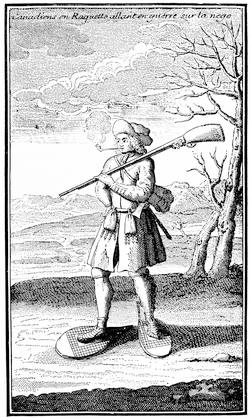
CANADIAN ON SNOW-SHOES.
A fac-simile of a print in Potherie, vol. i.
Frontenac, when he heard of the manner in which his orders had been treated, flew into a passion. He despatched Lieutenant Bizard and three soldiers to Montreal, charged to arrest and convey to the capital the offending Carion. Bizard succeeded in making the arrest, and left a letter in the house of Le Ber the merchant for Perrot, from Frontenac, giving notice of what had been done. Perrot was, however, earlier advised of the arrest. He hastened with a sergeant and three or four soldiers, found Bizard, and indignantly ordered him under arrest. Nor did Le Ber fare better, for, because he had testified to the scene he had witnessed, he was thrown into jail. These arrests produced much excitement in the place, and Perrot after a while was aware that he had acted with inconsiderate rashness. He released Bizard, and sent him off to Quebec, the bearer of a sullen and impertinent letter to the Count. In due time an answer came, in an order to come to Quebec and render an account of his conduct. Frontenac also wrote to the Abbé Salignac de Fénelon,[696]—a zealous young missionary stationed at Montreal, one of whose uncles had been a firm friend of Frontenac during the progress of the Canadian war,—and desired him to see Perrot and explain the situation. The Abbé’s task was a delicate but congenial one, and he pursued it with such good effect that the Governor was induced to accompany him to headquarters. They made the journey on snow-shoes, and walked the whole distance of one hundred and eighty miles on the St. Lawrence. The interview with the Count was short. Both men were choleric and easily excited. Perrot was disappointed at his reception, after taking the trouble to come so far, and at such a season of the year. Frontenac was stubborn and angry, and the position of his rival at his feet did not mollify his passion, but rather increased it. He put an end to the interview by locking up his offending subordinate in the château, and ordering guards to be placed over him day and night. A trusty friend of Frontenac, La Nouguère by name, was despatched to Montreal to take command. Brucy was seized and cast into prison, while a determined war was made on the coureurs de bois. The two who had been the main cause of the recent trouble were captured and sent to Quebec, where one of them was hanged in the presence of Perrot. The end of this war of extermination soon came, and Frontenac informed the minister that only five of these rangers of the wood remained at large; all the others had returned to the settlements, and given up their hazardous calling.
The old jealousy between Quebec and Montreal now showed itself again. The Sulpitians thought that Frontenac had acted a high-handed part in placing La Nouguère in command over their district without as much as consulting them. Perrot was still their selected governor, and they revolted against the arbitrary conduct of the Governor-General. They roused the colonists against Frontenac’s course, and the Abbé Fénelon, who possessed many of the indiscretions of youth, and who felt that he had been trapped, became the most bitter of the Count’s enemies. Before he left Quebec to return home, he gave his former friend a good deal of abuse; and his first act on reaching Montreal was to preach a sermon full of meaning against Frontenac. Dollier de Casson, the superior of the congregation, reproved the preacher and disclaimed the sermon. Fénelon, in turn, declared that bad rulers in general, and not Frontenac in particular, were meant; but his future conduct belied his words. He made the cause of Perrot his own, and was active in his behalf. Frontenac summoned him before the council on a charge of inciting sedition. The Abbé d’Urfé, a relative of Fénelon, tried to smooth matters over with the Count, but he fared very ill, and was shown the door for his pains.
And now ensued a remarkable trial before the council at Quebec. Perrot was charged with disobeying the royal edicts and of treating with contempt the royal authority. The other offender was the Abbé Fénelon. Frontenac had a pliant council to second his wishes. The councillors owed their positions to him, and as he had power to remove them when he willed, they soon ranged themselves on his side, and showed that they were friendly to his cause. Perrot challenged the right of the Governor-General to preside over the case, on the ground that he was a personal enemy. He moreover objected to several of the councillors on various pretexts. New judges were appointed for the trial, and Perrot’s protests continuing, the board overruled all his exceptions, and the trial went on. Other sessions proceeded to try the impetuous Abbé. Frontenac presided at the council-board. When Fénelon was led in, he seated himself in a vacant chair, though ordered to stand by the Count, and persisted in wearing his hat firmly pressed over his brows. Hot words passed between the Governor and his prisoner, the result of which was that the Abbé was put under arrest. The priest assumed that Frontenac had no right to try him, and that the ecclesiastical court alone had jurisdiction over him. The war grew fierce, and the councillors, half afraid of what they had done, at length decided to refer the question to the King himself. The Governor of Montreal and the vehement Abbé were accordingly despatched to France, and all the documents relating to the case were sent with them. Frontenac presented his side of the argument in a long despatch, which, considering his provocation, was moderate in tone and calm in judgment. The Abbé d’Urfé accompanied the prisoners to France, and as his cousin, the Marquise d’Allègre, was shortly to marry Seignelay, the son of Colbert, he hoped much from his visit. Perrot, too, was not without friends near the King: Talon, his wife’s relative, held a post at court. Besides these influences the Church had other means at work.
In April, 1675, the King and Colbert disposed of the Perrot question. They wrote calmly and with dignity. His Majesty condemned the action of Perrot in imprisoning Bizard, and had the offender confined for three weeks in the Bastile, “that he may learn to be more circumspect in the discharge of his duty, and that his example may serve as a warning to others.” He had already endured ten months of imprisonment in Quebec. The King also told Frontenac that he should not, “without absolute necessity,” cause his “commands to be executed within the limits of a local government, like that of Montreal, without first informing its governor.” Perrot was sent back to his government, and ordered to apologize to Frontenac. Colbert informed the Count of the approaching marriage of his son with the heiress of the house of Allègre, and hinted at the closeness of the connection which existed between the Abbé d’Urfé and himself. Frontenac was urged to show the Abbé “especial consideration,” and also to treat with kindness the priests of Montreal. Fénelon was sustained in his plea that he had the right to be tried by an ecclesiastical tribunal; but his superior, Bretonvilliers, absolutely forbade him to return to Canada, and wrote a letter to the members of his order at Montreal, telling them not to interfere in worldly matters, but to profit by the example of M. Fénelon. He advised them “in matters of this sort” to “stand neutral.”

The King now resolved to make some administrative changes in New France, with a view, it is probable, of lessening the hold of Frontenac on the body politic of the colony. He announced that the appointment of councillors should rest with him alone in future, and promptly filled the vacant office of Intendant by appointing M. Duchesneau whose duty it was to watch the Governor-General, and to manage certain details in executive work. Bishop Laval, who had been absent from Canada for some time, also returned to his see; and Frontenac, who had ruled alone, without bishop, without intendant, and with a subservient council, viewed the new aspect of affairs with ill-concealed disgust. It was not long before the threatened outbreak came. The question of selling brandy to the natives, which had disturbed previous administrations, became again a contention between governor and prelate.[697] The Intendant promptly sided with the Bishop and the clergy, while the latter stood aside at times, and allowed their secular ally to lead the contest, content themselves to give him arguments and advice. One question after another arose. Many of them were of trivial import, but all of them were vexatious and troublesome, and to an imperious mind like Frontenac’s galling in the extreme. The old rivalry of Church and State in the matter of honors and precedence became troublesome. Colbert wrote strongly to Duchesneau, and ordered him not to make himself a partisan of the Bishop, and to pay proper respect to Frontenac. The latter was commanded to live in harmony and peace with the Intendant. The King was incensed at the constant bickerings, and ordered Frontenac to conform to the practice prevailing at Amiens, and to demand no more. The Intendant was roundly berated by the minister, who told him that he ought to be able to understand the difference between a governor and an intendant, and that he was completely in the wrong as regards the pretensions he had assumed.
But if the religious quarrel was settled for a time, a civil difficulty arose. The council no longer remained a mere body for registering the Governor’s decrees. The new order of things gave him a council of men who were opposed in many respects to his views and interests. The King had reinstated Villeray,—a former councillor, and a man wholly under Jesuitical influence. Frontenac, who thought him a “Jesuit in disguise,” called him “an intriguing busybody, who makes trouble everywhere.” The attorney-general was Auteuil, another enemy of the Governor. Tilly was a third member, and the Count at first approved of him; but his opinion was destined to change. Under the ordinance of Sept. 23, 1675, the Intendant, whose official position entitled him to rank as the third man in the colony, was appointed president of the council. His commission, dated June 5, 1675, read: “Présider au Conseil Souverain en l’absence du dit Sieur de Frontenac.” Frontenac was styled in many of the despatches which reached him from the Crown, “Chief and President of the Council.” A conflict of authority immediately arose, and both Governor and Intendant claimed with equal right (one would suppose from the royal documents in their possession) the position of presiding officer. Frontenac bided his time, and remained patient until late in the autumn, when the last vessel cleared for France. Then he asserted his claim to the title of chief and president, and demanded to be so styled on the records of the council. In support of his contention he exhibited a letter from Louis dated May 12, 1678. The Intendant, supported by the clergy, opposed the claim. The Governor refused to compromise, scolded Duchesneau, and threatened to teach him his duty, while he ordered Villeray, Tilly, and Auteuil to their houses, and commanded them to remain there until he should give them permission to leave.[698] Auteuil begged the King to interfere, and the wearied monarch wrote to his representative: “You have wished to be styled Chief and President on the records of the supreme council, which is contrary to my edict concerning that council; and I am the more surprised at this demand, since I am very sure that you are the only man in my kingdom who, being honored with the title of governor and lieutenant-general, would care to be styled chief and president of such a council as that of Quebec.” So the King refused the title of president to either, and commanded that Duchesneau should perform the duties of presiding officer. He also said that Frontenac had abused his authority in exiling two councillors and the attorney-general for so trivial a cause, and warned him to be careful in future, lest he be recalled from office. Several other disputes in the council followed. They were mostly about matters of small moment, but they created great storms while they lasted. The imprisonment of Councillor Amours by order of the Count for an alleged infringement of the passport law, and the presence of his wife with a petition to the council for redress and a speedy trial, caused much discussion and provoked very strong feeling.
Duchesneau was the object of Frontenac’s constant displeasure. On him was visited his fiercest wrath; but the Intendant bore it all with varying moods,—sometimes disputing with Frontenac, at others abusing him, and occasionally treating the diatribe of vituperation which flowed from the Count’s lips with lofty disdain and scorn. He wrote letters to the Court, and lodged complaint after complaint against the Governor, who, in his turn, pursued the same course. Out of the council quarrels others involving more important issues sprang up, and nearly all the people in the colony were in time driven to one side or the other. With Frontenac, as Parkman points out, were ranged La Salle and his lieutenant, La Forêt; Du Lhut, the leader of the coureurs de bois; Boisseau, agent of the farmers of the revenue; Barrois, the Governor’s secretary; Bizard, lieutenant of his guard; and others. Against him were the members of the council, Aubert de la Chesnaye, Le Moyne and his sons, Louis Joliet, Jacques Le Ber, Sorel, Boucher, Varennes, and many of the ecclesiastics. Duchesneau received replies from the Court, and they must have been galling to his pride and self-respect. He was plainly assured that though Frontenac was not blameless, his own conduct was far more open to censure. In this strain Colbert’s letter continued, and he said: “As to what you say concerning his violence, his trade with the Indians,[699] and in general all that you allege against him, the King has written to him his intentions; but since, in the midst of all your complaints, you say many things which are without foundation, or which are no concern of yours, it is difficult to believe that you act in the spirit which the service of the King demands,—that is to say, without interest and without passion. If a change does not appear in your conduct before next year, his Majesty will not keep you in your office.” The King returned his usual advice to Frontenac, told him to live on good terms with the Intendant, and prohibited him from trading with the Indians. But neither the letters of the King nor the minister had much effect apparently, for the Governor and Intendant continued to war against each other. At last the King wrote thus sharply to the Count:—
“What has passed in regard to the coureurs de bois is entirely contrary to my orders, and I cannot receive in excuse for it your allegation that it is the Intendant who countenances them by the trade he carries on, for I perceive clearly that the fault is your own. As I see that you often turn the orders I give you against the very object for which they are given, beware not to do so on this occasion. I shall hold you answerable for bringing the disorder of the coureurs de bois to an end throughout Canada; and this you will easily succeed in doing if you make a proper use of my authority. Take care not to persuade yourself that what I write to you comes from the ill-offices of the Intendant. It results from what I fully know from everything which reaches me from Canada, proving but too well what you are doing there. The Bishop, the ecclesiastics, the Jesuit Fathers, the supreme council, and, in a word, everybody, complain of you; but I am willing to believe that you will change your conduct, and act with the moderation necessary for the good of the colony.”
Frontenac felt the ground slipping under him, but he continued his suicidal policy, while he wrote to some friends in France to recount his woes, and to solicit their good offices with the Court.
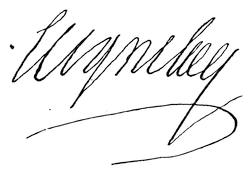
Seignelay came to power in 1681. He was the son of Colbert, and a man of very good abilities, matured under the eye of the great minister. He soon received long letters from Frontenac and the Intendant, filled with accusations and countercharges. Affairs had gone badly during the spring and summer of 1681. Some blows were struck, and a resort to sharper weapons was hinted at. The Intendant, Frontenac said, had barricaded his house and armed his servants. Duchesneau declared that his son had been beaten by the Governor for a slight offence, and afterward imprisoned in the château for a month, despite the pleadings of the Bishop in his behalf. These matters, and much more, were regularly reported to the new minister. Both officials stated that furs had been carried to the English settlements, and each blamed the other for it. The Intendant maintained that the faction led by Frontenac had spread among the Indians a rumor of a pestilence at Montreal, for the purpose of keeping them away from the fair, and in order that the bushrangers might purchase the beaver-skins at a low price. The allegation was groundless, but it had its effect at court. The King, tired at last of the constant strife, recalled both Frontenac and Duchesneau in the following year.


Frontenac’s successor was Le Fèbvre de la Barre, a soldier of repute who had already rendered his country good service in the West Indian war, where he had gained some notable successes against the English. For reducing Antigua and Montserrat and recapturing Cayenne from the enemy, he had been promoted to a lieutenant-generalship. He arrived at Quebec with Meules, his intendant, at a most inopportune time. The great fire of August 4, 1682, had laid waste fifty-five houses, and destroyed vast quantities of goods.

The new Governor took up his residence in the château, while Meules went to live in a house in the woods. La Barre was a very different man from Frontenac. He had nothing of that soldier’s peculiar energy or determination. He was a temporizer, cold and insincere, and no match for Indian diplomacy or duplicity. The Indians gauged his capacity before he had been in Canada many weeks, and as compared with Frontenac they felt that they had a child to deal with. The King had given him pretty plain instructions. He was ordered not only to apply himself to prevent the violence of the Iroquois against the French, but also to endeavor to keep the savages at peace among themselves, and by all means to prevent the Iroquois from making war on the Illinois and other tribes. He was further told that his Majesty did not attach much importance to the discoveries which had lately been made in the countries of the Nadoussioux, the River Mississippi, and other parts of North America, deeming them of but slight utility; but he enjoined that the Sieur de la Salle be permitted to complete the exploration he had commenced, as far as the mouth of the Mississippi, “in case he consider, after having examined into it with the Intendant, that such discovery can be of any utility.”
It was not long before La Barre exhibited his total incapacity for governing Canada. He lowered the French prestige in the eyes of the Indians of the Confederacy, and left his red allies to their fate. He was jealous of La Salle, and hated him cordially. Charlevoix accounts for his incapacity by saying that “his advanced age made him credulous when he ought to be distrustful, timid when he ought to be bold, dark and cautious towards those who deserved his confidence, and deprived him of the energy necessary to act as the critical condition of the colony demanded when he administered its affairs.” He was not very old, being little more than sixty years of age at the time. He found the Iroquois flushed with victory over their enemies, and displaying an arrogant bearing towards the French. He wrote a braggart letter to the King; said that with twelve hundred men he would attack twenty-six hundred Iroquois, and then begged for more troops. To the minister he wrote that war was imminent, and unless those “haughty conquerors” were opposed, “half our trade and all our reputation” would be lost. He was always talking about fighting; but those about him knew that he rarely meant all he said. He developed a remarkable predilection for trade, and soon after his arrival allied himself to several of the Quebec merchants, with that object in view. This gave grave offence to all those who could not participate. The tables were turned, and the old enemies of Frontenac now reigned, while La Salle and La Forêt were deposed. Du Lhut, the leader of the coureurs de bois, and a quondam friend of the Ex-Governor, transferred his allegiance to the new authority. La Barre soon showed his feeling towards La Salle. Jacques Le Ber and Aubert de la Chesnaye were early despatched to Fort Frontenac, which La Forêt commanded, with orders to seize it and all it contained, on the flimsy pretext that La Salle had failed to fulfil the conditions of his contract. La Forêt was offered his former position as commander of the fort; but he refused to be false to his chief, and sailed for France in high dudgeon.
On the 10th of October a conference on the state of affairs with the Iroquois was held. There were present the Governor, Intendant, Bishop of Quebec, M. Dollier, Superior of the Seminary of St. Sulpice of Montreal, Father Dablon, the Governor of Three Rivers, and others. The meeting was harmonious, and the importance and danger of the situation seemed to be understood. A most uninviting prospect lay before the little colony. The Iroquois, well armed and equipped, could strike first the Illinois, and in turn all the tribes in alliance with the French, and so divert the peltry trade into other channels, and finally fall upon the French themselves. It was stated at the conference that the English were responsible for this, and that they had been urging the Iroquois on for four years, in order to ruin Canada, and to secure for themselves and the Dutch the entire peltry trade of the continent. It was determined to make an effort to prevent the Iroquois from bringing upon the friendly Indians the fate they had previously dealt upon the Algonquins, the Andastes, the Abenaquis, and others. It was finally thought that the war might be averted for a time, and meanwhile the King was urgently importuned for troops and two hundred hired men, besides arms and ammunition.
The attack came sooner than had been expected. In the early spring the Seneca Indians were reported to be moving in considerable force on the Illinois, the Hurons, and the Ottawas of the lakes. La Barre, greatly excited, hastened his preparations. He wrote to France, explaining the posture of affairs, and demanding more troops. Du Lhut was sent with thirty men, with powder and lead, to Michillimackinac, to strengthen the defences there, and to guard the stores, of which there was a great quantity. Charles Le Moyne was despatched to Onondaga with a mission, which so far succeeded that forty-three Iroquois chiefs went to Montreal to meet the Governor. They arrived on the 14th of August. A council was held, and over two thousand crowns’ worth of presents were distributed among the Indians. La Barre demanded friendship for the Ottawas, the Algonquins, and the Hurons; but there was no firmness in his demands. He was timid, and when the fierce Senecas declared that the Iroquois made war on the Illinois because they deserved to die, he said nothing, and his silence sealed their doom. The delegates were asked to agree not to plunder French traders who were provided with passports. They agreed to this. It was a suggestion of La Chesnaye, and evidently aimed at La Salle, though La Barre denied that he gave the Iroquois liberty to plunder and kill the explorer. By a sort of poetic justice, the first captures the Iroquois made under their agreement were two boats belonging to La Chesnaye, which had gone up the lakes during Frontenac’s reign, and had no passports. On the 30th of August the deputies left Montreal.
La Barre continued his trading operations. He and La Chesnaye anticipated the annual market at Montreal, by sending up a large fleet of vessels, and securing enormous quantities of furs, a great part of which was clandestinely sent to Albany and New York. The Governor’s persecutions of La Salle went on, and in the spring he sent the Chevalier de Baugis, with canoes and soldiers, to seize his fort of St. Louis; but his scheme suffered defeat. La Barre now prepared in earnest for war, and was resolved to attack the Senecas in the following August (1684). On the 31st of July the King wrote that he had sent him three hundred soldiers.
It has been said that the English colonists of New York had instigated the Iroquois to make war on the French. Colonel Thomas Dongan, Lord Tyrconnel’s nephew, and a Roman Catholic, was governor of New York. Though he had respect for the King of France, he nevertheless thought himself entitled to a share of the fur-trade, which had so long remained a monopoly of the Canadians, and he decided to make some effort to obtain it. The Duke of York warned him against offending the French governor; but while Dongan publicly professed to observe his Grace’s injunction, he was really in frequent intrigue with the enemies of the French, and did all he could to provoke the Iroquois into making war on La Barre and his allies. The English had secured the allegiance of the five tribes of the Confederacy; the hatchet had been buried, and the song of peace had been sung. Dongan was wily, and got the Iroquois to recognize his king as their lawful sovereign. This would give him the command of the country south of the great lakes. The Indians readily promised, but without any intention of keeping their word. Their motive evidently was to make the most out of either party, and yield nothing. La Barre complained of the Senecas and Cayugas, and wrote to Dongan, telling him not to sell the offenders any arms or ammunition, and saying that he meant to attack the tribes for plundering French canoes and attempting a French fort. Dongan wrote in reply that the Iroquois were British subjects, and if they had done wrong, reparation should be made. Meanwhile he urged La Barre not to make his threatened attack, and begged him to keep the peace between the two colonies. Next he laid the complaints of the French governor before the chiefs, who on their part declared that the French had carried arms to their foes, the Illinois and the Miamis. Dongan handled the question with tact, and played upon the fears of the Indians so well that he got them to consent to his placing the arms of the Duke of York in their villages, which he said would save them from the French. They further agreed that they would not make peace with Onontio without consent of the English. In return for this, Dongan promised aid in case their country should be invaded.
The English Governor was a believer in prompt action, and he hastened to have the Iroquois’ subjection to King Charles confirmed. To that end he despatched a Dutch interpreter, Arnold Viele by name, to Onondaga. But Charles Le Moyne and the crafty Jesuit Jean de Lamberville, who knew the Indian character well, were there before the envoy of the English arrived. Le Moyne had been sent to invite the tribes to a conference with La Barre. The chief of the Onondagas was Otréouati, or Big Mouth, a famous orator and influential warrior, and ranking as one of the ablest Indians of the Confederacy. He was unscrupulous as regards keeping promises, but his valor and astuteness were beyond question. The two Frenchmen had spent some days in trying to induce the Onondagas to get their Seneca confederates to make peace with the French. The Senecas at first would not hear of it; but finally they succumbed to Big Mouth’s eloquence, and gave the Onondagas power to complete a treaty for them. Viele appeared on the scene; but he was no diplomat, and he shocked the pride of the Onondagas when he told them, with more arrogance than policy, that the English were masters of their territory, and that they had no right to hold council with the French without permission. It was natural that Big Mouth should become indignant: he asserted the independence of his tribe, and told his warriors and chiefs not to listen to the proposals of a man who seemed to be drunk, so opposed to all reason was what he uttered. The end of it was that Big Mouth and his sachems consented to accompany Le Moyne to meet La Barre.
The French Governor was ready for the campaign, having seven hundred Canadians, a hundred and thirty regulars, and two hundred mission Indians under his command. He was to be reinforced by a band of Indians on the way, and a company of coureurs de bois led by Du Lhut and La Durantaye. More warriors were to join him at Niagara. He declared that he intended to exterminate the Senecas; but his Intendant, Meules, had no faith in his promises, and kept urging him on, as if he feared that he would make peace without striking a blow,—a fatal course in his eyes. He wrote to the Governor two letters on the subject, concluding the second one thus: “If we do not destroy them, they will destroy us. I think you see but too well that your honor and the safety of the country are involved in the results of this war.” He also sent a despatch to Seignelay, which contained the customary complaints against La Barre, and some vigorous comments on his conduct in trading against the orders of the King, and his warlike pretensions which meant nothing. “I will take the liberty to tell you, Monseigneur,” he wrote, “though I am no prophet, that I discover no disposition on the part of Monsieur the General to make war against the aforesaid savages. In my belief, he will content himself by going in a canoe as far as Fort Frontenac, and then send for the Senecas to treat of peace with them, and deceive the people, the Intendant, and, if I may be allowed with all possible respect to say so, his Majesty himself.” La Barre proceeded on his way with his army, and after encountering a few adventures en route, finally reached Fort Frontenac, where the whole party encamped. A malarial fever broke out among the French, and many died. La Barre himself was greatly reduced and wasted by the disease, and so disheartened that he abandoned his plans, and sought to secure peace on the most favorable terms that he could get. He no longer thought of punishing the Senecas, nor had he the courage to invite them to council. He crossed over to La Famine with a few men, and sent Le Moyne to beg the tribes to meet him on their side of the lake. Here provisions grew scarce, and hunger and discontent prevailed among his followers. Several soldiers languished through disease; others died.
La Barre awaited the return of his envoy with fear and suspense. When at last he came on the third of the month, with Big Mouth and thirteen deputies, the Governor received the party with what grace he could. He had sent his sick men away, and told the Indians that his army was at Fort Frontenac; but the keen-witted savages were not deceived, and one of their number, understanding French, gathered during the evening from the conversation of the soldiers the true condition of affairs. The council was held on the 4th of September; and Baron La Hontan, who was present, gives a long account of what took place. The Governor related the offences of the Iroquois; charged them with maltreating and robbing the French traders in the country of the Illinois, with introducing the “English into the lakes which belong to the King, my master, and among the tribes who are his children, in order to destroy the trade of his subjects,” and with having made “several barbarous inroads into the country of the Illinois and Miamis, seizing, binding, and leading into captivity an infinite number of those savages in time of peace.... They are the children of my king,” he said, “and are not to remain your slaves. They must at once be set free and sent home.” Should such things occur again, he was ordered, he said, to declare war against the offending tribes. He agreed to grant them terms of peace, provided they made atonement for the past, and promised good conduct for the future; otherwise he would burn their villages and destroy them. Big Mouth rose and replied. He very soon convinced La Barre of the hopelessness of his task. “Listen, Onontio,” he said. “I am not asleep, my eyes are open; and by the sun that gives me light I see a great captain at the head of a band of soldiers who talks like a man in a dream. He says that he has come to smoke the pipe of peace with the Onondagas; but I see that he came to knock them in the head if so many of his Frenchmen were not too weak to fight. I see Onontio raving in a camp of sick men, whose lives the Great Spirit has saved by smiting them with disease. Our women had snatched war-clubs, and our children and old men seized bows and arrows, to attack your camp, if our warriors had not restrained them, when your messenger, Akouessan, appeared in our village.” The savage refused reparation; said that his tribe had been born free, and that they depended on neither Onontio nor on Corlaer, the governor of New York. “We have knocked the Illinois in the head,” he continued, “because they cut down the tree of peace and hunted the beaver on our lands. We have done less than the English and the French, who have seized upon the lands of many tribes, driven them away, and built towns, villages, and forts in the country.” La Barre, greatly disgusted, retired to his tent, and the council closed. In the afternoon another session was held, and in the evening a treaty was patched up. Big Mouth agreed to some reparation, which, however, he never made; but he would not consent to make peace with La Barre’s allies, the Illinois, whom he declared he would fight to the death. He also demanded that the council fire should be removed from Fort Frontenac to La Famine,—a concession yielded by La Barre without hesitation, but which Frontenac would never have granted.
The Governor returned home the next day, broken and dispirited; his men followed, wasted by fever and hunger, as best they could. This disgraceful truce was treated with contempt by all, the allies of the French included; and for a while it was thought that the friendly tribes would go over to the enemy in a body, make peace with their old rivals, and divert the channel of trade from Montreal to Albany. Lamberville only indorsed the Governor’s conduct, and styled him the “savior of the country” for having made peace at so critical a time. Meules and the others viewed the matter differently, and the former wrote to the minister that the Governor’s excuses were a mere pretence; that he had lost his wits, had gone off in a fright, and since his return his officers could not abstain from showing him the contempt in which they held him. The King, much annoyed, recalled La Barre, and the Marquis de Denonville, a colonel in the Queen’s regiment of Dragoons, full of piety and a devoted friend of the Jesuits, was sent to succeed him.
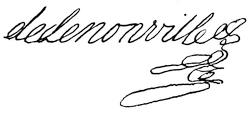
Denonville had been thirty years a soldier, and was much esteemed at court for his valor. It was agreed on all hands that the King’s selection of him for governor of the troubled colony was a very good one. But results proved it otherwise; and Denonville’s administration was even more unfortunate than that of La Barre, whose disastrous reign had brought Canada almost to the brink of ruin. When he arrived at Quebec in the autumn of 1685, with his wife and a portion of his family, he found little to cheer him. One hundred and fifty of the five hundred soldiers who had been sent out to Canada by King Louis had perished of scurvy while crossing the sea. The colony was in great disorder; the Iroquois roamed at their pleasure, destroyed when and whom they pleased, and vented their anger with all the cruelty and ferocity of their savage nature on such tribes as favored the French. The Indian allies of the French who had been abandoned by La Barre had little respect left for the nation whose chief representative had so badly served them. But now all this would be changed. Denonville was ordered to ratify the peace with the Iroquois or to declare war, the alternative being left to his own discretion. The King, who felt acutely the disgrace of La Barre’s abandonment of the Illinois, enjoined the new governor to repair that mischief as speedily as possible, to sustain the friendly tribes, and to humble the Iroquois at all hazards. A vigorous policy was determined on, and the King had great faith in the instrument which was to effect it. Denonville was given especial instructions regarding the English of New York, who at this time were constantly intriguing with the enemies of New France. Dongan understood the country well, and was striving with all his energy to secure control of the valuable fur districts south of the Great Lakes. To that end he was always in treaty with the Iroquois, who promised and disregarded their promises as exigency or humor suited them. The King was fully aware of this, and his instructions of March 10, 1685, are especially clear on this point. First, the French ambassador at London, M. Barillon, was desired to demand from the King of England “precise orders obliging that Governor [Dongan] to confine himself within the limits of his government, and to observe a different line of conduct toward Sieur de Denonville, whom his Majesty has chosen to succeed said Sieur de la Barre.” And Denonville was himself told that “everything must be done to maintain good understanding between the French and English; but if the latter, contrary to all appearances, excite and aid the Indians, they must be treated as enemies when found on Indian territory, without, at the same time, attempting anything on territory under the obedience of the King of England.” Meanwhile, the English were seizing posts in Acadia[700] which had always been occupied by the French. Denonville was ordered to send to the governor at Boston to explain the points of boundary, and to request him to confine himself to his own limits in future. Perrot, the former governor of Montreal, was now governor of Acadia, and he was instructed to keep up a correspondence with Denonville, and to take his orders from him.[701]
The struggle for the supremacy was between Denonville and Dongan. The latter dared not act as openly as he wished, for his King, being often at the mercy of Louis, kept saddling him with mandates which he could not disobey, though they sorely touched his pride. He could, however, intrigue; and the convenient Iroquois, who found their gain in the dissensions of the English and French, and who soon learned to encourage the rivalry between the two white powers encroaching on their domain, turned listening ears to his words. Louis favored the schemes of Denonville, which had been formed on a very extensive scale, and involved the mastery of the most fruitful part of the entire continent. New York had at this time about 18,000 inhabitants; Canada’s population was 12,263; but while the latter people were united in furthering French aims, the inhabitants of New York, save the active traders of the colony who were concerned in the purchase of peltries, took very little interest in Dongan’s plans. The English colonies were all deeply interested in checking French advancement, but they declined to help the government of New York, and Dongan was forced to fight his battles single-handed. His king furnished him neither money nor troops; but the assistance rendered, though sometimes in a negative sense, by the Iroquois league, was often formidable enough, and served his purpose on occasion. On the part of Denonville there were, of course, counter-intrigues. Through Lamberville he distributed presents to the Iroquois, and Engelran spent many days at Michillimackinac trying to stay the Hurons, Ottawas, and other lake tribes from allying themselves with the English, as they threatened to do. It was clear that a bold stroke must be made to keep these hitherto friendly tribes on the side of the French, and the only means which seemed to be open was war with the Iroquois. The latter were also intriguing with their old enemies, and trying to make treaties independently of the French. The coureurs de bois, too, were a source of danger and annoyance. La Barre had not kept them in check, and Denonville speedily discovered that they acted as though they regarded the edicts of the King as so much waste paper. It was impossible to prevent their selling brandy to the Indians, and demoralizing and debauching the tribes. Denonville wrote for more troops, and seemed anxious to deal a decisive blow at the Iroquois. Affairs were in a deplorable state, and nothing short of a stalwart exhibition of French power would save the country. “Nothing can save us,” wrote the Governor, “but the sending out of troops and the building of forts and blockhouses. Yet I dare not begin to build them; for if I do, it will bring down all the Iroquois upon us before we are in a condition to fight them.”
A brisk correspondence sprang up between the Governor of New York and Denonville. At first it was polite and complimentary, but ere long it assumed a sterner character, and strong language was employed on both sides. A good deal of fencing was indulged in. There were charges and countercharges. Each blamed the other for keeping bad faith, and each side made every effort to out-manœuvre the other. Denonville saw with military prescience that forts would be of service at several important points. One of these sites was situate on the straits of Detroit, and he hastened to send Du Lhut with fifty men to occupy it. The active woodsman promptly built a stockade at the outlet of Lake Huron, on the western side of the strait, and paused there for a while. News reached Denonville that Dongan contemplated sending, early in the spring of 1687, an armed expedition in the direction of Michillimackinac to forestall the trade there. He complained to the Governor of New York, and advised the King about it. To Du Lhut he issued orders to shoot down the intruders so soon as they presented themselves. Dongan dissembled until he heard from England, when he altered his tone, and wrote a letter much subdued in temper to Denonville. The French Governor replied, and counselled harmony.
Intelligence from the north reached Denonville about this time, which gave him considerable satisfaction. The French had resolved in the spring of 1686 to assert their right to the territory of Hudson’s Bay. An English Company had established a post at the mouth of Nelson River, on the west, and on the southern end there were situate forts Albany, Hayes, and Rupert, each garrisoned by a few men. The rival of this Company was the Company of the North, a Canadian institution, which held a grant from Louis XIV. The French had decided to expel the English from their posts, and Denonville approved the plan, and sent Chevalier de Troyes with a band of eighty men to assist the Company. Forts Hayes and Rupert were assaulted at night. In each instance the attack was a surprise, and the posts readily fell into the hands of the invaders. Several of the English were killed, others were wounded, and the rest were made prisoners. Iberville attacked a vessel anchored near the fort; three of its defenders were killed, and others, including Bridger, the governor for the Company, were captured. At Fort Albany, which was garrisoned by thirty men, a stouter resistance was offered, but at the end of an hour it was silenced, and shared the fate of its fellows.
Meanwhile, a treaty of neutrality had been signed at Whitehall, and there was peace between England and France for a time. The document bears date Nov. 16, 1686. On Jan. 22, 1687, instructions were sent to Governor Dongan to maintain friendly relations with Denonville, and to give him no cause for complaint. The King of France delayed despatching his orders to Canada until four months had elapsed.

Denonville was ordered to punish the Iroquois. He had eight hundred regulars, and a further contingent of eight hundred men were promised in the spring. Abundant means, too, had been provided; namely, 168,000 livres in money and supplies. Denonville was in high feather, and everything turned in his favor for a time. He had got rid of his meddling Intendant, Meules, and a pious man like himself had been sent in his place. This was Champigny. The Bishop, St. Vallier, had only words of praise for the administration as it then stood: Church and State were in perfect harmony at last. The attack on the Iroquois towns was well planned, and every precaution was observed to keep the matter secret until the time for action had arrived. Dongan, however, learned the truth from straggling deserters, and he was not slow in informing the Iroquois of the warlike designs of the French.
Denonville’s plan was to proceed to the Senecas, the strongest castle and the nearest to Niagara, his course taking him along the southern shore, which he elected on account of certain advantages which it possessed over the northern side. The little army moved out from Montreal on its career of conquest June 13, 1687. After some difficulty, Fort Frontenac was reached. Champigny and his men had arrived a few days in advance of the main army; and through his exertions thirty men and ninety women and children of a peaceable tribe belonging to the Iroquois and living in the neighborhood, were decoyed into the fort under the pretence of being feasted, and treacherously captured. Other Indians were taken in the same way, many of whom were afterward consigned to the French galleys. The Iroquois were more chivalrous. They had Lamberville, the Jesuit missionary whom Denonville had basely left to his fate, in their power, and could easily have destroyed him, but they allowed him to go free and join his friends. At the fort there were assembled, according to Denonville, about two thousand men, regulars, militia, and Indians. Eight hundred troops, newly arrived from France, had been left at Montreal to protect the settlers and property there. More allies were awaiting his commands at Niagara; they consisted of one hundred and eighty Frenchmen, and four hundred Indians, under Tonty, La Durantaye, and Du Lhut. The journey to Niagara had not been made without hardship and adventure. The Indians of the party had been difficult to manage, and for a while Durantaye was not sure that they would remain with him. Some of the English traders, commanded by Johannes Rooseboom, a Dutchman, on the way to Michillimackinac with goods, were encountered, and Durantaye hastened with one hundred and twenty coureurs de bois to meet them. The party, consisting of twenty-nine whites and five Mohawks and Mohicans, were threatened with death if they resisted. They immediately surrendered, and were despatched to Michillimackinac as prisoners. The merchandise they brought was parcelled out among the Indians. This stroke was the means of saving Durantaye’s life, and the Indians with him became in consequence his sure allies. While making for Niagara, McGregory’s canoes were met, and the same fate overtook them. This capture proved important, for McGregory had with him a number of Ottawa and Huron prisoners whom the Iroquois had taken. It was the Englishman’s intention to restore these captives to their countrymen, to make good the terms of the triple alliance which had been entered into by the English, the Iroquois, and the lake tribes. McGregory’s capture destroyed the whole arrangement, and he and his companions, with those of Rooseboom, were ultimately sent as prisoners to Quebec.
The war-party at Niagara were ordered to repair to the rendezvous at Irondequoit Bay, on the border of the Seneca country, and Denonville went to meet them. His command numbered three thousand men, for a reinforcement of Ottawas of Michillimackinac who had refused to follow Durantaye, having altered their minds, now joined the party. The host was well officered. The leaders were Denonville, the Chevalier de Vaudreuil,—an excellent soldier, fresh from France,—La Durantaye, Callières, Du Lhut, Tonty, Berthier, La Valterie, Granville, Longueil, La Hontan, De Troyes, and others. On the afternoon of the 12th of July, at three o’clock, having already despatched four hundred men to garrison the redoubt, which had been put in a condition of defence for the protection of the provisions and canoes, Denonville began his march across the woods to Gannagaro,—twenty-two miles distant. Each man carried with him food for thirteen days. Three leagues were made the first day, and the party camped for the night. Two defiles were passed the next morning. The heat was intense, and the mosquitoes were very troublesome, but the men moved on in pretty fair order. So far, only a few scouts of the enemy had been encountered. At two o’clock the third defile was entered. It had been the Governor’s intention to rest here, but having been notified by scouts that a considerable party of the Senecas was in the neighborhood, an advance was made by Callières, who was at the head of the three companies commanded by Tonty, Durantaye, and Du Lhut, besides the detachment of Indians. This body, which formed the vanguard of the army, pushed rapidly through the defile, unconscious of the fact that an ambuscade of Senecas, three hundred strong, was posted in the vicinity. When they reached the end they came upon a thicket of alders and rank grass. At a given signal, the air was rent with defiant shouts, and a host of savages leaped from their places of concealment, and sent a volley of lead into the bewildered French, while the three hundred Senecas who lined the sides of the defile sprang upon the van. They had thought to crush their enemy at a blow, but Denonville, hurrying up with his sixteen hundred men, soon spread consternation into their ranks. The firing was heavy on both sides; but the Senecas were defeated with considerable slaughter, and finally fled from the scene in dismay. Denonville wrote that “all our Christian Indians from below performed their duty admirably, and firmly maintained the position assigned to them on the left.” The French did not follow the flying savages, being too much fatigued by their long march. Their loss was five or six men killed and twenty wounded. Among the latter was Father Engelran, who was seriously injured by a bullet.

The next morning the army pressed forward again, but no Seneca warriors were to be seen. The villages were deserted, and ten days were occupied by the soldiers and their allies in reducing the Indian villages and destroying the provisions and stores which the Senecas had left behind them. Denonville withdrew on the 24th with his army, and set out for Montreal. On the way back he ordered a stockade to be built at Niagara, on the site of La Salle’s old fort, between the River Niagara and Lake Ontario. Montreal was reached on the 13th of August.[702]