Part 2 — THE JESUIT RELATIONS,
Reading edition
AND OTHER MISSION RECORDS.
A CHRONOLOGICAL BIBLIOGRAPHY BY THE EDITOR.
THE main bibliographical sources for this study pertain to the Jesuit missions, as follows:—
Le Père Auguste Carayon: Bibliographie historique de la Compagnie de Jésus, ... depuis leur Origine jusqu’à nos jours, Paris, 1864, 4º.
Henry Harrisse: Notes sur la Nouvelle France, 1545-1700, Paris, 1872. He says, no. 49, that no library (1870-71) has a complete set of the Jesuit Relations; and adds that, including those of 1616 and 1627, a full set consists of fifty-four volumes, nine of which are second editions, and one a Latin translation. He had inspected all but one.
E. B. O’Callaghan: a catalogue raisonnée (1632-1672), in the N. Y. Hist. Soc. Proc., 1847, p. 140, also printed separately. Field (Indian Bibliography, no. 1,146), in noticing this essay, says that Dr. O’Callaghan enumerates only forty titles, of which the Carter-Brown Collection had thirty-six; Harvard College, thirty-five; Henry C. Murphy, twenty-nine. “Of the forty-eight now [1873] known to exist, Mr. Murphy has secured all but three.” Dr. O’Callaghan at that time named twenty libraries, public and private, in the United States which had sets more or less imperfect. The volumes of some years were not very scarce, those of 1648-1649 and 1653-1654 being known in ten copies in these libraries, while there were at that time no copies at all of the years 1655 and 1659; and these, marked by titles varying from the usual form, are still the rarest of the series.
The O’Callaghan pamphlet was reissued at Montreal in 1850 in a French translation by Father Martin, the superior of the Jesuits in Canada, who amended the text in places, and included the Biard Relation of 1613. He also gave an account of unprinted ones still preserved in Canada which were written subsequent to 1672, when the annual printing of them ceased.
Deriving help from this and other sources, Dr. O’Callaghan issued privately, in 1853, a broadside, with an amended list of the Relations and their several principal repositories,—State Library, Albany; Harvard College Library; the Parliamentary Library, Quebec; and the private libraries of Mr. Carter-Brown of Providence, Mr. Lenox of New York, Rev. Mr. Plante, Mr. O. H. Marshall of Buffalo, and Mr. George Bancroft.
In June, 1870, Dr. O’Callaghan issued a circular asking information of owners of the volumes for a second edition of his tract; but I cannot learn that the new edition was ever published. At the sale of Dr. O’Callaghan’s library December, 1882, his Catalogue, p. 105, showed 31 of the series; and they brought $1,068.45. Dr. O’Callaghan contributed a paper on the Relations to the International Magazine, iii. 185.
Carter-Brown Library: Catalogue, vol. ii. p. 164.
Lenox Library: Contributions, no. ii., The Jesuit Relation, etc., New York, 1879. The Relation of 1659, of which the copy in the Library of the Canadian Parliament was supposed to be unique, was reprinted in fac-simile by Mr. Lenox. In 1854, at the destruction of the Parliamentary Library at Montreal, its series of these Relations, forty-three in number (except eight), and including this unique volume, was destroyed. This Contribution shows the Lenox Library to possess forty-nine out of the series of fifty-five, counting different editions of the forty-one titles, from 1632 to 1672, making the fifty-five to include two translations and twelve second or later editions. The Lenox series lacks nos. 1, 28, and 35, as enumerated, and of no. 35 the Carter-Brown Library has the only copy known in America. The Lenox Library also lacks the first issue of no. 2, and the second issue of nos. 3 and 5. It has four duplicates, with slight variations.
These Relations will also be found entered under their respective authors in Sabin’s Dictionary and in Field’s Indian Bibliography.
The reason of the rarity of these books may lie in part in the smallness of the editions, but probably most in the avidity of readers, and consequent destruction; for Charlevoix says, “They were at the time extremely relished in France.” Of their character, the same authority says: “There is no other source to which we can apply for instruction as to the progress of religion among the savages, or for a knowledge of these people, all of whose languages the Jesuits spoke. The style of these Relations is extremely simple; but this simplicity itself has not contributed less to give them a great celebrity than the curious and edifying matter they contain.” Father Martin, in his translation of Bressani, speaks (p. 8) Of these Relations as the most precious monument, and sometimes the only source, of the history of Canada, and praises the impartial use made of them by Bancroft and Sparks. Parkman says of them: “Though the productions of men of scholastic training, they are simple and often crude in style, as might be expected of narratives hastily written in Indian lodges or rude mission-houses in the forest, amid annoyances and interruptions of all kinds. In respect to the value of their contents, they are exceedingly unequal.... The closest examination has left me no doubt that these missionaries wrote in perfect good faith, and that the Relations hold a high place as authentic and trustworthy historical documents. They are very scarce, and no complete collection of them exists in America.” Shea (Le Clercq, i. 381) has a note of the contemporary discrediting of the Relations by rival orders.
The series was reprinted by the Canadian Government in 1858 in three octavo volumes, with bibliographical notes and synopses, containing—vol. i. 1611, 1626, 1632 to 1641; ii. 1642 to 1655; iii. 1656 to 1672. These reprinted volumes are not now easy to find, and have been lately priced at £7 10s. and 100 francs. Field, Indian Bibliography, no. 1,177; Lenox, Jesuit Relations, p. 14.
There have been three supplemental and complemental issues of allied and later Relations; one was printed at the expense of Mr. Lenox, and the others had the editorial care of Dr. O’Callaghan and Dr. Shea, of which notice will be taken under their respective dates. See the lists of Shea’s “Cramoisy Series” (100 copies printed) in the Lenox Contributions, p. 15; Field, Indian Bibliography, nos. 129 and 1,397; and Menzies Catalogue, no. 1,811; and the O’Callaghan Catalogue for Dr. O’Callaghan’s series (25 copies printed). Dr. Shea’s acquaintance with the subject was first largely evinced by his History of the Catholic Missions among the Indian Tribes of the United States, 1529-1854, published, at the instance of Jared Sparks, in New York in 1855 (Field, no. 1,392); and he published a list of early missionaries among the Iroquois in the Documentary History of New York, iv. 189.
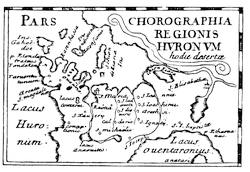
The earliest summarizing of these Relations or of those before 1656, was by the Père du Creux (or Creuxius, b. 1596, d. 1666) in his Historiæ Canadensis, sev Novæ Franciæ, libri decem, Paris, 1664 (pp. xxvi, 810, 4, map and thirteen plates). There are copies in Harvard College, Carter-Brown, Lenox, and New York Historical Society libraries. Cf. Rich (1832), no. 333, £1 16s.; Brinley, no. 82, $80; Carayon, no. 1,322; Harrisse, no. 120; Carter-Brown, vol. ii. no. 945, with fac-simile of title; Leclerc, Bibl. Amér. no. 706, 500 fr.; Ternaux, no. 823; Lenox, p. 10; O’Callaghan, no. 699; Huth, i. 367; Sunderland, vol. ii. no. 3,561; Charlevoix (Shea’s edition), i. 81, who says: “This extremely diffuse work was composed almost exclusively from the Jesuit Relations. Father du Creux did not reflect that details read with pleasure in a letter become unsupportable in a continuous history.” “It contains, however,” says Dr. Shea, “some curious statements, showing that he had other material.” The map, Tabula Novæ Franciæ anno 1660, extends so as to include Hudson’s Bay, Newfoundland, the Chesapeake, and Lake Superior; and it has a corner-map, “Pars regionis Huronum hodie desertæ.” The map has been reproduced in Martin’s translation of Bressani’s Relation of 1653, and is given in part on another page of the present volume.
The Relations were not much noticed by writers at the time, and few allusions to them appear in contemporaneous works. One of the few books which drew largely from them is Le Nouveau Monde ou l’Amérique Chrestienne.... Par Me Charles Chavlmer, Historiographe de France. Paris, 1659.
The story of the missions of New France necessarily makes part of the general works of Charlevoix and the other Catholic historians, particularly the Histoire du Canada of Brasseur de Bourbourg, Paris, 1859, who depends largely upon Bancroft for his facts. Mr. Parkman, not bound by the same ties, gives a view of the Jesuits’ character, in his Jesuits in North America, which has been questioned by their adherents. His book, however, is of the first importance; and Dr. George E. Ellis, in the Atlantic Monthly, September, 1867, recounts, in a review of the book, the historian’s physical disability, which has from the beginning of his labor sadly impeded the progress of his work. Cf. also Dr. Ellis’s sustained estimate of Parkman, in his Red Man and White Man in North America, p. 259. The story of the Jesuits’ trials contained in the Lettres Edifiantes is translated in Bishop W. I. Kip’s Early Jesuit Missions in North America, 1846, and again, 1866. Cf. also Magazine of American History, iii. 767; M. J. Griffin in Canadian Monthly, i. 344; W. B. O. Peabody’s “Early Jesuit Missionaries in the Northwest,” in Democratic Review, May, 1844, reprinted in Beach’s Indian Miscellany; Judge Law on the same subject, in Wisconsin Historical Society’s Collections, iii. 89; and Thébaud on the natives and the missions, in The Month, June, 1877; Poole’s Index gives other references, p. 683. Dr. Shea, at the end of his Catholic Missions, p. 503, gives a list of his sources printed and in manuscript.
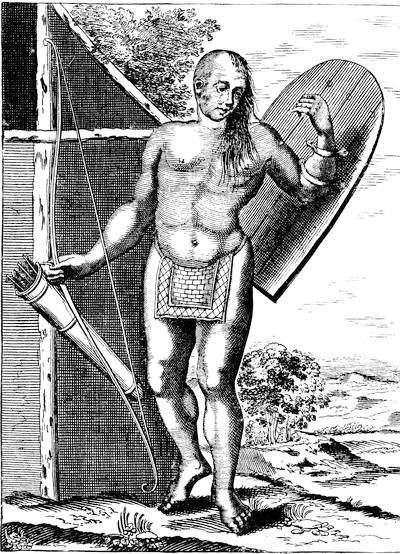
A CANADIAN (from Creuxius).
Of the tribes encountered by the Jesuits, there is no better compact account than Mr. Parkman gives in the Introduction to his Jesuits in North America, where he awards (p. liv) well-merited praise to Lewis H. Morgan’s League of the Iroquois, and qualified commendation to Schoolcraft’s Notes on the Iroquois, and gives (p. lxxx) a justly severe judgment on his Indian Tribes. Mr. Parkman’s Introduction first appeared in the North American Review, 1865 and 1866.
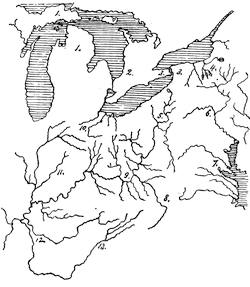
THE OHIO VALLEY, 1600.
This sketch follows one by Mr. C. C. Baldwin, accompanying an article on “Early Indian Migrations in Ohio,” in the American Antiquarian, i. 228 (reprinted in Western Reserve Historical Society’s Tracts, no. 47), in which he conjecturally places the position of the tribes occupying that valley at the opening of the seventeenth century. The key is as follows: 1, Ottawas; 2, Wyandots and Hurons: 3, Neutrals; 4, Iroquois; 5, Eries; 6, Andastes, or Susquehannahs; 7, Algonquins; 8, Cherokees; 9, Shawnees; 10, Miamies; 11, Illinois; 12, Arkansas; 13, Cherokees. (On the Andastes see Hawley’s Cayuga History, p. 36.)
There is another map of the position of the Indians in 1600 in George Gale’s Upper Mississippi, Chicago, 1867, p. 49; and Dr. Edward Eggleston gives one of wider scope in the Century Magazine, May, 1883, p. 98. Cf. Henry Harvey’s History of the Shawnee Indians, 1681-1854, Cincinnati, 1855; and a paper by D. G. Brinton on the Shawnees and their migrations, in the Historical Magazine, x. 21. Judge M. F. Force, in Some Early Notices of the Indians of Ohio, Cincinnati, 1879, an address before the Philosophical and Historical Society of Ohio, has tracked the changing habitations of the tribes of that region. There is a paper by S. D. Peet on the location of the Indian tribes between the Ohio and the Lakes, in the American Antiquarian, i. 85. William H. Harrison controverted the view that the Iroquois ever conquered the valley of the Ohio, in his “Discourse on the Aborigines of the Valley of the Ohio,” which was printed at Cincinnati in 1838, at Boston in 1840, and in the Historical and Philosophical Society of Ohio’s Transactions, vol. i. part 2d, p. 217; but compare C. C. Baldwin’s “Iroquois in Ohio, and the Destruction of the Eries,” in Western Reserve Historical Society’s Tracts, no. 40. David Cusick (a Tuscarora) published Sketches of Ancient History of the Six Nations, at Tuscarora Village, 1825, and again at Lockport, N. Y., 1848. An historical sketch of the Wyandots will be found in the Historical Magazine, v. 263; and Peter Clarke (a Wyandot) has published the Origin and Traditional History of the Wyandots. See references in Poole’s Index under Hurons, Iroquois, Indians, etc.]
There is a rare book containing contemporary accounts of the savages, which was written at Three Rivers in 1663, by the governor of that place, the Sieur Pierre Boucher, and published in Paris in 1664, under the title, Histoire veritable et naturelle des Mœurs et Productions du Pays de la Nouvelle France, vulgairement dite le Canada. The author, says Charlevoix (Shea’s edition, i. p. 80), should not be confounded with the Jesuit of the same name; and he calls the book under consideration a “superficial but faithful account of Canada.” There are copies in the Harvard College, Lenox (Jesuit Relations, p. 10), and Carter-Brown (Catalogue ii. 941) libraries.[688]
Another early account is the Mémoire sur les Mœurs ... des Sauvages, by Nicholas Perrot, which remained in manuscript till it was edited by Father Tailhan, and printed in 1864.[689]
The Jesuit Lafitau published at Paris in 1724 his Mœurs des Sauvages Amériquains in two volumes, with various plates, which in the main is confined to the natives of Canada, where he had lived long with the Iroquois. Charlevoix said of his book, twenty years later, “We have nothing so exact upon the subject;” and Lafitau continues to hold high rank as an original authority, though his book is overlaid with a theory of the Tartaric origin of the red race. Mr. Parkman calls him the most satisfactory of the elder writers. (Field, no. 850; Carter-Brown, vol. iii. nos. 344, 345, 472; Sabin, vol. x. p. 22.) There was a Dutch version, with the same plates, in 1731.
Bacqueville de la Potherie’s Histoire de l’Amérique Septentrionale, in four volumes, with a distinctive title to each (1722 and 1753), is mainly a history of the Indians with which the French came in contact. He wrote early in the last century, and his book saw several editions, evincing the interest it created. His information is at second hand for the early portions of the period covered (since Cartier); but of the later times he becomes a contemporary authority. (Field, no. 66,)
Of less interest in relation to the seventeenth century is Le Beau’s Voyage Curieux et Nouveau parmi les Sauvages de l’Amérique Septentrionale, published at Amsterdam in 1738,—a work, however, of a semi-historical character, (Field, no. 901.)
Cadwallader Colden’s History of the Five Indian Nations was printed by Bradford in New York in 1727, and is now very rare. Dr. Shea reprinted it in 1866, and in his introduction and notes its somewhat curious bibliographical history is learnedly traced. (Carter-Brown, vol. iii. nos. 393, 394; Field, Indian Bibliography, 341; Menzies, 429, $210; Sabin, vol. v. p. 222.) The three later London editions (1747, 1750, 1755) were altered somewhat by the English publishers, without indicating the variations they introduced. (Carter-Brown, vol. iii. nos. 847, 922, 1,049.) A portrait of Colden is given in the Historical Magazine, ix. 1. Sulte, in his Mélanges, p. 184, has an essay on the respective positions of the Iroquois and Algonquins previous to the coming of the Europeans.
D. G. Brinton, at the end of chap. i. of his Myths of the New World, characterizes the different writers on the mythologies of the Indians; and Mr. Parkman, Jesuits, etc., p. lxxxviii, notes some of the repositories of Iroquois legends.
A valuable paper on the origin of the Iroquois confederacy, by Horatio Hale, is printed in Mass. Hist. Soc. Proc., xix. 241; and Mr. C. C. Baldwin has a paper on the Iroquois in Ohio in the Western Reserve Historical Society, no. 40, and another paper on the early Indian migrations, in no. 47. Mr. Hale has further extended our knowledge by the curious learning of his Iroquois Book of Rites, Cincinnati, 1883; and he also printed in the American Antiquarian, January and April, 1883 (also separately Chicago, 1883), a scholarly paper on Indian Migrations as evidenced by Language.
So far as relates to the more easterly tribes coming within the range of the Jesuits’ influence, Parkman’s description can be compared with the plain matter-of-fact enumerations which make up the picture in Palfrey’s New England, which are derived from authorities enumerated in his notes. See various papers in the Canadian Journal.
The general historians of New France necessarily give more or less attention to the study of the Indians as the Jesuits found them; and such a study is an integral part of Dr. George E. Ellis’s learned monograph, The Red Man and the White Man in North America, whose account of the different methods of converting the natives, pursued by the French and the English, may be compared with that in Archbishop Spalding’s Miscellanea, i. 333.
[In the enumeration below the initials of the repositories of copies signify: C., Library of Congress; CB., Carter-Brown Library, Providence; F., Mrs. J. F. Fisher, Alverthorpe, Penn.; GB., Hon. George Bancroft, Washington; HC., Harvard College; J., Jesuits’ College, Georgetown, D.C.; K., Charles H. Kalbfleisch, New York; L., Lenox Library, N.Y.; M., the late Henry C. Murphy, Brooklyn, L.I.; OHM., O. H. Marshall, Buffalo; NY., New York State Library, Albany; SJ., St. John’s College, Fordham, N.Y.; V., Catholic Bishop of Vincennes, Indiana.
Space is not taken in these notes to give full titles nor exhaustive collations, which can be found in the authorities referred to, the figures following them being to numbers; but the references to the Lenox Contributions is necessarily to pages.]
1580.—The Lenox bibliography begins the series of allied works with A Shorte and briefe narration of the two Navigations and Discoveries to the northweast partes, called Newe France, London, 1580. Harrisse, Notes sur la Nouvelle France, no. 5.
1605.—De Monts’ Commission. See chapter iv.
1609.—Coppie d’une lettre envoyée de la Nouvelle France, par le Sieur Cōbes, Lyons. (Harrisse, no. 20; Lenox, p. 3; Sabin, xiii. no. 56,083.) Dated “Brest-en-Canada, 13 Février, 1608.” The Carter-Brown Catalogue (vol. ii. no. 80) shows only a manuscript copy. Brunet speaks of a single copy, sold and bought for America.
1610.—La Conversion des Savages ... baptizés en la Nouvelle France, Paris. Harrisse, no. 21; Lenox, p. 3; Carter-Brown, vol. ii. no. 99.
1610.—Lettre missive, touchant la conversion ... du grand Sagamos, Paris. Lenox, p. 3; Carter-Brown, vol. ii. no. 103 (manuscript only.)
1611.—Missio Canadensis. Epistola ex Porturegali in Acadia. This is a reprint, made for Dr. O’Callaghan at Albany in 1870 (25 copies), following the letter as given in the Annuæ litteræ Societatis Jesu, 1611 and 1612. (Cf. Lenox, p. 18; Carter-Brown, vol. ii. no. 119.) Carayon says that this Annual extends from 1581 (imprint, 1583) to 1614; and then again, 1650-1654. There are incomplete sets in the Harvard College and Carter-Brown libraries. From the same source Dr. O’Callaghan also reprinted Relatio rerum gestarum in Nova Francia, 1613, which relates to Biard’s mission.
1613.—Contract d’association des Jésuites au trafique de Canada, Lyons. (Harrisse, no. 28.) Tross’s reprint on vellum (12 copies only) is in the Lenox (p. 4) and Carter-Brown (vol. ii. no. 148) Collections.
1611-1613.—Canadicæ Missionis Relatio ab anno 1611 usque ad annum 1613, auctore Josepho Juvencio. Dr. O’Callaghan’s reprint, no. 4. (O’Callaghan, no. 1,980; Lenox, p. 18.)
1612.—Relation dernière de ce qui s’est passé au voyage du Sieur de Poutrincourt en la Nouvelle France, Paris. A description of the voyage of Biard and Masse from Dieppe, Jan. 26, 1611. (Cf. Harrisse, no. 26.)
Copy: HC.
Upon this early mission, see Carayon, Première mission des Jésuites au Canada, lettres et documents inédits, Paris, 1864. (Sabin, vol. iii. no. 10,792.) These letters and others are cited by Harrisse, nos. 397-400, 404-406. (Cf. Parkman’s Pioneers, p. 263.) Charlevoix (Shea’s ed., p. 87) cites Juvency’s Historiæ Societatis Jesu pars quinta, book xv., Rome, 1710, as elucidating events in Acadia in 1611. (Harrisse, no. 402.) For the trading relations of the Jesuits, see Lescarbot (1618), p. 665; Champlain (1632), p. 100, and references in Harrisse, no. 28, and Parkman’s Old Régime, p. 328. These early Acadian missions are treated in the Catholic World, xii. 628, 826; xxii. 666, and in Historical Magazine, xv. 313, 391; xvi. 41.
The subject of the Capuchins and other Catholics on the Maine coast at an early date is followed in Historical Magazine, viii. 301, and in Maine Historical Collections, i. 323. Cf. Poor’s Gorges, p. 98.
1613-1614.—Relatio rerum gestarum in Nova-Francia Missione annis 1613 et 1614. Lugduni. No. 6 of Dr. O’Callaghan’s reprints, Albany, 1871. Carter-Brown, vol. ii. no. 170; O’Callaghan, no. 1,250; Lenox, p. 19.
1616.—Relation de la Nouvelle France ... faicte par le P. Pierre Biard, Lyons. Chaps. i. to viii. are on the country and its inhabitants. Chap. xi. is on the arrival of the Jesuits in 1611; and in Harrisse’s opinion, it constitutes a reply to the Factum escrit et publié contre les Jésuites,—a publication of which we can find no other trace. It also describes the labors of the missionaries and the cruelties of Argall. See chap. iv.
See Harrisse, no. 30, on the question of an earlier edition in 1612. The Supplément of Brunet calls this 1612 edition spurious. (Carayon, p. 178; Lenox, p. 4, for a copy, with title in fac-simile by Pilinski, which yet cost 1,000 francs, as per Leclerc, no. 2,482.) A reprint, “presque en fac-simile,” was made at Albany in 1871 from a copy owned by Rufus King, of Jamaica, L. I. The Carter-Brown (vol. ii. no. 178) has only this fac-simile, and it is noted in O’Callaghan, nos. 1,207, 1,971, where it is stated only twenty-five were printed, at $25 per copy.
1626.—Coppie de la lettre escripte par le R. P. Denys Jamet, Commissaire des PP. Recollestz de Canada. Dated Quebec, Aug. 15, 1626.
References: Carter-Brown, vol. ii. no. 315. Dr. Shea thinks the date should be 1620. It is from Sagard, p. 58.
1626.—Relation de ce qui s’est passé en la Nouvelle France, 1626. Envoyée au Père Hierosme L’Allemant par Charles L’Allemant. Paris, 1629. Reprinted (no. 7) in O’Callaghan’s series, from the text in Mercure François, vol. xiii.
References: Carter-Brown, vol. ii. no. 351; O’Callaghan, nos. 1,210, 1,250, 1,982; Lenox, p. 19. Le Clercq doubts L’Allemant’s authorship; but see Shea’s Le Clercq, i. 329.
1627.—Lettre du Père Charles l’Allemant, Supérieur de la mission de Canadas, Paris, 1627. It bears date Aug. 1, 1626.
References: Sabin, vol. x. no. 38,680; Harrisse, no. 41; Faribault, no. 361; Ternaux, no. 496; Carayon, p. 179; Lenox, p. 4; O’Callaghan, no. 1,250.
It was reprinted in 1871 in O’Callaghan’s series. (Carter-Brown, vol. ii. no. 328; O’Callaghan, no. 1,208.) It first appeared in the Mercure François, xiii. 1. This last publication appeared in Paris, 1611-1646, in twenty-three volumes, and contains much illustrative of these early missions. There are sets of the Mercure in the Boston Athenæum, Harvard College, Carter-Brown, Boston Public libraries, etc. The reprint of L’Allemant’s Lettre in the Quebec edition of the Relations, follows the text of the Mercure, which corresponds, as is not always the case of these early Relations, with the contemporary separate text, as Mr. Lenox has pointed out in the Historical Magazine, iii. 19. Carayon, in his Première Mission, translates from another letter of L’Allemant, preserved at Rome, and of the same date, another account of these early Jesuit labors, which he sent to Père Vitelleschi. L’Allemant’s name in the contemporary publications is spelled with a single or double l, indifferently.
Another of O’Callaghan’s series (Albany, 1870), was Copie de trois Lettres escrittes en 1625 et 1626 par le P. Charles Lallemand. O’Callaghan, nos. 1,209, 1,250; Carter-Brown, vol. ii. no. 316.
1629.—Lettre du Rev. Père l’Allemand au Rev. Père Supérieur du Collège des Jésuites à Paris, 22 Novembre, 1629. It is found in Champlain’s Voyages, and a reprint (no. 3) is in O’Callaghan’s series, Albany, 1870. O’Callaghan, nos. 1,250, 1,979; Sabin, vol. x. no. 38,681; Carter-Brown, vol. ii. no. 390; Carayon, p. 179; Lenox, p. 18. It is translated in Shea’s Perils of the Ocean and Wilderness.
[The regular series of so-called Relations, addressed to the Provincial of the order in France, begins here.]
1632.—Le Jeune. Brieve Relation du Voyage de la Nouvelle France, fait au mois d’Avril dernier, par le P. Paul le Jeune. Paris, 1632. Pages 68, one leaf for the Privilege.
Contents: The arrival and reinstatement of the order in Quebec, with notices of the natives.
References: Carayon, no. 1,260; Harrisse, no. 49; Sabin, vol. x. no. 39,946. Carter-Brown, vol. ii. no. 381, with fac-simile of title.
Copies: CB., GB., M. Others in the Arsenal and National Libraries at Paris, etc.
It was reprinted in the Mercure François for 1633.
1633.—Le Jeune. Relation de ce qui s’est passé en la Nouvelle France en l’année 1633. Paris, 1634. Pages 216 and Privilege, with a cupid in the vignette, and errors of pagination. A second issue has a ram’s head for a vignette, and some typographical variations. These vignettes are at the top of p. 3; that with two storks is on the titlepage.
Contents: Champlain’s arrival, and that of Brebeuf and Masse; Le Jeune’s difficulties with the native language.
References: Carayon, no. 1,261; Harrisse, nos. 55, 56; Sabin, vol. x. no. 39,947-48; Carter-Brown, vol. ii. no. 417; O’Callaghan, no. 1,212. (2d issue).
Copies: CB., GB., HC. (3d issue), M.
There is an abridgment in the Mercure François for 1633.
1634.—Le Jeune. Relation ... en l’année 1634. Paris, 1635. Pages 4, 342, with pp. 321-22 numbered 323-24. A second issue corrects p. 321, but makes 337 to be 339.
Contents: Champlain’s Domestic Life; Labors of Missionaries; Habits of Indians, and (chap. 9) Account of their Languages; Le Jeune’s Journal, August, 1633, to April, 1634, while he was living with the savages.
References: Carayon, no. 1,263. Harrisse, nos. 60, 61; Sabin, vol. x. no. 39,949; Carter-Brown, vol. ii. no. 307; Lenox, p. 4; O’Callaghan, no. 1,235; Harrassowitz (1882, 180 marks).
Copies: CB., F., GB., HC., K., L. (1st ed.), M.
1635.—Le Jeune. Relation ... en l’année 1635. Paris, 1636. Pages 4, 246, 2.
Contents: Report, dated August 28, 1635, ending on p. 112; Report from the Huron country by Brebeuf, with “divers sentimens.” Report from Cape Breton by Perrault.
References: Carayon, no. 1,264; Harrisse, nos. 58, 63; Carter-Brown, vol. ii. no. 436; Lenox, p. 5; Sabin, vol. x. nos. 39,950, 39,951; O’Callaghan, no. 1,214; Leclerc, no. 778 (140 francs). Priced (1883), $50.
Copies: CB., GB., HC., L., M., OHM.
1635.—Le Jeune. Relation, etc. Avignon, 1636.
Contents: Same as the Paris edition.
References: Harrisse, no 64; Lenox, p. 5.
Copies: The Lenox Contributions claims its copy as the only one now known; if so, a third edition is represented in a defective copy noted in O’Callaghan, no. 1,215.
1636.—Le Jeune. Relation ... en l’année 1636. Paris, 1637. Pages 8, 272, 223.
Contents: Report; Death of Champlain, etc.; Brebeuf’s Huron report, with account of the language, customs, etc.
References: Carayon, no. 1,265; Harrisse, no. 65; Sabin, vol. x. no. 39,952; Carter-Brown, vol. ii. no. 446; Lenox, p. 5; Harrassowitz, 1883 (125 marks).
Copies: CB., HC., K., L. It does not appear whether copies GB., M., OHM., and V. are of this or of the following edition.
1636.—Le Jeune. Relation, etc. Paris, 1637. Pages 199 in smaller type than the preceding edition; the Huron report sometimes wanting, though mentioned in the title, while it was not mentioned in the preceding edition; but Sobolewski describes a copy which has this Huron report, occupying 163 pages.
References: Harrisse, no. 66; Lenox, p. 5.
1637.—Le Jeune. Relation ... en l’année 1637. Rouen, 1638. Pages 10,336 (pp. 193-196 omitted in paging), 256, with vignette of I. H. S. supported by two angels on the title. A second issue has the I. H. S. surrounded by rays, and there are other typographical changes in the title only. A folding woodcut of fireworks between pp. 18 and 19.
Contents: Report about the missions and the Huron Seminary near Quebec; Report by Lemercier from the Huron country, dated 1637.
References: Harrisse, nos. 67, 68; Sabin, vol. x. no. 39,953; Carter-Brown, vol. ii. no. 457; Lenox, p. 5; O’Callaghan, no. 1,216; Harrassowitz, 1880 (150 francs); Leclerc, 779 (200 francs).
Copies: CB., HC., K., M., OHM., L. (both varieties).
Harrisse, p. xiv, says the oldest original document he has found is a memorandum of a gift, August 16, 1637, by the Duchesse d’Aiguillon to the Réligieuses Hospitalières of Quebec (cf. also his no. 457).
1638.—Le Jeune. Relation ... en l’année 1638. Paris, 1638. Pages 4, 78, 2, 68. A second edition has pp. 4, 78, 76. Harrisse says it is distinguishable by the last page being marked 67, correctly, and page 39 of the Huron report having the word fidelle instead of fidèle; but the whole volume is reset.
Contents: Report,—Failure of the Huron Seminary; Persecution of the Fathers; Lemercier’s Report from the Huron Country, 1637-38, with account of Lunar Eclipse, December, 1637.
References: Carayon, no. 1,267; Harrisse, nos. 69, 70; Sabin, vol. x. nos. 39,954, 39,955; Carter-Brown, vol. ii. no. 458; Lenox, p. 5; O’Callaghan, no. 1,217; Stevens, Bibl. Hist., no. 1,120; Harrassowitz, 1883 (125 marks).
Copies: CB., GB., HC., K., L. (both eds.), OHM., NY.
Harrisse, p. 62, says a Latin version is included “dans le recueil du P. Trigaut, Cologne, 1653.”
1639.—Le Jeune. Relation ... en l’année 1639. Paris, 1640. Pages 8, 166, 2, 174. A second edition was a page-for-page reprint, with typographical changes on almost every page. The Privilege on the first reads, Par le Roy en son Conseil, and is signed March 26, 1638; the word son is omitted in the second, and the date of this is Dec. 20, 1639.
Contents: Regular Report; Huron Report, June, 1638, to June, 1639.
References: Carayon, no. 1,268; Harrisse, nos. 74, 75; Sabin, vol. x. no. 39,956; Carter-Brown, vol. ii. pp. 481, 482; Lenox, p. 6; O’Callaghan, no. 1,218; Harrassowitz, 1883 (125 marks).
Copies: CB. (both eds.), GB., HC., K., L. (both eds.).
1640.—Vimont. Relation ... en l’année M. DC. XL. Paris, 1641. Pages 8, 197, 3, 196; but 191 and 192 are repeated.
Contents: Report on the State of the Colony and the Missions; Report from the Huron Country by Hierosme Lalemant, mentioning a map of the Western country by Ragueneau.
References: Carayon, no. 1,269; Harrisse, no. 76; Carter-Brown, vol. ii. p. 495; Lenox, p. 6; O’Callaghan, no. 1,219; Dufossé, no. 8,660 (125 francs); Harrassowitz, 1883 (125 marks).
Copies: CB., GB., HC., K., L., OHM.
We derive the earliest mention of Jean Nicolet’s explorations about Green Bay from this Relation, and what it says is translated in Smith’s Wisconsin, vol. iii. See chapter v. of the present volume.
1640-1641.—Vimont. Relation ... ès années 1640 et 1641. Paris, 1642. Pages 8, 216, 104. Chap. vi. is numbered viii., and there are other irregularities.
Contents: Report,—Missions News; Wars with the Iroquois; Tadousac Mission; Report from the Huron Country by Lalemant, June, 1640, to June, 1641; First mention of Niagara as Onguiaahra; a Huron Prayer interlined.
References: Carayon, no. 1,720; Harrisse, no. 77; Carter-Brown, vol. ii. p. 509; Lenox, p. 6; O’Callaghan, no. 1,220; Harrassowitz, 1883 (100 marks). Cf. Faillon, Hist. de la Col. Française, vols. i. and ii., chaps. 4 and 5, on this Iroquois War.
Copies: CB., GB., HC., K., L. (two copies, with slight variations), OHM.
1642.—Vimont. Relation ... en l’année 1642. Paris, 1643. Pages 8, 191, 1, 170; pp. 76, 77, omitted in paging.
Contents: Report,—Founding of Montreal; Capture of Jogues; Lunar Eclipse, April 4, 1642; Lalemant’s Report from the Huron Country, June, 1641, to June, 1642.
References: Carayon, no. 1,271; Harrisse, no. 80; Carter-Brown, vol. ii. no. 528; Lenox, p. 6; O’Callaghan, no. 1,221; Harrassowitz, 1883 (125 marks); Dufossé, 1878 (180 francs).
Copies: CB., GB., HC., K., L., M., NY., V.
On Jogues’ exploration to the Sault Ste. Marie, see Margry, Découvertes, i. 45; Shea’s Charlevoix, i. 137.
For references on the founding and early history of Montreal, see Harrisse, p. 79. The Abbé Faillon’s Histoire de la Colonie Française en Canada, Paris, 1865-1866, three volumes, with maps, pertains chiefly to Montreal, and was left incomplete at the author’s death.
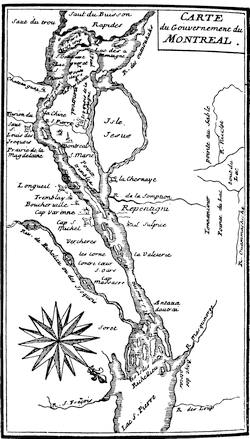
MONTREAL AND ITS VICINITY
Faillon, Histoire de la Colonie Française, iii. 375, gives a map of Montreal preserved in the French archives,—Plan de Villemarie et des premières rues projetées pour l’établissement de la Haute Ville. This represents the town at about 1665. There is a fac-simile of another plan of about 1680 preserved in the library of the Canadian Parliament, the original being at Paris (Catalogue, 1858, p. 1,615). A plan of 1685 is given in l’Héroïne Chrétienne du Canada, ou Vie de Mlle. le Ber, Villemarie, 1860. Charlevoix gives a map with the old landmarks, and it is reproduced in Shea’s edition, ii. 170. A later one is in La Potherie, 1753 edition, ii. 311 (given above), and one of about 1759, in Miles’s Canada, p. 296.
He derives new matter from the public archives in France, goes over afresh the whole history of Champlain’s career, and throws light on points left dark by Charlevoix and the earlier narrators, and is in some respects the best of the recent French historians; but Parkman (Jesuits, p. 193) cautions us that his partisan character as an ardent and prejudiced Sulpitian should be well kept in mind (cf. Field, p. 518; and chap. vii. of the present volume). Dollier de Casson’s Histoire de Montréal, 1640-1672, is a manuscript in the Mazarin Library in Paris, of which Mr. Parkman has a copy. It was printed in 1871 by the Literary and Historical Society of Quebec, in the third series of their historical documents. Parkman refers to (Jesuits, p. 209), and gives extracts from, Les véritables Motifs ... de la Société de Notre Dame de Montréal pour la Conversion des Sauvages, which was published in 1643 as a defence against aspersions of the “Hundred Associates.” It was probably printed at Paris. A copy some years since passed into an American collection at 800 francs. A transcript of a copy, collated by Margry, was used in the reprint issued in the Mémoires de la Société historique de Montreal, in 1880, under the editing of the Abbé Verreau, who attributes it to Olier, while Faillon has ascribed it to Laisné de la Marguerie. The editor adds some important “notices bibliographiques et documentaires;” some “notes historiques par le Commandeur Viger,” from an unpublished work,—Le Petit Registre; a “liste des premiers Colons de Montreal.” Of the older authorities, Le Clercq and Charlevoix (Shea’s edition, note, ii. 129) are useful; but Charlevoix, as Parkman says, was not partial to Montreal. The Société historique de Montreal began in 1859 the publication of Mémoires et Documents relatifs a l’histoire du Canada. The first number, “Dè l’Esclavage en Canada,” was the joint work of J. Viger and L. H. Lafontaine, but it has little matter falling within the present period; the second, “De la Famille des Lauson,” the governor of New France after 1651, by Lafontaine, with an Appendix on the “Vice-Rois et Lieutenants Generaux des rois de France en Amerique,” by R. Bellemare; the third, “Ordonances de Mr Paul de Chomedey, Sieur de Maisonneuve, premier gouverneur de Montreal,” etc; the fourth, “Règne Militaire en Canada;” the fifth, “Voyage de Dollier et Galinée.” See a paper on Montreal and its founder, Maisonneuve, in the Canadian Antiquarian, January, 1878. Concerning the connection of M. Olier with the founding of Montreal and the schemes connected with it for the conversion of the savages, see Faillon, Vie de M. Olier, Paris, 1873, iii. 397, etc., and references there cited; and also see Faillon, Vie de Mdlle. Mance, Paris, 1854, and Parkman in Atlantic Monthly, xix. 723.
1642-1643.—Vimont. Relation ... en l’années 1642 et 1643. Paris, 1644. Pages 8, 309, 3.
Contents: Report,—Algonquin Letter, with interlinear Translation; Founding of Sillery; Tadousac; Five Letters from Père Jogues about his Captivity among the Iroquois, beginning p. 284, giving, in substance only, the Latin narrative mentioned below; Declaration of the Company of New France, that the Jesuits took no part in their trade; Further notice of Nicolet’s Exploration towards the Mississippi.
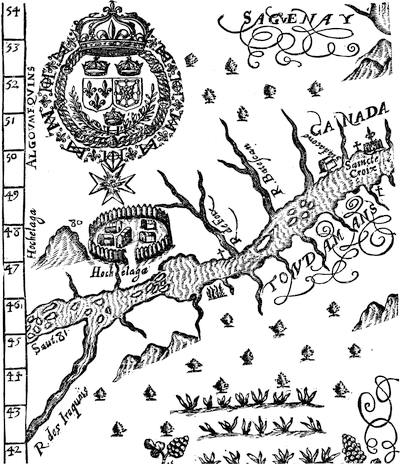
THE SITE OF MONTREAL.
From Lescarbot’s map of 1609, showing the Mountain and the Indian town, Hochelaga, the site of Montreal. Newton Bosworth’s Hochelaga Depicta was published in Montreal in 1839.
References: Carayon, no. 1,272; Harrisse, no. 81; Carter-Brown, vol. ii. no. 552; Lenox, p. 6; O’Callaghan, no. 1,222.
Copies: CB., F., GB., HC., L. (two copies, slightly different), M., SJ., V.
Nicolet’s explorations, which have usually been put in 1638-39, were fixed by Sulté in 1634; cf. his Mélanges, Ottawa, 1876, and Draper’s annotations in the Wisconsin Historical Collections, viii. 188, and Canadian Antiquarian, viii. 157. This view is sustained in C. W. Butterfield’s Jean Nicolet, Cincinnati, 1881. Cf. Margry, Découvertes, i. 47; Creuxius, Historia Canadensis, and the modern writers,—Parkman, La Salle: Harrisse, Notes; Margry, in Journal de l’Instruction publique, 1862; Gravier, La Salle; etc. See also chap. v. of the present volume.
1643-1644.—Vimont. Relation ... ès années 1643 et 1644. Paris, 1645. Pages 8, 256, 4, 147 (marked 174).
Contents: Report, giving account of the Capture of Father Bressani; Huron Report by Hierosme Lalemant; War of the Five Nations against the Hurons.
References: Carayon, no. 1,273; Harrisse, no. 83; Carter-Brown, vol. ii. no. 576; Lenox, p. 6. O’Callaghan, no. 1,223. Recently priced at $50.
Copies: CB., GB., HC., L., M., OHM.
Father F. G. Bressani was in the country from 1642 to 1645, and in his Breve Relatione d’alcune missioni de PP. della Compagnia di Giesu nella Nuova Francia, Macerata, 1653, pp. iv, 127, he gave an account of the rise and progress of the Huron mission. He promised a map and plates, but they do not appear in the copies known, of which two are in the Carter-Brown (Catalogue, vol. ii. no. 750) and Lenox (Contributions, p. 8) libraries; and others were sold in the Brinley (no. 67) and O’Callaghan (no. 1,232) sales. Cf. Carayon, p. 1,317; Leclerc, no. 684 (350 francs); and Shea’s Charlevoix, p. 80. Père Martin had to bring a copy from Rome to make his French translation, Relation abrégée de quelques missions ... dans la Nouvelle France, Montreal, 1852. This version had the Creuxius map, as already stated; another of the Huron country (p. 280), and numerous notes, with a memoir of Bressani by the editor. Cf. Parkman’s Jesuits, p. 253, with references; Shea’s Charlevoix, ii. 174, with note, and his Perils of the Ocean and Wilderness, p. 104; O’Callaghan’s New Netherland; Archbishop Spalding’s Miscellanea.
The first martyr of the Huron mission was Père Antoine Daniel, killed July 4, 1648 (Parkman’s Jesuits, p. 373). Field (Indian Bibliography, p. 146) says some curious, though perhaps not very authentic, information regarding the Hurons can be got from Sieur Gendron’s Quelques Particularitéz du Pays des Hurons, par le Sieur Gendron, which appeared in Davity’s Déscription Générale de l’Amerique, edited by Jean Baptiste de Rocoles, Troyes et Paris, 1660, and was reprinted in New York in 1868. Cf. Carter-Brown, vol. ii. no. 873; Lenox, p. 18; and Field, no. 598. A fac-simile of a corner map in Creuxius’s larger map, giving the Huron country, is given herewith. Parkman also gives a modern map with the missions and villages marked, and tells the fate of this people after their dispersement, at the end of his Jesuits. See Canadian Monthly, ii. 409.
Dr. Shea gives the following list of martyrs among the Canadian Jesuits, with the dates of their deaths: Isaac Jogues, 1646; Antoine Daniel, 1648; Jean Brebeuf, Gabriel Lallemant, Charles Garnier, and Natalis Chabanel, 1649; Jacques Buteux, 1652; Leonard Garreau, 1656, and René Menard, 1661. And of the Sulpitians: Guillaume Vignal and Jacques Le Maître, 1661. Les Jésuites-Martyrs du Canada, Montreal, 1877, includes Martin’s translation of Bressani’s Relation Abrégée, and sections on the “Caractère des Sauvages et de leur pays,” on their conversion, and on the “Mort de Quelqes Pères.”
1644-1645.—Vimont. Relation ... ès années 1644 et 1645. Paris, 1646. Pages 8, 183, 1.
Contents: Missions News; Incursions of the Five Nations; Letter from Lalemant about the Huron Mission, beginning on p. 136.
References: Carayon, no. 1,274; Harrisse, no. 84; Carter-Brown, vol. ii. no. 594; Lenox, p. 6; Dufossé, no. 8,663.
Copies: CB., HC., L., M., V.
1645-1646.—Hierosme Lalemant. Relation ... ès années 1644 et 1645. Paris, 1647. Pages 6, 184, 128.
Contents: Report,—Missions to the Iroquois; Jogues among the Mohawks; Huron Report by Paul Ragueneau, May, 1645, to May, 1646.
References: Carayon, no. 1,275; Harrisse, no. 86; Sabin, vol. x. no. 38,684; Carter-Brown, vol ii. no. 619; Lenox, p. 7; O’Callaghan, 1,224; Harrassowitz, 1883 (160 marks).
Copies: CB., GB., HC. (two copies), K., L. (two copies), M., NY., V.
Masse died May 12, 1646, and this Relation contains an account of him.
From October, 1645, to June, 1668, there are journals of the Jesuit missionaries preserved in the archives of the Séminaire at Quebec, which give details not originally intended for the public eye, but which now form an interesting supplement to the series for the years 1645-1668, except that there is a gap between Feb. 5, 1654 and Oct. 25, 1656. These journals were printed at Quebec in 1871, as Le Journal des Jésuites; publié par les Abbés Laverdière et Casgrain. Cf. Carter-Brown, vol. ii. no. 1,009, where it is stated that the greater part of the edition was destroyed by fire. A continuation of this Journal was in the hands of William Smith, historian of Canada; but is now lost. The Amer. Cath. Quarterly, U. S. Cath. Mag., and The Month contain various papers on the missions. See Poole’s Index.
1647.—Hierosme Lalemant. Relation ... en l’année 1647. Paris, 1648. Pages 8, 276; paging irregular from p. 209 to p. 228. Some copies have a repeated de in the title.
Contents: The Mission of Jogues among the Mohawks, and a narrative of his death begins p. 124; Missions among the Abenakis.
References: Carayon, no. 1,276; Harrisse, no. 87; Sabin, vol. x. no. 38,685; Carter-Brown, vol. ii. no. 652; Lenox, p. 7; O’Callaghan, no. 1,225; Harrassowitz, 1883 (160 marks); Dufossé, no. 5,603 (190 francs).
Copies: CB., F., GB., HC., J. (two copies), K., L. (two copies), M., NY., V.
After Jogues’ captivity among the Mohawks, and his mutilations, and his rescue by the Dutch, he wrote an account of Novum Belgium in 1643-1644, which remained in manuscript till Dr. Shea printed it with notes in 1862, as explained in a note to chap. ix. of the present volume. Jogues now went to France, but returned shortly to brave once more the perils of a missionary’s life, and this second venture he did not survive. His own account of this was preserved, according to Père Martin, in the archives of the College of Quebec down to 1800, and according to Dr. Shea passed into the hands of the English Government, and was used by Smith in compiling his History of Canada, Quebec, 1815, and has not been seen since. “It is given apparently in substance in the Relation of 1646.”—Shea’s Charlevoix, ii. 188.
Dr. Shea also edited in English the “Jogues Papers” in the N. Y. Hist. Soc. Coll., 2d ser., vol. iii., including the account of Jogues’ captivity among the Mohawks; and he repeated the narrative in his Perils of the Ocean and Wilderness, p. 16. The original is a Latin letter, dated Rennselaerswyck, Aug. 5, 1643, of which there is a sworn copy preserved at Montreal, which differs somewhat from the printed copy as given in Alegambe’s Mortes illustres, Rome, 1667, p. 616 (Carayon, no. 79); and in Tanner’s Societas Jesu, Prague, 1675; and the German translation of it, Die Gesellschaft Jesu, Prague, 1683. Cf. Carter-Brown, vol. ii. nos. 1,136, 1,274; Field, Indian Bibliography, 1,530; Stevens, Bibliotheca Hist. 2,017. The letter is badly translated in Bressani’s Breve Relatione, p. 77, but Martin gives it better in his version of Bressani (p. 188). Details, more or less full, can be found in Andrada’s Claros Varones, Madrid, 1666; Creuxius, Historia Canadensis, pp. 338, 378; the Dutch Church History of Hazart, vol. iv.; Barcia, Ensayo Chronologico, Madrid, 1723, p. 205; Carayon, Première Mission; the Bishop of Buffalo’s Missions in Western New York, Buffalo, 1862; and of course in Ferland, Parkman (Jesuits, pp. 106, 211, 217, 304), and the other modern historians. A portrait of Jogues is given in Shea’s edition of the Novum Belgium, and in his Charlevoix, ii. 141.
1647-1648.—Hierosme Lalemant. Relation ... ès années 1647 et 1648. Paris, 1649. Pages 8, 158, blank leaf, 135.
Contents: Dreuillettes among the Abenakis; Huron Country Report by Ragueneau, with accounts of the Great Lakes and the Native Tribes upon them; The Five Nations; The Delawares (Andastes); New Sweden, Niagara Falls, etc.
References: Carayon, no. 1,277; Harrisse, no. 89; Sabin, vol. x. no. 38,686; Carter-Brown, vol. ii. no. 673; Lenox, p. 7; O’Callaghan, no. 1,226; Sunderland, vol. iii. no, 7,218.
Copies: CB., HC., K., L. (2 copies), M., NY., V.

Father Gabriel Dreuillettes, in the interest of the Abenakis mission, subsequently made a journey in 1651 to Boston, to negotiate a league between the New England colonies, the Canadian authorities and the Abenakis against the Iroquois. The papers appertaining were recovered by Dr. Shea and printed in New York in 1866, as Recueil de Pièces sur la Négociation entre la Nouvelle France et la Nouvelle Angleterre ès années 1648 et suivantes. A Latin letter from Dreuillettes to Winthrop, which makes a part of this book, had earlier been printed separately in 1864 by Dr. Shea, and again in 1869. The original manuscript was found among the Winthrop Papers, and is now in the cabinet of the Massachusetts Historical Society. (Field, Indian Bibliography, pp. 460, 461; Sabin, vol. v. p. 536; N. Y. Hist. Soc. Coll., 2d ser., iii. 303.) Mr. Lenox also, still earlier, privately printed at Albany in 1855, after the original, “déposé parmi les papiers du Bureau des Biens des Jésuites à Québec,” Dreuillettes’ Narré du Voyage (60 copies), as copied by Dr. Shea. Cf. Carter-Brown, vol. ii. no. 713; Mass. Hist. Soc. Proc., iii. 34; xi. 152; Hutchinson’s Massachusetts Bay, i. 166; his Collection of Papers, p. 166; Plymouth Colonial Records, ix. 199; Parkman’s Jesuits, pp. 324, 330, and his references; Shea’s Charlevoix, i. 228, and ii. 214; Hazard’s Collection, ii. 183, 184; and N. Y. Col. Doc., ix. 6. The letter of the Council of Quebec and the commission given to the envoys sent to Boston, are also in Massachusetts Archives; Documents Collected in France, ii. 67, 69, where will also be found (iii. 21) a letter, dated Quebec, April 8, 1681, on the life and death of Druillettes.
1648-1649.—Paul Ragueneau. Relation ... ès années 1648 et 1649. Paris, 1650. Pages 8, 103. There was a second issue, with larger vignette on title, and some additional pages to the Huron report, pp. 4, 114, 2.
Contents: Text signed by J. H. Chaumonot; the Huron mission; chaps. 4 and 5 give biographies of Brebeuf and Gabriel Lalemant, killed by the Iroquois.
References: Carayon, no. 1,278; Harrisse, nos. 90, 91; Carter-Brown, vol. ii. nos. 695, 696; Lenox, p. 7; O’Callaghan, no. 1,228; Dufossé, 1880 (180 francs). Harrassowitz, 1883 (160 marks). The second issue was recently priced in New York at $60.
Copies: CB. (both editions), GB. (first), J. (first), K. (second), L. (both), M. (first), OHM. (both).
1648-1649.—Ragueneau. Relation, etc.... Lille, 1650. Pages 121, 3. Follows the first Paris edition, but is of smaller size.
References: Harrisse, no. 92; Lenox, p. 7.
Copies: HC., L.
1648-1649.—Ragueneau. Narratio Historica ... Œniponti, 1650. Pages 24, 232, 3. A Latin translation by G. Gobat, somewhat abridged, and differently divided into chapters; smaller than the preceding edition.
References: Carayon, no. 1,316; Harrisse, no. 93; Ternaux, no. 703; Carter-Brown, vol. ii. no. 690; Lenox, p. 7; O’Callaghan, no. 1,227. Rich, 1832 (15 shillings).
Copies: CB., HC., L.
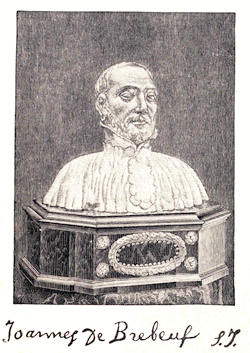
Further accounts of the martyrdom of Brebeuf and Lalemant will be found in most of the works mentioned under 1647, in connection with Jogues. Cf. also the Mercure de France, 1649, pp. 997-1,008; Catholic World, xiii. 512, 623; Le Père Martin’s Le P. Jean de Brebeuf, sa vie, ses travaux, son Martyre, Paris, 1877; Harrisse, p. 88; Shea’s Charlevoix, ii. 221, where is an engraving of a silver portrait bust of Brebeuf, sent by his relatives from Paris to enclose his skull (cf. Parkman’s Jesuits, p. 389), which is still preserved at Quebec. The accompanying engraving is made from a photograph kindly lent by Mr. Parkman. There are other engravings in Shea’s Catholic Mission, in his Charlevoix, ii. 221; and in the Carter-Brown Catalogue, ii. 171.
1649-1650.—Ragueneau. Relation ... depuis l’Esté de la année 1649 jusques à l’Esté de l’année 1650. Paris, 1651. Pages 4, 178 (marked 187), 2. Page 171 has tailpiece of fruits. A second issue has typographical variations, with no tailpiece on p. 171, and on p. 178 a letter from the “Supérieure de l’Hospital de la Miséricorde de Kebec.”
Contents: Ragueneau’s letter begins p. 1; Lalemant’s, p. 172; Letters of Buteux and De Lyonne; Huron Mission; Murders of Garnier and Noel Chabanel; Iroquois defeat of the Hurons, and a remnant of the latter colonized near Quebec.
References: Carayon, nos. 1,279, 1,280; Harrisse, nos. 95, 96; Carter-Brown, vol. ii. no. 719; Lenox, p. 8; Brinley, p. 139; Harrassowitz, 1883 (250 marks).
Copies: CB., GB., HC. (first edition), K., L. (both), M., NY.
Shea, Charlevoix, ii. 231, and Parkman, Jesuits, pp. 101, 406, 407, give references for Garnier. Cf. Bressani, Breve Relatione, and Martin’s translation of Bressani, for a table of thirty Jesuit and Recollect missionaries among the Hurons. Margry’s Découvertes, etc., Part I., is on “Les Récollets dans le pays des Hurons, 1646-1687.”
Parkman, Jesuits, pp. 402, 430, saying that this Relation is the principal authority for the retreat of the Hurons to Isle St. Joseph, etc., gives other references.
1650-1651.—Ragueneau. Relation ... ès années 1650 et 1651. Paris, 1652. Pages 4, 146, 1.
Contents: French Settlements and the Missions. A letter signed Martin Lyonne begins p. 139.
References: Carayon, no. 1,281; Harrisse, no. 97; Carter-Brown, vol. ii. no. 740; Lenox, p. 8; O’Callaghan, no. 1,229; Harrassowitz, 1883 (120 marks).
Copies: CB., GB., HC., K., L., M., NY.
1651-1652.—Ragueneau. Relation ... depuis l’été de l’année 1651 jusques à l’été de l’année 1652. Paris, 1653. Pages 8, 200.
Contents: Chap. i. gives an account of the death of Buteux; Chap. ix., War with the Iroquois; Chap. x., Biography of La Mère Marie de Saint Joseph.
References: Carayon, no. 1,282; Harrisse, no. 98; Carter-Brown, vol. ii. no. 756; Lenox, p. 8; O’Callaghan, no. 1,231; Harrassowitz, 1883 (120 marks).
Copies: CB., HC., (two copies), K., L., V.
The account of the Réligieuses Ursulines of Canada in this Relation was repeated, with additions, in pp. 229-315 of La Gloire de S. Ursule, Valenciennes, 1656. Cf. Harrisse, p. 106; Lenox, p. 8; also Les Ursulines de Québec, and Saint Foi’s Premières Ursulines de France.

An account of the missions “in Canada sive Nova Francia” is the first section of the Progressus fidei Catholicæ in novo orbe, published at Coloniæ Agrippinæ, 1653. The book is very rare; the only copy noted is in the Carter-Brown Collection, vol. ii. no. 758. The Lenox Contribution, p. 8., says there was a copy in O’Callaghan’s Collection, but I fail to find it in his sale catalogue; cf. Harrisse, p. 99.
1652-1653.—François Lemercier. Relation ... depuis l’été de l’année 1652 jusques à l’été de l’année 1653. Paris, 1654. Pages 4, 184, 4.
Contents: Montreal; Three Rivers; Poncet captured by the Mohawks; Fort Orange; Peace with the Iroquois.
References: Carayon, no. 1,283; Harrisse, no. 101; Sabin, vol. x. no. 39,992; Carter-Brown, vol. ii. no. 775; Lenox, p. 8; O’Callaghan, no. 1,233; Harrassowitz, 1883 (120 marks).
Copies: CB., HC., K., L., M., OHM.
Montreal was organized as a colony in 1653. Cf. Faillon, vol. ii. chap. 10.
1653-1654.—Lemercier. Relation ... ès années 1653 et 1654. Paris, 1655. Pages 4, 176.
Contents: Negotiations with the Five Nations; Le Moyne at Onondaga; Treaty of Peace, and Discovery of Salt Springs; Letter from the Hurons at the Isle d’Orléans with a translation.
References: Carayon, no. 1,284; Harrisse, no. 103; Sabin, vol. x. no. 39,993; Lenox, p. 8; Carter-Brown, vol. ii. no. 799; O’Callaghan, no. 1,234; Harrassowitz, 1883 (120 marks); Doc. Hist. N. Y., i. 33
Copies: CB., F., HC., J., K., L., M., OHM., NY..
Cf. L. P. Tarcotte’s Histoire de l’ile Orléans, Quebec, 1867, and N. H. Bowen’s Isle of Orleans, 1860.
1655.—Copie de deux Lettres envoiées de la Nouvelle France. Paris, 1656. Pages 28. The bearer of the Relation of this year was robbed in France, and only these two letters were recovered and printed. It, with the Relation of 1660, is the rarest of the series.
References: Harrisse, nos. 108, 425; Carter-Brown, vol. ii. no. 813; Lenox, p. 9; O’Callaghan, no. 1,974.
Copies: Those in L. and in the Ste. Geneviève at Paris are the only ones known.
Mr. Lenox printed a fac-simile edition from his own copy, with double titles, showing variations; and of this there are copies in CB., HC., etc.
1655-1656.—Jean de Quens. Relation ... ès Années 1655 et 1656. Paris, 1657. Pages 6, 168.
Contents: A Letter signed by De Quens; Le Moyne among the Mohawks; The French at Onondaga; War between the Five Nations and Eries; Ottawas at Quebec; Murder of Garreau.
References: Carayon, no. 1,285; Harrisse, no. 109; Carter-Brown, vol. ii. no. 826; Lenox, p. 9; O’Callaghan, no. 1,237.
Copies: CB., GB., HC., L., M.
Cf. Tailhan, Mémoires sur Perrot, p. 229; and the references in Shea’s Charlevoix, vol. ii. Parkman says Perrot is in large part incorporated in La Potherie; cf. Historical Magazine, ix. 205.
1656-1657.—Le Jeune. Relation ... ès années mil six cents cinquante six et mil six cens cinquante sept. Paris, 1658. Pages 12, 211.
Contents: Begins with a Letter signed by Le Jeune; The Senecas and the French; Mission to the Cayugas; Dupuis and the Jesuits among the Onondagas; Le Moyne among the Mohawks; Customs of the Five Nations; Chap. xxi. has a Letter signed by Le Mercier.
References: Carayon, no. 1,280; Harrisse, no. 110; Sabin, vol. x. no. 39,957; Carter-Brown, vol. ii. no. 839; Lenox, p. 9; O’Callaghan, no. 1,238; Harrassowitz, 1883 (125 marks). Recently priced at $60.
Copies: CB., GB., HC., K., L., NY.

1657-1658.—Ragueneau. Relation ... ès années 1657 et 1658. Paris, 1659. Pages 8, 136. Martin holds that this volume was made up in Paris.
Contents: Two Letters from Ragueneau; French Settlements at Onondaga abandoned; Journal, 1655-1658, dated New Holland, March 25, 1658, and signed Simon Le Moine; Routes to Hudson’s Bay; Comparison of savage and European Customs.
References: Carayon, no. 1,287; Harrisse, no. 112; Carter-Brown, vol. ii. no. 859; Lenox, p. 9.
Copies: CB., L., M., NY.
On the French missions in New York, see Marie de l’Incarnation, Lettres historiques; Parkman’s Old Régime, chap. i.; O’Callaghan’s New Netherland; Shea’s Charlevoix, vol. iii.; J. V. H. Clark’s Onondaga (Syracuse, 1849); Charles Hawley’s Early Chapters of Cayuga History, with the Jesuit Missions in Goi-o-gouen, 1656-1684 (Auburn, 1879), with an Introduction by Dr. Shea. This last book has a map of the Iroquois territory and the mission sites, by J. S. Clark (reproduced on an earlier page).
1659.—Lallemant. Lettres envoiées de la Nouvelle France. Paris, 1660. Pages 49, 3.
Contents: Arrival of a Bishop; Algonquin and Huron Missions; Acadia Mission. The three letters are dated, respectively, Sept. 12, Oct. 10, Oct. 16, 1659.
References: Harrisse, no. 113; Sabin, vol. x. no. 38,683; Lenox, p. 9; O’Callaghan, no. 1,236.
Copies: From what was supposed to be a unique copy (since burned in 1854), in the Parliamentary Library at Quebec, Mr. Lenox had a fac-simile made, from which he afterward printed, in 1854, his fac-simile edition; but Harrisse has since reported two copies in the Bibliothèque Nationale, at Paris. Harrassowitz, in his Rarissima Americana, no. 91, p. 5, notes a copy at 2,500 marks, which is now in Mr. Kalbfleisch’s Collection.

De Laval landed at Quebec June 6, 1659, having been made Bishop of Petra and Vicar Apostolic of New France the previous year. He became Bishop of Quebec in 1674; resigned in 1688, and died in 1708. Parkman draws a distinct picture of his character in his Old Régime, chap. v., and describes his appearance from several portraits which are extant, one of which is engraved in Shea’s Le Clercq, ii. p. 50. A Life of him, by La Tour, was printed at Cologne in 1761; and an Esquisse de la vie, etc., at Quebec, in 1845. Two other publications are of interest: Notice sur la fête à Quebec le 16 Juin, 1859, 200eme anniversaire de l’arrivée de Laval, Quebec, 1859, and Translation des Restes de Laval, Quebec, 1878. Cf. Faillon, Hist. de la Colonie Française, ii. chap. 13, and Shea’s Charlevoix, iii. 20, for references. In 1874 the second centennial of Laval’s becoming bishop was commemorated in a Notice biographique, by E. Langevin, “suivie de quarante-une lettres et notes historiques sur le Chapitre de la Cathédrale,” published at Montreal, 1874.
The Sisters of the Congregation of Notre Dame were founded this year at Montreal, and the life of the foundress, Margaret Bourgeois, by Montgolfier, was published in Montreal in 1818; and was translated and published in English in New York in 1880. Another Life, said to be by the Abbé Faillon, was published in 1853. An earlier Life, by Ransonet, was published at Liege in 1728. Cf. Parkman’s Jesuits, p. 201, and Shea’s Charlevoix, vol. v., for her portrait.
The Abbé de Queylus, who was the candidate of the Sulpitians for the Bishopric, came over in 1657. (Faillon, ii. 271; La Tour, Vie de Laval, 19; Shea’s Charlevoix, iii. 20; Parkman, Old Régime, 97.)
1659-1660.—(Not signed.) Relation ... ès années mil six cent cinquante neuf et mil six cent soixante. Paris, 1661. Pages 6, 202; paging irregular in parts.
Contents: Letter from Menard; Country of the Five Nations, with Census of the Tribes; Saguenay River; Hudson’s Bay; Overthrow of the Hurons.
References: Carayon, no. 1,288; Harrisse, no. 115: Carter-Brown, vol. ii. no. 895; Lenox, p. 9; O’Callaghan, no. 1,239.
Copies: CB., F., GB., HC., L., M., NY.
For the dispersal of the Hurons, see Martin’s Bressani, App. p. 309; cf. Parkman’s Jesuits.
For the part relating to traders on Lake Superior in 1658, see translation, in Smith’s Wisconsin, iii. 20; cf. Margry, i. 53. Menard’s letter, Aug. 27, 1660, on the eve of his embarkation for Lake Superior, is translated in Minnesota Historical Society’s Annals, i. 20; and Collections, i. 135.

1660-1661.—Le Jeune. Relation ... ès années 1660 et 1661. Paris, 1662. Pages 8, 213, 3.
Contents: Le Jeune’s Epistle to the King; War with the Iroquois; Peace with the Five Nations; Mission to Hudson’s Bay; “Journal du premier Voyage fait vers la Mer du Nort,” begins on page 62; Letters of Le Moyne from the Mohawk Country, and from a French Prisoner among the Mohawks.
References: Carayon, no. 1,289; Harrisse, no. 117; Carter-Brown, vol. ii. no. 907; Lenox, p. 10; O’Callaghan, no. 1,240; Harrassowitz, 1882 (125 marks). Recently priced in New York at $50.
Copies: CB., HC., K., L., NY., V.
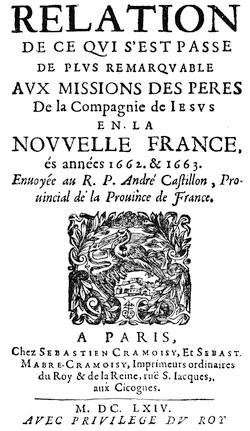
1661-1662.—Lallemant. Relation ... ès années 1661 et 1662. Paris, 1663. Pages 8, 118, 1.
Contents: Letter dated Kebec, Sept. 18, 1662, signed Hierosme Lalemant; Disputes with two of the Five Nations; Murder of Vignal; Le Moyne among the Senecas.
References: Carayon, no. 1,290; Harrisse, no. 119; Carter-Brown, vol. ii. no. 929; Lenox, p. 10; O’Callaghan, no. 1,241; Quaritch, no. 12,365 (£8 10s.); Harrassowitz, 1882 (150 marks).
Copies: CB., HC., J., K., L.
Cf. Shea’s Charlevoix, iii. 45, note.
1662-1663.—Lallemant. Relation ... ès années 1662 et 1663. Paris, 1664. Pages 16, 169, with some irregularity of paging.
Contents: Meteorological Phenomena: Earthquake of 1663 [see Harrisse, p. 118] and Solar Eclipse, Sept. 1, 1663; War with the Iroquois; Outaouaks; Death of Menard.
References: Carayon, no. 1,291; Harrisse, no. 121; Sabin, vol. x. no. 38,688; Lenox, p. 10; Carter-Brown, vol. ii. no. 950; O’Callaghan, no. 1,242; Dufossé, no. 5,602 (180 francs); Harrassowitz, 1882 (120 marks). Recently priced in New York at $50.
Copies: CB., HC., K., L., M., NY.
Cf. Shea’s Charlevoix, iii. 48, 57.
Menard had established a mission at St. Theresa Bay, Lake Superior, in 1661. Cf. Smith’s Wisconsin, vol. iii., for a translation; cf. further, on Menard, Perrot’s Mœurs des Sauvages; Historical Magazine, viii. 175, by Dr. Shea, and his edition of Charlevoix, i. 49; Minnesota Hist. Soc. Coll., by E. D. Neill, i. 135. Cf. J. G. Shea on the “Indian Tribes of Wisconsin,” in the Wisconsin Hist. Coll., iii. 125; and a criticism by Alfred Brunson in vol. iv. p. 227.
1663-1664.—Lallemant. Relation ... ès années 1663 et 1664. Paris, 1665. Pages 8, 176, with some irregularities of paging.
Contents: Missions among the Hurons, Algonquins, and Five Nations; War of the Mohawks; Iroquois Embassy to the French.
References: Carayon, no. 1,292; Harrisse, no. 123; Sabin, vol. x. no. 38,689; Carter-Brown, vol. ii. no. 964; Lenox, p. 10.
Copies: CB., HC., L., M., NY.
1664-1665.—Lemercier. Relation ... ès années 1664 et 1665. Paris, 1666. Pages 12, 128.
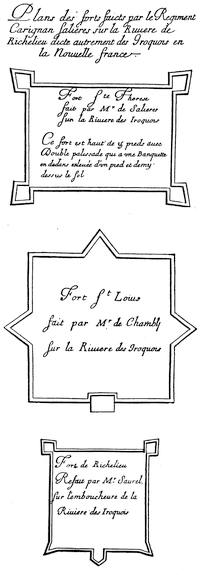
Contents: M. de Tracy’s Voyage; Strength of the Five Nations; Comets; Vignal’s Death; Nouvel among the Savages. What is called a second issue has in addition a “Lettre de la R. Mère Supérieure des Réligieuses Hospitalières de Kebec du 23 Octobre, 1665,” 16 pp., which is not reprinted in the Quebec edition of the Relations. A map of Lakes Ontario, Champlain, and adjacent parts, with plans of the forts on the Richelieu River. A part of the map and plans of the forts are given herewith. Martin assigns these plans to the following Relation.
References: Carayon, no. 1,293; Harrisse, nos. 124, 133; Sabin, vol. x. no. 39,994; Carter-Brown, vol. ii. no 978; Lenox, p. 10; O’Callaghan, no. 1,243; Dufossé, no. 2,175 (200 francs).
Copies: CB., HC., L. (both issues), M., OHM., NY.
1665-1666.—Lemercier. Relation ... aux années mil six cent soixante cinq et mil six cent soixante six. Paris, 1667. Pages viii, 47, 16.
Contents: Courcelles’ Expedition, January, 1666, against the Oneidas and Mohawks; De Tracy’s Interview with Garacontie, and his Expedition, September, 1666, against the Mohawks.
References: Carayon, no. 1,294; Harrisse, no. 126; Sabin, vol. x. no. 39,995; Carter-Brown, vol. ii. no. 992: Lenox, p. 10; Harrassowitz, 1882 (150 marks).
Copies: CB., without the “Lettre.” K., with the “Lettre.”

Harrisse says the copies in the Bibliothèque Nationale and the Ste. Geneviève Libraries in Paris contain also a “Lettre de la Révérende Mère Supérieure des Réligieuses Hospitalières de Kebec, du 3 Octobre, 1666,” 16 pp., which is called for in the contents-tables of copies in which it fails, and it is not included in the Quebec edition of the Relations. Historical Magazine, iii. 20.

1666-1667.—Lemercier. Relation ... les années mil six cens soixante six et mil six cens soixante sept. Paris, 1668. Pages 8, 160, 14. The title is without the usual vignette of storks.
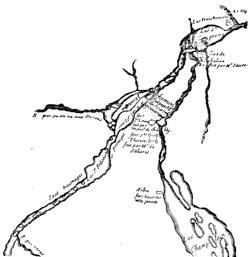
THE FORTS.
A section in fac-simile of the map in the Relation of 1662-63, showing the position of the forts. These may be compared with the Carte dressée pour la Campagne de 1666, accompanied by plans of forts Richelieu, St. Louis, and Ste. Thérèse, which Talon sent with his despatch of Nov. 11, 1665, and which is engraved in Faillon, Histoire de la Colonie Française en Canada, iii. 125, where will also be found a map to illustrate the campaign of 1666.
Contents: Allouez’ Journal to Lake Superior; The Pottawatomies and other Western Tribes; Missions to the Five Nations; Thomas Morel’s Account of the Wonders in the Church of St. Anne du Petit Cap. A second issue has appended, a “Lettre de la Révérende Mère Supérieure des Réligieuses Hospitalières de Kebec du 20 Octobre, 1667,” 14 pp., which is omitted in the Quebec edition of the Relations.
References: Carayon, no. 1,295; Harrisse, no. 127; Sabin, vol. x. no. 39,996; Carter-Brown, vol. ii. no. 1,011; Lenox, p. 11; Harrassowitz, 1882, without the “Lettre” (100 marks).
Copies: CB. (2d issue), HC. (2d issue), J., K. (1st issue), L. (both), M., NY. (1st issue), V.
A translation of Allouez’ journal is in Smith’s Wisconsin, vol. iii.; cf. Shea’s Charlevoix, iii. 101, and his Discovery of the Mississippi, and Catholic Missions; Margry’s Découvertes, i. 57.
For the early missions in the far West, see Wisconsin Hist. Soc. Coll., vol. iii.; E. M. Sheldon’s Early History of Michigan; Lanman’s Michigan; James W. Taylor’s History of Ohio. Cf. Field’s Indian Bibliography, nos. 856, 1,398, 1,535, 1,688.
It has been claimed that Archbishop Fénelon (b. 1651) may have been a missionary among the Iroquois from 1667 to 1674; cf. Robert Greenough in N. Y. Hist. Soc. Proc., 1848, p. 109; 1849, p. 11. A half-brother of Fénelon is known to have been in Montreal; cf. Abbé Verreau on “Les deux Abbés de Fénelon,” in the Canadian Journal de l’Instruction publique, vol. viii.; Parkman’s Frontenac, pp. 33, 43. The evidence fails to establish the proof of the Archbishop’s presence here. Cf. N. E. Hist. and Geneal. Reg. xvi. p. 344, and xvii. p. 246.
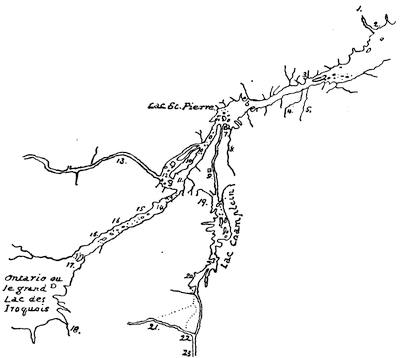
TRACY’S CAMPAIGN, 1666.
This sketch follows the principal part of a manuscript map in Mr. Parkman’s collection (No. 6) in Harvard College Library. It is called Carte des grands lacs Ontario et Autres, et des costes de la Nouvelle Angleterre et des pays traversés par Mrs. de Tracy et Courcelles pour aller attaquer les Agnez, 1666. Key:—
1. Saguenay.
2. Tadoussac.
3. Quebec.
4. R. du Sault de la Chaudiere.
5. R. des Etchemins.
6. Les 3 Rivières.
7. Fort de Richelieu.
8. R. St. François.
9. Fort de St. Louis.
10. Montreal.
11. Lac de St. Louis.
12. Lac des deux Montagnes.
13. Rivière par ou viennent les Outaouacs.
14. Lac St. François.
15. Sault.
16. Rapides.
17. Otondiala.
18. Ochouagen R.
19. Commencement du lac Champlain, ou est le fort Sa Anne du quel M. de Tracy escrit et est party le 4eme Octobre, 1666.
20. Lac du St. Sacrement.
21. Habitations Iroquoises que les troupes du Roy doivent attaquer. Trois villages des Agniez Iroquois.
22. Petit village hollandais.
23. Orange Midy.
The Catalogue of the Library of Parliament, 1858, p. 1614, gives a map, probably this one, as copied from the original in the archives at Paris.
Cf. on this campaign, Parkman’s Old Régime, p. 186. Harrisse, no. 125, following Faribault, no. 808, cites a Journal de la Marche du Marquis de Tracy contre les Iroquois, Paris, 1667, as an account of the third expedition against the Iroquois, of which Tracy took the command, Sept.-Nov., 1666, in person,—the earlier expeditions having been unsuccessful. Cf. documents in Margry, i. 169; Charlevoix, liv. ix., and Brodhead, vols. i. and ix. Cf. Colden’s Five Nations, and authorities enumerated by Shea in his Charlevoix, iii. 89, etc.
1667-1668.—Lemercier. Relation ... aux années mil six cens soixante-sept, et mil six cens soixante-huit. Paris, 1669. Pages 8, 219. Has the stork vignette of the Cramoisy press on the title, and it is the last Relation in which that sign is used.
Contents: The several Missions; Drowning of Arent van Curler; Letter of De Petrée, Bishop of Quebec; Death of the Mère Cathérine de St. Augustin.
References: Carayon, no. 1,296; Harrisse, no. 128; Sabin, vol. x. no. 39,997; Carter-Brown, vol. ii. no. 1,029; Lenox, p. 11.
Copies: CB., HC. (2 copies) L., M., OHM., NY.
Père Paul Ragueneau’s La Vie de la Mère Cathérine de St. Augustin, was published at Paris in 1671. Cf. Harrisse, no. 133; Carter-Brown, vol. ii. no. 1,069; Leclerc, 1878 (500 francs). There was an Italian translation printed at Naples in 1752.
1668-1669.—(No author.) Relation ... les années 1668 et 1669. Paris, 1670. Pages 2, 150 (last page 140 by error). The title vignette is a vase of flowers.
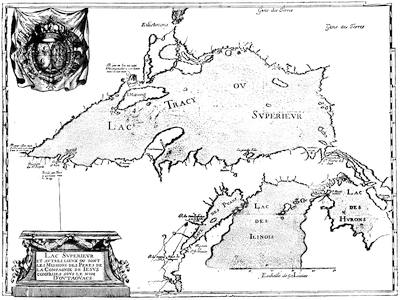
THE JESUIT MAP OF LAKE SUPERIOR.
Contents: Missions among the Five Nations; Letter from Governor Lovelace, “Gouverneur de Manhate,” from Fort James (New York), Nov. 18, 1668, to Father Pierron, on the sale of ardent spirits to the Indians.
References: Carayon, no. 1,297; Harrisse, nos. 129, 530; Carter-Brown, vol. ii. no. 1,049; Lenox, p. 11; O’Callaghan, no. 1,244.
Copies: CB., HC., L., M., OHM., NY.
The question of selling liquor to the Indians was one of large political bearing at times. Cf. Faillon, iii. chap. 21.
1669-1670.—Lemercier. Relation ... les années 1669 et 1670. Paris, 1671. Pages 10, 3-318. Part i. pp. 3-108, in larger type than part ii. pp. 111-318.
Contents: Missions to the Five Nations; The Iroquois and Algonquin Difficulties; The Mohawk and Mohegan War, 1669; The Père d’Ablon’s “Relation des Missions aux Ovtaovaks;” A chapter on the Dutch begins p. 145; Lake Superior and the Copper Mines; Letter from Jacques Marquette on the Western Tribes.
References: Carayon, no. 1,298; Harrisse, no. 135; Sabin, vol. x. no. 39,998; Carter-Brown, vol. ii. no. 1,070; Lenox, p. 11; O’Callaghan, no. 1,245; Dufossé, no. 2,176 (200 francs).
Copies: CB., F., HC., L., M., NY., V.

Translations of portions on Western explorations are in Smith’s Wisconsin, vol. iii.
1670-1671.—Claude d’Ablon. Relation ... les années 1670 et 1671.. Paris, 1672. Pages 16, 189, 1, with errors of paging. The title vignette is a basket of fruit.
Contents: The Missions; The Western Country occupied by the French, and the Country described; the Mississippi River described from the Reports of the Indians.

It has a folding map of Lake Superior (a fac-simile of it is annexed), of which, says Parkman (La Salle, pp. 30, 450), “the exactness has been exaggerated as compared with other Canadian maps of the day.” Bancroft (United States, original edition, iii. 152) gives a reproduction of it. Others are in Whitney’s Geological Report of Lake Superior, and in Monette’s Mississippi. vol. i. Harrisse (no. 201) notes a map of Lake Superior, dated 1671, and preserved in Paris.
References: Carayon, no. 1,290; Harrisse, no. 138; Carter-Brown, vol. ii. no. 1,084; Lenox, p. 11; Dufossé, no. 2,177 (200 francs); Harrassowitz, 1882 (110 marks).
Copies: CB., HC., K. (without map), L., M., NY.
Cf. the “Relation de l’Abbé Gallinée” in Margry, Découvertes, etc., part i. p. 112, and separately with the Abbé Verreau’s notes, Montreal, 1875. St. Lusson’s ceremony in taking possession of the country on the Lakes is noted in Ibid. i. 96.
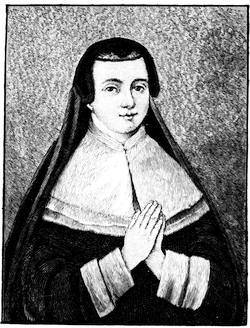
MADAME DE LA PELTRIE.
Copied from a photograph owned by Mr. Parkman of a painting of which there is an engraving in Les Ursulines de Quebec, i. 348.
1671-1672.—D’ablon. Relation ... les années 1671 et 1672. Paris, 1673. Pages 16, 264.
Contents: Arrival of Frontenac; Huron and Iroquois, Lower Algonquin, and Hudson’s Bay Missions; Overland Journey from the Saguenay. On page 207 begins “La Sainte Mort de Madame de la Peltrie.”
References: Carayon, no. 1,300; Harrisse, nos. 139, 340; Carter-Brown, vol. ii. no. 1,097; Lenox, p. 12; O’Callaghan, no. 1,246; Harrassowitz, 1882 (150 marks.)
Copies: CB., HC. (without map), K., L., M., NY., V.
Harrisse says the two copies in the Bibliothèque Nationale have the same map as the preceding Relation. O’Callaghan says all copies ought to have it. Lenox says the map in this edition is sometimes, but rarely, found with variations, the position of some of the missions being changed, and new stations added on the plate.
Parkman (La Salle, p. 29) speaks of the change now taking place in the character of the Relations, which are still “for the edification of the pious reader, filled with intolerably tedious stories of baptisms, conversions, and the exemplary deportments of neophytes; but they are relieved abundantly by more mundane subjects,— ... observations on the winds, currents, and tides of the Great Lakes, speculations on a subterranean outlet of Lake Superior, accounts of its copper mines,”[690] etc.
A Life of Madame de la Peltrie (Magdalen de Chauvigny), by Mother St. Thomas, was published in New York in 1859.
A companion of Madame de la Peltrie was commemorated in La Vie de la Vénérable Mère Marie de l’Incarnation, première Supérieure des Ursulines (Paris, 1677), by her son, Claude Martin. She was in Canada from 1639 to 1672. (Harrisse, no. 143; Lenox, pp. 13, 14; Dufossé, no. 6,763, 125 francs.) In 1681 a series of Lettres de la Vénérable Mère Marie de l’Incarnation was printed, and they cover many historical incidents. (Harrisse, no. 148; Dufossé, no. 3,166, 110 francs.) A selection of them was published at Clermont Ferrand in 1837. Charlevoix published a Life of her in 1724; and in 1864 one by Casgrain was printed in Quebec, and in English at Cork in 1880. In 1873 the French text was included in Œuvres de l’Abbé Casgrain, tome i. Another by the Abbé Richardeau was printed at Tournai in 1873. There is a likeness of her in Les Ursulines de Québec depuis leur Etablissement jusqu’a nos jours. A. M. D. G. Quebec, 1863. 4 vols. Shea (Charlevoix, i. 82; ii. 101; iii. 184) enumerates other authorities: Juchereau, Histoire de l’Hôtel-Dieu de Québec. Another History of the Hôtel-Dieu, by Casgrain, was published in 1878. An account of steps to procure her canonization is in the Catholic World (New York), August, 1878. Cf. Parkman’s Jesuits, 174, 177, 199, 206.
[The contemporary printing of these Relations stopped with this for 1671-1672. The series in continuation has since been printed in various forms, as follows.]
1672-1679.—Mission du Canada; Relations inédites de la Nouvelle France (1672-1679), Paris, Ch. Douniol, 1861. 2 vols.; 2 maps, one of them a fac-simile of Marquette’s map. [These volumes are vols. iii. and iv. of Voyages et Travaux des Missionaires de la Compagnie de Jésus.]
Cf. Field. Indian Bibliography, p. 276; Carter-Brown, vol. ii. no. 1,085, 1,198; Lenox, p. 14; O’Callaghan, no. 1,252.
1673-1679.—Claude Dablon. Relation de ce qui s’est passé de plus remarquable aux Missions des Pères de la Compagnie de Jésus en la Nouvelle France les années 1673 à 1679. A la Nouvelle York. De la Presse Cramoisy de Jean-Marie Shea, 1860. Pages 13, 290, with Marquette’s map.
Martin describes the original manuscript (147 pages, pp. 109-118 wanting) preserved at Quebec as being divided into eight chapters. It has an account of the heroic death of Marquette. Cf. Field’s Indian Bibliography, no. 396; Carter-Brown, vol. ii. no. 1,197; Lenox, p. 16.
Some misrepresentations having been made regarding the Cramoisy series of Dr. Shea, it is fair to say that the expense of the whole series was borne by himself alone. There are enumerations of the volumes in Field’s Indian Bibliography, the Menzies Catalogue, no. 1,811, and in the Brinley Catalogue, no. 146, etc.
1672-1673.—Dablon. Relation, etc. New York, 1861.
This concerns the missions to the Hurons near Quebec, to the Iroquois, and beyond the Great Lakes. It is also printed in the Mission du Canada, vol. i. Cf. Harrisse, nos. 597, 605; Carter-Brown, vol. ii. no. 1,098; Field, no. 1,070; Lenox, p. 17.
1673-1674.—Dablon. Relation, etc. In the Mission du Canada; and an English translation is in the Historical Magazine, v. 237.
1673-1675. Récit des Voyages et des Découvertes du R. Père Jacques Marquette, de la Compagnie de Jésus, en l’année 1673 et aux suivantes: La Continuation de ses Voyages par le R. P. Claude Allouez, et Le Journal autographe du P. Marquette en 1674 et 1675. Avec la Carte de son Voyage tracée de sa main.
Printed for Mr. Lenox after the original manuscript preserved in the Collége Ste. Marie at Montreal. Cf. O’Callaghan, no. 1,246a; Carter-Brown, ii. 1,126; Lenox, p. 12.
1675.—“État présent des missions pendant l’année 1675,” in the Mission du Canada, vol. ii.
1676-1677.—Relation ... ès années 1676 et 1677. Imprimée pour la première fois, selon la copie du MS. original restant à l’Université Laval, Québec. [Albany, 1854.] Pages 2, 165.
Contents: Missions among the Iroquois, Outaouacs, and at Tadousac.
This Relation was printed for Mr. Lenox. Cf. Lenox, p. 13; Carter-Brown, vol. ii. no. 1,172; O’Callaghan, nos. 1,247, 1,975.
1677-1678.—Relation, etc. This is printed in the Mission du Canada, i. 193.
Contents: Joliet’s account of his Journey with Marquette, and their discovery of the Mississippi in 1673, as edited by Père Dablon, with an account of a third journey to the Country of the Illinois, by Claude Allouez.
An English version of Allouez’ journal is given in Shea’s Mississippi Valley, p. 67, with a sketch of the missionary’s life. Cf. Margry’s “Notice sur le Père Allouez, 1665-71,” in his Découvertes, etc., Part I. p. 59. For Joliet and Marquette, see chap. vi.
1684.—Copie d’une Lettre escrite par le Père Jacques Bigot, de la Compagnie de Jésus, l’an 1684. Manate [New York], 1858.
The letter was written in behalf of the Abenakis of the St. Francis de Sales mission, to accompany offerings to the tomb of their patron saint at Annecy. The original letter is preserved in the Archives du Monastère de la Visitation à Annecy. Cf. Harrisse, no. 725; Lenox, p. 17; O’Callaghan, no. 1,972; Carter-Brown, vol. ii. no. 1,278.
1684.—Jacques Bigot. Relation ... l’année 1684. À Manate, 1857 (100 copies).
The Abenakis mission of St. Joseph de Sillery and the new mission of St. Francis de Sales, and follows the original manuscript in the Collége Ste. Marie. Cf. Harrisse, no. 726; Field, no. 130; Carter-Brown, vol. ii. no. 1,277; Lenox, p. 15.
1685.—Bigot. Relation ... l’année 1685. À Manate, 1858.
The St. Joseph de Sillery and St. Francis de Sales missions, and follows the original manuscript in the Collége Ste. Marie. Cf. Harrisse, no. 727; Carter-Brown, vol. ii. no. 1,307; Lenox, p. 15; Field, no. 131.
1688.—Jean de St. Valier (Evêque de Québec). Relation des Missions de la Nouvelle France. Paris, 1688.
References: Harrisse, no. 159; Carter-Brown, vol. ii. nos. 1,366, 1,367; O’Callaghan, no. 2,218; Sunderland, no. 268; Lenox, pp. 12, 13.
Copies: CB., HC., L., etc.
This work has sometimes the following title instead: Estat présent de l’Eglise et de la Colonie Françoise dans la Nouvelle France. De St. Valier had succeeded De Laval, but before consecration visited the country, and wrote this account of it.[691]
1688.—J. M. Chaumonot. Vie, écrite par lui-même, 1688. New York, 1858.
One of Dr. Shea’s Cramoisy series. The original manuscript is preserved in the Hôtel-Dieu, Quebec. It was followed by Suite de la vie de P. M. J. Chaumonot, par un père de la Compagnie, believed by Dr. Shea to be Rale. This was printed at New York in 1858, and continues the story to 1693. Cf. Carayon, Le Père Chaumonot; also, Harrisse, no. 753; Lenox, p. 16; Carter-Brown, vol. ii. nos. 1,348, 1,349; Field, no. 288.
1690-1691.—Pierre Milet. Relation de sa Captivité parmi les Onneiouts en 1690-91. Nouvelle York, 1864.
Cf. Lenox, p. 17; Harrisse, no. 776; Field, p. 274. It follows a copy found in Holland by Henry C. Murphy. See Vol. III. p. 415.
1693-1694.—Jacques Gravier. Relation ... depuis le Mois de Mars, 1693, jusqu’en Février, 1694. À Manate, 1857.
The mission of the Immaculate Conception among the Illinois. Cf. Lenox, p. 15; Carter-Brown, vol. ii. no. 1,466; Field, no. 622.
E. Carré, the minister of the French Church in Boston, printed in 1693, with a preface by Cotton Mather, Eschantillon de la doctrine que les Jésuites enseignent aux Sauvages du nouveau monde, drawn from a manuscript found at Albany. Sabin, vol. iii. no. 11,040.
1696-1702.—Relation des Affaires du Canada en 1696; avec des lettres des Pères de la Compagnie de Jésus, depuis 1696 jusqu’en 1702. Nouvelle York [Shea], 1865.
It was printed from copies of manuscripts preserved at Paris, made for H. C. Murphy, and covers the war with the Iroquois, the Sault St. Xavier, and other missions. A portion of it appeared without authority the same year, as Relation des affaires du Canada en 1696, et des Missions des Pères de la Compagnie de Jésus jusqu’en 1702. Cf. Field, p. 325; Lenox, p. 17; Carter-Brown, vol. ii. no. 1,489.
1700.—Relation ou Journal du Voyage du R. P. Jacques Gravier en 1700, depuis le pays des Illinois jusqu’à l’Embouchure du Mississippi. Nouvelle York, 1859.
Printed by Dr. Shea as one of his series, and translated by Shea in his Early Voyages up and down the Mississippi (Carter-Brown, vol. ii. no. 1,604). Dr. Shea also printed in 1861 De Montigny de St. Cosme and Thaumur de la Source’s Relation de la Mission du Mississippi du Séminaire de Québec en 1700, giving an account of the attempt of the Quebec Seminary to found missions on the lower Mississippi. Cf. Field, no. 1,084; Carter-Brown, vol. ii. no. 1,619. An English version is in Shea’s Early Voyages, etc.
1701.—Bigot. Relation ... dans la mission des Abnaquis à l’Acadie, 1701. Manate [Shea] 1858.
Cf. Field, p. 33; Carter-Brown, vol. ii. no. 1,628. Shea also printed Relation (1702) in 1865.
1717-1776.—Lettres édifiantes et curieuses, écrites des missions étrangères. 32 vols. in 34 parts.
References: Carayon, p. 55; Field, no. 919; Brunet, p. 1028; Catalogue Library of Parliament, 1858, p. 1192; Shea’s Charlevoix, p. 88; Sabin, vol. x. pp. 294, 395; Muller, Books on America, (1877), no. 3,680.
This serial contains various accounts supplementing the Jesuit Relations: as under 1712, Father Marest’s voyage to Hudson’s Bay in 1694-1695 with D’Iberville; under 1722 and 1724, much about Rale, etc.

As regards the date, 1717, for the beginning of this series, Dr. Shea writes:—
“This date, though generally given, is, I am convinced, erroneous. The first Recueil was approved by the Provincial in 1702, and obtained the Royal license to print Aug. 23, 1702. The approval of vol. iii. is dated in 1703. It is clear that vol. i. must have appeared in 1702 or 1703. I possess a translation of vol. i. in English: ‘Edifying and Curious Letters of some Missioners, of the Society of Jesus, from Foreign Missions. Printed in the Year 1707. 16º.’ Of course the French preceded this translation.”
Brunet says it is not easy to find the series complete. A second edition, Paris, 1780-1783, is in twenty-six volumes, but the prefaces and dedications of the original volumes are not included. There were other issues in 1819 and 1839. Stöcklein’s Brief-Schriften, etc., 1726-1756, is in part a translation, with much else besides. Carter-Brown, vol. ii. no. 390, and vol. iii. no. 994, where a Spanish translation is noted.