Part 2 — CHAPTER V. (continued 3)
Reading edition
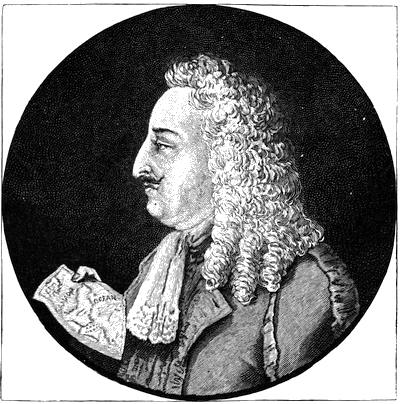
LA SALLE.
This follows a design given in Gravier (pp. 1, 202), which is said to be based on an engraving preserved in the Bibliothèque de Rouen, entitled Cavilli de la Salle François,—and is the only picture meriting notice, except possibly a small vignette of which Gravier gives a fac-simile in his Cavelier de la Salle. Mr. Parkman has a photograph, given to him by Gravier, of a modern painting drawn from the first of these two pictures. In the Magazine of American History, May, 1882, there is an engraving, “after a photograph of the original painting,” leading the reader to suppose a veritable original likeness to have been followed, instead of this photograph of a made-up picture.
It was fortunate that in regard to one point only this deprivation had led Mr. Parkman astray in his earlier edition; and that was upon La Salle’s failure to find the mouth of the Mississippi in 1684, and the conduct therewith of Beaujeu. Mr. Parkman has testified to the authenticity of the La Salle letters in the North American Review, December, 1877, where (p. 428) he says: “The contents of these letters were in good measure known through a long narrative compiled from them by one of the writer’s friends, who took excellent care to put nothing into it which could compromise him. All personalities are suppressed. These letters of La Salle have never been used by any historical writer.” Margry’s publication has been reviewed by J. Thoulet in the Bulletin de la Société de Géographie, November and December, 1880, where a modern map enables the reader to track the explorer’s course. A sketch of this map is given on an earlier page.
The severest criticism of Margry’s publication has come from Dr. Shea, in a tract entitled The Bursting of Pierre Margry’s La Salle Bubble, New York, 1879,—a paper which first appeared in the New York Freeman’s Journal. Margry is judged by his critic to have unwarrantably extended the collection by repeating what had already elsewhere been printed, sometimes at greater length.[672] The “bubble” in question is the view long entertained by Margry that La Salle was the real discoverer of the Mississippi, and which he has set forth at different times in the following places:—
1. “Les Normands dans les vallées de l’Ohio et du Mississippi,” in the Journal general de l’instruction publique, July-September, 1862, placing the event in 1670-1671.
2. Revue maritime et colonial, Paris (1872), xxxiii. 555.
3. La priorité de La Salle sur le Mississipi, Paris, 1873,—a pamphlet.
4. The preface to his Découvertes, etc., 1876.
5. A letter in the American Antiquarian (Chicago, 1880), ii. 206, which was addressed to the Wisconsin Historical Society (Collections, ix. 108), and which first appeared in J. D. Butler’s translation in the State Journal, Madison, Wisconsin, July 30, 1879.
Margry, who has wavered somewhat, first claimed that La Salle reached the Mississippi by the Ohio in 1670; and later he has contended for the route by the Illinois in 1671. He bases his claim upon four grounds:—
First, upon a Récit d’un ami de l’Abbé de Galinée, 1666-1678 (printed in the Découvertes, etc., i. 342, 378),[673] which is without date, but which Margry holds to be the work of Abbé Renaudot, derived from La Salle in Paris in 1678, wherein it is stated that La Salle, after parting with Dollier and Galinée, made a first expedition to the Ohio, and a second by the Illinois to the Mississippi.
Second, upon a letter of La Salle’s niece, dated 1756 (i. 379), which affirms that the writer of it possessed maps which had belonged to La Salle in 1676, and that such maps showed that previous to that date he had made two voyages of discovery, and that upon these maps the Colbert (Mississippi) is put down.
Third, upon a letter of Frontenac in 1677 to Colbert (i. 324), which places, as is alleged, the voyage of Joliet after that of La Salle; but at the same time (ii. 285) he prints a paper of La Salle virtually admitting Joliet’s priority.
Fourth, upon the general antagonism between the Jesuits, who espoused Joliet’s claim, and the merchants, who were, with La Salle, the adherents of the Sulpitians and Recollects.
Sides have been taken among scholars in regard to the irrefragability of these evidences, but with a great preponderance of testimony against their validity.
The principal supporter of Margry’s view (though Henri Martin has adopted it) has been Gabriel Gravier in the following publications:—
1. Découvertes et établissements de la Cavelier de la Salle de Rouen dans l’Amérique du nord, Paris, 1870.
2. Cavelier de la Salle de Rouen, Paris, 1871, p. 23. This work is in good part a commentary on Parkman, to whom it is dedicated.
3. “La route du Mississipi,” in the Compte rendu, Congrès des Américanistes, Nancy, 1878, placing it in 1666.
4. In Magazine of American History, viii. 305 (May, 1882).
Views in support of the prior discovery of Joliet and Marquette, and opposed to the claim for La Salle, are given in the following places, without enumerating Charlevoix, Sparks, and the other upholders of the Joliet discovery, before Margry’s theory was advanced:—
1. Tailhan, as editor of Perrot’s Sauvages, Paris, 1864, p. 279.
2. Verreau, Voyage de MM. Dollier et Galinée, p. 59.
3. Parkman, La Salle.
4. Faillon, in his Colonie Française en Canada, iii. 312; while at the same time he testifies to Margry’s labors in vol i. p. 24.
5. Harrisse, Notes, etc., sur la Nouvelle France, 1872, p. 125, where he reviews the controversy; and again in the Revue maritime et coloniale (1872), xxxii. 642.
6. J. Brucker, Jacques Marquette et la découverte de la vallée du Mississipi, Lyons, 1880, taken from Les études réligieuses, vol. iv.
7. H. H. Hurlbut, in Magazine of American History, September, 1882.
8. John G. Shea, in the Wisconsin Historical Society’s Collections, vii. 111; and in the Bursting of the La Salle Bubble, already referred to. In his edition of Le Clercq, ii. 89, he speaks of the theory as “utterly absurd.”
FATHER LOUIS HENNEPIN
AND HIS REAL OR DISPUTED DISCOVERIES.
BY THE EDITOR.
THE life of this Recollect missionary is derived in its particulars mainly from his own writings; and the details had never been set forth in an orderly way till Dr. J. G. Shea in 1880 prefixed to a new translation of Hennepin’s first book a satisfactory sketch. He seems to have been born in Hainault, though precisely when does not appear. Felix Van Hulst, in the title of his tract, gives the date approximately: Notice sur le Père Louis Hennepin, né à Ath (Belgique) vers 1640. Liege, 1845. He early joined the Franciscans, served the Order in various places, travelled as he could, was inspired with a desire to see the world, and felt the impulse strongest when, at Calais, he listened to the narratives of sea-captains who had returned from long voyages. This inclination prompted him to continued missionary expeditions, and to attendance upon armies in their campaigns. In 1675 Frontenac succeeded in his attempt to recall to Canada the Recollects, as a foil to the Jesuits; and among the first of that Order to go was Hennepin, who crossed the ocean in the same ship with La Salle, the ambitious explorer, and De Laval, the new Bishop of Quebec. According to his own account, Hennepin had his first quarrel with La Salle about some girls who were on their way to reinforce the family life of the new colony.[674]
La Salle enjoyed their dances, and Hennepin, as their spiritual guide, kept them under restraint. This, at least, is the Recollect story of the origin of La Salle’s enmity for the missionary.
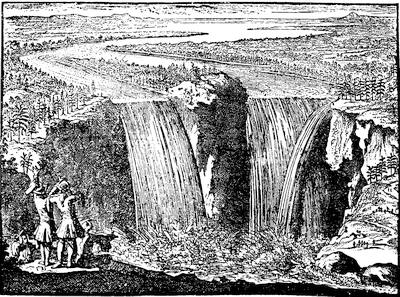
From Quebec Hennepin continued his missionary wanderings, sometimes to remote stations, and at one time, in the spring of 1677, among the Iroquois,—not going, however, to Albany, as has been sometimes asserted. (Cf. Brodhead’s New York, ii. 307; Hist. Mag. x. 268.) Next he accompanied La Salle in his explorations west. Of Niagara he offers us the earliest picture in his 1697 publication,—of which a reduced fac-simile is here given. Others are in Gay’s Pop. Hist. U. S., ii. 511; Shea’s Hennepin, p. 379, and in his Le Clercq, ii. 112; and in the Carter-Brown Catalogue, vol. ii. no. 561. The original cut was repeated in the later editions and translations of Hennepin. These Falls had been indicated on Champlain’s map, in 1632, with the following note: “Sault d’eau au bout du Sault [Lac] Sainct Louis fort hault, où plusiers sortes de poissons descendans s’estourdissent.” This was from the natives’ accounts. Ragueneau, in the Relation of 1648, was the first to describe them, though they had been known by report to the Jesuits some years earlier (Parkman’s Jesuits, p. 142). Lalemant, in 1641, called them Onguiaahra. Ragueneau gave them no definite altitude, but called them of “frightful height.” Hennepin, in his 1683 book, calls them five hundred feet, and in 1697 six hundred feet high, and describes a side-shoot on their western verge which does not now exist. Sanson, in his map of 1657, had somewhat simplified Ragueneau’s name into Ongiara; but Hennepin gives the name in its present form. There is a great variety in the early spelling of the name. (See Canadian Journal, 1870, p. 385.) The word is of Iroquois origin, and its proper phonetic spelling is very like the form now in use (Parkman, La Salle, p. 126; O’Callaghan, Col. Doc., index, 465). Hennepin had also been anticipated in a brief notice by Gendron, in his Quelques Particularites, etc., 1659. Hennepin’s account is also translated in the Mag. of Amer. Hist., v. 47. His engraving was reproduced, in 1702, in Campanius’ work on New Sweden.
Hennepin accompanied La Salle to the point where Fort Crèvecœur was built, on the Illinois, and parting from La Salle here in February, 1680, he pursued his further wandering down the Illinois to the Mississippi, and thence up to the Falls of St. Anthony, which were named by him in reference to his being a Recollect of the province of St. Anthony in Artois. On the 3d of July, 1880, the bi-centenary of the discovery of these Falls was observed, when C. K. Davis delivered an historical address. Thence, after being captured by the Sioux and rescued by a party under Du Lhut,[675] Hennepin made his way to the Wisconsin, passed by Green Bay, and reached Quebec. He soon after returned to France, where, on the 3d of September, 1682, he obtained the royal permission to print his first book, which was issued from the press Jan. 5, 1683.
From this point his story[676] can be best followed in connection with the history of his books, and as they are rare and curious, it has been thought worth while to point out a few of the repositories of copies, which are indicated by the following heavy-faced letters:—
BA. Boston Athenæum.
BPL. Boston Public Library.
C. Library of Congress.
CB. Carter-Brown Library, Providence.
HC. Harvard College Library.
HCM. Henry C. Murphy.
L. Lenox Library, New York.
For full titles, see the Bibliography in Shea’s edition of the Description of Louisiana, and the article “Hennepin,” in Sabin’s Dictionary. Cf. also Brunet, Supplément, 598.
I. DESCRIPTION DE LA LOUISIANE.
This first book was entitled Description de la Louisiane nouvellement découverte au Sud-Oüest de la Nouvelle France. Les Mœurs des Sauvages. Par le R. P. Louis Hennepin, Paris, 1683. Pages 12, 312, 107. Some copies are dated 1684.
Copies: BA., C., CB., HC., L. (both dates).
References: Shea (ed. of Hennepin), nos. 1, 2; Sabin, Dictionary, no. 31,347; Ternaux, Bibliothèque Amér. no. 985; Harrisse, Notes sur la Nouv. France, nos. 150, 352; Carter-Brown Catalogue, vol. ii. no. 1,266, with fac-simile of title; Hist. Mag., vol. ii. no. 24 (by Mr. Lenox), 346; Dufossé, Americana, 70 francs, with genuine map, and 40 or 50 francs with fac-simile; Leclerc, Bibl. Americana, nos. 897, 898 at 90 and 150 francs; Rich, Catalogue (1832), no. 402, 12s.
The map, of which a section is herewith given in fac-simile, measures 10.2 X 17.2, “Guerard inven. et fecit. Roussel sculpsit,” and is often wanting. Cf. Harrisse, no. 352; Hist. Mag., vol. ii. 24.
Harrisse (no. 219; also see no. 238) cites a map preserved in the Dépôt des Cartes de la Marine, which seems to embody the results of Hennepin’s discoveries.
The next edition (Paris, 1688) shows the same pagination, with some verbal changes in the text, and is accompanied by the same map.
Copies: B.A., CB., HC.
References: Shea, no. 3; Sabin, no. 31,348; Carter-Brown, vol. ii. no. 1,354; Hist. Mag. vol. ii. p. 346; Harrisse, no. 160; O’Callaghan, Catalogue, no. 1,068; Beckford, Catalogue, no. 674, bought by Quaritch, who advertised it at £3 3s.
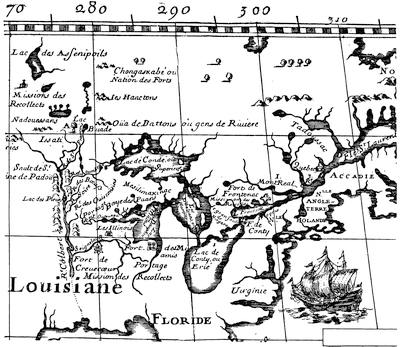
HENNEPIN, 1683.
An extract from the Carte de la Nouvelle France et de la Louisiane, nouvellement découverte, dediée au Roy l’an 1683. Par le Révérend Père Louis Hennepin, Missionaire Recollect et Notaire Apostolique, belonging to the Description de la Louisiane, 1683. There is a full fac-simile in Shea’s translation of this book, and another one was made in 1876 by Pilinski, in Paris (36 copies). The letter A near a tree signifies “Armes du Roy telle qu’elle sont gravée sur l’escorce d’un chesne.” This map (Harrisse, no. 352) seems to resemble closely a map described by Harrisse (no. 219), as indicating the discoveries of Du Lhut, of which there is a copy in the Barlow Collection.
The following translations may be noted:—
English.—Some portions of Hennepin’s first work had been translated in Shea’s Discovery of the Mississippi, pp. 107-145; but no English translation of the whole work appeared till Dr. Shea edited a version in 1880, comparing Hennepin’s text with the second publication of that missionary (issued in 1697) with the La Salle documents, published by Margry, and with other contemporaneous papers.
Dutch.—The engraved title, Ontdekking van Louisania; the printed title, Beschryving van Louisania. It appeared at Amsterdam in 1688, under the same covers with a Dutch version of Denys’ Coast of North America, accompanied by a map which is a reduction of the map of the 1683 edition, and is called “Kaart van nieuw Vrankrijk en van Louisania;” together with four plates.
Copies: CB., HC., L.
References: Shea, no. 5; Sabin, no. 31,357; Harrisse, no. 161; Carter-Brown, vol. ii. no. 1,355, with fac-simile of title; Historical Magazine, vol. ii. p. 24; O’Callaghan, no. 1,069; Stevens, Historical Collections, vol. i. no. 1,433; Muller, Books on America, 1870, no. 908, and 1877, no. 1,395.
It is usually priced at from $8 to $10.
German.—There were two editions,—Beschreibung der Landschaft Louisiana, to which was appended a German version of Marquette’s and Joliet’s exploration, published at Nuremberg in 1689. It should have two maps.
Copies: CB., L.
References: Shea, no. 6; Ternaux, no. 1,041; Carter-Brown, vol. ii no. 1,379; O’Callaghan, no. 1,071; Muller, 1877, no. 1,399.
The other German edition of the same title appeared at Nuremberg in 1692.
Copies: CB., L.
References: Shea, no. 7; Harrisse, no. 163; Historical Magazine, vol. ii. p. 24; Sabin, no. 31,364.
Italian.—Descrizione della Luigiana. Rendered by Casimiro Freschot, and published at Bologna in 1686, with a map.
Copies: CB.
References: Shea, no. 4; Harrisse, no. 157; Sabin, no. 31,356; Historical Magazine, vol. ii. p. 346; Carter-Brown, vol. ii. no. 1,326; Ternaux, no. 1,012; Leclerc, no. 900; 60 francs.
An abridgment was printed in Il Genio Vagante, Parma, 1691, with a map, “Nuova Francia e Luigiana.” Cf. Harrisse, no. 365.
In this earliest work of Hennepin the Mississippi, it will be seen by the map, forms no certain connection with the Gulf of Mexico, but is connected by a dotted line, and there is no claim for explorations further south than the map indicates. Hennepin’s later publications have raised doubts as to the good faith of his narrative of discoveries on the Upper Mississippi. Harrisse (no. 150), for instance, says “Cette Relation de 1683 n’est en réalité qu’une pâle copie d’un des mémoires de Cavelier de la Salle;” and goes on to deny to Hennepin the priority of giving the name of Louisiana to the country. La Salle and others of his contemporaries threw out insinuations as to his veracity, or at least cautioned others against his tendency to exaggerate. (Cf. Neill, Writings of Hennepin.) The publication of an anonymous account of La Salle’s whole expedition in Margry’s Découvertes et Établissements des Français, has enabled Dr. Shea, in his edition of Hennepin, to contest Margry’s views of Hennepin’s plagiarism, and to compare the two narratives critically; and he comes to the conclusion that probably Hennepin was La Salle’s scribe before they parted, and that he certainly contributed directly or indirectly to La Salle’s despatches what pertains to Hennepin’s subsequent independent exploration,—thus making the borrowing to be on the part of the anonymous writer, who, if he were La Salle, did certainly no more than was becoming in the master of the expedition to combine the narratives of his subordinates. It is Shea’s opinion, however, that the Margry document was not written by La Salle, but by some compiler in Paris, who used Hennepin’s printed book rather than his notes or manuscript reports. Margry claims that this Relation officielle de l’enterprise de La Salle, de 1678 à 1681, was compiled by Bernou for presentation to Colbert. Parkman thinks, as opposed to Shea’s view, that Hennepin knew of the document, and incorporated many passages from it into his book (La Salle, pp. 150, 262). Dr. Shea sided with the detractors of Hennepin in his earlier Discovery of the Mississippi; but in this later book he makes fair amends for what he now considers his hasty conclusions then. Cf. further Sparks’s Life of La Salle, and the North American Review, January, 1845. Mr. Parkman’s conclusion is that this early book of Hennepin is “comparatively truthful.”
II. NOUVELLE DÉCOUVERTE.
According to Hennepin’s own story, some time after his first book was published, he incurred the displeasure of the Provincial of his Order by refusing to return to America, and was in more ways than one so pursued by his superior that in the end he threw himself on the favor of William III. of England, whom he had met at the Hague. Hennepin searched Amsterdam for a publisher of his new venture, but had to take it to Utrecht, where it came out, in 1697, with a fulsome dedication to the English king. It is called in the printed title (the engraved title is abridged): Nouvelle Découverte d’un très grand Pays, situé dans l’Amérique, entre le Nouveau Mexique et la Mer glaciale, Utrecht, 1797, pp. 70, 506, with two maps and two plates, one being the earliest view of Niagara Falls, as given on p. 86.
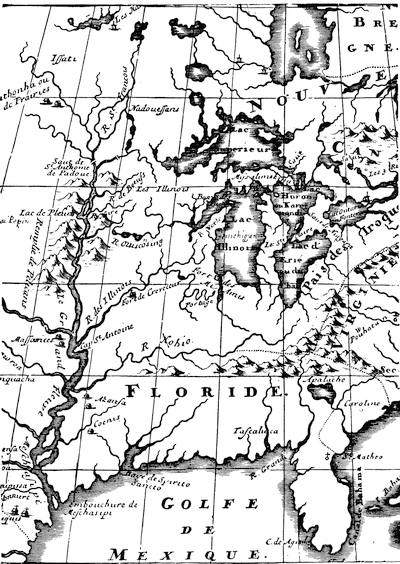
HENNEPIN, 1697.
This is an extract from the second of Hennepin’s maps, Carte d’un très grand pays entre le Nouveau Mexique et la Mer glaciale, dediée à Guillaume III.... à Utreght. The same plate was used in later editions (1698, 1704, 1711, etc.), with additions of many names, and some topographical changes, and alterations of place of publication. Those of 1698 have à Utreght in some cases, and in others à Amsterdam.
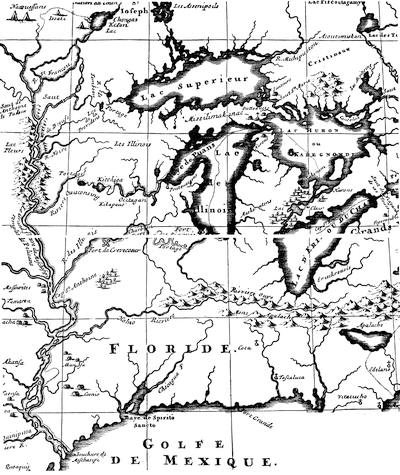
HENNEPIN, 1697.
Extract from Carte d’un très grand pais nouvellement découvert dans l’Amérique septentrionale, entre le Nouveau Mexique et la Mer glaciale, avec le Cours du Grand Fleuve Meschasipi ... à Utreght. The same plate was used for the editions, à Leiden, 1704, etc. The plate was re-engraved with English names for the English editions.
Copies: BA., CB., HC.
References: Shea, no. 1; Sabin, no. 31,349; Ternaux, no. 1,095; Harrisse, no. 175; Carter-Brown, vol. ii. no. 1,513; Historical Magazine, vol. ii. p. 346; Beckford, no. 675, bought by Quaritch, and advertised by him at £4 4s.; Stevens, vol. i. no. 1,434; Leclerc, no. 902, 80 francs; Harrassowitz, Catalogue, 1883, no. 58, 50 marks; Brinley, Catalogue, no. 4,491. It is usually priced in English catalogues at two or three guineas.
The portions repeated in this book from the Description de la Louisiane are enlarged, and the “Mœurs des Sauvages” is omitted.
It will be observed that in both of the maps of 1697, extracts from which are given herewith, the Mississippi River is marked as continuing its course to the Gulf. This change is made to illustrate an interpolation in the text (pp. 249-312), borrowed from Father Membré’s Journal of La Salle’s descent of the river, as given in Le Clercq’s Premier Établissement de la Foi, p. 153. Sparks, in his Life of La Salle, was the first to point out this correspondence. Mr. J. H. Perkins, reviewing Sparks’s book in the North American Review in January, 1839 (reprinted in his Memoir and Writings, vol. ii.), on the “Early French Travellers in the West,” referring to the partial statements of the distrust of Hennepin in Andrew Ellicott’s Journal, and in Stoddard’s Sketches of Louisiana, makes, for the first time, as he thinks, a thorough critical statement of the grounds “for thinking the Reverend Father so great a liar.” Further elucidation of the supposed theft was made by Dr. Shea in his Discovery of the Mississippi, etc., p. 105, where, p. 83, he translated for the first time into English Membré’s Journal. The Membré narrative is much the same as a Relation de la Découverte de l’Embouchure de la Rivière Mississippi, faite par le Sieur de la Salle, l’année passée, 1682, preserved in the Archives Scientifiques de la Marine, and printed in Thomassy’s Géologie pratique de la Louisiane. Gravier, p. 180, holds it to be the work of La Salle himself (Boimare, Text explicatif pour accompagner la première planche historique relative à la Louisiane, Paris, 1868; cf. Gravier’s Appendix, no. viii). That there was a fraud on Hennepin’s part has been generally held ever since Sparks made his representations. Bancroft calls Hennepin’s journal “a lie.” Brodhead calls it an audacious falsehood. Parkman (La Salle, p. 226) deems it a fabrication, and has critically examined Hennepin’s inconsistencies. Gravier classes his narrative with Gulliver’s.
The excuse given in the Nouvelle Découverte for the tardy appearance of this Journal is, that fear of the hostility of La Salle having prevented its appearance in the Description de la Louisiane, that explorer’s death rendered the suppression of it no longer necessary. It is, moreover, proved that passages from Le Clercq are also appropriated in describing the natives and the capture of Quebec in 1628. The reply to this was that Le Clercq stole from a copy of Hennepin’s Journal, which had been lent to Le Roux in Quebec. These revelations led Shea seriously to question in his Mississippi if Hennepin had ever seen the upper parts of that river, and to suspect that Hennepin may have learned what he wrote from Du Lhut. Harrisse, p. 176, brings forward some new particulars about Hennepin’s relations with Du Lhut.
Dr. Shea’s later views, as expressed in his English translation (1880) of the Description de la Louisiane (1683), is that Hennepin’s manuscript or revamped copy of his earlier book, as prepared for the printer by himself, was subjected to the manipulations of an ignorant and treacherous editor, who made these insertions to produce a more salable book, and that Hennepin was not responsible for it in the form in which it appeared. Shea’s arguments to prove this opposite of the generally received opinion are based on inherent evidence in the insertions that Hennepin could not have written them, and on the material evidences of these questionable portions of the book having been printed at a later time than the rest of it, and in different type. The only rejoinder yet made to this exculpation is by Mr. E. D. Neill, in a tract on The Writings of Louis Hennepin, read before the Minnesota Historical Society in November, 1880, in which the conclusion is reached that “nothing has been discovered to change the verdict of two centuries, that Louis Hennepin, Recollect Franciscan, was deficient in Christian manhood.”
The Nouvelle Découverte was reset and reissued in 1698 at Amsterdam, with the same maps and a new title.
Copies: CB., L.
References: Shea, no. 2; Sabin, no. 31,350; Harrisse, no. 176; Ternaux, no. 1,110; O’Callaghan, no. 1,073; Muller, 1877, no. 3,666; Sparks, Catalogue, no. 1,211; Rich, 1832, 12s.; Carter-Brown, vol. ii. 1,538; Historical Magazine, vol. ii. pp. 24,346.
There was another edition, Voyage ou Nouvelle Découverte, at Amsterdam in 1704, with the same maps and additional plates, to which was appended La Borde’s Voyage.
Copies: BA., CB.
References: Shea, no. 3; Sabin, no. 31,352; Rich, 1830, no. 8; Historical Magazine, vol. ii. p. 347; Beckford, no. 676; Leclerc, no. 905, 60 francs; Stevens, vol. i. no. 1,436; Carter-Brown, vol. iii. no. 52.
The Hague and Leyden editions of the same year (1704) had an engraved title, Voyage curieux ... qui contient une Nouvelle Découverte, but were evidently from the same type, and also have the La Borde appended.
Copies: CB., L., HCM.
References: Shea, nos. 4, 5; Sabin, no. 31,353; Historical Magazine, vol. ii. 25.
The Amsterdam edition of 1711 was called Voyages curieux et nouveaux de Messieurs Hennepin et de la Borde, with oblong title, folded in, which seems to be the only difference from the 1704 editions.
Copies: BA., CB., HC.
References: Shea, no. 6; Sabin, no. 31,354; Carter-Brown, vol. iii. no. 153.
In 1712 another Amsterdam edition was called Voyage ou Nouvelle Découverte.
Copy: CB.
References: Shea, no. 7; Sabin, no. 31,355; Historical Magazine, vol. ii. p. 347; Carter-Brown, vol. iii. no. 168; Stevens, vol. i. no. 1,438.
Hennepin’s book also appeared in the third edition, at Amsterdam (1737), of Bernard’s Recueil de Voyages au Nord, vol. ix., with a map called “Le Cours du fleuve Mississipi, 1737.” Cf. Shea, no. 8; Sabin, no. 4,936; Historical Magazine, ii. 25. It also appeared at Amsterdam in 1720, in Relations de la Louisiane et du Fleuve Mississippi (Dufossé, 1878, no. 4,577), and again in 1737 in connection with a translation of Garcilasso de la Vega (Dr. O’Callaghan in Historical Magazine, ii. 24). An abridgment appeared in Paris, in 1720, under the title, Description de la Louisiane, par le Chevalier Bonrepos, pp. 45 (Lenox in Historical Magazine, ii. 25).
The following translations may be noted:—
Dutch.—1. Nieuwe Ontdekkinge, etc., Amsterdam, 1699.
Copy: CB.
References: Shea, no. 9; Sabin, no. 31,359; Harrisse, no. 183.
2. Nieuwe Entdekkinge, etc., Amsterdam, 1702. It follows the 1697 French edition, with the same maps and plates, and has Capiné’s book on the Spanish West Indies appended.
Copies: BA., CB., L.
References: Shea, no. 10; Sabin, no. 31,360; Lenox in Historical Magazine, vol. ii. p. 25; Muller, 1870, no. 912, and 1877, no. 1,397; Brinley, no. 4,493; O’Callaghan, no. 1,076; Carter-Brown, vol. iii. no. 23.
3. Aenmerkelyke Voyagie, etc., Leyden, 1704.
Copy: CB.
References: Shea, no. 11; Sabin, no. 31,361; Carter-Brown, vol. iii. nos. 53, 54; Stevens, vol. i. no. 1,437; Muller, 1870, no. 913, and 1877, no. 1,398.
4. Aanmerkkelyke Voyagie, etc., Rotterdam, 1704. It is usually found with Benzoni’s West-Indise Voyagien, and also in Van der Aa’s Collection of Voyages, 1704.
Copies: C., CB., L.
References: Shea, nos. 12, 13; Sabin, no. 31,362; Lenox in Historical Magazine, vol. ii. p. 25.
5. Nieuwe Ontdekkinge, etc. Amsterdam, 1722.
Copy: CB.
References: Shea, no. 14; Sabin, no. 31,363.
English.—Discovery of a Large, Rich, and Plentiful Country, etc., London, 1720.
Copies: BA., CB., HC.
References: Shea, no. 2; Sabin, nos. 20,247, 31,373; Historical Magazine, vol. i. p. 347; Rich, no. 12; Carter-Brown, vol. iii. no. 267.
This is an abridgment.
German.—1. Neue Entdeckung, etc. Bremen, 1699.
Copies: CB., L.
References: Shea, no. 15; Historical Magazine, vol. i. p. 347, vol. ii. p. 25; Sabin, no. 31,367; Carter-Brown, vol. ii. no. 1,572; Harrisse, no. 185; Stevens, vol. i. no. 1,435.
2. Beschreibung der Grosser Flusse Mississipi. Dritte Auflage, Leipzig, 1720.
Copy: L.
References: Lenox in Historical Magazine, vol. ii. p. 25.
3. Neue Reise Beschreibung, etc., Nürnberg, 1739.
Copy: CB.
References: Shea, no. 16; Carter-Brown, vol. iii. no. 604.
4. Neue Entdeckung, etc., Bremen, 1742.
Copy: CB.
Reference: Carter-Brown, vol. iii. no. 708.
Spanish.—Relaçion, etc., Brusselas, 1699.
Copies: HC., CB., L. An abridgment by Sebastian Fernandez de Medrano.
References: Shea, no. 1; Sabin, no. 31,374; Carter-Brown, vol. ii. no. 1,573; Lenox in Historical Magazine, vol. ii. p. 25; Ternaux, no. 1,126.
It has the same map with the 1697 French edition, with an Italian label, “Carta geografica de un Pais,” etc., pasted over the French title.
III. NOUVEAU VOYAGE.
It has been customary to bestow upon this volume a similar distrust as upon the preceding; but Dr. Shea contends that the luckless treatment of the Nouvelle Découverte by a presumptuous editor was also repeated with this. It was entitled, Nouveau Voyage d’un Pais plus grand que l’Europe, Utrecht, 1698. The work was made up from Le Clercq, and included the treatise on the Indians which had been omitted in the Nouvelle Découverte, of which this volume may be considered the supplement.
Copies: BA., CB.
References: Shea, no. 1; Sabin, no. 31,351; Carter-Brown, vol. ii. no. 1,537; Harrisse, no. 177; Beckford, no. 677, bought by Quaritch, who priced it at £4 4s.; Leclerc, no. 904, 70 francs; Rich, no. 455; Ternaux. no. 1,111.
The Nouveau Voyage was also included in an abridged form in the second (1720) and third (1734) editions of the Recueil de Voyages au Nord, published by Bernard at Amsterdam. Cf. Shea, 2 and 3.
It was also issued in the following translations:—
Dutch.—Engraved title, Reyse door nieuwe Ondekte Landen. Printed title, Aenmerckelycke Historische Reijs Beschryvinge, Utrecht, 1698. The map reads, “Carte d’un Nouveau Monde entre Le Nouveau Mexique et la Mer glaciale. Gasp. Bouttals fecit.”
Copies: BA., CB.
References: Shea, no. 4; Sabin, no. 31,358; Carter-Brown, vol. ii. no. 1,539, with fac-simile of title; Historical Magazine, vol. ii. p. 347; Harrisse, no. 179; Trömel, no. 425; O’Callaghan, no. 1,075; Muller, 1877, no. 1,396.
English.—In the Archæologia Americana, vol. i.
German, I.—Neue Reise Beschreibung, übersetzt durch M. J. G. Langen, Bremen, 1698.
Copy: CB.
References: Shea, no. 5.; Sabin, no. 31,365; Ternaux, no. 1,049, of doubtful date; Harrisse, no. 165; Carter-Brown, vol. ii. no. 1,540.
2. Reisen und seltsehme Begebenheiten, etc., Bremen, 1742.
References: Shea, no. 6; Sabin, no. 31,369.
IV. COMBINATION.
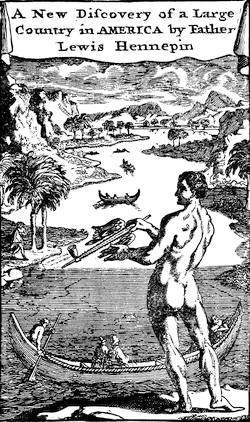
The Nouvelle Découverte and the Nouveau Voyage were combined in an English translation issued under the following title: A new Discovery of a Vast Country in America, extending above four thousand miles between New France and New Mexico, etc., London, 1698. It contains—part i., a translation of the Nouvelle Découverte; part ii., in smaller type and new paging, a version of the Nouveau Voyage; the rest of the volume in the type of part i. and continuing its paging, being an account of Marquette’s voyages. Another edition of the same year shows a slight change of title, with alterations in part i. and part ii. rewritten. Still another issue conforms in title to the earliest, but in body, with a slight correction, to the second edition. The engraved title of the first edition is given herewith. This picture is a re-engraving reversed of the one on the title of the Nouvelle Découverte of 1697.
Copies: BPL., CB., HC.
References: Shea, nos. 1, 2, 3; Sabin, nos. 31,370, 31,371; Ternaux, nos. 1,010, 1,119; Historical Magazine, vol. i. p. 347; Field, Indian Bibliography, no. 685; Carter-Brown, vol. ii. nos. 1,535, 1,536; Rich, no. 456; Brinley, no. 4,492; Harrisse, no. 181; Menzies Catalogue, no. 915.
In the next year (1699) there was a reprint of the second issue of the preceding year.
Copy: BA.
References: Shea, no. 4; Sabin, no. 31,372; O’Callaghan, no. 1,074; and Historical Magazine, vol. ii p. 74; Menzies, no. 916.
BARON LA HONTAN.
A BIBLIOGRAPHICAL AND CRITICAL NOTE BY THE EDITOR.
LA HONTAN, a young Gascon, born about 1667, had come to Canada in 1683, and from being a common soldier, had by his ability risen to an officer’s position. He became a favorite of Frontenac, and was selected by him to bear the despatch to Paris which conveyed an account of Phips’s failure before Quebec in 1690. He was not long after made deputy-governor of Placentia, where he quarrelled with his superior and fled to France; and here, fearing arrest, he was obliged to escape beyond its boundaries. After the Peace of Ryswick he sought reinstatement, but was not successful; and it is alleged that his book, which he now published, was in some measure the venting of his spleen. It appeared in 1703, at La Haye, as Nouveaux Voyages dans l’Amérique septentrionale, qui contiennent une Relation des différens Peuples que y habitent, in two volumes (the second entitled Mémoires de l’Amérique septentrionale, ou la suite des Voyages), with twenty-six maps and plates (Sabin, vol. x. nos. 38,635-38,638; Carter-Brown, vol. iii. no. 36; Quaritch, 25 shillings; Leclerc, no. 737, 40 francs). Another edition, in somewhat larger type and better engravings, with a vignette in place of the sphere on the title, appeared the same year. Dr. Shea is inclined to think this the authorized edition, and the other a pirated one, with reversed cuts. La Hontan, being in London, superintended an edition published there the same year in English, called New Voyages to North America (in Harvard College Library; cf. Brinley Catalogue, no. 101; Field, Indian Bibliography, no. 852; Carter-Brown, vol. iii. no. 39), likewise in two volumes, but containing in addition a Dialogue between La Hontan and a Huron Indian (the Rat), which had not been included in the Hague edition, and which was the vehicle of some religious scepticism. There were thirteen plates in vol. i., and eleven in vol. ii., and La Hontan speaks of them as being much better than those of the Holland edition (Sabin, vol. x. no. 38,644). This same Dialogue was issued separately the next year (1704) at Amsterdam in French,—Dialogue du Baron de La Hontan et d’un Sauvage dans l’Amérique; and also, with a changed title (Supplément aux Voyages du Baron La Hontan), as the third volume or “suite” of the Voyages, and sometimes with added pages devoted to travels in Portugal and Denmark (Sabin, vol. x. nos. 38,633, 38,634, 38,637; Field, no. 853; Leclerc, nos. 738, 739; Muller, Books on America, 1872, no. 864). These editions are found with the dates also of 1704 and 1705. What is called a “seconde Édition, revue, corrigée, et augmentée,” with twenty-seven plates (but not from the same coppers, however, with the earlier issues), and omitting the “Carte générale,” appeared likewise at La Haye in 1705 and 1706. This is professedly “almost recast, to make the style more pure, concise, and simple, with the Dialogues rewritten.” The Denmark and Portugal voyage being omitted, it is brought within two volumes, the second of which is still called Mémoires, etc. (Carter-Brown, vol. iii. no. 68). There were later French editions in 1707, 1709, and 1715, and at Amsterdam in 1721, with the “suite,” dated 1728, three volumes in all, and sometimes all three are dated 1728; and still other editions are dated 1731 and 1741 (Sabin, vol. x. no. 38,640, who says it is quite impossible to make a clear statement of all the varieties of these several editions; Carter-Brown, vol. iii. no. 689). The English version appeared again at London in 1735 (Menzies, no. 1,178; Brinley, no. 101; Sabin, vol. x. nos. 38,645, 38,646, who says there are various imprints; and it is also included in Pinkerton’s Voyages, vol. xiii.). There are also a German edition, Des beruhmten Herrn Baron de La Hontan Neueste Reisen, 1709 (Sabin, vol. x. no. 38,647; Carter-Brown, vol. iii. no. 123; Stevens, Bibl. Hist., no. 2,505), and a Dutch, Reizen van den Baron van La Hontan, 1739 (Sabin, vol. x. no. 38,648; Stevens, no. 2,506).
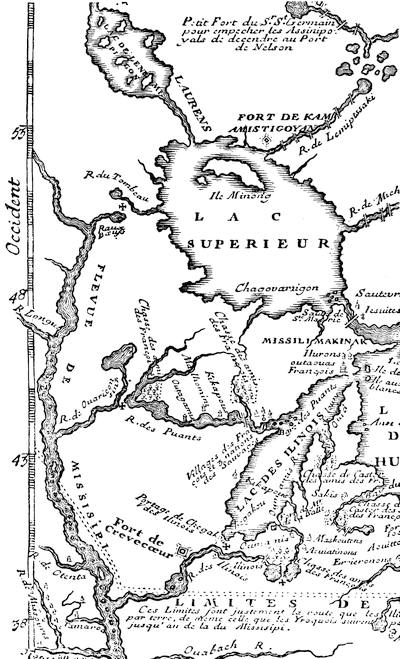
PART OF LA HONTAN’S MAP.
This is the western part of the Carte Générale de Canada, which appeared in the Nouveaux Voyages, La Haye, 1709, vol. ii., and was re-engraved in his Mémoires, Amsterdam, 1741, vol. iii.
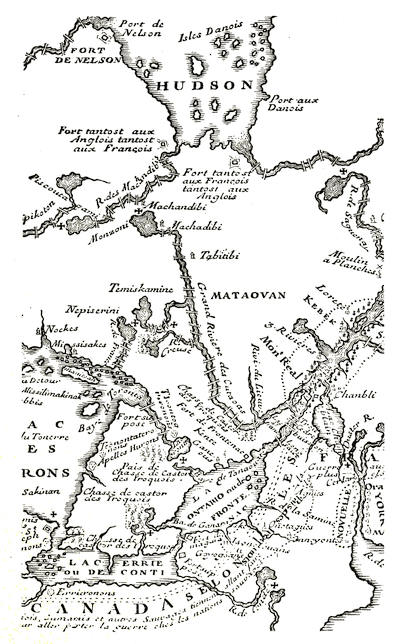
PART OF LA HONTAN’S MAP.
A middle section from his “Carte Générale de Canada,” in his Nouveaux Voyages, La Haye, 1709, vol. ii.; re-engraved in the Amsterdam, 1741, edition of the Mémoires, vol. iii.
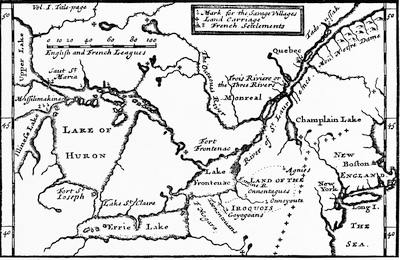
LA HONTAN’S MAP.
A fac-simile of the frontispiece to La Hontan’s New Voyages, London, 1703. It was less carefully drawn in the re-engraving of smaller size for the Mémoires de l’Amérique, vol. ii., Amsterdam; and still another plate of the same map will be found in the 1709 and 1715 La Haye editions.
The book is thought to have been edited by Nicolas Gueudeville; or at least his hand is usually recognized in the customary third volume of some of the editions. Faribault (p. 76) says that a bookseller in Amsterdam knew that the Dialogue was added by Gueudeville, in whose Atlas, Amsterdam, 1719, as well as in Corneille’s Geographical Dictionary, the accounts given of La Hontan’s Rivière Longue are incorporated.
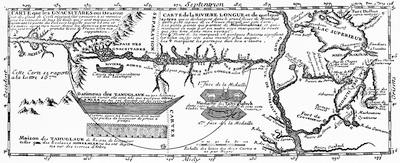
LA HONTAN’S RIVIERE LONGUE.
Fac-simile of the map in the Nouveaux Voyages, La Haye, 1709, i. 136. He reports that the river was called by some the Dead River, because of its sluggish current.
As early as 1715-1716 there was a general discrediting of the story of La Hontan, as will be seen by letters addressed by Bobé to De l’Isle, the French geographer, and printed in the Historical Magazine, iii. 231, 232; but the English geographer, Herman Moll, in his maps between 1710 and 1720, was under La Hontan’s influence. Another English cartographer, John Senex (1710), accepted the La Hontan story with considerable hesitation, and later rejected it. Daniel Coxe, in his Carolana (1727), quite unreservedly accepted it; and the Long River appears as Moingona in Popple’s Atlas, in 1733.
The German geographer, Homann, of Nuremberg, was in some degree influenced; and the French cartographer De l’Isle sometimes accepted these alleged discoveries, and again discarded them; but the careful work of Bellin, in Charlevoix’s Nouvelle France, did much to relegate La Hontan to oblivion. Charlevoix himself says: “The great liberty which La Hontan gives his pen has contributed greatly to make his book read by people not informed to separate truth from falsehood. It fails to teach the well-informed, and confuses others. The episode of the voyage up the Long River is as fabulous as the Barataria of Sancho Panza.” (Cf. Shea’s ed., i. 86, with Shea’s note, iii. 286.) The Long River some years later, however, figured in the map which illustrates Samuel Engel’s Extraits raisonnés des Voyages faits dans les parties septentrionales, published at Lausanne, and again in 1765, and again in 1779, and of which there is also a German translation. At a later date Carver accepted the accounts of this western river as genuine, and identified it with the St. Peter’s,—a belief which Long again, in his Expedition to St. Peter’s River, wholly rejected. (Cf. also J. H. Perkins in the North American Review (1839), vol. xlviii. no. 98, where it is thought possible; and the paper by H. Scadding in the Canadian Journal, 2d series, vol. xiii. pp. 240, 396.) Parkman expresses the present view of scholars when he says (La Salle, p. 458) that La Hontan’s account of the Long River is a sheer fabrication; but he did not, like Hennepin, add slander and plagiarism to mendacity. Again, in his Frontenac (p. 105), he calls La Hontan “a man in advance of his time, for he had the caustic, sceptical, and mocking spirit which a century later marked the approach of the great Revolution. He usually told the truth when he had no motive to do otherwise, and yet was capable at times of prodigious mendacity,” for his account of what “he saw in the colony is commonly in accord with the best contemporary evidence.” There are some exceptions to this view. Gravier speaks of La Hontan as “de bonne foi et de jugement sain”!