THE DICTIONARY OF COOKERY. (continued 9)
Reading edition
LEMON PUDDING, Baked.
Ingredients.—10 oz. of bread-crumbs, 2 pints of milk, 2 oz. of butter, 1 lemon, ¼ lb. of pounded sugar, 4 eggs, 1 tablespoonful of brandy. Mode.—Bring the milk to the boiling point, stir in the butter, and pour these hot over the bread-crumbs; add the sugar and very finely-minced lemon-peel; beat the eggs, and stir these in with the brandy to the other ingredients; put a paste round the dish, and bake for ¾ hour. Time.—¾ hour. Average cost, 1s. 2d. Sufficient for 6 or 7 persons. Seasonable at any time.
LEMON PUDDING, Baked (Very Rich).
Ingredients.—The rind and juice of 2 large lemons, ½ lb. of loaf sugar, ¼ pint of cream, the yolks of 8 eggs, 2 oz. of almonds, ½ lb. of butter, melted. Mode.—Mix the pounded sugar with the cream and add the yolks of eggs and the butter, which should be previously warmed. Blanch and pound the almonds, and put these, with the grated rind and strained juice of the lemons, to the other ingredients. Stir all well together; line a dish with puff-paste, put in the mixture, and bake for 1 hour. Time.—1 hour. Average cost, 2s. Sufficient for 6 or 7 persons. Seasonable at any time.
LEMON PUDDING, Boiled.
Ingredients.—½ lb. of chopped suet, ¾ lb. of bread-crumbs, 2 small lemons, 6 oz. of moist sugar, ¼ lb. of flour, 2 eggs, milk. Mode.—Mix the suet, bread-crumbs, sugar, and flour well together, adding the lemon-peel, which should be very finely minced, and the juice, which should be strained. When these ingredients are well mixed, moisten with the eggs and sufficient milk to make the pudding of the consistency of thick batter; put it into a well-buttered mould, and boil for 3½ hours; turn it out, strew sifted sugar over, and serve with wine sauce, or not, at pleasure. Time.—3½ hours. Average cost, 1s. Sufficient for 7 or 8 persons. Seasonable at any time.
Note.—This pudding may also be baked, and will be found very good. It will take about 2 hours.
LEMON PUDDING, Plain.
Ingredients.—¾ lb. of flour, 6 oz. of lard or dripping, the juice of 1 large lemon, 1 teaspoonful of flour, sugar. Mode.—Make the above proportions of flour and lard into a smooth paste, and roll it out to the thickness of about ½ an inch. Squeeze the lemon-juice, strain it into a cup, stir the flour into it, and as much moist sugar as will make it into a stiff and thick paste; spread this mixture over the paste, roll it up, secure the ends, and tie the pudding in a floured cloth. Boil for 2 hours. Time.—2 hours. Average cost, 7d. Sufficient for 5 or 6 persons. Seasonable at any time.
LEMON SAUCE, for Boiled Fowl.
Ingredients.—1 small lemon, ¾ pint of melted butter. Mode.—Cut the lemon into very thin slices, and these again into very small dice. Have ready ¾ pint of melted butter, put in the lemon; let it just simmer, but not boil, and pour it over the fowls. Time.—1 minute to simmer. Average cost, 6d. Sufficient for a pair of large fowls.
LEMON WHITE SAUCE, for Fowls, Fricassees, &c.
Ingredients.—¾ pint of cream, the rind and juice of 1 lemon, ½ teaspoonful of whole white pepper, 1 sprig of lemon thyme, 3 oz. of butter, 1 dessertspoonful of flour, 1 teacupful of white stock; salt to taste. Mode.—Put the cream into a very clean saucepan (a lined one is best), with the lemon-peel, pepper, and thyme, and let these infuse for ½ hour, when simmer gently for a few minutes, or until there is a nice flavour of lemon. Strain it, and add a thickening of butter and flour in the above proportions; stir this well in, and put in the lemon-juice at the moment of serving; mix the stock with the cream, and add a little salt. This sauce should not boil after the cream and stock are mixed together. Time.—Altogether, ¾ hour. Average cost, 1s. 6d. Sufficient, this quantity, for a pair of large boiled fowls.
Note.—Where the expense of the cream is objected to, milk may be substituted for it. In this case, an additional dessertspoonful, or rather more, of flour must be added.
LEMON SAUCE, for Sweet Puddings.
Ingredients.—The rind and juice of 1 lemon, 1 tablespoonful of flour, 1 oz. of butter, 1 large wineglassful of sherry, 1 wineglassful of water, sugar to taste, the yolks of 4 eggs. Mode.—Rub the rind of the lemon on to some lumps of sugar; squeeze out the juice, and strain it; put the butter and flour into a saucepan, stir them over the fire, and when of a pale brown, add the wine, water, and strained lemon-juice. Crush the lumps of sugar that were rubbed on the lemon; stir these into the sauce, which should be very sweet. When these ingredients are well mixed, and the sugar is melted, put in the beaten yolks of 4 eggs; keep stirring the sauce until it thickens, when serve. Do not, on any account, allow it to boil, or it will curdle, and be entirely spoiled. Time.—Altogether, 15 minutes. Average cost, 1s. 2d. Sufficient for 7 or 8 persons.
LEMON SPONGE.
Ingredients.—2 oz. of isinglass, 1¾ pint of water, ¾ lb. of pounded sugar, the juice of 5 lemons, the rind of 1, the whites of 3 eggs. Mode.—Dissolve the isinglass in the water, strain it into a saucepan, and add the sugar, lemon-rind, and juice. Boil the whole from 10 to 15 minutes; strain it again, and let it stand till it is cold and begins to stiffen. Beat the whites of the eggs, put them to it, and whisk the mixture till it is quite white; put it into a mould which has been previously wetted, and let it remain until perfectly set; then turn it out, and garnish it according to taste. Time.—10 to 15 minutes. Average cost, with the best isinglass, 4s. Sufficient to fill a quart mould. Seasonable at any time.
LEMON SYRUP.
Ingredients.—2 lbs. of loaf sugar, 2 pints of water, 1 oz. of citric acid, ½ drachm of essence of lemon. Mode.—Boil the sugar and water together for ¼ hour, and put it into a basin, where let it remain till cold. Beat the citric acid to a powder, mix the essence of lemon with it, then add these two ingredients to the syrup; mix well, and bottle for use. Two tablespoonfuls of the syrup are sufficient for a tumbler of cold water, and will be found a very refreshing summer drink. Sufficient.—2 tablespoonfuls of syrup to a tumblerful of cold water.
LEMONS, to Pickle, with the Peel on.
Ingredients.—6 lemons, 2 quarts of boiling water; to each quart of vinegar allow ½ oz. of cloves, ½ oz. of white pepper, 1 oz. of bruised ginger, ¼ oz. of mace and chilies, 1 oz. of mustard-seed, ½ stick of sliced horseradish, a few cloves of garlic. Mode.—Put the lemons into a brine that will bear an egg; let them remain in it 6 days, stirring them every day; have ready 2 quarts of boiling water, put in the lemons, and allow them to boil for ¼ hour; take them out, and let them lie in a cloth until perfectly dry and cold. Boil up sufficient vinegar to cover the lemons, with all the above ingredients, allowing the same proportion as stated to each quart of vinegar. Pack the lemons in a jar, pour over the vinegar, &c. boiling hot, and tie down with a bladder. They will be fit for use in about 12 months, or rather sooner. Seasonable.—This should be made from November to April.
LEMONS, to Pickle, without the Peel.
Ingredients.—6 lemons, 1 lb. of fine salt; to each quart of vinegar, the same ingredients as in the last recipe. Mode.—Peel the lemons, slit each one down 3 times, so as not to divide them, and rub the salt well into the divisions; place them in a pan, where they must remain for a week, turning them every other day; then put them in a Dutch oven before a clear fire until the salt has become perfectly dry; then arrange them in a jar. Pour over sufficient boiling vinegar to cover them, to which have been added the ingredients mentioned in the foregoing recipe; tie down closely, and in about 9 months they will be fit for use. Seasonable.—The best time to make this is from November to April.
Note.—After this pickle has been made from 4 to 5 months, the liquor may be strained and bottled, and will be found an excellent lemon ketchup.
LEMON WINE.
Ingredients.—To 4½ gallons of water allow the pulp of 50 lemons, the rind of 25, 16 lbs. of loaf sugar, ½ oz. of isinglass, 1 bottle of brandy. Mode.—Peel and slice the lemons, but use only the rind of 25 of them, and put them into the cold water. Let it stand 8 or 9 days, squeezing the lemons well every day; then strain the water off and put it into a cask with the sugar. Let it work some time, and when it has ceased working, put in the isinglass. Stop the cask down; in about six months put in the brandy and bottle the wine off. Seasonable.—The best time to make this is in January or February, when lemons are best and cheapest.
LEMONADE.
Ingredients.—The rind of two lemons, the juice of 3 large or 4 small ones, ½ lb. of loaf sugar, 1 quart of boiling water. Mode.—Rub some of the sugar, in lumps, on 2 of the lemons until they have imbibed all the oil from them, and put it with the remainder of the sugar into a jug; add the lemon-juice (but no pips), and pour over the whole a quart of boiling water. When the sugar is dissolved, strain the lemonade through a fine sieve or piece of muslin, and, when cool, it will be ready for use. The lemonade will be much improved by having the white of an egg beaten up in it; a little sherry mixed with it, also, makes this beverage much nicer. Average cost, 6d. per quart.
LEMONADE, Nourishing.
Ingredients.—1½ pint of boiling water, the juice of 4 lemons, the rinds of 2, ½ pint of sherry, 4 eggs, 6 oz. of loaf sugar. Mode.—Pare off the lemon-rind thinly, put it into a jug with the sugar, and pour over the boiling water. Let it cool, then strain it; add the wine, lemon-juice, and eggs, previously well beaten, and also strained, and the beverage will be ready for use. If thought desirable, the quantity of sherry and water could be lessened, and milk substituted for them. To obtain the flavour of the lemon-rind properly, a few lumps of the sugar should be rubbed over it, until some of the yellow is absorbed. Time.—Altogether 1 hour to make it. Average cost, 1s. 8d. Sufficient to make 2½ pints of lemonade. Seasonable, at any time.
LETTUCES.
These form one of the principal ingredients to summer salads; they should be blanched, and be eaten young. They are seldom served in any other way, but may be stewed and sent to table in a good brown gravy flavoured with lemon-juice. In preparing them for a salad, carefully wash them free from dirt, pick off all the decayed and outer leaves, and dry them thoroughly by shaking them in a cloth. Cut off the stalks, and either halve or cut the lettuces into small pieces. The manner of cutting them up entirely depends on the salad for which they are intended. In France, the lettuces are sometimes merely wiped with a cloth and not washed, the cooks there declaring that the act of washing them injuriously affects the pleasant crispness of the plant: in this case scrupulous attention must be paid to each leaf, and the grit thoroughly wiped away. Average cost, when cheapest, 1d. each. Sufficient.—Allow 2 lettuces for 4 or 5 persons. Seasonable from March to the end of August, but may be had all the year.
LEVERET, to Dress a.
Ingredients.—2 leverets, butter, flour. Mode.—Leverets should be trussed in the same manner as a hare, but they do not require stuffing. Roast them before a clear fire, and keep them well basted all the time they are cooking. A few minutes before serving, dredge them lightly with flour, and froth them nicely. Serve with plain gravy in the dish, and send to table red-currant jelly with them. Time.—½ to ¾ hour. Average cost, in full season, 4s. each. Sufficient for 5 or 6 persons. Seasonable from May to August, but cheapest in July and August.
LIAISON OF EGGS, for Thickening Sauces.
Ingredients.—The yolks of 3 eggs, 8 tablespoonfuls of milk or cream. Mode.—Beat up the yolks of the eggs, to which add the milk, and strain the whole through a hair-sieve. When the liaison is being added to the sauce it is intended to thicken, care must be exercised to keep stirring it during the whole time, or, otherwise, the eggs will curdle. It should only just simmer, but not boil.
LIQUEUR JELLY.
Ingredients.—1 lb. of lump sugar, 2 oz. of isinglass, 1½ pint of water, the juice of 2 lemons, ¼ pint of liqueur. Mode.—Put the sugar, with 1 pint of the water, into a stewpan, and boil them gently by the side of the fire until there is no scum remaining, which must be carefully removed as fast as it rises. Boil the isinglass with the other ½ pint of water, and skim it carefully in the same manner. Strain the lemon-juice, and add it, with the clarified isinglass, to the syrup; put in the liqueur, and bring the whole to the boiling-point. Let the saucepan remain covered by the side of the fire for a few minutes; then pour the jelly through a bag, put it into a mould, and set the mould in ice until required for table. Dip the mould in hot water, wipe the outside, loosen the jelly by passing a knife round the edges, and turn it out carefully on a dish. Noyeau, Maraschino, Curaçoa, brandy, or any kind of liqueur, answers for this jelly; and, when made with isinglass, liqueur jellies are usually prepared as directed above. Time.—10 minutes to boil the sugar and water. Average cost, with the best isinglass, 3s. 6d. Sufficient to fill a quart mould. Seasonable at any time.

OVAL JELLY MOULD.
LIVER AND LEMON SAUCE, for Poultry.
Ingredients.—The liver of a fowl, one lemon, salt to taste, ½ pint of melted butter. Mode.—Wash the liver, and let it boil for a few minutes; peel the lemon very thin, remove the white part and pips, and cut it into very small dice; mince the liver and a small quantity of the lemon-rind very fine; add these ingredients to ½ pint of smoothly-made melted butter; season with a little salt, put in the cut lemon, heat it gradually, but do not allow it to boil, lest the butter should oil. Time.—1 minute to simmer. Sufficient to serve with a pair of small fowls.
LIVER AND PARSLEY SAUCE, for Poultry.
Ingredients.—The liver of a fowl, one tablespoonful of minced parsley, ½ pint of melted butter. Mode.—Wash and score the liver, boil it for a few minutes, and mince it very fine; blanch or scald a small bunch of parsley, of which there should be sufficient when chopped to fill a tablespoon; add this with the minced liver, to ½ pint of smoothly-made melted butter; let it just boil; when serve. Time.—1 minute to simmer. Sufficient for a pair of small fowls.
LOBSTERS, to Boil.
Ingredients.—¼ lb. of salt to each gallon of water. Mode.—Buy the lobsters alive, and choose those that are heavy and full of motion, which is an indication of their freshness. When the shell is incrusted, it is a sign they are old: medium-sized lobsters are the best. Have ready a stewpan of boiling water, salted in the above proportion; put in the lobster, and keep it boiling quickly from 20 minutes to ¾ hour, according to its size, and do not forget to skim well. If it boils too long, the meat becomes thready, and if not done enough, the spawn is not red: this must be obviated by great attention. Rub the shell over with a little butter or sweet oil, which wipe off again. Time.—Small lobster, 20 minutes to ½ hour; large ditto, ½ to ¾ hour. Average cost, medium size, 1s. 6d. to 2s. 6d. Seasonable all the year, but best from March to October.
To Choose Lobsters.—This shellfish, if it has been cooked alive, as it ought to have been, will have a stiffness in the tail, which, if gently raised, will return with a spring. Care, however, must be taken in thus proving it; for if the tail is pulled straight out, it will not return; when the fish might be pronounced inferior, which, in reality, may not be the case. In order to be good, lobsters should be weighty for their bulk; if light, they will be watery; and those of the medium size, are always the best. Small-sized lobsters are cheapest, and answer very well for sauce. In boiling lobsters, the appearance of the shell will be much improved by rubbing over it a little butter or salad-oil on being immediately taken from the pot.
LOBSTER CURRY (an Entrée).
Ingredients.—1 lobster, 2 onions, 1 oz. butter, 1 tablespoonful of curry-powder, ½ pint of medium stock, the juice of ½ lemon. Mode.—Pick the meat from the shell, and cut into nice square pieces; fry the onions of a pale brown in the butter, stir in the curry-powder and stock, and simmer till it thickens, when put in the lobster; stew the whole slowly for ½ hour, stirring occasionally; and just before sending to table, put in the lemon-juice. Serve boiled rice with it, the same as for other curries. Time.—Altogether, ¾ hour. Average cost, 3s. Seasonable at any time.
LOBSTER CUTLETS (an Entrée).
Ingredients.—1 large hen lobster, 1 oz. fresh butter, ½ saltspoonful of salt, pounded mace, grated nutmeg, cayenne and white pepper to taste, egg, and bread-crumbs. Mode.—Pick the meat from the shell, and pound it in a mortar with the butter, and gradually add the mace and seasoning, well mixing the ingredients; beat all to a smooth paste, and add a little of the spawn; divide the mixture into pieces of an equal size, and shape them like cutlets. They should not be very thick. Brush them over with egg, and sprinkle with bread-crumbs, and stick a short piece of the small claw in the top of each; fry them of a nice brown in boiling lard, and drain them before the fire, on a sieve reversed; arrange them nicely on a dish, and pour béchamel in the middle, but not over the cutlets. Time.—About 8 minutes after the cutlets are made. Average cost for this dish, 2s. 9d. Seasonable all the year. Sufficient for 5 or 6 persons.
LOBSTERS, to Dress.
When the lobster is boiled, rub it over with a little salad-oil, which wipe off again; separate the body from the tail, break off the great claws, and crack them at the joints, without injuring the meat; split the tail in halves, and arrange all neatly in a dish, with the body upright in the middle, and garnish with parsley.
LOBSTER, Hot.
Ingredients.—1 lobster, 2 oz. of butter, grated nutmeg; salt, pepper, and pounded mace, to taste; broad crumbs, 2 eggs. Mode.—Pound the meat of the lobster to a smooth paste with the butter and seasoning, and add a few bread-crumbs. Beat the eggs, and make the whole mixture into the form of a lobster; pound the spawn, and sprinkle over it. Bake ¼ hour, and just before serving, lay over it the tail and body shell, with the small claws underneath, to resemble a lobster. Time.—¼ hour. Average cost, 2s. 6d. Seasonable at any time. Sufficient for 4 or 5 persons.
LOBSTER PATTIES (an Entrée).
Ingredients.—Minced lobster, 4 tablespoonfuls of béchamel, 6 drops of anchovy sauce, lemon-juice, cayenne to taste. Mode.—Line the patty-pans with puff-paste, and put into each a small piece of bread; cover with paste, brush over with egg, and bake of a light colour. Take as much lobster as is required, mince the meat very fine, and add the above ingredients; stir it over the fire for 5 minutes; remove the lids of the patty-cases, take out the bread, fill with the mixture, and replace the covers. Seasonably at any time.
LOBSTER, Potted.
Ingredients.—2 lobsters; seasoning to taste, of nutmeg, pounded mace, white pepper, and salt; ¼ lb. of butter, 3 or 4 bay-leaves. Mode.—Take out the meat carefully from the shell, but do not cut it up. Put some butter at the bottom of a dish, lay in the lobster as evenly as possible, with the bay-leaves and seasoning between. Cover with butter, and bake for ¾ hour in a gentle oven. When done, drain the whole on a sieve, and lay the pieces in potting-jars, with the seasoning about them. When cold, pour over it clarified butter, and, if very highly seasoned, it will keep some time. Time.—¾ hour. Average cost for this quantity, 4s. 4d. Seasonable at any time.
Note.—Potted lobster may be used cold, or as a fricassee with cream sauce.
LOBSTER (à la Mode Française).
Ingredients.—1 lobster, 4 tablespoonfuls of white stock, 2 tablespoonfuls of cream, pounded mace, and cayenne to taste; bread-crumbs. Mode.—Pick the meat from the shell, and cut it up into small square pieces; put the stock, cream, and seasoning into a stewpan, add the lobster, and let it simmer gently for 6 minutes. Serve it in the shell, which must be nicely cleaned, and have a border of puff-paste; cover it with bread-crumbs, place small pieces of butter over, and brown before the fire, or with a salamander. Time.—¼ hour. Average cost, 2s. 6d. Seasonable at any time.
LOBSTER SALAD.
Ingredients.—1 hen lobster, lettuces, endive, small salad (whatever is in season), a little chopped beetroot, 2 hard-boiled eggs, a few slices of cucumber. For dressing, 4 tablespoonfuls of oil, 2 do. of vinegar, 1 teaspoonful of made mustard, the yolks of 2 eggs; cayenne and salt to taste; ¼ teaspoonful of anchovy sauce. These ingredients should be mixed perfectly smooth, and form a creamy-looking sauce. Mode.—Wash the salad, and thoroughly dry it by shaking it in a cloth. Cut up the lettuces and endive, pour the dressing on them, and lightly throw in the small salad. Mix all well together with the pickings from the body of the lobster; pick the meat from the shell, cut it up into nice square pieces, put half in the salad, the other half reserve for garnishing. Separate the yolks from the whites of 2 hard-boiled eggs; chop the whites very fine, and rub the yolks through a sieve, and afterwards the coral from the inside. Arrange the salad lightly on a glass dish, and garnish, first with a row of sliced cucumber, then with the pieces of lobster, the yolks and whites of the eggs, coral, and beetroot placed alternately, and arranged in small separate bunches, so that the colours contrast nicely. Average cost, 3s. 6d. Sufficient for 4 or 5 persons. Seasonable from April to October; may be had all the year, but salad is scarce and expensive in winter.
Note.—A few crayfish make a pretty garnishing to lobster salad.
LOBSTER SAUCE, to serve with Turbot, Salmon, Brill, &c. (very Good.)
Ingredients.—1 middling-sized hen lobster, ¾ pint of melted butter, 1 tablespoonful of anchovy sauce, ½ oz. of butter, salt and cayenne to taste, a little pounded mace when liked, 2 or 3 tablespoonfuls of cream. Mode.—Choose a hen lobster, as this is indispensable, in order to render this sauce as good as it ought to be. Pick the meat from the shells, and cut it into small square pieces; put the spawn, which will be found under the tail of the lobster, into a mortar with ½ oz. of butter, and pound it quite smooth; rub it through a hair-sieve, and cover up till wanted. Make ¾ pint of melted butter; put in all the ingredients except the lobster-meat, and well mix the sauce before the lobster is added to it, as it should retain its square form, and not come to table shredded and ragged. Put in the meat, let it get thoroughly hot, but do not allow it to boil, as the colour would immediately be spoiled; for it must be remembered that this sauce should always have a bright red appearance. If it is intended to be served with turbot or brill, a little of the spawn (dried and rubbed through a sieve without butter) should be saved to garnish with; but as the goodness, flavour, and appearance of the sauce so much depend on having a proper quantity of spawn, the less used for garnishing the better. Time.—1 minute to simmer. Average cost, for this quantity, 2s. Seasonable at any time. Sufficient to serve with a small turbot, a brill, or salmon for 6 persons.
Note.—Melted butter made with milk, will be found to answer very well for lobster sauce, as by employing it a nice white colour will be obtained. Less quantity than the above may be made by using a very small lobster, to which add only ½ pint of melted butter, and season as above. Where economy is desired, the cream may be dispensed with, and the remains of a cold lobster left from table, may, with a little care, be converted into a very good sauce.
LOBSTER SOUP.
Ingredients.—3 large lobsters, or 6 small ones; the crumb of a French roll, 2 anchovies, 1 onion, 1 small bunch of sweet herbs, 1 strip of lemon-peel, 2 oz. of butter, a little nutmeg, 1 teaspoonful of flour, 1 pint of cream, 1 pint of milk; forcemeat balls, mace, salt, and pepper to taste, bread-crumbs, 1 egg, 2 quarts of water. Mode.—Pick the meat from the lobsters, and beat the fins, chine, and small claws in a mortar, previously taking away the brown fin and the bag in the head. Put it in a stewpan, with the crumb of the roll, anchovies, onions, herbs, lemon-peel, and the water; simmer gently till all the goodness is extracted, and strain it off. Pound the spawn in a mortar, with the butter, nutmeg, and flour, and mix with it the cream and milk. Give one boil up, at the same time adding the tails cut in pieces. Make the forcemeat balls with the remainder of the lobster, seasoned with mace, pepper, and salt, adding a little flour, and a few bread-crumbs; moisten them with the egg, heat them in the soup, and serve. Time.—2 hours, or rather more. Average cost, 3s. 6d. per quart. Seasonable from April to October. Sufficient for 8 persons.
LUNCHEONS.
The remains of cold joints, nicely garnished, a few sweets, or a little hashed meat, poultry or game, are the usual articles placed on the table for luncheon, with bread, and cheese, biscuits, butter, &c. If a substantial meal is desired, rump-steaks or mutton chops may be served, as also veal cutlets, kidneys, or any dish of that kind. In families where there is a nursery, the mistress of the house often partakes of the meal with the children, and makes it her luncheon. In the summer, a few dishes of fresh fruit should be added to the luncheon, or, instead of this, a compôte of fruit or fruit tart, or pudding.
MACARONI, as usually served with the CHEESE COURSE.
I.
Ingredients.—½ lb. of pipe macaroni, 1 lb. of butter, 6 oz. of Parmesan or Cheshire cheese, pepper and salt to taste, 1 pint of milk, 2 pints of water, bread-crumbs. Mode.—Put the milk and water into a saucepan with sufficient salt to flavour it; place it on the fire, and, when it boils quickly, drop in the macaroni. Keep the water boiling until it is quite tender; drain the macaroni, and put it into a deep dish. Have ready the grated cheese, either Parmesan or Cheshire; sprinkle it amongst the macaroni and some of the butter cut into small pieces, reserving some of the cheese for the top layer. Season with a little pepper, and cover the top layer of cheese with some very fine bread-crumbs. Warm, without oiling, the remainder of the butter, and pour it gently over the bread-crumbs, Place the dish before a bright fire to brown the crumbs; turn it once or twice, that it may be equally coloured, and serve very hot. The top of the macaroni may be browned with a salamander, which is even better than placing it before the fire, as the process is more expeditious; but it should never be browned in the oven, as the butter would oil, and so impart a very disagreeable flavour to the dish. In boiling the macaroni, let it be perfectly tender but firm, no part beginning to melt, and the form entirely preserved. It may be boiled in plain-water, with a little salt instead of using milk, but should then have a small piece of butter mixed with it. Time.—1 to 1½ hours to boil the macaroni, 5 minutes to brown it before the fire. Average cost, 1s. 6d. Sufficient for 6 or 7 persons. Seasonable at any time.
Note.—Riband macaroni may be dressed in the same manner, but does not require boiling so long a time.
II.
Ingredients.—¼ lb. of pipe or riband macaroni, ½ pint of milk, ½ pint of veal or beef gravy, the yolks of 2 eggs, 4 tablespoonfuls of cream, 3 oz. of grated Parmesan or Cheshire cheese, 1 oz. of butter. Mode.—Wash the macaroni, and boil it in the gravy and milk until quite tender, without being broken. Drain it, and put it into rather a deep dish. Beat the yolks of the eggs with the cream and 2 tablespoonfuls of the liquor the macaroni was boiled in; make this sufficiently hot to thicken, but do not allow it to boil; pour it over the macaroni, over which sprinkle the grated cheese and the butter broken into small pieces; brown with a salamander, or before the fire, and serve. Time.—1 to 1½ hour to boil the macaroni, 5 minutes to thicken the eggs and cream, 5 minutes to brown. Average cost, 1s. 2d. Sufficient for 3 or 4 persons, Seasonable at any time.
III.
Ingredients.—¼ lb. of pipe macaroni, ½ pint of brown gravy No. 436, 6 oz. of grated Parmesan cheese. Mode.—Wash the macaroni, and boil it in salt and water until quite tender; drain it, and put it into rather a deep dish. Have ready a pint of good brown gravy, pour it hot over the macaroni, and send it to table with grated Parmesan served on a separate dish. When the flavour is liked, a little pounded mace may be added to the water in which the macaroni is boiled; but this must always be sparingly added, as it will impart a very strong flavour. Time.—1 to 1½ hour to boil the macaroni. Average cost, with the gravy and cheese, 1s. 3d. Sufficient for 3 or 4 persons. Seasonable at any time.
MACARONI, Sweet Pudding.
Ingredients.—2½ oz. of macaroni, 2 pints, of milk, the rind of ½ lemon, 3 eggs, sugar and grated nutmeg to taste, 2 tablespoonfuls of brandy. Mode.—Put the macaroni, with a pint of the milk, into a saucepan with the lemon-peel, and let it simmer gently until the macaroni is tender: then put it into a pie-dish without the peel; mix the other pint of milk with the eggs; stir these well together, adding the sugar and brandy, and pour the mixture over the macaroni. Grate a little nutmeg over the top, and bake in a moderate oven for ½ hour. To make this pudding look nice, a paste should be laid round the edges of the dish, and, for variety, a layer of preserve or marmalade may be placed on the macaroni: in this case, omit the brandy. Time.—1 hour to simmer the macaroni; ½ hour to bake the pudding. Average cost, 11d. Sufficient for 5 or 6 persons. Seasonable at any time.
MACARONI SOUP.
Ingredients.—3 oz. of macaroni, a piece of butter the size of a walnut, salt to taste, 2 quarts of clear stock. Mode.—Throw the macaroni and butter into boiling water, with a pinch of salt, and simmer for ½ an hour. When it is tender, drain and cut it into thin rings or lengths, and drop it into the boiling stock. Stew gently for 15 minutes, and serve grated Parmesan cheese with it. Time.—¾ to 1 hour. Average cost, 1s. per quart. Seasonable all the year. Sufficient for 8 persons.
MACARONI, a Sweet Dish of.
Ingredients.—¼ lb. of macaroni, 1½ pint of milk, the rind of ½ lemon, 3 oz. of lump sugar, ¾ pint of custard. Mode.—Put the milk into a saucepan, with the lemon-peel and sugar; bring it to the boiling-point, drop in the macaroni, and let it gradually swell over a gentle fire, but do not allow the pipes to break. The form should be entirely preserved; and, though tender, should be firm, and not soft, with no part beginning to melt. Should the milk dry away before the macaroni is sufficiently swelled, add a little more. Make a custard, place the macaroni on a dish, and pour the custard over the hot macaroni; grate over it a little nutmeg, and, when cold, garnish the dish with slices of candied citron. Time.—From 40 to 50 minutes to swell the macaroni. Average cost, with the custard, 1s. Sufficient for 4 or 5 persons. Seasonable at any time.
MACAROONS.
Ingredients.—½ lb. of sweet almonds, ½ lb. of sifted loaf sugar, the whites of three eggs, wafer paper. Mode.—Blanch, skin and dry the almonds, and pound them well with a little orange flower or plain water, then add the sifted sugar and the whites of the eggs, which should be beaten to a stiff froth, and mix all the ingredients well together. When the paste looks soft, drop it at equal distances from a biscuit syringe on to sheets of wafer paper: put a strip of almond on the top of each; strew some syrup over, and bake the macaroons in rather a slow oven, of a light brown colour. When hard and set, they are done. They must not be allowed to get very brown, as that would spoil their appearance. If the cakes when baked, appear heavy, add a little more white of egg, which should be well whisked up before it is added to the other ingredients. Time.—From 15 to 20 minutes. Average cost, 1s. 8d. per lb.
MACKEREL.
In choosing this fish, purchasers should, to a great extent, be regulated by the brightness of its appearance. If it has a transparent, silvery hue, the flesh is good; but if it be red about the head, it is stale.
MACKEREL, Baked.
Ingredients.— 4 middling-sized mackerel, a nice delicate forcemeat, 3 oz. of butter; pepper and salt to taste. Mode.—Clean the fish, take out the roes, and fill up with forcemeat, and sew up the slit. Flour, and put them in a dish, heads and tails alternately, with the roes; and, between each layer, put some little pieces of butter, and pepper and salt. Bake for ½ an hour, and either serve with plain melted butter or a maître d’hôtel sauce. Time.—½ hour. Average cost for this quantity, 1s. 10d. Seasonable from April to July. Sufficient for 6 persons.
Note.—Baked mackerel may be dressed in the same way as baked herrings, and may also be stewed in wine.
MACKEREL, Boiled.
Ingredients.—¼ lb. of salt to each gallon of water. Mode.—Cleanse the inside of the fish thoroughly, and lay it in the kettle with sufficient water to cover it with salt as above; bring it gradually to boil, skim well, and simmer gently till done; dish them on a hot napkin, heads and tails alternately, and garnish with fennel. Fennel sauce and plain melted butter are the usual accompaniments to boiled mackerel; but caper or anchovy sauce is sometimes served with it. Time.—After the water boils, 10 minutes; for large mackerel, allow more time. Average cost, from 4d. Seasonable from April to July.
Note.—When variety is desired, fillet the mackerel, boil it, and pour over parsley and butter; send some of this, besides, in a tureen.
MACKEREL, Broiled.
Ingredients.—Pepper and salt to taste, a small quantity of oil. Mode.—Mackerel should never be washed when intended to be broiled, but merely wiped very clean and dry, after taking out the gills and insides. Open the back, and put in a little pepper, salt, and oil; broil it over a clear fire, turn it over on both sides, and also on the back. When sufficiently cooked, the flesh can be detached from the bone, which will be in about 10 minutes for a small mackerel. Chop a little parsley, work it up in the butter with pepper and salt to taste, and a squeeze of lemon-juice, and put it in the back. Serve before the butter is quite melted, with a maître d’hôtel sauce in a tureen. Time.—Small mackerel 10 minutes. Average cost, from 4d. Seasonable from April to July.
MACKEREL, Fillets of.
Ingredients.—2 large mackerel, 1 oz. butter, 1 small bunch of chopped herbs, 3 tablespoonfuls of medium stock, 3 tablespoonfuls of béchamel; salt, cayenne, and lemon-juice to taste. Mode.—Clean the fish, and fillet it; scald the herbs, chop them fine, and put them with the butter and stock into a stewpan. Lay in the mackerel, and simmer very gently for 10 minutes; take them out, and put them on a hot dish. Dredge in a little flour, add the other ingredients, give one boil, and pour it over the mackerel. Time.—20 minutes. Average cost for this quantity, 1s. 6d. Seasonable from April to July. Sufficient for 4 persons.
Note.—Fillets of mackerel may be covered with egg and bread-crumbs, and fried of a nice brown. Serve with maître d’hôtel sauce and plain melted butter.
MACKEREL, Pickled.
Ingredients.—12 peppercorns, 2 bay-leaves, ½ pint of vinegar, 4 mackerel. Mode.—Boil the mackerel, and lay them in a dish; take half the liquor they were boiled in; add as much vinegar, peppercorns, and bay-leaves; boil for 10 minutes, and when cold, pour over the fish. Time.—½ hour. Average cost, 1s. 6d.
MACKEREL, Potted.
Ingredients.—Mackerel, a blade of mace, cayenne, salt, and 2 oz. or more butter, according to the quantity of mackerel. Mode.—Any remains of cooked mackerel may be potted as follows; pick it well from the bones, break it into very small pieces, and put into a stewpan with the butter, pounded mace, and other ingredients; warm it thoroughly, but do not let it boil; press it into potting pots and pour clarified butter over it.
MAIGRE SOUP (i.e., Soup without Meat).
Ingredients.—6 oz. butter, 6 onions sliced, 4 heads of celery, 2 lettuces, a small bunch of parsley, 2 handfuls of spinach, 3 pieces of bread-crust, 2 blades of mace, salt and pepper to taste, the yolks of 2 eggs, 3 teaspoonfuls of vinegar, 2 quarts of water. Mode.—Melt the butter in a stewpan, and put in the onions to stew gently for 3 or 4 minutes; then add the celery, spinach, lettuces, and parsley, cut small. Stir the ingredients well for 10 minutes. Now put in the water, bread, seasoning, and mace. Boil gently for 1½ hour, and, at the moment of serving, beat in the yolks of the eggs and the vinegar, but do not let it boil, or the eggs will curdle. Time.—2 hours. Average cost, 6d. per quart. Seasonable all the year. Sufficient for 8 persons.
MAIZE, Boiled.
Ingredients.—The ears of young and green Indian wheat; to every ½ gallon of water allow 1 heaped tablespoonful of salt. Mode.—This vegetable, which makes one of the most delicious dishes, brought to table, is unfortunately very rarely seen in Britain; and we wonder that, in the gardens of the wealthy, it is not invariably cultivated. Our sun, it is true, possesses hardly power sufficient to ripen maize; but, with well-prepared ground, and in a favourable position, it might be sufficiently advanced by the beginning of autumn to serve as a vegetable. The outside sheath being taken off and the waving fibres removed, let the ears be placed in boiling water, where they should remain for about 25 minutes (a longer time may be necessary for larger ears than ordinary); and, when sufficiently boiled and well drained, they may be sent to table whole, and with a piece of toast underneath them. Melted butter should be served with them. Time.—25 to 35 minutes. Average cost.—Seldom bought. Sufficient 1 ear for each person. Seasonable in autumn.
MALT WINE.
Ingredients.—5 gallons of water, 28 lbs. of sugar, 6 quarts of sweet-wort, 6 quarts of tun, 3 lbs. of raisins,; ½ lb. of candy, 1 pint of brandy. Mode.—Boil the sugar and water together for 10 minutes; skim it well, and put the liquor into a convenient-sized pan or tub. Allow it to cool; then mix it with the sweet-wort and tun. Let it stand for 3 days, then put it into a barrel; here it will work or ferment for another three days or more; then bung up the cask, and keep it undisturbed for 2 or 3 mouths. After this, add the raisins (whole), the candy, and brandy, and, in 6 months’ time, bottle the wine off. Those who do not brew, may procure the sweet-wort and tun from any brewer. Sweet-wort is the liquor that leaves the mash of malt before it is boiled with the hops; tun is the new beer after the whole of the brewing operation has been completed. Time.—To be boiled 10 minutes; to stand 3 days after mixing; to ferment 3 days; to remain in the cask 2 months before the raisins are added; bottle 6 months after. Seasonable.—Make this in March or October.
MANNA KROUP PUDDING.
Ingredients.—3 tablespoonfuls of manna kroup, 12 bitter almonds, 1 pint of milk, sugar to taste, 3 eggs. Mode.—Blanch and pound the almonds in a mortar; mix them with the manna kroup; pour over these a pint of boiling milk, and let them steep for about ¼ hour. When nearly cold, add sugar and the well-beaten eggs; mix all well together; put the pudding into a buttered dish, and bake for ½ hour. Time.—½ hour. Average cost, 8d. Sufficient for 4 or 5 persons. Seasonable at any time.
MARCH—BILLS OF FARE.
Dinner for 18 persons.
First Course.
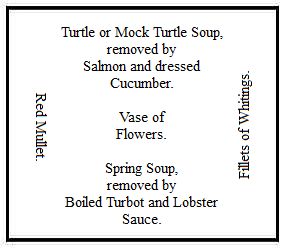
Turtle or Mock Turtle Soup, removed by Salmon and dressed Cucumber. Red Mullet. Vase of Flowers. Fillets of Whitings. Spring Soup, removed by Boiled Turbot and Lobster Sauce.
Entrées.
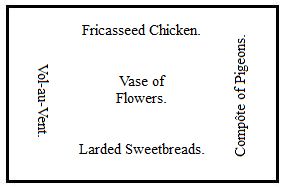
Fricasseed Chicken. Vol-au-Vent. Vase of Flowers. Compôte of Pigeons. Larded Sweetbreads.
Second Course.
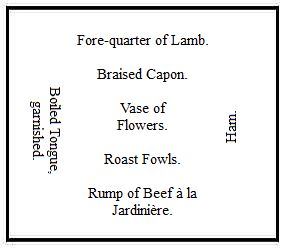
Fore-quarter of Lamb. Braised Capon. Boiled Tongue, garnished. Vase of Flowers. Ham. Roast Fowls. Rump of Beef à la Jardinière.
Third Course.
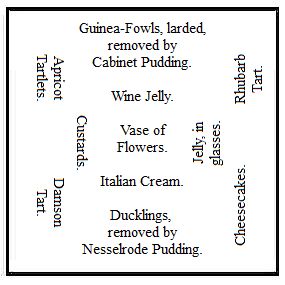
Dessert and Ices.
Apricot Tartlets. Guinea-Fowls, larded, removed by Cabinet Pudding. Rhubarb Tart. Custards. Wine Jelly. Jelly, in glasses. Vase of Flowers. Italian Cream. Ducklings, removed by Nesselrode Pudding. Damson Tart. Cheesecakes.
Dinner for 12 persons.
First Course.—White soup; clear gravy soup; boiled salmon, shrimp sauce, and dressed cucumber; baked mullets in paper cases. Entrées.—Filet de bœuf and Spanish sauce; larded sweetbreads; rissoles; chicken patties. Second Course.—Roast fillet of veal and Béchamel sauce; boiled leg of lamb; roast fowls, garnished with water-cresses; boiled ham, garnished with carrots and mashed turnips; vegetables—sea-kale, spinach, or brocoli. Third Course.—Two ducklings; guinea-fowl, larded; orange jelly; Charlotte Russe; coffee cream; ice pudding; macaroni with Parmesan cheese; spinach, garnished with croûtons; dessert and ices.
Dinner for 10 persons.
First Course.—Macaroni soup; boiled turbot and lobster sauce; salmon cutlets. Entrées.—Compôte of pigeons; mutton cutlets and tomato sauce. Second Course.—Roast lamb; boiled half calf’s head, tongue, and brains; boiled bacon-cheek, garnished with spoonsfuls of spinach; vegetables. Third Course.—Ducklings; plum-pudding; ginger cream; trifle; rhubarb tart; cheesecakes; fondues, in cases; dessert and ices.
Dinner for 8 persons.
First Course.—Calf’s-head soup; brill and shrimp sauce; broiled mackerel à la Maître d’Hôtel. Entrées.—Lobster cutlets; calf’s liver and bacon, aux fines herbes. Second Course.—Roast loin of veal; two boiled fowls à la Béchamel; boiled knuckle of ham; vegetables—spinach or brocoli. Third Course.—Wild ducks; apple custards; blancmange; lemon jelly; jam sandwiches; ice pudding; potatoes à la Maître d’Hôtel; dessert and ices.
Dinner for 6 persons.
First Course.—Vermicelli soup; soles à la Crême. Entrées.—Veal cutlets; small vols-au-vent. Second Course.—Small saddle of mutton; half calf’s head; boiled bacon-cheek, garnished with Brussels sprouts. Third Course.—Cabinet pudding; orange jelly; custards, in glasses; rhubarb tart; lobster salad; dessert.
First Course.—Julienne soup; baked mullets. Entrées.—Chicken cutlets; oyster patties. Second Course.—Roast lamb and mint sauce; boiled leg of pork; pease pudding; vegetables. Third Course.—Ducklings; Swiss cream; lemon jelly; cheesecakes; rhubarb tart; macaroni; dessert.
First Course.—Oyster soup; boiled salmon and dressed cucumber. Entrées.—Rissoles; fricasseed chicken. Second Course.—Boiled leg of mutton, caper sauce; roast fowls, garnished with water-cresses; vegetables. Third Course.—Charlotte aux pommes; orange jelly; lemon cream; soufflé of arrowroot; sea-kale; dessert.
First Course.—Ox-tail soup; boiled mackerel. Entrées.—Stewed mutton kidneys; minced veal and oysters. Second Course.—Stewed shoulder of veal; roast ribs of beef and horseradish sauce; vegetables. Third Course.—Ducklings; tartlets of strawberry jam; cheesecakes; Gâteau de Riz; carrot pudding; sea-kale; dessert.
MARCH, Plain Family Dinners for.
Sunday.—1. Boiled ½ calf’s head, pickled pork, the tongue on a small dish with the brains round it; mutton cutlets and mashed potatoes. 2. Plum tart made with bottled fruit, baked custard pudding, Baroness pudding.
Monday.—1. Roast shoulder of mutton and onion sauce, brocoli, baked potatoes. 2. Slices of Baroness pudding warmed, and served with sugar sprinkled over Cheesecakes.
Tuesday.—1. Mock turtle soup, made with liquor that calf’s head was boiled in, and the pieces of head. 2. Hashed mutton, rump-steaks and oyster sauce. 3. Boiled plum-pudding.
Wednesday.—1. Fried whitings, melted butter, potatoes. 2. Boiled beef, suet dumplings, carrots, potatoes, marrow-bones. 3. Arrowroot blancmange, and stewed rhubarb.
Thursday.—1. Pea-soup made from liquor that beef was boiled in. 2. Stewed rump-steak, cold beef, mashed potatoes. 3. Rolled jam pudding.
Friday.—1. Fried soles, melted butter, potatoes. 2. Roast loin of mutton, brocoli, potatoes, bubble-and-squeak. 3. Rice pudding.
Saturday.—1. Rump-steak pie, haricot mutton made with remains of cold loin. 2. Pancakes, ratafia pudding.
Sunday.—1. Roast fillet of veal, boiled ham, spinach and potatoes. 2. Rhubarb tart, custards in glasses, bread-and-butter pudding.
Monday.—1. Baked soles, potatoes. 2. Minced veal and rump-steak pie. 3. Somersetshire dumplings with the remains of custards poured round them; marmalade tartlets.
Tuesday.—1. Gravy soup. 2. Boiled leg of mutton, mashed turnips, suet dumplings, caper sauce, potatoes, veal rissoles made with remains of fillet of veal. 3. Cheese.
Wednesday.—1. Stewed mullet. 2. Roast fowls, bacon, gravy, and bread sauce, mutton pudding, made with a few slices of the cold meat and the addition of two kidneys. 3. Baked lemon pudding.
Thursday.—1. Vegetable soup made with liquor that the mutton was boiled in, and mixed with the remains of gravy soup. 2. Roast ribs of beef, Yorkshire pudding, horseradish sauce, brocoli and potatoes. 3. Apple pudding or macaroni.
Friday.—1. Stewed eels, pork cutlets, and tomato sauce. 2. Cold beef, mashed potatoes. 3. Plum tart made with bottled fruit.
Saturday.—1. Rump-steak-and-kidney pudding, broiled beef-bones, greens and potatoes. 2. Jam tartlets made with pieces of paste from plum tart, baked custard pudding.
MARCH, Things in Season.
Fish.—Barbel, brill, carp, crabs, crayfish, dace, eels, flounders, haddocks, herrings, lampreys, lobsters, mussels, oysters, perch, pike, plaice, prawns, shrimps, skate, smelts, soles, sprats, sturgeon, tench, thornback, turbot, whiting.
Meat.—Beef, house lamb, mutton, pork, veal.
Poultry.—Capons, chickens, ducklings, tame and wild pigeons, pullets with eggs, turkeys, wild-fowl, though now not in full season.
Game.—Grouse, hares, partridges, pheasants, snipes, woodcock.
Vegetables.—Beetroot, brocoli (purple and white), Brussels sprouts, cabbages, carrots, celery, chervil, cresses, cucumbers (forced), endive, kidney-beans, lettuces, parsnips, potatoes, savoys, sea-kale, spinach, turnips,—various herbs.
Fruit.—Apples (golden and Dutch pippins), grapes, medlars, nuts, oranges, pears (Bon Chrétien), walnuts, dried fruits (foreign), such as almonds and raisins; French and Spanish plums; prunes, figs, dates, crystallized preserves.
MARMALADE AND VERMICELLI PUDDING.
Ingredients.—1 breakfast-cupful of vermicelli, 2 tablespoonfuls of marmalade, ¼ lb. of raisins, sugar to taste, 3 eggs, milk. Mode.—Pour some boiling milk on the vermicelli, and let it remain covered for 10 minutes; then mix with it the marmalade, stoned raisins, sugar, and beaten eggs. Stir all well together, put the mixture into a buttered mould, boil for 1½ hour, and serve with custard sauce. Time.—1½ hour. Average cost, 1s. Sufficient for 5 or 6 persons. Seasonable at any time.
MARROW-BONES, Boiled.
Ingredients.—Bones, a small piece of common paste, a floured cloth. Mode.—Have the bones neatly sawed into convenient sizes, and cover the ends with a small piece of common crust, made with flour and water. Over this tie a floured cloth, and place the bones upright in a saucepan of boiling water, taking care there is sufficient to cover them. Boil them for 2 hours, remove the cloth and paste, and serve them upright on a napkin with dry toast. Many persons clear the marrow from the bones after they are cooked, spread it over a slice of toast and add a seasoning of pepper: when served in this manner, it must be very expeditiously sent to table, as it so soon gets cold. Time.—2 hours. Seasonable at any time.
Note.—Marrow-bones may be baked after preparing them as in the preceding recipe; they should be laid in a deep dish, and baked for 2 hours.
MARROW DUMPLINGS, to serve with Roast Meat, in Soup, with Salad, &c.
(German Recipe.)
Ingredients.—1 oz. of beef marrow, 1 oz. of butter, 2 eggs, 2 penny rolls, 1 teaspoonful of minced onion, 1 teaspoonful of minced parsley, salt and grated nutmeg to taste. Mode.—Beat the marrow and butter together to a cream; well whisk the eggs, and add these to the other ingredients. When they are well stirred, put in the rolls, which should previously be well soaked in boiling milk, strained, and beaten up with a fork. Add the remaining ingredients, omitting the minced onion where the flavour is very much disliked, and form the mixture into small round dumplings. Drop these into boiling broth, and let them simmer for about 20 minutes or ½ hour. They may be served in soup, with roast meat, or with salad, as in Germany, where they are more frequently sent to table than in this country. They are very good. Time.—20 minutes to ½ hour. Average cost, 6d. Sufficient for 7 or 8 dumplings. Seasonable at any time.
MARROW PUDDING, Baked or Boiled.
Ingredients.—½ pint of bread-crumbs, 1½ pint of milk, 6 oz. of marrow, 4 eggs, ¼ lb. of raisins or currants, or 2 oz. of each; sugar and grated nutmeg to taste. Mode.—Make the milk boiling, pour it hot on to the bread-crumbs, and let these remain covered for about ½ hour; shred the marrow, beat up the eggs, and mix these with the bread-crumbs; add the remaining ingredients, beat the mixture well, and either put it into a buttered mould and boil it for 2½ hours, or put it into a pie-dish edged with puff-paste, and bake for rather more than ¾ hour. Before sending it to table, sift a little pounded sugar over, after being turned out of the mould or basin. Time.—2½ hours to boil, ¾ hour to bake. Average cost, 1s. 2d. Sufficient for 5 or 6 persons. Seasonable at any time.
MAY—BILLS OF FARE.
Dinner for 18 persons.
First Course.
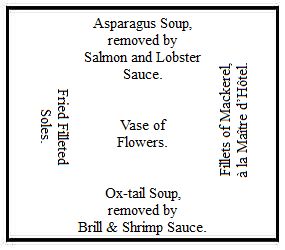
Asparagus Soup, removed by Salmon and Lobster Sauce. Fried Filleted Soles. Vase of Flowers. Fillets of Mackerel, à la Maître d’Hôtel. Ox-tail Soup, removed by Brill & Shrimp Sauce.
Entrées.
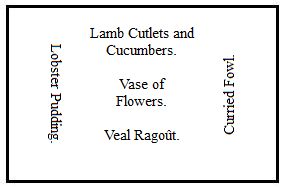
Lamb Cutlets and Cucumbers. Lobster Pudding. Vase of Flowers. Curried Fowl. Veal Ragoût.
Second Course.
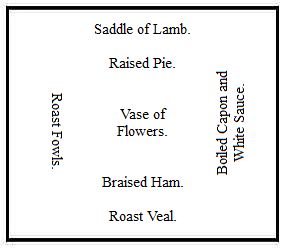
Saddle of Lamb. Raised Pie. Roast Fowls. Vase of Flowers. Boiled Capon and White Sauce. Braised Ham. Roast Veal.
Third Course.
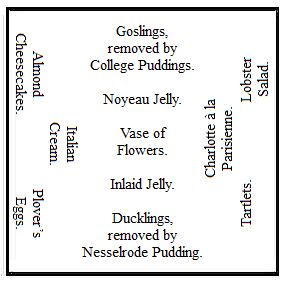
Dessert and Ices.
Almond Cheesecakes. Goslings, removed by College Puddings. Lobster Salad. Noyeau Jelly. Italian Cream. Vase of Flowers. Charlotte à la Parisienne. Inlaid Jelly. Plover’s Eggs. Ducklings, removed by Nesselrode Pudding. Tartlets.
Dinner for 12 persons.
First Course.—White soup; asparagus soup; salmon cutlets; boiled turbot and lobster sauce. Entrées.—Chicken vol-au-vent; lamb cutlets and cucumbers; fricandeau of veal; stewed mushrooms. Second Course.—Roast lamb; haunch of mutton; boiled and roast fowls; vegetables. Third Course.—Ducklings; goslings; Charlotte Russe; Vanilla cream; gooseberry tart; custards; cheesecakes; cabinet pudding and iced pudding; dessert and ices.
Dinner for 10 persons.
First Course.—Spring soup; salmon à la Genévése; red mullet. Entrées.—Chicken vol-au-vent; calf’s liver and bacon aux fines herbes. Second Course.—Saddle of mutton; half calf’s head, tongue, and brains; braised ham; asparagus. Third Course.—Roast pigeons; ducklings; sponge-cake pudding; Charlotte à la vanille; gooseberry tart; cream; cheesecakes; apricot-jam tart; dessert and ices.
Dinner for 8 persons.
First Course.—Julienne soup; brill and lobster sauce; fried fillets of mackerel. Entrées.—Lamb cutlets and cucumbers; lobster patties. Second Course.—Roast fillet of veal; boiled leg of lamb; asparagus. Third Course.—Ducklings; gooseberry tart; custards; fancy pastry; soufflé; dessert and ices.
Dinner for 6 persons.
First Course.—Vermicelli soup; boiled salmon and anchovy sauce. Entrées.—Fillets of beef and tomato sauce; sweetbreads. Second Course.—Roast lamb; boiled capon; asparagus. Third Course.—Ducklings; cabinet pudding; compôte of gooseberries; custards in glasses; blancmange; lemon tartlets; fondue; dessert.
First Course.—Macaroni soup; boiled mackerel à la maître d’hôtel; fried smelts. Entrées.—Scollops of fowl; lobster pudding. Second Course.—Boiled leg of lamb and spinach; roast sirloin of beef and horseradish sauce; vegetables. Third Course.—Roast leveret; salad; soufflé of rice; ramakins; strawberry-jam tartlets; orange jelly; dessert.
First Course.—Julienne soup; trout with Dutch sauce; salmon cutlets. Entrées.—Lamb cutlets and mushrooms; vol-au-vent of chicken. Second Course.—Roast lamb; calf’s head à la tortue; vegetables. Third Course.—Spring chickens; iced pudding; Vanilla cream; clear jelly; tartlets; cheesecakes; dessert.
First Course.—Soup à la reine; crimped trout and lobster sauce; baked whitings aux fines herbes. Entrées.—Braised mutton cutlets and cucumbers; stewed pigeons. Second Course.—Roast fillet of veal; bacon-cheek and greens; fillet of beef à la jardinière. Third Course.—Ducklings; soufflé à la vanille; compôte of oranges; meringues; gooseberry tart; fondue; dessert.
MAY, Plain Family Dinners for.
Sunday.—1. Vegetable soup. 2. Saddle of mutton, asparagus and potatoes. 3. Gooseberry tart, custards.
Monday.—1. Fried whitings, anchovy sauce. 2. Cold mutton, mashed potatoes, stewed veal. 3. Fig pudding.
Tuesday.—1. Haricot mutton, made from remains of cold mutton, rump-steak pie. 2. Macaroni.
Wednesday.—1. Roast loin of veal and spinach, boiled bacon, mutton cutlets and tomato sauce. 2. Gooseberry pudding and cream.
Thursday.—1. Spring soup. 2. Roast leg of lamb, mint sauce, spinach, curried veal and rice. 3. Lemon pudding.
Friday.—1. Boiled mackerel and parsley-and-butter. 2. Stewed rump-steak, cold lamb and salad. 3. Baked gooseberry pudding.
Saturday.—1. Vermicelli. 2. Rump-steak pudding, lamb cutlets, and cucumbers. 3. Macaroni.
Sunday.—1. Boiled salmon and lobster or caper sauce. 2. Roast lamb, mint sauce, asparagus, potatoes. 3. Plum-pudding, gooseberry tart.
Monday.—1. Salmon warmed in remains of lobster sauce and garnished with croûtons. 2. Stewed knuckle of veal and rice, cold lamb and dressed cucumber. 3. Slices of pudding warmed, and served with sugar sprinkled over. Baked rice pudding.
Tuesday.—1. Roast ribs of beef, horseradish sauce, Yorkshire pudding, spinach and potatoes. 2. Boiled lemon pudding.
Wednesday.—1. Fried soles, melted butter. 2. Cold beef and dressed cucumber or salad, veal cutlets and bacon. 3. Baked plum-pudding.
Thursday.—1. Spring soup. 2. Calf’s liver and bacon, broiled beef-bones, spinach and potatoes. 3. Gooseberry tart.
Friday.—1. Roast shoulder of mutton, baked potatoes, onion sauce, spinach. 2. Currant dumplings.
Saturday.—1. Broiled mackerel, fennel sauce or plain melted butter. 2. Rump-steak pie, hashed mutton, vegetables. 3. Baked arrowroot pudding.
MAY, Things in Season.
Fish.—Carp, chub, crabs, crayfish, dory, herrings, lobsters, mackerel, red and gray mullet, prawns, salmon, shad, smelts, soles, trout, turbot.
Meat.—Beef, lamb, mutton, veal.
Poultry.—Chickens, ducklings, fowls, green geese, leverets, pullets, rabbits.
Vegetables.—Asparagus, beans, early cabbages, carrots, cauliflowers, cresses, cucumbers, lettuces, pease, early potatoes, salads, sea-kale,—various herbs.
Fruit.—Apples, green apricots, cherries, currants for tarts, gooseberries, melons, pears, rhubarb, strawberries.
MAYONNAISE, a Sauce or Salad-Dressing for cold Chicken, Meat, and other cold Dishes.
Ingredients.—The yolks of 2 eggs, 6 tablespoonfuls of salad oil, 4 tablespoonfuls of vinegar, salt and white pepper to taste, 1 tablespoonful of white stock, 2 tablespoonfuls of cream. Mode.—Put the yolks of the eggs into a basin, with a seasoning of pepper and salt; have ready the above quantities of oil and vinegar, in separate vessels; add them very gradually to the eggs; continue stirring and rubbing the mixture with a wooden spoon, as herein consists the secret of having a nice smooth sauce. It cannot be stirred too frequently, and it should be made in a very cool place, or, if ice is at hand, it should be mixed over it. When the vinegar and oil are well incorporated with the eggs, add the stock and cream, stirring all the time, and it will then be ready for use.
For a fish Mayonnaise, this sauce may be coloured with lobster-spawn, pounded; and for poultry or meat, where variety is desired, a little parsley-juice may be used to add to its appearance. Cucumber, tarragon, or any other flavoured vinegar, may be substituted for plain, where they are liked. Average cost, for this quantity, 7d. Sufficient for a small salad.
Note.—In mixing the oil and vinegar with the eggs, put in first a few drops of oil, and then a few drops of vinegar, never adding a large quantity of either at one time. By this means, you can be more certain of the sauce not curdling. Patience and practice, let us add, are two essentials for making this sauce good.
MELONS.
This fruit is rarely preserved or cooked in any way, but is sent whole to table on a dish garnished with leaves or flowers, as fancy dictates. A border of any other kind of small fruit, arranged round the melon, has a pretty effect, the colour of the former contrasting nicely with the melon. Plenty of pounded sugar should be served with it; and the fruit should be cut lengthwise, in moderate-sized slices. In America, it is frequently eaten with pepper and salt. Average cost.—English, in full season, 3s. 6d. to 5s. each; when scarce, 10s. to 15s.; seasonable, June to August. French, 2s. to 3s. 6d. each; seasonable, June and July. Dutch, 9d. to 2s. each; seasonable, July and August.
MERINGUES.
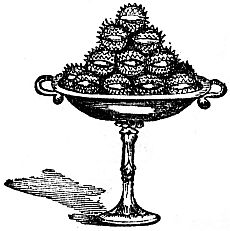
MERINGUES.
Ingredients.—½ lb. of pounded sugar, the whites of 4 eggs. Mode.—Whisk the whites of the eggs to a stiff froth, and, with a wooden spoon, stir in quickly the pounded sugar; and have some boards thick enough to put in the oven to prevent the bottom of the meringues from acquiring too much colour. Cut some strips of paper about 2 inches wide; place this paper on the board, and drop a tablespoonful at a time of the mixture on the paper, taking care to let all the meringues be the same size. In dropping it from the spoon, give the mixture the form of an egg, and keep the meringues about 2 inches apart from each other on the paper. Strew over them some sifted sugar, and bake in a moderate oven for ½ hour. As soon as they begin to colour, remove them from the oven; take each slip of paper by the two ends, and turn it gently on the table, and, with a small spoon, take out the soft part of each meringue. Spread some clean paper on the board, turn the meringues upside down, and put them into the oven to harden and brown on the other side. When required for table, fill them with whipped cream, flavoured with liqueur or vanilla, and sweetened with pounded sugar. Join two of the meringues together, and pile them high in the dish, as shown in the annexed drawing. To vary their appearance, finely-chopped almonds or currants may be strewn over them before the sugar is sprinkled over; and they may be garnished with any bright-coloured preserve. Great expedition is necessary in making this sweet dish; as, if the meringues are not put into the oven as soon as the sugar and eggs are mixed, the former melts, and the mixture would run on the paper, instead of keeping its egg-shape. The sweeter the meringues are made, the crisper will they be; but, if there is not sufficient sugar mixed with them, they will most likely be tough. They are sometimes coloured with cochineal; and, if kept well covered in a dry place, will remain good for a month or six weeks. Time.—Altogether, about ½ hour. Average cost, with the cream and flavouring, 1s. Sufficient to make 2 dozen meringues. Seasonable at any time.
MILK.
Milk, when of good quality, is of an opaque white colour: the cream always comes to the top; the well-known milky odour is strong; it will boil without altering its appearance in these respects; the little bladders which arise on the surface will renew themselves if broken by the spoon. To boil milk is, in fact, the simplest way of testing its quality. The commonest adulterations of milk are not of a hurtful character. It is a good deal thinned with water, and sometimes thickened with a little starch, or coloured with yolk of egg, or even saffron; but these processes have nothing murderous in them.
MILK AND CREAM, to keep, in hot Weather.
When the weather is very warm, and it is very difficult to prevent milk from turning sour and spoiling the cream, it should be scalded, and it will then remain good for a few hours. It must on no account be allowed to boil, or there will be a skin instead of a cream upon the milk; and the slower the process the safer will it be. A very good plan to scald milk, is to put the pan that contains it into a saucepan or wide kettle of boiling water. When the surface looks thick, the milk is sufficiently scalded, and it should then be put away in a cool place in the same vessel that it was scalded in. Cream may be kept for 24 hours, if scalded without sugar; and by the addition of the latter ingredient, it will remain good double the time, if kept in a cool place. All pans, jugs, and vessels intended for milk, should be kept beautifully clean, and well scalded before the milk is put in, as any negligence in this respect may cause large quantities of it to be spoiled; and milk should never be kept in vessels of zinc or copper. Milk may be preserved good in hot weather, for a few hours, by placing the jug which contains it in ice, or very cold water; or a pinch of bicarbonate of soda may be introduced into the liquid.
MILK AND CREAM, Separation of.
If it be desired that the milk should be freed entirely from cream, it should be poured into a very shallow broad pan or dish, not more than 1½ inch deep, as cream cannot rise through a great depth of milk. In cold and wet weather, milk is not so rich as it is in summer and warm weather, and the morning’s milk is always richer than the evening’s. The last-drawn milk of each milking, at all times and seasons, is richer than the first-drawn, and on that account should be set apart for cream. Milk should be shaken as little as possible when carried from the cow to the dairy, and should be poured into the pans very gently. Persons not keeping cows, may always have a little cream, provided the milk they purchase be pure and unadulterated. As soon as it comes in, it should be poured into very shallow open pie-dishes, and set by in a very cool place, and in 7 or 8 hours a nice cream should have risen to the surface.
MILK AND CREAM, Substitute for, in Tea and Coffee.
Ingredients.—1 new laid egg to every large breakfast-cupful of tea or coffee. Mode.—Beat up the whole of the egg in a basin, put it into a cup, and pour over it the tea or coffee quite hot, stirring all the time to prevent the egg from curdling. In point of nourishment, both tea and coffee are much improved by this addition. Sufficient.—1 egg to every large breakfast-cupful of tea or coffee.
MILK SOUP (a nice Dish for Children).
Ingredients.—2 quarts of milk, 1 saltspoonful of salt, 1 teaspoonful of powdered cinnamon, 3 teaspoonfuls of pounded sugar, or more if liked, 4 thin slices of bread, the yolks of 6 eggs. Mode.—Boil the milk with the salt, cinnamon, and sugar; lay the bread in a deep dish, pour over it a little of the milk, and keep it hot over a stove, without burning. Beat up the yolks of the eggs, add them to the milk, and stir it over the fire till it thickens. Do not let it curdle. Pour it upon the bread, and serve. Time.—¾ of an hour. Average cost, 8d. per quart. Seasonable all the year. Sufficient for 10 children.
MINCE PIES.
Ingredients.—Good puff-paste, mincemeat. Mode.—Make some good puff-paste by recipe; roll it out to the thickness of about ¼ inch, and line some good-sized patty-pans with it; fill them with mincemeat, cover with the paste, and cut it off all round close to the edge of the tin. Put the pies into a brisk oven, to draw the paste up, and bake for 25 minutes, or longer, should the pies be very large; brush them over with the white of an egg, beaten with the blade of a knife to a stiff froth; sprinkle over pounded sugar, and put them into the oven for a minute or two, to dry the egg; dish the pies on a white d’oyley, and serve hot. They may be merely sprinkled with pounded sugar instead of being glazed, when that mode is preferred. To re-warm them, put the pies on the patty-pans, and let them remain in the oven for 10 minutes or ¼ hour, and they will be almost as good as if freshly made. Time.—25 to 30 minutes; 10 minutes to re-warm them. Average cost, 4d. each. Sufficient—½ lb. of paste for 4 pies. Seasonable at Christmas time.
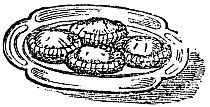
MINCE PIES.
MINCEMEAT.
Ingredients.—2 lbs. of raisins, 3 lbs. of currants, 1½ lb. of lean beef, 3 lbs. of beef suet, 2 lbs. of moist sugar, 2 oz. of citron, 2 oz. of candied lemon-peel, 2 oz. of candied orange-peel, 1 large nutmeg, 1 pottle of apples, the rind of 2 lemons, the juice of 1, ½ pint of brandy. Mode.—Stone and cut the raisins once or twice across, but do not chop them; wash, dry, and pick the currants free from stalks and grit, and mince the beef and suet, taking care that the latter is chopped very fine; slice the citron and candied peel, grate the nutmeg, and pare, core, and mince the apples; mince the lemon-peel, strain the juice, and when all the ingredients are thus prepared, mix them well together, adding the brandy when the other things are well blended; press the whole into a jar, carefully exclude the air, and the mincemeat will be ready for use in a fortnight. If an additional quantity of spice be preferred, add ½ teaspoonful of pounded mace, and the same of pounded allspice. We, however, prefer the mincemeat without the latter ingredients, and can vouch for its excellence. Average cost for this quantity, 8s. Seasonable.—Make this about the beginning of December.
MINCEMEAT, Excellent.
Ingredients.—3 large lemons, 3 large apples, 1 lb. of stoned raisins, 1 lb. of currants, 1 lb. of suet, 2 lbs. of moist sugar, 1 oz. of sliced candied citron, 1 oz. of sliced candied orange-peel, and the same quantity of lemon-peel, 1 teacupful of brandy, 2 tablespoonfuls of orange marmalade. Mode.—Grate the rinds of the lemons; squeeze out the juice, strain it, and boil the remainder of the lemons until tender enough to pulp or chop very finely. Then add to this pulp the apples, which should be baked, and their skins and cores removed; put in the remaining ingredients one by one, and, as they are added, mix everything very thoroughly together. Put the mincemeat into a stone jar with a closely-fitting lid, and in a fortnight it will be ready for use. Seasonable.—This should be made the first or second week in December.
MINT SAUCE, to serve with Roast Lamb.
Ingredients.—4 dessertspoonfuls of chopped mint, 2 dessertspoonfuls of pounded white sugar, ¼ pint of vinegar. Mode.—Wash the mint, which should be young and fresh-gathered, free from grit; pick the leaves from the stalks, mince them very fine, and put them into a tureen; add the sugar and vinegar, and stir till the former is dissolved. This sauce is better by being made 2 or 3 hours before wanted for table, as the vinegar then becomes impregnated with the flavour of the mint. By many persons, the above proportion of sugar would not be considered sufficient; but as tastes vary, we have given the quantity which we have found to suit the general palate. Average cost, 3d. Sufficient to serve with a middling-size joint of lamb.
Note.—Where green mint is scarce and not obtainable, mint vinegar may be substituted for it, and will be found very acceptable in early spring.
MINT VINEGAR.
Ingredients.—Vinegar, mint. Mode.—Procure some nice fresh mint, pick the leaves from the stalks, and fill a bottle or jar with them. Add vinegar to them until the bottle is full; cover closely to exclude the air, and let it infuse for a fortnight. Then strain the liquor, and put it into small bottles for use, of which the corks should be sealed. Seasonable.—This should be made in June, July or August.
MOCK TURTLE SOUP.
I.
Ingredients.—½ a calf’s head, ¼ lb. of butter, ¼ lb. of lean ham, 2 tablespoonfuls of minced parsley, a little minced lemon thyme, sweet marjoram, basil, 2 onions, a few chopped mushrooms (when obtainable), 2 shalots, 2 tablespoonfuls of flour, ¼ bottle of Madeira or sherry, forcemeat balls, cayenne, salt and mace to taste, the juice of 1 lemon and 1 Seville orange, 1 dessertspoonful of pounded sugar, 3 quarts of best stock. Mode.—Scald the head with the skin on, remove the brain, tie the head up in a cloth, and let it boil for 1 hour. Then take the meat from the bones, cut it into small square pieces, and throw them into cold water. Now take the meat, put it into a stewpan, and cover with stock; let it boil gently for an hour, or rather more, if not quite tender, and set it on one side. Melt the butter in another stewpan, and add the ham, cut small, with the herbs, parsley, onions, shalots, mushrooms, and nearly a pint of stock; let these simmer slowly for 2 hours, and then dredge in as much flour as will dry up the butter. Fill up with the remainder of the stock, add the wine, let it stew gently for 10 minutes, rub it through a tammy, and put it to the calf’s head; season with cayenne, and, if required, a little salt; add the juice of the orange and lemon; and when liked, ¼ teaspoonful of pounded mace, and the sugar. Put in the forcemeat balls, simmer 5 minutes, and serve very hot. Time.—4½ hours. Average cost, 3s. 6d. per quart, or 2s. 6d. without wine or forcemeat balls. Seasonable in winter. Sufficient for 10 persons.
Note.—The bones of the head should be well stewed in the liquor it was first boiled in, and will make good white stock, flavoured with vegetables, &c.
II.
(More Economical.)
Ingredients.—A knuckle of veal weighing 5 or 6 lbs., 2 cow-heels, 2 large onions stuck with cloves, 1 bunch of sweet herbs, 3 blades of mace, salt to taste, 12 peppercorns, 1 glass of sherry, 24 forcemeat balls, a little lemon-juice, 4 quarts of water. Mode.—Put all the ingredients, except the forcemeat balls and lemon-juice, in an earthen jar, and stew for 6 hours. Do not open it till cold. When wanted for use, skim off all the fat, and strain carefully; place it on the fire, cut up the meat into inch-and-a-half squares, put it, with the forcemeat balls and lemon-juice, into the soup, and serve. It can be flavoured with a tablespoonful of anchovy, or Harvey’s sauce. Time.—6 hours. Average cost, 1s. 4d. per quart. Seasonable in winter. Sufficient for 10 persons.
MUFFINS.
Ingredients.—To every quart of milk allow 1½ oz. of German yeast, a little salt; flour. Mode.—Warm the milk, add to it the yeast, and mix these well together; put them into a pan, and stir in sufficient flour to make the whole into a dough of rather a soft consistence; cover it over with a cloth, and place it in a warm place to rise, and, when light and nicely risen, divide the dough into pieces, and round them to the proper shape with the hands; place them in a layer of flour about two inches thick, on wooden trays, and let them rise again: when this is effected, they each will exhibit a semi-globular shape. Then place them carefully on a hot plate or stove, and bake them until they are slightly browned, turning them when they are done on one side. Muffins are not easily made, and are more generally purchased than manufactured at home. To toast them, divide the edge of the muffin all round, by pulling it open to the depth of about an inch, with the fingers. Put it on a toasting-fork, and hold it before a very clear fire until one side is nicely browned, but not burnt; turn, and toast it on the other. Do not toast them too quickly, as, if this be done, the middle of the muffin will not be warmed through. When done, divide them by pulling them open; butter them slightly on both sides, put them together again, and cut them into halves: when sufficient are toasted and buttered, pile them on a very hot dish, and send them very quickly to table. Time.—From 20 minutes to ½ hour to bake them. Sufficient.—Allow 1 muffin to each person.

MUFFINS.
MULBERRIES, Preserved.
Ingredients.—To 2 lbs. of fruit and 1 pint of juice allow 2½ lbs. of loaf sugar. Mode.—Put some of the fruit into a preserving pan, and simmer it gently until the juice is well drawn. Strain it through a bag, measure it, and to every pint allow the above proportion of sugar and fruit. Put the sugar into the preserving-pan, moisten it with the juice, boil it up, skim well, and then add the mulberries, which should be ripe, but not soft enough to break to a pulp. Let them stand in the syrup till warm through, then set them on the fire to boil gently; when half done, turn them carefully into an earthen pan, and let them remain till the next day; then boil them as before, and when the syrup is thick, and becomes firm when cold, put the preserve into pots. In making this, care should be taken not to break the mulberries: this may be avoided by very gentle stirring, and by simmering the fruit very slowly. Time.—¾ hour to extract the juice; ¼ hour to boil the mulberries the first time, ¼ hour the second time. Seasonable in August and September.
MULLAGATAWNY SOUP.
Ingredients.—2 tablespoonfuls of curry powder, 6 onions, 1 clove of garlic, 1 oz. of pounded almonds, a little lemon-pickle, or mango-juice, to taste; 1 fowl or rabbit; 4 slices of lean bacon; 2 quarts of medium stock, or, if wanted very good, best stock. Mode.—Slice and fry the onions of a nice colour; line the stewpan with the bacon; cut up the rabbit or fowl into small joints, and slightly brown them; put in the fried onions, the garlic, and stock and simmer gently till the meat is tender, skim very carefully, and when the meat is done, rub the curry powder to a smooth batter: add it to the soup with the almonds, which must be first pounded with a little of the stock. Put in seasoning and lemon-pickle or mango-juice to taste, and serve boiled rice with it. Time.—2 hours. Average cost, 1s. 6d. per quart. Seasonable in winter. Sufficient for 8 persons.
Note.—This soup can also be made with breast of veal, or calf’s head. Vegetable mullagatawny is made with veal stock, by boiling and pulping chopped vegetable marrow, cucumbers, onions, and tomatoes, and seasoning with curry powder and cayenne. Nice pieces of meat, good curry powder, and strong stock, are necessary to make this soup good.
MULLET, Grey.
Ingredients.—¼ lb. of salt to each gallon of water. Mode.—If the fish be very large, it should be laid in cold water, and gradually brought to a boil; if small, put it in boiling water, salted in the above proportion. Serve with anchovy sauce and plain melted butter. Time.—According to size, ¼ to ¾ hour. Average cost, 8d. per lb. Seasonable from July to October.
MULLET, Red.
Ingredients.—Oiled paper, thickening of butter and flour, ½ teaspoonful of anchovy sauce, 1 glass of sherry; cayenne and salt to taste. Mode.—Clean the fish, take out the gills, but leave the inside, fold in oiled paper, and bake them gently. When done, take the liquor that flows from the fish, add a thickening of butter kneaded with flour; put in the other ingredients, and let it boil for 2 minutes. Serve the sauce in a tureen, and the fish, either with or without the paper cases. Time.—About 25 minutes. Average cost, 1s. each. Seasonable at any time, but more plentiful in summer.
Note.—Red mullet may be broiled, and should be folded in oiled paper, the same as in the preceding recipe, and seasoned with pepper and salt. They may be served without sauce; but if any is required, use melted butter, Italian or anchovy sauce. They should never be plain boiled.
MUSHROOM KETCHUP.
Ingredients.—To each peck of mushrooms ½ lb. of salt; to each quart of mushroom-liquor ¼ oz. of cayenne, ½ oz. of allspice, ½ oz. of ginger, 2 blades of pounded mace. Mode.—Choose full-grown mushroom flaps, and take care they are perfectly fresh gathered when the weather is tolerably dry; for, if they are picked during very heavy rain, the ketchup from which they are made is liable to get musty, and will not keep long. Put a layer of them in a deep pan, sprinkle salt over them, and then another layer of mushrooms, and so on alternately. Let them remain for a few hours, when break them up with the hand; put them in a nice cool place for 3 days, occasionally stirring and mashing them well, to extract from them as much juice as possible. Now measure the quantity of liquor without straining, and to each quart allow the above proportion of spices, &c. Put all into a stone jar, cover it up very closely, put it in a saucepan of boiling water, set it over the fire, and let it boil for 3 hours. Have ready a nice clean stewpan; turn into it the contents of the jar, and let the whole simmer very gently for ½ hour; pour it into a jug, where it should stand in a cool place till the next day; then pour it off into another jug, and strain it into very dry clean bottles, and do not squeeze the mushrooms. To each pint of ketchup add a few drops of brandy. Be careful not to shake the contents, but leave all the sediment behind in the jug; cork well, and either seal or rosin the cork, so as perfectly to exclude the air. When a very clear bright ketchup is wanted, the liquor must be strained through a very fine hair-sieve, or flannel bag, after it has been very gently poured off; if the operation is not successful, it must be repeated until you have quite a clear liquor. It should be examined occasionally, and if it is spoiling, should be reboiled with a few peppercorns. Seasonable from the beginning of September to the middle of October, when this ketchup should be made.
Note.—This flavouring ingredient, if genuine and well prepared, is one of the most useful store sauces to the experienced cook, and no trouble should be spared in its preparation. Double ketchup is made by reducing the liquor to half the quantity; for example, 1 quart must be boiled down to 1 pint. This goes farther than ordinary ketchup, as so little is required to flavour a good quantity of gravy. The sediment may also be bottled for immediate use, and will be found to answer for flavouring thick soups or gravies.
MUSHROOM POWDER (a valuable addition to Sauces and Gravies, when fresh Mushrooms are not obtainable).
Ingredients.—½ peck of large mushrooms, 2 onions, 12 cloves, ¼ oz. of pounded mace, 2 teaspoonfuls of white pepper. Mode.—Peel the mushrooms, wipe them perfectly free from grit and dirt, remove the black fur, and reject all those that are at all worm-eaten; put them into a stewpan with the above ingredients, but without water; shake them over a clear fire, till all the liquor is dried up, and be careful not to let them burn; arrange them on tins, and dry them in a slow oven; pound them to a fine powder, which put into small dry bottles; cork well, seal the corks, and keep it in a dry place. In using this powder, add it to the gravy just before serving, when it will merely require one boil-up. The flavour imparted by this means to the gravy, ought to be exceedingly good. Seasonable.—This should be made in September, or at the beginning of October.
Note.—If the bottles in which it is stored away are not perfectly dry, as, also, the mushroom powder, it will keep good but a very short time.
MUSHROOM SAUCE, very rich and good, to serve with Fowls or Rabbits.
Ingredients.—1 pint of mushroom-buttons, salt to taste, a little grated nutmeg, 1 blade of pounded mace, 1 pint of cream, 2 oz. of butter, flour to thicken. Mode.—Rub the buttons with a piece of flannel and salt, to take off the skin; cut off the stalks, and put them in a stewpan with the above ingredients, previously kneading together the butter and flour; boil the whole for about ten minutes, stirring all the time. Pour some of the sauce over the fowls, and the remainder serve in a tureen. Time.—10 minutes. Average cost, 2s. Sufficient to serve with a pair of fowls. Seasonable from August to October.
MUSHROOM SAUCE, Brown, to serve with Roast Meat, &c.
Ingredients.— ½ pint of button mushrooms, ½ pint of good beef gravy, 1 tablespoonful of mushroom ketchup (if at hand), thickening of butter and flour. Mode.—Put the gravy into a saucepan, thicken it, and stir over the fire until it boils. Prepare the mushrooms by cutting off the stalks, and wiping them free from grit and dirt; the large flap mushrooms cut into small pieces will answer for a brown sauce, when the buttons are not obtainable; put them into the gravy, and let them simmer very gently for about 10 minutes; then add the ketchup, and serve. Time.—Rather more than 10 minutes. Seasonable from August to October.
Note.—When fresh mushrooms are not obtainable, the powder may be used as a substitute for brown sauce.
MUSHROOM SAUCE, White, to serve with Boiled Fowls, Cutlets, &c.
Ingredients.—Rather more than ½ pint of button mushrooms, lemon-juice, and water, 1 oz. of butter, ½ pint of Béchamel, ¼ teaspoonful of pounded sugar. Mode.—Turn the mushrooms white by putting them into lemon-juice and water, having previously cut off the stalks and wiped them perfectly free from grit. Chop them, and put them in a stewpan with the butter. When the mushrooms are softened, add the Béchamel, and simmer for about 5 minutes; should they, however, not be done enough, allow rather more time. They should not boil longer than necessary, as they would then lose their colour and flavour. Rub the whole through a tammy, and serve very hot. After this, it should be warmed in a bain marie. Time.—Altogether ¼ hour. Average cost, 1s. Seasonable from August to October.
MUSHROOM SAUCE, White, to serve with Boiled Fowls, Cutlets, &c. (a more simple Method).
Ingredients.— ½ pint of melted butter, made with milk, ½ pint of button mushrooms, 1 dessertspoonful of mushroom ketchup, if at hand; cayenne and salt to taste. Mode.—Make the melted butter with milk, and add to it the mushrooms, which must be nicely cleaned, and free from grit, and the stalks cut off. Let them simmer gently for about 10 minutes, or until they are quite tender. Put in the seasoning and ketchup; let it just boil, when serve. Time.—Rather more than 10 minutes. Average cost, 8d. Seasonable from August to October.
MUSHROOMS, Baked (a Breakfast, Luncheon, or Supper Dish).
Ingredients.—16 to 20 mushroom-flaps, butter, pepper to taste. Mode.—For this mode of cooking, the mushroom-flaps are better than the buttons, and should not be too large. Cut off a portion of the stalk, peel the top, and wipe the mushrooms carefully with a piece of flannel and a little fine salt. Put them into a tin baking-dish, with a very small piece of butter placed on each mushroom; sprinkle over a little pepper, and let them bake for about 20 minutes, or longer should the mushrooms be very large. Have ready a very hot dish, pile the mushrooms high in the centre, pour the gravy round, and send them to table quickly, with very hot plates. Time.—20 minutes; large mushrooms, ½ hour. Average cost, 1d. each for large mushroom-flaps. Sufficient for 5 or 6 persons. Seasonable.—Meadow mushrooms in September and October; cultivated mushrooms may be had at any time.
MUSHROOMS, Broiled (a Breakfast, Luncheon, or Supper Dish).

BROILED MUSHROOMS.
Ingredients.—Mushroom-flaps, pepper and salt to taste, butter, lemon-juice. Mode.—Cleanse the mushrooms by wiping them with a piece of flannel and a little salt; cut off a portion of the stalk, and peel the tops; broil them over a clear fire, turning them once, and arrange them on a very hot dish. Put a small piece of butter on each mushroom, season with pepper and salt, and squeeze over them a few drops of lemon-juice. Place the dish before the fire, and when the butter is melted, serve very hot and quickly. Moderate-sized flaps are better suited to this mode of cooking than the buttons: the latter are better in stews. Time.—10 minutes for medium-sized mushrooms. Average cost, 1d. each for large mushrooms. Sufficient.—Allow 3 or 4 mushrooms to each person. Seasonable.—Meadow mushrooms in September and October; cultivated mushrooms may be had at any time.
MUSHROOMS, Dried.
Mode.—Wipe them clean, take away the brown part, and peel off the skin; lay them on sheets of paper to dry, in a cool oven, when they will shrivel considerably. Keep them in paper bags, which hang in a dry place. When wanted for use, put them into cold gravy, bring them gradually to simmer, and it will be found that they will regain nearly their usual size.
MUSHROOMS, Pickled.
Ingredients.—Sufficient vinegar to cover the mushrooms; to each quart of mushrooms, 2 blades of pounded mace, 1 oz. of ground pepper, salt to taste. Mode.—Choose some nice young button mushrooms for pickling, and rub off the skin with a piece of flannel and salt, and cut off the stalks; if very large, take out the red inside, and reject the black ones, as they are too old. Put them into a stewpan, sprinkle salt over them, with pounded mace and pepper in the above proportion; shake them well over a clear fire until the liquor flows, and keep them there until they are all dried up again; then add as much vinegar as will cover them; just let it simmer for 1 minute, and store it away in stone jars for use. When cold, tie down with bladder and keep in a dry place: they will remain good for a length of time, and are generally considered delicious. Seasonable.—-Make this the same time as ketchup, from the beginning of September to the middle of October.
MUSHROOMS, to Preserve.
Ingredients.—To each quart of mushrooms, allow 3 oz. butter, pepper and salt to taste, the juice of 1 lemon, clarified butter. Mode.—Peel the mushrooms, put them into cold water, with a little lemon-juice; take them out and dry them very carefully in a cloth. Put the butter into a stewpan capable of holding the mushrooms; when it is melted, add the mushrooms, lemon-juice, and a seasoning of pepper and salt; draw them down over a slow fire, and let them remain until their liquor is boiled away, and they have become quite dry, but be careful in not allowing them to stick to the bottom of the stewpan. When done, put them into pots, and pour over the top clarified butter. If wanted for immediate use, they will keep good a few days without being covered over. To re-warm them, put the mushrooms into a stewpan, strain the butter from them, and they will be ready for use. Average cost, 1d. each. Seasonable.—Meadow mushrooms in September and October; cultivated mushrooms may be had at any time.
MUSHROOMS, Stewed.
Ingredients.—1 pint mushroom-buttons, 3 oz. of fresh butter, white pepper and salt to taste, lemon-juice, 1 teaspoonful of flour, cream or milk, ¼ teaspoonful of grated nutmeg. Mode.—Cut off the ends of the stalks, and pare neatly a pint of mushroom-buttons; put them into a basin of water, with a little lemon juice, as they are done. When all are prepared, take them from the water with the hands, to avoid the sediment, and put them into a stewpan with the fresh butter, white pepper, salt, and the juice of ½ lemon; cover the pan closely, and let the mushrooms stew gently from 20 to 25 minutes; then thicken the butter with the above proportion of flour, add gradually sufficient cream, or cream and milk, to make the sauce of a proper consistency, and put in the grated nutmeg. If the mushrooms are not perfectly tender, stew them for 5 minutes longer, remove every particle of butter which may be floating on the top, and serve. Time.—½ hour. Average cost, from 9d. to 2s. per pint. Sufficient for 5 or 6 persons. Seasonable.—Meadow mushrooms in September and October.
MUSHROOMS, Stewed in Gravy.
Ingredients.—1 pint of mushroom-buttons, 1 pint of brown gravy, ¼ teaspoonful of grated nutmeg, cayenne and salt to taste. Mode.—Make a pint of brown gravy, cut nearly all the stalks away from the mushrooms and peel the tops; put them into a stewpan, with the gravy, and simmer them gently from 20 minutes to ½ hour. Add the nutmeg and a seasoning of cayenne and salt, and serve very hot. Time.—20 minutes to ½ hour. Average cost, 9d. to 2s. per pint. Sufficient for 5 or 6 persons. Seasonable.—Meadow mushrooms in September and October.
MUSTARD, How to Mix.
Ingredients.—Mustard, salt and water. Mode.—Mustard should be mixed with water that has been boiled and allowed to cool; hot water destroys its essential properties, and raw cold water might cause it to ferment. Put the mustard into a cup, with a small pinch of salt, and mix with it very gradually sufficient boiled water to make it drop from the spoon without being watery. Stir and mix well, and rub the lumps well down with the back of a spoon, as well-mixed mustard should be perfectly free from these. The mustard-pot should not be more than half-full, or rather less if it will not be used for a day or two, as it is so much better when it is freshly mixed.
MUSTARD, Indian, an excellent Relish to Bread and Butter, or any cold Meat.
Ingredients.—¼ lb. of the best mustard, ¼ lb. of flour, ½ oz. of salt, 4 shalots, 4 tablespoonfuls of vinegar, 4 tablespoonfuls of ketchup, ¼ bottle of anchovy sauce. Mode.—Put the mustard, flour, and salt into a basin, and make them into a stiff paste with boiling water. Boil the shalots with the vinegar, ketchup, and anchovy sauce, for 10 minutes, and pour the whole, boiling, over the mixture in the basin; stir well, and reduce it to a proper thickness; put it into a bottle, with a bruised shalot at the bottom, and store away for use. This makes an excellent relish, and if properly prepared will keep for years.
MUSTARD, Tartar.
Ingredients.—Horseradish vinegar, cayenne, ½ a teacupful of mustard. Mode.—Have ready sufficient horseradish vinegar to mix with the above proportion of mustard; put the mustard into a cup, with a slight seasoning of cayenne; mix it perfectly smooth with the vinegar, adding this a little at a time; rub down with the back of a spoon any lumps that may appear, and do not let it be too thin. Mustard may be flavoured in various ways, with Tarragon, shalot, celery, and many other vinegars, herbs, spices, &c.
MUTTON.
Almost every large city has a particular manner of cutting up, or, as it is called, dressing the carcase. In London this process is very simple, and as our butchers have found that much skewering back, doubling one part over another, or scoring the inner cuticle or fell, tends to spoil the meat and shorten the time it would otherwise keep, they avoid all such treatment entirely. The carcase when flayed (which operation is performed while yet warm), the sheep when hung up and the head removed, presents the profile shown in our cut; the small numerals indicating the parts or joints into which one-half of the animal is cut. After separating the hind from the fore quarters, with eleven ribs to the latter, the quarters are usually subdivided in the manner shown in the sketch, in which the several joints are defined by the intervening lines and figures. Hind quarter: No. 1, the leg; 2, the loin—the two, when cut in one piece, being called the saddle. Fore quarter: No. 3, the shoulder; 4 and 5 the neck; No. 5 being called, for distinction, the scrag, which is generally afterwards separated from 4, the lower and better joint; No. 6, the breast. The haunch of mutton, so often served at public dinners and special entertainments, comprises all the leg and so much of the loin, short of the ribs or lap, as is indicated on the upper part of the carcase by a dotted line.
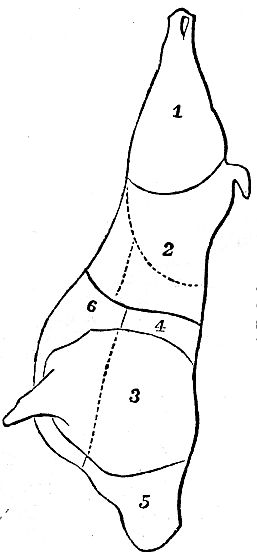
SIDE OF MUTTON, SHOWING THE SEVERAL JOINTS.
MUTTON, Baked Minced.
[Cold Meat Cookery.] Ingredients.—The remains of any joint of cold roast mutton, 1 or 2 onions, 1 bunch of savoury herbs, pepper and salt to taste, 2 blades of pounded mace or nutmeg, 1 teacupful of gravy, mashed potatoes. Mode.—Mince an onion rather fine, and fry it a light-brown colour; add the herbs and mutton, both of which should be also finely minced and well mixed; season with pepper and salt, and a little pounded mace or nutmeg, and moisten with the above proportion of gravy. Put a layer of mashed potatoes at the bottom of a dish, then the mutton, and then another layer of potatoes, and bake for about ½ hour. Time.—½ hour. Average cost, exclusive of the meat, 4d. Seasonable at any time.
Note.—If there should be a large quantity of meat, use 2 onions instead of 1.
MUTTON, Boiled Breast of, and Caper Sauce.
Ingredients.—Breast of mutton, bread-crumbs, 2 tablespoonfuls of minced savoury herbs (put a large proportion of parsley), pepper and salt to taste. Mode.—Cut off the superfluous fat; bone the meat; sprinkle over a layer of bread-crumbs, minced herbs, and seasoning; roll, and bind it up firmly. Boil gently for 2 hours, remove the tape, and serve with caper sauce, a little of which should be poured over the meat. Time.—2 hours. Average cost, 6d. per lb. Sufficient for 4 or 5 persons. Seasonable all the year.