THE DICTIONARY OF COOKERY. (continued 16)
Reading edition
TOMATO SAUCE for Keeping (Excellent).
Ingredients.—3 dozen tomatoes; to every pound of tomato-pulp allow 1 pint of Chili vinegar, 1 oz. of garlic, 1 oz. of shalot, 2 oz. of salt, 1 large green capsicum, ½ teaspoonful of cayenne, 2 pickled gherkins, 6 pickled onions, 1 pint of common vinegar, and the juice of 6 lemons. Mode.—Choose the tomatoes when quite ripe and red; put them in a jar with a cover to it, and bake them till tender. The better way is to put them in the oven overnight, when it will not be too hot, and examine them in the morning to see if they are tender. Do not allow them to remain in the oven long enough to break them; but they should be sufficiently soft to skin nicely and rub through the sieve. Measure the pulp, and to each pound of pulp add the above proportion of vinegar and other ingredients, taking care to chop very fine the garlic, shalot, capsicum, onion, and gherkins. Boil the whole together till everything is tender; then again rub it through a sieve, and add the lemon-juice. Now boil the whole again till it becomes as thick as cream, and keep continually stirring; bottle it when quite cold, cork well, and seal the corks. If the flavour of garlic and shalot is very much disliked, diminish the quantities. Time.—Bake the tomatoes in a cool oven all night. Seasonable from the middle of September to the end of October.
Note.—A quantity of liquor will flow from the tomatoes, which must be put through the sieve with the rest. Keep it well stirred whilst on the fire, and use a wooden spoon.
TOMATO SAUCE, Hot, to serve with Cutlets, Roast Meats, &c.
Ingredients.—6 tomatoes, 2 shalots, 1 clove, 1 blade of mace, salt and cayenne to taste, ¼ pint of gravy or stock. Mode.—Cut the tomatoes in two, and squeeze the juice and seeds out; put them in a stewpan with all the ingredients, and let them simmer gently until the tomatoes are tender enough to pulp; rub the whole through a sieve, boil it for a few minutes, and serve. The shalots and spices may be omitted when their flavour is objected to. Time.—1 hour, or rather more, to simmer the tomatoes. Average cost, for this quantity, 1s. In full season in September and October.
TOMATOES, Baked (Excellent).
Ingredients.—8 or 10 tomatoes, pepper and salt to taste, 2 oz. of butter, bread-crumbs. Mode.—Take off the stalks from the tomatoes; cut them into thick slices, and put them into a deep baking-dish; add a plentiful seasoning of pepper and salt, and butter in the above proportion; cover the whole with bread-crumbs; drop over these a little clarified butter; bake in a moderate oven from 20 minutes to ½ hour, and serve very hot. This vegetable dressed as above, is an exceedingly nice accompaniment to all kinds of roast meat. The tomatoes, instead of being cut in slices, may be baked whole; but they will take rather longer time to cook. Time.—20 minutes to ½ hour. Average cost, in full season, 9d. per basket. Sufficient for 5 or 6 persons. Seasonable in August, September, and October; but may be had, forced, much earlier.
TOMATOES, Baked (another Mode).
Ingredients.—Some bread-crumbs, a little butter, onion, cayenne, and salt. Mode.—Bake the tomatoes whole, then scoop out a small hole at the top; fry the bread-crumbs, onion, &c., and fill the holes with this as high up as possible; then brown the tomatoes with a salamander, or in an oven, and take care that the skin does not break.
TOMATOES, Stewed.
Ingredients.—8 tomatoes, pepper and salt to taste, 2 oz. of butter, 2 tablespoonfuls of vinegar. Mode.—Slice the tomatoes into a lined saucepan; season them with pepper and salt, and place small pieces of butter on them. Cover the lid down closely, and stew from 20 to 25 minutes, or until the tomatoes are perfectly tender; add the vinegar, stir two or three times, and serve with any kind of roast meat, with which they will be found a delicious accompaniment. Time.—20 to 25 minutes. Average cost, in full season, 9d. per basket. Sufficient for 4 or 5 persons. Seasonable from August to October; but may be had, forced, much earlier.

STEWED TOMATOES.
TOMATOES, Stewed.
Ingredients.—8 tomatoes, about ½ pint of good gravy, thickening of butter and flour, cayenne and salt to taste. Mode.—Take out the stalks of the tomatoes; put them into a wide stewpan, pour over them the above proportion of good brown gravy, and stew gently until they are tender, occasionally carefully turning them, that they may be equally done. Thicken the gravy with a little butter and flour worked together on a plate; let it just boil up after the thickening is added, and serve. If it be at hand, these should be served on a silver or plated vegetable-dish. Time.—20 to 25 minutes, very gentle stewing. Average cost, in full season, 9d. per basket. Sufficient for 4 or 5 persons. Seasonable in August, September, and October; but may be had, forced, much earlier.
TONGUE, Boiled.
Ingredients.—1 tongue, a bunch of savoury herbs, water. Mode.—In choosing a tongue, ascertain how long it has been dried or pickled, and select one with a smooth skin, which denotes its being young and tender. If a dried one, and rather hard, soak it at least for 12 hours previous to cooking it; if, however, it is fresh from the pickle, 2 or 3 hours will be sufficient for it to remain in soak. Put the tongue into a stewpan with plenty of cold water and a bunch of savoury herbs; let it gradually come to a boil, skim well, and simmer very gently until tender. Peel off the skin, garnish with tufts of cauliflowers or Brussels sprouts, and serve. Boiled tongue is frequently sent to table with boiled poultry, instead of ham, and is, by many persons, preferred. If to serve cold, peel it, fasten it down to a piece of board by sticking a fork through the root, and another through the top, to straighten it. When cold, glaze it, and put a paper ruche round the root, and garnish with tufts of parsley. Time.—A large smoked tongue, 4 to 4½ hours; a small one, 2½ to 3 hours. A large unsmoked tongue, 3 to 3½ hours; a small one, 2 to 2½ hours. Average cost, for a moderate-sized tongue, 3s. 6d. Seasonable at any time.
TONGUES, to Cure.
Ingredients.—For a tongue of 7 lbs., 1 oz. of saltpetre, ½ oz. of black pepper, 4 oz. of sugar, 3 oz. of juniper berries, 6 oz. of salt. Mode.—Rub the above ingredients well into the tongue, and let it remain in the pickle for 10 days or a fortnight; then drain it, tie it up in brown paper, and have it smoked for about 20 days over a wood fire; or it may be boiled out of this pickle. Time.—From 10 to 14 days to remain in the pickle; to be smoked 24 days. Average cost, for a medium-sized uncured tongue, 2s. 6d. Seasonable at any time.
Note.—If not wanted immediately, the tongue will keep 3 or 4 weeks without being too salt; then it must not be rubbed, but only turned in the pickle.
TONGUES, to Cure.
Ingredients.—9 lbs. of salt, 8 oz. of sugar, 9 oz. of powdered saltpetre. Mode.—Rub the above ingredients well into the tongues, and keep them in this curing mixture for 2 months, turning them every day. Drain them from the pickle, cover with brown paper, and have them smoked for about 3 weeks. Time.—The tongues to remain in pickle 2 months; to be smoked 3 weeks. Sufficient.—The above quantity of brine sufficient for 12 tongues, of 5 lbs. each. Seasonable at any time.
TONGUE, to Pickle and Dress a, to Eat Cold.
Ingredients.—6 oz. of salt, 2 oz. of bay-salt, 1 oz. of saltpetre, 3 oz. of coarse sugar; cloves, mace, and allspice to taste; butter, common crust of flour and water. Mode.—Lay the tongue for a fortnight in the above pickle, turn it every day, and be particular that the spices are well pounded; put it into a small pan just large enough to hold it, place some pieces of butter on it, and cover with a common crust. Bake in a slow oven until so tender that a straw would penetrate it; take off the skin, fasten it down to a piece of board by running a fork through the root, and another through the tip, at the same time straightening it and putting it into shape. When cold, glaze it, put a paper ruche round the root, which is generally very unsightly, and garnish with tufts of parsley. Time.—From 3 to 4 hours in a slow oven, according to size. Average cost, for a medium-sized uncured tongue, 2s. 6d. Seasonable at any time.
TREACLE PUDDING, Rolled.
Ingredients.—1 lb. of suet crust, ¼ lb. of treacle, ½ teaspoonful of grated ginger. Mode.—Make, with 1 lb. of flour, a suet crust by our given recipe, roll it out to the thickness of ½ inch, and spread the treacle equally over it, leaving a small margin where the paste joins; close the ends securely, tie the pudding in a floured cloth, plunge it into boiling water, and boil for 2 hours. We have inserted this pudding, being economical, and a favourite one with children; it is, of course, only suitable for a nursery, or very plain family dinner. Made with a lard instead of a suet crust, it would be very nice baked, and would be sufficiently done in from 1½ to 2 hours. Time.—Boiled pudding, 2 hours; baked pudding, 1½ to 2 hours. Average cost, 7d. Sufficient for 5 or 6 persons. Seasonable at any time.
TRIFLE, to make a.
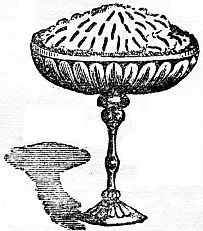
TRIFLE.
Ingredients.—For the whip, 1 pint of cream, 3 oz. of pounded sugar, the white of 2 eggs, a small glass of sherry or raisin wine. For the trifle, 1 pint of custard, made with 8 eggs to a pint of milk; 6 small sponge-cakes, or 6 slices of sponge-cake; 12 macaroons, 2 dozen ratafias, 2 oz. of sweet almonds, the grated rind of 1 lemon, a layer of raspberry or strawberry jam, ½ pint of sherry or sweet wine, 6 tablespoonfuls of brandy.
Mode.—The whip to lay over the top of the trifle should be made the day before it is required for table, as the flavour is better, and it is much more solid than when prepared the same day. Put into a large bowl the pounded sugar, the whites of the eggs, which should be beaten to a stiff froth, a glass of sherry or sweet wine, and the cream. Whisk these ingredients well in a cool place, and take off the froth with a skimmer as fast as it rises, and put it on a sieve to drain; continue the whisking till there is sufficient of the whip, which must be put away in a cool place to drain. The next day, place the sponge-cakes, macaroons, and ratafias at the bottom of a trifle-dish; pour over them ½ pint of sherry or sweet wine, mixed with 6 tablespoonfuls of brandy, and, should this proportion of wine not be found quite sufficient, add a little more, as the cakes should be well soaked. Over the cakes pat the grated lemon-rind, the sweet almonds, blanched and cut into strips, and a layer of raspberry or strawberry jam. Make a good custard, by recipe, using 8 instead of 5 eggs to the pint of milk, and let this cool a little; then pour it over the cakes, &c. The whip being made the day previously, and the trifle prepared, there remains nothing to do now but heap the whip lightly over the top: this should stand as high as possible, and it may be garnished with strips of bright currant jelly (see illustration), crystallized sweetmeats, or flowers; the small coloured comfits are sometimes used for the purpose of garnishing a trifle, but they are now considered rather old-fashioned. Average cost, with cream at 1s. per pint, 5s. 6d. Sufficient for 1 trifle. Seasonable at any time.
TRIFLE, Indian.
Ingredients.—1 quart of milk, the rind of ½ large lemon, sugar to taste, 5 heaped tablespoonfuls of rice-flour, 1 oz. of sweet almonds, ½ pint of custard.
Mode.—Boil the milk and lemon-rind together until the former is well flavoured; take out the lemon-rind and stir in the rice-flour, which should first be moistened with cold milk, and add sufficient loaf sugar to sweeten it nicely. Boil gently for about 5 minutes, and keep the mixture stirred; take it off the fire, let it cool a little, and pour it into a glass dish. When cold, cut the rice out in the form of a star, or any other shape that may be preferred; take out the spare rice, and fill the space with boiled custard. Blanch and cut the almonds into strips; stick them over the trifle, and garnish it with pieces of bright-coloured jelly, or preserved fruits, or candied citron. Time.—¼ hour to simmer the milk, 5 minutes after the rice is added. Average cost, 1s. Sufficient for 1 trifle. Seasonable at any time.
TRIPE, to Dress.
Ingredients.—Tripe, onion sauce, milk and water. Mode.—Ascertain that the tripe is quite fresh, and have it cleaned and dressed. Cut away the coarsest fat, and boil it in equal proportions of milk and water for ¾ hour. Should the tripe be entirely undressed, more than double that time should be allowed for it. Have ready some onion sauce, made by our given recipe, dish the tripe, smother it with the sauce, and the remainder send to table in a tureen. Time.—¾ hour; for undressed tripe, from 2½ to three hours. Average cost, 7d. per lb. Seasonable at any time.
Note.—Tripe may be dressed in a variety of ways: it may be cut in pieces and fried in batter, stewed in gravy with mushrooms, or cut into collops, sprinkled with minced onion and savoury herbs, and fried a nice brown in clarified butter.
TROUT, Stewed.
Ingredients.—2 middling-sized trout, ½ onion cut in thin slices, a little parsley, 2 cloves, 1 blade of mace, 2 bay-leaves, a little thyme, salt and pepper to taste, 1 pint of medium stock, 1 glass of port wine, thickening of butter and flour. Mode.—Wash the fish very clean, and wipe it quite dry. Lay it in a stewpan, with all the ingredients but the butter and flour, and simmer gently for ½ hour, or rather more, should not the fish be quite done. Take it out, strain the gravy, add the thickening, and stir it over a sharp fire for 5 minutes; pour it over the trout, and serve. Time.—According to size, ½ hour or more. Average cost.—Seldom bought. Seasonable from May to September, and fatter from the middle to the end of August than at any other time. Sufficient for 4 persons. Trout may be served with anchovy or caper sauce, baked in buttered paper, or fried whole like smelts. Trout dressed à la Genévése is extremely delicate; for this proceed the same as with salmon.
TRUFFLES, to Dress, with Champagne.
Ingredients.—12 fine black truffles, a few slices of fat bacon, 1 carrot, 1 turnip, 2 onions, a bunch of savoury herbs, including parsley, 1 bay-leaf, 2 cloves, 1 blade of pounded mace, 2 glasses of champagne, ½ pint of stock. Mode.—Carefully select the truffles, reject those that have a musty smell, and wash them well with a brush, in cold water only, until perfectly clean. Put the bacon into a stewpan, with the truffles and the remaining ingredients; simmer these gently for an hour, and let the whole cool in the stewpan. When to be served, re-warm them, and drain them on a clean cloth; then arrange them on a delicately white napkin, that it may contrast as strongly as possible with the truffles, and serve. The trimmings of truffles are used to flavour gravies, stock, sauces, &c.; and are an excellent addition to ragoûts, made dishes of fowl, &c. Time.—1 hour. Average cost.—Not often bought in this country. Seasonable from November to March.
TRUFFLES A L’ITALIENNE.
Ingredients.—10 truffles, 1 tablespoonful of minced parsley, 1 minced shalot, salt and pepper to taste, 2 oz. of butter, 2 tablespoonfuls of good brown gravy, the juice of ½ lemon, cayenne to taste. Mode.—Wash the truffles and cut them into slices about the size of a penny-piece; put them into a frying-pan, with the parsley, shalot, salt, pepper, and 1 oz. of butter; stir them over the fire, that they may all be equally done, which will be in about 10 minutes, and drain off some of the butter; then add a little more fresh butter, 2 tablespoonfuls of good gravy, the juice of ½ lemon, and a little cayenne; stir over the fire until the whole is on the point of boiling, when serve. Time.—Altogether, 20 minutes. Average cost.—Not often bought in this country. Seasonable from November to March.
TRUFFLES, Italian Mode of Dressing.
Ingredients.—10 truffles, ¼ pint of salad-oil, pepper and salt to taste, 1 tablespoonful of minced parsley, a very little finely minced garlic, 2 blades of pounded mace, 1 tablespoonful of lemon-juice. Mode.—After cleansing and brushing the truffles, cut them into thin slices, and put them in a baking-dish, on a seasoning of oil, pepper, salt, parsley, garlic, and mace in the above proportion. Bake them for nearly an hour, and, just before serving, add the lemon-juice, and send them to table very hot. Time.—Nearly 1 hour. Average cost.—Not often bought in this country. Seasonable from November to March.
TRUFFLES AU NATUREL.
Ingredients.—Truffles, buttered paper. Mode.—Select some fine truffles; cleanse them, by washing them in several waters with a brush, until not a particle of sand or grit remains on them; wrap each truffle in buttered paper, and bake in a hot oven for quite an hour; take off the paper, wipe the truffles, and serve them in a hot napkin. Time.—1 hour. Average cost.—Not often bought in this country. Seasonable from November to March.
TURBOT.
In choosing turbot see that it is thick, and of a yellowish white; for if of a bluish tint, it is not good. The turbot-kettle, as will be seen by our cut, is made differently from ordinary fish kettles, it being less deep, whilst it is wider, and more pointed at the sides; thus exactly answering to the shape of the fish which it is intended should be boiled in it.
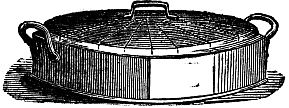
TURBOT-KETTLE.
TURBOT, Boiled.
Ingredients.—6 oz. of salt to each gallon of water. Mode.—Choose a middling-sized turbot; for they are invariably the most valuable: if very large, the meat will be tough and thready. Three or four hours before dressing, soak the fish in salt and water to take off the slime; then thoroughly cleanse it, and with a knife make an incision down the middle of the back, to prevent the skin of the belly from cracking. Rub it over with lemon, and be particular not to cut off the fins. Lay the fish in a very clean turbot-kettle, with sufficient cold water to cover it, and salt in the above proportion. Let it gradually come to a boil, and skim very carefully; keep it gently simmering, and on no account let it boil fast, as the fish would have a very unsightly appearance. When the meat separates easily from the bone, it is done; then take it out, let it drain well, and dish it on a hot napkin. Rub a little lobster spawn through a sieve, sprinkle it over the fish, and garnish with tufts of parsley and cut lemon. Lobster or shrimp sauce, and plain melted butter, should be sent to table with it. Time.—After the water boils, about ½ hour for a large turbot; middling size, about 20 minutes. Average cost,—large turbot, from 10s. to 12s.; middling size, from 12s. to 15s. Seasonable at any time. Sufficient, 1 middling-sized turbot for 8 persons.
TURBOT, to Help.
First run the fish-slice down the thickest part of the fish lengthwise, quite through to the bone, and then cut handsome and regular slices across the fish until all the meat on the upper side is helped. When the carver has removed all the meat from the upper side of the fish, the backbone should be raised, put on one side of the dish, and the under side helped as the upper.
TURBOT À LA CREME.
Ingredients.—The remains of cold turbot. For sauce, 2 oz. of butter, 4 tablespoonfuls of cream; salt, cayenne, and pounded mace to taste. Mode.—Clear away all skin and bone from the flesh of the turbot, which should be done when it comes from table, as it causes less waste when trimmed hot. Cut the flesh into nice square pieces, as equally as possible; put into a stewpan the butter, let it melt, and add the cream and seasoning; let it just simmer for one minute, but not boil. Lay in the fish to warm, and serve it garnished with croûtons or a paste border. Time.—10 minutes. Seasonable at any time.
Note.—The remains of cold salmon may be dressed in this way, and the above mixture may be served in a vol-au-vent.
TURBOT, Baked Fillets of.
Ingredients.—The remains of cold turbot, lobster sauce left from the preceding day, egg, and bread-crumbs; cayenne and salt to taste; minced parsley, nutmeg, lemon-juice. Mode.—After having cleared the fish from all skin and bone, divide it into square pieces of an equal size; brush them over with egg, sprinkle with bread-crumbs mixed with a little minced parsley and seasoning. Lay the fillets in a baking-dish, with sufficient butter to baste with. Bake for ¼ hour, and do not forget to keep them well moistened with the butter. Put a little lemon-juice and grated nutmeg to the cold lobster sauce; make it hot, and pour over the fish, which must be well drained from the butter. Garnish with parsley and cut lemon. Time.—Altogether, ½ hour. Seasonable at any time.
Note.—Cold turbot thus warmed in the remains of lobster sauce will be found much nicer than putting the fish again in water.
TURBOT A L’ITALIENNE, Fillets of.
Ingredients.—The remains of cold turbot, Italian sauce. Mode.—Clear the fish carefully from the bone, and take away all skin, which gives an unpleasant flavour to the sauce. Make the sauce hot, lay in the fish to warm through, but do not let it boil. Garnish with croûtons. Time.—5 minutes. Seasonable all the year.
TURBOT, or other Large Fish, Garnish for.
Take the crumb of a stale loaf, cut it into small pyramids with flat tops, and on the top of each pyramid put rather more than a tablespoonful of white of egg beaten to a stiff froth. Over this, sprinkle finely-chopped parsley and fine raspings of a dark colour. Arrange these on the napkin round the fish, one green and one brown alternately.
TURBOT AU GRATIN.
Ingredients.—Remains of cold turbot, béchamel (see Sauces), bread-crumbs, butter. Mode.—Cut the flesh of the turbot into small dice, carefully freeing it from all skin and bone. Put them into a stewpan, and moisten with 4 or 5 tablespoonfuls of béchamel. Let it get thoroughly hot, but do not allow it to boil. Spread the mixture on a dish, cover with finely-grated bread-crumbs, and place small pieces of butter over the top. Brown it in the oven, or with a salamander. Time.—Altogether, ½ hour. Seasonable at any time.
TURKEY, Boiled.

BOILED TURKEY.
Ingredients.—Turkey; forcemeat. Choosing and Trussing.—Hen turkeys are preferable for boiling, on account of their whiteness and tenderness, and one of moderate size should be selected, as a large one is not suitable for this mode of cooking. They should not be dressed until they have been killed 3 or 4 days, as they will neither look white, nor will they be tender. Pluck the bird, carefully draw, and singe it with a piece of white paper; wash it inside and out, and wipe it thoroughly dry with a cloth. Cut off the head and neck, draw the strings or sinews of the thighs, and cut off the legs at the first joint; draw the legs into the body, fill the breast with forcemeat; run a skewer through the wing and the middle joint, of the leg, quite into the leg and wing on the opposite side; break the breastbone, and make the bird look as round and as compact as possible. Mode.—Put the turkey into sufficient hot water to cover it; let it come to a boil, then carefully remove all the scum: if this is attended to, there is no occasion to boil the bird in a floured cloth; but it should be well covered with the water. Let it simmer very gently for about 1½ hour to 1¾ hour, according to the size, and serve with either white, celery, oyster,or mushroom sauce, or parsley-and-butter, a little of which should be poured over the turkey. Boiled ham, bacon, tongue, or pickled pork, should always accompany this dish; and when oyster sauce is served, the turkey should be stuffed with oyster forcemeat. Time.—A small turkey, 1½ hour; a large one, 1¾ hour. Average cost, 5s. 6d. to 7s. 6d. each, but more expensive at Christmas, on account of the great demand. Sufficient for 7 or 8 persons. Seasonable from December to February.
TURKEY, Croquettes of (Cold Meat Cookery).
Ingredients.—The remains of cold turkey; to every ½ lb. of meat allow 2 oz. of ham or bacon, 2 shalots, 1 oz. of butter, 1 tablespoonful of flour, the yolks of 2 eggs, egg and bread-crumbs. Mode.—The smaller pieces, that will not do for a fricassée or hash, answer very well for this dish. Mince the meat finely with ham or bacon in the above proportion; make a gravy of the bones and trimmings, well seasoning it; mince the shalots, put them into a stewpan with the butter, add the flour; mix well, then put in the mince, and about ½ pint of the gravy made from the bones. (The proportion of the butter must be increased or diminished according to the quantity of mince.) When just boiled, add the yolks of 2 eggs; put the mixture out to cool, and then shape it in a wineglass. Cover the croquettes with egg and bread-crumbs, and fry them a delicate brown. Put small pieces of parsley-stems for stalks, and serve with rolled bacon cut very thin. Time.—8 minutes to fry the croquettes. Seasonable from December to February.
TURKEY, Fricasseed (Cold Meat Cookery).
Ingredients.—The remains of cold roast or boiled turkey; a strip of lemon-peel, a bunch of savoury herbs, 1 onion, pepper and salt to taste, 1 pint of water, 4 tablespoonfuls of cream, the yolk of an egg. Mode.—Cut some nice slices from the remains of a cold turkey, and put the bones and trimmings into a stewpan, with the lemon-peel, herbs, onion, pepper, salt, and the water; stew for an hour, strain the gravy, and lay in the pieces of turkey. When warm through, add the cream and the yolk of an egg; stir it well round, and, when getting thick, take out the pieces, lay them on a hot dish, and pour the sauce over. Garnish the fricassée with sippets of toasted bread. Celery or cucumbers, cut into small pieces, may be put into the sauce; if the former, it must be boiled first. Time.—1 hour to make the gravy. Average cost, exclusive of the cold turkey, 4d. Seasonable from December to February.
TURKEY, Hashed.
Ingredients.—The remains of cold roast turkey, 1 onion, pepper and salt to taste, rather more than 1 pint of water, 1 carrot, 1 turnip, 1 blade of mace, a bunch of savoury herbs, 1 tablespoonful of mushroom ketchup, 1 tablespoonful of port wine, thickening of butter and flour. Mode.—Cut the turkey into neat joints; the best pieces reserve for the hash, the inferior joints and trimmings put into a stewpan with an onion cut in slices, pepper and salt, a carrot, turnip, mace, herbs, and water in the above proportion; simmer these for an hour, then strain the gravy, thicken it with butter and flour, flavour with ketchup and port wine, and lay in the pieces of turkey to warm through; if there is any stuffing left, put that in also, as it so much improves the flavour of the gravy. When it boils, serve, and garnish the dish with sippets of toasted bread. Time.—1 hour to make the gravy. Seasonable from December to February.
TURKEY, Roast.
Ingredients.—Turkey; forcemeat. Choosing and Trussing.—Choose cock turkeys by their short spurs and black legs, in which case they are young; if the spurs are long, and the legs pale and rough, they are old. If the bird has been long killed, the eyes will appear sunk and the feet very dry; but, if fresh, the contrary will be the case. Middling-sized fleshy turkeys are by many persons considered superior to those of an immense growth, as they are, generally speaking, much more tender. They should never be dressed the same day they are killed; but, in cold weather, should hang at least 8 days; if the weather is mild, 4 or 5 days will be found sufficient. Carefully pluck the bird, singe it with white paper, and wipe it thoroughly with a cloth; draw it, preserve the liver and gizzard, and be particular not to break the gall-bag, as no washing will remove the bitter taste it imparts where it once touches. Wash it inside well, and wipe it thoroughly dry with a cloth; the outside merely requires nicely wiping, as we have just stated. Cut off the neck close to the back, but leave enough of the crop-skin to turn over; break the leg-bone close below the knee, draw out the strings from the thighs, and flatten the breastbone to make it look plump. Have ready a forcemeat; fill the breast with this, and, if a trussing-needle is used, sew the neck over to the back; if a needle is not at hand, a skewer will answer the purpose. Run a skewer through the pinion and thigh into the body to the pinion and thigh on the other side, and press the legs as much as possible between the breast and the side-bones, and put the liver under one pinion and the gizzard under the other. Pass a string across the back of the bird, catch it over the points of the skewer, tie it in the centre of the back, and be particular that the turkey is very firmly trussed. This may be more easily accomplished with a needle and twine than with skewers. Mode.—Fasten a sheet of buttered paper on to the breast of the bird, put it down to a bright fire, at some little distance at first (afterwards draw it nearer), and keep it well basted the whole of the time it is cooking. About ¼ hour before serving, remove the paper, dredge the turkey lightly with flour, and put a piece of butter into the basting-ladle; as the butter melts, baste the bird with it. When of a nice brown and well frothed, serve with a tureen of good brown gravy and one of bread sauce. Fried sausages are a favourite addition to roast turkey; they make a pretty garnish, besides adding very much to the flavour. When these are not at hand, a few forcemeat balls should be placed round the dish as a garnish. Turkey may also be stuffed with sausage-meat, and a chestnut forcemeat with the chestnut sauce is, by many persons, very much esteemed as an accompaniment to this favourite dish. Time.—Small turkey, 1½ hour; moderate-sized one, about 10 lbs., 2 hours; large turkey, 2½ hours, or longer. Average cost, from 10s. to 12s., but expensive at Christmas, on account of the great demand. Sufficient.—A moderate-sized turkey for 7 or 8 persons. Seasonable from December to February.
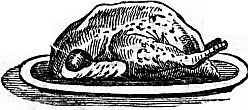
ROAST TURKEY.
TURKEY, Roast.
A noble dish is a turkey, roast or boiled. A Christmas dinner, with the middle-classes of this empire, would scarcely be a Christmas dinner without its turkey; and we can hardly imagine an object of greater envy than is presented by a respected portly pater-familias carving, at the season devoted to good cheer and genial charity, his own fat turkey, and carving it well. The only art consists, as in the carving of a goose, in getting from the breast as many fine slices as possible; and all must have remarked the very great difference in the large number of people whom a good carver will find slices for, and the comparatively few that a bad carver will succeed in serving. As we have stated in both the carving of a duck and goose, the carver should commence cutting slices to the wing, from 2 to 3, and then proceed upwards towards the ridge of the breastbone: this is not the usual plan, but, in practice, will be found the best. The breast is the only part which is looked on as fine in a turkey, the legs being very seldom cut off and eaten at table: they are usually removed to the kitchen, where they are taken off, as here marked, to appear only in a form which seems to have a special attraction at a bachelor’s supper-table,—we mean devilled: served in this way, they are especially liked and relished. A boiled turkey is carved in the same manner as when roasted.
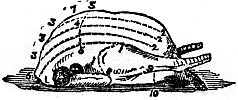
ROAST TURKEY.
TURKEY POULTS, Roast.
Ingredients.—Turkey poult; butter. Choosing and Trussing.—Choose a plump bird, and truss it in the following manner:—After it has been carefully plucked, drawn, and singed, skin the neck, and fasten the head under the wing; turn the legs at the first joint, and bring the feet close to the thighs, as a woodcock should be trussed, and do not stuff it. Mode.—Put it down to a bright fire, keep it well basted, and at first place a piece of paper on the breast to prevent its taking too much colour. About 10 minutes before serving, dredge it lightly with flour, and baste well; when nicely frothed, send it to table immediately, with a little gravy in the dish, and some in a tureen. If at hand, a few water-cresses may be placed round the turkey as a garnish, or it may be larded. Time.—About 1 hour. Average cost, 7s. to 8s. each. Sufficient for 6 or 7 persons. Seasonable.—In full season from June to October.
TURKEY SOUP (a Seasonable Dish at Christmas).
Ingredients.—2 quarts of medium stock, the remains of a cold roast turkey, 2 oz. of rice-flour or arrowroot, salt and pepper to taste, 1 tablespoonful of Harvey’s sauce or mushroom ketchup. Mode.—Cut up the turkey in small pieces, and put it in the stock; let it simmer slowly until the bones are quite clean. Take the bones out, and work the soup through a sieve; when cool, skim well. Mix the rice-flour or arrowroot to a batter with a little of the soup; add it with the seasoning and sauce, or ketchup. Give one boil, and serve. Time.—4 hours. Average cost, 10d. per quart. Seasonable at Christmas. Sufficient for 8 persons.
Note.—Instead of thickening this soup, vermicelli or macaroni may be served in it.
TURNIP SOUP
Ingredients.—3 oz. of butter, 9 good-sized turnips, 4 onions, 2 quarts of stock, seasoning to taste. Mode.—Melt the butter in the stewpan, but do not let it boil; wash, drain, and slice the turnips and onions very thin; put them in the butter, with a teacupful of stock, and stew very gently for an hour. Then add the remainder of the stock, and simmer another hour. Rub it through a tammy, put it back into the stewpan, but do not let it boil. Serve very hot. Time.—2½ hours. Average cost, 8d. per quart. Seasonable from October to March. Sufficient for 8 persons.
Note.—By adding a little cream, this soup will be much improved.
TURNIPS, Boiled.
Ingredients.—Turnips; to each ½ gallon of water allow 1 heaped tablespoonful of salt. Mode.—Pare the turnips, and, should they be very large, divide them into quarters; but, unless this is the case, let them be cooked whole. Put them into a saucepan of boiling water, salted in the above proportion, and let them boil gently until tender. Try them with a fork, and, when done, take them up in a colander; let them thoroughly drain, and serve. Boiled turnips are usually sent to table with boiled mutton, but are infinitely nicer when mashed than served whole: unless nice and young, they are scarcely worth the trouble of dressing plainly as above. Time.—Old turnips, ¾ to 1¼ hour; young ones, about 18 to 20 minutes. Average cost, 4d. per bunch. Sufficient.—Allow a bunch of 12 turnips for 5 or 6 persons. Seasonable.—May be had all the year; but in spring only useful for flavouring gravies, &c.
TURNIPS, German Mode of Cooking.
Ingredients.—8 large turnips, 3 oz. of butter, pepper and salt to taste, rather more than ½ pint of weak stock or broth, 1 tablespoonful of flour. Mode.—Make the butter hot in a stewpan, lay in the turnips, after having pared and cut them into dice, and season them with pepper and salt. Toss them over the fire for a few minutes, then add the broth, and simmer the whole gently till the turnips are tender. Brown the above proportion of flour with a little butter; add this to the turnips, let them simmer another 5 minutes, and serve. Boiled mutton is usually sent to table with this vegetable, and may be cooked with the turnips by placing it in the midst of them: the meat would then be very delicious, as, there being so little liquid with the turnips, it would almost be steamed, and, consequently, very tender. Time.—20 minutes. Average cost, 4d. per bunch. Sufficient for 4 persons. Seasonable.—May be had all the year.
TURNIPS, Mashed.
Ingredients.—10 or 12 large turnips; to each ½ gallon of water allow 1 heaped tablespoonful of salt, 2 oz. of butter, cayenne or white paper to taste. Mode.—Pare the turnips, quarter them, and put them into boiling water, salted in the above proportion; boil them until tender; then drain them in a colander, and squeeze them as dry as possible by pressing them with the back of a large plate. When quite free from water, rub the turnips with a wooden spoon through the colander, and put them into a very clean saucepan; add the butter, white pepper, or cayenne, and, if necessary, a little salt. Keep stirring them over the fire until the butter is well mixed with them, and the turnips are thoroughly hot; dish, and serve. A little cream or milk added after the turnips are pressed through the colander, is an improvement to both the colour and flavour of this vegetable. Time.—From ½ to ¾ hour to boil the turnips; 10 minutes to warm them through. Average cost, 4d. per bunch. Sufficient for 4 or 5 persons. Seasonable.—May be had all the year; but in early spring only good for flavouring gravies.
TURNIPS IN WHITE SAUCE. (An Entremets, or to be served with the Second Course as a Side-dish.)
Ingredients.—7 or 8 turnips, 1 oz. of butter, ½ pint of white sauce. Mode.—Peel and cut the turnips in the shape of pears or marbles; boil them in salt and water, to which has been added a little butter, until tender; then take them out, drain, arrange them on a dish, and pour over the white sauce made by either of the recipes, and to which has been added a small lump of sugar. In winter, when other vegetables are scarce, this will be found a very good and pretty-looking dish: when approved, a little mustard may be added to the sauce. Time.—About ¾ hour to boil the turnips. Average cost, 4d. per bunch. Sufficient for 1 side dish. Seasonable in winter.
VANILLA CUSTARD SAUCE, to serve with Puddings.
Ingredients.—½ pint of milk, 2 eggs, 2 oz. of sugar, 10 drops of essence of vanilla. Mode.—Beat the eggs, sweeten the milk; stir these ingredients well together, and flavour them with essence of vanilla, regulating the proportion of this latter ingredient by the strength of the essence, the size of the eggs, &c. Put the mixture into a small jug, place this jug in a saucepan of boiling water, and stir the sauce one way until it thickens; but do not allow it to boil, or it will instantly curdle. Serve in a boat or tureen separately, with plum, bread, or any kind of dry pudding. Essence of bitter almonds or lemon-rind may be substituted for the vanilla, when they are more in accordance with the flavouring of the pudding with which the sauce is intended to be served. Time.—To be stirred in the jug from 8 to 10 minutes. Average cost, 4d. Sufficient for 4 or 5 persons.
VEAL, Baked (Cold Meat Cookery).
Ingredients.—½ lb. of cold roast veal, a few slices of bacon, 1 pint of bread-crumbs, ½ pint of good veal gravy, ½ teaspoonful of minced lemon-peel, 1 blade of pounded mace, cayenne and salt to taste, 4 eggs. Mode.—Mince finely the veal and bacon; add the bread-crumbs, gravy, and seasoning, and stir these ingredients well together. Beat up the eggs thoroughly; add these, mix the whole well together, put into a dish, and bake from ¾ to 1 hour. When liked, a little good gravy may be served in a tureen as an accompaniment. Time.—from ¾ to 1 hour. Average cost, exclusive of the cold meat, 6d. Sufficient for 3 or 4 persons. Seasonable from March to October.
VEAL, Roast Breast of.
Ingredients.—Veal; a little flour. Mode.—Wash the veal, well wipe it, and dredge it with flour; put it down to a bright fire, not too near, as it should not be scorched. Baste it plentifully until done; dish it, pour over the meat some good melted butter, and send to table with it a piece of boiled bacon and a cut lemon. Time.—From 1½ to 2 hours. Average cost, 8½d. per lb. Sufficient for 5 or 6 persons. Seasonable from March to October.
VEAL, Breast of, to Carve.
The carving of a breast of veal is not dissimilar to that of a fore-quarter of lamb, when the shoulder has been taken off. The breast of veal consists of two parts,—the rib-bones and the gristly brisket. These two parts should first be separated by sharply passing the knife in the direction of the lines 1, 2; when they are entirely divided, the rib-bones should be carved in the direction of the lines 5 to 6; and the brisket can be helped by cutting pieces in the direction 3 to 4. The carver should ask the guests whether they have a preference for the brisket or ribs; and if there be a sweetbread served with the dish, as it often is with roast breast of veal, each person should receive a piece.
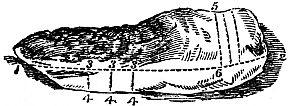
BREAST OF VEAL.
VEAL, Stewed Breast of, and Peas.
Ingredients.—Breast of veal, 2 oz. of butter, a bunch of savoury herbs, including parsley; 2 blades of pounded mace, 2 cloves, 5 or 6 young onions, 1 strip of lemon-peel, 6 allspice, ¼ teaspoonful of pepper, 1 teaspoonful of salt, thickening of butter and flour, 2 tablespoonfuls of sherry, 2 tablespoonfuls of tomato sauce, 1 tablespoonful of lemon-juice, 2 tablespoonfuls of mushroom ketchup, green peas. Mode.—Cut the breast in half, after removing the bone underneath, and divide the meat into convenient-sized pieces. Put the butter into a frying-pan, lay in the pieces of veal, and fry until of a nice brown colour. Now place these in a stewpan with the herbs, mace, cloves, onions, lemon-peel, allspice, and seasoning; pour over them just sufficient boiling water to cover the meat; well close the lid, and let the whole simmer very gently for about 2 hours. Strain off as much gravy as is required, thicken it with butter and flour, add the remaining ingredients, skim well, let it simmer for about 10 minutes, then pour it over the meat. Have ready some green peas, boiled separately; sprinkle these over the veal, and serve. It may be garnished with forcemeat balls, or rashers of bacon curled and fried. Instead of cutting up the meat, many persons prefer it dressed whole;—in that case it should be half-roasted before the water, &c. are put to it. Time.—2¼ hours. Average cost, 8½d. Sufficient for 5 or 6 persons. Seasonable from March to October.
VEAL, à la Bourgeoise (Excellent).
Ingredients.—2 to 3 lbs. of the loin or neck of veal, 10 or 12 young carrots, a bunch of green onions, 2 slices of lean bacon, 2 blades of pounded mace, 1 bunch of savoury herbs, pepper and salt to taste, a few new potatoes, 1 pint of green peas. Mode.—Cut the veal into cutlets, trim them, and put the trimmings into a stewpan with a little butter; lay in the cutlets and fry them a nice brown colour on both sides. Add the bacon, carrots, onions, spice, herbs, and seasoning; pour in about a pint of boiling water, and stew gently for 2 hours on a very slow fire. When done, skim off the fat, take out the herbs, and flavour the gravy with a little tomato sauce and ketchup. Have ready the peas and potatoes, boiled separately; put them with the veal, and serve. Time.—2 hours. Average cost, 2s. 9d. Sufficient for 5 or 6 persons. Seasonable from June to August with peas;—rather earlier when these are omitted.
VEAL CAKE (a Convenient Dish for a Picnic).
Ingredients.—A few slices of cold roast veal, a few slices of cold ham, 2 hard-boiled eggs, 2 tablespoonfuls of minced parsley, a little pepper, good gravy. Mode.—Cut off all the brown outside from the veal, and cut the eggs into slices. Procure a pretty mould; lay veal, ham, eggs, and parsley in layers, with a little pepper between each, and when the mould is full, get some strong stock, and fill up the shape. Bake for ½ hour, and when cold, turn it out. Time.—½ hour. Seasonable at any time.
VEAL, Curried (Cold Meat Cookery).
Ingredients.—The remains of cold roast veal, 4 onions, 2 apples sliced, 1 tablespoonful of curry-powder, 1 dessertspoonful of flour, ½ pint of broth or water, 1 tablespoonful of lemon-juice. Mode.—Slice the onions and apples, and fry them in a little butter; then take them out, cut the meat into neat cutlets, and fry these of a pale brown; add the curry-powder and flour, put in the onion, apples, and a little broth or water, and stew gently till quite tender; add the lemon-juice, and serve with an edging of boiled rice. The curry may be ornamented with pickles, capsicums, and gherkins, arranged prettily on the top. Time.—¾ hour. Average cost, exclusive of the meat, 4d. Seasonable from March to October.
VEAL CUTLETS (an Entrée).
Ingredients.—About 3 lbs. of the prime part of the leg of veal, egg and bread-crumbs, 3 tablespoonfuls of minced savoury herbs, salt and pepper to taste, a small piece of butter. Mode.—Have the veal cut into slices about ¾ of an inch in thickness, and, if not cut perfectly even, level the meat with a cutlet-bat or rolling-pin. Shape and trim the cutlets, and brush them over with egg. Sprinkle with bread-crumbs, with which have been mixed minced herbs and a seasoning of pepper and salt, and press the crumbs down. Fry them of a delicate brown in fresh lard or butter, and be careful not to burn them. They should be very thoroughly done, but not dry. If the cutlets be thick, keep the pan covered for a few minutes at a good distance from the fire, after they have acquired a good colour: by this means, the meat will be done through. Lay the cutlets in a dish, keep them hot, and make a gravy in the pan as follows:—Dredge in a little flour, add a piece of butter the size of a walnut, brown it, then pour as much boiling water as is required over it, season with pepper and salt, add a little lemon-juice, give one boil, and pour it over the cutlets. They should be garnished with slices of broiled bacon, and a few forcemeat balls will be found a very excellent addition to this dish. Time.—For cutlets of a moderate thickness, about 12 minutes; if very thick, allow more time. Average cost, 10d. per lb. Sufficient for 6 persons. Seasonable from March to October.
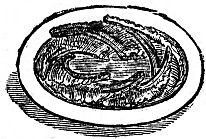
VEAL CUTLETS.
Note.—Veal cutlets may be merely floured and fried of a nice brown: the gravy and garnishing should be the same as in the preceding recipe. They may also be cut from the loin or neck, as shown in the engraving.
VEAL CUTLETS, Broiled, à la Italienne (an Entrée).
Ingredients.—Neck of veal, salt and pepper to taste, the yolk of 1 egg, bread-crumbs, ½ pint of Italian sauce. Mode.—Cut the veal into cutlets, flatten and trim them nicely; powder over them a little salt and pepper; brush them over with the yolk of an egg, dip them into bread-crumbs, then into clarified butter, and, afterwards, in the bread-crumbs again; boil or fry them over a clear fire, that they may acquire a good brown colour. Arrange them in the dish alternately with rashers of broiled ham, and pour the sauce (made by recipe for Italian sauce, p. 305) in the middle. Time.—10 to 15 minutes, according to the thickness of the cutlets. Average cost, 10d. per lb. Seasonable from March to October.
VEAL CUTLETS, à la Maintenon (an Entrée).
Ingredients.—2 or 3 lbs. of veal cutlets, egg and bread-crumbs, 2 tablespoonfuls of minced savoury herbs, salt and pepper to taste, a little grated nutmeg. Mode.—Cut the cutlets about ¾ inch in thickness, flatten them, and brush them over with the yolk of an egg; dip them into bread-crumbs and minced herbs, season with pepper and salt and grated nutmeg, and fold each cutlet in a piece of buttered paper. Broil them, and send them to table with melted butter or a good gravy. Time.—From 15 to 18 minutes. Average cost, 10d. per lb. Sufficient for 5 or 6 persons. Seasonable from March to October.
VEAL, Fillet of, au Béchamel (Cold Meat Cookery).
Ingredients.—A small fillet of veal, 1 pint of béchamel sauce, a few bread-crumbs, clarified butter. Mode.—A fillet of veal that has been roasted the preceding day will answer very well for this dish. Cut the middle out rather deep, leaving a good margin round, from which to cut nice slices, and if there should be any cracks in the veal, fill them up with forcemeat. Mince finely the meat that was taken out, mixing with it a little of the forcemeat to flavour, and stir to it sufficient béchamel to make it of a proper consistency. Warm the veal in the oven for about an hour, taking care to baste it well, that it may not be dry; put the mince in the place where the meat was taken out, sprinkle a few bread-crumbs over it, and drop a little clarified butter on the bread-crumbs; put it into the oven for ¼ hour to brown, and pour béchamel round the sides of the dish. Time.—Altogether 1½ hour. Seasonable from March to October.
VEAL, Roast Fillet of.
Ingredients.—Veal, forcemeat, melted butter. Mode.—Have the fillet cut according to the size required; take out the bone, and after raising the skin from the meat, put under the flap a nice forcemeat. Prepare sufficient of this, as there should be some left to eat cold, and to season and flavour a mince if required. Skewer and bind the veal up in a round form; dredge well with flour, put it down at some distance from the fire at first, and baste continually. About ½ hour before serving, draw it nearer the fire, that it may acquire more colour, as the outside should be of a rich brown, but not burnt. Dish it, remove the skewers, which replace by a silver one; pour over the joint some good melted butter, and serve with either boiled ham, bacon, or pickled pork. Never omit to send a cut lemon to table with roast veal. Time.—A fillet of veal weighing 12 lbs., about 4 hours. Average cost, 9d. per lb. Sufficient for 9 or 10 persons. Seasonable from March to October.

FILLET OF VEAL.
VEAL, Fillet of.
The carving of this joint is similar to that of a round of beef. Slices, not too thick, in the direction of the line 1 to 2 are cut; and the only point to be careful about is, that the veal be evenly carved. Between the flap and the meat the stuffing is inserted, and a small portion of this should be served to every guest. The persons whom the host wishes most to honour should be asked if they like the delicious brown outside slice, as this, by many, is exceedingly relished.
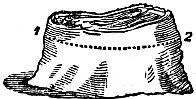
FILLET OF VEAL.
VEAL, Stewed Fillet of.
Ingredients.—A small fillet of veal, forcemeat, thickening of butter and flour, a few mushrooms, white pepper to taste, 2 tablespoonfuls of lemon-juice, 2 blades of pounded mace, ½ glass of sherry. Mode.—If the whole of the leg is purchased, take off the knuckle to stew, and also the square end, which will serve for cutlets or pies. Remove the bone, and fill the space with a forcemeat. Roll and skewer it up firmly; place a few skewers at the bottom of a stewpan to prevent the meat from sticking, and cover the veal with a little weak stock. Let it simmer very gently until tender, as the more slowly veal is stewed, the better. Strain and thicken the sauce, flavour it with lemon-juice, mace, sherry, and white pepper; give one boil, and pour it over the meat. The skewers should be removed, and replaced by a silver one, and the dish garnished with slices of cut lemon. Time.—A fillet of veal weighing 6 lbs., 3 hours’ very gentle stewing. Average cost, 9d. per lb. Sufficient for 5 or 6 persons. Seasonable from March to October.
VEAL, Fricandeau of (an Entrée).
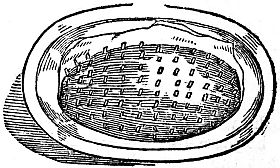
FRICANDEAU OF VEAL.
Ingredients.—A piece of the fat side of a leg of veal (about 3 lbs.), lardoons, 2 carrots, 2 large onions, a faggot of savoury herbs, 2 blades of pounded mace, 6 whole allspice, 2 bay-leaves, pepper to taste, a few slices of fat bacon, 1 pint of stock. Mode.—The veal for a fricandeau should be of the best quality, or it will not be good. It may be known by the meat being white and not thready. Take off the skin, flatten the veal on the table, then at one stroke of the knife, cut off as much as is required, for a fricandeau with an uneven surface never looks well. Trim it, and with a sharp knife make two or three slits in the middle, that it may taste more of the seasoning. Now lard it thickly with fat bacon, as lean gives a red colour to the fricandeau. Slice the vegetables, and put these, with the herbs and spices, in the middle of a stewpan, with a few slices of bacon at the top: these should form a sort of mound in the centre for the veal to rest upon. Lay the fricandeau over the bacon, sprinkle over it a little salt, and pour in just sufficient stock to cover the bacon, &c., without touching the veal. Let it gradually come to a boil; then put it over a slow and equal fire, and let it simmer very gently for about 2½ hours, or longer should it be very large. Baste it frequently with the liquor, and a short time before serving, put it into a brisk oven, to make the bacon firm, which otherwise would break when it was glazed. Dish the fricandeau, keep it hot, skim off the fat from the liquor, and reduce it quickly to a glaze, with which glaze the fricandeau, and serve with a purée of whatever vegetable happens to be in season—spinach, sorrel, asparagus, cucumbers, peas, &c. Time.—2½ hours. If very large, allow more time. Average cost, 3s. 6d. Sufficient for an entrée. Seasonable from March to October.
VEAL, Fricandeau of (more economical).
Ingredients.—The best end of a neck of veal (about 2½ lbs.), lardoons, 2 carrots, 2 onions, a faggot of savoury herbs, 2 blades of mace, 2 bay-leaves, a little whole white pepper, a few slices of fat bacon. Mode.—Cut away the lean part of the best end of a neck of veal with a sharp knife, scooping it from the bones. Put the bones in with a little water, which will serve to moisten the fricandeau; they should stew about 1½ hour. Lard the veal, proceed in the same way as in the preceding recipe, and be careful that the gravy does not touch the fricandeau. Stew very gently for 3 hours; glaze, and serve it on sorrel, spinach, or with a little gravy in the dish. Time.—3 hours. Average cost, 2s. 6d. Sufficient for an entrée. Seasonable from March to October.
Note.—When the prime part of the leg is cut off, it spoils the whole; consequently, to use this for a fricandeau is rather extravagant. The best end of the neck answers the purpose nearly or quite as well.
VEAL, to Carve a Knuckle of.
The engraving, showing the dotted line from 1 to 2, sufficiently indicates the direction which should be given to the knife in carving this dish. The best slices are those from the thickest part of the knuckle, that is, outside the line 1 to 2.
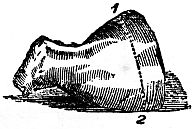
KNUCKLE OF VEAL.
VEAL, to Ragoût a Knuckle of.
Ingredients.—Knuckle of veal, pepper and salt to taste, flour, 1 onion, 1 head of celery, or a little celery-seed, a faggot of savoury herbs, 2 blades of pounded mace, thickening of butter and flour, a few young carrots, 1 tablespoonful of tomato sauce, 3 tablespoonfuls of sherry, the juice of ½ lemon. Mode.—Cut the meat from a knuckle of veal into neat slices, season with pepper and salt, and dredge them with flour. Fry them in a little butter of a pale brown, and put them into a stewpan with the bone (which should be chopped in several places); add the celery, herbs, mace, and carrots; pour over all about 1 pint of hot water, and let it simmer very gently for 2 hours over a slow but clear fire. Take out the slices of meat and carrots, strain and thicken the gravy with a little butter rolled in flour; add the remaining ingredients, give one boil, put back the meat and carrots, let these get hot through, and serve. When in season, a few green peas, boiled separately, and added to this dish at the moment of serving, would be found a very agreeable addition. Time.—2 hours. Average cost, 5d. to 6d. per lb. Sufficient for 4 or 5 persons.
VEAL, Stewed Knuckle of, and Rice.
Ingredients.—Knuckle of veal, 1 onion, 2 blades of mace, 1 teaspoonful of salt, ½ lb. of rice. Mode.—Have the knuckle cut small, or cut some cutlets from it, that it may be just large enough to be eaten the same day it is dressed, as cold boiled veal is not a particularly tempting dish. Break the shank-bone, wash it clean, and put the meat into a stewpan with sufficient water to cover it. Let it gradually come to a boil, put in the salt, and remove the scum as fast as it rises. When it has simmered gently for about ¾ hour, add the remaining ingredients, and stew the whole gently for 2¼ hours. Put the meat into a deep dish, pour over it the rice, &c., and send boiled bacon, and a tureen of parsley and butter to table with it. Time.—A knuckle of veal weighing 6 lbs., 3 hours’ gentle stewing. Average cost, 5d. to 6d. per lb. Sufficient for 5 or 6 persons. Seasonable from March to October.
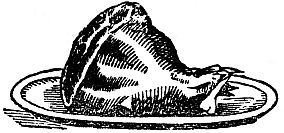
KNUCKLE OF VEAL.
Note.—Macaroni, instead of rice, boiled with the veal, will be found good; or the rice and macaroni may be omitted, and the veal sent to table smothered in parsley and butter.
VEAL, Roast Loin of.
Ingredients.—Veal; melted butter. Mode.—Paper the kidney fat; roll in and skewer the flap, which makes the joint a good shape; dredge it well with flour, and put it down to a bright fire. Should the loin be very large, skewer the kidney back for a time to roast thoroughly. Keep it well basted, and a short time before serving, remove the paper from the kidney, and allow it to acquire a nice brown colour, but it should not be burnt. Have ready some melted butter, put it into the dripping-pan after it is emptied of its contents, pour it over the veal, and serve. Garnish the dish with slices of lemon and forcemeat balls, and send to table with it boiled bacon, ham, pickled pork, or pig’s cheek. Time.—A large loin, 3 hours. Average cost, 9½d. per lb. Sufficient for 7 or 8 persons. Seasonable from March to October.

LOIN OF VEAL.
Note.—A piece of toast should be placed under the kidneys when the veal is dished.
VEAL, Loin of, au Béchamel (Cold Meat Cookery).
Ingredients.—Loin of veal, ½ teaspoonful of minced lemon-peel, rather more than ½ pint of béchamel or white sauce, Mode.—A loin of veal which has come from table with very little taken off, answers well for this dish. Cut off the meat from the inside, mince it, and mix with it some minced lemon-peel; put it into sufficient béchamel to warm it through. In the mean time, wrap the joint in buttered paper, and place it in the oven to warm. When thoroughly hot, dish the mince, place the loin above it, and pour over the remainder of the béchamel. Time.—1½ hour to warm the meat in the oven. Seasonable from March to October.
VEAL, Loin of, à la Daube.
Ingredients.—The chump end of a loin of veal, forcemeat, a few slices of bacon, a bunch of savoury herbs, 2 blades of mace, ½ teaspoonful of whole white pepper, 1 pint of veal stock or water, 5 or 6 green onions. Mode.—Cut off the chump from a loin of veal, and take out the bone; fill the cavity with forcemeat, tie it up tightly, and lay it in a stewpan with the bones and trimmings, and cover the veal with a few slices of bacon. Add the herbs, mace, pepper, and onions, and stock or water; cover the pan with a closely-fitting lid, and simmer for 2 hours, shaking the stewpan occasionally. Take out the bacon, herbs, and onions; reduce the gravy, if not already thick enough, to a glaze, with which glaze the meat, and serve with tomato, mushroom, or sorrel sauce. Time.—2 hours. Average cost, 9d. per lb. Sufficient for 4 or 5 persons. Seasonable from March to October.
VEAL, to Carve Loin of.
As is the case with a loin of mutton, the careful jointing of a loin of veal is more than half the battle in carving it. If the butcher be negligent in this matter, he should be admonished; for there is nothing more annoying or irritating to an inexperienced carver than to be obliged to turn his knife in all directions to find the exact place where it should be inserted in order to divide the bones. When the jointing is properly performed, there is little difficulty in carrying the knife down in the direction of the line 1 to 2. To each guest should be given a piece of the kidney and kidney fat, which lie underneath, and are considered great delicacies.

LOIN OF VEAL.
VEAL, Minced, with Béchamel Sauce (Cold Meat Cookery, very good).
Ingredients.—The remains of a fillet of veal, 1 pint of béchamel sauce, ½ teaspoonful of minced lemon-peel, forcemeat balls. Mode.—Cut—but do not chop—a few slices of cold roast veal as finely as possible, sufficient to make rather more than 1 lb., weighed after being minced. Make the above proportion of béchamel, by recipe; add the lemon-peel, put in the veal, and let the whole gradually warm through. When it is at the point of simmering, dish it, and garnish with forcemeat balls and fried sippets of bread. Time.—To simmer 1 minute. Average cost, exclusive of the cold meat, 1s. 4d. Sufficient for 5 or 6 persons. Seasonable from March to October.
VEAL, Minced (more economical).
Ingredients.—The remains of cold roast fillet or loin of veal, rather more than 1 pint of water, 1 onion, ½ teaspoonful of minced lemon-peel, salt and white pepper to taste, 1 blade of pounded mace, 2 or 3 young carrots, a faggot of sweet herbs, thickening of butter and flour, a tablespoonful of lemon-juice, 3 tablespoonfuls of cream or milk. Mode.—Take about 1 lb. of veal, and should there be any bones, dredge them with flour, and put them into a stewpan with the brown outside, and a few meat trimmings, add rather more than a pint of water, the onion cut in slices, lemon-peel, seasoning, mace, carrots, and herbs; simmer these well for rather more than 1 hour, and strain the liquor. Rub a little flour into some butter; add this to the gravy, set it on the fire, and, when it boils, skim well. Mince the veal finely by cutting, and not chopping it; put it in the gravy; let it get warmed through gradually; add the lemon-juice and cream, and, when it is on the point of boiling, serve. Garnish the dish with sippets of toasted bread and slices of bacon rolled and toasted. Forcemeat balls may also be added. If more lemon-peel is liked than is stated above, put a little very finely minced to the veal, after it is warmed in the gravy. Time.—1 hour to make the gravy. Average cost, exclusive of the cold meat, 6d. Seasonable from March to October.
VEAL, Minced, and Macaroni (a pretty side or corner dish).
Ingredients.—¾ lb. of minced cold roast veal, 3 oz. of ham, 1 tablespoonful of gravy, pepper and salt to taste, ¼ teaspoonful of grated nutmeg, ¼ lb. of bread-crumbs, ¼ lb. of macaroni, 1 or 2 eggs to bind, a small piece of butter. Mode.—Cut some nice slices from a cold fillet of veal, trim off the brown outside, and mince the meat finely with the above proportion of ham: should the meat be very dry, add a spoonful of good gravy. Season highly with pepper and salt, add the grated nutmeg and bread-crumbs, and mix these ingredients with 1 or 2 eggs well beaten, which should bind the mixture and make it like forcemeat. In the mean time, boil the macaroni in salt and water, and drain it; butter a mould, put some of the macaroni at the bottom and sides of it, in whatever form is liked; mix the remainder with the forcemeat, fill the mould up to the top, put a plate or small dish on it, and steam for ½ hour. Turn it out carefully, and serve with good gravy poured round, but not over, the meat. Time.—½ hour. Average cost, exclusive of the cold meat, 10d. Seasonable from March to October.
Note.—To make a variety, boil some carrots and turnips separately in a little salt and water; when done, cut them into pieces about ⅛ inch in thickness; butter an oval mould, and place these in it, in white and red stripes alternately, at the bottom and sides. Proceed as in the foregoing recipe, and be very careful in turning it out of the mould.
VEAL, Moulded Minced (Cold Meat Cookery).
Ingredients.—¾ lb. of cold roast veal, a small slice of bacon, 1/3 teaspoonful of minced lemon-peel, ½ onion chopped fine, salt, pepper, and pounded mace to taste, a slice of toast soaked in milk, 1 egg. Mode.—Mince the meat very fine, after removing from it all skin and outside pieces, and chop the bacon; mix these well together, adding the lemon-peel, onion, seasoning, mace, and toast. When all the ingredients are thoroughly incorporated, beat up an egg, with which bind the mixture. Butter a shape, put in the meat, and bake for ¾ hour; turn it out of the mould carefully, and pour round it a good brown gravy. A sheep’s head dressed in this manner is an economical and savoury dish. Time.—¾ hour. Average cost, exclusive of the meat, 6d. Seasonable from March to October.
VEAL, Braised Neck of.
Ingredients.—The best end of the neck of veal (from 3 to 4 lbs.), bacon, 1 tablespoonful of minced parsley, salt, pepper, and grated nutmeg to taste; 1 onion, 2 carrots, a little celery (when this is not obtainable, use the seed), ½ glass of sherry, thickening of butter and flour, lemon-juice, 1 blade of pounded mace. Mode.—Prepare the bacon for larding, and roll it in minced parsley, salt, pepper, and grated nutmeg; lard the veal, put it into a stewpan with a few slices of lean bacon or ham, an onion, carrots, and celery; and do not quite cover it with water. Stew it gently for 2 hours, or until it is quite tender; strain off the liquor; stir together over the fire, in a stewpan, a little flour and butter until brown; lay the veal in this, the upper side to the bottom of the pan, and let it remain till it is a nice brown colour. Place it in the dish; pour into the stewpan as much gravy as is required, boil it up, skim well, add the wine, pounded mace, and lemon-juice; simmer for 3 minutes, pour it over the meat, and serve. Time.—Rather more than 2 hours. Average cost, 8d. per lb. Sufficient for 5 or 6 persons. Seasonable from March to October.
VEAL, Roast Neck of.
Ingredients.—Veal, melted butter, forcemeat balls. Mode.—Have the veal cut from the best end of the neck; dredge it with flour, and put it down to a bright clear fire; keep it well basted; dish it, pour over it some melted butter, and garnish the dish with fried forcemeat balls; send to table with a cut lemon. The scrag may be boiled or stewed in various ways, with rice, onion-sauce, or parsley and butter. Time.—About 2 hours. Average cost, 8d. per lb. Sufficient.—4 or 5 lbs. for 5 or 6 persons. Seasonable from March to October.
VEAL OLIVE PIE (Cold Meat Cookery).
Ingredients.—A few thin slices of cold fillet of veal, a few thin slices of bacon, forcemeat, a cupful of gravy, 4 tablespoonfuls of cream, puff-crust. Mode.—Cut thin slices from a fillet of veal, place on them thin slices of bacon, and over them a layer of forcemeat, made by recipe, with an additional seasoning of shalot and cayenne; roll them tightly, and fill up a pie-dish with them; add the gravy and cream, cover with a puff-crust, and bake for 1 to 1½ hour: should the pie be very large, allow 2 hours. The pieces of rolled veal should be about 3 inches in length, and about 3 inches round. Time.—Moderate-sized pie, 1 to 1½ hour. Seasonable from March to October.
VEAL PIE.
Ingredients.—2 lbs. of veal cutlets, 1 or 2 slices of lean bacon or ham, pepper and salt to taste, 2 tablespoonfuls of minced savoury herbs, 2 blades of pounded mace, crust, 1 teacupful of gravy. Mode.—Cut the cutlets into square pieces, and season them with pepper, salt, and pounded mace; put them in a pie-dish with the savoury herbs sprinkled over, and 1 or 2 slices of lean bacon or ham placed at the top: if possible, this should be previously cooked, as undressed bacon makes the veal red, and spoils its appearance. Pour in a little water, cover with crust, ornament it in any way that is approved; brush it over with the yolk of an egg, and bake in a well-heated oven for about 1½ hour. Pour in a good gravy after baking, which is done by removing the top ornament, and replacing it after the gravy is added. Time.—About 1½ hour. Average cost, 2s. 6d. Sufficient for 5 or 6 persons. Seasonable from March to October.
VEAL AND HAM PIE.
Ingredients.—2 lbs. of veal cutlets, ½ lb. of boiled ham, 2 tablespoonfuls of minced savoury herbs, ¼ teaspoonful of grated nutmeg, 2 blades of pounded mace, pepper and salt to taste, a strip of lemon-peel finely minced, the yolks of 2 hard-boiled eggs, ½ pint of water, nearly ½ pint of good strong gravy, puff-crust. Mode.—Cut the veal into nice square pieces, and put a layer of them at the bottom of a pie-dish; sprinkle over these a portion of the herbs, spices, seasoning, lemon-peel, and the yolks of the eggs cut in slices; cut the ham very thin, and put a layer of this in. Proceed in this manner until the dish is full, so arranging it that the ham comes at the top. Lay a puff paste on the edge of the dish, and pour in about ½ pint of water; cover with crust, ornament it with leaves, brush it over with the yolk of an egg, and bake in a well-heated oven for 1 to 1½ hour, or longer, should the pie be very large. When it is taken out of the oven, pour in at the top, through a funnel, nearly ½ pint of strong gravy: this should be made sufficiently good that, when cold, it may cut in a firm jelly. This pie may be very much enriched by adding a few mushrooms, oysters, or sweetbreads; but it will be found very good without any of the last-named additions. Time.—1½ hour, or longer, should the pie be very large. Average cost, 3s. Sufficient for 5 or 6 persons. Seasonable from March to October.
VEAL, Potted (for Breakfast).
Ingredients.—To every lb. of veal allow ¼ lb. of ham, cayenne and pounded mace to taste, 6 oz. of fresh butter; clarified butter. Mode.—Mince the veal and ham together as finely as possible, and pound well in a mortar, with cayenne, pounded mace, and fresh butter in the above proportion. When reduced to a perfectly smooth paste, press it into potting-pots, and cover with clarified butter. If kept in a cool place, it will remain good some days. Seasonable from March to October.
VEAL, Ragoût of Cold (Cold Meat Cookery).
Ingredients.—The remains of cold veal, 1 oz. of butter, ½ pint of gravy, thickening of butter and flour, pepper and salt to taste, 1 blade of pounded mace, 1 tablespoonful of mushroom ketchup, 1 tablespoonful of sherry, 1 dessertspoonful of lemon-juice, forcemeat balls. Mode.—Any part of veal will make this dish. Cut the meat into nice-looking pieces, put them in a stewpan with 1 oz. of butter, and fry a light brown; add the gravy (hot water may be substituted for this), thicken with a little butter and flour, and stew gently about ¼ hour; season with pepper, salt, and pounded mace; add the ketchup, sherry, and lemon-juice; give one boil, and serve. Garnish the dish with forcemeat balls and fried rashers of bacon. Time.—Altogether ½ hour. Average cost, exclusive of cold meat, 6d. Seasonable from March to October.
Note.—The above recipe may be varied, by adding vegetables, such as peas, cucumbers, lettuces, green onions cut in slices, a dozen or two of green gooseberries (not seedy), all of which should be fried a little with the meat, and then stewed in the gravy.
VEAL RISSOLES (Cold Meat Cookery).
Ingredients.—A few slices of cold roast veal, a few slices of ham or bacon, 1 tablespoonful of minced parsley, 1 tablespoonful of minced savoury herbs, 1 blade of pounded mace, a very little grated nutmeg, cayenne and salt to taste, 2 eggs well beaten, bread-crumbs. Mode.—Mince the veal very finely with a little ham or bacon; add the parsley, herbs, spices, and seasoning; mix into a paste with an egg; form into balls or cones; brush these over with egg, sprinkle with bread-crumbs, and fry a rich brown. Serve with brown gravy, and garnish the dish with fried parsley. Time.—About 10 minutes to fry the rissoles. Seasonable from March to October.
VEAL ROLLS (Cold Meat Cookery).
Ingredients.—The remains of a cold fillet of veal, egg and bread-crumbs, a few slices of fat bacon, forcemeat. Mode.—Cut a few slices from a cold fillet of veal ½ inch thick; rub them over with egg; lay a thin slice of fat bacon over each piece of veal; brush these with the egg, and over this spread the forcemeat thinly; roll up each piece tightly, egg and bread-crumb them, and fry them a rich brown. Serve with mushroom sauce or brown gravy. Time.—10 to 15 minutes to fry the rolls. Seasonable from March to October.
VEAL, Stuffed and Stewed Shoulder of.
Ingredients.—A shoulder of veal, a few slices of ham or bacon, forcemeat, 3 carrots, 2 onions, salt and pepper to taste, a faggot of savoury herbs, 3 blades of pounded mace, water, thickening of butter and flour. Mode.—Bone the joint by carefully detaching the meat from the blade-bone on one side, and then on the other, being particular not to pierce the skin; then cut the bone from the knuckle, and take it out. Fill the cavity whence the bone was taken with a forcemeat. Roll and bind the veal up tightly; put it into a stewpan with the carrots, onions, seasoning, herbs, and mace; pour in just sufficient water to cover it, and let it stew very gently for about 5 hours. Before taking it up, try if it is properly done by thrusting a larding-needle in it: if it penetrates easily, it is sufficiently cooked. Strain and skim the gravy, thicken with butter and flour, give one boil, and pour it round the meat. A few young carrots may be boiled and placed round the dish as a garnish, and, when in season, green peas should always be served with this dish. Time.—5 hours. Average cost, 7d. per lb. Sufficient for 8 or 9 persons. Seasonable from March to October.
VEAL, Stewed with Peas, Young Carrots, and New Potatoes.
Ingredients.—3 or 4 lbs. of the loin or neck of veal, 15 young carrots, a few green onions, 1 pint of green peas, 12 new potatoes, a bunch of savoury herbs, pepper and salt to taste, 1 tablespoonful of lemon-juice, 2 tablespoonfuls of tomato sauce, 2 tablespoonfuls of mushroom ketchup. Mode.—Dredge the meat with flour, and roast or bake it for about ¾ hour: it should acquire a nice brown colour. Put the meat into a stewpan with the carrots, onions, potatoes, herbs, pepper, and salt; pour over it sufficient boiling water to cover it, and stew gently for 2 hours. Take out the meat and herbs, put it in a deep dish, skim off all the fat from the gravy, and flavour it with lemon-juice, tomato sauce, and mushroom ketchup, in the above proportion. Have ready a pint of green peas boiled separately; put these with the meat, pour over it the gravy, and serve. The dish may be garnished with a few forcemeat balls. The meat, when preferred, may be cut into chops, and floured and fried instead of being roasted; and any part of veal dressed in this way will be found extremely savoury and good. Time.—3 hours. Average cost, 9d. per lb. Sufficient for 6 or 7 persons. Seasonable, with peas, from June to August.
VEGETABLE MARROW, Boiled.

VEGETABLE MARROW ON TOAST.
Ingredients.—To each ½ gallon of water, allow 1 heaped tablespoonful of salt; vegetable marrows. Mode.—Have ready a saucepan of boiling water, salted in the above proportion; put in the marrows after peeling them, and boil them until quite tender. Take them up with a slice, halve, and, should they be very large, quarter them. Dish them on toast, and send to table with them a tureen of molted butter, or, in lieu of this, a small pat of salt butter. Large vegetable marrows may be preserved throughout the winter by storing them in a dry place; when wanted for use, a few slices should be cut and boiled in the same manner as above; but, when once begun, the marrow must be eaten quickly, as it keeps but a short time after it is cut. Vegetable marrows are also very delicious mashed: they should be boiled, then drained, and mashed smoothly with a wooden spoon. Heat them in a saucepan, add a seasoning of salt and pepper, and a small piece of butter, and dish with a few sippets of toasted broad placed round as a garnish. Time.—Young vegetable marrows, 10 to 20 minutes; old ones, ½ to ¾ hour. Average cost, in full season, 1s. per dozen. Sufficient.—Allow 1 moderate-sized marrow for each person. Seasonable in July, August, and September; but may be preserved all the winter.
VEGETABLE MARROW, Fried.
Ingredients.—3 medium-sized vegetable marrows, egg and bread-crumbs, hot lard. Mode.—Peel, and boil the marrows until tender in salt and water; then drain them and cut them in quarters, and take out the seeds. When thoroughly drained, brush the marrows over with egg, and sprinkle with bread-crumbs; have ready some hot lard, fry the marrow in this, and, when of a nice brown, dish; sprinkle over a little salt and pepper, and serve. Time.—About ½ hour to boil the marrow, 7 minutes to fry it. Average cost, in full season, 1s. per dozen. Sufficient for 4 persons. Seasonable in July, August, and September.
VEGETABLE MARROWS IN WHITE SAUCE.
Ingredients.—4 or 5 moderate-sized marrows, ½ pint of white sauce. Mode.—Pare the marrows; cut them in halves, and shape each half at the top in a point, leaving the bottom end flat for it to stand upright in the dish. Boil the marrows in salt and water until tender; take them up very carefully, and arrange them on a hot dish. Have ready ½ pint of white sauce; pour this over the marrows, and serve. Time.—From 15 to 20 minutes to boil the marrows. Average cost, in full season, 1s. per dozen. Sufficient for 5 or 6 persons. Seasonable in July, August, and September.
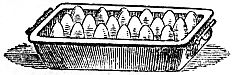
VEGETABLE MARROW IN WHITE SAUCE.
VEGETABLE MARROW SOUP.
Ingredients.—4 young vegetable marrows, or more, if very small, ½ pint of cream, salt and white pepper to taste, 2 quarts of white stock. Mode.—Pare and slice the marrows, and put them in the stock boiling. When done almost to a mash, press them through a sieve, and at the moment of serving, add the boiling cream and seasoning. Time.—1 hour. Average cost, 1s. 2d. per quart. Seasonable in summer. Sufficient for 8 persons.
VEGETABLE SOUP.
Ingredients.—7 oz. of carrot, 10 oz. of parsnip, 10 oz. of potato, cut into thin slices; 1¼ oz. of butter, 5 teaspoonfuls of flour, a teaspoonful of made mustard, salt and pepper to taste, the yolks of 2 eggs, rather more than 2 quarts of water. Mode.—Boil the vegetables in the water 2½ hours; stir them often, and if the water boils away too quickly, add more, as there should be 2 quarts of soup when done. Mix up in a basin the butter and flour, mustard, salt, and pepper, with a teacupful of cold water; stir in the soup, and boil 10 minutes. Have ready the yolks of the eggs in the tureen; pour on, stir well, and serve. Time.—3 hours. Average cost, 4d. per quart. Seasonable in winter. Sufficient for 8 persons.
VEGETABLE SOUP.
Ingredients.—Equal quantities of onions, carrots, turnips; ¼ lb. of butter, a crust of toasted bread, 1 head of celery, a faggot of herbs, salt and pepper to taste, 1 teaspoonful of powdered sugar, 2 quarts of common stock or boiling water. Allow ¾ lb. of vegetables to 2 quarts of stock. Mode.—Cut up the onions, carrots, and turnips; wash and drain them well, and put them in the stewpan with the butter and powdered sugar. Toss the whole over a sharp fire for 10 minutes, but do not let them brown, or you will spoil the flavour of the soup. When done, pour the stock or boiling water on them; add the bread, celery, herbs, and seasoning; stew for 3 hours; skim well and strain it off. When ready to serve, add a little sliced carrot, celery, and turnip, and flavour with a spoonful of Harvey’s sauce, or a little ketchup. Time.—3½ hours. Average cost, 6d. per quart. Seasonable all the year. Sufficient for 8 persons.
VEGETABLE SOUP. (Good and Cheap, made without Meat.)
Ingredients.—6 potatoes, 4 turnips, or 2 if very large; 2 carrots, 2 onions; if obtainable, 2 mushrooms; 1 head of celery, 1 large slice of bread, 1 small saltspoonful of salt, ¼ saltspoonful of ground black pepper, 2 teaspoonfuls of Harvey’s sauce, 6 quarts of water. Mode.—Peel the vegetables, and cut them up into small pieces; toast the bread rather brown, and put all into a stewpan with the water and seasoning. Simmer gently for 3 hours, or until all is reduced to a pulp, and pass it through a sieve in the same way as pea-soup, which it should resemble in consistence; but it should be a dark brown colour. Warm it up again when required; put in the Harvey’s sauce, and, if necessary, add to the flavouring. Time.—3 hours, or rather more. Average cost, 1d. per quart. Seasonable at any time. Sufficient for 16 persons.
Note.—This recipe was forwarded to the Editress by a lady in the county of Durham, by whom it was strongly recommended.
VEGETABLES, Cut for Soups, &c.
The annexed engraving represents a cutter for shaping vegetables for soups, ragoûts, stews, &c.; carrots and turnips being the usual vegetables for which this utensil is used. Cut the vegetables into slices about ¼ inch in thickness, stamp them out with the cutter, and boil them for a few minutes in salt and water, until tender. Turnips should be cut in rather thicker slices than carrots, on account of the former boiling more quickly to a pulp than the latter.

VEGETABLE-CUTTER.
VENISON, Hashed.
Ingredients.—The remains of roast venison, its own or mutton gravy, thickening of butter and flour. Mode.—Cut the meat from the bones in neat slices, and, if there is sufficient of its own gravy left, put the meat into this, as it is preferable to any other. Should there not be enough, put the bones and trimmings into a stewpan, with about a pint of mutton gravy; let them stew gently for an hour, and strain the gravy. Put a little flour and butter into the stewpan, keep stirring until brown, then add the strained gravy, and give it a boil up; skim and strain again, and, when a little cool, put in the slices of venison. Place the stewpan by the side of the fire, and, when on the point of simmering, serve: do not allow it to boil, or the meat will be hard. Send red-currant jelly to table with it. Time.—Altogether, 1½ hour. Seasonable.—Buck venison, from June to Michaelmas; doe venison, from November to the end of January.
Note.—A small quantity of Harvey’s sauce, ketchup, or port wine, may be added to enrich the gravy: these ingredients must, however, be used very sparingly, or they will overpower the flavour of the venison.
VENISON, Roast Haunch of.
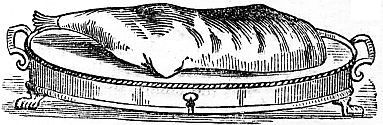
ROAST HAUNCH OF VENISON.
Ingredients.—Venison, coarse flour-and-water paste, a little flour. Mode.—Choose a haunch with clear, bright, and thick fat, and the cleft of the hoof smooth and close; the greater quantity of fat there is, the better quality will the meat be. As many people object to venison when it has too much haut goût, ascertain how long it has been kept, by running a sharp skewer into the meat close to the bone: when this is withdrawn, its sweetness can be judged of. With care and attention, it will keep good a fortnight, unless the weather is very mild. Keep it perfectly dry by wiping it with clean cloths till not the least damp remains, and sprinkle over powdered ginger or pepper, as a preventive against the fly. When required for use, wash it in warm water, and dry it well with a cloth; butter a sheet of white paper, put it over the fat, lay a coarse paste, about ½ inch in thickness, over this, and then a sheet or two of strong paper. Tie the whole firmly on to the haunch with twine, and put the joint down to a strong close fire; baste the venison immediately, to prevent the paper and string from burning, and continue this operation, without intermission, the whole of the time it is cooking. About 20 minutes before it is done, carefully remove the paste and paper, dredge the joint with flour, and baste well with butter until it is nicely frothed, and of a nice pale-brown colour; garnish the knuckle-bone with a frill of white paper, and serve with a good, strong, but unflavoured gravy, in a tureen, and currant jelly; or melt the jelly with a little port, wine, and serve that also in a tureen. As the principal object in roasting venison is to preserve the fat, the above is the best mode of doing so where expense is not objected to; but, in ordinary cases, the paste may be dispensed with, and a double paper placed over the roast instead: it will not require so long cooking without the paste. Do not omit to send very hot plates to table, as the venison fat so soon freezes: to be thoroughly enjoyed by epicures, it should be eaten on hot-water plates. The neck and shoulder may be roasted in the same manner. Time.—A large haunch of buck venison, with the paste, 4 to 5 hours; haunch of doe venison, 3¼ to 3¾ hours. Allow less time without the paste. Average cost, 1s. 4d. to 1s. 6d. per lb. Sufficient for 18 persons. Seasonable.—Buck venison in greatest perfection from June to Michaelmas; doe venison from November to the end of January.
VENISON, to Carve Haunch of.
Here is a grand dish for a knight of the carving-knife to exercise his skill upon, and, what will be pleasant for many to know, there is but little difficulty in the performance. An incision being made completely down to the bone, in the direction of the line 1 to 2, the gravy will then be able easily to flow; when slices, not too thick, should be cut along the haunch, as indicated by the line 4 to 3; that end of the joint marked 3 having been turned towards the carver, so that he may have a more complete command over the joint. Although some epicures affect to believe that some parts of the haunch are superior to others, yet we doubt if there is any difference between the slices cut above and below the line. It should be borne in mind to serve each guest with a portion of fat; and the most expeditious carver will be the best carver, as, like mutton, venison soon begins to chill, when it loses much of its charm.
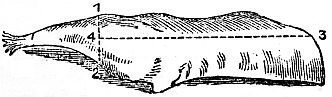
HAUNCH OF VENISON.
VENISON, Stewed.
Ingredients.—A shoulder of venison, a few slices of mutton fat, 2 glasses of port wine, pepper and allspice to taste, 1½ pint of weak stock or gravy, ½ teaspoonful of whole pepper, ½ teaspoonful of whole allspice. Mode.—Hang the venison till tender; take out the bone, flatten the meat with a rolling-pin, and place over it a few slices of mutton fat, which have been previously soaked for 2 or 3 hours in port wine; sprinkle these with a little fine allspice and pepper, roll the meat up, and bind and tie it securely. Put it into a stewpan with the bone and the above proportion of weak stock or gravy, whole allspice, black pepper, and port wine; cover the lid down closely, and simmer, very gently, from 3½ to 4 hours. When quite tender, take off the tape, and dish the meat; strain the gravy over it, and send it to table with red currant jelly. Unless the joint is very fat, the above is the best mode of cooking it. Time.—3½ to 4 hours. Average cost, 1s. 4d. to 1s. 6d. per lb. Sufficient for 10 or 12 persons. Seasonable.—Buck venison, from June to Michaelmas; doe venison, from November to the end of January.
VERMICELLI PUDDING.
Ingredients.—4 oz. of vermicelli, 1½ pint of milk, ½ pint of cream, 3 oz. of butter, 3 oz. of sugar, 4 eggs. Mode.—Boil the vermicelli in the milk until it is tender; then stir in the remaining ingredients, omitting the cream, if not obtainable. Flavour the mixture with grated lemon-rind, essence of bitter almonds, or vanilla; butter a pie-dish; line the edges with puff-paste, put in the pudding, and bake in a moderate oven for about ¾ hour. Time.—¾ hour. Average cost, 1s. 2d. without cream. Sufficient for 5 or 6 persons. Seasonable at any time.
VERMICELLI SOUP.
Ingredients.—1½ lb. of bacon, stuck with cloves; ½ oz. of butter, worked up in flour; 1 small fowl, trussed for boiling; 2 oz. of vermicelli, 2 quarts of white stock. Mode.—Put the stock, bacon, butter, and fowl, into the stewpan, and stew for ¾ of an hour. Take the vermicelli, add it to a little of the stock, and set it on the fire, till it is quite tender. When the soup is ready, take out the fowl and bacon, and put the bacon on a dish. Skim the soup as clean as possible; pour it, with the vermicelli, over the fowl. Cut some bread thin, put in the soup, and serve. Time.—2 hours. Average cost, exclusive of the fowl and bacon, 10d. per quart. Seasonable in winter. Sufficient for 4 persons.
VERMICELLI SOUP.
Ingredients.—¼ lb. of vermicelli, 2 quarts of clear gravy stock. Mode.—Put the vermicelli in the soup, boiling; simmer very gently for ½ an hour, and stir frequently. Time.—½ an hour. Average cost, 1s. 3d. per quart. Seasonable all the year. Sufficient for 8 persons.
VOL-AU-VENT (an Entrée).
Ingredients.—¾ to 1 lb. of puff-paste, fricasseed chickens, rabbits, ragoûts, or the remains of cold fish, flaked and warmed in thick white sauce. Mode.—Make from ¾ to 1 lb. of puff-paste, taking care that it is very evenly rolled out each time, to ensure its rising properly; and if the paste is not extremely light, and put into a good hot oven, this cannot be accomplished, and the vol-au-vent will look very badly. Roll out the paste to the thickness of about 1½ inch, and, with a fluted cutter, stamp it out to the desired shape, either round or oval, and, with the point of a small knife, make a slight incision in the paste all round the top, about an inch from the edge, which, when baked, forms the lid. Put the vol-au-vent into a good brisk oven, and keep the door shut for a few minutes after it is put in. Particular attention should be paid to the heating of the oven, for the paste cannot rise without a tolerable degree of heat. When of a nice colour, without being scorched, withdraw it from the oven, instantly remove the cover where it was marked, and detach all the soft crumb from the centre: in doing this, be careful not to break the edges of the vol-au-vent; but should they look thin in places, stop them with small flakes of the inside paste, stuck on with the white of an egg. This precaution is necessary to prevent the fricassee or ragoût from bursting the case, and so spoiling the appearance of the dish. Fill the vol-au-vent with a rich mince, or fricassee, or ragoût, or the remains of cold fish flaked and warmed in a good white sauce, and do not make them very liquid, for fear of the gravy bursting the crust: replace the lid, and serve. To improve the appearance of the crust, brush it over with the yolk of an egg after it has risen properly. Time.—¾ hour to bake the vol-au-vent. Average cost, exclusive of the interior, 1s. 6d. Seasonable at any time.