THE DICTIONARY OF COOKERY. (continued 15)
Reading edition
Various Herbs and Vegetables are required for the purpose of making soups and gravies. Of these the principal are,—Scotch barley, pearl barley, wheat flour, oatmeal, bread-raspings, pease, beans, rice, vermicelli, macaroni, isinglass, potato-mucilage, mushroom or mushroom-ketchup, champignons, parsnips, carrots, beetroot, turnips, garlic, shalots, and onions. Sliced onions, fried with butter and flour till they are browned, and then rubbed through a sieve, are excellent to heighten the colour and flavour of brown soups and sauces, and form the basis of many of the fine relishes furnished by the cook. The older and drier the onion, the stronger will be its flavour. Leeks, cucumber, or burnet vinegar; celery or celery seed pounded. The latter, though equally strong, does not impart the delicate sweetness of the fresh vegetable; and when used as a substitute, its flavour should be corrected by the addition of a bit of sugar. Cress-seed, parsley, common thyme, lemon thyme, orange thyme, knotted marjoram, sage, mint, winter savoury, and basil. As fresh green basil is seldom to be procured, and its fine flavour is soon lost, the best way of preserving the extract is by pouring wine on the fresh leaves.
For the Seasoning of Soups, bay-leaves, tomato, tarragon, chervil, burnet, allspice, cinnamon, ginger, nutmeg, clove, mace, black and white pepper, essence of anchovy, lemon peel and juice, and Seville orange juice, are all taken. The latter imparts a finer flavour than the lemon, and the acid is much milder. These materials, with wine, mushroom ketchup, Harvey’s sauce, tomato sauce, combined in various proportions, are, with other ingredients, manipulated into an almost endless variety of excellent soups and gravies. Soups, which are intended to constitute the principal part of a meal, certainly ought not to be flavoured like sauces, which are only designed to give a relish to some particular dish.
SOUP-MAKING, the Chemistry and Economy of.
Stock being the basis of all meat soups, and, also, of all the principal sauces, it is essential to the success of these culinary operations, to know the most complete and economical method of extracting, from a certain quantity of meat, the best possible stock, or broth. The theory and philosophy of this process we will, therefore, explain, and then proceed to show the practical course to be adopted.
As all meat is principally composed of fibres, fat, gelatine, osmazome, and albumen, it is requisite to know that the fibres are inseparable, constituting almost all that remains of the meat after it has undergone a long boiling.
Fat is dissolved by boiling; but as it is contained in cells covered by a very fine membrane, which never dissolves, a portion of it always adheres to the fibres. The other portion rises to the surface of the stock, and is that which has escaped from the cells which were not whole, or which have burst by boiling.
Gelatine is soluble; it is the basis and the nutritious portion of the stock. When there is an abundance of it, it causes the stock, when cold, to become a jelly.
Osmazome is soluble even when cold and is that part of the meat which gives flavour and perfume to the stock. The flesh of old animals contains more osmazome than that of young ones. Brown meats contain more than white, and the former make the stock more fragrant. By roasting meat, the osmazome appears to acquire higher properties; so, by putting the remains of roast meats into your stock-pot, you obtain a better flavour.
Albumen is of the nature of the white of eggs; it can be dissolved in cold or tepid water, but coagulates when it is put into water not quite at the boiling-point. From this property in albumen, it is evident that if the meat is put into the stock-pot when the water boils, or after this is made to boil up quickly, the albumen, in both cases, hardens. In the first it rises to the surface, in the second it remains in the meat, but in both it prevents the gelatine and osmazome from dissolving; and hence a thin and tasteless stock will be obtained. It ought to be known, too, that the coagulation of the albumen in the meat always takes place, more or less, according to the size of the piece, as the parts farthest from the surface always acquire that degree of heat which congeals it before entirely dissolving it.
Bones ought always to form a component part of the stock-pot. They are composed of an earthy substance,—to which they owe their solidity,—of gelatine, and a fatty fluid, something like marrow. Two ounces of them contain as much gelatine as one pound of meat; but in them, this is so incased in the earthy substance, that boiling-water can dissolve only the surface of whole bones. By breaking them, however, you can dissolve more, because you multiply their surfaces; and by reducing them to powder or paste, you can dissolve them entirely; but you must not grind them dry. We have said that gelatine forms the basis of stock; but this, though very nourishing, is entirely without taste; and to make the stock savoury, it must contain osmazome. Of this, bones do not contain a particle; and that is the reason why stock made entirely of them is not liked; but when you add meat to the broken or pulverized bones, the osmazome contained in it makes the stock sufficiently savoury.
In concluding this part of our subject, the following condensed hints and directions should be attended to in the economy of soup-making:—
Beef makes the best Stock; veal stock has less colour and taste; whilst mutton sometimes gives it a tallowy smell, far from agreeable, unless the meat has been previously roasted or broiled. Fowls add very little to the flavour of stock, unless they be old and fat. Pigeons, when they are old, add the most flavour to it; and a rabbit or partridge is also a great improvement. From the freshest meat the best stock is obtained.
If the Meat be Boiled solely to make stock, it must be cut up into the smallest possible pieces; but, generally speaking, if it is desired to have good stock and a piece of savoury meat as well, it is necessary to put a rather large piece into the stock-pot, say sufficient for two or three days, during which time the stock will keep well in all weathers. Choose the freshest meat, and have it cut as thick as possible; for if it is a thin, flat piece, it will not look well, and will be very soon spoiled by the boiling.
Never wash Meat, as it deprives its surface of all its juices; separate it from the bones, and tie it round with tape, so that its shape may be preserved, then put it into the stock-pot, and for each pound of meat, let there be one pint of water; press it down with the hand, to allow the air, which it contains, to escape, and which often raises it to the top of the water.
Put the Stock-pot on a Gentle Fire, so that it may heat gradually. The albumen will first dissolve, afterwards coagulate; and as it is in this state lighter than the liquid, it will rise to the surface, bringing with it all its impurities. It is this which makes the scum. The rising of the hardened albumen has the same effect in clarifying stock as the white of eggs; and, as a rule, it may be said that the more scum there is, the clearer will be the stock. Always take care that the fire is very regular.
Remove the Scum when it rises thickly, and do not let the stock boil, because then one portion of the scum will be dissolved, and the other go to the bottom of the pot; thus rendering it very difficult to obtain a clear broth. If the fire is regular, it will not be necessary to add cold water in order to make the scum rise; but if the fire is too large at first, it will then be necessary to do so.
When the Stock is well Skimmed, and begins to boil, put in salt and vegetables, which to every 3 lbs. of meat should consist of three carrots, two turnips, one parsnip, a few leeks, and a little celery. You can add, according to taste, a piece of cabbage, two or three cloves stuck in an onion, and a tomato. The latter gives a very agreeable flavour to the stock. If burnt onion be added, it ought, according to the advice of a famous French chef, to be tied in a little bag: without this precaution, the colour of the stock is liable to be clouded.
By this time we will now suppose that you have chopped the bones which were separated from the meat, and those which were left from the roast meat of the day before. Remember, as was before pointed out, that the more these are broken, the more gelatine you will have. The best way to break them up is to pound them roughly in an iron mortar, adding, from time to time, a little water, to prevent them getting heated. It is a great saving thus to make use of the bones of meat, which, in too many English families, we fear, are entirely wasted; for it is certain, as previously stated, that two ounces of bone contain as much gelatine (which is the nutritive portion of stock) as one pound of meat. In their broken state tie them up in a bag, and put them in the stock-pot; adding the gristly parts of cold meat, and trimmings, which can be used for no other purpose. If, to make up the weight, you have received from the butcher a piece of mutton or veal, broil it slightly over a clear fire before putting it in the stock-pot, and be very careful that it does not contract the least taste of being smoked or burnt.
Add now the Vegetables, which, to a certain extent, will stop the boiling of the stock. Wait, therefore, till it simmers well up again, then draw it to the side of the fire, and keep it gently simmering till it is served, preserving, as before said, your fire always the same. Cover the stock-pot well, to prevent evaporation; do not fill it up, even if you take out a little stock, unless the meat is exposed; in which case a little boiling water may be added, but only enough to cover it. After six hours’ slow and gentle simmering, the stock is done; and it should not be continued on the fire longer than is necessary, or it will tend to insipidity.
Note.—It is on a good stock, or first good broth and sauce, that excellence in cookery depends. If the preparation of this basis of the culinary art is intrusted to negligent or ignorant persons, and the stock is not well skimmed, but indifferent results will be obtained. The stock will never be clear; and when it is obliged to be clarified, it is deteriorated both in quality and flavour. In the proper management of the stock-pot an immense deal of trouble is saved, inasmuch as one stock, in a small dinner, serves for all purposes. Above all things, the greatest economy, consistent with excellence, should be practised, and the price of everything which enters the kitchen correctly ascertained. The theory of this part of Household Management may appear trifling, but its practice is extensive, and therefore it requires the best attention.
SOUP, Baked.
Ingredients.—1 lb. of any kind of meat, any trimmings or odd pieces; 2 onions, 2 carrots, 2 oz. of rice, 1 pint of split peas, pepper and salt to taste, 4 quarts of water. Mode.—Cut the meat and vegetables in slices, add to them the rice and peas, season with pepper and salt. Put the whole in a jar, fill up with the water, cover very closely, and bake for 4 hours. Time.—4 hours. Average cost, 2½d. per quart. Seasonable at any time. Sufficient for 10 or 12 persons.
Note.—This will be found a very cheap and wholesome soup, and will be convenient in those cases where baking is more easily performed than boiling.
SOUP, Brilla.
Ingredients.—4 lbs. of shin of beef, 3 carrots, 2 turnips, a large sprig of thyme, 2 onions, 1 head of celery, salt and pepper to taste, 4 quarts water. Mode.—Take the beef, cut off all the meat from the bone, in nice square pieces, and boil the bone for 4 hours. Strain the liquor, let it cool, and take off the fat; then put the pieces of meat in the cold liquor; cut small the carrots, turnips, and celery; chop the onions, add them with the thyme and seasoning, and simmer till the meat is tender. If not brown enough, colour it with browning. Time.—6 hours. Average cost, 5d. per quart. Seasonable all the year. Sufficient for 10 persons.
SOUP, Chantilly.
Ingredients.—1 quart of young green peas, a small bunch of parsley, 2 young onions, 2 quarts of medium stock. Mode.—Boil the peas till quite tender, with the parsley and onions; then rub them through a sieve, and pour the stock to them. Do not let it boil after the peas are added, or you will spoil the colour. Serve very hot. Time.—½ hour. Average cost, 1s. 6d. per quart. Seasonable from June to the end of August. Sufficient for 8 persons.
Note.—Cold peas pounded in a mortar, with a little stock added to them, make a very good soup in haste.
SOUP, Calf’s-head.
Ingredients.—½ of calf’s head, 1 onion stuck with cloves, a very small bunch of sweet herbs, 2 blades of mace, salt and white pepper to taste, 6 oz. of rice-flour, 3 tablespoonfuls of ketchup, 3 quarts of white stock, or pot-liquor, or water. Mode.—Rub the head with salt, soak it for 6 hours, and clean it thoroughly, put it in the stewpan, and cover it with the stock, or pot-liquor, or water, adding the onion and sweet herbs. When well skimmed and boiled for 1½ hour, take out the head, and skim and strain the soup. Mix the rice-flour with the ketchup, thicken the soup with it, and simmer for 5 minutes. Now cut up the head into pieces about two inches long, and simmer them in the soup till the meat and fat are quite tender. Season with white pepper and mace finely pounded, and serve very hot. When the calf’s head is taken out of the soup, cover it up or it will discolour. Time.—2½ hours. Average cost, 1s. 9d. per quart, with stock. Seasonable from May to October. Sufficient for 10 persons.
Note.—Forcemeat balls can be added, and the soup may be flavoured with a little lemon-juice, or a glass of sherry or Madeira. The bones from the head may be stewed down again, with a few fresh vegetables, and it will make a very good common stock.
SOUP, à la Cantatrice. (An Excellent Soup, very Beneficial for the Voice.)
Ingredient.—3 oz. of sago, ½ pint of cream, the yolks of 3 eggs, 1 lump of sugar, and seasoning to taste, 1 bay-leaf (if liked), 2 quarts of medium stock. Mode.—Having washed the sago in boiling water, let it be gradually added to the nearly boiling stock. Simmer for ½ hour, when it should be well dissolved. Beat up the yolks of the eggs, add to them the boiling cream; stir these quickly in the soup, and serve immediately. Do not let the soup boil, or the eggs will curdle. Time.—40 minutes. Average cost, 1s. 6d. per quart. Seasonable all the year. Sufficient for 8 persons.
Note.—This is a soup, the principal ingredients of which, sago and eggs, have always been deemed very beneficial to the chest and throat. In various quantities, and in different preparations, these have been partaken of by the principal singers of the day, including the celebrated Swedish Nightingale, Jenny Lind, and, as they have always avowed, with considerable advantage to the voice, in singing.
SOUP, à la Crécy.
Ingredients.—4 carrots, 2 sliced onions, 1 cut lettuce, and chervil; 2 oz. butter, 1 pint of lentils, the crumbs of 2 French rolls, half a teacupful of rice, 2 quarts of medium stock. Mode.—Put the vegetables with the butter in the stewpan, and let them simmer 5 minutes; then add the lentils and 1 pint of the stock, and stew gently for half an hour. Now fill it up with the remainder of the stock, let it boil another hour, and put in the crumb of the rolls. When well soaked, rub all through a tammy. Have ready the rice boiled; pour the soup over this, and serve. Time.—1¾ hour. Average cost, 1s. 2d. per quart. Seasonable all the year. Sufficient for 8 persons.
SOUP, à la Flamande (Flemish).
Ingredients.—1 turnip, 1 small carrot, ½ head of celery, 6 green onions shred very fine, 1 lettuce cut small, chervil, ¼ pint of asparagus cut small, ¼ pint of peas, 2 oz. butter, the yolks of 4 eggs, ½ pint of cream, salt to taste, 1 lump of sugar, 2 quarts of stock. Mode.—Put the vegetables in the butter to stew gently for an hour with a teacupful of stock; then add the remainder of the stock, and simmer for another hour. Now beat the yolks of the eggs well, mix with the cream (previously boiled), and strain through a hair sieve. Take the soup off the fire, put the eggs, &c., to it and keep stirring it well. Bring it almost to boiling point, but do not leave off stirring, or the eggs will curdle. Season with salt, and add the sugar. Time.—2½ hours. Average cost, 1s. 9d. per quart. Seasonable from May to August. Sufficient for 8 persons.
SOUP, à la Flamande (Flemish).
Ingredients.—5 onions, 5 heads of celery, 10 moderate-sized potatoes, 3 oz. butter, ½ pint of water, ½ pint of cream, 2 quarts of stock. Mode.—Slice the onions, celery, and potatoes, and put them with the butter and water into a stewpan, and simmer for an hour. Then fill up the stewpan with stock, and boil gently till the potatoes are done, which will be in about an hour. Rub all through a tammy, and add the cream (previously boiled). Do not let it boil after the cream is put in. Time.—2½ hours. Average cost, 1s. 4d. per quart. Seasonable from September to May. Sufficient for 8 persons.
Note.—This soup can be made with water instead of stock.
SOUP, a Good Family.
Ingredients.—Remains of a cold tongue, 2 lbs. of shin of beef, any cold pieces of meat or beef-bones, 2 turnips, 2 carrots, 2 onions, 1 parsnip, 1 head of celery, 4 quarts of water, ½ teacupful of rice; salt and pepper to taste. Mode.—Put all the ingredients in a stewpan, and simmer gently for 4 hours, or until all the goodness is drawn from the meat. Strain off the soup, and let it stand to get cold. The kernels and soft parts of the tongue must be saved. When the soup is wanted for use, skim off all the fat, put in the kernels and soft parts of the tongue, slice in a small quantity of fresh carrot, turnip, and onion; stew till the vegetables are tender, and serve with toasted bread. Time.—5 hours. Average cost, 3d. per quart. Seasonable at any time. Sufficient for 12 persons.
SOUP, Hessian.
Ingredients.—Half an ox’s head, 1 pint of split peas, 8 carrots, 6 turnips, 6 potatoes, 6 onions, 1 head of celery, 1 bunch of savoury herbs, pepper and salt to taste, 2 blades of mace, a little allspice, 4 cloves, the crumb of a French roll, 6 quarts of water. Mode.—Clean the head, rub it with salt and water, and soak it for 5 hours in warm water. Simmer it in the water till tender, put it into a pan and let it cool; skim off all the fat; take out the head, and add the vegetables cut up small, and the peas which have been previously soaked; simmer them without the meat, till they are done enough to pulp through a sieve. Put in the seasoning, with the pieces of meat cut up; give one boil, and serve. Time.—4 hours. Average cost, 6d. per quart. Seasonable in winter. Sufficient for 16 persons.
Note.—An excellent hash or ragoût can be made by cutting up the nicest parts of the head, thickening and seasoning more highly a little of the soup, and adding a glass of port wine and 2 tablespoonfuls of ketchup.
SOUP, Portable.
Ingredients.—2 knuckles of veal, 3 shins of beef, 1 large faggot of herbs, 2 bay-leaves, 2 heads of celery, 3 onions, 3 carrots, 2 blades of mace, 6 cloves, a teaspoonful of salt, sufficient water to cover all the ingredients. Mode.—Take the marrow from the bones; put all the ingredients in a stock-pot, and simmer slowly for 12 hours, or more, if the meat be not done to rags; strain it off, and put it in a very cool place; take off all the fat, reduce the liquor in a shallow pan, by setting it over a sharp fire, but be particular that it does not burn; boil it fast and uncovered for 8 hours, and keep it stirred. Put it into a deep dish, and set it by for a day. Have ready a stewpan of boiling water, place the dish in it, and keep it boiling; stir occasionally, and when the soup is thick and ropy, it is done. Form it into little cakes by pouring a small quantity on to the bottom of cups or basins; when cold, turn them out on a flannel to dry. Keep them from the air in tin canisters. Average cost of this quantity, 16s.
Note.—Soup can be made in 5 minutes with this, by dissolving a small piece, about the size of a walnut, in a pint of warm water, and simmering for 2 minutes. Vermicelli, macaroni, or other Italian pastes, may be added.
SOUP, Prince of Wales’s.
Ingredients.—12 turnips, 1 lump of sugar, 2 spoonfuls of strong veal stock, salt and white pepper to taste, 2 quarts of very bright stock. Mode.—Peel the turnips, and with a cutter cut them in balls as round as possible, but very small. Put them in the stock, which must be very bright, and simmer till tender. Add the veal stock and seasoning. Have little pieces of bread cut round, about the size of a shilling; moisten them with stock; put them into a tureen and pour the soup over without shaking, for fear of crumbling the bread, which would spoil the appearance of the soup, and make it look thick. Time.—2 hours. Seasonable in the winter. Sufficient for 8 persons.
SOUP, Regency.
Ingredients.—The bones and remains of any cold game such as of pheasants, partridges, &c.; 2 carrots, 2 small onions, 1 head of celery, 1 turnip, ¼ lb. of pearl barley, the yolks of 3 eggs boiled hard, ¼ pint of cream, salt to taste, 2 quarts of medium or common stock. Mode.—Place the bones or remains of game in the stewpan, with the vegetables sliced; pour over the stock, and simmer for 2 hours; skim off all the fat, and strain it. Wash the barley, and boil it in 2 or 3 waters before putting it to the soup; finish simmering in the soup, and when the barley is done, take out half, and pound the other half with the yolks of the eggs. When you have finished pounding, rub it through a clean tammy, add the cream, and salt if necessary; give one boil, and serve very hot, putting in the barley that was taken out first. Time.—2½ hours. Average cost, 1s. per quart, if made with medium stock, or 6d. per quart, with common stock. Seasonable from September to March. Sufficient for 8 persons.
SOUP, à la Reine.
Ingredients.—1 large fowl, 1 oz. of sweet almonds, the crumb of 1½ French roll, ½ pint of cream, salt to taste, 1 small lump of sugar, 2 quarts of good white veal stock. Mode.—Boil the fowl gently in the stock till quite tender, which will be in about an hour, or rather more; take out the fowl, pull the meat from the bones, and put it into a mortar with the almonds, and pound very fine. When beaten enough, put the meat back in the stock, with the crumb of the rolls, and let it simmer for an hour; rub it through a tammy, add the sugar, ½ pint of cream that has boiled, and, if you prefer, cut the crust of the roll into small round pieces, and pour the soup over it, when you serve. Time.—2 hours, or rather more. Average cost, 2s. 7d. per quart. Seasonable all the year. Sufficient for 8 persons.
Note.—All white soups should be warmed in a vessel placed in another of boiling water.
SOUP, à la Reine (Economical).
Ingredients.—Any remains of roast chickens, ½ teacupful of rice, salt and pepper to taste, 1 quart of stock. Mode.—Take all the white meat and pound it with the rice, which has been slightly cooked, but not too much. When it is all well pounded, dilute with the stock, and pass through a sieve. This soup should neither be too clear nor too thick. Time.—1 hour. Average cost, 4d. per quart. Seasonable all the year. Sufficient for 4 persons.
Note.—If stock is not at hand, put the chicken-bones in water, with an onion, carrot, a few sweet herbs, a blade of mace, pepper and salt, and stew for 3 hours.
SOUP, à la Solferino (Sardinian Recipe).
Ingredients.—4 eggs, ½ pint of cream, 2 oz. of fresh butter, salt and pepper to taste, a little flour to thicken, 2 quarts of bouillon. Mode.—Beat the eggs, put them into a stewpan, and add the cream, butter, and seasoning; stir in as much flour as will bring it to the consistency of dough; make it into balls, either round or egg-shaped, and fry them in butter; put them in the tureen, and pour the boiling bouillon over them. Time.—1 hour. Average cost, 1s. 3d. per quart. Seasonable all the year. Sufficient for 8 persons.
Note.—This recipe was communicated to the Editress by an English gentleman, who was present at the battle of Solferino, on June 24, 1859, and who was requested by some of Victor Emmanuel’s troops, on the day before the battle, to partake of a portion of their potage. He willingly enough consented, and found that these clever campaigners had made a palatable dish from very easily-procured materials. In sending the recipe for insertion in this work, he has, however, Anglicised, and somewhat, he thinks, improved it.
SOUP, Spring, or Potage Printanier.
Ingredients.—½ a pint of green peas, if in season, a little chervil, 2 shredded lettuces, 2 onions, a very small bunch of parsley, 2 oz. of butter, the yolks of 3 eggs, 1 pint of water, seasoning to taste, 2 quarts of stock. Mode.—Put in a clean stewpan the chervil, lettuces, onions, parsley, and butter, to 1 pint of water, and let them simmer till tender. Season with salt and pepper; when done, strain off the vegetables, and put two-thirds of the liquor they were boiled in to the stock. Beat up the yolks of the eggs with the other third, give it a toss over the fire, and at the moment of serving, add this, with the vegetables which you strained off, to the soup. Time.—¾ of an hour. Average cost, 1s. per quart. Seasonable from May to October. Sufficient for 8 persons.
SOUP, Stew.
Ingredients.—2 lbs. of beef, 5 onions, 5 turnips, ¾ lb. of rice, a large bunch of parsley, a few sweet herbs, pepper and salt, 2 quarts of water. Mode.—Cut the beef up in small pieces, add the other ingredients, and boil gently for 2½ hours. Oatmeal or potatoes would be a great improvement. Time.—2½ hours. Average cost, 6d. per quart. Seasonable in winter. Sufficient for 6 persons.
SOUP, Stew.
Ingredients.—½ lb. of beef, mutton, or pork; ½ pint of split peas, 4 turnips, 8 potatoes, 2 onions, 2 oz. of oatmeal or 3 oz. of rice, 2 quarts of water. Mode.—Cut the meat in small pieces, as also the vegetables, and add them, with the peas, to the water. Boil gently for 3 hours; thicken with the oatmeal, boil for another ¼ hour, stirring all the time, and season with pepper and salt. Time.—3¼ hours. Average cost, 4d. per quart. Seasonable in winter. Sufficient for 8 persons.
Note.—This soup may be made of the liquor in which tripe has been boiled, by adding vegetables, seasoning, rice, &c.
SOUP, Stew, of Salt Meat.
Ingredients.—Any pieces of salt beef or pork, say 2 lbs.; 4 carrots, 4 parsnips, 4 turnips, 4 potatoes, 1 cabbage, 2 oz. of oatmeal or ground rice, seasoning of salt and pepper, 2 quarts of water. Mode.—Cut up the meat small, add the water, and let it simmer for 2¾ hours. Now add the vegetables, cut in thin small slices; season, and boil for 1 hour. Thicken with the oatmeal, and serve. Time.—2 hours. Average cost, 3d. per quart without the meat. Seasonable in winter. Sufficient for 6 persons.
Note.—If rice is used instead of oatmeal, put it in with the vegetables.
SOUP, Useful for Benevolent Purposes.
Ingredients.—An ox-cheek, any pieces of trimmings of beef, which may be bought very cheaply (say 4 lbs.), a few bones, any pot-liquor the larder may furnish, ¼ peck of onions, 6 leeks, a large bunch of herbs, ½ lb. of celery (the outside pieces, or green tops, do very well); ½ lb. of carrots, ½ lb. of turnips, ½ lb. of coarse brown sugar, ½ a pint of beer, 4 lbs. of common rice, or pearl barley; ½ lb. of salt, 1 oz. of black pepper, a few raspings, 10 gallons of water. Mode.—Divide the meat in small pieces, break the bones, put them in a copper, with the 10 gallons of water, and stew for half an hour. Cut up the vegetables, put them in with the sugar and beer, and boil for 4 hours. Two hours before the soup is wanted, add the rice and raspings, and keep stirring till they are well mixed in the soup, which simmer gently. If the liquor boils away a little, fill up with water. Time.—6½ hours. Average cost, 1½d. per quart.
SOUP, White.
Ingredients.—¼ lb. of sweet almonds, ¼ lb. of cold veal or poultry, a thick slice of stale bread, a piece of fresh lemon-peel, 1 blade of mace, pounded, ¾ pint of cream, the yolks of 2 hard-boiled eggs, 2 quarts of white stock. Mode.—Reduce the almonds in a mortar to a paste, with a spoonful of water, and add to them the meat, which should be previously pounded with the bread. Beat all together, and add the lemon-peel, very finely chopped, and the mace. Pour the boiling stock on the whole, and simmer for an hour. Rub the eggs in the cream, put in the soup, bring it to a boil, and serve immediately. Time.—1½ hour. Average cost, 1s. 6d. per quart. Seasonable all the year. Sufficient for 8 persons.
Note.—-A more economical white soup may be made by using common veal stock, and thickening with rice, flour, and milk. Vermicelli should be served with it. Average cost, 5d. per quart.
SPINACH, to Boil (English Mode).
Ingredients.—2 pailfuls of spinach, 2 heaped tablespoonfuls of salt, 1 oz. of of butter, pepper to taste. Mode.—Pick the spinach carefully, and see that no stalks or weeds are left amongst it; wash it in several waters, and, to prevent it being gritty, act in the following manner:—Have ready two large pans or tubs filled with water; put the spinach into one of these, and thoroughly wash it; then, with the hands, take out the spinach, and put it into the other tub of water (by this means all the grit will be left at the-bottom of the tub); wash it again, and should it not be perfectly free from dirt, repeat the process. Put it into a very large saucepan, with about ½ pint of water, just sufficient to keep the spinach from burning, and the above proportion of salt. Press it down frequently with a wooden spoon, that it may be done equally; and when it has boiled for rather more than 10 minutes, or until it is perfectly tender, drain it in a colander, squeeze it quite dry, and chop it finely. Put the spinach into a clean stewpan, with the butter and a seasoning of pepper; stir the whole over the fire until quite hot; then put it on a hot dish, and garnish with sippets of toasted bread. Time.—10 to 15 minutes to boil the spinach, 5 minutes to warm with the butter. Average cost for the above quantity, 8d. Sufficient for 5 or 6 persons. Seasonable.—Spring spinach from March to July; winter spinach from November to March.

SPINACH GARNISHED WITH CROÛTONS.
Note.—Grated nutmeg, pounded mace, or lemon-juice may also be added to enrich the flavour; and poached eggs are also frequently served with spinach: they should be placed on the top of it, and it should be garnished with sippets of toasted bread.
SPINACH dressed with Cream, à la Française.
Ingredients.—2 pailfuls of spinach, 2 tablespoonfuls of salt, 2 oz. of butter, 8 tablespoonfuls of cream, 1 small teaspoonful of pounded sugar, a very little grated nutmeg. Mode.—Boil and drain the spinach; chop it fine, and put it into a stewpan with the butter; stir it over a gentle fire, and, when the butter has dried away, add the remaining ingredients, and simmer for about 5 minutes. Previously to pouring in the cream, boil it first, in case it should curdle. Serve on a hot dish, and garnish either with sippets of toasted bread or leaves of puff-paste. Time.—10 to 15 minutes to boil the spinach; 10 minutes to stew with the cream. Average cost for the above quantity, 8d. Sufficient for 5 or 6 persons. Seasonable.—Spring spinach from March to July; winter spinach from November to March.
SPINACH, French Mode of Dressing.
Ingredients.—2 pailfuls of spinach, 2 tablespoonfuls of salt, 2 oz. of butter, 1 teaspoonful of flour, 8 tablespoonfuls of good gravy; when liked, a very little grated nutmeg. Mode.—Pick, wash, and boil the spinach, and when tender, drain and squeeze it perfectly dry from the water that hangs about it. Chop it very fine, put the butter into a stewpan, and lay the spinach over that; stir it over a gentle fire, and dredge in the flour. Add the gravy, and let it boil quickly for a few minutes, that it may not discolour. When the flavour of nutmeg is liked, grate some to the spinach, and when thoroughly hot, and the gravy has dried away a little, serve. Garnish the dish with sippets of toasted bread. Time.—10 to 15 minutes to boil the spinach; 10 minutes to simmer in the gravy. Average cost for the above quantity, 8d. Sufficient for 5 or 6 persons. Seasonable.—Spring spinach from March to July; winter spinach from October to February.
Note.—For an entremets or second-course dish, spinach dressed by the above recipe may be pressed into a hot mould; it should then be turned out quickly, and served immediately.
SPINACH-GREEN, for Colouring various Dishes.
Ingredients.—2 handfuls of spinach. Mode.—Pick and wash the spinach free from dirt, and pound the leaves in a mortar to extract the juice; then press it through a hair sieve, and put the juice into a small stewpan or jar. Place this in a bain marie, or saucepan of boiling water, and let it set. Watch it closely, as it should not boil; and, as soon as it is done, lay it in a sieve, so that all the water may drain from it, and the green will then be ready for colouring. If made according to this recipe, the spinach-green will be found far superior to that boiled in the ordinary way.
SPINACH SOUP (French Recipe).
Ingredients.—As much spinach as, when boiled, will half fill a vegetable-dish, 2 quarts of very clear medium stock. Mode.—Make the cooked spinach into balls the size of an egg, and slip them into the soup-tureen. This is a very elegant soup, the green of the spinach forming a pretty contrast to the brown gravy. Time.—1 hour. Average cost, 1s. per quart. Seasonable from October to June.
SPONGE-CAKE.
Ingredients.—The weight of 8 eggs in pounded loaf sugar, the weight of 5 in flour, the rind of 1 lemon, 1 tablespoonful of brandy. Mode.—Put the eggs into one side of the scale, and take the weight of 8 in pounded loaf sugar, and the weight of 5 in good dry flour. Separate the yolks from the whites of the eggs; beat the former, put them into a saucepan with the sugar, and let them remain over the fire until milk-warm, keeping them well stirred. Then put them into a basin, add the grated lemon-rind mixed with the brandy, and stir these well together, dredging in the flour very gradually. Whisk the whites of the eggs to a very stiff froth, stir them to the flour, &c., and beat the cake well for ¼ hour. Put it into a buttered mould strewn with a little fine-sifted sugar, and bake the cake in a quick oven for 1½ hour. Care must be taken that it is put into the oven immediately, or it will not be light. The flavouring of this cake may he varied by adding a few drops of essence of almonds instead of the grated lemon-rind. Time.—1½ hour. Average cost, 1s. 3d. Sufficient for 1 cake. Seasonable at any time.
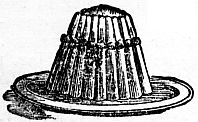
SPONGE-CAKE.
SPONGE-CAKE.
Ingredients.—½ lb. of loaf sugar, not quite ¼ pint of water, 5 eggs, 1 lemon, ½ lb. of flour, ¼ teaspoonful of carbonate of soda. Mode.—Boil the sugar and water together until they form a thick syrup; let it cool a little, then pour it to the eggs, which should be previously well whisked; and after the eggs and syrup are mixed together, continue beating them for a few minutes. Grate the lemon-rind, mix the carbonate of soda with the flour, and stir these lightly to the other ingredients; then add the lemon-juice, and, when the whole is thoroughly mixed, pour it into a buttered mould, and bake in rather a quick oven for rather more than 1 hour. The remains of sponge or Savoy cakes answer very well for trifles, light puddings, &c.; and a very stale one (if not mouldy) makes an excellent tipsy cake. Time.—Rather more than 1 hour. Average cost, 10d. Sufficient to make 1 cake. Seasonable at any time.
SPONGE-CAKES, Small.
Ingredients.—The weight of 5 eggs in flour, the weight of 8 in pounded loaf sugar; flavouring to taste. Mode.—Let the flour be perfectly dry, and the sugar well pounded and sifted. Separate the whites from the yolks of the eggs, and beat the latter up with the sugar; then whisk the whites until they become rather stiff, and mix them with the yolks, but do not stir them more than is just necessary to mingle the ingredients well together. Dredge in the flour by degrees, add the flavouring; butter the tins well, pour in the batter, sift a little sugar over the cakes, and bake them in rather a quick oven, but do not allow them to take too much colour, as they should be rather pale. Remove them from the tins before they get cold, and turn them on their faces, where let them remain until quite cold, when store them away in a closed tin canister or wide-mouthed glass bottle. Time.—10 to 15 minutes in a quick oven. Average cost, 1d. each. Seasonable at any time.
SPRATS.
Sprats should be cooked very fresh, which can be ascertained by their bright and sparkling eyes. Wipe them dry; fasten them in rows by a skewer run through the eyes; dredge with flour, and broil them on a gridiron over a nice clear fire. The gridiron should be rubbed with suet. Serve very hot. Time.—3 or 4 minutes. Average cost, 1d. per lb. Seasonable from November to March.
To Choose Sprats.—Choose these from their silvery appearance, as the brighter they are, so are they the fresher.
SPRATS, Dried.
Dried sprats should be put into a basin, and boiling water poured over them; they may then be skinned and served, and this will be found a much better way than boiling them.
SPRATS, Fried in Batter.
Ingredients.—2 eggs, flour, bread-crumbs; seasoning of salt and pepper to taste. Mode.—Wipe the sprats, and dip them in a batter made of the above ingredients. Fry of a nice brown, serve very hot, and garnish with fried parsley. Sprats may be baked like herrings.
SPROUTS, to Boil Young.
Ingredients.—To each ½ gallon of water allow 1 heaped tablespoonful of salt; a very small piece of soda. Mode.—Pick away all the dead leaves, and wash the greens well in cold water; drain them in a colander, and put them into fast-boiling water, with salt and soda in the above proportion. Keep them boiling quickly, with the lid uncovered, until tender; and the moment they are done, take them up, or their colour will be spoiled; when well drained, serve. The great art in cooking greens properly, and to have them a good colour, is to put them into plenty of fast-boiling water, to let them boil very quickly, and to take them up the moment they become tender. Time.—Brocoli sprouts, 10 to 12 minutes; young greens, 10 to 12 minutes; sprouts, 12 minutes, after the water boils. Seasonable.—Sprouts of various kinds may be had all the year.
STEW, Irish.
Ingredients.—3 lbs. of the loin or neck of mutton, 5 lbs. of potatoes, 5 large onions, pepper and salt to taste, rather more than 1 pint of water. Mode.—Trim off some of the fat of the above quantity of loin or neck of mutton, and cut it into chops of a moderate thickness. Pare and halve the potatoes, and cut the onions into thick slices. Put a layer of potatoes at the bottom of a stewpan, then a layer of mutton and onions, and season with pepper and salt; proceed in this manner until the stewpan is full, taking care to have plenty of vegetables at the top. Pour in the water, and let it stew very gently for 2½ hours, keeping the lid of the stewpan closely shut the whole time, and occasionally shaking the preparation to prevent its burning. Time.—2½ hours. Average cost, for this quantity, 2s. 8d. Sufficient for 5 or 6 persons. Seasonable.—Suitable for a winter dish.
STEW, Irish.
Ingredients.—2 or 3 lbs. of the breast of mutton, 1½ pint of water, salt and pepper to taste, 4 lbs. of potatoes, 4 large onions. Mode.—Put the mutton into a stewpan with the water and a little salt, and let it stew gently for an hour; cut the meat into small pieces, skim the fat from the gravy, and pare and slice the potatoes and onions. Put all the ingredients into the stewpan, in layers, first a layer of vegetables, then one of meat, and sprinkle seasoning of pepper and salt between each layer; cover closely, and let the whole stew very gently for 1 hour, or rather more, shaking it frequently to prevent its burning. Time.—Rather more than 2 hours. Average cost, 1s. 6d. Sufficient for 5 or 6 persons. Seasonable.—Suitable for a winter dish.
Note.—Irish stew may be prepared in the same manner as above, but baked in a jar instead of boiled. About 2 hours or rather more in a moderate oven will be sufficient time to bake it.
STILTON CHEESE.
STILTON CHEESE.
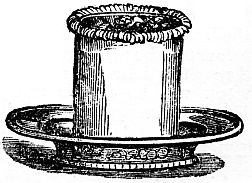
Stilton cheese, or British Parmesan, as it is sometimes called, is generally preferred to all other cheeses by those whose authority few will dispute. Those made in May or June are usually served at Christmas; or, to be in prime order, should be kept from 10 to 12 months, or even longer. An artificial ripeness in Stilton cheese is sometimes produced by inserting a small piece of decayed Cheshire into an aperture at the top. From 3 weeks to a month is sufficient time to ripen the cheese. An additional flavour may also be obtained by scooping out a piece from the top, and pouring therein port, sherry, Madeira, or old ale, and letting the cheese absorb these for two or three weeks. But that cheese is the finest which is ripened without any artificial aid, is the opinion of those who are judges in these matters. In serving a Stilton cheese, the top of it should be cut off to form a lid, and a napkin or piece of white paper, with a frill at the top, pinned round. When the cheese goes from table, the lid should be replaced.
STOCKS for all kinds of Soups (Rich Strong Stock).
Ingredients.—4 lbs. of shin of beef, 4 lbs. of knuckle of veal, ¼ lb. of good lean ham; any poultry trimmings; 2 oz. of butter; 3 onions, 3 carrots, 2 turnips (the latter should be omitted in summer, lest they ferment), 1 head of celery, a few chopped mushrooms, when obtainable; 1 tomato, a bunch of savoury herbs, not forgetting parsley; 1½ oz. of salt, 3 lumps of sugar, 12 white peppercorns, 6 cloves, 3 small blades of mace, 4 quarts of water. Mode.—Line a delicately clean stewpan with the ham cut in thin broad slices, carefully trimming off all its rusty fat; cut up the beef and veal in pieces about 3 inches square, and lay them on the ham; set it on the stove, and draw it down, and stir frequently. When the meat is equally browned, put in the beef and veal bones, the poultry trimmings, and pour in the cold water. Skim well, and occasionally add a little cold water, to stop its boiling, until it becomes quite clear; then put in all the other ingredients, and simmer very slowly for 5 hours. Do not let it come to a brisk boil, that the stock be not wasted, and that its colour may be preserved. Strain through a very fine hair sieve, or cloth, and the stock will be fit for use. Time.—5 hours. Average cost, 1s. 3d. per quart.
STOCK, Economical.
Ingredients.—The liquor in which a joint of meat has been boiled, say 4 quarts; trimmings of fresh meat or poultry, shank-bones, &c., roast-beef bones, any pieces the larder may furnish; vegetables, spices, and the same seasoning as in the foregoing recipe. Mode.—Let all the ingredients simmer gently for 6 hours, taking care to skim carefully at first. Strain it off, and put by for use. Time.—6 hours. Average cost, 3d. per quart.
STOCK, Medium.
Ingredients.—4 lbs. of shin of beef, or 4 lbs. of knuckle of veal, or 2 lbs. of each; any bones, trimmings of poultry, or fresh meat, ¼ lb. of lean bacon or ham, 2 oz. of butter, 2 large onions, each stuck with 3 cloves; 1 turnip, 3 carrots, 1 head of celery, 3 lumps of sugar, 2 oz. of salt, ½ a teaspoonful of whole pepper, 1 large blade of mace, 1 bunch of savoury herbs, 4 quarts and ½ pint of cold water. Mode.—Cut up the meat and bacon or ham into pieces of about 3 inches square; rub the butter on the bottom of the stewpan; put in ½ a pint of water, the meat, and all the other ingredients. Cover the stewpan, and place it on a sharp fire, occasionally stirring its contents. When the bottom of the pan becomes covered with a pale, jelly-like substance, add the 4 quarts of cold water, and simmer very gently for 5 hours. As we have said before, do not let it boil quickly. Remove every particle of scum whilst it is doing, and strain it through a fine hair sieve. This stock is the basis of most of the soups mentioned in this dictionary, and will be found quite strong enough for ordinary purposes. Time.—5½ hours. Average cost, 9d. per quart.
STOCK, To Clarify.
Ingredients.—The whites of 2 eggs, ½ pint of water, 2 quarts of stock. Mode.—Supposing that by some accident the soup is not quite clear, and that its quantity is 2 quarts, take the whites of 2 eggs, carefully separated from their yolks, whisk them well together with the water, and add gradually the 2 quarts of boiling stock, still whisking. Place the soup on the fire, and when boiling and well skimmed, whisk the eggs with it till nearly boiling again; then draw it from the fire, and let it settle, until the whites of the eggs become separated. Pass through a fine cloth, and the soup should be clear.
Note.—The rule is, that all clear soups should be of a light straw-colour, and should not savour too strongly of the meat; and that all white or brown thick soups should have no more consistency than will enable them to adhere slightly to the spoon when hot. All purées should be somewhat thicker.
STOCK, White (to be used in the preparation of White Soups).
Ingredients.—4 lbs. of knuckle of veal, any poultry trimmings, 4 slices of lean ham, 3 carrots, 2 onions, 1 head of celery, 12 white peppercorns, 2 oz. of salt, 1 blade of mace, a bunch of herbs, 1 oz. butter, 4 quarts of water. Mode.—Cut up the veal, and put it with the bones and trimmings of poultry, and the ham, into the stewpan, which has been rubbed with the butter. Moisten with ½ a pint of water, and simmer till the gravy begins to flow. Then add the 4 quarts of water and the remainder of the ingredients; simmer for 5 hours. After skimming and straining it carefully through a very fine hair sieve, it will be ready for use. Time.—5½ hours. Average cost, 9d. per quart.
Note.—When stronger stock is desired, double the quantity of veal, or put in an old fowl. The liquor in which a young turkey has been boiled, is an excellent addition to all white stock or soups.
STOCK, Consommé or White, for many Sauces.
Consommé is made precisely in the same manner as white stock, and, for ordinary purposes, will be found quite good enough. When, however, a stronger stock is desired, either put in half the quantity of water, or double that of the meat. This is a very good foundation for all white sauces.
STRAWBERRY JAM.
Ingredients.—To every lb. of fruit allow ½ pint of red-currant juice, 1¼ lb. of loaf sugar. Mode.—Strip the currants from the stalks, put them into a jar; place this jar in a saucepan of boiling water, and simmer until the juice is well drawn from the fruit; strain the currants, measure the juice, put it into a preserving pan, and add the sugar. Select well-ripened but sound strawberries; pick them from the stalks, and when the sugar is dissolved in the currant-juice, put in the fruit. Simmer the whole over a moderate fire, from ½ to ¾ hour, carefully removing the scum as it rises. Stir the jam only enough to prevent it from burning at the bottom of the pan, as the fruit should be preserved as whole as possible. Put the jam into jars, and when cold, cover down. Time.—½ to ¾ hour, reckoning from the time the jam simmers all over. Average cost, from 7d. to 8d. per lb. pot. Sufficient.—12 pints of strawberries will make 12 lbs. of jam. Seasonable in June and July.
STRAWBERRY JELLY.
Ingredients.—Strawberries, pounded sugar; to every pint of juice allow 1¼ oz. of isinglass. Mode.—Pick the strawberries, put them into a pan, squeeze them well with a wooden spoon, add sufficient pounded sugar to sweeten them nicely, and let them remain for 1 hour, that the juice may be extracted; then add ½ pint of water to every pint of juice. Strain the strawberry-juice and water through a bag; measure it, and to every pint allow 1¼ oz. of isinglass, melted and clarified in ¼ pint of water. Mix this with the juice; put the jelly into a mould, and set the mould in ice. A little lemon-juice added to the strawberry-juice improves the flavour of the jelly, if the fruit is very ripe; but it must be well strained before it is put to the other ingredients, or it will make the jelly muddy. Time.—1 hour to draw the juice. Average cost, with the best isinglass, 3s. Sufficient.—Allow 1½ pint of jelly for 5 or 6 persons. Seasonable in June, July, and August.
STRAWBERRIES and CREAM.
Ingredients.—To every pint of picked strawberries allow 1/3 pint of cream, 2 oz. of finely-pounded sugar. Mode.—Pick the stalks from the fruit, place it on a glass dish, sprinkle over it pounded sugar, and slightly stir the strawberries, that they may all be equally sweetened; pour the cream over the top, and serve. Devonshire cream, when it can be obtained, is exceedingly delicious for this dish; and, if very thick indeed, may be diluted with a little thin cream or milk. Average cost for this quantity, with cream at 1s. per pint, 1s. Sufficient for 2 persons. Seasonable in June and July.
STRAWBERRIES, Preserved in Wine.
Ingredients.—To every quart bottle allow ¼ lb. of finely-pounded loaf sugar; sherry or Madeira. Mode.—Let the fruit be gathered in fine weather, and used as soon as picked. Have ready some perfectly dry glass bottles, and some nice soft corks or bungs. Pick the stalks from the strawberries, drop them into the bottles, sprinkling amongst them pounded sugar in the above proportion, and when the fruit reaches to the neck of the bottle, fill up with sherry or Madeira. Cork the bottles down with new corks, and dip them into melted resin. Seasonable.—Make this in June or July.
STRAWBERRIES, to Preserve Whole.
Ingredients.—To every lb. of fruit allow 1½ lb. of good loaf sugar, 1 pint of red-currant juice. Mode.—Choose the strawberries not too ripe, of a fine large sort and of a good colour. Pick off the stalks, lay the strawberries in a dish, and sprinkle over them half the quantity of sugar, which must be finely pounded. Shake the dish gently, that the sugar may be equally distributed and touch the under-side of the fruit, and let it remain for 1 day. Then have ready the currant-juice, drawn as for red-currant jelly; boil it with the remainder of the sugar until it forms a thin syrup, and in this simmer the strawberries and sugar, until the whole is sufficiently jellied. Great care must be taken not to stir the fruit roughly, as it should be preserved as whole as possible. Strawberries prepared in this manner are very good served in glasses and mixed with thin cream. Time.—¼ hour to 20 minutes to simmer the strawberries in the syrup. Seasonable in June and July.
OPEN TART.
STRAWBERRY, Open Tart of, or any other Kind of Preserve.
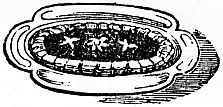
Ingredients.—Trimmings of puff-paste, any kind of jam. Mode.—Butter a tart-pan of the shape shown in the engraving, roll out the paste to the thickness of ½ an inch, and line the pan with it; prick a few holes at the bottom with a fork, and bake the tart in a brisk oven from 10 to 15 minutes. Let the paste cool a little; then fill it with preserve, place a few stars or leaves on it, which have been previously cut out of the paste and baked, and the tart is ready for table. By making it in this manner, both the flavour and colour of the jam are preserved, which would otherwise be lost, were it baked in the oven on the paste; and, besides, so much jam is not required. Time.—10 to 15 min. Average cost, 8d. Sufficient.—1 tart for 3 persons. Seasonable at any time.

OPEN-TART MOULD.
STURGEON, Baked.
Ingredients.—1 small sturgeon, salt and pepper to taste, 1 small bunch of herbs, the juice of ½ lemon, ¼ lb. of butter, 1 pint of white wine. Mode.—Cleanse the fish thoroughly, skin it, and split it along the belly without separating it; have ready a large baking-dish, in which lay the fish, sprinkle over the seasoning and herbs very finely minced, and moisten it with the lemon-juice and wine. Place the butter in small pieces over the whole of the fish, put it in the oven, and baste frequently; brown it nicely, and serve with its own gravy. Time.—Nearly 1 hour. Average cost, 1s. to 1s. 6d. per lb. Seasonable from August to March.
STURGEON, Roast.
Ingredients.—Veal stuffing, buttered paper, the tail-end of a sturgeon. Mode.—Cleanse the fish, bone and skin it; make a nice veal stuffing (see Forcemeats), and fill it with the part where the bones came from; roll it in buttered paper, bind it up firmly with tape, like a fillet of veal, and roast it in a Dutch oven before a clear fire. Serve with good brown gravy, or plain melted butter. Time.—About 1 hour. Average costs, 1s. to 1s. 6d. per lb. Seasonable from August to March.
Note.—Sturgeon maybe plainly boiled, and served with Dutch sauce. The fish is very firm, and requires long boiling.
SUET PUDDING, to serve with Roast Meat.
Ingredients.—1 lb. of flour, 6 oz. of finely-chopped suet, ½ saltspoonful of salt, ½ saltspoonful of pepper, ½ pint of milk or water. Mode.—Chop the suet very finely, after freeing it from skin, and mix it well with the flour; add the salt and pepper (this latter ingredient may be omitted if the flavour is not liked), and make the whole into a smooth paste with the above proportion of milk or water. Tie the pudding in a floured cloth, or put it into a buttered basin, and boil from 2½ to 3 hours. To enrich it, substitute 3 beaten eggs for some of the milk or water, and increase the proportion of suet. Time.—2½ to 3 hours. Average cost, 6d. Sufficient for 5 or 6 persons. Seasonable at any time.
Note.—When there is a joint roasting or baking, this pudding may be boiled in a long shape, and then cut into slices a few minutes before dinner is served; these slices should be laid in the dripping-pan for a minute or two, and then browned before the fire. Most children like this accompaniment to roast-meat.
SUGAR, to Boil, to Caramel.
Ingredients.—To every lb. of lump sugar allow 1 gill of spring water. Mode.—Boil the sugar and water together very quickly over a clear fire, skimming it very carefully as soon as it boils. Keep it boiling until the sugar snaps when a little of it is dropped in a pan of cold water. If it remains hard, the sugar has attained the right degree; then squeeze in a little lemon-juice, and let it remain an instant on the fire. Set the pan into another of cold water, and the caramel is then ready for use. The insides of well-oiled moulds are often ornamented with this sugar, which with a fork should be spread over them in fine threads or network. A dish of light pastry, tastefully arranged, looks very pretty with this sugar spun lightly over it.
SUPPERS.
Much may be done in the arrangement of a supper-table, at a very small expense, provided taste and ingenuity are exercised. The colours and flavours of the various dishes should contrast nicely; there should be plenty of fruit and flowers on the table, and the room should be well lighted. We have endeavoured to show how the various dishes may be placed; but of course these little matters entirely depend on the length and width of the table used, on individual taste, whether the tables are arranged round the room, whether down the centre, with a cross one at the top, or whether the supper is laid in two separate rooms, &c., &c. The garnishing of the dishes has also much to do with the appearance of a supper-table. Hams and tongues should be ornamented with cut vegetable flowers, raised pies with aspic jelly cut in dice, and all the dishes garnished sufficiently to be in good taste without looking absurd. The eye, in fact, should be as much gratified as the palate. Hot soup is now often served at suppers, but is not placed on the table. The servants fill the plates from a tureen on the buffet, and then hand them to the guests: when these plates are removed, the business of supper commences.
Where small rooms and large parties necessitate having a standing supper, many things enumerated in the following bill of fare may be placed on the buffet. Dishes for these suppers should be selected which may be eaten standing without any trouble. The following list may, perhaps, assist our readers in the arrangement of a buffet for a standing supper.
Beef, ham, and tongue-sandwiches, lobster and oyster-patties, sausage-rolls, meat-rolls, lobster-salad, dishes of fowls, the latter all cut up; dishes of sliced ham, sliced tongue, sliced beef, and galantine of veal; various jellies, blancmanges, and creams; custards in glasses, compôtes of fruit, tartlets of jam, and several dishes of small fancy pastry; dishes of fresh fruit, bon-bons, sweetmeats, two or three sponge-cakes, a few plates of biscuits, and the buffet ornamented with vases of fresh or artificial flowers. The above dishes are quite sufficient for a standing supper; where more are desired, a supper must then be laid and arranged in the usual manner.
SUPPER, BILL OF FARE FOR A BALL, FOR 60 PERSONS (for Winter).
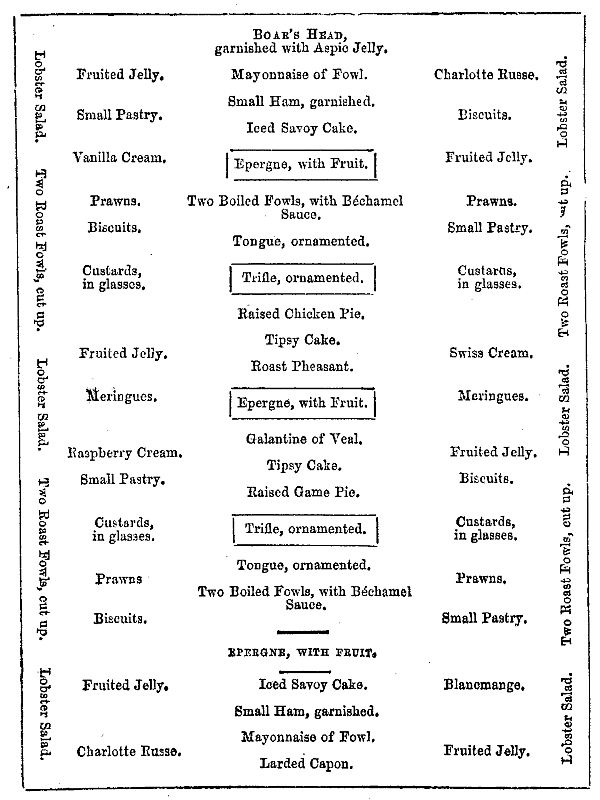
Boar’s Head garnished with Aspic Jelly. Lobster Salad. Lobster Salad. Fruited Jelly. Mayonnaise of Fowl. Charlotte Russe. Small Ham, garnished. Small Pastry. Biscuits. Iced Savoy Cake. Vanilla Cream. Epergne, with Fruit. Fruited Jelly. Two Roast Fowls, cut up. Two Roast Fowls, cut up. Prawns. Two Boiled Fowls, with Béchamel Sauce. Prawns. Biscuits. Small Pastry. Tongue, ornamented. Custards, in glasses. Trifle, ornamented. Custards, in glasses. Raised Chicken Pie. Tipsy Cake. Fruited Jelly. Swiss Cream. Roast Pheasant. Lobster Salad. Lobster Salad. Meringues. Epergne, with Fruit. Meringues. Galantine of Veal. Raspberry Cream. Fruited Jelly. Tipsy Cake. Small Pastry. Biscuits. Raised Game Pie. Two Roast Fowls, cut up. Two Roast Fowls, cut up. Custards, in glasses. Trifle, ornamented. Custards, in glasses. Tongue, ornamented. Prawns. Two Boiled Fowls, with Béchamel Sauce. Prawns. Biscuits. Small Pastry. —— EPERGNE, WITH FRUIT. —— Fruited Jelly. Iced Savoy Cake. Blancmange. Lobster Salad. Lobster Salad. Small Ham, garnished. Mayonnaise of Fowl. Charlotte Russe. Fruited Jelly. Larded Capon.
Note.—When soup is served from the buffet, Mock Turtle and Julienne may be selected. Besides the articles enumerated above, Ices, Wafers, Biscuits, Tea, Coffee, Wines, and Liqueurs will be required. Punch à la Romaine may also be added to the list of beverages.
SUPPER, BILL OF FARE FOR A BALL,
Or a Cold Collation for a Summer Entertainment, or Wedding or Christening Breakfast for 70 or 80 Persons (July),
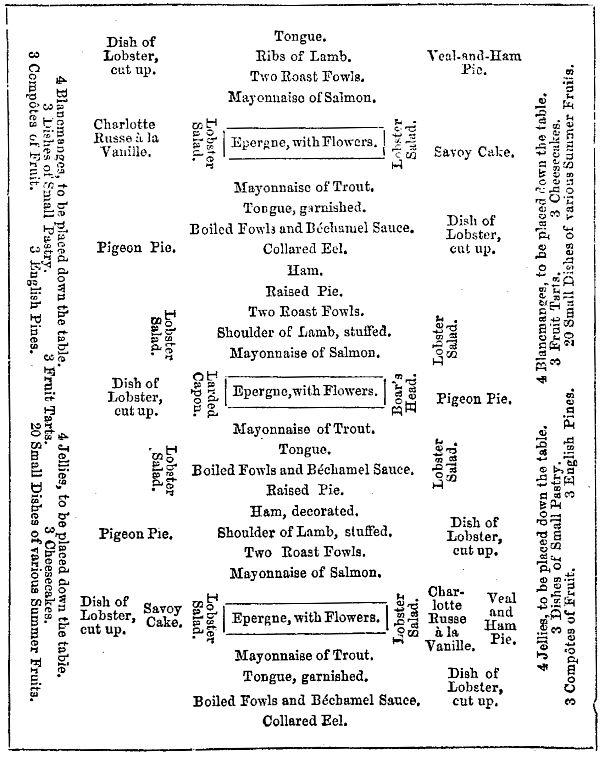
Dish of Lobster, cut up. Tongue. 3 Compôtes of Fruit. Ribs of Lamb. Veal-and-Ham Pie. 20 Small Dishes of various Summer Fruits. Two Roast Fowls. 4 Blancmanges, to be placed down the table. 3 Dishes of Small Pastry. Mayonnaise of Salmon. Charlotte Russe à la Vanille. Lobster Salad. Epergne, with Flowers. Lobster Salad. Savoy Cake. Mayonnaise of Trout. Tongue, garnished. Dish of Lobster, cut up. Boiled Fowls and Béchamel Sauce. Pigeon Pie. Collared Eel. 3 English Pines. Ham. Raised Pie. Lobster Salad. Two Roast Fowls. Lobster Salad. Shoulder of Lamb, stuffed. Mayonnaise of Salmon. Dish of Lobster, cut up. 3 Fruit Tarts. Larded Capon. Epergne, with Flowers. Boar’s Head. Pigeon Pie. Mayonnaise of Trout. Tongue. Lobster Salad. Boiled Fowls and Béchamel Sauce. Lobster Salad. Raised Pie. Ham, decorated. Dish of Lobster, cut up. 3 Cheesecakes. Pigeon Pie. Shoulder of Lamb, stuffed. Dish of Lobster, cut up. 4 Jellies, to be placed down the table. Two Roast Fowls. Mayonnaise of Salmon. Charlotte Russe à la Vanille. Veal and Ham Pie. Dish of Lobster, cut up. Savoy Cake. Lobster Salad. Epergne, with Flowers. Lobster Salad. Mayonnaise of Trout. Dish of Lobster, cut up. Tongue, garnished. Boiled Fowls and Béchamel Sauce. Collared Eel.
Note.—The length of the page will not admit of our giving the dishes as they should be placed on the table; they should be arranged with the large and high dishes down the centre, and the spaces filled up with the smaller dishes, fruit, and flowers, taking care that the flavours and colours contrast nicely, and that no two dishes of a sort come together. This bill of fare may be made to answer three or four purposes, placing a wedding cake or christening cake in the centre on a high stand, if required for either of these occasions. A few dishes of fowls, lobster salads, &c. &c., should be kept in reserve to replenish those that are most likely to be eaten first. A joint of cold roast and boiled beef should be placed on the buffet, as being something substantial for the gentlemen of the party to partake of. Besides the articles enumerated in the bill of fare, biscuits and wafers will be required, cream-and-water ices, tea, coffee, wines, liqueurs, soda-water, ginger-beer, and lemonade.
SWEETBREADS, Baked (an Entrée).
Ingredients.—3 sweetbreads, egg and bread-crumbs, oiled butter, 3 slices of toast, brown gravy. Mode.—Choose large white sweetbreads; put them into warm water to draw out the blood, and to improve their colour; let them remain for rather more than 1 hour; then put them into boiling water, and allow them to simmer for about 10 minutes, which renders them firm. Take them up, drain them, brush over with egg, sprinkle with bread-crumbs; dip them in egg again, and then into more bread-crumbs. Drop on them a little oiled butter, and put the sweetbreads into a moderately-heated oven, and let them bake for nearly ¾ hour. Make 3 pieces of toast; place the sweetbreads on the toast, and pour round, but not over them, a good brown gravy. Time.—To soak 1 hour, to be boiled 10 minutes, baked 40 minutes. Average cost, 1s. to 5s. Sufficient for an entrée. Seasonable.—In full season from May to August.

SWEETBREADS.
SWEETBREADS, Fried (à la Maître d’Hôtel), an Entrée.
Ingredients.—3 sweetbreads, egg and bread-crumbs, ¼ lb. of butter, salt and pepper to taste, rather more than ½ pint of maître-d’hôtel sauce. Mode.—Soak the sweetbreads in warm water for an hour; then boil them for 10 minutes; cut them in slices, egg and bread-crumb them, season with pepper and salt, and put them into a frying-pan, with the above proportion of butter. Keep turning them until done, which will be in about 10 minutes; dish them, and pour over them a maître-d’hôtel sauce. The dish may be garnished with slices of cut lemon. Time.—To soak 1 hour, to be boiled 10 minutes, to be fried about 10 minutes. Average cost, 1s. to 5s., according to the season. Sufficient for an entrée. Seasonable.—In full season from May to August.
Note.—The egg and bread-crumb may be omitted, and the slices of sweetbread dredged with a little flour instead, and a good gravy may be substituted for the maître-d’hôtel sauce. This is a very simple method of dressing them.
SWEETBREADS, Stewed (an Entrée).
Ingredients.—3 sweetbreads, 1 pint of white stock, thickening of butter and flour, 6 tablespoonfuls of cream, 1 tablespoonful of lemon-juice, 1 blade of pounded mace, white pepper and salt to taste. Mode.—Soak the sweetbreads in warm water for 1 hour, and boil them for 10 minutes; take them out, put them into cold water for a few minutes; lay them in a stewpan with the stock, and simmer them gently for rather more than ½ hour. Dish them; thicken the gravy with a little butter and flour; let it boil up, add the remaining ingredients, allow the sauce to get quite hot, but not boil, and pour it over the sweetbreads. Time.—To soak 1 hour, to be boiled 10 minutes, stewed rather more than ½ hour. Average cost, from 1s. to 5s., according to the season. Sufficient for an entrée. Seasonable.—In full season from May to August.
Note.—A few mushrooms added to this dish, and stewed with the sweetbreads, will be found an improvement.
SWEETBREADS, Lambs’, larded, and Asparagus (an Entrée).
Ingredients.—2 or 3 sweetbreads, ½ pint of veal stock, white pepper and salt to taste, a small bunch of green onions, 1 blade of pounded mace, thickening of butter and flour, 2 eggs, nearly ½ pint of cream, 1 teaspoonful of minced parsley, a very little grated nutmeg. Mode.—Soak the sweetbreads in lukewarm water, and put them into a saucepan with sufficient boiling water to cover them, and let them simmer for 10 minutes; then take them out and put them into cold water. Now lard them, lay them in a stewpan, add the stock, seasoning, onions, mace, and a thickening of butter and flour, and stew gently for ¼ hour or 20 minutes. Beat up the egg with the cream, to which add the minced parsley and a very little grated nutmeg. Put this to the other ingredients; stir it well till quite hot, but do not let it boil after the cream is added, or it will curdle. Have ready some asparagus-tops, boiled; add these to the sweetbreads, and serve. Time.—Altogether ½ hour. Average cost, 2s. 6d. to 3s. 6d. each. Sufficient.—3 sweetbreads for 1 entrée. Seasonable from Easter to Michaelmas.
SWEETBREADS, another Way to Dress (an Entrée).
Ingredients.—Sweetbreads, egg and bread-crumbs, ½ pint of gravy, ½ glass of sherry. Mode.—Soak the sweetbreads in water for an hour, and throw them into boiling water to render them firm. Let them stew gently for about ¼ hour, take them out and put them into a cloth to drain all the water from them. Brush them over with egg, sprinkle them with bread-crumbs, and either brown them in the oven or before the fire. Have ready the above quantity of gravy, to which add ½ glass of sherry; dish the sweetbreads, pour the gravy under them, and garnish with water-cresses. Time.—Rather more than ½ hour. Average cost, 2s. 6d. to 3s. 6d. each. Sufficient—3 sweetbreads for 1 entrée. Seasonable, from Easter to Michaelmas.
SYLLABUB.
Ingredients.—1 pint of sherry or white wine, ½ grated nutmeg, sugar to taste, 1½ pint of milk. Mode.—Put the wine into a bowl, with the grated nutmeg and plenty of pounded sugar, and milk into it the above proportion of milk from the cow. Clouted cream may be laid on the top, with pounded cinnamon or nutmeg and sugar; and a little brandy may be added to the wine before the milk is put in. In some counties, cider is substituted for the wine: when this is used, brandy must always be added. Warm milk may be poured on from a spouted jug or teapot; but it must be held very high. Average cost, 2s. Sufficient for 5 or 6 persons. Seasonable at any time.
SYLLABUBS, Whipped.
Ingredients.—½ pint of cream, ¼ pint of sherry, half that quantity of brandy, the juice of ½ lemon, a little grated nutmeg, 3 oz. of pounded sugar, whipped cream the same as for trifle. Mode.—Mix all the ingredients together, put the syllabub into glasses, and over the top of them heap a little whipped cream, made in the same manner as for trifle. Solid syllabub is made by whisking or milling the mixture to a stiff froth, and putting it in the glasses, without the whipped cream at the top. Average cost, 1s. 8d. Sufficient to fill 8 or 9 glasses. Seasonable at any time.
SYRUP for Jellies, to Clarify.
Ingredients.—To every quart of water allow 2 lbs. of loaf sugar; the white of 1 egg. Mode.—Put the sugar and water into a stewpan; set it on the fire, and, when the sugar is dissolved, add the white of the egg, whipped up with a little water. Whisk the whole well together, and simmer very gently until it has thrown up all the scum. Take this off as it rises, strain the syrup through a fine sieve or cloth into a basin, and keep it for use.
TAPIOCA PUDDING.
Ingredients.—3 oz. of tapioca, 1 quart of milk, 2 oz. of butter, ¼ lb. of sugar, 4 eggs, flavouring of vanilla, grated lemon-rind, or bitter almonds. Mode.—Wash the tapioca, and let it stew gently in the milk by the side of the fire for ¼ hour, occasionally stirring it; then let it cool a little; mix with it the butter, sugar, and eggs, which should be wall beaten, and flavour with either of the above ingredients, putting in about 12 drops of the essence of almonds or vanilla, whichever is preferred. Butter a pie-dish, and line the edges with puff-paste; put in the pudding, and bake in a moderate oven for an hour. If the pudding is boiled, add a little more tapioca, and boil it in a buttered basin 1½ hour. Time.—1 hour to bake, 1½ hour to boil. Average cost, 1s. 2d. Sufficient for 5 or 6 persons. Seasonable at any time.
TAPIOCA SOUP.
Ingredients.—5 oz. of tapioca, 2 quarts of stock. Mode.—Put the tapioca into cold stock, and bring it gradually to a boil. Simmer gently till tender, and serve. Time.—Rather more than 1 hour. Average cost, 1s. 6d. per quart. Seasonable all the year. Sufficient for 8 persons.
TARTLETS.
Ingredients.—Trimmings of puff-paste, any jam or marmalade that may be preferred. Mode.—Roll out the paste to the thickness of about ½ inch; butter some small round patty-pans, line them with it, and cut off the superfluous paste close to the edge of the pan. Put a small piece of bread into each tartlet (this is to keep them in shape), and bake in a brisk oven for about 10 minutes, or rather longer. When they are done, and are of a nice colour, take the pieces of bread out carefully, and replace them by a spoonful of jam or marmalade. Dish them high on a white d’oyley, piled high in the centre, and serve. Time.—10 to 15 minutes. Average cost, 1d. each. Sufficient.—1 lb. of paste will make 2 dishes of tartlets. Seasonable at any time.
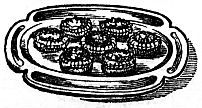
DISH OF TARTLETS.
TARTLETS, Polish.
Ingredients.—Puff-paste, the white of an egg, pounded sugar. Mode.—Roll some good puff-paste out thin, and cut it into 2½-inch squares; brush each square over with the white of an egg, then fold down the corners, so that they all meet in the middle of each piece of paste; slightly press the two pieces together, brush them over with the egg, sift over sugar, and bake in a nice quick oven for about ¼ hour. When they are done, make a little hole in the middle of the paste, and fill it up with apricot jam, marmalade, or red-currant jelly. Pile them high in the centre of a dish, on a napkin, and garnish with the same preserve the tartlets are filled with. Time.—¼ hour or 20 minutes. Average cost, with ½ lb. of puff-paste, 1s. Sufficient for 2 dishes of pastry. Seasonable at any time.
Note.—It should be borne in mind, that, for all dishes of small pastry, such as the preceding, trimmings of puff-paste, left from larger tarts, answer as well as making the paste expressly.
TEA, to make.
There is very little art in making good tea; if the water is boiling, and there is no sparing of the fragrant leaf, the beverage will almost invariably be good. The old-fashioned plan of allowing a teaspoonful to each person, and one over, is still practised. Warm the teapot with boiling water; let it remain for two or three minutes for the vessel to become thoroughly hot, then pour it away. Put in the tea, pour in from ½ to ¾ pint of boiling water, close the lid, and let it stand for the tea to draw from 5 to 10 minutes; then fill up the pot with water. The tea will be quite spoiled unless made with water that is actually boiling, as the leaves will not open, and the flavour not be extracted from them; the beverage will consequently be colourless and tasteless,—in fact, nothing but tepid water. Where there is a very large party to make tea for, it is a good plan to have two teapots, instead of putting a large quantity of tea into one pot; the tea, besides, will go farther. When the infusion has been once completed, the addition of fresh tea adds very little to the strength; so, when more is required, have the pot emptied of the old leaves, scalded, and fresh tea made in the usual manner. Economists say that a few grains of carbonate of soda, added before the boiling water is poured on the tea, assist to draw out the goodness; if the water is very hard, perhaps it is a good plan, as the soda softens it; but care must be taken to use this ingredient sparingly, as it is liable to give the tea a soapy taste if added in too large a quantity. For mixed tea, the usual proportion is four spoonfuls of black to one of green; more of the latter when the flavour is very much liked; but strong green tea is highly pernicious, and should never be partaken of too freely. Time.—2 minutes to warm the teapot, 5 to 10 minutes to draw the strength from the tea. Sufficient.—Allow 1 teaspoonful to each person.
TEA-CAKES.
Ingredients.—2 lbs. of flour, ½ teaspoonful of salt, ¼ lb. of butter or lard, 1 egg, a piece of German yeast the size of a walnut, warm milk. Mode.—Put the flour (which should be perfectly dry) into a basin; mix with it the salt, and rub in the butter or lard; then beat the egg well, stir to it the yeast, and add these to the flour with as much warm milk as will make the whole into a smooth paste, and knead it well. Let it rise near the fire, and, when well risen, form it into cakes; place them on tins, let them rise again for a few minutes before putting them into the oven, and bake from ¼ to ½ hour in a moderate oven. These are very nice with a few currants and a little sugar added to the other ingredients, they should be put in after the butter is rubbed in. These cakes should be buttered, and eaten hot as soon as baked; but, when stale, they are very nice split and toasted; or, if dipped in milk, or even water, and covered with a basin in the oven till hot, they will be almost equal to new. Time.—¼ to ½ hour. Average cost, 10d. Sufficient to make 8 tea-cakes. Seasonable at any time.
TEA-CAKES, to toast.
Cut each tea-cake into three or four slices, according to its thickness; toast them on both sides before a nice clear fire, and as each slice is done, spread it with butter on both sides. When a cake is toasted, pile the slices one on the top of the other, cut them into quarters, put them on a very hot plate, and send the cakes immediately to table. As they are wanted, send them in hot, one or two at a time, as, if allowed to stand, they spoil, unless kept in a muffin-plate over a basin of boiling water.

TEA-CAKES.
TEAL, Roast.
Ingredients.—Teal, butter, a little flour. Mode.—Choose fat, plump birds, after the frost has set in, as they are generally better flavoured; truss them in the same manner as wild duck; roast them before a brisk fire, and keep them well basted. Serve with brown or orange gravy, water-cresses, and a cut lemon. The remains of teal make excellent hash. Time.—From 9 to 15 minutes. Average cost, 1s. each; but seldom bought. Sufficient.—2 for a dish. Seasonable from October to February.
TEAL.
Teal, being of the same character as widgeon and wild duck, may be treated, in carving, in the same style.
TENCH, Matelot of.
Ingredients.—½ pint of stock, ½ pint of port wine, 1 dozen button onions, a few mushrooms, a faggot of herbs, 2 blades of mace, 1 oz. of butter, 1 teaspoonful of minced parsley, thyme, 1 shalot, 2 anchovies, 1 teacupful of stock, flour, 1 dozen oysters, the juice of ½ lemon; the number of tench, according to size. Mode.—Scale and clean the tench, cut them into pieces, and lay them in a stewpan; add the stock, wine, onions, mushrooms, herbs, and mace, and simmer gently for ½ hour. Put into another stewpan all the remaining ingredients but the oysters and lemon-juice, and boil slowly for 10 minutes, when add the strained liquor from the tench, and keep stirring it over the fire until somewhat reduced. Rub it through a sieve, pour it over the tench with the oysters, which must be previously scalded in their own liquor, squeeze in the lemon-juice, and serve. Garnish with croûtons. Time.—¾ hour. Seasonable from October to June.
TENCH, Stewed with Wine.
Ingredients.—½ pint of stock, ½ pint of Madeira or sherry, salt and pepper to taste, 1 bay-leaf, thickening of butter and flour. Mode.—Clean and crimp the tench, carefully lay it in a stewpan with the stock, wine, salt and pepper, and bay-leaf, let it stew gently for ½ hour; then take it out, put it on a dish, and keep hot. Strain the liquor, and thicken it with butter and flour kneaded together, and stew for 5 minutes. If not perfectly smooth, squeeze it through a tammy, add a very little cayenne, and pour over the fish. Garnish with balls of veal forcemeat. Time.—Rather more than ½ hour. Seasonable from October to June.
TENDRONS DE VEAU, Stewed (an Entrée).
Ingredients.—The gristles from 2 breasts of veal, white stock, 1 faggot of savoury herbs, 2 blades of pounded mace, 4 cloves, 2 carrots, 2 onions, a strip of lemon-peel. Mode.—The tendrons or gristles, which are found round the front of a breast of veal, are now very frequently served as an entrée, and when well dressed, make a nice and favourite dish. Detach the gristles from the bone, and cut them neatly out, so as not to spoil the joint for roasting or stewing. Put them into a stewpan, with sufficient stock to cover them; add the herbs, mace, cloves, carrots, onions, and lemon, and simmer these for nearly, or quite, 4 hours. They should be stewed until a fork will enter the meat easily. Take them up, drain them, strain the gravy, boil it down to a glaze, with which glaze the meat. Dish the tendrons in a circle with croûtons fried of a nice colour placed between each; and put mushroom sauce, or a purée of green peas or tomatoes, in the middle. Time.—4 hours. Sufficient for 1 entrée. Seasonable.—With peas, from June to August.
TENDRONS DE VEAU (an Entrée).
Ingredients.—The gristles from 2 breasts of veal, white stock, 1 faggot of savoury herbs, 1 blade of pounded mace, 4 cloves, 2 carrots, 2 onions, a strip of lemon-peel, egg and bread-crumbs, 2 tablespoonfuls of chopped mushrooms, salt and pepper to taste, 2 tablespoonfuls of sherry, the yolk of 1 egg, 3 tablespoonfuls of cream. Mode.—After removing the gristles from a breast of veal, stew them for 4 hours, as in the preceding recipe, with stock, herbs, mace, cloves, carrots, onions, and lemon-peel. When perfectly tender, lift them out and remove any bones or hard parts remaining. Put them between two dishes, with a weight on the top, and when cold, cut them into slices. Brush these over with egg, sprinkle with bread-crumbs, and fry a pale brown. Take ½ pint of the gravy they were boiled in, add 2 tablespoonfuls of chopped mushrooms, a seasoning of salt and pepper, the sherry, and the yolk of an egg beaten with 3 tablespoonfuls of cream. Stir the sauce over the fire until it thickens; when it is on the point of boiling, dish the tendrons in a circle, and pour the sauce in the middle. Tendrons are dressed in a variety of ways,—with sauce à l’Espagnole, vegetables of all kinds: when they are served with a purée, they should always be glazed. Time.—4½ hours. Average cost.—Usually bought with breast of veal. Sufficient for an entrée. Seasonable from March to October.
TETE DE VEAU EN TORTUE (an Entrée).
Ingredients.—Half a calf’s head, or the remains of a cold boiled one; rather more than 1 pint of good white stock, 1 glass of sherry or Madeira, cayenne and salt to taste, about 12 mushroom-buttons (when obtainable), 6 hard-boiled eggs, 4 gherkins, 8 quenelles, or forcemeat balls, 12 crayfish, 12 croûtons. Mode.—Half a calf’s head is sufficient to make a good entrée, and if there are any remains of a cold one left from the preceding day, it will answer very well for this dish. After boiling the head until tender, remove the bones, and cut the meat into neat pieces; put the stock into a stewpan, add the wine, and a seasoning of salt and cayenne; fry the mushrooms in butter for 2 or 3 minutes, and add these to the gravy. Boil this quickly until somewhat reduced; then put in the yolks of the hard-boiled eggs whole, and the whites cut in small pieces, and the gherkins chopped. Have ready a few veal quenelles, add these, with the slices of head, to the other ingredients, and let the whole get thoroughly hot, without boiling. Arrange the pieces of head as high in the centre of the dish as possible; pour over them the ragoût, and garnish with the crayfish and croûtons placed alternately. A little of the gravy should also be served in a tureen. Time.—About ½ hour to reduce the stock. Sufficient for 6 or 7 persons. Average cost, exclusive of the calf’s head, 2s. 9d. Seasonable from March to October.
TIPSY CAKE.
TIPSY CAKE.
Ingredients.—1 moulded sponge or Savoy cake, sufficient sweet wine or sherry to soak it, 6 tablespoonfuls of brandy, 2 oz. of sweet almonds, 1 pint of rich custard. Mode.—Procure a cake that is three or four days old,—either sponge, Savoy, or rice answering for the purpose of a tipsy cake. Cut the bottom of the cake level, to make it stand firm in the dish; make a small hole in the centre, and pour in and over the cake sufficient sweet wine or sherry, mixed with the above proportion of brandy, to soak it nicely. When the cake is well soaked, blanch and cut the almonds into strips, stick them all over the cake, and pour round it a good custard, made by our recipe, allowing 8 eggs instead of 5 to the pint of milk. The cakes are sometimes crumbled and soaked, and a whipped cream heaped over them, the same as for trifles. Time.—About 2 hours to soak the cake. Average cost, 4s. 6d. Sufficient for 1 dish. Seasonable at any time.
TIPSY CAKE, an easy way of making.
Ingredients.—12 stale small sponge-cakes, raisin wine, ½ lb. of jam, 1 pint of custard (see Custard). Mode.—Soak the sponge-cakes, which should be stale (on this account they should be cheaper), in a little raisin wine; arrange them on a deep glass dish in four layers, putting a layer of jam between each, and pour round them a pint of custard, made by recipe, decorating the top with cut preserved-fruit. Time.—2 hours to soak the cakes. Average cost, 2s. 6d. Sufficient for 1 dish. Seasonable at any time.
TOAD-IN-THE-HOLE (Cold Meat Cookery).
Ingredients.—6 oz. of flour, 1 pint of milk, 3 eggs, butter, a few slices of cold mutton, pepper and salt to taste, 2 kidneys. Mode.—Make a smooth batter of flour, milk, and eggs in the above proportion; butter a baking-dish, and pour in the batter. Into this place a few slices of cold mutton, previously well seasoned, and the kidneys, which should be cut into rather small pieces; bake about 1 hour, or rather longer, and send it to table in the dish it was baked in. Oysters or mushrooms may be substituted for the kidneys, and will be found exceedingly good. Time.—Rather more than 1 hour. Average cost, exclusive of the cold meat, 8d. Seasonable at any time.
TOAD-IN-THE-HOLE (a Homely but Savoury Dish).
Ingredients.—1½ lb. of rump-steak, 1 sheep’s kidney, pepper and salt to taste. For the batter, 3 eggs, 1 pint of milk, 4 tablespoonfuls of flour, ½ saltspoonful of salt. Mode.—Cut up the steak and kidney into convenient-sized pieces, and put them into a pie-dish, with a good seasoning of salt and pepper; mix the flour with a small quantity of milk at first, to prevent its being lumpy; add the remainder, and the 3 eggs, which should be well beaten; put in the salt, stir the batter for about 5 minutes, and pour it over the steak. Place it in a tolerably brisk oven immediately, and bake for 1½ hour. Time.—1½ hour. Average cost, 1s. 9d. Sufficient for 4 or 5 persons. Seasonable at any time.
Note.—The remains of cold beef, rather underdone, may be substituted for the steak, and, when liked, the smallest possible quantity of minced onion or shalot may be added.
TOAST, to make Dry.
To make dry toast properly, a great deal of attention is required; much more, indeed, than people generally suppose. Never use new bread for making any kind of toast, as it eats heavy, and, besides, is very extravagant. Procure a loaf of household bread about two days old; cut off as many slices as may be required, not quite ¼ inch in thickness; trim off the crusts and ragged edges, put the bread on a toasting-fork, and hold it before a very clear fire. Move it backwards and forwards until the bread is nicely coloured; then turn it and toast the other side, and do not place it so near the fire that it blackens. Dry toast should be more gradually made than buttered toast, as its great beauty consists in its crispness, and this cannot be attained unless the process is slow and the bread is allowed gradually to colour. It should never be made long before it is wanted, as it soon becomes tough, unless placed on the fender in front of the fire. As soon as each piece is ready, it should be put into a rack, or stood upon its edges, and sent quickly to table.
TOAST, to make Hot Buttered.
A loaf of household bread about two days old answers for making toast better than cottage bread, the latter not being a good shape, and too crusty for the purpose. Cut as many nice even slices as may be required, rather more than ¼ inch in thickness, and toast them before a very bright fire, without allowing the bread to blacken, which spoils the appearance and flavour of all toast. When of a nice colour on both sides, put it on a hot plate; divide some good butter into small pieces, place them on the toast, set this before the fire, and when the butter is just beginning to melt, spread it lightly over the toast. Trim off the crust and ragged edges, divide each round into 4 pieces, and send the toast quickly to table. Some persons cut the slices of toast across from corner to corner, so making the pieces of a three-cornered shape. Soyer recommends that each slice should be cut into pieces as soon as it is buttered, and when all are ready, that they should be piled lightly on the dish they are intended to be served on. He says that by cutting through 4 or 5 slices at a time, all the butter is squeezed out of the upper ones, while the bottom one is swimming in fat liquid. It is highly essential to use good butter for making this dish.
TOAST-AND-WATER.
Ingredients.—A slice of bread, 1 quart of boiling water. Mode.—Cut a slice from a stale loaf (a piece of hard crust is better than anything else for the purpose), toast it of a nice brown on every side, but do not allow it to burn or blacken. Put it into a jug, pour the boiling water over it, cover it closely, and let it remain until cold. When strained, it will be ready for use. Toast-and-water should always be made a short time before it is required, to enable it to get cold: if drunk in a tepid or lukewarm state, it is an exceedingly disagreeable beverage. If, as is sometimes the case, this drink is wanted in a hurry, put the toasted bread into a jug, and only just cover it with the boiling water; when this is cool, cold water may be added in the proportion required, the toast-and-water strained; it will then be ready for use, and is more expeditiously prepared than by the above method.
TOAST SANDWICHES.
Ingredients.—Thin cold toast, thin slices of bread-and-butter, pepper and salt to taste. Mode.—Place a very thin piece of cold toast between 2 slices of thin bread-and-butter in the form of a sandwich, adding a seasoning of pepper and salt. This sandwich may be varied by adding a little pulled meat, or very fine slices of cold meat, to the toast, and in any of these forms will be found very tempting to the appetite of an invalid.
TOFFEE, Everton.
Ingredients.—1 lb. of powdered loaf sugar, 1 teacupful of water, ¼ lb. of butter, 6 drops of essence of lemon. Mode.—Put the water and sugar into a brass pan, and beat the butter to a cream. When the sugar is dissolved, add the butter, and keep stirring the mixture over the fire until it sets, when a little is poured on to a buttered dish; and just before the toffee is done, add the essence of lemon. Butter a dish or tin, pour on it the mixture, and when cool, it will easily separate from the dish. Butter-Scotch, an excellent thing for coughs, is made with brown, instead of white sugar, omitting the water, and flavoured with ½ oz. of powdered ginger. It is made in the same manner as toffee. Time.—18 to 35 minutes. Average cost, 10d. Sufficient to make a lb. of toffee.
TOMATO SAUCE for Keeping (Excellent).
Ingredients.—To every quart of tomato-pulp allow 1 pint of cayenne vinegar, ¾ oz. of shalots, ¾ oz. of garlic, peeled and cut in slices; salt to taste. To every six quarts of liquor, 1 pint of soy, 1 pint of anchovy-sauce. Mode.—Gather the tomatoes quite ripe; bake them in a slow oven till tender; rub them through a sieve, and to every quart of pulp add cayenne vinegar, shalots, garlic, and salt, in the above proportion; boil the whole together till the garlic and shalots are quite soft; then rub it through a sieve, put it again into a saucepan, and, to every six quarts of the liquor, add 1 pint of soy and the same quantity of anchovy-sauce, and boil altogether for about 20 minutes; bottle off for use, and carefully seal or resin the corks. This will keep good for 2 or 3 years, but will be fit for use in a week. A useful and less expensive sauce may be made by omitting the anchovy and soy. Time.—Altogether 1 hour. Seasonable.—Make this from the middle of September to the end of October.
TOMATO SAUCE for Keeping (Excellent).
Ingredients.—1 dozen tomatoes, 2 teaspoonfuls of the best powdered ginger, 1 dessertspoonful of salt, 1 head of garlic chopped fine, 2 tablespoonfuls of vinegar, 1 dessertspoonful of Chili vinegar (a small quantity of cayenne may be substituted for this). Mode.—Choose ripe tomatoes, put them into a stone jar, and stand them in a cool oven until quite tender; when cold, take the skins and stalks from them, mix the pulp with the liquor which is in the jar, but do not strain it; add all the other ingredients, mix well together, and put it into well-sealed bottles. Stored away in a cool, dry place, it will keep good for years. It is ready for use as soon as made, but the flavour is better after a week or two. Should it not appear to keep, turn it out, and boil it up with a little additional ginger and cayenne. For immediate use, the skins should be put into a wide-mouthed bottle with a little of the different ingredients, and they will be found very nice for hashes or stews. Time.—4 or 5 hours in a cool oven. Seasonable from the middle of September to the end of October.