THE DICTIONARY OF COOKERY. (continued 2)
Reading edition
BARBERRIES, to preserve in Bunches.
Ingredients.—1 pint of syrup, barberries. Mode.—Prepare some small pieces of clean white wood, 3 inches long and ¼ inch wide, and tie the fruit on to these in nice bunches. Have ready some clear syrup (see Syrup); put in the barberries, and simmer them in it for 2 successive days, boiling them for nearly ½ hour each day, and covering them each time with the syrup when cold. When the fruit looks perfectly clear it is sufficiently done, and should be stowed away in pots, with the syrup poured over, or the fruit may be candied. Time.—½ hour to simmer each day. Seasonable in autumn.
BARLEY SOUP.
Ingredients.—2 lbs. of shin of beef, ¼ lb. of pearl barley, a large bunch of parsley, 4 onions, 6 potatoes, salt and pepper, 4 quarts of water. Mode.—Put in all the ingredients, and simmer gently for 3 hours. Time.—3 hours. Average cost, 2½d. per quart. Seasonable all the year, but more suitable for winter.
BARLEY-SUGAR, to make.
Ingredients.—To every lb. of sugar allow ½ pint of water, ½ the white of an egg. Mode.—Put the sugar into a well-tinned saucepan, with the water, and, when the former is dissolved, set it over a moderate fire, adding the well-beaten egg before the mixture gets warm, and stir it well together. When it boils, remove the scum as it rises, and keep it boiling until no more appears, and the syrup looks perfectly clear; then strain it through a fine sieve or muslin bag, and put it back into the saucepan. Boil it again like caramel, until it is brittle, when a little is dropped in a basin of cold water: it is then sufficiently boiled. Add a little lemon-juice and a few drops of essence of lemon, and let it stand for a minute or two. Have ready a marble slab or large dish, rubbed over with salad-oil; pour on it the sugar, and cut it into strips with a pair of scissors: these strips should then be twisted, and the barley-sugar stored away in a very dry place. It may be formed into lozenges or drops, by dropping the sugar in a very small quantity at a time on to the oiled slab or dish. Time.—¼ hour. Average cost, 7d. Sufficient for 5 or 6 sticks.
BARLEY-WATER, to make.
Ingredients.—2 oz. of pearl barley, 2 quarts of boiling water, 1 pint of cold water. Mode.—Wash the barley in cold water; put it into a saucepan with the above proportion of cold water, and when it has boiled for about ¼ hour, strain off the water, and add the 2 quarts of fresh boiling water. Boil it until the liquid is reduced one half; strain it, and it will be ready for use. It may be flavoured with lemon-peel, after being sweetened, or a small piece may be simmered with the barley. When the invalid may take it, a little lemon-juice gives this pleasant drink in illness a very nice flavour; as does also a small quantity of port wine. Time.—To boil until the liquid is reduced one half. Sufficient to make 1 quart of barley-water.
BATTER PUDDING, Baked.
Ingredients.—1½ pint of milk, 4 tablespoonfuls of flour, 2 oz. of butter, 4 eggs, a little salt. Mode.—Mix the flour with a small quantity of cold milk; make the remainder hot, and pour it on to the flour, keeping the mixture well stirred; add the butter, eggs, and salt; beat the whole well, and put the pudding into a buttered pie-dish; bake for ¾ hour, and serve with sweet sauce, wine sauce, or stewed fruit. Baked in small cups, very pretty little puddings may be made; they should be eaten with the same accompaniments as above. Time.—¾ hour. Average cost, 9d. Sufficient for 5 or 6 persons. Seasonable at any time.
BATTER PUDDING, Baked, with Dried or Fresh Fruit.
Ingredients.—1½ pint of milk, 4 tablespoonfuls of flour, 3 eggs, 2 oz. of finely-shredded suet, ¼ lb. of currants, a pinch of salt. Mode.—Mix the milk, flour, and eggs to a smooth batter; add a little salt, the suet, and the currants, which should be well washed, picked, and dried; put the mixture into a buttered pie-dish, and bake in a moderate oven for 1¼ hour. When fresh fruits are in season, this pudding is exceedingly nice, with damsons, plums, red currants, gooseberries, or apples; when made with these, the pudding must be thickly sprinkled over with sifted sugar. Boiled batter pudding, with fruit, is made in the same manner, by putting the fruit into a buttered basin, and filling it up with batter made in the above proportion, but omitting the suet. It must be sent quickly to table, and covered plentifully with sifted sugar. Time.—Baked batter pudding, with fruit, 1¼ to 1½ hour; boiled ditto, 1½ to 1¾ hour, allowing that both are made with the above proportion of batter. Smaller puddings will be done enough in ¾ or 1 hour. Average cost, 10d. Sufficient for 7 or 8 persons. Seasonable at any time, with dried fruits.
BATTER PUDDING, Boiled.
Ingredients.—3 eggs, 1 oz. of butter, 1 pint of milk, 3 tablespoonfuls of flour, a little salt. Mode.—Put the flour into a basin, and add sufficient milk to moisten it; carefully rub down all the lumps with a spoon, then pour in the remainder of the milk, and stir in the butter, which should be previously melted; keep beating the mixture, add the eggs and a pinch of salt, and, when the batter is quite smooth, put it into a well-buttered basin, tie it down very tightly, and put it into boiling water; move the basin about for a few minutes after it is put into the water, to prevent the flour settling in any part, and boil for 1¼ hour. This pudding may also be boiled in a floured cloth that has been wetted in hot water: it will then take a few minutes less than when boiled in a basin. Send batter puddings very quickly to table, and serve with sweet sauce, wine sauce, stewed fruit, or jam of any kind: when the latter is used, a little of it may be placed round the dish in small quantities, as a garnish. Time.—1¼ hour in a basin, 1 hour in a cloth. Average cost, 7d. Sufficient for 5 or 6 persons. Seasonable at any time.
BATTER PUDDING, with Orange Marmalade.
Ingredients.—4 eggs, 1 pint of milk, 1½ oz. of loaf sugar, 3 tablespoonfuls of flour. Mode.—Make the batter with the above ingredients, put it into a well-buttered basin, tie it down with a cloth, and boil for 1 hour. As soon as it is turned out of the basin, put a small jar of orange marmalade all over the top, and send the pudding very quickly to table. It is advisable to warm the marmalade to make it liquid. Time.—1 hour. Average cost, with the marmalade, 1s. 3d. Sufficient for 5 or 6 persons. Seasonable at any time; but more suitable for a winter pudding.
BEANS, Boiled Broad or Windsor.
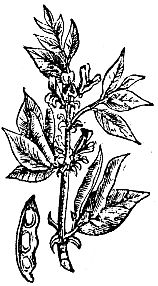
BROAD BEANS.
Ingredients.—To each ½ gallon of water, allow 1 heaped tablespoonful of salt; beans. Mode.—This is a favourite vegetable with many persons, but, to be nice, should be young and freshly gathered. After shelling the beans, put them into boiling water, salted in the above proportion, and let them boil rapidly until tender. Drain them well in a colander; dish, and serve with them separately a tureen of parsley and butter. Boiled bacon should always accompany this vegetable, but the beans should be cooked separately. It is usually served with the beans laid round, and the parsley and butter in a tureen. Beans also make an excellent garnish to a ham, and when used for this purpose, if very old, should have their skins removed. Time.—Very young beans, 15 minutes; when a moderate size, 20 to 25 minutes, or longer. Average cost, unshelled, 6d. per peck. Sufficient.—Allow one peck for 6 or 7 persons. Seasonable in July and August.
BEANS, Broad, à la Poulette.
Ingredients.—2 pints of broad beans, ½ pint of stock or broth, a small bunch of savoury herbs, including parsley, a small lump of sugar, the yolk of 1 egg, ¼ pint of cream, pepper and salt to taste. Mode.—Procure some young and freshly-gathered beans, and shell sufficient to make 2 pints; boil them, as in the preceding recipe, until nearly done; then drain them and put them into a stewpan with the stock, finely-minced herbs, and sugar. Stew the beans until perfectly tender, and the liquor has dried away a little; then beat up the yolk of an egg with the cream, add this to the beans, let the whole get thoroughly hot, and when on the point of simmering, serve. Should the beans be very large, the skin should be removed previously to boiling them. Time.—10 minutes to boil the beans, 15 minutes to stew them in the stock. Average cost, unshelled, 6d. per peck. Seasonable in July and August.
BEANS, Boiled French.
Ingredients.—To each ½ gallon of water allow 1 heaped tablespoonful of salt, a very small piece of soda. Mode.—This vegetable should always be eaten young, as when allowed to grow too long it tastes stringy and tough when cooked. Cut off the heads and tails, and a thin strip on each side of the beans to remove the strings; then divide each bean into 4 or 6 pieces, according to size, cutting them lengthways in a slanting direction, and as they are cut put them into cold water, with a small quantity of salt dissolved in it. Have ready a saucepan of boiling water, with salt and soda in the above proportion; put in the beans, keep them boiling quickly, with the lid uncovered, and be careful that they do not get smoked. When tender, which may be ascertained by their sinking to the bottom of the saucepan, take them up, pour them into a colander, and when drained, dish and serve with plain melted butter. When very young, beans are sometimes served whole: thus dressed, their colour and flavour are much better preserved, but the more general way of sending them to table is to cut them into thin strips. Time.—Very young beans, 10 to 12 minutes; moderate size, 15 to 20 minutes, after the water boils. Average cost, in full season, 1s. 4d. per peck, but when forced very expensive. Sufficient.—Allow ½ peck for 6 or 7 persons. Seasonable from the middle of July to the end of September, but may be had forced from February to the beginning of June.
BEANS, French Mode of Cooking French.
Ingredients.—A quart of French beans, 3 oz. of fresh butter, pepper and salt to taste, the juice of ½ lemon. Mode.—Cut and boil the beans by the preceding recipe, and when tender, put them into a stewpan, and shake over the fire, to dry away the moisture from the beans. When quite dry and hot, add the butter, pepper, salt, and lemon-juice; keep moving the stewpan, without using a spoon, as that would break the beans; and when the butter is melted, and all is thoroughly hot, serve. If the butter should not mix well, add a tablespoonful of gravy, and serve very quickly. Time.—About ¼ hour to boil the beans; 10 minutes to shake them over the fire. Average cost, in full season, about 1s. 4d. per peck. Sufficient for 3 or 4 persons. Seasonable from the middle of July to the end of September.
BEANS, to Boil Haricots Blancs, or White Haricot.
Ingredients.—1 quart of white haricot beans, 2 quarts of soft water, 1 oz. of butter, 1 heaped tablespoonful of salt. Mode.—Put the beans into cold water, let them soak from 2 to 4 hours, according to their age; then put them into cold water salted in the above proportion, bring them to boil, and let them simmer very slowly until tender; pour the water away from them, let them stand by the side of the fire, with the lid of the saucepan partially off, to allow the beans to dry; then add 1 oz. of butter and a seasoning of pepper and salt. Shake the beans about for a minute or two, and serve: do not stir them with a spoon, for fear of breaking them to pieces. Time.—After the water boils, from 2 to 2½ hours. Average cost, 4d. per quart. Sufficient for 4 or 5 persons. Seasonable in winter, when other vegetables are scarce.
Note.—Haricots blancs, when new and fresh, should be put into boiling water, and do not require any soaking previous to dressing.
BEANS, Haricots Blancs & Minced Onions.
Ingredients.—1 quart of white haricot beans, 4 middling-sized onions, ¼ pint of good brown gravy, pepper and salt to taste, a little flour. Mode.—Peel and mince the onions not too finely, and fry them in butter of a light brown colour; dredge over them a little flour, and add the gravy and a seasoning of pepper and salt. Have ready a pint of haricot beans well boiled and drained; put them with the onions and gravy, mix all well together, and serve very hot. Time.—From 2 to 2½ hours to boil the beans; 5 minutes to fry the onions. Average cost, 4d. per quart. Sufficient for 4 or 5 persons. Seasonable in winter.
BEANS, Haricots Blancs à la Maître d’Hôtel.

HARICOT BEANS.
Ingredients.—1 quart of white haricot beans, ¼ lb. of fresh butter, 1 tablespoonful of minced parsley, pepper and salt to taste, the juice of ½ lemon. Mode.—Should the beans be very dry, soak them for an hour or two in cold water, and boil them until perfectly tender, as in the preceding recipe. If the water should boil away, replenish it with a little more cold, which makes the skin of the beans tender. Let them be very thoroughly done; drain them well; then add to them the butter, minced parsley, and a seasoning of pepper and salt. Keep moving the stewpan over the fire without using a spoon, as this would break the beans; and, when the various ingredients are well mixed with them, squeeze in the lemon-juice, and serve very hot. Time.—From 2 to 2½ hours to boil the beans. Average cost, 4d. per quart. Sufficient for 4 or 5 persons. Seasonable in winter.
BÉCHAMEL, or French White Sauce.
Ingredients.—1 small bunch of parsley, 2 cloves, ½ bay-leaf, 1 small bunch of savoury herbs, salt to taste; 3 or 4 mushrooms, when obtainable; 2 pints of white stock, 1 pint of milk or cream, 1 tablespoonful of arrowroot. Mode.—Put the stock into a stewpan, with the parsley, cloves, bay-leaf, herbs, and mushrooms; add a seasoning of salt, but no pepper, as that would give the sauce a dusty appearance, and should be avoided. When it has boiled long enough to extract the flavour of the herbs, &c., strain it, and boil it up quickly again, until it is nearly half reduced. Now mix the arrowroot smoothly with the milk or cream, and let it simmer very gently for 5 minutes over a slow fire; pour to it the stock, and continue to simmer slowly for 10 minutes, if the sauce be thick. If, on the contrary, it be too thin, it must be stirred over a sharp fire till it thickens. Always make it thick, as it can easily be thinned with cream, milk, or white stock. This sauce is excellent for pouring over boiled fowls. Time.—Altogether, 2 hours. Average cost, 3s. per quart, with cream at 1s. 6d. per pint.
BÉCHAMEL MAIGRE, or Without Meat.
Ingredients.—2 onions, 1 blade of mace, mushroom trimmings, a small bunch of parsley, 1 oz. of butter, flour, ½ pint of water, 1 pint of milk, salt, the juice of ½ lemon, 2 eggs. Mode.—Put in a stewpan the milk and ½ pint of water, with the onions, mace, mushrooms, parsley, and salt. Let these simmer gently for 20 minutes. In the meantime, rub on a plate 1 oz. of flour and butter; put it to the liquor, and stir it well till it boils up; then place it by the side of the fire, and continue stirring until it is perfectly smooth. Now strain it through a sieve into a basin, after which put it back in the stewpan, and add the lemon-juice. Beat up the yolks of the eggs with about 4 dessertspoonfuls of milk; strain this to the sauce, keep stirring it over the fire, but do not let it boil, or it will curdle. Time.—Altogether, ¾ hour. Average cost, 5d. per pint.
This is a good sauce to pour over boiled fowls when they are a bad colour.
BEEF, Aitchbone of, Boiled.
Ingredients.—Beef, water. Mode.—After this joint has been in salt 5 or 6 days, it will be ready for use, and will not take so long boiling as a round, for it is not so solid. Wash the meat, and, if too salt, soak it for a few hours, changing the water once or twice, till the required freshness is obtained. Put into a saucepan, or boiling-pot, sufficient water to cover the meat; set it over the fire, and when it boils, plunge in the joint, and let it boil up quickly. Now draw the pot to the side of the fire, and let the process be very gradual, as the water must only simmer, or the meat will be hard and tough. Carefully remove the scum from the surface of the water, and continue doing this for a few minutes after it first boils. Carrots and turnips are served with this dish, and sometimes suet dumplings, which may be boiled with the beef. Garnish with a few of the carrots and turnips, and serve the remainder in a vegetable-dish. Time.—An aitchbone of 10 lbs., 2½ hours after the water boils; one of 20 lbs., 4 hours. Average cost, 6d. per lb. Sufficient.—10 lbs. for 7 or 8 persons. Seasonable all the year, but best from September to March.
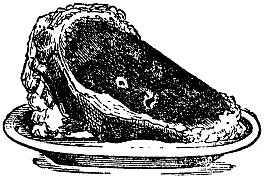
AITCH-BONE OF BEEF.
Note.—The liquor in which the meat has been boiled may be easily converted into a very excellent pea-soup. It will require very few vegetables, as it will be impregnated with the flavour of those boiled with the meat.
BEEF À LA MODE.
Ingredients.—6 or 7 lbs. of the thick flank of beef, a few slices of fat bacon, 1 teacupful of vinegar, black pepper, allspice, 2 cloves well mixed and finely pounded, making altogether 1 heaped teaspoonful; salt to taste, 1 bunch of savoury herbs, including parsley, all finely minced and well mixed; 3 onions, 2 large carrots, 1 turnip, 1 head of celery, 1½ pint of water, 1 glass of port wine. Mode.—Slice and fry the onions of a pale brown, and cut up the other vegetables in small pieces, and prepare the beef for stewing in the following manner:—Choose a fine piece of beef, cut the bacon into long slices, about an inch in thickness, dip them into vinegar, and then into a little of the above seasoning of spice, &c., mixed with the same quantity of minced herbs. With a sharp knife make holes deep enough to let in the bacon; then rub the beef over with the remainder of the seasoning and herbs, and bind it up in a nice shape with tape. Have ready a well-tinned stewpan (it should not be much larger than the piece of meat you are cooking), into which put the beef, with the vegetables, vinegar, and water. Let it simmer very gently for 5 hours, or rather longer, should the meat not be extremely tender, and turn it once or twice. When ready to serve, take out the beef, remove the tape, and put it on a hot dish. Skim off every particle of fat from the gravy, add the port wine, just let it boil, pour it over the beef, and it is ready to serve. Great care must be taken that this does not boil fast, or the meat will be tough and tasteless; it should only just bubble. When convenient, all kinds of stews, &c. should be cooked on a hot plate, as the process is so much more gradual than on an open fire. Time.—5 hours, or rather more. Average cost, 7d. per lb. Sufficient for 7 or 8 persons. Seasonable all the year, but more suitable for a winter dish.
BEEF À LA MODE (Economical).
Ingredients.—About 3 lbs. of clod or sticking of beef, 2 oz. of clarified dripping, 1 large onion, flour, 2 quarts of water, 12 berries of allspice, 2 bay-leaves, ½ teaspoonful of whole black pepper, salt to taste. Mode.—Cut the beef into small pieces, and roll them in flour; put the dripping into a stewpan with the onion, which should be sliced thin. Let it get quite hot; lay in the pieces of beef, and stir them well about. When nicely browned all over, add by degrees boiling water in the above proportion, and, as the water is added, keep the whole well stirred. Put in the spice, bay-leaves, and seasoning, cover the stewpan closely, and set it by the side of the fire to stew very gently, till the meat becomes quite tender, which will be in about 3 hours, when it will be ready to serve. Remove the bay-leaves before it is sent to table. Time.—3 hours. Average cost, 1s. 3d. Sufficient for 6 persons. Seasonable at any time.
BEEF, Baked.
[Cold Meat Cookery. 1.] Ingredients.—About 2 lbs. of cold roast beef, 2 small onions, 1 large carrot or 2 small ones, 1 turnip, a small bunch of savoury herbs, salt and pepper to taste, quite ½ pint of gravy, 3 tablespoonfuls of ale, crust or mashed potatoes. Mode.—Cut the beef in slices, allowing a small amount of fat to each slice; place a layer of this in the bottom of a pie-dish, with a portion of the onions, carrots, and turnips, which must be sliced; mince the herbs, strew them over the meat, and season with pepper and salt. Then put another layer of meat, vegetables, and seasoning; and proceed in this manner until all the ingredients are used. Pour in the gravy and ale (water may be substituted for the former, but it is not so nice), cover with a crust or mashed potatoes, and bake for ½ hour, or rather longer. Time.—Rather more than ½ hour. Average cost, exclusive of the meat, 6d. Sufficient for 5 or 6 persons. Seasonable at any time.
Note.—It is as well to parboil the carrots and turnips before adding them to the meat, and to use some of the liquor in which they were boiled as a substitute for gravy; that is to say, when there is no gravy at hand. Be particular to cut the onions in very thin slices.
[Cold Meat Cookery. 2.] Ingredients.—Slices of cold roast beef, salt and pepper to taste, 1 sliced onion, 1 teaspoonful of minced savoury herbs, 12 tablespoonfuls of gravy or sauce of any kind, mashed potatoes. Mode.—Butter the sides of a deep dish, and spread mashed potatoes over the bottom of it; on this place layers of beef in thin slices (this may be minced, if there is not sufficient beef to cut into slices), well seasoned with pepper and salt, and a very little onion and herbs, which should be previously fried of a nice brown; then put another layer of mashed potatoes, and beef, and other ingredients, as before; pour in the gravy or sauce, cover the whole with another layer of potatoes, and bake for ½ hour. This may be served in the dish, or turned out. Time.—½ hour. Average cost, exclusive of the cold beef, 6d. Sufficient.—A large pie-dish full for 5 or 6 persons. Seasonable at any time.
BEEF-BONES, Broiled.
[Cold Meat Cookery.] Ingredients.—The bones of ribs or sirloin; salt, pepper and cayenne. Mode.—Separate the bones, taking care that the meat on them is not too thick in any part; sprinkle them well with the above seasoning, and broil over a very clear fire. When nicely browned, they are done; but do not allow them to blacken.
BEEF, Brisket of, à la Flamande.
Ingredients.—About 6 or 8 lbs. of the brisket of beef, 4 or 5 slices of bacon, 2 carrots, 1 onion, a bunch of savoury herbs, salt and pepper to taste, 4 cloves, 4 whole allspice, 2 blades of mace. Mode.—Choose that portion of the brisket which contains the gristle, trim it, and put it into a stewpan with the slices of bacon, which should be placed under and over the meat. Add the vegetables, herbs, spices, and seasoning, and cover with a little weak stock or water; shut the stewpan-lid as closely as possible, and simmer very gently for 4 hours. Strain the liquor, reserve a portion of it for sauce, and the remainder boil quickly over a sharp fire until reduced to a glaze, with which glaze the meat. Garnish the dish with scooped carrots and turnips, and, when liked, a little cabbage; all of which must be cooked separately. Thicken and flavour the liquor that was saved for sauce, pour it round the meat, and serve. The beef may also be garnished with glazed onions, artichoke-bottoms, &c. Time.—4 hours. Average cost, 7d. per lb. Sufficient for 6 or 8 persons. Seasonable at any time.
BEEF, Brisket of, Stewed.
Ingredients.—7 lbs. of the brisket of beef, vinegar and salt, 6 carrots, 6 turnips, 6 small onions, 1 blade of pounded mace, 2 whole allspice pounded, thickening of butter and flour, 2 tablespoonfuls of ketchup; stock, or water. Mode.—About an hour before dressing it, rub the meat over with vinegar and salt; put it into a stewpan, with sufficient stock to cover it (when this is not at hand, water may be substituted for it), and be particular that the stewpan is not much larger than the meat. Skim well, and when it has simmered very gently for 1 hour, put in the vegetables, and continue simmering till the meat is perfectly tender. Draw out the bones, dish the meat, and garnish either with tufts of cauliflower or braised cabbage cut in quarters. Thicken as much gravy as required, with a little butter and flour; add spices and ketchup in the above proportion, give one boil, pour some of it over the meat, and the remainder send in a tureen. Time.—Rather more than 3 hours. Average cost, 7d. per lb. Sufficient for 7 or 8 persons. Seasonable at any time.
Note.—The remainder of the liquor in which the beef was boiled may be served as a soup, or it may be sent to table with the meat in a tureen.
BEEF, Broiled, and Mushroom Sauce.
[Cold Meat Cookery.] Ingredients.—2 or 3 dozen small button mushrooms, 1 oz. of butter, salt and cayenne to taste, 1 tablespoonful of mushroom ketchup, mashed potatoes, slices of cold roast beef. Mode.—Wipe the mushrooms free from grit with a piece of flannel, and salt; put them in a stewpan with the butter, seasoning, and ketchup; stir over the fire until the mushrooms are quite done, when pour it in the middle of mashed potatoes, browned. Then place round the potatoes slices of cold roast beef, nicely broiled over a clear fire. In making the mushroom sauce the ketchup may be dispensed with, if there is sufficient gravy. Time.—¼ hour. Average cost, exclusive of the meat, 8d. Seasonable from August to October.
BEEF, Broiled, and Oyster Sauce.
[Cold Meat Cookery.] Ingredients.—2 dozen oysters, 3 cloves, 1 blade of mace, 2 oz. of butter, ½ teaspoonful of flour, cayenne and salt to taste, mashed potatoes, a few slices of cold roast beef. Mode.—Put the oysters in a stewpan, with their liquor strained; add the cloves, mace, butter, flour, and seasoning, and let them simmer gently for 5 minutes. Have ready in the centre of a dish round walls of mashed potatoes, browned; into the middle pour the oyster sauce quite hot, and round the potatoes place, in layers, slices of the beef, which should be previously broiled over a nice clear fire. Time.—5 minutes. Average cost, 1s. 6d., exclusive of the cold meat. Sufficient for 4 or 5 persons. Seasonable from September to April.
BEEF BUBBLE-AND-SQUEAK.
[Cold Meat Cookery.] Ingredients.—A few thin slices of cold boiled beef; butter, cabbage, 1 sliced onion, pepper and salt to taste. Mode.—Fry the slices of beef gently in a little butter, taking care not to dry them up. Lay them on a flat dish, and cover with fried greens. The greens may be prepared from cabbage sprouts or green savoys. They should be boiled till tender, well drained, minced, and placed till quite hot in a frying-pan, with butter, a sliced onion, and seasoning of pepper and salt. When the onion is done it is ready to serve. Time.—Altogether, ½ hour. Average cost, exclusive of the cold beef, 3d. Seasonable at any time.
BEEF CAKE.
[Cold Meat Cookery.] Ingredients.—The remains of cold roast beef; to each pound of cold meat allow ¼ lb. of bacon or ham; seasoning to taste of pepper and salt, 1 small bunch of minced savoury herbs, 1 or 2 eggs. Mode.—Mince the beef very finely (if underdone it will be better), add to it the bacon, which must also be chopped very small, and mix well together. Season, stir in the herbs, and bind with an egg, or 2 should 1 not be sufficient. Make it into small square cakes, about ½ inch thick, fry them in hot dripping, drain them, and serve in a dish with good gravy poured round. Time.—10 minutes. Average cost, exclusive of the cold meat, 6d. Seasonable at any time.
BEEF, Collared.
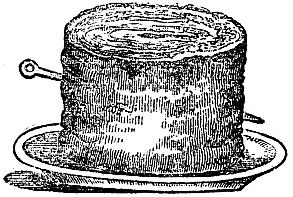
COLLARED BEEF.
Ingredients.—7 lbs. of the thin end of the flank of beef, 2 oz. of coarse sugar, 6 oz. of salt, 1 oz. of saltpetre, 1 large handful of parsley, minced, 1 dessertspoonful of minced sage, a bunch of savoury herbs, ½ teaspoonful of pounded allspice; salt and pepper to taste. Mode.—Choose fine tender beef, but not too fat; lay it in a dish, rub in the sugar, salt, and saltpetre, and let it remain in the pickle for a week or ten days, turning and rubbing it every day. Then bone it, remove all the gristle and the coarse skin of the inside part, and sprinkle it thickly with parsley, herbs, spice, and seasoning in the above proportion, taking care that the former are finely minced, and the latter well pounded. Roll the meat up in a cloth as tightly as possible; bind it firmly with broad tape, and boil it gently for 6 hours. Immediately on taking it out of the pot put it under a good weight, without undoing it, and let it remain until cold. This dish is a very nice addition to the breakfast-table. Time.—6 hours. Average cost, for this quantity, 4s. Seasonable at any time.
Note.—During the time the beef is in pickle it should be kept cool, and regularly rubbed and turned every day.
BEEF COLLOPS.
Ingredients.—2 lbs. of rump-steak, ¼ lb. of butter, 1 pint of gravy (water may be substituted for this), salt and pepper to taste, 1 shalot, finely minced, ½ pickled walnut, 1 teaspoonful of capers. Mode.—Have the steak cut thin, and divide it in pieces about 3 inches long; beat these with the blade of a knife, and dredge with flour. Put them in a frying-pan with the butter, and let them fry for about 3 minutes; then lay them in a small stewpan, and pour over them the gravy. Add a piece of butter kneaded with a little flour, put in the seasoning and all the other ingredients, and let the whole simmer, but not boil, for 10 minutes. Serve in a hot covered dish. Time.—10 minutes. Average cost, 1s. per lb. Sufficient for 4 or 5 persons. Seasonable at any time.
BEEF CARVING.
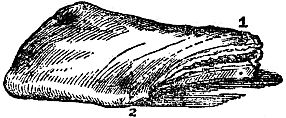
Beef, Aitchbone of.—A boiled aitchbone of beef is not a difficult joint to carve, as will be seen on reference to the accompanying engraving. By following with the knife the direction of the line from 1 to 2, nice slices will be easily cut. It may be necessary, as in a round of beef, to cut a thick slice off the outside before commencing to serve.
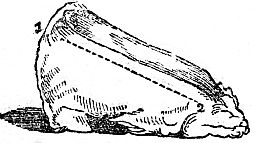
Beef, Brisket of.—There is but little description necessary to add to show the carving of a boiled brisket of beef beyond the engraving here inserted. The only point to be observed is, that the joint should be cut evenly and firmly quite across the bones, so that on its reappearance at table it should not have a jagged and untidy look.
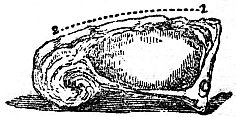
Beef, Ribs of.—This dish resembles the sirloin, except that it has no fillet or undercut. As explained in the recipes, the end piece is often cut off, salted and boiled. The mode of carving is similar to that of the sirloin, viz., in the direction of the dotted line from 1 to 2. This joint will be the more easily cut if the plan be pursued which is suggested in carving the sirloin; namely, the inserting of the knife immediately between the bone and the meat, before commencing to cut it into slices. All joints of roast beef should be cut in even and thin slices. Horseradish, finely scraped, may be served as a garnish; but horseradish sauce is preferable for eating with the beef.
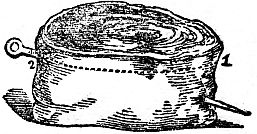
Beef, a Round of.—A round of beef is more easily carved than any other joint of beef, but, to manage it properly, a thin-bladed and very sharp knife is necessary. Off the outside of the joint, at its top, a thick slice should first be cut, so as to leave the surface smooth: then thin and even slices should be cleverly carved in the direction of the line 1 to 2; and with each slice of the lean a delicate morsel of the fat should be served.
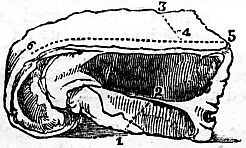
Beef, Sirloin of.—This dish is served differently at various tables, some preferring it to come to table with the fillet, or, as it is usually called, the undercut, uppermost. The reverse way, as shown in the cut, is that most usually adopted. Still the undercut is best eaten when hot; consequently, the carver himself may raise the joint, and cut some slices from the under side, in the direction of from 1 to 2, as the fillet is very much preferred by some eaters. The upper part of the sirloin should be cut in the direction of the line from 5 to 6, and care should be taken to carve it evenly and in thin slices. It will be found a great assistance, in carving this joint well, if the knife be first inserted just above the bone at the bottom, and run sharply along between the bone and meat, and also to divide the meat from the bone in the same way at the side of the joint; the slices will then come away more readily. Some carvers cut the upper side of the sirloin across, as shown by the line from 3 to 4; but this is a wasteful plan, and one not to be recommended. With the sirloin, very finely-scraped horseradish is usually served, and a little given, when liked, to each guest. Horseradish sauce is preferable, however, for serving on the plate, although the scraped horseradish may still be used as a garnish.
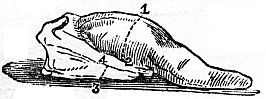
Beef Tongue.—Passing the knife down in the direction of from 1 to 2, a not too thin slice should be helped; and the carving of a tongue may be continued in this way until the best portions of the upper side are served. The fat which lies about the root can be served by turning the tongue, and cutting in the direction of from 3 to 4.
BEEF, Curried.
[Cold Meat Cookery.] Ingredients.—A few slices of tolerably lean cold roast or boiled beef, 3 oz. of butter, 2 onions, 1 wineglassful of beer, a dessertspoonful of curry powder. Mode.—Cut up the beef into pieces about 1 inch square, put the butter into a stewpan with the onions sliced, and fry them of a light-brown colour. Add all the other ingredients, and stir gently over a brisk fire for about 10 minutes. Should this be thought too dry, more beer, or a spoonful or two of gravy or water, may be added; but a good curry should not be very thin. Place it in a deep dish, with an edging of dry boiled rice, in the same manner as for other curries. Time.—10 minutes. Average cost, exclusive of the meat, 4d. Seasonable in winter.
BEEF, Roast Fillet of (Larded).
Ingredients.—About 4 lbs. of the inside fillet of the sirloin, 1 onion, a small bunch of parsley, salt and pepper to taste, sufficient vinegar to cover the meat, glaze, Spanish sauce (see Sauce). Mode.—Lard the beef with bacon, and put it into a pan with sufficient vinegar to cover it, with an onion sliced, parsley, and seasoning, and let it remain in this pickle for 12 hours. Roast it before a nice clear fire for about 1¼ hour, and, when done, glaze it. Pour some Spanish sauce round the beef, and the remainder serve in a tureen. It may be garnished with Spanish onions boiled and glazed. Time.—1¼ hour. Average cost, exclusive of the sauce, 4s. Sufficient for 6 or 8 persons. Seasonable at any time.
BEEF, Fricandeau of.
Ingredients.—About 3 lbs. of the inside fillet of the sirloin (a piece of the rump may be substituted for this), pepper and salt to taste, 3 cloves, 2 blades of mace, 6 whole allspice, 1 pint of stock (see Stock), or water, 1 glass of sherry, 1 bunch of savoury herbs, 2 shalots, bacon. Mode.—Cut some bacon into thin strips, and sprinkle over them a seasoning of pepper and salt, mixed with cloves, mace, and allspice, well pounded. Lard the beef with these, put it into a stewpan with the stock or water, sherry, herbs, shalots, 2 cloves, and more pepper and salt. Stew the meat gently until tender, when take it out, cover it closely, skim off all the fat from the gravy, and strain it. Set it on the fire, and boil, till it becomes a glaze. Glaze the larded side of the beef with this, and serve on sorrel sauce, which is made as follows:—Wash and pick some sorrel, and put it into a stewpan with only the water that hangs about it. Keep stirring, to prevent its burning, and when done, lay it in a sieve to drain. Chop it, and stew it with a small piece of butter and 4 or 5 tablespoonfuls of good gravy, for an hour, and rub it through a sieve. If too acid, add sugar; a little cabbage-lettuce boiled with the sorrel will be found an improvement. Time.—2 hours to gently stew the meat. Average cost, for this quantity, 4s. Sufficient for 6 persons. Seasonable at any time.
BEEF, Fried Salt.
[Cold Meat Cookery.] Ingredients.—A few slices of cold salt beef, pepper to taste, ½ lb. of butter, mashed potatoes. Mode.—Cut any part of cold salt beef into thin slices, fry them gently in butter, and season with a little pepper. Have ready some very hot mashed potatoes, lay the slices of beef on them, and garnish with 3 or 4 pickled gherkins. Cold salt beef, warmed in a little liquor from mixed pickle, drained, and served as above, will be found good. Time.—About 5 minutes. Average cost, exclusive of the meat, 4d. Seasonable at any time.
BEEF FRITTERS.
[Cold Meat Cookery.] Ingredients.—The remains of cold roast beef, pepper and salt to taste, ¾ lb. of flour, ½ pint of water, 2 oz. of butter, the whites of 2 eggs. Mode.—Mix very smoothly, and, by degrees, the flour with the above proportion of water; stir in 2 oz. of butter, which must be melted but not oiled, and, just before it is to be used, add the whites of two well-whisked eggs. Should the batter be too thick, more water must be added. Pare down the cold beef into thin shreds, season with pepper and salt, and mix it with the batter. Drop a small quantity at a time into a pan of boiling lard, and fry from 7 to 10 minutes, according to the size. When done on one side, turn and brown them on the other. Let them dry for a minute or two before the fire, and serve on a folded napkin. A small quantity of finely-minced onions, mixed with the batter, is an improvement. Time.—From 7 to 10 minutes. Average cost, exclusive of the meat, 6d. Seasonable at any time.
BEEF, Hashed.
[Cold Meat Cookery. 1.] Ingredients.—Gravy saved from the meat, 1 teaspoonful of tomato sauce, one teaspoonful of Harvey’s sauce, one teaspoonful of good mushroom ketchup, ½ glass of port wine or strong ale, pepper and salt to taste, a little flour to thicken, 1 onion finely minced, a few slices of cold roast beef. Mode.—Put all the ingredients but the beef into a stewpan with whatever gravy may have been saved from the meat the day it was roasted; simmer these gently for 10 minutes, then take the stewpan off the fire; let the gravy cool and skim off the fat. Cut the beef into thin slices, dredge them with flour, and lay them in the gravy; let the whole simmer gently for 5 minutes, but not boil, or the meat will be tough and hard. Serve very hot, and garnish with sippets of toasted bread. Time.—20 minutes. Average cost, exclusive of the cold meat, 4d. Seasonable at any time.
[Cold Meat Cookery. 2.] Ingredients.—The remains of ribs or sirloin of beef, 2 onions, 1 carrot, 1 bunch of savoury herbs, pepper and salt to taste, ½ blade of pounded mace, thickening of flour, rather more than 1 pint of water. Mode.—Take off all the meat from the bones of ribs or sirloin of beef; remove the outside brown and gristle; place the meat on one side, and well stew the bones and pieces, with the above ingredients, for about 2 hours, till it becomes a strong gravy, and is reduced to rather more than ½ pint; strain this, thicken with a teaspoonful of flour, and let the gravy cool; skim off all the fat; lay in the meat, let it get hot through, but do not allow it to boil; and garnish with sippets of toasted bread. The gravy should be flavoured as in the preceding recipe. Time.—Rather more than 2 hours. Average cost, exclusive of the cold meat, 6d. Seasonable at any time.
Note.—Either of the above recipes may be served in walls of mashed potatoes browned; in which case the sippets should be omitted. Be careful that hashed meat does not boil, or it will become tough.
BEEF, Hunter’s.
Ingredients.—For a round of beef weighing 25 lbs. allow 3 oz. of saltpetre, 3 oz. of coarse sugar, 1 oz. of cloves, 1 grated nutmeg, ½ oz. of allspice, 1 lb. of salt, ½ lb. bay-salt. Mode.—Hang the beef for 2 or 3 days, and remove the bone. Pound spices, salt, &c. in the above proportion, and let them be reduced to the finest powder. Put the beef into a pan, rub all the ingredients well into it, and turn and rub it every day for rather more than a fortnight. When it has been sufficiently long in pickle, wash the meat, bind it up securely with tape, and put it into a pan with ½ pint of water at the bottom; mince some suet, cover the top of the meat with it, and over the pan put a common crust of flour and water; bake for 6 hours, and when cold remove the paste. Save the gravy that flows from it, as it adds greatly to the flavour of hashes, stews, &c. The beef may be glazed and garnished with meat jelly. Time.—6 hours. Seasonable all the year.
Note.—In salting or pickling beef or pork for family consumption, it not being generally required to be kept for a great length of time, a less quantity of salt and a larger quantity of other matters more adapted to retain mellowness in meat, may be employed, which could not be adopted by the curer of the immense quantities of meat required to be preserved for victualling the shipping of this maritime country. Sugar, which is well known to possess the preserving principle in a very great degree, without the pungency and astringency of salt, may be, and is, very generally used in the preserving of meat for family consumption. Although it acts without corrugating or contracting the fibres of meat, as is the case in the action of salt, and, therefore, does not impair its mellowness, yet its use in sufficient quantities for preservative effect, without the addition of other antiseptics, would impart a flavour not agreeable to the taste of many persons. It may be used, however, together with salt, with the greatest advantage in imparting mildness and mellowness to cured meat, in a proportion of about one part by weight to four of the mixture; and, perhaps, now that sugar is so much lower in price than it was in former years, one of the obstructions to its more frequent use is removed.
BEEF KIDNEY, to Dress.
Ingredients.—1 kidney, clarified butter, pepper and salt to taste, a small quantity of highly-seasoned gravy, 1 tablespoonful of lemon-juice, ¼ teaspoonful of powdered sugar. Mode.—Cut the kidneys into neat slices, put them into warm water to soak for two hours, and change the water 2 or 3 times; then lay them on a clean cloth to dry the water from them, place them in a frying-pan with some clarified butter, and fry them of a nice brown; season each side with pepper and salt, put them round the dish, with the gravy in the middle. Before pouring the gravy in the dish, add the lemon-juice and sugar. Time.—From 5 to 10 minutes. Average cost, 9d. each. Seasonable at any time.
BEEF KIDNEY, to Dress.
Ingredients.—1 kidney, 1 dessertspoonful of minced parsley, 1 teaspoonful of minced shalot, salt and pepper to taste; ¼ pint of gravy (follow one of the gravy recipes), 3 tablespoonfuls of sherry. Mode.—Take off a little of the kidney fat, mince it very fine, and put it in a frying-pan; slice the kidney, sprinkle over it parsley and shalots in the above proportion, add a seasoning of pepper and salt, and fry it of a nice brown. When it is done enough, dredge over a little flour, and pour in the gravy and sherry. Let it just simmer, but not boil any more, or the kidney would harden; serve very hot, and garnish with croûtons. Where the flavour of the shalot is disliked it may be omitted, and a small quantity of savoury herbs substituted for it. Time.—From 5 to 10 minutes, according to the thickness of the slices. Average cost, 9d. each. Sufficient for 3 persons. Seasonable at any time.
BEEF KIDNEY, to Dress (a more simple method).
Cut the kidneys into thin slices, flour them, and fry of a nice brown. When done, make a gravy in the pan by pouring away the fat, putting in a small piece of butter, ¼ pint of boiling water, pepper and salt, a dessertspoonful of lemon-juice, and a tablespoonful of mushroom ketchup. Let the gravy just boil up, pour over the kidney, and serve.
BEEF MARROW-BONES, Boiled.
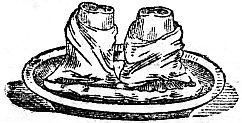
MARROW-BONES.
Ingredients.—Bones, a small piece of common paste, a floured cloth. Mode.—Have the bones neatly sawed into convenient sizes, and cover the ends with a small piece of common crust, made with flour and water. Over this tie a floured cloth, and place them upright in a saucepan of boiling water, taking care there is sufficient to cover the bones. Boil the bones for 2 hours, remove the cloth and paste, and serve them upright on a napkin with dry toast. Many persons clear the marrow from the bones after they are cooked, spread it over a slice of toast, and add a seasoning of pepper; when served in this manner, it must be very expeditiously sent to table, as it so soon gets cold. Time.—2 hours. Seasonable at any time.
Note.—Marrow-bones may be baked after preparing them as in the preceding recipe; they should be laid in a deep dish, and baked for 2 hours.
BEEF, Minced.
[Cold Meat Cookery.] Ingredients.—1 oz. of butter, 1 small onion, 12 tablespoonfuls of gravy left from the meat, 1 tablespoonful of strong ale, 1 teaspoonful of flour, salt and pepper to taste, a few slices of lean roast beef. Mode.—Put into a stewpan the butter with an onion chopped fine; add the gravy, ale, and a teaspoonful of flour to thicken; season with pepper and salt, and stir these ingredients over the fire until the onion is a rich brown. Cut (but do not chop) the meat very fine, add it to the gravy, stir till quite hot, and serve. Garnish with sippets of toasted bread. Be careful in not allowing the gravy to boil after the meat is added, as it would render it hard and tough. Time.—About ½ hour. Average cost, exclusive of the meat, 3d. Seasonable at any time.
BEEF, Minced Collops of (an Entrée).
Ingredients.—1 lb. of rump-steak, salt and pepper to taste, 2 oz. of butter, 1 onion minced, ¼ pint of water, 1 tablespoonful of Harvey’s sauce, or lemon-juice, or mushroom ketchup; 1 small bunch of savoury herbs. Mode.—Mince the beef and onion very small, and fry the latter in butter until of a pale brown. Put all the ingredients together in a stewpan, and boil gently for about 10 minutes; garnish with sippets of toasted bread, and serve very hot. Time.—10 minutes. Average cost, 1s. per lb. Sufficient for 2 or 3 persons. Seasonable at any time.
BEEF, Miroton of.
[Cold Meat Cookery.] Ingredients.—A few slices of cold roast beef, 3 oz. of butter, salt and pepper to taste, 3 onions, ½ pint of gravy. Mode.—Slice the onions and put them into the frying-pan with the cold beef and butter; place it over the fire, and keep turning and stirring the ingredients to prevent them burning. When a pale brown, add the gravy and seasoning; let it simmer for a few minutes, and serve very hot. The dish is excellent and economical. Time.—5 minutes. Average cost, exclusive of the meat, 6d. Seasonable at any time.
BEEF OLIVES.
Ingredients.—2 lbs. of rump-steak, 1 egg, 1 tablespoonful of minced savoury herbs, pepper and salt to taste, 1 pint of stock, 2 or 3 slices of bacon, 2 tablespoonfuls of any kind of store sauce, a slight thickening of butter and flour. Mode.—Have the steaks cut rather thin, beat them to make them level, cut them into 6 or 7 pieces, brush over with egg, and sprinkle with herbs, which should be very finely minced; season with pepper and salt, roll up the pieces tightly, and fasten with a small skewer. Put the stock in a stewpan that will exactly hold the ingredients, for, by being pressed together, they will keep their shape better; lay in the rolls of meat, cover them with the bacon, cut in thin slices, and over that put a piece of paper. Stew them very gently for full 2 hours; for the slower they are done the better. Take them out, remove the skewers, thicken the gravy with butter and flour, and flavour with any store sauce that may be preferred. Give one boil, pour over the meat, and serve. Time.—2 hours. Average cost, 1s. per pound. Sufficient for 4 or 5 persons. Seasonable at any time.
BEEF OLIVES (Economical).
[Cold Meat Cookery.] Ingredients.—The remains of underdone cold roast beef, bread-crumbs, 1 shalot finely minced, pepper and salt to taste, gravy made from the beef bones, thickening of butter and flour, 1 tablespoonful of mushroom ketchup. Mode.—Cut some slices of underdone roast beef about half an inch thick; sprinkle over them some bread-crumbs, minced shalot, and a little of the fat and seasoning; roll them, and fasten with a small skewer. Have ready some gravy made from the beef bones; put in the pieces of meat, and stew them till tender, which will be in about 1¼ hour, or rather longer. Arrange the meat in a dish, thicken and flavour the gravy, and pour it over the meat, when it is ready to serve. Time.—1½ hour. Average cost, exclusive of the beef, 2d. Seasonable at any time.
BEEF PALATES, to Dress (an Entrée).
Ingredients.—4 palates, sufficient gravy to cover them, cayenne to taste, 1 tablespoonful of mushroom ketchup, 1 tablespoonful of pickled-onion liquor, thickening of butter and flour. Mode.—Wash the palates, and put them into a stewpan, with sufficient water to cover them, and let them boil until perfectly tender, or until the upper skin may be easily peeled off. Have ready sufficient gravy to cover them; add a good seasoning of cayenne, and thicken with a little butter kneaded with flour; let it boil up, and skim. Cut the palates into square pieces, put them in the gravy, and let them simmer gently for ½ hour; add ketchup and onion-liquor, give one boil, and serve. Time.—From 3 to 5 hours to boil the palates. Sufficient for 4 persons. Seasonable at any time.
Note.—Palates may be dressed in various ways with good onion sauce, tomato sauce, &c., &c., and may also be served in a vol-au-vent; but the above will be found a more simple method of dressing them.
BEEF PICKLE. (This may also be used for any kind of Meat, Tongues, or Hams.)
Ingredients.—6 lbs. of salt, 2 lbs. of fine sugar, 3 oz. of powdered saltpetre, 3 gallons of spring water. Mode.—Boil all the ingredients gently together, so long as any scum or impurity arises, which carefully remove; when quite cold, pour it over the meat, every part of which must be covered with the brine. This may be used for pickling any kind of meat, and may be kept for some time, if boiled up occasionally with an addition of the ingredients. Time.—A ham should be kept in pickle for a fortnight; a piece of beef weighing 14 lbs., 12 or 15 days; a tongue, 10 days or a fortnight.
Note.—For salting and pickling meat, it is a good plan to rub in only half the quantity of salt directed, and to let it remain for a day or two to disgorge and effectually to get rid of the blood and slime; then rub in the remainder of the salt and other ingredients, and proceed as above. This rule may be applied to all recipes for salting and pickling meat.
BEEF, Potted.
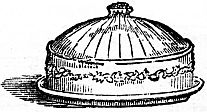
JAR FOR POTTED MEATS.
[Cold Meat Cookery. 1.] Ingredients.—2 lbs. of lean beef, 1 tablespoonful of water, ¼ lb. of butter, a seasoning to taste of salt, cayenne, pounded mace, and black pepper. Mode.—Procure a nice piece of lean beef, as free as possible from gristle, skin, &c., and put it into a jar (if at hand, one with a lid) with 1 tablespoonful of water. Cover it closely, and put the jar into a saucepan of boiling water, letting the water come within 2 inches of the top of the jar. Boil gently for 3½ hours, then take the beef, chop it very small with a chopping-knife, and pound it thoroughly in a mortar. Mix with it by degrees all, or a portion, of the gravy that will have run from it, and a little clarified butter; add the seasoning, put it in small pots for use, and cover with a little butter just warmed and poured over. If much gravy is added to it, it will keep but a short time; on the contrary, if a large proportion of butter is used, it may be preserved for some time. Time.—3½ hours. Average cost, for this quantity, 1s. 10d. Seasonable at any time.
[Cold Meat Cookery. 2.] Ingredients.—The remains of cold roast or boiled beef, ¼ lb. of butter, cayenne to taste, 2 blades of pounded mace. Mode.—The outside slices of boiled beef may, with a little trouble, be converted into a very nice addition to the breakfast-table. Cut up the meat into small pieces and pound it well, with a little butter, in a mortar; add a seasoning of cayenne and mace, and be very particular that the latter spice is reduced to the finest powder. When all the ingredients are thoroughly mixed, put them into glass or earthen potting-pots, and pour on the top a coating of clarified butter. Seasonable at any time.
Note.—If cold roast beef is used, remove all pieces of gristle and dry outside pieces, as these do not pound well.
BEEF RAGOÛT.
[Cold Meat Cookery.] Ingredients.—About 2 lbs. of cold roast beef, 6 onions, pepper, salt, and mixed spices to taste; ½ pint of boiling water, 3 tablespoonfuls of gravy. Mode.—Cut the beef into rather large pieces, and put them into a stewpan with the onions, which must be sliced. Season well with pepper, salt, and mixed spices, and pour over about ½ pint of boiling water, and gravy in the above proportion (gravy saved from the meat answers the purpose); let the whole stew very gently for about 2 hours, and serve with pickled walnuts, gherkins, or capers, just warmed in the gravy. Time.—2 hours. Average cost, exclusive of the meat, 4d. Seasonable at any time.
BEEF, Rib-bones of (a pretty Dish).
[Cold Meat Cookery.] Ingredients.—Ribs of beef bones, 1 onion chopped fine, a few slices of carrot and turnip, ¼ pint of gravy. Mode.—The bones for this dish should have left on them a slight covering of meat; saw them into pieces 3 inches long; season them with pepper and salt, and put them into a stewpan with the remaining ingredients. Stew gently, until the vegetables are tender, and serve on a flat dish within walls of mashed potatoes, Time.—¾ hour. Average cost, exclusive of the bones, 2d. Seasonable at any time.
BEEF, Roast Ribs of.
Ingredients.—Beef, a little salt. Mode.—The fore-rib is considered the primest roasting piece, but the middle-rib is considered the most economical. Let the meat be well hung (should the weather permit), having previously cut off the ends of the bones, which should be salted for a few days, and then boiled. Put the meat down to a nice clear fire, with some clean dripping in the pan, dredge the joint with a little flour, and keep continually basting it all the time it is cooking. Sprinkle some fine salt over it (this must never be done until the joint is dished, as it draws the juices from the meat); pour the dripping from the pan, put in a little boiling water, and strain the gravy over the meat. Garnish with tufts of scraped horseradish, and send horseradish sauce to table with it. A Yorkshire pudding (see Puddings) sometimes accompanies this dish, and, if lightly made and well cooked, will be found a very agreeable addition. Time.—10 lbs. of beef, 2½ hours; 14 to 16 lbs., from 3½ to 4 hours. Average cost, 9d. per lb. Sufficient.—A joint of 10 lbs. sufficient for 8 or 9 persons. Seasonable at any time.
BEEF, Roast Ribs of, Boned and Rolled (a very convenient Joint for a small Family).
Ingredients.—1 or 2 ribs of beef. Mode.—Choose a fine rib of beef, and have it cut according to the weight you require, either wide or narrow. Bone and roll the meat round, secure it with wooden skewers, and, if necessary, bind it round with a piece of tape. Spit the beef firmly, or, if a bottle-jack is used, put the joint on the hook, and place it near a nice clear fire. Let it remain so till the outside of the meat is set, when draw it to a distance, and keep continually basting until the meat is done, which can be ascertained by the steam from it drawing towards the fire. As this joint is solid, rather more than ¼ hour must be allowed for each lb. Remove the skewers, put in a plated or silver one, and send the joint to table with gravy in the dish, and garnish with tufts of horseradish. Horseradish sauce is a great improvement to roast beef. Time.—For 10 lbs. of the rolled ribs, 3 hours (as the joint is very solid, we have allowed an extra ½ hour); for 6 lbs., 1½ hour. Average cost, 9d. per lb. Sufficient.—A joint of 10 lbs. for 6 or 8 persons. Seasonable all the year.
Note.—When the weight exceeds 10 lbs., we would not advise the above method of boning or rolling; only in the case of 1 or 2 ribs, when the joint cannot stand upright in the dish, and would look awkwardly. The bones should be put on with a few vegetables and herbs, and made into stock.
BEEF RISSOLES.
[Cold Meat Cookery.] Ingredients.—The remains of cold roast beef; to each pound of meat allow ¾ lb. of bread-crumbs, salt and pepper to taste, a few chopped savoury herbs, ½ a teaspoonful of minced lemon-peel, 1 or 2 eggs, according to the quantity of meat. Mode.—Mince the beef very fine, which should be rather lean, and mix with this bread-crumbs, herbs, seasoning, and lemon-peel, in the above proportion, to each pound of meat. Make all into a thick paste with 1 or 2 eggs; divide into balls or cones, and fry a rich brown. Garnish the dish with fried parsley, and send to table some good brown gravy in a tureen. Instead of garnishing with fried parsley, gravy may be poured in the dish round the rissoles; in this case, it will not be necessary to send any in a tureen. Time.—From 5 to 10 minutes, according to size. Average cost, exclusive of the meat, 5d. Seasonable at any time.
BEEF, Rolled, to eat like Hare.
Ingredients.—About 5 lbs. of the inside of the sirloin, 2 glasses of port wine, 2 glasses of vinegar, a small quantity of forcemeat, 1 teaspoonful of pounded allspice. Mode.—Take the inside of a large sirloin, soak it in 1 glass of port wine and 1 glass of vinegar, mixed, and let it remain for 2 days. Make a forcemeat (see Forcemeat), lay it on the meat, and bind it up securely. Roast it before a nice clear fire, and baste it with 1 glass each of port wine and vinegar, with which mix a teaspoonful of pounded allspice. Serve, with a good gravy in the dish, and send red-currant jelly to table with it. Time.—A piece of 5 lbs., about 1½ hour before a brisk fire. Average cost, for this quantity, 5s. 4d. Sufficient for 4 persons. Seasonable at any time.
BEEF ROLLS.
[Cold Meat Cookery.] Ingredients.—The remains of cold roast or boiled beef, seasoning to taste of salt, pepper, and minced herbs; puff paste. Mode.—Mince the beef tolerably fine with a small amount of its own fat; add a seasoning of pepper, salt, and chopped herbs; put the whole into a roll of puff paste, and bake for ½ hour, or rather longer, should the roll be very large. Beef patties may be made of cold meat, by mincing and seasoning beef as directed above, and baking in a rich puff paste in patty-tins. Time.—½ hour. Seasonable at any time.
BEEF, Boiled Round of.
Ingredients.—Beef, water. Mode.—As a whole round of beef, generally speaking, is too large for small families, and very seldom required, we here give the recipe for dressing a portion of the silver side of the round. Take from 12 to 16 lbs., after it has been in salt about 10 days; just wash off the salt, skewer it up in a nice round-looking form, and bind it with tape to keep the skewers in their places. Put it in a saucepan of boiling water, set it upon a good fire, and when it begins to boil, carefully remove all scum from the surface, as, if this is not attended to, it sinks on to the meat, and, when brought to table, presents a very unsightly appearance. After it is well skimmed, draw the pot to the corner of the fire, allow the liquor to cool, then let the beef simmer very gently until done. Remove the tape and skewers, which should be replaced by a silver one; pour over a little of the pot-liquor, and garnish with carrots. Carrots, turnips, parsnips, and sometimes suet dumplings, accompany this dish; and these may all be boiled with the beef. The pot-liquor should be saved, and converted into pea-soup; and the outside slices, which are generally hard, and of an uninviting appearance, may be cut off before being sent to table, and potted. These make an excellent relish for the breakfast or luncheon table. Time.—Part of a round of beef weighing 12 lbs., about 3 hours after the water boils. Average cost, 8d. per lb. Sufficient for 10 persons. Seasonable all the year, but more suitable for winter.
Soyer’s Recipe for Preserving the Gravy in Salt Meat, when it is to be served Cold.—Fill two tubs with cold water, into which throw a few pounds of rough ice; and when the meat is done, put it into one of the tubs of ice-water; let it remain 1 minute, when take out, and put it into the other tub. Fill the first tub again with water, and continue this process for about 20 minutes; then set it upon a dish, and let it remain until quite cold. When cut, the fat will be as white as possible, besides having saved the whole of the gravy. If there is no ice, spring water will answer the same purpose, but will require to be more frequently changed.
Note.—The brisket and rump may be boiled by the above recipe; of course allowing more or less time, according to the size of the joint.
BEEF, Miniature Round of (an excellent Dish for a small Family).
Ingredients.—From 5 to 10 lbs. of ribs of beef, sufficient brine to cover the meat. Mode.—Choose a fine rib, have the bone removed, rub some salt over the inside, and skewer the meat up into a nice round form, and bind it with tape. Put it into sufficient brine to cover it (see Beef Pickle), and let it remain for 6 days, turning the meat every day. When required to be dressed, drain from the pickle, and put the meat into very hot water; boil it rapidly for a few minutes, then draw the pot to the side of the fire, and simmer the beef very gently until done. Remove the skewer, and replace it by a plated or silver one. Carrots and turnips should be served with this dish, and may be boiled with the meat. Time.—A small round of 8 lbs., about 2 hours after the water boils; one of 12 lbs., about 3 hours. Average cost, 9d. per lb. Sufficient for 6 persons. Seasonable at any time.
Note.—Should the joint be very small, 4 or 5 days will be sufficient time to salt it.
BEEF, to Pickle part of a Round, for Hanging.
Ingredients.—For 14 lbs. of a round of beef allow 1½ lb. of salt, ½ oz. of powdered saltpetre; or, 1 lb. of salt, ½ lb. of sugar, ½ oz. of powdered saltpetre. Mode.—Rub in, and sprinkle either of the above mixtures on 14 lbs. of meat. Keep it in an earthenware pan, or a deep wooden tray, and turn twice a week during 3 weeks; then bind up the beef tightly with coarse linen tape, and hang it in a kitchen in which a fire is constantly kept, for 3 weeks. Pork, hams, and bacon may be cured in a similar way, but will require double the quantity of the salting mixture; and, if not smoke-dried, they should be taken down from hanging after 3 or 4 weeks, and afterwards kept in boxes or tubs, amongst dry oat-husks. Time.—2 or 3 weeks to remain in the brine, to be hung 3 weeks. Seasonable at any time.
Note.—The meat may be boiled fresh from this pickle, instead of smoking it.
BEEF SAUSAGES.
Ingredients.—To every lb. of suet allow 2 lbs. of lean beef; seasoning to taste of salt, pepper, and mixed spices. Mode.—Clear the suet from skin, and chop that and the beef as finely as possible; season with pepper, salt, and spices, and mix the whole well together. Make it into flat cakes, and fry of a nice brown. Many persons pound the meat in a mortar after it is chopped, but this is not necessary when the meat is minced finely. Time.—10 minutes. Average cost, for this quantity, 1s. 6d. Seasonable at any time.
BEEF, Roast Sirloin of.
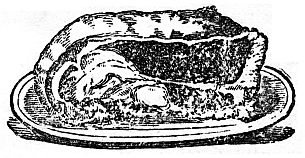
ROAST SIRLOIN OF BEEF.
Ingredients.—Beef, a little salt. Mode.—As a joint cannot be well roasted without a good fire, see that it is well made up about ¾ hour before it is required, so that when the joint is put down, it is clear and bright. Choose a nice sirloin, the weight of which should not exceed 16 lbs., as the outside would be too much done, whilst the inside would not be done enough. Spit it or hook it on to the jack firmly, dredge it slightly with flour, and place it near the fire at first. Then draw it to a distance, and keep continually basting until the meat is done. Dish the meat, sprinkle a small quantity of salt over it, empty the dripping-pan of all the dripping, pour in some boiling water, stir it about, and strain over the meat. Garnish with tufts of horseradish, and send horseradish sauce and Yorkshire pudding to table with it. Time.—A sirloin of 10 lbs., 2½ hours; 14 to 16 lbs., about 4 or 4½ hours. Average cost, 8½d. per lb. Sufficient.—A joint of 10 lbs. for 8 or 9 persons. Seasonable at any time. The rump, round, and other pieces of beef are roasted in the same manner, allowing for solid joints ¼ hour to every lb.
Note.—The above is the usual method of roasting meat; but to have it in perfection and the juices kept in, the meat should at first be laid close to the fire, and when the outside is set and firm, drawn away to a good distance, and then left to roast very slowly. Where economy is studied, this plan would not answer, as the meat requires to be at the fire double the time of the ordinary way of cooking; consequently, double the quantity of fuel would be consumed.
BEEF, Sliced and Broiled (a pretty Dish).
[Cold Meat Cookery.] Ingredients.—A few slices of cold roast beef, 4 or 5 potatoes, a thin batter, pepper and salt to taste. Mode.—Pare the potatoes as you would peel an apple; fry the parings in a thin batter seasoned with salt and pepper, until they are of a light brown colour, and place them on a dish over some slices of beef, which should be nicely seasoned and broiled. Time.—5 minutes to broil the meat. Seasonable at any time.
BEEF, Spiced (to serve Cold).
Ingredients.—14 lbs. of the thick flank or rump of beef, ½ lb. of coarse sugar, 1 oz. of saltpetre, ¼ lb. of pounded allspice, 1 lb. of common salt. Mode.—Rub the sugar well into the beef, and let it lie for 12 hours; then rub the saltpetre and allspice, both of which should be pounded, over the meat, and let it remain for another 12 hours; then rub in the salt. Turn daily in the liquor for a fortnight, soak it for a few hours in water, dry with a cloth, cover with a coarse paste, put a little water at the bottom of the pan, and bake in a moderate oven for 4 hours. If it is not covered with a paste, be careful to put the beef into a deep vessel, and cover with a plate, or it will be too crisp. During the time the meat is in the oven it should be turned once or twice. Time.—4 hours. Average cost, 7d. per lb. Seasonable at any time.
BEEF, Stewed. (A Polish Dish.)
Ingredients.—A thick beef or rump-steak of about 2 lbs., an onion, some bread-crumbs, pepper and salt, ¼ lb. of butter. Mode.—Mince the onion fine, mix it with the bread, pepper, and salt; make deep incisions in the beef, but do not cut it through; fill the spaces with the bread, &c. Roll up the steak and put it in a stewpan with the butter; let it stew very gently for more than two hours; serve it with its own gravy, thickened with a little flour, and flavoured, as may be required, either with tomato sauce, ketchup, or Harvey’s sauce. Time.—About 2 hours, or rather more. Average cost, 2s. 6d. Sufficient for 4 persons. Seasonable at any time.
BEEF, Stewed Rump of.
Ingredients.—½ rump of beef, sufficient stock to cover it, 4 tablespoonfuls of vinegar, 2 tablespoonfuls of ketchup, 1 bunch of savoury herbs, 2 onions, 12 cloves, pepper and salt to taste, thickening of butter and flour, 1 glass of port wine. Mode.—Cut out the bone, sprinkle the meat with a little cayenne (this must be sparingly used), and bind and tie it firmly up with tape; put it into a stewpan with sufficient stock to cover it, add vinegar, ketchup, herbs, onions, cloves, and seasonings in the above proportions, and simmer very gently for 4 or 5 hours, or until the meat is perfectly tender, which may be ascertained by piercing it with a thin skewer. When done, remove the tape, lay it into a deep dish, which keep hot; strain and skim the gravy, thicken it with butter and flour, add a glass of port wine and any flavouring to make the gravy rich and palatable; let it boil up, pour over the meat, and serve. This dish may be very much enriched by garnishing with forcemeat balls, or filling up the space whence the bone is taken with a good forcemeat; sliced carrots, turnips, and onions boiled with the meat are also a great improvement, and, where expense is not objected to, it may be glazed. This, however, is not necessary where a good gravy is poured round and over the meat. Time.—½ rump stewed gently from 4 to 5 hours. Average cost, 10d. per lb. Sufficient for 8 or 10 persons. Seasonable at any time.
Note.—A stock or gravy in which to boil the meat may be made of the bone and trimmings, by boiling them with water, and adding carrots, onions, turnips, and a bunch of sweet herbs. To make this dish richer and more savoury, half-roast the rump, and afterwards stew it in strong stock and a little Madeira. This is an expensive method, and is not, after all, much better than a plainer-dressed joint.
BEEF, Stewed Shin of.
Ingredients.—A shin of beef, 1 head of celery, 1 onion, a faggot of savoury herbs, ½ teaspoonful of allspice, ½ teaspoonful of whole black pepper, 4 carrots, 12 button onions, 2 turnips, thickening of butter and flour, 3 tablespoonfuls of mushroom ketchup, 2 tablespoonfuls of port wine; pepper and salt to taste. Mode.—Have the bone sawn into 4 or 5 pieces, cover with hot water, bring it to a boil, and remove any scum that may rise to the surface. Put in the celery, onion, herbs, spice, and seasoning, and simmer very gently until the meat is tender. Peel the vegetables, cut them into any shape fancy may dictate, and boil them with the onions until tender; lift out the beef, put it on a dish, which keep hot, and thicken with butter and flour as much of the liquor as will be wanted for gravy; keep stirring till it boils, then strain and skim. Put the gravy back in the stewpan, add the seasoning, port wine, and ketchup, give one boil, and pour it over the beef; garnish with the boiled carrots, turnips and onions. Time.—The meat to be stewed about 4 hours. Average cost, 5d. per lb. with bone. Sufficient for 7 or 8 persons. Seasonable at any time.
BEEF-TEA.
Ingredients.—1 lb. of lean gravy-beef, 1½ pint of water, 1 saltspoonful of salt. Mode.—Have the meat cut without fat and bone, and choose a nice fleshy piece. Cut it into small pieces about the size of dice, and put it into a clean saucepan. Add the water cold to it; put it on the fire, and bring it to the boiling-point; then skim well. Put in the salt when the water boils, and simmer the beef-tea gently from ½ to ¾ hour, removing any more scum should it appear on the surface. Strain the tea through a hair sieve, and set it by in a cool place. When wanted for use, remove every particle of fat from the top; warm up as much as may be required, adding, if necessary, a little more salt. This preparation is simple beef-tea, and is to be administered to those invalids to whom flavourings and seasonings are not allowed. When the patient is very weak, use double the quantity of meat to the same proportion of water. Should the invalid be able to take the tea prepared in a more palatable manner, it is easy to make it so by following the directions in Soyer’s recipe, which is an admirable one for making savoury beef-tea. Beef-tea is always better when made the day before it is wanted, and then warmed up. It is a good plan to put the tea into a small cup or basin, and to place this basin in a saucepan of boiling water. When the tea is hot, it is ready to serve. Time.—½ to ¾ hour. Average cost, 6d. per pint. Sufficient.—Allow 1 lb. of meat for a pint of good beef-tea.
BEEF-TEA, Baked.
Ingredients.—1 lb. of fleshy beef, 1 pint of water, ½ saltspoonful of salt. Mode.—Cut the beef into small square pieces, after trimming off all the fat, and put it into a baking-jar (these jars are sold expressly for the purpose of making soups, gravies, &c., in the oven, and are arranged with tightly-fitting lids), with the above proportion of water and salt; close the jar well, place it in a warm but not hot oven, and bake for 3 or 4 hours. When the oven is very fierce in the day-time, it is a good plan to put the jar in at night, and let it remain till next morning, when the tea will be done. It should be strained, and put by in a cool place until wanted. It may also be flavoured with an onion, a clove, and a few sweet herbs, &c., when the stomach is sufficiently strong to take these. Time.—3 or 4 hours, or to be left in the oven all night. Average cost, 6d. per pint. Sufficient.—Allow 1 lb. of meat for 1 pint of good beef-tea.
BEEF-TEA, Savoury (Soyer’s Recipe).
Ingredients.—1 lb. of solid beef, 1 oz. of butter, 1 clove, 2 button onions or ½ a large one, 1 saltspoonful of salt, 1 quart of water. Mode.—Cut the beef into very small dice; put it into a stewpan with the butter, clove, onion, and salt; stir the meat round over the fire for a few minutes until it produces a thin gravy, then add the water, and let it simmer gently from ½ to ¾ of an hour, skimming off every particle of fat. When done, strain it through a sieve, and put it by in a cool place until required. The same, if wanted quite plain, is done by merely omitting the vegetables, salt, and clove; the butter cannot be objectionable, as it is taken out in skimming. Time.—½ to ¾ hour. Average cost, 8d. per pint. Sufficient.—Allow 1 lb. of beef to make 1 pint of good beef-tea.
Note.—The meat left from beef-tea may be boiled a little longer, and pounded with spices, &c., for potting. It makes a very nice breakfast dish.
BEETROOT, Boiled.
Ingredients.—Beetroot; boiling water. Mode.—When large, young, and juicy, this vegetable makes a very excellent addition to winter salads, and may easily be converted into an economical and quickly-made pickle. (See Beetroot, Pickled.) Beetroot is more frequently served cold than hot: when the latter mode is preferred, melted butter should be sent to table with it. It may also be stewed with button onions, or boiled and served with roasted onions. Wash the beets thoroughly; but do not prick or break the skin before they are cooked, as they would lose their beautiful colour in boiling. Put them into boiling water, and let them boil until tender, keeping them well covered. If to be served hot, remove the peel quickly, cut the beetroot into thick slices, and send to table melted butter. For salads, pickle, &c., let the root cool, then peel, and cut it into slices. Time.—Small beetroot, 1½ to 2 hours; large, 2½ to 3 hours. Average cost, in full season, 2d. each. Seasonable.—May be had at any time.
BEETROOT, Pickled.
Ingredients.—Sufficient vinegar to cover the beets, 2 oz. of whole pepper, 2 oz. of allspice to each gallon of vinegar. Mode.—Wash the beets free from dirt, and be very careful not to prick the outside skin, or they would lose their beautiful colour. Put them into boiling water, let them simmer gently, and when about three parts done, which will be in 1½ hour, take them out and let them cool. Boil the vinegar with pepper and allspice, in the above proportion, for 10 minutes, and when cold, pour it on the beets, which must be peeled and cut into slices about ½ inch thick. Cover with bladder to exclude the air, and in a week they will be fit for use.
BISCUITS, Crisp.
Ingredients.—1 lb. of flour, the yolk of 1 egg, milk. Mode.—Mix the flour and the yolk of the egg with sufficient milk to make the whole into a very stiff paste; beat it well, and knead it until it is perfectly smooth. Roll the paste out very thin; with a round cutter shape it into small biscuits, and bake them a nice brown in a slow oven from 12 to 18 minutes. Time.—12 to 18 minutes. Average cost, 4d. Seasonable at any time.
BISCUITS, Dessert, which may be flavoured with Ground Ginger, Cinnamon, &c.
Ingredients.—1 lb. of flour, ½ lb. of butter, ½ lb. of sifted sugar, the yolks of 6 eggs, flavouring to taste. Mode.—Put the butter into a basin; warm it, but do not allow it to oil; then with the hand beat it to a cream. Add the flour by degrees, then the sugar and flavouring, and moisten the whole with the yolks of the eggs, which should previously be well beaten. When all the ingredients are thoroughly incorporated, drop the mixture from a spoon on to a buttered paper, leaving a distance between each cake, for they spread as soon as they begin to get warm. Bake in rather a slow oven from 12 to 18 minutes, and do not let the biscuits acquire too much colour. In making the above quantity, half may be flavoured with ground ginger and the other half with essence of lemon or currants, to make a variety. With whatever the preparation is flavoured, so are the biscuits called, and an endless variety may be made in this manner. Time.—12 to 18 minutes, or rather longer, in a very slow oven. Average cost, 1s. 6d. Sufficient to make from 3 to 4 dozen cakes. Seasonable at any time.
BISCUITS, Simple Hard.
Ingredients.—To every lb. of flour allow 2 oz. of butter, about ½ pint of skimmed milk. Mode.—Warm the butter in milk until the former is dissolved, and then mix it with the flour into a very stiff paste; beat it with a rolling-pin until the dough looks perfectly smooth. Roll it out thin; cut it with the top of a glass into round biscuits; prick them well, and bake them from 6 to 10 minutes. The above is the proportion of milk which we think would convert the flour into a stiff paste; but should it be found too much, an extra spoonful or two of flour must be put in. These biscuits are very nice for the cheese course. Time.—6 to 10 minutes. Seasonable at any time.

ROAST BLACK-COCK.
BLACK-COCK, to Roast.
Ingredients.—Black-cock, butter, toast. Mode.—Let these birds hang for a few days, or they will be tough and tasteless, if not well kept. Pluck and draw them, and wipe the insides and outsides with a damp cloth, as washing spoils the flavour. Cut off the heads, and truss them, the same as a roast fowl, cutting off the toes, and scalding and peeling the feet. Trussing them with the head on, as shown in the engraving, is still practised by many cooks, but the former method is now considered the best. Put them down to a brisk fire, well baste them with butter, and serve with a piece of toast under, and a good gravy and bread sauce. After trussing, some cooks cover the breast with vine-leaves and slices of bacon, and then roast them. They should be served in the same manner and with the same accompaniments as with the plainly-roasted birds. Time.—45 to 50 minutes. Average cost, from 5s. to 6s. the brace; but seldom bought. Sufficient,—2 or 3 for a dish. Seasonable from the middle of August to the end of December.
BLACK-COCK, to Carve.

BLACK-COCK.
Skilful carving of game undoubtedly adds to the pleasure of the guests at a dinner-table; for game seems pre-eminently to be composed of such delicate limbs and tender flesh that an inapt practitioner appears to more disadvantage when mauling these pretty and favourite dishes, than larger and more robust pièces de résistance. This bird is variously served with or without the head on; and, although we do not personally object to the appearance of the head as shown in the woodcut, yet it seems to be more in vogue to serve it without. The carving is not difficult, but should be elegantly and deftly done. Slices from the breast, cut in the direction of the dotted line from 2 to 1, should be taken off, the merrythought displaced, and the leg and wing removed by running the knife along from 3 to 4, reserving the thigh, which is considered a great delicacy, for the most honoured guests, some of whom may also esteem the brains of this bird.
BLANCMANGE (a Supper Dish).
Ingredients.—1 pint of new milk, 1¼ oz. of isinglass, the rind of ½ lemon, ¼ lb. of loaf sugar, 10 bitter almonds, ½ oz. of sweet almonds, 1 pint of cream. Mode.—Put the milk into a saucepan, with the isinglass, lemon-rind, and sugar, and let these ingredients stand by the side of the fire until the milk is well flavoured; add the almonds, which should be blanched and pounded in a mortar to a paste, and let the milk just boil up; strain it through a fine sieve or muslin into a jug, add the cream, and stir the mixture occasionally until nearly cold. Let it stand for a few minutes, then pour it into the mould, which should be previously oiled with the purest salad-oil, or dipped in cold water. There will be a sediment at the bottom of the jug, which must not be poured into the mould, as, when turned out, it would very much disfigure the appearance of the blancmange. This blancmange may be made very much richer by using 1½ pint of cream, and melting the isinglass in ½ pint of boiling water. The flavour may also be very much varied by adding bay-leaves, laurel-leaves, or essence of vanilla, instead of the lemon-rind and almonds. Noyeau, Maraschino, Curaçoa, or any favourite liqueur, added in small proportions, very much enhances the flavour of this always favourite dish. In turning it out, just loosen the edges of the blancmange from the mould, place a dish on it, and turn it quickly over: it should come out easily, and the blancmange have a smooth glossy appearance when the mould is oiled, which it frequently has not when it is only dipped in water. It may be garnished as fancy dictates. Time.—About 1½ hour to steep the lemon-rind and almonds in the milk. Average cost, with cream at 1s. per pint, 3s. 6d. Sufficient to fill a quart mould. Seasonable at any time.
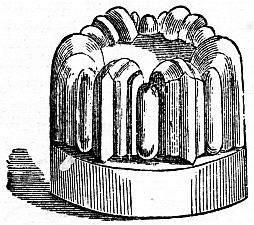
BLANC-MANGE MOULD.
BLANCMANGE, Cheap.
Ingredients.—¼ lb. of sugar, 1 quart of milk, 1½ oz. of isinglass, the rind of ½ lemon, 4 laurel-leaves. Mode.—Put all the ingredients into a lined saucepan, and boil gently until the isinglass is dissolved; taste it occasionally to ascertain when it is sufficiently flavoured with the laurel-leaves; then take them out, and keep stirring the mixture over the fire for about 10 minutes. Strain it through a fine sieve into a jug, and, when nearly cold, pour it into a well-oiled mould, omitting the sediment at the bottom. Turn it out carefully on a dish, and garnish with preserves, bright jelly, or a compôte of fruit. Time.—Altogether, ½ hour. Average cost, 8d. Sufficient to fill a quart mould. Seasonable at any time.
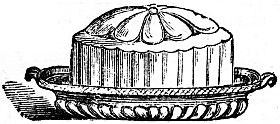
BLANC-MANGE.
BOUDIN à la REINE (an Entrée; M. Ude’s Recipe).
Ingredients.—The remains of cold roast fowls, 1 pint of Béchamel, salt and cayenne to taste, egg and bread-crumbs. Mode.—Take the breasts and nice white meat from the fowls; cut it into small dice of an equal size, and throw them into some good Béchamel (see Béchamel); season with salt and cayenne, and put the mixture into a dish to cool. When this preparation is quite cold, cut it into 2 equal parts, which should be made into boudins of a long shape, the size of the dish they are intended to be served on; roll them in flour, egg and bread-crumb them, and be careful that the ends are well covered with the crumbs, otherwise they will break in the frying-pan; fry them a nice colour, put them before the fire to drain the greasy moisture from them, and serve with the remainder of the Béchamel poured round: this should be thinned with a little stock. Time.—10 minutes to fry the boudins. Average cost, exclusive of the fowl, 1s. 3d. Sufficient for 1 entrée.
BRAWN, to make.
Ingredients.—To a pig’s head weighing 6 lbs. allow 1½ lb. lean beef, 2 tablespoonfuls of salt, 2 teaspoonfuls of pepper, a little cayenne, 6 pounded cloves. Mode.—Cut off the cheeks and salt them, unless the head be small, when all may be used. After carefully cleaning the head, put it on in sufficient cold water to cover it, with the beef, and skim it just before it boils. A head weighing 6 lbs. will require boiling from 2 to 3 hours. When sufficiently boiled to come off the bones easily, put it into a hot pan, remove the bones, and chop the meat with a sharp knife before the fire, together with the beef. It is necessary to do this as quickly as possible to prevent the fat settling in it. Sprinkle in the seasoning, which should have been previously mixed. Stir it well and put it quickly into a brawn-tin if you have one; if not, a cake-tin or mould will answer the purpose, if the meat is well pressed with weights, which must not be removed for several hours. When quite cold, dip the tin into boiling water for a minute or two, and the preparation will turn out and be fit for use. Time.—From 2 to 3 hours. Average cost, for a pig’s head, 4½d. per lb. Seasonable from September to March.
Note.—The liquor in which the head was boiled will make good pea soup, and the fat, if skimmed off and boiled in water, and afterwards poured into cold water, answers the purpose of lard.
BREAD-MAKING.
Panification, or bread-making, consists of the following processes, in the case of Wheaten Flour. Fifty or sixty per cent. of water is added to the flour, with the addition of some leavening matter, and preferably, of yeast from malt and hops. All kinds of leavening matter have, however, been, and are still used in different parts of the world: in the East Indies, “toddy,” which is a liquor that flows from the wounded cocoa-nut tree; and in the West Indies, “dunder,” or the refuse of the distillation of rum. The dough then undergoes the well-known process called kneading. The yeast produces fermentation, a process which may be thus described:—The dough reacting upon the leavening matter introduced, the starch of the flour is transformed into saccharine matter, the saccharine matter being afterwards changed into alcohol and carbonic acid. The dough must be well “bound,” and yet allow the escape of the little bubbles of carbonic acid which accompany the fermentation, and which, in their passage, cause the numerous little holes which are seen in light bread.
The yeast must be good and fresh, if the bread is to be digestible and nice. Stale yeast produces, instead of vinous fermentation, an acetous fermentation, which flavours the bread and makes it disagreeable. A poor thin yeast produces an imperfect fermentation, the result being a heavy, unwholesome loaf.
When the dough is well kneaded, it is left to stand for some time, and then, as soon as it begins to swell, it is divided into loaves; after which it is again left to stand, when it once more swells up, and manifests for the last time the symptoms of fermentation. It is then put into the oven, where the water contained in the dough is partly evaporated, and the loaves swell up again, while a yellow crust begins to form upon the surface. When the bread is sufficiently baked, the bottom crust is hard and resonant if struck with the finger, while the crumb is elastic, and rises again after being pressed down with the finger. The bread is, in all probability, baked sufficiently if, on opening the door of the oven, you are met by a cloud of steam, which quickly passes away.
One word as to the unwholesomeness of new bread and hot rolls. When bread is taken out of the oven, it is full of moisture; the starch is held together in masses, and the bread, instead of being crusted so as to expose each grain of starch to the saliva, actually prevents their digestion by being formed by the teeth into leathery poreless masses, which lie on the stomach like so many bullets. Bread should always be at least a day old before it is eaten; and, if properly made, and kept in a cool dry place, ought to be perfectly soft and palatable at the end of three or four days. Hot rolls, swimming in melted butter, and new bread, ought to be carefully shunned by everybody who has the slightest respect for that much-injured individual—the Stomach.
Aërated Bread.—It is not unknown to some of our readers that Dr. Dauglish, of Malvern, has recently patented a process for making bread “light,” without the use of leaven. The ordinary process of bread-making by fermentation is tedious, and much labour of human hands is requisite in the kneading, in order that the dough may be thoroughly interpenetrated with the leaven. The new process impregnates the bread, by the application of machinery, with carbonic acid gas, or fixed air. Different opinions are expressed about the bread; but it is curious to note, that, as corn is now reaped by machinery, and dough is baked by machinery, the whole process of bread-making is probably in course of undergoing changes which will emancipate both the housewife and the professional baker from a large amount of labour.