THE DICTIONARY OF COOKERY. (continued 5)
Reading edition
CRUST, Another good Short.
Ingredients.—To every lb. of flour allow 8 oz. of butter, the yolks of 2 eggs, 2 oz. of sifted sugar, about ¼ pint of milk. Mode.—Rub the butter into the flour, add the sugar, and mix the whole as lightly as possible to a smooth paste, with the yolks of the eggs well beaten, and the milk. The proportion of the latter ingredient must be judged of by the size of the eggs; if these are large so much will not be required, and more if the eggs are smaller. Average cost, 1s. per lb.
CUCUMBER SAUCE.
Ingredients.—3 or 4 cucumbers, 2 oz. of butter, 6 tablespoonfuls of brown gravy. Mode.—Peel the cucumbers, quarter them, and take out the seeds; cut them into small pieces, put them in a cloth, and rub them well to take out the water that hangs about them. Put the butter in a saucepan, add the cucumbers, and shake them over a sharp fire until they are of a good colour; then pour over them the gravy, mixed with the cucumbers, and simmer gently for 10 minutes, when it will be ready to serve. Time.—Altogether, ½ hour.
CUCUMBER SAUCE, White.
Ingredients.—3 or 4 cucumbers, ½ pint of white stock, cayenne and salt to taste, the yolks of 3 eggs. Mode.—Cut the cucumbers into small pieces, after peeling them and taking out the seeds. Put them in the stewpan with the white stock and seasoning; simmer gently till the cucumbers are tender, which will be in about ¼ hour. Then add the yolks of the eggs, well beaten; stir them to the sauce, but do not allow it to boil, and serve very hot. Time.—Altogether, ½ hour.
CUCUMBER SOUP (French Recipe).
Ingredients.—1 large cucumber, a piece of butter the size of a walnut, a little chervil and sorrel cut in large pieces, salt and pepper to taste, the yolks of 2 eggs, 1 gill of cream, 1 quart of medium stock. Mode.—Pare the cucumber, quarter it, and take out the seeds; cut it in thin slices, put these on a plate with a little salt, to draw the water from them; drain, and put them in your stewpan with the butter. When they are warmed through, without being browned, pour the stock on them. Add the sorrel, chervil, and seasoning, and boil for 40 minutes. Mix the well-beaten yolks of the eggs with the cream, which add at the moment of serving. Time.—1 hour. Average cost, 1s. 2d. per quart. Sufficient for 4 persons. Seasonable from June to September.
CUCUMBER VINEGAR (a very nice addition to Salads).
Ingredients.—10 large cucumbers, or 12 smaller ones, 1 quart of vinegar, 2 onions, 2 shalots, 1 tablespoonful of salt, 2 tablespoonfuls of pepper, ¼ teaspoonful of cayenne. Mode.—Pare and slice the cucumbers, put them in a stone jar or wide-mouthed bottle with the vinegar; slice the onions and shalots, and add them, with all the other ingredients, to the cucumbers. Let it stand 4 or 5 days, boil it all up, and, when cold, strain the liquor through a piece of muslin, and store it away in small bottles well sealed. This vinegar is a very nice addition to gravies, hashes, &c., as well as a great improvement to salads, or to eat with cold meat.
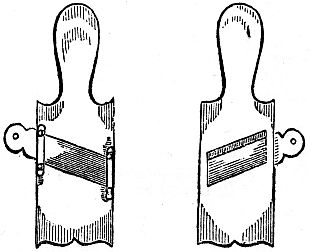
CUCUMBER-SLICES.
CUCUMBERS, to Dress.
Ingredients.—3 tablespoonfuls of salad-oil, 4 tablespoonfuls of vinegar, salt and pepper to taste. Mode.—Pare the cucumber, cut it equally into very thin slices, and commence cutting from the thick end; if commenced at the stalk, the cucumber will most likely have an exceedingly bitter taste, far from agreeable. For the purpose of slicing cucumbers evenly and very thin, we recommend the slice in preference to an ordinary knife. Put the slices into a dish, sprinkle over salt and pepper, and pour over oil and vinegar in the above proportion; turn the cucumber about, and it is ready to serve. This is a favourite accompaniment to boiled salmon, is a nice addition to all descriptions of salads, and makes a pretty garnish to lobster salad. Average cost, when scarce, 1s. to 2s. 6d.; when cheapest, may be had for 1d. each. Seasonable.—Forced from the beginning of March to the end of June; in full season in July, August, and September.

SLICED CUCUMBERS.
CUCUMBERS, Fried.
Ingredients.—2 or 3 cucumbers, pepper and salt to taste, flour, oil or butter. Mode.—Pare the cucumbers, and cut them into slices of an equal thickness, commencing to slice from the thick and not the stalk end of the cucumber. Wipe the slices dry with a cloth, dredge them with flour, and put them into a pan of boiling oil or butter; keep turning them about until brown; lift them out of the pan, let them drain, and serve, piled lightly in a dish. These will be found a great improvement to rump-steak: they should be placed on a dish with the steak on the top. Time.—5 minutes. Average cost, when cheapest, 1d. each. Sufficient for 4 or 5 persons. Seasonable.—Forced from the beginning of March to the end of June; in full season in July and August.
CUCUMBERS à la Poulette.
Ingredients.—2 or 3 cucumbers, salt and vinegar, 2 oz. of butter, flour, ½ pint of broth, 1 teaspoonful of minced parsley, a lump of sugar, the yolks of 2 eggs, salt and pepper to taste. Mode.—Pare and cut the cucumbers into slices of an equal thickness, and let them remain in a pickle of salt and vinegar for ½ hour, then drain them in a cloth, and put them into a stewpan with the butter. Fry them over a brisk fire, but do not brown them, and then dredge over them a little flour; add the broth, skim off all the fat, which will rise to the surface, and boil gently until the gravy is somewhat reduced, but the cucumber should not be broken. Stir in the yolks of the eggs, add the parsley, sugar, and a seasoning of pepper and salt; bring the whole to the point of boiling, and serve. Time.—Altogether, 1 hour. Average cost, when cheapest, 1d. each. Sufficient for 5 or 6 persons. Seasonable in July, August, or September; but may be had, forced, from the beginning of March.
CUCUMBERS, Pickled.
Ingredients.—1 oz. of whole pepper, 1 oz. of bruised ginger, sufficient vinegar to cover the cucumbers. Mode.—Cut the cucumbers in thick slices, sprinkle salt over them, and let them remain for 24 hours. The next day, drain them well for 6 hours, put them into a jar, pour boiling vinegar over them, and keep them in a warm place. In a short time, boil up the vinegar again, add pepper and ginger in the above proportion, and instantly cover them up. Tie them down with bladder, and in a few days they will be fit for use.
CUCUMBERS, an excellent way of Preserving.
Ingredients.—Salt and water, 1 lb. of lump sugar, the rind of 1 lemon, 1 oz. of ginger, cucumbers. Mode.—Choose the greenest cucumbers, and those that are most free from seeds; put them in strong salt and water, with a cabbage-leaf to keep them down; tie a paper over them, and put them in a warm place till they are yellow, then wash them and set them over the fire in fresh water with a very little salt, and another cabbage-leaf over them; cover very closely, but take care they do not boil. If they are not a fine green, change the water again, cover them as before, and make them hot. When they are a good colour take them off the fire and let them cool; cut them in quarters, take out the seeds and pulp, and put them into cold water; let them remain for 2 days, changing the water twice each day, to draw out the salt. Put the sugar, with ½ pint of water, in a saucepan over the fire; remove the scum as it rises, and add the lemon-peel and ginger with the outside scraped off; when the syrup is tolerably thick, take it off the fire, and when cold, wipe the cucumbers dry and put them in. Boil the syrup once in 2 or 3 days for 3 weeks; strengthen it if required, and let it be quite cold before the cucumbers are put in. Great attention must be paid to the directions in the commencement of this recipe, as, if these are not properly carried out, the result will be far from satisfactory. Seasonable.—This recipe should be used in June, July, or August.
CUCUMBERS, German Method of keeping for Winter use.
Ingredients.—Cucumbers, salt. Mode.—Pare and slice the cucumbers (as for the table), sprinkle well with salt, and let them remain for 24 hours; strain off the liquor, pack in jars, a thick layer of cucumbers and salt alternately; tie down closely, and, when wanted for use, take out the quantity required. Now wash them well in fresh water, and dress as usual with pepper, vinegar, and oil.
CUCUMBERS, Stewed.
Ingredients.—3 large cucumbers, flour, butter, rather more than ½ pint of good brown gravy. Mode.—Cut the cucumbers lengthwise the size of the dish they are intended to be served in; empty them of the seeds, and put them into boiling water with a little salt, and let them simmer for 5 minutes; then take them out, place them in another stewpan, with the gravy, and let them boil over a brisk fire until the cucumbers are tender. Should these be bitter, add a lump of sugar; carefully dish them, skim the sauce, pour over the cucumbers, and serve. Time.—Altogether, 20 minutes. Average cost, when cheapest, 1d. each. Sufficient for 3 or 4 persons. Seasonable in June, July, and August; but may be had, forced, from the beginning of March.
CUCUMBERS, Stewed with Onions.
Ingredients.—6 cucumbers, 3 moderate-sized onions, not quite 1 pint of white stock, cayenne and salt to taste, the yolks of 2 eggs, a very little grated nutmeg. Mode.—Pare and slice the cucumbers, take out the seeds, and cut the onions into thin slices; put these both into a stewpan, with the stock, and let them boil for ¼ hour or longer, should the cucumbers be very large. Beat up the yolks of 2 eggs; stir these into the sauce; add the cayenne, salt, and grated nutmeg; bring it to the point of boiling, and serve. Do not allow the sauce to boil, or it will curdle. This is a favourite dish with lamb or mutton chops, rump-steaks, &c. Time.—Altogether, 20 minutes. Average cost, when cheapest, 1d. each. Sufficient for 6 or 7 persons. Seasonable in July, August, and September; but may be had, forced, from the beginning of March.
CURRANT DUMPLINGS.
Ingredients.—1 lb. of flour, 6 oz. of suet, ½ lb. of currants, rather more than ½ pint of water. Mode.—Chop the suet finely, mix it with the flour, and add the currants, which should be nicely washed, picked, and dried; mix the whole to a limp paste with the water (if wanted very nice, use milk); divide it into 7 or 8 dumplings; tie them in cloths, and boil for 1¼ hour. They may be boiled without a cloth: they should then be made into round balls, and dropped into boiling water, and should be moved about at first, to prevent them from sticking to the bottom of the saucepan. Serve with a cut lemon, cold butter, and sifted sugar. Time.—In a cloth, 1¼ hour; without, ¾ hour. Average cost, 9d. Sufficient for 6 or 7 persons. Seasonable at any time.
CURRANT FRITTERS.
Ingredients.—½ pint of milk, 2 tablespoonfuls of flour, 4 eggs, 3 tablespoonfuls of boiled rice, 3 tablespoonfuls of currants, sugar to taste, a very little grated nutmeg, hot lard or clarified dripping. Mode.—Put the milk into a basin with the flour, which should previously be rubbed to a smooth batter with a little cold milk; stir these ingredients together; add the well-whisked eggs, the rice, currants, sugar, and nutmeg. Beat the mixture for a few minutes, and, if not sufficiently thick, add a little more boiled rice; drop it, in small quantities, into a pan of boiling lard or clarified dripping; fry the fritters a nice brown, and, when done, drain them on a piece of blotting-paper, before the fire. Pile them on a white d’oyley, strew over sifted sugar, and serve them very hot. Send a cut lemon to table with them. Time.—From 8 to 10 minutes to fry the fritters. Average cost, 9d. Sufficient for 3 or 4 persons. Seasonable at any time.
CURRANT JAM, Black.
Ingredients.—To every lb. of fruit, weighed before being stripped from the stalks, allow; ¾ lb. of loaf sugar, 1 gill of water. Mode.—Let the fruit be very ripe, and gathered on a dry day. Strip it from the stalks, and put it into a preserving-pan, with a gill of water to each lb. of fruit; boil these together for 10 minutes; then add the sugar, and boil the jam again for 30 minutes, reckoning from the time when the jam simmers equally all over, or longer, should it not appear to set nicely when a little is poured on to a plate. Keep stirring it to prevent it from burning, carefully remove all the scum, and when done, pour it into pots. Let it cool, cover the top of the jam with oiled paper, and the top of the jars with a piece of tissue-paper brushed over on both sides with the white of an egg: this, when cold, forms a hard stiff cover, and perfectly excludes the air. Great attention must be paid to the stirring of this jam, as it is very liable to burn, on account of the thickness of the juice. Time.—10 minutes to boil the fruit and water; 30 minutes with the sugar, or longer. Average cost, from 6d. to 8d. for a pot capable of holding 1 lb. Sufficient.—Allow from 6 to 7 quarts of currants to make 1 dozen pots of jam, each pot to hold 1 lb. Seasonable.—Make this in July.
CURRANT JAM, Red.
Ingredients.—To every lb. of fruit allow ¾ lb. of loaf sugar. Mode.—Let the fruit be gathered on a fine day; weigh it, and then strip the currants from the stalks; put them into a preserving-pan with sugar in the above proportion; stir them, and boil them for about ¾ hour. Carefully remove the scum as it rises. Put the jam into pots, and, when cold, cover with oiled papers; over these put a piece of tissue-paper brushed over on both sides with the white of an egg; press the paper round the top of the pot, and, when dry, the covering will be quite hard and air-tight. Time.—½ to ¾ hour, reckoning from the time the jam boils all over. Average cost, for a lb. pot, from 6d. to 8d. Sufficient.—Allow from 6 to 7 quarts of currants to make 12 1-lb. pots of jam. Seasonable.—Make this in July.
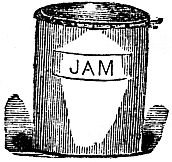
JAM-POT.
CURRANT JELLY, Black.
Ingredients.—Black currants; to every pint of juice allow ¼ pint of water, 1 lb of loaf sugar. Mode.—Strip the currants from the stalks, which may be done in an expeditious manner, by holding the bunch in one hand, and passing a small silver fork down the currants: they will then readily fall from the stalks. Put them into a jar, place this jar in a saucepan of boiling water, and simmer them until their juice is extracted; then strain them, and to every pint of juice allow the above proportion of sugar and water; stir these ingredients together cold until the sugar is dissolved; place the preserving-pan on the fire, and boil the jelly for about ½ hour, reckoning from the time it commences to boil all over, and carefully remove the scum as it rises. If the jelly becomes firm when a little is put on a plate, it is done; it should then be put into small pots, and covered the same as the jam in the preceding recipe. If the jelly is wanted very clear, the fruit should not be squeezed dry; but, of course, so much juice will not be obtained. If the fruit is not much squeezed, it may be converted into a jam for immediate eating, by boiling it with a little common sugar: this answers very well for a nursery preserve. Time.—About ¾ hour to extract the juice; ½ hour to boil the jelly. Average cost, from 8d. to 10d. per ½-lb. pot. Sufficient.—From 3 pints to 2 quarts of fruit should yield a pint of juice. Seasonable.—Make this in July.
CURRANT JELLY, Red.
Ingredients.—Red currants; to every pint of juice allow ¾ lb. of loaf sugar. Mode.—Have the fruit gathered in fine weather; pick it from the stalks, put it into a jar, and place this jar in a saucepan of boiling water over the fire, and let it simmer gently until the juice is well drawn from the currants; then strain them through a jelly-bag or fine cloth, and if the jelly is wished very clear, do not squeeze them too much, as the skin and pulp from the fruit will be pressed through with the juice, and so make the jelly muddy. Measure the juice, and to each pint allow ¾ lb of loaf sugar; put these into a preserving-pan, set it over the fire, and keep stirring the jelly until it is done, carefully removing every particle of scum as it rises, using a wooden or silver spoon for the purpose, as metal or iron ones would spoil the colour of the jelly. When it has boiled from 20 minutes to ½ hour, put a little of the jelly on a plate, and if firm when cool, it is done. Take it off the fire, pour it into small gallipots, cover each of the pots with an oiled paper, and then with a piece of tissue-paper brushed over on both sides with the white of an egg. Label the pots, adding the year when the jelly was made, and store it away in a dry place. A jam may be made with the currants, if they are not squeezed too dry, by adding a few fresh raspberries, and boiling all together, with sufficient sugar to sweeten it nicely. As this jam is not worth storing away, but is only for immediate eating, a smaller proportion of sugar than usual will be found enough: it answers very well for children’s puddings, or for a nursery preserve. Time.—From ¾ to 1 hour to extract the juice; 20 minutes to ½ hour to boil the jelly. Average cost, from 8d. to 10d. per ½-lb. pot. Sufficient.—8 quarts of currants will make from 10 to 12 pots of jelly. Seasonable.—Make this in July.
Note.—Should the above proportion of sugar not be found sufficient for some tastes, add an extra ¼ lb. to every pint of juice, making altogether 1 lb.
CURRANT JELLY, White.
Ingredients.—White currants; to every pint of juice allow ¾ lb. of good loaf sugar. Mode.—Pick the currants from the stalks, and put them into a jar; place this jar in a saucepan of boiling water, and simmer until the juice is well drawn from the fruit, which will be in from ¾ to 1 hour. Then strain the currants through a fine cloth or jelly-bag; do not squeeze them too much, or the jelly will not be clear, and put the juice into a very clean preserving-pan, with the sugar. Let this simmer gently over a clear fire until it is firm, and keep stirring and skimming until it is done; then pour it into small pots, cover them, and store away in a dry place. Time.—¾ hour to draw the juice; ½ hour to boil the jelly. Average cost, from 8d. to 10d. per ½-lb. pot. Sufficient.—From 3 pints to 2 quarts of fruit should yield 1 pint of juice. Seasonable in July and August.
CURRANT PUDDING, Boiled (Plain and Economical).
Ingredients.—1 lb. of flour, ½ lb. of suet, ½ lb. of currants, milk. Mode.—Wash the currants, dry them thoroughly, and pick away any stalks or grit; chop the suet finely; mix all the ingredients together, and moisten with sufficient milk to make the pudding into a stiff batter; tie it up in a floured cloth, put it into boiling water, and boil for 3½ hours; serve with a cut lemon, cold butter, and sifted sugar. Time.—3½ hours. Average cost, 10d. Sufficient for 7 or 8 persons. Seasonable at any time.
CURRANT PUDDING, Black or Red.
Ingredients.—1 quart of red or black currants, measured with the stalks, ¼ lb. of moist sugar, suet crust or butter crust (see recipes for Crusts). Mode.—Make, with ¾ lb. of flour, either a suet crust or butter crust (the former is usually made); butter a basin, and line it with part of the crust; add the currants, which should be stripped from the stalks, and sprinkle the sugar over them; put the cover of the pudding on; make the edges very secure, that the juice does not escape; tie it down with a floured cloth, put it into boiling water, and boil from 2½ to 3 hours. Boiled without a basin, allow ½ hour less. We have given rather a large proportion of sugar; but we find fruit puddings are so much more juicy and palatable when well sweetened before they are boiled, besides being more economical. A few raspberries added to red-currant pudding are a very nice addition; about ½ pint would be sufficient for the above quantity of fruit. Fruit puddings are very delicious if, when they are turned out of the basin, the crust is browned with a salamander, or put into a very hot oven for a few minutes to colour it: this makes it crisp on the surface. Time.—2½ to 3 hours; without a basin, 2 to 2½ hours. Average cost, in full season, 8d. Sufficient for 6 or 7 persons. Seasonable in June, July, and August.
CURRANT AND RASPBERRY TART, Red.
Ingredients.—1½ pint of picked currants, ½ pint of raspberries, 3 heaped tablespoonfuls of moist sugar, ½ lb of short crust. Mode.—Strip the currants from the stalks, and put them into a deep pie-dish, with a small cup placed in the midst, bottom upwards; add the raspberries and sugar; place a border of paste round the edge of the dish, cover with crust, ornament the edges, and bake from ½ to ¾ hour; strew some sifted sugar over before being sent to table. This tart is more generally served cold than hot. Time.—½ to ¾ hour, Average cost, 1s. Sufficient for 5 or 6 persons. Seasonable in June, July, and August.
Note.—In tarts of this description carefully avoid washing the fruit.
CURRANTS, Iced, for Dessert.
Ingredients.—¼ pint of water, the whites of 2 eggs, currants, pounded sugar. Mode.—Select very fine bunches of red or white currants, and well beat the whites of the eggs. Mix these with the water; then take the currants, a bunch at a time, and dip them in; let them drain for a minute or two, and roll them in very fine-pounded sugar. Lay them to dry on paper, when the sugar will crystallize round each currant, and have a very pretty effect. All fresh fruit may be prepared in the same manner; and a mixture of various fruits iced in this manner, and arranged on one dish, looks very well for a summer dessert. Time.—¼ day to dry the fruit. Average cost, 8d. for a pint of iced currants. Seasonable in summer.
CURRY.
Ingredients.—Veal, mutton, fowl, or rabbit; a large onion, butter, brown gravy or stock, a tablespoonful of curry-powder. Mode.—Let the meat be half fried. Cut the onion into small pieces, and fry it in butter till quite brown; add the meat, with a small quantity of brown gravy or stock, also the curry-powder, and stew all for about 20 minutes. This is for a dry curry; more gravy and curry-powder can be used if preferred. Time.—20 minutes. Seasonable at any time.
CURRY ST. LEONARDS.
Ingredients.—Chicken, or any meat; 2 tablespoonfuls of butter, 2 tablespoonfuls of curry-powder, 4 or 5 leaves of mint, a teacup of good gravy, salt, a dessertspoonful of vinegar, 3 tablespoonfuls of cream. Mode.—Fry together for 10 minutes the butter, curry-powder, and mint; then add the meat cut into dice, also the gravy, salt, and vinegar. Let all these simmer for 20 minutes, and then pour over the cream, and serve quite hot. Time.—30 minutes. Seasonable at any time.
CURRY-POWDER (Founded on Dr. Kitchener’s Recipe).
Ingredients.—¼ lb. of coriander-seed, ¼ lb. of turmeric, 2 oz. of cinnamon-seed, ½ oz. of cayenne, 1 oz. of mustard, 1 oz. of ground ginger, ½ ounce of allspice, 2 oz. of fenugreek seed. Mode.—Put all the ingredients in a cool oven, where they should remain one night; then pound them in a mortar, rub them through a sieve, and mix thoroughly together; keep the powder in a bottle, from which the air should be completely excluded.
CURRY-POWDER (Capt. White’s Recipe; most excellent).
Ingredients.—1 lb. of pale turmeric seed, 4 oz. of cumming seed, 8 oz. of coriander seed, 4 oz. of black pepper, 2 oz. of cayenne pepper, 4 oz. of Jamaica ginger, 10 oz. of caraway seed, ¼ oz. of cardamums. Mode.—Mix together all these ingredients, well pounded, and then place the mixture in the sun, or before the fire, stirring it frequently. Average cost, 5s. 2d.
Note.—This will be found a most excellent curry-powder, if care be taken to purchase the ingredients at a good druggist’s.
CUSTARDS, Boiled.

CUSTARDS IN GLASSES.
Ingredients.—1 pint of milk, 5 eggs, 3 oz. of loaf sugar, 3 laurel-leaves, or the rind of ½ lemon, or a few drops of essence of vanilla, 1 tablespoonful of brandy. Mode.—Put the milk into a lined saucepan, with the sugar and whichever of the above flavourings may be preferred (the lemon-rind flavours custards most deliciously), and let the milk steep by the side of the fire until it is well flavoured. Bring it to the point of boiling, then strain it into a basin; whisk the eggs well, and, when the milk has cooled a little, stir in the eggs, and strain this mixture into a jug. Place this jug in a saucepan of boiling water over the fire; keep stirring the custard one way until it thickens; but on no account allow it to reach the boiling point, as it will instantly curdle and be full of lumps. Take it off the fire, stir in the brandy, and when this is well mixed with the custard, pour it into glasses, which should be rather more than three-parts full; grate a little nutmeg over the top, and the dish is ready for table. To make custards look and eat better, ducks’ eggs should be used, when obtainable; they add very much to the flavour and richness, and so many are not required as of the ordinary eggs, 4 ducks’ eggs to the pint of milk making a delicious custard. When desired extremely rich and good, cream should be substituted for the milk, and double the quantity of eggs used to those mentioned, omitting the whites. Time.—½ hour to infuse the lemon-rind, about 10 minutes to stir the custard. Average cost, 8d. Sufficient to fill 8 custard-glasses. Seasonable at any time.
CUSTARD PUDDING, Baked.
Ingredients.—1½ pint of milk, the rind of ¼ lemon, ¼ lb. of moist sugar, 4 eggs. Mode.—Put the milk into a saucepan with the sugar and lemon-rind, and let this infuse for about ½ hour, or until the milk is well flavoured; whisk the eggs, yolks and whites; pour the milk to them, stirring all the while; then have ready a pie-dish, lined at the edge with paste ready baked; strain the custard into the dish, grate a little nutmeg over the top, and bake in a very slow oven for about ½ hour, or rather longer. The flavour of this pudding may be varied by substituting bitter almonds for the lemon-rind; and it may be very much enriched by using half cream and half milk, and doubling the quantity of eggs. Time.—½ to ¾ hour. Average cost, 9d. Sufficient for 5 or 6 persons. Seasonable at any time.
Note.—This pudding is usually served cold with fruit tarts.
CUSTARD PUDDING, Boiled.
Ingredients.—1 pint of milk, 1 tablespoonful of flour, 4 eggs, flavouring to taste. Mode.—Flavour the milk by infusing in it a little lemon-rind or cinnamon; whisk the eggs, stir the flour gradually to these, and pour over them the milk, and stir the mixture well. Butter a basin that will exactly hold it; put in the custard, and tie a floured cloth over; plunge it into boiling water, and turn it about for a few minutes, to prevent the flour from settling in one part. Boil it slowly for ½ hour; turn it out of the basin, and serve. The pudding may be garnished with red-currant jelly, and sweet sauce may be sent to table with it. Time.—½ hour. Average cost, 7d. Sufficient for 5 or 6 persons. Seasonable at any time.
CUSTARD SAUCE, for Sweet Puddings or Tarts.
Ingredients.—½ pint of milk, 2 eggs, 3 oz. of pounded sugar, 1 tablespoonful of brandy. Mode.—Put the milk in a very clean saucepan, and let it boil. Beat the eggs, stir to them the milk and pounded sugar, and put the mixture into a jug. Place the jug in a saucepan of boiling water; keep stirring well until it thickens, but do not allow it to boil, or it will curdle. Serve the sauce in a tureen, stir in the brandy, and grate a little nutmeg over the top. This sauce may be made very much nicer by using cream instead of milk; but the above recipe will be found quite good enough for ordinary purposes. Average cost, 6d. per pint. Sufficient, this quantity, for 2 fruit tarts, or 1 pudding.
CUSTARD TARTLETS, or Fanchonnettes.
Ingredients.—For the custard, 4 eggs, ¾ pint of milk, 2 oz. of butter, 2 oz. of pounded sugar, 3 dessertspoonfuls of flour, flavouring to taste; the whites of 2 eggs, 2 oz. of pounded sugar. Mode.—Well beat the eggs; stir to them the milk, the butter, which should be beaten to a cream, the sugar, and flour; mix these ingredients well together, put them into a very clean saucepan, and bring them to the simmering point, but do not allow them to boil. Flavour with essence of vanilla, bitter almonds, lemon, grated chocolate, or any flavouring ingredient that may be preferred. Line some round tartlet-pans with good puff-paste; fill them with the custard, and bake in a moderate oven for about 20 minutes; then take them out of the pans; let them cool, and in the meantime whisk the whites of the eggs to a stiff froth; stir into this the pounded sugar, and spread smoothly over the tartlets a little of this mixture. Put them in the oven again to set the icing, but be particular that they do not scorch; when the icing looks crisp, they are done. Arrange them, piled high in the centre, on a white napkin, and garnish the dish, and in between the tartlets, with strips of bright jelly, or very firmly-made preserve. Time.—20 minutes to bake the tartlets; 5 minutes after being iced. Average cost, exclusive of the paste, 1s. Sufficient to fill 10 or 12 tartlets, Seasonable at any time.
Note.—The icing may be omitted on the top of the tartlets, and a spoonful of any kind of preserve put at the bottom of the custard instead: this varies both the flavour and appearance of this dish.
CUTLET, the Invalid’s.
Ingredients.—1 nice cutlet from a loin or neck of mutton, 2 teacupfuls of water, 1 very small stick of celery, pepper and salt to taste. Mode.—Have the cutlet cut from a very nice loin or neck of mutton; take off all the fat; put it into a stewpan, with the other ingredients; stew very gently indeed for nearly 2 hours, and skim off every particle of fat that may rise to the surface from time to time. The celery should be cut into thin slices before it is added to the meat, and care must be taken not to put in too much of this ingredient, or the dish will not be good. If the water is allowed to boil fast, the cutlet will be hard. Time.—2 hours’ very gentle stewing. Average cost, 6d. Sufficient for 1 person. Seasonable at any time.
CUTLETS, Mutton, Italian.
Ingredients.—About 3 lbs. of the neck of mutton, clarified butter, the yolk of 1 egg, 4 tablespoonfuls of bread-crumbs, 1 tablespoonful of minced savoury herbs, 1 tablespoonful of minced parsley, 1 teaspoonful of minced shalot, 1 saltspoonful of finely-chopped lemon-peel; pepper, salt, and pounded mace to taste; flour, ½ pint of hot broth or water, 2 teaspoonfuls of Harvey’s sauce, 1 teaspoonful of soy, 2 teaspoonfuls of tarragon vinegar, 1 tablespoonful of port wine. Mode.—Cut the mutton into nicely-shaped cutlets, flatten them, and trim off some of the fat, dip them in clarified butter, and then into the beaten yolk of an egg. Mix well together bread-crumbs, herbs, parsley, shalot, lemon-peel, and seasoning in the above proportion, and cover the cutlets with these ingredients. Melt some butter in a frying-pan, lay in the cutlets, and fry them a nice brown; take them out, and keep them hot before the fire. Dredge some flour into the pan, and, if there is not sufficient butter, add a little more; stir till it looks brown, then put in the hot broth or water, and the remaining ingredients; give one boil, and pour round the cutlets. If the gravy should not be thick enough, add a little more flour. Mushrooms, when obtainable, are a great improvement to this dish, and when not in season, mushroom-powder may be substituted for them. Time.—10 minutes; rather longer, should the cutlets be very thick. Average cost, 2s. 9d. Sufficient for 5 or 6 persons. Seasonable at any time.
CUTLETS of Cold Mutton.
[Cold Meat Cookery.] Ingredients.—The remains of cold loin or neck of mutton, 1 egg, bread-crumbs, brown gravy or tomato sauce. Mode.—Cut the remains of cold loin or neck of mutton into cutlets, trim them, and take away a portion of the fat, should there be too much; dip them in beaten egg, and sprinkle with bread-crumbs, and fry them a nice brown in hot dripping. Arrange, them on a dish, and pour round them either a good gravy or hot tomato sauce. Time.—About 7 minutes. Seasonable.—Tomatoes to be had most reasonably in September and October.
DAMPFNUDELN, or German Puddings.
Ingredients.—1 lb. of flour, ¼ lb. of butter, 5 eggs, 2 small tablespoonfuls of yeast, 2 tablespoonfuls of finely-pounded sugar, milk, a very little salt. Mode.—Put the flour into a basin, make a hole in the centre, into which put the yeast, and rather more than ¼ pint of warm milk; make this into a batter with the middle of the flour, and let the sponge rise in a warm temperature. When sufficiently risen, mix the eggs, butter, sugar, and salt, with a little more warm milk, and knead the whole well together with the hands, beating the dough until it is perfectly smooth, and it drops from the fingers. Then cover the basin with a cloth, put it in a warm place, and when the dough has nicely risen, knead it into small balls; butter the bottom of a deep sauté-pan, strew over some pounded sugar, and let the dampfnudeln be laid in, but do not let them touch one another; then pour over sufficient milk to cover them, put on the lid, and let them rise to twice their original size by the side of the fire. Now place them in the oven for a few minutes to acquire a nice brown colour, and serve them on a napkin, with custard sauce flavoured with vanilla, or a compôte of any fruit that may be preferred. Time.—½ to ¾ hour for the sponge to rise; 10 to 15 minutes for the puddings to rise; 10 minutes to bake them in a brisk oven. Sufficient for 10 or 12 dampfnudeln. Seasonable at any time.
DAMSON CHEESE.
Ingredients.—Damsons; to every lb. of fruit pulp allow ½ lb. of loaf sugar. Mode.—Pick the stalks from the damsons, and put them into a preserving-pan; simmer them over the fire until they are soft, occasionally stirring them, then beat them through a coarse sieve, and put the pulp and juice into the preserving-pan, with sugar in the above proportion, having previously carefully weighed them. Stir the sugar well in, and simmer the damsons slowly for 2 hours. Skim well, then boil the preserve quickly for ½ hour, or until it looks firm and hard in the spoon; put it quickly into shallow pots, or very tiny earthenware moulds, and, when cold, cover it with oiled papers, and the jars with tissue-paper brushed over on both sides with the white of an egg. A few of the stones may be cracked, and the kernels boiled with the damsons, which very much improves the flavour of the cheese. Time.—1 hour to boil the damsons without the sugar; 2 hours to simmer them slowly, ½ hour quickly. Average cost, from 8d. to 10d. per ¼-lb. pot. Sufficient.—1 pint of damsons to make a very small pot of cheese. Seasonable.—Make this in September or October.
DAMSON JAM.
Ingredients.—Damsons; to every lb. of fruit allow ¾ lb. of loaf sugar. Mode.—Have the fruit gathered in dry weather, pick it over, and reject any that is at all blemished. Stone the damsons, weigh them, and to every lb. allow ¾ lb. of loaf sugar. Put the fruit and sugar into a preserving-pan; keep stirring them gently until the sugar is dissolved, and carefully remove the scum as it rises. Boil the jam for about an hour, reckoning from the time it commences to simmer all over alike: it must be well stirred all the time, or it will be liable to burn and stick to the pan, which will cause the jam to have a very disagreeable flavour. When the jam looks firm, and the juice appears to set, it is done; then take it off the fire, put it into pots, cover it down, when quite cold, with oiled and egged papers, and store it away in a dry place. Time.—1 hour after the jam simmers all over. Average cost, from 6d. to 8d. per lb. pot. Sufficient.—1½ pint of damsons for a lb. pot. Seasonable.—Make this in September or October.
DAMSON PUDDING.
Ingredients.—1½ pint of damsons, ¼ lb. of moist sugar, ¾ lb. of suet or butter crust. Mode.—Make a suet crust with ¾ lb. of flour by recipe; line a buttered pudding-basin with a portion of it; fill the basin with the damsons, sweeten them, and put on the lid; pinch the edges of the crust together, that the juice does not escape; tie over a floured cloth, put the pudding into boiling water, and boil from 2½ to 3 hours. Time.—2½ to 3 hours. Average cost, 8d. Sufficient for 6 or 7 persons. Seasonable in September and October.
DAMSON TART.
Ingredients.—1½ pint of damsons, ¼ lb. of moist sugar, ½ lb. of short or puff crust. Mode.—Put the damsons, with the sugar between them, into a deep pie-dish, in the midst of which place a small cup or jar turned upside down; pile the fruit high in the middle, line the edges of the dish with short or puff crust, whichever may be preferred; put on the cover, ornament the edges, and bake from ½ to ¾ hour in a good oven. If puff-crust is used, about 10 minutes before the pie is done, take it out of the oven, brush it over with the white of an egg beaten to a froth with the blade of a knife; strew some sifted sugar over, and a few drops of water, and put the tart back to finish baking: with short crust, a little plain sifted sugar, sprinkled over, is all that will be required. Time.—½ to ¾ hour. Average cost, 10d. Sufficient for 5 or 6 persons. Seasonable in September and October.
DAMSONS, Baked, for Winter use.
Ingredients.—To every lb. of fruit allow 6 oz. of pounded sugar; melted mutton suet. Mode.—Choose sound fruit, not too ripe; pick off the stalks, weigh it, and to every lb. allow the above proportion of pounded sugar. Put the fruit into large dry stone jars, sprinkling the sugar amongst it; cover the jars with saucers, place them in a rather cool oven, and bake the fruit until it is quite tender. When cold, cover the top of the fruit with a piece of white paper cut to the size of the jar; pour over this melted mutton suet about an inch thick, and cover the tops of the jars with thick brown paper well tied down. Keep the jars in a cool dry place, and the fruit will remain good till the following Christmas, but not much longer. Time.—From 5 to 6 hours to bake the damsons in a very cool oven. Seasonable in September and October.
DAMSONS, Compôte of.
Ingredients.—1 quart of damsons, 1 pint of syrup (see Syrup). Mode.—Procure sound ripe damsons, pick the stalks from them, and put them into boiling syrup made by the recipe. Simmer them gently until the fruit is tender, but not sufficiently soft to break; take them up, boil the syrup for 5 minutes, pour it over the damsons, and serve. This should be sent to table in a glass dish. Time.—About ¼ hour to simmer the damsons; 5 minutes to boil the syrup. Average cost, 9d. Sufficient for 4 or 5 persons. Seasonable in September and October.
DAMSONS, Preserved.
Ingredients.—To every quart of damsons allow ½ lb. of loaf sugar. Mode.—Put the damsons (which should be picked from the stalks and quite free from blemishes) into a jar, with pounded sugar sprinkled amongst them in the above proportion; tie the jar closely down, set it in a saucepan of cold water; bring it gradually to boil, and simmer gently until the damsons are soft, without being broken. Let them stand till cold; then strain the juice from them, boil it up well, strain it through a jelly-bag, and pour it over the fruit. Let it cool, cover with oiled papers, and the jars with tissue-paper brushed over on both sides with the white of an egg, and store away in a dry place. Time.—About ¾ hour to simmer the fruit after the water boils; ¼ hour to boil the juice. Seasonable.—Make this in September or October.
DAMSONS, or any kind of Plums, to Preserve. (Useful in Winter.)
Ingredients.—Damsons or plums; boiling water. Mode.—Pick the fruit into clean dry stone jars, taking care to leave out all that are broken or blemished. When full, pour boiling water on the plums, until it stands one inch above the fruit; cut a piece of paper to fit the inside of the jar, over which pour melted mutton-suet; cover down with brown paper, and keep the jars in a dry cool place. When used, the suet should be removed, the water poured off, and the jelly at the bottom of the jar used and mixed with the fruit. Seasonable in September and October.
DARIOLES À LA VANILLE. (Sweet Entremets.)
Ingredients.—½ pint of milk, ½ pint of cream, 2 oz. of flour, 3 oz. of pounded sugar, 6 eggs, 2 oz. of butter, puff-paste, flavouring of essence of vanilla. Mode.—Mix the flour to a smooth batter, with the milk; stir in the cream, sugar, the eggs, which should be well whisked, and the butter, which should be beaten to a cream. Put in some essence of vanilla, drop by drop, until the mixture is well flavoured; line some dariole-moulds with puff-paste, three-parts fill them with the batter, and bake in a good oven from 25 to 35 minutes. Turn them out of the moulds on a dish, without breaking them; strew over sifted sugar, and serve. The flavouring of the darioles may be varied by substituting lemon, cinnamon, or almonds, for the vanilla. Time.—25 to 35 minutes. Average cost, 1s. 8d. Sufficient to fill 6 or 7 dariole-moulds. Seasonable at any time.
DECEMBER—BILLS OF FARE.
Dinner for 18 persons.
First Course.
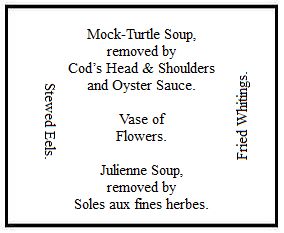
Mock-Turtle Soup, removed by Cod’s Head & Shoulders and Oyster Sauce. Stewed Eels. Vase of Flowers. Fried Whitings. Julienne Soup, removed by Soles aux fines herbes.
Second Course.
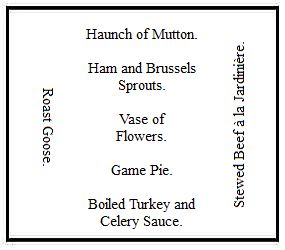
Haunch of Mutton. Roast Goose. Ham and Brussels Sprouts. Stewed Beef à la Jardinière. Vase of Flowers. Game Pie. Boiled Turkey and Celery Sauce.
Entrées.
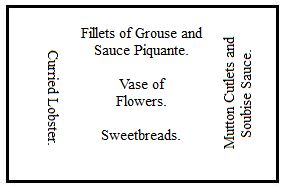
Fillets of Grouse and Sauce Piquante. Curried Lobster. Vase of Flowers. Mutton Cutlets and Soubise Sauce. Sweetbreads.
Third Course.
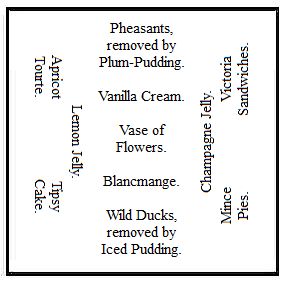
Dessert and Ices.
Apricot Tourte. Pheasants, removed by Plum-Pudding. Victoria Sandwiches. Lemon Jelly. Vanilla Cream. Champagne Jelly. Vase of Flowers. Blancmange. Tipsy Cake. Wild Ducks, removed by Iced Pudding. Mince Pies.
Dinner for 12 persons.
First Course.—Game soup; clear vermicelli soup; codfish au gratin; fillets of whitings à la maître d’hôtel. Entrées.—Filet de bœuf and sauce piquante; fricasseed chicken; oyster patties; curried rabbit. Second Course.—Roast turkey and sausages; boiled leg of pork and vegetables; roast goose; stewed beef à la Jardinière. Third Course.—Widgeon; partridges; Charlotte aux pommes; mince pies; orange jelly, lemon cream; apple tart; cabinet pudding. Dessert and ices.
Dinner for 10 persons.
First Course.—Mulligatawny soup; fried slices of codfish; soles à la crême. Entrées.—Croquettes of fowl; pork cutlets and tomato sauce. Second Course.—Roast ribs of beef; boiled turkey and celery sauce; tongue, garnished; lark pudding; vegetables. Third Course.—Roast hare; grouse; plum-pudding; mince pies; Charlotte à la Parisienne; cheesecakes; apple tart; Nesselrode pudding. Dessert and ices.
Dinner for 8 persons.
First Course.—Carrot soup; crimped cod and oyster sauce; baked soles. Entrées.—Mutton kidneys à la Française; oyster patties. Second Course.—Boiled beef and vegetables; marrow-bones; roast fowls and water-cresses; tongue, garnished; game pie. Third Course.—Partridges; blancmange; compôte of apples; vol-au-vent of pears; almond cheesecakes; lemon pudding. Dessert and ices.
Dinners for 6 persons.
First Course.—Rabbit soup; brill and shrimp sauce. Entrées.—Curried fowl; oyster patties. Second Course.—Roast turkey and sausages; boiled leg of pork; vegetables. Third Course.—Hunters’ pudding; lemon cheesecakes; apple tart; custards, in glasses; raspberry cream. Dessert.
First Course.—Ox-tail soup; crimped cod and oyster sauce. Entrées.—Savoury rissoles; fowl scollops à la Béchamel. Second Course.—Haunch of mutton; boiled chickens and celery sauce; bacon-cheek, garnished with Brussels sprouts; vegetables. Third Course.—Snipes; orange jelly; cheesecakes; apples à la Portugaise; apricot-jam tartlets; soufflé of rice. Dessert.
First Course.—Vermicelli soup; soles à la maître d’hôtel; fried eels. Entrées.—Pork cutlets and tomato sauce; ragoût of mutton à la Jardinière. Second Course.—Roast goose; boiled leg of mutton and vegetables. Third Course.—Pheasants; whipped cream; meringues; compôte of Normandy pippins; mince pies; plum-pudding. Dessert.
First Course.—Carrot soup; baked cod; fried smelts. Entrées.—Stewed rump-steak à la Jardinière; fricasseed chicken. Second Course.—Roast leg of mutton, boned and stuffed; boiled turkey and oyster sauce; vegetables. Third Course.—Wild ducks; fancy pastry; lemon cream; damson tart, with bottled fruit; custards, in glasses; cabinet pudding. Dessert.
DECEMBER, Plain Family Dinners for.
Sunday.—1. Carrot soup. 2. Roast beef, horseradish sauce, vegetables. 3. Plum-pudding, mince pies.
Monday.—1. Fried whitings, melted butter. 2. Rabbit pie, cold beef, mashed potatoes. 3. Plum-pudding cut in slices and warmed, apple tart.
Tuesday.—1. Hashed beef and broiled bones, pork cutlets and tomato sauce; vegetables. 2. Baked lemon pudding.
Wednesday.—1. Boiled neck of mutton and vegetables,—the broth served first with a little pearl barley or rice boiled in it. 2. Bakewell pudding.
Thursday.—1. Roast leg of pork, apple sauce; vegetables. 2. Rice snowballs.
Friday.—1. Soles à la crême. 2. Cold pork and mashed potatoes, broiled rump-steaks and oyster sauce. 3. Rolled jam pudding.
Saturday.—1. The remains of cold pork curried, dish of rice, mutton cutlets and mashed potatoes. 2. Baked apple dumplings.
Sunday.—1. Roast turkey and sausages, boiled leg of pork, pease pudding; vegetables. 2. Baked apple pudding, mince pies.
Monday.—1. Hashed turkey, cold pork, mashed potatoes. 2. Mincemeat pudding.
Tuesday.—1. Pea-soup made from liquor in which pork was boiled. 2. Boiled fowls and celery sauce, vegetables. 3. Baked rice pudding.
Wednesday.—1. Roast leg of mutton, stewed Spanish onions, potatoes. 2. Baked rolled jam pudding.
Thursday.—1. Baked cod’s head. 2. Cold mutton, roast hare, gravy and red-currant jelly. 3. Macaroni.
Friday.—1. Hare soup, made with stock and remains of roast hare. 2. Hashed mutton, pork cutlets, and mashed potatoes. 3. Open tarts, rice blancmange.
Saturday.—1. Rump-steak-and-kidney pudding, vegetables. 2. Mince pies, baked apple dumplings.
DECEMBER, Things in Season.
Fish.—Barbel, brill, carp, cod, crabs, eels, dace, gudgeons, haddocks, herrings, lobsters, oysters, perch, pike, shrimps, skate, sprats, soles, tench, thornback, turbot, whiting.
Meat.—Beef, house lamb, mutton, pork, venison.
Poultry.—Capons, chickens, fowls, geese, pigeons, pullets, rabbits, teal, turkeys, widgeons, wild ducks.
Game.—Hares, partridges, pheasants, snipes, woodcocks.
Vegetables.—Broccoli, cabbages, carrots, celery, leeks, onions, potatoes, parsnips, Scotch kale, turnips, winter spinach.
Fruit.—Apples, chestnuts, filberts, grapes, medlars, oranges, pears, walnuts, dried fruits, such as almonds and raisins, figs, dates, &c.,—crystallized preserves.
DESSERT.
With moderns the dessert is not so profuse, nor does it hold the same relationship to the dinner that it held with the ancients,—the Romans more especially. On ivory tables they would spread hundreds of different kinds of raw, cooked, and preserved fruits, tarts, and cakes, as substitutes for the more substantial comestibles with which the guests were satiated. However, as late as the reigns of our two last Georges, fabulous sums were often expended upon fanciful desserts. The dessert certainly repays, in its general effect, the expenditure upon it of much pains; and it may be said, that if there be any poetry at all in meals, or the process of feeding, there is poetry in the dessert, the materials for which should be selected with taste, and, of course, must depend, in a great measure, upon the season. Pines, melons, grapes, peaches, nectarines, plums, strawberries, apples, pears, oranges, almonds, raisins, figs, walnuts, filberts, medlars, cherries, &c. &c., all kinds of dried fruits, and choice and delicately-flavoured cakes and biscuits, make up the dessert, together with the most costly and recherché wines. The shape of the dishes varies at different periods, the prevailing fashion at present being oval and circular dishes on stems. The patterns and colours are also subject to changes of fashion; some persons selecting china, chaste in pattern and colour; others, elegantly-shaped glass dishes on stems, with gilt edges. The beauty of the dessert services at the tables of the wealthy tends to enhance the splendour of the plate. The general mode of putting a dessert on table, now the elegant tazzas are fashionable, is, to place them down the middle of the table, a tall and short dish alternately; the fresh fruits being arranged on the tall dishes, and dried fruits, bon-bons, &c., on small round or oval glass plates. The garnishing needs especial attention, as the contrast of the brilliant-coloured fruits with nicely-arranged foliage is very charming. The garnish par excellence for dessert is the ice-plant; its crystallized dewdrops producing a marvellous effect in the height of summer, giving a most inviting sense of coolness to the fruit it encircles. The double-edged mallow, strawberry, and vine leaves have a pleasing effect; and for winter desserts, the bay, cuba, and laurel are sometimes used. In town, the expense and difficulty of obtaining natural foliage is great, but paper and composite leaves are to be purchased at an almost nominal price. Mixed fruits of the larger sort are now frequently served on one dish. This mode admits of the display of much taste in the arrangement of the fruit: for instance, a pine in the centre of the dish, surrounded with large plums of various sorts and colours, mixed with pears, rosy-cheeked apples, all arranged with a due regard to colour, have a very good effect. Again, apples and pears look well mingled with plums and grapes, hanging from the border of the dish in a négligé sort of manner, with a large bunch of the same fruit lying on the top of the apples. A dessert would not now be considered complete without candied and preserved fruits and confections. The candied fruits may be purchased at a less cost than they can be manufactured at home. They are preserved abroad in most ornamental and elegant forms. And since, from the facilities of travel, we have become so familiar with the tables of the French, chocolate in different forms is indispensable to our desserts. Olives, too, should not be omitted; these should be served in a small, deep glass dish, with a little of the liquor, or brine, poured over.
DESSERT DISHES.
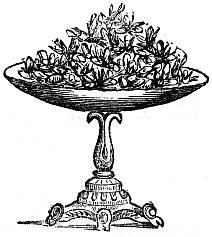
DISH OF NUTS.
The tazza, or dish with stem, the same as that shown in our illustrations, is now the favourite shape for dessert-dishes. The fruit can be arranged and shown to better advantage on these tall high dishes than on the short flat ones. All the dishes are now usually placed down the centre of the table, dried and fresh fruit alternately, the former being arranged on small round or oval glass plates, and the latter on the dishes with stems. The fruit should always be gathered on the same day that it is required for table, and should be tastefully arranged on the dishes, with leaves between and round it. By purchasing fruits that are in season, a dessert can be supplied at a very moderate cost. These, with a few fancy biscuits, crystallized fruit, bon-bons, &c., are sufficient for an ordinary dessert. When fresh fruit cannot be obtained, dried and foreign fruits, compôtes, baked pears, stewed Normandy pippins, &c. &c., must supply its place, with the addition of preserves, bon-bons, cakes, biscuits, &c. At fashionable tables, forced fruit is served growing in pots, these pots being hidden in more ornamental ones, and arranged with the other dishes. A few vases of fresh flowers, tastefully arranged, add very much to the appearance of the dessert; and, when these are not obtainable, a few paper ones, mixed with green leaves, answer very well as a substitute. In decorating a table, whether for luncheon, dessert, or supper, a vase or two of flowers should never be forgotten, as they add so much to the elegance of the tout ensemble. In summer and autumn, ladies residing in the country can always manage to have a few freshly-gathered flowers on their tables, and should never be without this inexpensive luxury. On the Continent, vases or epergnes filled with flowers are invariably placed down the centre of the dinner-table at regular distances. Ices for dessert are usually moulded; when this is not the case, they are handed round in glasses, with wafers to accompany them. Preserved ginger is frequently handed round after ices, to prepare the palate for the delicious dessert wines. A basin or glass of finely-pounded lump sugar must never be omitted at a dessert, as also a glass jug of fresh cold water (iced, if possible), and two goblets by its side. Grape scissors, a melon-knife and fork, and nutcrackers, should always be put on table, if there are dishes of fruit requiring them. Zests are sometimes served at the close of the dessert; such as anchovy toasts or biscuits. The French often serve plain or grated cheese with a dessert of fresh or dried fruits. At some tables, finger-glasses are placed at the right of each person, nearly half filled with cold spring water, and in winter with tepid water. These precede the dessert. At other tables, a glass or vase is simply handed round, filled with perfumed water, into which each guest dips the corner of his napkin, and, when needful, refreshes his lips and the tips of his fingers. After the dishes are placed, and every one is provided with plates, glasses, spoons, &c., the wine should be put at each end of the table, cooled or otherwise, according to the season. If the party be small, the wine may be placed only at the top of the table, near the host. The following dishes may be introduced at dessert, according to season:—
Dish of Nuts.—These are merely arranged piled high in the centre of the dish, as shown in the engraving, with or without leaves round the edge. Filberts should always be served with the outer skin or husk on them; and walnuts should be well wiped with a damp cloth, and then with a dry one, to remove the unpleasant sticky feeling the shells frequently have. Seasonable.—Filberts from September to March; walnuts from September to January.
Box of French Plums.—If the box which contains them is exceedingly ornamental, it may be placed on the table; if small, on a glass dish; if large, without one. French plums may also be arranged on a glass plate, and garnished with bright-coloured sweetmeats, which make a very good effect. All fancy boxes of preserved and crystallized fruit may be put on the table or not, at pleasure. These little matters of detail must, of course, be left to individual taste. Seasonable.—May be purchased all the year; but are in greater perfection in the winter.

BOX OF FRENCH PLUMS.
Dish of Mixed Fruit.—For a centre dish, a mixture of various fresh fruits has a remarkably good effect, particularly if a pine be added to the list. A high raised appearance should be given to the fruit, which is done in the following manner. Place a tumbler in the centre of the dish, and, in this tumbler, the pine, crown uppermost; round the tumbler put a thick layer of moss, and, over this, apples, pears, plums, peaches, and such fruit as is simultaneously in season. By putting a layer of moss underneath, so much fruit is not required, besides giving a better shape to the dish. Grapes should be placed on the top of the fruit, a portion of some of the bunches hanging over the sides of the dish in a négligé kind of manner, which takes off the formal look of the dish. In arranging the plums, apples, &c., let the colours contrast well. Seasonable.—Suitable for a dessert in September or October.
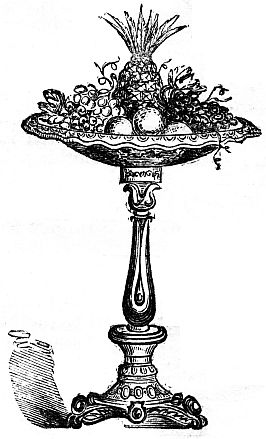
DISH OF MIXED FRUIT.
Box of Chocolate.—This is served in an ornamental box, placed on a glass plate or dish. Seasonable.—May be purchased at any time.

BOX OF CHOCOLATE.
Dish of Apples.—The apples should be nicely wiped with a dry cloth, and arranged on a dish, piled high in the centre, with evergreen leaves between each layer. The inferior apples should form the bottom layer, with the bright-coloured large ones at the top. The leaves of the laurel, bay, holly, or any shrub green in winter, are suitable for garnishing dessert dishes. Oranges may be arranged in the same manner; they should also be wiped with a dry cloth before being sent to table.
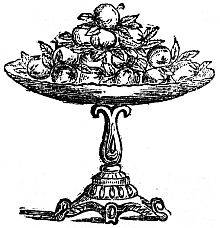
DISH OF APPLES.
Dish of Mixed Summer Fruit.—This dish consists of cherries, raspberries, currants, and strawberries, piled in different layers, with plenty of leaves between each layer, so that each fruit is well separated. The fruit should be arranged with a due regard to colour, so that they contrast nicely one with the other. Our engraving shows a layer of white cherries at the bottom, then one of red raspberries, over that a layer of white currants, and at the top some fine scarlet strawberries. Seasonable in June, July, and August.
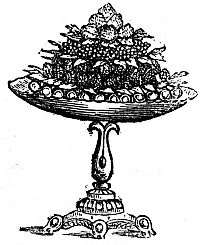
DISH OF MIXED SUMMER FRUIT.
Almonds and Raisins.—These are usually served on glass dishes, the fruit piled high in the centre, and the almonds blanched and strewn over. To blanch the almonds, put them into a small mug or teacup, pour over them boiling water, let them remain for 2 or 3 minutes, and the skins may then be easily removed. Figs, dates, French plums, &c., are all served on small glass plates or oval dishes, but without the almonds. Seasonable at any time, but more suitable in winter, when fresh fruit is not obtainable.

ALMONDS AND RAISINS.
Dish of Strawberries.—Fine strawberries, arranged in the manner shown in the engraving, look exceedingly well. The inferior ones should be placed at the bottom of the dish, and the others put in rows pyramidically, with the stalks downwards, so that when the whole is completed, nothing but the red part of the fruit is visible. The fruit should be gathered with rather long stalks, as there is then something to support it, and it can be placed more upright in each layer. A few of the finest should be reserved to crown the top.
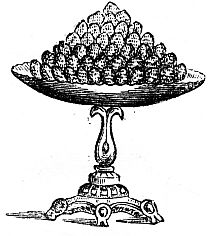
DISH OF STRAWBERRIES.
DEVONSHIRE JUNKET.
Ingredients.—To every pint of new milk allow 2 dessertspoonfuls of brandy, 1 dessertspoonful of sugar, and 1½ dessertspoonful of prepared rennet; thick cream, pounded cinnamon, or grated nutmeg. Mode.—Make the milk blood-warm; put it into a deep dish with the brandy, sugar, and rennet; stir it altogether, and cover it over until it is set. Then spread some thick or clotted cream over the top, grate some nutmeg, and strew some sugar over, and the dish will be ready to serve. Time.—About 2 hours to set the milk. Seasonable at any time.
DINNER,
Being the grand solid meal of the day, is a matter of considerable importance; and a well-served table is a striking index of human ingenuity and resource.
The elegance with which a dinner is served depends, of course, partly upon the means, but still more upon the taste of the master and mistress of the house. It may be observed, in general, that there should always be flowers on the table, and, as they form no item of expense where a garden is, there is no reason why they should not be employed every day.
The variety of the dishes which furnish forth a modern dinner-table, does not necessarily imply anything unwholesome, or anything capricious. Food that is not well relished cannot be well digested; and the appetite of the over-worked man of business, or statesman, or of any dweller in towns, whose occupations are exciting and exhausting, is jaded, and requires stimulation. Men and women who are in rude health, and who have plenty of air and exercise, eat the simplest food with relish, and commonly digest it well; but those conditions are out of the reach of many men. They must suit their mode of dining to their mode of living, if they cannot choose the latter. It is in serving up food that is at once appetizing and wholesome that the skill of the modern housewife is severely tasked; and she has scarcely a more important duty to fulfil. It is, in fact, her particular vocation, in virtue of which she may be said to hold the health of the family, and of the friends of the family, in her hands from day to day.
The following aphorisms and short directions in relation to dinner-parties, are well deserving of notice:—“Let the number of your guests never exceed twelve, so that the conversation may be general. Let the temperature of the dining-room be about 68°. Let the dishes be few in number in the first course, but proportionally good. The order of food is from the most substantial to the lightest. The order of drinking wine is from the mildest to the most foamy and most perfumed. To invite a person to your house is to take charge of his happiness so long as he is beneath your roof. The mistress of the house should always be certain that the coffee is excellent; whilst the master should be answerable for the quality of his wines and liqueurs.”
Dinners à la Russe differ from ordinary dinners in the mode of serving the various dishes. In a dinner à la Russe, the dishes are cut up on a sideboard, and handed round to the guests, and each dish may be considered a course. The table for a dinner à la Russe should be laid with flowers and plants in fancy flower-pots down the middle, together with some of the dessert dishes. A menu or bill of fare should be placed by the side of each guest.
The following are bills of fare for dinners à la Russe, and eatable from July to November: the dishes can easily be varied to suit other months.
Service a la Russe (July).
Julienne Soup, Vermicelli Soup.
Boiled Salmon, Turbot and Lobster Sauce. Soles-Water Souchy, Perch-Water Souchy. Matelote d’Anguilles à la Toulouse, Filets de Soles à la Normandie. Rod Mullet, Trout. Lobster Rissoles, Whitebait.
Riz de Veau à la Banquière, Filets de Poulets aux Concombres. Canards à la Rouennaise, Mutton Cutlets à la Jardinière. Braised Beef à la Flamande, Spring Chickens, Roast Quarter of Lamb, Roast Saddle of Mutton, Tongue, Ham and Peas.
Quails, larded, Roast Ducks, Turkey Poult, larded. Mayonnaise of Chicken, Tomatoes, Green Peas à la Française. Suédoise of Strawberries, Charlotte Russe, Compôte of Cherries. Neapolitan Cakes, Pastry, Madeira Wine Jelly. Iced Pudding à la Nesselrode.
Dessert and Ices.
Service a la Russe (November).
Ox-tail Soup, Soup à la Jardinière.
Turbot and Lobster Sauce, Crimped Cod and Oyster Sauce. Stewed Eels, Soles à la Normandie. Pike and Cream Sauce. Fried Fileted Soles.
Filets de Bœuf à la Jardinière, Croquettes of Game aux Champignons. Chicken Cutlets, Mutton Cutlets and Tomato Sauce. Lobster Rissoles, Oyster Patties. Partridges aux fines Herbes, Larded Sweetbreads. Roast Beef, Poulets aux Cressons, Haunch of Mutton, Roast Turkey, Boiled Turkey and Celery Sauce, Ham.
Grouse, Pheasants, Hare. Salad, Artichokes, Stewed Celery. Italian Cream, Charlotte aux Pommes, Compôte of Pears. Croûtes madrées aux Fruits, Pastry, Punch Jelly. Iced Pudding.
Dessert and Ices.
DORMERS.
[Cold Meat Cookery.] Ingredients.—½ lb. of cold mutton, 2 oz. of beef suet, pepper and salt to taste, 3 oz. of boiled rice, 1 egg, bread-crumbs, made gravy. Mode.—Chop the meat, suet, and rice finely; mix well together, and add a high seasoning of pepper and salt, and roll into sausages; cover them with egg and bread-crumbs, and fry in hot dripping of a nice brown. Serve in a dish with made gravy poured round them, and a little in a tureen. Time.—¼ hour to fry the sausages. Average cost, exclusive of the meat, 6d. Seasonable at any time.
DRAUGHT for Summer.
Ingredients.—The juice of 1 lemon, a tumblerful of cold water, pounded sugar to taste, ½ small teaspoonful of carbonate of soda. Mode.—Squeeze the juice from the lemon; strain, and add it to the water, with sufficient pounded sugar to sweeten the whole nicely. When well mixed, put in the soda, stir well, and drink while the mixture is in an effervescing state.
DRINK, Pleasant, for Warm Weather.
Ingredients.—To every ½ pint of good ale allow 1 bottle of ginger beer. Mode.—For this beverage the ginger beer must be in an effervescing state, and the beer not in the least turned or sour. Mix them together, and drink immediately. The draught is refreshing and wholesome, as the ginger corrects the action of the beer. It does not deteriorate by standing a little, but, of course, is better when taken fresh.
DRIPPING, to Clarify.
Good and fresh dripping answers very well for basting everything except game and poultry, and, when well clarified, serves for frying nearly as well as lard; it should be kept in a cool place, and will remain good some time. To clarify it put the dripping into a basin, pour over it boiling water, and keep stirring the whole to wash away the impurities. Let it stand to cool, when the water and dirty sediment will settle at the bottom of the basin. Remove the dripping, and put it away in jars or basins for use.
Another Way.—Put the dripping into a clean saucepan, and let it boil for a few minutes over a slow fire, and be careful to skim it well. Let it stand to cool a little, then strain it through a piece of muslin into jars for use. Beef dripping is preferable to any other for cooking purposes, as, with mutton dripping, there is liable to be a tallowy taste and smell.
DUCK, Hashed.
[Cold Meat Cookery.] Ingredients.—The remains of cold roast duck, rather more than 1 pint of weak stock or water, 1 onion, 1 oz. of butter, thickening of butter and flour, salt and cayenne to taste, ½ teaspoonful of minced lemon-peel, 1 dessertspoonful of lemon-juice, ½ glass of port wine. Mode.—Cut the duck into nice joints, and put the trimmings into a stewpan; slice and fry the onion in a little butter; add these to the trimmings, pour in the above proportion of weak stock or water, and stew gently for 1 hour. Strain the liquor, thicken it with butter and flour, season with salt and cayenne, and add the remaining ingredients; boil it up and skim well; lay in the pieces of duck, and let them get thoroughly hot through by the side of the fire, but do not allow them to boil: they should soak in the gravy for about ½ hour. Garnish with sippets of toasted bread. The hash may be made richer by using a stronger and more highly-flavoured gravy; a little spice or pounded mace may also be added, when their flavour is liked. Time.—1½ hour. Average cost, exclusive of cold duck, 4d. Seasonable from November to February; ducklings from May to August.
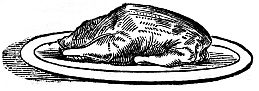
ROAST DUCK.
DUCKS, Roast.
Ingredients.—A couple of ducks; sage-and-onion stuffing; a little flour. Choosing and Trussing.—Choose ducks with plump bellies, and with thick and yellowish feet. They should be trussed with the feet on, which should be scalded, and the skin peeled off, and then turned up close to the legs. Run a skewer through the middle of each leg, after having drawn them as close as possible to the body, to plump up the breast, passing the same quite through the body. Cut off the heads and necks, and the pinions at the first joint; bring these close to the sides, twist the feet round, and truss them at the back of the bird. After the duck is stuffed, both ends should be secured with string, so as to keep in the seasoning. Mode.—To insure ducks being tender, never dress them the same day they are killed; and, if the weather permits, they should hang a day or two. Make a stuffing of sage and onion sufficient for one duck, and leave the other unseasoned, as the flavour is not liked by everybody. Put them down to a brisk clear fire, and keep them well basted the whole of the time they are cooking. A few minutes before serving, dredge them lightly with flour, to make them froth and look plump; and when the steam draws towards the fire, send them to table hot and quickly, with a good brown gravy poured round, but not over the ducks, and a little of the same in a tureen. When in season, green peas should invariably accompany this dish. Time.—Full-grown ducks from ¾ to 1 hour; ducklings from 25 to 35 minutes. Average cost, from 2s. 3d. to 2s. 6d. each. Sufficient.—A couple of ducks for 6 or 7 persons. Seasonable.—Ducklings from April to August; ducks from November to February.
DUCK, Roast, to carve.

ROAST DUCK.
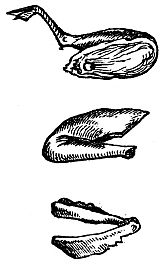
LEG, WING, AND NECKBONE OF DUCK.
No dishes require so much knowledge and skill in their carving as do game and poultry; for it is necessary to be well acquainted with the anatomy of the bird in order to place the knife at exactly the proper point. A tough fowl and an old goose are sad triers of a carver’s powers and temper, and, indeed, sometimes of the good humour of those in the neighbourhood of the carver; for a sudden tilt of the dish may eventuate in the placing of a quantity of the gravy in the lap of the right or left-hand supporter of the host. We will endeavour to assist those who are unacquainted with the “gentle art of carving,” and also those who are but slightly acquainted with it, by simply describing the rules to follow, and referring to the distinctly-marked illustrations of each dish, which will further help to bring light to the minds of the uninitiated. If the bird be a young duckling, it may be carved like a fowl, viz., by first taking off the leg and the wing on either side; but in cases where the duckling is very small, it will be as well not to separate the leg from the wing, as they will not then form too large a portion for a single serving. After the legs and wings are disposed of, the remainder of the duck will be also carved in the same manner as a fowl; and not much difficulty will be experienced, as ducklings are tender, and the joints are easily broken by a little gentle forcing, or penetrated by the knife. In cases where the duck is a large bird, the better plan to pursue is then to carve it like a goose, that is, by cutting pieces from the breast in the direction indicated by the lines marked from 1 to 2, commencing to carve the slices close to the wing, and then proceeding upwards from that to the breastbone. If more should be wanted than can be obtained from both sides of the breast, then the legs and wings must be attacked, in the same way as is described in connection with carving a fowl. It may be here remarked, that as the legs of a duck are placed far more backward than those of a fowl, their position causing the waddling motion of the bird, the thigh-bones will be found considerably nearer towards the backbone than in a chicken; this is the only difference worth mentioning. The carver should ask each guest if a portion of stuffing would be agreeable; and in order to get at this, a cut should be made below the breast, as shown by the line from 3 to 4, at the part called the “apron,” and the spoon inserted. (As described in the recipe, it is an excellent plan, when a couple of ducks are served, to have one with, and the other without, stuffing.) As to the prime parts of a duck, it has been said that “the wing of a flier and the leg of a swimmer” are severally the best portions. Some persons are fond of the feet of the duck; and, in trussing, these should never be taken off. The leg, wing, and neckbone are here shown; so that it will be easy to see the shape they should be when cut off.
Note.—Ducklings are trussed and roasted in the same manner, and served with the same sauces and accompaniments. When in season, do not omit apple sauce.
DUCK AND PEAS, Stewed.
[Cold Meat Cookery.] Ingredients.—The remains of cold roast duck, 2 oz. of butter, 3 or 4 slices of lean ham or bacon, 1 tablespoonful of flour, 2 pints of thin gravy, 1, or a small bunch of green onions, 3 sprigs of parsley, 3 cloves, 1 pint of young green peas, cayenne and salt to taste, 1 teaspoonful of pounded sugar. Mode.—Put the butter into a stewpan; cut up the duck into joints, lay them in with the slices of lean ham or bacon; make it brown, then dredge in a tablespoonful of flour, and stir this well in before adding the gravy. Put in the onion, parsley, cloves, and gravy, and when it has simmered for ¼ hour, add a pint of young green peas, and stew gently for about ½ hour. Season with cayenne, salt, and sugar; take out the duck, place it round the dish, and the peas in the middle. Time.—¾ hour. Average cost, exclusive of the cold duck, 1s. Seasonable from June to August.
DUCK AND PEAS, Stewed.
[Cold Meat Cookery.] Ingredients.—The remains of cold roast duck, ½ pint of good gravy, cayenne and salt to taste, ½ teaspoonful of minced lemon-peel, 1 teaspoonful of pounded sugar, 2 oz. of butter rolled in flour, 1½ pint of green peas. Mode.—Cut up the duck into joints, lay it in the gravy, and add a seasoning of cayenne, salt, and minced lemon-peel; let this gradually warm through, but not boil. Throw the peas into boiling water slightly salted, and boil them rapidly until tender. Drain them, stir in the pounded sugar, and the butter rolled in flour; shake them over the fire for two or three minutes, and serve in the centre of the dish, with the duck laid round. Time.—15 minutes to boil the peas, when they are full grown. Average cost, exclusive of the cold duck, 10d. Seasonable from June to August.
DUCK, Stewed, in Turnips.
[Cold Meat Cookery.] Ingredients.—The remains of cold duck, ½ pint of good gravy, 4 shalots, a few slices of carrot, a small bunch of savoury herbs, 1 blade of pounded mace, 1 lb. of turnips weighed after being peeled, 2 oz. of butter, pepper and salt to taste. Mode.—Cut up the duck into joints, fry the shalots, carrots, and herbs, and put them with the duck into the gravy. Cut about 1 lb. of turnips into ½ inch squares, put the butter into a stewpan, and stew them till quite tender, which will be in about ½ hour, or rather more; season with pepper and salt, and serve on the centre of the dish, with the duck, &c., laid round. Time.—Rather more than ½ hour to stew the turnips. Average cost, exclusive of cold duck, 1s. Seasonable from November to February.
DUCK, to Ragoût a whole.
Ingredients.—1 large duck, pepper and salt to taste, good beef gravy, 2 onions sliced, 4 sage-leaves, a few leaves of lemon thyme, thickening of butter and flour. Mode.—After having emptied and singed the duck, season it inside with pepper and salt, and truss it. Roast it before a clear fire for about 20 minutes, and let it acquire a nice brown colour. Put it into a stewpan with sufficient well-seasoned beef gravy to cover it; slice and fry the onions, and add these, with the sage-leaves and lemon thyme, both of which should be finely minced, to the stock. Simmer gently until the duck is tender; strain, skim, and thicken the gravy with a little butter and flour; boil it up, pour over the duck, and serve. When in season, about 1½ pint of young green peas, boiled separately, and put in the ragoût, very much improve this dish. Time.—20 minutes to roast the duck; 20 minutes to stew it. Average cost, from 2s. 3d. to 2s. 6d. each. Sufficient for 4 or 5 persons. Seasonable from November to February; ducklings from April to August.
DUCK, Wild, Hashed.
Ingredients.—The remains of cold roast wild duck, 1 pint of good brown gravy, 2 tablespoonfuls of bread-crumbs, 1 glass of claret, salt, cayenne, and mixed spices to taste; 1 tablespoonful of lemon or Seville orange-juice. Mode.—Cut the remains of the duck into neat joints, put them into a stewpan, with all the above ingredients; let them get gradually hot by the side of the fire, and occasionally stir the contents; when on the point of boiling, serve, and garnish the dish with sippets of toasted bread. Time.—About ¼ hour. Seasonable from November to February.
DUCK, Wild, Ragoût of.
Ingredients.—2 wild ducks, 4 shalots, 1 pint of stock (see Stock), 1 glass of port wine, 1 oz. of butter, a little flour, the juice of ½ lemon, cayenne and salt to taste. Mode.—Ducks that have been dressed and left from the preceding day will answer for this dish. Cut them into joints, reserve the legs, wings, and breasts until wanted; put the trimmings into a stewpan with the shalots and stock, and let them simmer for about ½ hour, and strain the gravy. Put the butter into a stewpan; when melted, dredge in a little flour, and pour in the gravy made from the bones; give it one boil, and strain it again; add the wine, lemon-juice, and cayenne; lay in the pieces of duck, and let the whole gradually warm through, but do not allow it to boil, or the duck will be hard. The gravy should not be too thick, and should be very highly seasoned. The squeeze of a Seville orange is a great improvement to this dish. Time.—About ½ hour to make the gravy; ¼ hour for the duck gradually to warm through. Seasonable from November to February.
DUCK, Wild, Roast.
Ingredients.—Wild duck, flour, butter. Mode.—Carefully pluck and draw them; cut off the heads close to the necks, leaving sufficient skin to turn over, and do not cut off the feet; some twist each leg at the knuckle, and rest the claws on each side of the breast; others truss them as shown in our illustration. Roast the birds before a quick fire, and, when they are first put down, let them remain for 5 minutes without basting (this will keep the gravy in); afterwards baste plentifully with butter, and a few minutes before serving dredge them lightly with flour; baste well, and send them to table nicely frothed, and full of gravy. If overdone, the birds will lose their flavour. Serve with a good gravy in the dish, or orange gravy, and send to table with them a cut lemon. To take off the fishy taste which wild fowl sometimes have, baste them for a few minutes with hot water to which have been added an onion and a little salt; then take away the pan, and baste with butter. Time.—When liked under-dressed, 20 to 25 minutes; well done, 25 to 35 minutes. Average cost, 4s. to 5s. the couple.

ROAST WILD DUCK.
DUCK, Wild, to Carve.
As game is almost universally served as a dainty, and not as a dish to stand the assaults of an altogether fresh appetite, these dishes are not usually cut up entirely, but only those parts are served of each which are considered the best flavoured and the primest. Of wild fowl, the breast alone is considered by epicures worth eating, and slices are cut from this, in the direction indicated by the lines, from 1 to 2; if necessary, the leg and the wing can be taken off by passing the knife from 3 to 4, and by generally following the directions described for carving boiled fowl.

WILD DUCK.
DUMPLINGS, Sussex, or Hard.
Ingredients.—1 lb. of flour, ½ pint of water, ½ saltspoonful of salt. Mode.—Mix the flour and water together to a smooth paste, previously adding a small quantity of salt. Form this into small round dumplings; drop them into boiling water, and boil from ½ to ¾ hour. They maybe served with roast or boiled meat; in the latter case, they may be cooked with the meat, but should be dropped into the water when it is quite boiling. Time.—½ to ¾ hour. Sufficient for 10 or 12 dumplings. Seasonable at any time.
DUTCH FLUMMERY.
Ingredients.—1½ oz. of isinglass, the rind and juice of 1 lemon, 1 pint of water, 4 eggs, 1 pint of sherry, Madeira, or raisin-wine; sifted sugar to taste. Mode.—Put the water, isinglass, and lemon-rind into a lined saucepan, and simmer gently until the isinglass is dissolved; strain this into a basin, stir in the eggs, which should be well beaten, the lemon-juice, which should be strained, and the wine; sweeten to taste with pounded sugar, mix all well together, pour it into a jug, set this jug in a saucepan of boiling water over the fire, and keep stirring it one way until it thickens; but take care that it does not boil. Strain it into a mould that has been oiled or laid in water for a short time, and put it in a cool place to set. A tablespoonful of brandy stirred in just before it is poured into the mould, improves the flavour of this dish: it is better if it is made the day before it is required for table. Time.—¼ hour to simmer the isinglass; about ¼ hour to stir the mixture over the fire. Average cost, 4s. 6d., if made with sherry; less with raisin-wine. Sufficient to fill a quart mould. Seasonable at any time.
EEL BROTH.
Ingredients.—½ lb. of eel, a small bunch of sweet herbs, including parsley, ½ onion, 10 peppercorns, 3 pints of water, 2 cloves, salt and pepper to taste. Mode.—After having cleaned and skinned the eel, cut it into small pieces, and put it into a stewpan with the other ingredients; simmer gently until the liquid is reduced to nearly half, carefully removing the scum as it rises. Strain it through a hair sieve: put it by in a cool place, and, when wanted, take off all the fat on the top; warm up as much as is required, and serve with sippets of toasted bread. This is a very nutritious broth, and easy of digestion. Time.—To be simmered until the liquor is reduced to half. Average cost, 6d. Sufficient to make 1½ pint of broth. Seasonable from June to March.
EEL PIE.
Ingredients.—1 lb. of eels, a little chopped parsley, 1 shalot, grated nutmeg, pepper and salt to taste, the juice of ½ a lemon, small quantity of forcemeat, ¼ pint of Béchamel; puff paste. Mode.—Skin and wash the eels, cut them in pieces 2 inches long, and line the bottom of the pie-dish with forcemeat. Put in the eels, and sprinkle them with the parsley, shalots, nutmeg, seasoning, and lemon-juice, and cover with puff paste. Bake for 1 hour, or rather more; make the Béchamel hot, and pour it into the pie. Time.—Rather more than 1 hour. Seasonable from August to March.
EEL SOUP.
Ingredients.—3 lbs. of eels, 1 onion, 2 oz. of butter, 3 blades of mace, 1 bunch of sweet herbs, ¼ oz. of peppercorns, salt to taste, 2 tablespoonfuls of flour, ¼ pint of cream, 2 quarts of water. Mode.—Wash the eels, cut them into thin slices, and put them into the stewpan with the butter; let them simmer for a few minutes, then pour the water to them, and add the onion, cut in thin slices, the herbs, mace, and seasoning. Simmer till the eels are tender, but do not break the fish. Take them out carefully, mix the flour smoothly to a batter with the cream, bring it to a boil, pour over the eels, and serve. Time.—1 hour or rather more. Average cost, 10d. per quart. Seasonable from June to March. Sufficient for 8 persons.
Note.—This soup may be flavoured differently by omitting the cream, and adding a little ketchup or Harvey’s sauce.
EELS, Boiled.
Ingredients.—4 small eels, sufficient water to cover them; a large bunch of parsley. Mode.—Choose small eels for boiling; put them into a stewpan with the parsley, and just sufficient water to cover them; simmer till tender. Take them out, pour a little parsley and butter over them, and serve some in a tureen. Time.—½ hour. Average cost, 6d. per lb. Seasonable from June to March. Sufficient for 4 persons.
EEL, Collared.
Ingredients.—1 large eel; pepper and salt to taste; 2 blades of mace, 2 cloves, a little allspice very finely pounded, 6 leaves of sage, and a small bunch of herbs minced very small. Mode.—Bone the eel and skin it; split it, and sprinkle it over with the ingredients, taking care that the spices are very finely pounded, and the herbs chopped very small. Roll it up and bind with a broad piece of tape, and boil it in water, mixed with a little salt and vinegar, till tender. It may either be served whole or cut in slices; and when cold, the eel should be kept in the liquor it was boiled in, but with a little more vinegar put to it. Time.—2 hours. Average cost, 6d. per lb. Seasonable from August to March.
EELS, Fried.
Ingredients.—1 lb. of eels, 1 egg, a few bread-crumbs, hot lard. Mode.—Wash the eels, cut them into pieces 3 inches long, trim and wipe them very dry; dredge with flour, rub them over with egg, and cover with bread-crumbs; fry a nice brown in hot lard. If the eels are small, curl them round, instead of cutting them up. Garnish with fried parsley. Time.—20 minutes or rather less. Average cost, 6d. per lb. Seasonable from June to March.
EELS, en Matelote.
Ingredients.—5 or 6 young onions, a few mushrooms, when obtainable; salt, pepper, and nutmeg to taste; 1 laurel leaf, ½ pint of port wine, ½ pint of medium stock, butter and flour to thicken; 2 lbs. of eels. Mode.—Rub the stewpan with butter, dredge in a little flour, add the onions cut very small, slightly brown them, and put in all the other ingredients. Wash, and cut up the eels into pieces 3 inches long; put them in the stewpan, and simmer for ½ hour. Make round the dish a border of croûtons, or pieces of toasted bread; arrange the eels in a pyramid in the centre, and pour over the sauce. Serve very hot. Time.—¾ hour. Average cost, 1s. 9d. for this quantity. Seasonable from August to March. Sufficient for 5 or 6 persons.
EELS, Stewed.
Ingredients.—2 lbs. of eels, 1 pint of rich strong stock, 1 onion, 3 cloves, a piece of lemon-peel, 1 glass of port or Madeira, 3 tablespoonfuls of cream; thickening of flour; cayenne and lemon-juice to taste. Mode.—Wash and skin the eels, and cut them into pieces about 3 inches long; pepper and salt them, and lay them in a stewpan; pour over the stock, add the onion stuck with cloves, the lemon-peel, and the wine. Stew gently for ½ hour, or rather more, and lift them carefully on a dish, which keep hot. Strain the gravy, stir the cream, sufficient flour to thicken; mix altogether, boil for 2 minutes, and add the cayenne and lemon-juice; pour over the eels and serve. Time.—¾ hour. Average cost for this quantity, 2s. 3d. Seasonable from June to March. Sufficient for 5 or 6 persons.
EELS, Stewed.
Ingredients.—2 lbs. of middling-sized eels, 1 pint of medium stock, ¼ pint of port wine; salt, cayenne, and mace to taste; 1 teaspoonful of essence of anchovy, the juice of ½ a lemon. Mode.—Skin, wash, and clean the eels, thoroughly; cut them into pieces 3 inches long, and put them into strong salt and water for 1 hour; dry them well with a cloth, and fry them brown. Put the stock on with the heads and tails of the eels, and simmer for ½ hour; strain it, and add all the other ingredients. Put in the eels, and stew gently for ½ hour, when serve. Time.—2 hours. Average cost, 1s. 9d. Seasonable from June to March. Sufficient for 5 or 6 persons.
EELS, à la Tartare.
Ingredients.—2 lbs. of eels, 1 carrot, 1 onion, a little flour, 1 glass of sherry; salt, pepper, and nutmeg to taste; bread-crumbs, 1 egg, 2 tablespoonfuls of vinegar. Mode.—Rub the butter on the bottom of the stewpan; cut up the carrot and onion, and stir them over the fire for 5 minutes; dredge in a little flour, add the wine and seasoning, and boil for ½ an hour. Skin and wash the eels, cut them into pieces, put them to the other ingredients, and simmer till tender. When they are done, take them out, let them get cold, cover them with egg and bread-crumbs, and fry them of a nice brown. Put them on a dish, pour sauce piquante over, and serve them hot. Time.—1½ hour. Average cost, 1s. 8d., exclusive of the sauce piquante. Seasonable from August to March. Sufficient for 5 or 6 persons.
EGGS.
There is only one opinion as to the nutritive properties of eggs, although the qualities of those belonging to different birds vary somewhat. Those of the common hen are most esteemed as delicate food, particularly when “new-laid.” The quality of eggs depends much upon the food given to the hen. Eggs in general are considered most easily digestible when little subjected to the art of cookery. The lightest way of dressing them is by poaching, which is effected by putting them for a minute or two into brisk boiling water: this coagulates the external white, without doing the inner part too much. Eggs are much better when new-laid than a day or two afterwards. The usual time allotted for boiling eggs in the shell is 3 to 3¾ minutes: less time than that in boiling water will not be sufficient to solidify the white, and more will make the yolk hard and less digestible: it is very difficult to guess accurately as to the time. Great care should be employed in putting them into the water, to prevent cracking the shell, which inevitably causes a portion of the white to exude, and lets water into the egg. For the purpose of placing eggs in water, always choose a large spoon in preference to a small one. Eggs are often beaten up raw in nutritive beverages.
The eggs of the turkey are almost as mild as those of the hen; the egg of the goose is large, but well-tasted. Ducks’ eggs have a rich flavour; the albumen is slightly transparent, or bluish, when set or coagulated by boiling, which requires less time than hens’ eggs. Guinea-fowl eggs are smaller and more delicate than those of the hen. Eggs of wild fowl are generally coloured, often spotted; and the taste generally partakes somewhat of the bird they belong to. Those of land birds that are eaten, as the plover, lapwing, ruff, &c., are in general much esteemed; but those of sea-fowl have, more or less, a strong fishy taste. The eggs of the turtle are very numerous: they consist of yolk only, without shell, and are delicious.
When fresh eggs are dropped into a vessel full of boiling water, they crack, because the eggs being well filled, the shells give way to the efforts of the interior fluids, dilated by heat. If the volume of hot water be small, the shells do not crack, because its temperature is reduced by the eggs before the interior dilation can take place. Stale eggs, again, do not crack because the air inside is easily compressed.
EGG BALLS, for Soups and made Dishes.
Ingredients.—8 eggs, a little flour; seasoning to taste of salt. Mode.—Boil 6 eggs for 20 minutes, strip off the shells, take the yolks and pound them in a mortar. Beat the yolks of the 2 uncooked eggs; add them, with a little flour and salt, to those pounded; mix all well together, and roll into balls. Boil them before they are put into the soup or other dish they may be intended for.
EGG SAUCE, for Salt Fish.
Ingredients.—4 eggs, ½ pint of melted butter, when liked, a very little lemon-juice. Mode.—Boil the eggs until quite hard, which will be in about 20 minutes, and put them into cold water for ½ hour. Strip off the shells, chop the eggs into small pieces, not, however, too fine. Make the melted butter very smooth, and, when boiling, stir in the eggs, and serve very hot. Lemon-juice may be added at pleasure. Time.—20 minutes to boil the eggs. Average cost, 8d. Sufficient.—This quantity for 3 or 4 lbs. of fish.
Note.—When a thicker sauce is required, use one or two more eggs to the same quantity of melted butter.
EGG SOUP.
Ingredients.—A tablespoonful of flour, 4 eggs, 2 small blades of finely-pounded mace, 2 quarts of stock. Mode.—Beat up the flour smoothly in a teaspoonful of cold stock, and put in the eggs; throw them into boiling stock, stirring all the time. Simmer for ¼ of an hour. Season and serve with a French roll in the tureen or fried sippets of bread. Time.—½ an hour. Average cost, 11d. per quart. Seasonable all the year. Sufficient for 8 persons.