THE DICTIONARY OF COOKERY. (continued 11)
Reading edition
OYSTER KETCHUP.
Ingredients.—Sufficient oysters to fill a pint measure, 1 pint of sherry, 3 oz. of salt, 1 drachm of cayenne, 2 drachms of pounded mace. Mode.—Procure the oysters very fresh, and open sufficient to fill a pint measure; save the liquor, and scald the oysters in it with the sherry; strain the oysters, and put them in a mortar with the salt, cayenne, and mace; pound the whole until reduced to a pulp, then add it to the liquor in which they were scalded; boil it again five minutes, and skim well; rub the whole through a sieve, and, when cold, bottle and cork closely. The corks should be sealed. Seasonable from September to April.
Note.—Cider may be substituted for the sherry.
OYSTER PATTIES (an Entrée).
Ingredients.—2 dozen oysters, 2 oz. of butter, 3 tablespoonfuls of cream, a little lemon-juice, 1 blade of pounded mace; cayenne to taste. Mode.—Scald the oysters in their own liquor, beard them, and cut each one into 3 pieces. Put the butter into a stewpan, dredge in sufficient flour to dry it up; add the strained oyster-liquor with the other ingredients; put in the oysters, and let them heat gradually, but not boil fast. Make the patty-cases as directed for lobster patties, fill with the oyster mixture, and replace the covers. Time.—2 minutes for the oysters to simmer in the mixture. Average cost, exclusive of the patty-cases, 1s. 4d. Seasonable from September to April.
OYSTER SAUCE, to serve with Fish, Boiled Poultry, &c.
Ingredients.—3 dozen oysters, ½ pint of melted butter, made with milk. Mode.—Open the oysters carefully, and save their liquor; strain it into a clean saucepan (a lined one is best), put in the oysters, and let them just come to the boiling-point, when they should look plump. Take them off the fire immediately, and put the whole into a basin. Strain the liquor from them, mix with it sufficient melted butter made with milk to make ½ pint altogether. When this is ready and very smooth, put in the oysters, which should be previously bearded, if you wish the sauce to be really nice. Set it by the side of the fire to get thoroughly hot, but do not allow it to boil, or the oysters will immediately harden. Using cream instead of milk makes this sauce extremely delicious. When liked, add a seasoning of cayenne or anchovy sauce; but, as we have before stated, a plain sauce should be plain, and not be overpowered by highly-flavoured essences; therefore we recommend that the above directions be implicitly followed, and no seasoning added. Average cost for this quantity, 2s. Sufficient for 6 persons. Never allow fewer than 6 oysters to 1 person, unless the party is very large. Seasonable from September to April.
A more economical sauce may be made by using a smaller quantity of oysters, and not bearding them before they are added to the sauce: this may answer the purpose, but we cannot undertake to recommend it as a mode for making this delicious adjunct to fish, &c.
OYSTER SOUP.
Ingredients.—6 dozen of oysters, 2 quarts of white stock, ½ pint of cream, 2 oz. of butter, 1½ oz. of flour; salt, cayenne, and mace to taste. Mode.—Scald the oysters in their own liquor; take them out, beard them, and put them in a tureen. Take a pint of the stock, put in the beards and the liquor, which must be carefully strained, and simmer for ½ an hour. Take it off the fire, strain it again, and add the remainder of the stock, with the seasoning and mace. Bring it to a boil, add the thickening of butter and flour, simmer for 5 minutes, stir in the boiling cream, pour it over the oysters, and serve. Time.—1 hour. Average cost, 2s. 8d. per quart. Seasonable from September to April. Sufficient for 8 persons.
Note.—This soup can be made less rich by using milk instead of cream, and thickening with arrowroot instead of butter and flour.
OYSTER SOUP.
Ingredients.—2 quarts of good mutton broth, 6 dozen oysters, 2 oz. butter, 1 oz. of flour. Mode.—Beard the oysters, and scald them in their own liquor; then add it, well strained, to the broth; thicken with the butter and flour, and simmer for ¼ of an hour. Put in the oysters, stir well, but do not let it boil, and serve very hot. Time.—¾ hour. Average cost, 2s. per quart. Seasonable from September to April. Sufficient for 8 persons.
OYSTERS, Fried.
Ingredients.—3 dozen oysters, 2 oz. butter, 1 tablespoonful of ketchup, a little chopped lemon-peel, ½ teaspoonful of chopped parsley. Mode.—Boil the oysters for 1 minute in their own liquor, and drain them; fry them with the butter, ketchup, lemon-peel, and parsley; lay them on a dish, and garnish with fried potatoes, toasted sippets, and parsley. This is a delicious delicacy, and is a favourite Italian dish. Time.—5 minutes. Average cost for this quantity, 1s. 9d. Seasonable from September to April. Sufficient for 4 persons.
OYSTERS Fried in Batter.
Ingredients.—½ pint of oysters, 2 eggs, ½ pint of milk, sufficient flour to make the batter; pepper and salt to taste; when liked, a little nutmeg; hot lard. Mode.—Scald the oysters in their own liquor, beard them, and lay them on a cloth to drain thoroughly. Break the eggs into a basin, mix the flour with them, add the milk gradually, with nutmeg and seasoning, and put the oysters in the batter. Make some lard hot in a deep frying-pan, put in the oysters, one at a time; when done, take them up with a sharp-pointed skewer, and dish them on a napkin. Fried oysters are frequently used for garnishing boiled fish, and then a few bread-crumbs should be added to the flour. Time.—5 or 6 minutes. Average cost for this quantity, 1s. 10d. Seasonable from September to April. Sufficient for 8 persons.
OYSTERS, to Keep.
Put them in a tub, and cover them with salt and water. Let them remain for 12 hours, when they are to be taken out, and allowed to stand for another 12 hours without water. If left without water every alternate 12 hours, they will be much better than if constantly kept in it. Never put the same water twice to them.
OYSTERS, Pickled.
Ingredients.—100 oysters; to each ½ pint of vinegar, 1 blade of pounded mace, 1 strip of lemon-peel, 12 black peppercorns. Mode.—Get the oysters in good condition, open them, place them in a saucepan, and let them simmer in their own liquor for about 10 minutes very gently; then take them out one by one, and place them in a jar, and cover them, when cold, with a pickle made as follows:—Measure the oyster-liquor; add to it the same quantity of vinegar, with mace, lemon-peel, and pepper in the above proportion, and boil it for 5 minutes; when cold, pour over the oysters, and tie them down very closely, as contact with the air spoils them. Seasonable from September to April.
Note.—Put this pickle away in small jars; because, directly one is opened, its contents should immediately be eaten, as they soon spoil. The pickle should not be kept more than 2 or 3 months.
OYSTERS, Scalloped.
Ingredients.—Oysters, say 1 pint, 1 oz. butter, flour, 2 tablespoonfuls of white stock, 2 tablespoonfuls of cream; pepper and salt to taste; bread-crumbs, oiled butter. Mode.—Scald the oysters in their own liquor, take them out, beard them, and strain the liquor free from grit. Put 1 oz. of butter into a stewpan; when melted, dredge in sufficient flour to dry it up; add the stock, cream, and strained liquor, and give one boil. Put in the oysters and seasoning; let them gradually heat through, but not boil. Have ready the scallop-shells buttered; lay in the oysters, and as much of the liquid as they will hold; cover them over with bread-crumbs, over which drop a little oiled butter. Brown them in the oven, or before the fire, and serve quickly, and very hot. Time.—Altogether, ¼ hour. Average cost, for this quantity, 3s. 6d. Sufficient for 5 or 6 persons.
OYSTERS, Scalloped.
Prepare the oysters as in the preceding recipe, and put them in a scallop-shell or saucer, and between each layer sprinkle over a few bread-crumbs, pepper, salt, and grated nutmeg; place small pieces of butter over, and bake before the fire in a Dutch oven. Put sufficient bread-crumbs on the top to make a smooth surface, as the oysters should not be seen. Time.—About ¼ hour. Average cost, 3s. 2d. Seasonable from September to April.
OYSTERS, Stewed.
Ingredients.—1 pint of oysters, 1 oz. of butter, flour, 1/3 pint of cream; cayenne and salt to taste; 1 blade of pounded mace. Mode.—Scald the oysters in their own liquor, take them out, beard them, and strain the liquor; put the butter into a stewpan, dredge in sufficient flour to dry it up, add the oyster-liquor and mace, and stir it over a sharp fire with a wooden spoon; when it comes to a boil, add the cream, oysters, and seasoning. Let all simmer for 1 or 2 minutes, but not longer, or the oysters would harden. Serve on a hot dish, and garnish with croûtons, or toasted sippets of bread. A small piece of lemon-peel boiled with the oyster-liquor, and taken out before the cream is added, will be found an improvement. Time.—Altogether 15 minutes. Average cost for this quantity, 3s. 6d. Seasonable from September to April. Sufficient for 6 persons.
PANCAKES.
Ingredients.—Eggs, flour, milk; to every egg allow 1 oz. of flour, about 1 gill of milk, ⅛ saltspoonful of salt. Mode.—Ascertain that the eggs are fresh; break each one separately in a cup; whisk them well, put them into a basin, with the flour, salt, and a few drops of milk, and beat the whole to a perfectly smooth batter; then add by degrees the remainder of the milk. The proportion of this latter ingredient must be regulated by the size of the eggs, &c. &c.; but the batter, when ready for frying, should be of the consistency of thick cream. Place a small frying-pan on the fire to get hot; let it be delicately clean, or the pancakes will stick, and, when quite hot, put into it a small piece of butter, allowing about ½ oz. to each pancake. When it is melted, pour in the batter, about ½ teacupful to a pan 5 inches in diameter, and fry it for about 4 minutes, or until it is nicely brown on one side. By only pouring in a small quantity of batter, and so making the pancakes thin, the necessity of turning them (an operation rather difficult to unskilful cooks) is obviated. When the pancake is done, sprinkle over it some pounded sugar, roll it up in the pan, and take it out with a large slice, and place it on a dish before the fire. Proceed in this manner until sufficient are cooked for a dish; then send them quickly to table, and continue to send in a further quantity, as pancakes are never good unless eaten almost immediately they come from the frying-pan. The batter may be flavoured with a little grated lemon-rind, or the pancakes may have preserve rolled in them instead of sugar. Send sifted sugar and a cut lemon to table with them. To render the pancakes very light, the yolks and whites of the eggs should be beaten separately, and the whites added the last thing to the batter before frying. Time.—From 4 to 5 minutes for a pancake that does not require turning; from 6 to 8 minutes for a thicker one. Average cost for 3 persons, 6d. Sufficient.—Allow 3 eggs, with the other ingredients in proportion, for 3 persons. Seasonable at any time, but specially served on Shrove Tuesday.

PANCAKES.
PANCAKES.
Ingredients.—6 eggs, 1 pint of cream, ¼ lb. of loaf sugar, 1 glass of sherry, ½ teaspoonful of grated nutmeg, flour. Mode.—Ascertain that the eggs are extremely fresh, beat them well, strain and mix with them the cream, pounded sugar, wine, nutmeg, and as much flour as will make the batter nearly as thick as that for ordinary pancakes. Make the frying-pan hot, wipe it with a clean cloth, pour in sufficient batter to make a thin pancake, and fry it for about 5 minutes. Dish the pancakes piled one above the other, strew sifted sugar between each, and serve. Time.—About 5 minutes. Average cost, with cream at 1s. per pint, 2s. 3d. Sufficient to make 8 pancakes. Seasonable at any time, but specially served on Shrove Tuesday.
PANCAKES, French.
Ingredients.—2 eggs, 2 oz. of butter, 2 oz. of sifted sugar, 2 oz. of flour, ½ pint of new milk. Mode.—Beat the eggs thoroughly, and put them into a basin with the butter, which should be beaten to a cream; stir in the sugar and flour, and when these ingredients are well mixed, add the milk; keep stirring and beating the mixture for a few minutes; put it on buttered plates, and bake in a quick oven for 20 minutes. Serve with a cut lemon and sifted sugar, or pile the pancakes high on a dish, with a layer of preserve or marmalade between each. Time.—20 minutes. Average cost, 7d. Sufficient for 3 or 4 persons. Seasonable at any time.
PANCAKES, Snow.
Ingredients.—3 tablespoonfuls of flour, 1 egg, 3 tablespoonfuls of snow, about ½ pint of new milk. Mode.—Mix the flour with the milk by degrees, add the egg well beaten, and just before frying, the snow, it should then be all beaten up together quickly, and put into the frying-pan immediately. Sufficient for 8 pancakes.
PAN KAIL.
Ingredients.—2 lbs. of cabbage, or Savoy greens; ¼ lb. of butter or dripping, salt and pepper to taste, oatmeal for thickening, 2 quarts of water. Mode.—Chop the cabbage very fine, thicken the water with oatmeal, put in the cabbage and butter, or dripping; season and simmer for 1½ hour. It can be made sooner by blanching and mashing the greens, adding any good liquor that a joint has been boiled in, and then further thicken with bread or pounded biscuit. Time.—1½ hour. Average cost, 1½d. per quart. Seasonable all the year, but more suitable in winter. Sufficient for 8 persons.
PARSLEY AND BUTTER, to serve with Calf’s Head, Boiled Fowls, &c.
Ingredients.—2 tablespoonfuls of minced parsley, ½ pint of melted butter. Mode.—Put into a saucepan a small quantity of water, slightly salted, and when it boils, throw in a good bunch of parsley which has been previously washed and tied together in a bunch; let it boil for 5 minutes, drain it, mince the leaves very fine, and put the above quantity in a tureen; pour over it ½ pint of smoothly-made melted butter; stir once, that the ingredients may be thoroughly mixed, and serve. Time.—5 minutes to boil the parsley. Average cost, 4d. Sufficient for 1 large fowl; allow rather more for a pair. Seasonable at any time.
PARSLEY, Fried, for Garnishing.
Ingredients.—Parsley, hot lard or clarified dripping. Mode.—Gather some young parsley; wash, pick, and dry it thoroughly in a cloth; put it into the wire basket of which we have given an engraving, and hold it in boiling lard or dripping for a minute or two. Directly it is done, lift out the basket, and let it stand before the fire, that the parsley may become thoroughly crisp; and the quicker it is fried the better. Should the kitchen not be furnished with the above article, throw the parsley into the frying-pan, and when crisp, lift it out with a slice, dry it before the fire, and when thoroughly crisp it will be ready for use.
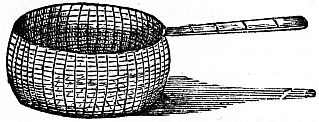
WIRE BASKET.
Wire Basket.—For this recipe a wire basket, as shown in the annexed engraving, will be found very useful. It is very light and handy, and may be used for other similar purposes besides that just described.
PARSLEY JUICE, for Colouring various Dishes.
Procure some nice young parsley; wash it and dry it thoroughly in a cloth; pound the leaves in a mortar till all the juice is extracted, and put the juice in a teacup or small jar; place this in a saucepan of boiling water, and warm it on the bain-marie principle just long enough to take off its rawness; let it drain, and it will be ready for colouring.
Substitute for.—Sometimes in the middle of winter parsley-leaves are not to be had, when the following will be found an excellent substitute:—Tie up a little parsley-seed in a small piece of muslin, and boil it for 10 minutes in a small quantity of water; use this water to make the melted butter with, and throw into it a little boiled spinach, minced rather fine, which will have an appearance similar to that of parsley.
PARSLEY, to Preserve through the Winter.
Use freshly-gathered parsley for keeping, and wash it perfectly free from grit and dirt; put it into boiling water which has been slightly salted and well skimmed, and then let it boil for 2 or 3 minutes; take it out, let it drain, and lay it on a sieve in front of the fire, when it should be dried as expeditiously as possible. Store it away in a very dry place in bottles, and when wanted for use pour over it a little warm water, and let it stand for about 5 minutes. Seasonable.—This may be done at any time between June and October.
PARSNIP SOUP.
Ingredients.—1 lb. of sliced parsnips, 2 oz. of butter, salt and cayenne to taste, 1 quart of stock. Mode.—Put the parsnips into the stewpan with the butter, which has been previously melted, and simmer them till quite tender. Then add nearly a pint of stock, and boil together for half an hour. Pass all through a fine strainer, and put to it the remainder of the stock. Season, boil, and serve immediately. Time.—2 hours. Average cost, 6d. per quart. Seasonable from October to April. Sufficient for 4 persons.
PARSNIPS, Boiled.
Ingredients.—Parsnips; to each ½ gallon of water allow 1 heaped tablespoonful of salt. Mode.—Wash the parsnips, scrape them thoroughly, and with the point of the knife remove any black specks about them, and, should they be very large, cut the thick part into quarters. Put them into a saucepan of boiling water salted in the above proportion, boil them rapidly until tender, which may be ascertained by thrusting a fork in them; take them up, drain them, and serve in a vegetable-dish. This vegetable is usually served with salt fish, boiled pork, or boiled beef: when sent to table with the latter, a few should be placed alternately with carrots round the dish as a garnish. Time.—Large parsnips, 1 to 1½ hour; small ones, ½ to 1 hour. Average cost, 1d. each. Sufficient.—Allow 1 for each person. Seasonable from October to May.
PARTRIDGE, Broiled (a Luncheon, Breakfast, or Supper Dish).
Ingredients.—3 partridges, salt and cayenne to taste, a small piece of butter, brown gravy or mushroom sauce. Mode.—Pluck, draw, and cut the partridges in half, and wipe the inside thoroughly with a damp cloth. Season them with salt and cayenne, broil them over a very clear fire, and dish them on a hot dish; rub a small piece of butter over each half, and send them to table with brown gravy or mushroom sauce. Time.—About ¼ hour. Average cost, 1s. 6d. to 2s. a brace. Sufficient for 3 or four persons. Seasonable from the 1st of September to the beginning of February.
PARTRIDGE PIE.
Ingredients.—3 partridges, pepper and salt to taste, 1 teaspoonful of minced parsley (when obtainable, a few mushrooms), ¾ lb. of veal cutlet, a slice of ham, ½ pint of stock, puff paste. Mode.—Line a pie-dish with a veal cutlet; over that place a slice of ham and a seasoning of pepper and salt. Pluck, draw, and wipe the partridges; cut off the legs at the first joint, and season them inside with pepper, salt, minced parsley, and a small piece of butter; place them in the dish, and pour over the stock; line the edges of the dish with puff paste, cover with the same, brush it over with the yolk of an egg, and bake for ¾ to 1 hour. Time.—¾ to 1 hour. Average cost, 1s. 6d. to 2s. a brace. Sufficient for 4 or 5 persons. Seasonable from the 1st of September to the beginning of February.
Note.—Should the partridges be very large, split them in half, they will then lie in the dish more compactly. When at hand, a few mushrooms should always be added.
PARTRIDGE, Potted.
Ingredients.—Partridges; seasoning to taste of mace, allspice, white pepper, and salt; butter, coarse paste. Mode.—Pluck and draw the birds, and wipe them inside with a damp cloth. Pound well some mace, allspice, white pepper, and salt; mix together, and rub every part of the partridges with this. Pack the birds as closely as possible in a baking-pan, with plenty of butter over them, and cover with a coarse flour and water crust. Tie a paper over this, and bake for rather more than 1½ hour; let the birds get cold, then cut them into pieces for keeping, pack them closely into a large potting-pot, and cover with clarified butter. This should be kept in a cool dry place. The butter used for potted things will answer for basting, or for paste for meat pies. Time.—1½ hour. Seasonable from the 1st of September to the beginning of February.
PARTRIDGE, Roast.
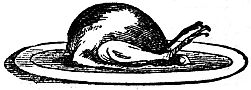
ROAST PARTRIDGE.
Ingredients.—Partridge; butter. Choosing and Trussing.—Choose young birds, with dark-coloured bills and yellowish legs, and let them hang a few days, or there will be no flavour to the flesh, nor will it be tender. The time they should be kept entirely depends on the taste of those for whom they are intended, as what some persons would consider delicious would be to others disgusting and offensive. They may be trussed with or without the head, the latter mode being now considered the most fashionable. Pluck, draw, and wipe the partridge carefully inside and out; cut off the head, leaving sufficient skin on the neck to skewer back; bring the legs close to the breast, between it and the side-bones, and pass a skewer through the pinions and the thick part of the thighs. When the head is left on, it should be brought round and fixed on to the point of the skewer. Mode.—When the bird is firmly and plumply trussed, roast it before a nice bright fire; keep it well basted, and a few minutes before serving, flour and froth it well. Dish it, and serve with gravy and bread sauce, and send to table hot and quickly. A little of the gravy should be poured over the bird. Time.—25 to 35 minutes. Average cost, 1s. 6d. to 2s. a brace. Sufficient.—2 for a dish. Seasonable from the 1st of September to the beginning of February.
PARTRIDGE SOUP.
Ingredients.—2 partridges, 3 slices of lean ham, 2 shred onions, 1 head of celery, 1 large carrot, and 1 turnip cut into any fanciful shapes, 1 small lump of sugar, 2 oz. of butter, salt and pepper to taste, 2 quarts of medium stock. Mode.—Cut the partridges into pieces, and braise them in the butter and ham until quite tender; then take out the legs, wings, and breast, and set them by. Keep the backs and other trimmings in the braise, and add the onions and celery; any remains of cold game can be put in, and 3 pints of stock. Simmer slowly for 1 hour, strain it, and skim the fat off as clean as possible; put in the pieces that were taken out, give it one boil, and skim again to have it quite clear, and add the sugar and seasoning. Now simmer the cut carrot and turnip in 1 pint of stock; when quite tender, put them to the partridges, and serve. Time.—2 hours. Average cost, 2s. or 1s. 6d. per quart. Seasonable from September to February. Sufficient for 8 persons.
Note.—The meat of the partridges may be pounded with a crumb of a French roll, and worked with the soup through a sieve. Serve with stewed celery cut in slices, and put in the tureen.
PARTRIDGES, to Carve.
ROAST PARTRIDGE.
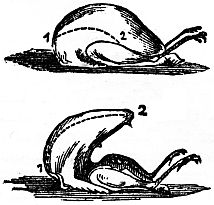
There are several ways of carving this most familiar game bird. The more usual and summary mode is to carry the knife sharply along the top of the breastbone of the bird, and cut it quite through, thus dividing it into two precisely equal and similar parts, in the same manner as carving a pigeon. Another plan is to cut it into three pieces; viz., by severing a small wing and leg on either side from the body, by following the line 1 to 2 in the upper woodcut; thus making 2 helpings, when the breast will remain for a third plate. The most elegant manner is that of thrusting back the body from the legs, and then cutting through the breast in the direction shown by the line 1 to 2: this plan will give 4 or more small helpings. A little bread-sauce should be served to each guest.
PARTRIDGES, Hashed, or Salmi de Perdrix.
Ingredients.—3 young partridges, 3 shallots, a slice of lean ham, 1 carrot, 3 or 4 mushrooms, a bunch of savoury herbs, 2 cloves, 6 whole peppers, ¾ pint of stock, 1 glass of sherry or Madeira, a small lump of sugar. Mode.—After the partridges are plucked and drawn, roast them rather underdone, and cover them with paper, as they should not be browned; cut them into joints, take off the skin from the wings, legs, and breasts; put these into a stewpan, cover them up, and set by until the gravy is ready. Cut a slice of ham into small pieces, and put them, with the carrots sliced, the shallots, mushrooms, herbs, cloves, and pepper, into a stewpan; fry them lightly in a little butter, pour in the stock, add the bones and trimming from the partridges, and simmer for ¼ hour. Strain the gravy, let it cool, and skim off every particle of fat; put it to the legs, wings, and breasts, add a glass of sherry or Madeira and a small lump of sugar, let all gradually warm through by the side of the fire, and when on the point of boiling, serve, and garnish the dish with croûtons. The remains of roast partridge answer very well dressed in this way, although not so good as when the birds are in the first instance only half-roasted. This recipe is equally suitable for pheasants, moorgame, &c.; but care must be taken always to skin the joints. Time.—Altogether 1 hour. Sufficient.—2 or 3 partridges for an entrée. Seasonable from the 1st of September to the beginning of February.
PASTE, Common, for Family Pies.
Ingredients.—1¼ lb. of flour, ½ lb. of butter, rather more than ½ pint of water. Mode.—Rub the butter lightly into the flour, and mix it to a smooth paste with the water; roll it out 2 or 3 times, and it will be ready for use. This paste may be converted into an excellent short crust for sweet tart by adding to the flour, after the butter is rubbed in, 2 tablespoonfuls of fine-sifted sugar. Average cost, 8d. per lb.
PASTE, Puff, French, or Feuilletage (Founded on M. Ude’s Recipe).
Ingredients.—Equal quantities of flour and butter—say 1 lb. of each; ½ saltspoonful of salt, the yolks of 2 eggs, rather more than ¼ pint of water. Mode.—Weigh the flour; ascertain that it is perfectly dry, and sift it; squeeze all the water from the butter, and wring it in a clean cloth till there is no moisture remaining. Put the flour on the paste-board, work lightly into it 2 oz. of the butter, and then make a hole in the centre; into this well put the yolks of 2 eggs, the salt, and about ¼ pint of water (the quantity of this latter ingredient must be regulated by the cook, as it is impossible to give the exact proportion of it); knead up the paste quickly and lightly, and, when quite smooth, roll it out square to the thickness of about ½ inch. Presuming that the butter is perfectly free from moisture, and as cool as possible, roll it into a ball, and place this ball of butter on the paste; fold the paste over the butter all round, and secure it by wrapping it well all over. Flatten the paste by rolling it lightly with the rolling-pin until it is quite thin, but not thin enough to allow the butter to break through, and keep the board and paste dredged lightly with flour during the process of making it. This rolling gives it the first turn. Now fold the paste in three, and roll out again, and, should the weather be very warm, put it in a cold place on the ground to cool between the several turns; for, unless this is particularly attended to, the paste will be spoiled. Roll out the paste again twice, put it by to cool, then roll it out twice more, which will make 6 turnings in all. Now fold the paste in two, and it will be ready for use. If properly baked and well made, this crust will be delicious, and should rise in the oven about 5 or 6 inches. The paste should be made rather firm in the first instance, as the ball of butter is liable to break through. Great attention must also be paid to keeping the butter very cool, as, if this is in a liquid and soft state, the paste will not answer at all. Should the cook be dexterous enough to succeed in making this, the paste will have a much better appearance than that made by the process of dividing the butter into 4 parts, and placing it over the rolled-out paste; but until experience has been acquired, we recommend puff-paste made by recipe. The above paste is used for vols-au-vent, small articles of pastry, and, in fact, everything that requires very light crust. Average cost, 1s. 6d. per lb.
PASTE, Puff, very Good.
Ingredients.—To every lb. of flour allow 1 lb. of butter, and not quite ½ pint of water. Mode.—Carefully weigh the flour and butter, and have the exact proportion; squeeze the butter well, to extract the water from it, and afterwards wring it in a clean cloth, that no moisture may remain. Sift the flour; see that it is perfectly dry, and proceed in the following manner to make the paste, using a very clean paste-board and rolling-pin:—Supposing the quantity to be 1 lb. of flour, work the whole into a smooth paste with not quite ½ pint of water, using a knife to mix it with: the proportion of this latter ingredient must be regulated by the discretion of the cook; if too much be added, the paste, when baked, will be tough. Roll it out until it is of an equal thickness of about an inch; break 4 oz. of the butter into small pieces; place these on the paste, sift over it a little flour, fold it over, roll out again, and put another 4 oz. of butter. Repeat the rolling and buttering until the paste has been rolled out 4 times, or equal quantities of flour and butter have been used. Do not omit, every time the paste is rolled out, to dredge a little flour over that and the rolling-pin, to prevent both from sticking. Handle the paste as lightly as possible, and do not press heavily upon it with the rolling-pin. The next thing to be considered is the oven, as the baking of pastry requires particular attention. Do not put it into the oven until it is sufficiently hot to raise the paste; for the best-prepared paste, if not properly baked, will be good for nothing. Brushing the paste as often as rolled out, and the pieces of butter placed thereon, with the white of an egg, assists it to rise in leaves or flakes. As this is the great beauty of puff-paste, it is as well to try this method. Average cost, 1s. 4d. per lb.
PASTE, Puff, Medium.
Ingredients.—To every lb. of flour allow 8 oz. of butter, 4 oz. of lard, not quite ½ pint of water. Mode.—This paste may be made by the directions in the preceding recipe, only using less butter, and substituting lard for a portion of it. Mix the flour to a smooth paste with not quite ½ pint of water; then roll it out 3 times, the first time covering the paste with butter, the second with lard, and the third with butter. Keep the rolling-pin and paste slightly dredged with flour, to prevent them from sticking, and it will be ready for use. Average cost, 1s. per lb.
PASTE, Puff (Soyer’s Recipe).
Ingredients.—To every lb. of flour allow the yolk of 1 egg, the juice of 1 lemon, ½ saltspoonful of salt, cold water, 1 lb. of fresh butter. Mode.—Put the flour on to the paste-board; make a hole in the centre, into which put the yolk of the egg, the lemon-juice, and salt; mix the whole with cold water (this should be iced in summer, if convenient) into a soft flexible paste, with the right hand, and handle it as little as possible; then squeeze all the buttermilk from the butter, wring it in a cloth, and roll out the paste; place the butter on this, and fold the edges of the paste over, so as to hide it; roll it out again to the thickness of ¼ inch; fold over one third, over which again pass the rolling-pin; then fold over the other third, thus forming a square; place it with the ends, top, and bottom before you, shaking a little flour both under and over, and repeat the rolls and turns twice again, as before. Flour a baking-sheet, put the paste on this, and let it remain on ice or in some cool place for ½ hour; then roll twice more, turning it as before; place it again upon the ice for ¼ hour, give it 2 more rolls, making 7 in all, and it is ready for use when required. Average cost, 1s. 6d. per lb.
PASTRY AND PUDDINGS, Directions in connection with the making of.
A few general remarks respecting the various ingredients of which puddings and pastry are composed may be acceptable, in addition to the recipes in this department of Household Management.
Flour should be of the best quality, and perfectly dry, and sifted before being used; if in the least damp, the paste made from it will certainly be heavy.
Butter, unless fresh is used, should be washed from the salt, and well squeezed and wrung in a cloth, to get out all the water and buttermilk, which, if left in, assist to make the paste heavy.
Lard should be perfectly sweet, which may be ascertained by cutting the bladder through, and, if the knife smells sweet, the lard is good.
Suet should be finely chopped, perfectly free from skin, and quite sweet; during the process of chopping, it should be lightly dredged with flour, which prevents the pieces from sticking together. Beef suet is considered the best; but veal suet, or the outside fat of a loin or neck of mutton, makes good crusts; as also the skimmings in which a joint of mutton has been boiled, but without vegetables.
Clarified Beef Dripping answers very well for kitchen pies, puddings, cakes, or for family use. A very good short crust may be made by mixing with it a small quantity of moist sugar; but care must be taken to use the dripping sparingly, or a very disagreeable flavour will be imparted to the paste.
Strict cleanliness must be observed in pastry-making; all the utensils used should be perfectly free from dust and dirt, and the things required for pastry kept entirely for that purpose.
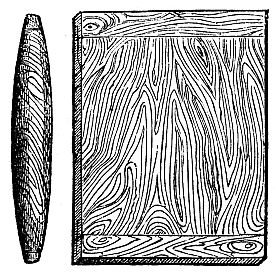
PASTE-BOARD AND ROLLING-PIN.
In mixing paste, add the water very gradually, work the whole together with the knife-blade, and knead it until perfectly smooth. Those who are inexperienced in pastry-making should work the butter in by breaking it in small pieces, and covering the paste rolled out. It should then be dredged with flour, and the ends folded over and rolled out very thin again: this process must be repeated until all the butter is used.
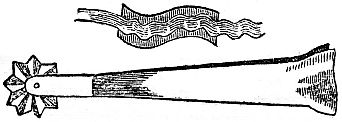
PASTE-PINCERS AND JAGGER, FOR ORNAMENTING THE EDGES OF PIE-CRUSTS.
The art of making paste requires much practice, dexterity, and skill: it should be touched as lightly as possible, made with cool hands and in a cool place (a marble slab is better than a board for the purpose), and the coolest part of the house should be selected for the process during warm weather.
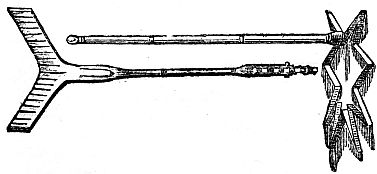
PASTE-CUTTER AND CORNER-CUTTER.
To insure rich paste being light, great expedition must be used in the making and baking; for if it stand long before it is put in the oven, it becomes flat and heavy.

ORNAMENTAL-PASTE CUTTER.
Puff-paste requires a brisk oven, but not too hot, or it would blacken the crust; on the other hand, if the oven be too slack, the paste will be soddened, and will not rise, nor will it have any colour.

PATTY-PANS, PLAIN AND FLUTED.
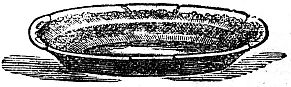
PIE-DISH.
Tart-tins, cake-moulds, dishes for baked puddings, patty-pans, &c., should all be buttered before the article intended to be baked is put in them. Things to be baked on sheets should be placed on buttered paper. Raised-pie paste should have a soaking heat, and paste glazed must have rather a slack oven, that the icing be not scorched. It is better to ice tarts, &c., when they are three-parts baked.
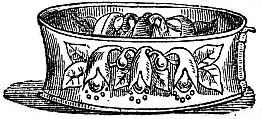
RAISED-PIE MOULD.
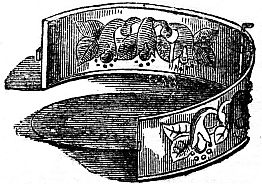
RAISED-PIE MOULD, OPEN.
To ascertain when the oven is heated to the proper degree for puff-paste, put a small piece of the paste in previous to baking the whole, and then the heat can thus be judged of.
The freshness of all pudding ingredients is of much importance, as one bad article will taint the whole mixture.
When the freshness of eggs is doubtful, break each one separately in a cup, before mixing them altogether. Should there be a bad one amongst them, it can be thrown away; whereas, if mixed with the good ones, the entire quantity would be spoiled. The yolks and whites beaten separately make the articles they are put into much lighter.
Raisins and dried fruits for puddings should be carefully picked, and in many cases stoned. Currants should be well washed, pressed in a cloth, and placed on a dish before the fire to get thoroughly dry: they should then be picked carefully over, and every piece of grit or stone removed from amongst them. To plump them, some cooks pour boiling water over them, and then dry them before the fire.
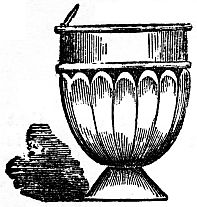
BOILED-PUDDING MOULD.
Batter pudding should be smoothly mixed and free from lumps. To insure this, first mix the flour with a very small proportion of milk, and add the remainder by degrees. Should the pudding be very lumpy, it may be strained through a hair sieve.
All boiled puddings should be put on in boiling water, which must not be allowed to stop simmering, and the pudding must always be covered with the water; if requisite, the saucepan should be kept filled up.
To prevent a pudding boiled in a cloth from sticking to the bottom of the saucepan, place a small plate or saucer underneath it, and set the pan on a trivet over the fire. If a mould is used, this precaution is not necessary; but care must be taken to keep the pudding well covered with water.
For dishing a boiled pudding as soon as it comes out of the pot, dip it into a basin of cold water, and the cloth will then not adhere to it. Great expedition is necessary in sending puddings to table, as by standing they quickly become heavy, batter puddings particularly.
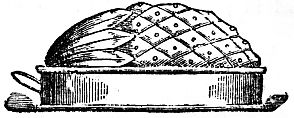
BOILED PUDDING MOULD.
For baked or boiled puddings, the moulds, cups, or basins should be always buttered before the mixture is put in them, and they should be put into the saucepan directly they are filled.
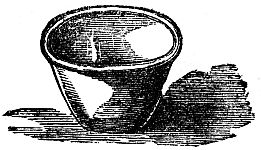
PUDDING-BASIN.
Scrupulous attention should be paid to the cleanliness of pudding-cloths, as from neglect in this particular the outsides of boiled puddings frequently taste very disagreeably. As soon as possible after it is taken off the pudding, it should be soaked in water, and then well washed, without soap, unless it be very greasy. It should be dried out of doors, then folded up and kept in a dry place. When wanted for use, dip it in boiling water, and dredge it slightly with flour.
The dry ingredients for puddings are better for being mixed some time before they are wanted; the liquid portion should only be added just before the pudding is put into the saucepan.
A pinch of salt is an improvement to the generality of puddings; but this ingredient should be added very sparingly, as the flavour should not be detected.
When baked puddings are sufficiently solid, turn them out of the dish they were baked in, bottom uppermost, and strew over them fine-sifted sugar.
When pastry or baked puddings are not done through, and yet the outside is sufficiently brown, cover them over with a piece of white paper until thoroughly cooked: this prevents them from getting burnt.
PASTRY, to Ice or Glaze.
To glaze pastry, which is the usual method adopted for meat or raised pies, break an egg, separate the yolk from the white, and beat the former for a short time. Then, when the pastry is nearly baked, take it out of the oven, brush it over with this beaten yolk of egg, and put it back in the oven to set the glaze.
To ice pastry, which is the usual method adopted for fruit tarts and sweet dishes of pastry, put the white of an egg on a plate, and with the blade of a knife beat it to a stiff froth. When the pastry is nearly baked, brush it over with this, and sift over some pounded sugar; put it back into the oven to set the glaze, and, in a few minutes, it will be done. Great care should be taken that the paste does not catch or burn in the oven, which it is very liable to do after the icing is laid on. Sufficient.—Allow 1 egg and 1½ oz. of sugar to glaze 3 tarts.
PASTRY SANDWICHES.
Ingredients.—Puff-paste, jam of any kind, the white of an egg, sifted sugar. Mode.—Roll the paste out thin; put half of it on a baking-sheet or tin, and spread equally over it apricot, greengage, or any preserve that may be preferred. Lay over this preserve another thin paste; press the edges together all round; and mark the paste in lines with a knife on the surface, to show where to cut it when baked. Bake from 20 minutes to ½ hour; and, a short time before being done, take the pastry out of the oven, brush it over with the white of an egg, sift over pounded sugar, and put it back in the oven to colour. When cold, cut it into strips; pile these on a dish pyramidically, and serve. These strips, cut about 2 inches long, piled in circular rows, and a plateful of flavoured whipped cream poured in the middle, make a very pretty dish. Time.—20 minutes to ½ hour. Average cost, with ½ lb. of paste, 1s. Sufficient.—½ lb. of paste will make 2 dishes of sandwiches. Seasonable at any time.
PATE BRISEE, Crust French, for Raised Pies.
Ingredients.—To every lb. of flour allow ½ saltspoonful of salt, 2 eggs, 1/3 pint of water, 6 oz. of butter. Mode.—Spread the flour, which should be sifted and thoroughly dry, on the paste-board; make a hole in the centre, into which put the butter; work it lightly into the flour, and when quite fine, add the salt; work the whole into a smooth paste with the eggs (yolks and whites) and water, and make it very firm. Knead the paste well, and let it be rather stiff, that the sides of the pie may be easily raised, and that they do not afterwards tumble or shrink. Average cost, 1s. per lb.
Note.—This paste may be very much enriched by making it with equal quantities of flour and butter; but then it is not so easily raised as when made plainer.
PATTIES, Fried.
[Cold Meat Cookery.] Ingredients.—Cold roast veal, a few slices of cold ham, 1 egg boiled hard, pounded mace, pepper and salt to taste, gravy, cream, 1 teaspoonful of minced lemon-peel, good puff-paste. Mode.—Mince a little cold veal and ham, allowing one-third ham to two-thirds veal; add an egg boiled hard and chopped, and a seasoning of pounded mace, salt, pepper, and lemon-peel; moisten with a little gravy and cream. Make a good puff-paste; roll rather thin, and cut it into round or square pieces; put the mince between two of them, pinch the edges to keep in the gravy, and fry a light brown. They may also be baked in patty-pans; in that case, they should be brushed over with the yolk of an egg before they are put in the oven. To make a variety, oysters may be substituted for the ham. Time.—15 minutes to fry the patties. Seasonable from March to October.
PEA SOUP (Inexpensive).
Ingredients.—¼ lb. of onions, ¼ lb. of carrots, 2 oz. of celery, ¾ lb. of split peas, a little mint, shred fine; 1 tablespoonful of coarse brown sugar, salt and pepper to taste, 4 quarts of water, or liquor in which a joint of meat has been boiled. Mode.—Fry the vegetables for 10 minutes in a little butter or dripping, previously cutting them up into small pieces; pour the water on them, and when boiling add the peas. Let them simmer for nearly 3 hours, or until the peas are thoroughly done. Add the sugar, seasoning, and mint; boil for ¼ of an hour, and serve. Time.—3½ hours. Average cost, 1½d. per quart. Seasonable in winter. Sufficient for 12 persons.
PEA SOUP (Green).
Ingredients.—3 pints of green peas, ¼ lb. of butter, 2 or 3 thin slices of ham, 3 onions sliced, 4 shredded lettuces, the crumb of 2 French rolls, 2 handfuls of spinach, 1 lump of sugar, 2 quarts of medium stock. Mode.—Put the butter, jam, 1 quart of peas, onions, and lettuces, to a pint of stock, and simmer for an hour; then add the remainder of the stock, with the crumb of the French rolls, and boil for another hour. Now boil the spinach, and squeeze it very dry. Rub the soup through a sieve, and the spinach with it, to colour it. Have ready a pint of young peas boiled; add them to the soup, put in the sugar, give one boil, and serve. If necessary, add salt. Time.—2½ hours. Average cost, 1s. 9d. per quart. Seasonable from June to the end of August. Sufficient for 10 persons.
Note.—It will be well to add, if the peas are not quite young, a little more sugar. Where economy is essential, water may be used instead of stock for this soup, boiling in it likewise the pea-shells; but using a double quantity of vegetables.
PEA SOUP, Winter (Yellow).
Ingredients.—1 quart of split peas, 2 lbs. of shin beef, trimmings of meat or poultry, a slice of bacon, 2 large carrots, 2 turnips, 5 large onions, 1 head of celery, seasoning to taste, 2 quarts of soft water, any bones left from roast meat, 2 quarts of common stock, or liquor in which a joint of meat has been boiled. Mode.—Put the peas to soak over-night in soft water, and float off such as rise to the top. Boil them in the water till tender enough to pulp; then add the ingredients mentioned above, and simmer for 2 hours, stirring it occasionally. Pass the whole through a sieve, skim well, season, and serve with toasted bread cut in dice. Time.—4 hours. Average cost, 6d. per quart. Seasonable all the year round, but more suitable for cold weather. Sufficient for 12 persons.
PEACHES, Compôte of.
Ingredients.—1 pint of syrup, about 15 small peaches, Mode.—Peaches that are not very large, and that would not look well for dessert, answer very nicely for a compôte. Divide the peaches, take out the stones, and pare the fruit; make a syrup by recipe, put in the peaches, and stew them gently for about 10 minutes. Take them out without breaking, arrange them on a glass dish, boil the syrup for 2 or 3 minutes, let it cool, pour it over the fruit, and, when cold, it will be ready for table. Time.—10 minutes. Average cost, 1s. 2d. Sufficient for 5 or 6 persons. Seasonable in August and September.
PEACH FRITTERS.
Ingredients.—For the batter, ½ lb. of flour, ½ oz. of butter, ½ saltspoonful of salt, 2 eggs, milk, peaches, hot lard or clarified dripping. Mode.—Make a nice smooth batter; skin, halve, and stone the peaches, which should be quite ripe; dip them in the batter, and fry the pieces in hot lard or clarified dripping, which should be boiling before the peaches are put in. From 8 to 10 minutes will be required to fry them; when done, drain them before the fire. Dish them on a white d’oyley. Strew over plenty of pounded sugar and serve. Time.—From 8 to 10 minutes to fry the fritters, 5 minutes to drain them. Average cost, 1s. Sufficient for 4 or 5 persons. Seasonable in July, August, and September.
PEACHES PRESERVED IN BRANDY.
Ingredients.—To every lb. of fruit weighed before being stoned, allow ¼ lb. of finely-pounded loaf sugar; brandy. Mode.—Let the fruit be gathered in dry weather; wipe and weigh it, and remove the stones as carefully as possible, without injuring the peaches much. Put them into a jar, sprinkle amongst them pounded loaf sugar in the above proportion, and pour brandy over the fruit. Cover the jar down closely, place it in a saucepan of boiling water over the fire, and bring the brandy to the simmering-point, but do not allow it to boil. Take the fruit out carefully, without breaking it; put it into small jars, pour over it the brandy, and, when cold, exclude the air by covering the jars with bladders, or tissue-paper brushed over on both sides with the white of an egg. Apricots may be done in the same manner, and, if properly prepared, will be found delicious. Time.—From 10 to 20 minutes to bring the brandy to the simmering-point. Seasonable in August and September.
PEARS, Baked.
Ingredients.—12 pears, the rind of 1 lemon, 6 cloves, 10 whole allspice; to every pint of water allow ½ lb. of loaf sugar. Mode.—Pare and cut the pears into halves, and, should they be very large, into quarters; leave the stalks on, and carefully remove the cores. Place them in a clean baking-jar, with a closely-fitting lid; add to them the lemon-rind cut in strips, the juice of ½ lemon, the cloves, pounded allspice, and sufficient water just to cover the whole, with sugar in the above proportion. Cover the jar down closely, put it into a very cool oven, and bake the pears from 5 to 6 hours, but be very careful that the oven is not too hot. To improve the colour of the fruit, a few drops of prepared cochineal may be added; but this will not be found necessary, if the pears are very gently baked. Time.—Large pears, 5 to 6 hours, in a very slow oven. Average cost, 1d. to 2d. each. Sufficient for 7 or 8 persons. Seasonable from September to January.
PEARS à L’ALLEMANDE.
Ingredients.—6 to 8 pears, water, sugar, 2 oz. of butter, the yolk of an egg, ½ oz. of gelatine. Mode.—Peel and cut the pears into any form that may be preferred, and steep them in cold water to prevent them turning black; put them into a saucepan with sufficient cold water to cover them, and boil them with the butter and enough sugar to sweeten them nicely, until tender; then brush the pears over with the yolk of an egg, sprinkle them with sifted sugar, and arrange them on a dish. Add the gelatine to the syrup, boil it up quickly for about 5 minutes, strain it over the pears, and let it remain until set. The syrup may be coloured with a little prepared cochineal, which would very much improve the appearance of the dish. Time.—From 20 minutes to ½ hour to stew the pears; 5 minutes to boil the syrup. Average cost, 1s. 3d. Sufficient for a large dish. Seasonable from August to February.
PEARS, Moulded.
Ingredients.—4 large pears or 6 small ones, 8 cloves, sugar to taste, water, a small piece of cinnamon, ¼ pint of raisin wine, a strip of lemon-peel, the juice of ½ lemon, ½ oz. of gelatine. Mode.—Peel and cut the pears into quarters; put them into a jar with ¾ pint of water, cloves, cinnamon, and sufficient sugar to sweeten the whole nicely; cover down the top of the jar, and bake the pears in a gentle oven until perfectly tender, but do not allow them to break. When done, lay the pears in a plain mould, which should be well wetted, and boil ½ pint of the liquor the pears were baked in with the wine, lemon-peel, strained juice, and gelatine. Let these ingredients boil quickly for 5 minutes, then strain the liquid warm over the pears; put the mould in a cool place, and when the jelly is firm, turn it out on a glass dish. Time.—2 hours to bake the pears in a cool oven. Average cost, 1s. 3d. Sufficient for a quart mould. Seasonable from August to February.
PEARS, Preserved.
Ingredients.—Jargonelle pears; to every lb. of sugar allow ½ pint of water. Mode.—Procure some Jargonelle pears, not too ripe; put them into a stewpan with sufficient water to cover them, and simmer them till rather tender, but do not allow them to break; then put them into cold water. Boil the sugar and water together for 5 minutes, skim well, put in the pears, and simmer them gently for 5 minutes. Repeat the simmering for 3 successive days, taking care not to let the fruit break. The last time of boiling, the syrup should be made rather richer, and the fruit boiled for 10 minutes. When the pears are done, drain them from the syrup, and dry them in the sun, or in a cool oven; or they may be kept in the syrup, and dried as they are wanted. Time.—½ hour to simmer the pears in water, 20 minutes in the syrup. Average cost, 1d. to 2d. each. Seasonable.—Most plentiful in September and October.
PEARS, Stewed.
Ingredients.—8 large pears, 5 oz. of loaf sugar, 6 cloves, 6 whole allspice, ½ pint of water, ¼ pint of port wine, a few drops of prepared cochineal. Mode.—Pare the pears, halve them, remove the cores, and leave the stalks on; put them into a lined saucepan with the above ingredients, and let them simmer very gently until tender, which will be in from 3 to 4 hours, according to the quality of the pears. They should be watched, and, when done, carefully lifted out on to a glass dish without breaking them. Boil up the syrup quickly for 2 or 3 minutes; allow it to cool a little, pour it over the pears, and let them get perfectly cold. To improve the colour of the fruit, a few drops of prepared cochineal may be added, which rather enhances the beauty of this dish. The fruit must not be boiled fast, but only simmered, and watched that it be not too much done. Time.—3 to 4 hours. Average cost, 1s. 6d. Sufficient for 5 or 6 persons. Seasonable from September to January.

STEWED PEARS.
PEAS, Boiled Green.
Ingredients.—Green peas; to each ½ gallon of water allow 1 small teaspoonful of moist sugar, 1 heaped tablespoonful of salt. Mode.—This delicious vegetable, to be eaten in perfection, should be young, and not gathered or shelled long before it is dressed. Shell the peas, wash them well in cold water, and drain them; then put them into a saucepan with plenty of fast-boiling water, to which salt and moist sugar have been added in the above proportion; let them boil quickly over a brisk fire, with the lid of the saucepan uncovered, and be careful that the smoke does not draw in. When tender, pour them into a colander; put them into a hot vegetable-dish, and quite in the centre of the peas place a piece of butter, the size of a walnut. Many cooks boil a small bunch of mint with the peas, or garnish them with it, by boiling a few sprigs in a saucepan by themselves. Should the peas be very old, and difficult to boil a good colour, a very tiny piece of soda may be thrown in the water previous to putting them in; but this must be very sparingly used, as it causes the peas, when boiled, to have a smashed and broken appearance. With young peas, there is not the slightest occasion to use it. Time.—Young peas, 10 to 15 minutes; the large sorts, such as marrowfats, &c., 18 to 24 minutes; old peas, ½ hour. Average cost, when cheapest, 6d. per peck; when first in season, 1s. to 1s. 6d. per peck. Sufficient.—Allow 1 peck of unshelled peas for 4 or 5 persons. Seasonable from June to the end of August.
PEAS, Green, à la Française.
Ingredients.—2 quarts of green peas, 3 oz. of fresh butter, a bunch of parsley, 6 green onions, flour, a small lump of sugar, ½ teaspoonful of salt, a teaspoonful of flour. Mode.—Shell sufficient fresh-gathered peas to fill 2 quarts; put them into cold water, with the above proportion of butter, and stir them about until they are well covered with the butter; drain them in a colander, and put them in a stewpan, with the parsley and onions; dredge over them a little flour, stir the peas well, and moisten them with boiling water; boil them quickly over a large fire for 20 minutes, or until there is no liquor remaining. Dip a small lump of sugar into some water, that it may soon melt; put it with the peas, to which add ½ teaspoonful of salt. Take a piece of butter the size of a walnut, work it together with a teaspoonful of flour, and add this to the peas, which should be boiling when it is put in. Keep shaking the stewpan, and, when the peas are nicely thickened, dress them high in the dish, and serve. Time.—Altogether, ¾ hour. Average cost, 6d. per peck. Sufficient for 4 or 5 persons. Seasonable from June to the end of August.
PEAS, Stewed Green.
Ingredients.—1 quart of peas, 1 lettuce, 1 onion, 2 oz. of butter, pepper and salt to taste, 1 egg, ½ teaspoonful of powdered sugar. Mode.—Shell the peas, and cut the onion and lettuce into slices; put these into a stewpan, with the butter, pepper, and salt, but with no more water than that which hangs around the lettuce from washing. Stew the whole very gently for rather more than 1 hour; then stir in a well-beaten egg, and about ½ teaspoonful of powdered sugar. When the peas, &c., are nicely thickened, serve; but, after the egg is added, do not allow them to boil. Time.—1¼ hour. Average cost, 6d. per peck. Sufficient for 3 or 4 persons. Seasonable from June to the end of August.
PERCH, Boiled.
Ingredients.—¼ lb. of salt to each gallon of water. Mode.—Scale the fish, take out the gills and clean it thoroughly; lay it in boiling water, salted as above, and simmer gently for 10 minutes. If the fish is very large, longer time must be allowed. Garnish with parsley, and serve with plain melted butter, or Dutch sauce. Perch do not preserve so good a flavour when stewed as when dressed in any other way. Time.—Middling-sized perch, ¼ hour. Seasonable from September to November.
Note.—Tench may be boiled the same way, and served with the same sauces.
PERCH, Fried.
Ingredients.—Egg and bread-crumbs, hot lard. Mode.—Scale and clean the fish, brush it over with egg, and cover with bread-crumbs. Have ready some boiling lard; put the fish in, and fry a nice brown. Serve with plain melted butter or anchovy sauce. Time.—10 minutes. Seasonable from September to November.
Note.—Fry tench in the same way.
PERCH, Stewed with Wine.
Ingredients.—Equal quantities of stock and sherry, 1 bay-leaf, 1 clove of garlic, a small bunch of parsley, 2 cloves, salt to taste; thickening of butter and flour, pepper, grated nutmeg, ½ teaspoonful of anchovy sauce. Mode.—Scale the fish and take out the gills, and clean them thoroughly; lay them in a stewpan with sufficient stock and sherry just to cover them. Put in the bay-leaf, garlic, parsley, cloves, and salt, and simmer till tender. When done, take out the fish, strain the liquor, add a thickening of butter and flour, the pepper, nutmeg, and the anchovy sauce, and stir it over the fire until somewhat reduced, when pour over the fish, and serve. Time.—About 20 minutes. Seasonable from September to November.
PETITES BOUCHÉES.
Ingredients.—6 oz. of sweet almonds, ¼ lb. of sifted sugar, the rind of ½ lemon, the white of 1 egg, puff-paste. Mode.—Blanch the almonds, and chop them fine; rub the sugar on the lemon-rind, and pound it in a mortar; mix this with the almonds and the white of the egg. Roll some puff-paste out; cut it in any shape that may be preferred, such as diamonds, rings, ovals, &c., and spread the above mixture over the paste. Bake the bouchées in an oven, not too hot, and serve cold. Time.—¼ hour, or rather more. Average cost, 1s. Sufficient for ½ lb. of puff-paste. Seasonable at any time.
PHEASANT.
If this bird be eaten three days after it has been killed, it then has no peculiarity of flavour; a pullet would be more relished, and a quail would surpass it in aroma. Kept, however, a proper length of time,—and this can be ascertained by a slight smell and change of colour,—then it becomes a highly-flavoured dish, occupying, so to speak, the middle distance between chicken and venison. It is difficult to define any exact time to “hang” a pheasant; but any one possessed of the instincts of gastronomical science, can at once detect the right moment when a pheasant should be taken down, in the same way as a good cook knows whether a bird should be removed from the spit, or have a turn or two more.
PHEASANT, Broiled (a Breakfast or Luncheon Dish).
Ingredients.—1 pheasant, a little lard, egg and bread-crumbs, salt and cayenne to taste. Mode.—Cut the legs off at the first joint, and the remainder of the bird into neat pieces; put them into a frying-pan with a little lard, and when browned on both sides, and about half done, take them out and drain them; brush the pieces over with egg, and sprinkle with bread-crumbs with which has been mixed a good seasoning of cayenne and salt. Broil them over a moderate fire for about 10 minutes, or rather longer, and serve with mushroom-sauce, sauce piquante, or brown gravy, in which a few game-bones and trimmings have been stewed. Time.—Altogether ½ hour. Sufficient for 4 or 5 persons. Seasonable from the 1st of October to the beginning of February.
PHEASANT, to Carve.
Fixing the fork in the breast, let the carver cut slices from it in the direction of the lines from 2 to 1: these are the prime pieces. If there be more guests to satisfy than these slices will serve, then let the legs and wings be disengaged in the same manner as described in carving boiled fowl, the point where the wing joins the neckbone being carefully found. The merrythought will come off in the same way as that of a fowl. The most valued parts are the same as those which are most considered in a fowl.
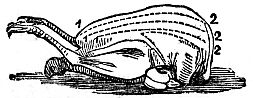
ROAST PHEASANT.
PHEASANT CUTLETS.
Ingredients.—2 or 3 pheasants, egg and bread-crumbs, cayenne and salt to taste, brown gravy. Mode.—Procure 3 young pheasants that have been hung a few days; pluck, draw, and wipe them inside; cut them into joints; remove the bones from the best of these; and the backbones, trimmings, &c., put into a stewpan, with a little stock, herbs, vegetables, seasoning, &c., to make the gravy. Flatten and trim the cutlets of a good shape, egg and bread-crumb them, broil them over a clear fire, pile them high in the dish, and pour under them the gravy made from the bones, which should be strained, flavoured, and thickened. One of the small bones should be stuck on the point of each cutlet. Time.—10 minutes. Average cost, 2s. 6d. to 3s. each. Sufficient for 2 entrées. Seasonable from the 1st of October to the beginning of February.
PHEASANT, Roast.
Ingredients.—Pheasant, flour, butter. Choosing and trussing.—Old pheasants may be known by the length and sharpness of their spurs; in young ones they are short and blunt. The cock bird is generally reckoned the best, except when the hen is with egg. They should hang some time before they are dressed, as, if they are cooked fresh, the flesh will be exceedingly dry and tasteless. After the bird is plucked and drawn, wipe the inside with a damp cloth, and truss it in the same manner as partridge. If the head is left on, as shown in the engraving, bring it round under the wing, and fix it on to the point of the skewer. Mode.—Roast it before a brisk fire, keep it well basted, and flour and froth it nicely. Serve with brown gravy, a little of which should be poured round the bird, and a tureen of bread sauce. 2 or 3 of the pheasant’s best tail-feathers are sometimes stuck in the tail as an ornament; but the fashion is not much to be commended. Time.—½ to 1 hour, according to the size. Average cost, 2s. 6d. to 3s. each. Sufficient,—1 for a dish. Seasonable from the 1st of October to the beginning of February.

ROAST PHEASANT.
PHEASANT, Roast, Brillat Savarin’s Recipe (à la Sainte Alliance).
When the pheasant is in good condition to be cooked, it should be plucked, and not before. The bird should then be stuffed in the following manner:—Take two snipes, and draw them, putting the bodies on one plate, and the livers, &c., on another. Take off the flesh, and mince it finely with a little beef, lard, a few truffles, pepper and salt to taste, and stuff the pheasant carefully with this. Cut a slice of bread, larger considerably than the bird, and cover it with the liver, &c., and a few truffles: an anchovy and a little fresh butter added to these will do no harm. Put the bread, &c., into the dripping-pan, and, when the bird is roasted, place it on the preparation, and surround it with Florida oranges.
Do not be uneasy, Savarin adds, about your dinner; for a pheasant served in this way is fit for beings better than men. The pheasant itself is a very good bird; and, imbibing the dressing and the flavour of the truffle and snipe, it becomes thrice better.
PHEASANT SOUP.
Ingredients.—2 pheasants, ¼ lb. of butter, 2 slices of ham, 2 large onions sliced, ½ head of celery, the crumb of two French rolls, the yolks of 2 eggs boiled hard; salt and cayenne to taste, a little pounded mace, if liked; 3 quarts of stock medium. Mode.—Cut up the pheasants, flour and braise them in the butter and ham till they are of a nice brown, but not burnt. Put them in a stewpan, with the onions, celery, stock, and seasoning, and simmer for 2 hours. Strain the soup; pound the breasts with the crumb of the roll previously soaked, and the yolks of the eggs; put it to the soup, give one boil, and serve. Time.—2½ hours. Average cost, 2s. 10d. per quart, or, if made with fragments of cold game, 1s. Seasonable from October to February. Sufficient for 10 persons.
Note.—Fragments, pieces and bones of cold game, may be used to great advantage in this soup, and then 1 pheasant will suffice.
PICKLE, an Excellent.
Ingredients.—Equal quantities of medium-sized onions, cucumbers, and sauce-apples; 1½ teaspoonful of salt, ¾ teaspoonful of cayenne, 1 wineglassful of soy, 1 wineglassful of sherry; vinegar. Mode.—Slice sufficient cucumbers, onions, and apples to fill a pint stone jar, taking care to cut the slices very thin; arrange them in alternate layers, adding at the same time salt and cayenne in the above proportion; pour in the soy and wine, and fill up with vinegar. It will be fit for use the day it is made. Seasonable in August and September,
PICKLE, Indian (very Superior).
Ingredients.—To each gallon of vinegar allow 6 cloves of garlic, 12 shalots, 2 sticks of sliced horseradish, ¼ lb. of bruised ginger, 2 oz. of whole black pepper, 1 oz. of long pepper, 1 oz. of allspice, 12 cloves, ¼ oz. of cayenne, 2 oz. of mustard-seed, ¼ lb. of mustard, 1 oz. of turmeric; a white cabbage, cauliflowers, radish-pods, French beans, gherkins, small round pickling-onions, nasturtiums, capsicums, chilies, &c. Mode.—Cut the cabbage, which must be hard and white, into slices, and the cauliflowers into small branches; sprinkle salt over them in a large dish, and let them remain two days; then dry them, and put them into a very large jar, with garlic, shalots, horseradish, ginger, pepper, allspice, and cloves, in the above proportions. Boil sufficient vinegar to cover them, which pour over, and, when cold, cover up to keep them free from dust. As the other things for the pickle ripen at different times, they may be added as they are ready: these will be radish-pods, French beans, gherkins, small onions, nasturtiums, capsicums, chilies, &c., &c. As these are procured, they must, first of all, be washed in a little cold vinegar, wiped, and then simply added to the other ingredients in the large jar, only taking care that they are covered by the vinegar. If more vinegar should be wanted to add to the pickle, do not omit first to boil it before adding it to the rest. When you have collected all the things you require, turn all out in a large pan, and thoroughly mix them. Now put the mixed vegetables into smaller jars, without any of the vinegar; then boil the vinegar again, adding as much more as will be required to fill the different jars, and also cayenne, mustard-seed, turmeric, and mustard, which must be well mixed with a little cold vinegar, allowing the quantities named above to each gallon of vinegar. Pour the vinegar, boiling hot, over the pickle, and when cold, tie down with a bladder. If the pickle is wanted for immediate use, the vinegar should be boiled twice more, but the better way is to make it during one season for use during the next. It will keep for years, if care is taken that the vegetables are quite covered by the vinegar.
This recipe was taken from the directions of a lady whose pickle was always pronounced excellent by all who tasted it, and who has, for many years, exactly followed the recipe given above.
Note.—For small families, perhaps the above quantity of pickle will be considered too large; but this may be decreased at pleasure, taking care to properly proportion the various ingredients.
PICKLE, Mixed (very good).
Ingredients.—To each gallon of vinegar allow ¼ lb. of bruised ginger, ¼ lb. of mustard, ¼ lb. of salt, 2 oz. of mustard-seed, 1½ oz. of turmeric, 1 oz. of ground black pepper, ¼ oz. of cayenne, cauliflowers, onions, celery, sliced cucumbers, gherkins, French beans, nasturtiums, capsicums. Mode.—Have a large jar, with a tightly-fitting lid, in which put as much vinegar as required, reserving a little to mix the various powders to a smooth paste. Put into a basin the mustard, turmeric, pepper, and cayenne; mix them with vinegar, and stir well until no lumps remain; add all the ingredients to the vinegar, and mix well. Keep this liquor in a warm place, and thoroughly stir every morning for a month with a wooden spoon, when it will be ready for the different vegetables to be added to it. As these come into season, have them gathered on a dry day, and, after merely wiping them with a cloth, to free them from moisture, put them into the pickle. The cauliflowers, it may be said, must be divided into small bunches. Put all these into the pickle raw, and at the end of the season, when there have been added as many of the vegetables as could be procured, store it away in jars, and tie over with bladder. As none of the ingredients are boiled, this pickle will not be fit to eat till 12 months have elapsed. Whilst the pickle is being made, keep a wooden spoon tied to the jar; and its contents, it may be repeated, must be stirred every morning. Seasonable.—Make the pickle-liquor in May or June, as the season arrives for the various vegetables to be picked.
PICKLE for Tongues or Beef (Newmarket Recipe).
Ingredients.—1 gallon of soft water, 3 lbs. of coarse salt, 6 oz. of coarse brown sugar, ½ oz. of saltpetre. Mode.—Put all the ingredients into a saucepan, and let them boil for ½ an hour, clear off the scum as it rises, and when done pour the pickle into a pickling-pan. Let it get cold, then put in the meat, and allow it to remain in pickle from 8 to 14 days, according to the size. It will keep good for 6 months if well boiled once a fortnight. Tongues will take 1 month or 6 weeks to be properly cured; and, in salting meat, beef and tongues should always be put in separate vessels. Time.—A moderate-sized tongue should remain in the pickle about a month, and be turned every day.
PICKLE, Universal.
Ingredients.—To 6 quarts of vinegar allow 1 lb. of salt, ¼ lb. of ginger, 1 oz. of mace, ½ lb. of shalots, 1 tablespoonful of cayenne, 2 oz. of mustard-seed, 1½ oz. of turmeric. Mode.—Boil all the ingredients together for about 20 minutes; when cold, put them into a jar with whatever vegetables you choose, such as radish-pods, French beans, cauliflowers, gherkins, &c. &c., as these come into season; put them in fresh as you gather them, having previously wiped them perfectly free from moisture and grit. This pickle will be fit for use in about 8 or 9 months. Time.—20 minutes. Seasonable.—Make the pickle in May or June, to be ready for the various vegetables.
Note.—As this pickle takes 2 or 3 months to make,—that is to say, nearly that time will elapse before all the different vegetables are added,—care must be taken to keep the jar which contains the pickle well covered, either with a closely-fitting lid, or a piece of bladder securely tied over, so as perfectly to exclude the air.
PICKLES.
Although pickles may be purchased at shops at as low a rate as they can usually be made for at home, or perhaps even for less, yet we would advise all housewives, who have sufficient time and convenience, to prepare their own. The only general rules, perhaps, worth stating here,—as in the recipes all necessary details will be explained—are, that the vegetables and fruits used should be sound, and not over-ripe, and that the very best vinegar should be employed.
PICNIC FOR 40 PERSONS, Bill of Fare for.
A joint of cold roast beef, a joint of cold boiled beef, 2 ribs of lamb, 2 shoulders of lamb, 4 roast fowls, 2 roast ducks, 1 ham, 1 tongue, 2 veal-and-ham pies, 2 pigeon pies, 6 medium-sized lobsters, 1 piece of collared calf’s head, 18 lettuces, 6 baskets of salad, 6 cucumbers.
Stewed fruit well sweetened, and put into glass bottles well corked; 3 or 4 dozen plain pastry biscuits to eat with the stewed fruit, 2 dozen fruit turnovers, 4 dozen cheesecakes, 2 cold cabinet puddings in moulds, 2 blancmanges in moulds, a few jam puffs, 1 large cold plum-pudding (this must be good), a few baskets of fresh fruit, 3 dozen plain biscuits, a piece of cheese, 6 lbs. of butter (this, of course, includes the butter for tea), 4 quartern loaves of household bread, 3 dozen rolls, 6 loaves of tin bread (for tea), 2 plain plum cakes, 2 pound cakes, 2 sponge-cakes, a tin of mixed biscuits, ½ lb. of tea. Coffee is not suitable for a picnic, being difficult to make.
PICNIC, Things not to be forgotten at.
A stick of horseradish, a bottle of mint-sauce well corked, a bottle of salad dressing, a bottle of vinegar, made mustard, pepper, salt, good oil, and pounded sugar. If it can be managed, take a little ice. It is scarcely necessary to say that plates, tumblers, wine-glasses, knives, forks, and spoons must not be forgotten; as also teacups and saucers, 3 or 4 teapots, some lump sugar, and milk, if this last-named article cannot be obtained in the neighbourhood. Take 3 corkscrews.
Beverages.—3 dozen quart bottles of ale, packed in hampers; ginger-beer, soda-water, and lemonade, of each 2 dozen bottles; 6 bottles of sherry, 6 bottles of claret, champagne à discrétion, and any other light wine that may be preferred, and 2 bottles of brandy. Water can usually be obtained, so it is useless to take it.
PIG, Sucking, to Carve.
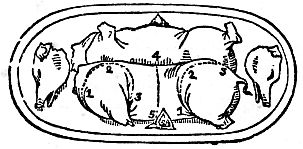
SUCKING-PIG.
A sucking-pig seems, at first sight, rather an elaborate dish, or rather animal, to carve; but by carefully mastering the details of the business, every difficulty will vanish; and if a partial failure be at first made, yet all embarrassment will quickly disappear on a second trial. A sucking-pig is usually sent to table in the manner shown in the engraving, and the first point to be attended to is to separate the shoulder from the carcase, by carrying the knife quickly and neatly round the circular line, as shown by the figures 1, 2, 3;—the shoulder will then easily come away. The next step is to take off the leg; and this is done in the same way, by cutting round this joint in the direction shown by the figures 1, 2, 3, in the same way as the shoulder. The ribs then stand fairly open to the knife, which should be carried down in the direction of the line 4 to 5; and two or three helpings will dispose of these. The other half of the pig is served, of course, in the same manner. Different parts of the pig are variously esteemed; some preferring the flesh of the neck; others, the ribs; and others, again, the shoulders. The truth is, the whole of a sucking-pig is delicious, delicate eating; but, in carving it, the host should consult the various tastes and fancies of his guests, keeping the larger joints, generally, for the gentlemen of the party.
PIG, Sucking, Roast.
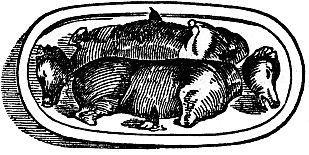
ROAST SUCKING-PIG.
Ingredients.—Pig, 6 oz. of bread-crumbs, 16 sage-leaves, pepper and salt to taste, a piece of butter the size of an egg, salad oil or butter to baste with, about ½ pint of gravy, 1 tablespoonful of lemon-juice. Mode.—A sucking-pig, to be eaten in perfection, should not be more than three weeks old, and should be dressed the same day that it is killed. After preparing the pig for cooking, as in the following recipe, stuff it with finely-grated bread-crumbs, minced sage, pepper, salt, and a piece of butter the size of an egg, all of which should be well mixed together, and put into the body of the pig. Sew up the slit neatly, and truss the legs back, to allow the inside to be roasted, and the under part to be crisp. Put the pig down to a bright clear fire, not too near, and let it lay till thoroughly dry; then have ready some butter tied up in a piece of thin cloth, and rub the pig with this in every part. Keep it well rubbed with the butter the whole of the time it is roasting, and do not allow the crackling to become blistered or burnt. When half-done, hang a pig-iron before the middle part (if this is not obtainable, use a flat iron), to prevent its being scorched and dried up before the ends are done. Before it is taken from the fire, out off the head, and part that and the body down the middle. Chop the brains and mix them with the stuffing; add ½ pint of good gravy, a tablespoonful of lemon-juice, and the gravy that flowed from the pig; put a little of this on the dish with the pig, and the remainder send to table in a tureen. Place the pig back to back in the dish, with one half of the head on each side, and one of the ears at each end, and send it to table as hot as possible. Instead of butter, many cooks take salad oil for basting, which makes the crackling crisp; and as this is one of the principal things to be considered, perhaps it is desirable to use it; but be particular that it is very pure, or it will impart an unpleasant flavour to the meat. The brains and stuffing may be stirred into a tureen of melted butter instead of gravy, when the latter is not liked. Apple sauce and the old-fashioned currant sauce are not yet quite obsolete as an accompaniment to roast pig. Time.—1½ to 2 hours for a small pig. Average cost, 5s. to 6s. Sufficient for 9 or 10 persons. Seasonable from September to February.
PIG, Sucking, to Scald a.
Put the pig into cold water directly it is killed; let it remain for a few minutes, then immerse it in a large pan of boiling water for 2 minutes. Take it out, lay it on a table, and pull off the hair as quickly as possible. When the skin looks clean, make a slit down the belly, take out the entrails, well clean the nostrils and ears, wash the pig in cold water, and wipe it thoroughly dry. Take off the feet at the first joint, and loosen and leave sufficient skin to turn neatly over. If not to be dressed immediately, fold it in a wet cloth to keep it from the air.
PIGS’ CHEEKS, to Dry.
Ingredients.—Salt, ½ oz. of saltpetre, 2 oz. of bay-salt, 4 oz. of coarse sugar. Mode.—Cut out the snout, remove the brains, and split the head, taking off the upper bone to make the jowl a good shape; rub it well with salt; next day take away the brine, and salt it again the following day; cover the head with saltpetre, bay-salt, and coarse sugar, in the above proportion, adding a little common salt. Let the head be often turned, and when it has been in the pickle for 10 days, smoke it for a week or rather longer. Time.—To remain in the pickle 10 days; to be smoked 1 week. Seasonable.—Should be made from September to March.
Note.—A pig’s cheek, or Bath chap, will require two hours’ cooking after the water boils.
PIG’S FACE, Collared (a Breakfast or Luncheon Dish).
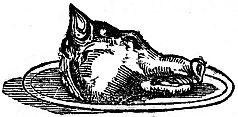
PIG’S FACE.
Ingredients.—1 pig’s face; salt. For brine, 1 gallon of spring water, 1 lb. of common salt, ½ handful of chopped juniper-berries, 6 bruised cloves, 2 bay-leaves, a few sprigs of thyme, basil, sage, ¼ oz. of saltpetre. For forcemeat, ½ lb. of ham, ½ lb. bacon, 1 teaspoonful of mixed spices, pepper to taste, ¼ lb. of lard, 1 tablespoonful of minced parsley, 6 young onions. Mode.—Singe the head carefully, bone it without breaking the skin, and rub it well with salt. Make the brine by boiling the above ingredients for ¼ hour, and letting it stand to cool. When cold, pour it over the head, and let it steep in this for 10 days, turning and rubbing it often. Then wipe, drain, and dry it. For the forcemeat, pound the ham and bacon very finely, and mix with these the remaining ingredients, taking care that the whole is thoroughly incorporated. Spread this equally over the head, roll it tightly in a cloth, and bind it securely with broad tape. Put it into a saucepan with a few meat trimmings, and cover it with stock; let it simmer gently for 4 hours, and be particular that it does not stop boiling the whole time. When quite tender, take it up, put it between 2 dishes with a heavy weight on the top, and when cold, remove the cloth and tape. It should be sent to table on a napkin, or garnished with a piece of deep white paper with a ruche at the top. Time.—4 hours. Average cost, from 2s. to 2s. 6d. Seasonable from October to March.
PIG’S FRY, to Dress.
Ingredients.—1½ lb. of pig’s fry, 2 onions, a few sage leaves, 3 lbs. of potatoes, pepper and salt to taste. Mode.—Put the lean fry at the bottom of a pie dish, sprinkle over it some minced sage and onion, and a seasoning of pepper and salt; slice the potatoes; put a layer of these on the seasonings, then the fat-fry, then more seasoning, and a layer of potatoes at the top. Fill the dish with boiling water, and bake for 2 hours, or rather longer. Time.—Rather more than 2 hours. Average cost, 6d. per lb. Sufficient for 3 or 4 persons. Seasonable from September to March.
PIG’S LIVER (a Savoury and Economical Dish).
Ingredients.—The liver and lights of a pig, 6 or 7 slices of bacon, potatoes, 1 large bunch of parsley, 2 onions, 2 sage leaves, pepper and salt to taste, a little broth or water. Mode.—Slice the liver and lights, and wash these perfectly clean, and parboil the potatoes; mince the parsley and sage, and chop the onion rather small. Put the meat, potatoes, and bacon into a deep tin dish, in alternate layers, with a sprinkling of the herbs, and a seasoning of pepper and salt between each; pour on a little water or broth, and bake in a moderately-heated oven for 2 hours. Time.—2 hours. Average cost, 1s. 6d. Sufficient for 6 or 7 persons. Seasonable from September to March.
PIG’S PETTITOES.
Ingredients.—A thin slice of bacon, 1 onion, 1 blade of mace, 6 peppercorns, 3 or 4 sprigs of thyme, 1 pint of gravy, pepper and salt to taste, thickening of butter and flour. Mode.—Put the liver, heart, and pettitoes into a stewpan with the bacon, mace, peppercorns, thyme, onion, and gravy, and simmer these gently for ¼ hour; then take out the heart and liver, and mince them very fine. Keep stewing the feet until quite tender, which will be in from 20 minutes to ½ hour, reckoning from the time that they boiled up first; then put back the minced liver, thicken the gravy with a little butter and flour, season with pepper and salt, and simmer over a gentle fire for 5 minutes, occasionally stirring the contents. Dish the mince, split the feet, and arrange them round alternately with sippets of toasted bread, and pour the gravy in the middle. Time.—Altogether 40 minutes. Sufficient for 3 or 4 persons. Seasonable from September to March.
PIGEON, to Carve.
A very straightforward plan is adopted in carving a pigeon: the knife is carried sharply in the direction of the line as shown from 1 to 2, entirely through the bird, cutting it into two precisely equal and similar parts. If it is necessary to make three pieces of it, a small wing should be cut off with the leg on either side, thus serving two guests; and, by this means, there will be sufficient meat left on the breast to send to the third guest.

PIGEON.
PIGEON PIE (Epsom Grand-Stand Recipe).
Ingredients.—1½ lb. of rump-steak, 2 or 3 pigeons, 3 slices of ham, pepper and salt to taste, 2 oz. of butter, 4 eggs, puff crust. Mode.—Cut the steak into pieces about 3 inches square, and with it line the bottom of a pie-dish, seasoning it well with pepper and salt. Clean the pigeons, rub them with pepper and salt inside and out, and put into the body of each rather more than ½ oz. of butter; lay them on the steak, and a piece of ham on each pigeon. Add the yolks of four eggs, and half fill the dish with stock; place a border of puff paste round the edge of the dish, put on the cover, and ornament it in any way that may be preferred. Clean three of the feet, and place them in a hole made in the crust at the top: this shows what kind of pie it is. Glaze the crust,—that is to say, brush it over with the yolk of an egg,—and bake it in a well-heated oven for about 1¼ hour. When liked, a seasoning of pounded mace may be added. Time.—1¼ hour, or rather less. Average cost, 5s. 3d. Sufficient for 5 or 6 persons. Seasonable at any time.
PIGEONS, Broiled.
Ingredients.—Pigeons, 3 oz. of butter, pepper and salt to taste. Mode.—Take care that the pigeons are quite fresh, and carefully pluck, draw, and wash them; split the backs, rub the birds over with butter, season them with pepper and salt, and broil them over a moderate fire for ¼ hour or 20 minutes. Serve very hot, with either mushroom-sauce or a good gravy. Pigeons may also be plainly boiled, and served with parsley and butter; they should be trussed like boiled fowls, and take from ¼ hour to 20 minutes to boil. Time.—To broil a pigeon, from ¼ hour to 20 minutes; to boil one, the same time. Average cost, from 6d. to 9d. each. Seasonable from April to September, but in the greatest perfection from Midsummer to Michaelmas.
PIGEONS, Roast.
Ingredients.—Pigeons, 3 oz. of butter, pepper and salt to taste. Trussing.—Pigeons, to be good, should be eaten fresh (if kept a little, the flavour goes off), and they should be drawn as soon as killed. Cut off the heads and necks, truss the wings over the backs, and cut off the toes at the first joint: previous to trussing, they should be carefully cleaned, as no bird requires so much washing. Mode.—Wipe the birds very dry, season them inside with pepper and salt, and put about ¾ oz. of butter into the body of each: this makes them moist. Place them at a bright fire, and baste them well the whole of the time they are cooking (they will be done enough in from 20 to 30 minutes); garnish with fried parsley, and serve with a tureen of parsley and butter. Bread sauce and gravy, the same as for roast fowl, are exceedingly nice accompaniments to roast pigeons, as also egg-sauce. Time.—From 20 minutes to ½ hour. Average cost, 6d. to 9d. each. Seasonable from April to September; but in the greatest perfection from Midsummer to Michaelmas.
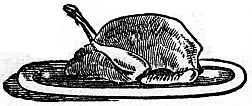
ROAST PIGEON.
PIGEONS, Stewed.
Ingredients.—6 pigeons, a few slices of bacon, 3 oz. of butter, 2 tablespoonfuls of minced parsley, sufficient stock to cover the pigeons, thickening of butter and flour, 1 tablespoonful of mushroom ketchup, 1 tablespoonful of port wine. Mode.—Empty and clean the pigeons thoroughly, mince the livers, add to these the parsley and butter, and put it into the insides of the birds. Truss them with the legs inward, and put them into a stewpan, with a few slices of bacon placed under and over them; add the stock, and stew gently for rather more than ½ hour. Dish the pigeons, strain the gravy, thicken it with butter and flour, add the ketchup and port wine, give one boil, pour over the pigeons, and serve. Time.—Rather more than ½ hour. Average cost, 6d. to 9d. each. Sufficient for 4 or 5 persons. Seasonable from April to September.
PIKE, Baked.
Ingredients.—1 or 2 pike, a nice delicate stuffing (see Forcemeats), 1 egg, bread-crumbs, ¼ lb. butter. Mode.—Scale the fish, take out the gills, wash, and wipe it thoroughly dry; stuff it with forcemeat, sew it up, and fasten the tail in the mouth by means of a skewer; brush it over with egg, sprinkle with bread-crumbs, and baste with butter, before putting it in the oven, which must be well heated. When the pike is of a nice brown colour, cover it with buttered paper, as the outside would become too dry. If 2 are dressed, a little variety may be made by making one of them green with a little chopped parsley mixed with the bread-crumbs. Serve anchovy or Dutch sauce, and plain melted butter with it. Time.—According to size, 1 hour, more or less. Average cost.—Seldom bought. Seasonable from September to March.
Note.—Pike à la genévése may be stewed in the same manner as salmon à la genévése.
PIKE, Boiled.
Ingredients.—¼ lb. of salt to each gallon of water; a little vinegar. Mode.—Scale and clean the pike, and fasten the tail in its mouth by means of a skewer. Lay it in cold water, and when it boils, throw in the salt and vinegar. The time for boiling depends, of course, on the size of the fish; but a middling-sized pike will take about ½ an hour. Serve with Dutch or anchovy sauce, and plain melted butter. Time.—According to size, ½ to 1 hour. Average cost.—Seldom bought. Seasonable from September to March.
PILLAU FOWL, based on M. Soyer’s Recipe (an Indian Dish).
Ingredients.—1 lb. of rice, 2 oz. of butter, a fowl, 2 quarts of stock or good broth, 40 cardamum-seeds, ½ oz. of coriander-seed, ¼ oz. of cloves, ¼ oz. of allspice, ¼ oz. of mace, ¼ oz. of cinnamon, ½ oz. of peppercorns, 4 onions, 6 thin slices of bacon, 2 hard-boiled eggs. Mode.—Well wash 1 lb. of the best Patna rice, put it into a frying-pan with the butter, which keep moving over a slow fire until the rice is lightly browned. Truss the fowl as for boiling, put it into a stewpan with the stock or broth; pound the spices and seeds thoroughly in a mortar, tie them in a piece of muslin, and put them in with the fowl. Let it boil slowly until it is nearly done; then add the rice, which should stew until quite tender and almost dry; cut the onions into slices, sprinkle them with flour, and fry, without breaking them, of a nice brown colour. Have ready the slices of bacon curled and grilled, and the eggs boiled hard. Lay the fowl in the form of a pyramid upon a dish, smother with the rice, garnish with the bacon, fried onions, and the hard-boiled eggs cut into quarters, and serve very hot. Before taking the rice out, remove the spices. Time.—½ hour to stew the fowl without the rice; ½ hour with it. Average cost, 4s. 3d. Sufficient for 4 or 5 persons. Seasonable at any time.
PINEAPPLE CHIPS.
Ingredients.—Pineapples; sugar to taste. Mode.—Pare and slice the fruit thinly, put it on dishes, and strew over it plenty of pounded sugar. Keep it in a hot closet, or very slow oven, 8 or 10 days, and turn the fruit every day until dry; then put the pieces of pine on tins, and place them in a quick oven for 10 minutes. Let them cool, and store them away in dry boxes, with paper between each layer. Time.—8 to 10 days. Seasonable.—Foreign pines, in July and August.