THE DICTIONARY OF COOKERY. (continued 6)
Reading edition
EGG WINE.
Ingredients.—1 egg, 1 tablespoonful and ½ glass of cold water, 1 glass of sherry, sugar and grated nutmeg to taste. Mode.—Beat the egg, mixing with it a tablespoonful of cold water; make the wine-and-water hot, but not boiling; pour it on the egg, stirring all the time. Add sufficient lump sugar to sweeten the mixture, and a little grated nutmeg; put all into a very clean saucepan, set it on a gentle fire, and stir the contents one way until they thicken, but do not allow them to boil. Serve in a glass with sippets of toasted bread or plain crisp biscuits. When the egg is not warmed, the mixture will be found easier of digestion, but it is not so pleasant a drink. Sufficient for 1 person.
EGGS, to Boil for Breakfast, Salads, &c.
Eggs for boiling cannot be too fresh, or boiled too soon after they are laid; but rather a longer time should be allowed for boiling a new-laid egg than for one that is three or four days old. Have ready a saucepan of boiling water; put the eggs into it gently with a spoon, letting the spoon touch the bottom of the saucepan before it is withdrawn, that the egg may not fall, and consequently crack. For those who like eggs lightly boiled, 3 minutes will be found sufficient; 3¾ to 4 minutes will be ample time to set the white nicely; and, if liked hard, 6 to 7 minutes will not be found too long. Should the eggs be unusually large, as those of black Spanish fowls sometimes are, allow an extra ½ minute for them. Eggs for salads should be boiled from 10 minutes to ¼ hour, and should be placed in a basin of cold water for a few minutes; they should then be rolled on the table with the hand, and the shell will peel off easily. Time.—To boil eggs lightly, for invalids or children, 3 minutes; to boil eggs to suit the generality of tastes, 3¾ to 4 minutes; to boil eggs hard, 6 to 7 minutes; for salads, 10 to 15 minutes.
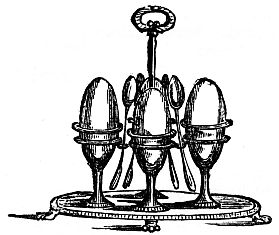
EGG-STAND FOR THE BREAKFAST-TABLE.
EGGS, Buttered.
Ingredients.—4 new-laid eggs, 2 oz. of butter. Mode.—Procure the eggs new-laid if possible; break them into a basin, and beat them well; put the butter into another basin, which place in boiling water, and stir till the butter is melted. Pour that and the eggs into a lined saucepan; hold it over a gentle fire, and, as the mixture begins to warm, pour it two or three times into the basin, and back again, that the two ingredients may be well incorporated. Keep stirring the eggs and butter one way until they are hot, without boiling, and serve on hot buttered toast. If the mixture is allowed to boil, it will curdle, and so be entirely spoiled. Time.—About 5 minutes to make the eggs hot. Average cost, 7d. Sufficient.—Allow a slice to each person. Seasonable at any time.
EGGS, to Choose.
In choosing eggs, apply the tongue to the large end of the egg, and, if it feels warm, it is new, and may be relied on as a fresh egg. Another mode of ascertaining their freshness is to hold them before a lighted candle or to the light, and, if the egg looks clear, it will be tolerably good; if thick, it is stale; and if there is a black spot attached to the shell, it is worthless. No egg should be used for culinary purposes with the slightest taint in it, as it will render perfectly useless those with which it has been mixed. Eggs that are purchased, and that cannot be relied on, should always be broken in a cup, and then put into a basin: by this means stale or bad eggs may be easily rejected, without wasting the others.
EGGS, Ducks’.
Ducks’ eggs are usually so strongly flavoured that, plainly boiled, they are not good for eating; they answer, however, very well for various culinary preparations where eggs are required; such as custards, &c. &c. Being so large and highly-flavoured, 1 duck’s egg will go as far as 2 small hen’s eggs, besides making whatever they are mixed with exceedingly rich. They also are admirable when used in puddings.
EGGS, Fried.
Ingredients.—4 eggs, ¼ lb. of lard, butter or clarified dripping. Mode.—Place a delicately-clean frying-pan over a gentle fire; put in the fat, and allow it to come to the boiling-point. Break the eggs into cups, slip them into the boiling fat, and let them remain until the whites are delicately set; and, whilst they are frying, ladle a little of the fat over them. Take them up with a slice, drain them for a minute from their greasy moisture, trim them neatly, and serve on slices of fried bacon or ham; or the eggs may be placed in the middle of the dish, with the bacon put round as a garnish. Time.—2 to 3 minutes. Average cost, 1d. each; 2d. when scarce. Sufficient for 2 persons. Seasonable at any time.

FRIED EGGS ON BACON.
EGGS à la Maître d’Hôtel.
Ingredients.—¼ lb. of fresh butter, 1 tablespoonful of flour, ½ pint of milk, pepper and salt to taste, 1 tablespoonful of minced parsley, the juice of ½ lemon, 6 eggs. Mode.—Put the flour and half the butter into a stewpan; stir them over the fire until the mixture thickens; pour in the milk, which should be boiling; add a seasoning of pepper and salt, and simmer the whole for 5 minutes. Put the remainder of the butter into the sauce, and add the minced parsley; then boil the eggs hard, strip off the shell, cut the eggs into quarters, and put them on a dish. Bring the sauce to the boiling-point, add the lemon-juice, pour over the eggs and serve. Time.—5 minutes to boil the sauce; the eggs, 10 to 15 minutes. Average cost, 1s. Sufficient for 4 or 5 persons. Seasonable at any time.
EGGS, to Pickle.
Ingredients.—16 eggs, 1 quart of vinegar, ½ oz. of black pepper, ½ oz. of Jamaica pepper, ½ oz. of ginger. Mode.—Boil the eggs for 12 minutes, then dip them into cold water, and take off the shells. Put the vinegar, with the pepper and ginger, into a stewpan, and let it simmer for 10 minutes. Now place the eggs in a jar, pour over them the vinegar, &c., boiling hot, and, when cold, tie them down with bladder to exclude the air. This pickle will be ready for use in a month. Average cost, for this quantity, 1s. 9d. Seasonable.—This should be made about Easter, as at this time eggs are plentiful and cheap. A store of pickled eggs will be found very useful and ornamental in serving with many first and second course dishes.
EGGS AU PLAT, or AU MIROIR, served on the Dish in which they are Cooked.
Ingredients.—4 eggs, 1 oz. of butter, pepper and salt to taste. Mode.—Butter a dish rather thickly with good fresh butter; melt it, break the eggs into it the same as for poaching, sprinkle them with white pepper and fine salt, and put the remainder of the butter, cut into very small pieces, on the top of them. Put the dish on a hot plate, or in the oven, or before the fire, and let it remain until the whites become set, but not hard, when serve immediately, placing the dish they were cooked in on another. To hasten the cooking of the eggs, a salamander may be held over them for a minute; but great care must be taken that they are not too much done. This is an exceedingly nice dish, and one very easily prepared for breakfast. Time.—3 minutes. Average cost, 5d. Sufficient for 2 persons. Seasonable at any time.
EGGS, Plovers’.
Plovers’ eggs are usually served boiled hard, and sent to table in a napkin, either hot or cold; they may also be shelled, and served the same as eggs à la Tripe, with a good Béchamel sauce, or brown gravy, poured over them. They are also used for decorating salads, the beautiful colour of the white being generally so much admired.
EGGS, Poached.
Ingredients.—Eggs, water. To every pint of water allow 1 tablespoonful of vinegar. Mode.—Eggs for poaching should be perfectly fresh, but not quite new-laid; those that are about 36 hours old are the best for the purpose. If quite new-laid, the white is so milky it is almost impossible to set it; and, on the other hand, if the egg be at all stale, it is equally difficult to poach it nicely. Strain some boiling water into a deep clean frying-pan; break the egg into a cup without damaging the yolk, and, when the water boils, remove the pan to the side of the fire, and gently slip the egg into it. Place the pan over a gentle fire, and keep the water simmering until the white looks nicely set, when the egg is ready. Take it up gently with a slice, cut away the ragged edges of the white, and serve either on toasted bread or on slices of ham or bacon, or on spinach, &c. A poached egg should not be overdone, as its appearance and taste will be quite spoiled if the yolk be allowed to harden. When the egg is slipped into the water, the white should be gathered together, to keep it a little in form, or the cup should be turned over it for ½ minute. To poach an egg to perfection is rather a difficult operation; so, for inexperienced cooks, a tin egg-poacher may be purchased, which greatly facilitates this manner of dressing eggs. Our illustration clearly shows what it is: it consists of a tin plate with a handle, with a space for three perforated cups. An egg should be broken into each cup, and the machine then placed in a stewpan of boiling water, which has been previously strained. When the whites of the eggs appear set, they are done, and should then be carefully slipped on to the toast or spinach, or with whatever they are served. In poaching eggs in a frying-pan, never do more than four at a time; and, when a little vinegar is liked mixed with the water in which the eggs are done, use the above proportion. Time.—2½ to 3½ minutes, according to the size of the egg. Sufficient.—Allow 2 eggs to each person. Seasonable at any time, but less plentiful in winter.

EGGS POACHED ON TOAST.
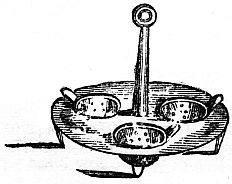
TIN EGG-POACHER.
EGGS, Poached, with Cream.
Ingredients.—1 pint of water, 1 teaspoonful of salt, 4 teaspoonfuls of vinegar, 4 fresh eggs, ½ gill of cream, salt, pepper, and pounded sugar to taste, 1 oz. of butter. Mode.—Put the water, vinegar, and salt into a frying-pan, and break each egg into a separate cup; bring the water, &c., to boil, and slip the eggs gently into it without breaking the yolks. Simmer them from 3 to 4 minutes, but not longer, and, with a slice, lift them out on to a hot dish, and trim the edges. Empty the pan of its contents, put in the cream, add a seasoning to taste of pepper, salt, and pounded sugar; bring the whole to the boiling-point; then add the butter, broken into small pieces; toss the pan round and round till the butter is melted; pour it over the eggs, and serve. To insure the eggs not being spoiled whilst the cream, &c. is preparing, it is a good plan to warm the cream with the butter, &c. before the eggs are poached, so that it may be poured over them immediately after they are dished. Time.—3 to 4 minutes to poach the eggs, 5 minutes to warm the cream. Average cost for the above quantity, 9d. Sufficient for 2 persons. Seasonable at any time.
EGGS, Scotch.
Ingredients.—6 eggs, 6 tablespoonfuls of forcemeat, hot lard, ½ pint of good brown gravy. Mode.—Boil the eggs for 10 minutes; strip them from the shells, and cover them with forcemeat, or substitute pounded anchovies for the ham. Fry the eggs a nice brown in boiling lard, drain them before the fire from their greasy moisture, dish them, and pour round from ¼ to ½ pint of good brown gravy. To enhance the appearance of the eggs, they may be rolled in beaten egg and sprinkled with bread-crumbs; but this is scarcely necessary if they are carefully fried. The flavour of the ham or the anchovy in the forcemeat must preponderate, as it should be very relishing. Time.—10 minutes to boil the eggs, 5 to 7 minutes to fry them. Average cost, 1s. 4d. Sufficient for 3 or 4 persons. Seasonable at any time.
EGGS, Snow, or Œufs à la Neige (a very pretty Supper Dish).
Ingredients.—4 eggs, ¾ pint of milk, pounded sugar to taste, flavouring of vanilla, lemon-rind, or orange-flower water. Mode.—Put the milk into a saucepan with sufficient sugar to sweeten it nicely, and the rind of ½ lemon. Let this steep by the side of the fire for ½ hour, when take out the peel; separate the whites from the yolks of the eggs, and whisk the former to a perfectly stiff froth, or until there is no liquid remaining; bring the milk to the boiling-point, drop in the snow a tablespoonful at a time, and keep turning the eggs until sufficiently cooked. Then place them on a glass dish, beat up the yolks of the eggs, stir to them the milk, add a little more sugar, and strain this mixture into a jug; place the jug in a saucepan of boiling water, and stir it one way until the mixture thickens, but do not allow it to boil, or it will curdle. Pour this custard over the eggs, when they should rise to the surface. They make an exceedingly pretty addition to a supper, and should be put in a cold place after being made. When they are flavoured with vanilla or orange-flowered water, it is not necessary to steep the milk. A few drops of the essence of either may be poured into the milk just before the whites are poached. In making the custard, a little more flavouring and sugar should always be added. Time.—About 2 minutes to poach the whites; 8 minutes to stir the custard. Average cost, 8d. Sufficient for 4 or 5 persons. Seasonable at any time.
EGGS, to keep Fresh for several Weeks.
Have ready a large saucepan, capable of holding 3 or 4 quarts, full of boiling water. Put the eggs into a cabbage-net, say 20 at a time, and hold them in the water (which must be kept boiling) for 20 seconds. Proceed in this manner till you have done as many eggs as you wish to preserve; then pack them away in sawdust. We have tried this method of preserving eggs, and can vouch for its excellence. They will be found, at the end of 2 or 3 months, quite good enough for culinary purposes; and although the white may be a little tougher than that of a new-laid egg, the yolk will be nearly the same. Many persons keep eggs for a long time by smearing the shells with butter or sweet oil: they should then be packed in plenty of bran or sawdust, and the eggs not allowed to touch each other. Eggs for storing should be collected in fine weather, and should not be more than 24 hours old when they are packed away, or their flavour, when used, cannot be relied on. Another simple way of preserving eggs is to immerse them in lime-water soon after they have been laid, and then to put the vessel containing the lime-water in a cellar or cool outhouse. Seasonable.—The best time for preserving eggs is from April to September.
EGGS, à la Tripe.
Ingredients.—8 eggs, ¾ pint of Béchamel sauce, dessertspoonful of finely-minced parsley. Mode.—Boil the eggs hard; put them into cold water, peel them, take out the yolks whole, and shred the whites. Make ¾ pint of Béchamel sauce; add the parsley, and, when the sauce is quite hot, put the yolks of the eggs into the middle of the dish, and the shred whites round them; pour over the sauce, and garnish with leaves of puff-paste or fried croûtons. There is no necessity for putting the eggs into the saucepan with the Béchamel; the sauce, being quite hot, will warm the eggs sufficiently. Time.—10 minutes to boil the eggs. Average cost, 1s. Sufficient for 5 or 6 persons. Seasonable at any time.
ELDER WINE.
Ingredients.—To every 3 gallons of water allow 1 peck of elderberries; to every gallon of juice allow 3 lbs. of sugar, ½ oz. of ground ginger, 6 cloves, 1 lb. of good Turkey raisins; ¼ pint of brandy to every gallon of wine. To every 9 gallons of wine, 3 or 4 tablespoonfuls of fresh brewer’s yeast. Mode.—Pour the water, quite boiling, on the elderberries, which should be picked from the stalks, and let these stand covered for 24 hours; then strain the whole through a sieve or bag, breaking the fruit to express all the juice from it. Measure the liquor, and to every gallon allow the above proportion of sugar. Boil the juice and sugar with the ginger, cloves, and raisins for 1 hour, skimming the liquor the whole time; let it stand until milk-warm, then put it into a clean dry cask, with 3 or 4 tablespoonfuls of good fresh yeast to every 9 gallons of wine. Let it ferment for about a fortnight; then add the brandy, bung up the cask, and let it stand some months before it is bottled, when it will be found excellent. A bunch of hops suspended to a string from the bung, some persons say, will preserve the wine good for several years. Elder wine is usually mulled, and served with sippets of toasted bread and a little grated nutmeg. Time.—To stand covered for 24 hours; to be boiled 1 hour. Average cost, when made at home, 3s. 6d. per gallon. Seasonable.—Make this in September.
ENDIVE.
This vegetable, so beautiful in appearance, makes an excellent addition to winter salad, when lettuces and other winter salads are not obtainable. It is usually placed in the centre of the dish, and looks remarkably pretty with slices of beetroot, hard-boiled eggs, and curled celery placed round it, so that the colours contrast nicely. In preparing it, carefully wash and cleanse it free from insects, which are generally found near the heart; remove any decayed or dead leaves, and dry it thoroughly by shaking in a cloth. This vegetable may also be served hot, stewed in cream, brown gravy, or butter; but when dressed thus, the sauce it is stewed in should not be very highly seasoned, as that would destroy and overpower the flavour of the vegetable. Average cost, 1d. per head. Sufficient.—1 head for a salad for 4 persons. Seasonable from November to March.
ENDIVE, à la Française.
Ingredients.—6 heads of endive, 1 pint of broth, 3 oz. of fresh butter; salt, pepper, and grated nutmeg to taste. Mode.—Wash and boil the endive as in the preceding recipe; chop it rather fine, and put into a stewpan with the broth; boil over a brisk fire until the sauce is all reduced; then put in the butter, pepper, salt, and grated nutmeg (the latter must be very sparingly used); mix all well together, bring it to the boiling point, and serve very hot. Time.—10 minutes to boil, 5 minutes to simmer in the broth. Average cost, 1d. per head. Sufficient for 3 or 4 persons. Seasonable from November to March.
ENDIVE, Stewed.
Ingredients.—6 heads of endive, salt and water, 1 pint of broth, thickening of butter and flour, 1 tablespoonful of lemon-juice, a small lump of sugar. Mode.—Wash and free the endive thoroughly from insects, remove the green part of the leaves, and put it into boiling water, slightly salted. Let it remain for 10 minutes; then take it out, drain it till there is no water remaining, and chop it very fine. Put it into a stewpan with the broth; add a little salt and a lump of sugar, and boil until the endive is perfectly tender. When done, which may be ascertained by squeezing a piece between the thumb and finger, add a thickening of butter and flour and the lemon-juice; let the sauce boil up, and serve. Time.—10 minutes to boil, 5 minutes to simmer in the broth. Average cost, 1d. per head. Sufficient for 3 or 4 persons. Seasonable from November to March.
ESPAGNOLE, or Brown Spanish Sauce.
Ingredients.—2 slices of lean ham, 1 lb. of veal, 1½ pint of white stock, 2 or 3 sprigs of parsley, ½ a bay-leaf, 2 or 3 sprigs of savoury herbs, 6 green onions, 3 shalots, 2 cloves, 1 blade of mace, 2 glasses of sherry or Madeira, thickening of butter and flour. Mode.—Cut up the ham and veal into small square pieces, and put them into a stewpan. Moisten these with ½ pint of the stock, and simmer till the bottom of the stewpan is covered with a nicely-coloured glaze, when put in a few more spoonfuls to detach it. Add the remainder of the stock, with the spices, herbs, shalots, and onions, and simmer very gently for 1 hour. Strain and skim off every particle of fat, and, when required for use, thicken with butter and flour, or with a little roux. Add the wine, and, if necessary, a seasoning of cayenne; when it will be ready to serve. Time.—1½ hour. Average cost, 2s. per pint.
Note.—The wine in this sauce may be omitted, and an onion sliced and fried of a nice brown substituted for it. This sauce or gravy is used for many dishes, and with most people is a general favourite.
FEBRUARY—BILLS OF FARE.
Dinner for 18 persons.
First Course.
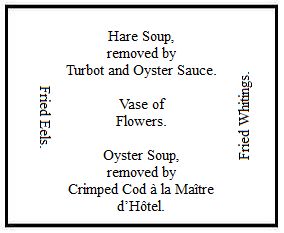
Hare Soup, removed by Turbot and Oyster Sauce. Fried Eels. Fried Whitings. Vase of Flowers. Oyster Soup, removed by Crimped Cod à la Maître d’Hôtel.
Second Course.
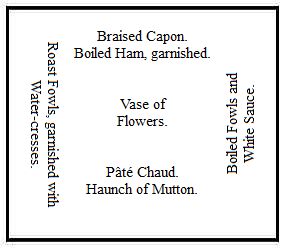
Roast Fowls, garnished with Water-cresses. Braised Capon. Boiled Ham, garnished. Boiled Fowls and White Sauce. Vase of Flowers. Pâté Chaud. Haunch of Mutton.
Entrées.
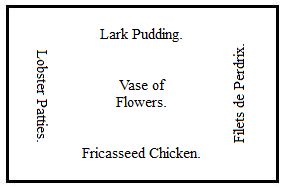
Lobster Patties. Lark Pudding. Filets de Perdrix. Vase of Flowers. Fricasseed Chicken.
Third Course.
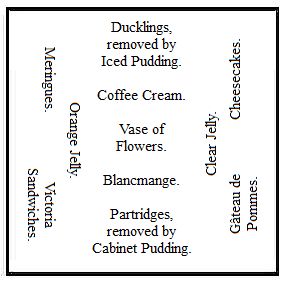
Dessert and Ices.
Meringues. Ducklings, removed by Iced Pudding. Cheesecakes. Orange Jelly. Coffee Cream. Clear Jelly. Vase of Flowers. Victoria Sandwiches. Blancmange. Gâteau de Pommes. Partridges, removed by Cabinet Pudding.
Dinner for 12 persons.
First Course.—Soup à la reine; clear gravy soup; brill and lobster sauce; fried smelts. Entrées.—Lobster rissoles; beef palates; pork cutlets à la soubise; grilled mushrooms. Second Course.—Braised turkey; haunch of mutton; boiled capon and oysters; tongue, garnished with tufts of broccoli; vegetables and salads. Third Course.—Wild ducks; plovers; orange jelly; clear jelly; Charlotte Russe; Nesselrode pudding; gâteau de riz; sea-kale; maids of honour; desert and ices.
Dinner for 10 persons.
First Course.—Palestine soup; John Dory, with Dutch sauce; red mullet, with sauce Génoise. Entrées.—Sweetbread cutlets, with poivrade sauce; fowl au Béchamel. Second Course.—Roast saddle of mutton; boiled capon and oysters; boiled tongue, garnished with Brussels sprouts. Third Course.—Guinea-fowls; ducklings; pain de rhubarb; orange jelly; strawberry cream; cheesecakes; almond pudding; fig pudding; dessert and ices.
Dinner for 8 persons.
First Course.—Mock turtle soup; fillets of turbot à la crême; fried filleted soles and anchovy sauce. Entrées.—Larded fillets of rabbits; tendrons de veau with purée of tomatoes. Second Course.—Stewed rump of beef à la Jardinière; roast fowls; boiled ham. Third Course.—Roast pigeons or larks; rhubarb tartlets; meringues; clear jelly; cream; ice pudding; soufflé; dessert and ices.
Dinners for 6 persons.
First Course.—Rice soup; red mullet, with Génoise sauce; fried smelts. Entrées.—Fowl pudding; sweetbreads. Second Course.—Roast turkey and sausages; boiled leg of pork; pease pudding. Third Course.—Lemon jelly; Charlotte à la vanille; maids of honour; plum-pudding, removed by ice pudding; dessert.
First Course.—Spring soup; boiled turbot and lobster sauce. Entrées.—Fricasseed rabbit; oyster patties. Second Course.—Boiled round of beef and marrow-bones; roast fowls, garnished with water-cresses and rolled bacon; vegetables. Third Course.—Marrow pudding; cheesecakes; tartlets of greengage jam; lemon cream; rhubarb tart; dessert.
First Course.—Vermicelli soup; fried whitings; stewed eels. Entrées.—Poulet à la Marengo; breast of veal stuffed and rolled. Second Course.—Roast leg of pork and apple sauce; boiled capon and oysters; tongue, garnished with tufts of broccoli. Third Course.—Wild ducks; lobster salad; Charlotte aux pommes; pain de rhubarb; vanilla cream; orange jelly; dessert.
First Course.—Ox-tail soup; cod à la crême; fried soles. Entrées.—Lark pudding; fowl scollops. Second Course.—Roast leg of mutton; boiled turkey and celery sauce; pigeon pie; small ham, boiled and garnished; vegetables. Third Course.—Game, when liked; tartlets of raspberry jam; vol-au-vent of rhubarb; Swiss cream; cabinet pudding; broccoli and sea-kale; dessert.
FEBRUARY, Plain Family Dinners for.
Sunday.—1. Ox-tail soup. 2. Roast beef, Yorkshire pudding, broccoli, potatoes. 3. Plum-pudding, apple tart. Cheese.
Monday.—1. Fried soles, plain melted butter, and potatoes. 2. Cold roast beef, mashed potatoes. 3. The remains of plum-pudding cut in slices, warmed, and served with sifted sugar sprinkled over it. Cheese.
Tuesday.—1. The remains of ox-tail soup from Sunday. 2. Pork cutlets with tomato sauce; hashed beef. 3. Rolled jam pudding. Cheese.
Wednesday.—1. Boiled haddock and plain melted butter. 2. Rump-steak pudding, potatoes, greens. 3. Arrowroot, blancmange, garnished with jam.
Thursday.—1. Boiled leg of pork, greens, potatoes, pease pudding. 2. Apple fritters, sweet macaroni.
Friday.—1. Pea-soup made with liquor that the pork was boiled in. 2. Cold pork, mashed potatoes. 3. Baked rice pudding.
Saturday.—1. Broiled herrings and mustard sauce. 2. Haricot mutton. 3. Macaroni, either served as a sweet pudding or with cheese.
Sunday.—1. Carrot soup. 2. Boiled leg of mutton and caper sauce, mashed turnips, roast fowls, and bacon. 3. Damson tart made with bottled fruit, ratafia pudding.
Monday.—1. The remainder of fowl curried and served with rice; rump-steaks and oyster sauce, cold mutton. 2. Rolled jam pudding.
Tuesday.—1. Vegetable soup made with liquor the mutton was boiled in on Sunday. 2. Roast sirloin of beef, Yorkshire pudding, broccoli, and potatoes. 3. Cheese.
Wednesday.—1. Fried soles, melted butter. Cold beef and mashed potatoes; if there is any cold mutton left, cut it into neat slices and warm it in a little caper sauce. 2. Apple tart.
Thursday.—1. Boiled rabbit and onion sauce, stewed beef and vegetables, made with the remains of cold beef and bones. 2. Macaroni.
Friday.—1. Roast leg of pork, sage and onions and apple sauce, greens and potatoes. 2. Spinach and poached eggs instead of pudding. Cheese and water-cresses.
Saturday.—1. Rump-steak and kidney pudding, cold pork and mashed potatoes. 2. Baked rice pudding.
FEBRUARY, Things in Season.
Fish.—Barbel, brill, carp; cod may be bought, but is not so good as in January; crabs, crayfish, dace, eels, flounders, haddocks, herrings, lampreys, lobsters, mussels, oysters, perch, pike, place, prawns, shrimps, skate, smelts, soles, sprats, sturgeon, tench, thornback, turbot, whiting.
Meat.—Beef, house lamb, mutton, pork, veal.
Poultry.—Capons, chickens, ducklings, tame and wild pigeons, pullets with eggs, turkeys, wild-fowl, though now not in full season.
Game.—Grouse, hares, partridges, pheasants, snipes, woodcock.
Vegetables.—Beetroot, broccoli (purple and white), Brussels sprouts, cabbages, carrots, celery, chervil, cresses, cucumbers (forced), endive, kidney-beans, lettuces, parsnips, potatoes, savoys, spinach, turnips—various herbs.
Fruit.—Apples (golden and Dutch pippins), grapes, medlars, nuts, oranges, pears (Bon Chrétien), walnuts, dried fruits (foreign), such as almonds and raisins; French and Spanish plums; prunes, figs, dates, crystallized preserves.
FENNEL SAUCE, for Mackerel.
Ingredients.—½ pint of melted butter, rather more than 1 tablespoonful of chopped fennel. Mode.—Make the melted butter very smooth, chop the fennel rather small, carefully cleansing it from any grit or dirt, and put it to the butter when this is on the point of boiling. Simmer for a minute or two, and serve in a tureen. Time.—2 minutes. Average cost, 4d. Sufficient to serve with 5 or 6 mackerel.
FIG PUDDING.
Ingredients.—2 lbs. of figs, 1 lb. of suet, ½ lb. of flour, ½ lb. of bread-crumbs, 2 eggs, milk. Mode.—Cut the figs into small pieces, grate the bread finely, and chop the suet very small; mix these well together, add the flour, the eggs, which should be well beaten, and sufficient milk to form the whole into a stiff paste; butter a mould or basin, press the pudding into it very closely, tie it down with a cloth, and boil for 3 hours, or rather longer; turn it out of the mould, and serve with melted butter, wine-sauce, or cream. Time.—3 hours, or longer. Average cost, 2s. Sufficient for 7 or 8 persons. Seasonable.—Suitable for a winter pudding.
FIG PUDDING (Staffordshire Recipe).
Ingredients.—1 lb. of figs, 6 oz. of suet, ¾ lb. of flour, milk. Mode.—Chop the suet finely, mix with it the flour, and make these into a smooth paste with milk; roll it out to the thickness of about ½ inch, cut the figs in small pieces, and strew them over the paste; roll it up, make the ends secure, tie the pudding in a cloth, and boil it from 1½ to 2 hours. Time.—1½ to 2 hours. Average cost, 1s. 1d. Sufficient for 5 or 6 persons. Seasonable at any time.
FIGS, Compôte of Green.
Ingredients.—1 pint of syrup, 1½ pint of green figs, the rind of ½ lemon. Mode.—Make a syrup as directed, boiling with it the lemon-rind, and carefully remove all the scum as it rises. Put in the figs, and simmer them very slowly until tender; dish them on a glass dish; reduce the syrup by boiling it quickly for 5 minutes; take out the lemon-peel, pour the syrup over the figs, and the compôte, when cold, will be ready for table. A little port wine, or lemon-juice, added just before the figs are done, will be found an improvement. Time.—2 to 3 hours to stew the figs. Average cost, figs, 2s. to 3s. per dozen. Seasonable in August and September.

COMPÔTE OF FIGS.
FISH.
Fish shortly before they spawn are, in general, best in condition. When the spawning is just over, they are out of season, and unfit for human food.
When fish is out of season, it has a transparent, bluish tinge, however much it may be boiled; whenever it is in season, its muscles are firm, and boil white and curdy.
As food for invalids, white fish, such as the ling, cod, haddock, coal-fish, and whiting, are the best; flat fish, as soles, skate, turbot, and flounders, are also good.
Salmon, mackerel, herrings, and trout soon spoil or decompose after they are killed; therefore, to be in perfection, they should be prepared for the table on the day they are caught. With flat fish, this is not of such consequence, as they will keep longer. The turbot, for example, is improved by being kept for a few hours.
FISH, General Directions for Dressing.
In dressing fish of any kind, the first point to be attended to, is to see that it is perfectly clean. It is a common error to wash it too much, as by doing so the flavour is diminished. If the fish is to be boiled, a little salt and vinegar should be put into the water, to give it firmness, after it is cleaned. Codfish, whiting, and haddock, are none the worse for being a little salted, and kept a day; and, if the weather be not very hot, they will be good for two days.
When fish is cheap and plentiful, and a larger quantity is purchased than is immediately wanted, the overplus of such as will bear it should be potted, or pickled, or salted, and hung up; or it may be fried, that it may serve for stewing the next day. Fresh-water fish, having frequently a muddy smell and taste, should be soaked in strong salt and water, after it has been well cleaned. If of a sufficient size, it may be scalded in salt and water, and afterwards dried and dressed.
Fish should be put into cold water and set on the fire to do very gently, or the outside will break before the inner part is done. Unless the fishes are small, they should never be put into warm water; nor should water, either hot or cold, be poured on to the fish, as it is liable to break the skin; if it should be necessary to add a little water whilst the fish is cooking, it ought to be poured in gently at the side of the vessel. The fish-plate may be drawn up, to see if the fish be ready, which may be known by its easily separating from the bone. It should then be immediately taken out of the water, or it will become woolly. The fish-plate should be set crossways over the kettle, to keep hot for serving, and a cloth laid over the fish, to prevent its losing its colour.
In garnishing fish great attention is required, and plenty of parsley, horseradish, and lemon should be used. If fried parsley be used, it must be washed and picked, and thrown into fresh water. When the lard or dripping boils, throw the parsley into it immediately from the water, and instantly it will be green and crisp, and must be taken up with a slice. When well done, and with very good sauce, fish is more appreciated than almost any other dish. The liver and roe, in some instances, should be placed on the dish, in order that they may be distributed in the course of serving; but to each recipe will be appended the proper mode of serving and garnishing.
If fish is to be fried or broiled it must be dried in a nice soft cloth after it is well cleaned and washed. If for frying, brush it over with egg, and sprinkle it with some fine crumbs of bread. If done a second time with the egg and bread, the fish will look so much the better. If required to be very nice, a sheet of white blotting-paper must be placed to receive it, that it may be free from all grease; it must also be of a beautiful colour, and all the crumbs appear distinct. Butter gives a bad colour; lard and clarified dripping are most frequently used; but oil is the best, if the expense be no objection. The fish should be put into the lard when boiling, and there should be a sufficiency of this to cover it.
When fish is broiled, it must be seasoned, floured, and laid on a very clean gridiron, which, when hot, should be rubbed with a bit of suet, to prevent the fish from sticking. It must be broiled over a very clear fire, that it may not taste smoky; and not too near, that it may not be scorched.
In choosing fish, it is well to remember that it is possible it may be fresh, and yet not good. Under the head of each particular fish in this work, are appended rules for its choice, and the months when it is in season. Nothing can be of greater consequence to a cook than to have the fish good; as, if this important course in a dinner does not give satisfaction, it is rarely that the repast goes off well.
FISH, General Directions for Carving.
In carving fish, care should be taken to help it in perfect flakes, as, if these are broken, the beauty of the fish is lost. The carver should be acquainted, too, with the choicest parts and morsels; and to give each guest an equal share of these titbits should be his maxim. Steel knives and forks should on no account be used in helping fish, as these are liable to impart to it a very disagreeable flavour. When silver fish-carvers are considered too dear to be bought, good electro-plated ones answer very well, and are inexpensive.
FISH CAKE.
Ingredients.—The remains of any cold fish, 1 onion, 1 faggot of sweet herbs; salt and pepper to taste, 1 pint of water, equal quantities of bread-crumbs and cold potatoes, ½ teaspoonful of parsley, 1 egg, bread-crumbs. Mode.—Pick the meat from the bones of the fish, which latter put, with the head and fins, into a stewpan with the water; add pepper and salt, the onion and herbs, and stew slowly for gravy about 2 hours; chop the fish fine, and mix it well with bread-crumbs and cold potatoes, adding the parsley and seasoning; make the whole into a cake with the white of an egg, brush it over with egg, cover with bread-crumbs, fry of a light brown; strain the gravy, pour it over, and stew gently for ¼ of an hour, stirring it carefully once or twice. Serve hot, and garnish with thin slices of lemon and parsley. Time.—½ an hour after the gravy is made.
FISH AND OYSTER PIE.
[Cold Meat Cookery.] Ingredients.—Any remains of cold fish, such as cod or haddock; 2 dozen oysters, pepper and salt to taste, bread-crumbs sufficient for the quantity of fish; ½ teaspoonful of grated nutmeg, 1 teaspoonful of finely-chopped parsley. Mode.—Clear the fish from the bones, and put a layer of it in a pie-dish, which sprinkle with pepper and salt; then a layer of bread-crumbs, oysters, nutmeg, and chopped parsley. Repeat this till the dish is quite full. You may form a covering either of bread-crumbs, which should be browned, or puff-paste, which should be cut into long strips, and laid in cross-bars over the fish, with a line of the paste first laid round the edge. Before putting on the top, pour in some made melted butter, or a little thin white sauce, and the oyster-liquor, and bake. Time.—If made of cooked fish, ¼ hour; if made of fresh fish and puff-paste, ¾ hour. Average cost, 1s. 6d. Seasonable from September to April.
Note.—A nice little dish may be made by flaking any cold fish, adding a few oysters, seasoning with pepper and salt, and covering with mashed potatoes; ¼ hour will bake it.
FISH PIE, with Tench and Eels.
Ingredients.—2 tench, 2 eels, 2 onions, a faggot of herbs, 4 blades of mace, 3 anchovies, 1 pint of water, pepper and salt to taste, 1 teaspoonful of chopped parsley, the yokes of 6 hard-boiled eggs, puff-paste. Mode.—Clean and bone the tench, skin and bone the eels, and cut them into pieces 2 inches long, and leave the sides of the tench whole. Put the bones into a stewpan with the onions, herbs, mace, anchovies, water, and seasoning, and let them simmer gently for 1 hour. Strain it off, put it to cool, and skim off all the fat. Lay the tench and eels in a pie-dish, and between each layer put seasoning, chopped parsley, and hard-boiled eggs; pour in part of the strained liquor, cover in with puff-paste, and bake for ½ hour or rather more. The oven should be rather quick, and when done, heat the remainder of the liquor, which pour into the pie. Time.—½ hour to bake, or rather more if the oven is slow.
FISH SAUCE.
Ingredients.—1½ oz. of cayenne, 2 tablespoonfuls of walnut ketchup, 2 tablespoonfuls of soy, a few shreds of garlic and shalot, 1 quart of vinegar. Mode.—Put all the ingredients into a large bottle, and shake well every day for a fortnight. Keep it in small bottles well sealed, and in a few days it will be fit for use. Average cost, for this quantity, 1s.
FISH, Scalloped.
[Cold Meat Cookery.] Ingredients.—Remains of cold fish of any sort, ½ pint of cream, ½ tablespoonful of anchovy sauce, ½ teaspoonful of made mustard, ditto of walnut ketchup, pepper and salt to taste (the above quantities are for ½ lb. of fish when picked): bread-crumbs. Mode.—Put all the ingredients into a stewpan, carefully picking the fish from the bones; set it on the fire, let it remain till nearly hot, occasionally stir the contents, but do not allow it to boil. When done, put the fish into a deep dish or scallop shell, with a good quantity of bread-crumbs; place small pieces of butter on the top, set in a Dutch oven before the fire to brown, or use a salamander. Time.—¼ hour. Average cost, exclusive of the cold fish, 10d.
FISH, Scalloped.
[Cold Meat Cookery.] Ingredients.—Any cold fish, 1 egg, milk, 1 large blade of pounded mace, 1 tablespoonful of flour, 1 teaspoonful of anchovy sauce, pepper and salt to taste, bread-crumbs, butter. Mode.—Pick the fish carefully from the bones, and moisten with milk and the egg; add the other ingredients, and place in a deep ditch or scallop shells; over with bread-crumbs, butter the top, and brown before the fire; when quite hot, serve. Time.—20 minutes. Average cost, exclusive of the cold fish, 4d.
FISH STOCK.
Ingredients.—2 lbs. of beef or veal (these can be omitted), any kind of white fish trimmings of fish which are to be dressed for table, 2 onions, the rind of ½ a lemon, a bunch of sweet herbs, 2 carrots, 2 quarts of water. Mode.—Cut up the fish, and put it, with the other ingredients, into the water. Simmer for 2 hours; skim the liquor carefully, and strain it. When a richer stock is wanted, fry the vegetables and fish before adding the water. Time.—2 hours. Average cost, with meat, 10d. per quart; without, 3d.
Note.—Do not make fish stock long before it is wanted, as it soon turns sour.
FLOUNDERS, Boiled.
Ingredients.—Sufficient water to cover the flounders, salt in the proportion of 6 oz. to each gallon, a little vinegar. Mode.—Put on a kettle with enough water to cover the flounders, lay in the fish, add salt and vinegar in the above proportions, and when it boils, simmer very gently for 5 minutes. They must not boil fast, or they will break. Serve with plain melted butter, or parsley and butter. Time.—After the water boils, 5 minutes. Average cost, 3d. each. Seasonable from August to November.
FLOUNDERS, Fried.
Ingredients.—Flounders, egg, and bread-crumbs; boiling lard. Mode.—Cleanse the fish, and, two hours before they are wanted, rub them inside and out with salt, to render them firm; wash and wipe them very dry, dip them into egg, and sprinkle over with bread-crumbs; fry them in boiling lard, dish on a hot napkin, and garnish with crisped parsley. Time.—From 5 to 10 minutes, according to size. Average cost, 3d. each. Seasonable from August to November. Sufficient, 1 for each person.
FLOWERS, Almond.
Ingredients.—Puff-paste; to every ½ lb. of paste allow 3 oz. of almonds, sifted sugar, the white of an egg. Mode.—Roll the paste out to the thickness of ¼ inch, and, with a round fluted cutter, stamp out as many pieces as may be required. Work the paste up again, roll it out, and, with a smaller cutter, stamp out some pieces the size of a shilling. Brush the larger pieces over with the white of an egg, and place one of the smaller pieces on each. Blanch and cut the almonds into strips lengthwise; press them slanting into the paste closely round the rings; and when they are all completed, sift over some pounded sugar, and bake for about ¼ hour or twenty minutes. Garnish between the almonds with strips of apple jelly, and place in centre of the ring a small quantity of strawberry jam; pile them high on the dish, and serve. Time.—¼ hour or 20 minutes. Sufficient.—18 or 20 for a dish. Seasonable at any time.
FLOWERS, to Preserve Cut.
A bouquet of freshly-cut flowers may be preserved alive for a long time by placing them in a glass or vase with fresh water, in which a little charcoal has been steeped, or a small piece of camphor dissolved. The vase should be set upon a plate or dish, and covered with a bell-glass, around the edges of which, when it comes in contact with the plate, a little water should be poured to exclude the air.
FLOWERS, to Revive after Packing.
Plunge the stems into boiling water, and, by the time the water is cold, the flowers will have revived. Then cut afresh the ends of the stems, and keep them in fresh cold water.
FONDUE.
Ingredients.—4 eggs, the weight of 2 in Parmesan or good Cheshire cheese, the weight of 2 in butter; pepper and salt to taste. Mode.—Separate the yolks from the whites of the eggs; beat the former in a basin, and grate the cheese, or cut it into very thin flakes. Parmesan or Cheshire cheese may be used, whichever is the most convenient, although the former is considered more suitable for this dish; or an equal quantity of each may be used. Break the butter into small pieces, add to it the other ingredients, with sufficient pepper and salt to season nicely, and beat the mixture thoroughly. Well whisk the whites of the eggs, stir them lightly in, and either bake the fondue in a soufflé-dish or small round cake-tin. Fill the dish only half full, as the fondue should rise very much. Pin a napkin round the tin or dish, and serve very hot and very quickly. If allowed to stand after it is withdrawn from the oven, the beauty and lightness of this preparation will be entirely spoiled. Time.—From 15 to 20 minutes. Average cost, 10d. Sufficient for 4 or 5 persons. Seasonable at any time.
FONDUE, Brillat Savarin’s (an excellent Recipe).
Ingredients.—Eggs, cheese, butter, pepper and salt. Mode.—Take the same number of eggs as there are guests; weigh the eggs in the shell, allow a third of their weight in Gruyère cheese, and a piece of butter one-sixth of the weight of the cheese. Break the eggs into a basin, beat them well; add the cheese, which should be grated, and the butter, which should be broken into small pieces. Stir these ingredients together with a wooden spoon; put the mixture into a lined saucepan, place it over the fire, and stir until the substance is thick and soft. Put in a little salt, according to the age of the cheese, and a good sprinkling of pepper, and serve the fondue on a very hot silver or metal plate. Do not allow the fondue to remain on the fire after the mixture is set, as, if it boils, it will be entirely spoiled. Brillat Savarin recommends that some choice Burgundy should be handed round with this dish. We have given this recipe exactly as he recommends it to be made; but we have tried it with good Cheshire cheese, and found it answer remarkably well. Time.—About 4 minutes to set the mixture. Average cost, for 4 persons, 10d. Sufficient.—Allow 1 egg, with the other ingredients in proportion, for 1 person. Seasonable at any time.
FOOD FOR INFANTS, and its Preparation.
The articles generally employed as food for infants consist of arrowroot, bread, flour, baked flour, prepared groats, farinaceous food, biscuit-powder, biscuits, tops-and-bottoms, and semolina, or manna croup, as it is otherwise called, which, like tapioca, is the prepared pith of certain vegetable substances. Of this list the least efficacious, though, perhaps, the most believed in, is arrowroot, which only as a mere agent, for change, and then only for a very short time, should ever be employed as a means of diet to infancy or childhood. It is a thin, flatulent, and innutritious food, and incapable of supporting infantine life and energy. Bread, though the universal régime with the labouring poor, where the infant’s stomach and digestive powers are a reflex, in miniature, of the father’s, should never be given to an infant under three months, and, even then, however finely beaten up and smoothly made, is a very questionable diet. Flour, when well boiled, though infinitely better than arrowroot, is still only a kind of fermentative paste, that counteracts its own good by after-acidity and flatulence.
Baked flour, when cooked into a pale brown mass, and finely powdered, makes a far superior food to the others, and may be considered as a very useful diet, especially for a change. Prepared groats may be classed with arrowroot and raw flour, as being innutritious. The articles that now follow on our list are all good, and such as we could, with conscience and safety, trust to the health and development of any child whatever.
We may observe in this place, that an occasional change in the character of the food is highly desirable, both as regards the health and benefit of the child; and, though the interruption should only last for a day, the change will be advantageous.
The packets sold as farinaceous food are unquestionably the best aliment that can be given from the first to a baby, and may be continued, with the exception of an occasional change, without alteration of the material, till the child is able to take its regular meals of animal and vegetable food. Some infants are so constituted as to require a frequent and a total change in their system of living, seeming to thrive for a certain time on any food given to them, but if persevered in too long, declining in bulk and appearance as rapidly as they had previously progressed. In such cases, the food should be immediately changed, and when that which appeared to agree best with the child is resumed, it should be altered in its quality, and perhaps in its consistency.
For the farinaceous food there are directions with each packet, containing instructions for the making; but, whatever the food employed is, enough should be made at once to last the day and night; at first, about a pint basinful, but, as the child advances, a quart will hardly be too much. In all cases, let the food boil a sufficient time, constantly stirring, and taking every precaution that it does not get burnt, in which case it is on no account to be used.
The food should always be made with water, the whole sweetened at once, and of such a consistency that, when poured out, and it has had time to cool, it will cut with the firmness of a pudding or custard. One or two spoonfuls are to be put into the pap saucepan and stood on the hob till the heat has softened it, when enough milk is to be added, and carefully mixed with the food, till the whole has the consistency of ordinary cream; it is then to be poured into the nursing-bottle, and the food having been drawn through to warm the nipple, it is to be placed in the child’s mouth. For the first month or more, half a bottleful will be quite enough to give the infant at one time; but, as the child grows, it will be necessary not only to increase the quantity given at each time, but also gradually to make its food more consistent, and, after the third month, to add an egg to every pint basin of food made. At night, the mother puts the food into the covered pan of her lamp, instead of the saucepan—that is, enough for one supply, and, having lighted the rush, she will find, on the waking of her child, the food sufficiently hot to bear the cooling addition of the milk. But, whether night or day, the same food should never be heated twice, and what the child leaves should be thrown away.
The biscuit powder is used in the same manner as the farinaceous food, and both prepared much after the fashion of making starch. But when tops-and-bottoms, or the whole biscuit, are employed, they require soaking in cold water for some time previously to boiling. The biscuit or biscuits are then to be slowly boiled in as much water as will, when thoroughly soft, allow of their being beaten by a three-pronged fork into a fine, smooth, and even pulp, and which, when poured into a basin and become cold, will cut out like a custard. If two large biscuits have been so treated, and the child is six or seven months old, beat up two eggs, sufficient sugar to properly sweeten it, and about a pint of skim milk. Pour this on the beaten biscuit in the saucepan, stirring constantly; boil for about five minutes, pour into a basin, and use, when cold, in the same manner as the other.
This makes an admirable food, at once nutritious and strengthening. When tops-and-bottoms or rusks are used, the quantity of the egg may be reduced, or altogether omitted.
Semolina, or manna croup, being in little hard grains, like a fine millet-seed, must be boiled for some time, and the milk, sugar, and egg added to it on the fire, and boiled for a few minutes longer, and, when cold, used as the other preparations.
Many persons entertain a belief that cow’s milk is hurtful to infants, and, consequently, refrain from giving it; but this is a very great mistake, for both sugar and milk should form a large portion of every meal an infant takes.
FORCEMEATS.
The points which cooks should, in this branch of cookery, more particularly observe, are the thorough chopping of the suet, the complete mincing of the herbs, the careful grating of the bread-crumbs, and the perfect mixing of the whole. These are the three principal ingredients of forcemeats, and they can scarcely be cut too small, as nothing like a lump or fibre should be anywhere perceptible. To conclude, the flavour of no one spice or herb should be permitted to predominate.
FORCEMEAT BALLS, for Fish Soups.
Ingredients.—1 middling-sized lobster, ½ an anchovy, 1 head of boiled celery, the yolk of a hard-boiled egg; salt, cayenne, and mace to taste; 4 tablespoonfuls of bread-crumbs, 2 oz. of butter, 2 eggs. Mode.—Pick the meat from the shell of the lobster, and pound it, with the soft parts, in a mortar; add the celery, the yolk of the hard-boiled egg, seasoning, and bread-crumbs. Continue pounding till the whole is nicely amalgamated. Warm the butter till it is in a liquid state; well whisk the eggs, and work these up with the pounded lobster-meat. Make the balls of about an inch in diameter, and fry of a nice pale brown. Sufficient, from 18 to 20 balls for 1 tureen of soup.
FORCEMEAT, French.
It will be well to state, in the beginning of this recipe, that French forcemeat, or quenelles, consist of the blending of three separate processes; namely, panada, udder, and whatever meat you intend using.
Panada. Ingredients.—The crumb of 2 penny rolls, 4 tablespoonfuls of white stock, 1 oz. of butter, 1 slice of ham, 1 bay-leaf, a little minced parsley, 2 shalots, 1 clove, 2 blades of mace, a few mushrooms, butter, the yolks of 2 eggs. Mode.—Soak the crumb of the rolls in milk for about ½ hour, then take it out, and squeeze so as to press the milk from it; put the soaked bread into a stewpan with the above quantity of white stock, and set it on one side; then put into a separate stewpan 1 oz. of butter, a slice of lean ham cut small, with a bay-leaf, herbs, mushrooms, spices, &c., in the above proportions, and fry them gently over a slow fire. When done, moisten with 2 teacupfuls of white stock, boil for 20 minutes, and strain the whole through a sieve over the panada in the other stewpan. Place it over the fire, keep constantly stirring, to prevent its burning, and, when quite dry, put in a small piece of butter. Let this again dry up by stirring over the fire; then add the yolks of 2 eggs, mix well, put the panada to cool on a clean plate, and use it when required. Panada should always be well flavoured, as the forcemeat receives no taste from any of the other ingredients used in its preparation.
Boiled Calf’s Udder for French Forcemeat.—Put the udder into a stewpan with sufficient water to cover it; let it stew gently till quite done, when take it out to cool. Trim all the upper parts, cut it into small pieces, and pound well in a mortar, till it can be rubbed through a sieve. That portion which passes through the strainer is one of the three ingredients of which French forcemeats are generally composed; but many cooks substitute butter for this, being a less troublesome and more expeditious mode of preparation.
FORCEMEAT, for Cold Savoury Pies.
Ingredients.—1 lb. of veal, 1 lb. of fat bacon; salt, cayenne, pepper, and pounded mace to taste; a very little nutmeg, the same of chopped lemon-peel, ½ teaspoonful of chopped parsley, ½ teaspoonful of minced savoury herbs, 1 or 2 eggs. Mode.—Chop the veal and bacon together, and put them into a mortar with the other ingredients mentioned above. Pound well, and bind with 1 or 2 eggs which have been previously beaten and strained. Work the whole well together, and the forcemeat will be ready for use. If the pie is not to be eaten immediately, omit the herbs and parsley, as these will prevent it from keeping. Mushrooms or truffles may be added. Sufficient for 2 small pies.
FORCEMEAT, for Pike, Carp, Haddock, and various Kinds of Fish.
Ingredients.—1 oz. of fresh butter, 1 oz. of suet, 1 oz. of fat bacon, 1 small teaspoonful of minced savoury herbs, including parsley; a little onion, when liked, shredded very fine; salt, nutmeg, and cayenne to taste; 4 oz. of bread-crumbs, 1 egg. Mode.—Mix all the ingredients well together, carefully mincing them very finely; beat up the egg, moisten with it, and work the whole very smoothly together. Oysters or anchovies may be added to this forcemeat, and will be found a great improvement. Average cost, 6d. Sufficient for a moderate-sized haddock or pie.
FORCEMEAT, for Baked Pike.
Ingredients.—3 oz. of bread-crumbs, 1 teaspoonful of minced savoury herbs, 8 oysters, 2 anchovies (these may be dispensed with), 2 oz. of suet; salt, pepper, and pounded mace to taste; 6 tablespoonfuls of cream or milk, the yolks of 2 eggs. Mode.—Beard and mince the oysters, prepare and mix the other ingredients, and blend the whole thoroughly together. Moisten with the cream and eggs, put all into a stewpan, and stir it over the fire till it thickens, when put it into the fish, which should have previously been cut open, and sew it up. Time.—4 or 5 minutes to thicken. Average cost, 10d. Sufficient for a moderate-sized pike.
FORCEMEAT, or QUENELLES, for Turtle Soup. (Soyer’s Recipe.)
Take a pound and a half of lean veal from the fillet, and cut it in long thin slices; scrape with a knife till nothing but the fibre remains; put it into a mortar, pound it 10 minutes, or until in a purée; pass it through a wire sieve (use the remainder in stock); then take 1 pound of good fresh beef suet, which skin, shred, and chop very fine; put it into a mortar and pound it; then add 6 oz. of panada (that is, bread soaked in milk and boiled till nearly dry) with the suet; pound them well together, and add the veal; season with a teaspoonful of salt, a quarter one of pepper, half that of nutmeg; work all well together; then add four eggs by degrees, continually pounding the contents of the mortar. When well mixed, take a small piece in a spoon, and poach it in some boiling water; and if it is delicate, firm, and of a good flavour, it is ready for use.
FORCEMEAT VEAL, or VEAL QUENELLES.
Ingredients.—Equal quantities of veal, panada, and calf’s udder, 2 eggs; seasoning to taste of pepper, salt, and pounded mace, or grated nutmeg; a little flour. Mode.—Take the fleshy part of veal, scrape it with a knife, till all the meat is separated from the sinews, and allow about ½ lb. for an entrée. Chop the meat, and pound it in a mortar till reduced to a paste; then roll it into a ball; make another of panada the same size, and another of udder, taking care that these three balls be of the same size. (It is to be remembered, that equality of size, and not of weight, is here necessary.) When the three ingredients are properly prepared, pound them altogether in a mortar for some time; for the more quenelles are pounded, the more delicate they are. Now moisten with the eggs, whites and yolks, and continue pounding, adding a seasoning of pepper, spices, &c. When the whole is well blended together, mould it into balls, or whatever shape is intended, roll them in flour, and poach in boiling water, to which a little salt should have been added. If the quenelles are not firm enough, add the yolk of another egg, but omit the white, which only makes them hollow and puffy inside. In the preparation of this recipe, it would be well to bear in mind that the ingredients are to be well pounded and seasoned, and must be made hard or soft according to the dishes they are intended for. For brown or white ragoûts they should be firm, and when the quenelles are used very small, extreme delicacy will be necessary in their preparation. Their flavour may be varied by using the flesh of rabbit, fowl, hare, pheasant, grouse, or an extra quantity of mushroom, parsley, &c.
FORCEMEAT for Veal, Turkeys, Fowls, Hare, &c.
Ingredients.—2 oz. of ham or lean bacon, ¼ lb. of suet, the rind of half a lemon, 1 teaspoonful of minced parsley, 1 teaspoonful of minced sweet herbs; salt, cayenne, and pounded mace to taste; 6 oz. of bread-crumbs, 2 eggs. Mode.—Shred the ham or bacon, chop the suet, lemon-peel, and herbs, taking particular care that all be very finely minced; add a seasoning to taste of salt, cayenne, and mace, and blend all thoroughly together with the bread-crumbs, before wetting. Now beat and strain the eggs; work these up with the other ingredients, and the forcemeat will be ready for use. When it is made into balls, fry of a nice brown, in boiling lard, or put them on a tin and bake for ½ hour in a moderate oven. As we have stated before, no one flavour should predominate greatly, and the forcemeat should be of sufficient body to cut with a knife, and yet not dry and heavy. For very delicate forcemeat, it is advisable to pound the ingredients together before binding with the eggs; but for ordinary cooking, mincing very finely answers the purpose. Average cost, 8d. Sufficient for a turkey, a moderate-sized fillet of veal, or a hare.
Note.—In the forcemeat for Hare, the liver of the animal is sometimes added. Boil for 5 minutes, mince it very small, and mix it with the other ingredients. If it should be in an unsound state, it must be on no account made use of.
FOWLS, Boiled, à la Béchamel.
Ingredients.—A pair of fowls, 1 pint of Béchamel, a few bunches of boiled broccoli or cauliflower. Mode.—Truss and boil the flowers; make a pint of Béchamel sauce; pour some of this over the fowls, and the remainder send to table in a tureen. Garnish the dish with bunches of boiled cauliflowers or broccoli, and serve very hot. The sauce should be made sufficiently thick to adhere to the fowls; that for the tureen should be thinned by adding a spoonful or two of stock. Time.—From ½ to 1 hour, according to size. Average cost, in full season, 5s. a pair. Sufficient for 6 or 7 persons. Seasonable all the year, but scarce in early spring.
FOWLS, Boiled, to Carve.

BOILED FOWL.
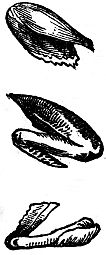
LEG, WING, AND NECKBONE OF FOWL.
This will not be found a very difficult member of the poultry family to carve, unless, as may happen, a very old farm-yard occupant, useless for egg-laying purposes, has, by some unlucky mischance, been introduced into the kitchen as a “fine young chicken.” Skill, however, and the application of a small amount of strength, combined with a fine keeping of the temper, will even get over that difficulty. Fixing the fork firmly in the breast, let the knife be firmly passed along the line shown from 1 to 2; then cut downwards from that line to fig. 3: and the wing, it will be found, can be easily withdrawn. The shape of the wing should be like the accompanying engraving. Let the fork be placed inside the leg, which should be gently forced away from the body of the fowl; and the joint, being thus discovered, the carver can readily cut through it, and the leg can be served. When the leg is displaced, it should be of the same shape as that shown in the annexed woodcut. The legs and wings on either side having been taken off, the carver should draw his knife through the flesh in the direction of the line 4 to 5; by this means the knife can be slipped underneath the merrythought, which, being lifted up and pressed backward, will immediately come off. The collar- or neck-bones are the next to consider: these lie on each side of the merrythought, close under the upper part of the wings; and, in order to free these from the fowl, they must also be raised by the knife at their broad end, and turned from the body towards the breastbone, until the shorter piece of the bone, as shown in the cut, breaks off. There will now be left only the breast, with the ribs. The breast can be, without difficulty, disengaged from the ribs by cutting through the latter, which will offer little impediment. The side bones are now to be taken off; and to do this, the lower end of the back should be turned from the carver, who should press the point of the knife through the top of the backbone, near the centre, bringing it down towards the end of the back completely through the bone. If the knife be now turned in the opposite direction, the joint will be easily separated from the vertebræ. The backbone being now uppermost, the fork should be pressed firmly down on it, whilst at the same time the knife should be employed in raising up the lower small end of the fowl towards the fork, and thus the back will be dislocated about its middle. The wings, breast, and merrythought are esteemed the prime parts of a fowl, and are usually served to the ladies of the company, to whom legs, except as a matter of paramount necessity, should not be given. Byron gave it as one reason why he did not like dining with ladies, that they always had the wings of the fowls, which he himself preferred. We heard a gentleman who, when he might have had a wing, declare his partiality for a leg, saying that he had been obliged to eat legs for so long a time that he had at last come to like them better than the other more prized parts. If the fowl is, capon-like, very large, slices may be carved from its breast in the same manner as from a turkey’s.
FOWL, Boiled, with Oysters. (Excellent.)
Ingredients.—1 young fowl, 3 dozen oysters, the yolks of 2 eggs, ¼ pint of cream. Mode.—Truss a young fowl as for boiling; fill the inside with oysters which have been bearded and washed in their own liquor; secure the ends of the fowl, put it into a jar, and plunge the jar into a saucepan of boiling water. Keep it boiling for 1½ hour, or rather longer; then take the gravy that has flowed from the oysters and fowl, of which there will be a good quantity; stir in the cream and yolks of eggs, add a few oysters scalded in their liquor; let the sauce get quite hot, but do not allow it to boil; pour some of it over the fowl, and the remainder send to table in a tureen. A blade of pounded mace added to the sauce, with the cream and eggs, will be found an improvement. Time.—1½ hour. Average cost, 4s. 6d. Sufficient for 3 or 4 persons. Seasonable from September to April.
FOWLS, Broiled, and Mushroom Sauce.
Ingredients.—A large fowl; seasoning, to taste, of pepper and salt, 2 handfuls of button mushrooms, 1 slice of lean ham, ¾ pint of thickened gravy, 1 teaspoonful of lemon juice, ½ teaspoonful of pounded sugar. Mode.—Cut the fowl into quarters, roast it until three-parts done, and keep it well basted whilst at the fire. Take the fowl up, broil it for a few minutes over a clear fire, and season it with pepper and salt. Have ready some mushroom sauce made in the following manner. Put the mushrooms into a stewpan with a small piece of butter, the ham, a seasoning of pepper and salt, and the gravy; simmer these gently for ½ hour, add the lemon-juice and sugar, dish the fowl, and pour the sauce round them. Time.—To roast the fowl, 35 minutes; to broil it, 10 to 15 minutes. Average cost, in full season, 2s. 6d. Sufficient for 4 or 5 persons. Seasonable.—In full season from May to January.
FOWL, Boiled, and Rice.
Ingredients.—1 fowl, mutton broth, 2 onions, 2 small blades of pounded mace, pepper and salt to taste, ¼ pint of rice, parsley and butter. Mode.—Truss the fowl as for boiling, and put it into a stewpan with sufficient clear well-skimmed mutton broth to cover it; add the onion, mace, and a seasoning of pepper and salt; stew very gently for about 1 hour, should the fowl be large, and about ½ hour before it is ready put in the rice, which should be well washed and soaked. When the latter is tender, strain it from the liquor, and put it on a sieve reversed to dry before the fire, and, in the mean time, keep the fowl hot. Dish it, put the rice round as a border, pour a little parsley and butter over the fowl, and the remainder send to table in a tureen. Time.—A large fowl, 1 hour. Average cost, 2s. 6d. Sufficient for 3 or 4 persons. Seasonable all the year.
FOWLS, to Bone, for Fricassees, Curries, and Pies.
First carve them entirely into joints, then remove the bones, beginning with the legs and wings, at the head of the largest bone; hold this with the fingers, and work the knife as directed in the recipe above. The remainder of the birds is too easily done to require any instructions.
FOWL, Croquettes of (an Entrée).
Ingredients.—3 or 4 shalots, 1 oz. of butter, 1 teaspoonful of flour, white sauce; pepper, salt, and pounded mace to taste; ½ teaspoonful of pounded sugar, the remains of cold roast fowls, the yolks of 2 eggs, egg, and bread-crumbs. Mode.—Mince the fowl, carefully removing all skin and bone, and fry the shalots in the butter; add the minced fowl, dredge in the flour, put in the pepper, salt, mace, pounded sugar, and sufficient white sauce to moisten it; stir to it the yolks of 2 well-beaten eggs, and set it by to cool. Then make the mixture up into balls, egg and bread-crumb them, and fry a nice brown. They may be served on a border of mashed potatoes, with gravy or sauce in the centre. Time.—10 minutes to fry the balls. Seasonable at any time.
FOWL AND RICE, Croquettes of (an Entrée).
Ingredients.—¼ lb. of rice, 1 quart of stock or broth, 3 oz. of butter, minced fowl, egg, and bread-crumbs. Mode.—Put the rice into the above proportion of cold stock or broth, and let it boil very gently for ½ hour; then add the butter, and simmer it till quite dry and soft. When cold, make it into balls, hollow out the inside, and fill with minced fowl made by recipe. The mince should be rather thick. Cover over with rice, dip the balls into egg, sprinkle them with bread-crumbs, and fry a nice brown. Dish them, and garnish with fried parsley. Oysters, white sauce, or a little cream, may be stirred into the rice before it cools. Time.—½ hour to boil the rice, 10 minutes to fry the croquettes. Average cost, exclusive of the fowl, 8d. Seasonable at any time.
FOWL, Curried.
Ingredients.—1 fowl, 2 oz. of butter, 3 onions sliced, 1 pint of white veal gravy, 1 tablespoonful of curry-powder, 1 tablespoonful of flour, 1 apple, 4 tablespoonfuls of cream, 1 tablespoonful of lemon-juice. Mode.—Put the butter into a stewpan, with the onions sliced, the fowl cut into small joints; and the apple peeled, cored, and minced. Fry of a pale brown, add the stock, and stew gently for 20 minutes; rub down the curry-powder and flour with a little of the gravy, quite smoothly, and stir this to the other ingredients; simmer for rather more than ½ hour, and just before serving, add the above proportion of hot cream and lemon-juice. Serve with boiled rice, which may either be heaped lightly on a dish by itself, or put round the curry as a border. Time.—50 minutes. Average cost, 3s. 3d. Sufficient for 3 or 4 persons. Seasonable in the winter.
Note.—This curry may be made of cold chicken, but undressed meat will be found far superior.
FOWL, Fricasseed.
[Cold Meat Cookery.] Ingredients.—The remains of cold roast fowl, 1 strip of lemon-peel, 1 blade of pounded mace, 1 bunch of savoury herbs, 1 onion, pepper and salt to taste, 1 pint of water, 1 teaspoonful of flour, ¼ pint of cream, the yolks of 2 eggs. Mode.—Carve the fowls into nice joints; make gravy of the trimmings and legs, by stewing them with the lemon-peel, mace, herbs, onion, seasoning, and water, until reduced to ½ pint; then strain, and put in the fowl. Warm it through, and thicken with a teaspoonful of flour; stir the yolks of the eggs into the cream; add these to the sauce, let it get thoroughly hot, but do not allow it to boil, or it will curdle. Time.—1 hour to make the gravy, ¼ hour to warm the fowl. Average cost, exclusive of the cold chicken, 8d. Seasonable at any time.
FOWLS, Fried.
[Cold Meat Cookery.] Ingredients.—The remains of cold roast fowls, vinegar, salt and cayenne to taste, 3 or 4 minced shalots. For the batter,—½ lb. of flour, ½ pint of hot water, 2 oz. of butter, the whites of 2 eggs. Mode.—Cut the fowl into nice joints; steep them for an hour in a little vinegar, with salt, cayenne, and minced shalots. Make the batter by mixing the flour and water smoothly together; melt in it the butter, and add the whites of egg beaten to a froth; take out the pieces of fowl, dip them in the batter, and fry in boiling lard, a nice brown. Pile them high in the dish, and garnish with fried parsley or rolled bacon. When approved, a sauce or gravy may be served with them. Time.—10 minutes to fry the fowl. Average cost, exclusive of the cold fowl, 8d. Seasonable at any time.
FOWLS, Fried.
[Cold Meat Cookery.] Ingredients.—The remains of cold roast fowl, vinegar, salt and cayenne to taste, 4 minced shalots, yolk of egg; to every teacupful of bread-crumbs allow 1 blade of pounded mace, ½ teaspoonful of minced lemon-peel, 1 saltspoonful of salt, a few grains of cayenne. Mode.—Steep the pieces of fowl as in the preceding recipe, then dip them into the yolk of an egg or clarified butter; sprinkle over bread-crumbs with which have been mixed salt, mace, cayenne, and lemon-peel in the above proportion. Fry a light brown, and serve with or without gravy, as may be preferred. Time.—10 minutes to fry the fowl. Average cost, exclusive of the cold fowl, 6d. Seasonable at any time.
FOWLS, Fried, and French Beans.
[Cold Meat Cookery.] Ingredients.—The remains of cold roast fowl; the yolk of 1 egg, 2 oz. of butter, 1 blade of pounded mace, ¼ saltspoonful of grated nutmeg, bread-crumbs and chopped parsley. Mode.—Cut the fowl into neat joints, brush them over with the yolk of egg, and sprinkle them with bread-crumbs, with which the parsley, nutmeg, and mace have been well mixed. Fry the fowl in the butter until of a nice brown, and dish the pieces on French beans boiled, and afterwards simmered for a minute or two in butter. The dish should be garnished with rolled bacon. Time.—10 minutes to fry the fowl. Average cost, exclusive of the cold fowl, 6d. Seasonable from July to September.
FOWL au Gratin.
[Cold Meat Cookery.] Ingredients.—The remains of either cold roast or boiled fowl, ½ pint of Béchamel sauce, a dessertspoonful of grated Parmesan cheese, pepper and salt to taste, ¼ saltspoonful of grated nutmeg, ¼ pint of cream, 2 tablespoonfuls of bread-crumbs, fried potatoes. Mode.—Mince the fowl not too finely, and make it hot in the Béchamel sauce, to which the nutmeg, pepper and salt, and cream, have been added. When well mixed, serve the fowl on to a dish, cover it with the bread-crumbs and Parmesan cheese, drop over a little clarified butter, and bake in the oven until of a pale brown. Garnish the dish with fried potatoes. Time.—10 minutes to warm the fowl, 10 minutes to bake. Seasonable at any time.
FOWL, Hashed. An Entrée.
[Cold Meat Cookery.] Ingredients.—The remains of cold roast fowl, 1 pint of water, 1 onion, 2 or 3 small carrots, 1 blade of pounded mace, pepper and salt to taste, 1 small bunch of savoury herbs, thickening of butter and flour, 1½ tablespoonful of mushroom ketchup. Mode.—Cut off the best joints from the fowl, and the remainder make into gravy, by adding to the bones and trimmings a pint of water, an onion sliced and fried of a nice brown, the carrots, mace, seasoning, and herbs. Let these stew gently for 1½ hour, strain the liquor, and thicken with a little flour and butter. Lay in the fowl, thoroughly warm it through, add the ketchup, and garnish with sippets of toasted bread. Time.—Altogether 1¾ hour. Average cost, exclusive of the cold fowl, 4d. Seasonable at any time.
FOWL, Hashed, Indian Fashion (an Entrée).
[Cold Meat Cookery.] Ingredients.—The remains of cold roast fowl, 3 or 4 sliced onions, 1 apple, 2 oz. of butter, pounded mace, pepper and salt to taste, 1 tablespoonful of curry-powder, 2 tablespoonfuls of vinegar, 1 tablespoonful of flour, 1 teaspoonful of pounded sugar, 1 pint of gravy. Mode.—Cut the onions into slices, mince the apple, and fry these in the butter; add pounded mace, pepper, salt, curry-powder, vinegar, flour, and sugar in the above proportions; when the onion is brown, put in the gravy, which should be previously made from the bones and trimmings of the fowls, and stew for ¾ hour; add the fowl cut into nice-sized joints, let it warm through, and when quite tender, serve. The dish should be garnished with an edging of boiled rice. Time.—1 hour. Average cost, exclusive of the fowl, 8d. Seasonable at any time.
FOWL, an Indian Dish of (an Entrée).
[Cold Meat Cookery.] Ingredients.—The remains of cold roast fowl, 3 or 4 sliced onions, 1 tablespoonful of curry-powder, salt to taste. Mode.—Divide the fowl into joints; slice and fry the onions in a little butter, taking care not to burn them; sprinkle over the fowl a little curry-powder and salt; fry these nicely, pile them high in the centre of the dish, cover with the onion, and serve with a cut lemon on a plate. Care must be taken that the onions are not greasy: they should be quite dry, but not burnt. Time.—5 minutes to fry the onions, 10 minutes to fry the fowl. Average cost, exclusive of the fowl, 4d. Seasonable during the winter months.
FOWL à la Mayonnaise.
Ingredients.—A cold roast fowl, Mayonnaise sauce, 4 or 5 young lettuces, 4 hard-boiled eggs, a few water-cresses, endive. Mode.—Cut the fowl into neat joints, lay them in a deep dish, piling them high in the centre, sauce the fowl with Mayonnaise, and garnish the dish with young lettuces cut in halves, water-cresses, endive, and hard-boiled eggs: these may be sliced in rings, or laid on the dish whole, cutting off at the bottom a piece of the white, to make the egg stand. All kinds of cold meat and solid fish may be dressed à la Mayonnaise, and make excellent luncheon or supper dishes. The sauce should not be poured over the fowls until the moment of serving. Should a very large Mayonnaise be required, use 2 fowls instead of one, with an equal proportion of the remaining ingredients. Average cost, with one fowl, 3s. 6d. Sufficient for a moderate-sized dish. Seasonable from April to September.
FOWL, Minced (an Entrée).
[Cold Meat Cookery.] Ingredients.—The remains of cold roast fowl, 2 hard-boiled eggs, salt, cayenne, and pounded mace, 1 onion, 1 faggot of savoury herbs, 6 tablespoonfuls of cream, 1 oz. of butter, two teaspoonfuls of flour, ½ teaspoonful of finely-minced lemon-peel, 1 tablespoonful of lemon-juice. Mode.—Cut out from the fowl all the white meat, and mince it finely without any skin or bone; put the bones, skin, and trimmings into a stewpan with an onion, a bunch of savoury herbs, a blade of mace, and nearly a pint of water; let this stew for an hour, then strain the liquor. Chop the eggs small; mix them with the fowl; add salt, cayenne, and pounded mace, put in the gravy and remaining ingredients; let the whole just boil, and serve with sippets of toasted bread. Time.—Rather more than 1 hour. Average cost, exclusive of the fowl, 8d. Seasonable at any time.
Note.—Another way to make this is to mince the fowl, and warm it in white sauce or Béchamel. When dressed like this, 3 or 4 poached eggs may be placed on the top: oysters, or chopped mushrooms, or balls of oyster forcemeat, may be laid round the dish.
FOWL, Minced, à la Béchamel.
[Cold Meat Cookery.] Ingredients.—The remains of cold roast fowl, 6 tablespoonfuls of Béchamel sauce, 6 tablespoonfuls of white stock, the white of 1 egg, bread-crumbs, clarified butter. Mode.—Take the remains of roast fowls, mince the white meat very small, and put it into a stewpan with the Béchamel and stock; stir it well over the fire, and just let it boil up. Pour the mince into a dish, beat up the white of egg, spread it over, and strew on it a few grated bread-crumbs; pour a very little clarified butter on the whole, and brown either before the fire or with a salamander. This should be served in a silver dish, if at hand. Time.—2 or 3 minutes to simmer in the sauce. Seasonable at any time.
FOWL, Ragoût of.
[Cold Meat Cookery.] Ingredients.—The remains of cold roast fowls, 3 shalots, 2 blades of mace, a faggot of savoury herbs, 2 or 3 slices of lean ham, 1 pint of stock or water, pepper and salt to taste, 1 onion, 1 dessertspoonful of flour, 1 tablespoonful of lemon-juice, ½ teaspoonful of pounded sugar, 1 oz. of butter. Mode.—Cut the fowls up into neat pieces, the same as for a fricassee; put the trimmings into a stewpan with the shalots, mace, herbs, ham, onion, and stock (water may be substituted for this). Boil it slowly for 1 hour, strain the liquor, and put a small piece of butter into a stewpan; when melted, dredge in sufficient flour to dry up the butter, and stir it over the fire. Put in the strained liquor, boil for a few minutes, and strain it again over the pieces of fowl. Squeeze in the lemon-juice, add the sugar and a seasoning of pepper and salt, make it hot, but do not allow it to boil; lay the fowl neatly on the dish, and garnish with croûtons. Time.—Altogether 1½ hour. Average cost, exclusive of the cold fowl, 9d. Seasonable at any time.
FOWLS, Roast.
Ingredients.—A pair of fowls, a little flour. Mode.—Fowls, to be tender, should be killed a couple of days before they are dressed; when the feathers come out easily; then let them be picked and cooked. In drawing them be careful not to break the gall-bag, as, wherever it touches, it would impart a very bitter taste; the liver and gizzard should also be preserved. Truss them in the following manner:—After having carefully picked them, cut off the head, and skewer the skin of the neck down over the back. Cut off the claws, dip the legs in boiling water, and scrape them; turn the pinions under, run a skewer through them and the middle of the legs, which should be passed through the body to the pinion and leg on the other side, one skewer securing the limbs on both sides. The liver and gizzard should be placed in the wings, the liver on one side and the gizzard on the other. Tie the legs together by passing a trussing-needle, threaded with twine, through the backbone, and secure it on the other side. If trussed like a capon, the legs are placed more apart. When firmly trussed, singe them all over; put them down to a bright clear fire, paper the breasts with a sheet of buttered paper, and keep the fowls well basted. Roast them for ¾ hour, more or less, according to the size, and 10 minutes before serving, remove the paper, dredge the fowls with a little fine flour, put a piece of butter into the basting-ladle, and as it melts baste the fowls with it; when nicely frothed and of a rich colour, serve with good brown gravy (a little of which should be poured over the fowls), and a tureen of well-made bread sauce. Mushroom, oyster, or egg sauce, are very suitable accompaniments to roast fowl.—Chicken is roasted in the same manner. Time.—A very large fowl, quite 1 hour; a medium-sized one, ¾ hour; chicken, ½ hour, or rather longer. Average cost, in full season, 5s. a pair; when scarce, 7s. 6d. the pair. Sufficient for 6 or 7 persons. Seasonable all the year, but scarce in early spring.
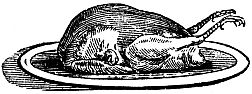
ROAST FOWL.
FOWL, Roast, to Carve.
A roast fowl is carved in the same manner as a boiled fowl, viz., by cutting along the line from 1 to 2, and then round the leg between it and the wing. The markings and detached pieces, as shown in the engravings under the heading of “Boiled Fowl,” supersede the necessity of our lengthily again describing the operation. It may be added, that the liver, being considered a delicacy, should be divided, and one half served with each wing. In the case of a fowl being stuffed, it will be proper to give each guest a portion, unless it be not agreeable to some one of the party.
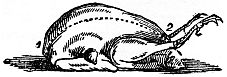
ROAST FOWL.
FOWL, Roast, Stuffed.
Ingredients.—A large fowl, forcemeat, a little flour. Mode.—Select a large plump fowl, fill the breast with forcemeat, truss it firmly, the same as for a plain roast fowl, dredge it with flour, and put it down to a bright fire. Roast it for nearly or quite an hour, should it be very large; remove the skewers, and serve with a good brown gravy and a tureen of bread sauce. Time.—Large fowl, nearly or quite 1 hour. Average cost, in full season, 2s. 6d. each. Sufficient for 4 or 5 persons. Seasonable all the year, but scarce in early spring.
Note.—Sausage-meat stuffing may be substituted: this is now a very general mode of serving fowl.
FOWL SAUTE with Peas (an Entrée).
[Cold Meat Cookery.] Ingredients.—The remains of cold roast fowl, 2 oz. of butter, pepper, salt, and pounded mace to taste, 1 dessertspoonful of flour, ½ pint of weak stock, 1 pint of green peas, 1 teaspoonful of pounded sugar. Mode.—Cut the fowl into nice pieces; put the butter into a stewpan; sautez or fry the fowl a nice brown colour, previously sprinkling it with pepper, salt, and pounded mace. Dredge in the flour, shake the ingredients well round, then add the stock and peas, and stew till the latter are tender, which will be in about 20 minutes; put in the pounded sugar, and serve, placing the chicken round, and the peas in the middle of the dish. When liked, mushrooms may be substituted for the peas. Time.—Altogether 40 minutes. Average cost, exclusive of the fowl, 7d. Seasonable from June to August.
FOWL SCOLLOPS.
[Cold Meat Cookery.] Ingredients.—The remains of cold roast or boiled fowl, ½ pint of Béchamel, or white sauce. Mode.—Strip off the skin from the fowl; cut the meat into thin slices, and warm them in about ½ pint, or rather more, of Béchamel, or white sauce. When quite hot, serve, and garnish the dish with rolled ham or bacon toasted. Time.—1 minute to simmer the slices of fowl. Seasonable at any time.
FRENCH TERMS used in modern Household Cookery, explained.
Aspic.—A savoury jelly, used as an exterior moulding for cold game, poultry, fish, &c. This, being of a transparent nature, allows the article which it covers to be seen through it. This may also be used for decorating or garnishing.
Assiette (plate).—Assiettes are the small entrées and hors-d’œuvres, the quantity of which does not exceed what a plate will hold. At dessert, fruits, cheese, chestnuts, biscuits, &c., if served upon a plate, are termed assiettes.—Assiette volante is a dish which a servant hands round to the guests, but is not placed upon the table. Small cheese soufflés and different dishes, which ought to be served very hot, are frequently made assiettes volantes.
Au-bleu.—Fish dressed in such a manner as to have a bluish appearance.
Bain-marie.—An open saucepan or kettle of nearly boiling water, in which a smaller vessel can be set for cooking and warming. This is very useful for keeping articles hot, without altering their quantity or quality. If you keep sauce, broth, or soup by the fireside, the soup reduces and becomes too strong, and the sauce thickens as well as reduces; but this is prevented by using the bain-marie, in which the water should be very hot, but not boiling.
Béchamel.—French white sauce, now frequently used in English cookery.
Blanch.—To whiten poultry, vegetables, fruit, &c., by plunging them into boiling water for a short time, and afterwards plunging them into cold water, there to remain until they are cold.
Blanquette.—A sort of fricassee.
Bouilli.—Beef or other meat boiled; but, generally speaking, boiled beef is understood by the term.
Bouillie.—A French dish resembling hasty-pudding.
Bouillon.—A thin broth or soup.
Braise.—To stew meat with fat bacon until it is tender, it having previously been blanched.
Braisière.—A saucepan having a lid with ledges, to put fire on the top.
Brider.—To pass a packthread through poultry, game, &c., to keep together their members.
Caramel (burnt sugar).—This is made with a piece of sugar, of the size of a nut, browned in the bottom of a saucepan; upon which a cupful of stock is gradually poured, stirring all the time, and adding the broth little by little. It may be used with the feather of a quill, to colour meats, such as the upper part of fricandeaux; and to impart colour to sauces. Caramel made with water instead of stock may be used to colour compôtes and other entremets.
Casserole.—A crust of rice, which, after having been moulded into the form of a pie, is baked, and then filled with a fricassee of white meat or a purée of game.
Compôte.—A stew, as of fruit or pigeons.
Consommé.—Rich stock, or gravy.
Croquette.—Ball of fried rice or potatoes.
Croûtons.—Sippets of bread.
Daubière.—An oval stewpan, in which daubes are cooked; daubes being meat or fowl stewed in sauce.
Désosser.—To bone, or take out the bones from poultry, game, or fish. This is an operation requiring considerable experience.
Entrées.—Small side or corner dishes served with the first course.
Entremets.—Small side or corner dishes served with the second course.
Escalopes.—Collops; small, round, thin pieces of tender meat, or of fish, beaten with the handle of a strong knife to make them tender.
Feuilletage.—Puff-paste.
Flamber.—To singe fowl or game, after they have been picked.
Foncer.—To put in the bottom of a saucepan slices of ham, veal, or thin broad slices of bacon.
Galette.—A broad thin cake.
Gâteau.—A cake, correctly speaking; but used sometimes to denote a pudding and a kind of tart.
Glacer.—To glaze, or spread upon hot meats, or larded fowl, a thick and rich sauce or gravy, called glaze. This is laid on with a feather or brush, and in confectionary the term means to ice fruits and pastry with sugar, which glistens on hardening.
Hors-d’œvres.—Small dishes, or assiettes volantes of sardines, anchovies, and other relishes of this kind, served to the guests during the first course. (See Assiettes volantes.)
Lit.—A bed or layer; articles in thin slices are placed in layers, other articles, or seasoning, being laid between them.
Maigre.—Broth, soup, or gravy, made without meat.
Matelote.—A rich fish-stew, which is generally composed of carp, eels, trout, or barbel. It is made with wine.
Mayonnaise.—Cold sauce, or salad dressing.
Menu.—The bill of fare.
Meringue.—A kind of icing, made of whites of eggs and sugar, well beaten.
Miroton.—Larger slices of meat than collops; such as slices of beef for a vinaigrette, or ragoût or stew of onions.
Mouiller.—To add water, broth, or other liquid, during the cooking.
Paner.—To cover with very fine crumbs of bread, meats, or any other articles to be cooked on the gridiron, in the oven, or frying-pan.
Piquer.—To lard with strips of fat bacon, poultry, game, meat, &c. This should always be done according to the vein of the meat, so that in carving you slice the bacon across as well as the meat.
Poelée.—Stock used instead of water for boiling turkeys, sweetbreads, fowls, and vegetables, to render them less insipid.—This is rather an expensive preparation.
Purée.—Vegetables or meat reduced to a very smooth pulp, which is afterwards mixed with enough liquid to make it of the consistency of very thick soup.
Ragoût.—Stew or hash.
Remoulade.—Salad dressing.
Rissoles.—Pastry, made of light puff-paste, and cut into various forms, and fried. They may be filled with fish, meat, or sweets.
Roux.—Brown and white; French thickening.
Salmi.—Ragoût of game previously roasted.
Sauce Piquante.—A sharp sauce, in which somewhat of a vinegar flavour predominates.
Sauter.—To dress with sauce in a saucepan, repeatedly moving it about.
Tamis.—Tammy, a sort of open cloth or sieve through which to strain broth and sauces, so as to rid them of small bones, froth, &c.
Tourte.—Tart. Fruit pie.
Trousser.—To truss a bird; to put together the body and tie the wings and thighs, in order to round it for roasting or boiling, each being tied then with packthread, to keep it in the required form.
Vol-au-vent.—A rich crust of very fine puff-paste, which may be filled with various delicate ragoûts or fricassees, of fish, flesh, or fowl. Fruit may also be inclosed in a vol-au-vent.
FRITTERS, Indian.
Ingredients.—3 tablespoonfuls of flour, boiling water, the yolks of 4 eggs, the whites of 2, hot lard or clarified dripping, jam. Mode.—Put the flour into a basin, and pour over it sufficient boiling water to make it into a stiff paste, taking care to stir and beat it well, to prevent it getting lumpy. Leave it a little time to cool, and then break into it (without beating them at first) the yolks of 4 eggs and the whites of 2, and stir and beat all well together. Have ready some boiling lard or butter; drop a dessertspoonful of batter in at a time, and fry the fritters of a light brown. They should rise so much as to be almost like balls. Serve on a dish, with a spoonful of preserve or marmalade dropped in between each fritter. This is an excellent dish for a hasty addition to dinner, if a guest unexpectedly arrives, it being so easily and quickly made, and it is always a great favourite. Time.—From 5 to 8 minutes to fry the fritters. Average cost, exclusive of the jam, 5d. Sufficient for 4 or 5 persons. Seasonable at any time.