THE DICTIONARY OF COOKERY. (continued 7)
Reading edition
FRITTERS, Plain.
Ingredients.—3 oz. of flour, 3 eggs, 1/3 pint of milk. Mode.—Mix the flour to a smooth batter with a small quantity of the milk; stir in the eggs, which should be well whisked, and then the remainder of the milk; beat the whole to a perfectly smooth batter, and should it be found not quite thin enough, add two or three tablespoonfuls more milk. Have ready a frying-pan, with plenty of boiling lard in it; drop in rather more than a tablespoonful at a time of the batter and fry the fritters a nice brown, turning them when sufficiently cooked on one side. Drain them well from the greasy moisture by placing them upon a piece of blotting-paper before the fire; dish them on a white d’oyley, sprinkle over them sifted sugar, and send to table with them a cut lemon and plenty of pounded sugar. Time.—From 6 to 8 minutes. Average cost, 4d. Sufficient for 3 or 4 persons. Seasonable at any time.
FRUIT, to Bottle Fresh. (Very useful in Winter.)
Ingredients.—Fresh fruits, such as currants, raspberries, cherries, gooseberries, plums of all kinds, damsons, &c.; wide-mouthed glass bottles, new corks to fit them tightly. Mode.—Let the fruit be full grown, but not too ripe, and gathered in dry weather. Pick it off the stalks without bruising or breaking the skin, and reject any that is at all blemished: if gathered in the damp, or if the skins are cut at all, the fruit will mould. Have ready some perfectly dry glass bottles, and some nice new soft corks or bungs; burn a match in each bottle, to exhaust the air, and quickly place the fruit in to be preserved; gently cork the bottles, and put them in a very cool oven, where let them remain until the fruit has shrunk away a fourth part. Then take the bottles out; do not open them, but immediately beat the corks in tight, cut off the tops, and cover them with melted resin. If kept in a dry place, the fruit will remain good for months; and on this principally depends the success of the preparation; for if stored away in a place that is in the least damp, the fruit will soon spoil. Time.—From 5 to 6 hours in a very slow oven.
FRUIT, to Bottle Fresh.
Ingredients.—Any kind of fresh fruit, such as currants, cherries, gooseberries, all kinds of plums, &c.; wide-mouthed glass bottles, new corks to fit them tightly. Mode.—the fruit must be full-grown, not too ripe, and gathered on a fine day. Let it be carefully picked and put into the bottles, which must be clean and perfectly dry. Tie over the tops of the bottles pieces of bladder; stand the bottles in a large pot, copper, or boiler, with cold water to reach to their necks; kindle a fire under, let the water boil, and as the bladders begin to rise and puff, prick them. As soon as the water boils, extinguish the fire, and let the bottles remain where they are, to become cold. The next day remove the bladders, and strew over the fruit a thick layer of pounded sugar; fit the bottles with cork, and let each cork lie close at hand to its own bottle. Hold for a few moments, in the neck of the bottle, two or three lighted matches, and when they have filled the bottle neck with gas, and before they go out, remove them very quickly; instantly cork the bottle closely, and dip it in bottle-cement. Time.—Altogether about 8 hours.
FRUIT, to Bottle Fresh, with Sugar. (Very useful in Winter.)
Ingredients.—Any kind of fresh fruit; to each quart bottle allow ¼ lb. of pounded sugar. Mode.—Let the fruit be gathered in dry weather. Pick it carefully, and drop it into clean and very dry quart glass bottles, sprinkling over it the above proportion of pounded sugar to each quart. Put the corks in the bottles, and place them in a copper of cold water up to their necks, with small hay-wisps round them, to prevent the bottles from knocking together. Light the fire under, bring the water gradually to boil, and let it simmer gently until the fruit in the bottles is reduced nearly one third. Extinguish the fire, and let the bottles remain in the water until it is perfectly cold; then take them out, make the corks secure, and cover them with melted resin or wax. Time.—About ½ hour from the time the water commences to boil.
FRUIT TURNOVERS (suitable for Pic-Nics).
Ingredients.—Puff-paste, any kind of fruit, sugar to taste. Mode.—Make some puff-paste by recipe; roll it out to the thickness of about ¼ inch, and cut it out in pieces of a circular form; pile the fruit on half of the paste, sprinkle over some sugar, wet the edges and turn the paste over. Press the edges together, ornament them, and brush the turnovers over with the white of an egg; sprinkle over sifted sugar, and bake on tins, in a brisk oven, for about 20 minutes. Instead of putting the fruit in raw, it may be boiled down with a little sugar first, and then inclosed in the crust; or jam, of any kind, may be substituted for fresh fruit. Time.—20 minutes. Sufficient.—½ lb. of puff-paste will make a dozen turnovers. Seasonable at any time.
GAME, Hashed.
[Cold Meat Cookery.] Ingredients.—The remains of cold game, 1 onion stuck with 3 cloves, a few whole peppers, a strip of lemon-peel, salt to taste, thickening of butter and flour, 1 glass of port wine, 1 tablespoonful of lemon-juice, 1 tablespoonful of ketchup, 1 pint of water or weak stock. Mode.—Cut the remains of cold game into joints, reserve the best pieces, and the inferior ones and trimmings put into a stewpan with the onion, pepper, lemon-peel, salt, and water or weak stock; stew these for about an hour, and strain the gravy; thicken it with butter and flour; add the wine, lemon-juice, and ketchup; lay in the pieces of game, and let them gradually warm through by the side of the fire; do not allow it to boil, or the game will be hard. When on the point of simmering, serve, and garnish the dish with sippets of toasted bread. Time.—Altogether 1¼ hour. Seasonable from August to March.
Note.—Any kind of game may be hashed by the above recipe, and the flavour may be varied by adding flavoured vinegars, curry powder, &c.; but we cannot recommend these latter ingredients, as a dish of game should really have a gamy taste; and if too many sauces, essences, &c., are added to the gravy, they quite overpower and destroy the flavour the dish should possess.
GERMAN PUFFS.
Ingredients.—2 oz. of flour, 2 eggs, ½ pint of new milk, 2 oz. of melted butter, little salt and nutmeg. Mode.—Let the 2 eggs be well beaten, then mix all the ingredients well together, and heat them up just before they are put into little cups half full for baking. Bake for ¼ hour in a hot oven till the puffs are of a nice brown; turn out on a flat dish, rub a little butter over each puff, and dust on it powdered sugar. Time.—¼ hour. Average cost, 6d. Seasonable at any time.
GHERKINS, Pickled.
Ingredients.—Salt and water, 1 oz. of bruised ginger ½ oz. of whole black pepper, ¼ oz. of whole allspice, 4 cloves, 2 blades of mace, a little horseradish. This proportion of pepper, spices, &c., for 1 quart of vinegar. Mode.—Let the gherkins remain in salt and water for 3 or 4 days, when take them out, wipe perfectly dry, and put them into a stone jar. Boil sufficient vinegar to cover them, with spices and pepper, &c., in the above proportion, for 10 minutes; pour it, quite boiling, over the gherkins, cover the jar with vine-leaves, and put over them a plate, setting them near the fire, where they must remain all night. Next day drain off the vinegar, boil it up again, and pour it hot over them. Cover up with fresh leaves, and let the whole remain till quite cold. Now tie down closely with bladder to exclude the air, and in a month or two they will be fit for use. Time.—4 days. Seasonable from the middle of July to the end of August.
GIBLET PIE.
Ingredients.—A set of duck or goose giblets, 1 lb. of rump-steak, 1 onion, ½ teaspoonful of whole black pepper, a bunch of savoury herbs, plain crust. Mode.—Clean, and put the giblets into a stewpan with an onion, whole pepper, and a bunch of savoury herbs; add rather more than a pint of water, and simmer gently for about 1½ hour. Take them out, let them cool, and cut them into pieces; line the bottom of a pie-dish with a few pieces of rump-steak; add a layer of giblets and a few more pieces of steak; season with pepper and salt, and pour in the gravy (which should be strained), that the giblets were stewed in; cover with a plain crust, and bake for rather more than 1½ hour in a brisk oven. Cover a piece of paper over the pie, to prevent the crust taking too much colour. Time.—1½ hour to stew the giblets, about 1 hour to bake the pie. Average cost, exclusive of the giblets, 1s. 4d. Sufficient for 5 or 6 persons.
GIBLET SOUP.
Ingredients.—3 sets of goose or duck giblets, 2 lbs. of shin of beef, a few bones, 1 ox-tail, 2 mutton-shanks, 2 large onions, 2 carrots, 1 large faggot of herbs, salt and pepper to taste, ¼ pint of cream, 1 oz. of butter mixed with a dessertspoonful of flour, 3 quarts of water. Mode.—Scald the giblets, cut the gizzards in 8 pieces, and put them in a stewpan with the beef, bones, ox-tail, mutton-shanks, onions, herbs, pepper, and salt; add the 3 quarts of water, and simmer till the giblets are tender, taking care to skim well. When the giblets are done, take them out, put them in your tureen, strain the soup through a sieve, add the cream and butter, mixed with a dessertspoonful of flour, boil it up for a few minutes, and pour it over the giblets. It can be flavoured with port wine and a little mushroom ketchup, instead of cream. Add salt to taste. Time.—3 hours. Average cost, 9d. per quart. Seasonable all the year. Sufficient for 10 persons.
GINGER, Apple. (A Dessert Dish.)
Ingredients.—2 lbs. of any kind of hard apples, 2 lbs. of loaf sugar, 1½ pint of water, 1 oz. of tincture of ginger. Mode.—Boil the sugar and water until they form a rich syrup, adding the ginger when it boils up. Pare, core, and cut the apples into pieces; dip them in cold water to preserve the colour, and boil them in the syrup until transparent; but be careful not to let them break. Put the pieces of apple into jars, pour over the syrup, and carefully exclude the air, by well covering them. It will remain good some time, if kept in a dry place. Time.—From 5 to 10 minutes to boil the syrup; about ½ hour to simmer the apples. Average cost, 2s. Sufficient for 7 or 8 persons. Seasonable.—Make this in September, October, or November.
GINGER-BEER.
Ingredients.—2½ lbs. of loaf sugar, 1½ oz. of bruised ginger, 1 oz. of cream of tartar, the rind and juice of 2 lemons, 3 gallons of boiling water, two large tablespoonfuls of thick and fresh brewer’s yeast. Mode.—Peel the lemons, squeeze the juice, strain it, and put the peel and juice into a large earthen pan, with the bruised ginger, cream of tartar, and loaf sugar. Put over these ingredients 3 gallons of boiling water; let it stand until just warm, when add the yeast, which should be thick and perfectly fresh. Stir the contents of the pan well, and let them remain near the fire all night, covering the pan over with a cloth. The next day skim off the yeast, and pour the liquor carefully into another vessel, leaving the sediment; then bottle immediately, and tie the corks down, and in 3 days the ginger-beer will be fit for use. For some tastes, the above proportion of sugar may be found rather too large, when it may be diminished; but the beer will not keep so long good. Average cost for this quantity, 2s.; or ½d. per bottle. Sufficient to fill 4 dozen ginger-beer bottles. Seasonable.—This should be made during the summer months.
GINGER CREAM.
Ingredients.—The yolks of 4 eggs, 1 pint of cream, 3 oz. of preserved ginger, 2 dessertspoonfuls of syrup, sifted sugar to taste, 1 oz. of isinglass. Mode.—Slice the ginger finely; put it into a basin with the syrup, the well-beaten yolks of eggs, and the cream; mix these ingredients well together, and stir them over the fire for about 10 minutes, or until the mixture thickens; then take it off the fire, whisk till nearly cold, sweeten to taste, add the isinglass, which should be melted and strained, and serve the cream in a glass dish. It may be garnished with slices of preserved ginger or candied citron. Time.—About 10 minutes to stir the cream over the fire. Average cost, with cream at 1s. per pint, 3s. 6d. Sufficient for a good-sized dish. Seasonable at any time.
GINGER, Preserved,
Comes from the West Indies. It is made by scalding the roots when they are green and full of sap, then peeling them in cold water and putting them into jars, with a rich syrup; in which state we receive them. It should be chosen of a deep yellow colour, with a little transparency. What is dark-coloured, fibrous, and stringy, is not good. Ginger roots, fit for preserving and in size equal to West Indian, have been produced in the Royal Agricultural Garden in Edinburgh.
GINGER PUDDING.
Ingredients.—½ lb. of flour, ¼ lb. of suet, ¼ lb. of moist sugar, 2 large teaspoonfuls of grated ginger. Mode.—Shred the suet very fine, mix it with the flour, sugar, and ginger; stir all well together; butter a basin, and put the mixture in dry; tie a cloth over, and boil for 3 hours. Time.—3 hours. Average cost, 6d. Sufficient for 5 or 6 persons. Seasonable at any time.
GINGER WINE.
Ingredients.—To 9 gallons of water allow 27 lbs. of loaf sugar, 9 lemons, 12 oz. of bruised ginger, 3 tablespoonfuls of yeast, 2 lbs. of raisins stoned and chopped, 1 pint of brandy. Mode.—Boil together for 1 hour in a copper (let it previously be well scoured and beautifully clean) the water, sugar, lemon-rinds, and bruised ginger; remove every particle of scum as it rises, and when the liquor is sufficiently boiled, put it into a large tub or pan, as it must not remain in the copper. When nearly cold, add the yeast, which must be thick and very fresh, and, the next day, put all in a dry cask with the strained lemon-juice and chopped raisins. Stir the wine every day for a fortnight; then add the brandy, stop the cask down by degrees, and in a few weeks it will be fit to bottle. Average cost, 2s. per gallon. Sufficient to make 9 gallons of wine. Seasonable.—The best time for making this wine is either in March or September.
Note.—Wine made early in March will be fit to bottle in June.
GINGERBREAD, Thick.
Ingredients.—1 lb. of treacle, ¼ lb. of butter, ¼ lb. of coarse brown sugar, 1½ lb. of flour, 1 oz. of ginger, ½ oz. of ground allspice, 1 teaspoonful of carbonate of soda, ¼ pint of warm milk, 3 eggs. Mode.—Put the flour into a basin, with the sugar, ginger, and allspice; mix these together; warm the butter, and add it, with the treacle, to the other ingredients. Stir well; make the milk just warm, dissolve the carbonate of soda in it, and mix the whole into a nice smooth dough with the eggs, which should be previously well whisked; pour the mixture into a buttered tin, and bake it from ¾ to 1 hour, or longer, should the gingerbread be very thick. Just before it is done, brush the top over with the yolk of an egg beaten up with a little milk, and put it back in the oven to finish baking. Time.—¾ to 1 hour. Average cost, 1s. per square. Seasonable at any time.
GINGERBREAD, White.
Ingredients.—1 lb. of flour, ½ lb. of butter, ½ lb. of loaf sugar, the rind of 1 lemon, 1 oz. of ground ginger, 1 nutmeg grated, ½ teaspoonful of carbonate of soda, 1 gill of milk. Mode.—Rub the butter into the flour; add the sugar, which should be finely pounded and sifted, and the minced lemon-rind, ginger, and nutmeg. Mix these well together; make the milk just warm, stir in the soda, and work the whole into a nice smooth paste; roll it out, cut it into cakes, and bake in a moderate oven from 15 to 20 minutes. Time.—15 to 20 minutes. Average cost, 1s. 3d. Seasonable at any time.
GINGERBREAD-NUTS, Rich Sweetmeats.
Ingredients.—1 lb. of treacle, ¼ lb. of clarified butter, 1 lb. of coarse brown sugar, 2 oz. of ground ginger, 1 oz. of candied orange-peel, 1 oz. of candied angelica, ½ oz. of candied lemon-peel, ½ oz. of coriander seeds, ½ oz. of caraway seeds, 1 egg; flour. Mode.—Put the treacle into a basin, and pour over it the butter, melted so as not to oil, the sugar, and ginger. Stir these ingredients well together, and whilst mixing, add the candied peel, which should be cut into very small pieces, but not bruised, and the caraway and coriander seeds, which should be pounded. Having mixed all thoroughly together, break in an egg, and work the whole up with as much fine flour as may be necessary to form a paste. Make this into nuts of any size, and put them on a tin plate, and bake in a slow oven from ¼ to ½ hour. Time.—¼ to ½ hour. Average cost, from 1s. to 1s. 4d. per lb. Seasonable at any time.
GINGERBREAD-NUTS, Sunderland. (An Excellent Recipe.)
Ingredients.—1¾ lb. of treacle, 1 lb. of moist sugar, 1 lb. of butter, 2¾ lbs. of flour, 1½ oz. of ground ginger, 1½ oz. of allspice, 1½ oz. of coriander-seeds. Mode.—Let the allspice, coriander-seeds, and ginger be freshly ground; put them into a basin, with the flour and sugar, and mix these ingredients well together; warm the treacle and butter together; then with a spoon work it into the flour, &c. until the whole forms a nice smooth paste. Drop the mixture from the spoon on a piece of buttered paper, and bake in rather a slow oven from 20 minutes to ½ hour. A little candied lemon-peel mixed with the above is an improvement, and a great authority in culinary matters suggests the addition of a little cayenne pepper in gingerbread. Whether it be advisable to use the latter ingredient or not, we leave our readers to decide. Time.—20 minutes to ½ hour. Average cost, 1s. to 1s. 4d. per lb. Seasonable at any time.
GLAZE for covering Cold Hams, Tongues, &c.
Ingredients.—Stock, doubling the quantity of meat in the recipes. Mode.—We may remark at the outset, that unless glaze is wanted in very large quantities, it is seldom made expressly. Either of the stocks, boiled down and reduced very considerably, will be found to produce a very good glaze. Put the stock into a stewpan, over a nice clear fire; let it boil till it becomes somewhat stiff, when keep stirring, to prevent its burning. The moment it is sufficiently reduced, and come to a glaze, turn it into the glaze-pot before it gets cold. As, however, this is not to be found in every establishment, a white earthenware jar would answer the purpose; and this may be placed in a vessel of boiling water, to melt the glaze when required. It should never be warmed in a saucepan, except on the principle of the bain marie, lest it should reduce too much, and become black and bitter. If the glaze is wanted of a pale colour, more veal than beef should be used in making the stock; and it is as well to omit turnips and celery, as those impart a disagreeable bitter flavour.
GLAZE-KETTLE.
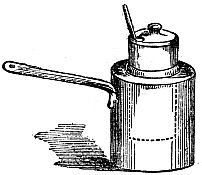
GLAZE-KETTLE.
This is a kettle used for keeping the strong stock boiled down to a jelly, which is known by the name of glaze. It is composed of two tin vessels, as shown in the cut, one of which, the upper,—containing the glaze, is inserted into one of larger diameter, and containing boiling water.
GLAZE, to, Cold Joints, &c.
Melt the glaze by placing the vessel which contains it, into the bain marie or saucepan of boiling water; brush it over the meat with a paste-brush, and if in places it is not quite covered, repeat the operation. The glaze should not be too dark a colour.
GOLDEN PUDDING.
Ingredients.—¼ lb. of bread-crumbs, ¼ lb. of suet, ¼ lb. of marmalade, ¼ lb. of sugar, 4 eggs. Mode.—Put the bread-crumbs into a basin; mix with them the suet, which should be finely minced, the marmalade, and the sugar; stir all these ingredients well together, beat the eggs to a froth, moisten the pudding with these, and when well mixed put it into a mould or buttered basin; tie down with a floured cloth, and boil for 2 hours. When turned out, strew a little fine-sifted sugar over the top, and serve. Time.—2 hours. Average cost, 11d. Sufficient for 5 or 6 persons. Seasonable at any time.
Note.—The mould may be ornamented with stoned raisins, arranged in any fanciful pattern, before the mixture is poured in, which would add very much to the appearance of the pudding. For a plainer pudding, double the quantities of the bread-crumbs; and if the eggs do not moisten it sufficiently, use a little milk.
GOOSE, Green.
Ingredients.—Goose, 3 oz. of butter, pepper and salt to taste. Mode.—Geese are called green till they are about four months old, and should not be stuffed. After it has been singed and trussed, put into the body a seasoning of pepper and salt, and the butter to moisten it inside. Roast before a clear fire for about ¾ hour, froth and brown it nicely, and serve with a brown gravy, and, when liked, gooseberry-sauce. This dish should be garnished with water-cresses. Time.—About ¾ hour. Average cost, 4s. 6d. each. Sufficient for 5 or 6 persons. Seasonable in June, July, and August.
GOOSE, Hashed.
[Cold Meat Cookery.] Ingredients.—The remains of cold roast goose, 2 onions, 2 oz. of butter, 1 pint of boiling water, 1 dessertspoonful of flour, pepper and salt to taste, 1 tablespoonful of port wine, 2 tablespoonfuls of mushroom ketchup. Mode.—Cut up the goose into pieces of the size required; the inferior joints, trimmings, &c., put into a stewpan to make the gravy; slice and fry the onions in the butter of a very pale brown; add these to the trimmings, and pour over about a pint of boiling water; stew these gently for ¾ hour, then skim and strain the liquor. Thicken it with flour, and flavour with port wine and ketchup in the above proportion; add a seasoning of pepper and salt, and put in the pieces of goose; let these get thoroughly hot through, but do not allow them to boil, and serve with sippets of toasted bread. Time.—Altogether, rather more than 1 hour. Average cost, exclusive of the cold goose, 4d. Seasonable from September to March.
GOOSE, Roast.

ROAST GOOSE.
Ingredients.—Goose, 4 large onions, 10 sage-leaves, ¼ lb. of bread-crumbs, 1½ oz. of butter, salt and pepper to taste, 1 egg. Choosing and Trussing.—Select a goose with a clean white skin, plump breast, and yellow feet: if these latter are red, the bird is old. Should the weather permit, let it hang for a few days; by so doing the flavour will be very much improved. Pluck, singe, draw, and carefully wash and wipe the goose; cut off the neck close to the back, leaving the skin long enough to turn over; cut off the feet at the first joint, and separate the pinions at the first joint. Beat the breastbone flat with a rolling-pin, put a skewer through the under part of each wing, and having drawn up the legs closely, put a skewer into the middle of each, and pass the same quite through the body. Insert another skewer into the small of the leg, bring it close down to the side-bone, run it through, and do the same to the other side. Now cut off the end of the vent, and make a hole in the skin sufficiently large for the passage of the rump, in order to keep in the seasoning. Mode.—Make a sage-and-onion stuffing of the above ingredients, put it into the body of the goose, and secure it firmly at both ends by passing the rump through the hole made in the skin, and the other end by tying the skin of the neck to the back: by this means the seasoning will not escape. Put it down to a brisk fire, keep it well basted, and roast from 1½ to 2 hours, according to the size. Remove the skewers, and serve with a tureen of good gravy, and one of well-made apple sauce. Should a very highly-flavoured seasoning be preferred, the onions should not be parboiled, but minced raw: of the two methods the mild seasoning is far superior. A ragoût, or pie, should be made of the giblets, or they may be stewed down to make gravy. Be careful to serve the goose before the breast falls, or its appearance will be spoiled by coming flattened to table. As this is rather a troublesome joint to carve, a large quantity of gravy should not be poured round the goose, but sent in a tureen. Time.—A large goose, 1¾ hour; a moderate-sized one, 1/¼ to 1½ hour. Seasonable from September to March; but in perfection from Michaelmas to Christmas. Average cost, 5s. 6d. each. Sufficient for 8 or 9 persons.
Note.—A teaspoonful of made mustard, a saltspoonful of salt, a few grains of cayenne, mixed with a glass of port wine, are sometimes poured into the goose by a slit made in the apron. This sauce is by many considered an improvement.
GOOSE, Roast, to Carve.

ROAST GOOSE.
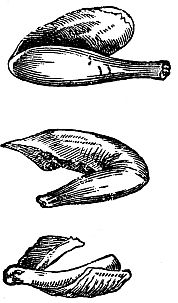
LEG, WING, AND NECK-BONE OF GOOSE.
It would not be fair to say that this dish bodes a great deal of happiness to an inexperienced carver, especially if there is a large party to serve, and the slices off the breast should not suffice to satisfy the desires and cravings of many wholesome appetites, produced, may be, by the various sports in vogue at Michaelmas and Christmas. The beginning of the task, however, is not in any way difficult. Evenly-cut slices, not too thick or too thin, should be carved from the breast in the direction of the line from 2 to 3; after the first slice has been cut, a hole should be made with the knife in the part called the apron, passing it round the line as indicated by the figures 1, 1, 1; here the stuffing is located, and some of this should be served on each plate, unless it is discovered that it is not agreeable to the taste of some one guest. If the carver manages cleverly, he will be able to cut a very large number of fine slices off the breast, and the more so if he commences close down by the wing, and carves upwards towards the ridge of the breastbone. As many slices as can be taken from the breast being carved, the wings should be cut off, and the same process as described in carving boiled fowl is made use of in this instance, only more dexterity and greater force will most probably be required. The shape of the leg, when disengaged from the body of the goose, should be like that shown in the accompanying engraving. It will be necessary, perhaps, in taking off the leg, to turn the goose on its side, and then, pressing down the small end of the leg, the knife should be passed under it from the top quite down to the joint; the leg being now turned back by the fork, the knife must cut through the joint, loosening the thighbone from its socket. The merrythought, which in a goose is not so large as might be expected, is disengaged in the same way as that of a fowl—by passing the knife under it, and pressing it backwards towards the neck. The neck-bones, of which we give a cut, are freed by the same process as are those of a fowl; and the same may be said of all the other parts of this bird. The breast of a goose is the part most esteemed; all parts, however, are good, and full of juicy flavour.
GOOSE STUFFING, Soyer’s Recipe for.
Take 4 apples peeled and cored, 4 onions, 4 leaves of sage, and 4 leaves of lemon thyme not broken, and boil them in a stewpan with sufficient water to cover them; when done, pulp them through a sieve, removing the sage and thyme; then add sufficient pulp of mealy potatoes to cause it to be sufficiently dry without sticking to the hand; add pepper and salt, and stuff the bird.
GOOSEBERRIES, Compôte of.
Ingredients.—Syrup; to 1 pint of syrup allow nearly a quart of gooseberries. Mode.—Top and tail the gooseberries, which should not be very ripe, and pour over them some boiling water; then take them out and plunge them into cold water with which has been mixed a tablespoonful of vinegar, which will assist to keep the fruit a good colour. Make a pint of syrup, and when it boils drain the gooseberries and put them in; simmer them gently until the fruit is nicely pulped and tender without being broken; then dish the gooseberries on a glass dish, boil the syrup for 2 or 3 minutes, pour over the gooseberries, and serve cold. Time.—About 5 minutes to boil the gooseberries in the syrup, 3 minutes to reduce the syrup. Average cost, 9d. Sufficient.—A quart of gooseberries for 5 or 6 persons. Seasonable in June.
GOOSEBERRY CHIPS. (Useful for Dessert.)
Ingredients.—Gooseberries unripe and green, but quite full-grown; sifted loaf sugar. Mode.—Put the gooseberries, when cleaned of tops and tails, into jars, and boil them in a copper till quite soft. To every lb. of pulp put ½ lb. of loaf sugar sifted: the sugar must be stirred in very gently. Then pour out the sweetened pulp on flat dishes, about ⅛ inch thick, which must be set in the sun to dry. When sufficiently dried in the sun, the pulp may be cut into strips, and twisted into any fanciful shapes, bows, &c. Time for drying, according to the amount of sun. Seasonable at all times.
Note.—These chips may be kept for years in tin boxes, if packed quite dry, with layers of paper between the rows.
GOOSEBERRY FOOL.
Ingredients.—Green gooseberries; to every pint of pulp add 1 pint of milk, or ½ pint of cream and ½ pint of milk; sugar to taste. Mode.—Cut the tops and tails off the gooseberries, put them into a jar with 2 tablespoonfuls of water and a little good moist sugar; set this jar in a saucepan of boiling water, and let it boil until the fruit is soft enough to mash. When done enough, beat it to a pulp, work this pulp through a colander, and stir to every pint the above proportion of milk, or equal quantities of milk and cream. Ascertain if the mixture is sweet enough, and put in plenty of sugar, or it will not be eatable; and in mixing the milk and gooseberries add the former very gradually to these: serve in a glass dish, or in small glasses. This, although a very old-fashioned and homely dish, is, when well made, very delicious, and, if properly sweetened, a very suitable preparation for children. Time.—From ¾ to 1 hour. Average cost, 6d. per pint, with milk. Sufficient.—A pint of milk and a pint of gooseberry pulp for 5 or 6 children. Seasonable in May and June.
GOOSEBERRY JAM.
Ingredients.—To every lb. of fruit allow ¾ lb. of loaf sugar; currant-juice. Mode.—Select red hairy gooseberries; have them gathered in dry weather, when quite ripe, without being too soft. Weigh them; with a pair of scissors cut off the tops and tails, and to every 6 lbs. of fruit have ready ½ pint of red-currant juice, drawn as for jelly. Put the gooseberries and currant-juice into a preserving-pan, let them boil tolerably quickly, keeping them well stirred; when they begin to break, add to them the sugar, and keep simmering until the jam becomes firm, carefully skimming and stirring it, that it does not burn at the bottom. It should be boiled rather a long time, or it will not keep. Put it into pots (not too large), let it get perfectly cold, then cover the pots down with oiled and egged papers. Time.—About 1 hour to boil the gooseberries in the currant-juice, from ½ to ¾ hour with the sugar. Average cost, per lb. pot, from 6d. to 8d. Sufficient.—Allow 1½ pint of fruit for a lb. pot. Seasonable.—Make this in June or July.
GOOSEBERRY JAM.
Ingredients.—To every 8 lbs. of red, rough, ripe gooseberries allow 1 quart of red-currant juice, 5 lbs. of loaf sugar. Mode.—Have the fruit gathered in dry weather, and cut off the tops and tails. Prepare 1 quart of red-currant juice, the same as for red-currant jelly; put it into a preserving-pan with the sugar, and keep stirring until the latter is dissolved. Keep it boiling for about 5 minutes; skim well; then put in the gooseberries, and let them boil from ½ to ¾ hour; then turn the whole into an earthen pan, and let it remain for 2 days. Boil the jam up again until it looks clear; put it into pots, and when cold, cover with oiled paper, and over the jars put tissue-paper brushed over on both sides with the white of an egg, and store away in a dry place. Care must be taken, in making this, to keep the jam well stirred and well skimmed, to prevent it burning at the bottom of the pan, and to have it very clear. Time.—5 minutes to boil the currant-juice and sugar after the latter is dissolved; from ½ to ¾ hour to simmer the gooseberries the first time, ¼ hour the second time of boiling. Average cost, from 8d. to 10d. per lb. pot. Sufficient.—Allow 1½ pint of fruit for a lb. pot. Seasonable.—Make this in June or July.
GOOSEBERRY JAM, White or Green.
Ingredients.—Equal weight of fruit and sugar. Mode.—Select the gooseberries not very ripe, either white or green, and top and tail them. Boil the sugar with water (allowing ½ pint to every lb.) for about ¼ hour, carefully removing the scum as it rises; then put in the gooseberries, and simmer gently till clear and firm: try a little of the jam on a plate; if it jellies when cold, it is done, and should then be poured into pots. When cold, cover with oiled paper, and tissue-paper brushed over on both sides with the unbeaten white of an egg, and stow away in a dry place. Time.—¼ hour to boil the sugar and water, ¾ hour the jam. Average cost, from 6d. to 8d. per lb. pot. Sufficient.—Allow 1½ pint of fruit for a lb. pot. Seasonable.—Make this in June.
GOOSEBERRY JELLY.
Ingredients.—Gooseberries; to every pint of juice allow ¾ lb. of loaf sugar. Mode.—Put the gooseberries, after cutting off the tops and tails, into a preserving-pan, and stir them over the fire until they are quite soft; then strain them through a sieve, and to every pint of juice allow ¾ lb. of sugar. Boil the juice and sugar together for nearly ¾ hour, stirring and skimming all the time; and if the jelly appears firm when a little of it is poured on to a plate, it is done, and should then be taken up and put into small pots. Cover the pots with oiled and egged papers, the same as for currant jelly, and store away in a dry place. Time.—¾ hour to simmer the gooseberries without the sugar; ¾ hour to boil the juice. Average cost, from 8d. to 10d. per ½-lb. pot. Seasonable in July.
GOOSEBERRY PUDDING, Baked.
Ingredients.—Gooseberries, 3 eggs, 1½ oz. of butter, ½ pint of bread-crumbs, sugar to taste. Mode.—Put the gooseberries into a jar, previously cutting off the tops and tails; place this jar in boiling water, and let it boil until the gooseberries are soft enough to pulp; then beat them through a coarse sieve, and to every pint of pulp add 3 well-whisked eggs, 1½ oz. of butter, ½ pint of bread-crumbs, and sugar to taste; beat the mixture well, put a border of puff-paste round the edge of a pie-dish, put in the pudding, bake for about 40 minutes, strew sifted sugar over, and serve. Time.—About 40 minutes. Average cost, 10d. Sufficient for 4 or 5 persons. Seasonable from May to July.
GOOSEBERRY PUDDING, Boiled.

BOILED FRUIT PUDDING
Ingredients.—¾ lb. of suet crust, 1½ pint of green gooseberries, ¼ lb. of moist sugar. Mode.—Line a pudding-basin with suet crust rolled out to about ½ inch in thickness, and, with a pair of scissors, cut off the tops and tails of the gooseberries; fill the basin with the fruit, put in the sugar, and cover with crust. Pinch the edges of the pudding together, tie over it a floured cloth, put it into boiling water, and boil from 2½ to 3 hours; turn it out of the basin, and serve with a jug of cream. Time.—2½ to 3 hours. Average cost, 10d. Sufficient for 6 or 7 persons. Seasonable from May to July.
GOOSEBERRY SAUCE for Boiled Mackerel.
Ingredients.—1 pint of green gooseberries, 3 tablespoonfuls of Béchamel (veal gravy may be substituted for this), 2 oz. of fresh butter; seasoning to taste of salt, pepper, and grated nutmeg. Mode.—Boil the gooseberries in water until quite tender; strain them, and rub them through a sieve. Put into a saucepan the Béchamel or gravy, with the butter and seasoning; add the pulp from the gooseberries, mix all well together, and heat gradually through. A little pounded sugar added to this sauce is by many persons considered an improvement, as the saccharine matter takes off the extreme acidity of the unripe fruit. Time.—Boil the gooseberries from 20 minutes to ½ hour. Sufficient.—This quantity, for a large dish of mackerel. Seasonable from May to July.
GOOSEBERRY TART.
Ingredients.—1½ pint of gooseberries, ½ lb. of short crust, ¼ lb. of moist sugar. Mode.—With a pair of scissors cut off the tops and tails of the gooseberries; put them into a deep pie-dish, pile the fruit high in the centre, and put in the sugar; line the edge of the dish with short crust, put on the cover, and ornament the edges of the tart; bake in a good oven for about ¾ hour, and before being sent to table, strew over it some fine-sifted sugar. A jug of cream, or a dish of boiled or baked custards, should always accompany this dish. Time.—¾ hour. Average cost, 9d. Sufficient for 5 or 6 persons. Seasonable from May to July.
GOOSEBERRY TRIFLE.
Ingredients.—1 quart of gooseberries, sugar to taste, 1 pint of custard, a plateful of whipped cream. Mode.—Put the gooseberries into a jar, with sufficient moist sugar to sweeten them, and boil them until reduced to a pulp. Put this pulp at the bottom of a trifle-dish; pour over it a pint of custard made by recipe, and, when cold, cover with whipped cream. The cream should be whipped the day before it is wanted for table, as it will then be so much firmer and more solid; but it should not be added to the fruit until a short time before it is required. The dish may be garnished as fancy dictates. Time.—About ¾ hour to boil the gooseberries. Average cost, 1s. 6d. Sufficient for 1 trifle. Seasonable in May, June, and July.
GOOSEBERRY VINEGAR. (An Excellent Recipe.)
Ingredients.—2 pecks of crystal gooseberries, 6 gallons of water, 12 lbs. of foots sugar of the coarsest brown quality. Mode.—Mash the gooseberries (which should be quite ripe) in a tub with a mallet; put to them the water nearly milk-warm; let this stand 24 hours; then strain it through a sieve, and put the sugar to it; mix it well, and tun it. These proportions are for a 9-gallon cask; and if it be not quite full, more water must be added. Let the mixture be stirred from the bottom of the cask two or three times daily for three or four days, to assist the melting of the sugar; then paste a piece of linen cloth over the bunghole, and set the cask in a warm place, but not in the sun; any corner of a warm kitchen is the best situation for it. The following spring it should be drawn off into stone bottles, and the vinegar will be fit for use twelve months after it is made. This will be found a most excellent preparation, greatly superior to much that is sold under the name of the best white wine vinegar. Many years’ experience has proved that pickle made with this vinegar will keep, when bought vinegar will not preserve the ingredients. The cost per gallon is merely nominal, especially to those who reside in the country and grow their own gooseberries; the coarse sugar is then the only ingredient to be purchased. Time.—To remain in the cask 9 months. Average cost, when the gooseberries have to be purchased, 1s. per gallon; when they are grown at home, 6d. per gallon. Seasonable.—This should be made the end of June or the beginning of July, when gooseberries are ripe and plentiful.
GOOSEBERRY WINE, Effervescing.
Ingredients.—To every gallon of water allow 6 lbs. of green gooseberries, 3 lbs. of lump sugar. Mode.—This wine should be prepared from unripe gooseberries, in order to avoid the flavour which the fruit would give to the wine when in a mature state. Its briskness depends more upon the time of bottling than upon the unripe state of the fruit, for effervescing wine can be made from fruit that is ripe as well as that which is unripe. The fruit should be selected when it has nearly attained its full growth, and consequently before it shows any tendency to ripen. Any bruised or decayed berries, and those that are very small, should be rejected. The blossom and stalk ends should be removed, and the fruit well bruised in a tub or pan, in such quantities as to insure each berry being broken without crushing the seeds. Pour the water (which should be warm) on the fruit, squeeze and stir it with the hand until all the pulp is removed from the skin and seeds, and cover the whole closely for 24 hours; after which, strain it through a coarse bag, and press it with as much force as can be conveniently applied, to extract the whole of the juice and liquor the fruit may contain. To every 40 or 50 lbs. of fruit one gallon more of hot water may be passed through the marc, or husks, in order to obtain any soluble matter that may remain, and be again pressed. The juice should be put into a tub or pan of sufficient size to contain all of it, and the sugar added to it. Let it be well stirred until the sugar is dissolved, and place the pan in a warm situation; keep it closely covered, and let it ferment for a day or two. It must then be drawn off into clean casks, placed a little on one side for the scum that arises to be thrown out, and the casks kept filled with the remaining “must,” that should be reserved for that purpose. When the active fermentation has ceased, the casks should be plugged upright, again filled, if necessary, the bungs be put in loosely, and, after a few days, when the fermentation is a little more languid (which may be known by the hissing noise ceasing), the bungs should be driven in tight, and a spile-hole made, to give vent if necessary. About November or December, on a clear fine day, the wine should be racked from its lees into clean casks, which may be rinsed with brandy. After a month, it should be examined to see if it is sufficiently clear for bottling; if not, it must be fined with isinglass, which may be dissolved in some of the wine: 1 oz. will be sufficient for 9 gallons. In bottling the wine, it will be necessary to wire the corks down, or to tie them down with string. Old champagne bottles are the best for this wine. In March or April, or when the gooseberry bushes begin to blossom, the wine must be bottled, in order to insure its being effervescing. Seasonable.—Make this the end of May or beginning of June, before the berries ripen.
GRAVIES, General Stock for
By the addition of various store sauces, thickening and flavouring, good stock may be converted into good gravies. It should be borne in mind, however, that the goodness and strength of spices, wines, flavourings, &c., evaporate, and that they lose a great deal of their fragrance if added to the gravy a long time before they are wanted. If this point is attended to, a saving of one half the quantity of these ingredients will be effected, as, with long boiling, the flavour almost entirely passes away. The shank-bones of mutton, previously well soaked, will be found a great assistance in enriching gravies; a kidney or melt, beef skirt, trimmings of meat, &c. &c., answer very well when only a small quantity is wanted, and a good gravy need not necessarily be so very expensive; for economically-prepared dishes are oftentimes found as savoury and wholesome as dearer ones. The cook should also remember that the fragrance of gravies should not be overpowered by too much spice, or any strong essences, and that they should always be warmed in a bain marie, after they are flavoured, or else in a jar or jug placed in a saucepan full of boiling water. The remains of roast-meat gravy should always be saved; as, when no meat is at hand, a very nice gravy in haste may be made from it, and when added to hashes, ragoûts, &c., is a great improvement.
GRAVY, a Good Beef, for Poultry, Game, &c.
Ingredients.—½ lb. of lean beef, ½ pint of cold water, 1 shalot or small onion, ½ a teaspoonful of salt, a little pepper, 1 tablespoonful of Harvey’s sauce or mushroom ketchup, ½ a teaspoonful of arrowroot. Mode.—Cut up the beef into small pieces, and put it, with the water, into a stewpan. Add the shalot and seasoning, and simmer gently for 3 hours, taking care that it does not boil fast. A short time before it is required, take the arrowroot, and having mixed it with a little cold water, pour it into the gravy, which keep stirring, adding the Harvey’s sauce, and just letting it boil. Strain off the gravy in a tureen, and serve very hot. Time.—3 hours. Average cost, 8d. per pint.
GRAVY, Beef, a Quickly Made.
Ingredients.—½ lb. of shin of beef, ½ onion, ¼ carrot, 2 or 3 sprigs of parsley and savoury herbs, a piece of butter about the size of a walnut; cayenne and mace to taste, ¾ pint of water. Mode.—Cut up the meat into very small pieces, slice the onion and carrot, and put them into a small saucepan with the butter. Keep stirring over a sharp fire until they have taken a little colour, when add the water and the remaining ingredients. Simmer for ½ hour, skim well, strain, and flavour, when it will be ready for use. Time.—½ hour. Average cost, for this quantity, 5d.
GRAVY, Brown.
Ingredients.—2 oz. of butter, 2 large onions, 2 lbs. of shin of beef, 2 small slices of lean bacon (if at hand), salt and whole pepper to taste, 3 cloves, 2 quarts of water. For thickening, 2 oz. of butter, 3 oz. of flour. Mode.—Put the butter into a stewpan; set this on the fire, throw in the onions cut in rings, and fry them a light brown; then add the beef and bacon, which should be cut into small square pieces; season, and pour in a teacupful of water; let it boil for about ten minutes, or until it is of a nice brown colour, occasionally stirring the contents. Now fill up with water in the above proportion; let it boil up, when draw it to the side of the fire to simmer very gently for 1½ hour; strain, and when cold, take off all the fat. In thickening this gravy, melt 3 oz. of butter in a stewpan, add 2 oz. of flour, and stir till of a light-brown colour; when cold, add it to the strained gravy, and boil it up quickly. This thickening may be made in larger quantities, and kept in a stone jar for use when wanted. Time.—Altogether, 2 hours. Average cost, 4d. per pint.
GRAVY, Brown, without Meat.
Ingredients.—2 large onions, 1 large carrot, 2 oz. of butter, 3 pints of boiling water, 1 bunch of savoury herbs, a wineglassful of good beer; salt and pepper to taste. Mode.—Slice, flour, and fry the onions and carrots in the butter until of a nice light-brown colour, then add the boiling water and the remaining ingredients; let the whole stew gently for about an hour, then strain, and when cold, skim off all the fat. Thicken it, and, if thought necessary, add a few drops of colouring. Time.—1 hour. Average cost, 2d. per pint.
Note.—The addition of a small quantity of mushroom ketchup or Harvey’s sauce very much improves the flavour of this gravy.
GRAVY, Cheap, for Minced Veal
Ingredients.—Bones and trimmings of cold roast or boiled veal, 1½ pint of water, 1 onion, ¼ teaspoonful of minced lemon-peel, ¼ teaspoonful of salt, 1 blade of pounded mace, the juice of ¼ lemon; thickening of butter and flour. Mode.—Put all the ingredients into a stewpan, except the thickening and lemon-juice, and let them simmer very gently for rather more than 1 hour, or until the liquor is reduced to a pint, when strain through a hair sieve. Add a thickening of butter and flour, and the lemon-juice; set it on the fire, and let it just boil up, when it will be ready for use. It may be flavoured with a little tomato sauce, and, where a rather dark-coloured gravy is not objected to, ketchup, or Harvey’s sauce, may be added at pleasure. Time.—Rather more than 1 hour. Average cost, 3d.
GRAVY, Cheap, for Hashes, &c.
Ingredients.—Bones and trimmings of the cooked joint intended for hashing, ¼ teaspoonful of salt, ¼ teaspoonful of whole pepper, ¼ teaspoonful of whole allspice, a small faggot of savoury herbs, ½ head of celery, 1 onion, 1 oz. of butter, thickening, sufficient boiling water to cover the bones. Mode.—Chop the bones in small pieces, and put them in a stewpan, with the trimmings, salt, pepper, spice, herbs, and celery. Cover with boiling water, and let the whole simmer gently for 1½ or 2 hours. Slice and fry the onion in the butter till it is of a pale brown, and mix it gradually with the gravy made from the bones; boil for ¼ hour, and strain into a basin; now put it back into the stewpan; flavour with walnut pickle or ketchup, pickled-onion liquor, or any store sauce that may be preferred. Thicken with a little butter and flour, kneaded together on a plate, and the gravy will be ready for use. After the thickening is added, the gravy should just boil, to take off the rawness of the flour. Time.—2 hours, or rather more. Average cost, 4d., exclusive of the bones and trimmings.
GRAVY for Roast Meat.
Ingredients.—Gravy, salt. Mode.—Put a common dish with a small quantity of salt in it under the meat, about a quarter of an hour before it is removed from the fire. When the dish is full, take it away, baste the meat, and pour the gravy into the dish on which the joint is to be served.
GRAVY for Venison.
Ingredients.—Trimmings of venison, 3 or 4 mutton shank-bones, salt to taste, 1 pint of water, 2 teaspoonfuls of walnut ketchup. Mode.—Brown the trimmings over a nice clear fire, and put them in a stewpan with the shank-bones and water; simmer gently for 2 hours, strain and skim, and add the walnut ketchup and a seasoning of salt. Let it just boil, when it is ready to serve. Time.—2 hours.
GRAVY, Jugged (Excellent).
Ingredients.—2 lbs. of shin of beef, ¼ lb. of lean ham, 1 onion or a few shalots, 2 pints of water, salt and whole pepper to taste, 1 blade of mace, a faggot of savoury herbs, ½ a large carrot, ½ a head of celery. Mode.—Cut up the beef and ham into small pieces, and slice the vegetables; take a jar, capable of holding two pints of water, and arrange therein, in layers, the ham, meat, vegetables, and seasoning, alternately, filling up with the above quantity of water; tie down the jar, or put a plate over the top, so that the steam may not escape; place it in the oven, and let it remain there from 6 to 8 hours; should, however, the oven be very hot, less time will be required. When sufficiently cooked, strain the gravy, and when cold, remove the fat. It may be flavoured with ketchup, wines, or any other store sauce that may be preferred. It is a good plan to put the jar in a cool oven over-night, to draw the gravy; and then it will not require so long baking the following day. Time.—From 6 to 8 hours, according to the oven. Average cost, 7d. per pint.
GRAVY-KETTLE.
This is a utensil which will not be found in every kitchen; but it is a useful one where it is necessary to keep gravies hot for the purpose of pouring over various dishes as they are cooking. It is made of copper, and should, consequently, be heated over the hot-plate, if there be one, or a charcoal stove.
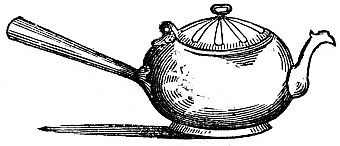
GRAVY-KETTLE.
GRAVY made without Meat for Fowls.
Ingredients.—The necks, feet, livers, and gizzards of the fowls, 1 slice of toasted bread, ½ onion, 1 faggot of savoury herbs, salt and pepper to taste, ½ pint of water, thickening of butter and flour, 1 dessertspoonful of ketchup. Mode.—Wash the feet of the fowls thoroughly clean, and cut them and the neck into small pieces. Put these into a stewpan with the bread, onion, herbs, seasoning, livers, and gizzards; pour the water over them and simmer gently for 1 hour. Now take out the liver, pound it, and strain the liquor to it. Add a thickening of butter and flour, and a flavouring of mushroom ketchup; boil it up and serve. Time.—1 hour. Average cost, 4d. per pint.
GRAVY, Rich, for Hashes, Ragoûts, &c.
Ingredients.—2 lbs. of shin of beef, l large onion or a few shalots, a little flour, a bunch of savoury herbs, 2 blades of mace, 2 or 3 cloves, 4 whole allspice, ¼ teaspoonful of whole pepper, 1 slice of lean ham or bacon, ½ a head of celery (when at hand), 2 pints of boiling water; salt and cayenne to taste. Mode.—Cut, the beef into thin slices, as also the onions, dredge them with flour, and fry of a pale brown, but do not allow them to get black; pour in the boiling water, let it boil up, and skim. Add the remaining ingredients, and simmer the whole very gently for 2 hours, or until all the juices are extracted from the meat; put it by to get cold, when take off all the fat. This gravy may be flavoured with ketchup, store sauces, wine, or, in fact, anything that may give additional and suitable relish to the dish it is intended for. Time.—Rather more than 2 hours. Average cost, 8d. per pint.
GRAVY SOUP.
Ingredients.—6 lbs. of shin of beef, a knuckle of veal weighing 5 lbs., a few pieces or trimmings, 2 slices of nicely-flavoured lean ham; ¼ lb. of butter, 4 onions, 4 carrots, 1 turnip, nearly a head of celery, 3 blades of mace, 6 cloves, a bunch of savoury herbs, seasoning of salt and pepper to taste, 3 lumps of sugar, 6 quarts of boiling soft water. It can be flavoured with ketchup, Leamington sauce, Harvey’s sauce, and a little soy. Mode.—Slightly brown the meat and ham in the butter, but do not let them burn. When this is done, pour to it the water, and as the scum rises, take it off; when no more appears, add all the other ingredients, and let the soup simmer slowly by the fire for 6 hours without stirring it any more from the bottom; take it off, and let it settle; skim off all the fat you can, and pass it through a sieve or cloth. When perfectly cold you can remove all the fat, and leave the sediment untouched, which serves very nicely for thick gravies, hashes, &c. Time.—7 hours. Average cost, 1s. per quart. Seasonable all the year. Sufficient for 14 persons.
GRAVY, Veal, for White Sauces, Fricassees, &c.
Ingredients.—2 slices of nicely-flavoured lean ham, any poultry trimmings, 3 lbs. of lean veal, a faggot of savoury herbs, including parsley, a few green onions (or 1 large onion may be substituted for these), a few mushrooms, when obtainable; 1 blade of mace, salt to taste, 3 pints of water. Mode.—Cut up the ham and veal into small square pieces, put these in a stewpan, moistening them with a small quantity of water; place them over the fire to draw down. When the bottom of the stewpan becomes covered with a white glaze, fill up with water in the above proportion; add the remaining ingredients, stew very slowly for 3 or 4 hours, and do not forget to skim well the moment it boils. Put it by, and when cold take off all the fat. This may be used for Béchamel, sauce tournée, and many other white sauces. Time.—3 or 4 hours. Average cost, 9d. per pint.
GREENGAGE JAM.
Ingredients.—To every lb. of fruit, weighed before being stoned, allow ¾ lb. of lump sugar. Mode.—Divide the greengages, take out the stones, and put them into a preserving-pan. Bring the fruit to a boil, then add the sugar, and keep stirring it over a gentle fire until it is melted. Remove all the scum as it rises, and, just before the jam is done, boil it rapidly for 5 minutes. To ascertain when it is sufficiently boiled, pour a little on a plate, and if the syrup thickens and appears firm, it is done. Have ready half the kernels blanched; put them into the jam, give them one boil, and pour the preserve into pots. When cold, cover down with oiled papers, and, over these, tissue paper brushed over on both sides with the white of an egg. Time.—¾ hour after the sugar is added. Average cost, from 6d. to 8d. per lb. pot. Sufficient.—Allow about 1½ pint of fruit for every lb. pot of jam. Seasonable.—Make this in August or September.
GREENGAGES, Compôte of.
Ingredients.—1 pint of syrup, 1 quart of greengages. Mode.—Make a syrup, skim it well, and put in the greengages when the syrup is boiling, having previously removed the stalks and stones from the fruit. Boil gently for ¼ hour, or until the fruit is tender; but take care not to let it break, as the appearance of the dish would be spoiled were the fruit reduced to a pulp. Take the greengages carefully out, place them on a glass dish, boil the syrup for another 5 minutes, let it cool a little, pour over the fruit, and, when cold, it will be ready for use. Time.—¼ hour to simmer the fruit, 5 minutes the syrup. Average cost, in full season, 10d. Sufficient for 4 or 5 persons. Seasonable in July, August, and September.
GREENGAGES, to Preserve and Dry.
Ingredients.—To every lb. of sugar allow 1 lb. of fruit, ¼ pint of water. Mode.—For this purpose, the fruit must be used before it is quite ripe, and part of the stalk must be left on. Weigh the fruit, rejecting all that is in the least degree blemished, and put it into a lined saucepan with the sugar and water, which should have been previously boiled together to a rich syrup. Boil the fruit in this for 10 minutes, remove it from the fire, and drain the greengages. The next day, boil up the syrup and put in the fruit again, and let it simmer for 3 minutes, and drain the syrup away. Continue this process for 5 or 6 days, and the last time place the greengages, when drained, on a hair sieve, and put them in an oven or warm spot to dry; keep them in a box, with paper between each layer, in a place free from damp. Time.—10 minutes the first time of boiling. Seasonable.—Make this in August or September.
GREENGAGES, Preserved in Syrup.
Ingredients.—To every lb. of fruit allow 1 lb. of loaf sugar, ¼ pint of water. Mode.—Boil the sugar and water together for about 10 minutes; divide the greengages, take out the stones, put the fruit into the syrup, and let it simmer gently until nearly tender. Take it off the fire, put it into a large pan, and, the next day, boil it up again for about 10 minutes with the kernels from the stones, which should be blanched. Put the fruit carefully into jars, pour over it the syrup, and, when cold, cover down, so that the air is quite excluded. Let the syrup be well skimmed both the first and second day of boiling, otherwise it will not be clear. Time.—10 minutes to boil the syrup; ¼ hour to simmer the fruit the first day, 10 minutes the second day. Average cost, from 6d. to 8d. per lb. pot. Sufficient.—Allow about 1 pint of fruit to fill a 1-lb. pot. Seasonable.—Make this in August or September.
GREENS, Boiled Turnip.
Ingredients.—To each ½ gallon of water allow 1 heaped tablespoonful of salt; turnip-greens. Mode.—Wash the greens well in two or three waters, and pick off all the decayed and dead leaves; tie them in small bunches, and put them into plenty of boiling water, salted in the above proportion. Keep them boiling quickly, with the lid of the saucepan uncovered, and when tender, pour them into a colander; let them drain, arrange them in a vegetable-dish, remove the string that the greens were tied with, and serve. Time.—15 to 20 minutes. Average cost, 4d. for a dish for 3 persons. Seasonable in March, April, and May.
GROUSE PIE.
Ingredients.—Grouse; cayenne, salt, and pepper to taste; 1 lb. of rump-steak, ½ pint of well-seasoned broth, puff-paste. Mode.—Line the bottom of a pie-dish with the rump-steak cut into neat pieces, and, should the grouse be large, cut them into joints; but, if small, they may be laid in the pie whole; season highly with salt, cayenne, and black pepper; pour in the broth, and cover with a puff-paste; brush the crust over with the yolk of an egg, and bake from ¾ to 1 hour. If the grouse is cut into joints, the backbones and trimmings will make the gravy, by stewing them with an onion, a little sherry, a bunch of herbs, and a blade of mace: this should be poured in after the pie is baked. Time.—¾ to 1 hour. Average cost, exclusive of the grouse, which are seldom bought, 1s. 9d. Seasonable from the 12th of August to the beginning of December.

ROAST GROUSE.
GROUSE, Roast.
Ingredients.—Grouse, butter, a thick slice of toasted bread. Mode.—Let the birds hang as long as possible; pluck and draw them; wipe, but do not wash them, inside and out, and truss them without the head, the same as for a roast fowl. Many persons still continue to truss them with the head under the wing, but the former is now considered the most approved method. Put them down to a sharp clear fire; keep them well basted the whole of the time they are cooking, and serve them on a buttered toast, soaked in the dripping-pan, with a little melted butter poured over them, or with bread-sauce and gravy. Time.—½ hour; if liked very thoroughly done, 35 minutes. Average cost, 2s. to 2s. 6d. the brace; but seldom bought. Sufficient.—2 for a dish. Seasonable from the 12th of August to the beginning of December.
GROUSE, to Carve.
Grouse may be carved in the way first described in carving partridge. The backbone of the grouse is highly esteemed by many, and this part of many game birds is considered the finest-flavoured.

ROAST GROUSE.
GROUSE SALAD (Soyer’s Recipe improved.)
Ingredients.—8 eggs, butter, fresh salad, 2 or 3 grouse; for the sauce, 1 tablespoonful of minced shalot, 2 tablespoonfuls of pounded sugar, the yolks of 2 eggs, 1 teaspoonful of minced parsley, ¼ oz. of salt, 12 tablespoonfuls of oil, 4 tablespoonfuls of Chili vinegar, 1 gill of cream, 2 tablespoonfuls of chopped tarragon and chervil. Mode.—Boil the eggs hard, shell them, throw them into cold water, cut a thin slice off the bottom to facilitate the proper placing of them in the dish, cut each one into four lengthwise, and make a very thin flat border of butter, about one inch from the edge of the dish the salad is to be served on; fix the pieces of egg upright close to each other, the yolk outside, or the yolk and white alternately; lay in the centre a fresh salad of whatever is in season, and, having previously roasted the grouse rather underdone, cut it into eight or ten pieces, and prepare the sauce as follows:—Put the shalots into a basin, with the sugar, the yolk of an egg, the parsley, and salt, and mix in by degrees the oil and vinegar; when all the ingredients are well mixed, put the sauce on ice or in a cool place. When ready to serve, whip the cream rather thick, which lightly mix with it; then lay the inferior parts of the grouse on the salad, sauce over so as to cover each piece, then lay over the salad and the remainder of the grouse, pour the rest of the sauce over, and serve. The eggs may be ornamented with a little dot of radishes or beetroot on the point. Anchovy and gherkin, cut into small diamonds, may be placed between, or cut gherkins in slices, and a border of them laid round. Tarragon or chervil-leaves are also a pretty addition. The remains of cold black-game, pheasant, or partridge may be used in the above manner, and will make a very delicate dish. Average cost, 2s. 6d. Seasonable from the 12th of August to the beginning of December.
GRUEL, to make.
Ingredients.—1 tablespoonful of Robinson’s patent groats, 2 tablespoonfuls of cold water, 1 pint of boiling water. Mode.—Mix the prepared groats smoothly with the cold water in a basin; pour over them the boiling water, stirring it all the time. Put it into a very clean saucepan; boil the gruel for 10 minutes, keeping it well stirred; sweeten to taste, and serve. It may be flavoured with a small piece of lemon-peel, by boiling it in the gruel, or a little grated nutmeg may be put in; but in these matters the taste of the patient should be consulted. Pour the gruel in a tumbler, and serve. When wine is allowed to the invalid, 2 tablespoonfuls of sherry or port make this preparation very nice. In cases of colds, the same quantity of spirits is sometimes added instead of wine. Time.—10 minutes. Sufficient to make a pint of gruel.
GUDGEONS.
Ingredients.—Egg and bread-crumbs sufficient for the quantity of fish; hot lard. Mode.—Do not scrape off the scales, but take out the gills and inside, and cleanse thoroughly; wipe them dry, flour and dip them into egg, and sprinkle over with bread-crumbs. Fry of a nice brown. Time.—3 or 4 minutes. Average cost.—Seldom bought. Seasonable from March to July. Sufficient.—3 for each person.
GUINEA-FOWL, Roast, Larded.
Ingredients.—A guinea-fowl, lardoons, flour, and salt. Mode.—When this bird is larded, it should be trussed the same as a pheasant; if plainly roasted, truss it like a turkey. After larding and trussing it, put it down to roast at a brisk fire; keep it well basted, and a short time before serving, dredge it with a little flour, and let it froth nicely. Serve with a little gravy in the dish, and a tureen of the same, and one of well-made bread-sauce. Time.—Guinea-fowl, larded, 1¼ hour; plainly roasted, about 1 hour. Sufficient for 6 persons. Seasonable in winter.
Note.—The breast, if larded, should be covered with a piece of paper, and removed about 10 minutes before serving.
GURNET, or GURNARD.
Ingredients.—1 gurnet, 6 oz. of salt to each gallon of water. Mode.—Cleanse the fish thoroughly, and cut off the fins; have ready some boiling water, with salt in the above proportion; put the fish in, and simmer very gently for ½ hour. Parsley and butter, or anchovy sauce, should be served with it. Time.—¼ hour. Average cost.—Seldom bought. Seasonable from October to March, but in perfection in October. Sufficient.—A middling-sized one for two persons.
Note.—This fish is frequently stuffed with forcemeat, and baked.
HADDOCK, Baked.
Ingredients.—A nice forcemeat, butter to taste, egg and bread-crumbs. Mode.—Scale and clean the fish, without cutting it open much; put in a nice delicate forcemeat, and sew up the slit. Brush it over with egg, sprinkle over bread-crumbs, and baste frequently with butter. Garnish with parsley and cut lemon, and serve with, a nice brown gravy, plain melted butter, or anchovy sauce. The egg and bread-crumbs can be omitted, and pieces of butter placed over the fish. Time.—Large haddock, ¾ hour; moderate size, ¼ hour. Seasonable from August to February. Average cost, from 9d. upwards.
Note.—Haddocks may be filleted, rubbed over with egg and bread-crumbs, and fried a nice brown; garnish with crisped parsley.
HADDOCK, Boiled.
Ingredients.—Sufficient water to cover the fish; ¼ lb. of salt to each gallon of water. Mode.—Scrape the fish, take out the inside, wash it thoroughly, and lay it in a kettle, with enough water to cover it, and salt in the above proportion. Simmer gently from 15 to 20 minutes, or rather more, should the fish be very large. For small haddocks, fasten the tails in their mouths, and put them into boiling water. 10 to 15 minutes will cook them. Serve with plain melted butter, or anchovy sauce. Time.—Large haddock, ½ hour; small, ¼ hour, or rather less. Average cost, from 9d. upwards. Seasonable from August to February.
HADDOCK, Dried.
Dried haddock should be gradually warmed through, either before or over a nice clear fire. Rub a little piece of butter over, just before sending it to table.
HADDOCK, Dried.
Ingredients.—1 large thick haddock, 2 bay-leaves, 1 small bunch of savoury herbs, not forgetting parsley, a little butter and pepper; boiling water. Mode.—Cut up the haddock into square pieces, make a basin hot by means of hot water, which pour out. Lay in the fish, with the bay-leaves and herbs; cover with boiling water; put a plate over to keep in the steam, and let it remain for 10 minutes. Take out the slices, put them in a hot dish, rub over with butter and pepper, and serve. Time.—10 minutes. Seasonable at any time, but best in winter.
HAM OMELET (a delicious Breakfast Dish).
Ingredients.—6 eggs, 4 oz. of butter, ½ saltspoonful of pepper, 2 tablespoonfuls of minced ham. Mode.—Mince the ham very finely, without any fat, and fry it for 2 minutes in a little butter; then make the batter for the omelet, stir in the ham, and proceed as in the case of a plain omelet. Do not add any salt to the batter, as the ham is usually sufficiently salt to impart a flavour to the omelet. Good lean bacon, or tongue, answers equally well for this dish; but they must also be slightly cooked previously to mixing them with the batter. Serve very hot and quickly, without gravy. Time.—From 4 to 6 minutes. Average cost, 1s. Sufficient for 4 persons. Seasonable at any time.
HAM, FRIED, AND EGGS (a Breakfast Dish).
Ingredients.—Ham; eggs. Mode.—Cut the ham into slices, and take care that they are of the same thickness in every part. Cut off the rind, and if the ham should be particularly hard and salt, it will be found an improvement to soak it for about 10 minutes in hot water, and then dry it in a cloth. Put it into a cold frying-pan, set it over the fire, and turn the slices 3 or 4 times whilst they are cooking. When done, place them on a dish, which should be kept hot in front of the fire during the time the eggs are being poached. Poach the eggs, slip them on to the slices of ham, and serve quickly. Time.—7 or 8 minutes to broil the ham. Average cost, 8d. to 1s. per lb. by the whole ham. Sufficient.—Allow 2 eggs and a slice of ham to each person. Seasonable at any time.
Note.—Ham may also be toasted or broiled; but, with the latter method, to insure its being well cooked, the fire must be beautifully clear, or it will have a smoky flavour far from agreeable.
HAM, Potted, that will keep Good for some time.
Ingredients.—To 4 lbs. of lean ham allow 1 lb. of fat, 2 teaspoonfuls of pounded mace, ½ nutmeg grated, rather more than ½ teaspoonful of cayenne, clarified lard. Mode.—Mince the ham, fat and lean together in the above proportion, and pound it well in a mortar, seasoning it with cayenne pepper, pounded mace, and nutmeg; put the mixture into a deep baking-dish, and bake for ½ hour; then press it well into a stone jar, till up the jar with clarified lard, cover it closely, and paste over it a piece of thick paper. If well seasoned, it will keep a long time in winter, and will be found very convenient for sandwiches, &c. Time.—½ hour. Seasonable at any time.
HAM, Potted (a nice addition to the Breakfast or Luncheon table).
Ingredients.—To 2 lbs. of lean ham allow ½ lb. of fat, 1 teaspoonful of pounded mace, ½ teaspoonful of pounded allspice, ½ nutmeg, pepper to taste, clarified butter. Mode.—Cut some slices from the remains of a cold ham, mince them small, and to every 2 lbs. of lean allow the above proportion of fat. Pound the ham in a mortar to a fine paste, with the fat, gradually add the seasonings and spices, and be very particular that all the ingredients are well mixed and the spices well pounded. Press the mixture into potting-pots, pour over clarified butter, and keep it in a cool place. Average cost for this quantity, 2s. 6d. Seasonable at any time.
HAM, to Bake.
Ingredients.—Ham; a common crust. Mode.—As a ham for baking should be well soaked, let it remain in water for at least 12 hours. Wipe it dry, trim away any rusty places underneath, and cover it with a common crust, taking care that this is of sufficient thickness all over to keep the gravy in. Place it in a moderately-heated oven, and bake for nearly 4 hours. Take off the crust and skin, and cover with raspings, the same as for boiled ham, and garnish the knuckle with a paper frill. This method of cooking a ham is, by many persons, considered far superior to boiling it, as it cuts fuller of gravy and has a finer flavour, besides keeping a much longer time good. Time.—A medium-sized ham, 4 hours. Average cost, from 8d. to 1s. per lb. by the whole ham. Seasonable all the year.
HAM, to Boil.

BOILED HAM.
Ingredients.—Ham, water, glaze, or raspings. Mode.—In choosing a ham, ascertain that it is perfectly sweet, by running a sharp knife into it, close to the bone; and if, when the knife is withdrawn, it has an agreeable smell, the ham is good; if, on the contrary, the blade has a greasy appearance and offensive smell, the ham is bad. If it has been long hung, and is very dry and salt, let it remain in soak for 24 hours, changing the water frequently. This length of time is only necessary in the case of its being very hard; from 8 to 12 hours would be sufficient for a Yorkshire or Westmoreland ham. Wash it thoroughly clean, and trim away from the under-side all the rusty and smoked parts, which would spoil the appearance. Put it into a boiling-pot, with sufficient cold water to cover it; bring it gradually to boil, and as the scum rises, carefully remove it. Keep it simmering very gently until tender, and be careful that it does not stop boiling, nor boil too quickly. When done, take it out of the pot, strip off the skin, and sprinkle over it a few fine bread-raspings, put a frill of cut paper round the knuckle, and serve. If to be eaten cold, let the ham remain in the water until nearly cold: by this method the juices are kept in, and it will be found infinitely superior to one taken out of the water hot; it should, however, be borne in mind that the ham must not remain in the saucepan all night. When the skin is removed, sprinkle over bread-raspings, or, if wanted particularly nice, glaze it. Place a paper frill round the knuckle, and garnish with parsley or cut vegetable flowers. Time.—A ham weighing 10 lbs., 4 hours to simmer gently; 15 lbs., 5 hours; a very large one, about 6 hours. Average cost, from 8d. to 1s. per lb. by the whole ham. Seasonable all the year.
HAM, how to Boil to give it an excellent flavour.
Ingredients.—Vinegar and water, 2 heads of celery, 2 turnips, 3 onions, a large bunch of savoury herbs. Mode.—Prepare the ham as in the preceding recipe, and let it soak for a few hours in vinegar and water. Put it on in cold water, and when it boils, add the vegetables and herbs. Simmer very gently until tender, take it out, strip off the skin, cover with bread-raspings, and put a paper ruche or frill round the knuckle. Time.—A ham weighing 10 lbs., 4 hours. Average cost, 8d. to 1s. per lb. by the whole ham. Seasonable at any time.
HAM, to Carve.
In cutting a ham, the carver must be guided according as he desires to practise economy, or have, at once, fine slices out of the prime part. Under the first supposition, he will commence at the knuckle end, and cut off thin slices towards the thick part of the ham. To reach the choicer portion, the knife, which must be very sharp and thin, should be carried quite down to the bone, in the direction of the line 1 to 2. The slices should be thin and even, and always cut down to the bone. There are some who like to carve a ham by cutting a hole at the top, and then slicing pieces off inside the hole, gradually enlarging the circle; but we think this is a plan not to be recommended. A ham, when hot, is usually sent to table with a paper ruffle round the knuckle.
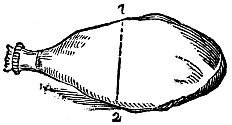
HAM.
HAMS, for Curing (Mons. Ude’s Recipe).
Ingredients.—For 2 hams weighing about 16 or 18 lbs. each, allow 1 lb. of moist sugar, 1 lb. of common salt, 2 oz. of saltpetre, 1 quart of good vinegar. Mode.—As soon as the pig is cold enough to be cut up, take the 2 hams and rub them well with common salt, and leave them in a large pan for 3 days. When the salt has drawn out all the blood, drain the hams, and throw the brine away. Mix sugar, salt, and saltpetre together in the above proportion, rub the hams well with these, and put them into a vessel large enough to hold them, always keeping the salt over them. Let them remain for 3 days, then pour over them a quart of good vinegar. Turn them in the brine every day for a month, then drain them well, and rub them with bran. Have them smoked over a wood fire, and be particular that the hams are hung as high up as possible from the fire; otherwise the fat will melt, and they will become dry and hard. Time.—To be pickled 1 month; to be smoked 1 month. Sufficient for 2 hams of 18 lbs. each. Seasonable from October to March.
HAMS, to Cure Sweet, in the Westmoreland way.
Ingredients.—3 lbs. of common salt, 3 lbs. of coarse sugar, 1 lb. of bay-salt, 3 quarts of strong beer. Mode.—Before the hams are put into pickle, rub them the preceding day well with salt, and drain the brine well from them. Put the above ingredients into a saucepan, and boil for ¼ hour; pour over the hams, and let them remain a month in the pickle. Rub and turn them every day, but do not take them out of the pickling-pan; and have them smoked for a month. Time.—To be pickled 1 month; to be smoked 1 month. Seasonable from October to March.
HAMS, to Pickle (Suffolk Recipe).
Ingredients.—To a ham from 10 to 12 lbs., allow 1 lb. of coarse sugar, ¾ lb. of salt, 1 oz. of saltpetre, ½ a teacupful of vinegar. Mode.—Rub the hams well with common salt, and leave them for a day or two to drain; then rub well in the above proportion of sugar, salt, saltpetre, and vinegar, and turn them every other day. Keep them in the pickle 1 month, drain them, and send them to be smoked over a wood fire for 3 weeks or a month. Time.—To remain in the pickle 1 month; to be smoked 3 weeks or 1 month. Sufficient.—The above proportion of pickle is sufficient for 1 ham. Seasonable.—Hams should be pickled from October to March.
HAMS, to Salt Two, about 12 or 15 lbs. each.
Ingredients.—2 lbs. of treacle, ½ lb. of saltpetre, 1 lb. of bay-salt, 2 pounds of common salt. Mode.—Two days before they are put into pickle, rub the hams well with salt, to draw away all slime and blood. Throw what comes from them away, and then rub them with treacle, saltpetre, and salt. Lay them in a deep pan, and let them remain one day; boil the above proportion of treacle, saltpetre, bay-salt, and common salt for ¼ hour, and pour this pickle boiling hot over the hams: there should be sufficient of it to cover them. For a day or two rub them well with it; afterwards they will only require turning. They ought to remain in this pickle for 3 weeks or a month, and then be sent to be smoked, which will take nearly or quite a month to do. An ox-tongue pickled in this way is most excellent, to be eaten either green or smoked. Time.—To remain in the pickle 3 weeks or a month; to be smoked about a month. Seasonable from October to March.
HAMS, to Smoke, at Home.
Take an old hogshead, stop up all the crevices, and fix a place to put a cross-stick near the bottom, to hang the articles to be smoked on. Next, in the side, cut a hole near the top, to introduce an iron pan filled with sawdust and small pieces of green wood. Having turned the tub upside down, hang the articles upon the cross-stick, introduce the iron pan in the opening, and place a piece of red-hot iron in the pan, cover it with sawdust, and all will be complete. Let a large ham remain 40 hours, and keep up a good smoke. Fish may be smoked in the same manner.
HARE, Broiled (a Supper or Luncheon Dish).
Ingredients.—The legs and shoulders of a roast hare, cayenne and salt to taste, a little butter. Mode.—Cut the legs and shoulders from a roast hare, season them highly with salt and cayenne, and broil them over a very clear fire for 5 minutes. Dish them on a hot dish, rub over them a little cold butter, and send to table very quickly. Time.—5 minutes. Seasonable from September to the end of February.
HARE, Hashed.
[Cold Meat Cookery.] Ingredients.—The remains of cold roast hare, 1 blade of pounded mace, 2 or 3 allspice, pepper and salt to taste, 1 onion, a bunch of savoury herbs, 3 tablespoonfuls of port wine, thickening of butter and flour, 2 tablespoonfuls of mushroom ketchup. Mode.—Cut the cold hare into neat slices, and put the head, bones, and trimmings into a stewpan, with ¾ pint of water; add the mace, allspice, seasoning, onion, and herbs, and stew for nearly an hour, and strain the gravy; thicken it with butter and flour, add the wine and ketchup, and lay in the pieces of hare, with any stuffing that may be left. Let the whole gradually heat by the side of the fire, and, when it has simmered for about 5 minutes, serve, and garnish the dish with sippets of toasted bread. Send red-currant jelly to table with it. Time.—Rather more than 1 hour. Average cost, exclusive of the cold hare, 6d. Seasonable from September to the end of February.
HARE, Jugged (very good).
Ingredients.—1 hare, 1½ lb. of gravy beef, ½ lb. of butter, 1 onion, 1 lemon, 6 cloves; pepper, cayenne, and salt to taste; ½ pint of port wine. Mode.—Skin, paunch, and wash the hare, cut it into pieces, dredge them with flour, and fry in boiling butter. Have ready 1½ pint of gravy, made from the above proportion of beef, and thickened with a little flour. Put this into a jar; add the pieces of fried hare, an onion stuck with six cloves, a lemon peeled and cut in half, and a good seasoning of pepper, cayenne, and salt; cover the jar down tightly, put it up to the neck into a stewpan of boiling water, and let it stew until the hare is quite tender, taking care to keep the water boiling. When nearly done, pour in the wine, and add a few forcemeat balls: these must be fried or baked in the oven for a few minutes before they are put to the gravy. Serve with red-currant jelly. Time.—3½ to 4 hours. If the hare is very old, allow 4½ hours. Average cost, 7s. Sufficient for 7 or 8 persons. Seasonable from September to the end of February.
HARE, Jugged (a Quicker and more Economical Way).
Ingredients.—1 hare, a bunch of sweet herbs, 2 onions, each stuck with 3 cloves, 6 whole allspice, ½ teaspoonful of black pepper, a strip of lemon-peel, thickening of butter and flour, 2 tablespoonfuls of mushroom ketchup, ¼ pint of port wine. Mode.—Wash the hare nicely, cut it up into joints (not too large), and flour and brown them as in the preceding recipe; then put them into a stewpan with the herbs, onions, cloves, allspice, pepper, and lemon-peel; cover with hot water, and when it boils, carefully remove all the scum, and let it simmer gently till tender, which will be in about 1¾ hour, or longer, should the hare be very old. Take out the pieces of hare, thicken the gravy with flour and butter, add the ketchup and port wine, let it boil for about 10 minutes, strain it through a sieve over the hare, and serve. A few fried forcemeat balls should be added at the moment of serving, or, instead of frying them, they may be stewed in the gravy, about 10 minutes before the hare is wanted for table. Do not omit to serve red-currant jelly with it. Time.—Altogether 2 hours. Average cost, 5s. 6d. Sufficient for 7 or 8 persons. Seasonable from September to the end of February.
Note.—Should there be any left, re-warm it the next day by putting the hare, &c., into a covered jar, and placing this jar in a saucepan of boiling water; this method prevents a great deal of waste.
HARE, Potted (a Luncheon or Breakfast Dish).
Ingredients.—1 hare, a few slices of bacon, a large bunch of savoury herbs, 4 cloves, ½ teaspoonful of whole allspice, 2 carrots, 2 onions, salt and pepper to taste, 1 pint of water, 2 glasses of sherry. Mode.—Skin, empty, and wash the hare; cut it down the middle, and put it into a stewpan, with a few slices of bacon under and over it; add the remaining ingredients, and stew very gently until the hare is tender, and the flesh will separate easily from the bones. When done enough, take it up, remove the bones, and pound the meat, with the bacon, in a mortar, until reduced to a perfectly smooth paste. Should it not be sufficiently seasoned, add a little cayenne, salt, and pounded mace, but be careful that these are well mixed with the other ingredients. Press the meat into potting-pots, pour over clarified butter, and keep in a dry place. The liquor that the hare was stewed in, should be saved for hashes, soups, &c. &c. Time.—About 2½ hours to stew the hare. Seasonable from September to the end of February.
HARE, Roast.
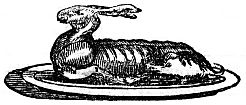
ROAST HARE.
Ingredients.—Hare, forcemeat, a little milk, butter. Choosing and Trussing.—Choose a young hare; which may be known by its smooth and sharp claws, and by the cleft in the lip not being much spread. To be eaten in perfection, it must hang for some time; and, if properly taken care of, it may be kept for several days. It is better to hang without being paunched; but should it be previously emptied, wipe the inside every day, and sprinkle over it a little pepper and ginger, to prevent the musty taste which long keeping in the damp occasions, and also which affects the stuffing. After it is skinned, wash it well, and soak for an hour in warm water to draw out the blood; if old, let it lie in vinegar for a short time, but wash it well afterwards in several waters. Make a forcemeat, wipe the hare dry, fill the belly with it, and sew it up. Bring the hind and fore legs close to the body towards the head, run a skewer through each, fix the head between the shoulders by means of another skewer, and be careful to leave the ears on. Put a string round the body from skewer to skewer, and tie it above the back. Mode.—The hare should be kept at a distance from the fire when it is first laid down, or the outside will become dry and hard before the inside is done. Baste it well with milk for a short time, and afterwards with butter; and particular attention must be paid to the basting, so as to preserve the meat on the back juicy and nutritive. When it is almost roasted enough, flour the hare, and baste well with butter. When nicely frothed, dish it, remove the skewers, and send it to table with a little gravy in the dish, and a tureen of the same. Red-currant jelly must also not be forgotten, as this is an indispensable accompaniment to roast hare. For economy, good beef dripping may be substituted for the milk and butter to baste with; but the basting, as we have before stated, must be continued without intermission. If the liver is good, it may be parboiled, minced, and mixed with the stuffing; but it should not be used unless quite fresh. Time.—A middling-sized hare, 1¼ hour; a large hare, 1½ to 2 hours. Average cost, from 4s. to 6s. Sufficient for 5 or 6 persons. Seasonable from September to the end of February.
HARE, Roast, to Carve.
The “Grand Carver” of olden times, a functionary of no ordinary dignity, was pleased when he had a hare to manipulate, for his skill and grace had an opportunity of display. Diners à la Russe may possibly, erewhile, save modern gentlemen the necessity of learning the art which was in auld lang syne one of the necessary accomplishments of the youthful squire; but, until side-tables become universal, or till we see the office of “grand carver” once more instituted, it will be well for all to learn how to assist at the carving of this dish, which, if not the most elegant in appearance, is a very general favourite. The hare, having its head to the left, as shown in the woodcut, should be first served by cutting slices from each side of the backbone, in the direction of the lines from 3 to 4. After these prime parts are disposed of, the leg should next be disengaged by cutting round the line indicated by the figures 5 to 6. The shoulders will then be taken off by passing the knife round from 7 to 8. The back of the hare should now be divided by cutting quite through its spine, as shown by the line 1 to 2, taking care to feel with the point of the knife for a joint where the back may be readily penetrated. It is the usual plan not to serve any bone in helping hare; and thus the flesh should be sliced from the legs and placed alone on the plate. In large establishments, and where men-cooks are kept, it is often the case that the backbone of the hare, especially in old animals, is taken out, and then the process of carving is, of course, considerably facilitated. A great point to be remembered in connection with carving hare is, that plenty of gravy should accompany each helping, otherwise this dish, which is naturally dry, will lose half its flavour, and so become a failure. Stuffing is also served with it; and the ears, which should be nicely crisp, and the brains of the hare, are esteemed as delicacies by many connoisseurs.

ROAST HARE.
HARE SOUP.
Ingredients.—A hare fresh-killed, 1 lb. of lean gravy-beef, a slice of ham, 1 carrot, 2 onions, a faggot of savoury herbs, ¼ oz. of whole black pepper, a little browned flour, ¼ pint of port wine, the crumb of two French rolls, salt and cayenne to taste, 3 quarts of water. Mode.—Skin and paunch the hare, saving the liver and as much blood as possible. Cut it in pieces, and put it in a stewpan with all the ingredients, and simmer gently for 6 hours. This soup should be made the day before it is wanted. Strain through a sieve, put the best parts of the hare in the soup, and serve.
HARE SOUP.
Proceed as above; but, instead of putting the joints of the hare in the soup, pick the meat from the bones, pound it in a mortar, and add it, with the crumb of two French rolls, to the soup. Rub all through a sieve; heat slowly, but do not let it boil. Send it to table immediately. Time.—8 hours. Average cost, 1s. 9d. per quart. Seasonable from September to February. Sufficient for 10 persons.