THE DICTIONARY OF COOKERY. (continued 4)
Reading edition
CELERY.
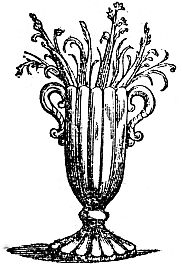
CELERY, IN GLASS.
With a good heart, and nicely blanched, this vegetable is generally eaten raw, and is usually served with the cheese. Let the roots be washed free from dirt, all the decayed and outside leaves being cut off, preserving as much of the stalk as possible, and all specks or blemishes being carefully removed. Should the celery be large, divide it lengthwise into quarters, and place it, root downwards, in a celery-glass, which should be rather more than half filled with water. The top leaves may be curled, by shredding them in narrow strips with the point of a clean skewer, at a distance of about 4 inches from the top. Average cost, 2d. per head. Sufficient.—Allow 2 heads for 4 or 5 persons. Seasonable from October to April.
Note.—This vegetable is exceedingly useful for flavouring soups, sauces, &c., and makes a very nice addition to winter salad.
CELERY SAUCE, for Boiled Turkey, Poultry, &c.
Ingredients.—6 heads of celery, 1 pint of white stock, 2 blades of mace, 1 small bunch of savoury herbs; thickening of butter and flour, or arrowroot, ½ pint of cream, lemon-juice. Mode.—Boil the celery in salt and water until tender, and cut it into pieces 2 inches long. Put the stock into a stewpan with the mace and herbs, and let it simmer for ½ hour to extract their flavour. Then strain the liquor, add the celery, and a thickening of butter kneaded with flour, or, what is still better, with arrowroot; just before serving, put in the cream, boil it up, and squeeze in a little lemon-juice. If necessary, add a seasoning of salt and white pepper. Time.—25 minutes to boil the celery. Average cost, 1s. 3d. Sufficient, this quantity for a boiled turkey.
Note.—This sauce may be made brown by using gravy instead of white stock, and flavouring it with mushroom ketchup or Harvey’s sauce.
CELERY SAUCE (a more simple Recipe).
Ingredients.—4 heads of celery, ½ pint of melted butter made with milk, 1 blade of pounded mace; salt and white pepper to taste. Mode.—Wash the celery, boil it in salt and water till tender, and cut it into pieces 2 inches long; make ½ pint melted butter by recipe; put in the celery, pounded mace, and seasoning; simmer for 3 minutes, when the sauce will be ready to serve. Time.—25 minutes to boil the celery. Average cost, 6d. Sufficient, this quantity for a boiled fowl.
CELERY SOUP.
Ingredients.—9 heads of celery, 1 teaspoonful of salt, nutmeg to taste, 1 lump of sugar, ½ pint of strong stock, a pint of cream, and 2 quarts of boiling water. Mode.—Cut the celery into small pieces; throw it into the water, seasoned with the nutmeg, salt, and sugar. Boil it till sufficiently tender; pass it through a sieve, add the stock, and simmer it for half an hour. Now put in the cream, bring it to the boiling-point, and serve immediately. Time.—1 hour. Average cost, 1s. per quart. Seasonable from September to March. Sufficient for 8 persons.
Note.—This soup can be made brown instead of white, by omitting the cream, and colouring it a little. When celery cannot be procured, half a drachm of the seed, finely pounded, will give a flavour to the soup, if put in a quarter of an hour before it is done. A little of the essence of celery will answer the same purpose.
CELERY, Stewed, à la Crême.
Ingredients.—6 heads of celery; to each ½ gallon of water allow 1 heaped tablespoonful of salt, 1 blade of pounded mace, 1/3 pint of cream. Mode.—Wash the celery thoroughly; trim, and boil it in salt and water until tender. Put the cream and pounded mace into a stewpan, shake it over the fire until the cream thickens, dish the celery, pour over the sauce, and serve. Time.—Large heads of celery, 25 minutes; small ones, 15 to 20 minutes. Average cost, 2d. per head. Sufficient for 5 or 6 persons. Seasonable from October to April.
CELERY, Stewed (with White Sauce).
Ingredients.—6 heads of celery, 1 oz. of butter; to each half gallon of water allow 1 heaped teaspoonful of salt, ½ pint of white sauce (see White Sauce). Mode.—Have ready sufficient boiling water just to cover the celery, with salt and butter in the above proportion. Wash the celery well, cut off the decayed outside leaves, trim away the green tops, and shape the root into a point; put it into the boiling water, let it boil rapidly until tender, then take it out, drain well, place it upon a dish, and pour over it about ½ pint of white sauce, made by recipe. It may also be plainly boiled as above, placed on toast, and melted butter poured over, the same as asparagus is dished. Time.—Large heads of celery 25 minutes, small ones 15 to 20 minutes, after the water boils. Average cost, 2d. per head. Sufficient for 5 or 6 persons. Seasonable from October to April.
CELERY, Stewed (with White Sauce).
Ingredients.—6 heads of celery, ½ pint of white stock or weak broth, 4 tablespoonfuls of cream, thickening of butter and flour, 1 blade of pounded mace, a very little grated nutmeg; pepper and salt to taste. Mode.—Wash the celery, strip off the outer leaves, and cut it into lengths of about 4 inches. Put these into a saucepan, with the broth, and stow till tender, which will be in from 20 to 25 minutes; then add the remaining ingredients, simmer altogether for 4 or 5 minutes, pour into a dish, and serve. It may be garnished with sippets of toasted bread. Time.—Altogether, ½ hour. Average cost, 2d. per head. Sufficient for 5 or 6 persons. Seasonable from October to April.
Note.—By cutting the celery into smaller pieces, by stewing it a little longer, and, when done, by pressing it through a sieve, the above stew may be converted into a Purée of Celery.
CELERY VINEGAR.
Ingredients.—¼ oz. of celery-seed, 1 pint of vinegar. Mode.—Crush the seed by pounding it in a mortar; boil the vinegar, and when cold, pour it to the seed; let it infuse for a fortnight, when strain and bottle off for use. This is frequently used in salads.
CHAMPAGNE-CUP.
Ingredients.—1 quart bottle of champagne, 2 bottles of soda-water, 1 liqueur-glass of brandy or Curaçoa, 2 tablespoonfuls of powdered sugar, 1 lb. of pounded ice, a sprig of green borage. Mode.—Put all the ingredients into a silver cup; stir them together, and serve the same as claret-cup. Should the above proportion of sugar not be found sufficient to suit some tastes, increase the quantity. When borage is not easily obtainable, substitute for it a few slices of cucumber-rind. Seasonable.—Suitable for pic-nics balls, weddings, and other festive occasions.
CHARLOTTE-AUX-POMMES.
Ingredients.—A few slices of rather stale bread ½ inch thick, clarified butter, apple marmalade, with about 2 dozen apples, ½ glass of sherry. Mode.—Cut a slice of bread the same shape as the bottom of a plain round mould, which has been well buttered, and a few strips the height of the mould, and about 1½ inch wide; dip the bread in clarified butter (or spread it with cold butter, if not wanted quite so rich); place the round piece at the bottom of the mould, and set the narrow strips up the sides of it, overlapping each other a little, that no juice from the apples may escape, and that they may hold firmly to the mould. Brush the interior over with the white of egg (this will assist to make the case firmer); fill it with the apple marmalade, with the addition of a little sherry, and cover them with a round piece of bread, also brushed over with egg, the same as the bottom; slightly press the bread down to make it adhere to the other pieces; put a plate on the top, and bake the charlotte in a brisk oven, of a light colour. Turn it out on the dish, strew sifted sugar over the top, and pour round it a little melted apricot jam. Time.—40 to 50 minutes. Average cost, 1s. 9d. Sufficient for 5 or 6 persons. Seasonable from July to March.
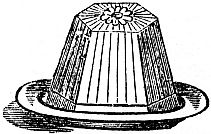
CHARLOTTE-AUX-POMMES.
CHARLOTTE-AUX-POMMES, an easy method of making.
Ingredients.—½ lb. of flour, ¼ lb. of butter, ¼ lb. of powdered sugar, ½ teaspoonful of baking-powder, 1 egg, milk, 1 glass of raisin-wine, apple marmalade, ¼ pint of cream, 2 dessert spoonfuls of pounded sugar, 2 tablespoonfuls of lemon-juice. Mode.—Make a cake with the flour, butter, sugar, and baking-powder; moisten with the egg and sufficient milk to make it the proper consistency, and bake it in a round tin. When cold, scoop out the middle, leaving a good thickness all round the sides, to prevent them breaking; take some of the scooped-out pieces, which should be trimmed into neat slices; lay them in the cake, and pour over sufficient raisin-wine, with the addition of a little brandy, if approved, to soak them well. Have ready some apple marmalade, made by recipe; place a layer of this over the soaked cake, then a layer of cake and a layer of apples; whip the cream to a froth, mixing with it the sugar and lemon-juice; pile it on the top of the charlotte, and garnish it with pieces of clear apple jelly. This dish is served cold, but may be eaten hot by omitting the cream, and merely garnishing the top with bright jelly just before it is sent to table. Time.—1 hour to bake the cake. Average cost, 2s. Sufficient for 5 or 6 persons. Seasonable from July to March.
CHARLOTTE, Russe (an elegant Sweet Entremets).
Ingredients.—About 18 Savoy biscuits, ¾ pint of cream, flavouring of vanilla, liqueurs, or wine, 1 tablespoonful of pounded sugar, ½ oz. of isinglass. Mode.—Procure about 18 Savoy biscuits, or ladies’-fingers, as they are sometimes called; brush the edges of them with the white of an egg, and line the bottom of a plain round mould, placing them like a star or rosette. Stand them upright all round the edge, carefully put them so closely together that the white of egg connects them firmly, and place this case in the oven for about 5 minutes, just to dry the egg. Whisk the cream to a stiff froth, with the sugar, flavouring, and melted isinglass; fill the charlotte with it, cover with a slice of sponge-cake cut in the shape of the mould; place it in ice, where let it remain till ready for table; then turn it on a dish, remove the mould, and serve. 1 tablespoonful of liqueur of any kind, or 4 tablespoonfuls of wine, would nicely flavour the above proportion of cream. For arranging the biscuits in the mould, cut them to the shape required, so that they fit in nicely, and level them with the mould at the top, that, when turned out, there may be something firm to rest upon. Great care and attention is required in the turning out of this dish, that the cream does not burst the case; and the edges of the biscuits must have the smallest quantity of egg brushed over them, or it would stick to the mould, and so prevent the charlotte from coming away properly. Time.—5 minutes in the oven. Average cost, with cream at 1s. per pint, 2s. 6d. Sufficient for 1 charlotte. Seasonable at any time.
CHEESE.
Cheese is the curd formed from milk by artificial coagulation, pressed and dried for use. Curd, called also casein and caseous matter, or the basis of cheese, exists in the milk, and not in the cream, and requires only to be separated by coagulation: the coagulation, however, supposes some alteration of the curd. By means of the substance employed to coagulate it, it is rendered insoluble in water. When the curd is freed from the whey, kneaded and pressed to expel it entirely, it becomes cheese; this assumes a degree of transparency, and possesses many of the properties of coagulated albumen. If it be well dried, it does not change by exposure to the air; but if it contain moisture, it soon putrefies; it therefore requires some salt to preserve it, and this acts likewise as a kind of seasoning. All our cheese is coloured more or less, except that made from skim milk. The colouring substances employed are arnatto, turmeric, or marigold, all perfectly harmless unless they are adulterated; and it is said that arnatto sometimes contains red lead.
Cheese varies in quality and richness according to the materials of which it is composed. It is made—1. Of entire milk, as in Cheshire; 2. of milk and cream, as at Stilton; 3. of new milk mixed with skim milk, as in Gloucestershire; 4. of skimmed milk only, as in Suffolk, Holland, and Italy.
The principal varieties of cheese used in England are the following: Cheshire cheese, famed all over Europe for its rich quality and fine piquante flavour. It is made of entire new milk, the cream not being taken off. Gloucester cheese is much milder in its taste than the Cheshire. There are two kinds of Gloucester cheese, single and double:—Single Gloucester is made of skimmed milk, or of the milk deprived of half the cream; Double Gloucester is a cheese that pleases almost every palate: it is made of the whole milk and cream. Stilton cheese is made by adding the cream of one day to the entire milk of the next: it was first made at Stilton, in Leicestershire. Sage cheese is so called from the practice of colouring some curd with bruised sage, marigold-leaves, and parsley, and mixing this with some uncoloured curd. With the Romans, and during the middle ages, this practice was extensively adopted. Cheddar cheese much resembles Parmesan. It has a very agreeable taste and flavour, and has a spongy appearance. Brickbat cheese has nothing remarkable except its form. It is made by turning with rennet a mixture of cream and new milk; the curd is put into a wooden vessel the shape of a brick, and is then pressed and dried in the usual way. Dunlop cheese has a peculiarly mild and rich taste: the best is made entirely from new milk. New cheese (as it is called in London) is made chiefly in Lincolnshire, and is either made of all cream, or, like Stilton, by adding the cream of one day’s milking to the milk that comes immediately from the cow: they are extremely thin, and are compressed gently two or three times, turned for a few days, and then eaten new with radishes, salad, &c. Skimmed Milk cheese is made for sea voyages principally. Parmesan cheese is made in Parma and Piacenza. It is the most celebrated of all cheese: it is made entirely of skimmed cows’ milk; the high flavour which it has is supposed to be owing to the rich herbage of the meadows of the Po, where the cows are pastured. The best Parmesan is kept for three or four years, and none is carried to market till it is at least six months old. Dutch cheese derives its peculiar pungent taste from the practice adopted in Holland of coagulating the milk with muriatic acid instead of rennet. Swiss cheeses, in their several varieties, are all remarkable for their fine flavour; that from Gruyère, a bailiwick in the canton of Fribourg, is best known in England; it is flavoured by the dried herb of Melilotus officinalis in powder. Cheese from milk and potatoes is manufactured in Thuringia and Saxony. Cream cheese, although so called, is not properly cheese, but is nothing more than cream dried sufficiently to be cut with a knife.
In families where much cheese is consumed, and it is bought in large quantities, a piece from the whole cheese should be cut, the larger quantity spread with a thickly-buttered sheet of white paper, and the outside occasionally wiped. To keep cheeses moist that are in daily use, when they come from table a damp cloth should be wrapped round them, and the cheese put into a pan with a cover to it, in a cool but not very dry place. To ripen cheeses, and bring them forward, put them into a damp cellar; and to check too large a production of mites, spirits may be poured into the parts affected. Pieces of cheese which are too near the rind, or too dry to put on table, may be made into Welsh rarebits, or grated down and mixed with macaroni. Cheeses may be preserved in a perfect state for years, by covering them with parchment made pliable by soaking in water, or by rubbing them over with a coating of melted fat. The cheeses selected should be free from cracks or bruises of any kind.
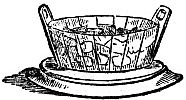
CHEESE-GLASS.
CHEESE, Mode of Serving.
The usual mode of serving cheese at good tables is to cut a small quantity of it into neat square pieces, and to put them into a glass cheese-dish, this dish being handed round. Should the cheese crumble much, of course this method is rather wasteful, and it may then be put on the table in the piece, and the host may cut from it. When served thus, the cheese must always be carefully scraped, and laid on a white d’oyley or napkin, neatly folded. Cream cheese is often served in a cheese course, and, sometimes, grated Parmesan: the latter should be put into a covered glass dish. Rusks, cheese-biscuits, pats or slices of butter, and salad, cucumber, or water-cresses, should always form part of a cheese-course.
CHEESE, Pounded.
Ingredients.—To every lb. of cheese allow 3 oz. of fresh butter. Mode.—To pound cheese is an economical way of using it if it has become dry; it is exceedingly good spread on bread, and is the best way of eating it for those whose digestion is weak. Cut up the cheese into small pieces, and pound it smoothly in a mortar, adding butter in the above proportion. Press it down into a jar, cover with clarified butter, and it will keep for several days. The flavour may be very much increased by adding mixed mustard (about a teaspoonful to every lb.), or cayenne, or pounded mace. Curry-powder is also not infrequently mixed with it.
CHEESE, Toasted, or Scotch Rarebit.
Ingredients.—A few slices of rich cheese, toast, mustard, and pepper. Mode.—Cut some nice rich sound cheese into rather thin slices; melt it in a cheese-toaster on a hot plate or over steam, and, when melted, add a small quantity of mixed mustard and a seasoning of pepper; stir the cheese until it is completely dissolved, then brown it before the fire, or with a salamander. Fill the bottom of the cheese-toaster with hot water, and serve with dry or buttered toasts, whichever may be preferred. Our engraving illustrates a cheese-toaster with hot-water reservoir: the cheese is melted in the upper tin, which is placed in another vessel of boiling water, so keeping the preparation beautifully hot. A small quantity of porter, or port wine, is sometimes mixed with the cheese; and, if it be not very rich, a few pieces of butter may be mixed with it to great advantage. Sometimes the melted cheese is spread on the toasts, and then laid in the cheese-dish at the top of the hot water. Whichever way it is served, it is highly necessary that the mixture be very hot, and very quickly sent to table, or it will be worthless. Time.—About 5 minutes to melt the cheese. Average cost, 1½d. per slice. Sufficient.—Allow a slice to each person. Seasonable at any time.
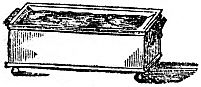
HOT-WATER CHEESE-DISH.
CHEESE, Toasted, or Welsh Rarebit.
Ingredients.—Slices of bread, butter, Cheshire or Gloucester cheese, mustard, and pepper. Mode.—Cut the bread into slices about ½ inch in thickness; pare off the crust, toast the bread slightly without hardening or burning it, and spread it with butter. Cut some slices, not quite so large as the bread, from a good rich fat cheese; lay them on the toasted bread in a cheese-toaster; be careful that the cheese does not burn, and let it be equally melted. Spread over the top a little made mustard and a seasoning of pepper, and serve very hot, with very hot plates. To facilitate the melting of the cheese, it may be cut into thin flakes, or toasted on one side before it is laid on the bread. As it is so essential to send this dish hot to table, it is a good plan to melt the cheese in small round silver or metal pans, and to send these pans to table, allowing one for each guest. Slices of dry or buttered toast should always accompany them, with mustard, pepper, and salt. Time.—About 5 minutes to melt the cheese. Average cost, 1½d. per slice. Sufficient.—Allow a slice to each person. Seasonable at any time.
Note.—Should the cheese be dry, a little butter mixed with it will be an improvement.
CHEESE SANDWICHES.
Ingredients.—Slices of brown bread-and-butter, thin slices of cheese. Mode.—Cut from a nice fat Cheshire, or any good rich cheese, some slices about ½ inch thick, and place them between some slices of brown bread-and-butter, like sandwiches. Place them on a plate in the oven, and, when the bread is toasted, serve on a napkin very hot and very quickly. Time.—10 minutes in a brisk oven. Average cost, 1½d. each sandwich. Sufficient.—Allow a sandwich for each person. Seasonable at any time.
CHEESECAKES.
Ingredients.—8 oz. of pressed curds, 2 oz. of ratafias, 6 oz. of sugar, 2 oz. of butter, the yolks of 6 eggs, nutmegs, salt, rind of 2 oranges or lemons. Mode.—Rub the sugar on the orange or lemon rind, and scrape it off. Press the curd in a napkin, to get rid of moisture; pound it thoroughly in a mortar with the other ingredients till the whole becomes a soft paste. Line 2 dozen, or more, tartlet-pans with good puff-paste, garnish these with the cheese-custard, place a strip of candied-peel on the top of each, and bake in a moderate oven a light colour; when done, shake a little sifted sugar over them. Currants, dried cherries, sultanas, and citron may be used instead of candied-peel. Time.—20 minutes to bake. Average cost, 6d. per dozen. Seasonable at any time.
CHEROKEE, or Store Sauce.
Ingredients.—½ oz. of cayenne pepper, 5 cloves of garlic, 2 tablespoonfuls of soy, 1 tablespoonful of walnut ketchup, 1 pint of vinegar. Mode.—Boil all the ingredients gently for about ½ hour; strain the liquor, and bottle off for use. Time.—½ hour. Seasonable.—This sauce can be made at any time.
CHERRIES, Dried.
Cherries may be put into a slow oven and thoroughly dried before they begin to change colour; they should then be taken out of the oven, tied in bunches, and stored away in a dry place. In the winter, they may be cooked with sugar for dessert, the same as Normandy pippins. Particular care must be taken that the oven be not too hot. Another method of drying cherries is to stone them, and to put them into a preserving-pan, with plenty of loaf sugar strewed amongst them. They should be simmered till the fruit shrivels, when they should be strained from the juice. The cherries should then be placed in an oven cool enough to dry without baking them. About 5 oz. of sugar would be required for 1 lb. of cherries, and the same syrup may be used again to do another quantity of fruit.
CHERRIES, Morello, to Preserve.
Ingredients.—To every lb. of cherries allow 1¼ lb. of sugar, 1 gill of water. Mode.—Select ripe cherries, pick off the stalks, and reject all that have any blemishes. Boil the sugar and water together for 5 minutes; put in the cherries, and boil them for 10 minutes, removing the scum as it rises. Then turn the fruit, &c., into a pan, and let it remain until the next day, when boil it all again for another 10 minutes, and, if necessary, skim well. Put the cherries into small pots, pour over them the syrup, and, when cold, cover down with oiled papers, and the tops of the jars with tissue-paper brushed over on both sides with the white of an egg, and keep in a dry place. Time.—Altogether, 25 minutes to boil. Average cost, from 8d. to 10d. per lb. pot. Seasonable.—Make this in July or August.
CHERRIES, to Preserve in Syrup (very delicious).
Ingredients.—4 lbs. of cherries, 3 lbs. of sugar, 1 pint of white-currant juice. Mode.—Let the cherries be as clear and as transparent as possible, and perfectly ripe; pick off the stalks, and remove the stones, damaging the fruit as little as you can. Make a syrup with the above proportion of sugar, mix the cherries with it, and boil them for about 15 minutes, carefully skimming them; turn them gently into a pan, and let them remain till the next day, then drain the cherries on a sieve, and put the syrup and white-currant juice into the preserving-pan again. Boil these together until the syrup is somewhat reduced and rather thick, then put in the cherries, and let them boil for about 5 minutes; take them off the fire, skim the syrup, put the cherries into small pots or wide-mouthed bottles; pour the syrup over, and, when quite cold, tie them down carefully, so that the air is quite excluded. Time.—15 minutes to boil the cherries in the syrup; 10 minutes to boil the syrup and currant-juice; 5 minutes to boil the cherries the second time. Average cost for this quantity, 3s. 6d. Seasonable.—Make this in July or August.
CHERRY BRANDY, to make.
Ingredients.—Morello cherries, good brandy; to every lb. of cherries allow 3 oz. of pounded sugar. Mode.—Have ready some glass bottles, which must be perfectly dry. Ascertain that the cherries are not too ripe and are freshly gathered, and cut off about half of the stalks. Put them into the bottles, with the above proportion of sugar to every lb. of fruit; strew this in between the cherries, and, when the bottles are nearly full, pour in sufficient brandy to reach just below the cork. A few peach or apricot kernels will add much to their flavour, or a few blanched bitter almonds. Put corks or bungs into the bottles, tie over them a piece of bladder, and store away in a dry place. The cherries will be fit to eat in 2 or 3 months, and will remain good for years. They are liable to shrivel and become tough if too much sugar be added to them. Average cost, 1s. to 1s. 6d. per lb. Sufficient.—1 lb. of cherries and about a ¼ pint of brandy for a quart bottle. Seasonable in August and September.
CHERRY JAM.
Ingredients.—To every lb. of fruit, weighed before stoning, allow ½ lb. of sugar; to every 6 lbs. of fruit allow 1 pint of red-currant juice, and to every pint of juice 1 lb. of sugar. Mode.—Weigh the fruit before stoning, and allow half the weight of sugar; stone the cherries, and boil them in a preserving-pan until nearly all the juice is dried up, then add the sugar, which should be crushed to powder, and the currant-juice, allowing 1 pint to every 6 lbs. of cherries (original weight), and 1 lb. of sugar to every pint of juice. Boil all together until it jellies, which will be in from 20 minutes to ½ hour; skim the jam well, keep it well stirred, and, a few minutes before it is done, crack some of the stones, and add the kernels: these impart a very delicious flavour to the jam. Time.—According to the quality of the cherries, from ¾ to 1 hour to boil them; 20 minutes to ½ hour with the sugar. Average cost, from 7d. to 8d. per lb. pot. Sufficient.—1 pint of fruit for a lb. pot of jam. Seasonable.—Make this in July or August.
CHERRY SAUCE, for Sweet Puddings (German Recipe).
Ingredients.—1 lb. of cherries, 1 tablespoonful of flour, 1 oz. of butter, ½ pint of water, 1 wineglassful of port wine, a little grated lemon-rind, 4 pounded cloves, 2 tablespoonfuls of lemon-juice, sugar to taste. Mode.—Stone the cherries, and pound the kernels in a mortar to a smooth paste; put the butter and flour into a saucepan, stir them over the fire until of a pale brown, then add the cherries, the pounded kernels, the wine, and the water. Simmer these gently for ¼ hour, or until the cherries are quite cooked, and rub the whole through a hair sieve; add the remaining ingredients, let the sauce boil for another 5 minutes, and serve. This is a delicious sauce to serve with boiled batter pudding, and when thus used, should be sent to table poured over the pudding. Time.—20 minutes to ½ hour. Average cost, 1s. 2d. Sufficient for 4 or 5 persons. Seasonable in June, July, and August.
CHERRY TART.
Ingredients.—1½ lb. of cherries, 2 small tablespoonfuls of moist sugar, ½ lb. of short crust. Mode.—Pick the stalks from the cherries, put them, with the sugar, into a deep pie-dish just capable of holding them, with a small cup placed upside down in the midst of them. Make a short crust with ½ lb. of flour, by either of the recipes for short crust, lay a border round the edge of the dish, put on the cover, and ornament the edges; bake in a brisk oven from ½ hour to 40 minutes; strew finely-sifted sugar over, and serve hot or cold, although the latter is the more usual mode. It is more economical to make two or three tarts at one time, as the trimmings from one tart answer for lining the edges of the dish for another, and so much paste is not required as when they are made singly. Unless for family use, never make fruit pies in very large dishes; select them, however, as deep as possible. Time.—½ hour to 40 minutes. Average cost, in full season, 8d. Sufficient for 5 or 6 persons. Seasonable in June, July, and August.
Note.—A few currants added to the cherries will be found to impart a nice piquante taste to them.
CHESTNUT SAUCE, Brown.
Ingredients.—½ lb. of chestnuts, ½ pint of stock, 2 lumps of sugar, 4 tablespoonfuls of Spanish sauce (see Sauces). Mode.—Prepare the chestnuts as in the succeeding recipe, by scalding and peeling them; put them in a stewpan with the stock and sugar, and simmer them till tender. When done, add Spanish sauce in the above proportion, and rub the whole through a tammy. Keep this sauce rather liquid, as it is liable to thicken. Time.—1½ hour to simmer the chestnuts. Average cost, 8d.
CHESTNUT SAUCE, for Fowls or Turkey.
Ingredients.—½ lb. of chestnuts, ½ pint of white stock, 2 strips of lemon-peel, cayenne to taste, ¼ pint of cream or milk. Mode.—Peel off the outside skin of the chestnuts, and put them into boiling water for a few minutes; take off the thin inside peel, and put them into a saucepan with the white stock and lemon-peel, and let them simmer for 1½ hour, or until the chestnuts are quite tender. Rub the whole through a hair-sieve with a wooden spoon; add seasoning and the cream; let it just simmer, but not boil, and keep stirring all the time. Serve very hot, and quickly. If milk is used instead of cream, a very small quantity of thickening may be required: that, of course, the cook will determine. Time.—Altogether, nearly 2 hours. Average cost, 8d. Sufficient, this quantity for a turkey.
CHESTNUT (Spanish) SOUP.
Ingredients.—¾ lb. of Spanish chestnuts, ¼ pint of cream; seasoning to taste of salt, cayenne, and mace; 1 quart of stock. Mode.—Take the outer rind from the chestnuts, and put them into a large pan of warm water. As soon as this becomes too hot for the fingers to remain in it, take out the chestnuts, peel them quickly, and immerse them in cold water, and wipe and weigh them. Now cover them with good stock, and stew them gently for rather more than ¾ of an hour, or until they break when touched with a fork; then drain, pound, and rub them through a fine sieve reversed; add sufficient stock, mace, cayenne, and salt, and stir it often until it boils, and put in the cream. The stock in which the chestnuts are boiled can be used for the soup, when its sweetness is not objected to, or it may, in part, be added to it; and the rule is, that ¾ lb. of chestnuts should be given to each quart of soup. Time.—Rather more than 1 hour. Average cost, per quart, 1s. 6d. Sufficient for 4 persons. Seasonable from October to February.
CHICKENS, Boiled.
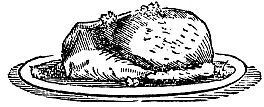
BOILED FOWL.
Ingredients.—A pair of chickens, water. Choosing and Trussing.—In choosing fowls for boiling, it should be borne in mind that those which are not black-legged are generally much whiter when dressed. Pick, draw, singe, wash, and truss them in the following manner, without the livers in the wings; and, in drawing, be careful not to break the gall-bladder:—Cut off the neck, leaving sufficient skin to skewer back. Cut the feet off to the first joint, tuck the stumps into a slit made on each side of the belly, twist the wings over the back of the fowl, and secure the top of the leg and the bottom of the wing together by running a skewer through them and the body. The other side must be done in the same manner. Should the fowl be very large and old, draw the sinews of the legs before tucking them in. Make a slit in the apron of the fowl, large enough to admit the parson’s nose, and tie a string on the tops of the legs to keep them in their proper place. Mode.—When they are firmly trussed, put them into a stewpan with plenty of hot water, bring it to boil, and carefully remove all the scum as it rises. Simmer very gently until the fowl is tender, and bear in mind that the slower it boils the plumper and whiter will the fowl be. Many cooks wrap them in a floured cloth to preserve the colour, and to prevent the scum from clinging to them; in this case, a few slices of lemon should be placed on the breasts, over these a sheet of buttered paper, and then the cloth; cooking them in this manner renders the flesh very white. Boiled ham, bacon, boiled tongue, or pickled pork, are the usual accompaniments to boiled fowls, and they may be served with Béchamel, white sauce, parsley and butter, oyster, lemon, liver, celery, or mushroom sauce. A little should be poured over the fowls after the skewers are removed, and the remainder sent in a tureen to table. Time.—Large fowl, 1 hour; moderate-sized one, ¾ hour; chicken, from 20 minutes to ½ hour. Average cost, in full season, 5s. the pair. Sufficient for 7 or 8 persons. Seasonable all the year, but scarce in early spring.
CHICKEN BROTH.
Ingredients.—½ fowl, or the inferior joints of a whole one; 1 quart of water, 1 blade of mace, ½ onion, a small bunch of sweet herbs, salt to taste, 10 peppercorns. Mode.—An old fowl not suitable for eating may be converted into very good broth; or, if a young one be used, the inferior joints may be put in the broth, and the best pieces reserved for dressing in some other manner. Put the fowl into a saucepan, stew all the ingredients, and simmer gently for 1½ hour, carefully skimming the broth well. When done, strain, and put by in a cool place until wanted; then take all the fat off the top, warm up as much as may be required, and serve. This broth is, of course, only for those invalids whose stomachs are strong enough to digest it, with a flavouring of herbs, &c. It may be made in the same manner as beef tea, with water and salt only, but the preparation will be but tasteless and insipid. When the invalid cannot digest this chicken broth with the flavouring, we would recommend plain beef tea in preference to plain chicken tea, which it would be without the addition of herbs, onions, &c. Time.—1½ hour. Sufficient to make rather more than 1 pint of broth.
CHICKEN, Curried.
[Cold Meat Cookery.] Ingredients.—The remains of cold roast fowls, 2 large onions, 1 apple, 2 oz. of butter, 1 dessertspoonful of curry-powder, 1 teaspoonful of flour, ½ pint of gravy, 1 tablespoonful of lemon-juice. Mode.—Slice the onions, peel, core, and chop the apple, and cut the fowl into neat joints; fry these in the butter of a nice brown, then add the curry-powder, flour, and gravy, and stew for about 20 minutes. Put in the lemon-juice, and serve with boiled rice, either placed in a ridge round the dish or separately. Two or three shalots or a little garlic may be added, if approved. Time.—Altogether, ½ hour. Average cost, exclusive of the cold fowl, 6d. Seasonable in the winter.
CHICKEN CUTLETS (an Entrée).
Ingredients.—2 chickens; seasoning to taste of salt, white pepper, and cayenne; 2 blades of pounded mace, egg and bread-crumbs, clarified butter, 1 strip of lemon-rind, 2 carrots, 1 onion, 2 tablespoonfuls of mushroom ketchup, thickening of butter and flour, 1 egg. Mode.—Remove the breast and leg-bones of the chickens; cut the meat into neat pieces after having skinned it, and season the cutlets with pepper, salt, pounded mace, and cayenne. Put the bones, trimmings, &c., into a stewpan with 1 pint of water, adding carrots, onions, and lemon-peel in the above proportion; stew gently for 1½ hour, and strain the gravy. Thicken it with butter and flour, add the ketchup and 1 egg well beaten; stir it over the fire, and bring it to the simmering-point, but do not allow it to boil. In the mean time, egg and bread-crumb the cutlets, and give them a few drops of clarified butter; fry them a delicate brown, occasionally turning them; arrange them pyramidically on the dish, and pour over them the sauce. Time.—10 minutes to fry the cutlets. Average cost, 2s. each. Sufficient for an entrée. Seasonable from April to July.
CHICKEN CUTLETS, French.
[Cold Meat Cookery.] Ingredients.—The remains of cold roast or boiled fowl, fried bread, clarified butter, the yolk of 1 egg, bread-crumbs, ½ teaspoonful of finely-minced lemon-peel; salt, cayenne, and mace to taste. For sauce,—1 oz. of butter, 2 minced shalots, a few slices of carrot, a small bunch of savoury herbs, including parsley, 1 blade of pounded mace, 6 peppercorns, ½ pint of gravy. Mode.—Cut the fowls into as many nice cutlets as possible; take a corresponding number of sippets about the same size, all cut one shape; fry them a pale brown, put them before the fire, then dip the cutlets into clarified butter mixed with the yolk of an egg, cover with bread-crumbs seasoned in the above proportion, with lemon-peel, mace, salt, and cayenne; fry them for about 5 minutes, put each piece on one of the sippets, pile them high in the dish, and serve with the following sauce, which should be made ready for the cutlets. Put the butter into a stewpan, add the shalots, carrot, herbs, mace, and peppercorns; fry for 10 minutes, or rather longer; pour in ½ pint of good gravy, made of the chicken-bones; stew gently for 20 minutes, strain it, and serve. Time.—5 minutes to fry the cutlets; 35 minutes to make the gravy. Average cost, exclusive of the chicken, 9d. Seasonable from April to July.
CHICKEN, Fricasseed (an Entrée).
Ingredients.—2 small fowls or 1 large one, 3 oz. of butter, a bunch of parsley and green onions, 1 clove, 2 blades of mace, 1 shalot, 1 bay-leaf, salt and white pepper to taste, ¼ pint of cream, the yolks of 3 eggs. Mode.—Choose a couple of fat plump chickens, and, after drawing, singeing, and washing them, skin, and carve them into joints; blanch these in boiling water for 2 or 3 minutes, take them out, and immerse them in cold water to render them white. Put the trimmings, with the necks and legs, into a stewpan; add the parsley, onions, clove, mace, shalot, bay-leaf, and a seasoning of pepper and salt; pour to these the water that the chickens were blanched in, and simmer gently for rather more than 1 hour. Have ready another stewpan; put in the joints of fowl, with the above proportion of butter; dredge them with flour, let them get hot, but do not brown them much; then moisten the fricassee with the gravy made from the trimmings, &c., and stew very gently for ½ hour. Lift the fowl into another stewpan, skim the sauce, reduce it quickly over the fire by letting it boil fast, and strain it over them. Add the cream, and a seasoning of pounded mace and cayenne; let it boil up, and when ready to serve, stir to it the well-beaten yolks of 3 eggs; these should not be put in till the last moment, and the sauce should be made hot, but must not boil, or it will instantly curdle. A few button-mushrooms stewed with the fowl are by many persons considered an improvement. Time.—1 hour to make the gravy, ½ hour to simmer the fowl. Average cost, 5s. the pair. Sufficient.—1 large fowl for 1 entrée. Seasonable at any time.
CHICKEN (or Fowl) PATTIES.
[Cold Meat Cookery.] Ingredients.—The remains of cold roast chicken or fowl; to every ¼ lb. of meat allow 2 oz. of ham, 3 tablespoonfuls of cream, 2 tablespoonfuls of veal gravy, ½ teaspoonful of minced lemon-peel; cayenne, salt, and pepper to taste; 1 tablespoonful of lemon-juice, 1 oz. of butter rolled in flour, puff paste. Mode.—Mince very small the white meat from a cold roast fowl, after removing all the skin; weigh it, and to every ¼ lb. of meat allow the above proportion of minced ham. Put these into a stewpan with the remaining ingredients, stir over the fire for 10 minutes or ¼ hour, taking care that the mixture does not burn. Roll out some puff paste about ¼ inch in thickness, line the patty-pans with this, put upon each a small piece of bread, and cover with another layer of paste; brush over with the yolk of an egg, and bake in a brisk oven for about ¼ hour. When done, cut a round piece out of the top, and, with a small spoon, take out the bread (be particular in not breaking the outside border of the crust), and fill the patties with the mixture. Time.—¼ hour to prepare the meat; not quite ¼ hour to bake the crust. Seasonable at any time.
CHICKEN (or Fowl) PIE.
Ingredients.—2 small fowls or 1 large one, white pepper and salt to taste, ½ teaspoonful of grated nutmeg, ½ teaspoonful of pounded mace, forcemeat, a few slices of ham, 3 hard-boiled eggs, ½ pint of water, puff crust. Mode.—Skin and cut up the fowls into joints, and put the neck, leg, and backbones in a stewpan, with a little water, an onion, a bunch of savoury herbs, and a blade of mace; let these stew for about an hour, and, when done, strain off the liquor: this is for gravy, Put a layer of fowl at the bottom of a pie-dish, then a layer of ham, then one of forcemeat and hard-boiled eggs cut in rings; between the layers put a seasoning of pounded mace, nutmeg, pepper, and salt. Proceed in this manner until the dish is full, and pour in about ½ pint of water; border the edge of the dish with puff crust, put on the cover, ornament the top, and glaze it by brushing over it the yolk of an egg. Bake from 1¼ to 1½ hour, should the pie be very large, and, when done, pour in at the top the gravy made from the bones. If to be eaten cold, and wished particularly nice, the joints of the fowls should be boned, and placed in the dish with alternate layers of forcemeat; sausage-meat may also be substituted for the forcemeat, and is now very much used. When the chickens are boned, and mixed with sausage-meat, the pie will take about 2 hours to bake. It should be covered with a piece of paper when about half-done, to prevent the paste being dried up or scorched. Time.—For a pie with unboned meat, 1¼ to 1½ hour; with boned meat and sausage or forcemeat, 1½ to 2 hours. Average cost, with 2 fowls, 6s. 6d. Sufficient for 6 or 7 persons. Seasonable at any time.
CHICKEN, Potted (a Luncheon or Breakfast Dish).
Ingredients.—The remains of cold roast chicken; to every lb. of meat allow ¼ lb. of fresh butter, salt and cayenne to taste, 1 teaspoonful of pounded mace, ½ small nutmeg. Mode.—Strip the meat from the bones of cold roast fowl; when it is freed from gristle and skin, weigh it, and to every lb. of meat allow the above proportion of butter, seasoning, and spices. Cut the meat into small pieces, pound it well with the fresh butter, sprinkle in the spices gradually, and keep pounding until reduced to a perfectly smooth paste. Put it into potting-pots for use, and cover it with clarified butter, about ¼ inch in thickness, and, if to be kept for some time, tie over a bladder: 2 or 3 slices of ham, minced and pounded with the above ingredients, will be found an improvement. It should be kept in a dry place. Seasonable at any time.
CHICKEN (or Fowl) SALAD.
Ingredients.—The remains of cold roast or boiled chicken, 2 lettuces, a little endive, 1 cucumber, a few slices of boiled beetroot, salad-dressing. Mode.—Trim neatly the remains of the chicken; wash, dry, and slice the lettuces, and place in the middle of a dish; put the pieces of fowl on the top, and pour the salad-dressing over them. Garnish the edge of the salad with hard-boiled eggs cut in rings, sliced cucumber, and boiled beetroot cut in slices. Instead of cutting the eggs in rings, the yolks may be rubbed through a hair sieve, and the whites chopped very finely, and arranged on the salad in small bunches, yellow and white alternately. This should not be made long before it is wanted for table. Average cost, exclusive of the cold chicken, 8d. Sufficient for 4 or 5 persons. Seasonable at any time.
CHILI VINEGAR.
Ingredients.—50 fresh red English chilies, 1 pint of vinegar. Mode.—Pound or cut the chilies in half, and infuse them in the vinegar for a fortnight, when it will be fit for use. This will be found an agreeable relish to fish, as many people cannot eat it without the addition of an acid and cayenne pepper.
CHINA CHILO.
Ingredients.—1½ lb. of leg, loin, or neck of mutton, 2 onions, 2 lettuces, 1 pint of green peas, 1 teaspoonful of salt, 1 teaspoonful of pepper, ¼ pint of water, ¼ lb. of clarified butter; when liked, a little cayenne. Mode.—Mince the above quantity of undressed leg, loin, or neck of mutton, adding a little of the fat, also minced; put it into a stewpan with the remaining ingredients, previously shredding the lettuce and onion rather fine; closely cover the stewpan, after the ingredients have been well stirred, and simmer gently for rather more than two hours. Serve in a dish, with a border of rice round, the same as for curry. Time.—Rather more than two hours. Average cost, 1s. 6d. Sufficient for 3 or 4 persons. Seasonable from June to August.
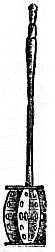
MILL.
CHOCOLATE, to Make.
Ingredients.—Allow ½ oz. of chocolate to each person; to every oz. allow ½ pint of water, ½ pint of milk. Mode.—Make the milk-and-water hot; scrape the chocolate into it, and stir the mixture constantly and quickly until the chocolate is dissolved; bring it to the boiling-point, stir it well, and serve directly with white sugar. Chocolate prepared within a mill, as shown in the engraving, is made by putting in the scraped chocolate, pouring over it the boiling milk-and-water, and milling it over the fire until hot and frothy. Sufficient.—Allow ½ oz. of cake chocolate to each person.
CHOCOLATE CREAM.
Ingredients.—3 oz. of grated chocolate, ¼ lb. of sugar, 1½ pint of cream, 1½ oz. of clarified isinglass, the yolks of 6 eggs. Mode.—Beat the yolks of the eggs well, put them into a basin with the grated chocolate, the sugar, and 1 pint of the cream; stir these ingredients well together, pour them into a jug, and set this jug in a saucepan of boiling water; stir it one way until the mixture thickens, but do not allow it to boil, or it will curdle. Strain the cream through a sieve into a basin; stir in the isinglass and the other ½ pint of cream, which should be well whipped; mix all well together, and pour it into a mould which has been previously oiled with the purest salad-oil, and, if at hand, set it in ice until wanted for table. Time.—About 10 minutes to stir the mixture over the fire. Average cost, 4s. 6d., with cream at 1s. per pint. Sufficient to fill a quart mould. Seasonable at any time.
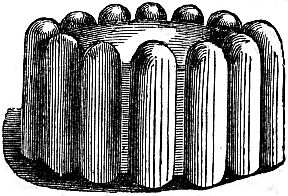
CREAM-MOULD.
CHOCOLATE SOUFFLÉ.
Ingredients.—4 eggs, 3 teaspoonfuls of pounded sugar, 1 teaspoonful of flour, 3 oz. of the best chocolate. Mode.—Break the eggs, separating the whites from the yolks, and put them into different basins; add to the yolks the sugar, flour, and chocolate, which should be very finely grated, and stir these ingredients for 5 minutes. Then well whisk the whites of the eggs in the other basin until they are stiff, and, when firm, mix lightly with the yolks till the whole forms a smooth and light substance; butter a round cake-tin, put in the mixture, and bake in a moderate oven from 15 to 20 minutes. Pin a white napkin round the tin, strew sifted sugar over the top of the soufflé, and send it immediately to table. The proper appearance of this dish depends entirely on the expedition with which it is served; and some cooks, to preserve its lightness, hold a salamander over the soufflé until it is placed on the table. If allowed to stand after it comes from the oven it will be entirely spoiled, as it falls almost immediately. Time.—15 to 20 minutes. Average cost, 1s. Sufficient for a moderate-sized soufflé. Seasonable at any time.
CLARET-CUP.
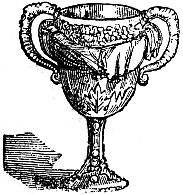
CLARET-CUP.
Ingredients.—1 bottle of claret, 1 bottle of soda-water, about ½ lb. of pounded ice, 4 tablespoonfuls of powdered sugar, ¼ teaspoonful of grated nutmeg, 1 liqueur-glass of Maraschino, a sprig of green borage. Mode.—Put all the ingredients into a silver cup, regulating the proportion of ice by the state of the weather; if very warm, a larger quantity would be necessary. Hand the cup round with a clean napkin passed through one of the handles, that the edge of the cup may be wiped after each guest has partaken of the contents thereof. Seasonable in summer.
COCK-A-LEEKIE.
Ingredients.—A capon or large fowl (sometimes an old cock, from which the recipe takes its name, is used), which should be trussed as for boiling, 2 or 3 bunches of fine leeks, 5 quarts of stock (see Stock), pepper and salt to taste. Mode.—Well wash the leeks (and, if old, scald them in boiling water for a few minutes), taking off the roots and part of the heads, and cut them into lengths of about an inch. Put the fowl into the stock, with, at first, one half of the leeks, and allow it to simmer gently. In half an hour add the remaining leeks, and then it may simmer for 3 or 4 hours longer. It should be carefully skimmed, and can be seasoned to taste. In serving, take out the fowl and carve it neatly, placing the pieces in a tureen, and pouring over them the soup, which should be very thick of leeks (a purée of leeks, the French would call it). Time.—4 hours. Average cost, 1s. 6d. per quart; or with stock, 1s. Sufficient for 10 persons. Seasonable in winter.
Note.—Without the fowl, the above, which would then be merely called leek soup, is very good, and also economical. Cock-a-leekie was largely consumed at the Burns Centenary Festival at the Crystal Palace, Sydenham, in 1859.
COCOA, to Make.
Ingredients.—Allow 2 teaspoonfuls of the prepared cocoa to 1 breakfast-cup; boiling milk and boiling water. Mode.—Put the cocoa into a breakfast-cup, pour over it sufficient cold milk to make it into a smooth paste; then add equal quantities of boiling milk and boiling water, and stir all well together. Care must be taken not to allow the milk to get burnt, as it will entirely spoil the flavour of the preparation. The above directions are usually given for making the prepared cocoa. The rock cocoa, or that bought in a solid piece, should be scraped, and made in the same manner, taking care to rub down all the lumps before the boiling liquid is added. Sufficient.—2 teaspoonfuls of prepared cocoa for 1 breakfast-cup, or ¼ oz. of the rock cocoa for the same quantity.
COD.
Cod should be chosen for the table when it is plump and round near the tail, when the hollow behind the head is deep, and when the sides are undulated as if they were ribbed. The glutinous parts about the head lose their delicate flavour after the fish has been twenty-four hours out of the water. The great point by which the cod should be judged is the firmness of its flesh; and, although the cod is not firm when it is alive, its quality may be arrived at by pressing the finger into the flesh: if this rises immediately, the flesh is good; if not, it is stale. Another sign of its goodness is, if the fish, when it is cut, exhibits a bronze appearance, like the silver side of a round of beef; when this is the case the flesh will be firm when cooked. Stiffness in a cod, or in any other fish, is a sure sign of freshness, though not always of quality. Sometimes codfish, though exhibiting signs of rough usage, will eat much better than those with red gills, so strongly recommended by many cookery-books. This appearance is generally caused by the fish having been knocked about at sea, in the well-boats, in which they are conveyed from the fishing-grounds to market.
COD à la BÉCHAMEL.
[Cold Meat Cookery.] Ingredients.—Any remains of cold cod, 4 tablespoonfuls of béchamel (see Béchamel Sauce), 2 oz. of butter; seasoning to taste of pepper and salt; fried bread, a few bread-crumbs. Mode.—Flake the cod carefully, leaving out all skin and bone; put the béchamel in a stewpan with the butter, and stir it over the fire till the latter is melted; add seasoning, put in the fish, and mix it well with the sauce. Make a border of fried bread round the dish, lay in the fish, sprinkle over with bread-crumbs, and baste with butter. Brown either before the fire or with a salamander, and garnish with toasted bread cut in fanciful shapes. Time.—½ hour. Average cost, exclusive of the fish, 6d.
COD à la CREME.
[Cold Meat Cookery.] Ingredients.—1 large slice of cod, 1 oz. of butter, 1 chopped shalot, a little minced parsley, ¼ teacupful of white stock, ¼ pint of milk or cream, flour to thicken, cayenne and lemon-juice to taste, ¼ teaspoonful of powdered sugar. Mode.—Boil the cod, and while hot, break it into flakes; put the butter, shalot, parsley, and stock into a stewpan, and let them boil for 5 minutes. Stir in sufficient flour to thicken, and pour to it the milk or cream. Simmer for 10 minutes, add the cayenne and sugar, and, when liked, a little lemon-juice. Put the fish in the sauce to warm gradually, but do not let it boil. Serve in a dish garnished with croûtons. Time.—Rather more than ½ hour. Average cost, with cream, 2s. Sufficient for 3 persons. Seasonable from November to March.
Note.—The remains of fish from the preceding day answer very well for this dish.
COD à l’ITALIENNE.
Ingredients.—2 slices of crimped cod, 1 shalot, 1 slice of ham minced very fine, ½ pint of white stock, when liked, ½ teacupful of cream; salt to taste; a few drops of garlic vinegar, a little lemon-juice, ½ teaspoonful of powdered sugar. Mode.—Chop the shalots, mince the ham very fine, pour on the stock, and simmer for 15 minutes. If the colour should not be good, add cream in the above proportion, and strain it through a fine sieve; season it, and put in the vinegar, lemon-juice, and sugar. Now boil the cod, take out the middle bone, and skin it; put it on the dish without breaking, and pour the sauce over it. Time.—¾ hour. Average cost, 3s. 6d., with fresh fish. Sufficient for 4 persons. Seasonable from November to March.
COD à la MAÎTRE D’HÔTEL.
[Cold Meat Cookery.] Ingredients.—2 slices of cod, ¼ lb. of butter, a little chopped shalot and parsley; pepper to taste; ¼ teaspoonful of grated nutmeg, or rather less when the flavour is not liked; the juice of ¼ lemon. Mode.—Boil the cod, and either leave it whole, or, what is still better, flake it from the bone, and take off the skin. Put it into a stewpan with the butter, parsley, shalot, pepper, and nutmeg. Melt the butter gradually, and be very careful that it does not become like oil. When all is well mixed and thoroughly hot, add the lemon-juice, and serve. Time.—½ hour. Average cost, 2s. 6d.; with remains of cold fish, 5d. Sufficient for 4 persons. Seasonable from November to March.
Note.—Cod that has been left will do for this.
COD, Curried.
[Cold Meat Cookery.] Ingredients.—2 slices of large cod, or the remains of any cold fish; 3 oz. of butter, 1 onion sliced, a teacupful of white stock, thickening of butter and flour, 1 small teaspoonful of curry-powder, ¼ pint of cream, salt and cayenne to taste. Mode.—Flake the fish, and fry it of a nice brown colour with the butter and onions; put this in a stewpan, add the stock and thickening, and simmer for 10 minutes. Stir the curry-powder into the cream; put it, with the seasoning, to the other ingredients; give one boil, and serve. Time.—¾ hour. Average cost, with fresh fish, 3s. Sufficient for 4 persons. Seasonable from November to March.
COD PIE.
Ingredients.—2 slices of cod; pepper and salt to taste; ½ a teaspoonful of grated nutmeg, 1 large blade of pounded mace, 2 oz. of butter, ½ pint of stock, a paste crust (see Pastry). For sauce,—1 tablespoonful of stock, ¼ pint of cream or milk, thickening of flour or butter, lemon-peel chopped very fine to taste, 12 oysters. Mode.—Lay the cod in salt for 4 hours, then wash it and place it in a dish; season, and add the butter and stock; cover with the crust, and bake for 1 hour, or rather more. Now make the sauce, by mixing the ingredients named above; give it one boil, and pour it into the pie by a hole made at the top of the crust, which can easily be covered by a small piece of pastry cut and baked in any fanciful shape,—such as a leaf, or otherwise. Time.—1½ hour. Average cost, with fresh fish, 2s. 6d. Sufficient for 6 persons. Seasonable from November to March.
Note.—The remains of cold fish may be used for this pie.
COD PIE. (Economical.)
[Cold Meat Cookery.] Ingredients.—Any remains of cold cod, 12 oysters, sufficient melted butter to moisten it; mashed potatoes enough to fill up the dish. Mode.—Flake the fish from the bone, and carefully take away all the skin. Lay it in a pie-dish, pour over the melted butter and oysters (or oyster sauce, if there is any left), and cover with mashed potatoes. Bake for ½ an hour, and send to table of a nice brown colour. Time.—½ hour. Seasonable from November to March.
COD, Salt, commonly called “Salt-fish.”
Ingredients.—Sufficient water to cover the fish. Mode.—Wash the fish, and lay it all night in water, with a ¼ pint of vinegar. When thoroughly soaked, take it out, see that it is perfectly clean, and put it in the fish-kettle with sufficient cold water to cover it. Heat it gradually, but do not let it boil much, or the fish will be hard. Skim well, and when done, drain the fish, and put it on a napkin garnished with hard-boiled eggs cut in rings. Time.—About 1 hour. Average cost, 6d. per lb. Sufficient for each person, ¼ lb. Seasonable in the spring.
Note.—Serve with egg sauce and parsnips. This is an especial dish on Ash Wednesday.
COD SOUNDS
Should be well soaked in salt and water, and thoroughly washed before dressing them. They are considered a great delicacy, and may either be broiled, fried, or boiled; if they are boiled, mix a little milk with the water.
COD SOUNDS, en Poule.
Ingredients.—For forcemeat, 12 chopped oysters, 3 chopped anchovies, ¼ lb. of bread-crumbs, 1 oz. of butter, 2 eggs, seasoning of salt, pepper, nutmeg, and mace to taste; 4 cod sounds. Mode.—Make the forcemeat by mixing the ingredients well together. Wash the sounds, and boil them in milk and water for ½ an hour; take them out, and let them cool. Cover each with a layer of forcemeat, roll them up in a nice form, and skewer them. Rub over with lard, dredge with flour, and cook them gently before the fire in a Dutch oven. Time.—1 hour. Average cost, 6d. per lb.
COD’S HEAD & SHOULDERS.
Ingredients.—Sufficient water to cover the fish; 5 oz. of salt to each gallon of water. Mode.—Cleanse the fish thoroughly, and rub a little salt over the thick part and inside of the fish 1 or 2 hours before dressing it, as this very much improves the flavour. Lay it in the fish-kettle, with sufficient cold water to cover it. Be very particular not to pour the water on the fish, as it is liable to break it, and only keep it just simmering. If the water should boil away, add a little by pouring it in at the side of the kettle, and not on the fish. Add salt in the above proportion, and bring it gradually to a boil. Skim very carefully, draw it to the side of the fire, and let it gently simmer till done. Take it out and drain it; serve on a hot napkin, and garnish with cut lemon and horseradish. Time.—According to size, ½ an hour, more or less. Average cost, from 3s. to 6s. Sufficient for 6 or 8 persons. Seasonable from November to March.
Note.—Oyster sauce and plain melted butter should be served with this.
COD’S HEAD & SHOULDERS, to Carve.
First run the knife along the centre of the side of the fish, namely, from d to b, down to the bone; then carve it in unbroken slices downwards from d to e, or upwards from d to c, as shown in the engraving. The carver should ask the guests if they would like a portion of the roe and liver.
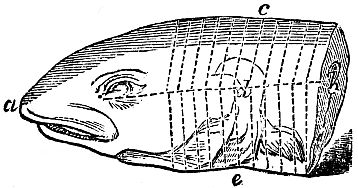
Note.—Of this fish, the parts about the backbone and shoulders are the firmest and most esteemed by connoisseurs. The sound, which lines the fish beneath the backbone, is considered a delicacy, as are also the gelatinous parts about the head and neck.
COFFEE, Essence of.
Ingredients.—To every ¼ lb. of ground coffee allow 1 small teaspoonful of powdered chicory, 3 small teacupfuls, or 1 pint, of water. Mode.—Let the coffee be freshly ground, and, if possible, freshly roasted; put it into a percolater, or filter, with the chicory, and pour slowly over it the above proportion of boiling water. When it has all filtered through, warm the coffee sufficiently to bring it to the simmering-point, but do not allow it to boil; then filter it a second time, put it into a clean and dry bottle, cork it well, and it will remain good for several days. Two tablespoonfuls of this essence are quite sufficient for a breakfast-cupful of hot milk. This essence will be found particularly useful to those persons who have to rise extremely early; and having only the milk to make boiling, is very easily and quickly prepared. When the essence is bottled, pour another 3 teacupfuls of boiling water slowly on the grounds, which, when filtered through, will be a very weak coffee. The next time there is essence to be prepared, make this weak coffee boiling, and pour it on the ground coffee instead of plain water: by this means a better coffee will be obtained. Never throw away the grounds without having made use of them in this manner; and always cork the bottle well that contains this preparation, until the day that it is wanted for making the fresh essence. Time.—To be filtered once, then brought to the boiling-point, and filtered again. Average cost, with coffee at 1s. 8d. per lb., 6d. Sufficient.—Allow 2 tablespoonfuls for a breakfast-cupful of hot milk.
COFFEE, Nutritious.
Ingredients.—½ oz. of ground coffee, 1 pint of milk. Mode.—Let the coffee be freshly ground; put it into a saucepan with the milk, which should be made nearly boiling before the coffee is put in, and boil together for 3 minutes; clear it by pouring some of it into a cup, and then back again, and leave it on the hob for a few minutes to settle thoroughly. This coffee may be made still more nutritious by the addition of an egg well beaten, and put into the coffee-cup. Time.—5 minutes to boil, 5 minutes to settle. Sufficient to make 1 large breakfast-cupful of coffee.
COFFEE, Simple Method of Making.
Ingredients.—Allow ½ oz., or 1 tablespoonful, of coffee to each person; to every oz. allow ½ pint of water. Mode.—Have a small iron ring made to fit the top of the coffee-pot inside, and to this ring sew a small muslin bag (the muslin for the purpose must not be too thin). Fit the bag into the pot, warm the pot with some boiling water; throw this away, and put the ground coffee into the bag; pour over as much boiling water as is required, close the lid, and, when all the water has filtered through, remove the bag, and send the coffee to table. Making it in this manner prevents the necessity of pouring the coffee from one vessel to another, which cools and spoils it. The water should be poured on the coffee gradually, so that the infusion may be stronger; and the bag must be well made, that none of the grounds may escape through the seams, and so make the coffee thick and muddy. Sufficient.—Allow 1 tablespoonful, or ½ oz., to each person.
COFFEE, to Make.
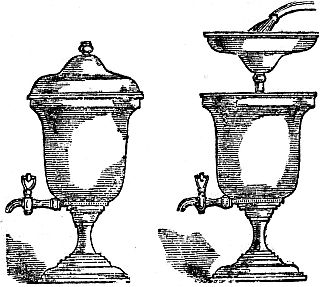
LOYSEL’S HYDROSTATIC URN.
Ingredients.—Allow ½ oz., or 1 tablespoonful, of ground coffee to each person; to every oz. of coffee allow 1/3 pint of water. Mode.—To make coffee good, it should never be boiled, but the boiling water merely poured on it, the same as for tea. The coffee should always be purchased in the berry,—if possible, freshly roasted; and it should never be ground long before it is wanted for use. There are very many new kinds of coffee-pots, but the method of making the coffee is nearly always the same, namely, pouring the boiling water on the powder, and allowing it to filter through. Our illustration shows one of Loysel’s Hydrostatic Urns, which are admirably adapted for making good and clear coffee, which should be made in the following manner:—Warm the urn with boiling water, remove the lid and movable filter, and place the ground coffee at the bottom of the urn. Put the movable filter over this, and screw the lid, inverted, tightly on the end of the centre pipe. Pour into the inverted lid the above proportion of boiling water, and when all the water so poured has disappeared from the funnel, and made its way down the centre pipe and up again through the ground coffee by hydrostatic pressure, unscrew the lid and cover the urn. Pour back direct into the urn, not through the funnel, one, two, or three cups, according to the size of the percolater, in order to make the infusion of uniform strength; the contents will then be ready for use, and should run from the tap strong, hot, and clear. The coffee made in these urns generally turns out very good, and there is but one objection to them,—the coffee runs rather slowly from the tap; this is of no consequence where there is a small party, but tedious where there are many persons to provide for. A remedy for this objection may be suggested, namely, to make the coffee very strong, so that not more than 1/3 cup would be required, as the rest would be filled up with milk. Making coffee in filters or percolaters does away with the necessity of using isinglass, white of egg, and various other preparations, to clear it. Coffee should always be served very hot, and, if possible, in the same vessel in which it is made, as pouring it from one pot to another cools, and consequently spoils it. Many persons may think that the proportion of water we have given for each oz. of coffee is rather small; it is so, and the coffee produced from it will be very strong; 1/3 of a cup will be found quite sufficient, which should be filled with nice hot milk, or milk and cream mixed. This is the café au lait for which our neighbours over the Channel are so justly celebrated. Should the ordinary method of making coffee be preferred, use double the quantity of water, and, in pouring it into the cups, put in more coffee and less milk. Sufficient.—For very good coffee, allow ½ oz., or 1 tablespoonful, to each person.
COFFEE, to Roast. (A French Recipe.)
It being an acknowledged fact that French coffee is decidedly superior to that made in England, and as the roasting of the berry is of great importance to the flavour of the preparation, it will be useful and interesting to know how they manage these things in France. In Paris, there are two houses justly celebrated for the flavour of their coffee,—La Maison Corcellet and La Maison Royer de Chartres; and to obtain this flavour before roasting, they add to every 3 lbs. of coffee a piece of butter the size of a nut, and a dessertspoonful of powdered sugar: it is then roasted in the usual manner. The addition of the butter and sugar develops the flavour and aroma of the berry; but it must be borne in mind, that the quality of the butter must be of the very best description.
COLLOPS, Scotch.
[Cold Meat Cookery.] Ingredients.—The remains of cold roast veal, a little butter, flour, ½ pint of water, 1 onion, 1 blade of pounded mace, 1 tablespoonful of lemon-juice, 1-2 teaspoonful of finely-minced lemon-peel, 2 tablespoonfuls of sherry, 1 tablespoonful of mushroom ketchup. Mode.—Cut the veal the same thickness as for cutlets, rather larger than a crown piece; flour the meat well, and fry a light brown in butter; dredge again with flour, and add ½ pint of water, pouring it in by degrees; set it on the fire, and when it boils, add the onion and mace, and let it simmer very gently about ¾ hour; flavour the gravy with lemon-juice, peel, wine, and ketchup, in the above proportion; give one boil, and serve. Time.—¾ hour. Seasonable from March to October.
COLLOPS, Scotch, White.
[Cold Meat Cookery.] Ingredients.—The remains of cold roast veal, ½ teaspoonful of grated nutmeg, 2 blades of pounded mace, cayenne and salt to taste, a little butter, 1 dessertspoonful of flour, ¼ pint of water, 1 teaspoonful of anchovy sauce, 1 tablespoonful of lemon-juice, ¼ teaspoonful of lemon-peel, 1 tablespoonful of mushroom ketchup, 3 tablespoonfuls of cream, 1 tablespoonful of sherry. Mode.—Cut the veal into thin slices about 3 inches in width; hack them with a knife, and grate on them the nutmeg, mace, cayenne, and salt, and fry them in a little butter. Dish them, and make a gravy in the pan by putting in the remaining ingredients. Give one boil, and pour it over the collops; garnish with lemon and slices of toasted bacon, rolled. Forcemeat balls may be added to this dish. If cream is not at hand, substitute the yolk of an egg beaten up well with a little milk. Time.—About 5 or 7 minutes. Seasonable from May to October.
COMPÔTE.
A confiture made at the moment of need, and with much less sugar than would be ordinarily put to preserves. They are very wholesome things, suitable to most stomachs which cannot accommodate themselves to raw fruit or a large portion of sugar: they are the happy medium, and far better than ordinary stewed fruit. For Fruit Compôtes refer to the recipes relating to the various Fruits.
CONFECTIONARY.
In speaking of confectionary, it should be remarked that many preparations come under that head; for the various fruits, flowers, herbs, roots, and juices, which, when boiled with sugar, were formerly employed in pharmacy as well as for sweetmeats, were called confections, from the Latin word conficere, ‘to make up;’ but the term confectionary embraces a very large class indeed of sweet food, many kinds of which should not be attempted in the ordinary cuisine. The thousand and one ornamental dishes that adorn the tables of the wealthy should be purchased from the confectioner: they cannot profitably be made at home. Apart from these, cakes, biscuits, and tarts, &c., the class of sweetmeats called confections may be thus classified:—1. Liquid confects, or fruits either whole or in pieces, preserved by being immersed in a fluid transparent syrup; as the liquid confects of apricots, green citrons, and many foreign fruits. 2. Dry confects are those which, after having been boiled in the syrup, are taken out and put to dry in an oven, as citron and orange-peel, &c. 3. Marmalade, jams, and pastes, a kind of soft compounds made of the pulp of fruits or other vegetable substances, beat up with sugar or honey; such as oranges, apricots, pears, &c. 4. Jellies are the juices of fruits boiled with sugar to a pretty thick consistency, so as, upon cooling, to form a trembling jelly; as currant, gooseberry, apple jelly, &c. 5. Conserves are a kind of dry confects, made by beating up flowers, fruits, &c., with sugar, not dissolved. 6. Candies are fruits candied over with sugar after having been boiled in the syrup.
COW-HEEL, Fried.
Ingredients.—Ox-feet, the yolk of 1 egg, bread-crumbs, parsley, salt and cayenne to taste, boiling butter. Mode.—Wash, scald, and thoroughly clean the feet, and cut them into pieces about 2 inches long; have ready some fine bread-crumbs mixed with a little minced parsley, cayenne, and salt; dip the pieces of heel into the yolk of egg, sprinkle them with the bread-crumbs, and fry them until of a nice brown in boiling butter. Time.—¼ hour. Average cost, 6d. each. Seasonable at any time.
Note.—Ox-feet maybe dressed in various ways, stewed in gravy or plainly boiled and served with melted butter. When plainly boiled, the liquor will answer for making sweet or relishing jellies, and also to give richness to soups or gravies.
COW-HEEL STOCK, for Jellies (More Economical than Calf’s-Feet).
Ingredients.—2 cow-heels, 3 quarts of water. Mode.—Procure 2 heels that have only been scalded, and not boiled; split them in two, and remove the fat between the claws; wash them well in warm water, and put them into a saucepan with the above proportion of cold water; bring it gradually to boil, remove all the scum as it rises, and simmer the heels gently from 7 to 8 hours, or until the liquor is reduced one-half; then strain it into a basin, measuring the quantity, and put it in a cool place. Clarify it in the same manner as calf’s-feet stock, using, with the other ingredients, about ½ oz. of isinglass to each quart. This stock should be made the day before it is required for use. Two dozen shank-bones of mutton, boiled for 6 or 7 hours, yield a quart of strong firm stock. They should be put on in 2 quarts of water, which should be reduced one-half. Make this also the day before it is required. Time.—7 to 8 hours to boil the cow-heels, 6 to 7 hours to boil the shank-bones. Average cost, from 4d. to 6d. each. Sufficient.—2 cow-heels should make 3 pints of stock. Seasonable at any time.
COWSLIP WINE.
Ingredients.—To every gallon of water allow 3 lbs. of lump sugar, the rind of 2 lemons, the juice of 1, the rind and juice of 1 Seville orange, 1 gallon of cowslip pips. To every 4½ gallons of wine allow 1 bottle of brandy. Mode.—Boil the sugar and water together for ½ hour, carefully removing all the scum as it rises. Pour this boiling liquor on the orange and lemon-rinds and the juice, which should be strained; when milk-warm, add the cowslip pips or flowers, picked from the stalks and seeds; and to 9 gallons of wine 3 tablespoonfuls of good fresh brewers’ yeast. Let it ferment 3 or 4 days, then put all together in a cask with the brandy, and let it remain for 2 months, when bottle it off for use. Time.—To be boiled ½ hour; to ferment 3 or 4 days; to remain in the cask 2 months. Average cost, exclusive of the cowslips, which may be picked in the fields, 2s. 9d. per gallon. Seasonable. Make this in April or May.
CRAB, to Choose.
The middle-sized crab is the best; and the crab, like the lobster, should be judged by its weight; for if light, it is watery.
CRAB, to Dress.
Ingredients.—1 crab, 2 tablespoonfuls of vinegar, 1 ditto of oil; salt, white pepper, and cayenne, to taste. Mode.—Empty the shells, and thoroughly mix the meat with the above ingredients, and put it in the large shell. Garnish with slices of cut lemon and parsley. The quantity of oil may be increased when it is much liked. Average cost, from 10d. to 2s. Seasonable all the year; but not so good in May, June, and July. Sufficient for 3 persons.
CRAB, Hot.
Ingredients.—1 crab, nutmeg, salt and pepper to taste, 3 oz. of butter, ¼ lb. of bread-crumbs, 3 tablespoonfuls of vinegar. Mode.—After having boiled the crab, pick the meat out from the shells, and mix with it the nutmeg and seasoning. Cut up the butter in small pieces, and add the bread-crumbs and vinegar. Mix altogether, put the whole in the large shell, and brown before the fire or with a salamander. Time.—1 hour. Average cost, from 10d. to 2s. Sufficient for 3 persons, Seasonable all the year; but not so good in May, June, and July.
CRAB SAUCE, for Fish (equal to Lobster Sauce).
Ingredients.—1 crab; salt, pounded mace, and cayenne to taste; ½ pint of melted butter made with milk. Mode.—Choose a nice fresh crab, pick all the meat away from the shell, and cut it into small square pieces. Make ½ pint of melted butter, put in the fish and seasoning; let it gradually warm through, and simmer for 2 minutes: it should not boil. Average cost, 1s. 2d.
CRAYFISH.
Crayfish should be thrown into boiling water, to which has been added a good seasoning of salt and a little vinegar. When done, which will be in ¼ hour, take them out and drain them. Let them cool, arrange them on a napkin, and garnish with plenty of double parsley.
Note.—This fish is frequently used for garnishing boiled turkey, boiled fowl, calf’s head, turbot, and all kinds of boiled fish.
CRAYFISH, Potted.
Ingredients.—100 crayfish; pounded mace, pepper, and salt to taste; 2 oz. butter. Mode.—Boil the fish in salt and water, pick out all the meat, and pound it in a mortar to a paste. Whilst pounding, add the butter gradually, and mix in the spice and seasoning. Put it in small pots, and pour over it clarified butter, carefully excluding the air. Time.—15 minutes to boil the crayfish. Average cost, 2s. 9d. Seasonable all the year.
CRAYFISH SOUP.
Ingredients.—50 crayfish, ¼ lb. of butter, 6 anchovies, the crumb of 1 French roll, a little lobster-spawn, seasoning to taste, 2 quarts of medium stock, or fish stock. Mode.—Shell the crayfish, and put the fish between two plates until they are wanted; pound the shells in a mortar with the butter and anchovies; when well beaten, add a pint of stock, and simmer for ¾ of an hour. Strain it through a hair sieve, put the remainder of the stock to it, with the crumb of the roll; give it one boil, and rub it through a tammy, with the lobster-spawn. Put in the fish, but do not let the soup boil after it has been rubbed through the tammy. If necessary, add seasoning. Time.—1½ hour. Average cost, 2s. 3d. or 1s. 9d. per quart. Sufficient for 8 persons. Seasonable from January to July.
CREAM à la VALOIS.
Ingredients.—4 sponge-cakes, jam, ¾ pint of cream, sugar to taste, the juice of ½ lemon, ¼ glass of sherry, 1¼ oz. of isinglass. Mode.—Cut the sponge-cakes into thin slices, place two together with preserve between them, and pour over them a small quantity of sherry mixed with a little brandy. Sweeten and flavour the cream with the lemon-juice and sherry; add the isinglass, which should be dissolved in a little water, and beat up the cream well. Place a little in an oiled mould; arrange the pieces of cake in the cream, then fill the mould with the remainder, let it cool, and turn it out on a dish. By oiling the mould the cream will have a much smoother appearance, and will turn out more easily than when merely dipped in cold water. Average cost, 3s. 6d. Sufficient to fill a 1½ pint mould. Seasonable at any time.
CREAM CHEESE.
Cream cheese should be served on a d’oyley, and garnished either with water-cresses or parsley; of the former, a plentiful supply should be given, as they add greatly to the appearance of the dish, besides improving the flavour of the cheese.
CREAM, Devonshire.
The milk should stand 24 hours in the winter, half that time when the weather is very warm. The milkpan is then set on a stove, and should there remain until the milk is quite hot; but it must not boil, or there will be a thick skin on the surface. When it is sufficiently done the undulations on the surface look thick, and small rings appear. The time required for scalding cream depends on the size of the pan and the heat of the fire, but the slower it is done the better. The pan should be placed in the dairy when the cream is sufficiently scalded, and skimmed the following day. This cream is so much esteemed that it is sent to the London markets in small square tins, and is exceedingly delicious eaten with fresh fruit. In Devonshire, butter is made from this cream, and is usually very firm.
CREAM, Italian.
Ingredients.—½ pint of milk, ½ pint of cream, sugar to taste, 1 oz. of isinglass, 1 lemon, the yolks of 4 eggs. Mode.—Put the cream and milk into a saucepan, with sugar to sweeten, and the lemon-rind. Boil until the milk is well flavoured, then strain it into a basin and add the beaten yolks of eggs. Put this mixture into a jug, place the jug in a saucepan of boiling water over the fire, and stir the contents until they thicken, but do not allow them to boil. Take the cream off the fire, stir in the lemon-juice and isinglass, which should be melted, and whip well; fill a mould, place it in ice if at hand, and, when set, turn it out on a dish, and garnish as taste may dictate. The mixture may be whipped and drained, and then put into small glasses, when this mode of serving is preferred. Time.—From 5 to 8 minutes to stir the mixture in the jug. Average cost, with the best isinglass, 2s. 6d. Sufficient to fill 1½ pint mould. Seasonable at any time.
CREAM SAUCE, for Fish or White Dishes.
Ingredients.—1/3 pint of cream, 2 oz. of butter, 1 teaspoonful of flour, salt and cayenne to taste; when liked, a small quantity of pounded mace or lemon-juice. Mode.—Put the butter in a very clean saucepan, dredge in the flour, and keep shaking round till the butter is melted. Add the seasoning and cream, and stir the whole till it boils; let it just simmer for 5 minutes, when add either pounded mace or lemon-juice to taste to give it a flavour. Time.—5 minutes to simmer. Average cost for this quantity, 7d.
Note.—This sauce may be flavoured with very finely-shredded shalot.
CREAM, Stone, of tous les Mois.
Ingredients.—½ lb. of preserve, 1 pint of milk, 2 oz. of lump sugar, 1 heaped tablespoonful of tous les mois, 3 drops of essence of cloves, 3 drops of almond-flavouring. Mode.—Place the preserve at the bottom of a glass dish; put the milk into a lined saucepan, with the sugar, and make it boil. Mix to a smooth batter the tous les mois with a very little cold milk; stir it briskly into the boiling milk, add the flavouring, and simmer for 2 minutes. When rather cool, but before turning solid, pour the cream over the jam, and ornament it with strips of red-currant jelly or preserved fruit. Time.—2 minutes. Average cost, 10d. Sufficient for 4 or 5 persons. Seasonable at any time.
CREAM, Swiss.
Ingredients.—¼ lb. of macaroons or 6 small sponge-cakes, sherry, 1 pint of cream, 5 oz. of lump sugar, 2 large tablespoonfuls of arrowroot, the rind of 1 lemon, the juice of ½ lemon, 3 tablespoonfuls of milk. Mode.—Lay the macaroons or sponge-cakes in a glass dish, and pour over them as much sherry as will cover them, or sufficient to soak them well. Put the cream into a lined saucepan, with the sugar and lemon-rind, and let it remain by the side of the fire until the cream is well flavoured, when take out the lemon-rind. Mix the arrowroot smoothly with the cold milk; add this to the cream, and let it boil gently for about 3 minutes, keeping it well stirred. Take it off the fire, stir till nearly cold, when add the lemon-juice, and pour the whole over the cakes. Garnish the cream with strips of angelica, or candied citron cut thin, or bright-coloured jelly or preserve. This cream is exceedingly delicious, flavoured with vanilla instead of lemon: when this flavouring is used the sherry may be omitted, and the mixture poured over the dry cakes. Time.—About ½ hour to infuse the lemon-rind; 5 minutes to boil the cream. Average cost, with cream at 1s. per pint, 3s. Sufficient for 5 or 6 persons. Seasonable at any time.
CREAM, Vanilla.
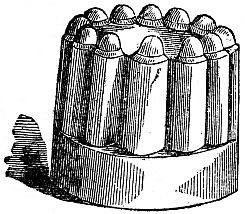
VANILLA-CREAM MOULD.
Ingredients.—1 pint of milk, the yolks of 8 eggs, 6 oz. of sugar, 1 oz. of isinglass, flavouring to taste of essence of vanilla. Mode.—Put the milk and sugar into a saucepan, and let it get hot over a slow fire; beat up the yolks of the eggs, to which add gradually the sweetened milk; flavour the whole with essence of vanilla, put the mixture into a jug, and place this jug in a saucepan of boiling water. Stir the contents with a wooden spoon one way until the mixture thickens, but do not allow it to boil, or it will be full of lumps. Take it off the fire; stir in the isinglass, which should be previously dissolved in about ¼ pint of water, and boiled for 2 or 3 minutes; pour the cream into an oiled mould, put it in a cool place to set, and turn it out carefully on a dish. Instead of using the essence of vanilla, a pod may be boiled in the milk until the flavour is well extracted. A pod, or a pod and a half, will be found sufficient for the above proportion of ingredients. Time.—About 10 minutes to stir the mixture. Average cost, with the best isinglass, 2s. 6d. Sufficient to fill a quart mould. Seasonable at any time.
CREAM, Whipped, for putting on Trifles, serving in Glasses, &c.
Ingredients.—To every pint of cream allow 3 oz. of pounded sugar, 1 glass of sherry or any kind of sweet white wine, the rind of ½ lemon, the white of 1 egg. Mode.—Rub the sugar on the lemon-rind, and pound it in a mortar until quite fine, and beat up the white of the egg until quite stiff; put the cream into a large bowl, with the sugar, wine, and beaten egg, and whip it to a froth; as fast as the froth rises take it off with a skimmer, and put it on a sieve to drain in a cool place. This should be made the day before it is wanted, as the whip is then so much firmer. The cream should be whipped in a cool place, and in summer over ice, if it is obtainable. A plain whipped cream may be served on a glass dish, and garnished with strips of angelica, or pastry-leaves, or pieces of bright-coloured jelly: it makes a very pretty addition to the supper-table. Time.—About 1 hour to whip the cream. Average cost, with cream at 1s. per pint, 1s. 9d. Sufficient for 1 dish or 1 trifle. Seasonable at any time.
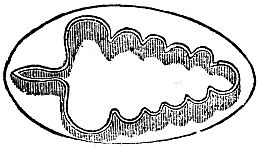
PASTRY-LEAF.
CRUMPETS.
These are made in the same manner as muffins, only, in making the mixture, let it be more like batter than dough. Let it rise for about ½ hour; pour it into iron rings, which should be ready on a hot-plate; bake them, and when one side appears done, turn them quickly on the other. To toast them, have ready a very bright clear fire; put the crumpet on a toasting-fork, and hold it before the fire, not too close, until it is nicely brown on one side, but do not allow it to blacken; turn it, and brown the other side; then spread it with good butter, cut it in half, and, when all are done, pile them on a hot dish, and send them quickly to table. Muffins and crumpets should always be served on separate dishes, and both toasted and served as expeditiously as possible. Time.—From 10 to 15 minutes to bake them. Sufficient.—Allow 2 crumpets to each person.
CRUST, Butter, for Boiled Puddings.
Ingredients.—To every lb. of flour allow 6 oz. of butter, ½ pint of water. Mode.—With a knife, work the flour to a smooth paste with ½ pint of water; roll the crust out rather thin; place the butter over it in small pieces, dredge lightly over it some flour, and fold the paste over; repeat the rolling once more, and the crust will be ready for use. It may be enriched by adding another 2 oz. of butter; but, for ordinary purposes, the above quantity will be found quite sufficient. Average cost, 6d. per lb.
CRUST, Common, for Raised Pies.
Ingredients.—To every lb. of flour allow ½ pint of water, 1½ oz. of butter, 1½ oz. of lard, ½ saltspoonful of salt. Mode.—Put into a saucepan the water; when it boils, add the butter and lard, and when these are melted, make a hole in the middle of the flour; pour in the water gradually, beat it well with a wooden spoon, and be particular in not making the paste too soft. When it is well mixed, knead it with the hands until quite stiff, dredging a little flour over the paste and board to prevent them from sticking. When it is well kneaded, place it before the fire, with a cloth covered over it, for a few minutes; it will then be more easily worked into shape. This paste does not taste so nicely as a richer one, but it is worked with greater facility, and answers just as well for raised pies, for the crust is seldom eaten. Average cost, 5d. per lb.
CRUST, Dripping, for Kitchen Puddings, Pies, &c.
Ingredients.—To every lb. of flour allow 6 oz. of clarified beef dripping, ½ pint of water. Mode.—After having clarified the dripping, weigh it, and to every lb. of flour allow the above proportion of dripping. With a knife, work the flour into a smooth paste with the water, rolling it out three times, each time placing on the crust 2 oz. of the dripping broken into small pieces. If this paste is lightly made, if good dripping is used, and not too much of it, it will be found good; and by the addition of two tablespoonfuls of fine moist sugar, it may be converted into a common short crust for fruit pies. Average cost, 4d. per lb.
CRUST, Lard or Flead.
Ingredients.—To every lb. of flour allow ½ lb. of lard or flead, ½ pint of water, ½ saltspoonful of salt. Mode.—Clear the flead from skin, and slice it into thin flakes; rub it into the flour, add the salt, and work the whole into a smooth paste, with the above proportion of water; fold the paste over two or three times, beat it well with the rolling-pin, roll it out, and it will be ready for use. The crust made from this will be found extremely light, and may be made into cakes or tarts; it may also be very much enriched by adding more flead to the same proportion of flour. Average cost, 8d. per lb.
CRUST, Suet, for Pies or Puddings.
Ingredients.—To every lb. of flour allow 5 or 6 oz. of beef suet, ½ pint of water. Mode.—Free the suet from skin and shreds, chop it extremely fine, and rub it well into the flour; work the whole to a smooth paste with the above proportion of water; roll it out, and it is ready for use. This crust is quite rich enough for ordinary purposes, but when a better one is desired, use from ½ to ¾ lb. of suet to every lb. of flour. Some cooks, for rich crusts, pound the suet in a mortar, with a small quantity of butter. It should then be laid on the paste in small pieces, the same as for puff-crust, and will be found exceedingly nice for hot tarts. 5 oz. of suet to every lb. of flour will make a very good crust; and even ¼ lb, will answer very well for children, or where the crust is wanted very plain. Average cost, 5d. per lb.
CRUST, Common Short.
Ingredients.—To every lb. of flour allow 2 oz. of sifted sugar, 3 oz. of butter, about ½ pint of boiling milk. Mode.—Crumble the butter into the flour as finely as possible, add the sugar, and work the whole up to a smooth paste with the boiling milk. Roll it out thin, and bake in a moderate oven. Average cost, 6d. per lb.
CRUST, Very good Short for Fruit Tarts.
Ingredients.—To every lb. of flour allow ½ or ¾ lb. of butter, 1 tablespoonful of sifted sugar, 1/3 pint of water. Mode.—Rub the butter into the flour, after having ascertained that the latter is perfectly dry; add the sugar, and mix the whole into a stiff paste with about 1/3 pint of water. Roll it out two or three times, folding the paste over each time, and it will be ready for use. Average cost, 1s. 1d. per lb.