THE DICTIONARY OF COOKERY. (continued 8)
Reading edition
HERB POWDER, for Flavouring when Fresh Herbs are not obtainable.
Ingredients.—1 oz. of dried lemon-thyme, 1 oz. of dried winter savory, 1 oz. of dried sweet marjoram and basil, 2 oz. of dried parsley, 1 oz. of dried lemon-peel. Mode.—Prepare and dry the herbs, pick the leaves from the stalks, pound them, and sift them through a hair sieve; mix in the above proportions, and keep in glass bottles, carefully excluding the air. This we think a far better method of keeping herbs, as the flavour and fragrance do not evaporate so much as when they are merely put in paper bags. Preparing them in this way, you have them ready for use at a moment’s notice. Mint, sage, parsley, &c., dried, pounded, and each put into separate bottles, will be found very useful in winter.
HERBS, to Dry, for Winter Use.
On a very dry day, gather the herbs, just before they begin to flower. If this is done when the weather is damp, the herbs will not be so good a colour. (It is very necessary to be particular in little matters like this, for trifles constitute perfection, and herbs nicely dried will be found very acceptable when frost and snow are on the ground. It is hardly necessary, however, to state that the flavour and fragrance of fresh herbs are incomparably finer.) They should be perfectly freed from dirt and dust, and be divided into small bunches, with their roots cut off. Dry them quickly in a very hot oven, or before the fire, as by this means most of their flavour will be preserved, and be careful not to burn them; tie them up in paper bags, and keep in a dry place. This is a very general way of preserving dried herbs; but we would recommend the plan described in a former recipe. Seasonable.—From the month of July to the end of September is the proper time for storing herbs for winter use.
HERRINGS, White, Baked.
Ingredients.—12 herrings, 4 bay-leaves, 12 cloves, 12 allspice, 2 small blades of mace, cayenne pepper and salt to taste, sufficient vinegar to fill up the dish. Mode.—Take herrings, cut off the heads, and gut them. Put them in a pie-dish, heads and tails alternately, and, between each layer, sprinkle over the above ingredients. Cover the fish with the vinegar, and bake for ½ hour, but do not use it till quite cold. The herrings may be cut down the front, the backbone taken out, and closed again. Sprats done in this way are very delicious. Time.—½ an hour. Average cost, 1d. each.
To Choose the Herring.—The more scales this fish has, the surer the sign of its freshness. It should also have a bright and silvery look; but if red about the head, it is a sign that it has been dead for some time.
HERRINGS, Red or YARMOUTH BLOATERS.
The best way to cook these is to make incisions in the skin across the fish, because they do not then require to be so long on the fire, and will be far better than when cut open. The hard roe makes a nice relish by pounding it in a mortar, with a little anchovy, and spreading it on toast. If very dry, soak in warm water 1 hour before dressing.
HIDDEN MOUNTAIN, The (a pretty Supper Dish).
Ingredients.—6 eggs, a few slices of citron, sugar to taste, ¼ pint of cream, a layer of any kind of jam. Mode.—Beat the whites and yolks of the eggs separately; then mix them and beat well again, adding a few thin slices of citron, the cream, and sufficient pounded sugar to sweeten it nicely. When the mixture is well beaten, put it into a buttered pan, and fry the same as a pancake; but it should be three times the thickness of an ordinary pancake. Cover it with jam, and garnish with slices of citron and holly-leaves. This dish is served cold. Time.—About 10 minutes to fry the mixture. Average cost, with the jam, 1s. 4d. Sufficient for 3 or 4 persons. Seasonable at any time.
HODGE-PODGE.
Ingredients.—2 lbs. of shin of beef, 3 quarts of water, 1 pint of table-beer, 2 onions, 2 carrots, 2 turnips, 1 head of celery; pepper and salt to taste; thickening of butter and flour. Mode.—Put the meat, beer, and water in a stewpan; simmer for a few minutes, and skim carefully. Add the vegetables and seasoning; stew gently till the meat is tender. Thicken with the butter and flour, and serve with turnips and carrots, or spinach and celery. Time.—3 hours, or rather more. Average cost, 3d. per quart. Seasonable at any time. Sufficient for 12 persons.
HODGE-PODGE.
[Cold Meat Cookery.] Ingredients.—About 1 lb. of underdone cold mutton, 2 lettuces, 1 pint of green peas, 5 or 6 green onions, 2 oz. of butter, pepper and salt to taste, ½ teacupful of water. Mode.—Mince the mutton, and cut up the lettuces and onions in slices. Put those in a stewpan, with all the ingredients except the peas, and let these simmer very gently for ¾ hour, keeping them well stirred. Boil the peas separately, mix these with the mutton, and serve very hot. Time.—¾ hour. Sufficient for 3 or 4 persons. Seasonable from the end of May to August.
HOLLY-LEAVES, to Frost, for Garnishing and Decorating Dessert and Supper Dishes.
Ingredients.—Sprigs of holly, oiled butter, coarsely-powdered sugar. Mode.—Procure some nice sprigs of holly; pick the leaves from the stalks, and wipe them with a clean cloth free from all moisture; then place them on a dish near the fire, to get thoroughly dry, but not too near to shrivel the leaves; dip them into oiled butter, sprinkle over them some coarsely-powdered sugar, and dry them before the fire. They should be kept in a dry place, as the least damp would spoil their appearance. Time.—About 10 minutes to dry before the fire. Seasonable.—These may be made at any time; but are more suitable for winter garnishes, when fresh flowers are not easily obtained.
HONEY CAKE.
Ingredients.—½ breakfast-cupful of sugar, 1 breakfast-cupful of rich sour cream, 2 breakfast-cupfuls of flour, ½ teaspoonful of carbonate of soda, honey to taste. Mode.—Mix the sugar and cream together; dredge in the flour, with as much honey as will flavour the mixture nicely; stir it well that all the ingredients may be thoroughly mixed; add the carbonate of soda, and beat the cake well for another 5 minutes; put it into a buttered tin, bake it from ½ to ¾ hour, and let it be eaten warm. Time.—½ to ¾ hour. Average cost, 8d. Sufficient for 3 or 4 persons. Seasonable at any time.
HORSERADISH.
This root, scraped, is always served with hot roast beef, and is used for garnishing many kinds of boiled fish. Let the horseradish remain in cold water for an hour; wash it well, and with a sharp knife scrape it into very thin shreds, commencing from the thick end of the root. Arrange some of it lightly in a small glass dish, and the remainder use for garnishing the joint; it should be placed in tufts round the border of the dish, with 1 or 2 bunches on the meat. Average cost, 2d. per stick. Seasonable from October to June.
HORSERADISH SAUCE, to serve with Roast Beef.
Ingredients.—4 tablespoonfuls of grated horseradish, 1 teaspoonful of pounded sugar, 1 teaspoonful of salt, ½ teaspoonful of pepper, 2 teaspoonfuls of made mustard; vinegar. Mode.—Grate the horseradish, and mix it well with the sugar, salt, pepper, and mustard; moisten it with sufficient vinegar to give it the consistency of cream, and serve in a tureen; 3 or 4 tablespoonfuls of cream added to the above very much improve the appearance and flavour of this sauce. To heat it to serve with hot roast beef, put it in a bain marie or a jar, which place in a saucepan of boiling water; make it hot, but do not allow it to boil, or it will curdle.
Note.—This sauce is a great improvement on the old-fashioned way of serving cold-scraped horseradish with hot roast beef. The mixing of the cold vinegar with the warm gravy cools and spoils everything on the plate. Of course, with cold meat, the sauce should be served cold.
HORSERADISH VINEGAR.
Ingredients.—¼ lb. of scraped horseradish, 1 oz. of minced shalot, 1 drachm of cayenne, 1 quart of vinegar. Mode.—Put all the ingredients into a bottle, which shake well every day for a fortnight. When it is thoroughly steeped, strain and bottle, and it will be fit for use immediately. This will be found an agreeable relish to cold beef, &c. Seasonable.—This vinegar should be made either in October or November, as horseradish is then in its highest perfection.
HOT SPICE (a Delicious Adjunct to Chops, Steaks, Gravies, &c.)
Ingredients.—3 drachms each of ginger, black pepper, and cinnamon, 7 cloves, ½ oz. mace, ¼ oz. of cayenne, 1 oz. grated nutmeg, 1½ oz. white pepper. Mode.—Pound the ingredients, and mix them thoroughly together, taking care that everything is well blended. Put the spice in a very dry glass bottle for use. The quantity of cayenne may be increased, should the above not be enough to suit the palate.
ICE-CREAMS, Fruit.
Ingredients.—To every pint of fruit-juice allow 1 pint of cream; sugar to taste. Mode.—Let the fruit be well ripened; pick it off the stalks, and put it into a large earthen pan. Stir it about with a wooden spoon, breaking it until it is well mashed; then, with the back of the spoon, rub it through a hair sieve. Sweeten it nicely with pounded sugar; whip the cream for a few minutes, add it to the fruit, and whisk the whole again for another 5 minutes. Put the mixture into the freezing-pot, and freeze, taking care to stir the cream, &c., two or three times, and to remove it from the sides of the vessel, that the mixture may be equally frozen and smooth. Ices are usually served in glasses, but if moulded, as they sometimes are for dessert, must have a small quantity of melted isinglass added to them, to enable them to keep their shape. Raspberry, strawberry, currant, and all fruit ice-creams, are made in the same manner. A little pounded sugar sprinkled over the fruit before it is mashed assists to extract the juice. In winter, when fresh fruit is not obtainable, a little jam may be substituted for it: it should be melted and worked through a sieve before being added to the whipped cream; and if the colour should not be good, a little prepared, cochineal or beetroot may be put in to improve its appearance. Time.—½ hour to freeze the mixture. Average cost, with cream at 1s. per pint, 4d. each ice. Seasonable, with fresh fruit, in June, July, and August.
ICE, Lemon-water.
Ingredients.—To every pint of syrup, allow 1/3 pint of lemon-juice; the rind of 4 lemons. Mode.—Rub the sugar on the rinds of the lemons, and with it make the syrup. Strain the lemon-juice, add it to the other ingredients, stir well, and put the mixture into a freezing-pot. Freeze as directed for Ice Pudding, and when the mixture is thoroughly and equally frozen, put it into ice-glasses. Time.—½ hour to freeze the mixture. Average cost, 3d. to 4d. each. Seasonable at any time.
ICED-PUDDING (Parisian Recipe).
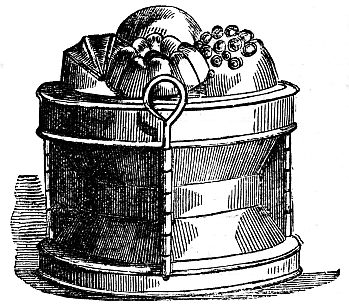
ICED-PUDDING MOULD.
Ingredients.—½ lb. of sweet almonds, 2 oz. of bitter ones, ¾ lb, of sugar, 8 eggs, 1½ pint of milk. Mode.—Blanch and dry the almonds thoroughly in a cloth, then pound them in a mortar until reduced to a smooth paste; add to these the well-beaten eggs, the sugar, and milk; stir these ingredients over the fire until they thicken, but do not allow them to boil; then strain and put the mixture into the freezing-pot; surround it with ice, and freeze it. When quite frozen, fill an iced-pudding mould, put on the lid, and keep the pudding in ice until required for table; then turn it out on the dish, and garnish it with a compôte or any fruit that may be preferred, pouring a little over the top of the pudding. This pudding may be flavoured with vanilla, Curaçoa, or Maraschino. Time.—½ hour to freeze the mixture. Seasonable.—Served all the year round.
ICES.
Ices are composed, it is scarcely necessary to say, of congealed cream or water, combined sometimes with liqueurs or other flavouring ingredients, or more generally with the juices of fruits. At desserts, or at some evening parties, ices are scarcely to be dispensed with. The principal utensils required for making ice-creams are ice-tubs, freezing-pots, spaddles, and a cellaret. The tub must be large enough to contain about a bushel of ice, pounded small, when brought out of the ice-house, and mixed very carefully with either salt, nitre, or soda. The freezing-pot is best made of pewter. If it be of tin, as is sometimes the case, the congelation goes on too rapidly in it for the thorough intermingling of its contents, on which the excellence of the ice greatly depends. The spaddle is generally made of copper, kept bright and clean. The cellaret is a tin vessel, in which ices are kept for a short time from dissolving. The method to be pursued in the freezing process must be attended to. When the ice-tub is prepared with fresh-pounded ice and salt, the freezing-pot is put into it up to its cover. The articles to be congealed are then poured into it and covered over; but to prevent the ingredients from separating and the heaviest of them from falling to the bottom of the mould, it is requisite to turn the freezing-pot round and round by the handle, so as to keep its contents moving until the congelation commences. As soon as this is perceived (the cover of the pot being occasionally taken off for the purpose of noticing when freezing takes place), the cover is immediately closed over it, ice is put upon it, and it is left in this state till it is served. The use of the spaddle is to stir up and remove from the sides of the freezing-pot the cream, which in the shaking may have washed against it, and by stirring it in with the rest, to prevent waste of it occurring. Any negligence in stirring the contents of the freezing-pot before congelation takes place, will destroy the whole: either the sugar sinks to the bottom and leaves the ice insufficiently sweetened, or lumps are formed, which disfigure and discolour it.
ICES, to make Fruit-water.
Ingredients.—To every pint of fruit-juice allow 1 pint of syrup. Mode.—Select nice ripe fruit; pick off the stalks and put it into a large earthen pan, with a little pounded sugar strewed over; stir it about with a wooden spoon until it is well broken, then rub it through a hair sieve. Make a syrup, without white of egg; let it cool add the fruit-juice, mix well together, and put the mixture into the freezing-pot. Proceed as directed for Ice Puddings, and when the mixture is equally frozen, put it into small glasses. Raspberry, strawberry, currant, and other fresh-fruit-water ices, are made in the same manner. Time.—½ hour to freeze the mixture. Average cost, 3d. to 4d. each. Seasonable, with fresh fruit, in June, July, and August.

DISH OF ICES.
ICING, Almond, for Cakes.
Ingredients.—To every lb. of finely-pounded loaf sugar, allow 1 lb. of sweet almonds, the whites of 4 eggs, a little rosewater. Mode.—Blanch the almonds, and pound them (a few at a time) in a mortar to a paste, adding a little rosewater to facilitate the operation. Whisk the whites of the eggs to a strong froth; mix them with the pounded almonds, stir in the sugar, and beat altogether. When the cake is sufficiently baked, lay on the almond icing, and put it into the oven to dry. Before laying this preparation on the cake, great care must be taken that it is nice and smooth, which is easily accomplished by well beating the mixture.
ICING, Sugar, for Cakes.
Ingredients.—To every lb. of loaf sugar allow the whites of 4 eggs, 1 oz. of fine starch. Mode.—Beat the eggs to a strong froth, and gradually sift in the sugar, which should be reduced to the finest possible powder, and gradually add the starch, also finely powdered. Beat the mixture well until the sugar is smooth; then with a spoon or broad knife lay the ice equally over the cakes. These should then be placed in a very cool oven, and the icing allowed to dry and harden, but not to colour. The icing may be coloured with strawberry or currant juice, or with prepared cochineal. If it be put on the cakes as soon as they are withdrawn from the oven, it will become firm and hard by the time the cakes are cold. On very rich cakes, such as wedding, christening cakes, &c., a layer of almond icing is usually spread over the top, and over that the white icing as described. All iced cakes should be kept in a very dry place.
INVALID COOKERY.
A few Rules to be observed in Cooking for Invalids.
Let all the kitchen utensils used in the preparation of invalids’ cookery be delicately and scrupulously clean; if this is not the case, a disagreeable flavour may be imparted to the preparation, which flavour may disgust, and prevent the patient from partaking of the refreshment when brought to him or her.
For invalids, never make a large quantity of one thing, as they seldom require much at a time; and it is desirable that variety be provided for them.
Always have something in readiness; a little beef tea, nicely made and nicely skimmed, a few spoonfuls of jelly, &c., &c., that it may be administered as soon almost as the invalid wishes for it. If obliged to wait a long time, the patient loses the desire to eat, and often turns against the food when brought to him or her.
In sending dishes or preparations up to invalids, let everything look as tempting as possible. Have a clean tray-cloth laid smoothly over the tray; let the spoons, tumblers, cups and saucers, &c., be very clean and bright. Gruel served in a tumbler is more appetizing than when served in a basin or cup and saucer.
As milk is an important article of food for the sick, in warm weather let it be kept on ice, to prevent its turning sour. Many other delicacies may also be preserved good in the same manner for some little time.
If the patient be allowed to eat vegetables, never send them up undercooked, or half raw; and let a small quantity only be temptingly arranged on a dish. This rule will apply to every preparation, as an invalid is much more likely to enjoy his food if small delicate pieces are served to him.
Never leave food about a sick-room; if the patient cannot eat it when brought to him, take it away, and bring it to him in an hour or two’s time. Miss Nightingale says, “To leave the patient’s untasted food by his side from meal to meal, in hopes that he will eat it in the interval, is simply to prevent him from taking any food at all.” She says, “I have known patients literally incapacitated from taking one article of food after another by this piece of ignorance. Let the food come at the right time, and be taken away, eaten or uneaten, at the right time, but never let a patient have ‘something always standing’ by him, if you don’t wish to disgust him of everything.”
Never serve beef tea or broth with the smallest particle of fat or grease on the surface. It is better, after making either of these, to allow them to get perfectly cold, when all the fat may be easily removed; then warm up as much as may be required. Two or three pieces of clean whity-brown paper laid on the broth will absorb any greasy particles that may be floating at the top, as the grease will cling to the paper.
Roast mutton, chickens, rabbits, calves’ feet or head, game, fish (simply dressed), and simple puddings, are all light food, and easily digested. Of course, these things are only partaken of supposing the patient is recovering.
A mutton chop, nicely cut, trimmed, and broiled to a turn, is a dish to be recommended for invalids; but it must not be served with all the fat at the end, nor must it be too thickly cut. Let it be cooked over a fire free from smoke, and sent up with the gravy in it, between two very hot plates. Nothing is more disagreeable to an invalid than smoked food.
In making toast-and-water, never blacken the bread, but toast it only a nice brown. Never leave toast-and-water to make until the moment it is required, as it cannot then be properly prepared,—at least the patient will be obliged to drink it warm, which is anything but agreeable.
In boiling eggs for invalids, let the white be just set; if boiled hard, they will be likely to disagree with the patient.
In Miss Nightingale’s admirable “Notes on Nursing,” a book that no mother or nurse should be without, she says,—“You cannot be too careful as to quality in sick-diet. A nurse should never put before a patient milk that is sour, meat or soup that is turned, an egg that is bad, or vegetables underdone.” Yet often, she says, she has seen these things brought in to the sick, in a state perfectly perceptible to every nose or eye except the nurse’s. It is here that the clever nurse appears,—she will not bring in the peccant article; but, not to disappoint the patient, she will whip up something else in a few minutes. Remember, that sick-cookery should half do the work of your poor patient’s weak digestion.
She goes on to caution nurses, by saying,—“Take care not to spill into your patient’s saucer; in other words, take care that the outside bottom rim of his cup shall be quite dry and clean. If, every time he lifts his cup to his lips, he has to carry the saucer with it, or else to drop the liquid upon and to soil his sheet, or bedgown, or pillow, or, if he is sitting up, his dress, you have no idea what a difference this minute want of care on your part makes to his comfort, and even to his willingness for food.”
INVALID’S CUTLET.
Ingredients.—1 nice cutlet from a loin or neck of mutton; 2 teacupfuls of water; 1 very small stick of celery; pepper and salt to taste. Mode.—Have the cutlet cut from a very nice loin or neck of mutton, take off all the fat, put it into a stewpan with the other ingredients; stew very gently indeed for nearly 2 hours, and skim off every particle of fat that may rise to the surface from time to time. The celery should be out into thin slices before it is added to the meat, and care must be taken not to put in too much of this, or the dish will not be good. If the water is allowed to boil fast, the cutlet will be hard. Time.—2 hours very gentle stewing. Average cost, 6d. Sufficient for one person. Seasonable.—Whenever celery may be had.
INVALID’S JELLY.
Ingredients.—12 shanks of mutton, 3 quarts of water, a bunch of sweet herbs, pepper and salt to taste, 3 blades of mace, 1 onion, 1 lb. of lean beef, a crust of bread toasted brown. Mode.—Soak the shanks in plenty of water for some hours, and scrub them well; put them, with the beef and other ingredients, into a saucepan with the water, and let them simmer very gently for 5 hours. Strain the broth, and, when cold, take off all the fat. It may be eaten either warmed up or cold as a jelly. Time.—5 hours. Average cost, 1s. Sufficient to make from 1½ to 2 pints of jelly. Seasonable at any time.
INVALIDS, Lemonade for.
Ingredients.—½ lemon, lump sugar to taste, 1 pint of boiling water. Mode.—Pare off the rind of the lemon thinly; cut the lemon into 2 or 3 thick slices, and remove as much as possible of the white outside pith, and all the pips. Put the slices of lemon, the peel, and lump sugar into a jug; pour over the boiling water; cover it closely, and in 2 hours it will be fit to drink. It should either be strained or poured off from the sediment. Time.—2 hours. Average cost, 2d. Sufficient to make 1 pint of lemonade. Seasonable at any time.
JAM ROLY-POLY PUDDING.
Ingredients.—¾ lb. of suet-crust, ¾ lb. of any kind of jam. Mode.—Make a nice light suet-crust, and roll it out to the thickness of about ½ inch. Spread the jam equally over it, leaving a small margin of paste without any, where the pudding joins. Roll it up, fasten the ends securely, and tie it in a floured cloth; put the pudding into boiling water, and boil for 2 hours. Mincemeat or marmalade may be substituted for the jam, and makes excellent puddings. Time.—2 hours. Average cost, 9d. Sufficient for 5 or 6 persons. Seasonable.—Suitable for winter puddings, when fresh fruit is not obtainable.
JANUARY—BILLS OF FARE.
Dinner for 18 persons.
First Course.
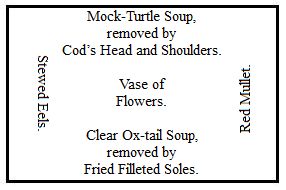
Mock-Turtle Soup, removed by Cod’s Head and Shoulders. Stewed Eels. Vase of Flowers. Red Mullet. Clear Ox-tail Soup, removed by Fried Filleted Soles.
Entrées.
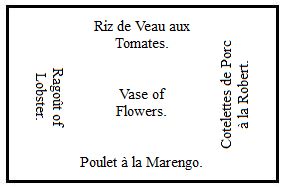
Riz de Veau aux Tomates. Ragoût of Lobster. Vase of Flowers. Cotelettes de Porc à la Robert. Poulet à la Marengo.
Second Course.
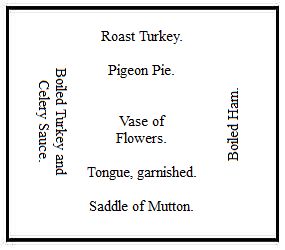
Roast Turkey. Pigeon Pie. Boiled Turkey and Celery Sauce. Vase of Flowers. Boiled Ham. Tongue, garnished. Saddle of Mutton.
Third Course.
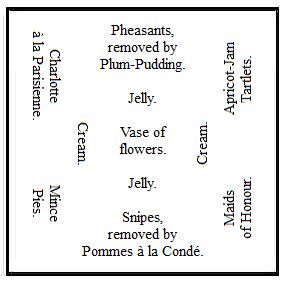
Charlotte à la Parisienne. Pheasants, removed by Plum-Pudding. Apricot-Jam Tartlets. Jelly. Cream. Vase of flowers. Cream. Jelly. Mince Pies. Snipes, removed by Pommes à la Condé. Maids of Honour.
Dinner for 12 persons.
First Course.—Carrot soup à la Crécy; ox-tail soup; turbot and lobster sauce; fried smelts, with Dutch sauce. Entrées. Mutton cutlets, with Soubise sauce; sweetbreads; oyster patties; fillets of rabbits. Second Course.—Roast Turkey; stewed rump of beef à la jardinière; boiled ham, garnished with Brussels sprouts; boiled chickens and celery sauce. Third course.—Roast hare; teal; eggs à la neige; vol-au-vent of preserved fruit; 1 jelly; 1 cream; potatoes à la maître d’hôtel; grilled mushrooms; dessert and ices.
Dinner for 10 persons.
First Course.—Soup à la Reine; whitings au gratin; crimped cod and oyster sauce. Entrées.—Tendrons de veau; curried fowl and boiled rice. Second Course.—Turkey, stuffed with chestnuts, and chestnut sauce; boiled leg of mutton, English fashion, with caper sauce and mashed turnips. Third course.—Woodcocks or partridges; widgeon; Charlotte à la vanille; cabinet pudding; orange jelly; blancmange; artichoke bottoms; macaroni, with Parmesan cheese; dessert and ices.
Dinner for 8 persons.
First course.—Mulligatawny soup; brill and shrimp sauce; fried whitings. Entrées.—Fricasseed chicken; pork cutlets, with tomato sauce. Second course.—Haunch of mutton; boiled turkey and celery sauce; boiled tongue, garnished with Brussels sprouts. Third Course.—Roast pheasants; meringues à la crême; compôte of apples; orange jelly, cheesecakes; soufflé of rice; dessert and ices.
Dinners for 6 persons.
First Course.—Julienne soup; soles à la Normandie. Entrées.—Sweetbreads, with sauce piquante; mutton cutlets, with mashed potatoes. Second Course.—Haunch of venison; boiled fowls and bacon, garnished with Brussels sprouts. Third Course.—Plum pudding; custards in glasses; apple tart; fondue à la Brillat Savarin; dessert.
First Course.—Vermicelli soup; fried slices of codfish and anchovy sauce; John Dory. Entrées.—Stewed rump-steak à la jardinière; rissoles; oyster patties. Second Course.—Leg of mutton; curried rabbit and boiled rice. Third Course.—Partridges; apple fritters; tartlets of greengage jam; orange jelly; plum-pudding; dessert.
First Course.—Pea-soup; baked haddock; soles à la crême. Entrées.—Mutton cutlets and tomato sauce; fricasseed rabbit. Second Course.—Roast pork and apple sauce; breast of veal, rolled and stuffed; vegetables. Third Course.—Jugged hare; whipped cream; blancmange; mince pies; cabinet pudding.
First Course.—Palestine soup; fried smelts; stewed eels. Entrées.—Ragoût of lobster; broiled mushrooms; vol-au-vent of chicken. Second Course.—Sirloin of beef; boiled fowls and celery sauce; tongue, garnished with Brussels sprouts. Third Course.—Wild ducks; Charlotte aux pommes; cheesecakes; transparent jelly, inlaid with brandy cherries; blancmange; Nesselrode pudding.
JANUARY, Plain Family Dinners for.
Sunday.—1. Boiled turbot and oyster sauce, potatoes. 2. Roast leg or griskin of pork, apple sauce, brocoli, potatoes. 3. Cabinet pudding, and damson tart made with preserved damsons.
Monday.—1. The remains of turbot warmed in oyster sauce, potatoes. 2. Cold pork, stewed steak. 3. Open jam tart, which should have been made with the pieces of paste left from the damson tart; baked arrowroot pudding.
Tuesday.—1. Boiled neck of mutton, carrots, mashed turnips, suet dumplings, and caper sauce: the broth should be served first, and a little rice or pearl barley should be boiled in it along with the meat. 2. Rolled jam pudding.
Wednesday.—1. Roast rolled ribs of beef, greens, potatoes, and horseradish sauce. 2. Bread-and-butter pudding, cheesecakes.
Thursday.—1. Vegetable soup (the bones from the ribs of beef should be boiled down with this soup), cold beef, mashed potatoes. 2. Pheasants, gravy, bread sauce. 3. Macaroni.
Friday.—1. Fried whitings or soles. 2. Boiled rabbit and onion sauce, minced beef, potatoes. 3. Currant dumplings.
Saturday.—1. Rump-steak pudding or pie, greens, and potatoes. 2. Baked custard pudding and stewed apples.
Sunday.—1. Codfish and oyster sauce, potatoes. 2. Joint of roast mutton, either leg, haunch, or saddle; brocoli and potatoes, red-currant jelly. 3. Apple tart and custards, cheese.
Monday.—1. The remains of codfish picked from the bone, and warmed through in the oyster sauce; if there is no sauce left, order a few oysters and make a little fresh; and do not let the fish boil, or it will be watery. 2. Curried rabbit, with boiled rice served separately, cold mutton, mashed potatoes. 3. Somersetshire dumplings with wine sauce.
Tuesday.—1. Boiled fowls, parsley-and-butter; bacon garnished with Brussels sprouts; minced or hashed mutton. 2. Baroness pudding.
Wednesday.—1. The remains of the fowls cut up into joints and fricasseed; joint of roast pork and apple sauce, and, if liked, sage-and-onion, served on a dish by itself; turnips and potatoes. 2. Lemon pudding, either baked or boiled.
Thursday.—1. Cold pork and jugged hare, red-currant jelly, mashed potatoes. 2. Apple pudding.
Friday.—1. Boiled beef, either the aitchbone or the silver side of the round; carrots, turnips, suet dumplings, and potatoes: if there is a marrow-bone, serve the marrow on toast at the same time. 2. Rice snowballs.
Saturday.—1. Pea-soup made from liquor in which beef was boiled; cold beef, mashed potatoes. 2. Baked batter fruit pudding.
JANUARY, Things in Season.
Fish.—Barbel, brill, carp, cod, crabs, crayfish, dace, eels, flounders, haddocks, herrings, lampreys, lobsters, mussels, oysters, perch, pike, plaice, prawns, shrimps, skate, smelts, soles, sprats, sturgeon, tench, thornback, turbot, whitings.
Meat.—Beef, house lamb, mutton, pork, veal, venison.
Poultry.—Capons, fowls, tame pigeons, pullets, rabbits, turkeys.
Game.—Grouse, hares, partridges, pheasants, snipe, wild-fowl, woodcock.
Vegetables.—Beetroot, brocoli, cabbages, carrots, celery, chervil, cresses, cucumbers (forced), endive, lettuces, parsnips, potatoes, savoys, spinach, turnips, various herbs.
Fruit.—Apples, grapes, medlars, nuts, oranges, pears, walnuts, crystallized preserves (foreign), dried fruits, such as almonds and raisins; French and Spanish plums; prunes, figs, dates.
JAUNEMANGE.
Ingredients.—1 oz. of isinglass, 1 pint of water, ½ pint of white wine, the rind and juice of 1 large lemon, sugar to taste, the yolks of 6 eggs. Mode.—Put the isinglass, water, and lemon-rind into a saucepan, and boil gently until the former is dissolved; then add the strained lemon-juice, the wine, and sufficient white sugar to sweeten the whole nicely. Boil for 2 or 3 minutes, strain the mixture into a jug, and add the yolks of the eggs, which should be well beaten; place the jug in a saucepan of boiling water; keep stirring the mixture one way until it thickens, but do not allow it to boil; then take it off the fire, and keep stirring until nearly cold. Pour it into a mould, omitting the sediment at the bottom of the jug, and let it remain until quite firm. Time.—¼ hour to boil the isinglass and water; about 10 minutes to stir the mixture in the jug. Average cost, with the best isinglass, 2s. 9d. Sufficient to fill a quart mould. Seasonable at any time.
JELLIES
Are not the nourishing food they were at one time considered to be, and many eminent physicians are of opinion that they are less digestible than the flesh, or muscular part of animals; still, when acidulated with lemon-juice and flavoured with wine, they are very suitable for some convalescents. Vegetable jelly is a distinct principle, existing in fruits, which possesses the property of gelatinizing when boiled and cooled; but it is a principle entirely different from the gelatine of animal bodies, although the name of jelly, common to both, sometimes leads to an erroneous idea on that subject. Animal jelly, or gelatine, is glue, whereas vegetable jelly is rather analogous to gum. Liebig places gelatine very low indeed in the scale of usefulness. He says, “Gelatine, which by itself is tasteless, and when eaten, excites nausea, possesses no nutritive value; that, even when accompanied by the savoury constituents of flesh, it is not capable of supporting the vital process, and when added to the usual diet as a substitute for plastic matter, does not increase, but on the contrary, diminishes the nutritive value of the food, which it renders insufficient in quantity and inferior in quality.” It is this substance which is most frequently employed in the manufacture of the jellies supplied by the confectioner; but those prepared at home from calves’ feet do possess some nutrition, and are the only sort that should be given to invalids. Isinglass is the purest variety of gelatine, and is prepared from the sounds or swimming-bladders of certain fish, chiefly the sturgeon. From its whiteness it is mostly used for making blancmange and similar dishes.
JELLIES, Bottled, How to Mould.
Uncork the bottle; place it in a saucepan of hot water until the jelly is reduced to a liquid state; taste it, to ascertain whether it is sufficiently flavoured, and if not, add a little wine. Pour the jelly into moulds which have been soaked in water; let it set, and turn it out by placing the mould in hot water for a minute; then wipe the outside, put a dish on the top, and turn it over quickly. The jelly should then slip easily away from the mould, and be quite firm. It may be garnished as taste dictates.
JELLY, Isinglass, or Gelatine.
(Substitutes for Calf’s Feet.)
Ingredients.—3 oz. of isinglass or gelatine, 2 quarts of water. Mode.—Put the isinglass or gelatine into a saucepan with the above proportion of cold water; bring it quickly to boil, and let it boil very fast, until the liquor is reduced one-half. Carefully remove the scum as it rises, then strain it through a jelly-bag, and it will be ready for use. If not required very clear, it may be merely strained through a fine sieve, instead of being run through a bag. Rather more than ½ oz. of isinglass is about the proper quantity to use for a quart of strong calf’s-feet stock, and rather more than 2 oz. for the same quantity of fruit juice. As isinglass varies so much in quality and strength, it is difficult to give the exact proportions. The larger the mould, the stiffer should be the jelly; and where there is no ice, more isinglass must be used than if the mixture were frozen. This forms a stock for all kinds of jellies, which may be flavoured in many ways. Time.—1½ hour. Sufficient, with wine, syrup, fruit, &c., to fill two moderate-sized moulds. Seasonable at any time.
Note.—The above, when boiled, should be perfectly clear, and may be mixed warm with wine, flavourings, fruits, &c., and then run through the bag.
JELLY-BAG, How to make a.
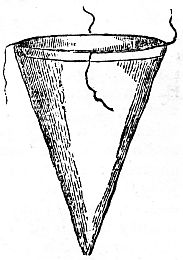
JELLY-BAG.
The very stout flannel called double-mill, used for ironing-blankets, is the best material for a jelly-bag: those of home manufacture are the only ones to be relied on for thoroughly clearing the jelly. Care should be taken that the seam of the bag be stitched twice, to secure it against unequal filtration. The most convenient mode of using the bag is to tie it upon a hoop the exact size of the outside of its mouth; and, to do this, strings should be sewn round it at equal distances. The jelly-bag may, of course, be made any size; but one of twelve or fourteen inches deep, and seven or eight across the mouth, will be sufficient for ordinary use. The form of a jelly-bag is the fool’s-cap.
JELLY Moulded with fresh Fruit, or Macedoine de Fruits.
Ingredients.—Rather more than 1½ pint of jelly, a few nice strawberries, or red or white currants, or raspberries, or any fresh fruit that may be in season. Mode.—Have ready the above proportion of jelly, which must be very clear and rather sweet, the raw fruit requiring an additional quantity of sugar. Select ripe, nice-looking fruit; pick off the stalks, unless currants are used, when they are laid in the jelly as they come from the tree. Begin by putting a little jelly at the bottom of the mould, which must harden; then arrange the fruit round the sides of the mould, recollecting that it will be reversed when turned out; then pour in some more jelly to make the fruit adhere, and, when that layer is set, put another row of fruit and jelly until the mould is full. If convenient, put it in ice until required for table, then wring a cloth in boiling water, wrap it round the mould for a minute, and turn the jelly carefully out. Peaches, apricots, plums, apples, &c., are better for being boiled in a little clear syrup before they are laid in the jelly; strawberries, raspberries, grapes, cherries, and currants are put in raw. In winter, when fresh fruits are not obtainable, a very pretty jelly may be made with preserved fruits or brandy cherries: these, in a bright and clear jelly, have a very pretty effect; of course, unless the jelly be very clear, the beauty of the dish will be spoiled. It may be garnished with the same fruit as is laid in the jelly; for instance, an open jelly with strawberries might have, piled in the centre, a few of the same fruit prettily arranged, or a little whipped cream might be substituted for the fruit. Time.—One layer of jelly should remain 2 hours in a very cool place, before another layer is added. Average cost, 2s. 6d. Sufficient, with fruit, to fill a quart mould. Seasonable, with fresh fruit, from June to October; with dried, at any time.
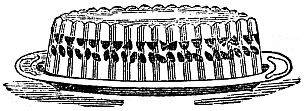
JELLY MOULDED WITH CHERRIES.
JELLY, ORANGE, Moulded with slices of Orange.
Ingredients.—1½ pint of orange jelly, 4 oranges, ½ pint of clarified syrup, Mode.—Boil ½ lb. of loaf sugar with ½ pint of water until there is no scum left (which must be carefully removed as fast as it rises), and carefully peel the oranges; divide them into thin slices, without breaking the thin skin, and put these pieces of orange into the syrup, where let them remain for about 5 minutes; then take them out, and use the syrup for the jelly. When the oranges are well drained, and the jelly is nearly cold, pour a little of the latter into the bottom of the mould; then lay in a few pieces of orange; over these pour a little jelly, and when this is set, place another layer of oranges, proceeding in this manner until the mould is full. Put it in ice, or in a cool place, and, before turning it out, wrap a cloth round the mould for a minute or two, which has been wrung out in boiling water. Time.—5 minutes to simmer the oranges, Average cost, 3s. 6d. Sufficient, with the slices of orange, to fill a quart mould. Seasonable from November to May.
JELLY of Two Colours.

JELLY OF TWO COLOURS.
Ingredients.—1½ pint of calf’s-feet jelly, a few drops of prepared cochineal. Mode.—Make 1½ pint of calf’s-feet jelly, or, if wished more economical, of clarified syrup and gelatine, flavouring it in any way that may be preferred. Colour one-half of the jelly with a few drops of prepared cochineal, and the other half leave as pale as possible. Have ready a mould well wetted in every part; pour in a small quantity of the red jelly, and let this set; when quite firm, pour on it the same quantity of the pale jelly, and let this set; then proceed in this manner until the mould is full, always taking care to let one jelly set before the other is poured in, or the colours would run one into the other. When turned out, the jelly should have a striped appearance. For variety, half the mould may be filled at once with one of the jellies, and, when firm, filled up with the other: this, also, has a very pretty effect, and is more expeditiously prepared than when the jelly is poured in small quantities into the mould. Blancmange and red jelly, or blancmange and raspberry cream, moulded in the above manner, look very well. The layers of blancmange and jelly should be about an inch in depth, and each layer should be perfectly hardened before another is added. Half a mould of blancmange and half a mould of jelly are frequently served in the same manner. A few pretty dishes may be made, in this way, of jellies or blancmanges left from the preceding day, by melting them separately in a jug placed in a saucepan of boiling water, and then moulding them by the foregoing directions. Time.—¾ hour to make the jelly. Average cost, with calf’s-feet jelly, 2s.; with gelatine and syrup, more economical. Sufficient to fill 1½-pint mould. Seasonable at any time.
Note.—In making the jelly, use for flavouring a very pale sherry, or the colour will be too dark to contrast nicely with the red jelly.
JELLY, Open, with whipped Cream (a very pretty dish).
Ingredients.—1½ pint of jelly, ½ pint of cream, 1 glass of sherry, sugar to taste. Mode.—Make the above proportion of calf’s-feet or isinglass jelly, colouring and flavouring it in any way that may be preferred; soak a mould, open in the centre, for about ½ hour in cold water; fill it with the jelly, and let it remain in a cool place until perfectly set; then turn it out on a dish; fill the centre with whipped cream, flavoured with sherry and sweetened with pounded sugar; pile this cream high in the centre, and serve. The jelly should be made of rather a dark colour, to contrast nicely with the cream. Time.—¾ hour. Average cost, 3s. 6d. Sufficient to fill 1½-pint mould. Seasonable at any time.
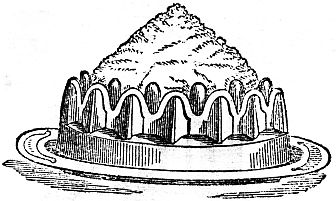
OPEN JELLY WITH WHIPPED CREAM.
JELLY, Savoury, for Meat Pies.
Ingredients.—3 lbs. of shin of beef, 1 calf’s-foot, 3 lbs. of knuckle of veal, poultry trimmings (if for game pies, any game trimmings), 2 onions stuck with cloves, 2 carrots, 4 shalots, a bunch of savoury herbs, 2 bay-leaves; when liked, 2 blades of mace and a little spice; 2 slices of lean ham; rather more than 2 quarts of water. Mode.—Cut up the meat and put it into a stewpan with all the ingredients except the water; set it over a slow fire to draw down, and, when the gravy ceases to flow from the meat, pour in the water. Let it boil up, then carefully take away all scum from the top. Cover the stewpan closely, and let the stock simmer very gently for 4 hours: if rapidly boiled, the jelly will not be clear. When done, strain it through a fine sieve or flannel bag; and when cold, the jelly should be quite transparent. If this is not the case, clarify it with the whites of eggs. Time.—4 hours. Average cost, for this quantity, 5s.
JELLY, to make the Stock for, and to Clarify it.
Ingredients.—2 calf’s feet, 6 pints of water. Mode.—The stock for jellies should always be made the day before it is required for use, as the liquor has time to cool, and the fat can be so much more easily and effectually removed when thoroughly set. Procure 2 nice calf’s feet; scald them, to take off the hair; slit them in two, remove the fat from between the claws, and wash the feet well in warm water; put them into a stewpan, with the above proportion of cold water, bring it gradually to boil and remove every particle of scum as it rises. When it is well skimmed, boil it very gently for 6 or 7 hours, or until the liquor is reduced rather more than half; then strain it through a sieve into a basin, and put it in a cool place to set. As the liquor is strained, measure it, to ascertain the proportion for the jelly, allowing something for the sediment and fat at the top. To clarify it, carefully remove all the fat from the top, pour over a little warm water, to wash away any that may remain, and wipe the jelly with a clean cloth; remove the jelly from the sediment, put it into a saucepan, and, supposing the quantity to be a quart, add to it 6 oz. of loaf sugar, the shells and well-whisked whites of 5 eggs, and stir these ingredients together cold; set the saucepan on the fire, but do not stir the jelly after it begins to warm. Let it boil about 10 minutes after it rises to a head, then throw in a teacupful of cold water; let it boil 5 minutes longer, then take the saucepan off, cover it closely, and let it remain ½ hour near the fire. Dip the jelly-bag into hot water, wring it out quite dry, and fasten it on to a stand or the back of a chair, which must be placed near the fire, to prevent the jelly from setting before it has run through the bag. Place a basin underneath to receive the jelly; then pour it into the bag, and should it not be clear the first time, run it through the bag again. This stock is the foundation of all really good jellies, which may be varied in innumerable ways, by colouring and flavouring with liqueurs, and by moulding it with fresh and preserved fruits. To insure the jelly being firm when turned out, ½ oz. of isinglass clarified might be added to the above proportion of stock. Substitutes for calf’s feet are now frequently used in making jellies, which lessen the expense and trouble in preparing this favourite dish, isinglass and gelatine being two of the principal materials employed; but although they may look as nicely as jellies made from good stock, they are never so delicate, having very often an unpleasant flavour, somewhat resembling glue, particularly when made with gelatine. Time.—About 6 hours to boil the feet for the stock; to clarify it,—¼ hour to boil, ½ hour to stand in the saucepan covered. Average cost.—Calf’s feet may be purchased for 6d. each when veal is in full season, but more expensive when it is scarce. Sufficient.—2 calf’s feet should make 1 quart of stock. Seasonable from March to October, but may be had all the year.
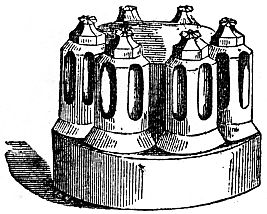
JELLY-MOULD.
JOHN DORY.
Ingredients.—-¼ lb. of salt to each gallon of water. Mode.—This fish, which is esteemed by most people a great delicacy, is dressed in the same way as a turbot, which it resembles in firmness, but not in richness. Cleanse it thoroughly and cut off the fins; lay it in a fish-kettle, cover with cold water, and add salt in the above proportion. Bring it gradually to a boil, and simmer gently for ¼ hour, or rather longer, should the fish be very large. Serve on a hot napkin, and garnish with cut lemon and parsley. Lobster, anchovy, or shrimp sauce, and plain melted butter, should be sent to table with it. Time.—After the water boils, ¼ to ½ hour, according to size. Average cost, 3s. to 5s. Seasonable all the year, but best from September to January.
Note.—Small John Dory are very good baked.
JUNE—BILLS OF FARE.
Dinner for 18 persons.
First Course.
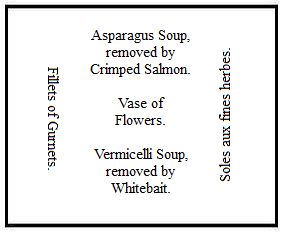
Asparagus Soup, removed by Crimped Salmon. Fillets of Gurnets. Vase of Flowers. Soles aux fines herbes. Vermicelli Soup, removed by Whitebait.
Entrées.
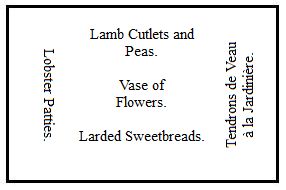
Lamb Cutlets and Peas. Lobster Patties. Vase of Flowers. Tendrons de Veau à la Jardinière. Larded Sweetbreads.
Second Course.
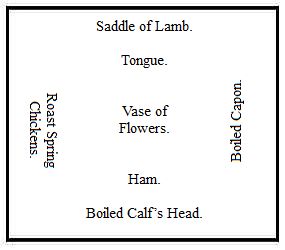
Saddle of Lamb. Tongue. Roast Spring Chickens. Vase of Flowers. Boiled Capon. Ham. Boiled Calf’s Head.
Third Course.
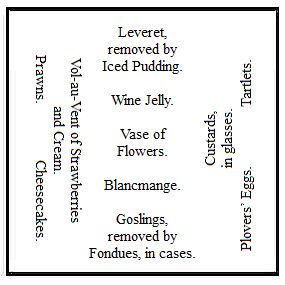
Dessert and Ices.
Prawns. Leveret, removed by Iced Pudding. Tartlets. Vol-au-Vent of Strawberries and Cream. Wine Jelly. Custards, in glasses. Vase of Flowers. Cheesecake. Plovers’ Eggs. Blancmange. Goslings, removed by Fondues, in cases.
Dinner for 12 persons.
First Course.—Green-pea soup; rice soup; salmon and lobster sauce; trout à la Genévése; whitebait. Entrées.—Lamb cutlets and cucumbers; fricasseed chicken; stewed veal and peas; lobster rissoles. Second Course.—Roast quarter of lamb and spinach; filet de bœuf à la Jardinière; boiled fowls; braised shoulder of lamb; tongue; vegetables. Third Course.—Goslings; ducklings; Nesselrode pudding; Charlotte à la Parisienne; gooseberry tartlets; strawberry cream; raspberry-and-currant tart; custards; dessert and ices.
Dinner for 10 persons.
First Course.—Julienne soup; salmon trout and parsley-and-butter; red mullet. Entrées.—Stewed breast of veal and peas; mutton cutlets à la Maintenon. Second Course.—Roast fillet of veal; boiled leg of lamb, garnished with young carrots; boiled bacon-cheek; vegetables. Third Course.—Roast ducks; leveret; gooseberry tart; strawberry cream; strawberry tartlets; meringues; cabinet pudding; iced pudding; dessert and ices.
Dinner for 8 persons.
First Course.—Vermicelli soup; trout à la Genévése; salmon cutlets. Entrées.—Lamb cutlets and peas; fricasseed chicken. Second Course.—Roast ribs of beef; half calf’s head, tongue, and brains; boiled ham; vegetables. Third Course.—Roast ducks; compôte of gooseberries; strawberry jelly; pastry; iced pudding; cauliflower with cream sauce; dessert and ices.
Dinner for 6 persons.
First Course.—Spring soup; boiled salmon and lobster sauce. Entrées.—Veal cutlets and endive; ragoût of duck and green peas. Second Course.—Roast loin of veal; boiled leg of lamb and white sauce; tongue, garnished; vegetables. Third Course.—Strawberry cream; gooseberry tartlets; almond pudding; lobster salad; dessert.
First Course.—Calf’s head soup; mackerel à la maître d’hôtel; whitebait. Entrées.—Chicken cutlets; curried lobster. Second Course.—Fore-quarter of lamb and salad; stewed beef à la Jardinière; vegetables. Third Course.—Goslings; green-currant tart; custards, in glasses; strawberry blancmange; soufflé of rice; dessert.
First Course.—Green-pea soup; baked soles aux fines herbes; stewed trout. Entrées.—Calf’s liver and bacon; rissoles. Second Course.—Roast saddle of lamb and salad; calf’s head à la tortue; vegetables. Third Course.—Roast ducks; vol-au-vent of strawberries and cream; strawberry tartlets; lemon blancmange; baked gooseberry pudding; dessert.
First Course.—Spinach soup; soles à la crême; red mullet. Entrées.—Roast fillet of veal; braised ham and spinach. Second Course.—Boiled fowls and white sauce; vegetables. Third Course.—Leveret; strawberry jelly; Swiss cream; cheesecakes; iced pudding; dessert.
JUNE, Plain Family Dinners for.
Sunday.—1. Salmon trout and parsley-and-butter, new potatoes. 2. Roast fillet of veal, boiled bacon-cheek and spinach, vegetables. 3. Gooseberry tart, custard.
Monday.—1. Light gravy soup. 2. Small meat pie, minced veal, garnished with rolled bacon, spinach, and potatoes. 3. Raspberry-and-currant tart.
Tuesday.—1. Baked mackerel, potatoes. 2. Boiled leg of lamb, garnished with young carrots. 3. Lemon pudding.
Wednesday.—1. Vegetable soup. 2. Calf’s liver and bacon, peas, hashed lamb from remains of cold joint. 3. Baked gooseberry pudding.
Thursday.—1. Roast ribs of beef, Yorkshire pudding, peas, potatoes. 2. Stewed rhubarb and boiled rice.
Friday.—1. Cold beef and salad, lamb cutlets and peas. 2. Boiled gooseberry pudding and baked custard pudding.
Saturday.—1. Rump-steak pudding, broiled beef-bones and cucumber, vegetables. 2. Bread pudding.
Sunday.—1. Roast fore-quarter of lamb, mint sauce, peas, and new potatoes. 2. Gooseberry pudding, strawberry tartlets. Fondue.
Monday.—1. Cold lamb and salad, stewed neck of veal and peas, young carrots, and new potatoes. 2. Almond pudding.
Tuesday.—1. Green-pea soup. 2. Roast ducks stuffed, gravy, peas, and new potatoes. 3. Baked ratafia pudding.
Wednesday.—1. Roast leg of mutton, summer cabbage, potatoes. 2. Gooseberry and rice pudding.
Thursday.—1. Fried soles, melted butter, potatoes. 2. Sweetbreads, hashed mutton, vegetables. 3. Bread-and-butter pudding.
Friday.—1. Asparagus soup. 2. Boiled beef, young carrots, and new potatoes, suet dumplings. 3. College puddings.
Saturday.—1. Cold boiled beef and salad, lamb cutlets, and green peas. 2. Boiled gooseberry pudding and plain cream.
JUNE, Things in Season.
Fish.—Carp, crayfish, herrings, lobsters, mackerel, mullet, pike, prawns, salmon, soles, tench, trout, turbot.
Meat.—Beef, lamb, mutton, veal, buck venison.
Poultry.—Chickens, ducklings, fowls, green geese, leverets, plovers, pullets, rabbits, turkey poults, wheatears.
Vegetables.—Artichokes, asparagus, beans, cabbages, carrots, cucumbers, lettuces, onions, parsnips, peas, potatoes, radishes, small salads, sea-kale, spinach,—various herbs.
Fruit.—Apricots, cherries, currants, gooseberries, melons, nectarines, peaches, pears, pineapples, raspberries, rhubarb, strawberries.
JULY—BILLS OF FARE.
Dinner for 18 persons.
First Course.
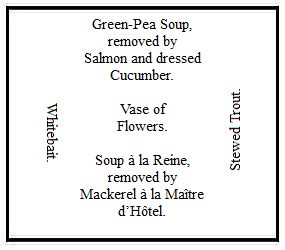
Green-Pea Soup, removed by Salmon and dressed Cucumber. Whitebait. Vase of Flowers. Stewed Trout. Soup à la Reine, removed by Mackerel à la Maître d’Hôtel.
Entrées.
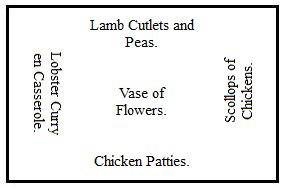
Lamb Cutlets and Peas. Lobster Curry en Casserole. Vase of Flowers. Scollops of Chickens. Chicken Patties.
Second Course.
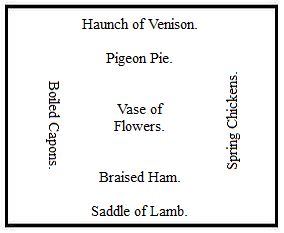
Haunch of Venison. Pigeon Pie. Boiled Capons. Vase of Flowers. Spring Chickens. Braised Ham. Saddle of Lamb.
Third Course.
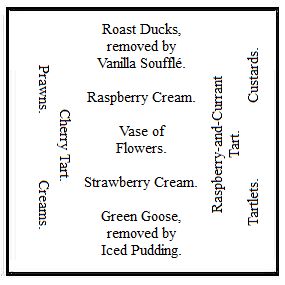
Dessert and Ices.
Roast Ducks, removed by Vanilla Soufflé. Prawns. Raspberry Cream. Custards. Vase of Flowers. Cherry Tart. Raspberry-and-Currant Tart. Strawberry Cream. Creams. Green Goose, removed by Iced Pudding. Tartlets.
Dinner for 12 persons.
First Course.—Soup à la Jardinière; chicken soup; crimped salmon and parsley-and-butter; trout aux fines herbes, in cases. Entrées.—Tendrons de veau and peas; lamb cutlets and cucumbers. Second Course.—Loin of veal à la Béchamel; roast fore-quarter of lamb; salad; braised ham, garnished with broad beans; vegetables. Third Course.—Roast ducks; turkey poult; stewed peas à la Française; lobster salad; cherry tart; raspberry-and-currant tart; custards, in glasses; lemon creams; Nesselrode pudding; marrow pudding. Dessert and ices.
Dinner for 8 persons.
First Course.—Green-pea soup; salmon and lobster sauce; crimped perch and Dutch sauce. Entrées.—Stewed veal and peas; lamb cutlets and cucumbers. Second Course.—Haunch of venison; boiled fowls à la Béchamel; braised ham; vegetables. Third Course.—Roast ducks; peas à la Française; lobster salad; strawberry cream; blancmange; cherry tart; cheesecakes; iced pudding. Dessert and ices.
Dinner for 6 persons.
First Course.—Soup à la Jardinière; salmon trout and parsley-and-butter; fillets of mackerel à la maître d’hôtel. Entrées.—Lobster cutlets; beef palates, à la Italienne. Second Course.—Roast lamb; boiled capon and white sauce; boiled tongue, garnished with small vegetable marrows; bacon and beans. Third Course.—Goslings; whipped strawberry cream; raspberry-and-currant tart; meringues; cherry tartlets; iced pudding. Dessert and ices.
First Course.—Julienne soup; crimped salmon and caper sauce; whitebait. Entrées.—Croquettes à la Reine; curried lobster. Second Course.—Roast lamb; rump of beef à la Jardinière. Third Course.—Larded turkey poult; raspberry cream; cherry tart; custards, in glasses; Gâteaux à la Genévése; Nesselrode pudding. Dessert.
JULY, Plain Family Dinners for.
Sunday.—1. Salmon trout and parsley-and-butter. 2. Roast fillet of veal, boiled bacon-cheek, peas, potatoes. 3. Raspberry-and-currant tart, baked custard pudding.
Monday.—1. Green-pea soup. 2. Roast fowls garnished with water-cresses; gravy, bread sauce; cold veal and salad. 3. Cherry tart.
Tuesday.—1. John dory and lobster sauce. 2. Curried fowl with remains of cold fowls, dish of rice, veal rolls with remains of cold fillet. 3. Strawberry cream.
Wednesday.—1. Roast leg of mutton, vegetable marrow and potatoes, melted butter. 2. Black-currant pudding.
Thursday.—1. Fried soles, anchovy sauce. 2. Mutton cutlets and tomato sauce, hashed mutton, peas, potatoes, 3. Lemon dumplings.
Friday.—1. Boiled brisket of beef, carrots, turnips, suet dumplings, peas, potatoes. 2. Baked semolina pudding.
Saturday.—1. Cold beef and salad, lamb cutlets and peas. 2. Rolled jam pudding.
Sunday.—1. Julienne soup. 2. Roast lamb, half calf’s head, tongue and brains, boiled ham, peas and potatoes. 3. Cherry tart, custards.
Monday.—1. Hashed calf’s head, cold lamb and salad. 2. Vegetable marrow and white sauce, instead of pudding.
Tuesday.—1. Stewed veal, with peas, young carrots, and potatoes. Small meat pie. 2. Raspberry-and-currant pudding.
Wednesday.—1. Roast ducks stuffed, gravy, peas, and potatoes; the remains of stewed veal rechauffé. 2. Macaroni served as a sweet pudding.
Thursday.—1. Slices of salmon and caper sauce. 2. Boiled knuckle of veal, parsley-and-butter, vegetable marrow and potatoes. 3. Black-currant pudding.
Friday.—1. Roast shoulder of mutton, onion sauce, peas and potatoes. 2. Cherry tart, baked custard pudding.
Saturday.—1. Minced mutton, rump-steak-and-kidney pudding. 2. Baked lemon pudding.
JULY, Things in Season.
Fish.—Carp, crayfish, dory, flounders, haddocks, herrings, lobsters, mackerel, mullet, pike, plaice, prawns, salmon, shrimps, soles, sturgeon, tench, thornback.
Meat.—Beef, lamb, mutton, veal, buck venison.
Poultry.—Chickens, ducklings, fowls, green geese, leverets, plovers, pullets, rabbits, turkey poults, wheatears, wild ducks (called flappers).
Vegetables.—Artichokes, asparagus, beans, cabbages, carrots, cauliflowers, celery, cresses, endive, lettuces, mushrooms, onions, peas, radishes, small salading, sea-kale, sprouts, turnips, vegetable marrow,—various herbs.
Fruit.—Apricots, cherries, currants, figs, gooseberries, melons, nectarines, pears, pineapples, plums, raspberries, strawberries, walnuts in high season, for pickling.
JULIENNE, Soup à la.
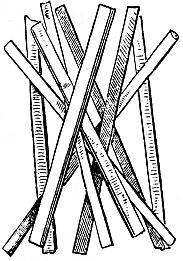
STRIPS OF VEGETABLE.
Ingredients.—½ pint of carrots, ½ pint of turnips, ¼ pint of onions, 2 or 3 leeks, ½ head of celery, 1 lettuce, a little sorrel and chervil, if liked, 2 oz. of butter, 2 quarts of stock. Mode.—Cut the vegetables into strips of about 1¼ inch long, and be particular they are all the same size, or some will be hard whilst the others will be done to a pulp. Cut the lettuce, sorrel, and chervil into larger pieces; fry the carrots in the butter, and pour the stock boiling to them. When this is done, add all the other vegetables and herbs, and stew gently for at least an hour. Skim off all the fat, pour the soup over thin slices of bread, cut round about the size of a shilling, and serve. Time.—1½ hour. Average cost.—1s. 3d. per quart. Seasonable all the year. Sufficient for 8 persons.
Note.—In summer, green peas, asparagus-tops, French beans, &c., can be added. When the vegetables are very strong, instead of frying them in butter at first, they should be blanched, and afterwards simmered in the stock.
KALE BROSE (a Scotch Recipe).
Ingredients.—Half an ox-head or cow-heel, a teacupful of toasted oatmeal, salt to taste, 2 handfuls of greens, 3 quarts of water. Mode.—Make a broth of the ox-head or cow-heel, and boil it till oil floats on the top of the liquor, then boil the greens, shred, in it. Put the oatmeal, with a little salt, into a basin, and mix with it quickly a teacupful of the fat broth: it should not run into one doughy mass, but form knots. Stir it into the whole, give one boil, and serve very hot. Time.—4 hours. Average cost, 8d. per quart. Seasonable all the year, but more suitable in winter. Sufficient for 10 persons.
KEGEREE.
Ingredients.—Any cold fish, 1 teacupful of boiled rice, 1 oz. of butter, 1 teaspoonful of mustard, 2 soft-boiled eggs, salt and cayenne to taste. Mode.—Pick the fish carefully from the bones, mix with the other ingredients, and serve very hot. The quantities may be varied according to the amount of fish used. Time.—¼ hour after the rice is boiled. Average cost, 5d. exclusive of the fish.
KIDNEYS, Broiled (a Breakfast or Supper Dish).
Ingredients.—Sheep kidneys, pepper and salt to taste. Mode.—Ascertain that the kidneys are fresh, and cut them open, very evenly, lengthwise, down to the root, for should one half be thicker than the other, one would be underdone whilst the other would be dried, but do not separate them; skin them, and pass a skewer under the white part of each half to keep them flat, and broil over a nice clear fire, placing the inside downwards; turn them when done enough on one side, and cook them on the other. Remove the skewers, place the kidneys on a very hot dish, season with pepper and salt, and put a tiny piece of butter in the middle of each; serve very hot and quickly, and send very hot plates to table. Time.—6 to 8 minutes. Average cost, 1½d. each. Sufficient.—Allow 1 for each person. Seasonable at any time.

KIDNEYS.
Note.—A prettier dish than the above may be made by serving the kidneys each on a piece of buttered toast cut in any fanciful shape. In this case a little lemon-juice will be found an improvement.
KIDNEYS, Fried.
Ingredients.—Kidneys, butter, pepper, and salt to taste. Mode.—Cut the kidneys open without quite dividing them, remove the skin, and put a small piece of butter in the frying-pan. When the butter is melted, lay in the kidneys the flat side downwards, and fry them for 7 or 8 minutes, turning them when they are half done. Serve on a piece of dry toast, season with pepper and salt, and put a small piece of butter in each kidney; pour the gravy from the pan over them, and serve very hot. Time.—7 or 8 minutes. Average cost, 1½d. each. Sufficient.—Allow 1 kidney to each person. Seasonable at any time.
KIDNEY OMELET (a favourite French Dish).
Ingredients.—6 eggs, 1 saltspoonful of salt, ½ saltspoonful of pepper, 2 sheep’s kidneys, or 2 tablespoonfuls of minced veal kidney, 5 oz. of butter. Mode.—Skin the kidneys, cut them into small dice, and toss them in a frying-pan, in 1 oz. of butter, over the fire for 2 or 3 minutes. Mix the ingredients for the omelet, and when the eggs are well whisked, stir in the pieces of kidney. Make the butter hot in the frying-pan, and when it bubbles, pour in the omelet, and fry it over a gentle fire from 4 to 6 minutes. When the eggs are set, fold the edges over, so that the omelet assumes an oval form, and be careful that it is not too much done: to brown the top, hold the pan before the fire for a minute or two, or use a salamander until the desired colour is obtained, but never turn an omelet in the pan. Slip it carefully on to a very hot dish, or, what is a much safer method, put a dish on the omelet, and turn the pan quickly over. It should be served the instant it comes from the fire. Time.—4 to 6 minutes. Average cost, 1s. Sufficient for 4 persons. Seasonable at any time.

OMELET PAN.
KIDNEYS, Stewed.
Ingredients.—About 8 kidneys, a large dessertspoonful of chopped herbs, 2 oz. butter, 1 dessertspoonful of flour, a little gravy, juice of half a lemon, a teaspoonful of Harvey sauce and mushroom ketchup, cayenne, and salt to taste. Mode.—Strew the herbs, with cayenne and salt, over the kidneys, melt the butter in the frying-pan, put in the kidneys, and brown them nicely all round; when nearly done, stir in the flour, and shake them well; now add the gravy and sauce, and stew them for a few minutes, then turn them out into a dish garnished with fried sippets. Time.—10 or 12 minutes. Seasonable at any time.
LAMB.
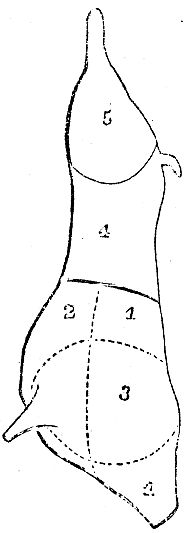
SIDE OF LAMB.
The most delicious sorts of lamb are those of the South-Down breed, known by their black feet; and of these, those which have been exclusively suckled on the milk of the parent ewe, are considered the finest. Next to these in estimation are those fed on the milk of several dams; and last of all, though the fattest, the grass-fed lamb: this, however, implies an age much greater than either of the others.
Lamb, in the early part of the season, however reared, is in London, and indeed generally, sold in quarters, divided with eleven ribs to the fore-quarter; but, as the season advances, these are subdivided into two, and the hind-quarter in the same manner; the first consisting of the shoulder, and the neck and breast; the latter, of the leg and the loin.—As lamb, from the juicy nature of its flesh, is especially liable to spoil in unfavourable weather, it should be frequently wiped, so as to remove any moisture that may form on it.
In the Purchasing of Lamb for the Table, there are certain signs by which the experienced judgment is able to form an accurate opinion whether the animal has been lately slaughtered, and whether the joints possess that condition of fibre indicative of good and wholesome meat. The first of these doubts may be solved satisfactorily by the bright and dilated appearance of the eye; the quality of the fore-quarter can always be guaranteed by the blue or healthy ruddiness of the jugular, or vein of the neck; while the rigidity of the knuckle, and the firm, compact feel of the kidney, will answer in an equally positive manner for the integrity of the hind-quarter.
Mode of cutting up a Side of Lamb in London.—1. Ribs; 2. Breast; 3. Shoulder; 4. Loin; 5. Leg; 1, 2, 3. Fore Quarter.
LAMB, Breast of, and Green Peas.
Ingredients.—1 breast of lamb, a few slices of bacon, ½ pint of stock, 1 lemon, 1 onion, 1 bunch of savoury herbs, green-peas. Mode.—Remove the skin from a breast of lamb, put it into a saucepan of boiling water, and let it simmer for 5 minutes. Take it out and lay it in cold water. Line the bottom of a stewpan with a few thin slices of bacon; lay the lamb on these; peel the lemon, cut it into slices, and put these on the meat, to keep it white and make it tender; cover with 1 or 2 more slices of bacon; add the stock, onion, and herbs, and set it on a slow fire to simmer very gently until tender. Have ready some green peas, put these on a dish, and place the lamb on the top of them. The appearance of this dish may be much improved by glazing the lamb, and spinach may be substituted for the peas when variety is desired. Time.—1½ hour. Average cost, 10d. per lb. Sufficient for 3 persons. Seasonable.—Grass lamb, from Easter to Michaelmas.
LAMB, Stewed Breast of.
Ingredients.—1 breast of lamb, pepper and salt to taste, sufficient stock to cover it, 1 glass of sherry, thickening of butter and flour. Mode.—Skin the lamb, cut it into pieces, and season them with pepper and salt; lay these in a stewpan, pour in sufficient stock or gravy to cover them, and stew very gently until tender, which will be in about 1½ hour. Just before serving, thicken the sauce with a little butter and flour; add the sherry, give one boil, and pour it over the meat. Green peas, or stewed mushrooms, may be strewed over the meat, and will be found a very great improvement. Time.—1½ hour. Average cost, 10d. per lb. Sufficient for 3 persons. Seasonable.—Grass lamb, from Easter to Michaelmas.
Lamb, to Carve.—Leg, loin, saddle, shoulder, are carved as mutton.
LAMB, Fore-quarter of, to Carve.
We always think that a good and practised carver delights in the manipulation of this joint, for there is a little field for his judgment and dexterity which does not always occur. The separation of the shoulder from the breast is the first point to be attended to; this is done by passing the knife round the dotted line, as shown by the figures 1, 2, 3, 4, and 5, so as to cut through the skin, and then, by raising with a little force the shoulder, into which the fork should be firmly fixed, it will come away with just a little more exercise of the knife. In dividing the shoulder and breast, the carver should take care not to cut away too much of the meat from the latter, as that would rather spoil its appearance when the shoulder is removed. The breast and shoulder being separated, it is usual to lay a small piece of butter, and sprinkle a little cayenne, lemon-juice, and salt between them; and when this is melted and incorporated with the meat and gravy, the shoulder may, as more convenient, be removed into another dish. The next operation is to separate the ribs from the brisket, by cutting through the meat on the line 5 to 6. The joint is then ready to be served to the guests; the ribs being carved in the direction of the lines from 9 to 10, and the brisket from 7 to 8. The carver should ask those at the table what parts they prefer—ribs, brisket, or a piece of the shoulder.
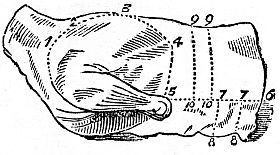
FORE-QUARTER OF LAMB.
LAMB CUTLETS.
Ingredients.—Loin of lamb, pepper and salt to taste. Mode.—Trim off the flap from a fine loin of lamb, and cut it into cutlets about ¾ inch in thickness. Have ready a bright clear fire; lay the cutlets on a gridiron, and broil them of a nice pale brown, turning them when required. Season them with pepper and salt; serve very hot and quickly, and garnish with crisped parsley, or place them on mashed potatoes. Asparagus, spinach, or peas are the favourite accompaniments to lamb chops. Time.—About 8 or 10 minutes. Average cost, 1s. per lb. Sufficient.—Allow 2 cutlets to each person. Seasonable from Easter to Michaelmas.
LAMB, Cutlets and Spinach (an Entrée).
Ingredients.—8 cutlets, egg and bread-crumbs, salt and pepper to taste, a little clarified butter. Mode.—Cut the cutlets from a neck of lamb, and shape them by cutting off the thick part of the chine-bone. Trim off most of the fat and all the skin, and scrape the top part of the bones quite clean. Brush the cutlets over with egg, sprinkle them with bread-crumbs, and season with pepper and salt. Now dip them into clarified butter, sprinkle over a few more bread-crumbs, and fry them over a sharp fire, turning them when required. Lay them before the fire to drain, and arrange them on a dish with spinach in the centre, which should be previously well boiled, drained, chopped, and seasoned. Time.—About 7 or 8 minutes. Average cost, 10d. per lb. Sufficient for 4 persons. Seasonable from Easter to Michaelmas.
Note.—Peas, asparagus, or French beans, may be substituted for the spinach; or lamb cutlets may be served with stewed cucumbers, Soubise sauce, &c., &c.
LAMB, Roast Fore-quarter of.
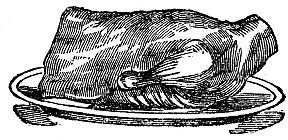
FORE-QUARTER OF LAMB.
Ingredients.—Lamb, a little salt. Mode.—To obtain the flavour of lamb in perfection, it should not be long kept; time to cool is all that it requires; and though the meat may be somewhat thready, the juices and flavour will be infinitely superior to that of lamb that has been killed 2 or 3 days. Make up the fire in good time, that it may be clear and brisk when the joint is put down. Place it at a sufficient distance to prevent the fat from burning, and baste it constantly till the moment of serving. Lamb should be very thoroughly done without being dried up, and not the slightest appearance of red gravy should be visible, as in roast mutton: this rule is applicable to all young white meats. Serve with a little gravy made in the dripping-pan, the same as for other roasts, and send to table with it a tureen of mint sauce, and a fresh salad. A cut lemon, a small piece of fresh butter, and a little cayenne, should also be placed on the table, so that when the carver separates the shoulder from the ribs, they may be ready for his use; if, however, he should not be very expert, we would recommend that the cook should divide these joints nicely before coming to table. Time.—Fore-quarter of lamb weighing 10 lbs., 1¾ to 2 hours. Average cost, 10d. to 1s. per lb. Sufficient for 7 or 8 persons. Seasonable.—Grass lamb, from Easter to Michaelmas.
LAMB’S FRY.
Ingredients.—1 lb. of lamb’s fry, 3 pints of water, egg and bread-crumbs, 1 teaspoonful of chopped parsley, salt and pepper to taste. Mode.—Boil the fry for ¼ hour in the above proportion of water, take it out and dry it in a cloth; grate some bread down finely, mix with it a teaspoonful of chopped parsley and a high seasoning of pepper and salt. Brush the fry lightly over with the yolk of an egg, sprinkle over the bread-crumbs, and fry for 5 minutes. Serve very hot on a napkin in a dish, and garnish with plenty of crisped parsley. Time.—¼ hour to simmer the fry, 5 minutes to fry it. Average cost, 10d. per lb. Sufficient for 2 or 3 persons. Seasonable from Easter to Michaelmas.
LAMB, Hashed, and Broiled Blade-Bone.
[Cold Meat Cookery.] Ingredients.—The remains of a cold shoulder of lamb, pepper and salt to taste, 2 oz. of butter, about ½ pint of stock or gravy, 1 tablespoonful of shalot vinegar, 3 or 4 pickled gherkins. Mode.—Take the blade-bone from the shoulder, and cut the meat into collops as neatly as possible. Season the bone with pepper and salt, pour a little oiled butter over it, and place it in the oven to warm through. Put the stock into a stewpan, add the ketchup and shalot vinegar, and lay in the pieces of lamb. Let these heat gradually through, but do not allow them to boil. Take the blade-bone out of the oven, and place it on a gridiron over a sharp fire to brown. Slice the gherkins, put them into the hash, and dish it with the blade-bone in the centre. It may be garnished with croûtons or sippets of toasted bread. Time.—Altogether ½ hour. Average cost, exclusive of the meat, 4d. Seasonable.—Houselamb, from Christmas to March; grass lamb, from Easter to Michaelmas.
LAMB, Boiled Leg of, à la Béchamel.
Ingredients.—Leg of lamb, Béchamel sauce. Mode.—Do not choose a very large joint, but one weighing about 5 lbs. Have ready a saucepan of boiling water, into which plunge the lamb, and when it boils up again, draw it to the side of the fire, and let the water cool a little. Then stew very gently for about 1¼ hour, reckoning from the time that the water begins to simmer. Make some Béchamel, dish the lamb, pour the sauce over it, and garnish with tufts of boiled cauliflower or carrots. When liked, melted butter may be substituted for the Béchamel: this is a more simple method, but not nearly so nice. Send to table with it some of the sauce in a tureen, and boiled cauliflowers or spinach, with whichever vegetable the dish is garnished. Time.—1¼ hour after the water simmers. Average cost, 10d. to 1s. per lb. Sufficient for 4 or 5 persons. Seasonable from Easter to Michaelmas.

LEG OF LAMB.
LAMB, Roast Leg of.
Ingredients.—Lamb, a little salt. Mode.—Place the joint at a good distance from the fire at first, and baste well the whole time it is cooking. When nearly done, draw it nearer the fire to acquire a nice brown colour. Sprinkle a little fine salt over the meat, empty the dripping-pan of its contents; pour in a little boiling water, and strain this over the meat. Serve with mint sauce and a fresh salad, and for vegetables send peas, spinach, or cauliflowers to table with it. Time.—A leg of lamb weighing 5 lbs., 1½ hour. Average cost, 10d. to 1s. a pound. Sufficient for 4 or 5 persons. Seasonable from Easter to Michaelmas.

LOIN OF LAMB.
LAMB, Braised Loin of.
Ingredients.—1 loin of lamb, a few slices of bacon, 1 bunch of green onions, 5 or 6 young carrots, a bunch of savoury herbs, 2 blades of pounded mace, 1 pint of stock, salt to taste. Mode.—Bone a loin of lamb, and line the bottom of a stewpan just capable of holding it, with a few thin slices of fat bacon; add the remaining ingredients, cover the meat with a few more slices of bacon, pour in the stock, and simmer very gently for 2 hours; take it up, dry it, strain and reduce the gravy to a glaze, with which glaze the meat, and serve it either on stewed peas, spinach, or stewed cucumbers. Time.—2 hours. Average cost, 11d. per lb. Sufficient for 4 or 5 persons. Seasonable from Easter to Michaelmas.
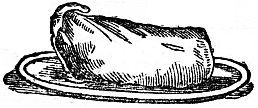
SADDLE OF LAMB.
LAMB, Roast Saddle of.
Ingredients.—Lamb; a little salt. Mode.—This joint is now very much in vogue, and is generally considered a nice one for a small party. Have ready a clear brisk fire; put down the joint at a little distance, to prevent the fat from scorching, and keep it well basted all the time it is cooking. Serve with mint sauce and a fresh salad, and send to table with it either peas, cauliflowers, or spinach. Time.—A small saddle, 1½ hour; a large one, 2 hours. Average cost, 10d. to 1s. per lb. Sufficient for 5 or 6 persons. Seasonable from Easter to Michaelmas.

RIBS OF LAMB.
Note.—Loin and ribs of lamb are roasted in the same manner, and served with the same sauces as the above. A loin will take about 1¼ hour; ribs, from 1 to 1¼ hour.
LAMB, Roast Shoulder of.
Ingredients.—Lamb; a little salt. Mode.—Have ready a clear brisk fire, and put down the joint at a sufficient distance from it, that the fat may not burn. Keep constantly basting until done, and serve with a little gravy made in the dripping-pan, and send mint sauce to table with it. Peas, spinach, or cauliflowers are the usual vegetables served with lamb, and also a fresh salad. Time.—A shoulder of lamb rather more than 1 hour. Average cost, 10d. to 1s. per lb. Sufficient for 4 or 5 persons. Seasonable from Easter to Michaelmas.
LAMB, Shoulder of, Stuffed.
Ingredients.—Shoulder of lamb, forcemeat, trimmings of veal or beef, 2 onions, ½ head of celery, 1 faggot of savoury herbs, a few slices of fat bacon, 1 quart of stock. Mode.—Take the blade-bone out of a shoulder of lamb, fill up its place with forcemeat, and sew it up with coarse thread. Put it into a stewpan with a few slices of bacon under and over the lamb, and add the remaining ingredients. Stew very gently for rather more than 2 hours. Reduce the gravy, with which glaze the meat, and serve with peas, stewed cucumbers, or sorrel sauce. Time.—Rather more than 2 hours. Average cost, 10d. to 1s. per lb. Sufficient for 4 or 5 persons. Seasonable from Easter to Michaelmas.
LANDRAIL, Roast, or Corn-Crake.

LANDRAILS.
Ingredients.—3 or 4 birds, butter, fried bread-crumbs. Mode.—Pluck and draw the birds, wipe them inside and out with damp cloths, and truss them in the following manner: Bring the head round under the wing, and the thighs close to the sides; pass a skewer through them and the body, and keep the legs straight. Roast them before a clear fire, keep them well basted, and serve on fried bread-crumbs, with a tureen of brown gravy. When liked, bread-sauce may also be sent to table with them. Time.—12 to 20 minutes. Average cost.—Seldom bought. Sufficient.—Allow 4 for a dish. Seasonable from August 12th to the middle of September.
LANDRAIL, to Carve.
Landrail, being trussed like Snipe, with the exception of its being drawn, may be carved in the same manner.
LARD, to Melt.
Melt the inner fat of the pig, by putting it in a stone jar, and placing this in a saucepan of boiling water, previously stripping off the skin. Let it simmer gently over a bright fire, and, as it melts, pour it carefully from the sediment. Put it into small jars or bladders for use, and keep it in a cool place. The flead or inside fat of the pig, before it is melted, makes exceedingly light crust, and is particularly wholesome. It may be preserved a length of time by salting it well, and occasionally changing the brine. When wanted for use, wash and wipe it, and it will answer for making into paste as well as fresh lard. Average cost, 10d. per lb.
LARDING.
Ingredients.—Bacon and larding-needle. Mode.—Bacon for larding should be firm and fat, and ought to be cured without any saltpetre, as this reddens white meats. Lay it on a table, the rinds downwards; trim off any rusty part, and cut it into slices of an equal thickness. Place the slices one on the top of another, and cut them evenly into narrow strips, so arranging it that every piece of bacon is of the same size. Bacon for fricandeaux, poultry, and game, should be about 2 inches in length, and rather more than one-eighth of an inch in width. If for larding fillets of beef or loin of veal, the pieces of bacon must be thicker. The following recipe of Soyer is, we think, very explicit; and any cook, by following the directions here given, may be able to lard, if not well, sufficiently for general use:—
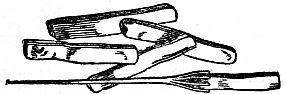
BACON FOR LARDING, AND LARDING-NEEDLE.
“Have the fricandeau trimmed; lay it, lengthwise, upon a clean napkin across your hand, forming a kind of bridge with your thumb at the part where you are about to commence; then with the point of the larding-needle make three distinct lines across, ½ inch apart; run the needle into the third line, at the farther side of the fricandeau, and bring it out at the first, placing one of the lardoons in it; draw the needle through, leaving out ¼ inch of the bacon at each line; proceed thus to the end of the row; then make another line, ½ inch distant, stick in another row of lardoons, bringing them out at the second line, leaving the ends of the bacon out all the same length; make the next row again at the same distance, bringing the ends out between the lardoons of the first row, proceeding in this manner until the whole surface is larded in chequered rows. Everything else is larded in a similar way; and, in the case of poultry, hold the breast over a charcoal fire for one minute, or dip it into boiling water, in order to make the flesh firm.”
LARK PIE (an Entrée).
Ingredients.—A few thin slices of beef, the same of bacon, 9 larks, flour; for stuffing, 1 teacupful of bread-crumbs, ½ teaspoonful of minced lemon-peel, 1 teaspoonful of minced parsley, 1 egg, salt and pepper to taste, 1 teaspoonful of chopped shalot, ½ pint of weak stock or water, puff-paste. Mode.—Make a stuffing of bread-crumbs, minced lemon-peel, parsley, and the yolk of an egg, all of which should be well mixed together; roll the larks in flour, and stuff them. Line the bottom of a pie-dish with a few slices of beef and bacon; over these place the larks, and season with salt, pepper, minced parsley, and chopped shalot, in the above proportion. Pour in the stock or water, cover with crust, and bake for an hour in a moderate oven. During the time the pie is baking, shake it 2 or 3 times, to assist in thickening the gravy, and serve very hot. Time.—1 hour. Average cost, 1s. 6d. per dozen. Sufficient for 5 or 6 persons. Seasonable.—In full season in November.
LARKS, Roast.
Ingredients.—Larks, egg and bread-crumbs, fresh butter. Mode.—These birds are by many persons esteemed a great delicacy, and may be either roasted or broiled. Pick, gut, and clean them; when they are trussed, brush them over with the yolk of an egg; sprinkle with bread-crumbs, and roast them before a quick fire; baste them continually with fresh butter, and keep sprinkling with the bread-crumbs until the birds are well covered. Dish them on bread-crumbs fried in clarified butter, and garnish the dish with slices of lemon. Broiled larks are also very excellent: they should be cooked over a clear fire, and would take about 10 minutes or ¼ hour. Time.—¼ hour to roast; 10 minutes to broil. Seasonable.—In full season in November.
Note.—Larks may also be plainly roasted, without covering them with egg and bread-crumbs; they should be dished on fried crumbs.
LEEK SOUP.
Ingredients.—A sheep’s head, 3 quarts of water, 12 leeks cut small, pepper and salt to taste, oatmeal to thicken. Mode.—Prepare the head, either by skinning or cleaning the skin very nicely; split it in two; take out the brains, and put it into boiling water; add the leeks and seasoning, and simmer very gently for 4 hours. Mix smoothly, with cold water, as much oatmeal as will make the soup tolerably thick; pour it into the soup; continue stirring till the whole is blended and well done, and serve. Time.—4½ hours. Average cost, 4d. per quart. Seasonable in winter. Sufficient for 10 persons.
LEMON BISCUITS.
Ingredients.—1¼ lb. of flour, ¾ lb. of loaf sugar, 6 oz. of fresh butter, 4 eggs, 1 oz. of lemon-peel, 2 dessertspoonfuls of lemon-juice. Mode.—Rub the flour into the butter; stir in the pounded sugar and very finely-minced lemon-peel, and when these ingredients are thoroughly mixed, add the eggs, which should be previously well whisked, and the lemon-juice. Beat the mixture well for a minute or two, then drop it from a spoon on to a buttered tin, about 2 inches apart, as the cakes will spread when they get warm; place the tin in the oven, and bake the cakes of a pale brown from 15 to 20 minutes. Time.—15 to 20 minutes. Average cost, 1s. 6d. Seasonable at any time.
LEMON BLANCMANGE.
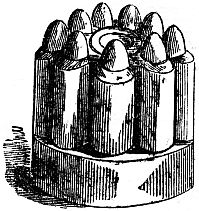
BLANCMANGE MOULD.
Ingredients.—1 quart of milk, the yolks of 4 eggs, 3 oz. of ground rice, 6 oz. of pounded sugar, 1½ oz. of fresh butter, the rind of 1 lemon, the juice of 2, ½ oz. of gelatine. Mode.—Make a custard with the yolks of the eggs and ½ pint of the milk, and when done, put it into a basin; put half the remainder of the milk into a saucepan with the ground rice, fresh butter, lemon-rind, and 3 oz. of the sugar, and let these ingredients boil until the mixture is stiff, stirring them continually; when done, pour it into the bowl where the custard is, mixing both well together. Put the gelatine with the rest of the milk into a saucepan, and let it stand by the side of the fire to dissolve; boil for a minute or two, stir carefully into the basin, adding 3 oz. more of pounded sugar. When cold, stir in the lemon-juice, which should be carefully strained, and pour the mixture into a well-oiled mould, leaving out the lemon-peel, and set the mould in a pan of cold water until wanted for table. Use eggs that have rich-looking yolks; and, should the weather be very warm, rather a larger proportion of gelatine must be allowed. Time.—Altogether, ½ hour. Average cost, 1s. 6d. Sufficient to fill 2 small moulds. Seasonable at any time.
LEMON CAKE.
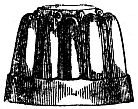
CAKE-MOULD.
Ingredients.—10 eggs, 3 tablespoonfuls of orange-flower water, ¾ lb. of pounded loaf sugar, 1 lemon, ¾ lb. of flour. Mode.—Separate the whites from the yolks of the eggs; whisk the former to a stiff froth; add the orange-flower water, the sugar, grated lemon-rind, and mix these ingredients well together. Then beat the yolks of the eggs, and add them, with the lemon-juice, to the whites, &c.; dredge in the flour gradually; keep beating the mixture well; put it into a buttered mould, and bake the cake about an hour, or rather longer. The addition of a little butter, beaten to a cream, we think, would improve this cake. Time.—About 1 hour. Average cost, 1s. 4d. Seasonable at any time.
LEMON CHEESECAKES.
Ingredients.—¼ lb. of butter, 1 lb. of loaf sugar, 6 eggs, the rind of 2 lemons and the juice of 3. Mode.—Put all the ingredients into a stewpan, carefully grating the lemon-rind and straining the juice. Keep stirring the mixture over the fire until the sugar is dissolved, and it begins to thicken: when of the consistency of honey, it is done; then put it into small jars, and keep in a dry place. This mixture will remain good 3 or 4 months. When made into cheesecakes, add a few pounded almonds, or candied peel, or grated sweet biscuit; line some patty-pans with good puff-paste, rather more than half fill them with the mixture, and bake for about ¼ hour in a good brisk oven. Time.—¼ hour. Average cost, 1s. 4d. Sufficient for 24 cheesecakes. Seasonable at any time.
LEMON CREAM.
Ingredients.—1 pint of cream, the yolks of two eggs, ¼ lb. of white sugar, 1 large lemon, 1 oz. of isinglass. Mode.—Put the cream into a lined saucepan with the sugar, lemon-peel, and isinglass, and simmer these over a gentle fire for about 10 minutes, stirring them all the time. Strain the cream into a jug, add the yolks of eggs, which should be well beaten, and put the jug into a saucepan of boiling water; stir the mixture one way until it thickens, but do not allow it to boil; take it off the fire, and keep stirring it until nearly cold. Strain the lemon-juice into a basin, gradually pour on it the cream, and stir it well until the juice is well mixed with it. Have ready a well-oiled mould, pour the cream into it, and let it remain until perfectly set. When required for table, loosen the edges with a small blunt knife, put a dish on the top of the mould, turn it over quickly, and the cream should easily slip away. Time.—10 minutes to boil the cream; about 10 minutes to stir it over the fire in the jug. Average cost, with cream at 1s. per pint, and the best isinglass, 3s. 6d. Sufficient to fill 1½ pint mould. Seasonable at any time.
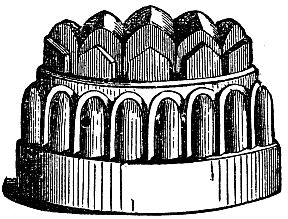
LEMON-CREAM MOULD.
LEMON CREAM, Economical.
Ingredients.—1 quart of milk, 8 bitter almonds, 2 oz. of gelatine, 2 large lemons, ¾ lb. of lump sugar, the yolks of 6 eggs. Mode.—Put the milk into a lined saucepan with the almonds, which should be well pounded in a mortar, the gelatine, lemon-rind, and lump sugar, and boil these ingredients for about 5 minutes. Beat up the yolks of the eggs, strain the milk into a jug, add the eggs, and pour the mixture backwards and forwards a few times, until nearly cold; then stir briskly to it the lemon-juice, which should be strained, and keep stirring until the cream is almost cold; put it into an oiled mould, and let it remain until perfectly set. The lemon-juice must not be added to the cream when it is warm, and should be well stirred after it is put in. Time.—5 minutes to boil the milk. Average cost, 2s. 5d. Sufficient to fill two 1½ pint moulds. Seasonable at any time.
LEMON CREAMS, Very Good.
Ingredients.—1 pint of cream, 2 dozen sweet almonds, 3 glasses of sherry, the rind and juice of 2 lemons, sugar to taste. Mode.—Blanch and chop the almonds, and put them into a jug with the cream; in another jug put the sherry, lemon-rind, strained juice, and sufficient pounded sugar to sweeten the whole nicely. Pour rapidly from one jug to the other till the mixture is well frothed; then pour it into jelly-glasses, omitting the lemon-rind. This is a very cool and delicious sweet for summer, and may be made less rich by omitting the almonds and substituting orange or raisin wine for the sherry. Time.—Altogether, ½ hour. Average cost, with cream at 1s. per pint, 3s. Sufficient to fill 12 glasses. Seasonable at any time.
LEMON CREAMS, or Custards.
Ingredients.—5 oz. of loaf sugar, 2 pints of boiling water, the rind of 1 lemon and the juice of 3, the yolks of 8 eggs. Mode.—Make a quart of lemonade in the following manner:—Dissolve the sugar in the boiling water, having previously, with part of the sugar, rubbed off the lemon-rind, and add the strained juice. Strain the lemonade into a saucepan, and add the yolks of the eggs, which should be well beaten; stir this one way over the fire until the mixture thickens, but do not allow it to boil, and serve in custard glasses, or on a glass dish. After the boiling water is poured on the sugar and lemon, it should stand covered for about ½ hour before the eggs are added to it, that the flavour of the rind may be extracted. Time.—½ hour to make the lemonade; about 10 minutes to stir the custard over the fire. Average cost, 1s. Sufficient to fill 12 to 14 custard glasses. Seasonable at any time.
LEMON DUMPLINGS.
Ingredients.—½ lb. of grated bread, ¼ lb. of chopped suet, ¼ lb. of moist sugar, 2 eggs, 1 large lemon. Mode.—Mix the bread, suet, and moist sugar well together, adding the lemon-peel, which should be very finely minced. Moisten with the eggs and strained lemon-juice; stir well, and put the mixture into small buttered cups. Tie them down and boil for ¾ hour. Turn them out on a dish, strew sifted sugar over them, and serve with wine sauce. Time.—¾ hour. Average cost, 7d. Sufficient for 6 dumplings. Seasonable at any time.
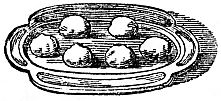
LEMON DUMPLINGS.
LEMON JELLY.
Ingredients.—6 lemons, ¾ lb. of lump sugar, 1 pint of water, 1¼ oz. of isinglass, ¼ pint of sherry. Mode.—Peel 3 of the lemons, pour ½ pint of boiling water on the rind, and let it infuse for ½ hour; put the sugar, isinglass, and ½ pint of water into a lined saucepan, and boil these ingredients for 20 minutes; then put in the strained lemon-juice, the strained infusion of the rind, and bring the whole to the point of boiling; skim well, add the wine, and run the jelly through a bag; pour it into a mould that has been wetted or soaked in water; put it in ice, if convenient, where let it remain until required for table. Previously to adding the lemon-juice to the other ingredients, ascertain that it is very nicely strained, as, if this is not properly attended to, it is liable to make the jelly thick and muddy. As this jelly is very pale, and almost colourless, it answers very well for moulding with a jelly of any bright hue; for instance, half a jelly bright red, and the other half made of the above, would have a very good effect. Lemon jelly may also be made with calf’s-feet stock, allowing the juice of 3 lemons to every pint of stock. Time.—Altogether, 1 hour. Average cost, with the best isinglass, 3s. 6d. Sufficient to fill 1½ pint mould. Seasonable at any time.
LEMON MINCEMEAT.
Ingredients.—2 large lemons, 6 large apples, ½ lb. of suet, 1 lb. of currants, ½ lb. of sugar, 2 oz. of candied lemon-peel, 1 oz. of citron, mixed spice to taste. Mode.—Pare the lemons, squeeze them, and boil the peel until tender enough to mash. Add to the mashed lemon-peel the apples, which should be pared, cored, and minced; the chopped suet, currants, sugar, sliced peel, and spice. Strain the lemon-juice to these ingredients, stir the mixture well, and put it in a jar with a closely-fitting lid. Stir occasionally, and in a week or 10 days the mincemeat will be ready for use. Average cost, 2s. Sufficient for 18 large or 24 small pies. Seasonable.—Make this about the beginning of December.
LEMON-PEEL.
This contains an essential oil of a very high flavour and fragrance, and is consequently esteemed both a wholesome and agreeable stomachic. It is used, as will be seen by many recipes in this book, as an ingredient for flavouring a number of various dishes. Under the name of candied lemon-peel, it is cleared of the pulp and preserved in sugar, when it becomes an excellent sweetmeat.
LEMON PUDDING, Baked.
Ingredients.—The yolks of 4 eggs, 4 oz. of pounded sugar, 1 lemon, ¼ lb. of butter, puff-crust. Mode.—Beat the eggs to a froth; mix with them the sugar and warmed butter; stir these ingredients well together, putting in the grated rind and strained juice of the lemon-peel. Line a shallow dish with puff-paste; put in the mixture, and bake in a moderate oven for 40 minutes; turn the pudding out of the dish, strew over it sifted sugar, and serve. Time.—40 minutes. Average cost, 10d. Sufficient for 5 or 6 persons. Seasonable at any time.