THE DICTIONARY OF COOKERY. (continued 12)
Reading edition
PINEAPPLE FRITTERS (an elegant dish).
Ingredients.—A small pineapple, a small wineglassful of brandy or liqueur, 2 oz. of sifted sugar; batter as for apple fritters, which see. Mode.—This elegant dish, although it may appear extravagant, is really not so if made when pineapples are plentiful. We receive them now in such large quantities from the West Indies, that at times they may be purchased at an exceedingly low rate; it would not, of course, be economical to use the pines which are grown in our English pineries for the purposes of fritters. Pare the pine with as little waste as possible, cut it into rather thin slices, and soak these slices in the above proportion of brandy or liqueur and pounded sugar for 4 hours; then make a batter the same as for apple fritters, substituting cream for the milk, and using a smaller quantity of flour; when this is ready, dip in the pieces of pine, and fry them in boiling lard from 5 to 8 minutes; turn them when sufficiently brown on one side, and, when done, drain them from the lard before the fire, dish them on a white d’oyley, strew over them sifted sugar, and serve quickly. Time.—5 to 8 minutes. Average cost, when cheap and plentiful, 1s. 6d. for the pine. Sufficient for 3 or 4 persons. Seasonable in July and August.
PINEAPPLE, Preserved.
Ingredients.—To every lb. of fruit, weighed after being pared, allow 1 lb. of loaf sugar; ¼ pint of water. Mode.—The pines for making this preserve should be perfectly sound but ripe. Cut them into rather thick slices, as the fruit shrinks very much in the boiling. Pare off the rind carefully, that none of the pine be wasted; and, in doing so, notch it in and out, as the edge cannot be smoothly cut without great waste. Dissolve a portion of the sugar in a preserving-pan with ¼ pint of water; when this is melted, gradually add the remainder of the sugar, and boil it until it forms a clear syrup, skimming well. As soon as this is the case, put in the pieces of pine, and boil well for at least ½ hour, or until it looks nearly transparent. Put it into pots, cover down when cold, and store away in a dry place. Time.—½ hour to boil the fruit. Average cost, 10d. to 1s. per lb. pot. Seasonable.—Foreign pines, in July and August.
PINEAPPLE, Preserved, for present use.
Ingredients.—Pineapple, sugar, water. Mode.—Cut the pine into slices ¼ inch in thickness; peel them, and remove the hard part from the middle. Put the parings and hard pieces into a stewpan, with sufficient water to cover them, and boil for 1 hour. Strain the liquor, and put in the slices of pine. Stew them for 10 minutes, add sufficient sugar to sweeten the whole nicely, and boil again for another ¼ hour; skim well, and the preserve will be ready for use. It must be eaten soon, as it will keep but a very short time. Time.—¼ hour to boil the parings in water; 10 minutes to boil the pine without sugar, ¼ hour with sugar. Average cost.—Foreign pines, 1s. to 3s. each; English, from 2s. to 12s. per lb. Seasonable.—Foreign, in July and August; English, all the year.
PIPPINS, Normandy, Stewed.
Ingredients.—1 lb. of Normandy pippins, 1 quart of water, ½ teaspoonful of powdered cinnamon, ½ teaspoonful of ground ginger, 1 lb. of moist sugar, 1 lemon. Mode.—Well wash the pippins, and put them into 1 quart of water with the above proportion of cinnamon and ginger, and let them stand 12 hours; then put these all together into a stewpan, with the lemon sliced thinly, and half the moist sugar. Let them boil slowly until the pippins are half done; then add the remainder of the sugar, and simmer until they are quite tender. Serve on glass dishes for dessert. Time.—2 to 3 hours. Average cost, 1s. 6d. Seasonable.—Suitable for a winter dish.
PLAICE, Fried.
Ingredients.—Hot lard, or clarified dripping; egg and bread-crumbs. Mode.—This fish is fried in the same manner as soles. Wash and wipe them thoroughly dry, and let them remain in a cloth until it is time to dress them. Brush them over with egg, and cover with bread-crumbs mixed with a little flour. Fry of a nice brown in hot dripping or lard, and garnish with fried parsley and cut lemon. Send them to table with shrimp-sauce and plain melted butter. Time.—About 5 minutes. Average cost, 3d. each. Seasonable from May to November. Sufficient, 4 plaice for 4 persons.
Note.—Plaice may be boiled plain, and served with melted butter. Garnish with parsley and cut lemon.
PLAICE, Stewed.
Ingredients.—4 or 5 plaice, 2 onions, ½ oz. ground ginger, 1 pint of lemon-juice, ¼ pint water, 6 eggs; cayenne to taste. Mode.—Cut the fish into pieces about 2 inches wide, salt them, and let them remain ¼ hour. Slice and fry the onions a light brown; put them in a stewpan, on the top of which put the fish without washing, and add the ginger, lemon-juice, and water. Cook slowly for ½ hour, and do not let the fish boil, or it will break. Take it out, and when the liquor is cool, add 6 well-beaten eggs; simmer till it thickens, when pour over the fish, and serve. Time.—¾ hour. Average cost for this quantity, 1s. 9d. Seasonable from May to November. Sufficient for 4 or 5 persons; according to the size of the fish.
PLOVERS, to Carve.
Plovers may be carved like quails or woodcock, being trussed and served in the same way as those birds.
PLOVERS, to Dress.
Ingredients.—3 plovers, butter, flour, toasted bread. Choosing and Trussing.—Choose those that feel hard at the vent, as that shows their fatness. There are three sorts,—the grey, green, and bastard plover, or lapwing. They will keep good for some time, but if very stale, the feet will be very dry. Plovers are scarcely fit for anything but roasting; they are, however, sometimes stewed, or made into a ragoût, but this mode of cooking is not to be recommended. Mode.—Pluck off the feathers, wipe the outside of the birds with a damp cloth, and do not draw them; truss with the head under the wing, put them down to a clear fire, and lay slices of moistened toast in the dripping-pan, to catch the trail. Keep them well basted, dredge them lightly with flour a few minutes before they are done, and let them be nicely frothed. Dish them on the toasts, over which the traill should be equally spread. Pour round the toast a little good gravy, and send some to table in a tureen. Time.—10 minutes to ¼ hour. Average cost, 1s. 6d. the brace, if plentiful. Sufficient for 2 persons. Seasonable.—In perfection from the beginning of September to the end of January.
PLUM CAKE, Common.
Ingredients.—3 lbs. of flour, 6 oz. of butter or good dripping, 6 oz. of moist sugar, 6 oz. of currants, ½ oz. of pounded allspice, 2 tablespoonfuls of fresh yeast, 1 pint of new milk. Mode.—Rub the butter into the flour; add the sugar, currants, and allspice; warm the milk, stir to it the yeast, and mix the whole into a dough; knead it well, and put it into 6 buttered tins; place them near the fire for nearly an hour for the dough to rise, then bake the cakes in a good oven from 1 to 1¼ hour. To ascertain when they are done, plunge a clean knife into the middle, and if on withdrawal it comes out clean, the cakes are done. Time.—1 to 1¼ hour. Average cost, 1s. 8d. Sufficient to make 6 small cakes.
PLUM CAKE, a Nice.
Ingredients.—1 lb. of flour, ¼ lb. of butter, ½ lb. of sugar, ½ lb. of currants, 2 oz. of candied lemon-peel, ½ pint of milk, 1 teaspoonful of ammonia or carbonate of soda. Mode.—Put the flour into a basin with the sugar, currants, and sliced candied peel; beat the butter to a cream, and mix all these ingredients together with the milk. Stir the ammonia into 2 tablespoonfuls of milk; add it to the dough, and beat the whole well, until everything is thoroughly mixed. Put the dough into a buttered tin, and bake the cake from 1½ to 2 hours. Time.—1½ to 2 hours. Average cost, 1s. 3d. Seasonable at any time.
PLUM JAM.
Ingredients.—To every lb. of plums, weighed before being stoned, allow ¾ lb. of loaf sugar. Mode.—In making plum jam, the quantity of sugar for each lb. of fruit must be regulated by the quality and size of the fruit, some plums requiring much more sugar than others. Divide the plums, take out the stones, and put them on to large dishes, with roughly-pounded sugar sprinkled over them in the above proportion, and let them remain for one day; then put them into a preserving-pan, stand them by the side of the fire to simmer gently for about ½ hour, and then boil them rapidly for another 15 minutes. The scum must be carefully removed as it rises, and the jam must be well stirred all the time, or it will burn at the bottom of the pan, and so spoil the colour and flavour of the preserve. Some of the stones may be cracked, and a few kernels added to the jam just before it is done: these impart a very delicious flavour to the plums. The above proportion of sugar would answer for Orleans plums; the Impératrice, Magnum-bonum, and Winesour would not require quite so much. Time.—½ hour to simmer gently, ¼ hour to boil rapidly. Best plums for preserving.—Violets, Mussels, Orleans, Impératrice, Magnum-bonum, and Winesour. Seasonable from the end of July to the beginning of October.
PLUM PUDDING, Baked.
Ingredients.—2 lbs. of flour, 1 lb. of currants, 1 lb. of raisins, 1 lb. of suet, 2 eggs, 1 pint of milk, a few slices of candied peel. Mode.—Chop the suet finely; mix it with the flour, currants, stoned raisins, and candied peel; moisten with the well-beaten eggs, and add sufficient milk to make the pudding of the consistency of very thick batter. Put it into a buttered dish, and bake in a good oven from 2¼ to 2½ hours; turn it out, strew sifted sugar over, and serve. For a very plain pudding, use only half the quantity of fruit, omit the eggs, and substitute milk or water for them. The above ingredients make a large family pudding; for a small one, half the quantity will be found ample; but it must be baked quite 1½ hour. Time.—Large pudding, 2¼ to 2½ hours; half the size, 1½ hour. Average cost, 2s. 6d. Sufficient for 9 or 10 persons. Seasonable in winter.
PLUM PUDDING, Excellent, made without Eggs.
Ingredients.—½ lb. of flour, 6 oz. of raisins, 6 oz. of currants, ¼ lb. of chopped suet, ¼ lb. of brown sugar, ¼ lb. of mashed carrot, ¼ lb. of mashed potatoes, 1 tablespoonful of treacle, 1 oz. of candied lemon-peel, 1 oz. of candied citron. Mode.—Mix the flour, currants, suet and sugar well together; have ready the above proportions of mashed carrot and potato, which stir into the other ingredients; add the treacle and lemon-peel; but put no liquid in the mixture, or it will be spoiled. Tie it loosely in a cloth, or, if put in a basin, do not quite fill it, as the pudding should have room to swell, and boil it for 4 hours. Serve with brandy-sauce. This pudding is better for being mixed over-night. Time.—4 hours. Average cost, 1s. 6d. Sufficient for 6 or 7 persons. Seasonable in winter.
PLUM PUDDING, Unrivalled.
Ingredients.—1½ lb. of muscatel raisins, 1¾ lb. of currants, 1 lb. of sultana raisins, 2 lbs. of the finest moist sugar, 2 lbs. of bread-crumbs, 16 eggs, 2 lbs. of finely-chopped suet, 6 oz. of mixed candied peel, the rind of 2 lemons, 1 oz. of ground nutmeg, 1 oz. of ground cinnamon, ½ oz. of pounded bitter almonds, ¼ pint of brandy. Mode.—Stone and cut up the raisins, but do not chop them; wash and dry the currants, and cut the candied peel into thin slices. Mix all the dry ingredients well together, and moisten with the eggs, which should be well beaten and strained, to the pudding; stir in the brandy, and, when all is thoroughly mixed, well butter and flour a stout new pudding-cloth; put in the pudding, tie it down very tightly and closely, boil from 6 to 8 hours, and serve with brandy-sauce. A few sweet almonds, blanched and cut in strips, and stuck on the pudding, ornament it prettily. This quantity may be divided and boiled in buttered moulds. For small families this is the most desirable way, as the above will be found to make a pudding of rather large dimensions. Time.—6 to 8 hours. Average cost, 7s. 6d. Seasonable in winter. Sufficient for 12 or 14 persons.
Note.—The muscatel raisins can be purchased at a cheap rate loose (not in bunches): they are then scarcely higher in price than the ordinary raisins, and impart a much richer flavour to the pudding.
PLUM PUDDING, a Plain Christmas, for Children.
Ingredients.—1 lb. of flour, 1 lb. of bread-crumbs, ¾ lb. of stoned raisins, ¾ lb. of currants, ¾ lb. of suet, 3 or 4 eggs, milk, 2 oz. of candied peel, 1 teaspoonful of powdered allspice, ½ saltspoonful of salt. Mode.—Let the suet be finely chopped, the raisins stoned, and the currants well washed, picked and dried. Mix these with the other dry ingredients, and stir all well together; beat and strain the eggs to the pudding, stir these in, and add just sufficient milk to make it mix properly. Tie it up in a well-floured cloth, put it into boiling water, and boil for at least 5 hours. Serve with a sprig of holly placed in the middle of the pudding, and a little pounded sugar sprinkled over it. Time.—5 hours. Average cost, 1s. 9d. Sufficient for 9 or 10 children. Seasonable at Christmas.
PLUM PUDDING, Christmas (very good).
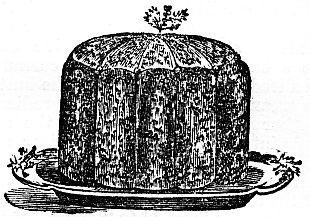
CHRISTMAS PLUM PUDDING IN MOULD.
Ingredients.—1½ lb. of raisins, ½ lb. of currants, ½ lb. of mixed peel, ¾ lb. of bread-crumbs, ¾ lb. of suet, 8 eggs, l wineglassful of brandy. Mode.—Stone and cut the raisins in halves, but do not chop them; wash, pick, and dry the currants, and mince the suet finely; cut the candied peel into thin slices, and grate down the bread into fine crumbs. When all these dry ingredients are prepared, mix them well together; then moisten the mixture with the eggs, which should be well beaten, and the brandy; stir well, that everything may be very thoroughly blended, and press the pudding into a buttered mould; tie it down tightly with a floured cloth, and boil for 5 or 6 hours. It may be boiled in a cloth without a mould, and will require the same time allowed for cooking. As Christmas puddings are usually made a few days before they are required for table, when the pudding is taken out of the pot, hang it up immediately, and put a plate or saucer underneath to catch the water that may drain from it. The day it is to be eaten, plunge it into boiling water, and keep it boiling for at least 2 hours; then turn it out of the mould, and serve with brandy-sauce. On Christmas-day a sprig of holly is usually placed in the middle of the pudding, and about a wineglassful of brandy poured round it, which, at the moment of serving, is lighted, and the pudding thus brought to table encircled in flame. Time.—5 or 6 hours the first time of boiling; 2 hours the day it is to be served. Average cost, 4s. Sufficient for a quart mould for 7 or 8 persons. Seasonable on the 25th of December, and on various festive occasions till March.
Note.—Five or six of these puddings should be made at one time, as they will keep good for many weeks, and in cases where unexpected guests arrive, will be found an acceptable and, as it only requires warming through, a quickly-prepared dish. Moulds of every shape and size are manufactured for these puddings, and may be purchased of Messrs. R. & J. Slack, 336, Strand.
PLUM PUDDING (a Pound).
Ingredients.—1 lb. of suet, 1 lb. of currants, 1 lb. of stoned raisins, 8 eggs, ½ grated nutmeg, 2 oz. of sliced candied peel, 1 teaspoonful of ground ginger, ½ lb. of bread-crumbs, ½ lb. of flour, ½ pint of milk. Mode.—Chop the suet finely; mix with it the dry ingredients; stir these well together, and add the well-beaten eggs and milk to moisten with. Beat up the mixture well, and should the above proportion of milk not be found sufficient to make it of the proper consistency, a little more should be added. Press the pudding into a mould, tie it in a floured cloth, and boil for five hours, or rather longer, and serve with brandy-sauce. Time.—5 hours, or longer. Average cost, 3s. Sufficient for 7 or 8 persons. Seasonable in winter.
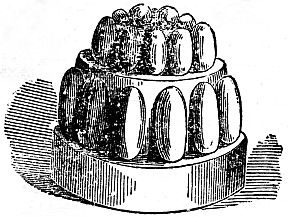
BAKED PUDDING, OR CAKE-MOULD.
Note.—The above pudding may be baked instead of boiled; it should be put into a buttered mould or tin, and baked for about 2 hours; a smaller one would take about 1¼ hour.
PLUM PUDDING (Fresh Fruit).
Ingredients.—¾ lb. of suet crust, 1½ pint of Orleans or any other kind of plum, ¼ lb. of moist sugar. Mode.—Line a pudding-basin with suet crust rolled out to the thickness of about ½ inch; fill the basin with the fruit, put in the sugar, and cover with crust. Fold the edges over, and pinch them together, to prevent the juice escaping. Tie over a floured cloth, put the pudding into boiling water, and boil from 2 to 2½ hours. Turn it out of the basin, and serve quickly. Time.—2 to 2½ hours. Average cost, 10d. Sufficient for 6 or 7 persons. Seasonable, with various kinds of plums, from the beginning of August to the beginning of October.
PLUM TART.
Ingredients.—½ lb. of good short crust, 1½ pint of plums, 1 lb. of moist sugar. Mode.—Line the edges of a deep tart-dish with crust; fill the dish with plums, and place a small cup or jar, upside down, in the midst of them. Put in the sugar, cover the pie with crust, ornament the edges, and bake in a good oven from ½ to ¾ hour. When puff-crust is preferred to short crust, use that made by the given recipe, and glaze the top by brushing it over with the white of an egg beaten to a stiff froth with a knife; sprinkle over a little sifted sugar, and put the pie in the oven to set the glaze. Time.—½ to ¾ hour. Average cost, 1s. Sufficient for 5 or 6 persons. Seasonable, with various kinds of plums, from the beginning of August to the beginning of October.

PLUM TART.
PLUMS, French, Stewed (a Dessert dish).
Ingredients.—1½ lb. of French plums, ¾ pint of syrup, 1 glass of port wine, the rind and juice of 1 lemon. Mode.—Stew the plums gently in water for 1 hour; strain the water, and with it make the syrup. When it is clear, put in the plums with the port wine, lemon-juice, and rind, and simmer very gently for 1½ hour. Arrange the plums on a glass dish, take out the lemon-rind, pour the syrup over the plums, and, when cold, they will be ready for table. A little allspice stewed with the fruit is by many persons considered an improvement. Time.—1 hour to stew the plums in water, 1½ hour in the syrup. Average cost, plums sufficiently good for stewing, 1s. per lb. Sufficient for 7 or 8 persons. Seasonable in winter.
PLUMS (Preserved).
Ingredients.—To every lb. of fruit allow ¾ lb. of loaf sugar; for the thin syrup, ¼ lb. of sugar to each pint of water. Mode.—Select large ripe plums; slightly prick them, to prevent them from bursting, and simmer them very gently in a syrup made with the above proportion of sugar and water. Put them carefully into a pan, let the syrup cool, pour it over the plums, and allow them to remain for two days. Having previously weighed the other sugar, dip the lumps quickly into water, and put them into a preserving-pan with no more water than hangs about them; and boil the sugar to a syrup, carefully skimming it. Drain the plums from the first syrup; put them into the fresh syrup, and simmer them very gently until they are clear; lift them out singly into pots, pour the syrup over, and, when cold, cover down to exclude the air. This preserve will remain good some time, if kept in a dry place, and makes a very nice addition to a dessert. The magnum-bonum plums answer for this preserve better than any other kind of plum. Greengages are also very delicious done in this manner. Time.—¼ hour to 20 minutes to simmer the plums in the first syrup; 20 minutes to ½ hour very gentle simmering in the second. Seasonable from August to October.
PLUMS, to Preserve Dry.
Ingredients.—To every lb. of sugar allow ¼ pint of water. Mode.—Gather the plums when they are full grown and just turning colour; prick them, put them into a saucepan of cold water, and set them on the fire until the water is on the point of boiling. Then take them out, drain them, and boil them gently in syrup made with the above proportion of sugar and water; and if the plums shrink, and will not take the sugar, prick them as they lie in the pan; give them another boil, skim, and set them by. The next day add some more sugar, boiled almost to candy, to the fruit and syrup; put all together into a wide-mouthed jar, and place them in a cool oven for 2 nights; then drain the plums from the syrup, sprinkle a little powdered sugar over, and dry them in a cool oven. Time.—15 to 20 minutes to boil the plums in the syrup. Seasonable from August to October.
PORK.
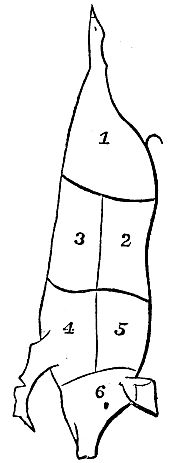
SIDE OF A PIG, SHOWING THE SEVERAL JOINTS
In the country, where, for ordinary consumption, the pork killed for sale is usually both larger and fatter than that supplied to the London consumer, it is customary to remove the skin and fat down to the lean, and, salting that, roast what remains of the joint. Pork goes further, and is consequently a more economical food, than other meats, simply because the texture is closer, and there is less waste in the cooking, either in roasting or boiling.
In fresh pork, the leg is the most economical family joint, and the loin the richest.
Pork, to be preserved, is cured in several ways,—either by covering it with salt, or immersing it in ready-made brine, where it is kept till required; or it is only partially salted, and then hung up to dry, when the meat is called white bacon; or, after salting, it is hung in wood smoke till the flesh is impregnated with the aroma from the wood. The Wiltshire bacon, which is regarded as the finest in the kingdom, is prepared by laying the sides of a hog in large wooden troughs, and then rubbing into the flesh quantities of powdered bay-salt, made hot in a frying-pan. This process is repeated for four days; they are then left for three weeks, merely turning the flitches every other day, After that time they are hung up to dry. The hogs usually killed for purposes of bacon in England average from 18 to 20 stone; on the other hand, the hogs killed in the country for farm-house purposes, seldom weigh less than 26 stone. The legs of boars, hogs, and, in Germany, those of bears, are prepared differently, and called hams.
The practice in vogue formerly in this country was to cut out the hams and cure them separately; then to remove the ribs, which were roasted as “spare-ribs,” and, curing the remainder of the side, call it a “gammon of bacon.”
Small pork to cut for table in joints, is cut up, in most places throughout the kingdom, as represented in the engraving. The side is divided with nine ribs to the fore quarter; and the following is an enumeration of the joints in the two respective quarters:—
Hind Quarter— 1. The leg.
2. The loin.
3. The spring, or belly.
Fore Quarter— 4. The hand.
5. The fore-loin.
6. The cheek.
The weight of the several joints of a good pork pig of four stone may be as follows; viz.:—
The leg8 lbs.
The loin and spring7“
The hand6“
The chine7“
The cheek from 2 to 3“
Of a bacon pig, the legs are reserved for curing, and when cured are called hams: when the meat is separated from the shoulder-blade and bones and cured, it is called bacon. The bones, with part of the meat left on them, are divided into spare-ribs, griskins, and chines.
PORK CHEESE (an Excellent Breakfast Dish).
Ingredients.—2 lbs. of cold roast pork, pepper and salt to taste, 1 dessertspoonful of minced parsley, 4 leaves of sage, a very small bunch of savoury herbs, 2 blades of pounded mace, a little nutmeg, ½ teaspoonful of minced lemon-peel; good strong gravy, sufficient to fill the mould. Mode.—Cut, but do not chop, the pork into fine pieces, and allow ¼ lb. of fat to each pound of lean. Season with pepper and salt; pound well the spices, and chop finely the parsley, sage, herbs, and lemon-peel, and mix the whole nicely together. Put it into a mould, fill up with good strong well-flavoured gravy, and bake rather more than one hour. When cold, turn it out of the mould. Time.—Rather more than 1 hour. Seasonable from October to March.
Note.—The remains of a pig’s head, after the chops are taken off, make most excellent pork cheese.
PORK CUTLETS, or Chops.
Ingredients.—Loin of pork, pepper and salt to taste. Mode.—Cut the cutlets from a delicate loin of pork, bone and trim them neatly, and cut away the greater portion of the fat. Season them with pepper; place the gridiron on the fire; when quite hot, lay on the chops, and broil them for about ¼ hour, turning them 3 or 4 times; and be particular that they are thoroughly done, but not dry. Dish them, sprinkle over a little fine salt, and serve plain, or with tomato sauce, sauce piquante, or pickled gherkins, a few of which should be laid round the dish as a garnish. Time.—About ¼ hour. Average cost, 10d. per lb. for chops. Sufficient.—Allow 6 for 4 persons. Seasonable from October to March.
PORK CUTLETS, or Chops.
Ingredients.—Loin, or fore-loin, of pork, egg and bread-crumbs, salt and pepper to taste; to every tablespoonful of bread-crumbs allow ½ teaspoonful of minced sage; clarified butter. Mode.—Cut the cutlets from a loin, or fore-loin, of pork; trim them the same as mutton cutlets, and scrape the top part of the bone. Brush them over with egg, sprinkle with bread-crumbs, with which have been mixed minced sage and a seasoning of pepper and salt; drop a little clarified butter on them, and press the crumbs well down. Put the frying-pan on the fire, put in some lard; when this is hot, lay in the cutlets, and fry them a light brown on both sides. Take them out, put them before the fire to dry the greasy moisture from them, and dish them on mashed potatoes. Serve with them any sauce that may be preferred; such as tomato sauce, sauce piquante, sauce Robert, or pickled gherkins. Time.—From 15 to 20 minutes. Average cost, 10d. per lb. for chops. Sufficient.—Allow 6 cutlets for 4 persons. Seasonable from October to March.
Note.—The remains of roast loin of pork may be dressed in the same manner.
PORK CUTLETS.
[Cold Meat Cookery.] Ingredients.—The remains of cold roast loin of pork, 1 oz. of butter, 2 onions, 1 dessertspoonful of flour, ½ pint of gravy, pepper and salt to taste, 1 teaspoonful of vinegar and mustard. Mode.—Cut the pork into nice-sized cutlets, trim off most of the fat, and chop the onions. Put the butter into a stewpan, lay in the cutlets and chopped onions, and fry a light brown; then add the remaining ingredients, simmer gently for 5 or 7 minutes, and serve. Time.—5 to 7 minutes. Average cost, exclusive of the meat, 4d. Seasonable from October to March.
PORK, Roast Griskin of.
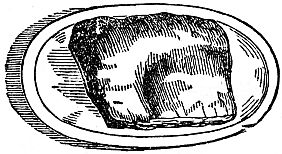
SPARE-RIB OF PORK.
Ingredients.—Pork; a little powdered sage. Mode.—As this joint frequently comes to table hard and dry, particular care should be taken that it is well basted. Put it down to a bright fire, and flour it. About 10 minutes before taking it up, sprinkle over some powdered sage; make a little gravy in the dripping-pan, strain it over the meat, and serve with a tureen of apple sauce. This joint will be done in far less time than when the skin is left on, consequently, should have the greatest attention that it be not dried up. Time.—Griskin of pork weighing 6 lbs., 1½ hour. Average cost, 7d. per lb. Sufficient for 5 or 6 persons. Seasonable from September to March.
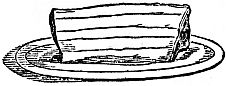
GRISKIN OF PORK.
Note.—A spare-rib of pork is roasted in the same manner as above, and would take 1½ hour for one weighing about 6 lbs.
PORK, Hashed.
Ingredients.—The remains of cold roast pork, 2 onions, 1 teaspoonful of flour, 2 blades of pounded mace, 2 cloves, 1 tablespoonful of vinegar, ½ pint of gravy, pepper and salt to taste. Mode.—Chop the onions and fry them of a nice brown; cut the pork into thin slices, season them with pepper and salt, and add these to the remaining ingredients. Stew gently for about ½ hour, and serve garnished with sippets of toasted bread. Time.—½ hour. Average cost, exclusive of the meat, 3d. Seasonable from October to March.
PORK, Boiled Leg of.
Ingredients.—Leg of pork; salt. Mode.—For boiling, choose a small, compact, well-filled leg, and rub it well with salt; let it remain in pickle for a week or ten days, turning and rubbing it every day. An hour before dressing it, put it into cold water for an hour, which improves the colour. If the pork is purchased ready salted, ascertain how long the meat has been in pickle, and soak it accordingly. Put it into a boiling-pot, with sufficient cold water to cover it; let it gradually come to a boil, and remove the scum as it rises. Simmer it very gently until tender, and do not allow it to boil fast, or the knuckle will fall to pieces before the middle of the leg is done. Carrots, turnips, or parsnips may be boiled with the pork, some of which should be laid round the dish as a garnish. A well-made pease-pudding is an indispensable accompaniment. Time.—A leg of pork weighing 8 lbs., 3 hours after the water boils, and to be simmered very gently. Average cost, 9d. per lb. Sufficient for 7 or 8 persons. Seasonable from September to March.
Note.—The liquor in which a leg of pork has been boiled makes excellent pea-soup.
PORK, Roast Leg of.
Ingredients.—Leg of pork, a little, oil, sage and onion stuffing. Mode.—Choose a small leg of pork, and score the skin across in narrow strips, about ¼ inch apart. Cut a slit in the knuckle, loosen the skin, and fill it with a sage-and-onion stuffing. Brush the joint over with a little salad-oil (this makes the crackling crisper, and a better colour), and put it down to a bright, clear fire, not too near, as that would cause the skin to blister. Baste it well, and serve with a little gravy made in the dripping-pan, and do not omit to send to table with it a tureen of well-made apple sauce. Time.—A leg of pork weighing 8 lbs., about 3 hours. Average cost, 9d. per lb. Sufficient for 6 or 7 persons. Seasonable from September to March.

ROAST LEG OF PORK.
PORK, Leg of, to Carve.
This joint, which is such a favourite one with many people, is easy to carve. The knife should be carried sharply down to the bone, clean through the crackling, in the direction of the line 1 to 2. Sage and onion and apple sauce are usually sent to table with this dish,—sometimes the leg of pork is stuffed,—and the guests should be asked if they will have either or both. A frequent plan, and we think a good one, is now pursued, of sending sage and onion to table separately from the joint, as it is not everybody to whom the flavour of this stuffing is agreeable.
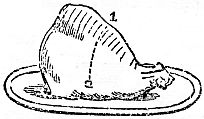
LEG OF PORK.
Note.—The other dishes of pork do not call for any special remarks as to their carving or helping.
PORK, Roast Loin of.

FORE LOIN OF PORK.
Ingredients.—Pork; a little salt. Mode.—Score the skin in strips rather more than ¼ inch apart, and place the joint at a good distance from the fire, on account of the crackling, which would harden before the meat would be heated through, were it placed too near. If very lean, it should be rubbed over with a little salad oil, and kept well basted all the time it is at the fire. Pork should be very thoroughly cooked, but not dry; and be careful never to send it to table the least underdone, as nothing is more unwholesome and disagreeable than under-dressed white meats. Serve with apple sauce and a little gravy made in the dripping-pan. A stuffing of sage and onion may be made separately, and baked in a flat dish: this method is better than putting it in the meat, as many persons have so great an objection to the flavour. Time.—A loin of pork weighing 5 lbs., about 2 hours: allow more time should it be very fat. Average cost, 9d. per lb. Sufficient for 5 or 6 persons. Seasonable from September to March.

HIND LOIN OF PORK.
PORK, to Pickle.
Ingredients.—¼ lb. of saltpetre; salt. Mode.—As pork does not keep long without being salted, cut it into pieces of a suitable size as soon as the pig is cold. Rub the pieces of pork well with salt, and put them into a pan with a sprinkling of it between each piece: as it melts on the top, strew on more. Lay a coarse cloth over the pan, a board over that, and a weight on the board, to keep the pork down in the brine. If excluded from the air, it will continue good for nearly 2 years. Average cost, 10d. per lb. for the prime parts. Seasonable.—The best time for pickling meat is late in the autumn.
PORK, Pickled, to Boil.
Ingredients.—Pork; water. Mode.—Should the pork be very salt, let it remain in water about 2 hours before it is dressed; put it into a saucepan with sufficient cold water to cover it, let it gradually come to a boil, then gently simmer until quite tender. Allow ample time for it to cook, as nothing is more disagreeable than underdone pork, and when boiled fast, the meat becomes hard. This is sometimes served with boiled poultry and roast veal, instead of bacon: when tender, and not over salt, it will be found equally good. Time.—A piece of pickled pork weighing 2 lbs., 1¼ hour; 4 lbs., rather more than 2 hours. Average cost, 10d. per lb. for the primest parts. Seasonable at any time.
PORK PIES (Warwickshire Recipe).
Ingredients.—For the crust, 5 lbs. of lard to 14 lbs. of flour; milk, and water. For filling the pies, to every 3 lbs. of meat allow 1 oz. of salt, 2¼ oz. of pepper, a small quantity of cayenne, 1 pint of water. Mode.—Rub into the flour a portion of the lard; the remainder put with sufficient milk and water to mix the crust, and boil this gently for ¼ hour. Pour it boiling on the flour, and knead and beat it till perfectly smooth. Now raise the crust in either a round or oval form, cut up the pork into pieces the size of a nut, season it in the above proportion, and press it compactly into the pie, in alternate layers of fat and lean, and pour in a small quantity of water; lay on the lid, cut the edges smoothly round, and pinch them together. Bake in a brick oven, which should be slow, as the meat is very solid. Very frequently, an inexperienced cook finds much difficulty in raising the crust. She should bear in mind that it must not be allowed to get cold, or it will fall immediately: to prevent this, the operation should be performed as near the fire as possible. As considerable dexterity and expertness are necessary to raise the crust with the hand only, a glass bottle or small jar may be placed in the middle of the paste, and the crust moulded on this; but be particular that it is kept warm the whole time. Sufficient.—The proportions for 1 pie are 1 lb. of flour and 3 lbs. of meat. Seasonable from September to March.
PORK PIES, Little Raised.
Ingredients.—2 lbs. of flour, ½ lb. of butter, ½ lb. of mutton suet, salt and white pepper to taste, 4 lbs. of the neck of pork, 1 dessertspoonful of powdered sage. Mode.—Well dry the flour, mince the suet, and put these with the butter into a saucepan, to be made hot, and add a little salt. When melted, mix it up into a stiff paste, and put it before the fire with a cloth over it until ready to make up; chop the pork into small pieces, season it with white pepper, salt, and powdered sage; divide the paste into rather small pieces, raise it in a round or oval form, fill with the meat, and bake in a brick oven. These pies will require a fiercer oven than those in the preceding recipe, as they are made so much smaller, and consequently do not require so soaking a heat. Time.—If made small, about 1½ hour. Seasonable from September to March.
POTATO FRITTERS.
Ingredients.—2 large potatoes, 4 eggs, 2 tablespoonfuls of cream, 2 ditto of raisin or sweet wine, 1 dessertspoonful of lemon-juice, ½ teaspoonful of grated nutmeg, hot lard. Mode.—Boil the potatoes, and beat them up lightly with a fork, but do not use a spoon, as that would make them heavy. Beat the eggs well, leaving out one of the whites; add the other ingredients, and beat all together for at least 20 minutes, or until the batter is extremely light. Put plenty of good lard into a frying-pan, and drop a tablespoonful of the batter at a time into it, and fry the fritters a nice brown. Serve them with the following sauce:—A glass of sherry mixed with the strained juice of a lemon, and sufficient white sugar to sweeten the whole nicely. Warm these ingredients, and serve the sauce separately in a tureen. The fritters should be neatly dished on a white d’oyley, and pounded sugar sprinkled over them. They should be well drained on a piece of blotting-paper before the fire previously to being dished. Time.—From 6 to 8 minutes. Average cost, 9d. Sufficient for 3 or 4 persons. Seasonable at any time.
POTATO PASTY.
Ingredients.—1½ lb. of rump-steak or mutton cutlets, pepper and salt to taste, 1/3 pint of weak broth or gravy, 1 oz. of butter, mashed potatoes. Mode.—Place the meat, cut in small pieces, at the bottom of the pan; season it with pepper and salt, and add the gravy and butter broken into small pieces. Put on the perforated plate, with its valve-pipe screwed on, and fill up the whole space to the top of the tube with nicely-mashed potatoes mixed with a little milk, and finish the surface of them in any ornamental manner. If carefully baked, the potatoes will be covered with a delicate brown crust, retaining all the savoury steam rising from the meat. Send it to table as it comes from the oven, with a napkin folded round it. Time.—40 to 60 minutes. Average cost, 2s. Sufficient for 4 or 5 persons. Seasonable at any time.
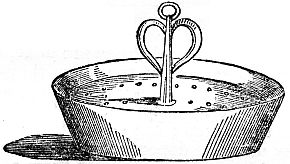
POTATO-PASTY PAN.
POTATO PUDDING.
Ingredients.—½ lb. of mashed potatoes, 2 oz. of butter, 2 eggs, ¼ pint of milk, 3 tablespoonfuls of sherry, ¼ saltspoonful of salt, the juice and rind of 1 small lemon, 2 oz. of sugar. Mode.—Boil sufficient potatoes to make ½ lb. when mashed; add to these the butter, eggs, milk, sherry, lemon-juice, and sugar; mince the lemon-peel very finely, and beat all the ingredients well together. Put the pudding into a buttered pie-dish, and bake for rather more than ½ hour. To enrich it, add a few pounded almonds, and increase the quantity of eggs and butter. Time.—½ hour, or rather longer. Average cost, 8d. Sufficient for 5 or 6 persons. Seasonable at any time.
POTATO RISSOLES.
Ingredients.—Mashed potatoes, salt and pepper to taste; when liked, a very little minced parsley, egg, and bread-crumbs. Mode.—Boil and mash the potatoes; add a seasoning of pepper and salt, and, when liked, a little minced parsley. Roll the potatoes into small balls, cover them with egg and bread-crumbs, and fry in hot lard for about 10 minutes; let them drain before the fire, dish them on a napkin, and serve. Time.—10 minutes to fry the rissoles. Seasonable at any time.

POTATO RISSOLES.
Note.—The flavour of these rissoles may be very much increased by adding finely-minced tongue or ham, or even chopped onions, when these are liked.
POTATO SALAD.
Ingredients.—10 or 12 cold boiled potatoes, 4 tablespoonfuls of tarragon or plain vinegar, 6 tablespoonfuls of salad-oil, pepper and salt to taste, 1 teaspoonful of minced parsley. Mode.—Cut the potatoes into slices about ½ inch in thickness; put these into a salad-bowl with oil and vinegar in the above proportion; season with pepper, salt, and a teaspoonful of minced parsley; stir the salad well, that all the ingredients may be thoroughly incorporated, and it is ready to serve. This should be made two or three hours before it is wanted for table. Anchovies, olives, or pickles may be added to this salad, as also slices of cold beef, fowl, or turkey. Seasonable at any time.
POTATO SNOW.
Ingredients.—Potatoes, salt, and water. Mode.—Choose large white potatoes, as free from spots as possible; boil them in their skins in salt and water until perfectly tender; drain and dry them thoroughly by the side of the fire, and peel them. Put a hot dish before the fire, rub the potatoes through a coarse sieve on to this dish; do not touch them afterwards, or the flakes will fall, and serve as hot as possible. Time.—½ to ¾ hour to boil the potatoes. Average cost, 4s. per bushel. Sufficient,—6 potatoes for 3 persons. Seasonable at any time.
POTATO SOUP.
Ingredients.—4 lbs. of mealy potatoes, boiled or steamed very dry, pepper and salt to taste, 2 quarts of stock. Mode.—When the potatoes are boiled, mash them smoothly, that no lumps remain, and gradually put them to the boiling stock; pass it through a sieve, season, and simmer for 5 minutes. Skim well, and serve with fried bread. Time.—½ hour. Average cost, 10d. per quart. Seasonable from September to March. Sufficient for 8 persons.
POTATO SOUP.
Ingredients.—1 lb. of shin of beef, 1 lb. of potatoes, 1 onion, ½ a pint of peas, 2 oz. of rice, 2 heads of celery, pepper and salt to taste, 3 quarts of water. Mode.—Cut the beef into thin slices, chop the potatoes and onion, and put them into a stewpan with the water, peas, and rice. Stew gently till the gravy is drawn from the meat; strain it off, take out the beef, and pulp the other ingredients through a coarse sieve. Put the pulp back into the soup, cut up the celery in it, and simmer till this is tender. Season, and serve with fried bread cut into it. Time.—3 hours. Average cost, 4d. per quart. Seasonable from September to March. Sufficient for 12 persons.
POTATO SOUP (very Economical).
Ingredients.—4 middle-sized potatoes well pared, a thick slice of bread, 6 leeks peeled and cut into thin slices as far as the white extends upwards from the roots, a teacupful of rice, a teaspoonful of salt, and half that of pepper, and 2 quarts of water. Mode.—The water must be completely boiling before anything is put into it; then add the whole of the ingredients at once, with the exception of the rice, the salt, and the pepper. Cover, and let these come to a brisk boil; put in the others, and let the whole boil slowly for an hour, or till all the ingredients are thoroughly done, and their several juices extracted and mixed. Time.—2½ hours. Average cost, 3d. per quart. Sufficient for 8 persons. Seasonable in winter.
POTATOES, Baked.
Ingredients.—Potatoes. Mode.—Choose large potatoes, as much of a size as possible; wash them in lukewarm water, and scrub them well, for the browned skin of a baked potato is by many persons considered the better part of it. Put them into a moderate oven, and bake them for about two hours, turning them three or four times whilst they are cooking. Serve them in a napkin immediately they are done, as, if kept a long time in the oven, they have a shrivelled appearance. Potatoes may also be roasted before the fire, in an American oven; but when thus cooked, they must be done very slowly. Do not forgot to send to table with them a piece of cold butter. Time.—Large potatoes, in a hot oven, 1½ hour to 2 hours; in a cool oven, 2 to 2½ hours. Average cost, 4s. per bushel. Sufficient.—Allow 2 to each person. Seasonable all the year, but not good just before and whilst new potatoes are in season.

BAKED POTATOES SERVED IN NAPKIN.
POTATOES, to Boil.
Ingredients.—10 or 12 potatoes; to each ½ gallon of water allow 1 heaped tablespoonful of salt. Mode.—Choose potatoes of an equal size, pare them, take out all the eyes and specks, and as they are peeled, throw them into cold water. Put them into a saucepan, with sufficient cold water to cover them, with salt in the above proportion, and let them boil gently until tender. Ascertain when they are done by thrusting a fork in them, and take them up the moment they feel soft through; for if they are left in the water afterwards, they become waxy or watery. Drain away the water, put the saucepan by the side of the fire, with the lid partially uncovered, to allow the steam to escape, and let the potatoes get thoroughly dry, and do not allow them to get burnt. Their superfluous moisture will evaporate, and the potatoes, if a good sort, should be perfectly mealy and dry. Potatoes vary so much in quality and size, that it is difficult to give the exact time for boiling; they should be attentively watched, and probed with a fork, to ascertain when they are cooked. Send them to table quickly, and very hot, and with an opening in the cover of the dish, that a portion of the steam may evaporate, and not fall back on the potatoes. Time.—Moderate-sized old potatoes, 15 to 20 minutes, after the water boils; large ones, ½ hour to 35 minutes. Average cost, 4s. per bushel. Sufficient for 6 persons. Seasonable all the year, but not good just before and whilst new potatoes are in season.
Note.—To keep potatoes hot, after draining the water from them, put a folded cloth or flannel (kept for the purpose) on the top of them, keeping the saucepan-lid partially uncovered. This will absorb the moisture, and keep them hot some time without spoiling.
POTATOES, to Boil in their Jackets.
Ingredients.—10 or 12 potatoes; to each ½ gallon of water, allow 1 heaped tablespoonful of salt. Mode.—To obtain this wholesome and delicious vegetable cooked in perfection, it should be boiled and sent to table with the skin on. In Ireland, where, perhaps, the cooking of potatoes is better understood than in any country, they are always served so. Wash the potatoes well, and if necessary, use a clean scrubbing-brush to remove the dirt from them; and, if possible, choose the potatoes so that they may all be as nearly the same size as possible. When thoroughly cleansed, fill the saucepan half full with them, and just cover the potatoes with cold water salted in the above proportion: they are more quickly boiled with a small quantity of water, and, besides, are more savoury than when drowned in it. Bring them to boil, then draw the pan to the side of the fire, and let them simmer gently until tender. Ascertain when they are done by probing them with a fork; then pour off the water, uncover the saucepan, and let the potatoes dry by the side of the fire, taking care not to let them burn. Peel them quickly, put them in a very hot vegetable-dish, either with or without a napkin, and serve very quickly. After potatoes are cooked, they should never be entirely covered up, as the steam, instead of escaping, falls down on them, and makes them watery and insipid. In Ireland they are usually served up with the skins on, and a small plate is placed by the side of each guest. Time.—Moderate-sized potatoes, with their skins on, 20 to 25 minutes after the water boils; large potatoes, 25 minutes to ¾ hour, or longer; 5 minutes to dry them. Average cost, 4s. per bushel. Sufficient for 6 persons. Seasonable all the year, but not good just before and whilst new potatoes are in season.
POTATOES, New, to Boil.
Ingredients.—Potatoes; to each ½ gallon of water allow 1 heaped tablespoonful of salt. Mode.—Do not have the potatoes dug long before they are dressed, as they are never good when they have been out of the ground some time. Well wash them, rub off the skins with a coarse cloth, and put them into boiling water salted in the above proportion. Let them boil until tender; try them with a fork, and when done, pour the water away from them; let them stand by the side of the fire with the lid of the saucepan partially uncovered, and when the potatoes are thoroughly dry, put them into a hot vegetable-dish, with a piece of butter the size of a walnut; pile the potatoes over this, and serve. If the potatoes are too old to have the skin rubbed off, boil them in their jackets; drain, peel, and serve them as above, with a piece of butter placed in the midst of them. Time.—¼ to ½ hour, according to the size. Average cost, in full season, 1d. per lb. Sufficient.—Allow 3 lbs. for 5 or 6 persons. Seasonable in May and June, but may be had, forced, in March.
POTATOES, Fried (French Fashion).
Ingredients.—Potatoes, hot butter or clarified dripping, salt. Mode.—Peel and cut the potatoes into thin slices, as nearly the same size as possible; make some butter or dripping hot in a frying-pan; put in the potatoes, and fry them on both sides until nearly cooked. Now take the potatoes out of the fat, make the fat quite boiling, then throw in the potatoes for a minute or two until sufficiently done. The immersion of the vegetable in the grease a second time after it is partially cooked, causes it to puff or “gonfler,” as the French say, which is the desired appearance for properly-dressed fried potatoes to possess. When they are crisp and done, take them up, place them on a cloth before the fire to drain the grease from them, and serve very hot, after sprinkling them with salt. These are delicious with rump-steak, and, in France, are frequently served thus as a breakfast dish. The remains of cold potatoes may also be sliced and fried by the above recipe, but the slices must be cut a little thicker. Time.—Sliced raw potatoes, 5 minutes; cooked potatoes, 5 minutes. Average cost, 4s. per bushel. Sufficient,—6 sliced potatoes for 3 persons. Seasonable at any time.
POTATOES, a German Method of Cooking.
Ingredients.—8 to 10 middling-sized potatoes, 3 oz. of butter, 2 tablespoonfuls of flour, ½ pint of broth, 2 tablespoonfuls of vinegar. Mode.—Put the butter and flour into a stewpan; stir over the fire until the butter is of a nice brown colour, and add the broth and vinegar; peel and cut the potatoes into long thin slices, lay them in the gravy, and let them simmer gently until tender, which will be in from 10 to 15 minutes, and serve very hot. A laurel-leaf simmered with the potatoes is an improvement. Time.—10 to 15 minutes. Seasonable at any time.
POTATOES, à la Maître d’Hôtel.
Ingredients.—Potatoes, salt and water; to every 6 potatoes allow 1 tablespoonful of minced parsley, 2 oz. of butter, pepper and salt to taste, 4 tablespoonfuls of gravy, 2 tablespoonfuls of lemon-juice. Mode.—Wash the potatoes clean, and boil them in salt and water; when they are done, drain them, let them cool; then peel and cut the potatoes into thick slices: if these are too thin, they would break in the sauce. Put the butter into a stewpan with the pepper, salt, gravy, and parsley; mix these ingredients well together, put in the potatoes, shake them two or three times, that they may be well covered with the sauce, and, when quite hot through, squeeze in the lemon-juice, and serve. Time.—½ to ¾ hour to boil the potatoes; 10 minutes for them to heat in the sauce. Average cost, 4s. per bushel. Sufficient for 3 persons. Seasonable all the year.
POTATOES, Mashed.
Ingredients.—Potatoes; to every lb. of mashed potatoes allow 1 oz. of butter, 2 tablespoonfuls of milk, salt to taste. Mode.—Boil the potatoes in their skins; when done, drain them, and let them get thoroughly dry by the side of the fire; then peel them, and, as they are peeled, put them into a clean saucepan, and with a large fork beat them to a light paste; add butter, milk, and salt in the above proportion, and stir all the ingredients well over the fire. When thoroughly hot, dish them lightly, and draw the fork backwards over the potatoes to make the surface rough, and serve. When dressed in this manner, they may be browned at the top with a salamander, or before the fire. Some cooks press the potatoes into moulds, then turn them out, and brown them in the oven: this is a pretty mode of serving, but it makes them heavy. In whatever way they are sent to table, care must be taken to have them quite free from lumps. Time.—From ½ to ¾ hour to boil the potatoes. Average cost, 4s. per bushel. Sufficient,—1 lb. of mashed potatoes for 3 persons. Seasonable at any time.
POTATOES, Very Thin-mashed, or, Purée de Pommes de Terre.
Ingredients.—To every lb. of mashed potatoes allow ¼ pint of good broth or stock, 2 oz. of butter. Mode.—Boil the potatoes, well drain them, and pound them smoothly in a mortar, or beat them up with a fork; add the stock or broth, and rub the potatoes through a sieve. Put the purée into a very clean saucepan with the butter; stir it well over the fire until thoroughly hot, and it will then be ready to serve. A purée should be rather thinner than mashed potatoes, and is a delicious accompaniment to delicately broiled mutton cutlets. Cream or milk may be substituted for the broth when the latter is not at hand. A casserole of potatoes, which is often used for ragoûts instead of rice, is made by mashing potatoes rather thickly, placing them on a dish, and making an opening in the centre. After having browned the potatoes in the oven, the dish should be wiped clean, and the ragoût or fricassée poured in. Time.—About ½ hour to boil the potatoes; 6 or 7 minutes to warm the purée. Average cost, 4s. per bushel. Sufficient.—Allow 1 lb. of cooked potatoes for 3 persons. Seasonable at any time.
POTATOES, how to use Cold.
Ingredients.—The remains of cold potatoes; to every lb. allow 2 tablespoonfuls of flour, 2 ditto of minced onions, 1 oz. of buttermilk. Mode.—Mash the potatoes with a fork until perfectly free from lumps; stir in the other ingredients, and add sufficient milk to moisten them well; press the potatoes into a mould, and bake in a moderate oven until nicely brown, which will be in from 20 minutes to ½ hour. Turn them out of the mould, and serve. Time.—20 minutes to ½ hour. Seasonable at any time.
POTATOES, to Steam.
Ingredients.—Potatoes; boiling water. Mode.—This mode of cooking potatoes is now much in vogue, particularly where they are wanted on a large scale, it being so very convenient. Pare the potatoes, throw them into cold water as they are peeled, then put them into a steamer. Place the steamer over a saucepan of boiling water, and steam the potatoes from 20 to 40 minutes, according to the size and sort. When a fork goes easily through them, they are done; then take them up, dish, and serve very quickly. Time.—20 to 40 minutes. Average cost, 4s. per bushel. Sufficient.—Allow 2 large potatoes to each person. Seasonable all the year, but not so good whilst new potatoes are in season.
POULET AUX CRESSONS.
Ingredients.—A fowl, a large bunch of water-cresses, 3 tablespoonfuls of vinegar, ¼ pint of gravy. Mode.—Truss and roast a fowl by recipe, taking care that it is nicely frothed and brown. Wash and dry the water-cresses, pick them nicely, and arrange them in a flat layer on a dish. Sprinkle over a little salt and the above proportion of vinegar; place over these the fowl, and pour over it the gravy. A little gravy should be served in a tureen. When not liked, the vinegar may be omitted. Time.—From ½ to 1 hour, according to size. Average cost, in full season, 2s. 6d. each. Sufficient for 3 or 4 persons. Seasonable at any time.
POULET À LA MARENGO.
Ingredients.—1 large fowl, 4 tablespoonfuls of salad oil, 1 tablespoonful of flour, 1 pint of stock or water, about 28 mushroom-buttons, salt and pepper to the taste, 1 teaspoonful of powdered sugar, a very small piece of garlic. Mode.—Cut the fowl into 8 or 10 pieces, put them with the oil into a stewpan, and brown them over a moderate fire; dredge in the above proportion of flour, when that is brown, pour in the stock or water, let it simmer very slowly for rather more than ½ an hour, and skim off the fat as it rises to the top; add the mushrooms, season with pepper, salt, garlic, and sugar; take out the fowl, which arrange pyramidically on a dish, with the inferior joints at the bottom. Reduce the sauce by boiling it quickly over the fire, keeping it stirred until sufficiently thick to adhere to the back of the spoon; pour over the fowl, and serve. Time.—Altogether 50 minutes. Average cost, 3s. 6d. Sufficient for 3 or 4 persons. Seasonable at any time.
POUND CAKE.

POUND CAKE.
Ingredients.—1 lb. of butter, 1¼ lb. of flour, 1 lb. of pounded loaf sugar, 1 lb. of currants, 9 eggs, 2 oz. of candied peel, ½ oz. of citron, ½ oz. of sweet almonds; when liked, a little pounded mace. Mode.—Work the butter to a cream; dredge in the flour; add the sugar, currants, candied peel, which should be cut into neat slices, and the almonds, which should be blanched and chopped, and mix all these well together; whisk the eggs, and let them be thoroughly blended with the dry ingredients. Beat the cake well for 20 minutes, and put it into a round tin, lined at the bottom and sides with a strip of white buttered paper. Bake it from 1½ to 2 hours, and let the oven be well heated when the cake is first put in, as, if this is not the case, the currants will all sink to the bottom of it. To make this preparation light, the yolks and whites of the eggs should be beaten separately, and added separately to the other ingredients. A glass of wine is sometimes added to the mixture; but this is scarcely necessary, as the cake will be found quite rich enough without it. Time.—1½ to 2 hours. Ave-* rage cost, 3s. 6d. Sufficient.—The above quantity divided in two will make two nice-sized cakes. Seasonable at any time.
PRAWN SOUP.
Ingredients.—Two quarts of fish stock, two pints of prawns, the crumb of a French roll, anchovy sauce or mushroom ketchup to taste, one blade of mace, one-fourth pint of vinegar, a little lemon-juice. Mode.—Pick out the tails of the prawns, put the bodies in a stewpan with 1 blade of mace, ¼ pint of vinegar, and the same quantity of water; stew them for ¼ hour, and strain off the liquor. Put the fish stock into a stewpan; add the strained liquor, pound the prawns with the crumb of a roll moistened with a little of the soup, rub them through a tammy, and mix them by degrees with the soup; add ketchup or anchovy sauce to taste with a little lemon-juice. When it is well cooked, put in a few picked prawns; let them get thoroughly hot, and serve. If not thick enough, put in a little butter and flour. Time.—Hour. Average cost, 2s. per quart. Seasonable at any time. Sufficient for 8 persons.
Note.—This can be thickened with tomatoes, and vermicelli served in it, which makes it a very tasteful soup.
PRAWNS, to Dress.
Cover a dish with a large cup reversed, and over that lay a small white napkin. Arrange the prawns on it in the form of a pyramid, and garnish with plenty of parsley. Sometimes prawns are stuck into a lemon cut in half the long way, and garnished with parsley.
PRESERVES.
From the nature of vegetable substances, and chiefly from their not passing so rapidly into the putrescent state as animal bodies, the mode of preserving them is somewhat different, although the general principles are the same. All the means of preservation are put in practice occasionally for fruits and the various parts of vegetables, according to the nature of the species, the climate, the uses to which they are applied, &c. Some are dried, as nuts, raisins, sweet herbs, &c.; others are preserved by means of sugar, such as many fruits whose delicate juices would be lost by drying; some are preserved by means of vinegar, and chiefly used as condiments or pickles; a few also by salting, as French beans; while others are preserved in spirits. We have, however, in this place to treat of the best methods of preserving fruits. Fruit is a most important item in the economy of health; the epicurean can scarcely be said to have any luxuries without it; therefore, as it is so invaluable, when we cannot have it fresh, we must have it preserved. It has long been a desideratum to preserve fruits by some cheap method, yet by such as would keep them fit for the various culinary purposes, as making tarts and other similar dishes. The expense of preserving them with sugar is a serious objection; for, except the sugar be used in considerable quantities, the success is very uncertain. Sugar also overpowers and destroys the sub-acid taste so desirable in many fruits: those which are preserved in this manner are chiefly intended for the dessert. Fruits intended for preservation should be gathered in the morning, in dry weather, with, the morning sun upon them, if possible; they will then have their fullest flavour, and keep in good condition longer than when gathered at any other time. Until fruit can be used, it should be placed in the dairy, an ice-house, or a refrigerator. In an ice-house it will remain fresh and plump for several days. Fruit gathered in wet or foggy weather will soon be mildewed, and be of no service for preserves.
Having secured the first and most important contribution to the manufacture of preserves—the fruit, the next consideration is the preparation of the syrup in which the fruit is to be suspended; and this requires much care. In the confectioner’s art there is a great nicety in proportioning the degree of concentration of the syrup very exactly to each particular case; and he knows this by signs, and expresses it by certain technical terms. But to distinguish these properly requires very great attention and considerable experience. The principal thing to be acquainted with is the fact, that, in proportion as the syrup is longer boiled, its water will become evaporated, and its consistency will be thicker. Great care must be taken in the management of the fire, that the syrup does not boil over, and that the boiling is not carried to such an extent as to burn the sugar.
The first degree or consistency is called the thread, which is subdivided into the little and great thread. If you dip the finger into the syrup and apply it to the thumb, the tenacity of the syrup will, on separating the finger and thumb, afford a thread, which shortly breaks: this is the little thread. If the thread, from the greater tenacity, and, consequently, greater strength of the syrup, admits of a greater extension of the finger and thumb, it is called the great thread. There are half-a-dozen other terms and experiments for testing the various thickness of the boiling sugar towards the consistency called caramel; but that degree of sugar-boiling belongs to the confectioner. A solution of sugar prepared by dissolving two parts of double-refined sugar (the best sugar is the most economical for preserves) in one of water, and boiling this a little, affords a syrup of the right degree of strength, and which neither ferments nor crystallizes. This appears to be the degree called smooth by the confectioners, and is proper to be used for the purposes of preserves. The syrup employed should sometimes be clarified, which is done in the following manner:—Dissolve 2 lbs. of loaf sugar in a pint of water; add to this solution the white of an egg, and beat it well. Put the preserving-pan upon the fire with the solution; stir it with a wooden spatula, and when it begins to swell and boil up, throw in some cold water or a little oil to damp the boiling; for, as it rises suddenly, if it should boil over, it would take fire, being of a very inflammable nature. Let it boil up again; then take it off, and remove carefully the scum that has risen. Boil the solution again, throw in a little more cold water, remove the scum, and so on for three or four times successively; then strain it. It is considered to be sufficiently boiled when some taken up in a spoon pours out like oil.
Although sugar passes so easily into the state of fermentation, and is, in fact, the only substance capable of undergoing the vinous stage of that process, yet it will not ferment at all if the quantity be sufficient to constitute a very strong syrup: hence, syrups are used to preserve fruits and other vegetable substances from the changes they would undergo if left to themselves. Before sugar was in use, honey was employed to preserve many vegetable productions, though this substance has now given way to the juice of the sugar-cane.
The fruits that are the most fit for preservation in syrup are apricots, peaches, nectarines, apples, greengages, plums of all kinds, and pears. As an example, take some apricots not too ripe, make a small slit at the stem end, and push out the stone; simmer them in water till they are softened and about half done, and afterwards throw them into cold water. When they have cooled, take them out and drain them. Put the apricots into the preserving-pan with sufficient syrup to cover them; let them boil up three or four times, and then skim them; remove them from the fire, pour them into an earthen pan, and let them cool till next day. Boil them up three days successively, skimming each time, and they will then be finished and in a fit state to be put into pots for use. After each boiling, it is proper to examine into the state of the syrup when cold; if too thin, it will bear additional boiling; if too thick, it may be lowered with more syrup of the visual standard. The reason why the fruit is emptied out of the preserving-pan into an earthen pan is, that the acid of the fruit acts upon the copper, of which the preserving-pans are usually made. From this example the process of preserving fruits by syrup will be easily comprehended. The first object is to soften the fruit by blanching or boiling it in water, in order that the syrup by which it is preserved may penetrate through its substance.
Many fruits, when preserved by boiling, lose much of their peculiar and delicate flavour, as, for instance, pineapples; and this inconvenience may, in some instances, be remedied by preserving them without heat. Cut the fruit in slices about one-fifth of an inch thick, strew powdered loaf sugar an eighth of an inch thick on the bottom of a jar, and put the slices on it. Put more sugar on this, and then another layer of the slices, and so on till the jar is full. Place the jar with the fruit up to the neck in boiling water, and keep it there till the sugar is completely dissolved, which may take half-an-hour, removing the scum as it rises. Lastly, tie a wet bladder over the mouth of the jar, or cork and wax it.
Any of the fruits that have been preserved in syrup may be converted into dry preserves, by first draining them from the syrup, and then drying them in a stove or very moderate oven, adding to them a quantity of powdered loaf-sugar, which will gradually penetrate the fruit, while the fluid parts of the fruit gently evaporate. They should be dried in the stove or oven on a sieve, and turned every six or eight hours, fresh powdered sugar being sifted over them every time they are turned. Afterwards, they are to be kept in a dry situation, in drawers or boxes. Currants and cherries preserved whole in this manner, in bunches, are extremely elegant, and have a fine flavour. In this way it is, also, that orange and lemon chips are preserved.
Marmalades, jams, and fruit pastes are of the same nature, and are now in very general request. They are prepared without difficulty, by attending to a very few directions; they are somewhat expensive, but may be kept without spoiling for a considerable time. Marmalades and jams differ little from each other: they are preserves of a half-liquid consistency, made by boiling the pulp of fruits, and sometimes part of the rinds, with sugar. The appellation of marmalade is applied to those confitures which are composed of the firmer fruits, as pineapples or the rinds of oranges; whereas jams are made of the more juicy berries, such as strawberries, raspberries, currants, mulberries, &c. Fruit pastes are a kind of marmalades, consisting of the pulp of fruits, first evaporated to a proper consistency, and afterwards boiled with sugar. The mixture is then poured into a mould, or spread on sheets of tin, and subsequently dried in the oven or stove till it has acquired the state of a paste. From a sheet of this paste, strips may be cut and formed into any shape that may be desired, as knots, rings, &c. Jams require the same care and attention in the boiling as marmalade; the slightest degree of burning communicates a disagreeable empyreumatic taste, and if they are not boiled sufficiently, they will not keep. That they may keep, it is necessary not to be sparing of sugar.
In all the operations for preserve-making, when the preserving-pan is used, it should not be placed on the fire, but on a trivet, unless the jam be made on a hot plate, when this is not necessary. If the pan be placed close on to the fire, the preserve is very liable to burn, and the colour and flavour be consequently spoiled.
Fruit jellies are compounds of the juices of fruits combined with sugar, concentrated, by boiling, to such a consistency that the liquid, upon cooling, assumes the form of a tremulous jelly.
Before fruits are candied, they must first be boiled in syrup, after which they are taken out and dried on a stove, or before the fire; the syrup is then to be concentrated, or boiled to a candy height, and the fruit dipped in it, and again laid on the stove to dry and candy; they are then to be put into boxes, and kept dry.
Conserves consist of fresh vegetable matters beat into a uniform mass with refined sugar, and they are intended to preserve the virtues and properties of recent flowers, leaves, roots, peels, or fruits, unaltered, and as near as possible to what they were when fresh gathered, and to give them an agreeable taste.
The last to be mentioned, but not the least important preparation of fruit, is the compôte, which can be made at the moment of need, and with much less sugar than would be ordinarily put to preserves. Compôtes are very wholesome things, suitable to most stomachs which cannot accommodate themselves to raw fruit or a large portion of sugar. They are the happy medium—far better than ordinary stewed fruit.
PTARMIGAN, the, or White Grouse.
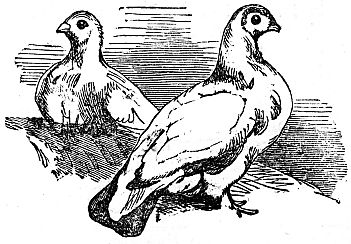
THE PTARMIGAN.
This bird is nearly the same size as red grouse, and is fond of lofty situations, where it braves the severest weather, and is found in most parts of Europe, as well as in Greenland. At Hudson’s Bay they appear in such multitudes that so many as sixty or seventy are frequently taken at once in a net. As they are as tame as chickens, this is done without difficulty. Buffon says that the ptarmigan avoids the solar heat, and prefers the frosts of the summits of the mountains; for, as the snow melts on the sides of the mountains, it ascends till it gains the top, where it makes a hole, and burrows in the snow. In winter, it flies in flocks, and feeds on the wild vegetation of the hills, which imparts to its flesh a bitter, but not altogether an unpalatable taste. It is dark-coloured, has something of the flavour of the hare, and is greatly relished and much sought after by some sportsmen.
PTARMIGAN, to Dress the.
Ingredients.—2 or 3 birds; butter, flour, fried bread-crumbs. Mode.—The ptarmigan, or white grouse, when young and tender, are exceedingly fine eating, and should be kept as long as possible, to be good. Pluck, draw, and truss them in the same manner as grouse, and roast them before a brisk fire. Flour and froth them nicely, and serve on buttered toast, with a tureen of brown gravy. Bread sauce, when liked, may be sent to table with them, and fried bread-crumbs substituted for the toasted bread. Time.—About ½ hour. Sufficient.—2 for a dish. Seasonable from the beginning of February to the end of April.
PTARMIGAN, to Carve.
Ptarmigan, being much of the same size, and trussed in the same manner, as the red bird, may be carved in the manner described, in Partridge and Grouse carving.
PUDDING, Alma.
Ingredients.—½ lb. of fresh butter, ½ lb. of powdered sugar, ½ lb. of flour, ¼ lb. of currants, 4 eggs. Mode.—Beat the butter to a thick cream, strew in, by degrees, the sugar, and mix both these well together; then dredge the flour in gradually, add the currants, and moisten with the eggs, which should be well beaten. When all the ingredients are well stirred and mixed, butter a mould that will hold the mixture exactly, tie it down with a cloth, put the pudding into boiling water, and boil for 5 hours; when turned out, strew some powdered sugar over it, and serve. Time.—6 hours. Average cost, 1s. 6d. Sufficient for 5 or 6 persons. Seasonable at any time.
PUDDING, Aunt Nelly’s.
Ingredients.—½ lb. of flour, ½ lb. of treacle, ½ lb. of suet, the rind and juice of 1 lemon, a few strips of candied lemon-peel, 3 tablespoonfuls of cream, 2 eggs. Mode.—Chop the suet finely; mix it with the flour, treacle, lemon-peel minced, and candied lemon-peel; add the cream, lemon-juice, and 2 well-beaten eggs; beat the pudding well, put it into a buttered basin, tie it down with a cloth, and boil from 3½ to 4 hours. Time.—3½ to 4 hours. Average cost, 1s. 2d. Sufficient for 5 or 6 persons. Seasonable at any time, but more suitable for a winter pudding.
PUDDING, a Bachelor’s.
Ingredients.—4 oz. of grated bread, 4 oz. of currants, 4 oz. of apples, 2 oz. of sugar, 3 eggs, a few drops of essence of lemon, a little grated nutmeg. Mode.—Pare, core, and mince the apples very finely, sufficient, when minced, to make 4 oz.; add to these the currants, which should be well washed, the grated bread, and sugar; whisk the eggs, beat these up with the remaining ingredients, and, when all is thoroughly mixed, put the pudding into a buttered basin, tie it down with a cloth, and boil for 3 hours. Time.—3 hours. Average cost, 9d. Sufficient for 4 or 5 persons. Seasonable from August to March.
PUDDING, Bakewell (very Rich).
Ingredients.—¼ lb. of puff-paste, 5 eggs, 6 oz. of sugar, ¼ lb. of butter, 1 oz. of almonds, jam. Mode.—Cover a dish with thin paste, and put over this a layer of any kind of jam, ½ inch thick; put the yolks of 5 eggs into a basin with the white of 1, and beat these well; add the sifted sugar, the butter, which should be melted, and the almonds, which should be well pounded; beat all together until well mixed, then pour it into the dish over the jam, and bake for an hour in a moderate oven. Time.—1 hour. Average cost, 1s. 6d. Sufficient for 4 or 5 persons. Seasonable at any time.
PUDDING, Bakewell.
Ingredients.—¾ pint of bread-crumbs, 1 pint of milk, 4 eggs, 2 oz. of sugar, 3 oz. of butter, 1 oz. of pounded almonds, jam. Mode.—Put the bread-crumbs at the bottom of a pie-dish, then over them a layer of jam of any kind that may be preferred; mix the milk and eggs together; add the sugar, butter, and pounded almonds; beat all well together; pour it into the dish, and bake in a moderate oven for 1 hour. Time.—1 hour. Average cost, 1s. 3d. to 1s. 6d. Sufficient for 4 or 5 persons. Seasonable at any time.
PUDDING, Baroness (Author’s Recipe).
Ingredients.—¾ lb. of suet, ¾ lb. of raisins weighed after being stoned, ¾ lb. of flour, ½ pint of milk, ¼ saltspoonful of salt. Mode.—Prepare the suet, by carefully freeing it from skin, and chop it finely; stone the raisins, and cut them in halves, and mix both these ingredients with the salt and flour; moisten the whole with the above proportion of milk, stir the mixture well, and tie the pudding in a floured cloth, which has been previously wrung out in boiling water. Put the pudding into a saucepan of boiling water, and let it boil, without ceasing, 4½ hours. Serve with plain sifted sugar only, a little of which may be sprinkled over the pudding. Time.—4½ hours. Average cost, 1s. 4d. Sufficient for 7 or 8 persons. Seasonable in winter, when fresh fruit is not obtainable.
Note.—This pudding the editress cannot too highly recommend. The recipe was kindly given to her family by a lady who bore the title here prefixed to it; and with all who have partaken of it, it is an especial favourite. Nothing is of greater consequence, in the above directions, than attention to the time of boiling, which should never be less than that mentioned.
PUDDING, Royal Coburg.
Ingredients.—1 pint of new milk, 6 oz. of flour, 6 oz. of sugar, 6 oz. of butter, 6 oz. of currants, 6 eggs, brandy and grated nutmeg to taste. Mode.—Mix the flour to a smooth batter with the milk, add the remaining ingredients gradually, and when well mixed, put it into four basins or moulds half full; bake for ¾ hour, turn the puddings out on a dish, and serve with wine sauce. Time.—¾ hour. Average cost, 1s. 9d. Sufficient for 7 or 8 persons. Seasonable at any time.
PUDDING, Cold.
Ingredients.—4 eggs, 1 pint of milk, sugar to taste, a little grated lemon-rind, 2 oz. of raisins, 4 tablespoonfuls of marmalade, a few slices of sponge cake. Mode.—Sweeten the milk with lump sugar, add a little grated lemon-rind, and stir to this the eggs, which should be well whisked; line a buttered mould with the raisins, stoned and cut in half; spread the slices of cake with the marmalade, and place them in the mould; then pour in the custard, tie the pudding down with paper and a cloth, and boil gently for 1 hour: when cold, turn it out, and serve. Time.—1 hour. Average cost, 1s. 2d. Sufficient for 5 or 6 persons. Seasonable at any time.
PUDDING, College.
Ingredients.—1 pint of bread-crumbs, 6 oz. of finely-chopped suet, ¼ lb. of currants, a few thin slices of candied peel, 3 oz. of sugar, ¼ nutmeg, 3 eggs, 4 tablespoonfuls of brandy. Mode.—Put the bread-crumbs into a basin; add the suet, currants, candied peel, sugar, and nutmeg, grated, and stir these ingredients until they are thoroughly mixed. Beat up the eggs, moisten the pudding with these, and put in the brandy; beat well for a few minutes, then form the mixture into round balls or egg-shaped pieces; fry these in hot butter or lard, letting them stew in it until thoroughly done, and turn them two or three times, till of a fine light brown; drain them on a piece of blotting-paper before the fire; dish, and serve with wine sauce. Time.—15 to 20 minutes. Average cost, 1s. Sufficient for 7 or 8 puddings. Seasonable at any time.
PUDDING, Comarques (Excellent).
Ingredients.—5 eggs, 3 tablespoonfuls of flour, 2 tablespoonfuls of powdered sugar, rind of 1 lemon, ½ pint of cream, different kinds of preserve. Mode.—Beat the whites and yolks of the eggs separately, and put them into different basins; stir the flour, sugar, and lemon-peel into the yolks; whip the cream very thick and put it on a sieve to harden. Then add it, with the whites of the eggs, to the other ingredients, and pour the mixture into little deep saucers just before putting into the oven. Bake about ½ an hour. When they are taken out, a very thin layer of different kinds of preserve should be put upon each, and they should be piled one above another. A little whipped cream placed here and there on the pudding as a garnish would be found to improve the appearance of this dish. Time.—About ½ an hour. Average cost, 1s. 9d. Sufficient for 4 or 5 persons. Seasonable at any time.
PUDDING, Delhi.
Ingredients.—4 large apples, a little grated nutmeg, 1 teaspoonful of minced lemon-peel, 2 large tablespoonfuls of sugar, 6 oz. of currants, ¾ lb. of suet crust. Mode.—Pare, core, and cut the apples into slices; put them into a saucepan with the nutmeg, lemon-peel, and sugar, stew them over the fire till soft; then have ready the above quantity of crust, roll it out thin, spread the apples over the paste, sprinkle over the currants, roll the pudding up, closing the ends properly, tie it in a floured cloth, and boil for 2 hours. Time.—2 hours. Average cost, 1s. Sufficient for 5 or 6 persons. Seasonable.—August to March.
PUDDING, Empress.
Ingredients.—¼ lb. of rice, 2 oz. of butter, 3 eggs, jam, sufficient milk to soften the rice. Mode.—Boil the rice in the milk until very soft; then add the butter, boil it for a few minutes after the latter ingredient is put in, and set it by to cool. Well beat the eggs, stir these in, and line a dish with puff-paste; put over this a layer of rice, then a thin layer of any kind of jam, then another layer of rice, and proceed in this manner until the dish is full; and bake in a moderate oven for ¾ hour. This pudding may be eaten hot or cold; if the latter, it will be much improved by having a boiled custard poured over it. Time.—¾ hour. Average cost, 1s. Sufficient for 6 or 7 persons. Seasonable at any time.
PUDDING, Exeter (Very Rich).
Ingredients.—10 oz. of bread-crumbs, 4 oz. of sago, 7 oz. of finely-chopped suet, 6 oz. of moist sugar, the rind of ½ lemon, ¼ pint of rum, 7 eggs, 4 tablespoonfuls of cream, 4 small sponge-cakes, 2 oz. of ratafias, ½ lb. of jam. Mode.—Put the bread-crumbs into a basin with the sago, suet, sugar, minced lemon-peel, rum, and 4 eggs; stir these ingredients well together, then add 3 more eggs and the cream, and let the mixture be well beaten. Then butter a mould, strew in a few bread-crumbs, and cover the bottom with a layer of ratafias; then put in a layer of the mixture, then a layer of sliced sponge-cake spread thickly with any kind of jam; then add some ratafias, then some of the mixture and sponge-cake, and so on until the mould is full, taking care that a layer of the mixture is on the top of the pudding. Bake in a good oven from ¾ to 1 hour, and serve with the following sauce:—Put 3 tablespoonfuls of black-currant jelly into a stewpan, add 2 glasses of sherry, and when warm, turn the pudding out of the mould, pour the sauce over it, and serve hot. Time.—From 1 to 1¼ hour. Average cost, 1s. 6d. Sufficient for 7 or 8 persons. Seasonable at any time.
PUDDING-PIES, Folkestone.
Ingredients.—1 pint of milk, 3 oz. of ground rice, 3 oz. of butter, ¼ lb. of sugar, flavouring of lemon-peel or bay-leaf, 6 eggs, puff-paste, currants. Mode.—Infuse 2 laurel or bay leaves, or the rind of ½ lemon in the milk, and when it is well flavoured, strain it, and add the rice; boil these for ¼ hour, stirring all the time; then take them off the fire, stir in the butter, sugar, and eggs, and let these latter be well beaten before they are added to the other ingredients; when nearly cold, line some patty-pans with puff-paste, fill with the custard, strew over each a few currants, and bake from 20 to 25 minutes in a moderate oven. Time.—20 to 25 minutes. Average cost, 1s. 1d. Sufficient to fill a dozen patty-pans. Seasonable at any time.
PUDDING, German.
Ingredients.—2 teaspoonfuls of flour, 1 teaspoonful of arrowroot, 1 pint of milk, 2 oz. of butter, sugar to taste, the rind of ½ lemon, 4 eggs, 3 tablespoonfuls of brandy. Mode.—Boil the milk with the lemon-rind until well flavoured; then strain it, and mix with it the flour, arrowroot, butter, and sugar. Boil these ingredients for a few minutes, keeping them well stirred; then take them off the fire and mix with them the eggs, yolks and whites, beaten separately and added separately. Boil some sugar to candy; line a mould with this, put in the brandy, then the mixture; tie down with a cloth, and boil for rather more than 1 hour. When turned out, the brandy and sugar make a nice sauce. Time.—Rather more than 1 hour. Average cost, 1s. Sufficient for 4 or 5 persons. Seasonable at any time.
PUDDING, Half-Pay.
Ingredients.—¼ lb. of suet, ¼ lb. of currants, ¼ lb. of raisins, ¼ lb. of flour, ¼ lb. of bread-crumbs, 2 tablespoonfuls of treacle, ½ pint of milk. Mode.—Chop the suet finely; mix with it the currants, which should be nicely washed and dried, the raisins, which should be stoned, the flour, bread-crumbs, and treacle; moisten with the milk, beat up the ingredients until all are thoroughly mixed, put them into a buttered basin, and boil the pudding for 3½ hours. Time.—3½ hours. Average cost, 8d. Sufficient for 5 or 6 persons. Seasonable at any time.
PUDDING, Herodotus.
Ingredients.—½ lb. of bread-crumbs, ½ lb. of good figs, 6 oz. of suet, 6 oz. of moist sugar, ½ saltspoonful of salt, 3 eggs, nutmeg to taste. Mode.—Mince the suet and figs very finely; add the remaining ingredients, taking care that the eggs are well whisked; beat the mixture for a few minutes, put it into a buttered mould, tie it down with a floured cloth, and boil the pudding for 5 hours. Serve with wine sauce. Time.—5 hours. Average cost, 10d. Sufficient for 5 or 6 persons. Seasonable at any time.
PUDDING, Hunter’s.
Ingredients.—1 lb. of raisins, 1 lb. of currants, 1 lb. of suet, 1 lb. of bread-crumbs, ½ lb. of moist sugar, 8 eggs, 1 tablespoonful of flour, ¼ lb. of mixed candied peel, 1 glass of brandy, 10 drops of essence of lemon, 10 drops of essence of almonds, ½ nutmeg, 2 blades of mace, 6 cloves. Mode.—Stone and shred the raisins rather small, chop the suet finely, and rub the bread until all lumps are well broken; pound the spice to powder, cut the candied peel into thin shreds, and mix all these ingredients well together, adding the sugar. Beat the eggs to a strong froth, and as they are beaten, drop into them the essence of lemon and essence of almonds; stir these to the dry ingredients, mix well, and add the brandy. Tie the pudding firmly in a cloth, and boil it for 6 hours at the least 7 or 8 hours would be still better for it. Serve with boiled custard, melted red-currant jelly, or brandy sauce. Time.—6 to 8 hours. Average cost, 3s. 6d. Sufficient for 9 or 10 persons. Seasonable in winter.
PUDDING, Manchester (to eat Cold).
Ingredients.—3 oz. of grated bread, ½ pint of milk, a strip of lemon-peel, 4 eggs, 2 oz. of butter, sugar to taste, puff-paste, jam, 3 tablespoonfuls of brandy. Mode.—Flavour the milk with lemon-peel, by infusing it in the milk for ½ hour; then strain it on to the bread-crumbs, and boil it for 2 or 3 minutes; add the eggs, leaving out the whites of 2, the butter, sugar, and brandy; stir all these ingredients well together; cover a pie-dish with puff-paste, and at the bottom put a thick layer of any kind of jam; pour the above mixture, cold, on the jam, and bake the pudding for an hour. Serve cold, with a little sifted sugar sprinkled over. Time.—1 hour. Average cost, 1s. Sufficient for 5 or 6 persons. Seasonable at any time.
PUDDING, Mansfield.
Ingredients.—The crumb of 2 rolls, 1 pint of milk, sugar to taste, 4 eggs, 2 tablespoonfuls of brandy, 6 oz. of chopped suet, 2 tablespoonfuls of flour, ½ lb. of currants, ½ teaspoonful of grated nutmeg, 2 tablespoonfuls of cream. Mode.—Slice the roll very thin, and pour upon it a pint of boiling milk; let it remain closely covered for ¼ hour, then beat it up with a fork, and sweeten with moist sugar; stir in the chopped suet, flour, currants, and nutmeg. Mix these ingredients well together, moisten with the eggs, brandy, and cream; beat the mixture for 2 or 3 minutes, put it into a buttered dish or mould, and bake in a moderate oven for 1¼ hour. Turn it out, strew sifted sugar over, and serve. Time.—1¼ hour. Average cost, 1s. 3d. Sufficient for 6 or 7 persons. Seasonable at any time.
PUDDING, Marlborough.
Ingredients.—¼ lb. of butter, ¼ lb. of powdered lump sugar, 4 eggs, puff-paste, a layer of any kind of jam. Mode.—Beat the butter to a cream, stir in the powdered sugar, whisk the eggs, and add these to the other ingredients. When these are well mixed, line a dish with puff-paste, spread over a layer of any kind of jam that may be preferred, pour in the mixture, and bake the pudding for rather more than ½ hour. Time.—Rather more than ½ hour. Average cost, 1s. Sufficient for 5 or 6 persons. Seasonable at any time.
PUDDING, Military.
Ingredients.—½ lb. of suet, ½ lb. of bread-crumbs, ½ lb. of moist sugar, the rind and juice of 1 large lemon. Mode.—Chop the suet finely, mix it with the bread-crumbs and sugar, and mince the lemon-rind and strain the juice; stir these into the other ingredients, mix well, and put the mixture into small buttered cups, and bake for rather more than ¼ hour; turn them out on the dish, and serve with lemon-sauce. The above ingredients may be made into small balls, and boiled for about ½ hour; they should then be served with the same sauce as when baked. Time.—Rather more than ½ hour. Average cost, 9d. Sufficient to fill 6 or 7 moderate-sized cups. Seasonable at any time.
PUDDING, Monday’s.
Ingredients.—The remains of cold plum-pudding, brandy, custard made with 5 eggs to every pint of milk. Mode.—Cut the remains of a good cold plum-pudding into finger-pieces, soak them in a little brandy, and lay them cross-barred in a mould until full. Make a custard with the above proportion of milk and eggs, flavouring it with nutmeg or lemon-rind; fill up the mould with it; tie it down with a cloth, and boil or steam it for an hour. Serve with a little of the custard poured over, to which has been added a tablespoonful of brandy. Time.—1 hour. Average cost, exclusive of the pudding, 6d. Sufficient for 5 or 6 persons. Seasonable at any time.
PUDDING, Nesselrode (a fashionable Iced Pudding—Carême’s Recipe).
Ingredients.—40 chestnuts, 1 lb. of sugar, flavouring of vanilla, 1 pint of cream, the yolks of 12 eggs, 1 glass of Maraschino, 1 oz. of candied citron, 2 oz. of currants, 2 oz. of stoned raisins, ½ pint of whipped cream, 3 eggs. Mode.—Blanch the chestnuts in the boiling water, remove the husks, and pound them in a mortar until perfectly smooth, adding a few spoonfuls of syrup. Then rub them through a fine sieve, and mix them in a basin with a pint of syrup made from 1 lb. of sugar, clarified, and flavoured with vanilla, 1 pint of cream, and the yolks of 12 eggs. Set this mixture over a slow fire, stirring it without ceasing, and just as it begins to boil, take it off and pass it through a tammy. When it is cold, put it into a freezing-pot, adding the Maraschino, and make the mixture set; then add the sliced citron, the currants, and stoned raisins (these two latter should be soaked the day previously in Maraschino and sugar pounded with vanilla); the whole thus mingled, add a plateful of whipped cream mixed with the whites of 3 eggs, beaten to a froth with a little syrup. When the pudding is perfectly frozen, put it into a pineapple-shaped mould; close the lid, place it again in the freezing-pan, covered over with pounded ice and saltpetre, and let it remain until required for table; then turn the pudding out, and serve. Time.—½ hour to freeze the mixture, Seasonable from October to February.