THE DICTIONARY OF COOKERY. (continued 10)
Reading edition
MUTTON, an excellent way to cook a Breast of.
Ingredients.—Breast of mutton, 2 onions, salt and pepper to taste, flour, a bunch of savoury herbs, green peas. Mode.—Cut the mutton into pieces about 2 inches square, and let it be tolerably lean; put it into a stewpan, with a little fat or butter, and fry it of a nice brown; then dredge in a little flour, slice the onions, and put it with the herbs in the stewpan; pour in sufficient water just to cover the meat, and simmer the whole gently until the mutton is tender. Take out the meat, strain, and skim off all the fat from the gravy, and put both the meat and gravy back into the stewpan; add about a quart of young green peas, and let them boil gently until done. 2 or 3 slices of bacon added and stewed with the mutton give additional flavour; and, to insure the peas being a beautiful green colour, they may be boiled in water separately, and added to the stew at the moment of serving. Time.—2½ hours. Average cost, 6d. per lb. Sufficient for 4 or 5 persons. Seasonable from June to August.
MUTTON, Broiled, and Tomato Sauce.
[Cold Meat Cookery.] Ingredients.—A few slices of cold mutton, tomato sauce. Mode.—Cut some nice slices from a cold leg or shoulder of mutton; season them with pepper and salt, and broil over a clear fire. Make some tomato sauce, pour it over the mutton, and serve. This makes an excellent dish, and must be served very hot. Time.—About 5 minutes to broil the mutton. Seasonable in September and October, when tomatoes are plentiful and seasonable.
MUTTON BROTH, to Make.
Ingredients.—1 lb. of the scrag end of the neck of mutton, 1 onion, a bunch of sweet herbs, ½ turnip, 3 pints of water, pepper and salt to taste. Mode.—Put the mutton into a stewpan; pour over the water cold, and add the other ingredients. When it boils, skim it very carefully, cover the pan closely, and let it simmer very gently for an hour; strain it, let it cool, take off all the fat from the surface, and warm up as much as may be required, adding, if the patient be allowed to take it, a teaspoonful of minced parsley which has been previously scalded. Pearl barley or rice are very nice additions to mutton broth, and should be boiled as long as the other ingredients. When either of these is added, the broth must not be strained, but merely thoroughly skimmed. Plain mutton broth without seasoning is made by merely boiling the mutton, water, and salt together, straining it, letting the broth cool, skimming all the fat off, and warming up as much as is required. This preparation would be very tasteless and insipid, but likely to agree with very delicate stomachs, whereas the least addition of other ingredients would have the contrary effect. Time.—1 hour. Average cost, 7d. Sufficient to make from 1½ to 2 pints of broth. Seasonable at any time.
Note.—Veal broth may be made in the same manner; the knuckle of a leg or shoulder is the part usually used for this purpose. It is very good with the addition of the inferior joints of a fowl, or a few shank-bones.
MUTTON BROTH, to Make Quickly.
Ingredients.—1 or 2 chops from a neck of mutton, 1 pint of water, a small bunch of sweet herbs, ¼ of an onion, pepper and salt to taste. Mode.—Cut the meat into small pieces; put it into a saucepan with the bones, but no skin or fat; add the other ingredients; cover the saucepan, and bring the water quickly to boil. Take the lid off, and continue the rapid boiling for 20 minutes, skimming it well during the process; strain the broth into a basin; if there should be any fat left on the surface, remove it by laying a piece of thin paper on the top; the greasy particles will adhere to the paper, and so free the preparation from them. To an invalid nothing is more disagreeable than broth served with a quantity of fat floating on the top; to avoid this, it is always better to allow it to get thoroughly cool, the fat can then be so easily removed. Time.—20 minutes after the water boils. Average cost, 5d. Sufficient to make ½ pint of broth. Seasonable at any time.
MUTTON, Haunch of, to Carve.
A deep cut should, in the first place, be made quite down to the bone, across the knuckle-end of the joint, along the line 1 to 2. This will let the gravy escape; and then it should be carved, in not too thick slices, along the whole length of the haunch, in the direction of the line from 4 to 3.
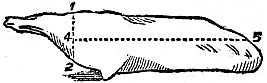
HAUNCH OF MUTTON.
MUTTON, Leg of, to Carve.
This homely, but capital English joint, is almost invariably served at table as shown in the engraving. The carving of it is not very difficult: the knife should be carried sharply down in the direction of the line from 1 to 2, and slices taken from either side, as the guests may desire, some liking the knuckle-end, as well done, and others preferring the more underdone part. The fat should be sought near the line 3 to 4. Some connoisseurs are fond of having this joint dished with the under-side uppermost, so as to get at the finely-grained meat lying under that part of the joint, known as the Pope’s eye; but this is an extravagant fashion, and one that will hardly find favour in the eyes of many economical British housewives and housekeepers.

LEG OF MUTTON.
MUTTON, Loin of, to Carve.
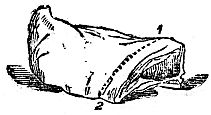
LOIN OF MUTTON.
There is one point in connection with carving a loin of mutton which includes every other; that is, that the joint should be thoroughly well jointed by the butcher before it is cooked. This knack of jointing requires practice and the proper tools; and no one but the butcher is supposed to have these. If the bones be not well jointed, the carving of a loin of mutton is not a gracious business; whereas, if that has been attended to, it is an easy and untroublesome task. The knife should be inserted at fig. 1, and after feeling your way between the bones, it should be carried sharply in the direction of the line 1 to 2. As there are some people who prefer the outside cut, while others do not like it, the question as to their choice of this should be asked.
MUTTON, Saddle of, to Carve.

SADDLE OF MUTTON.
Although we have heard, at various intervals, growlings expressed at the inevitable “saddle of mutton” at the dinner-parties of our middle classes, yet we doubt whether any other joint is better liked, when it has been well hung and artistically cooked. There is a diversity of opinion respecting the mode of sending this joint to table; but it has only reference to whether or no there shall be any portion of the tail, or, if so, how many joints of the tail. Some trim the tail with a paper frill. The carving is not difficult: it is usually cut in the direction of the line from 2 to 1, quite down to the bones, in evenly-sliced pieces. A fashion, however, patronized by some, is to carve it obliquely, in the direction of the line from 4 to 3; in which case the joint would be turned round the other way, having the tail end on the right of the carver.
MUTTON, Shoulder of, to Carve.
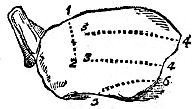
SHOULDER OF MUTTON.
This is a joint not difficult to carve. The knife should be drawn from the outer edge of the shoulder in the direction of the line from 1 to 2, until the bone of the shoulder is reached. As many slices as can be carved in this manner should be taken, and afterwards the meat lying on each side of the blade-bone should be served, by carving in the direction of 3 to 4 and 5 to 6. The uppermost side of the shoulder being now finished, the joint should be turned, and slices taken off along its whole length. There are some who prefer this under-side of the shoulder for its juicy flesh, although the grain of the meat is not so fine as that on the other side.
MUTTON CHOPS, Broiled.
Ingredients.—Loin of mutton, pepper and salt, a small piece of butter. Mode.—Cut the chops from a well-hung tender loin of mutton, remove a portion of the fat, and trim them into a nice shape; slightly beat and level them; place the gridiron over a bright clear fire, rub the bars with a little fat, and lay on the chops. Whilst broiling, frequently turn them, and in about 8 minutes they will be done. Season with pepper and salt, dish them on a very hot dish, rub a small piece of butter on each chop, and serve very hot and expeditiously. Time.—About 8 minutes. Average cost, 10d. per lb. Sufficient.—Allow 1 chop to each person. Seasonable at any time.
MUTTON-COLLOPS.
Ingredients.—A few slices of a cold leg or loin of mutton, salt and pepper to taste, 1 blade of pounded mace, 1 small bunch of savoury herbs minced very fine, 2 or 3 shalots, 2 or 3 oz. of butter, 1 dessertspoonful of flour, ½ pint of gravy, 1 tablespoonful of lemon-juice. Mode.—Cut some very thin slices from a leg or the chump end of a loin of mutton; sprinkle them with pepper, salt, pounded mace, minced savoury herbs, and minced shalot; fry them in butter, stir in a dessertspoonful of flour, add the gravy and lemon-juice, simmer very gently about 5 or 7 minutes, and serve immediately. Time.—5 to 7 minutes. Average cost, exclusive of the meat, 6d. Seasonable at any time.
MUTTON, Curried.
[Cold Meat Cookery.] Ingredients.—The remains of any joint of cold mutton, 2 onions, ¼ lb. of butter, 1 dessertspoonful of curry-powder, 1 dessertspoonful of flour, salt to taste, ¼ pint of stock or water. Mode.—Slice the onions in thin rings, and put them into a stewpan with the butter, and fry of a light brown; stir in the curry-powder, flour, and salt, and mix all together. Cut the meat into nice thin slices (if there is not sufficient to do this, it may be minced), and add it to the other ingredients; when well browned, add the stock or gravy, and stew gently for about ½ hour. Serve in a dish with a border of boiled rice, the same as for other curries. Time.—½ hour. Average cost, exclusive of the meat, 6d. Seasonable in winter.
MUTTON CUTLETS, with Mashed Potatoes.
Ingredients.—About 3 lbs. of the best end of the neck of mutton, salt and pepper to taste, mashed potatoes. Mode.—Procure a well-hung neck of mutton, saw off about 3 inches of the top of the bones, and cut the cutlets of a moderate thickness. Shape them by chopping off the thick part of the chine-bone; beat them flat with a cutlet-chopper, and scrape quite clean, a portion of the top of the bone. Broil them over a nice clear fire for about 7 or 8 minutes, and turn them frequently. Have ready some smoothly-mashed white potatoes; place these in the middle of the dish; when the cutlets are done, season with pepper and salt; arrange them round the potatoes, with the thick end of the cutlets downwards, and serve very hot and quickly. Time.—7 or 8 minutes. Average cost, for this quantity, 2s. 4d. Sufficient for 5 or 6 persons. Seasonable at any time.

MUTTON CUTLETS.
Note.—Cutlets may be served in various ways; with peas, tomatoes, onions, sauce piquant, &c.
MUTTON, Braised Fillet of, with French Beans.
Ingredients.—The chump end of a loin of mutton, buttered paper, French beans, a little glaze, 1 pint of gravy. Mode.—Roll up the mutton in a piece of buttered paper, roast it for 2 hours, and do not allow it to acquire the least colour. Have ready some French beans, boiled, and drained on a sieve; remove the paper from the mutton, glaze it; just heat up the beans in the gravy, and lay them on the dish with the meat over them. The remainder of the gravy may be strained, and sent to table in a tureen. Time.—2 hours. Average cost, 8½d. per lb. Sufficient for 4 or 5 persons. Seasonable at any time.
MUTTON, Haricot.
Ingredients.—4 lbs. of the middle or best end of the neck of mutton, 3 carrots, 3 turnips, 3 onions, pepper and salt to taste, 1 tablespoonful of ketchup or Harvey’s sauce. Mode.—Trim off some of the fat, cut the mutton into rather thin chops, and put them into a frying-pan with the fat trimmings. Fry of a pale brown, but do not cook them enough for eating. Cut the carrots and turnips into dice, and the onions into slices, and slightly fry them in the same fat that the mutton was browned in, but do not allow them to take any colour. Now lay the mutton at the bottom of a stewpan, then the vegetables, and pour over them just sufficient boiling water to cover the whole. Give the boil, skim well, and then set the pan on the side of the fire to simmer gently until the meat is tender. Skim off every particle of fat, add a seasoning of pepper and salt, and a little ketchup, and serve. This dish is very much better if made the day before it is wanted for table, as the fat can be so much more easily removed when the gravy is cold. This should be particularly attended to, as it is apt to be rich and greasy if eaten the same day it is made. It should be served in rather a deep dish. Time.—2½ hours to simmer gently. Average cost, for this quantity, 3s. Sufficient for 6 or 7 persons. Seasonable at any time.
MUTTON, Haricot.
Ingredients.—Breast or scrag of mutton, flour, pepper, and salt to taste, 1 large onion, 3 cloves, a bunch of savoury herbs, 1 blade of mace, carrots and turnips, sugar. Mode.—Cut the mutton into square pieces, and fry them a nice colour; then dredge over them a little flour and a seasoning of pepper and salt. Put all into a stewpan, and moisten with boiling water, adding the onion, stuck with 3 cloves, the mace, and herbs. Simmer gently till the meat is done, skim off all the fat, and then add the carrots and turnips, which should be previously cut in dice and fried in a little sugar to colour them. Let the whole simmer again for 10 minutes; take out the onion and bunch of herbs, and serve. Time.—About 3 hours to simmer. Average cost, 6d. per lb. Sufficient for 4 or 5 persons. Seasonable at any time.
MUTTON, Haricot.
[Cold Meat Cookery.] Ingredients.—The remains of cold neck or loin of mutton, 2 oz. of butter, 3 onions, 1 dessertspoonful of flour, ½ pint of good gravy, pepper and salt to taste, 2 tablespoonfuls of port wine, 1 tablespoonful of mushroom ketchup, 2 carrots, 2 turnips, 1 head of celery. Mode.—Cut the cold mutton into moderate-sized chops, and take off the fat; slice the onions, and fry them with the chops, in a little butter, of a nice brown colour; stir in the flour, add the gravy, and let it stew gently nearly an hour. In the mean time boil the vegetables until nearly tender, slice them, and add them to the mutton about ¼ hour before it is to be served. Season with pepper and salt, add the ketchup and port wine, give one boil, and serve. Time.—1 hour. Average cost, exclusive of the cold meat, 6d. Seasonable at any time.
MUTTON, Hashed.
Ingredients.—The remains of cold roast shoulder or leg of mutton, 6 whole peppers, 6 whole allspice, a faggot of savoury herbs, ½ head of celery, 1 onion, 2 oz. of butter, flour. Mode.—Cut the meat in nice even slices from the bones, trimming off all superfluous fat and gristle; chop the bones and fragments of the joints, put them into a stewpan with the pepper, spice, herbs, and celery; cover with water, and simmer for 1 hour. Slice and fry the onion of a nice pale-brown colour, dredge in a little flour to make it thick, and add this to the bones, &c. Stew for ¼ hour, strain the gravy, and let it cool; then skim off every particle of fat, and put it, with the meat, into a stewpan. Flavour with ketchup, Harvey’s sauce, tomato sauce, or any flavouring that may be preferred, and let the meat gradually warm through, but not boil, or it will harden. To hash meat properly, it should be laid in cold gravy, and only left on the fire just long enough to warm through. Time.—1½ hour to simmer the gravy. Average cost, exclusive of the meat, 4d. Seasonable at any time.
MUTTON, Roast Haunch of.

HAUNCH OF MUTTON.
Ingredients.—Haunch of mutton, a little salt, flour. Mode.—Let this joint hang as long as possible without becoming tainted, and while hanging dust flour over it, which keeps off the flies, and prevents the air from getting to it. If not well hung, the joint, when it comes to table, will do credit neither to the butcher nor the cook, as it will not be tender. Wash the outside well, lest it should have a bad flavour from keeping; then flour it and put it down to a nice brisk fire, at some distance, so that it may gradually warm through. Keep continually basting, and about ½ hour before it is served, draw it nearer to the fire to get nicely brown. Sprinkle a little fine salt over the meat, pour off the dripping, add a little boiling water slightly salted, and strain this over the joint. Place a paper ruche on the bone, and send red-currant jelly and gravy in a tureen to table with it. Time.—About 4 hours. Average cost, 10d. per lb. Sufficient for 8 to 10 persons. Seasonable.—In best season from September to March.
MUTTON, Boiled Leg of.
Ingredients.—Mutton, water, salt. Mode.—A leg of mutton for boiling should not hang too long, as it will not look a good colour when dressed. Cut off the shank-bone, trim the knuckle, and wash and wipe it very clean; plunge it into sufficient boiling water to cover it; let it boil up, then draw the saucepan to the side of the fire, where it should remain till the finger can be borne in the water. Then place it sufficiently near the fire, that the water may gently simmer, and be very careful that it does not boil fast, or the meat will be hard. Skim well, add a little salt, and in about 2¼ hours after the water begins to simmer, a moderate-sized leg of mutton will be done. Serve with carrots and mashed turnips, which may be boiled with the meat, and send caper sauce to table with it in a tureen. Time.—A moderate-sized leg of mutton of 9 lbs., 2¼ hours after the water boils; one of 12 lbs., 3 hours. Average cost, 8½d. per lb. Sufficient.—A moderate-sized leg of mutton for 6 or 8 persons. Seasonable nearly all the year, but not so good in June, July, and August.
Note.—When meat is liked very thoroughly cooked, allow more time than stated above. The liquor this joint was boiled in should be converted into soup.
MUTTON, Boned Leg of, Stuffed.
Ingredients.—A small leg of mutton, weighing 6 or 7 lbs., forcemeat, 2 shalots finely minced. Mode.—Make a forcemeat, to which add 2 finely-minced shalots. Bone the leg of mutton, without spoiling the skin, and cut off a great deal of the fat. Fill the hole up whence the bone was taken with the forcemeat, and sew it up underneath, to prevent its falling out. Bind and tie it up compactly, and roast it before a nice clear fire for about 2½ hours or rather longer; remove the tape and send it to table with a good gravy. It may be glazed or not, as preferred. Time.—2½ hours, or rather longer. Average cost, 4s. 8d. Sufficient for 6 or 7 persons. Seasonable at any time.
MUTTON, Braised Leg of.
Ingredients.—1 small leg of mutton, 4 carrots, 3 onions, 1 faggot of savoury herbs, a bunch of parsley, seasoning to taste of pepper and salt, a few slices of bacon, a few veal trimmings, ½ pint of gravy or water. Mode.—Line the bottom of a braising-pan with a few slices of bacon, put in the carrots, onions, herbs, parsley, and seasoning, and over these place the mutton. Cover the whole with a few more slices of bacon and the veal trimmings, pour in the gravy or water, and stew very gently for 4 hours. Strain the gravy, reduce it to a glaze over a sharp fire, glaze the mutton with it, and send it to table, placed on a dish of white haricot beans boiled tender, or garnished with glazed onions. Time.—4 hours. Average cost, 5s. Sufficient for 6 or 7 persons. Seasonable at any time.
MUTTON, Roast Leg of.
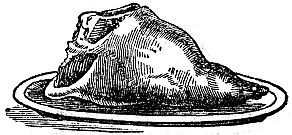
LEG OF MUTTON.
Ingredients.—Leg of mutton, a little salt. Mode.—As mutton, when freshly killed, is never tender, hang it almost as long as it will keep; flour it, and put it in a cool airy place for a few days, if the weather will permit. Wash off the flour, wipe it very dry, and cut off the shank-bone; put it down to a brisk clear fire, dredge with flour, and keep continually basting the whole time it is cooking. About 20 minutes before serving, draw it near the fire to get nicely brown; sprinkle over it a little salt, dish the meat, pour off the dripping, add some boiling water slightly salted, strain it over the joint, and serve. Time.—A leg of mutton weighing 10 lbs., about 2¼ or 2½ hours; one of 7 lbs., about 2 hours, or rather less. Average cost, 8½d. per lb. Sufficient.—A moderate-sized leg of mutton sufficient for 6 or 8 persons. Seasonable at any time, but not so good in June, July, and August.
MUTTON, Roast Loin of.
Ingredients.—Loin of mutton, a little salt. Mode.—Cut and trim off the superfluous fat, and see that the butcher joints the meat properly, as thereby much annoyance is saved to the carver, when it comes to table. Have ready a nice clear fire (it need not be a very wide large one), put down the meat, dredge with flour, and baste well until it is done. Make the gravy as for roast leg of mutton, and serve very hot. Time.—A loin of mutton weighing 6 lbs., 1½ hour, or rather longer. Average cost, 8½d, per lb. Sufficient for 4 or 5 persons. Seasonable at any time.
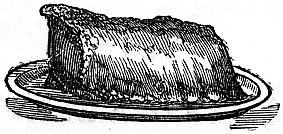
LOIN OF MUTTON.
MUTTON, Rolled loin of (very Excellent).
Ingredients.—About 6 lbs. of a loin of mutton, ½ teaspoonful of pepper, ¼ teaspoonful of pounded allspice, ¼ teaspoonful of mace, ¼ teaspoonful of nutmeg, 6 cloves, forcemeat, 1 glass of port wine, 2 tablespoonfuls of mushroom ketchup. Mode.—Hang the mutton till tender, bone it, and sprinkle over it pepper, mace, cloves, allspice, and nutmeg in the above proportion, all of which must be pounded very fine. Let it remain for a day, then make a forcemeat, cover the meat with it, and roll and bind it up firmly. Half bake it in a slow oven, let it grow cold, take off the fat, and put the gravy into a stewpan; flour the meat, put it in the gravy, and stew it till perfectly tender. Now take out the meat, unbind it, add to the gravy wine and ketchup as above, give one boil, and pour over the meat. Serve with red-currant jelly; and, if obtainable, a few mushrooms stewed for a few minutes in the gravy, will be found a great improvement. Time.—1½ hour to bake the meat, 1½ hour to stew gently. Average cost, 4s. 9d. Sufficient for 5 or 6 persons. Seasonable at any time.
Note.—This joint will be found very nice if rolled and stuffed, as here directed, and plainly roasted. It should be well basted, and served with a good gravy and currant jelly.
MUTTON, Boiled Neck of.
Ingredients.—4 lbs. of the middle, or best end of the neck of mutton; a little salt. Mode.—Trim off a portion of the fat, should there be too much, and if it is to look particularly nice, the chine-bone should be sawn down, the ribs stripped half-way down, and the ends of the bones chopped off; this is, however, not necessary. Put the meat into sufficient boiling water to cover it; when it boils, add a little salt and remove all the scum. Draw the saucepan to the side of the fire, and let the water get so cool that the finger may be borne in it; then simmer very slowly and gently until the meat is done, which will be in about 1½ hour, or rather more, reckoning from the time that it begins to simmer. Serve with turnips and caper sauce, and pour a little of it over the meat. The turnips should be boiled with the mutton; and when at hand, a few carrots will also be found an improvement. These, however, if very large and thick, must be cut into long thinnish pieces, or they will not be sufficiently done by the time the mutton is ready. Garnish the dish with carrots and turnips, placed alternately round the mutton. Time.—4 lbs. of the neck of mutton, about 1½ hour. Average cost, 8½d. per lb. Sufficient for 6 or 7 persons. Seasonable at any time.
MUTTON, Ragoût of Cold Neck of.
[cold Meat Cookery.] Ingredients.—The remains of a cold neck or loin of mutton, 2 oz. of butter, a little flour, 2 onions sliced, ½ pint of water, 2 small carrots, 2 turnips, pepper and salt to taste. Mode.—Cut the mutton into small chops, and trim off the greater portion of the fat; put the butter into a stewpan, dredge in a little flour, add the sliced onions, and keep stirring till brown; then put in the meat. When this is quite brown, add the water, and the carrots and turnips, which should be cut into very thin slices; season with pepper and salt, and stew till quite tender, which will be in about ¾ hour. When in season, green peas may be substituted for the carrots and turnips: they should be piled in the centre of the dish, and the chops laid round. Time.—¾ hour. Average cost, exclusive of the meat, 4d. Seasonable, with peas, from June to August.
MUTTON, Roast Neck of.
Ingredients.—Neck of mutton; a little salt. Mode.—For roasting, choose the middle, or the best end, of the neck of mutton, and if there is a very large proportion of fat, trim off some of it, and save it for making into suet puddings, which will be found exceedingly good. Let the bones be cut short, and see that it is properly jointed before it is laid down to the fire, as they will be more easily separated when they come to table. Place the joint at a nice brisk fire, dredge it with flour, and keep continually basting until done. A few minutes before serving, draw it nearer the fire to acquire a nice colour, sprinkle over it a little salt, pour off the dripping, add a little boiling water slightly salted; strain this over the meat and serve. Red-currant jelly may be sent to table with it. Time.—4 lbs. of the neck of mutton, rather more than 1 hour. Average cost, 8½d. per lb. Sufficient for 4 or 6 persons. Seasonable at any time.
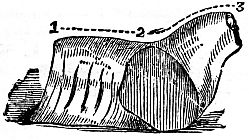
NECK OF MUTTON. 1-2. Best end. 2-3. Scrag.
MUTTON PIE.
[Cold Meat Cookery.] Ingredients.—The remains of a cold leg, loin, or neck of mutton, pepper and salt to taste, 2 blades of pounded mace, 1 dessertspoonful of chopped parsley, 1 teaspoonful of minced savoury herbs; when liked, a little minced onion or shalot; 3 or 4 potatoes, 1 teacupful of gravy; crust. Mode.—Cold mutton may be made into very good pies if well seasoned and mixed with a few herbs; if the leg is used, cut it into very thin slices; if the loin or neck, into thin cutlets. Place some at the bottom of the dish; season well with pepper, salt, mace, parsley, and herbs; then put a layer of potatoes sliced, then more mutton, and so on till the dish is full; add the gravy, cover with a crust, and bake for 1 hour. Time.—1 hour. Seasonable at any time.
Note.—The remains of an underdone leg of mutton may be converted into a very good family pudding, by cutting the meat into slices, and putting them into a basin lined with a suet crust. It should be seasoned well with pepper, salt, and minced shalot, covered with a crust, and boiled for about three hours.
MUTTON PIE.
Ingredients.—2 lbs. of the neck or loin of mutton, weighed after being boned; 2 kidneys, pepper and salt to taste, 2 teacupfuls of gravy or water, 2 tablespoonfuls of minced parsley; when liked, a little minced onion or shalot; puff crust. Mode.—Bone the mutton, and cut the meat into steaks all of the same thickness, and leave but very little fat. Cut up the kidneys, and arrange these with the meat neatly in a pie-dish; sprinkle over them the minced parsley and a seasoning of pepper and salt; pour in the gravy, and cover with a tolerably good puff crust. Bake for 1½ hour, or rather longer, should the pie be very large, and let the oven be rather brisk. A well-made suet crust may be used instead of puff crust, and will be found exceedingly good. Time.—1½ hour, or rather longer. Average cost, 2s. Sufficient for 5 or 6 persons. Seasonable at any time.
MUTTON PUDDING.
Ingredients.—About 2 lbs. of the chump end of the loin of mutton, weighed after being boned; pepper and salt to taste, suet crust made with milk, in the proportion of 6 oz. of suet to each pound of flour; a very small quantity of minced onion (this may be omitted when the flavour is not liked). Mode.—Cut the meat into rather thin slices, and season them with pepper and salt; line the pudding-dish with crust; lay in the meat, and nearly, but do not quite, fill it up with water; when the flavour is liked, add a small quantity of minced onion; cover with crust, and proceed in the same manner as directed in recipe for rump steak and kidney pudding. Time.—About 3 hours. Average cost, 1s. 9d. Sufficient for 6 persons. Seasonable all the year, but more suitable in winter.
MUTTON, Roast Saddle of.
Ingredients.—Saddle of mutton; a little salt. Mode.—To insure this joint being tender, let it hang for ten days or a fortnight, if the weather permits. Cut off the tail and flaps, and trim away every part that has not indisputable pretensions to be eaten, and have the skin taken off and skewered on again. Put it down to a bright, clear fire, and, when the joint has been cooking for an hour, remove the skin and dredge it with flour. It should not be placed too near the fire, as the fat should not be in the slightest degree burnt, but kept constantly basted, both before and after the skin is removed. Sprinkle some salt over the joint; make a little gravy in the dripping-pan; pour it over the meat, which send to table with a tureen of made gravy and red-currant jelly. Time.—A saddle of mutton weighing 10 lbs., 2½ hours; 14 lbs., 3¼ hours. When liked underdone, allow rather less time. Average cost, 10d. per lb. Sufficient.—A moderate-sized saddle of 10 lbs. for 7 or 8 persons. Seasonable all the year; not so good when lamb is in full season.
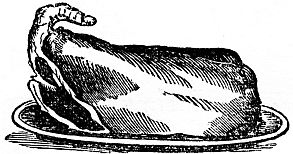
SADDLE OF MUTTON.
MUTTON, Roast Shoulder of.
Ingredients.—Shoulder of mutton; a little salt. Mode.—Put the joint down to a bright, clear fire; flour it well, and keep continually basting. About ¼ hour before serving, draw it near the fire, that the outside may acquire a nice brown colour, but not sufficiently near to blacken the fat. Sprinkle a little fine salt over the meat, empty the dripping-pan of its contents, pour in a little boiling water slightly salted, and strain this over the joint. Onion sauce, or stewed Spanish onions, are usually sent to table with this dish, and sometimes baked potatoes. Time.—A shoulder of mutton weighing 6 or 7 lbs., 1½ hour. Average cost, 8d. per lb. Sufficient for 5 or 6 persons. Seasonable at any time.
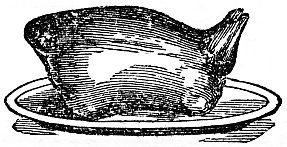
SHOULDER OF MUTTON.
Note.—Shoulder of mutton may be dressed in a variety of ways; boiled, and served with onion sauce; boned, and stuffed with a good veal forcemeat; or baked, with sliced potatoes in the dripping-pan.
MUTTON SOUP, Good.
Ingredients.—A neck of mutton about 5 or 6 lbs., 3 carrots, 3 turnips, 2 onions, a large bunch of sweet herbs, including parsley; salt and pepper to taste; a little sherry, if liked; 3 quarts of water. Mode.—Lay the ingredients in a covered pan before the fire, and let them remain there the whole day, stirring occasionally. The next day put the whole into a stewpan, and place it on a brisk fire. When it commences to boil, take the pan off the fire, and put it on one side to simmer until the meat is done. When ready for use, take out the meat, dish it up with carrots and turnips, and send it to table; strain the soup, let it cool, skim off all the fat, season and thicken it with a tablespoonful, or rather more, of arrowroot; flavour with a little sherry, simmer for 5 minutes, and serve. Time.—15 hours. Average cost, including the meat, 1s. 3d. per quart. Seasonable at any time. Sufficient for 8 persons.
NASTURTIUMS, Pickled (a very good Substitute for Capers).
Ingredients.—To each pint of vinegar, 1 oz. of salt, 6 peppercorns, nasturtiums. Mode.—Gather the nasturtium pods on a dry day, and wipe them clean with a cloth; put them in a dry glass bottle, with vinegar, salt, and pepper, in the above proportion. If you cannot find enough ripe to fill a bottle, cork up what you have got until you have some more fit; they may be added from day to day. Bung up the bottles, and seal or rosin the tops. They will be fit for use in 10 or 12 months; and the best way is to make them one season for the next. Seasonable.—Look for nasturtium-pods from the end of July to the end of August.
NECTARINES, Preserved.
Ingredients.—To every lb. of sugar allow ¼ pint of water; nectarines. Mode.—Divide the nectarines in two, take out the stones, and make a strong syrup with sugar and water in the above proportion. Put in the nectarines, and boil them until they have thoroughly imbibed the sugar. Keep the fruit as whole as possible, and turn it carefully into a pan. The next day boil it again for a few minutes, take out the nectarines, put them into jars, boil the syrup quickly for five minutes, pour it over the fruit, and, when cold, cover the preserve down. The syrup and preserve must be carefully skimmed, or it will not be clear. Time.—10 minutes to boil the sugar and water; 20 minutes to boil the fruit the first time, 10 minutes the second time; 5 minutes to boil the syrup. Seasonable in August and September, but cheapest in September.
NECTAR, Welsh.
Ingredients.—1 lb. of raisins, 3 lemons, 2 lbs. of loaf sugar, 2 gallons of boiling water. Mode.—Cut the peel of the lemons very thin, pour upon it the boiling water, and, when cool, add the strained juice of the lemons, the sugar, and the raisins, stoned and chopped very fine. Let it stand 4 or 5 days, stirring it every day; then strain it through a jelly-bag, and bottle it for present use. Time.—4 or 5 days. Average cost, 1s. 9d. Sufficient to make 2 gallons.
NEGUS, to make.
Ingredients.—To every pint of port wine allow 1 quart of boiling water, ¼ lb. of sugar, 1 lemon, grated nutmeg to taste. Mode.—As this beverage is more usually drunk at children’s parties than at any other, the wine need not be very old or expensive for the purpose, a new fruity wine answering very well for it. Put the wine into a jug, rub some lumps of sugar (equal to ¼ lb.) on the lemon-rind until all the yellow part of the skin is absorbed, then squeeze the juice, and strain it. Add the sugar and lemon-juice to the port-wine, with the grated nutmeg; pour over it the boiling water, cover the jug, and, when the beverage has cooled a little, it will be fit for use. Negus may also be made of sherry, or any other sweet white wine, but is more usually made of port than of any other beverage. Sufficient.—Allow 1 pint of wine, with the other ingredients in proportion, for a party of 9 or 10 children.
NOVEMBER—BILLS OF FARE.
Dinner for 18 persons.
First Course.
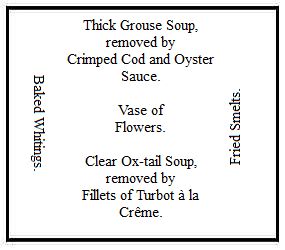
Thick Grouse Soup, removed by Crimped Cod and Oyster Sauce. Baked Whitings. Vase of Flowers. Fried Smelts. Clear Ox-tail Soup, removed by Fillets of Turbot à la Crême.
Entrées.
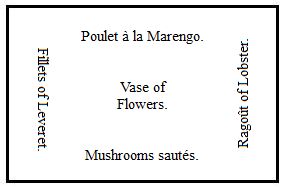
Poulet à la Marengo. Fillets of Leveret. Vase of Flowers. Ragoût of Lobster. Mushrooms sautés.
Second Course.
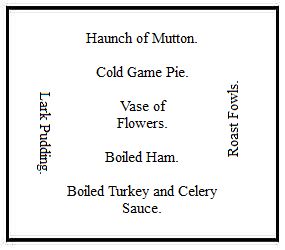
Haunch of Mutton. Cold Game Pie. Lark Pudding. Vase of Flowers. Roast Fowls. Boiled Ham. Boiled Turkey and Celery Sauce.
Third Course.
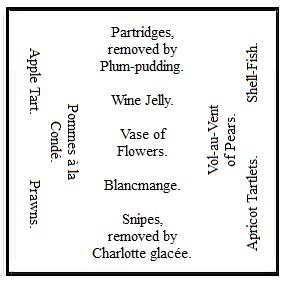
Dessert and Ices.
Apple Tart. Partridges, removed by Plum-pudding. Shell-Fish. Wine Jelly. Pommes à la Condé. Vase of Flowers. Vol-au-Vent of Pears. Blancmange. Prawns. Snipes, removed by Charlotte glacée. Apricot Tartlets.
Dinner for 12 persons.
First Course.—Hare soup; Julienne soup; baked cod; soles à la Normandie. Entrées.—Riz de veau aux tomates; lobster patties; mutton cutlets and Soubise sauce; croûtades of marrow aux fines herbes. Second Course.—Roast sirloin of beef; braised goose; boiled fowls and celery sauce; bacon-cheek, garnished with sprouts. Third Course.—Wild ducks; partridges; apples à la Portugaise; Bavarian cream; apricot-jam sandwiches; cheesecakes; Charlotte à la vanille; plum-pudding; dessert and ices.
Dinner for 8 persons.
First Course.—Mulligatawny soup; fried slices of codfish and oyster sauce; eels en matelote. Entrées.—Broiled pork cutlets and tomato sauce; tendrons de veau à la jardinière. Second Course.—Boiled leg of mutton and vegetables; roast goose; cold game pie. Third Course.—Snipes; teal; apple soufflé; iced Charlotte; tartlets; champagne jelly; coffee cream; mince pies; dessert and ices.
Dinners for 6 persons.
First Course.—Oyster soup; crimped cod and oyster sauce; fried perch and Dutch sauce. Entrées.—Pigs’ feet à la Béchamel; curried rabbit. Second Course.—Roast sucking-pig; boiled fowls and oyster sauce; vegetables. Third Course.—Jugged hare; meringues à la crême; apple custard; vol-au-vent of pears; whipped cream; cabinet pudding; dessert.
First Course.—Game soup; slices of codfish and Dutch sauce; fried eels. Entrées.—Kidneys à la Maître d’Hôtel; oyster patties. Second Course.—Saddle of mutton; boiled capon and rice; small ham; lark pudding. Third Course.—Roast hare; apple tart; pineapple cream; clear jelly; cheesecakes; marrow pudding; Nesselrode pudding; dessert.
NOVEMBER, Plain Family Dinners for.
Sunday.—1. White soup. 2. Roast haunch of mutton, haricot beans, potatoes. 3. Apple tart, ginger pudding.
Monday.—1. Stewed eels. 2. Veal cutlets garnished with rolled bacon; cold mutton and winter salad. 3. Baked rice pudding.
Tuesday.—1. Roast fowls, garnished with water-cresses; boiled bacon-cheek; hashed mutton from remains of haunch. 2. Apple pudding.
Wednesday.—1. Boiled leg of pork, carrots, parsnips, and pease-pudding; fowl croquettes made with remainder of cold fowl. 2. Baroness pudding.
Thursday.—1. Cold pork and mashed potatoes; roast partridges, bread sauce and gravy. 2. The remainder of the pudding cut into neat slices, and warmed through, and served with sifted sugar sprinkled over; apple fritters.
Friday.—1. Roast hare, gravy, and currant jelly; rump-steak and oyster-sauce; vegetables. 2. Macaroni.
Saturday.—1. Jugged hare; small mutton pudding. 2. Fig pudding.
Sunday.—1. Crimped cod and oyster sauce. 2. Roast fowls, small boiled ham, vegetables; rump-steak pie. 3. Baked apple pudding, open jam tart.
Monday.—1. The remainder of cod warmed in maître d’hôtel sauce. 2. Boiled aitchbone of beef, carrots, parsnips, suet dumplings. 3. Baked bread-and-butter pudding.
Tuesday.—1. Pea-soup made from liquor in which beef was boiled. 2. Cold beef, mashed potatoes; mutton cutlets and tomato sauce. 3. Carrot pudding.
Wednesday.—1. Fried soles, melted butter. 2. Roast leg of pork, apple sauce, vegetables. 3. Macaroni with Parmesan cheese.
Thursday.—1. Bubble-and-squeak from remains of cold beef; curried pork. 2. Baked Semolina pudding.
Friday.—1. Roast leg of mutton, stewed Spanish onions, potatoes. 2. Apple tart.
Saturday.—1. Hashed mutton; boiled rabbit and onion sauce; vegetables. 2. Damson pudding made with bottled fruit.
NOVEMBER, Things in Season.
Fish.—Brill, carp, cod, crabs, eels, gudgeons, haddocks, oysters, pike, soles, tench, turbot, whiting.
Meat.—Beef, mutton, veal, doe venison.
Poultry.—Chickens, fowls, geese, larks, pigeons, pullets, rabbits, teal, turkeys, widgeons, wild-duck.
Game.—Hares, partridges, pheasants, snipes, woodcocks.
Vegetables.—Beetroot, cabbages, carrots, celery, lettuces, late cucumbers, onions, potatoes, salading, spinach, sprouts—various herbs.
Fruit.—Apples, bullaces, chestnuts, filberts, grapes, pears, walnuts.
NOVEMBER—BILLS OF FARE FOR A GAME DINNER.
Dinner for 30 persons. First Course.
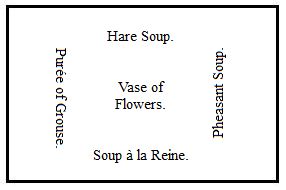
Hare Soup. Purée of Grouse. Vase of Flowers. Pheasant Soup. Soup à la Reine.
Entrées.
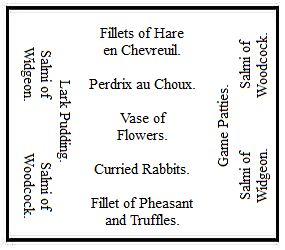
Fillets of Hare en Chevreuil. Salmi of Widgeon. Salmi of Woodcock. Perdrix au Choux. Lark Pudding. Vase of Flowers. Game Patties. Curried Rabbits. Salmi of Woodcock. Salmi of Widgeon. Fillet of Pheasant and Truffles.
Second Course.
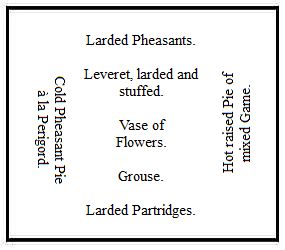
Larded Pheasants. Leveret, larded and stuffed. Cold Pheasant Pie à la Perigord. Vase of Flowers. Hot raised Pie of mixed Game. Grouse. Larded Partridges.
Third Course.
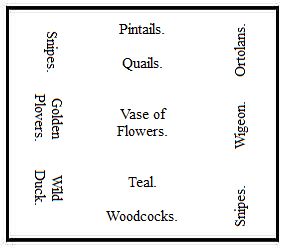
Pintails. Quails. Snipes. Ortolans. Vase of Flowers. Golden Plovers. Widgeon. Teal. Wild Duck. Snipes. Woodcocks.
Entremets and Removes.
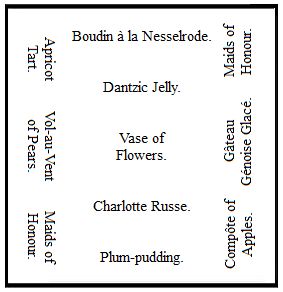
Boudin à la Nesselrode. Apricot Tart. Dantzic Jelly. Maids of Honour. Vol-au-Vent of Pears. Vase of Flowers. Gâteau Génoise Glacé. Charlotte Russe. Maids of Honour. Compôte of Apples. Plum-pudding.
Dessert.
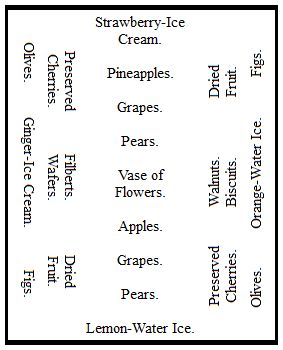
Strawberry-Ice Cream. Olives. Figs. Pineapples. Preserved Cherries. Dried Fruit. Grapes. Filberts. Wafers. Pears. Walnuts. Biscuits. Vase of Flowers. Ginger-Ice Cream. Orange-Water Ice. Apples. Dried Fruit. Preserved Cherries. Grapes. Pears. Figs. Olives. Lemon-Water Ice.
NOYEAU CREAM.
Ingredients.—1½ oz. of isinglass, the juice of 2 lemons, noyeau and pounded sugar to taste, 1½ pint of cream. Mode.—Dissolve the isinglass in a little boiling water, add the lemon-juice, and strain this to the cream, putting in sufficient noyeau and sugar to flavour and sweeten the mixture nicely; whisk the cream well, put it into an oiled mould, and set the mould in ice or in a cool place; turn it out, and garnish the dish to taste. Time.—Altogether, ½ hour. Average cost, with cream at 1s. per pint and the best isinglass, 4s. Sufficient to fill a quart mould. Seasonable at any time.
NOYEAU, Home-made.
Ingredients.—2 oz. of bitter almonds, 1 oz. of sweet ditto, 1 lb. of loaf sugar, the rinds of 3 lemons, 1 quart of Irish whiskey or gin, 1 tablespoonful of clarified honey, ½ pint of new milk. Mode.—Blanch and pound the almonds, and mix with them the sugar, which should also be pounded. Boil the milk; let it stand till quite cold; then mix all the ingredients together, and let them remain for 10 days, shaking them every day. Filter the mixture through blotting-paper, bottle off for use in small bottles, and seal the corks down. This will be found useful for flavouring many sweet dishes. A tablespoonful of the above noyeau, added to a pint of boiled custard instead of brandy as given in our recipe for custard, makes an exceedingly agreeable and delicate flavour. Average cost, 2s. 9d. Sufficient to make about 2½ pints of noyeau. Seasonable.—May be made at any time.
OCTOBER—BILLS OF FARE.
Dinner for 18 persons.
First Course.
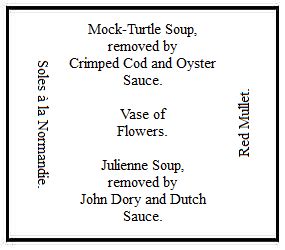
Mock-Turtle Soup, removed by Crimped Cod and Oyster Sauce. Soles à la Normandie. Vase of Flowers. Red Mullet. Julienne Soup, removed by John Dory and Dutch Sauce.
Entrées.
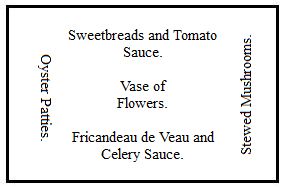
Sweetbreads and Tomato Sauce. Oyster Patties. Vase of Flowers. Stewed Mushrooms. Fricandeau de Veau and Celery Sauce.
Second Course.
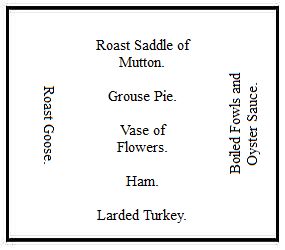
Roast Saddle of Mutton. Grouse Pie. Roast Goose. Vase of Flowers. Boiled Fowls and Oyster Sauce. Ham. Larded Turkey.
Third Course.
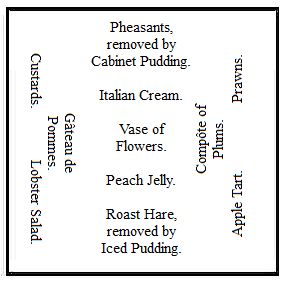
Dessert and Ices.
Custards. Pheasants, removed by Cabinet Pudding. Prawns. Italian Cream. Gâteau de Pommes. Vase of Flowers. Compôte of Plums. Lobster Salad. Peach Jelly. Apple Tart. Roast Hare, removed by Iced Pudding.
Dinner for 12 persons.
First Course.—Carrot soup à la Crécy; soup à la Reine; baked cod; stewed eels. Entrées.—Riz de Veau and tomato sauce; vol-au-vent of chicken; pork cutlets and sauce Robert; grilled mushrooms. Second Course.—Rump of beef à la jardinière; roast goose; boiled fowls and celery sauce; tongue, garnished; vegetables. Third Course.—Grouse; pheasants; quince jelly; lemon cream; apple tart; compôte of peaches; Nesselrode pudding; cabinet pudding; scalloped oysters; dessert and ices.
Dinner for 8 persons.
First Course.—Calf’s-head soup; crimped cod and oyster sauce; stewed eels. Entrées.—Stewed mutton kidneys; curried sweetbreads. Second Course.—Boiled leg of mutton, garnished with carrots and turnips; roast goose. Third Course.—Partridges; fruit jelly; Italian cream; vol-au-vent of pears; apple tart; cabinet pudding; dessert and ices.
Dinners for 6 persons.
First Course.—Hare soup; broiled cod à la Maître d’Hôtel. Haddocks and egg sauce. Entrées.—Veal cutlets, garnished with French beans; haricot mutton. Second Course.—Roast haunch of mutton; boiled capon and rice; vegetables. Third Course.—Pheasants; punch jelly; blancmange; apples à la Portugaise; Charlotte à la Vanille; marrow pudding; dessert.
First Course.—Mock-turtle soup; brill and lobster sauce; fried whitings. Entrées.—Fowl à la Béchamel; oyster patties. Second Course.—Roast sucking-pig; stewed rump of beef à la jardinière; vegetables. Third Course.—Grouse; Charlotte aux pommes; coffee cream; cheesecakes; apricot tart; iced pudding; dessert.
OCTOBER, Plain Family Dinners for.
Sunday.—1. Roast sucking-pig, tomato sauce and brain sauce; small boiled leg of mutton, caper sauce, turnips, and carrots. 2. Damson tart, boiled batter pudding.
Monday.—1. Vegetable soup, made from liquor that mutton was boiled in. 2. Sucking-pig en blanquette, small meat pie, French beans, and potatoes. 3. Pudding, pies.
Tuesday.—1. Roast partridges, bread sauce, and gravy; slices of mutton warmed in caper sauce; vegetables. 2. Baked plum-pudding.
Wednesday.—1. Roast ribs of beef, Yorkshire pudding, vegetable marrow, and potatoes. 2. Damson pudding.
Thursday.—1. Fried soles, melted butter. 2. Cold beef and salad; mutton cutlets and tomato sauce. 3. Macaroni.
Friday.—1. Carrot soup. 2. Boiled fowls and celery sauce; bacon-cheek, garnished with greens; beef rissoles, from remains of cold beef. 3. Baroness pudding.
Saturday.—1. Curried fowl, from remains of cold ditto; dish of rice, rump-steak-and-kidney pudding, vegetables. 2. Stewed pears and sponge-cakes.
Sunday.—1. Crimped cod and oyster sauce. 2. Roast haunch of mutton, brown onion sauce, and vegetables. 3. Bullace pudding, baked custards in cups.
Monday.—1. The remains of codfish, flaked, and warmed in a maître d’hôtel sauce. 2. Cold mutton and salad, veal cutlets and rolled bacon, French beans and potatoes. 3. Arrowroot blancmange and stewed damsons.
Tuesday.—1. Roast hare, gravy, and red-currant jelly; hashed mutton, vegetables. 2. Currant dumplings.
Wednesday.—1. Jugged hare, from remains of roast ditto; boiled knuckle of veal and rice; boiled bacon cheek. 2. Apple pudding.
Thursday.—1. Roast leg of pork, apple sauce, greens, and potatoes. 2. Rice snowballs.
Friday.—1. Slices of pork, broiled, and tomato sauce, mashed potatoes; roast pheasants, bread sauce, and gravy. 2. Baked apple pudding.
Saturday.—1. Rump-steak pie, sweetbreads. 2. Ginger pudding.
OCTOBER, Things in Season.
Fish.—Barbel, brill, cod, crabs, eels, flounders, gudgeons, haddocks, lobsters, mullet, oysters, plaice, prawns, skate, soles, tench, turbot, whiting.
Meat.—Beef, mutton, pork, veal, venison.
Poultry.—Chickens, fowls, geese, larks, pigeons, pullets, rabbits, teal, turkeys, widgeons, wild ducks.
Game.—Black-cock, grouse, hares, partridges, pheasants, snipes, woodcocks, doe venison.
Vegetables.—Artichokes, beets, cabbages, cauliflowers, carrots, celery, lettuces, mushrooms, onions, potatoes, sprouts, tomatoes, turnips, vegetable marrows,—various herbs.
Fruit.—Apples, black and white bullaces, damsons, figs, filberts, grapes, pears, quinces, walnuts.
OMELET.
Ingredients.—6 eggs, 1 saltspoonful of salt, ½ saltspoonful of pepper, ¼ lb. of butter. Mode.—Break the eggs into a basin, omitting the whites of 3, and beat them up with the salt and pepper until extremely light; then add 2 oz. of the butter broken into small pieces, and stir this into the mixture. Put the other 2 oz. of butter into a frying-pan, make it quite hot, and, as soon as it begins to bubble, whisk the eggs, &c., very briskly for a minute or two, and pour them into the pan; stir the omelet with a spoon one way until the mixture thickens and becomes firm, and when the whole is set, fold the edges over, so that the omelet assumes an oval form; and when it is nicely brown on one side, and quite firm, it is done. To take off the rawness on the upper side, hold the pan before the fire for a minute or two, and brown it with a salamander or hot shovel. Serve very expeditiously on a very hot dish, and never cook until it is just wanted. The flavour of this omelet may be very much enhanced by adding minced parsley, minced onion or eschalot, or grated cheese, allowing 1 tablespoonful of the former, and half the quantity of the latter, to the above proportion of eggs. Shrimps or oysters may also be added: the latter should be scalded in their liquor, and then bearded and cut into small pieces. In making an omelet, be particularly careful that it is not too thin, and, to avoid this, do not make it in too large a frying-pan, as the mixture would then spread too much, and taste of the outside. It should also not be greasy, burnt, or too much done, and should be cooked over a gentle fire, that the whole of the substance may be heated without drying up the outside. Omelets are sometimes served with gravy; but this should never be poured over them, but served in a tureen, as the liquid causes the omelet to become heavy and flat, instead of eating light and soft. In making the gravy, the flavour should not overpower that of the omelet, and should be thickened with arrowroot or rice flour. Time.—With 6 eggs, in a frying-pan 18 or 20 inches round, 4 to 6 minutes. Average cost, 9d. Sufficient for 4 persons. Seasonable at any time.

OMELET.
OMELET, The Cure’s, or Omelette au Thon.
Ingredients.—Take for 6 persons, the roes of 2 carp;[A] bleach them, by putting them, for 5 minutes, in boiling water slightly salted; a piece of fresh tunny the size of a hen’s egg, to which add a small shalot already chopped; hash up together the roe and the tunny, so as to mix them well, and throw the whole into a saucepan, with a sufficient quantity of very good butter: whip it up until the butter is melted! This constitutes the specialty of the omelet. Take a second piece of butter, à discrétion, mix it with parsley and herbs, place it in a long-shaped dish destined to receive the omelet; squeeze the juice of a lemon over it, and place it on hot embers. Beat up 12 eggs (the fresher the better); throw up the sauté of roe and tunny, stirring it so as to mix all well together; then make your omelet in the usual manner, endeavouring to turn it out long, thick, and soft. Spread it carefully on the dish prepared for it, and serve at once. This dish ought to be reserved for recherché déjeûners, or for assemblies where amateurs meet who know how to eat well: washed down with a good old wine, it will work wonders.
Note.—The roe and the tunny must be beaten up (sauté) without allowing them to boil, to prevent their hardening, which would prevent them mixing well with the eggs. Your dish should be hollowed towards the centre, to allow the gravy to concentrate, that it may be helped with a spoon. The dish ought to be slightly heated, otherwise the cold china will extract all the heat from the omelet.
OMELETTE AUX CONFITURES, or Jam Omelet.
Ingredients.—6 eggs, 4 oz. of butter, 3 tablespoonfuls of apricot, strawberry, or any jam that may be preferred. Mode.—Make an omelet, only instead of doubling it over, leave it flat in the pan. When quite firm, and nicely brown on one side, turn it carefully on to a hot dish, spread over the middle of it the jam, and fold the omelet over on each side; sprinkle sifted sugar over, and serve very quickly. A pretty dish of small omelets may be made by dividing the batter into 3 or 4 portions, and frying them separately; they should then be spread each one with a different kind of preserve, and the omelets rolled over. Always sprinkle sweet omelets with sifted sugar before being sent to table. Time.—4 to 6 minutes. Average cost, 1s. 2d. Sufficient for 4 persons. Seasonable at any time.
OMELET, Bachelor’s.
Ingredients.—2 or 3 eggs, 2 oz. of butter, teaspoonful of flour, ½ teacupful of milk. Mode.—Make a thin cream of the flour and milk; then beat up the eggs, mix all together, and add a pinch of salt and a few grains of cayenne. Melt the butter in a small frying-pan, and, when very hot, pour in the batter. Let the pan remain for a few minutes over a clear fire; then sprinkle upon the omelet some chopped herbs and a few shreds of onion; double the omelet dexterously, and shake it out of the pan on to a hot dish. A simple sweet omelet can be made by the same process, substituting sugar or preserve for the chopped herbs. Time.—2 minutes. Average cost, 6d. Sufficient for 2 persons. Seasonable at any time.
OMELET, Plain Sweet.
Ingredients.—6 eggs, 4 oz. of butter, 2 oz. of sifted sugar. Mode.—Break the eggs into a basin, omitting the whites of 3; whisk them well, adding the sugar and 2 oz. of the butter, which should be broken into small pieces, and stir all these ingredients well together. Make the remainder of the butter quite hot in a small frying-pan, and when it commences to bubble, pour in the eggs, &c. Keep stirring them until they begin to set; then turn the edges of the omelet over, to make it an oval shape, and finish cooking it. To brown the top, hold the pan before the fire, or use a salamander, and turn it carefully on to a very hot dish; sprinkle sifted sugar over, and serve. Time.—From 4 to 6 minutes. Average cost, 10d. Sufficient for 4 persons. Seasonable at any time.
OMELETTE SOUFFLÉ.
Ingredients.—6 eggs, 5 oz. of pounded sugar, flavouring of vanilla, orange-flower water, or lemon-rind, 3 oz. of butter, 1 dessertspoonful of rice-flour. Mode.—Separate the yolks from the whites of the eggs, add to the former the sugar, the rice-flour, and either of the above flavourings that may be preferred, and stir these ingredients well together. Whip the whites of the eggs, mix them lightly with the batter, and put the butter into a small frying-pan. As soon as it begins to bubble, pour the batter into it, and set the pan over a bright but gentle fire; and when the omelet is set, turn the edges over to make it an oval shape, and slip it on to a silver dish, which has been previously well buttered. Put it in the oven, and bake from 12 to 15 minutes; sprinkle finely-powdered sugar over the soufflé, and serve it immediately. Time.—About 4 minutes in the pan; to bake, from 12 to 15 minutes. Average cost, 1s. Sufficient for 3 or 4 persons. Seasonable at any time.
ONION SAUCE, Brown.
Ingredients.—6 large onions, rather more than ½ pint of good gravy, 2 oz. of butter, salt and pepper to taste. Mode.—Slice and fry the onions of a pale brown in a stewpan, with the above quantity of butter, keeping them well stirred, that they do not get black. When a nice colour, pour over the gravy, and let them simmer gently until tender. Now skim off every particle of fat, add the seasoning, and rub the whole through a tammy or sieve; put it back into the saucepan to warm, and when it boils, serve. Time.—Altogether 1 hour. Seasonable from August to March.
Note.—Where a high flavouring is liked, add 1 tablespoonful of mushroom ketchup, or a small quantity of port wine.
ONION SAUCE, French, or Soubise.
Ingredients.—½ pint of Béchamel, 1 bay-leaf, seasoning to taste of pounded mace and cayenne, 6 onions, a small piece of ham. Mode.—Peel the onions and cut them in halves; put them into a stewpan, with just sufficient water to cover them, and add the bay-leaf, ham, cayenne, and mace; be careful to keep the lid closely shut, and simmer them until tender. Take them out and drain thoroughly; rub them through a tammy or sieve (an old one does for the purpose) with a wooden spoon, and put them to ½ pint of Béchamel; keep stirring over the fire until it boils, when serve. If it should require any more seasoning, add it to taste. Time.—¾ hour to boil the onions. Average cost, 10d. for this quantity. Sufficient for a moderate-sized dish.
ONION SAUCE, White, for Boiled Rabbits, Roast Shoulder of Mutton, &c.
Ingredients.—9 large onions, or 12 middling-sized ones, 1 pint of melted butter made with milk, ½ teaspoonful of salt, or rather more. Mode.—Peel the onions and put them into water to which a little salt has been added, to preserve their whiteness, and let them remain for ¼ hour. Then put them into a stewpan, cover them with water, and let them boil until tender, and, if the onions should be very strong, change the water after they have been boiling for ¼ hour. Drain them thoroughly, chop them, and rub them through a tammy or sieve. Make 1 pint of melted butter with milk, and when that boils, put in the onions, with a seasoning of salt; stir it till it simmers, when it will be ready to serve. If these directions are carefully attended to, this onion sauce will be delicious. Time.—From ¾ to 1 hour, to boil the onions. Average cost, 9d. per pint. Sufficient to serve with a roast shoulder of mutton, or boiled rabbit. Seasonable from August to March.
Note.—To make this sauce very mild and delicate, use Spanish onions, which can be procured from the beginning of September to Christmas. 2 or 3 tablespoonfuls of cream added just before serving, will be found to improve its appearance very much. Small onions, when very young, may be cooked whole, and served in melted butter. A sieve or tammy should be kept expressly for onions; an old one answers the purpose, as it is liable to retain the flavour and smell, which of course would be excessively disagreeable in delicate preparations.
ONION SOUP.
Ingredients.—6 large onions, 2 oz. of butter, salt and pepper to taste, ½ pint of cream, 1 quart of stock. Mode.—Chop the onions, put them in the butter, stir them occasionally, but do not let them brown. When tender, put the stock to them, and season; strain the soup, and add the boiling cream. Time.—½ hour. Average cost, 1s. per quart. Seasonable in winter. Sufficient for 4 persons.
ONION SOUP, Cheap.
Ingredients.—8 middling-sized onions, 3 oz. of butter, a tablespoonful of rice-flour, salt and pepper to taste, 1 teaspoonful of powdered sugar, thickening of butter and flour, 2 quarts of water. Mode.—Cut the onions small, put them into the stewpan with the butter, and fry them well; mix the rice-flour smoothly with the water, add the onions, seasoning, and sugar, and simmer till tender. Thicken with butter and flour, and serve. Time.—2 hours. Average cost, 4d. per quart. Seasonable in winter. Sufficient for 8 persons.
ONIONS, Burnt, for Gravies.
Ingredients.—½ lb. of onions, ½ pint of water, ½ lb. of moist sugar, 1/3 pint of vinegar. Mode.—Peel and chop the onions fine, and put them into a stewpan (not tinned), with the water; let them boil for 5 minutes, then add the sugar, and simmer gently until the mixture becomes nearly black and throws out bubbles of smoke. Have ready the above proportion of boiling vinegar, strain the liquor gradually to it, and keep stirring with a wooden spoon until it is well incorporated. When cold, bottle for use. Time.—Altogether, 1 hour.
ONIONS, Pickled (a very simple Method, and exceedingly Good).
Ingredients.—Pickling onions; to each quart of vinegar, 2 teaspoonfuls of allspice, 2 teaspoonfuls of whole black pepper. Mode.—Have the onions gathered when quite dry and ripe, and, with the fingers, take off the thin outside skin; then, with a silver knife (steel should not be used, as it spoils the colour of the onions), remove one more skin, when the onion will look quite clear. Have ready some very dry bottles or jars, and as fast as they are peeled, put them in. Pour over sufficient cold vinegar to cover them, with pepper and allspice in the above proportions, taking care that each jar has its share of the latter ingredients. Tie down with bladder, and put them in a dry place, and in a fortnight they will be fit for use. This is a most simple recipe and very delicious, the onions being nice and crisp. They should be eaten within 6 or 8 months after being done, as the onions are liable to become soft. Seasonable from the middle of July to the end of August.
ONIONS, Pickled.
Ingredients.—1 gallon of pickling onions, salt and water, milk; to each ½ gallon of vinegar, 1 oz. of bruised ginger, ¼ tablespoonful of cayenne, 1 oz. of allspice, 1 oz. of whole black pepper, ¼ oz. of whole nutmeg bruised, 8 cloves, ¼ oz. of mace. Mode.—Gather the onions, which should not be too small, when they are quite dry and ripe; wipe off the dirt, but do not pare them; make a strong solution of salt and water, into which put the onions, and change this, morning and night, for 3 days, and save the last brine they were put in. Then take the outside skin off, and put them into a tin saucepan capable of holding them all, as they are always better done together. Now take equal quantities of milk and the last salt and water the onions were in, and pour this to them; to this add 2 large spoonfuls of salt, put them over the fire, and watch them very attentively. Keep constantly turning the onions about with a wooden skimmer, those at the bottom to the top, and vice versâ; and let the milk and water run through the holes of the skimmer. Remember, the onions must never boil, or, if they do, they will be good for nothing; and they should be quite transparent. Keep the onions stirred for a few minutes, and, in stirring them, be particular not to break them. Then have ready a pan with a colander, into which turn the onions to drain, covering them with a cloth to keep in the steam. Place on a table an old cloth, 2 or 3 times double; put the onions on it when quite hot, and over them an old piece of blanket; cover this closely over them, to keep in the steam. Let them remain till the next day, when they will be quite cold, and look yellow and shrivelled; take off the shrivelled skins, when they should be as white as snow. Put them into a pan, make a pickle of vinegar and the remaining ingredients, boil all these up, and pour hot over the onions in the pan. Cover very closely to keep in all the steam, and let them stand till the following day, when they will be quite cold. Put them into jars or bottles well bunged, and a tablespoonful of the best olive-oil on the top of each jar or bottle. Tie them down with bladder, and let them stand in a cool place for a month or six weeks, when they will be fit for use. They should be beautifully white, and eat crisp, without the least softness, and will keep good many months. Seasonable from the middle of July to the end of August.
ONIONS, Spanish, Baked.
Ingredients.—4 or 5 Spanish onions, salt, and water. Mode.—Put the onions, with their skins on, into a saucepan of boiling water slightly salted, and let them boil quickly for an hour. Then take them out, wipe them thoroughly, wrap each one in a piece of paper separately, and bake them in a moderate oven for 2 hours, or longer, should the onions be very large. They may be served in their skins, and eaten with a piece of cold butter and a seasoning of pepper and salt; or they may be peeled, and a good brown gravy poured over them. Time.—1 hour to boil, 2 hours to bake. Average cost, medium-sized, 2d. each. Sufficient for 5 or 6 persons. Seasonable from September to January.
ONIONS, Spanish, Pickled.
Ingredients.—Onions, vinegar; salt and cayenne to taste. Mode.—Cut the onions in thin slices; put a layer of them in the bottom of a jar; sprinkle with salt and cayenne; then add another layer of onions, and season as before. Proceeding in this manner till the jar is full, pour in sufficient vinegar to cover the whole, and the pickle will be fit for use in a month. Seasonable.—May be had in England from September to February.
ONIONS, Spanish, Stewed.
Ingredients.—5 or 6 Spanish onions, 1 pint of good broth or gravy. Mode.—Peel the onions, taking care not to cut away too much of the tops or tails, or they would then fall to pieces; put them into a stewpan capable of holding them at the bottom without piling them one on the top of another; add the broth or gravy, and simmer very gently until the onions are perfectly tender. Dish them, pour the gravy round, and serve. Instead of using broth, Spanish onions may be stewed with a large piece of butter: they must be done very gradually over a slow fire or hot-plate, and will produce plenty of gravy. Time.—To stew in gravy, 2 hours, or longer if very large. Average cost, medium-sized, 2d. each. Sufficient for 6 or 7 persons. Seasonable from September to January.
Note.—Stewed Spanish onions are a favourite accompaniment to roast shoulder of mutton.
ORANGE BRANDY. (Excellent.)
Ingredients.—To every ½ gallon of brandy allow ¾ pint of Seville orange-juice, 1¼ lb. of loaf sugar. Mode.—To bring out the full flavour of the orange-peel, rub a few lumps of the sugar on 2 or 3 unpared oranges, and put these lumps to the rest. Mix the brandy with the orange-juice, strained, the rinds of 6 of the oranges pared very thin, and the sugar. Let all stand in a closely-covered jar for about 3 days, stirring it 3 or 4 times a day. When clear, it should be bottled and closely corked for a year; it will then be ready for use, but will keep any length of time. This is a most excellent stomachic when taken pure in small quantities; or, as the strength of the brandy is very little deteriorated by the other ingredients, it may be diluted with water. Time.—To be stirred every day for 3 days. Average cost, 7s. Sufficient to make 2 quarts. Seasonable.—Make this in March.
ORANGE CREAM.
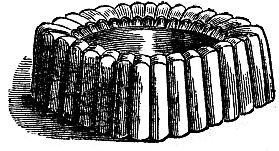
OPEN MOULD.
Ingredients.—1 oz. of isinglass, 6 large oranges, 1 lemon, sugar to taste, water, ½ pint of good cream. Mode.—Squeeze the juice from the oranges and lemon; strain it, and put it into a saucepan with the isinglass, and sufficient water to make it in all 1½ pint. Rub the sugar on the orange and lemon-rind, add it to the other ingredients, and boil all together for about 10 minutes. Strain through a muslin bag, and, when cold, beat up with it ½ pint of thick cream. Wet a mould, or soak it in cold water; pour in the cream, and put it in a cool place to set. If the weather is very cold, 1 oz. of isinglass will be found sufficient for the above proportion of ingredients. Time.—10 minutes to boil the juice and water. Average cost, with the best isinglass, 3s. Sufficient to fill a quart mould. Seasonable from November to May.
ORANGE CREAMS.
Ingredients.—1 Seville orange, 1 tablespoonful of brandy, ¼ lb. of loaf sugar, the yolks of 4 eggs, 1 pint of cream. Mode.—Boil the rind of the Seville orange until tender, and beat it in a mortar to a pulp; add to it the brandy, the strained juice of the orange, and the sugar, and beat all together for about 10 minutes, adding the well-beaten yolks of eggs. Bring the cream to the boiling-point, and pour it very gradually to the other ingredients, and beat the mixture till nearly cold; put it into custard-cups, place the cups in a deep dish of boiling water, where let them remain till quite cold. Take the cups out of the water, wipe them, and garnish the tops of the creams with candied orange-peel or preserved chips. Time.—Altogether, ¾ hour. Average cost, with cream at 1s. per pint, 1s. 7d. Sufficient to make 7 or 8 creams. Seasonable from November to May.
Note.—To render this dish more economical, substitute milk for the cream, but add a small pinch of isinglass to make the creams firm.
ORANGE FRITTERS.
Ingredients.—For the batter, ½ lb. of flour, ½ oz. of butter, ½ saltspoonful of salt, 2 eggs, milk, oranges, hot lard or clarified dripping. Mode.—Make a nice light batter with the above proportion of flour, butter, salt, eggs, and sufficient milk to make it the proper consistency; peel the oranges, remove as much of the white skin as possible, and divide each orange into eight pieces, without breaking the thin skin, unless it be to remove the pips; dip each piece of orange in the batter. Have ready a pan of boiling lard or clarified dripping; drop in the oranges, and fry them a delicate brown from 8 to 10 minutes. When done, lay them on a piece of blotting-paper before the fire, to drain away the greasy moisture, and dish them on a white d’oyley; sprinkle over them plenty of pounded sugar, and serve quickly. Time.—8 to 10 minutes to fry the fritters; 5 minutes to drain them. Average cost, 9d. Sufficient for 4 or 5 persons. Seasonable from November to May.
ORANGE GRAVY, for Wildfowl, Widgeon, Teal, &c.
Ingredients.—½ pint of white stock, 1 small onion, 3 or 4 strips of lemon or orange peel, a few leaves of basil, if at hand, the juice of a Seville orange or lemon, salt and pepper to taste, 1 glass of port wine. Mode.—Put the onion, cut in slices, into a stewpan with the stock, orange-peel, and basil, and let them simmer very gently for ¼ hour or rather longer, should the gravy not taste sufficiently of the peel. Strain it off, and add to the gravy the remaining ingredients; let the whole heat through, and, when on the point of boiling, serve very hot in a tureen which should have a cover to it. Time.—Altogether ½ hour. Sufficient for a small tureen.
ORANGE JELLY.
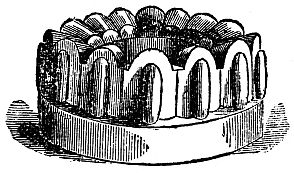
OPEN MOULD.
Ingredients.—1 pint of water, 1½ to 2 oz. of isinglass, ½ lb. of loaf sugar, 1 Seville orange, 1 lemon, about 9 China oranges. Mode.—Put the water into a saucepan, with the isinglass, sugar, and the rind of 1 orange, and the same of ½ lemon, and stir these over the fire until the isinglass is dissolved, and remove the scum; then add to this the juice of the Seville orange, the juice of the lemon, and sufficient juice of China oranges to make in all 1 pint: from 8 to 10 oranges will yield the desired quantity. Stir all together over the fire until it is just on the point of boiling; skim well; then strain the jelly through a very fine sieve or jelly-bag, and when nearly cold, put it into a mould previously wetted, and, when quite set, turn it out on a dish, and garnish it to taste. To insure this jelly being clear, the orange- and lemon-juice should be well strained, and the isinglass clarified, before they are added to the other ingredients, and, to heighten the colour, a few drops of prepared cochineal may be added. Time.—5 minutes to boil without the juice; 1 minute after it is added. Average cost, with the best isinglass, 3s. 6d. Sufficient to fill a quart mould. Seasonable from November to May.
ORANGE MARMALADE.
Ingredients.—Equal weight of fine loaf sugar and Seville oranges; to 12 oranges allow 1 pint of water. Mode.—Let there be an equal weight of loaf sugar and Seville oranges, and allow the above proportion of water to every dozen oranges. Peel them carefully, remove a little of the white pith, and boil the rinds in water 2 hours, changing the water three times to take off a little of the bitter taste. Break the pulp into small pieces, take out all the pips, and cut the boiled rind into chips. Make a syrup with the sugar and water; boil this well, skim it, and, when clear, put in the pulp and chips. Boil all together from 20 minutes to ½ hour; pour it into pots, and, when cold, cover down with bladders or tissue-paper brushed over on both sides with the white of an egg. The juice and grated rind of 2 lemons to every dozen of oranges, added with the pulp and chips to the syrup, are a very great improvement to this marmalade. Time.—2 hours to boil the orange-rinds; 10 minutes to boil the syrup; 20 minutes to ½ hour to boil the marmalade. Average cost, from 6d. to 8d. per lb. pot. Seasonable.—This should be made in March or April, as Seville oranges are then in perfection.
ORANGE MARMALADE.
Ingredients.—Equal weight of Seville oranges and sugar; to every lb. of sugar allow ½ pint of water. Mode.—Weigh the sugar and oranges, score the skin across, and take it off in quarters. Boil these quarters in a muslin bag in water until they are quite soft, and they can be pierced easily with the head of a pin; then cut them into chips about 1 inch long, and as thin as possible. Should there be a great deal of white stringy pulp, remove it before cutting the rind into chips. Split open the oranges, scrape out the best part of the pulp, with the juice, rejecting the white pith and pips. Make a syrup with the sugar and water; boil it until clear; then put in the chips, pulp, and juice, and boil the marmalade from 20 minutes to ½ hour, removing all the scum as it rises. In boiling the syrup, clear it carefully from scum before the oranges are added to it. Time.—2 hours to boil the rinds, 10 minutes the syrup, 20 minutes to ½ hour the marmalade. Average cost, 6d. to 8d. per lb. pot. Seasonable.—Make this in March or April, when Seville oranges are in perfection.
ORANGE MARMALADE, an easy way of Making.
Ingredients.—To every lb. of pulp allow 1½ lb. of loaf sugar. Mode.—Choose some fine Seville oranges; put them whole into a stewpan with sufficient water to cover them, and stew them until they become perfectly tender, changing the water 2 or 3 times; drain them, take off the rind, remove the pips from the pulp, weigh it, and to every lb. allow 1½ of loaf sugar and ½ pint of the water the oranges were last boiled in. Boil the sugar and water together for 10 minutes; put in the pulp, boil for another 10 minutes; then add the peel cut into strips, and boil the marmalade for another 10 minutes, which completes the process. Pour it into jars; let it cool; then cover down with bladders, or tissue-paper brushed over on both sides with the white of an egg. Time.—2 hours to boil the oranges; altogether ½ hour to boil the marmalade. Average cost, from 6d. to 8d. per lb. pot. Seasonable.—Make this in March or April.
ORANGE MARMALADE, made with Honey.
Ingredients.—To 1 quart of the juice and pulp of Seville oranges allow 1 lb. of the rind, 2 lbs. of honey. Mode.—Peel the oranges, and boil the rind in water until tender, and cut it into strips. Take away the pips from the juice and pulp, and put it with the honey and chips into a preserving-pan; boil all together for about ½ hour, or until the marmalade is of the proper consistency; put it into pots, and, when cold, cover down with bladders. Time.—2 hours to boil the rind, ½ hour the marmalade. Average cost, from 7d. to 9d. per lb. pot. Seasonable.—Make this in March or April.
ORANGE MARMALADE, Pounded.
Ingredients.—Weight and ½ in sugar to every lb. of oranges. Mode.—Cut some clear Seville oranges in 4 pieces, put all the juice and pulp into a basin, and take out the seeds and skins; boil the rinds in hard water till tender, changing the water 2 or 3 times while boiling; drain them well, and pound them in a mortar; then put them into a preserving-pan with the juice and pulp, and their weight and ½ of sugar; boil rather more than ½ an hour. Time.—About 2 hours to boil the rinds, ½ an hour the marmalade.
ORANGE PUDDING, Baked.
Ingredients.—6 oz. of stale sponge cake or bruised ratafias, 6 oranges, 1 pint of milk, 6 eggs, ½ lb. of sugar. Mode.—Bruise the sponge-cake or ratafias into fine crumbs, and pour upon them the milk, which should be boiling. Rub the rinds of 2 of the oranges on sugar, and add this, with the juice of the remainder, to the other ingredients. Beat up the eggs, stir them in, sweeten to taste, and put the mixture into a pie-dish previously lined with puff-paste. Bake for rather more than ½ hour; turn it out of the dish, strew sifted sugar over, and serve. Time.—Rather more than ½ hour. Average cost, 1s. 6d. Sufficient for 3 or 4 persons. Seasonable from November to May.
ORANGE PUDDING, Seville.
Ingredients.—4 Seville oranges, 6 oz. of fresh butter, 12 almonds, ½ lb. of sifted sugar, the juice of 1 lemon, 8 eggs. Mode.—Boil the oranges and chop them finely, taking out all the pips. Put the butter, the almonds, blanched and chopped, and the sugar, into a saucepan, to which add the orange pulp and the lemon-juice. Put it on a hot plate to warm, mixing all together until the butter is thoroughly melted. Turn the mixture out, let it get cold, then add the eggs, which should be well whipped. Put all into a baking-dish, bordered with puff paste, and bake from ½ hour to 40 minutes, according to the heat of the oven. Time.—½ hour to 40 minutes. Seasonable from November to May.
ORANGE SALAD.
Ingredients.—6 oranges, ¼ lb. of muscatel raisins, 2 oz. of pounded sugar, 4 tablespoonfuls of brandy. Mode.—Peel 5 of the oranges; divide them into slices without breaking the pulp, and arrange them on a glass dish. Stone the raisins, mix them with the sugar and brandy, and mingle them with the oranges. Squeeze the juice of the other orange over the whole, and the dish is ready for table. A little pounded spice may be put in when the flavour is liked; but this ingredient must be added very sparingly. Average cost, 1s. Sufficient for 5 or 6 persons. Seasonable from November to May.
ORANGE WINE, a very Simple and Easy Method of Making a very Superior.
Ingredients.—90 Seville oranges, 32 lbs. of lump sugar, water. Mode.—Break up the sugar into small pieces, and put it into a dry, sweet, 9-gallon cask, placed in a cellar or other storehouse, where it is intended to be kept. Have ready close to the cask two large pans or wooden keelers, into one of which put the peel of the oranges pared quite thin, and into the other the pulp after the juice has been squeezed from it. Strain the juice through a piece of double muslin, and put into the cask with the sugar. Then pour about 1½ gallon of cold spring water on both the peels and the pulp; let it stand for 24 hours, and then strain it into the cask; add more water to the peels and pulp when this is done, and repeat the same process every day for a week: it should take about a week to fill up the cask. Be careful to apportion the quantity as nearly as possible to the seven days, and to stir the contents of the cask each day. On the third day after the cask is full—that is, the tenth day after the commencement of making—the cask may be securely bunged down. This is a very simple and easy method, and the wine made according to it will be pronounced to be most excellent. There is no troublesome boiling, and all fermentation takes place in the cask. When the above directions are attended to, the wine cannot fail to be good. It should be bottled in 8 or 9 months, and will be fit for use in a twelvemonth after the time of making. Ginger wine may be made in precisely the same manner, only, with the 9-gallon cask for ginger wine, 2 lbs. of the best whole ginger, bruised, must be put with the sugar. It will be found convenient to tie the ginger loosely in a muslin bag. Time.—Altogether, 10 days to make it. Average cost, 2s. 6d. per gallon. Sufficient for 9 gallons. Seasonable.—Make this in March, and bottle it in the following January.
ORANGES, Compôte of.

COMPÔTE OF ORANGES.
Ingredients.—1 pint of syrup, 6 oranges. Mode.—Peel the oranges, remove as much of the white pith as possible, and divide them into small pieces without breaking the thin skin with which they are surrounded. Make the syrup by recipe, adding the rind of the orange cut into thin narrow strips. When the syrup has been well skimmed, and is quite clear, put in the pieces of orange, and simmer them for 5 minutes. Take them out carefully with a spoon without breaking them, and arrange them on a glass dish. Reduce the syrup by boiling it quickly until thick; let it cool a little, pour it over the oranges, and, when cold, they will be ready for table. Time.—10 minutes to boil the syrup; 5 minutes to simmer the oranges; 5 minutes to reduce the syrup. Average cost, 9d. Sufficient for 5 or 6 persons. Seasonable from November to May.
ORANGES, a Pretty Dish of.
Ingredients.—6 large oranges, ½ lb. of loaf sugar, ¼ pint of water, ½ pint of cream, 2 tablespoonfuls of any kind of liquor, sugar to taste. Mode.—Put the sugar and water into a saucepan, and boil them until the sugar becomes brittle, which may be ascertained by taking up a small quantity in a spoon, and dipping it in cold water; if the sugar is sufficiently boiled, it will easily snap. Peel the oranges, remove as much of the white pith as possible, and divide them into nice-sized slices, without breaking the thin white skin which surrounds the juicy pulp. Place the pieces of orange on small skewers, dip them into the hot sugar, and arrange them in layers round a plain mould, which should be well oiled with the purest salad-oil. The sides of the mould only should be lined with the oranges, and the centre left open for the cream. Let the sugar become firm by cooling; turn the oranges carefully out on a dish, and fill the centre with whipped cream, flavoured with any kind of liqueur, and sweetened with pounded sugar. This is an exceedingly ornamental and nice dish for the supper-table. Time.—10 minutes to boil the sugar. Average cost, 1s. 8d.—Sufficient for 1 mould. Seasonable from November to May.
ORANGES, Iced.
Ingredients.—Oranges; to every lb. of pounded loaf sugar allow the whites of 2 eggs. Mode.—Whisk the whites of the eggs well, stir in the sugar, and beat this mixture for ¼ hour. Skin the oranges, remove as much of the white pith as possible without injuring the pulp of the fruit; pass a thread through the centre of each orange, dip them into the sugar, and tie them to a stick. Place this stick across the oven, and let the oranges remain until dry, when they will have the appearance of balls of ice. They make a pretty dessert or supper dish. Care must be taken not to have the oven too fierce, or the oranges would scorch and acquire a brown colour, which would entirely spoil their appearance. Time.—From ½ to 1 hour to dry in a moderate oven. Average cost, 1½d. each. Sufficient.—½ lb. of sugar to ice 12 oranges. Seasonable from November to May.
ORANGES, Preserved.
Ingredients.—Oranges; to every lb. of juice and pulp allow 2 lbs. of loaf sugar; to every pint of water ½ lb. of loaf sugar. Mode.—Wholly grate or peel the oranges, taking off only the thin outside portion of the rind. Make a small incision where the stalk is taken out, squeeze out as much of the juice as can be obtained, and preserve it in a basin with the pulp that accompanies it. Put the oranges into cold water; let them stand for 3 days, changing the water twice; then boil them in fresh water till they are very tender, and put them to drain. Make a syrup with the above proportion of sugar and water, sufficient to cover the oranges; let them stand in it for 2 or 3 days; then drain them well. Weigh the juice and pulp, allow double their weight of sugar, and boil them together until the scum ceases to rise, which must all be carefully removed; put in the oranges, boil them for 10 minutes, place them in jars, pour over them the syrup, and, when cold, cover down. They will be fit for use in a week. Time.—3 days for the oranges to remain in water, 3 days in the syrup; ½ hour to boil the pulp, 10 minutes the oranges. Seasonable.—This preserve should be made in February or March, when oranges are plentiful.
OX, The.
The manner in which a side of beef is cut up in London is shown in the engraving on this page. In the metropolis, on account of the large number of its population possessing the means to indulge in the “best of everything,” the demand for the most delicate joints of meat is great, the price, at the same time, being much higher for these than for the other parts. The consequence is, that in London the carcass is there divided so as to obtain the greatest quantity of meat on the most esteemed joints. In many places, however, where, from a greater equality in the social condition and habits of the inhabitants, the demand and prices for the different parts of the carcasses are more equalized, there is not the same reason for the butcher to cut the best joints so large.
The meat on those parts of the animal in which the muscles are least called into action is most tender and succulent; as, for instance, along the back, from the rump to the hinder part of the shoulder; whilst the limbs, shoulder, and neck are the toughest, driest, and least-esteemed.
The names of the several joints in the hind and fore quarters of a side of beef, and the purposes for which they are used, are as follows:—
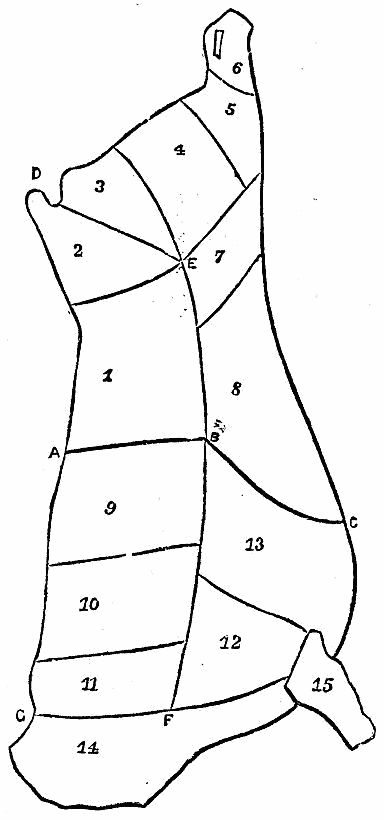
SIDE Of BEEF, SHOWING THE SEVERAL JOINTS.
Hind Quarter:—
1. Sirloin,—the two sirloins, cut together in one joint, form a baron; this, when roasted, is the famous national dish of Englishmen, at entertainments, on occasion of rejoicing.
2. Rump,—the finest part for steaks.
3. Aitchbone,—boiling piece.
4. Buttock,—prime boiling piece.
5. Mouse-round,—boiling or stewing.
6. Hock,—stewing.
7. Thick flank, cut with the udder-fat,—primest boiling piece.
8. Thin flank,—boiling.
Fore Quarter:—
9. Five ribs, called the fore-rib.—This is considered the primest roasting piece.
10. Four ribs, called the middle-rib,—greatly esteemed by housekeepers as the most economical joint for roasting.
11. Two ribs, called the chuck-rib,—used for second quality of steaks.
12. Leg-of-mutton piece,—the muscles of the shoulder dissected from the breast.
13. Brisket, or breast,—used for boiling, after being salted.
14. Neck, clod, and sticking-piece,—used for soups, gravies, stocks, pies, and mincing for sausages.
15. Shin,—stewing.
The following is a classification of the qualities of meat, according to the several joints of beef, when cut up in the London manner.
First class—includes the sirloin, with the kidney suet (1), the rump-steak piece (2), the fore-rib (9).
Second class—The buttock (4), the thick flank (7), the middle-rib (10).
Third class—The aitchbone (3), the mouse-round (5), the thin flank (8), the chuck (11), the leg-of-mutton piece (12), the brisket (13).
Fourth class—The neck, clod, and sticking-piece (14).
Fifth class—The hock (6), the shin (15).
OX-CHEEK SOUP.
Ingredients.—An ox-cheek, 2 oz. of butter, 3 or 4 slices of lean ham or bacon, 1 parsnip, 3 carrots, 2 onions, 3 heads of celery, 3 blades of mace, 4 cloves, a faggot of savoury herbs, 1 bay leaf, a teaspoonful of salt, half that of pepper, 1 head of celery, browning, the crust of a French roll, 5 quarts of water. Mode.—Lay the ham in the bottom of the stewpan, with the butter; break the bones of the cheek, wash it clean, and put it on the ham. Cut the vegetables small, add them to the other ingredients, and set the whole over a slow fire for ¼ of an hour. Now put in the water, and simmer gently till it is reduced to 4 quarts; take out the fleshy part of the cheek, and strain the soup into a clean stewpan; thicken with flour, put in a head of sliced celery, and simmer till the celery is tender. If not a good colour, use a little browning. Cut the meat into small square pieces, pour the soup over, and serve with the crust of a French roll in the tureen, A glass of sherry much improves this soup. Time.—3 to 4 hours. Average cost, 8d. per quart. Seasonable in winter. Sufficient for 12 persons.
OX-CHEEK, Stewed.
Ingredients.—1 cheek, salt and water, 4 or 5 onions, butter and flour, 6 cloves, 3 turnips, 2 carrots, 1 bay-leaf, 1 head of celery, 1 bunch of savoury herbs, cayenne, black pepper, and salt to taste, 1 oz. of butter, 2 dessertspoonfuls of flour, 2 tablespoonfuls of Chili vinegar, 2 tablespoonfuls of mushroom ketchup, 2 tablespoonfuls of port wine, 2 tablespoonfuls of Harvey’s sauce. Mode.—Have the cheek boned, and prepare it the day before it is to be eaten, by cleaning and putting it to soak all night in salt and water. The next day, wipe it dry and clean, and put it into a stewpan. Just cover it with water, skim well when it boils, and let it gently simmer till the meat is quite tender. Slice and fry 3 onions in a little butter and flour, and put them into the gravy; add 2 whole onions, each stuck with 3 cloves, 3 turnips quartered, 2 carrots sliced, a bay-leaf, 1 head of celery, a bunch of herbs, and seasoning to taste of cayenne, black pepper, and salt. Let these stew till perfectly tender; then take out the cheek, divide into pieces fit to help at table, skim and strain the gravy, and thicken 1½ pint of it with butter and flour in the above proportions. Add the vinegar, ketchup, and port wine; put in the pieces of cheek; let the whole boil up, and serve quite hot. Send it to table in a ragoût-dish. If the colour of the gravy should not be very good, add a tablespoonful of the browning. Time.—4 hours. Average cost, 3d. per lb. Sufficient for 8 persons. Seasonable at any time.
OX-TAIL, Broiled (an Entrée).
Ingredients.—2 tails, 1½ pint of stock, salt and cayenne to taste, bread-crumbs, 1 egg. Mode.—Joint and cut up the tails into convenient-sized pieces, and put them into a stewpan, with the stock, cayenne, and salt, and, if liked very savoury, a bunch of sweet herbs. Let them simmer gently for about 2½ hours; then take them out, drain them, and let them cool. Beat an egg upon a plate; dip in each piece of tail, and, afterwards, sprinkle them well with fine bread-crumbs; broil them over a clear fire, until of a brownish colour on both sides, and serve with a good gravy, or any sauce that may be preferred. Time.—About 2½ hours. Average cost, from 9d. to 1s. 6d., according to the season. Sufficient for 6 persons. Seasonable at any time.
Note.—These may be more easily prepared by putting the tails in a brisk oven, after they have been dipped in egg and bread-crumb; and, when brown, they are done. They must be boiled the same time as for broiling.
OX-TAIL SOUP.
Ingredients.—2 ox-tails, 2 slices of ham, 1 oz. of butter, 2 carrots, 2 turnips, 3 onions, 1 leek, 1 head of celery, 1 bunch of savoury herbs, 1 bay-leaf, 12 whole peppercorns, 4 cloves, a tablespoonful of salt, 2 tablespoonfuls of ketchup, ½ glass of port wine, 3 quarts of water. Mode.—Cut up the tails, separating them at the joints; wash them, and put them in a stewpan, with the butter. Cut the vegetables in slices, and add them, with the peppercorns and herbs. Put in ½ pint of water, and stir it over a sharp fire till the juices are drawn. Fill up the stewpan with the water, and, when boiling, add the salt. Skim well, and simmer very gently for 4 hours, or until the tails are tender. Take them out, skim and strain the soup, thicken with flour, and flavour with the ketchup and port wine. Put back the tails, simmer for 5 minutes, and serve. Time.—4½ hours. Average cost, 1s. 3d. per quart. Seasonable in winter. Sufficient for 10 persons.
OX-TAILS, Stewed.
Ingredients.—2 ox-tails, 1 onion, 3 cloves, 1 blade of mace, ¼ teaspoonful of whole black pepper, ¼ teaspoonful of allspice, ½ a teaspoonful of salt, a small bunch of savoury herbs, thickening of butter and flour, 1 tablespoonful of lemon-juice, 1 tablespoonful of mushroom ketchup. Mode.—Divide the tails at the joints, wash, and put them into a stewpan with sufficient water to cover them, and set them on the fire; when the water boils, remove the scum, and add the onion cut into rings, the spice, seasoning, and herbs. Cover the stewpan closely, and let the tails simmer very gently until tender, which will be in about 2½ hours. Take them out, make a thickening of butter and flour, add it to the gravy, and let it boil for ¼ hour. Strain it through a sieve into a saucepan, put back the tails, add the lemon-juice and ketchup; let the whole just boil up, and serve. Garnish with croûtons or sippets of toasted bread. Time.—2½ hours to stew the tails. Average cost, 9d. to 1s. 6d., according to the season. Sufficient for 8 persons. Seasonable all the year.
OYSTER, Forcemeat for Roast or Boiled Turkey.
Ingredients.—½ pint of bread-crumbs, 1½ oz. of chopped suet or butter, 1 faggot of savoury herbs, ¼ saltspoonful of grated nutmeg, salt and pepper to taste, 2 eggs, 18 oysters. Mode.—Grate the bread very fine, and be careful that no large lumps remain; put it into a basin with the suet, which must be very finely minced, or, when butter is used, that must be cut up into small pieces. Add the herbs, also chopped as small as possible, and seasoning; mix all these well together, until the ingredients are thoroughly mingled. Open and beard the oysters, chop them, but not too small, and add them to the other ingredients. Beat up the eggs, and, with the hand, work altogether, until it is smoothly mixed. The turkey should not be stuffed too full: if there should be too much forcemeat, roll it into balls, fry them, and use them as a garnish. Sufficient for 1 turkey.