BIOGRAPHICAL (continued 9)
Reading edition
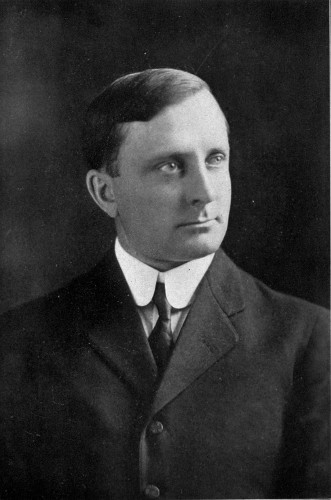
JOSEPH L. ST. JACQUES
In the acquirement of his education Joseph Leon St. Jacques attended the Jacques Cartier Normal school from which he was graduated with the class of 1897, obtaining the academic diploma. He later entered Laval University in which he completed his course in 1901, winning the degrees of LL. L. and LL. M. The same year he was admitted to the bar and entered upon practice. In the meantime, however, after leaving the normal school, he had devoted some time to teaching. He began practice at Lachute, where he had a few criminal cases, including the trial of Robert Day, a murder case. After six years of practice in the country district he came to Montreal and entered into partnership with Mr. Gustave Lamothe, K. C. The firm of Lamothe, St. Jacques & Lamothe has an extensive clientele, especially among religious interests and municipal corporations. He is also a director of some financial enterprises.
On the 19th of May, 1906, at St. Hermas, Mr. St. Jacques was married to Miss Albertine Lafond, a daughter of Mathias Lafond, a merchant and prominent citizen of his municipality. There are four children in the St. Jacques family; Jacques, Jules, Gustave and Alberte. The religious faith of the family is that of the Catholic church. In politics Mr. St. Jacques is a conservative and has taken an active part in the political campaigns of Argenteuil and Two Mountains, being a recognized leader in conservative ranks. He has ever preferred, however, to concentrate his energies and efforts upon his law practice, which is now extensive and important, placing him with the leading representatives of the Montreal bar.
GEORGE HASTINGS.
George Hastings, who was born at Petite Cote, Quebec, in 1817, died in July, 1865. His father was Thomas Hastings, who came from Lexington, Massachusetts, to Petite Cote, where he bought land and settled some time before the birth of Mr. Hastings. In this connection it is interesting to mention that Petite Cote is now divided into Fairmount and Rosemount and is a part of the city of Montreal. The land is now mostly divided into building lots that command good prices.
Thomas Hastings, father of George Hastings, had married Cynthia Baker, of Burlington, Vermont, and they lived for many years in their home at Petite Cote, where their five children, three sons and two daughters, were born and brought up. The sons’ names were: George; Thomas, who is mentioned elsewhere in this work; and Horatio, the youngest, who died unmarried in 1899. The daughters were Mrs. Clark Fitts and Mrs. Ryan.
George Hastings, of this record, married in 1847 Margaret Ogilvie, a sister of A. W., John and W. W. Ogilvie, whose careers are mentioned at greater length in another part of this history. Mr. and Mrs. George Hastings spent their entire married life in their home on a farm at Petite Cote. There their ten children received the training of their early lives. Of these children six were sons and four were daughters. Thomas, the eldest, married Jane Kydd, formerly the widow of William Nesbitt. They reside at Rosemount boulevard and have no children. William, the next son, with George, the third son, after considerable business experience established The Lake of the Woods Milling Company. The former married, in 1884, Georgina Ure, of Montreal. He died in 1903, leaving his widow and two sons, who live in this city. George managed the western branch of the business, from which he resigned in October, 1913. He married in 1886, Margaret Anderson, of Ayr, Ontario. They live in Winnipeg and have a family of two sons and two daughters. Robert, the fourth son, is with The Lake of the Woods Milling Company and lives also in the west, making his present home in Qu’ Appelle. He is unmarried. Alexander, the fifth son, was also connected with The Lake of the Woods Milling Company. He died in St. John, New Brunswick, where he had charge for several years of the local branch of the company. He married, in 1898, Maud Anderson, of Montreal, and his widow is living. Their only child died when one month of age. John Clark, the youngest son, died unmarried in 1883. Helen Watson and Cynthia Baker, the two elder daughters, died in 1912, the latter in January and the former in May of that year. The third daughter, Frances, married Francis Jordan, of Goderich, Ontario, in 1885. Mr. Jordan died in 1907, but his widow, son and daughter are living. Maria, the fourth and youngest daughter of the family, is living and unmarried. The family have always been connected with the American Presbyterian church. The Hastings are well known among the old residents of Montreal, for it is almost a century since Thomas Hastings settled upon the farm which now is a portion of the metropolis.
JAMES ALFRED DALE.
In educational circles the name of Professor James Alfred Dale is well known. His ability has gained him prominence and his position as a leader among the educationists of the country is indicated in the fact that he was honored with election to the position of treasurer of the Dominion Educational Association. Since November, 1907, he has held the Macdonald professorship of education in McGill University. A native of Birmingham, England, he was born in 1874, the eldest son of J. A. Dale. He attended King Edward VI School at Camp Hill, and afterward entered the Mason University College, now the University of Birmingham, and subsequently became classical exhibitioner in Merton College at Oxford, which conferred upon him the Master of Arts degree.
James Alfred Dale has remained continuously in the educational field, being lecturer on literature and education in connection with the Oxford Extension Delegacy from 1902 until 1908, and also to the universities of Liverpool and Manchester. In 1902-3 he was tutor in the Borough Road Training College, and in November, 1907, was called to the Macdonald professorship of education in McGill University. The steps in his orderly progression are thus easily discernible and he stands today among the eminent educationists of the Dominion, his ability being acknowledged by colleagues and contemporaries. He has the power of imparting clearly, concisely and readily to others the knowledge that he has acquired, and on the lecture platform he is a most interesting and entertaining as well as instructive speaker. He was a delegate to the convention of the Dominion Educational Association of Victoria, British Columbia, in 1909. He has served as treasurer of the association and was secretary of the convention held at Ottawa in July, 1913. In May, 1911, he was appointed a member of the council of public instruction for the province of Quebec, and he has come to be a member of most of the committees on Protestant education in the province. Soon after coming out, he was elected president of the Protestant Teachers Association of the province of Quebec and on relinquishing office in 1912 was elected first vice president. His studious habits have made him a man of scholarly attainments, and he is continually seeking out new methods that will render his service as an educationist more effective. His ideas have received the indorsement of prominent contemporaries in this field of labor and have been adopted to the benefit of various institutions of learning. He agrees with Kant that “the object of education is to train each individual to reach the highest perfection possible for him” and that spirit has been manifest throughout his professional career. He has endeavored in his teaching to develop capacity and to impart knowledge which shall prove of practical benefit and value throughout life. He was instrumental in founding the University Settlement of Montreal in 1910 and has been its president since that time. This was the first settlement in the city, and its success is to be measured not by itself but by the influence it has exerted in the general movement toward social reform. He has taken a prominent part in movements for adult education and was one of the first members of the committee of the Workers’ Educational Association, which has succeeded in grouping together over twenty-five hundred trade unions, cooperative societies, etc., and educational bodies in England. At the present time every university in the country is undertaking working-class education under the auspices of the association. At the formation of the City Improvement League he was appointed its first honorary secretary but was compelled by pressure of work to relinquish the active duties of office. He edited the proceedings of the convention of the League in 1910. As literary correspondent of the Canadian Club he is editing its proceedings for the third year.
In 1904 Professor Dale was married to Miss Margaret Butler, a daughter of J. Holden Butler, of Birmingham, and they reside at No. 771 University Street, in Montreal. Not only as an instructor in the classroom and as an enthusiastic advocate of extending educational facilities to all is Professor Dale well known. His contributions to the literature of the profession have made his name a familiar one not only in this country but throughout the American continent and in Great Britain. He is the author of many articles which have appeared in various publications and which have treated of literary as well as educational subjects, and he has published in Germany a volume entitled History of English Literature. His name was suggested in various quarters when British Columbia was looking for a president for its new university. A modern philosopher has said: “Not the good that comes to us but the good that comes to the world through us is the measure of our success,” and judged by this standard the life of Professor Dale is a most successful one.
GEORGE HUGH ALEXANDER MONTGOMERY, B. C. L., K. C.
George Hugh Alexander Montgomery is one of the most successful members of the Montreal bar, of which he is an ex-councillor. He has successfully pleaded cases in all the courts of Canada and before the privy council and has for some years occupied an enviable place at the bar of this city. He was born at Philipsburg, P. Q., February 5, 1874, a son of the Rev. Hugh and E. M. (Slack) Montgomery. The family being one appreciative of the benefits and value of education, liberal opportunities in that direction were afforded him, and after attending Bishop’s College School at Lennoxville, P. Q., he entered the University of Bishop’s College, where he pursued a classical course and won the Bachelor of Arts degree in 1893. Four years later he was graduated with the B. C. L. degree from McGill University, having thus thoroughly qualified for the active practice of law, which he had determined to make his life work. He became an advocate in 1898 and since that time has successfully followed his profession in Montreal, his clientage being one of growing importance and volume. Since May, 1905, he has been solicitor for the Montreal Light, Heat & Power Company, and has had many other important professional connections. In 1909 he was created king’s counsel. His work in the courts has shown him to be largely a master of the principles of jurisprudence and also possessed of the power to present his cause clearly, cogently and logically. His ability as an advocate is acknowledged by contemporaries and colleagues.
Mr. Montgomery is the owner of Lakeside Stock Farm at Philipsburg, Quebec, the home of some of the finest Ayrshire cattle and Clydesdale horses in the Dominion. Modern in its improvements, with fine natural advantages, this farm contains two hundred and fifty acres of the finest arable soil; for which most of the eastern township farms are noted, as well as ample additional acreage to meet the requirements of a successful stock farm.
Mr. Montgomery has for more than twenty years been extensively interested in farming operations, and from time to time has added to his holdings, in the eastern townships, which now comprise more than seven hundred acres. It was more than ten years ago that he started in to breed the best in pure-bred Ayrshire cattle, and while finding all the recreation and entertainment sought by a gentleman farmer, the project has been conducted on a business as well as a scientific basis with gratifying results. Stock from Lakeside Stock Farm have successfully contested in the show ring with the best herds in Canada. Equally as high class are the Clydesdale horses owned and bred at this farm.
In 1913 Mr. Montgomery completed his beautiful country residence on Missisquoi Bay near Philipsburg. Modern in its appointments, the structure is of field stone up to the ground floor, above which it is of Elizabethan style, and from its site overlooking Lake Champlain, comprises one of the most attractive homes in that section.
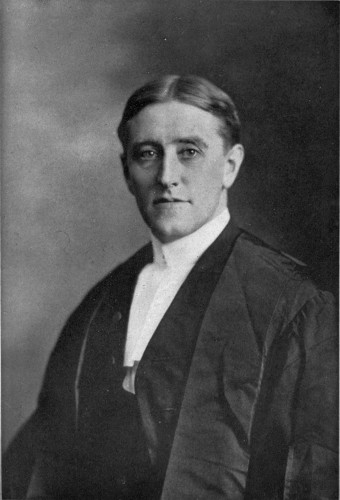
GEORGE H. A. MONTGOMERY
In June, 1909, was celebrated the marriage of Mr. Montgomery and Miss Gwendoline Baptist, a daughter of the late John Baptist, of Three Rivers, P. Q. Mr. and Mrs. Montgomery have one son. In religious faith Mr. and Mrs. Montgomery are Anglicans, while socially they are well known in the best circles of the city. Mr. Montgomery has membership relations with the Mount Royal, University, St. James, Montreal and Montreal Jockey Clubs, as well as the Quebec Garrison Club. His profession is constantly making greater demands upon his time and energies, yet he finds opportunities for other obligations and duties and for the pleasures of life, thus maintaining a well balanced character.
JOSEPH PHILLIPE BEAUDRY.
An excellent example of the aggressive type of a business man, and one well known in real-estate circles of Montreal, is Joseph P. Beaudry, manager of the Beaudry Realty Company, No. 402, McGill building.
Mr. Beaudry comes from one of the oldest families in the Dominion, dating back to 1629, and the numerous branches of it probably could be traced back to show relationship, where, in many cases at this time, no family connection is supposed to exist.
Joseph P. Beaudry was born in Ottawa, Ontario, a son of Joseph and Alphonsine (Valiquette) Beaudry. The father, a wood manufacturer, was born at Three Rivers, while the mother was a native of Quebec.
Reared in his native town, Mr. Beaudry after attending school there, completed his educational training by taking a commercial course. Taking up the printing business, he began at the bottom and was gradually advanced from one capacity to another of greater importance, successfully filling the positions of foreman, superintendent, manager and traveling representative for some of the largest printing houses in Montreal. While he had become well known in this line of business and enjoyed a high standing among those connected with it, Mr. Beaudry concluded that the real-estate business afforded better opportunities, and in 1909 he decided to enter it. The wisdom of his judgment in this move has been fully shown in the success that has come to him. He has formed a number of successful real-estate companies and has come to be known as a shrewd judge of realty values.
The Beaudry Realty Company, of which he is manager, is generally known to carry the largest list of city lots and property among the French real-estate firms in the city. This firm’s extensive clientele is not confined to Montreal, but branches out into a great many towns throughout the province of Quebec.
Mr. Beaudry is a director of seven different real-estate companies, all limited concerns and formed by him. He is a member of the Canadian Club, also the Automobile Club, belongs as well to the Sixty-fifth Regiment and holds membership in the Commercial Travellers Association. In political matters his interest is that of a business man, and he votes with the conservative party, while in his religious connection he is a Roman Catholic.
On May 25, 1897, he was married to Alexina Senecal, a daughter of Adolphe and Cordelia (Colletts) Senecal. Mr. Beaudry’s children are Alexina, Gabrielle, Guillaume, Jean-Rene and Raoul.
He has earned for himself a reputation as a careful man of business, and in his dealing is known for his prompt and honorable methods which have brought him success.
REV. JOHN E. DONNELLY.
Rev. John E. Donnelly, who since 1891 has been rector of St. Anthony’s parish, Montreal, one of the largest Irish Catholic congregations in the city, was born in this city, February 22, 1861, a son of the late Charles and Margaret (McAfee) Donnelly. He acquired his education in the local grammar schools and later entered Ste. Thérèse College, from which he was graduated with the degree of B. A. in the class of 1880. He afterward attended the Grand Seminary, where he received his theological training, graduating with the class of 1883. He was ordained in the following year and after spending three years as private secretary to Archbishop Fabre became connected with St. Anthony’s church as curate. He was made parish priest in 1891 and he has since had spiritual jurisdiction over the twelve thousand families which go to make up this large Irish Catholic parish in Montreal. St. Anthony’s church was founded in April, 1884, and the first rector was Joseph U. Leclerc. The present church building was erected in 1889 and the parish house in 1901. The church property is ably administered, Father Donnelly proving himself a capable, farsighted and energetic business man as well as a zealous, sincere and untiring servant of God.
Father Donnelly is an honorary member of the Shamrock Lacrosse Club and a great patron of athletics, and is familiarly and lovingly known as “Father John” among the people to whom his singleness of purpose, his high-mindedness and his constant geniality have so greatly endeared him. The Montreal Herald calls him “A skilled musician, a good preacher and a man justly considered a leader among the Irish Catholic clergy in the city.”
WILLIAM STIVEN PATERSON.
The story of the life of William Stiven Paterson is the story of honest industry and thrift. It is the record of a strong individuality, sure of itself, stable in purpose, quick in perception, swift in decision, energetic and persistent in action. A native of Dundee, Scotland, born April 16, 1841, Mr. Paterson was but one year old when brought to this country by his father, James Paterson, who lived in Upper Canada and there engaged on the river Humber, in the manufacture of blankets. He afterward removed to near Meaford, Ontario, where he engaged in farming, and there he died.
The public-school system of Canada afforded William S. Paterson his educational opportunities. After leaving home he spent one year in the oil fields of Pennsylvania, and then came to Montreal and eventually with the late J. T. Wilson formed the firm of Wilson, Paterson & Company of which he remained an active member until his death. The business developed as the years passed, owing to the progressive methods instituted in its conduct, and prosperity attended the labors of the partners.
In Montreal, in 1875, occurred the marriage of William S. Paterson, and Miss Electa C. Childs, daughter of Charles Childs, who came from Massachusetts in 1851 and engaged in the retail shoe business in Montreal. He became the pioneer in the manufacture of shoe lasts in this city and built up an extensive trade, in which he continued until his death in January, 1888. Mr. and Mrs. Paterson had a family of five children: Kate Elizabeth, who became the wife of R. B. Ross, Jr., secretary of the Mount Royal Milling Company, by whom she has three children; Dr. Robert C. Paterson, who is married and has two children; Charles S., a missionary in Calcutta, India; Arthur L., of The Wilson-Paterson Company, and who has two children; and E. Russell, secretary of the Boy Scouts.
Mr. Paterson was interested in outdoor sports, especially in fishing, and was a member of the Little Cascapedia Fishing Club and as a devotee of golf, a member of Westmount Golf Club. He belonged to the American Presbyterian church, in which he served as a trustee and elder, and his life was actuated by high and honorable principles. His record measured up to exalted standards of manhood and citizenship and when death called him on the 2d of June, 1907, he left behind him not only an excellent competence but an honored name. He never allowed personal interests or ambition to dwarf his public spirit or his activities, and he was prominent as a man whose constantly expanding powers took him from humble surroundings to fields of large enterprise and continually broadening opportunities.
REV. GEORGE DALY, C. SS. R.
Rev. George Daly, who since 1912 has been rector of St. Anne’s parish in Montreal, discharging his manifold duties in this connection in a way which reflects credit upon his religious zeal and his administrative ability alike, is a native son of the city, born September 5, 1872, his parents being William and Josephine (Morin) Daly. The father was born on the isle of Malta, where the grandfather, a native of County Cavan, Ireland, was an officer in the British army. William Daly came to Canada with the Forty-seventh Regiment Band in 1861 and was afterward in the employ of the Grand Trunk Railway Company for one year, resigning in order to accept the position of manager of the Point St. Charles branch of the City & District Savings Bank, a position which he held continuously for thirty-seven years, retiring from active life in 1909. He died May 19, 1913, and is survived by his wife. They were for many years members of St. Gabriel’s Catholic church. The following children were born to their union: William, who is a member of the firm of Daly & Morin, manufacturers in Montreal; George, of this review; Louisa, the wife of D. J. Byrne, of Leonard Brothers, wholesale fish dealers of this city; Elizabeth, a nun at Hotel Dieu, Montreal; Aileen, who resides with her mother; and Mary, Joseph, Alphonsus and Walter, all of whom have passed away.
Rev. George Daly acquired his education in the parochial schools of Montreal, which he attended until he was twelve years of age. He then entered Montreal College and in 1888 became a student at St. Trond, Belgium, where he remained five years. At the end of that time he went to Beau Plateau, in Belgium, studying seven years there, returning to Quebec at the end of that time and becoming a director in the Preparatory College at Ste. Anne de Beaupré, a position which he retained for twelve years. In 1900, previous to his return to Canada, he was ordained to the Catholic priesthood in Belgium and on the 2d of August, 1912, was made parish priest at St. Anne’s in Montreal. Here he has done excellent work during the two years of his incumbency, for he is a man of abiding faith, energy and religious zeal and, moreover, possesses unusual administrative and executive ability. He is a man of scholarly attainments, most earnest and consecrated in his work and is ever watchful over the interests of his people, whose love he holds in large measure, while he enjoys the respect of people of all denominations.
EDMOND BROSSARD.
One of the most able and deservedly successful barristers in Montreal at the present time is Edmond Brossard, practicing at the bar in partnership with Hon. P. E. Le Blanc, K. C., and connected through his important clientage with a great deal of notable litigation. He is numbered among Montreal’s native sons, his birth having occurred in this city on the 19th of December, 1873. His parents were Telesphore B. and Evelina (Turgeon) Brossard, the former for many years Dominion appraiser of His Majesty’s customs in this city. The family is of old French origin and of long Canadian establishment, having been founded in the Dominion by the ancestor who came to Canada with Maisonneuve in 1642.
In the acquirement of an education Edmond Brossard attended St. Mary’s Jesuit College and was afterward a student in Laval University, where even at that time he showed promise of the distinction to which he has since attained. He was graduated B. A. in 1894, taking the governor general’s medal, and he received the degree of LL.L. with first rank honors in 1897. In the following year he was called to the bar as advocate and since that time has practiced his profession in Montreal. He was made a councillor in 1900 and a member of the general council in the same year, and his standing is high in legal circles of the city. He has formed a partnership with Hon. P. E. Le Blanc, K. C., and is in control of a large and important clientage, his success and prominence having increased yearly as his ability has become more widely known. Mr. Brossard has successfully conducted a number of hotly contested legal cases for he possesses clear and incisive qualities of mind, a power of close reasoning and clear deduction as well as the personality and force necessary to make knowledge effective in any line. His ability has carried him into important relations with the legal life of the city, his standing in professional circles being evidenced by the fact that in 1900 he was made secretary of the Montreal bar and in 1908 was elected president of the Junior Bar Association.
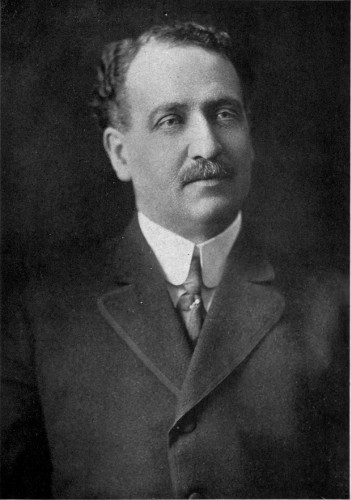
EDMOND BROSSARD
In October, 1900, Mr. Brossard was united in marriage to Mlle. Alice de Lorimer and they are well known in social circles of the city. Mr. Brossard is a man of considerable literary attainments, possessed of a clear, lucid and forceful style in writing and the ability to present his ideas in a concise and able way. He is an occasional contributor to the press and to law reviews, and his name is a synonym for efficiency and comprehensive knowledge in everything relating to the legal profession. He is one of Montreal’s prominent, able and successful barristers and in a profession where advancement depends almost entirely upon individual merit and ability he has risen steadily, holding today a place of prominence and possessing in his native talents and developed powers the guarantee of still greater attainment in the future.
AIME GEOFFRION, K. C.
Aime Geoffrion, treasurer of the council of the bar and one of those at the head of the French section of the Montreal bar, as well as holding one of the civil law professorships at McGill, occupies a distinguished professional position. He was born in Montreal, November 13, 1872. Fortunate is the man who has back of him an ancestry honorable and distinguished, and happy is he if his lines of life are cast in harmony therewith. In person, in talents and in character Aime Geoffrion is a worthy scion of his race. His father was the late Hon. C. A. Geoffrion one of the leading members of the bar, minister without portfolio in the Laurier government, and his mother was Eulalie G. Dorion, the eldest daughter of the late Chief Justice Sir A. A. Dorion. In the acquirement of his education Aime Geoffrion attended successively St. John’s school, St. Mary’s (Jesuit) College and McGill University. Having determined to enter upon the practice of law, he prepared for the profession at McGill and was graduated B. C. L. in 1893, being also a gold medalist. He began practice as an advocate in 1894 and within nine years had won such success that he was created a king’s counsel. He occupies an enviable position in his profession, and in addition to his appearance before Canadian courts he has pleaded on several occasions before the judicial committee of the privy council. He was one of the counsel retained by the province of Quebec in the arbitration between the Dominion and Ontario and Quebec for a settlement of outstanding accounts existing at the time of the confederation. He was also made the junior Dominion counsel in the matter of the Alaskan boundary arbitration in 1903-4. When he expresses himself upon questions of vital importance to city or province his opinions are listened to with attention and interest, for it is recognized that he is a farsighted and public-spirited man who has the municipal, provincial and Dominion welfare close at heart. He is not only recognized as the distinguished lawyer but also as a most able educator along professional lines, having since 1905 been professor of civil law in McGill University, in which position he succeeded Mr. Justice Fortin.
In November, 1896, Mr. Geoffrion was married to Miss Marguerite Thibaudeau, the eldest daughter of the late J. R. Thibaudeau, senator of Montreal. Mr. Geoffrion gives his political allegiance to the liberal party and is stanch and warm in support of the principles in which he believes. His religious faith is that of the Catholic church. He is a member of several of Montreal’s leading clubs, including St. James Club, and the Montreal Reform Club, and also of the Rideau Club of Ottawa. Sir Wilfrid Laurier spoke of him as “one who well sustained the hereditary glories of his house.” The Montreal Star has referred to him as “a man of a remarkably clear and vigorous mind who has been highly successful before all the courts.” He is widely recognized as a man of earnest purpose, seeking ever to benefit by those activities and interests which look beyond the exigencies of the moment to the possibilities and opportunities of the future, and which seek provincial welfare rather than the aggrandizement of self.
LAWRENCE MACFARLANE.
Lawrence Macfarlane, member of the well known firm of Lafleur, Macdougall, Macfarlane & Pope, barristers and solicitors, was born in Montreal on the 12th of November, 1876, a son of the late James Ferrier and Cecilia Clare Macfarlane. He was a student in the Montreal high school and then entered McGill for his arts course, graduating with the degree of B. A. in 1897. He pursued his studies in the law department of McGill and obtained the degree of B. C. L. in April, 1900. He was called to the bar in the same year and was admitted a partner in the law firm headed by the late R. D. McGibbon, K. C., with whom he had previously studied for three years. As representing English interests Mr. Macfarlane is a director of the British Columbia Breweries, Limited; the North Saskatchewan Land Company, Limited; the Alabama Traction Light and Power Company, Limited; Terminal Cities of Canada, Limited; Mexican Northern Power Company, Limited; and the Cities Service Company.
Mr. Macfarlane’s political allegiance is given to the conservative party. He belongs to St. Paul’s Lodge, Masons, English Register, and he also has membership in the more important clubs of his native city, including the St. James, Canada, Royal Montreal Golf, University and Racquet Clubs.
JOSEPH CHARLES WRAY.
For many years the name of Joseph Charles Wray figured in connection with the undertaking business in Montreal, but in July, 1907, he retired from active management of a business which had been established by his grandfather in 1840. Mr. Wray was born in Montreal on the 25th of March, 1857, and is descended from Irish ancestry, his parents being William and Marion (McGregor) Wray, the latter of Scotch lineage. The father came to Montreal at an early age with his father. The latter, Joseph Wray, established an undertaking business in 1840 and was joined by his son, William Wray in its conduct and management. The business was originally conducted under the name of Joseph Wray, but upon the death of the grandfather, William Wray succeeded to the ownership and management of the business, which he afterward conducted under his own name. However, his health failed him about six months later, and he was obliged to retire from active business. He was then succeeded by his son Joseph Charles Wray.
The last named had been a pupil in the public schools of Montreal and after putting aside his text-books became connected with the confectionery business in the employ of James Griffin. At length he entered the undertaking business that had been established by his grandfather, and when his father was forced to retire from the management Joseph Charles Wray assumed control and conducted the business under his own name for thirty years, his patronage growing with the development of the city. In July, 1907, however, the firm style was changed to Joseph C. Wray & Brother, and Mr. Wray of this review retired from active management, being succeeded by his youngest brother, Frederick A. Wray, who has always been connected with the business. The Wrays were the first to establish ambulance work in Canada in connection with the hospitals, and they now own the ambulances used in connection with the hospitals of the city. They began this in July, 1883, and the value of the work done by them can be scarcely overestimated, the ambulance service largely annihilating time and distance in cases of emergency, bringing the patient to medical and surgical aid with as little discomfort as possible.
On the 7th of September, 1900, in Trinity church, Mr. Wray was united in marriage to Ellen Louise Gibbon, a native of Wales. They are members of the Church of England, and Mr. Wray is identified with Mizpah Lodge, I. O. O. F., and Elgin Lodge, No. 7, A. F. & A. M. He votes independently, exercising his right of franchise as his judgment dictates. He has long since won place among the prosperous men of the city, his position being attributable entirely to his close application and honorable business methods.
OSCAR DESAUTELS.
Of distinguished French-Canadian ancestry, Oscar Desautels worthily wears the family name and worthily carries forward the family traditions. He is a successful notary of Montreal, in which city he has many interests. His Canadian ancestry goes back to Pierre Desautels, who was born of the marriage of Thomas and Marie (Buisson) Desautels, of Malicerne, in the bishopric of Mans, France. Pierre Desautels married Marie Remy and to them was born Joseph Desautels at Montreal on the 29th of October, 1666. He married Marie Charlotte Chatillon, and they became the parents of a son, Michel, who was born at Pointe-aux-Trembles, Montreal, October 1, 1701. Michel Desautels married Louise Catherine Bergeron, and their son Michel was born at Sorel in 1727. He married Marie Charlotte Rondeau, and they became the parents of a son, Michel, who was born at St. Ours on the 11th of August, 1759. To this Michel Desautels was born a son, Michel, at Beloeil in 1796. He married Josephte Morin, and their son Elzear was born at St. Jean Baptiste, November 25, 1827. He was the father of our subject. His wife was Malvina Guertin, and their son Oscar was born at St. Jean Baptiste, April 26, 1872.
Oscar Desautels pursued a classical course at the Petit Seminaire of Ste. Marie de Monnoir at Marieville and was graduated in June, 1893, with the Bachelor of Arts degree. From 1893 to 1898 he studied law at St. Hyacinthe, in the office of Taché & Desautels, notaries. He was admitted to practice on September 10, 1898. On November 1st of that year he established himself as a notary at Montreal and in the evening kept an office in the town of St. Louis. His entrance into the legal profession and his first years thereafter were arduous but his ability, energy and honesty led him to success. During the first ten years—as is so often the case in professional careers—his clientele grew slowly. He was notary of the corporation of the town of St. Louis and also of the school commission of the various parishes of the town of St. Louis and is counsel for various other important institutions. He enjoys today a numerous and representative clientage which recruits itself largely from the old town of St. Louis, which is now the ward Laurier of the metropolis. Mr. Desautels is interested in various enterprises, largely along real estate lines, among which is La Compagnie Nationale d’Immeubles, of which he has always been one of the directors. He has interested himself actively in mutual societies and has held official positions in nearly all those societies established in the town of St. Louis.
At Beloeil, on the 8th of June, 1903, Mr. Desautels was united in marriage to Miss Corine Bernard, a daughter of Elophe and Mathilde (Lafontaine) Bernard. To them have been born four children, Bernard, Robert, Thérèse and Bruno. Mr. Desautels gives his political allegiance to the liberal party and is treasurer of the Liberal Club of the town of St. Louis. He is an effective worker for his party, in which he enjoys great prestige. An excellent notary and public-spirited citizen, he is highly esteemed and respected by all who know him. As a notary he enjoys the highest reputation as to ability and integrity, and more and more important interests have come under his direction as the years have passed.
ZEPHIRIN HEBERT.
Zéphirin Hébert, president of the wholesale grocery firm of Hudon, Hébert & Company, Ltd., the leading concern of its kind in Canada, was born in Montreal, February 6, 1866, the son of Charles P. Hébert, who was the first president of the above mentioned firm. In 1883 Zéphirin Hébert became connected with the business of which he is now the head. In 1893 he was admitted as a partner. In 1906, on the incorporation of the company, he became assistant manager and a director. In 1908 he was elected to the office of vice president and in 1911 succeeded his brother, the late Albert Hébert, as president. For about twenty-five years he has been a member of the Montreal Board of Trade and since the 1st of February, 1913, he has served on the council of that body, and in December, 1913, was elected a member of the transportation bureau of that organization.
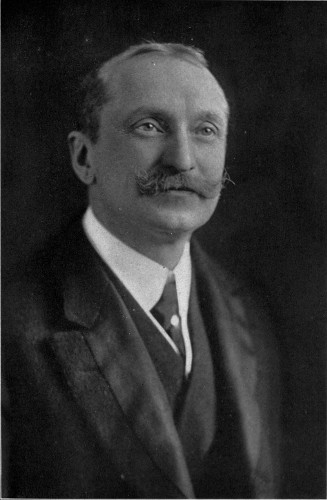
ZEPHIRIN HEBERT
Mr. Hébert is president of the Dominion Wholesale Grocers Guild, chairman of the prize committee for the province of Quebec, president of the Montreal Wholesale Grocers Guild, president of the Montreal Wholesale Liquor Association, treasurer and governor of Notre Dame Hospital, governor of the Montreal General Hospital and governor of Laval University. He is also a member of the Canada Club, the Montreal Jockey Club and L’Association St. Jean Baptiste.
Mr. Hébert married Miss Blanche Robidoux and their four children are, Marielle, Gertrude, Charles P. and Jacques R.
REV. WILLIAM O’MEARA.
A man of scholarly attainments, great force of personality and broadness of mind, Rev. William O’Meara has made these qualities the basis of many years of successful work as rector of St. Gabriel’s church in Montreal and in the promotion of the work along many lines in which the Catholic church is interested. He was born in Sherrington, Quebec province, May 6, 1857, and is one of twelve children born to the late Captain William and Judith (McManus) O’Meara, the former a native of Waterford, Ireland, who came to Canada in 1832.
Rev. William O’Meara acquired his early education in the grammar schools of Sherrington, and later entered the College of Ste. Thérèse, where he took a classical course, graduating with the degree of B. A. in 1880. He then entered Grand Seminary in Montreal, where he pursued his theological studies for three years and a half, being ordained to the Roman Catholic priesthood December 22, 1883. He was first made curate at St. Ann’s church in this city and was then transferred to St. Cecelia’s parish in Valleyfield, where he remained as assistant from 1884 to 1889. In the latter year he came to St. Gabriel’s church, Montreal, and in January, 1890, was made rector, a position which he still holds. This parish was organized in 1873 as a mission from St. Henry’s parish and was made an independent congregation two years later. The first church was a wooden structure, presided over by Rev. John J. Salmon, and here services were held until 1891, Rev. Thomas McCarthy succeeding the first parish priest. The new church was started in 1891 by Father O’Meara and was completed in 1894, at a cost of one hundred and fifteen thousand dollars. It is a beautiful structure, built of limestone, in the Roman and Byzantine styles of architecture, having a capacity of one thousand people and the dimensions being one hundred and sixty by seventy feet. There is a main altar of white wood, a chancel rail of oak and stations of the cross which are fine specimens of work in terra cotta. Father O’Meara built in 1895 a parish house costing eleven thousand five hundred dollars, and the entire church property is valued at one hundred and fifty thousand dollars. The affairs of the congregation, which numbers eight hundred families, are administered in a capable and farsighted way, Father O’Meara having proven himself a reliable business man as well as an earnest and consecrated worker in the cause of religion. He is particularly interested in the schools of his parish and has now erected two excellent institutions of learning, which are conducted in connection with his church. These are a school for boys, built at a cost of thirty-seven thousand dollars, and an academy for girls, representing a value of fifty-five thousand dollars.
Father O’Meara was formerly a governor of the Catholic high school of Montreal and was on July 1, 1905, appointed a Catholic school commissioner. He was elected chairman of the commission in 1910 and since that time has been accounted one of the prominent educators of the city as well as one of the greatest individual forces in the promotion of Catholic education. He has given a great deal of time and attention to this work and in 1907 was sent as a delegate to the Dublin International Exposition in order to study the national school systems of Ireland, France, England and Belgium. He is interested in the work of St. Gabriel’s Total Abstinence and Benefit Society, of which he is president, and he has recently been appointed honorary canon of the archdiocese of Montreal. He has, indeed, accomplished a great deal of important and constructive work among the people of his parish, and he holds their love in large measure, while he enjoys the confidence and respect of people of all denominations. He has demonstrated that the business affairs of St. Gabriel’s parish are in the hands of a farsighted, capable and energetic man, while his religious zeal is evidenced in his constant and untiring labor in the promulgation of the doctrines in which he believes. He is widely and favorably known in Montreal and has earned mention by the Montreal Gazette as “a broad-minded, well informed, energetic and popular priest.”
LOUIS BEAUDOIN.
In commercial circles of Montreal, Louis Beaudoin is widely known as president of Beaudoin Limited, accountants and auditors. Louis Beaudoin of this review occupies the executive position in this firm, and Gérant L. M. Philéas Beaudoin is secretary-treasurer. They maintain offices at 33 Notre Dame Street West and have been eminently successful in their line, enjoying an extensive and important clientage. Louis Beaudoin was born August 29, 1869, in Repentigny, L’Assomption county, Quebec, and is a son of Pierre and Melina (Lachapelle dit Jeannotte) Beaudoin, the former a well known agriculturist of Repentigny. The paternal grandparents of our subject were Pierre and Adelaide (Rochon) Beaudoin, the former also a farmer of Repentigny. The great-grandfather, Jean Baptiste Beaudoin, also followed that occupation at the same place. The maternal grandfather, Pierre Lachapelle, was an agriculturist of Mascouche. The Beaudoin family is historically known in two variations, that of Baudoin and Bodin. The earliest record of a member of this family goes back to Alexis Beaudoin, born in 1694, who on November 27, 1720, married at Ste. Croix, Angeline Houde and had seven children. Of these his son Louis married Louise Barrat, at Montreal, on May 6, 1748, this being the first mention of the family in Montreal archives.
Louis Beaudoin acquired his education in the College de L’Assomption and began his career in the grocery business, also being connected with butchering and merchandising. He subsequently became president of Beaudoin Limited and has since given his entire attention to the extension of the interests of that firm. Recently a line of Assyrian products has been added. Natural ability and keen observation of existing conditions make him eminent in his profession, and he is today recognized as one of the foremost men in his line in Montreal.
On February 4, 1889, Mr. Beaudoin was united in marriage to Evelina Legault dit Deslaurier, a daughter of Jean Baptiste Legault dit Deslaurier. The father for many years has been connected with commercial interests. Mr. and Mrs. Beaudoin have the following children: Philéas, Coramance, Armand, Honoré, Adrien, Aurélien, Albert, Adolphe, Laurent, Amedée, Eveline and Clément Marcel. In his political views Mr. Beaudoin is a liberal, stanchly upholding the principles of his party. Although he has never cared to participate in public life he has done much toward promoting worthy public enterprises. He is a valued citizen of Montreal, prominent in commercial circles and effective in his private capacity in furthering the interests of the city, where he has been so long and so successfully engaged in business.
THOMAS J. DAWSON.
“Not the good that comes to us but the good that comes to the world through us is the measure of our success.” Judged by this standard, Thomas J. Dawson was a most successful man. His life measured up to the standard which all men acknowledge good. His record was as an open book which all might read and there were many who bore testimony to his kindness of heart and his generous spirit manifest in active effort for the alleviation of hard conditions of life for the unfortunate and for practical improvement along the line of civic and moral reform. Mr. Dawson was born at Knockmanoul, Ireland, April 29, 1843, and spent his early life in Dublin and Belfast. His parents, Rev. Abram and Anne (Graham) Dawson, were both natives of the Emerald isle. The father was a minister of the Methodist Episcopal church and coming from Ireland to the new world engaged in preaching in Ontario near Kingston. Thomas J. Dawson came to Canada in 1864 and spent several years at Sydenham and Guelph, Ontario. In 1870 he arrived in Montreal, from which date until his death he was actively engaged in commercial pursuits. For fifteen years prior to his demise he was connected with the custom service and during the latter part of that period was the appraiser in the postoffice department.
Mr. Dawson was a splendid type of the Irish gentleman, possessing native wit and humor and scattering cheer wherever he went. His geniality and cordiality ever made him popular in social circles and his friends were almost as numerous as his acquaintances. His spirit of benevolence was one of his strongly developed characteristics and, again and again, found expression in tangible effort for the benefit of others. He was deeply interested in the Irish Protestant Benevolent Society, was a life governor of the Montreal Homeopathic Hospital, was for years secretary of the Old Brewery Mission and was an active member of the Westmount Methodist church, which numbered him among its earnest, helpful workers. Any movement tending to bring about civic or moral reform received his indorsement and cooperation. In 1866, upon its organization, he became a member of the Young Men’s Christian Association, retaining his membership until his death, and to the support of which he contributed liberally. He gave, too, of his time and efforts for its upbuilding and always took a most active interest in young men, realizing how necessary are uplifting influences in the plastic age. Life was to him purposeful and fraught with opportunity for good, which he did not neglect, and when he passed away October 21, 1910, he left behind him a memory that is a benediction to all who knew him.
In 1876 Mr. Dawson was married to Miss Louisa Holland, daughter of George A. Holland, who came from Ireland as a young man and was the active head of the G. A. Holland & Son Company, dealers in wall paper, established by him in 1843. He built up that business to large proportions and remained in close identification therewith until his demise. His wife, who bore the maiden name of Marian Hutchins, was a native of Canada. He was one of the volunteer firemen of Montreal at an early day and he passed away in this city in July, 1882. Mr. and Mrs. Dawson had three children: Ralph H. of Montreal; Arthur B. of Calgary; and Mabel L., the wife of R. Macaulay Cushing, and they have two children, Dorothy M. and Arthur M.
LOUIS ALFRED ADHEMAR RIVET.
“A man of ideas; a man with a future; a coming man,” is the way the Toronto Globe describes Louis Alfred Adhemar Rivet, of Montreal, and all who have come in contact with him during the course of his brilliant and successful career as a barrister and legislator fully concur in this opinion, adding also that he is one of the most able members of his profession in Quebec province, a distinguished statesman and one of the greatest of the younger generation of French Canadians. He was born in Joliette, Quebec, on the 15th of September, 1873, and is a son of Charles and Herminie (Michaud) Rivet, of French Canadian origin.
In the acquirement of an education Mr. Rivet attended Joliette College and Laval University, from which institution he was graduated B. A. in 1892 and LL. B. in 1895, in the same year being called to the bar as advocate. He was made king’s counsel in 1906 and for a number of years has been practicing successfully in Montreal, where he is ranked among brilliant and forceful barristers. For a time he was associated with the late C. Beausoleil, M. P., but the death of the latter severed this connection and subsequently he became associated with other firms, the present one being Rivet, Glass & Sullivan. He is recognized as a strong and able practitioner, a barrister whose knowledge of underlying legal principles is comprehensive and exact and whose application of points of law is always correct and logical. His keen and incisive mind grasps quickly all the details of the most intricate case, seizes upon the most telling points and arguments, and his presentations are models of conciseness and accuracy. Mr. Rivet has thus won distinction in his chosen profession and has secured a representative clientage in Montreal connecting him with a great deal of notable litigation. He has been interested and active in affairs affecting the Montreal bar, his ability being widely recognized in professional circles.
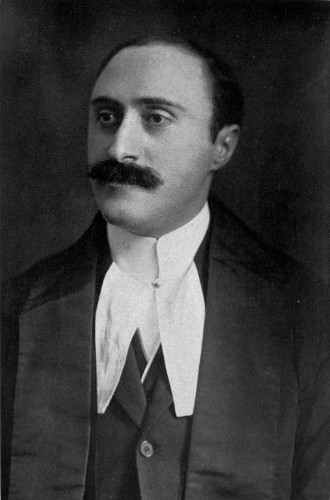
L. A. RIVET
As is often the case, Mr. Rivet’s success in law has carried with it prominence in politics and his interest in the growth and welfare of the province has carried him forward into important political relations. At the bi-election of 1904 he was returned to the house of commons and, representing Hochelaga in that body, served with ability and distinction until 1911. During this time he accomplished a great deal of constructive and important work in statesmanship, leaving the impress of his personality and standards upon useful, and beneficial legislation, his vote and influence being always on the side of right, reform and progress. A stanch liberal, Mr. Rivet has always supported the principles and policies of that party and has been one of the greatest individual forces in its expansion in Montreal, where he founded the St. Gabriel Liberal Club, of which he served as president in 1898. He has been a director of the Montreal Reform Club. He calls himself an imperialist and is one in the sense that the greatness of the empire depends to a great extent on the fair development of the colonies. He is, however, a stanch advocate of Canadian customs and institutions and has done as much as any one man in the Dominion to promote their spread and growth. Although of French Canadian extraction he speaks English fluently and often addressed the house of commons in that language. In a lecture on the dual language of Canada delivered before the Nomads’ Club in 1909 he advocated Canada as a bi-lingual nation and he has done much to promote the fusion of the two great nations which dominate the country. He also addressed the Canadian Club in Ontario, advocating closer relations between the two races, in view of national unity.
Mr. Rivet married in January, 1898, Mlle. Rose Cypihot and both are widely and favorably known in social circles of Montreal. Their children are: Gaston, born June 23, 1901; Marguerite, January 10, 1904; and Gerard, January 24, 1906.
Mr. Rivet has extensive and important club affiliations, belonging to the Club St. Denis, the Club Canadien de Montreal and the Reform Club, and socially is found to be genial, charming and constantly courteous. In his profession he has made continued and rapid advancement and his accomplishments in the political field have been substantial and far-reaching, so that he is well entitled to a high place among the representative and useful citizens of the city where he makes his home.
JOSEPH ALCIDE CHAUSSE.
Since 1900 Joseph Alcide Chaussé has filled the important position of superintendent of buildings and city architect of Montreal and in that position has established for himself an enjoyable reputation. He is one of the foremost men in the profession, not only in the city, but in the Dominion and recognition has come to him from numerous national as well as foreign societies. Alcide Chaussé was born at St. Sulpice, Assumption county, Quebec, Canada, on January 7, 1868, a son of Edouard and Rose de Lima (Rivet) Chaussé, both natives of St. Sulpice, Quebec. The father, a prominent lumberman there and ex-alderman of the city of Montreal, died on March 15, 1909, the mother having preceded him in death, passing away on July 20, 1896. The Chaussé family is of ancient lineage and one of the old-established ones in the province of Quebec. Pierre Chaussé, le Chaudronnier (the brazier), was born in 1630 and was established at St. Anne de la Parade as early as 1681. Pierre Chaussé, another of the name, called la Lumière, was born in 1651, a son of Jean and Catherine (Groleau) Chaussé. He married Marie Madeleine Sel au Deselles on April 24, 1681, and they had five children. These are among the earliest ancestors of Mr. Chaussé recorded in Canadian history.
Alcide Chaussé received his fundamental education at St. Mary’s Academy in Montreal. He studied architecture with the late Alphonse Raza, of Montreal, from the 3d of March, 1884, to the 14th of March, 1887. From the 17th of March of that year until July 24, 1889, he was in Chicago, perfecting himself in the profession, and was admitted to practice in 1888. On the 20th of November, 1889, he opened an office for the practice of architecture at Montreal and continued with ever increasing success until May 21, 1900, when he was appointed to his present important position. A wide and comprehensive knowledge fits him particularly for this work and Mr. Chaussé has been in a large measure responsible for the upbuilding of the city along lines of the “plan beautiful.” He also holds the position of commissioner of the superior court for the district of Montreal and that of justice of the peace for the same district.
Mr. Chaussé is a charter member of the Province of Quebec Association of Architects, of which he served as president in 1906. In 1907 he was the promoter of and since its inception is, honorary secretary and a member of the Royal Architectural Institute of Canada; is an associate of the Canadian and American Societies of Civil Engineers; a member of La Chambre Syndicale de la Construction; a member of the Board of Plumbers’ Examiners in Montreal; chairman of the committee on fire prevention of the American Society of Municipal Improvements; a member of the American Public Health Association; a member of the council of Le Comité Permanent des Congrès Internationaux des Architectes; member of the British Fire Prevention Committee; corresponding member of La Société Centrale des Architectes Français; the American Institute of Architects; La Société Centrale d’Architecture de Belgique; La Société Nationale des Architectes de France; Architekten-Verein at Berlin, Germany; Sociedad Central de Architectos, Madrid, Spain; and the Society of Portuguese Architects. He is a member of the council of the Antiquarian and Numismatic Society. Mr. Chaussé has been awarded gold, silver and bronze medals by various architectural societies for technical papers and lectures. He was a member of the International Congress of Architects held at Paris in 1900; at Madrid, in 1904; and London, England, in 1906; and of the International Fire Prevention Congress, held at London in 1903; a delegate to the Sixth Commercial Congress of the Empire, held at London, in 1906. In 1907 he conceived the project for the Institute of Architects of Canada. He is the author of several articles on fire prevention and fire protection; of the “Building Inspector’s Handbook,” published in 1902; the “Code of Building Laws of the Province of Quebec,” published in 1906; the “Handbook of Building Laws of Montreal”; and the “Supplement to the Code of Building Laws,” published in 1913, all of them published in English and French.
At Ste. Bridgide’s church, Montreal, on Saturday, September 8, 1894, Mr. Chaussé was united in marriage to Miss Rose de Lima Renaud, a daughter of Cyrille Renaud and Rose de Lima (Favreau) Renaud, both of Montreal. The father is a well known manufacturers’ agent of this city. Mr. and Mrs. Chaussé have two sons: Marcel, who was born July 7, 1902, and Fernand, born December 29, 1904. Mr. and Mrs. Chaussé are members of the Blessed Sacrament Congregation, Church of the Holy Sacrament, on Mount Royal Avenue.
The political views of Mr. Chaussé coincide with the principles of the conservative party. He is a member of Le Club Canadien of Montreal, a member of L’Alliance Nationale, of which he served as grand marshal; and a member of the Association of St. Jean Baptiste, of which he has been president of Ste. Bridgide’s Section. He was also president of the Cêrcle Jeanne D’Arc of L’Alliance Nationale. Fraternally he is a member of the Knights of Columbus. Mr. Chaussé finds recreation in curling and is a member of the St. Lawrence Curling Club of Montreal. His city residence is at No. 1433 St. Hubert Street, while the summer home of the family is Villa Iris, Sault-au-Recollet.
MORTIMER BARNETT DAVIS.
Manufacturing interests of Montreal find a prominent representative in Mortimer Barnett Davis, one of the leaders in the tobacco trade of the Dominion, being active in the management of an enterprise of mammoth proportions. It is true that he entered upon a business already established, but in enlarging and developing this many a man of less resolute spirit and of more limited business sagacity would have failed. Each step he has taken in the business world has been one of progress, bringing him a broader outlook and wider opportunities.
Mr. Davis was born February 6, 1866, in Montreal, a son of Samuel and Minnie (Falk) Davis, the former the founder of the firm of Samuel Davis & Sons, manufacturers and importers of cigars at Montreal. Mortimer B. Davis completed his education in the high school of his native city and early became associated with his father in business, receiving thorough training that acquainted him with every phase of the trade. He went upon the road as a traveling salesman and eventually was advanced to the position of manager after the firm had acquired the D. Ritchie Tobacco factory. He controlled the business most systematically and, finally, when it had been absorbed by the formation of the American Tobacco Company of Canada in 1895, he became president of the company and so continues. Later he gave to the country a great national industry in the Empire Tobacco Company, which is a branch of the Imperial Tobacco Company of Canada. He was largely instrumental in establishing a permanent market for Canada leaf tobacco and promoting trade interests in his line between this and other lands. Something of the volume of business under his control is indicated in the fact that there are now three thousand workmen in his factories. No undertaking in connection with the tobacco trade seems too difficult or its scope too broad for him to successfully manage and control. Every effort which he puts forth seems to count for the utmost and obstacles and difficulties in his path seem but an impetus for renewed concentration and direction. His opinions carry weight in the management of other important financial, commercial and agricultural interests.
On the 12th of June, 1898, Mr. Davis was married to Miss Henrietta Myers, and they have one son. Mr. Davis belongs to the Royal Montreal Golf Club, and also holds membership in the Mount Royal, St. James, Montreal Hunt and Montreal Jockey Clubs, the Auto Club of Canada and the Forest and Stream Club, associations which indicate something of the nature of his interests and activities and which have brought about a well rounded character, justifying the expression of the Gazette, which termed him “a man of strength, vigor, capacity and wisdom.”
RENE ALPHONSE JOSEPH PIGEON.
René Alphonse Joseph Pigeon, patent solicitor of Montreal, member of the firm of Pigeon, Pigeon & Davis, was born at Billingsbridge, near Ottawa, on the 11th of July, 1890. The ancestral line can be traced back to Pierre Pigeon, who was born in 1636 and was married in Montreal to Jeanne Godart, who was born in 1638. Their marriage occurred in 1662, twenty years after the foundation of Montreal. Representatives of succeeding generations have lived in or near Montreal, some going to Laprairie and others to Verchères. The father, Hormisdas Honoré Pigeon, was born at Verchères, in Verchères county, P. Q., and after having lived for some years in the United States removed to Ottawa, where he has now been engaged in business for more than thirty years. He married Marie Tremblay who was born at Baie St. Paul, Charlevoix county, and was married in 1889. The Tremblays were among the earliest settlers of that section.
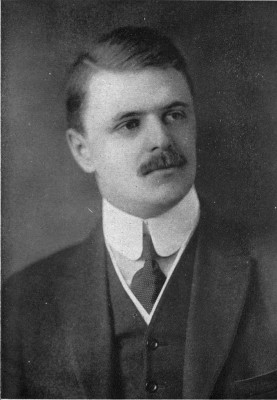
RENE A. J. PIGEON
René Alphonse J. Pigeon was a student in the University of Ottawa, completing his studies there in 1907. He afterward studied mechanics and electricity and entered upon his professional career as draftsman in the office of Fetherstonhaugh, Dennison & Blackmore, patent solicitors at Ottawa. After a year he was promoted to the position of manager of their Ottawa office and was in the employ of that firm for four years. In 1912 he left them to establish himself in business in Montreal as a member of the present firm of Pigeon, Pigeon & Davis. Previous experience and thorough collegiate and professional training have well qualified him for the responsibilities, activities and duties of the profession. He is a typical young man of the age, alert, enterprising and progressive and is now at the head of a large, growing and successful business.
REV. JOSEPH N. O. DUPUIS, D. D., D. C. L.
In the life of the Catholic church of Canada Rev. Joseph Nazaire Odilon Dupuis occupies a foremost position as inspector and visitor of a number of parish schools which are attended by over thirty thousand children. He was chosen to this important office in 1913 by twenty-seven school commissions in Montreal which are formed into an association, and has done fruitful work in promoting education in the city.
Rev. Dupuis was born at Montreal on the 16th of December, 1871, and is a son of Nazaire Dupuis, founder of the commercial house of Dupuis Frères, and of Alphonsine (St. Onge) Dupuis. He pursued his classical studies at the College of Montreal and in June, 1890, entered ecclesiastical orders. He was ordained priest by Monseigneur Fabre on August 30, 1896. From 1896 to 1899 he studied at the Canadian College of Rome, Italy, returning from there with the degree of Doctor of Theology, bestowed by the propaganda in 1898, and the degree of Doctor of Canon Law, bestowed in 1899 by Apollinaire College. From 1899 to 1900 he studied at the Catholic Institute of Paris and at the Sorbonne. In the latter year he returned to Canada, becoming vicar of the Church of St. Jacques at Montreal, where he remained until 1902, when he was attached to the congregation St. Louis de France, remaining until 1904. He was appointed almoner of the Convent of the Sisters of the Sacred Heart of the Sault au Récollet, where he remained for about nine years. At the same time he acted as chaplain at the Crèche of the Sisters of Miséricorde. In 1913 he was chosen by twenty-seven school commissions of Montreal, formed into an association, as a visitor and inspector of all the schools under the control of these commissions, having under his jurisdiction thirty thousand children divided over forty different parishes and eighty-two schools. Rev. Dupuis was one of the founders of Lafontaine Council of the Knights of Columbus. He is life governor of Notre Dame Hospital and is professor at Laval University and the author of several lecture papers. He has been heard as a preacher in nearly all of the churches of Montreal. Rev. Dupuis is a great lover of fine arts and literature and spent his last holidays in Italy and Spain, paying especial attention to the masterpieces of those countries.
HARRY HAYWARD HENSHAW.
Harry Hayward Henshaw, whose name was well known in electrical circles died in Montreal, his native city, May 15, 1908. He was born in 1865, a son of Joshua Henshaw, who for many years was paymaster with the Grand Trunk Railway. His mother bore the maiden name of Jane Fayrer and in the family were two sons and a daughter: Charles G., now living in Vancouver; Harry Hayward; and Lady Williams Taylor.
After pursuing his education in Montreal schools, Harry Hayward Henshaw obtained a position with the Grand Trunk Railway and afterward spent twenty years with the Royal Electric Company, gaining intimate and comprehensive knowledge of the various phases of the business, during the two decades of his identification therewith. When the Royal Electric Company became a part of the amalgamation forming the Montreal Light, Heat & Power Company he became secretary and treasurer of the new company, remaining thus for many years, on the expiration of which period he became manager of the Allis-Chalmers Company, manufacturers of electric machinery. He had been with them for only a few months when ill health forced him to resign. Throughout almost the entire period of his business career he was connected with electrical interests and came to be a leading figure in electrical circles.
In Montreal in 1895 Mr. Henshaw was married to Florence Thompson Christie, a daughter of Peter M. and Margaret (Thompson) Christie, the latter being a daughter of Edward Thompson, a prominent citizen of Montreal serving as alderman from the Centre ward and rendering the city much valuable service. He was mainly instrumental in the widening of Notre Dame Street during his term of office, and in recognition of his efforts for this work he was publicly presented with a handsome silver service on Christmas Day, 1859. The paternal grandfather of Mrs. Henshaw, William Christie, came to this city at an early day and was active in the soap manufacturing business until late in life when he retired. He was a prominent church man, being for forty years an elder in St. Paul’s church. To Mr. and Mrs. Henshaw was born a daughter, Margaret Fayrer. Mr. Henshaw was a member of St. James Club, Forest and Stream Club, and the Royal St. Lawrence Yacht Club. He belonged to the English Cathedral church and was interested in all that pertained to the city’s development and progress, along material, social and moral lines. His life measured up to high standards of manhood and citizenship and commanded for him the respect, confidence and good-will of those who knew him.
GEORGE CREAK.
George Creak, senior member of the firm of Creak, Cushing & Hodgson, chartered accountants, was born and educated in London, England. His parents were George and Maria Creak, of Clapham, London. For many years he was secretary and treasurer of the Merchants Cotton Company, began practice as a chartered accountant in 1895 and is now at the head of the above firm.
Mr. Creak is a member of the Association of Accountants of Montreal and is a fellow of the Dominion Association of Chartered Accountants. He is a Freeman of the city of London and is a member of the Goldsmiths’ Company, as were his father and grandfather before him. Mr. Creak belongs to the Anglican church and is a member of the Mount Royal Club, the Canada Club, the Art Association of Montreal, the Montreal Hunt Club, and the Board of Trade.
WILLIAM ERNEST FINDLAY.
Since entering business life William Ernest Findlay has devoted his attention uninterruptedly to the insurance profession, and his success is due to his close application, indefatigable energy and thorough understanding of every phase of the business in which he has so long been engaged. Montreal claims him as a native citizen, his birth having here occurred April 26, 1867, his parents being Captain Jonathan D. G. Findlay, R. N. and Mary (Forbes) Findlay, both now deceased. The son acquired his education in the model and private schools and, as previously stated, became connected with the insurance profession upon his entrance into business life. He was manager and inspector of the Northern Life Insurance Company and in 1906 was advanced to the position of general secretary, which he later resigned to devote his entire attention to his other interests. In his connection with the Northern Life he did much to shape the policy of the company and direct its activities, and its success is attributable in considerable measure to his efforts, sound judgment and ready understanding of the different phases of the business. He is now chief agent for Canada of the Niagara Fire Insurance Company of New York, and also for the province of Quebec for the Springfield Fire and Marine Insurance Company and is an authority on fire prevention and underwriting.
On the 8th of February, 1897, Mr. Findlay was married to Laura Brockwill Grier, a daughter of William Grier, of Montreal, in which city they have since resided. Mr. Findlay has an interesting military chapter in his life record, having in 1891 been appointed second lieutenant of the Sixth Regiment Fusiliers. The following year brought him advancement to the rank of captain and in 1904 he became a member of the Corps Reserve. He holds a first class certificate from the Royal School of Infantry. He is a justice of the peace and commissioner of the superior court. He is a life member of Royal Victoria Lodge, No. 57, A. F. & A. M., and a director of the Montreal Amateur Athletic Association. He is honorary secretary-treasurer of the Canadian branch of the Royal Caledonian Curling Club and has always been much interested in athletic affairs.
WALTER NORTON EVANS.
Church activities vied with business interests in claiming the attention and energies of Walter Norton Evans, who died on the 23d of October, 1896. He was born at Wolverhampton, England, in 1837, and after pursuing his education there, came as a young man to Canada. His father, Samuel Norton Evans, also a native of England, crossed the Atlantic to the American continent and spent the last years of his life in retirement in Guelph, Ontario. In business circles Walter N. Evans made for himself a creditable place. He became cashier of the firm of Frothingham & Workman, and was one of the executives of the Thomas Workman building. His identification with the above interests covered a period of nearly a third of a century. His name became a synonym for reliability as well as energy in business circles. Men came to know that they could depend upon him, that what he promised he would do and that he would improve his opportunities not only for his own benefit but for the welfare of those things in which he was concerned.
In 1864 Mr. Evans was married in Montreal to Miss Nora Hunter, a daughter of the Rev. Stephenson Hunter, a minister of the Unitarian church of England. They became parents of five children: Nevil Norton Evans, professor of chemistry in McGill University; Mabel Norton, who is Mrs. George. C. Wright, of Ottawa; Dr. Percy Norton Evans, professor of chemistry in Purdue University, at Lafayette, Indiana; Lillian Norton, the wife of Professor Henry Martyn MacKay, head of the civil engineering department at McGill University; and Miss Gladys Norton Evans, at home.
Mr. Evans was deeply interested in affairs of public moment, kept well informed concerning the claims of vital interest and gave his indorsement to many measures that are a matter of civic virtue and civic pride. For many years he was prominently and actively connected with the Unitarian church and for a long period served as superintendent of its Sunday school. High were the ideals which his life activities embodied and the name which he left to posterity is an honored one.
HON. LAURENT OLIVIER DAVID.
Hon. Laurent Olivier David, senator and journalist, possesses a statesmanlike grasp of affairs that has enabled him to handle important public questions in a manner that has largely influenced public opinion. Prominent and active, however, as he has been in the field of journalism and in politics, literature is perhaps his real life work and his writings will endure for years to come, especially the important historical volumes of which he is the author. A native of Sault au Récollet, Quebec, he was born March 24, 1840, a son of Major Stanislas and Elizabeth (Tremblay) David. He pursued his education in St. Therese College and after thorough preparation for law practice was called to the bar in 1864. While yet a law student he entered the field of newspaper publication in the founding of Le Colonisateur, to which he was a contributor. He would undoubtedly have won prominence in the practice of law had he continued in that field, but the trend of his mind was rather for the discussion of public questions of vital significance and far-reaching importance. He was particularly interested in the question of the impending confederation which so altered the destiny of the Dominion. It was during the period of his early manhood that he became associated with Sir Wilfrid Laurier, and the friendship then formed between them has since existed. There was little indication at that period to show that Laurier, the young lawyer, who was forced to practice the most rigid economy, would in future years, as prime minister, guide the destinies of his country. Long after he had risen to prominence Mr. David became his biographer, his history of the eminent liberal leader being marked by delicate sympathy, inner knowledge and keen and subtle appreciation of character.
Continuing his activity in the journalistic field, Mr. David, in 1870, established and became chief editor of an illustrated weekly called L’Opinion Publique, which he left because he objected to the paper’s supporting the government on the question of the Pacific scandal. He made in that circumstance an important sacrifice of his personal interest. In this enterprise he was associated with Messrs. Mousseau and Desbarats. In 1874, in association with the late C. Beausoleil, M. P., he established Le Bien Public, which he discontinued when the Mackenzie government refused to raise the tariff more than a relatively small per cent, which Mr. David thought insufficient in view of the financial crisis then prevailing. His newspaper career as well as his natural interest brought him into close connection with the important political and other significant questions of the day, and his discussion thereof through the columns of the press did not a little in formulating public policy. His presentation of any subject was always clear and cogent. There was a piquant and compelling force in his style, and the development of his native powers and talents in the field of literature has made him one of Canada’s foremost representatives in authorship. During the brief interval between two epochs in his newspaper publication he acted as translator and assistant clerk of the votes and deliberations of the house of commons during the Mackenzie regime. This was the initial step of his activity in public office. He resigned the position in 1878 and afterward successfully practiced his profession in Montreal. In May, 1892, Mr. David was called to the office of city clerk of Montreal and was one of the revisers who drafted a new charter for the city in 1898.
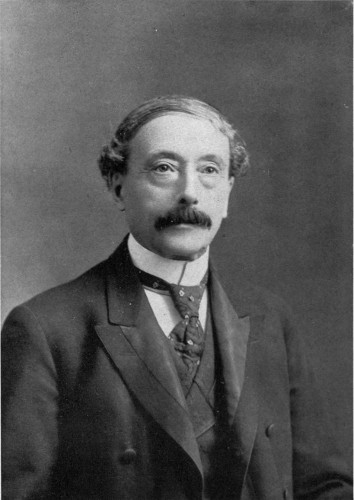
HON. LAURENT O. DAVID
In the meantime he was taking an active part in the discussion of many questions relative to the provincial and national welfare. Originally a supporter of the conservative party, he withdrew therefrom to join L’Union Nationale, an organization of young men pledged to oppose the confederacy of the provinces. Later he joined the liberal party under Dorion, Holton and Laflamme and was in full accord with their policy on all questions save that of protection to native industries, which he had always favored. For many years he has been an unswerving supporter of Sir Wilfrid Laurier, enjoying his personal friendship and political confidence in a supreme degree. In 1867 and 1875 he unsuccessfully contested Hochelaga (local) at the general election, and in 1878 contested Hochelaga for the house of commons, while in 1891 he contested Montreal East for the house of commons. He sat for Montreal East in the legislature from 1886 until 1890, when he retired because he was not entirely in accord with the policy of Mr. Mercier, his local leader. On the 19th of June, 1903, he was called to the senate by Lord Minto and has since taken an active part in shaping the legislative history of the country along the lines of progressive statesmanship. He moved the address in reply to the speech from the throne in 1905, and his speech was highly appreciated by the whole Canadian press. He has since moved on the subject of senate reform and on the subject of concerted measures for the restriction in Canada of indecent and immoral literature, and other subjects of vital interest to the general public. He declined appointment to the lieutenant governorship of the Northwest and it is said that he would have been appointed judge if he had been willing to accept the charge. He was also offered a judgeship in Montreal and refused.
It would be difficult to determine which has been the most important feature in the life record of the Hon. Laurent O. David. Much of his time has been devoted to authorship, in which field he has had marked influence aside from that which he has exerted in journalism. From his pen have come various important historical works, the titles and dates of publication being as follows: Biographies et Portraits (1876); Le Heros de Chateauguay (1883); Les Patriotes de 1837-8 (1884); Mes Contemporains (1894); Les Deux Papineau (1896), Le Clergé Canadien (do.), condemned at Rome and placed on the Index because of the strong position which he took against the intervention of the priest in political matters; L’Union de Deux Canadas 1841-67 (1898); Le Drapeau de Carillon, a drama (1901); Laurier et son Temps (1905); Histoire du Canada depuis la Confédération; and Souvenirs et Biographies (1910). He has also lately published biographies of Charles Le Moyne and of his illustrious sons, d’Iberville, de Bienville, etc. These biographies first appeared in La Presse but will later be issued in book form. He has frequently addressed the public from the platform on such important subjects as National Unity, A Page of Canadian History, etc., and is recognized as one of Canada’s most graceful and instructive writers as well as a much admired public speaker. The Toronto Club has characterized him as “a man of fine literary attainments and high views of national life” and the Toronto News wrote of him, “a man of sincere and enlightened views, excellent abilities and thoroughly informed upon public questions.”
Mr. David was married in 1868 to Mlle. Albina Chenet, who died in July, 1887. In 1892 he wedded Mlle. Ludivine Garceau. His children numbered one son and nine daughters. Next to his home, he holds dear the public interests and is prominently identified with the Society for the Protection of Women and Children of the province of Quebec. He is deeply and helpfully interested in all measures which seek the betterment of the community, and endeavors to shape the public welfare according to the highest ideals. He is a fellow of the Royal Society of Canada and a knight of the Legion of Honor of France, having been appointed in 1911. He has deep attachment for the institutions of his native land, and it has been said of him that “next to his love of Canada is his love for the flag which protects him and his race in all that they hold dear and precious.” He often gives expression to his admiration for the English constitution and does not cease to repeat that it is the most perfect political system of government made by man. He has membership in the Canadian Club and in the Roman Catholic church. From early life he has been deeply interested in the conservation of the French language and customs, especially since the opening of the Northwest, which event seemed to threaten the extinction of the French-Canadians by foreign populations. Accordingly he associated himself with St. Jean Baptiste and other national societies, and it was as president of St. Jean Baptiste Society that he labored to erect the Monument National. Although considered a sincere patriot by his countrymen his patriotism is not narrow, and he is always ready to admire what is done by other people for the advancement and honor of their nationality. He often repeats that the existence of different nationalities in a country is an element of progress and civilization and that Canada cannot but benefit by the work along different lines of the representatives of two of the greatest nations of the world; that the maintenance of French nationality does not conflict with the keeping of British institutions. In his present position as city clerk of Montreal he has displayed admirable fitness resulting from habits of precision and wide knowledge of the civic situation, combined with the courtesy, urbanity and quiet dignity which have ever been among his marked characteristics. He has enjoyed widespread confidence in this position, discharging his duties without regard to partisanship, and the most malevolent have never dared to assail the integrity and honor of his course. His utterances may stir to public thought and action and then, having accomplished their purpose, are in a measure forgotten. His position as an author, however, is established for all time, and in this connection the Montreal Standard has written:
“As a writer he has gained the highest distinction. Like Keats, he has an instinct for fine words. As Goldwin Smith is in English, so Mr. David, among French-Canadians, is the most exquisite writer of his generation. Perhaps the chief charm of his prose lies in its exceeding clarity, and clearness is the first quality in a French writer. There is no man in Canada today who can better propound a synthesis; that also is a luminous feature of his style. But for elegance and clearness he has among his compatriots achieved a position of unique pre-eminence.”
ADRIEN LAFONTAINE.
Since the fall of 1912 Adrien Lafontaine has been engaged in law practice in Montreal. His offices are located at No. 13 La Patrie building and he makes his home at No. 1136 Galt Street, town of St. Paul, Montreal. He was born in the parish of St. Barthélemi, in the county of Berthier, on the 30th of November, 1887, a son of Edmond and Marie Louise (Denis) Lafontaine, the father a well known citizen of Montreal.
Adrien Lafontaine enjoyed a very thorough education. He attended the Academy of St. Barthélemi and from the College of Montreal obtained the degree of Bachelor of Letters in rhetoric and philosophy, studying there during the years 1908 and 1909 with the Fathers of St. Sulpice. He then entered Laval University of Montreal, where he pursued his legal studies and from which he graduated in 1912 as licentiate in law (LL. L.). On the 9th of July, 1912, he submitted to examinations before the chamber of notaries and was thereupon received as a notary, establishing himself as a practicing lawyer on the 30th of October, 1912. His excellent legal equipment gives promise of a distinguished career.
Mr. Lafontaine is interested in a loan company and a mining company. He has been a notary public since the 12th of July, 1912. On March 1, 1913, he joined the Independent Order of Foresters and has been elected to the office of secretary-treasurer of the Préfontaine Court of that organization. Since October 1, 1912, he has been vice president of the Parish Circle of the town of St. Paul. Mr. Lafontaine is prominent among the professional men of the city and has many friends among the younger generation of lawyers. He has already succeeded in gaining a great amount of confidence and good-will among the general public.
JAMES G. DAY.
James G. Day was born in Montreal, December 12, 1834. He had therefore passed the seventy-second milestone on life’s journey, when called to the home beyond. He was one in a family of nine children, whose father, John J. Day, was born in London, but came to Montreal and was one of the most active men of his time in the city. He was particularly interested in all things pertaining to its welfare and progress and his aid in public movements was of a beneficial character.
James G. Day was educated in Montreal and took the law course at McGill University. He was admitted to the bar in Montreal. He engaged in the practice of his profession until 1866, when he was compelled to abandon it because of poor health. After spending one year in the United States he returned to Montreal and became a member of the firm of Hutchins & Company, wholesale tea merchants, and there continued for a few years. He then engaged in the coal business until his failing health caused him to seek a change. He then located at Troy, New York, and there resumed the practice of law, so continuing until his death, January 6, 1907.
It was while a resident of the United States that he was married in Bloomington, Illinois, to Miss Ellen E. Lewis, a daughter of Dr. William Lewis, who was an English Army surgeon and spent twenty years in the West Indies. He was afterward stationed for a time at Halifax and subsequently removed to Chicago, where he lived prior to establishing a home in Morris, Grundy county, Illinois, where his remaining days were passed. He was very active in his profession, being recognized as an able and eminent medical practitioner.
Mr. and Mrs. Day had three sons: Dr. John L. Day, engaged in the practice of his profession in Westmount; Albert J. Day, who is with Greenshields & Company; and Maurice Baldwin Day, acting manager of the Bourbonniere branch of the Union Bank of Canada, at Montreal.
HENRY MILES.
Henry Miles in 1895 became one of the founders of the firm of Leeming, Miles & Company of Montreal, importers and manufacturers of drugs, chemicals and proprietary articles in the drug and grocery lines. He has since been an active factor in the successful control of the business and to other fields of activity has extended his efforts with equally desirable results. He was born in Lennoxville, P. Q., May 8, 1854. His father, the late Henry Hooper Miles, D. C. L., LL. D., a well known historian and for twenty-five years vice principal of Bishop’s College at Lennoxville, afterward became secretary of the Protestant section of the department of public instruction for the province. He married Elizabeth Wilson, daughter of Dr. William Wilson, of Sherbrooke, Quebec.
In the Lennoxville grammar school their son Henry Miles pursued his preliminary education, which was supplemented by study in the high school of Quebec and in the Laval Normal School of the same city. His early business experience came to him through association with the firm of Lyman, Sons & Company, of which he became manager and managing partner, his association with the house continuing from 1870 until 1895, when he separated his interests and in the latter year organized the firm of Leeming, Miles & Company of Montreal for the importation and manufacture of drugs, chemicals and proprietary articles in both the drug and grocery lines. After continuing for a considerable period as managing partner he was elected to the presidency of the company on incorporation. He is also engaged in the manufacture of medicines as proprietor of a business conducted under the style of Dick & Company and he is publisher and editor of the Montreal Pharmaceutical Journal. Even this does not compass the extent of his business activity, for he is president of the National Hydro-Electric Company, Ltd., and managing director of the Carillon Construction & Development Company, Ltd.
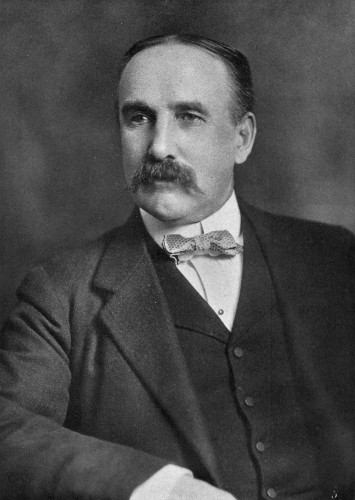
HENRY MILES
Moreover, Mr. Miles is actively and helpfully interested in organizations for the benefit of trade and business conditions. He is a member of the Chambre de Commerce, was treasurer of the Montreal Board of Trade in 1897-98, was vice president in 1899-1900 and in 1901 became president. The present magnificent Board of Trade building stands as a monument to his energy. He is still an active member of the organization, and since 1901 he has been president of the Montreal Business Men’s League, which has been instrumental in effecting many municipal and other reforms. He is likewise president of the Proprietary Articles Trade Association of Canada, secretary-treasurer of the Montreal Industrial Exhibition Association and in 1900 was a delegate to the International Commercial Congress at Philadelphia. In 1905 he was honorary treasurer of the Hon. John Young Monument Committee. Aside from all these interests of a semi-public character his activities have been salient features in the attainment of success for other organizations and for the public good. He has filled the office of justice of the peace and is consul in Canada for Paraguay. He was one of the founders of the Montreal Philharmonic Society and for a time was director of Trinity church choir, both of which indicate his deep interest in music. He represented the Montreal Board of Trade at the funeral of King Edward in London, England, in May, 1910. Fraternally he is a Mason and an Odd Fellow, in sympathy with the purposes of those organizations. His religious faith is that of the Anglican church, and he was for many years warden of Trinity church and the Church of St. James the Apostle. He has also been a member of the synod. His political belief is that of the liberal party. He belongs to the Canada, Montreal and Country Clubs, and those who meet him in these different organizations find him a social, genial companion. He has been a thorough and discriminating student of many questions that pertain to Canada and her welfare, carrying his researches far and wide. In 1880 he was the author of the Prize Questions in Canadian History, having won the first prize, and in 1900 he published an Address on Commercial Education, indicating deep insight into and thorough knowledge of the question. He made the customs’ tariff a special study for years and has written much on that subject.
Mr. Miles was married in 1875 to Miss McGregor, of Montreal. Nature endowed him with qualities, which developed through persistent energy and laudable ambition, have brought him into prominent relations. Inheriting the strong intellectual force of worthy ancestry, he has developed his talents and his powers not only in the control and enlargement of important business interests, but also along lines in which the general public has been the beneficiary.
REV. DAVID BENSON ROGERS.
Rev. David Benson Rogers, since 1911 rector of St. Luke’s Episcopal Church, Montreal, was born in Watford, Ontario, and is a son of John B. Rogers of that city. He acquired his preliminary education in the public schools there and after graduating from the Watford high school entered McGill University from which he was graduated with the degree of B. A. and with first class honors in mental and moral philosophy, in 1906. Continuing his studies he received the degree of M. A. in 1909 and in the same year that of Licentiate in Theology from the Montreal Diocesan Theological College. He was made deacon in the Episcopal church in 1908 and received full orders in 1909 and in the former year was appointed assistant in Grace church, Montreal. In this position he did sincere and earnest work until 1911 when his ability and zeal were recognized in his appointment as rector of St. Luke’s church. He possesses true religious zeal, is earnest, God-fearing and unostentatious in the discharge of his duties and has already accomplished a great deal of consecrated work among his people whose love he holds in large measure. He is moreover a man of initiative spirit and administrative ability, and under his able management the business affairs of the church have been carried forward in an orderly and systematic manner.
On the 19th of April, 1911, Mr. Rogers was united in marriage to Miss Florence Ethel Hurd, eldest daughter of Henry Hurd of Montreal. Mr. Rogers is widely and favorably known in Montreal among his own people and among those of all denominations, and his influence is felt as a potent force in the moral development of the community. The doctrines which he professes he consistently practices, and at all times his life has been actuated by high and honorable purposes and characterized by kindly actions and consideration for others. He realizes fully the obligations which devolve upon him and finds it a privilege to bring his fellowmen to a knowledge of truth and an understanding of those principles of life which bring men into more harmonious relations with the divine law.
CHARLES H. MAGUIRE.
Charles H. Maguire, who figured prominently in insurance circles in Montreal, was born in Quebec in 1858 and died at The Glade, Boisbriand, province of Quebec, July 31, 1907. His father was Hon. Judge Maguire of the superior court of Quebec, a very able and distinguished citizen and jurist, who was born April 15, 1810, and died July 5, 1880. He married Miss Frances Horan, also of Quebec.
Their son, Charles H. Maguire, was educated in the seminary of that city and for a few years was connected with the bank there, thus receiving his initial business training. About 1897 he came to Montreal and engaged in the insurance business as a member of the firm of Esinhart & Maguire, which succeeded the late Walter Kavanagh as chief agents for the Scottish Union & the National Insurance Company of Edinburgh. They also became chief agents for the German-American and the Rochester German Insurance Company, conducting an insurance business of large proportions, his name becoming a synonym for successful achievements in insurance circles.
Mr. Maguire was also active in interests of the city and his devotion to the public welfare was manifest in many tangible ways. He was fond of outdoor sports, especially those of an aquatic character. He always adhered to the religious faith in which he was reared—that of the Catholic church.