BIOGRAPHICAL (continued 15)
Reading edition
HOWARD WINTHROP PILLOW.
Howard Winthrop Pillow is the Montreal manager for the British American Bank Note Company and is vice president and one of the directors of that corporation. His position as one of the younger business men of the city is enviable. He was born in Montreal, May 9, 1883, and is a son of John Alexander and Annie Elizabeth (Hillyer) Pillow. He attended Bishop’s College School at Lennoxville and for two years was a student in McGill University. With liberal education to serve as the foundation, he has gradually worked his way upward, the exercise of effort developing his latent powers and talents. He is now bending his efforts to administrative direction and executive control as the manager at Montreal for the British American Bank Note Company, a position to which he has attained by individual merit. He is the vice president and one of the directors of the company and as such occupies a prominent and enviable position in business circles.
On the 1st of October, 1906, in Boston, Massachusetts, Mr. Pillow was married to Miss Lucile E. Fairbank, a daughter of Mr. and Mrs. L. G. Fairbank, and they now have one child, Lucile Marguerite.
Mr. Pillow is a well known club man and much of the nature of his interests and recreation, aside from business, is indicated in the fact that he belongs to the St. James, Montreal and Beaconsfield Golf Clubs, the Automobile Club of Canada, the Montreal Amateur Athletic Association, the Montreal Jockey Club, the Royal St. Lawrence Yacht Club and the Heather Curling Club.
XAVIER ARTHUR ROBICHON, M. D.
High on the list of Montreal’s best known surgeons appears the name of Dr. Xavier Arthur Robichon, who is a descendant of one of the old French families of the province of Quebec. His great-grandfather, the first of the family to come to Canada, was in early life a captain of French vessels. After arriving in this country he established an iron foundry near Three Rivers, in the province of Quebec. The Doctor’s grandfather also followed the business of an iron founder at that place and Nicolas Treffle Robichon, the father, was a successful merchant at Three Rivers. He married Trenche Montague, who since his death has resided in Montreal. Their children are: Nicolas Raoul, a civil engineer of Montreal; Xavier Arthur; George Henri, an advocate of Three Rivers; and Mastai, who died at the age of seven years.
Dr. X. A. Robichon was educated in a preparatory school in Three Rivers, and at the Christian Brothers Ste. Ursule school at the same place, followed by a five-years’ classical course at St. Joseph College at Three Rivers, his classical studies being completed in St. Mary’s College in Montreal, where he spent four years and where he was graduated with the Bachelor of Arts degree, receiving the medal of the governor general and the prize of excellency.
Upon the broad foundation of literary learning Dr. Robichon erected the superstructure of professional knowledge. Immediately after the completion of his course at St. Mary’s he began the study of medicine at Laval University, graduating summa cum laude in 1906, with the degree of M. D. The following year he spent as interne in Notre Dame Hospital of Montreal, gaining the broad practical experience which only hospital practice can bring. During the succeeding two years he specialized in the study of surgery in Paris, France, and in the summer of 1909 he entered upon active practice in Montreal as a general surgeon, since which time he has devoted his attention exclusively to professional duties of growing volume and importance. Throughout this entire period he has also been assistant demonstrator of anatomy at Laval University. He is a member of La Société Médicale de Montreal, and he has his office at No. 335 St. Denis Street.
On the 18th of September, 1907, Dr. Robichon was married by the archbishop of Montreal, Monseigneur Paul Bruchesi, to Miss Flora Salvail, daughter of Dr. Salvail, of Helena, Montana, and they are parents of five daughters, Claire, Jeanne, Alice, Lucienne and Estelle. Family and professional interests divide Dr. Robichon’s time. Upon his home and his practice his interest centers, and laudable ambition in the latter connection has brought him to a high position, experience, wide reading and research constantly developing his skill until he is now one of the foremost surgeons of the city.
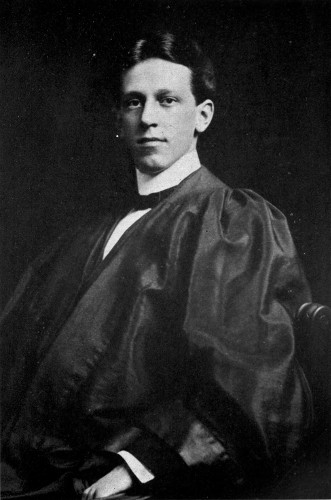
X. ARTHUR ROBICHON
DUNCAN McDONALD.
The name of Duncan McDonald has long figured prominently in connection with transportation interests. He has displayed a spirit of enterprise and initiative in all that he has undertaken, has operated along broad lines and has carefully planned and executed important projects. He is now devoting his attention to the supervision of various interests with which he is identified following his retirement from the management of the Montreal Street Railway Company. His investments largely have to do with transportation interests. He is president of the Montreal Tunnel Company, which has reached a very active stage in its development, and it is Mr. McDonald’s purpose to give special attention to the rapid inauguration and execution of the work. He is also largely concerned in several real-estate companies that are dealing with central Montreal property, as well as large subdivisions in outlying municipalities. He is the president of the Pre-payment Car Sales Company with offices in the Hudson Terminal building at No. 50 Church Street, New York, this being the operating company for all the various “Pay-as-you-enter,” “Pay-within” and other styles of pre-payment cars that are being so rapidly adopted by the cities on this continent. He is also connected with the International F-A-Y-E Tramcar Company, Limited, Broad Street Place, London, E. C.
Mr. McDonald’s operations in real estate have been of a mammoth character. He was the original promoter of Dominion Park, which in its development and sale has netted a splendid income for the investors, and he is at present vice president of that enterprise. He is also a director of several industrial and transportation companies. He belongs to the Institute of Civil Engineers of France and to the Institute of Electrical Engineers of Great Britain, connections which indicate the recognition of his high standing and notable ability in the fields into which he has directed his efforts.
JOSEPH PHILIPPE LAMARCHE.
Joseph Philippe Lamarche, a well known notary of Montreal, was born in St. Henri de Mascouche, L’Assomption county, Quebec, January 29, 1866. His grandfather, Louis Lamarche, was a farmer of L’Assomption county. His father, Joseph Olivier Lamarche, now eighty-one years of age, was for many years a notary at St. Henri de Mascouche, where he yet resides. He married Helene Mount, a sister of Dr. Mount, of Montreal, and her death occurred in April, 1874. To them were born three children: Joseph Philippe; George, a resident farmer of St. Henri de Mascouche; and Joseph S., a notary of Montreal. The father has been a lifelong conservative in politics and for many years was secretary and treasurer of the municipality of St. Henri de Mascouche. In fact, he has been a prominent figure in political, official and business circles there and is today one of the honored and venerable citizens.
Joseph Philippe Lamarche was educated in the parochial schools of his native town and in L’Assomption College, which he attended for six years, his course there being supplemented by two years’ study in the Ottawa University. During the succeeding three years he was a student in the office of Coultee & Lamarche, notaries of Montreal. In 1890 he won the degree of Baccalaureatus in Legibus. In 1890 he began the practice of his profession in St. Henri de Mascouche, where he continued until 1903, when he removed to Montreal, where he has since successfully practiced. He is thoroughly versed in the principles of the profession and his ability is attested by his liberal clientage.
Mr. Lamarche was married in St. Henri de Mascouche to Marie Rose Lambert, and to them have come four children, Helene, Lambert, Philippe and Rita. In politics Mr. Lamarche is a conservative and at the present writing he is filling the office of commissioner to the superior court for the district of Montreal, his creditable record commending him to the further support and confidence of the public.
SIR JOSEPH HICKSON.
Sir Joseph Hickson, who in 1890 received the honor of knighthood at the hand of Her Majesty in recognition of ability displayed in the management of important and extensive railway interests, is classed with those to whom Canada owes much of her greatness and her prosperity. He was born at Otterburn, Northumberland, England, in 1830, and acquired his education there. Throughout his entire business career he was connected with railway interests, first entering the service of the North Eastern Railway of England and thus gaining his elementary knowledge of railway management and operation.He left that corporation to accept a position with the Maryport & Carlisle Railway, in which capacity he served with credit until 1851, when he went to Manchester and entered the service of the Manchester, Sheffield & Lincolnshire Railway. Promotion rapidly followed in recognition of his capability, indefatigable energy and perseverance, so that after ten years he became assistant to the general manager, in which position his labors engaged the attention of Sir Edward Watkin, chairman of the Grand Trunk Railway in Canada, who proffered him the position of chief accountant of the Grand Trunk in December, 1861.
He left England for the new world in the following January and made his way to Montreal, where he continued to reside until called to his final rest. Here his ability and power soon gained further recognition and he was made secretary and treasurer of the company, in which capacity he continued until the resignation of C. J. Brydges, managing director of the Grand Trunk, in 1874, when Sir Joseph Hickson succeeded as general manager of the road and system. The policy which he inaugurated was soon felt as a dominant power in active management and cooperation. One of his first acts was to sell to the federal government the line between Point Levis and Riviere du Loup and with the proceeds of this transaction he changed the old gauge of the road to the standard gauge of American lines and thus effected connection with Sarnia and Chicago. The wisdom of this move was soon manifest as it opened up a new field of enterprise to the company and marked the beginning of that policy of affiliation and connection which resulted to the benefit of both countries before Sir Joseph Hickson ceased to be an active factor in the control of an immense system embracing five thousand miles of track in the United States and Canada. Sir Joseph served as general manager until 1890, when he retired from his arduous position after receiving, early in that year, knighthood from Her Majesty, the late Queen Victoria, in recognition of the ability which he had displayed in the management of the Grand Trunk Railway System and of the valuable service he had rendered in developing Canada and her resources. Under his management the road had been rapidly and substantially improved and extended, connections with other lines being formed which have proven of great value in later years. Perhaps the most valuable work which he undertook and accomplished was the establishment of the direct line to Chicago wholly under control of the Grand Trunk system. By this master stroke was secured the best paying portion for carrying freight and at the same time gave to Canadian steamship companies a large amount of the freight which they carried across the Atlantic. It was while Sir Joseph Hickson occupied the position of general manager that the length of the road in its main and collateral lines was extended from one thousand three hundred and eighty-three to three thousand four hundred and eighty-seven miles. In railway management he studied each vital question from every possible standpoint and with almost judicial accuracy passed judgment upon the important matters at issue. He was largely instrumental in carrying forward the great engineering undertaking known as the St. Clair tunnel, which was completed in 1890 at a cost of three million dollars. His work elicited attention from one end of the country to the other, and he became one of the foremost representatives of railway interests on the American continent.
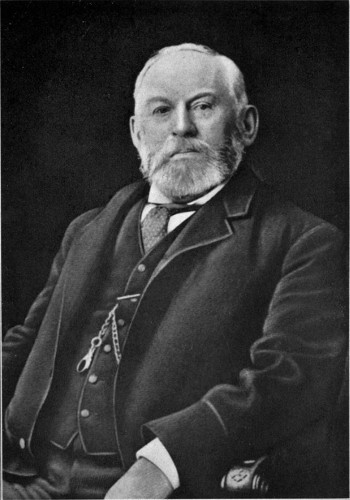
SIR JOSEPH HICKSON
On the 17th of June, 1869, Sir Joseph Hickson wedded Catherine, the eldest daughter of the late Andrew Dow of Montreal. Mrs. Hickson is a native of this city and was educated here. She has been prominently identified with the Montreal League for the Prevention of Tuberculosis and was one of the promoters of the Royal Edward Institute in 1909 and an active supporter of various other similar bodies. She is also the vice president of the Montreal branch of the Needlework Guild of Canada and has been termed by one of the city papers “a queenly hostess.” Sir Joseph and Lady Hickson had two sons and a daughter. The eldest, Joseph William Andrew Hickson, was educated at McGill University, winning the B. A. degree on completing the course in mental and moral philosophy in 1893, while in 1896 his alma mater conferred upon him the Master of Arts degree. He won the Ph. D. degree in 1900 at the universities of Berlin, Freiburg and Halle. He was lecturer and tutor in the philosophical department of McGill University from 1900 until 1905, assistant professor of psychology and lecturer on philosophy at McGill from 1905 until 1909 and has since been assistant professor of metaphysics and logic. He is a contributor to the University and other magazines and reviews, is a councillor to the Economic and Statistical Society, is a member of the University Club and a member of the board of management of the House of Industry and Refuge. He is an enthusiastic mountain climber and a well known clubman, belonging to the Mount Royal, University and Political Economy Clubs of Montreal and the Alpine Club of Banff. The second son, James Claud Hickson, graduated B. A. from McGill in 1895 and, receiving the B. C. L. degree in 1898, is now engaged in active practice as a member of the law firm of Hickson & Campbell. He was created K. C. in 1909 and is a life governor of the Montreal General Hospital. He is well known as a clubman, his membership being in Mount Royal Club, Canada Club, Montreal Hunt Club, Royal Montreal Golf Club, Montreal Curling Club, Lafontaine Club, Montreal Jockey Club, Montreal Racquet Club, Royal St. Lawrence Yacht Club, University Club, and Constitutional Club of London, England. The daughter, Miss Mary Elizabeth Hickson, is well known as an author, having early contributed tales and sketches to the magazines. She is also the author of two charming stories of French-Canadian life, “Madame Janvier’s Church” and “The Call of God.”
Sir Joseph Hickson served as justice of the peace for Montreal and was interested in several banking, commercial and industrial enterprises which he represented on the directorate. He was appointed by the Dominion government as president of the royal commission on the prohibition of the liquor traffic. He stood for all those interests which are effective forces in the progress and upbuilding of city, province and country, and the position which he filled was one of influence and honor.
HERBERT BROWN AMES.
Herbert Brown Ames, a deep student of the science of government and avowed in his opposition to misrule in public affairs, has, through his practical efforts, the result of keen insight into situations, been instrumental in bringing about various needed reforms and improvements. His public addresses, too, have aided largely in shaping public opinion on the side of right and order, and thus his value as a citizen can hardly be overestimated.
He was born in Montreal, June 27, 1863, his parents being the late Evan Fisher and Caroline Matilda (Brown) Ames, both of whom were born in the United States. After mastering the elementary branches of learning Herbert B. Ames became a student in Amherst College, of Massachusetts, from which he was graduated in 1885 with the Bachelor of Arts degree. He afterward studied the French language and literature in France, and made his initial step in business circles as a representative of the wholesale firm of Ames-Holden, Ltd., of Montreal, with which he was actively connected until December, 1893. He is still a representative of that corporation and one of its directors and is likewise a director of the Dominion Guarantee Company, the Great West Life Insurance Company, the Royal Victoria Life Insurance Company, and a number of other prominent business concerns. As a merchant he has established a reputation that places him in a prominent position among the leading and representative business men of the city. His efforts in that direction would alone entitle him to distinctive mention in the history of Montreal, and yet this is but one phase of his activity. He is perhaps even more widely known because of his connection with efforts put forth in opposition to misrule in municipal affairs. He was particularly active in that direction during his service as alderman from 1898 until 1906, during which time he promoted and advocated many reform measures and projects, always working along conservative lines. He was chairman of the municipal board of health from 1900 until 1904, and again his service was of notable value to the city. He had previously filled the position of secretary of the Good Government Association and was president of the Volunteer Election League, which bodies effected many reforms in civic administration. His name is widely known, and in fact he has been heard in many centers as a lecturer on Canadian political history and on problems of municipal government. He has been a frequent contributor to the press, and among his notable articles are: The Machine in Honest Hands, published in 1894; The City Below the Hill, A Sociological Study, published in 1897; The City Problem; What is it?, in 1901; and The Housing of the Working Classes, in 1907. These show wide research and deep insight into existing conditions and point out various practical methods of improvement.
Mr. Ames was appointed a member and protestant secretary of the council of public instruction for the province of Quebec in 1895. The following year he was elected to the presidency of the Young Men’s Christian Association of Montreal, and the extent and importance of his work is further indicated in the fact that he is a governor of the Montreal Dispensary and of the Society for the Protection of Women and Children. He delivered an address in London, England, before the chamber of commerce on trade interchange in 1904, and was presented with a silver bowl by the same body in acknowledgment of his personal services in connection with the visit of that organization to Canada in 1904. In 1909 he went as a delegate to the Imperial Commercial Congress at Sidney, New South Wales, and as a member of that body moved for the appointment of an advisory imperial council to consider questions of imperial interest, especially those tending to promote trade between the various parts of the empire.
Since the general election of 1904 he has sat for the St. Antoine division of Montreal in the house of commons in the conservative interests, and in March, 1909, succeeded in securing the appointment of a committee for the revision of the assets of the Dominion. He is a very active worker in support of conservative measures and movements, and his life work indicates his recognition of the fact that education along broad lines and political activity are the sources of a country’s power and the foundation upon which is builded its business. He was appointed one of the representatives of the house of commons at the coronation of King George in London in 1911.
In May, 1900, Mr. Ames was united in marriage to Miss Louise Marion Kennedy, a daughter of John Kennedy, C. E. They occupy an attractive home at No. 26 Ontario Avenue, Montreal. Their religious faith is that of the Presbyterian church, and Mr. Ames holds membership in a number of the leading clubs of the city, including Lafontaine, University, Montreal, Royal St. Lawrence Yacht and St. James Clubs. He is a man of indefatigable energy and unquestionably a force to be reckoned with in the public life of Canada. Even those opposed to him politically recognize that he is a man to be trusted, that what he promises he will do. His position is never an equivocal one and in his entire career there is no esoteric phase.
ERNEST NICHOLSON BROWN.
Ernest Nicholson Brown was born in Lower Newcastle, New Brunswick, on the 12th of July, 1867. His father, Robert Brown, went from Dumfries, Scotland, to Pictou, Nova Scotia, in 1823, and settled as a young man in Miramichi, New Brunswick, in 1835. He married Ann Noble, of United Empire Loyalist descent. Her grandfather fought on the British side at the battle of Bunker Hill. James Nicholson, an uncle of Robert Brown fought at the battle of Trafalgar and the medal awarded him for his services on that occasion is now in possession of Mr. Brown.
After attending the high school at Chatham, New Brunswick, Ernest N. Brown entered Dalhousie University at Halifax, from which he was graduated in 1889 with the degree of Bachelor of Arts. He followed that course with post-graduate study at Clark University in Worcester, Massachusetts, after which he was engaged for some years in teaching. In 1902 he won the degree of Bachelor of Civil Law upon the completion of the regular course in law in McGill University. He was admitted to the bar in the province of Quebec in 1902 and for two years was in practice in the office of Duncan McCormick, K. C., while subsequently he became a member of the firm of Patterson & Brown, and in 1908 he became a member of the firm of Brown & Staveley.
Mr. Brown is a liberal in politics, and his religious faith is that of the Presbyterian church. In 1904, Mr. Brown married Miss Elizabeth Malcolm Fraser, a daughter of the late John Fraser of Lachine Rapids, author of “Canadian Pen and Ink Sketches”, “Historic Canadian Ground” and various articles dealing with points of interest in Canadian history, especially those connected with the scenes of his boyhood in and about Lachine.
CHARLES BERNIER.
The name of Charles Bernier is a synonym for efficiency in architecture in Montreal. A native of the province of Quebec, he was born at St. Jean Port Joli, on the 17th of December, 1866. His father, Francis Bernier, was a contractor and builder at St. Jean Port Joli and there died. The mother bore the maiden name of Virginie Deschene.
Charles Bernier was educated in the schools of his native town and in the Christian Brothers school at L’Islet. When fifteen years of age he went to Quebec, where he entered the office of David Ouellet, a well known architect, with whom he remained as a student for three and a half years. Through the ensuing year and a half he was in the office of Ferdinand Peachy, a noted architect of Quebec, and then, splendidly qualified for the profession, he entered upon active practice, which he successfully followed alone in Quebec until June 24, 1903, when he came to Montreal. Here in connection with Charles Brodeur he formed the partnership of Bernier & Brodeur, which connection was maintained for seven years, and during that period their offices were removed to 70 St. James Street. Through the three succeeding years Albert Menard was associated with Mr. Bernier in the firm of Bernier & Menard, and since Mr. Menard’s death Mr. Bernier has continued alone. He is accorded a large clientage, for his ability places him among those foremost in the ranks of the profession. On all sides may be seen splendid evidences of his handiwork as exemplified in some of the most beautiful and substantial structures of Montreal.
CHARLES BERNIER
Mr. Bernier was married in this city to Alma Dionne, daughter of Octave Dionne, of Quebec, and they are parents of three daughters, Adrienne, Alice and Anna. The religious belief of the family is that of the Roman Catholic church. Mr. Bernier belongs to Lafontaine Club and to the Royal Arcanum. He is a man of refined, cultured tastes, quiet in manner and a deep student of subjects relating to the profession, in which his standing is among the highest.
HON. AMEDEE GEOFFRION.
Hon. Amedee Geoffrion, one of the recorders of Montreal, was born at Varennes, in the province of Quebec, February 6, 1867, and was educated at L’Assomption and Laval University. Liberal training qualified him for the profession which he determined to make his life work and in 1889 he was called to the bar. He began the practice of law at the age of twenty-one and from the beginning made continuous progress. He was made King’s Counsel in 1905.
His activity, too, has been largely manifested along other lines. Not a little of the progress made on the south side of the river in recent years is due to his efforts and public spirit. A consistent supporter of the progressive policy of the government of Sir Lomer Gouin he has, since elected for Vercheres in 1908, been identified with many noteworthy public projects that have assisted materially in the development and improvement of the rural districts. The movement for the improvement of existing highways in the county of Vercheres has found in him a warm supporter. He has served the municipality of Longueuil with efficiency and manifest approbation, first in the capacity of recorder and afterward in that of mayor, holding the latter position since 1908. He stands for all that works for civic betterment and improvement and is a close student of the vital problems affecting the welfare of city, province and nation. During the years of his mayoralty he has been the head of a highly progressive administration. It has been during this period that the electric railway has been brought to the town and that electricity has been installed for lighting purposes, while cement sidewalks have been laid and the work of improvement has been otherwise carried on along most progressive and beneficial lines.
In September, 1912, Mr. Geoffrion was appointed by Quebec to the position of recorder of the city of Montreal and is now filling that office with the same capability and fidelity that he has displayed in other positions. None question his public spirit nor his knowledge of the law, and he stands today with those whose success has been builded upon the foundation of ability and laudable ambition.
LYON COHEN.
Lyon Cohen, merchant and contractor, of Montreal, Quebec, is a member of L. Cohen & Son, coal merchants, and of W. R. Cuthbert & Company, brass founders, and is proprietor of the Freedman Company, wholesale clothiers, the Hibbard Company, Ltd., railway contractors, and General Improvement & Contracting Company, Ltd., dredging contractors.
This has been termed the age of commercialism and it is the old world’s belief that new world residents are engrossed in money-making to the exclusion of almost everything else. There are many examples, however, to the contrary, and the life record of Lyon Cohen is one which proves that while successfully conducting business affairs, time may also be found for active cooperation in movements that tend to promote intellectual and moral progress, or which relieve distress among the unfortunate ones of the world, for he has done much philanthropic and charitable work, while at the same time he has wisely and capably managed important mercantile interests. He was born in Poland, Russia, May 11, 1868, a son of Lazarus Cohen. In early childhood he was brought to Canada and attended the McGill Model School and also the Catholic Commercial Academy of Montreal. He became a member of the firm of L. Cohen & Son in 1891, and from the time when he put aside his text-books and entered business circles his progress has been continuous.
Mr. Cohen has attained a prominence in Montreal social and business circles that necessitates a mention of him in any publication undertaking to represent the leading citizens of the city. He has been prominently identified with almost every movement looking to the betterment of Jewish conditions in this country, and his labors have been effective forces in promoting the welfare of those of his faith. He was one of the founders of The Jewish Times of Montreal, and he was president for three years, 1904-5-6, of Shaar Hashomayim congregation, the largest and most prominent Jewish congregation in Canada. Interested in the welfare of his people wherever they are found, he is treasurer of the Canadian committee of The Jewish Colonization Association of Paris, and was secretary of the Jewish rights committee. He is a life governor of The Montreal General Hospital and of The Western Hospital, and was elected president of The Baron de Hirsch Institute of Montreal in 1908. He did such splendid work in that connection, that he was four times reelected, serving until the end of 1912. Upon his voluntary retirement he was presented with an illuminated address and handsome silver service. He is prominently identified with a number of movements; is member of juvenile court committee; member of executive of Child’s Welfare Association, and was chairman of publicity of Child’s Welfare Exhibition, 1912; member of executive of Montreal improvement committee; honorary chairman of North End Synagogue; honorary president of Young Men’s Hebrew Association; and chairman of Committee to Federate Jewish Charities.
Mr. Cohen is a member of The Montefiore Club, of which he is a past president; he is also an ex-president of The Montreal Reform Club, being a liberal in politics. A love of progress actuates him in all he does. He could not be content to move forward at the pace which many men assume. He must all the time be up and doing, for he is a man of action rather than theory, and at all times the end accomplished indicates the wisdom of the methods he has followed.
Mr. Cohen was married in February, 1891, to Miss Rachel Friedman, a daughter of the late Noah Friedman. They have four children, Nathan Bernard, Horace Rives, Lawrence Z. and Sylvia L. Mrs. Cohen is also interested in charitable work and is the founder and president of The Jewish Endeavor Sewing Society. The family residence is at 25 Rosemount Avenue, Westmount, Quebec.
ZIGMOND FINEBERG.
Under the name of Zigmond Fineberg & Sons is conducted a growing real-estate and brokerage business. Mr. Fineberg was born in March, 1863, in Poland, Russia, his parents being Moses Nathan and Agnes Fineberg, the former a merchant. Among his ancestors were rabbis, physicians and lawyers and capable business men. He pursued his education in Suvalk, Russia, and became a government roads contractor of that country.
Attracted by the opportunities of the new world, and prompted by laudable ambition to try his fortune on this side of the Atlantic, Mr. Fineberg came to Canada, settling in Montreal, where he embarked in business as a clothing merchant in 1887. About seventeen years were devoted to that undertaking, years which brought him a substantial measure of success and led to his activities along still broader lines. It was in 1904 that he turned his attention to real estate, becoming a real-estate broker and finance agent, business being now conducted under the firm style of Z. Fineberg & Sons at No. 62 St. James Street. He is thoroughly informed concerning property values, knows the real estate that is upon the market and has himself been a large investor, not only in real estate, but in railway shares, so that his stocks and property holdings make him one of the prosperous citizens of Montreal. Moreover, in 1910, he founded the Montreal Free Loan Association, of which he is the president. He belongs to the Montreal Board of Trade and is connected with many institutions of a public nature, being formerly a director of the Baron de Hirsch Institute, a life governor of the Baron de Hirsch Institute, a life governor of the Montreal General Hospital, of the Hertzl Dispensary and of Mount Sinai Sanitarium. He likewise belongs to the Montreal Citizens’ Association. He is an ex-member and vice president of the Spanish and Portuguese synagogue, and he now holds membership in the McGill College Avenue Synagogue.
In his native city of Prenn in 1885, Mr. Fineberg was married to Miss Jennie Kirschberg, a daughter of the late Abraham Kirschberg. The children of this marriage are: Joseph, Nathan Samuel, Aaron Harry, Moe Newton, Agnes and Max. The second son has won the degrees of Master of Arts and Bachelor of Common Laws and is now engaged in the practice of the legal profession.
Mr. Fineberg has held the offices of justice of the peace and commissioner of the superior courts since 1903. He belongs to the Masonic fraternity, the Odd Fellows society and the Canadian Order of Foresters, and exemplifies in his life the beneficent spirit underlying those organizations, recognizing the brotherhood of mankind and the obligations of mutual helpfulness and kindliness.
MATTHEW A. SAMMETT.
Matthew A. Sammett, one of the most competent electrical engineers in Canada, was born at Baku, Russia, on the 2d of November, 1872. He was educated in a technical school in his native land and in 1893, when a young man of twenty-one years, came to the new world. He continued his education by attendance at night schools for a time and afterward entered the University of California, where he pursued a four years’ course, which he completed by graduation with the Bachelor of Science degree in 1899. He immediately put his theoretical training to practical test and joined the staff of the General Electrical Company of Schenectady, New York, in which connection he obtained thorough familiarity with modern electrical machinery and general engineering practice. The ability which he displayed in that connection won him promotion to the engineering department and in that position he made a close study of the design of some of the alternating current machinery now in universal use. Each step in his career has been a forward one, and each change in his business connections has marked an advance. In 1902 he joined the engineering staff of the Lachine Rapids Hydraulic & Land Company and after its amalgamation with the Montreal Light, Heat & Power Company was given charge of the testing department of the new organization, his work embracing the testing of the various kinds of electrical apparatus used in the transformation, control and measurement of electrical energy. He also designed a complete line of highly efficient transformers for lighting and power service.
During 1905 and 1906 Mr. Sammett conducted a popular course in applied electricity at the Montreal Young Men’s Christian Association.
In 1908 Mr. Sammett opened an office as consulting engineer in Montreal and in this connection has gained a large and distinctively representative clientage, including the Amalgamated Asbestos Corporation, Ltd.; The Asbestos & Asbestic Company, Ltd.; The St. Francis Hydraulic Company, Ltd.; The Brompton Pulp & Paper Company; The Maritime Coal, Railway & Power Company, Ltd.; The Dominion Marble Company, Ltd.; The Smart-Woods Company, Ltd. He has also been retained in connection with municipal electrical undertakings. The practice of his profession now makes heavy demands upon his time and energies, and in addition he is well known as a contributor to the technical press of the United States and Canada. He has also prepared and read many scientific papers before engineering bodies and is known personally or by reputation to the entire electrical profession on the American continent. He has formed many warm friendships by keeping in close touch with the progress of his profession as a member of the Canadian Electrical Association, the Canadian Society of Civil Engineers and the American Institute of Electrical Engineers.
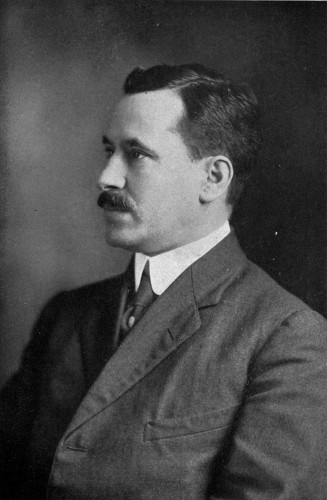
MATTHEW A. SAMMETT
Mr. Sammett married Miss Eleanor Horwitz, and their children are four in number, Frank Edward, Hazel, Helene and Pearl. Mr. Sammett is a member of the Canadian Club and possesses a genial cordial nature that has made him popular, but he prefers to concentrate his energies upon his business affairs, in which he has attained notable success. He is a self-made man. Commendable ambition pointed out to him the way to success. He followed the path indicated and is today occupying an advanced position as an electrical engineer.
HENRY MORGAN & COMPANY, LIMITED.
For nearly three-quarters of a century the name of Henry Morgan has been inseparably interwoven with the mercantile progress and advancement of Montreal and in more recent years, with the branching out of the house he founded, it has taken a foremost position, in its various lines, among the big mercantile and industrial institutions of the Dominion.
The Henry Morgan & Company, Limited, of today, is the outgrowth of a business established early in the year 1843, on Notre Dame Street, a few doors east of McGill Street, by Henry Morgan and David Smith, under the firm name of Smith & Morgan. From a small dry-goods house carrying only a limited number of lines it has developed into a great and powerful departmental store and what might be justly termed one of the mercantile successes of Montreal, whose capabilities are almost as varied as the city’s needs.
Henry Morgan, the founder of this house, was born in Fifeshire, Scotland, in 1819, and when a young man in his early twenties, came to Montreal, where he entered into the dry-goods business, as previously stated.
The original location of Smith & Morgan’s store was soon found inadequate, and in 1854 the business was removed to McGill Street, just south of St. Joseph, now Notre Dame, in a building occupied by Latineer. In 1860 an addition was made extending to Notre Dame Street and when the old American Presbyterian church, corner of Victoria Square and St. James Street, was removed, the business was transferred to that location in more commodious quarters.
In 1852, Mr. Smith retired from the business, and that same year the firm of Henry Morgan & Company was established, Mr. James Morgan of Glasgow, Scotland, a brother, becoming a member at that time. The latter, a native of Saline, Fifeshire, Scotland, had entered the dry-goods business early in life and for a number of years was a member of the firm of Muirhead & Morgan, of Glasgow. The personnel of the firm practically remained unchanged until 1876, when James and Colin D. Morgan, nephews of Henry Morgan and the former a son of James Morgan, became members, and upon whom most of the burden of the business has fallen.
In 1891, this firm completed on St. Catherine Street, opposite Phillips Square, one of the finest business blocks in America, to which its mercantile business was transferred. This move became necessary in order to meet the requirements of a constantly growing business, and a shift in the retail section to that part of the city.
Mr. Henry Morgan, the founder of the business, died December 12, 1893, at which time the Gazette said in part: “No Montreal merchant and not many Canadian merchants could claim to be better known than Mr. Henry Morgan, who passed to his rest yesterday, after a busy, successful and well spent life of almost seventy-five years. His character was marked by many of those traits which have made men of Scottish birth so prominent a factor in the upbuilding of Montreal’s commercial prosperity. Mr. Morgan was of a somewhat retiring disposition. His store and his farm home at Maisonneuve divided his time, and though he enjoyed a very large share of public respect, he never sought to enter public life. He was unmarried. His death was due to influenza, the cause of so many deaths of prominent men lately, acting on a constitution weakened somewhat by previous illness. The funeral takes place today from St. Andrew’s church, of which he was an esteemed elder.”
The death of Mr. James Morgan had preceded that of his brother but a few months, and occurred on March 28, 1893, at which time the Gazette said in part: “By the death of Mr. James Morgan, Sr., Montreal has lost one of its oldest citizens and one who for well nigh half a century was an intelligent sharer in its commercial and industrial progress. The deceased gentleman was in his eighty-sixth year. Mr. James Morgan was a man of strong intellect, diligently cultivated, an assiduous but judicious reader until his eyesight became impaired, and his opinion on questions to which he had given thought was ever listened to with attention. With few persons was it more profitable to converse, especially on the higher themes of religion, philosophy and science. His views were broad and so was his charity. Although as a business man he had little spare time for writing, Mr. Morgan could wield an able pen and has written not only prose but poetry. He was long an esteemed member of the Church of the Messiah. But though a man of strong convictions, as he was a thorough Scotchman, neither in creed nor in nationality was he of the narrow type.”
The business of Henry Morgan & Company from its very inception, has never been at a standstill, success following the firm’s every move. In 1906 it was incorporated as a limited liability company under the present title of Henry Morgan & Company, Limited, with Mr. James Morgan, as president. The development and expansion of this firm’s interests have come to include several large factories which it owns and operates, among these being the foremost high class wood-working plant in the Dominion, which places the company in a position to build homes as well as to decorate and furnish them even to the smallest detail. In this respect the firm has become widely known throughout Canada, and its successful undertakings include decorative schemes and interior furnishings of some of the finest homes in practically every province in the Dominion.
Its business policy has always been one of absolute integrity and business honesty, and this has exerted a strong influence upon the life of a great city. The public who come in daily contact with the various branches of this great organization readily feel that spirit of industry and enterprise that has made possible the accomplishing of great things and the building of a great business dedicated to the best interests of the public whom it serves.
HON. JAMES McSHANE.
In the political history of Montreal during the past half century no name has been more familiar to the people than that of the Hon. James McShane, who in all of his public connections displayed a masterful grasp of every problem presented for solution combined with thorough understanding of human nature and the springs of human conduct. A firm belief in the principles which he advocated combined with the qualities of leadership enabled him to become a directing force in public affairs.
Mr. McShane was born in Montreal, November 7, 1833, a son of James and Ellen (Quinn) McShane, who came from county Armagh, Ireland, and settled in Montreal in the summer of 1833. The mother died during the cholera epidemic of 1834.
After pursuing his early education under Daniel Mahoney, a well known Irish schoolmaster of that period, and spending some years as a student in the Sulpician College, James McShane, at the age of eighteen years, joined his father who had become an extensive cattle exporter. The son eventually succeeded to the business and it is a matter of history that he was the first to export cattle to Europe, his first shipment of three hundred head being made October 5, 1874, on the steamship George, to Liverpool. For four years he also had the contract to supply the British troops when they were stationed here.
While engaged in this business Mr. McShane, with the natural love of the Celt for such matters, found time to devote to political problems and activities, both municipal and federal. In 1863 he was a justice of the peace and for twenty-one years he represented St. Ann’s ward as an alderman. During those years he became known as “the people’s Jimmie,” for he knew every man, woman and child in the ward, calling them by their Christian names and ever manifesting deep and sincere solicitude for their welfare. He possessed a wonderful gift of memory enabling him to readily recall names and faces and incidents connected with the individual to whom he was speaking. All this made him personally popular and was an effective element in his leadership.
At various periods Mr. McShane represented Montreal West and Center in the legislature, continuing to sit from 1878 until 1892. In the formation of the Mercier cabinet he accepted the important portfolio of minister of public works in which he continued in 1887-8. When the late Mr. Justice Curran was raised to the bench in 1875 Mr. McShane contested St. Ann’s division in the liberal interests against Sir William Hingston whom he defeated. In 1891 and 1892 Mr. McShane was mayor of Montreal, and his administration of municipal affairs was characterized by many needed reforms and improvements. In 1887 he was a member of the Quebec Interprovincial Conference, and he was at one time president of St. Patrick’s Society. He served as an officer in the volunteer militia in the first administrative battalion in the Fenian raids of 1866 and was granted a medal for his service. He is now eighty years of age, but is splendidly preserved physically and mentally, in both regards being the superior of many men of sixty years. He possesses all the virtues and specific activities of the sons of Erin. In 1910 when he was far past the span of life allotted by the psalmist, he fell victim to an acute attack of pneumonia, but by sheer force of will passed through a crisis after he was given up by his old family physician and friend, Mr. McShane remarking that “he felt quite fit and that this business of making him stay in bed was only a joke.”
Mr. McShane has been married twice. In 1863 he wedded Elizabeth Jane Darrah, who died June 25, 1867. In 1870 he married Miss Josephine Kathleen Meron of Plattsburg, New York, who died January 1, 1910. Unto them were born six children, three of whom survive the mother: Mrs. Richard Barry of Montreal; Mrs. Henry M. Tracy of Philadelphia, Pennsylvania, who has two children; and Mrs. Kathleen H. Buckley of New York city, who has five children.
HON. JEAN BAPTISTE ARCHAMBAULT.
Hon. Jean Baptiste Archambault, judge of the circuit court of Montreal, took to his judicial duties an excellent record as a lawyer whose ability and success had won for him a foremost place among the strong and forceful representatives of the Montreal bar. A deep thinker, logical reasoner and well versed in the science of his profession, he was eminently well fitted for the judgeship to which he was appointed November 29, 1913.
He was born at St. Antoine, Vercheres county, P. Q., on the 21st of March, 1871, and comes from one of the old and prominent families of the province, one that has given to the legal profession more members than any other one family.
In the attainment of his education, Judge Archambault attended St. Hyacinthe Seminary and Laval University, winning the degrees of B. L. and B. C. L. in 1895. From the outset the science of his profession, as well as its practical phases, proved a strong attraction for him. He entered upon active practice in 1895 and soon demonstrated his ability to successfully cope with intricate and involved legal problems.
His preparation of cases was always thorough and his presentation of a cause marked by perspicuity. His standing among his professional brethren is indicated by the fact that in 1905 he was chosen by the council of the bar of the province of Quebec to assist in editing the judicial reports of the superior court and the court of king’s bench.
Vital political problems have always greatly interested him, and he has been active and zealous in support of principles in which he believes. He was a recognized leader of the conservative party in his native county and was a candidate for the legislature in 1904. He has ever been a close student of the signs of the times and the questions of the day, and although still a conservative in principle he holds to more independent views than formerly, his comprehensive study leading him to see many questions in a different light. He has been spoken of as “a man who has thought out problems for himself and is an authority on economics, political and social.” He was one of the first to advocate proportional representation in Canada, has delivered many lectures upon the subject and has written many articles which have done much to foster and promote the idea.
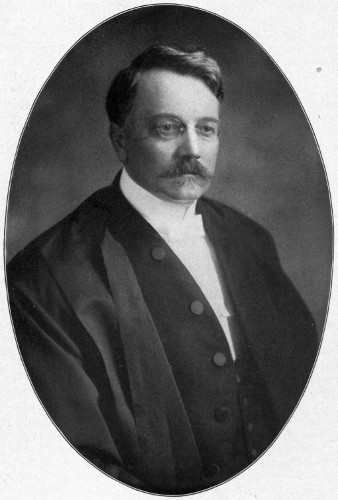
HON. JEAN B. ARCHAMBAULT
His wide general information is one of the strong elements of his power and ability as a lawyer and jurist. His broad knowledge, which enables him to understand life in its various phases, and his masterful grasp of every problem presented for solution, are qualities which, combined with a familiarity of the law and with precedent, equip him for his work on the bench.
Judge Archambault withal is possessed of a genial nature, is kindly in spirit and unfailingly courteous. He belongs to a number of the leading social clubs and in their membership is most popular.
SIR HUGH ALLAN.
Sir Hugh Allan, one of the foremost men in the early development of Canada’s foreign commerce and the practical founder of the Allan line of steamships, was a man whose initiative spirit enabled him to recognize, appreciate and understand situations incomprehensible to men of less sagacity and insight. The success of his undertakings made him one of the foremost figures in the history of Canada’s commercial greatness. He stood as a leading representative of navigation interests and was almost equally well known in banking and industrial circles. Indeed many business interests profited by his cooperation and ability and his memory is still honored by those who cherish the history of their country and recognize its real upbuilders.
The identification of the Allan family with the shipping interests of the St. Lawrence dated back to about 1825, when Captain Alexander Allan sailed up the river in the brig Favorite from Glasgow. There were no wharves then. The vessel was assisted up the St. Mary’s current by oxen. The cargo was discharged on the beach, over long planks.
Sir Hugh Allan was the second son of Captain Alexander, and was born September 29, 1810, in Saltcoats, County Ayr, Scotland. Sir Hugh Allan was in his sixteenth year, when on the 12th of April, 1826, he sailed from Greenock for Montreal on the brig Favorite, commanded by his father, and on which his eldest brother was second officer. They arrived in Montreal on the 21st of May. Hugh Allan entered the employ of William Kerr & Company, and afterward travelled for some time in the United States. He then visited Scotland and a year later returned to Montreal, where he secured a position with J. Millar & Company, shipbuilders and shippers. So excellent was his service in that connection that after four years he was admitted to partnership and following the death of Mr. Millar in 1838 the business was conducted by the firm of Edmonstone & Allan, ship agents, shipbuilders, importers and general merchants. In 1846, Andrew Allan, a younger brother of Hugh’s, was taken into the firm. It owned a fleet of fast sailing vessels of about 350 tons register, full-rigged ships which, with ice-blocks round their bows, pushed their way through the ice, so that sometimes they would arrive in port on the 15th of April. In 1853 Hugh Allan, who was a man of great tenacity of purpose, and at the same time of remarkable foresight, saw that the time had come for the building of iron ships for the St. Lawrence trade. Besides, there was the consideration that they would run to Portland in the winter time, and connect with Montreal by rail. He enlisted the support of several wealthy men, including William Dow and Robert Anderson, of Montreal, and formed the Montreal Ocean Steamship Company. The Canadian and Indian were the first two boats built by the company. The boats cost about two hundred and fifty thousand dollars each and had a speed of eleven knots. They were wonders at the time and made a great impression, as the people had not been accustomed to see iron ships.
It happened that about this time the Crimean war broke out, and the government was at its wits’ end to provide transports. The Allans went into the business and while the war lasted made large profits.
The first ocean steamship, the Genova, reached Quebec in 1853 and proceeded to Montreal, where there was great rejoicing. She was an iron boat of eight hundred tons and was succeeded by the Cleopatra and the Sarah Sands. Newer and larger vessels were built in the succeeding year and what was deemed experimental at the start became fixed features of the new navigation, which was dangerous, owing to so many sunken reefs in the St. Lawrence and the poor lighting of the river. The Canadian government made a contract with Hugh Allan for carrying the mails, paying an annual subsidy of one hundred and twenty thousand dollars. The Anglo-Saxon, a new boat, ran from Quebec to Liverpool in nine days on one occasion. This was thought to be wonderful, as the people had been accustomed to a voyage of forty days on the old sailing vessels. At that time the grain carrying charge was thirty cents per bushel.
The requirements of the service in 1858 demanded more accommodation, and the Allan brothers determined on a weekly service. Larger and faster boats were introduced. The government paid subsidies to the new service totaling four hundred and sixteen thousand dollars per annum. Year by year the Allans launched new boats, always bigger and faster, though speed was never the chief consideration with the company. In 1861 they had a fleet of over twenty vessels, but a sinister fortune befell the company in the first ten years of its existence. Eight ships were lost in as many years. The Indian, the Hungarian, a second Canadian, the North Briton, the Anglo-Saxon, the Norwegian, the Bohemian, all became total wrecks. The river was badly lighted, the tides did not run true, the pilots were incompetent and the compass deviated owing to some strange local attraction due, it was said, to mineral deposits in the gulf. Anyway, disaster followed disaster, and, as was said at the time, any other man than Mr. Allan would have given up in despair. But that gentleman had something of the firmness of his native granite in his composition and he never wavered. Difficulties in time were overcome, the Allans began to prosper and from this on their boats were singularly free from accidents.
To show, however, how little even the most perspicacious can see in advance of their time, it may be stated that at the banquet which the citizens tendered Hugh Allan in 1850, he said that ships of one thousand seven hundred tons were the most suitable for the Montreal trade. He lived to see his boats grow to five thousand five hundred tons. The line prospered; the number of boats was constantly increased to meet the need; the Northwest was opened up; and the Allan boats brought in many thousands of immigrants. The building of the Parisian in 1881 was supposed to be about the last word in shipbuilding. She was far in advance of anything to be seen on the route. Today she is, by comparison with the leviathans of the route, almost as antique as the old Favorite was when steamships came in.
As prosperity came to him in one direction, Sir Hugh Allan extended his efforts into other fields. He not only kept abreast with the times but was ever in the vanguard of progress. He became president of the Montreal Telegraph Company, of the Canadian Navigation Company, the Merchants Bank of Canada, and the Lake Memphremagog Navigation Company. He was also interested in mining as president of the Mulgrave Gold Mining Company and his activities extended to the presidency of the Montreal Warehousing Company, the Vermont & Canada Marble Company, and many other business enterprises of importance. Indeed, no citizen of Canada has deserved popular recognition in larger measure than Sir Hugh, and Queen Victoria acknowledged the value of his service to his country by knighting him with her own hand in 1871.
In 1877 he decided to associate his name with the Canadian Pacific Railway enterprise. He, in fact, formed the first syndicate to build it. The fall of the Macdonald government defeated his plan.
On the 13th of September, 1844, Sir Hugh was married to Miss Matilda Smith, the second daughter of John Smith, one of the leading merchants of Montreal. They became parents of nine daughters and four sons. Sir Hugh died in Edinburgh while on a visit to Scotland on the 9th of December, 1882, having passed the seventy-second milestone on life’s journey. His remains were brought to Montreal in one of his own vessels, and laid to rest in Mount Royal cemetery. Well merited encomiums were passed upon him and high honors awaited him during his active life. He was one who pushed forward the wheels of progress. Looking into the future he saw something of the greatness in store for Canada and became a factor in the fulfillment of the progress which he believed possible for a country having the natural advantages here offered. He builded perhaps even better than he knew, for his work continues today, remaining an important element in Canada’s enterprise, activity and greatness.
FREDERICK CLEVELAND MORGAN.
Frederick Cleveland Morgan, merchant, is one of Montreal’s native sons, his father being James Morgan. Liberal educational opportunitiess were afforded him and after pursuing his education at Cambridge, where he won the Bachelor of Arts degree, he continued his studies in McGill University, which conferred upon him the degree of Master of Arts. Throughout his business career he has been identified with commercial interests and is now a member of the firm of Henry Morgan & Company, Limited, proprietors of the Colonial House Department Store, which is one of the largest and best establishments of its character in the city.
In March, 1906, Mr. Morgan was married to Miss Elizabeth Marcia Shaw, the eldest daughter of C. Thaxter Shaw, of Montreal. They occupy an attractive home at No. 308 Peel Street. Mr. Morgan is a member of the University Club, Racquet Club, Forest and Stream, the Mount Royal Lawn Tennis, Arts Club, Art Association and Antiquarian and Numismatic Society. Mr. Morgan’s interest lies more in art and literature than in business affairs. He was the first secretary of the Arts Club, Limited, formed in 1913 for the purpose of encouraging art and literature.
HON. SIMEON BEAUDIN, K. C.
Hon. Simeon Beaudin, puisne judge of the superior court of the province of Quebec, took to his judicial duties an excellent record as a lawyer whose ability had won for him a foremost position among the strong and forceful members of the Montreal bar, where he had been a successful practitioner for more than one-third of a century.
He was born at St. Isidore, P. Q., September 12, 1855, and comes from one of the oldest families in the province.
He supplemented his early educational privileges by a course of study in Montreal College and in 1878 was called to the bar. He immediately entered upon active practice, forming a partnership with Messrs. Loranger & Loranger, in whose office he had previously studied. One of the partners was raised to the bench and on the death of the other Mr. Beaudin succeeded to the business of the firm. His partnership relations extended until he became the senior member of the well known law firm of Beaudin, Loranger, St. Germain & Guerin. His practice was of an extensive and important character. He argued the St. Blase parish and other cases before the judicial committee of the privy council of England, and was acknowledged as a leader of the French-Canadian bar. For many years he was a member of the bar council. In 1889 he was created Q. C. by the Earl of Derby. He was batonnier of the Montreal bar in 1902 and later batonnier-general. His close conformity to the highest standards of his profession and his devotion to his clients’ interests gave to him a standing that was an honor to his profession. He was elected an honorary member of La Chambre de Commerce of Montreal in 1902 and in 1904 he became one of the incorporators of the La Presse Publishing Company. He was also one of the promoters of Lafontaine Club and he likewise belongs to Club Canadien and Pointe Claire Golf Club.
Judge Beaudin has always given his political allegiance to the conservative party. He unsuccessfully contested Laprairie-Napierville for the house of commons at the general election in 1908.
For some years previous to his assuming judicial duties in 1912, he had been frequently referred to by the press and profession as a most competent man for the bench, and of him the Montreal Witness said: “He ranks high in his profession, his thorough legal sense, knowledge of the law and extensive experience qualifying him for early judicial preferment.”
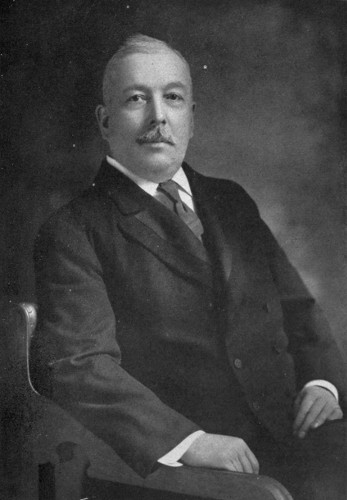
HON. SIMEON BEAUDIN
In 1883 Mr. Beaudin was united in marriage to Miss Mary Norris, a daughter of John Norris, of Montreal, and they reside at No. 44 Bishop Street. In religious faith Mr. Beaudin is a Roman Catholic. In all matters of citizenship pertaining to the material, intellectual, political and moral progress of the community he is deeply interested, but after all he regards the law as his real life work.
SIR WILLIAM HALES HINGSTON, Kt., M. D.
Sir William Hales Hingston, Kt., M. D., whose professional activities constituted valuable contributions to the world’s work, his ability winning him wide recognition and high honors from various scientific bodies, was born at Hinchinbrooke, province of Quebec, June 29, 1829, a son of the late Lieutenant Colonel S. J. Hingston, of His Majesty’s One Hundredth Regiment. He was a representative of a distinguished Irish family, closely related to the Cotters of Cork, the Latouches of Dublin and the Hales. He supplemented his early education, acquired in a local academy, by study in St. Sulpice, now Montreal College, and having determined upon the practice of medicine as a life work, he prepared for his chosen calling by a course in McGill University, which he completed with the class of 1851. He further carried on his investigation, study and research abroad, obtaining a diploma in the Royal College of Surgery at Edinburgh in 1852, and subsequently obtaining diplomas in France, Prussia, Austria and Bavaria. He was the first Canadian to whom was accorded the honor of membership in the Imperial Leopold Academy at Vienna.
Dr. Hingston entered upon the active work of his profession in Montreal and continued an eminent member of the profession to the time of his death, winning notable renown in surgery. His ability along that line constantly developed. He possessed the steady hand and the cool nerve of the surgeon and his professional skill gained him rank with the most prominent representatives of the profession on the American continent. For many years he was surgeon in the Hotel Dieu Hospital, where he gave clinical instructions in surgery. He was also governor of the College of Physicians and Surgeons and at one time was its president. He was honored with election as a first secretary of the Canadian Medical Association, and later was called to its presidency.
He was the organizer of the first board of health in the Dominion, and his efforts in behalf of sanitary interests were far reaching and beneficial. Not only did he display marked skill in surgery, but also eminent ability as an educator, and upon the organization of Bishop’s College Medical School was chosen professor of surgery and clinical surgery, and became dean of the faculty, but at length was forced to sever his connections with that institution, owing to the many other demands made upon his time and services. He never refused to respond to a call for professional aid if he could possibly meet it, and it would be difficult to name a physician and surgeon of Canada whose labors have reached out beneficially to a larger number of people. When, during an epidemic of smallpox, a local board of health was organized, Dr. Hingston was made its chairman, and he also became chairman of the provincial board of health, when in 1885 the province was again being visited by that calamity. He was an energetic advocate of vaccination.
It was but natural that a man of his ability and position should have written much upon professional topics. He was a valuable contributor to the medical literature of his day, one of his most important publications being his “Climate of Canada and its Relation to Life and Health,” published in 1885. Competent authority pronounced this “the fullest work, which has appeared on the subject and apart from its economic and ethnological value, is, from its pleasing style, delightful to read.” Scientific bodies conferred high honors upon Dr. Hingston and in addition, he was elected an honorary member of different state boards of medicine and by many state medical societies in the United States. When the British Association for the Advancement of Science visited Canada some years ago, he was chosen vice president and not long afterward was elected an honorary member of the British Medical Association.
His professional activity would alone entitle him to wide distinction, yet he was active in other fields and in connection with the public affairs of the country.
He became president of the Montreal City & District Savings Bank, and also vice president of the City Passenger Railway Company. In 1875 Montreal elected him its mayor, and he served one term, when he declined renomination. For coolness and judgment, which he displayed during the Guibord affair in Montreal, he received the thanks of the Earl of Dufferin, then governor general of Canada. Bishop’s College University at Lennoxville conferred upon him the honorary degree of D. C. L., while Victoria University of Toronto gave him the honorary degree of LL. D. He was made vice president of the Montreal branch of the St. John’s Ambulance Association and in 1875 was appointed a commander of the Roman Order of St. Gregory. Twenty years later, or on the 24th of May, 1895, he was knighted by Her Majesty, the late Queen Victoria, and he was called to the senate of Canada by the Earl of Aberdeen, January 2, 1896. His political allegiance was given to the conservative party, and his study of vital questions and issues of the day brought about the familiarity of Canadian politics, which enabled him to discuss such subjects with those to whom such study was a life work.
In 1875 Dr. Hingston was married to Miss Margaret Josephine Macdonald, a daughter of the late Hon. D. A. Macdonald, at one time lieutenant governor of Ontario. Her mother was Katherine, the second daughter of the late Hon. Colonel Alexander Fraser of Frasersfield, Ontario. Lady Hingston was educated in Montreal and has been very prominent in charitable and benevolent work. She is a member of the Ladies Committee L’Institute des Ecoles Menageres, vice president of the Needlework Guild, honorary president of the Loyola Literary Club; prominently identified with the local League for the Prevention of Tuberculosis; formerly president of the Woman’s Park Protective Association; etc., and was elected president of the Catholic Girls’ Club of Montreal (an association largely founded by her), in 1911.
Sir William Hingston was a member of the Roman Catholic church to which Lady Hingston also belongs. He passed away on February 19, 1907, but there lives in the minds of those who knew him and of the professional world at large, the memory of distinguished service for the benefit of his fellowmen, in the path of his chosen profession. A keen intellect, splendidly developed, was brought to bear upon complex medical and surgical problems and the result of deep thought, wise research and careful investigation, made his contribution to the world’s work of the utmost benefit.
HON. JAMES KEWLEY WARD.
Out of the struggle with comparatively small opportunities Hon. James Kewley Ward came finally into a field of broad and active influence and usefulness. Not seeking honor but simply endeavoring to do his duty, honors were yet multiplied and prosperity followed his undertakings. His father settled on the Isle of Man and it was there that the son, James Kewley Ward, was born on the 9th of September, 1819. He was reared and educated at the place of his nativity but the opportunities of America attracted him in early manhood, and he crossed the Atlantic to New York, remaining for a decade in that city. His initial experience in the new world was one of continuous advancement, for the wise use he made of his time and opportunities brought about the development and increase of his powers. He left New York for Canada in 1853, and settling in Montreal engaged in the lumber business, which he found a profitable field of labor, owing to his keen discernment and his wise management of his affairs. He also became deeply interested in the Canadian cotton manufacturing industry and in time came to rank with the leading representatives of manufacturing and commercial interests in his province.
Important and extensive as were his business affairs, Mr. Ward never allowed these to preclude an active and helpful interest in the municipal life or provincial welfare. For eighteen years he was a valued member of the town council of Cote St. Antoine, and for nine years he was mayor, giving to the city a businesslike and progressive administration that brought about needed reforms and improvements. In 1882 and again in 1887 he was defeated in the dominion general election, after which he was appointed to the legislative council in 1888 and in 1903 was made a member of the council of public instruction. He reached the remarkable old age of ninety-one years, yet remained an active factor in the work of the legislative council, being seen daily at his desk in the legislature, taking a keen interest in many public questions which were submitted for consideration. He was a liberal and his position upon any vital issue was never an equivocal one. He stood stalwartly in defence of what he believed to be right and for the best interests of the province at large. He was a man of broad vision, whose public service was characterized by no petty personal prejudices. Duty was his watchword in public office, and he seemed to view a vital question from every possible standpoint.
Hon. Mr. Ward was connected with various public institutions, having to do with the welfare and benefit of the unfortunate or tending to alleviate hard conditions of life for the needy. He was a governor of the Montreal General Hospital and of the House of Industry and Refuge, was president of the Protestant Hospital for the Insane and president of St. George’s Society and other organizations. He passed away October 2, 1910, having kept his faculties unimpaired to the last. To build up rather than to destroy had ever been his broad policy, and through life he had attacked every important work which he undertook with a contagious enthusiasm.
JOSEPH MEDARD GUINDON.
Joseph Medard Guindon, engaged in the real estate business in Montreal since December, 1908, was born at St. Ignace du Coteau du Lac in the county of Soulanges, on the 23d of March, 1866, a son of Jules and Marguerite (Wilson) Guindon the father born at St. Eustache and the mother at Coteau du Lac. The ancestry of the Guindon family can be traced back to Pierre Guindon, who was born in 1648 and died September 27, 1733. He married Catherine Rouchallet dit Bergerac, who died August 22, 1710. To his marriage were born three children. The eldest son, Jean Baptiste Guindon, was born September 15, 1707, and married, February 14, 1729, Madeleine Labette. Pierre Guindon, the second son, was born in 1708, and died October 7, 1709. Paul Guindon, the youngest son, was born August 21, 1710, and married November 16, 1733, Marie Josette Aube dit Aubert, to which marriage were born two sons: Paul, August 20, 1735; and François, March 23, 1737. Paul Guindon married Marie Amable de Maisonneuve in 1770 and had one son, Amable, born in 1772. Amable Guindon married in 1809 and had a son, Magloire, born October 15, 1811. Magloire Guindon was married in 1835 to Josette Guindon, his cousin. He took up arms at the revolt of St. Eustache in 1837, was arrested and imprisoned for a period of seven months after the confiscation of the greater part of his goods. To his marriage were born six children of whom Jules, born in 1840, married Marguerite Wilson, May 20, 1865, at Coteau du Lac. To them were born eleven children, the most of whom died at an early age.
Joseph Medard Guindon was a student in l’Ecole du Plateau in Montreal, where he completed the commercial course in 1882. He then turned his attention to the hardware trade and in 1897 became a hardware merchant in Valleyfield, where he conducted business for nine years. In 1907 he established a hardware store in Montreal, of which he was proprietor for two years. In December, 1908, he opened a real estate office with L. D. Latour under the firm name of Latour & Guindon, in which business he has since been engaged with a large capital. He has personally made investments in improved property and vacant land and his holdings are now very extensive. As real estate agent and expert he has a large clientage and his business is growing year by year. He is thoroughly informed concerning realty values and the energy and enterprise which he displays in carrying on his work have constituted the salient forces in the attainment of his success.
Mr. Guindon has been twice married. On the 30th of June, 1886, he wedded Rosalinda Bourdon, a daughter of Narcisse and Marie Anne (Bisaillon) Bourdon, and to this marriage was born one son, Paul Herve, whose birth occurred at Valleyfield, April 2, 1898. On October 7, 1902, Mr. Guindon was again married, his second union being with Marie Rose Anne Sevigny, a daughter of Philias and Madeleine (Cantin) Sevigny. The children of this marriage are: Marguerite, Marcelle, Suzanne, Juliette, Mario, Robert, Jacques and Jean Rodrigue.
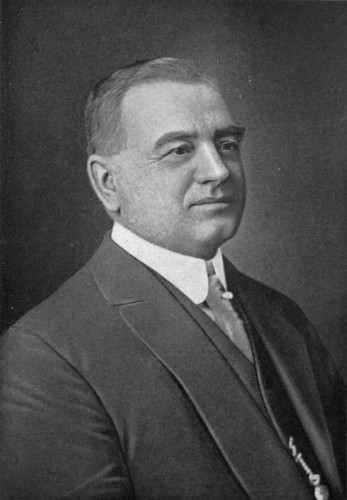
J. M. GUINDON
While living in Valleyfield Mr. Guindon served as city alderman from 1898 till 1904. He manifests a deep interest in municipal affairs and all lines of public progress, but has never been ambitious to hold office, preferring to concentrate his energies upon his business interests, which are now extensive and important.
WILLIAM PATTERSON, K. C.
William Patterson was born in Ormstown, Quebec, and is a son of the late Samuel Patterson. He was educated at the public school of Ormstown; Huntingdon Academy at Huntingdon, Quebec; McGill University of Montreal, which institution conferred upon him the degree of B. A. with first rank honours in classics, in 1886, M. A., in 1889, and B. C. L., in 1895; and at Laval University, which granted him the LL. B. degree in 1900.
Mr. Patterson was principal of the Royal Arthur school at Montreal from 1888 to 1898, during which time he organized and directed a movement in favor of a school history of Canada, written from a Dominion instead of a provincial point of view, the object being, while the history of our country is told from its earliest periods, to direct, as far as possible, the mind of the reader from the various currents of provincial history into the broader channel of the Dominion and to make the boys and girls of Canada feel as they grow up into the responsibilities of citizenship that under confederation we have a united country and a united people. He addressed in support of the movement the Provincial Association of Protestant Teachers of the Province of Quebec at their annual convention in McGill Normal school, Montreal, in October, 1889, and also addressed the Teachers of the Province of Nova Scotia at their annual convention, in Halifax, in December, 1890. He also read before the Royal Society of Canada at Montreal in June, 1891, a paper entitled A Proposal for a Dominion Text-Book of Canadian History. He was appointed secretary of the Dominion history committee, with the Hon. George W. Ross, later Sir George W. Ross, as chairman, by the Dominion Educational Association at its first meeting, which was held in Montreal in July, 1892. The result of these efforts was the organization of the Dominion history prize competition, open to authors of recognized ability, and the publication in June, 1897, of The History of the Dominion of Canada, by W. H. P. Clement, B. A., LL. B., which had been awarded the first prize, and of A Canadian History for Boys and Girls, by Miss Emily P. Weaver, which had been awarded the second prize—both works written from the viewpoint indicated above.
Mr. Patterson organized at Ormstown, Quebec, in 1888, the Chateauguay Literary and Historical Society and was its corresponding secretary from that time until 1895, when, under the auspices of the society and in the presence of over seven thousand people, many of whom had come from a distance, a monument erected on the Chateauguay battlefield by the Dominion government, the outcome of a long agitation, was unveiled in memory of Colonel de Salaberry’s brilliant victory of 1813 over the American invading army.
Mr. Patterson was called to the Quebec bar in July, 1901, and has since successfully practiced his profession at Montreal, where he is the attorney of the Dominion Alliance and of other bodies. He is the author of the Handbook of Commercial Law, published in 1904. In 1910 he was appointed joint crown prosecutor for the district of Beauharnois and in April, 1912, was created a king’s counsellor.
Mr. Patterson married Miss Naomi Florence Smith, a daughter of Robert Smith, of Westmount, Quebec, in July, 1909. He is a liberal in politics and has taken an active part on the hustings in all federal and provincial elections at Montreal and in its vicinity since 1900. His church membership is held in the Presbyterian denomination, and he is a member of the Canadian and Reform Clubs of Montreal. His residence is at 2290 Mance Street, Montreal.
WILLIAM HENRY ATHERTON.
William Henry Atherton was born on November 15, 1867, in Salford, a suburb of Manchester, in Lancashire, England, of Joseph Atherton, sanitary engineer, and Sarah (Nicholls) Atherton. His grandfather, William Atherton, was of a line of merchants and was the last volunteer fire chief in Salford where in Peel Park Museum his famous fire dog “Lion” held an honoured place. His maternal grandfather’s family of Nicholls had farms in Yorkshire and previously in North Wales.
William Henry Atherton spent his early boyhood at the old cathedral city of Norwich in Norfolk, and in 1879, at the age of twelve, started his classical studies at Stonyhurst College, in Lancashire, graduating from the class of Rhetoric in 1886 and matriculating the same year in the first class in the University of London. After several years’ further classical studies he entered the course of scholastic philosophy at St. Mary’s College, Stonyhurst, and at the end of the third year, in 1895, presented his theses in Universa Philosophia, which he passed with distinction “aptus ad docendum,” the degree being equivalent to the Doctorate of Philosophy, which was, after a further thesis on “Beatitudo Finalis” accepted as ad eundum gradum at the University of Ottawa in 1908. From 1898 to 1902 he pursued a four years’ course of scholastic divinity at St. Beuno’s College, St. Asaph, North Wales. When not engaged in the above courses he taught for nearly ten years as a professor of classics and elocution at Stonyhurst College, Lancashire, and Beaumont College, Old Windsor, Berkshire, two of the principal “public schools” of England. At both of these colleges he had charge of the dramatic performances, which are a recognized and important feature in their educational system. There he produced many of the best examples of the classical drama as well as of the best modern plays. He also had charge of the preparation of the annual or term “academies” or “speech days” and thus his students presented parts of Latin, Greek, English and French classical pieces.
On coming to Canada in 1907 William Atherton taught classics for a year at St. Albert, Alberta, at the Bishop’s Seminary, assisting Mgr. Légal in the preparation of a history of the Catholic church in North Alberta. In 1908 he taught classics at Loyola College, Montreal. Since then he has filled other educational posts in the city as lecturer in psychology and ethics at the College for the Higher Education of Women, established in connection with Laval University; professor of the English course in the new “Ecole des Hautes Etudes Commerciales” erected by the Gouin government in 1910, and from 1911 he has also been an examiner in Arts for the entrance examinations conducted by the College of Physicians and Surgeons of the province of Quebec. During his career in Montreal Dr. Atherton has identified himself with most phases of the sociological problems of the city. In 1908 he was invited to assume the managership of the Catholic Sailors’ Club, a position he still holds. In 1909, when the City Improvement League was established, he was selected to become the executive secretary. He is a member of the Civic Secretaries’ Association in connection with the National Municipal League of America, a member of the National Housing Association, the International City Planning Conference and the American Civic League. At the Toronto convention of the International City Planning Congress held in June, 1914, he was appointed by the Canadian delegates to represent them before the Commission of Conservation of the Dominion government to urge the creation of a special Municipal Improvement Bureau in connection with that Commission, to co-operate with and to organize the various movements for city planning, housing and civic improvements in the Dominion. He has taken an active part in most of the recent Civic Improvement and Good Government movements in Montreal, being one of the pioneers in affecting the appointment of the Metropolitan Parks Commission for Montreal, and a consistent advocate of better housing conditions for the working classes. He was the organizing secretary of the notable Child Welfare Exhibition held in Montreal in the Drill Hall on Craig Street in October, 1912. In 1914 he was a member of the executive committee of the “clean-up week” movement, a great public health movement which was taken up by the whole city, in which he acted as chairman of the Co-operation Committee.
WILLIAM H. ATHERTON, PH. D.
Dr. Atherton has been the author of many contributions and criticisms to literary, philosophical and civic journals. His first work, published anonymously under the auspices of the Catholic Truth Society of England, was the Life of Father Damien, the Leper Priest, which appeared in England in 1889, attracting attention as the first authentic life then published. Dr. Atherton has identified himself with the literary life of Montreal. He was one of the founders of the Montreal branch of the Dickens’ Fellowship of which he has been vice president for three years and president for the years 1912-1913-1914. He is the author of the two volumes of the history of Montreal under the French Régime and under the English Rule now being published.
HON. RAYMOND PREFONTAINE.
Joseph Raymond Fournier Préfontaine was a member of an old French family which was established in 1680 in New France. Mr. Préfontaine was born at Longueuil on the 16th of September, 1850. He began his education under private tutors and completed his classical studies at St. Mary’s College under the direction of the Jesuit Fathers. He obtained his Bachelor’s degree at McGill University and was admitted to the bar in 1873. While taking up his private practice he began at the same time occupying himself with public affairs with success.
There are few men who, step by step, possessed more than he the rare gift of being always the man of his time and who at all times retained the favor of his friends. He made his debut in municipal politics as alderman for Hochelaga, and in 1879 became the mayor of that municipality, which honorary post he held until 1884. At this period the progress of Montreal was slow, it being the custom to retard rather than hasten her development. The town and city officers at that time were struggling along with inadequate acts and regulations. They were like the undeterred scientists of old who obstinately tried to solve the problem of squaring the circle although without the slightest vestige of success. New blood was needed and Hochelaga supplied the first infusion in the person of Mr. Préfontaine. When Hochelaga was annexed to Montreal Mr. Préfontaine became alderman of the Montreal council and president of the public works commission. The task which confronted him was not a small one. On the one hand he had to fight against a routine held sacred, and on the other hand against a majority which was absolutely neglecting the eastern part of Montreal.
In 1898 Mr. Préfontaine was mayor of Montreal and began to carry out his program of action. Nothing was neglected for the advancement of the city, and he employed to the utmost his legal acumen and ability in restoring Montreal to her rights. From that time he displayed a deep and abiding devotion to Montreal East which owes so much to him, his labors in this connection being the crowning achievement of his efforts. It was he who gave to the city the Viger railroad station, and this was in itself but a small matter when compared with the shipbuilding yards, the mammoth warehouses and thousands of habitations that he by his persistency won for the French region of the metropolis. He thought of everything; the street railway service, the electric lighting system, the street paving, all these bore the stamp of his personality. He was sometimes unjustly accused of lending himself to questionable deals but always emerged from these ordeals without a stain upon his character or a shadow of doubt remaining as to the entire justification of his actions.
He was the Haussman of the city. It was generally known that he was the friend of the working men and would defend their interests as his own. It was but natural therefore that the workingmen of Hochelaga were his best friends and his stanchest partisans. They were his standard bearers throughout the entire town and were the first who made possible his election to the magistracy of the city. Mr. Préfontaine lifted Montreal out of the old routine and after he was elected mayor all worked hand and glove with him in order to crown his work, and it is not short of the truth to say that a complete reorganization of the municipal autonomy took place.
Hon. Mr. Préfontaine at the time of his death had been in politics for thirty years. In 1875 he was elected member of parliament from Chambly to the legislature of Quebec and continued to represent that county from 1886 to 1896 in the Dominion parliament. In his early days he served as president of the Young Men’s Liberal Association and later as president of the Club National. He was always the man of the hour. His remarkable popularity, the wide prestige which he enjoyed in the liberal party and the financial world, his intimate knowledge of political and administrative affairs, all betokened him the foremost man in the province of Quebec and more particularly in the district of Montreal. He was actively interested in all the movements of his party; few were the counties which he did not visit during the campaigns, and he took part in all the important debates. From his debut he was always in the public eye. Men like him are always the first in all ranks of life. One sees him ceaselessly battling when vital interests are at stake. At the general elections of 1900 he was elected by a large majority for Maisonneuve and Terrebonne. At the time of his death he was representing Maisonneuve, which had elected him by a majority of twenty-five hundred votes. When the Hon. Mr. Tarte resigned from the Laurier cabinet Mr. Préfontaine was prevailed upon to accept the portfolio of marine and fisheries. It is to him that Canada owes the fine organization of this department and the excellent results obtained.
Let us recall what he wrote regarding this subject on the 21st of October in Le Soleil: “We receive every day confirmation of the happy news that the harvest of this year will surpass all hopes. In fact, everything indicates that it will be phenomenal. The Grain Merchants Association values for only the west the production of wheat at ninety-one and a half millions bushels; that of oats at sixty-seven millions of bushels; that of flax at half a million. On the other side the reports from Quebec and Ontario are excellent. There is no doubt that our exportations of agricultural products will this year largely exceed those of 1903, our maximum year, which amounted to one hundred and fifteen million dollars. These figures are so outstanding that they speak for themselves. They mean that the facilities of transportation will have to be considerable to ship all of this,—that is that the St. Lawrence route will be largely put in requisition to export our grain and in return, for the importation of articles sent in exchange. But they signify also that large sums of money will come into the treasury and that the St. Lawrence route will well merit its share. The St. Lawrence begins at the head of Lake Superior and goes as far as Belle Isle, I may say nearly to Newfoundland.
“One of my predecessors asked from Sir Wilfrid Laurier twenty-five million dollars for the single purpose of deepening the channel from Montreal to the Gulf. It is far from being completed. Since the channel was started we have not yet expended one-fifth of this amount and yet we can look backward with confidence and contemplate with pride the work accomplished. It is needless to give here the figures. Suffice it to say this is not a financial treatise but a statement to the people, telling them frankly that in less than five years we have created from nothing at Sorel, the national workshops of maritime construction, the most perfect, the best equipped, the best managed in existence in Canada and which would do credit to any other country. We have constructed the dredges and the apparatus necessary for digging and maintaining the channel at a desirable depth. The channel will be thirty feet in depth throughout almost its entire course. We have reasonably widened the curves wherever they were met. We have constructed signals and placed buoys to extend as far as the gulf and join with the channel. We have installed submarine bells and we are experimenting with a new electrical system for the direction of the vessels in the channel. We have made the channel between Montreal and Sorel as light at night as it is by day. We are now replacing floating fires with stationary fires. We have commenced and will continue with powerful vessels specially constructed to this end to make possible winter navigation and this trial, mark my words, will culminate in good results. That is as a matter of fact quite a goodly sum of finished work since Sir Wilfrid Laurier has come into power and, without boasting too much, since he has entrusted to your humble servant the portfolio of marine, so much decried by our good friends, the conservatives.
“Now, as far as professional progress is concerned, we can still cite without fear of criticism improvement of the law in regard to pilots who are now under control of my department, new conditions regarding more severe regulations, etc.; the revision of the law for the examination of captains and mates; the re-drafting of the law regarding the inspection of steamships; the creation of a competent tribunal of nautical inquiries; the establishment of navigation schools, and the organization of a scientific system of oceanographic and hydrographic observations. Here, in brief, between two viewpoints, we can, I believe, address our friends in order to show them in a new and authentic light the liberal work which has been done on the service of our grand maritime route. But you say in Quebec that with all this there still will be accidents on the river. This I cannot deny and no one regrets it more keenly than I. There will be accidents everywhere and these will happen in spite of all the precautions taken and at the moment when they are least expected. It is for this very reason that we call them accidents. Accidents happen on the canals, they will happen in mid-ocean and they might even happen in the port of Quebec if Providence so ordains, which I sincerely pray, not.”
At the outbreak of the Boer war Mr. Préfontaine gauged public feeling in Canada correctly and favored the contribution of men to the cause of the Empire and also favored the establishment of a Canadian navy. While maintaining offices in the city hall he displayed remarkable faculty for winning friends. It was said of him that no matter how bitterly opponents assailed him he never bore resentment. As years went by this trait actually made admirers out of those who had formerly been enemies. He was always ready to do a friendly act and was naturally of an optimistic temperament, being scarcely ever known to show a sign of dejection or low spirits. A belief in the possibilities of an undertaking always served as a stimulus to his intense activity, usually accompanied by the desired results.
In June, 1876, Mr. Préfontaine married Miss Hermantine Rolland, and unto them were born three sons: Rolland, a civil engineer in Montreal; Fernand, of the firm of Préfontaine & Drouin, architects of Montreal; and Adrien, now deceased.
Mr. Préfontaine died in Paris, France, December 25, 1905. At that time Mr. Lawrence A. Wilson said of his dead friend: “As the last candle lights were flickering out their little flames upon the gilded Christmas trees that had made so many young and old hearts happy, a cruel message, wrapped in thunder, reached us. A man had died: Yes! a big, big man in the fullest sense of the word. A generous friend he was always to the needful, irrespective of color, creed or nationality and one whom I have never known, during twenty years, to have harbored over night an ill feeling against his greatest political foe. When I asked him recently during a friendly conversation why he worked so hard to the detriment of his personal interests and particularly of his health, he replied, ‘My greatest pleasure is to be able to do something for my friends.’ He was a kind husband to his devoted but now sorrowing wife, a good father to his three bright boys, a solid friend to all those he trusted and a faithful, unflinching follower of his chief, Sir Wilfrid Laurier. That man was Raymond Préfontaine.”