BIOGRAPHICAL (continued 12)
Reading edition
Aside from his extensive printing and engraving business Mr. Desbarats was deeply interested in all that pertained to the city’s welfare, and those things which are a matter of civic virtue and civic pride received his indorsement and cooperation. He took great interest in the Montreal Philharmonic Society of which he was one of the directors. He was captain in the Civil Service Rifle Regiment, of a company composed entirely of men in his employ. During the smallpox epidemic in Montreal in 1885 he was chairman of the citizens’ relief committee and took a leading part in the establishing of a temporary hospital at the exhibition grounds. His political allegiance was given to the conservative party but he took no active part in politics. In religious faith he was a Roman Catholic and in 1867 was president of the Société St. Jean Baptiste in Ottawa.
On the 30th of April, 1860, G. E. Desbarats was married to Miss Lucianne Bossé, eldest daughter of Joseph N. Bossé, advocate who was afterward senator and subsequently judge. Mr. and Mrs. Desbarats were married in Quebec and they became the parents of five sons and two daughters. George J., born January 27, 1861, and now deputy minister in the naval service, married Miss L. Scott, a daughter of Sir Richard Scott. William A., born February 14, 1862, is president of the Desbarats Printing Company, Limited. Edward S. C., born April 24, 1863, is president of the Desbarats Advertising Agency and married Miss M. A. MacCallum, daughter of Dr. D. C. MacCallum. Lucianne, born August 10, 1864, married Lord de Blaquière. Cecile is superior of the Convent of the Sacred Heart at New Orleans, Louisiana. Alexander died in childhood; and C. H. Hullett married Miss J. Henkels of Philadelphia. He is the secretary and treasurer of the Desbarats Printing Company. He and his brother, William, succeeded to the business upon their father’s death and it has since been organized into a joint stock company.
Such in brief is the life history of one who had much to do with shaping the development of the printing and engraving business in Canada. His was largely the initiative spirit that brought about improvement and advancement in methods of printing and of illustration. He ever maintained the highest standards, was quick to adopt any new methods which his judgment sanctioned as of value, and he largely set the standards that others have followed. His life continued one of increasing activity, usefulness and of public benefit to the time of his death which occurred in 1892.
ARTHUR WILLIAM PATRICK BUCHANAN.
In the practice of law devotion to the interests of his clients, careful preparation of his cases and comprehensive knowledge of the principles of jurisprudence are salient features which have gained Arthur William Patrick Buchanan a place among the well known representatives of the Montreal bar. He was born at Montreal in 1870, the son of Alexander Brock and Elizabeth Ann (Best) Buchanan and grandson of the late Alexander Buchanan, Q. C., a distinguished lawyer and in his day the leader of the Montreal bar, who married Mary Ann, the daughter of James Buchanan, H. B. M. consul at New York from 1816 to 1843. After attending the Montreal high school our subject entered McGill University and later pursued his law course in Laval University, where he took the degree of LL. B. in 1893. He was admitted to the bar of the province of Quebec in 1894 and the same year began practice as an advocate. He was created a king’s counsel in 1908 and practices in partnership with W. J. White, K. C. Their clientele is extensive and of a representative character, and Mr. Buchanan has proved himself a capable and careful lawyer. He is interested in genealogy and has written a history of his family, The Buchanan Book (1911).
In 1897 Mr. Buchanan married Berthe Louise, elder daughter of William Quirin, of Boston and resides at No. 731 Pine Avenue West. Mr. Buchanan is a life member of the Buchanan Society, a governor of the Montreal General Hospital and a member of the St. James Club, the Canada Club, the Montreal Hunt and the Royal Montreal Golf Club.
ANDREW ROBERTSON.
In many public positions Andrew Robertson gained wide acquaintance and the efficiency of his service in public behalf marked him as one of Montreal’s most valued and prominent men. In commercial circles he was well known as the founder and senior member of the firms of Andrew Robertson & Company and Robertson, Stephen & Company, wholesale dry-goods merchants, and later he became a factor in insurance and financial enterprises. This however represented but one phase of his life, as he became connected with many public projects having to do with the general development and improvement of the city, or with its charitable and benevolent activities. Abraham Lincoln said, “There is something better than making a living—making a life,” and it was that spirit which actuated Andrew Robertson at all times. He recognized his obligations to his fellowmen and again and again he played the part of the Good Samaritan, not from any unavoidable sense of duty but from a deep love for his fellows.
Mr. Robertson was of Scotch birth, the place of his nativity being Paisley, and the year, 1827. When he arrived at school age he entered the Paisley grammar school, where he gained a working knowledge of the common branches of learning. All through his life he was a student,—a student of books, of men, of affairs and the signs of the times, and he became a thoroughly well read man, whose judgment was regarded as sound and his sagacity keen. After leaving school he learned the weavers trade and in 1840 was sent to Glasgow and entered upon a four year’s apprenticeship in a drapery and clothing establishment. Subsequently he became an employe of a manufacturing firm and displayed such ability and resourcefulness in this connection that he was soon afterward admitted into a partnership, and as most of the work of the firm devolved upon him, his health gave way and his physician recommended that he go either to Australia or Canada.
Mr. Robertson’s choice fell upon the latter country and in 1853 he sailed for the new world, accompanied by his wife and two sons. He at once joined the wholesale dry-goods firm of Brown & Swan and, on retiring therefrom two years later, founded the firm of Andrew Robertson & Company which in 1867 was merged with the older established business of William Stephen & Company and continued under the style of Robertson, Stephen & Company. With the firm and its successors he was continuously connected until 1885, when he retired. Early in the 60’s he built the Auburn Woolen Mill at Peterboro, Ontario, for the manufacture of Canadian tweeds, and successfully directed it from Montreal until 1867, when he sold it as part of the purchase price of the Stephen business. His methods were ever progressive, and his close application and indefatigable energy constituted the foundation upon which he builded his prosperity.
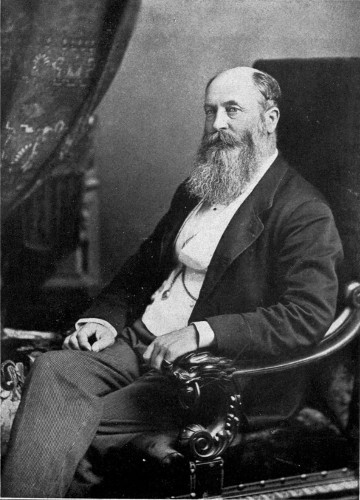
ANDREW ROBERTSON
While building up a commercial enterprise of large and profitable proportions, Mr. Robertson always found time to devote to public duties and the promotion of the general welfare. Joining the St. Andrew’s Society in 1857 he served as treasurer in 1862 and 1863, second vice president in 1864 and 1865, first vice president in 1868 and president during 1869 and 1870. In 1876 he was president of the Dominion Board of Trade and in that and the following year was also president of the Montreal Board of Trade. He had the honor of being chosen the first president of the Dominion Commercial Travelers’ Association, and thus he figured prominently among the men who were most active in commercial pursuits. He himself extended his efforts as a business man with the passing years and became president of the Royal Canadian Insurance Company in 1876, in which position he continued until his death, while from its formation in 1880 until his demise he was president of the Bell Telephone Company of Canada.
His public service was of a varied character and embraced connection with charitable and benevolent objects, with public works and with movements having to do with general progress and improvement. In 1872 Mr. Robertson became one of the governors of the Montreal General Hospital and later was elected and served successively as treasurer, vice president and president. In 1879 he was elected chairman of the board of harbor commissioners for Montreal and remained in that position until his death. His name figured also in connection with military activities, beginning in 1861, when, during the Trent excitement he was gazetted first lieutenant and quartermaster of the Montreal Light Infantry. Many tangible evidences of his devotion to the public welfare may be cited. He familiarized himself with all the details of the management of the General Hospital and was greatly interested in the proposal to enlarge it, so that in 1886 upon a trip to England he consulted some of the best architects of that country concerning the subject and brought back with him plans for the proposed extension. The deepening of the ship channel between Montreal and Quebec was a project which awakened his strong and hearty enthusiasm, and he frequently said that when he saw the completion of the plan he would retire from the active duties of chairman of the board, well satisfied. He was of a nervous temperament, possessed marked energy and was a tireless worker, and before his health became impaired he was actively and helpfully interested in the movement for the improvement of the harbor and the prevention of damages by flood. During the great flood of 1885 he was making a tour through the submerged district in a canoe, propelled by one of the oldest river men. His companion of that occasion testified to the deep interest he took in the poor people of the district. He left the harbor commissioners’ office with forty or fifty dollars in his pocket and when he returned he had not enough cash to pay the boatman, having given all to the flood sufferers. This is but one incident of his generous spirit, which was constantly manifested. He was of a most charitable disposition but he gave in a quiet, unassuming manner, following the mandate not to let the left hand know what the right hand doeth. Again and again his gifts of charity were known only to the recipients.
On the 19th of April, 1850, in Scotland, Mr. Robertson was married to Miss Agnes Bow, a daughter of the late Alexander Bow, of Glasgow, and they became parents of ten children, four sons and six daughters, of whom the sons and four daughters are still living, six being residents of Montreal, while one daughter and one son reside on the Pacific coast.
At the time of his death, which occurred March 29, 1890, Mr. Robertson was chairman of the harbor commission and his associates in that work, as also those in other relations of life, entertained for him the highest regard. In politics he was conservative and in church connection a Presbyterian. In his Christian faith was found the root of a well spent, honorable life, reaching out along many lines for the benefit of his fellowmen. The world is better for his having lived and his memory remains as a blessed benediction to those who knew him. Mrs. Robertson survived her husband for nine years, passing away suddenly in her beautiful home, Elmbank, Dorchester Street West, on the 6th of July, 1899, mourned by a large circle of old friends.
REV. JOSEPH GUILLAUME LAURENT FORBES.
Rev. Joseph Guillaume Laurent Forbes, bishop of Joliette, was formerly the spiritual director of the thirty-nine hundred families which make up the great French-Canadian parish of St. Jean Baptiste in Montreal, a position of responsibility as well as one of power and importance among the Catholic people of the city. This responsibility rested upon the shoulders of a conscientious, capable and God-fearing man and the power was used wisely and humbly, so that Father Forbes has become an important force in the conservation and propagation of the doctrines which he teaches and professes. He is a native of the province of Quebec, born in Isle Perrot, near Montreal, August 10, 1865, a son of John and Octavie (Léger) Forbes, both natives of Vaudreuil. The Forbes family was founded in Canada in 1757 and representatives of the Léger family came to Quebec with the first French colonists in 1608. Both parents are still living, the father having retired from active life.
Rev. Guillaume Forbes acquired his early education in the kindergarten at the Nazareth Asylum in charge of the Grey Nuns in Montreal and was afterward a student at the Catholic Commercial Academy of this city. He was graduated from Montreal College with the class of 1882 and from the Seminary of Philosophy in 1884. He finished the course in the College of Theology in 1887 and was ordained to the Roman Catholic priesthood March 17, 1888. Immediately afterward he was sent as curate to Caughnawaga, where he did excellent work among the Iroquois Indians. He held his original position until 1892 and was then given the direction of the Caughnawaga mission, serving until 1903. In that year he was appointed parish priest of the Church of St. Anne de Bellevue, in the province of Quebec, and he there remained until 1911, when he was appointed rector of St. Jean Baptiste church in Montreal. The parish of St. Jean de Baptiste in Montreal is one of the largest and most important French-Canadian congregations in the city, and its rector holds a very responsible position and one which makes him a great individual force in Catholic circles. The original church building was burned June 27, 1911, and is now being replaced at a cost of three hundred thousand dollars, the entire property being valued at five hundred thousand dollars. Father Forbes had four assistants, Rev. Joseph A. Lefevre, Rev. Charles A. de Lamirande, Rev. Auguste Paré and Rev. Hector Quesnel, and had spiritual jurisdiction over thirty-nine hundred families and nineteen thousand souls, all French-Canadians. He became very popular and widely beloved among the people of this congregation, who saw his simplicity of character, his greatness of heart, his earnestness and sincerity, and who recognized his administrative and business ability. On the 6th of August, 1913, Rev. Forbes was chosen by the Holy See to succeed the Rt. Rev. Alfred Archambeault as bishop of Joliette. He received the episcopal consecration in the cathedral of Joliette from the hands of His Grace, Monseigneur Bruchesi, archbishop of Montreal, on the 9th of October, 1913. A brother of Bishop Forbes, the Rev. Father John Forbes, of the White Fathers, after a stay of sixteen years in the mission fields of Africa, is since the year 1900 residing in Quebec, superior of the branch house of the Society of the White Fathers in Canada.
Bishop Forbes is profoundly learned in Indian dialects and is in addition an author of some note, his works being all of a religious character. Besides his original volumes he has edited and republished a Life of Catherine Tekakwitha and an Iroquois almanac for the years between 1899 and 1903.
ARTHUR EDOUARD JOSEPH BISSONNET.
The name of Bissonnet has long been a distinguished one in this locality, the first member of the family having been one Pierre, a son of Jacques, who was born in 1626, and on the 3d of May, 1660, married Mathurène Des Bordes and who, as the records show, had seven children. A brother of Pierre, Jacques, was married in 1670 and sixteen children are credited to him. Arthur Edouard Joseph Bissonnet worthily upholds the honor of the family name, having gained a reputation along legal lines in Montreal, where he has successfully practiced since 1897. He was born at St. Hyacinthe, Quebec, and is a son of Napoléon and Domithilde (Scott) Bissonnet. The father was a well known manufacturer of that city, where he passed away in 1887, the mother having predeceased him in 1882. The paternal grandparents were Jérome and Josephte (Courtemanche) Bissonnet, who died in 1870 and 1872, respectively.
Arthur E. J. Bissonnet received an excellent education. His preliminary courses were taken at the College of the Sacred Heart at Arthabaskaville, which was followed by a classical course at St. Hyacinthe that earned him the title of M. L. A. In 1894 he studied law at Laval University and in 1895 and 1896 at McGill University which he left in 1897 with the degree of B. C. L., being admitted to the bar of the province of Quebec in the same year. His advent in Montreal soon followed and here he has ever since been engaged in the practice of his profession. No long novitiate awaited him for he soon demonstrated his ability to successfully cope with the most intricate law problems and gained a reputation which connected him with much important litigation. He has represented some of the foremost firms and individuals as well as other interests, having attained a name for preparing his cases thoroughly and presenting them in an able manner. He has all the attributes of a successful lawyer, clearly sets forth his cause and by the weight of his character and his insight into human nature has won a high standing in his profession. In 1909 Mr. Bissonnet was appointed king’s counsel and as such handled important government cases which especially connected him with provincial law revenue on duties on successions. His prominence in fraternal circles has led to his election as legal adviser of the Council of St. Henry (for 1913), a branch of the Knights of Columbus at Montreal. Mr. Bissonnet is now at the head of the legal firm, Bissonnet & Cordeau, occupying suite 606, in the Royal Trust building.
On the 14th of February, 1905, occurred the marriage of Mr. Bissonnet to M. A. Ernestine Roy, a daughter of Amedée Roy and Hemma (Rocher) Roy. The family has been long established in the county of Bagot, in the province of Quebec, and her father was a prominent merchant in his locality. Mr. and Mrs. Bissonnet have the following children, Jean, Léon, Marie Laure, Louise Marie and Paul.
His political convictions lead Mr. Bissonnet to support the liberal party, and he is a member of the Montreal Reform Club and other political institutions. Although not an active politician, he takes a deep and helpful interest in the issues of the day that affect the Canadian people as a nation and his province as part of the Dominion and stands ever ready to support progressive measures making for advancement, either material or intellectual. His faith is that of the Catholic church. A distinguished and influential lawyer, he is highly respected in the profession and is esteemed by the general public as a public-spirited citizen who loyally acknowledges and fulfills his duties to his city and his country.
DUNCAN A. McCASKILL.
Duncan A. McCaskill was a factor in Montreal’s commercial development and progress, inasmuch as he was the founder and head of the house of D. A. McCaskill Company, later McCaskill, Dougall & Company, manufacturers of railway and carriage varnishes and japans. The extent and importance of his business made him well known in commercial circles, while his career demonstrated the possibilities for successful achievement on the part of any individual who must perforce start in life as he did, without any capital to aid him. He was born in Victoria county, Cape Breton, in 1845 and was a son of Murdo McCaskill, a justice of two counties of Cape Breton. His education was acquired in his native county, where the first thirty years of his life were passed. The year 1875 witnessed his arrival in Montreal, where he connected himself with one of the large business houses of the city. During the succeeding five years he steadily progressed and there awakened in him the ambition to enter commercial circles on his own account. He took his initial step in the direction in which his later labors brought him to the prominent position which he occupied as the head of the house of what is now McCaskill, Dougall & Company, manufacturers of railway and carriage varnishes. He was ever a most industrious man, close application and energy constituting the basis of his success. In 1902 he retired and spent his remaining days in those ways which afforded him recreation and enjoyment, traveling extensively in company with Mrs. McCaskill through the United States and Europe.
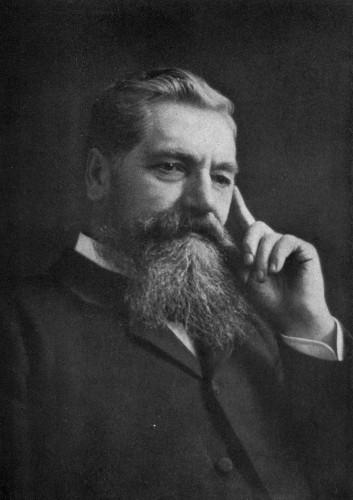
DUNCAN A. McCASKILL
Mrs. McCaskill was in her maidenhood Miss Abbott, a member of the Abbott family of Andover, Massachusetts, and one of the old New England families. They were separated by death on the 12th of July, 1907, when Mr. McCaskill passed away at Lausanne, Switzerland.
While an active factor in the business world, Mr. McCaskill also took a great interest in political matters and for several years was president of the Sir John A. Macdonald Club. In 1900, at the solicitation of a large body of electors of his native county, he became a candidate for political honors. The conservative party lost in that connection and Mr. McCaskill was defeated at the polls, although a large vote was accorded him and his course gained him the general esteem of the people. By preference he concentrated his efforts upon his business interests and private affairs and worked his way upward until he stood among the successful merchants and manufacturers of the city with a record that commended him to the confidence and admiration of colleagues and contemporaries.
SAMUEL HAMILTON EWING.
With intense activity intelligently directed and with ability to plan and perform that amounts almost to genius, Samuel Hamilton Ewing has become one of the prominent manufacturers and capitalists of Montreal. He today has financial investments in many of the most important corporate interests of the province, and his opinion concerning complex business matters is eagerly sought and constitutes a valuable element in the attainment of a wise conclusion.
From his boyhood Samuel Hamilton Ewing has been a resident of Canada. He was born May 10, 1834, at Lisdillon House, Londonderry, Ireland, and is a representative of an old family of Irish origin, his parents being Samuel and Margaret (Hamilton) Ewing, who with their family crossed the Atlantic to Canada during the boyhood of their son Samuel H. Entering the public schools of Montreal, he pursued his education and afterward joined his brother, Andrew S. Ewing, in the ownership and management of the extensive coffee and spice mills formerly owned by his father. The business, established in 1860, was conducted under the firm style of Samuel Ewing & Sons, Samuel Hamilton Ewing remaining an active factor in the management and direction of the business until his retirement from the firm in 1892. In the meantime the efforts of the partners had resulted in the establishment of an enterprise of extensive proportions. Gradually he extended his efforts to other fields, becoming financially and ofttimes actively interested in corporations which are now recognized as among the foremost in the commercial and industrial circles of the province. He is president of the Montreal Cotton Company, president of the Canada Accident Assurance Company, president of the Levis County Railway and the Cornwall Street Railway, and is vice president of the Molson’s Bank and the Sun Life Assurance Company, while he is a director of the Atlantic Sugar Refinery, the Standard Clay Products, Limited, the Crown Trust Company, and the Illinois Traction Company. One of the local papers said of him: “It is doubtful if there is a more active man of his age in the city of Montreal.” What he undertakes he accomplishes, and he utilizes opportunities that many others have passed heedlessly by. Moreover, he has the ability to unify seemingly dissimilar elements, coordinating them into a harmonious whole.
Mr. Ewing has been married twice. He first wedded Miss Caroline Wilson Cheese, of London, England, who died in 1872, and later he wedded Margaret Anna Knight, who passed away in March, 1908. She was a daughter of George Knight, of Glasgow, Scotland. Mr. Ewing’s attractive home, Seaforth, is situated at No. 100 Cote des Neiges road. He is well known in club circles, holding membership in the Mount Royal, Canada, St. James and Canadian Clubs. He is a life governor of the Art Association of Montreal. His political belief is that of the conservative party but the honors and emoluments of office have little attraction for him. He has preferred always to devote his leisure to such activities as seek the public welfare along charitable or humanitarian lines. He is a governor of the Montreal General Hospital and served for several years prior to 1906 as its treasurer. He is likewise a governor of the Protestant Hospital for the Insane, and in 1906 was the delegate to the Sixth Congress Chambers of Commerce of the Empire. Forceful and resourceful, his is a record of a strenuous life, stable in purpose, quick in perception, swift in decision, energetic and persistent in action.
ALBERT HEBERT.
Albert Hébert, deceased, who for many years was one of the best known business men of Montreal, was born in this city, February 28, 1864. He was educated in the Jesuit College and the Archambault Commercial School, from which he was graduated. At the age of seventeen years he entered the firm of Dufresne & Mongenais and a year later became a member of the firm of Hudon, Hébert & Company, wholesale grocers. Later, when his father, C. P. Hébert, retired from the firm, Albert Hébert became the general manager of the business and so continued throughout his remaining days, directing the policy and stimulating the progress of the business, which became one of the important commercial concerns of the province. A man of resourceful ability, he was a director of the Montreal City and District Savings Bank and succeeded his father as treasurer of Notre Dame Hospital. He was a prominent member of the Board of Trade, serving as a councillor in 1904 and 1905, a governor of Laval University and a governor of the Antiquarian and Numismatic Society. Mr. Hébert was married in Montreal to Miss Loulou Barbeau, a daughter of the late E. G. Barbeau, who was the first manager of the Montreal City and District Savings Bank. Mr. and Mrs. Hébert had one daughter, Joséphine, now the wife of Mr. LsRaoul de Lorimer, of Montreal. While traveling in Europe Mr. Hébert died at Lucerne, Switzerland, June 21, 1911, although when he left Montreal for this trip he was in the best of health. He was but forty-seven years of age at the time of his demise, yet he stood very high in the opinion of the leading business men of the wholesale district of Montreal and was also appreciated and esteemed in financial circles. When Notre Dame Hospital was threatened with a financial crisis in 1909 it was Mr. Hébert, the treasurer of the institution, who opened the subscription and by his energetic campaign raised the two hundred thousand dollars which saved the day. One who knew him well and was, therefore, qualified to speak of his sterling traits of character wrote to the Montreal Star:
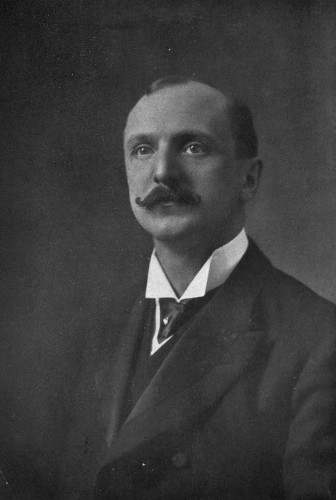
ALBERT HEBERT
“There were many sympathizing and sad hearts in Canada after it was known that Albert Hébert, Esq., of your city died in the prime of life, far away from home in Switzerland. In the death of Mr. Hébert Montreal has lost the prince of the many princely merchants. He was known far and near not only by reputation but personally and wherever he was known he was respected and beloved. I have had business dealings with the late Mr. Hébert for over a quarter of a century and during that long period I have had many opportunities of forming an opinion of his worth as a man and of his splendid abilities as a business man. At the annual business meeting of the Wholesale Grocers Guild, of which he was a prominent and respected member and at which meetings I have often had an opportunity of attending, it was always a pleasure to hear him speak in his faultless English, with a slightly French accent. His opinions and advice had a spirit of fairness and good sense that invariably carried conviction with them. No better argument in favor of a joint English and French training could be had than to hear him address a meeting in English. The late Mr. Hébert will be missed in Montreal. He will be sadly missed by the many English speaking friends in the west when they visit Montreal. It is men of his type that are needed to build up Canada as a nation.”
J. GEORGES PICHE, M. D.
Among the successful physicians of Montreal is Dr. J. Georges Piché, who has been in practice since 1900. He was born in St. Gabriel de Brandon, Berthier, province of Quebec, September 4, 1872, and descends from one of the oldest families of that section.
His father, Camille Piché, was a notary of St. Gabriel for forty years, occupying the position at the time of his death. He was regarded as one of the best known and most highly respected citizens of the locality. He married Sophie Desparrois dit Champagne, a native of St. Sulpice, province of Quebec.
Dr. Piché acquired his early education at St. Gabriel and later attended the normal school at Montreal, leaving there in 1887. He then went to the United States and for several years was a bookkeeper in the employ of a wholesale grocery house at Providence, Rhode Island. In 1896 he returned to Montreal and, having determined upon a professional career, began the study of medicine at Laval University, where he was graduated in 1900 with the degree of M. D.
Dr. Piché immediately began the practice of his profession in Montreal on DeMontigny Street, where he continued with gratifying success until 1914, when he removed his offices to No. 287 St. Denis Street. He is now accorded a liberal practice and his ability is constantly increasing as the result of broad experience and wide reading and research. He is now physician to the Merchants & Employers Guarantee & Accident Company, and he is a member of La Société Médicale de Montreal.
In 1894 Dr. Piché was married in St. Gabriel de Brandon, province of Quebec, to Albertine Bellemore, a daughter of John Bellemore, of that place, and they have four children: Julien, Georges, Albert, Ernest and Rachel.
JOHN S. ARCHIBALD.
John S. Archibald, an architect holding to the highest professional standards and one of Montreal’s native citizens, is a son of the late David A. Archibald, formerly of Inverness, Scotland. Reared and educated in Scotland. Mr. Archibald prepared for the profession which he has made his life work and which he has successfully followed in Montreal. He is a member of the firm of Saxe & Archibald and as such has been connected with the execution of some important professional contracts. A number of the fine structures of the city stand as monuments to his skill and ability. Moreover his position is indicated by the fact that in 1905 he was honored with election to the presidency of the Architects Association of the province of Quebec and at the congress of architects held in July, 1906, he moved the resolution favoring statutory qualifications of architects. He has never believed in deviating from the highest standards of the profession.
In December, 1900, Mr. Archibald was united in marriage to Miss Edith Thurston, the third daughter of J. D. Thurston, of Montreal. In politics Mr. Archibald is a liberal and is interested in all projects that are opposed to misrule in civic affairs and which seek to promote the interests of the many rather than of the few. He is now a councillor of the Montreal Reform Club, and he belongs also to the Engineers Club. He has carefully cultivated the powers and talents with which nature endowed him and thus has gained more than local recognition as a capable architect, well versed in the science of his profession.
ESIOFF LEON PATENAUDE.
Among the younger members of the bar of Montreal is Esioff Léon Patenaude, a member of the well known firm of Leonard, Patenaude, Filion & Monette, who maintain offices at No. 26 St. James Street. Not only has Mr. Patenaude attained a prominent position along strictly legal lines but he has been prominent politically, having for several terms been elected a member of the provincial legislative assembly of Quebec and serving at present in that capacity. He is a member of one of the old French-Canadian families.
Esioff L. Patenaude was born at St. Isidore on February 12, 1875, and is a son of Hilaire and Angèle (Trudeau) Patenaude. Early showing a preference for a legal career, he laid the foundations of his classical education in Montreal College, from which he graduated with the degree of B. A., and subsequently studied law at Laval University, receiving the degree of LL. L. He has since taken up his practice in Montreal and, having been able soon to demonstrate his knowledge and ability, has built up a reputation as one of the foremost advocates of the city. He is a member of the firm of Leonard, Patenaude, Filion & Monette, who are connected with much of the foremost litigation before the courts, their patronage being distinctive and important.
On the 8th of May, 1900, Mr. Patenaude married Miss Georgiana Deniger and they have two children, Rose Angèle and Alphonse. In religious faith the family are Roman Catholics. The political allegiance of Mr. Patenaude is given to the conservative party and, as he has become widely known in his profession, it was but natural that he should be chosen to the Quebec legislative assembly, to which he was elected at the general election of 1908. He was returned to his seat in 1912, his reelection being the confirmation of his record. He has always exerted himself to the best of his ability in the interests of his constituents and has done valuable work in committee rooms as well as on the floor of the provincial house of parliament. Prominent among the French colony, Mr. Patenaude is highly respected by all who know him for what he has attained and for those characteristics which have made possible his success. He is ever willing to gladly bear his share in promoting the public welfare and the advancement of the city and is a forceful factor in Montreal not only along legal and political lines but in building up material progress and promoting measures which elevate moral and intellectual standards.
JOSEPH GUSTAVE AVARD.
Joseph Gustave Avard, one of the best known men in real-estate circles in Montreal, has been instrumental in promoting some of the largest projects in this city during the past ten years, notwithstanding the fact that his life record does not cover one-half the span of time of many other real-estate dealers of the city. He was born January 29, 1881, at Shirley, Massachusetts, a son of Louis and Philomene (Sasseville) Avard, both of whom are natives of St. Hyacinthe county, Quebec. For some years the father was a saddler at Shirley, Massachusetts, but since 1883 has resided at St. Hyacinthe.
The son was educated in the schools of St. Hyacinthe, the Brothers of the Sacred Heart Academy and in the St. Hyacinthe Practical Business School. For a year he was a clerk in St. Hyacinthe Bank and through the ensuing four years was with the Eastern Townships Bank at St. Hyacinthe and Waterloo, Quebec.
In 1903 Mr. Avard came to Montreal as an accountant for the firm of McPherson & Company, wholesale dealers in cheese and butter. In 1905 he opened a real-estate office at 47 St. Vincent Street under the firm name of Avard & Dagenais. This firm continued in business successfully for five years at that location. On the expiration of that period the partnership was dissolved and Mr. Avard opened an office in the Royal Trust building, where he remained for two years, removing thence to the Transportation building at No. 120 St. James Street in 1912. In that year the business was incorporated under the name of J. G. Avard & Company, Ltd. He promoted the Viauville Lands, Ltd., one of the largest deals carried through in the past decade. The firm owns the Tetreauville Annex and are agents for Hudonville Lands, Ltd. Mr. Avard is also a director of the Dominion Quarry, Ltd., of the Metropolis Apartment Company, Ltd., Montreal Playhouses, Ltd., and of the Practical Business School of St. Hyacinthe. His offices in the Transportation building are models of good taste and the casual visitor has only to glance around to see that Mr. Avard is a lover of the fine arts.
On the 2d of October, 1904, Mr. Avard was married, in Montreal, to Rachel Eva Simard, a daughter of the late Adelard Simard, a well known lawyer of Waterloo, Quebec. To Mr. and Mrs. Avard have come three children: Elise; Gaston, who died at the age of eleven months; and Jean.
Active in the social life of the city, Mr. Avard is a member of the Canadian Club, the National Sporting Club, the Reform Club, St. Denis Club and is the vice president of the Laurentide Summer Home Company, Ltd. Politically he is a liberal, and his religious faith is indicated in his membership in St. Leon’s Roman Catholic church at Westmount, where he resides.
ALBERT H. CAMPBELL.
Albert H. Campbell, an active factor in business circles in Montreal as a member of the firm of A. C. Leslie & Company, iron, steel and metal merchants on St. Paul Street, remained in connection with that business until his death, which occurred August 27, 1907. He was a native of Ontario, born May 13, 1866, and a son of Dr. Donald P. Campbell, who was also born in the province of Ontario, where his father had settled upon coming to Canada from Scotland. Dr. Campbell was a graduate of McGill University and after preparing for the medical profession practiced in Vankleek Hill, Ontario, until his death which occurred in 1870. He was married in Montreal, in 1863, to Miss Alice Bell, a daughter of James Bell, who came to this city in 1832 from Scotland and was prominent as a contractor and builder here until his death in 1860. Following the death of her husband, Mrs. Campbell returned with her family to Montreal, where she has since resided.
Albert H. Campbell was thus reared in this city and completed his education in the Montreal high school, in 1883. He first engaged with Frothingham & Workman after leaving school, spending a few years with that firm before he embarked in business on his own account as junior partner in the firm of A. C. Leslie & Company, iron, steel and metal merchants on St. Paul Street. He then concentrated his energy upon the development of that business and was a very active representative of commercial interests in Montreal until his life’s labors were ended in death. He studied every phase of the business with which he was connected, readily recognized and utilized advantages and by methods that neither seek nor require disguise, won the confidence and respect of contemporaries and colleagues.
Mr. Campbell was married in Ottawa to Miss Elizabeth Henderson of Ottawa, whose father, John Henderson, is city clerk there. Mr. Campbell belonged to the Canadian Club and his social nature gained him many warm friends. He was a public-spirited man and gave generous and helpful support to projects for the general good. He belonged to the Board of Trade and was in hearty sympathy with its plans for Montreal’s improvement. He was also a member of the American Presbyterian church and his life exemplified his belief.
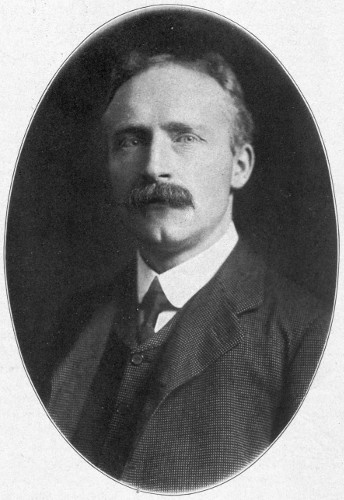
ALBERT H. CAMPBELL
JOSEPH ISRAEL DESROCHES, M. D.
Capable, earnest and conscientious, Dr. Joseph Israël Desroches has for many years exercised his profession in Montreal, where he is widely known to the general public and enjoys high prestige among his colleagues, especially in regard to hygiene and children’s hygiene, upon which subjects he is an expert. His standing is quite evident from his connection with some of the foremost societies in the medical line in the world and it is therefore not surprising that his practice should be extensive and representative as well as lucrative to him. Dr. Desroches was born in October, 1850, at St. Esprit and is a son of André and Héloïse (Mercier) Desroches, the former in his day a well known agriculturist of St. Esprit. The Desroches family is descended from one Jean Deroches, who was born in 1614 and in 1641 left Ste. Lucie, near Autun, France, for Villemarie. He made the journey with one Monsieur de Maisonneuve. In 1647 he married Françoise Godet and this marriage was the first contract of that kind to be registered at Villemarie. Jean Deroches had a family of eight children, of whom his son Pierre married Marie Beaudry on November 24, 1698, at Pointe-aux-Trembles. It was he who added the s to the original name of Deroches. Jean Deroches died at Quebec on August 23, 1664. This record of the early ancestors of Dr. Desroches is to be found in Abbé Tanguay’s Dictionnaire Généalogique, in volume I, page 184.
Dr. Desroches pursued his classical studies at the Seminary of Joliette and received his medical education at the School of Medicine and Surgery of Montreal. There he received his degree of M. D. in 1877. He has ever since engaged in his profession at Montreal and, deeply studious of mind, has ever continued in perfecting his wide knowledge and keeping up-to-date with the latest discoveries made in the world’s medical science. The humane element in his nature is strongly developed and much of his success must be ascribed to the confidence which he inspires in his patients and which is recognized today as being one of the larger factors in effecting a cure. Careful in diagnosis, he is decisive in his actions after reaching a conclusion and there are hundreds who can testify to his ability and are grateful to him for having given them back health and happiness.
It is but natural that a man of Dr. Desroches’ ability should turn to the scientific side of his profession, not finding his sole satisfaction in mere attendance upon and ministrations to the sick. In 1884 he was chosen by the Hygienic Society of the Province of Quebec as manager of the Journal of Popular Hygiene and had charge of this valuable medium of influence until 1895, contributing many articles toward the enlightenment of the general public. In 1887 Dr. Desroches was nominated an honorary member of the Société Française of Paris and in the same year, on the occasion of the exposition of children’s hygiene, held in Paris, he received from the Hygienic Society for Children, of that city, a diploma and a gold medal and was chosen a corresponding member of the society. In 1889 he was made a corresponding member of the Society of Physical, Natural and Climatological Sciences of Algiers. From 1892 to 1895 and from 1898 until 1901 Dr. Desroches had charge of the medical bureau of the province of Quebec and from 1894 until 1900 was a member of the Provincial Council on Hygiene, of Quebec.
On February 9, 1881, Dr. Desroches was united in marriage to Miss Albertine Groulx, a daughter of Louis Thomas and Cornélie (Doyou) Groulx, the former a well known barrister and notary public of Joliette. Dr. and Mrs. Desroches have the following children, Jeanne, Gilberte, Henri, Juliette and Lucille. In various connections the Doctor has made valuable contributions to hygienic science and the subject of medicine and several of the works of which he is the author enjoy a wide circulation and are considered standard by the profession. He is a public-spirited man, progressive not only in his profession but in regard to all subjects that affect his home city and is ever ready to give his warm support to worthy public enterprises. His deep knowledge assures him of a position of distinction, while his kindly spirit has gained him a place in the hearts of his fellowmen.
HON. HONORE MERCIER.
Hon. Honore Mercier, minister of colonization, mines and fisheries, lawyer and legislator, recognized as one of the liberal leaders of Montreal and also acknowledged one of the capable representatives of the bar, was born at St. Hyacinthe, P. Q., in 1875, his parents being the late Hon. H. M. (Count) Mercier and Virginie (St. Denis) Mercier, the former prime minister of Quebec and one of the eminent lawyers of the province, of whom mention will be found elsewhere in this work.
The preparatory education of Honore Mercier was received at St. Mary’s (Jesuit) College, following which he was privately tutored in preparation for his work at Laval University, that institution conferring upon him the LL. B. degree in 1899. He was made an advocate in 1900, since which time he has successfully practiced his profession, being now senior member of the law firm of Mercier & Beique, with offices in the Quebec Bank building. Mr. Mercier’s knowledge of the principles of jurisprudence is comprehensive and exact, and his ability, devotion to his clients’ interests and the thoroughness with which he prepares his cases have given him high standing as a representative of the legal profession in the province.
Mr. Mercier has been a prominent figure in municipal and provincial affairs, standing firmly in support of the principles and measures which he deems of vital worth. He was elected to the city council of Montreal in February, 1906, and in 1907, was appointed a member of L’Ecole des Hautes Etudes Commerciales, of which he is secretary and treasurer, and in the work of which institution, Mr. Mercier has proven a most capable official.
He was chosen in the liberal interest to represent Chateauguay in the provincial parliament, where he has sat almost uninterruptedly since 1907. On April 29, 1914, he was appointed minister of colonization, mines and fisheries in the Gouin cabinet. He gives earnest and thoughtful consideration to the questions of the day and is farsighted in his outlook over the political field with all that it implies in its relation to the welfare, progress and prosperity of the province and dominion.
Mr. Mercier was married, in April, 1903, to Miss Jeanne Frechette, a daughter of the late Dr. L. H. Frechette, C. M. G. Their religious faith is that of the Roman Catholic church. They occupy an attractive home at No. 408 St. Denis Street, and its hospitality is greatly enjoyed by their many friends. They also have a summer residence at Bellevue. Mr. Mercier is not a club man in the usually accepted sense of the term, yet he belongs to the Club Canadien and has social qualities that make and retain friends.
ALFRED FOREST.
Natural ability and profound learning have placed Alfred Forest among the well known young barristers of Montreal, where he enjoys an extensive practice as a member of the firm of Le Blanc, Brossard & Forest, who have offices at No. 35 St. James Street. Well versed in the letter of the law, he is capable, earnest and conscientious in the discharge of his duties and has been entrusted with much important litigation since beginning his career.
The Forest family were among those French emigrants who settled in Acadia—now Nova Scotia—and the earliest record to be found of them in Montreal is that of Madeline Forest, who was born in 1709 at d’Annapolis, Acadia. On the maternal side Alfred Forest is descended from the Mousseau family, who are named among the early settlers in the province of Quebec, the first mentioned being Jacques Mousseau, who was married on January 25, 1694, at Boucherville, to Marie-Ann Daunet, or Daunais.
Alfred Forest was born on the 8th of June, 1881, in the parish of St. Patrick of Rawdon, in the county of Montcalm. His parents were Urgel Forest, gentleman, and Eliza (Mousseau) Forest, a niece of the late Hon. Alfred Mousseau, in 1882 prime minister of the province of Quebec and later minister of public service in the cabinet of Sir John A. Macdonald in 1884. In 1886, when he died, he was judge of the superior court of Montreal and was always a leading conservative.
In the acquirement of his education Alfred Forest attended the Seminary of Joliette and then followed the philosophical course at the Seminary of the St. Sulpice Fathers in Montreal, graduating in 1905 with the degree of B. A. This was followed by a law course at Laval University, where on December 21, 1907, he obtained his degree of LL. L. with distinction and was admitted to the bar on the 15th of January, 1908. In 1906 he was secretary of the law students at Laval University and in 1907 was their president. During his law course he received practical training in the office of the Hon. Judge Paul Martineau and with the Hon. P. E. Le Blanc, ex-speaker and ex-leader in the legislative assembly, with whom he is now connected under the firm style of Le Blanc, Brossard & Forest. After settling down to his practice no long novitiate awaited him for he soon demonstrated his ability to cope with the most intricate legal problems. His reasoning is sound, his logic forceful and, being a student of humanity as well as book lore, he easily perceives the vital point in the most difficult legal tangles. As the years have passed he has made himself felt in the legal fraternity. Moreover he is now connected with some of the largest interests of the city, this connection having led him to become a director of the Modern Gas Light, Heat & Power Company, in which organization he served in that capacity in 1912 and 1913.
On April 30, 1913, in Montreal, Mr. Forest was united in marriage to Miss Hélène Jondreville, only daughter of Charles Jondreville, formerly of Paris, France. Her parents came directly from that city to Montreal in 1880. Of a distinguished family, Mrs. Forest is a cultured young lady of rare attainments and many accomplishments and will no doubt take a prominent part in the social life of the city.
Mr. Forest has always been a profound student and is an expert on political economy. He is a member of the conservative party and was offered the candidature in the federal election of 1911 by the electors of the county of Montcalm but declined, as his private interests practically forebade him to divert his time. He is an adherent of the Catholic church and holds membership in the Canadian Club, L’Alliance Française and the Conservative Club. Mr. Forest is loyal to the interests of Montreal, of which he is considerate and which he always tries to promote, proving thereby his value as a citizen. He is esteemed and respected not only among the legal fraternity but among the general public, who have recognized his worth as man, citizen and lawyer.
WILLIAM PATERSON.
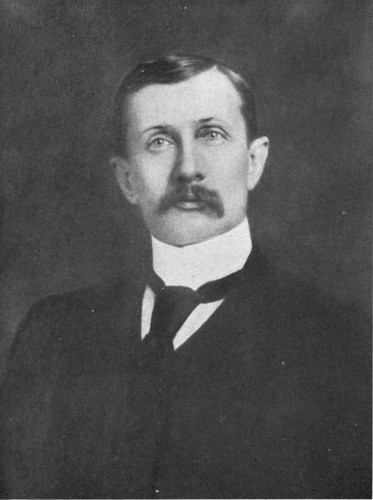
Personally popular, William Paterson left behind him a large circle of friends at his death on the 23d of October, 1902. For twenty years he had been engaged in the tailoring business in Montreal, where he enjoyed a wide acquaintance. He was born December 2, 1858, in Montreal, a son of James Paterson, a native of Scotland, who passed his youthful days in that country. He there married Miss Ellen Swanson and afterward left the land of hills and heather for the new world. To him and his wife were born seven children.
The father was a tailor by trade and it was under his direction and guidance that William Paterson learned the business. He pursued a public-school education and then entered his father’s shop, devoting many decades to that pursuit. He was in business on Notre Dame Street for two decades, having one of the well equipped establishments of the city and gaining a liberal patronage, which grew with the passing years and made his one of the prosperous tailoring establishments of the city.
On the 18th of August, 1881, Mr. Paterson was united in marriage, on Prince Edward Island, to Miss Arabella Le B. Graves, of Nova Scotia, and they became the parents of four children: Leslie J.; William Henry; Alice G., who is Mrs. James J. Aird; and Grace W.
Mr. Paterson voted with the conservative party but never took an active interest in politics to the extent of seeking office as a reward for party fealty. He was very prominent in fraternal circles, serving as worshipful master of Elgin Lodge, A. F. & A. M., and in 1898 he was elected district deputy grand master of the Montreal district. He was past grand in the Independent Order of Odd Fellows. He was also a life member of the Montreal Amateur Athletic Association, and was one of the members of Knox Presbyterian church, serving for several years on the board of managers. His varied interests and activities of life maintained an even balance and made him a forceful and influential factor in support of the business, social and municipal affairs with which he was connected.
WILLIAM PATERSON
D. AUG. FONTAINE.
D. Aug. Fontaine is a well known lawyer and notary of Montreal, being located at No. 244 St. Catherine Street East. Born in the town of Marieville, Rouville county, February 2, 1872, he comes of distinguished French-Canadian ancestry. The Rev. Damase Limoges is an uncle and Morrainé Alphonsine Lemieux, his cousin. The Rev. Damase Limoges was curate of the Catholic parish of St. Jean Baptiste, in the county of Rouville, and our subject was baptized in the Catholic church in that parish on the 4th of February, 1872. His father was Felix Fontaine, a notary at Marieville, and his mother Claire (Limoges) Fontaine. The former was born at St. Charles sûr Richelieu or at St. Hyacinthe about November 24, 1832. He studied in the Seminary of St. Hyacinthe and served a legal clerkship at Marieville with the notary Laberge. He afterwards established himself in that city as a notary and there practiced for the rest of his life, being recognized as a brilliant lawyer and gaining great success. He was a member of the Chamber of Notaries for about twenty-five years and when he died was vice president of this institution. The mother was born at Terrebonne, about August 2, 1840, a daughter of Pierre Limoges, a blacksmith, and Dame (Viger) Limoges. The paternal grandfather of our subject was Felix Fontaine, a teacher at St. Hyacinthe. The maternal grandfather, Pierre Limoges, and Charlotte Luce (Viger) Limoges, his wife, were the parents of twenty-three children, three daughters of whom embraced holy orders, one of them having joined the Ladies of the Sacred Heart at Montreal. One of their sons, Joseph Magloire Limoges, is a curate at Sorel; another, Damase Limoges, a curate at Beloeil and Farnham. A daughter, Claire Limoges, is the mother of our subject.
Louis Fontaine received his education in the elementary school at the Hospice of Ste. Croix at Marieville. He completed his commercial and classical studies at the Seminary of Ste. Marie de Monnoir at Marieville, having terminated his course in 1893. He studied law at Laval University of Montreal from 1893 to 1897 and served a clerkship with Maître J. A. Dorval, of Montreal. He received his notaryship at Quebec (with distinction) September 14, 1897. Mr. Fontaine then formed a partnership with his former preceptor, Maître Dorval, under the firm name of Dorval & Fontaine. Following, he associated himself with his classmate, Oscar Desautels, continuing the partnership of Fontaine & Desautels until 1899. At the end of that time he succeeded his father, Felix Fontaine, as notary in Marieville. Taking up his father’s practice, he there followed his profession for about ten years and has been actively engaged in legal work in Montreal since 1910. He was secretary-treasurer of the school commission of Marieville and also was manager of the Marieville branch of a private bank, known as “La Caisse d’Economie de Drummondville.” He also was for some time collector of customs at Marieville. In politics he was a strict liberal until 1909 and although he yet gives his allegiance to that party, is a nationalist at the same time.
On the 29th of July, 1896, Mr. Fontaine was married in the town of Marieville, which is now annexed to Montreal and known as the town of Ste. Cunegonde, to Miss Marie Eugenie Anna Vezina, daughter of Alexandre and Emma (Chagnon) Vezina. The father is engaged in the saddlery business. Mr. and Mrs. Fontaine have three children: Marie Eugenie Claire Ubaldine, fourteen years of age; Marie Marguerite Jeanne, twelve years of age; and Joseph Alexandre Felix Auguste, aged eleven.
Mr. Fontaine is a member of the Roman Catholic and Apostolic church. He is a musical composer of no mean ability and has produced a pleasing repertoire of Canadian songs. He is the author of the Canadian national song, which was written to the words of Abbé A. Fournet, P. S. S. He was a prize winner in the competition between Canadian poets in 1908 and the newspaper La Presse paid him one hundred dollars, le prix de concours. He is adviser to the singers of Notre Dame parish church of Montreal. Mr. Fontaine deeply interests himself in all matters pertaining to public affairs and is interested in the cause of education and in arts and letters. He is a lawyer of ability, a patriotic citizen and a man who stands for the higher things in life and who finds great pleasure and satisfaction in following his aesthetic tastes and in implanting his art ideas in others. His talent along musical lines has been ably put to use in elevating the musical standards of the city and in bringing more closely before the public the idea of creating a home musical art particularly and peculiarly Canadian.
ARTHUR SURVEYER.
In the field of engineering the name of Arthur Surveyer is widely known. Liberal training and broad experience have brought him to a prominent position and won for him the liberal patronage that is accorded him as senior partner in the firm of Surveyer & Frigon, consulting engineers of Montreal.
Mr. Surveyer was born in this city on the 17th of December, 1878, son of L. J. A. and M. A. Hectorine (Fabre) Surveyer, of whom more extended mention will be found elsewhere in this book, and supplemented his course of study in St. Mary’s College by a course in L’Ecole Polytechnique in which he won the degrees of Bachelor of Arts and Bachelor of Applied Science and was graduated as a civil engineer. He also pursued a special post-graduate course at L’Ecole d’Industrie et des Mines du Hainout, Mons, Belgium. His liberal training and broad experience have made him one of the most efficient representatives of the profession. From 1904 until May, 1911, he was in the service of the Canadian department of public works and was engaged on the survey, plans and estimates for the Georgian Bay Ship Canal project and the survey of the Richelieu river for a twelve-foot canal. He was supervising engineer during the construction of the Port Arthur Dry Dock and reported on several hydro-electric projects on the St. Lawrence river. In May, 1911, he left the public service, in which he was connected with many important works, to enter upon private practice, but has been retained as consulting engineer by the public works department in a number of important matters such as the preparation of Canada’s case against the Chicago drainage canal and the report on the plans submitted to the government by the Montreal Tunnel Company and by the Montreal Central Terminal Company. Mr. Surveyer is a member of the St. Lawrence River commission, is engineer for various municipalities and is a member of a number of professional societies and associations, including the Canadian Society of Civil Engineers, the International Federation of Consulting Engineers and the Hydrotechnic Society of France. Thoroughness has characterized all that he has undertaken. That quality was manifest in his preparation for his profession. He was a most discriminating and earnest student and in his practice he has lost sight of no detail of his work and at the same time has given due prominence to its most important problems and features. His entire professional career has been characterized by continuous advancement.
J. F. OLIVAR ASSELIN.
J. F. Olivar Asselin was born at St. Hilarion, in Charlevoix county, P. Q., November 8, 1874, a son of Rieule and Cedulie (Tremblay) Asselin, the latter of whom is still living. He emigrated to the United States with his parents in 1892, and in Fall River, Massachusetts, J. F. Olivar Asselin was for two years employed in the cotton mills.
Taking up journalism, he was at first connected with small French weekly publications. He afterward became editor of La Tribune, a Woonsocket, Rhode Island, daily, in which capacity he enjoyed the friendship and confidence of the Hon. Mr. A. J. Pothier, then lieutenant governor, and now governor of Rhode Island. While practicing his profession in Woonsocket, Mr. Asselin was principal of an evening public school in that city in 1897 and 1898.
He was the first man to enlist in the First Rhode Island Volunteers, at the breaking out of the Spanish-American War.
Returning to Canada in 1900, he was successively connected with the Montreal Herald, La Patrie, Le Journal, La Presse, La Nationaliste and Le Devoir, with a two years intermission—1901-1903—during which he was private secretary to the Hon., now Sir Lomer Gouin, then minister of colonization and public works of the province of Quebec. In 1902 he organized the Nationalist league, being for several years president of the Montreal branch. This indicates his deep interest in political problems and to disseminate the principles in which he believed, he founded La Nationaliste as the organ of the party, and for a time was editor of that publication.
He has written much upon various subjects, his publications including a series of political brochures with the title, Feuilles de Combat. He is also the author of “A Quebec View of Canadian Nationalism, an Essay by a Dyed-in-the-Wool French-Canadian,” which was published in 1910.
He has been in business for four years as manager of the Credit Metropolitain, one of the well known real-estate and financial firms of Montreal.
In 1912, he was appointed by the federal government, a special commissioner to French and Belgium, to study the question of emigration from those countries to Canada. Mr. Asselin has made a special study of municipal questions, and is well known as a member of the National Municipal league, as well as a contributor to the Municipal Journal. Mr. Asselin stood twice as a candidate for parliamentary honors, without success, a result which, in one case at least, was said to be due to his caustic spirit. In 1913 he was elected general president of the great St. Jean Baptiste Society, the national society of the French.
In 1903 Mr. Asselin wedded Mlle. Alice Le Bouthillier of Montreal.
JOSEPH ASSELIN, M. D., C. M.
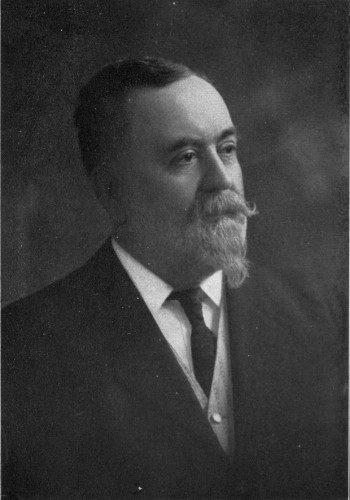
A specialist in the treatment of children’s diseases and prominently known in connection with both hospital and private practice, Dr. Joseph Asselin is one of the best known physicians of Montreal. He was born in Joliette, Quebec, August 10, 1858, a son of Eusebe and Elmire (Cornellier) Asselin. The father was a merchant and proprietor of an important seigneury.
JOSEPH ASSELIN
Dr. Asselin acquired his classical education in Joliette College, and in further preparation for the profession which he had determined to make his life work, he studied for two and a half years in hospitals for children, in Paris, under the direction of such eminent men as Parrot, Bouchert, Simon and Descroizilles. Since entering upon active practice in Montreal his advancement has not only been continuous but rapid, winning speedy recognition for his ability. He has served as a director of the town dispensary of the Sisters of Providence, Montreal, an institution in which many thousands of children have been treated each year. He has also been physician of the Orphelinat St. Alexis at the corner of Mignonne and St. Denis Streets, Montreal.
On the 10th of October, 1883, Dr. Asselin was married to Miss Albina Laurier, daughter of Dr. Louis Laurier, and their family numbers five children. Dr. Asselin is a conservative in politics and in religious faith a Roman Catholic. He holds membership with the Independent Order of Foresters, but his chief interest is that of his profession. He gives untiringly of his service for the benefit of mankind and is highly esteemed not only by his colleagues but by the community generally.
LOUIS THEOPHILE MARECHAL.
In a profession where advancement depends entirely upon individual merit, talent and ability Louis Theophile Marechal has attained distinguished rank. Firmly entrenched in the principles of jurisprudence, he adds to his forensic knowledge and ability the rare gift of eloquence, which has been an effective force in winning for him a high position in his profession. He represents one of the old and distinguished French families in the Montreal district. His birth occurred at St. Henri, near Montreal, on the 13th of March, 1864, and in the pursuit of his education he spent some time as a student in Montreal College and in St. Mary’s (Jesuit) College. He afterward entered Laval University, where he pursued his law course until graduated with the class of 1889. The same year he was called to the bar and has since practiced as an advocate of Montreal. He was made a king’s counsel in 1903 and was appointed a councillor of the Montreal bar for the year 1908-9. His advancement in his profession has been continuous. He accurately applies law principles, being seldom, if ever, at fault in the citation of a fact or legal precedent. He speaks French and English with equal fluency and has been gifted with oratorical power that enables him to sway his hearers with the force of his eloquence. Moreover, his statements are convincing, and his legal utterances are always based upon a thorough understanding of the legal principles involved.
Mr. Marechal was united in marriage to Marie, the only daughter of Hon. C. B. de Boucherville, but lost his wife in death in 1902. His recognition of the duties and obligations of citizenship is manifest in many tangible ways. In politics he is a conservative of the pronounced type. He unsuccessfully contested St. Mary’s (Montreal) for the house of commons in the general election of 1904 and was again a candidate for the same seat in 1908. It is a recognized fact that he is a leader in party ranks and has done much to mold public thought and action. His religious faith is that of the Roman Catholic church. The spirit of progress dominates him in all things, especially in his professional and public relations, and his position of leadership is one to which his ability, public spirit and eloquence have brought him.
L. GEORGES BADEAUX, M. D.
Specializing in the treatment of diseases of the eye, ear, nose and throat, Dr. Badeaux has won a merited place in his particular branch of the medical profession. A native of Three Rivers, Quebec, he is descended from a very old and prominent family, the ancestry being traced back to 1630, when Jacques Badeaux, who was one of the first notaries in Canada, settled at Beauport. In the direct line from Jacques Badeaux to the subject of this review, there were four notaries. The great-great-grandfather, Jean Baptiste Badeaux, who resided at Three Rivers, was also an author and journalist and among his literary productions was a journal relating to the American Invasion in 1775. His son, Joseph Badeaux, also a notary, was a member of the legislature from Three Rivers at Quebec during the Revolution of 1837.
Dr. Georges Badeaux, his son, and grandfather of Dr. L. Georges Badeaux, was a widely known physician of Three Rivers, where he engaged in practice for fifty-five years, or until the time of his death. He was the father of two sons and several daughters. One of his sons, Joseph Badeaux, was a physician at Three Rivers, but is now deceased. His only son is Dr. Joseph M. Badeaux, now engaged in the practice of medicine as successor to his father and grandfather.
Louis Badeaux, father of Dr. Badeaux, of this review, has always resided at Three Rivers, where for more than a quarter of a century he was engaged in the wholesale dry-goods business. He is now living retired.
Dr. L. Georges Badeaux was born March 21, 1886, in Three Rivers and acquired his classical education in St. Joseph’s College in his native place. In 1906 he began the study of medicine at Laval University, Quebec, and after spending two years there he entered Laval University at Montreal, from which he was graduated with the degree of M. D. in 1910.
He then began to make special study of the eye, ear, nose and throat at the Hotel Dieu, being assistant there in the treatment of the diseases of those organs. For the past three years Dr. Badeaux has been an assistant in practice to Dr. Albert Lassalle, the noted eye and ear specialist. For two years Dr. Badeaux was a professor in the demonstration of anatomy at Laval and he is a member of La Société Médicale de Montreal.
On the 28th of April, 1913, Dr. Badeaux was married in Montreal to Anita Fellay, a daughter of Ernest Fellay, of this city, and they have one child, Louis Jacques.
JAMES CHALMERS CAMERON, M. D.
Dr. James Chalmers Cameron, medical practitioner and educator of Montreal, was for thirty-eight years actively connected with the profession in this city, enjoying not only the respect of all with whom he came in contact but also the love and affectionate regard of those to whom he ministered in his professional capacity by reason of his ready sympathy and thorough understanding as well as his medical and surgical skill. Kindness and helpfulness might be termed the keynote of his character and those qualities constantly found expression in all the relations of his life. Ontario was proud to number him among her native sons, for as he developed his latent powers and energies he gained a wide reputation. He was born at Aultsville, Ontario, January 18, 1852, being the eldest son of Rev. James Y. Cameron, of the Presbyterian church, who after receiving his education in Edinburgh, under Dr. Thomas Chalmers, was actively connected with the ministry in Canada for a number of years, but later withdrew from that field to devote his energies to teaching. He conducted a private academy in Lundy’s Lane for several years and was later in turn principal of the Drummondville (Ont.) high school, the Williamstown (Ont.) high school and for a couple of years lecturer in classics and mathematics at the Presbyterian College, Montreal. Rev. J. Y. Cameron married Charlotte Ann Ault in 1851. Both husband and wife were descended from United Empire Loyalist families, who had sacrificed their homes in the American colonies to remain true to the British flag and settled in Glengarry.
Dr. Cameron began studying in the old Upper Canada College, Toronto, and by reason of his aptitude and close application became head boy of the school in 1870. He next entered McGill, where in four years he became first prize man in medicine, graduating in 1874. The succeeding three years were spent in connection with the General Hospital in Montreal, but in 1877 he severed his connection with that institution and in April of the same year sailed for Dublin, Ireland. He pursued post-graduate courses in medicine and surgery in Berlin, Paris and Vienna and thus he added greatly to his knowledge through acquaintance with the methods of practice of the most eminent physicians and surgeons of the old world. The chair of obstetrics at Bishop’s College was offered to Dr. Cameron when he returned from his first post-graduate course at the Rotunda and was at once accepted. He remained there until the chair at McGill was offered him, thus giving him wider opportunities. He became professor of obstetrics and infants’ diseases at his alma mater, holding that chair for twenty-six years and contributing in large measure to the success of the medical department. He believed always in raising the standards of medical education because of his clear recognition of the responsibilities devolving upon the practitioner and his labors and teachings were an inspiration to all who came under his instruction. While professor at McGill Dr. Cameron became associated with the old University Lying-in Hospital, which later became the Montreal Maternity Hospital, and Dr. Cameron’s work in behalf of that institution resulted largely in bringing it to its present standard of modern excellence. It was not only as practitioner and educator that Dr. Cameron became widely known but also as a contributor to various text-books on medicine, this gaining him a wide reputation. His treatises were written in English, French and German. He was well known in the United States and was elected an honorary fellow of the American Gynecological Society, besides being a member of many other leading societies connected with the medical profession. He was a member of the British Medical Association and the Edinburgh Obstetrical Society. For many years he was chief medical examiner for the Equitable Life Assurance Society in Montreal. He gained eminence as a lecturer on subjects of literary interest, his addresses on Robert Louis Stevenson and Robert Burns being especially well received.
Dr. Cameron was married in 1880 to Miss Elizabeth Jane Dakers, daughter of James Dakers, who was for thirty-five years secretary and manager of the Montreal Telegraph Company. Mrs. Cameron survives with one son, Dakers Cameron, of Montreal. Dr. Cameron is also survived by his mother and two brothers, Dr. John W. Cameron, of Buffalo, New York, and Wellington Ault Cameron, barrister, of Toronto.
The remarkable energy of Dr. Cameron found expression along other lines. He was for a time assistant surgeon of the Sixth Fusiliers. His name was on the membership role of the St. James and University Clubs and in 1874 he was initiated into Royal Albert Lodge, A. F. & A. M. Subsequently he became the principal mover in establishing the University Lodge, A. F. & A. M., which has rapidly grown in influence and includes many university graduates and students of McGill. He was the first worshipful master of this lodge and also an officer of the grand lodge of Quebec. In Masonry he attained the thirty-second degree. As specially appointed medical examiner for the German army, Dr. Cameron held a position unique in Canadian history, an honor which he valued very highly. He was also a member of the Teutonia Club. Dr. Cameron died suddenly on March 16, 1912. The funeral services were conducted according to Masonic rites, the religious ceremony taking place at St. Paul’s Presbyterian church, of which he was a member. One of the local papers said: “His every patient became his friend and his death is a loss to thousands.” The news of his demise, indeed, carried a sense of personal bereavement into many homes where his eminent skill and kindly ministrations had made him loved and honored. In all of his professional relations he approached the ideal because of his comprehensive knowledge and still more because of his deep human interest and sympathy. He regarded it as a sacred privilege and obligation to discharge the duties of his profession and his life embodied the thought of the philosopher who has said: “Not the good that comes to us but the good that comes to the world through us is the measure of our success.”
JOSEPH VENNE.
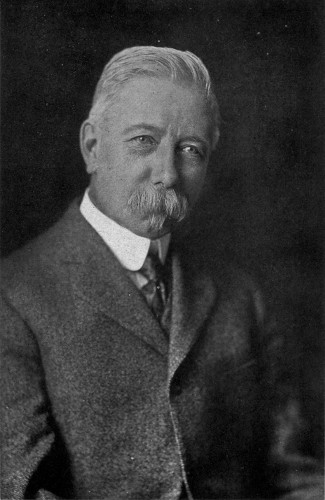
On the list of architects who have had to do with the building of Montreal appears the name of Joseph Venne, senior member of the well known firm of Venne & Labelle, and those who are to any extent familiar with the building operations that have been carried on here in the last third of a century know that he has figured prominently as one whose work combines the indispensable qualities of utility, comfort, convenience and adornment. He was born in Montreal, June 14, 1859, was educated in the Christian Brothers school of this city and, being a diligent student, creditably passed his examinations.
JOSEPH VENNE
After putting aside his text-books he entered the office of Perrault & Mesnard, architects, and for many years was their head clerk. The high regard entertained for him by his employers is indicated in the advancement that came to him from time to time and his eventual admission to the firm under the style of Perrault, Mesnard & Venne, which partnership continued for several years when it was dissolved. Since 1912 he has been associated with Louis Labelle.
In 1882 Mr. Venne was united in marriage to Miss P. Boucher, a daughter of S. Boucher, Esq., of Montreal. A Roman Catholic in religious faith, he belongs to the St. Jean Baptiste Society and has been president of the Sacred Heart section. In politics he is a liberal. Along professional lines his connection is with the provincial Association of Architects, and through his identification with that organization he keeps in touch with the advanced work and progressive ideas of representative men of the profession and also contributes from his experience and wisdom to its discussions and conferences.
NIEL H. ASSELIN.
The name of Niel H. Asselin has become a familiar one in commercial circles in Montreal, where he occupies the important and responsible position of general agent of the Singer Sewing Machine Company for eastern Canada. He was born in 1845 at St. Michel, Bellechase county, in the province of Quebec, and supplemented his preliminary education by study in the St. Michel Commercial College. He reached what may be termed his métier by a somewhat circuitous course. He started with the Grand Trunk Railway in the position of operator and stationmaster at Hadlow in 1863 and left that position to accept one in the office of the prothonotary for the Quebec district, in which capacity he served for six years. He then resigned to travel in the boot and shoe trade, and in 1874 came into active connection with the sewing machine business as representative of the Howe Sewing Machine Company. When this went into liquidation he made his way to the United States and joined the sales force of the Wheeler & Wilson & Domestic Sewing Machine Company.
Upon returning to Canada in 1884, Mr. Asselin entered the employ of the White Sewing Machine Company as its representative in Quebec, the maritime provinces and Newfoundland. In 1891 he joined the Singer Sewing Machine Company at Quebec as its manager for half of the province and a part of New Brunswick. In 1903 he was advanced to the position of superintendent and in 1905 became general agent for all eastern Canada, comprising Quebec, New Brunswick, Prince Edward Island, Nova Scotia and Newfoundland, with headquarters in the Board of Trade building in Montreal. Here with an office staff of fifteen under his control and twenty-eight regular shops, thirty-two contract shops and four hundred outside employes under his jurisdiction, he may well be said to hold the blue ribbon position in sewing machine circles in Canada.
Mr. Asselin has a fluent command of both English and French and is a cultured, genial gentleman, whose popularity arises from attractive social qualities as well as pronounced business ability.
ROBERT T. MULLIN.
Robert T. Mullin, one of the able and successful advocates in Montreal, is a representative of a well known Canadian family whose members settled in the Dominion about 1810. He was born in 1870 at Bryson, province of Quebec, and after completing his preliminary education, entered McGill University at Montreal. He was graduated from the law department in 1896, with first rank honors, and he was also a gold medallist in Roman law in his graduating year. While at McGill, Mr. Mullin was a member of the Literary and Debating Society and was also editor in chief of the “McGill Fortnightly.” He was called to the bar in 1900, beginning the practice of his profession in this city in partnership with Colonel J. P. Cooke, who later became registrar, the firm name being Cooke & Mullin. This connection was productive of mutually beneficial results and was maintained until 1910 when it was dissolved. Mr. Mullin later was a member of the firm of De Boucherville, Mullin & Mathieu, but since 1912 he has been alone in practice. Mr. Mullin is at all times a strong and forceful practitioner, well versed in underlying legal principles and possessed of the insight, keenness of perception and powers of deduction necessary to make his knowledge effective. He controls a large and important clientage and is very successful in its conduct, standing today in the front ranks of reliable and competent advocates in Montreal.
At the inception of the Cobalt mining activities, Mr. Mullin became interested in various mining properties, and he has had considerable success along this line of industry and has played a conspicuous part in the development of various mining properties. His operations have been so successful that his judgment has been profitably followed by others in the mining world.
Mr. Mullin is connected with the Masonic fraternity and with the Benevolent Protective Order of Elks and is active in the affairs of the local branches of both organizations. Mr. Mullin has done valiant service in the ranks of the liberal party. He has always been an enthusiastic supporter of Sir Wilfrid Laurier and ready to respond to his party’s call at any time. In the city where practically his entire active life has been passed his signal ability has gained him the respect of his professional brethren, while his constant courtesy and sterling qualities of character command everywhere high honor and regard.
J. A. ST. JULIEN, K. C.
J. A. St. Julien, K. C., was a member of the prominent and well known law firm of St. Julien & Theberge, having offices at No. 60 Notre Dame Street East. During the years of his connection with the Montreal bar he attained an enviable place in the practice of his profession.
Mr. St. Julien was a native son of Montreal, born in 1855. Liberal educational opportunities qualified him for important professional service. His early studies were supplemented by a course in the Montreal College, Laval University and in McGill University and from the last named institution he was graduated with the degree of B. C. L. He entered upon the active practice of his chosen profession in 1882 and was continuously before the courts from that time until his death. His ability was pronounced for he was ever a careful and discriminating student of the principles of law and was accurate in the application thereof. His devotion to his clients’ interests was proverbial, yet he never forgot that he owed a still higher allegiance to the majesty of the law, and neither the zeal of an advocate nor the pleasure of success permitted him to disregard this. His political allegiance was given to the liberal party, but he was never an aspirant for office, preferring to concentrate his energies upon his professional interests and perform his public service as a private citizen. His death occurred May 4, 1914, and was deeply regretted by all who knew him. In his demise Montreal lost one of her foremost representatives of the legal profession and a citizen who was always loyal to his city.
HON. CHARLES LAURENDEAU.
Hon. Charles Laurendeau, chief city attorney, the head of the city’s legal department, is one of the able members of the legal profession in Montreal. The Hon. Mr. Laurendeau belongs to one of the oldest families in the province of Quebec. He was born at St. Barthelemy, in 1865, and was educated at L’Assomption College and Laval University. In the latter institution he pursued the study of law and was graduated with the LL. B. degree in 1892.
In the same year he began practice as an advocate, and rapidly won a foremost position among his colleagues until his ability and power to successfully cope with the intricate and involved problems of jurisprudence became widely known.
He was at one time associated in practice with Justice Fortin, subsequently becoming the head of the law firm of Laurendeau, Pelletier & Pelletier. He was created king’s counsel in 1906, and on July 6, 1910, was honored with the appointment of puisne judge of the superior court of the province of Quebec.
Advancement at the bar is proverbially slow and yet he has progressed step by step, putting his knowledge to the practical test in his application of legal principles to the points at issue, in which connection he is seldom at fault.
Judge Laurendeau resigned his position on the bench, to accept the far more arduous one of city attorney, to which he was appointed October 26, 1913.
Judge Laurendeau is married to Miss Georgina Beaudet, the eldest daughter of G. J. Beaudet, of Coteau-du-Lac, P. Q. Judge and Mrs. Laurendeau hold membership in the Catholic church. The hospitality of their attractive home is enjoyed by many friends, and Judge Laurendeau is well known and honored among his professional colleagues by reason of his strict conformity to the highest ethics of the law.
WILL. H. WHYTE.
Will. H. Whyte, prominent and successful in the insurance profession and an eminent representative of Masonry in Canada, was born in Montreal, March 15, 1850, the eldest son of the late James Whyte of “The Greenlaw,” Paisley, Scotland, and Annie Gray (Shanks) Whyte, whose girlhood home was at Berwick on Tweed.
Will. H. Whyte became a student at the Montreal Collegiate school and entered business circles in connection with the wholesale dry-goods house of Ogilvy & Company. The steps in his orderly progression are easily discernible and his course has been marked by a continuous advance along lines of constantly broadening activity and usefulness. For six years he was business manager of the Montreal Herald when the Hon. Peter Mitchell was the principal owner and president. Since 1897 his attention has been given to the insurance business, and his constantly expanding powers have brought him into prominent relations with the profession. He is now secretary-treasurer and underwriter of the Royal Marine Insurance Company of Montreal.
His business connections alone would entitle him to distinction, yet he has, perhaps, an even wider acquaintance through his Masonic associations. Indeed, few Canadian Masons are better known throughout the Masonic world. He was initiated in Prince Consort Lodge, No. 52, and was installed worshipful master in December, 1876. He was elected to a number of important offices in the grand lodge and became grand secretary of the grand lodge of Quebec in January, 1902. He has passed through the various branches of Royal Arch Masonry and was grand first principal Z. of the grand chapter of Quebec, holding the office for the years 1888-9. He has held the office of grand scribe E. from 1893. He received the Cryptic degrees and has been illustrious grand master of the grand council of the maritime provinces. He was knighted as a Knight Templar in 1882 and was supreme grand master in 1895 and 1896 of the sovereign great priory of Canada and has been grand chancellor since 1897. He was the second Knight Templar to be elected an honorary member of the grand encampment, K. T., of the United States at the triennial conclave in Chicago in 1910. He is a member of the Ancient Arabic Order of the Mystic Shrine and of the Royal Order of Scotland. The many important offices he has held, as well as his reviews and historical sketches have brought him very prominently before the Masonic craft for many years.
In former years Mr. Whyte was an active athlete and supporter of amateur athletics. He was one of the founders and is the historian of the Montreal Amateur Athletic Association. He has also served as one of its directors. He was likewise president of the Montreal Lacrosse Club in 1885-6; was vice president and secretary for six years of the Montreal Snowshoe Club; is one of the oldest members of the Dominion Commercial Travelers’ Association; is a life member of the Caledonian Society; a member of St. Andrew’s Society; and of the Board of Trade of Montreal.
On the 3d of January, 1882, Mr. Whyte married Almeda Garratt, a daughter of the late Captain Robert Nelson Garratt of Kingston, Ontario, a representative of one of the families longest connected with the history of the city of Kingston. They are members of the American Presbyterian church, and they delight in dispensing the hospitality of their home at No. 4290 Western Avenue, Westmount.
JAMES PATON.
James Paton, a well known citizen of Montreal, died November 17, 1905. He was born in this city in 1853, a son of Laird Paton, a distinguished citizen of Montreal, who was at the head of the firm of Laird Paton & Sons, contractors.
It was to that business that James Paton turned his attention, when his school days were over, joining his father and acquainting himself with every phase of the business in which he was destined to win substantial success. The firm of Laird Paton & Sons took high rank among the contractors of the city and erected many of Montreal’s best buildings. James Paton was capable of watching and directing the slightest detail as well as the most important features of his business and could turn with equal energy and enthusiasm to sporting events. In a word, he had the power of concentrating his entire energy upon the interest of the moment and it was this that gained him prominence along each line. Whenever the name of James Paton was seen in connection with any sport, it was a guarantee that it was clean and honest and he rendered great service to the city in the promotion of amateur sports. He belonged to the Montreal Amateur Athletic Association and was one of the moving spirits in the development of that organization and in the efforts which eventually lead to the securing of the present handsome quarters of the organization on Peel Street. He was also instrumental in securing the establishment of its swimming-pool and he belonged to the Montreal and Caledonian Curling Clubs, was always ready to take an active part in the water carnivals, and was a favorite of the membership in the different organizations with which he was identified. He found pleasure and manifested marked proficiency in ice-boating and tobogganing. He loved sailing and seemed a born sailor, displaying great ability in managing his craft and taking part in many sailing contests of note.
JAMES PATON
Mr. Paton married Miss Annie M. Thompson of Ottawa and they had four children. He was but fifty-two years of age at the time of his death. He possessed in a large measure the quality of camaraderie and his friends were legion so that his death was deeply regretted outside the immediate family circle.
RICHEMONT LE MOYNE DE MARTIGNY.
Richemont Le Moyne de Martigny, for many years engaged in the real-estate business in Montreal, was born at Varennes, Quebec, September 25, 1852, and is descended from a distinguished French family that was founded in Canada in 1654. Of the three brothers who first crossed the Atlantic to the new world Charles became governor of Montreal, Jacques established himself at Varennes and was a farmer and active participant in the early Indian wars, while Pierre proceeded westward to what is now Detroit.
Prime de Martigny, father of Richemont Le Moyne de Martigny, was a farmer at Varennes, well known in both military and official connections, serving as colonel of the militia and mayor of Varennes. He married Charlotte Perreault, of Quebec, and their sons were: Prime, a physician of Omaha, Nebraska; Richemont Le Moyne; and Alexander, chief engineer of the Ottawa River Navigation Company.
The second son was educated at L’Assomption College and studied law with La Coste & Globesky, of Montreal. In 1881 he was admitted to the bar and practiced his profession until 1885, when he devoted himself to the real-estate business, in which he has since been successfully engaged. It is generally conceded that he is one of the best informed men on real estate in the entire province. He is an expert valuator of property, and his knowledge of the real-estate market embraces every important piece of property that is offered for sale. A spirit of enterprise characterizes all of his business dealings and, guiding his activities, has brought him to a position of distinction and success.
In 1880 Mr. de Martigny was married, in L’Assomption, to Marie Louise Levesque, and they have one daughter, Jacqueline. Mr. de Martigny is a conservative in politics and in religious faith is a Roman Catholic. He has ever been fond of outdoor life, is an enthusiastic fisherman and spends much of his leisure in engaging in that sport.
HON. NAPOLEON CHARBONNEAU, K. C.
Hon. Napoleon Charbonneau, K. C., and a puisne judge of the superior court of the province of Quebec since 1903, was admitted to the bar in 1879 and in the intervening period has made continuous progress in his profession until he is today one of the leaders of the provincial bar. He was born at Cote des Neiges, Quebec, on the 12th of February, 1853, his parents being Augustin and Julienne (Dufort) Charbonneau. In the acquirement of his education he attended Montreal College and after thorough preparation for the bar was admitted to practice in 1879 and entered upon the active work of the profession in Montreal. At one time he was a partner of the late Senator Trudel and of the Hon. L. O. Taillon. He has successfully pleaded before the judicial committee of the privy council, and on the 11th of March, 1903, he was made a puisne judge, remaining continuously upon the bench to the present time. The Montreal Standard speaks of him as “a judge of uncommon perspicacity, thoroughly sound in his law and swift in his perception of relevant facts and issues; there are not two opinions as to his ability.”
Judge Charbonneau’s public activity aside from his service on the bench has been partially in connection with political affairs. He unsuccessfully contested Jacques Cartier for the house of commons in the liberal interest at the general election in 1887 and in 1895 was elected at the by-election. He was appointed a royal commissioner for the province to inquire into the charges against the Hon. A. Turgeon in 1907. His attention, however, has largely been confined to his professional duties, and he has gained eminence in a calling where advancement depends entirely upon individual merit. Endowed by nature with strong intellectual power, he has so directed his reading and his activities as to have won place among the eminent judges of the province.
The present wife of Judge Charbonneau was Mlle. Lemieux. His religious belief is that of the Roman Catholic church. He maintains his residence in Montreal at No. 36 Simpson Street. His summer outing affords him opportunity for cruising, and he and his family are enthusiastic over this form of recreation. His launch, the Mouette, is much enjoyed. His circle of friends is select rather than large, and he is often found in those gatherings where intelligent men are met in the discussion of vital and significant themes and problems.