BIOGRAPHICAL (continued 6)
Reading edition
In June, 1889, Mr. Duclos was united in marriage to Isabella Spence, a daughter of G. M. Holbrook, of Ottawa, and they reside at No. 488 Elm Avenue, Westmount. Mr. Duclos’ fellow citizens of Westmount called him to the office of mayor, in which he served in 1905-6, giving to the city a businesslike and progressive administration. He is a conservative in politics, and he stands for all that means progress along material, intellectual, political and moral lines. His religious faith is that of the Presbyterian church. His social connections are with St. James, Canada, Royal Montreal Golf, St. George Snowshoe Clubs, of Montreal; and the Rideau Club, of Ottawa. Appreciative of the social amenities of life and readily recognizing and appreciating these qualities in others, he has gained many friends in these organizations. However, he regards the practice of law as his real life work and bends his energies, in major part, toward his professional duties. He was created king’s counsel in 1903, and the years of his active practice now cover nearly three decades—years in which he has made continuous advancement as the result of constantly developing power in the line of his chosen profession.
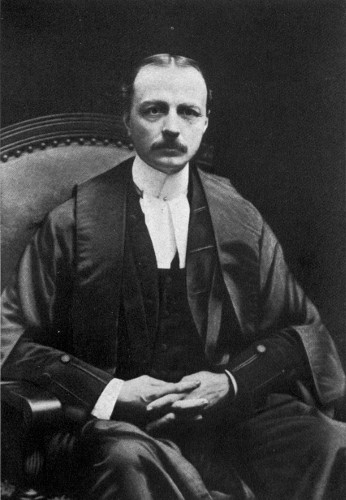
CHARLES A. DUCLOS
REV. CANON JOHN MACPHERSON ALMOND.
Rev. Canon John Macpherson Almond, rector of Trinity church, Montreal, is a man whose practical piety has been demonstrated in many ways, as a traveling missionary, on the field of battle, in the pulpit and in quiet work among his people. His name stands as a synonym for sincerity of purpose, upright living and breadth of mind, and his accomplishments have already been important enough to form a notable part of the history of the Anglican church in Canada. Canon Almond was born in Shigawake, Quebec province, July 27, 1872, and is a son of James and Mary Ann (Macpherson) Almond. He studied in the University of Bishop’s College at Lennoxville, from which he was graduated B. A. in 1894 and M. A. in 1901. He was ordained deacon in the Anglican church in 1896 and priest in the following year, being stationed first as a missionary in Labrador and becoming afterward traveling missionary for the Quebec diocese. In October, 1899, he was commissioned chaplain to the Royal Canadian Regiment and accompanied it to South Africa, where he was chaplain to the Nineteenth Brigade, composed of the Gordons, Cornwalls, Shropshires and Canadians. His conduct during the campaign received high praise, more particularly in connection with his attendance on the enteric fever patients at Bloemfontein, and he was given a medal for courageous and untiring work in all conditions of danger both from the enemy and from disease and discomfort.
Returning to Canada in December, 1900, Canon Almond was made assistant curate at Holy Trinity Cathedral, Quebec, and as such remained one year, after which he was appointed rector at Grand Mere. In 1904 he was transferred to Montreal, where he has since filled the position of rector of Trinity church, winning the love, respect and confidence of his parishioners and the high regard of all who have an opportunity of knowing his honorable and upright life. Canon Almond is a preacher of great power and forcefulness and has won a wide reputation as a speaker, delivering among others the oration at the decoration of the soldiers’ graves in Montreal on Victoria Day, 1905. He was elected president of the South African Veterans Association of Montreal in 1908 and of the Last Post Association two years later. Since March, 1911, he has held the office of chaplain, with the honorary rank of captain, in the Sixth Duke of Connaught’s Royal Canadian Hussars. In 1912 he was appointed chaplain of the Montreal jails. Archdeacon Ker has called him “a splendid preacher,” and the Toronto Globe speaks of him as “a man of zeal, practical piety and unselfishness, with a knack for executive work”—tributes which he has won by most able and untiring work in many fields. Canon Almond was married in October, 1901, to Nellie Estelle, daughter of H. G. Beemer of Quebec.
WILLIAM LANGLEY BOND, K. C.
William Langley Bond, one of the well known advocates of Montreal, belongs to an old Canadian family, his parents being Lieutenant Colonel Frank and Mary (Scott) Bond. Colonel Bond is a well known financial agent and stockbroker of Montreal and is the eldest son of the late Archbishop Bond, Primate of All Canada, and Eliza (Langley) Bond. The father has been connected with banking and financial interests for many years and has also been prominent in military life.
William L. Bond was born in Montreal, January 20, 1873. He attended the high school in Montreal and then entered McGill University, from which he received the degree of B. A. in 1894 and of B. C. L. in 1897. In 1898 he became an advocate and shortly thereafter a member of the legal firm of Atwater, Duclos, Bond & Meagher, of Montreal. Among the famous cases which he argued was the Cantin case, which was tried before Jl. Comte, P. C., England. In November, 1911, he was appointed a K. C.
For a number of years Mr. Bond was captain and adjutant of the Prince of Wales Fusiliers. He is also honorary treasurer of the Province of Quebec Rifle Association. In his religious faith he is an Anglican and was elected lay secretary of the Montreal Synod in 1907 and also church advocate. In 1910 he was made a governor of the Montreal Diocesan Theological College. Mr. Bond is prominent in club life, being a member of the committee of St. James, and a member of the Reform, the Arts, and the Winter Clubs. He is a great friend of outdoor sports and the lines along which he seeks recreation are indicated by his membership in the Royal Montreal Golf Club, the Montreal Curling Club and the Forest and Stream. He also belongs to the Montreal Military Institute and is an honorary member of the Polo and Country Club.
ROBERT ANDERSON BECKET.
Robert Anderson Becket, did much to promote musical talent, directly assisting many young musicians, and thus his loss was distinctly felt in musical circles, when death called him on the 6th of May, 1910. He had passed the seventy-fifth milestone on life’s journey, his birth having occurred in Scotland, December 30, 1834. His father, James Becket, came to Canada with his family in 1841 and was connected with the customs department at Montreal, where Robert A. pursued his education in private schools. He was a young man in his twenty-fourth year, when on January 11, 1858, he wedded Anne Wilson, born in Bellemeana, Ireland, a daughter of Samuel Wilson.
Robert A. Becket had made his initial step in business as bookkeeper for his uncle, J. C. Becket, on St. James Street in Montreal, but in the year of his marriage, removed to Belleville, Ontario, where he embarked in business on his own account conducting a music and stationery store, for about eight years, or until 1866, when he returned to this city and became manager for the D. Morris Ice Company. Some time passed and he became owner of this enterprise, in which connection he built up a large and profitable business. He organized a joint stock company called the City Ice Company, Limited, and devoted all of his time to the conduct of his business, carefully directing its interests. He was a progressive man and was especially active along musical lines, doing much to help young musicians. He was also a prominent figure in quartet and choir work and there was perhaps, no one who did more to stimulate among the young, a love for music of the higher class, than Mr. Becket.
Unto Mr. and Mrs. Becket were born twelve children, of whom five are living: Christina A.; Dr. George C., of East Orange, New Jersey; Ralph A., of Montreal; Fred M., of Niagara Falls, New York; and Frank W., of New York. The family attend the Erskine church, of which Mr. Becket was a prominent member and elder, his religious faith constituting the root from which sprang his many good deeds, wrought along lines of continuous benefit to his fellowmen.
HAROLD EARLE WALKER.
Harold Earle Walker, practicing at the bar of Montreal as a member of the law firm of Chauvin, Baker & Walker, was born in Westmount, Quebec, in 1882. His father, James Robert Walker, a native of the city of Quebec, became senior partner of the well known firm of J. R. Walker & Company of Montreal and is not only well known in business circles but also through his active connection with public affairs. At one time he was mayor of Westmount and has taken an active part in furthering matters of civic virtue and civic pride. He married Agnes Cooper Earle.
After attending the Abingdon school, Mr. Walker became a student in McGill University, completing the arts course in 1904 and the law course with the class of 1907. His standing is indicated by the fact that he won the Elizabeth Torrance gold medal and the Macdonald scholarship. Following his graduation with the class of 1907, which was indicative of the completion of the thorough course of law prescribed by McGill, he was admitted to the bar and after a year spent in France returned to Montreal to enter upon the active practice of his profession, which he now follows as a member of the law firm of Chauvin, Baker & Walker. An extensive practice is fast adding to his experience and developing the powers with which nature endowed him.
In Montreal, in 1911, Mr. Walker was united in marriage to Miss Hazel A. Hart, a daughter of R. A. Baldwin Hart. His religious faith is that of the Presbyterian church, and something of the nature of his recreation is indicated in the fact that he is a member of the Beaconsfield Golf Club. He is a typical young professional man of the age, alert, energetic, watchful of opportunities. His friends anticipate for him future success, and the record he has already made shows that he has taken a far step in advance since entering upon the active practice of law.
JOSEPH BOWLES LEARMONT.
The history of a country is no longer an account of wars and conquests, but is a record of notable business activity, of intellectual, aesthetic and moral progress and political management and control. While never active in the field of politics, Joseph Bowles Learmont was not only highly successful where his tastes led, but was as well one of the foremost merchants of the city, and well known in the business community of Montreal. He cooperated in various interests having broad humanitarianism as their basic principle, and he was a connoisseur on rare books and engravings. His interests were wide and varied and brought him into close connection with many of the leading citizens of the Dominion.
Mr. Learmont was a native of Montreal. From the beginning of his business career success attended him so that he at length was numbered among the city’s most substantial business men. In all his career there was no esoteric phase, his advancement having been through constructive and progressive methods. Studying the demands of the times and the conditions of trade he was no small factor in the growth and development of the extensive wholesale hardware business of Caverhill, Learmont & Company, of which Mr. Learmont was the senior member. This well known house succeeded Crathern & Caverhill (which was established in 1854) and occupies a foremost position in its line, with a reputation for commercial integrity second to none.
Successful business man that he was, commerce constituted but one feature in the life of Mr. Learmont. He was of decided literary tastes and was frequently heard on literary and historical subjects. He was, moreover, the author of a most interesting paper on folk lore, in which extended mention is made of the folk lore of Canada. Another paper of equal interest from his pen is on The Canadian Indian. Mr. Learmont was widely known as a collector of rare books and manuscripts, etchings, engravings and autograph letters, his knowledge of such being that of a connoisseur. His collection of Bibles comprised more than one hundred rare volumes. He also wrote on engravings, translations of the English versions of the Bible, children’s elementary books, etc.
Mr. Learmont’s keen interest in matters historic was probably best shown in his purchase of Quebec House, the home of Major General James Wolfe, Westerham, Kent, England. The motive which inspired him to make the purchase was to secure the property for the Canadian people, to be held by them in perpetuity “irrespective of race, language or creed.” His desire was that the Canadian people maintain it so that it may be open to visitors and free to all that are interested in Canada. Mr. Learmont always manifested the keenest interest in anything associated with Wolfe and had made a collection of engravings of the famous general. He also possessed an excellent painting of Wolfe’s father, the work of Sir James Thornhill.
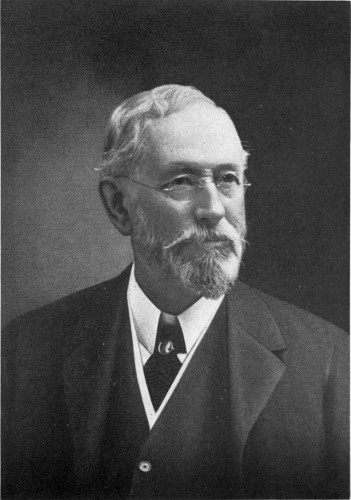
JOSEPH B. LEARMONT
Mr. Learmont was a member of the council of the Montreal Art Association and treasurer of the local branch and one of the council of the Archaeological Institute of America. He likewise became one of the early members of the Antiquarian Society of Montreal.
Mr. Learmont was first married to Miss Amelia Jane Holton, a daughter of the late Hon. L. H. Holton, M. P., a prominent parliamentarian and statesman. Following her death, he married, in 1882, Charlotte Smithers, a daughter of the late Charles F. Smithers, president of the Bank of Montreal. Mr. and Mrs. Learmont were always in full accord concerning religious and charitable work. He was connected with the Congregational church and a generous supporter of church and benevolent enterprises. Mrs. Learmont is particularly well known in efforts to ameliorate the conditions of life for the unfortunate. She is interested in the movement for providing playgrounds for children; is vice president of the Montreal Day Nursery; vice president of the local branch of the Needle Work Guild, and president and convener of the local branch of the ladies’ committee of the Victorian Order of Nurses. She is likewise a director of the City Improvement League; was one of the directors of the Royal Edward Institute, and is one of the honorary presidents of the Young Women’s Christian Association. She was one of a deputation, headed by the Countess of Aberdeen, who presented Queen Alexandra an address of congratulation from twenty-five hundred women of Canada.
Mr. Learmont was a member of the committee of management of the Montreal General Hospital; a member of the board and a governor of the Montreal branch of the Victorian Order of Nurses, and a director of the Charity Organization Society. He belonged to the Montreal Board of Trade, of which he was for two years a councilor, and in more strictly social lines was a member of the St. James, Mount Royal, Montreal and City Clubs. He was termed “a man of exquisite taste and deep knowledge on special subjects.” He was an advocate of all that is most progressive and beneficial, never choosing the second best but seeking out those things which are most beneficial to the individual and to the community, recognizing every man’s relation and obligation to his fellowman.
Mr. Learmont died March 12, 1914.
FREDERICK WILLIAM THOMPSON.
Centuries past the history of a country consisted of a record of wars and conquests—the contest of man with man; today the history is the record of man’s contests with material forces and those who are making the history of a country are the men who are controlling its important agricultural, commercial and professional interests. It is they who are shaping the annals of the nation and those who rise to leadership in any given line are the men who are preparing the records that in years to come will be eagerly read as the history of the past. In this connection the name of Frederick William Thompson stands prominently forth, for he became one of the foremost figures in connection with the milling industry of Canada. He was born in Montreal, January 16, 1862, and was but in the prime of life when he passed away in London, England, May 7, 1912. His parents were the late Andrew and Josephine (DeLesperance) Thompson. The son was educated in Montreal and in Brooklyn, New York, living for some years in the latter city. Subsequently he returned to Montreal and entered the service of the Exchange Bank as a clerk, remaining with that institution for seven years. It was thus that he gained his preliminary business experience which he later turned to account in the management of milling operations. In 1882 he joined the Ogilvie Mills in Winnipeg, becoming general manager of the Ogilvie Milling Company in 1888. Following the death of W. W. Ogilvie in 1900 the entire company’s interests were consolidated and the business purchased by Mr. Thompson and C. R. Hosmer. In 1911 the Ogilvies were made millers to the King. The business gradually grew and developed and became a focal point in the milling industry of the country, setting the standard for activity along that line. Mr. Thompson was active in coordinating forces and in developing an enterprise which became second to none in all Canada. He had wonderful powers of organization and could unite seemingly diverse elements into a unified and harmonious whole. He considered no detail as too unimportant to claim his attention, while, at the same time, he gave due regard to the major points in his business. His executive force and management were many times called forth in other connections.
He had voice in the control of many important business and financial interests and in affairs of a public and semi-public character. He was a director of the Canadian branch of the Liverpool & London & Globe Insurance Company, the Montreal Transportation Company, the Canadian Appraisal Company, the Electric Flour Patents Company, the E. N. Heney Company, the Royal Bank of Canada, the Manitoba Assurance Company, and was president of the Keystone Transportation Company and of the Canada Appraisal Company. He was also the originator of the Kaministiqua Power Company and of a large number of other enterprises which contributed to the history of the country in its commercial and financial development.
As stated, Mr. Thompson was a prominent figure in relation to many public and semi-public interests. He was a governor of the Winnipeg General Hospital; and a life governor of the Protestant Hospital for the Insane, the Western Home and the Boys’ Home. In 1908 he lectured on Plain Business Facts. He was president of the Winnipeg Industrial Exchange Association and of the Winnipeg Board of Trade. He was likewise a vice president of the Winnipeg Rowing Club; president and patron of the local branch of the Royal Caledonia Curling Club, and honorary president of the Winnipeg Hockey Club. He was a director of the Montreal Association for the Blind, governor of the Montreal Western Hospital, councilor of the Montreal Board of Trade, and in Montreal no less than in Winnipeg he was greatly interested in all public enterprises and philanthropic undertakings. In 1903 he was a delegate to the Fifth Commercial Congress of the Empire.
In the previous year Mr. Thompson received the Prince and Princess of Wales, now King George and Queen Mary, at the Ogilvie Mill in Winnipeg and subsequently presented the Princess with the picture of the largest flour mill in the British Empire. It was in the same year that the largest shipment of flour to South America from the Dominion of Canada was made.
In 1882 Mr. Thompson was united in marriage to Miss Wilhelmina Reid, a daughter of the late William Reid of Bedford, province of Quebec, and their children were Marion, Fred, Alice and Helen. The first named became the wife of D. C. Rea, of Winnipeg, manager of the Royal Bank. Mr. Thompson was prominently known in club and social circles, holding membership in the St. James, Mount Royal, Canada, Forest and Stream, Royal Montreal Golf, Montreal Jockey, and Auto and Aero Clubs; Montreal Amateur Athletic Association; the Montreal Curling Club; the Rideau Club of Ottawa; the Constitutional of London; Manitoba of Winnipeg; and the York Club of Toronto.
Perhaps no better estimate of the life and character of Mr. Thompson can be given than by quoting from an editorial which appeared in one of the papers at the time of his demise and which read:
“Death has within a year robbed the Canadian milling industry of its two most prominent leaders. During the years which brought Robert Meighen and Frederick William Thompson to the top, the flour milling industry underwent an expansion and consolidation second only to that of the transportation industry and the metal industries. The process was peculiarly favorable to the rise of men of strong personal character and large intellectual capacity. It is not surprising, therefore, to find the leaders of the industry taking a larger part in the public life of the country than those of almost any other business. Without ever seeking office or public honors, for which indeed the cares of his business left him no time, the late Mr. Thompson exercised a very wide and effective influence upon the beliefs and policies of Canada in business matters. When he spoke it was not as a mere expert miller, but as an authority of the widest knowledge; and as he never wasted a public utterance by dealing with any matter on which he was not perfectly informed, he was listened to with a respect which neither his wealth nor his business success alone could have commanded. There are men still living who can remember when the flour milling of Canada was carried on in hundreds of small local mills under separate ownership. The process of centralizing the industry has been pretty well completed now; such companies as that of which Mr. Thompson was the active head are national in their scope and the extent of their properties.
“He has been cut off in the prime of life and it is difficult to conjecture what further progress of organization he might have participated in, had he lived. Whatever it might be, we can be sure that the interests of Canada would have been advantaged, for he was a thorough Canadian by birth and by conviction and ever regarded the milling industry less as a source of wealth than as a factor in Canada’s greatness. In these days the best and most practical form of patriotism is frequently to be found in business.”
WILLIAM H. HOPE.
William H. Hope, for more than thirty years an active business man on St. Catherine Street, near Mansfield, was born, March 9, 1840, in the north of England, and died September 11, 1903, so that his life span compassed sixty-three years. He came to Montreal as a young man and on July 26, 1878, was married in this city to Miss Mary E. Percy. Their family numbered seven children: Lena, who is Mrs. Thomas Bradley, now a resident of New York city; Eva, the wife of Rev. Hunter Laverie, of Forest, Ontario; William G., of Portland, Oregon; Adam V., who died in infancy; Sadie, who is the wife of George Wanless, of Outremont; Clifford R.; and Elsie.
Mr. Hope was a well known business man, conducting an art store at one location for over thirty years. His business integrity was above question and he was respected by all who knew him. In his political faith he was a conservative, but did not take an active part in politics. He was interested, however, in the promotion of athletic and outdoor sports for the young. A man of domestic taste, he found his greatest happiness at his own fireside, doing everything in his power to promote the welfare of his wife and children. He held membership in St. Paul’s Presbyterian church and his life was actuated by high and honorable principles that made him a thorough gentleman, courteous, kindly and considerate at all times.
JAMES O’CONNOR.
Prominent in the business and financial life of the city, James O’Connor was numbered among Montreal’s well known and successful business men. He was born at St. Alphonse, province of Quebec, and when a young man in his teens, came to Montreal at which time his capital was but little more than his energy, pluck and determination. From the time of his arrival here his attention was largely concentrated upon business affairs and he wisely improved his time and opportunities, thus advancing step by step until he reached the plane of affluence. For many years he had charge of the wholesale pork packing house on Williams Street and there laid the foundation for his fortune.
For a number of years before his death, Mr. O’Connor had largely confined his business activities to the stock market, where he was a prominent figure. While a man of sound judgment and keen business sagacity, one of his strongest characteristics was his great courage and persistency. During the great financial depression of 1907, when security values were slumping in a manner that brought financial ruin to many, Mr. O’Connor’s fortune suffered a large shrinkage. He had confidence in the future, however, and the pluck to hold on, with the result that he recouped his losses and added substantially to his fortune, which was estimated at over a half million dollars at the time of his retirement.
He was one of the largest individual holders of Dominion Steel preferred and also an extensive holder of the common stock. He was likewise a heavy stockholder in the Dominion Coal Company.
All his life he was a man of business, which through careful attention brought him substantial as well as honorable success. Mr. O’Connor was a figure that attracted attention and he made lasting friendships in business as well as in private life. He was known as a man of his word, and always ready to lend a helping hand to those less fortunate in life’s battle. Many of his acts of kindness and substantial assistance were known only to the recipients. His acquaintance was large and included the prominent business and public men of his time.
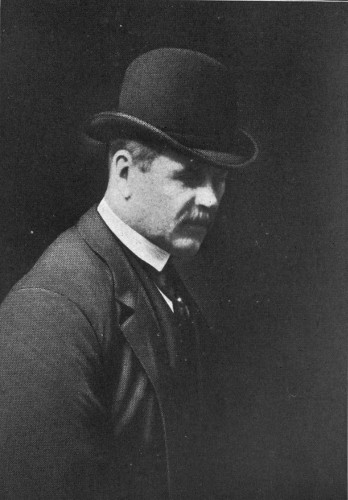
JAMES O’CONNOR
Mr. O’Connor held membership in St. Anthony’s Catholic church and in politics he was a conservative. In his habits and tastes, he was most domestic, finding his greatest pleasure in administering to the welfare and happiness of his family. The most envious could not begrudge him his success, so honorably was it won and so worthily used for the benefit and assistance of others. His nature was one of extreme generosity and his example is worthy of emulation.
His sudden death on April 15, 1909, left a widow, a son and two daughters. James O’Connor is a resident of Montreal; Margaret resides at home; and Laura Esther is now Mrs. G. F. Hemsley. Mrs. O’Connor previous to her marriage which took place in St. Patrick’s church, Montreal, was Miss Catherine Curran, a daughter of John Curran, a prominent and distinguished citizen of this city.
HARRIS VINEBERG.
Among the mercantile institutions of Montreal is that of H. Vineberg & Company, clothing manufacturers for the trade, the inception and building up of which business is entirely due to the indefatigable efforts of H. Vineberg. The firm occupies what is known as Vineberg’s building, eight stories in height. Hundreds of young men have learned their trade and received their start in this establishment, and that many of them today occupy creditable positions in life is in a measure due to the lofty principles which are the policy of the firm. Many have profited by Mr. Vineberg’s kindly advice, who took an interest in each employe of his large enterprise and who, moreover, often helped them to begin their career in the right direction. Mr. Vineberg has aided many men who are today prominent in professional life in the city and has ever taken a deep interest in charitable and church organizations, having particularly given his aid to those who came to this country in straitened circumstances in order to enjoy the privileges of British freedom, British institutions and the prosperity held out to all who but want to grasp it in the vast Canadian commonwealth.
Harris Vineberg was born in 1855, on the 25th of December, a Jewish feast day called Chanuka, in Zidugira, Russian Poland. Zidugira means Jewish bush, and his ancestors owned the vast forests in Poland from which this name is derived. It may be mentioned in this connection that the cable address used by the house of H. Vineberg & Company today is “Zidugira,” perpetuating in a manner the memory of that place which gave birth to him and whence he sallied forth into the world to build his fortune. It seems that this reverent attitude toward his birthplace, toward his parents and toward his people has been the guiding star over Mr. Vineberg’s career, the star which has led him to the goal. His parents were Lazarus and Malca Vineberg, the former of whom died in Palestine in 1901 and the latter in 1882.
Their son Harris received a strictly orthodox education from private teachers. After having mastered the curriculum he assisted his father in the lumber business for the last two years which he spent in his native land. However, the young man could not content himself with the limitations which hedged him in on all sides under Russian rule and, coveting the opportunity of a wider sphere of action, he made up his mind to seek that country under which the greatest personal liberty, the greatest freedom of thought, the greatest tolerance of religious views prevailed. With an eye to the practical, he selected that part of the empire which seemed to him to hold out the greatest opportunity.
In September, 1872, Mr. Vineberg came to Montreal on the steamship Sarmatian. A brother had broken the home ties with him and with this brother he worked one year in Glengarry county, where he acquired a fair knowledge of English. He then made for Montreal in order to profit by the opportunities which the fast growing center of population held out and for seven months he worked in a humble capacity, earning but two dollars a week. On Saturdays and Sundays he instructed two boys in the Hebrew language and in this manner earned sufficient to pay for his board. Quickly accommodating himself, however, to the new conditions of life, Mr. Vineberg never lost sight of his purpose and, husbanding his small resources, he strove eagerly to establish himself in business. He opened a small store at No. 662 Craig Street, near St. Peter, and devoted his whole time for one year to that establishment with such good success that at the end of that period he had to seek larger quarters on McGill Street, where he remained until 1876, when removal was made to Lancaster, Ontario. Careful of his profits, he was there enabled to establish a general country store of considerable size which he conducted for four years,—years which brought him added prosperity. Mr. Vineberg has ever held a warm place in his heart for the little village of Lancaster, to which he largely credits his commercial education. There he had already attained such prominence that he was moving in the best of circles and was associated with and sought out by the foremost men of that county. In 1880 Mr. Vineberg returned to Montreal, having definitely decided to engage in the manufacture of clothing and, beginning in a small way in a private house, he formed a partnership with G. Burnett under the firm style of G. Burnett & Company. Although the firm’s policy was such that it should have resulted in success, it was forced to close out in 1891 and liquidated in that year. Such means as Mr. Vineberg had acquired up to that time were swept away by this unfortunate venture, and when he started again in 1892, tenaciously holding to his purpose, he had to begin practically without capital. However, he enjoyed a good reputation and among his personal following were many who had utmost confidence in his integrity and ability. He secured the assistance of Mr. Westgate of the H. B. Knitting Company, and it was this combination which formed the beginning of Progress brand clothing, under which name the output of H. Vineberg & Company is favorably known to the trade in all the Dominion. His thorough understanding of the business, his capacity for detail, his executive ability and understanding of human nature led him to the position which he now occupies at the head of one of the leading establishments of its kind in the city. The firm was incorporated in 1908 and in 1912 was transformed into a joint stock company, of which Mr. Vineberg became the president.
Although Mr. Vineberg’s mercantile interests are large, he has found time and opportunity to prove himself one of those men to whom the progress of the city and the welfare of its people is of foremost importance. Deeply grateful for such success as has come to him—and in his modest way not at all ascribing it to his personality, his energy, his patience, his judgment and industry—Mr. Vineberg welcomes the opportunity of giving to charitable institutions and of aiding those who strive to make a success of life. He has never forgotten how he once started himself—a poor Jewish boy without means and friends—and how he had to struggle to obtain a place in society. It is therefore but natural that he shows the deepest understanding and the greatest sympathy for those who today find themselves in similar conditions, even if these are not so trying as those which the young emigrant from the Sarmatian met. Mr. Vineberg is a director of the Jewish Colonization Institute, engaged in Jewish communal work. He was president of the Young Men’s Benevolent Hebrew Society from 1888 until 1892, during which time Baron de Hirsch sent the first ten thousand dollars with which the Baron de Hirsch Institute was founded. Before being president of this society, Mr. Vineberg was a director and in that capacity wrote to the famous Jewish philanthropist calling his attention to the needs of such an institution, and it was he who was largely instrumental in founding the institute at St. Elizabeth Street. In addition to his duties in connection with the Benevolent Hebrew Society for Young Men and the Baron de Hirsch Institute, Mr. Vineberg was one of those who were most active in promoting its religious school and he was chairman of the committee having charge over that department for many years. He is a member of the Spanish-Portuguese Synagogue and also of the English and German Synagogue on McGill College Avenue, in which latter he held the position of secretary for four years. He was one of the leading and most energetic spirits in moving the synagogue to McGill College Avenue from St. Constant Street, being at that time the secretary. He also is a director of the Hebrew Free Loan Association and a member of every Jewish charitable institution in Montreal. However, that his charity and his interest in those who are afflicted is not limited by creed is evident from the fact that he is a governor of the Montreal General Hospital.
During his long business career Mr. Vineberg has been the mentor of many of the leading merchants and manufacturers of this city who began their careers in his employ and who learned their trade in his place and there laid the foundations of their fortunes. Hundreds of well-to-do families in Montreal have been able to establish themselves in comfortable circumstances through their connection with the house of Vineberg & Company. There are a number of professional men who occupy an honored place in their spheres of activities and who are indebted to Mr. Vineberg for timely help and advice and there are many who are well known in the city today who reached these shores as emigrants with small means, and friendless, and who found in him one who was willing to assuage such troubles as beset them.
Mr. Vineberg is devoting much of his time to the care of his wife, a sufferer, and it is therefore but natural that he does not give so much of his time to the active operation of his large business interests, the management of the house of H. Vineberg & Company being entrusted largely to the husband of his eldest daughter. Yet he is still active and his advice is highly valued and often sought in commercial circles. He is a member of the Board of Trade and in that connection has always stood for things which would promote progress and prosperity in Montreal. He is a member of the Canadian Manufacturers Association and a director of the Canadian Credit Men’s Association. Although he is interested in all movements that make for efficient government of city, province and Dominion, for the highest type of sanitary system, the best health conditions, the beautification of the city, he has never actively entered the political arena.
On October 23, 1876, Mr. Vineberg married Miss Lily Goldberg, daughter of the late Rev. Hyman Goldberg, who for a number of years was assistant minister of the Spanish-Portuguese Synagogue. Mr. and Mrs. Vineberg became the parents of three daughters: Libbie, who married Isidor Cohen, a member of H. Vineberg & Company; Eva, who married A. J. Hart, president and general manager of the Hart Manufacturing Company; and Malca, who is the wife of A. Z. Cohen, a member of the firm of L. Cohen & Sons.
Mr. and Mrs. Vineberg have twelve grandchildren, and it may be mentioned as illustration of his deep affection for his family that the pictures of these children adorn the walls of his private office. When deeply engaged in business thoughts, these children’s faces, no doubt, smile to him encouragement and fill him with satisfaction in the knowledge that around him are growing up generations of his own blood who appreciate and love him for what he is to them and will honor him for what he has done to lighten their life’s burdens when they will occupy the stage of life’s activities.
PHILEMON COUSINEAU, B. A., LL. D., K. C., M. L. A.
As a member of the firm of Bastien, Bergeron, Cousineau, Lacasse & Jasmin, Philemon Cousineau, K. C., occupies a foremost position among the legal fraternity of Montreal. Moreover, he has gained a reputation as a legislator and is considered today one of the foremost authorities on constitutional law in the province. He has important commercial interests, and his career has had in its various aspects a lasting influence upon the growth and development of the city. He was born at St. Laurent, Quebec, on October 25, 1874, and is a son of Gervais and Angelique (Grou) Cousineau.
Philemon Cousineau was educated at Sainte Therese College and Laval University, from which he graduated in 1896. Being called to the bar, he began the active practice of law in July of that year and has ever since continued with increasing success. He is professor of constitutional and municipal law at Laval University, which institution of learning conferred upon him the degree of LL. D., after he had presented a thesis on Corporations. He has also been for some time king’s counsel and enjoys a profitable and representative practice.
Mr. Cousineau is extensively interested in industrial and financial projects which have had to do with the city’s progress, among them being the Mount Royal Telephone Company, of which he was president, and previous to its absorption by the Canadian Light & Power Company he was a director of the Saraguay Light & Power Company. He is also president of the St. Lawrence Tobacco Company. He was mayor of the town of St. Laurent from 1904 to 1908 and both as an official and citizen has had no little to do with the progress of that flourishing town.
In 1897 Mr. Cousineau was united in marriage to Miss Helmina Gendron, and they have four daughters. In politics Mr. Cousineau is a conservative and in 1908 was elected to the legislature of the province of Quebec from the county of Jacques Cartier and reelected in 1912. He is a trusted counselor of the party and has done far-reaching work on committees as well as on the floor of the house. Public-spirited in the most noble sense of the word, he has ever stood for that which is best for the greatest number. In 1913 he was delegate of the Canadian government to the general meeting of the International Institute Of Agriculture at Rome, Italy.
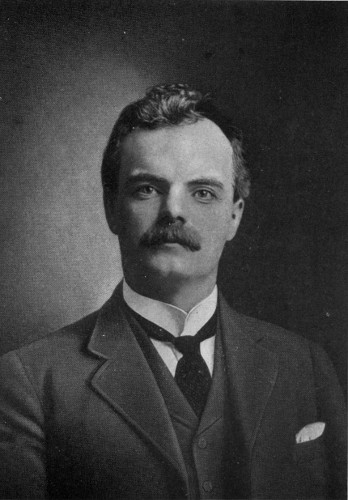
PHILEMON COUSINEAU
EDOUARD NAPOLEON HEBERT.
The house of Hébert has been one of the foremost families of the Dominion since the early dawn of Canadian history. One of the first Canadian farmers, Louis Hébert, arrived in Quebec with his family in 1617. Tradition has it that previously he passed some time in Acadia, where he “was the first to utilize the salt-water marshes of the Bay of Fundy by building dikes to keep out the tides.” He continued to cultivate the soil at Quebec and on February 28, 1626, as a reward to him and an encouragement to others, the Duc de Ventadour, viceroy of New France, issued a patent granting Hébert “in fief noble to him and his assigns forever” a seignorial domain on the River St. Charles, near Quebec, and confirming to him a concession made by the preceding viceroy, the Duc de Montmorency. It was expressly stated in the deed that these grants were made in consideration of Hébert’s “long and painful labors, perils and expenses, incessantly supported in the discovery of the lands of Canada and that he is the head of the first family which has settled and dwelt there since the year 1600 till now * * * having left his relations and friends to go and form this commencement of a colony of Christian people in those lands * * * which are deprived of the knowledge of God.” Charles Lecroix Hébert, a rich trader and the first farmer on the island of Montreal, built a residence in 1655 on Jean Baptiste Street, which is still standing and which is shown in one of the illustrations of this history. Hébert, named Larivière, was born in 1633 and was a companion in arms of Dollard and present at the massacre of Long Sault in May, 1660.
Edouard Napoléon Hébert was born in Montreal on March 10, 1874, and is a son of J. Napoléon Hébert, who was born January 14, 1850. His father, Louis Hébert, the grandfather of our subject, was born in Quebec in 1810 or 1812 and from that city removed to Montreal, while his father was the proprietor of the Boulangerie du Roi (bakery of the king) at Quebec. This establishment was subsequently continued by one of his sons, a brother of the grandfather of our subject.
E. Napoléon Hébert, in the acquirement of his education, attended Montcalm school of this city and subsequently improved his advantages by a commercial course. He entered upon active business life in connection with Hudon & Hébert, engaged in the grocery business, for whom he made customs entries and acted as assistant cashier. He is now treasurer of the “Twelve Companies” and largely engaged in the real-estate business, being a young man of very great ability, pleasant in manners and of sound judgment. In two years the “Twelve Companies” with which he is connected have disposed of properties to the value of eleven million dollars, which gives an indication of the magnitude of their transactions. Mr. Hébert is considered one of the best informed men as to realty values here and his advice and judgment are often sought by large investors and he has in many ways been instrumental in promoting the growth and furthering the welfare of his city. He is also interested in a cigar box factory which gives employment to eighty men.
On July 7, 1891, at Montreal, Mr. Hébert was united in marriage to Miss Cécilia Drolet and they have become the parents of twelve children, four sons and eight daughters. The eldest son, Charles-Edouard, is married and the other three are Armand, Charles and Jean. The daughters are Gabrielle, Herminie, Adrienne, Cécile, Marie-Thérèse, Germaine, Gilberte and Paulette.
In his political affiliations Mr. Hébert is a liberal, stanchly upholding the principles of his party. He is well known in fraternal orders, in most of which he has held important offices, being connected with the Independent Order of Foresters and the Canadian Order of Foresters. He is a member of the L’Alliance Nationale, of the Club Canadien and the Club St. Louis. His religious faith is that of the Catholic church and he is prominent in the church of the Immaculate Conception, in which for twenty-five years he has been organist. A man of great energy and vast information as regards his business, Mr. Hébert occupies a high place among the business men of Montreal and can ever be found in the front ranks of those who have at heart the welfare of their city. Although he has never cared to participate in official life, he gladly supports worthy public enterprises and enjoys the high respect and regard of all who come in contact with him in business or social relations.
CHARLES SAMUEL JOHN PHILLIPS.
Many of the organized efforts for benefiting the general interests of society have felt the stimulus of the cooperation and indorsement of Charles Samuel John Phillips, whose position in the business world is that of head of the firm of Morton, Phillips & Company, stationers and printers. He was born in Quebec on the 13th of October, 1844, and is a son of the late Thomas Osmond Phillips, of Quebec, and his wife, Agnes Ritchie Leslie, a daughter of Dr. S. W. H. Leslie, of the army medical department. He was but a youth of thirteen when he accompanied his parents to Montreal, where he has made his home continuously since 1857, being, therefore, one of the older residents of the city in years of continuous connection therewith.
It was in Montreal that Mr. Phillips was married in 1873 to Miss Jessie Amelia Thomson, a daughter of the late William A. Thomson, and her death occurred in May, 1910.
With the attainment of his majority Charles S. J. Phillips entered business life and gradually advanced to the position of head of the firm of Morton, Phillips & Company, stationers and printers, which business was established in 1869. His activities have been exerted with energy, force and effectiveness along other lines, some of which have been of a semi-public and others of a public character. He was formerly president of the Montreal Citizens League and of the Montreal Dispensary and is now a director of the Citizens Association. He is likewise a member of the Business Men’s League and is a director of the Mount Royal Cemetery Company. He belongs to the Natural History Society and is deeply interested in the Boys Home, of which he is honorary treasurer, and the Boys Farm and Training School at Shawbridge, Quebec. He has been a student of the important political, economic and sociological questions and has investigated conditions which bear directly upon the interests of society at large in its relation to citizenship and the opportunities which are placed before the individual for his normal development and advancement. His religious faith is that of the Baptist church, and his political belief that of the conservative party. He is well known as a member of the Montreal and Canadian Clubs. While the winter months are spent in the city, he has an attractive summer home, Mes Délices, at Notre Dame du Portage on the St. Lawrence.
ALEXANDER GEORGE CAMERON.
Alexander George Cameron is one of the younger representatives of the legal profession in Montreal. Since his admission to the bar in 1910 he has made continuous progress. He was born in Winchester, Ontario, May 11, 1884, a son of Alexander and Louise (Reddick) Cameron, the former a native of Inverness, Scotland, while the latter is of Canadian birth.
In the public schools of Winchester Alexander G. Cameron laid the foundation for his education. He was a student in the Morrisburg Collegiate Institute and received his law training in McGill University, from which he was graduated B. C. L. with the class of 1910. He at once entered upon the practice of law. His name is also well known in the business world, being a director of several commercial enterprises.
Mr. Cameron is known in military circles, being a captain in the Fifth Royal Highlanders of Canada. His political allegiance is given to the conservative party, and he is prominent in club circles, his membership being in the Royal St. Lawrence Yacht Club, the Manitou Club, the Kaniwakee Golf Club, the Beaconsfield Golf Club, the University Club, the Montreal Club and the Montreal Art Association. He is a Presbyterian in religious belief.
GILBERT SCOTT.
Gilbert Scott was for many years a resident of Montreal and a witness of its development and progress. He came to rank prominently among the representatives of commercial and financial interests and for an extended period was a member of the Dow Brewery Company of this city. He was born at Chagford, Devonshire, England, April 16, 1820. In early life he was a clerk in a bank in London and came to Montreal in 1845. In the ’60s he entered into partnership with William Dow, a well known Montreal brewer and continued in active connection with the business until his life’s labors were ended on the 9th of June, 1891, when he was seventy-one years of age. The other members of the firm at various times were John Harris, A. C. Hooper, J. Philip Scott, son of Gilbert Scott, Angus Hooper and Major George Hooper. Capable management led to the continuous growth and success of the business until the year 1912, when the Dow Brewery became a part of the National Breweries Company.
Gilbert Scott was connected officially with many large financial and commercial institutions and was well posted upon financial and commercial matters, but his fund of knowledge went further and made him familiar with many other questions and interests of the day. He was a director of the Bank of Montreal; senior partner of the Dow Brewery Company; president of the Intercolonial Mining Company; vice president of the Shedden Company; a director of the North British and Mercantile Insurance Company, and of the Canada Sugar Refining Company.
Mr. Scott was married to Miss Janet Cooper of London, England, who died in 1875. He was survived by one son, James Philip, who was a member of the Dow Brewery Company from 1876 until his death, in 1898, and four daughters.
Mr. Scott was a member of St. Paul’s Lodge of Masons and was always loyal to the teachings and purposes of the craft. He had vivid recollections of the important points in the history of Montreal, from the time when he located here in 1845, until his death. As a man, he possessed many attractive social qualities and was beloved by a large circle of friends.
JOSEPH RIELLE.
In the long years of an active professional career Joseph Rielle has made continuous advancement until he stands today not only as a veteran civil engineer and surveyor, but also as one of the most capable representatives of his chosen calling in Montreal. Each year has found him in advance of the position which he occupied the previous year, because of his developing powers and growing ability. He was born at Laprairie on the 6th of October, 1833, and received his initial business training with the firm of Ostell & Perrault, architects and land surveyors, whose service he entered in 1850 when a youth of seventeen years. He continued with that firm for four years and then became assistant to Mr. John Page, chief engineer of public works. He next accepted the position of assistant engineer to the harbor commission and eventually entered upon the general practice of land surveying in Montreal and the surrounding district. He has been connected with extensive surveys for the Grand Trunk and the Canadian Pacific Railways and the harbor commissioners of Montreal and in addition to his general practice has made a number of important hydraulic surveys. In 1904 he was presented with a testimonial by members of the society of land surveyors to mark the fiftieth anniversary of his entry into civil engineering and land surveying.
While this has been his chief life activity, Mr. Rielle has done important work in other connections. He was formerly vice president of the Pontiac Pacific Junction Railway, and he has done much work of a public and semi-public character, whereby the general interests of the country at large have been greatly promoted. He was secretary and manager of the Montreal Turnpike Trust for about fifteen years. He was a member of the council of Verdun, Montreal, from 1875 until 1900 and was intrusted with many important public works. He is a life governor of the House of Industry and Refuge, also of the Montreal General Hospital, and is president of the Fraser Institute and Free Public Library of Montreal. His activities have been of a nature that have contributed largely to the general development and good, but he has never taken an active part in politics.
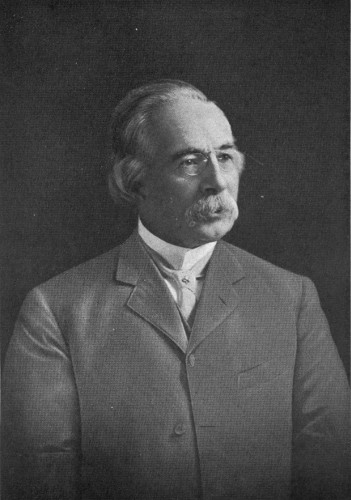
JOSEPH RIELLE
Mr. Rielle married Miss Jeannie T. Goldie of Laprairie, P. Q., who was vice president of the Montreal Industrial Rooms and who died in June, 1904. Mr. Rielle has his home at No. 90 Union Avenue and is a member of the St. James Club. He has now reached the advanced age of more than eighty years, but is still active in his profession and in spirit and interest seems yet a man in the prime of life.
JOHN STUART BUCHAN.
No phase of life affecting the political and local status of the province or its educational or moral development fails to elicit the attention and interest of John Stuart Buchan and seldom fails to receive his hearty cooperation and support. He is ever willing to divide his time between his profession and public service, recognizing ever the duties as well as the privileges of citizenship and the obligations which devolve upon man in relation to his fellowmen. He is well known as a practitioner at the bar and his reputation as a capable lawyer has been well earned. He was born at St. Andrews, P. Q., October 28, 1852, the only son of the late William and Katherine (Stuart) Buchan, of St. Andrews. The family is descended from the old earls of Buchan. After attending public schools of his native city John S. Buchan entered McGill University and won his B. C. L. degree in 1884. He had determined to make the practice of law his life work, and following his graduation he became an advocate, since which time he has continued a representative of the Montreal bar. Here he has worked his way up to leadership and in 1899 was created a king’s counsel. For almost a third of a century he has been engaged in practice here, and his ability has long since placed him in a position of distinction among the leaders of the legal profession in Montreal. At one time he was a member of the editorial staff of the Canadian Jurist, and in 1904 he was a royal commissioner for the revision of the provincial statutes. Thus important governmental problems in connection with his profession have elicited his deep interest and called forth his abilities.
In 1885 Mr. Buchan was married to Miss Katherine McMartin, the second daughter of F. McMartin, of St. Andrews. She died in August, 1894, and in 1896 Mr. Buchan wedded Annie, the eldest daughter of the late J. H. Henderson, of Montreal.
Mr. Buchan is an attendant of Christ’s Church Cathedral, while his political faith is that of the liberal party. Political honors and emoluments have had no attraction for him. His activities, however, along other lines relating to the welfare and progress of city and province have been resultant. He acted as solicitor of the Lord’s Day Alliance of the province for a time. He was also chosen a life governor of the Montreal Boys Home in 1911 and many movements having broad humanitarianism as their basis have received his indorsement. He is likewise the vice president of the Natural History Society of Montreal. He is not unknown in literary circles for under the nom-de-plume of Douglas Erskine he has published “A Bit of Atlantis” and “Some Notes on Mount Royal,” and various other papers of a scientific nature. When questions of public welfare are at stake he is never weighed in the balance and found wanting, and his support of any project and measure is not the result of a hasty conclusion. On the contrary he brings to all vital questions the habits of the lawyer, carefully analyzing and weighing the points in a situation and then giving his support thereto as the result of a firm belief in the worth or righteousness of the case.
ARCHIBALD MURRAY CASSILS.
Archibald Murray Cassils, who as a wholesale leather merchant gained an enviable business standing, while attractive social qualities won him many friends, was but forty-eight years of age at the time of his death, which occurred March 6, 1891. He was born in July, 1843, in Renton, Dumbartonshire, Scotland, a son of John and Margaret (Murray) Cassils. His education was there acquired and he remained in his native land until 1856, when he came to Montreal where a brother was residing. For a number of years he was engaged in merchandising in connection with the wholesale leather business, and made for himself an enviable place in commercial circles, by reason of his enterprise, his progressiveness and his business integrity. Gradually his trade grew owing to his capable control of his interests, and success in a substantial measure rewarded his labors.
In September, 1873, in Montreal, Mr. Cassils was married to Miss Eva A. Shaw, and they became the parents of three children: Marcia A., the wife of George P. Butters; William A., who died in 1906; and Angus Shaw Cassils.
Mr. Cassils was a member of the Masonic order and the American Presbyterian church and his religious belief guided him in all the relations of life, making him a man of high principle and kindly spirit, straightforward in action and thoroughly reliable in all things. While more than two decades have passed since he was called from this life, he is yet kindly remembered by all who knew him owing to his gracious presence and his sterling worth.
GEORGE CAMPBELL MacDOUGALL.
George Campbell MacDougall, recognized as one of the ablest members of the brokerage profession, had not passed the fiftieth milestone on life’s journey when death called him. He was born June 6, 1843, in Ringmore, Devonshire, England, a son of Major MacDougall, who belonged to the King’s Own Borders, and in 1857 came to Montreal. His son, George C. MacDougall, was educated in the schools of this city, passing through consecutive grades to the high school and afterward attending McGill University. Throughout his active business career he was identified with financial interests. He became a clerk in the Bank of Montreal, worked his way upward until his experience, combined with his recognized capability led to his assignment to a responsible position with the New York city branch of the Bank of Montreal. He remained in the American metropolis for a few years and while in New York won several prizes for horsemanship at horse shows there. He afterward entered the Lounsbury & Tenshaw Brokerage Company, acquainted himself with the brokerage business and returned to Montreal, where he formed a partnership with his brother, Hartland St. Clair MacDougall, continuing in the brokerage business until his death. The firm gained an extensive clientage that made the business one of large volume.
Mr. MacDougall was married twice. He first wedded Miss C. J. Bridges and they had one son, H. B. MacDougall. In 1887, in Montreal, Mr. MacDougall was married to Miss Mary L. Macdonald, a daughter of Hon. Donald Alexander Macdonald, a well known figure in public life, serving as postmaster general in the Mackenzie administration at Ottawa from 1873 until 1875, and as lieutenant governor of Ontario from 1875 until 1880. He married Catherine, daughter of Hon. Alexander Fraser, M. L. C., of Fraserville, Ontario. To George C. and Mary L. (Macdonald) MacDougall was born a daughter, Beatrice.
Mr. MacDougall was well known as a sportsman, was an expert rider and was the owner of some fine horses. He was likewise a prominent member of many clubs, including the St. James, Montreal, Jockey, Forest and Stream and Hunt Clubs. His death occurred March 31, 1892, and although he was then at the comparatively early age of forty-nine years, he had achieved distinction in his line of business and as a sportsman had gained wide friendship among many of the most distinguished citizens of the province.
JOSEPH CHARLES HECTOR DUSSAULT.
Joseph Charles Hector Dussault, a graduate of Laval University and thus carefully trained for the profession to which he has devoted his life, has been actively engaged in the practice of law in Montreal since 1899. His course has been marked by continuous progress until he has gained a creditable position among the forceful, capable representatives of the bar. He was born at Sherbrooke, Quebec, on the 19th of November, 1876, a son of N. T. and Malvina (Deseve) Dussault, the former a merchant of Sherbrooke, who was born there more than seventy years ago and is still engaged in business in that city. He is well known in the eastern townships and is recognized as a man of prominence in his community.
Liberal educational opportunities were accorded Joseph C. H. Dussault, who pursued commercial and classical courses in the Seminary of Sherbrooke. Reviewing the broad field of industrial, commercial and professional activity, he determined upon the practice of law as a life work and in preparation therefor entered Laval University at Montreal. On the completion of the regular law course he was graduated and in 1899 received the degree of Master of Laws. The same year he was admitted to practice at the bar of the province of Quebec and entered alone upon the active work of the profession. Advancement at the bar is proverbially slow, yet he had as the basis of success broad and thorough understanding of the principles of jurisprudence and gradually worked his way upward. After three years he formed a partnership with J. A. Mercier and in January, 1912, they were joined by a third partner, P. L. Dupuis under the firm style of Dussault, Mercier & Dupuis. Mr. Dussault has ever been very careful in the preparation of his cases. His mind is naturally analytical, logical and inductive and, therefore, his reasoning is clear, his argument sound and his deductions clear and convincing. He is also identified with financial activities as one of the organizers and directors of the Merchants & Employers Guarantee & Accident Company.
On the 1st of October, 1906, in Montreal, Mr. Dussault was married to Miss Alice Dupuis, a daughter of J. O. Dupuis, one of the founders of Dupuis Freres of Montreal. Her father is also widely known in political as well as commercial circles, his opinions carrying weight in party councils. He served as alderman of Montreal and has been active in molding public thought and opinion. That confidence is reposed in his business ability and integrity is indicated in the fact that he was one of the liquidators of the defunct Ville Marie Bank. Unto Mr. and Mrs. Dussault have been born three children, Jeanne, Marcelle and Jacques. The religious faith of the family is that of the Roman Catholic church. Mr. Dussault is a conservative and strong protectionist. His interest in politics is not a superficial one, and he keeps well versed on the questions and issues of the day, yet political honors and emoluments have no attraction for him. He finds recreation through his connection with St. Andrew’s Curling Club, of which he is a charter member. He now has a wide acquaintance in his adopted city, where his developing powers have brought him professional success, while sterling traits of manhood have gained him place among the highly esteemed citizens.
ERNEST R. DECARY.
Ernest R. Decary, senior member of Decary, Barlow & Joron, one of the foremost firms of notaries in Montreal, occupies a distinguished professional position, viewed not only from the extent, but as well from the prominence of his clientele. Mr. Decary is a native of Montreal and was born on December 9, 1878. He received an excellent education, graduating with the degree of Bachelor of Arts from St. Mary’s Jesuit College and beginning his business career alone, subsequently joined with him Mr. Barlow and Mr. Joron, and he has since continued in that relationship. This firm specializes in railway and bank work and they have come to occupy a position second to none in Montreal professional circles.
Mr. Decary personally acts as notary for the Canadian Pacific Railway, the Canadian Northern and the Dominion and Traders Banks and the Canadian Express Company, as well as for many other institutions and corporations.
Although Mr. Decary has never aspired to political office, he is deeply interested in the growth and expansion of his city and readily gives of his time and means in support of worthy enterprises. In politics he is a liberal. He is a member of the Montreal, Royal Montreal Golf, University, Royal St. Lawrence Yacht, and Lachine Boating and Canoe Clubs, and has views upon business and social conditions. Yet a comparatively young man, he occupies a position of dignity in the life of the city to which his ripe judgment on matters of a commercial or legal nature fully entitles him.
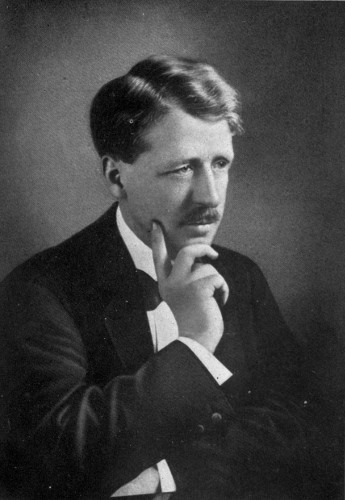
ERNEST R. DECARY
BENJAMIN NAPOLEON LADOUCEUR.
One of the well known legal practitioners of Montreal and a notary public, Benjamin Napoléon Ladouceur has a clientele both representative and important. He is yet a young man, barely thirty years of age, but has demonstrated his ability to capably handle the most intricate legal problems. He was born on the 15th of January, 1883, at Ste. Marie de Monnoir, and is a son of Mathias and Azilda Ste. Marie Ladouceur, both natives of Ste. Marie de Monnoir. The paternal grandfather was Benjamin Ladouceur, called Martin, his birthplace being Côté des Neiges. His wife was Cèleste Vient, a native of Ste. Marie de Monnoir. The grandfather in the maternal line was Jean Baptiste Ste. Marie and his wife was Henriette Bédard, also natives of Ste. Marie de Monnoir.
Benjamin Napoléon Ladouceur was educated at the College of Ste. Marie de Monnoir and took his law degrees at Laval University in July, 1910. He has since engaged in practice in Montreal and also acts as notary public. No long novitiate awaited him for he soon demonstrated his ability along legal lines and now enjoys an important and lucrative practice. In his political views he is a nationalist, a party which has for its aim the amelioration of certain conditions of government which make not for the best of the masses. In some ways it may be said that it is similar to the progressive movement in the United States and this movement has largely for its object a restricting influence upon political malpractices. Mr. Ladouceur also interests himself along other public and semi-public lines although he has never cared for official positions. He is loyal to the city of his adoption and ever ready to give his share of time and money in promoting her interests.
WILLIAM RUTHERFORD.
The steps in the orderly progression of William Rutherford whereby he has reached his present advanced position in business circles of Montreal are easily discernible and each forward step has brought him a broader outlook and wider opportunities. Born in Montreal, April 22, 1864, he is a son of William and Elizabeth (Jackson) Rutherford, both of whom are of Scotch birth, the former coming from Jedburgh, Roxburghshire, and the latter from Biggar, Lanarkshire. They were representatives of the excellent Scotch type that has done so much for Canada and its substantial upbuilding. The father was a member of the first council of Cote St. Antoine, which afterward became Westmount. He was an enthusiastic curler and greatly enjoyed other outdoor sports. His interests, however, were largely concentrated upon the development and management of important business interests. He founded the lumber firm of William Rutherford & Sons in 1852 and was largely instrumental in developing it into one of the most extensive lumber enterprises of Canada.
In the acquirement of his education William Rutherford attended successively the schools of Cote St. Antoine, the high school of Montreal and the private school conducted by Hon. E. H. Springrice. He crossed the threshold of the business world as a junior clerk with Gillespie, Moffat & Company, general merchants, and subsequently became a clerk for the Pillow Hersey Manufacturing Company, owners of rolling mills, etc. Subsequently he entered the firm of William Rutherford & Sons of Montreal and upon the incorporation of the company became its treasurer. The business is today conducted under the style of William Rutherford & Sons Company, Ltd., dealers in and manufacturers of lumber and timber. The business is now one of mammoth proportions and in his official capacity William Rutherford of this review is bending his energies to administrative direction and executive control. Into other fields he has also extended his efforts and his business interests are now of considerable volume and importance, placing him among the prominent representatives of commercial and industrial activity in the province. He is now the president of the Dominion Box Company, Ltd., of the Grier Timber Company and the Dominion Park Realty Company, Ltd.
On the 16th of May, 1894, in Montreal, Mr. Rutherford married Miss Ida Bulmer, a daughter of John Bulmer and a representative of a well known Montreal family. Their children are William J., John B., Jean, Andrew S. and Marjorie. Presbyterians in religious faith, the family hold membership in St. Andrew’s church of Westmount. Mr. Rutherford is a liberal in politics, conversant with the leading questions and issues of the day. He has filled a number of local offices, having been elected alderman of Westmount in 1908, while in 1910 he was chosen mayor of the city. In 1913 he was made school commissioner of the city and in 1912-13 was a member of the executive committee of the Canadian Manufacturers Association. He is also a member of the committee of St. Andrew’s Society, while along more strictly social lines his membership is in the Canada, Engineers, Manitou and North Lake Fish and Game Clubs. His success permits him that leisure which enables him to enjoy fishing, hunting and other outdoor and indoor sports, but he is preeminently a business man and one whose successful methods might be studied by all who wish to gain prosperity within the legitimate lines of business.
CARL ROSENBERG.
Among the mercantile houses of Montreal the British American Import Company occupies a place of prominence and importance. Under this firm style Carl Rosenberg is connected with Canadian trade interests. Mr. Rosenberg was born in Kishenev, Russia, on the 15th of July, 1870, a son of Wolf and Bessie (Dachis) Rosenberg, both now residents of Montreal. The former has now retired from active business life.
Carl Rosenberg was one of those who did not find the opportunities which he sought in his native country and, seeking the benefits of British freedom, selected the Dominion of Canada for his field of operation and came to Montreal twenty-five years ago, or in 1889, when a young man of about nineteen years. After his arrival he went into partnership with a cousin, who had preceded him to the Dominion and who was engaged in the importing and dry-goods jobbing business. The name of the firm was Shiller & Rosenberg and they continued for two years, when the partnership was dissolved and Mr. Rosenberg became the leading factor in the establishment of the British American Import Company, who opened their place of business on St. Paul Street, Montreal. His ability as a merchant, his ready understanding of local market conditions and his indefatigable energy led to such growth of business that in 1909 the firm was enabled to put up a large building of their own at 516 St. Lawrence boulevard, into which they moved in 1910. The British American Import Company occupies a leading place in its line in Montreal and their reputation is of the highest. Its success is largely due to the executive ability of Mr. Rosenberg, its founder.
In 1888, when but eighteen years of age, Mr. Rosenberg, while yet in Europe, was married to Miss Clara Sperling and to them were born the following children: Hannah, who married Dr. Tannenbaum; Sarah, now Mrs. Aronson; and Madge, Rose, Sadie, David and Moses.
Mr. Rosenberg is a liberal and, adhering to the faith of his fathers, he was during 1910-11 a director of the Baron de Hirsch Institute, but his fast expanding business interests forced him to relinquish this position. He is a justice of the peace; vice president of the Herzl Dispensary; a founder and an ex-president of the Jewish Eagle Publishing Company, holding the latter office for five years; and a member of Ionic Lodge, No. 54, of the Masonic order. He is a shrewd and able business man and his name and that of his firm stand for successful accomplishment in the trade annals of the city.
REV. ALLAN PEARSON SHATFORD.
Rev. Allan Pearson Shatford, known in Montreal and throughout the province of Quebec as a forceful and eloquent preacher, holding a high position in Masonic circles as grand chaplain of the grand lodge of Quebec and known in this city as most earnest, zealous and consecrated in his work as rector of the Church of St. James the Apostle, was born at St. Margaret’s Bay, Nova Scotia, and is a son of the late James E. Shatford, a resident of Indian Harbor.
Rev. Allan P. Shatford acquired his education in King’s College in his native province, from which he was graduated B. A. with first class honors in English literature in 1895 and M. A. in 1898. In the former year he was made curate of the Anglican church at Bridgewater, Nova Scotia, and served in that capacity until 1900, during which time he was ordained deacon in 1896 and priest in 1897. He was transferred from Bridgewater to North Sydney, Nova Scotia, where he remained as rector until 1906, moving in that year to Montreal, where he became assistant rector of the parish of St. James the Apostle. He was promoted to the position of rector in January, 1912, and still holds this position which is an important and responsible one, for the parish is one of the oldest and largest in Montreal. It was founded in 1864 by Canon Elligood and the first church was built by Mrs. Phillips on land donated by her. Canon Elligood continued as rector from 1864 to 1911, dying in December of that year at the advanced age of eighty-seven. He was succeeded by Rev. Allan P. Shatford, the present incumbent, who is ably carrying forward his predecessor’s work, giving his time, attention and unusual talents to the promotion of the interests of the parish and the spread of the doctrines in which he believes. There are about four hundred and fifty families in the congregation, and the church property is valued at seven hundred and fifty thousand dollars. Its administration calls for farsighted and capable work and Mr. Shatford has proved equal to the trust reposed in him, aiding the trustees in every possible way and proving his possession of unusual administrative ability and organizing power. The church has had some of the most famous ministers in Canada connected with its affairs at different times, Bishop Dumlin, of the diocese of Niagara, having been at one time assistant, as were also Bishop Duvernet, of Caledonia, and Dean Abbott, of Niagara. The affairs of the congregation are in a most flourishing and prosperous condition, and the people of the parish find in Mr. Shatford a minister well suited to their needs, a man sincere and high-minded in his aims, of scholarly attainments and well directed ability. His sermons show great force and power, and his lectures have gained him wide recognition, winning him mention by the Montreal Gazette as “an accomplished extempore speaker and a preacher of great power.”
Mr. Shatford is well known in Masonic circles, exemplifying in his life the beneficent teachings of that order. He was grand chaplain of the grand lodge of Freemasons for Nova Scotia from 1903 to 1906 and since that time has been grand chaplain of the grand lodge of Quebec province. He was a delegate to the Pan-Anglican Congress held in London in 1908; a delegate to the general synod and to the church congress held in Halifax, Nova Scotia, in 1910, speaking there in a forceful and telling way upon parochial problems. “Today,” in his opinion, “it is Canada for the world, and we think of England as the center of an empire which tends to the solidarity of the human race and the universal brotherhood of man.”
VICTOR MORIN, LL. D.
Victor Morin, prominent in connection with the legal profession as a practitioner and as professor of administrative law and doctor of laws in Laval University, is now at the head of the firm of Morin & Mackay, notaries of Montreal. His name is also well known in literary circles and his activities and his writings have had a far-reaching and beneficial effect upon public interests. Born at St. Hyacinthe, Quebec, on the 15th of August, 1865, he is a son of Jean Baptiste Morin and Aurelie (Cote) Morin. In the acquirement of his education he attended successively Girouard Academy, the St. Hyacinthe College, from which he was graduated B. A. in 1884, and Laval University, which conferred upon him the LL. B. degree in 1888 and that of LL. D. in 1910. He studied law in the office of Papineau, Morin & Mackay and was admitted to the practice of the notarial profession in 1888. For a brief period thereafter he was a resident of Acton Vale, Quebec, but in 1890 returned to Montreal and is now senior member in the firm of Morin & Mackay. He is also custodian of the archives of his late partners, D. E. Papineau, C. F. Papineau, Durand and Morin, whose office was established in 1841. Aside from his business he has occupied many positions of importance and of public trust. While a resident of the town of Acton Vale he was secretary-treasurer of the town from 1888 until 1890. He has been treasurer of the board of notaries of the province of Quebec since 1897 and he has various important business connections. He was president of the Imperial Electric Light Company from 1899 until 1901, became secretary of the Montreal Real-Estate Association in 1904 and is now its president. He is likewise president of the Crédit Métropolitain, of the Caisse Hypothécaire, of the Montreal Debenture Corporation, of the Récollet Land Company, and of the Federal Real-Estate & Trust Company; vice president of the Security Life Insurance Company, and a director of the Provincial Life and of the Provincial Fire Insurance Companies. From 1897 to 1910, he was notary to the corporation of the city of Montreal and resigned this position in order to run for aldermanic honors. His high standing in his chosen profession is indicated by the fact that he has been made professor of administrative law in Laval University and is regarded as one of the prominent law educators of the country. His public-spirited citizenship finds expression in active support of many measures and movements for the public good and his cooperation can always be counted upon when the welfare of city, province or country is at stake. He has taken great interest for many years past in social questions, and is vice president general of the St. Jean Baptiste Society, the national association of French-Canadians. He was a director of Montreal Citizens Association from 1908 until 1910 and his position upon the temperance question is indicated by the fact that he is now the general secretary of the Montreal Anti-Alcoholic League.
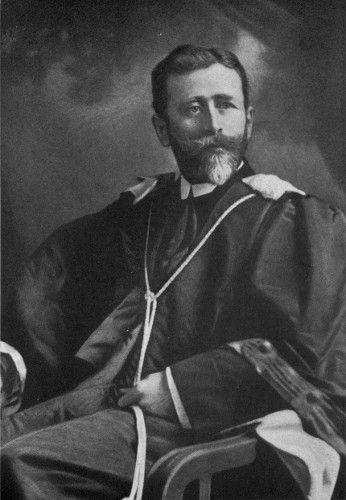
VICTOR MORIN
Prominent in the Independent Order of Foresters, Mr. Morin was its supreme vice chief ranger from 1898 to 1902, and has been its past supreme chief ranger since 1905; in 1895-6 he edited and published a paper in the interests of that fraternity called Le Forestier. Since 1890 he has delivered many lectures to fraternal societies and no man is better qualified to speak on the beneficent basic principles of the organization.
His authorship has made Mr. Morin equally widely known. He was actively interested in the literary work of the Cercle Ville Marie as its secretary from 1886 until 1888. He is the author of Vingt Ans Après, the second edition of which was brought forth in 1909. He is silver medalist of the Ligue Nationale de la Prévoyance et de la Mutualité, of Paris, France, and honorary vice president of the Antiquarian and Numismatic Society of Montreal. His active interest in affairs of vital importance to the city has been manifest in his capable public service as alderman of Montreal, to which position he was elected in 1910. His political support is given to the liberal party and his religious faith is that of the Roman Catholic church. He is prominent in club circles, is a member of the St. Denis and Reform Clubs, and is secretary of the Maison des Etudiants. His library, which is extensive and well selected, furnishes him his chief source of recreation and interest.
Mr. Morin was married in 1893 at Biddeford, Maine, to Miss Fannie, daughter of the Hon. D. Cote. In 1896 he wedded Alphonsine, daughter of Victor Cote, of St. Hyacinthe. They reside at No. 703 St. Urbain Street with their eleven children, and spend their summer months in their attractive villa on the slope of Mount St. Bruno. His life has been so varied in its activities and so honorable in its purposes as to leave an indelible impress for good upon the community and through his professional, business and fraternal connections Mr. Morin has come to be recognized as one of the leading residents of Montreal.
HUBERT ADOLPHE ELZEAR GRANDBOIS.
Hubert Adolphe Elzéar Grandbois, who since October, 1911, has been connected with the notarial profession in Montreal, was born in St. Casimir, Port Neuf district, in the province of Quebec, on the 15th of January, 1876, a son of Michel Adolphe and Marie Aurée (Charest) Grandbois, the former a dealer in wood. The son pursued his classical education in the Seminary of Nicolet, from which he was graduated in 1895. He afterward entered upon the study of law in Laval University at Quebec, which conferred upon him the degree of Bachelor of Laws, in June, 1898. On the completion of his studies he was admitted to practice as a notary in the following September and located at St. Casimir, where he remained in active practice from September, 1898, until October, 1911. He then came to Montreal, where he has since remained and has attained high standing among the representatives of the profession owing to broad and accurate knowledge, close application and fidelity to the interests of his clients.
Mr. Grandbois was married in the city of his nativity on the 7th of January, 1899, to Miss Marie Laetitia Belisle, a daughter of Octave Germain and Marguerite (Daly) Belisle. The children of this marriage are Marie Marguerite and Marie Laurette Grandbois. The religious faith of the family is that of the Catholic church, and Mr. Grandbois has membership with the Chevaliers de Colomb.
JOHN EDGAR.
The late John Edgar, who for many years was connected with the fur industry in Montreal, was born in Woodstock, Ontario, March 12, 1843. During his boyhood the family removed to Hamilton, Ontario, where his school days were passed. He began his business career in the provision trade with Folingsby & Williamson in Hamilton and later came to Montreal as representative of that firm. Soon after his arrival in this city, or in 1866, he entered the firm of Greene & Sons Company, wholesale furriers, in which connection he worked his way upward, eventually becoming a partner in the business. About the year 1895, when Greene & Sons Company retired, Mr. Edgar succeeded to the business which he continued for some years under the firm name of Edgar, Swift & Company. When Mr. Swift retired Mr. Edgar formed a partnership with Mr. Charles Coristine under the firm name of Edgar, Coristine & Company, which relation was maintained for four years, after which Mr. Edgar continued the business alone until 1912, when he retired. He was one of the prominent furriers of the city, developing and building up a business of extensive proportions, and in commercial affairs his judgment was sound, his enterprise keen and his diligence unfaltering.
In Montreal Mr. Edgar was united in marriage to Miss Selina Kidner and unto them were born five children, three sons and two daughters: John Hamilton, who is connected with the Canadian Pacific Railway; Frank Clifton, connected with the Royal Bank of Canada at Montreal; William Dewar, of the custom house of Montreal; Katie Selina; and Lillian Maud. The death of the husband and father occurred September 12, 1913, and was the occasion of deep regret to many with whom he had been closely associated in business and social circles. In politics he was a conservative but without aspiration for public office. He belonged to the Royal Albert Lodge of Masons and was a faithful member of the Church of St. James the Apostle. In those connections are indicated the principles which governed his life and guided him in all of his relations.
CAMILLE TESSIER.
Camille Tessier, a young man possessed of laudable ambition and determination, is making continuous progress in the field of his chosen profession—that of the practice of law. He was born at Berthierville, Quebec, July 26, 1887, a son of Dominique and Odile (Des Rosiers) Tessier, the former a merchant at Berthierville. He is descended from French ancestors who landed here with the pioneers of the country. Like the greater part of Canada’s first inhabitants, they were farmers and spent their whole lives in cultivating the lands which they had first courageously conquered from the wilderness and from the forest on the north side of the St. Lawrence river, thus contributing in large measure to the actual prosperity of the country.
Camille Tessier was accorded liberal educational opportunities, which he improved, thus laying a broad foundation for his later success. He pursued a course in the commercial college of Berthierville, was a student in the Seminary of Joliette, attended St. Mary’s College at Montreal, Laval University at Montreal, in which he pursued his classical and professional courses, winning the Bachelor of Arts and Bachelor of Laws degrees. He subsequently attended Eastman’s Business College of Poughkeepsie, New York. As advocate, barrister and solicitor he is making for himself a creditable position in professional ranks. He has been a member of the Montreal bar since the 7th of July, 1910, and the thoroughness and care with which he prepares his cases and the logic of his deductions have gained him rank among those who are winning success in the difficult and arduous profession to which he devotes his energies. He makes a specialty of commercial law and is a member of the Commercial Law League of America. He is working his way to success vigorously but quietly and honestly. Mr. Tessier is a member of the Roman Catholic church. He was married in Montreal, on the 28th of January, 1913, to Edmee Paquette, and they have one child, Jean Marcel, born in Outremont on the 28th of October, 1913. His courage and a laudable ambition of living a life of usefulness to his family and to his country have brought Mr. Tessier the high regard of associates and all who know aught of his career.
CHARLES GIDEON HILL.
The life record of Charles Gideon Hill constitutes an illustration of what the new world has to offer to ambitious young men. Coming to Canada as an orphan boy, he steadily worked his way upward, each forward step bringing him a broader outlook and wider opportunities. He became in time a successful merchant of Montreal and in later years devoted his time to the supervision of his invested interests, which included large property holdings and stock in many financial and commercial enterprises. He was seventy-six years of age at the time of his death, which occurred on the 12th of June, 1893, at the old home at No. 247 Bleury Street, where he had lived for more than half a century. He was born in England, but lost his father and mother when quite young, after which he crossed the Atlantic and for a time resided in New York. He afterward came to Montreal and gradually he worked his way upward in a business way, realizing at the outset of his career, that industry and honesty constitute the foundation upon which success is built. In time he was the proprietor of a small dry-goods establishment on St. Paul Street and conducted it successfully for many years, but about 1870, retired from commercial circles in order to supervise his large estate which also included the estate of William Galt. From time to time he became interested in business enterprises, holding stock in many leading financial and commercial concerns. His judgment was sound, his sagacity keen and in the control of important interests he established his position as one of the leading and capable business men of the city.
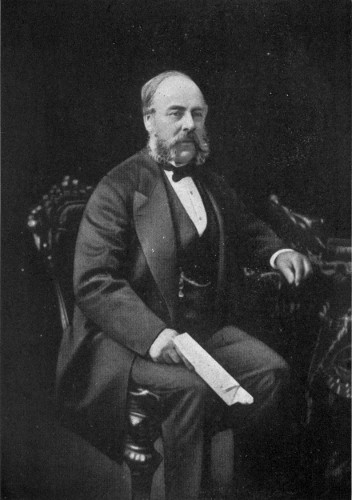
CHARLES G. HILL
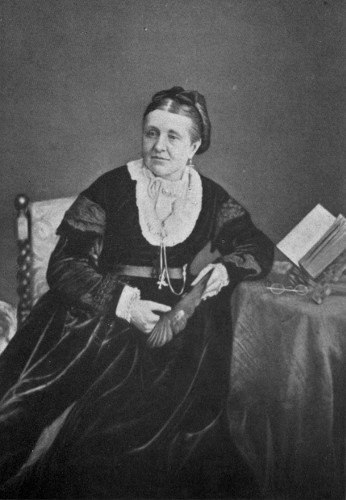
MRS. CHARLES G. HILL
On the 19th of August, 1840, Mr. Hill was united in marriage to Miss Margaret J. Galt, a daughter of William Galt, who for many years was one of the leading citizens of Montreal. He engaged in the tanning business near Glasgow, Quebec, and amassed a very considerable fortune. Following his death, Mr. Hill retired from commercial interests to supervise the Galt estate. To Mr. and Mrs. Hill were born eleven children, eight of whom reached adult age. These children were: William Galt, deceased; Charles G., who also has passed away; Margaret Ewing, the widow of G. M. Patterson, residing in Cleveland, Ohio; Robert Ewing, deceased; Adelaide, who married Samuel P. Wigg and resides in Lakefield, Ontario; Lewis E., deceased; Helena Augusta, residing in Montreal; Jean Elizabeth, now Mrs. E. A. Hilton; Peter Alexander; Emma Louise, who married Albert A. Adams and is deceased; and Dr. Adolphus James Hill, deceased. Mr. and Mrs. Hill devoted the greatest care to rearing their large family and bestowed upon the children their tenderest love. Those who grew to adult’s estate were an honor to the family name and in full measure repaid the care of the parents, whom they ever held in reverent memory. It is due to the kind cooperation of Miss Helena A. Hill,—and to her the publishers are indebted,—that they are able to present herewith the excellent steel etchings portraying her parents.
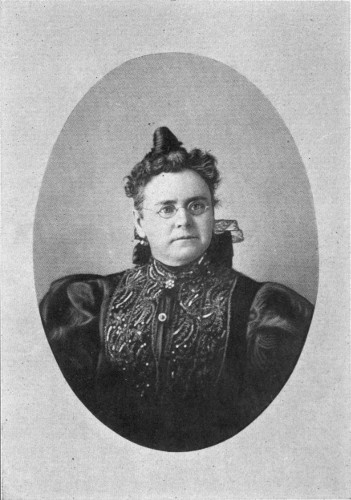
HELENA A. HILL
Mr. Hill attended services and held a pew in the First Baptist church and also in the Church of England, in the Cathedral. His membership was in the latter and his wife, who died in 1882, was a member of the former. Both were greatly esteemed and an extensive circle of friends indicated their worth and the high regard in which they were held.
WALDO W. SKINNER.
Waldo W. Skinner, practicing at the Montreal bar as a member of the firm of Smith, Markey, Skinner, Pugsley & Hyde, was born at St. John, New Brunswick, a son of the late Hon. C. M. Skinner, K. C. His youthful days were largely devoted to the acquirement of an education in the schools of his native city and at Upper Canada College, Toronto, and having determined upon the practice of law as his life work, he entered McGill University in preparation for the bar, and was graduated B. C. L. in 1901. In 1913 Mr. Skinner was created a king’s counsel. The year following his graduation he entered upon the active work of his profession and his course has been marked by continuous progress. He is now associated with one of the leading law firms of the city, Smith, Markey, Skinner, Pugsley & Hyde, and is actively interested in much important litigation, in connection with which he is retained as counsel for the defense or prosecution. From the outset of his career he has recognized the fact that careful preparation is one of the indispensable elements of success, so that thorough work precedes his presentation of his cause in the courtroom. His reasoning is clear and cogent and his arguments strong and forceful.
In June, 1907, was celebrated the marriage of Mr. Skinner and Miss Loulou Forget, the eldest daughter of the late Hon. L. J. Forget, senator. Mr. Skinner in his social relations is well known, being a member of the Mount Royal, St. James and Montreal Clubs, while his interest in sports is further indicated in his membership in the Montreal Racquet and Royal Montreal Golf Cubs. Attractive social qualities render him popular in those organizations, in which he has gained many friends.
THOMAS ROBB.
Organization is the watchword of the age. Promotion in every field of endeavor is brought about through the agency of organized effort and cooperation, and thorough study of each situation constitutes the basis of effort in this direction. This spirit and tendency of the age has led to the formation of many companies or societies for the benefit of business interests and it is in this connection that Thomas Robb is known, being manager and secretary of the Shipping Federation of Canada. A native of Scotland, he was born in the city of Glasgow in the year 1863, his father being the late Thomas Robb, who for some years was superintendent of police in Glasgow. Spending his youthful days in that city, the son pursued his education in the public schools and in the Glasgow Academy. Mr. Robb came to Canada first in 1883 and spent one year at farming in the Niagara district. Returning to England he became identified with the shipping interests and in connection therewith was located at different periods in Australia, South Africa and New Zealand. He returned to Canada in 1902 and upon the organization of the Shipping Federation of Canada, which is incorporated by act of the Dominion parliament, he was chosen manager and secretary. He still continues in the dual position, his efforts being of marked value to the organization in promoting its object and accomplishing its purpose as he is actively engaged in all matters relating to navigation and shipping. In 1913 Mr. Robb was appointed member of the royal commission appointed to inquire into and report upon the “Law Respecting Pilotage” and its administration in the pilotage district of Montreal and Quebec.