BIOGRAPHICAL (continued 11)
Reading edition
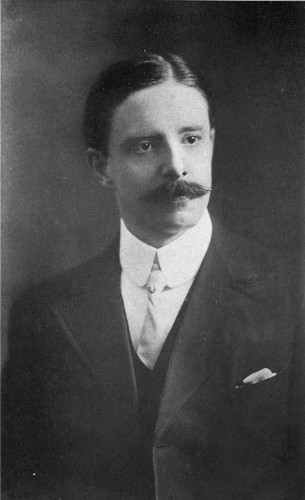
EDOUARD BIRON
Edouard Biron was a student in St. Mary’s College in Montreal until graduated with the Bachelor of Arts degree in June, 1897. He next entered Laval University, where he won the LL. D. degree in June, 1900. He became a notary in July of the same year, practicing alone until February, 1903, when he formed a partnership with J. A. Savignac under the name of Biron & Savignac, an association which was maintained for more than ten years, or until September, 1913. On the 1st of that month the present firm of Biron, Savignac, Coderre & Poirier was formed. In addition to the business of that firm Mr. Biron, as previously stated, is acting as secretary of the board of notaries for the district of Montreal, through appointment received in July, 1912. He stands as a prominent representative of his profession and one whose ability in this line is unquestioned. As he has prospered he has made investment in property and is holder of some valuable Montreal real estate.
On the 1st of September, 1902, Mr. Biron was married to Miss Blanche Fleury, a daughter of the late A. Fleury, who was a merchant of Montreal. Mr. and Mrs. Biron are the parents of four children: Germaine, ten years of age; Roger, eight years; Marcel, six years; and Suzanne, a little maiden of five summers. The religious faith of the family is that of the Roman Catholic church. Mr. Biron is general secretary of L’Association St. Jean Baptiste de Montreal and he belongs to the St. Denis and Canadian Clubs and the Club Canadien of Montreal.
EDMUND PHILLIPS HANNAFORD.
Edmund Phillips Hannaford engraved his name high on the roll of the promoters of railway interests in Canada. To no other single agency is progress so largely indebted as to railway building and thus it is that E. P. Hannaford deserves to be numbered among the public benefactors of his country. Throughout his entire life he was connected with railway projects and the superb engineering department of the Grand Trunk system is largely a monument to his skill, ability and sagacity. A native of Devonshire, England, Mr. Hannaford was born at Stoke Gabriel, on the 12th of December, 1834, and he was a youth of but seventeen years when he entered the railway service as draftsman and assistant under Sir I. K. Brunel. Through the succeeding four years he was a member of the engineering corps of the South Devon Railway and in 1856 he became identified with the development of railway projects in Canada. Following his arrival in the new world he became connected with the Grand Trunk Railway and acted as assistant engineer of the company from 1857 until 1866. In the latter year he was appointed chief engineer of the western division and further promotion awaited him in his appointment in 1869 to the position of chief engineer of the company. He remained in that connection for twenty-seven years, resigning from active work in 1896. He was in charge of the engineering department during the period of the greatest development of the railway and managed the construction of all new lines and stations of the company. His particular talent made him very successful in drawing up the plans of yards or overcoming any difficulty in the way of construction. No better proof of his work can be given than the fact that it is now generally admitted that the Grand Trunk has one of the best lines of any railway in Canada. The general offices at Point St. Charles were also erected under his direction.
In addition to his work in connection with the Grand Trunk Railway Mr. Hannaford in 1879 was named chief engineer of the Montreal & Champlain Junction Railway. Ten years before he had been chief engineer of the International bridge and in 1883 he became chief engineer of the Jacques Cartier Union and United States and Canada Railways.
It was in 1859, in Belleville, Ontario, that Mr. Hannaford was united in marriage to Miss Mary W. Roy, a daughter of Robert Maitland Roy, of Scotland, who became a resident of Belleville in 1837. He served in the war of the rebellion in defense of his country’s interests and long held public office, serving for a quarter of a century as town clerk. Mr. and Mrs. Hannaford became the parents of seven children, of whom four survived the father: Elizabeth, who was Mrs. Harry B. Eastty, of Mount Vernon, New York, and died August 3, 1913; R. Maitland, assistant chief engineer of the Montreal Street Railway Company; Edmund P., who is located at Corpus Christi, Texas; and Miss Mary R. Hannaford, at home.
Mr. Hannaford belonged to the Church of St. James the Apostle and his social nature found expression in his membership in the St. James Club. He was a public-spirited man, deeply interested in all that pertained to the welfare and upbuilding of Canada, yet his tastes inclined him to domesticity and in the home circle he was a most devoted husband and father. He was a man of fine personal appearance and impressive manner, yet withal was most genial and affable, and, wherever he went and formed acquaintanceship, it constituted the beginning of warm and enduring friendships.
Mr. Hannaford died August 18, 1902.
ROBERT CARLYLE JAMIESON.
Robert Carlyle Jamieson, who stood as a man among men, ready to meet any obligation of life with the confidence and courage that come of conscious personal ability, right conception of things and an habitual regard for what is best in the exercise of human activities, was born in Glengarry, Ontario, in 1836. He was a cousin of Thomas Carlyle, philosopher and historian, and a son of William Jamieson, a gentleman farmer, who married Jean Brodie, also a native of Scotland, and on coming to Canada settled in Glengarry.
Their son Robert Carlyle Jamieson pursued his education in the place of his nativity to the age of sixteen years, when he left home and taught school at Hawkesbury. In 1856 he came to Montreal and thereafter to the time of his death, which occurred almost a half century later, he was a resident of this city. He built up a large and profitable business through his industry, thrift and unfaltering honesty. It was in 1858 that he began the manufacture of varnish on St. Thomas Street, there establishing a plant that is yet conducted by the firm. In 1882 he purchased the plant of the Baylis Manufacturing Company, manufacturers of paints and colors, and later bought the plant of P. D. Dodds & Company at St. Patrick and Island Streets, where the main office is now located. Thus the business has steadily grown and developed, Mr. Jamieson remaining the active head of the firm to the time of his demise. Year by year the trade has increased until it today extends all over Canada and a branch office is maintained in Vancouver, British Columbia. Mr. Jamieson devoted his entire life to the upbuilding and control of this industry, which is still conducted by his sons under the style of the R. C. Jamieson Company, Ltd. It became one of the chief productive industries of the city and constituted and still remains a source of gratifying revenue to the stockholders.
In 1863, in Montreal, Mr. Jamieson was married to Miss Harriet Josephine McGowan, who was born in Cincinnati, Ohio, a daughter of John H. McGowan, who on leaving his native place, Aberdeen, Scotland, settled at Cincinnati, Ohio, but during the early ’60s removed to Montreal. Mr. and Mrs. Jamieson had a family of seven children, all of whom survive: Harriet A., now Mrs. W. de M. Marler; Helen L., the wife of A. W. Cochrane; Dr. William Hoves; Walter Lockhart; Robert Harry; Frederick Carlyle; and Ernest Temple. The death of the husband and father occurred February 17, 1905.
Mr. Jamieson was a man who occupied an honorable and enviable position in the regard of his fellows. His life work was permeated by noble and upright principles and he was untiring in his efforts to do good. He was one of the original governors of the House of Industry and Reform and for twenty years he was treasurer of the Congregational College. He served as deacon in Emanuel church and was one of the first trustees when the house of worship was erected in 1875. At one time he served on the council of the Board of Trade and he was one of the first members of both the Montreal Amateur Athletic Association and the Montreal Curling Club. He was solicited to accept many important offices, both city and provincial, but refused, preferring to concentrate his energies upon his business interests and duties and his activities in behalf of his fellow men along the lines of reform, intellectual progress and moral development.
JOHN KEITH MACDONALD.
Although a native of Scotland, born in Kintyre, John Keith Macdonald spent almost his entire active life in Montreal, where he arrived when a youth of sixteen years. He believed that better business opportunities awaited him on this side of the Atlantic and he made his initial step as an apprentice at the machinist’s trade under his uncle, John Boyd. Applying himself closely to the tasks assigned him, his knowledge and skill developed day by day until he became an expert workman in that line. Laudable ambition prompted the development of his latent powers and awakened in him the desire to engage in business on his own account, so that eventually he organized the firm of J. K. Macdonald, general machinists and contractors for iron work. Mr. Macdonald continually added to his knowledge through experience, reading and investigation along his chosen line and he continued in the business until his death, becoming one of the well known and leading representatives of industrial activity in Montreal.
In Montreal, in 1867, Mr. Macdonald was united in marriage to Miss Margaret Mackay, a daughter of Norman Mackay, of Glengarry, where he was born and spent his life. Unto Mr. and Mrs. Macdonald were born six children, five of whom are living, Mrs. Janette Macfarlane, Norman, Duncan, George and Margaret. The family circle was broken by the hand of death when Mr. Macdonald passed away at the age of sixty-three years. He was a Presbyterian in religious faith and his life was passed in consistent harmony with his professions, making him a man whom to know was to respect and honor.
COLONEL EDWARD ASHWORTH WHITEHEAD.
Colonel Edward Ashworth Whitehead, for many years one of the best known insurance agents and brokers of Montreal, his native city, was born April 16, 1845, and was here educated. He was the head of E. A. Whitehead & Company, insurance agents and brokers, for many years and thus became widely known in financial circles. In this connection he helped to build up the great insurance business conducted under the name of The E. A. Whitehead Company, Limited.
He had perhaps an even wider acquaintance through his military connections, for his military career was long, distinguished and honorable. He was one of the oldest officers in the volunteer military service in the Dominion and as original member of the Victoria Rifles he rose from the ranks to the command of the regiment and was placed on the list of reserve officers in 1876. He was on active duty during the Fenian raids from 1866 until 1870, was present at Eccles Hill and for his service received a general service medal with two clasps, while his active duty at the time of the Northwest rebellion in 1885 also won him a medal. He was chief transport officer under Colonel Middleton and held a long service decoration and he was a member of the Royal Commission on Canadian War Claims in 1885-6.
Colonel Whitehead was a veteran amateur athlete, was one of the founders of the Montreal Amateur Athletic Association and its first honorary president. In 1908 he was a member of the Canadian Olympic Games Committee and he was also a director of the Society for the Prevention of Cruelty to Animals. In Club circles he was long popular and prominent, holding membership in the Mount Royal Club; the St. James Club, of which he served as chairman; the Royal Montreal Golf Club; Forest and Stream Club; Montreal Hunt Club; Montreal Jockey Club; Montreal Curling Club; Montreal Polo Club; St. George Snow Shoe Club; the Isleway Club; the Military Institute; and the Royal St. Lawrence Yacht Club.
The end came to Colonel Whitehead September 7, 1912. He seemed almost to the last in the prime of life, his fine figure being erect and soldierly, and the years rested lightly upon him. His eye could still sweep down the long lines of the regiment, his step was elastic and he was enjoying life in all the mental riches that follow a career of activity and usefulness. The Victoria Rifles felt great pride in his brilliant record and in that regiment he was an outstanding figure, a symbol of duty well done, while his memory will ever be to them an inspiration for loyalty in the King’s service. In January, 1912, he was the leading figure at the dinner given by the regiment to celebrate the fiftieth anniversary of its organization. He had been one of the first to spring to the colors when the corps was organized and had carried those colors in many fields. Even as in his youth, ready to fight for his flag, Colonel Whitehead was as willing to go to its defense in later years, when it might have been supposed that the fire of youth had died down. Years rolled onward, changes came and brought with them the boy scout movement. This appealed strongly to his military spirit and he entered heartily into the work of supporting and furthering the cause. Money was needed; he supplied it. He also raised the money for the trip to Europe a few years ago. He had always loved boys, the military had always been dear to him and in the boy scout movement these two were combined.
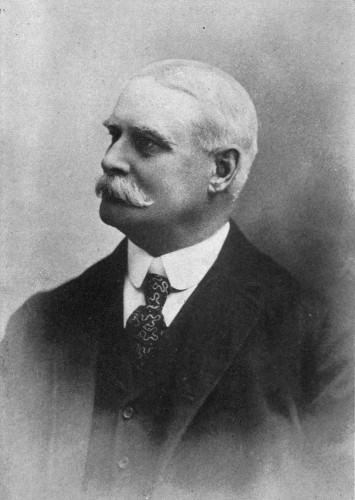
Col. Whitehead
Colonel Whitehead was a man to whom a worthy appeal was never made in vain. His heart took in a great circle of friends and his purse was open to all calls of charity.
In the field of sport he was well to the front. In early manhood he was an excellent lacrosse player and old timers remember the games in which he participated against the Shamrocks for the Claxton flags in the early ’60s. He was also a splendid sprinter, making a notable record in the hundred-yard dash. This love of sport he retained to the last and he was a life member of the Montreal Amateur Athletic Association, of which he at one time served as president.
Trouble did not pass him by, but through all he was the same kindly, upright gentleman, maintaining a high sense of duty and honor. In 1899 death robbed him of his wife, Mrs. Elizabeth Whitehead, daughter of William Newcomb, whom he had married in 1868; and his son, E. A. Whitehead, Jr., died in 1908.
Edward Ashworth Whitehead, Jr., son of Colonel Edward Ashworth Whitehead, was born in Montreal in 1869 and acquired his education in England and in Kingston, Ontario, where he was graduated with honors at the Royal Military College. He was connected with The E. A. Whitehead Company, Limited, and for many years was a special agent for Montreal of the Phoenix Assurance Company, Limited, of London and was as popular in business as he was in social circles.
Mr. Whitehead, Jr., married Miss May Sicotte, a daughter of Victor Benjamin Sicotte, district magistrate at St. Hyacinthe and a granddaughter of Hon. Louis Sicotte, premier of Canada. Three children were born to them: Edward Ashworth, who is the third of the name to continue the business of The E. A. Whitehead Company, Limited; George Victor, a student at Bishop’s College School; and Margaret Whitehead.
ROBERT LINTON.
Robert Linton became well known in the business circles of Montreal in connection with the manufacture of woolen goods. He was regarded as a resourceful business man whose enterprise, progress and laudable ambition were constantly manifest in the success which he won. A native of Ireland, he was born in Newtown-Limavady in 1834, a son of Samuel and Martha Linton, who brought their family to the new world during the boyhood of their son, Robert. Settling in Montreal, their remaining days were passed in this city but both have long since departed this life.
Robert Linton acquired his education in the schools of Montreal and received his business training with the firm of William Stephen & Company. Of that firm Lord Mount Stephen was a partner and eventually took over the business upon the death of the senior member of the firm. Continuing in active connection with the business Robert Linton grew in usefulness and capability, as he thoroughly acquainted himself with the duties that devolved upon him. After the death of William Stephen the business was conducted by George Stephen & Company for some time and Mr. Linton was admitted to partnership in 1857. Upon the retirement of George Stephen, later Lord Mount Stephen, the business of the firm of George Stephen & Company was combined with that of Andrew Robertson under the firm style of Robertson, Linton & Company, this connection continuing until 1898, when the business was closed out.
Mr. Linton was married twice. At Three Rivers, Quebec, he wedded Miss Margaret McDougall, and they became the parents of six children, as follows: Robert M., deceased; Margaret M., who is Mrs. Denaston Breakey, of Breakeyville, Quebec; Ernest, a resident of Ottawa; Agnes H, who is Mrs. F. N. Southam, of Montreal; Percy L., deceased; and Alice L., who married Herbert Carter, of Montreal. The second marriage of Robert Linton was also celebrated at Three Rivers, Miss Margaret Paterson, daughter of John Paterson, becoming his wife on the 20th of October, 1886.
Mr. Linton was ever actively interested in those projects and measures bearing upon the progress, upbuilding and development of the city as well as upon his business affairs. He was widely recognized as an honorable and upright man, in whose life there were no esoteric phases. He was a member of the Montreal Board of Trade, a life governor of the Montreal General Hospital, and a justice of the peace for a few years before his death. He passed away in November, 1899, after having gained for himself a most creditable position in business circles and in the regard of his fellowmen.
ARTHUR O’CONNELL KAVANAGH.
A history of the insurance business in Montreal would be incomplete without mention of Arthur O. Kavanagh, who for many years figured prominently in connection therewith. He was one of the city’s native sons, born April 12, 1860, and in its schools pursued his education, while in the school of experience he also learned many valuable and practical lessons, thus constantly adding to his knowledge and ability. The family name indicates his Irish lineage and he manifested the sterling characteristics of the race. He was engaged in business with his brother, Walter Kavanagh, and they became prominent figures in insurance circles, representing the Scottish Union & National Insurance Company, the German-American Insurance Company and the Rochester German Insurance Company, of which they were chief agents. Arthur Kavanagh familiarized himself with every phase of the business and had gained a most creditable position as an alert progressive man and one ready to meet any emergency in business, when death called him on the 14th of September, 1896, when he was yet in the prime of life.
He had been married in Montreal less than five years before, having on the 7th of October, 1891, wedded Alice Mullin, a native of this city and a daughter of Patrick Mullin, of whom mention is made elsewhere in this publication. They became the parents of three sons: Harold Henry; Arthur Patrick, who died at the age of six years; and Walter John. Deep regret was felt at the passing of Mr. Kavanagh, because of his comparatively early age and because he had gained a firm hold upon the affectionate regard of his business associates and his many friends.
PATRICK MULLIN.
Patrick Mullin had traveled life’s journey for more than four score years when he was called from this life on the 14th of August, 1913. He was a native of Tyrone, Ireland, and for more than six decades was a resident of Montreal, arriving in this city in 1850. He was associated with various business enterprises. With his brother, James E. Mullin, he became associated with another brother, John Mullin, who had, in 1845, established a wholesale grocery business, which they conducted on College Street, now St. Paul Street. There they built up a very extensive and successful enterprise, their patronage constantly growing, as their trade interests extended over a wide territory. In the early years of the business there were practically no railroads in this section of the continent, while means of water transportation were but slightly developed. They hauled much of their stock with teams and, notwithstanding the difficulties involved, they were enterprising enough to compete for business as far west as Toronto. Their merchandise was taken from Montreal to that city by team, the journey requiring two weeks. John Mullin died in 1853, after which the business was conducted by James E. and Patrick Mullin, under the firm name of J. E. Mullin & Company. Both brothers had great faith in the ultimate growth and prosperity of the city and because of this they made large investments in real estate, gradually acquiring the ownership of the block upon which they conducted their business, extending from the rear of the Grand Trunk offices to the Haymarket. Patrick Mullin also invested in other real estate until his holdings were extensive and important. The large block which the brothers acquired on St. Paul and William Streets later became the location of the present plant of the Canada Cold Storage Company and Mr. Mullin became a pioneer in that line of business in the city. He was a man of indefatigable energy and strong purpose and as the years passed on he carried forward to successful completion whatever he undertook.
Mr. Mullin was united in marriage, in Montreal, to Alice O’Neil, a native of County Tyrone, Ireland. She died on November 29, 1903, the mother of seven children, as follows: Mary A., the wife of Joseph A. Cloran, of Boston, Massachusetts; Margaret J.; Alice, the widow of Arthur O. Kavanagh; John F., who died in March, 1904, aged twenty-nine years; Patrick; Elizabeth M., who is Mrs. Harry J. Trihey; and Emma M., wife of William J. Hart.
A long and useful life was Mr. Mullin’s. He was a man of quiet habits, but greatly enjoyed a good game of forty-five. In manner he was always courteous, kindly, and considerate to others. In religious faith he was a Catholic and devoted much time to increasing the usefulness of St. Bridget’s Home and of St. Patrick’s Asylum, being a trustee of the latter institution. He gave liberally to the church and did everything in his power to promote its influence.
ROSAIRE DUPUIS.
Rosaire Dupuis, one of the rising young notaries of Montreal, is a son of Louis Napoleon Dupuis and Melanie Panet Levesque. The father is ex-controller of Montreal and one of the founders of the well known mercantile house of Dupuis Freres, Limited. The mother of Rosaire Dupuis is a daughter of the late Pierre Thomas Levesque and comes from a family that has for generations been prominent in the judicial and legislative history of the province and Dominion. Mr. Dupuis was born in the parish of La Longue Pointe on the 17th of October, 1888. He made his classical course at L’Assomption College, from which he was graduated in 1908 with the degree of Bachelor of Science. He then took up the study of law in Laval University in 1908 and won his LL. L. degree upon graduation with the class of June, 1911. During the summer seasons of 1909 and 1910 he attended the famous Eastman Business College at Poughkeepsie, New York, where he was graduated with honors on the 30th of August, 1910. During the succeeding year he traveled abroad, visiting the Holy Land and many European countries.
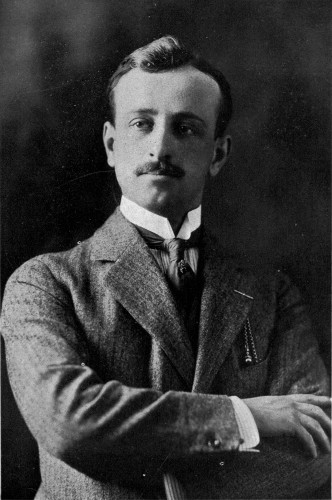
ROSAIRE DUPUIS
In January, 1912, Mr. Dupuis began practice and has met with gratifying success in following his profession, in which he is well versed. He is a conservative in politics and a Roman Catholic in religious belief. He holds membership with the Canadian Club, the Montreal Amateur Athletic Association and the Knights of Columbus, and for the past two years has been secretary of the Anti-Alcoholic League. During the years 1909 and 1910 at Laval he was secretary of the Laval Students-at-Law. He is a young man of promise as well as a credit to one of Montreal’s best families.
DONALD ALEXANDER SMITH.
Donald Alexander Smith, Lord Strathcona and Mount Royal, whose career has been so wonderful as to appear almost magical, was born on August 6, 1820, in the ancient town of Forres, in Morayshire, Scotland. His father, Alexander Smith, was a small tradesman of Archieston and was born in the parish of Knocando. He married Barbara Stuart, of Leanchoil, Abernethy, a capable, thrifty woman, ambitious for her children. It was her desire that her son Donald should prepare for the bar, but, though he did not see fit to follow this wish, the mother heart never lost faith in her son and it was said that after he came to Canada as a fur trader she was frequently heard to remark: “They’ll all be proud of my Donald yet.” It was said that in boyhood he was shy, yet amiable, and displayed sturdy resolution and even hardihood if circumstances called those qualities forth. After leaving school he took up the study of law, his reading being directed by Robert Watson, solicitor, for two or three years. At length, however, he determined to enter the service of the Hudson’s Bay Company, influenced somewhat by a previous suggestion made by John Stuart, his uncle, who was then visiting Scotland. In 1838 he sailed for the new world and after a voyage of between forty and fifty days upon an eight hundred ton vessel, one of the largest on the seas at that time, he landed on Canadian shores. The rebellion of Mackenzie and Papineau had just been suppressed. Donald A. Smith at once entered the service of the Hudson’s Bay Company, but in a minor position. He met various hardships, but he proved his fidelity to the company as well as his capability in performing every service intrusted to him. He was first sent to the Labrador coast, where he spent thirteen years in a cold, bleak, barren, desolate region, with no companionship save a few employes, but during that period he learned the business methods of the company, how to manage Indians and how to secure the best returns. It has been said that power grows through the exercise of effort and year by year Donald Smith became more powerful. The hardships which he was forced to endure developed him. There is probably no other country in the world where there exists a longer or more dangerous postal route for men and dogs—two thousand miles of land travel from Quebec to Ungava in the depth of an Arctic winter, continuing from December until June—yet Lord Strathcona covered that route not once but many times.
His apprenticeship was, indeed, a difficult one, but he was undeterred by all obstacles he encountered and privations which he endured. At length, however, his eyesight became impaired, making it necessary that he go to Montreal for treatment. He covered the journey from Labrador by dog sled and on his arrival in Montreal he was greeted by Sir George Simpson, governor of the company, with the remark: “Well, young man, why are you not at your post?” “My eyes, sir,” came the reply, and he pointed to his blue goggles; “they got so very bad I have come to see a doctor.” But the governor thundered: “And who gave you permission to leave your post?” It would have taken a full year to obtain official consent, but when Mr. Smith was forced to reply, “No one,” the governor answered: “If it is a question between your eyes and your service in the Hudson’s Bay Company you will take my advice and return this instant to your post,” and Mr. Smith started almost immediately upon that return journey of nearly a thousand miles. The weather became so bad that both of his Indians succumbed to the cold and he arrived at the post more dead than alive. He once remarked: “A man who has been frozen and roasted by turns every year must be the tougher for it if he survived it at all.” Donald A. Smith did survive and advanced steadily. He learned the dialect of a number of Indian tribes and he so managed business affairs that his services were ever a matter of profit to the company. His advancement was slow at first, but his worth was eventually recognized and promotion came quicker. His duties were many and onerous because of his remoteness from civilization. He was called upon to minister to the sick and half a century later, when speaking to the students of the Middlesex Hospital in London he described the antiseptic which he used in Labrador in the ’40s, saying: “It was a primitive and somewhat rude form of treatment that was practiced in those days before Lord Lister introduced his discovery. For the treatment of wounds, ulcerated sores, etc., a pulp was made by boiling the inner bark of the juniper tree. The liquor which resulted was used for washing and treating the wounds and the bark, beaten into a plastic mass, was applied after the thorough cleaning of the wound, forming a soft cushion, lending itself to every inequality of the sore. Scrupulous cleanliness was observed and fresh material used for every application.”
When in Labrador, at the age of twenty-nine years, Donald A. Smith married Isabella Sophia Hardisty, with whom he traveled life’s journey for sixty-five years, separated in her death, which occurred in London in 1913. In the meantime he was advancing from one post to another in the service of the Hudson’s Bay Company, becoming trader and then chief trader, while his splendid administrative ability won him further promotion to factor and to chief factor. In 1851 he was transferred to the Northwest provinces and became most active in their later development. He eventually reached the position of supreme head of the company, becoming the last resident governor of the corporation that had its beginning under the Merry Monarch. The year 1868 witnessed his arrival in Montreal, as chief executive for the Hudson’s Bay Company. He is described at that time as “a man of middle stature, rather slight in build, and looked not at all the typical northerner, except when one studied his countenance.” “The snow tan of the north had made him dark as an Indian. He wore a full beard, black and wiry. Black brows met above his eyes, enhancing the stern, uncompromising aspect of his face. He looked what he was—a commander of men and of forces, a man made strong by a life of struggle and conquest in the wilderness.” He had not yet become a wealthy man, although he had saved his money and had invested it in land at various points in the northwest—land that many would have regarded as valueless. With wonderful prescience he discerned something of what the future had in store for that great country and with the growth of its population and the onrushing tide of civilization his holdings increased in value, making him one of Canada’s more prosperous citizens.
While Donald A. Smith had reached the pinnacle of service in connection with the Hudson’s Bay Company when he came to Montreal, he was destined to gain equal eminence in other directions. In the interests of the Canadian Confederation it was seen that the title to the territory of the Hudson’s Bay Company in Rupert’s Land must pass to the crown and a purchase was arranged whereby the company received a million dollars and large reserves of land, although the transfer was not made without great difficulty and danger, culminating in what has been known as the Red River rebellion, or the first Riel rebellion.
Discontented people of that region had been trying to produce an agitation that would separate their settlement from that of the Hudson’s Bay Company. The rapid growth of population in Assiniboia was imperilling the company’s hold and its rule, hitherto wise and practical, was denounced as arbitrary. A contemporary biographer has written:
“Better representation was demanded and, by dint of much uproar and noise, considerable sympathy was obtained from outside. To understand fully the character of this Red River settlement it must be explained that the population was considerably mixed. In all there were about twelve thousand souls. There were Europeans, Canadians, Americans and French half-breeds. With a mixed population like this it was difficult to deal and when, on November 9, 1869, the deed was signed in London, whereby the company surrendered its interests in the northwest to the crown, with reservations for the company, rebellion broke out. The leader was the famous Louis Riel, a Metis, described as ‘a short, stout man, with a large head, a square cut, massive forehead overhung by a mass of long and thickly clustering hair and marked with well cut eyebrows—altogether a remarkable looking face.’
“The Hon. William McDougall had been appointed lieutenant governor of Rupert’s Land and the Northwest territories in September, 1869, but when he went, by way of the United States, to possess himself of his power he was turned back on the borders of his domain by Louis Riel and his followers, the Metis of the plains, who absolutely refused to recognize his authority on the ground that they had not been consulted in the new arrangement. Mr. McDougall found himself unable to cope with the situation and was compelled to remain at a farm house several miles south of the boundary line for six weeks.
“Meanwhile the armed resistance to authority had attained serious proportions. Riel seized Fort Garry, made the editor of the local paper prisoner and was issuing proclamations to the inhabitants. So matters went on until sixty of Riel’s enemies were confined in Fort Garry and the insurgents’ flag hoisted.
“Meanwhile in his office in Montreal Donald A. Smith was slowly but surely studying the position. Understanding the character of both McDougall and Riel, he saw how hopeless the situation was. Understanding them better than they understood themselves, he realized that what was needed was a man who knew the inner mind of the company well and could clear its character of the imputations cast upon it. He was the man—he felt it and although the journey involved grave personal risk he resolved to go. The government promptly accepted his services and he was appointed special commissioner to proceed at once to Fort Garry.
“With characteristic courage he went unarmed and almost alone. No sooner had he arrived at Fort Garry than he was treated as a prisoner of ‘President’ Riel. That, however, did not check his determination. He had made up his mind to avoid bloodshed and yet to enforce the decision of the government. To quote his own words: ‘The part I had to act was that of a mediator. Not only would one rash or unguarded word have increased the difficulty but even the pointing of a finger might, on more than one occasion, have been sufficient to put the whole country in a flame.’ But the unguarded word was never spoken, the finger was never pointed in a wrong direction and the rebellion ended in a bloodless expedition. Yet before Sir Garnet Wolseley marched to the Red river many a heated discussion was held and probably never before in history has a regularly ordained meeting been held in British territory under such conditions. If the moral atmosphere was warmly excited, the physical atmosphere was depressed enough to chill the fiercest rebels.
“The first meeting was a memorable one. In the open air, with the thermometer twenty degrees below zero, a cruel, biting wind penetrating through the warmest clothing, there they stood, men of all nationalities and ages. On the small, raised platform were the four most concerned in the rebellion—Riel, O’Donoghue, De Salaberry (a man beloved by thousands) and Donald A. Smith. At first the meeting was wholly with Riel, who cleverly got himself appointed French interpreter. But when things were at their worst and men of the opposite sides glared at each other with hate in their eyes, Mr. Smith rose to speak. His facts, his practical wisdom and, above all, his reasonableness had their effect upon the swaying multitude. If he did not gain much that day, at any rate he averted bloodshed.
“In the open air, with the thermometer twenty degrees below zero, in the teeth of a biting blast, this meeting was conducted with a respect for decorum and ancient parliamentary methods worthy of Westminster itself.
“The next day things went better. The proposition that representatives should be chosen from both sides was accepted, and when Riel agreed to disband the men at Fort Garry all classes felt that the worst was over. However, matters were not so easily arranged. Riel broke his word and the murder of a young man named Scott complicated the situation. Nevertheless, the excitement slowly cooled and there is little doubt that but for the tactful courage of Mr. Smith a spark would have been put to the flame of rebellion.
“‘I am as certain as I can be of anything,’ said Dr. O’Donnell, one of the old timers of Winnipeg, who was at Fort Garry in 1869, ‘that Donald A. Smith saved the northwest of Canada. On December 10, 1869, he was appointed a special commissioner to explain to the people of the Red River settlement the principles on which the government of Canada intended to govern the country and to take such steps as he might consider necessary to bring about a peaceable transfer from the Hudson’s Bay Company to the Dominion. At that time everything was in confusion; Mr. McDougall had been refused admission, Riel was king, an American element was trying to bring about the annexation of the settlement to the United States and last but not least the Indians were disaffected. When he reached Fort Garry Mr. Smith was virtually made a prisoner, Riel would not allow him to go outside the fort and kept an eye on his correspondence. In January, 1870, a mass meeting was held at Fort Garry and Mr. Smith was allowed to state his case and tell what he wanted the people to do. Riel was present, together with O’Donoghue and other insurrectionaries. It was a critical moment, I assure you; in fact, when Mr. Smith got up to read his commission from Sir John Young most of those present expected to see him arrested or shot on the spot. As it was he had a stormy time, but managed to impress many of the hot-headed with the belief that the interests of the settlement would be properly safeguarded by Canada. Riel was afraid of Mr. Smith’s influence and at once hurried on preparations for having himself made president of a provisional government. Then came the wholesale arrests culminating in the murder of Thomas Scott. Mr. Smith risked his life in an attempt to save Scott. Notwithstanding Riel’s antipathy to him, he went boldly to Riel and pleaded for Scott, even going so far as to warn Riel that if Scott was shot his blood would be upon his head. Riel was intoxicated with power and more than half disposed to shoot others on the loyal side, but Mr. Smith told him to his teeth that such a crime would not go unpunished.
“‘In the discussions that took place over the Bill of Rights to be sent to Ottawa, the chief part was borne by Mr. Smith. His coolness and sagacity undoubtedly prevented the collapse of the negotiations. “This man Smith,” said O’Donoghue at one stage, “knows too much for us, he is too able for us. We must get rid of him or the northwest cannot be made either an independent republic or part of the United States. He is a Hudson’s Bay Company officer and as such a friend of the half-breeds, and will be able to persuade them that union with Canada is to their interest.” It was a wonder all along that Mr. Smith was not shot. He was warned often enough that his life was in danger, but seemed quite willing to risk it in behalf of the cause he represented. A good many English-speaking settlers, while loyal enough, did not at first care to belong to Canada; they thought Rupert’s Land would be better off as a crown colony than as a Canadian province and Mr. Smith had to convince them that they were mistaken. In reality, therefore, he was between two fires—the Riel or disaffected party and the loyalists who did not favor the idea of confederation—whilst, as I have said, there was an American element working for annexation.
“‘At a later period when Governor Archibald came in (September 2, 1870), Mr. Smith rendered services to Canada of the highest moment. The Governor did not receive a very cordial reception, but Mr. Smith, who accompanied him, set about the work of conciliating the French, the old time English-speaking settlers and the new or Canadian settlers, who constituted three distinct factions. Mr. Archibald frequently told me that but for Mr. Smith the little community would have been torn to pieces by intestine strife. He was the one man who brought the northwest into Canada, who, indeed, saved it to the British empire, and we think he should get credit, even at this late day, for so great a work.’
“Many are the anecdotes concerning Mr. Smith’s dangerous mission to Fort Garry during the first Riel rebellion and of the commencement of his political career in the far west.”
With Sir Garnet Wolseley were Captain Buller, afterward General Sir Redvers, and Lieutenant Butler, afterward General Sir William. The tyranny of Riel had become irksome to the people, who received the newcomers joyously, and at the approach of the “red coats” Riel, with his co-conspirators, fled, taking up his position on the shores of St. Boniface. All was now quiet in the settlement, the purchase price of one million, five hundred thousand dollars had been paid and the territory transferred to Canada.
Donald A. Smith was by this time recognized as the most powerful man in the west. The governor general thanked him for his services and in 1870, after the organization of the province of Manitoba, he was returned to the legislature for Winnipeg and St. John. He was also called to the Northwest territorial council and was returned for Selkirk to the house of commons. He supported the conservative government then under direction of Sir John A. Macdonald and the party soon found that in him there was another man fit for leadership. It was found that the builders of the railway from ocean to ocean had trafficked with contractors and taken money for election purposes. This became known as the Pacific Scandal and the intense feeling manifest throughout the country centered in the house of commons. The house divided upon a motion of the Hon. Alexander Mackenzie, the leader of the liberal opposition to Sir John Macdonald. Feeling was intense. At one o’clock in the morning of November 5, 1873, Mr. Smith arose and uttered what became an oracular speech, for the people he represented were vitally interested in the building of the railway so necessary to the development of their country. It is said the house became deadly calm; no one knew whether he would adhere to his party’s policies or otherwise. He said: “For the honor of the country no government should exist that has a shadow of suspicion resting upon it, and for that reason I cannot give it my support.” These were his closing words, greeted by frantic cheers by the opposition, and the government was doomed. Feeling ran high and was most intense and bitter, but in later years the two leaders, the great statesman and the great financier, built together the Canadian Pacific Railway. Both were master builders and the executive capacity of the financier was necessary to the constructive genius of the statesman. It was in no idle spirit of laudation that Sir Charles Tupper stated that “had it not been for Mr. Smith’s indomitable pluck, energy and determination the road would never have been constructed.”
Mr. Smith thoroughly understood the fact that colonization could not be carried forward in the west without the building of the railroad. Another has written concerning this:
“It must have been with profound reluctance that he voted for the overthrow of the Macdonald government. He knew that the fall of that administration would set back the construction of the Pacific Railway and of the necessity of that great work to the unity and stability of the confederation he was thoroughly convinced. He was not well satisfied with the slower and less heroic policy of Mackenzie, although it is said he believed the road should be built by the government and ‘not by any company, however honorable or competent.’ He said in 1876, ‘Nothing short of a guarantee from the government of interest on the whole amount of the bonds could induce capitalists to embark on the enterprise.’ He, therefore, well understood the magnitude of the contract into which the syndicate entered in 1880 and the peril to his fortune and reputation involved in the assumption of that gigantic undertaking.
“There is no doubt that the syndicate received great subventions, but Mr. Smith and his courageous associates undertook to build a railway through thousands of miles of unknown and uninhabited country, along the sterile shores of Lake Superior and across the Rocky mountains. They had to go out in advance of settlement. They had to lead the march of civilization across leagues of unsettled prairie. They had to seek a silent port on the Pacific. It was a more daring idea than the Cape to Cairo Railway, which united two great centers of world activity. The Canadian Pacific was a plunge through nothing to nothing. It was a stupendous guess at the future. As we look back we recognize that few human achievements rank higher than the construction of the Canadian Pacific Railway across this enormous stretch of territory, its operation during the first ten years of its history and the maintenance of its credit in face of persistent attack, slow growth of population and unpromising national outlook. The whisper goes that when the great enterprise hung on the verge of collapse, Mr. Smith pledged his private fortune to the last dollar in support of its credit, as he held his associates to the scrupulous performance of every detail of their contract with the country.”
One of the initial steps of the work was the purchase of the bankrupt St. Paul, Minneapolis & Manitoba Railway, which, extending over Minnesota and Dakota had a branch line to Pembina, Manitoba. Built by Dutch capitalists, it became bankrupt in 1873, yet Messrs. Smith and Hill recognized that with the return of prosperity this would become a profitable undertaking. These two, together with George Stephen, later Lord Mount Stephen, and N. W. Kittson purchased the road.
Sir John Macdonald returned to power in 1878, but he could not secure the cooperation of London financiers in the building of the railroad. When it was seen that it was impossible to carry the project through as a government railroad, in 1880 the four men who had made the old Minnesota railroad a paying investment, undertook the other task. A syndicate was formed, known as the Canadian Pacific Railway Company, ultimately capitalized at seventy-five million dollars, with twenty-five million dollars of land grant bonds, and this company built the railroad from the Atlantic to the Pacific. The task accomplished was a gigantic one. The movement had the support of the conservative government, but was bitterly assailed by the opposition, both in the house and through the press. Again and again the word went out through the papers and through party utterances that the railroad could never be made a paying investment. It was almost impossible to get investors to buy stock. At times the treasury seemed utterly exhausted. It is said that one day Donald A. Smith came late to a directors’ meeting. He looked into the faces of his colleagues and said: “Nobody has any money; let’s adjourn until tomorrow.” The following day he smilingly entered the room. “Has anybody raised any money?” he asked. Everyone replied: “Not a cent.” “I have raised another million,” announced Mr. Smith, “and that will last us until somebody gets more money.” Never for a moment did he lose faith in the ultimate triumph of the venture. He inspired others with much of his own contagious enthusiasm. Again and again when his associates seemed utterly discouraged he inspired them with hope and when he was in Great Britain and the directors wrote him a long letter indicating their utter despair he cabled back one word “Craigellachie,” recalling at once the old Highland clan cry “Stand Fast, Craigellachie,” and once more inspired by their chieftain the men did stand fast and on the 7th of November, 1885, at Craigellachie, British Columbia, Donald A. Smith, then a white haired man, drove a golden spike into the cedar tie upon which the rails met from east to west. The weight of the Herculean task which he had accomplished between 1880 and 1885 had changed the strong, black bearded, sturdy man to a white haired veteran. Before night came on the Marquis of Lansdowne, governor general of Canada, had received a telegram from Queen Victoria congratulating the Canadian people on an event “of greatest importance to the whole British empire.” Speaking of the Canadian Pacific Railway Sir Charles Tupper said:
“The Canadian Pacific Railway would have no existence today, notwithstanding all the government did to support that undertaking, had it not been for the indomitable pluck and energy and determination, both financially and in every other respect, of Sir Donald Smith.” Mr. James J. Hill, president of the Great Northern Railway of the United States, also said that “the one person to whose efforts and to whose confidence in the growth of our country, our success in early railway development is due is Sir Donald A. Smith.”
The splendid work done by Mr. Smith won him imperial honors. He was created a knight commander of the Most Distinguished Order of St. Michael and St. George by Queen Victoria in 1886 and a decade later received a knight grand cross in the same order, being privately invested by Her Majesty at Windsor Castle. At the time of the Diamond Jubilee in 1897 Queen Victoria bestowed a further mark of royal favor upon Mr. Smith by elevating him to the peerage of the united kingdom as Baron Strathcona and Mount Royal of Glencoe, in the county of Argyll, and of Montreal, in the province of Quebec and Dominion of Canada. In 1908 he was appointed a knight of the grand cross of the Royal Victorian Order and was also elected a fellow of the Royal Society, while in 1910 he became a knight of grace of the Order of the Hospitallers of St. John of Jerusalem.
In the meantime he had become identified with so many financial interests that it would be impossible to enumerate them. He also remained active in politics, unyielding as ever in all matters where subserviency was demanded by party exigencies. It has been said:
“He was not a legislator; he was not a statesman; he never wanted office; and he seldom spoke. He was forced into the house by his commanding personality and he sat there representing the silent power of the empire builder. But it is not to be supposed that he was not a working member. Probably few men did more valuable parliamentary work, while he remained a member of the house.”
In 1874 Mr. Smith resigned his seat in the Manitoba legislature, but remained a representative of the province at Ottawa, sitting for Selkirk until 1880. In 1887, at the general election, he was returned to the house of commons as member for Montreal West, now St. Antoine division, by a majority of fourteen hundred and fifty, and was reelected in 1891 by a majority of thirty-seven hundred and six, remaining the representative for Montreal West until 1896. In 1892 he was an active participant in the commercial congress held in London and in March, 1896, he served as a delegate to the Manitoba government to aid in deciding the Manitoba school question, his colleagues being Messrs. Dickey and Desjardins. In April of the same year he was sworn of the queen’s privy council of Canada, and he was commissioner to the Pacific cable conference held in London in 1896, in which year he once more attended the commercial congress. During the existence of the Imperial Federation League he was vice president of that organization for Quebec. In April, 1896, ere the conservative administration went out of power, he was appointed Canadian high commissioner in Great Britain, succeeding Sir Charles Tupper, who had filled the office since its creation in 1884. The high commissionership combines all the functions of an ambassador and financial agent but has no diplomatic standing. The appointment as high commissioner is a political one, but when Sir Wilfrid Laurier came into power Lord Strathcona still retained the position as if there had been no change in government. When the conservatives returned to power in 1911 he remained in London, with the approval of all Canada. When the expenses of the high commissioner’s office in London were being discussed in the Dominion house of commons the late Sir Richard Cartwright said:
“I believe that Canada has in very important respects been extremely well served by Lord Strathcona since he has represented us in Great Britain. It is a matter of no small moment to Canada that our representative should be well and favorably known on the London Stock Exchange as a man of the highest honor and probity, and a man whose word is universally admitted to be his bond. I need not tell the house that the emoluments are absolutely naught to Lord Strathcona. I need not tell the house that in all probability, in the exercise of hospitality which he has indulged in during a single London season, he will vastly exceed all that is nominally assigned to him as the representative of Canada. I think every member of the house who has occasion to visit London will testify that, whether or not the office in other respects comes up to all that he desires, Lord Strathcona, at any rate, is worthy of upholding in every possible way the honor and dignity of Canada. I may further add that Lord Strathcona is a man whose advice is eagerly sought and has very great weight, indeed, with the British government and with Englishmen, Scotsmen and Irishmen of every rank and station. As regards his influence in what I may call the diplomatic circle and the ministerial circle and on the Stock Exchange, Canada would find it pretty hard, indeed, to replace Lord Strathcona.”
Lord Strathcona’s name stands high on the roll of those who have figured most prominently in financial circles in the Dominion. He was one of the large shareholders of the Bank of Montreal, became its vice president in 1882 and president in 1887. It was only after many years’ residence in London that he resigned in 1905, whereupon he was immediately elected honorary president for life. He studied banking from every possible standpoint and in all of its relations to other business interests. His first address to the shareholders after he became president was a notable one. He spoke of the bountiful harvests in Canada and in the American northwest and recognized the fact that shipping interests must bring the grain to Montreal and that the bank would benefit thereby. Few men would have considered the question in so wide a scope. Year after year during his presidency Lord Strathcona continued to call attention to the wealth of the nation as provided by the agricultural districts of the northwest and time has proven the wisdom of his judgment in this regard.
Not only was Lord Strathcona a railroad builder, a distinguished financier and a political leader, but he was also one of Canada’s most generous philanthropists. He never for a moment forgot his own struggles and his hand was ever out-reaching to assist another. His munificence was princely, yet his giving was most unostentatious in its character and no one will ever know the extent of his private charities. Some of his gifts, however, he could not conceal. In association with Lord Mount Stephen he gave one million for the erection of a great hospital in Montreal to commemorate the queen’s jubilee. Later, when the building had been erected on the mountain side, they gave equally in the sum of eight hundred thousand to endow the institution and the Royal Victoria is today one of the best equipped hospitals on the continent. Modern science has been exhausted to furnish it adequately and the large endowment makes it possible to keep pace with the newest discoveries and inventions. McGill University has again and again been the beneficiary of Lord Strathcona until the sum total of his gifts reaches two million dollars, and in addition he has presented to the university the land on which to erect the new medical building and the site and building of the Royal Victoria College. He also gave the income of a million dollars as an endowment to the Royal Victoria College and the chair of zoology. The former was founded for the higher education of women and is one of the most popular and useful of his bequests to McGill. Lord Strathcona was early chosen a governor of McGill and was elected chancellor of the university in 1889. The gifts to the university for the faculty of medicine included the Leanchoil endowment, in memory of his mother, fifty thousand dollars; for endowment of the chair of pathology, fifty thousand dollars; for endowment of the department of hygiene, fifty thousand dollars. The faculty of applied science benefited by the endowment of its pension fund, fifty thousand dollars, while the faculty of arts also benefited by a like amount for the same object. Of the five hundred thousand dollar gift, given in 1909, it was stipulated that fifty thousand should go for augmenting the salaries of the professional staff. To the Trafalgar Institute, affiliated with McGill University, he gave thirty thousand dollars. Together with Lord Mount Stephen he endowed a Canadian scholarship in the Royal College of Music, London, and subsequently endowed a second scholarship on his own account. Lord Strathcona took an active interest in the cooperative scheme put in operation in 1912 by the Montreal Theological Colleges affiliated with McGill and in the summer of 1913 contributed one hundred thousand dollars to a half million dollar fund raised by the friends of the four institutions concerned—Anglican, Presbyterian, Methodist and Congregational—to place the joint work upon a permanent basis. As honorary chairman of the Western committee of the Young Men’s Christian Association Lord Strathcona gave one hundred and fifty thousand dollars to funds for the Young Men’s Christian Association buildings in Manitoba, Saskatchewan, Alberta and British Columbia.
Lord Strathcona’s patriotism and generosity found expression in the equipment of the famous Strathcona Horse, a military force of five hundred and forty men completely equipped and sent to the front at a critical period of the war. He paid the expenses of equipment, pay and transport until the regiment reached Cape Town. The service of the regiment was, indeed, a credit to its founder and has become a part of the military history of Canada. Another of Lord Strathcona’s beneficent gifts was the contribution of two hundred and fifty thousand dollars to create an annual fund of ten thousand dollars for the encouragement of physical and military training in the public schools of the Dominion. In writing upon this subject Lord Strathcona said:
“While I attach the highest importance to the advantages of physical training and elementary drill for all children of both sexes, I am particularly anxious that the especial value of military drill, including rifle shooting for boys capable of using rifles, should be constantly borne in mind. My object is not only to help to improve the physical and intellectual capabilities of the children by inculcating habits of alertness, orderliness and prompt obedience but also to bring up the boys to patriotism and to a realization that the first duty of a free citizen is to be prepared to defend his country. The Dominion at the present time and for many years to come can hardly hope to be able to give so long a period of training to her military forces as by itself would suffice to make them efficient soldiers, but if all boys had acquired a fair acquaintance while at school with simple military drill and rifle shooting the degree of efficiency which could be reached in the otherwise short period which can be devoted to the military training of the Dominion forces would in my opinion be enormously enhanced.”
Among other evidences of his generosity was a gift of one hundred thousand dollars in June, 1913, through the minister of militia, for the purchase of a site on Lorne Crescent for a drill hall for the exclusive use of McGill students.
Lord Strathcona has been equally generous in his assistance of Scottish institutions. He gave to Marischal College, Aberdeen, one hundred and twenty-five thousand dollars and to Aberdeen University fifty thousand dollars. He became chancellor of the university in 1903 and held the office throughout his remaining days, while from the students came the honor of election as lord rector of that university. He founded the Leanchoil Cottage Hospital in his native town of Forres and gave generously to other charitable and educational institutions of his native land. In 1902 he gave a million dollars to the fund for King Edward’s Hospital and about the same time gave fifty-two thousand, five hundred dollars to Queen Alexandra’s fund for the unemployed.
Lord Strathcona was honored with the friendship of Queen Victoria, King Edward and Queen Alexandra and of King George and Queen Mary and for many years His Royal Highness the Duke of Connaught regarded him as a close friend. He was the host of King George and Queen Mary when as Duke and Duchess of Cornwall and York they visited Montreal in September, 1911. By invitation he was present at the coronation of King Edward and Queen Alexandra in 1902 and at the funeral of the former in 1910 he was one of Canada’s representatives. Again in his official capacity he was present at the coronation of King George and Queen Mary in 1911.
Many academic honors were conferred upon Lord Strathcona. He received the LL. D. degree from Cambridge in 1887; LL. D., Yale, 1892; LL. D., Aberdeen, 1899; LL. D., Laval, 1902; LL. D., Toronto, 1903; LL. D., Queen’s, Kingston, 1905; LL. D., Ottawa, 1906; LL. D., St. Andrew’s, 1911; and D. C. L., Durham, 1912. He was presented with the freedom of the city of Aberdeen in 1902; of Edinburgh in 1903; of Bristol in 1908; and of Bath in 1911. Lord Strathcona’s portrait by Arless was exhibited at the Royal Academy in London in 1890. Another portrait by Jongers was presented to McGill University by the governors of that institution in 1901. Still another portrait was presented to the Canada Club of London in 1902. Lord Strathcona was honorary president of the Mount Royal Club and also of the Canadian Club of Montreal. In 1898 he was appointed honorary lieutenant colonel of the Victoria Rifles, Montreal, a tribute to the interest he had taken in the military movement in Canada. In 1902 he became honorary colonel of the Eighth Volunteer Battalion of the King’s Liverpool Regiment. In 1909 he was honored by being made honorary colonel of the Fifteenth Light Horse and in 1910 he was made the honorary colonel of the Seventy-ninth Highlanders. At the house of the Royal Society of Arts, Adelphi, London, on November 15, 1912, Lord Sanderson, on behalf of the Duke of Connaught, president of the society, presented the society’s Albert medal to Lord Strathcona “for his services in improving the railway communications, developing the resources and promoting the commerce and industry of Canada and other parts of the British empire.” Lord Sanderson read a message from the Duke of Connaught in which His Royal Highness said: “In my present office of governor general of Canada I have had special opportunities of fully realizing the great services Lord Strathcona has rendered to the Dominion and to the industrial and commercial progress of the British empire. As an old friend of many years’ standing I rejoiced that, as president of the Society of Arts, I had been able to add another mark of appreciation of his long and valuable career of usefulness.”
Lord Strathcona was a familiar figure at the Athenaeum Club in Pall Mall, the center of British culture and exclusiveness. In one of its handsome dining rooms he delighted to gather together distinguished men of Great Britain to meet visiting Canadians of high rank and greatly was the honor appreciated. Sir Wilfrid Laurier and Mr. Borden have both enjoyed the High Commissioner’s hospitality in this luxurious form and realized afresh what a genius for entertaining was his.
A contemporary biographer has written:
“On November 12, 1913, Lord Strathcona suffered bereavement by the death of Lady Strathcona, who died in her eighty-ninth year, at their London home, Grosvenor Square, most unexpectedly. Pneumonia was the cause of death. Lord Strathcona bore the blow with much fortitude and made continuous acknowledgement of many hundreds of messages of sympathy which came to him from all quarters and classes, from the king and the royal family downwards.
“Isabella Sophia, Lady Strathcona, was the daughter of the late Mr. Richard Hardisty, long a resident of Montreal and also for many years one of the trusted agents of the Hudson’s Bay Company in Labrador. She became the wife of Lord Strathcona when he was twenty-nine years of age. The early married life of Lord and Lady Strathcona was spent in the bleak winds of Labrador. It was a terrible country in those days. Winter comes early and stays late—and such a winter! A few short hours of frozen day, then night—a long uncanny night. Sometimes the snow falls through weeks on weeks and no man dares to move beyond the circle of the little settlement. Wolves in those days would sweep the icy paths, truculent, hungry, seeking their sustenance. At night about the little camp their hordes would sweep howling in mournful unison. By day, men went their ways but cautiously, watching the hard grey sky above and the hard white snow below.
“Lady Strathcona accompanied her husband everywhere in his long years of service of the Hudson’s Bay Company. They saw Lake Winnipeg before the city was. They traveled the dreadful wastes where the great Mackenzie river tumbles across the Arctic circle. Dreary Keewatin they learned from end to end, tramping in and out from the posts on Hudson’s bay. They threaded the forests on the Ontario hinterland and on foot or by dog sled paced the thousands of miles of prairie that lie between Lake Winnipeg and the Rocky mountains.
“Lord and Lady Strathcona spent over sixty years of happy married life together. Lady Strathcona maintained her interest in Canada to the very end and took the keenest interest in public affairs. She followed events in Canada closely and was especially interested in everything pertaining to McGill University. All who were the recipients of her hospitality in London, either as the wife of Canada’s high commissioner or as private guests were charmed with the kindness displayed to them by Lady Strathcona. Lady Strathcona was presented, with Lord Strathcona, to Queen Victoria in Windsor Castle in July, 1886, and to King Edward and Queen Alexandra at Buckingham Palace in March, 1903, and April, 1904. She was present, with Lord Strathcona, in Westminster Abbey at the coronation of King Edward and Queen Alexandra. With Lord Strathcona she was also present at the coronation of King George and Queen Mary, in June, 1911.
“Although a woman of a retiring and altogether unostentatious nature Lady Strathcona throughout her life splendidly seconded her husband in his innumerable acts and schemes for the benefit of the people of Canada and of mankind at large. With her daughter, the Hon. Mrs. Howard, Lady Strathcona gave one hundred thousand dollars to McGill University for the erection of a new wing to the medical building. To Queen Alexandra’s fund for the relief of the unemployed of Great Britain she gave fifty-two thousand, five hundred dollars and from time to time she also gave largely in many directions. Throughout she exercised a large and gracious hospitality. At Knebworth House and at Glencoe in Scotland she was beloved by the people for her many acts of kindness and generosity.
“Lady Strathcona accompanied Lord Strathcona on his flying visit to Canada in the autumn of 1913, when His Lordship came to Montreal to take part in the ceremonies connected with the congress of the American Bar Association. Lady Strathcona at that time appeared to be in the best of health and spirits. They were present together at the recent reception given by the Duke and Duchess of Connaught at St. James Palace just before Their Royal Highnesses left London to return to Canada.
“Lady Strathcona’s funeral took place to Highgate cemetery on November 18, after a simple service in the Church of St. Mark. Lord Strathcona was a pathetic figure as he followed the coffin to the church, leaning on the arm of his daughter, the Hon. Mrs. Howard. Among the numerous floral tributes was a handsome wreath with a tender inscription from Queen Mother Alexandra. It bore the words, ‘To dear Lady Strathcona—a sorrowing tribute to the memory of a beloved wife and companion for sixty-five years—From Alexandra.’”
It was but little more than two months after the death of Lady Strathcona that Lord Strathcona passed away, his death occurring January 21, 1914. His was a strikingly splendid figure even at the age of ninety-three. He had learned well the lessons of life. Nobility of character and high purpose had won for him imperial honors and had made him one of the world’s empire builders.
ROBERT JAMES INGLIS.
At the time of his death, which occurred on the 25th of June, 1903, Robert James Inglis was at the head of the most extensive merchant tailoring establishment and the best known business of its kind in Montreal, which was developed entirely through his efforts and capability. He was recognized as a self-made man and his example should serve as a source of encouragement and inspiration to others. He was born in Hamilton, Ontario, in 1856 and in 1875, when but nineteen years of age, he opened a tailoring establishment on St. Joseph, now Notre Dame Street. Although his start in life was comparatively unimportant, he soon demonstrated his capability and proved that he was worthy of confidence and support. Year by year his patronage grew and after nine years at his original location he removed to Beaver Hall Hill while later he was for five years on St. Catherine Street West. Less than one month prior to his demise he opened his establishment in a business block which he had erected, having well appointed and attractive quarters in which he carried a large and carefully selected line of goods. In style, excellence of design and workmanship the output of his establishment could not be surpassed, and progressive methods and honorable dealing led to the establishment of a business of large and gratifying proportions.
Mr. Inglis was survived by his widow and four sons: Douglas S., Robert J., W. Stewart, and Lockhart C. The first two are in charge of the business of R. J. Inglis, Ltd., of Montreal, and W. Stewart is in charge of the branch of the firm in Winnipeg, established after the death of his father. Mr. Inglis had reached a position where the comforts and luxuries of life were at his command but death called him when he was only forty-seven years of age. He was a prominent member of Victoria Lodge, No. 57, A. F. & A. M., but he was never a club man, preferring the enjoyment of the pleasures of his home. He possessed a strong character, marked individuality and pleasing personality and was loved by all who knew him. His acquaintance was a wide one, for his entire business life had been spent in Montreal and he had gained for himself a creditable position in business and social circles.
CHARLES BLAIR GORDON.
Manufacturing and financial interests in Montreal find a worthy representative in Charles Blair Gordon, practical, progressive and determined. His familiarity with the line of business in which he is engaged, his recognition of opportunities and his laudable ambition have gained him distinction and success, and material progress has been largely promoted through his efforts. Perhaps there is no other man in Canadian business life whose career so aptly illustrates the reward of conscientious business energy. Montreal has reason to be proud of the fact that he is one of her native sons. He was born here in 1867, his parents being John and Jane Gordon. After passing through consecutive grades to the high school and mastering the branches of learning therein taught, he took up the more difficult lessons to be learned in the school of experience, entering business circles in the employ of McIntyre, Sons & Company. In that connection he gained his first knowledge of business methods and measures, and the experience which he thus acquired led him to believe that he might profitably pursue a business career independently. He left that firm, therefore, to become the organizer of the Standard Shirt Company, of which he became the manager, and which he conducted very successfully. At the organization of the Dominion Textile Company, Mr. Gordon became at first managing director and vice president. He was elected to the presidency of the company in 1909 and has since remained at its head, bending his energies to administrative direction and executive control. The business, which is one of the worlds’ largest cotton manufacturing concerns, has developed steadily under his guidance, for he keeps in close touch with trade conditions and studies every question bearing upon manufacturing in his line. He was also at one time vice president of the Montmorency Cotton Mills Company and of the Colonial Bleaching & Printing Company. He was likewise a director of the Merchants Cotton Company and is still financially and officially connected with the Montreal Cotton Company. He is a director of the Bank of Montreal, president of Penman’s, Ltd., president of Hill Crest Collieries, Ltd., vice president of the well known financial bond and investment house of C. Meredith, Ltd., and a director of the Ogilvie Flour Mills Company, Ltd. He is likewise a director of the Ritz-Carlton Company, owners of the magnificent new hotel, the Royal Trust Company, the Dominion Bridge Company, and numerous other corporations in the Dominion of Canada. His judgment is sought as a valuable factor in the management of all the different business organizations with which he is connected. McGill University has requisitioned his services and made him one of its governors. To further the interests of trade he has become a member of the Canadian Manufacturers Association and was elected vice president of the Quebec branch in 1911.
In 1897 Mr. Gordon was united in marriage to Miss Annie Brooks, of Seaforth, Ontario, and they reside at Terra Nova on St. Luc road, Ville Notre Dame des Neiges, Montreal. His social interests largely center in his membership in the Mount Royal, Canada, Montreal Hunt, Montreal Racquet, Montreal Jockey and Royal St. Lawrence Yacht Clubs. Mr. Gordon is a typical man of the age. He has gone beyond many who perhaps started out ahead of him in the race of life, this being due to his close application, unfaltering energy, and an earnest and persistent desire to accomplish at any one point in his career the utmost possibility for success at that point. He belongs to that class of valued and representative citizens who in advancing individual interests have also largely promoted the public good.
LESLIE HALE BOYD.
Leslie Hale Boyd is not only a student of the law but also of the vital public questions which are engaging wide attention, and is, as well, widely known in connection with many athletic and similar organizations. Montreal numbers him among her native sons, his birth having here occurred July 31, 1873, his parents being Andrew and Georgina L. (Hale) Boyd. Passing through consecutive grades in the public schools, he entered the Montreal high school and eventually pursued the arts and law courses in McGill University, which in 1894 conferred upon him the B. A. degree and in 1897 that of B. C. L. In 1898 he began practice as an advocate, and while advancement at the bar is proverbially slow no dreary novitiate awaited him. Almost from the beginning of his professional career he was accorded a liberal clientage and is now one of the prominent practitioners of the Montreal bar. In 1908 he was created king’s counsellor. As he has won success in his profession, he has made investments in real estate and is now the owner of considerable valuable property in the city.
In 1898 Mr. Boyd was married to Miss Emma Constance, a daughter of the late William Farrell, of Montreal, but her death occurred in August, 1909. Mr. Boyd makes his home at No. 1036 Dorchester Street West. He is a Presbyterian in religious faith and is identified with various social organizations and with different societies having to do with the material development and welfare of the city. He belongs to the Montreal Amateur Athletic Association, which has honored him with the presidency, and in 1908 he was vice president of the Amateur Athletic Federation of Canada. He likewise belongs to the Canada Club and the Engineers Club, the Caledonia and St. Lawrence Curling Clubs, the Canadian Club and the Rangers, Fish and Game Club, and he figures prominently in the various athletic and similar organizations to which he belongs. His interest in affairs of general importance is indicated in the fact that he is a governor of the Montreal Homeopathic Hospital and a member of the Protestant board of school trustees at St. Henri, P. Q. The conservative party numbers him among its active workers and representatives, and in 1910 he was elected alderman of St. George’s ward of Montreal as a reform candidate, and in 1912 and 1914 was reelected by acclamation. In May, 1912, he ran in the St. Lawrence division as the conservative candidate for the provincial legislature but was defeated. The talents with which nature endowed him he has wisely used, not only for the benefit of himself but for the improvement of municipal and moral conditions and physical and mental development.
COLIN McARTHUR.
It is a natural thing that when the sons of Great Britain desire to emigrate they turn toward one of the colonial possessions of the great British empire, and thus it is that a large percentage of Canada’s citizens have come from Scotland. Among the number was Colin McArthur, who was born in Glasgow in 1835, a son of James McArthur, a mason contractor of that city. He was educated in St. Enoch’s school of Glasgow and for sixteen years was associated with the firm of Wylie & Lockhead, wall paper manufacturers, acting as manager of their interests most of the time. While in their employ he frequently visited Canada and the United States in the interests of the house, and eventually taking up his permanent abode in Canada, embarked in business in Toronto. In 1879, however, he came to Montreal and entered into business with J. C. Watson in the manufacture of wall paper under the firm name of Watson & McArthur. This relation was maintained uninterruptedly until 1884, when Mr. McArthur withdrew from the firm and established the present business, that of Colin McArthur & Company, wall paper manufacturers. In the early days skilled labor had to be brought from the States, but in time men of this country were trained for the work and with the introduction of improved machinery the business developed rapidly. The trade grew enormously and Mr. McArthur was not only one of the pioneers in his line but controlled one of the most extensive and successful enterprises of that character. He thoroughly understood every phase of the business and, watchful of details pointing to success, his capable control was manifest in the excellent results which rewarded him.
Mr. McArthur was first married to Margaret Jamieson, of Largs, Scotland, and had two children. David married Rose Wilkinson and died in 1902, leaving a widow and three children, Colin, David and Margaret. Margaret, the daughter, is now living in Montreal. Mr. McArthur married in England, in 1869, Miss Annie Williamson, who survives him and resides in Montreal.
Mr. McArthur was an active factor in public interests as well as in business circles. He joined the Board of Trade in 1888, and he was much interested in public institutions and in plans for the general welfare. He was a life member of the General Hospital and was a member of the Caledonia and St. Andrew’s Societies. He also was a life member of the Protestant Insane Hospital and took an active interest in the founding of that institution. A Presbyterian in religious faith, his many good deeds had their inception in his Christian belief. He did much for charity and in fact was continually assisting others, yet all in a most unostentatious manner. He never spoke of his benevolent acts and shrank from all publicity of that character, yet there are many who have reason to bless his memory for aid rendered in an hour of need.
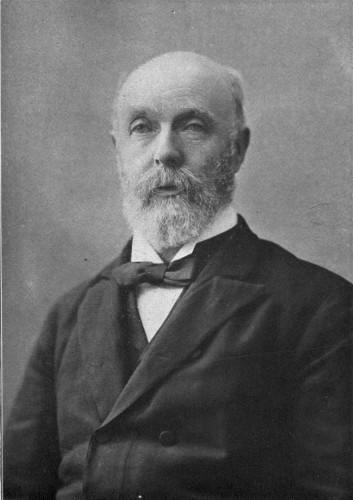
COLIN McARTHUR
GEORGE EDWARD DESBARATS.
The late George Edward Desbarats was head of the well known printing firm of Desbarats & Company of Montreal, which, for many years has set the standard for all that is progressive in this field of business activity. He was a representative of a family that through many generations has been closely connected with the printing business, successive generations being in the vanguard of those who have been most active in bringing about the advancement and improvement in connection with the art preservative of arts. The History of Printing and Bookbinding in the State of Bearne gives account of Pierre Desbarats, bookseller from 1638, who established in 1651 the first printing office to have more than a transient existence in the state of Bearne; while Jean Desbarats, 1656 to 1687, was named printer to the Royal College of Bearne in 1662, printer to the Jesuit College at Pau in 1663 and printer to the King and the Royal College in 1680. Jean Desbarats, 1687 to 1714, was appointed King’s printer and printer to the Royal College in 1687. Isaac Desbarats, 1714 to 1737, was printer to the States of the Province of Bearne and on the 24th of December, 1719, was officially appointed to succeed Jean Desbarats as King’s printer. Parliamentary decree of April 27, 1730, admitted him to the ranks of the nobility as “Isaac Desbarats, King’s Printer, Seigneur de Labarthe Buisson.” Isaac Charles Desbarats, 1737-1787, was made printer to the King and to the States of the Kingdom of Navarre, September 20, 1737. He succeeded to the rank of Seigneur de Labarthe Buisson and was “Avocat au Parlement.” The printing establishment was inherited by Jeanne Desbarats but the government would not allow a woman to carry on the printing business and it had to be sold. The above indicates the close connection of the family with the printing business in France from 1638 to 1787. The family name has figured with equal prominence in Canada. Pierre Edouard Desbarats was named King’s printer January 27, 1800, and so continued until his death in 1828. His son, Georges Pascal Desbarats, father of George E. Desbarats of this review, succeeded his father and in 1844 was named Queen’s printer.
The family had been founded in Canada by Joseph Desbarats, who came to this country in 1756 and in 1761 married Marie Louise Crête at Beauport. He died in 1810. Their son, Pierre Edouard Desbarats, was married in September, 1798, to Josephte Voyer and at the time of his death, in 1828, was not only printer of His Majesty’s laws, but was also assistant clerk of the house, lieutenant colonel and justice of the peace. His son, Georges Pascal Desbarats, married Henriette Dionne, daughter of Hon. Amable Dionne. She died in 1839, while G. P. Desbarats passed away in 1864. He had succeeded his father in business and in 1844 was named Queen’s printer, in which connection he removed with the Government to Kingston, Toronto and Quebec as the government was successively established in those cities. He was also lieutenant colonel of militia.
George Edward Desbarats was born at Quebec, April 5, 1838, and in the attainment of his education attended Holy Cross College at Worcester, Massachusetts, from 1846 to 1851; St. Mary’s College at Montreal from 1852 until 1855 and Laval University at Quebec from 1855 until 1857. He won the degrees of Bachelor of Arts and Bachelor of Laws and thoroughly qualified for the bar. He studied with the Hon. Jean Thomas Taschereau in 1857 and with the law firm of Bethune & Dunkin in Montreal. He was received at the bar of Lower Canada in 1859 and was offered a partnership in the firm of Laflamme & Laflamme but declined in order to enter his father’s printing office, in which connection he remained in Quebec until 1865, when he went to Ottawa which had been made the new seat of government. In Quebec he published several volumes of original French-Canadian literature, among which were: Le Foyer Canadien in three volumes, eleven hundred and thirty-six pages; La Littérature Canadienne, in two volumes, seven hundred and eighty pages; Essais Poétiques, Lemay, in one volume, three hundred and twenty pages; Les Anciens Canadiens, P. A. de Gaspe, in one volume, four hundred and twelve pages; Mémoires de M. de Gaspe in one volume, five hundred and sixty pages; Canadians of Old (English) in one volume, three hundred and thirty pages; Mère Marie de l’Incarnation, L’Abbé H. R. Casgrain, in one volume, four hundred and sixty pages; Vies des Saints, Abbé Casgrain, in one volume, seven hundred and fifty pages; Lives of the Saints (English) in one volume, seven hundred and fifty pages; Chansons Populaires du Canada, Ernest Gagnon, in one volume, three hundred and seventy-five pages; Contes Populaires, Paul Stevens, in one volume, two hundred and sixty-five pages; Traité d’Art & d’Histoire Militaire, L. T. Sugor, in one volume, four hundred and seventy-two pages; Instructions Chrétiennes pour les Jeunes Gens, in one volume, three hundred and twenty pages; and Le Protestantisme, Etc., Abbé Guillaume, five hundred and fifty pages.
On removing to Ottawa in 1865 Mr. Desbarats occupied a building erected for this purpose which was begun during his father’s lifetime and belonged to the estate. Malcolm Cameron, who had been Queen’s printer with the father of George Edward Desbarats after the death of Stewart Derbishire, held the patent alone from 1864 to 1869 and was G. E. Desbarats’ partner in the printing business. The building erected there in Ottawa was one of the largest business blocks of the city at that time. It was in this building that the Hon. Thomas D’Arcy McGee lodged in company with Sir Hector Langevin and others on the occasion of his atrocious assassination and it was upon the place where the murder occurred that Mr. Desbarats caused to be erected a memorial tablet. This, it has been supposed gave offence to a certain lawless element in the population, resulting in the destruction of the noble pile of buildings by the incendiary’s torch. After the destruction of the building by fire on the 21st of January, 1869, it was not rebuilt. The Cartier-Macdonald government was then in power and gave out the Gazette, laws, etc., to public competition. G. E. Desbarats was appointed Queen’s printer and charged with making the schedules, getting the tenders and adjudging the contracts. He held the office for about a year and then resigned to remove to Montreal, where he had large interests in a lithographic and photo-engraving business which he had established there in connection with the Leggo Brothers. The fire of January 21, 1869, destroyed the complete first edition of Les Oeuvres de Champlain, which G. E. Desbarats was publishing at that time, the compiler and annotator being L’Abbé Laverdiere, librarian of Laval University. Not only was the manuscript destroyed but also the electrotype plates and illustrations. The only copy saved was that in proof sheets in Mr. Laverdiere’s hands. Mr. Desbarats determined to republish the work at once. The second edition was printed direct from the type, being limited to one thousand copies. The six volumes, which are quarto, contain some sixteen hundred and fifty pages and are copiously illustrated with facsimiles of the original charts, maps and cuts produced by the Leggotype process. This great work was published by G. E. Desbarats in 1870 and is considered the finest book issued so far from the Canadian Press. He was also the publisher, in Ottawa, of H. J. Morgan’s Bibliotheca Canadensis.
At the fire in Ottawa G. E. Desbarats’ net loss was over one hundred thousand dollars. The estate also lost heavily on the building, which was only partly insured. At a meeting of citizens an address of sympathy was voted to Mr. Desbarats and afterwards presented to him, handsomely engrossed, bearing the city seal, signed by the mayor and others and framed.
In 1869 G. E. Desbarats built a printing office on St. Antoine Street, Montreal, and there founded The Canadian Illustrated News, the first number of which was issued on October 30, of that year, with Alexander Robertson as the first editor and E. Jump as chief artist. The illustrations were at first photo-electrotypes produced by the Leggotype process. In 1870 Mr. Desbarats founded a French companion paper to the Canadian Illustrated News called L’Opinion Publique, a twelve-page paper, the illustrations in which were for the most part the same as those in the English weekly. The editors were J. A. Mousseau and L. O. David. Among the contributors to its pages were P. J. O. Chauveau, L. H. Frechette, Joseph Marmette, J. A. Poisson, Benjamin Sulte, W. Gelinas, Joseph Tassé and many other distinguished French-Canadian writers. By arrangement with Ferdinand Gagnon, L’Opinion Publique absorbed L’Etendard National of Worcester, Massachusetts.
In May, 1871, Mr. Desbarats became proprietor of a weekly literary paper named The Hearthstone. The editorial work of The Hearthstone was performed by J. A. Phillips. Mr. Desbarats owned and conducted The Dominion Telegraph Institute which had been started by Churchill, continuing this for two years, during which time were sent out many capable telegraph operators now at the head of their profession. In 1872 he organized the Graphic Company to publish a daily illustrated paper in the city of New York. This was the first illustrated daily ever published and it came to end in about a year, being too far ahead of its time and lacking the necessary capital. Still the field of his activity and usefulness constantly broadened, and at all times he was in the lead among those who have wrought for advancement and progress in connection with the printing and publishing business. In March, 1873, he founded The Canadian Patent Office Record and Mechanics Magazine, a quarto monthly of thirty-two pages devoted to engineering, manufacturing, mining and other industrial pursuits. With each number was issued the official patent office record, the whole amply illustrated, the two parts together forming a book of from sixty to eighty pages monthly, the subscription price to which was only a dollar and a half a year.
In 1873 it was thought advisable to form a stock company to carry on the Canadian publications and the general Montreal engraving and printing business. The Desbarats Lithographic & Publishing Company was therefore organized by G. E. Desbarats, W. P. Hussey, Luke Moore, William Angus, Jonathan Hodgson, Alexander Buntin and Daniel MacLellan as provincial directors; G. E. Desbarats and W. P. Hussey as managers. In April, 1874, Mr. Desbarats entered into negotiations with G. B. Burland with a view to amalgamating the two concerns and formed The Burland-Desbarats Lithographing Company, from which he retired in 1876. He then opened a small office in the old postoffice building and in 1878 moved to larger premises and laid the foundation of the present Desbarats Printing Company, one of the most important establishments of this character in the Dominion. In 1879 G. E. Desbarats joined with Notman & Sandham in organizing The Artotype Printing Company and went himself to New York to learn the artotype work.
In 1884 W. C. Smillie, founder and first president of The British American Bank Note Company entered into negotiations with G. E. Desbarats & Company to revive the Canada Bank Note Company which absorbed G. E. Desbarats & Company’s business and in which G. E. Desbarats and H. Drechsel were appointed managers. In 1887 Mr. Desbarats admitted his son, William, to a partnership and together they published the Dominion Illustrated, a weekly illustrated paper which also had to be discontinued for lack of capital. Half-tone engraving was then in its infancy and Mr. Desbarats was the first to introduce it into Canada. The process was largely used in the Dominion Illustrated and a photo-engraving plant was installed to meet the paper’s requirements. While all days were not equally bright in his career and indeed in his business experience he saw the gathering of clouds that threatened disastrous storms, yet his rich inheritance of energy, determination and initiative enabled him to turn defeat into victory and promised failures into brilliant successes. His strict integrity, business conservatism and judgment were always so universally recognized that he enjoyed public confidence to an enviable degree and naturally this brought him a lucrative patronage. In early manhood he showed conspicuously the traits of character that made his life brilliantly successful and his mental and physical activity, combined with thorough training, brought him to an eminent position as a representative of the printing and publishing business in Canada.
The business career of Mr. Desbarats with its steps of successive advancement has been given but what of the man and his personality? All who remember him speak of him as of the highest type of gentlemen, his kindly nature and courteous manner winning for him many warm friends. Even now, twenty years after his demise, his old employes mention him with the greatest respect and love. It has been said that there is no better way to judge an individual than by his treatment of those in his employ. Judged by this standard, no man has been more worthy of regard. While in Ottawa his employes presented him a silver goblet and tray as a mark of esteem. The employes of the Canadian Illustrated News presented him with two bronze statues and a necklace for Madame Desbarats and the employes of the Canada Bank Note Company presented him a water pitcher when he severed his connection with that company.