BIOGRAPHICAL (continued 13)
Reading edition
GEORGES ALPHONSE MONETTE.
Foremost in his profession in Montreal is Georges Alphonse Monette, architect, whose skill finds tangible expression in some of the most beautiful and substantial structures of the city. A native of Montreal, he is a son of Georges and Domithilde (Beauchamp) Monette. The father, now deceased, was a contractor. The mother is still a resident of this city.
G. A. Monette acquired his early education in the Christian Brothers school and began the study of architecture in the office of A. F. Dunlop, a well known architect, with whom he remained for five years. He received a diploma from the Associate Architects of the Province of Quebec in 1892 and soon afterward went to Boston, Massachusetts, where he studied in the offices of a number of the leading architects of that city. He then returned to Montreal and entered the office of Perrault & Mesnard, architects, subsequently engaging in business for himself about a score of years ago. While he has a large general practice, he specializes in public buildings work and substantial evidence of his ability may be seen in the La Patrie building, the large block of H. P. Labelle & Company, Ltd., the dental department building of Laval University, the St. Leo Catholic church of Westmount and a number of school and convent buildings. That he ranks notably high in his profession is indicated by the fact that he has been admitted to membership in various important organizations, including the Province of Quebec Association of Architects and the Royal Architectural Institute of Canada, while of the Architectural League of New York he is an associate member.
Mr. Monette was married in Montreal to Maria Versailles, a daughter of Nazaire Versailles of Montreal, and they have the following children: Antonio, Cecile, Gertrude, Marcal, Adrienne, Eugene and Hector. Mr. Monette is a member of the Club St. Denis and has attractive social qualities, which have won him popularity and prominence in a friendship circle that is extensive. His interests, however, have been concentrated upon his profession with the result that his position is now one of recognized leadership.
MAXIME DAOUST.
There is probably no other line of business that is a factor in a city’s growth and development equal to the real-estate business, when conducted by men who are reliable and who aim to develop only properties of merit and value. Included among such men is Maxime Daoust, president and founder of the Daoust Realty, Limited.
Mr. Daoust was born in St. Clet, P. Q., November 10, 1873, son of Leon and Olive Daoust. When he was six years of age his parents removed to Labelle county and there Mr. Daoust received his education. In 1893 he went to the United States and was employed in various places in New England until February, 1898, when he enlisted as a volunteer in the United States marines for service in the Spanish-American war, which then seemed imminent.
He was among the first troops landed on Cuban soil at Guantanamo, June 10, 1898, participating in the fight at that place. He remained in Cuba until August, when he was detailed as one of the guard to accompany the Spanish prisoners, survivors of Cervera’s fleet, to Portsmouth, New Hampshire.
Mr. Daoust remained in the United States service until the expiration of his enlistment, after which he returned to Canada in 1900 and for some time was employed at the trade of brass molder in Montreal. He then entered the fire and life insurance field as an agent, at which he achieved success so that in 1904 he had accumulated capital sufficient to engage in the real-estate business in a small way. He formed a partnership with the late Joseph Charrau under firm name of Charrau & Daoust, and the first subdivision handled by them was Frontenac Park, owned by the estate of Henry Hogan, the land being then an open field. This tract comprised twenty-five hundred lots, and today this property is populated by over five hundred families and its location is now the geographical center of Montreal. The firm quickly won a reputation for straight and honorable dealings so that when their subsequent subdivisions, Estate Viau and Christian Brothers, were placed on the market, it was not the merits of the properties alone that made them in demand.
Mr. Daoust later purchased the interest of Mr. Charrau and in 1908 the Daoust Realty, Limited, was formed with a capital of one hundred thousand dollars, Mr. Daoust becoming president and manager. Up to that time he had financed his own properties, but he realized that to carry out his huge land schemes he would require more capital, hence his company. Since then the Daoust Realty, Limited, has done some of the largest real-estate business in the city. In June, 1913, the capital of the company was increased to two hundred and fifty thousand dollars.
They are sole agents for Mount Lasalle Park, Mount Lasalle Annex Park and Champlain Park in Rosemount ward; Bernard Terrace, Bernard Plateau and Alliance Park in Longue-Pointe ward; St. Helen’s Park and Coteau Rouge Park, near town of Montreal South; St. Lambert Heights, near town of St. Lambert; Chambly Basin Park, Chambly, P. Q.; and Montreal East Extension, Pointe-aux-Trembles, these properties representing a carrying value of over three million dollars. Mr. Daoust is vice president of the Mackay Realty, Limited, a member of the Board of Trade and the Chambre de Commerce.
In politics he is a liberal and in religion a Roman Catholic. He is fond of athletic sports and is president of the National Sporting Club, Limited. Mr. Daoust was one of the first men in Canada to become interested in aviation and has spent thousands for furthering that science. He has built four machines, the designing and building being done in this district. The first two were failures, but notwithstanding the large expense he persevered until his courage and enthusiasm were rewarded by his machines making successful flights.
On June 20, 1905, Mr. Daoust was married to Amelia Clement, daughter of Samuel Clement of Pointe Claire, Quebec, and they have two children, Farnand and Jule-Berthe.
Mr. Daoust is a self-made man in the fullest sense of that term. He possesses many admirable qualities and a character of sterling worth. He is devoted to his home and family, is faithful in friendship and loyal to every interest to which he gives his support. He possesses marked business enterprise with ability to recognize opportunities that others pass heedlessly by and early grasped the eternal truth that industry wins, making industry the beacon light of his life, and has thereby entered into most important business relations. He has accomplished important and far-reaching results and has contributed in no small degree to the expansion and material growth of the community.
FRANCOIS GEORGE CREPEAU.
François George Crépeau, a representative of the notarial profession in active practice in Montreal since 1890, was born at St. Henri de Mascouche, Quebec, on the 25th of May, 1865, a son of Charles and Mathilde (Magnan) Crépeau. The ancestry of the family can be traced back to Paul Crépeau of Laverdure. The next in the line of descendants was T. Maurice Crépeau, major of militia, who married Marie Andet of St. Jean, isle of Orleans. Their son, Charles Crépeau, wedded Agnes Chartrand and their son, Charles Crépeau was married in 1765 to Françoise Gravel near Quebec. They were the parents of Joseph Crépeau, grandfather of François George Crépeau. He married Madeleine Allard, and they were parents of Charles Crépeau, father of our subject. The family were largely agriculturists and the old homestead which has been occupied by the family for over one hundred and fifty years, is now owned by Octave Crépeau, a brother of François George Crépeau. The father’s family numbered fifteen children, four of whom passed away, while six sons and five daughters are yet living and all are well and strong.
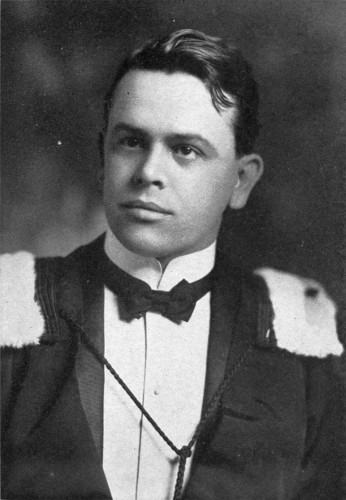
FRANCOIS G. CREPEAU
After the ordinary school training François George Crépeau attended an academy and followed his academical course by study in l’Assomption College. He won his degree at the College of Montreal and Laval University, being graduated LL. B. in 1890. Having studied law and prepared for the notarial profession, he entered upon active practice, in which he has since continued, his ability bringing him to his present position as a prominent representative of his chosen calling. His practice is very extensive and in addition he has other business investments, being a director of the Funeral Expense Society and of La Cie Mutuelle d’Immeubles, Ltee.
On the 25th of May, 1891, Mr. Crépeau was married to Miss Marie Louise Lecours, a daughter of Théophile and Marie (Prefontaine) Lecours, representatives of one of the old French families of the province. The children of this marriage are: George Henry, a photographer, who married Juliette Robillard; Joseph Roumald; M. Jeanne; M. Juliette; M. Emérentienne; and J. C. Bernard. The religious faith of the family is that of the Roman Catholic church. Mr. Crépeau holds membership with the Canadian Order of Foresters, and the Independent Order of Foresters. He also belongs to the Société Des Artisans, to the Knights of Columbus, to l’Union St. Pierre and l’Alliance Nationale.
ARSENE S. BROSSEAU, D. D. S.
Comprehensive knowledge of the science of dentistry, skill in its mechanical phases and close adherence at all times to the highest standards of the profession has made Dr. Arsene S. Brosseau one of the leading and best known dentists of Montreal. Moreover, he is one of the oldest, if not the oldest, in length of practice in the city. He was born January 22, 1861, in L’Acadie, P. Q., a son of Jacques and Catherine (Demerce) Brosseau. The parents were for many years highly esteemed residents of Montreal, but both are now deceased.
Dr. Brosseau acquired his early education in the Christian Brothers school in Montreal and then took up the study of dentistry at Laval University, being graduated in 1883. He began practice in the office of Dr. John C. Nichols, with whom he remained for five years, and later he spent three years in the office of Dr. Edmund Mathieu. Later he began practice on his own account and has since continued alone. He has continuously promoted his knowledge through broad reading and investigation, keeping in touch with the advanced thought of the profession. His practice comes to him from the best class of Montreal citizens and is very extensive. Splendidly equipped is his office, showing all the latest appliances known to modern dentistry, and back of all his success is the sound judgment which enables him to understand the specific needs of each case and to apply the necessary corrective. Reputation has placed him in a foremost position in the ranks of the dental fraternity in this city.
Dr. Brosseau was married in Montreal, in 1883, to Miss Fannie Robert, a daughter of Julien Robert, and they had two children: Lotta, who died in early life; and Leo. In club circles Dr. Brosseau is known as a popular member of the Club St. Denis and Club Canadien. He belongs to the Roman Catholic church and is a liberal in politics. In matters of moment to the individual and to the community he maintains the same spirit of progress which characterizes him in his professional activity, yet he has always made his profession his chief interest and has obtained a splendid practice. He has ever attended strictly to the duties incumbent upon him in that connection, being possessed of excellent business qualifications and a most attractive personality, which has been a large asset in his success. His is a splendid type of manhood and citizenship, and his record is a credit to the profession.
JOSEPH AUGUSTIN ODILON LA BADIE.
Joseph Augustin Odilon La Badie, one of the best known notaries of Montreal, was born May 12, 1852, at the family home on St. James Street, between Roy Street and David Lane. His grandfather, Joseph Augustin La Badie, also a native of Montreal, studied with Jean Marie Cadieux, a notary, and for many years had his office and also his home in the building which stood at the corner of St. Lambert Hill and St. James Street, now the corner of St. Laurence boulevard and St. James Street. He was devoted to his profession, spending the hours from 9 a. m. to 6 p. m. in his office. He was asked to become mayor of Montreal but declined the honor. He served as colonel of a volunteer regiment and was a warden of Notre Dame Cathedral. He married Louise Grenier, who was also of an old Montreal family, and to them were born eighteen children. Joseph A. La Badie passed away in 1885, at the advanced age of eighty years.
Joseph Evariste Odilon La Badie, father of J. A. O. La Badie of this review, was born in the old home at the corner of St. Lambert Hill and St. James Street. He attended Montreal College and in his father’s office prepared for the practice of the notarial profession. In the home in which he was born he continued to practice with his father until 1864, when the old building was razed and a new one erected on the same site. In the latter he continued to practice his profession until his death, which occurred in August, 1908, when he was eighty years of age. He was chief warden of Notre Dame Cathedral and was a prominent and influential citizen. He married Sophie Jeannotte, a native of Montreal, and they lived to celebrate their golden wedding. Mrs. La Badie passed away April 13, 1906. They had a family of seven children: Joseph Augustin Odilon; Adolphe, a notary of Montreal; Felix, a practicing physician of Montreal; Joseph Esdras, a real estate dealer of New York city; Flora, who died in childhood; Sophie, the deceased wife of Louis Belanger, a lawyer; and Alphonse, a broker, who died in Montreal in 1908.
Joseph Augustin Odilon La Badie pursued his education in the normal school and in the Jesuit College, from which he was graduated. In 1874 he won the degree of B. C. L. from McGill University and on the 8th of May, of that year, he was made a notary at Laval University in Quebec. He then began practice with his father and grandfather and has ever maintained high standing in his profession.
Mr. La Badie has been an extensive traveler. As a young man he engaged in ranching in Colorado and during his sojourn in the west learned much of that section of the United States. He has also made many trips abroad. He is a great lover of nature and a student of botany. The library which he has collected contains more than six thousand volumes, many of which are rare editions. This is an indication of his cultured taste and wide interest in literary matters. His summer home for the past twenty-one years has been at Upper St. Lambert, where he has two fine farms and makes a specialty of cheese making. Mr. La Badie is very fond of hunting, a recreation in which he indulges every year.
Though over three score years of age, Mr. La Badie is of magnificent physique, his muscles as hard as iron, and he has the appearance of a man twenty years his junior. In his office is a long table, four feet wide, over which he can jump without touching it with his hands and he can lift a weight of one hundred and eighty-seven pounds with one hand. His interests have largely covered those things which are essential and valuable elements in life. He has been a student of many questions of public moment and has filled some offices, being now a commissioner of the superior court and a justice of the peace. For one hundred and ten years the La Badies of four generations have been notaries at the present location. The great-grandfather of Joseph A. O. La Badie died at the home where Joseph E. O. La Badie was born. The family is, indeed, one of the oldest and most prominent in Montreal.
Mr. La Badie is not a club man. His interest centers in his home and his family, which he prefers to club life. On the 7th of October, 1877, he married Aurelia de Lompré, of an old Montreal family, and to them have been born seventeen children: Raoul, a civic employe; Odilon, who is in his father’s office; Paul, a notary; Florida, deceased; Jeanne; Germaine; Marie Antoinette; Camile; Alice; Leo; Amanda; Adolphe; Alice; Emile; Pauline; Gabriel; and Cecile.
ARTHUR GIBEAULT, B. A., LL. L.
Arthur Gibeault, a Laval man, active in the practice of law since January, 1902, has been retained as counsel for the defense or prosecution in many notable cases heard in the Montreal courts. He was born on the 26th of February, 1880, a son of Arthur Alphonse and Elizabeth Emma (Morrissette) Gibeault. The father was for seven years provincial chief ranger of the Catholic Order of Foresters. The son was a student in Montreal College for eight years, from September, 1890, until July, 1898. In September of the latter year he entered Laval University, where he remained until December 21, 1901, winning the Bachelor of Arts and LL. L. degrees. He was admitted as a lawyer and barrister to the bar of Quebec on the 17th of January, 1902, and has since been actively connected with the profession, in which he has made steady advancement, already having won a place of equal rank with many an older representative of the bar. He was attorney and counsel for the school commissioners of Hochelaga for many years and as counsel tried many immigration cases. He was especially prominent in the case of Gaetanetta Imparato, who was deported to Italy and subsequently returned to Canada pursuant to an appeal made by Mr. Gibeault in her favor. He represented Sarah Kositzky in her appeal before the department of immigration of the United States and obtained a commission of three medical men to examine her. The decision of the first board was afterward reversed by this commission. Mr. Gibeault’s name appears in connection with other important cases which have attracted widespread interest not only in Canada but also in the United States.
Mr. Gibeault is a conservative and was prime minister of the mock parliament of Laval in 1899 and head of the conservative ministry, while the leader of the opposition was J. W. Pilon, a well known lawyer of Montreal. That Mr. Gibeault possesses marked histrionic as well as legal talent is indicated in the fact that during the year 1904-5 the Greek drama of Antigone by Sophocles was played in Greek, on which occasion he took the role of Ismene and the role of Antigone was taken by D. Lalonde, now Father Lalonde, P. S. S., one of the directors of Montreal College, while the role of Creon was played by J. F. St. Cyr, now district magistrate of St. Johns, Iberville. The production of the play in Greek created a tremendous sensation at the time because it was an achievement unheard of before.
On the 26th of June, 1905, Mr. Gibeault was married to Marie Jeanne Phaneuf, daughter of L. A. Phaneuf, notary public of Rigaud, and Marie Joseph Adam. Mrs. Gibeault is a niece of the Rt. Rev. Canon F. L. T. Adam, of Montreal, and Father J. Adam, S. J. Mr. and Mrs. Gibeault have three children, Yves, Marc and Madeleine. The religious faith of the family is that of the Catholic church and Mr. Gibeault is a leading member of the Independent Order of Foresters. Possessed of natural oratorical ability, his power in that direction, supplementing the analytical trend of his mind and added to his broad knowledge of the law, has gained him distinction as one of the younger members of the Montreal bar.
DIOSCORE ALFRED BENOIT, M. D.
Dioscore Alfred Benoit, M. D., prominent in the field of medical practice, making a specialty of obstetrics and gynecology, was born in Montreal on the 26th of July, 1880, a son of Lucien and Albina (Bourdon) Benoit, the former a native of Contrecoeur and the latter of Lavaltrie, Quebec. The paternal grandfather, Isaac Benoit, was born in Geneva, Switzerland, a member of an old French family of rank established in Switzerland at the time that Louis XIV issued the revocation of the edict of Nantes. Some years after his arrival in Canada Isaac Benoit embraced the Catholic religion.
Dr. Benoit pursued a commercial course in a Catholic school and his classical course in St. Mary’s (Jesuit) College. Having determined upon the practice of medicine as his life work he entered Laval University wherein he completed the medical course with the class of 1906. During the succeeding year he was interne in Notre Dame Hospital and then went abroad to continue his medical studies in Paris, where he remained for two years, making a specialty of obstetrics and gynecology. Upon his return he was made demonstrator of anatomy in Laval University which position he occupied for a year. He next became adjoint professor in obstetrics and medicine to Laval University and adjoint professor to the Catholic Maternity Hospital. He is a member of the Medical Society of Montreal and the profession as well as the public recognize the high position which he has attained in the field in which he specializes. His reading and investigations have been deep and broad, and his opinions are largely accepted as authority upon points in question concerning the obstetrical practice. In politics Dr. Benoit is a conservative according to the views of Macdonald and Cartier with tendencies toward the nationalist. His religious faith is that of the Roman Catholic church. His entire life has been passed in Montreal, save for the period spent in study abroad. He there came under the instruction of some of the most eminent physicians and surgeons of Paris, returning well equipped for the arduous and responsible duties of a profession in which he has made continuous advancement. Dr. Benoit’s office is at 945a, St. Denis Street.
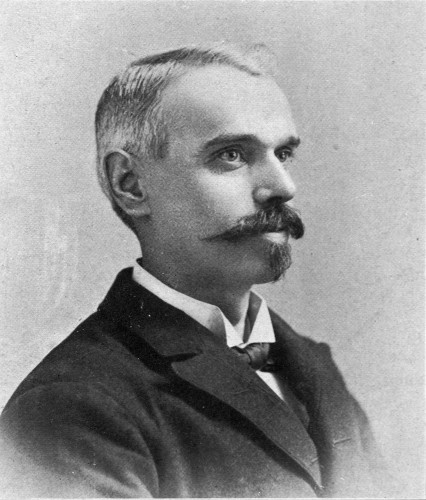
DR. DIOSCORE A. BENOIT
J. LOUIS MICHAUD.
J. Louis Michaud, district engineer of public works of Canada for the district of Montreal, was born November 27, 1851, at Rimouski, province of Quebec. He is descended from an old family of St. Denis, county of Kamouraska. His father was Tobie Michaud, a contractor and builder, and his mother was Felicitée Fournier.
J. Louis Michaud was educated at the Classical Seminary at Rimouski and studied engineering with Charles Baillarge, an eminent engineer of Quebec, for two years, and then for two years was connected with the engineering department of the Intercolonial Railway. On the 19th of April, 1878, he was admitted to practice as a licensed land surveyor at Quebec and the recognition of his skill and ability came to him in April, 1882, when he was made Dominion land surveyor at Ottawa. In 1883 he came to Montreal to reside, but his work for the Dominion in surveying the Canadian northwest continued until 1889. From that year until 1896 he was engaged in private practice in Montreal and an extensive clientage was accorded him. He is recognized as one of the best versed men in the science of his profession as well as in all the practical phases of the business. In 1896 he was appointed district engineer of public works for the district of Montreal and has since conscientiously and capably discharged the duties of that position.
In 1880 Mr. Michaud was married, at Matane, Rimouski county, Quebec, to Henriette Bradley, who died in 1910. They had eleven children, three of whom died in childhood. Two of the number, Albert, aged seventeen years, and René, aged fifteen, met death by drowning at Ste. Anne de Bellevue. The surviving six are: Alexander, who is with the Canadian Light & Power Company; Edouard, a missionary priest in central Africa; Juliette; Adolph; Grazielle; and Gabrielle. In a review of the life work of J. Louis Michaud it is self-evident that his advancement has come through the development of his powers resulting from broad study and active practice in the profession. He holds to the highest standards, and his progression has been continuous. He is a member of the Canadian Society of Civil Engineers and is a member of the Corporation of Land Surveyors in Quebec.
J. AUGUSTINE MANN.
J. Augustine Mann, one of the best known members of the Montreal bar, was born May 24, 1876, in the city where he still maintains his home, his parents being Eric and Agnes McWhirter (Bailey) Mann. For thirty-eight years Eric Mann was an engineer and architect of Montreal and in 1901 retired from business and returned to his native city of Edinburgh, Scotland, to live. Mr. and Mrs. Mann had two children: J. Augustine; and Mrs. Quincy Tucker, now a resident of Boston, Massachusetts.
The former was educated in Montreal, completing a course in McGill University with the class of 1901, at which time the B. C. L. degree was conferred upon him. While in McGill he was also a student in the office of Foster, Martin & Girouard. Upon his admission to the bar in 1901 this firm became Foster, Martin, Girouard & Mann and is now Foster, Martin, Mann, MacKinnon & Hackett. Mr. Mann was created a king’s counsel in 1911. His practice has been extensive, and his high reputation has been well won. Aside from his practice, he is now in business connections as a Canadian director of the N. K. Fairbanks Company.
Mr. Mann is a member of the Montreal Art Association, the Montreal Amateur Athletic Association, the Montreal Club, the Montreal Jockey Club, the Montreal Curling Club and the Beaconsfield Golf Club. These associations indicate much of the nature of his interests and indicate him to be a broad-minded, cultured gentleman and also one of social nature.
Mr. Mann was married in Montreal to Miss Evelyn Gertrude Mann, and they are parents of two children: Dorothy and Audrey. The family residence is at No. 822 University Street and their summer home, Dornal Hall, is at Beaurepaire, Quebec.
JOSEPH WILFRID MICHAUD.
Joseph Wilfrid Michaud, senior member of the firm of Michaud & Des Rosiers, public accountants at 55 St. Francis Xavier Street in Montreal, is a native of the province of Quebec, his birth having occurred at St. Barthelemi on the 2d of August, 1872, his parents being Olivier and Stephenie (Paquin) Michaud. He was educated in the schools of his native town and in St. Viateur Academy. He began his business career as an accountant for the Western Loan & Trust Company, Ltd., and later became associated with Mr. A. W. Wilks as a member of a firm of public accountants under the style of Wilks & Michaud. For a number of years this firm occupied a prominent place in professional circles in Montreal. In 1911, following the dissolution of the partnership, Mr. Michaud joined Mr. Des Rosiers in forming the firm of Michaud & Des Rosiers. Their clientage is now extensive, and the volume of their business is justified by the capability of the members of the firm. Mr. Michaud is a director of the National Loan & Trust Company, Ltd., and also of the Sapho Manufacturing Company and thus along several lines has become closely associated with the business interests of the city.
In 1897 occurred the marriage of Mr. Michaud and Miss Rose Lafreniere, a daughter of Joseph Lafreniere. They have four children, Yvonne, Gerard, Paul and Lionel. The religious faith of the family is that of the Roman Catholic church, and Mr. Michaud holds membership in Club St. Denis. Identified with the interests of Montreal throughout the entire period of his business career, he has become well known, and enterprise and laudable ambition have brought him to his present enviable position.
JOSEPH ULRIC EMARD, K. C.
One of the distinguished members of the legal profession in Montreal, whose years of active practice extend through more than one third of a century, is Joseph Ulric Emard. Well versed in the science of his profession, a deep thinker, logical reasoner, he has long since occupied a foremost place among the strong and forceful Montreal bar.
Mr. Emard comes from one of the old and prominent families of the province of Quebec. His father, Medard Emard, was one of the best known and successful educators of his day, while his mother, previous to her marriage, was Mathilde Beaudin. His brother, Monseigneur J. M. Emard, now bishop of Valleyfield, was for years prominent in church work in Montreal and was attached to Archbishop Fabre’s personal staff at the Palace.
Joseph Ulric Emard was born March 27, 1855, at St. Constant, Laprairie county, Quebec. Reared in a home where education was valued at its true worth, he attended St. Hubert grammar school, then conducted by his father, and was afterward a student in a private school conducted by Abbé Villeneuve.
His entrance into business life was first as a clerk, but after a short time he entered Laval University, where he pursued his law course and was graduated LL. B. in 1881. He was called to the bar that same year, and at once entered upon active practice as an advocate, which he has followed ever since, with brilliant success. Mr. Emard has been connected with a number of important cases, among them being the famous Lachine Bridge case, which he won after a notable legal battle, making it the cause celebre of the day. He was appointed king’s counsel in 1903.
For some years Mr. Emard was associated in practice with Hon. J. Ald Ouimet, who is, at present, counsel in the firm of Emard & Emard, composed of Joseph U. Emard and son, Charles.
Mr. Emard’s interests, aside from the law, are diversified and extensive. Through the splendid use of his talents, as well as his sound business judgment and foresight, he has been very successful, not only as to the accumulation of worldly possessions, but also in the way of important and valuable work done which has given a decided impetus to the city’s progress and improvement. He was the founder of the town of Boulevard St. Paul, now Emard ward, and capably served as its mayor. After annexation he twice represented this ward on the city council as alderman.
Mr. Emard has a prominent connection with business affairs; his interests include mining, real-estate, industrial and financial companies, in a number of which he is a member of the directorate. His connection with corporations has brought him an intimate knowledge concerning corporation law. To some extent he has specialized in that field of practice, and his knowledge thereof is comprehensive and exact.
He is a member of the St. James Club, the Canadian Club and Club St. Denis. Of the last named he was president for a number of years. In 1903 he had been the chief promoter of Club Jacques Cartier. In 1884 he had been president of St. Jean Baptiste Society of the St. Vincent de Paul section. Mr. Emard’s political allegiance is given to the conservative party.
He was married to Miss Exilda Stuart of Montreal, and they belong to the Catholic church.
A man of fine personal appearance and keen intellectuality, his mind has been well trained, enabling him to readily meet any emergency with the consciousness that comes from a right perception of things and a strong regard for what is best in the exercise of human activities.
EMILIEN GADBOIS-VAN DAN DAIGUE.
Based upon an excellent professional education, Emilien Gadbois-Van dan Daigue has already made his mark in the legal profession in Montreal, where he practices as a member of the firm of La Mothe, Gadbois & Nantel. The first member of the Van dan Daigue family came to Canada in 1671 from Brussels, Belgium. Pierre Van dan Daigue Gadbois, of the Gadbois family, was born in 1574 and died on October 20, 1667, at Montreal. Joseph Van dan Daigue was born in 1653 at Meunisier and at Quebec, on April 18, 1678, married Louise Chalifour. He died on the 11th of June, 1725, at Charlesbourg. The records of the family continue to the fourth generation up to 1750 in Abbé Tanguay’s Dictionnaire Généalogique.
Emilien Gadbois-Van dan Daigue was born October 30, 1884, a son of Emile Gadbois, a well known horticulturist of Longemont, Rouville county, province of Quebec. His mother before her marriage was Priscillia Bernard, a sister of Monseigneur A. X. Bernard, bishop of St. Hyacinthe. Emilien Gadbois was educated at Montreal College, on Sherbrooke Street, and Laval University. On the 1st of July, 1907, he received the degree of B. A. with distinction and in the same year won the first prize in French literature in Laval University. In 1910 he was made by that institution LL. M. and on July 8th, of the same year he received his commission as a lawyer and has since practiced with ever increasing success in Montreal, having formed a partnership with L. E. Bernard, K. C., with whom he was associated until May, 1914, when he became a member of the firm of La Mothe, Gadbois & Nantel with offices in the Quebec Bank building. He has all the faculties of which a lawyer may be proud, skill in the presentation of his evidence, marked ability in cross examination, perseverance before the jury, and a strong grasp of every feature of the case. It is therefore but natural that he readily received recognition and is today connected with much important litigation in the local courts.
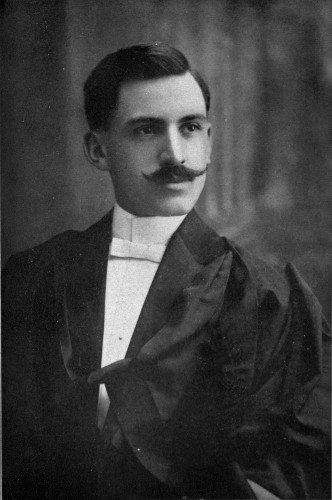
EMILIEN GADBOIS-VAN DAN DAIGUE
In his political views Mr. Gadbois is a conservative, stanchly upholding the principles of his party, although he has not yet become connected with public life. As a member of the Canadian Club he can be found in the ranks of those men who have at heart the development and progress of the Dominion, and he is ever loyal to his city. His faith is that of the Catholic church. On the threshold of a successful career, he has ever moved in the right direction toward fame, and a distinguished future may be prophesied for him, a future which will bring new luster to the old family name which he bears.
JOSEPH H. RAINVILLE, M. P.
Joseph H. Rainville, a member of parliament and deeply interested in questions concerning the government, province and Dominion, is today recognized as one of the younger leaders of the conservative party. He chose as a profession the practice of law, and it is a notable fact that members of the bar are more apt to become prominent figures in political circles than any other class of men. The reason for this is obvious, as the training which qualifies them for the onerous and difficult work of the courts also prepares them to solve the intricate and complex problems of local or general government.
Quebec numbers Mr. Rainville among her native sons, his birth having occurred at Ste. Angele, Rouville county, on the 8th of March, 1875. In the attainment of his education he attended successively Monnoir College, Marieville, and Laval University, where he won the degree of Bachelor of Laws. He entered upon the active practice of his profession with L. E. Beauregard of Montreal in 1901. No dreary novitiate awaited him. His capability won almost immediate recognition. He is an effective speaker, earnest in his appeals before the court, zealous in support of his cause, and at all times loyal to the interests of his clients.
Since age conferred upon him the right of franchise Joseph H. Rainville has been a stalwart conservative, and in 1908 he unsuccessfully contested Vercheres county at the provincial election, being defeated by a majority of ninety-eight. When the tide of popular favor turned against the liberal government of the Dominion in September, 1911, he became a member for Chambly-Vercheres, so that he is now occupying a seat in the house. He frankly and fearlessly expresses his opinion, but also possesses the tact of the successful politician who seeks to conciliate rather than antagonize.
Mr. Rainville married Miss Gendreau, daughter of Dr. J. G. A. Gendreau of Montreal. Mr. Rainville is a lieutenant in the Eighty-fifth Regiment and is a member of the Montreal Gun Club. His friends speak of him as always a courteous, polished gentleman, both forceful and resourceful when occasion demands.
EDOUARD FABRE SURVEYER.
Edouard Fabre Surveyer, who throughout his professional career has been a representative of the Montreal bar and equally well known as an educator and author in the field of his profession, was born in this city in 1875. His father, L. J. A. Surveyer, is a Montreal merchant and a past vice president of the Chamber of Commerce. He married Hectorine Fabre, a daughter of the late E. R. Fabre and a sister of the late Archbishop Fabre, the late Hon. Hector Fabre, C. M. G., and of the late Lady Cartier.
E. Fabre Surveyer was a student in St. Mary’s (Jesuit) College, where he made an excellent record, winning the Angers bronze medal for letters in 1890, the Mercier gold medal for rhetoric in 1891 and the alumni gold medal for philosophy in 1893. He took up his law course in Laval University and was graduated LL. L. with first class honors in 1896. The same year he won his B. C. L. degree with first class honors from McGill University, but not content with the preparation that he had already made for active practice at the bar, he went abroad and completed his law course in Paris and took part in the first International Congress of Lawyers at Brussels in 1897. He was a delegate to the Universal Congress of Lawyers and Jurists at St. Louis, Missouri, in 1904 and is correspondent for several Canadian, American, French and Belgian law reviews.
It was in 1897 that Mr. Surveyer entered upon active practice in Montreal in connection with McGibbon, Casgrain, Ryan & Mitchell. He has not only obtained success in practice but has also gained recognition for his ability in other professional connections. He has been the editor of the Quebec Practice Reports since their establishment in 1897 and since 1905 has been a lecturer in practice and pleading in McGill University. He was made a king’s counsel by the government of Quebec in 1909. On withdrawal from the firm of McGibbon, Casgrain, Mitchell & Surveyer in 1909 he entered into a partnership with H. A. Lovett, K. C., a connection that was continued until the following year. Since September, 1913, Mr. Surveyer has been the senior member of the firm of Surveyer, Ogden & Mariotti. Mr. Surveyer also has an office in New York city in connection with the firm of Daly, Hoyt & Mason, attorneys at law. He has published a pamphlet, The Bench and Bar of Montreal, and there are few who are more familiar with the history of the courts of this city than Mr. Surveyer. In 1903 he was president of the Junior Bar Association of Montreal, while in 1914 he became the secretary of the newly formed Canadian Bar Association. A fluent speaker, forceful and earnest, Mr. Surveyer has as ready a command of English as he has of French.
Aside from his professional duties and interests Mr. Surveyer is connected with various business enterprises which feature in the material development and prosperity of the city. He is vice president of the Union Land Corporation, Ltd., and the Lachine Land Company, Ltd.; is a director of the Capital Trust Corporation (Ottawa), of the Franco-Canadian Land & Development Company, Ltd., and of the Rothesay Realty Company, Ltd. In all business affairs his judgment is sound and his discrimination keen, and he falters not until his purpose has been accomplished and success has rewarded his efforts.
In October, 1906, Mr. Surveyer was married to Miss Elodie Barnard, a daughter of the late Edmund Barnard, K. C., of Montreal. In religious faith Mr. Surveyer is a Catholic and in political belief a conservative. He is regarded as one of the prominent members of the party among its younger representatives, and of him the Windsor Record (liberal) said: “He has a splendid platform presence, speaks English fluently, and has the appearance of an all round campaigner.” Mr. Surveyer’s social connections are with the University Club, Club Lafontaine and Canadian Club of Montreal; the Albany Club, of Toronto; and the Colonial Club, of London, England. He has been president of the Canadian Club, as well as vice president of the Federation of Canadian Clubs and is a member of the executive board of the University Club and a director and honorary solicitor of the Society for the Prevention of Cruelty to Animals.
Among Mr. Surveyer’s other connections, he is vice president of L’Alliance Française and a member of the board of the Federation de L’Alliance Française aux Etats Unis et au Canada.
He is a member of the executive committee of the Liberal-Conservative Association, and thus in a number of the organizations with which he is allied he has been honored with office. He regards the practice of law, however, as his real life work, and he has at times been heard by the judicial committee of the privy council of England. He has been throughout life a student, and since his admission to the bar has remained a close and discriminating student of law principles, thoroughly qualifying himself for the conduct of all legal business intrusted to his care.
WILLIAM FORREST ANGUS.
As vice president and general manager of the Canadian Steel Foundries, Ltd., William Forrest Angus represents one of the foremost industries of the Dominion. He was born in Montreal, October 28, 1873, a son of Richard Bladworth Angus, the eminent financier and railway promoter.
William F. Angus was educated privately in preparation for his university course and entered for that purpose McGill, from which he graduated as B. A. Sc. in 1895, completing his university work with a post-graduate course in 1896. He then entered the employ of the Dominion Bridge Company and subsequently was with the Laurie Engine Company, which is now defunct. His next position was with the Canada Switch and Spring Company, which was merged into the Montreal Steel Works. He remained with this concern, rapidly rising to more and more important positions until he was made manager and managing director. When this company was bought out by the Canadian Steel Foundries, Ltd., about two years ago he was elected vice president and managing director of this vast enterprise.
In November, 1904, Mr. Angus was united in marriage to Miss Grace N., eldest daughter of Sergeant P. Stearns of Montreal. They reside at No. 364 Peel Street. In his religious faith Mr. Angus is a Presbyterian. He is prominent in club life, being a member of the St. James Club, the Mount Royal, the Canada, the Forest and Stream, the Montreal Hunt, the University, the Montreal Curling, the Montreal Racquet and the St. Lawrence Yacht Clubs. His name is also on the roster of the Canadian Society of Civil Engineers.
Highly trained in his profession, careful in judgment, shrewd, energetic and a man of rare executive force, Mr. Angus ably administers the affairs of a vast industrial enterprise, and his career bids fair to rival that of his distinguished father. He is deeply interested in all that pertains to progress and trade expansion and can always be found among those men who are the most forceful exponents of advanced measures inaugurated to exploit the vast resources of the Dominion. He bends his genius to create new markets and increase trade facilities and gives of the best of his ability so that the Dominion of Canada may march in the van of the great industrial nations of the world. Realizing that the natural resources lie but dormant, awaiting the magic wand of man, he has linked himself with such men as will guide the Dominion to the industrial position in the world which is its due.
THOMAS GAUTHIER.
The specific and distinctive office of biography is not to give voice to a man’s modest estimate of himself and his accomplishments but rather to leave the perpetual record establishing his character by the consensus of opinion on the part of his fellowmen, and any history of Montreal introducing biographies of her citizens whose activities and influence have been for the city’s growth and betterment, would be incomplete without reference to Thomas Gauthier.
His life has been so varied in activity, so honorable in its purposes, so far-reaching and beneficial in its effects that it has become an integral part of the history of the city and also left an impress upon the annals of the province. His business interests are extensive and important, but by no means cover the scope of his activities, as he has been identified with various movements and projects having to do with the public welfare along material, political, social and moral lines.
Mr. Gauthier was born in Montreal in 1844 and attended the Lachine Commercial School, but is largely a self-educated as well as a self-made man. He has ever been a reader and thinker and in the school of experience has learned many valuable lessons. At times he has acquired with labor and difficulty the knowledge which he has been so anxious should be given others, his efforts in behalf of education being well known. He began his active business career in Montreal in 1869, and for many years he conducted the Place Chaboillez establishment with conspicuous success. During this time, having become widely and favorably known, he was elected president of the old Society of Mutual Assistance—the Union St. Joseph.
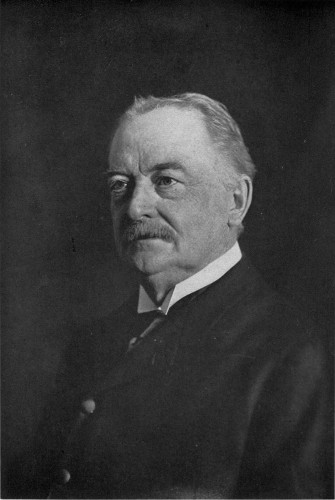
THOMAS GAUTHIER
In 1881 the Association of Retail Grocers, of which he was one of the founders, appointed him president and through his active exertions the Chamber of Commerce of Montreal was established. Along these and various other lines he has promoted the business activity of Montreal, pushing forward the wheels of progress in such a way that the entire city has benefited thereby.
His public service in connection with municipal affairs has been equally notable and commendable. He was one of Montreal’s aldermen from 1890 to 1893, and his labors were effective and beneficial as a member of the committees of police and hygiene. He was largely instrumental in establishing the mutual benefit fund among the members of the police force and also in establishing the first public bath in Hochelaga ward. All this, however, does not cover the scope of his activities, for in various other fields of usefulness his labors proved resultant. In the year 1883-4 he was general treasurer of the St. Jean Baptiste Society and was treasurer of the Montreal Exposition Company, in 1891, the only year in which it showed a surplus. He was a member of the finance committee of the National Association for a number of years, being also one of the promoters of the building of the Monument National, and in 1909 he was elected vice president and in 1911 became president, serving until April, 1913.
One of the most important of Mr. Gauthier’s public services has been in behalf of education. It was largely through the missionary work done by him and the assistance he received from the Chamber of Commerce, the Board of Trade and the Builders’ Exchange that the government was induced to take up the establishment of technical schools in Montreal and Quebec. In this connection Mr. Gauthier has done a noble and patriotic work, the value of which cannot be estimated. He has been president of the Council of Arts and Manufactures continuously since 1897, and more than three thousand scholars are now participating in these classes.
He has ever believed in that special training which will enable the individual to develop his native talents and thus qualify for the business life to which he is best adapted. Mr. Gauthier was associated with Dr. Adami in the general presidency of the Child’s Welfare movement.
In the various movements and projects with which Mr. Gauthier has been associated, whether financial, educational, philanthropic or commercial, he has shown the same intelligent and careful interest as in his own private business affairs.
In connection with the affairs of La Caisse Nationale d’Economie, of which he was one of the founders in 1899, he has taken a very active and prominent part. Ever since its organization he has been chairman of the finance committee, also chairman of the committee of administration, and has been no small factor in the splendid success of this association.
He is an extensive holder of stock in the Montreal Light, Heat & Power Company, as well as in the Lake of the Woods Milling Company, and is president of the Amherst Park Land Company.
Mr. Gauthier is an exceptionally well preserved gentleman for one of his years, and among his extensive acquaintance he is spoken of in terms of admiration and respect.
He has continuously been a student of the signs of the times, of existing conditions and keeps abreast with the best thinking men of the age in his knowledge of political, economical and social questions affecting the welfare and progress of the race.
WILLIAM DOUW LIGHTHALL.
The position of William Douw Lighthall has for many years been one of leadership. He has exerted wide and beneficial influence on public thought and action and as lawyer, author and the promoter of various prominent societies his name has become known throughout the length and breadth of the land. He has been termed “a living example of good citizenship ... a man of high culture, refined tastes and exceptional literary ability.” His efforts along all the lines in which his activities have been put forth have been productive of far-reaching and beneficial results. He was born at Hamilton, Ontario, December 27, 1857, a son of William Francis Lighthall, who is the doyen of the Montreal notarial profession, and is descended from the Schuyler, Van Renssalaer and Van Cortlandt families, three of the most prominent Knickerbocker families of New York. The mother, Mrs. Margaret Lighthall, was the eldest daughter of Captain Henry Wright, of Chateauguay, who was a son of Major James Wright (McIntyre), the commander of the British settlers of the district in the War of 1812.
After being dux of the high school of Montreal William D. Lighthall pursued a classical course in McGill University, from which he was graduated with the Bachelor of Arts degree and the Shakespeare gold medal in English literature in 1879. He then entered upon the study of law at McGill, which conferred upon him the B. C. L. degree in 1881, and he took the honorary degree of M. A. in 1885. With the completion of his law course he was called to the bar and began practice as an advocate. Nature endowed him with keen mentality, and the thoroughness with which he prepared his cases and the earnestness with which he presented his causes before the courts won him success and advancement. He was created king’s counsel in 1906. For a long period he has been accounted one of the distinguished representatives of the Montreal bar, practicing as senior member of the law firm of Lighthall & Harwood.
What he has accomplished as a member of the legal profession would alone entitle W. D. Lighthall to mention among the representative men of Montreal, yet he has gained equal prominence as an author, as a promoter of various societies, as an antiquarian greatly interested in historical and antiquarian research, and as a public-spirited citizen who takes cognizance of the needs of the hour and employs practical methods in working for high ideals for the benefit of city, province and Dominion. He was the founder of the Society of Canadian Literature, the Canadian National League, the Westmount Liberal Club, the Montreal Tourist Association, and originated and, in connection with De Lery Macdonald, established the Chateau de Ramezay Historical Museum. He was also the founder of the Union of Canadian Municipalities. He was one of those largely instrumental in securing the erection of the Maisonneuve monument at Montreal and was the discoverer of the Indian burying ground at Westmount. He is interested in all that pertains to the history of the country from prehistoric times down to the present, and his researches and investigations have been carried far and wide, bringing to light many interesting points bearing upon the travel history of the North American Indians as well as upon the period of the early colonists and the development of Canada. He is a member of the Scotch Society of Literature and Art; a vice president of the National Municipal League of America; a fellow of the Royal Society of Canada and a fellow of the Royal Society of Literature; an honorary member of the Women’s Historical Society of Canada and of the Chateauguay Literary and Historical Society; life corresponding member of the Quebec Literary and Historical Society; president of the Numismatic and Antiquarian Society; a governor of the Congregational College of Canada and of the Joint Board of Theological Colleges of McGill University; and has been a representative fellow of the University. In 1910 he was appointed a member of the Metropolitan Parks Commission.
In all these years, retiring to the quiet of his study, he has devoted hours to writing, and his authorship has gained him equal renown with his efforts in other directions. His first published volume, Thoughts, Moods and Ideals (verse), came from the press in 1887 and was followed in 1888 by The Young Seigneur. Then came The Battle of Chateauguay, in 1889; Montreal After 250 Years, in 1892; The False Chevalier, in 1898; a Prehistoric Hochelaga Burying-ground, in 1898; A Link in Iroquois History, in 1899; The Glorious Enterprise, in 1901; Hiawatha the Great, in 1901; and Westmount: a Municipal Illustration, in 1902. This last book followed his three years of service as mayor of Westmount, so that he was qualified to discuss the subjects of which the volume treated. The same year he brought forth a volume entitled To the Boers: A Friend’s Appeal from Canada. In 1904 he published Canada, a Modern Nation, and Thomas Pownall: His Part in the Conquest of Canada. In 1908 he added to the list of his publications A Romance of Prehistoric Montreal and The Master of Life; and in 1910, The Governance of Empire and Sights and Shrines of Montreal. He also published Songs of the Great Dominion (Windsor series) in 1889, and Canadian Poems and Lays (Canterbury Poets series) in 1891.
There are few men in possession in so eminent a degree of the habits, tastes and ability of the scholar and at the same time in so large a measure the practical qualities which find expression in successful professional service and in public-spirited citizenship. Mr. Lighthall has studied as closely the signs of the times and the questions of the hour as he has the history of the past. His deep interest in the cause of education was manifest in his service as chairman of the board of school commissioners of Westmount, to which office he was appointed in 1909. He is an imperialist in principle and at the same time a strong believer in the necessity and advantage of organizing the intellectual and higher interests of Canadian nationality and retaining state ownership and control of forests, railways, land tenure, coal mines and other public resources.
In October, 1890, Mr. Lighthall was married to Miss Cybel Charlotte Wilkes, a daughter of John Wilkes and a granddaughter of the late Rev. Dr. Henry Wilkes. Mrs. Lighthall is vice president of the local branch of the Zenana Bible and Medical Mission, and is also a vice president of the Canadian Handicrafts Guild. Something of the nature of his recreation is indicated in the fact that Mr. Lighthall belongs to Lac Tremblant Fishing Club, of which he was elected president in 1909, and in the same year he was admitted an Iroquois Indian chief with the name of Ticonderoga in recognition of services to that race. He furthermore belongs to the University, Canada, Reform, Montreal, Country and Canadian Clubs of Montreal and the Royal Societies Club of London, England. His winter residence, Chateauclair, is at No. 14 Murray Avenue, Westmount, while his summer home, Camp Beartracks, is at Lac Tremblant. In the review of his history it seems that his constantly expanding powers are opening to him a still broader field of usefulness and establishing him more firmly in the position of prominence which he today occupies.
JOSEPH DROUIN.
Joseph Drouin, a member of the Montreal bar, was born at Two Mountains, in the province of Quebec, on the 15th of November, 1875, a son of Firmin and Mathilde (Lafrance) Drouin, sturdy French Canadian farmers. He is of the eighth generation in descent from Robert Drouin, of Pin au Perche, France, who became the founder of the family in the new world, establishing himself at Quebec in 1635. The principal branch of the family remains in Quebec and Orleans, but in 1751 one branch detached itself from the main Quebec stem and was transplanted to Montreal, where representatives of the name have since been found in the city and surrounding districts.
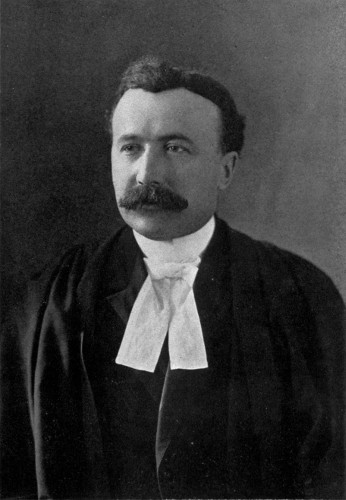
JOSEPH DROUIN
Joseph Drouin pursued a classical course in the seminary of Ste. Thérèse and won his B. C. L. degree upon graduation from McGill University in April, 1904. He engaged in the practice of law, winning a liberal clientage that connected him with the important work of the courts. Of late Mr. Drouin has devoted his attention to the management of his own private interests.
Mr. Drouin is a Roman Catholic in religious faith. He was married in Montreal on the 22d of November, 1904, to Marie Orpha Leduc, a daughter of Augustin and Philomène (Lefebvre) Leduc, who were farming people at St. Benoit, Deux Montagnes, province of Quebec. Unto Mr. and Mrs. Drouin have been born five children: Cécile, Thérèse, René, Marguerite and Gabriel.
HON. HONORE MERCIER.
Among contemporary Canadian statesmen a foremost place must be assigned to the late Hon. Honore Mercier, premier of the province of Quebec. He was not only distinguished by reason of his position at the head of the government of one of the foremost provinces of the Canadian federation but attained distinction along various other lines having to do with the progress and upbuilding of the country and the upholding of its political, legal and moral status. A native of the province of Quebec, he was born at Iberville, October 15, 1840. He came of a family of unpretentious farmers, or habitants, as they are styled in Lower Canada, the ancestors originally from Old France, although several generations have been represented in the county of Montmagny below the city of Quebec. His father had to provide for the needs of a large household, but he was a man of energy and foresight and counted no personal sacrifice too great if he could thereby equip his children for the later responsibilities and duties that fall to the lot of every individual. The maiden name of the mother was Marie Catherine Laflamme.
When fourteen years of age Honore Mercier became a student in the Jesuit College in Montreal, where he completed his education, making an excellent record. Some time afterward he determined upon the practice of law as his life work and became a student in the office of Laflamboise & Papineau, who directed his reading until he was admitted to practice in 1865. While a law student he turned his attention to journalism and in 1862 became editor in chief of the Courier de St. Hyacinthe, winning distinction because of his able political editorials, his support being given to the Macdonald-Sicotte liberal administration.
Following his admission to the bar Mr. Mercier retired from the profession of journalism to concentrate his energies upon his law practice. His thorough training, his natural powers and his ambition soon brought him a prominent position at the bar and from that time forward his advancement was continuous as a factor in those affairs and events which have shaped the history of province and Dominion.
In 1871 he appeared in the political arena at Bagot as a supporter of M. Langelier, the liberal candidate. The following year, upon the earnest solicitation of his friends, he became a candidate for Rouville in the house of commons and was elected. Following the downfall of the conservative government in 1873, he yielded his seat to Mr. Cheval in 1874, to avoid dividing the vote of the liberal party in the case of the redoubtable conservative candidate, Mr. Gigault. Following his retirement to private life he entered upon a partnership with Mr. Bourgeois of St. Hyacinthe. He was made the candidate of the liberal party in 1878, standing for St. Hyacinthe, but lost the election by six votes. The following year a majority of three hundred and seven votes elected him to the legislative assembly to represent St. Hyacinthe and he became solicitor-general of the Joly administration, filling out the unexpired term of Hon. P. Bachand, deceased. Mr. Mercier continued in the office until the administration went out in the same year.
In 1881, following his removal from St. Hyacinthe to Montreal, Mr. Mercier became a law partner of Messrs. Beausoleil & Martineau and was again called into the field of political activity when in December, 1881, at the general provincial election he was chosen by acclamation for his old constituency, St. Hyacinthe. In the beginning of the session of 1883 Hon. Mr. Joly resigned the direction of the provincial liberal party and Mr. Mercier was unanimously chosen his successor, on motion of Mr. Joly, as the leader of the opposition. Here his dominant qualities found fitting scope, his ability and qualities of leadership placing him within a brief period among the foremost French-Canadian statesmen. Within the short space of three years he demonstrated what could be accomplished by an able and intrepid leader with the support of a small but disciplined and trusty band of parliamentary followers to retrieve the fallen fortunes of his party and to defend and lead to victory a popular cause the moment circumstances placed it in his hands.
As the accepted leader of the new national party formed by a combination of liberals and conservative bolters, Mr. Mercier not only directed the whole movement but personally traversed the province of Quebec almost from end to end, addressing as many as one hundred and sixty meetings and leaving the impress of his influence as a factor in the promotion of his cause. The election of October, 1886, resulted in a victory for the nationals. After the struggle, which ensued in the final overthrow of the Ross administration, Mr. Mercier was called upon by the lieutenant governor to form a new cabinet and in less than twenty-four hours, as a result of his quick decisions and promptness in action, he had made choice of his colleagues, announcing the result to the legislature and the country, both receiving it with marked satisfaction.
The close of the first session found him more popular and more firmly established in the good graces of the people than ever, a position that was augmented later by the marvelous success of his administration as evidenced in the settlement of the long pending dispute with Ontario respecting the division of the common school fund and the unusually advantageous negotiation of the new provincial loan of three and a half millions. His adversaries attributed these and other valuable results to good luck, but a real student of politics knows that good management and thorough understanding of the situation lay back of them. Mr. Mercier remained in power until December, 1891, when he was dismissed by Lieutenant Governor Angers as a result of an investigation held by a royal commission on what then became known as the Baie des Chaleurs Scandal.
On March 8, 1892, at the general elections, though Mr. Mercier was returned for Bonaventure, which he had represented since the general elections of 1890, his party was annihilated and he ceased to be a factor in provincial politics.
Following his retirement to private life he joined his son-in-law, Sir Lomer Gouin, and Mr. R. Lemieux in a law partnership, but he rarely appeared in court. However, he won the highest professional honors. He was actually the attorney-general as well as the premier of Quebec. He was twice batonnier of the bar of the Montreal district, and the respect entertained for him by his legal colleagues was so great that they unanimously elevated him to the still more distinguished eminence of batonnier-general of the bar of the province. Of him it has been written: “Heralded to the world as the apostle of an advanced radicalism which in reality had no representative in this country, he not only preached but practiced a different gospel and in office proved himself unusually moderate and conciliatory as well as a man of broad and generous views, free from sectionalism and exceedingly anxious to do justice to all races, classes and creeds, yet fully determined to work out the regeneration of his native province on the great lines of reform which he ever regarded as essential to that desirable end.”
Mr. Mercier held to the religious faith of the French-Canadians—that of the Roman Catholic church and his loyal adherence thereto increased with the passing years. There was a time, however, when, on account of his political liberalism and alliances, his orthodoxy was more than once seriously questioned by his political foes to his personal and party detriment. This, however, passed by and the Papal authority conceded that a man may be a liberal in politics and yet a good Catholic, while the clergy of Lower Canada came to know that he was not only a devoted churchman in theory and practice, but also that the interests of Catholicism were as safe in his hands as in those of its self-constituted champions who proclaimed their zeal for the faith from the housetops. There was in him nothing of narrow-minded bigotry and perhaps no prominent statesman or political leader of his day has shown himself so free from religious or sectional bias in the conduct of affairs relating to the entire community. A French-Canadian in heart and soul and a thorough son of the soil, still, “strict and impartial justice to all classes, races and creeds and undue favor to none,” seems to have been the motto upon which Honore Mercier always acted. In 1893 he undertook a campaign in favor of the independence of Canada and advocated this both here and in the United States, but with no tangible results. Though received enthusiastically in the eastern states, he met with a rebuff in Chicago, and abandoned the campaign to resume his practice in Montreal.
Two notable features in his life history were the torchlight procession in his honor in Montreal following his return from Europe, and the reception he tendered the ex-Papal zouaves at his country seat at Ste. Anne de la Perade, when he distributed the medals awarded them by the pope. On that occasion Mr. Mercier appeared in the gorgeous uniform of commander of the Order of St. Gregory the Great—the first time it had been seen in Canada. The wide recognition given his ability is attested by a partial list of the honors conferred upon him. Not only did he receive the grand cross of the Order of St. Gregory the Great from the pope but His Holiness also raised him to the rank of count. He was in addition to these honors officer of the Legion of Honor; commander of the Order of Leopold I, King of the Belgians; and chevalier of the Order of St. Sepulcher. He was made queen’s counsel and received the degree of Doctor of Laws from Laval University, the University of Fordham, New York, and the University of Georgetown.
A man of his ability and eminence could not fail to have enemies, but he had also hosts of friends. He possessed that quality which, for want of a better term, has been called magnetism. He was most generous and ever had a helping hand out-reaching to those who needed assistance. His residence both in Montreal and in Quebec was always filled with his admirers. It has been said repeatedly that his so-called friends were largely responsible for any errors that he may have committed. He was particularly helpful to young men, many of whom have reason to remember him with gratitude. It was his delight to assist a struggling youth in his law studies or in other ways.
Mr. Mercier was twice married. On the 29th of May, 1866, he wedded Leopoldine Boivin of St. Hyacinthe, who died leaving a daughter who subsequently married Sir Lomer Gouin and who is now deceased. On the 9th of May, 1871, Honore Mercier married Virginie St. Denis, also of St. Hyacinthe, and they had two sons and one daughter to reach adult age, Honore, Paul-Emile and Héva. The elder son is a member of the Gouin cabinet and a sketch of his life appears elsewhere in this work. The younger son is a civil and consulting engineer and is mentioned elsewhere in this history. Héva married Dr. Homère Fauteux and resides in Beauceville.
The death of Hon. Honore Mercier occurred October 30, 1894, on which occasion the Montreal Daily Star said editorially: “The career of the late Hon. Honore Mercier is one that will long live on the lips of those who delight in political reminiscences of this historic province. He played a conspicuous role in the political drama; and, while he was on the stage, pretty well absorbed the attention of the multitude. That he was a man of rare ability in many ways, his swift attainment of the highest positions in Quebec amply attests.
“It is too late in the day for those who contributed to his overthrow in ’92 to make mawkish pretension of blindness to his faults, but it may truly be said that he gained striking success in spite of his faults, and, further, that it was his own hand that turned the current of destiny against him. Like all strong characters, he made many warm personal friends, and there will be more sincere mourning at his bier than falls to the lot of most mortals.”
Senator L. O. David, an intimate and lifelong friend of Mr. Mercier, in making a parallel between the three most popular men of our time, Laurier, Chapleau and Mercier, has written of the latter: “Mercier is the heaviest of the three, the strongest built and the most muscular; he is tall, with black eyes and hair and a heavy mustache—a veritable type of musketeer—the personification of strength and energy. He walks heavily with the assurance of a man who believes that the earth belongs to him. Mercier is the most solid, the most vigorous and the most penetrating. Penetrating is, indeed, the word which best describes his eloquence. See his movements; they resemble those of the axeman who strikes the tree at the root and at each blow removes a chip. Mercier is a parliamentary orator, a lawyer, a tribune. He is the strongest, cleverest, and most indefatigable speaker whom I have heard in the house or on the hustings. While I write these words I learn that he is dead. Is it possible that so much of life and intellect are gone forever? What a loss! How little we mortals are! Alas; had he struggled to preserve his health as he fought to regain it, he would not have died so young. Yes, so young, because he was built to live thirty or forty years more. Death has seldom met a more valiant fighter; it has vanquished him, but he died almost standing, as he often said he would.
“Before the grave, which opens to receive his mortal remains, criticism will disarm, no doubt, to render homage to the splendor and power of his intelligence, his political genius, to the energy of his character and the sincerity of his patriotism. Through all the vicissitudes of a stormy life, in spite of his faults and weaknesses, he preserved until the last moment all the fervor of the religious and patriotic sentiments of his youth. Of all the political men I have known, he is the one who, in all things and under all circumstances, was most given to consider questions from a national standpoint. He was frankly, sincerely, profoundly patriotic and without fanaticism. Few men have had more devoted friends, enthusiastic admirers, and secured more brilliant triumphs and undergone such crushing defeats. He was stronger in defeat than in victory. Much will be forgiven him because he suffered much.”
HON. HENRI C. BERRYER-SAINT-PIERRE.
The subject of this short biographical sketch was born at Ste. Madeleine de Rigaud, during a short stay of his parents in that parish, on the 13th day of September 1842, but was brought up at Isle Bizard, on the Lake of Two Mountains, near Montreal. His father, a farmer, was Joseph Berryer-Saint-Pierre of Isle Bizard, and his mother, Demitilde Denis dit Saint-Denis, who had been born at Pointe Claire. Young Henri received his classical and literary education at the old Montreal College on Collège Street near McGill Street. On leaving college he was sent up to Kingston, Ontario, where he began his law course, the object in sending him up there being to give him an opportunity of improving his knowledge of the English language. Having passed the required examinations for his admission to the study of the law, he availed himself of the permission which had been granted him to go and visit Niagara falls and the city of Buffalo. The great battle of Gettysburg had just been fought and won by the northern army, and on his arrival at Buffalo, he found the people delirious with the news of the recent victory. Our young student, who had inherited from his ancestors a marked taste for the military career (a career by the way for which there were but few openings for a young French Canadian in those days, in Canada), was altogether carried away by the enthusiastic demonstrations which he then witnessed and made up his mind to give up the doleful study of Blackstone to enter the American army. A short time later, the runaway student was a member of Company F in the Seventy-sixth New York Volunteers. At the battle of Mine Run which was fought on the 27th November, 1863, he was wounded and reported as dead at the regiment. The same report having been reproduced in the Montreal papers, the usual service for the dead was celebrated for him at the Montreal College and at Isle Bizard where his widowed mother was living. He was picked up from the field however by the southern cavalry and sent to the military prison of Belle Island in the city of Richmond from which he was later on transferred to Andersonville in Georgia. After the capture of Atlanta, he was removed with the other prisoners first to Savannah, and then to Florence and finally to Charleston’s race ground in South Carolina, where he regained his liberty in the spring of 1865 on the city being evacuated by the southern troops. On his return to Montreal after the war, he resumed his legal studies first in the office of Sir George Etienne Cartier, for whom he, for a time, acted as private secretary, and later on in that of the Hon. J. J. C. Abbott who some years afterward became premier of Canada.
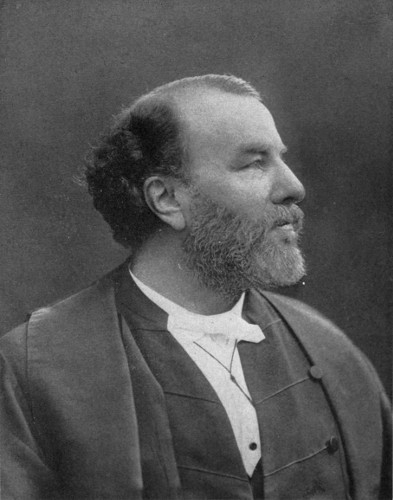
H. C. BERRYER-SAINT-PIERRE
He was admitted to the bar in June, 1870. His career at the Montreal bar was a most successful and brilliant one, and he soon became one of the leading lawyers in the province of Quebec, being particularly noted for his success as a criminal lawyer. His record as such was never surpassed at least in his province and but seldom equalled anywhere. It is said that he pleaded not less than thirty-three cases of murder, securing complete acquittals in most of them. Not one of those he defended was ever found guilty of murder in the first degree and sentenced to be hanged, except Shortis who had killed two men at Valleyfield and wounded dangerously a third one. In this last case, the plea of impulsive insanity was urged for the first time in the province of Quebec as a ground of defense and proved successful in the end in spite of the verdict of the jury. Shortis is today detained in the penitentiary of Kingston as “a dangerous lunatic.” Judge Saint-Pierre frequently associated in the defence of persons accused of serious crimes with Donald MacMaster, K. C., now a member of the English parliament, who was his intimate friend.
In 1889, he was created a queen’s counsel by the Earl of Aberdeen. Judge Saint-Pierre never showed any great inclination for politics but confined his labor and efforts more particularly to secure the highest position in his profession as a lawyer. Being a liberal, he consented however to be the nominee of the liberal party in the county of Jacques-Cartier, for the local seat in 1878 against the old member, but was defeated by a small majority.
He was married in 1874 to Marie Albina Lesieur, daughter of Adolphe Lesieur, a merchant of Terrebonne. She died on the 19th December, 1908, leaving five children, three boys and two girls who are all married and settled. In 1902 on the occasion of his being raised to the bench, he was made an officer of the order of the Crown of Italy upon a petition presented to the King of Italy by the Italian colony at Montreal supported by the Italian consul.
Judge Saint-Pierre has been the organizer of the Canadian Veterans as a body and has been their honorary president ever since their organization some fourteen years ago.
His eminent ability as a legist led eventually to his appointment to the bench. He was first named for the district of Beauharnois on the retirement of Hon. Mr. Justice Belanger in June, 1902, and was transferred to Montreal in March, 1909, so that he is now presiding over the district of Montreal. His decisions are strictly fair and impartial and render him the peer of the ablest men who have presided over Montreal’s courts.
The Judge is a Roman Catholic of the broad liberal school. He is known to be a great admirer of British institutions though much attached to the French civil law which he holds to be superior to the common law of England.
The press has united in passing high encomiums upon him. The Montreal Herald styled him “a man of great vigor.” The Montreal Star spoke of him as broad-minded and public-spirited. The Toronto Star said “Judge Berryer-Saint-Pierre is gifted with fine powers of eloquence and is broad-minded and tolerant.” Perhaps his lofty patriotism is best indicated in his own utterance: “Be English, be Scotch, be French, be Irish, if you will,” he often said in his public utterance, “but above and before all, let us all be Canadians.” Judge Saint-Pierre’s residence is at 2330 Park Avenue, Montreal.
DONALD FORBES ANGUS.
Successfully operating in mercantile circles, Donald Forbes Angus has also extended his efforts along those lines whereby are promoted aesthetic culture and humanitarian interests, thus rendering his life a serviceable factor in the world’s work. A son of Richard Bladworth Angus, he was educated in England and Germany and in February, 1894, was united in marriage to Miss Mary Ethel Henshaw, the daughter of the late F. W. Henshaw.
In his business connections Mr. Angus has so directed his efforts that substantial results have accrued, and he is today a prominent figure in commercial circles as director of the Intercolonial Coal Company and of the Paton Manufacturing Company, both of which are important forces in the business progress of the city. He is also director of the Bank of Montreal; director of the Standard Life Assurance Company; and vice president of the Guardian Accident & Guarantee Company. In these connections Mr. Angus bends his efforts to executive administration and control, and his ability to correctly judge between the essential and the nonessential, utilizing the one and discarding the other, and his power to coordinate seemingly diverse elements into a harmonious whole have been strong features in his growing success.
Mr. Angus is a popular member of several of the leading clubs of Montreal, including St. James, Mount Royal and the Montreal Jockey Clubs—associations which indicate much of the nature of his interests and the source of his recreation. He is also a life member of the Art Association and is a friend and patron of art. He is likewise a governor and a member of the executive committee of the Fraser Institute of Montreal.
HENRY HOLGATE.
Not only is Henry Holgate one of the foremost civil engineers of Montreal, but he is also an author of no mean talents on professional and other subjects. He is now engaged in private practice after a long and strenuous career with various large organizations and of late has designed and built several large hydraulic power plants for transmission of electric power. He is a member of several arbitration committees, a past vice president of the Canadian Society of Civil Engineers, a member of the American Society of Civil Engineers and a councillor of the American Institute of Consulting Engineers.
Mr. Holgate is of English ancestry and was born at Milton, Ontario, September 14, 1863, the seventh son of John and Jane (Browne) Holgate, the former of whom was in charge of the division court at Milton. Judge Holgate passed away in 1896 and his wife in 1902.
Henry Holgate was educated in the Toronto public schools and after having completed his studies served an apprenticeship with the Northern Railway of Canada, which lasted for five years. He continued with them for three years and became their chief engineer in 1884, so continuing until 1893, when he took charge of the Central Bridge Company’s works at Peterboro, Ontario. During this time, in 1887, he became a member of the Canadian Society of Civil Engineers, contributing a paper to its transactions for which he was awarded the Gzowski medal. He remained with the Central Bridge Company for about a year and then joined the Royal Electrical Company in Montreal as engineer in charge of the steel plants and general construction. The years 1896, 1897 and 1898 were spent that way, and he then became engineer of the Montreal Park & Island Company, constructing and managing all their lines. He then went as manager and engineer to Kingston, Jamaica, and constructed all of the works of the Western Electric Company there, returning to Canada in 1900. He established himself in a private engineering practice in that year and in 1902 formed a partnership with Mr. Ross, under the firm name of Ross & Holgate, consulting engineers. This partnership was dissolved in 1911.
Mr. Holgate has on various occasions been retained by the federal and provincial governments for special engineering inquiries and reports. He was so retained in regard to the reorganization of the Trent Valley Canal works and was appointed chairman of the royal commission to report on the collapse of the Quebec bridge in September, 1907. He is widely recognized as one of the able men along his line and has had charge in late years of the building of several large hydraulic power plants.
Occasionally Mr. Holgate contributes interesting articles to technical works. He is the author of an exhaustive paper on Northeast Canada, which was published in 1908, and he has lectured extensively, one of his subjects being “Some Facts Regarding the Upper St. Lawrence.”
Mr. Holgate is independent in his political views and nonsectarian in his religious belief. He is a patriotic Canadian and has always at heart the interests of the Dominion. He believes in a Canada for Canadians and for any others who will become good citizens, recognizing the value of desirable immigration.
On September 19, 1888, Mr. Holgate was married to Miss Bessie Bell Headley, a daughter of Edward Headley, of Milford, Delaware. They have two sons, Henry Watson and Edwin Headley. The family residence is at No. 44 Rosemount Avenue, Westmount. He is a member of the Engineers Club of Montreal.
LEGLEUS ANTOINE GAGNIER, M. D.
Dr. Légléus Antoine Gagnier is widely and favorably known to the public as a general medical practitioner and more specifically in connection with the special work which he does in treating nervous diseases by electrical methods. He is a man who has never ceased to be a student and still frequently makes trips to Europe in order to attend the clinics conducted by the most eminent specialists in the profession. There is no new phase brought out in the world of medicine with which he is not thoroughly acquainted and which he does not thoroughly understand, and his complete knowledge has naturally resulted in a large and lucrative practice. Freeing himself from many of the old medical prejudices he applies modern thought in his treatments and more closely follows his own logical conclusions than book prescriptions. He believes that in numerous cases massage treatments, X-Rays, light baths and general hydrotherapy will achieve more beneficial and lasting results than the older treatment of giving medicaments internally. His well equipped offices, modernly appointed and filled with all the appliances necessary to follow out his methods, are located at No. 256 St. Denis Street, Montreal, and there ever can be found a long line of patients, rich and poor, old and young, waiting to be admitted for treatment.
Although the family of Gagnier is not among the very earliest Canadian settlers, it is an old one. There were variations in the name of Gagnier and extensive records show the name as Gagné and Gagnesse in Abbé Tanguay’s Dictionnaire Généalogique.
Légléus Antoine Gagnier was born at Ste. Martine, in the county of Chateauguay, on October 4, 1871, a son of François and Sophie (Perras) Gagnier, both deceased. The doctor received his classical education at Ste. Thérèse and St. Hyacinthe Seminaries and graduated in medicine from Laval University in 1895. He pursued special studies in Paris and has ever since continued to attend clinics in that and other European cities. Capable, earnest and conscientious, he has not only a reputation for ability but enjoys the utmost confidence of his patients, to whom he is more than a doctor, as they see in him their best and truest friend. He is physician for a number of French and English mutual associations and president of the Medical Board of Union St. Pierre of Montreal.
DR. LEGLEUS A. GAGNIER
On September 28, 1897, Dr. Gagnier was united in marriage to Miss Delia Collerette, a daughter of O. Collerette, and they have the following children, Yvonne, Légléus Adolphe, Gaston, Gabrielle, Marie Régine, Germaine and Paul Emile.
The religious faith of Dr. Gagnier is that of the Roman Catholic church. For many years he was a conservative in politics but of late has allied himself with the nationalist movement, a party which in scope of progressiveness stands foremost of the three political organizations of the Dominion and has for its intention the improvement of general conditions not only political and governmental but also sociological. In the material growth of Montreal Dr. Gagnier is interested as a director of the Greater Montreal Land Investment Company, Limited. He has an interesting military record to his credit and has been in command of the Sixty-fourth Regiment of Chateauguay and Beauharnois for three or four years and since January 23, 1901, he has been on the officers reserve as lieutenant colonel. His deep love for mankind finds expression in his public-spirited actions, and he is never called upon in vain to give his support to any enterprise which will benefit the people of his city or country. Careful of his own interests, he is more minutely careful of those of others and influenced at all times by the thought of the broader effect which his work has upon his community, exemplifying in his conduct the lofty ideals of his nation and of a noble calling. He honors his profession by paying it honor and by his adherence to the solid virtues and enlightened principles underlying it.
GEORGE STEPHEN CANTLIE.
A native of Montreal, George Stephen Cantlie was born May 2, 1867, a son of James Alexander and Eleanor Simpson (Stephen) Cantlie. The father is a prominent merchant of Montreal and a son of the late Francis Cantlie, a native of Mortlach, Banffshire, Scotland, who married Mary Stuart. James Alexander Cantlie was born June 5, 1836, and married in May, 1866, the second daughter of the late William Stephen, of Montreal. J. A. Cantlie came to Canada in 1863. He was for years head of the well known wholesale dry-goods house of J. A. Cantlie & Company, which was founded in 1868. He is connected with a number of important commercial enterprises and is one of the foremost men in business circles in Montreal.
George S. Cantlie received private tuition and attended the Montreal high school and McGill University in the acquirement of an education. In 1885 he entered the service of the Canadian Pacific Railway as clerk in the audit department. He became consecutively clerk in the comptroller’s office, chief clerk to the assistant general manager, to the assistant president and to the vice president. He was then made general baggage agent, general stationary agent and superintendent of car service. Since November, 1908, Mr. Cantlie has been at the head of the car service as general superintendent.
Colonel Cantlie has for a number of years been connected with the volunteer service. He has been lieutenant colonel in command of the Fifth Regiment, Royal Highlanders of Canada, since May 11, 1905. He commanded this regiment at the Quebec Tercentenary celebration in 1908 and at the Lake Champlain celebration at Plattsburg, New York, in 1909, when he received high commendation from President Taft on the splendid appearance of his men. In 1908 he was awarded the long service decoration.
In November, 1896, Mr. Cantlie was married to Miss Beatrice Campbell, a daughter of the late W. D. Campbell, queen’s notary, of Quebec. Mr. and Mrs. Cantlie make their home at No. 502 Sherbrooke Street West, Montreal. He is a member of the Mount Royal, St. James, Montreal Hunt, Forest and Stream, Back River Polo, Auto and Montreal Jockey Clubs. He also is enrolled in the York Club of Toronto and is a member of the Montreal Amateur Athletic Association.
CHARLES LYMAN.
One of the best known men in his line of business in Canada was the late Charles Lyman, wholesale druggist, who died November 17, 1909, after a successful business career of nearly two score years, all of which was spent in his native city. He was born in Montreal, April 3, 1849, a son of Benjamin Lyman and Delia A. Wells. These parents, both natives of the state of Vermont, whose ancestry in the United States dated back almost to the landing of the Mayflower, might account for the strong interest in the affairs of that country which was one of the pronounced characteristics of Mr. Lyman. He was educated in the Montreal high school, the Hopkins grammar school of New Haven, Connecticut, and Yale University, from which he graduated in the class of 1871.
In his senior year at college he was elected a member of the Scroll and Key Society, then as now one of the most coveted distinctions outside of the purely academic sphere. He always retained a very absorbing interest in the affairs of Yale, returning almost annually to his class reunions.
After leaving college he entered his father’s business, Lyman, Clare & Company, in which he shortly became a partner. This business in 1879 was styled Lyman, Sons & Company, under which name it was known until 1908, becoming incorporated then as Lymans, Limited.
In 1887 Mr. Lyman together with James W. Knox and F. Gold Lyman established the business of Lyman, Knox & Company, which continued under this style until in 1906 it became part of the National Drug & Chemical Company, Limited, of which corporation Charles Lyman was secretary from its inception until he retired from business in 1908. Mr. Lyman was of a studious disposition, and his chief interest was perhaps centered in his family life. He was known for his broad culture and was a close follower of the public affairs of both the United States and Canada. Together with the late Goldwin Smith he was a firm believer in the eventual unity of political interest of these countries.
Mr. Lyman was married October 1, 1874, at Stelton, New Jersey, to Kate Dean, daughter of the late Henry Dean of New York, who survives him, together with their three children: C. Philip Lyman and Frank D. Lyman, both of Montreal; and Ruth Delia, the wife of William G. MacNaughton of Port Edwards, Wisconsin.
Mr. Lyman was a member of The University Club, of which he was one of the founders and The Montreal Amateur Athletic Association. He was a member of the American Presbyterian church, the corner stone of the present edifice having been laid by his father, Benjamin Lyman. The higher, better elements of life always made strong appeal to him, and the principles which governed his conduct make his example as a man and citizen one well worthy of emulation.
FREDERIC ORR-LEWIS.
Frederic Orr-Lewis was born at Hamilton, Ontario, Canada. He is the second son of the late William Thomas Lewis and Mary (Graham) Lewis, and a grandson of the late William Lewis, sheriff of Glamorganshire, Wales. The father was a shipowner in Canadian Inland Lakes. William Thomas Lewis came to Canada from Swansea, Wales, in 1852, locating at Hamilton. He became a prominent figure on the inland lakes between Chicago and Kingston and was a large shipowner. He retired from active business in 1890 and moved to Montreal, where he departed this life in 1908. For more than two decades he had survived his wife, who passed away in 1886.
Frederic Orr-Lewis was educated in Kingston, Ontario, and on leaving school went with J. Muckleston & Company, wholesale hardware merchants of the same city. He resigned from that position to establish his own business in Kingston in 1888 and removed the establishment to Montreal in 1889, associated with his brothers James Graham Lewis and Thomas Graham Lewis. The firm was then Lewis Brothers, which was later formed into the limited liability company of Lewis Brothers, Limited, of which he is still the president. From the beginning their trade has extended to such an extent that they now occupy the entire eight-story building which covers Nos. 20 to 42 inclusive on Bleury Street, Montreal, with sales offices in Ottawa, Toronto and other western cities. They have been recognized as one of the leading hardware establishments of the Dominion.
Frederic Orr-Lewis is also a director of the Merchants’ Bank of Canada and director of the Montreal Cotton Company and president of Canadian Vickers, Limited, which is associated with the English firm of Vickers, Sons & Maxim. In 1903 he was elected to the presidency of the Dominion Wholesale Hardware Merchants’ Association.
On the 18th of June, 1896, at Christ church, Montreal, was celebrated the marriage of F. Orr-Lewis and Maude Mary Helen Booth, daughter of William Booth of London, Ontario. They now have three children, a son and two daughters, John Duncan, Helen Merryday and Mary-Graham. The religious faith of the family is that of the Presbyterian church, Mr. and Mrs. Orr-Lewis holding membership therein.