BIOGRAPHICAL (continued 2)
Reading edition
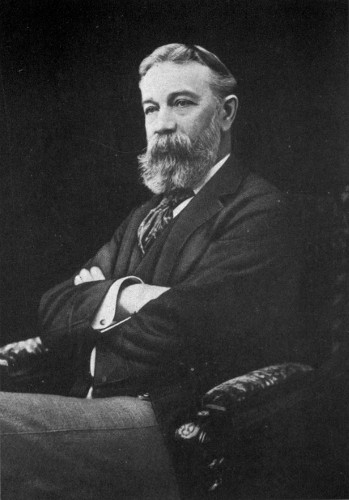
GEORGE HADRILL.
George Hadrill, secretary of the Montreal Board of Trade, is one whose opinions concerning business conditions are largely accepted as standard, because of his broad experience and his thorough study of matters effecting trade relations of the country. For more than a quarter of a century he has occupied his present position and has been called into conference in many trade councils. He was born in London, England, August 2, 1848, a son of George and Elizabeth (Bushell) Hadrill. His education was acquired in the metropolis, and he spent the earlier years of his business life in that city, arriving in Canada in 1874, when a young man of twenty-six years. Three years were devoted to business pursuits before he joined the staff of the Montreal Board of Trade in 1877. His fitness for the position is evidenced in the fact that by 1880 he had been promoted to the position of assistant secretary. Six years passed and in 1886 he was made secretary, so that he has now acted in that capacity for twenty-eight years. The occasion of the twenty-fifth anniversary of his acceptance of the position was fittingly celebrated, and a cabinet of silverware was presented him by the Montreal Board of Trade.
His position as secretary brings him into close contact with business affairs and trade organizations throughout the world. He has been a delegate to several imperial trade congresses, the last being held in Sydney, Australia. By invitation he was a delegate to Newfoundland to assist in the formation of a board of trade there in 1909. He was presented in 1903 with a testimonial from British delegates to the imperial trade congress at Montreal in acknowledgement of courtesies and services rendered by him. In 1905 he was elected an honorary member of the International Board of Foreign Trade and was made honorary secretary of the King Edward memorial committee of Montreal in 1911. His position has brought him into close connection with many important civic and municipal projects with which the Board of Trade has been intimately associated.
In 1891 Mr. Hadrill married Emmeline Lilian, the daughter of J. Albert Copland of Chelmsford, England. Mrs. Hadrill died in December, 1902. Mr. Hadrill has been a director of St. George’s Society of Montreal and is an Anglican in religious faith. The Montreal Herald has written of him that he is “a man of great natural abilities as a statistician and accountant.” “He possesses unusual qualifications for his office, which calls for a display of diplomacy, tact and social qualities as well as for purely business ability,” writes another paper, and this opinion is corroborated by all who have come in contact with him. While thoroughly systematic and methodical in managing the duties of his position, he has at the same time that ready resourcefulness which enables him to meet an emergency and secure from it the best possible results.
CHARLES MELVILLE HAYS.
The tales of heroic conduct in times of war will always arouse the enthusiasm and call forth the praise of those who hear them, but heroism is by no means confined to the men who wear their nation’s uniform and march to the sound of the bugle. It has been manifest where there were none to witness and none to record the story and with nothing but an individual sense of duty for its inspiration. The world thrilled with the story of the heroism of the men, who, in the silence of the night, gave women and children over to the care of the few who manned the lifeboats and quietly awaited death on the decks of the steamship Titanic when it sank on its maiden trip across the Atlantic, April 15, 1912. Included in the great toll of human lives exacted by this catastrophe, was that of Charles Melville Hays, president of the Grand Trunk Pacific Railways and one of the foremost railroad magnates of his generation. His was the master mind in the development of the Grand Trunk Pacific and his work for the Grand Trunk Railway has become a part of the history of the Dominion. One of the elements of his success was that he was always essentially and strictly a railroad man, never dissipating his energies over too broad a field but concentrating his efforts along that single line of activity.
A native of Rock Island, Illinois, Mr. Hays was born in 1856, and was but a child when his parents removed to St. Louis, Missouri, in which city he was reared and received his educational training. He was but a boy of seventeen when he started out in life on his own account as a clerk in the passenger department of the Atlantic & Pacific Railway. From that time on his advancement was continuous and rapid, solely the result of his thoroughness, efficiency and genuine merit. After a year he was transferred to the auditor’s department and later was called to a position in the office of the general superintendent, where his aptitude, enterprise and initiative were soon recognized. From 1878 until 1884 he was secretary to the general manager of the Missouri Pacific Railroad and in the latter year was offered and accepted the position of secretary to the general manager of the Wabash & St. Louis Pacific Railway Company.
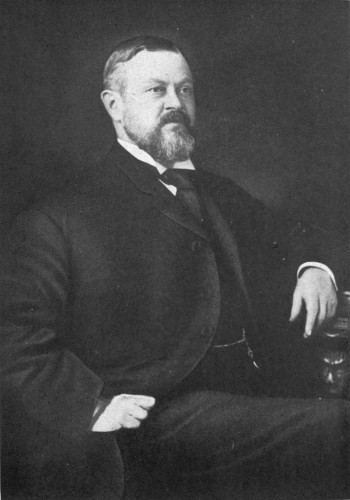
CHARLES M. HAYS
In 1886 he was appointed general manager of the road and the following year became general manager of the Wabash Western, comprising all of the Wabash lines west of the Mississippi and also between Chicago and Detroit. In 1889 he was appointed general manager of the reorganized and consolidated Wabash system and controlled the important and manifold interests of the railway for six years or until he resigned to become general manager of the Grand Trunk, succeeding L. J. Seargeant. Five years later he left the Grand Trunk to take the position of president of the Southern Pacific Railway Company but remained in that connection for only a year, as the railway passed under the control of the Harriman interests, whose policy differed from that of Mr. Hays. About that time he received a communication from Sir Charles Rivers Wilson, again offering him the position of general manager of the Grand Trunk and he returned to the latter road late in 1901 as second vice president and general manager. His connection therewith was continuous from that time until his demise, and on the retirement of Sir Charles Rivers Wilson in October, 1909, he was appointed president. In the meantime his connection with railway interests constantly broadened, making him one of the notable figures in railway circles on the American continent. He became president of the Central Vermont Railway, the Grand Trunk Western Railway, the Detroit, Grand Haven & Milwaukee Railway, the Toledo, Saginaw & Muskegon Railway, the Michigan Air Line Railway, the Chicago, Detroit and Canada Grand Trunk Junction Railway, the Detroit & Toledo Shore Line, the Southern New England Railway Company, the Canadian Express Company, the Grand Trunk Railway Insurance & Provident Society and of various corporations featuring largely as factors in commercial and industrial development. He was chosen to the presidency of the St. Clair Tunnel Company, the International Bridge Company, the Montreal Warehousing Company, the Portland Elevator Company and the New England Elevator Company. He also represented the Grand Trunk Western Railway as a director of the Chicago & Western Indiana Railway and Belt Railway of Chicago.
In 1905 he was made a member of the permanent commission of the International Railway Congress and also a director of the United States Mortgage & Trust Company. He was a delegate to the Imperial Trades Congress in 1903. He became a director of the Royal Trust Company and the Merchants Bank of Canada and a director of the Canadian Board of the London & Lancashire Life Assurance Company. He was also a director of the Montreal Horticultural and Fruit Growing Association—a fact which indicated much of the breadth of his interests. His executive ability was sought as an element in the successful management of various benevolent, charitable and philanthropic enterprises. He was a governor of the Montreal General Hospital, a governor of the Royal Victoria Hospital and a governor of the McGill University. In 1907 he was decorated with the Order of the Rising Sun (third class) by the emperor of Japan.
He was a man of remarkable personality. Obstacles and difficulties seemed but a stimulus for renewed effort on his part and he was never happier than when he could grasp an opportunity and utilize it to the fullest extent or untangle a knotty problem in railway management and control. Mr. Hays was a well known figure in club circles, belonging to the Mount Royal, St. James, Canada, Forest and Stream, Montreal Jockey, Montreal Hunt, St. Maurice Fish and Game Club and the Laurentian Club of Montreal and the Rideau Club of Ottawa. Sir Wilfrid Laurier had termed him “a valuable acquisition to Canada,” and the Montreal Witness said he was “a splendid example of what brains, pluck and industry can overcome and accomplish,” while the Montreal Standard styled him “a man of quiet dignity, whose sanity and strength are seen and felt in all his undertakings.”
Mr. Hays was survived by his widow, who was Miss Clara J. Gregg, a daughter of William H. Gregg of St. Louis, Missouri, and four daughters, Mrs. George D. Hall, of Boston, Mrs. Thornton Davidson, Mrs. A. Harold Grier and Mrs. Hope C. Scott, of Montreal.
One of the ships that hastened to the relief of the Titanic recovered the body of Mr. Hays, which was brought back to Montreal for interment and laid to rest following one of the most imposing funerals ever accorded a civilian in this city. Mr. Hays worshipped at the American Presbyterian church of Montreal and was one of its trustees, but retained his membership in the First Presbyterian church of St. Louis, Missouri, and in the memorial services held in the former on the 25th of April, 1912, a sermon by the Rev. Dr. McKittrick, pastor of the First Presbyterian church of St. Louis, following the death of Mr. Hays, was read. He said in part: “The colossal catastrophe of the seas which has so recently startled and dismayed the civilized world could not pass today entirely unnoted in the temples of the living God. Among those who went down to their unexpected and, it seems to our vision, their untimely death, there was no man who worthily had a higher position in the social, industrial and financial world than Mr. Charles M. Hays, president of the Grand Trunk Railway of Canada. Since commonly the boy is father of the man we might almost refer to him as ‘our Mr. Hays’ for he was once in our Sunday School, and afterwards a member of our Board of Trustees. His is an inspiring example to all our boys and to every boy in the land of what may be accomplished by rightful purpose, industry, determination, all these by the worthy motives which variously constitute character. It took all the elements which are found in a manly man to make first so notable a record as was his in this city, and then to create for himself the distinguished name and for his undertaking the great prosperity which concerning both the history of today reveals.”
The following reference to Mr. Hays’ life and work was made at the close of public worship in the American Presbyterian church, Montreal, on Sabbath, April 28th. Dr. Johnston said: “The subject that we have been considering this morning has unavoidably suggested to you, as it has to me, many thoughts regarding the life, the death and the work of Mr. Charles M. Hays whose loss our land mourns today.
“Much has already been said of Mr. Hays as the railway magnate, the man of enterprise, the devoted husband and father and the loyal friend. Upon these phases of his character I will not therefore further dwell, but there remains something to be said of that feature of his life which, though less conspicuous to the general public, nevertheless lay deep and strong behind all these other characteristics, and was indeed the inspiration of them. We all in this congregation know the large place which Mr. Hays gave to the work and worship of the church, and the readiness with which his time and influence were always lent to its interests. He loved the House of God. That love, in a measure, was doubtless the result of early training in a home of whose deep religious character he ever loved to speak in terms of affection and appreciation. It was also due in part to his deep sense of what he owed in his place of great prominence to the community at large, and to a younger generation in particular, in the way of example. Most of all, however, it was due to his appreciation of the place that worship should have in every life, and to his deep sense of the need of every soul for those things that the House of God and its services can give. This attitude instead of lessening, as in so many lives it does, as responsibilities increased, and honours accumulated, deepened in Mr. Hays with the passing years.
“The continent-wide enterprises with which his name will always be associated were not simply enterprises and interests to him. They constituted a work, a ministry, which it was given him to administer for man, and through man for God. The tens of thousands for whom he had already thrown open the door of their exodus from European stagnation and oppression were his Israel, whom he, in God’s name, was leading out into liberty and larger life. These broad prairies and boundless stretches of Northern Saskatchewan and the Peace River district, those hitherto impassable Rockies, giving gateway to the flowering farmlands that slope toward the silver sands of the Pacific—these were his Canaan, which it was his to conquer, not with sword and clash of battle, but with genius and enterprise and the power of science, so that into the good ‘Land of Promise’ he might bring the oppressed peoples of the world, to make a nation strong in liberty and in righteousness.
“Did time permit I could tell you much of how Mr. Hays carried on his great heart, the toiling multitudes of earth and their needs, and of how it was to him a vision glorious that he was permitted in some measure to contribute to their uplift and redemption. He, too, like Israel’s leader, had looked upon the burdens of the people. To us it seems that, like Moses, he has been permitted only to view his promised land from afar. On the threshhold of completion he has been bidden to lay down his work. A broken column? A work incomplete? Yes, if this world is all, and this life the only life, but if death is indeed for the life that lives in Christ, not extinction but expansion, not frustration but promotion, than surely in some other of the many mansions in our Father’s one great house, they still serve who have ceased from labor here, and work with gladness for the bringing in of that day when throughout all the universe of God there shall be nothing to hurt nor to destroy, but ‘God shall be all and in all.’”
The press throughout the American continent united in tribute to Charles Melville Hays and under the caption of Montreal’s Loss the Gazette of April 19, 1912, said editorially: “Among the many places which will have home reasons for bearing the loss (April 15, 1912) of the steamship Titanic in sorrowful memory there will be few to rank before Montreal. Of residents who had won or were winning honorable places of usefulness in the city’s commercial life, no less than four ended their earthly career in the dark hours of Monday when the Atlantic waters closed over the wreck of what had been one of the world’s noblest vessels. First of these, of course, ranks Mr. Charles M. Hays, president of the Grand Trunk Pacific Railways and director and adviser in many allied and other enterprises. Mr. Hays came to Montreal as a stranger, when the condition and fortunes of the Grand Trunk Railway were low indeed. The life had apparently gone out of the direction and a great property, with greater potentialities, was in danger of passing into bankruptcy. He and his associates found their task harder also because they were strangers. It was only a little while, however, before the city and the country, as well as the proprietors of the railway, recognized that in the new general manager, which was the title Mr. Hays then had, they had a man who for capacity ranked with the highest in his profession. With a slight interruption Mr. Hays has had chief executive control since 1897 of the Grand Trunk Railway. In that time it has been lifted physically to the standard of a high class, well equipped road, with few superiors in America. Financially it has been so improved as to meet the interest charges on the new capital raised for betterments and has been able to pay dividends on some of the older issues that once seemed to have lost all value as investments. In late years he was a chief moving spirit in the projection and construction of the Grand Trunk Pacific Railway, which is now approaching completion. His work in these connections speaks of his executive ability louder than can words written or spoken. It is only to be added that in all relations of life, business or social, he was a plain, courteous and kindly gentleman, to whom all were ready to pay in full measure the respect that he deserved.”
The memorial service read in the American Presbyterian church to which previous allusion has been made, was one of the most impressive ever held within the borders of Canada and the tributes to Mr. Hays on that occasion attested how high was the position which he held in the regard of business colleagues, of eminent educators, ministers and others. Principal Peterson of McGill University said in part: “We have done well to come together in this solemn manner, not to meet in a useless parade of grief and sorrow, but to pay a sincere tribute to the worth of one who has gone to his last reward and to express our sympathy to those who suffer the loss of one so dear, and who have scarcely yet survived the shock of their sudden bereavement. Our men died like heroes—in that last dread extremity they bore themselves nobly and well.
“And I doubt not that foremost in fortitude was that great-hearted man who today is mourned throughout the world, Charles M. Hays, who was then eagerly returning to take his controlling part in those great enterprises with which his name will always be associated, and no doubt looking forward with joy to returning to his accustomed work and surroundings here. The vast transportation system over which he so well presided, and to which he gave fresh life, has just paid him well earned tribute in those moments of organized, concerted, silence stretching across this continent—the awed hush of reverent respect and tender sympathy from every section of the railway service and from every rank and class in the community at large. It was a moving incident, but only a slight indication of the esteem in which he was held everywhere, and of the loss which the railways and the people have sustained.
“Mr. Hays came to Montreal in 1896, shortly after I came here, and since then it has been my privilege to know him well, and to meet him frequently in university and other affairs. Only a short time before Mr. Hays left for Europe I had a walk with him, when he talked to me of his plans for the future, and discussed university and other educational matters, with the grave and serious hope for future advancement which marked his thought. Little then did either of us think it possible that so terrible a disaster should cut short his vigorous and useful career. He was a real leader of men, a true captain of industry, carrying a huge burden of work and responsibility on his shoulders, and always carrying it as a strong Christian man should. We shall go forth from this solemn service to our customary duties, graver and sadder men. It may be that we shall not have the melancholy duty of following to the grave the remains of this man whose work interlinked a vast continent. He has found his grave in the ocean, and it may be literally said of him that the whole world is his tomb. Certainly his memory will not soon die; for long will the memory live of this impressive memorial of his sad fate and the sorrow of his stricken family. And when the far-reaching plans for which he stood sponsor are realized we shall often go back in thought to what this city, this dominion and the empire at large owes to the ability, the integrity and dauntless energy of Charles Melville Hays.”
One of the glowing and well deserved tributes paid to the memory of Charles Melville Hays was spoken by Rev. T. S. McWilliams. D. D., of Cleveland, Ohio, who said: “The man whose loss we mourn today, and whose memory we would honor was not merely a national, he was an international figure. The great enterprise of which he was at the head, and, to an unusual degree the guiding and animating spirit, was not merely a national, but an international railway. It seems fitting therefore that one from the United States should have a small part in this memorial service. The humble tribute which I bring is not merely that of a former pastor—as such I was privileged to say a few words on Sunday last. Nor is my tribute that of a personal friend—as such my place would not be here in the pulpit, but in position with the mourners, amongst those who most deeply and genuinely feel a sense of personal loss. Mine is the privilege today of bringing a neighboring nation’s tribute, if you will; of assuring you that many of the American people share with you the sorrow and sense of loss which you feel so keenly. In the United States the late Charles M. Hays was born, and there he spent the larger part of his life. Of our country he remained a citizen to the last. Yet there were few men more genuinely devoted to the interests of Canada or more intelligently attached to British institutions than he. Few, if any, in Canada saw with clearer vision the great possibilities of the future of your country and believed more intensely in the great destinies of Canada.
“To speak of Mr. Hays’ preeminent ability as a railway man is scarcely necessary. We have only to look around to see the monuments to his genius. There are two immense office buildings that ornament your city; there is that wonderful steel bridge over Niagara’s gorge and the great station at Ottawa. There is the rejuvenated and vastly extended Grand Trunk Railway. And, perhaps greatest of all, there is the Grand Trunk Pacific Railway, destined at no distant date to span this continent, making accessible natural resources of incalculable value, and bringing into practical part of the national progress vast regions at present inaccessible to the agriculturist. These are great enterprises which have attracted the admiring attention of the world and stimulated rival systems to greater activity, while bringing millions in money to your land, and, what means much more to you, an unprecedented tide of immigration. It is but just to say that such enterprises as these have been no small factor in the building up of that great progress and prosperity which characterizes Canada at the present time.
“The credit of such achievements is, of course, to be shared with Mr. Hays’ earnest colaborers—and he would have been the first to give them such credit—but to Mr. Hays is certainly due the credit of the initiative. For a man at the early age of thirty-eight years to rise from the bottom of the ladder to the presidency of such a railway system as the Wabash, and later to be selected as president of the Grand Trunk, charged with its rehabilitation, and to so conduct its affairs that after only five years its securities had enhanced in value by eighty-six millions of dollars; to be called to the presidency of the Southern Pacific, and then called back again to the Grand Trunk to consummate yet vaster plans—these are proofs positive and sufficient of his preeminent railway genius. The tribute of silence in which we a few minutes ago reverently joined—a silence in which we were joined by that great army of employes from ocean to ocean—was not the silence of obedience to an enforced order. It was the genuine heart-felt tribute of men of all ranks to a leader whom they had loved and lost.
“The contagion of his example spread through every part of that great system. Himself a hard and rapid worker his own example was a sufficient incentive to do away with indolence and incompetence. His presence anywhere on the system encouraged and thrilled to better work not by fear of the tyrant’s command to go, but they thrilled at the leader’s call to come.
“Mr. Hays was first, last and all the time a great railway man. But it would be unjust to speak merely of that. He possessed other qualities that impressed me even more than that. He was throughout his life a man of lofty and unbending principle. I personally know that his early ending of his connection with a great railway system, sacrificing a position to which was attached great honor and an immense salary, and his going out of that office, not knowing whither he went, was a wonderful example of the triumph of principle over what appeared to be personal interests. It stands as a proof of Mr. Hays’ unwillingness to be the tool of a designing genius no matter what that might seem to offer him in the way of personal remuneration. And in the great positions he held it was his constant endeavor to be just to all. It was his endeavor by day and his prayer by night to always carry an even balance between the employes of his company and those who had invested their living in it with even justice to both. Knowledge of this permeated the whole system, and brought a realization amongst the men that the main endeavor of the leader was not to get out of the employes as much as possible and give them in return as little as possible, but that they were really working with, not for, their president, in the interests of all.
“And he was a public-spirited man in many other spheres. That he was a generous friend of education is proven in that he was a governor of McGill University; that he was a benefactor to suffering humanity is shown by the hospitals of which he was a governor. But far more than these public positions were innumerable cases in which he proved himself a generous but unostentatious friend to the needy. And may I for a moment draw aside the sacred veil, and speak of his home life. As a father, husband, brother, comrade, to all in his household he was ever the genial, pure, high-minded Christian gentleman—the idol of his home, as he deserved to be. His religious influence was unmistakable and caused him inevitably to work for the right. I am confident that his deep religious sense of duty was at the bottom of much that we admire in his career—he was utterly honest, not because he believed it to be the best business policy, but because he had faith in the right; he was filled with genial optimism, not from blindness to the facts, but because he knew them.
“That such lives should be allowed to be interrupted by such disasters as that we now mourn is a problem which cannot be satisfactorily answered. It may be said that no man’s place is impossible to be filled. But Methodism has never found another John Wesley, and the Grand Trunk will look and wait for long before it finds another Charles Melville Hays.”
DOUGALL CUSHING.
One of the most able, successful and progressive of the younger generation of professional men in Montreal is Dougall Cushing, connected with important legal interests as a member of the firm of Barron & Cushing, notaries. He is a native son of the city, born May 3, 1886, his parents being Charles and Lily (Macaulay) Cushing. The family is of old American establishment, the great-grandfather of the subject of this review, Job Cushing, having been born in Massachusetts in 1765. The father was born in May, 1848, and he was for a number of years the senior member of the firm of Cushing & Barron and known as an able and reliable notary. He was in addition a director in the Sun Life Assurance Company, on the board of governors of the Young Men’s Christian Association and deacon in Calvary Congregational church, a man of wide interests, high standards and useful and important accomplishments. His death occurred September 30, 1910. He and his wife became the parents of seven children, R. Macaulay, Dougall of this review, Charles, Arthur, Eric, Geoffrey and Edith.
Dougall Cushing was reared in his parents’ home and acquired his preliminary education in the grammar and high schools of Montreal. He afterward attended McGill University, from which he was graduated B. A. in 1907 and B. C. L. in 1910. In the following year he established himself as a notary in his native city, associating himself with Robert H. Barron, his father’s former partner. The firm of Barron & Cushing is today, as it has been for many years past, one of the strongest of its kind in the city, for Dougall Cushing has followed closely in his father’s footsteps, and has proved himself brilliant, reliable and energetic in the conduct of his professional interests.
Mr. Cushing belongs to Phi Kappa Pi, which he joined in McGill University and is a member of the Seventeenth Regiment, Duke of York’s Royal Canadian Hussars. He is one of the popular and enterprising young men of Montreal and has already gained a creditable place in a profession in which his superior merit and ability will undoubtedly win for him ultimate distinction.
HON. SAMUEL GALE.
Hon. Samuel Gale, one of the ablest members of the legal profession in his day, and a very prominent citizen of Montreal, died in that city on Saturday, April 15, 1865. He was the son of a Mr. Gale who, born in Hampshire, England, came to America in 1770 as assistant paymaster to the forces. He married there a Miss Wells, of Brattleboro, and soon after left the army, and took up his residence in the colony of New York. During the Revolution he stood firmly by the old flag under which he had served, and was for some time imprisoned as a loyalist. After the Revolution, he came to reside in Canada, upon an estate granted to his wife’s father by the crown, as indemnification for the losses brought upon him as a loyalist in the Revolution. He was subsequently secretary to Governor Prescott, whom he accompanied to England, and there assisted to defend him from the attacks made upon his administration. While there he wrote an essay on Public Credit, addressed and submitted to Pitt. The following is the inscription on his tombstone at Farnham, in Shefford county:
“Here rests Samuel Gale, Esq., formerly acting deputy paymaster general of H. Majesty’s forces in the Southern Provinces, now the U. S. of America; subsequently Secretary to H. E. the Governor-in-chief of H. M. dominions in N. A.; Author of Essays on Public Credit, and other works; born at Kimpton Hants, England, October 14, 1748; died at Farnham, June 27, 1826.”
Samuel Gale of this review was born at St. Augustine, East Florida, in 1783. He was educated at Quebec, while his father was secretary, and came to study law at Montreal under Chief Justice Sewell, in 1802, having Chief Justice Rolland and Mr. Papineau as fellow students. Mr. Gale was admitted to the bar in 1808, and ere long secured a large practice. In 1815 he was appointed a magistrate in the Indian territories, and accompanied Lord Selkirk when he went to the northwest. Later, when Lord Dalhousie was attacked for his Canadian administration, Mr. Gale went home as bearer of memorials from the English-speaking Lower Canadians in the townships and elsewhere, defending his lordship’s conduct. In 1829, he became chairman of the quarter sessions, and in 1834 was raised to the bench to replace Mr. Justice Uniacke, who preferred to resign the seat on the bench to which he had just been appointed rather than come back to Montreal during the cholera, then raging here. Judge Gale retired from the bench in 1849, forced into retirement by continued ill health and the gradual coming on of the infirmities of old age.
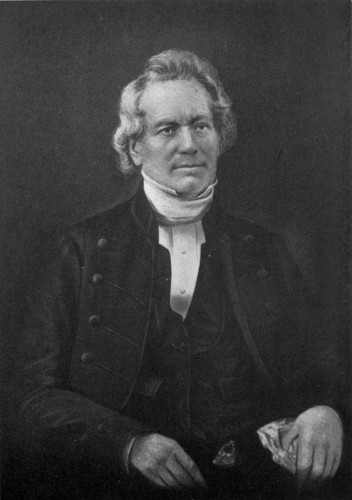
HON. SAMUEL GALE
He had married in 1839 a Miss Hawley, of St. Armand West, by whom he had three daughters. Mrs. Gale died in September, 1849. Of the daughters the only one now living is Anna R., widow of T. Sterry Hunt, of Montreal, who is mentioned elsewhere in this work; while of the other two, Agnes Logan married Andrew Stuart of Quebec, a son of Chief Justice Stuart and of a very prominent family in that city, and the third became the Baroness von Friesen, who died December 10, 1875, in Berlin, Germany.
Born of parents who had both suffered for their loyal adherence to the British Crown during the American Revolution, and educated in their views Mr. Gale was, as long as he busied himself in politics, a stanch conservative and defender of British unity and British supremacy. He wrote a series of letters to the Montreal Herald (in those days the organ of the stoutest conservatism) over the signature of “Nerva” which produced a strong impression on the public mind at that time; and in espousing the cause of Lord Dalhousie and upholding the old constitution (under the title constitutionalists taken by the conservatives of that day) against the advocates of democracy or responsible government, he was but consistently pursuing the course on which he first set out. While upon the bench he maintained in an elaborate and very able judgment the right of the Crown to establish martial law here in 1837, refusing to theorize about what abstract rights man had or ought to have, declaring simply and firmly what the law, as he read it, established the prerogative of the sovereign to be in a colony. Both as a lawyer and judge he won the respect of his confreres alike by his ability and learning.
For many years previous to his death he was deeply interested in the freedom of the slave. He could not speak with patience of any compromise with slavery and waxed indignant in denunciation of all who in any way aided, abetted, or even countenanced it. When the Anderson case was before the Upper Canada courts he was one of the most active among those who aroused agitation here. When the Prince of Wales visited this country he got up a congratulatory address from the colored people of Canada which, however, was not received, as the prince was desired by the Duke of Newcastle, not to recognize differences of race and creed wherever it could be helped.
Judge Gale was a man of high principle and ever bore an unblemished moral character. Once in his early career at the bar he was forced by the then prevailing customs of society to fight a duel. His antagonist was Sir James Stuart, who had quarreled with him in court and Mr. Gale was severely wounded. It was an event which, we believe, he profoundly regretted, and gladly saw the better day dawn when men ran no risk of forfeiting their position as gentlemen by refusing to shoot, or be shot at, in order to redress real or fancied insults. He was a scrupulously just man, most methodical and punctual in business matters. There were in his writings great care, and precision and clearness of language. In his letters, too, and even in signing his name, the same trait was observable. He often used to condemn the stupid custom of men who signed their names with a flourish, yet so illegibly that no one could read, but only guess at, the word intended. He was not ostentatious of his charities, yet they were not lacking. Some years before his demise he made a gift of land to Bishop’s College, Lennoxville, and during the last months of his life, when age and illness were day by day wearing him out, he found relief for his own distress in aiding to relieve that of the needy and afflicted.
With him passed away one more of those men, who link the creative past, in which were laid the foundations of our civilization, with the bustling present and of whom the generation of today knows naught; of men more proud and precise in their manners than we are; and of such rectitude and sense of honor, that we feel deeply the loss of the influence of their example. A loyal subject, a learned and upright judge, a kind, true, steadfast friend, was lost to the community in Judge Gale.
ROLLO CAMPBELL, M. D.
Dr. Rollo Campbell, of whom it was said that no man ever spoke ill, was the son of Dr. Francis W. Campbell and was born in Montreal on the 6th of June, 1864. His life record covered a comparatively brief span. He was educated under private tutors and in Bishop’s College, where he pursued his professional course, being graduated from that institution at Lennoxville, P. Q., with honors in the class of 1886, at which time the M. D. degree was conferred upon him. His early professional experience came to him as interne in the Western Hospital at Montreal, where he remained for a year, gaining the wide knowledge and training that only hospital practice can bring. He then went to Europe, pursuing his studies in London and in Edinburgh. Upon returning to his native land he located in Montreal for practice and it was not long before he had established an enviable reputation as a conscientious, capable physician of untiring energy, thoroughly devoted to his profession and ever ready to do a kindness to those in need of his services. He was especially interested in surgery and his researches along that line were broad and varied.
From the time of his graduation Dr. Campbell was on the teaching staff of Bishop’s College, first as demonstrator of anatomy, to which he was appointed in 1897, and later as professor of surgery. For many years he was on the consulting staff of the Montreal Dispensary and was one of the assistant surgeons of the Western Hospital, in which institution he was greatly interested. He was likewise an examiner for the New York Life Insurance Company.
A feature in his professional connections was his service as surgeon for seventeen years of the Fifth Royal Scots of Canada, in which regiment he was very popular. At one time he was president of Bishop’s Medical College Graduates’ Society and he was physician to several fraternal societies. He also belonged to the Montreal Medico-Chirurgical Society and along more strictly social lines he was connected with the Metropolitan Club, the Montreal Military Institute and the Montreal Amateur Athletic Association. Of the latter he was a life member and was captain of the Bicycle Club of that organization.
Dr. Campbell was married in Montreal in 1892 in St. Paul’s Presbyterian church to Miss Marion May Fletcher, a daughter of Henry Fletcher, who for thirty years was tide surveyor of the port of Montreal, and his wife, whose maiden name was Margaret Ann McInnes. Dr. and Mrs. Campbell became parents of two children: Gladys Agnes and Edith Margaret. The family circle was broken by the hand of death when on the 31st of May, 1904, Dr. Campbell passed away. Speaking of him at this time a fellow graduate of Bishop’s College said: “He was a fine fellow. I think I can safely say that I never heard anyone speak ill of him. He was kind and thoughtful and devoted himself to his work. In fact, I fear that he worked too hard on account of that conscientiousness which would not allow of his neglecting any seeming duty. He will be greatly missed, not only by his fellow practitioners, but by all who knew him and respected him.”
ROBERT KURCZYN LOVELL.
While Robert Kurczyn Lovell entered upon a business already established, he has displayed the enterprise and determination which are among his salient characteristics in the methods which he has followed in conducting his business affairs. Montreal numbers him among her native sons, but he comes of Irish and German ancestry. He is the eldest son of the late John Lovell, who was a prominent publisher of Montreal from 1835 until his death in 1893. His mother is Mrs. Sarah Lovell, a daughter of N. P. M. Kurczyn, who was a German merchant of Montreal.
In the acquirement of his education Robert K. Lovell passed through consecutive grades to the high school. In 1867 he became connected with his father in business, becoming a partner in 1880 and so continuing until the latter’s death in July, 1893. The business was conducted under the same style until 1903 when it was incorporated. Since 1903 he has been president of the firm of John Lovell & Son, Ltd., publishers of Lovell’s Gazetteer of the Dominion of Canada and Newfoundland, Lovell’s Montreal Directory, Lovell’s Montreal Business Directory and numerous other publications. In all of his business affairs he never deviates from the highest standards. He is an Anglican in religious faith.
WILLIAM OKELL HOLDEN DODDS.
For over twenty years Major William O. H. Dodds has been connected with the Mutual Life Insurance Company of New York, being at present the assistant manager for Quebec and the maritime provinces. He was born in Yarmouth, Nova Scotia, July 3, 1867, a son of the late Charles Dodds, a manufacturer of that province, who died in June, 1893. The mother of our subject, who was before her marriage Miss Agnes Smith, died in December, 1910.
William Dodds received his education in the Yarmouth high school and the Yarmouth Academy of Yarmouth, Nova Scotia. He completed his school education in 1884 and then entered the employ of the Bank of Yarmouth, remaining with that institution until 1887. From 1887 to 1888 he assisted his father in the wholesale and retail dry-goods business, but in the latter year came to Montreal, entering the wholesale dry-goods trade, with which line he continued until 1892. In that year he joined the staff of the Mutual Life Insurance Company of New York as cashier and, rising through various positions, was made the assistant manager of the concern for Quebec and the maritime provinces, which office he yet holds. Mr. Dodds has also been one of the promoters of the Consumers’ Cotton Company.
On November 29, 1910, Mr. Dodds married Jean Hamilton Holt, eldest daughter of Robert W. Tyre, of Montreal. Mrs. Dodds is greatly interested in athletics and in 1911 was elected president of the Ladies’ Montreal Curling Club.
Major Dodds is also a well known amateur athlete. He was formerly president of the Canadian Amateur Athletic Union; is a member of the executive committee of the Amateur Skating Association of Canada; and was selected as one of the team of the Montreal Curling Club to proceed to Scotland in December, 1908, but was unable to go. He has long been in the volunteer military service, being formerly a captain in the Fifth Regiment, Royal Scots. He subsequently commanded the Third Battery, Montreal, and then organized the Twenty-first (Westmount) Battery, which he commanded from October 26, 1907, to April 9, 1910. He is now engaged in the reorganization of the First Regiment, Grenadier Guards of Canada. In January, 1906, Major Dodds was elected president of the Montreal Military Institute and is now councillor of the Boy Scout movement.
Mr. Dodds is a Presbyterian and gives his political support to the conservative party. He is a member of the Montreal Club, the Montreal Military Institute, the Montreal Curling Club, the Montreal Amateur Athletic Association, the Montreal Hunt Club, the St. James Club, the Royal Montreal Golf Club and others.
ISAIE PREFONTAINE.
Isaie Prefontaine, no less highly esteemed for his business capacity and enterprise than for his public-spirited citizenship, has contributed along various lines to the welfare and progress of the city in which he makes his home. A native of Beloeil, he was born in 1861 and in the pursuit of his education attended Montreal College, from which he was graduated with honors. From the outset of his career he has made his labors count as factors in general progress and improvement. He has been a close student of conditions and problems of the time and along practical lines has worked for betterment.
He has taken a warm interest in the commercial development of the city and has been prominently identified with various bodies working toward that end. He was president of the Chamber of Commerce of Montreal for the year 1908-9 and for six years was president of the School of High Commercial Studies. In 1909 he became president of the Federation of Chambers of Commerce for the province of Quebec and was continued in that high and important office for three years. He has also been a member of the Board of Trade and has been a cordial cooperator in the movement for providing facilities for specialized instruction and training of those engaged in manufacturing and other industrial pursuits.
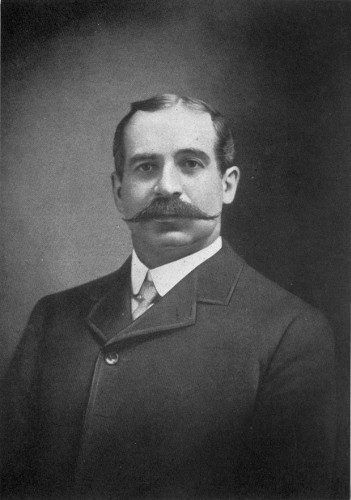
ISAIE PREFONTAINE
His wide research and investigation enable him to speak with authority upon many questions bearing upon the business condition of the city and its possibilities for progress along industrial and commercial lines. He is an idealist, whose methods are practical, and is a man of action rather than of theory.
In 1883 he married Miss Eliza Pigeon, a daughter of Olivier Pigeon, of Vercheres, Quebec. He belongs to both the Club St. Denis and the Canadian Club and in the city has a wide and favorable acquaintance. The Montreal Herald has termed him “a man of capacity and high character.”
FRANCIS WAYLAND CAMPBELL, M. D.
Dr. Francis Wayland Campbell, practitioner, educator and editor of medical journals, winning distinction along each line, was born in Montreal on the 5th of November, 1837, a son of the late Rollo Campbell, at one time publisher of the Montreal Daily Pilot and a native of Perthshire, Scotland. Dr. Campbell’s more specifically literary education was obtained at Dutton Academy and the Baptist College, and in preparation for a professional career he studied medicine in McGill University, from which he was graduated with the M. D. degree in 1860. He at once located for practice in his native city, where he continued until his death. After the completion of his course at McGill he spent some time in study abroad, investigating the methods and watching the clinics of eminent physicians and surgeons of London, Dublin, Edinburgh and Glasgow. In 1861 he passed with high rank an examination before the Royal College of Physicians of London.
In October, 1861, Dr. Campbell married Miss Agnes Stuart Rodger, of Greenock, Scotland, and in November returned with his bride to Canada, opening an office for practice in Montreal. Success came to him almost immediately because his equipment was good and because of his recognition of and marked devotion to the duties of the profession. He was offered the editorship of the hospital report department of the British-American Journal, accepted it and continued to serve in that connection until 1864, when the publication of the paper ceased. The Canada Medical Journal was soon afterward started and Dr. Campbell joined Dr. Fenwick in its editorial management, being thus associated from 1864 until 1872. In the meantime he had joined the medical faculty of Bishop’s College, whereupon Dr. Fenwick declined to associate with him any longer in the publication of the Canada Medical Journal. The result was the discontinuance of that paper. Dr. Campbell decided to contest the field with Dr. Fenwick, who began issuing the paper independently, the Campbell publication being known as the Canada Medical Record, of which he remained editor and proprietor until his demise. In 1872 Dr. Campbell joined Drs. David, Smallwood, Hingston and Trenholme in organizing the medical faculty of Bishop’s College, after which he was appointed professor of physiology and was elected by the faculty as their registrar. His writings were considered a valuable contribution to the literature of the profession and his publications were liberally patronized by those holding to the highest professional standards.
Dr. Campbell was a member of the volunteer militia from 1854 and in 1860 was appointed assistant surgeon of the First Battalion, Volunteer Rifles of Canada, now the First Battalion. He served with his regiment on the eastern frontier, being at Hemingford and at Durham during the Fenian raid in 1866. In the fall of that year he was promoted to the rank of surgeon of the regiment and again during the brief Fenian raid of 1871 was with his command at Pigeon Hill, at St. Armands and St. Johns. After being for a great many years surgeon of the Prince of Wales Rifles he was appointed, on the formation of the Regular Canadian Militia, to the office of surgeon of the Infantry School Corps at St. Johns, Province of Quebec, and held the position for nineteen years, being then retired at the age limit with the rank of surgeon lieutenant colonel. At that time the regiments were known and still are as the Royal Regiments Canadian Infantry. In 1894 he established the V. R. I. Magazine and became its first editor. Lennoxville conferred upon him the honorary degree of D. C. L. in 1895. Two years later his son, Dr. Rollo Campbell, was appointed demonstrator of anatomy in Bishop’s College. Another matter of interest and importance in the life record of Dr. Campbell was that he held for forty-three years the position of chief medical examiner for the New York Life Insurance Company at Montreal and his son, Dr. Rollo Campbell, was his assistant. He was honorary president of the Military Institute for several years and was one of the founders of the Western Hospital of Montreal. He was called the father of that institution and two years ago the hospital placed a very handsome bronze tablet to his memory in the institution. At the time of his death he was dean of the medical faculty of Bishop’s College at Montreal. His degrees were M. A., M. D. and L. R. C. P. of London. Honor and distinction came to him in many ways, and at all times he bore his honors with becoming modesty.
Dr. Campbell was a liberal conservative in politics. He belonged to the Montreal Military Institute and was a past master of the Victoria Lodge of Masons. Of scholarly attainments, finding keen pleasure in scientific research and actuated, too, by a broad humanitarian spirit, his professional service as practitioner, educator and writer was of marked value to the public and constituted a notable contribution to the world’s work in the field of medical and surgical progress.
CLEOPHAS EDWARD LECLERC.
Cleophas Edward Leclerc, who for fifteen years was a member of the board of notaries of Quebec, his home being in Montreal, his native city, was born September 26, 1844. Almost his entire life was passed in Montreal, where he supplemented his early education by a classical course in the College of Ste. Therese de Blainville in the district of Terrebonne. Having determined to become a notary public, he entered upon his professional studies under the direction of Mr. F. Des Bastien, registrar of the county of Vaudreuil, and was admitted to practice on the 15th of October, 1866. For fifteen years he was a member of the Quebec board of notaries and for three years was its vice president. He stood high in his profession, and the clientage afforded him came in recognition of his superior ability.
On the 16th of November, 1875, Mr. Leclerc was married to Miss Caroline Eliza Archambault of St. Hyacinthe, and they became the parents of six children: Robertine; Rene, who is managing director of the Credit-Canada, Limited; Achille; Alice, the wife of Arthur Hubour, who is engaged in the drug business at the corner of Demontigny and St. Denis Streets; Ovide; and Rita. Death came to Mr. Leclerc at his home at No. 655 St. Hubert Street on the 23d of November, 1912, when he was sixty-eight years of age. He was a man of fine personal appearance, his broad forehead indicating strong native intelligence. He was of dignified appearance and mien and looked at life from the standpoint of one who recognized its obligations and duties as well as its privileges and opportunities. He had an extensive circle of friends so that his death was deeply regretted by many outside his own household.
GEORGE CAVERHILL.
Prominent on the roll of leading business men of Montreal stands the name of George Caverhill, a merchant who for an extended period has been connected with commercial life and figures prominently in connection with corporate interests having to do with the business enterprise and consequent prosperous development of the city. He was born October 18, 1858, at Beauharnois, P. Q., and is of Scotch descent. His parents were Thomas and Elizabeth Spiers (Buchanan) Caverhill, the latter a representative of the Buchanan family of Lenny, while the former was a member of the border family of Caverhills, residents of Scotland from 1200.
In the attainment of his education George Caverhill attended successively the Montreal high school, the Galt Collegiate Institute and McGill University. From the outset of his business career he has been connected with mercantile interests. In 1877 he entered the employ of Crathern & Caverhill, of Montreal, and, later ambitious to engage in business on his own account, utilized the opportunities of becoming a partner in a wholesale hardware firm, his partners being his brother, the late Frank Caverhill, J. B. Learmont and T. H. Newman. The four organized the firm of Caverhill, Learmont & Company, wholesale hardware merchants of both Montreal and Winnipeg. This by no means indicates the scope of his investments and his activities. That he is today one of the most important business men of the province is indicated in the fact that he is vice president of the Montreal Loan & Mortgage Company, a director of the Dominion Iron & Steel Company, Canadian Cottons, Ltd., Montreal Trust Company, Montreal Light, Heat & Power Company, and is identified with a number of organizations to promote trade and business relations. In 1904 he was chosen president of the Montreal Metal & Hardware Association, was made first vice president of the Montreal Board of Trade in 1906 and its president in 1907.
In 1887 Mr. Caverhill was married to Miss Emily Margaret, daughter of John Caverhill. She takes active interest in philanthropical and charitable work and is a member of the general committee of the Victorian Order of Nurses. Together with her husband, she is a life governor of the Protestant Hospital for the Insane. Both Mr. and Mrs. Caverhill were presented to the late King Edward at Windsor Castle in June, 1905.
In addition to his previously mentioned activities, Mr. Caverhill is a governor of the Montreal General Hospital, and is a life member of St. Andrew’s Society of Montreal. He has a great love of animals and has won fully two hundred and sixty prizes with his kennel of skye terriers. Mr. Caverhill’s political allegiance is given to the liberal party, and in 1911 he opposed the Taft-Fielding reciprocity compact. Prominent in club circles, he holds membership with the Mount Royal, St. James, Canada, Canadian, Forest and Stream, Lachine Boating and Canoe, Montreal Hunt, Montreal Jockey, Montreal Polo, Reform, Royal Montreal Golf and Royal St. Lawrence Yacht Clubs, all of Montreal. He is a man of liberal culture and broad general information, having largely promoted his knowledge through extended travel in the East Indies, South America, Japan, Egypt, Greece and Italy. His opinions carry weight on all questions in which he has become deeply interested, and his interest in any plan or project is ever the source of activity in its support.
LOUIS JOSEPH ARTHUR SURVEYER.
Louis Joseph Arthur Surveyer, one of the best known business men of Montreal, his ability and enterprise finding exemplification in his substantial success, was born May 16, 1841, in the town of Beauharnois, in the province of Quebec. His father was Dr. Joseph Surveyer, a well known physician of Beauharnois and surrounding parishes, and his mother bore the maiden name of Eugenie Duclos Decelles.
L. J. A. Surveyer was educated at St. Laurent College and entered upon his business career as a clerk in a general store in St. Johns, P. Q. After eighteen months he came to Montreal and entered the retail hardware store of Messrs. Ferrier & Company on Notre Dame Street. After nine months’ service in the employ of that firm they sold their business and Mr. Surveyer entered the employ of Mr. Thomas Davidson in his retail store, continuing in that employ for seven years. He was ambitious to engage in business on his own account and so wisely used his time and talent that he was now able with a capital of six hundred dollars to open a store of his own. His venture proved successful from the beginning and has been developed and built up to its present extensive proportions so that Mr. Surveyer is now ranked with the leading business men of the city.
In 1868 Mr. Surveyer married Miss Amelie Pelletier, who died thirteen months later. In 1873 he married Miss M. A. Hectorine Fabre, a daughter of the late E. R. Fabre, and the youngest sister of the late Archbishop Fabre. Of this union there were born eight children, seven of whom are living, as follows: Edward Fabre, a lawyer in Montreal, of whom there is further mention in this work; Eugenie, now Mrs. N. K. Laflamme of Montreal; Arthur, of Surveyer & Frigon, consulting engineers; Paul, a lawyer in Montreal; Gustave, of Montreal; Marie; and Therese, now Mrs. Jules Faurnier of Montreal. Mr. Surveyer is a member of the Canadian Club and of the Alliance Nationale. There is found in his life history the strong proof of the fact that the road to opportunity is open to ambition and energy, and that it leads to the goal of success.
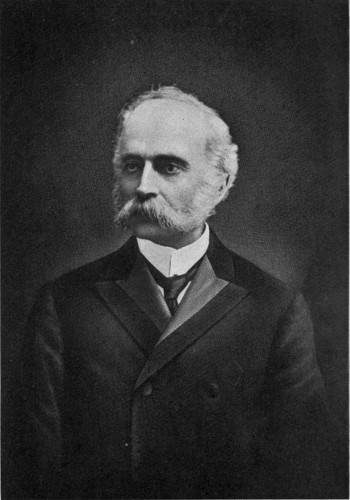
LOUIS J. A. SURVEYER
NORVAL DICKSON.
Norval Dickson, practicing as a notary in Montreal in partnership with R. B. Hutcheson, and controlling an important, representative and growing clientage, was born in Howick, Quebec, in 1878 and is a son of Robert Dickson who came to Canada from Edinburgh, Scotland, in 1830.
Norval Dickson acquired his preliminary education in Huntingdon Academy, Huntingdon, Quebec, and afterwards entered McGill University in Montreal, receiving his Bachelor of Arts degree in 1901 and his degree in law in 1904. Immediately afterward he began practice in Montreal, continuing alone until May, 1910, when he formed a partnership with R. B. Hutcheson under the firm name of Hutcheson & Dickson. Mr. Dickson has proved an important and helpful factor in the success of the firm, for he possesses a deep and comprehensive knowledge of the underlying principles of his profession and has a well deserved reputation as a reliable and competent notary. The firm controls a growing and extensive patronage and has a high standing in legal circles of the city.
REV. ABRAHAM DE SOLA, LL. D.
Rev. Abraham de Sola, LL. D., who for many years was so familiar a figure in literary circles in Montreal and who earned so wide and deserved a reputation as an Oriental scholar and theologian, was a descendent of an illustrious Spanish-Jewish family. The marvelous history of Israel must ever be of peculiar interest to mankind, and perhaps no chapter in the post-biblical portion of that history possesses more charm than that which relates about the Jews of Spain and Portugal, or Sephardim, as they are styled. These lived free and untrammeled during those mediæval times when their brethren in less favored countries were weighed down by the burden of oppression, and with the Saracens they kept alive the flame of learning and science in the Iberian peninsula at a time when it burnt lowest in the rest of Europe. Power, rank and honor were theirs; and when afterwards clouds obscured the sky of their prosperity, and the storm of persecution burst pitilessly over their heads, their record of heroic martyrdom and thrilling adventure is a tale as fascinating as that of many of the most imaginative pages of fiction.
Among the many bright names which illumined Spanish-Jewish history, that of De Sola stands prominent. The De Solas had settled in Andalusia as early as the sixth century, whence they had come from Judea by gradual stages through northern Africa. They held various offices under the Saracenic caliphs at Toledo and Cordova, and afterwards when they removed to Navarre they were received with like favor by the Gothic princes. From their estate in this province, their surname had its origin. A particularly distinguished member of the family was Don Bartolomeu de Sola, who, in reward for his services, was ennobled and, after being a minister of state, held for a while the position of viceroy of Navarre.
During the fourteenth century another De Sola distinguished himself fighting under the Infante of Aragon and figured conspicuously in the Spanish wars of that period. During the succeeding centuries the family continued to hold an illustrious place, owing to the large number of eminent scholars, physicians and statesmen it produced. Their fortunes, however, changed when King Ferdinand, having by the conquest of Granada destroyed the last vestige of Moorish power in Spain, decided to drive therefrom all who did not conform to the dominant faith; and in 1492 was promulgated the terrible edict of expulsion, which, at one blow, deprived hundreds of thousands of Spain’s most intelligent and industrious inhabitants of happy and prosperous homes. The De Solas took refuge in Holland, but a branch of the family continued to hold business connections with Lisbon, and eventually some of them settled in the Portuguese capital, where they amassed much wealth. Watched by the Inquisition, they, like many other Portuguese Jews, for some time evaded the danger by assuming to become Marannos or Nuevos Christianos—as converted Jews were styled—while they secretly remained loyal to Judaism. In the latter part of the seventeenth century, however, suspicion was directed towards them, and David de Sola (who to elude his persecutors had assumed the name of Bartolome) was apprehended and charged with having relapsed into Judaism. Although placed under the most fearful torture nothing seems to have been proved, as he was allowed to afterwards go free; but he was physically broken down by his terrible sufferings. Escape from the country by a suspect was then extremely difficult, but in the next generation his son, Aaron de Sola, managed to secure refuge on board a British man-of-war and to make good his escape with his family to England; not, however, before two of his relatives had been imprisoned, tortured and condemned to death at an auto-da-fé, by the Inquisition, for secret adherence to Judaism.
It was in 1749 that Aaron de Sola fled with his wife and family to England, and now that they were freed from the terrors of the Inquisition they openly avowed once more their loyalty to the faith of their fathers. From England they took passage for Holland, where they rejoined their relatives, and taking up their residence in Amsterdam they soon again rose to distinction in the various learned professions.
Previously to this—in the year 1690—one of the preceding generation, Isaac de Sola, had settled in London and had acquired a high reputation in the Hebrew community there as an eloquent preacher and author. Several volumes of his works are still extant.
Four sons had accompanied Aaron de Sola in his flight from Lisbon in 1749, of whom the eldest, David, was the great-grandfather of the Dr. Abraham de Sola who forms the chief subject of this sketch. The youngest of Aaron de Sola’s, sons, Dr. Benjamin de Sola, attained to a foremost place among the practitioners of the eighteenth century. He was court physician to William V of the Netherlands and was the author of a large number of medical works. The other two sons of Aaron de Sola settled in Curacao, and one of them was the grandfather of General Juan de Sola, who became so distinguished as a commander of cavalry under Bolivar and Paez when the South American states revolted from Spain. He took part in the decisive battle of Carabobo, and led the charge on Puerto Cabello when that city was stormed by Paez, receiving a sabre wound during the fight. After the restoration of peace he held important public offices during the Paez regime.
The Rev. Abraham de Sola, LL. D., was born in London, England, on the 18th of September, 1825. His father, David Aaron de Sola, was senior minister of the Portuguese Jews of London, to which city he had been called from Amsterdam, and was eminent as a Hebrew author, having produced among many other works an elegant translation of the Jewish Forms of Prayer; also, in conjunction with Dr. Raphael, an edition of Genesis, very valuable to biblical students on account of its commentaries and copious notes, and the first English translation of Eighteen Treatises of the Mishna. His mother was the daughter of Dr. Raphael Meldola, chief rabbi of the Spanish-Jewish congregations of Britain. The Meldolas had given eminent chief rabbis to Europe for twelve generations. Abraham de Sola received careful tuition in all the usual branches of a liberal education. He became early engrossed in the study of Oriental languages and literature and of theology, and continued to devote his attention to those subjects until he acquired that profound knowledge of them which subsequently won him so prominent a place among scholars. Having been offered the position of rabbi of the Spanish and Portuguese Jewish Congregation of Montreal he accepted the call and arrived in this city in the beginning of 1847, and here, for over thirty-five years, he continued to minister to the spiritual wants of his people. His able pulpit discourses soon attracted attention. Dr. de Sola’s abilities, however, were not destined to be confined exclusively to his official duties. Before leaving London he had been associated in the editorial work of a Hebrew journal, The Voice of Jacob, and soon after his arrival in Canada he delivered a course of lectures on Jewish history before the Mercantile Literary Association. In 1848 he published his “Notes on the Jews of Persia under Mohammed Shah,” and also “A History of the Jews of Persia.” Within the same year there appeared his important work on “Scripture Zoology.” Soon afterwards he published his “Lectures on the Mosaic Cosmogony.” This was followed by his “Cosmography of Peritsol,” a work displaying such erudition that it gained a wide circulation in Europe and was reprinted there in several languages. His next work, “A Commentary upon Samuel Hannagid’s Introduction to the Talmud,” was a book which deservedly attracted much attention, owing to the light which it threw upon an interesting portion of rabbinical literature and to its depth of Talmudic knowledge. In 1853 he published, conjointly with the Rev. J. J. Lyons, of New York, a work on the Jewish Calendar System, chiefly valuable on account of its excellent prefatory treatise upon the Jewish system of calculating time.
Dr. de Sola’s mastery of Semitic languages and literature early attracted the notice of our learned bodies, and, after first acting as lecturer, he was, in 1853, appointed professor of Hebrew and Oriental literature at McGill University. The high abilities which he displayed as occupant of this chair proved the wisdom of the appointment, and he continued to hold the position during the rest of his life.
For some time Dr. de Sola had been engaged in the preparation of one of his most important productions, “The Sanatory Institutions of the Hebrews.” The work was published in two parts and was an exhaustive exposition of the hygienic laws of the Hebrews, as exhibited in both Scriptural and rabbinical writings, critically examined in the light of modern scientific knowledge. It was a production which evinced how deeply the author had penetrated into scientific as well as rabbinical paths of learning. Shortly afterwards he published a supplemental work to it, entitled “Behemoth Hatemeoth.”
The prominence to which Dr. de Sola had now reached among men of letters led McGill University to confer upon him the degree of LL. D. in 1858.
In 1860, Dr. Hall, the editor of The British American Journal, devoted to physical and medical science, induced Dr. de Sola to assist that publication with his pen, and, among other contributions, his series of articles “Upon the Employment of Anaesthetics in Cases of Labor, in Connection with Jewish Law,” call for particular mention.
Dr. de Sola’s wide range of studies had made him very popular both as a public lecturer and as a contributor to various literary papers. The themes of some of these were afterwards much amplified by him and republished in their elaborated and completed form. At comparatively short intervals he gave to the public his works on “Scripture Botany,” “Sinaitic Inscriptions,” “Hebrew Numismatics,” “The Ancient Hebrews as Promoters of the Arts and Sciences,” “The Rise and Progress of the Great Hebrew Colleges,” and “Philological Studies in Hebrew and the Aramaic Languages.” Turning his attention again to Jewish history, he, in 1869, wrote his interesting “Life of Shabethai Tsevi, the False Messiah.” The following year he completed his “History of the Jews of Poland,” and in 1871 he published his “History of the Jews of France.”
Dr. de Sola closely identified himself with many of our literary and scientific associations, notably with the Natural History Society, in which he was an active colaborer of Sir William Dawson and Sir William Logan. He was for many years president of the society and received H. R. H. Prince Arthur (afterwards Duke of Connaught) when that prince visited the society in 1870. His address upon “The Study of Natural Science,” delivered upon that occasion, called forth a letter of approbation from Queen Victoria.
During all his intense literary activity Dr. de Sola was taking a very prominent part in all matters affecting the Jewish people. His mastery of Jewish theology, in all its branches, had earned him wide renown among his own race and had gained him a high place among the very foremost rabbis of the day. Convinced that the fences which orthodoxy placed around the citadel of his ancestral faith were the best safeguards against disintegrating forces, the upholders of historical Judaism found in him an able and powerful champion. Equally noticeable were his bold attacks upon the weak points of the skeptical school of modern biblical criticism. His intimate knowledge of all those branches of learning which bear upon this subject made him particularly formidable in this respect. The Jewish press and pulpit and the lecture platform were the vehicles by which he usually reached the public on these subjects. He had, indeed, since his first arrival in Canada been a particularly active contributor to Jewish journals, more especially to the Occident of Philadelphia, with which he was for years identified, being in intimate literary relations with its editor, the gifted Isaac Leeser.
Dr. de Sola’s ability in the pulpit led to his frequently being invited to lecture in the United States, where he had acquired much prominence and popularity. On the 9th of January, 1872, he was invited by General Grant’s government to perform the ceremony of opening the United States congress with prayer, and for the first time was witnessed the unique spectacle of one who was not a citizen of the United States nor of the dominant belief officiating at the opening ceremonies at the assembling of congress at Washington. The broad liberality of this act, upon the part of the United States government, was fraught with particular significance at that time, owing to the fact that diplomatic relations between Britain and the United States had then but lately been strained to dangerous tension by the “Alabama Claims,” and this high compliment to a British subject was the first evidence of the growth of a better feeling between the two countries. Sir Edward Thornton, the British ambassador at Washington, formally extended to Dr. de Sola the thanks of the British government, and Mr. Gladstone—then prime minister, also personally communicated his satisfaction.
Upon the death of Isaac Leeser, Dr. de Sola purchased the stereotyped plates of his works and issued a new edition of that author’s translation of the Bible according to Jewish authorities. He also brought out a revised translation of the Jewish Forms of Prayer, in six volumes, based upon the editions of D. A. de Sola (his father) and of Leeser. He was invited to become the successor of Mr. Leeser in his ministerial office but declined. He had previously refused several similar offers.
Dr. de Sola’s onerous duties were at this time further increased by his being offered the chair of Hebrew at the Montreal Presbyterian College, and later on he accepted the appointment of lecturer in Spanish literature at McGill University, a literature and language with which he was specially familiar and to which he was particularly attached.
But such incessant application to work could not but prove exhaustive, and his naturally vigorous health broke down under the strain. A year’s rest, spent in Europe, proved sufficiently beneficial to enable him to return to some of his duties. For a while he also resumed his contributions to the Jewish press, and among other interesting writings we notice his “Yehuda Alcharizi and the Book Tachkemoni.” In 1880 he published his last important work, “Saadia Ha-Gaon,” a book giving a very valuable description of the writings and life of one of the greatest of Jewish philosophers and also containing an interesting account of the court of a prince of the captivity.
But failing health was destined now to check forever the labors of his active pen, and while in New York, on a visit to his sister, he was taken ill and his death occurred on June 5, 1882. The remains were brought on to Montreal and there interred. He had not yet completed his fifty-seventh year when he passed away.
In his death the Hebrew community sustained a loss whose magnitude could scarcely be overestimated. His self-sacrificing devotion to the service of his race, his ceaseless labor in everything which could elevate and promote both their moral and intellectual welfare, his quick readiness to assuage, with kind counsel and help, the lot of those in adversity, and the rare talents which he had displayed in his multifarious writings, had won for him the warmest admiration and attachment of his people and had gained him a reputation among them that was world-wide. His loss, indeed, was scarcely less regretted by Gentile than by Jew, for the prominence which his scholarly attainments had acquired for him among Canadian litterateurs, the active role which he had for thirty-five years played in our various learned bodies, and the distinguished position which he held in our leading university, achieved for him an illustrious place among Canada’s public men.
Dr. de Sola was married in 1852 to Esther Joseph, the youngest daughter of Henry Joseph, of Berthier, one of the earliest Jewish settlers in this country. Of his several children, the eldest son, the Rev. Meldola de Sola, succeeded him as rabbi of the Spanish and Portuguese Synagogue of Montreal, and another son, Clarence I. de Sola, is general manager of the Belgian syndicate, “Comptoir Belgo-Canadien.”
ROBERT MEIGHEN.
The history of Canada’s great industrial and commercial growth during the past thirty or forty years is but the history of such men as Robert Meighen one of the foremost business men of his generation, whose intense and intelligently directed activity constituted a potent force in the material development and progress of not only the city and province of his adoption but various other sections of the Dominion as well. His birth occurred at Dungiven, near Londonderry, Ireland, April 18, 1838, his parents being Robert and Mary (McLeghan) Meighen, whose family numbered five children. The family history shows a long line of Irish ancestors.
Robert Meighen was educated at Perth, Ontario, for following the father’s death the mother brought her family to the new world, settling at Perth, where her sons were educated and established themselves in business as retail and wholesale merchants. The firm of A. Meighen & Brothers has for many years been one of the most extensive mercantile firms doing business in the old Bathurst district. Robert Meighen carried on business in partnership with his brother at Perth, Ontario, until 1879, when he removed to Montreal and entered into business relations with his brother-in-law, Sir George Stephen, later Lord Mount Stephen, whom he succeeded as president of the New Brunswick Railway, which now forms part of the Canadian Pacific Railway system. Successful from the outset of his business career, Mr. Meighen continually extended his efforts into other fields. He became one of the founders of the Lake of the Woods Milling Company, establishing and operating mills and elevators at Keewatin and Portage la Prairie, which are among the largest and best equipped in the world. Shortly after the organization of this company Robert Meighen became its president, which position he retained till the time of his death, directing its policy and formulating the plans upon which the mammoth business was constructed. This represented, however, but one phase of his activity. He carried his efforts into many fields, none of them failing to profit by his cooperation.
ROBERT MEIGHEN
“The Gazette,” at the time of Mr. Meighen’s death, said in part: “Mr. Meighen was a self-made man and was proud to designate himself as such. From the day he entered business pursuits at Perth, many years ago, down to the time he became a director of the Canadian Pacific Railway, an institution he had championed from its inception, in commerce, in finance and in imperial politics, Robert Meighen was never at home except on the firing line. Although the fact is only perhaps known to the newspaper fraternity and to some of the leaders of tariff reform in England, he advocated closer relations between the mother country and the outlying dependencies of the empire even before Mr. Chamberlain took the platform in England as the champion of such a policy.
“Mr. Meighen was known in eastern Ontario as a clever business man, a follower of Sir John A. Macdonald, and as a man who had ideas and could fearlessly express them on the stump and at the fireside, many years before he came to Montreal. It was ere his removal to this city that he had secured, most successfully, the right of way for the Ontario & Quebec Railway, now the Montreal & Toronto section of the Canadian Pacific, and later on he was entrusted with the promotion of a bill which was of the utmost importance to that railway. Mr. Meighen was not a member of parliament, but he stated his case to the members outside and in the lobbies of the house with such forcefulness, such clarity of view and in so straightforward a manner that few could withstand his cogent arguments. It was a tribute to his power that Sir Richard Cartwright’s denunciation of him was quite as vehement as the thunderbolts which the chief antagonist of the great railway project used to launch against Sir John Macdonald, Sir Charles Tupper and the other parliamentary giants of the day.
“Mr. Meighen believed not only in the Canadian Pacific project itself, but also in the ultimate value of the great tracts of land lying for a thousand miles along to the north of where the line was being run away up to the Saskatchewan, and, if he died a rich man, it was due to abiding faith in the future of Canada’s western domain and in the ultimate development of the Dominion as a whole. It was in reply to a jocular observation from Mr. Choate, the then American ambassador at the court of St. James, who had asked Mr. Meighen when Canada was going to throw in her lot with the United States, that the Montreal imperialist declared that it was customary for the larger unit to absorb the smaller, and no doubt at her pleasure Canada would follow the established precedent.
“A good many shrewd Montreal merchants smiled when Mr. Meighen came from a small Ontario town to this city as the promoter of a great industry, but many months had not passed before they discovered that both in commerce and finance a rival worthy of their keenest steel had taken his place amongst them and ever after, when any important subject was up for discussion on the floors of the Board of Trade, the opinions of the man from Perth, uttered with characteristic Irish eloquence and wit, invariably commanded respect and attention. His fellow members did not always agree with him, but they were always ready to admit that he was sincere and that he spoke the truth as he felt it.
“Returning from England some years ago, when everything spelt unrest in industrial Britain, Mr. Meighen gave an interview to The Gazette which has perhaps been quoted more frequently by politicians on both continents, as well as by Canadian public men of all parties, than any other of his utterances. Mr. Meighen, who was always a great reader, declared that England at that time could only be compared to Athens when Diogenes, the Greek philosopher, went out with his lantern looking, as he said, for a man. He said, however, in the course of that interview, that the man would be found, and sure enough it was not long before Joseph Chamberlain was entering upon his whirlwind campaign in favor of imperial preference and the absolute unity of the British empire. Mr. Meighen was denounced more than once at the Montreal Board of Trade, but a good many of the men who came to scoff remained to pray, to use Mr. Meighen’s own graphic language. Three years ago, when a resolution was to be introduced before the Montreal Board of Trade on the policy of imperial preferential trade, Mr. Meighen was particularly anxious that it should be fathered by a leader in commerce and finance. He prepared the resolution, called upon the late Sir George Drummond, president of the Bank of Montreal and universally admitted to be the first authority on matters of trade and finance in the Dominion, asking him to move it. Sir George Drummond’s answer was characteristic of the man. ‘Mr. Meighen,’ he replied, ‘this resolution meets my views exactly, but the honor of moving it belongs to you and you alone and I will take a second place. You will move the resolution and I will be only too happy to second it.’ Mr. Meighen delivered a masterly address on that occasion and the resolution was carried.
“His greatest energy was centered in the development of the company over which he presided up to the hour of his death, yet he stated not very long ago that he was shaping things in such a manner as would permit younger men to assume the responsibilities of management and that after the million-dollar bond issue had been retired he would then feel that he could take a rest.
“The late president of the Lake of the Woods Company was from the outset an uncompromising opponent of the Washington reciprocity pact and he did not hesitate to state on every offered occasion that the ratification of such a treaty would be a severe blow aimed at the unity of the empire, and a decided mistake in the widest interests.
“He was the confidential friend and associate in various business enterprises of both Lord Mount Stephen and Lord Strathcona. These eminent men had implicit confidence in Mr. Meighen’s business judgment, and as a matter of fact many other men high up in imperial statecraft came to him for advice on both Canadian and British trade matters. Indeed, some of the best speeches delivered on the unionist side during the last two British elections drew their information from, and were in part, inspired by the ideas of this foremost, perhaps, of Canadian tariff reformers.”
The same paper said editorially: “A worthy and widely respected citizen was lost to Montreal by the death yesterday morning of Mr. Robert Meighen. In business he won marked success. He helped in no small way to show the great possibilities of the milling trade of Canada and so profited the country as well as himself and his associates. He judiciously employed the wealth that came to him and greatly increased his store. The largest business enterprises sought his counsel on their directorates and profited by his connection with them. He was a man of ideas in matters outside of commerce, and held and advocated views about the country and the empire with vigor and courage and the broadest loyalty. In private life his sincerity, earnestness and kindliness caused all men to give him their regard. In his capacity as merchant, citizen and man he rose to high stature; and at a ripe old age closed a worthy career, leaving a memory that is a help to what is good and creditable in business life.”
Among his business connections, not already mentioned, Mr. Meighen was managing director of the Cornwall Manufacturing Company, a director of the Canada Northwest Land Company, the Bank of Toronto, the Dominion Transportation Company, the St. John Bridge & Railway Company, the Montreal Street Railway and the New Brunswick Land Company. His activities likewise extended to other fields having to do with many subjects of vital interest to city and country. He was a director of the Montreal Parks and Playground Association and was president of the New Brunswick Fish and Game Club. He was likewise vice president of the King Edward Memorial Committee of Montreal, was chairman of the Canadian board of the Phoenix Assurance Company and was a governor of the Royal Victoria, the Western and Maternity Hospitals of Montreal. The Montreal Standard named him as one of the twenty-three men at the basis of Canadian finance, and it was a recognized fact that few men were more familiar with the problems of finance or did more to establish a safe monetary system. Mr. Meighen belonged to various prominent social organizations, including the St. James Club, the Mount Royal Club, the Canada Club and the Montreal Club.
He was a Presbyterian, a member of St. Paul’s church and chairman of its board of trustees. All his life Mr. Meighen was a firm believer in the copartnership of capital and labor and in the coexisting duties, on a fair basis, of one to the other. He realized and carried out the idea of their inter-dependency. When labor had contributed to the success of capital he never allowed it go without recognition and its just reward, with the result of absolute confidence on the part of his employes in his fairness and regard for their interests, and a willingness to give, in turn, their loyal and honest support to capital. Above all Mr. Meighen had keen human sympathies. He delighted in the energetic young man cutting out his road to success, but this did not prevent him from having patience and sympathy with those who, perhaps through lack of natural gifts or unfortunate circumstances, found life an uphill pull. In astonishing numbers both kinds of men seemed to bring their successes and their failures to him, and to both, provided they showed honesty of purpose, he would give his time, his advice and his help in the open-hearted way characteristic of a man who had not a single ungenerous impulse in his nature.
At the time of his death when the press throughout Canada was giving appreciations of his ability and of his success one of his intimate friends remarked, “They have omitted the biggest thing about him—his heart”—and so it was. When these two, great heart and much ability, go hand in hand and work together, one vitalizing, as it were, the conceptions of the other, a potent force is felt to be abroad. Well is it for our Canadian business world to have had such a force in its midst as the late Robert Meighen truly was. He died when still, one might say, at the height of his activities and with a heavy burden of work upon him, but to work was his pleasure. His loss was deeply deplored by all who knew him and he left behind him a record of a man who in all things was the soul of honor and an example to those who come after—“Follow on.”
Mr. Meighen left a widow, Elsie Stephen, daughter of the late William Stephen, formerly of Dufftown, Scotland, and three children, Lieutenant Colonel F. S. Meighen, who has succeeded his father as president of the Lake of the Woods Milling Company, Mrs. R. Wilson Reford and Mrs. R. O. Harley.
WILLIAM ERNEST BOLTON.
Twenty years’ connection with the real-estate business has brought William Ernest Bolton into prominence and today he figures as a controlling factor in some of the leading real-estate companies of Montreal. He was born in this city April 11, 1873, a son of Richard and Elizabeth (Minchin) Bolton. His education was acquired in the schools of his native city, and early in his business career he became identified with real-estate activity in which connection he has remained for many years as a well known and successful real-estate broker. He has been identified with many important property transfers and with important development of real-estate interests. He is now a director of the Montreal Loan & Mortgage Company; president of the Birmingham-Montreal Realty Company, Limited; a director of the Midland Investment Company, Limited; of the Richelieu Realty Company, Limited; of the Renforth Realty Company, Limited, and of the Riviera Realty Company, Limited. These are among the most important corporations in that branch of business having to do with the property interests and consequent development and progress of the city.
In Plainfield, New Jersey, in 1905, Mr. Bolton was united in marriage to Miss Catherine Hamilton McClure and they have become the parents of two sons, Richard and Hamilton. Mr. Bolton votes with the conservative party but the honors and emoluments of public office have no attraction for him. When business leaves him leisure for social enjoyment he spends his time at the Montreal Club, the Beaconsfield Golf Club, the Winter Club, the Montreal Country Club and the Montreal Amateur Athletic Association, in all of which he holds membership.
THORNTON DAVIDSON.
Foremost among the younger generation of business men in Montreal and one who had attained a high standing in the financial circles of the city, was Thornton Davidson, whose untimely death in the sinking of the steamship Titanic, April 15, 1912, ended a career that had not only been successful, but gave great promise for the future.
Thornton Davidson was a native of Montreal, and was born on the 17th of May, 1880. His father was the Hon. C. Peers Davidson, D. C. L., a distinguished jurist, and his mother Alice Mattice, second daughter of William Mattice of Cornwall, Ontario. Reared in Montreal, Thornton Davidson attended the city schools, graduating from high school. Throughout his active business career he was connected with financial interests, later becoming manager of the Montreal branch of the New York house of Charles Head & Company.
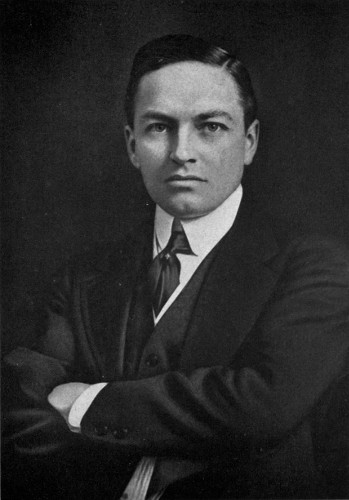
THORNTON DAVIDSON
In 1908 he established the firm of Thornton Davidson & Company which soon took a prominent position among the leading brokerage and investment security houses in the city. In 1909 Mr. Davidson became a member of the Montreal Stock Exchange. His thorough capability and great energy were factors in the success of the business which he established and of which he remained the head until his death. His personal popularity made him a valued member of the club life of the city, where he held membership in the St. James, Racquet, Montreal Hunt, Montreal Jockey, Montreal Polo, Royal St. Lawrence Yacht, Manitou and Canada Clubs, and also in Montreal Amateur Athletic Association.
On November 3, 1906, in Montreal, Mr. Davidson was married to Miss Orian Hays, daughter of Charles Melville Hays. Returning from Europe in company with his wife and the latter’s parents, Mr. and Mrs. Charles M. Hays, on the ill-fated Titanic, Mr. Davidson was among those brave men who on April 15, 1912, gave precedence to women and children and went down with the ship. Such an act is just what his friends would have expected of Thornton Davidson in such an emergency. His associates knew him as a capable business man and a most genial companion, but they recognized in him also the strength of character which manifests itself in the highest type of manhood when a crisis arises.
WILLIAM FAWCETT HAMILTON, M. D.
Important professional connections indicate the high standing of Dr. William Fawcett Hamilton of Montreal, who, in addition to an extensive private practice has done much hospital work. He is a son of Gustavus W. and Eleanor (Goodwin) Hamilton, and was born in Baie Verte, New Brunswick. His early education was acquired in the schools of his native town and in Upper Sackville and then, having determined upon the practice of medicine as a life work, he entered McGill University of Montreal, from which he was graduated with the class of 1891, receiving the degrees of M. D. and C. M. He has now successfully practiced his profession in this city for more than two decades and has advanced steadily to a place of prominence as a representative of the medical profession. From 1891 until 1894 he was medical superintendent of the Montreal General Hospital and in the latter year became assistant physician of the Royal Victoria Hospital, and upon the death of Dr. James Stewart, in 1906, he was appointed attending physician of that institution. He has proven himself a man of ability and public opinion has accorded him rank with the eminent physicians of the city. He is now associate professor of clinical medicine at McGill University and as an instructor displays capability in imparting readily, clearly, concisely and forcibly to others the knowledge that he has acquired. In 1909 he was elected a member of the Board of Victorian Order of Nurses, and he is a member of the Association of American Physicians and vice president of the Montreal Medico-Chirurgical Society. Through these connections he keeps in close touch with the advanced work of the profession and has himself been a leader along the line of professional progress.