BIOGRAPHICAL (continued 4)
Reading edition
In May, 1907, Dr. Nicholls was married to Miss Lucia Pomeroy, the youngest daughter of the late William H. Van Vliet of Lacolle, P. Q., and they have three sons, George Van Vliet, John Van Vliet and Robert Van Vliet. Dr. Nicholls is a conservative and an ardent imperialist. His religious affiliation is with the Presbyterian church, and he is a member of the University Club, Montreal, and the Authors’ Club, London.
Those life forces which work for betterment, for progress and improvement elicit his attention and receive his support, and he is today recognized as a man of splendidly developed talents and well balanced powers, so that he has become a forceful factor in the world’s work.
CAPTAIN GEORGE HILLYARD MATTHEWS.
Success in business resulting entirely from capable management, keen discrimination and unfaltering enterprise came to Captain George Hillyard Matthews, who for many years was president of the Sincennes-McNaughton Line. His birth occurred in Montreal on the 14th of August, 1846, and he passed away at the comparatively early age of fifty-seven years, dying on the 19th of January, 1904. He was a son of George Matthews, of Mount Victoria, Hudson and Montreal. The father came to Canada from Essex, England, as a young man and in this country married a Miss Hudson, also a native of England. They became the parents of six children, including Captain Matthews, who received his military education at Sandhurst, England, in 1871. The following year he entered the army and served for a period of eight years, when he resigned. He was an honorary member of the officers’ mess of the Third Victoria Rifles and also honorary president of the Army and Navy Veterans Association. He never ceased to feel a deep interest in military affairs and believed in the maintenance of a high standard of service in connection with the army and navy.
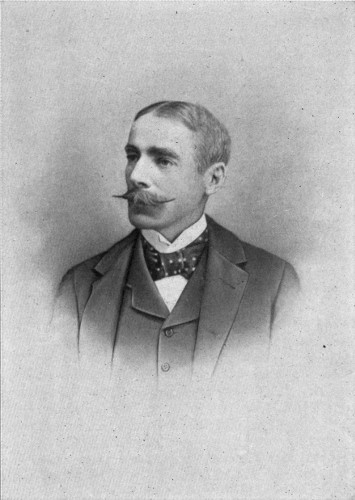
CAPTAIN GEORGE H. MATTHEWS
Captain Matthews’ business affairs also brought him prominently before the public. For many years he was president of the Sincennes-McNaughton Line and during his term of office the major portion of the harbor fleet of tugs was built under his supervision. As opportunity offered he made judicious investments in real estate and became the owner of a large amount of property in Montreal. Following the death of Baron de Longueuil, he took charge of his estate, which he wisely managed.
In 1878 Captain Matthews was united in marriage to Miss Virginia Pratt, a daughter of John Pratt, one of the early settlers of Montreal. He held membership in the St. James Club and he was interested in various significant and vital questions of the day, especially in fish and game protection. He also took an active interest in politics. He was acquainted with all of the different phases of public life having to do with the prosperity and progress of his city and province, and his aid and cooperation could always be counted upon to further movements for the general good.
DAVID BURKE.
One of the best known insurance and financial men of Montreal was the late David Burke, who passed away on December 5, 1913. He was born in Charlottetown, P. E. I., in 1850, being the youngest son of Edward and Mary (Acorn) Burke, both of whom were natives of Prince Edward Island. He received his early education in the schools of that province. In early manhood he turned his attention to the insurance business, being but sixteen years of age when he entered upon the field of labor in which he was to attain to importance, making his name one well known in insurance circles not only in Canada but also in the United States. In 1869 he came to Montreal, where he was associated in business with his brother, the late Walter Burke, then general manager for Canada of the New York Life Insurance Company. On the death of the latter in 1879 the company retired from Canada owing to differences with the insurance department at Ottawa. In 1883, being willing to conform to the regulations set down by this department, the company reentered Canada, and Mr. David Burke was appointed general manager. In 1897 he retired from his connection with this firm to organize an insurance company of his own, the Royal Victoria Life Insurance Company, which was absorbed by the Sun Life in 1911. He thus bent his energies to administrative direction and executive control and his opinions were largely accepted as authority upon matters connected with the complex problems of insurance and the control of the business. In 1882 he was elected an associate of the British Institute of Actuaries, being one of its oldest members, and in 1897 was made a fellow of the Royal Statistical Society of Great Britain. In 1904 he was honored with election to the vice presidency of the Economic and Statistical Society of Montreal and in 1906 was chosen president of the Canadian Life Insurance Officers Association. For two years he held the presidency of the Life Managers Association of Canada, a body formed solely of the executive heads of insurance companies in Canada, each company being represented in the association by only one member. He studied every phase of the insurance business with a thoroughness that made his opinions standard, and he was the author of a valuable paper published in 1908 entitled “Insurance as a National Economy.” The Montreal Witness spoke of him as one “recognized as a most capable insurance administrator,” and his contemporaries and colleagues speak of his business ability and resourcefulness in terms of high admiration.
Mr. Burke was married in 1875 to Miss Rose Maclear, the youngest daughter of the late Thomas Maclear, founder of the Maclear Publishing Company of Toronto, and they were parents of four sons and two daughters, as follows: Edmund A., the noted vocalist; Louis, of New York; Alan, of Boston; Maurice N., of Montreal; Mrs. Fred C. Budden, of Montreal; and Miss Marjorie Burke, of Montreal.
Mr. Burke was a member of the St. James Club and in religious faith an Anglican, while his political belief placed him in the position of an imperial protectionist. His views of life were those of a broad-minded man who delved deep into the questions of vital importance and who proved himself the master of those forces which made up his life’s experience.
JAMES JOHN EDMUND GUERIN, M. D., LL. D., T. C. D., K. C. S. G.
Dr. James John Edmund Guerin, medical practitioner and educator, and an influential figure in the political history of the province, having served with distinction as a member of the Marchand and Parent cabinets and later as mayor of Montreal, was born July 4, 1856, in the city which is still his place of residence, a son of the late Thomas Guerin, C. E., chief hydraulic engineer of the department of public works, Ottawa, and a brother of the Hon. Edmund Guerin, one of the judges of the superior court, Montreal. Dr. Guerin made his studies at the Montreal College, and later entered McGill University for the purpose of pursuing a course in medicine. He was graduated M. D., C. M. in 1878, and has since engaged in active practice in his native city where he has also done important hospital work. He is the president of the medical board of the Hôtel-Dieu Hospital and one of the governors of the Notre Dame Hospital; in educational circles he is well known as professor of clinical medicine in Laval University. He holds to the highest professional standards of ethics and enjoys the warmest regard of fellow practitioners. He is a director of the Royal Edward Institute and a governor of the Victorian Order of Nurses, and in 1909 he was appointed a member of the royal commission to prevent the further spread of tuberculosis.
Capable and prominent as is Dr. Guerin in his chosen profession, he has also become equally widely known in connection with political activity and has done much important work. In 1895 he was elected president of the St. Patrick’s Society and was reelected in 1896 and 1897. In the former year he was a delegate to the Irish National Convention at Dublin. In October, 1895, he was returned to the legislature for Montreal in the liberal interests by a majority of twelve hundred and fifty-four. In 1897 he was reelected in the general election and was called to the Marchand cabinet without portfolio on the 25th of May of that year. He was a minister without portfolio in the Marchand and Parent administrations from 1897 to 1904, and in 1901 was appointed member of the council of public instruction of the province of Quebec. His opinions carried weight in provincial councils and a discussion of any vital question with him at once indicated how widely and thoroughly he was informed concerning the points at issue. In February, 1910, as the candidate of the citizens’ party, he was elected mayor of Montreal by a majority of twelve thousand nine hundred and eighty-three and in his administration sought at all times to further the best interests of the city. He conducted its civic affairs along economical lines and yet never fettered municipal progress by a narrow conservatism. He represented the city of Montreal at the funeral of King Edward in London in 1910 and at the coronation of King George and Queen Mary in 1911. In 1911 he was created a Knight Commander of the Order of St. Gregory the Great, and in 1912 he received the degree of LL. D. from Trinity College, Dublin.
In 1883 Dr. Guerin was married to Miss Mary Carroll O’Brien, daughter of the late Hon. James O’Brien; she died in 1886. Dr. Guerin resides at No. 4 Edgehill Avenue. His religious faith is that of the Roman Catholic church. Aside from serving as president of St. Patrick’s Society he has been president of the Shamrock Lacrosse Club and of many other organizations. He is a member of the Mount Royal Club, the University Club and the Montreal Jockey Club. His activity along various important lines indicates his worth and value as a citizen, and his indorsement at the polls testifies to the confidence reposed in him by his fellow citizens. His ideals of citizenship are high, while in his professional career he manifests the keenest appreciation for the responsibilities and obligations which devolve upon him.
ANDREW STUART EWING.
Andrew Stuart Ewing, for almost half a century one of the best known business men of Montreal, was born in 1838 at Lisdillon House, Londonderry, Ireland, and was a representative of an old family of Irish origin, his parents being Samuel and Margaret (Hamilton) Ewing, who crossed the Atlantic to Canada with their family when their son, Andrew, was seven years of age. He was educated in the public schools of Montreal and in 1860 entered into partnership with his brother, Samuel H. Ewing, in the ownership and management of the extensive coffee and spice mills formerly owned by his father, who founded the business in 1845. In 1860 the firm style of Samuel Ewing & Sons was assumed and in 1892, after the retirement of Samuel H. Ewing, Andrew S. Ewing became sole proprietor of the business which was conducted at No. 55 Cote Street. The enterprise was one of extensive proportions and yielded a substantial profit as a result of careful management and wise direction.
During the last fifteen years of his life Mr. Ewing was a prominent member of the Montreal Board of Trade and was interested in its various projects for promoting the material progress of the city and advancing affairs of municipal and civic interest. In politics he was a conservative and a strong supporter of the national policy.
Mr. Ewing died at his home in Montreal, January 8, 1902, and was survived by his widow until June, 1913. The surviving children are Andrew Stuart and Royal L. H. Ewing and two daughters, Mrs. Robert Starke and Miss Adelaide Ewing. The sons are members of the firm of Ewing & Ewing, real estate and insurance, which was established in September, 1906, by the brothers in connection with A. F. Gault, but the last named retired from the firm May 1, 1912. A. Stuart Ewing is a member of the Art Association of Montreal, the Canadian Club, the Montreal Amateur Athletic Association, the Royal St. Lawrence Yacht Club, the St. James Club, the Manitou Club and the Park Toboganning Club, of which he is vice president.
Mr. Royal L. H. Ewing is a member of the Art Association of Montreal, the Montreal and Canadian Clubs, the Montreal Amateur Athletic Association, the Mount Royal Lawn Tennis Club, the Royal St. Lawrence Yacht Club, the St. James Club, the Manitou Club and the Park Toboganning Club. The sons are worthy successors to their father, not only in business activity but also in that business integrity for which the family name has always stood.
FRANK RICHARDSON ENGLAND, M. D., C. M.
Dr. Frank Richardson England, an alumnus of Bishop’s College of Montreal and now well known as a practical educator as well as a successful practitioner, was born August 21, 1862, at Cowansville, province of Quebec, and is the eldest son of Francis and Jane (Ruiter) England, of Dunham, Quebec. The family comes of United Empire Loyalist stock and the parents are now deceased.
While Dr. England acquired his early education at Waterloo, he pursued his medical course at Bishop’s College in Montreal, from which he was graduated with the class of 1885, the degrees of M. D. and C. M. being then conferred upon him, and obtaining the Wood and Nelson gold medals. He was professor of diseases of children at Bishop’s College in 1887 and professor of surgery in the same institution in 1894. In 1905 he was graduated at McGill College (ad eund). The profession has honored him with official distinction, for in 1906 he was chosen president of the Montreal Medico-Chirurgical Society and the following year was vice president of the Canadian Medical Association. He is a governor and fellow of the American College of Surgeons. He is now, 1914, surgeon of the Western Hospital at Montreal and in his surgical practice displays comprehensive knowledge of anatomy, of the component parts of the human body and of the onslaughts made upon it by disease or left to it as a legacy by progenitors. He is cool and collected at critical moments and combines strength with tenderness, seeking ever the ultimate good of patient and of profession.
Dr. England was married twice. In 1887 he wedded Carrie Ann, youngest daughter of the late R. L. Galer, of Dunham. Following her death Dr. England married Octavia Grace Ritchie, B. A., M. D., of Montreal, the youngest daughter of the late Thomas W. Ritchie, Q. C. She was born in Montreal and became a student in McGill University, winning the degree of Bachelor of Arts, together with first class honors in natural science in 1883. She was afterward graduated from Bishop’s College, Lennoxville, Quebec, with the degree of M. D. and C. M. in 1891. She was one of the first class of ladies to graduate from McGill and the first woman to receive a medical degree in the province of Quebec. Mrs. England took a scholarship at Kingston and later pursued a post-graduate course at Vienna, Austria. She has done much to arouse public feeling in favor of the medical education of women in Quebec and was secretary of the organization called the Donalda Students to procure this concession. She is now a governor of the Western Hospital and was assistant gynecologist there from 1894 until 1896. She has lectured on medical subjects before the Women’s Club and the Young Women’s Christian Association. She is a member of the Montreal Medico-Chirurgical Society and was a delegate to the Quinquennial Congress of the National Council of Women at Toronto in 1909. She is president of the local council of the National Council of Women. In 1897 she became the wife of Dr. Frank Richardson England of Montreal. Both continue actively in the practice of the profession, and each has a large clientage, indicating the prominence to which they have attained.
WILLIAM JOHN WHITE.
William John White, whose authorship no less than his practice has gained him eminence and success, is regarded as one of the foremost representatives of the Montreal bar. Contemporaneous writers pronounce upon him high encomiums for his contributions to legal as well as to general literature. A native of Peterboro, Ontario, he was born January 29, 1861, a son of the late Richard White, D. C. L., and Jean (Riddel) White. After completing his studies in the Montreal high school he entered McGill University, where he pursued a classical and legal course, winning the B. A. degree in 1881, the degree of Bachelor of Civil Law in 1882, while in 1885 the Master of Arts degree was conferred upon him and in 1902 that of Doctor of Civil Law. He completed his legal studies at the Sorbonne in Paris and in 1883 entered upon the active work of the profession as an advocate. He has since successfully practiced and was created king’s counsel in 1899. He is now senior partner of the law firm of White & Buchanan and is recognized as one of the leaders of the Montreal bar. In 1901 he was made batonnier. His law practice has been of an important as well as of an extensive character. He was retained as counsel by the Mexican government in the boundary dispute between the United States and Mexico in 1911. His high standing in his profession and his thorough understanding of vital and significant governmental problems have brought him into prominence in various international affairs. He served as a member of the board of investigation appointed by the minister of labor in the United Shoe Machinery case, and his opinions have been sought on various questions of far-reaching importance. He represented the Montreal bar at the annual meeting of the New York State Bar Association at Albany in 1902 and at the Illinois State Bar Association in 1906, and on the latter occasion read a paper on The Law of Quebec. He is the author of a treatise on Canadian Company Law which was published in 1901.
Aside from his profession Mr. White has been connected with several business enterprises and public projects of importance. In 1911 he became one of the directors of the Sherwin-Williams Company of Canada, and from 1906 to 1908 he served as alderman of the city. He is a director and was elected the vice president of the new Technical School of Montreal. He was one of the founders of the Society of Historical Studies and was chosen to the presidency of that organization for 1891-2. He was likewise one of the organizers of the Society of Canadian Literature and of the Canadian branch of the American Folk Lore Society. From 1889 until 1891 he published a monthly magazine known as Canadiana and Dr. John Reade termed him “A writer of taste and force,” while the Montreal Witness spoke of him as “A thoroughly capable man.” Mr. White belongs to a number of the leading clubs, including the St. James, University, Outremont Golf and the Montreal Jockey Clubs of Montreal; the Rideau Club of Ottawa; the Quebec Garrison Club; and the Constitutional Club of London, England. It is in his law practice, however, that he has won the recognition that has placed him in the present enviable position which he occupies. He has ever in his practice been faithful to his clients, fair to his adversaries and candid to the court. In many cases with which he has been connected he has exhibited the possession of every faculty of which a lawyer may be proud—skill in presentation of his own evidence, extraordinary ability in cross examination, strong grasp of every feature of the case, power to secure favorable rulings from the judge, unusual familiarity with human nature and untiring industry. These qualities have gained him notable success in law practice.
ROBERT REFORD.
At the time of his death half a century was drawing to its close since the subject of this sketch, the late Robert Reford, first established a commercial connection with Montreal. The outstanding position which Mr. Reford occupied in the life of the city was the natural outcome of qualities which quickly bring men to be recognized as a source of strength to whatever spheres in which they may move. He was a man of very pronounced ability, tenaciousness of purpose, firmness of decision and of forceful character but by those who knew him best he will be remembered, chiefly for those high standards of honor which were his for the straightforwardness and uprightness of all his dealings with his fellowmen and for the strong sense of justice which throughout his long career he was so often called upon to exercise.
Robert Reford was born at Moylena, which for generations had been the family seat near Antrim, Ireland, in 1831 and was a lad of fourteen when in 1845 he came with his mother, three brothers and one sister to make his home in Canada. The family arrived at Quebec the night of the great fire when the lower town was almost completely destroyed. After a very brief stay in Montreal they settled in Toronto, where Mr. Reford completed his education. He was, however, still but a boy when he became engaged in business and, though he was indentured to work for his first employer for two years at a fixed salary, it is indicative of the great natural capacity which he possessed and of his steadiness and alertness in business, that at the end of the first year his salary was increased fivefold and again at the end of the second year that amount was doubled. In three years time, still barely on the threshold of manhood, Robert Reford had proved his ability to such an extent as to be offered a partnership with William Strachan in a wholesale and retail grocery business which the latter was about to open. This offer was accepted but the firm dissolved after a few years duration and Mr. Reford started a business on his own account, which he continued to conduct alone for several years, only taking Richard Dunbar as a partner when he acquired, by purchase, from William Ross, another large wholesale business of the same nature. The two businesses were run separately, one as Reford & Dunbar, the other in partnership with the late John Dillon, as Reford & Dillon, wholesale grocers and merchants. It would indeed have been strange if a man, imbued with the spirit of enterprise and courage, as was Mr. Reford to a very remarkable degree, had been content to remain without some wider scope for his abilities than that offered, even by a successful wholesale business. It was not long before he took the initial step which was to lead him so far along the path of that vast question of transportation.
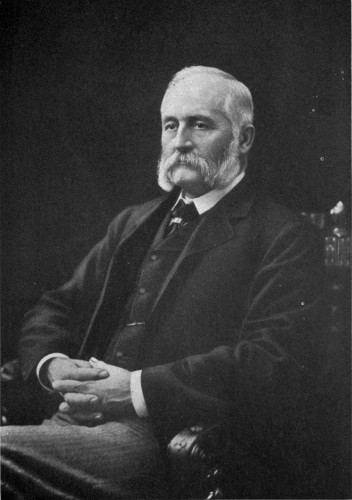
ROBERT REFORD
Mr. Reford was one of the pioneer workers in this direction, entering the carrying trade, in the early ’60s. He amassed a considerable fortune during the forty odd years he was engaged in shipping pursuits but never did he lose sight of the fact that Canada’s interests as a whole are intimately and indivisibly bound up in every phase of the shipping industry, nor did he ever fail to consider and work towards the benefit of those wider interests of his adopted country.
The operation of vessels on the Great Lakes was the beginning of Mr. Reford’s shipping enterprises. In 1860 he equipped the schooner “Seagull” and sent her with a general cargo of Canadian produce to Port Natal, South Africa, thus being the first man to undertake direct shipping connection between Canada and that part of the world.
In 1865, associated with his old friend William Ross, the firm opened a branch in Montreal. This was the commencement of the present Montreal firm. The business was now assuming large trading proportions with Great Britain, the United States, China, Japan, the West Indies and other foreign countries; nevertheless it soon began to confine itself more strictly to ocean shipping. The firm became agents and part owners of the Thomson and Donaldson lines. When the story of the growth of Canada’s shipping comes to be written the name of Robert Reford will loom up largely on its pages. Mr. Dillon severed his connection with Mr. Reford in the shipping business in 1897 and it was then that the present company, the Robert Reford Co., Ltd., was incorporated, with very extensive steamship services of six different lines to many of the world’s principal ports and with branch offices established in Quebec, Toronto, St. John, New Brunswick, and Portland, Maine. Canada owes not a little to Mr. Reford for contributing so materially to the opening up of new markets for her produce along the east coast of Great Britain, and also for the building up of further valuable trade connections by giving direct shipping communication between Canada and the Mediterranean ports. Every aspect of the carrying trade had been studied by him with that thoroughness and regard for detail which characterized the man in everything he undertook. His opinions and advice on shipping and on transportation generally were appreciated as those of an expert, and sought after by people from all over the Dominion.
Apart from his shipping enterprises, which remained the main issue of his commercial life, the most important of his other business activities was his interest in the Mount Royal Milling and Manufacturing Company. Mr. Reford founded the company in 1882 for the milling of rice, with mills in Montreal and Victoria, British Columbia, and acted as its president up to the time of his death. He was also president for many years of the Charlemagne & Lac Ouareau Lumber Company, president of the York Lumber Company, president of the Crown Trust Company and vice president of the Labrador Company; and a director of the Bank of Toronto, of the Lake of the Woods Milling Company and of the Paton Manufacturing Company.
From 1901 to 1905 Mr. Reford was a member of the Montreal Board of Harbour Commissioners and in 1903 was a delegate to the fifth congress of the Chambers of Commerce of the Empire, but no doubt his chief public service was rendered first as a member and then as chairman of the Royal Commission on Transportation, 1904-1905. The work involved in this important commission necessitated its members visiting every Canadian port, from the Atlantic to the Pacific, with a view to recommending all possible desirable improvements for the increase of and facilitating the transportation trade appertaining to the Dominion, both ocean and inland. The commission sent in an exhaustive report to the government in December, 1905, based on very thorough personal observations and study, together with the result of carefully gathered evidence of those residents in the different sections of Canada who were best fitted to judge. It strongly advocated the building of the Georgian Bay canal and the formation of national ports on the Atlantic and Pacific, the St. Lawrence and the Great Lakes. Further, it was urged that there should be a fast all-round-the-world British steamship service which would bind together more closely all portions of the empire, by taking advantage of the shorter ocean route which services between Canada and Europe, via Great Britain on the east, and Asia and the Orient on the west, could offer, if Halifax and Galway were used as the termini for the Atlantic coasts. Mr. Reford’s work on this commission was stupendous, but none of it was done in the light of the public eye. Few knew of the great personal sacrifices which it demanded and which were willingly made by this man of then seventy-four years. In fact all his life Mr. Reford avoided rather than sought any kind of prominence or recognition.
Many of Montreal’s educational and charitable institutions looked to him for guidance and help and whether the requests came to him for his advice, or for financial support, provided he was in sympathy with the object, to either his response was equally ready and generous. He was a governor of McGill University and was the first to respond to an appeal for aid by donating fifty thousand dollars towards a fund for the increase of salaries of the professional staff. In 1911 when the campaign for the general funds of the university was made, it found in him one of its leading spirits and most ardent supporters. Again he gave proof of his faith in the higher education of men’s minds as being an asset of immeasurable national value and set the inspiring example of a one hundred thousand dollars contribution.
Could we mention all the hospitals, homes for the aged poor and for little children, and in fact every kind of philanthropic institution which knew and enjoyed his generous help, the list would indeed be a long one and few such in Montreal omitted from it. Some of his largest donations were to the Montreal General Hospital of which he was a life governor and to which in recent years he gave thirty-five thousand dollars; to the Young Men’s Christian Association he gave ten thousand dollars, and a like sum to the Diocesan Theological College.
In manner the late Robert Reford was somewhat abrupt but this arose purely from that eagerness and energy which every move of the body seemed to betray, and not from any unkindly feeling. He was an exceptionally clear thinker, his mind worked with precision; his plans were made and carried out with unvarying promptitude and method which perhaps supply the key to his amazing capacity for the accomplishment of work. Self indulgence knew no place with him and to the end he adhered to his stern habits of life, granting himself but little respite and no holidays. From the age of twenty-two when he was made captain of No. 4 Company in the Queen’s Own Rifles his interest in civic affairs never waned. He fought untiringly for reforms, often with a lack of support which would have discouraged most men, but this North of Ireland man was not of such stuff. He was of the kind which the hand of Providence seems to have scattered far from their native shores, over the face of the British Empire to give it that salt, without which it could have no savor.
Mr. Reford was twice married; first to Miss Margaret McCord, daughter of A. T. McCord, chamberlain and treasurer of the city of Toronto, who died within a year after the marriage. In 1866 he married Miss Katherine S. Drummond, daughter of Andrew Drummond of Stirling, Scotland. Mrs. Reford survives him, as do five of his children, they being: Robert Wilson Reford, president of the Robert Reford Co., Ltd.; A. D. Reford; L. L. Reford, M. D.; Mrs. H. B. MacDougall; and Miss Kate Reford.
Mr. Reford was a member of St. George’s church and a stanch believer in the power of the church to be a light unto the lives of men. In all things he acted as he believed and so the community is bereft of a personality of strength, of courage and of truth.
MORRIS STANSFELD BLAIKLOCK.
Morris Stansfeld Blaiklock entered the service of the Grand Trunk Railway over thirty years ago and since 1907 has held the position of engineer of maintenance and survey in connection with this road. He is a son of the late Frederick William Blaiklock, who died in 1900, and Elizabeth (Whittaker) Blaiklock, who died in 1889. The father was public land surveyor and head of the Cadastral Bureau of Montreal. The family has long been prominent in engineering circles, the grandfather of our subject, Captain Blaiklock, having been one of the Royal Engineers. A brother of our subject was the late Major W. F. Blaiklock, of the Royal Scots. The family is of English origin.
Morris S. Blaiklock was born in the city of Quebec on the 19th of July, 1859. He pursued his early education in a private school in Quebec and upon the removal of the parents to Montreal in 1870 attended the high school in this city, rounding out his course by receiving private tuition. He then studied architecture for three years and in 1879 entered the employ of the Grand Trunk Railway as assistant engineer, remaining in that position until 1889, when he became resident engineer for the St. Clair Tunnel Company in connection with the same road, holding this office until 1892. In that year he was promoted to the position of inspector, continuing as such until 1897, when he became engineer of the eastern division of the Grand Trunk Railway. In 1902 he was appointed superintendent of the eastern division and in 1907 engineer of maintenance and survey for the system. He has held this latter office ever since. He is one of the foremost men in his line, basing his success upon native ability, a vast experience and executive force of rare quality.
On November 12, 1889, Mr. Blaiklock married Miss Mary Elizabeth Tunstall, eldest daughter of the late Gabriel C. Tunstall, of Ste. Anne de Bellevue, province of Quebec. Mr. and Mrs. Blaiklock have two children, Jessie B. and Stansfeld. The family residence is at No. 405 Mackay Street, Montreal. Mr. Blaiklock is a member of the Church of St. James the Apostle (Episcopalian). Politically he is an independent conservative.
ALEXANDER MICHAUD.
Progressive citizenship in the twentieth century finds a prominent exemplar in Alexander Michaud, mayor of the city of Maisonneuve, who is an active factor in public affairs and business life of the city. His clear insight, his keen sagacity and his public spirit have made his influence a potent factor in bringing about not only Canada’s commercial progress, but also her moral uplift. He might be termed a practical idealist, for, while he strives for the betterment of many civic and commercial conditions, the methods which he employs take cognizance of present day situations and opportunities and present none of the impractical views of the dreamer. In a word, he is a man of action rather than of theory.
Mr. Michaud is a representative of one of the old French families of Quebec, while the maternal line is of an unadulterated Irish strain. He was born January 27, 1868, at Back River, Quebec, a son of J. B. and Norah (Connolly) Michaud. His education was acquired at the Christian Brothers school and in the Plateau Academy of Montreal. In 1881 he entered the employ of his father, who was a well known miller and flour merchant, remaining with him until 1885. During that period Alexander Michaud, while acting principally in a clerical capacity, also acquired a good general knowledge of the business in its various departments. In 1885 he accepted a position with A. L. Hurtubise & Company, grain merchants of Montreal, with whom he remained for several years in the capacity of bookkeeper and confidential clerk. His ability gained him recognition, followed by promotion, and at the time he resigned his position in that house he was manager of the business.
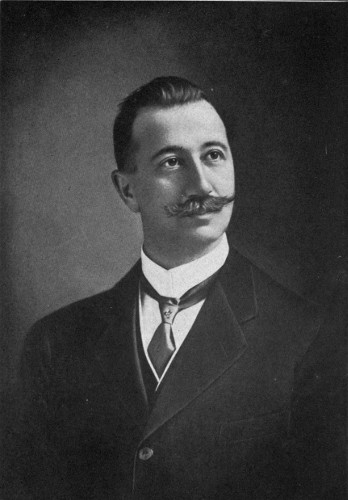
ALEXANDER MICHAUD
It was then that Mr. Michaud organized the firm of Michaud Brothers & Company, which soon took a foremost position among the leading wholesale grain and export firms of Montreal. Its existence covered a period of about fifteen years and an extensive business was conducted, constituting another forward step in the career of Alexander Michaud. However, recognizing the fact that the field of real-estate activity and land speculation in Montreal afforded great opportunity for profitable investment, he withdrew from active connection with the grain trade and entered the real-estate business. It is unusual for a man who has been so long identified with one line of business to make so radical a change, but the subsequent success of Mr. Michaud is indicative of his splendid business foresight and capability. The success that he has achieved in the real-estate business has been substantial, is well deserved and represents methods that have lent dignity to the undertaking. There are few, if any, who have more intimate or comprehensive knowledge of realty values or whose judgment is more to be relied upon and these facts have served to bring him an extensive and desirable clientage.
In connection with his public career a Montreal paper has said: “Perhaps the field in which Mr. Michaud was best known to the citizens of Montreal is political. He was an alderman and was president of the finance committee of Maisonneuve from 1905 to 1909 and was elected mayor by acclamation three times in succession. During this time Maisonneuve has made those wonderful strides in growth which have been the admiration of the entire country and have placed herself on a footing which is attracting the attention of the entire world. The part played in this great advance in manufacturing and commerce by the city is not a little due to the energy and foresight of her mayor, who has brought his business acumen and farsighted commercial judgment into play in running the civic side of affairs, the same as he did as a merchant or miller. Mr. Michaud prefers to talk about Maisonneuve rather than about himself, about the opportunities there are there for capital, the splendid locations for factories and the many other inducements which have made the city one of the leaders in commercial advancement during the past five years. It is an interesting subject and more Aladdinlike than Africa diamond mines or the gold strewn coasts of Alaska.” It may be mentioned here that Maisonneuve, though surrounded by the city of Montreal, is an entirely separate city, having its own autonomy.
Perhaps the most unique point in Mr. Michaud’s public career is its cause. Like many other men who had been similarly attracted to that locality, Mr. Michaud took up his residence in Maisonneuve but with neither time nor inclination for public office. The city at that period had a population of seven thousand. Twenty-four liquor licenses had been issued and the town, in modern parlance, was “wide open.” It was a great rendezvous for hundreds of people from Montreal who would go down there on Sundays, the open saloons serving as a great attraction. This disregard of the law and the undesirable notoriety it gave the town aroused the indignation of the better class of citizens, who, however, were powerless, owing to the inactivity of those who were in charge of the city government. Mr. Michaud was one who set about to bring order out of chaos and while his first article in the local papers attracted attention, his second and subsequent ones certainly aroused the opposition of the lawless element whose arrogance had so long held sway. Personal violence was threatened Mr. Michaud and his residence was attacked by a mob that broke every window within reach. Missiles of every description were hurled inside. This cowardly attack instead of intimidating Mr. Michaud, only spurred him on to further action and showed that the Irish blood in him could mean fight—not fight in the brutal sense of the mob but with that courage that comes of honest conviction combined with fearlessness. In the face of such bitter opposition Mr. Michaud became a candidate for alderman, was elected and wielded such an influence in favor of good government and progress that from the time he entered politics to the present he has made a most creditable record. No citizen of Maisonneuve has worked so incessantly or taken greater pride in what has been accomplished. That city today, with forty thousand population, contains but nineteen licensed saloons, all conducted under strict observance of the law. He is, indeed, a resourceful man and in the management of public affairs displays the same spirit of careful watchfulness and wise control that he does in conducting his private interests. He was named by the provincial government a member of the Metropolitan Parks commission of Montreal, of which body Sir William Van Horne is president.
In 1909 Mr. Michaud was the chief factor in the organization of the Dominion Light, Heat & Power Company and during the two years of its successful operation, before being absorbed by the Montreal Public Service Corporation, he was prominently connected with its management. He is a man but little past middle age and his whole capital when starting in life was energy and ambition, yet he has been highly successful, not only in the way of winning prosperity, but also in valuable service to the city and province. He gets much out of life in comfort and pleasure and has never lived solely to accumulate wealth, but has ever been a lover of nature and of outdoor life and it is only severe weather that prevents him from enjoying the four and a half mile walk daily from his office to his home. In the latter his greatest interest centers and he is always happiest when in the company of his family. Mr. Michaud was married February 21, 1898, to Miss Marie Virolle and to them have been born four children: Margaret, Paul, Germaine and Alexander. Mr. Michaud is an indulgent father and the comrade of his children. For a number of years he has spent the summers with his family at Old Orchard, Maine.
JOHN MILNE BROWNING.
In the later years of his life John Milne Browning lived retired in Montreal. He was of Scotch birth, a native of Edinburgh, born in June, 1826. His father, Matthew Browning, died when the son was a young man and the latter, who had been educated in the schools of his native country, came to Canada in 1852, when twenty-six years of age. He located at Beauharnois, where he continued until 1873 and then removed to Montreal, where he resided through the succeeding fifteen years. In 1888 he went to British Columbia, where he lived for eleven years, but on the expiration of that period returned to Montreal, where he spent his remaining days in well earned and honorable retirement from business. He had been a land commissioner and was also connected with the Canadian Pacific Railway Townsite Company. He displayed excellent business ability in that connection and handled important realty interests.
In 1855 Mr. Browning was united in marriage to Miss Magdeline H. Norval, born in 1833, in Beauharnois, Quebec, a daughter of R. H. Norval, who came from Edinburgh when twenty-one years of age and remained thereafter a resident of Canada until his death in 1856. His daughter, Mrs. Browning, has seen Montreal develop from a comparatively small place into a wonderful city, being ever an interested witness of the changes which have occurred. It was on the 20th of December, 1906, that Mr. Browning was called from this life and his loss was mourned in the various localities where he was well and favorably known. He was a member of a number of clubs and won popularity in those organizations. His public spirit found tangible expression in many ways and his religious faith was evidenced in his membership in the Crescent Street Presbyterian church. His life was honorable and upright at all times and he left behind him an untarnished name.
JAMES POWER CLEGHORN.
Prominent for many years among the merchants of Montreal was James Power Cleghorn and equally well was he known through his support of charitable and philanthropic projects and his cooperation in affairs of public benefit. He was born in Montreal, October 31, 1830, and his life record covered the intervening years to the 14th of December, 1911, when he passed away. He was a son of Robert Cleghorn, who came to Montreal at a very early day. The latter married Miss Eliza Power, a native of Sorel, province of Quebec, and whose father was connected with the commissary department of the army. Their family numbered ten children. Robert Cleghorn was a public-spirited citizen and a man of domestic tastes, and the influences of a home of culture and refinement left their impress upon the life of James Power Cleghorn, who with the passing years rose to prominence along the different lines in which he exerted his activities.
He was educated at Howden & Taggart’s Academy and entered commercial circles as junior clerk in the mercantile house of J. G. Mackenzie & Company of Montreal in 1853. In that establishment he gradually worked his way upward until admitted to partnership in 1864, after which he had largely control of the business, which was extensive in proportion and which ranked with the oldest mercantile houses of the city. Mr. Cleghorn, however, did not confine his efforts entirely to one line. In fact he became recognized as a power in other business connections, both commercial and financial, and was elected to the directorate of the Intercolonial Coal Company, the Sun Life Assurance Company of Canada, the Merchants & Manufacturers Association, the Canada Accident Company and Molson’s Bank. He served as president of the Board of Trade and it was during his incumbency of the office that the site for the present building was selected. He was also a trustee of the Mount Royal Cemetery Association and the president of the Intercolonial Coal Company. His cooperation was likewise sought in behalf of those institutions where humanitarian principles must combine with executive ability in successful management. He was made a governor of the Montreal General Hospital, of the Montreal Hospital for the Insane and the Montreal Dispensary. An active member in the Church of England, he served as a delegate to the synod and cooperated in its work along many helpful lines. In politics he was a conservative and he stood ever for the welfare of the people.
On the 14th of February, 1865, Mr. Cleghorn was married to Miss Anna Spalding, of Port Hope, Ontario, who was born in Peterboro, Ontario. Five children were born to them: George S., connected with the W. R. Brock Company, Limited; C. Power, a general insurance broker, who married Florence Fechheimer, of New York, and to whom have been born two children, James Power and Helen Power; Emily C.; Helen G., who died at the age of thirteen years; and James Herbert, whose death occurred when he was eighteen years of age.
The family residence is at No. 256 Bishop Street, and their summer home, “Blinkbonny” is situated at Como in the province of Quebec. The death of Mr. Cleghorn left a gap in those circles where he had moved as a central figure. In business and social relations and in his connection with humanitarian interests he had established himself in an enviable position by reason of personal worth and capability, and his name is inscribed high on the list of Montreal’s valued citizens.
GEORGE WASHINGTON STEPHENS.
If one would seek a fitting poetical phrase to express the life work of the Hon. George Washington Stephens these lines might well be chosen:
“He leaves a patriot’s name to after times Linked with a thousand virtues and no crimes.”
For an extended period he was in public life, and whether connected with municipal, professional, or national affairs was always the same public-spirited, progressive citizen, ever seeking the welfare of the constituency which he represented. He was born in Montreal in 1832, the second son of Harrison and Sarah (Jackson) Stephens. The father removed from the state of Vermont to Montreal in 1828 and for years was a leading merchant of the city.
George W. Stephens was educated at high school, afterward entering business circles. He became identified with the firm of Law Young & Company, but after a time determined to enter upon professional activities, and with this end in view took up the study of law, following a law course at McGill University, which conferred upon him the B. C. L. degree. Called to the bar in 1863, he at once entered upon active practice and for some time was a partner of the late John A. Perkins, an eminent barrister of Montreal. Mr. Stephens personally conducted the cause celebre of Connolly versus Woolrych, which he brought to a successful conclusion. The case was a notable one, awakening widespread interest among the legal fraternity and establishing the validity of an Indian marriage, celebrated according to the custom of the tribe.
After a number of years devoted to successful law practice, Mr. Stephens was obliged to abandon the profession in order to assume the management of his father’s estate, and proved himself equally capable, sagacious, farsighted and enterprising in that connection. His ability and his devotion to the general welfare led to his selection again and again for public office. In 1868 he was elected alderman of Montreal and for seventeen consecutive years remained a member of the city council, during which period he served on several occasions as acting mayor. He did much during that period toward shaping the policy of city affairs and upholding those interests which are a matter of civic virtue and civic pride. In fact he became distinguished for his constant opposition to wrong-doing and dishonesty, and his stalwart support of a prudent and economical progressive administration. From the time that age conferred upon him the right of franchise he advocated the principles of the liberal party and upon its ticket was elected to the provincial legislature, representing Montreal Centre in the Quebec assembly from 1881 until 1886, and so earnestly and faithfully guarded the public interests as to earn the title “watch dog.” At the general election of 1892 he was returned for Huntingdon and was reelected at the general election in 1897. On the formation of the Marchand administration in May of the latter year he was called into the cabinet, without portfolio. He was the organizer of the Good Government Association of Montreal and in January, 1897, received the thanks of that body for his “vigorous efforts and judicious action” in the Quebec assembly in reference to certain local measures. In 1896 he promoted a measure prohibiting indecent play bills and posters being displayed on the public streets. No one ever questioned the honesty and virtue of his position and his belief. Though others may have differed from him in policy they recognized the patriotic spirit which actuated him in all his public service, and none was more earnest in opposition to misrule in public affairs.
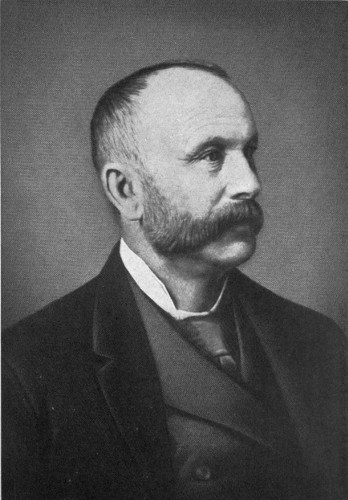
HON. GEORGE W. STEPHENS
Aside from his active work in the assembly, Mr. Stephens utilized many other opportunities for advancing public progress and improvement. He was at one time a member of the council of the Montreal Board of Trade, was president of the Mercantile Library Association and president of the Citizens Gas Company. He was also a governor of the Montreal General Hospital and of the Protestant Hospital for the Insane. His cooperation could ever be counted upon in support of any measure or plan to ameliorate the hard conditions of life for the unfortunate and, as a member of the Unitarian church, he took an active interest in all good works done in the name of charity or religion.
Mr. Stephens married first in 1865, Elizabeth Mary MacIntosh and afterward in 1878, Frances Ramsay MacIntosh, daughter of Nicholas Carnegie MacIntosh, of Edinburgh, Scotland. For many years Mrs. Stephens was president of the Decorative Art Association of Montreal and a recognized leader in social circles. She has accomplished work of far-reaching importances and benefit in connection with the Woman’s Immigrant Society; the Soldiers’ Wives League, which was organized during the South African war; the Maternity Hospital, and the Montreal Cooking School. In religious faith she is a Unitarian and in more strictly social lines is connected with the Canadian Woman’s Club, the Ladies Morning Musical Club and the Royal Montreal Ladies Golf Club. The children are two sons and two daughters: Major G. W. and F. C. Stephens; and Mrs. J. Wedderburn Wilson and Mrs. A. Hamilton Gault.
Mr. Stephens was devoted to his family and ever held friendship inviolable. He belonged to both the St. James and Union Clubs and his military experience covered service as a cavalry major until he was placed on the retired list, his connection being with the Montreal Rifle Rangers. One of the leading newspapers styled him “a liberal of the old school, fearless and brave.” The same qualities characterized him throughout his entire life in every relation, and many who were his associates and contemporaries felt at his passing, which occurred at his country residence, Lac à l’eau Claire, in 1904, that,
“He was a man. Take him for all in all I shall not look upon his like again.”
MAJOR VICTOR EVELYN MITCHELL.
Public opinion accords Major Victor Evelyn Mitchell a position of leadership among the members of the Montreal bar, not only because of his extensive practice and the ability displayed therein, but also because of his contribution to the literature of the profession. His military record also gives him right to public recognition. A native of London, England, he was born October 17, 1865, and is of English lineage, his father having been James Mitchell, of London, England. In the attainment of his education he attended the City of London school and afterward McGill University, where he won his B. C. L. degree and valedictorian honors in 1896. The same year he began practice as an advocate in Montreal with the late R. D. McGibbon, K. C. He had been a resident of Canada for eight years, and thus it was that his preparation for the bar was pursued in McGill. The ability which he has displayed in practice is indicated by the fact that he was created K. C. in 1909. He is now a member of the firm of McGibbon, Casgrain, Mitchell & Casgrain and devotes himself to corporation and commercial law. He published the first English edition of the The Code of Civil Procedure and in conjunction with J. L. Perron, K. C., brought out an Insolvency Manual. He is not unknown in the educational field, having lectured on The Legal Aspects of Trade Unionism and on Warranties and Representations re Contract of Life Insurance. All this establishes his position as a lawyer well versed in his profession and capable in handling intricate and involved legal problems. He is also a well known publicist; his letters to the Montreal Star on the naval question created great interest and showed a thorough knowledge and study of the subject.
Aside from his professional interests Major Mitchell has become known in business circles and in connection with projects of a public or semi-public character. He is a director of Penman’s, Ltd.; the Canadian Consolidated Rubber Company; Ames, Holden, McCready, Ltd.; the Canadian Consolidated Felt Company, Ltd.; the Charlemagne & Lac Ouareau Lumber Company, Ltd.; and many other commercial companies. He is also a director of the Laurentian Sanitarium and a governor of the Montreal General Hospital and the Western Hospital.
For some years Major Mitchell was connected with the volunteer military service, joining the Sixth Fusiliers in 1889, and when that regiment amalgamated with the First Prince of Wales Rifles in 1898 he became senior major in that corps. In 1900 he was placed on the list of retired officers.
Major Mitchell was married in 1911 to Miss Sarah Proulx, and they reside at No. 377 Peel Street. Major Mitchell holds membership with the Anglican church and is well known in club circles, belonging to the St. James, Canada and University Clubs, the Royal St. Lawrence Yacht Club, the Montreal Jockey Club, Outremont Golf Club, Royal Montreal Golf Club, the Manitou Club of Montreal, the Railroad Club and the Alpha Delta Phi Club of New York and the United Empire Club of London, England.
WALTER HARDMAN ARDLEY.
A well known figure in railroad circles of Montreal is Walter Hardman Ardley, who since 1913 has acted as general auditor of the Grand Trunk Railway system and Grand Trunk Pacific Railway. A native of London, England, he was born April 24, 1858, and is a son of James and Elizabeth (Dunton) Ardley, the former of whom passed away during the early childhood of his son Walter and the latter in 1896.
Mr. Ardley was educated in the City of London College and made his advent in the business world as an apprentice in a London office. He came to Canada in November, 1882, entering the service of the Grand Trunk Railway, in the chief accountant’s office, on November 5, 1882. Steadiness of purpose, faithfulness and diligence won him advancement. On December 31, 1907, he was made chief clerk and general bookkeeper and so continued until August 31, 1908, when he became auditor of disbursements. He held this office until September 30, 1908, when he became assistant general auditor, and in 1909 he was made general auditor of the Grand Trunk Railway system and Grand Trunk Pacific Railway. Mr. Ardley stands high in the estimation of the officers of the road on account of the efficient management of his department.
On December 12, 1889, Mr. Ardley married Miss Tamar Jane Phillips, a daughter of Henry Phillips, of Upway, England. He is independent politically and a member of the Church of England.
REV. HERBERT SYMONDS.
A man who has made his zeal and commanding ability the basis of an important work not only in the cause of religion but in the public service along lines of charity and reform is Rev. Herbert Symonds, since 1903 vicar of Christ Church Cathedral, Montreal. He is a prominent orator and preacher, an able writer and an untiring worker for the promotion of religious and social advancement and is regarded as one of the vital forces in the spread of movements looking toward Christian unity. He was born in Rickinghall-Inferior, Suffolk, England, December 28, 1860, and is a son of George and Hannah (Wright) Symonds. He studied in Framlingham College in England and in Trinity University, Toronto, Ontario, from which he was graduated with the degree of B. A. in 1885, receiving the degree of M. A. and the prize for an English essay and sermon in 1887. He holds the honorary degree of D. D., given him by Queen’s University in 1901, and the honorary degree of LL. D., conferred upon him by McGill University in 1910.
Rev. Herbert Symonds came to Canada in 1881 and four years later was ordained deacon in the Anglican church. He received orders as a priest in 1887 and from that year to 1890 was a fellow and lecturer in Trinity University in Toronto. The next two years he spent as professor of divinity in the same institution and in 1892 was made rector of St. Luke’s church in Ashburnham, Ontario. He resumed his work as an educator in the year 1901, being made headmaster of Trinity College School in Port Hope, Ontario, serving in that capacity from 1901 to 1903. In the latter year he was transferred to Montreal and made vicar of Christ Church Cathedral in this city, and he has since held the position, which affords him an excellent scope for his talents and abilities and in which his work has carried him forward into important relations with Anglican affairs. He was president of the Montreal Protestant Ministerial Association in 1905, first president of the Canadian Society of Christian Unity and in 1910 a delegate to the World’s Missionary Congress, held in Edinburgh, and the Anglican Church Congress, held in Halifax, Nova Scotia.
Mr. Symonds married, in March, 1883, Miss Emma Blackall, fourth daughter of the late Mossom Boyd, of Bobcaygeon, Ontario, and both are well known in social circles of Montreal. Since 1907 Mr. Symonds has served as Protestant school commissioner and he is well known in military circles, having been from 1896 to 1907 chaplain of the Third Prince of Wales Canadian Dragoons and since that time chaplain, with the honorary rank of major, of the First Regiment, Prince of Wales Fusiliers. He is a member of the Masonic fraternity and is a past grand chaplain of the grand lodge of Quebec. A writer of great force and power, he has made many contributions to The Week and Expository Times of England and other papers and is the author of articles on Trinity University and University Federation, published in 1894, on Christian Unity, published in 1899, and The Anglican Church and the Doctrine of Apostolical Succession, 1907. He is regarded as one of the ablest preachers in the Anglican pulpit at the present time and has made this talent also a force in the accomplishment of a great and lasting work.
HENRY HOGAN.
Very few if any men in Montreal were any better known in their respective lines of business than was Henry Hogan, in connection with the hotel business. He occupied a position among his contemporaries that made him a unique personage. The story of his life is best told by the history of the hostelry, St. Lawrence Hall, that his name had made famous and over which he had charge for upwards of a half century. Mr. Hogan was born at La Tortue, near Laprairie, on the 12th of April, 1820, and was a son of Nicholas Hogan, who served in the British army in the Peninsular war and at Waterloo under the Duke of Wellington. He was engaged in the woolen manufacturing business in Manchester, England, and upon coming to Canada established a mill at La Tortue. He met his death from drowning, the result of the giving way of the rail on a boat, which precipitated him into the St. Lawrence river. He was survived by a widow and several children.
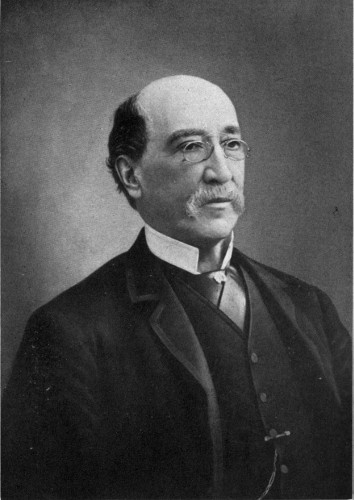
HENRY HOGAN
Henry Hogan was but a boy when he came to Montreal and his early training in a business way began in the line of business of which he made such a great success in later life, the hotel business. In 1851 he became proprietor of what was then called the Hogan Hotel, in which enterprise he was in partnership with Messrs. Borden and Compaine, but both men retired early, being succeeded in the firm by Frederick Penn, who remained a partner with Mr. Hogan until 1869. After that time the latter was alone as sole proprietor of St. Lawrence Hall. In 1856 he was one of the prominent factors in the grand banquet given by the citizens in the Hall to mark the opening of the Grand Trunk Railway, on which occasion many distinguished citizens were his guests. In 1860 he entertained the members of the suite of the Prince of Wales, later His Majesty, King Edward VII. In those days Mr. Hogan entertained many people of title and prominence. The story of this hotel has its own connection with the history of Canada, for under the roof of St. Lawrence Hall there occurred many things that led to the present-day development of the Dominion. Here Mr. John A. Macdonald, later the great Sir John, met his sturdy opponent, Mr. George Brown, and exchanged views on the best means of uniting the scattered provinces. From this beginning confederation was achieved and Mr. Hogan performed his share in these events and at all times faithfully carried out the duties of citizenship. St. Lawrence Hall was for many years the best known hotel in Canada and one of the best known on the continent. Princes of the royal blood, soldiers and statesmen, political refugees, artists and poets, stars of the operatic and dramatic stage partook of its hospitality and their names recall events of bygone days. The opening of Victoria bridge brought many notables to the Hall, and during the progress of the Civil war in the United States the clank of the sword was heard at St. Lawrence Hall, which became the headquarters for the Confederate representatives and southern refugees. Jefferson Davis and John Wilkes Booth were guests of the Hall, and during the Trent affair it was the headquarters of the officers. During the trial of John Surratt, the register of the Hall was taken to Washington and has never been returned. After the Civil war, General Sherman, of the Union army, and also one of the most prominent Confederate generals visited Montreal and were entertained by Mr. Hogan, as was Henry Ward Beecher and other distinguished Americans. The banquets held at St. Lawrence Hall were noted affairs, the place being the scene of many brilliant social gatherings.
The ancestral records of the Hogan family included the names of many prominent in military circles and Henry Hogan also took a deep interest in these affairs, being for years commanding officer of the Montreal Field Battery, of which he was lieutenant in 1855, afterwards became colonel and assumed command, retiring with that rank in 1866. Mr. Hogan had been connected with numerous business enterprises aside from his hotel interests. He always had implicit confidence in the future of Montreal and made investments that proved highly profitable. His business ability won him success and prominence in his chosen field and his capability, tact and resourcefulness made him an ideal host, whether entertaining a little private gathering of friends or a large concourse of notable and eminent citizens at a banquet. In religious belief he was a Unitarian. His death occurred October 9, 1902, and he was survived by a widow, two sons, Henry H. and Lawrence H., and also two daughters: Anna W., now the widow of Major Low, of the British army; and Marion E., who died unmarried.
MARTIN MONTGOMERY REYNOLDS.
Martin Montgomery Reynolds enjoyed the reputation of being one of the foremost experts in railroad accounting and finance. He had thirty years of experience along that line and was connected with roads in the United States and Mexico until he came to Canada in 1908 as fifth vice president of the Grand Trunk Railway and third vice president of the Grand Trunk Pacific Railway. At his death, which occurred June 17, 1914, he held the position of vice president in charge of the financial and accounting departments.
Martin M. Reynolds was born in Syracuse, New York, and educated there. His first notable position in the railroad world was that of auditor of the Mexican National Railroad, which office he held until 1892. He then went to Vermont as general auditor of the Central Vermont Railroad, which office he held until 1896. From 1896 to 1899 he was auditor for the receivers of this road, and from 1899 to 1902 auditor for its successor, the Central Vermont Railway. From 1902 to 1904 he was comptroller of the National Railway of Mexico and in 1904 accepted in addition to this office the comptrollership of the Mexican International Railway and the Interoceanic Railway of Mexico, continuing in this office until 1908. In that year he came to Montreal as fifth vice president of the Grand Trunk Railway and third vice president of the Grand Trunk Pacific Railway, and in 1910 was promoted to the third vice presidency of the Grand Trunk. From 1911 Mr. Reynolds was vice president in charge of the financial and accounting departments of the Grand Trunk and Grand Trunk Pacific and affiliated lines. His office was one of the most important in the service. Mr. Reynolds was also a director of the Canadian Express Company.
In 1894 Martin M. Reynolds was united in marriage to Miss Flora Livingstone and they resided at the Linton apartments, Montreal. Although he was in Montreal only a few years he quickly became imbued with the Canadian spirit and his aims and interests became thoroughly Canadian.
CHARLES A. BRIGGS.
Charles A. Briggs was an active business man of Montreal, well known and respected. He conducted a retail fur store under his name on Notre Dame Street, and careful management and wise direction of his interests wrought the substantial success which eventually came to him. A native of Montreal, he was born October 3, 1839, a son of Russell Briggs, who came to this city from Vermont and here spent his remaining days. Charles A. Briggs was indebted to the public-school system of Montreal for the educational opportunities he enjoyed. In early life he acquainted himself with the fur business and eventually became proprietor of a retail fur store on Notre Dame Street. He closely applied himself to the conduct of the business and his able management and reliable methods were strong elements in his growing success.
In 1862 Mr. Briggs was united in marriage to Sarah S., a daughter of Mansfield Holland, who in early life came from Maine to Montreal and was actively identified with the infant industrial development of the city, building the first rolling mill here and also a nail and spike factory, making the first railroad spike manufactured in Canada. His plant was located on Mill Street and there he continued actively and successfully in business throughout the remainder of his days, his death occurring in 1883. He was then seventy-four years of age, his birth having occurred in 1809. He was twenty years of age when he arrived in Montreal in 1829, becoming a most active factor in its business circles, for, with the growth of his enterprise, he employed many men. His wife was in her maidenhood Miss Gould and by their marriage they became the parents of twelve children. Mr. and Mrs. Charles A. Briggs became the parents of seven children: Charles Russell; Celia; Florence; Edwin; Dr. George Nixon; Henry, who died young; and Ethel.
Mr. Briggs held membership in St. James Cathedral, to the support of which he made generous contribution. He stood stanchly in support of many of those factors which work for the betterment of the individual and for the community and at the same time he conducted a successful business indicative of his ability and his enterprise.
JOHN A. PILLOW.
Standing deservedly high in the respect of all who knew him, John A. Pillow was regarded as a progressive business man and valuable citizen of Montreal, of which city he was a native. He was educated in the public schools and for many years ranked as one of Montreal’s oldest and best known manufacturers. In his business career he made advancement step by step, gaining thus a broader outlook and wider opportunity. He made wise use of the advantages that came to him and eventually reached a position of prominence in manufacturing circles. It was in the late ‘60s that he succeeded to the rolling mill business of T. D. Bigelow & Company, which was one of the oldest establishments of the city, having been founded for a century. Forming a partnership with Randolph Hersey, he continued the business under the firm name of Pillow & Hersey. Later this was converted into a stock company and Mr. Pillow was elected to the presidency. He stood deservedly high in the regard of his contemporaries in commercial circles. Business men knew him as one whose word was thoroughly reliable, who met every obligation and kept every engagement, and the record which he thus made was one which any might envy. He was very thorough and competent in all that he did, neglecting no details and at the same time developing his interests along the broad lines characteristic of business enterprise at the present day.
Mr. Pillow was united in marriage to Annie Elizabeth Hillyer, and their surviving children are two sons, Laurence B. and Howard W. He was a man of domestic tastes, devoted to the welfare of his family and finding his greatest happiness in promoting their interests. He rejoiced in his prosperity not merely from the standpoint of success but because of the opportunity which it gave him to provide liberally for his family and to give generously to the poor and needy. He attended the American Presbyterian church and in his life exemplified his Christian faith. He was much interested in the welfare of his native city, cooperating in many movements that have promoted its interests along various lines. He belonged to the Board of Trade and his social nature found expression in his membership in St. James Club, the Forest and Stream Club and the Manhattan Club of New York. Death called him February 16, 1902. He had remained a lifelong resident of his native city and his worth was widely recognized by those who had been his associates in business and by those who met him in social relations.
JAMES ELLIOT.
James Elliot, for more than half a century one of the best known bankers of Montreal, was born June 2, 1840, in this city, and was the eldest son of the late Andrew and Sarah (Pullan) Elliot. The father was a native of Northumberland, England, and following his arrival in Montreal in 1832 became a well known contractor of the city.
After acquiring a thorough education in the Montreal high school James Elliot entered the dry-goods establishment of the late Mr. Alexander Molson, and after a time spent in that connection entered Molson’s Bank in 1860. In 1870 he became accountant and further promotion came to him in recognition of his ability in his appointment to the position of manager of the Montreal branch in 1879. Step by step he advanced in his connection with financial interests until he became recognized as one of the foremost bankers of the city. In May, 1900, he was appointed general manager, which position he ably filled until his death, December 19, 1913. In banking circles he was recognized as a man of exceptional ability, prudence and sagacity, and was termed both a model man and a model banker. That he occupied a position of distinction in business and financial circles was evidenced by the large number of business men who paid their last tribute of respect to his worth when he passed away.
Mr. Elliot was for many years a councillor of the Canadian Bankers Association and was otherwise officially connected with interests of importance to the public, being a life governor of the Montreal General Hospital, a vice president of the Montreal Prisoners Aid Association and an active factor in philanthropic work. Mr. Elliot was also an attendant at the Melville Presbyterian church. His political support was given to the conservative party. Although he was past the allotted age of three score years and ten when called from this life, Mr. Elliot’s friends were drawn largely from the younger generation. He was a quiet, unostentatious gentleman of the old school, whose delight outside of his business was his home and garden on Cote St. Antoine road. This home was one of the early residences in Westmount and when erected more than a quarter of a century ago was surrounded by open fields.
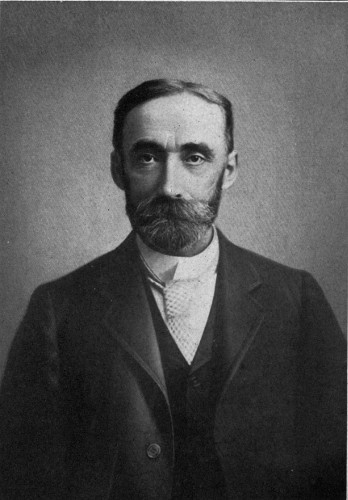
JAMES ELLIOT
Mr. Elliot was unmarried. After providing with great liberality for near relatives he bequeathed five thousand dollars to the Montreal General Hospital, five thousand dollars to the Protestant Hospital for the Insane and a thousand dollars each to the Western Hospital, McKay Institute, Grace Dart Home, the Protestant House of Industry and Refuge and the Salvation Army. His bequest to these many organizations showed his broad-mindedness and his deep interest in the welfare and uplift of his fellowmen.
JOSEPH ARTHUR COUTURE.
Joseph Arthur Couture, a notary public practicing in Montreal and in Maisonneuve, was born on the 29th of December, 1881, at Sherrington in the county of Napierville, P. Q., his parents being Jules and Dométhile (Bourgeois) Couture. He represents two of the old French families of the province. His great-grandfather and his grandfather, both of whom bore the name of François Couture, were farming people, the former following agricultural pursuits at Lacadie, while the latter was a farmer at St. Cyprien in the county of Napierville. He married Sophie Ward and their family included Jules Couture, who married Dométhile Bourgeois. Her father, Pierre Bourgeois, was at one time a farmer at St. Jean, P. Q., and later at St. Cyprien, where he was residing at the time of his death. His wife was a member of the Granger family. Jules Couture was born in St. Cyprien, county of Napierville, and made farming his life work, but since 1900 has lived retired, his home being in the village of Napierville. His wife was born in the parish of St. John, P. Q., and died on the 15th of September, 1907. They had a family of twelve children, of whom three daughters and five sons are living.
Joseph Arthur Couture, the youngest of the family, attended the parish school to the age of ten years and afterward studied with the parish priest of Sherrington for three years. He next entered Montreal College, where he pursued a five years’ classical course and later became a student in the Seminary of Philosophy, where after two years, or in 1902, he won his degree of Bachelor of Letters. In September of that year he matriculated in Laval University where he studied law in preparation for the notarial profession, receiving his LL. L. degree in 1905. He was received as a notary in July of the same year and in September began practice in the village of Napierville, where he continued until the 1st of October, 1906. He then removed to the city of Maisonneuve, where he continues in practice, and at the same time maintains an office in the city of Montreal. He is likewise a commissioner of the superior court in and for the district of Montreal. He carefully prepared for his chosen calling and his knowledge of the law and his understanding of all phases of the notarial profession have given him high rank among his associates in that field of labor.
Mr. Couture is also interested in some syndicates, purchasing lots on the island of Montreal. He is a director of La Société du Boulevard Pie IX, Limitée and of Salmon River Gold Fields and of the Montreal Consolidated Real Estate and Investments, Limited. His connection therewith has resulted in bringing him good financial returns, while in his profession he is making continuous advancement.
On the 9th of October, 1905, Mr. Couture was married to Miss Mathilda Ida Lachapelle, a daughter of Alfred and Mathilde (Beauchamp) Lachapelle, the former in his life time a merchant of Montreal. Mrs. Couture died at Maisonneuve, at the age of twenty-seven years, on the 17th of December, 1913, leaving no issue. Mr. Couture is a member of the Roman Catholic church and in politics he was formerly a conservative but became a nationalist as he did not approve of the naval policies of either the liberal or conservative parties. He is still, however, a member of the Montreal Liberal-Conservative Club. He was for three years recording secretary of Court Gounod No. 3240, I. O. F., of which he is now deputy chief.
HON. J. O. VILLENEUVE.
The name of Hon. J. O. Villeneuve is inseparably interwoven with the history of Montreal and its progress. Modesty at all times characterized his bearing and simplicity his habits, yet the sterling worth of his character and the high order of his ability brought him to a position of leadership in connection with municipal and provincial affairs. He labored untiringly for the best interests of Montreal while acting as chief executive of the city and was equally faithful in his support of matters relating to the provincial welfare when serving as senator. A native of the county of Terrebonne, he was born at Ste. Anne des Plaines, on the 4th of March, 1837, and his life record covered the intervening period to the 27th of June, 1901, when he passed away at the age of sixty-four years. He was but a young lad at the time of the removal of his father, Octave Villeneuve, and the family to Montreal, so that he was indebted to the school system of this city for his educational opportunities. He started in the business world as clerk in a dry-goods store in 1853, when a youth of sixteen years, and his traits of loyalty and faithfulness were manifest from the beginning, as is evidenced by the fact that he remained with one establishment until 1865. Ambitious to engage in business on his own account, he carefully saved his earnings until his industry and economy had brought him sufficient capital to enable him to open a grocery store at Mile End. There he conducted business for some time and subsequently founded the wholesale grocery house of J. O. Villeneuve & Company, which rapidly gained patronage and a high and well merited reputation in commercial circles. He was a farsighted man and one who on recognizing a public need at once sought to meet it. Realizing the lack of communication between the extreme northern section of Montreal and the outlying parishes, he established an omnibus route in 1860 between Mile End, Terrebonne, Sault au Récollet and New Glasgow, which he later sold to the Montreal Street Railway when it seemed feasible to extend the railway lines into that section.
Mr. Villeneuve was frequently called to public office and it is a notable fact in his career that no public trust reposed in him was ever betrayed in the slightest degree. For more than seventeen years he was mayor of St. Jean Baptiste village and again, when the organization of the town took place, he served for four years more, carefully guiding the interests of village and town so as to bring about needed reforms and improvements. Following the annexation to the city in 1885 he represented St. Jean Baptiste ward from that date until 1894 in the city council and as a member of the finance committee his experience in financial matters was found to be of great service to the public. Higher official honors awaited him, however, for in 1894 he was elected Montreal’s mayor and filled that position for two years, proving a capable executive and one who most carefully and systematically safeguarded the public interests. For eighteen years he served as warden of the county of Hochelaga and in 1886 was elected to represent that county in the Quebec legislature, where his record was so commendable that he was reelected in 1890 and again in 1892. In 1888 he was made a member of the harbor commission and served for several years on that body. In January, 1896, he succeeded the late Hon. Joseph Tasse as senator for the De Salaberry division. All this, however, did not cover the many phases of his activity. For many years he was a member of the Board of Trade, and he had important business connections, serving as director of the Dominion Cotton Company, in addition to which he had other large manufacturing, mercantile and real-estate interests in the city. He was resident director of the Banque Nationale and a member of the harbor board and a governor of Laval University. He was also senior partner of the firm of L. Villeneuve & Company, wholesale lumber dealers.
In 1861 Mr. Villeneuve married Miss Susan Ann Walker, a daughter of Captain James Walker, of Sorel, Quebec, who survives together with their four children. Her father was a captain in the regiment stationed at Sorel and was a son of Dr. Edward Walker, surgeon of that regiment. Jacques Villeneuve, the eldest of the four children, residing at St. Jerome, Quebec, is proprietor of a stone quarry and brick manufacturing business there. He married Miss Lamontague and they had seven children, Jacques, Edgar, Charles Eugene, Lia, Adrienne, Marguerite and Jeanne. For his second wife Jacques Villeneuve wedded Miss Poitevin, and they have a son, Jean. Eugene W., the second member of the family, was born in Montreal in 1865 and was associated in business with his father until the latter’s death. He brought about the royal commission, giving a change of administration and management of the city by a board of control. In November, 1910, at a meeting held at St. Jean Baptiste market hall, he proposed that the centenary of the birth of Sir George Etienne Cartier should be appropriately commemorated and that steps should be taken for the erection of a monument to his memory. Since then the monumental enterprise has assumed not only national but empire scope and representatives of every portion of the empire will be present at the commemorative celebration September 6, 1914. Mr. Villeneuve has served faithfully as president of the executive committee in charge of the celebration and the erection of the monument. He married Miss Alice Crompton, and their children are James and Reginald. Frederic Villeneuve, the third member of the family, is a graduate of Laval University and was afterwards advocate in Montreal and in Edmonton, Alberta. For several years he was editor of Canadian West and for four years, from 1898 until 1902, sat for St. Albert in the legislature. In 1909 he was appointed librarian of the Montreal Civic Library. He married Miss Howie, of St. Johns. Rachel Villeneuve, the youngest of the family, married Alphonse Morin, protonotary of St. Johns. Their children are Josephine, Louise, Susan, Pierre Villeneuve, Lucie, Madeleine and Andre, and they reside at No. 629 Dorchester West.
The death of Hon. J. O. Villeneuve occurred on the 27th of June, 1901, at the family residence at 862 St. Denis Street. Editorially the Gazette said of him: “Senator Villeneuve is dead at the comparatively early age of sixty-four. His career was a typical one and included fully thirty years of public service, municipal and parliamentary. His straightforward conduct and good faith gained him general respect and for almost a generation he could count on election to whatever office in the gift of the county of Hochelaga or city of Montreal he aspired to. His municipal career was crowned by the mayoralty of Montreal and his political work by a senatorship. He was a thoroughly well meaning man, of modest bearing and simple habits, whose innate worth was behind his business and public success. In his death Montreal loses a good citizen and parliament a member of safe judgment and right purpose.” To thus win the merit and plaudit of the press shows that the life of Hon. J. O. Villeneuve was one of far-reaching usefulness and of importance in Montreal. He neglected no opportunity, slighted no duty nor passed unheedingly the chances to benefit city or province by helpful service on his part.
JOHN DILLON.
John Dillon, for many years one of the best known merchants of Montreal, was a member of the firm of Reford & Dillon. He was born in Chambly, March 18, 1836, a son of John Dillon, Sr., a native of Belfast, Ireland, who emigrated to Canada and for some years resided in Toronto and Montreal, his death occurring in the latter city in 1875. He was father of two sons, George Graham and John Dillon. The former passed his active business life in Toronto, where he was connected with the retail dry-goods house of George Bowes & Company. He died in Toronto, while his widow, Mrs. Catherine Jacques Dillon, passed away in Montreal. They were survived by a daughter, Miss Elisabeth J. Dillon, who for many years lived with her uncle, John Dillon, who never married.
It was in Toronto that John Dillon formed a partnership with Robert Reford under the firm name of Reford & Dillon, wholesale grocers, and in 1867 the business was moved to Montreal. This association continued for about forty years and the business was most successfully and capably conducted according to modern progressive methods. A few years prior to his death Mr. Dillon retired from the firm, but maintained his interest in other industrial and commercial institutions. Up to the time of his death he was a director of the Mount Royal Milling and Manufacturing Company and was also vice president of the Gould Cold Storage Company. His business judgment was sound, his discrimination keen and his enterprise unfaltering. He could see farther than many a man in business circles, foretelling the outcome of any enterprise from the beginning and, moreover, he had the power to coordinate and unify forces into a harmonious whole.
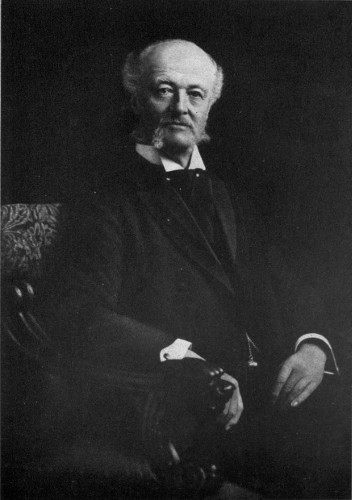
JOHN DILLON
Mr. Dillon was much interested throughout his lifetime in charitable work and among other institutions with which he was actively associated was the Old Brewery Mission. He was an active member of the Dominion Square Methodist church, which he joined as a charter member upon its organization.
The Montreal Star in announcing his death on the 15th of May, 1908, said, “In the death of Mr. John Dillon which took place this morning very suddenly at his residence, 19 McGregor Street, Montreal loses one of its oldest and most respected citizens. Mr. Dillon, who had been in good health, was speaking to a relative about 11:30 today, when he was overcome by heart failure, his death taking place almost immediately. Thus passed onward one who always strove to do his duty by his fellowmen.”
CARLOS A. HAYES.
Carlos A. Hayes, who for a number of years was connected with the Grand Trunk Railway, lastly as freight traffic manager, was on July 1, 1913, appointed general traffic manager of the Canadian Government Railways, with headquarters at Moncton, New Brunswick. Mr. Hayes has long been prominently connected with Canadian railway service and has in that way contributed toward the opening up of vast natural resources in the Dominion.
He was born in West Springfield, Massachusetts, March 10, 1865, and when a boy of seventeen entered the railway service in 1882, continuing along that line with various roads in the United States until the year 1892, when he was made New England agent and, in 1896, manager of the National Despatch-Great Eastern Line. He held this position until 1903, when he became connected with the Grand Trunk Railway as assistant general freight agent in Chicago. Readily grasping railroad problems and possessed of the true generalship of a railway executive, he was chosen in 1908 to succeed J. E. Dalrymple as general freight agent of the Grand Trunk, with headquarters at Montreal, and there remained, first as general freight agent and later as freight traffic manager, until his recent appointment. Mr. Hayes is a well known figure in Dominion railway circles and stands high in the estimation of business men.
JOHN EDWARD MARTIN.
John Edward Martin, K. C., a well known member of the Montreal bar, was born in September, 1859, at Shefford, in the province of Quebec. He received his early education in the public school at Waterloo, P. Q., and at McGill Normal School, and later entered McGill University, where he graduated with the Degree of Bachelor of Civil Law in 1883, being the medallist of that year.
In July, 1884, he was admitted to the practice of law and began the practice of his profession at Sweetsburg, P. Q., in partnership with the late Senator Baker. In 1893 he removed to Montreal and for over twenty years has been a member of the law firm of Foster, Martin, Mann, Mackinnon & Hackett, and his constantly expanding powers brought him prominently before the public as an able lawyer and led to his being named king’s counsel in 1903.
The litigated interests intrusted to his care have on the whole been of a most important character, and he has successfully practised before all the courts of the province, the supreme court of Canada, and has frequently appeared before the judicial committee of the privy council in London, England.
Mr. Martin has specialized in corporation and insurance law, and his preparation of cases is always thorough and exhaustive, and the court records indicate his ability in securing verdicts favorable to his clients.
He was a member of the council of the bar of Montreal for several years and batonnier of the bar of Montreal and batonnier-general of the bar of the province of Quebec during the year 1913-1914. In 1913 he was elected an honorary member of the American Bar Association.
Mr. Martin has been married twice. His first wife, Nellie, daughter of J. Rooney of Sweetsburg, P. Q., died in January, 1909. In December, 1910, he married Emily Violet, daughter of James Patterson of Guelph, Ontario.
In politics Mr. Martin is a conservative, and he is a member of the Anglican church. He is a member of the Mount Royal, Forest and Stream, Canada and the Laurentian Clubs. He has a wide acquaintance among the leading residents of the city, where his ability and personal worth have gained for him the high regard of those with whom he has come in contact.
JAMES ALEXANDER LAWRASON STRATHY.
James Alexander Lawrason Strathy, long a factor in financial circles in Montreal, was born in London, Ontario, July 22, 1857, where his father, James B. Strathy, was at one time collector of customs. The mother, Mrs. Elvira Strathy, was a daughter of Dr. Hiram D. Lee and of United Empire Loyalist stock. Liberal educational opportunities were accorded the son, who was educated in the Moncrieff Preparatory School, in Hellmuth College at London, Ontario, and in Upper Canada College. At the age of seventeen years he came to Montreal and entered the employ of the brokerage firm of Gordon Strathy & Company, later becoming a partner in the business. He subsequently was admitted to the Montreal Stock Exchange, while six years later he became a member of the Board of Trade. In the following years he devoted all his time to the Montreal Trust & Deposit Company, of which he was one of the organizers. He was appointed general manager of the business and remained with the company until his death. He was also a member of the executive committee of the Royal Electric Company and in business connections gave evidence of his ability to handle important interests and solve intricate problems.
Mr. Strathy was a justice of the peace of Montreal and in official position made a record equally creditable with that which he won in business. He was a member of St. Andrew’s Society and vice president of the United Empire Loyalist Association. Distinction and honors also came to him along military lines, his military record dating from his appointment as second lieutenant of the Fifth Royal Scots of Canada, in 1880. He was advanced to the rank of captain in 1884, became major in 1891 and was made lieutenant colonel, commanding his regiment, in 1893, so continuing until his connection with the regiment ceased in December, 1897. In 1894 he became vice president of the Canada Military Institute at Toronto and the same year was appointed to the staff of the governor general of Canada as an extra aide-de-camp.
Mr. Strathy was widely known in sporting circles. As a gentleman rider he was the winner of the Montreal Hunt Cup Steeplechase in 1880, 1881 and 1886 and of the American Grand National Hunt Steeplechase at Saratoga in 1882 and of the steeplechase open to gentlemen riders. His political allegiance was given to the conservative party and the interests and duties of citizenship found ample recognition in his life activities.
On the 9th of January, 1885, Lieutenant Colonel Strathy was married to Miss Margaret, daughter of Andrew Robertson, of Montreal, and they became the parents of six children, of whom five are living: Marguerite F., Isabella D., Alison L., R. Lee A. and Elvira M. The family circle was broken by the hand of death when on the 7th of October, 1901, Lieutenant Colonel Strathy passed away. He was a popular member of the St. James Club and his position as a business man and in military and sporting circles classed him with the representative residents of his city.
JOHN RIGNEY BARLOW.
John Rigney Barlow, a civil engineer, who in 1900 was appointed to the position of city surveyor of Montreal, has since served in that capacity and is one of her best known civic officials. A native of Scotland, he was born at Stornoway, Lewis, on the 29th of July, 1850, a son of the late Robert Barlow of the Canadian Geological Survey. The first five years of his life were spent in the land of hills and heather, after which the family came to the new world. John R. Barlow was reared in Montreal and started in the business world in the employ of the Canadian Geological Survey, with which he remained from 1872 until 1875. He then entered the service of the corporation of Montreal in 1876, and did important duty in that connection. He was engaged in the construction of water works in the town of St. Henri and did other important duties. He became assistant city engineer of Montreal in 1880 and was made deputy city surveyor in 1882. Further advancement came to him in his appointment to the position of city surveyor in 1900, and he is now acting in that capacity. He thoroughly understands the scientific principles which underlie his work as well as every practical phase of the business and now occupies an enviable position among the civil engineers of Montreal.