BIOGRAPHICAL (continued 3)
Reading edition
In June, 1897, Dr. Hamilton married Miss Janet Mills of Westmount, P. Q. Aside from his activity in the professional field Dr. Hamilton has done important public service as a director of the Young Men’s Christian Association and as senator of the Montreal Wesleyan Theological College. He is an active and helpful member of the Methodist church, and his social nature finds expression in his membership in the University Club and the Montreal Country Club.
HON. MICHEL MATHIEU.
Hon. Michel Mathieu has engraven his name high upon the list of Montreal’s eminent jurists, but has now retired from active connection with the profession, spending the evening of life in the enjoyment of well earned rest. He has passed the seventy-fifth milestone, having been born at Sorel, province of Quebec, December 20, 1838, a son of the late Joseph and Edwidge (Vandal) Mathieu. His education was acquired under private tuition and in the College of St. Hyacinthe, followed by a professional course in Laval University. He was admitted to the notarial profession in 1864 and was called to the Montreal bar as an advocate in 1865. His practice of his profession has been combined with active public service. In 1866 he was chosen sheriff of Richelieu and continued in that position for six years. He successfully practiced his profession at Sorel and while at the bar was closely associated with journalism bearing upon his profession, being the publisher of La Revue Legale, together with some annotated reports. In 1880 he was created king’s counsel by the Marquis of Lorne. He became widely known as an educator, for in 1886 he became a member of the law faculty of Laval University, receiving in that year the degree of LL. D., and becoming dean of the faculty, which connection he still retains.
It is a well known fact that members of the bar more than representatives of other professions are prominent in public office. The reasons for this are obvious and need no amplification here, for the qualities which fit one for success in law practice also prepare him for the thorough understanding of involved problems affecting the public welfare, and the habit of analytical reasoning is as forceful and valuable in one connection as in the other. Judge Mathieu sat for Richelieu in the house of commons, representing the conservative interests from 1872 until 1874. He was then defeated but represented the same constituency in the local parliament from 1875 until 1878. He took his place upon the bench as puisne judge of the superior court on the 3d of October, 1881, and for twenty-eight years interpreted law in opinions which were notably free from partiality and bias. His decisions indicate strong mentality, careful analysis and a thorough knowledge of the law. The judge on the bench fails more frequently, perhaps, from a deficiency in that broad-mindedness which not only comprehends the details of a situation quickly and that insures a complete self-control under even the most exasperating conditions than from any other cause; and the judge who makes a success in the discharge of his multitudinous, delicate duties is a man of well rounded character, finely balanced mind and of splendid intellectual attainments. That Judge Mathieu is regarded as such a jurist is a uniformly accepted fact. He figured also in public life as a royal commissioner to inquire into certain matters concerning the good government of the province in 1892. He presided at the celebrated Shortis case for murder in the ’90s; in 1910 he lectured on the Canadian constitution and in July of that year he was appointed a royal commissioner to revise, consolidate and modify the municipal code of Quebec.
Judge Mathieu was married in 1863 to Marie Delina Thirza, a daughter of the late Captain St. Louis of Sorel, province of Quebec. She died in 1870 and in 1881 Judge Mathieu wedded Marie Amelie Antoinette, a daughter of the late Hon. D. M. Armstrong, M. L. C. The death of Mrs. Marie A. A. Mathieu occurred in April, 1898. Judge Mathieu now resides at The Marlborough in Montreal. His religious belief is that of the Roman Catholic church. Something of his standing is indicated in the words of Dr. J. Reade, who spoke of him as “much esteemed, especially by the students and younger members of the bar,” while the Montreal Gazette said of him, “He is a judge, painstaking and capable and with a grasp of the law and its meaning that few can equal.” His influence has been far-reaching and beneficial; it has touched the general interests of society along many lines and has been a factor in maintaining the legal status upon which rests the stability and prosperity of a country, the life and liberty of the individual.
HON. CHARLES SERAPHIM RODIER.
Along the path of broad usefulness and activity Hon. Charles Seraphim Rodier advanced to prominence and success. He was a pioneer contractor, lumber merchant and manufacturer of Montreal and eventually came to figure prominently in financial circles. He was born in this city, October 14, 1818, and his life record spans seventy-two years, drawing to its close on the 26th of January, 1890. His grandfather was a physician in the French army and leaving Paris came to Canada, settling in Montreal in the middle of the eighteenth century. His father was Jean Baptiste Rodier, who married Miss Montreuil, daughter of a well known navigator who commanded vessels sailing from Montreal.
The opportunities accorded Charles Seraphim Rodier in his youth were somewhat limited. He pursued his education in a church school, but at the age of fourteen years put aside his text-books in order that he might earn his own living. He was apprenticed to the carpenter’s trade and for his services received a wage of one dollar per day. Thus from a humble position in the business world he steadily worked his way upward until long prior to his death he had reached a place in the millionaire class. He applied himself thoroughly to the mastery of his trade and when but eighteen years of age began contracting on his own account and gained a good patronage. About the year 1846 he began the manufacture of threshing machines on St. Peter Street, now St. Martin, and for the remainder of his life was to be found almost daily at his office at No. 62 St. Martin. The business prospered from the beginning and machines that were made there over a half century ago are still repaired there. Each step in his business career brought him a broader outlook and wider opportunities. He was the owner of freight and passenger vessels and was one of the founders of the Jacques Cartier Bank, in which he placed one hundred and forty-five thousand dollars. He acted as both vice president and director of that institution and was connected with several joint stock companies, his opinions carrying weight in their management, for his advice was always considered sound and his judgment discriminating in regard to business affairs.
Aside from his personal interests, he was for over fifty years active in public life. In 1838 he was elected alderman for St. Antoine ward of Montreal but could not take his seat until later when he became of age. For nine years he served in the council, being elected three times by acclamation. Politically he was a stanch liberal-conservative and three times he refused a senatorship, but later, at the urgent request of his family and friends, he accepted in 1888, being gazetted senator on the 17th of December, of that year, for the division of Mille Isles. He last attended parliament the week before his death and was last at his desk on the 24th of January, 1890. He gave careful consideration to the grave questions which came up for settlement and stanchly supported any movement which he considered of vital worth. His activities also extended to other lines. He was president of the St. Jean Baptiste Society; was warden of Notre Dame church; and president of St. Vincent de Paul Society. He was also lieutenant colonel of the Sixty-fourth Beauharnois Battalion at the time of its formation and he was ever a generous contributor to religious, educational and charitable institutions.
Senator Rodier was united in marriage in 1848 to Miss Angelique Lapierre, a daughter of Andre Lapierre. The death of Mr. Rodier occurred January 26, 1890, when he had reached the age of seventy-two years, while his wife survived until March 24, 1907. They were the parents of four sons and four daughters.
ALEXANDER C. HENRY.
In business circles of Montreal the name of Alexander C. Henry was well known, for from 1899 until his death, three years later, he was purchasing agent for the entire system of the Canadian Pacific Railway, the magnitude and importance of his duties making his position a most difficult and responsible one. He was born at Beamsville, Canada, in 1849, and after mastering the branches of learning taught in the public schools he attended the Upper Canada College, at Toronto. Subsequently he removed to Montreal, and gradually working his way upward in business connections became, in 1884, assistant purchasing agent for the Canadian Pacific Railway, and in 1899 was made general purchasing agent for the entire system. His ability, fidelity, indefatigable energy and enterprise brought him to the prominent position which he occupied. At the time of his death Sir Thomas Shaughnessy, president of the Canadian Pacific Railway, paid high tribute to his memory and bore testimony to his honesty, which was manifest in his careful accounting for every penny, although in his capacity of purchasing agent he expended over one hundred and two million dollars.
On the 30th of November, 1882, in Montreal, Mr. Henry was united in marriage to Miss Agnes Wilson, of England, and to them were born three children, two of whom are living, H. Gordon, being a resident of Cleveland, Ohio, and the other, A. Wilson, of Montreal. Mr. Henry held membership in St. James the Apostle church. He was a public-spirited citizen, active in support of any movement which he deemed of vital worth in the upbuilding and progress of the community. He belonged to St. James Club, the Forest and Stream Club and others, and he had an extensive circle of friends who held him in the highest esteem. Mr. Henry passed away on February 2, 1902.
GEORGE FREDERICK BENSON.
In manufacturing and commercial circles of Montreal the name of George Frederick Benson is well known. Important business concerns have profited by his cooperation, have felt the stimulus of his energy and enterprise and have been quickened by his close application and careful control. Many of Montreal’s best known and most successful business men are numbered among her native sons, to which class Mr. Benson belongs. His father, William T. Benson, a native of Kendal, Westmoreland, England, was a member of the federal parliament for the constituency of South Grenville, Ontario, in which county the village of Cardinal (formerly called Edwardsburg) is situated. There the late W. T. Benson resided for twenty-seven years, after establishing there in 1858 the industry, so well known for many years throughout the Dominion of Canada as The Edwardsburg Starch Company and now forming the Edwardsburg Works of The Canada Starch Company, Ltd. The late W. T. Benson married in England, before coming to Canada, Helen Wilson of Acton Grange, Cheshire, England, and their only son was George Frederick Benson, the subject of this review.
He was educated in England at Uppingham School and Oxford University, but returned to Canada, after the sudden death of his father in 1885, to take charge of his father’s varied interests. After first confining his work to the management of the firm of W. T. Benson & Company, importers of foreign wools and chemicals at Montreal, he was elected president of The Edwardsburg Starch Company in 1894, and since the formation of The Canada Starch Company in 1906 he has been its president and managing director. He is likewise a director of the West Kootenay Power & Light Company, and thus his interests have become extensive and important, connecting him with leading manufacturing, commercial and industrial interests, not only in the east but also in the west.
In October, 1890, Mr. Benson was united in marriage to Miss Etheldred Norton, a daughter of the late George Frothingham of the well known firm of Frothingham & Workman, and they reside at No. 15 Ontario Avenue, Montreal. Mr. Benson gives his political allegiance to the conservative party and in religious faith is an Anglican. He has been an active member of the Montreal Board of Trade, and was treasurer for the year 1913. He has a wide acquaintance among leading club men of the city, holding membership in a number of the most important clubs of Montreal, including the St. James, Mount Royal, Canadian, Canada, Forest and Stream, Montreal Hunt, Montreal Racquet, Royal Montreal Golf and Royal St. Lawrence Yacht Clubs. He is also a member of the Royal Canadian Yacht Club of Toronto and an active member of the Thousand Islands Yacht Club in the Thousand Islands district, where he has a most attractive summer residence.
LOUIS N. DUPUIS.
Louis N. Dupuis is one of Montreal’s well known business men and citizens, whose connection with varied and important commercial enterprises in that city, has gained for him success and high standing as well as an enviable position in business and financial circles. He was born at St. Jacques l’Achigan, Montcalm county, October 17, 1855, a son of Joseph Dupuis and Euphrasie Richard. He attended Archambault’s Catholic Commercial Academy now called Plateau school and entered upon his business career as junior clerk in the employ of his late brother, J. Naz. Dupuis, in 1868. While at this time, Mr. Dupuis was but a lad, yet he applied himself closely and learned the business rapidly.
He was one of the founders in 1876 of Dupuis Freres, Limited, one of the best known mercantile houses in Montreal, and during the first ten years of this firm’s existence he took an important part in the management of its affairs and was no small factor in its success.
On the 1st of January, 1886, Louis N. Dupuis retired from the firm, since which time he has given his attention to various commercial enterprises, his sound judgment constituting an active and effective force in capable management.
Mr. Dupuis has been for a number of years extensively identified with real estate interests in Montreal, and in this connection has taken a prominent part in the city’s development. He is president of the Eastmount Land Company, also president of La Compagnie General d’Immeubles, Limitee, and president of the Merchants and Employers Guarantee and Accident Company. In these companies as well as in others with which he has been identified, his sound business judgment and foresight have been substantial contributions to their success.
On the 25th of April, 1881, Mr. Dupuis was married at L’Assomption to Miss Marie Melanie Panet Levesque, the second daughter of Pierre Thomas Panet Levesque, a land surveyor. Mr. Panet Levesque was seigneur of d’Ailleboust and Ramsey, which two seigneuries are situated in the county of Joliette, P. Q. Mr. and Mrs. Dupuis have ten children, living: Anne Marie; Amelie; Pauline and Celine; Pierre Louis, a well known young advocate of Montreal who was married on the 15th of January, 1913, to Miss Carmel Girouard, daughter of Joseph Girouard, ex-member of parliament of St. Benoit, Two Mountains; Rosaire, one of the rising young notaries of Montreal, and of whom further mention is made elsewhere in this work; François; Camille; Roger; and Jean.
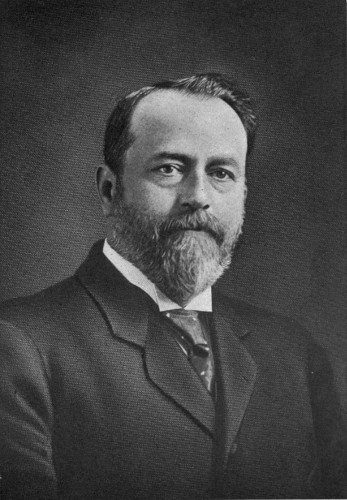
LOUIS N. DUPUIS
Mr. Dupuis holds to the political faith of the conservative party and to the religious faith of the Roman Catholic church. He is a Knight of Columbus of Conseil Lafontaine and belongs to the Chapleau Fish and Game Club and the Canadian Club. Thoroughly progressive in his ideas, he has kept well informed both by reading and travel. As long ago as 1874, Mr. Dupuis visited Fort Garry, now the city of Winnipeg, when the journey required fourteen days from Montreal, and too, when the Red River country was considered the “Far West.” He has since then visited the Pacific coast no less than five times, as well as various sections of the United States. He is equally familiar with England, Ireland, Scotland and Wales, as well as continental Europe, as it was formerly his custom to make semi-annual trips to Europe in connection with his business affairs. He enjoys the outdoor life, especially the sports of the forest. His public service has been well performed. At the end of 1909 he was selected by the citizens committee to form part of the new administration of the city as commissioner and was elected by the city at large in the election held on the 2d of February, 1910.
ROUER JOSEPH ROY, K. C.
Rouer Joseph Roy, jurist, linguist and an interested student of literary, scientific and antiquarian subjects, was born in Montreal, January 7, 1821, his parents being the late Joseph Roy, M. P. P., and Amelia (Lusignan) Roy. The former, of French descent, rose to a position of prominence, representing his riding in the provincial legislature. His wife was connected with the distinguished family of Rouer de Villeray.
Rouer Joseph Roy attended Montreal College, from which he was graduated with honors in the presence of Lord Durham. Having determined upon the practice of law as his life profession, he entered the law office of the Hon. Mr. Sullivan in 1838 and after four years of thorough and comprehensive study was called to the bar, in 1842. Almost from the beginning his career was a successful one and after several years devoted to active law practice he was appointed joint city attorney for Montreal in 1862, filling that position continuously until 1876, when he became the sole legal advisor of the city, remaining in that office until he resigned in 1898. He afterward filled the position of consulting city attorney. In 1864 he was elected syndic of the Quebec bar and so continued for four years. In the same year he was made queen’s counsel as well as being elected president of the committee in charge of the bar library, which office he continuously and honorably filled for thirty years. In 1887 he was unanimously chosen batonnier of the Montreal bar and the following year was chosen batonnier general of the province. He held high professional rank and on several occasions appeared before the judicial committee of the privy council in England.
In January, 1857, Mr. Roy was married to Miss Corinne Beaudry, a daughter of the late Hon. J. L. Beaudry, M. L. C., who in 1857 was mayor of Montreal. Mr. Roy not only enjoyed a high reputation as a lawyer but also as a scholar, being widely known as a linguist, speaking fluently Greek, Latin, Italian and French as well as English. For many years he occupied the presidency of the Numismatic and Antiquarian Society. He was one of the last survivors of the Sons of Liberty, an organization which played a most important part at the time of the rebellion of 1837. His religious faith was that of the Roman Catholic church and he filled the office of church warden of the parish of Notre Dame. His life was characterized by a nobility that lifted him above those traits which mar character and when death called him on the 27th of July, 1905, only words of commendation and respect were spoken concerning his life work. He had done things worthy to be written and had written things worthy to be read, and he left to posterity an unblemished name, linked with many deeds that won him prominence and honor.
CHARLES MACKAY COTTON.
A man of force, experience and capacity, Charles Mackay Cotton has made for himself an enviable position at the bar of Quebec and is numbered among the most able and successful advocates of Montreal, where he is in active practice as a member of the firm of Cotton & Westover. He was born in Durham township, Missisquoi county, Quebec, February 22, 1878, and is a representative of a well known Canadian family of English extraction, being a son of Sheriff Cotton, a grandson of Dr. Cotton and a great-grandson of Rev. Charles Caleb Cotton, B. A. (Oxford), who came from England in 1799 and was one of the pioneer Anglican clergymen in the eastern townships.
Charles Mackay Cotton acquired his preliminary education at Cowansville Academy, Feller Institute, Grande Ligne, Quebec, and afterward entered McGill University, Montreal, from which he was graduated with the degree of B. A. in 1899, winning the high honor of the gold medal for general proficiency. From the same institution he was afterwards graduated B. C. L. in 1902, taking at this time the Macdonald scholarship. In his student days he gave every evidence of the ability and power upon which his present success is founded for besides the honors above mentioned he was class orator in science, arts and law. His record in McGill University is very creditable and one of which he has every reason to be proud, and its promise has been fully justified by his later accomplishments in the professional field. Mr. Cotton was called to the bar as advocate in 1902 and immediately afterwards went abroad in order to get the advantages of foreign travel and to supplement his excellent legal training by further study. He attended lectures at the law school of the University of Montpelier in 1903, thus completing an exhaustive and comprehensive legal education.
Mr. Cotton opened his first office in Sweetsburg, this province, practising in partnership with J. C. McCorkill, and proving able, farsighted and discriminating in the discharge of his professional duties. From Sweetsburg he came to Montreal, and he is today one of the representative citizens of this community, prominent in his profession and a leading factor in the promotion of those projects and measures which have for their object municipal growth, advancement and progress. The firm of Cotton & Westover is one of the strongest of its kind in the city and connected through a wide and representative patronage with a great deal of important litigation. Mr. Cotton is recognized as an able advocate, possessed of a comprehensive knowledge of the law and a practical ability in its application, and his developed powers and wide experience are bringing him constantly increasing prominence in his chosen field.
Mr. Cotton is a member of the Anglican church and was formerly a captain in the Fifteenth Shefford Field Battery. A strong liberal, he takes an intelligent interest in public affairs, opposing political corruption wherever he finds it and supporting by word and action pure and clean politics. Viewed from any standpoint his has been a useful and successful career, and the future undoubtedly holds for him further honors and continued prosperity.
WILLIAM ALEXANDER HASTINGS.
William Alexander Hastings, for many years vice president and general manager of the Lake of the Woods Milling Company, Ltd., and one of the best known men in his line of business in Canada, was born at Petite Cote, March 6, 1852, a son of George and Margaret (Ogilvie) Hastings. George Hastings came from Boston, Massachusetts, and located at Petite Cote where he was engaged in farming.
William A. Hastings pursued his education in the schools of his native city and began his business career as a clerk in the Exchange Bank. His progress was rapid and he was promoted to manager of the Bedford (Quebec) branch, and later manager of the Exeter branch. Subsequently he was appointed treasurer of the St. Joseph (Missouri) Gas Company, serving until 1882 when he became identified with the milling business in which he achieved such notable success. In that year, with his brother, George V. Hastings, he became associated with the Ogilvie Company at Winnipeg, building and opening the flour mills there with great success. In 1888 he severed his connection with the above firm and became vice president and general manager of the Lake of the Woods Milling Company, filling this prominent and important position until his death, which occurred on May 23, 1903.
Mr. Hastings had thoroughly acquainted himself with the business in its different phases so that he was well qualified to assume the control of one of the largest businesses of its kind in the Dominion, and to his rare judgment and marked executive ability is credited, to no small extent, the high degree of prosperity enjoyed by the company whose affairs he so ably directed.
Robert Meighen, president of the Lake of the Woods Milling Company, said that he had been associated with Mr. Hastings for thirteen years and that any business which passed through his hands passed through the hands of God’s noblest work—an honest man. Others bore equally strong testimony as to his enterprise and his thorough reliability. He never weighed an act in the scale of public policy but always measured his deeds by the standard of upright principle.
In 1884 Mr. Hastings was united in marriage to Miss Georgina Roy Ure, daughter of the late George P. Ure, and they became the parents of the following children: Margaret Ogilvie, who died in infancy; William Roy, of Montreal; and John Ogilvie, of Montreal.
Mr. Hastings was lacking in none of the qualities which make for upright manhood and progressive citizenship, and his cooperation with any movement or plan largely insured the successful outcome of the same. In 1890 he became a member of the Corn Exchange and in 1893 was elected a member of the committee of management, in which office he continued until 1898, serving for the last three years of that period as treasurer. Throughout his entire life Canada numbered him among her best citizens and the record which he made reflected credit upon the Dominion, constituting a factor in its material development.
ROBERT DENNISON MARTIN.
One of the best known men in the grain trade in Canada and one whose untimely death cut short a business career that had been highly successful and was full of greater possibilities for the future was Robert Dennison Martin, who was born at Selby, Ontario, October 18, 1854, a son of William and Elizabeth (Thompson) Martin. The father was a farmer and the boyhood of Robert Dennison Martin was spent in the manner of a farmer’s son of that locality and period. His education, acquired at the place of his nativity, was somewhat limited. He remained in the district in which he was born until after attaining his majority. Hearing of the possibilities of the western country, he went to Manitoba and near Deloraine he secured a homestead which he developed and improved. As he managed to gather together a little capital, he turned his attention to merchandising, becoming a member of the hardware firm of Faulkner & Martin at Deloraine, an association which continued for a number of years after his removal to Montreal. It was at Deloraine that he first became connected with the grain business in which he was destined to win notable success. In the buying of grain he became associated with Alfred P. Stuart under the firm name of The R. D. Martin Company, a partnership that continued until the death of Mr. Martin.
After a few years residence in Winnipeg Mr. Martin came to Montreal in 1899, and with the exception of a year spent in Napanee and a year in Kingston, Montreal was his place of residence throughout the remainder of his life. The business of The R. D. Martin Company enjoyed a steady and prosperous growth and to its development Mr. Martin devoted his entire attention and rare ability. Since his demise the business has been continued under the name of the British Empire Grain Company, Limited. Mr. Martin suffered from ill health for several years prior to his demise which occurred at his beautiful new home at No. 1 Murray Avenue, Westmount, which was completed only a few weeks prior to his demise, which occurred on the 28th of June, 1905.
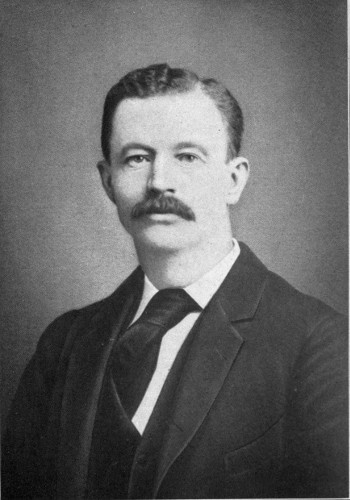
ROBERT D. MARTIN
It was on the 18th of May, 1894, at Winnipeg, that Mr. Martin was united in marriage to Miss Helen Moncrieff Morton, who was born in Perth, Scotland, a daughter of Duncan and Jessie (Watson) Morton. The father died when Mrs. Martin was but two years of age and her mother survived until a few years ago. Mrs. Martin came to Canada in 1892 and resided in Winnipeg previous to her marriage, a brother having preceded her to that place. She is one of five children born to her parents, four of whom survive, as follows: Jessie, the wife of George Banks of Perth, Scotland; Duncan, residing in Winnipeg; Helen M., who is Mrs. R. D. Martin; and Madeline, the wife of Andrew C. Craig of Winnipeg. To Mr. and Mrs. Martin were born five children: Charles Stuart, a student in McGill University; and Helen Elizabeth, Edith Laura, Jessie Watson and Robert Henry, all at home.
Mr. Martin was quiet and domestic in his tastes and habits. He held membership in only one club, the Canada Club, and did not enter actively into its affairs. He was very fond of his family and found his chief delight in the home circle, being a loving and kind husband and father. As a business man he was alert and energetic, ready for any emergency and he seemed to pass by no opportunity that pointed to honorable success. Contemporaries and colleagues had the highest respect for him and more than that, he gained the warm friendship and esteem of a large majority of his acquaintances. Although a later arrival in Montreal than many of his business associates, he gained prominence among them and attained an enviable position in the business world. He was a member of the Board of Trade and his opinions carried weight among its representatives and in other connections which had to do with the city’s welfare. He was truly Canadian in spirit and interests and his devotion to the public good was one of his notable traits of character.
J. LOUIS A. GUIMOND.
J. Louis A. Guimond, a notary public practicing in Montreal and interested in business enterprises which connect him with activity in the real-estate field, was born in the town of Beauharnois, in the province of Quebec on the 14th of February, 1877. His father was Cyrille Guimond, a merchant and manufacturer, who married Justine Dubreuil of Pointe-aux-Trembles. In the pursuit of his education he attended the Seminary of St. Hyacinthe and was graduated in letters with the class of 1896, while his scientific course was pursued in College St. Laurent, from which he graduated in 1898. He has since been an active representative of the notarial profession in which connection he has secured a large clientage that makes his practice a profitable one. His life has been one of intense and intelligently directed activity and aside from his professional duties he is acting as a director and is a shareholder in a real-estate company. He is likewise secretary-treasurer of two municipalities and thus takes a helpful interest in public affairs as well as in the conduct of private business interests.
On the 24th of May, 1909, at Iberville, P. Q., Mr. Guimond was married to Miss Marie Louise Gayette, a daughter of Calixte Gayette. Their children are Paul and Ives Guimond. The religious faith of the family is that of the Catholic church and in politics Mr. Guimond is a liberal-nationalist. He is energetic, accomplished and successful and by the consensus of public opinion he is ranked with the representative men of Montreal. He comes of an old and respected line of ancestors who settled in the province of Quebec in the seventeenth century. Since that day they have not only been active and progressive in business, but loyal in citizenship. Mr. Guimond’s lines of life have been cast in harmony with the record of an honored ancestry and his forbears have been no more loyal to city, province and country than he.
ROBERT H. BARRON.
A man who has founded success in the legal profession upon ability, comprehensive knowledge, long experience and untiring industry, is Robert H. Barron, since 1895 in active and successful practice as a notary in Montreal. He has made continued and rapid progress in his chosen field of labor, each year bringing him to a point in advance of the previous one, and today the firm of Barron & Cushing, of which he is the senior member, is one of the most reliable of its kind in the city.
Mr. Barron was graduated B. A. from McGill University in 1892 and acquired his professional training in the same institution, completing the law course in 1895. In October of that year he began practice in Montreal, being taken into partnership by Mr. Charles Cushing and Mr. Robert A. Dunton; this association continued until 1900, and Mr. Barron then continued in partnership under the firm name of Cushing & Barron until the death of Mr. Cushing in September, 1910. Mr. Barron then practiced alone for about one year, when he associated himself with Dougall Cushing, his present partner and a son of his former partner. Barron & Cushing control a large and constantly growing business, and the firm is known to be strong and reliable. Mr. Barron is held in high honor in professional circles of Montreal, and his prominence stands upon the substantial foundation of ability and merit.
ARTHUR DELISLE, Q. C.
The legal fraternity of Montreal finds an able representative in Arthur Delisle, who not only has achieved favorable reputation in a private capacity but has ably represented the district of Portneuf in the provincial parliament. Capable, earnest and conscientious, he has been connected with important litigation before the local courts and his clientele is representative. He comes of an old and distinguished family whose ancestors came from France in the year 1669, on the 15th of October of which year arrived in Quebec Louis de l’Isle, of Dompierre, of the bishopric Rouen, accompanied by his young wife, Louise des Granges, of St. Brice of Paris, settlement being made at Pointe-aux-Trembles, of Quebec.
Arthur Delisle was born at Portneuf and is the son of Jean and Anathalie (Frenette) Delisle. In the acquirement of his education he attended Laval Normal School Seminary of Quebec and Laval University of that city, taking his degree of Master in Law (cum laude) on the 23d of December, 1882. After locating for practice in Montreal important business came to him and as the years have passed he has become known as one of the most able men in his profession in the city. He has every faculty of which a lawyer may be proud, unusual familiarity with human nature and untiring industry making him one of the most forceful members of the bar. He was appointed queen’s counsel in 1898.
On April 22, 1890, at Quebec, Mr. Delisle was united in marriage to Blanche Hudon, a daughter of Théophile Hudon, a prominent merchant of Quebec. They have two children, Marguerite and Gaston. While attending the Laval Normal School Mr. Delisle received the usual course of military training under the supervision of the high officers at the citadel of Quebec, receiving such instruction there in the years 1876 and 1877. This experience has been of great benefit to him as it infused into the young man the lasting benefits of military exactness and punctuality. From 1891 until 1896 he represented the district of Portneuf in the house of commons, retiring in the latter year in order to give his seat to Sir Henry Joly de Lotbinière. Public-spirited and progressive, Mr. Delisle takes an active interest in the progress his city is making as one of the great metropolitan centers of North America and is ever willing and ready to support worthy enterprises projected for general improvement and growth.
DAVID GREENE, M. D.
In the death of Dr. David Greene, Montreal was forced to record the loss of a most capable member of the medical profession. He added to broad scientific knowledge and thorough training a deep human sympathy combined with an almost intuitive understanding of his fellowmen. Moreover he recognized to the fullest extent the weight of responsibility and obligations resting upon him, and his fidelity to duty became one of his strongest characteristics. A native of Ballyshannon, in the north of Ireland, he died on the 21st of March, 1891, at Montreal, Quebec. He prepared for college at the Royal School of Portora, Enniskillen, and was graduated from Trinity College at Dublin. He became a licentiate of the Royal College of Surgeons of Ireland and from 1858 until 1864 practiced in the north of Ireland. It was in his native town of Ballyshannon that Dr. Greene wedded Miss Ellen Green, who with a son and several daughters survive him. But one of the children was born on the Emerald isle and with this daughter Dr. and Mrs. Greene came to the new world in 1866, making their way to Montreal, Canada. For a time Dr. Greene was actively engaged in practice in this city and then removed to Granby, where he practiced for many years, but afterward returned to Montreal. His intellectual powers were marked and his scholastic and literary attainments were of a high order. It was a liberal education in itself to know him well and profit by his wonderful store of knowledge, which he unconsciously imparted to his close friends in conversation that was brilliant and fascinating. His associates recognized that his comradeship meant expansion and elevation. Being endowed with a warm heart and splendid mental gifts, he left the impress of his individuality upon those with whom he was brought into close and intimate relations. While he took high rank in his profession, his attainments were varied and brought him fame in other connections. He was a devout member of the English church, and his influence was always on the side of right, progress, truth and reform.
The surviving children of Dr. and Mrs. Greene are: Alice, Maud, Gertrude, Vida, Geraldine, and Whately Stokes. The last named pursued his education in the schools of Montreal and in March, 1898, made his initial step in connection with the banking business as an employe in the old Ontario Bank, with which he was connected for eight years. Through the past seven years he has been with the Royal Bank of Canada, and is now manager of the Laurier Avenue branch at the corner of Park Avenue and Laurier Avenue West. Mr. Greene married Miss Gertrude Anne Sheppard, only daughter of the late Charles Stanley Sheppard, and they have one daughter, Lorna Gertrude. Mr. Greene has made for himself a creditable place in financial circles as did his father in the field of professional service, and the name has long been an honored one in Montreal.
GEORGES GONTHIER.
In financial circles in Montreal we have to mention Mr. Georges Gonthier as one of the most familiar figures. A member of the well known firm of St. Cyr, Gonthier & Frigon and a public accountant of some standing and repute, he has nevertheless found time to promote many measures of great commercial and public utility, and to prepare the way for the foundation of one of our most important institutions (L’Ecole des Hautes Etudes Commerciales).
Mr. Gonthier was born in Montreal in November, 1869. After a period of arduous study and preparation he entered upon his business activities in 1890, and since that time has advanced steadily in his profession winning the good-will and esteem of everyone, so that we now see him occupying such positions of trust and public confidence as that of treasurer and director of the Chamber of Commerce and president of the Institute of Accountants and Auditors of the Province of Quebec. In fact, it was Mr. Gonthier himself who was chiefly instrumental in bringing about the establishment of the last mentioned institute, and he played no small part in its subsequent organization, for which his wide business experience and knowledge coupled with what we might term an unrivalled commercial sagacity, especially fitted him.
He was moreover one of the founders with the late Mr. Poindron of the Canada-French Trade Development Committee, since merged into the Comité France-Amérique under the presidency in Canada of the Hon. Raoul Dandurand.
Nor are Mr. Gonthier’s activities limited to the field of practical achievement. He has entered the lists as a public lecturer on financial and accounting subjects where he has won for himself considerable renown. In particular his essay on “Bonds as an Investment” has been highly praised and was even published in the financial journals at Paris. It is not surprising therefore that he has considerable influence in Belgium and in France.
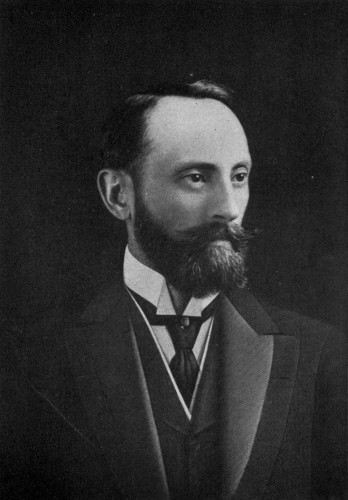
GEORGES GONTHIER
It would be superfluous to add anything further to demonstrate the sterling qualities and well deserved reputation of Mr. Gonthier. It may, however, be interesting to accountants and auditors in general to know that it was mainly through his efforts that the law was passed to render compulsory the keeping of proper accounts to all who engage in business.
HUNTLY WARD DAVIS.
Huntly Ward Davis, member of the firm of Hogle & Davis, architects, was born in Montreal, October 22, 1875, a son of M. and Lucy (Ward) Davis, the latter a daughter of Hon. J. K. Ward, M. L. C. Huntly Ward Davis attended Eliock school at Montreal and the Massachusetts Institute of Technology, from which he was graduated as Bachelor of Science in June, 1898. He prepared for and has always followed the profession of architect, working in early manhood under A. T. Taylor, who became senior partner of the firm of Taylor, Hogle & Davis, but has since withdrawn, leaving the firm Hogle & Davis. Mr. Davis is a conservative, and his membership relations are with St. James Club and with the Church of St. James the Apostle. On the 26th of October, 1910, in Montreal, he was married to Evelyn St. Claire Stanley Bagg, daughter of the late Robert Stanley and Clara (Smithers) Bagg, and they have a daughter, Evelyn Clare Ward Davis.
FRANCOIS XAVIER ROY.
This is an age of specialization. It is the unusual rather than the usual thing for any man to attempt to gain proficiency in the various departments of the law; on the contrary he usually concentrates his efforts upon a single branch of jurisprudence, with the result that he reaches a position which otherwise he could not hope to gain. Following this general course, François X. Roy has devoted his attention to commercial law, in which connection he has a large and distinctively representative clientage. He has been a lifelong resident of the province of Quebec, his birth having occurred on the 13th of August, 1863. His educational training was received at the College of Nicolet and in Laval University. He also spent a year in special study at Sherbrooke in 1886, was for a year under the direction of the law faculty at Bishop’s College, and then passed the usual examinations that secured his admission to the bar.
Choosing Montreal as the seat of his labors, Mr. Roy here began practice in association with the late Hon. C. A. Geoffrion, and later was with D. R. Murphy, K. C. He had become so well established in practice as a successful commercial lawyer that in 1909 he was created king’s counsel. He has become a recognized authority in the department of law in which he has chosen to specialize, and as such is called to all parts of the province, his opinions being largely received as authority upon points of commercial law. He is now attorney for the Williams Manufacturing Company, Henon-LeBlanc, Ltd., and several other commercial firms of Montreal. He readily grasps the relation of cause and effect, and in the preparation of his cases his analytical power is strongly manifest. In presenting a cause before the courts he is logical, and his deductions follow in orderly sequence.
Mr. Roy is a liberal in politics and in all his political interests is actuated by a spirit of progressiveness as affecting both provincial and Dominion affairs. He has ever stood for improvement, reform and advancement, and for many years has held the office of treasurer of the Reform Club. Aside from this he is a member of Le Club Canadien, L’Alliance Nationale, L’Alliance Française, La Société St. Jean Baptiste and other societies. He stands as a high type of the French element in the citizenship of Montreal, combining with the admirable and strongly marked characteristics of a French ancestry the progressive spirit of the modern age, a spirit which falters not in the accomplishment of a task until success is achieved.
NAPOLEON URGEL LACASSE.
Napoléon Urgel Lacasse, attorney at law practicing in Montreal as a member of the well known firm of Bastien, Bergeron, Cousineau, Lacasse & Jasmin, was born at St. Vincent de Paul, in the county of Laval, P. Q., July 11, 1877. In the early records of the French families it is found that there are several variations to the family name which appears also as Casse, Cassé and Du Tertre. Angelique Lacasse was born in 1715 and died at Beaumont, August 22, 1738. Antoine Lacasse, who was born in 1706, married Marguerite Sionnaux and died November 27, 1778. The parents of Napoléon Urgel Lacasse were Zéphirin and Rose Delima (Fortier) Lacasse. Under the parental roof he spent his boyhood days while studying in St. Mary’s College and Laval University of Montreal, winning his Bachelor of Arts degree on the 15th of June, 1898, and that of Bachelor of Laws on the 21st of June, 1901. Following his graduation he entered immediately upon the active practice of his profession and was alone therein until the 1st of July, 1912, when he entered into his present partnership relations. He is recognized as one of the strong and able members of the bar among the younger practitioners, and his experience and study are continually promoting his knowledge and ability. Aside from his profession he is financially interested in several joint stock companies and has extensive real-estate investments.
Mr. Lacasse has been married twice, on the 28th of September, 1903, to Eugénie Barbeau and on the 31st of March, 1913, to Miss Yvonne Barbeau, daughter of the late Godfroy Barbeau, a merchant of Ste. Geneviève county, P. Q. The four children of Mr. Lacasse are: Jean François Bernard, Jacques Vincent Ferrier, Joséphine Hélène Marcelle and Suzanne Andrée Victoire. The religious faith of the family is that of the Catholic church. The military experience of Mr. Lacasse covers more than three years’ service as commanding officer of St. Mary’s College Cadets from 1896 until 1898 inclusively. He was one of the winners in the cadets contest in 1893 for the Duke of Connaught prize, also in 1894 and 1895.
In politics he is a conservative and has made public battles for his principles in elections in the counties of Terrebonne, Jacques Cartier, Laval and Yamaska. However, the practice of law he considers his real life work, regarding it as abundantly worthy of his best efforts, and in his chosen profession he has made continuous and gratifying progress.
FRANK BULLER, M. D., C. M.
Dr. Frank Buller was one of the most celebrated ophthalmologists of the new world, occupying, as practitioner and educator, a position in which he had few peers. His scientific research and his broad reading gave him a knowledge far superior to that of many able members of the profession, and in the wise utilization of his time and talents he made valuable contributions to the world’s work.
Dr. Buller was born at Campbellford, Ontario, May 4, 1844, a son of Charles G. and Frances Elizabeth (Boucher) Buller, of Hillside, Campbellford. After attending the high school at Peterboro, from which he graduated in due time, he took up the study of medicine in Victoria College at Cobourg, completing his course with the class of 1869. He then went to Germany, where he spent two years in the study of the eye, ear, nose and throat, acquainting himself with the advanced methods of eminent men in the profession. While at the University of Berlin he received close personal instruction from Von Helmholtz and Von Graefe, and, during the Franco-German war, served as assistant surgeon in a number of military hospitals of northern Germany. In 1872 Dr. Buller went to London and studied for some years in “Moorfields”—the Royal London Ophthalmic Hospital. He was for two years chief house surgeon of this hospital, and he introduced to London the “direct” method of ophthalmoscopy. In England he became a member of the Royal College of Surgeons. Dr. Buller began practice in Montreal in 1876 and rapidly advanced to a foremost position in his profession. For seventeen years he was the opthalmic and aural surgeon in the Montreal General Hospital and resigned to take the same position in the Royal Victoria Hospital. He was the first ophthalmologist to be appointed to the General Hospital—and so remarkably recent is the development of opthalmology in the new world that, prior to that time, every physician and surgeon treated his eye cases in his own clinic. For many years Dr. Buller was professor of ophthalmology and otology in McGill University, being appointed professor when the chair was founded in 1883. He was equally able in his large private practice and enjoyed an ever widening reputation. Dr. Buller received the English degree of M. R. C. S.
Dr. Buller was a powerfully built man, restless and very energetic. His students used to say of him, “Buller is a great teacher, but he wears us out.” He was forever engaged in arduous mental work but also took keen interest in matters outside of his profession. He was frank, straightforward and kind—a strong generous nature.
Dr. Buller married Elizabeth Belton Langlois, of Quebec, who died November 20, 1895. By this marriage there were two children, Marguerite and Cecil. In 1898 he married Miss Jean Brien, of New York, and they had three children, Francis, Audrey and James, the latter dying in 1909.
Dr. Buller was a member of the Church of England. He died October 11, 1905. He was followed to the grave by the entire medical profession of Montreal and numerous physicians from a distance. Also many of the city’s poor were present at the obsequies—a fact which, had he been able to know it, would have touched that great heart which had so keenly felt their sorrows.
A colleague of Dr. Buller writes as follows: “In very delicate cases, where he feared to trust patients in the hands of untrained attendants, and they were too poor to hire professional nurses, he has been known to stay with the patients all night, after an operation, and attend to the dressing himself, lest the eye, so tender and in such a precarious condition, might suffer needless pain or be injured through a slight mistake.”
“Dr. Buller will be especially remembered because of three inventions: (1) the Buller eye-shield (composed of a watch-crystal and strips of sticking-plaster and oftenest employed to protect an unaffected eye when its fellow is afflicted with gonorrheal infection). (2) Temporary tying of the cacalieuli for the prevention of wound infection in operations on the eye-ball. (3) The Buller trial frame. Yet his inventions and investigations were very numerous and, for the most part, successful in every way. Thus, concerning his investigation into ‘Methyl Alcohol Blindness,’ conducted jointly with Dr. Casey A. Wood, De Schweintz declares the work to be ‘by far the most important contribution to the subject and one to which too high praise cannot be given.’” Scientists, members of the profession and all mankind delighted to honor him because of what he had accomplished. High above any desire for pecuniary reward was his deep interest in humanity and an earnest purpose to make his life a serviceable one to his fellowmen.
WILLIAM WATSON OGILVIE.
Foremost among those men whose life’s record seems an inseparable part of Canada’s industrial and commercial growth during the period of their activities, is that of William Watson Ogilvie, whose identification with the milling business covered a period of nearly a half century. The position of Mr. Ogilvie in this important industry was unquestionably at the head. He did more to develop it than any other man before or since his time, and the great success he achieved was fully merited.
William W. Ogilvie was born at Cote St. Michel, Montreal, February 14, 1835, of Scotch ancestry, and belonged to the Banffshire family of that name. He received his education in Montreal schools, and in entering on a business career chose that which was his by inheritance, the milling business.
His grandfather, Alexander, erected in 1801, a mill at Jacques Cartier, near Quebec, where was ground the first flour under British rule that was ever exported to Europe. This old mill was really the foundation of the immense business that was built up by W. W. Ogilvie. In 1860 he entered into partnership with his brothers, Alexander and John, grain merchants and proprietors of a mill at Lachine Rapids. The growth of the business was soon responsible for the building of the Glenora Flour Mills on the Lachine canal. The business continued to grow, and the Ogilvies erected mills at Goderich and Seaforth, Ontario and Winnipeg, Manitoba; and later, the Royal Mills at Montreal. The three brothers operated together until 1874, when the elder brother retired, and on the death of his brother, John, in 1888 the entire business management devolved upon William W. Ogilvie, whose well developed powers were entirely adequate to the demands made upon him in the further control and management of this extensive enterprise, of which he became the head. In addition to the properties mentioned, Mr. W. W. Ogilvie afterward purchased the City Mills, Montreal, and at the time of his death had accepted plans for a very large mill at Fort William. Some years previous to his demise to facilitate the administration of his western business, the Ogilvie Milling Company of Winnipeg was formed in which Mr. Ogilvie was the dominant factor. The Ogilvie Flour Mills Company, of the present, was organized in 1903 and is practically the successor of the Ogilvie Milling Company and various other interests in this line, belonging to Mr. Ogilvie’s estate.
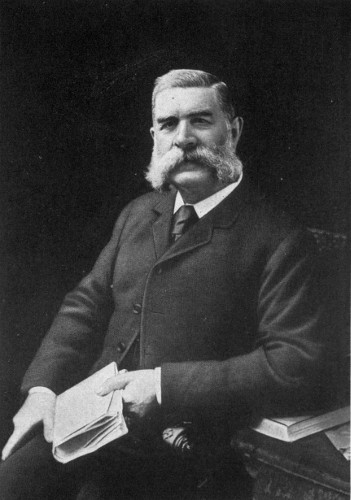
WILLIAM W. OGILVIE
Mr. Ogilvie and his brother John were the pioneer wheat buyers in Manitoba. He had traveled through Canada’s present wheat fields years before they were cultivated and many times afterwards. From the first small shipment of five hundred bushels from Manitoba in 1876, the shipments, in Mr. Ogilvie’s lifetime, to his own mills increased until they reached the enormous total of eight million bushels of No. 1 hard wheat, all purchased by his own expert buyers from the farmers, at his seventy elevators, extending all over the wheat section of Ontario and the northwest.
In the manufacture of flour Mr. Ogilvie spent a lifetime and spared neither time, labor or expense in bringing his product to the very acme of perfection. By steady industry and indomitable energy and most of all the superior quality of his products, upheld at all cost, the business grew until it not only became the largest of its kind in the Dominion, but the most extensive flour business in the world controlled by one man.
Mr. Ogilvie was the first to introduce into Canada the patent process of grinding by rollers. In 1868, he visited Hungary where this system originated, for the purpose of investigating it. He saw at once its value and adopted it. He invented improved machinery used in the milling business, and was always ready to adopt the improvements of others that were practical.
It was said that he had better knowledge of wheat and wheat lands than any man in Canada. His business furnished a market for wheat growers and proved a stimulating influence in the agricultural development of the great wheat-raising section of middle and western Canada. His labors were directly responsible for much of the growth, progress and prosperity of Manitoba and the provinces farther west, and his worth as a business man and citizen was acknowledged by all.
Mr. Ogilvie’s identification with commercial interests was large and diversified. He was a director of the Bank of Montreal; the Montreal Transportation Company; the North British and Mercantile Insurance Company; the Old Dominion Board of Trade; and the Sailors Institute. He was president of the Corn Exchange Association; St. Andrew’s Society; and the Montreal Horticultural Society; governor of the Montreal General and the Royal Victoria Hospitals; president of the Manufacturers’ Association, and served as a member of the Harbor Board.
In regard to agricultural and horticultural interests he manifested an interest and enthusiasm that were contagious, his efforts constituting an example that many others followed. He served both on the council and board of arbitration of the Montreal Board of Trade and was president of that body in 1893-4. In matters of citizenship he was extremely public-spirited and what he accomplished represented the fit utilization of his innate talents and powers. His political belief is indicated in the fact that in 1896 he was president of the Liberal Conservative Club of Montreal. He was a forceful speaker in both French and English and frequently, in his earlier days, addressed public meetings during political campaigns.
As a young man he served as lieutenant and subsequently as a captain in the Montreal Cavalry under his brother, being thanked in brigade orders by Colonel Pakenham in 1866.
He was one of the prominent members of St. Andrew’s church. Mr. Ogilvie always gave with a free hand toward various public institutions, and there was no movement of importance to which he did not contribute. His benefactions were liberal, varied and by no means local. He gave thirteen thousand dollars, towards making up a deficit for completion of the Jubilee wing of the Winnipeg General Hospital. He was one of the first to subscribe to the patriotic fund for the families of those who went with the Canadian contingent to the Transvaal war. Mr. Ogilvie was a man of great business capacity and to a most remarkable extent maintained a personal knowledge of his diversified interests.
His death on January 12, 1900, was very sudden. He had been at his office attending to business as usual, after which he attended a directors’ meeting of the Bank of Montreal. On his way home he was taken ill and passed away soon after reaching there.
Many of the leading mercantile houses and public offices flew their flags at half mast through respect for him. The Montreal Gazette at time of his death, said on January 13, 1900, editorially:
“It is long since any event caused such a painful shock in Montreal as did the death yesterday of W. W. Ogilvie. Strong in body, clear in mind, actively interested in the details of great concerns, he was one of the last whose taking away would be thought of. His loss will be felt the more because of its suddenness and it is a great loss, to the city’s commercial life. Mr. Ogilvie’s business intelligence and energy long ago raised him to a place not among Canada’s alone, but among the world’s great merchants.
“It was a just pride that he felt in directing the greatest milling interest in the world under one man’s control; and the pride was more than personal. He early saw what the northwest meant to Canada, both commercially and nationally, and it was a pleasure to him to feel that as his business spread it was making known the resources of the country, in all of whose affairs he took the deepest interest.
“The success that he gained in his own business caused his counsel to be sought in the direction of other great enterprises. He was a director in the country’s greatest financial corporation, and in other institutions in which he had investments. On the Corn Exchange and on the Board of Trade, his was an influential voice, and it was always raised in behalf of that which was best and broadest.
“He knew how to give generously to a good cause. He earned the respect of all who were brought into contact with him and especially that of the hundreds of men who served him in the enterprise of which his was the directing brain.
“It was a big place that he won through his heart as well as by his head and it will be long ere there will be found another capable of filling it.”
Mr. Ogilvie was survived by his widow and four children, three sons and a daughter, Albert Edward, William Watson (died 1906), Gavin Lang and Alice Helen. Mrs. Ogilvie previous to her marriage in 1871, was Helen, a daughter of Joseph Johnston of Paisley, Scotland.
R. A. BALDWIN HART.
R. A. Baldwin Hart, prominent as a representative of one of the old families of Montreal, manager-executor of the Theodore Hart estate, and a public-spirited citizen, was born in Montreal, December 5, 1852, a son of Theodore Hart. For a long period the family had been represented in this city, the name figuring prominently in connection with its history. His education was acquired in the schools of Montreal and his life was spent in his native city.
In 1900 in Montreal Mr. Hart was united in marriage to Miss Mary Isabella Owen, who survives him, the death of Mr. Hart having occurred on the 11th of September, 1903, when he was yet in the prime of life. He was very fond of outdoor sports. He was a wide reader and kept abreast with the events of the day and the progress of the times. Charitable and kindly in spirit, he listened attentively and sympathetically to a tale of sorrow or distress and no worthy object failed to receive substantial assistance from him. Civic affairs were a matter of interest to him and he supported movements which he deemed of benefit to Montreal. His was indeed a well rounded character in which the varied important interests of life received due consideration and he stood as a high type of Canadian manhood and citizenship.
ALAN JUDAH HART.
Alan Judah Hart, founder of the Hart Manufacturing Company, of Montreal, is a descendant of one of the oldest English speaking families of Canada, the ancestry being traced back to one who came from New York with General Amherst in 1759. For many generations the family was represented at Three Rivers, Canada. Lewis A. Hart, father of Alan J. Hart, has for forty years or more been a notary in Montreal. He was born at Three Rivers and was educated in Montreal, supplementing his preliminary studies by advanced courses which won him the degrees of Master of Arts and Bachelor of Civil Law. He married Fanny Elizabeth Benjamin and they became the parents of four sons and four daughters: Claude Benjamin, a commission merchant; Arthur Daniel, a manufacturer’s agent; Philip Beyfus, a commercial traveler; Alan Judah; Ethel Muriel; Mabel Ruth; Gladys Judith; and Dorothy Marguerite.
Alan Judah Hart was born in Montreal, October 4, 1879. He was educated in Montreal and for some years was employed by E. A. Small & Company, manufacturers of men’s clothing, and later was with A. H. Sims & Company, manufacturers of ladies’ clothing, acting as superintendent of the house for three years. In 1902 he established the Hart Manufacturing Company for the purpose of manufacturing ladies’ tailor-made suits and cloaks and in the conduct of this business he has been very successful. Mr. Hart is a director of H. Vineberg & Company, Limited, manufacturers of the Progress Brand clothing and has become widely and favorably known in commercial circles.
Mr. Hart married Miss Eva Vineberg, a daughter of Harris Vineberg, and they have a family of five children: Edward Henry, Gordon David, Lawrence Ezra, Alma Ruth and Vera Esther.
Mr. Hart is a life governor of the Montreal General Hospital and a director of Mount Sinai Sanitarium at Ste. Agathe. He was likewise a member of the executive board of the Canadian Manufacturers Association, serving in that capacity in 1912 and 1913, and he is a member of the Montreal Board of Trade and of the Royal Arcanum. His interests and activities are varied and important, winning him recognition of his worth in both commercial circles and in public life.
HON. LOUIS JOSEPH FORGET.
Hon. Louis Joseph Forget, whose name is written large on the pages of financial and industrial history of Montreal during the past forty years, left the impress of his great constructive force and energy upon mammoth projects which are figured as some of the Dominion’s leading enterprises. He was born March 11, 1853, at Terrebonne, P. Q., a district that has produced many eminent statesmen, writers, merchants and financiers. He was one of the nine sons of Mr. and Mrs. Joseph Forget and was descended from a family that came to Canada from Normandy in 1600. Among those nine sons there were two priests, one of whom declined episcopal robes, a notary, two lawyers, two contractors, one farmer and he who was destined to become a power in the financial world, Louis Joseph Forget. His education was acquired at Masson College and his entrance into business circles was in connection with a dry-goods establishment. He had almost reached the determination of trying his fortune in the United States when he chanced upon a newspaper that contained an advertisement of office help being needed by Thomas Caverhill. Mr. Forget applied for the position the next morning and was accepted. From the beginning of his work with Mr. Caverhill the young man displayed unusual aptness as well as great eagerness to learn. He was not an ordinary boy. He took great interest in his work and often asked questions about other features of the business that did not come within his particular line of duties, but a knowledge thereof added to his capability and rendered him fit for promotion and opportunity offered later. It is only natural that a young man of this character should attract the attention of his employer. Mr. Caverhill took great interest in him and was instrumental in causing Mr. Forget to enter the brokerage business. The financial exploit during Jay Gould’s celebrated Black Friday in Wall Street reflected no little credit upon Mr. Forget, displaying in notable manner his insight and ability, and soon afterward he was nominated for membership in the Montreal Stock Exchange by his former employer. It is interesting in this connection to note that he was the first French-Canadian to be admitted to membership in that body and that before he had reached his majority he purchased his seat therein at a cost of nine hundred dollars. He began business as a stock broker in Montreal in 1873, from which time until his death, thirty-eight years later, his prominence and success in the investment security business were not over-shadowed by that of his contemporaries. He founded the financial house of L. J. Forget & Company, one of the foremost in its line in Montreal and remained its head during his life time. The Paris branch of L. J. Forget & Company at 7 Rue Auber, was the first to be established in continental Europe by a Canadian financial house and readily secured a clientele that materially broadened the operations of the firm.
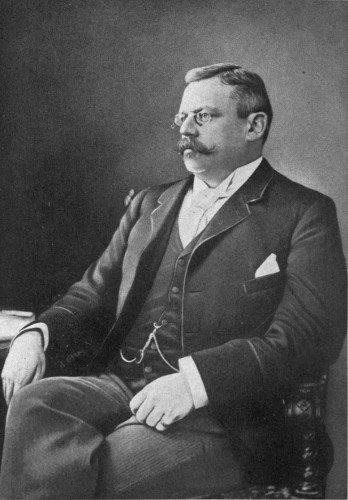
HON. LOUIS J. FORGET
Senator Forget was elected president of the Montreal Stock Exchange in 1895 to succeed H. S. Macdougall and in May, 1896, was reelected. His business and financial connections had been constantly broadening and had long since included a prominent identification with the foremost financial and industrial projects of the time. In 1892 he became president of what was then the Montreal City Passenger Railway Company, now the Montreal Tramways Company. He remained its directing head until 1911, in which connection he accomplished what has meant much to Montreal. To no one man is the city indebted as largely for the upbuilding and development of its transportation system as to Senator Forget. Under his regime the motive power was changed from horses to electricity and the market value of the company’s stock advanced from around one hundred dollars to three hundred and thirty-seven dollars and a half per share.
In 1895 Senator Forget became president of the Richelieu & Ontario Navigation Company. At that time the affairs of the company were far from being on a dividend-paying basis and the rehabilitation of its interests was but another illustration of Senator Forget’s constructive genius. He resigned his position as head of the company in 1905, but in the meantime the stock was paying a six per cent dividend and the affairs of the company generally were in a better condition than ever before.
One of the great achievements of Senator Forget was in carrying through the merger of the Montreal Light, Heat & Power Company and in doing so he accomplished what many predicted to be utterly impossible, saying that nothing but failure and financial disaster could result. This was in 1900 before the days when big business interests were merged into mammoth enterprises and the amount involved, seventeen million dollars, seemed to stagger even the most progressive element in financial circles. Like all of his undertakings, Mr. Forget had not entered into this without due consideration and he had implicit confidence in its success. It is doubtful if any but he could have swung that deal and how well he succeeded is best indicated in the value of the securities of the company in investment circles.
He was a prominent figure in the notable contest which took place between the Dominion Coal Company and the Dominion Iron & Steel Company. Originally a director and vice president of the coal company he espoused the cause of the steel company in its fight over the coal supply and ultimately the matter was carried to the privy council and was there decided in favor of the steel company. Mr. Forget was elected vice president of the steel corporation when eventually the two companies were merged and he continued to take an active part in the administration of the affairs of the company to the time when his health began to fail. Evidence of his wonderful insight and sagacity in business matters is shown in the fact that when the trouble first arose from which resulted the extended litigation between the Dominion Iron & Steel Company and the Dominion Coal Company Senator Forget went over the point in contention in his characteristic deliberate manner and at once concluded that the claim of the steel corporation would be sustained by the courts, notwithstanding the contrary opinion of some of the greatest legal authorities and business men of the day and time proved that his judgment was correct.
He was the first French-Canadian to be elected to the directorate of the Canadian Pacific Railway and was a member of its board at the time of his death. His greatest enthusiasm was aroused while viewing the untold resources of the west during the many times he accompanied Sir Thomas Shaughnessy and R. B. Angus on their annual tours of inspection. When the life work of Senator Forget was ended the Montreal Daily Star said in part: “By the death of Senator Forget a man of affairs has been lost to Canada. A man of wide vision who saw far into the future and who modeled his career accordingly. A glance through the financial district at the half-masted flags at once conveys an idea of the number and the prominence of the institutions that Senator Forget had been interested in. Senator Forget stood out in Canadian finance, but more than that, he was a true Canadian citizen and had done his share towards the public weal, forgetting not his duty towards the state in the midst of tremendous private enterprises. He was a man of sympathies. At all times courteous and approachable, he could thrust aside great business matters to attend to the small wants of individuals, nor was he ever found wanting or indifferent when charity offered a plea.
“In finance Senator Forget was a true leader. He was one of the first men to loom large in high finance in Canada. He realized many possibilities which other men have realized too—but he followed that by action. He had the courage to follow his convictions and many solid institutions which today enjoy in themselves prosperity and largely aid in the advancement of the Dominion, owe to him debts which can never be repaid to the individual, though they will be to the people of the country. His financial ability brought him into prominence in connection with several of the largest corporations in the Dominion, prominent among which were the Montreal Street, the Richelieu & Ontario Navigation Company and the Montreal Light, Heat & Power Company, the Dominion Coal Company, and the Dominion Iron & Steel Company.
“Senator Forget was one of the colossal figures about whom have surged the tides and currents of Canadian finance. The news of his death this morning was as much of a shock as a surprise, both to those with whom he had been so long associated in connection with the organization and the management of the great financial and industrial enterprises of the Dominion and to the thousands of others to whom his name had come to be the shibboleth of success.
“But if Senator Forget represented one thing more than success it was absolute unswerving fidelity to his word. In all the heat and confusion of the stock market amidst the treacheries which sometimes attend on high financing and the deception and duplicity which beset the path of the successful man everywhere, there was never a question of his own unfaltering veracity. Senator Forget was wisely charitable, an intelligent patron of the arts, and a strong supporter of all movements which made for the better government of the city and the state. He will long be remembered for what he was as well as for what he did.”
Another Montreal paper said of him: “His rise to financial fame is written on the business history of Montreal, and the story of his success in the financial world is the history of the development of the city. Although Senator Forget’s estate will count up into the millions, its accumulation was not effected by continuous plain sailing.”
Obstacles and difficulties of grave import arose, but his financial capacity and strict integrity had won the confidence and trust of friends who rallied to his support, and although he saw the storm clouds gather, he was able to turn threatened disaster into brilliant achievement. His investments were most judiciously made and his judgment concerning important financial transactions seemed never at fault. Once his mind was made up as to the value of a security nothing could shake his confidence, and much of his success in life was due to his unerring judgment.
Slow to make a promise or express an opinion, Senator Forget never failed to fulfill a promise and when he gave his opinion it was the expression of his honest conviction and indicated a course which he would follow in a similar position. If he advised an investor it meant that he would not hesitate a moment in investing his own money in the same security. His unquestioned loyalty to his friends covered his entire business career. His recommendation of a security to an investor meant that he would fully support that security and there were instances in his career when even his vast resources were taxed in such support. This was true in connection with the Montreal Stock Exchange in a security where large sums were invested on his recommendation. The implicit confidence that capital had in his judgment enabled him to finance and successfully carry out projects that probably no other man of his time could have handled. His word was as good as his bond. His denial of a rumor killed it immediately just as an admission from him settled all doubt. He could see through a proposition readily and would decide important and extensive matters quickly. His decision was never hasty or ill advised but came as the result of the fact that he had mastered many grave business affairs and with readiness comprehended every phase of a situation that came before him. He was a man of strong personality. His was never the command of the tyrant to go but ever the call of the leader to come. He was never vacillating in his opinions of the best methods to be followed or the manner in which a given work was to be done. He was a most considerate and appreciative man and was always ready to encourage one who was striving upward. He was not a talkative man, that is he talked but comparatively little, yet he talked to the point and with great earnestness and thinking men listened to him with attention. He never laughed aloud, but his smile was one full of humor, enjoyment and good nature. Judging his manner by first appearance might do him an injustice, for a habit of earnest thought had brought a deep furrow in the forehead that might be regarded as a frown. An acquaintance, however, always received the most polite attention from him and his unfailing courtesy of manner showed him to be a perfect gentleman in the highest and best sense of the term.
His interest in benevolent and charitable projects was wide and his support thereof most generous. He became a director of the Notre Dame Hospital and was a governor of both the General Hospital and the Western Hospital. He was a governor of the Art Association and life governor of the Numismatic & Antiquarian Society; also president of the board of governors of Laval University. His political career is an interesting one, for he was not always a supporter of the liberal-conservative party. Although a fellow townsman of Sir Adolphe Chapleau, the Senator had been allied with Sir Henri Gustave Joly de Lotbinière in that leader’s contest with Chapleau, Angers and the rest of the conservative leaders of his time. In federal politics, however, Hon. Mr. Forget declined to follow the free trade policy of Mackenzie and Cartwright, which had been forced against his will upon Rodolphe Laflamme, and from the days of the national policy the Senator worked with the present conservative party. He was appointed to the upper house during the elections of 1896 and was the last conservative senator to enter that branch of the Canadian parliament. Senator Forget seldom addressed the senate, yet his advice in committee was of great value to his fellow members and it was here that the close friendship sprang up between Senator Forget and the ex-prime minister, Sir Mackenzie Bowell. The Senator was a loyal follower of R. L. Borden as leader of the conservative party, both in parliament and in the country. He realized that it was a very difficult matter for any leader to find complete favor in the eyes of all the provinces, but he was confident that Mr. Borden gave his services to the party and to the country in a patriotic manner and consequently deserved the support of a united party in both houses. The Montreal Gazette some years ago termed him “an astute and enterprising man of affairs.” He was more than that. He was a constructionist and builded where others saw no opportunity; he was a patriot without narrow partisanship; a Roman Catholic and stanch churchman without a particle of race prejudice, in evidence of which fact his closest friend in the senate of the Dominion was an ex-grand master of the Orange Grand Lodge of British North America—Sir Mackenzie Bowell. High honors had been accorded him, distinction and notable success had come to him. These things made him an eminent citizen, but, more than that, attractive social qualities and genuine personal worth had gained him the highest regard, confidence, good-will and friendship of his contemporaries and colleagues.
While Senator Forget was a member of a number of clubs, he manifested keenest interest perhaps in the Mount Royal Club, of which he was one of the founders. Among the other clubs to which he belonged were the St. James, of which he had been president; the Royal St. Lawrence Yacht Club; the Forest and Stream; the Montreal Hunt; the Country Club of Ottawa and the Manhattan Club of New York.
In May, 1876, Senator Forget married Miss Maria Raymond, a daughter of Gustav A. Raymond of Montreal. They were the parents of five children: Loulou, now Mrs. W. W. Skinner; Raymond, who died at the age of four years; Blanche, now Mrs. Guy Boyer; Marguerite; and Pauline. The two younger daughters accompanied their parents abroad and the family was sojourning at Nice when Senator Forget passed away, April 7, 1911.
CHARLES M. BLACK.
Thorough preparatory training and broadening experience well qualify Charles M. Black for the important and responsible duties that devolve upon him as secretary and treasurer of the insurance brokerage firm of R. Howard & Company of Montreal. He has many friends in this city, to whom his life record will prove of interest. He was born in Winnipeg in 1890, a son of William Allan Black and a grandson of Charles R. and Elizabeth (Hall) Black, of Montreal. There is a mingled strain of English and Scotch blood in his veins. The birth of William A. Black occurred in Montreal, November 17, 1862. His education was acquired in the schools of his native city, and for some years he was in the service of the Grand Trunk and Canadian Pacific Railway Companies. In 1882 he went to Manitoba and the following year became connected with the Ogilvie Milling Company, one of the foremost enterprises of that character in the country. Gradually in that connection he worked his way upward and in 1902 was appointed general manager of the western division, while in 1910 he was elected one of the directors of the company. Still further promotion has come to him in his election as vice president and managing director of the Ogilvie Flour Mills Company. He is likewise a member of the Winnipeg Board of Trade, a councillor of the Winnipeg Grain and Produce Exchange and a member of the grain survey and grain standard boards. He is likewise a director of the Home Savings & Investment Company, Molson’s Bank and Larose Consolidated Mines and is managing director of the Kaministiquia Power Company and president of the Manitoba Cold Storage Company. He belongs to the Winnipeg and Manitoba Clubs. He was married in 1888 to Mary Campbell, daughter of Alexander McEwan, of Edinburgh, Scotland.
The illustrious example of his father has fired the ambition of Charles M. Black, who was reared in Montreal and Winnipeg. Making good use of time, talents and opportunities, he has steadily progressed and is today a well known factor in insurance brokerage circles of Montreal. The business of the firm of R. Howard & Company was established in 1901 and was organized under the present firm style on the 1st of February, 1913, when Charles M. Black became a member of the firm, of which he has since been secretary and treasurer, with Robert Howard as the president. He had received thorough initial business training in three years’ connection with his father, and he is also secretary and treasurer of the Financial Investment Company. A young man of determination and energy, he carries forward to successful completion whatever he undertakes, and obstacles and difficulties in his path serve but as an impetus for renewed effort on his part.
JOHN PRATT.
High on the list of Montreal’s worthy citizens who have passed from this life appears the name of John Pratt, who from 1839 until 1872 was one of the prosperous merchants of the city. He was born at Berthier, en haut, on the 20th of July, 1812, and after a well spent life of sixty-four years passed away July 22, 1876. He was survived for only a few weeks by his brother, Mr. C. F. Pratt, with whom he had commenced his business career and with whom he was almost continuously associated thereafter.
The father was a merchant at Berthier and in 1833 the sons, Charles F. and John, left the paternal home to establish a business house in Quebec under the firm name of C. F. Pratt & Company. Having succeeded almost beyond his expectations in that city, John Pratt opened a branch establishment at Three Rivers and, as in Quebec, won almost immediate prosperity in the conduct of the enterprise. Soon the brothers found that their sphere of action was too limited and in 1839 they extended the scope of their interests by founding the well known leather house of John Pratt & Company in Montreal.
In 1852 the Quebec house was closed, the brothers concentrating their energies upon the conduct of the Montreal business, out of which they made colossal fortunes, that of Mr. John Pratt amounting to about a million dollars. The tanneries at Roxton Falls were started by the Pratts, who for many years stood at the head of the leather business. In 1869, however, they put aside industrial and commercial interests, but while Charles Pratt confined himself to private affairs, his brother, John Pratt, whose name introduces this review, unable with his active temperament to remain comparatively unemployed, engaged in the conduct of several joint stock companies, with which he had identified himself. At the time of his death he was president of the Richelieu & Ontario Navigation Company, over whose board he had presided since 1867. He was president of the Banque du Peuple, of the Rubber Company, and others; and was vice president of the Citizens Assurance Company, a position which he also occupied in connection with other joint stock concerns. He was on the board of directors of the Valleyfield Cotton Company, an enterprise which he had done much to promote. Indeed, it may be said of Mr. Pratt that he was an undoubted authority on all business matters, being sagacious, practical, enterprising and energetic. He seemed to recognize almost from the beginning the possibilities of any undertaking, and he never faltered until his purpose was accomplished.
In 1863 Mr. Pratt was placed on the harbor board, but the succeeding year the government of Sir John Macdonald removed him from office, doing exactly the same by Hon. John Young and Mr. Thomas Cramp. In 1874, however, he was placed upon the newly constituted board, of which he was an active, practical and influential member. His natural modesty impelled him, upon several occasions, to decline nomination for parliament, to which, there is no doubt, had he so desired, he would have been elected. Politically he was a thorough reformer and even by those who differed from him, his opinions were looked upon with great respect. He was at all times a thorough gentleman, a faithful and considerate friend and a real philanthropist.
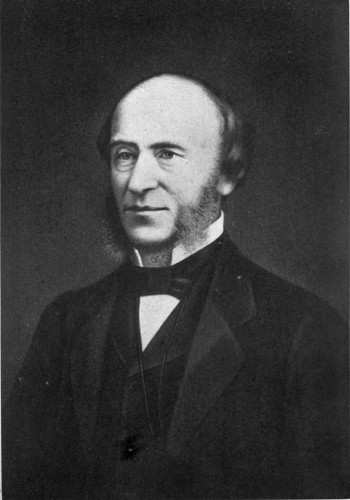
JOHN PRATT
On the 3d of March, 1840, Mr. Pratt married Marie Mathilde Roy, the widow of Charles Ovide Perrault, who was killed in the rebellion of 1837. Mrs. Pratt died July 29, 1897. The children born to Mr. and Mrs. Pratt were: Marie Mathilde, who was married in 1862 to Desire Girouard; Charles Alfred, a practicing physician, who in 1866 married Alphonsine Leclair and resides at Longueuil; Eveline Marie Louise, the wife of Joseph Gustave Laviolette, of Montreal; Virginia, who was married September 30, 1878, to George H. Matthews; Aloysia, who was married June 17, 1878, to Percy Franklin Woodcock, the well known artist; Frederick Emile George, who was married May 31, 1883, to Albina Thibault, the widow of his younger brother; and Louis Edouard Albert, who married Albina Thibault and died August 11, 1880.
On the 27th of July, 1876, the body of Mr. John Pratt was taken from the family residence, No. 310 Lagauchetiere Street to the church of St. Jacques, St. Denis Street, and thence to the family vault in the Roman Catholic cemetery. The attendance at the church was immense, comprising all the influential and representative citizens, both French and English, of Montreal. At the church the burial service was celebrated by Rev. A. L. Sentenne, curé of the parish, assisted by Rev. Father Fleck, superior of the Jesuits.
Perhaps no better indication of Mr. Pratt’s high standing could be given than by quoting a letter received by Mrs. John Pratt, reading:
“Dear Madam:
“We, the harbor commissioners of Montreal, take the liberty of intruding upon you to express our sympathy and condolence to you and your family in the irretrievable loss sustained by the death of your late husband, our friend and colleague in the harbor trust. Our late friend rendered such efficient service in the management of this important trust and was so fully in sympathy with every movement for the good of his country and this city in which he lived, as to secure the esteem and confidence of every member of the commission. At such a time we are aware that nothing can be said to assuage the natural grief of yourself and family, still we hope, Dear Madam, it will prove consolatory to you and yours, that your husband, our friend, has filled up his season of life with so many good deeds and in so exemplary a manner, and that although he has now gone from among us, he will be remembered by all who knew him. This we trust will be to you and your family a source of comfort and help you to bear with fortitude and resignation your present great affliction.
“Thomas Cramp, “Hugh McLennan, “Andrew Allan, “Charles H. Gould, “John Young, “Adolphe Roy, “P. Donovan.
“Harbor commissioners’ office, Montreal, July 28, 1876.”
The board of directors of the Richelieu & Ontario Navigation Company, at its meeting on Friday, the 28th of July, 1876, passed unanimously the following resolution:
“Resolved: That this board of directors have received with much regret intelligence of the death of the late president of the company, Mr. John Pratt, whose long and valuable services in its behalf secured for him the gratitude, not only of the directors, but of every shareholder in the company. The directors desire to offer to his family the deep sympathy of every member of the board in the loss they have sustained, and to assure them of the high esteem in which the late Mr. Pratt was universally held.
“Hugh Allan, president. “J. N. Beaudry, secretary. “Thomas Caverhill. “Andrew Allan. “William McNaughton. “Adolphe Roy. “D. Masson. “M. H. Gault. “Robert Anderson.”
THOMAS W. RITCHIE.
One of the most prominent members of the provincial bar was T. W. Ritchie, who specialized in the practice of commercial law in Montreal and represented many important corporations in his professional connection. A native of Hatley, Quebec, he was born in 1828. After careful preparation for active law practice he was called to the bar in 1852 and opened an office in Sherbrooke. In 1860 he removed to Montreal and became a member of the firm of Rose, Monk & Ritchie. It was in 1867 that he was appointed queen’s counsel. No dreary novitiate awaited him at the outset of his professional career. He brought to its starting point several rare gifts, strong individuality, marked strength of character and high professional ideals, in addition to comprehensive knowledge of the principles of law and ability to correctly apply these. He continued in active practice as a member of the firm of Rose, Monk & Ritchie until Mr. Monk was appointed to the bench. The partnership relation under the firm style of Rose & Ritchie then continued until Sir John Rose left Canada for England. Mr. Ritchie was then joined by J. L. Morris and W. Rose, but the latter left soon afterward and later Mr. Morris retired. Mr. Ritchie then took in as partner Mr. G. H. Borlase, who remained with him until 1879, when he retired. Mr. Ritchie then admitted his son W. F. Ritchie to a partnership under the firm style of Ritchie & Ritchie. The father was one of the most prominent members of the bar of the province, ranking high as an advocate in the department of commercial law and sustaining many important professional relations. At the time of his death, on the 4th of September, 1882, he was solicitor to the Bank of Montreal and the Hudson’s Bay Company and was both director and solicitor to the Montreal, Portland & Boston Railway. For many years he acted as crown prosecutor for the district of Montreal. The court records attest his high standing and his ability whereby he engraved his name high on the keystone of the legal arch. It is the theory of the law that the counsels who practice are to aid the court in the administration of justice, and perhaps no representative of the Montreal bar has been more careful to conform his practice to a high standard of professional ethics than did T. W. Ritchie.
ALBERT GEORGE NICHOLLS, M. D.
One of the well known members of the medical profession in Montreal, Dr. Albert George Nicholls has made continual progress, and in the field of scientific attainment and research is recognized as one of the most eminent in the profession in the city. His investigations, carried far and wide, have brought forth many valuable truths, and his contributions to medical literature are largely accepted as standard.
Dr. Nicholls was born at Shotley Bridge, Durham, England, April 16, 1870, a son of the late Rev. John Nicholls and Mary Elizabeth (Harland) Nicholls. The father was the well known pastor of St. Mark’s Presbyterian church in Montreal for twenty-two years. In England he became identified with the Methodist clergy and was given charge of churches at Shotley Bridge, Durham; Chester-le-Street, Hetton and Blyth, Northumberland. He was born at Willenhall, Staffordshire, England, in 1840, and had reached the age of fifty-eight years when he passed away in Montreal on the 4th of May, 1898. He had been a resident of Canada for almost a quarter of a century, having arrived in this country in 1874. It was after he came to the new world that he connected himself with the Presbyterian church and for twenty-two years remained pastor of St. Mark’s. The names of few are so closely interwoven with the history of moral progress in this city. For some years he was a member of the Protestant Ministerial Association, was editor of the Bible Reporter, and was a frequent contributor to the press upon questions relative to the work of the church and the extension of Christian influence. At the time of the smallpox epidemic in Montreal he served on various committees formed to relieve the situation and opened his church for the distribution of relief. He was also one of the originators of the Fresh Air Fund and while thoroughly versed upon dogmas and the principles of theology, his religion was ever of that practical character which found expression in good deeds, in ready sympathy, and in immediate helpfulness. The survivors of his family are Mrs. Nicholls; Dr. Albert George Nicholls, whose name introduces this review; and a daughter, Miss Amy Nicholls, B. A.
Education received high rating in the Nicholls home and the son was afforded excellent opportunities for acquiring knowledge that would fit him for any field of labor to which he might choose to devote his efforts. He attended McGill Model School, the Montreal high school and afterward entered McGill University, where he won the Bachelor of Arts degree and became gold medallist in classics in 1890. Three years later his alma mater conferred upon him the Master of Arts degree and in preparation for the medical profession he pursued a course of study in McGill, which won him the M. D. and C. M. degrees in 1894. In 1909 the Doctor of Science degree was conferred upon him and in 1908 the honor of F. R. S. C. Holding to the highest professional standards and wishing to reach the highest possible point of proficiency, Dr. Nicholls has gone abroad for study, doing post-graduate work at Erlangen, Prague and Vienna. A successful practitioner in Montreal, he has devoted much time to original research, more especially in the scientific side of medicine. He is perhaps best known for his work in connection with typhoid fever, Brights disease, tuberculosis and some of the more obscure phases of chronic inflammation and his views have been referred to in several of the more recent authoritative text-books. He is the author of more than forty monographs and other publications on medical subjects, and his writings have largely been accepted as standard by the profession in this section of the country. He was joint author with Professor Adami of The Principles of Pathology, a work of recognized value. He is equally well known as a lecturer on clinical medicine and assistant professor of pathology and bacteriology in McGill University. He is out-patient physician to the Montreal General Hospital and assistant physician and pathologist to the Western General Hospital.