Part 2 — PART II THE DIVINE COMEDY COMPARED WITH OTHER MOSLEM LEGENDS ON THE AFTER-LIFE (continued 2)
Harold Sunderland translation
A tale, attributed to Utba al-Ghulam, certainly dates before the eleventh century:—
“In a dream I saw a houri of beautiful features, who said to me, ‘I love thee passionately and trust thou wilt do no deed that might keep us apart.’ I replied, ‘Thrice have I abandoned the things of this world and hope never to regain them, so that I may be able to meet thee (in heaven).’”
Sulayman ad-Darani, a great ascetic of the ninth century of our era, is the protagonist of a similar tale[313]:—
“I saw in a dream a maiden of a beauty ‘as splendid as the moon,’ clad in a mantle that ‘seemed as if made of light.’[314] Said the maiden to me, ‘Thou sleepest, oh! delight of my soul. Perchance thou knowest not that I am thy bride? Rise, for thy prayer is light and thy Lord deserveth thy thanks...!’ and, with a cry, she flew off through the air.”
Other legends tell of the visions seen by martyrs of holy warfare, the soldier ascetics of Islam, who later had their counterpart in the knights of the Christian military orders. In those quoted below, the meeting with the heavenly bride, who appears either alone or accompanied by her handmaidens, is described in terms similar to those used by Dante, and the subject of the earthly loves of the protagonist is also alluded to.
A tale told by Abd ar-Rahman ibn Zayd, of the eighth century, runs as follows[315]:—
“A youth, moved to devotion by spiritual reading, distributes all his patrimony among the poor, keeping only enough to buy a mount and arms, with which he sets off to the holy war. Whilst on service, he fasts during the day-time and spends the nights in prayer and vigil as he guards the horses of his sleeping comrades. One day he cries out in a loud voice: ‘Oh, how I long to be with the large-eyed maiden!’ and to his companions he explains how in a dream his soul found itself in a lovely garden watered by a river; on the bank of the river stood a group of fair maidens in rich attire, who welcomed him saying, ‘This is the bridegroom of the large-eyed maiden whom we serve.’ Proceeding on his way, he comes to a second river, where other maidens again welcome him.[316] A few steps further, and he meets the heavenly maiden herself enthroned on a seat of gold within a tabernacle of pearl. When she beholds her betrothed, she wishes him joy of having come to her, but warns him that his present coming is not final. ‘The spirit of life yet breathes within thee, but to-night thou shalt break thy fast in my company.’”[317]
The following legend was told by Abd Allah ibn al-Mubarak in the eighth century[318]:—
A soldier in the holy war tells of a vision he had when faint from wounds received on the field of battle. “I seemed to be led to a mansion built of rubies, wherein I saw a woman whose beauty enraptured me. She bade me welcome, saying she was not like my wife on earth, whose behaviour she then related to me. I laughed and would fain have clasped her in my arms, but she held me at a distance saying, ‘To-morrow in the evening thou shalt come to me,’ and I wept because she would not let me draw nigh to her.” The legend ends by saying that on the morrow that same soldier died in battle.
A legend, related by Ismail ibn Hayyan, of the ninth century, also tells of a vision seen by a martyr of holy warfare as he fainted away:—
He finds himself led by a man to the mansion of the heavenly maiden, through palaces of paradise inhabited by youths whose beauty is painted in hyperbolic terms. Finally there comes to greet him the beautiful woman who tells him she is his bride and who reminds him of the women of this world with such detail that she appears to be speaking from a record made in a book.
7. The features of resemblance found in this comparison of Dante’s story of the earthly paradise with Islamic legend may be summarised as follows: On either hand, this paradise is represented as a garden of delight, situated on the summit of a high mountain rising on an island in the ocean; other Islamic legends tell of a garden lying at the gate of paradise and forming both the antechamber to glory and the last stage of purgatory, where the souls undergo final purification by being washed in the waters of two streams; in this garden also the soul is met and welcomed by the heavenly bride, a figure who in appearance and attitude bears a striking resemblance to the Beatrice of Dante.
Versions of the Miraj described a similar garden as being watered by rivers in which the souls are purified before they enter heaven. That garden was called the Garden of Abraham. Thus, in Islam, there was a threefold garden beyond the grave—the Garden of Abraham, or Limbo; the Garden of Eden, or earthly paradise; and the garden of paradise, lying between purgatory and the theological heaven. Features of all three gardens appear blended in the Divine Comedy in a form foreign to Christian legend, as it existed prior to Dante.
The Risala of Abu-l-Ala al-Maarri, the literary imitation of the Miraj that was quoted in a former chapter, depicted a similar scene. In a garden lying at the gate of the celestial paradise the traveller, on the banks of a river, meets a maiden who has been sent by God to welcome and guide him; she leads him to the presence of the beloved of the poet Imru-l-Qays, who appears in the wake of a procession of beautiful maidens.[319]
It would thus seem that there was nothing to prevent the legend of the ascension from being extended to include the legends quoted in this chapter, dealing, as they also do, with the after-life. The idea might indeed prove tempting to so consummate an artist as Dante, who, saturated with classical and Christian learning, might well know how to weave into the outline of the story of Mahomet the scenes provided in these legends and the features available in mythology and ecclesiastical tradition, in order to paint his picture of the earthly paradise, in which elements from the Garden of Eden, the Parnassus of the Ancients, and the Paradise of Islam are blended into one.
VIII The Celestial Paradise of Islam in the Divine Comedy
1. As we have now reached a point in our argument when it might appear that we were treading on dangerous ground, a few words by way of preface to this chapter may not be amiss. The very suggestion of a comparison between Dante’s paradise and the paradise of Islam will most likely occasion surprise even in the minds of people of moderate culture. Surely, it will be thought, any such comparison can only serve to show up the utter antagonism between the two conceptions. Indeed, the spiritualism of Dante’s paradise seems so far removed from the coarse and sensual materialism of the paradise depicted in the Koran that, if the question were to be decided on that issue alone, there could be but one answer. The Koran, however, as has already been pointed out, does not stand for all Islam, nor does it constitute the main source of its dogma. The traditions early attributed to Mahomet, the explanations of the commentators, and the speculations of theologians and mystics, played at least as great a part as the letter of the Koran in determining the essential points of the creed of the Moslem paradise. Of outstanding interest in this connection is the tradition of the ascension of Mahomet. This legend in its various forms, and particularly in Version C of Cycle 2, showed very clearly that paradise was by no means generally conceived on the gross and sensual lines described in the Koran; on the contrary, the picture drawn there was almost exclusively one of light, colour and music, which are the very elements that Dante used to express his conception.
The spiritual interpretation of the delights of paradise must have begun in the first centuries of Islam. The famous traditionist and kinsman of Mahomet, Ibn Abbas, was of old credited with a saying which is significant of its early origin: “In paradise there is none of the things of this world; only their names are there.” The earliest traditionists even place in the mouth of the very Prophet who had described in such glowing terms the sensual joys awaiting the blessed, the same sublime words by which Isaiah and St. Paul had represented the glory of heaven; for a hadith attributed to Mahomet says, “I have prepared for my holy servants such things as the eye hath not seen, nor the ear heard, nor the mind of man imagined.”[320] To this Divine promise the Prophet added the verse of the Koran (XXXII, 17): “The soul knows not of the delights awaiting it in reward for its good deeds.” The Moslem books on eschatology record many similar hadiths attributed to Mahomet, in which the Beatific Vision is represented as the supreme bliss reserved for the souls in paradise.[321] It will thus be seen that from the very first centuries Islam had begun to conceive, apart from the sensual paradise of the Koran, a spiritual and essentially Christian heaven, in which beatitude consists in the contemplation of the splendour of the Divine essence.
2. To trace back each of the many controversies that arose in the centuries following would be to exceed the limits of our task. In the end the idealistic conception of paradise emerged triumphant alike over the exegesis of the Koran and the arguments against the anthropomorphism of God of the Mutazili and Kharijite heretics.[322] By the time that the dogma of Islam was given definite shape by its greatest theologians, the Beatific Vision was considered to be the principal, if not the only prize of heaven, and the sensual delights extolled in the text of revelation were discreetly ignored.
The mystics and the philosophers, imbued as they were with Christian theology and neo-Platonic metaphysics contributed to the gradual elimination of the sensual conception of paradise by giving its material delights a mystical or allegorical meaning. And this line of thought was followed by the two great thinkers of the twelfth century, the theologian and mystic, Algazel, and the theologian and philosopher, Averrhoes.[323] Algazel states that, with the exception of the materialists, who denied the immortality of the soul, all cultured minds in Islam more or less openly scouted the idea of any sensuality in connection with the delights of paradise[324]; the philosophers averred that these delights were purely imaginary; the mystics went further and denied their existence; and both philosophers and mystics for the joys depicted in the Koran substituted the sole and sovereign delight of the intellectual vision or contemplation of the essence of God, the enjoyment of which they made equivalent to all the physical and ideal pleasures that man is capable of feeling.[325] This denial, more or less complete in substance, was, however, attenuated in form, to avoid disappointing the masses, who were incapable of so lofty a conception. To save appearances, the philosophers and Sufis affected acceptance of the material descriptions of the Koran on the grounds that they were symbols, the spiritual meaning of which was the patrimony of the enlightened. Algazel and Averrhoes, the champions alike of faith and reason, found means to reconcile the points of view of both the learned and the vulgar by declaring that heaven, as the supreme aim and ultimate bliss of all men, would be a state in which each would attain his particular desire. Those who in this life were tied down to things material, would in heaven be capable of deriving joy only from sensual delights, though they could not say of what these were to consist; whilst those whose conceptions and desires were free from all material taint, would find delight in the enjoyment of the Beatific Vision alone.
Thus, Algazel and Averrhoes in their picture of the mediæval beliefs of Islam provide us with two heavens—the one, material, and the other, ideal. A few years later, Ibn Arabi of Murcia expressed his views on the question in the same concise terms.[326]
“There are two heavens—the one, sensible; and the other, ideal. In the one, both the animal spirits and the rational souls enjoy bliss; in the other, the rational souls alone. The latter paradise is the heaven of knowledge and intuition.”
Not content with this formula, he proceeds to explain the psychological motives that led Divine Providence to lay greater stress upon the sensible than upon the ideal paradise in the Koran, in contrast to the teaching of Christian revelation. And Ibn Arabi’s explanation, arguing as it does the Christian origin of the spiritual conception of paradise in Islam, is so significant that it is worthy of literal transcription.[327]
“God has depicted paradise in accordance with the different degrees of man’s understanding. The Messiah defined the delights of paradise as purely spiritual, when, in concluding the instructions given to his disciples in his testament, he said, ‘Should ye do as I have bidden you, ye will sit with me to-morrow in the Kingdom of Heaven by the side of my Lord and your Lord and behold around His throne the angels singing His praise and glorifying His holiness. And there ye will enjoy all manner of delights and yet will partake not of either food or drink.’[328] But, if the Messiah was so explicit on this point and had recourse to none of the allegories found in our Book, it was simply because his words were spoken to a people conversant with the Torah and the books of the prophets, whose mind was thus prepared for his words. Not so with our Prophet Mahomet. His Divine mission fell among a rude people, who dwelt in deserts and on mountains; who lacked the discipline of learning and believed neither in the resurrection nor in the future life; who were ignorant even of the pleasures of the princes of this world, let alone those of the kings in heaven! Accordingly, most of the descriptions of paradise in his book are based on the body, in order that they might be understood by the people and serve as an incentive to their minds.”
3. The evidence furnished by the Moslem thinkers, Algazel, Averrhoes and Ibn Arabi, is fully confirmed by the writings of the two Christian scholastics who were most versed in Islam—the Spaniards, Raymond Lull and Raymond Martin. Far from falling into the common error of attributing to all Moslems the belief in a voluptuous paradise, they repeat almost literally what those thinkers had affirmed; and Raymond Martin even quotes passages from Algazel, full of the loftiest metaphysical thought, in which this prince of Moslem mystics pictures the sublime delights of the Beatific Vision.[329]
If, therefore, at the very time at which Dante was composing the Divine Comedy two Christian theologians knew of a Moslem paradise just as adaptable as Dante’s to the purest and most spiritual Christian doctrine, the idea of comparing the two conceptions, based as they are on dogmas that are so much alike, can no longer be considered as out of place. That a connection between the two artistic conceptions does exist will appear the less unlikely if it is borne in mind that Dante’s paradise has no precedent in Christian mediæval literature. Dantists have shown that in none of the so-called “precursors” of the Divine Comedy could the poet have found inspiration for his delicate picture. Whereas, to Dante paradise is pure light, and the life of the blessed, one of ecstatic contemplation and Divine Love, in the rude conception of most of his Christian predecessors—who were merely monks or jongleurs—life in heaven is but a grotesque exaggeration of the life of the refectory and the choir, or of the life at the court of a feudal lord.[330] Thus, the question of determining the values to be attributed to the conceptions of paradise current in the Middle Ages may in all fairness be reduced to the following terms: In the Moslem world two antithetical ideas flourished almost simultaneously—the coarse and sensual paradise of the Koran, and the spiritual picture of the philosophers and the mystics. In the Christian world, the same two ideas existed—the materialistic conception, equivalent to that of the Koran, which flourished prior to the Divine Comedy, and the spiritual picture, which was solely the work of the Florentine poet.[331] Dante himself appears to disdain the conceptions of his Christian predecessors when, in announcing his ascension to paradise, he says, “If God ... wills that I may behold his court in a manner quite outside modern use.”[332]
Once the mind is free from the prejudice, as common as it is ill-founded, that regards all Islamic conception of paradise as materialistic, it will the more readily grasp how it came about that Islam, as early as the eighth century of our era, conceived so spiritual a picture of heaven as that found in Version C of Cycle 2 of the legend of the Miraj. The many striking features of resemblance borne by that description to the paradise of Dante were exhaustively dealt with in the first part of this work, and the wealth of coincidence afforded room for so minute a comparison that but little is now needed to complete the parallel.
4. To begin with the general scheme of the Paradiso, we know that Dante’s paradise is formed of the nine astronomical heavens of the Ptolemaic system. In the first seven heavens it is only by chance that the poet sees the blessed, who are distributed according to their merits. Their real residence is in the Empyrean, or immobile sphere, which is thus the true paradise or theological heaven. There Dante pictures them as seated on thrones, benches or seats of light in the form of an amphitheatre, which gives the whole assembly the appearance of an immense rose of light, in the centre of which God stands revealed to the contemplation of His Chosen. The Empyrean is the celestial Jerusalem and lies in the vertical projection of the earthly Jerusalem, whilst beneath the latter opens the abyss of hell. The most perfect symmetry exists between the realm of reward and the realm of punishment. Both contain ten mansions and, just as the depth of each infernal mansion indicates the gravity of the sin punished therein, so does each degree of merit find its reward in a correspondingly high mansion in heaven.[333]
Most, if not all, of the architectural features of this plan have already been shown to exist in one or other of the versions of the legend of the Miraj. Thus, many of those versions represent the astronomical spheres as being inhabited by saints, prophets, and angels, who were seen to be allotted to the spheres according to their merit.[334] This conceit, though shared by Dante and Islam, had however no Biblical foundation; for neither the Old nor the New Testament definitely mentions the astronomical heavens as being the dwelling-places of the blessed. The idea can only have been derived either from the Cabbalists or some of the apocryphal Christian writers[335]; for the Fathers of the Church and the early ecclesiastical writers were careful not to attempt any specific localisation of the theological heaven.[336]
One outstanding feature of Dante’s general scheme of paradise has been universally admired for its originality. The site of glory, or celestial Jerusalem, he places directly above the Jerusalem on earth, which according to the poet occupies the centre of our northern hemisphere.[337]
Exactly the same conception existed in Islam as early as the seventh century, that is to say, in the time of Mahomet himself. A legend attributed to the famous traditionist and companion of the Prophet, Kaab al-Akhbar, a Jewish convert who introduced many rabbinical myths into Islam, runs: “Paradise is in the seventh heaven, opposite Jerusalem and the rock (of the Temple); if a stone were dropped from paradise, it would surely fall upon the rock.”[338] Similar rabbinical sayings, attributed to the same traditionist, or to another Jewish convert, Wahb ibn Munabbih, and sometimes to the kinsman of the Prophet, Ibn Abbas, must have contributed to spread the belief that paradise lay in the vertical projection of Jerusalem and its Temple. Indeed, geographical treatises of the tenth century describe Jerusalem as follows[339]:—
“Jerusalem is the navel of the earth. The Gate of Heaven stands open on its temple. In Jerusalem is the Divine Light and the Divine Fire. To visit Jerusalem is to enter heaven. God said of the rock (of the Temple), ‘Thou art My lower throne; from thee heaven rises unto Me; underneath thee stretches the earth; in thee lie My heaven and My hell.’ From Jerusalem Jacob saw the ladder that rose to heaven. Jesus ascended into heaven from Jerusalem and thither He will descend again. That part of the earth that is nearest to heaven is Jerusalem.”
It should be remembered that in several versions of the Miraj Mahomet began his ascension from the same rock of the Temple of Jerusalem, and this the commentators explain by quoting in a slightly altered form the legend mentioned above as told by Kaab al-Akhbar: “The Gate of heaven, named the Mount of the Angels, lies opposite Jerusalem.”[340]
This obsession for symmetry in design is characteristic of Moslem eschatology, in which the world beyond the grave was conceived on the lines of this world. All versions of the Mahometan ascension tell of a temple in heaven called the “House of Habitation,” which is but the counterpart of the Holy Shrine at Mecca; and, as the Caaba is supposed to have been built by Abraham, so the latter is represented as residing near the heavenly temple. Moreover, in some legends this temple of paradise is supposed to lie in the vertical projection of the Caaba, just as the Celestial Jerusalem lies directly above the Jerusalem on earth. One of these legends Ibn Arabi quotes: “Were the House of Habitation to fall to the earth, it would assuredly fall on the temple of the Caaba.”[341]
Nor does this desire for symmetry, which so imbued the minds of Moslem traditionists, end there. The realms of pain and of reward, hell and heaven, correspond in design just as perfectly as they do in Dante’s design. This may be seen from the general plan that Ibn Arabi traces with almost mathematical precision.[342]
“The degrees of heaven are as many in number as the degrees of hell; for each degree in the one has its counterpart in the other. This is but natural, for man can but comply, or fail to comply with any one precept. If he complies with it, he gains a degree of glory commensurate with his merit; but, if he fails to do so, he suffers condign punishment in hell. Thus, were a stone to fall from any one degree in paradise, it would of a surety fall in a straight line on the corresponding degree in hell.”
5. The actual description of Dante’s abode of glory is contained in Cantos XXX, XXXI, and XXXII of the Paradiso.[343] As the rays spread from the centre of Divine Light throughout the Empyrean, they create a number of luminous circumferences of immense diameter on planes that lessen in extent as they gradually descend. Each of these circles, like the tier of an amphitheatre, is formed of a row of seats, benches or thrones. The ranks thus formed Dante likens to the petals of an immense rose, each petal of the mystic flower representing a seat in glory, and the petals on one and the same plane, a circle or tier of the celestial amphitheatre. Dante also compares the abode of bliss to a realm, a garden, or a hill around which the blessed are grouped in ecstatic contemplation of the Divine Light; but the simile he mainly uses is that of the mystic rose, which, although he never actually employs the figure, he derived, no doubt, from the more graphic image of an amphitheatre.
The moral principle underlying the distribution of the blessed in the various tiers of the amphitheatre is applied with as strict a regard for symmetry as is shown in the geometrical design. All is governed by law and nothing is left to chance. The greater or lesser height of each circle corresponds to the greater or lesser degree of holiness attained by the souls, who, again, occupy a position on the left or right in each circle according to the nature of their faith before or after the advent of Christ. Further, the saints of the Old Testament are separated from those of the New Testament by subdivisions within each sector, some of which are in a vertical, others in a horizontal, sense. Men and women, children and adults, all are grouped in their respective classes in the various parts of the rose. Perfect symmetry marks the whole scheme throughout. Thus we find that Eve, the mother of human sinners, sits underneath Mary, the Mother of Christ the Redeemer; on the left of Mary sits Adam, the father of mankind, and on her right, St. Peter, the father of the Church. The blessed occupy their seats in Glory for one or the other of two reasons—either owing to their works plus grace, or to Divine grace alone; in the former category are the adults, in the latter, the children who were only saved through the faith of their parents. A third class, formed of the children and adults who sit in the places left vacant by rebel angels, might indeed be added. In conclusion, the spirits occupying the principal seats in the first circles, though not actually so classified by Dante, fall into three groups—the patriarchs and apostles, such as Adam, Moses, John the Baptist, St. Peter, and St. John the Evangelist; beneath them, the holy doctors of the religious orders, such as St. Francis, St. Benedict, and St. Augustine; and, still lower, the laymen and clergy who followed the teaching of these doctors.
In spite of these differences in degree, the life of the blessed is essentially one and the same. With their gaze fixed on the focus of Divine light, they contemplate God and know Him more or less perfectly according to the strength of their vision, which, in turn, depends on the purity and intensity of the Divine love they felt on earth. The difference in degree is made outwardly manifest by the greater or lesser brilliance each spirit emits; but it does not imply any essential difference either in the vision itself or in the spiritual delight of the souls; nor can it give rise to any desire on the part of those in the lower ranks to occupy a higher seat, and still less can it cause any feeling of envy, for this would be incompatible with the spirit of brotherly love that unites them in the love of God; each, moreover, is aware that the joy experienced in the degree allotted to him is greater than he could possibly deserve.
6. Of this clearly defined scheme the Dantists have been able to trace but little to other Christian authors; indeed, with the exception of the situation of paradise in the Empyrean, almost the whole of Dante’s architecture of heaven has been attributed to the inventive faculty of the poet himself. Again, therefore, before pronouncing final judgment on the originality or otherwise of the conception, we would suggest that the Moslem sources be consulted. In this respect especial interest attaches to the works of the mystical writers of Islam, and more particularly to the detailed and picturesque descriptions of the realm of glory given by the Sufi of Murcia, Ibn Arabi.
The division of heaven into seven mansions, in diametric opposition to the seven stages of hell, dates from the early centuries of Islam. Ibn Abbas, in a hadith that is repeated again and again in the holy books of Islam, refers to these divisions indiscriminately as gardens, gates, mansions, stages or circular strata; and with names derived from the Koran he enumerates them in the following order[344]: The first and highest is the mansion of the Divine Majesty; the second, the mansion of peace; the third, the Garden of Eden; the fourth, the garden of refuge; the fifth, the garden of eternity; the sixth, the garden of paradise; and the seventh, the garden of delight. Other versions of the hadith change the order of the mansions, add one to their number, or vary the names given above.
As early as the tenth century a moral principle, in the form of a graduation of the bliss of glory, was introduced into the architectural scheme. The author of the Corra, who lived at Samarcand in that century, says that at intervals, according to their merits, God grants the Beatific Vision to His blessed; they, for example, who mortified their flesh and gave their whole life to His service, shall enjoy the vision every Friday; those who indulged in the pleasures to which youth is prone, shall behold it but once a month; and they who only served God toward the end of their days, but once a year; whilst such as spent their life in sin and only repented on their death-bed, shall see the vision but once throughout eternity.[345]
Other hadiths attempt to connect the seven or eight mansions of bliss with as many categories of blessed.[346] One such classification may serve as an example: The first heaven is reserved for the prophets, the envoys of God, the martyrs, and the saints; the second for such as fulfilled the rites of prayer and ablution; the third for men of holy meditation; the fourth, for the devout in religious practice; the fifth, for the ascetics; the sixth, for those militant in the spiritual strife with passion; the seventh, for pilgrims; and the eighth, for those who were chaste and charitable towards their neighbours.
From these hadiths the mystics gradually elaborated their doctrine of the Beatific Vision, which, besides being originally Christian, was influenced by the neo-Platonic tradition of Moslem philosophy. Ibn Ayshun, of Toledo, who lived in the first half of the tenth century, describes the vision of the countenance of God as being like the contemplation of the sun or moon when unhidden by clouds.[347] Two centuries later, Shakir Ibn Muslim, of Orihuela, enumerates the different aspects in which God appears to the blessed according to his attributes of perfection, beauty, eloquence, mercy, bounty, wisdom, and kindness.[348] The author of the Tadhkira, in the middle of the thirteenth century, completes the doctrine by stating that even after each vision of the Divine essence the eternal light continues to reign in the souls of the blessed, so that the bliss of glory may be uninterrupted.[349] The Cordovan ascetic further establishes a difference of degree in the enjoyment of the vision, according to the merit of the soul; to each precept of the Divine law there corresponds a degree of bliss that can only be attained by compliance with that precept.[350] In the twelfth century, the famous Oriental theologian and philosopher, Fakhr ad-Din ar-Razi, availed himself of the elements contained in the Koran and the hadiths to trace a general scheme of paradise showing eight main divisions, subdivided into a hundred degrees or stages.[351] Thus, in the centuries immediately preceding the Divine Comedy the structure of paradise, as conceived in the mind of Eastern and Western Islam, appears complete in outline and detail.
IX The Celestial Paradise of Islam in the Divine Comedy—(Conclusion)
1. Of the doctrine of paradise in general it may be safely said that nobody succeeded like the Murcian, Ibn Arabi, in blending all previous conceptions into one harmonious whole. Not only is Ibn Arabi’s scheme embellished by the artistry of its author, but it is so illustrated by means of geometrical sketches that the general plan of his various heavenly mansions can be seen at a glance. This, from our point of view, is its most interesting feature.
In the cosmology of Ibn Arabi, the entire universe is represented by a circle or sphere[352]; and the plan of the cosmos consists of a series of concentric spheres, which rise one above another with progressively increasing radii. At present we are only concerned with the units comprised between the earth and the Divine Throne. These, beginning at the bottom, are in turn[353]: the spheres of the earth, water, air and ether; then, in the astronomical world, follow in succession the spheres of the moon, Mercury, Venus, Sun, Mars, Jupiter, Saturn, and that of the Fixed Stars; still further is the sphere without stars or the primum mobile, where the astronomical world ends, and, finally, above all, shining like a focus of eternal light, the Throne of God Himself.
The paradise of the elect Ibn Arabi places between the heaven of the Fixed Stars and that of the primum mobile. Here, other eight concentric spheres, rising, as before behind and above each other, represent the eight mansions of the celestial paradise. These appear in the following order: 1. The abode of grace; 2. The mansion of perseverance; 3. The abode of peace; 4. The garden of eternity; 5. The garden of refuge; 6. The garden of delight; 7. The garden of paradise; 8. The Garden of Eden.[354]
Each of these eight spheres[355] is divided into innumerable grades—Ibn Arabi, like Dante, claims that the number of these is considerably more than several thousand—which are grouped to form one hundred different categories. These in turn represent a still more limited number of classes of the chosen, which, if the followers of Mahomet only are considered, do not number more than twelve. Each grade contains countless individual mansions or dwelling-places.[356]
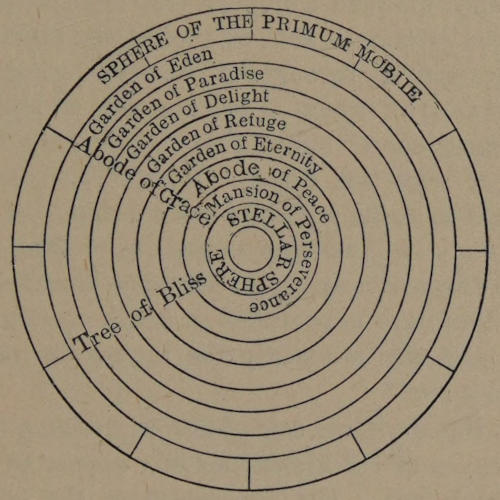
Fig. 1
2. Now, no great effort of imagination is required to trace the analogy between this fantastic conception and Dante’s rose. True, Ibn Arabi does not employ the simile of the rose in his text; but a mere glance at his plan, which, drawn with geometric precision, he himself has handed down to us, will at once suggest such a simile.
The figure given here (see Fig. 1) is as it appears in the Futuhat, III, 554, with the Arabic names translated. In its construction it is identical with the figure appearing under the number 32 in Manfredi Porena’s Commento grafico alla Divina Commedia as the plan of Dante’s rose (see Fig. 2). Porena in his description compares it to an amphitheatre the tiers of which are occupied by the elect.
3. Apart from this similarity in geometrical design, there is a further affinity between Dante’s rose and a Moslem myth whereby paradise is likened to a tree. Ibn Arabi, availing himself of a tradition very popular in Islam,[357] introduces into his plan a mighty tree depending from the heaven of the primum mobile, or roof of the abode of glory, whose foliage spreads throughout the seven celestial spheres and each branch of which penetrates one of the countless individual mansions of bliss. This tree he calls the tree of happiness, or bliss (see Fig. 1). Now, if this tree were to be depicted on Ibn Arabi’s plan of the mansions of glory, the effect of its myriad branches extending to their set places on each of the seven strata of paradise would be to give the whole figure the appearance of seven concentric circles of leaves; and this is exactly the impression one gets on looking into a rose.[358]
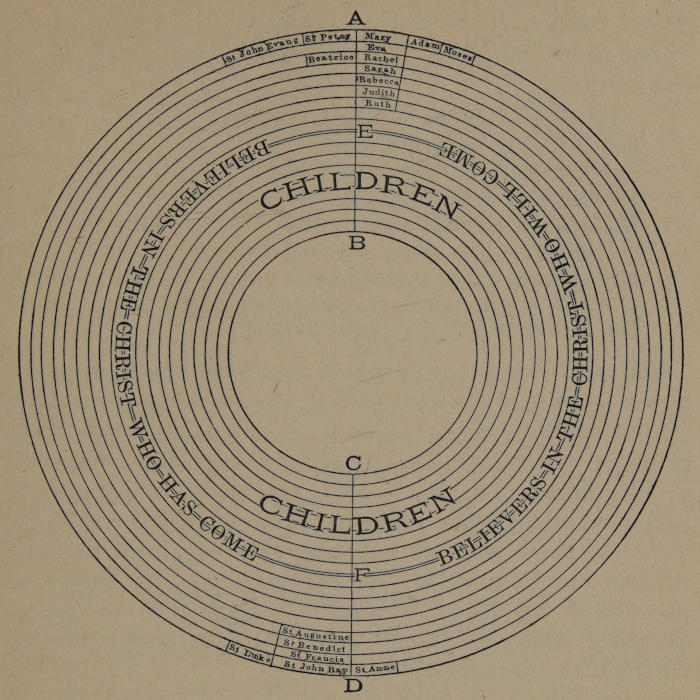
Fig. 2
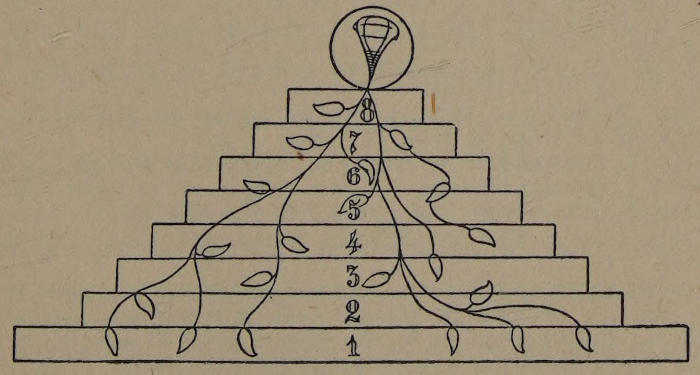
Fig. 3
Nor does this mythical tree of Islam, growing downwards from the heaven of the highest sphere, appear to have been out of Dante’s ken. His conception of the astronomical spheres (and they also from time to time serve as mansions of the blessed) is likewise that of a huge inverted tree, each one of whose branches corresponds to one of the astronomical spheres and whose roots are in the Empyrean. This image he forms when he reaches the sphere of Jupiter.[359] It must be admitted, however, that Dante’s simile is not nearly so closely related to the Moslem model as is the same simile of one of his imitators. We refer to Federigo Frezzi in his Quadriregio[360]:
“Poscia trovammo la pianta più bella Del paradiso, la pianta felice Che conserva la vita e rinnovella. Su dentro al cielo avea la sua radice E giù inverso terra i rami spande Ov’era un canto che qui non si dice. Era la cima lata e tanto grande Che più, al mio parer, che duo gran miglia Era dall’una all’altra delle bande.”
The other similes Dante uses in describing paradise—when he compares it to a walled garden, to a kingdom over which Christ and Mary reign, and to a hill around which the elect gather to contemplate the Divine light—are also to be found in Ibn Arabi. To him, indeed, the whole of paradise is simply a huge garden divided into seven circular parts by means of seven walls or luminous spheres[361]; and its most sublime mansion, Eden, Ibn Arabi terms the palace or mansion of the King,[362] because here there rises a “hill of exceeding whiteness around which the elect gather to contemplate the Almighty.”[363]
4. We will now proceed to compare the moral structure of Dante’s paradise with that of Ibn Arabi. The outstanding feature of both works is the tendency of the writers to exaggerate the number of divisions and subdivisions of the various categories in which the elect are placed. Ibn Arabi, indeed, insists that “no good deed that ever was performed is without its own appropriate reward in paradise.”[364] The chief categories are eight in number, just as in the human body there are eight organs, controlled by the soul: the eyes, ears, tongue, hands, stomach, pudenda, feet, and heart. It will be remembered that this principle formed the basis of the moral structure of hell, for Ibn Arabi, as well as Dante, held that the strictest symmetry should be observed in the conceptions of the two worlds of the after-life. Of the eight categories in question, then, each has its reward in one of the eight spheres or strata of the celestial paradise.
Further, these eight rewards are subdivided into a multiplicity of grades, each one of which is assigned to a specific virtuous deed. The age of the blessed—to cite but one example, which is eminently Dantean—is taken into consideration when the rewards are administered, so that an old man, who has led a sinless life in the faith of Islam, is appointed to a higher grade than a younger man of equal innocence, even although both may have been distinguished for the same virtue.
Another striking similarity between the two works is to be found in the allotment of the various places that the elect occupy in each of the eight spheres of glory. According to Ibn Arabi, three reasons determine the allocation: the first, grace alone, in which category are placed children who died before reason came and adults who lived according to the natural law; the second, personal virtue or good deeds performed by adults; and the third, inheritance of the celestial mansions left unoccupied by the damned.[365] To strengthen the parallel, Ibn Arabi points out that the second reason does not imply that the happiness of glory is only the due reward for good done on earth. It is, he explains, something much greater than a mere recompense.[366]
By way of exemplifying how the elect are distributed, Ibn Arabi enumerates four of the principal categories in the higher grades: first, the prophets or God’s messengers, who occupy pulpits in the highest grade; secondly, the saints, who, as disciples of the prophets, are seated on thrones in the next grade; thirdly, the wise men, who, having in life acquired a scientific knowledge of God, are placed in chairs in a still lower grade; and fourthly, the pure in heart, who, having only gained a knowledge of Divine things through revelation, occupy gradins beneath the others.[367] Dante’s distribution is on the same lines. In the highest seats he places the prophets, such as Adam and Moses, and the apostles, St. Peter, St. John, and so forth; beneath these, the doctors of the religious orders, St. Francis, St. Benedict, and St. Augustine; and lastly, the faithful, who obeyed the commandments.[368] It is also worthy of note that Dante in his description of the seats of the blessed uses the same terms as Ibn Arabi, namely, thrones or chairs, gradins or forms.[369]
In the four general categories in question Ibn Arabi again distinguishes, although somewhat vaguely, between the Moslem elect and those who, before Islam, professed the other religions revealed by the prophets of Israel, of whom, according to Moslem theology, Christ was one.[370] This vagueness is surprising, seeing that the Dantean division of the two elects had been established in Moslem tradition long before Ibn Arabi’s time. A hadith, attributed to Ali, son-in-law of the prophet, clearly defines it[371]:
“At the Divine Throne are two pearls, one white and the other yellow, each of which contains 70,000 mansions. The white pearl is for Mahomet and his flock; the yellow for Abraham and his.”
The analogy between this idea and Dante’s distribution is obvious. In the mystic rose the prophets, patriarchs and saints of the Old Testament are placed in the left sector and those who lived after Christ in the right.[372] The similitude, however, extends to the actual details. Just as Ibn Arabi couples Mahomet with Adam in the same degree of the Beatific Vision, so does Dante place Adam with St. Peter in the mystic rose.[373]
5. Let us now study awhile the scene of the glorious triumph of the elect as depicted by the Murcian mystic. Briefly, the Futuhat description is as follows:
“The blessed gather around the snow-white hill to await the epiphany of the Lord. As they stand, each in his respective grade and place and magnificently arrayed,[374] a dazzling light shines forth before which they fall prostrate. Through their eyes into the inmost recesses of their bodies and souls the light penetrates, so that each of the blessed becomes all eye and ear and sees and hears with his entire spirit, such is the virtue conferred on them by the light. Thus are they prepared for the presence of the Almighty. And then the Prophet appears before them, saying, ‘Prepare, then, ye chosen, for the manifestation of the Lord.’ The three veils that enshroud the Almighty—the veils of glory, majesty and power—are drawn aside at His will, and the truth is revealed, one vision, yet in the dual epiphany of the two names, the beautiful and the good. The magnificence of the Lord leaves the elect spellbound, and the brilliance of the wonderful vision pervades their beings.”
“This vision, although in itself one and the same so far as the elect are concerned, has, nevertheless, different aspects.[375] Those prophets, who only acquired their knowledge of God through the faith received from God Himself and did not increase that knowledge by reason and contemplation, will behold the vision through the eye of faith. The saint whose faith in God was inspired by a prophet will see it through the mirror of that prophet. If, however, he also gained a knowledge of God through contemplation, then will he have two visions, one of science and the other of faith. And so also will it be with the prophet. Similarly, the saint who, unenlightened by any prophet, acquired his knowledge, either through his own reason or direct from the Almighty, or in both of these ways, will be ranged in the Beatific Vision with the men of science or those of simple faith, or with both of these classes. Those who obtained from God the mystic intuition only will occupy a grade in glory apart from all the other elect. To sum up, the three aspects which God presents to the elect correspond to the different ways in which a knowledge of Him was gained on earth; and he who acquired that knowledge in all three ways will witness three Divine manifestations in the same instant. The visions of the elect in these three categories are graded thus: the prophets who received supernatural inspiration from God excel those saints who followed their teaching; while those who were neither prophets nor their disciples but simply saints and friends of God will, if they achieved the desired end by rational contemplation, be inferior in the Beatific Vision to the mystics, because reason, like a veil, will intervene between them and the Divine truth, and their efforts to raise it will be of no avail. In like manner the followers of the prophets will be unable to raise the veil of prophetic revelation. And so it is that the Beatific Vision, pure and unalloyed, will be the heritage exclusively of the prophets and those mystics who, like the prophets, received Divine inspiration on earth.”
“In each grade of vision a relative degree of bliss will be experienced.[376] Thus, the joy of some of the saints will be purely intellectual and that of others, emotional, physical, or imaginative, as the case may be. As for the mass of the faithful, the enjoyment derived by each from the Beatific Vision will also be proportional to his capacity for understanding the theological dogmas of his master. Further, as the mentality of the multitude is chiefly imaginative, so will be their knowledge of God and their participation in the Beatific Vision. This, too, will be the lot of the majority of the men of rational science, few of whom, although superior to the multitude, are on earth able to conceive the absolute abstraction from all matter. Hence it is that the greater part of the truths revealed by God through religion have been presented to the multitude in a form adapted to its understanding, though invariably accompanied by vague allusions, which are intelligible only to a select few of those of superior intellect.”[377]
Continuing, Ibn Arabi from time to time gives further interesting details[378]:
“In the Beatific Vision God manifests Himself to the elect in a general epiphany, which, nevertheless, assumes various forms corresponding to the mental conceptions of God formed by the faithful on earth. There is, then, one single epiphany, which is multiple only by reason of the difference of forms in which it is received. The Vision impregnates the elect with Divine light, each experiencing the Vision according to the knowledge of the Divine dogma or dogmas gained by him on earth.”
“The Divine light pervades the beings of the elect and radiates from them, reflected as if by mirrors, on everything around them. The spiritual enjoyment produced by the contemplation of this reflection is even greater than that of the Vision itself. For, at the moment when they experience the Beatific Vision, the elect are transported and, losing all consciousness, cannot appreciate the joys of the Vision. Delight they feel, but the very intensity of the delight makes it impossible for them to realise it. The reflected light, on the other hand, does not overpower them, and they are thus able to participate in all its joys.”
The fact of there being different grades of glory engenders no bitter feeling, much less envy, in the minds of those of the elect that occupy the lower grades. Ibn Arabi makes this point clear.[379]
“Each knows his allotted grade and seeks it as a child seeks its mother’s breast, and iron, the lodestone. To occupy or even aspire to a higher grade is impossible. In the grade in which he is placed each sees the realisation of his highest hopes. He loves his own grade passionately and cannot conceive that a higher could exist. If it were not so, heaven would not be heaven but a mansion of grief and bitter disillusion. Nevertheless, those in the superior participate in the enjoyment of the lower grades.”
6. From this description, so rich in detail, in picturesque images and in philosophico-theological ideas, we may now select those cardinal theses that are prominent in Ibn Arabi and compare them with Dante’s ideas.[380]
Firstly, the life of glory, according to the Murcian mystic, consists fundamentally in the Beatific Vision, which is conceived as a manifestation, revelation, or epiphany of the Divine light. God is a focus of light, the rays of which serve to prepare the elect to look upon the Almighty.
The parallel between this conception of Ibn Arabi and that of Dante need not be insisted upon; both in idea and artistic execution the two are identical.[381] For the latter, mediæval Christian literature furnishes no precedent whatever. The former, however, the idea or theological thesis of the necessity of a Divine light with which to behold the Almighty, had been conceived and discussed by the scholastics long before Dante’s time. St. Thomas Aquinas freely refers to a lumen gloriae, which strengthens the human understanding for participation in the Beatific Vision.[382]
At the same time it is certain that St. Thomas Aquinas himself admits seeking inspiration, not among the Holy Fathers and scholastic theologians, but among the Moslem philosophers.[383] It is the authority of Alfarabius, Avicenna, Avempace and Averrhoes that he quotes, when he attempts to explain the Beatific Vision in terms of philosophy, and it is the theory of Averrhoes, of the vision of the substances separated by the soul, that he accepts as the one most suitable for the elect’s vision of God.[384]
That Aquinas should not have recourse to patristic or scholastic literature was but natural, seeing he would find there little or no information about so abstruse a theme. The chroniclers of dogma recognise that the philosophic explanation of this article of the Christian faith is not to be found in the Holy Fathers nor in the early theologians. St. John Chrysostom even denies the vision of the Divine essence. St. Ambrose, St. Augustine, and with the latter all the Latins up to the eighth century, placed the blessed, according to the Scripture, face to face with the Divinity in the Vision; and they make the least possible comment on the sacred text to avoid falling into any anthropomorphic error, maintaining that it is impossible for the human eye to look upon the Vision.[385] Those that go more deeply into the subject, like St. Epiphanes, merely arrive at the conclusion that the soul requires assistance before it can look upon God.[386] What the nature of this assistance is, neither the Scriptures nor the Holy Fathers have determined. This is admitted by Petavius. Although the sacred texts tell of a Divine lumen, this has no bearing on the scholastic theory of the lumen gloriae. St. Thomas, indeed, held that the lumen gloriae is a principle of vision, as it were a habit or faculty of seeing (akin to the sensitive faculty inherent in the eye), by means of which principle the human mind is trained to behold God. On the other hand, the lumen of the Psalms (XXXV, 10), “In lumine tuo videbimus lumen,” was regarded by Origenes, St. Cyril, the pseudo-Dionysius, and St. Augustine, as a synonym of Christ, in Whose light we should see the Father. From which Petavius concludes that the theory of the lumen gloriae is a novelty introduced by the scholastics.[387] He finishes by citing Plotinus as the only thinker that saw even vaguely the necessity, for the Vision of God, of a lumen which is God Himself. Had there only been added to his great store of patristic learning some knowledge of Moslem theology (which was unknown in his century), he would have completed the cycle of his historical investigations and filled the gap of centuries that separates Plotinus from the scholastics.
He would have found, indeed, in Algazel and in the Spaniards, Ibn Hazm and Averrhoes—to mention but three great theologians—the roots from which the theory of the lumen gloriae sprouted. Algazel dedicates a complete chapter of his Ihia to the development of this theory.[388] Long before St. Thomas, he defined the Beatific Vision as a perfection of the understanding and, in order to convey an idea of the vision of glory, he establishes a complete, although metaphorical, parallel between it and the physical vision. He says:
As the physical vision is a complement and perfection of the fantastic representation of the object, the Beatific Vision is a clearer and more perfect perception of God as He appears to the mind in this life. He proceeds[389]: “God will reveal Himself to the elect in all the splendour of His manifestation. This epiphany, compared with the knowledge of God possessed by the elect, will be like the manifestation of an object in a mirror compared with a fantastic representation of it. That epiphany of God is what we call the Beatific Vision. It is, then, a real vision, provided it is clear that here we do not understand by vision a complement of the imaginative representation of the imaginable object, represented in a concrete form, with dimensions, site, etc. The knowledge which you have gained of God on earth will be completed in heaven and will become presence or experience. Between this presence in the future life and the knowledge acquired on earth there will be no more difference than what comes from a greater manifestation and clearness.”
Ibn Hazm, the great eleventh-century theologian of Cordova, expounds a similar doctrine:
“We do not admit the possibility of seeing God with a sort of human vision. We simply maintain that God will be seen by means of a power distinct from that which we have in our eyes, a power that will be inspired in us by God. Some people call it a sixth sense. And the proof lies in the fact that, as we now know God with our souls, which in this life He has strengthened to that end, so afterwards God may strengthen our vision in order that we may behold Him.”[390]
We have already seen how Averrhoes’ theory was accepted by St. Thomas as an explanation of the Beatific Vision. But he goes further. In one of his theological treatises,[391] dealing with the texts of the Koran which compare God to a light, he says:
“God, being the cause of the existence of all beings and the cause of our being able to see them, has rightly been called Light; for the same relation exists between light and the colours, that is to say, light is the cause of their existence and also of our being able to see them. Nor can any doubt exist about the dogma of the vision of God, which is a light, in the life to come.”
And after refuting all objections, he concludes, like Algazel, by asserting that the Vision will consist in an increased knowledge of the Divine essence.
7. The analogies, however, between Dante’s conception and that of Ibn Arabi are not limited to the general theory of the lumen gloriae. Other even more striking similarities are:
Secondly. In both descriptions the elect are in the same attitude, their gaze fixed on the focus of Divine light.[392] The different grades in the Beatific Vision depend, according to Dante, on the degree of love that each of the elect shows for God, whereas in Ibn Arabi it appears to be the nature of the knowledge that the souls possessed of the Divinity that counts.[393] It would seem, then, that Dante adopted the point of view of a voluntaryist, and Ibn Arabi, that of an intellectualist. The difference, however, is more apparent than real. For Dante frequently appears to adopt Ibn Arabi’s standpoint as an intellectualist; on several occasions he attributes the grade of glory to the nature of the faith or the illuminating grace with which the soul knew God.[394] Further Ibn Arabi, like all Moslem mystics, is essentially a voluntaryist; virtue, in his opinion, is based, not on theological knowledge or dead faith, but on divine love, at once the cause and the fruit of the knowledge that the soul has gained of God. He therefore reserves a prominent grade in the Beatific Vision for the contemplative mystics and places in an inferior position such saints as were also philosophers.[395] This doctrine was expounded by Algazel before Ibn Arabi. The happiness of heaven—he writes in his Ihia[396]—will be proportionate to the intensity of the love for God, just as this love will be commensurate with the knowledge of God gained by the elect on earth and called by Revelation, faith.
Thirdly. The difference in grades is shown, not in the Beatific Vision itself, but in the variety of forms in which the Divine light is made manifest to the elect and in the greater or lesser brilliance of the light they receive and reflect.[397] These three ideas of Ibn Arabi have also their respective parallels in Dante’s conception. In Par. XXX, 121, he says: “There, distance makes no difference, for where God governs the natural law has no power whatever.” In this way Dante establishes the essential unity of the vision in its different grades. If in these grades there is any difference, it is not in the thing seen but in the way of seeing it. Accordingly, in Par. XXXIII, 109, he adds: “Not because there were more than one aspect of the light I saw, which itself is immutable, but because my vision, strengthened by its contemplation, was able to see it in another manner.”
Finally, that the light acquired is reflected by the elect, and its greater or lesser brilliance distinguishes their greater or lesser glory, are points frequently alluded to by Dante in the Paradiso.[398] The Dantists have explained this theme by the Thomist doctrine of the endowments of the glorious body, one of which is the radiance it derives from the glory of the soul.[399] Now, we have already seen how Ibn Arabi, before St. Thomas, likewise explains the radiance of the elect by the superabundance of Divine light, which pervades the body of each blessed and is reflected from all around it. Nor was this an original idea of Ibn Arabi’s, but merely a repetition of the doctrine of the Ishraqi mystics. Indeed, in the tenth century of our era, the author of the Corra, having discovered it in some hadiths of a still earlier date, used the theme in his description of paradise. In those pictures of the glorious life, the external brightness of the elect indicates the grade of glory of each. The following passages put the matter beyond all doubt[400]:
“He who belongs to the highest category of the elect so illumines the others that the whole of heaven is bright with the radiance of his face.” Again, it is stated that “the elect see one another in paradise as we see stars shining in the sky”; that “if one of the elect were to descend to earth, he would eclipse the light of the sun”; that Fatima, the daughter of Mahomet, is called the Brilliant, the Splendid, on account of the intensity of her light; that “the robes of the blessed reflect the Divine light”; that “when the Almighty appears in the Beatific Vision and the light of the Divine countenance falls on the faces of the elect, it causes them to shine with such brilliance that they appear transfigured with ecstasy”; and, lastly, that after the Beatific Vision the elect marvel at their own greater brilliance, increased by the reflection of the countenance of God.
Fourthly. The Beatific Vision will engender joy or delight, proportional to the various grades of the Vision, but so intense as to produce ecstasy in the soul. As is well-known, this idea of Ibn Arabi’s reappears in full in Dante’s work.[401] The idea of proportion may, it is true, have been taken from the Thomist doctrine rather than from Islamic sources.[402] Not so the idea of the ecstasy; of this there is not a word in the Thomist doctrine, which confines itself to an explanation of the philosophic origin of the three endowments of the blessed soul: vision, delectation, and comprehension of the Divine essence. Whereas, if the ecstasy in Dante be psychologically analysed and compared with that in Ibn Arabi, various constituent elements common to both will be found: loss of memory, somnolence or semi-consciousness, produced on the soul by the intensity of delight.[403]
Fifthly. The fact of there being different grades in the Beatific Vision excites no feeling of envy or sadness among those in the lower grades. Each accepts his share of the glory as if it were impossible even to desire anything greater. And this is so, because all love the grade they occupy; and, further, because, if it were not thus, heaven would not be a mansion of peace and delight.[404]
Dante puts the same explanation in the mouth of Piccarda[405]: “Our desires, awakened only by the love of the Holy Spirit, are satisfied in the way that He determined.” To Dante’s inquiry whether there is no desire on the part of the souls to attain to a higher place, Piccarda replies: “Brother, a feeling of charity quells such a desire, and we long for nothing more than what we have. Were we to aspire to a higher sphere, our wish would be at variance with the will of the Almighty, and such disagreement does not exist in the kingdom of heaven.” Dante, satisfied with the explanation, concludes: “Then I understood why in the heavens all is paradise, notwithstanding the different degrees of bliss.”
8. The identity thus established between the five fundamental theses of the Murcian Ibn Arabi on the Beatific Vision and Dante’s is strong enough to render comment unnecessary. In comparison, the other similarities, such as picturesque details and artistic devices, used in both descriptions in an attempt to delineate by geometrical figures the Divine truth as seen in the glorious vision, are vague.
The analogy that was revealed in the discussion of Version C of the second cycle of the Miraj[406] between the apotheosis witnessed by Mahomet and that described by Dante need not be dwelt upon. It is as well to recall, however, that the image representing the Divinity in that version, which dates back to the eighth century, is identical with that employed by Dante: a focus of light, surrounded by concentric circles, composed of tiers of resplendent angels. This description was perpetuated in Islam, and Ibn Arabi frequently reproduced it in his Futuhat, notably in his portrayal of God at the final judgment.[407]
But the similarity extends further. Dante, having arrived at the spiritual cusp of his glorious ascension, attempts to explain the mystery of the Trinity by means of the same geometrical circular symbol: three circumferences, of equal size and multi-coloured, the first two of which seem to be a reflection of the other, after the manner of two rainbows, and the third as of fire, emitted by the other two.[408] Now, the more shrewd among the commentators, although acknowledging the ingenuity shown by Dante in his conception, admit that this geometrical symbol of the three circles, as a representation of the persons of the Trinity, is more of an enigma than it is explanatory. No details are given of the colour of the first two circles or of the geometrical relationship between the three, whether they are concentric or eccentric, whether they are tangent to or cut each other—in fact, no help whatever to interpret the symbol is given.[409] One fact, however, stands out: Dante uses the symbol of the circle to represent God in all His aspects—as One in the Essence, as the Father, as the Son, and as the Holy Ghost. Thus, the symbol of the circle represents God conceived both as the principle of emanation and as the emanation itself.
Now, it is well known that the same use of the circle as a symbol of the Divinity was made in the Plotinian metaphysics.[410] The Apocryphal Theology of Aristoteles, as also the apocryphal book of Hermes Trismegistus and the Liber de Causis, made this symbol known to the Moslems and the scholastics; but it was the Moslems, the Ishraqi mystics in particular, who had recourse to the circle on every possible occasion to explain their ideas on emanation, both in their metaphysics and their cosmology.[411]
The Murcian Ibn Arabi, more than any of the Ishraqis, employs circles, concentric and eccentric, secant and tangent, to represent the Almighty, whether in His abstract individuality, in His attributes, names and relations, in His manifestations ad extra, or in His emanation.[412] A circle of white light on a red background, also of light, with two radii projecting from it, as it gently moves but never changes, is the symbol by which he represents the individual essentiality of God.[413] The procession of the beings who emanate from God the essence is also symbolised in the Futuhat by a circle.[414] The centre, like a focus of light, is God, from Whom the contingent beings emanate, just as the radii of a circle proceed from one central point to terminate in a series of points which, when joined together, form the circumference, symbolical of the cosmos; and just as these points are in their essence indistinguishable the one from the other, so also in the emanation of God is there a unity of substance and a multiplicity of epiphanies; the beings are merely the aspects, or the names and forms under which the Divine light appears.
These emanations likewise are represented by circles[415]; at the innumerable points on the first circumference, the centre of which is God, an infinity of other circumferences cut the circle; and these in turn produce other circles, secant as before, and so on ad infinitum. As the circles multiply, the centre of their origin, God, becomes hidden, nevertheless, all reflect the light of His first epiphany. All the ingenious and paradoxical similitudes which Ibn Arabi deduces from this symbol of the Divine emanation are founded upon one main idea, the basis of his pantheism, half emanative, half immanent. God and the creatures are one and the same substance; the multiplicity of the emanations in no wise changes the essence of their origin; and these emanations are merely distinct affinities, who represent the immanence of the origin from which they spring.
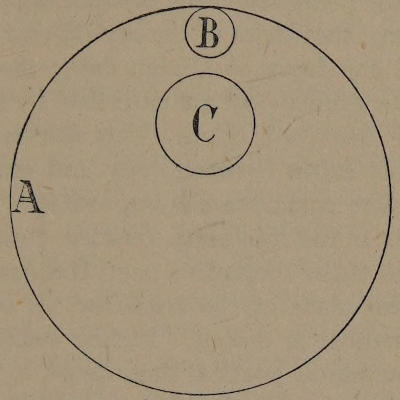
This general plan of the Divine emanation becomes less involved when Ibn Arabi proceeds to represent the ontological categories alone by the symbol of concentric circles.[416] The supreme series of these consists of three substances, hypostases or emanations from the One Absolute: first, the Spiritual Substance, from which proceed all those beings who are not God; secondly, the Universal Intellect, which is the Divine light by which the beings of the Spiritual Substance receive objective reality; thirdly, the Universal Soul, likewise an emanation from the One, through the Intellect.[417] This triad of substances, which to Ibn Arabi represents the essence of God, is shown in the Futuhat by a geometrical figure composed of three circles: the largest, which encircles the whole figure, represents the Spiritual Substance; inside, two smaller eccentric circles, almost tangent to one another, symbolise the Intellect and the Soul. Ibn Arabi gives no reasons for these graphic details of his plan, but the mere fact of his using the three circles as a symbol for the three hypostases of his Trinity, to wit, the principle of prime aptitude for the existence of all beings, the principle of active potency to give such existence, and the principle of life of the cosmos, is in itself an interesting point and one that will repay the study of those who, while appreciating the subtle ingenuity of the Florentine poet, are not content merely to admire his artistic creations but are eager to find out whence he derived his ideas.[418] For, in spite of there being an abyss of differences between the pantheistic triad of Ibn Arabi and the Catholic dogma of the Trinity,[419] this in no wise affects the symbolical representation of the two conceptions by a geometrical plan. To adapt this plan to a representation of either conception would constitute neither an absurdity in metaphysics nor a danger from the point of view of dogma, provided that the key to the enigma were kept discreetly hidden and concrete details in its interpretation were omitted; and this is exactly what Dante did. In describing his symbol of the three circles, he confines himself to stating that the three are one only as regards “continenza,” i.e., substance, and that they are of different colours, to distinguish the Three Divine Persons, in the unity of essence.[420]
X Synthesis of all the Partial Comparisons
1. The many minute comparisons made in this second part of our work will now enable us to present, in the form of a synthesis of the partial results, the following conclusions:
A considerable number of the details and topographical descriptions in the Divine Comedy, although they have no parallels in the Miraj, have, nevertheless, their precedents in Islamic literature, whether it be in the Koran, in the hadiths, in the Moslem legends of the final judgment, or in the doctrine of the theologians, philosophers, and mystics.
2. Among all the Islamic thinkers, the Murcian Ibn Arabi stands out as the most likely to have furnished Dante with his model for the hereafter. The infernal regions, the astronomical heavens, the circles of the mystic rose, the choirs of angels around the focus of Divine light, the three circles symbolising the Trinity—all are described by Dante exactly as Ibn Arabi described them. This similarity betrays a relation such as exists between copy and model. That it should be a mere coincidence is impossible. The historical facts are these: in the thirteenth century, twenty-five years before the birth of the Florentine poet, Ibn Arabi introduced into his Futuhat plans of the hereafter, all of which were circular or spherical in design. Eighty years after, Dante produces a marvellous poetical description of the after-life, the topographical details of which are so precise that they enabled the poet’s commentators in the twentieth century to represent them graphically by geometrical plans; and these plans are essentially identical with those designed by Ibn Arabi seven centuries before. If imitation by Dante can be disproved, the manifest similarity is either an insolvable mystery or a miracle of originality.[421]
3. Over and above this identity in construction there is a striking analogy in decoration. Indeed, the Aaraf seems to be the prototype of the limbo: the Gehenna, the model of the Inferno; the Sirat of the Purgatorio; the meadow between purgatory and hell, of the Terrestrial Paradise; and the eight gardens, of the Mystic Rose or Dantean Paradise.
4. The same unity in architectural design and the same hankering after symmetry, physical as well as moral, are exhibited in both descriptions. Jerusalem is the pivot on which the other world revolves; beneath it is hell, in the last storey of which Lucifer is imprisoned; vertically above Jerusalem is the theological heaven, where dwell the Divinity and the elect; here, the number, as well as the subdivision, of the mansions is identical with that of the infernal regions, with the result that each place in hell has its antithesis in heaven.
5. The likeness between the two extends to many of the episodes and scenes, some of which are literally identical. For instance, the classification of the inhabitants of the limbo and their moral suffering are analogous to those of the Aaraf; the black tempest of the adulterers is the Koranic wind of Ad; the rain of fire that beats down upon the Sodomites, who are driven round in a circle; the punishment of the soothsayers, whose heads are reversed; Caiaphas, crucified upon the ground and trampled upon; the robbers, devoured by serpents; the authors of schism, with their bowels protruding and their arms cut off, or with their head, talking, in their hands; the giants, whose abnormal proportions are described in parallel terms; the torture of the ice, which is the Moslem zamharir, suffered by traitors; the picture of Lucifer, fast in ice like the Islamic Iblis; the dense smoke that envelops the passionate in purgatory, identical with that which, according to the Koran, will appear on the Day of Judgment; the double ablution in the two rivers of the earthly paradise, and the meeting of Dante with Beatrice, which is a parallel scene to that of the entry of the soul into the Islamic paradise, after ablution in two rivers, and of the meeting with its heavenly bride; and, lastly, the description of the Beatific Vision as a Divine lumen, which produces outward brilliance, intellectual clarity, and ecstatic delight.
6. If to all these analogies of architecture, topography, and setting, are added those that were brought out in full relief in the first part of this work, it will be apparent that the religious literature of Islam alone, in the sole theme of the after-life—a theme mainly developed around the Miraj—offers to investigators a more abundant harvest of ideas, images, symbols, and descriptions, similar to those of Dante, than all the other religious literatures together that have up to now been consulted by Dantists in their endeavours to explain the genesis of the Divine Comedy.
7. And here our study might be concluded, were it not for one important doubt that may assail the mind of the investigator.
The artistic devices and theological-philosophic conceptions introduced by Dante into his poem are attributed by Dantists to the poet’s own inventive genius, stimulated to a certain extent by his acquaintance with sundry popular legends that were broadcast throughout Europe in the centuries immediately preceding his appearance. These mediæval legends are technically referred to as the “precursors of the Divine Comedy.”
Now, it is certain that none of these furnishes the same explanation for so many elements of Dante’s work as does the legend of the Miraj, and, taken altogether, they fail to throw light upon many details which the Miraj and Islamic literature in general explain in full. Further, the analogies between the Divine Comedy and its precursors are too slight to establish any relation such as exists between model and copy.
In spite of all this, however, it might be possible to ignore the hypothesis of Moslem influence over Dante’s poem and fall back on the theory that the poem was conceived in the womb of Christian literature and evolved from the seeds of eschatology contained in its mediæval precursors. To rebut this theory and render the argument in favour of our hypothesis conclusive, further investigation is, therefore, necessary. The origin of the eschatological elements in the precursory legends must be inquired into, in order to ascertain whether they were indeed all of native Christian growth, or whether they do not also show signs of Moslem ancestry such as the Divine Comedy has revealed to us.