Part 2 — PART II THE DIVINE COMEDY COMPARED WITH OTHER MOSLEM LEGENDS ON THE AFTER-LIFE
Harold Sunderland translation
I Introduction
1. The close resemblance that the Divine Comedy has been shown to bear to the legend of the Miraj gives rise to a multiplicity of problems in the history of literature, all relevant to the originality of Dante’s poem. These problems are so important that a more minute examination of the poem in its several parts—limbo, hell, purgatory and the earthly and celestial paradises—is required in order to resolve whether or not many of the descriptive features and even whole scenes and episodes, although successfully standing the test of comparison with the Miraj, are, nevertheless, traceable to other Moslem legends and beliefs.
2. As a preliminary, it may be well briefly to set forth the doctrine of Islam on the future life; for it will be possible to admit or reject a priori the likelihood of any resemblance between the conceptions of Dante and the Arabs according as the Islamic doctrine agrees or disagrees with the teaching of Christianity on the same point.
3. Now, on no question are the two religions in closer agreement than on that of the future life, in which, according to both, the souls exist in four different states. By the eleventh century at the latest definite expression had been given to this doctrine by the orthodox clergy of Islam, and notably by the great moralist and theologian, Algazel.[140]
The state of everlasting damnation, reserved for the souls of those who denying God gave themselves up to worldly pleasures is equivalent to the Christian hell; and, just as in the latter the pain inflicted is both physical and moral, so in the Moslem state the soul, in addition to being subjected to the torture of everlasting fire, is made to suffer anguish through its separation from God.
Everlasting salvation, corresponding to the Christian heaven, is the state of those souls that lived in the true faith and died either innocent or repentant, free from all taint of sin. Their reward is double, for over and above the sensual pleasures promised by Moslem revelation, they experience the infinitely greater bliss of the contemplation of the Divine essence.
The two states intermediate between heaven and hell approximate to our purgatory and limbo. According to Algazel, the punishment in purgatory differs from that in hell only in that it is not eternal, but temporary. True, the Christian purgatory is the place where venial sins are expiated, or deadly sins whose guilt has been washed away; whereas the Moslem purgatory is assigned to those souls who, although guilty of deadly sin, have until the moment of death kept the root of faith alive within their hearts and been deprived by death alone of the possibility of repentance. As, according to Algazel, the faith that saves is not the dead but the living faith expressed in religious feeling and good deeds, this act of living faith in God and in the intercession of the Prophet is then practically the same as the spirit of contrition required to save the Christian.
The fourth state, which represents the Christian limbo, is that of the souls who, having neither served nor offended God, are exempt from punishment, although denied eternal bliss. This is the condition of lunatics, idiots, the children of infidels, and those adults who, never having heard the call of Islam, may be said to have died in ignorance of their infidelity.
The brief outlines sketched above will suffice to show how similar are the moral foundations upon which the Christian and Moslem conceptions of the after-life are based. Nor is this a matter for wonder, seeing that so great an authority as St. John of Damascus held Islam to be but an heretical form of Christianity, heretical inasmuch as it denied both the Trinity and the Divinity of Christ,[141] and that Algazel himself confessed the whole of the teaching of the Christian faith, apart from these two points of doctrine, to be infallible truth.[142]
II The Moslem Limbo in the Divine Comedy
1. The first of the nether regions visited by Dante is that set apart for such souls as have done neither good nor evil. To this place Dante gives the name of “limbo.”[143]
The Latin noun “limbus,” the origin of which is obscure, is used by classical writers, such as Virgil, Ovid, and Statius, with the meaning of “fringe or border adorning the lower part of a garment.” In the sixth century it is used with the meaning of “coast.” In the Bible and ecclesiastical writings the abode of indifferent souls is named the “Bosom of Abraham,” but never the “limbo”; and it is not known who introduced the term into Christian literature. It appears suddenly in the works of the commentators of Peter the Lombard, contemporaries of Dante, who designate by it both the abode of unbaptised children (limbus puerorum) and the dwelling of the patriarchs of the Old Testament (limbus patrum).[144]
Dante places this abode immediately above hell, as if it were an antechamber of the latter, and divides it into two parts—the ante-inferno, a wide plain inhabited by the indifferent souls,[145] and the angels that remained neutral in Lucifer’s rebellion against God,[146] and the limbo proper, a deep and shaded valley, in the midst of which stands a fortress surrounded by seven walls with seven gates leading to a pleasant meadow.[147]
The limbo is inhabited by children that died innocent, but unbaptised, and, in addition, by a host of men and women who, though righteous, were either pre-Christian pagans or true followers of Mahomet and who, moreover, are famous as poets, moralists, philosophers, or heroes.[148]
The suffering of these spirits is purely moral, and arises from their insatiable longing to behold God. Debarred from the joys of paradise, and exempt from the physical punishment of hell, they may be said to be in suspense (sospesi) between heaven and hell.[149] This intermediate state would appear to give them special opportunities of knowing and dealing with both the blessed and the damned. Thus Virgil is in direct communication, from the limbo, with Beatrice[150]; and, as he guides Dante through hell and purgatory, he names and describes to him the sinners and fiends, whose features are evidently well known to him.
2. The absence of almost all Biblical or theological precedents for Dante’s picture need hardly be insisted upon. The name, the picturesque description of the place, the exact classification of the dwellers, who are pagans and at times even Moslems, the many details of their life and condition—none of these can find full justification in Catholic dogma, which is as discreet on these as on most other points of eschatology.[151]
In Islam it is otherwise. The absence of any one and unquestionable authority to distinguish between matters of faith and of free thought enabled a large number of myths and legends to be introduced from other Oriental religions—especially Judaism, Mazdaism, and Eastern Christianity—and, being attributed to the Prophet and his companions, to acquire a weight almost equal with the text of the Koran.
A search in this direction may perhaps provide a clue to the reading of the riddle of Dante’s limbo, which Christian theology leaves unsolved.
3. The Koran (VII, 44, 46) speaks of a mansion “Al Aaraf” that separates the blessed from the wicked. The word “Aaraf” by derivation means “the upper part of a curtain or veil”; it is also used to denote “the mane of a horse, the crest of a cock and, in general, the highest or most prominent part of anything”; in its wider sense it is applied to “any limit or boundary between things.”[152] Thus, it is similar to the classical limbus; but, whereas limbus did not acquire the meaning of a region beyond the grave until the thirteenth century, the Arabic word had this meaning, in addition to its ordinary meaning, as early as the time of Mahomet.[153]
The Moslem limbo is variously described in the legends—as a pleasant vale studded with fruit trees; as a valley lying behind a lofty mountain; as a circular wall of great height, with battlements and a gate, rising between heaven and hell; or simply as an eminence or mount. These conceptions, grouped together, present a picture not unlike that of Dante’s limbo; especially, if the picture is completed with the description, recurrent in the Miraj, of the Garden of Abraham and the entrance to the Moslem hell, which, like the castle that forms the antechamber of Dante’s hell, also has seven gates. Again, this castle, surrounded as it is by seven walls with seven gates, is an almost exact reproduction of the Islamic castle of the garden of paradise, which is surrounded by eight walls with eight gates[154]; as if Dante, in blending the Moslem designs of heaven and hell, had sought to symbolise the neutral nature of the souls dwelling in the limbo.
The Moslem limbo has, on the authority of Algazel himself, been shown to be the abode of those that lived neither in virtue nor in vice. In keeping with this doctrine, Moslem tradition specifies the following groups: Martyrs of holy warfare who are denied the reward of paradise through having disobeyed their parents; men of learning whose merit was nullified by their vanity; infant children of Moslems and infidels; and, finally, angels of the male sex or genii that believed in the Prophet. These groups correspond very fairly to the groups in Dante’s limbo of the unbaptised children and the heroes, poets and philosophers whose virtues and talents were neutralised by their lack of faith. As regards the angels of male sex, they are indeed as enigmatical as Dante’s neutral angels.
The only suffering that, according to the Koran and the theologians, is inflicted on the inhabitants of the Moslem limbo is a vain longing to enter paradise: “They cannot enter for all their longing.”[155] As the good they have done is balanced by their sins, they neither sink into hell nor rise to heaven, but remain in suspense between the two.[156] Thus placed, they are acquainted and converse with both the blessed and the damned.[157]
III The Moslem Hell in the Divine Comedy
1. Dante lovers of all ages have dwelt admiringly upon the originality shown by the poet in his conception of the architecture of hell. His compatriot Christoforo Landino wrote as follows in the fifteenth century[158]: “Benche questo poeta in ogni cosa sia maraviglioso, nientedimeno non posso sanza sommo stupore considerare la sua nuova, ne mai da alcuno altro escogitata inventione.” And in modern times, Rossi, after showing how feeble were the stereotyped descriptions of hell prior to Dante’s and how poor in this respect were the Biblical and classical sources available to him, concludes by saying: “L’ingegno poderoso e l’alta fantasia del poeta svolsero e rimutarono con piena libertà questo abbozzo, fecondarono quegli elementi e ne trassero un tutto nuovo, originale, grandioso, definito in ogni parte con esatteza quasi matematica.”[159]
The admiration of the critic is justified. But, before the originality of Dante’s conception can be regarded as established beyond all doubt, it must be shown that no similar description existed in the literature of other religions. This demonstration has often been attempted. Vossler, for instance, has given a complete summary of the researches made by Dantists in their endeavour to find religious, philosophical and artistic precedents for the Divine Comedy.[160] With wonderful scholarship he has reconstructed what he calls the prehistory of the sublime poem. The myths contained in religions prior to Christianity, as well as the teaching of the Old and New Testaments, are drawn upon as sources. One religion alone is excluded from his survey—the Mahometan.[161] Yet of all religions Islam is the richest in legends on the after-life.[162] Islam, the spurious offspring of Judaism and Christianity, blended the doctrine of the Old and New Testaments with elements drawn from other Oriental faiths; and the fact that it appeared at a later date and spread rapidly through countries inhabited by the most religious peoples of the ancient world aided the process of assimilation. Accordingly, in no other religious lore do we find so minute and graphic descriptions of the abodes and life of the blessed and the wicked souls as in the Koran and the traditions built up around it; and a comparison of the Moslem hell with Dante’s Inferno may well throw new light upon the question of the originality of the great poet’s conception.
2. Beginning with the general outlines of the two conceptions, we find no precise topography of hell in the Koran.[163] But Moslem tradition agrees with Dante in placing hell beneath the earth’s crust; the tales represent it as a dark chasm, or concave opening in the earth, so deep that a stone or ball of lead dropped into it would take seventy years to reach the bottom.[164] As in the Divine Comedy, its mouth is laid at Jerusalem, near or behind the Eastern wall of the temple of Solomon.[165] Dante maintains the unity of his architectural design by placing the celestial Jerusalem in a vertical line with the city on earth; and the same vertical projection applies, as will be shown later, to the Moslem paradise.
But there are further coincidences. In Version B of Cycle 2 of the Miraj the Moslem hell was seen to be formed, like that of Dante, of a series of concentric circular strata gradually descending from the mouth to the bottom. This conception of the structure of hell was invented by the Moslem traditionists in their endeavour to interpret the Koranic text (XV, 44), which says: “(Hell) has seven gates; to each gate, a separate group.” The commentators could furnish no explanation of this verse, if the current meaning of “door” or “gate” were to be given to the Arabic word bab. Accordingly, a metaphorical interpretation was soon applied to the word in the sense of “step” or “circular stratum,” which allowed hell to be conceived as a place of imprisonment consisting of seven pits, each reserved for one class of sinners.[166] To give this interpretation greater authority, it was attributed to Ali, the son-in-law of Mahomet.[167]
“Know ye of what manner are the gates of hell?” he asked his hearers, and they answered, “as are the gates we know”; but he said, “not so, for they are thus,” and, as he spake, he laid one hand flat upon the other.
The idea of parallel planes thus suggested is carried further in other tales, attributed either to Ali or to Ibn Abbas, Mahomet’s uncle. In these the words “step” or “circular stratum” are used in place of “gate”; the seven divisions are expressly stated to lie one above the other; and the distance between each is measured in terms of hyperbole.[168] The division into seven is characteristic of Moslem cosmography. The Koran itself says (LXV, 12): “Seven are the astronomical heavens and seven the earths, as are seven the seas, the gates of hell and the mansions of paradise.”[169] Dante, in dividing each of the realms of hell, purgatory and paradise into ten regions, betrays a similar obsession for symmetry, coupled with a belief in the esoteric virtue of a given number.[170] Although the coincidence does not extend to the numbers themselves, the principle underlying both cosmographies is the same.
Like the different circles of the Inferno, each of the stages of the Moslem hell has a name of its own and certain physical features peculiar to it, and is reserved for one class of sinners condemned to one particular torture. It would be difficult, if not impossible, to reduce to one scheme the heterogeneous descriptions furnished in the tales. Nor is it claimed that they agree in detail with Dante’s description of hell. But a brief review of some of these tales will, notwithstanding the simplicity of the setting, reveal the general features of resemblance mentioned above. Thus a tradition dating from the second century of the Hegira gives the divisions of hell, reckoned downwards, as the following[171]:—
1. Jahannam, or Gehenna, for Moslems guilty of deadly sins. 2. Lazi, or glowing fire, for Christians. 3. Al-Hatma, or greedy fire, for Jews. 4. As-Sair, or flaming fire, for Sabians. 5. Saqar, or burning fire, for Zoroastrians. 6. Al-Jahim, or intense fire, for polytheists. 7. Al-Hawiya, or abysm, for hypocrites.
Other traditions classify the seven earths into which God divided our planet and which correspond to the seven stages of hell, as follows[172]:—
1. Adim, or surface, inhabited by mankind. 2. Basit, or plain, the prison of the winds, inhabited by men that eat their own flesh and drink their own blood. 3. Thaqil, or region of distress, the antechamber of hell in which dwell men with the mouth of a dog, the ears of a goat, the cloven hoof of an ox and the wool of a sheep. 4. Batih, or place of torrents, a valley through which flows a stream of boiling sulphur to torment the wicked; the dwellers in this valley have no eyes and in place of feet, have wings. 5. Hayn, or region of adversity, in which serpents of enormous size devour the infidels. 6. Masika, or store and Sijin, or dungeon, the office where sins are recorded and where the souls are tormented by scorpions of the size of mules. 7. As-Saqar, or place of burning, and Athara, place of damp and great cold; this is the home of Iblis, who is chained in the midst of the rebel angels, his hands fastened one in front of and the other behind him, except when set free by God to chastise his fiends.
It need hardly be pointed out how great the distance is that separates this scheme, childish in its simplicity, from the complex moral structure of Dante’s hell. It should be borne in mind, however, that here we are not dealing with the systematic works of accomplished writers—they will be discussed at a later stage—but with popular tales that lived, and still live, in the mouth of the illiterate people; and they are quoted, not as counterparts of the Inferno, but as rough sketches, in which analogies, even of detail, with the poem are to be found.[173] Thus, the second stage is, like Dante’s second circle, a place of winds; and in the fifth region enormous serpents devour the sinners, as in the eighth circle of Dante they do the thieves. Again, the glacial region of the last surface is an exact counterpart of Dante’s lowest circle, with Lucifer corresponding to Iblis the Moslem king of evil; Iblis, moreover, appears chained with one hand in front and one behind, just as does the giant Ephialtes.[174]
As more and more traditions come to be consulted, each adding fresh picturesque details, the description will be found to lose its original baldness and acquire a relief as marked as that of Dante’s picture. These tales were collected by the ascetics of Islam, who have handed the collections down to us in their writings.[175] A comparison of the picture of the Moslem hell with the Inferno shows a remarkable resemblance. Like the latter, the former is depicted with a wealth of orographic, hydrographic and architectural features—rocks, hills and mountains, chasms and valleys; rivers, lakes and seas; sepulchres, dungeons, castles and bridges. As in the Inferno, many of these topographical features bear special names; and, again, in the naming the same principles are followed as in Dante. The latter either names the regions after the sinners suffering in them, such as the abodes of the traitors[176]; or, like the eighth circle, Malebolge, from the physical and moral conditions of the place itself. Apart from the names of the principal stages that are quoted above, the hell of Islam has many names for special topographical features.
Thus, a mountain formed of the smoke of hell is named Zal Yahmum; a rock on which libertines are tortured is called Sijin, or dungeon; Khandaq as-sokran is the name of a pit from the bottom of which spring water and blood wherewith drunkards seek to quench their thirst; Maubiq, or perdition, is a valley through which runs a river of fire; Atham, or place of crimes, is the name of another valley; Al-Wayl, or misery, is the deepest of the valleys, in which the pus from the sores of the sinners gathers and is drunk by the polytheists; Al-Khabal, or ruin, and Al-Hazan, or sorrow, are the names of two other valleys; Lamlam is the name of a round valley, the intense heat of which strikes terror into the hearts of all the dwellers in hell; Al-Gassaq, or infection, is a spring from which flows sweat exuded by serpents, in the poisonous waters of which the flesh of the damned rots away from the bone.[177] Some regions take their names from famous sinners, such as the abode of tyrants, from Pharaoh; that of the polytheists, from Abu Jahl; and so forth.[178]
From this brief summary it will be seen that the hell of primitive Islam agrees with Dante’s hell in being an abyss of great depth, formed of stages, steps or circular strata, each lying at a depth proportionate to the torture meted out therein; each main stage is subdivided into a number of secondary storeys; and in both schemes the stages or steps bear special names and are set apart for certain categories of sinners.
The agreement in outline between the two conceptions cannot be explained on the ground that both were derived from a common early Christian model; for the eschatology of early Christianity, both Occidental and Oriental, is of marked sobriety.[179] Nor is it in Islam that the origin of this complex architectural scheme must be sought, but farther East, particularly in Buddhism.[180]
3. The outlines of hell, traced by the early Moslem traditionists, were filled in with a wealth of detail by the theologians of later centuries; the mystics, especially, enhanced the tales with fantastic comment and even endeavoured graphically to represent by means of designs the picture thus formed.
Prominent among the mystics living before Dante’s time was Ibn Arabi of Murcia, whose allegorical ascensions have been shown to be curiously similar to the work of Dante.[181] Entire chapters of his monumental work, Futuhat, are devoted to the description of hell, which is represented in the traditional manner as a pit or abyss of fabulous depth, formed of seven steps or circular strata.[182] The innovations introduced by the Sufi are, however, of great interest. Above all, the sinners are distributed among the seven circles according to the nature of their sins and the organ, or part of the body, with which they committed them, viz., the eyes, ears, tongue, hands, belly, pudenda, and feet. Thus, the principle governing the distribution is no longer dogmatic, but, as in the Divine Comedy, ethical. Ibn Arabi, indeed, combines both principles, inasmuch as he subdivides each circle into quadrants, reserved for unbelievers, polytheists, atheists, and hypocrites respectively. In addition, and on a different principle, each circle is divided into semi-circles—the one for sinners guilty of external sin, or sin actually committed; the other for those who committed the same sin internally, or in thought. Finally, each circle is composed of a hundred secondary circles or steps, subdivided into abodes or cells, the total number of which equals the number of mansions in heaven.[183] But Ibn Arabi goes further than this. Accustomed to the use of geometrical design for the illustration of the most abstruse metaphysical thought, he has recourse to this means for interpreting his conception of hell.[184] As a follower of the school of Ibn Masarra, he, like other Spanish Sufis, conceived hell to have the external aspect of a serpent.[185] And indeed, as the Moslem hell, like that of Dante, consists of a structure of circular layers or strata, the diameter of which decreases with their depth, the whole seen from above in ground plan would provide a figure formed of concentric circles not unlike the spiral formed by the coils of a serpent. This is, in fact, the plan that Ibn Arabi has given us in his Futuhat[186] and which is here reproduced in Fig. 1.
The Dantists also, in graphic illustration of the poet’s descriptions, have drawn designs of the architectural plan of hell and the other regions beyond the grave. Thus, Manfredi Porena in his “Commento grafico alla Divina Commedia per use delle scuole” (Milan, 1902) gives a ground plan of Dante’s hell (see upper part of Fig. 2) that is almost identical with Ibn Arabi’s design, the main difference lying in the number of circles, of which there are ten in Dante and seven in Ibn Arabi.
Porena also gives the elevation of the inferno (see lower part of Fig. 2), which resembles the section of an amphitheatre having ten steps or tiers. The same elevation appears in Fraticelli’s edition of the Divine Comedy. Ibn Arabi does not give us this figure, but the elevation of the Islamic hell was drawn by the Sufis and their design appears in the Turkish encyclopædia, “Maʿrifet Nameh,” by Ibrahim Hakki.[187] A glance at the reproduction of this design in Fig. 3 will show it to be identical with the elevation of Dante’s hell.
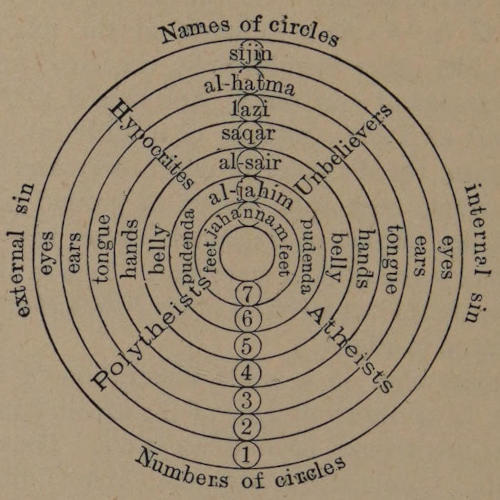
Fig. 1
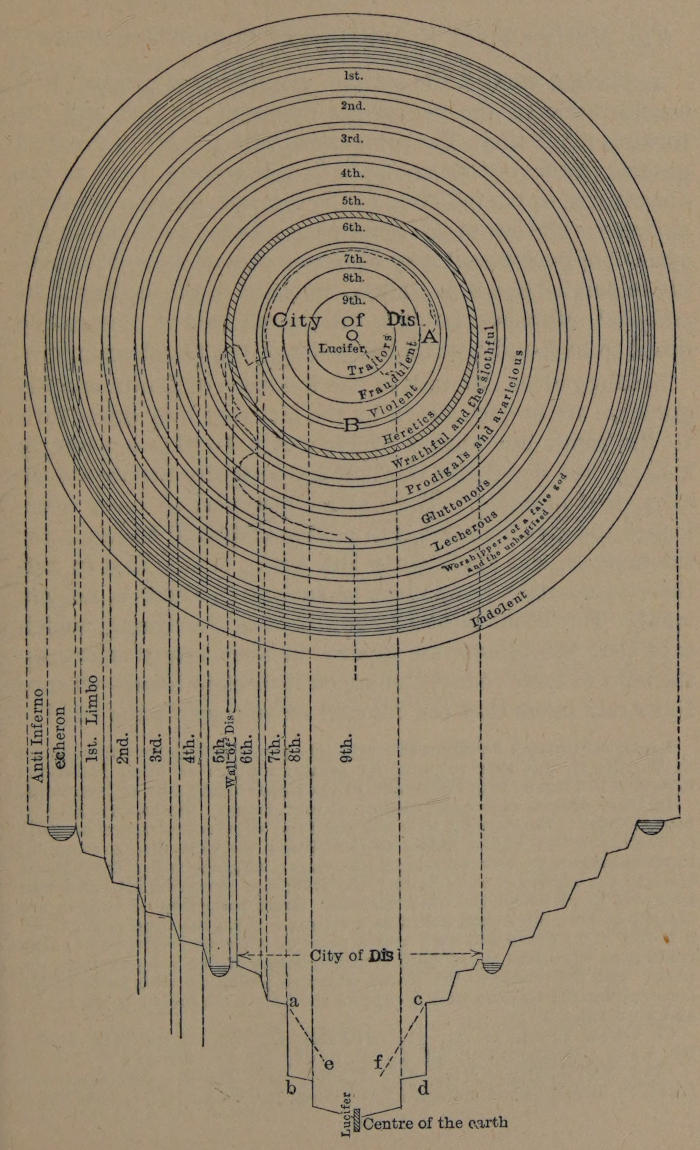
Fig. 2
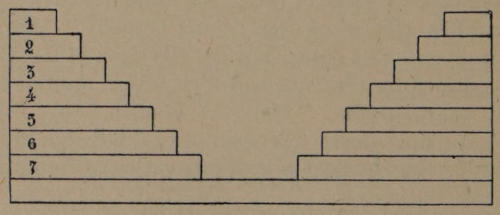
Fig. 3
IV The Moslem Hell in the Divine Comedy—continued
1. Having studied the setting, we may now proceed to a consideration of the personages appearing in hell and the tortures they suffer. The comparison with the Miraj revealed general features of resemblance in this respect, such as the observance, in the infliction of the tortures, of what Dantists aptly term the law of the contrapasso. Other analogies in the systems of punishment may be passed over as being due possibly to parallel and independent imitation of the mediæval lex talionis.[188] More interesting is the resemblance of picturesque detail to be found in actual episodes of the two descriptions.
Setting out on our task in the footsteps of Dante and his guide we are at once struck by the fact that they never turn to the right, but always to the left. To this apparently insignificant detail the Dantists have rightly attributed an allegorical meaning. They seem, however, to have overlooked the fact that this is in reality a Moslem feature; for the mystics, and particularly Ibn Arabi, taught that in hell there is no right hand, just as in heaven there is no left hand. The belief is based on a text of the Koran, which says that the blessed are guided on their way to glory by the light of their virtues shining on their right hand—whence Ibn Arabi infers that the damned move towards the left.[189]
2. In the second circle Dante sees the adulterers swept hither and thither in the darkness of a hellish storm. An outline of this scene appeared in Version B of Cycle 1 of the Miraj; and, as has just been seen, in the legends describing the division of the Moslem hell into seven stages or tiers the second is also referred to as the region of winds. In addition, there is a tale attributed to Mahomet that says: “In hell there blows a dark storm of wind, with which God torments such of the wicked as He chooses.”[190] This wind is the same dread gale that God sent to punish the city of Ad for its wickedness, a scene that is repeatedly described in terms similar to those used by Dante, in the commentaries on the Koran and the collections of legends of the Prophet.[191]
A black cloud or storm, a hurricane wraps all in gloom except for the sinister light from what appears to be a flame in its midst; a dry and desolating wind roars as it whirls around; the ground trembles under the perpetual blast, which sweeps all before it; with each violent gust men and women are swept along, thrown up into the air and dashed to the ground; this hurricane is the dread instrument of Divine vengeance, the merciless torture of sinners who gave themselves up to the delights of the senses, to gluttony and lust; tossed hither and thither by the gale and smitten by the wind, they cry out in bitter anguish.
Compare this scene with that described by Dante: A hellish storm, a wind of utter darkness but for streaks of purple light[192] blows furiously without ceasing; roaring like the sea in tempest, it sweeps the lustful along in its whirl, turning them around, vexing and bruising them; it carries them now in this, then in that direction, it throws them up and casts them down; and, as it wounds them, it wrings cries of pain and anguish from the sufferers.
As may be seen, the similarity of the descriptions extends to the very wording of the texts.[193]
3. Let us now descend to the sixth circle of the inferno. Version B of Cycle 2 of the legend of the Miraj told how Mahomet beheld a sea of fire, on the shores of which stood cities formed of countless fiery sepulchres, in which the wicked lie tortured. The literal resemblance of this scene to the city of Dis in the sixth circle, described in Cantos IX, X and XI of the Inferno, was remarked upon above.[194] It may be added here that the punishment of sinners in coffins of fire is mentioned in several other Moslem legends describing the tortures of hell.[195]
4. The torture of the Sodomites in the third ring of the seventh circle also has its parallel in the Moslem hell. Dante depicts them as unceasingly treading the circle they inhabit, under a rain of fire that sears their naked bodies.[196] One of the sinners is his former master, Brunetto Latini, and, as he walks awhile with him, he expresses his astonishment and grief at finding him there, for he remembers the wise teaching he received from him on earth.
A double series of Moslem traditions may be quoted as prototypes of this episode. In the first place, the Moslem hell contains a torture very similar to that of the rain of fire:
A rain of boiling water or molten brass will fall unceasingly upon their heads and, penetrating their skin, will eat away their entrails and emanate from between their feet, when the body will return to its former state.[197]
More specifically, though indeed referring to the fate of the wicked at the final judgment, it is stated in the Koran (LV, 35): “Upon you shall God send down flames of fire and molten brass.”
The second group of tales refers to the punishment of the wise men whose conduct was at variance with their teaching.
“Cast into hell, they will be made to go round and round without rest, even as a donkey in turning the wheel of a well or a mill. Some of their disciples, on beholding them from heaven, will descend and accompany them in their ceaseless rotation, asking, ‘What has brought you hither, seeing that it was but from you we learnt?’ In other versions the disciple exclaims: ‘Master! What has befallen thee? Didst not thou haply teach us what to do and what not to do?’ In other versions again they ask, ‘How came ye to enter hell seeing that we gained heaven but by your teaching?’ To which the sages make reply: ‘We bade you do what was right, but we ourselves did otherwise.’”[198]
As will be seen, the similarity between the two texts, the Moslem and the Christian, extends down to the very form of expression.
5. The first valley of Malebolge, Dante’s eighth circle, contains the panders, who, as they hurry naked through the valley, are scourged by fiends.[199] This is the very punishment allotted by Moslem tradition to those that neglected the rite of prayer or falsely accused people of adultery—angels or fiends, the tradition runs, shall whip both classes of sinners, smiting them cruelly on the face, ribs and shoulders.[200]
As for the flatterers, whom immersed in filth Dante places in the second chasm,[201] their punishment is equivalent to that of the drunkards in the Moslem hell, whose thirst is quenched with the loathsome lees of hell, the sweat, the pus and the blood flowing from the wounds of the other sinners.[202]
The third fosse of Malebolge is set with pits of fire, in which the Simonists are roasted head downwards. A parallel to this scene is the Moslem torture of murderers, who are likewise held in pits of fire.[203]
6. On reaching the fourth pit, Dante meets with a procession of sinners whose necks he describes as being strangely twisted, for their faces are turned towards their backs. More than once he seeks to describe the strange sight, by saying that the tears of these souls fell down their backs, that their shoulders were turned into their breasts, that they walked backwards, and so forth.[204]
This curious torture, the originality of which has often been commented on, would seem to be but an adaptation of a passage in the Koran, which reads:—
“Ye that have received the Scriptures, beware of disbelieving in what God has sent down from heaven in witness of your holy books, lest We should wipe out your features and turn your faces in the opposite direction.”[205]
The warning that God is thus supposed to address to the Jews who denied the truth of the Koran, was variously interpreted both in a literal and figurative sense. The ninth century commentator Tabari has recorded the different meanings.[206] But the literal interpretation prevailed, supported as it was by a belief in Islam, based on Talmudic legend, according to which some of the demons appear to man in the same distorted shape.[207] Moslem tales of the Day of Judgment also depict certain sinners as brought to life again in this condition—with their faces turned towards their backs they read their sentence, which is fixed to their shoulders.[208] The very vividness of the picture stamped it on the Moslem mind with the result that it was used both in the popular sermons addressed to the Moriscoes and in the works of thinkers such as Algazel.[209]
7. The torture of hypocrites in the sixth pit of Malebolge also appears to be an adaptation from two scenes, common in Moslem tradition, blended into one. Dante depicts them as walking slowly along, groaning under the weight of leaden mantles, the external gilt of which dazzles the eye.[210] In the Arabian tales of the Day of Judgment misers are punished by being obliged to walk on and on without rest under the weight of the hoards they had gathered on earth[211]; and both the Koran and the traditions of Islam represent sinners, particularly carnal sinners, as being clothed in tunics or mantles of metal glowing with heat.[212]
While conversing with two of the hypocrites the poet is horror-stricken at the sight of the awful suffering of Caiaphas, who lies impaled upon the ground and writhes in agony as he is trampled under foot by the other hypocrites.[213]
This is another instance of the artistic blending of scenes characteristic of the Moslem legends on the after-life. A hadith, attributed to Ibn Abbas, describing in pathetic language the tortures of the final judgment and hell, contains the following passage:—
“How many youths of tender age and fresh in features will be crying out in hell: ‘Alas, my unhappy childhood, my luckless youth! Woe is me that my strength should have failed me and my young body been so wretched in its weakness!’ For they will lie in bitter affliction fixed to the ground with stakes.”[214]
The complementary scene is related in the following apocryphal tradition:—
“He who in this life treats his neighbour with contempt will be brought to life again on the Day of Judgment in the figure of an ant and all mankind will trample him under foot. Thereafter he shall enter hell.”[215]
8. The seventh pit of Malebolge is the place where thieves expiate their crimes. Dante sees them rushing hither and thither in a vain attempt to escape the hydras that, after seizing and twining themselves around their victims, sting them in the neck, face and navel with fangs so poisonous that their flesh is consumed and reduced to ashes, only to reappear for the torture to be renewed.[216] Dante enhances his description with features borrowed from the classical poets, more particularly Ovid. If these are eliminated, the picture will be found to agree very fairly with several scenes of torture that abound in Moslem tales of the final judgment and hell, especially the tales of the Corra, the collection that has so often been drawn upon for the purposes of this work.[217] If allowance is made for Oriental hyperbole, a comparison with the following will at once suggest a likeness between the two:—
“On the Day of Judgment the miser who had refused to give the ritual alms will find himself face to face with a serpent of great size, with eyes of fire and teeth of iron, which will pursue him saying, ‘Give me thy miserly right hand that I may tear it from thee.’ The miser will attempt to flee, whereupon the serpent will say, ‘Where dost thou hope to find refuge from thy sins?’ and, coiling itself around him, will bite off his right hand and devour it, when the hand will at once grow again. Thereupon the serpent will devour his left hand, which likewise will reappear. At each bite of the serpent, the miser will utter such a shriek of pain that all around him will be stricken with horror.”—“In the valley of hell called Lamlam there are snakes, as thick as a camel’s neck and as long as a month’s journey, that sting all who neglected the rite of prayer; the poison they inject burns the flesh throughout seventy years.”—“There is another valley in hell called the Sad Valley, in which are scorpions like black mules, each provided with seventy fangs swollen with poison to sting the sinners who were remiss in prayer; the virus they deposit burns in the wounds a thousand years, when the flesh of their victims rots away.”—“The drunkard will be taken to a den full of scorpions as large as camels, which will seize hold of him by the feet.”—“Usurers will lie in hell with their bellies open and swarming with snakes and scorpions.”—“Adulterers will be stung by serpents in the very parts of their bodies on which they bestowed their kisses.”—“The infidel will be seized by the hydra of the naked head, which will devour his flesh from head to foot, but the flesh will grow again over his bones so that the hydra may again devour it from foot to head.”
9. As Dante sets foot in the ninth pit of Malebolge he meets with a sight so awful that he is at a loss for words to describe it.[218] A crowd of sinners guilty of having sown discord among men are being driven round the valley by demons who with sharp swords cut them in twain; but as the victim moves on the wounds heal, only to be opened afresh on his return. Three scenes of torture particularly attract the poet’s attention. Mahomet, with his entrails trailing at his feet, is seen following his cousin Ali, who appears cut open from chin to belly. Mosca degli Uberti, whose hands have been cut off, raises his bleeding stumps as he makes himself known to Dante. Finally, Bertrand de Born appears decapitated, holding his head by the hair in his hand like a lantern.
The outlines of this scene in general and of the three episodes already existed in Moslem legend.
“He who takes his own life”—says a tradition[219]—“shall with the same knife be done to death throughout eternity by the angels in the valleys of hell.... At each stab a jet of blood blacker than pitch will spout from the wound, which will heal again at once for the torture to be repeated without end.”
The picture that Dante draws of Mahomet and Ali occurs in many Moslem tales of hell, one of which depicts two groups of sinners as follows:—
“Cursing and wailing they tread the space between two circles of hell; the ones drag their entrails behind them as they go; the others are spewing blood and matter.”
Variants of these legends depict the sinners treading, like an ass that turns the wheel of a grindstone, round and round the valley in hell, with their entrails, torn out by the fiends, trailing behind them. The very same torture, moreover, was allotted to two men notorious throughout Islam for their cruelty, the fifth Ommeyad Caliph Abd al-Malik Ibn Marwan and his bloodthirsty general Al-Hajjaj, whom tradition represented either as walking in hell with their bowels dangling between their legs, or as being assassinated seventy times for each murder they had committed on earth.[220]
The bloody fate of Mosca degli Uberti also has its Moslem counterpart in the torture of thieves and the avaricious:—
“He who bereaves another of a part of his wealth shall on the Day of Judgment appear before God bereft of both hands.”[221]
Lastly, the horrifying apparition of Bertrand de Born would seem to be but an artistic adaptation of a scene in a Moslem description of the final judgment:—
“On that day the victim of murder will appear before God carrying in one hand his head hanging by the hair, with the blood pouring from the veins of his neck and, dragging his murderer with him, will cry out ‘Oh, Lord! Ask Thou of this man why he killed me.’”[222]
10. In the last chasm of Malebolge deceivers and falsifiers of all kinds are seen undergoing various forms of torture; some lie piled one upon the other or drag themselves along on all fours; itching all over, they scratch the scab from off their sores or tear one another with their teeth; others lie with swollen bellies, suffering unquenchable thirst.[223]
In Version B of Cycle 2 of the Miraj three similar scenes were described, showing the tortures suffered by slanderers, usurers and drunkards. Many other tales in Islam also depict the torture of sinners in terms greatly resembling those of Dante. Thus it is said, “The itch will seize upon the sinners, who will scratch themselves to the bone;” or, “They will suffer such pangs of hunger that they will devour their own bodies”; or, again, “A maddening thirst will consume them and they will cry out, ‘Oh, but for a sip of water to slake my thirst!’”[224]
V The Moslem Hell in the Divine Comedy (Conclusion)
1. To reach the place allotted to the traitors, Dante and his guide are obliged to cross a deep chasm inhabited by sinners of giant stature who have been guilty of rebellion against God. The chief of these are Nimrod and the giants of classical mythology, Ephialtes, Briareus, and Antaeus. The last-named takes the poets in his hand and gently deposits them in the abyss of the lowest circle.[225] Dante delights in describing the giants in terms of hyperbole. The head of Nimrod appears to him as large as the Cone of St. Peter’s, or rather more than five fathoms in height and width; his other members are in proportion, so that his total stature, according to the commentators, would be forty-three fathoms.
The Christian works prior to the Divine Comedy provide no satisfactory explanation of this scene. True, the personality of the giants is well defined in the Bible and in mythology, but none of these sources warrants their being placed in hell. The Moslem sources, however, at once furnish a key to the riddle. The eschatological books of Islam devote whole chapters to the tales of the Prophet describing the enormous stature of the infidels who, like Dante’s giants, occupy the lowest circle of hell and whose proportions are measured, hyperbolically indeed, but with a mathematical exactitude similar to that displayed by Dante.[226]
“On the Day of Judgment the infidels will appear with black faces, their stature increased to a height of sixty fathoms and their heads crowned with a diadem of fire....” “The bodies of the sinners are of the size of mountains.... Each of their teeth is as large as a man and the rest of their body is in proportion. Their thighs are as big as Mount Albaida (three miles distant from Mecca). The space they fill when seated is as the distance from Mecca to Medina. Their bodies are so massive that a roaring noise, as of wild beasts, is heard between the skin and the flesh. Their total stature is forty-two fathoms.”
The object of giving the victim this monstrous size is simply to provide more material for torture. Finally, the hypothesis of the Moslem origin of Dante’s picture is supported by two facts—the one, that Iblis lies in the lowest circle chained in the same curious manner as the giant Ephialtes, with one hand in front and the other behind[227]; the other, that Islam relegates Nimrod and Pharaoh, as the prototypes of Satanic pride, to the same region in which Iblis suffers punishment for his rebellion.[228] Dante accuses Nimrod of the same sin of rebellion and places him at the entrance to the lowest circle, that of Lucifer.
2. One and the same torture, that of cold, is suffered by all sinners in this lowest circle. The lake Cocytus, which fills the entire space, is kept frozen by the icy blast from the wings of Lucifer; and in its congealed waters traitors of four different classes are shown in diverse attitudes.[229]
It need hardly be remarked that Biblical eschatology makes no mention of any torture of cold in hell. The Moslem doctrine, however, places this torture on the same footing as torture by fire.[230] True, the Koran alludes to it but vaguely in saying that the blessed shall suffer neither from the heat of the sun nor the cold of zamharir.[231] But, as comment on this passage, there arose a number of traditions, attributed to Mahomet, in which intense cold is acknowledged as a torture of hell and, indeed, a torture more painful even than that of heat.[232] Its introduction into the Moslem scheme of hell was due, not merely to a desire for symmetry and antithesis in torture, but rather to the assimilation by Islam of a Zoroastrian belief. The theologian Jahiz, writing in the ninth century, says that this torture is peculiar to the Persian hell of Zoroaster, by whose religion fire is held sacred.[233] If, therefore, it is accepted unhesitatingly by Tabari a century later, it is probable that it had in the meantime been introduced by Zoroastrians converted to Islam. More interesting, however, than the question of the remote origin, is the fact that some of the traditions interpret the Koranic zamharir as a frozen lake.[234] “What is the zamharir of hell?” they asked Mahomet, and he replied, “It is a pit into which the unbeliever is cast, in which his members are rent asunder by intense cold.” If it is borne in mind that the word had the scientific meaning of “glacial wind” or “air of the atmospheric region intermediate between the earth and the sphere of the moon”[235] it will be seen that, as in Dante’s hell, the sinners of Islam suffered the double torment of exposure to an icy blast of wind and contact with frozen water.
The picturesque description of the various attitudes in which Dante depicts the different groups of traitors is a feature that constantly recurs in the pictures of the Moslem hell, though not indeed in connection with the torture of cold. Thus, a tradition attributed to Ibn Abbas says that “some are punished standing, some lying on their sides; others lie stretched out on their backs, or stand leaning on their elbows; while many are to be seen hanging head downwards.”[236] A very popular legend of hell adds:
“The fire will be well aware of the guilt of the sinners and the suffering they deserve.... Thus, in some it will reach the ankles; in others, the knees, the waist, the chest, and even the neck.”[237]
One Moslem scene of torture is even identical with the most violent of the postures in which Dante places the sinners in the frozen lake of Cocytus:
“The fiends will seize the sinner from behind, will break his ribs in twain and, bending back his belly, with his hair will tie his feet.”[238]
3. At the bottom of the lowest pit of hell, that is to say, at the centre of the earth, Dante places Lucifer, the king of the realm of pain, set in the ice from the lower part of his chest downwards. Of gigantic stature and monstrously misshapen, he bears on the trunk three faces, underneath which are enormous wings shaped like the wings of a bat; the flapping of these wings produces the icy wind that blows in this region. With his three mouths he devours three traitors. Dante in terror manages to slip between the hairy shoulders of Lucifer and the ice and reach the southern hemisphere through a long subterranean passage. As he escapes, he beholds the enormous legs of Lucifer hanging unsupported in the air; and Virgil explains how the fallen angel, on being cast out of heaven, with his head had struck the surface of the southern hemisphere and, penetrating to the centre of the earth, had remained fixed there to that day.[239]
The originality of this picture has always been greatly admired. Graf, bringing all his erudition and insight to bear on the subject, detects three elements in the demonology of Dante—theological elements, based on Thomistic doctrine; popular elements, in harmony with opinion current at his time; and elements peculiar to Dante, such as he may have acquired in exile, particularly at the University of Bologna.[240] Among the last-named he includes this description, saying, “Questa mirabile immaginazione è, per quanto io so, tutta propria di Dante.”
4. However much the power and beauty of Dante’s description are to be admired, prototypes of it are not lacking in the theological literature of Islam.
The position of Lucifer, fixed in the lowest pit of hell, has been shown to be common to many Moslem descriptions. Nor, given the principle of the division of sinners, could he be conceived in any other place; for the Iblis of Islam being, like Lucifer, the father of all rebellion against God, must necessarily suffer the severest torture.
But the similarity of the two conceptions extends even to the very nature of the torture. Ibn Arabi definitely states that Iblis is exposed to the torture of ice, and this assertion he bases on the fact that Iblis, like all demons, is a genie and thus was created from fire; his punishment, he infers, must therefore by contrast consist in exposure to the severest cold, or zamharir.[241] Contemporaries of Ibn Arabi had on similar grounds accounted for the immunity of the fiends from the effect of the fire of hell. Thus, Abu-l-Hasan al-Ashari argues that the demons, being fallen angels, were created from light and, accordingly, are insensible to torture by fire.[242]
As to Lucifer’s monstrous appearance, the multiplicity of faces is the very stigma that for their double-dealing is imposed upon traitors in the Moslem hell; and Lucifer, it must be remembered, as a rebel against God, is the arch-traitor and, as such, is confined by Dante in the traitors’ pit. An early apocryphal tradition says: “He who in this world has a double face and a double tongue, to him shall God give two faces and two tongues in hell.”[243] Other early legends depict the fiends also as two-headed monsters.[244] Even hell itself, considered not as the place, but as the embodiment of tortures, is vividly represented as a hydra-headed monster in Moslem legends of the Day of Judgment; with its many mouths this monster devours sinners of different categories, and some versions even fix the number at three.[245] Finally, the many popular tales of fantastic voyages frequently describe similar monsters—such as the beast named Malikan, which has two wings and numerous heads and faces and devours the animals of the sea that land upon its island; or Dahlan, which is depicted as a fiend that rides upon a bird like an ostrich and seizes on all men that set foot upon its isle in the Indian Ocean.[246]
There remains to be considered Dante’s description of the fall of Lucifer from heaven. The only allusion in pre-Dante Christian literature to the fall of Lucifer is the brief passage in the Gospel according to St. Luke (X, 18): “And he said unto them, I beheld Satan as lightning fall from heaven.” The Koran, on the other hand, describes the rebellion and expulsion from heaven of Iblis in more than seven passages[247]; and, though no details of his descent are given, these were filled in by the traditions depicting the punishment God inflicted on Adam and Eve, the serpent and Iblis.[248] In addition, there exists a cycle of cosmogonical legends, which serve to complete the myth of the fall of Iblis.
Mention has been made in a former chapter of tales describing the division of the earth into seven floors or stages, which were identified with the seven mansions of hell.[249] These tales were intended to explain the cosmogonical legends above referred to; and all are in the end but comment on a passage of the Koran to the effect that heaven and earth were created as one sole mass and only later were separated and each divided into several strata.[250]
“Immediately after their division,” the legend says, “God sent an angel from His throne, who, falling upon the earth, penetrated the seven strata thereof and there remained, sustaining them upon his shoulders, with one hand stretched towards the East and the other towards the West, his feet lacking all support.”[251]
The legend does not indeed identify Iblis with this angel, but the fact that he was sent from the very throne of God and fell to earth would seem to favour the suggestion.
The two myths, blended together, may well have served as a model for Dante’s picture. That there exist grounds for this hypothesis may be shown by a review of the different features of resemblance furnished by the Moslem descriptions. Iblis is an angel cast out of heaven for rebellion against God, who, in falling to the earth, penetrates its several strata and is embedded in the ice, with his feet unsupported; although of gigantic stature—he supports the different strata—he is yet an angel and thus provided with wings; but sin has changed his beauty into hideousness and thus he appears as a many-headed beast that devours men, as a monster that is half man, half ostrich.[252]
VI The Moslem Purgatory in the Divine Comedy
1. Through the dark and winding passage leading from the centre of the earth to the surface of the southern hemisphere Dante and his guide pass to reach the shores of purgatory, which the poet conceives as a lofty mountain shaped like a truncated cone and set in the midst of a boundless ocean. Seven terraces divide this mountain into as many mansions of expiation, one for each capital sin; and at the foot two mansions form the antechamber of purgatory, where the disobedient and negligent spirits await admittance. On the table-land at the top of the mountain and bordering on the sphere of the ether is the earthly paradise. The mount of purgatory may thus be variously considered as consisting of seven, nine or ten mansions, which are connected by a steep and arduous path. The spirits in purgatory are those guilty merely of venial sin, or of deadly sins for which full penitence has not been done; these they expiate in the successive mansions under the guard of angels who guide them in their ascent—a task that is rendered easier by the prayers of their friends on earth. Dante, too, though only in a mystical sense, is subjected to this progressive purification, the guardian angel marking his brow seven times with the letter P, the symbol of sin, which is washed away in each of the seven terraces. As they rise, the ascent becomes easier and, finally, the poets reach the summit, or earthly paradise, where, by bathing in the waters of two rivers, Dante cleanses his soul and is prepared for his entry into heaven.
2. Nothing in Christian eschatology seems to warrant so detailed and precise a description of the site of purgatory. Not until a century after the appearance of the Divine Comedy did the existence of purgatory as a special condition of the soul, engaged in temporary expiation of sin, become a dogma of the Christian faith.[253] The site was never mentioned, either at the Council of Florence held in that century, or at the Council of Trent, or on any other occasion, for, as a matter of fact, the Church has always endeavoured to avoid fantastic descriptions of the realms beyond the grave, and particularly of purgatory.[254] Not that purgatory was an innovation of the fifteenth century; indeed, the belief in it was deeply rooted in scholastic and patristic tradition, as well as in revealed doctrine. But the dogma never went beyond the admission of its existence as a state of the soul, and ecclesiastical tradition, especially of Western Christianity, was ever discreetly silent upon its site and descriptive detail. Prior to Dante, only a few writers, such as Hugh of St. Victor, St. Thomas and Ricardo de Media Villa, had made timid attempts to portray purgatory, and their conceptions differed greatly from Dante’s picture. Landino, accordingly, concludes his review of all possible models, classical or Christian, with the remark: “Ma Dante, huomo di mirabile ingegno e di mirabile inventione, trovo nuovo sito, il quale niente e contra sustantialmente all opinione christiana.”[255]
3. As has been seen, Islam, the successor of Eastern Christianity, admitted purgatory as a state of temporary penitence to be undergone by all sinners that die in the true faith.[256] To determine its locality and the nature of the trials to which the souls are subjected, it is necessary to have recourse to the plethora of Islamic legends on the after-life. The dogmas of the resurrection of the body and the final judgment caused a certain confusion in the minds of the theologians who were called upon to decide the question of the penalties and rewards awaiting the soul during the time between death and the end of the world. Are the souls alone, or the bodies also, subject to sanction? Can the dead body feel physical pain and pleasure if it is not resuscitated in the tomb? Again, what useful purpose can be served by final judgment, if sentence and sanction are to begin at death? As it is impossible to make a critical selection of the legends or to distinguish between tales dealing with expiation immediately after death and those describing purgation following upon final judgment, a few descriptive features taken indiscriminately from the whole group of legends will be compared with the corresponding scenes in Dante.
To begin with, the purgatory of Islam is represented as being near to, but separate from hell; and, whereas the latter is placed in the interior of the earth, the former is described as lying outside and above the earth. This is clearly borne out by a tradition which, in addition to this topographical feature, gives an outline of the expiation of sin[257]:
“There are two hells, or gehennas; the one the internal, the other the external fire. The former none shall ever leave, but the latter is the place in which God chastises the faithful for their sins. Then, when at His will the angels, prophets and saints intercede on their behalf, the blackened bodies of the sinners will be withdrawn from the fire and cast upon the banks of a river in paradise, called the River of Life. When sprinkled with the waters of the river they will come to life again like seeds sprouting in dung. Their bodies made whole, they will be bidden to enter the river and to wash themselves and drink of its waters, so that later they may be called upon to enter heaven. In heaven they will be known as the ‘Men of Hell’ until such time as God shall consent to remove this stigma, when the brow of each will bear the legend ‘Freedman of God.’”
Thus, the final episode of Dante’s purgatory, in which, when the poet enters the garden of the terrestrial paradise, the allegorical mark of sin is wiped from off his brow and he is washed in the rivers of Lethe and Eunoe, is given in this Moslem legend with typical details similar in their turn to those already noted in versions of the Miraj.[258]
A tale of another cycle describes purgatory essentially as Dante conceived it, as “a mount rising between hell and heaven on which the sinners are imprisoned.”[259] True, purgatory here is either confused or blended with the limbo, for the region is named Al Aaraf, and is said to be inhabited by Moslem sinners whose sins are counterbalanced by their virtues. But, inasmuch as these sinners, after being purified of their sins in the River of Life, are capable of entering heaven, the characteristics of purgatory may be said to prevail.
So far, then, the purgatory of Islam stands revealed as a hill or mount definitely situated outside and above hell and rising between it and heaven. The description is carried further in the legends, adopted by Islam from Persian eschatology, that deal with the bridge or path that has to be traversed by the souls before they can enter heaven.[260] The Persian Chinvat, or luminous bridge, which stretches over the abyss of hell between heaven and a mountain rising from the centre of the earth, assumed in Islam the various forms of a path or road; a lofty structure, vaulted bridge or viaduct; a natural bridge or slippery passage; or, again, a slope or ramp difficult of ascent. With the exception of the image of the bridge, these features reappear in the Purgatorio; and even Dante’s mount is in reality but an enormous bridge, providing as it does the only means of passing from earth to heaven and rising above hell, or, rather, like the sirat or path described in the Moslem books of eschatology, above the back of the abyss of hell.[261]
4. Ibn Arabi, commenting in his Futuhat upon the words attributed to Mahomet on this point says, “the souls that are not cast into hell shall be detained in the sirat, where strict account shall be taken of their sins, for which they will be punished.” He adds that “the sirat will be over the back of hell and form the sole means of entering paradise.”[262] In another passage he completes the picture saying, as if indeed he were speaking of Dante’s conception, “the sirat will rise in a straight line from the earth to the surface of the stellar sphere and end in a meadow lying outside the walls of the heavenly paradise; the souls will first enter this meadow, called the paradise of delight.”[263]
In other legends two sirats appear, and the souls that have succeeded in passing the first without falling into hell are subjected to the trial of the second. The latter is often represented as a high structure (cantara) between hell and heaven, which serves as a place of temporary expiation of sin: “in it the souls will be detained until they mutually restore the debts that by their guilt they contracted on earth, and they are purified”; whereupon angels will receive them with loving words of welcome and guide them on the path that leads to eternal bliss.[264]
The resemblance of the purgatory of Islam to that of Dante is most striking, however, in the form given to it by the mystics, who multiply the primitive cantara, or place of expiation, into a number of chambers, enclosures or abodes. As usual, it is Ibn Arabi who paints the picture with the greatest detail.[265] In the legend of the Prophet that he has handed down to us, there are fifty stations, distributed into four main groups. Of these the last is the most interesting to us, since, like Dante’s purgatory, it consists of seven enclosures, called bridges or slippery passages, beset with obstacles which the souls have to surmount by ascending seven steep slopes of a height hyperbolically couched in terms of thousands of years. The principle on which these different abodes of trial and expiation are distinguished is, as in Dante, ethical; it is based on the seven capital sins of Islam, which consist in the breaking of the rules of faith, prayer, fasting, almsgiving, pilgrimage, ablution, and just dealing with one’s neighbour.
Once started in this direction, the imagination of the faithful soon overstepped the narrow limits of the scheme outlined above, and the topography was amplified by the addition of other partial purgatories of ten, twelve, or fifteen sections. Here, again, the principle is ethical; although it must be confessed that the distribution is neither logical nor based on any philosophical or theological system, but is rather the outcome of a desire on the part of the casuist to leave no wrongdoing unpunished. The result is thus a heterogeneity of vices and failings.[266]
Judging by the wealth of detail with which the place of expiation is described in the eschatology of Islam, it is evident, then, that in the matter of topography Dante’s conception can hardly be claimed to be original.
5. As for his description of the punishments of purgatory, no such claim has ever been made. Indeed, having exhausted the whole gamut of suffering in his picture of hell, he would no doubt find it difficult to conceive new torments, so that a very brief comparison of Dante’s with the Moslem scenes will be sufficient for our argument.
The disobedient and neglectful souls are punished merely by being withheld indefinitely from the place of expiation. At the foot of the mount they lie, awaiting the help of friends and relations, the prayers of whom will shorten the term of Divine wrath. It is in this antechamber of purgatory that Manfred of Sicily and Belacqua make themselves known to Dante and implore him to give news of their sad fate to their friends on earth. Under the shade of a rock Belacqua with his head between his knees sits in an attitude of utter dejection.[267]
In the religious literature of Islam similar scenes abound in the form of visions of souls in purgatory, who appear to their relations in their sleep and beseech them to pray for their eternal rest.[268] One scene in particular bears a striking resemblance to Dante’s description; Abu Dolaf al-Ijli, a soldier of the time of Caliph Al-Mamun, appears to his son Dolaf, who thus describes the vision:—
“In a dream I saw my father lying in a place of horror, with dark walls around it and its floor covered with ashes. Naked and sitting with his head resting upon his knees, he called out to me, ‘Dolaf,’ and I replied, ‘May God have thee in His keeping.’ Then did he recite the following verses: ‘Tell our family of the fate awaiting them in this dread purgatory and how account is taken of all our deeds. Hide nothing from them, but thou, have pity on my awful loneliness and terrible fate. If in death we were but left alone, it would at least be a comfort to us! But, alas! We are brought to life again and must answer for all our deeds.’ And with these words he vanished, and I awoke.”[269]
6. The torments of Dante’s Purgatorio, like those of the Inferno, are based on the principle of correlation between punishment and sin. Thus, in the first circle the souls that are being purified of the sin of pride are seen wending their way bowed down under a heavy load of stones. This is the very suffering assigned by Islam to the avaricious and such as grew rich by evil means. Tales attributed to Mahomet say[270]:—
“Men of my persuasion will come to me on the Day of Judgment, their shoulders burdened with the goods of this world, and they will implore my aid.... But I shall turn my back upon them, saying, ‘the faith ye profess is known to me, but your deeds I know not.’ For he who stole but a palm of land shall be obliged by God to bear it upon his neck, down to the bottommost part of the earth.”
Other legends depict the avaricious as vainly endeavouring to cross the sirat under the burden of their riches, or as wandering hither and thither, borne down by the weight of their wealth.
In the second circle Dante portrays the envious with their eyelids sewn together and weeping bitterly as they pray for pardon.
Blindness, though in a milder form, is also one of the punishments reserved in Islam for those that failed to practise the virtues they preached.[271] An apocryphal tradition of Mahomet runs:—
“He who reads the Koran but ignores its teaching shall appear blind on the Day of Judgment. To his cry ‘Oh, Lord! Why hast Thou brought me to life again, deprived of my sight, whereas aforetime I could see?’ God will give answer, ‘Even as my words reached thine eyes and thou didst heed them not, so shall I pay no heed to thee to-day.’”
The wrathful, in Dante’s third circle, are enveloped in a cloud of smoke so dense that although their voices can be heard, they themselves cannot be seen.
This is the very torment, referred to in the Koran as a plague of smoke that God will send on the Day of Judgment to punish them that mocked His prophets.[272] The traditionists, in their comment on this passage, filled in the details of the picture, which thus comes to bear a striking resemblance to Dante’s scene.[273]
“The smoke will be so dense that the whole earth will resemble a house that is on fire; the plague will last forty days and forty nights, until the earth from East to West is full of smoke, which will enter the eyes, ears and nostrils of the infidels, suffocating and blinding them, and even the true believers will suffer from faintness; men will call out one to another, but though their voices will be heard, they themselves will not be seen, so thick will be the fog.”
The punishment meted out in the fourth circle of the Purgatorio to the slothful, who are made to run without ceasing, may be passed over as of slight interest. More striking is the torture of the avaricious, in the fifth circle, who as they lie face downwards on the ground, bound hand and foot, bewail their fate with bitter tears.
Sadness and moral pain are among the typical features of the purgatory of Islam that recur in the descriptions of the different abodes or stations.[274]
“Should the soul have been guilty of any of these failings, it will remain in its allotted abode a thousand years downcast and ashamed, naked, hungered and athirst, until such time as it shall have made restitution unto God.”
The peculiar posture, moreover, in which Dante depicts the avaricious, is that in which, according to Islam, sinners in general, and inebriates in particular, are found on the Day of Judgment and in purgatory itself. A tradition of the Prophet runs: “He, who on earth made you walk upright, may on the Day of Judgment cause you to walk upon your faces.”[275] And the author of the Corra describes the punishment of the drunkard as follows: “He shall come to life again with his hands and feet fettered and be obliged to drag himself along the ground.”[276] Of the passage of the sirat a tradition attributed to Mahomet says:
“Some will pass with the swiftness of a race-horse, of the wind, or of lightning; others will merely run or walk; while others, again, will crawl on all fours, like an infant, or drag themselves along on their bellies.”[277]
In Dante’s sixth circle, where the vice of gluttony is punished, the souls, famished and parched with thirst, are tantalised by the sight and odour of the fruit of two trees, offshoots of the tree growing on high in the earthly paradise.
As has just been seen, the cravings of hunger and thirst are characteristic torments of the purgatory of Islam. It is a further curious coincidence that in a Moslem legend narrating the passage of the soul along the sirat, or path of expiation, this incident of the tree should be thrice repeated.[278] Three trees grow by the side of the path at different stages, the last one standing at the gate of paradise. The soul, in its painful progress, begs to be allowed to rest in their shade and eat of their luscious fruit, and God finally grants the prayer. Though the ending is different, the general outline of the incident is very similar in both stories.
The last circle of the Purgatorio is the place of expiation of the sin of lust. Tormented with thirst and scorched by the flames, the souls cry aloud to God for forgiveness. Dante speaks to several who are known to him, and they entreat him to intercede on their behalf.
Fire is the most common of all the torments, occurring as it does in almost every eschatological system; in some, indeed, it constitutes the only form of punishment. It would, therefore, be superfluous to point out parallel scenes in Islamic descriptions of the after-life.[279] The Moslem traditionists, however, are careful to distinguish between the expiatory flames of purgatory and the eternal fire of hell. The former, being temporary and merely serving to purify, are limited both as to duration and extent, proportionately to the nature of the sin for which atonement is being made. Numerous are the legends describing the different degrees of this torture and telling of the laments and prayers, addressed by the sufferers to the angels, Mahomet, and the saints, begging them to intercede with God on their behalf.[280]
VII The Earthly Paradise of Islam in the Divine Comedy.
1. The summit of the Mount of Purgatory is a broad table-land, which Dante describes as a garden of great beauty. This is the earthly paradise, or Garden of Eden, in which our first ancestors dwelt while yet in a state of innocence. As he treads the ground, which is fragrant with flowers, a gentle breeze, laden with the perfumes of paradise, fans his tear-stained cheeks. In the shade of verdant trees, the rustling of whose leaves murmurs a soft accompaniment to the song of a thousand birds, he comes to a limpid stream, whose course he follows; here he walks, accompanied by a fair maiden, Matilda, who, gathering flowers as she trips along the further bank, explains to him the nature of the garden. Virgil’s mission is now ended, and he is soon to leave Dante; for, of a sudden, they behold advancing from beyond the stream a marvellous procession of maidens and elders, who, richly attired, lead in triumph a car in which, surrounded by angelic spirits and greeted with songs of welcome, appears Beatrice, the poet’s beloved. Calling him by name, she sternly rebukes Dante for his disregard of the holy counsel she gave him in his dreams, for his faithlessness in following other less worthy loves, and for his sins. Dante, confused and repentant, confesses his unworthiness. He is then immersed by Matilda and the maidens that serve Beatrice in the stream of Lethe, on whose banks they are gathered, and upon drinking of its waters loses all memory of sin. Thereafter he succumbs to sleep in the shade of the tree of paradise, and finally, is bathed in the waters of Eunoe, from which he emerges “born again, even as trees renewed with fresh foliage, pure and ready to mount to the stars.”[281]
Graf, after minute study of the mediæval legends bearing on the earthly paradise, has shown that there existed precedents for the site chosen by Dante, inasmuch as others before him had laid this garden in the southern hemisphere and on the peak of a high mountain.[282] But he asserts that no one before Dante had thought of placing it precisely on the summit of purgatory. An examination of Islamic literature will therefore be of interest, as it may furnish the key to this riddle of topography by revealing analogies both in outline and in detail with this closing scene of the Purgatorio.
2. From the earliest centuries in Islam the question of the site of the garden in which God had placed Adam and Eve had given rise to animated controversy. The passages in which the Koran tells the Biblical story in a slightly altered form, led to a confusion between this paradise and the abode of glory, thus causing it to be laid in heaven.[283] According to another interpretation, however, it was supposed to be situated on earth, more precisely, in the East and on the highest of all mountains. This explanation, whilst more in keeping with the Biblical narrative, had the advantage of being reconcilable with the words used in the Koran; for the expulsion of Adam and Eve to the earth would merely mean that God drove them from the summit to the foot of the mountain[284]; it would also account for the delights of the Garden of Eden and its difference from other places on the surface of the earth. This view, though indeed held from early times, was mainly propounded by the Mutazili heretics, the philosophers and the mystics. A Spanish Mutazili ascetic of the ninth century, Mondir ibn Said al-Belloti, who was chief cadi of Cordova, was its most ardent champion; and in the tenth century it became popular throughout Islam through the Rasail or encyclopædia compiled by the Ikhwan as-safa, or Brethren of Purity, a heretical sect established in Basra.
“Lying on the summit of the Mountain of the Hyacinth, which no human being may ascend, paradise was a garden of the East; a soft breeze blew day and night, winter and summer, over its perfumed ground. The garden was well watered by streams and shaded by lofty trees; it was full of luscious fruit, of sweet-smelling plants, of flowers of different kinds; harmless animals lived there and birds of song....”[285]
The earthly paradise that is here depicted in terms similar to those used by Dante was situated, therefore, on the summit of the highest mountain of the earth. Exactly which mountain was referred to is not easy to determine, for on this point opinion differed. Some authors placed it in Syria or in Persia; others in Chaldea or in India.[286] Eventually the belief that it lay in the last-named country was the most generally accepted.[287] The Brethren of Purity refer to the mountain as the “Mount of the Hyacinth,” which, according to Arab geographers, is the mountain rising in Ceylon, now known as “Adam’s Peak.”[288] Rising out of the Indian Ocean to a height of seven thousand feet, it is visible from afar at sea, and this fact would no doubt account for the exaggerated height attributed to it, for its summit was supposed to reach to the sky.
The very name the mountain still bears is a perpetuation of the Islamic legend. Ibn Batutah, of Tangier, the famous fourteenth century traveller, who journeyed to the ends of the world, as it was then known, has left us a picturesque description of its difficult ascent, which Moslem pilgrims were wont to undertake in the belief that a rock on the summit bore the footprint of our father Adam.[289]
A high mount, rising in the middle of an island in the ocean covering the southern hemisphere is, in Dante’s conception, the site of the earthly paradise. According to Islam, it is a high mountain rising in the middle of an island in the Indian Ocean.[290] Dante’s, it is true, is but a small isle lying in the antipodes of Jerusalem, whereas the island of Ceylon is larger and is situated on the equator; but the difference in topography is slight.[291]
3. As Graf has pointed out, however, Dante’s conception of the site of the earthly paradise was no novelty in mediæval Christian literature, so that coincidence with Islam on this point alone would not suffice as proof of Moslem influence. But, as mentioned above, there is an element in Dante’s topography that Graf does not hesitate to ascribe to the poet’s inventive genius, to wit, the position of the earthly paradise on the summit of the mount of expiation, and its conception as the goal of the sinner in his arduous ascent and the last stage of purgation, in which the soul is cleansed of sin and made fit to cross the threshold of eternal bliss.[292]
Among the many Moslem legends dealing with the entry of the souls into the theological heaven there is a whole cycle describing their adventures from the time they finally emerge from the sirat or path of purgatory. Close to the sirat, and forming as it were the last stage of purgatory, lies the marvellous garden of paradise, which, although not indeed stated to be the earthly paradise, is depicted with all the features proper to it. Its pleasant pastures, gay with flowers, are watered by two rivers, and two only, in which the souls are immersed and cleansed from sin, and of whose waters they drink; upon emerging, the souls rest, as does Dante, in the shade of trees and are then led by a choir of angels to the abode of glory. But a still more remarkable coincidence is, that on the threshold of the celestial mansion the soul is welcomed by a maiden of surpassing beauty, his promised bride, who for long has awaited his coming, yearning to be united with him in a love at once spiritual and chaste.
4. The resemblance to Dante’s picture borne by this brief sketch is such as to call for a more detailed examination of these legends and a comparison of this episode with Dante’s story. Originating in the form of gloss on a verselet of the Koran, the myth in its earliest and crudest version reads as follows:[293]
“The souls that are about to enter paradise first come to two springs; they drink of the waters of the one, and God blots all rancour and hatred from their hearts; they bathe in the waters of the other, and their complexions become brilliant, and the purity and splendour of bliss is seen shining on their faces.”[294]
These bare outlines were soon filled in by the traditionists, who in the course of time built up the story that has been handed down to us in its most complete and classical form by Shakir ibn Muslim, of Orihuela. Composed in rhymed verse, it is of such extraordinary length that only the most interesting passages can be given here.[295]
“When the souls have left hell behind them and have traversed the sirat, or path of purgatory, they issue upon the plain that leads to paradise.[296] Accompanying them are the angels of Divine mercy, who cheer and guide them on their way to glory and wish them joy of their victory and salvation.[297] As they approach the entrance to paradise a gentle breeze, laden with perfume, brings balm to their souls and wipes away the memory of the suffering they endured in the course of their judgment and in the various mansions.... At the gate of paradise stand two mighty trees, lovelier than any ever seen on earth. Their fragrance, the richness of their foliage, the beauty of their blossom, the perfume of their fruit, the lustre of their leaves—nothing could ever surpass. The birds on their branches sing in sweet harmony with the rustling of the leaves....[298] At the foot of either tree there springs a fountain of the purest water, clearer than beryl, cooler and whiter than freshly melted snow; these springs are the source of two limpid streams, whose beds are seen to be of pearls and rubies....[299] Along their banks spread gardens and groves of trees in blossom, laden with fruit and harbouring birds of sweet song.... The souls bathe in the two rivers; from the one they emerge whole in body and cleansed from the marks of fire, with the lustre of health and joy upon their faces; they drink of the waters of the river and, as all memory of past affliction leaves them, so is all trace of envy, rancour and hatred blotted from their hearts; they then bathe in the other stream, and later find peaceful repose in the shade of the two trees....[300] And, even as they rest, the angels of the Lord call upon them, saying, ‘Oh, beloved of God, these trees are not your dwelling; nigh unto God is your appointed place. Rise, therefore, and march onward, till ye reach the mansion of rest and everlasting bliss.’[301] And they rise and proceed through the paths of paradise, following the voice of the angel herald, who leads them on from garden to garden until they meet with a brilliant procession of youths and maidens, dressed in rich attire and mounted on coursers ... who greet each one with shouts of joy and congratulation upon his triumph.... ‘Be thou welcome, beloved son of God! Enter thy mansion, covered with glory and honour.’ As he enters, behold! a damsel of surpassing beauty, arrayed in robes of brilliant hue, awaits him seated in a tabernacle ... the splendour of her countenance dazzles him and his heart is enraptured with the perfection, grace, and brilliant beauty with which God has endowed her. Indeed, were it not that God had granted him extraordinary powers of vision, he would be bereft of both sight and sense by the intensity of the light shining in her and the splendour radiating from her presence.[302] The voice of an angel announces to him, ‘Oh, beloved one of God! This is thy precious bride, thy dearly beloved partner in the life of heaven; this is the mistress of the damsels, the coy maiden hidden from the gaze of man.’ But hardly has she caught sight of him when, unable to restrain the impulse of her love, she hastens towards him with fond words of welcome, ‘Oh, beloved of God! How I have yearned to see thee!’”
Of the many points of resemblance shown by this legend to Dante’s story of the earthly paradise, some are so evident as to be hardly worthy of mention. The scenic features, for example, are clearly identical, recourse being had to the same rhetorical figures to depict the beauty of the gardens—such as the wealth of flowers, the perfumed air, the soft climate, and the gentle breeze on which is wafted the sweet song of birds. The rivers in which the souls are washed are two in number in Dante’s poem and in the Moslem story, as against four in the Biblical paradise. Lastly, both gardens adjoin the path of purgatory, of which in fact they constitute the last division, for in them the soul undergoes final purification from the stain of sin and is prepared for entry into the realm of glory. The resemblance even extends to the manner of purification: the soul is bathed in both rivers and, in addition, drinks of their waters. The effects of the double ablution are also similar; all physical and moral trace of sin is blotted out and new life imparted to the soul. After ablution, the pilgrim seeks rest in the shade of a tree. Finally comes the procession of youths and maidens leading in the heavenly bride; the meeting of bride and bridegroom and their mutual recognition.
5. In spite of long and minute research, no literary precedent has so far been found for this latter scene.[303] Yet, as the Dantists justly claim, it is of supreme moment for the whole of Dante’s poem, for it not only sheds light on the riddles that precede it, but also foreshadows the significance of what is to come; and, indeed, but for this scene of the meeting of Dante and Beatrice, neither the descent to hell nor the ascension to paradise would be susceptible of a satisfactory interpretation. At the same time, it must be admitted that the scene bears but little trace of the Christian spirit and is in strange contrast to the asceticism and the horror of sexual love that are characteristic of ecclesiastic literature in general, and that of the Middle Ages in particular.[304] To arrange, as the climax of a journey to the regions beyond the grave, the meeting of the pilgrim with his lost Beloved is a poetic conceit that will in vain be sought for in any of the Christian precursors of the Divine Comedy. Dante was well aware of how singular the note he struck was. So novel did the glorification of Beatrice, which is the avowed object of his poem, appear to him, that many years before, when the plan of the Divine Comedy was shaping in his mind, he remarked about his future poem, “Spero di dire di lei quello que mai non fu detto d’alcuna.”[305] No doubt this glorification of Beatrice has its immediate roots in the spirit of chivalry that inspired the troubadours of Provence and the Italian poets of the “dolce stil nuovo”; in the spiritual and romantic love of woman underlying that literary movement; and in the mixture of mysticism and sensuality revealed in the temperament of Dante, the man and poet. These explanations may, indeed, lay bare the inner workings of the poet’s mind, but they leave unsolved the riddle of the outer literary form in which his mentality manifested itself in this episode of the earthly paradise. In a later chapter of this work it will be shown that the origin of the “dolce stil nuovo” movement itself is most probably to be sought outside Christianity and that long before the appearance of the troubadours in Europe romantic love had inspired the poets of Arabia, and provided food for the speculative minds of Moslem mystics.[306] Here it will suffice to point to the outstanding fact that an episode so typical of the Divine Comedy as the meeting of Beatrice and Dante, and, being foreign to the very spirit of Christianity, unprecedented in Christian legend, has a striking parallel in Moslem tradition. Nor is the tale translated above unique; rather is it the final stage in the evolution of a series of legends that tell the fantastic story of the entry of the blessed soul into paradise. The Moslem heaven, as will be seen later on, is not exclusively the paradise of coarse delight, as depicted in the Koran and many of the traditions, that has become stamped on the mind of educated Europe. By the side of that picture there is another, painted by the ascetics and mystics, that reveals a heaven of purer love, in which, in addition to the large-eyed houris and the wives the blessed knew on earth, a spiritual bride also awaits him. This is his Heavenly Betrothed, who from on high has been waiting and watching for the advent of her lover, guiding him on the path of virtue, inspiring him with lofty aims and ever encouraging him to persevere to the triumphant end, when they will be united in eternal bliss. When death at last leads the blessed soul to paradise, it is she who sallies forth to welcome him, radiant indeed with beauty, yet not as an instrument of carnal delight, but rather as a spiritual companion and moral redemptress who wishes the soul joy of his victory and reproves him for having on occasions forsaken her for other, earthly loves. The picture of this Heavenly Bride is so strikingly like that of Beatrice that it will not be amiss to quote some of the legends on this subject.
6. A very interesting description of the entry of the blessed soul into paradise is contained in the tenth century work Corrat Aloyun.[307]
The angel Ridwan leads him to the tabernacle where his bride awaits him. She greets him with the words, “Oh, friend of God, how I have longed to meet thee! Blessed be the Lord, who has united us! God created me for thee and engraved thy name upon my heart. While thou on earth wast serving God in prayer and fasting, day and night, God bade his angel Ridwan carry me on his wings so that I might behold thy good deeds from heaven. The love I felt for thee caused me to watch over thy progress unbeknown to thee. When in the dark of night thy prayer went up, my heart was glad within me, and I said to thee, ‘Serve and thou shalt be served, sow and thou shalt reap! God has advanced thee in glory, for thy virtues have found favour in His sight, and He will bring us together in heaven.... But, when I found thee neglectful and half-hearted, I felt sad.’”
Another legend of the same cycle, attributed to the eighth century traditionist Ibn Wahab, introduces the reproaches of the bride for her bridegroom’s earthly loves.[308]
“They will say to a woman in paradise, ‘Would’st thou see thy spouse who is yet on earth?’ and, as she assents, they will draw aside the veils that separate her from him, so that she may look upon his face and long for the moment of his coming, even as on earth a woman longs for her absent man. It may be that between him and his spouse on earth there have been grounds for resentment such as are common among wives and husbands, and she will reproach him saying, ‘Oh, wretched man! Why dost thou not forswear (such loves) that, compared with mine, shall last thee but a night or two?’”[309]
The similarity between these two descriptions and the two scenes in which Beatrice comes to the moral aid of Dante is surely evident. Beatrice, when from on high she sees that her beloved poet is in danger of forfeiting salvation and, therewith, her companionship in paradise, descends from heaven to implore Virgil’s assistance in setting the pilgrim on the right path. The scene forms, as it were, the prologue to the poem.[310] When Dante reaches the earthly paradise, she again descends and to her greeting adds reproof for his backsliding, his indulgence in earthly loves, and his neglect of the holy counsel she gave him in his dreams.[311]
Tales of visions, based on the legends of the same cycle, are common in Islamic literature. They all tell of a beautiful and angelic maiden who appears to the devout in their dreams, to inspire them with holy thoughts and urge them to serve God with the promise that she will be theirs in the life to come.
A tale attributed to Ali al-Talhi, who lived prior to the tenth century, reads as follows[312]:—
“In a dream I beheld a woman fairer than any of this world. ‘Who art thou?’ I asked, and she replied, ‘I am a houri.’ I said to her, ‘Pray let me be thy husband,’ to which she replied, ‘Ask me in marriage of my Lord and name my dowry.’ I asked, ‘What is thy dowry?’ and she answered, ‘That thou shouldst keep thy soul unspotted from the world.’”
Another story, attributed to the ninth century ascetic Ahmed ibn Abu-l-Hawari, runs:—
“In a dream I saw a maiden of the most perfect beauty, whose countenance shone with celestial splendour. To my asking, ‘Whence comes that brilliance on thy face?’ she replied, ‘Dost thou remember that night spent by thee in weeping (and devotion)?’ ‘I remember,’ I answered, and she said, ‘I took those tears of thine and with them anointed my face, since when it has shone in brilliance.’”