Family TYRANNIDÆ.—Tyrant Flycatchers.
Reading edition
Primary Characters. Primaries ten. Bill in typical forms broad, triangular, much depressed, abruptly decurved and notched at tip, with long bristles along gape. Tarsi with scutellæ extending round the outer face of tarsus from the front to back; sometimes divided on the outer side. Bill with culmen nearly as long as the head, or shorter; straight to near the tip, then suddenly bent down into a conspicuous hook, with a notch behind it; tip of lower jaw also notched. Commissure straight to near the notch; gonys slightly convex. Nostrils oval or rounded, in the anterior extremity of the nasal groove, and more or less concealed by long bristles which extend from the posterior angle of the jaws along the base of the bill, becoming smaller, but reaching nearly to the median line of the forehead. These bristles with lateral branches at the base. Similar bristles are mixed in the loral feathers and margin the chin. Tarsi short, generally less than middle toe, completely enveloped by a series of large scales, which meet near the posterior edge of the inner side, and are separated either by naked skin or by a row of small scales. Sometimes a second series of rather large plates is seen on the posterior face of the tarsus, these, however, usually on the upper extremity only. Basal joint of middle toe united almost throughout to that of the outer toe, but more than half free on the inner side; outer lateral toe rather the longer. Wings and tail variable; first quill always more than three fourths the second. The outer primaries sometimes attenuated near the tip.
The primary characters given above will serve to distinguish the North American Tyrannidæ from their allies; the essential features consisting in the peculiarity of the scales of the tarsus and the ten primaries. In the Sylvicolidæ there are species as truly “flycatching,” and with a depressed bristly bill, but the nine (not ten) primaries, and the restriction of the scales to the anterior face of the tarsus, instead of extending entirely round the outer side, will readily separate them.
The relationships of the Tyrannidæ are closest to the Cotingidæ. These last differ mainly in having the tarsus more or less reticulated, or covered in part at least with small angular scales, instead of continuous broad ones; and in the greater adhesion of the toes. The legs are shorter, and the body broader and more depressed. The bill is less abundantly provided with bristles, and the species do not appear to be strictly flycatchers, feeding more on berries and on stationary insects and larvæ, rather than capturing them on the wing. Two species of this family, Hadrostomus affinis[62] and Pachyramphus major,[63] were introduced into the Birds of North America, from specimens collected by Lieutenant Couch in the valley of the Rio Grande, not far from the border of the United States, but as they have not yet been detected within our limits, we have concluded to omit them in the present work.
The bird fauna of America may be said to have one of its chief features in the great number and variety of its Tyrannidæ, the family being strictly a New World one. Nearly every possible diversity of form is exhibited by different members; the size, however, usually varying from that of our common Robin to that of the Kinglet, our smallest bird with exception of the Humming-Bird. Of the numerous subfamilies, however, only one, the Tyranninæ proper, belongs to North America, and will be readily distinguished from other of our land birds by the family characters given at the head of this article, and which, as drawn up, apply rather to the subfamily than to the Tyrannidæ generally.
The North American species of the Tyranninæ may, for our present purposes, be divided into Tyranni and Tyrannuli. The former are large, generally with bright color, pointed wings, with attenuated primaries and a colored crest in the middle of the crown. The others are plainer, smaller, without colored crest; the primaries not attenuated.
The genera of our Flycatchers may be arranged as follows:—
TYRANNI. Size large; colors generally brilliant; crown with a brightly colored crest, usually concealed; outer primaries abruptly contracted or attenuated near the tip; upper scales of tarsus usually continuing round on the outside and behind. Nest in trees, very bulky, containing much downy material; eggs white or pinkish, with ovate dots of rich brown, of various shades.
Milvulus. Tail excessively forked and lengthened; more than twice as long as the wings.
Tyrannus. Tail moderate; nearly even or slightly forked; less than the wings.
TYRANNULI. Size generally small; colors usually plain; crown without any colored crest concealed by the tips of the feathers; primaries normal; scales of the upper part of the tarsus usually continuing only to the middle of the outer face, and a second series opposite to them behind.
1. Tail lengthened; about equal to the wings, which reach scarcely to its middle.
Myiarchus. Tarsus equal to the middle toe, which is decidedly longer than the hinder one. Tail even or rounded. Throat pale ash, rest of lower parts yellow generally, the primaries edged with rufous, and inner webs of tail-feathers with more or less of the same color. Nest in a cavity of a tree, of loose material; eggs whitish, with intricate tangled lines and streaks of dark brown, the general effect salmon-color.
Sayornis. Tarsus rather longer than the middle toe, which is scarcely longer than the hind toe. Tail slightly forked. Bill very narrow. No light orbital ring, nor distinct bands on wings; both mandibles black. Nest attached to rocks or parts of buildings, very compact and bulky, containing much mud in its composition; eggs pure white, immaculate, or with very minute sparse dots near larger end.
2. Tail decidedly shorter than the wings, which reach beyond its middle. Tarsus shorter than the middle toe.
Contopus. Hind toe much longer than the lateral. Tail considerably forked. Wings long, pointed; much longer than the tail, reaching beyond the middle of the latter; first quill about equal to the fourth. Bill broad. Color olive-gray, and white, sometimes with a yellowish tinge beneath. Lower mandible pale-colored. Nest saucer-shaped, compact, and very small, saddled very securely upon a thick branch; eggs cream-colored, with a zone of lilac and rich brown blotches round the larger end.
3. Tail shorter than the wings, as in the last. Tarsus considerably longer than the middle toe; hind toe much longer than lateral. Tail nearly even, sometimes slightly rounded, but little shorter than the wings; first primary much shorter than the fourth.
Empidonax. Head moderately crested; tail about even. Bristles of bill reaching about half-way to tip. Legs stout. A conspicuous light orbital ring, and distinct bands on the wing. More or less tinged with sulphur-yellow on lower parts. Nest variously constructed, deeply cup-shaped, compact or loose, entirely of either grassy or fibrous and downy material, and fixed to slender twigs or lodged in a crotch between thick branches; eggs white, immaculate, or with blotches of brown round larger end.
Mitrephorus. Head decidedly crested. Tail forked. Bristles of bill reaching nearly to tip. Legs very weak and slender. Beneath more or less tinged with fulvous or ochraceous.
Pyrocephalus. Head with a full crest. Tarsus but little longer than the middle toe; hind toe not longer than the lateral. Tail broad, even; first quill shorter than the fifth. Beneath, with whole crown bright red (except in P. obscurus). Female very different, lacking the red, except posteriorly beneath, and with the breast obsoletely streaked.
Genus MILVULUS, Swainson.
Milvulus, Swainson, Zoöl. Jour. III, 1827, 165.
Despotes, Reichenbach, Avium Syst. Naturale, 1850 (in part).
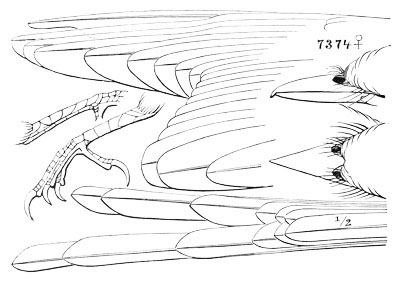
Milvulus forficatus (tail abnormal). 7374 ♀
Sp. Char. Bill shorter than the head, and nearly equal to the tarsus. Tail nearly twice as long as the wing, excessively forked; the middle feathers scarcely half the lateral. First primary abruptly attenuated at the end, where it is very narrow and linear. Head with a concealed crest of red.
This group is distinguished from Tyrannus by the very long tail, but the two species assigned by authors to North America, although agreeing in many respects, differ in some parts of their structure. The peculiarities of coloration are as follows:—
M. forficatus. Whitish-ash above; rump black. Tail-feathers rose-white with black tips; shoulders, axillars, and belly light vermilion. Hab. Middle America, and open portions of Texas, Indian Territory, etc.; accidental in New Jersey.
M. tyrannus.[64] Head above and tail black; the latter edged externally with white. Back ashy. Beneath pure white. Hab. Middle America, accidental in Eastern United States.
Milvulus tyrannus, Bon.
FORK-TAILED FLYCATCHER.
Muscicapa tyrannus, Linn. Syst. Nat. I, 1766, 325. Milvulus tyrannus, Bonap.Geog. List, 1838.—Audubon, Synopsis, 1839, 38.—Ib. Birds Am. I, 1840, 196, pl. lii.—Baird, Birds N. Am. 1858, 168.—Caban. Journ. 1861, 251.—Scl. List, 1862, 237.—Finsch, P. Z. S. 1870, 572 (Trinidad; considers violentus, tyrannus, and monachus as identical). Despotes tyrannus, Bonap. Comptes Rendus, 1854, 87. Tyrannus savana, Vieillot, Ois. Am. Sept. I, 1807, 72, pl. xliii.—Swainson, Mon. Ty. Shrikes; Quarterly Jour. XX, Jan. 1826, 282. Muscicapa savana, Bonap. Am. Orn. I, 1825, 1, pl. I, f. 1.—Aud. Orn. Biog. II, 1834, 387, pl. clxviii. Milvulus savanus, Gray, List, 1841. Tyrannus milvulus, Nuttall, Man., (2d ed.,) I, 1840, 307. Fork-tailed Flycatcher, Pennant, Latham. Tyran a queue fourchue, Buffon pl. enl. 571.
Sp. Char. Outer four primaries abruptly attenuated at the end, the sides of the attenuated portion parallel. Second and third quills longest; fourth little shorter, and not much exceeding the first. Tail very deeply forked; the external feather linear, and twice as long as the head and body alone. Top and sides of the head glossy black. Rump, upper tail-coverts, and tail almost black; the outer web of outer tail-feather yellowish-white for more than the basal half; rest of upper parts ash-gray. Under parts generally pure white. Wings dark brown; the outer primary and tertials edged with white. Crown with a concealed patch of yellow. Length, 14.00; wing, 4.75; tail, 10.00; depth of fork, 7.00. Young. No colored patch on crown; wing-coverts (including the lesser) and tail-feathers, with their upper coverts, bordered with rusty ochraceous. Black of head, tail, etc., duller than in adult.
Hab. Mexico to South America. Accidental in the United States. (New Jersey, Kentucky, and Mississippi, Audubon.)
This species claims a place in the fauna of the United States on account of two specimens captured in New Jersey, at long intervals, and one or two seen by Mr. Audubon in the southwest. It is, however, hardly proper to include it in our work on so slight a basis, and we only retain it for the purpose of referring to the notice of it by Mr. Audubon.
Habits. The Fork-tailed Flycatcher is of purely accidental occurrence in the United States. Two specimens, taken at long intervals, are said to have been captured in the United States. One of these was shot by Mr. Audubon, in June, 1832, near the city of Camden, N. J. It was first observed flying over a meadow, in pursuit of insects. It afterwards alighted on the top of a small detached tree, when it was secured. The bird appeared to have lost its way, was unsuspicious, and paid no attention when approached. On the wing, it seemed to make use of its long tail whenever it sought to suddenly turn in pursuit of its prey. On the ground, it vibrated its tail in the manner of a Sparrow-Hawk.
When the bird fell to the ground severely wounded, it uttered a sharp squeak, which it repeated, accompanied by a smart clicking of the bill, when Mr. Audubon approached it. It lived only a few moments, and from this specimen he made his drawing.
Several years previous to this, one of these birds had been shot near Henderson, Ky., but it was so far decayed when given to Mr. Audubon that it could not be preserved. It had been obtained among the Barrens late in October. Near Natchez, Miss., in August, 1822, Mr. Audubon was confident he saw two others of this species. They were high in the air, and were twittering in the manner of a Kingbird. He was, however, unable to secure them.
Another straggler was obtained near Bridgton, N. J., early in December. From this specimen was made the engraving in Bonaparte’s Ornithology. It was given to Titian Peale by Mr. J. Woodcraft of that place.
This Flycatcher is a resident in tropical South America from Guiana to La Plata, and in its habits resembles the swallow-tailed species of our southern fauna. It is said to be a solitary bird, remaining perched on the limb of a tree, from which, from time to time, it darts after passing insects; while standing, it is said to vibrate its long tail in the manner of the European Wagtail. It also occasionally utters a twitter not unlike the common note of the Kingbird. Besides insects, this bird also feeds on berries, as the bird obtained near Bridgton had its stomach distended with the fruit of the poke-weed.
This species, according to Sumichrast, is found abundantly in winter in the savannas of the hot lands of Vera Cruz, and occurs to the height of about two thousand feet. He is not aware of its being resident.
Mr. Leyland found this species frequenting Old River and the pine ridges of Belize. They were also plentiful on the flats near Peten, and were occasionally found at Comayagua and Omoa, Honduras.
Mr. C. W. Wyatt met with this Flycatcher in Colombia, South America, on the savanna in the neighborhood of Aquachica. When at Ocaña, he used to see them congregated in considerable numbers just before sunset, whirling round high up in the air, and darting down like rockets to the ground. He only found it frequenting the open part of the country, and he never met with it at a greater elevation than five thousand feet.
An egg of this species obtained by Dr. Baldamus, from Cayenne, exhibits a strong resemblance to the egg of the common Kingbird. It has a clear white ground, and is spotted with deep and prominent marking of red and red-brown. They are of an oblong-oval shape, are tapering at one end, and measure .90 by .68 of an inch.
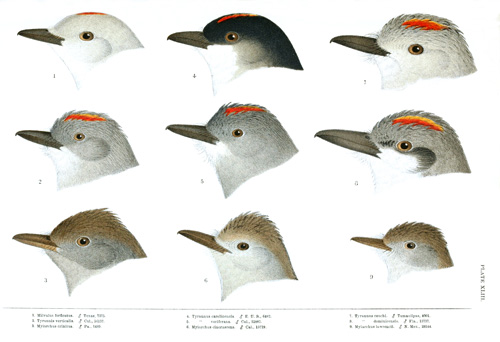
PLATE XLIII.
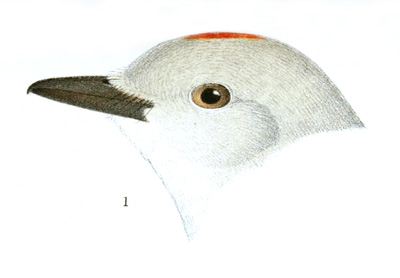
1. Milvulus forficatus. ♂ Texas, 7375.
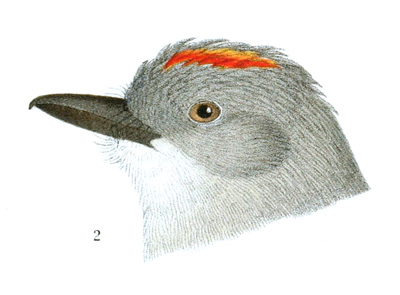
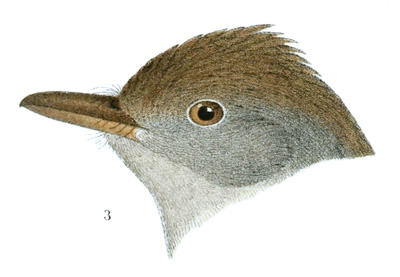
3. Myiarchus crinitus. ♂ Pa., 1489.
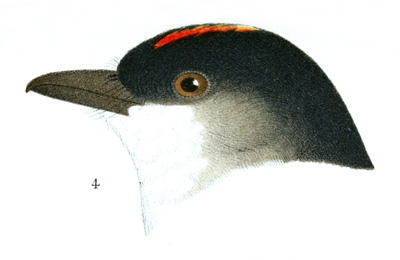
4. Tyrannus carolinensis. ♂ E. U. S., 6482.
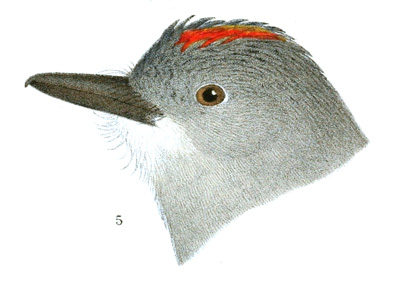
5. Tyrannus vociferans. ♂ Cal., 31887.
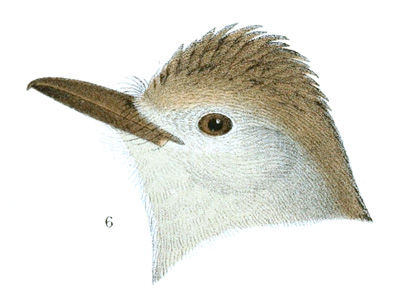
6. Myiarchus cinerascens. ♂ Cal., 13719.
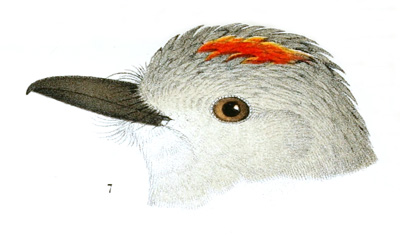
7. Tyrannus couchi. ♂ Tamaulipas, 4001.
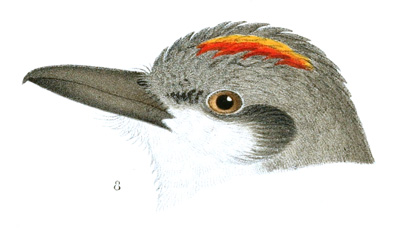
8. Tyrannus dominicensis. ♂ Fla., 13737.
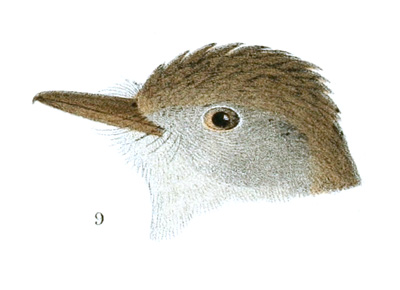
9. Myiarchus lawrencii. ♂ N. Mex., 29344.
Milvulus forficatus, Swain.
SCISSOR-TAIL; SWALLOW-TAIL FLYCATCHER.
Muscicapa forficata, Gmelin, Syst. Nat. I, 1788, 931.—Vieillot, Ois. Am. Sept. I, 1807, 71.—Stephens, in Shaw’s Zoöl. X, II, 413, pl. iii.—Bonap. Am. Orn. I, 1825, 15, pl. ii, f. 1.—Aud. Orn. Biog. IV, 1838, 426, pl. ccclix, f. 3. Tyrannus forficatus, Say, Long’s Exped., II, 1823, 224.—Nuttall’s Manual, I, (2d ed.,) 1840, 309. Milvulus forficatus, “Swains.” Rich. List, 1837.—Audubon, Synopsis, 1839, 38.—Ib. Birds Am. I, 1840, 197, pl. liii.—Caban. Mus. Hein. II, 79.—Scl. List, 1862, 237.—Baird, Birds N. Am. 1858, 169.—Ib. Mex. B. II, Zoöl. 7.—Heerm. X, c. p. 11. Tyrannus mexicanus, Stephens, Shaw, Gen. Zoöl. Birds, XIII, II, 1826, 135. Moucherolle a queue fourchue du Mexique, Buffon pl. enl. 677. Bird of Paradise of the Texans.
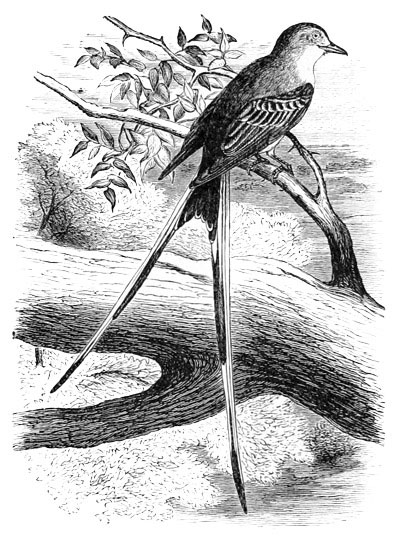
Milvulus forficatus.
Sp. Char. Wing with the outer primary only abruptly attenuated, and narrowly linear (for about .85 of an inch); the second but slightly emarginate; second quill longest; first and third equal. Tail very deeply forked, the lateral feathers twice as long as the body, all narrow and linear or subspatulate. Top and sides of the head very pale ash; the back a little darker, and faintly tinged with light brick-red; under parts nearly pure white, tinged towards the tail with light vermilion, rather more rose on the under wing-coverts; a patch on the side of the breast and along the fore-arm dark vermilion-red. Tail-feathers rosy white, tipped at the end for two or three inches with black. Rump dark brown, turning to black on the coverts. Wings very dark brown; the coverts and quills, excepting the primaries (and including the outer of these), edged with whitish. Crown with a concealed patch of white, having some orange-red in the centre. Length, 13.00; wing, 4.75; tail, 8.50; depth of fork, 5.80.
Hab. Middle America, from Panama northward; prairies and oak barrens of Texas, Indian Territory, and occasionally Southwest Missouri and Kansas. Accidental in Eastern States (New Jersey, Turnbull; District of Columbia? Coues); Xalapa (Scl. 1857, 204); Guatemala (Scl. Ibis, I, 121; Mus. S. I.); Honduras (Scl. II, 114); Costa Rica (Caban. J., 1861, 252); Vera Cruz, hot and temperate regions (Sum. M. B. S. I, 556).
This exquisitely beautiful and graceful bird is quite abundant on the prairies of Southern Texas, and is everywhere conspicuous among its kindred species. It is usually known as the Scissor-tail from the habit of closing and opening the long feathers of the tail like the blades of a pair of scissors. The adult female is very similar, though rather smaller. The young is not conspicuously different, only lacking the concealed patch of the head.
Habits. The Swallow-tailed Flycatcher appears to be a common species from Central Texas to the Rio Grande, and thence throughout Mexico to Central America, as far south at least as Guatemala. It is also found in the Indian Territory, where it breeds, specimens of the nest and eggs having been obtained at the Kioway Agency by Dr. E. Palmer.
It was found very plentiful at Langui, in Honduras, by Mr. G. C. Taylor, and also in fewer numbers in other localities. In the evening, just before roosting time, they were in the habit of assembling on the tops of certain favorite trees, where they remained until nearly dark. They then all went off to the woods. He generally met with them on open ground, not much encumbered by trees or brushwood.
Mr. Dresser states that he found this very graceful bird quite abundant at Matamoras and in Western Texas, where it is known by the name of “Texan Bird of Paradise.” He found it as far east as the river Guadaloupe. It arrives, he states, in the neighborhood of San Antonio, late in March, and remains until the middle or latter end of October. It breeds abundantly near San Antonio, building its nest in a mesquite or other tree, and lays from three to four eggs, which, as he states, are pure white, blotched with large spots of a dark red color.
He adds that these birds are of a quarrelsome and fearless disposition, rarely brooking intruders near their homes. During the breeding-season Mr. Dresser has often, when travelling, stopped to admire four or five of them fighting on the wing. They show their long tail-feathers and the rich scarlet color under their wings to the fullest advantage. After passing Guadaloupe River, he saw none of these birds to the eastward, though he was told they have occasionally been seen on Galveston Island.
This Flycatcher was met with at Eagle Pass, in Lower Texas, and in Tamaulipas by Mr. Clark and Lieutenant Couch, in the Mexican Boundary Survey. None were found occurring west of the valley of the Rio Pecos. Mr. Clark states that he always saw them either following one another through the air, or perched upon some solitary twig. In their gyrations the scissors were always more or less expanded, suggesting the idea of balancers. Their nests were built of sticks, lined on the inside, though not very softly, with grass, and were placed almost invariably on dry limbs of the mesquite. They contained from three to five eggs, and, what was quite remarkable, more than one pair always seemed to have an interest in the same nest, over which they were all very watchful, and gave proofs of their courage by darting at the intruders. He describes their notes as short and sharp, without much variation, and they can be heard at quite a distance. The Mexicans imagine that this Flycatcher lives on the brains of other birds.
Lieutenant Couch describes the Scissor-tail as shy, but of a very lively disposition. Usually four or more are seen in company, and seem to prefer the thinly wooded prairies to close thickets. In beauty, Lieutenant Couch considers it the queen of all the birds found in Northern Tamaulipas. This superiority is not owing so much to the brilliancy of its plumage, for in that it is excelled by several species, but to the inimitable grace and charm of its flight. Rising from the topmost branch of some acacia, it seems to float, rather than to fly; then descending perpendicularly, it retakes its position, uttering its usual note. He did not see it west of the Cadereita. Dr. Kennerly, in his march from the Gulf of Mexico into Western Texas, frequently met with these Flycatchers along his route. He usually saw them in the open prairie, or among the mesquite-bushes. When perched, they were generally on the top of a bush or a tall weed, and their tails were constantly in motion. When they darted off after some passing insect, they usually circled around, displaying the singular bifurcation of their tail, but seldom alighting again on the same bush. It was occasionally seen on the open prairie, flying for a long distance near the earth, as if in search of insects.
In Vera Cruz this species is an inhabitant of the hot lands. A few individuals ascend, though very rarely, to the height of the city of Orizaba, or about 3,700 feet.
Mr. Nuttall states that he met with this Flycatcher rather common along the banks of the Red River, near the confluence of the Kiamesha. He again met them, even more frequently, near the Great Salt River of Arkansas, in August. They seemed to be preying upon grasshoppers.
Dr. Woodhouse not only found this species abundant in Texas, in the vicinity of San Antonio, but in the Indian Territory also it was quite common, particularly near the Cross Timbers. He found them breeding in the beginning of the month of July, on the Great Prairie. Its nest was built on the horizontal branch of a small scrub-oak, about six feet from the ground, and was composed of coarse dry grass and sticks. It contained four young birds nearly able to fly. On his approach the female flew from the nest to a bush near by. The male bird flew to a great height above him, circling round in the air, apparently watching his movements, and at the same time uttering a coarse scolding chirp.
Dr. Gideon Lincecum, of Texas, writes that the Scissor-tail Flycatchers have greatly increased in numbers in that State since 1848. They are severe hunters of insects, and make great havoc among honey-bees. They are exclusively prairie birds. He adds that they construct their nests far out on the top branches of the live-oak or any other lone tree on the prairies. They seem to be a very playful bird, and delight in shooting rapidly upwards, cutting the air with their strong wings with such force that the sound may be heard to the distance of three hundred yards or more. Their notes are harsh and inharmonious. They leave Texas late in autumn, and return again about the first of April. The resounding strokes of their wings and their oft-repeated cries are heard just before the dawn of day. They usually have but three eggs.
A single individual of Milvulus, and supposed to be one of this species, was seen by Mr. C. Drexler, May 6, 1861, but was not obtained, in the vicinity of Washington. Another bird of this species is mentioned by Mr. Abbott as having been taken near Trenton, N. J., April 15, 1872. It was a male bird in full health and feather. Its stomach was found to be full of small coleoptera, insects’ eggs, flies, etc.
The eggs of this species vary greatly in size, from .92 by .75 to .80 by .60 of an inch. They are in shape a rounded oval, and tapering at one end. The ground-color is white, marked with a few very large dark red spots, and occasionally of an obscure purple.
Genus TYRANNUS, Cuvier.
Tyrannus, Cuvier, Leçons Anat. Comp. 1799, 1800 (Agassiz).
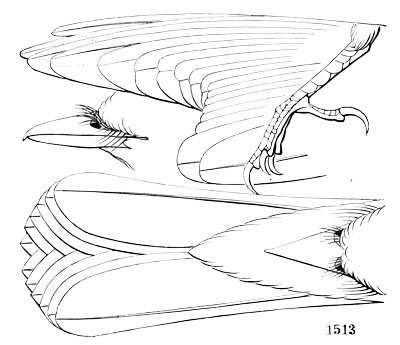
Tyrannus carolinensis. 1513
Gen. Char. Tail nearly even, or moderately forked; rather shorter than the wings; the feathers broad, and widening somewhat at the ends. Wings long and pointed; the outer primaries rather abruptly attenuated near the end, the attenuated portion not linear, however. Head with a concealed patch of red on the crown.
The species of this genus are especially characterized by their long, attenuated primaries, their moderately forked or nearly even tail, and the concealed colored crest in the crown. Their affinities are nearest to Milvulus, from which the tail, shorter than the wings, instead of twice as long, or more, will always serve as a point of distinction. The attenuation of the primary differs in being less abrupt, and not truly linear, sloping gradually, and not bounded behind by a notch. We are unable to appreciate any other differences of importance.
The character and extent of the attenuation of the primaries, the depth of the fork of the tail, with the size of the legs and bill, all vary considerably, and may, perhaps, serve as ground for further subdivisions. The bill, in particular, varies much in size in the North American species, from that of T. carolinensis, where the culmen is but little more than half the head, to that of T. dominicensis (genus Melittarchus of Cabanis), where it is decidedly longer than the head, and almost as stout as that of Saurophagus.
The North American species of Tyrannus (with their nearest Mexican allies) may be arranged by colors, accordingly as they are white beneath or yellow, in the following manner:—
A. Under parts whitish, without any shade of yellow. A faint grayish-plumbeous pectoral band.
1. T. carolinensis. Tail slightly rounded. Bill much shorter than the head. Above black, shading into dark plumbeous on the back. Tail abruptly and broadly margined and tipped with pure white. (Tyrannus.) Hab. Whole of North America, north to the British Provinces, and south to Panama. Rare in the Western Province of North America.
2. T. dominicensis. Tail moderately forked. Bill longer than the head. Above gray; the tail and wings brownish. The edges and tips of the tail narrowly margined with soiled white. (Melittarchus.) Hab. West Indies, New Granada, Panama, Florida, Georgia, and South Carolina.
B. Above ashy-olive, becoming purer ash on the head. Tail brown or black. Beneath yellow; the chin paler; the breast strongly shaded with olivaceous or ashy. (Laphyctes.)
a. Tail nearly black; the outer edges of the outer webs of the feathers with the fibres united closely throughout, and colored similarly to the rest of the feathers; beneath sulphur-yellow.
3. T. verticalis. Tail slightly forked; external feather with the entire outer web and the outer half of the shaft abruptly yellowish-white. Pectoral band pale ashy, lighter than the back. Hab. Western Province of United States.
4. T. vociferans. Tail nearly even or slightly rounded; external feather with the shaft brown; the outer edge only of the outer web obscurely yellowish-white, and all the feathers fading into paler at the tip. Throat and breast broadly tinged with dark ashy-olive like the back. Hab. Plains and southern Middle Province of United States, south into Middle America.
b. Tail brown, scarcely darker than the wings; outer edges of the outer webs of the tail-feathers olivaceous like the back, in contrast with the brown; the fibres loosened externally; shafts of tail-feathers white beneath. Beneath bright gamboge-yellow.
5. T. melancholicus. Tail quite deeply forked (.70 of an inch), brownish-black, the lighter edgings obsolete, and those on wings indistinct. Throat ashy. Hab. South America … var. melancholicus.[65]
Tail moderately forked (.30 of an inch), grayish-brown, the light edges conspicuous, as are also those of the wings. Throat white. Hab. Middle America, north to southern boundary of United States … var. couchi.
In the Birds of North America a supposed new species, T. couchi, was mentioned as coming so close to the boundary line of the United States in Texas as to warrant its introduction into our fauna. We have, however, concluded to give in the present work nothing but what has actually been found within its prescribed limits.
Tyrannus carolinensis, Baird.
KINGBIRD; BEE MARTIN.
? Lanius tyrannus, Linn. Syst. Nat. I, 1766, 136. This belongs to the Cuban T. matutinus, according to Bonaparte. Muscicapa tyrannus, (Brisson?) Wilson, Am. Orn. I, 1808, 66, pl. xiii.—Aud. Orn. Biog. I, 1832, 403; V, 1839, 420, pl. lxxix.—Ib. Birds Am. I, 1840, 204, pl. lvi. Lanius tyrannus, var. γ, carolinensis, δ, ludovicianus, Gmelin, Syst. Nat. I, 1788, 302. Muscicapa rex, Barton, Fragments N. H. Penna. 1799, 18. Tyrannus pipiri, Vieillot, Ois. Am. Sept. I, 1807, 73, pl. xliv.—Cab. Journ. Orn. III, 1855, 478.—Scl. List, 1862, 236. Tyrannus intrepidus, Vieillot, Galerie Ois. I, 1824, 214, pl. cxxxiii.—Swainson, Mon. Ty. Shrikes, Quart. Jour. 1826, 274. Muscicapa animosa, Licht. Verz. Doubl. 1823, No. 558. Gobe Mouche de la Caroline, Buffon, Ois. V, 281, enl. pl. 676. Tyrannus leucogaster, Stephens, Shaw, Gen. Zoöl. XIII, II, 1826, 132. Tyrannus carolinensis, Baird, Birds N. Am. 1858, 171.—Caban. Mus. Hein. II, 79.—Lord, Pr. R. A. Inst. IV, 64, 113.—Cooper & Suckley, 167.—Samuels, 128.—Cooper, Orn. Cal. 1, 1870, 311.
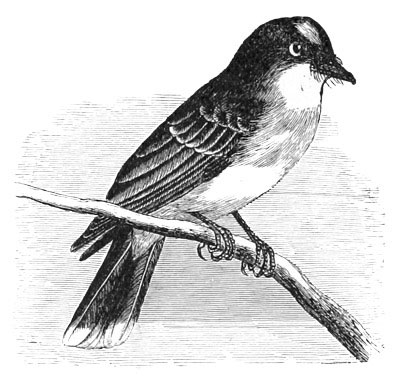
Tyrannus carolinensis.
Sp. Char. Two, sometimes three, outer primaries abruptly attenuated at the end. Second quill longest; third little shorter; first rather longer than fourth, or nearly equal. Tail slightly rounded. Above dark bluish-ash. The top and sides of the head to beneath the eyes bluish-black. A concealed crest on the crown vermilion in the centre, white behind, and before partially mixed with orange. Lower parts pure white, tinged with pale bluish-ash on the sides of the throat and across the breast; sides of the breast and under the wings similar to, but rather lighter than, the back. Axillaries pale grayish-brown tipped with lighter. The wings dark brown, darkest towards the ends of the quills; the greater coverts and quills edged with white, most so on the tertials; the lesser coverts edged with paler. Upper tail-coverts and upper surface of the tail glossy black, the latter very dark brown beneath; all the feathers tipped, and the exterior margined externally with white, forming a conspicuous terminal band about .25 of an inch broad. Length, 8.50; wing, 4.65; tail, 3.70; tarsus, .75.
Hab. Eastern North America to Rocky Mountains. Occasional in various parts of the Western Province (Washington Territory, Salt Lake Valley, Truckee River, Nevada, etc.). South to Panama. Oaxaca, lowlands, March (Scl. P. Z. S. 1858, 302); Honduras (Moore, P. Z. S. 1859, 55); Guatemala (Scl. Ibis I, 120); Cuba (Cab. J. III, 476; Gundl. Rep. 1865, 239, “T. pipiri”); Panama, (Mus. S. I.; Lawr. Ann. N. Y. Lyc. VII, 295); Greytown, Nic.? (Lawr. Ann. VIII, 183); East of San Antonio, Texas (Dresser, Ibis, 1865, 472; breeds); Upper Amazon, Peru, Nauta (Scl. and Salv. P. Z. S. 1866, 189); Vera Cruz, hot region, resident (Sumichrast, M. B. S. I, 557).
The young of the year is similar; the colors duller, the concealed colored patch on the crown wanting. The tail more rounded; the primaries not attenuated.
Specimens vary in the amount of white margining the wing-feathers; the upper tail-coverts are also margined sometimes with white.
Habits. The common Kingbird or Bee Martin of North America is found throughout the continent, from Texas and Florida, on the south, as far to the north as the 57th parallel of north latitude. Westward, north of the 44th parallel, it is found from the Atlantic to the Pacific, but south of this it has not been found west of the Rocky Mountains. It is included by Dr. Cooper among the birds of California, but I am not aware that it has ever been taken within the limits of that State. Mr. Allen regards the eastern slope of the Rocky Mountains its extreme western limit; but Mr. Ridgway states that this species was met with by him in various portions of the Great Basin, though always in less abundance than the T. verticalis. Among the cottonwoods of the Truckee Valley, in Western Nevada, two or three pairs were seen in July and August. In the fertile Salt Lake Valley it was nearly or quite as common as the T. verticalis, and was also met with in the fertile “parks” of the Wahsatch Mountains.
This species not only has this widely extended area, but is also quite abundant wherever found. It is apparently as abundant throughout Nova Scotia as it is in the State of Florida. Richardson even found it common on the banks of the Saskatchewan, where he traced its northern migrations beyond the 57th parallel of latitude. It was found at the Carlton House early in May, and retired southward in September. It winters in Central and South America, and has been received by Mr. Lawrence from Panama.
Dr. Suckley found this species quite plentiful at the eastern base of the Rocky Mountains, in Washington Territory, and more sparingly at Puget Sound, where he obtained several specimens. They appeared to shun the dense forests near Puget Sound, but were moderately plentiful in the groves of low oaks, and among the cottonwood-trees fringing the lakes on Nisqually Plains, where, August 5, he obtained a nest with newly fledged young.
Mr. Joseph Leyland found this species near Omoa, in Honduras, migratory. They came in flocks of two or three hundred, but remained only a short time before departing farther south. They flew high, and seemed very wild. This species was also met with, in May, at Playa Vicente, in the low lands of the State of Oaxaca, Mexico, by Mr. Boucard, and during the winter months is found throughout Mexico.
Wilson states that his jealous affection for his mate and for his nest and young makes him suspicious of every bird that happens to pass near his residence. But this is not the case in all instances. A pair of these birds nested, in the summer of 1871, and peacefully reared their young, in an apple-tree near my residence, within four feet of the nest of the Baltimore Oriole, and not more than eight or ten feet from the nest of a Robin, all in the same tree. The three pairs were on evident terms of amity and mutual good-will. The male Kingbird kept a sharp lookout for danger from the topmost bough, and seemed to have all under his special guardianship, but showed no disposition to molest or annoy them.
The Purple Martin is said to be the implacable enemy of the Kingbird, and one of the few birds with which the latter maintains an unequal contest. Its superiority in flight gives the former great advantages, while its equal courage and strength render it more than a match. Audubon relates an instance in which the Kingbird was slain in one of these struggles.
Wilson also narrates an encounter, of which he was an eyewitness, between one of this species and a Red-headed Woodpecker, in which the latter, while clinging on the rail of a fence, seemed to amuse itself with the violence of the Kingbird, playing bo-peep with it round the rail, while the latter became greatly irritated, and made repeated but vain attempts to strike at him.
The Kingbird feeds almost exclusively upon winged insects, and consumes a vast number. It is on this account one of our most useful birds, but, unfortunately for its popularity, it is no respecter of kinds, and destroys large numbers of bees. In districts where hives of honey-bees abound, the Kingbird is not in good repute. Wilson suggests that they only destroy the drones, and rarely, if ever, meddle with the working bees. But this discrimination, even if real, is not appreciated by the raisers of bees, who regard this bird as their enemy.
The Kingbirds arrive in Pennsylvania the latter part of April, and in New England early in May, and leave for the South in September. They nest in May, selecting an upper branch, usually of an isolated tree, and often in an exposed situation. Their nests are large, broad, and comparatively shallow, and coarsely, though strongly, made of rude materials, such as twigs, withered plants, bits of rags, strings, etc. These are lined with fine rootlets, horse-hair, and fine grasses.
The Kingbird has no song, but, instead, utters an incessant monotonous succession of twitterings, which vary in sharpness and loudness with the emotions that prompt them.
The flight of the Kingbird when on the hunt for insects is peculiar and characteristic. It flies slowly over the field, with rapid vibrations of the wings, in the manner of Hawks, and soars or seems to float in the air in a manner equally similar. At other times it flies with great rapidity, and dives about in the air in the manner of a Swallow. It also exhibits great power and rapidity of flight when rushing forth to encounter a Hawk or an Eagle.
As they are known occasionally to plunge into the water, and, emerging thence, to resume their seat on a high branch, to dry and dress their plumage, it has been conjectured that they feed on small fish, but this is unsupported by any positive evidence.
Though the Kingbird usually builds in trees, it does not always select such situations. In the summer of 1851, passing over a bridge near the village of Aylesford, in Nova Scotia, I observed a Kingbird fly from a nest built on the projecting end of one of the planks of which the bridge was made. So remarkably exposed a position, open to view, and on a level with and within a few feet of a highway, must be quite unusual.
The eggs of this bird are five, sometimes six, in number, and vary considerably in size. Their ground-color is white with a more or less decided roseate tinge, beautifully spotted with blotches and markings of purple, brown, and red-brown. In some, these are disposed in a confluent crown around the larger end; in others they are irregularly distributed over the entire egg. In length they vary from 1.05 to .86 of an inch, and in breadth from .72 to .70 of an inch.
Tyrannus dominicensis, Rich.
GRAY KINGBIRD.
Tyrannus dominicensis, Brisson, Ois. II, 1760, 394, pl. xxxviii. fig. 2.—Rich. List, 1837.—Baird, Birds N. Am. 1858, 172. Lanius tyrannus, var. β, dominicensis, Gmelin, Syst. Nat. I, 1788, 302. Muscicapa dominicensis, Aud. Orn. Biog. II, 1834, 392, pl. xlvi.—Ib. Birds Am. I, 1840, 201, pl. lv. Melittarchus dominicensis, Cabanis, Journal für Ornith. III, Nov. 1855, 478. Tyrannus griseus, Vieillot, Ois. Am. Sept. I, 1807, 76, pl. xlvi.—Swainson, Mon. Shrikes, Quart. Jour. XX, 1826, 276.—Bp. Consp. 1850, 192 (Bonaparte makes two species).—Scl. List, 1862, 236. Tyrannus matutinus, Vieill. De La Sagra pl. xiv.
Sp. Char. Bill very large and stout. Tail conspicuously forked. Wings long; the first six quills attenuated abruptly, much longer than the seventh. Tertials much developed, nearly intermediate in length between the longest primaries and the shortest secondary. Above, and on the sides of the head and neck, ash-gray, shaded in places with brown, which forms the middle portion of each feather. Downy portion at the base of each feather above light ash, then light brown, tipped and edged with darker ash-gray. The mottled appearance is caused by the brown showing from under the feathers; the ear-coverts darker. A concealed colored patch on the crown, formed by the base of the feathers, white before and behind, orange in the middle. Lower parts grayish-white, tinged with ash across the breast, deepest anteriorly. Sides of the breast similar to, but lighter than, the back. Under wing-coverts and axillars pale sulphur-yellow. The wings brown, darker to the tips; the secondaries narrowly, the tertials more broadly, edged with dull white. Edges of the coverts paler. Alula dark brown. Tail similar in color to the quills. Upper tail-coverts brown. Bill and feet black. Length, 8.00; wing, 4.65; tail, 4.00; tarsus, .76.
Young. Lesser wing-coverts and upper tail-coverts distinctly bordered with pale ochraceous; tail-feathers bordered all round with a deeper shade of the same. No colored patch on the crown.
Hab. South Carolina coast, accidental; Florida Keys and West Indies; Nicaragua; New Granada; Santa Cruz (Newton, Ibis I, 146, eggs); Carthagena, N. G. (Cass. P. A. N. S. 1860, 143); Cuba (Cab. J. III, 478, breeds; Gundl. Rep. 1865, 238, “Mel. griseus”); Jamaica (Gosse, B. J. 169, breeds; March, P. A. N. S. 1863, 287); St. Thomas (Cass. P. A. N. S. 1860, 375); Sombrero (Lawr. Ann. N. Y. Lyc. VIII, 1864, 99, “griseus”); Greytown, Nicar. (Lawr. Ann. 183); Sta. Bartholemy (Sund. 1869, 584); Massachusetts (Maynard, B. E. Mass. 1870, 124).
This species, though about the same size as the T. carolinensis, is much more powerfully built, the bill and feet being much stronger, the former considerably longer than the head, and as large as that of Saurophagus sulphuratus, though less compressed.
Specimens from Nicaragua and New Granada appear to be almost perfectly identical with those from Florida and the West Indies, differing only in being just appreciably smaller, which, however, might be expected from their more southern habitat.
Habits. The Gray Kingbird—the Pipiry Flycatcher of Audubon, or Gray Petchary of Jamaica—is, except in Florida, of scarcely more than occasional occurrence within the limits of the United States. A single specimen has been taken in Massachusetts. This was shot in Lynn, October 23, 1868, and was in immature plumage. The bird was shot on a tree near one of the streets of that city by Mr. Charles Goodall. Mr. Audubon also found these birds quite common on the Florida Keys, almost every Key, however small, having its pair. A pair was observed breeding in the college yard at Charleston, S. C., by Dr. Bachman; and for at least three years in succession they regularly returned each year, and raised two broods in a season. This Flycatcher is abundant in St. Croix, Cuba, Jamaica, and in the other West India Islands. In the first-named locality Mr. Alfred Newton found it one of the most conspicuous and commonest birds over the entire island. Its favorite station, he states, was the top of the spearlike unexpanded frond of a tall mountain-cabbage tree, from which place, in the breeding-season, it darted down to attack almost any animal that passed near. Its favorite object of attack was the Green Heron (Butorides virescens), at which it would make several well-directed swoops, never leaving it until it had driven it into some shelter, when, much pleased with its prowess, it would return to its lookout station and celebrate its victory with cries of triumph. On one occasion Mr. Newton observed a Gray Kingbird pursue a Green Heron out to sea for a quarter of a mile and back. It is described as a very clamorous bird, even when there is apparently no need; taking alarm from the domestic poultry, its oft-repeated notes were heard every morning before the dawn. This noise it continued pertinaciously till sundown. Its food consists of insects, which are caught with great dexterity on the wing. It also feeds very largely on the black berries of a myrtle-leaved parasite that grows abundantly on the orange-trees. The nest is often placed under the fronds or among the spathes of a cocoanut or mountain-cabbage tree, and sometimes in any ordinary situation. It is described as flat in construction and large for the size of the bird, being nearly a foot in diameter, composed of a platform of twigs, in the midst of which is hollowed a cup lined with fine roots. In St. Croix the eggs rarely exceeded three in number, and are spoken of as exceedingly beautiful when fresh, of a delicate creamy white, marked at the larger end with blotches and spots of pink or orange-brown, often disposed in a zone. He found their eggs from May till August.
Mr. Richard Hill, of Spanishtown, Jamaica, in some interesting notes furnished to Mr. Gosse, states that along the seaside savannas of that island migrant flocks of these birds swarm early in September. Numbers then congregate on the trees around the cattle ponds and about the open meadows, pursuing the swarms of insects which fill the air at sundown. These throngs are immediately joined by resident birds of this species, which gather about the same places, and do not return to their usual abodes until the breeding-season is at hand.
The Jamaica bird is not exclusively an insect-feeder, but eats very freely of the sweet wild berries, especially those of the pimento. These ripen in September, and in groves of these this bird may always be found in abundance. By the end of September most of the migrant birds have left the island.
This is among the earliest to breed of the birds of Jamaica. As early as January the mated pair is said to be in possession of some lofty tree, sounding at day-dawn a ceaseless shriek, which is composed of a repetition of three or four notes, sounding like pē-chēē-ry, according to Mr. Hill, and from which they derive their local name. In these localities they remain until autumn, when they quit these haunts and again congregate about the lowland ponds. In feeding, just before sunset, they usually sit, eight or ten in a row, on some exposed twig, darting from it in pursuit of their prey, and returning to it to devour whatever they have caught. They are rapid in their movements, ever constantly and hurriedly changing their positions in flight. As they fly, they are able to check their speed suddenly, and to turn at the smallest imaginable angle. At times they move off in a straight line, gliding with motionless wings from one tree to another. When one descends to pick an insect from the surface of the water, it has the appearance of tumbling, and, in rising again, ascends with a singular motion of the wings, as if hurled into the air and endeavoring to recover itself.
In the manner in which the male of this species will perch on the top of some lofty tree, and from that vantage-height scream defiance to all around him, and pursue any large bird that approaches, as described by Mr. Hill, all the audacity and courage of our Kingbird is exhibited. At the approach of a Vulture or a Hawk, he starts off in a horizontal line, after rising in the air to the same height as his adversary, and, hovering over him for a moment, descends upon the intruder’s back, rising and sinking as he repeats his attack, and shrieking all the while. In these attacks he is always triumphant.
This Flycatcher is also charged by Mr. Hill with seizing upon the Humming-Birds as they hover over the blossoms in the garden, killing its prey by repeated blows struck on the branch, and then devouring them.
The nest, according to Mr. Hill, is seldom found in any other tree than that of the palm kind. Among the web of fibres around the footstalk of each branch the nest is woven of cotton-wool and grass. The eggs, he adds, are four or five, of an ivory color, blotched with deep purple spots, intermingled with brown specks, the clusters thickening at the greater end. Mr. Gosse, on the contrary, never found the nest in a palm. One, taken from an upper limb of a bitterwood-tree that grew close to a friend’s door, at no great height, was a cup made of the stalks and tendrils of a small passion flower, the spiral tendrils very prettily arranged around the edge, and very neatly and thickly lined with black horse-hair. The other, made in a spondias bush, was a rather loose structure, smaller and less compact, almost entirely composed of tendrils, with no horse-hair, but a few shining black frond-ribs of a fern.
Mr. March states that the migrant birds of this species return to Jamaica about the last of March, gradually disperse, and, like the resident birds, occupy their selected trees in solitary pairs, and immediately set about preparing their nests. At St. Catharine’s the first nest found was on the 14th of April, and the latest in the middle of July. They seldom build in the tree in which they perch, but select a lower tree near it. Some make their nests high, others low, usually at the extremity of a lateral branch. He describes them as loose structures of twigs and the stems of trailing plants, with the cup of grass, horse-hair, and vegetable fibre. The eggs are three, rarely four, of a long oval, with a ground of light cream-color, dashed around the larger end more or less thickly with blotches of burnt sienna, and with cloudings of pale bistre underneath.
Mr. Audubon states that this Flycatcher reaches the Florida Keys about the first of April. He describes their usual flight as performed by a constant flutter of the wings, except when in chase, when they exhibit considerable power and speed. He noticed them pursue larger birds, such as Herons, Crows, Cuckoos, Grakles, and Hawks, following them quite a distance. They did not molest the Doves. They built their nests in a manner similar to the Kingbird, on the horizontal branches of the mangrove, almost invariably on the western side of the tree and of the island. Some were not more than two feet above the water, others were twenty feet. On one of the keys, although of small size, he saw several of their nests, and more than a dozen of the birds living amicably together.
Dr. J. G. Cooper, who visited Florida in the spring of 1859, informed me, by letter, on his return, that when he reached Cape Florida, March 8, none of this species were to be seen on any of the keys. The first he noticed were about the first of May, near Fort Dallas on the mainland. As, however, it rarely appears at this place, he supposes they reached the keys some weeks sooner. About May 14 he found several pairs at the Cape, and, going up the coast to New Smyrna, he found them abundant about the marshy islands. On the first of June, with a companion, he went in a small boat for the express purpose of finding their nests; and, pushing the boat about among the islands which almost filled Mosquito Lagoon, he discovered three in one afternoon. They were all built among the small branches of low dead mangrove-trees, about ten feet from the ground, formed of a loose, open flooring of small twigs, with scarcely any lining of a finer material. One contained four eggs half hatched, another three young and one egg, the third four young just hatched. He preserved one nest and all the eggs, and presented them to the National Museum in Washington. The old birds showed no resentment, and neither came near nor followed him, differing very much in this respect from the fearless and devoted Kingbird. The only notes this bird was heard to utter were loud and harsh rattling cries. Dr. Bachman informed Dr. Cooper that these birds had become quite regular summer visitants of Charleston, where they continued to breed each season. Dr. Cooper saw none away from the Florida coast, and thinks that none go inland.
The eggs of this species measure from 1 to 1.05 inches in length, and from .70 to .72 of an inch in breadth. They are of an oblong oval shape, variously marked with large blotches and smaller spots of purple, red-brown, and a dark purplish-brown. The latter color, in a few cases, is found in large masses, covering nearly a fifth of the entire surface of the egg; not inaptly compared by Mr. Gosse to the sinuous outlines of lands, as represented on a terrestrial globe.
Tyrannus verticalis, Say.
ARKANSAS FLYCATCHER.
Tyrannus verticalis, Say, Long’s Exped. II, 1823, 60.—Nuttall, Man. II, (2d ed.,) 1840, 306.—Baird, Birds N. Am. 1858, 173.—Scl. Catal. 1862, 235.—Lord, Pr. R. A. Inst. IV, 113 (Br. Col.).—Cooper & Suckley, 168.—Cooper, Orn. Cal. 1, 1870, 312. Muscicapa verticalis, Bonap. Am. Orn. I, 1825, 18, pl. xi.—Aud. Orn. Biog. IV, 1838, 422, pl. ccclix.—Ib. Birds Am. I, 1840, 199, pl. liv. Laphyctes verticalis, Caban. Mus. Hein. II, 1859, 77.—Heerm. X. S, 37.
Sp. Char. The four exterior quills attenuated very gently at the end, the first most so; third and fourth quills longest, second and fifth successively a little shorter. Tail slightly forked; bill shorter than the head. Crown, sides of head above the eyes, nape, and sides of neck pale lead-color, or ash-gray; a concealed crest on the crown, vermilion in the centre, and yellowish before and behind. Hind neck and back ash-gray, strongly tinged with light olivaceous-green, the gray turning to brown on the rump; upper tail-coverts nearly black, lower dusky; chin and part of ear-coverts dull white; throat and upper part of breast similar to the head, but lighter, and but slightly contrasted with the chin; rest of lower parts, with the under wing-coverts and axillars, yellow, deepening to gamboge on the belly, tinged with olivaceous on the breast. Wing brown, the coverts with indistinct ashy margins; secondaries and tertials edged with whitish; inner webs of primaries whitish towards the base. Tail nearly black above and glossy, duller brownish beneath; without olivaceous edgings. Exterior feather, with the outer web and the shaft, yellowish-white; inner edge of latter brown. Tips of remaining feathers paler. Bill and feet dark brown. Female rather smaller and colors less bright. Length of male, 8.25; wing about 4.50.
Hab. Western North America, from the high Central Plains to the Pacific; Colima, Mexico. Accidental in Eastern States (New Jersey, Turnbull; Plymton, Maine, Oct. 1865, Bryant, Pr. Bost. Soc., X, 1865, 96).
The young bird is, in general, quite similar, with the exception of the usual appearance of immaturity, the colored patch on the crown wanting. In one specimen the first primary only is attenuated, in others none exhibit this character.
A specimen of this bird, shot at Moorestown, N. J., is in the museum of the Philadelphia Academy, but this locality can only be considered as very exceptional.
Habits. The Arkansas Flycatcher was first discovered by the party in Long’s Expedition in 1823, and described by Mr. Say. It is a bird of western North America, found from the great plains to the Pacific, and only accidentally occurring east. A single specimen is said to have been shot in Moorestown, N. J., near Philadelphia. It has been met with in Texas as far east as the river Mimbres, and in Nebraska nearly to the Missouri River. The specimen from which the first description was made was obtained in the beginning of July, near the Platte River.
Mr. Nuttall, in his Western tour, first met with this species early in July, among the scanty wood on the banks of the northwest branch of the Platte River. He characterizes it as a bold and querulous bird. He found it all the way from thence to the forests of the Columbia and the Wahlamet, and throughout California to latitude 32°. He speaks of them as remarkably noisy and quarrelsome with each other, and, like the Kingbird, suffering nothing of the bird kind to approach them without exhibiting their predilection for dispute. He describes their note as a discordant, clicking warble, resembling tsh’k-tsh’k-tshivait,—sounding not unlike the creaking of a rusty door-hinge, something in the manner of a Kingbird, with a blending of the notes of the common Purple Grakle.
Mr. Townsend mentions finding this bird numerous along the banks of the Platte, particularly in the vicinity of trees. From that river to the banks of the Columbia, and as far as the ocean, it was a very common species. The males were wonderfully belligerent, fighting almost constantly and with great fury.
Dr. J. G. Cooper states that in California this is an abundant species, arriving in that State about the 20th of March. None are known to remain within the State during the winter. Small parties of males come first, and are very quarrelsome until each one has selected its mate. This is not done for several weeks, and the earliest nest with eggs that he has found was on the 12th of May at Santa Barbara. The nest, built on a branch of a low oak near the town, was five inches wide, constructed of lichens, twigs, coarse grass, and wool, lined with hair. It contained four eggs, measuring .94 by .70 of an inch. He describes them as creamy-white, spotted with purple of two shades near the larger end.
These birds are said to be almost an exact counterpart of the Kingbird, exhibiting the same courage in defence of their nests. Their notes are more varied and noisy, and they utter them almost constantly during the spring, often when flying and fighting. They are very destructive to bees, but compensate for this damage by destroying great quantities of noxious insects. They leave the State in October. At Puget Sound, early in June, Dr. Cooper found this species associating with the common Kingbird without any signs of disagreement, though their similar habits would naturally lead to disputes. He has even seen them together in parties of four about the period of mating. They do not approach the coast in Washington Territory.
Dr. Suckley found this species abundant in the central and western portions of Oregon and Washington Territory. He first noted their arrival from the South about May 15. The first notification of their presence is given by the skirmishes and quarrels incident to the love-season. Their battles are generally fought in the air, and present ludicrous alternations of pursuit and flight. At Fort Dalles their favorite breeding-places were oak-trees for the most part.
Mr. Charles D. Gibbes, of Stockton, informs us that these birds occasionally build their nests in the shrubbery about the gardens, but more frequently in large oak-trees, fifteen or twenty feet from the ground. They are constructed of weeds and grass firmly woven together, and lined with cotton, feathers, strings, and other soft materials. They are usually secured to the limb on which they are placed by a portion of the string. The diameter of the cavity of the nest is about three inches, depth one and a half. Their eggs are laid in May and June, and are four, five, or six in number. They are described as white, marked with dark brown spots on the larger end. In some the spots, decreasing in size, extend to the smaller end.
Dr. Hoy informs me that he has never detected this bird within the limits of Wisconsin, though he has no doubt that they may occasionally straggle into its limits, as have many of the birds peculiar to the Missouri region.
Mr. Ridgway gives it as one of the most abundant and familiar of the Tyrannidæ in the Sacramento Valley and the fertile portions of the Great Basin. He notes their excessively quarrelsome disposition, which far exceeds that of the eastern Kingbird, for fighting among themselves seems to be their chief amusement. As many as half a dozen of these birds were sometimes noticed pitching at one another promiscuously, in their playful combats; and when a nest was disturbed, the cries of the parents invariably brought to the vicinity all the birds of this species in the neighborhood, which, as soon as gathered together, began their aerial battles by attacking each other without regard apparently to individuals, accompanying the fight by a shrill twitter, very different from the loud rattling notes of the T. carolinensis. Indeed, all the notes of the western Kingbird are very conspicuously different from those of the eastern species, being weaker, and more twittering in their character. The nesting habits, the construction of the nest, and appearance of the eggs, are, however, almost perfectly identical.
Mr. Ridgway gives an interesting account (Am. Nat., Aug., 1869) of a young bird of this species which became quite domesticated with his party in the geological survey of the 40th parallel. It had been taken about the middle of July, fully fledged, from the nest, by some Indians, and was fed with grasshoppers and flies until able to catch them for itself. When not in quest of food it remained quietly perched on Mr. Ridgway’s shoulder or his hat, or would perch on a rope extending from the top of the tent to a stake. At night it frequently roosted under an umbrella which hung outside of the tent. If permitted, it would have preferred to keep on its master’s shoulder, snuggling against his neck. In the morning it was sure to come fluttering about his head, singling him out from a dozen or more persons who lay around upon the ground. It had an insatiable appetite, and was ascertained by actual count to consume one hundred and twenty fat grasshoppers in a day. It soon learned its own name, Chippy, and always answered to the call. It followed Mr. Ridgway when on horseback, occasionally leaving to sport with other birds, but always returning to his shoulder or hat. It evidently preferred the society of the camp to that of his own race. It was once, by accident, nearly shot, and ever after held the gun in great dread. It went with Mr. Ridgway from camp to camp, continuing perfectly tame and domesticated, until, as was supposed, it fell a prey to a Hawk.
The eggs of this species are not easily distinguishable from those of the common Kingbird. They have a ground-color of a crystalline whiteness, marked with bold dashes of reddish and purplish brown, the latter fewer and faint. They are oblong in shape, are pointed at one end, and measure 1 inch in length by .70 of an inch in breadth.
Tyrannus vociferans, Swainson.
CASSIN’S FLYCATCHER.
Tyrannus vociferans, Swainson, Mon. Tyrant Shrikes in Quarterly Journal Sc. XX, Jan. 1826, 273.—Ib. Philos. Mag. I, 1827, 368.—Baird, Birds N. Am. 1858, 174, pl. xlviii.—Ib. M. B. II, Birds 8, pl. x.—Scl. Catal. 1862, 235.—Cooper, Orn. Cal. I, 1870, 314. Laphyctes vociferans, Caban. Mus. Hein. II, 77. Tyrannus cassini, Lawrence, Ann. N. Y. Lyc. N. H. V, 1852, 39, pl. iii, fig. 2 (Texas).
Sp. Char. Bill from the forehead about as long as the head. Tail even or slightly rounded. Outer five primaries attenuated; the first four abruptly and deeply emarginated; third quill longest, second and fourth a little less, first shorter than the sixth, and half an inch less than the longest. Head and neck above and on the sides rather dark bluish-ash; the throat and breast similar, and only a little paler. Rest of upper parts olive-green tinged with gray, mixed with brown on the rump; the upper tail-coverts and surface of the tail nearly black; the outer web of the external feather and the tips of all pale brown. The chin is white, in strong contrast to the dark ash of the throat; the rest of the under parts bright sulphur-yellow (the sides olivaceous), palest on the under tail-coverts and inside of wing. A concealed vermilion patch in the crown, bordered by straw-yellow. Wing-feathers brown, tinged with olive, becoming paler towards the edge. Length, 8.80; wing, 5.25; tail, 4.25.
Hab. Valley of Gila and southern California, eastward to Pecos River, Texas, and into Mexico, on table-lands; north along the Plains to Fort Laramie, south to Costa Rica. Oaxaca (Scl. P. Z. S. 1859, 383); Vera Paz (Scl. Ibis I, 121); W. Arizona (Coues, P. A. N. S. 1866, 59); Vera Cruz, hot and temp. regions, and Plateau (Sum. M. Bost. Soc. I, 557.)
The table of specific characters presented under the generic head will readily serve to distinguish this species from its near ally, T. verticalis. The white outer web of the exterior tail-feather in verticalis, compared with the brown web, only edged with whitish of the present bird, is always sufficient to separate them; while the deep ash of the jugulum, and the much lighter, more brownish shade of the wings, are entirely peculiar features.
Habits. This bird is abundant in Vera Cruz, where it is known by the name of Portuguéz. According to Sumichrast, it belongs to the hot and temperate regions, rather than the alpine. It is also common in the Plateau, and is found in all parts of Mexico.
In Arizona Dr. Coues states this bird to be an abundant summer resident, arriving in that Territory during the third week in April, and remaining until the latter part of September. It was found in every kind of locality. He furnishes no information as to its habits.
During the Mexican Boundary Survey this species was taken on the Colorado River, in California, by Dr. A. Schott, and at Los Nogales, Mexico, by Dr. Kennerly. It was also met with in the Sacramento Valley by Dr. Heermann; at Fort Thorn, New Mexico, by Dr. Henry; on the Pecos, Texas, by Captain Pope; and specimens from Mexico have been received from Mr. Gould. It does not appear to have been observed in Southwestern Texas by Mr. Dresser.
This species Dr. Cooper states to be quite common throughout the southern half of California, and resident throughout the year at least as far north as Los Angeles. In color they greatly resemble the T. verticalis, but are less lively and not so quarrelsome in their habits. During the early part of the year they begin to sing by daylight, generally from the top of some high tree. Their notes are said to be loud and much more musical than those of the other species, and their song exhibits considerable variety for a bird of this family. During the middle of the day they are rather quiet, and sit much of the time on their perch, occasionally catching an insect that comes very near, but they are supposed by Dr. Cooper to feed mostly in the very early morning. This observer found them breeding at San Diego as early as March 28, as well as subsequently. Their nest is said to be much larger and more firmly built than are those of others of the genus, being five and a half inches in external diameter and about two and a half in height. The cavity is three inches wide at the rim. The eggs, which he describes as white, with large scattered reddish-brown and umber blotches, measure .96 of an inch in length and .70 in breadth. He found some of these birds in Santa Clara Valley in May, 1864. They appeared to be smaller and greener on the back than those from the South. They winter in large numbers at Santa Clara, in latitude 37°. Dr. Coues found this a very abundant summer resident at Fort Whipple, breeding there in considerable numbers, and all leaving early in October.
Mr. Ridgway did not meet with this species anywhere in the Great Basin, nor in the Sacramento Valley. On the plains it is found as far north as Cheyenne and Laramie Peak, and in the southern portion of the Western Provinces extends westward to California.
Specimens were obtained by Mr. George M. Skinner from Salamá, Vera Paz, in Central America. It was also taken, in February, near Oaxaca, Mexico, by Mr. Boucard.
A nest of this bird (No. 1,828), in the Smithsonian Museum, was taken at Volcan de Colima, June, 1863, by Mr. John Xantus. It is a slight structure composed chiefly of wiry grass, mixed with bits of wool, and lined with finer grasses. The eggs are two in number, having a pure-white ground, freckled on the larger end with purplish-brown and grayish-lilac. These markings are more sparse and are finer than those of the eggs of any other species of this genus, so far as I am aware. One of the eggs has a few blotches of umber on the larger end. They measure, one .93 by .68 of an inch, the other .93 by .65.
Tyrannus melancholicus, var. couchi, Baird.
COUCH’S KINGBIRD.
Tyrannus couchi, Baird, Birds N. Am. 1858, 175, pl. xlix, f. 1.—Scl. Catal. Am. B. 1862, 235.
Sp. Char. Bill long as the head. Feet stout. Five outer primaries abruptly attenuated at the end; the third and fourth longest; the first a little longer than the sixth. Tail considerably forked (depth of fork about .30 of an inch, or more). Head, neck, and jugulum bluish-ashy, becoming nearly white on the throat, and shaded with yellow on the breast. Rest of lower parts gamboge-yellow. Rest of upper parts olive-green, tinged with ash anteriorly. Tail and primaries grayish-brown, the tail not the darker. Wing-coverts passing externally into pale, the tertials edged with almost white. Crown with a concealed patch of bright orange-red. Length, 9.00; wing, 5.00; tail, 4.70.
Hab. Middle America (both coasts), from southern border of United States, south to Guatemala; Tucson, Arizona (Bendire).
All specimens of T. melancholicus from regions north of Guatemala are referrible to var. couchi; all from Costa Rica southward, to melancholicus.
It is only by comparing specimens from near the extreme northern and southern limits of the range of the species, that differences are readily discernible; and between these two extremes there is so gradual a transition that it is impossible to draw a line separating two well-marked varieties, so that it is necessary to assume an arbitrary geographical line, and determine specimens from the middle regions by their position, whether to the north or south of the line established. Specimens from Buenos Ayres, the Parana, and Brazil, to Peru and New Granada, are identical. Costa Rica specimens (T. satrapa, Licht.) have the dark tail of var. melancholicus and white throat of couchi.
Genus MYIARCHUS, Cabanis.
Myiarchus, Cabanis, Fauna Peruana, 1844-46, 152.—Burmeister, Thiere Brasiliens, II, Vögel, 1856, 469.
Gen. Char. Tarsus equal to or not longer than the middle toe, which is decidedly longer than the hinder one. Bill wider at base than half the culmen. Tail broad, long, even, or slightly rounded, about equal to the wings, which scarcely reach the middle of the tail; the first primary shorter than the sixth. Head with elongated lanceolate distinct feathers. Above brownish-olive, throat ash, belly yellow. Tail and wing feathers varied with rufous.
This genus is well marked among the American Flycatchers, and constitutes what Bonaparte called Ultimi Tyrannorum sive Tyrannularum primæ. The type is the Muscicapa ferox of Gmelin, (M. tyrannulus,) which, as identified by Cabanis and Burmeister as above, appears to resemble our species very closely.
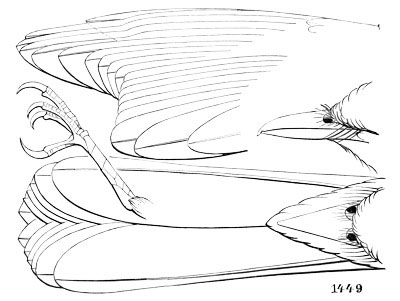
Myiarchus mexicanus. 1449
For an elaborate discussion of the various forms of this exceedingly difficult genus, we are indebted to a recent monograph by Dr. Coues, in the Proceedings of the Philadelphia Academy, for June and July, 1872 (pp. 56-81). With the same material for our investigations, we have been led, after a very careful perusal of the valuable paper mentioned, and tedious critical comparison of the large material at our command, to adopt a somewhat difficult view of the relationship of the forms characterized. The following synopsis expresses their affinity as at present understood:—
Common Characters. Above olivaceous, usually uniform, sometimes darker, sometimes more ashy, on the head above. Head and jugulum more or less ashy, though the latter is sometimes very pale. Rest of lower parts sulphur-yellow, sometimes almost or quite white. Primaries, secondaries, and rectrices usually more or less edged on either web with rufous; but sometimes entirely destitute of this color.
Species and Varieties.
A. Bill sub-conical; sometimes nearly terete, its depth equal to, or exceeding, its breadth in the middle portion; its lateral outlines moderately divergent basally; terminal hook abrupt, strong. (Myionax.)
1. M. tyrannulus. No trace of rufous edgings on either wings or tail. Above ashy-olive, the pileum similar, the outer webs of wing-coverts and secondaries edged with whitish. Head, laterally and beneath, ashy, the throat and jugulum more whitish; rest of lower parts sulphur-yellow. Tail slightly rounded.
Pileum and nape umber-brown; upper surface umber-grayish. Bill dark brown. Wing, 3.50-3.70; tail, 3.60-3.90; culmen, .90-.95; tarsus, .80-.90. Hab. South and Central America, from Bolivia and Southern Brazil to Costa Rica … var. tyrannulus.[66]
Whole head and neck pure ash, paler on the throat, and darker on the pileum; upper surface greenish-ash. Bill black. Wing, 3.70; tail, 4.00; culmen, .82; tarsus, .91. Hab. Ecuador and Guayaquil … var. phæocephalus.[67]
2. M. validus.[68] All the wing-coverts, tertials, secondaries, primaries, and rectrices distinctly edged with rufous (the latter on both webs). Above olivaceous, more ashy anteriorly; the upper tail-coverts more rufescent; remiges broadly rufous on exterior edges; rectrices with the whole inner web (except a narrow streak along the shaft) and edge of outer web rufous. Head beneath, and entire throat and breast, deep ash; rest of lower parts sulphur-yellow, the junction of the two colors not well defined. Wing, 3.80-4.20; tail, 3.80-4.20; culmen, 1.00; tarsus, .80-91; tail even; third and fourth quill longest. Hab. Jamaica.
3. M. crinitus. Outer webs of primaries distinctly edged with rufous (no other rufous on wings); inner webs of rectrices broadly, sometimes entirely, rufous, none on outer webs (except in young). Above olivaceous, varying from a greenish to an ashy cast, the pileum more brownish. Wing-coverts (both rows) broadly tipped with brownish ashy-whitish; tertials, secondaries, and lateral tail-feather broadly edged on outer web with the same. Head laterally and beneath ashy paler on the throat and jugulum; rest of lower parts delicate yellow, varying from a rich lemon to a pale sulphur tint. Hab. Continental America.
Bill dark brown (never black). Upper parts decidedly greenish; ash of throat and jugulum, and yellow of abdomen, etc., very deep.
Inner webs of rectrices wholly rufous, or with only a narrow strip of dusky along the shaft. Wing, 3.75-4.25; tail, 3.75-4.20; culmen, .95-1.00; tarsus, .85-.90. Hab. Eastern Province of North America; in winter south through Eastern Mexico to Guatemala (grading into var. irritabilis in Nicaragua) … var. crinitus.
Bill deep black; upper parts without a greenish, but, instead, an ashy-brownish cast; ash of throat and jugulum, and yellow of abdomen, etc., very pale.
Inner webs of rectrices broadly (but not entirely) rufous to the extreme tip, with a broad dusky stripe next the shaft.
Wing, 4.10-4.50; tail, 4.00-4.70; culmen, 1.10-1.20; tarsus, 1.00-1.05. Hab. Southern and Western Mexico (Tehuantepec, Yucatan, Mazatlan, etc.) … var. cooperi.[69]
Wing, 3.60-3.90; tail, 3.50-3.75; culmen, .90-1.00; tarsus, .80-.85. Hab. Eastern South America, and Central America, from Paraguay to Costa Rica (grading into var. cooperi in Guatemala, and into var. cinerascens in Tehuantepec) … var. irritabilis.[70]
Inner webs of rectrices almost entirely rufous to near the extreme tip, the end of the web, however, being brownish-dusky like the outer.
Wing, 3.35-4.10; tail, 3.35-4.10; culmen, .80-1.00; tarsus, .80-.91. Hab. Western Province of United States, and Western Mexico (grading into var. irritabilis in Tehuantepec, and in winter migrating into Eastern Mexico) … var. cinerascens.
4. M. stolidus. Colors essentially nearly as the varieties of M. crinitus. Primaries more or less distinctly edged with rufous, especially on inner quills; rectrices with inner webs more or less edged with rufous (found only terminally in var. antillarum). Wing-coverts broadly tipped with dull ashy-whitish. Above brownish-slaty, with an olivaceous cast, the pileum more or less appreciably darker. Beneath ashy-white, without distinct yellow (except in var. stolidus, in which the abdomen, etc., are pale sulphury yellow). Tail varying in shape from slightly rounded to distinctly emarginated. Hab. West Indies.
Beneath entirely white, only faintly, or hardly appreciably, tinged with sulphur-yellow on the flanks.
Inner web of rectrices broadly edged with rufous for the whole length. Crown scarcely darker than the back. Tail distinctly emarginated. Wing, 3.15-3.50; tail, 3.30-3.60; culmen, .85-.95; tarsus, .80-85. (Bahaman specimens the larger). Hab. Bahamas and Cuba … var. phœbe.[71]
Inner web of rectrices not edged with rufous except at extreme tip, where sometimes also absent. Crown decidedly darker than the back. Tail slightly rounded. Wing, 3.25-3.50; tail, 3.20-3.60; culmen, .85-95; tarsus, .85-90. Hab. Porto Rico … var. antillarum.[72]
Beneath white only on throat and jugulum, the abdomen, etc., being sulphur-yellow.
Inner webs of rectrices more or less distinctly edged with rufous for whole length. Pileum very much darker than the back. Wing, 3.35-3.50; tail, 3.35-3.65; culmen, .90-.95; tarsus, .80-.85. Tail faintly doubly-rounded. Hab. Hayti, Jamaica, (and Yucatan?) … var. stolidus.[73]
B. Bill much depressed, its depth only about half its width, in the middle portion; lateral outlines widely divergent basally; terminal hook weak. (Myiarchus.)
5. M. tristis. Colors very variable, and amount of rufous exceedingly different in the different races. Inner webs of rectrices seldom edged with rufous; rufous sometimes entirely absent on both wings and tail, and sometimes the whole wing and both webs of rectrices distinctly edged with it. Above ashy-olive, usually with more or less of a greenish cast, the pileum decidedly darker (except in var. lawrencei); throat and jugulum ashy-white; rest of lower parts sulphur-yellow. Hab. Central and South America, and Jamaica.
Pileum sooty-brown, decidedly darker than the back; wings and tail entirely destitute of rufous edgings, except a faint tinge on outer webs of inner secondaries and rectrices, towards the base. Tail faintly rounded. Wing, 3.00; tail, 3.10; culmen, .80; tarsus, .65. Hab. Jamaica … var. tristis.[74]
Pileum grayish-brown, not appreciably darker than the back; outer webs of inner secondaries and primaries and rectrices faintly edged with rufous. Wing, 2.80-3.40; tail, 2,85-3.45; culmen, .85-.90; tarsus, .75-.80. Hab. Northern Mexico, from northern boundary, south to Colima, Tehuantepec, Yucatan, and Salvador … var. lawrencei.[75]
Pileum sooty-blackish, decidedly and abruptly darker than the back. Outer webs of wing-coverts, primaries, secondaries, and rectrices distinctly edged with rufous. Yellow beneath brighter than in lawrencei. Wing, 3.20-3.30; tail, 3.15-3.30; culmen, .80-.85; tarsus, .75-.80. Hab. Central America from Panama to Guatemala (grading into var. lawrencei in Tehuantepec, and Orizaba) … var. nigricapillus.[76]
Pileum deep black, abruptly different from the greenish-olive of the back, and separated from it by a more ashy shade. Wings and tail wholly destitute of rufous edgings. Yellow beneath brighter than in var. nigricapillus. Wing, 3.20; tail, 3.20; culmen, .85; tarsus, .78. Tail about even. Hab. Northwest South America, from Ecuador northward (grading into nigricapillus on Isthmus of Panama) … var. nigriceps.[77]
Myiarchus crinitus, Cabanis.
GREAT CRESTED FLYCATCHER.
Muscicapa crinita, Linn. Syst. Nat. I, 1766, 325.—Wilson, Am. Orn. II, 1810, 75, pl. xiii.—Licht. Verzeichniss Doubl. 1823, No. 559.—Aud. Orn. Biog. II, 1834, 176; V, 423, pl. cxxix.—Ib. Birds Am. I, 1840, 209, pl. lvii. Tyrannus crinitus, Swainson, Mon. Tyrant Shrikes in Quarterly Journal, XX, Jan. 1826, 271.—Nuttall, Man. I, (2d ed.,) 1840, 302.—Max. Cab. J. VI, 1858, 182. Myiobius crinitus, Gray, Genera, I, 248. Tyrannula crinita, Bonap. Consp. 1850, 189.—Kaup, Pr. Zoöl. Soc. 1851, 51. Myiarchus crinitus, Cabanis, Journ. für Ornith. III, 1855, 479.—Baird, Birds N. Am. 1858, 178.—Scl. Catal. 1862, 232.—Samuels, 131. Myionax crinitus, Caban. Mus. Hein. 1859, 73 (type, Journ. 1861, 250). Muscicapa ludoviciana, Gm. Syst. Nat. I, 1788, 934.—Latham, Ind. Tyrannus ludovicianus, Vieillot, Ois. Am. Sept. I, 1807, pl. xlv. Muscicapa virginiana cristata, Brisson, II, 1760, 412. Crested Flycatcher, Pennant, Latham.
Figure: Buffon pl. enl. 569, fig. 1.
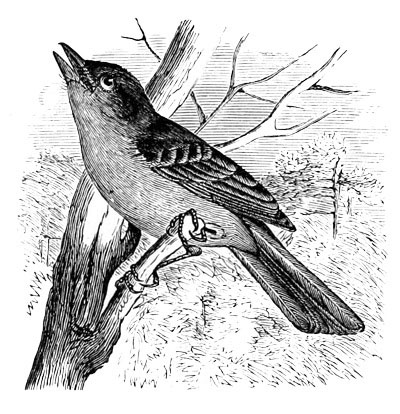
Myiarchus cinerascens.
Sp. Char. Head with a depressed crest. Third quill longest; fourth and second successively but little shorter; first a little longer than seventh; much shorter than sixth. Tail decidedly rounded or even graduated; the lateral feather about .25 of an inch shorter. Upper parts dull greenish-olive, with the feathers of the crown and to some extent of the back showing their brown centres; upper tail-coverts turning to pale rusty-brown. Small feathers at the base of the bill, ceres, sides of the head as high as the upper eyelid, sides of the neck, throat, and forepart of the breast, bluish-ashy; the rest of the lower parts, including axillaries and lower wing-coverts, bright sulphur-yellow. A pale ring round the eye. Sides of the breast and body tinged with olivaceous. The wings brown; the first and second rows of coverts, with the secondary and tertial quills, margined externally with dull white, or on the latter slightly tinged with olivaceous-yellow. Primaries margined externally for more than half their length from the base with ferruginous; great portion of the inner webs of all the quills very pale ferruginous. The two middle tail-feathers light brown, shafts paler; the rest have the outer web and a narrow line on the inner sides of the shaft brown, pale olivaceous on the outer edge; the remainder ferruginous to the very tip. Outer web of exterior feather dull brownish-yellow. Feet black. Bill dark brown above and at the tip below; paler towards the base. Length, 8.75; wing, 4.25; tail, 4.10; tarsus, .85.
Hab. Eastern North America to the Missouri and south to Eastern Texas (not yet observed farther west). Guatemala (Scl. Ibis, I, 121); Cuba (Gundl. Repert. 1865, 239; Cab. J. III, 479); ? Jamaica (Gosse, B. J. 186); Panama (Lawr. N. Y. Lyc. 1861, 329); Costa Rica (Caban. J. 1861, 250; Lawr. N. Y. Lyc. IX, 115); San Antonio, Texas (Dresser, Ibis, 1865, 473, rare).
The female appears to have no brown on the inner web of the quills along the shaft, or else it is confined chiefly to the outer feathers.
The young is hardly appreciably different, having merely the wing-coverts tinged with rusty at the ends.
Habits. The common Great-crested Flycatcher of eastern North America has a much more extended northern distribution than has been generally given it by earlier writers. Wilson speaks of it only as a bird of Pennsylvania. Audubon mentions their occurring as far as Massachusetts, but as confined to the mountains, and as entirely unknown farther eastward. Mr. Nuttall refers to it as nearly unknown in New England, and as never appearing near the coast.
It is now known to be a regular though a somewhat rare summer resident, at least as far to the northeast as St. Stephen, New Brunswick, latitude 45° north, longitude 67° west, and as far to the north in Vermont as Randolph, and Hamilton in Canada, both in about latitude 44°. Mr. Boardman mentions it as a regular summer visitant, and as breeding near Calais. Professor Verrill gives it as a rare summer visitant of Western Maine. Mr. McIlwraith states it to be a common summer resident of Hamilton, Canada West, where it arrives about the 10th of May, after which its harsh cry is heard in all parts of the woods. It winters in Central America and Panama.
In a letter dated June 17, 1865, Mr. C. S. Paine of Randolph, Vt., informed me that he had, within a few days, found a nest of this Flycatcher. It was built in the hollow of a decayed apple-tree, in one of its limbs. The nest was built up from the bottom of the cavity some eight inches, and contained six eggs. Though not very abundant in that neighborhood, Mr. Paine had been aware, for several years, of the occurrence of this Flycatcher, but had never before been able to ascertain its manner of nesting. He has since informed me that these Flycatchers have continued to occur every summer, as they always make their presence known by their harsh notes, which may be heard to quite a distance, and he knows that they breed there regularly every year. They are shy, and do not come about the buildings, but are generally seen in the woods and orchards.
In Eastern Massachusetts they are not common, but scattered pairs have been met with in Concord, Acton, Newton, Hingham, and in other places.
Dr. Coues states that the Great-crested Flycatcher reaches Washington the third week in April, and leaves the last of September. It is a common summer resident, but is most numerous in the spring and autumn. It is found on the edge of open woods, and betrays its presence by its peculiar notes. In the western part of Massachusetts, Mr. Allen gives it as a rare summer visitant, having been taken by him from May 15 to September 17, and having been found breeding on Mount Tom by Mr. C. W. Bennett. It is found abundantly in the Middle and Southern States as far south as Florida and Texas, and occurs as far to the west as the Missouri River. Dr. Woodhouse found it very abundant in Texas and in the Indian Territory, and Mr. Dresser obtained specimens at San Antonio in the month of April.
In speaking of the habits of this species, Wilson accuses it of being addicted to eating bees equally with the Kingbird; but as this bird is known to feed largely on berries, and to feed its young to some extent with the same, the extent of such propensity may well be doubted. It is not so prone to attack birds larger than itself as is the Kingbird, which Wilson characterizes as cowardice, but which it would be more charitable to call prudence. It is said to be harsh, cruel, and vindictive to smaller birds and to weaker individuals of its own species.
In its flight it moves with power, steadiness, and swiftness, and when in pursuit of insects follows its prey with great zeal and perseverance. When it captures a large insect, it retires to its perch and beats it against the limb. These birds are not in the least gregarious. They occur in isolated pairs, and appear to have no interest or sympathy with others than those of their own household. To each other, however, they are attentive and considerate, and they are devoted in their solicitude for their young.
Their usual call-note is a sharp disagreeable squeak, which, once known, is easily recognized. Besides this it has a monotonous succession of squeaking, harsh notes, only a little less unpleasant. They raise but one brood in a season, and remain together in a family group of from six to eight until they leave, in the middle of September.
During the early summer this species feeds chiefly upon insects of various kinds, which it catches with great facility, skill, and assiduity; afterwards, as if from choice, it chiefly eats ripe berries of various kinds of shrubs and plants, among which those of the poke-weed and the huckleberry are most noticeable. It nests altogether in hollows in trees, stumps, or limbs. It lines the bottoms of these hollows with a great variety of miscellaneous materials, and in quantities that vary with the size and shape of the place to be occupied. These beds are composed of loose hay, feathers, the hair of various small quadrupeds, etc., while the exuviæ of snakes are almost always to be met with.
The eggs, four, five, or six in number, are peculiar and noticeably varied and beautiful in their style of markings, varying also somewhat in shape. Generally they are nearly spherical, and equally obtuse at either end. Occasionally they are an oblong oval, one end a very little more tapering than the other. Their ground-color is a beautiful light buff, rather than a cream-color, over which are waving lines, marblings, markings, and dots of a brilliant purple, and others of a more obscure shading. The lines are variously distributed, generally running from one pole of the egg to the other with striking effect, as if laid on with the delicate brush of an artist. In some eggs the whole surface is so closely covered with these intercrossing and waving lines, blending with the obscure cloudings of lilac, as nearly to conceal the ground. Usually the buff color is conspicuously apparent, and sets off the purple lines with great effect.
An oblong-oval egg from New Jersey measures 1.10 inches in length by .70 of an inch in breadth. A more nearly spherical egg from Florida measures .90 by .75 of an inch. These well represent the two extremes. Their average is about 1 inch by .75 of an inch.
The eggs of all the members of this genus have a remarkable similarity, and can scarcely be mistaken for those of any other group.
Myiarchus crinitus, var. cinerascens, Lawr.
ASH-THROATED FLYCATCHER.
Tyrannula cinerascens, Lawrence, Ann. N. Y. Lyc. N. Hist. V, Sept. 1851, 109. Myiarchus cinerascens, Scl. List, 1862, 133.—Ib. P. Z. S. 1871, 84.—Coues, Pr. A. N. S. July, 1872, 69. Myiarchus mexicanus, Baird, Birds N. Am. 1858, 179, pl. 5.—Heerm. X, S, 37, pl. v.—Cooper, Orn. Cal. 1, 1870, 316. Myiarchus mexicanus, var. pertinax, Baird, P. A. N. S. 1859, 303 (Cape St. Lucas).
Sp. Char. Bill black, the width opposite the nostrils not half the length of culmen. Head crested. Tail even, the lateral feathers slightly shorter. Second, third, and fourth quills longest; first rather shorter than the seventh. Above dull grayish-olive; the centres of the feathers rather darker; the crown, rump, and upper tail-coverts tinged with brownish. The forehead and sides of the head and neck grayish-ash; the chin, throat, and forepart of the breast ashy-white; the middle of the breast white; the rest of the under parts very pale sulphur-yellow; wings and tail brown. Two bands across the wing, with outer edges of secondaries and tertials, dull white; the outer edges of the primaries light chestnut-brown (except towards the tip and on the outer feather); the inner edges tinged with the same. Whole of middle tail-feathers, with the outer webs (only) and the ends of the others brown; the rest of the inner webs reddish-chestnut, the outer web of exterior feather yellowish-white. Legs and bill black; lower mandible brownish at the base. Length about 8.00; wing, 4.00; tail, 4.10; tarsus, .90.
Hab. Coast of California, to Cape St. Lucas, and across by the valley of Gila and Rio Grande to Northeastern Mexico. Seen as far north in Texas as San Antonio. Oaxaca (Scl. 1859, 384); ? Guatemala (Scl. Ibis, I, 129); Vera Cruz hot regions, resident (Sum. M. Bost. Soc. I); San Antonio, Texas (Dresser, Ibis, 1865, 473).
In a young specimen the crown is more tinged with brown; the upper tail-coverts and the middle tail-feathers are chestnut, and, in fact, all the tail-feathers are of this color, except along both sides of the shaft on the central feathers, and along its outer side in the lateral ones.
This species is easily distinguished from T. crinitus and T. cooperi by the brown tip of the tail; the colors paler than in the former, bill slenderer, and tarsi longer.
A variety of this species (pertinax[78]) is found at Cape St. Lucas, and distinguished chiefly by the considerably larger and stouter bill.
Habits. The Ash-throated or Mexican Flycatcher appears to be a common species, from San Antonio, Texas, its extreme northeastern point, southwesterly throughout Mexico as far south as Guatemala, and westward to the Pacific coast. It has been obtained in various parts of California by Mr. Cutts, Mr. Schott, Dr. Heermann, and others, as also on the Gila River. Dr. Kennerly procured specimens at Los Nogales, Mexico, and others have met with it near the city of Mexico, at Saltillo, and in different parts of Western Texas. It was found breeding at Cape San Lucas by Mr. Xantus.
In the Department of Vera Cruz, Mr. Sumichrast found this species apparently confined to the hot region. He did not meet with it anywhere else.
Mr. Dresser thinks that this Flycatcher does not reach San Antonio before the latter part of April. The first that came under his notice was one that he shot, on the 23d of that month, on the Medina River. It breeds near the Medina and the San Antonio Rivers, making its nest in a hollow tree, or taking possession of a deserted Woodpecker’s hole. Mr. Dresser observed these birds as far to the east as the Guadaloupe River, where they were common. Farther east he saw but very few. Their eggs he speaks of as peculiarly marked with a multitude of purple and brown dashes and lines on a dull yellowish-brown ground, and very similar to those of Myiarchus crinitus.
In the Mexican Boundary Survey, individuals of this species were taken by Mr. A. Schott, March 31, on the Colorado Bottom; near the Gila River, New Mexico, December 31; and also at Eagle Pass, in Texas, date not given. Mr. J. H. Clark obtained a specimen at Frontera, Texas, where he mentions finding it in great abundance in damp places, or near the water. In May, 1853, Lieutenant Couch secured several near Saltillo, and notes its occurrence among mesquite-bushes. In the following June, Dr. Kennerly found them very abundant at Los Nogales. Where two were found together, they were generally noticed to be uttering a loud chattering noise.
Dr. Heermann, in his Report on the birds observed in the survey of Lieutenant Williamson’s route between the 32d. and the 35th parallels, mentions finding this species abundant. His specimens were obtained near Posa Creek. He describes them as of shy and retiring habits, preferring the deep and shady forests where its insect food abounds. The nests, found in hollows of trees or in a deserted squirrel’s or Woodpecker’s hole, were composed of grasses and lined with feathers. The eggs, five in number, he describes as cream-colored, marked and speckled with purplish-red dashes and faint blotches of a neutral tint.
Dr. Coues found them a common summer resident in Arizona, where they arrived in the third week in April and remained until the middle of September. They were seldom found among pine-trees, but appeared to prefer ravines, hillsides, and creek bottoms. Some wintered as high up in the Colorado Valley as Fort Mohave. At Fort Whipple young birds were first observed early in July.
Dr. Cooper obtained one of this species at Fort Mohave, January 15, and is of the opinion that some may habitually winter in the Colorado Valley. In California they begin to arrive about March 10, and extend their range through very nearly the whole of the State. He describes their notes as few, loud, and harsh, but little varied, and uttered from time to time as they fly after an insect from an accustomed perch, usually a lower dead limb of a forest tree. They prefer shady situations, and are said to feed late in the evening.
Mr. Ridgway met with this species in all suitable localities, from the Sacramento Valley eastward to the Wahsatch Mountains. It was most abundant among the oaks of the plains between the Sacramento River and the Sierra Nevada; but in the wooded river valleys of the interior, as well as in the cedar and piñon or mahogany woods on the mountains of the latter region, it was also more or less frequently met with. In its manners it is described as a counterpart of the eastern M. crinitus, but its notes, though generally similar in character, have not that strength which makes the vociferous screaming whistles of the eastern species so noticeable.
This species, or a very closely allied race of it (var. pertinax) was procured at Cape St. Lucas by Mr. Xantus. It had the peculiarities of a southern race, stronger feet, stouter bill, and a generally smaller size.
A few individuals of this species were found by Mr. Grayson inhabiting the islands of the Three Marias, on the Pacific coast of Mexico. He usually saw them among low bushes, darting from their perch after flies and other winged insects. They were very silent, and seldom uttered a note.
Four eggs of this species from Matamoras, collected by the late Dr. Berlandier, have the following measurements: .82 by .75, .91 by .71, .95 by .75, .98 by .75 of an inch. Though having a very close resemblance to the eggs of M. crinita, there are noticeable certain constant variations. The ground-color is a little lighter, and has a tinge of pinkish not found in the eggs of the eastern species. The markings are more in oblong plashes of irregular shape, and rarely exhibit the waving lines. There are more and larger blotches of a light purplish-brown. The eggs are a little more spherical in their general shape, and the markings are less abundant. The eggs of M. cooperi have a still more roseate tint in the buff of the ground-color, are marked with smaller blotches of bright purple and much larger ones of lilac-brown. They measure .92 by .75 of an inch.