Family CORVIDÆ.—The Crows. (continued 2)
Reading edition
Pica caudata, var. hudsonica, Bonap.
MAGPIE.
Corvus pica, Forster, Phil. Trans. LXXII, 1772, 382.—Wilson, Am. Orn. IV, 1811, 75, pl. xxxv.—Bon. Obs. Wils. 1825, No. 40.—Ib. Syn. 1828, 57.—Nuttall, Man. I, 1832, 219.—Aud. Orn. Biog. IV, 1838, 408, pl. ccclvii (not of Linnæus). Corvus hudsonica, Jos. Sabine, App. Narr. Franklin’s Journey, 1823, 25, 671. Picus hudsonica, Bonap. List, 1838.—Ib. Conspectus, 1850, 383.—Maxim. Reise Nord Amer. I, 1839, 508.—Ib. Cabanis, Journ. 1856, 197.—Newberry, Zoöl. Cal. & Or. Route, Rep. P. R. R. VI, IV, 1857, 84.—Baird, Birds N. Am. 1858, 576, pl. xxv.—Lord, Pr. R. A. Inst. IV, 121 (British Columbia).—Cooper & Suckley, 213, pl. xxv.—Dall & Bannister, Trans. Chicago Acad. I, 1869, 286 (Alaska).—Finsch, Abh. Nat. III, 1872, 39 (Alaska).—Cooper, Orn. Cal. 1, 1870, 296. Cleptes hudsonicus, Gambel, J. A. N. Sc. 2d Ser. I, Dec. 1847, 47. Pica melanoleuca, “Vieill.” Aud. Syn. 1839, 157.—Ib. Birds Am. IV, 1842, 99, pl. ccxxvii.
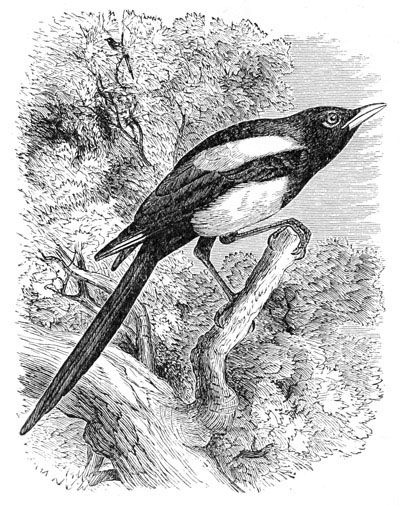
Pica nuttalli.
Sp. Char. Bill and naked skin behind the eye black. General color black. The belly, scapulars, and inner webs of the primaries white; hind part of back grayish; exposed portion of the tail-feathers glossy green, tinged with purple and violet near the end; wings glossed with green; the secondaries and tertials with blue; throat-feathers spotted with white in younger specimens. Length, 19.00; wing, 8.50; tail, 13.00. Young in color and appearance similar generally to the adult.
Hab. The northern regions of North America. The middle and western Provinces of the United States exclusive of California; Wisconsin, Michigan, and Northern Illinois, in winter.
The American Magpie is almost exactly similar to the European, and differs only in larger size and disproportionably longer tail. According to Maximilian and other authors, the iris of the American bird has a grayish-blue outer ring, wanting in the European bird, and the voice is quite different. It is, however, difficult to consider the two birds otherwise than as geographical races of one primitive stock.
Habits. The American Magpie has an extended western distribution from Arizona on the south to Alaska on the northwest. It has been met with as far to the east as the Missouri River, and is found from there to the Pacific. It is abundant at Sitka; it was observed at Ounga, one of the Shumagin Islands, and was obtained by Bischoff at Kodiak.
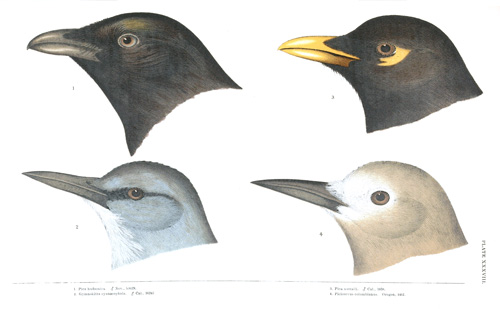
PLATE XXXVIII.
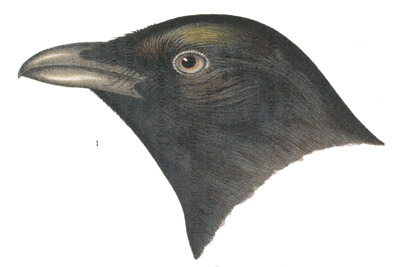
1. Pica hudsonica. ♂ Nev., 53629.
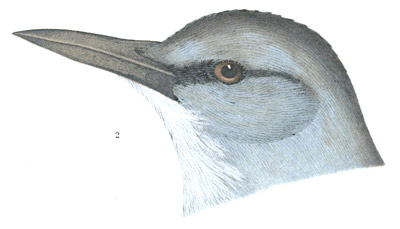
2. Gymnokitta cyanocephala. ♂ Cal., 16247.
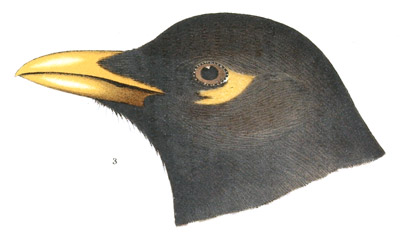
3. Pica nuttalli. ♂ Cal., 3938.
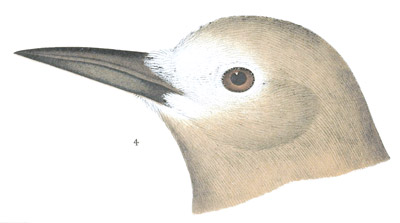
4. Picicorvus columbianus. Oregon, 4461.
Richardson observed these birds on the Saskatchewan, where a few remain even in winter, but are much more frequent in summer.
Mr. Lord, the naturalist of the British branch of the Northwest Boundary Survey, characterizes our Magpie as murderous, because of its cruel persecution of galled and suffering mules, its picking out the eyes of living animals, and its destruction of birds. These birds caused so much trouble to the party, in winter, at Colville, as to become utterly unbearable, and a large number were destroyed by strychnine. They were then so tame and impudent that he repeatedly gave them food from his hand without their showing any evidence of fear. He says they nest in March.
Dr. Suckley states that this Magpie is abundant throughout the central region of Oregon and Washington Territory. He first met with it a hundred miles west of Fort Union, at the mouth of the Yellowstone. It became more abundant as the mountains were approached, and so continued almost as far west as the Cascade Mountains, where the dense forests were an effectual barrier. On Puget Sound he saw none until August, after which, during the fall, it was tolerably abundant. It breeds throughout the interior. He obtained a young bird, nearly fledged, about May 5, at Fort Dalles. At this place a few birds remain throughout the winter, but a majority retire farther south during the cold weather. One of its cries, he says, resembles a peculiar call of Steller’s Jay.
Mr. Ridgway regards this Magpie as one of the most characteristic and conspicuous birds of the interior region, distinguished both for the elegance of its form and the beauty of its plumage. While not at all rare in the fertile mountain cañons, the principal resort of this species is the rich bottom-land of the rivers. The usual note of the Magpie is a frequently uttered chatter, very peculiar, and, when once heard, easily recognized. During the nesting-season it utters a softer and more musical and plaintive note, sounding something like kay´-e-ehk-kay-e. It generally flies about in small flocks, and, like others of its family, is very fond of tormenting owls. In the winter, in company with the Ravens, it resorts to the slaughter-houses to feed on offal. The young differ but little in plumage from the adult, the metallic colors being even a little more vivid; the white spotting of the throat is characteristic of the immature bird.
The nests were found by Mr. Ridgway in various situations. Some were in cedars, some in willows, and others in low shrubs. In every instance the nest was domed, the inner and real nest being enclosed in an immense thorny covering, which far exceeded it in bulk. In the side of this thorny protection is a winding passage leading into the nest, possibly designed to conceal the very long tail of the bird, which, if exposed to view, would endanger its safety.
Dr. Cooper first met this bird east of the Cascade Mountains, near the Yakima, and from there in his journey northward as far as the 49th degree it was common, as well as in all the open unwooded regions until the mountains were passed on his return westward.
Dr. Kennerly met with these birds on the Little Colorado in New Mexico, in December. He found them in great numbers soon after leaving the Rio Grande, and from time to time on the march to California. They seemed to live indifferently in the deep cañons among the hills or in the valleys, but were only found near water.
Dr. Newberry first met with these birds on the banks of one of the tributaries of the Des Chutes, one hundred miles south of the Columbia, afterwards on the Columbia, but nowhere in large numbers. He regards them as much less gregarious in their habits than Pica nuttalli, as all the birds he noticed were solitary or in pairs, while the Yellow-bills were often seen in flocks of several hundreds.
All accounts of this bird agree in representing it as frequently a great source of annoyance to parties of exploration, especially in its attacks upon horses worn down and galled by fatigue and privations. In the memorable narrative of Colonel Pike’s journey in New Mexico, these birds, rendered bold and voracious by want, are described as assembling around that miserable party in great numbers, picking the sore backs of their perishing horses, and snatching at all the food they could reach. The party of Lewis and Clark, who were the first to add this bird to our fauna, also describe them as familiar and voracious, penetrating into their tents, snatching the meat even from their dishes, and frequently, when the hunters were engaged in dressing their game, seizing the meat suspended within a foot or two of their heads.
Mr. Nuttall, in his tour across the continent, found these birds so familiar and greedy as to be easily taken, as they approached the encampment for food, by the Indian boys, who kept them prisoners. They soon became reconciled to their confinement, and were continually hopping around and tugging and struggling for any offal thrown to them.
Observers have reported this bird from different parts of Arizona and New Mexico; but Dr. Coues writes me that he never saw it at Fort Whipple, or elsewhere in the first-named Territory. He found it breeding, however, in the Raton Mountains, in June, under the following circumstances, recorded at the time in his journal.
“Yesterday, the 8th, we were rolling over smooth prairie, ascending a little the while, but so gradually that only the change in the flora indicated the difference in elevation. The flowery verdure was passed, scrubby junipers came thicker and faster, and pine-clad mountain-tops took shape before us. We made the pass to-day, rounding along a picturesque ravine, and the noon halt gave me a chance to see something of the birds. Troops of beautiful Swallows were on wing, and as their backs turned in their wayward flight, the violet-green colors betrayed the species. A colony of them were breeding on the face of a cliff, apparently like H. lunifrons, but the nests were not accessible. Whilst I was watching their movements, a harsh scream attracted my attention, and the next moment a beautiful Magpie flew swiftly past with quivering wings, and with a flirt of the glittering tail and a curious evolution dashed into a dense thicket close by. In the hope of seeing him again, and perhaps of finding his nest, I hurried to the spot where he had disappeared, and pushed into the underbrush. In a few moments I stood in a little open space, surrounded on all sides and covered above with a network of vines interlacing the twigs and foliage so closely that the sun’s rays hardly struggled through. A pretty shady bower! and there, sure enough, was the nest, not likely to be overlooked, for it was as big as a bushel basket,—a globular mass, hung in the top of one of the taller saplings, about twelve feet from the ground. The mother bird was at home, and my bustling approach alarmed her; she flew out of the nest with loud cries of distress, which brought the male to her side in an instant. As I scrambled up the slender trunk, which swayed with my weight, both birds kept flying about my head with redoubled outcry, alighting for an instant, then dashing past again so close that I thought they would peck at me. As I had no means of preserving the nest, I would not take it down, and contented myself with such observations as I could make whilst bestriding a limb altogether too slender for comfort. It was nearly spherical in shape, seemed to be about eighteen inches in diameter, arched over, with a small hole on one side. The walls, composed entirely of interlaced twigs bristling outwardly in every direction, were extremely thick, the space inside being much less than one would expect, and seemingly hardly enough to accommodate the bird’s long tail, which I suppose must be held upright. The nest was lined with a little coarse dried grass, and contained six young ones nearly ready to fly. Authors state that the American Magpie lays only two eggs; but I suppose that this particular pair lived too far from scientific centres to find out what was expected of them. Other birds, noticed to-day, were Steller’s Jays among the pines and cedars, a flock of Chrysomitris, apparently pinus, feeding on willow-buds along the rivulet that threaded the gorge, and some Robins.”
The eggs of this Magpie are somewhat larger than any I have seen of P. nuttalli, and are differently marked and colored. Six specimens from the Sierra Nevada exhibit the following measurements: 1.40 × 0.98, 1.22 × 1.00, 1.41 × 0.95, 1.28 × 0.95, 1.26 × 0.92, 1.32 × 0.96. Their ground-color is a grayish-white, or light gray with a yellowish tinge, spotted with blotches, dottings, and dashes of a purplish or violet brown. In some they are sparsely distributed, showing plainly the ground, more confluent at the larger end. In others they are finer, more generally and more thickly distributed. In others they are much larger and of deeper color, and cover the whole of the larger end with one large cloud of confluent markings. None of these closely resembles the eggs of P. nuttalli. The usual number of eggs in a nest, according to Mr. Ridgway, varies from six to nine, although it is said that ten are sometimes found.
Pica caudata, var. nuttalli, Aud.
YELLOW-BILLED MAGPIE.
Pica nuttalli, Aud. Orn. Biog. IV, 1838, 450, pl. ccclxii.—Ib. Syn. 1839, 152.—Ib. Birds Am. IV, 1842, 104, pl. ccxxviii.—Bon. List, 1838.—Ib. Conspectus, 1850, 383.—Nuttall, Man. I, (2d ed.,) 1840, 236.—Newberry, Rep. P. R. R. VI, IV, 1857, 84.—Baird, Birds N. Am. 1858, 578, pl. xxvi.—Heerm. X, S, 54.—Cooper, Orn. Cal. I, 1870, 295. Cleptes nuttalli, Gambel, J. A. N. Sc. Ph. 2d Series, I, 1847, 46.
Sp. Char. Bill, and naked skin behind the eye, bright yellow; otherwise similar to P. hudsonica. Length, 17.00; wing, 8.00; tail. 10.00.
Hab. California (Sacramento Valley, and southern coast region).
We cannot look upon the Yellow-billed Magpie otherwise than as a local race of the common kind, since it is well known that among the Jays many species have the bill either black or yellow according to sex, age, or locality; and as the Yellow-billed Magpie occupies a more southern locality than usual, and one very different from that of the black-billed species, it well may exhibit a special geographical variation. The great restriction in range is another argument in favor of its being a simple variety.
Habits. The Yellow-billed Magpie seems to be exclusively a bird of California, where it is very abundant, and where it replaces almost entirely the more eastern form. Mr. Ridgway, who met with this variety only in the valley of the Sacramento, states that he there found it very abundant among the oaks of that region. It differed from the common Magpie in being exceedingly gregarious, moving about among the oak groves in small companies, incessantly chattering as it flew, or as it sat among the branches of the trees. He saw many of their nests in the tops of the oaks,—indeed, all were so situated,—yet he never met with the nests of the other species in a high tree, not even in the river valleys. The young of this Magpie have the white of the scapulars marked with rusty triangular spots.
Dr. Cooper found this Magpie abundant in the valleys of California, especially near the middle of the State, except during the spring months, when none were seen in the Santa Clara Valley, the supposition being that they had retired eastward to the mountains to build their nests. At Santa Barbara he found them numerous in April and May, and saw their nests in oak-trees. The young were already fledged by the 25th of April. The nest, he states, is composed of a large mass of coarse twigs twisted together in a spherical form, with a hole in the side. The eggs he saw resembled those of the other species, and are described as being whitish-green, spotted with cinereous-gray and olive-brown. They also breed abundantly about Monterey. They have not been traced to the northern border of the State.
Their food, Dr. Cooper adds, consists of almost everything animal and vegetable that they can find, and they come about farms and gardens to pick up whatever they can meet with. They have a loud call that sounds like pait-pait, with a variety of chattering notes, in tone resembling the human voice, which, indeed, they can be taught to imitate.
An egg of this species from Monterey, California, is of a rounded oval shape, a little less obtuse at one end than the other. The ground-color is a light drab, so closely marked with fine cloudings of an obscure lavender color as nearly to conceal the ground, and to give the egg the appearance of an almost uniform violet-brown. It measures 1.20 inches in length by .90 in breadth.
Genus CYANURA, Swainson.
Cyanurus, Swainson, F. Bor.-Am. II, 1831, 495, Appendix. (Type, Corvus cristatus, Linn.)
Cyanocitta, Cabanis, Mus. Hein. 1851 (not of Strickland, 1845).
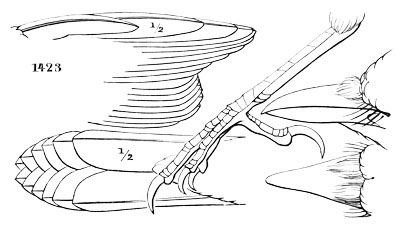
Cyanura cristata. 1423
Gen. Char. Head crested. Wings and tail blue, with transverse black bars; head and back of the same color. Bill rather slender, somewhat broader than high at the base; culmen about equal to the head. Nostrils large, nearly circular, concealed by bristles. Tail about as long as the wings, lengthened, graduated. Hind claw large, longer than its digit.
Species and Varieties.
Common Characters. Wings and tail deep blue, the latter, with the secondaries and tertials, sometimes also the greater coverts, barred with black.
A. Greater coverts, tertials, secondaries, and tail-feathers tipped broadly with white; lower parts generally, including lateral and under parts of head, whitish.
C. cristata. Head above, back, scapulars, lesser wing-coverts, rump and upper tail-coverts, light ashy purplish-blue; a narrow frontal band, a loral spot, streak behind the eye, and collar round the neck, commencing under the crest, passing down across the end of the auriculars and expanding into a crescent across the jugulum, black; throat tinged with purplish-gray, the breast and sides with smoky-gray; abdomen, anal region, and crissum pure white. Wing, 5.70; tail, 6.00; bill, 1.25; tarsus, 1.35; middle toe, .85; crest, 2.20. Hab. Eastern Province of North America.
B. No white on wing or tail; lower parts deep blue.
C. stelleri. Color deep blue, less intense than on wings and tail, except dorsal region, which may be deep blue, ashy-brown, or sooty-black. Head and neck dark grayish-brown, dusky-blue, or deep black, the throat more grayish.
a. No white patch over the eye; throat and chin not abruptly lighter than adjacent parts; secondary coverts not barred with black.
Whole head, neck, jugulum, and dorsal region plain sooty-black; no blue streaks on forehead, or else these only faintly indicated. The blue everywhere of a uniform dull greenish-indigo shade. Depth of bill, .45; crest, 2.60; wing, 6.00; tail, 6.00; culmen, 1.35; tarsus, 1.75; middle toe, 1.00. Hab. Northwest coast, from Sitka to the Columbia … var. stelleri.
Whole head, neck, jugulum, and dorsal region plumbeous-umber; the forehead conspicuously streaked with blue, and the crest washed with the same. The blue of two very different shades, the wings and tail being deep indigo, the body and tail-coverts greenish cobalt-blue. Depth of bill, .35; crest, 2.80; wing, 6.00; tail, 6.00; culmen, 1.25; tarsus, 1.55; middle toe, .90. Hab. Sierra Nevada, from Fort Crook to Fort Tejon … var. frontalis.
b. A patch of silky white over the eye; throat and chin abruptly lighter than the adjoining parts; secondary coverts barred distinctly with black.
Whole crest, cheeks, and foreneck deep black; the crest scarcely tinged with blue; dorsal region light ashy-plumbeous; forehead conspicuously streaked with milk-white. The blue contrasted as in var. frontalis. Depth of bill, .35; crest, 3.00; wing, 6.10; tail, 6.10; culmen, 1.25; tarsus, 1.65; middle toe, .90. Hab. Rocky Mountains of United States … var. macrolopha
Whole crest, cheeks, and foreneck deep black, the crest strongly tinged with blue; dorsal region greenish plumbeous-blue. The blue nearly uniform; forehead conspicuously streaked with bluish-white. Depth of bill, .35; crest, 2.80; wing, 5.90; tail, 5.90; culmen, 1.30; tarsus, 1.60; middle toe, .90. Hab. Highlands of Mexico … var. diademata.[56]
Whole crest, cheeks, and foreneck deep blue, lores black; dorsal region deep purplish-blue; forehead conspicuously streaked with light blue. The blue of a uniform shade—deep purplish-indigo—throughout. Depth of bill, .40; length of crest, 2.50; wing, 5.80; tail, 5.80; culmen, 1.30; tarsus, 1.60; middle toe, .95. Hab. Southeastern Mexico (Xalapa, Belize, etc.) … var. coronata.[57]
The different varieties just indicated under Cyanura stelleri, namely, stelleri, frontalis, macrolopha, diademata, and coronata, all appear to represent well-marked and easily defined races of one primitive species, the gradation from one form to the other being very regular, and agreeing with the general variation attendant upon geographical distribution. Thus, beginning with C. stelleri, we have the anterior part of head and body, including interscapular region, black, without any markings on the head. In frontalis the back is lighter, and a glossy blue shows on the forehead. In macrolopha the blue of posterior parts invades the anterior, tingeing them very decidedly, leaving the head black, with a blue shade to the crest; the forehead is glossed with bluish-white; the upper eyelids have a white spot. In coronata the blue tinge is deeper, and pervades the entire body, except the side of the head. The shade of blue is different from macrolopha, and more like that of stelleri; diademata, intermediate in habitat between macrolopha and coronata, is also intermediate in colors. The tail becomes rather more even, and the bill more slender, as we proceed from stelleri to coronata. The bars on the secondary coverts become darker in the same progression.
Cyanura cristata, Swainson.
BLUE JAY.
Corvus cristatus, Linn. Syst. Nat. I, (10th ed.,) 1758, 106; (12th ed.,) 1766, 157.—Gmelin, Syst. Nat. I, 1788, 369.—Wilson, Am. Orn. I, 1808, 2, pl. I, f. 1.—Bon. Obs. Wilson, 1824, No. 41.—Doughty, Cab. N. H. II, 1832, 62, pl. vi.—Aud. Orn. Biog. II, 1834, 11; V, 1839, 475, pl. cii. Garrulus cristatus, “Vieillot, Encyclop. 890.”—Ib. Dict. XI, 477.—Bon. Syn. 1828, 58.—Sw. F. Bor.-Am. II, 1831, 293.—Vieillot, Galerie, I, 1824, 160, pl. cii.—Aud. Birds Am. IV, 110, pl. ccxxxi.—Max. Caban. J. 1858, VI, 192. Pica cristata, Wagler, Syst. Av. 1827, Pica, No. 8. Cyanurus cristatus, Swainson, F. Bor.-Am. II, 1831, App. 495.—Baird, Birds N. Am. 1858, 580.—Samuels, 364.—Allen, B. E. Fla. 297. Cyanocorax cristatus, Bon. List, 1838. Cyanocitta cristata, Strickland, Ann. Mag. N. H. 1845, 261.—Cabanis, Mus. Hein. 1851, 221. Cyanogarrulus cristatus, Bon. Consp. 1850, 376.
Sp. Char. Crest about one third longer than the bill. Tail much graduated. General color above light purplish-blue; wings and tail-feathers ultramarine-blue; the secondaries and tertials, the greater wing-coverts, and the exposed surface of the tail, sharply banded with black and broadly tipped with white, except on the central tail-feathers. Beneath white; tinged with purplish-blue on the throat, and with bluish-brown on the sides. A black crescent on the forepart of the breast, the horns passing forward and connecting with a half-collar on the back of the neck. A narrow frontal line and loral region black; feathers on the base of the bill blue, like the crown. Female rather duller in color, and a little smaller. Length, 12.25; wing, 5.65; tail, 5.75.
Hab. Eastern North America, west to the Missouri. Northeastern Texas (Dresser, Ibis, 1865, 494). North to Red River and Moose Factory.
Specimens from north of the United States are larger than more southern ones. A series of specimens from Florida, brought by Mr. Boardman, are quite peculiar in some respects, and probably represent a local race resident there. In these Florida specimens the wing and tail are each an inch or more shorter than in Pennsylvania examples, while the bill is not any smaller. The crest is very short; the white spaces on secondaries and tail-feathers more restricted.
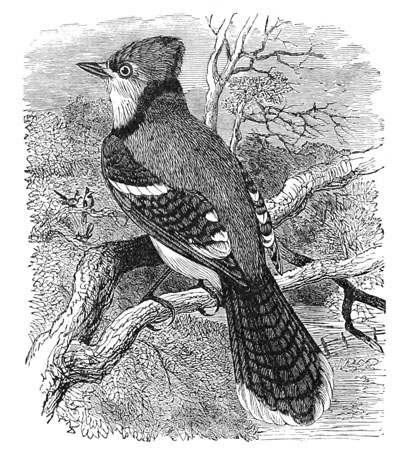
Cyanura cristata.
Habits. The common Blue Jay of North America is found throughout the continent, from the Atlantic coast to the Missouri Valley, and from Florida and Texas to the fur regions nearly or quite to the 56th parallel. It was found breeding near Lake Winnepeg by Donald Gunn. It was also observed in these regions by Sir John Richardson. It was met with by Captain Blakiston on the forks of the Saskatchewan, but not farther west.
The entire family to which this Jay belongs, and of which it is a very conspicuous member, is nearly cosmopolitan as to distribution, and is distinguished by the remarkable intelligence of all its members. Its habits are striking, peculiar, and full of interest, often evincing sagacity, forethought, and intelligence strongly akin to reason. These traits belong not exclusively to any one species or generic subdivision, but are common to the whole family.
When first met with in the wild and unexplored regions of our country, the Jay appears shy and suspicious of the intruder, man. Yet, curious to a remarkable degree, he follows the stranger, watches all his movements, hovers with great pertinacity about his steps, ever keeping at a respectful distance, even before he has been taught to beware of the deadly gun. Afterwards, as he becomes better acquainted with man, the Jay conforms his own conduct to the treatment he receives. Where he is hunted in wanton sport, because of brilliant plumage, or persecuted because of unjust prejudices and a bad reputation not deserved, he is shy and wary, shuns, as much as possible, human society, and, when the hunter intrudes into his retreat, seems to delight to follow and annoy him, and to give the alarm to all dwellers of the woods that their foe is approaching.
In parts of the country, as in Iowa, Illinois, Indiana, and other Western States, where the Jay is unmolested and exempt from persecution, we find him as familiar and confiding as any of the favored birds of the Eastern States. In the groves of Iowa Mr. Allen found our Blue Jay nearly as unsuspicious as a Black-capped Titmouse. In Illinois he speaks of them as very abundant and half domestic. And again, in Indiana, in one of the principal streets of Richmond, the same gentleman found the nest of these birds in a lilac-bush, under the window of a dwelling. In the summer of 1843 I saw a nest of the Jay, filled with young, in a tree standing near the house of Mr. Audubon, in the city of New York. The habits of no two species can well be more unlike than are those which persecution on the one hand and kind treatment on the other have developed in this bird.
The Blue Jay, wherever found, is more or less resident. This is especially the case in the more southern portions of its area of reproduction. In Texas, Dr. Lincecum informs us, this Jay remains both summer and winter. It is there said to build its nest of mud, a material rarely if ever used in more northern localities; and when placed not far from dwelling-houses, it is lined with cotton thread, rags of calico, and the like. They are, he writes, very intelligent and sensible birds, subsisting on insects, acorns, etc. He has occasionally known them to destroy bats. In Texas they seem to seek the protection of man, and to nest near dwellings as a means of safety against Hawks. They nest but once a year, and lay but four eggs. In a female dissected by him, he detected one hundred and twelve ova, and from these data he infers that the natural life of a Jay is about thirty years.
Mr. Allen mentions finding the Blue Jay in Kansas equally at home, and as vivacious and even more gayly colored than at the North. While it seemed to have forgotten none of the droll notes and fantastic ways always to be expected from it, there was added to its manners that familiarity which characterizes it in the more newly settled portions of the country, occasionally surprising one with some new expression of feeling or sentiment, or some unexpected eccentricity in its varied notes, perhaps developed by the more southern surroundings.
The Blue Jay is arboreal in its habits. It prefers the shelter and security of thick covers to more open ground. It is omnivorous, eating either animal or vegetable food, though with an apparent preference for the former, feeding upon insects, their eggs and larvæ, and worms, wherever procurable. It also lays up large stores of acorns and beech mast for food in winter, when insects cannot be procured in sufficient abundance. Even at this season it hunts for and devours in large quantities the eggs of the destructive tent caterpillar.
The Jay is charged with a propensity to destroy the eggs and young of the smaller birds, and has even been accused of killing full-grown birds. I am not able to verify these charges, but they seem to be too generally conceded to be disputed. These are the only serious grounds of complaint that can be brought against it, and are more than outweighed, tenfold, by the immense services it renders to man in the destruction of his enemies. Its depredations on the garden or the farm are too trivial to be mentioned.
The Blue Jay is conspicuous as a musician. He exhibits a variety in his notes, and occasionally a beauty and a harmony in his song, for which few give him due credit. Wilson compares his position among our singing birds to that of the trumpeter in the band. His notes he varies to an almost infinite extent, at one time screaming with all his might, at another warbling with all the softness of tone and moderation of the Bluebird, and again imparting to his voice a grating harshness that is indescribable.
The power of mimicry possessed by the Jay, though different from, is hardly surpassed by that of the Mocking-Bird. It especially delights to imitate the cries of the Sparrow Hawk, and at other times those of the Red-tailed and Red-shouldered Hawks are given with such similarity that the small birds fly to a covert, and the inmates of the poultry-yard are in the greatest alarm. Dr. Jared P. Kirtland, of Cleveland, on whose grounds a large colony of Jays took up their abode and became very familiar, has given me a very interesting account of their habits. The following is an extract: “They soon became so familiar as to feed about our yards and corn-cribs. At the dawn of every pleasant day throughout the year, the nesting-season excepted, a stranger in my house might well suppose that all the axles in the country were screeching aloud for lubrication, hearing the harsh and discordant utterances of these birds. During the day the poultry might be frequently seen running into their hiding-places, and the gobbler with his upturned eye searching the heavens for the enemy, all excited and alarmed by the mimic utterances of the adapt ventriloquists, the Jays, simulating the cries of the Red-shouldered and the Red-tailed Hawks. The domestic circle of the barn-yard evidently never gained any insight into the deception by experience; for, though the trick was repeated every few hours, the excitement would always be re-enacted.”
When reared from the nest, these birds become very tame, and are perfectly reconciled to confinement. They very soon grow into amusing pets, learning to imitate the human voice, and to simulate almost every sound that they hear. Wilson gives an account of one that had been brought up in a family of a gentleman in South Carolina that displayed great intelligence, and had all the loquacity of a parrot. This bird could utter several words with great distinctness, and, whenever called, would immediately answer to its name with great sociability.
The late Dr. Esteep, of Canton, Ohio, an experienced bird-fancier, assured Dr. Kirtland that he has invariably found the Blue Jay more ingenious, cunning, and teachable than any other species of bird he has ever attempted to instruct.
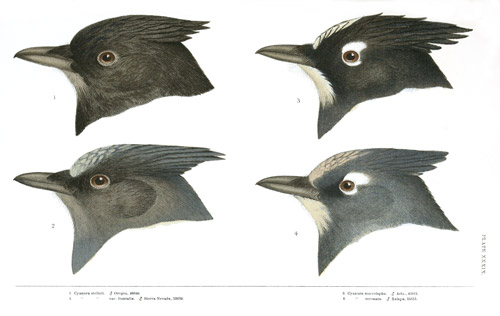
PLATE XXXIX.
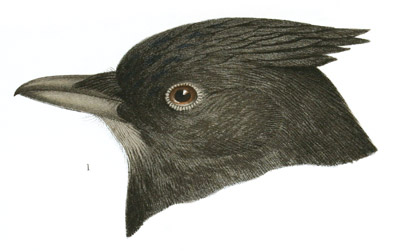
1. Cyanura stelleri. ♂ Oregon, 46040.
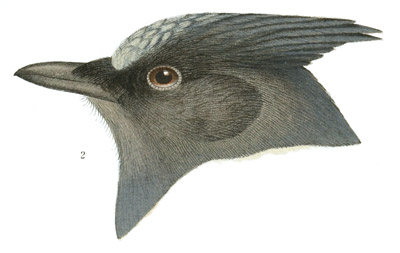
2. Cyanura stelleri. var. frontalis. ♂ Sierra Nevada, 53639.
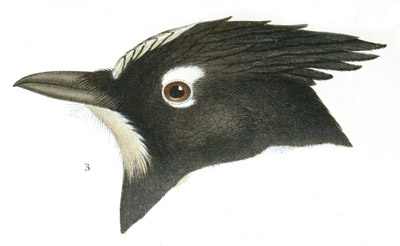
3. Cyanura macrolopha. ♂ Ariz., 41015.
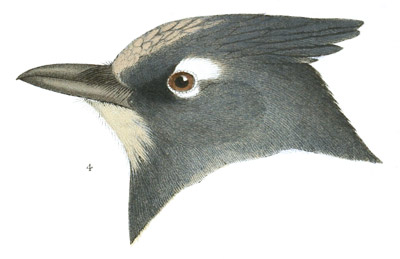
4. Cyanura coronata. ♂ Xalapa, 16313.
Dr. Kirtland has also informed me of the almost invaluable services rendered to the farmers in his neighborhood, by the Blue Jays, in the destruction of caterpillars. When he first settled on his farm, he found every apple and wild-cherry tree in the vicinity extensively disfigured and denuded of its leaves by the larvæ of the Clisiocampa americana, or the tent caterpillar. The evil was so extensive that even the best farmers despaired of counteracting it. Not long after the Jays colonized upon his place he found they were feeding their young quite extensively with these larvæ, and so thoroughly that two or three years afterwards not a worm was to be seen in that neighborhood; and more recently he has searched for it in vain, in order to rear cabinet specimens of the moth.
The Jay builds a strong coarse nest in the branch of some forest or orchard tree, or even in a low bush. It is formed of twigs rudely but strongly interwoven, and is lined with dark fibrous roots. The eggs are usually five, and rarely six in number.
The eggs of this species are usually of a rounded-oval shape, obtuse, and of very equal size at either end. Their ground-color is a brownish-olive, varying in depth, and occasionally an olive-drab. They are sparingly spotted with darker olive-brown. In size they vary from 1.05 to 1.20 inches in length, and in breadth from .82 to .88 of an inch. Their average size is about 1.15 by .86 of an inch.
Cyanura stelleri, Swainson.
STELLER’S JAY.
Corvus stelleri, Gmelin, Syst. Nat. I, 1788, 370.—Lath. Ind. Orn. I, 1790, 158.—Pallas, Zoog. Rosso-As. I, 1811, 393.—Bonap. Zoöl. Jour. III, 1827, 49.—Ib. Suppl. Syn. 1828, 433.—Aud. Orn. Biog. IV, 1838, 453, pl. ccclxii. Garrulus stelleri, Vieillot, Dict. XII, 1817, 481.—Bonap. Am. Orn. II, 1828, 44, pl. xiii.—Nuttall, Man. I, 1832, 229.—Aud. Syn. 1839, 154.—Ib. Birds Am. IV, 1842, 107, pl. ccxxx (not of Swainson, F. Bor.-Am.?). Cyanurus stelleri, Swainson, F. Bor.-Am. II, 1831, 495, App. Pica stelleri, Wagler, Syst. Av. 1827, Pica, No. 10. Cyanocorax stelleri, Bon. List, 1838. Finsch, Abh. Nat. III, 1872, 40 (Alaska). Cyanocitta stelleri, Cab. Mus. Hein. 1851, 221. Newberry, P. R. R. Rep. VI, IV, 1857, 85. Cyanogarrulus stelleri, Bonap. Conspectus, 1850, 377. Steller’s Crow, Pennant, Arctic Zoöl. II, Sp. 139. Lath. Syn. I, 387. Cyanura s. Baird, Birds N. Am. 1858, 581 (in part). Lord, Pr. R. A. Inst. IV, 122 (British Columbia; nest).—Dall & Bannister, Trans. Chicago Acad. I, 1869, 486 (Alaska).—Cooper, Orn. Cal. 1, 1870, 298 (in part).
Sp. Char. Crest about one third longer than the bill. Fifth quill longest; second about equal to the secondary quills. Tail graduated; lateral feathers about .70 of an inch shortest. Head and neck all round, and forepart of breast, dark brownish-black. Back and lesser wing-coverts blackish-brown, the scapulars glossed with blue. Under parts, rump, tail-coverts, and wings greenish-blue; exposed surfaces of lesser quills dark indigo-blue; tertials and ends of tail-feathers rather obsoletely banded with black. Feathers of the forehead streaked with greenish-blue. Length, about 13.00; wing, 5.85; tail, 5.85; tarsus, 1.75 (1,921).
Hab. Pacific coast of North America, from the Columbia River to Sitka; east to St. Mary’s Mission, Rocky Mountains.
Habits. Dr. Suckley regarded Steller’s Jay as probably the most abundant bird of its size in all the wooded country between the Rocky Mountains and the Pacific. He describes it as tame, loquacious, and possessed of the most impudent curiosity. It is a hardy, tough bird, and a constant winter resident of Washington Territory. It is remarkable for its varied cries and notes, and seems to have one for every emotion or pursuit in which it is engaged. It also has a great fondness for imitating the notes of other birds. Dr. Suckley states that frequently when pleasantly excited by the hope of obtaining a rare bird, in consequence of hearing an unknown note issuing from some clump of bushes or thicket, he has been not a little disappointed by finding that it had issued from this Jay. It mimics accurately the principal cry of the Catbird.
Dr. Cooper also found it very common in all the forests on both sides of the Cascade Mountains. While it seemed to depend chiefly upon the forest for its food, in the winter it would make visits to the vicinity of houses, and steal anything eatable it could find within its reach, even potatoes. In these forages upon the gardens and farm-yards, they are both silent and watchful, evidently conscious of the peril of their undertaking, and when discovered they instantly fly off to the concealment of the forests. They also make visits to the Indian lodges when the owners are absent, and force their way into them if possible, one of their number keeping watch. In the forest they do not appear to be shy or timid, but boldly follow those who intrude upon their domain, screaming, and calling their companions around them. Hazel-nuts are one of their great articles of winter food; and Dr. Cooper states that, in order to break the shell, the Jay resorts to the ingenious expedient of taking them to a branch of a tree, fixing them in a crotch or cavity, and hammering them with its bill until it can reach the meat within. Their nest he describes as large, loosely built of sticks, and placed in a bush or low tree.
At certain seasons of the year its food consisted almost entirely of the seeds of the pine, particularly of P. brachyptera, which Dr. Newberry states he has often seen them extracting from the cones, and with which the stomachs of those he killed were usually filled. He found these birds ranging as far north as the line of the British Territory, and from the coast to the Rocky Mountains.
In his Western journey Mr. Nuttall met with these birds in the Blue Mountains of the Oregon, east of Walla-walla. There he found them scarce and shy. Afterwards he found them abundant in the pine forests of the Columbia, where their loud trumpeting clangor was heard at all hours of the day, calling out with a loud voice, djay-djay, or chattering with a variety of other notes, some of them similar to those of the common Blue Jay. They are more bold and familiar than our Jay. Watchful as a dog, no sooner does a stranger show himself in their vicinity than they neglect all other employment to come round him, following and sometimes scolding at him with great pertinacity and signs of irritability. At other times, stimulated by curiosity, they follow for a while in perfect silence, until something seems to arouse their ire, and then their vociferous cries are poured out with unceasing volubility till the intruder has passed from their view.
In the month of May, Mr. Nuttall found a nest of these birds in a small sapling of the Douglas fir, on the borders of a dense forest, and, some time after, a second nest with young, in an elevated branch of another fir, on the border of a rocky cliff. The first nest contained four eggs, of a pale green, marked with small olive-brown spots, varied with others inclining to a violet hue. The parents flew at him with the utmost anger and agitation, almost deafening him with their cries; and although he took only two of their eggs, the next day he found they had forsaken their nest. This nest was bulky, made of interlaced twigs and roots, with a stout layer of mud, and lined with black rootlets. One of the eggs taken by Mr. Nuttall is in my cabinet, and is as he describes it, except that the obscure markings of violet have nearly faded out. It measures 1.20 inches in length, and .90 in breadth, is oval in shape, and a little more obtuse at one end than at the other.
This Jay was obtained by Steller at Nootka, on the west coast of Vancouver Island, in latitude 50°. It was also found in abundance by Mr. Dall at Sitka, in British Columbia, where a number of specimens were obtained by Mr. Bischoff and by Mr. Elliot.
Mr. J. K. Lord states that this Jay ever makes its presence known by the constant utterance of discordant screams. It is continually hopping from bough to bough, darting down to catch an insect, performing short, erratic flights, and jerking up and down its crest of bright feathers. Its noisy song seems to be everywhere. It is the embodiment of restlessness, and, by dint of sheer impudence, attracts attention even from the hunter. He adds that it seemed fond of frequenting the haunts of man, and is always plentiful near Indian lodges or white men’s shanties. It is by no means epicurean in taste, but readily devours anything, whether seeds or salmon, grasshoppers or venison. Its nest he found artfully concealed amidst the thick foliage of a young pine-tree. It was composed of moss, small twigs, lichens, and fir fronds, and lined with deer’s hair. The average number of eggs laid appears to be seven.
Cyanura stelleri, var. frontalis, Ridgway.
SIERRA JAY.
Cyanura stelleri, Auct. All reference to Steller’s Jay as occurring in California, excepting on the northern Coast Range, relate to this variety.
Sp. Char. Head, neck, and dorsal region plumbeous-umber, darker on the head, and posteriorly changing gradually into the light greenish-blue of the rest of the body; wings and tail deep indigo-blue, the tertials, secondaries, and tail conspicuously marked with broad and rather distant bars of black; primaries greenish light-blue, like the rump, abdomen, etc. Whole forehead conspicuously streaked with blue (the streaks forming two parallel series, where the feathers are not disarranged), and the crest strongly tinged with blue. ♂ (53,639, Carson City, Nevada, April 30, 1868): wing, 6.00; tail, 6.00; culmen, 1.25; depth of bill, .35; tarsus, 1.55; middle toe, .90; crest, 2.80. ♀ (53,640, Carson City, Nevada, April 30, 1868): wing, 5.70; tail, 5.50. Young with the blue of the body and head entirely replaced by a sooty grayish; and that of the wings and tail duller, and less distinctly barred.
Hab. Whole length of the Sierra Nevada, from Fort Crook (where it approaches var. stelleri) to Fort Tejon.
In the colors of the body, wings, and tail, this well-marked race resembles C. macrolopha in every respect, except that the greater coverts are not barred with black; there being the same abrupt contrast between the deep blue of the wings and tail, and the light greenish-blue of the body, tail-coverts, and primaries,—seen only in these two forms. The variety is confined to the mountains of California and Western Nevada, extending along the Sierra Nevada about the entire length of the State, there being specimens in the collection from Fort Crook and Fort Tejon, and intermediate localities.
Habits. The Blue-fronted Jay, so far as it was observed by Mr. Ridgway, was found to be exclusively an inhabitant of the pine woods of the Sierra Nevada, and is, with Clarke’s Nutcracker, one of the most characteristic birds of that region. In its general habits and manners, it greatly resembles the eastern Blue Jay, but is rather more shy, while its notes are very different, and do not possess the variety and flexibility of the cristata, but are in comparison harsh and discordant. The usual note is a hoarse, deep-toned monosyllabic squawk. Sometimes it utters a hollow sonorous chatter.
Near Carson City one of these birds had been winged by a shot, and, in falling, alighted on the lower branches of a pine-tree. Upon an attempt to capture it, the bird began to ascend the tree limb by limb, at the same time uttering a perfect imitation of the cry of the Red-tailed Hawk, evidently in the hope of frightening away his tormentors. Dr. Newberry regards this Jay as the western counterpart of the C. cristata. By its more conspicuous crest, its bold, defiant air, and its excessively harsh and disagreeable cry, it challenges and secures attention. He found it almost exclusively confined to the hilly and mountainous districts, choosing in preference those covered with pines.
Dr. Heermann found these Jays abundant and resident as far south as Warner’s Ranch, where, though common, they were for some reason so unusually wild and vigilant as not to be easily procurable. In feeding, he observed that they seemed always to begin in the lower branches and ascend, hopping from twig to twig, to the topmost point, and, while thus employed, utter a harsh screaming note that can be heard to a considerable distance.
This species, Dr. Cooper states, is numerous in the mountains of California, inhabiting the whole length of the Sierra Nevada, and the Coast Range as far south, at least, as Santa Cruz. Though showing a decided preference for the pine forests, they sometimes in winter frequent those of oaks. They are omnivorous, eating seeds, acorns, nuts, insects, and in winter even potatoes and dead fish. They are at times bold and prying, and at others very cautious and suspicious. They soon learn to appreciate a gun, and show great sagacity in their movements to avoid its peril. On the Columbia they lay in May, and in California about a month earlier.
Cyanura stelleri, var. macrolopha, Baird.
LONG-CRESTED JAY.
Cyanocitta macrolopha, Baird, Pr. A. N. Sc.Phila. VII, June, 1854, 118 (Albuquerque). ? Garrulus stelleri, Swainson, F. Bor.-Am. II, 1831, 294, pl. liv (head-waters of Columbia; figure of a bird intermediate between C. stelleri and macrolopha). Cyanura macrolopha, Baird, Birds N. Am. 1858, 582.—Elliot, Illust. Am. B, I, xvii.—Cooper, Orn. Cal. 1, 1870, 300.
Sp. Char. Crest nearly twice the length of the bill. Tail moderately graduated; the lateral feathers about .60 of an inch shorter than the middle. Fourth and fifth quills longest; second shorter than the secondaries. Head all round, throat, and forepart of the breast, black, the crest with a gloss of blue; rest of back dark ashy-brown with a gloss of greenish. Under parts, rump, tail-coverts, and outer surfaces of primaries, greenish-blue; greater coverts, secondaries, and tertials, and upper surface of tail-feathers bright blue, banded with black; forehead streaked with opaque white, passing behind into pale blue; a white patch over the eye. Chin grayish. Length, 12.50; wing, 5.85; tail, 5.85; tarsus, 1.70 (8,351).
Hab. Central line of Rocky Mountains from northern border of the United States to table-lands of Mexico; Fort Whipple, Arizona.
Young birds have the bright blue of body and black of head replaced by a dull slate; the head unvaried.
An apparent link between this variety and C. stelleri is represented in the Smithsonian collection by three specimens from the region towards the head-waters of the Columbia, where the respective areas of distribution of the two overlap. In this the anterior parts of the body are nearly as black as in stelleri (much darker than macrolopha), with the short crest; but the forehead (except in one specimen) is streaked with blue, and there is a white patch over the eye. As in stelleri, there are no black bars on the greater wing-coverts. As this is an abundant form, whether permanent race or hybrid, it may be called var. annectens.
Habits. The Long-crested Jay appears to occur throughout the central range of the Rocky Mountains from British Columbia to Mexico, where it is replaced by a closely allied species or race, the Cyanura coronata of Swainson.
Mr. Ridgway met with this Jay only among the Wahsatch and the Uintah Mountains. They appeared to be rather common in those regions, though far from being abundant. In their manners and in their notes they are described as having been almost an exact counterpart of the Sierra Nevada form. Their notes, however, are said to be not so loud nor so coarse as those of the more western species. A nest, found by Mr. Ridgway, June 25, 1869, in Parley’s Park, Wahsatch Mountains, was in a small fir-tree on the edge of a wood. It was saddled on a horizontal branch about fifteen feet from the ground, and contained six eggs. The base of the nest was composed of coarse strong sticks, rudely put together. Upon this was constructed a solid, firm plastering of mud of a uniform concave shape, lined with fine wiry roots. The external diameter is about nine inches, and the height of the nest four. The interior is five inches in diameter, and three in depth.
The species was first described by Professor Baird, from specimens obtained by Dr. Kennerly, who writes that he first saw this bird among the lofty pines of the Sierra Madre in November, 1853. Leaving that range, he did not meet with it again until his party crossed the Aztec Mountains, in January, 1854, where it was less abundant than when first met with. It was, for the most part, found among the cedars on the high grounds, though occasionally seen among the clumps of large pines that were scattered along the valley. The party did not meet with it again.
Dr. Coues found this species a common and a resident bird in Arizona. It was observed to be almost exclusively an inhabitant of pine woods, and was generally to be met with only in small companies, never congregating in the manner of Woodhouse’s Jay. He describes it as very shy, vigilant, noisy, and tyrannical.
The eggs of C. macrolopha measure 1.30 inches in length and .91 in breadth. Their ground-color is a light sea-green. They are somewhat sparingly spotted with fine markings of dark olive-brown, and lighter cloudings of a purplish or violet brown. They are oblong oval in shape, obtuse at either end, but more tapering at one end. They appear to be a little larger than the eggs of stelleri, and the ground-color is brighter, and the markings deeper and more of an olive hue.
Genus CYANOCITTA, Strickland.
Cyanocitta, Strickland, Annals and Mag. N. H. XV, 1845, 260. (Type, Garrulus californicus, Vigors.)
Aphelocoma, Cabanis, Mus. Hein. 1851, 221. (Same type.)
Char. Head without crest. Wings and tail blue, without any bands. Back usually with a gray patch, different from the head. Bill about as broad as high at the base, and the culmen a little shorter than the head. Nostrils large, nearly circular, and concealed. Tail nearly equal to the wings, lengthened, graduated, or else shorter and nearly even.
This genus is readily distinguished from the preceding by the entire absence of crest and of black bars on the blue of wings and tail. The species and races hitherto described will be found detailed in the accompanying synopsis. The characters indicated above are of no very great generic value, but as the group is a very natural one it will be as well to retain it. As in Cyanura, the species are peculiar to the United States and Mexico, one indeed being apparently confined to the Peninsula of Florida.
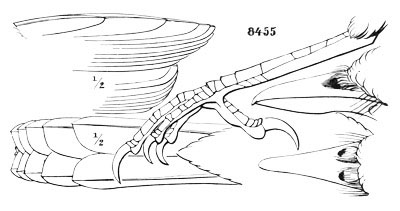
Cyanocitta californica. 8455
It would perhaps be not very far out of the way to consider Sections A and B as representing in their general characters, respectively, the types from which their subdivisions have sprung.
A. Tail longer than wings. A superciliary stripe of whitish streaks; jugular and pectoral feathers faintly edged with bluish, posteriorly forming an indistinct collar, interrupted medially. Ear-coverts dusky, except in var. woodhousei.
a. Forehead and nasal tufts hoary white; the superciliary stripe a continuous wash of the same. Scapulars blue like the wings; dorsal region (the interscapulars) as light-colored as the lower parts.
C. floridana. Back and lower parts pale ashy-brown; lower tail-coverts bright blue. Wing, 4.50; tail, 5.70; bill, 1.20 and .35; tarsus, 1.40; middle toe, .85. Wing-formula, 4, 5, 6, 7, 3, 8, 9, 2, 10; first, 1.80 shorter than longest. Graduation of tail, 1.50. Hab. Florida (only).
b. Forehead and nasal tufts bright blue; superciliary stripe composed of narrow streaks; scapulars ashy like the back; back much darker than the lower parts.
C. californica.
Lower tail-coverts bright blue, dorsal region not well-defined ashy; auriculars bluish, beneath continuous pure ash. Superciliary streak well defined. Wing, 5.15; tail, 6.00; bill, 1.35 and .30; tarsus, 1.40; middle toe, .85. Wing-formula, fourth, fifth, and sixth equal; 7, 3, 8, 9 = 2; first, 1.80 shorter than longest. Graduation of tail, .90. Hab. Rocky Mountains and Middle Province of United States … var. woodhousei.
Lower tail-coverts pure white; dorsal region well-defined ashy; auriculars blackish; beneath dull white, approaching ash on breast. Superciliary streak indistinct. Wing, 5.65; tail, 6.00; bill, 1.20 and .35; tarsus, 1.42; middle toe, .90. Wing-formula, 5, 6, 7, 4, 8, 3, 9, 10 = 2; first, 2.20 shorter than longest. Graduation of tail, .80. Hab. Mexico (Orizaba; City of Mexico) … var. sumichrasti.[58]
Superciliary streak sharply defined, conspicuous. Wing, 5.00; tail, 5.60; bill, 1.20 and .37; tarsus, 1.55; middle toe, .95. Wing-formula, 4, 5, 6, 7, 3, 8, 9, 2, 10; first, 2.10 shorter than longest. Graduation of tail, 1.15. Hab. Pacific Province of United States; Cape St. Lucas … var. californica.
B. Tail not longer than wings, or considerably shorter. No superciliary stripe, and no streaks on throat or jugulum. Auriculars blue like the crown.
C. ultramarina. Lower parts whitish, conspicuously different from the upper.
Tail nearly, or perfectly even.
Length, 13.00; tail even; bill, 1.50; tail, 7.00. Hab. Mexico … var. ultramarina.[59]
Length, 11.50; tail very slightly rounded (graduation, .25 only); bill, 1.28 and .35; tail, 50. Above bright blue, dorsal region obscured slightly with ashy; beneath dull pale ash, becoming gradually whitish posteriorly, the crissum being pure ash. Lores blue. Tarsus, 1.45; middle toe, .95. Wing-formula, 5, 4 = 6, 7, 3, 8, 9, 10, 2; first, 2.10 shorter than longest. Graduation of tail, .25. Hab. Lower Rio Grande … var. couchi.
Tail considerably rounded.
Colors as in couchi, but dorsal region scarcely obscured by ashy. Lores black. Wing, 7.50; tail, 7.50; bill, 1.30 and .40; tarsus, 1.60; middle toe, .90. Wing-formula, 5, 4, 6, 3 = 7, 8, 9, 2; first, 2.75, shorter than longest. Graduation of tail, 1.15. Hab. Mexico (Orizaba, Mirador, etc.) … var. sordida.[60]
Graduation of the colors as in sordida, but the blue, instead of being a bright ultramarine, is very much paler and duller, and with a greenish cast, the whole dorsal region decidedly ashy; ash of the pectoral region much paler, and throat similar, instead of decidedly whitish, in contrast; pure white of posterior lower parts covering whole abdomen instead of being confined to crissum. Wing, 6.20; tail, 5.70; bill, 1.30 and .40; tarsus, 1.50; middle toe, .97. Wing-formula, fourth, fifth, and sixth equal; 7, 3, 8, 9, 2; first, 2.20, shorter than longest. Graduation of tail, .50. Hab. Southern Rocky Mountains (Fort Buchanan, and Copper Mines, Arizona) … var. arizonæ.
C. unicolor.[61] Lower parts bright blue, like the upper. Entirely uniform rich ultramarine-blue; lores black. Wing, 6.70; tail, 6.70; bill, 1.30 and .50; tarsus, 1.45; middle toe, .95. Wing-formula, 5, 6, 4, 7, 3, 8, 9, 2; first, 2.60 shorter than longest. Graduation of tail, 1.50. Hab. Southern Mexico (Cordova, Mirador, etc.); Guatemala.
In the first section of this group we see the same indication of variation from a common type with the region that is so evident in Cyanura. Thus, Cyanocitta woodhousei differs from californica, much as Cyanura macrolopha does from C. stelleri (var. frontalis), in more slender bill and a greater percentage of blue; this invading the back and under parts, the lower tail-coverts especially. But here the parallel of modification ends, for the Mexican representative of the species (C. sumichrasti) appears to revert back to the characters of californica, having like it a minimum amount of blue, though this almost obliterates the superciliary stripe of white. In this respect there is more resemblance to the case of Pipilo fusca and its three races in the three regions inhabited by these representative forms of Cyanocitta californica; for, while the Mexican (P. fusca) and Californian (P. crissalis) are very much alike, the one from the intervening region (P. mesoleuca) is more different from the two extreme races than they are from each other.
In the other section of the genus the relation between arizonæ and sordida is a parallel to that between Cyanura macrolopha and C. coronata; the southern forms (sordida and coronata) differing principally in the greater intensity and prevalence or amount of the blue. The relations of couchi and ultramarina to the two above mentioned are yet obscure, owing to the small material at command,—there being only two specimens of the former, and none of the latter, in the National Museum at Washington.
Cyanocitta floridana, Bonap.
FLORIDA JAY.
Corvus floridanus, Bartram, Travels, 1791, 291.—Aud. Orn. Biog. I, 1831, 444, pl. lxxxvii. Garrulus floridanus, Bon. Am. Orn. II, 1828, 11, pl. xi.—Nuttall, Man. I, 1832, 230.—Aud. Syn. 1839, 154.—Ib. Birds Am. IV, 1842, 118, pl. ccxxxiii. Cyanurus floridanus, Swainson, F. B. A. II, 1831, 495. Cyanocorax floridanus, Bon. List, 1838. Cyanocitta floridana, Bon. Consp. 1850, 377.—Baird, Birds N. Am. 1858, 586.—Allen, B. E. Fla. 298. Aphelocoma floridana, Cabanis, Mus. Hein. 1851, 22. Garrulus cyaneus, Vieillot, Nouv. Dict. XII, 1817, 476 (not described). ? Garrulus cærulescens, Vieillot, Nouv. Dict. XII, 1817, 480.—Ord. J. A. N. Sc. I, 1818, 347. Pica cærulescens, Wagler, Syst. Av. 1827, Pica, No. 11.
Sp. Char. Tail much graduated; lateral feathers nearly 1.50 inches shortest. Tail an inch longer than the wings. Above blue, including scapulars; interscapular region and back brownish-ash, the former lighter. Forehead and sides of the crown, including the nasal feathers, hoary white. Sides of head and neck blue; the former tinged with blackish, the latter sending a streaked collar of the same entirely across the breast; region anterior to this collar dirty white, streaked on the edges of the feathers with blue; rest of under parts dirty whitish-brown; under tail-coverts blue, the tibia tinged with the same. Length, 11.00; wing, 4.50; tail, 5.70; tarsus, 1.45.
Hab. Florida only, and quite local.
Habits. This beautiful species appears to be exclusively confined to the peninsula of Florida, and there is no authentic evidence that it has ever been found outside of the limits of that State. The statement of Bonaparte, that these birds are found in the States of Louisiana and Kentucky, has never been confirmed, and Mr. Audubon, who was for many years a resident of both States and familiar with the birds of each, was very positive the statement was without foundation. It has never been observed even in Georgia or Alabama, and Mr. Nuttall states that it is not found in any part of West Florida.
Mr. Allen, in his recent paper on the winter birds of East Florida, speaking of this species, states that it is numerous in the scrub, but does not appear to frequent the pine woods, the hummocks, or the swamps. He saw none along the St. John’s, except at Blue Springs, but they occur in numbers a few miles back from the river.
Dr. Bryant, in his Notes on the birds of Florida, mentions that this species is tolerably plentiful in the vicinity of Enterprise. He regarded it as exceedingly interesting on account of its limited geographical distribution. With no apparent obstacle to its movements, it is yet confined to a small part of the peninsula of Florida, its area of distribution north and south not exceeding three degrees of latitude, if so much. He saw none north of St. Augustine, and none south of Jupiter’s Inlet. So far as he observed them, they were exclusively confined to the growth of scrub-oak, which in many places is so entangled with creeping plants that it is impossible to walk through without cutting a path. This growth is generally found on elevated ridges running parallel to the sea-coast. The most extensive of these, near Enterprise, is about three miles wide, and eighty feet above the lake.
The flight of this species is said by Mr. Audubon to be performed at a short distance from the ground, and to consist either of a single sailing sweep, as it passes from one tree to another, or of continuous flappings with a slightly undulating motion, in the manner of the Canada Jay. Its notes are described as softer than those of the Blue Jay, and more frequently uttered. Its motions are also quicker and more abrupt. Its food is said to consist of snails, which it collects on the ground, insects, and various kinds of fruits and berries. It is also charged with being very destructive of eggs and young birds.
The Florida Jay is said to be easily kept in confinement, feeding readily on dried or fresh fruit and the kernels of various nuts, and soon appears to be reconciled to its loss of liberty. It secures its food between its feet, and breaks it into pieces before swallowing it. In this way it feeds on the acorn of the live-oak, snails, and the seeds of the sword-palmetto.
The nest of this Jay is formed of dry sticks, placed across each other, and, although rounded in form, is so lightly made that the birds may be seen through its interstices. It is lined with fibrous rootlets. Only one brood is raised in a season. Audubon’s descriptions of its eggs are inaccurate, and only applicable to those of the Blue Jay.
Mr. Audubon observed a pair of these birds in confinement in New Orleans. They were fed upon rice and dry fruit. At dessert they were allowed their liberty, when they would fly to the table, feed on the almonds given them, and drink claret diluted with water. They attempted to mimic various sounds, but did so very imperfectly.
Mr. Nuttall states that at the approach of winter these birds retire to the south of St. Augustine. He regards their voice as less harsh than that of the Blue Jay, and states that they have a variety of notes, some of which are probably imitations, and are said to resemble the song of the Wood Thrush and the calls of the common Jay.
An egg of the Florida Jay before me is of a rounded oval shape, being nearly equally obtuse at either end. The ground-color is a light bluish-gray, marked almost exclusively at the larger end with a few small spots of a light rufous-brown. It has no near resemblance to the eggs of the California Jay, nor to those of any other Jay that I have seen. It measures 1.05 inches by .80.
In its flight and action, Dr. Bryant thought the Florida Jay resembled the Mocking-Bird. It has none of the restless, suspicious manner of the Blue Jay. He never heard it utter more than a single note, this being much softer than the usual cry of the Blue Jay; its song he regarded as rather monotonous. It seldom flies more than a short distance at a time, and seems to trust for protection to the difficulty of access to its abode. It also evinces a great partiality for particular localities. Generally only a single pair is seen at a time, though in one place he has seen three pairs together. It is not fond of civilization, and is seldom known to frequent the vicinity of dwellings.
A nest found by Dr. Bryant on the 15th of April was built in a scrub-oak about three feet from the ground. It was made of small twigs, compactly and carefully lined with fibres of the dwarf palmetto, that had apparently been brought a distance of half a mile. The cavity measured about five inches in breadth and one and a half in depth. The nest contained three eggs of a light blue, sparingly sprinkled with rufous, the spots being larger and more numerous towards the larger end. Another nest, found a few days later, contained five eggs of a more neutral tint, with the spots darker, larger, and more evenly distributed.
Cyanocitta californica, Strickland.
CALIFORNIA JAY.
Garrulus californicus, Vigors, Zoöl. Beechey’s Voyage, 1839, 21, pl. v. Cyanocitta californica, Strickland, Ann. Mag. XV, 1845, 342.—Gambel, J. A. N. Sc. 2d series, I, Dec. 1847, 45.—Bon. Conspectus, 1850, 377.—Newberry, P. R. R. Rep. VI, IV, 1857, 85.—Baird, Birds N. Am. 1858, 584.—Heerm. X, S, 55.—Cooper, Orn. Cal. 1, 1870, 302. Cyanocorax californicus, Gambel, Pr. A. N. Sc. III, Ap. 1847, 201. Aphelocoma californica, Cabanis, Mus. Hein. 1851, 221.—Bon. Comptes Rendus, XXXVII, Nov. 1853, 828; Notes Orn. Delattre. Corvus ultramarinus, Aud. Orn. Biog. IV, 1838, 456, pl. ccclxii (not Garrulus ultramarinus, Bon.). Garrulus ultramarinus, Aud. Syn. 1839, 154.—Ib. Birds Am. IV, 1842, 115, pl. ccxxxii (not of Bonaparte). Cyanocitta superciliosa, Strickland, Ann. Mag. XV, 1845, 260 (type of genus Cyanocitta). “Corvus palliatus, Drapiez,” Bonap.
Sp. Char. Width of bill at base of lower mandible rather more than half the length of culmen. Lateral tail-feathers about an inch the shortest. Tail an inch longer than the wings. General color above, including the surface of the wings, bright blue, without bars. The whole back, including to some extent the scapulars, brownish-ash, very faintly glossed with blue in the adult. À streaked white superciliary line from a little anterior to the eye as far as the occiput. Sides of the head and neck blue, the region around and behind the eye, including lores and most of ear-coverts, black. The blue of the sides of the neck extends across the forepart of the breast, forming a crescent, interrupted in the middle. The under parts anterior to the crescent white, the feathers edged with blue; behind it dull white; the sides tinged with brown. Length, 12.25; wing, 5.00; tail, 6.15; tarsus, 1.55. (No. 2,841.)
Hab. Pacific Province from Columbia River to Cape St. Lucas; Carson City, Nevada (Ridgway).
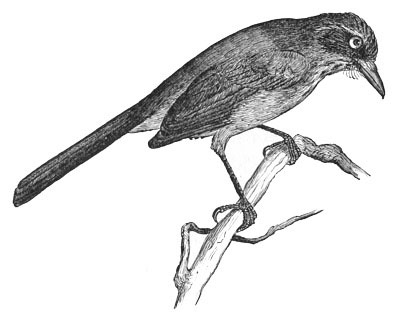
Cyanocitta californica.
Specimens from Cape St. Lucas are rather smaller and perhaps whiter beneath than elsewhere; those from the eastern slope of Sierra Nevada are very large. Upon a careful comparison, we find that the supposed specimens of C. californica in the Smithsonian collection from Mexico (Orizaba, etc.) constitute a quite different form, characterized by very indistinct superciliary white and bluish edges to throat and jugular feathers, and especially by the lengthened wings, which average 5.75 inches instead of 5.00. In general respects the resemblance, as suggested by Sclater, is to californica, and not to woodhousei. The dorsal patch is very distinct.
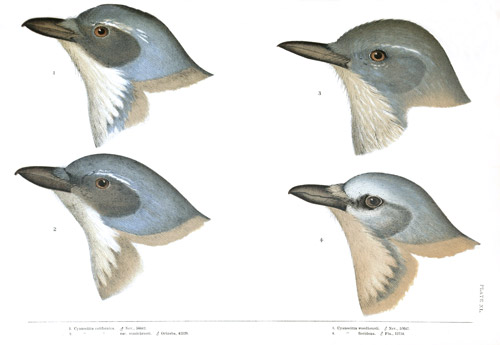
PLATE XL.
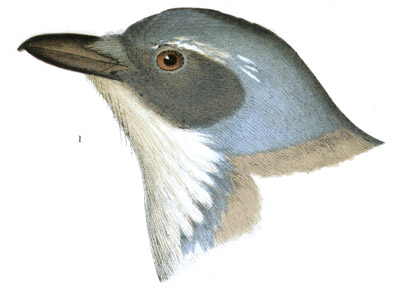
1. Cyanocitta californica. ♂ Nev., 56642.
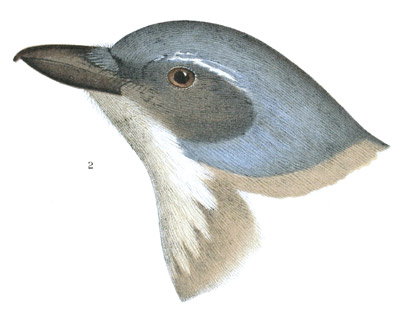
2. Cyanocitta californica. var. sumichrasti. ♂ Orizaba, 42129.
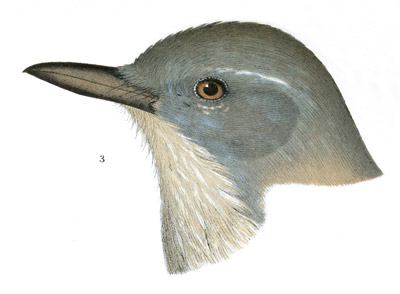
3. Cyanocitta woodhousii. ♂ Nev., 53647.
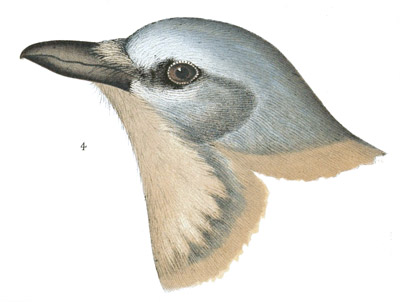
4. Cyanocitta floridana. ♂ Fla., 13734.
One Mexican specimen (8,465 from Real del Monte?), presented by Mr. John Gould, differs again in having the dorsal patch obscured by a bluish wash; an unusual amount of blue edging to the throat and jugular feathers, and a dull brownish tinge to the belly. It almost suggests the possibility of a hybrid form between sumichrasti and ultramarina.
Habits. The California Jay appears to be a Pacific coast species, occurring from the Columbia River southward to Cape St. Lucas, but not found in the interior at any considerable distance from the coast. Mr. Ridgway speaks of it as the Valley Jay of California, having been observed by him in abundance only among the oaks of the Sacramento Valley, the brushwood of the ravines, and the scattered pines of the foot-hills along the western base of the Sierra Nevada. It was also quite common, in April, in the vicinity of Carson City, where he found it breeding. Its notes and manners, he adds, are very similar to those of the Woodhouse Jay, belonging to the wooded regions of the interior, but the shrill cries of this species are even more piercing. There is, moreover, something in its appearance, caused by the sharp contrast of the bright blue, the light ash, and the pure white colors, by which it may be distinguished at a glance from the more uniformly colored woodhousei.
Dr. Heerman speaks of it as frequenting to some extent the same districts as Steller’s Jay, but also found in greater abundance throughout the valleys. He likewise describes it as noisy, alert, and cunning in its habits, wild and wary, and yet often seeking the habitations of man, near which to rear its young, drawn thither by the abundance of food found in such localities. Their nests, he states, are built in a thick-leaved bush, or on the lower branches of an oak, at but little height from the ground. They are constructed of twigs, and are lined with fine rootlets. The eggs, four in number, are, he says, emerald-green in color, profusely dotted with umber-brown spots.
Dr. Newberry states that he found the trees and the thickets bordering the streams in the valleys the favorite haunts of the California Jay. As his party ascended among the evergreen forests of the higher grounds, and passed northeasterly from the Sacramento Valley, these birds were no longer met with, and long before reaching the Oregon line they lost sight of it altogether. Nor did they meet with it again until their return to California. This Jay, he adds, has all the sprightliness and restlessness of the family, but is less noisy, and its notes are far more agreeable than those of Steller’s Jay, by which it is replaced at the north.
The Smithsonian Museum has a specimen of this species obtained on the Columbia by Townsend, and Mr. Nuttall mentions that early in October, on arriving at the forests of the Columbia, near Fort Vancouver, he met with it in company with Steller’s Jay. They were breeding in the dark pine woods, and by the 15th of June they were feeding their fully fledged young. He also states that they were found as far north as Fraser’s River, migrating to the south at the approach of winter. Without questioning the correctness of this statement, it is worthy of mention that these birds have not been met there by more recent collectors, and that Dr. Newberry nowhere met with them in Oregon. Dr. Cooper suggests that, since then, the increased severity of the winters may have driven them permanently farther south.
Mr. Nuttall describes its habits as very much like those of the Blue Jay. It usually flies out to the tops of the tallest pines, jerks its tail, and perches playfully on some extreme branch, where, as if in anger, it calls woit, woit-woit, with an occasional recognition note of twee-twee. When pursued, it retreats to the shade of the loftiest branches. It feeds on insects, acorns, which it breaks up, and pine seeds. He describes it as a graceful, active, and shy bird, with a note much less harsh and loud than that of Steller’s Jay.
Dr. Cooper remarks that this species is one of the most common and conspicuous of the birds of the State of California. They frequent every locality in which oak-trees are found, even within the limits of large towns, where they enter gardens and audaciously plunder the fruit. They have all the usual cunning of their tribe, and when alarmed become very quiet, and conceal themselves in the thick foliage. They are usually noisy and fearless, and their odd cries, grotesque actions, and bright plumage make them general favorites in spite of their depredations. They are also said to have a talent for mimicry, besides notes to express their various wants and ideas.
They breed abundantly throughout the western parts of California, and construct a large and strong nest of twigs, roots, and grass. These are placed in a low tree or bush. They lay about five eggs, which Dr. Cooper describes as dark green marked with numerous pale brown blotches and spots, and measure 1.80 by 1.04 inches. At San Diego he found these eggs laid as early as April 5.
This Jay inhabits the Coast Range of mountains to their summit, south of San Francisco, and the Sierra Nevada as far as the oaks extend, or to an elevation of from 1,000 to 5,000 feet. Dr. Cooper saw none on the east side of the Sierra Nevada in latitude 39°.
He describes their flight as slow and laborious, on account of their short wings, and states that they never fly far at a time. He also accuses them of being very destructive to the eggs of smaller birds, hunting for them in the spring, and watching the movements of other birds with great attention.
Mr. Xantus found these birds very abundant at Cape St. Lucas, being, like all the other resident species there, much smaller than those occurring in more northern localities. Their habits are said to be very much the same.
This species was taken in winter near Oaxaca, Mexico, by Mr. Boucard.
Four eggs of this species from different parts of California present the following measurements: 1.20 × 0.85; 1.10 × 0.80; 1.13 × 0.80; 1.05 × 0.80. The measurements given by Dr. Cooper we are confident must be a mistake. Their ground-color is a bright, but not a dark, emerald-green; and they are marked and blotched with faint purplish-brown, and deeper spots of dark umber. These spots are sparingly distributed, and are chiefly about the larger end. In one they are wholly of a light violet-brown. These eggs are of a perfectly oval shape.
Mr. Charles D. Gibbes, of Stockton, writes that he found in a garden in that city a nest built by a pair of these birds that had become half domesticated. It was placed in a very thick arbor of honeysuckle. The body of the nest was composed of clippings from a hedge of osage orange, with thorns on them half an inch long. These twigs were tied and interlaced with twine and bits of cotton strings. Within this frame was a layer of fine weeds and grasses nicely arranged, the whole lined with horse-hair. The nest was found in May, and contained five eggs. The parents kept a good deal about the kitchen door, and would steal anything they had an opportunity to take. They made use of an old nest in the same garden as a receptacle for their stolen goods; among other things was found a large slice of bread-and-butter.
Cyanocitta californica, var. woodhousei, Baird.
WOODHOUSE’S JAY.
Cyanocitta woodhousei, Baird, Birds N. Am. 1858, 585, pl. lix.—Ib. Mex. B. II, Birds, 20, pl. xxi.—Cooper, Orn. Cal. 1, 1870, 304.
Sp. Char. Size and general appearance of C. californica. Bill slender. Graduation of tail one inch. Blue, with a very obscure ashy patch on the back. Sides of the head and neck and incomplete pectoral collar, blue; throat streaked with the same. Breast and belly uniform brownish-ash, glossed with blue; under tail-coverts bright blue. Sides of head, including lores, black, glossed with blue below; a streaked white superciliary line. Length, 11.50; wing, 5.35; tail, 6.10; tarsus, 1.60. Young. All the blue, except that of the wings and tail, replaced by dull ash.
Hab. Rocky Mountains and Middle Province of United States; north to Idaho and Wyoming (Ridgway); south to Northern Mexico; east to Wyoming and Colorado.
The bluish wash on the back nearly obscuring the dorsal patch, the general ashy tinge of the under parts, the decided blue under tail-coverts, and the longer and much slenderer bill, distinguish this form from californica, although probably both are geographical races of the same species.
Habits. This bird was first met with by Dr. Woodhouse among the San Francisco Mountains of New Mexico, and was given by him, in his Report of the Sitgreaves Expedition, as the California Jay. He states in regard to it, that wherever he found the piñon, or nut-pine (Pinus edulis), growing in New Mexico, this bird was sure to be there in great numbers, feeding upon the fruit of those trees. Among the men it was known as the piñon bird. Its notes are said to be harsh and disagreeable. It was extremely restless, and was continually in motion, flying from tree to tree, uttering its well-known cries.
Mr. Ridgway calls this a very interesting species, and states that it was found very abundant in the fertile cañons of the West Humboldt Mountains, as well as in all the extensive nut-pine and cedar woods to the eastward. On the Toyaba and East Humboldt Mountains, and the extensive piñon woods in Southern Idaho, it was equally common. In Utah, in the cañons of the Wahsatch Mountains, it was occasionally seen, though oftener observed in the valley of the Weber. When unmolested, this bird is, he states, very unsuspicious, and anything unusual at once excites its curiosity. Often when at work, in camp, skinning birds, on the edge of bushes, one of them would approach within a few feet, and quietly watch every movement. At Unionsville they were quite common in the gardens and around the door-yards of the town, and were very familiar and unsuspicious. Their cries greatly resembled those of the California Jay, and consisted of a repetition of harsh screeching notes.
This species, according to Dr. Coues, is a resident and a very abundant species in Arizona, where it is one of the most characteristic species. It was found in all situations, but seemed to shun dense pine woods, and to prefer to keep on the open hillsides, among the scrub-oaks, etc. In winter it collects in rather large flocks, sometimes as many as fifty together. They are, however, usually seen in small groups of six or seven individuals. They are said to be a restless, vigilant, shy, and noisy species.
Mr. C. E. Aiken found this bird a common and resident species in Colorado. He met with it along the foot of the mountains, in brush thickets, in which they also breed. The base and periphery of a nest found by him were composed of dead twigs, intermingled within with fine rootlets and horsehair. The eggs, four or five in number, are said to be laid about the first of May. They have a ground-color of a light bluish-green, and marked with reddish-brown specks, thickest at the larger end. They are of a rounded oval shape, much more pointed at one end, and rounded at the other, and average 1.06 inches in length by .80 of an inch in breadth.
Cyanocitta ultramarina, var. arizonæ, Ridgway.
Cyanocitta sordida (not of Swains.!), Baird, Birds N. Am. 1858, 587, pl. lx. f. 1.—Ib. Mex. B. II, Birds, 21, pl. xxii, f. 1.—Cooper, Orn. Cal. 1, 1870, 305. Cyanocitta sordida var. arizonæ, Ridgway, Rep. U. S. Geol. Expl. 40th Par.
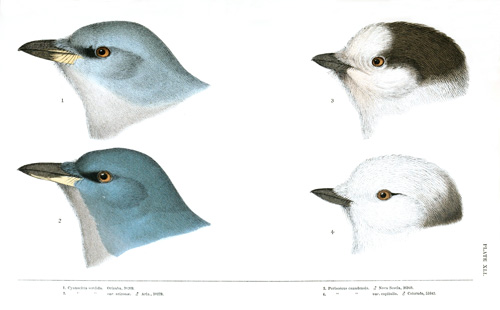
PLATE XLI.
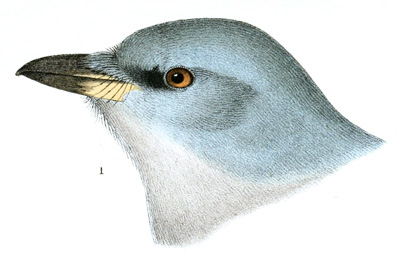
1. Cyanocitta sordida. Orizaba, 38209.
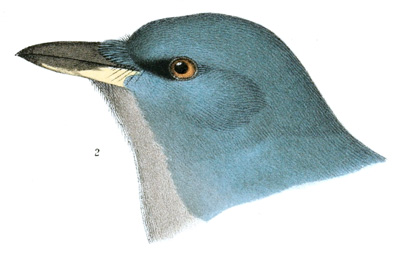
2. Cyanocitta sordida. var. arizonæ. ♂ Ariz., 18279.
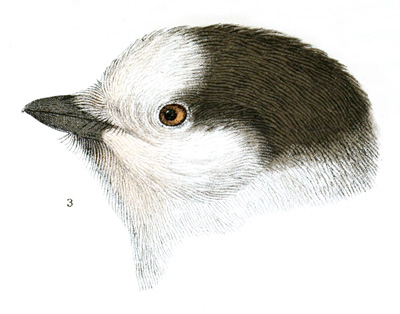
3. Perisoreus canadensis. ♂ Nova Scotia, 26940.
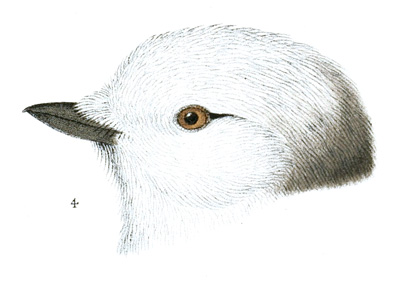
4. Perisoreus canadensis. var. capitalis. ♂ Colorado, 51642.
Sp. Char. Bill short, thick; half as high as long. Wing considerably longer than the tail, which is slightly graduated (.50 of an inch). Upper surface (including whole side of head to the throat) light sky-blue, the whole dorsal region inclining to pure bluish-ashy. Beneath fine, uniform, pale ash for anterior half (including the throat), this gradually fading into white on the posterior portions (including whole abdomen), the lower tail-coverts being pure white. Lores blue. Length, 13.00; wing, 6.20; tail, 5.70; culmen, 1.30; depth of bill, .40; tarsus, 1.50; middle toe, .97. Fourth, fifth, and sixth quills equal and longest, second shorter than ninth; first 2.20 shorter than longest. (18,279, Fort Buchanan, Arizona, December; Dr. Irwin.) Immature (8,469 ♂, Copper Mines, Arizona). The blue, except that of the wings and tail, replaced by dull ash; the blue feathers appearing in scattered patches.
Hab. Arizona (Copper Mines, J. H. Clark; and Fort Buchanan, Dr. Irwin, U. S. A.).
The nearest ally of this race is the var. sordida of Mexico, which, however, differs in many important respects; the differences between the two being giving in the synopsis (page 880), it is unnecessary to repeat them here. In both there is a tendency towards a party-colored bill; each example of the northern style, and most of those of the southern, having more or less whitish on the lower mandible.
Nothing definite is known as to the habits or reproduction of this bird.
Cyanocitta ultramarina, var. couchi, Baird.
ULTRAMARINE JAY.
Garrulus ultramarinus, Bonap. J. A. N. Sc. IV, 1825, 386 (not of Audubon).—Temm. Pl. Col. II, 439. Cyanocitta ultramarina, Strickland, Ann. & Mag. XV, 1845, 260.—Gambel, J. A. N. Sc. 2d Ser. I, 1847, 45.—Baird, Birds N. Am. 588, pl. 60, f. 2.—Ib. Mex. B. II, Birds 21, pl. xxii. Cyanogarrulus ultramarinus, Bon. Consp. 1850, 378. Cyanocitta couchi, Baird, Birds N. Am. 1858, 588.
Sp. Char. Tail rounded, but little graduated; lateral feather about a quarter of an inch shortest. Wings longer than the tail; when closed, reaching nearly to its middle. Above and on sides of head and neck bright blue; the lores blackish; the middle of the back slightly duller, the tips of some of the feathers dark brown. Beneath brownish-ash, paler on the chin and towards the anal region, which, with the crissum, is white. No trace of white or black on the sides of the head, nor of any streaks or collar on the breast. Length, (fresh,) 11.50; wing, 6.00; tail, (dried,) 5.40; tarsus, 1.50.
Hab. South side of valley of Rio Grande, near the coast, and southward.
This well-marked species is quite different in form from the C. californica, having a shorter, more even tail, much longer wings, and stouter feet. The absence of any collar or streaks on the breast and throat, of black or white on the side of the head, and of decided ash on the back, are very well marked features. There is also much more green in the blue of the head.
As suggested in the P. R. R. Report, the birds collected by Lieutenant Couch at Monterey, Mexico, although agreeing almost exactly with the original description of Bonaparte, are much smaller, and perhaps entitled to recognition as a separate form. The tail is nearly two inches less, 5.40 instead of 7.00, or over.
Habits. The Ultramarine Jay is a well-marked species, and is specifically quite distinct from the C. californica. It is found in the valley of the Rio Grande, and thence southward and eastward in the northern provinces of Mexico. Though we know of no specimens having been procured on this side of the boundary line, their occurrence is quite probable. Lieutenant Couch met with this species near Monterey, Mexico, and from thence west to Parras. He describes it as being gregarious and eminently Jay-like in its habits. They are very noisy and vociferous in their outcries, and three or four of them suffice to keep a whole forest in an uproar. Near Guyapuco a large snake (Georgia obsoleta) was seen pursued by three or four of this species. The reptile was making every effort to escape from their combined attacks, and would, no doubt, have been killed by them, had they not been interfered with. The cause of so much animosity against the snake was explained when, on opening its stomach, three young of this species, about two thirds grown, were found.
In the Department of Vera Cruz, Sumichrast found what he calls C. ultramarina in company with Cyanura coronata and Cyanocitta nana, “californica” (Sumichrasti), and sordida, occurring in the alpine region, and with the three first named restricted to that locality. The limit of their extension is about that of the alpine region, that is, from an elevation of about 4,500 feet to the height of 10,500 feet. The sordida is also found on the plateau.
Genus XANTHOURA, Bonap.
Xanthoura, Bonaparte, Consp. Av. 1850. (Type, “Corvus peruvianus, Gm.”)
Char. Head without crest. Throat black. Lateral tail-feathers bright yellow. Bill very stout, rather higher than broad; culmen curved from the base. Nostrils rather small, oval, concealed by a nasal tuft varying in length with species. Tail longer than the wings; graduated. The wings concave, rounded; the secondaries nearly as long as the primaries. Legs very stout; hind claw about half the total length of the toe.
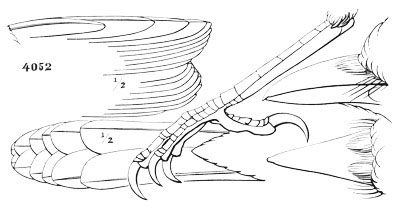
Xanthoura luxuosa. 4052
The genus Xanthoura is composed of three so-called species, of different geographical distribution, and exhibits a progressive change from one to the other, with variation of latitude that enforces assent to the hypothesis of their all belonging to one primitive form. These differences may be expressed as follows:—
Common Characters. Nasal tufts, patch on side of lower jaw and one above eye, (both eyelids,) bright blue; remainder of face and throat black. Back, and upper surface of wings and tail (the four central feathers), green, the latter tinged with blue at end; the rest of tail-feathers bright yellow. Belly and crissum varying from bright yellow to green. Forehead yellowish or whitish.
a. Nasal tufts short, only covering the nostrils; whole top of head (except anteriorly) and nape bright blue.
1. Body beneath, and crissum, green. Hab. Mexico and South Texas … var. luxuosa.
2. Body beneath, and crissum, yellow, sides more greenish. Hab. Guatemala and Honduras … var. guatemalensis.
b. Nasal tuft elongated, forming an anterior crest, the feathers reaching far beyond nostrils. Whole top of head pale heavy yellow, glossed behind with bluish.
3. Body beneath, and crissum, very bright gamboge-yellow. Hab. Colombia, Ecuador, Bogota, and Bolivia … var. incas.
Thus, starting with the green-bellied luxuosa of the Rio Grande, we come to the yellow-bellied guatemalensis; but intermediate localities show different proportions of the two colors. The nasal tufts in the first do not extend beyond the nasal fossæ; and the frontal yellowish is very narrow. In the second these tufts reach beyond the fossæ, and the frontal yellowish is more extended. In incas again the nasal tufts have reached their maximum, while the frontal yellowish extends over the whole cap, leaving only a trace of blue on the nape.
Xanthoura incas, var. luxuosa, Bonap.
GREEN JAY.
Garrulus luxuosus, Lesson, Rev. Zoöl. April, 1839, 100. Cyanocorax luxuosus, Du Bus, Esquisses Ornithologiques, IV, 1848, pl. xviii.—Cassin, Illust. I, 1853, I, pl. i. Xanthoura luxuosa, Bon. Consp. 1850, 380.—Cabanis, Mus. Hein. 1851, 224.—Baird, Birds N. Am. 1858, 589. Pica chloronota, Wagler, Isis, 1829, 750 (young male; name belongs to Corvus peruvianus, Gm.). Cyanocorax cyanicapillus, Cabanis, Fauna Peruana, 1844-46, 233 (note). Cyanocorax yncas, “Boddært,” Lawrence, Ann. N. Y. Lyc. V, April, 1851, 115 (first added here to fauna of United States).
Sp. Char. Wings shorter than the tail, which is much graduated, the lateral feathers 1.25 inches shorter. Above green; beneath yellow, glossed continuously with green; inside of wings and outer four tail-feathers straw-yellow; rest of tail feathers green, glossed with blue. Sides of the head, and beneath from the bill to the forepart of the breast, velvet-black. Crown, nape, and a short maxillary stripe running up to the eye and involving the upper eyelid, brilliant blue; the nostril-feathers rather darker; the sides of the forehead whitish. Bill black; feet lead-color. Length, 11.00; wing, 4.75; tail, 5.40; tarsus, 1.65.
Hab. Valley of Rio Grande, of Texas, and southward.
As remarked above, the passage into the yellow-bellied guatemalensis is gradual as we proceed south; and the latter, and perhaps even the incas, can only be considered as fellow races of a common original species.
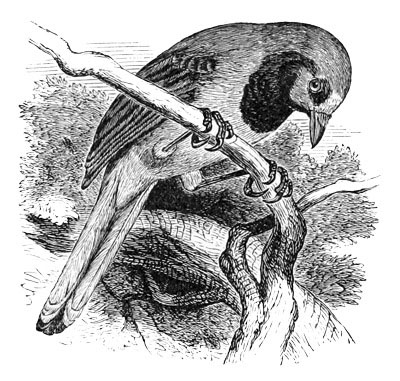
Xanthoura luxuosa.
Habits. Within the limits of the United States this beautiful species has thus far been only met with in Southeastern Texas in the lower valley of the Rio Grande. It was first described in 1839, by M. Lesson, a French naturalist, from a Mexican specimen, and in 1851 was first brought to our notice as a bird of the United States by Mr. Geo. N. Lawrence of New York. Specimens of this bird were obtained by the party of the Mexican Boundary Survey, and by Lieutenant Couch on the Rio Grande, at Matamoras, New Leon, and San Diego, Mexico. The only note as to its habits by Lieutenant Couch is to the effect that it eats seeds and insects.
The late Dr. Berlandier of Matamoras obtained specimens of this bird in the vicinity of that city, which were found among his collections. Among his manuscript notes occurs a description of the plumage and habits of this species, which he had described under the name of Pica cervantesii. In this he states that this bird inhabits the whole eastern coast of Mexico, but that he has only met with it on the banks of the Rio Bravo del Norte, in the vicinity of Matamoras. It is said to be both carnivorous and graminivorous, and comes about the houses in search of the refuse. Although it can swallow whole grains of corn, before eating it breaks them with its beak, holding them between its claws, in the manner of birds of prey, and biting with great force. It is commonly known as Pajaro verde, or Greenbird.
Mr. Dresser states that this species was common on the lower Rio Grande during the winter, but was not found on the Upper Rio Grande or in Texas, except as a straggler from Mexico.
This bird, Mr. Sumichrast states, is common throughout the Department of Vera Cruz, where it is generally known by the name of Verde detoca and Sonaja. It is said to be one of the birds most generally diffused throughout the whole department. It inhabits both the hot and the temperate regions, and is found even at the foot of the alpine, to the altitude of nearly six thousand feet above the sea. It is also said to be abundant in other parts of Mexico. It was observed to be quite numerous on the Tierra templada, or table-lands, and also among the hills that bound the plains of Perote and Puebla on the east, by Mr. William S. Pease, a naturalist who was with General Scott’s army in its campaign in Mexico. Mr. Pease stated that it lived on the sides of the hills throughout the year, and that its local name was Pepe verde.
Colonel George A. McCall, Inspector-General of the United States Army, was the first person to collect these birds within our limits. He obtained them in the forests that border the Rio Grande on the southeastern frontier of Texas. There he found them all mated in the month of May, and he felt no doubt that they had their nests in the extensive and almost impenetrable thickets of mimosa, commonly called chaparral. From the jealousy and pugnacity which these birds manifested on the approach, or appearance even, of the large boat-tailed Blackbirds of that country (Quiscalus macrurus), which were nesting in great numbers in the vicinity, Colonel McCall was satisfied that the Jays were at that time also engaged in the duties of incubation and rearing their young. In character and temperament these birds appeared to be very active and lively, though less noisy than some other species of the family. Their gay plumage was exhibited to great advantage as they flitted from tree to tree, or dashed boldly in pursuit of such of their more plainly attired neighbors as ventured to intrude upon their domain.
Captain J. P. McCown, also quoted by Mr. Cassin, furnishes some additional observations in regard to these birds. He states that during the several years that he was in Texas, he frequently saw these Jays, but never met with them above Ringgold Barracks, or north of the woods that skirt the Rio Grande. They seemed to prefer the acacia groves which have sprung up where the ground has been overflowed. He regards it as a rather cautious bird. He observed nests high up in the trees above mentioned, which he supposes belong to this species, though this was never positively ascertained. He had no doubt that they breed in Texas.
Genus PERISOREUS, Bonap.
Perisoreus, Bonap. Saggio di una dist. met. 1831. (Type, Corvus canadensis?)
Dysornithia, Swainson, F. B. Am.II, 1831, 495. (Same type.)
Char. Feathers lax and full, especially on the back, and of very dull colors, without any blue. Head without distinct crest. Bill very short; broader than high. Culmen scarcely half the length of the head; straight to near the tip, then slightly curved; gonys more curved than culmen. Bill notched at tip. Nostrils round, covered by bristly feathers. Tail about equal to the wings; graduated. Tarsi rather short; but little longer than the middle toe. Plumage very soft, and without any lustre.
The Canada Jay has a near ally in a species of northern Europe and Siberia,—the Siberian Jay (P. infaustus). In size and proportions the two are quite identical, there being about the same proportionate length of wing and tail, and a general correspondence in the minutiæ of external anatomy. In colors, however, they differ entirely; the P. infaustus having the head darker than the body, and uniform (instead of the contrary), and in having the lower primary and lower feathers of the greater coverts, as well as the greater part of the tail, bright rufous.
A. Dusky nuchal hood reaching forward to, or in front of, the eyes; plumbeous-black.
Dorsal feathers with white shafts in old and young. Tail-feathers not distinctly paler at ends.
Dorsal feathers without white shafts in old or young. Tail-feathers broadly tipped with dull white.
2. White frontal patch much broader than length of bill; abruptly defined, with a convex outline behind, against the dusky of the occiput. Upper parts plumbeous, with a slight brownish cast. Wing, 5.25; tail, 5.80; bill, .95 and .35. Young. Entirely uniform dark plumbeous. Hab. Canada, Maine, and Labrador to the Yukon … var. canadensis.
B. Dusky nuchal hood not reaching to the eyes, but confined to the nape; bluish-plumbeous.
3. White frontal patch covering whole crown, melting gradually into the ashy of the nape; upper parts bluish-ashy. Wing, 6.00; tail, 6.00; bill, 1.00 and .31. Young. Bluish-plumbeous, inclining to ashy-white on the crown and cheeks. Hab. Rocky Mountains of United States … var. capitalis.
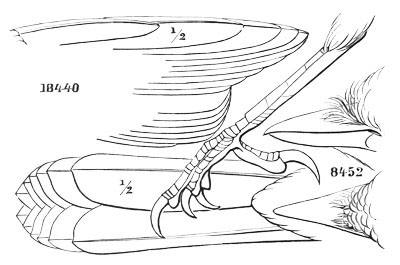
Perisoreus canadensis. 18440 8452
In the more slender form, longer and narrower bill, and paler tints with a predominance of the light colors, of the var. capitalis, compared with the typical, or standard, var. canadensis, we see the peculiar impression of the middle region; while in the var. obscurus, the more dusky tints, and predominance of darker colors, the influence of the well-known law affecting colors in birds of the northwest coast region is seen.
Perisoreus canadensis, Bonap.
CANADA JAY; WHISKEY-JACK; MOOSE-BIRD.
Corvus canadensis, Linn. Syst. Nat. I, 1766, 158.—Forster, Phil. Trans. LXII, 1772, 382.—Wilson, Am. Orn. III, 1811, 33, pl. xxi.—Bon. Obs. 1824, No. 42.—Aud. Orn. Biog. II, 1834, 53; V, 1839, 208, pl. cvii. Garrulus canadensis, Bon. (Saggio, 1831?) Syn. 1828, 58.—Swainson, F. Bor.-Am. II, 1831, 295.—Nuttall, Man. I, 1832, 232.—Aud. Syn. 1839, 155.—Ib. Birds Am. IV, 1842, 121, pl. ccxxxiv. Dysornithia canadensis, Swainson, F. Bor.-Am. II, 1831, Appendix. Perisoreus canadensis, Bon. List, 1838.—Ib. Conspectus, 1850, 375.—Cab. Mus. Hein. 1851, 219.—Newberry, Rep. P. R. R. Surv. VI, IV, 1857, 85.—Baird, Birds N. Am. 1858, 590.—Coues, P. A. N. S. 1861, 226.—Samuels, 366. Garrulus fuscus, Vieillot, Nouv. Dict. XII, 1817, 479. Pica nuchalis, Wagler, Syst. Av. 1827 (Pica No. 14). Garrulus trachyrrhynchus, Swainson, F. Bor.-Am. II, 1831, 296, pl. lv (young). “Coracias mexicanus, Temminck,” Gray.
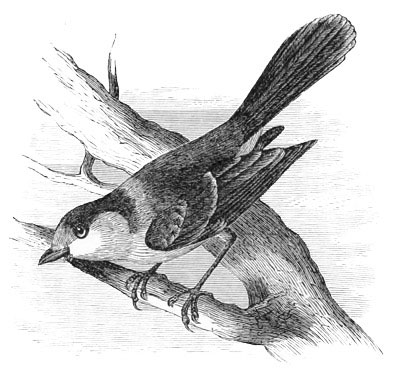
Perisoreus canadensis.
Sp. Char. Tail graduated; lateral feathers about one inch shortest. Wings a little shorter than the tail. Head and neck and forepart of breast white. A rather sooty plumbeous nuchal patch, becoming darker behind, from the middle of the cap to the back, from which it is separated by an interrupted whitish collar. Rest of upper parts dark ashy-plumbeous; the outer primaries margined, the secondaries, tertials, and tail-feathers obscurely tipped with white. Beneath smoky-gray. Crissum whitish. Bill and feet black. Length, 10.70; wing, 5.75; tail, 6.00; tarsus, 1.40.
Hab. Eastern Northern America into the northern part of United States; British America to Upper Yukon.
The young of this species are everywhere of a dull sooty-plumbeous, lighter on the middle of the belly, and more bluish-plumbeous on the wings and tail. With increasing age the region about the base of the bill whitens.
There is a decided bluish cast to the plumbeous of the tail. The white frontal patch has a convex posterior outline, and is abruptly defined against the blackish of the occiput and nape.
All specimens from Canada and the Northeastern United States, to the interior of British America, are referrible to this variety; in the Yukon Territory specimens show a tendency to var. obscurus of the northwest coast, having a narrower whitish frontal patch.