Family FRINGILLIDÆ.—The Finches. (Continued.) (continued 2)
Reading edition
This Finch was found by Salvin about the reeds on the margin of Lake Dueñas, Guatemala, in February, but was not common. It is common, in the winter months, near Oaxaca, Mexico, where it was taken by Mr. Boucard.
Mr. Kennicott saw its nest June 14. This was on the ground, built in a bunch of grass in rather an open and dry place, and containing five eggs. The female permitted him to approach very close to her, until he finally caught her on the nest with his beating-net. Another nest was placed in a bunch of grass growing in the water of a small grassy pond. The nest contained four eggs and one young bird.
The nest and eggs of this species had been previously discovered by Dr. Hoy, near Racine. This is, I believe, the first instance in which it was identified by a naturalist, as also the most southern point at which it has ever been found. These eggs measure .74 by .60 of an inch. They have a pale greenish-white ground, and are thickly marked with dots and small blotches of a ferruginous-brown, often so numerous and confluent as to disguise and partially conceal the ground.
Melospiza palustris, Baird.
SWAMP SPARROW.
Fringilla palustris, Wilson, Am. Orn. III, 1811, 49, pl. xxii, f. 1.—Aud. Orn. Biog. I, 1831, 331; V, 508, pl. lxiv. Fringilla (Spiza) palustris, Bonap. Obs. Wilson, 1825, No. 105. Passerculus palustris, Bonap. List, 1838.—Ib. Conspectus, 1850, 481. Ammodromus palustris, Aud. Syn. 1839.—Ib. Birds Am. III, 1841, 110, pl. clxxv. Melospiza palustris, Baird, Birds N. Am. 1858, 483.—Samuels, 323. ? Fringilla georgiana, Lath. Index Orn. I, 1790, 460 (perhaps Peucæa æstivalis).—Licht. Verz. 1823, No. 251. Fringilla (Ammodromus) georgiana, Nutt. Man. I, (2d ed.,) 1840, 588.
Sp. Char. Middle of the crown uniform chestnut; forehead black; superciliary streak, sides of head and back, and sides of neck, ash. A brown stripe behind the eye. Back with broad streaks of black, which are edged with rusty yellow. Beneath whitish, tinged with ashy anteriorly, especially across the breast, and washed with yellowish-brown on the sides. A few obsolete streaks across the breast, which become distinct on its sides. Wings and tail strongly tinged with rufous; the tertials black, the rufous edgings changing abruptly to white towards the end. Length, 5.75; wing, 2.40.
Female with the crown scarcely reddish streaked with black, and divided by a light line. Young conspicuously streaked beneath the head, above nearly uniform blackish.
Hab. Eastern North America from the Atlantic to the Missouri; north to Fort Simpson.
In autumn the male of this species has the feathers of the crown each with a black streak; and the centre of the crown with an indistinct light stripe, materially changing its appearance.
The forehead is usually more or less streaked with black.
In the uncertainty whether the Fringilla georgiana of Latham be not rather the Peucæa æstivalis than the Swamp Sparrow, I think it best to retain Wilson’s name. It certainly applies as well to the latter, which has the black sub-maxillary streak, and the chin and throat more mouse-colored than in palustris.
Habits. Owing to the residence of this species in localities not favoring frequent visits or careful explorations, and still more to its shy and retiring habits, our writers have not been generally well informed as to the history and general manners of this peculiar and interesting Sparrow. Its irregular distribution, its abundance only in certain and unusually restricted localities, its entire absence from all the surrounding neighborhood, and its secretiveness wherever found, have all combined to throw doubt and obscurity over its movements. Unless purposely looked for and perseveringly hunted up, the Swamp Sparrow might exist in large numbers in one’s immediate neighborhood and yet entirely escape notice. Even now its whole story is but imperfectly known, and more careful investigation into its distribution and general habits will doubtless clear up several obscure points in regard to its movements.
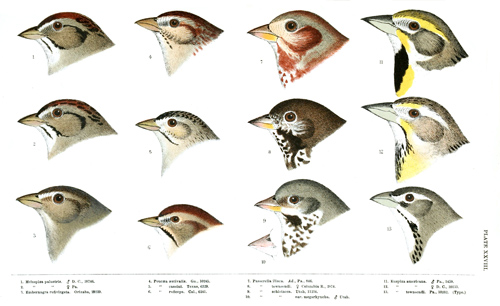
PLATE XXVIII.
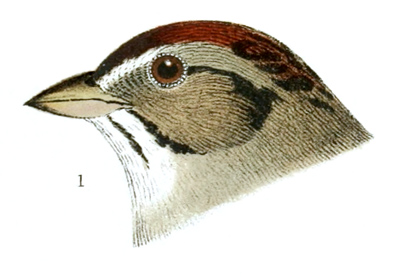
1. Melospiza palustris. ♂ D. C., 38746.
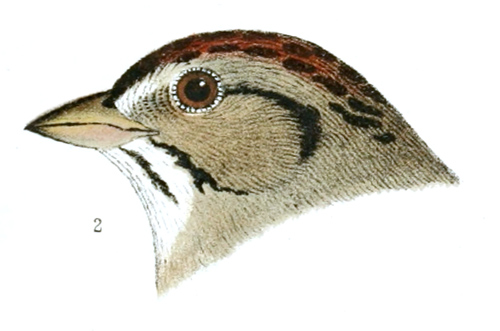
2. Melospiza palustris. ♀ Pa.
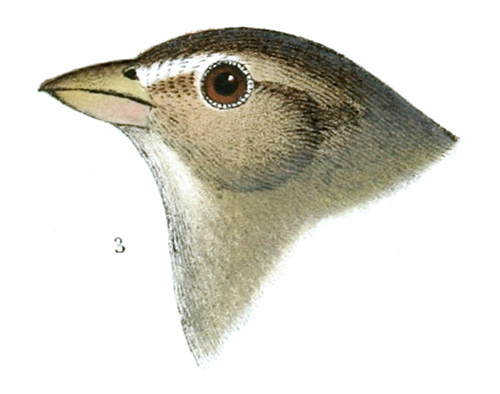
3. Embernagra rufivirgata. Orizaba, 29229.
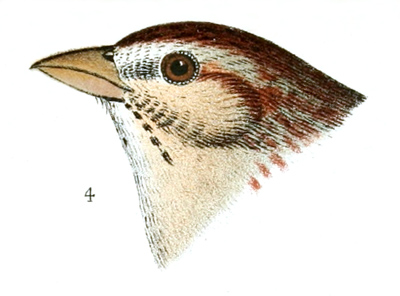
4. Peucæa æstivalis. Ga., 10245.
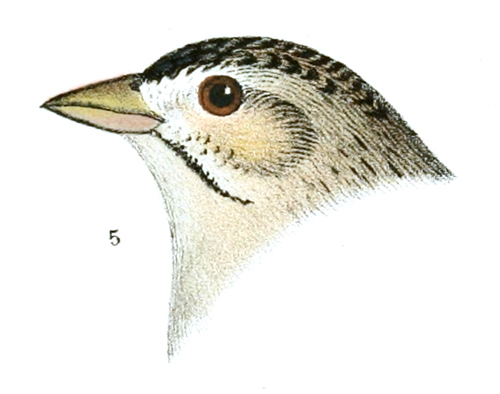
5. Peucæa cassini. Texas, 6329.
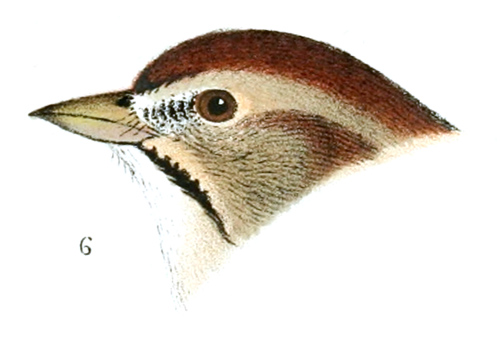
6. Peucæa ruficeps. Cal., 6241.
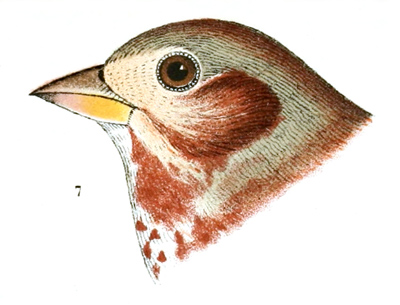
7. Passerella iliaca. Ad., Pa., 846.
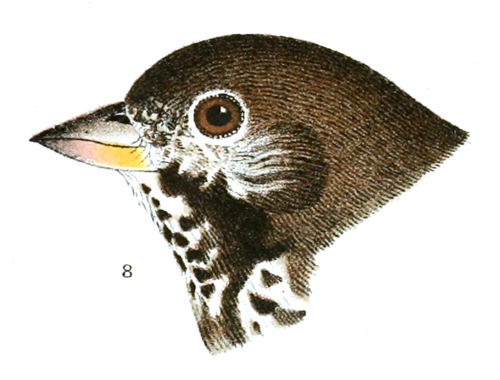
8. Passerella townsendi. ♀ Columbia R., 2874.
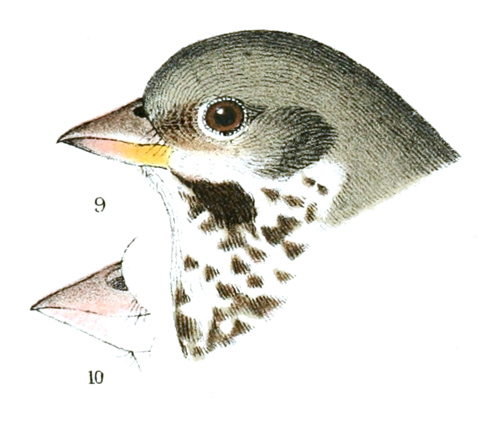
9. Passerella schistacea. Utah, 11234. 10. Passerella schistacea. var. megarhyncha. ♂ Utah.
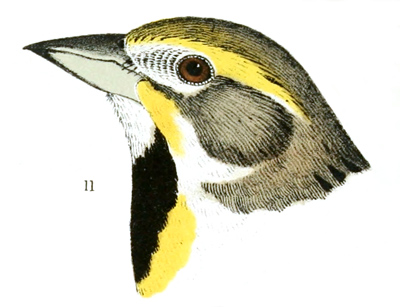
11. Euspiza americana. ♂ Pa., 1459.
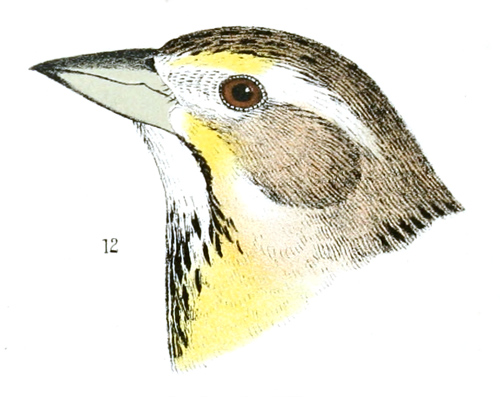
12. Euspiza americana. ♀ D. C., 10133.
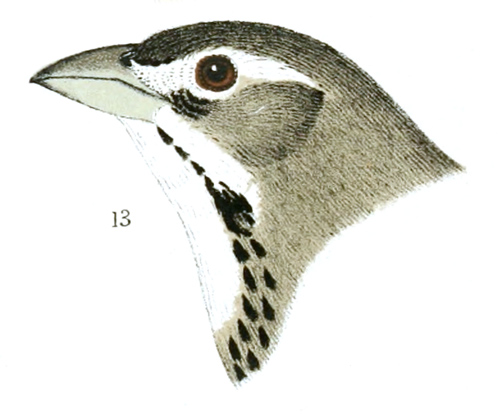
13. Euspiza townsendi. Pa., 10282. (Type.)
From what is now known, we gather that it occurs throughout the eastern portions of North America, from the Southern States, in which it passes the wintry months, to high northern latitudes, where some find their way in the breeding-season, extending as far to the west at least as the Missouri River region.
Three specimens were obtained at Fort Simpson, by Mr. Kennicott, in September, which indicates their probable summer presence in latitude 55°, and their near approach to the Pacific coast at the extreme northwestern portion of their distribution. Audubon also met with them in Newfoundland and in Labrador. They are known to breed as far to the south as Pennsylvania. They have been taken in the eastern portion of Nebraska, and breed in considerable numbers in Southern Wisconsin. Further investigations in regard to its distribution will probably show it to be a much more widely distributed as well as a more abundant bird than has been generally supposed.
Mr. Ridgway writes me that this bird winters in Southern Illinois, and remains there very late in the spring, but he thinks that none remain to breed.
Wilson states that it arrives in Pennsylvania early in April, where it frequents low grounds and river-courses, rears two and sometimes three broods in a season, and returns to the South as the cold weather commences. During the winter, he met with them in large numbers in the immense cypress swamps and extensive grassy flats of the Southern States, along the numerous rivers and rice plantations. These places abounded with their favorite seeds and other means of sustenance, and appeared to be their general places of resort at this season. From the river Trent, in North Carolina, to the Savannah River, and even farther south, Wilson found this species very numerous. They were not found in flocks, but skulked among the reeds and grass, were shy and timorous, and seemed more attached to the water than any others of this family. In April large numbers pass through Pennsylvania northward. Only a few remain behind, and these frequent the swamps and the reedy borders of creeks and rivers. He found their nests built in the ground, in tussocks of rank grass, surrounded by water, with four eggs of a dirty-white ground, spotted with rufous. He has found them feeding their young as late as the 15th of August. Their food seemed to be principally grass-seeds, wild oats, and insects. He supposed them to have no song, and that their only note was a single cheep uttered in a somewhat hoarse tone. They flirt their tails as they fly, seldom or never take to trees, but run and skulk from one low bush to another.
Except in regard to their song, Wilson’s account of their habits, so far as it goes, is quite accurate, although this bird really does have quite a respectable song, and one that improves as the season advances. At first it is only a succession or repetition of a few monotonous trilling notes, which might easily be mistaken for the song of the Field Sparrow, or even confounded with the feebler chant of the socialis, although not so varied as the former, and is much more sprightly and pleasing than the other. Still later its music improves, and more effort is made. Like the Song Sparrow, it mounts some low twig, expands its tail-feathers, and gives forth a very sprightly trill that echoes through the swampy thicket with an effect which, once noticed and identified with the performer, is not likely to be ever mistaken. Nuttall calls this song loud, sweet, and plaintive. It is to my ear more sprightly than pathetic, and has a peculiarly ventriloquistic effect, as if the performer were at a much greater distance than he really is.
Their food, when they first arrive, and that which they feed to their young, consists very largely of insects, principally coleopterous ones, with such few seeds as they can glean. After the breeding-season, when their young can take care of themselves, they eat almost exclusively the ripened seeds of the coarse water grasses and sedges. They are very devoted to their young, and often display great solicitude for their safety, even when able to take care of themselves, and often expose themselves to dangers they carefully avoid at other times, and are thus more easily procured. At all other times they are difficult to shoot, running, as they do, through the grass and tangled thickets, and rarely rising on the wing. They dive from thicket to thicket with great rapidity, and even when wounded have a wonderful power of running and hiding themselves.
Mr. Audubon met with them, during autumn and winter, among the flat sand-bars of the Mississippi, which are overgrown with rank grasses. Though not in flocks, their numbers were immense. They fed on grass-seeds and insects, often wading for the latter in shallow water in the manner of the Tringidæ, and when wounded and forced into the water swimming off to the nearest shelter. He also met with these birds abundantly dispersed in the swamps of Cuyaga Lake, as well as among those along the Illinois River in the summer, and in the winter up the Arkansas River.
Mr. Townsend observed these birds on the head-waters of the Upper Missouri, but did not meet with them beyond.
In Maine, Mr. Boardman gives it as a regular summer visitant at Calais, arriving there as early as March, becoming common in May, and breeding in that locality. Professor Verrill found it in Western Maine, a summer visitant and breeding, but did not regard it as common. From my own experience, in the neighborhood of Boston, I should have said the same as to its infrequency in Eastern Massachusetts, yet in certain localities it is a very abundant summer resident. Mr. William Brewster has found it breeding in large numbers in the marshes of Fresh Pond, where it arrives sometimes as early as the latter part of March, and where it remains until November. In the western part of the State it is more common as a migratory bird, and has not been found, in any numbers, stopping to breed. Mr. Allen never met with any later than May 25. They were observed to be in company with the Water Thrush, and to be in every way as aquatic in their habits. In the autumn he again met with it from the last of September through October, always in bushy marshes or wet places. Mr. McIlwraith states that in the vicinity of Hamilton, Ontario, it is a common summer resident, breeding there in marshy situations. At Lake Koskonong, in Wisconsin, Mr. Kumlien has also met with these birds abundantly in suitable localities, and found their nests and eggs quite plentiful.
Mr. Ridgway has recently found this Sparrow to be a very abundant winter resident in Southern Illinois, where it inhabits swampy thickets, and where it remains until May, but is not known to breed there.
They always nest on the ground, usually in a depression sheltered by a tuft of grass. The nest is woven of fine grass-stems, but is smaller than the nest of M. melodia.
The eggs of this species, usually five in number, have an average measurement of .78 by .60 of an inch. Their ground-color is usually a light green, occasionally of a light clay, marked and blotched with reddish and purplish brown spots, varying in size and number, occasionally forming a confluent ring around the larger end.
Genus PEUCÆA, Audubon.
Peucæa, Aud. Synopsis, 1839. (Type, Fringilla æstivalis.) Sclater & Salvin, 1868, 322 (Synopsis.)
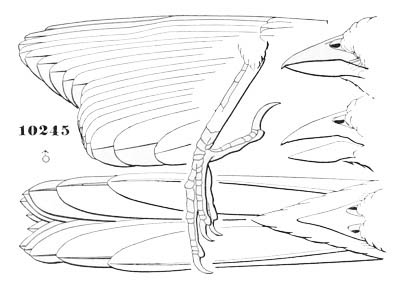
Peucæa æstivalis. 10245 ♂
Gen. Char. Bill moderate. Upper outline and commissure decidedly curved. Legs and feet with the claws small; the tarsus about equal to the middle toe; the lateral toes equal, their claws falling considerably short of the middle one; the hind toe reaching about to the middle of the latter. The outstretched feet reach rather beyond the middle of the tail. The wing is very short, reaching only to the base of the tail; the longest tertials do not exceed the secondaries, while both are not much short of the primaries; the outer three or four quills are graduated. The tail is considerably longer than the wings; it is much graduated laterally; the feathers, though long, are peculiarly narrow, linear, and elliptically rounded at the ends.
Color beneath plain whitish or brownish, with a more or less distinct dusky line each side of the chin. Above with broad obsolete brown streaks or blotches. Crown uniform, or the feathers edged with lighter.
Species and Varieties.
Common Characters. A light superciliary stripe, with a brownish one below it from the eye along upper edge of ear-coverts (not one along lower edge of ear-coverts, as in Melospiza). A narrow blackish “bridle” along side of throat (sometimes indistinct). Crown without a distinct median stripe, and lower parts without markings. Ground-color above ashy, sometimes of a brownish cast; dorsal region and nape with brown blotches, with or without dark centres. Crown blackish-brown streaked with ashy or plain rufous. Beneath plain brownish-white, lightest on the abdomen, darker across jugulum and along sides.
A. Crown plain rufous; interscapulars without distinct black centres, and tertials without whitish border. Blackish “bridle” conspicuous. Bend of wing edged with white.
1. P. ruficeps.
Above olivaceous-ash, interscapulars with broad streaks of dull rufous, the shafts scarcely blackish. Crown bright rufous. Wing, 2.40; tail, 2.70; bill, .29 from forehead, .20 deep; tarsus, .70; middle toe without claw, .55. Hab. California (and Mexico in winter?) … var. ruficeps.
Darker, above brownish-plumbeous, dorsal streaks scarcely rufous, and with distinctly black shaft-streaks; crown darker rufous. Wing, 2.40; tail, 2.60; bill, .34 and .25; tarsus, .77; middle toe, .57. Hab. Mexico (Orizaba; Oaxaca), in summer … var. boucardi.[7]
B. Crown streaked; interscapulars with distinct black centres; tertials sharply bordered terminally with paler. “Bridle” obsolete; bend of wing edged with yellowish.
2. P. æstivalis. Above uniformly marked with broad streaks or longitudinal blotches of deep rufous; black streaks confined to interscapulars and crown. Tail-feathers without darker shaft-stripe, and without indications of darker bars; the outer feathers without distinct white. Black marks on upper tail-coverts inconspicuous, longitudinal.
The bluish-ash, and chestnut-rufous streaks above sharply contrasted; black dorsal streaks broad. Wing, 2.45; tail, 2.65; bill, .30 and .30; tarsus, .73; middle toe, .60. Hab. Southern States from Florida and Georgia to Southern Illinois … var. æstivalis.
The dull ash and light rufous streaks above not sharply defined; black dorsal streaks narrow. Wing, 2.65; tail, 3.00; bill, .32 and .25; tarsus, .80; middle toe, .63. Hab. Southern border of the Arizona region of Middle Province of United States … var. arizonæ.
Markings badly defined as in the last, but the rufous streaks darker (in summer plumage almost entirely black), with more black on the crown. Wing, 2.55; tail, 2.65; bill, .32 and .25; tarsus, .80; middle toe, .60. Hab. Mexico (Orizaba; Mirador, Colima) … var. botterii.[8]
3. P. cassini. Above marked everywhere with broad short streaks of pale (not reddish) brown streaks, all black medially. Tail-feathers with distinct blackish shaft-stripe, throwing off narrow, obsolete bars toward the edge of the feathers. Outer tail-feathers distinctly tipped (broadly) and edged with dull white. Black marks on upper tail-coverts very large, transverse. Beneath nearly uniform dull white, scarcely darker along sides and across breast; flanks with broad streaks of blackish-brown. Wing, 2.55; tail, 2.80; bill, .28 and .23; tarsus, .68; middle toe, .55. Hab. Rio Grande, region (San Antonio and Laredo), north to Kansas (Allen).
Peucæa æstivalis, Cabanis.
BACHMAN’S SPARROW.
Fringilla æstivalis, Licht. Verz. Doubl. 1823, 25, No. 254.—Bonap. Conspectus, 1850, 481. Peucæa æstivalis, Cabanis, Mus. Hein. 1850, 132.—Baird, Birds N. Am. 1858, 484. Fringilla bachmani, Aud. Orn. Biog. II, 1834, 366, pl. clxv. Ammodromus bachmani, Bon. List, 1838. Peucæa bachmani, Aud. Syn. 1839.—Ib. Birds Am. III, 1841, 113, pl. clxxvi.—Bon. Consp. 1850, 481 (type). Fringilla æstiva, Nutt. I, (2d ed.,) 1840, 568. “Summer finch, Latham, Synopsis, (2d ed.,) VI, 136.” Nuttall.
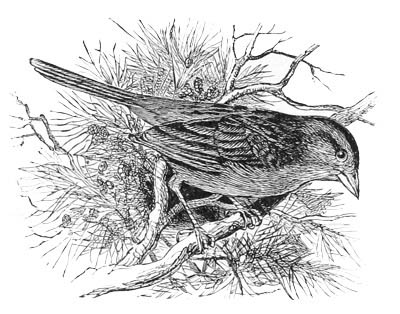
Peucæa æstivalis.
Sp. Char. All the feathers of the upper parts rather dark brownish-red or chestnut, margined with bluish-ash, which almost forms a median stripe on the crown. Interscapular region and upper tail-coverts with the feathers becoming black in the centre. An indistinct ashy superciliary stripe. Under parts pale yellow-brownish, tinged with ashy on the sides, and with darker brownish across the upper part of the breast. A faint maxillary dusky line. Indistinct streaks of chestnut along the sides. Edge of wing yellow; lesser coverts tinged with greenish. Innermost secondaries abruptly margined with narrow whitish. Legs yellow. Bill above dusky, yellowish beneath. Outer tail-feathers obsoletely marked with a long blotch of paler at end. Female considerably smaller. Young with rounded dusky specks on the jugulum, which is more ochraceous. Length, 6.25; wing, 2.30; tail, 2.78.
Hab. Georgia; Florida; South Illinois, breeding (Ridgway). (Perhaps whole of Southern States from Florida to South Illinois.)
Specimens from Southern Illinois (Wabash Co., July, 1871; coll. of R. Ridgway) are similar to Florida examples.
Habits. Bachman’s Finch has only been known, until very recently, as a species of a very restricted range, and confined within the limits of the States of South Carolina, Georgia, and Florida. Our principal, and for some time our only, knowledge of its habits was derived from the account furnished by Rev. Dr. Bachman to Mr. Audubon. That observing naturalist first met with it in the month of April, 1832, near Parker’s Ferry, on the Edisto River, in South Carolina. Dr. Henry Bryant afterwards met with this species at Indian River, in Florida, where he obtained specimens of its nests and eggs. Dr. Alexander Gerhardt also found these Sparrows common at Varnell’s Station, in the northern part of Georgia. Professor Joseph Leconte has taken it near Savannah, and Mr. W. L. Jones has also obtained several specimens in Liberty County, in the same State.
After meeting with this species on the Edisto, Dr. Bachman ascertained, upon searching for them in the vicinity of Charlestown, that they breed in small numbers on the pine barrens, about six miles north of that city. He was of the opinion that it is by no means so rare in that State as has been supposed, but that it is more often heard than seen. When he first heard it, the notes so closely resembled those of the Towhee Bunting that for a while he mistook them for those of that bird. Their greater softness and some slight variations at last induced him to suspect that the bird was something different, and led him to go in pursuit. After that it was quite a common thing for him to hear as many as five or six in the course of a morning’s ride, but he found it almost impossible to get even a sight of the bird. This is owing, not so much to its being so wild, as to the habit it has of darting from the tall pine-trees, on which it usually sits to warble out its melodious notes, and concealing itself in the tall broom-grass that is almost invariably found in the places it frequents. As soon as it alights it runs off, in the manner of a mouse, and hides itself in the grass, and it is extremely difficult to get a sight of it afterwards.
It was supposed by Dr. Bachman—correctly, as it has been ascertained—to breed on the ground, where it is always to be found when it is not singing. He never met with its nest. In June, 1853, he observed two pairs of these birds, each having four young. They were pretty well fledged, and were following their parents along the low scrub-oaks of the pine lands.
Dr. Bachman regarded this bird as decidedly the finest songster of the Sparrow family with which he was acquainted. Its notes are described as very loud for the size of the bird, and capable of being heard at a considerable distance in the pine woods where it occurs, and where at that season it is the only singer.
He also states that, by the middle of November, they have all disappeared, probably migrating farther south. It is quite probable that they do not go beyond the limits of the United States, and that some remain in South Carolina during the whole of winter, as on the 6th of February, the coldest part of the year, Dr. Bachman found one of them in the long grass near Charleston.
Mr. Audubon says that on his return from Florida, in June, 1832, travelling through both the Carolinas, he observed many of these Finches on the sides of the roads cut through the pine woods of South Carolina. They filled the air with their melodies. He traced them as far as the boundary line of North Carolina, but saw none within the limits of that State. They were particularly abundant about the Great Santee River.
This Finch, hitherto assumed to be an exclusively southeastern species, has recently been detected by Mr. Ridgway in Southern Illinois, where it is a summer resident, and where it breeds, but is not abundant. It inhabits old fields, where, perched upon a fence-stake or an old dead tree, it is described as chanting a very delightful song. It was first taken on the 12th of July, 1871, on the road about half-way between Mount Carmel and Olney. The bird was then seen on a fence, and its unfamiliar appearance and fine song at once attracted his notice as he was riding by. As several were heard singing in the same neighborhood, it seemed common in that locality, and as a young bird was taken in its first plumage there is no doubt that it is a regular summer visitant of Southern Illinois, and breeds there. Mr. Ridgway speaks of its song as one of the finest he has ever heard, most resembling the sweet chant of the Field Sparrow, but is stronger, and varied by a clear, high, and very musical strain. He describes its song as resembling the syllables thééééééé-til-lūt, lūt-lūt, the first being a very fine trill pitched in a very high musical key, the last syllable abrupt and metallic in tone.
The food of this species, Dr. Bachman states, consists of the seeds of grasses, and also of coleopterous insects, as well as of a variety of the small berries so abundant in that part of the country. He speaks of its flight as swift, direct, and somewhat protracted, and adds that it is often out of sight before it alights.
Dr. Coues did not meet with this Sparrow in South Carolina, but he was informed by Professor Leconte that it occurs about Columbia and elsewhere in the State, frequenting open pine woods and old dry fields.
Dr. Bryant met with its nest in Florida, April 20. It was similar, in construction, to that of the Savannah Sparrow, and contained five eggs. It was the only Sparrow found by him in the pine barrens near Enterprise, and was only seen occasionally, when it was a very difficult bird to shoot, as it runs round in the grass more like a mouse than a bird, and will not fly until almost trodden on, then moving only a few feet at a time.
The nests of this bird, found by Dr. Bryant in Florida and by Dr. Gerhardt in Northern Georgia, were all placed upon the ground and concealed in tufts of thick grass, and constructed entirely of coarse wiry grasses, with no other lining than this material. The eggs, four in number, are of a pure, almost brilliant white, of a rounded oval shape, and measure .74 by .60 of an inch.
Peucæa æstivalis var. arizonæ, Ridgway.
ARIZONA SPARROW.
Peucæa cassini, Baird, Birds N. Am. 1858, 486. (Los Nogales specimen.)
Sp. Char. (6,327 ♂, Los Nogales, Northern Sonora, June, C. B. Kennerly.) Similar to P. æstivalis, but paler; wings and tail longer. Above light chestnut, all the feathers margined and tipped with bluish-gray, but the reddish prevailing. Interscapular and crown feathers with a narrow streak of black, those on crown indistinct. Beneath dull white, tinged with ashy-ochraceous across the breast and along the sides; crissum pale ochraceous. An obsolete light superciliary, and narrow dusky maxillary stripe. Bend of wing yellow; lesser coverts tinged with greenish-yellow. Length, 6 inches; wing, 2.65; tail, 3.00; bill, .32 from nostril, .25 deep at base; tarsus, .80; middle toe, .63.
Hab. Los Nogales, Sonora, and Southern Arizona.
This race has a considerable resemblance to P. æstivalis, but differs in some appreciable points. The brown of the upper parts is paler, and the ashy edging to the feathers appears rather less extensive. The dark brown blotches on the back are of greater extent, the black streaks on the back confined to a mere streak along the shaft. There is less of an olive tinge across the breast.
The proportions of the present race differ more from those of æstivalis than do the colors, the bill being more slender, and the wings and tail considerably longer.
The resemblance to P. botterii (= æstivalis, var. botterii) of Sclater, from Middle Mexico (Orizaba, Colima, etc.), is very close; the difference being greater in the proportions than in the colors, the latter having a shorter wing and tail, with thicker bill, as in var. æstivalis. In botterii there is rather a predominance of the black over the rufous in the streaks above.
Habits. This, in its general habits, nesting, eggs, etc., probably resembles the variety æstivalis.
Peucæa cassini, Baird.
CASSIN’S SPARROW.
Zonotrichia cassini, Woodhouse, Pr. A. N. Sc. Ph. VI, April, 1852, 60 (San Antonio). Passerculus cassini, Woodhouse, Sitgreaves’s Rep. Zuñi and Colorado, 1853, 85; Birds, pl. iv. Peucæa cassini, Baird, Birds N. Am. 1858, 485, pl. iv, f. 2.—Heermann, X, c, p. 12, pl. iv, f. 2.—Cooper, Orn. Cal. 1, 219 (not from Cal.).
Sp. Char. (6,329 ♂, Texas; compared with type of species.) Ground-color of upper parts grayish-ash; the middle portion of each feather dull brown, in the form of a blotch, and with a black shaft-streak, the latter becoming modified on scapulars, rump, and upper tail-coverts, into transverse spots, those on the upper tail-coverts being large and conspicuous, and in the form of crescentic spots, the terminal margin of the feathers being lighter ashy in sharp contrast. Middle tail-feathers clear ashy, with a sharply defined shaft-streak of blackish, throwing off obsolete, narrow, transverse bars toward the edge; rest of tail clear dusky-brown, the lateral feather with whole outer web, and margin of the inner, dull white, all, except the intermediate, with a large, abruptly defined, terminal space of dilute brown (decreasing in size from the outer), the margin whitish. Upper secondaries broadly and sharply margined along both edges with dull ashy-white, the enclosed portion being clear dusky brown, intensified where adjoining the whitish. A very obsolete superciliary stripe of ashy, becoming whitish over the lore; auriculars more dingy, but without distinct stripe along upper edge. An uninterrupted but indistinct “bridle” along sides of throat. Lower parts dull white, without any ochraceous, but with a very faint ashy tinge ever the jugulum; flanks with broad, somewhat blended streaks of mixed brownish and dusky. Bend of wing edged with light yellow. Wing, 2.55; tail, 2.80; bill, .28 from nostril and .23 deep; tarsus, .68; middle toe, .55.
Young. (45,277, Laredo, Texas, June 28.) Very similar, but with a few drop-shaped streaks of dark brown on the jugulum and along sides. The feathers above have a more appreciable terminal border of buff.
Hab. Rio Grande region of Southern Middle Province; Kansas, breeding (Allen). San Antonio, Texas, summer (Dresser, Ibis, 1865, 489; eggs); ? Orizaba, temp. reg. (Sum. M. B. S. I, 551).
In the Birds of North America, the specimen characterized on p. 637 of the present work as æstivalis, var. arizonæ, was referred to P. cassini, those specimens which are here retained as such being considered as in quite immature plumage. A more recent examination of additional material, however, has compelled us to change our view. In consequence of the similarity of the specimen in question to æstivalis, as noted in the article referred to above, the general acceptation of the name cassini has been that of a term designating a variety of the common species; but we have as the result of the investigation in question found it necessary to retain under the head of “cassini” only the typical specimens from the Rio Grande region, and refer the supposed aberrant specimen to æstivalis. In this Los Nogales specimen we find existing such differences in proportions and colors as are sufficient to warrant our bestowing upon it a new name, and establishing it as the Middle Province race of æstivalis, in this way connecting the South Atlantic and Mexican races (var. æstivalis and var. botterii) by a more similar form than the P. cassini, which must be set apart as an independent form,—in all probability a good species. Several facts are favorable to this view. First, we have of the P. cassini specimens which are beyond question in perfect adult plumage, and others which are undoubtedly immature; they differ from each other only in such respects as would be expected, and agree substantially in other characters, by which they are distinguished from the different styles of æstivalis. Secondly, the region to be filled by a peculiar race of æstivalis is represented by the var. arizonæ, which is undoubtedly referable to that species; thus we have in one province these two different forms, which therefore are probably distinct.
The present bird is hardly less distinct from the races of æstivalis than is ruficeps; and we would be as willing to consider all the definable forms presented in the synopsis as varieties of a single species, as to refer the present bird to æstivalis.
Habits. This Finch, in its general appearance, as well as in respect to habits, nesting, and eggs, is quite similar to Bachman’s Finch. It was first met with by Dr. Woodhouse, in the expedition to the Zuñi River, when he found it in Western Texas. He shot it on the prairies near San Antonio, on the 25th of April, 1851, mistaking it for Passerculus savanna, which, in its habits, it seemed to him very much to resemble, but upon examination it was found to be totally distinct.
Dr. Heermann afterwards, being at Comanche Springs in Texas, had his attention attracted by the new note of a bird unfamiliar to him. It was found, after some observation, to proceed from this species. He describes it as rising with a tremulous motion of its wings some twenty feet or more, and then descending again, in the same manner, to within a few yards of the spot whence it started, and as accompanying its entire flight with a lengthened and pleasing song. The country in that neighborhood is very barren, covered with low stunted bushes, in which the bird takes refuge on being alarmed, gliding rapidly through the grass and shrubbery, and very adroitly and effectually evading its pursuer. He observed them during four or five days of the journey of his party, and after that saw no more of them. They seemed, at the time, to be migrating, though their continued and oft-repeated song also showed that they were not far from readiness for the duties of incubation.
The Peucæa cassini is said, by Mr. Sumichrast, to be a resident species in the valley of Orizaba, in the State of Vera Cruz, Mexico, and to be generally distributed throughout the temperate region of that district. It is very probable, however, that he has in view the Mexican race of P. æstivalis (var. botterii), and not the present species.
Mr. J. A. Allen, who considers this bird only a western form of P. æstivalis, mentions (Am. Naturalist, May, 1872) finding it quite frequently near the streams in Western Kansas, where its sweetly modulated song greets the ear with the first break of dawn, and is again heard at night till the last trace of twilight has disappeared. Mr. Allen also states, in a letter, that this bird was “tolerably common along the streams near Fort Hays, but very retiring, singing mostly after nightfall and before sunrise, during the morning twilight. When singing, it had the habit of rising into the air. I shot three one morning thus singing, when it was so dark I could not find the birds. The one I obtained does not differ appreciably from specimens from Mr. Cassin’s collection, labelled by him Peucæa cassini, collected in Texas.”
Mr. Ridgway regards this record of the manners of this bird, while singing, as indicating a specific difference from P. æstivalis. The latter, in Southern Illinois, has never been heard by him to sing at night, or in the morning, nor even on the wing; but in broad midday, in the hottest days of June, July, and August, he often heard them singing vigorously and sweetly, as they perched upon a fence or a dead tree in a field, exactly after the manner of our common Spizella pusilla.
Among Dr. Heermann’s notes, quoted by Mr. Dresser, is one containing the statement that he found this species not rare on the prairies near the Medina River, in Texas, where it breeds. Mr. Dresser also states that when at Howard’s Ranche, early in May, he found this bird by no means uncommon. He confirms Dr. Heermann’s account, that it is easily distinguished as it rises in the air, from a bush, with a peculiar fluttering motion of the wings, at the same time singing, and then suddenly dropping into the bushes again. He adds that, in his absence, Dr. Heermann procured the eggs of this species on the Medina, and while he was himself travelling in July towards Loredo, he found a nest which he was fully confident belonged to this bird. It was placed in a low bush not above a foot from the ground, and in its construction resembled that of the Poospiza bilineata. The eggs were three in number, pure white, closely agreeing with those taken by Dr. Heermann, and larger and more elongated than those of the bilineata.
An egg of this species, taken in Texas by Dr. H. R. Storer, the identification of which, however, was incomplete, is more oblong than the eggs of P. æstivalis, and smaller, measuring .72 by .58 of an inch. It is pure white also.
Peucæa ruficeps, Baird.
RUFOUS-CROWNED SPARROW.
Ammodromus ruficeps, Cassin, Pr. A. N. Sc. VI, Oct. 1852, 184 (California).— Ib. Illust. I, V, 1854, 135, pl. xx. Peucæa ruficeps, Baird, Birds N. Am. 1858, 486.—Cooper, Orn. Cal. 1, 1870, 218.
Sp. Char. Above brownish-ashy. The crown and nape uniform brownish-chestnut, the interscapular region and neck with the feathers of this color, except around the margins. A superciliary ashy stripe, whiter at the base of the bill. Beneath pale yellowish-brown, or brownish-yellow, darker and more ashy across the breast and on the sides of body; middle of belly and chin lighter; the latter with a well-marked line of black on each side. Edge of wing white. Under tail-coverts more rufous. Legs yellow. Length, 5.50; wing, 2.35; tail, 2.85.
Hab. Coast of California, to Mexico; ? Oaxaca, March (Scl. 1859, 380); ? Vera Cruz, temperate region; resident (Sum. M. B. S. I, 552).
This plainly colored species has the bill rather slender; tail rather long, and considerably rounded; the outer feathers .40 of an inch shorter than the middle; the feathers soft, and rounded at the tip. The wing is short; the primaries not much longer than the tertials; the second, third, fourth, and fifth nearly equal; the first scarcely longer than the secondaries.
There is a blackish tinge on the forehead, separated by a short central line of white, as in Spizella socialis. The eyelids are whitish, and there is a short black line immediately over the upper lid. There is a faint chestnut streak back of the eye. The chestnut of the nape is somewhat interrupted by pale edgings. The blotches on the back melt almost insensibly into the colors of the margins of the feathers. The outer edges of the secondaries and tertials, and the outer surface of the tail, are yellowish-rusty.
This bird is similar in general appearance to the P. æstivalis, but has the head above more continuous chestnut; the black cheek-stripe more distinct, and the edge of wing whitish, not yellow, the bill more slender. A Mexican specimen has a stouter bill.
The P. boucardi of Sclater (= ruficeps, var. boucardi; see table, p. 634), from Mexico, is exceedingly similar, it being very difficult to present the differences in a diagnosis. This trouble is partly the result of the insufficient series at our command, for there are such different combinations of colors, according to the season, that it is almost impossible to select the average characters of two definable forms.
Habits. This species was first described, in 1852, by Mr. Cassin, from a specimen obtained in California by Dr. Heermann. Very little is known as to its history, and it appears to have been generally overlooked by naturalists who have studied the ornithology of that State. The extent of its distribution or of its numbers remains unknown,—a circumstance due undoubtedly to the nature of the country which it frequents.
Dr. Heermann states that in the fall of 1851 he shot on the Cosumnes River a single specimen of this bird from among a large flock of Sparrows of various kinds. In the spring of the following year, among the mountains, near the Calaveras River, he found it quite abundant. It was then flying in pairs, engaged in picking grass-seed from the ground, and when started it never extended its flight beyond a few yards. Its notes, in their character, reminded him of the ditty of our common little Chipping Sparrow (Spizella socialis). He obtained several specimens. Its flight seemed feeble, and when raised from the ground, from which it would not start until almost trodden on, it would fly but a short distance, and almost immediately drop again into the grass.
Dr. Cooper has only met with this species on Catalina Island, in June, where a few kept about the low bushes, feeding on the ground. They were very difficult even to get a sight of. He heard them sing a few musical notes, that reminded him of those of the Cyanospizæ. They flew only a short distance, and in their habits reminded him of the Melospizæ. Their favorite places of resort he supposes to be pine woods, as in the eastern species.
The fact that this species has been found by Mr. Sumichrast to be a permanent resident throughout all the temperate regions of Vera Cruz is a very interesting one, and is suggestive of different manners and habits from those supposed to belong to it as a bird allied with the Ammodrami. They are abundant, and breed there, as in the United States, but nothing is given throwing any positive light upon their general habits.
Genus EMBERNAGRA, Lesson.
Embernagra, Lesson, Traité d’Ornith., 1831 (Agassiz). (Type, Saltator viridis, Vieillot.)
Gen. Char. Bill conical, elongated, compressed; the upper outline considerably curved, the lower straight; the commissure slightly concave, and faintly notched at the end. Tarsi lengthened; considerably longer than the middle toe. Outer toe a little longer than the inner, not reaching quite to the base of the middle claw. Hind toe about as long as the middle without its claw. Wings very short, and much rounded; the tertials nearly equal to the primaries; the secondaries a little shorter; the outer four primaries much graduated, even the second shorter than any other quill. The tail is moderate, about as long as the wings, much graduated; the feathers rather narrow, linear, and elliptically rounded at the end; the outer webs more than usually broad in proportion to the inner, being more than one third as wide. The upper parts are olive-green, the under whitish.
The position of this genus is a matter of considerable uncertainty. On some accounts it would be better placed among the Spizinæ.
There are numerous tropical species of this genus; none of them are nearly allied, however, to the single North American species.
Embernagra rufivirgata, Lawrence.
TEXAS SPARROW.
Embernagra rufivirgata, Lawrence, Ann. N. Y. Lyc. V, May, 1851, 112, pl. v, f. 2 (Texas).—Sclater, Pr. Zoöl. Soc. 1856, 306.—Baird, Birds N. Am. 1858, 487, pl. lv. f. 2.—Ib. Mex. Bound. II, Birds, 16, pl. xvii, f. 2. Zonotrichia plebeja, Licht. Bon. Comptes Rend. 43, 1856, 413.
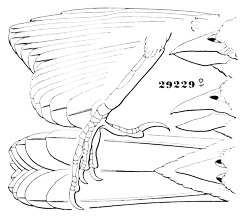
Embernagra rufivirgata, Lawr. 29229 ♀
Sp. Char. Above uniform olivaceous-green. A stripe on each side of the head, and one behind the eye, dull brownish-rufous, an ashy superciliary stripe whiter anteriorly. Under parts brownish-white, tinged with yellowish posteriorly, and with olivaceous on the sides; white in the middle of the belly. Edge of wing, under coverts, and axillaries bright yellow. Young with the head-stripes obsolete. Length, 5.50; wing, 2.60; tail, 2.70.
Hab. Valley of the Rio Grande, and probably of Gila, southward; Mazatlan, Mexico. Oaxaca, April (Scl. 1859, 380); Cordova; Vera Cruz, temperate and hot regions, breeding (Sum. M. B. S. I, 551); Yucatan (Lawr. IX, 201).
In this species the bill is rather long; the wings are very short, and much rounded; the tertials equal to the primaries; the secondaries rather shorter; the first quill is .65 of an inch shorter than the seventh, which is longest. The tail is short; the lateral feathers much graduated; the outer half an inch shorter than the middle.
All the Mexican specimens before us have the bill stouter than those from the Rio Grande of Texas, the stripes on the head apparently better defined. The back is darker olive; the flanks brighter olive-green, not olive-gray, the wings are apparently shorter. The series is not sufficiently perfect to show other differences, if any exist.
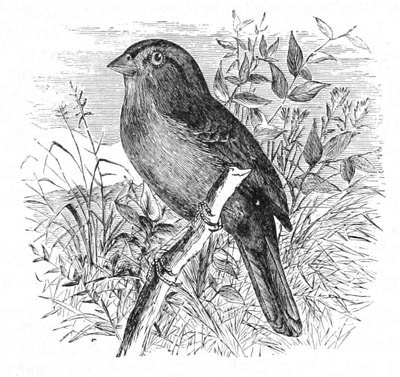
Embernagra rufivirgata.
Habits. In regard to the habits and distribution of this species we are entirely without any information, other than that it has been met with in the valley of the Rio Grande, and at various places in Mexico. Specimens were obtained at New Leon, Mexico, by Lieutenant Couch, and at Ringgold Barracks, in Texas, by Mr. J. H. Clark. The season when these birds were met with is not indicated by him.
It is stated by Mr. Sumichrast that this species is found throughout both the temperate and the hot districts of the State of Vera Cruz, Mexico. He also mentions that he has found this bird in localities quite remote from each other, and belonging both to the hot and to the temperate regions. In the latter it is found to the height of at least four thousand feet.
This species was met with by Mr. Boucard, during the winter months, at Plaza Vicente, in the hot lowlands of the State of Oaxaca, Mexico.
Subfamily PASSERELLINÆ.
Char. Toes and claws very stout; the lateral claws reaching beyond the middle of the middle one; all very slightly curved.
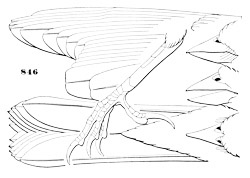
Passerella iliaca. 846
Bill conical, the outlines straight; both mandibles equal; wings long, longer than the even tail or slightly rounded, reaching nearly to the middle of its exposed portion. Hind claw longer than its digit; the toe nearly as long as the middle toe; tarsus longer than the middle toe. Brown above, either uniformly so or faintly streaked; triangular spots below.
This section embraces a single North American genus, chiefly characterized by the remarkable elongation of the lateral claws, as well as by the peculiar shape and large size of all the claws; the lateral, especially, are so much lengthened as to extend nearly as far as the middle. The only approach to this, as far as I recollect, among United States Conirostres, is in Pipilo megalonyx, and Xanthocephalus icterocephalus.
Genus PASSERELLA, Swainson.
Passerella, Swainson, Class. Birds, II, 1837, 288. (Type, Fringilla iliaca, Merrem.)
Gen. Char. Body stout. Bill conical, not notched, the outlines straight; the two jaws of equal depth; roof of upper mandible deeply excavated, and vaulted; not knobbed. Tarsus scarcely longer than the middle toe; outer toe little longer than the inner, its claw reaching to the middle of the central one. Hind toe about equal to the inner lateral; the claws all long, and moderately curved only; the posterior rather longer than the middle, and equal to its toe. Wings long, pointed, reaching to the middle of the tail; the tertials scarcely longer than secondaries; second and third quills longest; first equal to the fifth. Tail very nearly even, scarcely longer than the wing. Inner claw contained scarcely one and a half times in its toe proper.
Color. Rufous or slaty; obsoletely streaked or uniform above; thickly spotted with triangular blotches beneath.
Species and Varieties.
Common Characters. Ground-color above, slaty-ash, or sepia; wings, upper tail-coverts, and tail more rufescent. Beneath, pure white, with numerous triangular spots over breast and throat, streaks along sides, and a triangular blotch on side of throat, of the same color as the wings. The pectoral spots aggregated on the middle of the breast.
A. Hind claw not longer than its digit. Back with broad streaks of dark rufous.
1. P. iliaca. Ground-color above ash (more or less overlaid in winter with a rufous wash); wings, dorsal spots, upper tail-coverts, tail, auriculars, and markings of lower parts, bright reddish-rufous. Wing, 3.50; tail, 2.90; tarsus, .87; middle toe, without claw, .67; hind claw, .35. Hab. Eastern Province of North America.
B. Hind claw much longer than its digit. Back without streaks.
2. P. townsendi.
Head and neck above with back, scapulars, and rump, rich sepia-brown, almost uniform with wings and tail. Belly thickly spotted; tibiæ deep brown; supraloral space not whitish. Wing, 3.05; tail, 2.85; tarsus, .80; middle toe, .62; hind claw, .43. Hab. Pacific Province of North America, from Kodiak south to Fort Tejon, Cal. (in winter) … var. townsendi.
Head and neck above, with back, scapulars, and rump, slaty-ash, in strong contrast with the rufescent-brown of wings and tail. Belly with only minute specks, or immaculate; tibiæ grayish; supraloral space distinctly white. Spots beneath clove-brown.
Bill, .34 from nostril, by .25 deep at base; wing, 3.30; tail, 3.50; tarsus, .85; middle toe, .60; hind claw, .45. Hab. Middle Province of United States … var. schistacea.
Bill, .35 from nostril and .47 deep; wing, 3.30; tail, 3.50; tarsus, .83; middle toe, .63; hind claw, .50. Hab. Sierra Nevada, from Fort Tejon, north to Carson City, Nev … var. megarhynchus.
No great violence would be done by considering all the above forms as races of one species, the characters separating iliaca from the rest being of no great importance. However, in the large series examined, there is no specimen of iliaca at all aberrant, and none approach in the slightest degree to any of the other forms. There can be no doubt whatever of the specific identity of the three forms presented under section “B,” as is plainly shown by specimens of intermediate characters. These western forms are parallels of the western race of Melospiza; schistacea representing M. fallax, megarhynchus the M. heermanni, and townsendi the M. guttata or rufina.
Passerella iliaca, Swainson.
FOX-COLORED SPARROW.
Fringilla iliaca, Merrem. “Beitr. zur besond. Gesch. der Vögel, II, 1786-87, 40, pl. x.”—Gm. Syst. Nat. I, 1788, 923.—Aud. Orn. Biog. II, 1834, 58; V, 512, pl. cviii.—Ib. Syn. 1839.—Ib. Birds Am. III, 1841, 139, pl. clxxxvi. Passerella iliaca, Sw. Birds, II, 1837, 288.—Bon. List, 1838.—Ib. Conspectus, 1850, 477.—Baird, Birds N. Am. 1858, 488.—Dall & Bannister, Tr. Ch. Ac. I, 1869, 285.—Samuels, 325. Fringilla rufa, Wilson, Am. Orn. III, 1811, 53, pl. xxiv, f. 4.—Licht. Verz. 1823, No. 248. Fringilla ferruginea, Wilson, Catalogue, VI, 1812.—Hall’s ed. Wilson, II, 255. “Emberiza pratensis, Vieill.,” Gray.
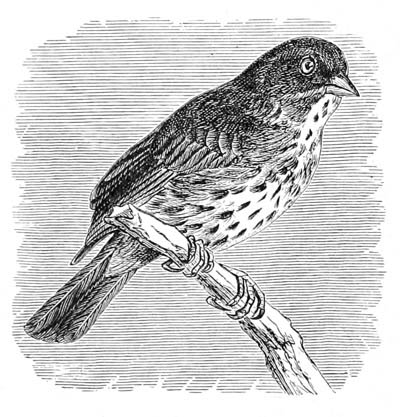
Passerella townsendi.
Sp. Char. General aspect of upper parts foxy-red, the ground-color and the sides of neck being ashy; the interscapular feathers each with a large blotch of fox-red; this color glossing the top of head and nape; sometimes faintly, sometimes more distinctly; the rump unmarked; the upper coverts and surface of the tail continuous fox-red. Two narrow white bands on the wing. Beneath, with under tail-coverts and axillars, clear white, the sides of head and of throat, the jugulum, breast, and sides of body, conspicuously and sharply blotched with fox-red; more triangular across breast, more linear and darker on sides. Sometimes the entire head above is continuously reddish. First quill rather less than fifth. Hind toe about equal to its claw. Length, 7.50; wing, 3.50; tail, 2.90; tarsus, .87; middle toe, without claw, .67; hind claw, .35.
Hab. Eastern North America to the Mississippi, to the north along valley of the Mackenzie, almost or quite to the Arctic coast, and down the valley of the Yukon to the Pacific. Breeds throughout the interior of British America.
In summer, the ash is more predominant above; in winter, it is overlaid more or less by a wash of rufous, as described above.
The young plumage we have not seen. The P. obscura, Verrill,[9] may be referrible to it.
Habits. The Fox-colored Sparrow, in its seasons of migrations, is a very common bird throughout the United States east of the Mississippi River. It has not been ascertained to breed in any part of the United States, though it may do so in Northeastern Maine. Mr. Boardman has not met with it near Calais, nor did I see nor could I hear of it in any part of Nova Scotia or New Brunswick that I visited. In passing north, these birds begin their northern movements in the middle of March, and from that time to the last of April they are gradually approaching their summer quarters. Their first appearance near Boston is about the 15th of March, and they linger in that vicinity, or successive parties appear, until about the 20th of April. The last comers are usually in song. On their return, the middle or last of October, they pass rapidly, and usually make no stay. In Southwestern Texas these birds were not observed by Mr. Dresser, nor in Arizona by Dr. Coues, but in the Indian Territory Dr. Woodhouse found them very abundant on the approach of winter. Dr. Coues speaks of them as common in South Carolina from November to April, but less numerous than most of the Sparrows.
In the vicinity of Washington this bird is found from October to April. I have met with small groups of them through all the winter months among the fallen leaves in retired corners of the Capitol grounds, where they were busily engaged, in the manner of a Pipilo, in scratching in the earth for their food. At those periods when the ground was open, their habits were eminently similar to those of the gallinaceous birds. In March and April they were in company with the White-throated Sparrows, but passed north at least a month earlier.
During their stay in the United States these birds keep in small distinctive flocks, never mingling, though often in the same places, with other species. They are found in the edges of thickets and in moist woods. They are usually silent, and only occasionally utter a call-note, low and soft. In the spring the male becomes quite musical, and is one of our sweetest and most remarkable singers. His voice is loud, clear, and melodious; his notes full, rich, and varied; and his song is unequalled by any of this family that I have ever heard. They soon become reconciled to confinement and quite tame, and sing a good part of the year if care is taken in regard to their food. If allowed to eat to excess, they become very fat and heavy, and lose their song.
Dr. Coues did not meet with these birds in Labrador, but Mr. Audubon found them there and in Newfoundland in large numbers; and, according to the observations of Sir John Richardson, they breed in the wooded districts of the fur countries, up to the 68th parallel of latitude.
These birds were also found abundantly at Fort Simpson and Great Slave Lake by Mr. Robert Kennicott and Mr. B. R. Ross; at Fort Anderson, Anderson River, Swan River, and in various journeys, by Mr. R. MacFarlane; at Fort Resolution, Fort Good Hope, La Pierre House, and Fort Yukon, by Mr. Lockhart; at Peel’s River, by Mr. J. Flett; at St. Michael’s, by Mr. H. M. Bannister; and at Nulato, by Mr. W. H. Dall. They were observed at Fort Simpson as early as May 17, and by Mr. Kennicott as late as September 17. Mr. Dall states that at Nulato he found this Sparrow in abundance. It arrived there from the 10th to the 15th of May. It breeds there, and its eggs were obtained on the Yukon River. In the month of August in 1867 and of July in 1868 it was abundant at the mouth of the Yukon and at St. Michael’s. One was also shot at Unalaklik. The birds seemed to prefer thickets to the more open country. Mr. Bannister did not find it abundant. He shot only one specimen during the season, in an alder thicket near the fort; and Mr. Pease, who was familiar with the species, only saw a single individual.
According to the reports of both Mr. MacFarlane and Mr. Kennicott, the nest of this species was found both on the ground and in trees. In one instance it was in a tree about eight feet from the ground, and in its structure was said to be similar to the nests of Turdus aliciæ. They were nearly all found after the middle of June, a few as early as the 7th. One was found on the ground at the foot of a tuft of dwarf willows, which helped to conceal it from view. This was composed of coarse hay, lined with some of a finer quality, a few deer-hairs, and a small quantity of fresh and growing moss, intermingled together. In speaking of this nest Mr. MacFarlane states that all the nests of this Sparrow he had previously met with had been built in the midst of branches of pine or spruce trees, and had been similar to those of the T. aliciæ, which, in this instance, it did not resemble. He adds that this species, though not numerous, extended quite to the borders of the wooded country, to the north and northwest of Fort Anderson. Afterwards he observed several other nests on the ground, all of which were similar to the last, and it is by no means impossible that in certain instances these birds may have occupied old nests of the T. aliciæ, and used them for purposes of incubation. Richardson states that its nests are constructed in a low bush, and are made of dry grass, hair, and feathers. He states that the eggs are five in number, of a pale mountain-green tint, and marbled with irregular spots of brown.
Mr. Audubon, who found several of the nests of this bird in Labrador, near the coast, describes them as large for the size of the bird, and as usually placed on the ground among moss or tall grass near the stem of a creeping fir, the branches of which usually conceal it from view. Its exterior is loosely formed of dry grasses and moss, with a carefully disposed inner layer of fine grasses, circularly arranged. The lining consists of very delicate fibrous roots, with feathers of different kinds of water-fowl. In one instance he noted the down of the eider-duck. He found their eggs from the middle of June to the 5th of July. When their nest was approached, the female affected lameness, and employed all the usual arts to decoy the intruder away. They raised but one brood in a season, and about the first of September left Labrador for the south in small flocks, made up of members of one family.
Their eggs measure from .92 to an inch in length, and .70 in breadth. They are oblong in shape. Their ground-color is a light bluish-white, thickly spotted with a rusty-brown, often so fully as to conceal the ground.
Passerella townsendi, Nuttall.
TOWNSEND’S SPARROW.
? Emberiza unalaschkensis, Gmel. II, 1788, 875 (based on Aonalaschka Bunting, Lath. II, 202, 48; Unalaschka B., Pennant, 52). Passerella u. Finsch, Abh. Nat. III, 1872, 53 (Alaska). Fringilla townsendi, Aud. Orn. Biog. V, 1839, 236, pl. ccccxxiv, f. 7.—Ib. Syn. 1839.—Ib. Birds Am. III, 1841, 43, pl. clxxxvii. Fringilla (Passerella) townsendi, Nutt. Man. I, (2d ed.,) 1840, 533. Passerella townsendi, Bon. Conspectus, 1850, 477.—Baird, Birds N. Am. 1858, 489.—Cooper & Suckley, 204.—Dall & Bannister, Tr. Ch. Ac. I, 1869, 285. Fringilla meruloides, Vig. Zoöl. Blossom (Monterey, Cal.), 1839, 19. ? Emberiza (Zonotrichia) rufina, Kittlitz, Denkw. 1858, 200. (He compares it with P. iliaca, but says it is darker. Sitka.)
Sp. Char. Above very dark olive-brown, with a tinge of rufous, the color continuous and uniform throughout, without any trace of blotches or spots; the upper tail-coverts and outer edges of the wing and tail feathers rather lighter and brighter. The under parts white, but thickly covered with approximating triangular blotches colored like the back, sparsest on the middle of the body and on the throat; the spots on the belly smaller. Side almost continuously like the back; tibiæ and under tail-coverts similar, the latter edged with paler. Axillars brown; paler on edges. Claws all very large and long; the hinder claw longer than its toe. First and sixth quills about equal. Length, about 7 inches; wing, about 3.00.
Hab. Pacific coast of United States, as far south as Sacramento, and Fort Tejon? north to Kodiak (and Unalaschka?).
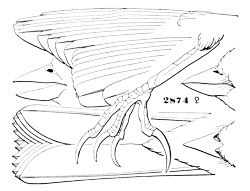
Passerella townsendi. 2874 ♀
This species differs a good deal in form from P. iliaca. The claws are much larger and stouter, the wing a good deal shorter and more rounded. The differences in color are very appreciable, the tints being dark sepia-brown instead of red, and perfectly uniform above, not spotted; the under parts much more thickly spotted.
Specimens from Alaska show a tendency to longer and perhaps more slender bills. Some are rather more rufous-brown than the type; others have a faint tinge of ashy anteriorly, although scarcely appreciable. This is especially noticeable in some skins from Fort Tejon, they being almost exactly intermediate between townsendi and schistacea, or megarhynchus.
Young birds are not materially different from the adult, except in having the white of under parts replaced by pale rusty; the back is rather duller in color, but without spots or stripes of any kind.
No. 46,620 from British Columbia has the bill much stouter than in the average.
It is by no means certain, however probable, that this bird is the E. unalaschkensis of Gmelin, an important objection being its absence so far in collections received by the Smithsonian Institution from that island. We therefore leave the question open for the present.
Habits. The history of this western analogue of the Fox-colored Sparrow is still quite imperfectly known. It was first obtained in Oregon by Mr. Townsend, on the 15th of February. He describes it as a very active and a very shy bird, keeping constantly among the low bushes of wormwood, and on the ground in their vicinity. It was partially gregarious, six or eight being usually seen together. Its call-note was a short, sharp, quick chirp, and it also had occasionally a low weak warble.
Dr. Gambel, referring probably to its occurrence in winter in California, speaks of this bird as an abundant resident in that State, which is not correct, it being only a winter visitant, and not abundant south of San Francisco. He describes its habits as very different from those of any other Sparrow, and more like those of a Thrush. It is said to keep in retired bushy places, or in underwood, and was scarcely ever seen except on the ground, and then would scarcely ever be discovered but for the noise it made in scratching among the leaves. It was silent and unsuspicious, and he rarely heard it utter even its occasional chirp.
Dr. Cooper states that he found this Sparrow only a winter resident in Washington Territory, where, in company with other Sparrows, it kept constantly on the ground, frequenting the thickets and scratching among the fallen leaves for its food. It was most common in the interior, but in very cold weather sought the coast, in company with the Snowbird and other species. He observed a few lingering about the Straits of Fuca until April. After that he saw no more of them until their return southward in October. During their winter residence Dr. Cooper never heard them sing. Dr. Suckley found them rather abundant near Fort Steilacoom, though not so common as the Melospiza rufina, which they greatly resembled in habits and in general appearance.
Dr. Heermann describes them as abundant and migratory in California, visiting that State only in winter. He speaks of them as of a solitary and quiet nature, resorting to the thickets and underwood for its food, turning over the leaves and scratching up the ground in the manner of the Brown Thrush, occasionally hopping backwards as if to ascertain the results of its labors.
Dr. Cooper, in his Report on the Birds of California, reaffirms that this bird is only a winter visitant to the lower country near the Columbia, but also conjectures that it spends the summer in the Cascade Mountains, between April and October. Specimens have been obtained near San Francisco in winter. It seemed to him to be both a shy and a silent bird, frequenting only woods or thick bushes, and while there constantly scratching among the fallen leaves, and feeding both on seeds and insects. He has seen either this bird or the P. megarhynchus as far south as San Diego in winter. He has also noticed its arrival near San Francisco as early as October 20.
On the Spokan Plains, in British Columbia, Mr. J. K. Lord first met with this species. They were there not uncommon in dark swampy places east of the Cascades. These birds he found remarkable for their singular habit of scratching dead leaves or decayed material of any sort with their feet, exactly as do barn-door fowls,—sending the dirt right, left, and behind. It picks up seeds, insects, larvæ, or anything eatable that it thus digs out, and then proceeds to scratch for more. The long and unusually strong claws with which this bird is provided seem particularly well adapted for these habits, so unusual in a Sparrow. At almost any time, by waiting a few moments, one may be pretty sure to hear the scratching of several of these birds from under the tangle of fallen timber.
Several specimens were obtained in Sitka by Bischoff and others, but without any record of their habits.
Passerella townsendi, var. schistacea, Baird.
Passerella schistacea, Baird, Birds N. Am. 1858, 490, pl. lxix, f. 3.
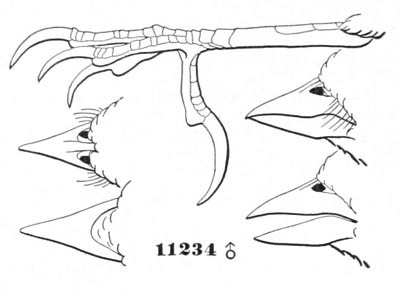
11234 ♂
Sp. Char. Bill slender, the length being .34 from nostril, the depth .25; the upper mandible much swollen at the base; the under yellow. Above and on the sides uniform slate-gray; the upper surface of wings, tail-feathers, and upper coverts dark brownish-rufous; ear-coverts streaked with white. Beneath pure white, with broad triangular arrow-shaped and well-defined spots of slate-gray like the back everywhere, except along the middle of the belly; not numerous on the throat. A hoary spot at the base of the bill above the loral region; axillars nearly white. Length, 6.80; wing, 3.30; tail, 3.50.
Hab. Head-waters of Platte and middle region of United States to Fort Tejon and to Fort Crook, California.
This species is readily distinguished from P. iliaca by the slaty back and spots on the breast, the absence of streaks above, and the longer claws. From townsendi it differs in having the head, back, sides, and spots beneath slate-colored, instead of dark reddish-brown. The spotting beneath is much more sparse, the spots smaller, more triangular, and confined to the terminal portion of the feathers, instead of frequently involving the entire outer edge. The axillars are paler. The wings and tail are the same in both species.
The young bird is quite similar; but the spots beneath are badly defined, more numerous, and longitudinal rather than triangular.
There can be little doubt, however, that this bird is a geographical race of P. townsendi.
Habits. For all that we know in regard to the habits and general distribution of this species, we are indebted to the observations of Mr. Ridgway, who met with it while accompanying Mr. Clarence King’s geological survey. It was first obtained in July, 1856, by Lieutenant F. T. Bryan, on the Platte River, and others were afterwards collected at Fort Tejon by Mr. Xantus.
Mr. Ridgway found the Slate-colored Sparrow at Carson City, during its spring migrations northward, in the early part of March. At this time it was seen only among the willows along the Carson River, and was by no means common. It had the habit of scratching among the dead leaves, on the ground in the thickets, precisely after the manner of the eastern P. iliaca. In the following September he again found it among the thickets in the Upper Humboldt Valley. In Parley’s Park, among the Wahsatch Mountains, he found it a very plentiful species in June, nesting among the willows and other shrubbery along the streams. There it was always found in company with the M. fallax, which in song it greatly resembles, though its other notes are quite distinct, the ordinary one being a sharp chuck. The nest of the two species, he adds, were also so much alike in manner of construction and situation, and the eggs so similar, that it required a careful observation to identify a nest when one was found.
The eggs from one nest of the Passerella schistacea measure .90 by .70 of an inch, have a ground of a light mountain-green, and are profusely spotted with blotches of a rufous-brown, generally diffused over the entire egg.
Another nest of this species, obtained in Parley’s Park, in the Wahsatch Mountains, by Mr. Ridgway, June 23, 1869, was built in a clump of willows, about two feet from the ground. The nest is two inches in height, two and a half in diameter, cavity one and a half deep, with a diameter of two. It is composed externally of coarse decayed water-grass, is lined with fine hair and finer material like the outside. The eggs, four in number, are .80 by .67 of an inch, of a very rounded oval shape, the ground-color of a pale green, blotched and marked chiefly at the larger end with brown spots of a wine-colored hue.
Passerella townsendi, var. megarhynchus, Baird.
THICK-BILLED SPARROW.
Passerella schistacea, Baird, Birds N. Am. 1858, p. 490 (in part; Ft. Tejon specimens). Passerella megarhynchus, Baird, Birds N. Am. 1858, p. 925 (Appendix).—Cooper, Orn. Cal. I, 222. Passerella schistacea, var. megarhynchus, Ridgway, Rept. Geol. Expl. 40th Par.
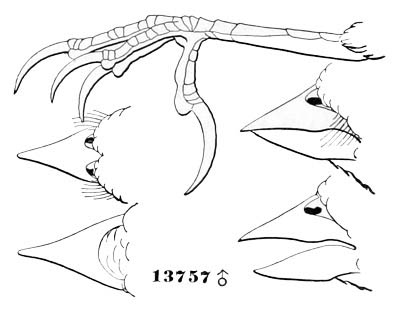
13757 ♂
Sp. Char. Similar to var. schistacea in colors, size, and general proportions; but bill enormously thick, its depth being very much greater than the distance from nostril to tip, instead of much less; color of lower mandible rosy milk-white, instead of maize-yellow. Bill, .35 from nostril, .47 deep; wing, 3.30; tail, 3.50; tarsus, .83; middle toe without claw, .63; hind claw, .50.
Hab. Sierra Nevada, from Fort Tejon north to 40° latitude (Carson City, Nevada, breeding, Ridgway).
This very remarkable variety of P. townsendi is quite local in its distribution, having been observed only in the Sierra Nevada region, as above indicated. The first specimens were brought from Fort Tejon by Mr. J. Xantus, but at what season they were found there is not indicated on the labels. Recently, specimens were procured by Mr. Ridgway at Carson City, Nev., in April, they having arrived there about the 20th of April, frequenting the ravines of the Sierra near the snow. At the same place the var. schistacea was found earlier in the spring, but among the willows along the streams in the valleys, and not met with in the mountains; and all the individuals had passed northward before those of megarhynchus arrived.
In this restricted distribution the present bird is a companion of the Melospiza melodia, var. heermanni, and the characteristics of form are the same in both as compared with their Middle Province and Northern representatives; while they both differ from the latter (townsendi of Passerella, and rufina of Melospiza) in purer, lighter, and less brown colors.
Habits. Dr. Cooper met with several individuals of this bird towards the summits of the Sierra Nevada, in September, 1863, but was unable to preserve any of them. So far as he was able to observe them, they had no song, and their habits were generally similar to those of the P. townsendi.
The Thick-billed Sparrow was found by Mr. Ridgway as a very common bird among the alder swamps in the ravines of the eastern slope of the Sierra Nevada during the summer. Near Carson City, April 25, in a swampy thicket near the streams in the level slopes, he heard, for the first time, its beautiful song, and killed a specimen in the midst of its utterance of what, he adds, was one of the most exquisitely rich utterances he ever heard. This song, he states, resembles, in richness and volume, that of the Louisiana Water Thrush (Seiurus ludovicianus), qualities in which that bird is hardly equalled by any other North American bird. They were singing in all parts of that swampy thicket, and up the ravines as far as the snow. From the nature of the place and the character of their song, they were at first supposed to be the Water Thrush, until specimens of these exquisite songsters were secured. He regards this bird as second to none of our singers belonging to this family and though in variety, sprightliness, and continuity, and also in passionate emotional character, its song is not equal to that of the Chondestes grammaca, yet it is far superior in power and richness of tone. Mr. Ridgway regards this bird as easily distinguishable from the P. schistacea, of which, however, it is only a variety. There is a total discrepancy in its notes, and while neither species is resident in the latitude of Carson City, through which both kinds pass in their migrations, the P. schistacea lingers in the spring only a short time, soon passing to the northward, while the P. megarhynchus arrives later and remains through the summer. The former makes its temporary abode among the willows along the river, while the latter breeds in the shrubbery of the mountain ravines.
Subfamily SPIZINÆ.
Char. Bill variable, always large, much arched, and with the culmen considerably curved; sometimes of enormous size, and with a greater development backward of the lower jaw, which is always appreciably, sometimes considerably, broader behind than the upper jaw at its base; nostrils exposed. Tail rather variable. Bill generally black, light blue, or red. Wings shorter than in the first group. Gape almost always much more strongly bristled. Few of the species sparrow-like or plain in their appearance; usually blue, red, or black and white; except in one or two instances the sexes very different in color.
The preceding diagnosis is intended to embrace the brightly colored passerine birds of North America, different in general appearance from the common Sparrows. It is difficult to draw the line with perfect strictness, so as to separate the species from those of the preceding group, but the bill is always more curved, as well as larger, and the colors are brighter. They resemble quite closely, at a superficial glance, the Coccothraustinæ, but may be readily distinguished by absence of the projecting tufts surrounding the base of the upper mandible, shorter, more rounded wings, and longer tarsi.
The genera may be most conveniently arranged as follows:—
A. Wings decidedly longer than the tail. Eggs plain blue or white, unspotted.
a. Feet very stout, reaching nearly to the end of the tail. Species terrestrial.
Calamospiza. Bill moderate, the commissure with a deep angle posteriorly and prominent lobe behind it; anteriorly nearly straight; commissure of lower mandible with a prominent angle. Outer toe longer than the inner, both nearly as long as the posterior. Outer four primaries about equal, and abruptly longer than the rest. Tertials nearly equal to primaries. Tail-feathers broad at tips. Color: black with white spot on wing in ♂, brownish streaks in ♀. Nest on or near ground; eggs plain pale blue.
Euspiza. Bill weaker, the commissure with a more shallow angle, and much less prominent sinuation behind it; anteriorly distinctly sinuated. Outer toe shorter than inner, both much shorter than the posterior one. First primary longest, the rest successively shorter. Tertials but little longer than secondaries. Tail-feathers attenuated at tips. Color: back brown streaked with black; throat white; jugulum yellow or ashy; with or without black spot on fore neck. A yellow or white superciliary stripe. Nest on or near ground; eggs plain pale blue.
b. Feet weaker, scarcely reaching beyond lower tail-coverts; species arboreal.
a. Size large (wing more than 3.50 inches).
Hedymeles. Upper mandible much swollen laterally. Colors: no blue; upper parts conspicuously different from the lower. Wings and tail with white patches; axillars and lining of wing yellow or red. Female streaked. Nest in a tree or bush; eggs greenish, thickly spotted.
Guiraca. Upper mandible flat laterally. Colors: ♂ deep blue, with two rufous bands on wings; no white patches on wings or tail; axillars and lining of wing blue; ♀ olive-brown without streaks. Nest in a bush; eggs plain bluish-white.
b. Size very small (wing less than 3.00 inches).
Cyanospiza. Similar in form to Guiraca, but culmen more curved, mandible more shallow, the angle and sinuations of the commissure less conspicuous. Color: ♂ more or less blue, without any bands on wing (except in C. amæna in which they are white); ♀ olive-brown. Nest in a bush; eggs plain bluish-white (except in C. ciris, in which they have reddish spots).
B. Wing and tail about equal. The smallest of American Conirostres. Nest in bushes. Eggs white, spotted.
Spermophila. Bill very short and broad, scarcely longer than high, not compressed; culmen greatly curved. Color: chiefly black and white, or brown and gray.
Phonipara. Bill more triangular, decidedly longer than deep, much compressed; culmen only slightly curved, or perfectly straight. Colors: dull olive-green and blackish, with or without yellow about the head.
C. Wing much shorter than the tail.
a. Head crested. Prevailing color red. Bill red or whitish.
Pyrrhuloxia. Bill pyrrhuline, very short, and with the culmen greatly convex; shorter than high. Hind claw less than its digit; not much larger than the middle anterior one. Tarsus equal to the middle toe. Nest in bush or low tree; eggs white, spotted with lilac and olive.
Cardinalis. Bill coccothraustine, very large; culmen very slightly convex. Wings more rounded. Feet as in the last, except that the tarsus is longer than the middle toe. Nest in bush or low tree; eggs white, spotted with lilac and olive.
b. Head not crested. Colors black, brown, or olive, without red. Bill dusky, or bluish.
Pipilo. Bill moderate; culmen and commissure curved. Hind claw very large and strong; longer than its digit. Tarsus less than the middle toe. Nest on ground or in low bush; eggs white sprinkled with red, or pale blue with black dots and lines round larger end.
Genus CALAMOSPIZA, Bonap.
Calamospiza, Bonap. List, 1838. (Type, Fringilla bicolor, Towns.)
Corydalina, Audubon, Synopsis, 1839. (Same type.)
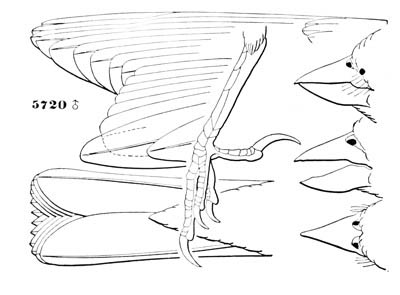
Calamospiza bicolor. 5720 ♂
Gen. Char. Bill rather large, much swollen at the base; the culmen broad, gently but decidedly curved; the gonys nearly straight; the commissure much angulated near the base, then slightly sinuated; lower mandible nearly as deep as the upper, the margins much inflected, and shutting under the upper mandible. Nostrils small, strictly basal. Rictus quite stiffly bristly. Legs large and stout. Tarsi a little longer than the middle toe; outer toe rather longer than the inner, and reaching to the concealed base of the middle claw; hind toe reaching to the base of the middle claw; hind claw about as long as its toe. Claws all strong, compressed, and considerably curved. Wings long and pointed; the first four nearly equal, and abruptly longest; the tertials much elongated, as long as the primaries. Tail a little shorter than the wings, slightly graduated; the feathers rather narrow and obliquely oval, rounded at the end.
Color. Male, black, with white on the wings. Female, brown above, beneath white, with streaks.
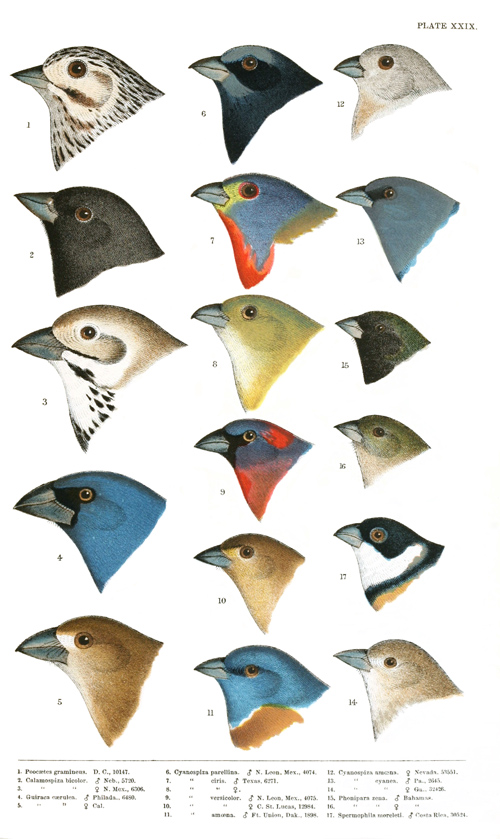
PLATE XXIX.
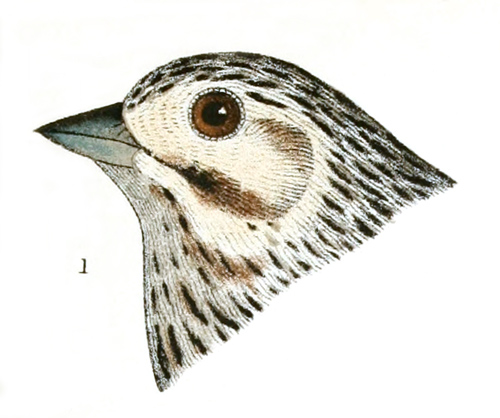
1. Poocætes gramineus. D. C., 10147.
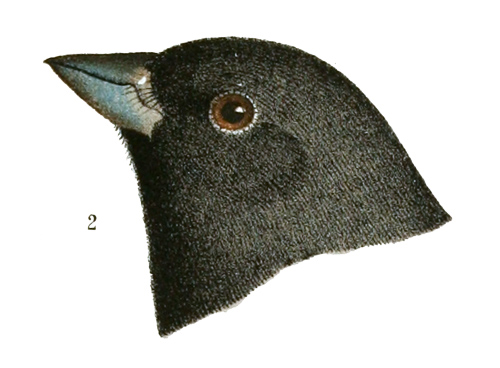
2. Calamospiza bicolor. ♂ Neb., 5720.
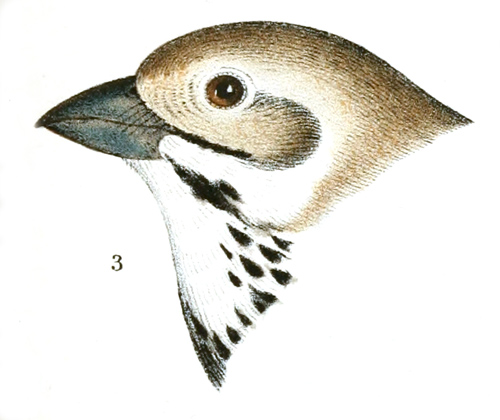
3. Calamospiza bicolor. ♀ N. Mex., 6306.
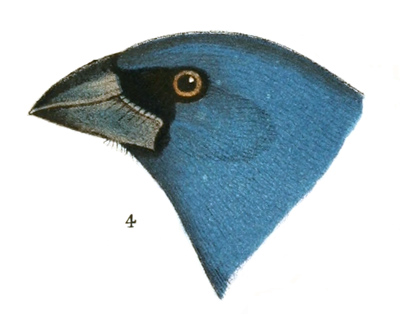
4. Guiraca cærulea. ♂ Philada., 6480.
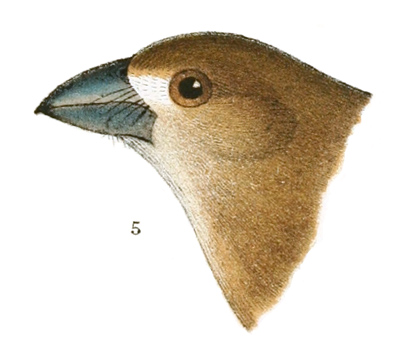
5. Guiraca cærulea. ♀ Cal.
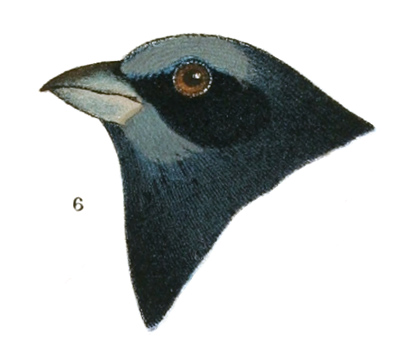
6. Cyanospiza parellina. ♂ N. Leon, Mex., 4074.
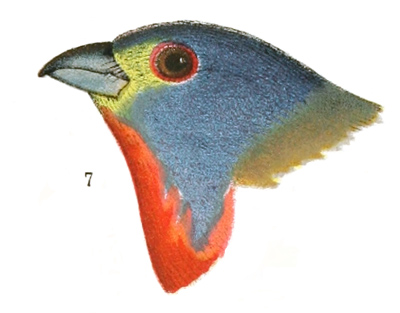
7. Cyanospiza ciris. ♂ Texas, 6271.
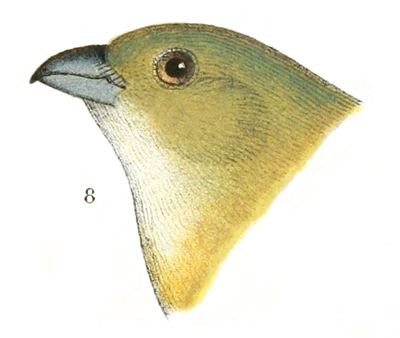
8. Cyanospiza ciris. ♀.
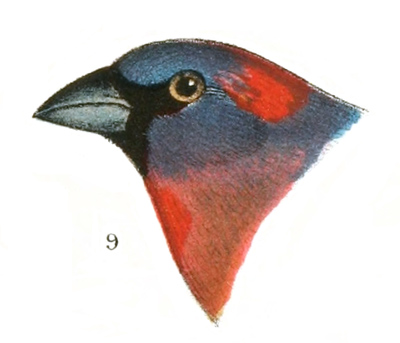
9. Cyanospiza versicolor. ♂ N. Leon, Mex., 4075.
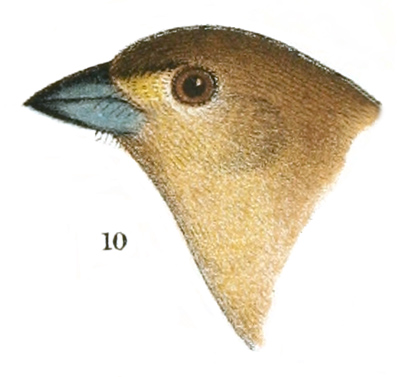
10. Cyanospiza versicolor. ♀ C. St. Lucas, 12984.
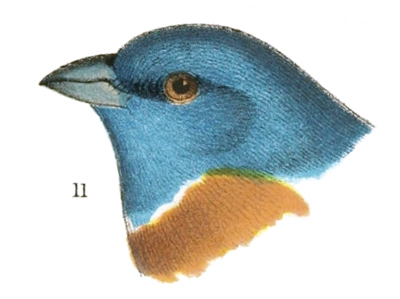
11. Cyanospiza amœna. ♂ Ft. Union, Dak., 1898.
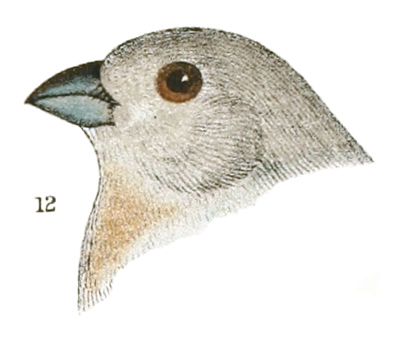
12. Cyanospiza amœna. ♀ Nevada, 53551.
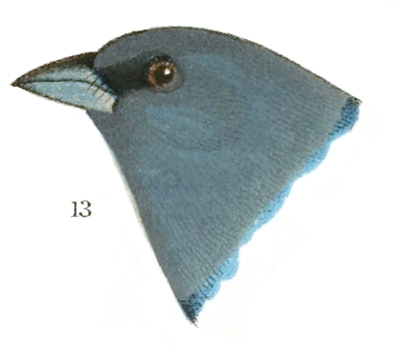
13. Cyanospiza cyanea. ♂ Pa., 2645.
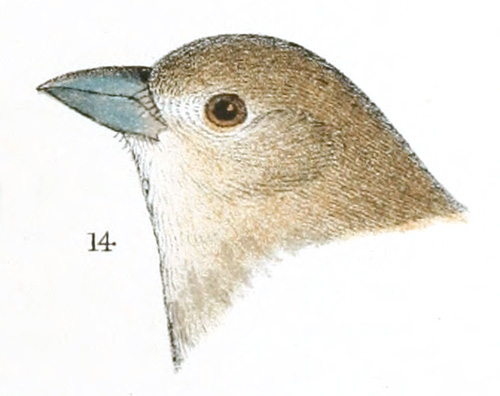
14. Cyanospiza cyanea. ♀ Ga., 32426.
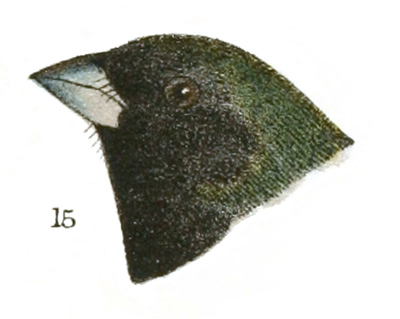
15. Phonipara zena. ♂ Bahamas.
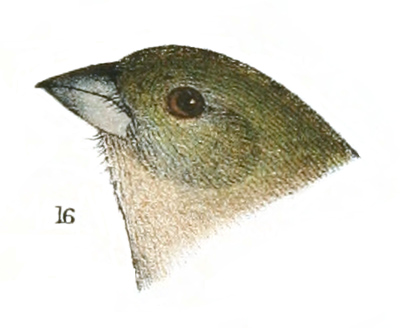
16. Phonipara zena. ♀ Bahamas.
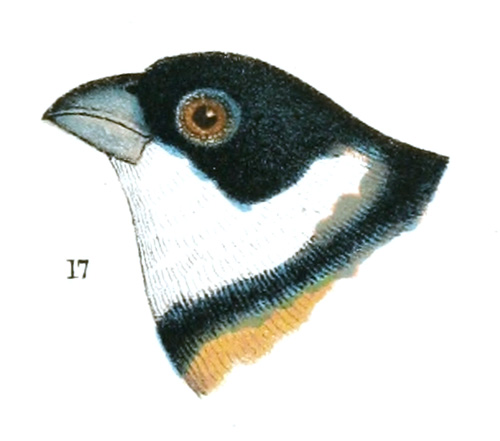
17. Spermophila moreleti. ♂ Costa Rica, 30524.
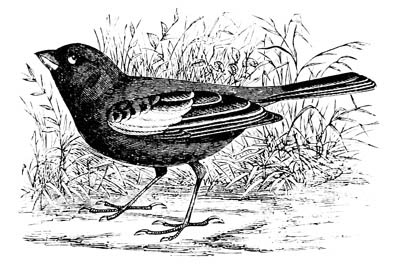
Calamospiza bicolor.
This genus is well characterized by the large swollen bill, with its curved culmen; the large strong feet and claws; the long wings, a little longer than the tail, and with the tertials as long as the primaries; the first four quills about equal, and abruptly longest; the tail short and graduated.
The only group of North American Spizellinæ, with the tertials equal to the primaries in the closed wing, is Passerculus. This, however, has a differently formed bill, weaker feet, the inner primaries longer and more regularly graduated, the tail-feathers more acute and shorter, and the plumage streaked brownish and white instead of black.
Calamospiza bicolor, Bonap.
LARK BUNTING; WHITE-WINGED BLACKBIRD.
Fringilla bicolor, Townsend, J. A. N. Sc. Ph. VII, 1837, 189.—Ib. Narrative, 1839, 346.—Aud. Orn. Biog. V, 1839, 19, pl. cccxc. Calamospiza bicolor, Bonap. List, 1838.—Ib. Conspectus, 1850, 475.—Baird, Birds N. Am. 1858, 492.—Heerm. X, c, 15. Corydalina bicolor, Aud. Synopsis, 1839, 130.—Ib. Birds Am. III, 1841, 195, pl. cci.—Max. Cab. J. VI, 1858, 347.—Cooper, Orn. Cal. 1, 225. Dolichonyx bicolor, Nuttall, Manual, I, (2d ed.,) 1840, 203.
Sp. Char. Male entirely black; a broad band on the wing (covering the whole of the greater coverts), with the outer edges of the quills and tail-feathers, white. Length, about 6.50; wing, 3.50; tail, 3.20; tarsus, 1.00; bill above, .60.
Female pale brown, streaked with darker above; beneath white, spotted and streaked rather sparsely with black on the breast and sides. Throat nearly immaculate. A maxillary stripe of black, bordered above by white. Region around the eye, a faint stripe above it, and an obscure crescent back of the ear-coverts, whitish. A broad fulvous white band across the ends of the greater wing-coverts; edge of wing white. Tail-feathers with a white spot at the end of the inner web.
Young. Similar to the female; a faint buff tinge prevalent beneath, where the streaks are narrower; dark streaks above broader, the feathers bordered with buffy-white.
Hab. High Central Plains to the Rocky Mountains; southwesterly to Valley of Mimbres and Sonora; San Antonio, Texas, winter (Dresser, Ibis, 1865, 490). Fort Whipple, Arizona (Coues, P. A. N. S. 1866, 84). Parley’s Park, Utah (Ridgway).
Habits. This peculiar species, known by some writers as the Lark Bunting, and by others as the White-winged Blackbird, was first described by Townsend in 1837. He met with it when, in company with Mr. Nuttall, he made his western tour across the continent, on the 24th of May, soon after crossing the north branch of the Platte River. The latter writer regarded it as closely allied to the Bobolink, and described it as a Dolichonyx. He describes the birds as gregarious, consorting with the Cowbirds, and, at the time he met with them, uttering most delightful songs. Towards evening they sometimes saw these birds in all directions around them, on the hilly grounds, rising at intervals to some height, hovering and flapping their wings, and, at the same time, giving forth a song which Mr. Nuttall describes as being something like weet-weet-wt-wt-wt, notes that were between the hurried warble of the Bobolink and the melody of a Skylark. It is, he says, one of the sweetest songsters of the prairies, is tame and unsuspicious, and the whole employment of the little band seemed to be an ardent emulation of song.
It feeds on the ground, and, as stated by Mr. Townsend, may be seen in flocks of from sixty to a hundred together. It was, so far as their observations went, found inhabiting exclusively the wide grassy plains of the Platte. They did not see it to the west of the Black Hills, or the first range of the Rocky Mountains.
To Mr. Nuttall’s account Mr. Townsend adds that this bird is strictly gregarious, that it feeds on the ground, around which it runs in the manner of the Grass Finch, to which, in its habits, it seems to be somewhat allied. Mr. Townsend adds that, as their caravan moved along, large flocks of these birds, sometimes to the number of sixty or a hundred individuals, were started from the ground, and the piebald appearance of the males and females promiscuously intermingled presented a very striking and by no means unpleasing effect. While the flock was engaged in feeding, some of the males were observed to rise suddenly to considerable height in the air, and, poising themselves over their companions with their wings in constant and rapid motion, continued nearly stationary. In this situation they poured forth a number of very lively and sweetly modulated notes, and, at the expiration of about a minute, descended to the ground and moved about as before. Mr. Townsend also states that he met with none of these birds west of the Black Hills.
Mr. Ridgway also mentions that though he found these birds very abundant on the plains east of the Black Hills, he met with only a single specimen to the westward of that range. This was at Parley’s Park, among the Wahsatch Mountains.
Dr. Gambel, in his paper on the Birds of California, states that he met with small flocks of this handsome species in the bushy plains, and along the margins of streams, during the winter months. And Dr. Heermann states that he also found this species numerous in California, New Mexico, and Texas. Arriving in the last-named State in May, he found this species there already mated, and about to commence the duties of incubation.
Mr. Dresser found these birds common near San Antonio during the winter. In December he noticed several flocks near Eagle Pass. They frequented the roads, seeking the horse-dung. They were quite shy, and when disturbed the whole flock would go off together, uttering a low and melodious whistle. In May and June several were still about near Howard’s Rancho, and on his return from Houston, in June, he succeeded in shooting one in its full summer plumage, when its specific name is peculiarly appropriate. He does not, however, think that, as a general thing, any of them remain about San Antonio to breed.
They breed in great numbers on the plains of Wyoming Territory, and probably also in Colorado, Montana, and Dakota. The Smithsonian collection embraces specimens obtained in July from the Yellowstone, from Platte River, Pole Creek, the Black Hills, and Bridger’s Pass, indicating that they breed in these localities; also specimens from Texas, New Mexico, Sonora, and Espia, in Mexico, but none from California.
Dr. Kennerly, who met with these birds both in Sonora and at Espia, on the Mexican Boundary Survey, states that he observed them in the valley of the river early in the morning, in very large flocks. During the greater part of the day they feed on the hills among the bushes. When on the wing they keep very close together, so that a single discharge of shot would sometimes bring down twenty or thirty. Mr. J. H. Clark, on the same survey, also states that he sometimes found them occurring in flocks of hundreds. The greatest numbers were seen near Presidio del Norte. Great varieties of plumage were observed in the same flock. The food seemed to be seeds almost exclusively. They were very simultaneous in all their movements. Stragglers were never observed remaining behind after the flock had started. They are, he states, the most absolutely gregarious birds he has ever met with.
Dr. Coues, who regarded this bird as one highly characteristic of the prairie fauna, writes me that he met with it in great numbers in Kansas, soon after leaving Fort Riley, and saw it every day until he reached the Raton Mountains in New Mexico. “For two or three days, in fact, from Fort Larned to the mountains,” he writes, “I scarcely saw anything else. This was the first week in June, and most of the birds seemed to be paired and nesting, though occasionally a dozen or more were seen together, flocking like the Blackbirds that they strongly recall. They were in full song, and proved delightful vocalists. Sometimes they warble from some spray or low bush offering a stand a little above the level flower-beds of the prairie, but oftener they mount straight up, hovering high in the air on tremulous wings, pouring forth their melodious strains until, seemingly exhausted, they sink back to the ground. At such times it is interesting to watch two rival males, each straining every nerve to mount higher than the other, and sing more acceptably to its mate hidden in the verdure below. This habit of rising on the wing to sing, so famed in the case of the Skylark, seems not confined to particular species, but to be a forced practice of a number of different birds residing in open level regions, that do not afford the elevated perches usually chosen by woodland songsters for their performances. The ordinary flight of this species is altogether of a different character, being a low gliding motion, overtopping the weeds and bushes. That the birds were nesting at this time is rendered still more probable by the fact that the males noticed as we passed along were out of all proportion, in numbers, to the females seen. They were very heedless of approach, and any number could have been readily destroyed. I never saw any at Fort Whipple, or elsewhere in Arizona, though Dr. Heermann says that they are abundant in the southern portions of the Territory, and specimens are recorded from Lower California.”
Mr. Allen found the Lark Bunting one of the few birds that seemed strictly confined to the arid plains near Fort Hays, in Kansas. He met with it in great abundance, but only on the high ridges and dry plateaus, where they seemed to live in colonies. He describes them as very wary, and very tenacious of life, often flying long distances, even after having been mortally wounded. They seemed to delight to fly in strong winds, when most other birds kept in shelter. They sing while on the wing, hovering in the wind and shaking the tail and legs after the well-known manner of the Yellow-breasted Chat. Its song seemed to him to strongly resemble that of the Chat, with which, at such times, its whole demeanor strikingly accorded.
Dr. Heermann, in his Report on the birds collected in the survey on the 32d parallel, states that he first observed these birds on approaching the Pimos villages. They were associated with large flocks of Sparrows, gleaning grain and grass-seed upon the ground. When started up they flew but a short distance before they resumed their occupation. After crossing the San Pedro he again found them in large flocks. At Fort Fillmore, in Mesilla Valley, it was also quite common and associated with the Cowbird and Blackbird, searching for grain among the stable offals. He again met with them in Texas, in the month of April, most of them still retaining their winter coat. He describes the tremulous fluttering motion of the wings with which the male accompanies its song while on the wing as very much after the manner of the Bobolink, and he speaks of their song as a disconnected but not an unmusical chant. He found their nests on the ground, made of fine grasses, lined with hair, and in one instance he found the eggs spotted with faint red dashes.
At Gilmer, in Wyoming Territory, their nests were found by Mr. Durkee built on the ground, and composed of dry grasses very loosely arranged. The eggs, four or five in number, are of a uniform and beautiful light shade of blue, similar to those of the Euspiza americana. They measure .90 by .70 of an inch, are of a rounded-oval shape, and, so far as I have observed, are entirely unspotted, although eggs with a few reddish blotches are said to have been met with.
Genus EUSPIZA, Bonap.
Euspiza, Bonap. List, 1838. (Type, Emberiza americana, Gmelin.)
Euspina, Cabanis, Mus. Hein. 1851, 133. (Same type.)
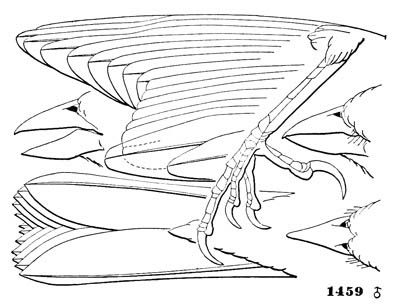
Euspiza americana, Bonap. 1459 ♂
Gen. Char. Bill large and strong, swollen, and without any ridges; the lower mandible nearly as high as the upper; as broad at the base as the length of the gonys, and considerably broader than the upper mandible; the edges much inflexed, and shutting much within the upper mandible; the commissure considerably angulated at the base, then decidedly sinuated. The tarsus barely equal to the middle toe; the lateral toes nearly equal, not reaching to the base of the middle claw; the hind toe about equal to the middle one without its claw. The wings long and acute, reaching nearly to the middle of the tail; the tertials decidedly longer than the secondaries, but much shorter than the primaries; first quill longest, the others regularly graduated. Tail considerably shorter than the wings, though moderately long; nearly even, although slightly emarginate; the outer feathers scarcely shorter. Middle of back only striped; beneath without streaks.
This genus comes nearer to Calamospiza, but has shorter tertials, more slender bill, weaker and more curved claws, etc.
Species.
E. americana. Top and sides of head light slate; forehead tinged with greenish-yellow. A superciliary stripe, a maxillary spot, sides of breast, and middle line of breast and belly, yellow. Chin white, throat black, shoulders chestnut. Female with the black of the throat replaced by a crescent of spots. Hab. Eastern Province of United States; south to New Grenada.
E. townsendi. Body throughout (including the jugulum), dark ash, tinged with brownish on the back and wings. Superciliary and maxillary stripe, chin, throat, and middle of belly, white. A maxillary line and a pectoral crescent of black spots. No chestnut shoulders. Hab. Chester Co., Pennsylvania.
Euspiza americana, Bonap.
BLACK-THROATED BUNTING.
Emberiza americana, Gmelin, Syst. Nat. I, 1788, 872.—Wilson, Am. Orn. III, 1811, 86, pl. iii, f. 2.—Aud. Orn. Biog. IV, 1838, 579, pl. ccclxxxiv.—Ib. Syn. 1839, 101.—Ib. Birds Am. III, 1841, 58, pl. clvi.—Max. Cab. J. VI, 1858, 341. Fringilla (Spiza) americana, Bonap. Obs. Wils. 1825, No. 85. Euspiza americana, Bonap. List, 1838 (type).—Ib. Conspectus, 1850, 469.—Baird, Birds N. Am. 1858, 494.—Samuels, 327. Euspina americana, Cabanis, Mus. Hein. 1851, 133 (type). Fringilla flavicollis, Gmelin, Syst. Nat. I, 926. “Emberiza mexicana, Latham,” Syn. I, 1790, 412 (Gray). Passerina nigricollis, Vieillot. Yellow-throated Finch, Pennant, Arc. Zoöl. II, 374.
Sp. Char. Male. Sides of the head and sides and back of the neck ash; crown tinged with yellowish-green and faintly streaked with dusky. A superciliary and short maxillary line, middle of the breast, axillaries, and edge of the wing yellow. Chin, loral region, patch on side of throat, belly, and under tail-coverts white. A black patch on the throat diminishing to the breast, and ending in a spot on the upper part of the belly. Wing-coverts chestnut. Interscapular region streaked with black; rest of back immaculate. Length, about 6.70; wing, 3.50.
Female with the markings less distinctly indicated; the black of the breast replaced by a black maxillary line and a streaked collar in the yellow of the upper part of the breast.
Hab. United States from the Atlantic to the border of the high Central Plains, south to Panama and New Granada. Xalapa (Scl. 1857, 205); Guatemala (Scl. Ibis, I, 18); Turbo, N. G. (Cassin, P. A. N. S. 1860, 140); Panama (Lawr. VII, 1861, 298); Nicaragua, Graytown (Lawr. VIII, 181); Veragua (Salv. 1867, 142); Costa Rica (Lawr. IX, 103); Vera Cruz, winter (Sum. M. B. S. I, 552).
Among adult males, scarcely two individuals exactly alike can be found. In some the black of the throat is continued in blotches down the middle of the breast, while in others it is restricted to a spot immediately under the head. These variations are not at all dependent upon any difference of habitat, for specimens from remote regions from each other may be found as nearly alike as any from the same locality. Some specimens from Central America are more deeply colored than North American ones, owing, no doubt, to the freshness of the plumage.
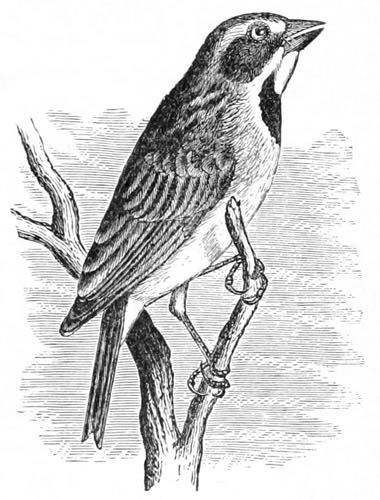
Euspiza americana.
Habits. The history of the Black-throated Bunting has, until very recently, been much obscured by incorrect observations and wrong descriptions. Evidently this bird has been more or less confounded with one or two other species entirely different from it. Thus Wilson, Audubon, and Nuttall, in speaking of its nest and eggs, give descriptions applicable to Coturniculus passerinus or to C. henslowi, but which are wholly wrong as applied to those of this bird. Nuttall, whose observations of North American birds were largely made in Massachusetts, speaks of this bird being quite common in that State, where it is certainly very rare, and describes, as its song, notes that have no resemblance to those of this Bunting, but which are a very exact description of the musical performances of the Yellow-winged Sparrow.
It is found in the eastern portion of North America, from the base of the Black Hills to the Atlantic States, and from Massachusetts to South Carolina. I am not aware that on the Atlantic it has ever been traced farther south than that State, but farther west it is found as far at least as Southwestern Texas. During winter it is found in Central America, and in Colombia, South America.