Family ICTERIDÆ.—The Orioles. (continued 2)
Reading edition
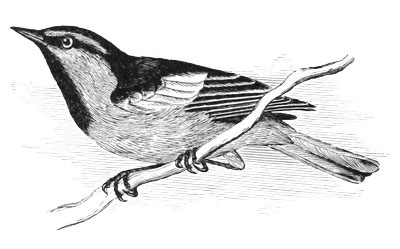
Icterus bullocki.
In view of the difficulties attendant upon the definition of subordinate groups among the United States Icterinæ, we propose to consider them all under the single genus Icterus, leaving it for some one with more ingenuity to establish satisfactory divisions into sub-genera.[34]
The colors of the Orioles are chiefly black and yellow, or orange, the wing sometimes marked with white. The females are generally much duller in plumage, and the young male usually remains in immature dress till the third year. In all the North American species the rump is of the same color with the belly; the chin, throat, and tail, black.
In the North American Orioles the baltimore and bullocki have the tail but little graduated; spurius, more so; the others very decidedly graduated. The bills of the two first mentioned are stout and nearly straight; that of I. melanocephalus quite similar. I. parisorum has the bill more attenuated, but scarcely more decurved; in spurius it is attenuated and decurved, much as in wagleri; this character is strongest in I. cucullatus. The much graduated tail is combined with a slender decurved bill in I. cucullatus and wagleri; with a straighter one in parisorum; with a thick, nearly straight, one in melanocephalus. The arrangement, according to the graduation of the tail, would be baltimore, bullocki, spurius, parisorum, wagleri, melanocephalus, and cucullatus. According to stoutness and curvature of bill, it would be baltimore, melanocephalus, bullocki,parisorum, spurius wagleri, and cucullatus.
All the species have the rump and under parts yellow or orange. All have the head entirely black, except bullocki, in which its sides are orange, and cucullatus, which has an orange crown. All have black on the throat. In the species with black head and neck, all have the tails black towards the end, except bullocki and baltimore.
The females and young males are so entirely different in colors from the adult males, and so similar in the different species, that they can best be distinguished by the details of form and size. The I. prosthemelas and I. melanocephalus are placed, according to the above arrangement, in different subgenera, yet the young male of the former and the adult male of the latter are so perfectly similar in colors as to be undistinguishable in this respect, and require careful examination of points of external structure to be separated (see description of I. melanocephalus, p. 782).
The following synopsis may help to distinguish the North American Orioles and their nearest allies, as far as color is concerned.
Species and Varieties.
ICTERUS. Head all round deep black, sharply defined against the yellow of the nape; wings black, with or without white markings. Body generally, including lesser wing-coverts, deep greenish-yellow (intense orange-red in some South American species).
I. vulgaris. Feathers of the throat elongated and lanceolate. Bill longer than head. Back and scapulars black; greater coverts and tertials with much white on outer webs; middle wing-coverts white. Rest of plumage, including lesser coverts, chrome-yellow. Sexes alike. Hab. Northern South America. Jamaica? Accidental in southeastern United States? ? Several races.
I. melanocephalus. Feathers of the throat not elongate and lanceolate, but soft and normal; bill shorter than head. Back and scapulars greenish-yellow. Rest of plumage, including lesser wing-coverts, gamboge-yellow. Sexes alike.
Wings without any white. Wing, 4.00; tail, 4.00; culmen, .95; tarsus, .96. Hab. Southern Mexico … var. melanocephalus.
Wings with white edgings to greater coverts, secondaries and tertials. Wing, 4.25; tail, 4.40; culmen, 1.10; tarsus, 1.10. Hab. Northern Mexico and Rio Grande Valley of United States … var. auduboni.
XANTHORNUS. Back, scapulars, wings, tail, and throat, black; wings and tail with, or without, white. Rest of plumage greenish-yellow, gamboge-yellow, orange, orange-red, or chestnut-rufous.
A. Head and neck, all round, deep black.
a. Tail-feathers wholly black.
I. dominicensis. Head, neck, back, scapulars, wings, tail, and jugulum, deep black; lesser and middle wing-coverts, lining of the wing, anal region, tibiæ, and rump, deep gamboge-yellow. No white on wings or tail. Sexes similar (in all the races?).
Abdomen and sides yellow.
Tail-coverts partially or wholly yellow. Wing, 3.25 to 3.50; Tail, 3.75 to 4.00; culmen, .80; tarsus, .85. Hab. South Mexico to Costa Rica … var. prosthemelas.[35]
Tail-coverts uniform black. Wing, 3.75; tail, 4.50; culmen, .80; tarsus, .90. Hab. Mexico and Guatemala … var. wagleri.
Abdomen and sides black.
Flanks and crissum yellow; upper tail-coverts yellow. Wing, 3.50; tail, 3.50; culmen, .80; tarsus, .85. Hab. Hayti … var. dominicensis.[36]
Flanks black; crissum mostly yellow; upper tail-coverts black. Wing, 3.75; tail, 4.00; culmen, .93; tarsus, .85. Hab. Porto Rico … var. portoricensis.[37]
Flanks black; crissum mostly black; upper tail-coverts black. Wing, 3.75; tail, 3.90; culmen, .80; tarsus, 86. Hab. Cuba … var. hypomelas.[38]
I. spurius. Head, neck, back, scapulars, wings, and tail, deep black; other portions, including lesser and middle wing-coverts, lining of wing, and the tail-coverts, above and below, chestnut-rufous; greater coverts and secondaries edged with dull white, and tail-feathers margined terminally with the same. Female greenish-yellow, darker above. Young male in second year similar, but with a black patch covering face and throat. Wing, 3.20; tail, 3.20, its graduation, .45; culmen, .73; tarsus, .92. Hab. Eastern Province of United States; south throughout Middle America, to New Granada.
b. Tail-feathers (except the two middle ones) with their basal half yellow.
I. parisorum. Head, neck, jugulum, back, scapulars, wings, and terminal half of tail, deep black; rest of plumage, including lesser and middle wing-coverts, bright lemon-yellow, approaching white on the middle coverts; greater coverts tipped with white, and tertials edged with the same; tail-feathers margined terminally with the same. Sexes very different. Hab. Mexico; Rio Grande Valley and Cape St. Lucas.
B. Crown, occiput, nape, and auriculars, orange; frontlet, lores, cheeks, chin, throat, and jugulum, deep black.
I. cucullatus. Back, scapulars, wings, and tail, and patch covering jugulum and throat, extending up over lores, around eyes and across frontlet, deep black. Other portions orange. Sexes very different.
Lesser coverts black; middle coverts white; greater coverts tipped with white, and secondaries, primaries, and tertials edged with the same; tail-feathers with narrow white tips. Wing, 3.30; tail, 4.00; culmen, .80; tarsus, .90. Sexes very unlike. Hab. Southern border of Western United States (San Bernardino, California, Camp Grant, Arizona and Rio Grande of Texas), south through Mexico to Guatemala; Cape St. Lucas … var. cucullatus.
Lesser coverts gamboge-yellow; middle coverts yellow; no white on wings or tail. Wing, 3.50; tail, 3.90; culmen, .85; tarsus, .90. Hab. New Granada, Venezuela, and Trinidad … var. auricapillus.[39]
HYPHANTES. Crown, back, scapulars, wings, and part of tail, deep black; wing with much white. Other portions orange or yellow. Sexes very different.
I. baltimore. Head entirely deep black; tail orange, the feathers black at base; greater coverts broadly tipped with white; secondaries and primaries skirted with the same. Other portions rich, mellow orange, the rump as intense as the breast. Wing, about 3.75; tail, 3.50; culmen, .80; tarsus, .97.
(Specimens from Eastern United States and Middle America with middle coverts deep orange.)
(Specimens from the Plains of Kansas, Nebraska, etc., with middle coverts pure white. Some eastern specimens similar.)
I. bullocki. Head mainly black, with an orange or yellow superciliary stripe, and a broader one beneath the eye, cutting off the black of the throat into a narrow strip; tail orange or yellow, the feathers with black at ends; greater coverts with outer webs wholly white, and middle coverts entirely white, producing a large conspicuous longitudinal patch on the wing; tertials and secondaries broadly edged with white, and primaries more narrowly skirted with the same. Other portions rich orange or yellow.
Rump grayish-orange; sides and flanks deep orange; forehead and auriculars orange; a broad supraloral stripe of the same. Xanthic tints deep orange, with a reddish tinge on the breast. Wings, 4.00; tail, 3.50; culmen, .80; tarsus, .90. Hab. Western Province of United States … var. bullocki.
Rump black; sides and flanks black; forehead and auriculars black; no yellow or orange supraloral stripes. Xanthic tint a very intense gamboge, without any shade of orange. Wing, 4.00; tail, 3.50; culmen, .75; tarsus, .85. Hab. Mexico … var. abeillei.[40]
Icterus vulgaris, Daudin.
TROUPIAL.
Oriolus icterus, Linn. Syst. Nat. I, 1766, 161. Icterus vulgaris, “Daudin.”—Aud. Birds Am. VII, 1844, 357, pl. ccccxcix.—Bp. Conspectus Av. 1850, 434.—Baird, Birds N. Am. 1858, 542.—Cass. P. A. N. S. 1867, 46. Le troupiale vulgaire, Buffon, Pl. enl. “532” (535, Bp.).
Sp. Char. Bill curved. Throat and chin with narrow pointed feathers. A naked space around and behind the eye. Tail-feathers graduated. Head and upper part of neck all round, and beneath from tail to upper part of breast, interscapular region of back, wings, and tail, black. Rest of under parts, a collar on the lower hind neck, rump, and upper tail-coverts, yellow-orange. A broad band on the wing and outer edges of secondaries, white. Length, 10 inches; wing, 4.50; tail, 4.50; bill above, 1.35.
Hab. Northern South America and West Indies? Accidental on the southern coast of the United States?
This is the largest Oriole said to be found in the United States, and differs from the rest in its longer bill, and pointed, elongated feathers on the throat. The bill is attenuated, and somewhat decurved. The third quill is longest, the first quill almost the shortest of all the primaries. The outer tail-feather is about .60 of an inch less than the middle.
There is only a trace of whitish on the edges of the primaries. The broad white edges to the secondaries are continuous in the folded wing with the white on the greater coverts, the lowest row of which, however, is black. The extreme and concealed base of the tail is white.
One specimen has the light markings yellow, instead of orange.
This species is given by Mr. Audubon as North American, on the strength of occasional stragglers from South America. One of the specimens before us was received from Mr. Audubon (2,842), and is, possibly, North American, although we doubt very much whether the species was ever taken within our limits, except as escaped from captivity.
An allied race (I. longirostris) from New Grenada has a longer and more slender bill, and a paler, lemon-yellow color. The I. aurantius of Brazil lacks the long, pointed, distinct feathers of the throat, and is of an intensely rich orange-red color, with much the same pattern as the present bird.
Habits. The common Troupial of South America and some of the West India Islands is probably only an imported species, or an accidental visitant. It is given by Mr. Audubon in the appendix to his seventh volume, on the strength of a specimen shot in Charleston, S. C., by his son, John W. The bird, when first seen, was perched on the point of the lightning-rod of Dr. Bachman’s house. A few days after others were seen, one of which was shot, though it fell into the river and was lost. Mr. Audubon was afterwards informed that small groups of four or five subsequently made their appearance in the same city and among the islands. If his information was correct, it precludes the supposition that those which have been procured are caged birds. Yet the Troupial is so common and so popular a bird in the cage, that its accidental occurrence is possible in many localities it never visits of its own accord.
This bird is common in all the northern countries of South America, Venezuela, Guiana, Rio Negro, Northern Brazil, etc. Its occurrence in Jamaica and the West Indies may be only accidental. It is said by Daudin to be a common species in South America, where it associates in large flocks, and constructs a large and pensile nest. In confinement it becomes very easily tamed, is reconciled to a life of imprisonment, and is very fond of those who feed and care for it. It has a loud, clear, and ringing whistle, and a great variety of call-notes and single or brief utterances, but rarely indulges in a continuous song. One kept in confinement several years answered readily to the name of Troopy, and always promptly responded, when thus addressed by his mistress, in notes of unmistakable and affectionate recognition. He was very fond of his liberty, and used his sharp bill with such effect that it was difficult to keep him in his cage. When at large he never attempted to escape, but returned upon being called. He, however, acquired such a mortal antipathy to children, attacked them so fiercely when at large, and his sharp bill was so dangerous a weapon, that it was found very necessary to keep him a close prisoner.
The eggs of this species measure 1.02 inches in length by .88 of an inch in breadth; they are a rounded, obtuse oval in shape. Their ground-color is a reddish-drab, and they are very generally blotched with markings of a deep claret-brown and faint purple, the markings being deeper and larger at one end.
Icterus melanocephalus, var. auduboni, Giraud.
AUDUBON’S ORIOLE.
Icterus auduboni, Giraud, Sixteen New Species Texas Birds, 1841 (not paged).—Baird, Birds N. Am. 1858, 542.—Cassin, Pr. A. N. S. 1867, 53. Xanthornus melanocephalus, Bon. Consp. 1850, 434 (not the description of the young). Icterus melanocephalus, Cassin, Ill. I, V, 1854, 137, pl. xxi (the description, but perhaps not the figure).
Sp. Char. Bill stout; upper and lower outlines very little curved downwards. Tail much graduated. Head and neck all round (this color extending down on the throat), tail, and wings black; rest of body, under wing-coverts, and middle and lesser upper coverts, yellow; more olivaceous on the back. An interrupted band across the ends of the greater wing-coverts, with the terminal half of the edges of the quills, white. Supposed female similar, but the colors less vivid. Length, 9.25; wing, 4.00; tail, 4.65; tarsus, 1.10.
Hab. Valley of the Lower Rio Grande of Texas, southward; Oaxaca (Scl. 1859, 38); Xalapa (Scl. 132); Vera Cruz (temperate regions; Sumichrast, M. B. S.).
This bird is perhaps rather a local race (larger as more boreal) of I. melanocephalus[41] of Southern Mexico. The differences are indicated in the foot-note.
The adult male of this species can be distinguished from the young male of I. prosthemelas only by stouter and less decurved bill, stronger feet, and black instead of yellow middle wing-coverts.
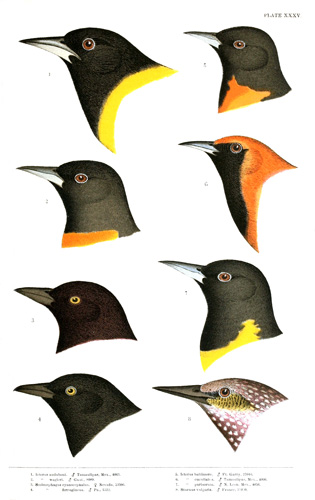
PLATE XXXV.
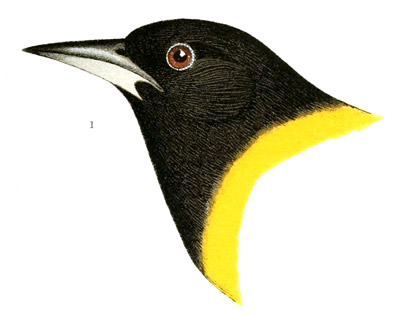
1. Icterus auduboni. ♂ Tamaulipas, Mex., 4063.
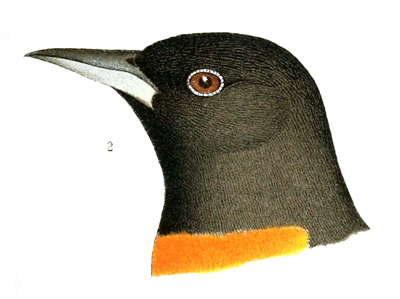
2. Icterus wagleri. ♂ Guat., 8089.
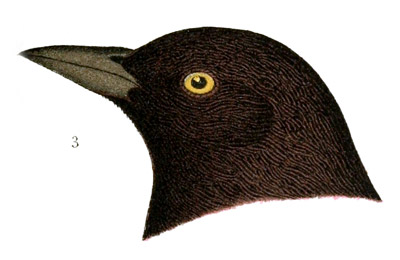
3. Scolecophagus cyanocephalus. ♀ Nevada, 53596.
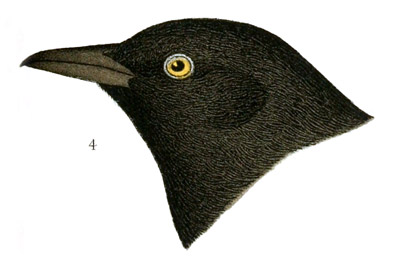
4. Scolecophagus ferrugineus. ♂ Pa., 1322.
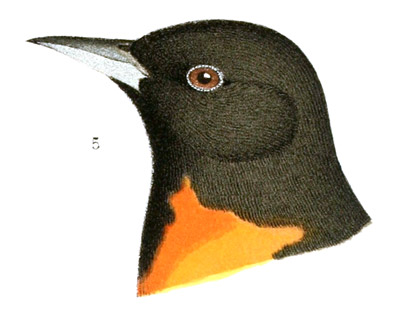
5. Icterus baltimore. ♂ Ft. Garry, 27046.
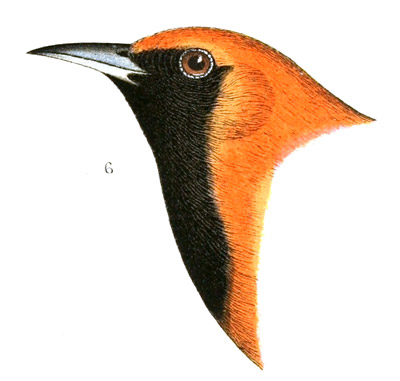
6. Icterus cucullatus. ♂ Tamaulipas, Mex., 4066.
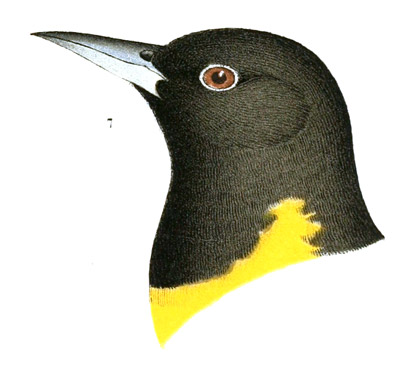
7. Icterus parisorum. ♂ N. Leon, Mex., 4056.
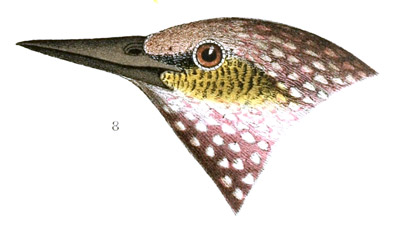
8. Sturnus vulgaris. ♂ France, 19020.
Habits. This handsome and rather recent addition to our fauna is a Northern Mexican species, which extends north to the valley of the Rio Grande and into Texas, from various localities in which it has been procured. Lt. D. N. Couch, who found this species common from the Lower Rio Grande to the Sierra Madre, speaks of the strong mutual attachment shown by the sexes. He describes its song as soft and melancholy, and the notes as resembling peut-pou-it. The sweetness of its notes renders it a favorite as a caged bird. In the State of Vera Cruz this bird is given by Sumichrast as inhabiting the temperate regions, and as there having exclusively their centre of propagation. They are very common in the district of Orizaba, where they breed. Their common name is Calandria, a name also given, without discrimination, to four or five other species of Icteri common in Vera Cruz. Mr. Pease, in 1847, observed either this species or the melanocephalus at Jalapa, and in the neighborhood of the city of Mexico, in considerable numbers. This bird was first described and brought to notice as belonging to our fauna, by Mr. Giraud, in 1841. Since then, Mr. John H. Clark, zoölogist on the Mexican Boundary Survey, obtained several specimens from the Lower Rio Grande. It was first seen by him near Ringgold Barracks. It was not abundant, and its quiet manners and secluded habits prevented it from being very conspicuous. It was most frequently observed by him feeding on the fruit of the hackberry, but whenever approached, while thus feeding, it always showed signs of uneasiness, and soon after sought refuge in some place of greater concealment.
Usually pairs were to be seen keeping close together, apparently preferring the thick foliage found on the margin of ponds, or in the old bed of the river. They did not communicate with each other by any note, and Mr. Clark was struck with their remarkable silence. Their habits seemed to him very different from those of any other Oriole with which he was acquainted.
From the papers of Lieutenant Couch, quoted by Mr. Cassin, we learn that these birds were seen by him, March 3, at Santa Rosalio, eight leagues from Matamoras. They were in pairs, and both sexes were very shy and secluded, seeking insects on the prickly pear, or among the low mimosa-trees, seeming to be never at rest, but ever on the lookout for their favorite food.
While at Charco Escondido, farther in the interior of Tamaulipas, Lieutenant Couch met with a pair of these birds, and having brought down the male bird with his gun, the female flew to a neighboring tree, apparently unaware of her loss. She soon, however, observed his fall, and endeavored to recall him to her side with notes uttered in a strain of such exquisite sadness that he could scarcely believe them uttered by a bird; and so greatly did they excite his sympathy, that he almost resolved to desist from further ornithological collections. He adds that he never heard the lay of any songster of the feathered tribe expressed more sweetly than that of the present species. At Monterey he found it a favorite cage-bird. The female also sings, but her notes are less powerful than those of the male. Generally the flight of this bird was low and rapid, and it seemed to prefer the shade of trees. It was observed almost invariably in pairs, and the male and female showed for each other great tenderness and solicitude.
The eggs of this species measure .90 of an inch in length by .70 in breadth. Their ground-color is a light drab or a dull purplish-white, scattered over which are faint markings of a subdued purple, blending imperceptibly with the ground, and above these markings are dots and irregular zigzag lines of dark brown, and darker purple, almost running into black.
Icterus parisorum, Bonap.
SCOTT’S ORIOLE.
Icterus parisorum, (“Bon. Acad. Bonon. 1836.”)—Bp. Pr. Zoöl. Soc. V, 1837, 109.—Baird, Birds N. Am. 1858, 544, pl. lvii, f. 1; Mex. B. II, Birds, 19, pl. xix, f. 1.—Cassin, Pr. 1867, 54.—Cooper, Orn. Cal. I, 1870, 276. Xanthornus parisorum, Ib. Conspectus, 1850, 434. Icterus melanochrysura, Lesson, Rev. Zoöl. 1839, 105.—Icterus scotti, Couch, Pr. A. N. Sc. Phil. VII, April, 1854, 66 (Coahuila).
Sp. Char. Bill attenuated; not much decurved; tail moderately graduated. Head and neck all round, breast, interscapular region, wings, and tail, black. Under parts generally, hinder part of back to the tail, middle and lesser upper, and whole of lower wing-coverts, and base of the tail-feathers, gamboge-yellow; a band across the ends of the greater coverts, with the edges of the inner secondaries and tertiaries, white. Length, 8.25; extent, 11.75; wing, 4.00; tail, 3.75; tarsus, .95.
Female. Olivaceous above, the back with obsolete dusky streaks; rump and under parts yellowish, clouded with gray. Tail brownish-olive on upper surface, more yellow beneath; wings with two white bands.
Hab. Valley of the Rio Grande; south to Guatemala. In Texas, found on the Pecos. Cape St. Lucas. Oaxaca, winter (Scl. 1858, 303); Orizaba (Scl. 1860, 251); Vera Cruz, temp. and alpine (Sum. M. B. S. I, 553).
The bill is slender and attenuated, very little decurved, much less so than in I. cucullatus, slenderer and a little more decurved than in I. baltimore. The tail is moderately graduated, the outer feather .45 of an inch less than the middle.
In this species the black feathers of the neck, except below, have a subterminal bar of yellow; elsewhere it is wanting. The black of the breast comes a little posterior to the anterior extremity of the folded wing. The posterior feathers in the yellow patch on the shoulders are tinged with white. The white in the bar across the ends of the greater coverts is confined mainly to the terminal quarter of an inch of the outer web. In the full plumage, there is only a faint trace of white on the edges of the primaries. The yellow of the base of the tail only extends on the middle feather as far as the end of the upper tail-coverts; on the three outer, it reaches to within an inch and a quarter of the end of the tail.
An immature male has the yellow more tinged with green, the black feathers of the head and back olivaceous with a black spot.
Specimens vary much in size; the more northern being the larger.
Icterus wagleri[42] is an allied species found just south of the Rio Grande by Lieutenant Couch, but not yet detected within our limits.
Habits. Notwithstanding the apparent abundance of the species at Cape St. Lucas, and also in Northern Mexico along our entire border, as far as New Mexico and Texas, our knowledge of its history still remains quite incomplete. A single specimen was obtained in Western Texas on the Pecos River, by Captain Pope, in 1856. Others were obtained by Lieutenant Couch, April, 1853, at Santa Catarina, in Mexico. They were first seen by him in the vicinity of Monterey. They were found to be generally of secluded habits. Their song, consisting of three or four notes, is said to be both rich and melodious.
In the State of Vera Cruz, this species is given by Sumichrast as occurring in both the temperate and the alpine regions. Its common name is Calandria india. They are said by him to occur chiefly in the temperate parts, where they breed, but not to be exclusively confined there, for they are also found in the alpine region to the height of at least five thousand feet, near Orizaba, and on the plateau at even a higher elevation. Dr. Cooper saw a bird at Fort Mohave, in April, which he supposed to be this bird, but he was not able to assure himself of the fact, by obtaining it.
Mr. Xantus found this species very abundant during his stay at Cape St. Lucas, and procured a number of specimens of the birds and of their nests and eggs. From his brief notes we gather that the nests are open, and are not pensile. One, found May 22, was built in a bunch of moss hanging down from an old cactus. Another was made in a bunch of hops, suspended from a cactus. A third was placed in a bunch of weeds growing out from a crevice in a perpendicular rock. Another, found May 29, was built in a small dead tree, overhung with vines. This nest was about five feet from the ground. A nest containing four young birds was found placed in a bunch of moss, hanging out of a crevice in a rock. These instances serve to show the general character of the position of their nests. Without being pensile they are usually resting upon pendent branches, and are not placed at great elevations.
The eggs measure .90 of an inch in length by .65 in breadth. Their shape is an oblong-oval, and they are obtuse at either end. Their ground-color is a dull white, with a purplish or a bluish tint. They are variously marked, in different eggs, with small blotches and finer dottings of a light purple, purplish-brown, darker purple, and even black.
Icterus spurius, Bon.
ORCHARD ORIOLE.
Oriolus spurius, Linn. Syst. Nat. I, 1766, 162.—Gm. I, 1788, 389 (very inaccurate description; only identified by the references). Icterus spurius, Bon. Obs. on Nom. Wils. 1825, No. 44.—Aud. Orn. Biog. I, 1831, 221; V, 485 pl. xlii.—Ib. Birds Am. IV, 1842, 46, pl. ccxix.—Baird, Birds N. Am. 1858, 547.—Samuels, 346. Oriolus varius, Gmelin, Syst. Nat. I, 1766, 390. Turdus ater, Gm. Syst. 1788, I; 1788, 83. Oriolus castaneus, Latham, Ind. Orn. I, 1790, 181 (same citations as O. varius, Gm.). Turdus jugularis, Latham, Ind. Orn. I, 1790, 361 (same citations as Turdus ater, Gm.). Yphantes solitaria, Vieillot ♂. “Pendulinus nigricollis, Vieill. ♂—viridis, Ib.” Oriolus mutatus, Wilson, Am. Orn. I, 1808, 64, pl. iv, f. 1-4. Xanthornus affinis, Lawrence, Ann. N. Y. Lyc. N. H. V, May, 1851, 113 (small race from Texas). Pendulinus s., Cass. Pr. 1867, 61. Pendulinus affinis, Cass. Pr. 1867, 61.
Sp. Char. Bill slender, attenuated, considerably decurved; tail moderately graduated. Male, three years. Head and neck all round, wings, and interscapular region of back, with tail-feathers, black. Rest of under parts, lower part of back to tail, and lesser upper wing-coverts, with the lower one, brownish-chestnut. A narrow line across the wing, and the extreme outer edges of quills, white. Female. Uniform greenish-yellow beneath, olivaceous above, and browner in the middle of the back; two white bands on the wings. Young male of two years like the female, but with a broad black patch from the bill to the upper part of the breast, this color extending along the base of the bill so as to involve the eye and all anterior to it to the base of the bill, somewhat as in I. cucullatus. Length of Pennsylvania male specimens, 7.25; wing, 3.25.
Hab. United States from the Atlantic to the high Central Plains, probably throughout Texas; south to Guatemala. Xalapa (Scl. 1859, 365); Cordova (Scl. 1856, 301); Guatemala (Scl. Ibis, I, 20; Lawr. N. Y. Lyc. IX, 104); Rio Atrato (Cass. P. A. N. S. 1860, 140); Costa Rica (Caban. J. 1861, 8); Panama (Lawr. N. Y. Lyc. 1861, 331); Cuba (Gundlach); Veragua (Salvin, 1867, 142); Vera Cruz, winter (Sum. M. B. S. I,); Mazatlan.
This species varies greatly in size with its geographical distribution.
Winter specimens from Mexico have the black obscured by brownish borders to the feathers.
Habits. The Orchard Oriole is found abundant throughout most of the United States, from the Atlantic to the Missouri Valley, and on the southwest to the valley of the Rio Grande. Mr. J. A. Allen met with individuals of this species as far west as the base of the Rocky Mountains, in Colorado, which he regards as the extreme western limit. It is a very rare summer visitant in New England, though found even as far eastward as Calais, Me. It was not found in Western Maine by Verrill, nor am I aware of its having been met with in either New Hampshire or Vermont. Mr. Allen states that a few pairs breed every season near Springfield, in Western Massachusetts. I have never met with it in the eastern part of the State, but others have been more fortunate, and it is probable that a few visit us each season.
In Texas Mr. Dresser found this species very common at San Antonio during the summer, arriving there quite early in April. He procured a number of their nests, all of which were made of light-colored flexible grasses, and suspended from the upper branches of the mesquite-trees. He also found them breeding near Houston, and on Galveston Island. He describes them as much smaller than birds from the Northern States. This smaller race Mr. Lawrence has regarded as a distinct species, to which he gives the name of affinis. It has been traced as far to the west as Fort Riley in Kansas, and Fort Lookout in Nebraska. It winters in Guatemala, where it is very abundant at that season. Mr. James McLeannan killed it as far south as Panama.
Dr. Elliott Coues considers this bird as rare and chiefly migrant in South Carolina; but Mr. H. S. Rodney (Naturalist, Jan., 1872) found them quite numerous at Camden, in that State, in the summer of 1871. He met with five nests between June 28 and July 19, and has no doubt he could have taken many more, as he counted at least fifteen different pairs. From the fact that Dr. Coues did not meet with any nest at Columbia, only thirty miles distant, Mr. Rodney infers that this Oriole is very partial to certain favored localities, as is also the Baltimore.
The Orchard Oriole is an active, sprightly, and very lively species, and possesses a very peculiar and somewhat remarkable song. Its notes are very rapidly enunciated, and are both hurried and energetic. Some writers speak of the song as confused, but this attribute is not in the utterance of the song, the musician manifesting anything but confusion in the rapid and distinct enunciation of his gushing notes. These may be too quick in their utterance for the listener to follow, but they are wonderful both for their rapidity and their harmony. His performance consists of shrill and lively notes, uttered with an apparent air of great agitation, and they are quite as distinct and agreeable, though neither so full nor so rich, as are those of the more celebrated Golden Robin.
In the Central States, from New York to North Carolina, these birds are not only very abundant, but very generally diffused. Hardly an orchard or a garden of any size can be found without them. They seem to prefer apple-trees for their abode, and for the construction of their nests. These structures, though essentially different, are, in their style of architecture, quite as curiously wrought and ingenious as those of the Baltimore. They are suspended from small twigs, often at the very extremity of the branches. In Pennsylvania they are usually formed externally of a peculiar kind of long, tough, and flexible grass. This material is woven through and through in a very wonderful manner, and with as much neatness and intricacy as if actually sewed with a needle. They are hemispherical in shape, open at the top, and generally about four inches in breadth and three deep. The cavity has a depth and a width of about two inches.
Wilson states that, having had the curiosity to detach one of these fibres of dried grass from the nest, he found it thirteen inches in length, and that, in that distance, it had been hooked through and returned no less than thirty-four times! In this manner it was passed entirely around the nest. The nests are occasionally lined with wool or the down of seeds. The external portions are strongly fastened to several twigs, so that they may be blown about by the wind without being upset.
Wilson also remarks that he observed that when these nests are built in the long pendent branches of the weeping-willow, where they are liable to much greater motion, though formed of the same materials, they are always made much deeper and of slighter texture. He regards this as a manifestation of a remarkable intelligence, almost equivalent to reason. The willow, owing to the greater density of its foliage, affords better shelter, and is preferred on that account, and owing to the great sweep, in the wind, of the branches, the eggs would be liable to be rolled out if the nest were of the usual depth; hence this adaptation to such positions.
The food of the Orchard Oriole is almost exclusively insects. Of these it consumes a large number, and with them it also feeds its young. Most of these are of the kinds most obnoxious to the husbandman, preying upon the foliage, destroying the fruit, and otherwise injuring the trees, and their destroyers render an incalculable amount of benefit to the gardens they favor with their presence. At the same time they are entirely innocent of injury to crops of any description, and I cannot find that any accusations or expressions of suspicion have been raised against them. They seem to be, therefore, general favorites, and, wherever protected, evince their appreciation of this good-will by their familiarity and numbers.
The female sits upon her eggs fourteen days, and the young remain in the nest about ten days longer. They are supposed to have occasionally two broods in a season, as nests with eggs are found the last of July. They are said to arrive in Pennsylvania about the first of May, and to leave before the middle of September.
According to Wilson they are easily raised from the nest, and become very tame and familiar. One that he kept through the winter, when two months old whistled with great clearness and vivacity.
All the nests of this species that I have seen from Georgia, Florida, Louisiana, or Texas, have no lining, but are wholly made of one material, a flexible kind of reed or grass.
The sociability of this species is one of its most marked characteristics. Audubon says that he has known no less than nine nests in the same enclosure, and all the birds living together in great harmony.
A nest of this bird, taken in Berlin, Conn., by Mr. Brandigee, has a diameter and a height of four inches. Its cavity is three inches in depth, and varies from three to three and a half in diameter, being widest at the centre, or half-way between the top and the base. It is entirely homogeneous, having been elaborately and skilfully woven of long green blades of grass. The inside is lined with animal wool, bits of yarn, and intermingled with a wooly substance of entirely vegetable origin. It was built from the extremity of the branch of an apple-tree.
An egg of this species, from Washington, measures .85 of an inch in length by .62 in breadth. The ground is a pale bluish-white, blotched with a pale purple, and dashed, at the larger end, with a few deep markings of dark purplish-brown. An egg from New Mexico is similar, but measures .79 of an inch by .54. Both are oblong oval, and pointed at one end.
Icterus cucullatus, Swainson.
HOODED ORIOLE.
Icterus cucullatus, Swainson, Philos. Mag. I, 1827, 436.—Lawrence, Ann. N. Y. Lyc. V, May, 1851, 116 (first introduced into fauna of United States).—Cassin, Ill. I, II, 1853, 42, pl. viii.—Cooper, Orn. Cal. I, 1870, 275.—Baird, Birds N. Am. 1858, 546. Pendulinus cucullatus, Bon. Consp. 1850, 433.—Cass. Pr. 1867, 60.
Sp. Char. Both mandibles much curved. Tail much graduated. Wings, a rather narrow band across the back, tail, and a patch starting as a narrow frontal band, involving the eyes, anterior half of cheek, chin, and throat, and ending as a rounded patch on the upper part of breast, black. Rest of body orange-yellow. Two bands on the wing and the edges of the quills white. Female without the black patch of the throat; the upper parts generally yellowish-green, brown on the back, beneath yellowish. Length, 7.50; wing, 3.25.
Hab. Valley of Lower Rio Grande, southward; Tucson, Arizona (Dr. Palmer); Lower California, Cordova (Scl. 1856, 300); Guatemala? (Scl. Ibis I, 20); Cuba? (Lawr. Ann. VII, 1860, 267); San Bernardino, California (Cooper, P. Cal., etc. 1861, 122); Vera Cruz hot region (Sum. M. B. S. I, 553); Mazatlan.
The orange varies greatly in tint and intensity with the individual; sometimes it is deep orange-red; often clear dull yellow, but more frequently of an oily orange.
This species is closely allied to the I. aurocapillus of South America, but differs in having black, not yellow, shoulders, and in the white markings on the wings.
Habits. The Hooded Oriole is essentially a Mexican species, though it also extends northward into Texas at the Rio Grande, and into Southern California and Arizona. It was not noticed by Dr. Coues in Arizona, but Lieutenant Charles Bendire found it breeding near Tucson in the summer of 1872. It is abundant at Cape St. Lucas. Dr. Cooper found that this species arrived at San Diego about April 22, where they were not rare for a fortnight afterwards, and all then retired into the warmer interior valleys, where he has seen them as far to the north as Los Angeles. While migrating, they were generally silent.
Captain McCown found it quite common on the Rio Grande, where it rears its young. When met with in the woods and far away from the abodes of men, it seemed shy and disposed to conceal itself. Yet a pair of these birds were his constant visitors, morning and evening. They came to the vicinity of his quarters—an unfinished building—at Ringgold Barracks, and at last became so tame and familiar that they would pass from some ebony-trees, that stood near by, to the porch, clinging to the shingles and rafters, frequently in an inverted position, prying into the holes and crevices, apparently in search of spiders and such insects as could be found there. From this occupation they would occasionally desist, to watch his movements. He never could induce them to partake of the food he offered them.
Lieutenant Couch found this species common in the states of Tamaulipas and New Leon. He found their nests generally on or under the tops of the palm known as the Spanish bayonet.
This species is given by Mr. Sumichrast as one of the birds of Vera Cruz, where it is exclusively an inhabitant of the hot region, and where it is rarely found above an elevation of eighteen hundred feet.
These birds were found quite abundant at Cape St. Lucas, Lower California, by Mr. Xantus, by whom a number of their nests and eggs were obtained. The following brief memoranda in regard to a few of these nests will serve to show their general position:—“Nest and two eggs, found May 20, about ten feet from the ground, woven to a small aloe, in a bunch of the Acacia prosopis. Nest and two eggs, found May 22, on a dry tree overhung with hops. Nest and one egg, found May 30, on an acacia, about fifteen feet from the ground. Nest with young, found on an aloe four feet high. Nest and eggs, found on a moss hanging out of a perpendicular bluff, on the sea-coast. Nest and eggs found on a Yucca angustifolia, on its stem, six feet from the ground. Nest and two eggs, found in a convolvulus, on a perpendicular rock fifty feet high. Nest and three eggs, found on an acacia, twenty-five feet high.”
The eggs of this species vary somewhat in shape, some being obtuse and more spherical, others more pointed and oblong. They vary in length from .92 to .88 of an inch, and from .68 to .65 of an inch in breadth. They have a clear white ground, marbled and blotched with large dashes, dots, and irregular zigzag lines of purple, brown, and black, chiefly disposed around the larger end. In those where the spots are more diffused they are blended with obscure blotches of a faint lavender.
Icterus baltimore, Daudin.
BALTIMORE ORIOLE; GOLDEN ROBIN; HANG-NEST.
Oriolus baltimore, Linn. Syst. Nat. I, 1766, 162.—Wilson, Am. Orn. I, 1808, 23, pl. i.—Ib. VI, 1812, pl. liii. “Icterus baltimore, Daud.”—Aud. Orn. Biog. I, 1831, 66; V, 1839, 278, pls. xii. and ccccxxiii.—Ib. Birds Am. IV, 1842, 37, pl. ccxvii.—Baird, Birds N. Am. 1858, 548.—Sclater & Salvin, Ex. Orn. I, 69, 188 (diagnosis).—Samuels, 348. Yphantes baltimore, Vieillot, Gal. des Ois. I, 1824, 124, pl. lxxxvii. Psarocolius baltimore, Wagler, Syst. Av. 1825, No. 26. Le Baltimore, Buff. pl. enl. 506, f. 1. Hyphantes b., Cass. Pr. 1867, 62.
Sp. Char. Tail nearly even. Head all round and to middle of back, scapulars, wings, and upper surface of tail, black; rest of under parts, rump, upper tail-coverts, and lesser wing-coverts, with terminal portion of tail-feathers (except two innermost), orange-red. Edges of wing-quills, with a band across the tips of the greater coverts, white. Length, 7.50 inches; wing, 3.75.
The female much less brilliant in color; the black of the head and back generally replaced by brownish-yellow, purer on the throat; each feather with a black spot.
Hab. From Atlantic coast to the high Central Plains, and in their borders; south to Panama. Xalapa (Scl. 1856, 365); Guatemala (Scl. Ibis, I, 20); Cuba (Caban. J. IV, 10); Costa Rica (Caban. J. 1861, 7; Lawr. IX, 104); Panama (Lawr. N. Y. Lyc. 1861, 331); Veragua (Salv. 1867, 142); Mosquito Coast (Scl. & Salv. 1867, 279); Vera Cruz (autumn, Sum. M. B. S. I, 553).
A young bird is soft, dull orange beneath, palest on the throat, and tinged along the sides with olive; above olive, with an orange cast on the rump and tail, the latter being without any black; centres of dorsal feathers blackish; wings blackish, with two broad white bands across coverts, and broad edges of white to the tertials.
Specimens collected in Western Kansas, by Mr. J. A. Allen, have the middle wing-coverts pure white instead of deep orange, and, according to that naturalist, have more slender bills than Eastern birds. Mr. Allen thinks they form a race peculiar to the plains; but in examining the series of specimens in the museum of the Smithsonian Institution, we have failed to discover any constancy in this respect. A male (5,356, Farm Isl., May 30) from Nebraska has the middle wing-coverts pure white,—the lesser, clear orange; the black throat-stripe is almost separated from the black of the cheeks by the extension forward of the orange on each side of it, only the tips of the feathers being black.
No. 61,192 ♂, Mount Carmel, Ill. (August 12), has the throat-stripe even more isolated, being connected anteriorly for only about a quarter of an inch with the black of the jaw; there is also a distinct indication of an orange superciliary stripe, mostly concealed, however, by the black tips of the feathers. The middle coverts, like the lesser, are pure plain orange.
A male from Cape May, N. J. (59,458, May), has the middle coverts white, and the lesser wholly uniform black. The head, however, is as in typical specimens.
In a series of twenty adult spring males from Carlisle, Penn., seven have the middle coverts more or less white. But it is noticed that all these specimens with white middle coverts have invariably less intense colors than those with orange shoulders, while in the Kansas specimens the other colors are of the brightest character.
A male from Washington (12,317, May 6) is exactly similar.
Habits. The familiar Baltimore Oriole, the Golden Robin of the New England States, is found throughout eastern North America, at various seasons, from Texas to the British Possessions, and from the Atlantic to the plains. It is, however, for the most part, not common beyond the Mississippi River. It has been traced as far to the north as the 55th parallel of latitude, and probably breeds more or less abundantly in every State east of the Mississippi River. It is rare in Florida, and is not given by Mr. Allen as known to that State, but I have received its nest and eggs from Monticello in West Florida. The Smithsonian Museum embraces specimens from as far west as Powder River and the Yellowstone.
Mr. J. A. Allen (Am. Naturalist, June, 1872) mentions finding this species at the base of the Rocky Mountains, in Colorado, which he regards as its extreme western limit. In Kansas he found this species, as well as the Orchard Oriole, abundant, the Baltimore indulging in a dialect so different from that of its northern relatives as often to puzzle him to make out to what bird its strange notes belonged. Its colors were also unusually bright in all the specimens he examined.
Mr. Boardman gives it as very rare at Calais, but Professor Verrill thinks it common in Western Maine. It is abundant throughout the southern and central portions of Vermont, and New Hampshire, and in all New York. It is a common summer resident at Hamilton, Ontario, where it arrives the second week in May. It was found on the plains of the Saskatchewan by Captain Blakiston.
Mr. Dresser states it to have been abundant at Matamoras, where it was breeding, though he was too late for its eggs. He saw none at San Antonio, but Mr. J. H. Clark was more fortunate. Numbers of them, he states, were seen nesting in the mesquite-trees on the prairies, at which time they were very musical, having sometimes as many as three nests in the same tree. These were all built of fine grass, among the top branches, and interwoven with the leaves. Dr. Woodhouse found it quite common in the Indian Territory and in Eastern Texas. Specimens of this species were taken by Mr. James M. Leannan, at Panama, which is presumed to be the most southern locality on record for this bird.
The Baltimore Oriole is one of the most common birds nearly throughout New England. Gay and brilliant in plumage, interesting and lively in manners and habits, and a vocalist of rare power, with pathos, beauty, and variety in his notes, this bird has been, and would still be, a great favorite, but for its transgressions among the pea-vines of our gardens. He makes his appearance with exemplary punctuality, seeming regardless of the prematureness or tardiness of the season. Rarely does the 10th of May pass without the sound of his welcome notes, and rarely, if ever, does he come sooner.
Their period of song is not a long one, but soon terminates, as family cares increase and the tender broods require an undivided attention. Early in July this Oriole ceases to favor the world with those remarkable notes that seldom fail to attract attention by their peculiarity, and to excite admiration by their rich and full-toned melody.
When the male Baltimores first arrive, they come unaccompanied by their mates. At this time their notes are unusually loud, and their voices seem shrill. Their song appears to partake somewhat of the nature of tender lamentations and complaining. At this period they are very active and restless, moving rapidly through the branches of the trees, just opening into leaf and blossom, searching busily for the insects which then form their principal food. When, a few days after their arrival, they are joined by the females, the whole character of their song changes, which becomes a lower-toned, richer, and more pleasing refrain. During their love-season their resonant and peculiarly mellow whistle resounds in every garden and orchard, along the highways of our villages, and in the parks and public squares of our cities.
Nuttall, generally very felicitous in expressing by verbal equivalents the notes of various species of our song-birds, describes the notes of its song as running thus, Tshippe-tshayia-too-too-tshippe-tshippe-too-too, with several other very similar modifications and variations. But these characters give a very inadequate idea of their song. It must be heard to be appreciated, and no description can do justice to its beauties. The notes are of an almost endless variety, and each individual has his own special variations. The female, too, has her own peculiar and very pretty notes, which she incessantly warbles as she weaves her curiously elaborate nest.
To agriculturists this Oriole renders immense service in the destruction of vast numbers of highly injurious insects; among the most noteworthy of these are the common canker-worm and the tent caterpillars, both great pests to orchards. These benefits far more than compensate for its annoying attacks on the pods of esculent peas, the only sin that can rightfully be brought against it, except, perhaps, the acts of theft committed against other birds, in seizing upon and appropriating to it materials collected by smaller birds for their nests.
The Baltimore Orioles are devoted, faithful, and courageous parents, resolutely defending their young when in danger, and exposing themselves fearlessly to danger and to death rather than forsake them. If their young are taken and caged, the parents follow them, and, if permitted, will continue to feed them.
Mr. Ridgway mentions an instance where the female entered her nest while he was in the act of severing the limb from which it was suspended, and persisted in remaining there until the nest had been cut off and taken into the house. One of these birds, reared from the nest by a family in Worcester, Mass., became perfectly domesticated, was allowed full liberty, and even when taken by the married daughter of its mistress, perched on her finger, through the open grounds to her own house, made no attempt to escape. It delighted in occasional acts of mischief, especially in putting its pointed bill through the meshes of the lace curtains, and then opening its beak, seeming to enjoy the sound produced by tearing the threads.
In the construction of its nest the Oriole displays great skill and ingenuity. This structure is a pendulous and nearly cylindrical pouch, suspended from the extremity of some hanging branch. It is constructed by means of the interweaving of the natural filaments of several flaxlike plants into a homogeneous fabric of great strength, and admirably adapted to its purpose. A nest of this species from West Florida, as well as the one figured by Audubon, was made entirely of the long moss (Tillandsia usneoides) so abundant in Southern forests.
The young birds, before they can fly, climb to the edge of the nest, and are liable, in sudden tempests, to be thrown out. If uninjured, they are good climbers, and by means of wings, bill, and claws, are often able to reach places of safety. In one instance a fledgling, which had broken both legs, and was placed in a basket to be fed by its parents, managed, by wings and bill, to raise itself to the rim, and in a few days took its departure.
The parents feed their young chiefly with caterpillars, which they apparently swallow and then disgorge for this purpose. In confinement they feed readily on soaked bread and fruit, and are especially fond of figs. They are soon reconciled to confinement, become very docile and even playful, sing readily, and will even come at a given signal and alight on the finger of their master.
The eggs of the Baltimore are usually five and rarely six in number. They are of an oblong-oval shape, pointed at one end, and measure .91 of an inch in length by .60 in breadth. Their ground-color is white, with a slight roseate tinge when fresh, fading into a bluish shade in time. They are all variously marked, dotted, and marbled, with spots, blotches, and irregular waving lines of purplish-brown. These markings are of greatly varying shades, from a light purple to almost complete blackness, only perceptibly purplish in a strong light.
Icterus bullocki, Bon.
BULLOCK’S ORIOLE.
Xanthornus bullocki, Sw. Syn. Mex. Birds, Taylor’s Phil. Mag. I, 1827, 436. Agelaius bullocki, Rich. Rep. Brit. Assoc. 1837. Icterus bullocki, Bon. List, 1838.—Aud. Orn. Biog. V, 1839, 9, pls. ccclxxxviii and ccccxxxiii.—Ib. Birds Am. IV, 1842, 43, pl. ccxviii.—Newberry, Rep. P. R. R. VI, IV, 1857, 87.—Baird, Birds N. Am. 1858, 549.—Max. Caban. J. VI, 1858, 259.—Lord, Pr. R. A. Inst. IV, 121.—Cooper & Suckley, 209.—Sclater & Salvin, Ex. Orn. I, 1869, 188 (diagnosis).—Cooper, Orn. Cal. I, 1870, 273. Psarocolius auricollis, Maxim. Reise Nordam. I, 1839, 367 (Fort Pierre, Neb.). Hyphantes b., Cass. Pr. A. N. S. 1867, 62.—Heerm. X, S, 52 (nest).
Sp. Char. Tail very slightly graduated. Upper part of the head and neck, back, wings, two central tail-feathers, line from base of bill through the eye to the black of the nape, and a line from the base of the bill running to a point on the throat, black. Under parts generally, sides of head and neck, forehead and line over the eye, rest of tail-feathers, rump, and upper tail-coverts, yellow-orange. A broad band on the wings, involving the greater and middle coverts, and the outer edges of the quills, white. Young male with the black replaced by greenish-yellow, that on the throat persistent; female without this. The first plumage of the young differs from that of baltimore in being more whitish beneath; lighter olive above, and without dark spots on back; white of middle and greater coverts connected by white edges of the latter. Length, about 7.50 inches; wing, 3.80.
Hab. High Central Plains to the Pacific; rare on Upper Missouri; south into Mexico. City of Mexico (Scl. & Salv. 1869, 362).
A closely allied Mexican species is I. abeillei of Lesson, differing principally in having the sides and rump black.
Habits. Bullock’s Oriole, the western counterpart of the eastern Baltimore, is found throughout the Pacific shore, from the great Central Plains to the ocean, and from Washington Territory to Mexico. It is not given by Sumichrast as occurring in Vera Cruz, where its place is taken, as a migrant, by the Baltimore. It was not noticed by Mr. Dresser on the Rio Grande, but in Arizona it was found by Dr. Coues to be a common summer resident. It was there seen to frequent, almost exclusively, the willows and cottonwoods of the creek-bottoms. To the small twigs of these trees its pensile nests were usually attached. It is said to arrive in Arizona late in April, and to remain there nearly through September.
In the survey of the Mexican boundary Dr. Kennerly met with this species in passing through Guadaloupe cañon, where it was often seen, but it was observed at no other point on the route. It seemed to prefer the low bushes on the hillside to the large trees. In its motions it was quick and restless, passing rapidly from bush to bush.
In Washington Territory this species is stated by Dr. Suckley to be more abundant in the sparsely wooded districts of the eastern base of the Cascade Mountains than in the Coast Range. He found it exceedingly abundant at Fort Dalles and along the eastern base of Mt. Adams. They arrive about the 15th of May, and were very common among the low oaks of that region. He speaks of its song as very pleasant, and especially melodious early in the morning, when the bird is generally perched on the sunny side or top of an oak.
At Puget Sound, according to Dr. Cooper, these birds do not arrive until the beginning of June, and are at no time very common there. He describes their habits as similar to those of the spurius, they being shy and difficult to discover among the foliage. Their song is more like that of the Baltimore, loud, clear, and varied.
In his Report on the birds of California, Dr. Cooper states that these birds arrive at San Diego, from the south, about March 1; but at Fort Mohave, one hundred and sixty miles farther north, he saw none until a month later. Like the Baltimore Oriole, they resort to the open roads, gardens, and orchards, putting themselves under the protection of man, and repaying him both by their sweet melody and their usefulness in destroying insects. They keep chiefly in the trees and rarely descend to the ground, except to collect materials for their nests. These are suspended from the end of a branch, and are constructed of fibrous grasses, horse-hairs, strings, bits of rags, wool, hempen fibres of plants, etc. At times only a single material is used, such as horse-hair. These nests are neatly and closely interwoven in the form of a deep bag or purse, and are suspended by the edges from the forks of a branch, near its end. They have usually a depth of about four or five inches, and a diameter of about three or three and a half. In most cases they are largely made of the flaxen fibres of wild hempen plants, and by strings of this are firmly bound around the ends of the twigs to which they are suspended. They are lined within with fine, soft vegetable down. In some nests the inner bark of the silkweed largely predominates.
Dr. Cooper states that the eggs of Bullock’s Oriole are, in number, from four to six. He describes them as bluish-white, with scattered, winding streaks and hair-lines of black and reddish-brown near the larger end, measuring .98 by .60 of an inch. In the southern half of California they are laid in the first or second week of May. At Santa Cruz, in 1866, he did not observe any of this species until April 3.
Mr. Allen did not meet with this species in Western Kansas, and it is not included in his list of birds observed by him near Fort Hays. At Ogden and Salt Lake City, in Utah, which he reached the first of September, Bullock’s Oriole had already migrated southward.
In all the fertile portions of the country west of the plains, Mr. Ridgway found Bullock’s Oriole—the western representative of the Baltimore—extremely abundant. In May, when the valley of the Truckee, near Pyramid Lake, was visited, he observed great numbers feeding upon the buds of the grease-wood, in company with the Louisiana Tanager and the Black-headed Grosbeaks. In certain localities there was scarcely a tree that did not contain one or more nests of these birds, and as many as five have been found in a single tree. Although constructed in a manner almost precisely similar to those of the common eastern species, its nest is less frequently pendulous, being in many cases fixed between the upright twigs near the top of the tree. It is, however, not unfrequently suspended, like that of the Baltimore, from the extremity of a drooping branch, though very rarely in so beautiful a manner. The notes of this Oriole, which are similar to those of the Baltimore, are neither so distinct, so mellow, nor so strong, and their effect is quite different from that produced by the splendid mellow whistling of the eastern species; and the mellow, rolling chatter so characteristic of the latter is not so full in the western species, and generally ends in a sharp chow, much like the curious mewing of an Icteria. He regards Bullock’s Oriole as altogether a less attractive species.
Mr. Lord found this bird by no means an abundant species in British Columbia. Those that were seen seemed to prefer the localities where the scrub-oaks grew, to the pine regions. He found their long, pendulous nests suspended from points of oak branches, without any attempt at concealment. He never met with any of these birds north of Fraser’s River, and very rarely east of the Cascades. A few stragglers visited his quarters at Colville, arriving late in May and leaving early in September, the males usually preceding the females three or four days.
On the Shasta Plains Mr. Lord noticed, in the nesting of this bird, a singular instance of the readiness with which birds alter their habits under difficulties. A solitary oak stood by a little patch of water, both removed by many miles from other objects of the kind. Every available branch and spray of this tree had one of the woven nests of this brilliant bird hanging from it, though hardly known to colonize elsewhere in this manner.
Dr. Coues, in an interesting paper on the habits of this species in the Naturalist for November, 1871, states that its nests, though having a general resemblance in their style of architecture, differ greatly from one another, usually for obvious reasons, such as their situation, the time taken for their construction, and even the taste and skill of the builders. He describes one nest, built in a pine-tree, in which, in a very ingenious manner, these birds bent down the long, straight, needle-like leaves of the stiff, terminal branchlets, and, tying their ends together, made them serve as the upper portion of the nest, and a means of attachment. This nest was nine inches long and four in diameter.
Another nest, described by the same writer, was suspended from the forked twig of an oak, and draped with its leaves, almost to concealment. It had an unusual peculiarity of being arched over and roofed in at the top, with a dome of the same material as the rest of the nest, and a small round hole on one side, just large enough to admit the birds.
The eggs of this Oriole are slightly larger than those of the Baltimore, and their ground-color is more of a creamy-white, yet occasionally with a distinctly bluish tinge. They are marbled and marked with irregular lines and tracings of dark umber-brown, deepening almost into black, but never so deep as in the eggs of the eastern species. These marblings vary constantly and in a remarkable degree; in some they are almost entirely wanting. They measure .90 of an inch in length by .65 in breadth.
Subfamily QUISCALINÆ.
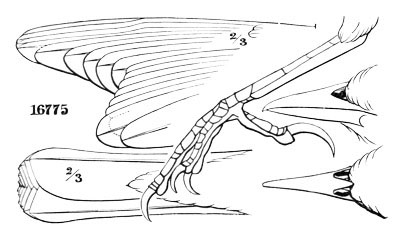
Scolecophagus ferrugineus. 16775
Char. Bill rather attenuated, as long as or longer than the head. The culmen curved, the tip much bent down. The cutting edges inflected so as to impart a somewhat tubular appearance to each mandible. The commissure sinuated. Tail longer than the wings, usually much graduated. Legs longer than the head, fitted for walking. Color of males entirely black with lustrous reflections.
The bill of the Quiscalinæ is very different from that of the other Icteridæ, and is readily recognized by the tendency to a rounding inward along the cutting edges, rendering the width in a cross section of the bill considerably less along the commissure than above or below. The culmen is more curved than in the Agelainæ. All the North American species have the iris white.
The only genera in the United States are as follows:—
Scolecophagus. Tail shorter than the wings; nearly even. Bill shorter than the head.
Quiscalus. Tail longer than the wings; much graduated. Bill as long as or longer than the head.
Genus SCOLECOPHAGUS, Swainson.
Scolecophagus, Swainson, F. Bor.-Am. II, 1831. (Type, Oriolus ferrugineus, Gmelin.)
Gen. Char. Bill shorter than the head, rather slender, the edges inflexed as in Quiscalus, which it otherwise greatly resembles; the commissure sinuated. Culmen rounded, but not flattened. Tarsi longer than the middle toe. Tail even, or slightly rounded.
The above characteristics will readily distinguish the genus from its allies. The form is much like that of Agelaius. The bill, however, is more attenuated, the culmen curved and slightly sinuated. The bend at the base of the commissure is shorter. The culmen is angular at the base posterior to the nostrils, instead of being much flattened, and does not extend so far behind. The two North American species may be distinguished as follows:—
Synopsis of Species.
S. ferrugineus. Bill slender; height at base not .4 the total length. Color of male black, with faint purple reflection over whole body; wings, tail, and abdomen glossed slightly with green. Autumnal specimens with feathers broadly edged with castaneous rusty. Female brownish dusky slate, without gloss; no trace of light superciliary stripe.
S. cyanocephalus. Bill stout; height at base nearly .5 the total length. Color black, with green reflections over whole body. Head only glossed with purple. Autumnal specimens, feathers edged very indistinctly with umber-brown. Female dusky-brown, with a soft gloss; a decided light superciliary stripe.
Cuba possesses a species referred to this genus (S. atroviolaceus), though it is not strictly congeneric with the two North American ones. It differs in lacking any distinct membrane above the nostril, and in having the bill not compressed laterally, as well as in being much stouter. The plumage has a soft silky lustre; the general color black, with rich purple or violet lustre. The female similarly colored to the male.
Scolecophagus ferrugineus, Swainson.
RUSTY BLACKBIRD.
Oriolus ferrugineus, Gmelin, Syst. Nat. I, 393, No. 43.—Lath. Ind. I, 1790, 176. Gracula ferruginea, Wilson, Am. Orn. III, 1811, 41, pl. xxi, f. 3. Quiscalus ferrugineus, Bon. Obs. Wils. 1824, No. 46.—Nuttall, Man. I, 1832, 199.—Aud. Orn. Biog. II, 1834, 315; V, 1839, 483, pl. cxlvii.—Ib. Synopsis, 1839, 146.—Ib. Birds Am. IV, 1842, 65, pl. ccxxii.—Max. Caban. J. VI, 1858, 204. Scolecophagus ferrugineus, Swainson, F. Bor.-Am. II, 1831, 286.—Bon. List, 1838.—Baird, Birds N. Am. 1858, 551.—Coues, P. A. N. S. 1861, 225.—Cass. P. A. N. S. 1866, 412.—Dall & Bannister, Tr. Ch. Ac. I, 1869, 285 (Alaska). ? ? Oriolus niger, Gmelin, I, 1788, 393, Nos. 4, 5 (perhaps Quiscalus).—Samuels, 350.—Allen, B. E. Fla. 291. Scolecophagus niger, Bonap. Consp. 1850, 423.—Cabanis, Mus. Hein. 1851, 195. ? ? Oriolus fuscus, Gmelin, Syst. I, 1788, 393, No. 44 (perhaps Molothrus). Turdus hudsonius, Gmelin, Syst. Nat. I, 1788, 818.—Lath. Ind. Turdus noveboracensis, Gmelin, I, 1788, 818. Turdus labradorius, Gmelin, Syst. Nat. I, 1788, 832.—Lath. Ind. I, 1790, 342 (labradorus). “Pendulinus ater, Vieillot, Nouv. Dict.” Chalcophanes virescens, Wagler, Syst. Av. (Appendix, Oriolus 9). ? Turdus No. 22 from Severn River, Forster Phil. Trans. LXII, 1772, 400.
Sp. Char. Bill slender; shorter than the head; about equal to the hind toe; its height not quite two fifths the total length. Wing nearly an inch longer than the tail; second quill longest; first a little shorter than the fourth. Tail slightly graduated; the lateral feathers about a quarter of an inch shortest. General color black, with purple reflections; the wings, under tail-coverts, and hinder part of the belly, glossed with green. In autumn the feathers largely edged with ferruginous or brownish, so as to change the appearance entirely. Spring female dull, opaque plumbeous or ashy-black; the wings and tail sometimes with a green lustre. Young like autumnal birds. Length of male, 9.50; wing, 4.75; tail, 4.00. Female smaller.
Hab. From Atlantic coast to the Missouri. North to Arctic regions. In Alaska on the Yukon, at Fort Kenai, and Nulato.
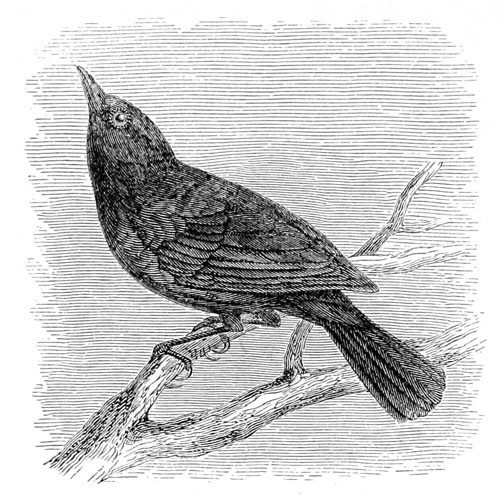
Scolecophagus ferrugineus.
Habits. The Rusty Blackbird is an eastern species, found from the Atlantic to the Missouri River, and from Louisiana and Florida to the Arctic regions. In a large portion of the United States it is only known as a migratory species, passing rapidly through in early spring, and hardly making a longer stay in the fall. Richardson states that the summer range of this bird extends to the 68th parallel, or as far as the woods extend. It arrives at the Saskatchewan in the end of April, and at Great Bear Lake, latitude 65°, by the 3d of May. They come in pairs, and for a time frequent the sandy beaches of secluded lakes, feeding on coleopterous insects. Later in the season they are said to make depredations upon the grain-fields.
They pass through Massachusetts from the 8th of March to the first of April, in irregular companies, none of which make any stay, but move hurriedly on. They begin to return early in October, and are found irregularly throughout that month. They are unsuspicious and easily approached, and frequent the streams and edges of ponds during their stay.
Mr. Boardman states that these birds are common near Calais, Me., arriving there in March, some remaining to breed. In Western Massachusetts, according to Mr. Allen, they are rather rare, being seen only occasionally in spring and fall as stragglers, or in small flocks. Mr. Allen gives as their arrival the last of September, and has seen them as late as November 24. They also were abundant in Nova Scotia. Dr. Coues states that in South Carolina they winter from November until March.
These birds are said to sing during pairing-time, and become nearly silent while rearing their young, but in the fall resume their song. Nuttall has heard them sing until the approach of winter. He thinks their notes are quite agreeable and musical, and much more melodious than those of the other species.
During their stay in the vicinity of Boston, they assemble in large numbers, to roost in the reed marshes on the edges of ponds, and especially in those of Fresh Pond, Cambridge. They feed during the day chiefly on grasshoppers and berries, and rarely molest the grain.
According to Wilson, they reach Pennsylvania early in October, and at this period make Indian corn their principal food. They leave about the middle of November. In South Carolina he found them numerous around the rice plantations, feeding about the hog-pens and wherever they could procure corn. They are easily domesticated, becoming very familiar in a few days, and readily reconciled to confinement.
In the District of Columbia, Dr. Coues found the Rusty Grakle an abundant and strictly gregarious winter resident, arriving there the third week in October and remaining until April, and found chiefly in swampy localities, but occasionally also in ploughed fields.
Mr. Audubon found these birds during the winter months, as far south as Florida and Lower Louisiana, arriving there in small flocks, coming in company with the Redwings and Cowbirds, and remaining associated with them until the spring. At this season they are also found in nearly all the Southern and Western States. They appear fond of the company of cattle, and are to be seen with them, both in the pasture and in the farm-yard. They seem less shy than the other species. They also frequent moist places, where they feed upon aquatic insects and small snails, for which they search among the reeds and sedges, climbing them with great agility.
In their habits they are said to resemble the Redwings, and, being equally fond of the vicinity of water, they construct their nests in low trees and bushes in moist places. Their nests are said to be similarly constructed, but smaller than those of the Redwings. In Labrador Mr. Audubon found them lined with mosses instead of grasses. In Maine they begin to lay about the first of June, and in Labrador about the 20th, and raise only one brood in a season.
The young, when first able to fly, are of a nearly uniform brown color. Their nests, according to Audubon, are also occasionally found in marshes of tall reeds of the Typha, to the stalks of which they are firmly attached by interweaving the leaves of the plant with grasses and fine strips of bark. A friend of the same writer, residing in New Orleans, found one of these birds, in full plumage and slightly wounded, near the city. He took it home, and put it in a cage with some Painted Buntings. It made no attempt to molest his companions, and they soon became good friends. It sang during its confinement, but the notes were less sonorous than when at liberty. It was fed entirely on rice.
The memoranda of Mr. MacFarlane show that these birds are by no means uncommon near Fort Anderson. A nest, found June 12, on the branch of a spruce, next to the trunk, was eight feet from the ground. Another nest, containing one egg and a young bird, was in the midst of a branch of a pine, five feet from the ground. The parents endeavored to draw him from their nest, and to turn his attention to themselves. A third, found June 22, contained four eggs, and was similarly situated. The eggs contained large embryos. Mr. MacFarlane states that whenever a nest of this species is approached, both parents evince great uneasiness, and do all in their power, by flying from tree to tree in its vicinity, to attract one from the spot. They are spoken of as moderately abundant at Fort Anderson, and as having been met with as far east as the Horton River. He was also informed by the Eskimos that they extend along the banks of the Lower Anderson to the very borders of the woods.
Mr. Dall states that these Blackbirds arrive at Nulato about May 20, where they are tolerably abundant and very tame. They breed later than some other birds, and had not begun to lay before he left, the last of May. Eggs were procured at Fort Yukon by Mr. Lockhart, and at Sitka by Mr. Bischoff.
Besides these localities, this bird was found breeding in the Barren Grounds of Anderson River in 69° north latitude, on the Arctic coast at Fort Kenai, by Mr. Bischoff, and at Fort Simpson, Fort Rae, and Peel River. It has been found breeding at Calais by Mr. Boardman, and at Halifax by Mr. W. G. Winton.
Eggs sent from Fort Yukon, near the mouth of the Porcupine River, by Mr. S. Jones, are of a rounded-oval shape, measuring 1.03 inches in length by .75 in breadth. In size, shape, ground-color, and color of their markings, they are hardly distinguishable from some eggs of Brewer’s Blackbird, though generally different. All I have seen from Fort Yukon have a ground-color of very light green, very thickly covered with blotches and finer dottings of a mixture of ferruginous and purplish-brown. In some the blotches are larger and fewer than in others, and in all these the purple shading predominates. One egg, more nearly spherical than the rest, measures .98 by .82. None have any waving lines, as in all other Blackbird’s eggs. Two from near Calais, Me., measure 1.02 by .75 of an inch, have a ground of light green, only sparingly blotched with shades of purplish-brown, varying from light to very dark hues, but with no traces of lines or marbling.
According to Mr. Boardman, these birds are found during the summer months about Calais, but they are not common. Only a few remain of those that come in large flocks in the early spring. They pass along about the last of April, the greater proportions only tarrying a short time; but in the fall they stay from five to eight weeks. They nest in the same places with the Redwing Blackbirds, and their nests are very much alike. In early summer they have a very pretty note, which is never heard in the fall.
Scolecophagus cyanocephalus, Cab.
BREWER’S BLACKBIRD.
Psarocolius cyanocephalus, Wagler, Isis, 1829, 758. Scolecophagus cyanocephalus, Cabanis, Mus. Hein. 1851, 193.—Baird, Birds N. Am. 1858, 552.—Cass. P. A. N. S. 1866, 413.—Heerm. X, S, 53.—Cooper & Suckley, 209.—Cooper, Orn. Cal. I, 1870, 278. Scolecophagus mexicanus, Swainson, Anim. in Men. 2¼ cent. 1838, 302.—Bon. Conspectus, 1850, 423.—Newberry, Zoöl. Cal. and Or. Route; Rep. P. R. R. Surv. VI, IV, 1857, 86. Quiscalus breweri, Aud. Birds Am. VII, 1843, 345, pl. ccccxcii.
Sp. Char. Bill stout, quiscaline, the commissure scarcely sinuated; shorter than the head and the hind toe; the height nearly half length of culmen. Wing nearly an inch longer than the tail; the second quill longest; the first about equal to the third. Tail rounded and moderately graduated; the lateral feathers about .35 of an inch shorter. General color of male black, with lustrous green reflections everywhere except on the head and neck, which are glossed with purplish-violet. Female much duller, of a light brownish anteriorly; a very faint superciliary stripe. Length about 10 inches; wing, 5.30; tail, 4.40.
Hab. High Central Plains to the Pacific; south to Mexico. Pembina, Minn.; S. Illinois (Wabash Co.; R. Ridgway); Matamoras and San Antonio, Texas (breeds; Dresser, Ibis, 1869, 493); Plateau of Mexico (very abundant, and resident; Sumichrast, M. B. S. I, 553).
Autumnal specimens do not exhibit the broad rusty edges of feathers seen in S. ferrugineus.
The females and immature males differ from the adult males in much the same points as S. ferrugineus, except that the “rusty” markings are less prominent and more grayish. The differences generally between the two species are very appreciable. Thus, in S. cyanocephalus, the bill, though of the same length, is much higher and broader at the base, as well as much less linear in its upper outline; the point, too, is less decurved. The size is every way larger. The purplish gloss, which in ferrugineus is found on most of the body except the wings and tail, is here confined to the head and neck, the rest of the body being of a richly lustrous and strongly marked green, more distinct than that on the wings and tail of ferrugineus. In one specimen only, from Santa Rosalia, Mexico, is there a trace of purple on some of the wing and tail feathers.
Habits. This species was first given as a bird of our fauna by Mr. Audubon, in the supplementary pages of the seventh volume of his Birds of America. He met with it on the prairies around Fort Union, at the junction of the Yellowstone and the Missouri Rivers, and in the extensive ravines in that neighborhood, in which were found a few dwarfish trees and tall rough weeds or grasses, along the margin of scanty rivulets. In these localities he met with small groups of seven or eight of these birds. They were in loose flocks, and moved in a silent manner, permitting an approach to within some fifteen or twenty paces, and uttering a call-note as his party stood watching their movements. Perceiving it to be a species new to him, he procured several specimens. He states that they did not evince the pertness so usual to birds of this family, but seemed rather as if dissatisfied with their abode. On the ground their gait was easy and brisk. He heard nothing from them of the nature of a song, only a single cluck, not unlike that of the Redwing, between which birds and the C. ferrugineus he was disposed to place this species.
Dr. Newberry found this Blackbird common both in California and in Oregon. He saw large flocks of them at Fort Vancouver, in the last of October. They were flying from field to field, and gathered into the large spruces about the fort, in the manner of other Blackbirds when on the point of migrating.
Mr. Allen found this Blackbird, though less an inhabitant of the marshes than the Yellow-headed, associating with them in destroying the farmers’ ripening corn, and only less destructive because less numerous. It appears to be an abundant species in all the settled portions of the western region, extending to the eastward as far as Wisconsin, and even to Southeastern Illinois, one specimen having been obtained in Wisconsin by Mr. Kumlien, and others in Wabash Co., Ill., by Mr. Ridgway.
In the summer, according to Mr. Ridgway, it retires to the cedar and piñon mountains to breed, at that time seldom visiting the river valley. In the winter it resorts in large flocks to the vicinity of corrals and barn-yards, where it becomes very tame and familiar. On the 3d of June he met with the breeding-ground of a colony of these birds, in a grove of cedars on the side of a cañon, in the mountains, near Pyramid Lake. Nearly every tree contained a nest, and several had two or three. Each nest was saddled on a horizontal branch, generally in a thick tuft of foliage, and well concealed. The majority of these nests contained young, and when these were disturbed the parents flew about the heads of the intruders, uttering a soft chuck. The maximum number of eggs or young was six, the usual number four or five. In notes and manners it seemed to be an exact counterpart of the C. ferrugineus.
Dr. Suckley found these birds quite abundant at Fort Dalles, but west of the Cascade Mountains they were quite rare. At Fort Dalles it is a winter resident, where, in the cold weather, it may frequently be found in flocks in the vicinity of barn-yards and stables. Dr. Cooper also obtained specimens of this Grakle at Vancouver, and regards it as a constant resident on the Columbia River. He saw none at Puget Sound. In their notes and habits he was not able to trace any difference from the Rusty Blackbird of the Atlantic States. In winter they kept about the stables in flocks of fifties or more, and on warm days flew about among the tree-tops, in company with the Redwings, singing a harsh but pleasant chorus for hours.
Dr. Cooper states it to be an abundant species everywhere throughout California, except in the dense forests, and resident throughout the year. They frequent pastures and follow cattle in the manner of the Molothrus. They associate with the other Blackbirds, and are fond of feeding and bathing along the edges of streams. They have not much song, but the noise made by a large flock, as they sit sunning themselves in early spring, is said to be quite pleasing. In this chorus the Redwings frequently assist. At Santa Cruz he found them more familiar than elsewhere. They frequented the yards about houses and stables, building in the trees of the gardens, and collecting daily, after their hunger was satisfied, on the roofs or on neighboring trees, to sing, for an hour or two, their songs of thanks. He has seen a pair of these birds pursue and drive away a large hawk threatening some tame pigeons.
Mr. Dresser, on his arrival at Matamoras, in July, noticed these birds in the streets of that town, in company with the Long-tailed Grakles Q. macrurus and Molothrus pecoris. He was told by the Mexicans that they breed there, but it was too late to procure their eggs. In the winter vast flocks frequented the roads near by, as well as the streets of San Antonio and Eagle Pass. They were as tame as European Sparrows. Their note, when on the wing, was a low whistle. When congregated in trees, they kept up an incessant chattering.
Dr. Coues found them permanent residents of Arizona, and exceedingly abundant. It was the typical Blackbird of Fort Whipple, though few probably breed in the immediate vicinity. Towards the end of September they become very numerous, and remain so until May, after which few are observed till the fall. They congregate in immense flocks about the corrals, and are tame and familiar. Their note, he says, is a harsh, rasping squeak, varied by a melodious, ringing whistle. I am indebted to this observing ornithologist for the following sketch of their peculiar characteristics:—
“Brewer’s Blackbird is resident in Arizona, the most abundant bird of its family, and one of the most characteristic species of the Territory. It appears about Fort Whipple in flocks in September; the numbers are augmented during the following month, and there is little or no diminution until May, when the flocks disperse to breed.
“The nest is placed in the fork of a large bush or tree, sometimes at the height of twenty or thirty feet, and is a bulky structure, not distantly resembling a miniature Crow’s nest, but it is comparatively deeper and more compactly built. A great quantity of short, crooked twigs are brought together and interlaced to form the basement and outer wall, and with these is matted a variety of softer material, as weed-stalks, fibrous roots, and dried grasses. A little mud may be found mixed with the other material, but it is not plastered on in any quantity, and often seems to be merely what adhered to the roots or plant-stems that were used. The nest is finished inside with a quantity of hair. The eggs are altogether different from those of the Quiscali and Agelæi, and resemble those of the Yellow-headed and Rusty Grakles. They vary in number from four to six, and measure barely an inch in length by about three fourths as much in breadth. The ground-color is dull olivaceous-gray, sometimes a paler, clearer bluish or greenish gray, thickly spattered all over with small spots of brown, from very dark blackish-brown or chocolate to light umber. These markings, none of great size, are very irregular in outline, though probably never becoming line-tracery; and they vary indefinitely in number, being sometimes so crowded that the egg appears of an almost uniform brownish color.
“In this region the Blackbirds play the same part in nature’s economy that the Yellow-headed Troupial does in some other parts of the West, and the Cowbird and Purple Grakle in the East. Like others of their tribe they are very abundant where found at all, and eminently gregarious, except whilst breeding. Yet I never saw such innumerable multitudes together as the Redwinged Blackbird, or even its Californian congener, A. tricolor, shows in the fall, flocks of fifty or a hundred being oftenest seen. Unlike the Agelæi, they show no partiality for swampy places, being lovers of the woods and fields, and appearing perfectly at home in the clearings about man’s abode, where their sources of supply are made sure through his bounty or wastefulness. They are well adapted for terrestrial life by the size and strength of their feet, and spend much of their time on the ground, betaking themselves to the trees on alarm. On the ground they habitually run with nimble steps, when seeking food, only occasionally hopping leisurely, like a Sparrow, upon both feet at once. Their movements are generally quick, and their attitudes varied. They run with the head lowered and tail somewhat elevated and partly spread for a balance, but in walking slowly the head is held high, and oscillates with every step. The customary attitude when perching is with the body nearly erect, the tail hanging loosely down, and the bill pointing upward; but should their attention be attracted, this negligent posture is changed, the birds sit low and firmly, with elevated and wide-spread tail rapidly flirted, whilst the bright eye peers down through the foliage. When a flock comes down to the ground to search for food, they generally huddle closely together and pass pretty quickly along, each one striving to be first, and in their eagerness they continually fly up and re-alight a few paces ahead, so that the flock seems, as it were, to be rolling over and over. When disturbed at such times, they fly in a dense body to a neighboring tree, but then almost invariably scatter as they settle among the boughs. The alarm over, one, more adventurous, flies down again, two or three follow in his wake, and the rest come trooping after. In their behavior towards man, they exhibited a curious mixture of heedlessness and timidity; they would ramble about almost at our feet sometimes, yet the least unusual sound or movement sent them scurrying into the trees. They became tamest about the stables, where they would walk almost under the horses’ feet, like Cowbirds in a farm-yard.
“Their hunger satisfied, the Blackbirds would fly into the pine-trees and remain a long time motionless, though not at all quiet. They were at singing-school,’ we used to say, and certainly there was room for improvement in their chorus; but if their notes were not particularly harmonious, they were sprightly, varied, and on the whole rather agreeable, suggesting the joviality that Blackbirds always show when their stomachs are full, and the prospect of further supply is good. Their notes are rapid and emphatic, and, like the barking of coyotes, give an impression of many more performers than are really engaged. They have a smart chirp, like the clashing of pebbles, frequently repeated at intervals, varied with a long-drawn mellow whistle. Their ordinary note, continually uttered when they are searching for food, is intermediate between the guttural chuck of the Redwing and the metallic chink of the Reedbird.
“In the fall, when food is most abundant, they generally grow fat, and furnish excellent eating. They are tender, like other small birds, and do not have the rather unpleasant flavor that the Redwing gains by feeding too long upon the Zizania.
“These are sociable as well as gregarious birds, and allied species are seen associating with them. At Wilmington, Southern California, where I found them extremely abundant in November, they were flocking indiscriminately with the equally plentiful Agelaius tricolor.”
Dr. Heermann found this Blackbird very common in New Mexico and Texas, though he was probably in error in supposing that all leave there before the period of incubation. During the fall they frequent the cattle-yards, where they obtain abundance of food. They were very familiar, alighting on the house-tops, and apparently having no cause for fear of man. Unlike all other writers, he speaks of its song as a soft, clear whistle. When congregated in spring on the trees, they keep up a continual chattering for hours, as though revelling in an exuberance of spirits.
Under the common Spanish name of Pajaro prieto, Dr. Berlandier refers in MSS. to this species. It is said to inhabit the greater part of Mexico, and especially the Eastern States. It moves in flocks in company with the other Blackbirds. It is said to construct a well-made nest about the end of April, of blades of grass, lining it with horse-hair. The eggs, three or four in number, are much smaller than those of Quiscalus macrurus, obtuse at one end, and slightly pointed at the other. The ground-color is a pale gray, with a bluish tint, and although less streaked, bears a great resemblance to those of the larger Blackbird.
Dr. Cooper states that these birds nest in low trees, often several in one tree. He describes the nest as large, constructed externally of a rough frame of twigs, with a thick layer of mud, lined with fine rootlets and grasses. The eggs are laid from April 10 to May 20, are four or five in number, have a dull greenish-white ground, with numerous streaks and small blotches of dark brown. He gives their measurement at one inch by .72. They raise two and probably three broods in a season.
Four eggs of this species, from Monterey, collected by Dr. Canfield, have an average measurement of 1.02 inches by .74. Their ground-color is a pale white with a greenish tinge. They are marked with great irregularity, with blotches of a light brown, with fewer blotches of a much darker shade, and a few dots of the same. In one egg the spots are altogether of the lighter shade, and are so numerous and confluent as to conceal the ground-color. In the other they are more scattered, but the lines and marbling of irregularly shaped and narrow zigzag marking are absent in nearly all the eggs.
Captain Blakiston found this species breeding on the forks of the Saskatchewan, June 3, 1858, where he obtained its eggs.
Genus QUISCALUS, Vieillot.
Quiscalus, Vieillot, Analyse, 1816 (Gray). (Type, Gracula quiscala, L.)
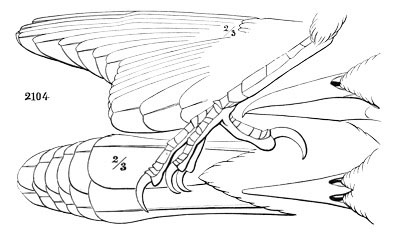
Quiscalus purpureus. 2104
Sp. Char. Bill as long as the head, the culmen slightly curved, the gonys almost straight; the edges of the bill inflected and rounded; the commissure quite strongly sinuated. Outlines of tarsal scutellæ well defined on the sides; tail long, boat-shaped, or capable of folding so that the two sides can almost be brought together upward, the feathers conspicuously and decidedly graduated, their inner webs longer than the outer. Color black.
The excessive graduation of the long tail, with the perfectly black color, at once distinguishes this genus from any other in the United States. Two types may be distinguished: one Quiscalus, in which the females are much like the males, although a little smaller and perhaps with rather less lustre; the other, Megaquiscalus, much larger, with the tail more graduated, the females considerably smaller, and of a brown or rusty color. The Quiscali are all from North America or the West Indies (including Trinidad); none having been positively determined as South American. The Megaquiscali are Mexican and Gulf species entirely, while a third group, the Holoquiscali, is West Indian.
Synopsis of Species and Varieties.
A. QUISCALUS. Sexes nearly similar in plumage. Color black; each species glossed with different shades of bronze, purple, violet, green, etc. Lateral tail-feathers about .75 the length of central. Hab. Eastern United States. Proportion of wing to tail variable.
Q. purpureus. a. Body uniform brassy-olive without varying tints. Head and neck steel-blue, more violaceous anteriorly.
1. Length, 13.50; wing, 5.50 to 5.65; tail, 5.70 to 5.80, its graduation, 1.50; culmen, 1.35 to 1.40. Vivid blue of the neck all round abruptly defined against the brassy-olive of the body. Female. Wing, 5.20; tail, 4.85 to 5.10. Hab. Interior portions of North America, from Texas and Louisiana to Saskatchewan and Hudson’s Bay Territory; New England States; Fort Bridger, Wyoming Territory … var. æneus.
b. Body variegated with purple, green, and blue tints. Head and neck violaceous-purple, more blue anteriorly.
2. Length, 12.50; wing, 5.60; tail, 5.30, its graduation, 1.20; culmen, 1.32. Dark purple of neck all round passing over the breast, and appearing in patches on the lower parts. Wing and tail purplish; tail-coverts reddish-purple. Female. Wing, 5.10; tail, 4.50. Hab. Atlantic coast of United States … var. purpureus.
3. Length, 11.75; wing, 4.85 to 5.60; tail, 4.60 to 5.50, its graduation, .90; culmen, 1.38 to 1.66. Dark purple of neck sharply defined against the dull blackish olive-green of the body. Wings and tail greenish-blue; tail-coverts violet-blue. Female. Wing, 4.65 to 4.90; tail, 3.80 to 4.60. Hab. South Florida; resident … var. agelaius.
B. HOLOQUISCALUS. (Cassin.) Tail shorter than wings; sexes similar. Color glossy black, but without varying shades of gloss; nearly uniform in each species. Tail moderately graduated. Hab. West India Islands, almost exclusively; Mexico and South America.
Q. baritus. Black, with a soft bluish-violet gloss, changing on wings and tail into bluish-green.
Culmen decidedly curved; base of mandibles on sides, smooth.
1. Bill robust, commissure sinuated; depth of bill, at base, .54; culmen, 1.33; wing, 6.15; tail, 5.50, its graduation, 1.30. Female. Wing, 5.20; tail, 4.70; other measurements in proportion. Hab. Jamaica … var. baritus.[43]
2. Bill slender, commissure scarcely sinuated; depth of bill, .43; culmen, 1.35; wing, 5.40; tail, 5.10, its graduation, 1.20. Female. Wing, 4.60; tail, 4.20. Hab. Porto Rico … var. brachypterus.[44]
Culmen almost straight; base of mandibles on sides corrugated.
3. Depth of bill, .51; culmen, 1.44; wing, 6.00; tail, 5.50, its graduation, 1.50. Female. Wing, 5.15; tail, 4.80. Hab. Cuba … var. gundlachi.[45]
4. Depth of bill, .40; culmen, 1.35; wing, 5.00; tail, 4.50, its graduation, .85. Hab. Hayti … var. niger.[46]
C. MEGAQUISCALUS. (Cassin.) Tail longer than wings. Sexes very unlike. Female much smaller, and very different in color, being olivaceous-brown, lightest beneath. Male without varying shades of color; lateral tail-feather about .60 the middle, or less.
Q. major. Culmen strongly decurved terminally; bill robust. Female with back, nape, and crown like the wings; abdomen much darker than throat.
Lustre of the plumage green, passing into violet anteriorly on head and neck.
1. Length, 15.00; wing, 7.50; tail, 7.70, its graduation, 2.50; culmen, 1.60. Female. Wing, 5.10. Hab. South Atlantic and Gulf coast of United States … var. major.
Lustre, violet passing into green posteriorly.
2. Length, 14.00; wing, 6.75; tail, 7.20, its graduation, 2.40; culmen, 1.57. Female. Wing, 5.30; tail, 5.00. Hab. Western Mexico. (Mazatlan, Colima, etc.) … var. palustris.[47]
3. Length, 18.00; wing, 7.70; tail, 9.20, its graduation, 3.50; culmen, 1.76. Female. Wing, 5.80; tail, 6.30. Hab. From Rio Grande of Texas, south through Eastern Mexico; Mazatlan (accidental?) … var. macrurus.
Q. tenuirostris.[48] Culmen scarcely decurved terminally; bill slender. Female with back, nape, and crown very different in color from the wings; abdomen as light as throat.
1. Male. Lustre purplish-violet, inclining to steel-blue on wing and upper tail-coverts. Length, 15.00; wing, 7.00; tail, 8.00, its graduation, 3.00. Female. Crown, nape, and back castaneous-brown; rest of upper parts brownish-black. A distinct superciliary stripe, with the whole lower parts as far as flanks and crissum, deep fulvous-ochraceous, lightest, and inclining to ochraceous-white, on throat and lower part of abdomen; flanks and crissum blackish-brown. Wing, 5.10; tail, 5.35, its graduation, 1.80; culmen, 1.33; greatest depth of bill, .36. Hab. Mexico (central?).
Quiscalus purpureus, Bartr.
THE CROW BLACKBIRD.
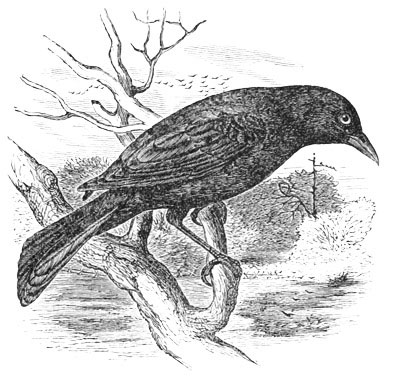
Quiscalus purpureus.
Sp. Char. Bill above, about as long as the head, more than twice as high; the commissure moderately sinuated and considerably decurved at tip. Tail a little shorter than the wing, much graduated, the lateral feathers .90 to 1.50 inches shorter. Third quill longest; first between fourth and fifth. Color black, variously glossed with metallic reflections of bronze, purple, violet, blue, and green. Female similar, but smaller and duller, with perhaps more green on the head. Length, 13.00; wing, 6.00; bill above, 1.25.