Family CORVIDÆ.—The Crows.
Reading edition
Char. Primaries ten; the first short, generally about half as long as the second (or a little more); the outer four sinuated on the inner edge. The nasal fossæ and nostrils usually more or less concealed by narrow, stiffened bristles (or bristly feathers), with short appressed lateral branches extending to the very tip, all directed forwards (these bristles occasionally wanting). Tarsi scutellate anteriorly, the sides undivided (except sometimes below), and separated from the anterior plates by a narrow naked strip, sometimes filled up with small scales. Basal joint of middle toe united about equally to the lateral, generally for about half the length. Bill generally notched.
The preceding characters distinguish the family of Crows quite markedly from all others. The features of the bristles on the bill, and the separation of the lateral and anterior scales by a narrow interval, are worthy of particular attention. The commissure is without the obtusely angular bend near the base, seen in the Icteridæ.
There are two sub-families of Corvidæ represented in America, one embracing the true Crows, the other the Jays. They pass very insensibly into each other, and it is difficult to mark the dividing line. We may, however, distinguish these, as found in the United States, by the following characters:—
Corvinæ. Bill as long as the head. Tail short, nearly even; wings long and pointed, longer than tail, and nearly reaching its tip; projecting beyond the under tail-coverts, which reach the middle of tail. Tip of wing formed by the third, fourth, and fifth quills, which are longest.
Garrulinæ. Bill usually shorter than head. Tail lengthened, rounded, and generally longer than the wings, which are short, rounded, and extend scarcely beyond the lower tail-coverts; these not reaching the middle of the tail. Tip of wing formed by the fourth, fifth, and sixth quills, which are longest.
The row of small scales is usually present on both sides of the tarsi in the Corvinæ, but in the Jays is generally restricted to the inner face.
Subfamily CORVINÆ.
Char. Wings long and pointed; longer than the tail, and, when closed, reaching nearly to its tip, extending far beyond the under tail-coverts; the third, fourth, and fifth quills forming the tip of the wing.
The following diagnosis may serve to distinguish the three genera of North American Corvinæ:—
A. (Corveæ). Bill compressed, much higher than broad; its tip compressed. Size large (i. e. over 15 inches long), color black, or mainly black.
Color black throughout; bill much compressed, the culmen much arched, and the gonys convex; nasal bristles strong … Corvus.
B. (Nucifrageæ.) Bill cylindrical, scarcely or not at all higher than broad; its tip depressed. Size small (i. e. less than 15 inches long). Color uniform blue or with ashy on body, and black wings and tail.
Color ashy, with wings and tail mainly black. Culmen convex, gonys slightly concave. Nostrils covered by the short nasal tuft … Picicorvus.
Color uniform blue, brighter on the head; the throat streaked with whitish. Culmen straight; gonys slightly convex. Nostrils completely exposed; no nasal tufts … Gymnokitta.
Genus CORVUS, Linnæus.
Corvus, Linnæus, Syst. Nat. 1735. (Type, Corvus corax, L.)
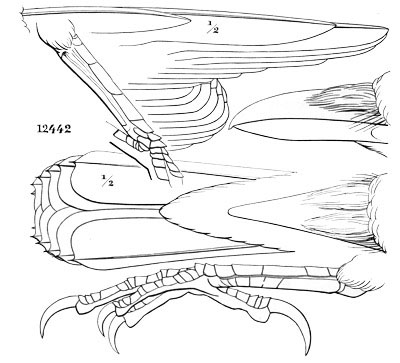
Corvus carnivorus. 12442
Gen. Char. The nasal feathers lengthened, reaching to or beyond the middle of the bill. Nostrils large, circular, overhung behind by membrane, the edges rounded elsewhere. Rictus without bristles. Bill nearly as long as the tarsus, very stout; much higher than broad at the base; culmen much arched. Wings reaching nearly or quite to the tip of the tail, the outer four primaries sinuated internally. Tarsi longer than the middle toe, with a series of small scales on the middle of each side separating the anterior scutellate portion from the posterior continuous plates. Sides of the head occasionally with nearly naked patches. Tail graduated or rounded.
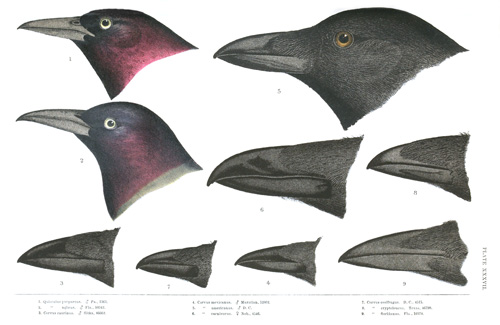
PLATE XXXVII
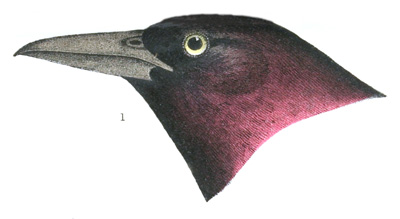
1. Quiscalus purpureus. ♂ Pa., 1363.
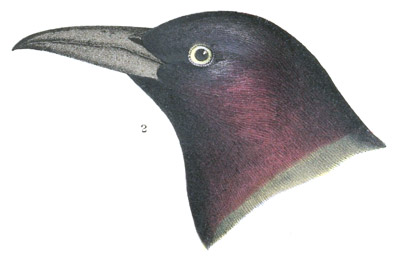
2. Quiscalus aglæus. ♂ Fla., 10342.
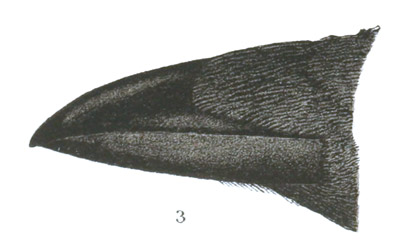
3. Corvus caurinus. ♂ Sitka, 46662.
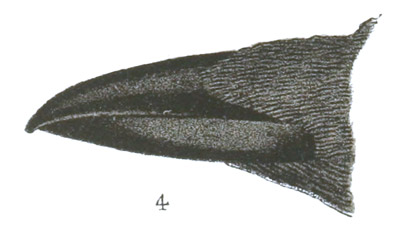
4. Corvus mexicanus. ♂ Mazatlan, 52802.
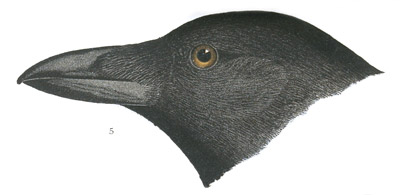
5. Corvus americanus. ♂ D. C.
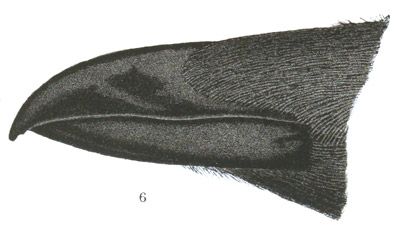
6. Corvus carnivorus. ♀ Neb., 4546.
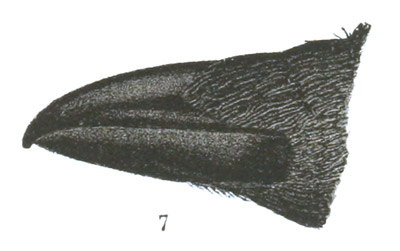
7. Corvus ossifragus. D. C., 4515.
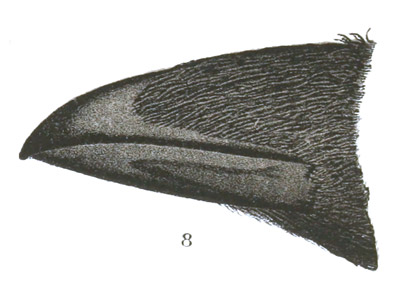
8. Corvus cryptoleucus. Texas, 46798.
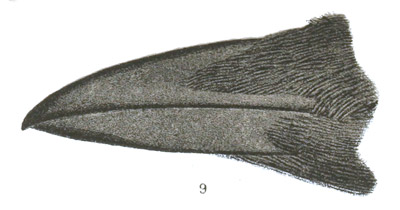
9. Corvus floridanus. Fla., 10374.
Species and Varieties.
RAVENS. Feathers of the chin and throat stiffened, elongated, narrow and lanceolate, with their outlines very distinct.
1. C. corax var. carnivorus. Length about 25.00; wing, 17.00; tail, 10.00; graduation of tail, 1.60 to 2.40. Feathers of the neck and breast light gray beneath surface. Hab. Whole of North America; Guatemala and Mexico. Rare in Eastern United States.
2. C. cryptoleucus. Length about 21.00; wing, 14.00; tail, 8.50; graduation of tail, about 1.25. Feathers of neck and breast snowy-white beneath surface. Hab. Llano Estacado, or Staked Plain of Texas; Arizona; Colorado.
CROWS. Feathers of chin and throat soft, short, broad, obtuse, and with their webs blended.
A. Angle of mouth feathered—North American Crows.
a. Tarsus longer than the bill. First quill not longer than tenth.
3. C. americanus. The gloss of the plumage purplish-violet, and hardly perceptible on head and neck, middle toe and claw rather shorter than tarsus, measured from beginning of scutellæ.
Wing, 12.25; tail, 7.20; culmen, 1.85; tarsus, 2.00; middle toe, 1.45; wing-formula, 4, 3, 5, 6, 2; first quill equal to tenth. Hab. North America generally … var. americanus.[50]
Wing, 12.50; tail, 7.20; culmen, 2.10; tarsus, 2.30; middle toe, 1.60. Wing-formula? (moulting). Hab. South Florida … var. floridanus.
4. C. ossifragus. The gloss of plumage violaceous-blue, almost green on the head, neck, and breast, where very perceptible. Middle toe and claw longer than tarsus, as above. Wing, 10.50; tail, 6.50; culmen, 1.55; tarsus, 1.65; middle toe, 1.35. Wing-formula, 4, 3, 5; first quill slightly shorter than tenth. Hab. Atlantic Coast of the United States.
b. Tarsus shorter than the bill. First quill longer than tenth.
5. C. caurinus. Gloss of the plumage as in americanus, but deeper. Wing, 10.50; tail, 6.40; culmen, 1.95; tarsus, 1.70; middle toe, 1.25. Wing-formula, 4, 3, 5. Hab. Northwestern coast of North America.
6. C. mexicanus.[51] Plumage highly lustrous, blended. Soft burnished steel-blue, changing to violet on the crown, and with a greenish cast on lower parts. Wing, 9.00; tail, 6.50; culmen, 1.60; tarsus, 1.20; middle toe, 1.10. Wing-formula, 4, 3, 5. First quill very much longer than tenth. Hab. Western Mexico (Mazatlan, etc.).
B. Angle of mouth naked—West Indian Crows.
a. Tarsus much shorter than the bill.
7. C. nasicus.[52] Nostrils scarcely concealed by the short nasal bristles. Entirely violaceous-black, the feathers smoky-gray beneath the surface. Wing, 11.00; tail, 7.75; culmen, 2.45; depth of bill, .80; tarsus, 1.95; middle toe, 1.50; graduation of tail about 1.00; wing-formula, 4, 3, 5, 6, 2; first quill shortest. Hab. Cuba.
8. C. leucognaphalus.[53] Nostrils well concealed by the longer, but rather scant, nasal bristles. Entirely violaceous-black, the feathers of the neck all round, breast and sides, pure white below the surface. Wing, 12.50; tail, 9.00; culmen, 2.45; depth of bill, .95; tarsus, 2.15; middle toe, 1.50; graduation of tail about 1.25. Wing-formula, 4, 5, 3, 6, 2; first quill much the shortest. Hab. Porto Rico.
b. Tarsus about equal to bill.
9. C. jamaicensis.[54] Nostrils just covered by the short but dense tuft of nasal bristles. Entirely dark sooty-plumbeous, inclining to black on the head, wings, and tail, where is a very faint violaceous gloss. Wing, 9.50; tail, 6.50; culmen, 2.00; depth of bill, 1.70; tarsus, 2.05; middle toe, 1.35; graduation of tail, about .60. Wing-formula, 5, 4, 3, 6, 2; first shortest. Hab. Jamaica.
Corvus corax, var. carnivorus, Bartram.
AMERICAN RAVEN.
Corvus carnivorus, Bartram, Travels in E. Florida, 1793, 290.—Baird, Birds N. Am. 1858, 560, pl. xxi.—Cooper & Suckley, 210, pl. xxi.—Coues, P. A. N. S. 1866, 225.—Lord, Pr. R. A. Inst. IV, 1864, 121 (British Columbia).—Dall & Bannister, Tr. Ch. Ac. I, 1869, 285 (Alaska).—Cooper, Orn. Cal. I, 1870, 282.—Samuels, 355. Corvus corax, Wilson, Am. Orn. IX, 1825, 136, pl. lxxv. f. 3.—Bonap. Obs. Wils. 1825, No. 36.—Ib. Syn. 1828, 56.—Doughty, Cab. N. H. I, 1830, 270, pl. xxiv.—Rich. F. B. Am. II, 1831, 290.—Nuttall, Man. I, 1832, 202.—Aud. Orn. Biog. II, 1834, 476, pl. ci.—Ib. Syn. 1839, 150.—Ib. Birds Am. IV. 1842, 78, pl. ccxxiv.—Heerm. X, S, 54.—Finsch, Abh. Nat. III, 1872, 40 (Alaska). Corvus cacalotl, “Wagler,” ? Bonap. Pr. Zoöl. Soc. 1837, 115 (perhaps true cacalotl).—Ib. List, 1838 (probably not of Wagler).—Ib. Conspectus, 1850, 387.—Maximilian, Reise innere Nord Amer. II, 1841, 289 (does not consider it different from European).—Newberry, P. R. R. Rep. VI, IV, 1857, 82. Corvus lugubris, Agassiz, Pr. Bost. Soc. N. H. II, Dec. 1846, 188.—Ib. Caban. J. VI, 1858, 195.—Baird, Birds N. Am. 1858, 563, pl. xx.—Kennerly, P. R. R. X., b pl. xxii. Corvus, var. littoralis, “Holböll, Kroger Tidsk. IV, 1843, 390.”—Schlegel, note on Corvus.
Sp. Char. Fourth quill longest; third and fifth about equal; second between fifth and sixth; first nearly equal to the eighth. Length, about 24.00 or 25.00; extent, 50.00 to 51.00; wing, about 17.00; tail, 10.00. Tail moderately graduated; the outer feather about 1.60 to 2.40 inches less than the middle. Entirely glossy black, with burnished violet reflections.
Hab. Entire continent of North America. Rare east of the Mississippi. South to Guatemala.
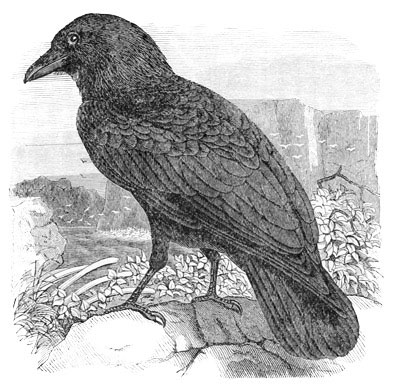
Corvus carnivorus.
Though easily distinguishable from the European bird, the American Raven is so nearly related to it as to be beyond doubt referrible to it as a variety. The differences presented in a very large series of both forms are, however, very constant and tangible. In the American bird the bill is always longer and less deep, and the plumage is more highly burnished, while the wings, especially the secondaries, are perceptibly of a more reddish violet than the other portions. Though in an immense series of American specimens many differences of form and size are noted, yet there is nothing sufficiently characteristic of any particular region to indicate more than one variety. As a rule, however, specimens from the high north exceed in size those from elsewhere, and have the bill more robust, though not so short as in the European bird; while those from the Middle Province and Mexico to Guatemala (= “cacalotl,” Baird et Auct.) have the plumage more brilliant than others, and frequently the bill very narrow.
Habits. Assuming that we must consider as but one species the two differing forms of Raven found in North America, we find this bird more or less common throughout nearly the whole continent. It is much more abundant in some regions than in others, and, as a general rule, is much more common and also more generally distributed in the western portion, where also its habits are remarkably different from the manners of its eastern representative.
It seems to be more or less common throughout the Arctic regions. Mr. Kennicott met with Ravens at Lake Winnipeg. Mr. MacFarlane found them abundant at Lockhart River, at Fort Anderson, and on the Lower Anderson River. Mr. Ross obtained them at Fort Simpson, Mr. Reid at Big Island, Mr. Clarke at Fort Rae, Mr. Lockhart at Fort Resolution, and Mr. Dall at Nulato, in Alaska.
Richardson speaks of it as abounding in the fur countries, where it frequents the barren grounds even in the intense winter cold, and where its movements are regulated by those of reindeer, musk-oxen, and other animals, which it follows, to assist in devouring whatever may be killed. Ravens are seen to collect from various quarters wherever any animal is slain, in order to feast on the offal, and considerable numbers are in constant attendance upon the several fishing-stations. He mentions a singular instance of the disposition of this bird to appropriate glittering objects of no value to it for food or anything else. A Raven was seen flying off with something in its claws, pursued by a number of its clamorous companions. Having been fired at, it dropped the object of contention, which proved to be the lock of a chest.
Mr. MacFarlane’s notes in regard to the nesting of these birds describe certain variations as to position, etc. One nest was on a ledge of a cliff of shale, and was composed of dry willow sticks, lined with pieces of rabbit skin and the hair of moose. Both parents were seen,—one on the nest, the other on a tree,—but both flew away on being approached. A second nest was in the top crotch of a tall pine on the river-bank. It was made of dry sticks, and thickly lined with reindeer hair. There were eight eggs in this nest. A third was in a tall pine, and was forty-five feet from the ground. It was constructed in a manner precisely similar to the preceding. A fourth was on the top of a tall pine, and only differed in having been lined with dry grass, moss, and a few reindeer hairs. The other nests appear to have been similarly situated and constructed. Nearly all were in high trees, built of dry sticks, and lined with dry grasses, mosses, and the hair of various quadrupeds. The maximum number of eggs was eight, their average six.
Mr. MacFarlane states that the Raven is found throughout the winter in the Arctic regions, and that, though he has met with it north of latitude 69°, he has never known it to breed north of that line. He informs us that it is seldom that more than a single pair is to be seen at a time, and occasionally they may be noted singly, flying alone, or feeding on garbage. Sometimes a dead fox or wolf will attract quite a number to the spot. On one occasion he observed as many as twenty Ravens amicably associated together around the carcasses of two wolves that had been poisoned with strychnine. In many cases he has known the partaking of a poisoned animal prove fatal to them, as also the eating of bait laid for foxes and wolves.
According to this same correspondent, one of these birds became almost domesticated at Fort Anderson, during February and March, 1865. At first it fed about the fort with a companion; soon after, coming alone, it grew bolder and bolder, alighted within the square, allowed itself to be closely approached, where the young dogs soon became familiar with it, and would even frolic and gambol with it, the Raven joining heartily in the sport in its own way. It was never known to attempt to injure even the smallest of the young dogs, nor did any of the dogs ever offer to annoy it. It at length came to be considered by all as an inmate of the establishment. While it seemed to have full confidence in the people of the fort, it kept at a careful distance from all Indian or Esquimaux visitors.
Mr. B. R. Ross speaks of Ravens as common as far north as the Arctic Ocean. They feed on carrion, and act as scavengers to the establishments. Their sight is remarkably keen, and the sagacity with which they follow the trapper is wonderful. Early as the hunter may start, these harpies will have been before him, and torn out the eyes and entrails of each hare. They will break into marten-traps for the sake of the bait or the captured animal, thrusting aside or pulling out with their beaks the sticks that compose the enclosure. Sometimes they are caught in steel traps that are set for foxes, or eat the strychnine baits laid for the same animals, and slowly succumb to this powerful poison. Their flesh is so rank that even a fox, unless sorely pressed by hunger, will not eat it. They pair in April, and usually construct their nests in the loftiest trees. They have various call-notes, one of which is like that of the Canada Goose, and another is said by Mr. Ross to be very liquid and musical.
Mr. Dall states that these birds were abundant all the year at Nulato, and indeed everywhere throughout Alaska, but much more common near the Indian villages and trading-posts than elsewhere. They build on the sandstone cliffs at Nulato, in cavities that have been occupied for years. They lay about the 20th of April, and the young are hatched before open water. He also speaks of them as very intelligent, and states that on several expeditions made to obtain their eggs, the instant he stopped at the foot of the bluff the whole colony would arrange themselves on the edge of the rock in anxious consultation, uttering repeated cries of warning. On one occasion, where the nest was inaccessible and the party went back unsuccessful, their departure was announced by significant and joyous croaks and derisive screeches. Ravens were also found by Mr. Bannister common all the year on the small islands lying off the northeast point of St. Michaels.
In the Eastern States the Raven is a comparatively rare bird, except in a few special localities. These are usually mountain-ranges, high precipitous banks of rivers and lakes and of the ocean, and among wild and lonely islands. It occurs on the Labrador coast, at Grand Menan in the Bay of Fundy, the Adirondacks, Lake George, the Hudson River, etc. Mr. Lawrence speaks of it as quite common on the coast of New Jersey. It is found among the mountains of Buncombe and other counties in North Carolina, and Mr. Audubon mentions its occurrence at Table Mountain, in the district of Pendleton, South Carolina. Dr. Coues found Ravens not rare at Labrador, where the almost inaccessible cliffs afford them safe and convenient retreats. They were so excessively wary that it was found impossible to shoot them. They descended in pairs to the sea-shore to feed on dead fish, crabs, and other animal substances thrown up by the sea.
Mr. Ridgway informs me of the presence of this bird in the heavy forests of the bottom-lands in Southern Illinois. It is there quite rare, however, as he has met with but a few pairs. These were resident, and nested in the tall timber of the Big Creek bottoms, in Richland Co.
Audubon’s party found it equally impossible to obtain a specimen at Labrador. One afternoon Mr. Audubon hid himself under a nest several hours, to no purpose. The old Ravens would not show themselves while he was within gunshot, though the young clamored for food. As soon as he had left the spot the female alighted on the nest, fed her young, and was off again before she could be approached.
At Grand Menan, where they are not rare, and where they breed among the high cliffs, I found them so wild that it was almost impossible even to obtain sight of them. Passing high in the air above our heads, their loud, hoarse croak attested their alarm at the sight of their enemy, man. They are looked upon with aversion by the islanders, and are persecuted by them without mercy. They rob the nests of the Herring Gulls, interfering with the islanders in this privilege, and are, wrongfully I believe, charged with destroying young lambs.
Years afterwards, when I again encountered individuals of this species at Cheyenne, on the Plains, I could not but notice the immense difference in their character. There perfect confidence in man took the place of dread. Unmolested by the people, who regard them as desirable scavengers, valueless for food and useful in removing nuisances, they were as tame and familiar as the European Sparrow in the parks of New York or Boston. On one occasion I found one engaged in eating the remains of a dead cow just outside the city. It allowed me to approach to within five or six feet, when with a very stately and dignified stride it moved out of my way, and kept me at about this distance. I could not compel it to fly to any distance, even when I hastened my steps.
In New England these birds are very rare, and their occurrence is only accidental. One has been shot on the Connecticut, and another on the Merrimack, in Massachusetts. They are not unfrequently met with in Northern New York.
On the Pacific Coast the Raven is common from Sitka to San Diego. Throughout Washington Territory it is said to be plentiful, more scattered in the summer, and in the winter congregating about settlements and the sea-shore. At Vancouver, during the winter, it was observed amicably associating with the Crows, and on the coast with the Fish Crows, but during the spring, when the latter had nests, they boldly attacked the Ravens, and drove them away.
In California and in all the adjacent regions, Dr. Cooper states, the Raven is found everywhere in pairs, more numerous than in the Atlantic States, and abundant even in the most barren desert districts. It follows trains and herds of cattle, and keeps on the lookout for anything befalling them. It is omnivorous, eating snakes, lizards, eggs, carrion, and even grain, though the last very rarely. It is accused of destroying young chickens and lambs.
In Arizona Dr. Coues speaks of it as resident, and very abundant about the cattle enclosures, where it congregates in immense numbers during the autumn and winter. During the severe winter of 1864-65 great numbers perished of cold and hunger at Fort Whipple. Dr. Coues has favored us with the following interesting sketch of the habits of this bird as observed by him in that Territory.
“The geographical distribution of the Raven seems to be in great measure complementary to that of the Crow. On the prairies, in the desert, among the mountains, of the Western States and Territories, where the Ravens and their congenial companions, the coyotes, abound, the Crows are rare or wanting altogether. In travelling westward, I saw no Crows after leaving the settlements this side of the Plains, while the Ravens were conspicuous, until in some parts of Southern California Crows reappeared, but no Ravens amongst them. I saw a fair number of Ravens along the Arkansas River, and they were frequent in the valley of the Rio Grande; after crossing the river, while traversing the wild region thence to the Colorado, they were our inseparable companions; hundreds, if not thousands, of them lived about Fort Whipple all the year, seemingly attracted from miles around by probabilities of finding abundant food. Throughout the Western wilds they hang on the footsteps of man, needy adventurers, claiming their share of his spoils, disputing with the wolves and vultures for the refuse of his camp, and polishing the skeletons of the buffalo, with which he sometimes strews the plain. The more desolate the land, the closer the Raven follows in the trail of the emigrant, till its dismal croaking sounds ominous of hardship, and its plumage seems to foreshadow days as dark.
“One accustomed to the shrewdness and prudence of Crows in populous districts is at first surprised at an apparent familiarity the Raven often shows in the West. There no one would think of wasting ammunition on the worthless bird, and it comes to look upon man more as its provider than as an enemy. Nevertheless, like the rest of its tribe, the Raven is a sagacious bird, not likely to be twice deceived, and very ready to take a hint; he always has his wits about him, and keeps a bright lookout when anything stranger than a coyote is near. This wariness is something altogether different from the childlike timidity of little birds like Sparrows, that scurry away in terror from any unusual sight or sound, and unquestionably implies keen powers of observation coupled with no small degree of reasoning faculty. Almost every day during the winter of 1864-65 I must have passed within a few paces of Ravens stalking about the fort; and yet, when I wanted a specimen, it was not an easy matter to secure one. The birds assuredly knew the difference between a person going quietly about his business and one “on mischief bent,” and their intelligent watchfulness rendered it quite impossible to approach them openly with gun in hand.
“Ravens are resident in the region about Fort Whipple, and their apparently diminished number in summer is simply due to the fact that they are then spread over a greater surface, are less restless, and better provided for in the matter of food. In winter, and especially when snow covered the ground, their numbers at the fort were simply incalculable. They dotted the ground everywhere during the day, and roosted in crowds on the neighboring pines by night. One patriarchal tree, that stood somewhat isolated, was a favorite resting-place for the Ravens and Buzzards, and gradually assumed a singular appearance, as if it had been whitewashed. This great pine overlooked a little open space where our beeves were slaughtered, and the banqueting there was never ended. All night long the wolves howled and barked as they tugged at the offal, till daylight sent them reluctant to their rocky fastnesses, when the great dark birds, with a premonitory stretching of the wings, flapped down to renew the feast. The Ravens and Buzzards seemed to get along very well together, quarrelling no more with each other than each species did with its own kind; but in the occasional disputes the smaller birds seemed to have rather the advantage of the heavier and clumsier gluttons. This comparative good-fellowship was in striking contrast to the behavior of Crows towards Turkey Buzzards.
“The Raven is not, on the whole, so noisy a bird as the Crow, though he croaks vigorously on occasion, and his caw may claim to be impressive, if not agreeable. But the queer sounds that the bird can utter, if he be so minded, are indescribable; even his ordinary cawing is susceptible of considerable modulation. A favorite amusement of his, when, his hunger appeased for the time, he feels particularly comfortable, is to settle snugly on the top of a pine-tree, and talk to himself. The performance generally begins with a loud caw, self-asserting, followed by a complacent chuckle; and then comes a series of comical syllables, so low as to be scarcely audible from the ground below, as if he were musing aloud, and tickled with his own fancies. Then he will raise his voice again, and file away at some old saw for a while, finishing with the inimitable ‘cork-drawing’ for which his tribe is famous.
“A Raven that I had slightly wounded in the wing and captured soon became quite tame, and developed a variety of amusing traits. Proving rather obtrusive and inconvenient in my narrow quarters, I undertook to tie him in a corner with a string round his leg. This he objected to, and it was astonishing to see the perseverance he showed in untying any number of knots I might make. It was a task that sometimes took him hours, but he never rested until it was done. I had no chain light enough for the purpose, but I finally got the better of him by twisting a wire with the cord. His intelligence did not reach in that direction more than six inches from his leg.”
Mr. Dresser observed the Raven common at San Antonio, frequenting the slaughter-houses. In November, in the Baudera Hills, several came to his camp to feast on the offal of deer. Dr. Woodhouse also found them very abundant in Texas, the Indian Territory, and New Mexico, and especially so on the buffalo plains. In the Mexican Boundary Survey, Dr. Kennerly observed these birds everywhere in Northern Mexico, flocks of them following the train from point to point. They were not at all shy, but often came into camp in search of food.
Captain Blakiston, having enjoyed unusual opportunities for observing the habits of the American Raven during his residence in high northern regions, characterizes the species as anything but solitary. During the day they are usually met with in pairs, except when drawn together in large numbers around the carcass of a dead animal. At night, during the winter, they repair to some chosen resting-place, usually a clump of trees on the edge of a prairie, and there roost in one immense body. One of these roosting-places was about a mile from Fort Carlton, and Captain Blakiston’s attention was first drawn to it by noticing that about sunset all the Ravens, from all quarters, were flying towards this point. Returning to the fort in the evening by that quarter, he found a clump of aspen-trees, none of them more than twenty-five feet high, filled with Ravens, who, at his approach, took wing and flew round and round. He also noted the wonderful regularity with which they repaired to their roosting-place in the evening and left it again in the morning, by pairs, on their day’s hunt. They always left in the morning, within a minute or two of the same time, earlier and earlier as the days grew longer, on cold or cloudy mornings a little later, usually just half an hour before sunrise. In April they all paired off, and their roosting-place became deserted. During an excursion about one hundred and fifty miles southwest of Fort Carlton, Captain Blakiston found several nests of Ravens with eggs, one of which was in a small tree near a lake, and was not more than fifteen feet above it. It contained six eggs, was about a foot in diameter, composed of sticks, and was lined with buffalo-hair and pieces of scarlet cloth, evidently picked up about an Indian camping-ground.
Dr. Heermann states that while in California he always found the nests of the Raven placed high on bold precipitous cliffs, secure against danger; in the vast desolate plains of New Mexico he saw these birds building on low trees, and even on cactus-plants, less than three feet from the ground, showing how much circumstances and localities affect the habits of birds regarding incubation.
A Raven, probably this species, is abundant on the plateau of Mexico. The Cerro Colorado, near Tehuacan, is the rendezvous of a large number of these birds, where, according to Sumichrast, at the time of the flowering of the maguey, they gather in great abundance, to feed on the blossoms of this plant, which are their favorite food.
Mr. Boardman writes me that he has several times collected Ravens’ eggs at Grand Menan, but always found the nest a hard one to take, as they usually build it under some high cliff. They make a very large and bulky nest, and, where not disturbed, use it several years in succession. They also breed very early. He once took a nest with eight eggs on the 10th of April, when the snow all around was quite deep. This was sent to the Smithsonian Institution. Its contents nearly filled a bushel basket. He does not regard the Ravens as migratory. Though they are apparently more numerous in winter than in summer, this is probably because they forsake the woods and come about the open fields and the banks of rivers for dead fish, and thus are more noticed. They are very shy, sagacious, and vigilant, so much so that it is almost impossible for one to get a shot at them. Crows avoid them, and the two are never seen together. The farmers of Grand Menan accuse them of pecking the eyes out of young lambs, and always try to destroy them, and they grow less and less numerous every year. The Ravens, he adds, appear to be on good terms with the Duck Hawks, as he has known a nest of the former within a few rods of one of the latter.
An egg of this species, from Anderson River, measures 1.96 inches in length by 1.32 in breadth. Two from Grand Menan measure, one 2.05 inches by 1.30, the other 1.95 by 1.25. The ground-color of two of these is a soiled sea-green, that of the third is a light bluish-green. This is more sparingly marked with dots, blotches, and cloudings of faint purple and purplish-brown, chiefly at the larger end. The others are marked over the entire egg with blotches of varying size and depth of coloring, of a deep purple-brown; some of the markings are not readily distinguishable from black.
Corvus cryptoleucus, Couch.
WHITE-NECKED CROW.
Corvus cryptoleucus, Couch, Pr. A. N. Sc. VII, April, 1854, 66 (Tamaulipas, Mexico).—Baird, Birds N. Am. 1858, 565 pl. xxii.—Cooper, Orn. Cal. I, 1870, 284.
Sp. Char. The fourth quill is longest; the third and fifth equal; the second longer than the sixth; the first about equal to the seventh. Glossy black, with violet reflections; feathers of neck all round, back, and breast, snow-white at the base. Length, about 21.00; wing, 14.00; tail, 8.50. Feathers of throat lanceolate; bristly feathers along the base of the bill covering it for nearly two thirds its length.
Hab. Valley of Rio Grande and Gila. Abundant on the Llano Estacado, and at Eagle Pass, Texas (Dresser, Ibis, 1865, 494). Colorado (Aiken).
In the white bases to the feathers of the neck, etc., there is a resemblance in this species to the C. leucognaphalus of Porto Rico; but the latter has entirely different proportions, blended instead of lanceolate feathers on the throat, exceedingly short instead of unusually long nasal plumes, and many other differences, and is in every feature totally distinct.
Habits. Of the distinctive habits or the extent of the distribution of the White-necked Raven we have very little knowledge. It was first described by Lieutenant Couch, in 1854, from specimens obtained by him at Charco Escondido, Mexico, in May, 1853. Other specimens were afterwards procured by Dr. Kennerly, at Janos, Mexico, in 1855, and by Mr. Dresser at Eagle Pass, Texas, in March, 1864. The latter gives no notes as to its habits.
Dr. Kennerly’s note in regard to it is that it was not very common, and when seen was generally associated with the larger species of Raven. Lieutenant Couch merely mentions it as found in small numbers in Eastern Tamaulipas, generally near ranches.
Mr. J. H. Clark writes that this species does not seem to possess the cunning or wariness of its congeners. It was met with, in the greatest abundance, about watering-places. It was not found habitually in great flocks, though at the head of the Limpia many were congregated and flying about the face of an immense rocky mountain wall, where they were probably nesting. Their note he describes as coarse, and less shrill than that of the common Crow. He met with the supposed nest in an arborescent cactus.
Dr. Coues does not appear to have met with this species in Arizona, but Lieutenant Bendire writes to Professor Baird from Tucson, April 12, 1872, that it is the most common Crow or Raven there. This he discovered accidentally, finding that three fourths of the Ravens he shot proved to be of this species; the others were the Colorado race of the Raven. Specimens of this Crow were obtained at Fort Buchanan by Dr. Irwin, at Pecos River by Dr. Anderson, and in the Indian Territory by Mr. McCarthy.
An egg of this species, from Trout Creek, Texas, obtained June 20 by Charles S. McCarthy, measures 1.75 inches in length by 1.25 in breadth. The ground-color is a light grayish-green, and is pretty uniformly marked with fine dottings of mingled purple and brown.
Corvus americanus, Aud.
COMMON CROW.
Corvus corone, Wilson, Am. Orn. IV, 1811, 79 pl. xxv, f. 3.—Bon. Obs. Wils. 1824, No. 37.—Ib. Syn. 1828, 56.—Rich. F. B. Am. II, 1831, 291.—Nuttall, Man. I, 1832, 209 (not Corvus corone ofLinn.). Corvus americanus, Aud. Orn. Biog. II, 1834, 317; V, 477, pl. clvi.—Ib. Syn. 1839, 150.—Ib. Birds Am. IV, 1842, 87, pl. ccxxv.—Bon. List, 1838.—Ib. Consp. 1850, 385.—Nuttall, Man. I, (2d ed.,) 1840, 221.—Maxim. Reise, I, 1839, 140.—Newberry, Zoöl. Cal. & Or. Route, P. R. R. Rep. VI, IV, 1857, 82.—Baird, Birds N. Am. 1858, 566, pl. xxiii.—Max. Caban. J. VI, 1858, 198.—Schlegel, Notice sur les Corbeaux, 10, pl. I, f. 16.—Coues, P. A. N. S. 1861, 226.—Samuels, 357.—Allen, B. E. Fla. 297 (in part).
Sp. Char. Fourth quill longest; second shorter than sixth; first shorter than ninth. Glossy black with violet reflections, even on the belly. Length, 19.00 to 20.00; wing, 13.00 to 13.50; tail about 8.00. Tarsus longer than the middle toe and claw.
Hab. United States, from Atlantic to Pacific; rare in the Middle Province and on Missouri Plains, and on northwest coast. N. E. Texas (Dresser, Ibis, 1865, 494). North to Great Slave Lake, Fort Rae, and Nelson River, H. B. T.
Prince Maximilian states, in addition, that the note differs in the two species.
Habits. The Common Crow of North America is found in great abundance in all the Eastern States, from Texas to Florida, and from the Missouri to Nova Scotia. A few are found beyond the Great Plains, and they also extend their migrations, in summer, into high Arctic regions. Richardson found them as far north as the 55th parallel, but was in error when he stated that beyond this they do not go. He adds that none approach within five or six hundred miles of Hudson’s Bay. They were observed at Cross Lake and at Lake Winnepeg by Mr. Kennicott, at Big Island by Mr. Reid, at Fort Rae by Mr. Clarke, and at Fort Anderson and on the Lower Anderson River by Mr. MacFarlane, who also found them breeding even at this high latitude. They were not seen in Russian America, and Dr. Cooper thinks that the species does not occur in California, or, if at all, only rarely, but that it is there replaced by C. caurinus.
Mr. Ridgway found the Crow of very rare occurrence in the interior. A very few were seen in the Truckee meadows, in November, and others at the Humboldt marshes, in October. These western birds were exceedingly unsuspicious and familiar, so much so that those seen in the Humboldt marshes were walking about with all the familiarity of domestic pigeons, only hopping aside as they were approached. None were seen either in spring or summer.
In Western Iowa Mr. Allen states that he saw but very few of this species, and even in Northern Illinois it was not very common. At the West this bird is reported to be held in better estimation than at the East, by the farmers. It is not known to pull corn, and seems to be entirely unsuspicious. It is regarded generally as a benefactor, and not only deserves, but receives, good treatment. In Indiana he found it more common.
Dr. Coues met with a single individual on the Labrador coast. In Nova Scotia it is much more abundant, and there, as on the Western prairies, being unmolested by the inhabitants, it is exceedingly unsuspicious, and will permit a very near approach before it will fly, and even then will not move to a distance. In all of the United States east of the Mississippi it is very abundant. In Texas, between San Antonio and the Mexican frontier, it is not common; but Mr. Dresser found it very common in the northeast part of the State during the whole year.
The persecutions to which the Crow is subjected have developed in them a wariness and a distrust that is foreign to their nature. They can only live by keeping on a constant lookout for dangers, and by learning to distinguish the weapons that threaten their destruction. As soon as anything is seen that causes alarm, the signal is at once given, and the warning passed from one to another.
In New Jersey and in Pennsylvania, during the winter months, the Crows assemble in immense flocks, and their movements appear to be regulated by the guidance of a few chosen leaders. I received from the lips of the late John Cassin, an ornithologist hardly less remarkable for his outdoor observations than for his researches in the closet, only a few days before his death, a very surprising account of the movements of a large army of Crows, witnessed by himself, in the spring of 1868.
On a Sunday morning in April, when Philadelphia was enveloped in a fog so dense and impenetrable that it was hardly possible to distinguish objects across its streets, Mr. Cassin’s attention was called to an immense accumulation of these birds in Independence Square. The whole park he found, to his utter astonishment, occupied by an immense army of Crows. They filled all the trees, bending down the overloaded branches, and swarmed over and covered the ground. The entire space seemed alive with Crows. They had evidently become bewildered in the fog, and had strangely taken refuge in this small park in the very heart of Philadelphia. As if aware of their close proximity to danger, the whole assembly was quiet, orderly, and silent. A few birds, evidently acting as leaders, moved noiselessly back and forth through their ranks, as if giving tacit signals. These movements were followed by the departure of a few scouts, as if sent to make explorations, but they soon returned unsuccessful. Again were repeated the uneasy movements of their leaders, passing slowly and cautiously through their close ranks. After an apparently much longer consultation, another small party ascended to explore, wheeling round and round in wider and wider zones. At length, satisfied with their observations, they quietly returned, and made their report in a manner evidently understood, though not audibly expressed; for immediately the leaders passed again among the crowd, and, as if signals were given for a general movement, the whole of this immense congregation, numbering, Mr. Cassin estimated, hundreds of thousands, rose slowly and silently, preceded by their scouts, and, moving off in a westerly direction, were soon lost to view.
When taken young, the Crow can be easily domesticated, and becomes a very entertaining, but a very mischievous pet. It is very secretive, hiding objects of no value to itself, and seems to delight in mischief. It displays often a wonderful intelligence, appears to understand and to obey certain directions, and manifests also remarkable quickness of vision. A tame Crow belonging to a family resident near Boston, and permitted to go at large, manifested all the attachment of a dog. It especially enjoyed the society of the children, and played with them in their games of hide and seek, surpassing them by its readiness in finding the secreted object. It was especially attached to the mistress of the house, flying to her whenever she approached, hovering over her head, and alighting on her shoulder.
In a few instances the Crow has been taught to imitate articulate sounds. In one of these, in Grafton, Mass., the Crow not only vociferated a single monosyllable repeatedly, but at other times enunciated a short sentence of five syllables.
A few are resident in Massachusetts during the year, but the greater portion move south in November and return in March. Those who remain during the winter are chiefly resident near the sea-shore. The Crow breeds from April to June, varying with the latitude of its residence. In Massachusetts it has full-grown young by June 1. It builds, usually in March, a large rudely constructed nest of sticks, moss, and bark, lined with finer mosses, and sometimes with hair. The parent birds are very watchful and vigilant if their nest is in danger, and often expose their lives in their anxiety for their young. The male bird is attentive to his mate during incubation, and assists in feeding the young. The young are fed chiefly on insects, frogs, mice, and similar food.
The eggs of the Crow vary from 1.60 to 1.55 inches in length, and from 1.20 to 1.10 in breadth. In their markings they exhibit surprising variations. They usually have a ground of a light sea-green, over which are scattered, more or less thickly, blotches, some of them quite large, of a dark-brown, almost black, with purplish reflections. These are chiefly about the larger end. Another quite common variety is of a deeper ground of green, very uniformly and thickly sprinkled with fine dottings of a sepia-brown. Others have a ground nearly white, slightly tinged with green, more sparingly spotted with small blotches of light purplish-brown. A nest found near Springfield contained eggs having the ground-color on one side a pinkish-gray, the rest being greenish-white, all spotted with brown. Another set of eggs from Hudson, Mass., were of a light bluish-green, entirely unspotted, resembling large Robin’s eggs; and Dr. Wood mentions another four, the ground of which was flesh-color, and the spots red.
Corvus americanus, var. floridanus, Baird.
FLORIDA CROW.
Corvus americanus, var. floridanus, Baird, Birds N. Am. 568, pl. lxvii, f. 1. C. americanus, Allen, B. E. Fla. 297.
Sp. Char. About the size of C. americanus, but bill and feet larger. Tail less rounded. Third, fourth, and fifth quills nearly equal; third rather longer than fifth. Color less violet above. Length, 19.50; wing, 12.00; tail, 7.70; tarsus, 2.60.
Hab. Southern peninsula of Florida.
This resident Crow of Florida differs in some marked features from that of the more northern localities in several characters. Although perhaps rather smaller, the bill and feet, especially the latter, are very considerably larger. The nasal feathers extend over the basal two fifths of the bill, instead of the half. The proportions of the bill are about the same; in the Florida bird it is rather the longer. The greatest difference is in the feet. The tarsal joint of the tibia is bare, the feathers scarcely coming below it, even anteriorly, instead of projecting some distance. The tarsus is almost a quarter of an inch longer, covered anteriorly by nine scutellæ, instead of eight. The outer lateral toe is shorter, not reaching the base of the middle claw. The middle toe and claw are considerably shorter than the tarsus; the middle claw is shorter than in the northern bird.
The wing-formula differs somewhat; the third, fourth, and fifth quills are nearly equal, the third even longer than the fifth, instead of shorter. The tail is short and very nearly even, the difference in length of feathers being less than half an inch, instead of an inch. This, however, may in part be owing to the absence of the middle pair.
The colors differ somewhat from those of the common Crow. There is less violet, and the feathers of the back have almost a brassy gloss on their margins, as in Crotophaga.
The specimen upon which these remarks are based, though apparently perfectly mature, is changing some of its feathers, such as the inner primaries, the middle tail-feathers, and the greater coverts. The long primaries and ten tail-feathers, however, are of full length. It is possible that the bird is really as large as the northern Crow, although this is hardly probable. It was killed on the mainland of the extreme southern portion of Florida, not far from Fort Dallas.
No comparison of this bird is required with the Fish Crow, which has the middle toe and claw longer than the tarsus, not shorter, and the proportions much less.
Habits. The common resident Crow of Florida exhibits so many peculiarities differing from the northern species, that Professor Baird, in his Birds of America, deemed it worthy of mention at least as a race, if not a distinct species. We have no account of its habits, and do not know if, in any respects, they differ from those of the common Crow. Dr. J. C. Cooper, in his brief manuscript notes on the birds of Florida, made in the spring of 1859, speaks of the Florida Crow as very common, as being quite maritime in its habits, and as having full-fledged young on the 20th of April. Three eggs of this race, obtained in Florida in the spring of 1871, by Mr. Maynard, differ not more from those of the Crow than do those of the latter occasionally from one another. They measure 1.73 by 1.20 inches; 1.70 by 1.20; and 1.54 by 1.25. Their ground-color is a bright bluish-green, and they are all more or less marked, over the entire egg, with blotches of a mingled bronze and brown with violet shadings. The latter tints are more marked in one egg than in the others, and in this the spots are fewer and more at one end, the larger end being nearly free from markings. Their average capacity, as compared with the average of the C. americanus, is as 5.1 to 4.2.
Corvus caurinus, Baird.
NORTHWESTERN FISH CROW.
Corvus caurinus, Baird, Birds N. Am. 1858, 569, pl. xxiv.—Cooper & Suckley, 211, pl. xxiv.—Dall & Bannister, Trans. Chicago Acad. I, 1869, 286 (Alaska).—Finsch, Abh. Nat. III, 1872, 41 (Alaska).—Cooper, Orn. Cal. I, 1870, 285.
Sp. Char. Fourth quill longest; fifth and third about equal; second longer than sixth; first shorter than ninth. Color black, glossed with purple. Tail nearly even. Tarsus longer than middle toe and claw. Length about 16.50; wing about 11.00; tail about 7.00.
Hab. Northwestern coast, from Columbia River to Sitka.
This species is readily distinguished from the eastern Fish Crow by the larger size; the absence of green gloss on the belly; the tarsi longer than the middle toe and claw, instead of shorter; and the second quill being generally shorter than the sixth instead of longer, and considerably shorter than the culmen, instead of longer.
It is rather to be compared with C. americanus, with which it agrees in colors, but from which it differs, essentially, in having the wing and tail very much shorter, while the bill is considerably longer, and in having the tarsus shorter than the culmen, instead of longer, as in all the other North American species. In this last respect it agrees with C. mexicanus (see synopsis, p. 829) of Western Mexico; in this, however, the color and proportions are entirely different.
Habits. This species appears to be confined to the seaboard of the Pacific, from Alaska to California inclusive. Smaller than the common Crow, in its more essential features it closely resembles that bird, while in all its habits it appears the exact counterpart of the Fish Crow, from which it is specifically and essentially distinct.
It is found as far north as Sitka, several specimens having been procured at that point by Mr. Bischoff.
In the opinion of Dr. Suckley, the marked differences in the habits of this species from those of the common Crow, even more than the great difference in size, sufficiently mark them as entirely distinct. The western Fish Crow is never wary or suspicious, like the common species, but in its impudent familiarity with man resembles the English Jackdaw, and hardly learns to be shy even after having been annoyed with the gun. In Oregon and Washington Territory, he states, this Crow is very abundant, and is one of the marked ornithological features of the country. The great abundance of fish, especially of salmon, in both of these divisions, amply supplies this species with food. At Puget Sound it is abundant throughout the year. During the winter it subsists principally upon the refuse food and offal thrown out by the natives from their lodges. He describes it as cunning, but very tame and impudent, allowing a very near approach, and retiring but a short distance when pursued. Like the Raven and the Herring Gull, these birds are in the habit of carrying clams high into the air and then dropping them, in order to break the shell. Dr. Suckley observed one fruitlessly trying to break the shell of a clam by letting it drop on soft ground. In this effort he persisted perseveringly as long as he was watched.
Dr. Suckley found a nest of this species at Fort Dalles. It was situated in a dense willow-thicket, near a lagoon on the Columbia, and contained three eggs. He describes them as about an inch and a half long, and very wide in their short diameter, of a dirty green ground with brown spots.
Dr. Cooper speaks of it as much more gregarious and familiar than the common Crow, but otherwise resembling that bird in habits, being very sagacious, feeding upon almost everything animal and vegetable, differing rather in the tone than in the character of its cries. Its chief dependence for food being on the sea, it is generally found along the beach, devouring dead fish and other objects thrown up by the waves. At high tide the birds leave the shore and resort to dwellings near the sea, where they devour the offal and any refuse, vegetable or animal. As soon as the tide changes they are sure to notice it and to return to their favorite feeding-ground. They are very troublesome to the Indians, stealing their fish exposed for drying, and other articles of food. From some superstitious awe of them the Indians never molest these birds, but set their children to watch and drive them away. They build in trees near the shore, and the young are fledged in May.
In the southern half of California, Dr. Cooper states, these birds are rarely seen near the sea, preferring inland districts, and only occasionally coming to the shores of the bays to feed. During most of the year they associate in large flocks, feeding in company, and are gregarious even in the breeding-season, building in close proximity to one another. Frequently several nests may be found on the same tree. In this respect they are very unlike the eastern species, which never permit another pair near their nest.
These birds were found by Dr. Cooper breeding as far south as San Diego, where they selected for their breeding-places the groves of evergreen oaks growing in ravines. Their nests were from twelve to forty feet from the ground. In the north they generally build in spruces. He describes their nests as strongly built of sticks, coarse on the outside, but finer on the inside, where they are mingled with roots, grasses, moss, horse-hair, etc., to form a soft lining. The eggs, four in number, have a ground-color of a dark shade of green, thickly marked with dark brown and olive. He gives their average measurement as 1.60 by 1.10 inches. At San Diego they are laid about April 15.
Where unmolested, these birds have not yet become so shy as in the older districts, but they soon learn to apprehend the danger of a gun, and to evince the cunning characteristics of their tribe. They have not, as yet, manifested any disposition to disturb the growing crops, and the small depredations they commit are far more than counterbalanced by their destruction of immense numbers of grubs, grasshoppers, and other injurious insects. They obtain a large supply of food around the cattle-ranches.
In northern California they feed largely on fish, and on the Columbia on clams and oysters.
For reasons not well understood, they avoid particular districts during the breeding-season. Dr. Cooper has never noticed one, during this season, on the coast south of Santa Clara, has never seen one in the Colorado Valley, nor in the Sierra Nevada.
At Visalia, where an extensive forest of oaks forms an oasis in the great Tulare plain, he met with large flocks of these birds, with the same gregarious habits as were observed on the coast.
During the month of July, 1866, a large number of these Crows came every evening to roost in an alder-grove near the town of Santa Cruz. They gathered in long, continuous flocks from the neighboring fields, flying rather high. All at once they would descend, with zigzag turns, to the low trees, sportively chasing and pecking at one another, and chattering in the air.
Mr. John K. Lord, who enjoyed an unusually good opportunity of comparing the habits of our common Crow with those of this species, has not the slightest doubt as to their distinctness, though so very like in all essential respects, as far as color, form of bill, and other details are concerned. The smaller size of this bird, the difference in voice, and their habit of building with mud a domed nest, sufficiently demonstrate their difference. This Crow he found principally near the sea-coast; retiring to the trees at high tide, following out its ebb and retreating before its flood, they feed on any marine food they can find. The caw of this species reminded him of the Jackdaws of Europe. During the breeding-season they abandoned the coast, from early May resorting by pairs to the interior. Selecting patches of open prairie, they build their nests in the bushes of the crab-apple or wild thorn, and something in the manner of the Magpie, arching over the top with sticks, with two openings for entrance and exit on either side. The inside is plastered with mud, and lined with a few loose grass-stalks. The eggs he found generally small, and of a lighter color than those of the common Crow. After nesting, they return with their young to the sea-coast, and remain in large flocks. During the breeding-season they feed on small reptiles, freshwater mollusks, insects, grubs, etc. Mr. Lord noticed them capturing butterflies flying near their nests. Their eggs range in number from five to seven.
An egg of this species from Sitka measures 1.62 inches in length by 1.12 in breadth. It is of an oblong-oval shape, pointed at one end. The ground-color is a light sea-green, with marks and blotches of olive-brown, of varying size and different shades.
Corvus ossifragus, Wilson.
FISH CROW.
Corvus ossifragus, Wilson, Am. Orn. V, 1812, 27, pl. xxxvii, f. 2.—Bon. Obs. Wils. 1825, No. 39.—Ib. Syn. 1828, 57.—Ib. Conspectus, 1850, 385.—Wagler, Syst. Avium, 1827, Corvus, No. 12.—Nuttall, Man. I, 1832, 216.—Aud. Orn. Biog. II, 1834, 268; V, 479, pl. cxlvi.—Ib. Syn. 1839, 151.—Ib. Birds Am. IV, 1842, 94, pl. ccxxvi.—Baird, Birds N. Am. 1858, 571, pl. lxvii, f. 2.—Samuels, 363.—Allen, B. E. Fla. 297.
Sp. Char. Fourth quill longest; second rather longer than seventh; first shorter than the ninth. Glossy black, with green and violet reflections; the gloss of the belly greenish. Length, about 15.50; wing, 10.50; tail, less than 7.00; tarsus shorter than the middle toe and claw.
Hab. Atlantic coast, from New Jersey to Florida.
The Fish Crow of the Atlantic States is readily distinguishable from the common Crow by the much smaller size (16 inches instead of 20; wing, about 11 inches instead of 13); the bill is broader at the base and tapers more rapidly to the end; the middle toe and claw are longer than the scutellate portion of the tarsus, not shorter, the inner claw not reaching to the base of the middle one. The tail is less rounded. The gloss on the belly is green instead of violet; that on the back is mixed with green, not entirely violet.
Habits. The Fish Crow of Eastern North America has a distribution restricted to the Southern Atlantic and the Gulf shore. It is found in the States of New Jersey, Pennsylvania, Maryland, Delaware, Virginia, the Carolinas, Georgia, and Florida, and, according to Audubon, thence to the mouth of the Mississippi. West of that river it appears to be very rarely met with. Dr. Würdemann obtained it at Calcasieu, La. Mr. Allen, in a list of the birds of Massachusetts, published in 1864, names this species as an occasional visitor along the southern coast of that State, but I am not able to find any corroboration of the statement, and believe it to be a mistake. Dr. De Kay, in his Report on the birds of New York, states that this Crow is occasionally seen on the shores of Long Island, but Mr. Lawrence is confident that it never occurs farther north than Squaw Beach, in New Jersey. So, too, Mr. Townsend is quoted by both Audubon and Nuttall as authority for its occurrence on the Columbia River, of which we have no confirmation.
This species was first described by Wilson, who met with it and observed its habits on the sea-coast of Georgia. In some respects its habits were the exact reverse of those of the common Crow, as the former regularly retired at evening into the interior to roost, and came down to the shores of the river Savannah, on the first appearance of day, to feed. Its voice first attracted his notice; there was something in it very different from the utterances of the Crow, being more hoarse and guttural, and more varied in its modulations. The mode of flight was also observed to be quite different, as the Fish Crow occasionally soars about in the manner of the Raven and of Hawks, without flapping its wings,—a flight which the Crow is never observed to make, and is probably not able to execute.
The food was also observed to be unlike, as well as the manner of procuring it. The favorite haunt of this species seemed to be the banks of the river, up and down which they soared, and in a very dexterous manner snatched up with their claws dead fish, or other garbage found floating on the surface. This Crow was also seen to perch frequently on the back of cattle, in the manner of the Jackdaw of Europe. It was never seen to mingle with the common Crows; and never, like the latter, roosts among the reeds and marshes near the water, but always seeks the shelter of the woods, in which to pass the night.
Afterwards, in his journey near the Mississippi, Wilson observed the same birds frequenting the borders of rivers and ponds, and feeding on the reptiles found in those waters. They were close attendants upon the cow-yards, and were more solitary, but much less shy and suspicious, than the common Crow. This species was also observed by Wilson in Cape May County, New Jersey, and in the regions bordering on the Schuylkill and the Delaware, near Philadelphia, during the shad and herring fishing, or from March till June.
During the breeding-season they were observed to separate into pairs, and to build their nests in tall trees near the sea or the river shore. One of their nests was in a tall wood at Great Egg Harbor, and they were presumed to have four or five young at a time.
In the District of Columbia, Dr. Coues found the Fish Crow to be an abundant resident throughout the year, less wary and suspicious than the common Crow, and more confined to the borders of rivers. It was generally confounded with C. americanus.
The Fish Crow appears to have received, even if it does not merit, an exemption from the general unpopularity of its race. It is generally believed to be at least a harmless species, and in its destruction of reptiles and vermin to be even beneficial. This belief, we apprehend, is for the most part well founded. Yet Mr. Audubon accuses these Crows of entering gardens and feeding upon the best fruits. He also states that, near Charleston, they commit such depredations upon the ripe figs, and become so troublesome generally in the gardens, that it is often found necessary to station a man near the fig-trees to shoot and destroy them.
The Fish Crow is confined either to the maritime districts or to the banks of rivers branching from them. Audubon states that they ascend the Delaware to quite a distance, and that some breed in New Jersey every year, but that all retire to the South on the approach of cold weather. Some go up the Mississippi to the distance of five hundred miles, but return to the seashore in the winter. In East Florida, where they were very abundant, Mr. Audubon found them breeding in February, in South Carolina on the 20th of March, and in New Jersey a month later. On the St. John’s River, during February, he saw them in flocks of several hundred, but all seemed mated and to move in pairs, sailing high in the air in the manner of Ravens. After these aerial excursions the whole body descended to the water’s edge to feed. When their fishing was over, they would alight in flocks on the live-oaks near the shore, and there keep up their gabbling, while they plumed themselves, for hours. They then returned to their fishing-grounds, where they remained until near sunset, moving into the interior to great distances, to roost on the loblolly-pines. These retreats were made in silence, but their return to the sea-shore in the early morning was made with noisy and lively demonstrations. They were then to be seen among the bays, rivers, salt ponds, and marshes, searching for small fry, and picking up any garbage they might find.
Mr. Audubon also accuses them of robbing other birds of their eggs and young. This was especially observed on the Florida Keys, where they even dared to plunder the nests of the Cormorants and White Ibis. They feed largely on the small crabs called fiddlers, which they pursue and easily capture in their burrows. He has also seen them attack and pursue small Gulls and Terns, and attempt to make them disgorge the fish they have caught; but as the flight of the latter is swifter, they are frequently unsuccessful in these attempts at robbery. This Crow can catch living fish with considerable dexterity, but cannot feed while on the wing.
During the winter and early spring, Mr. Audubon states that these birds feed on various kinds of berries, especially those of the Ilex cassina and of the common holly, and those of the exotic tallow-tree, now so common near Charleston (Stillingia sebifera). In January and February these trees are much resorted to by the Crows, who greedily devour their white and oily seeds.
Mr. Audubon found these birds breeding generally on moderate-sized trees of the loblolly-pine, building their nests towards the extremities of the branches, about twenty feet from the ground. The nests are smaller than those of the Crow, and are built of sticks, lined with dry grasses and moss, and neatly finished with fine fibrous roots. The eggs are five or six in number, and resemble those of the Crow, but are smaller.
Two eggs of this species, from St. Simon’s Island, measure, one 1.50 in length by 1.10 in breadth, the other 1.52 by 1.09. Their ground-color is a light blue with a slight greenish tinge, marked over the entire egg with small blotches of a light brown. An egg from Great Egg Harbor, obtained by Wilson, from the old Peale Museum, and which may be a faded specimen, has no tinge of blue or green, but a ground of pinkish-gray, marked with smaller blotches and cloudings of dark drab. It measures 1.46 inches in length by one inch in breadth.
Genus PICICORVUS, Bonap.
Picicorvus, Bonaparte, Consp. Av. 1850, 384. (Type, Corvus columbianus, Wils.)
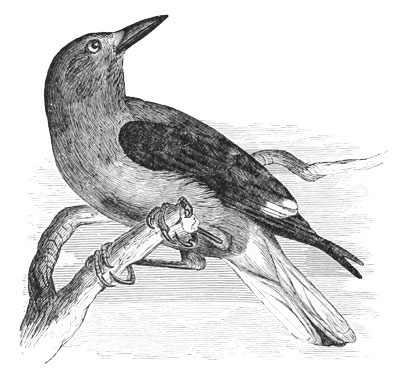
Picicorvus columbianus.
Gen. Char. Leaden-gray color, with black wings and tail. Bill longer than the head, considerably longer than the tarsus, attenuated, slightly decurved; tip without notch. Culmen and commissure curved; gonys straight or slightly concave, as long as the tarsi. Nostrils circular, completely covered by a full tuft of incumbent white bristly feathers. Tail much shorter than the wings, nearly even or slightly rounded. Wings pointed, reaching to the tip of tail. Third, fourth, and fifth quills longest. Tarsi short, scarcely longer than the middle toe, the hind toe and claw very large, reaching nearly to the middle of the middle claw, the lateral toe little shorter. A row of small scales on the middle of the sides of tarsus. Color of the single species leaden-gray, with black wings and tail.
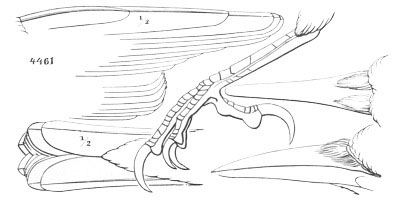
Picicorvus columbianus. 4461
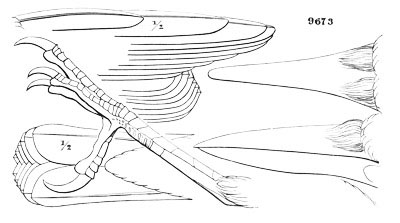
Nucifraga caryocatactes. 9673
This genus is so similar to Nucifraga as to be hardly separable; the principal difference being in the slender and more decurved and attenuated bill, with a slightly concave, instead of convex, culmen, and plain instead of spotted plumage. The differences of form are expressed by the accompanying outlines of the generic features of the two. But one species is known, this being peculiar to Western North America.
Picicorvus columbianus, Bonap.
CLARKE’S CROW.
Corvus columbianus, Wilson, Am. Orn. III, 1811, 29, pl. xx.—Bon. Obs. Wilson, 1824, No. 38.—Ib. Syn. 1828, 57.—Nuttall, I, 1832, 218. Nucifraga columbiana, Aud. Orn. Biog. IV, 1838, 459, pl. ccclxii.—Ib. Syn. 1839, 156.—Ib. Birds Am. IV, 1842, 127, pl. ccxxxv.—Bon. List, 1838.—Nuttall, Man. I, (2d ed.,) 251. Picicorvus columbianus, Bonap. Consp. 1850, 384.—Newberry, P. R. R. Rep. VI, IV, 1837, 83.—Baird, Birds N. Am. 1858, 573.—Lord, Pr. R. A. Inst. IV, 121 (British Columbia).—Dall & Bannister, Trans. Chicago Acad. I, 1869, 286.—Cooper, Orn. Cal. 1, 1870, 289. “Corvus megonyx, Wagler.”
Sp. Char. Tail rounded or moderately graduated, the closed wings reaching nearly to its tip. Fourth quill longest; second considerably shorter than the sixth. General color bluish-ash, changing on the nasal feathers, the forehead, sides of head (especially around the eye), and chin, to white. The wings, including their inner surface, greenish-black, the secondaries and tertials, except the innermost, broadly tipped with white; tail white, the inner web of the fifth feather and the whole of the sixth, with the upper tail-coverts, greenish-black. The axillars plumbeous-black. Bill and feet black. Young similar in color, without additional markings of any kind. The gonys, however, convex, and the bill generally more like that of the Jays. Length of male (fresh), 12.00; wing, 7.00; tail, 4.30; tarsus, 1.20.
Hab. From Rocky Mountains to Pacific. East to Fort Kearney, north to Sitka, south to Arizona.
Habits. Clarke’s Crow was first met with by the parties composing the celebrated exploring party to the Rocky Mountains under the direction of Lewis and Clarke. It was described by Wilson in 1811, who was informed by individuals belonging to the expedition that these birds were found inhabiting the shores of the Columbia and the adjacent country in great numbers, frequenting the rivers and sea-shore, and that it seemed to have all the noisy and gregarious habits of the common Crow of Europe.
In his account of this species, Mr. Nuttall states that during his journey westward in the month of July, he first observed individuals of this bird in a small grove of pines on the borders of Bear River, near where it falls into Lake Timpanagos. This was at a height of about seven thousand feet above the sea level, and in the 42d parallel. Their habits appeared to him to correspond with those of the Nutcrackers of Europe.
He afterwards saw a considerable flock of the young birds early in August, in a lofty ravine near the Three Buttes, a remarkable isolated mountain group about forty miles west of the Lewis River. They appeared somewhat shy, and were scattered through a grove of aspens, flying, with a slight chatter, from the tops of bushes and trees, to the ground. He was of the opinion that this species never descends below the mountain plains, but that it has a constant predilection for the pine forests.
Mr. Townsend afterwards found this species abundant on the Blue Mountains of Oregon. He describes its flight as very unlike that of a Crow, being performed in jerks, in the manner of a Woodpecker. At times, when sitting, it is said to keep up a constant scream, in a very harsh and grating voice, and in an unvaried and prolonged tone. He states that it breeds in very high pine-trees, and that he did not meet with it within five hundred miles of the Columbia River.
Mr. Ridgway found this species one of the most abundant birds of the pine forests of the Sierra Nevada. East of this range it was also met with, though only in smaller numbers, in the cedar and piñon woods of the East Humboldt Mountains. He adds that it is a bird so curiously striking as at once to attract attention. It bears but very little resemblance to any bird of its family, and in its general appearance, flight, and notes approaches so nearly to the Woodpeckers as to be usually known to the settlers as a bird of that tribe.
He further remarks that its flight much resembles that of Melanerpes torquatus, and, as it alights from the top of a tall dead tree, and sits quietly gazing around, it might readily be mistaken for one of the Picidæ. He describes them as being very active in their movements, now flying from a tree to the ground to pick up some article of food, now examining the excavations of an old dead stump or snag, or, on being approached, as flying up and alighting upon the extreme summit of a tree, out of gunshot. It is a very noisy bird, and its notes are harsh and discordant, though less so than are those of the Steller’s Jay, which is generally seen in the same localities. Its usual note is a harsh guttural churr-churr, generally uttered when two or more alight on the same tree. Occasionally an individual takes up a peculiar piping strain, which is immediately answered by all the others in the neighborhood, thus awakening the echoes of the surrounding solitude with their discordant cries. In regard to its nest he can give no positive information, but thinks that they breed in cavities in old dead trees and stumps, having found a nest in such a situation in the East Humboldt Mountains, which he thinks belonged to a pair of these birds which were flying about, and seen to enter this cavity.
Dr. Newberry, in his Report on the zoölogy of his route, states that he found this species rather common along a large portion of it, and was thus enabled to study its habits at leisure. He found it strictly confined to the highlands and mountains, never, where he saw it, descending to a lower altitude than about four thousand feet. On the other hand, while crossing the Cascade Mountains at the line of perpetual snow, seven thousand feet above the sea-level, he has seen this bird, in company with the Melanerpes torquatus, flying over the snow-covered peaks three thousand feet above him.
He first met with this bird on the spur of the Sierra Nevada, near Lassen’s Butte, and found it constantly, when in high and timbered regions, from there to the Columbia. He describes its habits as a compound, in about equal parts of those of the Jays and of the Woodpeckers. Its cry he speaks of as particularly harsh and disagreeable, something like that of Steller’s Jay, but louder and more discordant. It seems to combine the shrewdness with all the curiosity of the Jays and Crows, and from its shyness is a very difficult bird to shoot, the Doctor never being able to get directly within killing distance of one of them, but only obtaining specimens by concealing himself and waiting for them to approach him. Apparently from excess of caution, it almost invariably alights on a dry tree. Even when going to a living tree for its food, it always flies first into a dry one, if one is near, to reconnoitre, and, if the coast is clear, it begins to feed. At the first movement of an intruder, without uttering a note, it puts a safe distance between itself and its enemy.
The food of this bird, at the time when Dr. Newberry visited its haunts, consisted exclusively of the seeds of the yellow pine (P. ponderosa), in dislodging which from the cones the bird displays great dexterity. Both Maximilian’s Jay and Steller’s Jay were, at that time, feeding on the same seeds, but not so exclusively.
Dr. Suckley obtained a specimen of this bird as far east as Milk River, in Nebraska, about two hundred miles east of the Rocky Mountains.
In crossing the Cascade Mountains, in 1853, Dr. Cooper found these birds quite abundant on the banks of the Yakima River, and from thence north wherever there were trees of the long-leaved pine, the seeds of which were its principal food. On returning to Vancouver during the severe cold weather of the following January, these birds appeared there in considerable numbers. At no other season of the year has he met with them west of the Cascade Mountains, and believes these migrations westward are only made in the severest weather. They extend eastward throughout Washington Territory, as Dr. Cooper has shot them at Fort Laramie, and met with a straggling pair even as far east as Fort Kearney. Dr. Cooper has never known these birds to eat anything except seeds and berries. They rarely descend to the ground, and never frequent river-banks, or other places, for fish or carrion. They may be seen on the tops of trees extracting seeds from cones, hanging head downwards, like a Chickadee. Dr. Cooper has observed this bird pecking at dead bark, in quest of insects. When feeding they are very shy, flying off, if approached, to a great distance before alighting. They are not known to visit the Coast Mountains south of San Francisco, but abound in the Rocky Mountains throughout our limits.
Mr. J. K. Lord notes the arrival of this species at Fort Colville, in May, in large flocks. They were hopping busily from branch to branch, amidst pine-trees.
The statement made to Wilson that this species frequents rivers and seashores, and his inference that its formidable claws indicated that they feed on living animals, is controverted by Mr. Lord. They never frequent river-banks, never by any chance eat fish, and never capture any living thing. Their habits are strictly arboreal, and their food the seeds of pine-trees. These noisy seed-hunters use their formidable claws to enable them to hang on to the pine cones while they are extracting the seed, which they are obliged to get out from under scaly coverings. For this nature has given them feet and claws that serve the purpose of hands, and a powerful bill, like a small crowbar. The cone must be steadied when they pry it open, or it would snap and fall. One foot clasps it, and the powerful claws hold it firmly. The other foot, encircling a branch, supports the bird in every possible position, the long grasping claws being equal to any emergency. The cone is thus fixed, and the seeds are forced out from under the scales. Mr. Lord collected a large packet of seeds of the Abies douglassi from the crops of these birds.
On their arrival they assemble in immense flocks, and the noise they make he describes as a most discordant, continuous, grating clatter, intensified at times into a perfect shriek. These assemblies last about a week, after which they separate in pairs.
A nest of this bird was found by Mr. Lord in the top of a lofty pine at least two hundred feet high,—felled in cutting the boundary line. By chance he discovered the nest, about which the old birds were hovering, leaving no doubt of its identity. This nest was very large and composed of fir twigs, bits of bark, the leaves of the pine, fine root-fibres, with small pieces of moss, and gray lichens mixed carelessly with the other materials. It was shallow and round, and presented a large extent of surface beyond the margins of the hollow containing the eggs. The eggs were in fragments, much like the eggs of Steller’s Jay in color, but of a lighter shade of bluish-green. He thinks that their habit is to build in the very tallest pines.
Dr. Kennerly also met with this Crow west of Albuquerque, in New Mexico, in the thick pine woods skirting the eastern slope of the Rocky Mountains, where it was quite abundant. He rarely saw more than two or three together. None were met with after leaving the mountains.
A single specimen of this crow was obtained at Sitka, by Bischoff.
Genus GYMNOKITTA, Pr. Max.
Gymnorhinus, Pr. Max. Reise Nord. Amer. II, 1841, 21. (Type, G. cyanocephala.)
Gymnokitta, Pr. Max. “1850,” Gray.
Cyanocephalus, Bonap. “1842,” preoccupied in Botany.
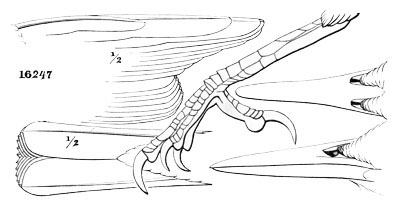
Gymnokitta cyanocephala. 16247
Gen. Char. Bill elongated, depressed, shorter than the tarsus, longer than the head, without notch, similar to that of Sturnella in shape. Culmen nearly straight; commissure curved; gonys ascending. Nostrils small, oval, entirely exposed, the bristly feathers at the base of the bill being very minute. Tail short, nearly even, much shorter than the pointed wings, which cover three fourths of the tail. Tarsi considerably longer than the middle toe. Color of the single species blue, most intense anteriorly; the throat streaked with white.
The bill in this genus is not unlike that of Sturnus and Sturnella, and conspicuous among Corvinæ by its uncovered nostrils.
Gymnokitta cyanocephala, Pr. Max.
MAXIMILIAN’S JAY.
Gymnorhinus cyanocephalus, Pr. Max., Reise in das innere Nord-Amerika, II, 1841, 21.—Ib. Voyage dans l’Am. du Nord, III, 1843, 296. Gymnokitta cyanocephala, “Pr. Max. 1850,” Bp. Conspectus, 1850, 382.—Cassin, Illust. I, VI, 1854, 165, pl. xxviii.—Newberry, Rep. P. R. R. VI, IV, 1857, 83.—Baird, Birds N. Am. 1858, 574.—Max. Cab. J. VI, 1858, 193.—Cooper, Orn. Cal. 1, 1870, 292. Psilorhinus cyanocephalus, Gray, Genera. Cyanocorax cassini, M’Call, Pr. A. N. Sc. V, June, 1851, 216.
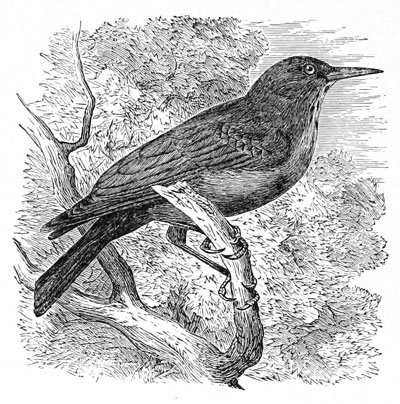
Gymnokitta cyanocephala.
Sp. Char. Wings considerably longer than the tail, and reaching to within an inch of its tip. Tail nearly even. General color dull blue, paler on the abdomen, the middle of which is tinged with ash; the head and neck of a much deeper and more intense blue, darker on the crown. Chin and forepart of the throat whitish, streaked with blue. Length, 10.00; wing, 5.90; tail, 4.50; tarsus, 1.50. Young bird not differing in markings.
Hab. Rocky Mountains of Colorado, to Cascade Mts. of California and Oregon. Not on the Pacific coast? South to New Mexico and Arizona.
The female is appreciably different from the male, both in size and plumage, being smaller, and of a light bluish-ash tint. This difference is readily appreciable when the birds are seen flying.
Habits. Maximilian’s Jay was discovered and first described by that eminent naturalist, Maximilian, Prince of Wied, in his book of travels in North America, published in 1841. Mr. Edward Kern, who was connected with Colonel Fremont’s exploring expedition in 1846, was the first to bring specimens of this interesting and remarkable bird to the notice of American naturalists, transmitting them to the Philadelphia Academy. The specimens procured by its discoverer were met with by him on Maria’s River, one of the tributaries of the Upper Missouri, in the extreme northern portion of our northwestern territory, a point much farther north than it has been met with by any other naturalist. As this species has since been seen in large numbers in New Mexico, it may be presumed to extend its movements over quite an extended area of distribution in the region of the Rocky Mountains.
According to the more recent observations of Mr. Ridgway, the Maximilian Jay inhabits exclusively the nut-pine and cedar woods on the interior mountain ranges, and is one of the most characteristic birds of those regions. This species he states to be eminently gregarious, even breeding in colonies, and in winter congregating in flocks, sometimes of thousands. Ever restless and in motion, as it moves it is constantly uttering its curious, querulous notes. It is a very conspicuous bird, and is one well worthy of particular attention. Its blue color is the only thing suggestive of its affinity to the Jay. All its habits are different, and its appearance is quite peculiar. It is as essentially migratory as the Ectopistes migratoria, its coming and its going being quite as sudden and uncertain. On one occasion, in visiting a nut-pine wood, Mr. Ridgway found it full of roving, noisy troops of these birds, but upon visiting the same locality the next day not one could be seen.
He also states that these birds are exceedingly early in their nesting, as he met with companies of fully fledged young flying about on the 21st of April. Near Carson City, April 20, 1868, he found these birds abundant among the scattered cedars and nut-pines on the lower slopes of the hills. They were in pairs, often three or four pairs in company.
The notes of this bird are both peculiar and curious. The usual ones are said to have some resemblance to the querulous wailings of the Screech Owl; but none, in his opinion, have any resemblance to the cry of the Catbird.
It flies very swiftly, but with a gentle floating motion, very much in the manner of the Robin. In its movements among the small cedars, it generally alighted upon the summit of a tree, and, quietly sitting there, would look about in the manner of the Picicorvus columbianus. In flying, it continually uttered a very peculiar querulous note, resembling very much one of the notes of the Magpie,—the peculiarly soft note of that bird uttered during the love-season, or when its nest is approached. In searching among the cedars, Mr. Ridgway found several of its nests. Nearly all had been deserted, and there were several families of fully fledged young flying about. One nest contained four fully feathered young. When these had been taken, and placed in a hat, they all jumped out, squalling vociferously. These nests were all saddled upon horizontal branches of cedars, and, except in their greater bulk, they closely resembled the nest of the eastern Blue Jay.
In autumn and in winter the large flocks of these birds, as they fly back and forth over the hills, present a very peculiar appearance. Their flight is then very swift.
Dr. Kennerly, in November, 1853, frequently saw large flocks of these birds between the Puebla of Laguna and the Sierra Madre, about a hundred miles west of Albuquerque, in New Mexico. They were found chiefly frequenting the watercourses, and when startled would circle around, rising higher above their heads, uttering their singular cries; then suddenly descending they would alight in the top of some tree on the adjoining cliffs. He compares its voice to that of the common Catbird.
Dr. T. C. Henry also repeatedly noticed these birds in the vicinity of Fort Webster, in New Mexico. He first met with them near San Miguel, in July, 1852, where he observed a party of about thirty flitting through the cedars along the roadside. They were chiefly young birds, and were constantly alighting on the ground for the purpose of capturing lizards, which they killed with great readiness, and devoured. After that he repeatedly, in winter, saw these birds near Fort Webster, and usually in flocks of about forty or fifty. They evinced great wariness, and were very difficult of approach.
The flocks would usually alight near the summit of a hill and pass rapidly down its sides, all the birds keeping quite near to each other, and frequently alighting on the ground. They appeared to be very social, and kept up a continual twittering note. This bird, so far as Dr. Henry observed it, is exclusively a mountain species, and never seen on the plains or bottom-lands, and was never observed singly, or even in a single pair, but always in companies.
Dr. Newberry met with this species in the basin of the Des Chutes, in Oregon. He first noticed it in September. Early every morning flocks of from twenty-five to thirty of these birds came across, in their usual straggling flight, chattering as they flew to the trees on a hill near the camp, and then, from tree to tree, they made their way to the stream to drink. He describes their note, when flying or feeding, as a frequently repeated ca-ca-că. Sometimes, when made by a straggler separated from mate or flock, it was rather loud and harsh, but was usually soft and agreeable. When disturbed, their cry was harsher. They were very shy, and could only be shot by lying in wait for them. Subsequently he had an opportunity of seeing them feed, and of watching them carefully as they were eating the berries of the cedars, and in their habits and cries they seemed closely to resemble Jays. A specimen, previously killed, was found with its crop filled with the seeds of the yellow pine.
Dr. Cooper has seen specimens of this bird from Washoe, just east of the California State line, and he was informed by Mr. Clarence King that they frequent the junipers on mountains near Mariposa.
From Dr. Coues we learn that this bird is very abundant at Fort Whipple, where it remains all the year. It breeds in the retired portions of the neighboring mountains of San Francisco and Bill Williams, the young leaving the nest in July. As the same birds are ready to fly in April, at Carson City, it may be that they have two broods in Arizona. During the winter they collect in immense flocks, and in one instance Dr. Coues estimates their number at a thousand or more. In a more recent contribution to the Ibis (April, 1872), Dr. Coues gives a more full account of his observations in respect to this bird. In regard to geographical range he considers its distribution very nearly the same with that of the Picicorvus. Mr. Aiken has recently met with these birds in Colorado Territory, where, however, Mr. Allen did not obtain specimens. General McCall found these birds abundant near Santa Fé, in New Mexico, at an altitude Of seven thousand feet; and the late Captain Feilner obtained specimens at Fort Crook, in Northeastern California. Dr. Coues considers its range to be the coniferous zone of vegetation within the geographical area bounded eastward by the foot-hills and slopes of the Rocky Mountains; westward by the Cascade and Coast ranges; northward, perhaps to Sitka, but undetermined; and somewhat so southward, not traced so far as the tierra fria of Mexico.
Dr. Coues adds that, like most birds which subsist indifferently on varied animal or vegetable food, this species is not, strictly speaking, migratory, as it can find food in winter anywhere except at its loftiest points of distribution. A descent of a few thousand feet from the mountains thus answers all the purposes of a southward journey performed by other species, so far as food is concerned, while its hardy nature enables it to endure the rigors of winter. According to his observations, this bird feeds principally upon juniper berries and pine seeds, and also upon acorns and other small hard fruits.
Dr. Coues describes this bird as garrulous and vociferous, with curiously modulated chattering notes when at ease, and with extremely loud harsh cries when excited by fear or anger. It is also said to be restless and impetuous, as if of an unbalanced mind. Its attitudes on the ground, to which it frequently descends, are essentially Crow-like, and its gait is an easy walk or run, very different from the leaping manner of progress made by the Jays. When perching, its usual attitude is stiff and firm. Its flight resembles that of the Picicorvus. After breeding, these birds unite in immense flocks, but disperse again in pairs when the breeding-season commences.
Nothing, so far, has been published in regard to the character of the eggs.
Subfamily GARRULINÆ.
Char. Wings short, rounded; not longer or much shorter than the tail, which is graduated, sometimes excessively so. Wings reaching not much beyond the lower tail-coverts. Bristly feathers at base of bill variable. Bill nearly as long as the head, or shorter. Tarsi longer than the bill or than the middle toe. Outer lateral claws rather shorter than the inner.
The preceding diagnosis may perhaps characterize the garruline birds, as compared with the Crows. The subdivisions of the group are as follows:—
A. Nostrils moderate, completely covered by incumbent feathers.
a. Tail much longer than the wings; first primary attenuated, falcate.
Pica. Head without crest.
b. Tail about as long as the wings; first primary not falcate.
Cyanura. Head with lengthened narrow crest. Wing and tail blue, banded with black.
Cyanocitta. Head without crest. Above blue, with a gray patch on the back. No bands on wing and tail.
Xanthoura. Head without crest. Color above greenish; the head blue; lateral tail-feathers yellow.
Perisoreus. Head full and bushy. Bill scarcely half the head, with white feathers over the nostrils. Plumage dull.
B. Nostrils very large, naked, uncovered by feathers.
Psilorhinus. Head not crested; tail broad; wings two thirds as long as the tail.
Calocitta. Head with a recurved crest; wings less than half as long as the tail.
There is a very close relationship between the Jays and the Titmice, the chief difference being in size rather than in any other distinguishing feature. The feathers at the base of the bill, however, in the Jays, are bristly throughout, with lateral branches reaching to the very tip. In Paridæ these feathers are inclined to be broader, with the shaft projecting considerably beyond the basal portion, or the lateral branches are confined to the basal portion, and extended forwards. There is no naked line of separation between the scutellæ on the outer side of the tarsi. The basal joint of the middle toe is united almost or quite to the end to the lateral, instead of half-way. The first primary is usually less than half the second, instead of rather more; the fourth and fifth primaries nearly equal and longest, instead of the fifth being longer than the fourth.
Genus PICA, Cuvier.
Coracias, Linnæus, Syst. Nat. 1735 (Gray).
Pica, Brisson, Ornithologia, 1760, and of Cuvier (Agassiz). (Type, Corvus pica, L.)
Cleptes, Gambel, J. A. N. Sc. 2d Ser. I, 1847, 47.
Gen. Char. Tail very long, forming much more than half the total length; the feathers much graduated; the lateral scarcely more than half the middle. First primary falcate, curved, and attenuated. Bill about as high as broad at the base; the culmen and gonys much curved, and about equal; the bristly feathers reaching nearly to the middle of the bill. Nostrils nearly circular. Tarsi very long; middle toe scarcely more than two thirds the length. A patch of naked skin beneath and behind the eye.
The peculiar characteristic of this genus, in addition to the very long graduated tail, lies in the attenuated, falcate first primary. Calocitta, which has an equally long or longer tail, has the first primary as in the Jays generally (besides having the nostrils exposed).
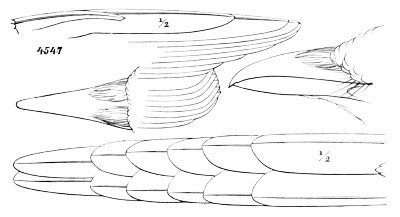
Pica hudsonica. 4547
A specimen of P. nuttalli has the lateral tarsal plates with two or three transverse divisions on the lower third. This has not been observed by us to occur in P. hudsonica.
Species and Varieties.
P. caudata. Head, neck, breast, interscapulars, lining of wing, tail-coverts and tibiæ, deep black: wings metallic greenish-blue; tail rich metallic green, the feathers passing through bronze and reddish-violet into violet-blue, at their tips. Scapulars, abdomen, sides, flanks, and inner webs of primaries, pure white. Sexes alike; young similar.
a. Bill and bare space around the eye black.
Wing, 7.50; tail, 9.50 or less, its graduation less than half its length, 4.50; culmen, 1.20; tarsus, 1.75; middle toe, 1.05. Hab. Europe … var. caudata.[55]
Wing, over 8.00 (8.50 maximum); tail over 10.00 (13.50, max., its graduation more than half its length, 7.70); culmen, 1.55; tarsus, 1.75; middle toe, 1.05. Hab. Northern and Middle North America, exclusive of the Atlantic Province of United States and California … var. hudsonica.
b. Bill and bare space around the eye yellow.
Wing, 7.50; tail, 10.50; its graduation, 5.00; culmen, 1.50; tarsus, 1.75; middle toe, 1.05. Hab. California … var. nuttalli.