Family ICTERIDÆ.—The Orioles.
Reading edition
Char. Primaries nine. Tarsi scutellate anteriorly; plated behind. Bill long, generally equal to the head or longer, straight or gently curved, conical, without any notch, the commissure bending downwards at an obtuse angle at the base. Gonys generally more than half the culmen, no bristles about the base of bill. Basal joint of the middle toe free on the inner side; united half-way on the outer. Tail rather long, rounded. Legs stout.
This family is strictly confined to the New World, and is closely related in many of its members to the Fringillidæ. Both have the angulated commissure and the nine primaries; the bill is, however, usually much longer; the rictus is completely without bristles, and the tip of the bill without notch.
The affinities of some of the genera are still closer to the family of Sturnidæ or Starlings, of which the Sturnus vulgaris may be taken as the type. The latter family, is, however, exclusively Old World, except for the occurrence of a species in Greenland, and readily distinguished by the constant presence of a rudimentary outer primary, making ten in all.
There are three subfamilies of the Icteridæ,—the Agelainæ, the Icterinæ, and the Quiscalinæ,[29] which may be diagnosed as follows, although it is difficult to define them with precision:—
Agelainæ. Bill shorter than, or about equal to, the head; thick, conical, both mandibles about equal in depth; the outlines all more or less straight, the bill not decurved at tip. Tail rather short, nearly even or slightly rounded. Legs longer than the head, adapted for walking; claws moderately curved.
Icterinæ. Bill rather slender, about as long as the head; either straight or decurved. Lower mandible less thick than the upper; the commissure not sinuated. Tarsi not longer than the head, nor than middle toe; legs adapted for perching. Claws much curved.
Quiscalinæ. Tail lengthened, considerably or excessively graduated. Bill as long as,or longer than, the head; the culmen curved towards the end, the tip bent down, the cutting edges inflexed, the commissure sinuated. Legs longer than the head, fitted for walking.
Subfamily AGELAINÆ.
Char. Bill stout, conical, and acutely pointed, not longer than the head; the outlines nearly straight, the tip not decurved. Legs adapted for walking, longer than the head. Claws not much curved. Tail moderate, shorter than the wings; nearly even.
The Agelainæ, through Molothrus and Dolichonyx, present a close relation to the Fringillidæ in the comparative shortness and conical shape of the bill, and, in fact, it is very difficult to express in brief words the distinctions which evidently exist. Dolichonyx may be set aside as readily determinate by the character of the feet and tail. The peculiar subfamily characteristics of Molothrus will be found under the generic remarks respecting it.
The following diagnosis will serve to define the genera:—
A. Bill shorter than the head. Feathers of head and nostrils as in B.
Dolichonyx. Tail-feathers with rigid stiffened acuminate points. Middle toe very long, exceeding the head.
Molothrus. Tail with the feathers simple; middle toe shorter than the tarsus or head.
B. Bill as long as the head. Feathers of crown soft. Nostrils covered by a scale which is directed more or less downwards.
Agelaius. First quill shorter than the second and third. Outer lateral claws scarcely reaching to the base of middle; claws moderate.
Xanthocephalus. First quill longest. Outer lateral claw reaching nearly to the tip of the middle. Toes and claws all much elongated.
C. Bill as long as, or longer than, the head. Feathers of crown with the shafts prolonged into stiffened bristles. Nostrils covered by a scale which stands out more or less horizontally.
Sturnella. Tail-feathers acute. Middle toe equal to the tarsus.
Trupialis. Tail-feathers rounded. Middle toe shorter than the tarsus.
Genus DOLICHONYX, Swainson.
Dolichonyx, Swainson, Zoöl. Journ. III, 1827, 351. (Type, Emberiza oryzivora, L.)
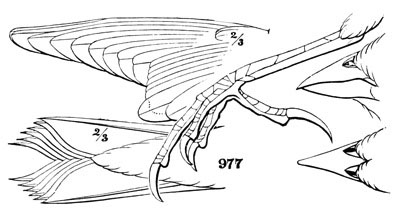
Dolichonyx oryzivorus. 977
Gen. Char. Bill short, stout, conical, little more than half the head; the commissure slightly sinuated; the culmen nearly straight. Middle toe considerably longer than the tarsus (which is about as long as the head); the inner lateral toe longest, but not reaching the base of the middle claw. Wings long, first quill longest. Tail-feathers acuminately pointed at the tip, with the shaft stiffened and rigid, as in the Woodpeckers.
The peculiar characteristic of this genus is found in the rigid scansorial tail and the very long middle toe, by means of which it is enabled to grasp the vertical stems of reeds or other slender plants. The color of the single species is black, varied with whitish patches on the upper parts.
Dolichonyx oryzivorus, Swainson.
BOBOLINK; REEDBIRD; RICEBIRD.
Emberiza oryzivora, Linn. Syst. Nat. I, 1766, 311.—Gm. I, 1788, 850.—Wilson, Am. Orn. II, 1810, 48, pl. xii, f. 1, 2. Passerina oryzivora, Vieillot, Nouv. Dict. XXV, 1817, 3. Dolichonyx oryzivora, Swainson, Zoöl. Jour. III, 1827, 351.—Ib. F. Bor.-Am. II, 1831, 278.—Bon. List, 1838.—Ib. Conspectus, 1850, 437.—Aud. Syn. 1839, 139.—Ib. Birds Am. IV, 1842, 10, pl. ccxi.—Gosse, Birds Jam. 1847, 229.—Baird, Birds N. Am. 1858, 522.—Max. Cab. J. VI, 1858, 266.—Cooper, Orn. Cal. I, 1870, 255.—Samuels, 335. Icterus agripennis, Bonap. Obs. Wils. 1824, No. 87. Aud. Orn. Biog. I, 1831, 283; V, 1839, 486, pl. liv.—Nutt. Man. I, 1832, 185. Icterus (Emberizoides) agripennis, Bon. Syn. 1828, 53. Dolichonyx agripennis, Rich. List, 1837. Psarocolius caudacutus, Wagler, Syst. Av. 1827, 32.
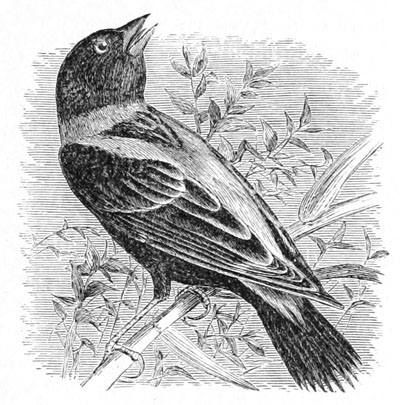
Dolichonyx oryzivorus.
Sp. Char. General color of male in spring, black; the nape brownish cream-color; a patch on the side of the breast, the scapulars, and rump, white, shading into light ash on the upper tail-coverts and the back below the interscapular region. The outer primaries sharply margined with yellowish-white; the tertials less abruptly; the tail-feathers margined at the tips with pale brownish-ash. In autumn totally different, resembling the female.
Female, yellowish beneath; two stripes on the top of the head, and the upper parts throughout, except the back of the neck and rump, and including all the wing-feathers generally, dark brown, all edged with brownish-yellow, which becomes whiter near the tips of the quills. The sides sparsely streaked with dark brown, and a similar stripe behind the eye. There is a superciliary and a median band of yellow on the head. Length of male, 7.70; wing, 3.83; tail, 3.15.
Hab. Eastern United States to the high Central Plains. North to Selkirk Settlement, and Ottawa, Canada; and west to Salt Lake Valley, Utah, and Ruby Valley, Nevada (Ridgway); Cuba, winter (Caban.); Bahamas (Bryant); Jamaica (Gosse, Scl., Oct.; March, Oct., and in spring); James Island, Galapagos, Oct. (Gould); Sombrero, W. I. (Lawrence); Brazil (Pelzeln); Yucatan.
A female bird from Paraguay (Dec., 1859) is undistinguishable from the average of northern ones, except by the smaller size. Specimens from the western plains differ from those taken near the Atlantic Coast in having the light areas above paler, and less obscured by the grayish wash so prevalent in the latter; the ochraceous of the nape being very pale, and at the same time pure.
Habits. The well-known and familiar Bobolink of North America has, at different seasons of the year, a remarkably extended distribution. In its migrations it traverses all of the United States east of the high central plains to the Atlantic as far to the north as the 54th parallel, which is believed to be its most northern limit, and which it reaches in June. In the winter it reaches, in its wandering, the West Indies, Central America, the northern and even the central portions of South America. Von Pelzeln obtained Brazilian specimens from Matogrosso and Rio Madeira in November, and from Marabitanas, April 4th and 13th. Those procured in April were in their summer or breeding plumage, suggesting the possibility of their breeding in the high grounds of South America. Sclater received specimens from Santa Marta and from Bolivia. Other specimens have been reported as coming from Rio Negro, Rio Napo, in Brazil, Cuba, Jamaica, Porto Rico, Paraguay, Buenos Ayres, etc.
In North America it breeds from the 42d to the 54th parallel, and in some parts of the country it is very abundant at this season. The most southern breeding locality hitherto recorded is the forks of the Susquehanna River, along the west branch of which, especially in the Wyoming Valley, it was formerly very abundant.
Mr. Ridgway also observed this bird in Ruby Valley where, among the wheat-fields, small companies were occasionally seen in August. He was informed that, near Salt Lake City, these birds are seen in May, and again late in the summer, when the grain is ripe.
Of all our unimitative and natural songsters the Bobolink is by far the most popular and attractive. Always original and peculiarly natural, its song is exquisitely musical. In the variety of its notes, in the rapidity with which they are uttered, and in the touching pathos, beauty, and melody of their tone and expression, its notes are not equalled by those of any other North American bird. We know of none, among our native feathered songsters, whose song resembles, or can be compared with it.
In the earliest approaches of spring, in Louisiana, when small flocks of male Bobolinks make their first appearance, they are said, by Mr. Audubon, to sing in concert; and their song thus given is at once exceedingly novel, interesting, and striking. Uttered with a volubility that even borders upon the burlesque and the ludicrous, the whole effect is greatly heightened by the singular and striking manner in which first one singer and then another, one following the other until all have joined their voices, take up the note and strike in, after the leader has set the example and given the signal. In this manner sometimes a party of thirty or forty Bobolinks will begin, one after the other, until the whole unite in producing an extraordinary medley, to which no pen can do justice, but which is described as very pleasant to listen to. All at once the music ceases with a suddenness not less striking and extraordinary. These concerts are repeated from time to time, usually as often as the flock alight. This performance may also be witnessed early in April, in the vicinity of Washington, the Smithsonian grounds being a favorite place of resort.
By the time these birds have reached, in their spring migrations, the 40th parallel of latitude, they no longer move in large flocks, but have begun to separate into small parties, and finally into pairs. In New England the Bobolink treats us to no such concerts as those described by Audubon, where many voices join in creating their peculiar jingling melody. When they first appear, usually after the middle of May, they are in small parties, composed of either sex, absorbed in their courtships and overflowing with song. When two or three male Bobolinks, decked out in their gayest spring apparel, are paying their attentions to the same drab-colored female, contrasting so strikingly in her sober brown dress, their performances are quite entertaining, each male endeavoring to outsing the other. The female appears coy and retiring, keeping closely to the ground, but always attended by the several aspirants for her affection. After a contest, often quite exciting, the rivalries are adjusted, the rejected suitors are driven off by their more fortunate competitor, and the happy pair begin to put in order a new home. It is in these love-quarrels that their song appears to the greatest advantage. They pour out incessantly their strains of quaint but charming music, now on the ground, now on the wing, now on the top of a fence, a low bush, or the swaying stalk of a plant that bends with their weight. The great length of their song, the immense number of short and variable notes of which it is composed, the volubility and confused rapidity with which they are poured forth, the eccentric breaks, in the midst of which we detect the words “bob-o-link” so distinctly enunciated, unite to form a general result to which we can find no parallel in any of the musical performances of our other song-birds. It is at once a unique and a charming production. Nuttall speaks of their song as monotonous, which is neither true nor consistent with his own description of it. To other ears they seem ever wonderfully full of variety, pathos, and beauty.
When their contests are ended, and the mated pair take possession of their selected meadow, and prepare to construct their nest and rear their family, then we may find the male bird hovering in the air over the spot where his homely partner is brooding over her charge. All this while he is warbling forth his incessant and happy love-song; or else he is swinging on some slender stalk or weed that bends under him, ever overflowing with song and eloquent with melody. As domestic cares and parental responsibilities increase, his song becomes less and less frequent. After a while it has degenerated into a few short notes, and at length ceases altogether. The young in due time assume the development of mature birds, and all wear the sober plumage of the mother. And now there also appears a surprising change in the appearance of our gayly attired musician. His showy plumage of contrasting white and black, so conspicuous and striking, changes with almost instant rapidity into brown and drab, until he is no longer distinguishable, either by plumage or note, from his mate or young.
At the north, where the Bobolinks breed, they are not known to molest the crops, confining their food almost entirely to insects, or the seeds of valueless weeds, in the consumption of which they confer benefit, rather than harm. At the south they are accused of injuring the young wheat as they pass northward in their spring migrations, and of plundering the rice plantations on their return. About the middle of August they appear in almost innumerable flocks among the marshes of the Delaware River. There they are known as Reedbirds. Two weeks later they begin to swarm among the rice plantations of South Carolina. There they take the name of Ricebirds. In October they again pass on southward, and make another halt among the West India Islands. There they feed upon the seeds of the Guinea-grass, upon which they become exceedingly fat. In Jamaica they receive a new appellation, and are called Butterbirds. They are everywhere sought after by sportsmen, and are shot in immense numbers for the table of the epicure. More recently it has been ascertained that these birds feed greedily upon the larvæ of the destructive cotton-worm, and in so doing render an immense service to the cultivators of Sea Island cotton.
Dr. Bryant, in his visit to the Bahamas, was eye-witness to the migrations northward of these birds, as they passed through those islands. He first noted them on the 6th of May, towards sunset. A number of flocks—he counted nine—were flying to the westward. On the following day the country was filled with these birds, and men and boys turned out in large numbers to shoot them. He examined a quantity of them, and all were males in full plumage. Numerous flocks continued to arrive that day and the following, which was Sunday. On Monday, among those that were shot were many females. On Tuesday but few were to be seen, and on Wednesday they had entirely disappeared.
Near Washington, Dr. Coues observed the Bobolink to be only a spring and autumnal visitant, from May 1st to the 15th distributed abundantly about orchards and meadows, generally in flocks. In autumn they frequented in immense flocks the tracts of Zizania aquatica, along the Potomac, from August 20 to October.
The Bobolink invariably builds its nest upon the ground, usually in a meadow, and conceals it so well among the standing grass that it is very difficult of discovery until the grass is cut. The female is very wary in leaving or in returning to her nest, always alighting upon the ground, or rising from it, at a distance from her nest. The male bird, too, if the nest is approached, seeks to decoy off the intruder by his anxiety over a spot remote from the object of his solicitude. The nest is of the simplest description, made usually of a few flexible stems of grasses carefully interwoven into a shallow and compact nest. The eggs, five or six in number, have a dull white ground, in some tinged with a light drab, in others with olive. They are generally spotted and blotched over the entire egg with a rufous-brown, intermingled with lavender. They are pointed at one end, and measure .90 by .70 of an inch. They have but one brood in a season.
In some eggs, especially those found in more northern localities, the ground-color is drab, with a strong tinge of purple. Over this is diffused a series of obscure lavender-color, and then overlying these are larger and bolder blotches of wine-colored brown. In a few eggs long and irregular lines of dark purple, so deep as to be undistinguishable from black, are added. These eggs are quite pointed at one end.
Genus MOLOTHRUS, Swainson.
Molothrus, Swainson, F. Bor.-Am. II, 1831, 277; supposed by Cabanis to be meant for Molobrus. (Type, Fringilla pecoris, Gm.)
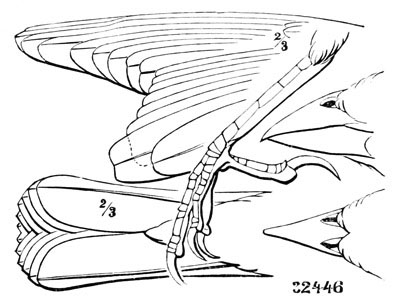
Molothrus pecoris. 32446
Gen. Char. Bill short, stout, about two thirds the length of head; the commissure straight, culmen and gonys slightly curved, convex, the former broad, rounded, convex, and running back on the head in a point. Lateral toes nearly equal, reaching the base of the middle one, which is shorter than tarsus; claws rather small. Tail nearly even; wings long, pointed, the first quill longest. As far as known, the species make no nest, but deposit the eggs in the nests of other, usually smaller, birds.
The genus Molothrus has the bill intermediate between Dolichonyx and Agelaius. It has the culmen unusually broad between the nostrils, and it extends back some distance into the forehead. The difference in the structure of the feet from Dolichonyx is very great.
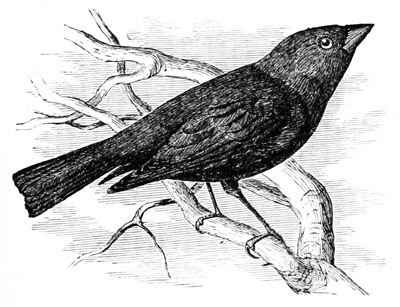
Molothrus pecoris.
Species of Molothrus resemble some of the Fringillidæ more than any other of the Icteridæ. The bill is, however, more straight, the tip without notch; the culmen running back farther on the forehead, the nostrils being situated fully one third or more of the total length from its posterior extremity. This is seldom the case in the American families. The entire absence of notch in the bill and of bristles along the rictus are strong features. The nostrils are perfectly free from any overhanging feathers or bristles. The pointed wings, with the first quill longest, or nearly equal to second, and the tail with its broad rounded feathers, shorter than the wings, are additional features to be specially noted.
Molothrus pecoris, Swainson.
COW BLACKBIRD; COWBIRD.
Fringilla pecoris, Gmelin, Syst. Nat. I, 1788, 910 (female).—Lath. Ind. Orn. I, 1790, 443.—Licht. Verzeich. 1823, Nos. 230, 231. Emberiza pecoris, Wils. Am. Orn. II, 1810, 145, pl. xviii, f. 1, 2, 3. Icterus pecoris, Bonap. Obs. Wilson, 1824, No. 88.—Aud. Orn. Biog. I, 1831, 493; V, 1839, 233, 490, pls. xcix and ccccxxiv. Icterus (Emberizoides) pecoris, Bon. Syn. 1828, 53.—Ib. Specchio comp. No. 41.—Nutt. Man. I, 1832, 178, (2d ed.,) 190. Passerina pecoris, Vieill. Nouv. Dict. XXV, 1819, 22. Psarocolius pecoris, Wagler, Syst. Av. 1827, No. 20. Molothrus pecoris, Swainson, F. Bor.-Am. II, 1831, 277.—Rich. List, 1837.—Bon. List, 1838.—Ib. Consp. 1850, 436.—Aud. Syn. 1839, 139.—Ib. Birds Am. IV, 1842, 16, pl. ccxii.—Cabanis, Mus. Hein. 1851, 193.—Baird, Birds N. Am. 1858, 524.—Cooper, Orn. Cal. I, 1870, 257.—Samuels, 339.—Allen, B. Fla. 284. ? Oriolus fuscus, Gmelin, Syst. Nat. I, 1788, 393. ? Sturnus obscurus, Gmelin, Syst. Nat. I, 1788, 804 (evidently a Molothrus, and probably, but not certainly, the present species). Molothrus obscurus, Cassin, Pr. Ph. Ac. 1866, 18 (Mira Flores, L. Cal.).—Cooper, Orn. Cal. I, 1870, 260. “Icterus emberizoides, Daudin.” ? Sturnus junceti, Lath. Ind. I, 1790, 326 (same as Sturnus obscurus, Gm.). ? Fringilla ambigua, Nuttall, Man. I, 1832, 484 (young). Sturnus nove-hispaniæ, Briss. II, 448.
Sp. Char. Second quill longest; first scarcely shorter. Tail nearly even, or very slightly rounded. Male with the head, neck, and anterior half of the breast light chocolate-brown, rather lighter above; rest of body lustrous black, with a violet-purple gloss next to the brown, of steel blue on the back, and of green elsewhere. Female light olivaceous-brown all over, lighter on the head and beneath. Bill and feet black. Length, 8 inches; wing, 4.42; tail, 3.40.
Hab. United States from the Atlantic to California; not found immediately on the coast of the Pacific? Orizaba (Scl. 1857, 213); Texas (Dresser, Ibis, 1865, 492); Fort Whipple, Arizona (Coues, P. A. N. S., 1866, 90); Nevada and Utah (Ridgway); Mazatlan, Tehuantepec, Cape St. Lucas.
The young bird of the year is brown above, brownish-white beneath; the throat immaculate. A maxillary stripe and obscure streaks thickly crowded across the whole breast and sides. There is a faint indication of a paler superciliary stripe. The feathers of the upper parts are all margined with paler. There are also indications of light bands on the wings. These markings are all obscure, but perfectly appreciable, and their existence in adult birds of any species may be considered as embryonic, and showing an inferiority in degree to the species with the under parts perfectly plain.
Specimens from the west appear to have a rather longer and narrower bill than those from the east. Summer birds of Cape St. Lucas and the Rio Grande are considerably smaller (var. obscurus, Cassin). Length about 6.50; wing, 4.00; tail, 3.00. Some winter skins from the same region are equal in size to the average.
Birds of this species breeding south of the Rio Grande, as well as those from Cape St. Lucas, Mazatlan, etc., are very much smaller than those nesting within the United States; but the transition between the extremes of size is so gradual that it is almost impossible to strike an average of characters for two races. The extremes of size in this species are as follows:—
Wing tail culmen tarsus
Largest. (11,271, ♂, Fort Bridger.) 4.60; 3.35; .72; 1.03.
Smallest. (17,297, ♂, Mira Flores, L. C.) 3.80; 2.65; .60; .84.
Habits. The common Cow Blackbird has a very extended distribution from the Atlantic to California, and from Texas to Canada, and probably to regions still farther north. They have not been traced to the Pacific coast, though abundant on that of the Atlantic. Dr. Cooper thinks that a few winter in the Colorado Valley, and probably also in the San Joaquin Valley.
This species is at all times gregarious and polygamous, never mating, and never exhibiting any signs of either conjugal or parental affections. Like the Cuckoos of Europe, our Cow Blackbird never constructs a nest of her own, and never hatches out or attempts to rear her own offspring, but imposes her eggs upon other birds; and most of these, either unconscious of the imposition or unable to rid themselves of the alien, sit upon and hatch the stranger, and in so doing virtually destroy their own offspring,—for the eggs of the Cowbird are the first hatched, usually two days before the others. The nursling is much larger in size, filling up a large portion of the nest, and is insatiable in its appetite, always clamoring to be fed, and receiving by far the larger share of the food brought to the nest; its foster-companions, either starved or stifled, soon die, and their dead bodies are removed, it is supposed, by their parents. They are never found near the nest, as they would be if the young Cow Blackbird expelled them as does the Cuckoo; indeed, Mr. Nuttall has seen parent birds removing the dead young to a distance from the nest, and there dropping them.
For the most part the Cowbird deposits her egg in the nest of a bird much smaller than herself, but this is not always the case. I have known of their eggs having been found in the nests of Turdus mustelinus and T. fuscescens, Sturnella magna and S. neglecta. In each instance they had been incubated. How the young Cowbird generally fares when hatched in the nests of birds of equal or larger size, and the fate of the foster-nurslings, is an interesting subject for investigation. Mr. J. A. Allen saw, in Western Iowa, a female Harporhynchus rufus feeding a nearly full grown Cowbird,—a very interesting fact, and the only evidence we now have that these birds are reared by birds of superior size.
It lays also in the nests of the common Catbird, but the egg never remains there long after the owner of the nest becomes aware of the intrusion. The list of the birds in whose nests the Cow Blackbird deposits her egg and it is reared is very large. The most common nurses of these foundlings in New England are Spizella socialis, Empidonax minimus, Geothlypis trichas, and all our eastern Vireos, namely, olivaceus, solitarius, noveboracensis, gilvus, and flavifrons. Besides these, I have found their eggs in the nests of Polioptila cærulea, Mniotilta varia, Helminthophaga ruficapilla, Dendroica virens, D. blackburniæ, D. pennsylvanica and D. discolor, Seiurus aurocapillus, Setophaga ruticilla, Cyanospiza cyanea, Contopus virens, etc. I have also known of their eggs having been found in the nests of Vireo belli and V. pusillus, and Cyanospiza amœna. Dr. Cooper has found their egg in the nest of Icteria virens; and Mr. T. H. Jackson of West Chester, Penn., in those of Empidonax acadicus and Pyranga rubra.
Usually not more than a single Cowbird’s egg is found in the same nest, though it is not uncommon to find two; and in a few instances three and even four eggs have been met with. In one instance Mr. Trippe mentions having found in the nest of a Black and White Creeper, besides three eggs of the owner of the nest, no less than five of the parasite. Mr. H. S. Rodney reports having found, in Potsdam, N. Y., May 15, 1868, a nest of Zonotrichia leucophrys of two stories, in one of which was buried a Cowbird’s egg, and in the upper there were two more of the same, with three eggs of the rightful owners. In the spring of 1869 the same gentleman found a nest of the Sayornis fuscus with three Cowbird’s eggs and three of her own.
Mr. Vickary, of Lynn, found, in the spring of 1860, the nest of a Seiurus aurocapillus, in which, with only one egg of the rightful owner, there were no less than four of the Cowbird. All five eggs were perfectly fresh, and had not been set upon. In the summer of the preceding year the same gentleman found a nest of the Red-eyed Vireo containing three eggs of the Vireo and four of the Cow Blackbird.
How the offspring from these eggs may all fare when more than one of these voracious nurslings are hatched in the same nest, is an interesting problem, well worthy the attention of some patiently inquiring naturalist to solve.
The Cow Blackbird appears in New England with a varying degree of promptness, sometimes as early as the latter part of March, and as frequently not until the middle of April. Nuttall states that none are seen in Massachusetts after the middle of June until the following October, and Allen, that they are there all the summer. My own observations do not correspond with the statement of either of these gentlemen. They certainly do become quite rare in the eastern part of that State after the third week in June, but that all the females are not gone is proved by the constant finding of freshly laid eggs up to July 1. I have never been able to find a Cow Blackbird in Eastern Massachusetts between the first of July and the middle of September. This I attribute to the absence of sufficient food. In the Cambridge marshes they remain until all the seeds have been consumed, and only reappear when the new crop is edible.
This Blackbird is a general feeder, eating insects, apparently in preference, and wild seed. They derive their name of Cow Blackbird from their keeping about that animal, and finding, either from her parasitic insects or her droppings, opportunities for food. They feed on the ground, and occasionally scratch for insects. At the South, to a limited extent, they frequent the rice-fields in company with the Redwinged Blackbird.
Mr. Nuttall states that if a Cow Blackbird’s egg is deposited in a nest alone it is uniformly forsaken, and he also enumerates the Summer Yellowbird as one of the nurses of the Cowbird. In both respects I think he is mistaken. So far from forsaking her nest when one of these eggs is deposited, the Red-eyed Vireo has been known to commence incubation without having laid any of her own eggs, and also to forsake her nest when the intrusive egg has been taken and her own left. The D. æstiva, I think, invariably covers up and destroys the Cowbird’s eggs when deposited before her own, and even when deposited afterwards.
The Cow Blackbird has no attractions as a singer, and has nothing that deserves the name of song. His utterances are harsh and unmelodious.
In September they begin to collect in large flocks, in localities favorable for their sustenance. The Fresh Pond marshes in Cambridge were once one of their chosen places of resort, in which they seemed to collect late in September, as if coming from great distances. There they remained until late in October, when they passed southward.
Mr. Ridgway only met with this species in two places, the valley of the Humboldt in September, and in June in the Truckee Valley. Their eggs were also obtained in the Wahsatch Mountains, deposited in the nest of Passerella schistacea, and in Bear River Valley in the nest of Geothlypis trichas.
Mr. Boardman informs me that the Cow Blackbird is a very rare bird in the neighborhood of Calais, Me., so much so that he does not see one of these birds once in five years, even as a bird of passage.
The eggs of this species are of a rounded oval, though some are more oblong than others, and are nearly equally rounded at either end. They vary from .85 of an inch to an inch in length, and from .65 to .70 in breadth. Their ground-color is white. In some it is so thickly covered with fine dottings of ashy and purplish-brown that the ground is not distinguishable. In others the egg is blotched with bold dashes of purple and wine-colored brown.
On the Rio Grande the eggs of the smaller southern race were found in the nests of Vireo belli, and in each of the nests of the Vireo pusillus found near Camp Grant, Arizona, there was an egg of this species. At Cape St. Lucas, Mr. Xantus found their eggs in nests of the Polioptila melanura. We have no information in regard to their habits, and can only infer that they must be substantially the same as those of the northern birds.
The eggs of the var. obscurus exhibit a very marked variation in size from those of the var. pecoris, and have a different appearance, though their colors are nearly identical. Their ground-color is white, and their markings a claret-brown. These markings are fewer, smaller, and less generally distributed, and the ground-color is much more apparent. They measure .60 by .55 of an inch, and their capacity as compared with the eggs of the pecoris is as 33 to 70,—a variation that is constant, and apparently too large to be accounted for on climatic differences.
Genus AGELAIUS, Vieill.
Agelaius, Vieillot, “Analyse, 1816.” (Type, Oriolus phœniceus, L.)
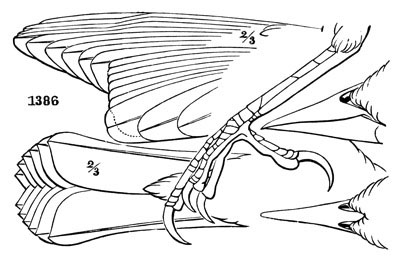
Agelaius phœniceus. 1386
Gen. Char. First quill shorter than second; claws short; the outer lateral scarcely reaching the base of the middle. Culmen depressed at base, parting the frontal feathers; length equal to that of the head, shorter than tarsus. Both mandibles of equal thickness and acute at tip, the edges much curved, the culmen, gonys, and commissure nearly straight or slightly sinuated; the length of bill about twice its height. Tail moderate, rounded, or very slightly graduated. Wings pointed, reaching to end of lower tail-coverts. Colors black with red shoulders in North American species. One West Indian with orange-buff. Females streaked except in two West Indian species.
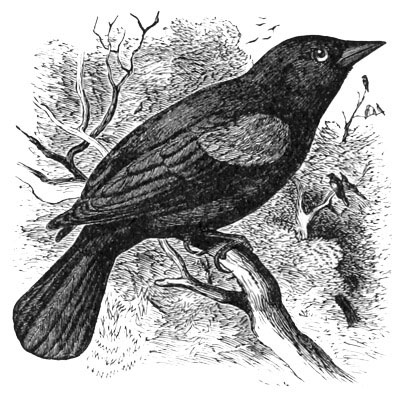
Agelaius phœniceus.
The nostrils are small, oblong, overhung by a membranous scale. The bill is higher than broad at the base. There is no division between the anterior tarsal scutellæ and the single plate on the outside of the tarsus.
The females of two West Indian species are uniform black. Of these the male of one, A. assimilis of Cuba, is undistinguishable from that of A. phœniceus; and in fact we may without impropriety consider the former as a melanite race of the latter, the change appreciable only in the female. The A. humeralis, also of Cuba, is smaller, and black, with the lesser coverts brownish orange-buff.
Species and Varieties.
Common Characters. Males glossy black without distinct bluish lustre, lesser wing-coverts bright red. Females without any red, and either wholly black or variegated with light streaks, most conspicuous below.
A. phœniceus. Tail rounded. Red of shoulders a bright scarlet tint. Black of plumage without bluish lustre. Females with wing-coverts edged with brownish, or without any light edgings at all.
a. Female continuous deep black, unvariegated.
Middle wing-coverts wholly buff in male.
Wing, 4.40; tail, 3.80; culmen, .95; tarsus, 1.00. Hab. Cuba.
b. Females striped beneath … var. assimilis.[30]
Wing, 4.90; tail, 3.85; culmen, .96; tarsus, 1.10. Female. White stripes on lower parts exceeding the dusky ones in width; a conspicuous lighter superciliary stripe, and one strongly indicated on middle of the crown. Hab. Whole of North America, south to Guatemala … var. phœniceus.
Middle wing-coverts black, except at base.
Wing, 5.00; tail, 3.90; culmen, .90; tarsus, 1.10. Female. White stripes on lower parts narrower than dusky ones; the posterior portion beneath being almost continuously dusky. No trace of median stripe on crown, and the superciliary one indistinct. Hab. Pacific Province of United States, south through Western Mexico … var. gubernator.
Middle wing-coverts wholly white in male.
B. tricolor. Tail square. Red of the shoulders a brownish-scarlet, or burnt-carmine tint. Black of the plumage (both sexes at all ages) with a silky bluish lustre. Female with wing-coverts edged with pure white.
Wing, 4.90; tail, 3.70; culmen, .97; tarsus, 1.13. Female. Like that of gubernator, but with scarcely any brownish tinge to the plumage, and the lesser wing-coverts sharply bordered with pure white. Hab. California (only ?).
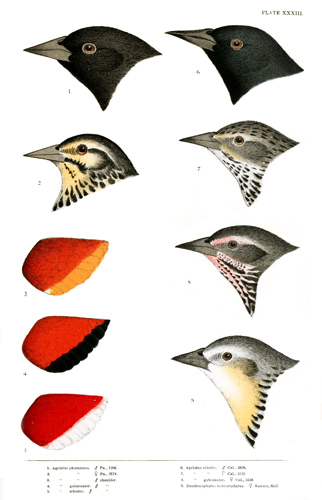
PLATE XXXIII.
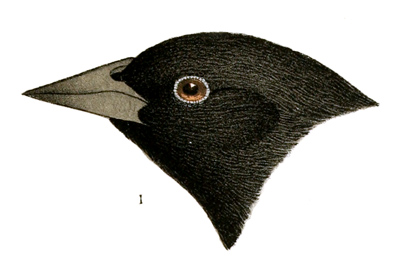
1. Agelaius phœniceus. ♂ Pa., 1386.
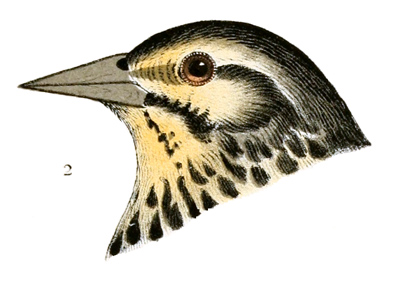
2. Agelaius phœniceus. ♀ Pa., 2174.
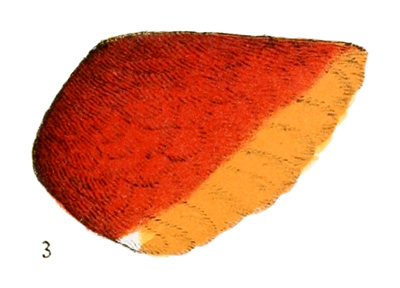
3. Agelaius phœniceus. ♂ shoulder.
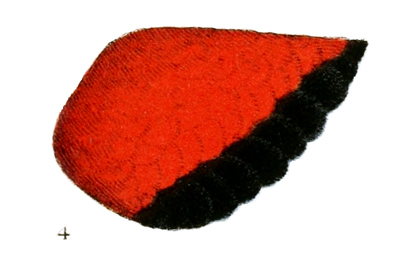
4. Agelaius gubernator. ♂ shoulder.
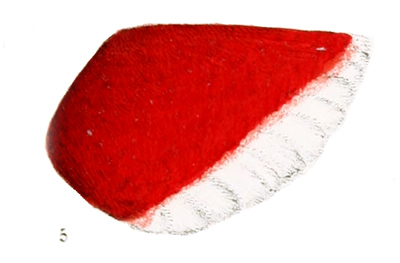
5. Agelaius tricolor. ♂ shoulder.
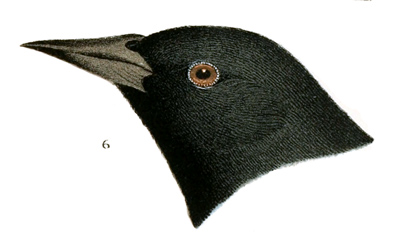
6. Agelaius tricolor. ♂ Cal., 2836.
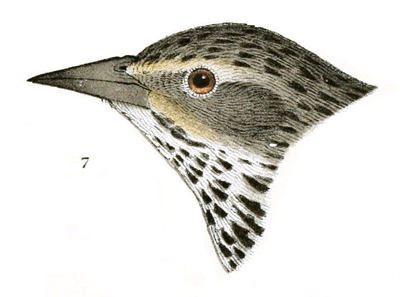
7. Agelaius tricolor. ♀ Cal., 5532.
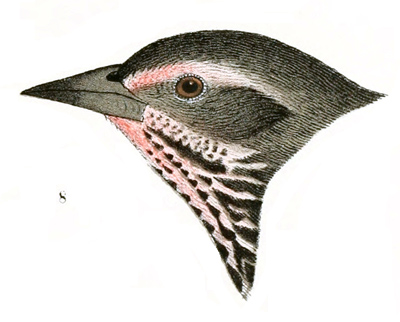
8. Agelaius gubernator. ♀ Cal., 5530.
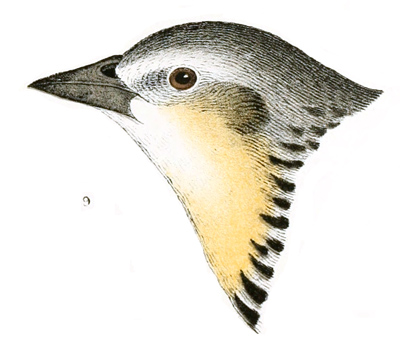
9. Xanthocephalus icterocephalus. ♀ Kansas, 6557.
Agelaius phœniceus, Vieillot.
SWAMP BLACKBIRD; REDWING BLACKBIRD.
Oriolus phœniceus, Linn. Syst. Nat. I, 1766, 161.—Gmelin, I, 1788, 386.—Lath. Ind. Orn. I, 1790, 428. Agelaius phœniceus, “Vieillot, Anal. 1816.”—Swainson, F. Bor.-Am. II, 1831, 280.—Bonap. List, 1838.—Ib. Consp. 1850, 430.—Aud. Syn. 1839, 141.—Ib. Birds Am. IV, 1842, 31, pl. ccxvi.—Baird, Birds N. Am. 1858, 526.—Max. Cab. J. VI, 1858, 263.—Cooper & Suckley, 207.—Cooper, Orn. Cal. I, 1870, 261.—Samuels, 341.—Allen, Birds E. Fla. 284. Icterus phœniceus, Licht. Verz. 1823, No. 188.—Bon. Obs. Wils. 1824, No. 68.—Aud. Orn. Biog. I, 1831, 348; V, 1839, 487, pl. lxvii. Psarocolius phœniceus, Wagler, Syst. Nat. 1827, No. 10. Icterus (Xanthornus) phœniceus, Bonap. Syn. 1828, 52.—Nuttall, Man. I, 1832, 167, (2d ed.,) 179. Sturnus prædatorius, Wilson, Am. Orn. IV, 1811, 30, pl. xxx. Redwinged Oriole, Pennant, Arctic Zoöl. II, 255.
Sp. Char. Tail much rounded; the lateral feathers about half an inch shorter. Fourth quill longest; first about as long as the fifth. Bill large, stout; half as high, or more than half as high, as long.
Male. General color uniform lustrous velvet-black, with a greenish reflection. Shoulders and lesser wing-coverts of a bright crimson or vermilion-red. Middle coverts brownish-yellow, or buff, and usually paler towards the tips.
Female. Brown above, the feathers edged or streaked with rufous-brown and yellowish; beneath white, streaked with brown. Forepart of throat, superciliary, and median stripe strongly tinged with brownish-yellow. Length of male, 9.50; wing, 5.00; tail, 4.15.
Hab. United States from Atlantic to Pacific; north to Great Slave Lake, Fort Resolution, Fort Simpson, Fort Rae, etc.; Guatemala (Sclater, Ibis I, 19; breeding); Costa Rica (Lawrence, America, N. Y. Lyc. IX, 104); Bahamas (Bryant, B. P. VII, 1859); Texas (Dresser, Ibis, 65, 492); Arizona (Coues, P. A. N. S. 1866, 90; Fort Whipple); Yucatan.
There is some variation in the shade of red on the shoulders, which is sometimes of the color of arterial blood or bright crimson. It never, however, has the hæmatitic tint of the red in A. tricolor. The middle coverts are usually uniform brownish-yellow to the very tips; sometimes some of these middle coverts are tipped at the end with black, but these black tips are usually of slight extent, and indicate immaturity, or else a transition of hybridism or race to A. gubernator.
There is also some variation in the size and proportions of the bill. The most striking is in a series of three from the Red River Settlement, decidedly larger than more southern ones (wings, 5.15; tail, 4.40). The bill is about as long as that of Pennsylvania specimens, but much stouter, the thickness at the base being considerably more than half the length of the culmen. One specimen from San Elizario, Texas, has the bill of much the same size and proportions.
The male of A. assimilis of Cuba cannot be distinguished from small-sized males of phœniceus from the United States, the females, however, as in nearly all West Indian Icteridæ, are uniform though rather dull black. This we consider as simply a local variation of melanism, not indicating a specific difference. A young male is similar, but with the lesser coverts red, tipped with black. On the other extreme, streaked female and young birds from Lower California, Arizona, and Western Mexico are much lighter than in eastern birds, the chin, throat, jugulum, and superciliary stripe tinged with a peculiar peach-blossom pink; not buff, sometimes tinged with orange.
Habits. The much abused and persecuted Redwinged Blackbird is found throughout North America as far north as the 57th parallel, from the Atlantic to the Pacific; and it breeds more or less abundantly wherever found, from Florida and Texas to the plains of the Saskatchewan. According to the observations of Mr. Salvin, it is resident all the year in Guatemala. It breeds among the reeds at the lake of Dueñas, deferring its incubation until the month of June. The females congregate in large flocks near the lake, feeding about the swampy grass on the edge of the water, the males keeping separate. At Orizaba, Mexico, Sumichrast regarded this species as only a bird of passage.
On the Pacific coast, it is only found, in any numbers, in Washington Territory and in Oregon, about cultivated tracts. Dr. Cooper thinks that none inhabit the bare and mountainous prairie regions east of the Cascade Mountains. Small flocks wintered at Vancouver about stables and haystacks. Dr. Suckley speaks of them as quite common west of the Cascade Mountains, arriving from the South in March. In all the marshy places of the entire West Mr. Ridgway met with this species and their nests in great abundance. In all respects he found the western birds identical with the eastern. Their nests were in low bushes in overflowed meadows.
Donald Gunn found this species common in the Red River Settlements; and Richardson met with them on the Saskatchewan, where they arrive in May, but do not breed until the 20th of June.
In New England this Blackbird is generally migratory, though instances are on record where a few have been known to remain throughout the winter in Massachusetts. They are among the earliest to arrive in spring, coming, in company with the Rusty Grakle, as early as the 10th of March. Those which remain to breed usually come a month later. They breed throughout New England, as also in New Brunswick and Nova Scotia.
It is equally abundant and resident in Arizona and Texas, and in the adjoining portions of Mexico. On the Rio Grande, Mr. Dresser found it very abundant, breeding on the banks of the rivers and streams. In the winter season these birds are found in immense flocks in the lower parts of Virginia, both the Carolinas, and all the Gulf States, particularly near the sea-coast and among old fields of rice and grain. Wilson states that once, passing, in January, through the lower counties of Virginia, he frequently witnessed the aerial evolutions of great bodies of these birds. Sometimes they appeared as if driven about like an enormous black cloud carried before the wind, varying every moment in shape. Sometimes they rose up suddenly from the fields with a noise like thunder, while the glittering of innumerable wings of the brightest vermilion, amid the black cloud, occasioned a very striking effect. At times the whole congregated multitude would suddenly alight in some detached grove and commence one general concert, that he could plainly distinguish at the distance of more than two miles, and when listened to at a distance of a quarter of a mile, the flow of its cadences was grand, and even sublime.
He adds that with the Redwings the whole winter season seems one continued carnival. They find abundant food in the old fields of rice, buckwheat, and grain, and much of their time is spent in aerial movements, or in grand vocal performances.
Early in March these large assemblies break up. A part separate in pairs and remain among the Southern swamps. The greater portion, in smaller flocks, the male bird leading the way, commence their movements northward. Late in April they have all re-established themselves in their chosen haunts, have mated, and are preparing to make their nests. In Pennsylvania this is done in May, in New England early in June, and farther north a fortnight later. For their nest they invariably select either the borders of streams or low marshy situations. These they usually place in low bushes, such as grow in moist situations, among thick bunches of reeds, or even on the ground. In one instance, in an island on the marshes of Essex River, Mr. Maynard found these nests placed in trees twenty feet from the ground. One nest was built on a slender sapling at the distance of fourteen feet from the ground. The nest was pensile, like that of the Baltimore Oriole. It was woven of bleached eel-grass.
When built in a bush, the outer, basket-like frame of the nest is carefully and strongly interwoven with, or fastened around, the adjacent twigs, and, though somewhat rudely put together, is woven firmly and compactly. Within this is packed a mass of coarse materials, with an inner nest of sedges and grasses. The outer framework is usually made of rushes and strong leaves of the iris. The male bird is a very attentive and watchful parent, constantly on the lookout for the approach of danger, and prompt to do all in his power to avert it, approaching close to the intruder, and earnestly remonstrating against the aggression. If the nest is pillaged, for several days he evinces great distress, and makes frequent lamentations, but soon prepares to remedy the disaster. So tenacious are they of a selected locality, that I have known the same pair to build three nests within as many weeks in the same bush, after having been robbed twice. The third time the pair succeeded in raising their brood.
In New England these birds have but one brood in a season. Farther south they are said to have three or more. In August they begin to collect in small flocks largely composed of young birds. The latter do not reach their full plumage until their third summer, but breed in their immature plumage the summer following their appearance. When the Indian corn is in the milk, these birds are said to collect in numbers, and to commit great depredations upon it. As soon, however, as the corn hardens, they desist from these attacks, and seek other food. In the grain-growing States they gather in immense swarms and commit great havoc, and although they are shot in immense numbers, and though their ranks are thinned by the attacks of hawks, it seems to have but little effect upon the survivors. These scenes of pillage are, for the most part, confined to the low sections, near the sea-coast, and only last during a short period, when the corn is in a condition to be eaten.
On the other hand, these Blackbirds more than compensate the farmer for these brief episodes of mischief, by the immense benefits they confer in the destruction of grub-worms, caterpillars, and various kinds of larvæ, the secret and deadly enemies of vegetation. During the months of March, April, May, June, and July, their food is almost wholly insects, and during that period the amount of their insect food, all of it of the most noxious kinds, is perfectly enormous. These they both consume themselves and feed to their young. Wilson estimated the number of insects destroyed by these birds in a single season, in the United States, at twelve thousand millions.
The notes of this bird are very various and indescribable. The most common one sounds like con-cur-ee. But there is also an almost endless mingling of guttural, creaking, or clear utterances that defy description.
Their eggs vary greatly in size; the largest measures 1.08 inches by .82 of an inch, the smallest .90 by .65. They average about an inch in length and .77 of an inch in breadth. They are oval in shape, have a light-bluish ground, and are marbled, lined, and blotched with markings of light and dark purple and black. These markings are almost wholly about the larger end, and are very varying.
Agelaius phœniceus, var. gubernator, Bon.
CRIMSON-SHOULDERED BLACKBIRD.
Psarocolius gubernator, Wagler, Isis, 1832, IV, 281. Agelaius gubernator, Bon. List, 1838.—Ib. Conspectus, 1850, 430.—Aud. Syn. 1839, 141.—Ib. Birds Am. IV, 1842, 29, pl. ccxv.—Newberry, P. R. R. Rep. VI, IV, 1857, 86.—Baird, Birds N. Am. 1858, 529.—Heerm. X, S, 53 (nest).—Cooper, Orn. Cal. I, 1870, 263. Icterus (Zanthornus) gubernator, Nuttall, Man. I, (2d ed.,) 1840, 187.
Sp. Char. Bill rather shorter than the head, without any longitudinal sulci, but with faint traces of transverse ones at the base of the lower jaw. Tail rounded. First quill nearly equal to the fourth.
Male. Throughout of a lustrous velvety-black, with a greenish reflection. The lesser coverts rich crimson; the middle coverts brownish-yellow at the base, but the exposed portion black. Wing, 5.00; tail, 3.90; culmen, .90; tarsus, 1.10.
Female. Nearly uniform dark slaty-brown; an indistinct superciliary stripe, an indication of a maxillary stripe, and blended streaks on chin and throat delicate pale peach-blossom pink, this on the jugulum interrupted by dusky streaks running in longitudinal series; lesser wing-coverts tinged with dark wine-red. Wings with just appreciable paler edges to the feathers. Wing, 4.20; tail, 3.20.
Hab. Pacific Province of United States, and Western Mexico, to Colima; Western Nevada (Ridgway). ? Xalapa (Sclater, 1859, 365).
In the female and all the immature stages, the dusky beneath is largely in excess of the light streaks; the superciliary light stripe is badly defined, and there is no trace of a median light stripe on the crown. These characters distinguish this race from phœniceus; while the rounded instead of square tail, and brown instead of pure white border to middle wing-coverts, distinguish it from corresponding stages of tricolor.
Habits. The Crimson-shouldered Blackbird was first met with by Mr. Townsend, on the Columbia River, where two specimens were obtained, which were described by Mr. Audubon, in his Synopsis, in 1839. No information in regard to its habits, distribution, or nesting, was obtained by either Mr. Townsend or by his companion, Mr. Nuttall.
This species, or local race, whichever it is considered, occurs from the Columbia River south throughout California. It is given doubtingly as also from the Colorado River, but Dr. Cooper was only able to detect there the common phœniceus. According to the observations of that careful naturalist, this species is chiefly found in the warmer interior of California, Santa Cruz being the only point on the coast where he has met with it. He found it in scattered pairs, in May, throughout the Coast Range, even to the summits, where there are small marshes full of rushes, in which they build. He has not been able to detect any difference between the habits and notes of this bird and the common Redwing. The fact that specimens with entirely red shoulders seem limited to the middle of the State, or are rare along the coast, while most of those on the coast closely resemble the eastern bird, Dr. Cooper regards as suggestive of its being only a local race, though said to occur also in Mexico.
During the summer this species is said to emit a variety of sweet and liquid notes, delivered from some tree near its favorite marsh. These are also sometimes mingled with jingling and creaking sounds.
Dr. Suckley, in his Report on the Zoölogy of Washington Territory, expresses the opinion, that, although a specimen of this bird is reported as having been taken by Townsend on the Columbia, it is very rarely found so far north, as he never met with it in Washington Territory, and has never been able to hear of any other specimen having been found there.
Dr. Kennerly, in his Report on the birds observed in the survey of the 35th parallel, states that during the march along Bill Williams Fork, and along the Great Colorado and the Mohave Rivers, this species was found quite numerous. They were more abundant still along the creeks and swampy grounds that were passed as they approached the settlements of California. Large flocks could there be seen whirling around in graceful curves, like dark clouds, chattering joyfully as they moved along, or settling as a black veil on the topmost branches of some tree, indulging loudly in their harsh music.
In his Report of the birds observed in the survey under Lieutenant Williamson, Dr. Heermann mentions finding this species abundant, and, in the fall season, as associated with Molothrus pecoris and A. tricolor. Its nest he found built in the willow bushes and tussocks of grass above the level of the water, in the marshes. There were but a few pairs together, and in this respect they differ from the tricolor, which prefers dry situations near water, and which congregate by thousands while breeding. The nest was composed of mud and fine roots, and lined with fine grasses. The eggs, four in number, he describes as pale blue, dashed with spots and lines of black.
Neither this nor the tricolor was detected by Dr. Coues in Arizona.
These Blackbirds were found by Mr. Ridgway abundant in the marshy regions of California, but they were rarely met with east of the Sierra Nevada. A few individuals were collected in Nevada in the valley of the Truckee. A few pairs were found breeding among the tulé sloughs and marshes. The nests found in the Truckee Reservations were built in low bushes in wet meadows.
A nest procured by Dr. Cooper from the summit of the Coast Range was built of grass and rushes, and lined with finer grass. The eggs are described as pale greenish-white, with large curving streaks and spots of dark brown, mostly at the large end. They are said to measure one inch by .75 of an inch.
Eggs of this variety in my cabinet, taken in California by Dr. Heermann, are of a rounded-oval shape, nearly equally obtuse at either end, and varying in length from .90 of an inch to an inch, and in breadth from .70 to .80. Their ground-color is a light blue, fading into a bluish-white, marked only around the larger end with waving lines of dark brown, much lighter in shade than the markings of the phœniceus usually are.
Agelaius tricolor, Bonap.
RED AND WHITE SHOULDERED BLACKBIRD.
Icterus tricolor, “Nuttall,” Aud. Orn. Biog. V, 1839, I, pl. ccclxxxviii.—Nuttall, Man. I, (2d ed.,) 1840, 186. Agelaius tricolor, Bon. List, 1838.—Aud. Syn. 1839, 141.—Ib. Birds Am. IV, 1842, 27, pl. ccxiv.—Heerm. X, S, 53 (nest).—Baird, Birds N. Am. 1858, 530.—Cooper, Orn. Cal. 1, 1870, 265.
Sp. Char. Tail nearly even. Second and third quills longest; first a little shorter than the fourth. Bill slender, not half as high as long.
Male. General color uniform lustrous velvet-black, with a strong silky-bluish reflection. Shoulders and lesser wing-coverts brownish-red, of much the color of venous blood; the median coverts of a well-defined and nearly pure white, with sometimes a brownish tinge. Wing, 4.90; tail, 3.70; culmen, .97; tarsus, 1.13.
Female. General color dusky slaty-brown, faintly variegated on head also by lighter streaks; middle wing-coverts broadly and sharply bordered with pure white. An obsolete superciliary and maxillary stripe of grayish-white. Beneath grayish-white for anterior half, with narrow streaks of dusky, this color gradually prevailing posteriorly, the sides, flanks, and crissum being nearly uniform dusky. Wing, 4.25; tail, 3.20.
Hab. Pacific Province of United States, from Columbia River southward, not yet found out of California and Oregon.
Immature males sometimes have the white on the wing tinged with brownish-yellow, as in A. phœniceus. The red, however, has the usual brownish-orange shade so much darker and duller than the brilliantly scarlet shoulders of the other species, and the black has that soft bluish lustre peculiar to the species. The relationships generally between the two species are very close, but the bill, as stated, is slenderer and more sulcate in tricolor, the tail much more nearly even; the first primary longer, usually nearly equal to or longer than the fourth, instead of the fifth.
Two strong features of coloration distinguish the female and immature stages of this species from gubernator and phœniceus. They are, first, the soft bluish gloss of the males, both adult and immature; and secondly, the clear white and broad, not brown and narrow, borders to the middle wing-coverts.
Habits. The Red and White shouldered Blackbird was seen by Mr. Ridgway among the tulé in the neighborhood of Sacramento City, where it was very abundant, associating with the A. phœniceus and gubernator, and the Yellow-headed Blackbird. The conspicuous white stripe on the wings of this bird renders it easily recognizable from the other species, where they are all seen together. Mr. Ridgway is of the opinion that the notes of the white-shouldered species differ very considerably from those of the two other Blackbirds.
Dr. Heermann found this a very abundant bird in California. He states that during the winter of 1852, when hunting in the marshes of Suisan Valley, he had often, on hearing a dull, rushing, roaring noise, found that it was produced by a single flock of this species, numbering so many thousands as to darken the sky for some distance by their masses. In the northern part of California he met with a breeding-place of this species that occupied several acres, covered with alder-bushes and willow, and was in the immediate vicinity of water. The nests, often four or five in the same bush, were composed of mud and straw, and lined with fine grasses. The eggs he describes as dark blue, marked with lines and spots of dark umber and a few light purple dashes. Dr. Heermann, at different times, fell in with several other breeding-places of this species, similarly situated, but they had all been abandoned, from which he inferred that each year different grounds are resorted to by these birds for the purposes of incubation.
Dr. Kennerly obtained a specimen of this bird on the Colorado River, in California, December, 1854. Dr. Cooper is of the opinion that it is, nevertheless, a rare species in that valley. The latter found them the most abundant species near San Diego and Los Angeles, and not rare at Santa Barbara. North of the last place they pass more into the interior, and extend up as far as Klamath Lake and Southern Oregon.
They are to be seen in considerable flocks even in the breeding-season. Their song, Dr. Cooper states, is not so loud and is more guttural than are those of the other species. Their habits are otherwise very similar, and they associate, in fall and winter, in immense flocks in the interior, though often also found separate.
These birds were first obtained by Mr. Nuttall near Santa Barbara, in the month of April. They were very common there, as well as at Monterey. He observed no difference in their habits from those of the common Redwing, except that they occurred in much larger flocks and kept apart from that species. They were seldom seen, except in the near suburbs of the towns. At that time California was in the possession of Mexico, and its inhabitants were largely occupied in the slaughter of wild cattle for the sake of the hides. Mr. Nuttall found these birds feeding almost exclusively on the maggots of the flesh-flies generated in the offal thus created. They were in large whirling flocks, and associated with the Molothri, the Grakles, the Redwings, and the Yellow-headed Blackbirds. They kept up an incessant chatter and a discordant, confused warble, much more harsh and guttural than even the notes of the Cow Blackbird.
Two eggs of this species, obtained by Dr. Heermann in California, and now in my cabinet, measuring an inch in length by .67 of an inch in breadth, are more oblong in shape than the preceding, but nearly equally obtuse at either end. They are similar in ground-color to the phœniceus, but are of a slightly deeper shade of blue, and are marked around one end with a ring of dark slaty-brown, almost black, lines, and irregular oblong blotches.
Genus XANTHOCEPHALUS, Bonap.
Xanthocephalus, Bonap. Conspectus, 1850, 431. (Type, Icterus icterocephalus, Bonap.)
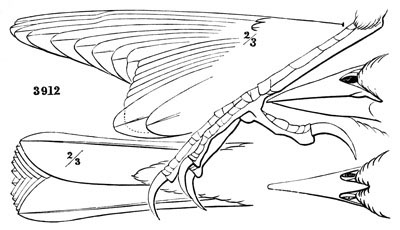
Xanthocephalus icterocephalus. 3912
Gen. Char. Bill conical, the length about twice the height; the outlines nearly straight. Claws all very long; much curved; the inner lateral the longest, reaching beyond the middle of the middle claw. Tail narrow, nearly even, the outer web scarcely widening to the end. Wings long, much longer than the tail; the first quill longest.
This genus differs from typical Agelaius in much longer and more curved claws, even tail, and first quill longest, instead of the longest being the second, third, or fourth. The yellow head and black body are also strong marks.
Xanthocephalus icterocephalus, Baird.
YELLOW-HEADED BLACKBIRD.
Icterus icterocephalus, Bonap. Am. Orn. I, 1825, 27, pl. iii.—Nutt. Man. I, 1832, 176.—Ib., (2d ed.,) 187 (not Oriolus icterocephalus, Linn.). Agelaius icterocephalus, Cabanis, Mus. Hein. 1851, 188. Icterus (Xanthornus) xanthocephalus, Bonap. J. A. N. Sc. V, II, Feb. 1826, 222.—Ib. Syn. 1828, 52. Icterus xanthocephalus, Aud. Orn. Biog. V, 1839, 6, pl. ccclxxxviii. Agelaius xanthocephalus, Swainson, F. Bor.-Am. II, 1831, 281.—Bon. List, 1838.—Aud. Syn. 1839, 140.—Ib. Birds Am. IV, 1842, 24, pl. ccxiii.—Newberry, Zoöl. Cal. and Or. Route; Rep. P. R. R. Surv. VI, IV, 1857, 86.—Max. Cab. J. VI, 1858, 361.—Heerm. X, S, 52 (nest). Agelaius longipes, Swainson, Phil. Mag. I, 1827, 436. Psarocolius perspicillatus, “Licht.” Wagler, Isis, 1829. VII, 753. Icterus perspicillatus, “Licht. in Mus.” Wagler, as above. Xanthocephalus perspicillatus, Bonap. Consp. 1850, 431. Icterus frenatus, Licht. Isis, 1843, 59.—Reinhardt, in Kroyer’s Tidskrift, IV.—Ib. Vidensk. Meddel. for 1853, 1854, 82 (Greenland). Xanthocephalus icterocephalus, Baird, M. B. II, Birds, 18; Birds N. Am. 1858, 531.—Cooper, Orn. Cal. I, 1870, 267.
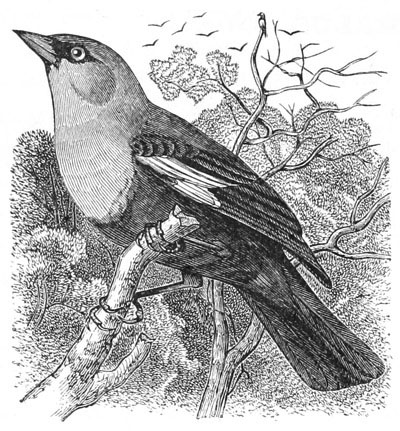
Sp. Char. First quill nearly as long as the second and third (longest), decidedly longer than the fourth. Tail rounded, or slightly graduated. General color black, including the inner surface of wings and axillaries, base of lower mandible all round, feathers adjacent to nostrils, lores, upper eyelids, and remaining space around the eye. The head and neck all round; the forepart of the breast, extending some distance down on the median line, and a somewhat hidden space round the anus, yellow. A conspicuous white patch at the base of the wing formed by the spurious feathers, interrupted by the black alula.
Xanthocephalus icterocephalus.
Female smaller, browner; the yellow confined to the under parts and sides of the head, and a superciliary line. A dusky maxillary line. No white on the wing. Length of male, 10 inches; wing, 5.60; tail, 4.50.
Hab. Western America from Texas, Illinois, Wisconsin, and North Red River, to California, south into Mexico; Greenland (Reinhardt); Cuba (Cabanis, J. VII, 1859, 350); Massachusetts (Maynard, D. C. Mass. 1870, 122); Volusia, Florida (Mus. S. I.); Cape St. Lucas.
The color of the yellow in this species varies considerably; sometimes being almost of a lemon-yellow, sometimes of a rich orange. There is an occasional trace of yellow around the base of the tarsus. Immature males show every gradation between the colors of the adult male and female.
A very young bird (4,332, Dane Co., Wis.) is dusky above, with feathers of the dorsal region broadly tipped with ochraceous, lesser and middle wing-coverts white tinged with fulvous, dusky below the surface, greater coverts very broadly tipped with fulvous-white; primary coverts narrowly tipped with the same. Whole lower parts unvariegated fulvous-white; head all round plain ochraceous, deepest above.
Habits. The Yellow-headed Blackbird is essentially a prairie bird, and is found in all favorable localities from Texas on the south to Illinois and Wisconsin, and thence to the Pacific. A single specimen is recorded as having been taken in Greenland. This was September 2, 1820, at Nenortalik. Recently the Smithsonian Museum has received a specimen from New Smyrna, in Florida. In October, 1869, a specimen of this bird was taken in Watertown, Mass., and Mr. Cassin mentions the capture of several near Philadelphia. These erratic appearances in places so remote from their centres of reproduction, and from their route in emigration, sufficiently attest the nomadic character of this species.
They are found in abundance in all the grassy meadows or rushy marshes of Illinois and Wisconsin, where they breed in large communities. In swamps overgrown with tall rushes, and partially overflowed, they construct their nests just above the water, and build them around the stems of these water-plants, where they are thickest, in such a manner that it is difficult to discover them, except by diligent search, aided by familiarity with their habits.
In Texas Mr. Dresser met with a few in the fall, and again in April he found the prairies covered with these birds. For about a week vast flocks remained about the town, after which they suddenly disappeared, and no more were seen.
In California, Dr. Cooper states that they winter in large numbers in the middle districts, some wandering to the Colorado Valley and to San Diego. They nest around Santa Barbara, and thence northward, and are very abundant about Klamath Lake. They associate with the other Blackbirds, but always keep in separate companies. They are very gregarious, even in summer.
Dr. Cooper states that the only song the male attempts consists of a few hoarse, chuckling notes and comical squeakings, uttered as if it was a great effort to make any sound at all.
Dr. Coues speaks of it as less numerous in Arizona than at most other localities where found at all. He speaks of it as a summer resident, but in this I think he may have been mistaken.
In Western Iowa Mr. Allen saw a few, during the first week in July, about the grassy ponds near Boonesboro’. He was told that they breed in great numbers, north and east of that section, in the meadows of the Skunk River country. He also reports them as breeding in large numbers in the Calumet marshes of Northern Illinois.
Sir John Richardson found these birds very numerous in the interior of the fur countries, ranging in summer as far to the north as the 58th parallel, but not found to the eastward of Lake Winnipeg. They reached the Saskatchewan by the 20th of May, in greater numbers than the Redwings.
Through California, as well as in the interior, Mr. Ridgway found the Yellow-headed Blackbird a very abundant species, even exceeding in numbers the A. phœniceus, occurring in the marshes filled with rushes. This species he found more gregarious than the Redwing, and frequently their nests almost filled the rushes of their breeding-places. Its notes he describes as harsher than those of any other bird he is acquainted with. Yet they are by no means disagreeable, while frequently their attempts at a song were really amusing. Their usual note is a deep cluck, similar to that of most Blackbirds, but of a rather deeper tone. In its movements upon the ground its gait is firm and graceful, and it may frequently be seen walking about over the grassy flats, in small companies, in a manner similar to the Cow Blackbird, which, in its movements, it greatly resembles. It nests in the sloughs, among the tulé, and the maximum number of its eggs is four.
Mr. W. J. McLaughlin of Centralia, Kansas, writes (American Naturalist, III, p. 493) that these birds arrive in that region about the first of May, and all disappear about the 10th of June. He does not think that any breed there. During their stay they make themselves very valuable to the farmers by destroying the swarms of young grasshoppers. On the writer’s land the grasshoppers had deposited their eggs by the million. As they began to hatch, the Yellow-heads found them out, and a flock of about two hundred attended about two acres each day, roving over the entire lot as wild pigeons feed, the rear ones flying to the front as the insects were devoured.
Mr. Clark met with these birds at New Leon, Mexico. They were always in flocks, mingled with two or three of its congeneric species. They were found more abundant near the coast than in the interior. There was a roost of these birds on an island in a lagoon near Fort Brown. Between sunset and dark these birds could be seen coming from all quarters. For about an hour they kept up a constant chattering and changing of place. Another similar roost was on an island near the mouth of the Rio Grande.
Dr. Kennerly found them very common near Janos and also near Santa Cruz, in Sonora. At the former place they were seen in the month of April in large flocks. He describes them as quite domestic in their habits, preferring the immediate vicinity of the houses, often feeding with the domestic fowls in the yards.
Dr. Heermann states that these birds collect in flocks of many thousands with the species of Agelaius, and on the approach of spring separate into smaller bands, resorting in May to large marshy districts in the valleys, where they incubate. Their nests he found attached to the upright stalks of the reeds, and woven around them, of flexible grasses, differing essentially from the nests of the Agelaii in the lightness of their material. The eggs, always four in number, he describes as having a ground of pale ashy-green, thickly covered with minute dots of a light umber-brown.
Mr. Nuttall states that on the 2d of May, during his western tour, he saw these birds in great abundance, associated with the Cowbird. They kept wholly on the ground, in companies, the sexes separated by themselves. They were digging into the earth with their bills in search of insects and larvæ. They were very active, straddling about with a quaint gait, and now and then whistling out, with great effort, a chuckling note, sounding like ko-kuk kie-ait. Their music was inferior even to the harsh notes of M. pecoris.
Several nests of this species, procured in the marshes on the banks of Lake Koskonong, in Southern Wisconsin, were sent me by Mr. Kumlien; they were all light, neat, and elegant structures, six inches in diameter and four in height. The cavity had a diameter of three and a depth of two and a half inches. The base, periphery, and the greater portion of these nests were made of interwoven grasses and sedges. The grasses were entire, with their panicles on. They were impacted together in masses. The inner portions of these nests were made of finer materials of the same. They were placed in the midst of large, overflowed marshes, and were attached to tall flags, usually in the midst of clumps of the latter, and these were so close in their growth that the nests were not easily discovered. They contained, usually, from five to six eggs. These are of an oblong-oval shape, and measure 1.02 inches in length by .70 of an inch in breadth. Their ground-color is of a pale greenish-white, profusely covered with blotches and finer dottings of drab, purplish-brown, and umber.
Genus STURNELLA, Vieillot.
Sturnella, Vieillot, Analyse, 1816. (Type, Alauda magna, L.)
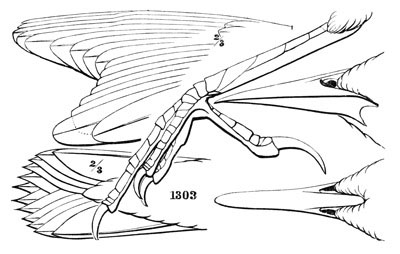
Sturnella magna. 1303
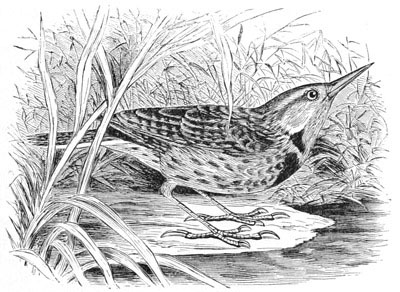
Sturnella magna.
Gen. Char. Body thick, stout; legs large, toes reaching beyond the tail. Tail short, even, with narrow acuminate feathers. Bill slender, elongated; length about three times the height; commissure straight from the basal angle. Culmen flattened basally, extending backwards and parting the frontal feathers; longer than the head, but shorter than tarsus. Nostrils linear, covered by an incumbent membranous scale. Inner lateral toe longer than the outer, but not reaching to basal joint of middle; hind toe a little shorter than the middle, which is equal to the tarsus. Hind claw nearly twice as long as the middle. Feathers of head stiffened and bristly; the shafts of those above extended into a black seta. Tertials nearly equal to the primaries. Feathers above all transversely banded. Beneath yellow, with a black pectoral crescent.
The only species which we can admit is the S. magna, though under this name we group several geographical races. They may be distinguished as follows:—
Species and Varieties.
1. S. magna. Above brownish, or grayish, spotted and barred with black; crown divided by a median whitish stripe; side of the head whitish, with a blackish streak along upper edge of the auriculars. Beneath more or less yellowish, with a more or less distinct dusky crescent on the jugulum. Sides, flanks, and crissum whitish, streaked with dusky; lateral tail-feathers partly white. Adult. Supraloral spot, chin, throat, breast, and abdomen deep gamboge-yellow; pectoral crescent deep black. Young. The yellow only indicated; pectoral crescent obsolete. Length, about 9.00 to 10.50 inches. Sexes similar in color, but female much smaller.
A. In spring birds, the lateral stripes of the vertex either continuous black, or with black largely predominating; the black spots on the back extending to the tip of the feather, or, if not, the brown tip not barred (except in winter dress). Yellow of the throat confined between the maxillæ, or just barely encroaching upon their lower edge. White of sides, flanks, and crissum strongly tinged with ochraceous.
a. Pectoral crescent much more than half an inch wide.
Wing, 4.50 to 5.00; culmen, 1.20 to 1.50; tarsus, 1.35 to 1.55; middle toe, 1.10 to 1.26 (extremes of a series of four adult males). Lateral stripe of the crown continuously black; black predominating on back and rump (heavy stripes on ochraceous ground). Light brown serrations on tertials and tail-feathers reaching nearly to the shaft (sometimes the terminal ones uninterrupted, isolating the black bars). Hab. Eastern United States … var. magna.
Wing, 3.75 to 4.30; culmen, 1.15 to 1.30; tarsus, 1.50 to 1.75; middle toe, 1.10 to 1.25. (Ten adult males!) Colors similar, but with a greater predominance of black; black heavily prevailing on back and rump, and extending to tip of feathers; also predominates on tertials and tail-feathers. Hab. Mexico and Central America … var. mexicana.[31]
Wing, 4.45; culmen, 1.62; tarsus, 1.50; middle toe, 1.20. (One specimen). Colors exactly as in last. Hab. Brazil … var. meridionalis.[32]
b. Pectoral crescent much less than half an inch wide.
Wing, 3.90 to 4.10; culmen, 1.25 to 1.35; tarsus, 1.40 to 1.55; middle toe, 1.00 to 1.20. (Three adult males.) Colors generally similar to magna, but crown decidedly streaked, though black predominates; ground-color above less reddish than in either of the preceding, with markings as in magna. Pectoral crescent about .25 in breadth. Hab. Cuba … var. hippocrepis.[33]
B. In spring birds, crown about equally streaked with black and grayish; black spots of back occupying only basal half of feathers, the terminal portion being grayish-brown, with narrow bars of black; feathers of the rump with whole exposed portion thus barred. Yellow of the throat extending over the maxillæ nearly to the angle of the mouth.
Wing, 4.40 to 5.05; culmen, 1.18 to 1.40; tarsus, 1.30 to 1.45. (Six adult males.) A grayish-brown tint prevailing above; lesser wing-coverts concolor with the wings (instead of very decidedly more bluish); black bars of tertials and tail-feathers clean, narrow, and isolated. White of sides, flanks, and crissum nearly pure. Hab. Western United States and Western Mexico … var. neglecta.
In magna and neglecta, the feathers of the pectoral crescent are generally black to the base, their roots being grayish-white; one specimen of the former, however, from North Carolina, has the roots of the feathers yellow, forbidding the announcement of this as a distinguishing character; mexicana may have the bases of these feathers either yellow or grayish; while hippocrepis has only the tips of the feathers black, the whole concealed portion being bright yellow.
In mexicana, there is more of an approach to an orange tint in the yellow than is usually seen in magna, but specimens from Georgia have a tint not distinguishable; in both, however, as well as in hippocrepis, there is a deeper yellow than in neglecta, in which the tint is more citreous.
As regards the bars on tertials and tail, there is considerable variation. Sometimes in either of the species opposed to neglecta by this character there is a tendency to their isolation, seen in the last few toward the ends of the feathers; but never is there an approach to that regularity seen in neglecta, in which they are isolated uniformly everywhere they occur. Two specimens only (54,064 California and 10,316 Pembina) in the entire series of neglecta show a tendency to a blending of these bars on the tail.
Magna, mexicana, meridionalis and hippocrepis, are most similar in coloration; neglecta is most dissimilar compared with any of the others. Though each possesses peculiar characters, they are only of degree; for in the most widely different forms (neglecta and mexicana) there is not the slightest departure from the pattern of coloration; it is only a matter of extension or restriction of the several colors, or a certain one of them, that produces the differences.
Each modification of plumage is attended by a still greater one of proportions, as will be seen from the diagnoses; thus, though neglecta is the largest of the group, it has actually the smallest legs and feet; with nearly the same general proportions, magna exceeds it in the latter respects (especially in the bill), while mexicana, a very much smaller bird than either, has disproportionally and absolutely larger legs and feet united with the smallest size otherwise in the whole series. Meridionalis presents no differences from the last, except in proportions of bill and feet; for while the latter is the smallest of the series, next to neglecta, it has a bill much exceeding that of any other.
The markings of the upper plumage of the young or even winter birds are different in pattern from those of the adult; the tendency being toward the peculiar features of the adult neglecta; the various species in these stages being readily distinguishable, however, by the general characters assigned. Mexicana and neglecta are both in proportions and colors the most widely different in the whole series; hippocrepis and neglecta the most similar. The relation of the several races to each other is about as follows:—
A. Yellow of throat confined within maxillæ.
Crown with black streaks predominating.
Smallest species, with reddish tints, and maximum amount of black.
Largest bill … meridionalis.
Smallest bill; largest feet … mexicana.
Next largest species, with less reddish tints, and smaller amount of black. Bill and feet the standard of comparison … magna
Crown with the light streaks predominating.
Narrowest pectoral crescent … hippocrepis
B. Yellow of throat covering maxillæ.
Crown with black and light streaks about equal.
Largest species, with grayish tints, and minimum amount of black.
Smallest feet … neglecta.
Sturnella magna, Swainson.
MEADOW LARK; OLD FIELD LARK.
Alauda magna, Linn. Syst. Nat. I, 1758, 167, ed. 10 (based on Alauda magna, Catesby, tab. 33).—Ib., (12th ed.,) 1766, 289.—Gm. I, 1788, 801.—Wilson, Am. Orn. III, 1811, 20, pl. xix.—Doughty, Cab. I, 1830, 85, pl. V. Sturnella magna, Swainson, Phil. Mag. I, 1827, 436.—Baird, Birds N. Am. 1858, 535.—Samuels, 343. Sturnus ludovicianus, Linnæus, Syst. Nat. I, 1766, 290.—Gm. I, 802.—Lath. Ind. I, 1790, 323.—Bon. Obs. Wils. 1825, 130.—Licht. Verz. 1823, No. 165.—Aud. Orn. Biog. II, 1834, 216; V, 1839, 492, pl. cxxxvi. Sturnella ludoviciana, Swainson, F. Bor.-Am. II, 1831, 282.—Nuttall, Man. I, 1832, 147.—Bon. List, 1838.—Ib. Conspectus, 1850, 429.—Aud. Syn. 1839, 148.—Ib. Birds Am. IV, 1842, 70, pl. ccxxiii.—Cabanis, Mus. Hein. 1851, 192.—Allen, B. E. Fla. 288. Sturnella collaris, Vieill. Analyse, 1816.—Ib. Galerie des Ois. I, 1824, 134, pl. xc. Sturnus collaris, Wagler, Syst. Av. 1827, 1.—Ib. Isis, 1831, 527. “Cacicus alaudarius, Daudin,” Cabanis.
Sp. Char. The feathers above dark brown, margined with brownish-white, and with a terminal blotch of pale reddish-brown. Exposed portions of wings and tail with dark brown bars, which on the middle tail-feathers are confluent along the shaft. Beneath yellow, with a black pectoral crescent, the yellow not extending on the side of the maxilla; sides, crissum, and tibiæ pale reddish-brown, streaked with blackish. A light median and superciliary stripe, the latter yellow anterior to the eye; a black line behind. Female smaller and duller. Young with pectoral crescent replaced by streaks; the yellow of under surface replaced more or less by ochraceous or pale fulvous. Length, 10.60; wing, 5.00; tail, 3.70; bill above, 1.35.
Hab. Eastern United States to the high Central Plains, north to Southern British Provinces. England (Sclater, Ibis, III, 176).
Habits. The eastern form of the Meadow Lark is found in all the eastern portions of the United States, from Florida to Texas at the south, and from Nova Scotia to the Missouri at the north. Richardson met with it on the Saskatchewan, where it arrives about the first of May. In a large portion of the United States it is resident, or only partially migratory.
In Maine this species is not abundant. A few are found in Southern Maine, even as far to the east as Calais, where it is very rare. It was not found in Oxford County by Mr. Verrill. In New Hampshire and Vermont, especially in the southern portions, it is much more abundant. Throughout Massachusetts it is a common summer visitant, a few remaining all winter, the greater number coming in March and leaving again in November, at which time they seem to be somewhat, though only partially, gregarious. South of Massachusetts it becomes more generally resident, and is only very partially migratory, where the depth of snow compels them to seek food elsewhere. Wilson states that he met a few of these birds in the month of February, during a deep snow, among the heights of the Alleghanies, near Somerset, Penn.
The favorite resorts of this species are old fields, pasture-lands, and meadows, localities in which they can best procure the insects, largely coleopterous, and the seeds on which they feed. They are not found in woods or thickets, or only in very exceptional cases.
In New England they are shy, retiring birds, and are rarely seen in the neighborhood of houses; but in Georgia and South Carolina, Wilson found them swarming among the rice plantations, and running about in the yards and the out-buildings, in company with the Killdeer Plovers, with little or no appearance of fear, and as if domesticated.
In Alabama and West Florida, Mr. Nuttall states, the birds abound during the winter months, and may be seen in considerable numbers in the salt marshes, seeking their food and the shelter of the sea-coast. They are then in loose flocks of from ten to thirty. At this season many are shot and brought to market. By some their flesh is said to be sweet and good; but this is denied by Audubon, who states it to be tough and of unpleasant flavor.
Mr. Sclater records the occurrence of one or more individuals of this species in England.
The song of the eastern Meadow Lark is chiefly distinguished for its sweetness more than any other excellence. When, in spring, at the height of their love-season, they alight on the post of a fence, a bush, or tree, or any other high object, they will give utterance to notes that, in sweetness and tenderness of expression, are surpassed by very few of our birds. But they are wanting in variety and power, and are frequently varied, but not improved, by the substitution of chattering call-notes, which are much inferior in quality. It is noticeable that at the West there is a very great improvement in the song of this bird as compared with that of their more eastern kindred, though still very far from equalling, either in volume, variety, or power, the remarkable song of the neglecta.
In the fall of the year these birds collect in small companies, and feed together in the same localities, but keeping, individually, somewhat apart.
In New England these birds mate during the latter part of April, and construct their nests in May. They always place their nest on the ground, usually in the shelter of a thick tuft of grass, and build a covered passage to their hidden nest. This entrance is usually formed of withered grass, and so well conceals the nest that it can only be detected by flushing the female from it, or by the anxiety of her mate, who will frequently fly round the spot in so narrow a circuit as to betray its location.
The eggs of the Meadow Lark vary greatly in size and also in their markings, though the general character of the latter is the same. The smallest, from Florida, measure .95 by .68 of an inch. The largest, from Massachusetts, measure 1.20 inches by .90. They have a white ground, marked and dotted with irregular reddish-brown spots. Generally these are equally distributed, but occasionally are chiefly about the larger end. Their shape is oval, nearly equally rounded at either end.
The diversity in the characteristics of the eggs of this species has not unfrequently occasioned remarks, and even suggested conjectures as to specific differences. They are all, however, reconcilable with differences in the age of the parents, and are, to some extent, affected by the circumstances under which they are deposited. The eggs of old, mature birds, deposited in the early summer, or the first brood, are usually sub-globular or obtusely pointed at either end, large in size, and irregularly sprinkled over with fine bright red dots. Younger birds, breeding for the first time, birds that have been robbed of their eggs, or those depositing a third set, have smaller eggs, sometimes two thirds of the maximum size, more oblong and more pointed at one end, and are marked, at the larger end only, with plashes of dark purplish-brown.
Sturnella magna, var. neglecta, Aud.
WESTERN LARK.
Sturnella neglecta, Or. Route; Rep. P. R. R. Surv. VI, IV, 1857, 86.—Baird, Birds N. Am. 1858, 537.—Heerm. X, S, 54.—Cooper & Suckley, 208.—Cooper, Orn. Cal. I, 1870, 270. ? Sturnella hippocrepis, (Wagler,) Heermann, J. A. N. Sc. Ph. 2d series, II, 1853, 269, Suisun.
Sp. Char. Feathers above dark brown, margined with brownish-white, with a terminal blotch of pale reddish-brown. Exposed portion of wings and tail with transverse bands, which, in the latter, are completely isolated from each other, narrow and linear. Beneath yellow, with a black pectoral crescent. The yellow of the throat extending on the sides of the maxilla. Sides, crissum, and tibiæ very pale reddish-brown, or nearly white, streaked with blackish. Head with a light median and superciliary stripe, the latter yellow in front of the eye; a blackish line behind it. The transverse bars on the feathers above (less so on the tail) with a tendency to become confluent near the exterior margin. Length, 10 inches; wing, 5.25; tail, 3.25; bill, 1.25.
Hab. Western America from high Central Plains to the Pacific; east to Pembina, and perhaps to Wisconsin, on the north (Iowa, Allen), and Texas on the south; western Mexico, south to Colima.
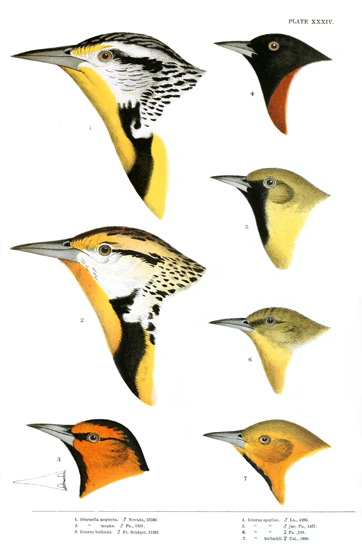
PLATE XXXIV.
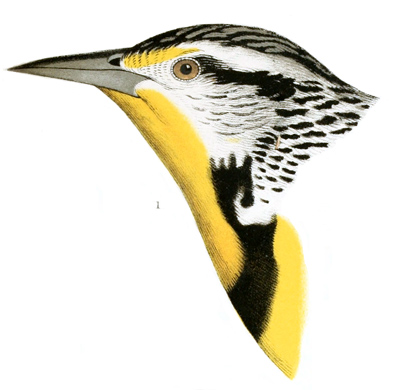
1. Sturnella neglecta. ♂ Nevada, 53592.
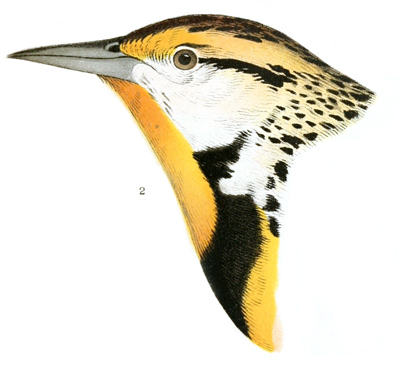
2. Sturnella magna. ♂ Pa., 1303.
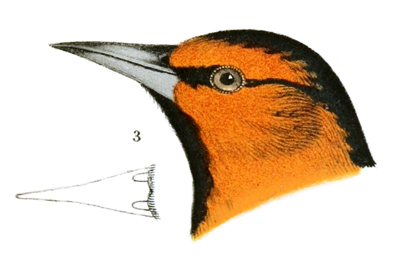
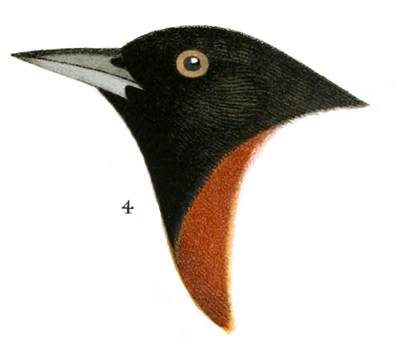
4. Icterus spurius. ♂ La., 4286.
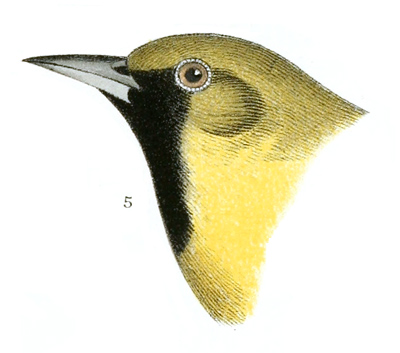
5. Icterus spurius. ♂ juv. Pa., 1437.
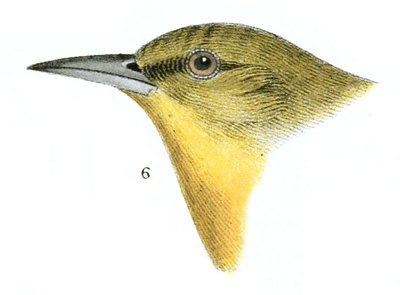
6. Icterus spurius. ♀ Pa., 150.
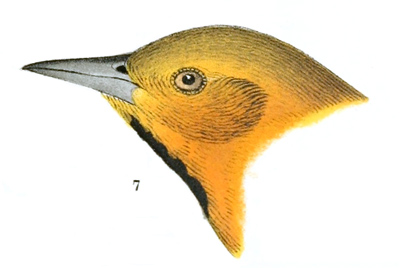
7. Icterus bullocki. ♀ Cal., 3900.
Habits. The differences of plumage between this species and our eastern Meadow Lark are so slight that we might hesitate to allow the existence of any specific distinctness between the two forms, were it not for the very strongly marked differences between them in other respects. Whether we regard them as races or as different species, their history diverges as we cross the Missouri River, though both are found on either bank.
The existence of this variety was first made known by Messrs. Lewis and Clark, in their memorable expedition to the Rocky Mountains. They refer especially to the difference, in the notes, between this bird and the old Field Lark of the east. It remained unnoticed by our ornithologists until 1844, when Mr. Audubon included it in the appendix to his seventh volume. He met with it in his voyage to the Yellowstone, and it would have escaped his notice had not the attention of his party been called to its curious notes. In its flight, manners on the ground, or general habits, he could perceive no difference between it and the common species. None of its nests that he found were covered over, in the manner of the magna, and the eggs were differently marked.
Mr. J. A. Allen, in his interesting paper on the birds observed in Western Iowa, while he does not admit any specific difference between these two forms, presents with impartial exactness the very striking dissimilarity between them, both in habits and in song. In regard to the diversity in habits we quote his words:—
“At the little village of Denison, where I first noticed it in song, it was particularly common, and half domestic in its habits, preferring the streets and grassy lanes, and the immediate vicinity of the village, to the remoter prairie. Here, wholly unmolested and unsuspicious, it collected its food; and the males, from their accustomed perches on the housetops, daily warbled their wild songs for hours together.” These traits of familiarity, so totally different from anything ever observed in our eastern birds, he does not concede, however, as establishing necessarily specific difference. Yet he does admit that its song was so new to him that he did not at first have the slightest suspicion that its utterer was the western Meadow Lark, as he found it to be. He adds: “It differs from that of the Meadow Lark in the Eastern States, in the notes being louder and wilder, and at the same time more liquid, mellower, and far sweeter. They have a pensiveness and a general character remarkably in harmony with the half-dreamy wildness of the primitive prairie, as though the bird had received from its surroundings their peculiar impress. It differs, too, in the less frequency of the harsh, complaining chatter so conspicuous in the eastern bird.”
The value of these marked differences, both in song and character, between the eastern and western birds, we will not argue, but will only add that they are none too strikingly presented by Mr. Allen. During the writer’s brief visit to the Plains he was strongly impressed by the natural, confiding trustfulness of this species and its wonderful beauty of song, both in such remarkable contrast with the habits of our eastern birds. At Antelope Station a pair of these birds had built their nest under the window of the office, and seemed to enjoy the society of the family, while the depot-master, familiar with the song and habits of our eastern birds, appreciated the great differences between the two forms, and called my attention to them.
Mr. Allen also found this Lark everywhere abundant in Colorado, but its notes appeared to him quite different from those of the representatives of this species living to the eastward, in the prairie States, being less varied and ringing, and more guttural.
Dr. Cooper says this bird is abundant in California, and resident nearly throughout the entire State, breeding in the Colorado Valley and in all other districts not quite waterless. Their songs are lively, sweet, and varied. They sing at all seasons, early and late, from the ground, from the tree-top, or in the air, and when unmolested are so tame as to make the house-top their favorite perch. Even the female has considerable musical power, and cheers her mate by singing to him while he relieves her by sitting on the eggs. She also has a harsh, petulant chirp, frequently repeated as if in anger. He states that they build their nest in a slight depression under a bunch of grass, and usually more or less arched over and artfully concealed. The female, when flushed, usually skulks off some distance before she flies. The eggs he describes as white, with a few large purplish-brown blotches and dots towards the larger end, and measuring 1.15 inches by .85. They are very obtuse in shape.
They feed chiefly on insects, seeds, and grain, do no damage to the crops, and destroy a vast number of noxious insects.
Dr. Suckley found this bird common everywhere in Oregon and Washington Territory, some remaining throughout every winter. In 1855 a few were seen at Fort Dalles as early as March 5. On the 7th he found them quite abundant on the ploughed fields near Fort Vancouver. Some of these had probably remained all the winter. In February, 1856, he found them quite abundant at Fort Steilacoom. At Fort Dalles, by the 2d of May, he obtained young birds nearly fledged.
Mr. Dresser found it very common during winter near San Antonio, where a few remain to breed.
In Arizona, according to Dr. Coues, it is resident, but quite rare.
Lieutenant Couch found these birds from the Rio Grande to the high bottoms of the Lower Bolson de Mapimi. Its notes he speaks of as highly musical, contending even with the Mocking Bird for a supremacy in song.
Mr. Ridgway found the western Meadow Lark one of the most abundant and characteristic birds of California and all fertile portions of the interior as far east as the Missouri, and remarks that, although closely resembling the eastern bird in appearance, its song is totally different, not a note uttered by it having more than a very distant resemblance to any of the well-known magna of the eastern meadows. In the depth of its tone and the charms of its articulation its song is hardly excelled, resembling very nearly the song of the Wood Thrush. Mr. Ridgway describes its modulations as expressed by the syllables tung-tung-tungah-til’lah-til’lah-tung, each note powerful and distinct. The difference between the other notes of the two birds is still greater than in their song, and even in character these are not alike. In the neglecta the call-note of watchfulness or alarm is a loud, deep-toned tuck, similar to the chuck of the Blackbird, but much louder and more metallic. That of sympathy for the young, or anxiety when the nest is approached, is a loud, liquid tyur, slightly resembling the complaining note of the eastern Bluebird, and also of the Orchard Oriole. All of its notes are of a power corresponding to the size of the bird.
Mr. Ridgway also notices important differences in their flight. That of the eastern species is carried on by an occasional spasmodic beat or jerk of the wings, which are then extended, the bird sailing a short distance. The flight of the western Lark is much more irregular, the bird flitting along by a trembling flutter of the wings, never assuming these peculiar features.
An egg of this species, collected by Dr. Cooper in Washington Territory, June 19, 1856, measures 1.20 inches in length and .86 in breadth. It is of an oblong-oval shape, obtuse; the ground white, sparingly spotted with a very dark purple, most of the markings being at the larger end. Three eggs from Arizona, collected by Dr. Palmer, measure 1.10 inches by .80. The markings are of much lighter shades of lilac, purple, and purplish and reddish-brown. The markings are more generally diffused, but predominate at the larger end. An egg from the Yellowstone, collected by Mr. Audubon, is unusually pointed at one end, measures 1.13 inches by .82. The spots are a dark purplish-brown, intermingled with smaller and lighter dottings of reddish-brown. Eggs from California do not vary essentially in their markings from those of Arizona, and have an average measurement of 1.10 inches by .85. As a general rule, the mottling of the eggs of the western bird is finer than that of the eastern.
Subfamily ICTERINÆ.
Genus ICTERUS, Auct.
Icterus, Brisson, R. A. 1760.—Gray, Genera.
Xanthornus, Cuvier, Leç. Anat. Comp. 1800.—Gray, Genera.
Pendulinus, Vieillot, Analyse, 1816.
Yphantes, Vieillot, Analyse, 1816.—Gray, Genera.
Gen. Char. Bill slender, elongated, as long as the head, generally a little decurved, and very acute. Tarsi not longer than the middle toe, nor than the head; claws short, much curved; outer lateral toe a little longer than the inner, reaching a little beyond base of middle toe. Feet adapted for perching. Tail rounded or graduated. Prevailing colors yellow or orange, and black.
The species of this subfamily are all as strikingly characterized by diversity and brilliancy of plumage as the others are (with few exceptions) for their uniform sombre black, scarcely relieved by other colors. Of the four genera of this subfamily, recognized by Gray, all but Cacicus are well represented in the United States. This differs from all the rest in having the culmen widened and much depressed towards the base, where it advances in a crescent on the forehead, separating the frontal plumes. In the other genera the culmen advances somewhat on the forehead, but it is in a narrow acute point, and not dilated.
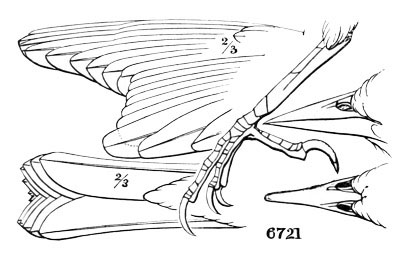
Icterus bullocki. 6721
In studying the North American Orioles we have found it exceedingly difficult to arrange them in any sharply defined sections, as whatever characters be taken as the basis of classification, the other features will not correspond. Thus, species with the bill of the same proportions and amount of curvature differ in the shape and graduation of the tail, while tails of the same form are accompanied by entirely dissimilar bills and wings. The bill is sometimes much attenuated and decurved, as in I. cucullatus, while in melanocephalus and baltimore it is stouter and straighter. The tail is usually much graduated; in I. baltimore and bullocki it is only moderately rounded. These last-mentioned species constitute the genus Hyphantes. Many of the species have a naked space round the eye, very evident in I. vulgaris, less so in melanocephalus. I. vulgaris is peculiar in having the feathers of the throat pointed and lanceolate, as in the ravens.