Family PICIDÆ.—The Woodpeckers.
Reading edition
Char. Outer toe turned backwards permanently, not versatile laterally, the basal portion of the tongue capable of great protrusion.
The preceding characters combined appear to express the essential characters of the Picidæ. In addition, it may be stated that the tongue itself is quite small, flat, and short, acute and horny, usually armed along the edges with recurved hooks. The horns of the hyoid apparatus are generally very long, and curve round the back of the skull, frequently to the base of the bill, playing in a sheath, when the tongue is thrown forward out of the mouth to transfix an insect.
There are twelve tail-feathers, of which the outer is, however, very small and rudimentary (lying concealed between the outer and adjacent feathers), so that only ten are usually counted. The tail is nearly even, or cuneate, never forked, the shafts very rigid in the true Woodpeckers; soft in Picumninæ and Yunginæ. The outer primary is generally very short, or spurious, but not wanting. The bill is chisel or wedge shaped, with sharp angles and ridges and straight culmen; sometimes the culmen is a little curved, in which case it is smoother, and without the ridges. The tarsi in the North American forms are covered with large plates anteriorly, posteriorly with small ones, usually more or less polygonal. The claws are compressed, much curved, very strong and acute.
The Picidæ are found all over the world with the exception of Madagascar, Australia, the Moluccas, and Polynesia. America is well provided with them, more than half of the described species belonging to the New World.
The subfamilies of the Picidæ may be most easily distinguished as follows, although other characters could readily be given:—
Picinæ. Tail-feathers pointed, and lanceolate at end; the shafts very rigid, thickened and elastic.
Picumninæ. Tail soft and short, about half the length of wing; the feathers without stiffened shafts, rather narrow, linear, and rounded at end.
Yunginæ. Tail soft and rather long, about three fourths the length of wing; the feathers broad, and obtusely rounded at end.
Of these subfamilies the Picinæ alone occur north of Mexico. The Yunginæ, to which the well-known Wryneck of England (Jynx torquilla) belongs, are exclusively Old World; the Picumninæ belong principally to the tropical regions of America, although a few species occur in Africa and India. One species, Picumnus micromegas, Sundevall, belongs to St. Domingo, although erroneously assigned to Brazil. This is the giant of the group, being about the size of the White-bellied Nuthatch (Sitta carolinensis) the other species being mostly very diminutive, varying from three to four inches in length.
Subfamily PICINÆ.
The diagnosis on the preceding page will serve to distinguish this group from its allies, without the necessity of going into greater detail. It includes by far the largest percentage of the Picidæ, and in the great variations of form has been variously subdivided by authors into sections. Professor Sundevall, in his able monograph,[124] establishes the following four series, referring all to the single genus Picus:—
I. Angusticolles. Neck slender, elongated. Nostrils concealed by bristles. Tail-feathers black or brownish, immaculate.
II. Securirostres. Neck not slender, and shorter. Nostrils concealed by bristles. Bill stout, cuneate, with the nasal ridges widely distant from each other.
III. Ligonirostres. Neck not slender. Nostrils covered, nasal ridges of bill placed near the culmen (or at least nearer it than the lower edge of the upper mandible), for the most part obsolete anteriorly.
IV. Nudinares. Nostrils open, uncovered by bristly hairs. Neck and bill various.
Of these series, the first and second correspond with Piceæ, as given below, while Centureæ and Colapteæ both belong to Ligonirostres. The Nudinares are not represented in North America, and by only one group, Celeus, in any portion of the continent.
In the following account of the Picinæ, we shall not pretend to discuss the relationship of the North American species to the Picinæ in general, referring to Sundevall’s work, and the monographs of Malherbe and Cassin, for information on the subject. For our present purposes they may be conveniently, even if artificially, arranged in the following sections:—
Piceæ. Bill variable in length; the outlines above and below nearly straight; the ends truncated; a prominent ridge on the side of the mandible springing from the middle of the base, or a little below, and running out either on the commissure, or extending parallel to and a little above it, to the end, sometimes obliterated or confluent with the lateral bevel of the bill. Nostrils considerably overhung by the lateral ridge, more or less linear, and concealed by thick bushy tufts of feathers at the base of the bill. Outer posterior toe generally longer than the anterior.
Centureæ. Bill rather long; the outlines, that of the culmen especially, decidedly curved. The lateral ridge much nearest the culmen, and, though quite distinct at the base, disappearing before coming to the lower edge of the mandible; not overhanging the nostrils, which are broadly oval, rounded anteriorly, and not concealed by the bristly feathers at the base. Outer pair of toes nearly equal; the anterior rather longer.
Colapteæ. Bill rather long, much depressed, and the upper outline much curved to the acutely pointed (not truncate) tip. The commissure considerably curved. Bill without any ridges. The nostrils broadly oval, and much exposed. Anterior outer toe longest.
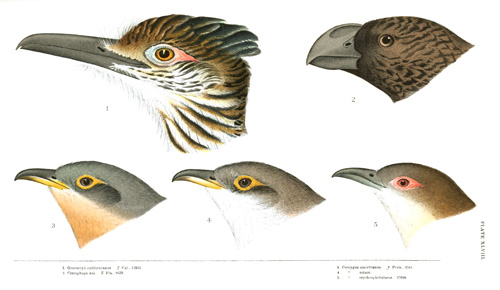
PLATE XLVIII.
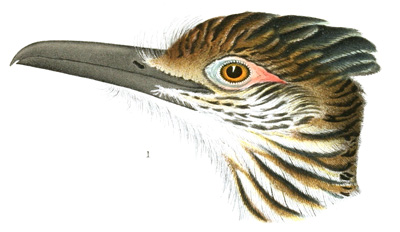
1. Geococcyx californianus ♂ Cal., 12925.
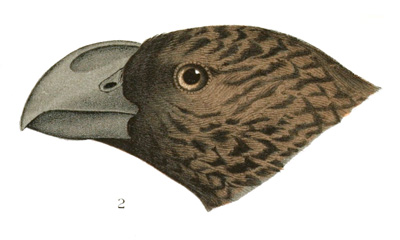
2. Crotophaga ani. ♀ Fla., 8639.
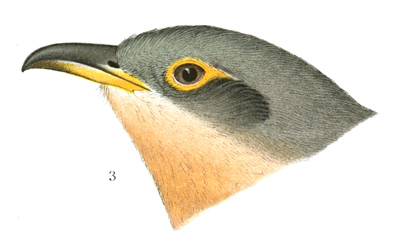
3. Coccygus americanus. ♂ Penn., 1541.
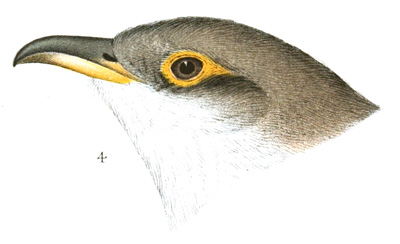
4. Coccygus minor.
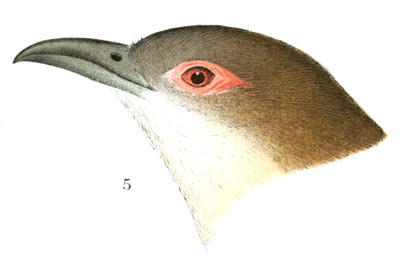
5. Coccygus erythrophthalmus. 27028.
The preceding diagnoses will serve to distinguish the three groups sufficiently for our present purposes; the bill being strongest in the Picinæ and best fitted for cutting into trees by its more perfect wedge-shape, with strengthening ridges, as well as by the lateral bevelling of both mandibles, which are nearly equal in thickness at the base, and with their outlines nearly straight. The lateral ridge is prominent, extending to the edge or end of the bill, and overhangs the nostrils, which are narrow and hidden. The Centureæ and the Colapteæ have the upper mandible more curved (the commissure likewise), the lower mandible smaller and weaker, the bill with little or no lateral bevelling. The nostrils are broadly oval and exposed. In the former, however, there is a distinct lateral ridge visible for a short distance from the base of the bill; while in the other there is no ridge at all, and the mandible is greatly curved.
In all the species of North American Woodpeckers, there is more or less red on the head in the male, and frequently in the female. The eggs of all are lustrous polished white, without any markings, and laid in hollow trees, upon a bed of chips, no material being carried in for the construction of the nest.
Section PICEÆ.
With the common characters, as already given, there are several well-marked generic groups in this section of Woodpeckers which may be arranged for the United States species as follows:—
A. Posterior outer toe longer than the anterior outer one. (Fourth toe longer than third.)
a. Lateral ridge starting above the middle of the base of the bill, and extending to the tip.
1. Campephilus. Lateral ridge above the middle of the lateral profile of the bill when opposite the end of the nostrils, which are ovate, and rounded anteriorly. Bill much depressed, very long; gonys very long. Posterior outer toe considerably longer than the anterior. Primaries long, attenuated towards the tip. Spurious quill nearly half the second. Shafts of four middle tail-feathers remarkably stout, of equal size, and abruptly very much larger than the others; two middle tail-feathers narrower towards bases than towards end.[125] A pointed occipital crest.
2. Picus. Lateral ridge in the middle of the lateral profile opposite the end of the nostrils, which are ovate and sharp-pointed anteriorly. Bill moderate, nearly as broad as high.
Outer hind toe moderately longer than the outer fore toe. Primaries broad to the tip, and rounded. Spurious primary not one third the second quill.
3. Picoides. Lateral ridge below the middle of the profile, opposite the end of the ovate acute nostrils, which it greatly overhangs. Bill greatly depressed; lower mandible deeper than the upper. Inner hind toe wanting, leaving only three toes. Tufts of nasal bristles very full and long.
b. Lateral ridge starting below the middle of the base of the bill, and running as a distinct ridge into the edge of the commissure at about its middle; the terminal half of the mandible rounded on the sides, although the truncate tip is distinctly bevelled laterally.
4. Sphyropicus. Nostrils considerably overhung by the lateral ridge, very small, linear. Gonys as long as the culmen, from the nostrils. Tips of tail-feathers elongated and linear, not cuneate. Wings very long; exposed portion of spurious primary about one fourth that of second quill.
B. Posterior outer toe considerably shorter than the anterior outer one. (Fourth toe shorter than third).
5. Hylotomus. Bill depressed. Lateral ridge above the middle of the lateral profile near the base. Nostrils elliptical, wide, and rounded anteriorly. Tail almost as in Sphyropicus. A pointed occipital crest, as in Campephilus, and not found in the other genera.
The arrangement in the preceding diagnosis is perhaps not perfectly natural, although sufficiently so for our present purpose. Thus, Hylotomus, in having the lateral ridge extending to the end of the bill, is like Picus, but the nostrils are broader, more open, and not acute anteriorly. The tail-feathers of Sphyropicus differ greatly from those of the others in being abruptly acuminate, the points elongated, narrow, and nearly linear, instead of being gently cuneate at the ends. Campephilus and Hylotomus belong to Sundevall’s Angusticolles, with their long slender neck, and elongated occipital crest (Dryocopinæ, Cab.); the other genera to Securirostres, with shorter, thicker neck, and no crest (Dendrocopinæ, Cab.). But no two genera in the subfamily are more distinct than Campephilus and Hylotomus.
Genus CAMPEPHILUS, Gray.
Campephilus, Gray, List of Genera? 1840. (Type, C. principalis.)
Megapicus, Malherbe, Mém. Ac. de Metz, 1849, 317.
Gen. Char. Bill considerably longer than the head, much depressed, or broader than high at the base, becoming somewhat compressed near the middle and gradually bevelled off at the tip. Culmen very slightly curved, gonys as concave, the curve scarcely appreciable; commissure straight. Culmen with a parallel ridge on each side, starting a little above the centre of the basal outline of the bill, the ridge projecting outwards and downwards, and a slight concavity between it and the acute ridge of the culmen. Gonys considerably more than half the commissure. Nostrils oval below the lateral ridge near the base of the bill; concealed by the bristly feathers directed forward. Similar feathers are seen at the sides of the lower jaw and on the chin.
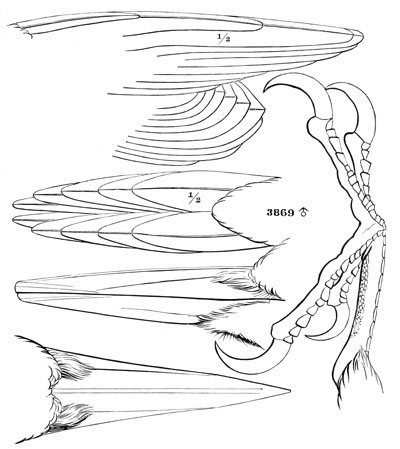
Campephilus principalis. 3869 ♂
Feet large; outer hind toe much longest; claw of inner fore toe reaching to middle of outer fore claw; inner hind toe scarcely more than half the outer one; its claw reaching as far as the base of the inner anterior claw, considerably more than half the outer anterior toe. Tarsus rather shorter than the inner fore toe. Tail long, cuneate; shafts of the four middle feathers abruptly much larger than the others, and with a deep groove running continuously along their under surface; webs of the two middle feathers deflected, almost against each other, so that the feathers appear narrower at the base than terminally. Wings long and pointed, the third, fourth, and fifth quills longest; sixth secondary longest, leaving six “tertials,” instead of three or four as usual; primaries long, attenuated. Color continuous black, relieved by white patches. Head with a pointed occipital crest.
This genus embraces the largest known kind of Woodpecker, and is confined to America. Of the two species usually assigned to it, only one occurs within the limits of the United States, C. imperialis, given by Audubon, and by subsequent authors on his credit, really belonging to Southern Mexico and Central America. The diagnoses of the species are as follows:—
Common Characters. Bill ivory-white. Body entirely glossy blue-black. A scapular stripe, secondaries, ends of inner primaries, and under wing-coverts, white. Crest scarlet in the male, black in the female.
1. C. principalis. A white stripe on each side of the neck. Bristly feathers at the base of the bill white.
White neck-stripe not extending to the base of the bill. Black feathers of crest longer than the scarlet. Wing, 10.00; culmen, 2.60. Hab. Gulf region of United States … var. principalis.
White stripe reaching the base of the bill. Scarlet feathers of crest longer than the black. Wing, 9.50; culmen, 2.40. Hab. Cuba … var. bairdi.[126]
2. C. imperialis. No white stripe on the sides of the neck. More white on the wings. Bristly feathers at the base of the bill black. Hab. South Mexico; Guatemala.
Campephilus principalis, Gray.
IVORY-BILLED WOODPECKER.
Picus principalis, Linn. Syst. Nat. I, 1766, 173.—Wilson, Am. Orn. IV, 1811, 20, pl. xxxix, f. 6.—Wagler, Syst. Avium, 1827, No. 1.—Aud. Orn. Biog. I, 1832, 341; V, 525, pl. lxvi.—Ib. Birds America, IV, 1842, 214, pl. cclvi.—Sundevall, Consp. Pic. 4. Dendrocopus principalis, Bon. List, 1838. Campephilus principalis, Gray, List Genera, 1840.—Baird, Birds N. Am. 83.—Cab. & Hein. Mus. Hein. IV, II, 100.—Dresser, Ibis, 1865, 468 (breeds in Brazos and Trinity, Texas).—Gray, Cat. 53.—Allen, Birds E. Florida, 301. Dryotomus (Megapicus) principalis, Bon. Con. Zyg. Aten. Ital. 1854, 7. Dryocopus principalis, Bon. Consp. 1850, 132. White-billed Woodpecker, Catesby, Car. I, 16.—Pennant, Latham.
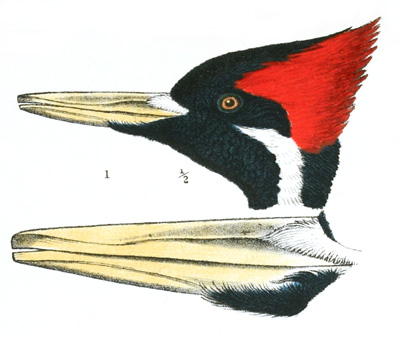
Sp. Char. Fourth and fifth quills equal; third a little shorter. Bill horn-white. Body entirely of a glossy blue-black (glossed with green below); a white stripe beginning half an inch posterior to the commissure, and passing down the sides of the neck, and extending down each side of the back. Under wing-coverts, and the entire exposed portion of the secondary quills, with ends of the inner primaries, bristles, and a short stripe at the base of the bill, white. Crest scarlet, upper surface black. Length, 21.00; wing, 10.00. Female similar, without any red on the head, and with two spots of white on the end of the outer tail-feather.
Hab. Southern Atlantic and Gulf States. North to North Carolina and mouth of the Ohio; west to Arkansas and Eastern Texas. Localities: Brazos and Trinity Rivers, Texas (Dresser, Ibis, 1865, 468, breeds).
In the male the entire crown (with its elongated feathers) is black. The scarlet commences just above the middle of the eye, and, passing backwards a short distance, widens behind and bends down as far as the level of the under edge of the lower jaw. The feathers which spring from the back of the head are much elongated above; considerably longer than those of the crown. In the specimen before us the black feathers of the crest do not reach as far back as the scarlet.
Reference has already been made to the Cuban variety of the Ivory-billed Woodpecker named C. bairdi by Mr. Cassin, and differing in smaller size; extension of the white cheek-stripe to the very base of the bill, and the excess in length of the upper black feathers of the crest over the scarlet. These features appear to be constant, and characteristic of a local race.
For the reasons already adduced, we drop C. imperialis from the list of North American birds, although given as such by Audubon.
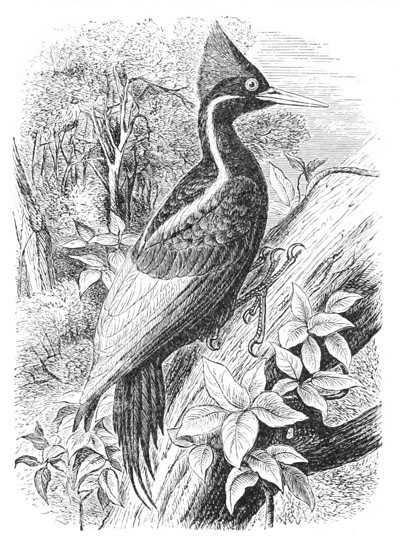
Campephilus principalis.
Habits. So far as we have information in regard to the geographical distribution of the Ivory-billed Woodpecker, it is chiefly restricted in its range to the extreme Southern States, and especially to those bordering on the Gulf of Mexico. Wilson states that very few, if any, are ever found north of Virginia, and not many even in that State. His first specimen was obtained near Wilmington, N. C. It is not migratory, but is a resident where found.
Mr. Audubon, who is more full than any other writer in his account of this bird, assigns to it a more extended distribution. He states that in descending the Ohio River he met with it near the confluence of that river with the Mississippi, and adds that it is frequently met with in following the windings of the latter river either downwards towards the sea, or upwards in the direction of the Missouri. On the Atlantic he was inclined to make North Carolina the limit of its northern distribution, though now and then individuals of the species have been accidentally met with as far north as Maryland. To the westward of the Mississippi he states that it is found in all the dense forests bordering the streams which empty into it, from the very declivities of the Rocky Mountains. The lower parts of the Carolinas, Georgia, North Florida, Alabama, Louisiana, and Mississippi, are, however, its favorite resorts, and in those States it constantly resides.
It was observed by Dr. Woodhouse in the timber on the Arkansas River, and in Eastern Texas, but quite rarely in both places. It was not, however, met with in any other of the government expeditions, either to the Pacific, in the survey of the railroad routes, or in that for the survey of the Mexican boundary line. It is given as a bird of Cuba by De la Sagra, in his catalogue of the birds of that island, as observed by him, October, 1850, and by Dr. John Gundlach, in his list of the birds that breed in Cuba. It is not mentioned by Gosse among the birds of Jamaica, nor by the Newtons as found in St. Croix. As it is not a migratory bird, it may be regarded as breeding in all its localities, except where it is obviously an accidental visitant.
Wilson, who never met with the nest of this Woodpecker, states, on the authority of reliable informants, that it breeds in the large-timbered cypress swamps of the Carolinas. In the trunks of these trees at a considerable height from the ground, both parents working alternately, these birds dig out a large and capacious cavity for their eggs and young. Trees thus dug out have frequently been cut down with both the eggs and the young in them. The hole was described to Wilson as generally a little winding, to keep out the rain, and sometimes five feet deep. The eggs were said to be generally four, sometimes five in number, as large as pullets’, pure white, and equally thick at both ends. The young make their appearance about the middle or end of June.
Mr. Audubon, whose account of the breeding-habits of the Ivory-bill is given from his own immediate observations, supplies a more minute and detailed history of its nesting. He states that it breeds earlier in spring than any other species of its tribe, and that he has observed it boring a hole for that purpose as early as the beginning of March. This hole he believed to be always made in the trunk of a live tree, generally an ash or a hackberry, and at a great height. It pays great regard to the particular situation of the tree and the inclination of the trunk, both with a view to retirement and to secure the aperture against rains. To prevent the latter injury, the hole is generally dug immediately under the protection of a large branch. It is first bored horizontally a few inches, then directly downward, and not in a spiral direction, as Wilson was informed. This cavity is sometimes not more than ten inches in depth, while at other times it reaches nearly three feet downward into the heart of the tree. The older the bird, the deeper its hole, in the opinion of Mr. Audubon. The average diameter of the different nests which Mr. Audubon examined was about seven inches in the inner parts, although the entrance is only just large enough to admit the bird. Both birds work most assiduously in making these excavations. Mr. Audubon states that in two instances where the Woodpeckers saw him watching them at their labors, while they were digging their nests, they abandoned them. For the first brood, he states, there are generally six eggs. These are deposited on a few chips at the bottom of the hole, and are of a pure white color. The young may be seen creeping out of their holes about a fortnight before they venture to fly to any other tree. The second brood makes its appearance about the 15th of August. In Kentucky and Indiana the Ivory-bill seldom raises more than one brood in a season. Its flight is described by Audubon as graceful in the extreme, though seldom prolonged to more than a few hundred yards at a time, except when it has occasion to cross a large river. It then flies in deep undulations, opening its wings at first to their full extent, and nearly closing them to renew their impulse. The transit from tree to tree is performed by a single sweep, as if the bird had been swung in a curved line from the one to the other.
Except during the love-season it never utters a sound when on the wing. On alighting, or when, in ascending a tree, it leaps against the upper parts of the trunk, its remarkable voice may be constantly heard in a clear, loud, and rather plaintive tone, sometimes to the distance of half a mile, and resembling the false high note of a clarionet. This may be represented by the monosyllable pait thrice repeated.
The food of this Woodpecker consists principally of beetles, larvæ, and large grubs. They are also especially fond of ripe wild grapes, which they eat with great avidity, hanging by their claws to the vines, often in the position of a Titmouse. They also eat ripe persimmons, hackberries, and other fruit, but are not known to disturb standing corn nor the fruits of the orchard.
These birds attack decaying trees so energetically as often to cause them to fall. So great is their strength, that Audubon has known one of them to detach, at a single blow, a strip of bark eight inches long, and, by beginning at the top branch of a dead tree, tear off the bark to the extent of thirty feet in the course of a few hours, all the while sounding its loud notes.
Mr. Audubon further states that this species generally moves in pairs, that the female is the least shy and the most clamorous, and that, except when digging a hole for the reception of their eggs, they are not known to excavate living trees, but only those attacked by worms. When wounded, they seek the nearest tree, and ascend with great rapidity by successive hops. When taken by the hand, they strike with great violence, and inflict severe wounds with their bills and claws.
Mr. Dresser states that these birds were found on the Brazos River, and also on the Trinity, where they were by no means rare.
Wilson dwells at some length and with great force upon the great value of these birds to our forests. They never injure sound trees, only those diseased and infested with insects. The pine timber of the Southern States is often destroyed, thousands of acres in a season, by the larvæ of certain insects. In Wilson’s day this was noticeable in the vicinity of Georgetown, S. C., and was attributed by him to the blind destruction of this and other insect-eating birds.
An egg of this species (Smith. Coll., No. 16,196) taken near Wilmington, N. C., by Mr. N. Giles, measures 1.35 inches in length by .95 of an inch in breadth. It is of a highly polished porcelain whiteness, and is much more oblong in shape and more pointed than are the eggs of Hylotomus pileatus.
Genus PICUS, Linnæus.
Picus, Linn. Syst. Nat. 1748. (Type, Picus martius, L.)
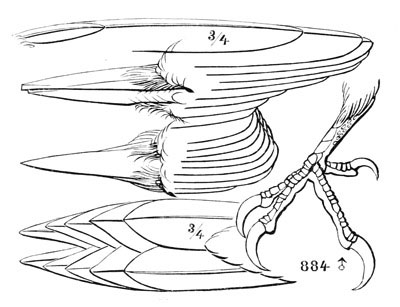
Picus villosus. 884 ♂
Gen. Char. Bill equal to the head, or a little longer; the lateral ridges conspicuous, starting about the middle of the base of the bill; the basal elongated oval nostrils nearest the commissure; the ridges of the culmen and gonys acute, and very nearly straight, or slightly convex towards the tip; the bill but little broader than high at the base, becoming compressed considerably before the middle. Feet much as in Campephilus; the outer posterior toe longest; the outer anterior about intermediate between it and the inner anterior; the inner posterior reaching to the base of the claw of the inner anterior. Tarsus about equal to the inner anterior toe; shorter than the two other long toes. Wings rather long, reaching to the middle of the tail, rather rounded; the fourth and fifth quills longest; the quills rather broad and rounded.
In the genus Picus, as characterized above, are contained several subdivisions more or less entitled to distinct rank, and corresponding with peculiar patterns of coloration. Thus, taking the P. villosus as the type, P. borealis has proportionally much longer primaries; the spurious primary smaller; the bill is considerably more attenuated, and even concave in its lateral outlines. The wings are still longer in P. albolarvatus. The species may be arranged as follows:—
A. Black above, and white beneath. Wings spotted with white; a black maxillary stripe.
a. Two white stripes on the side of the head, one above, and the other below, the ear-coverts, which are mostly black. First quill shorter than sixth. Tail-feathers broad and obtuse at ends, the narrowed tips of middle feathers very short.
DRYOBATES, Boie. Middle of back streaked longitudinally and continuously with white. Maxillary and auricular black stripes not confluent; the latter running into the black of the nape. Beneath white without spots. Red of head confined to a narrow nuchal band.
1. P. villosus. Outer tail-feathers immaculate white, great variation in size with latitude. Length, 7.00 to 10.00.
All the quills, with middle and greater wing-coverts, with large white spots. Hab. Eastern North America … var. villosus.
Innermost quills and some of the coverts entirely black, or unspotted with white. Remaining spots reduced in size. (Var. jardini similar, but much smaller, 7.00, and lower parts smoky-brown.) Hab. Middle and western North America, and south to Costa Rica … var. harrisi.
2. P. pubescens. Outer tail-feather white, with transverse black bands; length about 6.25.
All the quills, with middle and greater wing-coverts, with large white spots. Hab. Eastern North America … var. pubescens.
Innermost quills and some of the coverts entirely black; remaining white spots reduced in size. Hab. Western North America … var. gairdneri.
DYCTIOPICUS, Bon. Whole back banded transversely with black and white. Beneath white, with black spots on sides. Maxillary and auricular black stripes confluent at their posterior ends, the latter not running into the nape. In the males at least half of top of head red. Length, about 6.50.
3. P. scalaris. Anterior portion of the back banded with white; lores and nasal tufts smoky brown. Black stripes on sides of the head very much narrower than the white ones, and not connected with the black of the shoulders. Male with the whole crown red.
Outer web of lateral tail-feathers barred with black to the base. White bands on back exceeding the black ones in width; red of the crown very continuous, on the forehead predominating over the black and white. (Sometimes the black at base of inner web of lateral tail-feather divided by white bars.) Hab. Southern and Eastern Mexico, and Rio Grande region of United States … var. scalaris.
Outer web of lateral tail-feather barred with black only toward end. Red of crown much broken anteriorly, and in less amount than the black and white mixed with it. White bands of the back not wider, generally much narrower than the black ones.
Bill, .90; tarsus, .70. Red of crown extending almost to the bill. Hab. Western Mexico, up to Western Arizona … var. graysoni.
Bill, 1.10; tarsus, .75. Red of crown disappearing about on a line above the eye. Hab. Cape St. Lucas … var. lucasanus.
4. P. nuttalli. Anterior portion of back not banded with white; lores and nasal tufts white. Black stripes on side of the head very much broader than the white ones, and connected by a narrow strip with the black of the shoulders. Male with only the nape and occiput red. Hab. California (only).
b. One white stripe, only, on side of head, and this occupying whole auricular region. Tail-feathers narrowed at ends, the points of the middle ones much elongated. First quill longer than sixth. Bill very small, much shorter than head.
PHRENOPICUS, Bonap. Back and wings transversely banded with black and white, and sides spotted with black, as in Dyctiopicus.
5. P. borealis. Red of male restricted to a concealed narrow line on each side of the occiput, at the junction of the white and black. Maxillary black stripe very broad and conspicuous, running back to the series of black spots on sides of breast. Three outer tail-feathers more or less white, with a few bars of black near their ends, principally on inner webs. Hab. South Atlantic States.
B. Body entirely continuous black; head all round immaculate white. First quill shorter than sixth.
XENOPICUS, Baird. Tail and primaries as in “A,” but much more lengthened. Bill as in Dryobates, but more slender.
6. P. albolarvatus. Red of male a narrow transverse occipital crescent, between the white and the black. Basal half, or more, of primaries variegated with white, this continuous nearly to the end of outer webs; inner webs of secondaries with large white spots toward their base. Hab. Sierra Nevada and Coast Ranges, Pacific Province, United States.
Subgenus DRYOBATES, Boie.
Dryobates, Boie, 1826. (Type, Picus pubescens, fide Cabanis, Mus. Hein.)
Trichopicus, Bonap. 1854.
Trichopipo, Cab. & Hein. Mus. Hein. 1863, 62.
According to Cabanis, as above cited, Dryobates, as established by Boie in 1826, had the Picus pubescens as type, although extended in 1828 to cover a much wider ground. As a subgeneric name, therefore, it must take preference of Trichopicus of Bonaparte, which, like all the allied names of this author, Cabanis rejects at any rate as hybrid and inadmissible.
The synopsis under the head of Picus will serve to distinguish the species in brief.
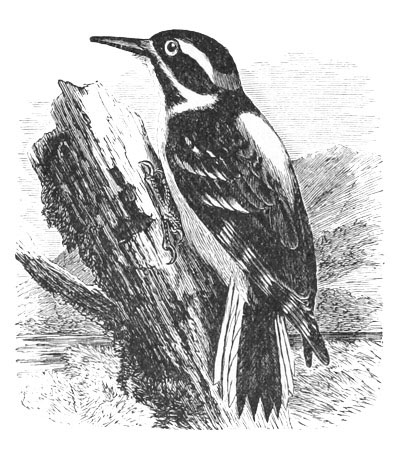
Picus harrisi.
The small black and white Woodpeckers of North America exhibit great variations in size and markings, and it is extremely difficult to say what is a distinct species and what a mere geographical race. In none of our birds is the difference in size between specimens from a high and a low latitude so great, and numerous nominal species have been established on this ground alone. There is also much variation with locality in the amount of white spotting on the wings, as well as the comparative width of the white and black bars in the banded species. The under parts, too, vary from pure white to smoky-brown. To these variations in what may be considered as good species is to be added the further perplexities caused by hybridism, which seems to prevail to an unusual extent among some Woodpeckers, where the area of distribution of one species is overlapped by a close ally. This, which can be most satisfactorily demonstrated in the Colaptes, is also probably the case in the black and white species, and renders the final settlement of the questions involved very difficult.
After a careful consideration of the subject, we are not inclined to admit any species or permanent varieties of the group of four-toed small white and black Woodpeckers as North or Middle American, other than those mentioned in the preceding synopsis.
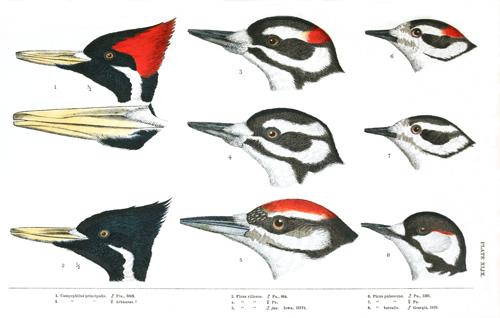
PLATE XLIX.
1. Campephilus principalis. ♂ Fla., 3869.
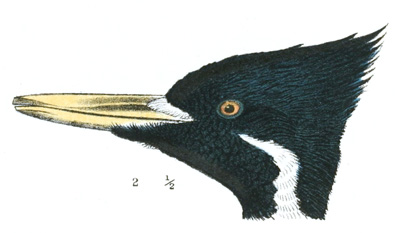
2. Campephilus principalis. ♀ Arkansas.?
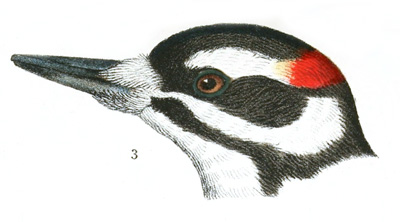
3. Picus villosus. ♂ Pa., 884.
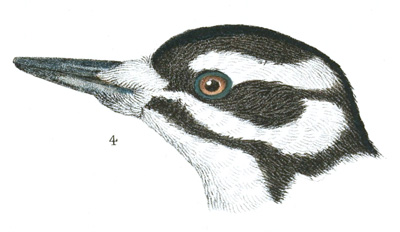
4. Picus villosus. ♀ Pa.
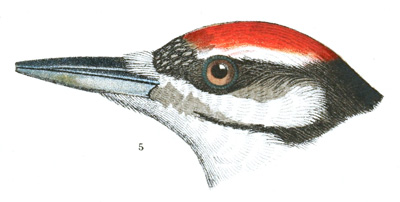
5. Picus villosus. ♂ juv. Iowa, 13172.
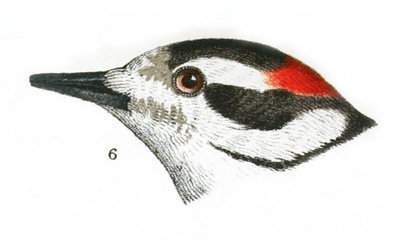
6. Picus pubescens. ♂ Pa., 1291.
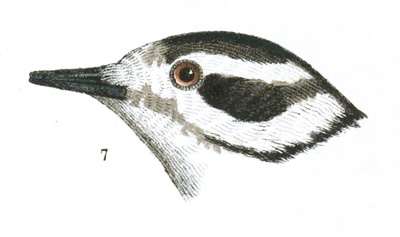
7. Picus pubescens. ♀ Pa.
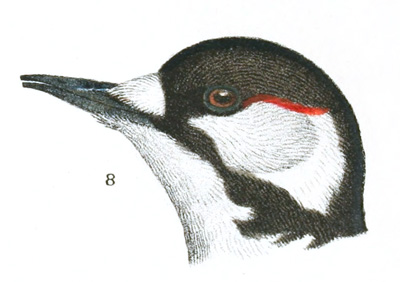
8. Picus borealis. ♂ Georgia, 1878.
Picus villosus, Linnæus.
HAIRY WOODPECKER; LARGER SAPSUCKER.
Var. canadensis.—Northern and Western regions.
? Picus leucomelas, Boddært, Tabl. Pl. Enl. 1783 (No. 345, f. 1, Gray).—Cass. P. A. N. S. 1863, 199. Dryobates leucomelas, Cab. & Hein. Mus. Hein. IV, 67. ? Picus canadensis, Gmelin, Syst. Nat. I, 1788, 437.—? Latham, Ind. Orn. I, 1790, 231.—Aud. Orn. Biog. V, 1839, 188, pl. ccccxvii.—Ib. Syn. 1839, 177.—Ib. Birds America, IV, 1842, 235, pl. cclviii.—Bonap. Consp. 1850, 137.—Ib. Aten. Ital. 1854, 8. Picus villosus, Forster, Philos. Trans. LXII, 1772, 383.—Baird, Birds N. Am. 1858, 84.—Cassin, P. A. N. S. 1863, 199.—Gray, Catal. 1868, 45.—Dall & Bannister, Tr. Chicago Ac. Sc. I, 1869, 274 (Alaska).—Finsch, Abh. Nat. III, 1872, 60 (Alaska).—Samuels, 87. Picus (Dendrocopus) villosus, Sw. F.-Bor. Am. II, 1831, 305. Picus phillipsi, Aud. Orn. Biog. V, 1839, 186, pl. ccccxvii.—Ib. Syn. 1839, 177.—Ib. Birds Amer. IV, 1842, 238, pl. cclix (immature, with yellow crown).—Nuttall, Man. I, (2d ed.,) 1840, 686.—Cass. P. A. N. S. 1863, 199. Picus martinæ, Aud. Orn. Biog. V, 1839, 181, pl. ccccxvii.—Ib. Syn. 1839, 178.—Ib. Birds Amer. IV, 1842, 240, pl. cclx (young male, with red feathers on crown).—Cass. P. A. N. S. 1863, 199. Picus rubricapillus, Nuttall, Man. I, (2d ed.,) 1840, 685 (same as preceding). Picus septentrionalis, Nuttall, Man. I, (2d ed.,) 1840, 684.
Var. villosus.—Middle States.
Picus villosus, Linnæus, Syst. Nat. I, 1758, 175.—Vieillot, Ois. Am. Sept. II, 1807, 64, pl. cxx.—Wilson, Am. Orn. I, 1808, 150, pl. ix.—Wagler, Syst. Av. 1827, No. 22.—Aud. Orn. Biog. V, 1839, 164, pl. ccccxvi.—Ib. Birds Amer. IV, 1842, 244, pl. cclxii.—Bonap. Conspectus, 1850, 137.—Sundevall, Mon. Pic. 17.—Baird, Birds N. Am. 1858, 84. Picus leucomelanus, Wagler, Syst. Av. 1827, No. 18 (young male in summer). Hairy Woodpecker, Pennant, Latham. Dryobates villosus, Cab. & Hein. Mus. Hein. IV, 2, 66.
Var. auduboni.—Southern States.
Picus auduboni, Swainson, F. B. A. 1831, 306.—Trudeau, J. A. N. Sc. Ph. VII, 1837, 404 (very young male, with crown spotted with yellow).—Aud. Orn. Biog. V, 1839, 194, pl. ccccxvii.—Ib. Birds Amer. IV, 1842, 259, pl. cclxv.—Nutt. Man. I, (2d ed.,) 1840, 684.—Cass. P. A. N. S. 1863, 199. Picus villosus, Bryant, Pr. Bost. Soc. 1859 (Bahamas, winter).—Allen, B. E. Fla. 302.
Sp. Char. Above black, with a white band down the middle of the back. All the middle and larger wing-coverts and all the quills with conspicuous spots of white. Two white stripes on each side of the head; the upper scarcely confluent behind, the lower not at all so; two black stripes confluent with the black of the nape. Beneath white. Three outer tail-feathers with the exposed portions white. Length, 8.00 to 11.00; wing, 4.00 to 5.00; bill, 1.00 to 1.25. Male, with a nuchal scarlet crescent (wanting in the female) covering the white, generally continuous, but often interrupted in the middle. Immature bird of either sex with more or less of the whole crown spotted with red or yellow, or both, sometimes the red almost continuous.
Hab. North America, to the eastern base of the Rocky Mountains, and (var. canadensis) along the 49th parallel to British Columbia; Sitka; accidental in England.
In the infinite variation shown by a large number of specimens in the markings of the wings, so relied on by authors to distinguish the species of the black and white spotted North American Woodpeckers having a longitudinal band of white down the back, it will be perhaps our best plan to cut them rigorously down to two, the old-fashioned and time-honored P. villosus and pubescens; since the larger and more perfect the series, the more difficult it is to draw the line between them and their more western representatives. The size varies very greatly, and no two are alike in regard to the extent and number of the white spots. Beginning at one end of the chain, we find the white to predominate in the more eastern specimens. Thus in one (20,601) from Canada, and generally from the north, every wing-covert (except the smallest) and every quill shows externally conspicuous spots or bands of white; the middle coverts a terminal band and central spot; the greater coverts two bands on the outer web, and one more basal on the inner; and every quill is marked with a succession of spots in pairs throughout its length,—the outer web as bands reaching nearly to the shaft; the inner as more circular, larger spots. The alula alone is unspotted. This is the typical marking of the P. leucomelas or canadensis of authors. The white markings are all larger respectively than in other forms.
The next stage is seen in typical or average P. villosus for the Middle States. Here the markings are much the same, but the white is more restricted, and on the outer webs of the feathers forms rounded spots rather than bands. Some Carlisle specimens have two spots on the middle coverts as described, others lack the basal one. Another stage is exhibited by a specimen from Illinois, in which with two spots on the middle coverts there is but one terminal on the outer web of the greater, and a reduction in number of spots on the inner webs of innermost secondaries, terminal outer spots not having the corresponding inner. This form is quite prevalent westward and on the Upper Missouri, but cannot be considered as strictly geographical, since a Massachusetts and a Georgia skin agree in the same characters.
In all this variation there is little diminution in the number of spots visible externally, nor so far have we seen any from the region east of the Missouri plains that lack white spots on every covert (except the smallest ones) and every quill, and with few exceptions on both webs of the latter. It is therefore this style that we propose to consider as pure P. villosus, irrespective of variations in the size or shape of the spots, of the amount of white on tail and back, or of the bird itself. Any deviation from this may be called a variety. It has the distribution already mentioned, and extends along the Upper Missouri to British Columbia and Sitka, straggling into Washington Territory, where, however, it is found with the more typical western form, var. harrisi. A specimen collected by Mr. Hepburn at Caribou, on the Upper Fraser, is absolutely undistinguishable from typical P. canadensis in size and markings.
We now come to the western race or variety, hardly to be called species, the P. harrisi of Audubon. Here the extreme of condition most opposed to typical villosus is shown by the entire absence of white on the exposed surface of the wing, except on the outer webs of the four or five longest primaries, where the spots are very small. (We have never seen them entirely wanting.) The white of the back, too, may be normal in amount, or else much restricted. Concealed white spots on some of the feathers will be seen on raising them. The white of tail-feathers sometimes shows black spots or blotches, especially on the inner web of the second. These features belong more especially to specimens from the coast region of Oregon and Washington.
Proceeding eastward from the Northern Pacific Coast we next find specimens showing a few white streaks on the greater coverts and next on the middle coverts. The spots on the secondaries, too, begin to show themselves; but as a general rule they do not occur on the innermost of the greater coverts and of the secondaries. This, therefore, may be considered as the limit of a variety, characterized by the absence at least of spots in these members of the wing.
With the variation in spots in the western variety we have, as already remarked, differences in amount of white on the tail and the back, as well as in the color of the belly, which is sometimes pure white, sometimes of a smoky gray; this latter variation not at all parallel with other differences or with geographical distribution, and equally observable in eastern villosus. The size, too, varies somewhat, but not to the same extent as on the Atlantic side. Here, however, we have Picus jardini of Mexico and Central America, as the small southern race, absolutely undistinguishable from dark-breasted Oregon specimens, except in size (length, 7.00; wing, 3.90; bill above, .85), and perhaps a more fulvous tinge on the under parts. The specimens before me have one or two black spots on the inner web of the next to the outer tail-feather, as in darker varieties of harrisi, but these are not symmetrical or constant in either, and are to be looked on as mere indications of the general tendency to melanism.
Habits. This common and familiar species of Woodpecker has an extended range throughout eastern North America. Specimens in the Smithsonian Institution have been collected from almost every portion of North America east of the Rocky Mountains. Wilson speaks of it as common throughout the continent from Hudson’s Bay to Carolina and Georgia. Mr. Audubon, who regarded Picus martinæ, P. phillipsi, and P. canadensis as distinct species, instead of varieties of this Woodpecker, states, in regard to its distribution, that the P. villosus is a constant resident both in the maritime and inland districts from Texas to New Hampshire, as well as in all the wooded tracts intervening between the junction of the Missouri and Mississippi, and the northern borders of the great lake. He adds that not an individual was found by him or by his sons in Maine, where he did, however, obtain in great abundance the variety he called P. canadensis. According to Sir John Richardson it is found as far to the north as the 63d parallel. It remains all the year round in the fur countries, and is the most common species up to the fifty-sixth degree of latitude, north of which it yields in frequency to the three-toed species. Dr. Woodhouse speaks of it as common in Texas and in the Indian Territory. Although not crossing the Rocky Mountains in the United States, it reaches the Pacific Coast of British Columbia, and is found north as far as Sitka, and perhaps still farther, thus replacing the var. harrisi. It is a resident, and not a migratory, species, and wherever found it also breeds. Several specimens have been killed in England.
According to the observations of Wilson, this Woodpecker frequents the orchards and cultivated grounds, and is less wild and more domestic than most of the species. In May, with its mate, it seeks the retirement of the woods to breed, selecting a branch already hollowed, or excavating one for itself. In the former case the nest has been known to be four or five feet from the opening. When it excavates its own opening, it digs horizontally six or eight inches into the body of the tree, and then downward to about twice that distance, carrying up the chips in the bill or scraping them out with the feet. They not unfrequently breed in orchards, and have been even known to excavate their holes in the rails of old fences. The female lays five white eggs, which are usually hatched out early in June.
Mr. Audubon observed these birds, at all seasons, in almost every possible locality, from the isolated trees of large towns and cities, even to the very midst of the salt marshes about the mouth of the Mississippi. He found the excavation for the nest more frequently running obliquely than perpendicularly. In the Southern States they rear two broods in a season, the first appearing the last of May, the second usually about the first of August. In the middle and northern districts they rarely raise more than one. Those which Mr. Audubon observed to raise more than one brood in a season made use of the same excavation for both, and not unfrequently within a few yards of a house. The eggs of the first brood he found usually six in number, and of the second four. Where they have but one brood, the number varies from four to six, and in two instances he has found seven. The measure given by him is one inch in length by .69 of an inch in breadth. They are elliptical or almost equally rounded at both ends, smooth, pure white, and translucent. The young remain in the nest until well able to fly.
Mr. Audubon states that the Hairy Woodpecker becomes, during the winter months, a very common bird in all parts of the Southern States, coming to the farm-yards with the downy species to glean the grains of corn left by the cattle. At this season their visits to the corn-cribs are extremely frequent. They may also be seen clinging to the stalks of the sugar-cane, boring them, and evidently enjoying the sweet juices of that plant.
Their flight is short and rapid, resembling that of other allied species. They are not social, never more than the members of one family being seen together. They feed chiefly on insects and their larvæ, often seizing the former on the wing. In the autumn they occasionally eat berries, seeds, and small fruit. Their notes are sharp and loud, uttered in monosyllables, at times with great frequency.
An egg of this species, taken in Roxbury, Mass., is of a pure crystal whiteness, oblong in shape, and equally rounded at either end, measuring 1.01 inches in length by .72 of an inch in breadth. Another, from Georgia, is more rounded at one end, and measures 1.02 inches in length and .75 of an inch in breadth.
Picus villosus, var. harrisi, Aud.
HARRIS’S WOODPECKER.
Picus harrisi, Aud. Orn. Biog. V, 1839, 191, pl. ccccxvii.—Ib. Syn. 1839, 178.—Ib. Birds America, IV, 1842, 242, pl. cclxi (dark-bellied variety).—Nuttall, Man. I, (2d ed.,) 1840, 627.—Baird, Birds N. Am. 1858, 87.—Sundevall, Mon. 17.—Lord, Pr. R. Art. Ass. IV, 111 (nesting).—Coues, Pr. A. N. S. 1866, 52 (Oregon).—Sumichrast, Mem. Bost. Soc. I, 1869, 562 (Alpine regions of Vera Cruz).—Gray, Catal. 1868, 47.—Caban. J. 1862, 175.—Cassin, P. A. N. S. 1863, 200.—Cooper & Suckley, 159.—Cooper, Orn. Cal. 1, 1870, 375. ? Picus inornatus, Licht. (Bon. Consp.). Picus (Trichopicus) harrisi, Bp. Consp. Zyg. Aten. Ital. 1854, 8. Dryobates harrisi, Cab. & Hein. Mus. Hein. IV, 2, 68 (jardini, 69.) Picus jardini, Malh. Rev. Zoöl. Oct. 1845, 374 (Mexico).—Cab. Jour. 1862, 175. Picus hyloscopus, Cab. & Hein. Mus. Hein. IV, 2, 1863, 69 (white-bellied form).
Sp. Char. Similar to typical villosus; the innermost of the greater wing-coverts and of the secondary quills without any white spots externally; varying from this to the entire absence of exposed white on wing except on the outer web of longest primaries. Belly varying from pure white to smoky or fulvous gray, white of tail-feathers very rarely blotched with black. Average length, in north, 9.00; wing, 5.00; exposed part of culmen, 1.15.
Var. jardini much smaller. Length, 7.00; wing, 3.90; culmen, .85.
Hab. Whole of Western United States, west of the Missouri plains, extending into Mexico and Central America, where it passes into the smallest and darkest southern extreme, known as P. jardini. Localities: West Arizona (Coues, P. A. N. S. 1866, 52); Vera Cruz, Alpine regions (Sumichrast, M. Bost. Soc. I, 1869, 562).
In the preceding article we have given some general remarks on Harris’s Woodpecker, and shown why we cannot consider it a well-defined species. If the specimens from the extreme west were constant in themselves, and the variations, as with Colaptes hybridus, occurred along the line of contact with villosus, we might refer to hybrids many of the intermediate forms; but as scarcely any two are alike, even on the Pacific coast, such a view is inadmissible. As, however, in the extreme limits of variation, there is yet a difference from eastern specimens, and this is characteristic of a large area of country, it may be proper to recognize the form by the name harrisi.
The P. jardini appears to be nothing more than the most southern race of this dark western form of P. villosus, and shows the smallest, as well as the darkest, extreme to which the species attains. In Southern Mexico typical P. harrisi and this form grade insensibly together. The minimum of size and maximum darkness of colors are reached in Costa Rica.
Habits. This variety was first described by Mr. Audubon from specimens obtained by Mr. Townsend on the Columbia River. No information was obtained in regard to its habits, which, it may be presumed, do not vary very essentially from those of the more familiar pubescens and villosus. In regard to its geographical distribution, it has been found in more or less abundance from Nebraska to the Pacific, and from Mexico to British America. It is known to occur in Texas on the Rio Grande, in New Mexico, in Arizona, Nebraska, California, Oregon, and Washington Territory.
This indicates a very general distribution throughout Western North America from the eastern slope of the Rocky Mountains to the Pacific, and from New Mexico and Texas probably to the limits of the forests in the northwest. It seems to take the place of the P. villosus in the far west. Dr. Heermann, in his notes on the birds of California (Journal of Philadelphia Academy, II, 270), says it is not a common bird, although it is occasionally met with in that State. Dr. Gambel, however, states that it occupies, on the western coast, the same place that the P. villosus does on the Atlantic, but seems to have a greater partiality for the pine woods. Dr. Woodhouse did not meet with it in the expedition to the Zuñi and Colorado. Dr. Newberry speaks of it (U. S. P. B. R. Survey, VI,—Zoölogy, p. 89) as not uncommon in the wooded districts of Northern California and Oregon. Dr. Kennerly, in his report on the birds obtained by Lieutenant Whipple’s party, states that Harris’s Woodpecker was found along the Little Colorado River in the month of December, wherever the cottonwood trees grew (U. S. P. R. R. Survey, X, Pt. VI, 21). It is not mentioned by Dr. Heermann in his Report on the birds of Lieutenant Parke’s explorations near the 32d. parallel. The same writer, in his Report on the birds of Lieutenant Williamson’s party, speaks of this bird as having been occasionally observed during the survey, but as a somewhat rare species, though procured in Northern California and at Tejon Pass. Dr. Suckley speaks of it as quite abundant at Fort Dalles, where he found it among the true pines, and at Fort Steilacoom, among the firs (D. douglasi), and as a winter resident in both localities (Natural History of Washington Territory, Zoölogy, p. 159). Dr. Cooper states that Harris’s Woodpecker is the most abundant species in Washington Territory, being found on both sides of the Cascade Mountains, frequenting the lower parts of the great coniferous trees. He found it a constant resident in May, burrowing out a nest in a dead tree, sometimes only four feet from the ground. He describes its cries and habits as so exactly like those of the larger Sapsucker (P. villosus) of the Atlantic States, that, were there not constant and unchangeable differences in plumage, it would be taken for the same species. He furnishes no description of the eggs, but it is quite probable that there is no appreciable difference between them and those of the Picus villosus.
Dr. Coues mentions this species as one of the most common and characteristic birds in the vicinity of Fort Whipple. Dr. Heermann speaks of its having clear trumpet-like notes that betray its locality and render it an easy bird to shoot.
In California Dr. Cooper found this chiefly a northern bird, frequenting the forests of all kinds up to the summits of the Sierra Nevada, and also resident as far south as Santa Barbara, descending, in winter, to the eastern branches of the Colorado and to Tejon Pass. He found it more common in the higher Coast Range near Santa Cruz, and still more so toward the Columbia River. Its cry, he adds, is louder than that of most of the small Woodpeckers, and it is rather shy, especially when it imagines itself pursued. It feeds at times on fruits and berries, and sometimes it visits gardens. It is known as one of the “Sapsuckers,” but does more good than harm in the orchard, destroying both insects and their larvæ.
Mr. John K. Lord states that this Woodpecker is by far the most abundant species in the district through which his party passed. He found it on Vancouver’s Island, and along the entire course of the boundary-line, south through Oregon and California, and north to Fort Simpson. A few remained at Colville during the winter, but the greater number retired to the coast and returned in April and May. In the latter month they mate, and bore out a hole in a dead tree. They use no lining for the nest, but lay the eggs on the bare wood. Their favorite haunts are the stumps of trees growing round swamps or prairie-land.
This Woodpecker was met with by Mr. Ridgway in all wooded portions of the Great Basin, but was most abundant among the pines on the mountains. In all respects, it is a perfect counterpart of the P. villosus of the east.
Picus pubescens, Linn.
DOWNY WOODPECKER; LESSER SAPSUCKER.
Picus pubescens, Linn. Syst. Nat. I, 1766, 15.—Vieillot, Ois. Am. Sept. II, 1807, 65, pl. cxxi.—Wilson, Am. Orn. I, 1808, 153, pl. ix.—Wagler, Syst. Avium, 1827, No. 23.—Aud. Orn. Biog. II, 1834, 81; V, 539, pl. cxii.—Ib. Birds Am. IV, 1842, 249, pl. cclxiii.—Baird, Birds N. Am. 1858, 89.—Sundevall, Mon. Pic. 17.—Malb. Mon. Pic. I, 119, pl. xxix.—Cassin, Pr. 1863, 20.—Scl. Cat. 1862, 334.—Gray, Cat. 1868, 44.—Dall & Bannister, Tr. Chicago Ac. I, 1869, 274 (Alaska).—Finsch, Abh. Nat. III, 1872, 60 (Alaska).—Samuels, 89.—Allen, B. E. Fla. 304. Picus (Dendrocopus) pubescens, Sw. F. B. A. II, 1831, 307. Picus (Trichopicus) pubescens, Bonap. Consp. Zyg. Ateneo Italiano, 1854, 8. ? Picus medianus, Sw. F. B. A. II, 1831, 308. Picus meridionalis, Sw. F. B. A. II, 1831, 308 (small southern race). Picus leconti, Jones, Ann. N. Y. Lyc. IV, 1848, 489, pl. xviii (Georgia; three-toed specimen, first toe wanting. Type of Tridactylia, Bp.) Dryobates pubescens, Cab. & Hein. Mus. Hein. 1863, 63.
Sp. Char. A miniature of P. villosus. Above black, with a white band down the back. Two white stripes on the side of the head; the lower of opposite sides always separated behind, the upper sometimes confluent on the nape. Two stripes of black on the side of the head, the lower not running into the forehead. Beneath white; all the middle and greater coverts and all the quills with white spots, the larger coverts with two series each; tertiaries or inner secondaries all banded with white. Two outer tail-feathers white, with two bands of black at end; third white at tip and externally, crissum sometimes spotted with black. Length, about 6.25; wing, 3.75. Male with red, terminating the white feathers on the nape. Young with whole top of head red.
Hab. Eastern United States, towards the eastern slope of the Rocky Mountains, into British Columbia and the Humboldt Mountains, and north to the limits of the woods; along whole Yukon River; perhaps to the Pacific, north of the 49th parallel; Kodiak. Localities: San Antonio, Texas (Dresser, Ibis, 1865, 468). Accidental in England.
The remarks already made on the variation of Picus villosus apply equally well here; all the differences in size and markings with locality being almost exactly reproduced. The western variety, P. gairdneri, is equally uncertain in characters as P. harrisi, and as little entitled to specific distinction. As in the previous instance, we shall call typical pubescens those specimens in which all the middle and greater coverts and all the quills including the innermost secondaries are spotted with white, while those in which any of these feathers, whether all the coverts, as in Oregon birds, or only a few of them, are unspotted, may be called var. gairdneri.
Of typical pubescens in the Eastern States there are minor variations, but not of much account. Thus the forehead itself, apart from the white nasal tufts, is sometimes white, connecting with the white superciliary stripe; more frequently, however, the whole forehead is black. Northern specimens are larger and have larger white spots, and not unfrequently the black cheek-stripe is invaded anteriorly by white, which, however, is appreciable at the base of the feathers. The black bars on the tail are much restricted in specimens from the Yukon. Southern specimens are smaller and darker, with smaller spots on the wings.
In all the changes of the two species, there is no difficulty in distinguishing P. pubescens from P. villosus by the black bars on outer tail-feathers of the former, and their absence in the latter. The crissum of pubescens is sometimes somewhat spotted with blackish. The white markings on the coverts are larger in proportion, and there are almost always two series of white spots on the greater coverts, as in northern varieties of villosus, not one, as in most of those from the Middle States.
Habits. This species, like the Hairy Woodpecker, is a resident rather than a migratory species, and breeds wherever it is met with. It also seems to have very nearly the same geographical distribution with that species. Dr. Woodhouse found it common throughout the Indian Territory, Texas, and New Mexico. It does not, however, appear to have been collected by any of the parties engaged in the Pacific Railroad surveys, nor by that upon the survey of the Mexican boundary. Of seventeen specimens given by Professor Baird in 1858 as in the collections of the Smithsonian Institution, six are from Pennsylvania, two from Massachusetts, two from Missouri, one from Bonhomme Island in Nebraska, and the rest from Fort Leavenworth, Salt Creek, Fort Riley, and Platte River in Kansas. It is quite common throughout the coast region of Alaska, exclusive of the Aleutians, and throughout the entire valley of the Yukon. Wilson makes no mention of its geographical distribution, probably because he found it everywhere common, to the extent of his own investigations. Audubon speaks of it as very generally distributed from the lower parts of Louisiana to Labrador, and as far westward as he travelled.
Sir John Richardson states that this species is a constant inhabitant of the fur countries up to the 58th parallel. It seeks its food principally on the maple, elm, and ash, and, north of latitude 54°, where these trees are not found, on the aspen and birch.
According to Wilson, these birds select a suitable place for the excavation of their nest, about the middle of May. An apple, pear, or cherry tree, often in the near neighborhood of a farm-house, is generally fixed upon for this purpose. The work of excavation is begun by the male, who cuts a hole in the solid wood as circular as if described with a pair of compasses. He is occasionally relieved by the female, both parties working with the most indefatigable diligence. The direction of the hole, when made in the body of the tree, is downward by an angle of forty degrees for the distance of six or eight inches, and then directly downward for ten or twelve more. Within, the excavation is roomy, capacious, and as smooth as if polished by the hand of the most finished workman. The entrance is, however, left only just large enough to admit the bodies of the birds. During their labor they even take the pains to carry their chips to a distance, to prevent suspicion. This operation sometimes occupies the chief part of a week. The eggs are generally six in number, pure white, and laid on the smooth bottom of the cavity. The male supplies the female with food while she is sitting. The young generally leave the nest about the last of June.
The same writer also gives an interesting account of the impudent coolness of the House Wren, who, coveting the well-built home of this Woodpecker, and unable to excavate such an apartment for itself, waits until the poor Woodpeckers have completed their work, and then attacks them with violence and drives them off from the nest they have been at so much pains to prepare. He states that he saw a striking example of this, where the Woodpeckers, after commencing in a cherry-tree, within a few yards of the house, and having made considerable progress, were turned out by the Wren. They began again on a pear-tree in the garden, a few yards off, when, after digging out a most complete apartment, and laying one egg, they were once more assaulted by the same impertinent intruder, and finally forced to abandon the place.
Mr. Audubon gives substantially the same account of their nesting, only he assigns an earlier period, the middle of April, for its commencement, and describes the entrance to the excavation as often being at right angles to the trunk for a few inches before it descends. He states that in the Southern and Middle States two broods are raised in a season, farther north seldom more than one.
Mr. C. S. Paine, of Randolph, Vt., speaks of this Woodpecker as being one of the most common and familiar, in Vermont, of the family. They are to be met with in his neighborhood at all seasons of the year, though he is of the opinion that many of them go south to spend the winter. They deposit their eggs about the first of June in the very snug little excavations they prepare. The male bird will sometimes prepare a separate apartment for himself, apart from his mate. Mr. Paine has taken the male in such a hole by himself, and without any nest or eggs, evidently only prepared for shelter.
This Woodpecker has a single note or cry, sounding like chink, which it frequently repeats. When it flies, and often when it alights, this cry is more shrill and prolonged. They are very industrious, and are constantly employed in search of insects, chiefly in orchards and the more open groves. The orchard is its favorite resort, and it is particularly fond of boring the bark of apple-trees for insects. This fact, and the erroneous impression that it taps the trees for the sap, has given to these birds the common name of Sapsuckers, and has caused an unjust prejudice against them. So far from doing any injury to the trees, they are of great and unmixed benefit. Wilson, who was at great pains to investigate the matter, declares that he invariably found that those trees that were thus marked by the Woodpecker were uniformly the most thriving and the most productive. “Here, then,” adds Wilson, “is a whole species—I may say genus—of birds, which Providence seems to have formed for the protection of our fruit and forest trees from the ravages of vermin, which every day destroy millions of those noxious insects that would otherwise blast the hopes of the husbandman, and even promote the fertility of the tree, and in return are proscribed by those who ought to have been their protectors.”
The egg of this species is nearly spherical, pure white, and measures .83 by .72 of an inch.
Picus pubescens, var. gairdneri, Aud.
GAIRDNER’S WOODPECKER.
Picus gairdneri, Aud. Orn. Biog. V, 1839, 317.—Ib. Syn. 1839, 180.—Ib. Birds Amer. IV, 1842, 252 (not figured).—Baird, Birds N. Am. 1858, 91, pl. lxxxv, f. 2, 3.—Sundevall, Consp. 1866, 17.—Gray, Cat. 1868, 44.—Cooper & Suckley, 159.—Sclater, Catal. 1862, 334.—Malh. Monog. Picidæ, I, 123.—Cass. P. A. N. S. 1863, 201.—Cooper, Orn. Cal. 1, 1870, 377.—Lord, Pr. R. Art. Inst. IV, 1864, 111. Picus meridionalis, Nutt. Man. I, (2d ed.,) 1840, 690 (not of Swainson).—Gambel, J. A. N. Sc. I, 1847, 55, 105. Picus turati, Malherbe, Mon. Pic. I, 125, tab. 29 (small race, 5.50, from Monterey, Cal., nearest pubescens). Dryobates turati, Cab. & Hein. Mus. Hein. IV, 2, 1863, 65. Dryobates homorus, Cab. & Hein. Mus. Hein. IV, 2, 1863, 65 (larger, more spotted style).
Sp. Char. Similar to pubescens in size and markings, but with less white on the wings. Varies from entire absence of exposed white spots on the middle and greater wing-coverts and innermost secondaries, with small spots on the quills, to spots on most of their feathers, but absent on some, and the spots generally larger.
Hab. Pacific coast of United States to Rocky Mountains. Darkest and with least white in Western Oregon and Washington.
In the preceding article we have given the comparative characters of this form, which we can only consider as a variety, and not very permanent or strongly marked at that.
As in pubescens, this race varies much in the color of the under parts, which are sometimes pure white, sometimes smoky-brown. It is suggested that this is partly due to a soiling derived from inhabiting charred trees. It is, at any rate, of no specific value.
Habits. Gairdner’s Woodpecker is the western representative and counterpart of the Downy Woodpecker of the east, resembling it in size and general habits, and only differing from it in certain exceptional characteristics already mentioned. It is found throughout western North America, probably from Mexico to the British Possessions, and from the eastern base of the Rocky Mountains to the Pacific.
Dr. Cooper met with it in California, chiefly in the northern parts of the State, but did not observe any south of the Santa Clara Valley. Dr. Coues saw none in Arizona, or possibly a single specimen not positively ascertained.
Dr. Cooper found one of its nests near Santa Clara, on the 24th of May, containing young. It had been burrowed in a small and partly rotten tree, and was about five feet from the ground. From the fact that they were found breeding so far south he infers that among the mountains they probably occur much farther to the south, as do most other northern birds. He found them frequenting chiefly the smaller trees in the vicinity of the evergreen woods, where they were to be seen at all seasons industriously tapping the bark to obtain insects.
Dr. Newberry mentions finding them very common in Oregon, and also in Northern California. In Washington Territory, Dr. Suckley found them extremely common on the Lower Columbia, especially among the willow-trees lining its banks. They were resident throughout the winter, and in these situations were very abundant. In January, 1856, he found them so abundant among the willows growing on the islands in the delta of the Willamette, that he readily obtained eight specimens in the space of an hour. At that season they were very unwary, giving little heed to the presence of man, not even allowing the near discharge of a gun to interfere with their busy search for food.
Dr. Heermann speaks of it as neither common nor especially rare. He obtained several specimens among the mountains of Northern California.
Mr. Lord met with these Woodpeckers abundantly in the Northwestern Boundary Survey. They differed slightly in their habits from the P. harrisi, generally hunting for insects on the maples, alders, and stunted oaks, rather than on the pine-trees. Specimens were taken on Vancouver Island, Sumass Prairie, Colville, and the west slope of the Rocky Mountains at an altitude of seven thousand feet above the sea-level.
Mr. Ridgway found this Woodpecker to be unaccountably rare in the Sierra Nevada and all portions of the Great Basin, as well as in the Wahsatch and Uintah Mountains, even in places where the P. harrisi was at all times abundant. Indeed, he only met with it on two or three occasions, in the fall: first in the Upper Humboldt Valley, in September, where it was rare in the thickets along the streams; and again in the Wahsatch Mountains, where but a single brood of young was met with in August.
An egg of this species from Oregon, obtained by Mr. Ricksecker, is larger than that of the pubescens, but similar in shape, being very nearly spherical. It measures .96 of an inch in length by .85 in breadth.
Subgenus DYCTIOPICUS, Bonap.
Dyctiopicus, Bonap. Ateneo Ital. 1854, 8. (Type, Picus scalaris, Wagler.)
Dyctiopipo, Cabanis & Hein. Mus. Hein. IV, 2, 1863, 74. (Same type.)
Char. Small species, banded above transversely with black or brown and white.
Of this group there are two sections,—one with the central tail-feathers entirely black, from Mexico and the United States (three species); the other with their feathers like the lateral black, banded or spotted with white (three species from southern South America). The northern section is characterized as follows:—
The characters of the species scalaris, with its varieties, and nuttalli, will be found under Picus.
Picus scalaris, Wagler.
LADDER-BACKED WOODPECKER.
Picus scalaris, Wagler, Isis, 1829, V, 511 (Mexico).—Bonap. Consp. 1850, 138.—Scl. P. Z. S. 1856, 307.—Sund. Consp. 18.—Baird, Birds N. Am. 1858, 94, pl. xli, f. 1.—Ib. Rep. Mex. Bound. II, 4, pl. iii.—Scl. Cat. 1862, 333.—Cass. P. A. N. S. 1863, 195.—Gray, Cat. 1868, 48.—Heerm. X, c, p. 18.—Cooper, Orn. Cal. 1, 1870, 379. Picus (Dyctiopicus) scalaris, Bon. Consp. Zygod. Aten. Ital. 1854, 8. Dyctiopipo scalaris, Cab. & Hein. Mus. 74. Picus gracilis, Less. Rev. Zoöl. 1839, 90 (Mexico). Picus parvus, Cabot, Boston Jour. N. H. V, 1845, 90 (Sisal, Yucatan). Picus orizabæ, Cassin, Pr. A. N. S. 1863, 196 (Orizaba). Picus bogotus, Cassin, Pr. A. N. S. 1863, 196; Jour. A. N. S. V, 1863, 460, pl. lii, f. 1 (Mex.). Picus bairdi (Scl. MSS.), Malherbe, Mon. Pic. I, 118, t. xxvii, f. 7, 8.—Scl. Cat. 333, (?) P. Z. S. 64, 177 (city of Mex.).—Cab. & Hein. Mus. Hein. IV, 2, 76.—Cassin, Pr. A. N. S. 1863, 196.—Coues, Pr. A. N. S. 1866, 52 (perhaps var. graysoni).—Dresser, Ibis, 1865, 468. Hab. Texas and New Mexico, to Arizona; south through Eastern Mexico to Yucatan. Picus scalaris, var. graysoni, Baird, MSS. Hab. Western Arizona; Western Mexico and Tres Marias.
Sp. Char. Back banded transversely with black and white from nape to rump (not upper tail-coverts). Quills and coverts with spots of white; forming bands on the secondaries. Two white stripes on sides of head. Top of head red, spotted with white. Nasal tufts brown. Beneath brownish-white, with black spots on sides, becoming bands behind. Outer tail-feathers more or less banded. Length, about 6.50; wing, 3.50 to 4.50; tail, about 2.50.
Hab. Guatemala, Mexico, and adjacent southern parts of United States. Localities: Xalapa (Scl. P. Z. S. 1859, 367); Cordova (Scl. 1856, 357); Guatemala (Scl. Ibis, I, 136); Orizaba (Scl. Cat. 333); S. E. Texas (Dresser, Ibis, 1865, 468, breeds); W. Arizona (Coues, P. A. N. S. 1866, 52); Yucatan (Lawr. Ann. N. Y. Lyc. IX, 205).
In the above diagnosis we have endeavored to express the average of characters belonging to a Woodpecker to which many names, based on trifling geographical variations, have been assigned, but which legitimately can be only considered as one species. This is among the smallest of the North American Woodpeckers, and in all its variations the wings are long, reaching as far as the short feathers of the tail. The upper parts generally are black, on the back, rump, and exposed feathers of the wings banded transversely with white, the black bands rather the narrower; the quills and larger coverts spotted with the same on both webs, becoming bands on the innermost secondaries. The upper tail-coverts and two inner tail-feathers on either side are black. The white bands of the back extend all the way up to the neck, without any interscapular interruption. The under parts are of a pale smoky brownish-white, almost with a lilac tinge; on the sides of the breast and belly are a few scattered small but elongated spots. The posterior parts of the sides under the wing and the under tail-coverts are obscurely banded transversely with black. The top of the head, extending from a narrow sooty frontlet at the base of the bill to a short, broad nuchal crest, is crimson in the male, each feather with a white spot between the crimson and the dark brown base of the feathers. The brown nasal tuft is scarcely different from the feathers of the forehead.
In a large series of specimens of this species, from a wide area of distribution, considerable differences are appreciable in size, but fewer in coloration than might be expected. Yucatan birds are the least (Picus parvus, Cabot; vagatus, Cassin), the wing measuring 3.30 inches. Those from Southern Mexico are but little larger (wing, 3.60). In Northern Mexico the wing is nearly 4 inches; in New Mexico it is 4.30. The markings vary but little. The black and white bands on the back are about of equal width, but sometimes one, sometimes the other, appears the larger; the more eastern have, perhaps, the most white. The pattern on the tail is quite constant. Thus, assuming the three outer feathers to be white, banded with black, the outermost may be said to have seven transverse bars of black, of which the terminal four (sometimes five) are distinct and perfect, the basal three (or two) confluent into one on the inner web (the extreme base of the feather white). The next feather has, perhaps, the same number of dark bands, but here only two (sometimes three) are continuous and complete; the innermost united together, the outer showing as scallops. The third feather has no continuous bands (or only one), all the inner portions being fused; the outer mere scallops, sometimes an oblique edging; generally, however, the interspaces of the dark bands are more or less distinctly traceable through their dusky suffusion, especially on the inner web of the outer feather. The number of free bands thus varies slightly, but the general pattern is the same. This condition prevails in nearly all the specimens before us from Yucatan and Mexico (in only one specimen from Arizona, and one or two from Texas), and is probably the typical scalaris of Wagler.
In specimens from the Rio Grande and across to Arizona the seven bands of the outer feather are frequently continuous and complete on both webs to the base, a slight suffusion only indicating the tendency to union in the inner web. The other feathers are much as described, except that the white interspaces of the black scallops penetrate deeper towards the shaft. This is perhaps the race to which the name of P. bairdi has been applied. We do not find, however, any decided reduction in the amount of red on the anterior portion of the head, as stated for this species (perhaps it is less continuous towards the front), except in immature birds; young females possibly losing the immature red of the crown, as with typical scalaris.
A third type of tail-marking is seen in specimens from the Pacific coast, and from the Tres Marias especially; also in some skins from Southwestern Arizona. Here the extreme forehead is black, with white spots; the red of the crown not so continuous anteriorly even as in the last-mentioned race. The general pattern of tail is as described, and the bars on the inner webs are also confluent towards the base, but we have only two or three transverse bars at the end of the outer feathers; the rest of outer web entirely white, this color also invading the inner. The second feather is similarly marked, sometimes with only one spot on outer web; the third has the black scallops restricted. This may be called var. graysoni, as most specimens in the Smithsonian collection were furnished by Colonel Grayson. The size is equal to the largest typical scalaris.
We next come to the Cape St. Lucas bird, described by Mr. Xantus as P. lucasanus. Here the bill and feet become disproportionally larger and more robust than in any described; the black bands of the back larger than the white, perhaps fewer in number. The continuous red of the head also appears restricted to a stripe above and behind the eye and on the occiput, although there are some scattered feathers as far forward as above the eyes. The specimens are, however, not in very good plumage, and this marking cannot be very well defined; the red may really be as continuous forward as in the last variety. The nasal tufts are brown, as in the typical scalaris. The outer three tail-feathers in most specimens show still more white, with one or two indistinct terminal bands only on the outer two; one or two additional spots, especially on inner web, and the sub-basal patch of inner web greatly reduced. Specimens vary here in this respect, as in other races of scalaris, but the average is as described.
Notwithstanding the decided difference between typical scalaris and lucasanus, the discovery of the variety graysoni makes it possible to consider both as extremes of one species. To nuttalli, however, it is but one step farther; a restriction of the red to the posterior half of the top of head, the white instead of brown nasal feathers, and the whiter under parts being the only positive characters. The markings of the tail are almost identical with those of lucasanus. The anterior portion of the back is, however, not banded, as in the several varieties described. For this reason it may therefore be questioned whether, if lucasanus and scalaris are one, nuttalli should not belong to the same series.
We thus find that the amount of black on the tail is greatest in Southern and Southeastern Mexican specimens, and farther north it begins to diminish; in Western Mexico it is still more reduced, while at Cape St. Lucas the white is as great in amount as in the Upper Californian P. nuttalli.
The characters given above for the different varieties or races of Picus scalaris, as far as they relate to the tail, may be expressed in the following table, illustrated by the accompanying diagram, showing the markings of outer tail-feather in scalaris and nuttalli.
Outer tail-feathers with seven distinct transverse black bands.
These bands confluent on inner web near the base … var. scalaris.
Bands distinct on inner web … var. bairdi.
Bands on outer tail-feather distinct on outer webs at end only, obsolete or wanting towards base (as in nuttalli).
Tarsus, .68. Bill and legs as in average … var. graysoni.
Tarsus, .78. Bill and legs very stout … var. lucasanus.
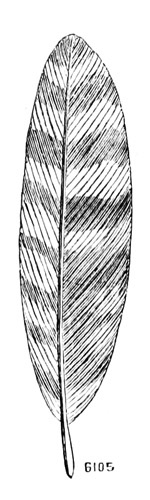
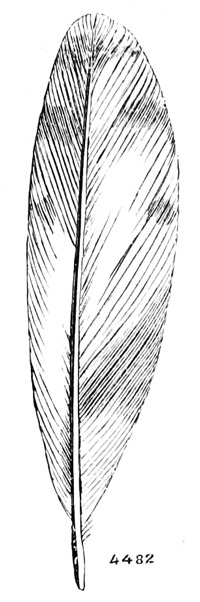
Outermost tail-feather of Picus scalaris. 6105 Outermost tail-feather of Picus nuttalli. 4482
Habits. This species belongs to our southern and southwestern fauna, entering our borders from Mexico, occurring from the valley of the Rio Grande to Southeastern California, and the slopes of the Rocky Mountains south of the 35th parallel. It is found throughout Mexico to Yucatan and Guatemala.
Dr. Samuel Cabot obtained a single specimen of this bird at Yucatan, which he described under the name of P. parvus, in the Boston Journal of Natural History, V, p. 92. It was procured early in December, 1841, in the neighborhood of Ticul, Yucatan. Dr. Kennerly considered it a not uncommon species in the vicinity of Boca Grande; especially wherever there were large trees. The same naturalist, in his Report on the birds of Lieutenant Whipple’s expedition, states that he very often saw this bird near San Antonio, Texas, as well as during the march several hundred miles west of that place, but that, after leaving the Rio Grande, he did not meet with it until he reached the head-waters of Bill Williams Fork. From thence to the Great Colorado River he saw it frequently, wherever there was any timber; but it was very shy, alighting on the tops of the leafless cotton-wood trees, and keeping a vigilant lookout.
Dr. Heermann, in his Report on the birds of Lieutenant J. G. Parke’s expedition, states that he observed this Woodpecker in the southernmost portion of California, and found it more and more abundant as he advanced towards Texas, where it was quite common. The same naturalist, in his Report on the birds of Lieutenant Williamson’s expedition, remarks that he procured this bird first at Vallicita, but found it abounding in the woods about Fort Yuma. He considered the species as new to the California fauna, though frequently seen in Texas, several of the expeditions having collected it.
Dr. Woodhouse, in his Report on the birds of Sitgreaves’s expedition to the Zuñi and the Colorado speaks of finding this beautiful little Woodpecker abundant in Texas, east of the Pecos River. During his stay in San Antonio and its vicinity, he became quite familiar with it. It was to be seen, at all times, flying from tree to tree, and lighting on the trunk of the mesquites (Algarobia), closely searching for its insect-food. In its habits and notes, he states, it much resembles the common Hairy Woodpecker. Dr. Woodhouse elsewhere remarks that he did not meet with this bird west of the Rio San Pedro, in Texas. In regard to its breeding-habits, so far as I am aware, they are inferred rather than known. It is quite probable they are not unlike those of the Picus pubescens, which it so closely resembles. The eggs in the collection of the Smithsonian were obtained with the collections of the late Dr. Berlandier of Matamoras, in the province of Tamaulipas, Mexico.
Dr. Cooper states that this Woodpecker is abundant in the Colorado Valley, and that they are sometimes seen on the bushes covering the neighboring mountains. In habits he regards them the exact counterpart of P. nuttalli, to which they are allied.
Mr. Dresser found them resident and very common throughout all Texas and Northeastern Mexico. It breeds abundantly about San Antonio, boring into any tree it finds most suitable for its purposes.
Dr. Coues regards Fort Whipple as about the northern limit of this species in Arizona. It is not very common, is only a summer resident, and breeds sparingly there. Farther south, throughout the Territory, and in the Colorado Valley, he found it abundant. It does not cross the Colorado Desert into California, and is there replaced by P. nuttalli. It extends south into Central America. A bird shot by Dr. Coues, June 5, appeared to be incubating; young birds were taken just fledged July 10. The nest was in the top of a live-oak tree. Malherbe, who speaks of this Woodpecker as exclusively Mexican, states that he has been informed that it is abundant in that country, where it may be seen at all times, climbing over the trunks and branches of trees. It is said to be very familiar and unwary, living commonly in gardens and orchards through the greater part of the year, and many of them nesting there, though in regard to their manner of nesting he has no information.
The egg of this Woodpecker in shape is most similar to the P. villosus, being of an oblong-oval. It is larger than the pubescens, and not of so clear a white color. It measures exactly one inch in length by .75 of an inch in breadth.
Picus scalaris, var. lucasanus, Xantus.
THE CAPE WOODPECKER.
Picus lucasanus, Xantus, Pr. A. N. S. 1859, 298, 302.—Malherbe, Mon. Picidæ, I, 166.—Cassin, Pr. A. N. S. 1863, 195.—Cooper, Orn. Cal. 1, 1870, 381.
Sp. Char. General appearance that of Picus nuttalli and scalaris. Bill stout, as long as or longer than the head. Above black, banded transversely with white on the back and scapulars to the nape, the white narrower band, the rump and inner tail-feathers entirely black; quills with a row of white spots on each web; the outer square, the inner rounded, these spots on the tertials becoming transversely quadrangular. Beneath brownish-white, with rounded black spots on the sides of the breast, passing behind on the flanks and under tail-coverts into transverse bars. Greater inner wing-coverts transversely barred. Outer two tail-feathers white, with one, sometimes two terminal bars, next to which are one or two bars on the inner web only; third feather black, the outer web mostly white, with traces of a terminal black bar; sometimes there is a greater predominance of black on the inner web. Two white stripes on side of head, one starting above, the other below the eye, with a tendency to meet behind and form a whitish collar on the nape. Male with the entire top of the head streaked with red, becoming more conspicuous behind; each red streak with a white spot at base. Feathers covering the nostrils smoky-brown. Length, 7.15; extent, 12.15; wing, 4.00; bill above, 1.00; middle toe and claw, .80; tarsus, .76.
Hab. Cape St. Lucas.
Of the distinctness of this bird as a species from P. nuttalli and scalaris I had at one time no doubt; but the discovery that the otherwise typical scalaris from Mazatlan and Western Mexico generally have the same markings on the tail has induced me to consider it as a kind of connecting link. I have, however, thought it best to give a detailed description for comparison. Of about the same size with nuttalli, the bill and feet are much larger. The legs, indeed, are nearly, if not quite, as large as those of male P. villosus from Pennsylvania; the bill, however, is somewhat less. The relations to P. scalaris are seen in the dorsal bands extending to the nape, the smoky-brown feathers of the nostrils, the red on the whole top of head (scattering anteriorly), the brownish shade beneath, the width of the white cheek-bands, etc. On the other hand, it has the black bands of the back rather wider than the white, as in nuttalli, and the white outer tail-feathers even less banded with black. The two outer are entirely white, with one terminal black bar; one or two spots on the outer web; and two or three bands on the inner, with a sub-basal patch on the inner web, even smaller than in nuttalli. It is rarely that even two continuous transverse bands can be seen to cross both webs of the tail. The bill and feet are much larger.
The following measurements taken from the largest specimens before us of Dyctiopicus, and one of P. villosus, will illustrate what has been said of the size of bill and feet of P. lucasanus.
P. villosus. P. lucasanus. P. nuttalli. P. scalaris.
884 ♂ ♂ 12939 ♂ 4482 ♂ 6105
Bill from forehead, 1.26 1.10 .90 .99
Tarsus, .76 .76 .70 .68
Middle toe and claw, .87 .84 .75 .65
Claw alone, .39 .34 .32 .31
Outer hind toe and claw, .95 .84 .79 .80
Claw alone, .40 .32 .31 .31
Habits. Nothing distinctive is known of the habits of this race.
Picus nuttalli, Gambel.
NUTTALL’S WOODPECKER.
Picus nuttalli, Gambel, Pr. A. N. Sc. I, April, 1843, 259 (Los Angeles, Cal.).—Baird, Birds N. Am. 1858, 93.—Sundevall, Consp. Pic. 19.—Malh. Mon. Pic. I, 100.—Cassin, P. A. N. S. 1863, 195.—Gray, Cat. 1868, 50.—Cooper, Orn. Cal. 1, 1870, 378. Picus scalaris, (Wagler) Gambel, J. A. N. Sc. Ph. 2d ser. I, Dec. 1847, 55, pl. ix, f. 2, 3 (not of Wagler). Picus wilsoni, Malherbe, Rev. Zoöl. 1849, 529.—Bonap. Consp. 1850, 138. Picus (Trichopicus) wilsoni, Bonap. Consp. Zyg. Aten. Ital. 1854, 8.
Sp. Char. Back black, banded transversely with white, but not on upper tail-coverts, nor as far forward as the neck. Greater and middle coverts and quills with spots or bands of white. Crown black, with white spots, sometimes wanting. On the nape a patch of white, behind this unbanded black. Occiput and nape crimson in the male. Tufts of feathers at the base of the bill white. Sides of the head black, with two white stripes, one above the eye and passing down on the side of the neck, the other below and cut off behind by black. Under parts smoky yellowish-white, spotted on the sides of the breast, and banded on flank and crissum with black. Predominant character of the outer tail-feather white, with two or three interrupted bands towards end; none at base. Length, about 7.00; wing, 4.50. Female with the top of the head uniform black, or sometimes spotted with white.
Hab. Coast region of California.
Third, fourth, and fifth quills nearly equal and longest; second intermediate between the seventh and eighth. General color above black, barred transversely with white on the back, rump, and flanks; the upper surface of tail and tail-coverts, and a broad patch on the upper part of the back about half an inch long, pure black. The white bands measure about .12 of an inch, the black about twice as much. The top of the head is black, each feather with a short streak of white; on the extreme occiput and the nape is a transverse patch of crimson, each feather having a white spot just below the crimson. The crimson patch is usually as far from the base of the bill above as this is from its point. The sides of the head may be described as black; a white stripe commences on the upper edge of the eye, and, passing backwards, margins the crimson, and extends on down the side of the neck to a patch of white, apparently connected with its fellow on the opposite side by white spots. Another narrow white stripe commences at the nostrils, (the bristles of which are whitish,) and passes as far as the occiput, where it ceases in the middle of the black of the cheeks. There are thus two white streaks on the side of the head bordering a black one passing through the eye. The under parts generally are white, with a dirty yellow tinge. The sides of the breast and body are faintly streaked with black; the flanks barred with the same. The under coverts are barred with black.
The three outer tail-feathers are yellowish-white, with two or three interrupted bars of black on the posterior or terminal fourth, and a concealed patch of black on the inner web near the end. Only the terminal band is continuous across, sometimes the others; always interrupted along the shaft, and even reduced to rounded spots of black on one or both webs. No distinct bands are visible on raising the crissum. The black patch on inner web of outer tail-feather near the base increases on the second and third, on the latter leaving the end only with an oblique white patch. The bands on the under surface have a tendency to a transversely cordate and interrupted, rather than a continuous, linear arrangement.
Young birds have the whole top of head red, as in P. scalaris, with or without white at the base of the red. The white nasal tufts and other characters will, however, distinguish them.
This bird, though widely different in appearance from scalaris, may nevertheless, without any violence, be regarded as but one extreme of a species of which the lighter examples of scalaris (bairdi) are the other, the transition towards nuttalli being through var. scalaris, var. graysoni, and var. lucasanus, each in that succession showing a nearer approach to the distinctive features of nuttalli. We have not seen any intermediate specimens, however. The pure white instead of smoky-brown nasal tufts, and their greater development, are the only characters which show a marked difference from the varieties of scalaris; but the other differences are nothing more than an extension of the black markings and restriction of the red in the male, the result of a melanistic tendency in the Pacific region.
Habits. This species was first discovered by Dr. Gambel near Los Angeles, Cal., and described by him in the Proceedings of the Philadelphia Academy. Afterwards, in his paper on the birds of California, published in the Academy’s Journal, mistaking it for the P. scalaris of Wagler, he furnished a fuller description of the bird and its habits, and gave with it illustrations of both sexes. So far as now known, it appears to be confined to the regions in California and Oregon west of the Coast Range, extending as far south as San Diego, representing, in its distribution on the Pacific, the P. borealis of the Atlantic States. One specimen in the Smithsonian collections was obtained on Umpqua River, in Oregon Territory; the others at Santa Clara, San Francisco, Petaluma, Bodega, and Yreka, in California. Dr. Woodhouse says, in his Report on the birds of the Zuñi and Colorado expedition, that he has only seen this bird in California, from which region he has examined numerous specimens. Dr. Heermann, in his Report on the birds of Lieutenant Williamson’s expedition, states that this Woodpecker is occasionally found in the mountains of Northern California, but that it is much more abundant in the valleys. Dr. Gambel found it abundant in California at all seasons. He describes it as having the usual habits of Woodpeckers, familiarly examining the fence-rails and orchard-trees for its insect-fare. He found it breeding at Santa Barbara, and on the 1st of May discovered a nest containing young in the dead stump of an oak, about fifteen feet from the ground. The hole for entrance was remarkably small, but inside appeared large and deep. The parents were constantly bringing insects and larvæ.
Dr. Cooper states that this Woodpecker is quite abundant towards the coast of California, and among the foothills west of the Sierra Nevada. It frequents the oaks and the smaller trees almost exclusively, avoiding the coniferous forests. It is very industrious, and not easily frightened, when engaged in hammering on the bark of trees allowing a very near approach. At other times, when pursued, it becomes more wary and suspicious. April 20, 1862, Dr. Cooper discovered a nest of this bird near San Diego. It was in a rotten stump, and was only about four feet from the ground. He captured the female on her nest, which contained five eggs of a pure pearly whiteness.
These birds are said to remain throughout the year in the valleys, and to migrate very little, if at all. Dr. Cooper has not observed it west of the Coast Range, except near Santa Barbara, nor has he seen any around gardens or orchards. None have been observed north or east of the State. East of the mountains it is replaced by the scalaris.
Mr. Xantus mentions finding a nest containing two eggs in a hole in the Cereus giganteus, about fifteen feet from the ground. The excavation made by the bird was about a foot and a half deep and six inches wide.
This Woodpecker Mr. Ridgway saw only in the Sacramento Valley, where, in June, it appeared to be a common species among the oaks of the plains. He did not learn anything of its habits, but describes its notes as very peculiar, the usual one being a prolonged querulous rattling call, unlike that of any other bird known to him.
Subgenus PHRENOPICUS, Bonap.
Phrenopicus, Bonap. Consp. Vol. Zygod. Ateneo Ital. 1854. (Type, Picus borealis, Vieill.)
Phrenopipo, Cab. & Hein. Mus. Hein. 1863, 70. Same type.
This subgenus is closely related in external form to the preceding, differing in rather longer and more pointed wings and tail, the latter especially, and a very small, short bill. The first quill (excluding the spurious one) is considerably longer than the sixth, not shorter. The tail-feathers are much attenuated at end. The most marked differences in coloration of the type species, P. borealis, consists in the absence of the post-ocular black patch, leaving the whole auricular region white, and in the restriction of the red to a very narrow line on each side, usually concealed.