Family FRINGILLIDÆ.—The Finches. (Continued.) (continued 4)
Reading edition
Hab. More southern portions of United States to the Missouri. Probably along valley of Rio Grande to Rocky Mountains.
The bill of this species is very large, and shaped much as in Hedymeles ludovicianus. The central feathers of the crest of the crown are longer than the lateral; they spring from about the middle of the crown, and extend back about an inch and a half from the base of the bill. The wings are much rounded, the fourth longest, the second equal to the seventh, the first as long as the secondaries. The tail is long, truncate at the end, but graduated on the sides; the feathers are broad to the end, truncated obliquely at the end.
Most North American specimens we have seen have the feathers of the back edged with ashy; the more northern the less brightly colored, and larger. Mexican skins (var. coccineus) are deeper colored and without the olivaceous. In all specimens from eastern North America the frontal black is very distinct.
Specimens from the Eastern Province of United States, including Florida and the Bermudas, are all alike in possessing those features distinguishing the restricted var. virginianus from the races of Mexico, namely, the wide black frontal band, and distinct gray edges to dorsal feathers, with small bill. Specimens from Florida are scarcely smaller, and are not more deeply colored than some examples from Southern Illinois. Rio Grande skins, however, are slightly less in size, though identical in other respects.
Habits. The Cardinal Grosbeak, the Redbird of the Southern States, is one of our few birds that present the double attraction of a brilliant and showy plumage with more than usual powers of song. In New England and the more northern States it is chiefly known by its reputation as a cage-bird, both its bright plumage and its sweet song giving it a high value. It is a very rare and only an accidental visitor of Massachusetts, though a pair was once known to spend the summer and to rear its brood in the Botanical Gardens of Harvard College in Cambridge. It is by no means a common bird even in Pennsylvania. In all the Southern States, from Virginia to Mexico, it is a well-known favorite, frequenting gardens and plantations, and even breeding within the limits of the larger towns and cities. A single specimen of this bird was obtained near Dueñas, Guatemala, by Mr. Salvin.
The song of this Grosbeak is diversified, pleasant, and mellow, delivered with energy and ease, and renewed incessantly until its frequent repetitions somewhat diminish its charms. Its peculiar whistle is not only loud and clear, resembling the finest notes of the flageolet, but is so sweet and so varied that by some writers it has been considered equal even to the notes of the far-famed Nightingale of Europe. It is, however, very far from being among our best singers; yet, as it is known to remain in full song more than two thirds of the year, and while thus musical to be constant and liberal in the utterance of its sweet notes, it is entitled to a conspicuous place among our singing birds.
In its cage life the Cardinal soon becomes contented and tame, and will live many years in confinement. Wilson mentions one instance in which a Redbird was kept twenty-one years. They sing nearly throughout the year, or from January to October. In the extreme Southern States they are more or less resident, and some may be found all the year round. There is another remarkable peculiarity in this species, and one very rarely to be met with among birds, which is that the female Cardinal Grosbeak is an excellent singer, and her notes are very nearly as sweet and as good as those of her mate.
This species has been traced as far to the west in its distribution as the base of the Rocky Mountains, and into Mexico at the southwest. In Mexico it is also replaced by a very closely allied variety, and at Cape St. Lucas by still another. It is given by Mr. Lawrence among the birds occurring near New York City. He has occasionally met with it in New Jersey and at Staten Island, and, in one instance, on New York Island, when his attention was attracted to it by the loudness of its song.
It is given by Mr. Dresser as common throughout the whole of Texas during the summer, and almost throughout the year, excepting only where the P. sinuata is found. At Matamoras it was very common, and may be seen caged in almost every Mexican hut. He found it breeding in great abundance about San Antonio in April and May.
Mr. Cassin states that the Cardinal Bird is also known by the name of Virginia Nightingale. He adds that it inhabits, for the greater part, low and damp woods in which there is a profuse undergrowth of bushes, and is particularly partial to the vicinity of watercourses. The male bird is rather shy and careful of exposing himself.
Wilson mentions that in the lower parts of the Southern States, in the neighborhood of settlements, he found them more numerous than elsewhere. Their clear and lively notes, even in the months of January and February, were, at that season, almost the only music. Along the roadsides and fences he found them hovering in small groups, associated with Snowbirds and various kinds of Sparrows. Even in Pennsylvania they frequent the borders of creeks and rivulets during the whole year, in sheltered hollows, covered with holly, laurel, and other evergreens. They are very fond of Indian corn, a grain that is their favorite food. They are also said to feed on various kinds of fruit.
The males of this species, during the breeding season, are described as very pugnacious, and when confined together in the same cage they fight violently. The male bird has even been known to destroy its mate. In Florida Mr. Audubon found these birds mated by the 8th of February. The nest is built in bushes, among briers, or in low trees, and in various situations, the middle of a field, near a fence, or in the interior of a thicket, and usually not far from running water. It has even been placed in the garden close to the planter’s house. It is loosely built of dry leaves and twigs, with a large proportion of dry grasses and strips of the bark of grapevines. Within, it is finished and lined with finer stems of grasses wrought into a circular form. There are usually two, and in the more Southern States three, broods in a season.
Mr. Audubon adds that they are easily raised from the nest, and have been known to breed in confinement.
The eggs of this species are of an oblong-oval shape, with but little difference at either end. Their ground-color appears to be white, but is generally so thickly marked with spots of ashy-brown and faint lavender tints as to permit but little of its ground to be seen. The eggs vary greatly in size, ranging from 1.10 inches to .98 of an inch in length, and from .80 to .78 in breadth.
Cardinalis virginianus, var. igneus, Baird.
CAPE CARDINAL.
Cardinalis igneus, Baird, Pr. Ac. Sc. Phila. 1859, 305 (Cape St. Lucas).—Elliot, Illust. N. Am. Birds, I, xvi.—Cooper, Orn. Cal. 1, 238. Cardinalis virginianus, Finsch, Abh. Nat. Brem. 1870, 339.
Sp. Char. Resembling virginianus, having, like it, the distinct grayish edges to feathers of the dorsal region. Red lighter, however, and the top of head, including crest, nearly pure vermilion, instead of brownish-red. Black of the lores not passing across the forehead, reaching only to the nostril. Wing, 4.00; tail, 5.00; culmen, .83; depth of bill, .66; breadth of upper mandible, .38. (No. 49,757 ♂, Camp Grant, 60 miles east of Tucson, Arizona).
Female distinguishable from that of virginianus only by more swollen bill, and more restricted dusky around base of bill. Young: bill deep black.
Hab. Cape St. Lucas; Camp Grant, Arizona; Tres Marias Islands (off coast of Mexico, latitude between 21° and 22° north). Probably Western Mexico, from Sonora south to latitude of about 20°.
In the features pointed out above, all specimens from Arizona and Tres Marias, and of an exceedingly large series collected at Cape St. Lucas, differ from those of other regions.
No specimens are in the collection from Western Mexico as far south as Colima, but birds from this region will, without doubt, be found referrible to the present race.
Habits. There appears to be nothing in the habits of this form of Cardinal, as far as known, to distinguish it from the Virginia bird; the nest and eggs, too, being almost identical. The latter average about one inch in length, and .80 in breadth. Their ground-color is white, with a bluish tint. Their markings are larger, and more of a rusty than an ashy brown, and the purple spots are fewer and less marked than in C. virginianus.
The memoranda of Mr. John Xantus show that in one instance a nest of this bird, containing two eggs, was found in a mimosa bush four feet from the ground; another nest, with one egg, in a like situation; a third, containing three eggs, was about three feet from the ground; a fourth, with two eggs, was also found in a mimosa, but only a few inches above the ground.
Genus PIPILO, Vieillot.
Pipilo, Vieillot, Analyse, 1816 (Agassiz). (Type, Fringilla erythrophthalma, Linn.)
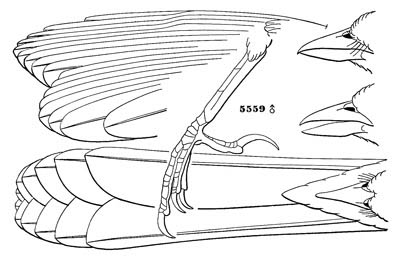
Pipilo fuscus. 5559 ♂
Gen. Char. Bill rather stout; the culmen gently curved, the gonys nearly straight; the commissure gently concave, with a decided notch near the end; the lower jaw not so deep as the upper; not as wide as the gonys is long, but wider than the base of the upper mandible. Feet large, the tarsus as long as or a little longer than the middle toe; the outer lateral toe a little the longer, and reaching a little beyond the base of the middle claw. The hind claw about equal to its toe; the two together about equal to the outer toe. Claws all stout, compressed, and moderately curved; in some western specimens the claws much larger. Wings reaching about to the end of the upper tail-coverts; short and rounded, though the primaries are considerably longer than the nearly equal secondaries and tertials; the outer four quills are graduated, the first considerably shorter than the second, and about as long as the secondaries. Tail considerably longer than the wings, moderately graduated externally; the feathers rather broad, most rounded off on the inner webs at the end.
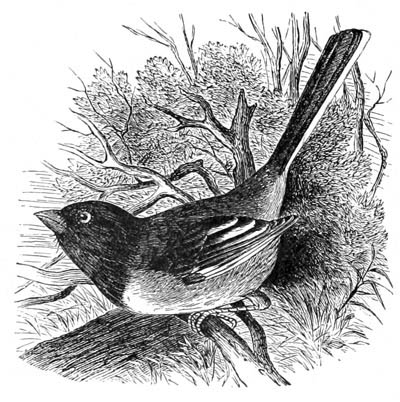
Pipilo erythrophthalmus.
The colors vary; the upper parts are generally uniform black or brown, sometimes olive; the under white or brown; no central streaks on the feathers. The hood sometimes differently colored.
In the large number of species or races included in this genus by authors, there are certain differences of form, such as varying graduation of tail, length of claw, etc., but scarcely sufficient to warrant its further subdivision. In coloration, however, we find several different styles, which furnish a convenient method of arrangement into groups.
Few genera in birds exhibit such constancy in trifling variations of form and color, and as these are closely connected with geographical distribution, it seems reasonable to reduce many of the so-called species to a lower rank. In the following synopsis, we arrange the whole of North American and Mexican Pipilos into four sections, with their more positive species, and in the subsequent discussion of the sections separately we shall give what appear to be the varieties.
Species.
A. Sides and lower tail-coverts rufous, in sharp contrast with the clear white of the abdomen. Tail-feathers with whitish patch on end of inner webs.
a. Head and neck black, sharply defined against the white of breast. Rump olive or blackish.
Black or dusky olive above.
1. P. maculatus. White spots on tips of both rows of wing-coverts, and on scapulars. No white patch on base of primaries. Hab. Mexico, and United States west of the Missouri. (Five races.)
Bright olive-green above.
3. P. macronyx.[18] Scapulars and wing-coverts (both rows) with distinct greenish-white spots on tips of outer webs.
4. P. chlorosoma.[19] Scapulars and wing-coverts without trace of white spots. Hab. Table-lands of Mexico. (Perhaps these are two races of one species, macronyx.)
b. Head and neck ashy, paler on jugulum, where the color fades gradually into the white of breast. Rump and upper tail-coverts bright rufous.
B. Sides ashy or tinged with ochraceous; lower tail-coverts ochraceous, not sharply contrasted with white on the abdomen, or else the abdomen concolor with the side. Head never black, and upper parts without light markings (except the wing in fuscus var. albicollis).
a. Wings and tail olive-green.
6. P. chlorurus. Whole pileum (except in young) deep rufous, sharply defined. Whole throat pure white, immaculate, and sharply defined against the surrounding deep ash; a maxillary and a short supraloral stripe of white. Anterior parts of body streaked in young. Hab. Western Province of United States.
b. Wings and tail grayish-brown.
7. P. fuscus. A whitish or ochraceous patch covering the throat contrasting with the adjacent portions, and bounded by dusky specks. Lores and chin like the throat. Hab. Mexico, and United States west of Rocky Mountains. (Five races.)
8. P. aberti. Throat concolor with the adjacent portions, and without distinct spots. Lores and chin blackish. Hab. Colorado region of Middle Province, United States. (Only one form known.)
SECTION I.
Head black.
Pipilo erythrophthalmus.
After a careful study of the very large collection of Black-headed Pipilos (leaving for the present the consideration of those with olive-green bodies) in the Smithsonian Museum, we have come finally to the conclusion that all the species described as having the scapulars and wing-coverts spotted with white—as arcticus, oregonus, and megalonyx, and even including the differently colored P. maculatus of Mexico—are probably only geographical races of one species, representing in the trans-Missouri region the P. erythrophthalmus of the eastern division of the continent. It is true that specimens may be selected of the four races capable of accurate definition, but the transition from one to the other is so gradual that a considerable percentage of the collection can scarcely be assigned satisfactorily; and even if this were possible, the differences after all are only such as are caused by a slight change in the proportion of black, and the varying development of feet and wings.
Taking maculatus as it occurs in the central portion of its wide field of distribution, with wing-spots of average size, we find these spots slightly bordered, or at least often, with black, and the primaries edged externally with white only towards the end. The exterior web of lateral tail-feather is edged mostly with white; the terminal white patches of outer feather about an inch long; that of inner web usually separated from the outer by a black shaft-streak. In more northern specimens the legs are more dusky than usual. The tail is variable, but longer generally than in the other races. The claws are enormously large in many, but not in all specimens, varying considerably; and the fourth primary is usually longest, the first equal to or shorter than the secondaries. This is the race described as P. megalonyx, and characterizes the Middle Province, between the Sierra Nevada of California and the eastern Rocky Mountains, or the great interior basin of the continent; it occurs also near the head of the Rio Grande.
On the Pacific slope of California, as we proceed westward, we find a change in the species, the divergence increasing still more as we proceed northward, until in Oregon and Washington the extreme of range and alteration is seen in P. oregonus. Here the claws are much smaller, the white markings restricted in extent so as to form quite small spots bordered externally by black; the spots on the inner webs of tail much smaller, and even bordered along the shaft with black, and the outer web of the lateral entirely black, or with only a faint white edging. The concealed white of the head and neck has disappeared also.
Proceeding eastward, on the other hand, from our starting-point, we find another race, in P. arcticus, occupying the western slope of the Missouri Valley and the basin of the Saskatchewan, in which, on the contrary, the white increases in quantity, and more and more to its eastern limit. The black borders of the wing-patches disappear, leaving them white externally; and decided white edgings are seen for the first time at the bases of primaries, as well as near their ends, the two sometimes confluent. The terminal tail-patches are larger, the outer web of the exterior feather is entirely white except toward the very base, and we thus have the opposite extreme to P. oregonus. The wings are longer; the third primary longest; the first usually longer than the secondaries or the ninth quill.
Finally, proceeding southward along the table-lands of Mexico, and especially on their western slope, we find P. maculatus (the first described of all) colored much like the females of the more northern races, except that the head and neck are black, in decided contrast to the more olivaceous back. The wing formula and pattern of markings are much like megalonyx, the claws more like arcticus. Even in specimens of megalonyx, from the southern portion of its area of distribution, we find a tendency to an ashy or brownish tinge on the rump, extending more or less along the back; few, if any indeed, being uniformly black.
As, however, a general expression can be given to the variations referred to, and as they have an important geographical relationship, besides a general diagnosis, we give their characters and distribution in detail.
The general impression we derive from a study of the series is that the amount of white on the wing and elsewhere decreases from the Missouri River to the Pacific, exhibiting its minimum in Oregon and Washington, precisely as in the small black Woodpeckers; that in the Great Basin the size of the claws and the length of tail increases considerably; that the northern forms are entirely black, and the more southern brown or olivaceous, except on the head.
The following synopsis will be found to express the principal characteristics of the species and their varieties, premising that P. arcticus is more distinctly definable than any of the others. We add the character of the green-bodied Mexican species to complete the series.
Synopsis of Varieties.
I. P. erythrophthalmus.
2. Wing, 2.90; tail, 3.75. Outer tail-feather with only terminal fourth of inner web white. Iris white. Hab. Florida (resident) … var. alleni.
II. P. maculatus.
A. Interscapulars with white streaks.
a. Outer webs of primaries not edged with white at the base.
1. Above olive-brown, the head and neck, only, continuous black; back streaked with black. White spots on wing-coverts not bordered externally with black. Wing, 3.25; tail, 4.00; hind claw, .44. Hab. Table-lands of Mexico … var. maculatus.[21]
2. Above black, tinged with olive on rump, and sometimes on the nape. White spots as in last. Inner web of lateral tail-feathers with terminal white spot more than one inch long; outer web broadly edged with white. Wing, 3.45; tail, 4.10; hind claw, .55. Female less deep black than male, with a general slaty-olive cast. Hab. Middle Province of United States, from Fort Tejon, California, to Upper Rio Grande, and from Fort Crook to Fort Bridger … var. megalonyx.
3. Above almost wholly black, with scarcely any olive tinge, and this only on rump. White spots restricted, and with a distinct black external border. White terminal spot on inner web of lateral tail-feather less than one inch long; outer web almost wholly black. Wing, 3.40; tail, 3.90; hind claw, .39. Female deep umber-brown, instead of black. Hab. Pacific Province of United States, south to San Francisco; West Humboldt Mountains … var. oregonus.
b. Outer webs of primaries distinctly edged with white at base.
4. Above black, except on rump, which is tinged with olivaceous. White spots very large, without black border. Inner web of lateral tail-feather with terminal half white, the outer web almost wholly white. Wing, 3.50; tail, 3.90; hind claw, .39. Female umber-brown, replacing black. Hab. Plains between Rocky Mountains and the Missouri; Saskatchewan Basin … var. arcticus.
B. Interscapulars without white streaks.
5. Above dusky olive; white spots on scapulars and wing-coverts small, and without black edge. Tail-patches very restricted (outer only .40 long). No white on primaries. Wing, 2.85; tail, 3.10. Female scarcely different. Hab. Socorro Island, off west coast of Mexico … var. carmani.[22]
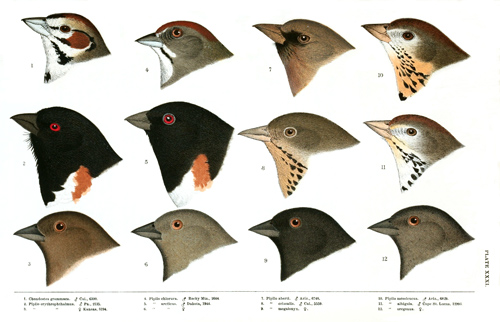
PLATE XXXI.
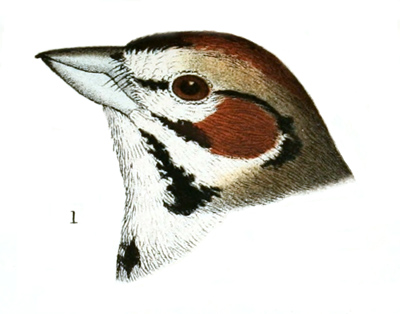
1. Chondestes grammaca. ♂ Cal., 6300.
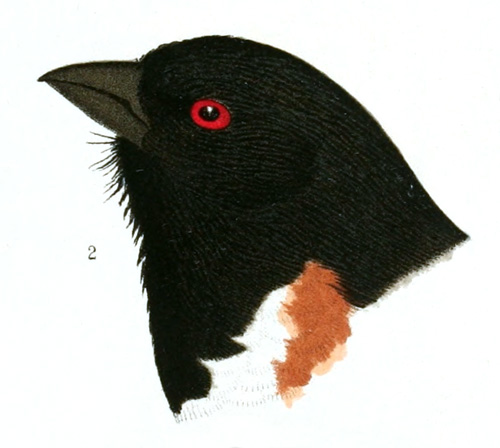
2. Pipilo erythrophthalmus. ♂ Pa., 2135.
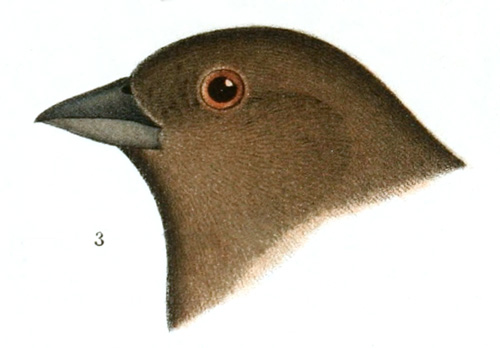
3. Pipilo erythrophthalmus. ♀ Kansas, 8194.
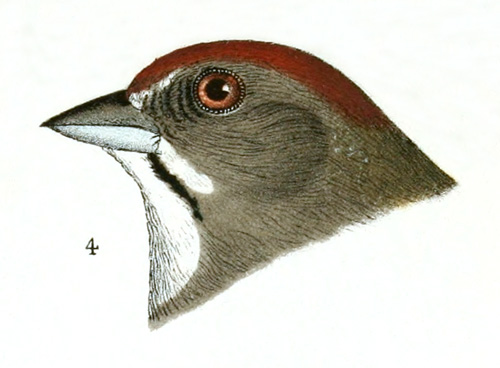
4. Pipilo chlorura. ♂ Rocky Mts., 2644.
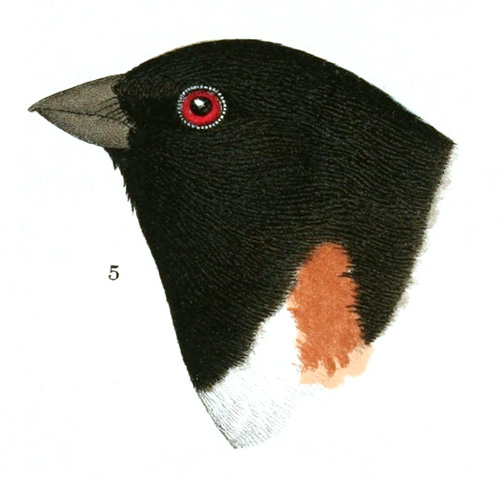
5. Pipilo arcticus. ♂ Dakota, 1944.
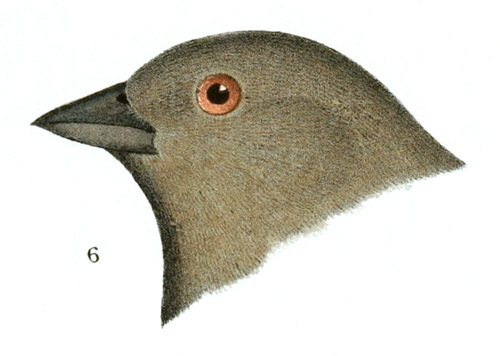
6. Pipilo arcticus. ♀.
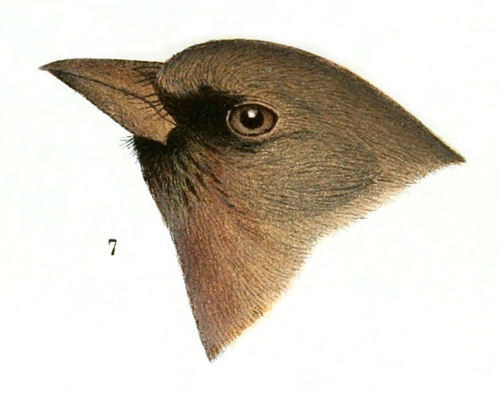
7. Pipilo aberti. ♂ Ariz., 6748.
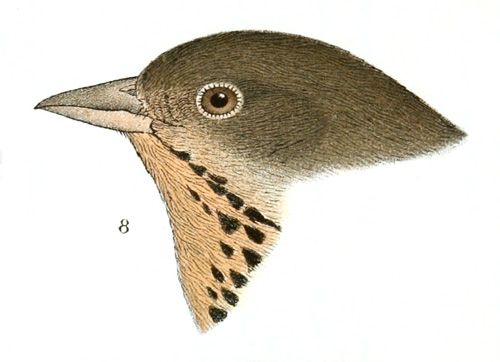
8. Pipilo crissalis. ♂ Cal., 5559.
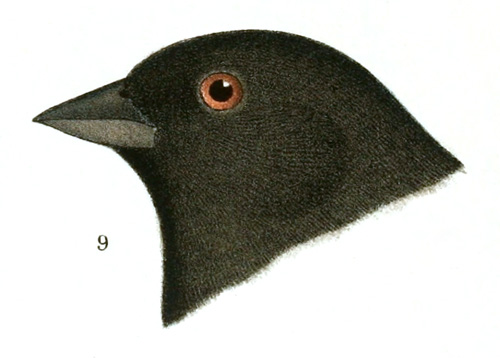
9. Pipilo megalonyx. ♀.
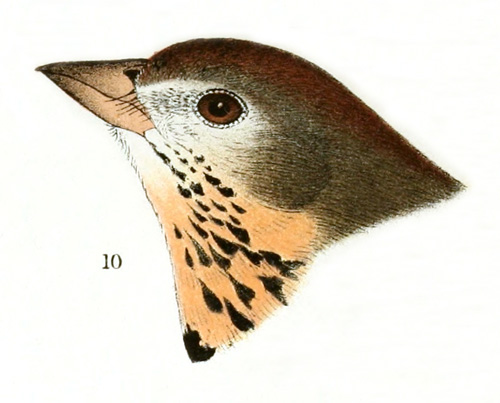
10. Pipilo mesoleucus. ♂ Ariz., 6829.
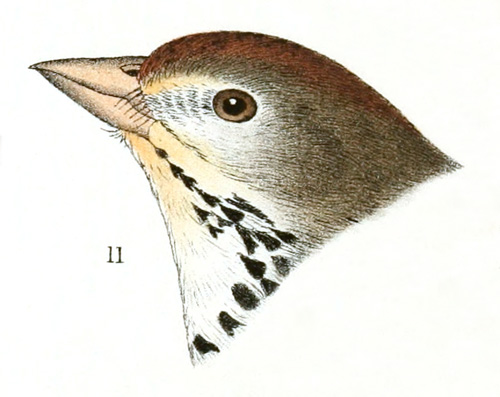
11. Pipilo albigula. ♂ Cape St. Lucas, 12993.
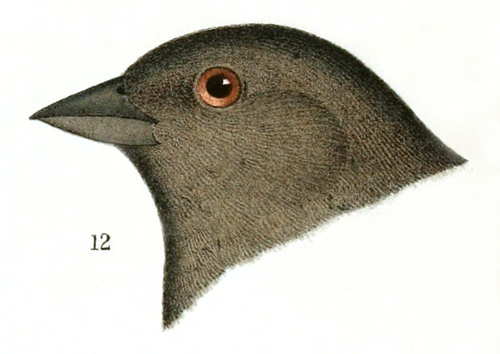
12. Pipilo oregonus. ♀.
Pipilo erythrophthalmus, Vieillot.
GROUND ROBIN; TOWHEE; CHEWINK.
Fringilla erythrophthalma, Linn. Syst. Nat. I, 1766, 318.—Aud. Orn. Biog. I, 1832, 151; V, 511, pl. xxix. Emberiza erythrophthalma, Gm. Syst. Nat. I, 1788, 874.—Wilson, Am. Orn. VI, 1812, 90, pl. liii. Pipilo erythrophthalmus, Vieill. Gal. Ois. I, 1824, 109, pl. lxxx.—Bon. List, 1838.—Ib. Conspectus, 1850, 487.—Aud. Syn. 1839, 124.—Ib. Birds Am. III, 1841, 167, pl. cxcv.—Baird, Birds N. Am. 1858, 512.—Samuels, 333. Pipilo ater, Vieill. Nouv. Dict. XXXIV, 1819, 292. Towhee Bird, Catesby, Car. I, 34. Towhee Bunting, Latham, Syn. II, I, 1783, 199.—Pennant, II, 1785, 359.
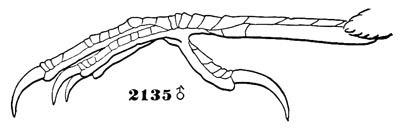
2135 ♂
Sp. Char. Upper parts generally, head and neck all round, and upper part of the breast, glossy black, abruptly defined against the pure white which extends to the anus, but is bounded on the sides and under the wings by light chestnut, which is sometimes streaked externally with black. Feathers of throat white in the middle. Under coverts similar to sides, but paler. Edges of outer six primaries with white at the base and on the middle of the outer web; inner two tertiaries also edged externally with white. Tail-feathers black; outer web of the first, with the ends of the first to the third, white, decreasing from the exterior one. Outermost quill usually shorter than ninth, or even than secondaries; fourth quill longest, fifth scarcely shorter. Iris red; said to be sometimes paler, or even white, in winter. Length, 8.75; wing, 3.75; tail, 4.10. Bill black, legs flesh-color. Female with the black replaced by a rather rufous brown.
Hab. Eastern United States to the Missouri River; Florida (in winter).
The tail-feathers are only moderately graduated on the sides; the outer about .40 of an inch shorter than the middle. The outer tail-feather has the terminal half white, the outline transverse; the white of the second is about half as long as that of the first; of the third half that of the second. The chestnut of the sides reaches forward to the black of the neck, and is visible when the wings are closed.
A young bird has the prevailing color reddish-olive above, spotted with lighter; beneath brownish-white, streaked thickly with brown.
The description above given may be taken as representing the average of the species in the Northern and Middle States. Most specimens from the Mississippi Valley differ in having the two white patches on the primaries confluent; but this feature is not sufficiently constant to make it worthy of more than passing notice, for occasionally western specimens have the white spaces separated, as in the majority of eastern examples, while among the latter there may, now and then, be found individuals scarcely distinguishable from the average of western ones.
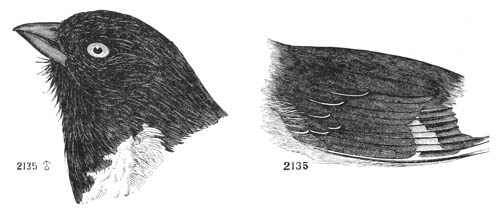
Pipilo erythrophthalmus. 2135 ♂
In Florida, however, there is a local, resident race, quite different from these two northern styles, which are themselves not enough unlike to be considered separately. This Florida race differs in much smaller size, very restricted white on both wing and tail, and in having a yellowish-white instead of blood-red iris. Further remarks on this Florida race will be found under its proper heading (p. 708), as P. erythrophthalmus, var. alleni.
Specimens of erythrophthalmus, as restricted, from Louisiana, as is the case with most birds from the Lower Mississippi region, exhibit very intense colors compared with those from more northern portions, or even Atlantic coast specimens from the same latitude.
Habits. The Ground Robin, Towhee, Chewink, Charee, or Joreet, as it is variously called, has an extended distribution throughout the eastern United States, from Florida and Georgia on the southeast to the Selkirk Settlements on the northwest, and as far to the west as the edge of the Great Plains, where it is replaced by other closely allied races. It breeds almost wherever found, certainly in Georgia, and, I have no doubt, sparingly in Florida.
This bird was not observed in Texas by Mr. Dresser. It has been found in Western Maine, where it is given by Mr. Verrill as a summer visitant, and where it breeds, but is not common. It arrives there the first of May. It is not given by Mr. Boardman as occurring in Eastern Maine. In Massachusetts it is a very abundant summer visitant, arriving about the last of April, and leaving about the middle of October. It nests there the last of May, and begins to sit upon the eggs about the first of June. It is slightly gregarious just as it is preparing to leave, but at all other times is to be met with only in solitary pairs.
The Ground Robin is in many respects one of the most strongly characterized of our North American birds, exhibiting peculiarities in which all the members of this genus share to a very large degree. They frequent close and sheltered thickets, where they spend a large proportion of their time on the ground among the fallen leaves, scratching and searching for worms, larvæ, and insects. Though generally resident in retired localities, it is far from being a shy or timid bird. I have known it to show itself in a front yard, immediately under the windows of a dwelling and near the main street of the village, where for hours I witnessed its diligent labors in search of food. The spot was very shady, and unfrequented during the greater part of the day. It was not disturbed when the members of the family passed in or out.
The call-note of this bird is very peculiar, and is variously interpreted in different localities. It has always appeared to me that the Georgian jo-rēēt was at least as near to its real notes as tow-hēē. Its song consists of a few simple notes, which very few realize are those of this bird. In singing, the male is usually to be seen on the top of some low tree. These notes are uttered in a loud voice, and are not unmusical. Wilson says its song resembles that of the Yellow-Hammer of Europe, but is more varied and mellow. Nuttall speaks of its notes as simple, guttural, and monotonous, and of its voice as clear and sonorous. The song, which he speaks of as quaint and somewhat pensive, he describes as sounding like t’sh’d-wĭtee-tĕ-tĕ-tĕ-tĕ-tĕ.
Wilson says this bird is known in Pennsylvania as the “Swamp Robin.” If so, this is a misnomer. In New England it has no predilection for low or moist ground; and I have never found it in such situations. Its favorite haunts are dry uplands, near the edges of woods, or high tracts covered with a low brushwood, selecting for nesting-places the outer skirts of a wood, especially one of a southern aspect. The nest is sunk in a depression in the ground, the upper edges being usually just level with the ground. It is largely composed of dry leaves and coarse stems as a base, within which is built a firmer nest of dry bents well arranged, usually with no other lining. It is generally partially concealed by leaves or a tuft of grass, and is not easily discovered unless the female is seen about it.
Dr. Coues says these Buntings are chiefly spring and autumnal visitants near Washington, only a few breeding. They are very abundant from April 25 to May 10, and from the first to the third week of October, and are partially gregarious. Their migrations are made by day, and are usually in small companies in the fall, but singly in the spring. Wilson found them in the middle districts of Virginia, and from thence south to Florida, during the months of January, February, and March. Their usual food is obtained among the dry leaves, though they also feed on hard seeds and gravel. They are not known to commit any depredations upon harvests. They may be easily accustomed to confinement, and in a few days will become quite tame. When slightly wounded and captured, they at first make a sturdy resistance, and bite quite severely. They are much attached to their young, and when approached evince great anxiety, the female thrusting herself forward to divert attention by her outcries and her simulated lameness.
The eggs of this species are of a rounded-oval shape, and have a dull-white ground, spotted with dots and blotches of a wine-colored brown. These usually are larger than in the other species, and are mostly congregated about the larger end, and measure .98 of an inch in length by .80 in breadth.
Pipilo erythrophthalmus, var. alleni, Coues.
WHITE-EYED CHEWINK; FLORIDA CHEWINK.
Pipilo alleni, Coues, American Naturalist, V, Aug. 1871, 366.
Sp. Char. Similar to erythrophthalmus, but differing in the following respects: White spaces on wings and tail much restricted, those on inner webs of lateral tail-feathers only .50 to .75 long. Size very much smaller, except the bill, which is absolutely larger. Iris white.
♂. (55,267, Dummits’s Grove, Florida, March, 1869.) Length, 7.75; wing, 3.00; tail, 3.75; bill from nostril, .38; tarsus, .97.
♀. (55,271, same locality and date.) Wing, 3.00; tail, 3.50; bill from nostril, .37; tarsus, .91. White on primaries almost absent.
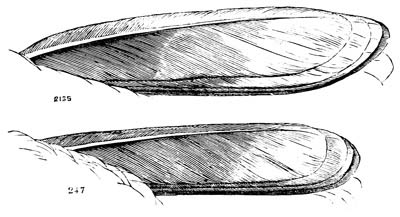
This interesting variety of Pipilo erythrophthalmus was found in Florida, in the spring of 1869, by Mr. C. J. Maynard, and probably represents the species as resident in that State. It is considerably smaller than the average (length, 7.75; extent, 10.00; wing, 3.00; tarsus, .95), and has very appreciably less white on the tail. The outer web of outer feather is only narrowly edged with white, instead of being entirely so to the shaft (except in one specimen), and the terminal white tip, confined to the inner web, is only from .50 to .75 of an inch long, instead of 1.25 to 1.75, or about the amount on the second feather of northern specimens, as shown in the accompanying figures. There is apparently a greater tendency to dusky streaks and specks in the rufous of the side of the breast or in the adjacent white. Resident specimens from Georgia are intermediate in size and color between the northern and Florida races.
The bill of Mr. Maynard’s specimen is about the size of that of more northern ones; the iris is described by him as pale yellowish-white, much lighter than usual.
Pipilo maculatus,[23] var. megalonyx, Baird.
LONG-CLAWED TOWHEE BUNTING.
Pipilo megalonyx, Baird, Birds N. Am. 1858, 515, pl. lxxiii.—Heerm. X, S, 51 (nest).—Cooper, Orn. Cal. I, 242.
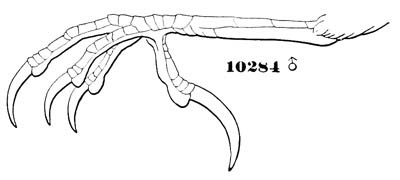
10284 ♂
Sp. Char. Similar to P. arcticus in amount of white on the wings and scapulars, though this frequently edged with black, but without basal white on outer web of primaries. Outer edge of outer web of external tail-feather white, sometimes confluent with that at tip of tail. Concealed white spots on feathers of side of neck. Claws enormously large, the hinder longer than its digit; the hind toe and claw reaching to the middle of the middle claw, which, with its toe, is as long as or longer than the tarsus. Inner lateral claw reaching nearly to the middle of middle claw. Length, 7.60; wing, 3.25; hind toe and claw, .90. Female with the deep black replaced by dusky slaty-olive.
Hab. Southern coast of California and across through valleys of Gila and Rio Grande; north through the Great Basin across from Fort Crook, California, to Fort Bridger, Wyoming.
This form constitutes so strongly marked a variety as to be worthy of particular description. The general appearance is that of P. arcticus, which it resembles in the amount of white spotting on the wings. This, however, does not usually involve the whole outer web at the end, but, as in oregonus, has a narrow border of black continued around the white terminally and sometimes externally. There is not quite so much of a terminal white blotch on the outer tail-feather, this being but little over an inch in length, and the outer web of the same feather is never entirely white, though always with an external white border, which sometimes is confluent with the terminal spot, but usually leaves a brown streak near the end never seen in arcticus, which also has the whole outer web white except at the base. From oregonus the species differs in the much greater amount of white on the wings and the less rounded character of the spots. Oregonus, too, has the whole outer web of external tail-feather black, and the terminal white spot of the inner web less than an inch in length. We have never seen in oregonus any concealed white spotting on the sides of the head.
The greatest difference between this race and the two others lies in the stout tarsi and enormously large claws, as described, both the lateral extending greatly beyond the base of the middle one, the hinder toe and claw nearly as long as the tarsus. The only North American passerine birds having any approach to this length of claw are those of the genus Passerella.
This great development of the claws is especially apparent in specimens from the Southern Sierra Nevada, the maximum being attained in the Fort Tejon examples; those from as far north as Carson City, Nev., however, are scarcely smaller. In most Rocky Mountain Pipilos, the claws are but little longer than in arcticus.
In this race the female is not noticeably different from the male, being of a merely less intense black,—not brown,—and conspicuously different as in arcticus and oregonus; there is, however, some variation among individuals in this respect, but none are ever so light as the average in the other races.
The young bird is dusky-brown above, with a slight rusty tinge, and obsolete streaks of blackish. White markings as in adult, but tinged with rusty. Throat and breast rusty-white, broadly streaked with dusky; sides only tinged with rufous.
Habits. According to Mr. Ridgway’s observations, the P. megalonyx replaces in the Rocky Mountain region and in the greater portion of the Great Basin the P. arcticus of the Plains, from their eastern slope eastward to the Missouri River, and the P. oregonus of the Northern Sierra Nevada and Pacific coast. It is most nearly related to the latter. He became familiar with the habits of this species near Salt Lake City, having already made like observations of the oregonus at Carson. A short acquaintance with the former, after a long familiarity with the latter, enabled him to note a decided difference in the notes of the two birds, yet in their external appearance they were hardly distinguishable, and he was at first surprised to find the same bird apparently uttering entirely different notes, the call-note of P. megalonyx being very similar to that of the common Catbird. The song of this species, he adds, has considerable resemblance in style to that of the eastern P. erythrophthalmus, and though lacking its musical character, is yet far superior to that of P. oregonus. This bird is also much less shy than the western one, and is, in fact, quite as unsuspicious as the eastern bird.
Nests, with eggs, were found on the ground, among the scrub-oaks of the hillsides, from about the 20th of May until the middle of June.
This species has been obtained on the southern coast of California, and through to the valleys of the Gila and the Rio Grande. In California it was obtained near San Francisco by Mr. Cutts and Mr. Hepburn; at Santa Clara by Dr. Cooper; at Monterey by Dr. Canfield; in the Sacramento Valley by Dr. Heermann; at San Diego by Dr. Hammond; at Fort Tejon by Mr. Xantus; at Saltillo, Mexico, by Lieutenant Couch; in New Mexico by Captain Pope; and at Fort Thorn by Dr. Henry.
Lieutenant Couch describes it as a shy, quiet bird, and as found in woody places.
Dr. Kennerly met with this bird at Pueblo Creek, New Mexico, January 22, 1854. It first attracted his attention early in the month of January, in the Aztec Mountains, along Pueblo Creek. There it was often met with, but generally singly. It inhabited the thickest bushes, and its motions were so constant and rapid, as it hopped from twig to twig, that they found it difficult to procure specimens. Its flight was rapid, and near the ground.
Dr. Cooper speaks of this species as a common and resident bird in all the lower districts of California, and to quite a considerable distance among the mountains. It was also found on the islands of Catalina and San Clemente, distant sixteen miles from the mainland. Though found in New Mexico, Dr. Cooper has met with none in the barren districts between the Coast Range and the Colorado, nor in the valley of the latter.
Their favorite residence is said to be in thickets and in oak groves, where they live mostly on the ground, scratching among the dead leaves in the concealment of the underbrush, and very rarely venturing far from such shelter. They never fly more than a few yards at a time, and only a few feet above the ground. In villages, where they are not molested, they soon become more familiar, take up their abodes in gardens, and build their nests in the vicinity of houses.
Dr. Cooper gives them credit for little musical power. Their song is said to be only a feeble monotonous trill, from the top of some low bush. When alarmed, they have a note something like the mew of a cat. On this account they are popularly known as Catbirds. He adds that the nest is made on the ground, under a thicket, and that it is constructed of dry leaves, stalks, and grass, mingled with fine roots. The eggs, four or five in number, are greenish-white, minutely speckled with reddish-brown, and measure one inch by .70.
Dr. Coues found this species a very abundant and resident species in Arizona. It was rather more numerous in the spring and in the fall than at other times. He found it shy and retiring, and inhabiting the thickest brush. Its call-note is said to be almost exactly like that of our eastern Catbird. He describes its song as a rather harsh and monotonous repetition of four or six syllables, something like that of the Euspiza americana. He found females with mature eggs in their ovaries as early as May 5.
A nest of this species, collected by Mr. Ridgway near Salt Lake City, May 26, was built on the ground, among scrub-oak brush. It is a very slight structure, composed almost entirely of coarse dry stems of grass, with a few bits of coarse inner bark, and with a base made up wholly with the latter material, and having a diameter of about four inches.
The eggs of this nest, four in number, have an average measurement of .95 of an inch in length by .73 in breadth. Their ground-color is crystalline-white, covered very generally with spots and small blotches of purplish and wine-colored brown, somewhat aggregated at the larger end.
Pipilo maculatus, var. oregonus, Bell.
OREGON GROUND ROBIN.
Pipilo oregonus, Bell, Ann. N. Y. Lyc. V, 1852, 6 (Oregon).—Bonap. Comptes Rendus, XXXVII, Dec. 1853, 922.—Ib. Notes Orn. Delattre, 1854, 22 (same as prec.).—Baird, Birds N. Am. 1858, 513.—Lord, Pr. R. A. Inst. IV, 64, 120 (British Col.).—Cooper & Suckley, 200.—Cooper, Orn. Cal. I, 241. Fringilla arctica, Aud. Orn. Biog. V, 1839, 49, pl. cccxciv. (not of Swainson). Pipilo arctica, Aud. Syn. 1839, 123.—Ib. Birds Am. III, 1841, 164, pl. cxciv.
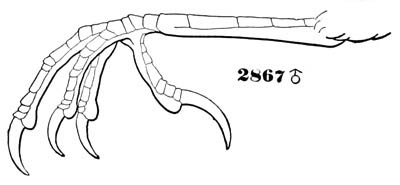
2867 ♂
Sp. Char. Upper surface generally, with the head and neck all round to the upper part of the breast, deep black; the rest of lower parts pure white, except the sides of the body and under tail-coverts, which are light chestnut-brown; the latter rather paler. The outer webs of scapulars (usually edged narrowly with black) and of the superincumbent feathers of the back, with a rounded white spot at the end of the outer webs of the greater and middle coverts; the outer edges of the innermost tertials white; no white at the base of the primaries. Outer web of the first tail-feather black, occasionally white on the extreme edge; the outer three with a white tip to the inner web. Outer quill shorter than ninth, or scarcely equalling the secondaries; fourth quill longest; fifth scarcely shorter. Length, 8.25; wing, 4.40; tail, 4.00. Female with the black replaced by a more brownish tinge. Claws much as in erythrophthalmus.
Hab. Coasts of Oregon and Washington Territories, south to San Francisco, California. Melting eastward and south into megalonyx. West Humboldt Mountains and Northern Sierra Nevada.
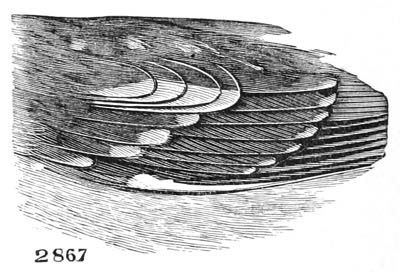
2867
Comparing this race with arcticus, we do not find much difference in the white of the scapular region, except that the white marks here, as elsewhere on the wing, are rounded, the extreme end of the outer web of the feather being black instead of running out acutely white to the very tip of the outer webs of the feathers. This gives rather less extension to the white. In fact, most of the white marks are edged externally with black, converting them into spots. There is no white whatever at the exposed base of the outer web of the second to fifth primaries, and there is only a trace of white near the end, instead of having a conspicuous white edging from base to near the tip.
The outer web of the outer tail-feather, instead of being entirely white for the exposed portion, is only very slightly edged with white; usually entirely black. The white at the end of the feathers is much more restricted, and extends only over the three outer feathers; usually not reaching to the shaft. The relations to var. megalonyx have been given under the latter head.
Habits. The Oregon Ground Robin, so far as known, has a restricted residence, the western portion of Oregon and Washington Territory during the summer, and in the more northern portions of California. Its occurrence in the latter State seems to have escaped the notice of Dr. Cooper, though he gives it conjecturally, having seen birds which he supposed to be of this species in the higher Sierra Nevada. In its habits and notes Dr. Cooper could observe no difference between this species and P. megalonyx, both having the complaining mew, from which they have obtained the name of Catbird on that coast.
Mr. J. K. Lord found a nest containing six eggs, which he supposed to belong to a bird of this species, at Fort Colville. It was built on the top of a stump, round which young shoots had grown like a fringe, completely hiding it from the sharpest eye. Mr. Hepburn met with it at Victoria.
Dr. Cooper, in his Report on the Birds of Washington Territory, states that the song of this species in spring, as it sits on a low bush enjoying the sunshine, is like the final trill of the Redwing, or the lisping faint notes of the Cowbird. It is a constant resident of the Territory, but only frequents the edge of the coast in winter. He also mentions finding it about thirty miles south of San Francisco in autumn. Dr. Suckley met with it west of the Cascade Mountains.
In very many respects, in the opinion of Mr. Ridgway, the Oregon Ground Robin very closely resembles the common and familiar eastern “Chewink.” There is noticeable in this western representative a peculiar manner of flight, and a predilection for bushy places, closely corresponding with those of the eastern bird. It differs, in the most marked manner, however, in its extreme shyness, and in the total absence of the agreeable and striking notes of the Towhee. The notes of this bird are, he states, of the rudest description, and instead of being familiar and unsuspicious, it is one of the shyest and most difficult to approach of any of the western birds.
He found it quite plentiful about Sacramento, where it inhabits the thickets in company with the western Chat. After crossing the Sierra Nevada it was found more abundant still in the chaparrals of the sheltered ravines on the eastern base of those mountains, as well as in the shrubbery of the river valleys. During the winter it forsakes the former for the latter localities. Eastward this species was found as far as the West Humboldt Mountains, where typical examples were obtained.
At Carson City, early in March, his attention was attracted by the peculiar notes of this Pipilo; the bird was sitting on a high rock above the thick chaparral of the hillside, and sharply defined against the sky. It was readily distinguishable by the black of its head and breast, in sharp contrast with the pure white of its lower parts. Every few moments it would raise its head to utter, in a short trill, its rude song. When approached, it would jerk its expanded white-tipped tail, and disappear among the bushes. It was abundant in the chaparrals, on the hillsides, and among the thickets and buffalo-berry bushes along the rivers. The males were in full song, perching, as they sang, on a prominent rock or bush.
Mr. Nuttall met with a nest of this species on the 14th of June. It was built in the shelter of a low undershrub, in a depression scratched out for its reception. It was made of a rather copious lining of clean wiry grass, with some dead leaves beneath, as a foundation. The eggs were four, nearly hatched, very closely resembling those of the Towhee, thickly spotted over, but more so at the larger end, with very small round and very numerous reddish-chocolate spots. The pair showed great solicitude about their nest, the male, in particular, approaching boldly to scold and lament at the dangerous intrusion.
The Oregon Ground Robin Mr. Lord considered a quaint and restless bird. He found it very abundant from the coast to the summit of the Rocky Mountains, and also very common on Vancouver Island. It arrives the last of April and first of May, and frequents dark woods and thick tangled underbrush. He describes it as stealthy and shy, with a habit of hiding, but its cry usually betrays its place of concealment. This cry he states to be like the squall of the Catbird.
Mr. Townsend found it abundant on the Columbia, where, as he observed, it lived mostly on the ground, or on bushes near the ground, rarely ascending trees. Mr. Audubon gives the measurement of its egg as 1.12 inches in length and .87 in breadth.
The egg of this species is more rounded than are those of this genus generally, and there is but little difference between the two ends. The ground-color is white, with a greenish tinge, and is very generally and profusely spotted with fine markings of reddish and purplish-brown. They measure .95 by .80 of an inch.
Pipilo maculatus, var. arcticus, Swainson.
ARCTIC TOWHEE BUNTING.
Pyrgita (Pipilo) arctica, Sw. F. Bor.-Am. II, 1831, 260. Pipilo arcticus, Nuttall, Man. I, 1832, 589.—Ib., (2d ed.,) 1840, 610.—Bell, Ann. N. Y. Lyc. V, 1852, 7.—Baird, Birds N. Am. 1858, 514.
Sp. Char. Upper parts generally, with head and neck all round to the upper part of the breast, black; the rump usually tinged with ashy. Middle of breast and of belly white; sides chestnut; under tail-coverts similar, but paler. Entire outer webs of scapulars and of dorsal feathers immediately above them, and of ends of primary and secondary coverts, to the shaft, with edges of outer webs of three innermost tertials, and of the second to the fifth primaries, conspicuously white. Whole outer web of the first and ends of the first to the fourth tail-feathers, white, the amount diminishing not very rapidly. Outermost quill longer than ninth, sometimes than eighth, nearly always exceeding the secondaries; third quill longest; fourth scarcely shorter. Length about 8 inches; wing, 4.40; tail, 4.10; hind toe and claw, .74. Female paler brown instead of black; the rufous, seen in P. erythrophthalmus, tinged with ashy.
Hab. High central plains of Upper Missouri, Yellowstone, and Platte; basin of Missouri River, especially west, including eastern slope of Rocky Mountains; San Antonio, Texas (Dresser, Ibis, 1865, 492).
P. arcticus is similar in form to P. erythrophthalmus, which, however, is readily distinguished by the entire absence of white on the scapulars and wing-coverts. The amount of white on the tail decreases much less rapidly. The differences between it and P. oregonus will be found detailed under the head of the latter species.
One specimen (8,193) from Fort Leavenworth, with a few white spots only on the scapulars, may perhaps be considered a hybrid between arcticus and erythrophthalmus.
In some specimens the interscapulars are edged externally with white. The feathers of throat and sides of head show occasional concealed spots of white about the middle. As in erythrophthalmus, the bases of the primaries are white along the outer edge, showing under the primary coverts, sometimes, but perhaps not generally, confluent with the white towards the end of the same web.
The female is of a dull ashy-brown, difficult to describe, but with only a slight tinge of the rufous seen in P. erythrophthalmus, which is most distinct on top of head and back. There is an almost inappreciable ashy superciliary stripe.
The young bird resembles in general appearance that of megalonyx, but is lighter colored, and with the dusky streaks on the jugulum much narrower. The brown above is as light as in erythrophthalmus, but without the reddish cast seen in the latter, and not blackish, as in megalonyx.
Habits. The Saskatchewan or Arctic Ground Finch was first met with by Sir John Richardson. It was observed by him only on the plains of the Saskatchewan, where he had no doubt of its breeding, as one specimen was killed late in July. It was said to arrive in that region in the end of May, and to frequent shady and moist clumps of wood. It was generally seen on the ground. Its habits, so far as they were observed, correspond with those of the Towhee Bunting, which it closely resembles in external appearance. It feeds on grubs, and is a solitary and retired, but not a distrustful bird.
Besides its occurrence in the Valley of the Saskatchewan, these birds have often been found on the high central plains of the Upper Missouri, on the Yellowstone and Platte Rivers. Audubon met with it at Fort Union. Dr. Hayden obtained it on the Yellowstone, in August; at Fort Lookout, June 22; at Bijou Hills, from May 1 to the 15th; at Bon Homme Island, May 9. Dr. Cooper obtained it at Fort Laramie in September. Mr. Allen found it in Colorado, where it was more abundant on the foothills than on the plains. He also found this species an abundant inhabitant of the thickets in the valley of the Great Salt Lake, in its habits strongly resembling the common birds of the Eastern States. Though its song is also somewhat similar, its call-note, he adds, is totally different, very nearly resembling that of the Catbird.
Dr. Woodhouse met with but few of these birds either in the Indian Territory or in New Mexico. Mr. Dresser, in November, 1863, when hunting in the Bandera Hills, noticed several of these birds near the camp, and obtained several near San Antonio during the winter. None of these birds appear to have been observed in the Arctic regions beyond the Saskatchewan Plains.
Mr. Nuttall met with this species on the western slopes of the Rocky Mountains, but as he apparently did not appreciate the difference between this form and the oregonus, we cannot determine with certainty to which his descriptions apply in all cases. He found it, in manners and habits, the counterpart of our common eastern species, frequenting forests and scratching among the dead leaves among bushes and thickets. He describes it as more shy than the common species. If the nest be invaded, the male shows more boldness, and reiterates his complaints until the cause of his alarm is removed. He speaks of its warble as quaint and monotonous, and very similar to the notes of the Towhee,—but the note of our bird, towhee, is never heard west of the mountains. In its stead this bird is said to have a note like the mew of a cat.
The egg of the arcticus is oval in shape, and measures one inch in length by .70 in breadth. It has a white ground, but is so generally and so thickly covered with fine dots of umber-brown, intermingled with paler markings of lavender and neutral tints, that the ground can hardly be distinguished.
SECTION II.
Head and body above brown; throat with a light patch.
Pipilo fuscus, Swainson.
Synopsis of the Varieties.
Common Characters. Grayish-brown above, with a more or less appreciable rufous tinge on the crown. A patch covering the throat, ochraceous or white, contrasting with the surrounding portions, and encircled more or less completely, especially posteriorly, by dusky spots; lores like the chin. Crissum deep ochraceous, the lower part of abdomen tinged more or less with the same.
A. No trace of white tips to middle wing-coverts. Throat ochraceous.
a. Crown only faintly tinged with rufous.
1. Abdomen pale grayish-brown; throat and lores deep reddish-ochraceous; the deep ochraceous confined posteriorly to lower tail-coverts. Wing, 3.90; tail, 5.00. Hab. California … var. crissalis.
2. Abdomen distinctly white centrally, but surrounded by grayish laterally and anteriorly; throat and lores pale ochraceous; deep ochraceous of crissum extending forward over lower part of abdomen. Wing, 3.80; tail, 4.00. Hab. Mexico … var. fuscus.[24]
b. Crown very distinctly rufous.
3. The ochraceous of posterior under parts spreading over whole lower part of abdomen and flanks. Ochraceous of the throat palest anteriorly, the chin and lores being almost white; it spreads over the jugulum also, outside the series of rather scattered dusky spots. Whole breast white. Wing, 3.80; tail, 4.30. Hab. Southern Middle Province of United States … var. mesoleucus.
4. The ochraceous of under parts confined to crissum and anal region; ochraceous of the throat palest posteriorly, where it is nearly white, and confined within the encircling series of rather coalesced dusky spots. Abdomen, only, white. Wing, 3.80; tail, 4.20. Hab. Cape St. Lucas … var. albigula
B. Middle coverts distinctly, and greater obsoletely, tipped with white. Throat white crossed by an ochraceous band.
5. Crown without a trace of rufous. Dusky spots surrounding the white gular patch, coalesced posteriorly into a narrow crescent. Whole breast and abdomen white, somewhat broken anteriorly. Flanks and lower tail-coverts ochraceous. Wing, 3.30; tail, 3.70. Hab. Mexico … (var. ?) albicollis[25]
Pipilo fuscus, var. crissalis, Vigors.
BROWN TOWHEE; CAÑON FINCH.
Pipilo fusca, Cassin, Illust. I, IV, 1853, 124, pl. xvii (the figure seems to be of the California species, the description more like mesoleucus).—Newberry, Zoöl. Cal. & Or. Route, Rep. P. R. R. VI, IV, 1857, 89. Kieneria fusca, Bonap. Comptes Rendus, XL, 1855, 356. Fringilla crissalis, Vigors, Zoöl. Blossom, 1839, 19. Oriturus wrangeli, Brandt, Bonap. Comp. Rend. 43, 1856, 413. Pipilo fuscus, Baird, Birds N. Am. 1858, 517.—Heerm. X, S, 51 (nest).—Cooper, Orn. Cal. I, 245.
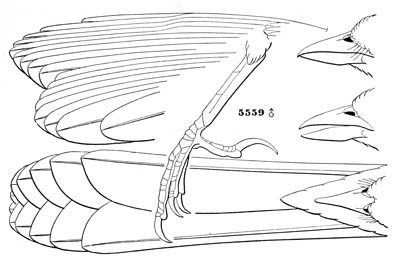
Pipilo fuscus, var. crissalis. 5559 ♂
Sp. Char. Above dark olive-brown, the crown with a very slight tinge of scarcely appreciable dark rufous. Under parts with the color somewhat similar, but of a lighter shade, and washed with grayish; middle of the belly only whitish; the under tail-coverts pale rufous, shading into lighter about the vent and sides of lower belly; chin and throat well-defined pale rufous, margined all round by brown spots, a few of them scattered within the margin. Eyelids and sides of head, anterior to the eye, rufous like the throat. One or two feathers on the lower part of the breast with a concealed brown blotch. Outer primary not edged with white. Fifth quill longest; first shorter than ninth, or even than secondaries. Bill pale brown, darker above; legs light. Length, 8.50 inches; wing, 4.00; tail, 4.60.
Hab. Coast region of California.
The bill is sinuated, as in P. aberti, differing from that of P. erythrophthalmus.
This race is very similar to the original P. fuscus of Mexico, the original description of Swainson answering almost exactly. It is, however, considerably larger; the proportions of wing are similar; and there is no decided indication of whitish in the middle of the body beneath, such as is always distinctly appreciable in fuscus, and still more in mesoleucus.
A young bird differs but little from the adult except in having obsolete dusky streaks below; the upper parts are uniform.
Habits. The Brown, or Cañon Finch of California is found nearly throughout the State of California. Mr. Xantus obtained it at Fort Tejon, and Mr. Ridgway observed it among the chaparrals on the foothills of the western slope of the Sierras.
Dr. Cooper considers the name of Cañon Finch ill applied to this species, as it is equally plentiful in level districts, wherever trees and shrubbery exist. He regards it as one of the most abundant and characteristic birds of California, residing in all the lower country west of the Sierras, and extending up the slopes of the Coast Range to the height of three thousand feet. They are said to have habits very similar to those of all the other species, living much upon the ground, and seeking their food among the dead leaves, which they greatly resemble in color. This resemblance Dr. Cooper regards as a great protection to them from Hawks; their hues also correspond with those of the earth and the dusky foliage during most of the year. They are thus less conspicuous in the light, and they venture more fearlessly forth and feed in open grounds.
They have but little song, and only utter a few faint chirps and hurried notes, as they sit perched upon some low bush, in the spring. At San Diego Dr. Cooper saw the first nest with eggs on April 17, but some birds had laid much earlier, as he found young hatched by the 20th. He afterwards observed other nests, all of which were built in bushes, from two to four feet from the ground, and all but one contained three eggs; the other had four. He has found them built in low trees, and one in a vine growing over the porch of a house. The nest is formed of coarse twigs, bark, and grass, is thick and large, and is lined with fine root-fibres and finer grasses. The eggs are pale blue, spotted with purplish-brown blotches, mostly small and scattered. He gives the measurement of the eggs as .90 by .65 of an inch. In the more northern part of the State they are said to lay four eggs oftener than three. They are supposed by him to have two broods in a season.
Colonel McCall has no doubt that they are found throughout California, as he has met with them from the upper waters of the Sacramento to the mouth of the Gila; the former having its origin in the extreme north, and the latter touching the extreme southern boundary of the State. It is most abundant south of Santa Barbara.
Colonel McCall states that its habits and manners differ somewhat from those of the common Towhee and the Arctic Finches. Its flight is more even and regular, and is without that violent jerking of the tail from side to side, which gives such a singular appearance of awkwardness to the movements of the Towhee. It is less shy and suspicious than the Arctic. It is also much less decidedly a Ground Finch than either of the others. Its favorite abode he found to be the vicinity of watercourses, where it is generally to be seen in pairs, though he has, at times, surprised eight or ten together under the shade of a large bush at noon in a summer day, when he has had no difficulty in procuring three or four specimens before the party dispersed. It is at all times a familiar bird, boldly coming into the roads to feed, and permitting a close approach. If compelled to retreat, it darts suddenly into the thicket, but returns as soon as the cause of alarm has disappeared. Near Santa Barbara he found thirty or forty of these birds, in the month of July, dispersed over an old field of some five acres in extent, contiguous to a sea-beach, through which flowed a small stream of fresh water. They were feeding on the ground, sheltered by a rank growth of weeds. When one was flushed it flew into a neighboring tree instead of seeking shelter again in the weeds. The young at that time were fully fledged, and scarcely differed in the color of their plumage from the adults.
Dr. Heermann once met with a nest of this bird built in a grapevine overhanging the Sacramento River. He describes the eggs of this species as differing entirely from any of this genus he had ever met with, and as having so great a resemblance to the eggs of the three different species of Blackbirds inhabiting California that they were liable to be confounded with them unless marked when taken from the nest.
Dr. Newberry, who found this bird very common in the Sacramento Valley, states that when he first met with it, a strange bird to him, its habit of scratching among the dry leaves under the bushes, as well as its long tail and jerking flight from one clump of bushes to another, at once indicated to him its affinities.
Among the memoranda made by Mr. Xantus at Fort Tejon are the following in reference to this species: “474, nest and two eggs, found May 19 on a small thorn-bush in a very dark thicket, about six feet from the ground; 1,675, nest and one egg, on a thick thorny bush, six feet from the ground; 1,851, nest and two eggs, May 12, on a rose-bush, four feet from the ground, eggs already incubated.”
The eggs of this species measure one inch by .75, have a light ground of robin-blue, and are spotted and blotched with varying shades of dark and light purple. In some the color of the blotches is so deep as not to be distinguishable from black, except in a strong light. The lighter shades are a faint lavender.
Pipilo fuscus, var. mesoleucus, Baird.
CAÑON BUNTING.
Pipilo mesoleucus, Baird, Pr. A. N. Sc. Ph. VII, June, 1854, 119 (Rocky Mountains).—Ib. Birds N. Am. 1858, 518, pl. xxix.—Kennerly, P. R. R. X, b pl. xxix.—Heerm. X, c. p. 15.—Cooper, Orn. Cal. 1, 247. ? Pipilo fusca, “Swains.,” Sclater & Salvin, P. Z. S. 1869, 361 (city of Mexico).
Sp. Char. Above very dull olivaceous-brown, with a grayish tinge; hood dull chestnut, conspicuously different from the back. Sides like the back, but paler; posteriorly, and about the vent and under tail-coverts, pale brownish-red. The ashy olive-brown of the sides scarcely meeting across the breast, the lower portion of which, with the upper belly, is rather pure white. The loral region, chin, throat, and upper part of the breast, pale yellowish-rufous, finely spotted on the sides and more coarsely across the breast with brown; an obscure spot in the middle of the breast; edge of outer primary white. Bill pale brown; legs flesh-color; first quill about equal to eighth, third and fourth longest. Length, 8.50 inches; wing, 3.80; tail, 4.70.
Hab. Valley of Upper Rio Grande and across to the Gila River. East to Santa Caterina, New Leon.
This race is similar in general appearance to P. crissalis, but the olive-brown and rufous are both of a lighter shade. The crown is of a decided rufous, conspicuously different from the back, instead of nearly the same tint. The light reddish under the head is wider throughout, and extends down to the upper part of the breast, blending with the colors of the breast and belly, instead of being narrower, more sharply defined, and restricted to the chin and throat; it is palest anteriorly, the chin and lore being almost white. The isolated larger spot on the breast is more conspicuous; the breast and belly are quite pure white, shaded with obsolete brownish blotches, instead of being uniform grayish-brown, with only an approach to whitish in the very middle. The edges of the wing and tail feathers are a good deal lighter, the outer web of the first primary being sharply edged with pure white, instead of obscure grayish-brown. The size generally is rather smaller, the wings more pointed.
Compared with P. fuscus, we find the tail decidedly longer; the wing more pointed; the first quill about equal to the eighth, instead of shorter than the secondaries. The colors generally are paler; the cap of head bright distinct rufous in strong contrast with the other plumage, instead of being only very obscurely tinged with that color. The white of belly is purer, and extends farther forward, displacing the ashy tinge almost to the buff of the throat.
If we consider all the brown Pipilos as modifications of one primitive species, it will be well to consider the Arizonan and New Mexican bird as the central figure around which the others are grouped. The common character will then be varied in the California race, crissalis, by the absence of decided rufous on crown, a darker shade of color, and an extension of the gray of sides over the whole under parts, almost entirely displacing the white. The wing is more rounded, and the general dimensions larger southward on the central plains of Mexico; the general tints are almost precisely as in the California bird, except that the white of belly is very evident; but the chestnut cap and extended whiteness of belly, together with the pointed wing of mesoleucus, are wanting. In P. albigula of Cape St. Lucas we have the general characters of mesoleucus, with paler colors, more restricted spots encircling throat, and a tendency to white in its lower part. In this it approaches albicollis of Southwestern Mexico.
Habits. This little-known form was first obtained by Dr. Kennerly, naturalist to the Pacific Railroad Expedition on the 35th parallel, under Lieutenant Whipple. He met with it at Bill Williams Fork, in Arizona, February 5, 1854. It was described by Professor Baird the following June. Dr. Kennerly furnished at the time no information in regard to its habits.
Dr. Heermann, in his Report on the birds observed in Lieutenant Parke’s expedition, mentions having met with this species in the vicinity of Tucson. Its habits, so far as he could judge of them from his opportunities, appeared very similar to those of Pipilo aberti.
Lieutenant Couch met with this species at Santa Catalina, Mexico, in April, 1853, but furnishes no information in reference to its manners. Mr. J. H. Clark, who obtained a specimen near the Copper Mines of the Mimbres, states that they were met with in abundance in the deep valleys or cañons of that region. They were almost always in or about the thick clumps of bushes, several usually being in company.
Dr. Kennerly, who met with them on a second trip, in June, 1855, near Los Nogales, in Mexico, speaks of them as not very common in that region. He found them preferring the dense bushes in the valleys. When approached, they became very restless, flying from one bush to another, accompanying their motions with very peculiar notes, which he does not describe.
Dr. Coues found this species abundantly distributed throughout the warmer portions of New Mexico and Arizona, from the valley of the Rio Grande to that of the Colorado. He did not observe any at Fort Whipple, though they were found breeding some twenty-five miles to the southward. He found them associating freely with Pipilo aberti, and inhabiting the same regions. The two birds have very similar habits.
Dr. Henry also states that this species is common in New Mexico both summer and winter, and, so far as he has observed, dwelling almost entirely among the mountains. It appeared to him very retiring in its habits, and seemed to prefer the cañons. He has seldom, if ever, observed it far from shady gorges, where, like its relative of the Eastern States, the Towhee Bunting, it passes the greater part of its time on the ground, and is generally accompanied by its congener, the Arctic Finch. When disturbed, it seeks the thickest cover, though it is by no means shy or difficult to approach. Its nest is usually constructed in the branches of a thick cedar or dwarf oak, and he has never known it to produce more than one brood in a season.
Dr. Cooper states that these birds are very abundant in Southern Arizona, that their habits closely resemble those of P. aberti, and that their eggs are similar to those of Pipilo fuscus.
Pipilo fuscus, var. albigula, Baird.
CAPE TOWHEE.
Pipilo albigula, Baird, P. A. N. S. Nov. 1859, 305 (Cape St. Lucas).—Elliot, Illust. Am. Birds, I, pl. xv (“= P. mesoleucus”).—Cooper, Orn. Cal. I, 248.
Sp. Char. Similar to var. mesoleucus, having, like it, a distinctly rufous crown and white abdomen. Differing, however, in the following respects: The pale ochraceous gular area is more sharply defined, the buff being confined within the encircling series of dusky spots; the buff is palest posteriorly, instead of directly the opposite. The rufous of the crissal region is more restricted, only tingeing the anal region instead of invading the lower part of the abdomen, the white beneath also is shifted farther back, covering the abdomen alone, instead of the breast, the whole jugulum being distinctly ashy, like the sides. Wing, 3.80; tail, 4.25.
Hab. Cape St. Lucas.
A very large series of specimens from Cape St. Lucas agree in possession of the characters pointed out above, distinguishing them from mesoleucus, to which race the present one is most nearly related.
Habits. The White-throated or Cape Towhee of Cape St. Lucas was first met with by Mr. Xantus in the southern extremity of the peninsula of Lower California, and described by Professor Baird in 1859. Its close resemblance to P. mesoleucus suggests an equal similarity as to its habits, in regard to which we possess no actual knowledge. Mr. Xantus has furnished us with no memoranda as to the manners of the bird. We have only the brief mention among his notes to the effect that No. 4,855 is the nest with four eggs of this Pipilo, found in a wild Humulus thicket; and that No. 5,076 is a nest with eggs of the same, found in a thicket of wild roses in the garden fence.
Judging from the large number of the nests and eggs of this species collected by that gentleman at Cape St. Lucas, it would seem to be very abundant in that locality.
The eggs of this variety measure .95 of an inch in length and .72 in breadth. They bear a strong resemblance to those of the P. fuscus, but the markings are darker and more distinctly defined, standing out with a clear and striking effect, in marked contrast with the light background. The ground-color of the egg is a light tint of robin-blue. The markings of dots, dashes, and lines are all about the larger end, and are of a deep dark shade of purplish-brown, so dark as, except in a strong light, to be undistinguishable from black.
SECTION III.
Brown; throat without light patch.
Pipilo aberti, Baird.
ABERT’S TOWHEE.
Pipilo aberti, Baird, Stansbury’s Rep. Great Salt Lake, Zoölogy, June, 1852, 325 (New Mexico).—Ib. Birds N. Am. 1858, 516, pl. xxx.—Kennerly, P. R. R. X, b, pl. xxx.—Heermann, X, c, 15.—Cooper, Orn. Cal. 1, 244. Kieneria aberti, Bonap. Comptes Rendus, XL, 1855, 356.
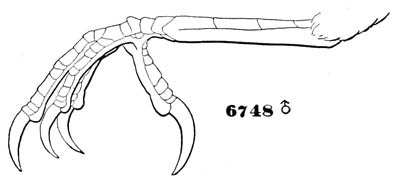
6748 ♂
Sp. Char. General color of upper parts pale brownish yellowish-red; beneath brighter, and more ochraceous, especially on the under coverts, palest on the middle of the belly. Sides of head anterior to eyes, and chin dark brown. Bill and legs yellowish. Length, 9 inches; wing, 3.70; tail, 4.85.
Hab. Base of Rocky Mountains in New Mexico. Valley of Gila and Colorado.
This plainly colored bird is perhaps the largest of the North American Finches, and is without any blotches, spots, or variations of importance from one color, except on the chin and sides of the head. The bill is similar to that of P. erythrophthalmus, but the cutting edge is less concave and more sinuated. The tail is more graduated; the claws thicker and stronger. The wings are short and much rounded; the first quill shorter than the secondaries; fifth and fourth longest.
It may be easily distinguished from all the varieties of fuscus by the blackish lores and chin, as well as by the absence of any colored gular area, there being, instead, a pinkish rufous tinge prevalent over the whole throat and jugulum. There are no dusky spots across the throat as in fuscus.
Habits. Dr. Cooper assigns the base of the Rocky Mountains, in New Mexico, and the valleys of the Gila and Colorado Rivers, as the habitat of this species. Dr. Coues speaks of it as one of the most abundant and characteristic birds of those two valleys, and adds that it ranges northward to within a few miles of Fort Whipple, but is not found in the adjacent mountains. It was common at Fort Mohave, and particularly so at Fort Yuma.
Dr. Kennerly met with it at Camp No. 114, New Mexico, February 6, and again at Bill Williams Fork, February 12. He states that while travelling down the Big Sandy Creek and Bill Williams Fork, in the month of February, he found them very abundant. They confined themselves to the thick bushes near the water. Generally two or three were seen together. Their motions were very rapid, and their note was a peculiar, loud, chattering sound, sharp but not disagreeable. After leaving the Great Colorado he did not see it again.
On the borders of the Gila, east of Fort Yuma, Dr. Heermann found this bird in great abundance. It kept in the close sheltered thickets, where, secure from intrusion, it sought among the dead leaves for various seeds and insects and their larvæ, on which it feeds. In its habits it very much resembles the Pipilo fuscus, or Cañon Finch, diving into the bushes when alarmed, and repeating, at intervals, a short chirp. After leaving the Gila River he did not meet with any more, as he followed no longer the course of any large stream, for the borders of which these birds seem to have a decided preference.
Dr. Cooper regards this species as the almost exact counterpart of the Pipilo fuscus. The only difference he noticed in habits was in the character of its loud note of alarm, remarkably similar, however, to that of two very distinct birds of the same valley, namely, Centurus uropygialis and Phainopepla nitens. Like the Cañon Finch, this species is said to live almost constantly on the ground, but appears rather more gregarious, especially in winter.
About the first of April Dr. Cooper met with many of their nests. They were generally built in thorny shrubs, and were composed of a flooring of coarse twigs, or of green herbs, and strongly interwoven with strips of bark, grass, and leaves. One bird had taken advantage of the recent introduction of horses into the valley to obtain a lining of horse-hair for its nest. The eggs were in all cases only three, bluish-white, with brown spots and streaks in a ring near the large end, quite variable in number, and measuring one inch by .70. One of the nests was in a low mesquite-tree, another in a dense cluster of dead twigs hanging from a cottonwood. The time required for hatching was twelve or thirteen days, and in a fortnight more the young left the nest. Dr. Cooper found nests with eggs as late as May 25, and had no doubt that they raise two or more broods in a season. He adds that the song of the male, throughout April and May, is precisely like that of P. fuscus, and also reminded him of the notes of P. oregonus and of the eastern Black-throated Bunting (Euspiza americana).
Dr. Coues has kindly supplied me with the following interesting sketch of this species, as observed by him in Arizona:—
“This species appears to have a remarkably restricted geographical distribution. I never saw it at Fort Whipple, but on the Colorado bottom in the same latitude, and thence along the river to Fort Yuma, I found it to be one of the most abundant and characteristic birds of all. At the time I observed it, in September, it was generally in small flocks, and proved rather difficult to capture, partly because the dense underbrush it inhabited was almost impenetrable, and partly on account of its natural timidity. Everything along the river-bottom is scorched with the heat, and the dry dead twigs constantly snap at a touch, with such noise that it is almost impossible to force a passage through the underbrush without alarming all its inmates. The bird occurs everywhere along the river-side, but is particularly numerous on the patches of mesquite, and the extensive areas grown up to young willows and cottonwoods, and the arrowwood (Tessaria borealis). Its ordinary cry of alarm, if not its call-note, is a loud, clear chirp, very different from the mewing sound made under similar circumstances by its congener, the P. megalonyx. The latter, as is well known, is almost exactly like that of a Catbird. I never heard the song of this bird, which appears to sing only during the breeding-season, but Dr. Cooper says it resembles that of the western Black Pipilos, and I can indorse his observation, that this is curiously like the monotonous notes of the Black-throated Bunting,—Chip, chip, chee-chee-chee; the first two syllables deliberately pronounced, the others more rapidly enunciated, with greater emphasis. The associates of this species seem to be few, if indeed they be not confined to the P. mesoleucus, a very near ally. The moult seems to me unusually protracted, as many September specimens were still in poor plumage.
“Excepting my experience with this bird on the Colorado, I only met with it on the Hassayampa, a small stream a few miles from Fort Whipple, yet in a somewhat different region, across a slight mountain-ridge, lower and warmer. Two specimens were secured, adult and young, the first week in August.”
Dr. Coues, on his way from Arizona to the Pacific (Ibis, 1866, p. 261), mentions that he was often startled by the loud, clear, sharp chirp of this bird, which, though fringilline in character, is more than usually powerful, and is its alarm-note. Everywhere in the Colorado Valley this was one of the most characteristic birds. Fort Yuma seemed to be its head-quarters. It is, like all its congeners, a retiring species, and keeps perseveringly in the almost impenetrable undergrowth. It is said to be more decidedly gregarious than most of the genus, often collecting in flocks of a dozen or more, wandering restlessly, yet in a cautious manner, through the thickets.
A nest with eggs, procured at Fort Mohave by Dr. Cooper, is in the Smithsonian Collection (No. 7,276). The egg measures .93 by .70 of an inch, is obovate in shape, being much rounded at the smaller end. Its ground-color is a dull white, without any perceptible tinge of blue,—though possibly bluish when fresh,—with heavy dots and occasional delicate, hair-like, zigzag markings of black. These markings are wholly confined to the larger end. One of the eggs has these markings much finer, consisting of minute dots, more dense, and upon the apex of the larger end. The nest is loosely built and very bulky. Its external diameter is about six inches, and its depth three. The cavity is three inches wide and two deep. It is constructed almost entirely of strips of inner bark, the coarser, ribbon-like pieces being used on the outer portion, and the finer shreds composing the lining. Externally are also a few sticks about one quarter of an inch in diameter.
SECTION IV.
Crown rufous; body above, olive-green.
Pipilo chlorurus, Baird.
GREEN-TAILED BUNTING; BLANDING’S FINCH.
Fringilla chlorura, (Townsend,) Aud. Orn. Biog. V, 1839, 336 (Young). Zonotrichia chlorura, Gambel, J. A. N. Sc. Ph. 2d Series, I, 1847, 51. Embernagra chlorura, Bonap. Conspectus, 1850, 483. Fringilla blandingiana, Gambel, Pr. A. N. Sc. Ph. I, April, 1843, 260. Embernagra blandingiana, Cassin, Illus. I, III, 1853, 70, pl. xii. Pipilo rufipileus, Lafresnaye, Rev. Zoöl. XI, June, 1848, 176.—Bp. Conspectus, 1850, 487. Kieneria rufipileus, Bon. Comptes Rendus, XL, 1855, 356. Pipilo chlorura, Baird, Birds N. Am., 1858, 519.—Heerm. X, c, 15.—Cooper, Orn. Cal. 1, 248.
Sp. Char. Above dull grayish olive-green. Crown uniform chestnut. Forehead with superciliary stripe, and sides of the head and neck, the upper part of the breast and sides of the body, bluish-ash. Chin and upper part of throat abruptly defined white, the former margined by dusky, above which is a short white maxillary stripe. Under tail-coverts and sides of body behind brownish-yellow. Tail-feathers generally, and exterior of wings, bright olive-green, the edge and under surface of the wings bright greenish-yellow; edge of first primary white. First quill longer than eighth, fourth longest. Length, about 7 inches; wing, 3.20; tail, 3.65.
Hab. Whole of the Middle Province, including the Rocky Mountains and eastern slope of the Sierra Nevada; north to beyond the 40th parallel; south to Mexico.
In this species the wing is considerably rounded, the tertials considerably shorter than the primaries, and not exceeding the secondaries; the fourth quill longest, the first shorter than the sixth, the second and fifth quills considerably longer than the rest. The tail is long and considerably graduated, the outer feather half an inch shortest; the feathers broad and obtusely pointed, the corners rounded.
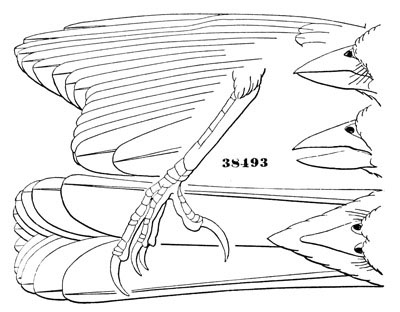
Pipilo chlorurus. 38493
The extent of the chestnut of the crown varies somewhat; more extended probably in the males. The region on the side of the head, adjoining the nostrils, is whitish; the small feathers under the eye are spotted with the same. The posterior outline of the ash of the breast is much less sharply defined than the anterior.
Specimens vary in the brightness of the olive above, which is never as pure as that of the wings and tail. The olive of the tail, too, is darker than that of the wings.
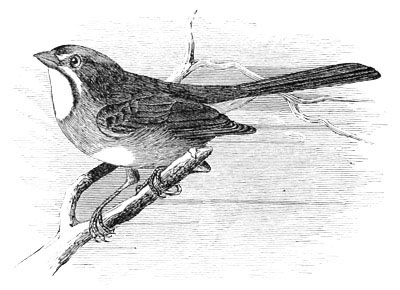
Pipilo chlorurus.
A very young bird (1,896) has the whole under parts dull white, streaked and spotted on the sides of the throat and on the breast with dark brown. The crown and back are also thickly spotted. In 5,734 the ash of the breast has made its appearance; the middle of the belly is white, spotted; the chin white, encircled by spots. The spots above are restricted to near the head, and there is a small central patch of chestnut on the crown.
No. 1,896 is the original “Green-tailed Sparrow” killed July 12, 1834, by Townsend, and described in an extract of a letter to Mr. Audubon, published page 336 of Vol. V. of the Ornithological Biography.
Habits. Dr. Kennerly, who procured a specimen of this bird at San Elizario, Tex., December 16, states that it was obtained with some difficulty. For several successive days it was found in the same place, occupying a small clump of very thick weeds. When aroused, which was only accomplished with some effort, its flight was short, rapid, and decidedly irregular. Its motions on the ground were very awkward. This species was found by Mr. Ridgway very generally distributed throughout the fertile mountain portions of the interior. It was not seen by him in California, and was first met with in the ravines at the base of the eastern slope of the Sierra Nevada. On the high mountain-ranges it was a characteristic and the best-known singer, as well as one of the most abundant of the Fringillidæ, being found in all bushy places, from the bases to the summits of the mountains. It is exclusively a summer species, arriving at Carson City about the middle of April. He describes the usual note of this bird as very peculiar, and, as nearly as can be described, a sweet laughing utterance of the syllables keek-keek´, a little resembling the tweet of a Canary, but very musical. This curious note was generally uttered when anything unusual attracted its attention, such as the approach of an intruder. Then, with elevated tail and its very conspicuous red cap raised, it would hop familiarly and unsuspiciously about. He adds that it is a songster of high merit, in power and variety ranking very little below the song of the Chondestes grammaca. The song varies in the modulations greatly with the individual, but the same general style is preserved. At times it seemed to have a slight resemblance to the song of Bewick’s Wren, and at others to that of a Cyanospiza, and more rarely, to be the reproduction of a passage from the song of the Chondestes.
In the early part of July, near Austin, in the cañons of the mountains, he found these birds breeding in the greatest abundance, and later in the same month a few of its nests were found on the East Humboldt Mountains. All of its nests, with hardly an exception, were placed from eighteen inches to two feet above the ground, among the thick bushes of a species of Symphoricarpus, or “snow-berry,” which grows in great abundance upon the sides of the cañons of those mountains. The maximum number of eggs was four. It was also quite a common bird in the Wahsatch Mountains, though less abundant than the P. megalonyx.
Mr. Allen found this Finch quite numerous in Colorado Territory, and speaks of its song as very peculiar and very pleasing. It is said to resemble in no respect the eastern Towhee Finch, with which it is classed, but much more closely the group of Sparrows, so familiarly represented at the east by the White-throated, being like them in habits, song, and general aspect. It was more common among the foot-hills than on the plains. In Utah, according to Mr. Allen, this Finch begins to appear in numbers about September 20, from its breeding-haunts in the mountains.
Dr. Coues met with this species in Arizona, but only as a spring and autumn migrant. None remained there in summer to breed, and none were found there in the winter. In its migrations it passed rapidly by Fort Whipple, being found there only during the latter part of April and the beginning of May, and during the month of September. At those seasons it appeared to him the most silent and retiring of all the Pipilos. He found it very difficult to either observe its habits or to capture it. It winters sparingly at Fort Mohave.
Specimens of this bird were taken near Lookout Mountain by C. S. McCarthy, and at Gilmer, in Wyoming Territory, by Mr. Durkee.
Dr. Heermann, in his Report on the birds observed on the 32d. parallel, under Lieutenant Parke, mentions first meeting with this species near Tucson. They were frequenting, in numbers, the thick undergrowth, and were seeking seeds and insects on the ground. They seemed inclined to shun observation, and always kept in the most retired situations. They were sociable among themselves, going about singly or in pairs, associated with the Poospiza bilineata and two or three other kinds of Finch. When started they fly low, diving into the bushes, and soon disappear from sight. Occasionally, until reaching El Paso, Texas, birds of this species were met with, mingling with the flocks of migrating Fringillidæ. He there procured a pair apparently just entering upon incubation.
Instead of being suited by color, like most of the other Pipilos, to inhabit dark thickets and among dry leaves, this species is clad in a gayer livery, and seems well adapted for concealment in its summer resorts, and also among the growing vegetation of the lower country during the rainy season. Dr. Heermann found a few wintering in the Colorado Valley, and yet more at San Diego, but they left both places in March. He found them silent and shy, hiding very closely in the bushes, and feeding altogether on the ground. The only note he heard, resembled the crowing note of the California Quail.
Among the memoranda of Mr. Xantus, made near Fort Tejon, are the two following: “4,839, nest and two eggs (of Pipilo chlorurus) found in a dry hedge in Mr. Ritchie’s garden; 5,083, nest and eggs found in a dark garden-hedge.”
The eggs of the chlorurus are like those of no other Pipilo that I have met with. They are peculiar in shape, being nearly of an exact oval, neither end being apparently much more rounded than the other. Their ground-color is white with a bluish tint, over which is profusely diffused a cloud of fine dottings of a pinkish-drab. These markings are occasionally so fine and so thickly distributed as to give to the egg the appearance of a uniform color, or as an unspotted pinkish drab-colored egg. Occasionally the dots are deeper and larger, and more sparsely diffused.
In considering the eggs of the Pipilos in general we find certain variations which deserve more than a passing notice. Those of erythrophthalmus, oregonus, arcticus, and megalonyx are all fringilline in their characters, and have a marked affinity to eggs of Melospiza, Zonotrichia, and many other genera of this order. The eggs of aberti, fuscus, mesoleucus, and albigula are also all closely alike, and exhibit a very close resemblance to those of the Agelaii, and even of the Icteri, while the eggs of P. chlorurus, though of a fringilline character, are unlike either style.