Family FRINGILLIDÆ.—The Finches. (Continued.) (continued 3)
Reading edition
In Massachusetts it is extremely rare. Mr. Hopkins found it breeding in Williamstown, and sent me its eggs. I have also met with its nest and eggs, in a low meadow near the sea, in Hingham. In both of these instances the nest was on the ground. A specimen was shot in Newton by Mr. John Thaxter, June 26, 1857, that had all the appearance of being then in the process of incubation. Throughout Pennsylvania, and in the vicinity of Washington, these birds are quite common.
Wilson states that they are very common in the vicinity of Philadelphia, where they make their appearance in the middle of May, and where they seem to prefer level fields covered with rye-grass, clover, or timothy. They are described as more conspicuous for the quantity than for the quality of their song. This consists of three notes, sounding like chip-chip-chē-chē-chē. Of this unmusical ditty they are by no means parsimonious, and for nearly three months after their first arrival, every level field of grain or grass resounds with their quaint serenade. In their shape and manners, Wilson states, they bear a close resemblance to the Emberiza citrinella of Europe. They become silent by September, and in the course of that month depart for the southwest. It is a rare bird in South Carolina, but is very abundant in Texas, where it is also resident, and undoubtedly breeds. Audubon states that he was surprised to see how numerous they were in every open piece of ground throughout that State, especially those covered with tufts of grass. They are, he states, not so common in Ohio, and quite rare in Kentucky. They are especially abundant in the open lands of Indiana, Illinois, Wisconsin, Iowa, Missouri, Kansas, and Nebraska; and they have been found breeding as far to the west as Wyoming Territory, near to the base of the eastern range of the Rocky Mountains. Mr. Allen found this species one of the most abundant birds of Western Iowa, characterizing it as eminently a prairie species, and one of the few inhabitants of the wide open stretches.
Mr. Dresser found, early in May, numbers of these birds in the mesquite thickets near the San Antonio and Medina Rivers, and, as he found them equally numerous there in July, he naturally infers that they breed in that neighborhood. Dr. Heermann obtained some eggs which he had no doubt belonged to this species, though he was unable to secure the parent.
It has also been found in Western Texas and in the Indian Territory by Mr. J. H. Clark, in Texas by Dr. Lincecum, at the Kiowa agency by Dr. Palmer, and on the Yellowstone by Dr. Hayden.
This bird is not gregarious, always moving in pairs, and although, as they are preparing for their migrations, they congregate in particular localities, they always keep somewhat apart in family groups, and do not mingle promiscuously as do many others of this family. They are, at all times, unsuspicious and easily approached, and when fired at will often return to the same field from which they were startled. They are very partial to certain localities, and are rarely to be met with in sandy regions.
Mr. Audubon states that the notes of this species very closely resemble those of the Emberiza miliaria of Europe. Its unmusical notes are almost continuously repeated from sunrise to sunset. When the female is startled from her nest she creeps quietly away through the grass, and then hides herself, making no complaint, and not showing herself even if her treasures are taken from her. Their nests are constructed of coarse grasses and stems, lined with finer and similar materials. They are, in certain localities, placed on the ground, but more frequently, in many parts of the country, they are built in positions above the ground. This is almost invariably the case where they nest among the tall coarse grasses of the prairies. My attention was first called to this peculiarity by Dr. J. W. Velie, then of Rock Island, Ill. He informed me that in no instance had he found the nest of this species on the ground, but always raised a few inches above it. It was usually constructed of the tops of the red-top grasses, worked in among a bunch of thick grass, so as to make the nest quite firm. The meadows in which Dr. Velie found these nests were quite dry, so that there was no necessity for their thus building clear from the ground in order to escape being wet. I was afterwards informed by the late Mr. Robert Kennicott that his experience in regard to the nests of these birds had been invariably the same. Dr. P. R. Hoy, of Racine, is confident that these birds in Wisconsin never nest on the ground, or else very rarely, as he has never noticed their doing so. He writes that during one season he visited and made notes of nineteen different nests. Ten of these were built in gooseberry-bushes, four on thorn-bushes, three among blackberry-brambles, one on a raspberry-bush, and one on a wild rose. None were within a foot of the ground, and some were six feet from it. They have two broods in a season.
On the other hand, Mr. Ridgway informs me that in Southern Illinois the nest of this species is always placed on the ground, usually in a meadow, and that he has never found its nest placed anywhere else than on the ground, in a tuft of grass or clover. Professor Baird has had a similar experience in Pennsylvania. Mr. B. F. Goss found them nesting both in bushes and on the ground at Neosho Falls, Kansas.
The eggs of this species are of a uniform light blue color, similar in shade to the eggs of the common Bluebird, as also to those of the Calamospiza bicolor. They vary considerably in size, the smallest measuring .80 of an inch in length by .60 in breadth, while the larger and more common size is .90 by .70 of an inch.
Euspiza townsendi, Bonap.
TOWNSEND’S BUNTING.
Emberiza townsendi, Aud. Orn. Biog. II, 1834, 183; V, 90, pl. cccc.—Ib. Syn. 1839.—Ib. Birds Am. III, 1841, 62, pl. clvii.—Nuttall, Man. I, (2d ed.,) 1840, 528. Euspiza townsendi, Bon. List, 1838.—Baird, Birds N. Am. 1858, 495.
Sp. Char. Male. Upper parts, head and neck all round, sides of body and forepart of breast, slate-blue; the back and upper surface of wings tinged with yellowish-brown; the interscapular region streaked with black. A superciliary and maxillary line, chin and throat, and central line of under parts from the breast to crissum, white; the edge of the wing, and a gloss on the breast and middle of belly, yellow. A black spotted line from the lower corner of the lower mandible down the side of the throat, connecting with a crescent of streaks in the upper edge of the slate portion of the breast. Length, 5.75; wing, 2.86; tail, 2.56.
Hab. Chester County, Penn. But one specimen known (in the Mus. Smith.).
It is still a question whether this is a distinct species, or only a variety of E. americana. There is, however, little ground for the last supposition, although its rarity is a mystery.
The original type specimen of this species, collected by Dr. J. K. Townsend, still continues to be the only one known, and has been presented by its owner, Dr. E. Michener, to the Smithsonian Institution.
Habits. Only a single specimen of this apparently well-marked species has been observed, and nothing is known as to its history. The bird was shot by Mr. J. K. Townsend, in an old field grown up with cedar-bushes, near New Garden, Chester Co. Penn., May 11, 1833.
Genus HEDYMELES, Cabanis.
? Goniaphea, Bowd. “Excurs. in Madeira, 1825,” Agassiz. (Type, Loxia ludoviciana, according to Gray.)
Habia, Reichenb. Av. Syst. Nat. 1850, pl. xxviii. (Type, L. ludoviciana; not Habia of Lesson, 1831).
Hedymeles, Cabanis, Mus. Hein. 1851, 153. (Same type.)
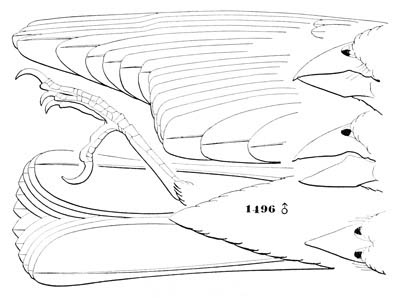
Hedymeles melanocephalus. 1496 ♂
Gen. Char. Bill very large, much swollen; lower mandible scarcely deeper than the upper; feet almost coccothraustine, tarsi and toes very short, the claws strong and much curved, though blunt. First four primaries longest, and nearly equal, abruptly longer than the fifth. Tail broad, perfectly square. Colors: Black, white, and red, or black, cinnamon, yellow, and white, on the male; the females brownish, streaked, with the axillars and lining of the wing yellow.
There seems to be abundant reason for separating this genus from Guiraca; the latter is, in reality, much more nearly related to Cyanospiza, it being impossible to define the dividing line between them.
Species and Varieties.
Common Characters. ♂. Head and upper parts (except rump) deep black. Two broad bands across coverts, a large patch on base of primaries, and terminal half of inner webs of tail-feathers, pure white. Breast carmine or cinnamon; axillars and lining of wing carmine or gamboge. ♀. Black replaced by ochraceous-brown; other parts more streaked.
H. ludovicianus. Rump and lower parts white; lining of wing, and patch on breast, rosy carmine. No nuchal collar. Female. Lining of wing saffron-yellow; breast with numerous streaks. Hab. Eastern Province of North America, south, in winter, to Ecuador.
H. melanocephalus. Rump and lower parts cinnamon-rufous; lining of wing and middle of abdomen gamboge-yellow. A nuchal collar of rufous. Female. Lining of wing lemon-yellow; breast without streaks; abdomen tinged with lemon-yellow.
Crown continuous black. No post-ocular rufous stripe. Hab. Mountains of Mexico, and Central Rocky Mountains of United States … var. melanocephalus.
Crown divided by a longitudinal rufous stripe; a distinct post-ocular stripe of the same. Hab. Western Province of United States, south, in winter, to Colima … var. capitalis.
Hedymeles ludovicianus, Swainson.
ROSE-BREASTED GROSBEAK.
Loxia ludoviciana, Linn. Syst. Nat. I, 1766, 306.—Wilson, Am. Orn. >II, 1810, 135, pl. xvii, f. 2. Guiraca ludoviciana, Swainson, Phil. Mag. I, 1827, 438.—Bonap. List, 1838.—Ib. Consp. 1850, 501.—Baird, Birds N. Am. 1858, 497.—Samuels, 328. Fringilla ludoviciana, Aud. Orn. Biog. II, 1834, 166; V, 513, pl. cxxvii. Pyrrhula ludoviciana, Sab. Zoöl. App. Franklin’s Narr. Coccothraustes ludoviciana, Rich. List, Pr. Br. Ass. 1837. Coccoborus ludovicianus, Aud. Syn. 1839, 133.—Ib. Birds Am. III, 1841, 209, pl. 205.—Max. Cab. J. VI, 1858, 267. “Goniaphea ludoviciana, Bowdich.” Hedymeles ludoviciana, Cabanis, Mus. Hein. 1851, 153. Fringilla punicea, Gmelin, Syst. Nat. I, 1788, 921 (male). Loxia obscura, Gmelin, I, 1788, 862. Loxia rosea, Wilson, Am. Orn. pl. xvii, f. 2. Coccothraustes rubricollis, Vieillot, Galerie des Ois. I, 1824, 67, pl. lviii.
Sp. Char. Upper parts generally, with head and neck all round, glossy black. A broad crescent across the upper part of the breast, extending narrowly down to the belly, axillaries, and under wing-coverts, carmine. Rest of under parts, rump and upper tail-coverts, middle wing-coverts, spots on the tertiaries and inner great wing-coverts, basal half of primaries and secondaries, and a large patch on the ends of the inner webs of the outer three tail-feathers, pure white. Length, 8.50 inches; wing, 4.15.
Female without the white of quills, tail, and rump, and without any black or red. Above yellowish-brown streaked with darker; head with a central stripe above, and a superciliary on each side, white. Beneath dirty white, streaked with brown on the breast and sides. Under wing-coverts and axillars saffron-yellow.
In the male the black feathers of the back and sides of the neck have a subterminal white bar. There are a few black spots on the sides of the breast just below the red.
The young male of the year is like the female, except in having the axillaries, under wing-coverts, and a trace of a patch on the breast, light rose-red.
The depth of the carmine tint on the under parts varies a good deal in different specimens, but it is always of the same rosy hue.
Hab. Eastern United States to the Missouri plains; south to Ecuador. Honduras (Moore, P. Z. S. 1859, 58); Xalapa (Scl. 1859, 365); Bogota (Scl. 1855, 154); Cordova (Scl. 1856, 301); Guatemala (Scl. Ibis, I, 17); Cuba (Cab. J. VI, 9); Ecuador (Scl. 1860, 298); Costa Rica (Cab. J. 61, 71); (Lawr. IX, 102); Panama (Lawr. VII, 1861, 297); Vera Cruz, winter (Sum. M. B. S. I, 552); Yucatan (Lawr. Ann. IX, 210).
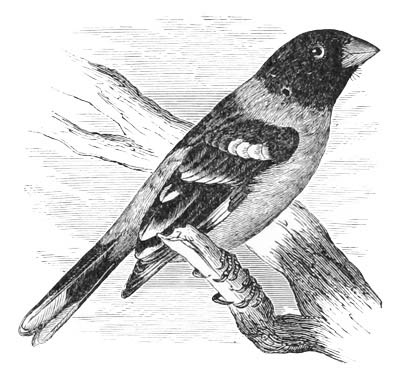
Hedymeles melanocephalus.
Habits. The Rose-breasted Grosbeak, during the summer months, appears to have a widely extended area of distribution, though nowhere a very abundant species, and one of somewhat irregular occurrence. It is found as far to the east as Nova Scotia, to the north as Selkirk Settlement and the valley of the Saskatchewan, and to the west as Nebraska. It winters in great numbers in Guatemala. In the last-named country, while abundant in the Vera Paz, it was not found at Dueñas, but was a common cage-bird in the city of Guatemala. It was also found common at Herradura, in Colombia, South America, by Mr. C. W. Wyatt.
This bird was noticed on a single occasion near San Antonio by Mr. Dresser, but was not observed by Dr. Woodhouse in Texas, or in the Indian Territory. Sumichrast did not meet with it in Vera Cruz. At St. Stephens, N. B., Mr. Boardman found this species a regular summer visitant, but rare, nor did Mr. Verrill find it common in the western part of Maine. In Massachusetts this bird becomes more common, but is nowhere very abundant. It has been met with in various places in the eastern part of the State, but rarely, and only in restricted localities. In the western part of the State it is more numerous, as well as throughout the whole of the Connecticut Valley. At Springfield, Mr. Allen notes it as a summer visitant, breeding in the open woods, but not abundant. He is of the opinion that during the past twenty-five years this bird has increased in numbers in all parts of the State. Mr. Allen found this bird quite common in Southern Indiana, in Northern Illinois, and in Western Iowa, where he found it frequent in the groves along the streams. Dr. Coues mentions it as rare and only migratory in South Carolina. Mr. McIlwraith gives it as a summer resident in the vicinity of Hamilton, Canada, where it is very generally distributed throughout the open woods, arriving there the second week in May. It is also found throughout Vermont, in favorable situations in open woods, on the borders of streams. It is not uncommon in the vicinity of Randolph, where it regularly breeds.
Wilson, who enjoyed but few opportunities of studying the habits of this species, states that it eagerly feeds on the ripe fruit of the sour gum-tree. He was also aware of its fine song, its value as a caged bird, and that it frequently sings during the night.
Sir John Richardson met with a single specimen of this bird near the Saskatchewan during his first expedition with Sir John Franklin, but did not afterwards meet with it. He states that it frequents the deep recesses of the forests, and there sings a clear, mellow, and harmonious song.
Nuttall appears to have seen little or nothing of this bird, except in confinement. He describes it as thriving very well in a cage, and as a melodious and indefatigable warbler, frequently passing the greater part of the night in singing, with great variety of tones. It is said, while thus earnestly engaged, to mount on tiptoe, as if seemingly in an ecstasy of enthusiasm and delight at the unrivalled harmony of its own voice. These notes, he adds, are wholly warbled, now loud and clear, now with a querulous and now with a sprightly air, and finally lower and more pathetic. In Mr. Nuttall’s opinion it has no superior in song, except the Mocking-Bird.
Mr. Say met with these birds in the spring, on the banks of the Missouri, and afterwards, on the 5th of August, at Pembina in the 49th degree of latitude.
This bird arrives in Eastern Massachusetts about the 15th of May, and leaves in September. It nests during the first week in June.
Mr. Audubon states that he has frequently observed this species, early in the month of March, in the lower parts of Louisiana, making its way eastward, and has noticed the same circumstance both at Henderson, Ky., and at Cincinnati, O. At this period it passes at a considerable height in the air. He never saw it in the maritime parts of Georgia or Carolina, but they have been procured in the mountainous parts of those States. On the banks of the Schuylkill, early in May, he has observed this bird feeding on the tender buds of the trees. When in Texas, in 1837, Mr. Audubon also found it very abundant in April.
Dr. Bachman, quoted by Audubon, states that, having slightly wounded a beautiful male of this species, he kept it three years in confinement. It very soon became quite tame, fed, in an open room, on moistened bread. It was at once reconciled to live in a cage, and fed readily on various kinds of food, but preferred Indian meal and hemp-seed. It was also very fond of insects, and ate grasshoppers and crickets with peculiar relish. It watched the flies with great apparent interest, and often snatched at and secured the wasps that ventured within its cage. During bright moonshiny nights it sang sweetly, but not loudly, remaining in the same position on its perch. When it sang in the daytime it was in the habit of vibrating its wings, in the manner of the Mocking-Bird. It was a lively and a gentle companion for three years, but suffered from cold in severe wintry weather, and finally died from this cause. It would frequently escape from its cage, and never exhibited the least desire to leave him, but always returned to the house at night. It sang about eight weeks, and the rest of the year had only a faint chuck.
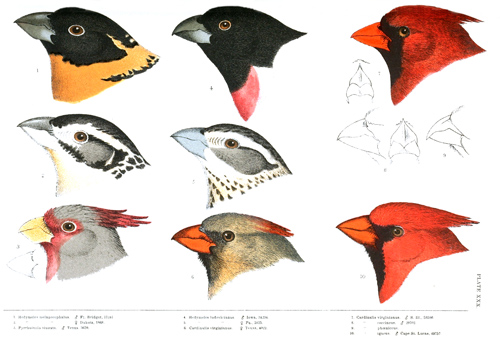
PLATE XXX.
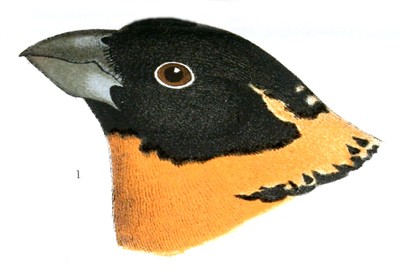
1. Hedymeles melanocephalus. ♂ Ft. Bridger, 11241.
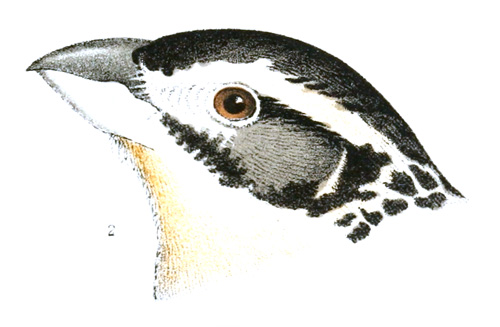
2. Hedymeles melanocephalus. ♀ Dakota, 1868.
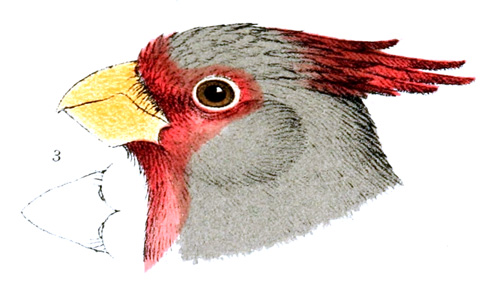
3. Pyrrhuloxia sinuata. ♂ Texas, 3670.
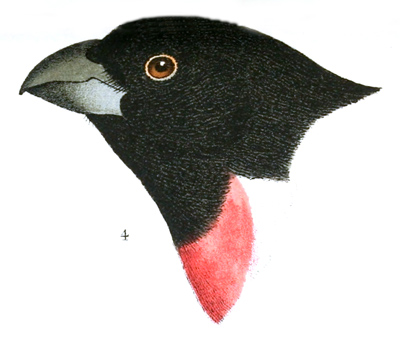
4. Hedymeles ludovicianus. ♂ Iowa, 34206.
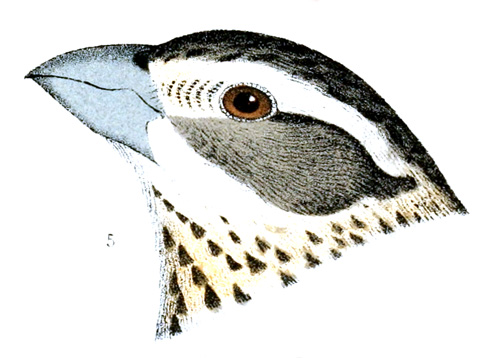
5. Hedymeles ludovicianus. ♀ Pa., 2425.
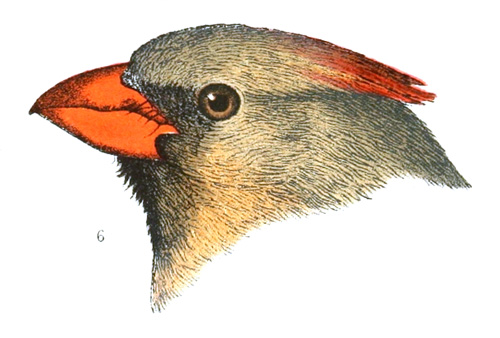
6. Cardinalis virginianus. ♀ Texas, 4022.
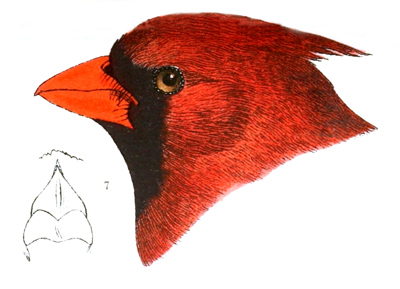
7. Cardinalis virginianus. ♂ S. Ill., 58586.
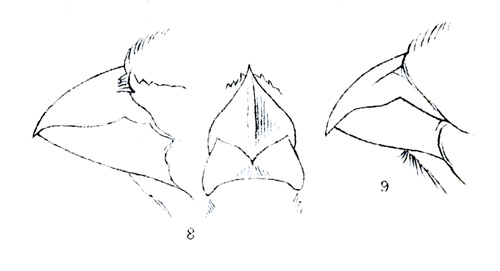
8. Cardinalis coccineus. ♂ 29702. 9. Cardinalis phœniceus.
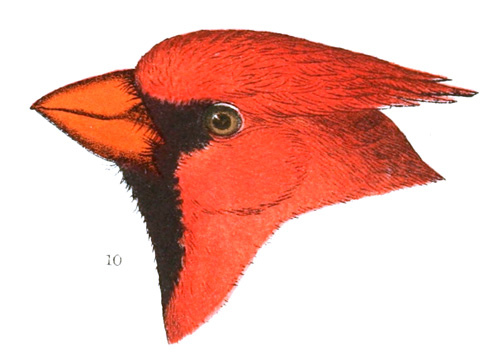
10. Cardinalis igneus. ♂ Cape St. Lucas, 49757.
This Grosbeak builds in low trees on the edge of woods, frequently in small groves on the banks of streams. Their nests are coarsely built, with a base composed of waste stubble, fragments of leaves, and stems of plants. These are intermingled with and strengthened by twigs and coarser stems. They have a diameter of eight inches, and a height of three and a half. The upper portion of the nest is usually composed of dry usnea mosses, mingled with a few twigs, and lined with finer twigs. Its cavity is three inches in diameter and one in depth, being quite shallow for so large a nest.
The eggs bear some resemblance to those of the Pyrangæ, but are usually much larger, though they vary greatly in size. Their ground-color is usually a light but well-marked shade of verdigris-green, varying occasionally to a greenish-white, and are marked, more or less, over their entire surface, with blotches of reddish-brown. They vary in length from 1.05 to .90 of an inch, and from .78 to .60.
During incubation, and in the presence of its mate, this Grosbeak is a persistent and enthusiastic singer, and, at times, carries his love of song so far as to betray his nest. This is more especially so when he relieves his mate, takes her place on the nest, and then, apparently oblivious of the danger of lifting up his voice in song when upon so responsible a duty, attracts, by his melody, the oölogist to his treasures.
Dr. Hoy, of Racine, supplies some interesting information in regard to the habits and nesting of this species. On the 15th of June, within six miles of that city, he found seven nests, all within a space of not over five acres, and he was assured that each year they resort to the same locality and nest thus socially. Six of these nests were in thorn-trees, all were within six to ten feet from the ground, and all were in the central portion of the top. Three of the four parent birds sitting on the nests were males, and this he was told was usually the case. When a nest was disturbed, all the neighboring Grosbeaks gathered around and appeared equally interested. Both nest and eggs so closely resemble those of the Tanagers that it is difficult to distinguish them. Their position is, however, usually different, the Grosbeaks generally nesting in the central portion of a small tree, the Tanagers’ being placed on a horizontal limb.
Hedymeles melanocephalus, Swainson.
BLACK-HEADED GROSBEAK.
Guiraca melanocephala, Sw. Syn. Mex. Birds Philos. Mag. I, 1827, 438.—Bon. List, 1838.—Ib. Consp. 1850, 502.—Baird, Birds N. Am. 1858, 498.—Cooper & Suckley, 206. Coccothraustes melanocephala, Rich. List, Pr. Br. Ass. for 1836, 1837. Fringilla melanocephala, Aud. Orn. Biog. IV, 1838, 519, pl. ccclxxiii. Coccoborus melanocephalus, Aud. Synopsis, 1839, 133.—Ib. Birds Am. III, 1841, 214, pl. 206.—Heerm. X, S, 51 (nest).—Cooper, Orn. Cal. I, 228. Goniaphea melanocephala, Sclater? Hedymeles melanocephala, Cabanis, Mus. Hein. 1851, 153. Fringilla xanthomaschalis, Wagler, Isis, 1831, 525. Pitylus guttatus, Lesson, Rev. Zoöl. II, 1839, 102. ? Guiraca tricolor, Lesson, Rev. Zoöl. II, 1839, 102.
Sp. Char. Male. Head above and on the sides, with chin, back, wings, and tail, black. A well-marked collar on the hind neck all round (and in var. capitalis a more or less distinct median stripe on crown, and one behind the eye), edges of interscapular feathers, rump, and under parts generally pale brownish-orange, almost light cinnamon. Middle of belly, axillaries, and under wing-coverts, yellow. Belly just anterior to the anus, under tail-coverts, a large blotch at the end of the inner webs of first and second tail-feathers, a band across the middle and greater wing-coverts, some spots on the ends of the tertiaries, the basal portions of all the quills, and the outer three primaries near the tips, white. Length nearly 8 inches; wing, 4.25; tail, 3.50.
Female has the chin, sides of throat, and superciliary stripe white; the black markings replaced by olivaceous-brown; the cinnamon markings paler, and almost white; the white of wings more restricted; that of tail wanting. Usually there are few or no streaks beneath as in ludovicianus (faint ones on flanks); in young males, however, they are more appreciable. The lemon or gamboge yellow axillars and under coverts in all ages and stages separate this species from H. ludovicianus, the female and young of which have those regions of a saffron or fulvous yellow.
Hab. High Central Plains from Yellowstone to the Pacific. Table-lands of Mexico. Xalapa (Scl. 1859, 365); Orizaba (Scl. 1857, 213); Vera Cruz, Alpine and plateau, breeding (Sum. M. B. S. I, 551).
This bird, in its range of habitat, appears to be represented by two varieties, which, however, run into each other, so that it is often difficult to determine to which variety specimens from intermediate regions should be referred.
Taking the series from Eastern Mexico (Orizaba and Mirador) and northward along the Rocky Mountains of the United States, we find the black of the head continuous, sharply defined by a gently curved outline behind, and without a trace of either the vertex or post-ocular stripes. This is the true melanocephalus, as restricted, and may be regarded as the Rocky Mountain form. The most western specimen is 11,241, from Fort Bridger; the most northern (19,355), from Stinking River, Northern Wyoming. All specimens from the Pacific coast eastward to the western base of the Rocky Mountains, including Cape St. Lucas and Western Mexico south to Colima, differ from the Rocky Mountain series in having the posterior outline of the black hood ragged, and irregularly indented by the rufous of the nape, which always extends in a quite broad stripe toward the eye, along the side of the occiput, and quite frequently forms a conspicuous median vertex stripe, though the latter feature is sometimes not distinct. These differences are observable only in the males, and, although apparently slight, are yet sufficiently constant to justify distinguishing them as races. The Rocky Mountain form being the true melanocephalus, the name capitalis is proposed for the western one.
Habits. This bird occurs from the high Central Plains to the Pacific, and from the northern portions of Washington Territory to the table-lands of Mexico. Mr. Ridgway found this species abundant, during the summer months, in all the fertile wooded districts along the entire route of the survey. At Sacramento it was common in the willow copses, and was observed in the greatest numbers, in May, in the rich valley of the Truckee, in company with Bullock’s Oriole, the Louisiana Tanager, and other species, feeding upon the buds of the “grease-wood.” It principally inhabits the willows along the rivers, and the shrubbery skirting the streams of the mountain cañons. In its manners and notes Mr. Ridgway regards this bird as an exact counterpart of the eastern species, the Hedymeles ludovicianus, its song being by no means superior. The peculiar and very odd click of the ludovicianus is said to be equally characteristic of this bird. Mr. Ridgway met with its nests in willows, about ten feet from the ground. He had evidence that the male bird assists the female in the duties of incubation.
This bird, though a common summer resident in the Great Salt Lake Valley, had all migrated, according to Mr. Allen, by the 1st of September. It is well known there as the Peabird, from its fondness for green peas, of which it is very destructive.
According to Dr. Cooper, this Grosbeak arrives in California, near San Diego, about April 12. It is numerous during the summer throughout the mountains both of the coast and of the Sierra Nevada, and extends its migrations at least as far as Puget Sound. It is often kept in confinement on account of its loud, sweet song. In the Coast Mountains, in May, its music is said to be delightful, the males vying with each other from the tops of the trees, and making the hills fairly ring with their melody.
Dr. Cooper found a nest of this bird, May 12, at the eastern base of the Coast Range. It was built in a low horizontal branch of an alder, and consisted of a few sticks and weeds, very loosely put together, with a lining of grass and roots. The eggs, three in number, he describes as of a pale bluish-white ground, thickly spotted with brown, more densely near the larger end. Their size he gives as .95 by .70 of an inch.
Dr. Cooper also states that they frequent the ground in search of food, but also live much on trees, feeding on their buds. They are not gregarious, assembling only in family groups in the fall. They do not fly high, nor do they make any noise in flying.
He has observed these birds at Santa Cruz April 12, or as early as he saw them at San Diego, three hundred and fifty miles farther south, and has found a young bird fledged as early as May 23.
Dr. Coues speaks of this bird as an abundant summer resident of Arizona, where it arrives by the first of May, and remains until the latter part of September. He speaks of it as frequenting the thick brush of the ravines and the cottonwood and willow copses of the river-bottoms. Its call-note resembles that of Lophortyx gambeli. Its song, he says, is superb,—a powerful, but melodious succession of clear, rich, rolling notes, reminding one somewhat of the Icterus baltimore.
Dr. Suckley speaks of this bird being sparingly found in the vicinity of Fort Steilacoom, Puget Sound, where he obtained two specimens.
Dr. Heermann speaks of the song of this bird as clear and musical, and as very closely resembling that of our Turdus migratorius. He describes its nests as formed with very little care, of twigs loosely thrown together, and lined with roots, placed in the branches of bushes. The eggs, four in number, he describes as of a greenish-blue ground, marked with irregular spots of umber-brown, varying in intensity of shade.
The song of the western species is described by Mr. Nuttall as fully equal, if not superior, to that of the Rose-breasted. He met with it on the central table-lands of the Rocky Mountains, along the upper branches of the Colorado River, where he found it frequenting the thick groves of the streams, and where, throughout its dense forests, the powerful song and the inimitable voice of this “most delightful Finch” cheered that naturalist amidst the wildest desolation of that “forest primeval,” where this superb vocalist made the woods echo and re-echo to its untiring song. These notes, greatly resembling those of its eastern relative, may be heard from early dawn almost even to the close of the following night. These are described as loud, varied, high-toned, and melodious, rising and falling with the sweetest cadence, fascinating the listener most powerfully with sensations of a pleasing sadness, its closing note seeming like a shrill cry of appealing distress, and then sinking faintly on the ear. It is described as very shy and retiring in its habits, and can be but very rarely observed closely while thus engaged in song. On these occasions the bird is said to sit up conspicuously on a lofty bough, near the summit of the tree, his throat swelling with the excitement, and seeming to take a great delight in the sound of his own music.
Mr. Sumichrast found this bird on the Plateau of Mexico, and also in the alpine regions of Vera Cruz. It was found to the height of 8,300 feet, and never lower than 4,000.
The eggs of this species are of an oblong-oval shape, one end but slightly more rounded than the other, and measure 1.10 of an inch in length by .65 in breadth. They have a bluish-green ground, blotched and splashed with markings of a rusty-brown, for the most part more numerous about the larger end.
Genus GUIRACA, Swainson.
Guiraca, Swainson, Zoöl. Jour. III, Nov. 1827, 350. (Type, Loxia cærulea, L.)
Coccoborus, Swainson, Class. Birds, II, 1837, 277. (Same type.)
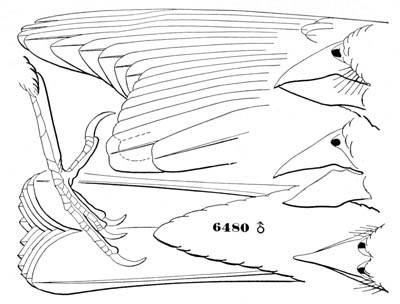
Guiraca cærulea. 6480 ♂
Gen. Char. Bill very large, nearly as high as long; the culmen slightly curved, with a rather sharp ridge; the commissure conspicuously angulated just below the nostril, the posterior leg of the angle nearly as long as the anterior, both nearly straight. Lower jaw deeper than the upper, and extending much behind the forehead; the width greater than the length of the gonys, considerably wider than the upper jaw. A prominent knob in the roof of the mouth. Tarsi shorter than the middle toe; the outer toe a little longer, reaching not quite to the base of the middle claw; hind toe rather longer than to this base. Wings long, reaching the middle of the tail; the secondaries and tertials nearly equal; the second quill longest; the first less than the fourth. Tail very nearly even, shorter than the wings.
The single North American species of this genus has no near relative in tropical America; indeed, no other species at present known can be said to be strictly congeneric.
In all essential details of external structure, and in every respect as to habits and nidification, the type of the genus (G. cærulea) is much more like the species of Cyanospiza than those of Hedymeles, with which latter it has usually been included.
Guiraca cærulea, Swainson.
BLUE GROSBEAK.
Loxia cærulea, Linn. Syst. Nat. I, 1766, 306.—Wilson, Am. Orn. III, 1811, 78, pl. xxiv, f. 6.—? Wagler, Isis, 1831, 525. Guiraca cærulea, Swainson, Birds Mex. in Phil. Mag. I, 1827, 438.—Baird, Birds N. Am. 1858, 499.—Cooper, Orn. Cal. 1, 230. Fringilla cærulea, Aud. Orn. Biog. II, 1834, 140; V, 508, pl. cxxii. Coccoborus cæruleus, Sw. Birds II, 1837, 277.—Aud. Syn. 1839.—Ib. Birds Am. III, 1841, 204, pl. cciv.—Cabanis, Mus. Hein. 1851, 152.—Finsch, Abh. Nat. Brem. 1870, 339 (Mazatlan). Cyanoloxia cærulea, Bp. Conspectus, 1850, 502. Goniaphæa cærulea, Bp. Blue Grosbeak, Pennant, Arc. Zoöl. II, 1785, 351.
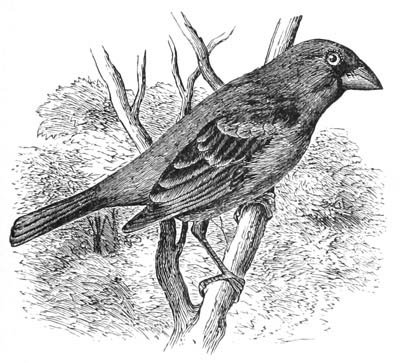
Guiraca cærulea.
Sp. Char. Brilliant blue; darker across the middle of the back. Space around base of the bill and lores, with tail-feathers, black. Two bands on the wing across the tips of the middle and secondary coverts, with outer edges of tertiaries, reddish-brown, or perhaps chestnut. Feathers on the posterior portion of the under surface tipped narrowly with grayish-white. Length, 7.25; wing, 3.50; tail, 2.80.
Female yellowish-brown above, brownish-yellow beneath; darkest across the breast. Wing-coverts and tertials broadly edged with brownish-yellow. Sometimes a faint trace of blue on the tail. The young resembles the female.
Hab. More southern United States from Atlantic to Pacific, south to Costa Rica. Xalapa (Scl. 1859, 365); Oaxaca (Scl. 1859, 378); Cordova (Scl. 1856, 301); Cuba (Cab. J. IV, 9); Vera Paz (Salvin, Ibis, III, 352); Costa Rica (Lawr. IX, 102); Vera Cruz, winter (Sum. M. B. S. I, 552); Yucatan (Lawr. IX, 200).
The species described as Cyanospiza parellina in the Birds of North America, but which so far has not been actually detected north of Mexico, is a miniature Guiraca, more related, however, to the G. concreta than to cærulea. It is easily distinguished from the latter by more lobed bill, darker back and under parts, absence of rufous wing-bands, and inferior size. Length, 5 inches; wing, 2.50.
Males from the Pacific coast region (California, Colima, etc.) have tails considerably longer than eastern specimens, while those from California are of a much lighter and less purplish blue, the difference being much the same as between Sialia sialis and S. azurea.
Autumnal and winter males have the feathers generally, especially on the back and breast, tipped with light brown, obscuring somewhat the blue, though producing a beautiful appearance.
Habits. The Blue Grosbeak, though more a bird of the Southern States, is also one both of an extended and of an irregular distribution. It was even met with one year in the vicinity of Calais, Me., although none have been known to occur in any part of the country between that point and New York City. It is found from the Atlantic to the Pacific coast.
The extent to which it is distributed throughout California is inferred, rather than known. Dr. Cooper noticed one at Fort Mohave, May 6, and afterwards saw many more frequenting the trees and bushes along the river, and singing a lively song, which he compares with that of the Carpodacus frontalis. He also saw them at Los Angeles and at Santa Barbara, and states that they were found at Pit River, in the extreme northeastern part of the State, by Dr. Newberry. They were observed to frequent the banks of streams crossing the great interior plains and deserts, where there was little vegetation except a few bushes.
The Blue Grosbeak was only met with by Mr. Ridgway and his party at Sacramento. It does not occur—or, if so, it was not seen—in the interior so far to the north as the route of Mr. King’s survey. At Sacramento it was found frequenting the same localities as the Cyanospiza amæna, and appeared to be characteristic of the cottonwood copses. Their nests were found between the 18th and the 29th of June, and were all in similar situations. These were built in small cottonwood-trees, on the edge of the copse, and were all about six feet from the ground.
Mr. John Burroughs, in one of his charming popular essays[10] on the general habits of our birds, refers to their occasional preference, in sites for their nests, of the borders of frequented roadsides, and mentions finding a nest of the Blue Grosbeak among the trees that line one of the main streets and fashionable drives leading out of Washington City, less than half a mile from the boundary. There, he states, this bird, which, according to Audubon’s observations, is shy and recluse, affecting remote marshes and the borders of large ponds of stagnant water, had placed its nest in the lowest twig of the lowest branch of a large sycamore immediately over a great thoroughfare, and so near the ground that a person standing in a cart or sitting on a horse could have reached it with his hand. The nest was composed mainly of fragments of newspaper and stalks of grass, and though so low, was remarkably well concealed by one of the peculiar clusters of twigs and leaves which characterize this tree. The nest contained young when he discovered it, and though the parent birds were much annoyed by his loitering about beneath the tree, they paid but little attention to the stream of vehicles that was constantly passing. It was a source of wonder to him when the birds could have built it, as they are so much shyer when building than at other times. They must have worked mostly in the early morning, when they could have the place all to themselves. The same observer also noticed another pair of Blue Grosbeaks that had built their nest in a graveyard within the city limits. This was placed in a low bush, and the male continued to sing at intervals till the young were ready to fly. The song of this bird he describes as a rapid, intricate warble, like that of the Indigo Bird, though stronger and louder. Indeed, these two birds so much resemble each other in color, form, voice, manner, and general habits, that, were it not for the difference in size,—the Grosbeak being nearly as large again as the Indigo Bird,—he thinks it would be a hard matter to tell them apart. The females of both birds are clad in the same reddish-brown suits, as are also the young during the first season.
The nest of this species has also been found built in a tree within the grounds of the Smithsonian Institution, Washington.
The only time I ever met with this species was at Carlisle, Penn., in June, 1843. The previous month Professor Baird had found its nest in a low tree, in open ground, and we found these birds still frequenting the same grounds, where we found another nest containing three eggs. It was in a low thorn-tree on the edge of a wood, but standing out in open ground. The nest was about five feet from the ground.
The Smithsonian specimens are from Carlisle, Penn., obtained in April, May, and August; from Georgia, Texas, New Mexico, Nebraska, Mexico, etc. Mr. Lawrence enumerates this among the birds found near New York City. Mr. Dresser found it common near Matamoras in July and August. It was breeding there, though, owing to the lateness of the season, he was unable to procure any of its eggs. Dr. Coues speaks of it as generally distributed in Arizona, but nowhere very common. A single specimen was taken near Fort Whipple, August 10. Turnbull regarded it as a rare straggler to the southern counties of Pennsylvania and New Jersey, arriving there in the middle of May. Dr. Woodhouse found it common in the Indian Territory and Texas. Lieutenant Couch mentions seeing this bird first near Monterey, the male always preceding the female. He speaks of them as exceedingly tame. Mr. J. H. Clark states that this bird was not often seen, and, when observed, was generally solitary, preferring the dark ravines and the cañons on the mountain-sides. It is not mentioned by Sumichrast as a bird of Vera Cruz, but was found during the winter months at Oaxaca, Mexico, by Mr. Boucard.
Mr. O. Salvin states (Ibis, III, p. 352) that he found this species, though not of very common occurrence, pretty generally distributed, in winter, throughout Vera Paz. He met with it on the Plains of Salamà, and all the collections from the warmer districts to the northward of Coban contained specimens. It was found by Mr. George H. White near Mexico.
Wilson speaks of this bird as retired and solitary, and also as a scarce species, and as having but few notes, its most common one being a loud chuck. He was, however, aware that at times they have a few low sweet-toned notes. He mentions their being kept in Charleston in cages, but as seldom singing in confinement. He fed a caged bird of this species on Indian corn, which it easily broke with its powerful bill; also on hemp-seed, millet, and berries. He speaks of them as timid, watchful, silent, and active.
Mr. Audubon was, apparently, somewhat at fault in regard to the peculiarities of this species. His accounts of the eggs of the Pyranga æstiva are entirely inapplicable to that species, and, so far as I know, apply to no other bird than the Blue Grosbeak, to which they exactly correspond. He makes no mention and gives no description of the eggs of the latter. His statements as to the nest appear to be correct.
Dr. Bachman kept several of these birds in an aviary; two of these mated, took possession of the nest of a Cardinal Grosbeak, which they drove off, and laid two eggs that were unfortunately destroyed. In the aviary these birds were silent. Mr. Audubon kept one, in confinement, with him in Edinburgh. It had been raised from the nest. This bird frequently sang in the night, and before dawn. It was extremely tame, coming out or going into its cage at pleasure, perching on the head-dress of Mrs. Audubon, or on the heads of other members of the family, alighting on the table and feeding on almost anything given to it. If a gold or silver coin was thrown upon the table he would go to it, take it up in his bill, and apparently toss it about with pleasure. After bathing he would go to the fire and perch on the fender to dry himself. He would attack other birds, if put into the cage with him. In feeding he sometimes held his food in his claws like a Hawk.
The eggs of this bird are of a uniform light-blue color, and most resemble those of the Sialia arctica, but are larger and of a lighter color. Their color is quite fugitive, and readily fades into a dull white upon even a slight exposure to light. They are of an oval shape, equally rounded at either end, and measure .98 of an inch in length by .65 in breadth.
Genus CYANOSPIZA, Baird.
Passerina, Vieillot, Analyse, 1816. Not of Linnæus, used in Botany.
Spiza, Bonaparte, Synopsis, 1828. Not of 1825.
Cyanospiza, Baird. (Type, Tanagra cyanea, L.)
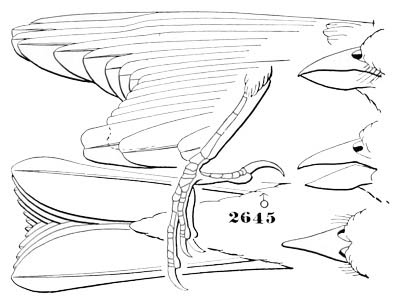
Cyanospiza amœna. 2645 ♂
Gen. Char. Bill deep at the base, compressed; the upper outline considerably curved; the commissure rather concave, with an obtuse, shallow lobe in the middle. Gonys slightly curved. Feet moderate; tarsus about equal to middle toe; the outer lateral toe barely longer than the inner, its claw falling short of the base of the middle; hind toe about equal to the middle without claw. Claws all much curved, acute. Wings long and pointed, reaching nearly to the middle of the tail; the second and third quills longest. Tail appreciably shorter than the wings; rather narrow, very nearly even.
The species of this genus are all of very small size and of showy plumage, usually blue, red, or green, in well-defined areas. The females plain olivaceous or brownish; paler beneath.
Species.
A. Head all round uniform blue; eyelids not different, commissure distinctly sinuated.
a. Lower parts blue; no white bands on wing.
1. C. cyanea. Entirely deep ultramarine-blue, more purplish on the head, somewhat greenish posteriorly. Female dull umber above, grayish-white beneath, the breast with obsolete darker streaks. Hab. Eastern Province of United States, south, in winter, to Panama.
b. Lower parts white, the breast rufous. One broad and distinct, and a narrower, more obsolete white band on the wing.
2. C. amœna. Head and neck, all round, and rump, bright greenish-blue; back, wings, and tail more dusky; a narrow white collar between rufous of the breast and blue of the throat. Female grayish-brown above, the rump tinged with blue. Beneath dull whitish, the breast and jugulum more buffy. Hab. Western Province of United States.
B. Head party-colored; eyelids different from adjoining portions. Commissure hardly appreciably sinuated, or even concave.
a. Back and breast similar in color. Upper mandible much less deep than lower, the commissure concave.
3. C. versicolor. Back and breast dark wine-purple, occiput and throat claret-red, forehead and rump purplish-blue. Eyelids purplish-red. Female fulvous-gray above, uniform pale fulvous below. Hab. Northern Mexico, and adjacent borders of United States; Cape St. Lucas.
b. Back and breast very different in color. Upper mandible scarcely less deep than the lower, the commissure straight, or slightly sinuated.
4. C. ciris. Lower parts vermilion-red. Back green, crown blue; rump dull red; eyelids red. Female dull green above, light olivaceous-yellow below. Hab. Gulf States of United States, and whole of Middle America.
5. C. leclancheri.[11] Lower parts gamboge-yellow. Back blue, crown green, rump blue; eyelids yellow. Female not seen. Hab. Southern Mexico.
Cyanospiza cyanea, Baird.
INDIGO BIRD.
Tanagra cyanea, Linn. Syst. Nat. I, 1766, 315. Emberiza cyanea, Gm. Syst. Nat. I, 1788, 876. Fringilla cyanea, Wilson, I, 1810, 100, pl. vi, f. 5.—Aud. Orn. Biog. I, 1832, 377; V, 503, pl. lxxiv. Passerina cyanea, Vieill. Dict. Spiza cyanea, Bon. List, 1838.—Ib. Consp. 1850, 474.—Aud. Syn. 1839, 109.—Ib. Birds Am. III, 1841, 96, pl. clxx. Cyanospiza cyanea, Baird, Birds N. Am. 1858, 505.—Samuels, 330. ? Emberiza cyanella, Gm. I, 1788, 887. ? Emberiza cærulea, Gm. Syst. Nat. I, 1788, 876. Indigo Bunting, and Blue Bunting, Pennant and Latham.
Sp. Char. Male. Blue, tinged with ultramarine on the head, throat, and middle of breast; elsewhere with verdigris-green. Lores and anterior angle of chin velvet-black. Wing-feathers brown, edged externally with dull bluish-brown. Female. Brown above; whitish, obscurely streaked or blotched with brownish-yellow, beneath; tinged with blue on shoulders, edges of larger feathers, and on rump. Immature males similar, variously blotched with blue. Very young birds streaked beneath. Length, about 5.75 inches; wing, nearly 3.00.
Hab. Eastern United States to the Missouri; south to Guatemala. Oaxaca (Scl. 1859, 379); Cordova (Scl. 1856, 304); Guatemala (Scl. Ibis, I. 17); Cuba (Cab. J. IV, 8); Costa Rica (Cab. Jour. 1861, 4; Lawr. IX, 103); Vera Cruz, winter (Sum. M. B. S. I, 552).
In this species, which may be considered the type of the genus, the tail is slightly emarginate; the second quill is longest, the first shorter than the fourth.
Habits. The common Indigo Bird of the Eastern States is found in nearly uniform and tolerable abundance in various parts of the United States, from the valley of the Missouri to the Atlantic, and from Florida to New Brunswick. It is a summer visitant, but rare, in Eastern Maine, but is common in the western part of the State, where it arrives early in May, and where it breeds. Mr. Allen speaks of it as not very common in the vicinity of Springfield, Mass., arriving there about the middle of May, and breeding in gardens, orchards, and the edges of woods, and making its nests in bushes. It leaves there about the middle of September.
In the eastern part of the State it is very unequally distributed. In certain localities it has not been met with, but in other favorite places it seems to be quite common, and to be on the increase. In the gardens of Brookline and Roxbury they are comparatively quite abundant. Mr. Maynard gives May 10 as the earliest date of their coming. He also states that in the autumn they are found in flocks, and frequent roadsides, high sandy fields, and rocky pastures, which I have never noticed. According to Dr. Coues, it is common and breeds as far south as Columbia, S. C., and, according to Mr. McIlwraith, it is a common summer resident in the neighborhood of Hamilton, Canada West. Specimens have been procured as far west as Fort Riley in Kansas. It passes the winter in Guatemala, where it is quite abundant, though a very large proportion of specimens received from there, in collections, are immature birds. It was not found in Vera Cruz by Mr. Sumichrast, nor is it given by Mr. Allen as found by him in Western Iowa, while it was common both in Northern Illinois and in Indiana. It was, however, found by Mr. Allen, in Kansas, in considerable numbers, near Leavenworth, in the spring of 1871. It was not met with by Mr. Dresser in Southwestern Texas, though Dr. Woodhouse found it quite common in the prairies of that State, where its pleasant song was heard in the timber on their edges, or in the thickets on the borders of the streams in the Indian Territory, where it was quite abundant. It was not observed on the Mexican Boundary Survey.
These birds were found, by Mr. Boucard, abundant throughout the State of Oaxaca, Mexico, having been taken both among the mountains near Totontepec, and among the hot lowlands near Plaza Vicente.
According to Wilson, this bird is not noticed in Pennsylvania much, if any, earlier than its first appearance in New England, and it leaves at about the same time. He observed it in great abundance both in South Carolina and Georgia.
In manners it is active and sprightly, and its song is vigorous and pleasant. It is considered a better singer than either the ciris or the amœna. It usually stations itself, in singing, on some high position, the top of a tree or of a chimney, where it chants its peculiar and charming song for quite a space of time. Its song consists of a repetition of short notes, at first loud and rapid, but gradually less frequent, and becoming less and less distinct. It sings with equal animation both in May and July, and its song may be occasionally heard even into August, and not less during the noonday heat of summer than in the cool of the morning. Nuttall describes its animated song as a lively strain, composed of a repetition of short notes. The most common of its vocal expressions sounds like tshe-tshe-tshe, repeated several times. While the female is engaged in the cares of incubation, or just as the brood has appeared, the song of the male is said to be much shortened. In the village of Cambridge, Nuttall observed one of this species regularly chanting its song from the point of a forked lightning-rod, on a very tall house.
The Indigo Bird usually builds its nest in the centre of a low thick bush. The first nest I ever met with was built in a thick sumach that had grown up at the bottom of a deep excavation, some fifteen feet below the surface, and but two feet above the base of the shrub. This same nest was occupied five successive summers. It was almost wholly built of matting that the birds had evidently taken from the ties of our grapevines. Each year the nest was repaired with the same material. Once only they had two broods in one season. The second brood was not hatched out until September, and the family was not ready to migrate until after nearly all its kindred had assembled and gone. This nest, though principally made of bare matting, was very neatly and thoroughly lined with hair. Other nests are made of coarse grasses and sedges, and all are usually lined in a similar manner.
Audubon and Wilson describe the eggs of this bird as blue, with purplish spots at the larger end. All that I have ever seen are white, with a slight tinge of greenish or blue, and unspotted. I have never been able to meet with a spotted egg of this bird, the identification of which was beyond suspicion. They are of a rounded-oval shape, one side is only a little more pointed than the other. They measure .75 of an inch in length by .58 in breadth. They resemble the eggs of C. amœna, but are smaller, and are not so deeply tinged with blue.
Cyanospiza amœna, Baird.
LAZULI FINCH.
Emberiza amœna, Say, Long’s Exped. II, 1823, 47. Fringilla (Spiza) amœna, Bonap. Am. Orn. I, 1825, 61, pl. vi, f. 5. Fringilla amœna, Aud. Orn. Biog. V, 1839, 64, 230, pls. cccxcviii and ccccxxiv. Spiza amœna, Bonap. List, 1838.—Aud. Syn. 1839, 109.—Ib. Birds Am. III, 1841, 100, pl. clxxi.—Max. Cab. Jour. VI, 1858, 283.—Heerm. X, s, 46. Cyanospiza amœna, Baird, Birds N. Am. 1858, 504.—Cooper & Suckley, 205.—Cooper, Orn. Cal. 1, 233.
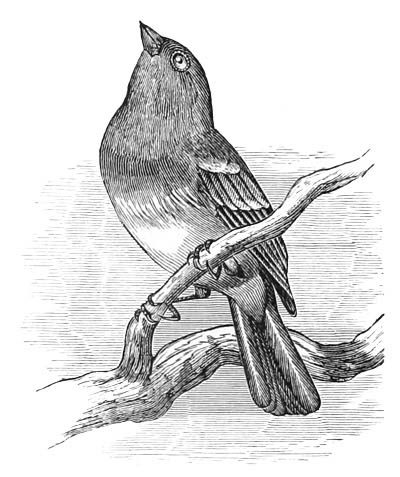
Cyanospiza amœna.
Sp. Char. Male. Upper parts generally, with the head and neck all round, greenish-blue; the interscapular region darker. Upper part of breast pale brownish-chestnut extending along the sides and separated from the blue of the throat by a faint white crescent; rest of under parts and axillars white. A white patch on the middle wing-coverts, and an obscurely indicated white band across the ends of the greater coverts. Loral region black. Length, about 5.50; wing, 3.90; tail, 2.60.
Female. Brown above, tinged with blue on rump and tail; whitish beneath, tinged with buff on the breast and throat; faint white bands on wings.
Hab. High Central Plains to the Pacific.
This species is about the size of C. cyanea; the bill exactly similar. The females of the two species are scarcely distinguishable, except by the faint traces of one or two white bands on the wings in amœna. Sometimes both the throat and the upper part of the breast are tinged with pale brownish-buff.
Habits. The Lazuli Finch was first obtained by Mr. Say, who met with it in Long’s expedition. It was observed, though rarely, along the banks of the Arkansas River during the summer months, as far as the base of the Rocky Mountains. It was said to frequent the bushy valleys, keeping much in the grass, after its food, and seldom alighting on either trees or shrubs.
Townsend, who found this rather a common bird on the Columbia, regarded it as shy and retiring in its habits, the female being very rarely seen. It possesses lively and pleasing powers of song, which it pours forth from the upper branches of low trees. Its nests were usually found placed in willows along the margins of streams, and were composed of small sticks, fine grasses, and buffalo-hair.
Mr. Nuttall found the nest of this bird fastened between the stem and two branches of a large fern. It was funnel-shaped, being six inches in height and three in breadth.
This bird possibly occurs quite rarely, as far east as the Mississippi, as I have what is said to be its egg taken from a nest near St. Louis. It only becomes abundant on the plains. Mr. Ridgway found it very generally distributed throughout his route, inhabiting all the bushy localities in the fertile districts. He regarded it as, in nearly every respect, the exact counterpart of the eastern C. cyanea. The notes of the two birds are so exactly the same that their song would be undistinguishable but for the fact that in the amœna it is appreciably weaker. He found their nests usually in the low limbs of trees, near their extremity, and only a few feet from the ground. Mr. J. A. Allen found this species common in Colorado, more so among the foot-hills than on the plains, but does not appear to have met with it in Kansas.
This species, Mr. Lord states, visits Vancouver Island and British Columbia early in the summer, arriving at the island in May, and rather later east of the Cascades. The song of the male is said to be feeble, and only now and then indulged in, as if to cheer his more sombre partner during incubation. The nest, he adds, is round and open at the top, composed of various materials worked together, lined with hair, and placed in a low bush, usually by the side of a stream.
The Lazuli Finch was met with in large numbers, and many of their nests procured, by Mr. Xantus, in the neighborhood of Ft. Tejon, California. Indeed, it is a very abundant species generally on the Pacific coast, and is found at least as far north as Puget Sound, during the summer. It arrives at San Diego, according to Dr. Cooper, about April 22, and remains there until October. A male bird, kept in a cage over winter, was found to retain its blue plumage. It is a favorite cage-bird in California, where it is absurdly known as the Indigo Bird. During the summer months, according to Dr. Cooper, there is hardly a grove in the more open portions of the State uninhabited by one or more pairs of this beautiful species. Although the female is very shy and difficult to obtain, except on the nest, the male is not timid, and frequently sings his lively notes from the top of some bush or tree, continuing musical in all weathers and throughout the summer. He describes its song as unvaried, as rather monotonous, and closely resembling that of C. cyanea.
Their nest, he adds, is usually built in a bush, not more than three or four feet from the ground, formed of fibrous roots, strips of bark, and grass, with a lining of vegetable down or hair, and securely bound to the surrounding branches. The eggs, five in number, he describes as white, faintly tinged with blue. At Santa Barbara he found them freshly laid May 6.
These birds are never gregarious, though the males come in considerable flocks in the spring, several days before the females. They travel at night, arriving at Santa Cruz about April 12. A nest found by Dr. Cooper, May 7, in a low bush close to a public road, was about three feet from the ground. It was very strongly built, supported by a triple fork of the branch, and was composed of blades of grass firmly interwoven, and lined with horsehair and cobwebs. It measured three inches in height and three and three fourths in width. The cavity was two inches deep and one and three fourths wide.
In Arizona Dr. Coues found this bird a summer resident, but not abundant.
At Puget Sound this bird arrives about May 15. Dr. Suckley states that in Oregon it was observed returning from the south, in large flocks, in one instance of several hundred individuals.
The eggs of the Lazuli, when fresh, are of a light blue, which on the least exposure soon fades into a bluish-white. They are almost exactly oval in shape, and measure .75 by .60 of an inch. One end is somewhat more rounded, but the difference is slight.
Cyanospiza versicolor, Baird.
VARIED BUNTING.
Spiza versicolor, Bon. Pr. Zoöl. Soc. 1837, 120.—Ib. Conspectus Av. 1850, 475.—Cab. Mus. Hein. 1851, 148. Carduelis luxuosus, Lesson, Rev. Zoöl. 1839, 41. Cyanospiza versicolor, Baird, Birds N. Am. 1858, 503, pl. lvi, f. 2.—Cooper, Orn. Cal. 1, 234.
Sp. Char. Posterior half of hood, with throat, dark brownish-red; interscapular region similar, but darker. Forepart of hood, lesser wing-coverts, back of the neck, and rump, purplish-blue; the latter purest blue; the belly reddish-purple, in places tinged with blue, more obscure posteriorly. Feathers of wing and tail dark-brown, edged with dull bluish. Loral region and narrow frontal band black. Feathers on side of rump white at base. Length, 5.50; wing, 2.75; tail, 2.38.
Female. Yellowish-brown; paler beneath, and lightest behind. No white on wing. Tail with a bluish gloss.
Hab. Northern Mexico, and Cape St. Lucas. Xalapa (Scl. 1859, 365); Oaxaca (Scl. 1859, 379); Orizaba (Scl. 1857, 214); (Sum. M. B. S. I, 551; breeding); Guatemala (Scl. Ibis, I, 17).
The bill is stouter and more swollen to the end, and the mandible is much more curved than that of C. cyanea; and its perfectly concave commissure, without any shallow lobe in the middle, and the much more arched ridge, would almost separate the two generically. The wing is shorter and more rounded, the fourth quill longest, then the third, second, and fifth. The first is only a little longer than the seventh. The tail is decidedly rounded; rather more so than in C. cyanea.
The female is very similar to those of C. amœna and cyanea. The former has whitish bands on the wing; the latter differs in shape of bill, and has the first quill but little less than the second, or longest; not shorter than the sixth. In 34,033 ♂, Cape St. Lucas (June 26), the colors are much brighter than in any other of the collection. The whole occiput is bright scarlet, and the forehead nearly pure light blue, neither having scarcely a tinge of purple.
Autumnal and winter males have the bright tints very slightly obscured by grayish-brown tips to the feathers, especially on the back. The female in autumn is much more brown above and more rusty beneath than in spring.
Habits. This beautiful species has only doubtful claims to a place in our fauna. It is a Mexican species, and may occasionally cross into our territory. It was met with at Boquillo, in the Mexican State of New Leon, by Lieutenant Couch. It was procured in Guatemala by Dr. Van Patten and by Salvin, and is given by Bonaparte as from Peru. It is also found at Cape St. Lucas, where it is not rare, and where it breeds.
This bird is also found at Orizaba, according to Sumichrast, but is quite rare in the State of Vera Cruz. Its common name is Prusiano. Its geographical distribution he was not able satisfactorily to ascertain.
Among the memoranda of Mr. Xantus made at Cape St. Lucas, we find the following in connection with this species: 517, nest and three eggs of Cyanospiza versicolor; obtained May 5 on a myrtle hanging down from very high perpendicular bluffs, off the Trajoles, at Cape St. Lucas. 1535, nest and eggs of the same found on a vine ten feet high.
Specimens of this species were taken by Mr. Boucard at Oaxaca, Mexico, during the winter months.
Cyanospiza ciris, Baird.
NONPAREIL; PAINTED BUNTING.
Emberiza ciris, Linn. Kong. Sv. Vet. Akad. Hand. 1750, 278; tab. vii, f. 1.—Ib. Syst. Nat. I, 1766, 313.—Wilson, Am. Orn. III, 1811, 68, pl. xxiv, f. 1, 2. Passerina ciris, Vieillot, Gal. Ois. I, 1824, 81, pl. lxvi. Fringilla ciris, Aud. Orn. Biog. I, 1832, 279; V, 517, pl. liii. Spiza ciris, Bon. List, 1838.—Ib. Conspectus, 1850, 476.—Aud. Syn. 1839, 108.—Ib. Birds Am. III, 1841, 93, pl. clxix. Cyanospiza ciris, Baird, Birds N. Am. 1858, 503.—Ib. Mex. Bound. II, Birds, 17, pl. xviii, f. 2.—Heerm. X, c, p. 14. ? Fringilla mariposa, Scopoli, Annals Hist. Nat. I, 1769, 151. Painted Finch, Catesby, Pennant.
Sp. Char. Male. Head and neck all round ultramarine-blue, excepting a narrow stripe from the chin to the breast, which, with the under parts generally, the eyelids, and the rump (which is tinged with purplish), are vermilion-red. Edges of chin, loral region, greater wing-coverts, inner tertiary, and interscapular region, green; the middle of the latter glossed with yellow. Tail-feathers, lesser wing-coverts, and outer webs of quills, purplish-blue. Length, about 5.50 inches; wing, 2.70.
Female. Clear dark green above; yellowish beneath. Young, like female.
Hab. South Atlantic and Gulf States to the Pecos River, Texas; south into Middle America to Panama; S. Illinois (Ridgway); Honduras (Scl. 1858, 358); Oaxaca (Scl. 1859, 379); Cordova (Scl. 1856, 304); Guatemala (Scl. Ibis, I, 17); Honduras (Scl. II, 10); Cuba (Cab. J. IV, 8); Veragua (Salv. 1867, 142); Costa Rica (Lawr. IX, 102); Vera Cruz, winter (Sum. M. B. S. I, 552); Yucatan (Lawr. IX, 200).
Tail very slightly emarginated and rounded; second, third, and fourth quills equal; first rather shorter than the fifth.
The female is readily distinguishable from that of C. cyanea by the green instead of dull brown of the back, and the yellow of the under parts.
Specimens of this species from all parts of its range appear to be quite identical.
Habits. The Nonpareil or Painted Bunting of the Southern and Southeastern States has a somewhat restricted distribution, not being found any farther to the north on the Atlantic Coast than South Carolina and Georgia, and probably only in the more southern portions of those States. It has been traced as far to the west as Texas. It was also met with at Monterey, Mexico, by Lieutenant Couch, and in winter by Mr. Boucard, at Plaza Vicente, Oaxaca.
Mr. Dresser found it very common both at Matamoras and at San Antonio, breeding in both places. Dr. Coues did not meet with it in Columbia, S. C., and considers it as confined to the low country, and as rare even there. It breeds about the city of Charleston, S. C., from which neighborhood I have received its eggs in considerable numbers, from Dr. Bachman. It is also found in the lower counties of Georgia, and breeds in the vicinity of Savannah. It was not met with by Dr. Gerhardt in the northern portion of that State. Dr. Woodhouse found it quite abundant in all parts of Texas, where he tells us the sweet warblings of this beautiful and active little Finch added much to the pleasures of his trip across the prairies. Its favorite places of resort appeared to be small thickets, and when singing it selected the highest branches of a bush.
In the Report on the birds of the Mexican Boundary Survey, Lieutenant Couch met with this species among the low hedges in the suburbs of Pesqueria Grande. Mr. J. H. Clark observed that the individuals of this species diminished as they proceeded westward. The male was almost always seen alone, flying a long distance for so small a bird. Their nests, he adds, were built of very fine grass, in low bushes, and resting in the crotch of the twigs. Males were never seen about the nest, but the females were so gentle as to allow themselves to be taken off the nest, which was deliberately done on more than one occasion.
Dr. Kennerly reports having often listened to the melodious warblings of this beautiful Finch in the vicinity of San Antonio, Texas, where he found it very abundant among the thick mesquite-bushes, in the month of July. It was deservedly a great favorite there, both on account of the beauty of its plumage and its notes.
Wilson found this bird one of the most numerous summer birds of Lower Louisiana, where it was universally known among the French inhabitants as Le Pape. Its gay dress and its docility of manners procured it many admirers. Wilson also states that he met with these birds in the low countries of all the Southern States, in the vicinity of the sea and along the borders of the large rivers, particularly among the rice plantations. He states that a few were seen near the coast in North Carolina, but they were more numerous in South Carolina, and still more so in Georgia, especially the lower parts. At Natchez, on the Mississippi, they were comparatively scarce, but below Baton Rouge, on the levee, they appeared in great numbers. Around New Orleans they were warbling from almost every fence. Their notes very much resemble those of the Indigo Bird, but lack their energy, and are more feeble and concise.
Wilson met with these birds very generally in the houses of the French inhabitants of New Orleans. In the aviary of a wealthy French planter near Bayou Fourche, he found two pairs of these birds so far reconciled to their confinement as to have nests and hatch out their eggs. Wilson was of the opinion that with the pains given to the Canary these birds would breed with equal facility. Six of them, caught only a few days before his departure, were taken with him by sea. They soon became reconciled to their cage, and sang with great sprightliness. They were very fond of flies, and watched with great eagerness as the passengers caught them for their benefit, assembling in the front of the cage and stretching their heads through the wires to receive them.
These birds, he states, arrive in Louisiana from the South about the middle of April, and build early in May. They reach Savannah about the 20th of April. Their nests are usually fixed in orange hedges or in the lower branches of the trees. He often found them in common bramble and blackberry bushes. They are formed exteriorly of dry grass intermingled with the silk of caterpillars, with hair and fine rootlets. Some nests had eggs as late as the 25th of June, which were probably a second brood. The food of this bird consists of rice, insects, and various kinds of seeds. They also feed on the seeds of ripe figs.
A single specimen of this species was detected by Mr. Ridgway in Southern Illinois between Olney and Mount Carmel, on the 10th of June. It is therefore presumed to be a rare summer resident in that locality.
The Nonpareil is possessed of a very pugnacious disposition, and, according to Mr. Audubon, the bird-dealers of New Orleans take advantage of this peculiarity in a very ingenious manner to trap them. A male bird is stuffed and set up in an attitude of defence on the platform of a trap-cage. The first male bird of this species that notices it is sure to make an attack upon it, and is at once trapped. So pertinacious are they that even when thus imprisoned the captive repeats its attack upon its supposed rival. They feed almost immediately upon being caught, and usually thrive in confinement, Audubon mentioning one that had been caged for ten years.
This bird is very easily made to breed in confinement. Dr. Bachman has had a single pair thus raise three broods in a season.
The eggs of this species measure .80 by .65 of an inch, and do not at all resemble the eggs of the cyanea or amœna. They have a dull or pearly-white ground, and are very characteristically marked with blotches and dots of purplish and reddish brown.
Genus SPERMOPHILA, Swainson.
Spermophila, Swainson, Zoöl. Jour. III, Nov. 1827, 348. (Type, Pyrrhula falcirostris, Temm. Sufficiently distinct from Spermophilus, F. Cuv. 1822.)
Sporophila, Cabanis, Mus. Hein. 1851, 148. (Type, Fringilla hypoleuca, Licht.)
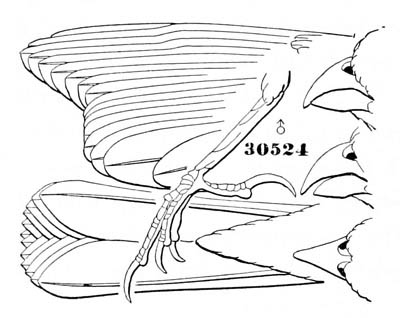
Spermophila moreleti. 30524 ♂
Gen. Char. Bill very short and very much curved, as in Pyrrhula, almost as deep as long; the commissure concave, abruptly bent towards the end. Tarsus about equal to middle toe; inner toe rather the longer (?), reaching about to the base of the middle one; hind toe to the middle of this claw. Wings short, reaching over the posterior third of the exposed part of the tail; the tertiaries gradually longer than the secondaries, neither much shorter than the primaries, which are graduated, and but little different in length, the first shorter than the sixth, the second and fourth equal. The tail is about as long as the wings, rounded, all the feathers slightly graduated, rather sharply acuminate and decidedly mucronate. Smallest of American passerine birds.
The essential characters of this genus are the small, very convex bill, as high as long; the short broad wings, with the quills differing little in length, the outer ones graduated; the tail as long as the wings, widened towards the end, and slightly graduated, with the acuminate and mucronate tip to the feathers.
Many species of the genus occur in Middle and South America, although none not readily distinguishable from the single North American one.
Spermophila moreleti, Pucheran.
LITTLE SEED-EATER.
Spermophila moreleti, (Pucheran,) Bonap. Conspectus, 1850, 497.—Sclater, Pr. Zoöl. Soc. 1856, 302.—Baird, Birds N. Am. 1858, 506, pl. liv, f. 2, 3.—Ib. Mex. Bound. II, Birds, 17, pl. xvi, f. 2, 3. Sporophila moreleti, Cab. Mus. Hein. 1851, 150.—Ib. Journ. für. Orn. IX, 1861, 4 (with synonomy). Spermophila albigularis, (Spix,) Lawrence, Ann. N. Y. Lyceum, V, Sept. 1851, 124 (Texas. Not of Spix).
Sp. Char. The top and sides of the head, back of the neck, a broad band across the upper part of the breast extending all round, the middle of the back, the wings and tail, with the posterior upper coverts, black. The chin, upper throat and neck all round, but interrupted behind, the rump, with the remaining under and lateral portions of the body, white; the latter tinged with brownish-yellow. Two bands on the wing, across the greater and middle coverts, with the concealed bases of all the quills, also white. Length, about 4 inches; wing, 2.05; tail, 1.90.
Female. Dull yellow; olivaceous above, brownish-yellow beneath. Wings and tail somewhat as in the male.
Hab. Rio Grande of Texas; south to Costa Rica. Xalapa (Scl. 1859, 365); Oaxaca (Scl. 1859, 378); Cordova (Scl. 1856, 302); Guatemala (Scl. Ibis, I, 17; Salv. Ibis, I, 468; nest); Costa Rica (Cab. J. 1861, 4); Vera Cruz, winter, alpine region, breeding (Sum. M. B. S. I, 551).
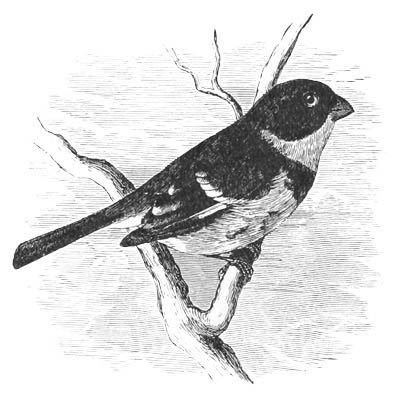
Spermophila moreleti.
Habits. This pretty little tropical form of Sparrow can only rest a claim to be included in our fauna by its occasional presence on the Rio Grande in Texas. It is found throughout Mexico and Central America.
Mr. Sumichrast found it throughout the State of Vera Cruz, except only in the elevated or alpine regions. Its common name was Frailecito. It was abundant throughout the hot and the temperate regions as well as the plateau.
This species was first met with near the Lake of Peten, in Guatemala, by M. Morelet, and was described from his specimens in the Paris Museum by Prince Bonaparte. Mr. Salvin found it a not uncommon species about Dueñas, where it is generally to be found amongst the tall weeds on the edge of the lake. It was also found at Belize. From a letter of Mr. Salvin, published in the Ibis of 1859 (p. 468), we quote the following in reference to the nest of this species, which is all the information we have in relation to this diminutive Sparrow: “A day or two ago I found two nests of Spermophila moreleti, and took one rotten dried-up egg from one with a young one in it. Nothing could be more different than this nest and that of S. bicolor, so well described by Mr. Newton. That of S. moreleti, instead of the loose domed structure of S. bicolor, with a large side-entrance, composed entirely of one material, is one of the neatest nests you ever saw,—a beautiful, open, transparent nest, composed of fine roots and fibres, and lined with horsehair. It is not placed resting on a branch, but is suspended like a Reed Warbler’s (Salicaria arundinacea), by several small twigs. The eggs, too, differ materially.” Mr. Salvin gives no description of these eggs.
This bird was found a resident during the winter months, and in May also, at Plaza Vicente, in the State of Oaxaca, Mexico. This is in the low or hot lands of that region.
Genus PHONIPARA, Bonap.
Phonipara, Bonaparte, 1850. (Type, Loxia canora, Gm.)
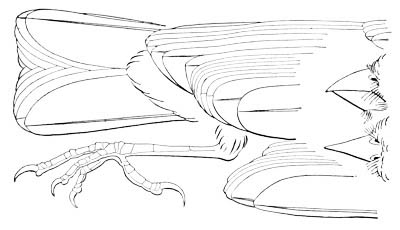
Phonipara zena.
Gen. Char. Size very small. Wing considerably longer than the tail, but much rounded; third or fourth quill longest; first about equal to seventh. Tail very slightly rounded, the feathers broad. Bill very short and deep, but the depth through the base less than the culmen; culmen but slightly, or not appreciably, curved; bill much compressed. Feet stout; tarsi longer than the middle toe; outer toe longer than the inner, its claw just reaching the base of the middle claw; hind toe with the claw very large, and strongly curved. Among the least of American Fringillidæ.
The introduction of this genus into the North American fauna is the result of Mr. Maynard’s indefatigable labors in the exploration of Florida. The species are principally West Indian, a single race alone belonging to the continental portion of Middle America.
Species and Varieties.
Common Characters. Sexes very different. Above olive-green, beneath blackish or whitish. ♂. Head and breast black, the former with or without yellow patches. ♀ with the yellow and black indicated only, or wanting. Length, about 4.00.
A. Head without any yellow.
1. P. zena. Culmen decidedly curved. Above dull grayish olive-green. ♂. Head and lower parts, especially anteriorly, dull black, mixed with whitish posteriorly. ♀. Head and beneath ashy. Wing, about 2.00; tail, 1.75. Hab. West Indies (Cuba, Hayti, Porto Rico, St. Bartholomew, Jamaica, etc.); also Key West, Florida (Maynard).
B. Head with yellow patches.
2. P. pusilla. Culmen perfectly straight. Above rather bright olive-green. ♂, a supraloral stripe, a patch on chin, and upper part of throat, with edge of wing, bright yellow; forehead, lores, and jugulum black. ♀ with the black and yellow only indicated, or wanting.
Whole crown, cheeks, breast, and upper part of abdomen black. Hab. Middle America, from Mirador to Panama, and southward … var. pusilla.[12]
Only isolated spots, covering forehead, lore, and base of lower jaw, and patch on jugulum, black. Hab. West Indies. (Porto Rico, Hayti, Jamaica, Cuba, etc.) … var. olivacea.[13]
3. P. canora.[14] Culmen decidedly curved. Above bright olive-green; beneath pale ashy, whitish on anal region. A bright yellow broad crescent across the lower part of the throat, curving upward and forward, behind and over the auriculars, to above the eye. ♂. Lores, auriculars, and chin, and a band across the jugulum, black. ♀. Chin, etc., chestnut-brown; no black on jugulum. Hab. Cuba.
Phonipara zena, Bryant.
THE BLACK-FACED FINCH.
Fringilla zena, Linn. Syst. Nat. I, (ed. 10,) 1758, 183 (based on Passer bicolor bahamensis, Catesby, Carol. I, tab. 37, Bahamas).—Bryant, Pr. Bost. Soc. N. H. X, 1865, 254. Fringilla bicolor, Linn. Syst. Nat. I, (ed. 12,) 1766, 324 (same original as zena). Spermophila bicolor, Gosse (Jamaica). Phonipara bicolor, Newton (St. Croix). ? Tiaris omissa, Jardine, Ann. Nat. Hist. 1847, 332 (Tobago). Phonipara omissa, Sclater. Phonipara marchi, Baird, Pr. A. N. Sc. Phila. Nov. 1863, 297 (Jamaica). Fringilla zena, var. marchi, Bryant, Pr. Bost. Soc. 1867, 43. Fringilla (Phonipara) zena, var. portoricensis, Bryant, Pr. Bost. Soc. X, 1865, 254 (Porto Rico).
Sp. Char. Male adult (627, Bryant coll.; Inagua). Above dull olive-green, the head and lower parts black, the two colors blending insensibly into each other; feathers of the middle of the abdomen and crissum edged with whitish. Wing, 2.10; tail, 1.80, culmen, .35; tarsus, .63; middle toe, .50.
Female adult (983, Bryant coll.; Inagua). Above dull olive-green, beneath ashy, whitish on the abdomen and crissum; no black. Wing, 2.10.
Male juv. (981, Bryant coll.; Inagua). Like the adult female, but the head anteriorly, the chin, throat, and jugulum medially, black. Wing, 2.05.
Hab. West Indies (Bahamas; Jamaica, Porto Rico; St. Croix, Tobago?).
Quite a large series of this species from the various West Indian Islands show a considerable variation in the amount of black in male birds; nothing characteristic of the different islands, however, for, in specimens from each, individuals are to be found agreeing in every respect with the stages described above.
Habits. The Black-faced Finch of Jamaica and other West India Islands claims a place in the fauna of the United States as an occasional visitant of Florida; of how common occurrence on that peninsula we cannot determine. It was taken there in the spring of 1871 by Mr. Maynard, and is possibly an accidental rather than a regular visitant. It is found in many of the West India Islands, though being resident in their several places of abode, they naturally exhibit certain characteristics as of distinct races. The eggs of the St. Croix bird differ considerably from those of the Jamaica one.
The Messrs. Newton, in their account of the birds of St. Croix, mention this bird as having a Bunting-like song, heard always very early in the morning. It is said to frequent the curing-houses, hopping on the uncovered sugar-hogsheads, and making a plentiful meal therefrom. It is very sociable, and feeds in small flocks, mostly on the ground among the guinea-grass. The crops of those dissected were usually found to contain small seeds. They build domed nests in low bushes, thickets of bamboo, or among creepers against the side of a house, seldom more than four feet from the ground, composed entirely of dry grass, the interior being lined with finer materials of the same. The opening is on one side, and is large for the size of the nest. They breed from the middle of May to the end of July. The eggs are white, spotted with red, especially at the larger end. The usual number of eggs is three, very rarely four. Their measurement is .65 by .50 of an inch.
In Jamaica Mr. March speaks of it as the most common of the Grass Finches, of which there are three other species, and as nesting at all seasons of the year in low trees and bushes. Near homesteads, in building their domed nests, they make use of shreds, scraps of cloth, bits of cotton, and other trash. Their eggs, he says, are three and sometimes even six in number; and he mentions their varying both as to dimensions and coloring, which may explain the difference between the eggs from St. Croix and Jamaica. Those from the latter place measure .72 by .50 of an inch, and the markings are more of a brown than a red color.
Mr. Hill adds that the Grass Finch very frequently selects a shrub on which the wasps have built, fixing the entrance close to their cells.
Mr. Gosse states that the only note of this species is a single harsh guttural squeak, difficult either to imitate or to describe.
Genus PYRRHULOXIA, Bonap.
Pyrrhuloxia, Bonaparte, Conspectus, 1850, 500. (Type, Cardinalis sinuatus, Bon.)
Gen. Char. The bill is very short and much curved, the culmen forming an arc of a circle of 60 degrees or more, and ending at a right angle with the straight gonys; the commissure abruptly much angulated anterior to the nostrils in its middle point; the lower jaw very much wider than the upper, and wider than the gonys is long; anterior portion of commissure straight. Tarsus longer than middle toe; outer lateral toes longer, not reaching the base of the middle; wing considerably rounded, first quill longer than secondaries. Tail much longer than the wing, graduated; the feathers broad, truncate. Head crested.
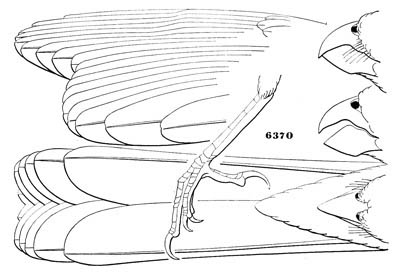
Pyrrhuloxia sinuata. 6370
Color. Gray, with red feathers and patches.
The essential character of this genus lies in the greatly curved, very short, and broad bill, something like that of Pyrrhula. In other respects like Cardinalis, but with less graduated wing, and longer and broader tail.
Pyrrhuloxia sinuata, Bonap.
TEXAS CARDINAL.
Cardinalis sinuatus, Bp. Pr. Zoöl. Soc. Lond. V, 1837, 111 (Mexico).—Lawrence, Ann. N. Y. Lyc. V, 1851, 116.—Cassin, Illust. I, VII, 1854, 204, pl. xxxiii. Pyrrhuloxia sinuata, Bon. Consp. 1850, 500.—Baird, Birds N. Am. 1858, 508.—Heerm. X, c. 16.—Cooper, Orn. Cal. I, 236.
Sp. Char. Head with an elongated, pointed crest, springing from the crown. Upper parts generally pale ashy-brown; hood, sides of neck, and under parts of body, rather paler. Long crest-feathers, bill all round including lores and encircling the eye, wing and tail, dark crimson. Chin and upper part of throat, breast, and median line of the belly, under tail-coverts, tibia, edge and inner coverts of the wings, bright carmine-red. Bill yellowish. Length, about 8.50; wing, 3.75; tail, 4.50.
Female similar, with the under part brownish-yellow; middle of belly and throat only tinged with red.
Hab. Valley of the Rio Grande of Texas and westward; Cape St. Lucas; Mazatlan, Mexico.
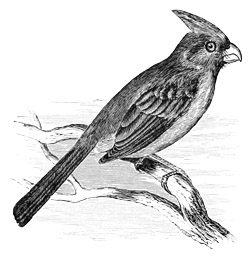
Pyrrhuloxia sinuata.
The wing is considerably rounded, the fourth and fifth quills longest; the first as long as the secondaries, the second longer than the seventh. The tail is long, graduated on the sides, the outer about half an inch shorter than the middle. The feathers are very broad to the end and obliquely truncate. They are rather broader than in Cardinalis virginianus. The crest is narrower and longer, and confined to the middle of the crown; it extends back about 1.80 inches from the base of the bill.
The carmine of the breast is somewhat hidden by grayish tips to the feathers; that of the throat is streaked a little with darker. The exposed surfaces of the wing-coverts and of secondaries and tertials are like the back. The tail-feathers are tipped with brownish.
Specimens from Cape St. Lucas are very much smaller than any others, measuring only, wing, 3.30; tail, 3.80. The crest is dull carmine, instead of dark wine-purple; the red tinge on wing and tail much fainter, and the sides, as well as the gray tints everywhere, more brownish; there is none of that dark burnt-carmine tint to the red of lores and cheeks observable in all the Texas specimens. No. 49,758, Camp Grant, Arizona, is like the Cape St. Lucas birds in colors, except that the crest is dusky, but the proportions are those of the Rio Grande series.
Habits. The Texan Cardinal was originally described as a bird of Mexico by Prince Charles Lucien Bonaparte in the Proceedings of the Zoölogical Society of London. It has since been ascertained to inhabit the southern central portions of our country, its range of extension northerly bringing it within the limits of the United States. In Texas, on the Rio Grande, it is resident throughout the year, or of but limited migration in the coldest weather. It was not observed by Dr. Coues in Arizona, but is said to occur in the southern portion of that Territory. It was found breeding at Cape St. Lucas by Mr. Xantus. It is not named by Sumichrast among the birds of Vera Cruz.
Its habits are said to be of the same general character with those of our common Cardinal.
The specimens from which this bird was first described were procured in the vicinity of the city of Mexico. The first obtained within the limits of the United States were observed by Captain McCown of the U. S. Army, at Ringgold Barracks, in Texas. Since then it has been procured by several of the naturalists accompanying the government expeditions. It was obtained in New Leon, Mexico, by Lieutenant Couch; in Texas, by Major Emory; in Texas and at El Paso, by Lieutenant Parke.
When first seen, in March, in the State of Tamaulipas, by Lieutenant Couch, it was in flocks, very shy and difficult of approach. It did not occur much in open fields, but seemed to prefer the vicinity of fences and bushes. It was often seen in company with the common Cardinal.
Dr. Kennerly found this bird quite abundant in the vicinity of El Paso, but did not observe it elsewhere. It kept generally in flocks of from three to six, frequenting the hedges and fruit-trees in the vicinity of houses. It became very restless when approached, flying from branch to branch and from tree to tree, uttering its peculiar note with great vehemence.
Dr. Heermann met with the first specimen of this bird in a dry cañon, a little to the east of the crossing of San Pedro River. It was perched on a bush, seemed wearied and lost, and was probably a wanderer. No more were seen until he reached El Paso. There he found it everywhere among the hedges and trees, and continued to meet with it occasionally on his road, until his party left civilization behind. It erects its crest as it moves actively about in search of food, and utters at intervals a clear, plaintive whistle, varied by a few detached notes.
Mr. Dresser considers this species rather a straggler from Mexico than as a Texan bird. Near Eagle Pass and Piedras Negras he found it abundant, but it became scarce as soon as he travelled a few miles into Texas. He saw none north or east of the Leona. He was told that quantities breed near Eagle Pass, and he saw not a few in cages that had been reared from the nest. He found it a shy bird, and difficult to shoot. When followed, it flies about uneasily, perching on the top of some high bush, and erecting its long crest, uttering a clear, plaintive whistle. Sometimes it would take to the thick brushwood and creep through the bushes so that it was impossible to get a shot at it. On the Lower Rio Grande it was of uncommon occurrence. He noticed a single pair near Matamoras in August, 1864.
Captain McCown, in his account of this species, published by Cassin, writes that, so far as seen on the Rio Grande, this handsome species appeared to have a strong partiality for damp and bushy woods. So far as he observed, it never ventured far from the river. He was under the impression that this bird remains in Texas all the year, having met with it so late in the fall and again so early in the spring, that, if not constantly resident, its migrations must be very limited. He describes it as a gay, sprightly bird, generally seen in company with others of the same species, frequently erecting its crest and calling to its mate or comrades. It is rather shy, and not easily approached. In its voice and general habits it appeared to him very similar to the common species.
The eggs of this species are of an oval shape, one end being only a little less rounded than the other. Their average measurement is one inch in length by .80 in breadth. Their ground-color is a dull chalky-white, over which are distributed well-defined blotches of a light umber-brown, and also a number of indistinct markings of purple. The spots are pretty uniform in these colors, but vary greatly in size and distribution. In some eggs they largely consist of fine dots, in others they are in bold blotches. In some the brown is more confluent and the effect that of a deeper shade.
Genus CARDINALIS, Bonap.
Cardinalis, Bonaparte, Saggio di una distribuzione metod. dei Animagli Vertebrati, 1831 (Agassiz). (Type, Loxia cardinalis, Linn.)
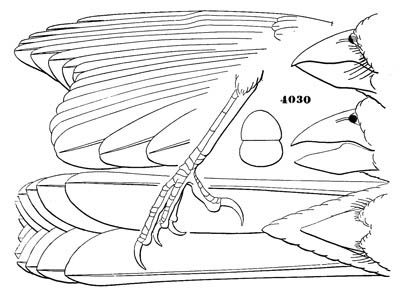
Cardinalis virginianus. 4030
Gen. Char. Bill enormously large; culmen very slightly curved, commissure sinuated; lower jaw broader than the length of the gonys, considerably wider than the upper jaw, about as deep as the latter. Tarsi longer than middle toe; outer toe rather the longer, reaching a little beyond the base of the middle one; hind toe not so long. Wings moderate, reaching over the basal third of the exposed part of the tail. Four outer quills graduated; the first equal to the secondaries. Tail long, decidedly longer than the wings, considerably graduated; feathers broad, truncated a little obliquely at the end, the corners rounded. Colors red. Head crested.
The essential characters of this genus are the crested head; very large and thick bill extending far back on the forehead, and only moderately curved above; tarsus longer than middle toe; much graduated wings, the first primary equal to the secondary quills; the long tail exceeding the wings, broad and much graduated at the end.
Of this genus, only two species are known, one of them being exclusively South American, the other belonging to North America, but in different regions modified into representative races. They may be defined as follows.
Species and Varieties.
Common Characters. Male. Bright vermilion-red, more dusky purplish on upper surface; feathers adjoining base of bill black for greater or less extent. Female. Above olivaceous, the wings, tail, and crest reddish; beneath olivaceous-whitish, slightly tinged on jugulum with red.
C. virginianus. Culmen nearly straight; commissure with a slight lobe; upper mandible as deep as the lower, perfectly smooth. Bill red. Black patch covering whole throat, its posterior outline convex. Female. Lining of wing deep vermilion. Olivaceous-gray above, the wings and tail strongly tinged with red; crest only dull red, without darker shaft-streaks. Beneath wholly light ochraceous. No black around bill.
A. Crest-feathers soft, blended. Rump not lighter red than back.
a. Black of the lores passing broadly across forehead. Crest brownish-red. Bill moderate.
Culmen, .75; gonys, .41; depth of bill, .54. Feathers of dorsal region broadly margined with grayish. Wing, 4.05; tail, 4.50; crest, 1.80. Hab. Eastern Province of United States, south of 40°. Bermudas … var. virginianus.
b. Black of the lores not meeting across forehead; crest pure vermilion. Bill robust.
Culmen, .84; gonys, .47; depth of bill, .70. Feathers of dorsal region without grayish borders; red beneath more intense; wing, 3.60; tail, 4.20; crest, 2.00. Hab. Eastern Mexico (Mirador; Yucatan; “Honduras”) … var. coccineus.[15]
Culmen, .82; gonys, .47; depth of bill, .65. Feathers of dorsal region with distinct gray borders; red beneath lighter. Wing, 4.00; tail, 5.00; crest, 2.00. Hab. Cape St. Lucas, and Arizona; Tres Marias Islands. (Perhaps all of Western Mexico, north of the Rio Grande de Santiago.) … var. igneus.
B. Crest-feathers stiff, compact. Rump decidedly lighter red than the back.
Culmen, .75; gonys, .41; depth of bill, .57. Dorsal feathers without grayish margins; red as in the last. Wing, 3.40; tail, 3.80; crest, 2.00. Hab. Western Mexico; Colima. “Acapulco et Realejo.” … var. carneus.[16]
C. phœniceus.[17] Culmen much arched; commissure arched; upper mandible not as deep as lower, and with grooves forward from the nostril, parallel with the curve of the culmen. Bill whitish-brown. Black patch restricted to the chin, its posterior outline deeply concave.
Crest-feathers stiff and compact. No black above, or on lores; crest pure vermilion; rump light vermilion, much lighter than the back, which is without gray edges to feathers. Culmen, .75; gonys, .39; height of bill, .67; wing, 3.50; tail, 3.90; crest, 2.20. Female. Lining of wing buff; above ashy-olivaceous, becoming pure ash on head and neck, except their under side. Crest-feathers vermilion with black shafts; no red tinge on wings, and only a slight tinge of it on tail. Forepart of cheeks and middle of throat white; rest of lower part deep ochraceous. Black around bill as in the male. Hab. Northern South America; Venezuela; New Granada.
Cardinalis virginianus, Bonap.
REDBIRD; CARDINAL GROSBEAK.
Coccothraustes virginiana, Brisson, Orn. III, 1760, 253. Loxia cardinalis, Linn. Syst. I, 1766, 300.—Wilson, Am. Orn. II, 1810, 38, pl. vi, f. 1, 2. Coccothraustes cardinalis, Vieill. Dict. Fringilla (Coccothraustes) cardinalis, Bon. Obs. Wils. 1825, No. 79. Fringilla cardinalis, Nutt. Man. I, 1832, 519.—Aud. Orn. Biog. II, 1834, 336; V, 514, pl. clix. Pitylus cardinalis, Aud. Syn. 1839, 131.—Ib. Birds Am. III, 1841, 198, pl. cciii. Cardinalis virginianus, Bon. List, 1838.—Ib. Consp. 1850, 501.—Baird, Birds N. Am. 1858, 509.—Max. Cab. J. VI, 1858, 268. Grosbec de Virginie, Buff. Pl. enl. 37.
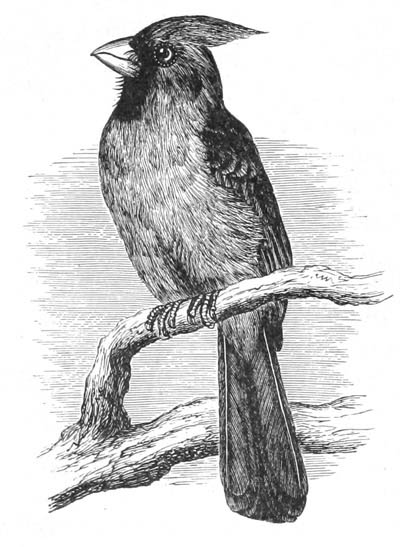
Cardinalis virginianus.
Sp. Char. A flattened crest of feathers on the crown. Bill red. Body generally bright vermilion-red, darker on the back, rump, and tail. The feathers of the back and rump bordered with brownish-gray. Narrow band around the base of the bill, extending to eyes, with chin and upper part of the throat black.
Female of a duller red, and this only on the wings, tail, and elongated feathers of the crown. Above light olive; tinged with yellowish on the head; beneath brownish-yellow, darkest on the sides and across the breast. Black about the head only faintly indicated. Length, 8.50; wing, 4.00; tail, 4.50; culmen, .75; depth of bill, .58; breadth of upper mandible, .35. (28,286 ♂, Mount Carmel, Southern Illinois.)