Family CORVIDÆ.—The Crows. (continued 3)
Reading edition
Habits. The Canada Jay was procured at Fort Simpson by Mr. Kennicott in August, September, and December, and at the same point by Mr. Ross in March and April, in the years 1860 and 1861. It was found breeding in May at Anderson River Fort by Mr. MacFarlane. It was also procured at Big Island by Mr. Reid, at Nulato and Unalakleet by Mr. Dall, at St. Michael’s by Colonel Bulkley, at Fort Kenai by Bischoff, and at Fort Rae by Mr. Clarke. From the memoranda of Mr. MacFarlane, we have valuable information in regard to the nesting and breeding habits of this species. May 24, at Fort Anderson, an Indian lad discovered a nest of this Jay. It was built in a tree, was composed of hay and feathers, and contained, with two young birds a few days old, an egg that was perfectly fresh. This bird, Mr. MacFarlane states, is tolerably numerous in that quarter. During the severe cold of winter it is not quite so common as at other seasons. It is by no means a difficult bird to shoot, as it will always venture into close proximity to man. Flesh or fish are certain to attract numbers of them, and they also cause great annoyance to the marten-hunter, by eating the bait placed in the traps used for capturing those animals. None of this species were observed on the Arctic coast, nor east of Horton River, Fort Anderson being the most northern point where Mr. MacFarlane saw any, in his journeys across the barren grounds.
Other nests found in the same region were usually built in spruce-trees, on branches near the trunk, well concealed from view, and about ten feet from the ground. They were constructed of hay and feathers, supported underneath by a few willow sticks laid crosswise.
Mr. Dall characterizes this species as a very bold and familiar bird, that will frequently fly down and steal away his dinner from some hungry dog, if he is not on the alert, or devour the fish hung up in camp by the Indians to dry. They breed very early, and occupy the same nest year after year. The nest is very large, and composed entirely of soft materials, moss, hair, and the like. On the 20th of April, Mr. Dall received a nest of this Jay containing four half-fledged young, so that they must lay in March. The bird was abundant everywhere on the Yukon River.
These birds are known throughout the fur countries by the name of Whiskey-Jack, not from any supposed predilection for that beverage, but probably, as Mr. Kennicott has suggested, from a corruption of the Indian name for these birds, Wiss-ka-chon, which has been contorted into Whiskey-John and thence into Whiskey-Jack. Richardson observed these birds from Canada to the fur countries as far as latitude 69°. Throughout that region it is a constant attendant at the fur-posts and fishing-stations, and becomes so tame in the winter as to feed from the hand. Yet it is impatient of confinement, and soon pines away if deprived of its liberty. Its voice is said to be plaintive and squeaking, though it occasionally makes a low chattering. It hoards berries, pieces of meat, etc., in hollow trees, or between layers of bark, by which it is enabled to feed its young while the ground is still covered with snow.
Dr. Newberry found this Jay as far to the south, in California, as the upper end of the Sacramento Valley, in latitude 40°. The fact that the isothermal line of this region passes south of Cincinnati, shows that climate and temperature do not regulate the range of this species. As observed in the summer months among the forests of Oregon, the Canada Jay appeared as a rather shy bird, exhibiting none of the familiarity and impudence exhibited in winter when made bold by hunger.
Wilson mentions the St. Lawrence as the southern boundary of this bird, a few only wintering in Northern New York and Vermont. But this is inexact. They are found resident throughout the year in a large part of Maine and in all the highlands of New Hampshire and Vermont. They are resident at Calais, where they breed in March at about latitude 45°, and descend in the winter to the southwest corner of Vermont, whence it is quite probable a few cross into Massachusetts, at Williamstown and Adams, though none have been detected, that I am aware. Wilson himself states that he was informed by a gentleman residing near Hudson, N. Y., that these birds have been observed in that neighborhood in the winter.
Dr. Coues met with these birds in Labrador. The first he saw were in a dense spruce forest. These were very shy, alighting only on the tops of the tallest trees, and flying off with loud harsh screams on his approach. Subsequently, at Rigolet, he found them abundant and very familiar. One or more were always to be seen hopping unconcernedly in the garden-patches around the houses, not in the least disturbed by the near presence of man, and showing no signs of fear even when very closely approached. He describes their voice as a harsh, discordant scream.
Mr. Edward Harris, of Moorestown, N. J., informed Mr. Audubon, that once, when fishing in a canoe in one of the lakes in the interior of Maine, these Jays were so fearless as to light on one end of his boat while he sat in the other, and helped themselves to his bait without taking any notice of him.
A nest of the Canada Jay, found by Mr. Boardman near St. Stephen’s, New Brunswick, measures four and a half inches in diameter and three inches in height. The cavity is about three inches wide and two deep. The nest is woven above a rude platform of sticks and twigs crossed and interlaced, furnishing a roughly made hemispherical base and periphery. Upon this an inner and more artistic nest has been wrought, made of a soft felting of fine mosses closely impacted and lined with feathers. The nest contained three eggs.
The egg of the Canada Jay measures 1.20 inches in length, by .82 of an inch in breadth. They are of an oblong-oval shape, and are more tapering at the smaller end than are most of the eggs of this family. The ground-color is of a light gray, with a slightly yellowish tinge over the entire egg, finely marked, more abundantly about the larger end, with points and blotches of slate-color and brown, and faint cloudings of an obscure lilac.
Perisoreus canadensis, var. obscurus, Ridgway.
ALASKAN GRAY JAY.
Perisoreus canadensis, Cooper & Suckley, 216.—Dall & Bannister, Trans. Chicago Acad. I, 1869, 286 (Alaska).—Finsch, Abh. Nat. III, 1872, 40 (Alaska).—Cooper, Orn. Cal. I, 1870, 307.
Sp. Char. (8,454 Shoalwater Bay, W. T., March 10, 1854; Dr. J. G. Cooper.) Above plumbeous-umber, inclining to grayish-plumbeous on wings and tail; shafts of the dorsal feathers conspicuously white. Whole crown and nape, above the lores and auriculars, sooty-black; separated from the brown of the back by a whitish tint. Forehead (narrowly), nasal tufts, lores, whole lateral and under side of head, with jugulum, pure white, rest of lower parts a duller and more brownish white. Wing, 5.50; tail, 5.30; culmen, .93; tarsus, 1.20. Young (5,904, Shoalwater Bay). Entirely plumbeous-brown, inclining to brownish-white beneath. Dorsal feathers with white shafts, and those of the forehead, crown, and nape, as well as the wing-coverts, with obsolete whitish borders.
This form, as described above, seems to be peculiar to the northwest coast, reaching its extreme development in Washington Territory and Oregon. North of Sitka, and in the Yukon Territory, specimens incline toward the var. canadensis, in broader frontal white, and purer plumbeous colors.
Habits. Dr. Cooper met with this variety at the mouth of the Columbia River in March in small scattered flocks, industriously seeking insects and seeds among the spruce-trees, occasionally whistling in a loud melodious tone like that of the Cardinal Grosbeak. He also states that the notes of this bird differ much from the other Jays in being clear and musical, and they sometimes show a considerable variety of song.
This Jay, Mr. Lord states, is so familiar and confiding, and so fond of being near the habitations of man, that the settlers never harm it. In the cold weather he has seen it hop by the fire, ruffle up its feathers and warm itself without the least fear, keeping a sharp lookout for crumbs, and looking so beseechingly with its glittering gray eyes, that no one could refuse such an appeal for a stray morsel. It winters in British Columbia and Vancouver Island.
Perisoreus canadensis, var. capitalis, Baird.
ROCKY MOUNTAIN GRAY JAY.
This race, very different from the two styles found to the westward and eastward of it, is peculiar to Rocky Mountain regions, and apparently only occurring south of the northern boundary of the United States. A very large series of specimens, brought in at various times from numerous localities, substantiate the constancy of the characters pointed out above.
Genus PSILORHINUS, Rüppell.
Psilorhinus, Rüppell, Mus. Senck. 1837, 188. (Type, Pica morio, Wagler.)
Char. Color very dull brown above. Bill very stout, compressed, without notch; higher than broad at the nostrils; culmen curved from the base. Nostrils rounded; the anterior extremity rounded off into the bill; not covered by bristles, but fully exposed. Tail rather longer than the wings, graduated; the lateral feather three fourths the longest; secondaries and tertials nearly as long as the primaries. Legs stout and short, not equal to the head, and little longer than the bill from base.
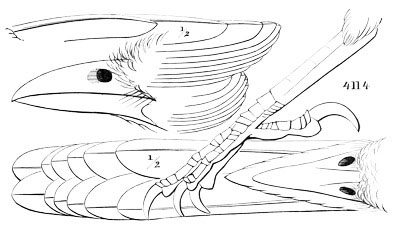
Psilorhinus morio. 4114
This genus embraces Jays of large size and very dull plumage. The thick bill, with the much curved culmen, the moderate tail, and the open nostrils, may serve to distinguish it from its allies. The nostril is very large, and its anterior portion is bevelled off to a greater degree than in any genus, except in Calocitta. This last-mentioned genus has the same form of bill and of nostrils, but the head has a long recurved crest; the tail is twice as long as the wings; the lateral feather nearly half the middle; the lateral tarsal plates scutellate for the inferior half, etc.
In the shape of the bill and the shortness of the primaries, compared with the broad tertials and secondaries, there is much resemblance to Xanthoura. The nostrils are, however, uncovered, the legs much stouter and shorter, being shorter than the head instead of longer; the tail-feathers are broader, etc.
Psilorhinus morio, Gray.
BROWN JAY.
Pica morio, Wagler, Isis, 1829, VII, 751.—Ib. Isis, 1831, 527.—Voyage de la Favorite, V, 1839, 54 (said to have been killed at San Francisco, Cal., by Botta). Psilorhinus morio, Gray, List, genera, 1841, 51.—Bonap. Consp. 1850, 381.—Cab. Mus. Hein. 1851, 226.—Baird, Birds N. Am. 1858, 592, pl. lxviii, f. 1, 2. “Pica fuliginosa, Lesson, Traité d’Orn. 1831, 333.” Psilorhinus mexicanus, Rüppell, Mus. Senck., 1837, pl. xi, f. 2.
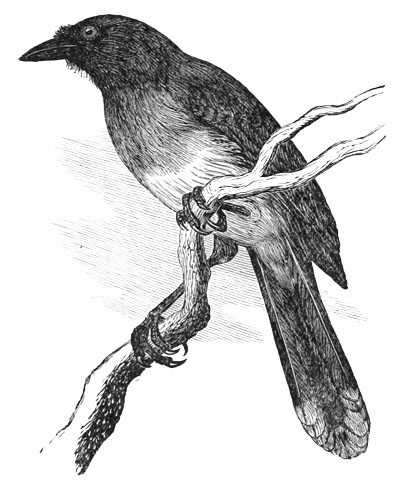
Psilorhinus morio.
Sp. Char. Tail much graduated; the lateral feathers about two inches shortest. Second quill equal to the secondaries; third and fourth longest. General color dark smoky-brown, becoming almost black on the head; the breast brownish-gray; nearly white about the anus; under tail-coverts tinged with brown; the exposed portion of the tail with a decided gloss of blue; bill and feet, in some specimens yellow, in others black. Length, 16.00; wing, 8.00; tail. 8.25; tarsus. 1.80.
Hab. Rio Grande Valley, north-eastern Mexico, southward. Cordova (Scl. 1856, 300); ? Guatemala (Scl. Ibis, I, 22); Honduras (Scl. II, 113); Costa Rica (Caban. J. 1861, 83); Vera Cruz, hot and temperate regions (Sumich. Mem. Bost. Soc. I, 554).
The difference in the color of the bill appears to be independent of sex. The feet of the yellow-billed birds are not of the same pure yellow.
The Psilorhinus mexicanus of Rüppell is described as having white tips to the tail-feathers; of these there is no trace in the adult specimens, male and female, from the Rio Grande, before us. He speaks of a supposed young bird sent from Tamaulipas, by Lindheimer, as being without these white tips.
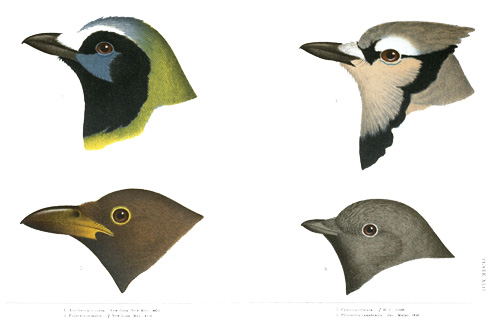
PLATE XLII.
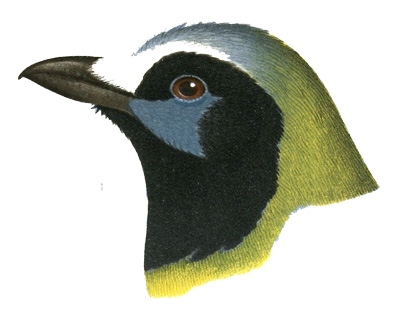
1. Xanthoura luxuosa. New Leon, New Mex., 4052.
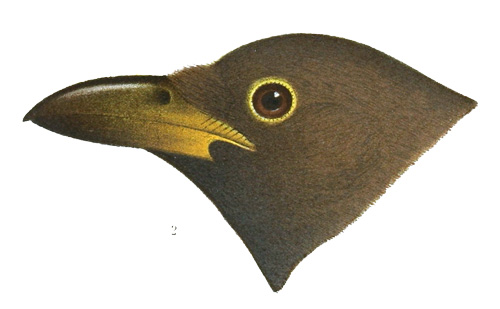
2. Psilorhinus morio. ♀ New Leon, Mex., 4114.
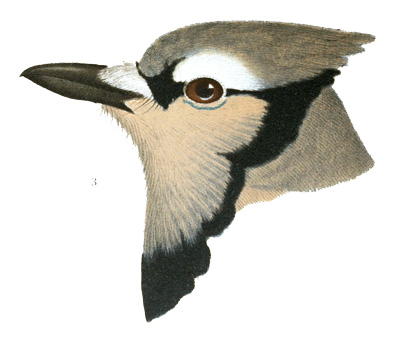
3. Cyanura cristata. ♂ D. C., 12408.
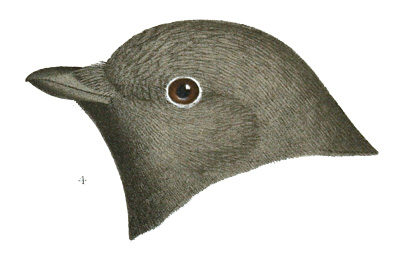
4. Perisoreus canadensis. Juv., Maine, 1920.
A series of specimens of this species exhibits considerable diversities. Some skins from Mirador, Mex., not far from Vera Cruz, perhaps best represent the species as first described by Wagler. In these the head and neck are sooty-brown, becoming lighter on the jugulum and on the back. The wings and tail show a trace of dull bluish. In No. 23,915 the under parts are sooty-gray, the bill and legs black; in 23,916 the colors are similar, with a fulvous tinge on the breast, the bill and feet yellow. In both the under surface of tail is brown to the end. In 23,917 the under parts, from breast to crissum inclusive, with the tibiæ, are brownish-white, the tail-feathers (excepting the two median) tipped with white for over an inch, the bill and feet black. This one also has an obscure dull bluish wash or patch along the feathers of the ramus of lower jaw not observed in other specimens.
The specimens collected by Lieutenant Couch, and described in the Pacific Railroad Report are considerably smaller, and exhibit other differences which may prove of specific importance. In this case they will appropriately bear Rüppell’s name of P. mexicanus.
Habits. This is a Mexican species, occasionally extending its movements as far north as the valley of the Rio Grande, and probably crossing our lines into Texas, although of this there is as yet no positive evidence.
Specimens of this species were procured by Lieutenant Couch at Boquillo, San Diego, and at China, in north-eastern Mexico, and were found by him living in forests of high trees. It is Jay-like in its habits, being decidedly gregarious, and having harsh and loud notes. Though making more noise than any other bird in the neighborhood, if one of their number is brought down by the discharge of a gun, the noise hushes them at once, and the rest move off in perfect silence.
Mr. Sumichrast, in his paper on the Distribution of the Birds of Vera Cruz, states that this species abounds in both the hot and the temperate regions of that department, and, indeed, the greater portions of Vera Cruz. He speaks of it as a bird well known and generally detested on account of its troublesome and noisy habits. It is found everywhere except in the alpine region, and it does not appear ever to go beyond a vertical elevation of 4,500 feet. This gentleman has been assured that the bird never makes any nest of its own, but invariably lays its eggs in those belonging to other birds. He does not so state, but we infer that he means to convey the idea that this Jay appropriates the nests of other birds in which to hatch its own young, not that, like the Cowbird, it leaves its eggs to be brought up by strangers.
This Jay was met with by Mr. G. C. Taylor at Taulevi, in Honduras; and from that place eastward, as far as the Atlantic, he found it very common. It was generally seen or heard shrieking in the bushes by the roadsides. It was also found by Mr. Salvin to occur on the eastern road between Quiriqua and Iguana, on the road to Guatemala.
Mr. Joseph Leyland found this species common both in Honduras and the Belize. It occurred in small flocks, which were very noisy, and annoyed the hunter by always giving the alarm.