Family TYRANNIDÆ.—Tyrant Flycatchers. (continued 2)
Reading edition
Genus SAYORNIS, Bonap.
Sayornis, Bonap. ? Ateneo italiano, 1854.—Ib. Comptes Rendus, 1854, Notes Orn. Delattre.
Aulanax, Cabanis, Journal für Orn. 1856, 1 (type, nigricans).
Gen. Char. Head with a blended depressed moderate crest. Tarsus decidedly longer than middle toe, which is scarcely longer than the hind toe. Bill rather narrow; width at base about half the culmen. Tail broad, long, slightly forked; equal to the wings, which are moderately pointed, and reach to the middle of the tail. First primary shorter than the sixth.
This genus agrees with the preceding in the length of the broad tail, but has a longer tarsus and a different style of coloration. The species are distinguished as follows:—
S. nigricans. Sooty black; abdomen and edge of outer web of lateral tail-feather pure white.
a. Lower tail-coverts pure white.
Greater wing-coverts paler toward tips of outer webs. Wing, 3.60; tail, 3.45. Hab. Pacific Province, United States, and Mexico … var. nigricans.
b. Lower tail-coverts blackish.
Greater coverts not appreciably paler at ends. Wing, 3.35; tail, 3.30. Hab. Middle America, north of Panama … var. aquaticus.[79]
Both rows of wing-coverts distinctly tipped with white; white edgings of secondaries very conspicuous. Wing, 3.35; tail, 3.30. Hab. New Granada; Venezuela … var. cinerascens.[80]
S. fuscus. Grayish-olive above, and on sides of breast; beneath (including throat) white, tinged with sulphur-yellow. Wing, 3.40; tail, 3.20. Hab. Eastern Province United States; Eastern Mexico.
S. sayus. Brownish-ashy, the tail and upper tail-coverts black; abdomen and crissum deep ochraceous. Hab. Western Province of United States, and whole of Mexico.
Sayornis nigricans, Bonap.
BLACK PEWEE.
Tyrannula nigricans, Swainson, Syn. Birds Mex. Taylor’s Phil. Mag. I, 1827, 367.—Newberry, Zoöl. Cal. & Or. Route, Rep. P. R. R. Surv. VI, IV, 1857, 81. Muscicapa nigricans, Aud. Orn. Biog. V, 1839, 302, pl. cccclxxiv.—Ib. Birds Am. I, 1840, 218, pl. lx. Tyrannus nigricans, Nuttall, Man. I, (2d ed.,) 1840, 326. Myiobius nigricans, Gray. Myiarchus nigricans, Cabanis, Tschudi Fauna Peruan. 1844-46, 153 (Peru). Sayornis nigricans, Bonap. Comptes Rendus XXVIII, 1854, notes Orn. 87.—Baird, Birds N. Am. 1858, 183.—Heerm. X, S, 38.—Cooper, Orn. Cal. 1, 1870, 319. Aulanax nigricans, Cabanis, Cab. Journ. für Ornith. IV, Jan. 1856, 2 (type of genus).—Ib. M. H. II, 68. Muscicapa semiatra, Vigors, Zoöl. Beechey Voy. 1839, 17.
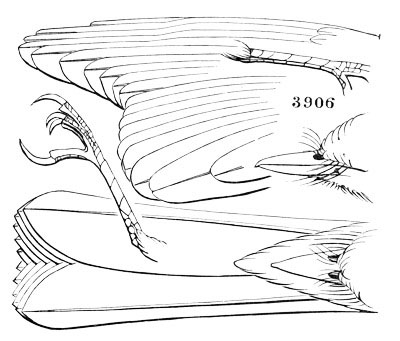
Sayornis nigricans. 3906
Sp. Char. Wings rounded; second, third, and fourth longest; first rather shorter than sixth. Tarsi with a second row of scales behind. The head and neck all round, forepart and sides of the breast, dark sooty-brown; the rest of the upper parts similar, but lighter; faintly tinged with lead-color towards the tail. The middle of the breast, abdomen, and lower tail-coverts white; some of the latter, with the shafts and the centre, brown. The lower wing-coverts grayish-brown, edged with white. Wings dark brown; the edges of secondary coverts rather lighter; of primary coverts dull white. Edge of the exterior vane of the first primary and of secondaries white. Tail dark brown, with the greater part of the outer vane of the exterior tail-feather white; this color narrowing from the base to the tip. Bill and feet black. The tail rounded, rather emarginate; feathers broad; more obliquely truncate than in sayus. The bill slender; similar to that of S. fuscus. Length, nearly 7 inches; wing, 3.60; tail, 3.45.
Hab. California coast (Umpqua Valley, Oregon, Newberry), and across by valley of Gila and Upper Rio Grande to New Leon, and south; Mazatlan. Oaxaca (Scl. 1859, 383); Cordova (Scl. 1856, 296); Vera Cruz, temp. and alp. regions, breeding (Sum. M. B. Soc. I, 557); W. Arizona (Coues, P. A. N. S. 1866, 60).
The female appears to differ only in the smaller size. A young bird from San Francisco has two bands of rusty on the wing; the shoulders and hinder part of the back tinged with the same.
Habits. Within our limits the Black Flycatcher has a distribution very nearly corresponding with that of Myiarchus cinerascens. It is found from Oregon and California on the Pacific coast, to the valley of the Rio Grande, and thence south throughout Mexico. It also occurs as a resident in Guatemala. Specimens in the Smithsonian Museum are from various parts of Mexico, from New Mexico, and California.
During his explorations in Northern Mexico, Lieutenant Couch first met with this species at Cadereita, Mexico, in April, occurring in abundance under the high banks of the stream which supplies the town with water. Its habits appeared to him to be much the same with those of the common Phœbe-Bird (Sayornis fuscus). Its nest was supposed to be in the bank. Dr. Kennerly, who found it at Espia, Mexico, could not observe any difference in the habits from those of the Pyrocephalus rubineus. They were both observed in the same vicinity, feeding alike on insects and having the same movements.
In the Department of Vera Cruz, Mr. Sumichrast says that this species is known by the common name of Aguador. It is very common in both the temperate and the colder regions of that State. It nests within the dwelling-houses in the city of Orizaba.
Dr. Kennerly states that after passing the mountains of California, and descending into the valley of the San Gabriel River, he found these birds quite abundant on the Pueblo Creek in New Mexico, though he had noticed none previously. They were generally found perched upon the summit of a bush, from which they would occasionally make short excursions in search of prey. At the season in which they were observed, March, they were rarely found in pairs, from which he inferred they were already hatching.
Dr. Heermann speaks of it as abundant throughout all California, and as constructing its nests in situations similar to those of the common eastern species (S. fuscus). It seems to have a marked predilection for the vicinity of streams and lakes, where it is nearly always to be seen, perched upon a stake or branch. It occasionally darts into the air for an insect, and returns to the same place to renew its watch and to repeat these movements. The nest, composed of mud and mosses and lined with hair, is placed against the rocks, the rafters of a house or bridge, or against the inside of a large hollow tree, and the eggs, four or five in number, are pure white, speckled with red.
Dr. Coues found this Flycatcher a very abundant and permanent resident in the valleys of the Gila and Colorado, and the more southern portions of the Territory of Arizona generally. It was not observed in the immediate vicinity of Fort Whipple, though it was detected a few miles south of that locality. As it has been found on the Pacific coast so much farther north than the latitude of Fort Whipple, he thinks it may yet be met with, at least as a summer visitant to that place. In his journey from Arizona to the Pacific, he ascertained that it is common throughout Southern Arizona, being, among land birds, his most constant companion on the route. Perched generally in pairs upon the dense verdure that in many places overhangs the river, it pursued its constant vocation of securing the vagrant insects around it, constantly uttering its peculiar unmelodious notes. In all its movements the Pewee of the Eastern States was unmistakably reproduced. It was rather shy and wary. In Southern Arizona and California it remains throughout the winter. It seems to delight not only in river bottoms, but also in deep mountain gorges and precipitous cañons with small streams flowing through them.
Dr. Newberry found this species quite common in Northern California, and specimens were also obtained as far to the north as the Umpqua Valley in Oregon. According to Dr. Cooper it is an abundant and resident species in all the lower parts of California, except the Colorado Valley, where he found none later than March 25, as they had all evidently passed on farther north. At San Diego, at that date, the following year (1862), all these birds had nests and eggs, and were there, as elsewhere, the first birds to build. Their nest, he states, is formed of an outer wall of mud about five and a quarter inches wide and three and a half high. It is built like that of the Barn Swallow, in little pellets, piled successively, as they dry, in the shape of a half-cup. They are fastened to a wall, or sometimes placed on a shelf, beam, or ledge of a rock, but are always under some protecting cover, often under a bridge. They are lined with fine grass or moss, and horse or cow hair. The eggs, four or five in number, he describes as pure white, measuring .74 by .55 of an inch.
This bird is said to prefer the vicinity of human habitations, and also to keep about water, on account of the numerous flies they find in such situations. It will often sit for hours at a time on the end of a barn, or some other perch, uttering a monotonous but not unpleasant ditty, which resembles, according to Dr. Cooper, the sound of pittic pittit, alternately repeated, and quite like the cry of the eastern Sayornis fuscus, which is its exact counterpart in habits. It is said to fly only a short distance at a time, turning and dodging quickly in pursuit of its prey, which it captures with a sharp snap of the bill.
This species was met with by Mr. Ridgway only in the vicinity of Sacramento City, Cal., where it seemed to replace our eastern Pewee, having the same familiarity and general habits, and with notes not distinguishable from some belonging to S. fuscus.
The eggs of this species, as described by Dr. Cooper and by Dr. Heermann, are either pure white unspotted, or else white with fine red dots, in this respect resembling the eggs of the S. fuscus, which present the same variations. The measurements of those in my cabinet vary from .75 by .56 of an inch to .78 by .60.
Mr. Salvin says that Sayornis nigricans is a resident species at Dueñas, in Guatemala, where it may always be found at a short distance from the village, up the stream of the river Guacatate. It also occurs about the lake. In its actions it is described as a lively and restless species, in this respect having but little resemblance to the Tyrant Flycatchers. It may always be found near water, generally sitting on a stone on the margin, from which it constantly darts to seize a fly or an insect from the surface. His remarks may, however, refer to the var. aquaticus.
Sayornis fuscus, Baird.
PEWEE; PHŒBE-BIRD.
Muscicapa fusca, Gmelin, Syst. Nat. I, 1788, 931.—Latham, Index, Orn. II, 1790, 483.—Vieillot, Ois. Am. Sept. I, 1807, 68, pl. xl.—Bonap. Obs. Wilson, 1825, No. 115.—Ib. Synopsis, 68.—Aud. Orn. Biog. II, 1834, 122; V, 1839, 424, pl. cxx.—Ib. Synopsis, 1839, 43.—Ib. Birds Am. I, 1840, 223, pl. lxiii.—Giraud, Birds L. Island, 1844, 42. Tyrannula fusca, Rich. List, 1837.—Bonap. List, 1838. Tyrannus fuscus, Nuttall, Man. I, (2d ed.,) 1840, 312. ? Aulanax fuscus, Cabanis, Cab. Journ. IV, 1856, 1. Muscicapa atra, Gmelin, Syst. Nat. I, 1788, 946.—Nuttall, Man. I, 1832, 278. Muscicapa phœbe, Latham, Index Orn. II, 1790, 489. Muscicapa nunciola, Wilson, Am. Orn. II, 1810, 78, pl. xiii. Myiobius nunciola, Gray, Genera, I, 248. Muscicapa carolinensis fusca, Brisson, Orn. II, 1760, 367. Black-headed Flycatcher, Pennant, Arc. Zoöl. II, 389, 269. Black-cap Flycatcher, Latham, Synopsis, I, 353. Empidias fuscus, Caban. M. H. II, Sept. 1859, 69 (type).—Scl. Catal. 1862, 234. Sayornis fuscus, Baird, Birds N. Am. 1858, 184.—Samuels, 133.—Allen, B. Fla. 1871, 299.
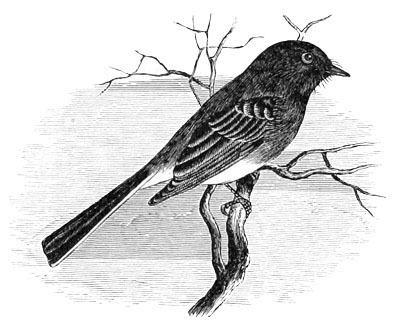
Sayornis nigricans.
Sp. Char. Sides of breast and upper parts dull olive-brown, fading slightly towards the tail. Top and sides of head dark brown. A few dull white feathers on the eyelids. Lower parts dull yellowish-white, mixed with brown on the chin, and in some individuals across the breast. Quills brown, the outer primary, secondaries, and tertials edged with dull white. In some individuals the greater coverts faintly edged with dull white. Tail brown; outer edge of lateral feather dull white; outer edges of the rest like the back. Tibiæ brown. Bill and feet black. Bill slender, edges nearly straight. Tail rather broad and slightly forked. Third quill longest; second and fourth nearly equal; the first shorter than sixth. Length, 7 inches; wing, 3.42; tail, 3.30.
Hab. Eastern North America; Eastern Mexico to Mirador and Orizaba. Cuba (Caban. J. IV, 1); Xalapa, (Scl. List, 234); Vera Cruz, winter (Sumichrast, M. B. S. I, 557); San Antonio, Texas (Dresser, Ibis, 1865, 773, rare).
In autumn, and occasionally in early spring, the colors are much clearer and brighter. Whole lower parts sometimes bright sulphur-yellow; above, greenish-olive; top and sides of the head tinged with sooty. In the young of the year the colors are much duller; all the wing-coverts broadly tipped with light ferruginous, as also the extreme ends of the wings and tail-feathers. The brown is prevalent on the whole throat and breast; the hind part of the back, rump, and tail strongly ferruginous.
Habits. The Pewee, or Phœbe-Bird, a well-known harbinger of early spring, is a common species throughout the whole of eastern North America, from the Rio Grande, on the southwest, to the provinces of Nova Scotia and New Brunswick on the northeast, and as far west as the Missouri River.
Dr. Woodhouse found it common both throughout Texas and in the Indian Territory. It was taken by Sumichrast in the Department of Vera Cruz, but he was in doubt whether it occurs there as a resident or is only migratory. It was observed at San Antonio, Texas, but only as a migrant, by both Dresser and Heermann; but at Houston, in that State, it evidently remains and breeds, as individuals were seen there in June by Dresser. Specimens were taken in February at Brownsville, Texas, by Lieutenant Couch, and afterwards in March on the opposite side of the river,—in Tamaulipas, Mexico.
In South Carolina, Dr. Coues found these birds most common in the months of February and March, and again in October and November. He had no doubt that some remain and pass the winter, and that others are resident in the State during the summer months, but believes the great majority go farther north to breed.
In Western Maine it is a common summer visitant, breeding there in considerable numbers. Professor Verrill states that it is frequently seen there the first of March, becoming quite common by the first of April. It is also a summer visitant about Calais, where it breeds, but is rather rare. At Hamilton, Canada, Mr. McIlwraith reports it as a common summer resident, arriving about April 15.
In Pennsylvania this species arrives among the earliest spring visitants, sometimes as early as the first week in March, and continues in that region until late in October. Wilson has seen specimens as late as the 12th of November. He states that in the month of February he met with them feeding on the smilax berries in the low, swampy woods of North and South Carolina. They were already chanting their simple, plaintive notes. In Massachusetts they usually arrive from the 15th to the 25th of March. In the warm spring of 1870 they were already abundant by the 10th. They were nesting early in April, and their first brood was ready to fly by the middle of May. They have two broods in a season, and occasionally perhaps three, as I have known fresh eggs in the middle of August. They leave late in October, unless the season be unusually open, when a few linger into November.
Their well-known and monotonous, though not unpleasing, note of pē-wēē, or, as some hear it, phœ-bēē, is uttered with more force and frequency in early spring than later in the season, though they repeat the note throughout their residence north. It usually has some favorite situation, in which it remains all the morning, watching for insects and continually repeating its simple song. As he sits, he occasionally flirts his tail and darts out after each passing insect, always returning to the same twig.
This species is attracted both to the vicinity of water and to the neighborhood of dwellings, probably for the same reason,—the abundance of insects in either situation. They are a familiar, confiding, and gentle bird, attached to localities, and returning to them year after year. They build in sheltered situations, as under a bridge, under a projecting rock, in the porches of houses, and in similar situations. I have known them to build on a small shelf in the porch of a dwelling; against the wall of a railroad-station, within reach of the passengers; and under a projecting window-sill, in full view of the family, entirely unmoved by the presence of the latter at mealtime.
Their nests are constructed of small pellets of mud, placed in layers one above the other, in semicircular form, covered with mosses, and warmly lined with fine straw and feathers. When the nest is placed on a flat surface,—a shelf or a projecting rock,—it is circular in form, and mud is not made use of. A nest of this description, taken by Mr. Vickary in Lynn, and containing five eggs, was constructed on a ledge, protected by an overhanging rock, only a few feet from the ground. It measured four and a half inches in diameter and three in height. The cavity was nearly three inches wide and one and a half deep. Its base was constructed of layers of fine leaves, strips of bark, roots of plants, and other miscellaneous materials. The great mass of the nest itself was made up of fine mosses closely interwoven, and strengthened by an intermixture of firmer plant fibres. The whole was carefully and softly lined with strips of the inner bark of various deciduous shrubs, fine roots, and finer grasses. The semicircular nests are usually placed out of reach of the weather under some projecting shelter.
Wilson states that they often nest in eaves, and occasionally in an open well, five or six feet down, among the interstices of the side-walls. Nuttall has known them to nest in an empty kitchen.
Their attachment to a locality, when once chosen, is remarkable, and is often persevered in under the most discouraging circumstances. In one instance, Nuttall states that a nest was built in the boathouse at Fresh Pond, Cambridge,—a place so common as to be almost a thoroughfare. Although with its young brood this nest was torn down by ruffian hands, the female immediately built a new one in the same spot, and laid five additional eggs. This was lined with the silvery shreds of a manilla rope, taken from the loft over the boathouse.
Besides the common call-note, from which these birds derive their name, they have, during the love-season, a low twittering song with which they entertain their mates, but which is heard only when the birds are in company, and for a brief season.
The flight of the Pewee is an alternation of soaring and a succession of light fluttering motions, more rapid when pursuing its prey than in its ordinary movements. Its crest is usually erected when it is in motion, or on the lookout for insects.
Mr. Audubon found these birds in full song in Florida during the winter, and as lively as in spring, but met with none breeding south of Charleston. They leave Louisiana in February, and return to it in October. They feed largely on berries, especially during the winter, and Mr. Maynard found some in the spring of 1868 with hawthorn berries in their stomachs.
The eggs of the Pewee measure .80 of an inch in length and .60 in breadth. They are of a rounded oval shape, pointed at one end and much larger at the other. Their ground-color is a pure bright white, and generally unspotted; but a certain proportion, one set in every five or six, is distinctly marked with reddish-brown dots at the larger end.
Sayornis sayus, Baird.
SAY’S PEWEE.
Muscicapa saya, Bonap. Am. Orn. I, 1825, 20, pl. xi, fig. 3.—Aud. Orn. Biog. IV, 1838, 428, pl. ccclix.—Ib. Birds Am. I, 1840, 217, pl. lix. Tyrannus saya, Nuttall, Man. I, (2d ed.,) 1840, 311. Myiobius saya, Gray, Genera, I, 1844-49, 249. Ochthœca sayĭ, Cabanis, Wiegmann Archiv, 1847, I, 255 (not type). Tyrannula saya, Bonap. Conspectus, 1850.—Max. Cab. J. VI, 1858, 183. Aulanax sayus, Cabanis, Journ. Orn. 1856, 2. Tyrannula pallida, Swainson, Syn. Birds Mex. No. 15, in Taylor’s Phil. Mag. I, 1827, 367. Sayornis pallida, Bonap.—Scl. P. Z. S. 1857, 204. Sayornis sayus, Baird, Birds N. Am. 1858, 185.—Ib. M. B. II, Birds, 9.—Cooper, Orn. Cal. 1, 1870, 320. Theromyias saya, Caban. M. H. II, Sept. 1859, 68 (type).
Sp. Char. Above and on the sides of the head, neck, and breast, grayish-brown, darker on the crown; region about the eye dusky. The chin, throat, and upper part of the breast similar to the back, but rather lighter and tinged with the color of the rest of the lower parts, which are pale cinnamon. Under wing-coverts pale rusty-white. The wings of a rather deeper tint than the back, with the exterior vanes and tips of the quills darker. Edges of the greater and secondary coverts, of the outer vane of the outer primary, and of the secondaries and tertials, dull white. The upper tail-coverts and tail nearly black. Edge of outer vane of exterior tail-feather white. Bill dark brown, rather paler beneath. The feet brown. Second, third, and fourth quills nearly equal; fifth nearly equal to sixth; sixth much shorter than the fifth. Tail broad, emarginate. Tarsi with a posterior row of scales. Length, 7 inches; wing, 4.30; tail, 3.35.
Hab. Missouri and central High Plains, westward to the Pacific and south to Mexico. Xalapa (Scl. 1859, 366); Orizaba (Scl. List, 199); Vera Cruz, winter? (Sum. M. Bost. Soc. I, 557); S. E. Texas (Dresser, Ibis, 1865, 473, breeds); W. Arizona (Coues, P. A. N. S. 1866, 60).
The young of the year have the upper parts slightly tinged with ferruginous; two broad (ferruginous) bands on the wings formed by the tips of the first and second coverts. The quills and tail rather darker than in an adult specimen.
Autumnal specimens are simply more deeply colored than spring examples, the plumage softer and more blended.
Habits. Say’s Flycatcher has an extended distribution throughout western North America, from Mexico, on the south, to the plains of the Saskatchewan on the north, and from the Rio Grande and the Missouri to the Pacific Ocean.
It was first discovered by Mr. Titian Peale on the Arkansas River, near the Rocky Mountains, and described by Bonaparte. Mr. Peale noticed a difference in its voice from that of the common S. fuscus, and found it nesting in a tree, building a nest of mud and moss, lined with dried grasses. Its young were ready to fly in July. Richardson obtained individuals of this species at the Carlton House, May 13. It is not given by Cooper and Suckley in their Zoölogy of Washington Territory, but Dr. Newberry found it not uncommon throughout both Oregon and California.
Mr. Sumichrast ascertained the presence of this bird within the Department of Vera Cruz, but whether there as resident or as exclusively migratory he was not able to state. It has also been found in winter throughout Mexico. Mr. J. H. Clark met with it near Fort Webster, in New Mexico, and describes it as particularly abundant about the copper mines. One of the shafts near the fort, and which was partially filled up, served as a sinkhole for the offal of the town, and around this quite a number of these birds could always be seen in pursuit of flies and insects attracted to the place. Mr. Clark observed that their sudden darting from their perch and their instantaneous return were not always attended with the capture of an insect, but seemed at times to be done only for amusement or exercise. Mr. Dresser first noticed these birds in November, when walking in the gardens of the arsenal at San Antonio. On his journey to Eagle Pass in December, he saw several daily, generally in pairs. They would perch on a bush by the roadside, occasionally darting off after some insect, and, as soon as he drew near, would fly off to a convenient perch some distance ahead, thus keeping in advance for miles. During the months of January and February they were not uncommon, but after that he lost sight of them altogether. They seemed to prefer the open country, as he generally found them on the prairies, and never in the mesquite thickets. Their stomachs were found to contain small insects.
Dr. Woodhouse frequently met with these birds in Western Texas and in New Mexico. They seemed more silent and more shy than the fuscus, but otherwise similar in their habits.
Dr. Kennerly met with this species at Bill Williams’s Fork, New Mexico, February 10, 1854. He states that he found them common in Texas, and as far to the westward as the Great Colorado River. They built their nests under the cliffs along the stream, and in notes and in every other respect closely resembled the common Pewee.
Dr. Heermann mentions finding this species abundant in Southern California. It was more especially plentiful in the fall, at the time of its migration southward. He also found it in New Mexico, in the northern part of Texas, near El Paso, and in Sacramento Valley, though somewhat rare. In migrating, it prefers the deep valleys bordered by high hills, but also occurs on the open plains, where, perched on the stalk of some dead weed, or on a prominent rock, it darts forth in pursuit of its prey, to return to the same point.
In Arizona, Dr. Coues found this Flycatcher common throughout the Territory. At Fort Whipple it was a summer resident. It was one of the first of the migratory birds to make its appearance in spring, arriving early in March, and remained among the last, staying until October. It winters in the Colorado Valley and the southern portions of the Territory generally. He found it frequenting almost exclusively open plains, in stunted chaparral and sage brush. In some other points of habits it is said to differ remarkably from our other Flycatchers. It does not habitually frequent cañons, rocky gorges, and secluded banks of streams, as does S. fuscus, nor does it inhabit forests, like other Flycatchers.
In the arid portions of the Great Basin this species was often seen by Mr. Ridgway. In its natural state it preferred rocky shores of lakes or rivers, or similar places in the cañons of the mountains, where it attached its bulky down-lined nests to the inside of small caves or recesses in the rocks, usually building them upon a small projecting shelf. Wherever man has erected a building in those desert wastes,—as at the stage-stations along the road, or in the mining towns,—it immediately assumed the familiarity of our eastern Pewee, at once taking possession of any outbuilding or any abandoned dwelling. Its notes differ widely from those of the S. fuscus and S. nigricans, the common one consisting of a wailing peer, varied by a tremulous twitter, and more resembling certain tones of the Wood Pewees (Contopus virens and richardsoni), with others which occasionally call to mind the Myiarchus cinerascens.
This species has been observed as far to the east as Racine, Wisconsin, where it was taken by Dr. P. R. Hoy. The specimen was sent to Mr. Cassin, and its identity fully established. Dr. Palmer found it breeding near Fort Wingate, in Arizona, June 11, 1869, and Mr. Ridgway obtained its nests and eggs at Pyramid Lake, Nevada, May 23, 1868. One of these nests (No. 13,588) he describes as a nearly globular mass, more flattened on top, 3.50 inches in depth by 4.00 in diameter, and composed chiefly of spiders’ webs, with which is mixed very fine vegetable fibres, of various descriptions. This composition forms the bulk of the nest, and makes a closely matted and tenacious, but very soft structure; the neat but rather shallow cavity is lined solely with the grayish-white down of wild ducks. The nest was placed on a shelf inside a small cave on the shore of the island, at about ten or twelve feet from the water.
Their eggs are rounded at one end and pointed at the other, measure .82 of an inch in length by .65 in breadth. They are of a uniform chalky white, and, so far as I am aware, entirely unspotted.
Genus CONTOPUS, Cabanis.
Contopus, Cabanis, Journ. für Ornith. III, Nov. 1855, 479. (Type, Muscicapa virens, L.)
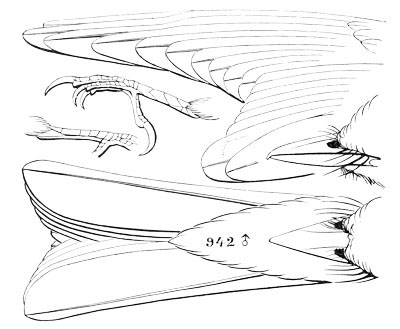
Contopus borealis. 942 ♂
Gen. Char. Tarsus very short, but stout; less than the middle toe and scarcely longer than the hinder; considerably less than the culmen. Bill quite broad at the base; wider than half the culmen. Tail moderately forked. Wings very long and much pointed, reaching beyond the middle of the tail; the first primary about equal to the fourth. All the primaries slender and rather acute, but not attenuated. Head moderately crested. Color olive above, pale yellowish beneath, with a darker patch on the sides of the breast. Under tail-coverts streaked in most species. A tuft of cottony-white feathers on each side of the rump (concealed in most species).
This genus is pre-eminently characterized among North American Flycatchers by the very short tarsi, and the long and much pointed wings.
In most other genera, as Sayoris, Myiarchus, and Empidonax, a trace of a cottony tuft may be discovered by careful search on the flanks; but in the present genus, there is, in addition, the tufts on the rump, not found in the others. The species are as follows:—
Species and Varieties.
A. Cottony patch of white feathers on sides of the rump greatly developed, and conspicuous. Rictal bristles very short (about one fourth the length of the bill). Lower parts distinctly and abruptly white medially (somewhat interrupted on the breast).
1. C. borealis. First quill longer than the fourth, generally exceeding the third. Wing, 4.00 to 4.40; tail, 2.90 to 3.00; culmen, .90; tarsus, .60. Above dark olive-plumbeous, the tertials edged with whitish; lower parts a lighter shade of the same, laterally and across the breast (narrowly), the throat and middle line of the abdomen being abruptly white. Young not different. Hab. Northern parts of North America, to the north border of United States; on the mountain-ranges, farther south, on the interior ranges, penetrating through Mexico to Costa Rica.
B. Cottony patch on side of rump rudimentary and concealed. Rictal bristles strong (one half, or more, the length of the bill). Lower parts not distinctly white medially.
a. First primary shorter than fifth, but exceeding the sixth. Tail shorter than wings.
2. C. pertinax. Wing more than 3.50. Grayish-olive, becoming lighter on the throat (indistinctly) and abdomen (decidedly). No distinct light bands on the wing. Rictal bristles about half the length of bill.
The olive of a grayish cast, and not darker on the crown. Wing, 4.45; tail, 3.90; depth of its fork, .35; culmen, .92; tarsus, .70. Hab. Mexico, generally north into Arizona (Fort Whipple, Coues) … var. pertinax.
The olive of a sooty cast, and darker on the crown. Wing, 3.60; tail, 3.10; its fork, .20; culmen, .83; tarsus, .61. Hab. Costa Rica … var. lugubris.[81]
3. C. brachytarsus. Wing less than 3.00; colors much as in pertinax, var. pertinax, but wing-bands distinct, breast less grayish, and pileum decidedly darker than the back. Rictal bristles two thirds as long as the bill.
Wing, 2.65; tail, 2.55; culmen, .60; tarsus, .53. Hab. Panama … var. brachytarsus.[82]
Wing, 2.90; tail, 2.55; culmen, .67; tarsus, .53. Hab. Yucatan … var. schotti.[83]
b. First primary shorter than the sixth. Tail variable.
4. C. caribæus. Bill much depressed, very long and broad, the sides more nearly parallel on the basal than on the terminal half; rictal bristles very strong (two thirds, or more, the length of the bill). Above olivaceous, generally rather dark, but varying in tint. Beneath whitish, or dull light-ochraceous, more brownish along the sides and (more faintly) across the breast. Axillars and lining of the wing deep light-ochraceous.
Tail longer than wings; bill moderately depressed; rictal bristles three fourths as long as the bill.
Dark greenish-olive above; beneath dingy ochrey-yellowish. Wing, 2.80; tail, 2.90; culmen, .78; tarsus, .58. Hab. Cuba … var. caribæus.[84]
Dark olive-gray above; beneath whitish, with scarcely any yellowish tinge. Wing, 3.00; tail, 3.05; culmen, .70; tarsus, .59. Hab. Hayti … var. hispaniolensis.[85]
Brownish-olive above; beneath deep dingy ochrey-yellowish. Wing, 2.85; tail, 2.90; culmen, .66; tarsus, .56. Hab. Jamaica … var. pallidus.[86]
Tail shorter than wing; bill excessively depressed; rictal bristles only one half as long as the bill.
Olive-plumbeous above; beneath dingy white (not interrupted on the breast); tinged posteriorly with sulphury (not ochrey) yellow; wing-bands pale ash. Wing, 2.80; tail, 2.65; culmen, .79; tarsus, .63. Hab. Bahamas … var. bahamensis.[87]
C. First quill much longer than fifth (sometimes equal to fourth). Tail much shorter than the wing. Bill much smaller, less depressed, and more triangular; rictal bristles about one half the bill.
5. C. virens. Colors of caribæus var. bahamensis, but rather more olivaceous above, and more distinctly tinged with sulphur-yellow posteriorly beneath. Lining of the wings, and axillars, without any ochraceous tinge; lower tail-coverts distinctly grayish centrally.
Whitish of the lower parts not interrupted on the breast. Wing, 3.40; tail, 2.90; culmen, .67; tarsus, .54. Hab. Eastern Province of United States … var. virens.
Whitish of medial lower parts interrupted by a grayish wash across the breast. Wing, 3.40; tail, 2.65 to 2.70; culmen, .70; tarsus, .54 to .56. Hab. Western Province of United States, south throughout Middle America to Ecuador … var. richardsoni.[88]
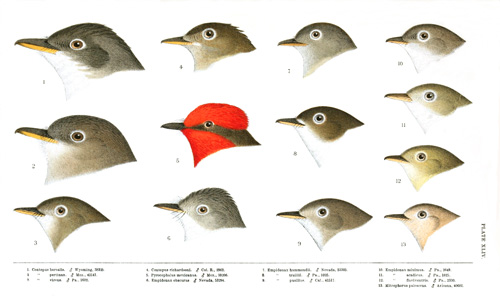
PLATE XLIV.
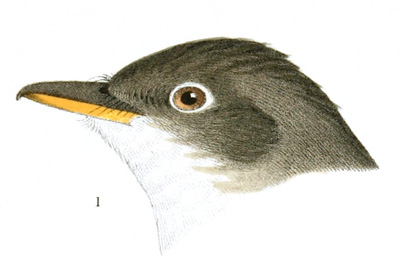
1. Contopus borealis. ♂ Wyoming, 38325.
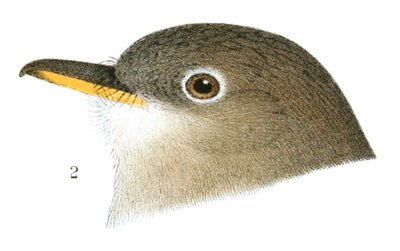
2. Contopus pertinax. ♂ Mex., 42141.
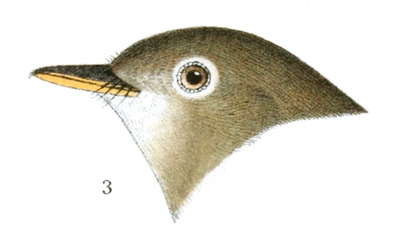
3. Contopus virens. ♂ Pa., 1632.
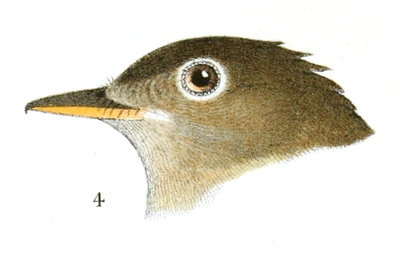
4. Contopus richardsoni. ♂ Col. R., 2962.
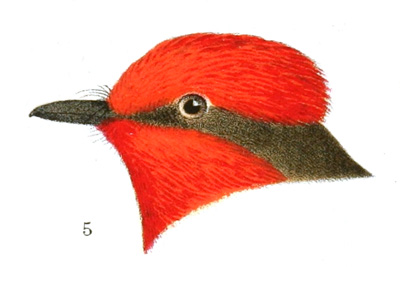
5. Pyrocephalus mexicanus. ♂ Mex., 38206.
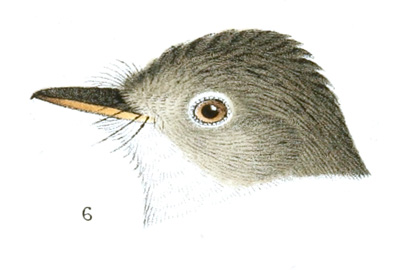
6. Empidonax obscurus. ♂ Nevada, 53294.
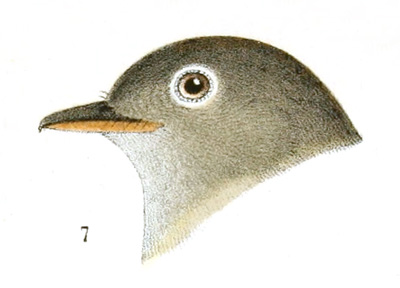
7. Empidonax hammondii. ♂ Nevada, 53305.
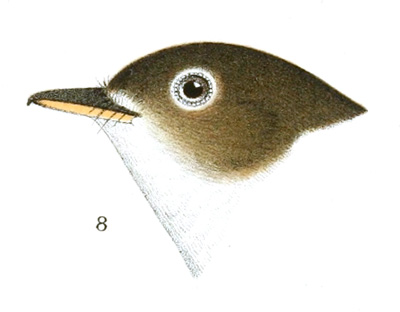
8. Empidonax traillii. ♂ Pa., 1025.
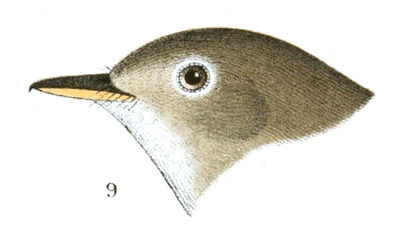
9. Empidonax pusillus. ♂ Cal., 41517.
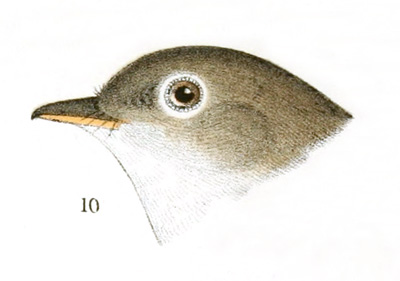
10. Empidonax minimus. ♂ Pa., 2649.
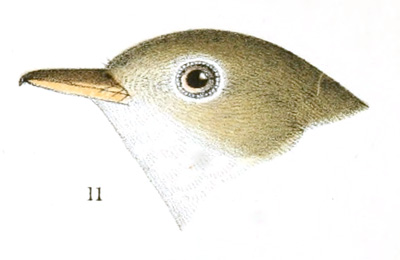
11. Empidonax acadicus. ♂ Pa., 1825.
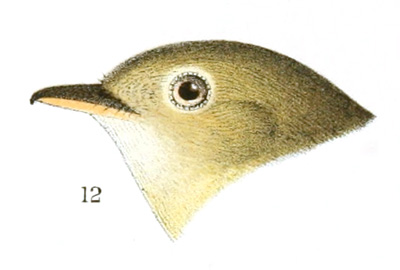
12. Empidonax flaviventris. ♂ Pa., 2330.
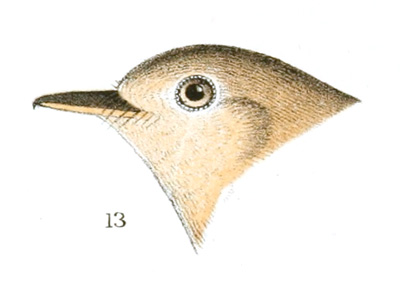
13. Mitrephorus palescens. ♂ Arizona, 40601.
Contopus borealis, Baird.
OLIVE-SIDED FLYCATCHER.
Tyrannus borealis, Sw. & Rich. F. Bor.-Am. II, 1831, 141, plate. Myiobius borealis, Gray, Genera, I, 248. Muscicapa cooperi, Nuttall, Man. I, 1832, 282.—Aud. Orn. Biog. II, 1834, 422; V, 1839, 422, pl. clxxiv.—Ib. Synopsis, 1839, 41.—Ib. Birds Am. I, 1840, 212, pl. lviii. Tyrannus cooperi, Bonap. List, 1838.—Nuttall, Man. I, (2d ed.,) 1840, 298. Contopus cooperi, Cabanis, Journal für Ornithol. III, Nov. 1855, 479. Muscicapa inornata, Nuttall, Man. I, 1832, 282. Contopus borealis, Baird, Birds N. Am. 1858, 188.—Cooper & Suckley, 169.—Sclater, Catal. 1862, 230.—Samuels, 135.—Cooper, Orn. Cal. 1, 1870, 323. Contopus mesoleucus, Sclater, P. Z. S. 1859, 43.—Ib. Ibis, 1859, 122, 151. Tyrannus nigricans, Max. Cab. J. VI, 1858, 184.
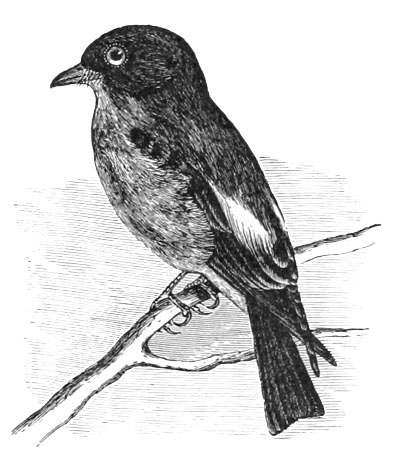
Contopus borealis.
Sp. Char. Wings long, much pointed; the second quill longest; the first longer than the third. Tail deeply forked. Tarsi short. The upper parts ashy-brown, showing darker brown centres of the feathers; this is eminently the case on the top of the head; the sides of the head and neck, of the breast and body, resembling the back, but with the edges of the feathers tinged with gray, leaving a darker central streak. The chin, throat, narrow line down the middle of the breast and body, abdomen, and lower tail-coverts white, or sometimes with a faint tinge of yellow. The lower tail-coverts somewhat streaked with brown in the centre. On each side of the rump, generally concealed by the wings, is an elongated bunch of white silky feathers. The wings and tail very dark brown, the former with the edges of the secondaries and tertials edged with dull white. The lower wing-coverts and axillaries grayish-brown. The tips of the primaries and tail-feathers rather paler. Feet and upper mandible black, lower mandible brown. The young of the year similar, but the color duller; edges of wing-feathers dull rusty instead of grayish-white. The feet light brown. Length, 7.50; wing, 4.33; tail, 3.30; tarsus, .60.
Hab. Northern portions of whole of North America, throughout Rocky Mountains, south through elevated regions of Mexico to Costa Rica. Localities: Oaxaca, high regions, Oct. (Scl. 1858, 301); Xalapa (Scl. 1859, 366); Guatemala (Scl. Ibis, I, 122); Costa Rica (Lawr. IX, 115); Veragua (Salv. 1870, 199); San Antonio, Texas (Dresser, Ibis, 1865, 474, winter).
There is wonderfully little variation in this species, both in coloration and size, with different regions; in fact none other than individual can be observed. Contrary to the usual rule, spring specimens have a more appreciable sulphur-yellow tinge below.
Habits. This still comparatively rare species was first obtained by Richardson and described by Swainson. The specimen was shot on the Saskatchewan. No other was taken, and no information was obtained in reference to its habits. It appears to have been next met with by Mr. John Bethune, in Cambridge, June 7, 1830, in the woods of Mount Auburn. This and a second specimen, obtained soon after, were females, on the point of incubation. A third female was shot in the following year, June 21. Supposed to be a new species, it was described by Mr. Nuttall as Tyrannus cooperi. All the specimens procured had their stomachs filled with torn fragments of bees, wasps, and similar insects.
Mr. Nuttall, who watched the motions of two other living individuals of this species, states that they appeared tyrannical and quarrelsome even with each other. Their attacks were always accompanied with a whining, querulous twitter. The disputes seemed to be about the occupancy of certain territories. One bird, a female, appeared to confine herself to a small clump of red cedars, in the midst of a sandy piece of forest. From the tree-tops she kept a sharp lookout for passing insects, and pursued them, as they appeared, with great vigor and success, sometimes chasing them to the ground, and returning to her perch with a mouthful which she devoured at her leisure. When she resumed her position, she would occasionally quiver her wings and tail, erect her crest, keeping up a whistling call of pŭ-pŭ, uttered with variations. Besides this call the male had a short song which sounded like ch’-phe’bēē.
The nest of this pair Mr. Nuttall discovered in the horizontal branch of a tall red cedar, fifty feet from the ground. It was made externally of interlaced dead twigs of the cedar, lined with wiry stems, and dry grasses, and fragments of lichens. It contained three young, which remained in the nest twenty-three days, and were fed on beetles and other insects. Before they left their nests they could fly as well as their parents. The male bird was very watchful, and would frequently follow Mr. Nuttall half a mile. They were in no way timid, and allowed him to investigate them and their premises without any signs of alarm.
In 1832 the same pair, apparently, took possession of a small juniper, near the tree they had occupied the year before, in which, at the height of fifteen feet, they placed their nest. It contained four eggs which, except in their superior size, were precisely similar to those of the Wood Pewee, yellowish cream-color, with dark brown and lavender-purple spots, thinly dispersed. After removing two of these eggs, the others were accidentally rolled out of the nest. The pair constructed another nest, again in a cedar-tree, at a short distance. The next year they did not return to that locality. Mr. Nuttall afterwards met with individuals of this species in the fir woods on the Columbia.
On the 8th of August, 1832, Mr. Audubon, in company with Mr. Nuttall, obtained the specimen of this species in Brookline, Mass., from which his drawing was made. In the course of his journey farther east, Audubon found it in Maine, on the Magdeleine Islands, and on the coast of Labrador. He afterwards met with it in Texas.
Mr. Boardman reports the Olive-sided Flycatcher as having of late years been very abundant during the summer in the dead woods about the lakes west of Calais, where formerly they were quite uncommon. Mr. Verrill mentions it as a summer visitant in Oxford County, in the western part of the State, but not very common, and as undoubtedly breeding there. It was never observed there before the 20th of May. It is said to be more abundant at Lake Umbagog.
In Western Massachusetts Mr. Allen regards this bird as a not very rare summer visitant. It arrives about May 12, breeds in high open woods, and is seldom seen at any distance from them. It leaves about the middle of September.
Mr. William Brewster, who resides in Cambridge, in the neighborhood in which this species was first observed by Mr. Nuttall, informs me that these birds still continue to be found in that locality. He has himself met with five or six of their nests, all of which were placed near the extremity of some long horizontal branch, usually that of a pitch-pine, but on one occasion in that of an apple-tree. The eggs were laid about the 15th of June, in only one instance earlier. The females were very restless, and left their nest long before he had reached it, and, sitting on some dead branch continually uttered, in a complaining tone, notes resembling the syllables pill-pill-pill, occasionally varying to pu-pu-pu. The males were fierce and quarrelsome, and attacked indiscriminately everything that came near their domain, sometimes seeming even to fall out with their mates, fighting savagely with them for several seconds. When incubation was at all far advanced, the birds evinced considerable courage, darting down to within a few inches of his head, if he approached their nest, at the same time loudly snapping their bills.
A nest of this Flycatcher was found in Lynn, Mass., by Mr. George O. Welch, in June, 1858. It was built on the top of a dead cedar, and contained three eggs. It was a flat, shallow structure, five inches in its external diameter, and with a very imperfectly defined cavity. The greatest depth was less than half an inch. It was coarsely and loosely built of strips of the bark and fine twigs of the red cedar, roots, mosses, dry grasses, etc. The nest was so shallow, that, in climbing to it, two of the eggs were rolled out and broken.
Mr. Charles S. Paine has found this bird breeding in Randolph, Vt. On one occasion he found its nest on the top of a tall hemlock-tree, but was not able to get to it.
In Philadelphia, Mr. Trumbull found this species very rare. It passed north early in May, and south in September. Near Hamilton, Canada, it is very rare, none having been seen; and two specimens obtained near Toronto are all that Mr. McIlwraith is aware of having been taken in Canada West.
Dr. Hoy informs me that this species used to be quite common near Racine, frequenting the edges of thick woods, where they nested. They have now become quite scarce. Some years since, he found one of their nests, just abandoned by the young birds, which their parents were engaged in feeding. It was on the horizontal branch of a maple, and was composed wholly of usneæ.
In Washington Territory this bird appears to be somewhat more common than in other portions of the United States. Dr. Suckley obtained a specimen at Fort Steilacoom, July 10, 1856. It was not very abundant about Puget Sound, and showed a preference for shady thickets and dense foliage, where it was not easily shot. Dr. Cooper speaks of it as very common, arriving early in May and frequenting the borders of woods, where, stationed on the tops of tall dead trees, it repeats a loud and melancholy cry throughout the day, during the whole of summer. It frequents small pine groves along the coast, and also in the interior, and remains until late in September.
In California Dr. Cooper found this species rather common in the Coast Range towards Santa Cruz, where they had nests in May; but as these were built in high inaccessible branches, he was not able to examine them. He also found it at Lake Tahoe in September.
This species was only met with by Mr. Ridgway in the pine woods high up on the East Humboldt, Wahsatch, and Uintah Mountains. There it was breeding, but was nowhere abundant, not more than two pairs being observed within an area of several miles. They preferred the rather open pine woods, and were shot from the highest branches. Their common note was a mellow puer, much like one of the whistling notes of the Cardinal Grosbeak (Cardinalis virginianus).
Mr. Dresser states it to be not uncommon near San Antonio in the winter season. Dr. Heermann mentions that two specimens of this species were obtained, to his knowledge, on the Cosumnes River, in California. It has been taken in winter, in the State of Oaxaca, Mexico, by Mr. Boucard, and has been met with at Jalapa, and even as far south as Guatemala.
A single specimen of this bird was taken, August 29, 1840, at Nenortalik, Greenland, and sent to Copenhagen.
The eggs of this species measure .86 of an inch in length by .62 in breadth, and are rounded at one end and sharply tapering at the other. The ground-color is a rich cream-color with a roseate tint. They are beautifully marked around the larger end with a ring of confluent spots of lilac, purple, and red-brown. These vary in number and in the size of this crown, but the markings are invariably about the larger end, as in Contopus virens.
Contopus pertinax, Cabanis & Heine.
MEXICAN OLIVE-SIDED FLYCATCHER.
Contopus pertinax, Cab. et Hein. Mus. Hein. II, p. 72.—Sclater, Catal. Am. B. 1862, 231.—Coues, Pr. Ac. Phil. 1866, 60.—Elliot, Illust. B. Am. I, pl. viii.—Cooper, Geol. Surv. Calif. Orn. I, 324.—Cooper, Orn. Cal. 1, 1870, 324. Contopus borealis, Sclater, P. Z. S. 1858, 301; 1859, 43; Ibis, 1859, 122, 440.
Sp. Char. Nearly uniformly olive-gray, lighter on the throat and abdominal region, where is a strong tinge of ochraceous-yellow; feathers of the wings with faintly lighter edges. Length about 8.00; wing, 4.45; tail, 3.90; depth of its fork, .35; culmen, .92; tarsus, .70. Rictal bristles long, about half the bill; lower mandible whitish. Young. Similar, but with a stronger ochraceous tinge on the abdomen and lining of the wings, and two distinct ochraceous bands across the wing.
Hab. Mexico generally, into southern borders of United States (Fort Whipple, Arizona; Dr. Coues).
Habits. Dr. Coues found this species a rare summer resident at Fort Whipple, where a single specimen was taken August 20, in good plumage. This was its first introduction into the fauna of the United States. It is one of several Mexican and peninsular birds found in Upper Arizona, probably following the course of the valley of the Great Colorado River. No observations were made in reference to its habits.
This species is abundant in the Department of Vera Cruz, according to Mr. Sumichrast, who gives it as confined to the alpine region. He found both it and C. virens common in the mountains of Orizaba, between the height of 3,600 and 7,500 feet.
Contopus virens, Cabanis.
WOOD PEWEE.
Muscicapa virens, Linn. Syst. Nat. I, 1766, 327.—Gmelin, Syst. Nat. I, 1788, 936.—Latham, Index Orn.—Licht. Verz. 1823, 563.—Nuttall, Man. I, 1832, 285.—Aud. Orn. Biog. II, 1834, 93; V, 1839, 425, pl. cxv.—Ib. Synopsis, 1839, 42.—Ib. Birds Am. I, 1840, 231, pl. lxiv.—Giraud, Birds L. Island, 1844, 43. Muscicapa querula, Vieillot, Ois. Am. Sept. I, 1807, 68, pl. xxxix (not of Wilson). Muscicapa rapax, Wilson, Am. Orn. II, 1810, 81, pl. xiii, f. 5. Tyrannula virens, Rich. App. Back’s Voyage.—Bonap. List, 1838. Myiobius virens, Gray. Tyrannus virens, Nuttall, Man. I, (2d ed.,) 1840, 316. Contopus virens, Cabanis, Journal für Ornithologie, III, Nov. 1855, 479.—Baird, Birds N. Am. 1858, 190.—Sclater, Catal. 1862, 231.—Samuels, 137.
Sp. Char. The second quill longest; the third a little shorter; the first shorter than the fourth; the latter nearly .40 longer than the fifth. The primaries more than an inch longer than the secondaries. The upper parts, sides of the head, neck, and breast, dark olivaceous-brown, the latter rather paler, the head darker. A narrow white ring round the eye. The lower parts pale yellowish, deepest on the abdomen; across the breast tinged with ash. This pale ash sometimes occupies the whole of the breast, and even occasionally extends up to the chin. It is also sometimes glossed with olivaceous. The wings and tail dark brown; generally deeper than in S. fuscus. Two narrow bands across the wing, the outer edge of first primary and of the secondaries and tertials, dull white. The edges of the tail-feathers like the back; the outer one scarcely lighter. Upper mandible black; the lower yellow, but brown at the tip. Length, 6.15; wing, 3.50; tail, 3.05.
Hab. Eastern North America to the borders of the high Central Plains. Localities: ? Guatemala (Scl. Ibis, I, 122); Mexico (Scl. Ibis, I, 441); Cuba? (Cab. J. III, 479; Gundl. Rep. 1865, 239); Costa Rica (Cab. J. 1861, 248; Lawr. IX, 115); Coban (Scl. List); Vera Cruz, alpine region, breeds (Sum. M. Bost. Soc. I, 557); San Antonio, Texas and Eastern Texas (Dresser, Ibis, 1865, 474, breeds).
Young birds are duller in plumage; the whitish markings of wing tinged with ferruginous; the lower mandible more dusky.
Habits. The common Wood Pewee of eastern North America occurs in abundance from the Atlantic to the great plains, and from Texas to New Brunswick. It breeds from South Carolina and Texas north. It is found in Central and Southern Maine, but is not so abundant as it is farther south. It is found near St. Stephens, N. B., and breeds in that vicinity, but is not common. It is a summer visitant at Norway, Me., but Professor Verrill states that it is much less common than in Massachusetts, where it arrives the last of May. At Hamilton, in Canada, Mr. McIlwraith records this species as abundant in the summer, arriving there the middle of May. I am not aware of its having been taken north of the 45th parallel of latitude, with the exception of one at Red River, Minnesota, and another at Fort William by Mr. Kennicott. It is said by Dr. Coues to be a summer resident of South Carolina from the middle of April to the middle of October, and Mr. Dresser states that he found it very common in the wooded river-bottoms near San Antonio during the summer, not arriving there until late in April or early in May. Their call-note, he states, is a low prolonged whistle. Their stomachs were found to contain minute coleopterous insects. Dr. Woodhouse also speaks of it as common in Texas and in the Indian Territory. In the Department of Vera Cruz, Mr. Sumichrast found this species, as well as the Contopus pertinax, common in the mountains of Orizaba, between the height of 3,600 and 7,500 feet.
In Pennsylvania, Wilson states that the Wood Pewee is the latest of the summer birds in arriving, seldom coming before the 12th or 15th of May. He found it frequenting the shady high-timbered woods, where there is little underwood and an abundance of dead twigs and branches. It was generally found in low situations. He adds that it builds its nest on the upper side of a limb or branch, formed outwardly of moss and lined with various soft materials, and states that the female lays five white eggs, and that the brood leave the nest about the middle of June. Probably the last statement is correct as applied to Pennsylvania, but the intimation as to the color of the egg and some of the characteristics of the nest is so inaccurate as to make it doubtful whether Wilson could have ever seen the nest for himself.
This species, like all its family, is a very expert catcher of insects, even the most minute, and has a wonderfully quick perception of their near presence, even when the light of day has nearly gone and in the deep gloom of thick woods. It takes its station on the end of a low dead limb, from which it darts out in quest of insects, sometimes for a single individual, which it seizes with a peculiar snap of its bill; and, frequently meeting insect after insect, it keeps up a constant snapping sound as it passes on, and finally returns to its post to resume its watch. During this watch it occasionally is heard to utter a low twitter, with a quivering movement of the wings and tail, and more rarely to enunciate a louder but still feeble call-note, sounding like pēē-ē. These notes are continued until dark, and are also uttered throughout the season.
Mr. Nuttall states that this species at times displays a tyrannical disposition, and that it has been observed to chase a harmless Sparrow to the ground, because it happened to approach his station for collecting insects.
According to Mr. Audubon, some of these birds spend the winter months in the extreme Southern States, Louisiana and Florida, where they feed upon berries as well as insects.
In Massachusetts the Wood Pewee is a very abundant species, and may usually be found in any open woods, or in an orchard of large spreading trees. In the latter situation it frequently breeds. It usually selects a lower dead limb of a tree, from ten to thirty feet from the ground, and occasionally, but more seldom, a living moss-grown branch. It always chooses one that is covered with small lichens, and saddles its nest upon its upper surface, so closely assimilated by its own external coating of lichens as not to be distinguishable from a natural protuberance on the limb. This structure is extremely beautiful, rivalling even the artistic nests of the Humming-Bird. It is cup-shaped, and a perfect segment of a sphere in shape. The periphery of the nest is made of fine root fibres, small lichens, and bits of cobwebs and other similar materials. The outer sides are entirely covered with a beautiful coating of mosses and lichens, glued to the materials with the saliva of the builder. The eggs are usually four in number, measure .78 of an inch in length and .55 in breadth. They are obtuse at one end and tapering at the other, have a ground of a rich cream-color, and are marked about the larger end with a wreath of blended purple, lilac, and red-brown in large and confluent spots. They hatch about the middle of June, leave the nest in July, and have but a single brood.
A nest of this species, taken in Lynn by Mr. Welch, and built on the dead branch of a forest tree, has a diameter of three and a height of one and a half inches. The cavity has a depth of one inch, and a diameter, at the rim, of two and a half inches. The base is flattened by its position. Its walls are strongly woven of fine dry stems, intermingled with vegetable down, covered externally with lichens, cemented to the exterior, apparently by the secretions of the bird. The base is thinner, and made of softer materials.
During the winter months this species is present as a migrant in various parts of Mexico, south to Guatemala.
Contopus virens, var. richardsoni, Baird.
SHORT-LEGGED PEWEE; WESTERN WOOD PEWEE.
Tyrannula richardsoni, Swainson, F. Bor.-Am. II, 1831, 146, plate. Muscicapa richardsoni, Aud. Orn. Biog. V, 1839, 299, pl. ccccxxxiv. Tyrannula phœbe, Bon. List, 1838, 24. Muscicapa phœbe, Audubon, Synopsis, 1839, 42.—Ib. Birds Am. I, 1840, 219, pl. lxi (not of Latham). Tyrannus phœbe, Nuttall, Man. I, (2d ed.,) 1840, 319. Tyrannus atriceps, D’Orbigny (fide G. R. Gray). Contopus richardsoni, Baird, Birds N. Am. 1858, 189.—Sclater, Catal. 1862, 231.—Cooper, Orn. Cal. 1, 1870, 325. Contopus sordidulus, Sclater, Catal. 1862, 231. Contopus plebeius, (Caban.) Sclater, Cat. 1862, 231. Contopus bogotensis, (Bonap.) Sclater, P. Z. S. 1858, 459. (Tyrannula b. Bonap. Comp. Rend. p. 196.)
Sp. Char. General appearance of C. virens. Bill broad. Wings very long and much pointed, considerably exceeding the tail; second quill longest; third a little shorter; first shorter than fourth, and about midway between distance from second to fifth (.60 of an inch). Primaries 1.20 inches longer than secondaries. Tail moderately forked. Above dark olive-brown (the head darker); the entire breast and sides of head, neck, and body of a paler shade of the same, tingeing strongly also the dull whitish throat and chin. Abdomen and under tail-coverts dirty pale-yellowish. Quills and tail dark blackish-brown; the secondaries narrowly, the tertials more broadly edged with whitish. Two quite indistinct bands of brownish-white across the wings. Lower mandible yellow; the tip brown. Length, 6.20; wing, 3.65; tail, 3.10.
Hab. High central dry plains to the Pacific; Rio Grande Valley, southward to Mexico; Labrador (Audubon). Localities: Orizaba, Guatemala, Coban (Scl. Catal. 1862, 231); Costa Rica (Lawr. IX, 115); Matamoras, Texas (Dresser, Ibis, 1865, 474, breeds); San Antonio, Texas (Dresser, one spec.); W. Arizona (Coues, P. A. N. S. 1866, 61).
This species has a very close relationship to C. virens, agreeing with it in general shape of wings and in color. The wings are, however, still longer and more pointed; the primaries exceeding the secondaries by nearly 1.25 inches. The proportions of the quills are nearly the same in both; the primaries, too, are similarly a little emarginated or attenuated towards the end. The tail is rather more deeply forked, the feathers broader. The bills are similar; the feet are larger and stouter.
The general colors are almost precisely the same. The outer primary, however, lacks the decidedly white margin. The under parts are much darker anteriorly, the entire breast being nearly a uniform olive-brown, but little paler than the back; the throat, too, in some specimens, being scarcely paler. There is little or none of the pale sulphur-yellow of C. virens on the abdomen, and the under wing-coverts and axillaries are much darker olivaceous. In C. virens the middle line of the breast is always paler than the sides, or at least the connecting space is short.
The lower mandible is generally yellow; in a few specimens, however, it is quite dusky, especially on its terminal half.
The young bird has the darker head and broader light edgings, with the ferruginous tinge on the wing-markings, usually seen in young of the Tyrannulas.
A large series shows considerable variations; autumnal specimens have a more appreciable tinge of yellow on the lower parts, while summer individuals are more grayish.
Habits. This species was first obtained by Richardson in the Arctic regions, and described by Swainson. It was found in the neighborhood of the Cumberland House, where it frequented moist shady woods by the banks of rivers and lakes. It was supposed likely to travel in summer as far as the shores of the Great Slave Lake.
Since its discovery by Richardson, this Flycatcher has been found to have a widely extended geographical range, as far to the south as Guatemala, and even Panama, and northward as far as the 60th parallel of latitude, and from the great plains to the Pacific.
During the survey of the Mexican Boundary, specimens of this bird were obtained by Mr. J. H. Clark in El Paso, Texas, and in the month of May by Lieutenant Couch in Monterey, Mexico.
Mr. Dresser found that this bird was very common near Matamoras during the summer, and that they were breeding there. He also shot one specimen near San Antonio in May. Its stomach contained small insects. Dr. Coues thinks this Flycatcher an exceedingly abundant summer resident in the Territory of Arizona. It arrives there in spring about the first of May, the latest of the Flycatchers, and is deemed by the Doctor a counterpart of the eastern Contopus virens. It departs from that Territory about the third week in September. It is found in all situations, but most especially in open forests.
This species arrives in California, according to Dr. Cooper, at least a fortnight earlier than the date of its earliest advent in Arizona as given by Dr. Coues, or about the 15th of April, and spends its summers in the most mountainous parts of the State. It is said to perch mainly on the lower dead limbs, watching for the passing insects, uttering occasionally a plaintive pe-ah. It is usually very silent, and seems to prefer the dark, solitary recesses of the forests.
Dr. Hoy informs me that this Flycatcher is occasionally found in the neighborhood of Racine, but that it is rare. It keeps in the deep forest, and never comes near dwellings in the manner of C. virens.
This bird was found breeding at Fort Tejon by Mr. Xantus, at Napa Valley by Mr. A. J. Grayson, and both in the Sacramento Valley and at Parley’s Park, among the Wahsatch Mountains, by Mr. Ridgway.
A nest of this bird in the Smithsonian Museum (10,076) from California, collected by W. Vuille, had been apparently saddled on the limb of a tree, in the manner of C. virens, having a broad flattened base, and a general resemblance to the nests of that species. It differs, however, somewhat in regard to materials, and most especially in having no lichens attached to the exterior. It has a diameter of three inches and a height of one and a half. The cavity is about one inch deep and two wide at the rim. The base and sides of this nest are largely composed of the exuviæ of chrysalides, intermingled with hemp-like fibres of plants, stems, and fine dry grasses. The rim is firmly wrought of strong wiry stems, and a large portion of the inner nest is of the same material. The whole is warmly and thoroughly lined with the soft fine hair of small quadrupeds and with vegetable fibres.
According to Mr. Ridgway, this is the most abundant and generally diffused of all the Tyrannuli of the Great Basin, as well as of California. It inhabits every grove of the lowest valleys, as well as the highest aspen copses on the mountains in the alpine region, and breeds abundantly in all these places. Resembling the eastern C. virens in its general habits, its appearance, and its every motion, it yet differs most widely from it in notes, the common one being a disagreeable weird squeak, very unlike the sad, wailing, but not unpleasant one of the eastern Wood Pewee. Mr. Ridgway relates that having shot a female bird, and taken her nest and eggs, he was surprised, a few days afterwards, to find the male with another mate, and a new nest built in precisely the same spot from which the other had been taken. Upon climbing to the nest, it was found to contain one egg; and the parents exhibited very unusual distress. When visited two or three days after, it was found to be deserted and the egg broken.
The eggs, three in number, measure .69 of an inch in length and .53 in breadth. They have a ground of beautiful cream-color slightly tinged with a roseate tint, surrounded at the larger end with a wreath of purple and reddish-brown spots. A few smaller markings are sparingly distributed, but nearly all are about the larger end.
Genus EMPIDONAX, Cabanis.
Empidonax, Cabanis, Journal für Ornithologie, III, Nov. 1855, 480. (Type, Tyrannula pusilla.) Tyrannula of most authors.
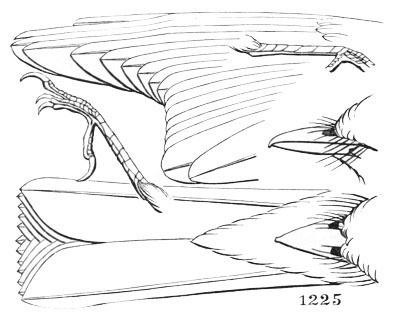
Empidonax acadicus. 1225
Gen. Char. Tarsus lengthened, considerably longer than the bill, and exceeding the middle toe, which is decidedly longer than the hind toe. Bill variable. Tail very slightly forked, even, or rounded; a little shorter only than the wings, which are considerably rounded; the first primary much shorter than the fourth. Head moderately crested. Color olivaceous above, yellowish beneath; throat generally gray.
The lengthened tarsi, the short toes, the short and rounded wings, and the plain dull olivaceous of the plumage, readily distinguish the species of this genus from any other North American Flycatchers. The upper plates of the tarsi in a good many species do not encircle the outside, but meet there a row on the posterior face.
There are few species of North American birds more difficult to distinguish than the small Flycatchers, the characters, though constant, being very slight and almost inappreciable, except to a very acute observer.
The following synopsis may aid in distinguishing the species:—
Species and Varieties.
A. Inner webs of secondaries edged with pinkish-buff.
a. Olive-brown above, whitish beneath; tibiæ ochraceous.
E. brunneus.[89] Third quill longest, first equal to seventh; tail slightly rounded. Russet-olive above, the crown, wings, and tail with a reddish-brown tinge; a yellowish-gray shade across the breast, and a faint sulphur-yellow tinge to posterior lower parts. Wing-bands broad, sharply defined, deep ochraceous; lining of wing and tibiæ slightly tinged with the same. Wing, 2.35; tail, 2.30; bill, .57 and .27; tarsus, .56; middle toe, .33. Hab. Parana.
E. axillaris.[90] Third quill longest, first equal to seventh; tail? Dark grayish-brown above, nearly uniform, breast ochraceous-olive; a just appreciable tinge of sulphur-yellow on abdomen. Wing-bands narrow, badly defined, in color nearly like the back; lining of the wing and tibiæ very deep ochraceous. Wing, 2.40; tail, 2.50; bill, .60 and .30; tarsus, .60; middle toe, .43. Hab. Orizaba.
b. Olive-green above, yellow beneath; tibiæ greenish.
E. flavescens.[91] Third, or third and fourth quills longest; first equal to eighth. Tail decidedly emarginated. Intense greenish-olive above, the crown with a decided russet tinge; beneath bright lemon-yellow, with a shade of fulvous-brown across the breast. Wing, 2.35 to 2.70; tail, 2.20 to 2.40; bill, .59 and .30; tarsus, .66; middle toe, .35. Hab. Costa Rica.
E. bairdi.[92] Fourth quill longest, first shorter than eighth. Tail slightly emarginated. Dull greenish-olive above, nearly uniform; beneath clear sulphur-yellow, with a greenish-olive shade across the breast. Wing, 2.60; tail, 2.50; bill, .62 and .29; tarsus, .65; middle toe, .35. Hab. Eastern Mexico (Mirador).
B. Inner webs of secondaries edged with yellowish or grayish white.
a. Olive-green above, yellowish beneath.
§. Young not mottled above.
E. flaviventris. Bill broad, twice as wide as deep, and the culmen less than twice the breadth. Outer web of lateral tail-feather dusky, like the inner. Wing-bands narrow, whitish. Tail square.
Clear olive-green above, sulphur-yellow beneath; wing-bands sulphur-yellowish; lining of wing clear sulphury-yellow. Wing, 2.60; tail, 2.35, or less; bill, .57 and .27; tarsus, .66; middle toe, .37. Hab. Eastern Province North America, south through Eastern Mexico to Guatemala … var. flaviventris.
Dull olive-gray above, pale, somewhat ochraceous, yellow beneath; wing-bands grayish-white; lining of wing strongly tinged with fulvous. Wing, 2.75; tail, 2.60 to 2.75. Hab. Western Province of North America, south, through Western Mexico, to Colima … var. difficilis.
E. fulvipectus.[93] Bill narrow, the width but little more than the depth, and the culmen considerably more than twice the breadth at base. Outer web of lateral tail-feather distinctly whitish, very different from the dusky of the inner web. Tail deeply emarginated. Colors of flaviventris var. difficilis, but wing-bands broad and buffy olive, and a deep shade of fulvous-olive across the breast. Wing, 3.00; tail, 2.90; bill, .61 and .22; tarsus, .60; middle toe, .37. Hab. City of Mexico.
b. Grayish or greenish olive above, whitish beneath.
¶. Tail deeply emarginated.
E. obscurus. Exact form and proportions of fulvipectus, but tarsus much longer proportionally. Ashy above, with a slight olive tinge; white beneath with no yellow tinge, and without distinct ashy shade across breast; sides of breast like the back. Orbital ring, wing-markings, and outer web of lateral tail-feather pale clear ashy. Wing, 3.00; tail, 2.80; bill, .64 and .24; tarsus, .77; middle toe, .42.
E. hammondi. Very similar, but bill much smaller and less elongated. Color of upper parts the same as in obscurus; but anterior lower parts nearly uniform ashy, the throat only indistinctly paler, and the posterior portions distinctly uniform pale sulphur-yellow. Outer web of lateral tail-feather less distinctly whitish. Wing, 2.85; tail, 2.55; bill, .50 and .20; tarsus, .64; middle toe, .34.
E. minimus. Very similar to hammondi, but bill much larger, broader, and the lateral outlines less straight. Outer web of lateral tail-feather not appreciably paler than the inner; whole throat distinctly whitish; wing-bands only about half as wide as in hammondi.
Wing, 2.70; tail, 2.60; bill, .57 and .27; tarsus, .66; middle toe, .35. Hab. Eastern Province of North America, and Eastern Mexico … var. minimus.
¶. Tail doubly rounded.
(var. ?) pectoralis.[94] Wing, 2.35; tail, 2.20; bill, .54 and .25; tarsus, .62; middle toe, .33. Colors of minimus, but wing-markings whiter. Hab. Panama.
E. griseipectus.[95] Colors of hammondi, but wing-bands whiter and narrower, very sharply defined; sides tinged with clear greenish; jugulum and sides of throat clear ashy. Wing, 2.40; tail, 2.40; bill, .56 and .27; tarsus, .60; middle toe, .35. Hab. Guayaquil, Ecuador.
¶. Tail square, or slightly rounded; feathers acute at tips.
E. pusillus. Brownish-olive or olive-gray above, wing-bands olive or gray; beneath whitish, with a grayish shade across the breast, and a sulphur-yellow tinge posteriorly.
Olive-grayish above, wing-bands much lighter, or whitish-gray. Wing, 2.90; tail, 2.70; bill, .69 and .26; tarsus, .67; middle toe, .40. Hab. Western Province of North America, and Middle and Western Mexico … var. pusillus.
Brownish-olive above, wing-bands but little lighter. Wing, 2.90; tail, 2.50; bill, .64 and .27; tarsus, .66; middle toe, .38. Hab. Eastern Province of North America, and Eastern Mexico … var. trailli.
§. Young with upper plumage transversely mottled. Wing-bands with a pale buff tinge; upper mandible brown.
E. acadicus. Grayish-green above, greenish-white beneath; throat purer white. Wing, 3.10; tail, 2.80; bill, .67 and .30; tarsus, .60; middle toe, .34. Hab. Eastern Province of United States, and Eastern Mexico … var. acadicus.
Wing, 2.65; tail, 2.50; bill, .66 and .30; tarsus, .62; middle toe, .33. Wing-bands whiter. Hab. Panama … var. griseigularis.[96]
In Empidonax, as well as Contopus, autumnal birds have the plumage softer and the colors brighter than in spring; the brilliancy of the yellow shades is especially enhanced. The young of the year resemble the parents, but there is a greater tendency to light bands on the wings, which with the other markings of this region show an ochraceous tinge. The lower mandible is also usually tinged with dusky. In the young of E. acadica, alone, there are light transverse bars over upper surface, as in the young of some species of Contopus (C. bahamensis and C. punensis).
Empidonax pusillus, Cabanis.
LITTLE FLYCATCHER.
? Platyrhynchus pusillus, Swainson, Phil. Mag. I, May, 1827, 366. Tyrannula pusilla, Sw. F. B. Am. II, 1831, 144, pl.—Rich. App. Back’s Voyage, 1834-36, 144.—Gambel, Pr. A. N. Sc. III, 1847, 156. Muscicapa pusilla, Aud. Orn. Biog. V, 1839, 288, pl. ccccxxxiv.—Ib. Birds Am. I, 1840, 236, pl. lxvi. Tyrannus pusilla, Nuttall, Man. I, (2d ed.,) 1840. Empidonax pusillus, Baird, Birds N. Am. 1858, 194. Cooper & Suckley, 176.—Sclater, Catal. 1862, 229. Empidonax trailli, Cooper, Orn. Cal. 1, 1870, 327 (Colorado River).
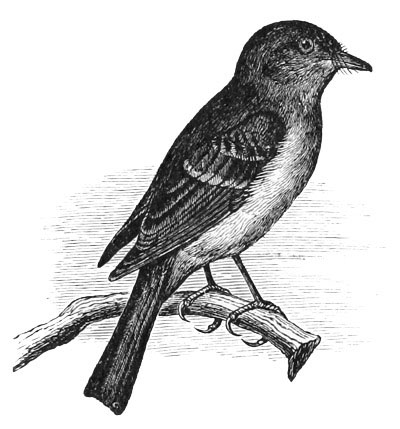
Empidonax pusillus.
Sp. Char. Second, third, and fourth quills longest; first shorter than the sixth. Bill rather broad; yellow beneath. Tail even. Tarsi rather long. Above dirty olive-brown, paler and more tinged with brown towards the tail. Throat and breast white, tinged with grayish-olive on the sides, shading across the breast; belly and under tail-coverts very pale sulphur-yellow. Wings with two dirty narrow brownish-white bands slightly tinged with olive; the secondaries and tertials narrowly and inconspicuously margined with the same. First primary faintly edged with whitish; the outer web of first tail-feather paler than the inner, but not white. Under wing-coverts reddish ochraceous-yellow. A whitish ring round the eye. Length, 5.50; wing. 2.80; tail, 2.75. Young. Wing-bands ochraceous instead of grayish.
Hab. High Central Plains to the Pacific. Fur countries. Southward into Mexico. Fort Whipple, Arizona (Coues, P. A. N. S. 1866, 61); Vera Cruz, temp. reg. resident (Sum. Mem. Bost. Soc. I, 557).
This race represents the var. trailli in the region west of the Rocky Mountains. The present bird is paler colored than trailli, the olivaceous above much more grayish anteriorly, and more brownish posteriorly, the olive being thus less greenish and less uniform in tint; the brownish shade across the breast is lighter and more ashy, and the yellow tinge posteriorly beneath more faint; the wing-bands lighter and more grayish. In color, pusillus thus approximates somewhat to E. minimus, which, however, is a very distinct species, and more closely related to E. hammondi; minimus may be distinguished by much smaller size (the bill especially), the wing-bands grayish-white instead of olive-gray, and the tail emarginated instead of appreciably rounded; minimus lays a white egg like E. obscurus, while pusillus and trailli lay distinctly spotted ones, and build a very different nest.
Habits. Professor Baird, in his Birds of North America, assigns to this species an area of distribution extending from the Great Plains to the Pacific, southward into Mexico, and north to the fur country. Dr. Hoy cites it as of Wisconsin in his List of the birds of that State, but without positive data for this claim; it has, however, since been actually taken, a summer resident breeding in Jefferson County, in that State. This is its most eastern known occurrence. In the Smithsonian Museum are skins from Fort Steilacoom, Fort Tejon, and Mexico. This species is probably identical with the Little Tyrant Flycatcher, described by Swainson in the Fauna Boreali as both from Mexico and from the Arctic regions. Dr. Richardson was not able to supply anything in regard to its habits. They were first seen by him at the Carlton House on the 19th of May. For a few days they were found flitting about among low bushes on the banks of the river, after which they retired to moist shady woods lying farther north.
Mr. Ridgway mentions the E. pusillus as the most common of the Empidonaces in the Great Basin, as well as in California and the Rocky Mountains. It is chiefly, if not entirely, confined to the willows along streams, but it is as common in the river valleys as in the mountain “parks.” In all respects it is a counterpart of the E. trailli; its notes, as well as its manners, being the same. In Parley’s Park, in the Wahsatch Mountains, at an elevation of over 7,000 feet, they were breeding abundantly; about nightfall they became particularly active, chasing each other, with a merry twitter, through the willow thickets, or, as they perched upon a dry twig, uttered frequently, with swelling throats and raised crest, their odd but agreeable enunciation of pretty dear, as their notes were translated by the people of the locality.
In the Department of Vera Cruz, Mexico, Mr. Sumichrast gives this species as a summer resident within the temperate region. He found it quite common around Orizaba in the months of June and July.
Dr. Coues mentions it as moderately plentiful as a summer resident in Arizona. None of this genus were very common at Fort Whipple, but this one was by far the most characteristic species. It arrives there about the middle of April, and remains through September.
Dr. Suckley found this species quite abundant in the vicinity of Fort Steilacoom, where it arrives early in May. It seems to prefer the vicinity of bushes and low trees at the edges of dense forests. This species, he adds, is rather less pugnacious than others of the group, and in habits generally more resembles the Vireo family. Its notes are said to be short but sweet, and just after sundown on warm summer evenings particularly low, plaintive, and soothing.
Dr. Cooper speaks of it as found by him frequenting the dark and gloomy spruce forests, which it seems to prefer to more open places. He found it most numerous near the coast, but also saw a few at Puget Sound, where it arrived about the 25th of April. He speaks of its song as lively but monotonous. He found it very difficult to get a sight of this bird among the upper branches of the tall spruces, its color making it almost invisible in the shade. One of these birds was observed to keep constantly on the border of a small pond and to drive away a Kingbird from the place. He adds that it has a peculiar short and lisping song of three notes, very different from those of the other species. In the fall the young birds uttered a very different call-note.
Mr. Ridgway found this species breeding, June 23, at Parley’s Park, Utah. One nest was built on the horizontal branch of a willow, over a stream, about four feet from the ground. It was partly pensile. It was three inches deep and four in diameter; the cavity was two inches wide and one and a half deep. Externally the nest was somewhat loosely constructed of flaxen fibres of plants, soft strips of inner bark and straw, and lined more firmly with fine roots of plants. This structure was firmly bound around the smaller branches of the limb. The inner nest was much more compactly interwoven than the periphery. The eggs, four in number, were of a chalky whiteness, more pinkish when unblown, finely sprinkled at the larger end with reddish-brown dots. Length, .77 of an inch; breadth, .51.
Another nest from the same locality was built in the upright fork of a wild rose, in the undergrowth of a willow thicket, and about four feet from the ground. It is a much more compact and homogeneous nest. Its external portion was almost wholly composed of the interweaving of the fine inner bark of deciduous shrubs, blended with a few stems of grasses, feathers, etc., and is lined with a few fine grass stems and fibrous roots. The eggs, four in number, have a pinkish-white ground, and are spotted at the larger end with reddish-brown and chestnut spots, in scattered groups.
In the summer of 1870 a son of Mr. Thure Kumlien, of Jefferson Co., Wisconsin, found the nest and eggs of this species. Both parents were obtained, and were fully identified by Professor Baird. The nest was placed in a thick mass of coarse marsh grasses, near the ground, and firmly interwoven with the tops of the surrounding herbage. The grass and reeds, among which it was made, grew in the midst of water, and it was discovered by mere accident in a hunt for rail’s eggs. It was found, June 28, on the edge of Lake Koskonong. It is a large nest for the bird; its base and sides are made of masses of soft lichens and mosses, and within this a neat and firm nest is woven of bits of wool and fine wiry stems of grasses, and lined with the same. The eggs measure .70 by .54 of an inch, are white with a pinkish tinge, and are marked with reddish-brown and fainter lilac blotches at the larger end.
Empidonax pusillus, var. trailli, Baird.
TRAILL’S FLYCATCHER.
Muscicapa trailli, Aud. Orn. Biog. I, 1832, 236; V, 1839, 426, pl. xlv.—Ib. Syn. 1839, 43.—Ib. Birds Am. I, 1840, 234, pl. lxv. Tyrannula trailli, Rich. List, 1837.—Bonap. List, 1838. Tyrannus trailli, Nuttall, Man. I, (2d ed.,) 1840, 323. Empidonax trailli, Baird, Birds N. Am. 1858, 193.—Sclater, Catal. 1862, 231.—Samuels, 140.
Sp. Char. Third quill longest; second scarcely shorter than fourth; first shorter than fifth, about .35 shorter than the longest. Primaries about .75 of an inch longer than secondaries. Tail even. Upper parts dark olive-green; lighter under the wings, and duller and more tinged with ash on nape and sides of the neck. Centre of the crown-feathers brown. A pale yellowish-white ring (in some specimens altogether white) round the eye. Loral feathers mixed with white. Chin and throat white; the breast and sides of throat light ash tinged with olive, its intensity varying in individuals, the former sometimes faintly tinged with olive. Sides of the breast much like the back. Middle of the belly nearly white; sides of the belly, abdomen, and the lower tail-coverts, sulphur-yellow. The quills and tail-feathers dark brown, as dark (if not more so) as these parts in C. virens. Two olivaceous yellow-white bands on the wing, formed by the tips of the first and second coverts, succeeded by a brown one; the edge of the first primary and of secondaries and tertials a little lighter shade of the same. The outer edge of the tail-feathers like the back; that of the lateral one rather lighter. Bill above dark brown; dull brownish beneath. Length, nearly 6.00; wing, 2.90; tail, 2.60. Young with the wing-bands ochraceous instead of grayish-olive.
Hab. Eastern United States and south to Mexico. Localities: ? Isthmus of Panama (Lawr. VIII, 63); ? San Antonio, Texas (Dresser, Ibis, 1865, 474, breeds); ? Costa Rica (Lawr. IX, 114); Yucatan (Lawr. IX, 201). All these localities, except perhaps the last, are to be questioned, as being more properly in the habitat of var. pusillus.
This species is most closely related to E. minimus, but differs in larger size and the proportions of quills. The middle of the back is the same color in both, but instead of becoming lighter and tinged with ash on the rump and upper tail-coverts, these parts very rarely differ in color from the back. The markings on the wings, instead of being dirty white, are decidedly olivaceous-grayish. The yellow of the lower parts is deeper. The tail-feathers are rather broad, acuminate, and pointed; in minimus they are narrow and more rounded, while the tail itself is emarginated, instead of square, as in the present bird. The bill is larger and fuller. The legs are decidedly shorter in proportion.
Habits. Traill’s Flycatcher was first described by Mr. Audubon as a western bird, procured from Arkansas. In his subsequent reference to this species he also speaks of it as identical with several birds obtained by Townsend near the Columbia River, but which our present knowledge as to the distribution of this species compels us to presume to have been specimens of the Empidonax pusillus, a closely allied species or race. That Traill’s Flycatcher does occur in Arkansas, on the other hand, is rendered probable by its abundance in other parts of the country, making this region directly within its range of migration. Dr. Woodhouse found it very common both in Texas and in the Indian Territory. Mr. Dresser found it common during the summer season near San Antonio, and to the eastward, breeding there, and building a small hanging nest. He also had its eggs sent to him from Systerdale. The stomach of the specimen he procured contained minute insects. It is mentioned by Dr. E. Coues as found in South Carolina, but whether as a migrant or as a resident is not stated. Dr. William P. Turnbull refers to it as rare near Philadelphia, and as only a spring and autumnal migrant. Mr. McIlwraith cites it as a rare summer visitant near Hamilton, Canada West. It is mentioned by Mr. Boardman as found near Calais, but has not been recorded as occurring in Nova Scotia, as far as I am aware. In Western Maine, Professor Verrill found it a regular but not a common summer visitant, arriving there the third week in May. And Mr. Brewster found it breeding in considerable abundance near Lake Umbagog in the summer of 1872.
In Massachusetts it has been found to occur very irregularly, and so far chiefly as a migrant, at least I am not aware that it has been known, except in a single instance, to breed within the limits of that State. It passes through the State about the middle of May, is rare some seasons, much more abundant for a few days in others. Near Springfield Mr. Allen regarded it as a rather rare summer visitant, arriving from the 10th to the 15th of May, and also mentioned it as probably breeding. A number have been taken in Lynn by Mr. Welch, but none have been observed to remain more than a day or two. Mr. Maynard once met with it on the 1st of June, 1869, in a swampy thicket. It was very shy, and he heard no note.
This species was observed by Mr. Paine, at Randolph, Vt., where it was found to be a not uncommon, though very retiring and shy species. It was found frequenting shady thickets, on the borders of the mountain streams, and several of its nests were procured. The bird was thoroughly identified, specimens of the parents having been sent to Professor Baird for verification. Mr. Paine was not able to obtain much insight into the manners and habits of this species, on account of its shyness. The nests were always placed in low alder-bushes, near running streams, and not more than three or four feet from the ground.
Mr. Paine has since informed me that Traill’s Flycatcher reaches Central Vermont from the 20th to the 25th of May, and is one of the last birds to arrive, coming in company with Contopus virens and C. borealis. They all leave before the close of September. Mr. Paine has met with a great many nests of this species, but has only found one containing more than three eggs. It has a very simple song, consisting of but two notes. It has also a sort of twitter as it plays with its mate. They are usually found in thickets, for the most part near water, but not always, and are never seen in tall woods. They are occasionally seen chasing one another in the open fields.
Mr. William Brewster informs me that he found Traill’s Flycatcher moderately common and breeding at the foot of Mount Washington, in the Glen, in August, 1869, and in the township of Newry, Me., in June, 1871. Their favorite haunts were the dense alder thickets along the runs and small streams, over these dark retreats, perched on some tall dead branch, full in the rays of the noonday sun. The male sang vigorously, occasionally darting out after some insect, and returning to the same perch. His song consisted of a single dissyllabic refrain, ke´wing, uttered in a harsh peevish tone at an interval of about thirty seconds, varied occasionally to ke´wink, or ki-winch. At each utterance his head is thrown upwards with a sudden jerk. They were retiring, but not shy, were easily approached, and were apparently not so restless as most Flycatchers.
Near Washington, Dr. Coues found Traill’s Flycatcher a rare spring and fall visitant, a few possibly remaining to breed. They came about the last of April, and passed south the last of September. Professor Baird frequently met with them about Carlisle, Pa.
In Southern Illinois, Mr. Ridgway has found this species a rather common summer resident, chiefly met with in the open woods. It was found nesting in Northwestern Massachusetts by Mr. A. Hopkins, in Illinois by Mr. Tolman, in New Brunswick by Mr. Barnstow, and at Fort Resolution by Messrs. Kennicott, Ross, and Lockhart.
I have myself found this species on the banks of the Androscoggin and Peabody Rivers in Gorham, and met with several of their nests. They were all in similar situations, and it was quite impossible to obtain a glimpse of the bird after she had left her nest. The nests were all made like those of the Indigo-Bird, externally of dry grasses and fine strips of bark, and lined with finer stems of grasses. The eggs were five in number, and incubation commenced about the first of June. I have discovered their nests at the same time among the foot-hills at the base of Mount Washington, its wooded sides being, at the time, covered with snow to the depth of several feet.
Among the memoranda of Mr. Kennicott I find one dated Fort Resolution, July 9, mentioning the procuring of the parent nest and egg of this species. The nest was three feet from the ground, in a small spruce among thick low bushes. The female was shot on the nest, which contained two young and two eggs. Eggs of this species from Gorham, N. H., and Coventry and Randolph, Vt., do not essentially vary in size or shape. They measure .63 of an inch in length, by .56 in breadth. Their ground-color is white, with a distinctly roseate tinge. They are oval in shape, a little less obtuse at one end, and marked almost entirely about the larger end with large and well-defined spots and blotches of purplish-brown.
Empidonax minimus, Baird.
LEAST FLYCATCHER.
Tyrannula minima, Wm. M. and S. F. Baird, Pr. A. N. Sc. I, July, 1843, 284.—Ib. Sillim. Am. Jour. Sc. July, 1844.—Aud. Birds Am. VII, 1844, 343, pl. ccccxci. Empidonax minimus, Baird, Birds N. Am. 1858, 195.—Sclater, Catal. 1862, 229.—Samuels, 141.
Sp. Char. Second quill longest; third and fourth but little shorter; fifth a little less; first intermediate between fifth and sixth. Tail even. Above olive-brown, darker on the head, becoming paler on the rump and upper tail-coverts. The middle of the back most strongly olivaceous. The nape (in some individuals) and sides of the head tinged with ash. A ring round the eye and some of the loral feathers white; the chin and throat white. The sides of the throat and across the breast dull ash, the color on the latter sometimes nearly obsolete; sides of the breast similar to the back, but of a lighter tint; middle of the belly very pale yellowish-white, turning to pale sulphur-yellow on the sides of the belly, abdomen, and lower tail-coverts. Wings brown; two narrow white bands on the wing, formed by the tips of the first and second coverts, succeeded by one of brown. The edge of the first primary, and of the secondaries and tertials, white. Tail rather lighter brown, edged externally like the back. Feathers narrow, not acuminate, with the ends rather blunt. In autumn the white parts are strongly tinged with yellow. Length, about 5.00; wing, 2.65; tail, 2.50. Young with ochraceous, instead of grayish-white wing-bands.
Hab. Eastern United States to Missouri Plains; Mirador; Orizaba; Belize. Localities: Oaxaca (Scl. 1859, 384); Guatemala (Scl. Ibis, I, 122); Orizaba (Scl. Ibis, I, 441, and Mus. S. I.); Coban, Escuintla, Dueñas (Scl. Catal. 1862, 229); San Antonio, Texas (Dresser, Ibis, 1865, 474, common, summer).
Habits. The distinctness of this species from the acadica, with which it had been previously confused, was first pointed out by the Messrs. Baird in 1843, but it was some time before the complete differences between the two species and their distinctive habits and distribution were fully appreciated and known. This species, one of the commonest birds in the State of Massachusetts, where the E. acadica is nearly or quite unknown, was supposed by Mr. Nuttall to be the latter species, and under that name is treated and its history given. Wilson contributed to cause this error. For although his account of the acadica is in part correct, it is not wholly free from error, and probably the nest and eggs described as belonging to the latter were those of the minima. The discovery, by Professor Baird, of the nest and eggs of the acadica, and their marked difference in all respects from those of the minima, which had hitherto been attributed to it, at once pointed out the errors that had prevailed, and permitted the real facts to be appreciated.
This bird is an abundant species throughout Eastern North America, occurring as a migrant in all the States between the Atlantic and the Great Plains, and breeding from the 40th parallel northward over an extent not fully defined, but probably to within the Arctic Circle. It occurs in great numbers from Maine to Nebraska, and, unlike all the other species of this genus, is not shy or retiring, but frequents the open grounds, visits gardens, is found in the vicinity of dwellings, and breeds even in the vines that half conceal their windows and doors.
This Flycatcher reaches Washington, according to Dr. Coues, the last of April, and remains about two weeks. It returns in autumn the third week in August, and remains till the last of September. It is only a spring and autumnal visitant, none breeding, and is rather common. It frequents the margins of small streams and brooks.
I am not aware that the nest of this species has ever been procured farther south than New York City, yet it is given by Mr. Dresser as having been found common by him, through the summer, near San Antonio. It is not, however, mentioned by Dr. Woodhouse, nor by the Mexican Survey, nor was it met with by Sumichrast in Vera Cruz. It is cited by Dr. Coues as only a migrant in South Carolina. Near Philadelphia Mr. Turnbull gives it as a somewhat rare migrant, passing north in April and returning in September, but adds that a few remain to breed. I did not find it breeding in the vicinity of Newark, nor, among a very extensive collection of nests and eggs made in that neighborhood, were there any eggs of this species. It is mentioned by Mr. Boardman as occurring at Calais, and in the western part of the State Mr. Verrill found it a very common summer visitant, arriving there about the middle of May and breeding there in numbers. It is also an exceedingly frequent summer visitant at Hamilton, Canada West, according to Mr. McIlwraith. It is found during the winter months near Oaxaca, Mexico, according to Mr. Boucard, and has been met with throughout Mexico and south to Guatemala.
In Massachusetts this Flycatcher is one of the most abundant and familiar species, arriving from about the 20th of April to the 1st of May. It is found most frequently in orchards, gardens, and open grounds, and very largely on the edges of woods, remaining until October. They are much addicted to particular localities, and return to the same spot year after year, if undisturbed. A pair that had established their hunting-grounds in an open area north of a dwelling in Roxbury returned to the same spot for several successive years, and would come regularly to the piazza of the house, where bits of cotton were exposed for the benefit of such of the whole feathered tribe as chose to avail themselves of it. Each year they drew nearer and nearer the house, until at last the nest was made in a clump of honeysuckle on the corner of the piazza, from which they would sally forth in quest of insects, entirely unmindful of the near presence of the family. I never observed the quarrelsome disposition that Nuttall speaks of, nor have I ever seen them molest other birds, even when the summer Yellow-Birds and the Chipping Sparrows have nested in the same clump. They are very silent birds, having no song and no other cry or note than a very feeble, guttural utterance, given out either as a single sound or as a succession of twitters. Their nest is a very common receptacle for the eggs of the Cow Blackbird.