Family TYRANNIDÆ.—Tyrant Flycatchers. (continued 3)
Reading edition
This species was found breeding at Fort Resolution, latitude 62°, by Mr. Kennicott, the nest being in an alder-bush, and about five feet from the ground. It was also found nesting in the same locality by Mr. Ross and by Mr. Lockhart. Its nest was found at Lake Manitobah by Mr. McTavish, and at Fort Simpson by Mr. Ross.
This species has been gradually undergoing certain modifications of habits and manners in consequence of its contact with civilization and becoming familiarized to the society of man. In nothing is this made more apparent than in the construction of its nests. Those made on the edge of woodlands or in remote orchards are wrought almost entirely of fine deciduous bark, hempen fibres of vegetables, feathers, dried fragments of insect cocoons, and other miscellaneous substances felted and impacted together; within this is a lining of fine strips of vegetable bark, woody fibres, fine lichens, and soft downy feathers. In some the lining is exclusively of fine pine leaves, in others with the seeds or pappus of compositaceous plants. The nests are always quite small, rarely measuring more than three inches in diameter or two in height. Those made in the vicinity of dwellings indicate their neighborhood by the variety of miscellaneous and convenient materials, such as bits of paper, rags, cotton, wool, and the larger and more conspicuous feathers of the poultry-yard. Where raw cotton was abundantly provided, I have known this material, strengthened with a few straws and woody fibres, with a lining of feathers, constitute the whole substance of the nest.
One nest, constructed in a thick tamarack swamp in Wisconsin, is composed of a dense, impacted mass of a dirty white vegetable wool, intertwined at the base with shreds of bark, vegetable stems, and small black roots. The inner rim and frame of the nest are made of black, shining rootlets, intermingled with slender leaves and stems of dry sedges, and lined with the pappus of a small composite plant and a few feathers.
The eggs of this species are pure white, never, so far as I am aware, spotted, of a rounded-oval shape, nearly equally obtuse at either end, and measuring about .60 of an inch in length by .50 in breadth.
Empidonax acadicus, Baird.
SMALL GREEN-CRESTED FLYCATCHER.
? Muscicapa acadica, Gmelin, Syst. Nat. I, 1788, 947.—Latham, Index Orn. II, 1790, 489.—Vieillot, Ois. Am. Sept. I, 1807, 71 (from Latham).—Aud. Orn. Biog. II, 1834, 256; V, 1839, 429, pl. cxliv.—Ib. Birds Am. I, 1840, 221, pl. lxii.—Nuttall, Man. I, 1832, 208.—Giraud, Birds L. Island, 1844, 40. Muscicapa querula, Wilson, Am. Orn. II, 1810, 77, pl. xiii, f. 3 (not of Vieillot). “Platyrhynchus virescens, Vieillot.” Tyrannula acadica, Richardson, ? Bon. List, Tyrannus acadica, Nuttall, Man. I, (2d ed.,) 1840, 320. Empidonax acadicus, Baird, Birds N. Am. 1858, 197.—Sclater, Catal. 1862, 229.—Samuels, 143.
Sp. Char. The second and third quills are longest, and about equal; the fourth a little shorter; the first about equal to the fifth, and about .35 less than the longest. Tail even. The upper parts, with sides of the head and neck, olive-green; the crown very little if any darker. A yellowish-white ring round the eye. The sides of the body under the wings like the back, but fainter olive; a tinge of the same across the breast; the chin, throat, and middle of the belly white; the abdomen, lower tail and wing coverts, and sides of the body not covered by the wings, pale greenish-yellow. Edges of the first primary, secondaries, and tertials margined with dull yellowish-white, most broadly on the latter. Two transverse bands of pale yellowish (sometimes with an ochrey tinge) across the wings, formed by the tips of the secondary and primary coverts, succeeded by a brown one. Tail light brown, margined externally like the back. Upper mandible light brown above; pale yellow beneath. In autumn the lower parts are more yellow. Length, 5.65; wing, 3.00; tail, 2.75. Young (60,892 Mt. Carmel, Ill., August 11, 1870; R. Ridgway.) Whole upper surface with indistinct transverse bars of pale ochraceous; wing-markings light ochraceous.
Hab. Eastern United States to the Mississippi; Yucatan. Localities: Cuba (Lawr. VII, 1860, 265; Gundl. Rept. 1865, 240); San Antonio, Texas, summer (Dresser, Ibis, 1865, 475).
This species is very similar to E. trailli, but the upper parts are of a brighter and more uniform olive-green, much like that of Vireo olivaceus. The feathers of the crown lack the darker centre. There is less of the olivaceous-ash across the breast. The bands across the wing are light yellowish, instead of grayish-olive. There is much more yellow at the base of the lesser quills. The wings are longer, both proportionally and absolutely. The primaries exceed the secondaries by nearly an inch, instead of by only about .70; the proportions of the quills are much the same.
Habits. This species belongs to Eastern North America, but its distribution north and east is not determined with entire certainty. I have never met with or received any evidence of its breeding northeast of Philadelphia. Nuttall’s account of this bird so blends what he had ascertained in regard to the habits of a different species with what he derived from other writers, that his whole sketch must be passed as unreliable. It is shy and retiring in its habits, frequenting only lonely places, and would readily escape notice, so that its presence in New Jersey, New York, and even New England, may not be uncommon, although we do not know it. Mr. Lawrence mentions its occurring in the vicinity of New York City; but I can find no evidence whatever that a single specimen of this bird has ever been procured in any part of New England, except Mr. Allen’s mention of finding it near Springfield. That it is found in the immediate neighborhood of Philadelphia I have positive evidence, having received its nest and eggs, found in West Philadelphia. Mr. Turnbull gives it as of frequent occurrence from the beginning of May to the middle of September. He generally met with it in the most secluded parts of woods. Mr. McIlwraith calls it a rare summer resident near Hamilton, Canada West.
I am informed by Mr. Thomas H. Jackson, an accurate observer, resident in Westchester, Pa., that this Flycatcher arrives in that neighborhood early in May, constructing its nest about the first of June. This is generally placed on a drooping limb of a beech or dogwood tree at the height of from six to ten feet from the ground. It is never saddled on a limb like that of a Wood Pewee, neither is it pensile like those of the Vireos, but is built in the fork of a small limb, and securely fastened thereto by a strip of bark. The nest itself is mostly made of fine strips of bark or weed-stalks, woven together without much care as to neatness or strength, and so very slight is the structure that you may often count the eggs in the nest from below. Occasionally this bird constructs its nest of the blossoms of the hickory-tree, and when thus made is very neat and pretty.
The eggs are generally three in number (Mr. Jackson has never known more in a nest), and they are said to be of a rich cream-color, thinly spotted near the greater end. The Cow-Bird sometimes imposes on this species with its parasitic offspring, but not so often as upon other birds.
Mr. Jackson also informs me that this is quite a common bird in some localities. In one piece of woodland, half a mile east of West Chester, he can every season meet with six or eight of their nests, while in another direction, in a wood apparently similar in every respect, he has never met with any.
Mr. J. A. Allen mentions finding this Flycatcher as a rare summer visitant in Western Massachusetts, where, as he states, it breeds in swamps and low moist thickets, which are its exclusive haunts. He characterizes it as one of the most spirited and tyrannical of this genus. It is said to have a short quick note, sounding like quequeal, which it utters hurriedly and sharply, and to have an erect, hawk-like attitude. He adds that it is very quarrelsome with its own species, a battle ensuing whenever two males meet. They pursue each other fiercely, with snapping bills and sharp, querulous, twittering notes. He found it a very shy bird, and difficult to collect, frequenting exclusively, so far as he was able to observe, thick alder-swamps and swampy thickets, keeping concealed among the thick bushes, or at a great distance.
Wilson’s history of this species is quite brief, and he expressly states that it is a bird but little known. His account of its nest and eggs is inaccurate, and refers probably to that of the minimus, as also the statement that it extends its migrations as far as Newfoundland. He found it inhabiting only the deepest solitary parts of the woods, stationed among the lower branches, uttering at short intervals a sudden, sharp squeak, heard at considerable distance through the woods. As it flies, it utters a low, querulous note, which it changes, on alighting, to its usual sharp cry. He adds that it is a rare and very solitary bird, always haunting the most gloomy, moist, and unfrequented parts of the forest, feeding on flying insects, devouring wild bees and huckleberries in their season.
To this account Audubon furnishes but little additional that is reliable. He evidently confounded with it the minimus, repeats Wilson’s description of its eggs, and is incorrect as to its northern distribution. He speaks of it as extremely pugnacious, chasing from its premises every intruder, and when once mated seldom leaving the vicinity of its nest except in pursuit of food. His description of the nest applies to that of the minimus, but not to that of this species.
Mr. Ridgway writes me that in Southern Illinois it is the most abundant of the Empidonaces, breeding in the same woods with E. trailli. It is so exceedingly similar to that species in manners and general habits that they are hard to distinguish, and it requires a long acquaintance with the two in the woods to learn to distinguish them when seen or heard. A close attention, however, shows that the notes of the two are quite distinct.
Mr. Dresser mentions finding this species not uncommon near San Antonio, Texas, during the summer. Its stomach was found to contain small insects. Dr. Woodhouse also speaks of it as common in Texas, New Mexico, and the Indian Territory, but at what season is not mentioned.
Dr. Hoy writes me that this bird, quite common about Racine some twenty-five years ago, has now almost entirely disappeared.
Near Washington Dr. Coues found this Flycatcher a common summer resident, the most abundant of the kind, and the only one that breeds there in any numbers. They arrive the last of April, and remain until the last of September.
A beautiful nest of this species was found by Mr. George O. Welch near Indianapolis, Indiana. It was fully identified, and the parent shot. This nest has a diameter of four inches, and a height of two. Its base is composed to a large extent of dried grasses, intermingled with masses of withered blossoms of different herbaceous plants. Above this is constructed a somewhat rudely interwoven nest, composed entirely of long, fine, wiry stems of grasses. The cavity is two inches wide and less than one in depth. The eggs, three in number, are exceedingly beautiful, and differ from all the eggs of this genus, having more resemblance to those of Contopi. They have an elongated oval shape, and are quite pointed at one end. They measure .78 by .56 of an inch. Their ground is a rich cream-color, tinged with a reddish-brown shading, and at the larger end the eggs are irregularly marked with scattered and vivid blotches of red and reddish-brown. The nest was found on the 3d of June.
Empidonax flaviventris, Baird.
YELLOW-BELLIED FLYCATCHER.
Tyrannula flaviventris, Wm. M. and S. F. Baird, Pr. Ac. Nat. Sc. Phila. I, July, 1843, 283.—Ib. Am. Journ. Science, April, 1844.—Aud. Birds Am. VII, 1844, 341, pl. ccccxc. Tyrannula pusilla (Swainson), Reinhardt, Vidensk. Meddel. for 1853, 1854, 82.—Gloger, Cab. Jour. 1854, 426. Empidonax hypoxanthus, Baird (provisional name for eastern specimens). Empidonax difficilis, Baird (provisional name for western). Empidonax flaviventris, Baird, Birds N. Am. 1859, 198.—Sclater, Catal. 1862, 229.—Maynard, B. E. Mass. 1870, 126.
Sp. Char. Second, third, and fourth quills nearly equal; first intermediate between fifth and sixth. Tail nearly even, slightly rounded. Tarsi long. Above bright olive-green (back very similar to that of Vireo noveboracensis); crown rather darker. A broad yellow ring round the eye. The sides of the head, neck, breast and body, and a band across the breast like the back, but lighter; the rest of the lower parts bright greenish sulphur-yellow; no white or ashy anywhere on the body. Quills dark brown; two bands on the wing formed by the tips of the primary and secondary coverts, the outer edge of the first primary and of the secondaries and tertials pale yellow, or greenish-yellow. The tail-feathers brown, with the exterior edges like the back. The bill dark brown above, yellow beneath. The feet black. In the autumn the colors are purer, the yellow is deeper, and the markings on the wings of an ochrey tint. Length, 5.15; wing, 2.83; tail, 2.45.
Hab. Eastern United States, and Eastern Middle America, south to Costa Rica. Localities: Guatemala (Scl. Ibis, I, 122); Xalapa (Scl. Ibis, I, 441); Choctun, Dueñas (Scl. Catal. 1862, 230); Costa Rica (Lawr. IX, 114); Panama (Lawr. VIII, 63); Vera Cruz, winter, resident? (Sum. M. B. S. I, 557); San Antonio, Texas (Dresser, Ibis, 1865, 475).
Specimens from the eastern regions of North and Middle America, though varying slightly among themselves, all agree in the characters which distinguish them from the western series.
Habits. This well-marked species was first obtained in Carlisle, Penn., and described by the Bairds in 1843. It has since remained a comparatively rare and scattered species, and has been only seldom met with. I found it breeding in the vicinity of Halifax, and also among the Grand Menan Islands, and in both cases was so fortunate as to be able to obtain its nest and eggs. It has been found near Calais by Mr. Boardman, and its nest also procured. It has also been found breeding near Trenton, N. J., by Dr. Slack, and in a not distant locality in the same State by Dr. Abbott.
Dr. Coues observed the Yellow-bellied Flycatcher to be a rather rare spring and autumnal visitant at Washington. As specimens were taken there July 28, undoubtedly they occasionally breed there. They appear early in May, and go south the latter part of September.
Two specimens of Flycatcher, identified as of this species, are recorded by Professor Reinhardt as having been taken at Godthaab, Greenland, in 1853.
Sumichrast met with this species in Vera Cruz, but whether as a resident or only as a migrant he could not determine. Mr. Dresser states that it is common in the summer near San Antonio, arriving there in April. Dr. Coues met it in its migrations through South Carolina. Dr. Turnbull speaks of it as rare in the neighborhood of Philadelphia, where it arrives in the middle of April on its way north. It has been found throughout Eastern Mexico and Guatemala, and as far south as Panama.
Mr. Verrill regarded this species as a summer resident in Western Maine, though he never met with its nest, and at no time very common. Specimens were procured between the last of May and the middle of June. It was found, though very rare, by Mr. McIlwraith, at Hamilton, where it was supposed to be a summer resident. Specimens were taken about the middle of May.
Dr. Hoy detected this species in the summer of 1869, in the vicinity of Racine, and although he had no doubt that they had a nest in the vicinity, he was not able to discover it. He was surprised to find that the male of this species has quite a pretty song. This fact has since been confirmed by the observations of Mr. Boardman, who has heard this bird give forth quite a pleasing, though somewhat monotonous trill. This, according to Dr. Hoy, resembles Pēa-wāyk-pēa-wāyoc, several times repeated in a soft and not unpleasant call or song.
In Western Massachusetts Mr. Allen has found this species rather rare. Those met with have all been taken from May 15 to June 5. Dr. Coues, in his List of the birds of New England, expresses his conviction that this species is probably much less rare than collectors have generally supposed. It harbors very closely in shady woods and thickets, and is very rarely to be met with anywhere else. In the distance it is not easily distinguished from other species of this genus, and may have been allowed to go unsought, mistaken for a much more common species. Mr. Allen has generally met with quite a number each year in May, sometimes several in a single excursion. Mr. Maynard took eight specimens in a few hours, May 31, in Eastern Massachusetts, and Mr. Welch obtained an unusual number in a single season. Dr. Coues has also met with them near Washington during their breeding-season.
At Grand Menan I found the nest of this species in a low alder-bush, on the edge of a thicket, but within a few feet of the shore. The nest was about two feet from the ground, placed in the fork of the bush, and bearing a close resemblance to the nest of the Cyanospiza cyanea. It was loosely made of soft strips of the inner bark of deciduous trees, and lined with yellow stems of grasses. It was not large for the bird, but the conspicuous color of the materials at once betrayed the nest as we chanced to land within a few feet of it. The female immediately slid from it, and was not seen again, but her mate was undisturbed by our presence. Afterwards other nests were obtained at Halifax, on the edge of swampy woods, made of stubble, and placed in low bushes. All the eggs I obtained were white, of a slightly more chalky hue than those of the minimus, and more oblong. Those procured by Mr. Boardman were sprinkled with minute dots of reddish-brown. Their measurement is .68 by .52 of an inch.
Empidonax flaviventris, var. difficilis, Baird.
WESTERN YELLOW-BELLIED FLYCATCHER.
Empidonax difficilis, Baird, Birds N. Am. 1858, 198 (under E. flaviventris) pl. lxxvi, f. 2.—Sclater, Catal. 1862, 230. Empidonax flaviventris, Cooper, Orn. Cal. 1, 1870, 328.
Sp. Char. Similar to flaviventris, but tail much longer, and colors lighter and duller. The olive above less green, and the sulphur-yellow beneath less pure, having an ochraceous cast, this especially marked on the edge of the wing; wing-bands grayish rather than yellowish white. Measurements, ♂ (58,550, Parley’s Park, Wahsatch Mountains, Utah, August 5, 1869; C. King, R. Ridgway): Wing, 2.90; tail, 2.80; wing-formula, 3, 4, 2, 5, 6, 1. Young. Wing-bands ochraceous, instead of grayish-white, with a sulphur-yellow tinge.
Hab. Western Province of United States, and Western Mexico. (Mazatlan, Colima, etc.) Fort Whipple, Arizona (Coues, P. A. N. S. 1866, 62).
Habits. This Flycatcher is a western form, closely allied to our eastern E. flaviventris. It was met with by Dr. Coues in Arizona, where it was rather rare, and appeared to be a summer resident. It arrives in that Territory about the middle of April, and remains there until the latter part of September. Dr. Coues found it difficult to distinguish this form from our eastern flaviventris.
Dr. Cooper obtained at Monterey, Cal., specimens of the western types of this bird, having darker markings on the wing, which, however, he regards as only indicative of a young plumage, and not of specific distinctness. He found these birds chiefly frequenting woods of Coniferæ, and very silent, which, so far as the observation has any value, indicates a marked difference between the eastern and the western birds.
The eggs of this species are also different from any of the eastern E. flaviventris that I have ever seen, and are more like the eggs of E. trailli than of the other species of Empidonax. They measure .73 of an inch in length, by .58 in breadth, have a creamy-white ground, marked at the larger end with reddish-brown and purplish markings. They are of an oblong-oval shape. Mr. Ridgway met with this species only once in his western explorations, when he obtained a pair in a thick pine woods on the Wahsatch Mountains, in June. They were exceedingly retiring, and frequented dark woods, whose solitudes were shared besides only by the Turdus auduboni and Myiadestes townsendi. Their note was a pit, much more like that of some Warblers than like the notes of the other Empidonaces.
This species, called by Mr. Grayson “The Lonely Flycatcher,” was found by him quite common in the Three Marias, islands off the Pacific coast of Mexico, as well as on the main coast, and also in California. The accustomed places of resort of this solitary little bird were, he states, the most retired and secluded dells of the forest. He there met with it beneath the canopy of the natural and shady grottos formed by the overlapping branches, intermingled with innumerable creeping plants, sitting upon some low twig watching for a passing fly. At other times it might be seen frequenting some secluded and shady little brook, near the surface of which it often darted upon the flies that skimmed over the surface of the water, ever and anon uttering a low and plaintive one-syllabled note.
Empidonax obscurus, Baird.
WRIGHT’S FLYCATCHER.
? Tyrannula obscura, Swainson, Syn. Mex. Birds, in Philos. Mag. I, 1827, 367. Empidonax obscurus, Baird, Birds N. Am. 1858, 200, pl. xlix, f. 3.—Ib. M. B. II, Birds 9, pl. xi, f. 3.—Scl. Catal. 1862, 230.—Cooper, Orn. Cal. 1, 1870, 329. Empidonax wrighti, Baird, Birds N. Am. 1858, 200 (name proposed in case this should prove not to be the T. obscura of Swainson).
Sp. Char. Bill very narrow. Tarsi long. Wing rounded. Second, third, and fourth quills longest; first shorter than sixth, sometimes than seventh and eighth. Tail rounded. Above dull brownish-olive, paler on the rump, tinged with gray on the head. Loral region and space round the eye whitish. Throat and forepart of the breast grayish-white, slightly tinged with olive across the latter; the rest of the under parts pale yellowish. Wings and tail brown; the former with two conspicuous bands of brownish-white; the outer primary edged, the secondaries and tertials edged and tipped with the same. The outer web of the external tail-feather white, in strong contrast. Length, 5.75; wing, 2.75; tail, 2.55; tarsus, .70. Young. Wing-bands yellowish-gray, or grayish-buff (not ochraceous); upper parts with a brownish wash; abdomen tinged with dull buff.
Hab. Rocky Mountains and Middle Province of United States, and table-lands of Mexico. Localities: La Parada, Mexico (Scl. Catal. 1862, 230); Vera Cruz, winter, perhaps resident (Sum. M. B. S. I, 557); Fort Whipple, Arizona (Coues, P. A. N. S. 1866, 63).
The most decided character of this species is seen in the combination of the narrow bill and the white outer margin of the external tail-feather, together with the long tarsi. The bill measured across opposite the middle of the nostrils is less than half its length from the forehead, instead of being considerably more, as in nearly all the other North American species, except hammondi. From this, however, the longer tail, edged externally with white; the longer bill and tarsus, the more rounded wings, the paler throat, etc., will distinguish it. Some specimens (spring and summer individuals) are very pale, showing scarcely any yellow beneath; the upper parts more tinged with gray. Sometimes there is a decidedly hoary frontlet.
A young specimen (53,303, ♀, Upper Humboldt Valley, Nev., September 16, 1868; C. King, R. Ridgway) is remarkable for its pale and unusually grayish colors. There is nowhere any tinge of yellow, and scarcely any of brown, the colors being simply clear ash and pure dull white, except the dusky of wings and tail. In these respects it differs from all others in the collection; there can be no doubt, however, that it is the same species as the brownish individuals obtained in the same locality.
Habits. This Flycatcher appears to have been first described as a Mexican species by Swainson in 1827. Since then it has been obtained by Sumichrast in the Department of Vera Cruz, but whether resident or only migratory he was unable to decide. Specimens were obtained at El Paso, in Texas, by Mr. C. Wright, on the Mexican Boundary Survey. Dr. Coues found this bird a summer resident in Arizona, but rare. It arrives there early in April, and remains until October. Dr. Cooper first observed this species at Fort Mohave about April 1, and a few afterwards until May 25. They kept among low bushes, were generally silent, or with only a single lisping chirp. Occasionally they flew a short distance after insects in the general manner of this genus. We are indebted to Mr. Ridgway for all the knowledge we possess in reference to the habits and nesting of this rare species.
He met with them in all the aspen groves and thickets of the high mountain regions, from the Sierra Nevada to the Wahsatch and Uintah Mountains. The aspen copses at the head of the cañons of the highest and well-watered ranges of the Great Basin were their favorite resort; but they were sometimes seen in the “mahogany” woods on the spurs, and occasionally, even, on the willows in the river valleys. Their common note was a weird sweer, much like the call of Chrysomitris pinus, but very often, especially when the nest was approached, they uttered a soft liquid whit. In the Toyabe Mountains, where these little Flycatchers were breeding abundantly in the aspen copses, Mr. Ridgway found them to be so unsuspicious that several were taken from the nest with his hand; and one which was shot at and slightly wounded returned to her nest and suffered herself to be taken off without showing any alarm.
A nest obtained by Mr. Ridgway near Austin, in Nevada, July 3, 1868, was built in the crotch of a small aspen, about five feet from the ground. This nest is a very neat, homogeneous, compact structure, cup-like in shape, three inches in diameter, and two and a half in height. Its cavity is one and a half inches in depth, and three inches across the rim. It is composed almost entirely of strips of soft and bleached fragments of the inner bark of deciduous trees and shrubs, and hempen fibres of various plants. The inner nest is a lining made of finer materials of the same, with a few fine roots and feathers.
The eggs, three in number, are of a uniform creamy white, unspotted, and not unlike the eggs of Empidonax minimus. They measure .73 of an inch in length, and .60 in breadth.
The nest and eggs of this species were also found by Mr. C. S. McCarthy, in Dodge Valley, July 2, 1859. The nest was in a low flowering bush, and was a few feet from the ground. It was likewise found breeding at Camp Grant, Arizona, by Dr. Palmer.
Empidonax hammondi, Baird.
HAMMOND’S FLYCATCHER.
Tyrannula hammondi, De Vesey (Xantus), Pr. A. N. Sc. May, 1858. Empidonax hammondi, Baird, Birds N. Am. 1858, 199, pl. lxxvi, f. 1.—Sclater, Catal. 1862, 230.—Cooper, Orn. Cal. 1, 1870, 330.
Sp. Char. Tail moderately forked; the feathers acutely pointed. Third quill longest; second and then fourth a little shorter. First much shorter than fifth, a little longer than sixth. Bill very slender; dark brown. Above dark olive-green, considerably darker on the head. Breast and sides of the body light olive-green, the throat grayish-white; the rest of under parts bright sulphur-yellow. A whitish ring round the eye. Wings and tail dark brown; the former with two olivaceous gray bands across the coverts; the latter with the outer edge a little paler than elsewhere, but not at all white. Length, 5.50; wing, 2.80; tail, 2.50; tarsus, .67.
Hab. Mexico and Western Province of United States (Clark’s Fork; Fort Laramie; Fort Tejon, Orizaba, and numerous intermediate points). North to Lesser Slave Lake, where breeding abundantly (S. Jones, Mus. S. I.). Localities: Vera Cruz, winter, perhaps resident (Sum. M. B. S. I, 557); W. Arizona (Coues, P. A. N. S. 1866, 62).
In this species the olive-green on the sides is scarcely distinguishable from that on the back, although becoming more yellow on the middle of the breast. There is a decided ashy shade on the whole head. The only light edging to the quills is seen on the terminal half of the secondaries. The upper mandible and feet are black; the tip of the lower (and in one specimen the whole) dark brown. The fork of the tail measures a quarter of an inch in depth; the longest quill exceeds the first by .40.
This species is at once distinguishable from all the North American Tyrannulas, except obscurus, by the extreme narrowness as well as shortness of the bill. This is only .25 of an inch wide at the posterior angle of the mouth, and only .19 at the nostrils. Its colors above are those of acadicus, while the general effect is much more that of flaviventris, although less brightly olive. The throat is grayish, not of the same yellow with the belly; the ring round the eye white, not yellow; the olive of the breast much more continuous and distinct; the bands on the wings dull grayish instead of clear greenish-yellow. The tail, instead of being nearly even, is quite deeply forked. The bill is scarcely half as wide, and brownish, not yellow, beneath. The tarsus has the same peculiar scutellation.
The differences from T. obscurus are less easily expressed. It is, however, considerably smaller, and more olivaceous above and below, the tarsi very much shorter; the most tangible character is seen in the absence of the white on the outer web of the external tail-feather, which is only a little paler brown than elsewhere. The abdomen is much more distinctly yellowish.
Habits. This species was first discovered in the vicinity of Fort Tejon, Cal., by Mr. Xantus, in 1858, and described by him in the Proceedings of the Philadelphia Academy. It has since been taken in other parts of California and Mexico. Sumichrast found it in the Department of Vera Cruz; and Dr. Coues has taken it in Arizona, where he regarded it as a rather rare summer resident, arriving late in April and remaining until the third week in October.
Dr. Cooper obtained a single specimen of this species at Fort Mohave, May 20. It closely resembled E. obscurus in its habits at that time, and he mistook it for that species. He afterwards met with others, as supposed, of these birds, on Catalina Island, in June. They kept in low trees, and uttered a few faint lisping notes. The first of this species arrived at Santa Cruz, March 13, and they were numerous during the summer, disappearing in September. April 27, Dr. Cooper found the first nest. It was built on the horizontal branch of a negundo-tree, about eighteen feet from the ground. He found four others afterwards, from four to ten feet high, either on horizontal branches or on forks of small trees. They contained three or four eggs each, or young. The last one with eggs was found as late as June 29, probably a second nest of a pair that had been robbed. These nests were all thick walled, composed externally of dry mosses and downy buds, with a few strips of bark and leaves, and slender woody fibres, and often with a few hairs or feathers lining the inside. Externally the nests were about four inches wide and two and a half high. The cavity was two inches wide and one and a half deep. The eggs were white with brown blotches and specks near the larger end, disposed mostly in a circle. They measured .68 by .52 of an inch.
These birds, he further states, frequented only the darkest groves along the river, and had a very few simple call-notes of a monotonous character. They were so very shy that he could not get near enough to determine the species, which in all probability was not this species, but the E. pusillus.
The E. hammondi was met with by Mr. Ridgway only in the East Humboldt Mountains, where, in September, it was found in the thickest groves of tall aspens. It seemed to be confined to these localities, and was much more secluded than the E. obscurus. Its common note was a soft pit.
A number of nests and eggs sent, with the parent birds, from Lesser Slave Lake, by Mr. Strachan Jones, show that its eggs are unspotted creamy-white, like those of E. minimus and E. obscurus. Indeed, a number of nests and eggs of the former of these two species, also accompanied by the parent birds, could not be distinguished, except by their apparently just appreciably larger size, on the average.
Genus MITREPHORUS, Sclater.
Mitrephorus, Sclater, P. Z. S. 1859, 44. (Type, M. phæocercus.)
40602 ♀
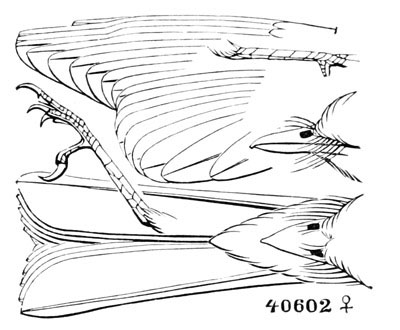
Gen. Char. Similar in general character to M. empidonax, but with fulvous, fulvous-olive and rufous tints, instead of clear olive, gray, white, and sulphur-yellow. Head crested; bristles of gape reaching nearly to tip of bill. Feet very weak.
The type of this genus (M. phæocercus) is quite different in form from Empidonax, the nearest North American ally, but both M. pallescens and fulvifrons could with little violence be placed in it. There is no positive character to separate the latter from the average of species of Empidonax, except it be the color. The crest is not at all conspicuous, nor is there any appreciable difference of form; while in the form of the bill these species are much nearer Empidonax than Mitrephorus. The legs, however, are weaker, and the rictal bristles longer.
There are two forms of the group, as defined by Sclater: one embracing E. phæocercus, Sclater (Mexico and Guatemala), and E. aurantiiventris, Lawr. (Costa Rica); the other E. fulvifrons, Giraud, and pallescens, Coues. The differences between the last two, which are probably merely races of one species, may be expressed as follows:—
M. fulvifrons. Olivaceous above; beneath ochraceous-fulvous; darkest on the breast, paler on throat and crissum. External edge of outer tail-feathers whitish.
Olive of back fulvous; under parts decided ochrey-fulvous. Wing-bands tinged with ochraceous; wing rather pointed. First quill equal to sixth; third, longest. Wing, 2.65; tail, 2.40; tarsus, .61. Hab. Northern Mexico … var. fulvifrons.[97]
Olive of back grayish; beneath obscurely ochrey-fulvous and much paler; wing-bands grayish-white; wing rather rounded. First quill shorter than sixth; fourth longest. Length, 4.75; wing, 2.15; tail, 2.00; tarsus, .55. Hab. Arizona … var. pallescens.
Mitrephorus fulvifrons, var. pallescens, Coues.
BUFF-BREASTED LEAST FLYCATCHER.
Mitrephorus pallescens, Coues, Pr. Philad. Ac. 1866, 63 (Fort Whipple, Arizona).—Cooper, Orn. Calif. I, 334. Mitrephorus fulvifrons, Elliot, Illust. B. Am. I, pl. xix.
Sp. Char. Above fulvous-gray, with an ashy cast on the tail and crown; lighter across the nape. Two grayish-white bands across the wings, and the terminal half of the secondaries and outer web of lateral tail-feather broadly edged with the same. Whole lower parts, including the lores and cheeks, and lining of wing, light ochraceous, very deeply ochraceous across the breast and on the sides, nearly white on the abdomen and crissum. Upper mandible deep black, lower whitish (“bright orange-yellow” in life); feet deep black. Wing-formula: second, third, and fourth quills equal and longest, 5, 6, 1. Tail very slightly emarginated, but lateral feather a little the shortest. Male. Length, 4.75; wing, 2.25; tail, 2.00; culmen, .54 (measured to concealed base); breadth of bill, .24; tarsus, .54; middle toe, .28. Female. Colors paler; deep ochraceous of breast, etc., less distinct.
Hab. Southern border of Middle Province of United States (Fort Whipple, Arizona).
The true M. fulvifrons of Mexico differs simply in deeper colors, the shade above being decidedly fulvous, instead of grayish, and the lower parts much more deeply ochraceous, the abdomen not approaching white; the wing-markings are also tinged with ochraceous.
Habits. This species, both new to our fauna and previously undescribed, was taken by Dr. Coues at Fort Whipple. It belongs to a newly established genus of Flycatchers, recently established by Mr. Sclater, similar to Empidonax. So far as known, its members are more or less tropical in their residence. It is a rare summer resident at Fort Whipple, arriving there early in May. Nothing is stated in reference to its habits, except that they correspond with those of the Empidonaces.
Genus PYROCEPHALUS, Gould.
Pyrocephalus, Gould, Zoöl. of Beagle, 1838, 44.
Pyrocephalus rubineus. 38206
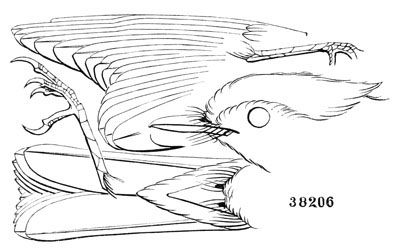
Gen. Char. Tarsus moderate, very little longer than the middle toe; hind toe not longer than the lateral. Bill slender, very narrow at the base. Tail broad, even, considerably shorter than the wings (about four fifths), which reach beyond the middle of the tail. First quill shorter than the fifth. Head with a conspicuous rounded crest. Sexes dissimilar. Male with the crown and lower parts red (except in E. obscurus); tail, back, and wings dark brown.
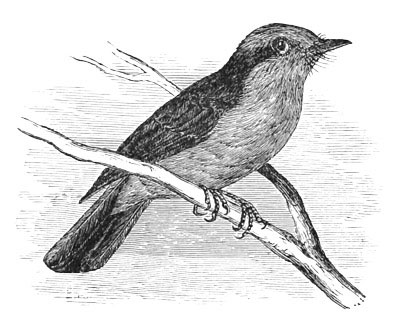
The single North American species of this genus is readily distinguished among other Flycatchers by the bright red of the under parts. The female is quite different in color from the male, being peculiar in this respect among North American Flycatchers.
Species and Varieties.
E. obscurus.[98] Entirely uniform sepia-brown beneath, with a wine-purple tinge posteriorly and on the forehead. Hab. Peru.
E. rubineus. Whole crown, and entire lower parts (except lining of wing), brilliant scarlet-red; a stripe on side of the head, and entire upper parts, sepia-brownish. Female. Whitish anteriorly beneath, more or less reddish posteriorly; anterior portion with dusky streaks; crown dusky. Young without any red; feathers above bordered with lighter; streaks beneath numerous. Length, about 5.50.
The brown of a dark sepia cast, edges of wing-feathers not appreciably paler, the red with a slight carmine shade. No whitish on the edge of outer nor on tips of other tail-feathers. Hab. South America … var. rubineus.[99]
Similar to last, but outer web of lateral tail-feather distinctly whitish, the rest tipped slightly with whitish. Hab. Northern South America (Bogota and Guayaquil) … var. nanus.[100]
The brown of a decided grayish cast, and edges of wing-feathers very distinctly paler; red more scarlet (but equally intense). No whitish tips to tail-feathers, and no white edge to the outer. Hab. Middle America; north into southern border of United States … var. mexicanus.
Pyrocephalus rubineus, var. mexicanus, Sclater.
RED FLYCATCHER.
Pyrocephalus rubineus, Lawrence, Ann. N. Y. Lyc. V, May, 1851, 115. Cassin, Ill. I, IV, 1853, 127, pl. xvii.—Baird, Birds N. Am. 1858, 201.—Salvadori, Atti. Milan. vii, 1864.—Heerm. X, S, 38. Tyrannula coronata, Swainson, Wagler, Isis, 1831, 529. Pyrocephalus nanus, Woodhouse, Sitgreave’s Report, 1853, 75 (not of Gould). Pyrocephalus mexicanus, Sclater, P. Z. S. 1859, 45, 56, 366; 1864, 176.—Ib. Ibis, 1859, 442.—Ib. Catal. 227.—Sclater & Salvin, Ibis, 1860, 399 (Guatemala).—Cabanis, Mus. Hein. ii, 1859, 68.—Cooper, Orn. Cal. 1, 1870, 333.
Sp. Char. Head with a full rounded or globular crest. Tail even. Crown and whole under parts bright carmine-red; rest of upper parts, including the cheeks as far as the bill, and the lining of the wing, dull grayish-brown; the upper tail-coverts darker; the tail almost black; greater and middle wing-coverts and edges of secondaries and tertials dull white towards the edges. Female similar, without the crest; the crown brown, like the back; the under parts whitish anteriorly, streaked with brown; behind white, tinged with red or ochraceous. Length of male about 5.50; wing, 3.25; tail, 2.75. Young resembling the female, but lacking any trace of red, and with each feather of the upper parts bordered with whitish, producing a very variegated appearance.
Hab. Valleys of Rio Grande and Gila southward. Localities: Honduras (Moore, P. Z. S. 1859, 55); Cordova (Scl. 1856, 296); Vera Cruz, hot to alpine regions (Sum. M. B. S. I, 557); Yucatan (Lawr. IX, 201); Arizona (Coues, P. A. N. S. 1866, 64).
Pyrocephalus rubineus.
Every stage between the youngest plumage described and the adult male may be found in a large series of immature specimens: the shade of the red in both sexes frequently varies, it being sometimes of a slightly rosaceous tint, and again decidedly inclining to orange; its amount in the female varies almost with the individual. The two South American races (var. nanus and var. rubineus; see synopsis) differ in having the brown of upper parts, etc., very decidedly darker; no appreciable light edgings to wing-feathers, and sometimes an appreciably more intense red. One of them (nanus) has a distinct white outer edge to lateral tail-feather, and slight whitish tips to the other; the other has no more than a trace of these markings.
Habits. This brilliant species is a rare summer visitant to Texas, New Mexico, Arizona, and probably Southern California. It is found throughout Middle America. It has only within a few years been known as a resident within our territory, but was first observed in Texas by Captain McCown, of the United States Army, in 1850, and its claim to a place in our fauna publicly made by Mr. G. N. Lawrence. Captain McCown, in some notes on the habits of certain Texan birds, published in the Annals of the N. Y. Lyceum, speaks of this Flycatcher as being seldom seen, and of his having noticed not more than a dozen in Western Texas. He always found them near ponds of water, in the vicinity of the Rio Grande, generally on a tree or a stake near the water. He only met with one nest, and this was inaccessible. It was built on an acacia over the water.
Lieutenant Couch, in a letter to Mr. Cassin, states that he first met with this bird at Charco Escondido, in Tamaulipas, on the 10th of March. The males had come in advance of the females, as the latter were not observed until several weeks afterwards. Early in the morning, and again about sunset, one of these birds came to the artificial lake constructed there for the supply of water to the inhabitants. It appeared to be of a very quiet and inoffensive disposition, usually sitting on the upper branches of the trees, occasionally uttering a low chirp. He subsequently met with these birds in Nueva Leon. In their habits they appeared to be in some respects similar to the smaller northern Flycatchers.
Dr. Henry also met with these birds in the vicinity of Fort Webster, in New Mexico; he found them exceedingly rare, and his observations were confirmatory of their partiality for the neighborhood of water. His first specimen was obtained on the Rio Mimbres, near Fort Webster, in the month of March.
Dr. Woodhouse met with an individual of this Flycatcher near the settlement of Quihi, in Texas, in the month of May. It was breeding in a thicket. He did not hear it utter any note.
According to the observations of Mr. Sumichrast, this bird is very abundant throughout the entire Department of Vera Cruz, common everywhere, at all heights, in the hot, the temperate, and the alpine regions. Mr. Dresser obtained a fine male specimen from the San Pedro River, near San Antonio, in August. Another, a young male, was obtained September 25. It was very shy, and made its way through the low bushes like the Hedge Sparrow of Europe. A third was obtained April 5, after much difficulty. It was not so shy as the others, but kept more in the open country, always perching on some elevated place. Its note resembled that of the Milvulus forficatus.
This bird, according to Dr. Coues, is not found as far to the north as Fort Whipple, among the mountains, though it extends up the valley of the Colorado to an equally high latitude. It is also said to be common in the valley of the Gila and in Southern Arizona generally.
Mr. E. C. Taylor (Ibis, VI, p. 86) mentions finding this Flycatcher tolerably abundant both at Ciudad Bolivar and at Barcelona, but he did not meet with a specimen on the island of Trinidad. He notes its great resemblance in habits to the Muscicapæ of Europe.
Dr. Kennerly reports that these birds were often observed by him at various points on the road, from Boca Grande to Los Nogales. It generally selected its perch on the topmost branch of some bush or tree, awaiting the approach of its insect food, and then sallying out to capture it. Sometimes it poised itself in a graceful manner in the air, while its bright plumage glistened in the sun like some brightly colored flower.
Dr. Heermann procured a specimen of this Flycatcher at Fort Yuma, where he was informed that it was quite common in spring. He saw other individuals of this species at Tucson in Sonora. These birds, he states, station themselves upon the topmost branches of trees, and when pursued appear quite wild, flying to a considerable distance before again alighting.
Dr. Cooper saw at Fort Mohave, May 24, a bird which he had no doubt was an individual of this species, but he was not able to procure it. It perched upon the tops of bushes, and would not suffer him to approach within shooting distance. One has since been taken by Mr. W. W. Holden in Colorado Valley, lat. 34°, April 18.
Mr. Joseph Leyland found this species common on the flats near Peten, in Guatemala, as also on the pine ridges of Belize. They have, he states, a singular habit of spinning round and round on the wing, and then dropping suddenly with wings loose and fluttering as though shot,—apparently done for amusement. They lay three or four light-colored eggs in a small nest composed of light grass and lined with cottony materials. Mr. Xantus found the nest and eggs of this species at San José, Mexico, May 16, 1861.