Sub-Division II.—ALGÆ. (continued 2)
Michael Cresse Potter translation
Order 4. Vaucheriaceæ. The thallus consists, in the vegetative condition, of a single irregularly or dichotomously branched cell, without differentiation into stem or leaf; root-like organs of attachment may however occur. Asexual reproduction by zoospores, which are formed singly in the extremity of a branch cut off by a transverse wall. They contain many nuclei, and bear small cilia situated in pairs, which give the appearance of a fine “pile” covering the whole or a great part of the surface. Akinetes, aplanospores, and phytoamœbæ (naked masses of protoplasm, without cilia, which creep like an amœba on a substratum) may occur under certain conditions.
The sexual reproductive organs are formed on short lateral branches, and are separated from the vegetative cell (Fig. 58 A) by cell-walls. Numerous spermatozoids, each with two cilia, are developed in the coiled antheridium (A, b). The oogonium is a thick, egg-shaped, often oblique cell, with its protoplasm rounded into an oosphere, which has a hyaline “receptive-spot” (A, a) immediately beneath the aperture formed in the wall of the oogonium. A slimy mass, which serves to receive the spermatozoids, is formed in some species in this aperture. The spermatozoids when liberated swim towards and enter the oosphere, which then immediately surrounds itself with a thick cell-wall. The mature oospore (B) contains a large quantity of oil. At germination the outer cell-wall bursts and a new plant is formed. There is only one genus, Vaucheria, with species living in salt as well as in fresh water and on damp soil.
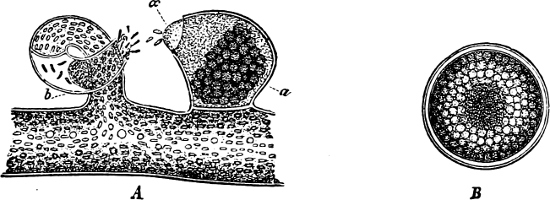
Fig. 58.—Vaucheria sessilis. A Fertilisation; b the antheridia; a the oogonia; a the receptive spot. B Oospore.
Order 5. Phyllosiphonaceæ are parasites in the leaves and stalks of Flowering-plants.
Order 6. Caulerpaceæ. The thallus has distinct differentiation into root, stem and leaf-like members (Fig. 59); it is unicellular. Within the cell, strong, branched threads of cellulose extend from one side to the other serving as stays to support the thallus. Reproduction takes place by detached portions of the thallus; no other modes of reproduction are known. This order may most approximately be classed with the Bryopsidaceæ. The genus Caulerpa consists of more than seventy species which inhabit the tropical seas.
Order 7. Codiaceæ. The thallus has various forms, but without distinct differentiation in stem- or leaf-structures, sometimes (e.g. Halimeda) it is very much incrusted with lime. In the early stages it is unicellular (later, often multicellular), very much branched, with the branches, at any rate partly, so united or grown in amongst one another (Fig. 60) that an apparently parenchymatous cellular body is formed. Akinetes or aplanospores are wanting; zoospores (or gametes?) may be developed in some species, however, in special swollen sporangia. Fertilisation similar to that in Bryopsis occurs perhaps in Codium. They are all salt water forms.
Order 8. Valoniaceæ. The thallus is generally multicellular, without differentation into stem- or leaf-structures, but the cells are sometimes united together and form a leaf-like reticulate expansion (e.g. Anadyomene). Zoospores are known in some, and they are then formed directly in the vegetative cells. In others (e.g. Valonia), a mass of protoplasm, which maybe separated through the damaging of a cell, can surround itself with a cell-wall, and grow into a new plant. No other modes of reproduction are known. The most important genera are: Valonia, Siphonocladus, Chamædoris, Struvea, Microdictyon, Anadyomene. They are all salt water forms.
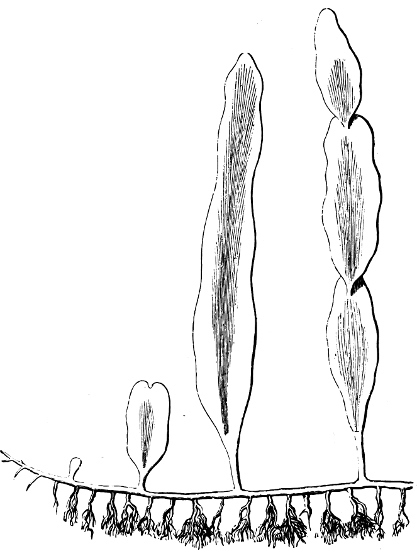
Fig. 59.—Caulerpa prolifera (natural size).
As already pointed out, the Valoniaceæ occupy a somewhat central position among the Siphoneæ, and present points of similarity and contrast with the Botrydiaceæ and the Bryopsidaceæ through Valonia, with the Dasycladaceæ through Chamædoris, and also with the Cladophoraceæ through Siphonocladus, and Struvea.
Order 9. Dasycladaceæ. The thallus consists of an axile longitudinal cell, destitute of transverse walls, attached at the base by root-like organs of attachment, and producing acropetally whorls of united, single or branched, leaf-like structures with limited growth. Asexual reproduction is wanting. Sexual reproduction by conjugation of gametes which arise in separate, fertile leaves, either directly or from aplanospores, which develope into gametangia. The principal genera are: Acetabularia, Dasycladus, Neomeris, Cymopolia. All marine.
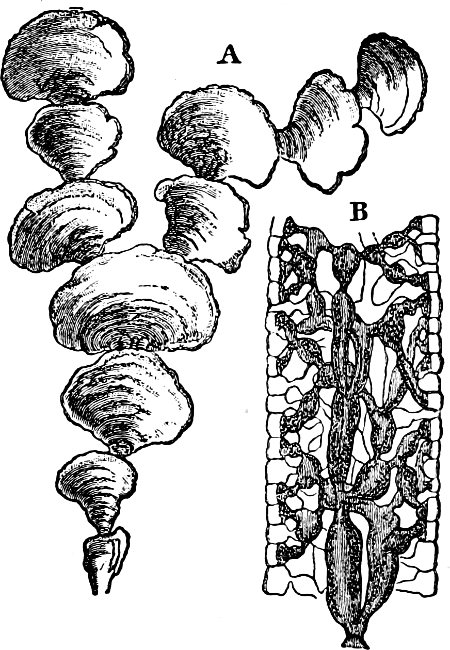
Fig. 60.—Halimeda opuntia. Plant (natural size). B Part of a longitudinal section.
The curiously shaped Acetabularia mediterranea grows gregariously on limestone rocks, and shells of mussels in the Mediterranean; it resembles a minute umbrella with a small stem, sometimes as much as nine centimetres in height, and a shade which may be more than one centimetre in diameter. The cell-membrane is thick, and incrusted with carbonate and oxalate of lime. Only the lower, root-like part of the thallus, which penetrates the calcareous substratum survives the winter, and may grow up into a new plant. The sterile leaves, which drop off early, are dichotomously branched and formed of cylindrical cells separated from each other by cross-walls, but they are not grown together. The shade is formed by a circle of 70–100 club-shaped rays (fertile leaves) grown together, in each ray 40–80 aplanospores are formed, which become liberated at the breaking of the shade, and later on are changed to gametangia (compare Botrydium) which open by a lid and allow a large number of egg-shaped gametes with two cilia to escape. Gametes from various gametangia conjugate with one another; the product of the conjugation swarms about for some time, rounds off, and then surrounds itself with a cell-wall. The zygote germinates after a period of rest and then produces a sexual plant. The aplanospores (gametangia) thus represent the sexual generation.
Class 7. Characeæ.
The thallus has a stem with nodes and internodes; and whorls of leaves, on which may be developed the antheridia and oogonia, are borne at the nodes. Vegetative reproduction by bulbils and accessory shoots. Zoospores are wanting. The antheridia are spherical, and contain a number of filaments in which the spirally coiled spermatozoids, each with two cilia, are formed. The oogonium is situated terminally, and is at first naked, but becomes later on surrounded by an investment, and forms after fertilisation the so-called “fruit.” The oospore, after a period of rest, germinates by producing a “proembryo,” from which the young sexual plant arises as a lateral branch. The Characeæ are distinguished by the structure of their vegetative system as well as by the spirally-coiled spermatozoids, and stand as an isolated group among the Thallophytes, of which, however, the Siphoneæ appear to be their nearest relations. They were formerly, but wrongly, placed near the Mosses. The class contains only one order, the Characeæ.
Order 1. Characeæ. Algæ with a peculiar odour, often incrusted with lime, and of a brittle nature. They generally grow gregariously in large masses at the bottom of fresh and brackish water, and are from a few inches to more than a foot in height. The stem has long internodes which in Nitella are formed of one cylindrical cell; in Chara of a similar cell, but closely surrounded by a cortical layer of smaller ones. The protoplasm in contact with the cell-wall exhibits in a well-marked degree the movement of rotation (cyclosis), carrying the chlorophyll corpuscles along with it. The internodes are separated from each other by a layer of small cells (nodal cells) from which the leaves are produced. The leaves are borne in whorls of from 5–12 which regularly alternate with one another as in the higher verticillate plants; a branch is borne in the axil of the first formed leaf of each whorl (Fig. 61 A, n).
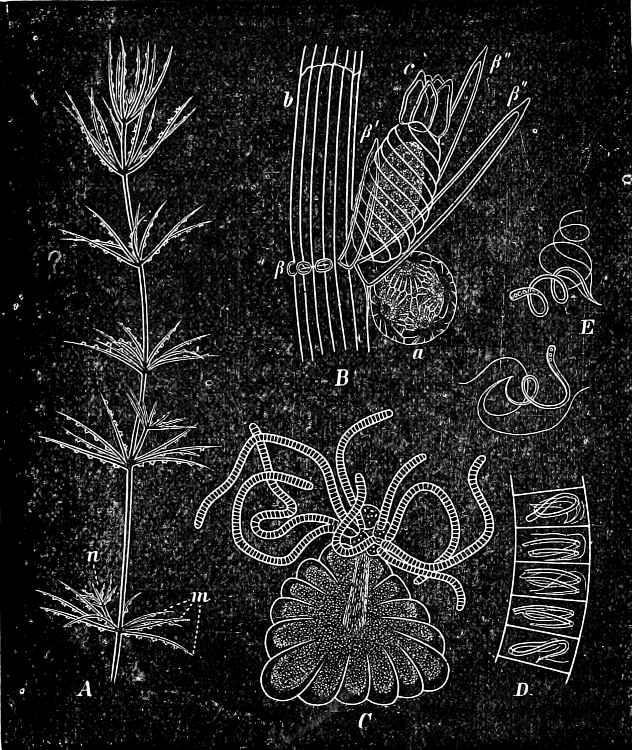
Fig. 61.—Chara fragilis. A Portion of a plant, natural size. B Portion of a leaf b, with leaflets β′-β′′; a antheridium; c oogonium. C A shield.—Nitella flexilis. D Filament from antheridium with spermatozoids. E Free spermatozoids.
The leaves are constructed in the same manner as the stem; they are divided into a series of joints, but have only a limited power of growth; their terminal cell, too, is not enclosed by a cortex. Leaflets are borne at their nodes. The growth of the stem is unlimited, and proceeds by means of an apical cell (Fig. 62 s). The apical cell divides into a segment-cell and a new apical cell. The segment-cell then divides by a transverse wall into two cells, one lying above the other; the lower one, without any further division, becomes one of the long, cylindrical, internodal cells (Fig. 62 in), and the upper one (Fig. 62 n) divides by vertical walls to form the nodal cells. The cortical cells (Fig. 62 r) which surround the long internodal cells of Chara, are derived from the divisions of the nodal cells; the cells covering the upper portion of an internodal cell being derived from the node immediately above it, and those in the lower part of the internode from the node below it.
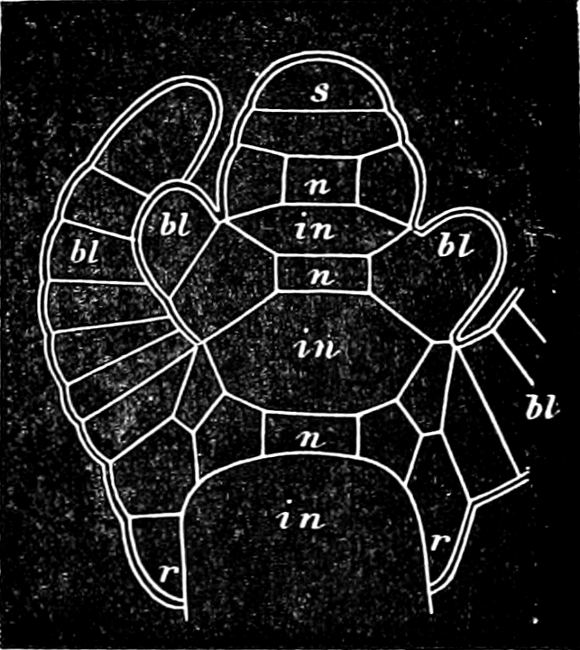
Fig. 62.—Chara fragilis: s apical cell; n, n nodal cells; in internodal cells; bl, bl leaves; r, r the cortical cells.
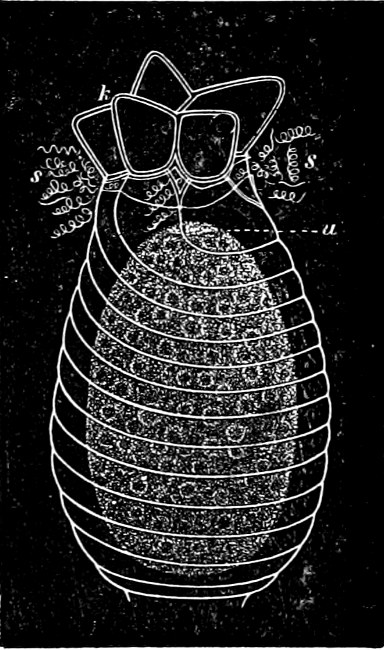
Fig. 63.—Oogonium of Chara: k “crown”; u receptive spot; s spermatozoids.
The organs of reproduction are very conspicuous by their colour and form. They are always situated on the leaves, the plants being very frequently monœcious. The antheridia (Fig. 61 B, a) are modified leaflets or the terminal cell of a leaf; they are spherical and become red when mature. Their wall consists of 8 “shields,” i.e. of plate-like cells, 4 of which cover the upper half, and are triangular; the 4 round the lower half, to which the stalk of the antheridia is attached, being quadrilateral, with sides of unequal length. The shields (Fig. 61 C) have dentated edges, with the teeth fitting into one another, and their faces ornamented with ridges. From the centre of the internal face of each shield (C) a cylindrical cell, the manubrium, projects nearly as far as the centre of the antheridium; at the inner end of each of the manubria a spherical cell, the capitulum, is situated. Each capitulum bears six secondary capitula, from each of which four long coiled filaments (C, D) project into the cavity of the antheridium. These filaments are divided by transverse walls into from 100–200 discoid cells, in each of which a biciliated, coiled spermatozoid is developed (D, E) from the nucleus. The spermatozoids escape from their mother-cell and are set free by the shields separating from one other.
The female organ of reproduction (Fig. 61 B, 63) is a small modified shoot, whose apical cell functions as an oogonium, its protoplasm forming the oosphere, which has a colourless receptive-spot at the summit (Fig. 63 u). The oogonium is situated on a nodal cell, from which 5 cells grow out in a circle and coil round the oogonium, covering it with a close investment. These cells divide once or twice at the top, so that 5 or 10 small cells are cut off, which project above the oogonium and form the so-called “crown” (Fig. 63 k). The crown either drops off at fertilisation, or its cells separate to form a central canal for the passage of the spermatozoids. The wall of the oosphere[9] above the receptive spot becomes mucilaginous, and allows the spermatozoid to fuse with the oosphere. The oospore, on germination (Fig. 64 sp), becomes a small filamentous plant of limited growth (Fig. 64 i, d, q, pl)—the proembryo—and from this, as a lateral outgrowth, the sexual generation is produced.
The order is divided into two sub-orders:—
A. Nitelleæ. The crown consists of 10 cells; cortex absent: Nitella, Tolypella.
B. Chareæ. The crown consists of 5 cells; cortex present: Tolypellopsis, Lamprothamnus, Lychnothamnus, Chara.
Chara crinita is parthenogenetic; in large districts of Europe only female plants are found, yet oospheres are formed capable of germination.
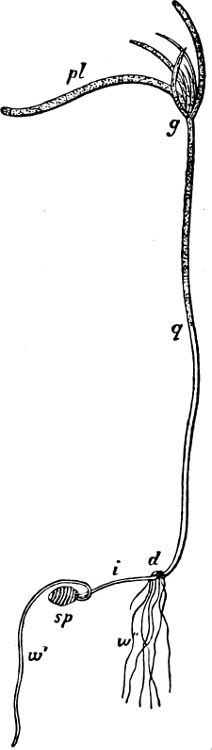
Fig. 64.—Chara fragilis. Germinating oospore (sp); i, d, g, pl, form together the proembryo rhizoids (w′) are formed at d; w′ the so-called tap-root; at g are the first leaves of the sexual plant, which appears as a lateral bud.
About 40 species of fossilized Chara, determined by their carpogonia, are known in the geological formations from the Trias up to the present day.
Class 8. Phæophyceæ (Olive-Brown Seaweeds).
The Phæophyceæ are Algæ, with chromatophores in which the chlorophyll is masked by a brown colour (phycophæin). The product of assimilation is a carbohydrate (fucosan), never true starch. In the highest forms (Fucaceæ), the thallus presents differentiation into stem, leaf, and root-like structures. The asexual reproduction takes place by means of zoospores. The sexual reproduction is effected by the coalescence of motile gametes, or by oogamous fertilisation. The swarm-cells are monosymmetric, each moved by two cilia which are true protoplasmic structures, and generally attached laterally (Fig. 65). The Phæophyceæ are almost entirely saltwater forms; a few species of Lithoderma live in fresh water.
The class is divided into two families:—
1. Phæosporeæ: 1 Sub-Family, Zoogonicæ; 2 Sub-Family, Acinetæ.
2. Cyclosporeæ: Fucaceæ.
Family 1. Phæosporeæ.
The family consists of multicellular plants, whose cells are firmly united together to form a thallus; this, in the simplest cases, may be a branched filament of cells (Ectocarpus), or, in the highest, may resemble a stem with leaves (Laminariaceæ), while all transitional forms may be found between these two. The thallus grows by intercalary divisions (e.g. Ectocarpus), or by an apical cell (e.g. Sphacelaria); pseudo-parenchymatous tissue may sometimes be formed by cells, which were originally distinct, becoming united together. The size of the thallus varies; in some species it is quite small—almost microscopical,—while in the largest it is many metres in length.
The vegetative cells in the lower forms are nearly uniform, but in those which are more highly developed (Laminariaceæ and Fucaceæ), they are sometimes so highly differentiated that mechanical, assimilating, storing and conducting systems may be found; the last named systems are formed of long cells with perforated, transverse walls, which bear a strong resemblance to the sieve-tubes in the higher plants.
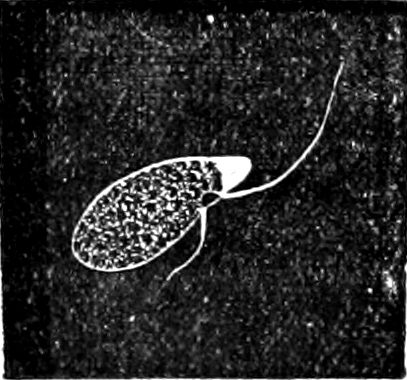
Fig. 65.—Swarmspore of Cutleria multifida.
The colouring matter in the living cells (“phæophyl”) contains chlorophyll; but this is concealed by a brown (“phycophæin”), and a yellow (“phycoxanthin”) colouring material, and hence all these Algæ are a lighter or darker yellow-brown. Starch is not formed. Asexual reproduction takes place, (1) by zoospores which arise in unilocular zoosporangia, and are monosymmetric, with two cilia attached laterally at the base of the colourless anterior end (Fig. 65), the longer one being directed forwards and the shorter backwards; or (2) by aplanospores (?).
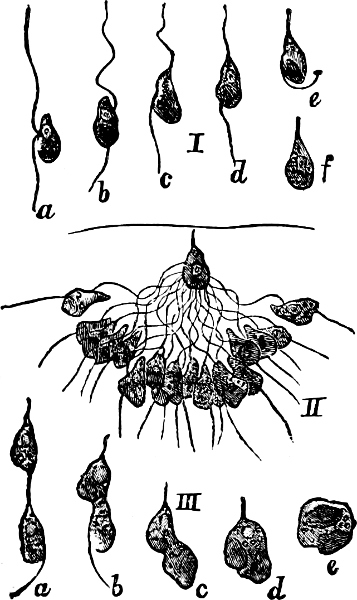
Fig. 66.—Ectocarpus siliculosus. I a-f A female gamete in the various stages of coming to rest. II A motionless female gamete surrounded by male gametes. III a-e Stages in the coalescence of male and female gametes.
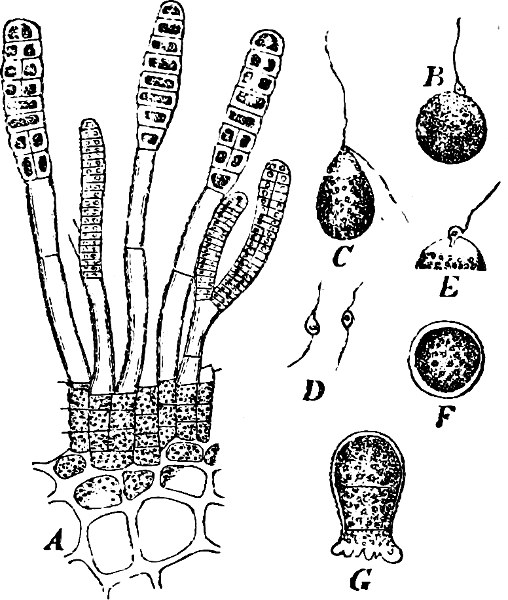
Fig. 67.—Zanardinia collaris. A Male gametangia (the smaller celled) and female gametangia (the larger celled). C Female gamete. D Male gamete. B, E Fertilisation. F Zygote. G Germinating zygote.
Sexual reproduction has only been discovered in a few cases, and takes place by means of gametes (oogamous fertilisation perhaps occurs in the Tilopteridæ). The gametes have the same structure as the zoospores, and arise in multilocular gametangia; these, like the zoosporangia, are outgrowths from the external surface, or arise as modifications from it. The conjugating gametes may be similar (e.g. Ectocarpus pusillus), or there may be a more or less pronounced difference of sex, an indication of which is found in Ectocarpus siliculosus (Fig. 66). When the gametes in this species have swarmed for a time, some, which are generally larger, are seen to attach themselves by one of the cilia, which by degrees is shortened to form a kind of stalk (compare the upper gamete in Fig. 66 II); these are the female gametes, which now become surrounded by a number of males endeavouring to conjugate with them, but only one succeeds in effecting fertilisation. The protoplasm of the two gametes coalesces (Fig. 66 III), and a zygote (e) is formed. The male gametes which do not conjugate may germinate, but the plants derived from them are much weaker than those produced by the zygotes. Strongly pronounced sexual differences are found in the Cutleriaceæ, in which order the male and female gametes arise in separate gametangia (Fig. 67 A). The male gametes (Fig. 67 D) are much smaller than the female gamete (Fig. 67 C); the latter, after swarming for a short time, withdraws the cilia, and is then ready to become fertilised (Fig. 67 B, E), thus we have here a distinct transition to the oogamous fertilisation which is found in the Fucaceæ. Alternation of generations is rarely found.
1. Sub-Family. Zoogonicæ.
Reproduction by means of gametes and zoospores.
Order 1. Ectocarpaceæ. The thallus consists of single or branched filaments with intercalary growth, extending vertically from a horizontal, branched filament or a disc, but sometimes it is reduced to this basal portion only. Zoosporangia and gametangia (for fertilisation see Fig. 66) are either outgrowths or arise by the transformation of one or several of the ordinary cells. The most common genera are: Ectocarpus and Pylaiella.
Order 2. Choristocarpaceæ. Choristocarpus, Discosporangium.
Order 3. Sphacelariaceæ. The thallus consists of small, parenchymatous, more or less ramified shoots, presenting a feather-like appearance. In the shoots, which grow by means of an apical cell (Fig. 68 S), a cortical layer, surrounding a row of central cells, is present. Sporangia and gametangia are outgrowths from the main stem or its branches. Sphacelaria, Chætopteris are common forms.
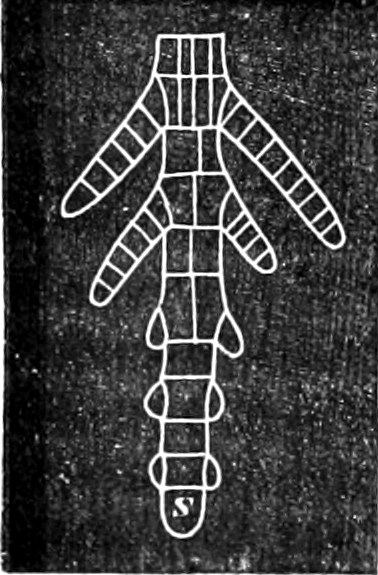
Fig. 68.—Apex of the thallus of Chætopteris plumosa. S Apical cell.
Order 4. Encoeliaceæ. Punctaria, Asperococcus, Phyllitis fascia.
Order 5. Striariaceæ. Striaria, Phlœospora.
Order 6. Dictyosiphonaceæ. Dictyosiphon.
Order 7. Desmarestiaceæ. Desmarestia aculeata is common.
Order 8. Myriotrichiaceæ. Myriotrichia.
Order 9. Elachistaceæ. Elachista fucicola is a common epiphyte on species of Fucus.
Order 10. Chordariaceæ. The shoot-systems are often surrounded by mucilage. Chordaria; Leathesia difformis occurs as rounded, brown-green masses of the size of a nut, generally attached to other Seaweeds.
Order 11. Stilophoraceæ. Stilophora rhizodes is common.
Order 12. Spermatochnaceæ. Spermatochnus paradoxus is common.
Order 13. Sporochnaceæ. Sporochnus.
Order 14. Ralfsiaceæ. Ralfsia verrucosa is common as a red-brown incrustation on stones and rocks at the water’s edge.
Order 15. Lithodermataceæ. Some species of the genus Lithoderma occur in fresh water.
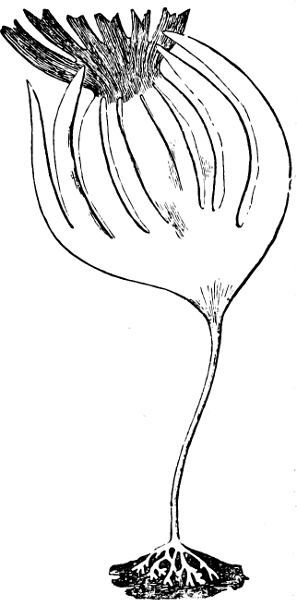
Fig. 69.—Laminaria digitata (much reduced in size).
Order 16. Laminariaceæ. The thallus is more or less leathery, and has generally a root-like lower part (Fig. 69) which serves to attach it, and a stalk or stem-like part, terminated by a large leaf-like expansion. Meristematic cells are situated at the base of the leaf, and from these the new leaves are derived. The older leaf thus pushed away by the intercalary formation of the younger ones, soon withers (Fig. 69). Gametes are wanting. Zoosporangia are developed from the lower part of a simple, few-celled sporangiophore, which is an outgrowth from a surface-cell and has a large club-formed apical cell. The sporangia are aggregated into closely packed sori, which cover the lower part of the terminal leaf, or occur on special, smaller, lateral, fertile fronds (Alaria). Most of the species belonging to this order live in seas of moderate or cold temperature and occur in the most northern regions that have yet been explored, forming their organs of reproduction during the cold and darkness of the arctic night. Laminaria is destitute of a midrib and has only one terminal leaf. L. digitata has a broad leaf, which, by the violence of the waves, is torn into a number of palmate strips (Fig. 69). L. saccharina has a small, undivided leaf. Alaria has a midrib and special fertile fronds. A. esculenta occurs plentifully on the west coast of Norway and on the shores of Great Britain. Chorda filum, a common seaweed, is thick, unbranched, and attains a length of several metres, without any strong demarcation between stalk and leaf. Some attain quite a gigantic size, e.g. Macrocystis pyrifera, whose thallus is said sometimes to be more than 300 metres in length. The Lessonia-species, like the above, form submarine forests of seaweed on the south and south-west coasts of South America, the Cape, and other localities in the Southern Hemisphere.
Uses. The large Laminarias, where they occur in great numbers, are, like the Fuci, used for various purposes, for example, in the production of iodine and soda, and as an article of food (Laminaria saccharina, Alaria esculenta, etc.). Laminaria saccharina contains a large quantity of sugar (mannit) and is in some districts used in the preparation of a kind of syrup; in surgical operations it is employed for the distension of apertures and passages, as for instance the ear-passage. It is by reason of the anatomical peculiarities and structure of the cell-walls, that they are employed for this purpose. The cell-walls are divided into two layers, an inner one which has very little power of swelling, and an outer one, well developed and almost gelatinous—the so-called “intercellular substance”—which shrivels up when dried, but can absorb water and swell to about five times its size. The stalks of Laminaria clustoni are officinal.
Order 17. Cutleriaceæ. The thallus is formed by the union of the originally free, band-shaped shoots. The growth is intercalary. Sexual reproduction by the conjugation of male and female gametes. An asexual generation of different appearance, which produces zoospores, arises from the germination of the zygote. Cutleria, Zanardinia.
Sub-Family 2. Acinetæ.
Branched, simple cell-rows with intercalary growth. The organs of reproduction are partly uni-and partly multicellular; in the unicellular ones a cell without cilia is formed, which may be destitute of a cell-wall, but has one nucleus (oosphere?), or which has a cell-wall and contains several (generally four) nuclei (aplanospores?); in the multicellular, monosymmetric swarm-cells with two cilia (spermatozoids?) are formed. The fertilisation has not been observed.
Order 1. Tilopteridaceæ. Haplospora, Tilopteris.
Family 2. Cyclosporeæ.
The individuals are multicellular, with growth by an apical cell. The thallus—often bilateral—is differentiated into a root-like structure (attachment-disc), and stem, sometimes also into leaves (Sargassum). Sometimes a differentiation occurs into various tissue-systems, viz. an external assimilating tissue, a storing tissue, a mechanical tissue of thickened, longitudinal, parenchymatous, strengthening cells, and a conducting tissue of sieve-cells, or of short sieve-tubes with perforated walls. Colouring material, as in Phæosporeæ. Vegetative reproduction can only take place by means of detached portions of the thallus (Sargassum), which are kept floating by means of bladders (Fig. 70 A, a, Fig. 72). Zoospores are wanting.
The sexual reproduction takes place by oogamous fertilisation. The oogonia and antheridia are formed inside special organs (conceptacles), and are surrounded by paraphyses. The conceptacles (Fig. 70 B, Fig. 71 b) are small, pear-shaped or spherical depressions, produced by a special ingrowth of the surface cells of the thallus, and their mouths (ostioles) project like small warts; they are either situated near the end of the ordinary branches of the thallus (Fucus serratus, Fig. 71 a) which may be swollen on this account (Fucus vesiculosus, Fig. 70 A, b), or on special short branches (Ascophyllum, Sargassum). The vertical section of a conceptacle is seen in Fig. 70 B (see also Fig. 71 b) where, in addition to the paraphyses, oogonia only are seen (F. vesiculosus is diœcious—male plant, yellow-brown; female plant, olive-brown); but in some species antheridia, together with oogonia, are produced in the same conceptacle. The oogonia are large, almost spherical cells, situated on a short stalk, in each of which are formed from 1–8 (in Fucus, 8; in Ascophyllum, 4; in Halidrys, 1; in Pelvetia, 2) rounded, immotile oospheres. The wall of the oogonium ruptures, and the oospheres, still enclosed in the inner membrane, are ejected through the mouth of the conceptacle, and float about in the water, being finally set free by the bursting of the inner membrane. The antheridia are oblong cells (Fig. 70 C, a), many of which are produced on the same branched antheridiophore (Fig. 70 C); the numerous spermatozoids are provided with 2 cilia and are very small (Fig. 70 D, two antheridia surrounded by spermatozoids, one being open). The spermatozoids, still enclosed by the inner membrane of the antheridium, are similarly set free, and fertilisation takes place in the water, numerous spermatozoids collecting round the oosphere (Fig. 70 E), which is many times larger, and by their own motion causing it to rotate. After fertilisation, the oospore surrounds itself with a cell-wall and germinates immediately, attaching itself (Fig. 70 F) to some object, and by cell-division grows into a new plant.
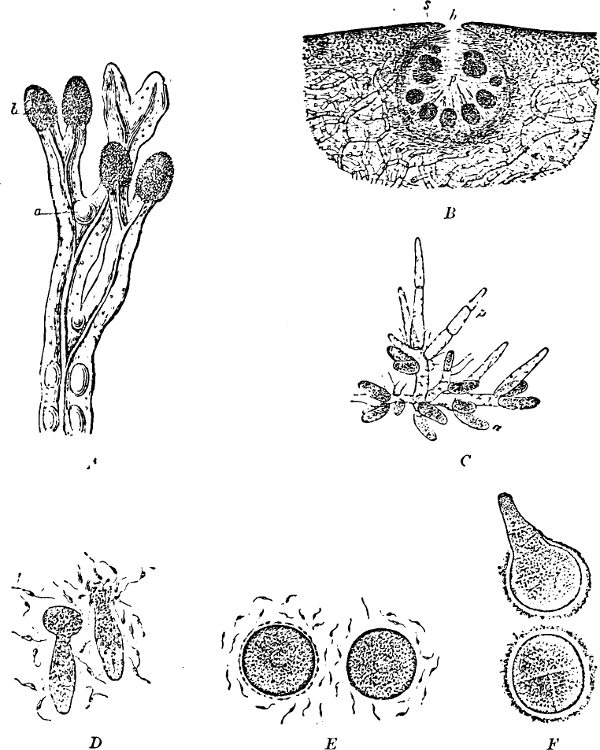
Fig. 70.—Fucus vesiculosus. A Portion of thallus with swimming bladders (a) and conceptacles (b). B Section of a female conceptacle; h the mouth; p the inner cavity; s oogonia. C Antheridiophore; a antheridium; p sterile cells. D Antheridia out of which the spermatozoids are escaping. E Fertilisation. F Germinating oospore.
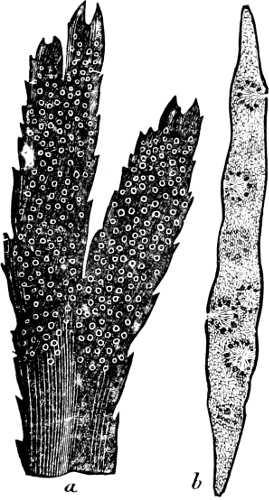
Fig. 71.—Fucus serratus. a Portion of a male plant which has been exposed to the action of the open air for some time; small orange-yellow masses, formed by the antheridia, are seen outside the mouths of the male conceptacles (nat. size). b Cross section through the end of a branch of a female plant, showing the female conceptacles (× 4).
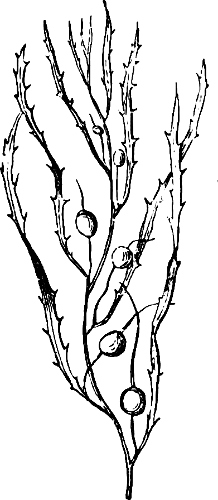
Fig. 72.—Sargassum bacciferum. A portion of the thallus, natural size.
Order 1. Fucaceæ. The following species are common on our coasts: Fucus vesiculosus (Fig. 70) has a thallus with an entire margin, and with bladders arranged in pairs; F. serratus (Fig. 71) without bladders, but with serrated margin; Ascophyllum nodosum has strap-like shoots, which here and there are swollen to form bladders; Halidrys siliquosa has its swimming bladders divided by transverse walls; Himanthalia lorea, which is found on the west coast of Norway, and the south coast of England, has a small perennial, button-shaped part, from the centre of which proceeds the long and sparsely branched, strap-like, annual shoot, which bears the conceptacles. The Gulf-weed (Sargassum bacciferum, Fig. 72) is well known historically from the voyage of Columbus; it is met with in large, floating, detached masses in all oceans, and is found most abundantly in the Atlantic, off the Canary Islands and the Azores, and towards the Bermudas. The stalked, spherical air-bladders are the characteristic feature of this genus. The thallus is more highly developed than in Fucus, and there is a contrast between the stem and leaf-like parts. The portions which are found floating are always barren, only those attached are fertile.
Uses. The Fucaceæ, like the Laminariaceæ, are used as manure (the best kinds being Fucus vesiculosus and Ascophyllum nodosum), for burning to produce kelp, and as food for domestic animals (Ascophyllum nodosum is especially used for this purpose).
Class 9. Dictyotales.
The plants in this class are multicellular, and brown, with apical growth, new cells being derived either from a flat apical cell, or from a border of apical cells. The thallus is flat, leaf- or strap-shaped, attached by haptera, which are either found only at the base, or on the whole of the lower expansion of the thallus. The cells are differentiated into the following systems of tissues: an external, small-celled layer of assimilating cells, generally one cell in thickness, and an internal, large-celled layer of one or only a few cells in thickness, forming the mechanical and conducting tissues. All the reproductive cells are motionless. Asexual reproduction by naked, motionless spores (tetraspores) which are formed 1–4 in each tetrasporangium, the latter being outgrowths from the surface cells of special, sexless individuals. Zoospores are wanting. The sexual organs are of two kinds, oogonia and antheridia, which are formed from the surface cells, either on the same or different individuals. The oogonia are spherical or oval, and are generally placed close together; each contains one oosphere, which on maturity is ejected into the surrounding water, and is then naked and motionless. The antheridia are formed of longitudinal cells, united in groups, whose contents by repeated divisions—transverse and longitudinal—are divided into a large number of small, colourless, motionless spermatia—round or elongated—which are set free by the dissolution of the wall of the antheridium. The process of fertilisation has not yet been observed.
The Dictyotales, in having tetraspores and spermatia, deviate considerably from the Phæophyceæ, but may be classed near to the Tilopteridæ, in which there are asexual spores with 4 cell-nuclei, which may be considered as an indication of the formation of tetraspores.
Order 1. Dictyotaceæ. Dictyota dichotoma which has a thin, regularly dichotomously divided thallus, occurs on the coasts of the British Isles. Padina is found on the south coast.
Class 10. Rhodophyceæ (Red Seaweeds).
The plants comprised in this class are multicellular; they are simple or branched filaments, or expansions consisting of 1 to several layers of cells; the thallus may be differentiated (as in many Florideæ), to resemble stem, root, and leaf. The cells contain a distinctly differentiated nucleus (sometimes several), and distinct chromatophores, coloured by rhodophyll. The chlorophyll of the chromatophores is generally masked by a red colouring matter (phycoerythrin), which may be extracted in cold, fresh water; or rarely by phycocyan. Pyrenoids occur in some. Starch is never formed in the chromatophores themselves, but a modification—Florideæ starch—may be found in the colourless protoplasm. Asexual reproduction by motile or motionless spores (tetraspores) which are devoid of cilia and of cell-wall. Swarmspores are never found.
Sexual reproduction is wanting, or takes place by the coalescence of a spermatium and a more or less developed female cell. The spermatia are naked masses of protoplasm, devoid of cilia and chromatophores. The female cell (carpogonium) is enclosed by a cell-wall, and after fertilisation forms a number of spores, either with or without cell-walls (carpospores), which grow into new individuals.
The Rhodophyceæ may be divided into two families:
1. Bangioideæ.
2. Florideæ.
Family 1. Bangioideæ.
The thallus consists of a branched or unbranched cell-filament, formed of a single row or of many rows of cells, or of an expansion, one or two layers of cells in thickness, but without conspicuous pores for the intercommunication of the cells. The growth of the thallus is chiefly intercalary. The star-like chromatophores contain chlorophyll and are coloured blue-green with phycocyan, or reddish with phycoerythrin; all these colouring matters are occasionally found in the same cell (Bangia-species). Asexual reproduction by tetraspores, without cilia, but capable of amœboid movements.
Sexual reproduction is wanting, or takes place by the coalescence of a spermatium with a carpogonium, which is only slightly differentiated from the vegetative cells, and is devoid of a trichogyne. The carpospores are destitute of cell-wall and arise directly by the division of the fertilised oosphere. The Bangioideæ occur chiefly in salt water.
Order 1. Goniotrichaceæ.—The thallus consists of a branched cell-filament without rhizoids. Tetraspores are formed directly from the entire contents of the mother-cell, without any preceding division. Fertilisation unknown. Asterocystis, Goniotrichum.
The Goniotrichaceæ, through the blue-green Asterocystis, are allied to the Myxophyceæ, and through Goniotrichum to the Porphyraceæ.
Order 2. Porphyraceæ.—The thallus is formed of an expansion consisting of a layer of 1–2 cells, which, at the base, are attached to the substratum by means of a special form of haptera (Porphyra, Diploderma); or of unbranched (very rarely slightly branched) filaments, attached at the base by haptera (Bangia): or it extends from a prostrate cell-disc (various species of Erythrotrichia). Tetraspores are formed after one or more divisions of the mother-cell, either from the whole or only a part of its contents; they possess amœboid movements, or have a jerky, sliding-forward motion. The antheridia have the same appearance as the vegetative cells, but divide several times, and several spermatia are formed, either simultaneously from the whole contents (Porphyra, Bangia), or the spermatia are successively formed from a part of the contents of the antheridium (Erythrotrichia). The carpogonium is without a trichogyne, but the oosphere has a colourless spot which may sometimes rise a little above the surface of the thallus, and may be considered as an early stage in the development of the trichogyne. The spermatia form a canal through the membrane of the carpogonium, and their contents coalesce with the oosphere at its colourless spot. The fertilised oosphere divides on germination into a number of carpospores, which are set free as naked, motionless masses of protoplasm, which grow and give rise to new individuals (alternation of generations).
Family 2. Florideæ.
The thallus has one or more apical cells, grows principally by apical growth, and may be differentiated into root, stem, and leaf. The chromatophores vary in form, but have a red or brownish colour, due to chlorophyll and phycoerythrin. Asexual reproduction by motionless tetraspores, which generally arise by the division into four of the contents of the tetrasporangium. The carpogonium has a trichogyne, and the carpospores, which are formed indirectly from the fertilised oosphere, possess a cell-wall.
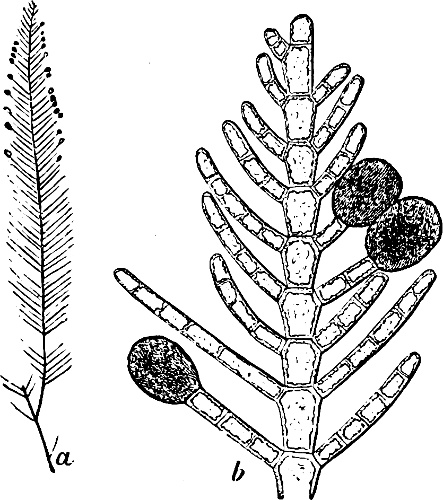
Fig. 73.—Callithamnion elegans: a a plant with tetraspores (× 20); b apex of a branch with tetraspores(× 250).
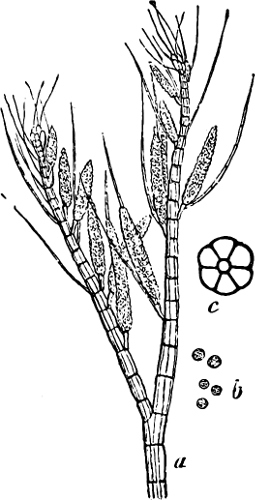
Fig. 74.—Polysiphonia variegata: a a portion of a male plant with antheridia; b spermatia; c transverse section of thallus.
The thallus may assume very different forms. In the simplest species it is filamentous and formed of single, branched rows of cells (Callithamnion, etc., Fig. 73). Ceramium has a filamentous thallus, generally dichotomously forked (Fig. 75), or sometimes pinnately branched, which, at the nodes, or throughout its entire length, is covered by a layer of small cortical cells. Polysiphonia (Fig. 74) has a filamentous, much branched thallus, made up of a central cylindrical cell, surrounded by a layer of other cells, cortical cells, which in length and position correspond to the central ones. In many of the Red Algæ the vegetative organs are differentiated into stems and leaves, the former having, as in Chara, unlimited growth in length, whilst the latter soon attain their full development. Chondrus has a fleshy, gelatinous thallus, without nodes; it is repeatedly forked into flat branches of varying thickness. Furcellaria has a forked thallus with thick branches and without nodes. The thallus of Delesseria (Fig. 76) consists of branches, often bearing leaf-like structures, with a midrib and lateral ribs springing from it. These ribs persist through the winter, and at the commencement of the succeeding period of vegetation the lateral ribs become the starting points for new leaves. In Corallina the thallus is pinnately branched, and divided into nodes and internodes. The name has been given to this genus from the fact that the thallus is incrusted with carbonate of lime to such a degree that it becomes very hard, and the whole plant adopts a coral-like appearance. Other genera which are similarly incrusted, and have a leaf-like or even crustaceous thallus (such as Melobesia, Lithothamnion), are included in this family.
In some instances the cells of the thallus may be found differentiated into more or less well defined tissues, so that it is possible to find special assimilating, mechanical, and conducting tissues, the last named in some cases having the double function of conducting and of serving as a reservoir in which starch is found as a reserve material. The cells of the Florideæ, which are formed by the division of a mother-cell into two daughter-cells of unequal size, have always larger or smaller pits in the cell-walls, and the thin cell-wall separating two pits from each other is perforated by a number of small holes. These pits are particularly developed in the conducting tissues, but sieve-tubes are very rarely to be found.
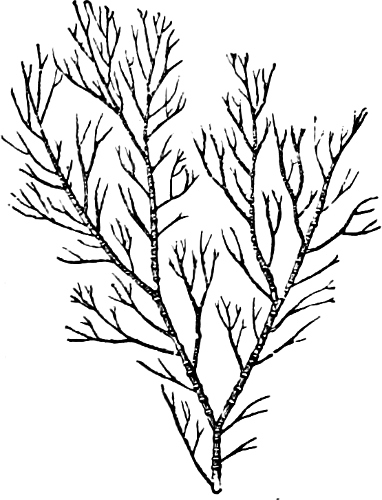
Fig. 75.—Ceramium diaphanum (nat. size).
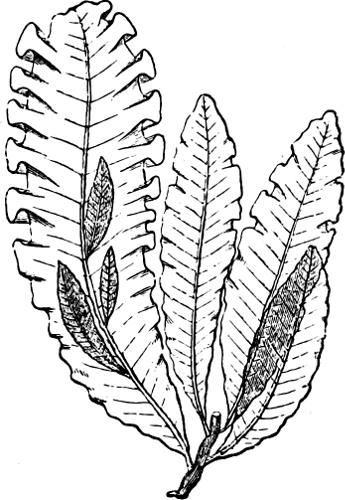
Fig. 76.—Delesseria sanguinea (about ⅓).
Tetraspores may be wanting (e.g. Lemanea) or may often arise on special, non-sexual individuals. In some (e.g. Batrachospermum) only one tetraspore is formed in each tetrasporangium, but the number is generally four, which may be formed tetrahedrally (Fig. 73) or by divisional walls perpendicular to each other, or even in a single row. The tetrasporangia in some species are free (Fig. 73), but in the majority they are embedded in the thallus.
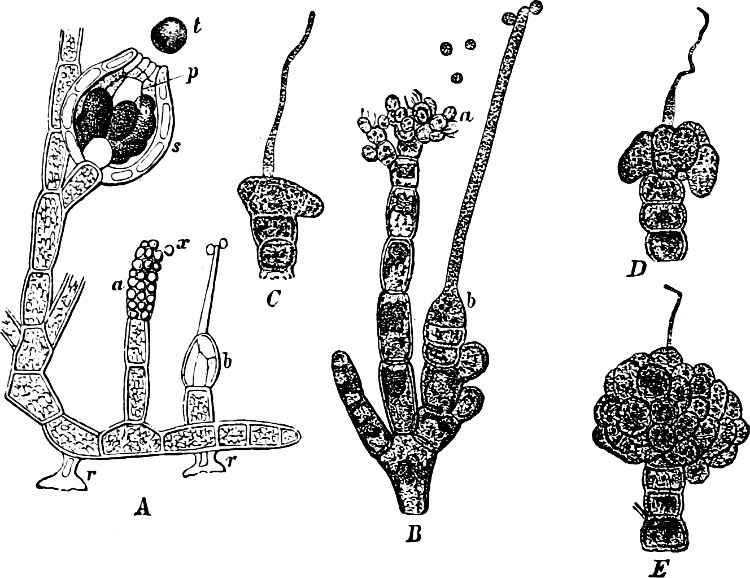
Fig. 77.—A Lejolisia mediterranea: r haptera; s longitudinal section through a cystocarp; p the empty space left by the liberated spore (t). B-E Nemalion multifidum: a antheridia; b procarpium with trichogyne, to which two spermatia are adhering.
The sexual reproduction (discovered by Thuret and Bornet, 1867) differs in the essential points from that of all other plants, and approaches most nearly to the sexual reproduction of the Bangioideæ. The sexual cells are developed from the terminal cells (never nodal cells) of the branched cell-filaments, which constitute the thallus. The mother-cells of the spermatia (spermatangia) are generally arranged in a group, in the so-called antheridia (Figs. 74, 77 A, a). On becoming ripe the membrane of the spermatangium ruptures and the spermatia emerge as spherical or ovoid, naked (a little later they may possess a cell-wall) masses of protoplasm which are not endowed with the power of motion, and hence are carried passively by the current of the water in which they may happen to be, to the female cell. This latter is analogous with the oogonium of the Green Algæ. The female reproductive organ is termed the procarpium, and consists of two parts, a lower swollen portion—the carpogonium (Fig. 77 b in A and B)—which contains the cell-nucleus, and an upper filamentous prolongation—the trichogyne (Fig. 77 B)—which is homologous with the colourless receptive spot of the oosphere of the Green Algæ, and the Porphyraceæ. In the sexual reproduction of the majority of the Florideæ, a very important part is played by certain special cells, rich in cell-contents—the auxiliary cells. These are either dispersed in the interior of the thallus, or are arranged together in pairs with the cell-filament which bears the carpogonium, and are generally united with this to form an independent multicellular procarpium. The spermatia attach themselves firmly to the trichogyne and surround themselves with a cell-wall. The dividing wall at the point of contact is perforated, and the nucleus of the spermatium probably travels through the trichogyne to the swollen part of the procarpium—the carpogonium—and fuses with its nucleus. After fertilisation the trichogyne withers (Fig. 77 C), but the lower portion of the procarpium, constituting the fertilised oosphere, grows out and forms in various ways, first a tuft of spore-forming filaments known as gonimoblasts, and finally the carpospores. These latter form a new asexual generation (compare the germination of the oospore of Œdogonium and Coleochæte).
The gonimoblasts may arise in three ways:—
1. In the Nemalionales, branched filaments grow out from the oosphere and form an upright, compressed or expanded tuft of spore-forming filaments.
2. In the Cryptonemiales, several branched or unbranched filaments (ooblastema-filaments) grow out from the oosphere, and conjugate in various ways with the auxiliary cells. The gonimoblasts are then formed from the single cells produced by the conjugation.
3. In the Gigartinales and Rhodymeniales the oosphere conjugates with an auxiliary cell by means of a short ooblastema-filament, and from this auxiliary cell a gonimoblast is produced.
The motionless carpospores, which sometimes in the early stages are naked, and afterwards invested with a cell-wall, are developed from the terminal cells (and perhaps also from some of the other cells) of the branches of the gonimoblast. The gonimoblasts constitute sharply defined parts of the plant in which the carpospores arise. These parts are called cystocarps and are either naked (Fig. 77 E), or surrounded by a covering (pericarp or involucre, Fig. 77 A) formed in different ways. On this account the Florideæ were formerly divided into Gymnosporeæ (Batrachospermum, Nemalion, Ceramium, etc.) and Angiosporeæ (Farcellaria, Lejolisia, Delesseria, Melobesia, etc.).
The Florideæ are divided into four sub-families:—
Sub-Family 1. Nemalionales. The fertilised oosphere produces directly the gonimoblast.
Order 1. Lemaneaceæ. Algæ of brownish colour and living in fresh water. They lack tetraspores, and the very sparingly branched fertile filaments, composed of many rows of cells, grow out from a proembryo, which consists of a single row of cells bearing branches. Lemanea fluviatilis, often found on rocks and stones in quickly flowing streams.
Order 2. Helminthocladiaceæ. Tetraspores are generally wanting (e.g. in Nemalion) or arise one in each tetrasporangium (e.g. Batrachospermum) and it is only in Liagora that four cruciate tetraspores are formed. Chantransia corymbifera consists of simple, branched cell-rows, and is an independent species. Several other Chantransia-forms, living in fresh water, are “proembryos” of species of the genus Batrachospermum. The germinating carpospore grows out into filaments and forms a so-called proembryo which, if not shaded, attains only a small size, but when growing in shady situations presents a much greater development. These highly developed proembryos have been described as species of Chantransia. The proembryo can reproduce by division, or by tetraspores which are developed singly in the sporangia; in B. vagum and B. sporulans which do not possess fully developed female reproductive organs, the proembryos serve almost entirely to reproduce the species. The young Batrachospermum-plant arises from the end of an upright filament of the proembryo. The proembryo is generally persistent, and continually produces new Batrachospermums. These latter bear the sexual reproductive organs and also whorls of branches: the central row of cells is enclosed by cells growing from the base of the whorls of branches, and from these cortical cells secondary proembryos are developed. In this alternation of shoots there is really no alternation of generations, since the proembryo and the shoots with the sexual reproductive organs are parts of the same thallus.
Several species of Batrachospermum have a bluish green or verdigris colour. Nemalion multifidum has a brown-red thallus, slightly branched, which is attached to rocks near the water’s edge.
Order 3. Chætangiaceæ. Galaxaura has a thallus thickly incrusted with lime.
Order 4. Gelidiaceæ. Naccaria, Gelidium.
Sub-Family 2. Gigartinales. The fertilised auxiliary cell grows towards the thallus, to produce the gonimoblasts. Procarpia generally present.
Order 5. Acrotylaceæ. Acrotylus.
Order 6. Gigartinaceæ. Gigartina, Phyllophora, Ahnfeltia; Chondrus crispus, with dark red, dichotomously branched thallus, is common on the coasts of Scandinavia and Great Britain.
Order 7. Rhodophyllidaceæ. Rhodophyllis, Euthora; Cystoclonium purpurascens is common, and sometimes the ends of its branches may be modified into tendril-like haptera.
Sub-Family 3. Rhodymeniales. The fertilised auxiliary cell forms the gonimoblast on the side away from the thallus. Procarpia are abundantly produced.
Order 8. Sphærococcaceæ. Gracilaria.
Order 9. Rhodymeniaceæ. Rhodymenia palmata is a common species. Lomentaria, Chylocladia, Plocamium.
Order 10. Delesseriaceæ. Delesseria sanguinea; D. alata and D. sinuosa are handsome forms which are not uncommon.
Order 11. Bonnemaisoniaceæ. Bonnemaisonia.
Order 12. Rhodomelaceæ. Rhodomela, Odonthalia; Polysiphonia, of which many species are to be found on the coasts of Great Britain, has a filamentous, richly branched thallus consisting of a central row of cells surrounded by a varying number of cortical cells of similar size—the so-called “siphons.”
Order 13. Ceramiaceæ. Pretty Algæ, often branched dichotomously, or unilaterally pinnate. Spermothamnion, Griffithsia, Callithamnion, Ceramium, Ptilota.
Sub-Family 4. Cryptonemiales. The cells formed by the coalescence of the auxiliary cells and the ooblastema-filaments, produce the gonimoblasts. The carpogonium-filaments and the auxiliary cells are scattered singly in the thallus.
Order 14. Gloiosiphoniaceæ. Gloiopeltis.
Order 15. Grateloupiaceæ. Halymenia, Cryptonemia.
Order 16. Dumontiaceæ. Dumontia, Dudresnaya.
Order 17. Nemastomaceæ. Furcellaria, which has dichotomously branched, round shoots, is common on the coasts of Great Britain.
Order 18. Rhizophyllidaceæ. Polyides, Rhizophyllis.
Order 19. Squamariaceæ. The Algæ belonging to this order form crust-like coverings on stones, mussel-shells, and on other Algæ, but are not themselves incrustated: Petrocelis, Cruoria, Peyssonellia.
Order 20. Corallinaceæ. Partly crustaceous, partly erect, branched Algæ, thickly incrusted with lime, so that a few species (Lithothamnia, also called Nullipora) occur in fossilized condition from Jurassic to Tertiary periods. Melobesia, Lithophyllum, Lithothamnion, Corallina.
Uses. “Carragen” is the thallus of Chondrus crispus (Irish Moss) and Gigartina mamillosa. It is a common article of food on the coasts of Ireland, and swells to a jelly when cooked. It is officinal. Rhodymenia palmata is generally eaten as food in Ireland and in some places on the west coast of Norway; it is also used as food for sheep and hence is termed “Sheep-seaweed.” Agar-Agar is the jelly obtained from species of Gelidium and Gigartina growing in China and Japan.