DIVISION V. ANGIOSPERMÆ. (continued 5)
Michael Cresse Potter translation
A. Fruit hairy: Amygdalus (A. communis, Almond-tree) has a dry pulp which is detached irregularly, when ripe, from the wrinkled, grooved, ovoid and somewhat compressed stone.—Persica (P. vulgaris, Peach-tree) differs from the Almond in having a juicy pulp, not detachable from the stone, which is deeply grooved and has pits in the grooves (Fig. 503). (The name of the genus is derived from Persia, though it is a native of China.).—Armeniaca (A. vulgaris, Apricot) has a hairy, velvety fruit, but the stone is smooth and has two ribs along one of the edges; the pulp is juicy. (The generic name has been given on the incorrect assumption that it was a native of Armenia; its home is China.)
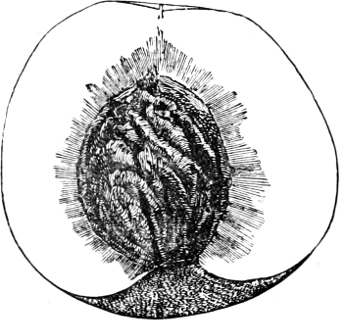
Fig. 503.—Fruit of the Peach. The pulp is cut through so that the stone is visible.
B. Fruit glabrous (i.e. without hairs): Prunus (Plum) has a glabrous fruit with bluish bloom; the stone is compressed, smooth or wrinkled. The flowers are borne solitarily or in couples, and open before or at the same time as the leaves; they are borne on shoots without foliage-leaves.—Cerasus (Cherry) has a glabrous, spherical fruit, without bloom, and a spherical stone. The flowers are situated in 2–many-flowered umbels or racemes, and open at the same time as the leaves or a little before them. Long-stalked flowers in umbels are found in C. avium (Wild Cherry), C. vulgaris (the cultivated Cherry, from Western Asia); racemes at the apex of leaf-bearing branches and small spherical fruits are found in C. padus (Bird Cherry), C. virginiana, C. laurocerasus (Cherry-laurel), C. mahaleb.
Pollination. Prunus spinosa (Sloe, Blackthorn) is protogynous, but the stamens are developed before the stigma withers. Honey is secreted by the receptacle. Cerasus padus (Bird-Cherry) agrees in some measure with P. spinosa. In the flowers of the Plum and Cherry the stamens and stigma are developed simultaneously and self pollination seems general; the stigma, however, overtops the inner stamens and thus promotes cross-pollination.—Distribution. 114 species in the N. Temp, zone; few in the warmer regions; the majority from W. Asia. C. vulgaris, from the regions of the Caspian; Prunus spinosa, insititia (Bullace), domestica (Plum, from the Caucasus, Persia).—Uses, principally as fruit-trees: Cherry, Plum, Apricot, etc.; “Almonds” are the seeds of Amygdalus communis (W. Mediterranean), “bitter,” “sweet,” and “shell” almonds are from different varieties, the latter being remarkable for the thin, brittle stone. In the majority of species and in almost all parts of the plant (especially the bark, seed and leaves) is found the glycoside, amygdalin, which forms prussic acid. Many form gum, and the seeds have fatty oils (“Almond oil”). Officinal: the seeds and oil of Amygdalus communis, and the fruit of the Cherry; in other countries also the leaves of C. laurocerasus.—The stems of Cerasus mahaleb are used for pipes. Ornamental Shrubs: Amygdalus nana, Cerasus laurocerasus.
Order 3. Chrysobalanaceæ. Tropical Amygdalaceæ with zygomorphic flower and gynobasic style. 200 species; especially Am. and Asia. Chrysobalanus icaco (Cocoa-plum) is cultivated on account of its fruit (Am.)
Order 4. Pomaceæ. Trees and shrubs, most frequently with simple leaves and caducous stipules. The flowers (Fig. 505) have 5 sepals, 5 petals and generally 20 stamens (10 + 5 + 5, or 10 + 10 + 5). There are from 1–5 carpels, which unite entirely or to some extent with each other, and with the hollow, fleshy receptacle (the flower becoming epigynous), (Figs. 505, 506, 507). The carpels are nearly always free on the ventral sutures, rarely free at the sides also. The whole outer portion of the fruit becomes fleshy, but the portions of the pericarp surrounding the loculi (endocarp) are most frequently formed of sclerenchymatous cells, and are more or less firm (the “core”). The nature of the fruit varies, according to the thickness and hardness of the endocarp, being either a “berry” or a “drupe” (see A and B). When the endocarp is thin and parchment-like, the fruit has the characteristics of a berry, each of the 5 loculi generally present containing several seeds; but when this is hard the fruit resembles a drupe, only one seed is developed in each loculus, and the number of the loculi is reduced to one or two. There are nearly always 2 ovules in the loculi of the ovary, but in Cydonia there are a large number in 2 rows. In the genera which have stones, only one seed is developed in each stone. The genera are distinguished mainly in accordance with the kind of fruit and the number of ovules and seeds.
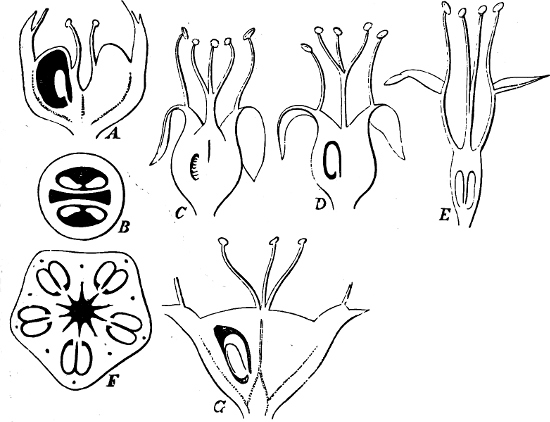
Fig. 504.—Longitudinal and transverse section through the flowers of A, B Cotoneaster; C Cydonia; D Malus communis; E Raphiolepis; F Cydonia; G Mespilus.
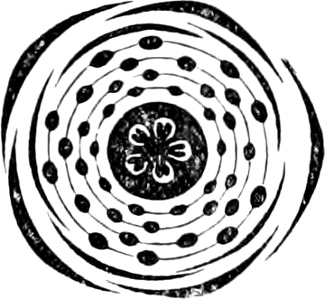
Fig. 505.—Floral diagram of Mespilus germanica.
A. Sorbeæ. The endocarp is parchment-like or papery (drupe, with thin stone or berry).
1. Pyrus and Cydonia; carpels completely embedded in the cup-like receptacle, styles always free.—Pyrus: the fruit is glabrous, and has only a small calyx, withering or deciduous, and a 5-locular ovary with at most 2 ascending ovules in each loculus (Fig. 504 D). The large flowers are situated in few-flowered umbels or corymbs. P. communis (Pear; free styles, Fig. 507; it has the well-known pear-shaped fruit; the core is reduced to several groups of sclerenchymatous cells embedded in the pulp, the leaf-stalk is as long as the blade).—Cydonia (Quince) has a hairy fruit with many seeds in 2 rows in each loculus of the endocarp (Figs. 504 C, F; 506); the testa of these seeds is mucilaginous. C. vulgaris, large, terminal flowers on lateral branches, and large leaf-like, persistent sepals.
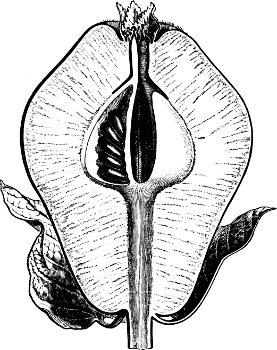
Fig. 506.—Cydonia vulgaris. Longitudinal section of fruit.
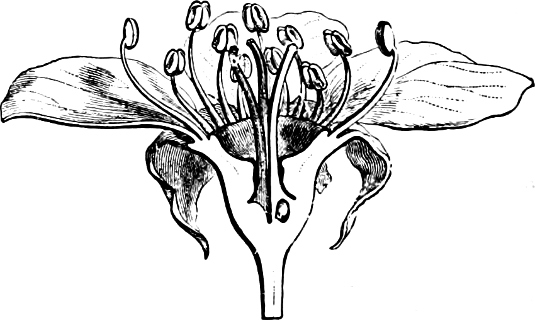
Fig. 507.—Longitudinal section of Pear flower.
2. Malus and Amelanchier (Aronia); carpels free on the ventral edge; styles united. Malus communis (Apple) the fruit is “umbilicate” at the base; no sclerenchymatous cells in the pulp; styles united at the base (Fig. 504 D); leaf-stalk shorter than the blade. Sorbus (Mountain-ash) differs only in having a 2–3-locular fruit with extremely thin endocarp. Cymose inflorescences in umbellate cymes. S. aucuparia has pinnate leaves, S. aria (White-beam) and other species have simple leaves.—Amelanchier (the Service-tree) has a false divisional wall springing from the dorsal suture, and more or less projecting into each of the loculi of the ovary; Raphiolepis (Fig. 504 E) has racemes and a juicy berry; Eriobotrya japonica (Loquat).
B. Cratægeæ. The endocarp is hard and bony (“drupes,” generally with several, sometimes, however, with only 1–2 stones, rarely one multilocular stone; only 1 seed in each of the loculi).—Cratægus (Hawthorn, May). There are 1–5 stones in the spherical or ovoid fruit. The disc, found on the apex of the fruit, inside the small, withered calyx, is small (much less than the transverse section of the fruit). Shrubs with thorns (branches) and moderately large flowers borne in corymbs.—Mespilus (Medlar) differs from the last-named only in having a large disc at the apex of the fruit, inside the large, leaf-like sepals, i.e. almost equal to the greatest diameter of the fruit. The flowers are solitary and terminal.—Cotoneaster is chiefly distinguished from the others by its syncarps, the 2–5 carpels (and stones) being free from one another, and only united to the receptacle by a larger or smaller portion of their dorsal surface (Figs. 504 A, B). Small shrubs with leathery leaves, generally covered with white, felted hairs on the lower surface, and with small flowers; the fruit is red or black.
Pear, Apple, Mountain Ash and Hawthorn have protogynous flowers which secrete honey, and are conspicuous to ensure insect pollination.—180 species; in the northern temperate regions.—Pear and Apple are especially cultivated as fruit trees in a number of varieties; the Paradise Apple (Pyrus baccata); especially in southern countries also the Quince (from N. Persia and the Caucasian districts), Medlar and Amelanchier vulgaris. Malus pumila (Caucasus, Altai) and M. dasyphylla (Orient, S. Eur.) are regarded as primitive forms of the Apple-tree; M. sylvestris, which grows wild in European forests, appears to have been less used. The early Lake-dwellers in Switzerland had the apple-tree both wild and cultivated.—The original form of the Pear is supposed to be Pyrus achras (Central Asia).—Many of the species of Cratægus, some with double flowers, and Pyrus (Chænomeles) japonica, with brilliant red flowers, are cultivated as ornamental shrubs. Officinal: Quince pips, on account of the mucilaginous testa.—The fruits contain free organic acids and sugar; prussic acid may be obtained from the seeds. The wood of the Pear-tree is used in manufactures.
Family 21. Leguminosæ.
The most characteristic feature is, that the gynœceum is 1-locular and formed of 1 carpel, the ventral suture of which is turned posteriorly. The fruit, in most instances, is a pod (legume), which opens generally along both sutures, the two valves twisting more or less in opposite directions. In other instances it opens along one suture only, or as a pyxidium (Red Clover), or it is indehiscent, in which case it is more or less berry-like (e.g. the Tamarind, Carob-bean), or it is a drupe (e.g. the Tonquin-bean), or a 1–few-seeded nut (e.g. Melilotus), or a lomentum, which divides transversely into as many joints as there are seeds (Ornithopus, see Fig. 513).
The inflorescences belong to the centripetal type (i.e. indefinite); cymes do not occur. The flowers are zygomorphic, with vertical plane of symmetry, seldom regular; 5-merous with but a few exceptions, ☿, and slightly perigynous. The following diagram is the most general (Fig. 511): 5 sepals, with the unpaired sepal median and anterior, 5 petals, 5 + 5 stamens, all in alternating whorls, 1 carpel. The calyx is most frequently gamosepalous, the gynœceum is narrowed down at the base to a short stalk and, in the majority, is more or less bent. The seed is most frequently kidney-shaped, with a smooth, hard and shining testa, the hilum being very distinct. Endosperm is wanting, or is reduced to a thin layer, which is of service when the seed swells during germination. The vegetative parts have these features in common, namely, the leaves are scattered, stipulate, and almost always compound. Peculiar sleep-movements and sensitiveness are found in some, chiefly in the Mimosas. Many, probably all, Leguminosæ have small tubercles on their roots which are produced by a kind of bacterium, and assist in the assimilation of free nitrogen. Spontaneous movements are exhibited by Desmodium gyrans (Telegraph-plant).
This family is closely allied to the Rosifloræ, with which it agrees in the scattered leaves, the presence of stipules, the generally 5-merous and most frequently perigynous flowers with eucyclic stamens, and the absence of endosperm. Amygdalaceæ and Chrysobalanaceæ, with solitary carpels, approach on one side to the Leguminosæ, among which genera with drupes are also found; Mimosaceæ, with their many stamens, form a connecting link on the other side. In this respect the Mimosa-genus Affonsea, and certain Cæsalpineæ and Swartzieæ, are of special interest in having more than one carpel (syncarp), a condition which is sometimes met with abnormally in other Leguminosæ, as well as in Amygdalaceæ. About 7,000 species of the Leguminosæ are known.
Order 1. Cæsalpiniaceæ. These are leguminous plants with straight embryo and a flower which is not papilionaceous and has not the same æstivation (Figs. 508–510); but in reality there is not a single characteristic which absolutely distinguishes them from the Papilionaceæ.—The majority are arborescent; the leaves as a rule are pinnate or bipinnate. The flower is 5-merous, most frequently perigynous and slightly zygomorphic; the calyx is free or gamosepalous, the corolla polypetalous with ascending imbricate æstivation (i.e. the two lowest petals envelop the lateral ones, and these again the posterior; Fig. 508); 10 free stamens; fruit various.
Figs. 508–510.—Cassia floribunda.

Fig. 508.—Floral diagram.
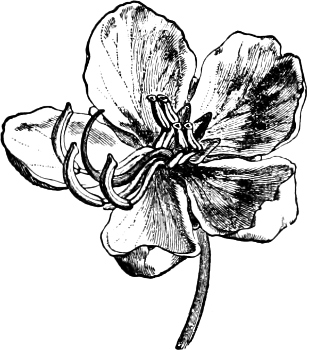
Fig. 509.—Flower.
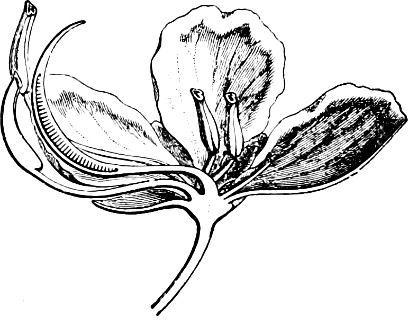
Fig. 510.—The same in long. sect.
Cassia (Figs. 508–510) is the largest genus (about 200 species); it has an almost hypogynous, zygomorphic flower with 5 free sepals and petals; of the 10 stamens the 3 posterior are generally barren, the others are of very unequal length and open at the apex by pores (Fig. 509). In some (the Senna group) the fruit is a flat, short, thin, dehiscing pod; in others (Cathartocarpus) it is round, long, woody or fleshy, indehiscent, and divided internally by more or less fleshy transverse walls into as many cells as there are seeds.—The following also have DEHISCENT FRUITS: Bauhinia (often lianes, tropical climbers with tendrils [stem-structures] and anomalous stems), Copaifera, Hæmatoxylon (whose pod does not dehisce along the suture, but laterally), Cercis (simple leaves; the corolla resembles that of the Papilionaceæ, but the posterior petal is the smallest, and is enveloped by the 2 lateral ones, which are enveloped in their turn by the 2 anterior).—Fruit Indehiscent: Tamarindus indica; the pod is almost round, often a little abstricted between the seeds; the wall is formed by a thin, brittle external layer, enclosing an acid pulp; well-developed septa are present, between the seeds; the most internal layer is parchment-like. Calyx 4-merous by the coalescence of 2 sepals. Only 3 fertile stamens.—Ceratonia siliqua (Carob-bean, Locusts); the pod is long, compressed, with thick sutures, and has a wall, the central part of which is more or less leathery, fleshy and sweet; there are transverse septa between the seeds, as in the Tamarind. Embryo greenish in endosperm. The flower is without a corolla, 5 stamens.—Pterogyne (winged fruit), etc.—Kramerieæ with Krameria is an anomalous group.
Distribution. 80 genera, with 740 species; almost exclusively in the Tropics. The Carob-tree and Cercis grow in the Mediterranean basin. The largest and most widely distributed genus is Cassia, which is found as trees, shrubs, and weeds in all tropical countries. The order has many important uses to mankind. Medicinal: the leaves and pods of Cassia acutifolia and angustifolia (officinal, Senna-leaves), the fruit-pulp of the Cassia-sub-genus, Cathartocarpus. Rhatany root from Krameria triandra (Peru, officinal). Balsam is extracted from a number of Copaifera-species (Balsam of Copaiba) from S. Am. (officinal), and from Hymenæa (Copal balsam), Trachylobium and others. Edible fruits are obtained especially from the Carob-tree (from the East) and the Tamarind (officinal). The heart-wood of several species of Cæsalpinia, such as C. brasiliensis (the Pernambuco-tree), echinata (Red-tree), and sappan, yield dyes; Hæmatoxylon (H. campechianum, Logwood), Copaifera bracteata (Amarant-tree).—Timber is obtained from many (Melanoxylon and others). In Europe they are of little importance as ornamental plants, these being confined principally to the species of Gleditschia (G. triacantha, from N. Am.) and Cercis (the Judas-tree, C. siliquastrum, S. Eur.), which are cultivated in gardens; but in tropical gardens beautiful flowering species, e.g. of Cassia, Poinciana, Brownea, are found, and the most beautiful of all ornamental plants, the Indian Amherstia nobilis.
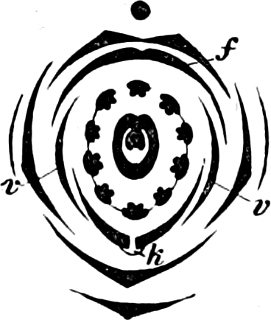
Fig. 511.—Diagram of Faba vulgaris: f the standard; v the wings; k the keel.
Order 2. Papilionaceæ. The flower (Figs. 511, 512) is strongly zygomorphic and somewhat perigynous (Fig. 512 B; most frequently more on one side than the other). The calyx is gamosepalous and persistent. The polypetalous corolla has descending imbricate æstivation, the posterior, large leaf, the standard (Figs. 511 f; 512 B’, e), covering in the bud the two lateral ones, the wings (Figs. 511 v; 512 B’, a), which again cover the two anterior; these are united in the form of a boat, the keel (k and c); the wings and the two petals of the keel are very unsymmetrical. That the keel is formed of two petals is seen by its position (in front of one sepal) and by the two often more or less free claws. The 10 (5 + 5) stamens (monadelphous) are either all united into one bundle, or into two bundles (diadelphous), the posterior one being free (Fig. 512 C). The ovules are curved and also the embryo (Fig. 512 G), especially the hypocotyl, so that the radicle assumes a position close to the edge of the thick, fleshy cotyledons. Endosperm wanting; the cotyledons are very rich in proteid reserve material. The forms of the fruit and exceptions are described under the genera.
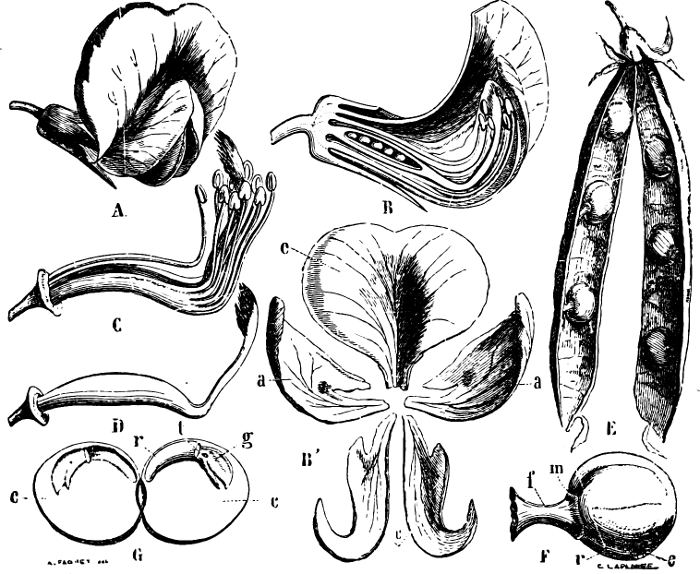
Fig. 512.—Pisum sativum: A entire flower; B in longitudinal section; C gynœceum and stamens; D gynœceum; B’ corolla dissected, e standard, a, a wings, c keel; D seed opened to show the cotyledons (c), the radicle (r), the plumule (g); E fruit (legume); F seed.
Geocarpic fruits, i.e. those which penetrate the soil during their development and ripen underground, are found in e.g. Arachis hypogæa (see page 472), Trifolium subterraneum, Vicia amphicarpæa. Germination takes place in various ways. In the majority the cotyledons are raised above the ground as green, leaf-like bodies; in the Vicieæ they remain thick and white, and are always enclosed in the testa, and are therefore never able to take part in the work of assimilation; in species of Phaseolus, on the other hand, they are raised well above the ground and become green, but remain however thick and fleshy.
1, 2. The two groups Podalyrieæ (the majority of the genera are Australian) and Sophoreæ (Sophora, Edwardsia, etc.), represent the oldest type, as they have 10 free stamens and so form the transition to the Cæsalpiniaceæ. Nearly all are trees and shrubs.
3. Astragaleæ. Herbs or shrubs, less frequently trees, with imparipinnate leaves (without tendrils). The flowers are generally borne in racemes or spikes. Stamens monadelphous or diadelphous.—Astragalus (Milk-Vetch) has the legume incompletely divided longitudinally into 2 loculi by a septum formed by the incurved dorsal suture. Diadelphous.—Glycyrrhiza (Liquorice); Colutea (Bladder-Senna) from S. Europe; Robinia (the false Acacia) with thorny stipules; Indigofera (the Indigo plant); Amorpha (which has only one petal, namely the standard, and the fruit a nut), Caragana, Wistaria (a climbing shrub), Galega. Carmichælia australis, when old, produces flat branches with scale-like leaves.
4. Vicieæ. Climbing herbs with paripinnate leaves, the midrib ending in a point or frequently in a tendril, which generally is branched, representing lateral veins without mesophyll; stamens diadelphous; the cotyledons remain underground on germination.—Vicia (Vetch) has a filamentous style, hairy towards the tip, and a pod with many seeds; climbing by means of tendrils; the leaves have many leaflets.—Faba (F. vulgaris, Horse-bean) is erect, without tendrils; its pod is thick with spongy septa between the seeds.—Ervum (Lentil) has a pod with only 1–2 seeds, and sweeping hairs (stylar-brush) on the inner side of the style.—Pisum (Pea; Fig. 512) has very large stipules, the bent style has a hollow groove on the anterior side. P. sativum (Common Pea), P. arvense (Grey Pea).—Lathyrus (Sweet Pea) generally has an angular, winged stem and most frequently only a few pairs of leaflets. The style is flattened, with sweeping hairs on the back. In L. aphaca the stipules alone are developed into foliage-leaves, while the remainder of the leaf is modified into a tendril.—Cicer has a nearly straight embryo and imparipinnate leaves with dentate or incised leaflets. C. arietinus (Chick-pea).—Abrus (precatorius, etc.); the seeds (“Crab’s eyes,” “Paternoster peas,” “Jequirity”) are scarlet with a black spot round the hilum.
5. Phaseoleæ. Herbs, twining or erect, but not climbing by tendrils; the leaves are imparipinnate, generally ternate, and bear small, linear bodies resembling stipules at the base of the stalks of the leaflets. The inflorescences are most frequently compound, groups of few flowers being situated on short, nodose, lateral axes borne on a longer stem. On germination the cotyledons are raised a considerable distance above the ground, and become greenish, but do not become leaf-like; in P. multiflorus they remain underground. Stamens as in the Vetches.—Phaseolus (Kidney-bean): the keel with the stamen and style is spirally twisted (to the right). Herbs, twining to the left.—The “Calabar-bean” (Physostigma venenosum), Erythrina, Clitoria, Glycine, Soja, Mucuna, Apios, Canavalia, Vigna, Dolichos, Cajanus, Rhynchosia, etc.
6. Trifolieæ (Clovers). Herbs with ternate leaves, the leaflets are often dentate with the veins prolonged into the teeth; stamens diadelphous; fruit 1-locular, 1–few-seeded, pyxidium-like, irregularly dehiscent, or more frequently a nut. The flowers are generally borne in capitula, racemes, or spikes.—Trifolium (Clover). The corolla is gamopetalous. The calyx persists, together with the corolla, round the ripe fruit. The inflorescence is a spike, capitulum or capitate umbel; the leaves are ternate, and have adnate stipules.—Medicago (Medick). The corolla falls off after flowering; fruit curved like a sickle or spirally twisted; it is a nut, and opens with difficulty. Leaves ternate.—Melilotus (Melilot) has a small, spherical or lanceolate, thick and wrinkled fruit, which as a rule is indehiscent. The inflorescence is a raceme, often long, or a spike, sometimes a capitulum. Leaves ternate.—Ononis (Rest-harrow) differs in having monadelphous stamens and in being more shrub-like and bushy, and in having a normal, 2-valved pod, by which characteristic it approaches the Genisteæ. The flowers are generally rose-coloured, solitary, or in few-flowered racemes in the leaf-axils. Thorns (branches) are often present; the leaves are compound with only one small leaflet (the terminal one), or ternate with adnate stipules.
7. Loteæ. Herbs with ternate or imparipinnate leaves, with entire leaflets. In the latter case, when the lowest pair of leaflets is placed quite close to the sheath, the stalk is wanting, and apparently a trifoliate leaf with large stipules is developed. Flowers in an umbel or capitulum. Stamens monadelphous or diadelphous, the filaments (either all of them, or only the 5 sepal-stamens) are widened at the top.—Lotus (Bird’s-foot-trefoil) has a long, round pod.—Tetragonolobus.—Anthyllis (Lady’s-finger); the fruit is a nut, which is distributed by the wind by means of the membranous, bladder-like calyx, which completely encloses and falls off with it.
8. Genisteæ. The majority are shrubs or trees with apparently simple leaves, i.e. compound leaves with only one leaflet (the terminal leaflet), or ternate leaves; the stipules in most instances are very small or are entirely wanting; stamens monadelphous.—Genista (Dyer’s-weed) has apparently simple leaves; the branches often terminate in a thorn. The strongly-winged stems in G. sagittalis are its most important organs of assimilation. Bossiæa rufa has flat branches, its leaves being reduced to small, pointed stipules.—Sarothamnus (Broom) has switch-like, angular branches and often both the apparently simple and ternate leaves on the same shoot; style spirally rolled.—Cytisus (Laburnum). Ulex (Furze; in U. europæus, the seedlings bear a few foliage leaves, but the leaves succeeding these are modified into thorns); Spartium; Crotalaria, etc.—Lupinus (Lupin) is allied to this group; it has a thick, often somewhat fleshy pod, and digitate leaves with adnate stipules.—Retama.
9. Hedysareæ are especially recognised by having the ovary divided by transverse septa into as many cells as there are seeds, the fruit thus becomes a lomentum, dehiscing transversely into nut-like joints (Fig. 513).—Ornithopus (Bird’s-foot); Coronilla; Hippocrepis; Onobrychis (Sainfoin) has a fruit with only 1 joint (i.e. a 1-seeded nut); Desmodium; Alhagi; Hedysarum, etc.—Arachis hypogæa (Earth-nut) has a pod which is abstricted between the seeds, and is indehiscent, but is not multilocular nor a true lomentum; it is reticulately wrinkled externally, and ripens underground; the basal part of the ovary is prolonged after flowering, attaining a length of several inches, and buries the young fruit in the soil. The embryo is straight.—Desmodium gyrans is well-known for its motile leaflets.
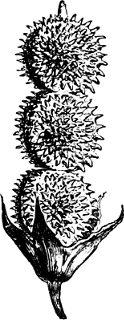
Fig. 513.—Hedysarum coronarium.
10. Dalbergieæ. 25 genera; especially in Tropical America; the majority are trees, a few shrubs or lianes; the leaves are simple or imparipinnate. The fruit is indehiscent in all; in some it is a winged, in others a wingless nut (Machærium, Dalbergia, Centrolobium, etc.), in others, again, a drupe, e.g. in Dipteryx (Tonquin-bean) and Andira. In some genera the embryo is straight.
Pollination. Especially effected by Bees. The nectar is secreted by a ring or disc-like portion round the base of the gynœceum or the inner surface of the receptacle. The flower is constructed with a peculiar mechanism to ensure cross-pollination by insects. The pollen is shed just before the flower opens, and is retained in a pouch formed by the keel. An insect visiting the flower uses the wings and keel for a landing-stage, and in attempting to reach the honey presses down the wings and the keel which are locked together near the standard; the stylar-brush by this means is forced through the apical opening of the keel and a little pollen is thus swept out and deposited upon the abdomen of the visiting insect as it presses against the apex of the keel; the insect thus carries away pollen and may effect cross-pollination. In the different flowers this arrangement is modified in various ways to promote pollination. 5000 species (319 genera); especially in the Tropics, where many are important forest trees.—The following plants are used FOR FOOD: Pisum sativum (W. Asia?) and arvense (Italy); Phaseolus vulgaris (Kidney-bean, American; Dolichos sinensis was known to the Greeks and Romans under the name “φασηλος,” “phaseolus”), P. compressus (French-bean), etc.; Faba vulgaris (Field-bean, Horse-bean; from the Old World); Ervum lens (Lentil, Eastern Mediterranean); in tropical countries the oil-containing seeds of Arachis hypogæa.—The following are FODDER plants: Vicia sativa, Faba vulgaris, Onobrychis sativa (Sainfoin), Medicago sativa (Lucerne), and lupulina (Medick), species of Trifolium, Hedysarum coronarium. Officinal: “Liquorice root,” from Glycyrrhiza glabra (S. Europe); “Red Sandalwood,” from Pterocarpus santalinus (Tropical E. Asia); Gum Tragacanth, from Astragalus-species (E. Mediterranean); Balsam of Peru, from Toluifera pereiræ, and Balsam of Tolu, from Toluifera balsamum. Calabar-beans, from Physostigma venenosum; Kino, from Pterocarpus marsupium; the pith of Andira araroba is used under the name of “Chrysarobin.”—Of use TECHNICALLY: Genista tinctoria (yellow dye) and Indigofera-species (Indigo), the bast of Crotalaria juncea (Sunn Hemp); the seeds of Dipteryx, which contain Coumarin, and are highly scented, and Balsam of Myroxylon. Poisonous: the seeds of Laburnum (Cytisus laburnum), various species of Lathyrus, and Abrus precatorius; the latter contain two poisonous proteids, paraglobulin and albumose, which resemble snake-poison in their effects. The following are ORNAMENTAL plants: Phaseolus multiflorus (Scarlet runner, from America), Robinia pseudacacia, Amorpha, Colutea, Coronilla, Indigofera dosua, Wistaria polystachya, Cytisus laburnum (Laburnum, S. Europe, Orient.) and other species.
Order 3. Mimosaceæ. The flowers are most frequently hypogynous and regular, the æstivation of the corolla is valvate and, in the majority of instances, that of the calyx also. The flower is 4-merous, less frequently 5- or 3-merous.—The flowers are generally small, but are always borne in compact, round capitula or spikes (Fig. 514); they are hypogynous or perigynous. The calyx is generally gamosepalous and the corolla gamopetalous, the latter being frequently wanting. The stamens are equal or double the number of the petals (Mimosa, etc., in M. pudica, e.g. S4, P4, A4, G1) or (in Acacia, Inga, etc.) in a large, indefinite number, free or monadelphous, often united to the corolla (Fig. 514 b). The colour of the flower in most cases is due to the long and numerous stamens. The fruit is various. The embryo is straight as in the Cæsalpiniaceæ. Entada and many species of Mimosa have a flat, straight, or somewhat sickle-like pod, which resembles the siliqua of the Cruciferæ in that the sutures (in this instance, however, dorsal and ventral suture) persist as a frame, but the intermediate portion divides, as in the transversely divided siliqua, into as many nut-like portions as there are seeds. Some species have a pod of enormous dimensions. The seeds of Entada gigalobium are often carried from the West Indies to the N. W. coasts of Europe by the Gulf Stream.—The fruit of Acacia in some species is an ordinary pod, in others it is transversely divided, or remains an undivided fruit, a nut.—This order includes both trees and herbaceous plants, which are often thorny; the leaves are usually bipinnate (Fig. 514) and are sensitive, and also possess sleep-movements.—Many Australian Acacias have compound leaves only when young, but when old have phyllodia, i.e. leaf-like petioles without blades, placed vertically. A large number have thorny stipules, which in some (Acacia sphærocephala) attain an enormous size, and serve as a home for ants, which in return protect their host-plant against the attacks of other, leaf-cutting ants.
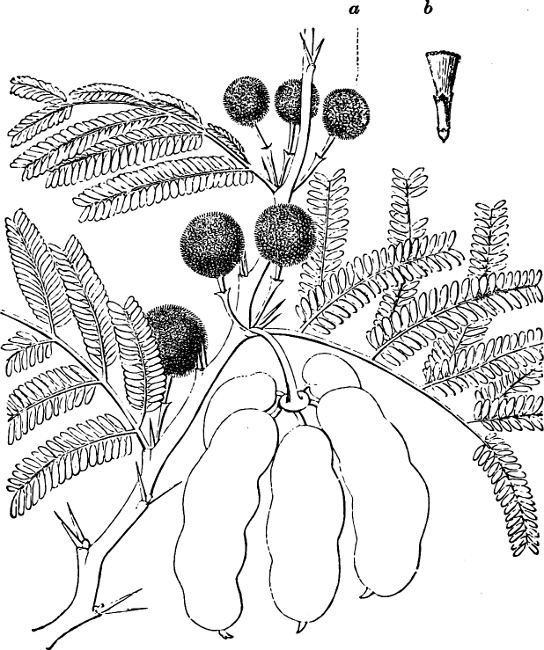
Fig. 514.—Acacia farnesiana: a inflorescence; b flower.
Other genera besides those mentioned are: Adenanthera, Desmanthus, Parkia, Inga (with rather fleshy, indehiscent fruit), Calliandra, etc.
1350 species (30 genera); none natives of Europe, their home being the Tropics and sub-tropical regions, especially Australia and Africa.—Fossils in Tertiary.—Gums are found in many species of Acacia, especially the African (Gum arabic) and Australian, of which some are officinal. The bark, and also the fruits, contain a large amount of tannic acid and are used as astringents and in tanning (“Bablah” is the fruits of several species of Acacia). Catechu is a valuable tanning material extracted from the wood of Acacia catechu (E. Ind). The flowers of Acacia farnesiana (Fig. 514) are used in the manufacture of perfumes. With us they are cultivated as ornamental plants, e.g. A. lophantha and many others, in conservatories.
Family 22. Passiflorinæ.
The flowers are most frequently regular, 5-merous in the three most external whorls, eucyclic and perigynous or epigynous, less frequently hypogynous. A characteristic feature is that the ovary is tricarpellary, unilocular, and with 3 parietal placentæ which sometimes meet in the central line (Cucurbitaceæ). The styles are generally free and bifid. To all these characteristics, however, there are exceptions. The Cucurbitaceæ are sometimes placed among the Sympetalæ, close to the Campanulinæ, but they are not allied to the Sympetalæ, from which they differ especially, for instance, in the structure of the ovule. The position of the Begoniaceæ in this family is also open to doubt.
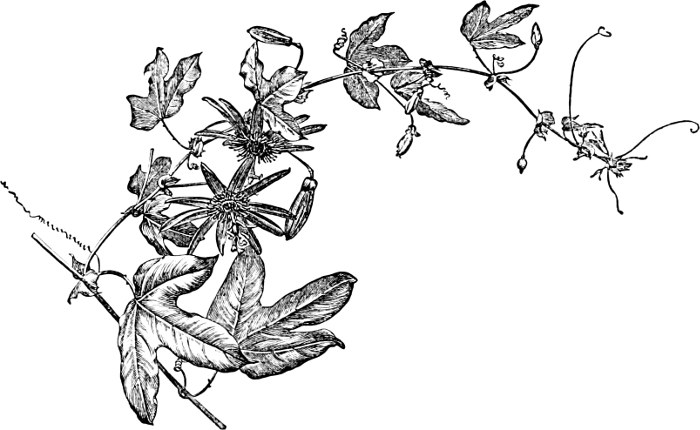
Fig. 515.—Passiflora cœrulea (reduced).
Order 1. Passifloraceæ (Passion-flowers). The majority are herbs which climb by means of tendrils (modified branches) and have scattered, stipulate leaves, often palminerved and lobed (Fig. 515). The flowers, which are often large and beautiful, are regular, ☿, with S5, P5, A5, G3; the calyx and corolla are perigynous, and immediately inside the corolla is the “corona,” consisting of numerous, tapering, filamentous bodies, or sometimes united in rings, most frequently petaloid and coloured; the stamens are raised on a long, round internode above the cup-like receptacle; immediately above these is the gynœceum with its 3 free styles and capitate stigmas; the ovary is unilocular with 3 parietal placentæ. Fruit most frequently a berry. The seeds have an aril.
210 species; especially in Tropical America. Several Passiflora-species are ornamental plants, and the fruits of some species are edible.
Order 2. Papayaceæ. The best known representative is the Papaw (Carica papaya), a Tropical American tree whose stem is usually unbranched, and bears at its summit several large, palmilobed leaves on long stalks. The stem and leaves have latex. The large, Melon-like berries are edible, and for this reason it is cultivated in the Tropics. Flowers unisexual, with slightly different structure in the ♂-and ♀-flowers, besides intermediate forms. The ♂-flower has a gamopetalous, the ♀-flower a polypetalous corolla.—The milky juice contains a substance with similar action to pepsine. 10 stamens. 5 carpels.
Order 3. Turneraceæ. 85 species; especially in America.
Order 4. Samydaceæ. 160 species; tropical.
Order 5. Loasaceæ. Herbaceous plants seldom shrubs, sometimes climbing, and nearly always studded with stiff hairs, in some instances stinging or hooked. The leaves are most frequently palmilobed and without stipules. The flowers are regular, ☿, polypetalous, entirely epigynous, with 4–5 sepals, petals and stamens, or more frequently (by splitting) many stamens, those which are placed before the sepals being generally barren and more or less petaloid; carpels most frequently 3, united into an inferior, unilocular ovary with 3 parietal placentæ, above which the receptacle is generally more or less prolonged. Fruit a capsule; in Gronovia an ovary with 1 ovule and fruit a nut.
115 species; principally from S. Am. A number of annuals are often grown in our gardens: Bartonia aurea (California); Mentzelia; Cajophora; Gronovia.
Order 6. Datiscaceæ. 4 species, especially in the Tropics.—Datisca cannabina (Asia Minor) resembles the Hemp in external appearance. The flowers are diœcious, insignificant; ♂-flowers: a low, gamosepalous calyx, no corolla, and an indefinite number of stamens; ♀-flowers; epigynous; ovary unilocular with free, mostly bifid, styles, and generally 3 parietal placentæ. In most cases the ovary is not entirely closed at the top (as in Reseda).
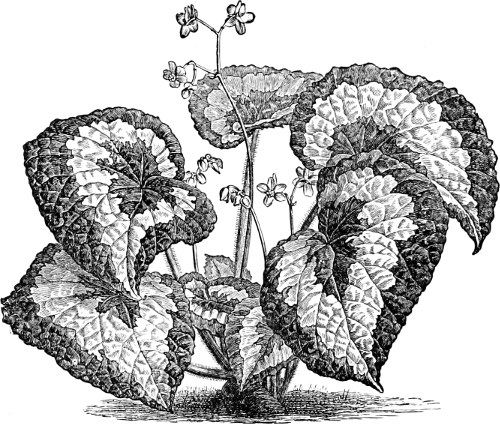
Fig. 516.—Begonia rex (reduced).
Order 7. Begoniaceæ. This order principally comprises herbs or under-shrubs with succulent stems (having scattered vascular bundles in the pith); the leaves are arranged in two rows (a divergence of 1/2) and are asymmetrical, as a rule more or less obliquely cordate, or ovate with cordate base (Fig. 516); large, caducous stipules are present. Inflorescences dichasial, or unipared scorpioid cymes; the flowers are unisexual; the first ones (the oldest) are ♂-flowers, while ♀-flowers are found especially on the younger axes. The ♂-flowers have most frequently 2 + 2 coloured perianth-leaves, and many stamens collected into a head in the centre of the flower; the ♀-flowers are epigynous with 5 coloured perianth-leaves (placed spirally with a divergence of 2/5) and a trilocular ovary, bearing 3 bifid styles and 3 wings (the wings usually of unequal size); in the inner angle of each loculus there is one large projecting placenta, or two plate-like placentæ (the bent back edges of the carpels) studded with ovules. Fruit a capsule, with many extremely small seeds.—Begonia.
420 species; almost all from the Tropics (Am., Asia).—Many species, with varieties and hybrids, are ornamental plants in houses and conservatories, chiefly on account of the form, colour and markings of their leaves; but also for their very beautiful flowers. They reproduce easily by adventitious buds from leaves and portions of leaves placed on damp soil; some have bulbils. Like the Oxalideæ they contain an acid sap.
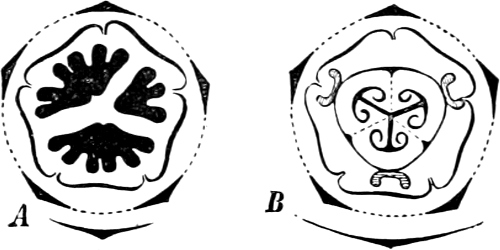
Fig. 517.—Ecballium agreste. Diagram of a ♂-and a ♀-flower.
Order 8. Cucurbitaceæ. The flower is epigynous, and, as a rule, is also provided with a leaf-like, cup- or bell-shaped receptacle above the ovary, to which the perianth and stamens are attached; the flowers are regular, unisexual, with rudiments of the other sex, and 5-merous: sepals 5, narrow and pointed, with the median sepal posterior (Fig. 517), petals 5, stamens 5, and carpels 3 (rarely 4–5); the corolla is gamopetalous in the majority, polypetalous in some; generally plicate-valvate in the bud. The anthers in the ♂-flowers are extrorse, and monothecious, i.e. only one half of each of the anthers of the 5 stamens is developed, the pollen-sac having frequently a peculiar [**rtilde]-shaped curve (Fig. 518 A, B); the stamens are either all united into a column (e.g. in Cucurbita), or they are united in pairs, so that only one remains free (Figs. 517 A; 518 A); in the latter case there appears to be one small stamen with a ~-shaped, curved pollen-sac and two larger ones, each with two curved pollen-sacs placed as in Fig. 517 A. The original form appears to be Fevillea with free petals and 5 free stamens. Sometimes the rudiment of a gynœceum is present. The carpels are united into an ovary with 3 (4–5) placentæ formed by their united edges. These are thick, fleshy, and bifid, bearing a number of ovules on each side (Figs. 517 B; 518 C, D); in general the placentæ are so large that they not only meet in the centre, but also fill up the ovary as far as the wall of the pericarp. The whole interior of the fruit thus becomes a juicy mass in which three lines may be seen, meeting in the centre (the boundaries of the individual placentæ), and near the circumference 6 groups of seeds (Fig. 518 D). When the carpels are equal in number to the petals they alternate with them. The style is short and thick, and generally divided into 3 (4–5) branches, with a horse-shoe shaped stigma on each branch (Fig. 518 C). The fruit is most frequently a many-seeded berry; in some it attains a considerable size and has a firm external layer (Cucurbita, Lagenaria, etc.). The embryo is straight, has no endosperm, but contains a large quantity of oil. The exceptions to the above characters will be found under the genera.
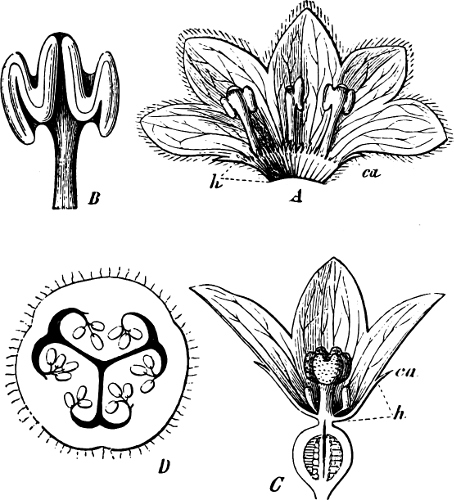
Fig. 518.—Citrullus colocynthis: A ♂-flower, cut open and spread out; B stamen; C ♀-flower in long section; h receptacle; ca calyx; D transverse section of ovary.
Exclusively herbs, generally with stiff hairs and yellow flowers. Many species are annuals, others are perennial, having tuberous roots or hypocotyls. The leaves are scattered, long-stalked, in most cases more or less heart-shaped, palminerved, palmilobed, and exstipulate; in their axils are found both flowers (singly, or in an inflorescence) and a vegetative bud, and outside the axil, on the anodic[37] side of the leaf, a simple or branched tendril, by which the plant climbs (exceptions: e.g. Ecballium).
The position of the flowers, branches and tendrils situated in and near the leaf-axils is as follows. In the leaf-axils, a flower is borne (as a branch of the first order), ♂ or ♀, according to the conditions of the various genera. This branch is not situated in the centre of the axil, but is removed slightly towards the anodic side of the leaf. Of its two bracteoles as a rule only the one lying on the anodic side is developed, namely as a tendril, which is displaced to a position outside the axil. The branch of the first order bears on its catodic side an inflorescence (in the axil of the suppressed bracteole), on the anodic side a vegetative bud which grows out into a branch like the main axis. The subtending leaf of this branch is thus the tendril; but when it has several arms the condition is complicated by the appearance of an accessory bud which unites with its subtending leaf, the tendril, its leaves also becoming tendrils (situated on an undeveloped internode); the many-branched tendril is thus a branch, and the tendril-arms are its leaves, except the main arm which is its subtending leaf. Other explanations of these difficult relations have been given.—The germination is somewhat peculiar, owing to the fact that a heel-like prolongation is formed at the base of the hypocotyl to assist in separating the two halves of the testa from each other, and to facilitate the unfolding of the cotyledons.
Cucurbita (Pumpkin, Marrow) has branched tendrils; the flowers are monœcious, and are borne singly; the corolla is bell-shaped, and divided almost as far as the middle. The stamens are all united into a tube; the compressed seeds have a thick, blunt edge.—Cucumis has (generally) unbranched tendrils; the ♀-flowers are borne singly, whilst the ♂-flowers are borne in groups: the corolla is divided nearly as far as the base, and the stamens are united 2-2-1. The connective is elongated above the anthers. The seeds have a sharp edge.—Citrullus (Fig. 518) has a corolla similar to Cucumis, but ☿-and ♂-flowers are borne singly; the stigma is only 3-lobed, the fruit most frequently spherical.—Ecballium (Squirting Cucumber, only 1 species, E. elaterium) has no tendrils, and is therefore not a climber. The oblong fruit is pendulous from the apex of its stalk, and when ripe is distended with an acrid, watery fluid; on being touched the fruit is detached, and the seeds, together with the watery fluid, are violently ejected through the aperture formed at the base of the fruit. The ♂-flowers are borne in racemes near the solitary ♀-flowers (Fig. 517).—Bryonia (White Bryony) has chiefly unbranched tendrils and small, greenish-yellow, usually diœcious flowers with rotate corolla, in many-flowered inflorescences; the small, spherical berry has no specially firm outer layer, and generally only few seeds. The tap-root and a few of the other roots are tuberous. B. alba (berry black; monœcious) and dioica (berry red; diœcious). Among other genera may be mentioned: Lagenaria (Gourd); the fruit has a woody external layer which, after the removal of the pulpy integument, may be used as a gourd. Luffa has a polypetalous corolla; the fruit is dry, and consists internally of a network of vascular bundles; it opens by an aperture at the summit. Benincasa; the fruit has a close, bluish coating of wax. Trichosanthes (Snake Cucumber) has a thin, round, long and curved fruit. Momordica; the fleshy fruit opens and ejects the seeds. Cyclanthera takes its name from the staminal column which is found in the centre of the ♂-flower, bearing a bilocular, ring-like anther which opens by a horizontal cleft. The fruit is unilocular by suppression, has 1 placenta, and when touched opens and ejects the seeds. Sicyos and Sechium have only unilocular ovaries with one pendulous ovule. Sechium has, moreover, 5 free stamens, of which only one is halved, the other 4 having both halves of the anther. Fevillea and Thladiantha also have 5 free stamens. Dimorphochlamys has dimorphic flowers.
Pollination is effected by insects, chiefly bees or wasps, the nectar being secreted by the inner, yellow portion of the receptacle; in the ♂-flower access is gained to the nectar through the slits between the stamens, which arch over the nectary.—85 genera; about 637 species; especially in the Tropics. Only two are found in the whole of N. Europe, Bryonia alba and dioica; in S. Europe, Ecballium also. Most of the cultivated species have been obtained from Asia, such as the Cucumber, Melon, Colocynth, several Luffa-species (the “Gourds” mentioned in Scripture are Cucumis chate); from Africa, the Water-melon, Cucurbita maxima, and others; from S. Am., no doubt, the Pumpkin (C. pepo and melopepo). Uses. Many species are used in medicine or for domestic purposes. Bitter, poisonous properties are found; the fruits of the two officinal ones are purgative: Citrullus colocynthis (Mediterranean, E. India, Ceylon) and Ecballium elaterium, as well as various tropical species, the roots of Bryonia, etc.—The following are cultivated AS ARTICLES OF FOOD: Pumpkin (Cucurbita pepo, etc.), Cucumber (Cucumis sativus), Melon (Cucumis melo), the Water-melon (Citrullus vulgaris), Sechium edule (Chocho), certain species of Luffa (the young fruit). The Bottle Gourd is cultivated in tropical countries for the sake of its hard pericarp, which is useful for bowls, bottles, etc. The fruits of Luffa have a number of reticulately felted, tolerably firm vascular bundles, which render them serviceable in various ways (as a kind of “sponge”). The Cucurbits are of no use in the manufactures. Only a few are cultivated as ornamental plants, chiefly as curiosities.
Family 23. Myrtifloræ.
The leaves are most frequently opposite, simple, entire (rarely dentate), and exstipulate. The flowers are regular and epigynous (perigynous in Lythraceæ and a few others), ☿, polypetalous; the number of members in a whorl is generally 4 or 5 (S, P, A, or most frequently A 2, G), but sometimes it becomes (e.g. Myrtles and Lythraceæ) very large in the andrœcium by splitting, and in the gynœceum also is often different. (When suppression takes place it is principally in the corolla and petal-stamens.) In nearly all instances the calyx is valvate. Gyncœceum multicarpellary, multilocular, with only one style (except Haloragidaceæ). In the majority the ovules are situated on an axile placenta in the multilocular ovary. Endosperm is wanting in the majority.—Less important exceptions: Rhizophoraceæ and Gunnera have stipules. Haloragidaceæ have several styles and endosperm. Rhizophora also has endosperm.
Order 1. Lythraceæ. Hermaphrodite, perigynous flowers which are most frequently 6-merous, viz. S 6 (often with a commissural “epicalyx,” Fig. 519 c), one segment posterior, P 6, A 6 + 6 or 6 + 0 and G 2–6, forming a 2–6-locular ovary with many ovules in the loculi, style single, and capitate stigma. The gynœceum is free at the base of the tubular, or bell-shaped, thin, strongly veined receptacle, which bears the other leaf-whorls on its edge and inner side. Fruit a capsule. No endosperm.—To this order belong both herbs, shrubs and trees. The branches are frequently square, the leaves always undivided, entire, and without stipules, or with several very small stipules, and often opposite. The calyx is valvate. The flower is regular (except Cuphea) and frequently large and beautiful. The stamens are generally incurved in the bud, and the petals irregularly folded.
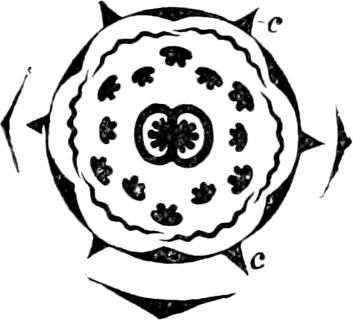
Fig. 519.—Lythrum salicaria. c the “epicalyx.”
Lythrum (Loose-strife). The flower is diplostemonous and 6-merous, with a long, tubular receptacle with epicalyx-teeth (Fig. 519 c). The 12 stamens are arranged in two tiers on the inner side of the receptacle. The gynœceum is bicarpellary. The flowers are borne in small dichasia in the leaf-axils, and their number is increased by accessory inflorescences beneath the main inflorescence.—The native species, L. salicaria, is trimorphic (long-styled, mid-and short-styled forms, Fig. 520). Cross-pollination is chiefly effected by humble-bees and bees, which seek the nectar formed at the bottom of the receptacle. Other species are only dimorphic, or even monomorphic.—Closely allied are, Nesæa, Diplusodon, Lagerstrœmia, and Cuphea, whose flower resembles that of Lythrum, but is zygomorphic. In Cuphea the receptacle is oblique and at the back prolonged into a spur, in which the nectar, secreted by a gland situated behind the ovary, is collected; the calyx and corolla gradually become reduced in size toward the anterior side of the flower; the reverse, however, is the case with the 11 stamens (the posterior one is absent); the posterior loculus in the bilocular ovary is sometimes barren; the fruit, when ripe, dehisces along the posterior side, the ovary as well as the wall of the receptacle being ruptured by the placenta, which expands and projects freely. The flowers stand singly in the centre of the stem, between the pairs of leaves. This may be explained as follows: of the two foliage-leaves in each pair, one supports a foliage-shoot, the other a flower; the foliage-shoot remains in the axil, but the flower is displaced through the length of an entire internode to the next pair of leaves, and then assumes a position between these two leaves. All foliage-shoots stand in two rows, the flowers in two other rows.
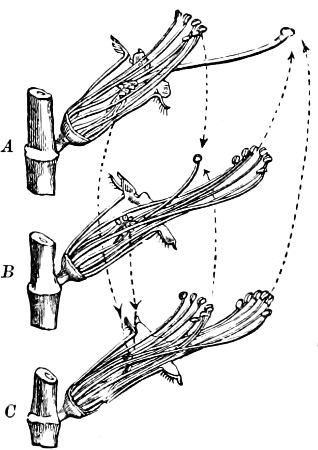
Fig. 520.—Lythrum salicaria. One side of the perianth is removed from all three flowers. A is long-styled, B mid-styled, and C short-styled. The direction of the arrows and dotted lines indicates the best (legitimate) methods of crossing.
Peplis (Water-purslane), a small, annual plant, with thin, bell-shaped receptacle without projecting nerves. The small flowers have no petal-stamens, and often also no corolla; fruit indehiscent.—Ammannia is closely allied to it.
365 species; 30 genera; mostly in the Tropics, and more especially S. Am.—Some yield dyes, e.g. Lawsonia inermis (cultivated in Africa and Asia) and Lagerstrœmeria indica; some contain tannin; others are ornamental plants, especially in gardens in warm countries.
Order 2. Blattiaceæ. 12 species. Tropical Asia and Africa. Trees. Formerly included with Punica, but best placed as an independent order.
Order 3. Melastomaceæ. A very natural and very large order (150 genera; 2,500 species), its home being chiefly in tropical S. America, especially the Brazils (termed by Schouw “The kingdom of Palms and Melastomaceæ”). There are both herbaceous and arborescent species, which are easily recognized by the opposite or verticillate, simple leaves which have (with the exception of a few heather-like species) 3–5–7–9 curved veins proceeding from the base of the leaf, and connected very regularly by closely parallel, transverse veins. The flower is perigynous or epigynous; its type is that of the Onagraceæ (4–5-merous; 1 whorl of sepals, petals and carpels, 2 of stamens); the calyx is valvate, the corolla is twisted (to the left) in æstivation; the stamens are very characteristic; in the bud they are geniculate; the anther opens in the often long, beak-like, prolonged point, with 1, less frequently with 2 pores, and has generally ear-like appendages at its base. The fruit is a berry or capsule. These large and beautiful flowering-plants play a very important part in South American landscapes; otherwise they are of slight importance (a few are cultivated in conservatories, e.g. Centradenia, Medinilla, Lasiandra, Tibouchina, Miconia, etc.).
Order 4. Œnotheraceæ (or Onagraceæ). The flowers are arranged in racemes or spikes, ☿, epigynous, regular, polypetalous, 4-merous in all 5 whorls (1 whorl of sepals, petals and carpels, 2 of stamens); 2–3–5–6-merous flowers are less frequent; the calyx is valvate, the corolla twisted in æstivation (the left edge being covered). Gynœceum simple with multilocular ovary; the style is undivided, filiform, and bears a capitate or 4-partite stigma; endosperm wanting; embryo straight.—The majority are herbs, especially water- and marsh-plants; several are shrubs. No essential oils. The leaves are alternate or opposite, always single, and without (or with very small) stipules. The odourless flowers sometimes have a coloured calyx. In some instances (e.g. Œnothera, Fuchsia) the receptacle is prolonged more or less beyond the inferior ovary, and finally falls off. The stamens are obdiplostemonous (carpels epipetalous); the petal-stamens are sometimes suppressed. The anthers in some genera are divided into storeys. The well-pronounced, triangular pollen-grains are connected together by viscous threads. Small stipules are sometimes found, e.g. Fuchsia, Lopezia.
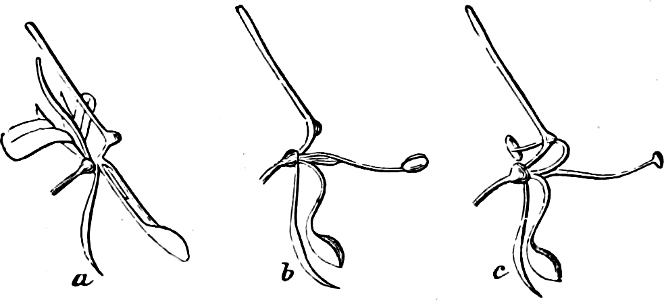
Fig. 521.—Flower of Lopezia.
A. Fruit a capsule. Œnothera (Evening Primrose) is 4-merous, has 8 stamens, a tubular receptacle, and an oblong capsule with loculicidal dehiscence leaving a centrally placed column, bearing the seeds.—Epilobium (Willow-herb) deviates from Œnothera especially in the seeds being hairy (at the chalazal end of the seed).—Chamænerium is a Willow-herb with zygomorphic flowers.—The following may be included here: Clarkia, Eucharidium (an Œnothera with 4 stamens and 3-lobed petals), Godetia and Boisduvalia, Jussiæa (dehiscence septicidal), Isnardia (petal-stamens absent, sometimes the petals also).—Lopezia has a peculiar, zygomorphic flower (Fig. 521); one of the four sepals is bent forwards and the other 3 backwards; the posterior petals are narrower than the 2 anterior ones which are turned obliquely backwards and bent like a knee, with a greenish nectary at the bend; 2 stamens, one only fertile (the posterior), while the anterior is barren, petaloid, and spoon-shaped; both are sensitive, which is essential for pollination. In Fig. 521, a represents an early stage, in which the stamen and style lie concealed in the staminode; b is the ♂ stage, the stamen projects from the centre of the flower; c, the ♀ stage, the style occupies the place of the stamen.
B. Fruit a berry. Fuchsia generally has a coloured calyx and tubular receptacle; the corolla may be wanting.
C. Fruit a nut. Circæa (Enchanter’s Nightshade) has a 2-merous flower (S2, P2, A2 + 0 [petal-stamens are wanting], G2). The flowers are borne in racemes without bracts.—Gaura.
D. Fruit a drupe. Trapa (Horn-nut); a peculiar aquatic plant; the submerged stem has long internodes and lanceolate leaves, falling off at an early period, but at each node are found 4 long roots with thin, lateral roots (sometimes erroneously regarded as leaves) borne pinnately; the stem reaching the surface of the water, bears a rosette of rhombic foliage-leaves, with large, inflated stalks containing air, and forming the floating apparatus of the plants. In the axils of the leaves (as in Gunnera) 8 small, stipular structures are present. The flowers are solitary in the axils of the foliage-leaves (S4, P4, A4 + 0, G2), semi-epigynous. There is an 8-lobed, crenate disc on the free portion of the ovary; one ovule in each loculus. The fruit is a drupe with 4 (or 2) prominent horns (the persistent sepals), which after the pulp has decayed away bear a series of hooks turned downwards on each side, i.e. sclerenchymatous bundles which formerly lay concealed in the pulp of the sepals. The germination is peculiar: one of the cotyledons is large, and its thick extremity remains in the fruit, the other however is small and is pushed out at the apex of the fruit together with the radicle and plumule; the development of the root soon ceases, and the plumule usually grows into a stem entirely without branches, similar to the one described above, only that 1–2 precisely similar shoots arise in the axil of each cotyledon, so that each embryo produces 3–5 shoots.—Trapa, by its mode of life, its 1-seeded fruit, etc., forms a transition to Haloragidaceæ.
The large-flowered forms are adapted for insect-pollination and are often protandrous, the small-flowered ones are homogamous and may pollinate themselves. Œnothera is adapted for hawk-moths and bees.—330 species; especially in temperate climates, chiefly in the Northern Hemisphere. Epilobium, Circæa are natives of this country; Trapa is extinct in this country, it has been found in a semi-fossilized condition near Cromer and in bogs in Denmark, and existed in Sweden until a few years ago; Œnothera has been introduced from N. Am.—A number of N. Am. species are grown as ornamental plants in our gardens. The seeds of Trapa natans are edible, and used as food in China.
Order 5. Haloragidaceæ. This is a reduced form of the Œnotheraceæ, and principally differs from these in the presence of endosperm and free styles. Only 1 ovule in each loculus.—84 species distributed over the entire globe; the majority are aquatic plants. The most advanced type is Myriophyllum (Water-Milfoil), with a regular, epigynous flower (S4, P4, A4 + 4, G4), most frequently diclinous (monœcious); the fruit is a 2–4-partite schizocarp. Aquatic plants, most frequently with pectinate, pinnate leaves.—Haloragis.—Gunnera (a dozen species from the Southern Hemisphere) forms the next step in the reduction. Large, scattered, rough-haired, and softly-spined leaves, with small flowers in crowded inflorescences. The flower, when most complete, has S2, P2, A2 (petal-stamens) and G2, forming an inferior, unilocular ovary with 1 ovule. It is remarkable for the great number of stipules placed in transverse rows in the leaf-axils, for the peculiar glandular organs, and for the colonies of Nostoc, which are found embedded in the cortex as a kind of parasite.—The simplest form is Hippuris (Mare’s-tail) with an extremely small, crenate or entire calyx, without corolla, and with only one stamen and one carpel, forming an inferior, unilocular ovary with only one ovule. Fruit a drupe with thin pulp. It is an aquatic plant with creeping, sympodial rhizome, and erect unbranched shoots, bearing numerous small, verticillate leaves. The small flowers are situated singly in the leaf-axils.
Order 6. Rhizophoraceæ. Tropical trees or shrubs (50 species, the best known being Rhizophora mangle, Mangrove) which grow gregariously, especially along the banks of rivers and by sea-coasts, where the water is quiet and brackish, and where they form the so-called Mangrove-swamps. Aerial roots are formed on the stems and branches (Fig. 522 A). The seeds germinate in the fruit, which by arrest contains only one seed (Fig. 522 B), before it is detached from the tree. The radicle projects considerably from the seed, and hangs down freely in the air; when the embryo is finally detached from the mother-plant, the separation is effected by the hood-like cotyledon, which entirely envelops the plumule, becoming detached from the rest of the embryo, which falls down, while the hood-like cotyledon remains enclosed in the fruit. The embryo, after it has fallen, strikes root, and continues growing in the undisturbed mud under the trees, or perhaps it may first be drifted about by the water, being well adapted for this by its peculiar, tough nature, and large, intercellular spaces.—It may also further be remarked that the anther is divided into a number of small loculi. The leaves are stipulate. The endosperm projects from the micropyle, growing out from the base of the seed, and thus serves as an organ of suction to convey nutriment to the embryo from the mother-plant.
Order 7. Combretaceæ. Trees and shrubs, partly lianes. An inferior, unilocular ovary with few pendulous ovules. Conocarpus and Laguncularia form, in conjunction with the species of Rhizophoraceæ, the tropical Mangrove-swamps. Terminalia.—280 species; Tropics.
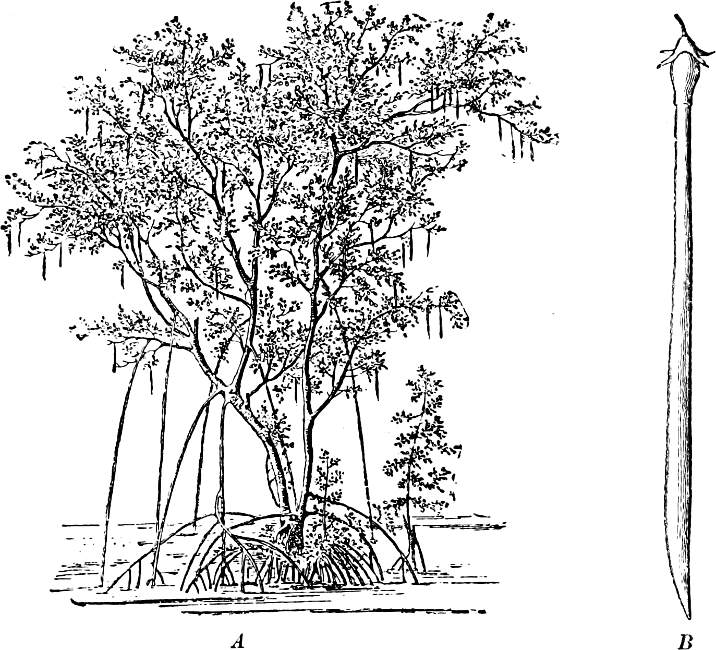
Fig. 522.—Rhizophora mangle with the germinating fruit (much reduced).
Order 8. Myrtaceæ (Myrtles). The plants belonging to this order are shrubs or trees, the majority being easily recognised by the vegetative characters. The leaves, for instance, are most frequently opposite, without stipules, undivided and entire, parchment-like or leathery, evergreen, aromatic, finely dotted by pellucid glands containing essential oils; the venation is penninerved with a nerve just inside and running parallel to the edge of the leaf. The flowers are regular, epigynous (Figs. 523, 524, 525) and ☿, most frequently 4- or 5-merous in the calyx and corolla, with many stamens (by splitting, so that they are often in several distinct bundles) and an ovary with one style, formed of 2–5–many carpels; the receptacle is most frequently united for its entire length with the ovary. The fruit varies, but is most frequently a berry. The embryo is thick, often curved, with united cotyledons; no endosperm.
1. Myrteæ, Myrtle Group. Chiefly American, though some are found also in Africa and Asia. The fruit is a berry with generally 2–5 loculi in the ovary, and many ovules in each.—Myrtus; Eugenia (the petals fall off together as a hood in the Clove, E. caryophyllata, Figs. 523, 524); Myrcia; Jambosa; Amomis; Psidium, etc.
2. Puniceæ, Pomegranate Group. Only 2 species (Punica granatum; from Persia, Afghanistan), differing in several respects from the typical form of the Myrtaceæ. The leaves are generally opposite, without glands and marginal veins. The receptacle, calyx and corolla are red; the latter 5–8–(generally 6-) merous. Calyx valvate and corolla folded as in Lythraceæ, stamens also and epicalyx as in this order. The most characteristic feature is the inferior, spherical berry, with dry pericarp, formed from two whorls of carpels in two tiers (Fig. 525); the interior whorl, which is also the lower, has 3 carpels, and the placentæ are situated in the inner angles of the 3 loculi; the external whorl is 5-merous, and the placentæ have originally the same position in the inner angles of the loculi, but their position is changed to the outer side of the loculi owing to the growth of the wall of the ovary, which takes place early, causing the carpels to become, as it were, turned inside out, so that the part which was turned downwards is turned upwards, and the part which was turned inwards becomes turned outwards (as in Mesembrianthemum). The edible part of the fruit is the fleshy testa, as in Ribes. The cotyledons are rolled together spirally.
Figs. 523, 524.—Eugenia caryophyllata.
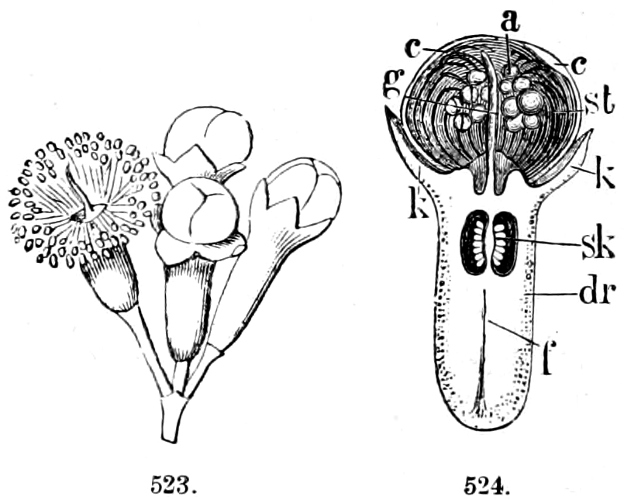
Fig. 523.—Flowers (nat. size).
Fig. 524.—A bud (“clove”), long. sec. (mag.).
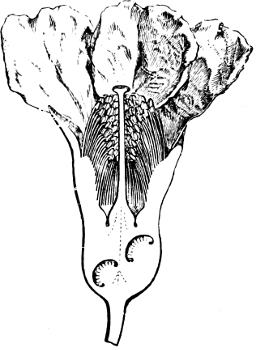
Fig. 525.—Punica granatum. Flower, long. sec. (nat. size).
3. Lecythideæ. The majority are South American. The leaves are scattered, without pellucid glands, and frequently dentate. The flowers are zygomorphic. The woody fruits are either indehiscent, or open by a lid. To this belong: Bertholletia (B. excelsa), the seeds well known as “Brazil-nuts,” Lecythis (Sapucaia-nuts from L. ollaria), Barringtonia.
4. Leptospermeæ. Almost entirely from Australia and the East Asian and Pacific Islands. The fruit is a capsule. The leaves are scattered, and in some placed edgewise by the twisting of the leaf-stalks.—Eucalyptus, the Australian Gum-tree; the calyx falls off like a lid (Figs. 526, 527). Some of the species attain gigantic heights, E. amygdalina 140–150 m. with a diameter of 8 m. The leaves in E. globulus are opposite and dorsiventral on the young plant; on the older scattered, placed edgewise by the twisting of the leaf-stalk, and isolateral; Metrosideros, Calothamnus (stamens distinctly polyadelphous), Melaleuca, Leptospermum, Callistemon (the flowers are borne in spikes whose axis continues to grow after flowering, thus several zones of fruits may be seen on the same branch).
Figs. 526, 527.—Eucalyptus globulus.
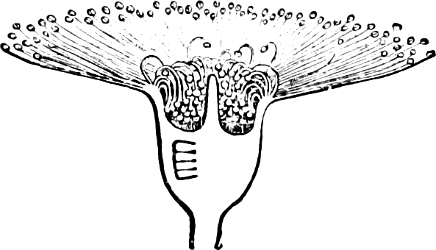
Fig. 526.—Long. sect. of flower.
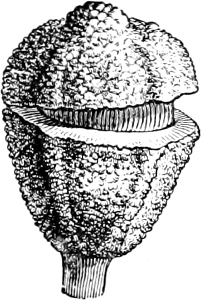
Fig. 527.—Flower opening.
5. Chamælaucieæ. Australian shrubs with heath-like appearance; they differ from the other Myrtaceæ in having a unilocular ovary with few, basal ovules, and a 1-seeded nut. The sepals are often pappus-like, and divided into many bristles.—Chamælaucium, Darwinia, etc.
This large order (2,100 species) is confined almost entirely to the Tropics, being found principally in America and Australia. In Europe, only Myrtus communis.—Several are useful on account of the large quantity of volatile oils (contained in internal glands): the flower-buds (“Cloves”) of Eugenia caryophyllata (the Moluccas, cultivated in the Tropics, Figs. 523, 524); the unripe, dry berries (“Pimento”) of Myrtus pimenta (Pimenta officinalis, W. Indies); Cajeput oil is extracted from Melaleuca minor and leucadendron (East Asian Islands). Eucalyptus globulus (Australia) has of late years become well known on account of its rapid growth, its hard wood, and its antipyretic qualities; it is cultivated on swampy soils, which it helps to drain.—Officinal: “Cloves,” and the cork of both stem and root of Punica granatum. Several have EDIBLE FRUITS, such as Psidium guyava (Guava, var. pomiferum and pyriferum, Am.), Eugenia cauliflora and others, E. jambosa, Punica granatum (the Pomegranate), etc. Edible seeds (with abundance of fatty oil): “Brazil nuts” from Bertholletia excelsa (Trop. S. Am.). “Bay-rum” is extracted from the leaves and fruits of the Bayberry-tree (Pimenta acris, W. Ind.); Guava-rum from the berries of Eugenia floribunda. Tannin is found in large quantities e.g. in Punica. Gum is formed by many Australian Eucalypti (“Gum-trees”). Ornamental plants cultivated in this country are: Myrtus communis (Mediterranean), several in conservatories, especially the Australian Leptospermeæ, Eucalyptæ and others.
Family 24. Umbellifloræ.
The flower is regular, ☿, and completely epigynous, 5- or 4-merous, with 1 whorl of stamens and 5–2 carpels. Sepals very small, tooth-like. The corolla is polypetalous, most frequently valvate in æstivation (least pronounced in the Umbelliferous plants). Round the base of the styles, which are generally free, there is an epigynous (undivided, or divided) nectar-disc (“stylar-foot”: Figs. 528 B, C, D; 539); the number of loculi in the ovary equals that of the carpels; only 1 pendulous (anatropous) ovule (Fig. 528 C) in each loculus. Endosperm copious (Fig. 528 D). To this must be added that the inflorescence in the majority of cases is an umbel or a capitulum, especially in the Umbelliferæ and Araliaceæ. Stipules are absent, but most frequently the base of the petiole forms a large sheath.
The Umbellifloræ are on one side so closely allied to the Frangulinæ, especially Rhamnaceæ, that they may perhaps be regarded as the epigynous continuation of this family. On the other hand, the similarities to the Rubiales, especially those between Cornaceæ and Sambuceæ, are so great that there is scarcely any character to distinguish them except the polypetalous corolla of the former and the gamopetalous corolla of the latter. Whether this is more than a merely analogous resemblance, and if not, whether the Cornaceæ at least should not be included in the Rubiales, must be left in abeyance.—The sepals are very small, as is generally the case in epigynous flowers.
Order 1. Cornaceæ. The majority of the species are shrubs with solid internodes, opposite (rarely scattered) leaves, which are simple, entire (rarely incised), penninerved, without stipules or large sheaths; flowers 4-merous (most frequently S4, P4, A4, G2), borne in dichasia which are either collected into corymbs (e.g. Cornus sanguinea), or in closely crowded umbels or capitula (Cornus mas, C. suecica), in which latter case there is often a large, leafy, or coloured, most frequently 4-leaved involucre round the base of the inflorescence; the style is undivided, with lobed stigma; the raphe of the ovule is turned outwards. The fruit is a berry or a drupe, with a 1–4-locular stone or 2 free stones.
Cornus (Dogwood, Cornel) has S4, P4, A4, G2. Leaves opposite.
Drupe with a bilocular, 2-seeded stone.—Aucuba, diœcious; unilocular ovary; 1 ovule; 1-seeded berry.—Garrya.—Helwingia.
80 species; N. Temp. The fruits of Cornus mas are edible; the wood is very hard; gum is found in some. Several species of Cornus and Aucuba japonica (Japan) are cultivated as ornamental shrubs.
Order 2. Araliaceæ (Ivies). Principally trees or shrubs with solid stems. The leaves are scattered, simple or compound, with a sheath more or less developed. The flowers are most frequently situated in umbels or capitula which are either borne singly or in racemes, or in paniculate inflorescences. The small, most frequently yellowish-green flowers are 5-merous, in the calyx, corolla, and andrœcium; the gynœceum may be 5-merous or may have some other number (2-∞). The styles are most frequently several, free; the raphe of the ovules is turned inwards as in the Umbelliferous plants. The fruit is a drupe or berry.—Stellate hairs often occur. The petals generally have a broad base, and a thick apex which is slightly incurved, and a distinctly valvate æstivation.
Hedera helix (Ivy) climbs by adventitious roots. The leaves are palminerved and lobed on the sterile branches, but often ovate and not lobed on the flowering branches. The flowers are yellowish-green and open in the autumn; they are slightly protandrous, and are visited by flies and wasps. Berries black. Endosperm ruminate.—Panax. Aralia (with Dimorphanthus).
375 species, 51 genera; especially in the Tropics (E. Asia).—The Ivy, several species of Aralia, e.g. A. japonica (Fatsia), Gastonia palmata, are cultivated as ornamental plants. Paper is manufactured from the pith of Aralia papyrifera (China).
Order 3. Umbelliferæ. The stem is herbaceous with hollow internodes; the leaves are scattered, and have a broad, amplexicaul base, a large, most frequently inflated sheath, and generally a pinnate (often very much dissected) blade. Entire leaves are found in Hydrocotyle vulgaris; Bupleurum.
The flowers are ☿, regular, small, but collected in compound umbels, that is, in “simple umbels,” which again are borne in umbels (for exceptions see Hydrocotyleæ); the external flowers in the simple umbel have often subtending bracts, which surround the base as an involucre, and may be termed the small involucre; the internal ones have no bracts; when involucral leaves are present at the base of the compound umbel, they may be termed the large involucre.
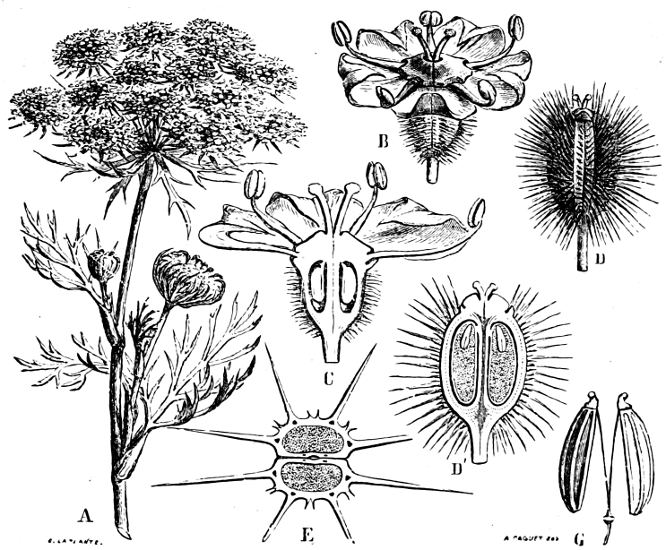
Fig. 528.—Daucus carota with flower and fruit.
The flower has 5 sepals (the median, as usual, posterior), 5 petals, 5 stamens and 2 carpels (in the median line) (Fig. 528). The calyx is often scarcely indicated. The petals have a short claw are most frequently obcordate, or have an incurved apex (Fig. 528 B, C), being incurved in the bud; they are white, rarely yellow (Fennel and Parsnips), blue or red. The flowers are sometimes zygomorphic, especially those on the circumference of the umbel, and in that case it is the petal which is directed outside (anterior) which is the largest, and the two posterior are the smallest (e.g. Heracleum). The stamens are incurved in the bud. The 2 free styles unite at the base into the “stylar-foot” (stylopod), a swollen nectary (Fig. 528 B, C); the ovary is bilocular, the raphe of the ovules being directed inwards. The fruit is a schizocarp, dividing into two mericarps; the plane in which these separate coincides with that of the union of the carpels, and the two nut-like mericarps are in most genera kept together for awhile at the top of a thin, bifid, or undivided stalk (carpophore) which is in direct continuation with the flower-stalk (Fig. 537). Each mericarp has most frequently 5 more or less strongly projecting ridges, the primary ridges (Figs. 530, 532, 534, 535, etc.), of which 3 lie on the back of the mericarp, the dorsal ridges, and 2 on its edge near the plane of division, the marginal ridges; five of these (10 ridges in all in the entire fruit) are placed opposite the calyx-teeth and the others between them. In some genera there are in addition 4 secondary ridges to each mericarp between the primary ones (Fig. 528 E: the secondary ridges bear the long bristles). Inside these secondary ridges, or inside the grooves between the primary ridges, when the secondary ridges are absent, oil ducts (vittæ, schizogenous ducts) are found in the pericarp, most frequently one in each groove; two are also often found on the ventral side of each mericarp (Figs. 528 E, 530 ol, etc.). The seed is most frequently united with the pericarp. The embryo is small and lies high up in the large, most frequently horny endosperm (Fig. 528 D).—The endosperm does not contain starch, but oil, and presents three different forms, of important systematic value: (a) those which are quite flat on the ventral side (i.e. the side turned towards the plane of splitting) (Figs. 528 E, 530, 531, 534, etc.): the majority of the genera, Orthospermeæ (e.g. Carum, Pastinaca); (b) those in which the endosperm on the ventral side is provided with a longitudinal groove, often deep: Campylospermeæ (e.g. Anthriscus); the transverse section is nearly a crescent (Fig. 532); (c) those in which the endosperm is concave on the ventral side (hollow in both longitudinal and transverse sections): Cœlospermeæ (e.g. Coriandrum) (Fig. 538).
The genera are distinguished first of all by the endosperm and forms of fruit, the ridges and oil-ducts; then by the form of the umbel, the calyx and corolla, by the absence or presence of an involucre, etc.
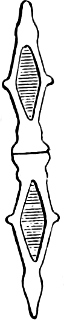
Fig. 529.—Hydrocotyle vulgaris. Transverse section of fruit.
1. Hydrocotyleæ, Penny-wort Group. Capitula or simple umbels (all the other groups have compound umbels). No oil-ducts. Orthospermous.—Hydrocotyle (Penny-wort). The fruit is considerably compressed laterally (Fig. 529). The calyx-teeth are small. The leaves are peltate.—Didiscus.—Sanicula (Sannicle). The umbels are small, capitate, generally collected in a raceme; calyx-teeth distinct. ♂-and ♀-flowers in the same umbel. The fruits are round, studded with hooked bristles. No carpophore.—Astrantia has an umbel surrounded by a large, often coloured involucre, with this exception it is the same as the preceding, but the fruit is slightly compressed, with 5 equal ridges. Hacquetia (Dondia).—Eryngium (Sea Holly): leaves often thorny. The flowers are all sessile, the inflorescence is thus a capitulum; each flower is often subtended by a bract, which is thorny like the involucre, resembling the burrs of the Teasel. The sepals are large.—Lagœcia: one of the loculi of the ovary is suppressed.
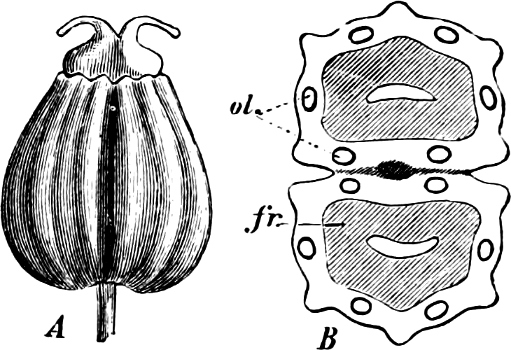
Fig. 530.—Fruit of Carum petroselinum: fr endosperm; ol oil-ducts.
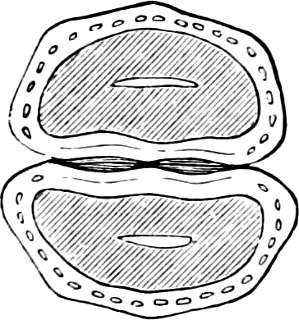
Fig. 531.—Pimpinella. Transverse section of fruit.
2. Ammieæ, Caraway Group (Figs. 530–532). The fruit has only the 10 primary ridges; it is usually short, almost spherical or broadly ovate and distinctly compressed laterally. Oil-canals are most frequently present. Orthospermous (except Conium).—Cicuta (Cow-bane). Pointed calyx-teeth. Glabrous herbs with pinnate or bipinnate leaves. C. virosa has a thick, vertical rhizome, divided by transverse septa into many compartments; the leaflets are narrow, lanceolate, and dentate; the large involucre is wanting.—Apium (Celery). No calyx-teeth. A. graveolens, a maritime plant, has neither large nor small involucre; the umbels are short-stalked or sessile.—Carum (Caraway). Calyx-teeth small; the large involucre is wanting or is only few-leaved. C. carvi (Caraway). C. petroselinum, (Parsley) (Fig. 530). Falcaria; Ammi; Helosciadium; Bupleurum (Hare’s-ear) with simple leaves and yellow corolla; Pimpinella (Fig. 531); Sium; Ægopodium (A. podagraria, Gout-weed) has bi- or tri-ternate leaves, with ovate, dentate leaflets; the large involucre is wanting.—Conium is campylospermous (Fig. 532); the short, broadly ovate fruit has distinctly projecting, often wavy crenulate ridges. C. maculatum (Hemlock) has a round, smooth stem with purplish spots.
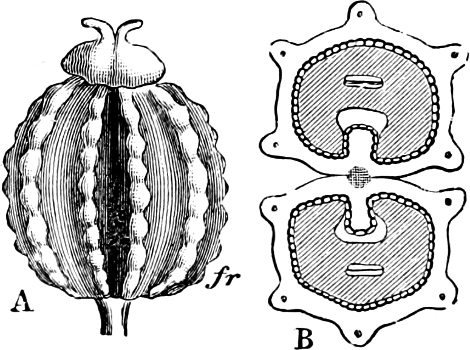
Fig. 532.—Conium maculatum. Fruit entire and in transverse section.
3. Scandiceæ. This group has a distinctly oblong or linear fruit which is slightly compressed laterally, and generally prolonged upwards into a “beak”; wings absent. Campylospermous. Otherwise as in the Ammieæ.—Anthriscus (Beaked Parsley) has a lanceolate fruit, round on the dorsal side, without ridges, but with a ten-ridged beak.—Scandix (Shepherd’s-needle).—Chærophyllum (Chervil): fruit lanceolate or linear with low, blunt ridges; beak absent or very short. C. temulum has a red-spotted, hairy stem.—Myrrhis (Cicely) has a short beak and sharp, almost winged ridges. M. odorata (Sweet Cicely) has very long fruits.
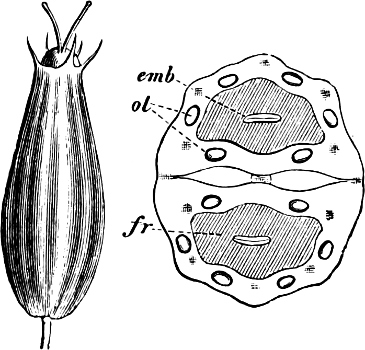
Fig. 533.—Œnanthe phellandrium. Fruit entire and in transverse section. emb The embryo; ol the oil-ducts; fr endosperm.
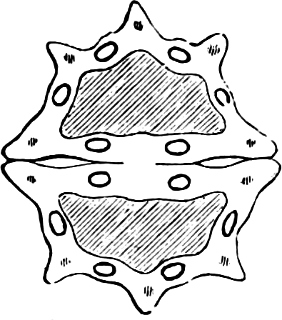
Fig. 534.—Fœniculum vulgare. Fruit in transverse section.
4. Seselineæ, Fennel Group (Figs. 533, 534). The fruit is slightly elliptical or oblong, in transverse section circular or nearly so, without grooves in the dividing plane; only primary ridges are present. Orthospermous.—Fœniculum (Fennel) has yellow petals; both involucres are wanting; the fruit is oblong. The ridges are thick, all equally developed, or the lateral ridges are slightly larger (Fig. 534).—Æthusa (A. cynapium, Fool’s Parsley); the large involucre is wanting or is reduced to one leaf, the small involucre is composed of three linear leaves which hang downwards on the outer side of the umbels. The fruit is spherical-ovate, with thick, sharp, keeled ridges, the lateral ones of which are the broadest.—Œnanthe (Dropwort); the fruit (Fig. 533) has usually an ovate, lanceolate form, with distinct, pointed sepals and long, erect styles; the ridges are very blunt, the marginal ones a trifle broader than the others.—Seseli, Libanotis, Cnidium, Silex, Silaus, Meum, etc.
5. Peucedaneæ, Parsnip Group (Figs. 535–537). The fruit is most frequently very strongly compressed dorsally, with broad, mostly winged, lateral ridges. Only primary ridges. The dorsal ridges may project considerably, but are not winged. Orthospermous.
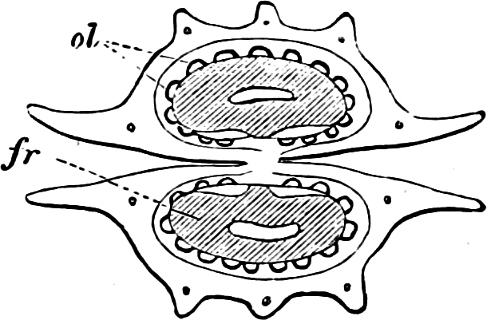
Fig. 535.—Archangelica officinalis. Transverse section of fruit.
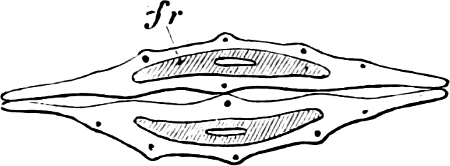
Fig. 536.—Scorodosma fœtidum. Transverse section of fruit.
a. The winged lateral ridges stand out from each other, so that the fruit appears to be 4-winged (Fig. 535).—Angelica; Archangelica (Fig. 535); Levisticum (Lovage).
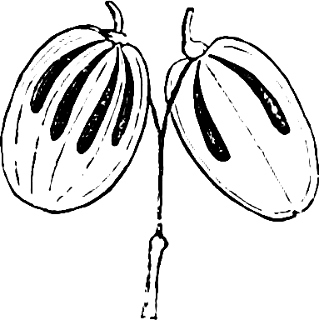
Fig. 537.—Heracleum sphondylium. Fruit.
b. The winged lateral ridges lie close together, and form one wing on each side of the fruit (Fig. 536).—Pastinaca (Parsnip). Corolla yellow. The dorsal ridges are very weak; the oil-ducts do not reach quite as far as the base of the fruit. Both large and small involucres are wanting; leaflets ovate. Anethum (Dill) is a Parsnip with more distinct dorsal ridges and filamentous leaflets. Peucedanum (Hog’s-fennel); Ferula (with Scorodosma, Fig. 536, and Narthex); Dorema.—Heracleum (Cow-parsnip); the flowers in the margin of the umbels are often very large, zygomorphic, and project like rays, e.g. in H. sibiricum. The fruit is very flat, with very small dorsal ridges; the oil-ducts are more or less club-like and do not reach as far as the base of the fruit (Fig. 537). Imperatoria; Tordylium.
6. Dauceæ, Carrot Group (Fig. 528). The fruit has 18 ridges, i.e. each fruitlet has 5 primary and 4 secondary ridges, the latter being often more prominent and projecting further than the primary ones. The oil-ducts are situated under the secondary ridges (Fig. 528).
a. Orthospermous: Daucus (Carrot). The secondary ridges project much further than the primary, and bear on their crests a series of hooked spines (Fig. 528 D, E); these are much longer than the small bristles on the primary ridges. The involucral leaves of D. carota (Carrot) are numerous and deeply pinnate; the inflorescence contracts during the ripening of the fruit, and since the external umbels have longer stalks than the central ones, they arch over them, and the inflorescence becomes hollow. For the terminal flower, see below.—Cuminum; Laserpitium; Melanoselinum.
b. Campylospermous: Torilis (Hedge Parsley). The primary ridges are covered with bristles; the secondary ridges are not. very distinct on account of the spines, which entirely fill up the grooves. Caucalis (Bur Parsley).
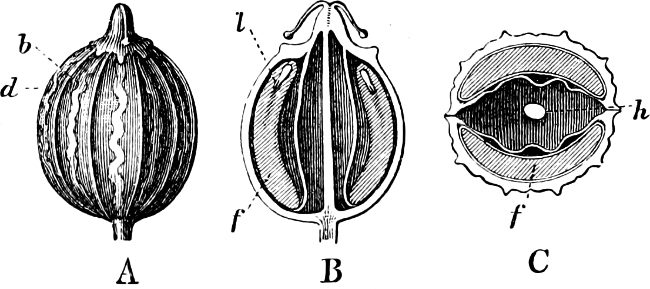
Fig. 538.—Coriandrum sativum: b secondary ridges; d primary ridges; f endosperm; l embryo.
c. Cœlospermous: Coriandrum (Coriander) has a smooth, spherical fruit (Fig. 538) with a distinct, 5-dentate calyx, the two anterior (i.e. turned outward) teeth being generally longer than the others; the two fruitlets scarcely separate from each other naturally; all the ridges project only very slightly, the curved primary ones least, the secondary ridges most.
Pollination. The flowers are adapted for insect-pollination; they secrete nectar at the base of the styles; individually they are rather small and insignificant, but yet are rendered conspicuous by being always crowded in many-flowered inflorescences. Protandry is common, sometimes to such an extent that the stamens have already fallen off before the styles begin to develop (Fig 539, 2). Insect visits are more frequent and numerous as the inflorescences are more conspicuous. The flowers as a rule are ☿, but ♂-flowers are often found interspersed among the others (Fig. 539), and the number of these becomes greater on the umbels developed at the latest period. A terminal flower, which differs from the others in form, and in Daucus carota often in colour also (purple), is sometimes found in the umbel. The nectar lies so exposed and flat that the flowers are principally visited by insects with short probosces, especially Diptera; bees are less frequent visitors, and butterflies rare.—1400 species (175 genera); especially from temperate climates in Europe, Asia, N. Am. About 68 species in this country.
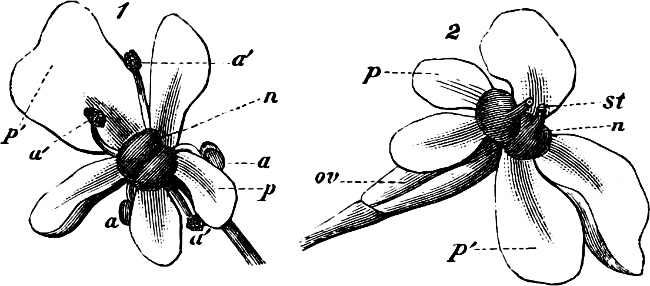
Fig. 539.—Anthriscus silvester: 1 ♂-flower; 2 ☿-flower.
Uses. A few are cultivated as ornamental plants. They are, however, useful in medicine,[38] and for culinary purposes on account of the essential oils and gum-resins which in many are formed in root, stem, and fruit. The FRUITS of the following are used: Carum carvi [+] (Caraway), Carum petroselinum (Parsley; also the leaves and root; its home is the Eastern Mediterranean); Fœniculum capillaceum [+] (Fennel; S. Europe); Pimpinella anisum [+] (Anise; E. Mediterranean); Coriandrum sativum [+] (Coriander; S. Eur.); Œnanthe phellandrium (Water Dropwort); Cuminum cyminum (Point Caraway; Africa; cultivated in S. Europe); Anethum graveolens (Dill). The LEAVES of the following are used as pot-herbs: Anthriscus cerefolium (Chervil); Myrrhis odorata (Sweet Cicely; Orient.); Conium maculatum [+] (the green portions; Hemlock). Besides Parsley, the ROOTS of the following are used: Carrot, Parsnip, Sium sisarum (Sugar-root; E. Asia); Chærophyllum bulbosum (Chervil-root); Levisticum officinale (foliage-shoots; S. Europe); Imperatoria ostruthium; Apium graveolens (Celery, the root in conjunction with the internodes); Pimpinella saxifraga and magna (Pimpinell); Archangelica (Angelica, the root of A. norvegica was formerly an article of food in Norway). Poisonous alkaloids are found in a few, such as Fool’s Parsley (Æthusa cynapium), Hemlock (Conium maculatum), Cow-bane (Cicuta virosa) and species of Œnanthe.—Gum-resin is extracted from various species: “Galbanum” from Ferula galbaniflua [+] and rubricalis [+] (Persia); Asafœtida from Ferula scorodosma [+] and F. narthex [+]; Ammoniac-gum from Dorema ammoniacum [+], all from Central and S. W. Asia. “Silphium” was an Umbelliferous plant which grew in ancient times in Cyrene, and from which the Romans extracted a valued condiment.
Family 25. Hysterophyta.
This family (with the exception of Aristolochiaceæ) includes only parasitic plants. Partly on this ground, and partly because they all have epigynous flowers, they are considered to belong to the youngest type (which is expressed in the name ὕστερος, the one that comes after). It is not certain to which of the preceding families they are most nearly allied. Again, it is a matter of doubt whether the Aristolochiaceæ are related to the others; they are by Engler united with Rafflesiaceæ into one family, Aristolochiales.
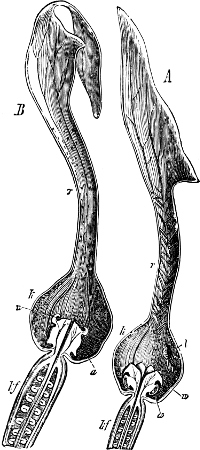
Fig. 540.—Flower of Aristolochia clematitis (long. sect.). A Before pollination, and B after: n stigma; a anthers; t an insect; kf ovary.
Order 1. Aristolochiaceæ. The majority are perennial herbs or twining shrubs, whose stalked, simple, and generally more or less cordate or reniform leaves are borne in 2 rows and are exstipulate. The flowers are hermaphrodite, epigynous, regular or zygomorphic; perianth-leaves united, simple but most frequently petaloid and 3-merous; 6 or 12 (in Thottea as many as 36) stamens with extrorse anthers. The ovary is more or less completely 4–6-locular with ovules attached in the inner angles of the loculi (Fig. 540 kf). The style is short, and has a large, radiating stigma (Fig. 540 n). Fruit a capsule. Seeds rich in endosperm.
Asarum europæum. Each shoot has 2 reniform foliage-leaves, between which the terminal flower is borne (the rhizome becomes a sympodium by development of the bud in the axil of the upper foliage-leaf). The flower is regular and has a bell-shaped perianth with 3 outer valvate, and 3 inner small segments (which may be wanting). 12 (2 × 6) free, extrorse stamens, 6 carpels.—Aristolochia clematitis (Birth-wort) has an erect, unbranched stem, bearing many flowers in the leaf-axils, in a zig-zag row (accessory buds in a unipared scorpioid cyme). The flowers are zygomorphic (Fig. 540), formed by 3 alternating, 6-merous whorls. The perianth has a lower, much-distended part (k), succeeded by a narrow, bent tube (r), which passes over into an oblique, almost tongue-like projection (6 vascular bundles indicate that the number 6 is prevalent here, as in Asarum); 6 stamens (Fig. 540 a), with the dorsal portion turned upwards, are united with the short style to form a stylar column; they are placed quite beneath the 6 commissural stigmatic rays, which arch over them as short, thick lobes. Protogynous; Pollination is effected in Arist. clematitis by small flies; these enter the erect unfertilised flower through the tube (Fig. 540 A, l) without being prevented by the stiff, downwardly-turned hairs which line the tube and prevent their escape; they find the stigma (n) fully developed, and may pollinate it with the pollen they have brought with them. The stigmas then straighten and wither (B, n), the anthers open, and the flies may again be covered with pollen; but the hairs which blocked up the tube do not wither until the anthers have shed their pollen, and only then allow the imprisoned flies to escape and effect cross-pollination. Prior to pollination, the flowers stand erect, but after this has taken place they become pendulous, and the perianth soon withers.—A. sipho (Pipe-flower), another species, is a climber, and often grown in gardens; it has only one row of accessory buds in the leaf-axils.—200 species; chiefly in S. Am. Officinal: the rhizome of Aristolochia serpentaria (N. Am.).
Fig. 541.—A fruit of Myzodendron brachystachyum (slightly mag.) germinating on a branch.
Order 2. Santalaceæ. Parasites containing chlorophyll, which, by the help of peculiar organs of suction (haustoria) on their roots, live principally on the roots of other plants. Some are herbs, others under-shrubs. The regular, most frequently ☿-flowers have a simple perianth, which is gamophyllous, 3- or 5 partite with the segments valvate in the bud, and a corresponding number of stamens opposite the perianth-leaves. In the inferior ovary there is a free, centrally placed, often long and curved placenta with three ovules (one opposite each carpel); these are naked, or in any case have an extremely insignificant integument. Fruit a nut or drupe. Seed without testa. Endosperm fleshy. 225 species; chiefly in the Tropics.—Thesium, a native, is a herb with scattered, linear leaves and small 5-merous flowers (P5, A5, G3) in erect racemes; the subtending bracts are displaced on the flower-stalks. Fruit a nut.—Osyris (diœcious shrub; 3-merous flowers) is another European genus.—Santalum album, which grows in E. Ind., yields the valuable, scented Sandalwood, the oil of which is used medicinally.—Quinchamalium.
Myzodendron is a reduced form of the Santalaceæ; the ♂-flowers are without perianth; the perianth of the ♀-flower is 3-merous. About 7 species; S. Am.; parasitic on a Beech (Nothofagus). The fruit has 3 feathery brushes, alternating with the lobes of the stigma, which serve as flying organs and to attach the fruits to a branch (Fig. 541), the brushes twining round as soon as they come in contact with it. There is only 1 seed in the fruit, which germinates by a long, negatively heliotropic hypocotyl, and is attached by a radicle modified into an haustorium.
Order 3. Loranthaceæ (Mistletoes). Plants containing chlorophyll which are parasites on trees, and most frequently have opposite, simple, entire leaves and regular, epigynous, often unisexual, 2- or 3-merous flowers, with single or double perianth. Stamens equal in number and opposite to the perianth-leaves, free, or in varying degrees united to one another. The inferior ovary is constructed as in the Santalaceæ, the ovules being situated on a low, free, centrally-placed placenta, but the placenta and ovules unite with the wall of the ovary into one connected, parenchymatous mass, in which the embryo-sacs are imbedded. Only 1 (less frequently 2–3) of the 1–6 embryo-sacs is fertile. The number of the carpels however varies. The fruit is a 1-seeded berry, whose inner layer is changed into a tough slimy mass (bird-lime), which serves to attach the fruits to other plants.
The two groups, Loranthoideæ and Viscoideæ, are distinguished by the fact that the former has a distinct “calyculus,” i.e. an entire or lobed, or dentate swelling on the receptacle below the perianth. The majority of the Loranthoideæ have a petaloid perianth; in all the Viscoideæ, on the other hand, it is sepaloid.
Fig. 542.—Viscum album: A branch with leaves and berries: a scale-leaves; b foliage-leaves; n m n flowers; B seedling, the bark of the branch being removed; C an older embryo which still retains the cotyledons.
Fig. 543.—To the left the Rafflesiaceous Cytinus hypocistus, parasitic on the roots of Cistus. To the right the Balanophoraceous Cynomorium coccineum, parasitic on the roots of Salicornia.
The Mistletoe (Viscum album, Fig. 542) is a native, evergreen plant which may be found growing on almost any of our trees (sometimes on the Oak), and, like other Loranthaceæ, it produces swellings of the affected branches. Its spherical white berries (Fig. 542 A) enclose (1–) 2–3 green embryos; they are eaten by birds (especially Thrushes), and are partly sown with their excrement, partly struck or brushed off the branches of the trees, the seed being enclosed, at maturity, by viscin, i.e. “bird-lime.” The seeds may also germinate on the branches, without having first passed through the alimentary canal of the birds. On germination, the hypocotyl-axis first appears, as in Fig. 541, and bends towards the branch; the apex of the root then broadens, and forms at the end a disc-like haustorium, from the centre of which a root-like body grows through the bark into the wood, and ramifies between the bark and wood. Suckers are developed on the root like strands which are formed in this manner, without, however, having a rootcap; they are green, and penetrate the wood by the medullary rays (Fig. 542 C). Adventitious buds may also be developed from the root-like strands which break through the bark and emerge as young plants. The young stem quickly ceases its longitudinal growth, and lateral shoots are developed from the axils of its foliage-leaves. These and all following shoots have a similar structure; each of them bears a pair of scale-leaves (Fig. 542 A, a) and a pair of foliage-leaves (Fig. 542 A, b), and then terminates its growth, if it does not produce an inflorescence; new lateral shoots proceed from the axils of the foliage-leaves, and the branching, in consequence, is extremely regular and falsely dichotomous. Only one internode (shoot-generation) is formed each year, so that each fork indicates one year. The foliage-leaves fall off in the second year. The inflorescence is a 3(-5)-flowered dichasium (Fig. 542 A, m is the central flower, n the lateral). The plants are diœcious; the ♂-flower as a rule is 2-merous: perianth 2 + 2, each leaf of which bears on its inner side 6–20 pollen-sacs, each of which opens by a pore; this relationship may be considered to have arisen from the union of the perianth-leaves with the multilocular stamens (2 + 2) placed opposite them. The ♀-flowers always have Pr 2 + 2, G2.—Loranthus is also found in Europe (it has a 3-merous flower), especially in the central and south-eastern districts, on Quercus cerris and Q. pubescens; but the great majority of the 520 species grow in the Tropics on trees which they ornament with their often brightly-coloured flowers, and ultimately kill when present in too great numbers. The pollination in the numerous Loranthaceæ with unisexual flowers, is effected by the wind. In Viscum album this takes place in autumn, the actual fertilisation in the following spring, and the maturity in November or December; in the succeeding month of May the berry is ready to germinate, and falls off.
Uses. Birdlime from Viscum album.
Order 4. Rafflesiaceæ and Order 5. Balanophoraceæ. These orders comprise root-parasites, almost entirely devoid of chlorophyll; they are reddish or yellow, without foliage-leaves (Fig. 543). As far as our knowledge of these rare tropical plants extends, they have thalloid organs of vegetation resembling the root-like strands of Viscum, or they are filamentous and branched like Fungus-hyphæ; they live in and on the tissues of the host-plant, from which their flowering-shoots, often of mushroom-like form, are subsequently developed (Fig. 543). In order to unfold they must often break through the tissues of the host-plant.
Of the Rafflesiaceæ, Cytinus hypocistus is found in S. Europe living on roots of Cistus-plants and to some extent resembling Monotropa (Fig. 543). Rafflesia is the best known; it lives on roots of Cissus-species (belonging to the Ampelidaceæ) in Java; its yellowish-red, stinking flowers attain a gigantic size (one metre or more in diameter), and are borne almost directly on the roots of the host-plant. Besides these there are other genera: Brugmansia, Pilostyles, Hydnora.—To Balanophoraceæ (Fig. 543) belong: Balanophora, Langsdorffia, Scybalium, Sarcophyte, Helosis, etc., and in S. Europe, Cynomorium coccineum.
Sub-Class 2. Sympetalæ.
The characters which separate this from the first Sub-class, the Choripetalæ, have been described on page 336. They consist in the following: the flower is always verticillate, generally with 5 sepals, 5 petals, 5 stamens, and 2 carpels (in the median plane), the calyx is generally persistent and gamosepalous, the corolla is gamopetalous and united to the stamens, which are therefore adnate to it, the ovules have only one thick integument and a small nucellus. (The exceptions are noted later.)
This Sub-class is no doubt more recent than the Choripetalæ; it is also peculiar in including fewer trees and shrubby forms than the latter.
The Sympetalæ may be separated into 2 sections:—
A. Pentacyclicæ (five-whorled). The flowers in this section have 5 whorls equal in number, namely, 2 staminal whorls in addition to the calyx, corolla, and carpels; in some instances, one of the staminal whorls is rudimentary or entirely suppressed, but in this case it is frequently the sepal-stamens which are suppressed, and the whorl which is present stands opposite the petals. The flowers are regular. The number of carpels equals that of the sepals, but in one of the orders (Bicornes) they are opposite the petals (the flower being obdiplostemonous); in the other two orders (Primulinæ and Diospyrinæ) they are placed opposite the sepals (the flower being diplostemonous). This section is the most closely allied to the Choripetalæ, since the petals may sometimes be found entirely free, and the stamens inserted directly on the receptacle (Ericaceæ); ovules with two integuments are also found. It is very doubtful, whether the orders included under this head have any relationship with the other Sympetalæ. They appear in any case to represent older types.
B. Tetracyclicæ (four-whorled). The flowers have only 4 whorls, namely, beside sepals, petals, and carpels, only one whorl of stamens, which alternates with the petals; there is no trace of the second staminal whorl, and when the number of carpels is the same as that of the preceding whorls (“isomerous”) they alternate with the stamens; but in most cases there are 2 carpels placed in the median plane (see the diagrams, e.g. Figs. 559, 567, 583, 590, etc.). This section is the largest, and the one which shows the characteristics of the Sympetalæ best. Very irregular flowers are met with.
The following families belong to the Pentacyclicæ: 26, Bicornes; 27, Diospyrinæ; 28, Primulinæ.
The remaining families belonging to the Tetracyclicæ are:—
a. Hypogynous flowers (with a few exceptions): 29, Tubifloræ; 30, Personatæ; 31, Nuculiferæ; 32, Contortæ.
b. Epigynous flowers: 33, Rubiales; 34, Dipsacales; 35, Campanulinæ; 36, Aggregatæ. The ovaries and ovules in the last family are always reduced to one; and at the same time the fruits become nuts, and the flowers are united into crowded inflorescences.
A. Pentacyclicæ.
Family 26. Bicornes.
This family is chiefly composed of shrubs, less frequently of small trees, or perennial herbs; their leaves are undivided, most frequently evergreen, stiff and leathery, and always without stipules. The flowers are ☿ and regular, rarely slightly zygomorphic, most frequently obdiplostemonous, and 4- or 5-merous through all the 5 whorls. The stamens are attached to the receptacle, and as a rule are quite free from the petals, an attachment which is very rare among the Gamopetalæ. They have a simple gynœceum with one undivided style, a commissural stigma, and a multilocular ovary, whose axile placentæ project considerably into the loculi, and bear a large number of ovules. The placentæ are sometimes not united, and in consequence, the ovary is 1-locular with incomplete partition-walls, e.g. Pyrola, Monotropa. Embryo straight, with endosperm. The carpels are placed opposite the petals.
The diagram is generally Sn, Pn, An + n, Gn, in which n is 4 or 5. To this may be added, that the corolla is in most cases gamopetalous, but in some (especially Pyrolaceæ) perfectly polypetalous; and that the anthers usually open by pores, and often have two horn-like appendages (hence the name “Bicornes”) (Figs. 545, 546); frequently the two halves of the anther are also widely separated from each other at the upper end, so that the pores are placed each one at the end of its own tube (Fig. 546); the pollen-grains in the majority are united into tetrads (Fig. 542 D).—The flowers, as a rule, are pendulous and borne in racemes, coloured (red or white), but odourless. When the fruit is a capsule, the placenta with the seeds attached persists as a central column. A mycorhiza occurs on many.
The majority of plants belonging to this family inhabit cold and temperate countries, or high mountains in tropical regions; they prefer cold and dry or damp places (bogs, heaths, etc.). Plentiful in N. America.
Order 1. Pyrolaceæ. Perennial herbs; petals most frequently quite free from each other, and falling off singly after flowering; the anthers are without appendages, and open by pores (Fig. 544), or by a transverse slit. The placentæ are thick. The seeds in the capsule-like fruit (loculicidal dehiscence) are exceedingly small and light, they have a sac-like testa which loosely envelops them, an oily endosperm, and an extremely simple embryo, which consists only of an ellipsoidal, cellular mass, without cotyledons or differentiation into plumule and radicle.
Pyrola (Winter-green) is green, and has also large evergreen foliage-leaves. The flowers, 5-merous, are most frequently borne in racemes without a terminal flower; the anthers are extrorse in the bud with the pores in the lower portion (Fig. 544 A), but they become inverted at a later period, so that the pores open at the top (Fig. 544 C). P. uniflora has a single, terminal flower; it winters by its roots, producing from these in the spring aerial, quite unbranched shoots. Chimaphila umbellata.
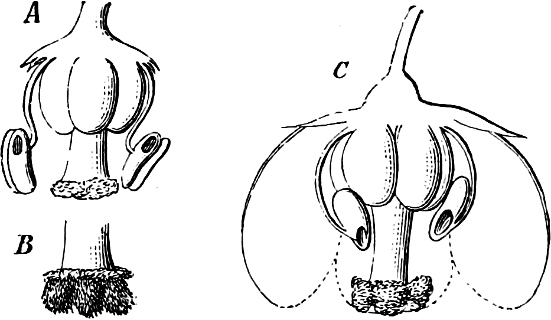
Fig. 544.—Pyrola minor: A portions of a young flower; B the stigma; C portions of an older flower (longitudinal section).
Monotropa (Yellow Bird’s-nest) is very pale yellow, without chlorophyll, succulent, and has only scale-like leaves closely pressed upon the stem; it is a saprophyte. The raceme has a terminal flower, and is pendulous before flowering. The anthers open by a semicircular, transverse cleft. M. hypopitys reproduces chiefly by root-shoots.
About 30 species, especially N. Europe, N. America, and N. Asia.
Order 2. Ericaceæ. The flower (Fig. 545) is hypogynous, the median sepal posterior; corolla, gamopetalous; the stamens are generally 2-horned, and the fruit is a capsule, less frequently a berry or drupe. At the base of the ovary is a nectar-secreting disc (Fig. 545 B). This order comprises shrubs or undershrubs (rarely small trees), which are evergreen, and as a rule have densely crowded leaves.
1. Ericeæ, Heath Group. Flowers most frequently 4-merous (S4, P4, A4 + 4, G4, united in a 4-locular gynœceum), rarely 5-merous. The withered corolla persists after flowering. The leaves are most frequently acicular, opposite or verticillate; the buds are without scales. The fruit is a capsule.—Calluna (C. vulgaris, Ling) has a deeply 4-cleft corolla, which is less than the coloured calyx; capsule with septicidal dehiscence.—Erica (about 420 species; E. tetralix, Cross-leaved Heath) has a tubular or bell-shaped, 4-dentate corolla, which is much longer than the calyx. Capsule with loculicidal dehiscence.—Pentapera.
2. Andromedeæ. The flowers are 5-merous (S5, P5, A5 + 5, G5), with deciduous corolla. Capsule with loculicidal dehiscence. The leaves are scattered, and incline more to the ordinary broad-leaved forms.—Andromeda; Gaultheria; Cassandra (Lyonia); Cassiope.
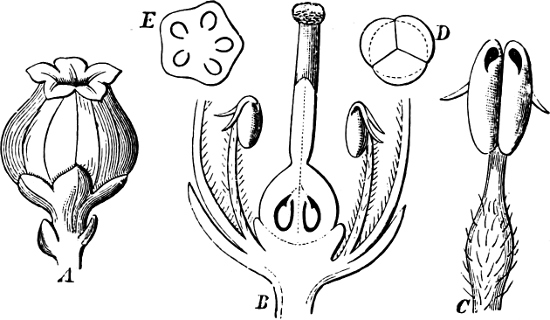
Fig. 545.—Arctostaphylos uva-ursi.
3. Arbuteæ. The flowers as in the preceding group (Fig. 545), but the fruit is a berry or drupe. Arctostaphylos (A. uva-ursi, Bear-berry) has a drupe with 5 stones in a dry, farinaceous pulp; in other species there is 1 stone with several loculi. Arbutus (A. unedo, Strawberry-tree) has a spherical berry.
Pollination is effected by means of insects, especially by bees. The pollen is light and dry, and is shaken out through the pores of the anthers when the insects agitate the horn-like appendages during their visits. Self-pollination takes place, no doubt, in many cases.—800 species; the very large genus, Erica, especially in S. Africa (the Cape).—Officinal: the leaves of Arctostaphylos uva ursi. Arbutus unedo (S. Europe) has an edible, peculiarly warted (strawberry-like) fruit. Many Erica-species are cultivated as ornamental plants.
Order 3. Rhodoraceæ (Rhododendrons). This differs from the preceding order in the median sepal being anterior, and hence the position of the other floral whorls is also reversed. The flower is hypogynous, in most cases 5-merous; the corolla is most frequently deeply cleft or polypetalous, and falls off after flowering; the anthers open by pores, and have no horn-like appendages. Capsule with septicidal dehiscence.—The shrubs or small trees belonging to this order have, like the Vaccineæ, ordinary foliage-leaves, and the buds are generally provided with large bud-scales.
Rhododendron has 10 stamens, and a slightly zygomorphic flower with deeply 5-cleft corolla (the section Azalea has frequently only 5 stamens, the petal-stamens being absent). They are Alpine plants (200 species) in the mountains of Asia, especially the Himalayas; some in S. Europe.—Menziesia.—Ledum; small, rusty-brown, hairy shrubs with polypetalous, expanded, star-like corolla.—Kalmia (N. Am.) has a cupular corolla, with 10 small, pocket-like depressions in which the anthers are concealed until the arched, elastic filaments are freed from this position by means of the insects, when they quickly straighten themselves in the centre of the flower.—Phyllodoce; Loiseleuria (5 stamens); (Clethra (?); also placed among the Ternstrœmiaceæ).