DIVISION V. ANGIOSPERMÆ.
Michael Cresse Potter translation
See pages 3 and 224. To this Division belong the majority of the Flowering-plants. They are divided into two parallel classes, the Monocotyledons and the Dicotyledons, which differ from each other not only in the number of cotyledons, which, with a few exceptions, is one in the former, two in the latter, but also in the internal structure of the stem, the venation of the leaves, the number of the parts of the flower, etc. Assuming that these two classes have sprang from a common origin, it is amongst the Helobieæ in the first, and amongst the Polycarpicæ in the second class that we might expect to find closely allied forms, which might reasonably be supposed to have varied less from this original type. As for the rest, they seem to stand quite parallel, without exhibiting any close relationship. It is scarcely proved that the Monocotyledons are the older class.
[Our knowledge of the forms included under the Angiosperms has recently been considerably increased by Treub (Ann. d. Jar. Bot. d. Buitenzorg, 1891), who has shown that the Casuarinas differ in many important points from the typical Angiosperms. Among other characters the pollen-tube is found to enter the ovule near the chalaza and therefore at the opposite end to the micropyle, and Treub therefore suggests that these plants should be placed in a subdivision termed Chalazogams.
According to this view the principal divisions of the Angiosperms would be represented thus:—
Angiospermæ.
Sub-division. Sub-division.
Chalazogames. Porogames.
Class. Classes.
Chalazogames. Monocotyledones, Dicotyledones.
More recently Nawaschin (Bull. Acad. Imp. Sci. St. Petersb., ser. iii., xxxv.) has shown that Betula, and Miss Benson (Trans. Linn. Soc., 1894) that Alnus, Corylus, and Carpinus also belong to the Chalazogams.
Our knowledge, however, is still so incomplete that one would hesitate to accord the full systematic value which Dr. Treub attaches to his discovery until the limits of the Chalazogamic group are better defined; and it would hardly be justifiable to include the Casuarinas and the above-noted genera in one family.]
Class 1. Monocotyledones.
The embryo has only one cotyledon; the leaves are as a rule scattered, with parallel venation; the vascular bundles of the stem are closed, there is no increase of thickness. The flower is typically constructed of five 3-merous whorls, placed alternately.
The embryo is generally small in proportion to the abundant endosperm (exceptions, see Helobieæ), and its single cotyledon is often sheath-like, and very large. On the germination of the seed either the entire cotyledon, or its apex only, most generally remains in the seed and absorbs the nutritive-tissue, while the lower portion elongates and pushes out the plumule and radicle, which then proceed with their further growth. The primary root in most cases soon ceases to grow, but at the same time, however, numerous lateral roots break out from the stem, and become as vigorous as the primary root, or even more so. Increase in thickness does not take place in these roots; they branch very little or not at all, and generally die after a longer or shorter time.
The stem is frequently a corm, bulb, or other variety of underground stem, as the majority of the Monocotyledons are perennial, herbaceous plants; it has scattered, closed vascular bundles (Fig. 276), and no cambium by which a continuous thickening may take place. The stem of the Palms, however, attains a very considerable thickness, which is due to the meristem of its growing-point continually increasing in diameter for a lengthened period (often for many years), until it has reached a certain size. In this condition the growing-point has the form of an inverted cone, and it is only when this cone has attained its requisite size that the formation of a vertical cylindrical stem commences. Certain tree-like Liliaceæ, as Dracæna, Aloe, etc., have a continuous increase in thickness; this is due to a meristematic layer, which arises in the cortex, outside the original vascular bundles, which were formed at the growing-point of the stem. This meristem continues to form thick-walled parenchyma and new, scattered vascular bundles. The primary vascular bundles, in the Palms and others, run in a curved line from their entrance into the stem at the base of the leaf, towards the centre of the stem, and then bend outwards and proceed downwards in a direction more parallel to the sides of the stem (Fig. 277). The bundles formed later, in those stems which increase in thickness, are not continued into the leaves.
The branching as a rule is very slight, the axillary buds of the majority of the leaves never attaining development, e.g. in the Palms, bulbous plants and others. As the cotyledon arises singly, the succeeding leaves also must be scattered, but they are frequently arranged in two rows (Grasses, Iris, etc). The first leaf borne on a branch (the “Fore-leaf,”[24]—the bracteole, if on a floral shoot) has generally, in the Monocotyledons, a characteristic form and position, being situated on the posterior side of its own shoot, and hence turned towards the main axis; it is sometimes provided with two laterally-placed keels (Figs. 279 f, 290 øi), but the midrib is often absent. It arises in some cases from two primordia, which at the beginning are quite distinct, and thus has been regarded as formed by two leaves. It is, however, only one leaf, a fact which is evident from several circumstances, one being that it never supports more than one shoot, and this stands in the median plane (Fig. 279).
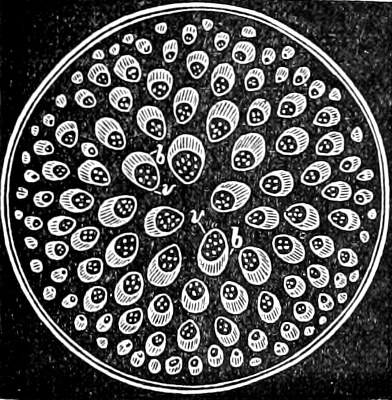
Fig. 276.—Transverse section of the stem of a Palm: v v is the wood portion, b b the bast portion of the vascular bundled.
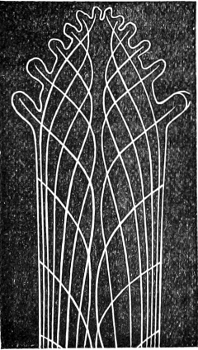
Fig. 277.—Diagrammatic representation of the course of the vascular bundles, from the stem into the leaves in a Monocotyledon.
The leaves are amplexicaul, and have a large sheath but no stipules; the blade is most frequently long, ligulate, or linear, entire, with parallel venation, the veins being straight or curved (Figs. 300, 309). Connecting the large number of veins which run longitudinally, there are as a rule only weak transverse ones. It is very rarely that other forms of leaves are found, such as cordate (Figs. 302, 312), or that the blade is branched, or the venation is, for example, pinnate or palmate (Figs. 225, 298); these deviations are especially found in the Araceæ, the Palms, the Scitamineæ (Fig. 308), the Dioscoreaceæ, and in several aquatic plants. The incisions in the Palm-leaf are derived by the splitting of an originally entire leaf.
The structure of the flower is generally as follows: Pr3 + 3, A3 + 3, G3, rarely S3 + P3 with the other members unchanged.[25] Instead of 3, the numbers 2 and 4 may occur; rarely others. In all these instances there are 5 whorls, which regularly alternate with one another, most frequently in the 3-merous flower, as in the diagram (Fig. 278). This diagram is found in the following orders: Liliaceæ, Convallariaceæ, Juncaceæ, Bromeliaceæ, Amaryllidaceæ, Dioscoreaceæ, Palmæ, some Araceæ, and in some small orders, and may be considered as the typical structure and also the starting point for the exceptional orders. The ovary in many Monocotyledons has many ovules, and the fruit becomes a many-seeded berry or capsule; this form is no doubt the oldest. In others the number of seeds becomes reduced to 1, and the fruit then becomes a cypsela, or a drupe (e.g. Gramineæ, Cyperaceæ, Palmæ, etc).
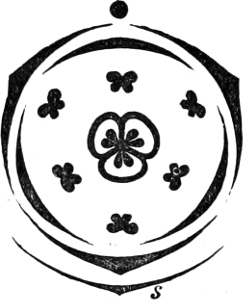
Fig. 278.—Diagram of the ordinary, regular flower in the Monocotyledons: s is the bract.
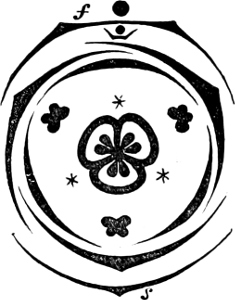
Fig. 279.—Diagram of Iris: f the bracteole; in its axil is a shoot with its bracteole.
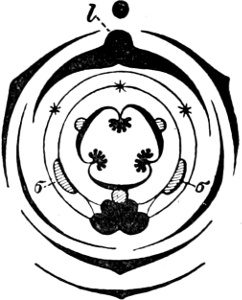
Fig. 280.—Diagram of Orchis: l the lip; σ σ the two staminodes.
Deviations from this typical floral structure in some instances may be traced to suppression, very rarely to a splitting of certain members, the typical relative positions not being changed. Thus, the Iridaceæ, the Cyperaceæ, most of the Gramineæ and some Juncaceæ deviate in having only 3 stamens (Fig. 279), the inner whorl (indicated by *) not becoming developed. The Musaceæ differ in the posterior stamen not being developed; Zingiberaceæ (Fig. 314), Marantaceæ, and Cannaceæ, in the fact that only 1 of all the stamens bears an anther, and the others are either suppressed or developed into petaloid staminodes, with some perhaps cleft in addition. The Orchideæ deviate in having, generally, only the anterior stamen of all the 6 developed (Fig. 280). In this, as in other instances, the suppression of certain parts of the flower is often connected with zygomorphy (i.e. symmetry in one plane), chiefly in the inner perianth-whorl, but also in the other whorls. In the Orchids, the perianth-leaf (the labellum, Fig. 280 l) which is directly opposite the fertile stamen, is larger and altogether different from the others. The perianth-leaves may also be suppressed; see, for example, the two diagrams of the Cyperaceæ (Fig. 284). In some orders the suppression of these leaves, which form the basis of the diagram, is so complete that it is hard to reduce the actual structure of the flower to the theoretical type, e.g. the Grasses (Fig. 290) and Lemna (Fig. 303). In the first family, which especially comprises water-plants, a somewhat different structure is found; thus Fig. 282 differs somewhat from the ordinary type, and other flowers much more so; but the floral diagrams which occur in this family may perhaps be considered as the most probable representatives of an older type, from which the ordinary pentacyclic forms have taken their origin. In favour of this theory we have the larger number of whorls, the spiral arrangement of some of these in the flower, with a large and indefinite number of stamens and carpels, the perfectly apocarpous gynœceum which sometimes occurs, etc., etc.
The Monocotyledons are divided into 7 Families:—
1. Helobieæ. This family forms a group complete in itself. It commences with hypogynous, perfect flowers, whose gynœcium is apocarpous and terminates in epigynous and more or less reduced forms.
2. Glumifloræ. These have as a starting point the same diagram as the following families, but otherwise develope independently.
3. Spadicifloræ. Also an independent branch, or perhaps two different ones which terminate in much reduced forms.
4. Enantioblastæ. These ought perhaps to be amalgamated with the following family.
5. Liliifloræ. These advance from forms with the typical diagram and hypogynous flower, to epigynous and reduced forms.
6. Scitamineæ and
7. Gynandræ. Two isolated families, which probably have taken their origin from Liliifloræ, and have epigynous, mostly zygomorphic, and much reduced forms.
Family 1. Helobieæ.
To this family belong only water- or marsh-plants; the endosperm is wanting, and they possess an embryo with a very large hypocotyl prolonged downwards and often club-like. The perianth is often differentiated into calyx and corolla; the flower is regular, and in the first orders to be considered, may be reduced to the ordinary Monocotyledonous type; there are, however, usually found two 3-merous whorls of carpels (Fig. 282), and thus in all 6 whorls, or again, the number of carpels may be indefinite; the number of stamens also may be increased, either by the division of the members of a whorl, or by the development of additional whorls. Syncarps,[26] with nut or follicular fruitlets, are very common, for example, in the first orders; in the last (Hydrocharitaceæ) the carpels are not only united, but the ovary is even inferior.
The primitive type appears to be a hypogynous flower, similar to that of the Juncaginaceæ or Alismaceæ, with several 3-merous whorls, and free carpels, each with many ovules; the green perianth in this instance being no doubt older than the coloured ones. If we take a flower with this structure as the starting point, then the family developes partly into epigynous forms, partly into others which are so strongly reduced and exceptional that it is scarcely possible to refer them to the ordinary type. The family, through the peculiar Zostereæ, appears to approach the Araceæ, in which Potamogetonaceæ and Najadaceæ are included by some authorities. However, the inclusion of Potamogeton, and with it Ruppia and Zannichellia, in the Juncaginaceæ appears quite correct. It would scarcely be right to separate Zostereæ from these. Great stress has often been laid upon the similarity with the Ranunculaceæ which is found in the Alismaceæ, but it is scarcely more than an analogous resemblance.
Order 1. Juncaginaceæ. The ☿, regular, hypogynous flowers have the perianth 3 + 3, sepaloid, stamens 3 + 3 (with extrorse anthers), and carpels 3 + 3 (free or united), of which last, however, one whorl may be suppressed (in Triglochin maritima all 6 carpels are developed, in T. palustris the inner whorl is unfertile). Inflorescence long spikes. Embryo straight.—Marsh-plants with radical, rush-like leaves, arranged in two rows, and often sheathing and ligulate (“squamulæ intravaginales”); the inflorescence is a spike or raceme.—Scheuchzeria. Carpels almost free; in each at least two ovules. Follicles.—Triglochin has long, fine racemes without bracts or bracteoles; one ovule in each carpel. The carpels in the two native species are united, but separate when ripe as a schizocarp, loosening from below; they open along the ventral suture or remain closed; a linear central column remains. The most reduced is Lilæa (1–2 sp. Am.)—Protogynous. About 10 species. Temp. Fossils in Tertiary.
Order 2. Potamogetonaceæ. The aquatic plants belonging to this order are perennial, living entirely submerged, or with floating leaves, and preferring still water. The leaves are alternate, in some linear and grass-like, in others there is an elliptical floating blade, supported by a linear submerged petiole. Axillary scales. The fruit is generally a syncarp with nuts or drupes; the embryo is curved, of very various forms.
Potamogeton (Pond-weed). The rhizome is creeping, sympodial (with two internodes in each shoot-generation); the inflorescence is a terminal, many-flowered spike, without floral-leaves; below it are found 2 foliage-leaves placed nearly at the same height, from whose axils the branching is continued cymosely. The flowers are ☿, 4-merous, naked, and consist only of 4 stamens, with the connectives, broadly developed at the back of the anthers, resembling a perianth, and of 4 free, sessile carpels. They are common plants in fresh water. The spike, during the flowering, is raised above the water. Wind-pollinated and protogynous.—Closely allied is Ruppia (Tassel Pond-weed), in salt or brackish water. The spike has only two naked flowers, each consisting of 2 stamens and 4 carpels. The stalks of the individual carpels are considerably prolonged.—Zannichellia (Horned Pond-weed) is monœcious; the ♀-flower consists of 4 (2–9) carpels, with membranous, bell-shaped perianth; long styles; the ♂-flower has 1 (-2) stamens. Althenia.
Zostera (Grass-wrack) is an entirely submerged, marine plant with creeping rhizome (with displacement of buds) and strap-shaped leaves. The flowering shoots are sympodia with displacement of the axes (Fig. 281). The inflorescence is a peculiar, flatly-compressed spike, on one side of which the flowers are borne (Fig. 281). This inflorescence may be considered, no doubt correctly, to be derived from the symmetrical spike of Potamogeton by strongly dorsiventral development, and by a strong suppression of the floral parts taking place simultaneously. Two rows of flowers are developed, but of these one is so pressed into the other that apparently only one is present. Each flower consists of only 1 stamen and 1 carpel situated at the same height (Fig. 281); the unilocular ovary encloses 1 pendulous ovule and bears a bifid style. As regards the perianth (?) one leaf may be present (Z. nana, Fig. 281 D). The pollen-grains are filamentous. Pollination takes place under water. Posidonia and Cymodocea are allied to these. About 70 species.
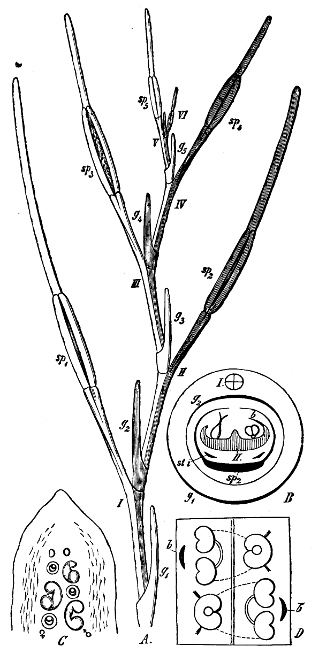
Fig. 281.—Zostera. A Diagram of the branching of the floral shoots: I, II ... are the successive shoot-generations, every other one being shaded; g1 g2 ... fore-leaves; sp1 sp2 ... spathes for the successive spikes. Each shoot is united for some distance with the parent axis (indicated by the half-shaded internodes). Each shoot commences with a fore-leaf turning towards the parent axis, g; succeeding this is the spathe, sp; and then the inflorescence. The fore-leaf supports a new lateral shoot. B Diagram of a shoot, II, which is borne laterally in the axil of the fore-leaf g1, on the shoot I, g2 its fore-leaf; sp2 its spathe; sti squamulæ intravaginales. II Is the spadix with stamens and carpels; b a perianth-leaf (or connective expansion, similar to those which occur in Potamogeton). C The upper portion of a young spadix with development of flowers. D Part of a spadix with 2 flowers; the parts which theoretically belong to one another are connected by a dotted line.
Order 3. Aponogetonaceæ. Aquatic plants with tuberous stem. They have a single, petaloid perianth (3–2–1–leaved), most frequently 6 stamens and 3(-6) carpels. Straight embryo.—About 15 species (Africa, Madagascar, Tropical Asia and Australia).—Aponogeton distachyos and A. (Ouvirandra) fenestralis are grown in conservatories; the latter has lattice-like, perforated leaves.
Order 4. Najadaceæ. Only one genus Najas (about 10 species); annual fresh water plants with leaves in pairs and solitary, unisexual flowers. The ♂ flower is remarkable in having a terminal stamen, which has either 4 longitudinal loculi or 1 central one; on this account the stamen of Najas is considered by some authorities to be a stem and not a leaf-structure. The unilocular gynœceum and the single, erect, anatropous ovule are also terminal. Pollination takes place under the water.
Order 5. Alismaceæ. The regular, hypogynous flowers are in some species unisexual by the suppression of either andrœcium or gynœceum; they have a 6-merous perianth, generally differentiated into 3 sepals and 3 petals; generally 6 stamens in the outer whorl (by the division of the 3; Fig. 282) and often several 3-merous whorls inside these, and 6–∞ free carpels arranged cyclically or spirally. Fruit a syncarp.—Marsh- or water-plants with radical leaves and long-stalked inflorescences.
A. Butomeæ. Follicles with many seeds, which are borne on nearly the whole of the inner surface of the cyclic carpels (as in Nymphæaceæ). Embryo straight.—Butomus (Flowering Rush, Fig. 282), has an umbel (generally composed of 3 helicoid cymes). S 3, P 3, stamens 9 (6 + 3, i.e. the outer whorl doubled), G 3 + 3. B. umbellatus; creeping rhizome with triangular Iris-like leaves.—Hydrocleis. Limnocharis.
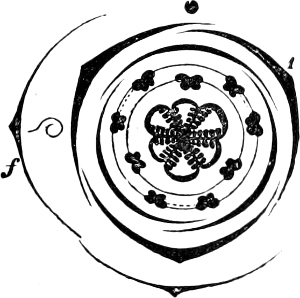
Fig. 282.—Diagram of Butomus: f bracteole.
B. Alismeæ. Fruit achenes. Latex common (in the intercellular spaces). The flowers are arranged most frequently in single or compound whorls. Embryo curved, horse-shoe shaped.—Alisma has S 3, P 3, A 6 (in 1 whorl, grouped in pairs, i.e. doubled in front of the sepals), and 1 whorl of 1-seeded achenes on a flat receptacle. The leaves are most frequently radicle, long-stalked; the lamina have curved longitudinal veins, and a richly branched venation. A. plantago.—Elisma (E. natans) has epitropous (turned inwards) ovules, whilst the ovules of Alisma, Sagittaria and others are apotropous (turned outwards).—Echinodorus (E. ranunculoides) has a convex receptacle, carpels many, united and capitate. Damasonium.—Sagittaria (Arrow-head) has monœcious flowers, several whorls of stamens and spirally-arranged achenes on a very convex receptacle. S. sagittifolia reproduces by tuberous buds formed at the end of long, submerged branches. The leaves, in deep and rapidly running water, are long and strap-shaped, but in the air arrow-shaped.
Honey is secreted in the flower and pollination effected by insects. Alisma plantago has 12 nectaries. The submerged flowers of Elisma natans remain closed and are self-pollinated. Butomus has protandrous flowers. There are about 50 species, which mostly grow outside the Tropics.—Uses insignificant. The rhizome of some is farinaceous.
Order 6. Hydrocharitaceæ. This order differs chiefly from the preceding in its epigynous flowers. These are in general unisexual (diœcious), and surrounded by a 2-leaved or bipartite spathe; they are 3-merous in all whorls, but the number of whorls is generally greater than 5, sometimes even indefinite. The perianth is divided into calyx and corolla. The ovary is unilocular with parietal placentation, or more or less incompletely plurilocular. The fruit is berry-like, but usually ruptures irregularly when ripe. Embryo straight.—Most often submerged water-plants, leaves seldom floating on the surface. Axillary scales (squamulæ intravaginales).
Hydrocharis. Floating water-plants with round cordate leaves; S3, P3 (folded in the bud); ♂-flowers: 3 (-more) flowers inside each spathe; stamens 9–15, the most internal sterile. ♀-flowers solitary; three staminodes; ovary 6-locular, with many ovules attached to the septa; styles 6, short, bifid. [The petals of the ♀-flowers bear nectaries at the base. In this and the following genus the pollination is without doubt effected by insects.] H. morsus ranæ (Frog-bit) has runners; it hibernates by means of special winter-buds.—Stratiotes; floating plants with a rosette of linear, thick, stiff leaves with spiny margin, springing from a short stem, from which numerous roots descend into the mud. Inflorescence, perianth, and ovary nearly the same as in Hydrocharis, but the ♂-flower has 12 stamens in 3 whorls, of which the outer 6 are in 1 whorl (dédoublement), and inside the perianth in both flowers there are numerous (15–30) nectaries (staminodes?). S. aloides (Water-soldier); in N. Eur. only ♀-plants.—Vallisneria spiralis is a tropical or sub-tropical plant, growing gregariously on the mud in fresh water. The leaves are grass-like, and the plants diœcious; the ♂-flowers are detached from the plant, and rise to the surface of the water, where they pollinate the ♀-flowers. These are borne on long, spirally-twisted peduncles which contract after pollination, so that the ♀-flower is again drawn under the water, and the fruits ripen deeply submerged.—Elodea canadensis is also an entirely submerged plant. The leaves are arranged in whorls on a well-developed stem. Only ♀-plants in Europe (introduced about 1836 from N. Am). This plant spreads with great rapidity throughout the country, the reproduction being entirely vegetative. Hydrilla, Halophila, Thalassia, Enhalus.—In many of these genera the number of whorls in the flower is remarkably reduced; for example, in Vallisneria, in the ♂-flowers to 2: Pr 3, A (1-) 3, in the ♀ to 3: Pr 3, Staminodes 3, G 3.—About 40 species; Temp. and Trop.
Family 2. Glumifloræ.
The hypogynous flowers in the Juncaceæ are completely developed on the pentacyclic, trimerous type, with dry, scarious perianth. Even in these the interior whorl of stamens becomes suppressed, and the ovary, which in Juncus is trilocular with many ovules, becomes in Luzula almost unilocular, but still with 3 ovules. The perianth in the Cyperaceæ and Gramineæ is reduced from hairs, in the first of these, to nothing, the flowers at the same time collecting more closely on the inflorescence (spike) supported by dry bracts (chaff); the number of stamens is almost constantly 3; stigmas linear; the ovary has only 1 loculus with 1 ovule, and the fruit, which is a capsule in the Juncaceæ, becomes a nut or caryopsis.—The endosperm is large and floury, the embryo being placed at its lower extremity (Figs. 286 B, 291).—The plants belonging to this order, with the exception of a few tropical species, are annual or perennial herbs. The stems above ground are thin, and for the most part have long internodes, with linear, parallel-veined leaves which have long sheaths, and often a ligule, i.e. a membranous projection, arising transversely from the leaf at the junction of the sheath and blade. The underground stems are short or creeping rhizomes. The flowers are small and insignificant. Wind- or self-pollination.
Order 1. Juncaceæ (Rushes). The regular, hermaphrodite, hypogynous flowers have 3 + 3 brown, dry, free perianth-leaves projecting like a star during the opening of the flower; stamens 3 + 3 (seldom 3 + 0) and 3 carpels united into one gynœceum (Fig. 283); the ovary is 3- or 1-locular; there is as a rule 1 style, which becomes divided at the summit into 3 stigmas, often bearing branches twisted to the right (Fig. 283). Fruit a capsule with loculicidal dehiscence. The embryo is an extremely small, ellipsoidal, cellular mass, without differentiation into the external organs.
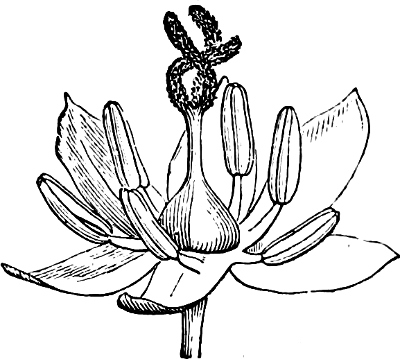
Fig. 283.—Flower of Luzula.
Juncus (Rush) has glabrous foliage-leaves, generally cylindrical, rarely flat; the edges of the leaf-sheath are free (“open” leaf-sheaths) and cover one another. The capsule, 1- or 3-locular, with many seeds—Luzula (Wood-Rush) has flat, grass-like leaves with ciliated edges; the edges of the leaf-sheath are united (“closed” leaf-sheath). The capsule unilocular and 3-seeded.—Prionium: S. Africa; resembling a Tacona.
The interior whorl of stamens, in some species, disappears partially or entirely (J. supinus, capitatus, conglomerates, etc.)
Some of the numerous Juncus-species (e.g. J. effusus, glaucus, conglomeratus, etc.), have false, lateral inflorescences, the axis of the inflorescence being pushed to one side by its subtending leaf, which apparently forms a direct continuation of the stem, and resembles it both in external and internal structure. The foliage-leaves of this genus were formerly described as “unfertile stems,” because they are cylindrical, erect, and resemble stems, and consequently the stem was said to be “leafless”: J. effusus, glaucus, conglomeratus. Stellate parenchynatous cells are found in the pith of these stems and in the leaves. Other species have distinct terminal inflorescences and grooved leaves; J. bufonius (Toad-rush), compressus, and others. The inflorescences most often present the peculiarity of having the lateral axes protruding above the main axis. Their composition is as follows:—The flowers have either no bracteoles, and the inflorescences are then capitulate; or they have 1–several bracteoles. Each branch has then, first, a 2-keeled fore-leaf placed posteriorly (“basal-leaf”), and succeeding this are generally several leaves borne alternately and in the same plane as the basal-leaf, the two uppermost (the “spathe-leaves”) being always barren; those which lie between the basal-leaves and the spathe-leaves are termed “intermediate-leaves.” If only branches occur in the axils of the basal-leaves, then the succeeding branches are always borne on the posterior side of the axis, and form a fan[27]; if the basal-leaf is barren, and if there is only one fertile intermediate-leaf, then the lateral axes are always on the upper side, and a sickle[27]-like inflorescence occurs; if there are 2 fertile intermediate-leaves, then a dichasium is formed, and in the case of there being several, then a raceme, or spike.
Juncaceæ are, by several authors, classed among the Liliifloræ, but there are so many morphological and partly anatomical features agreeing with the two following orders, that they may, no doubt, most properly be regarded as the starting point of these, especially of the Cyperaceæ, which they resemble in the type of flowers, the inflorescence, the type of mechanical system, and the stomata.
Pollination by means of the wind. Cross-pollination is often established by protogyny. J. bufonius has partly triandrous and cleistogamic, partly hexandrous, open flowers.—Distribution. The 200 species are spread over the entire globe, but especially in cold and temperate countries; they are seldom found in the Tropics.—Uses. Very slight; plaiting, for instance.
Order 2. Cyperaceæ. The majority are perennial (seldom annual) herbs living in damp situations, with a sympodial rhizome and grass-like appearance. The stems are seldom hollow, or have swollen nodes, but generally triangular, with the upper internode just below the inflorescence generally very long. The leaves are often arranged in 3 rows, the leaf-sheath is closed (very seldom split), and the ligule is absent or insignificant. The flowers are arranged in spikes (spikelets) which may be united into other forms of inflorescences (chiefly spikes or racemes). The flowers are supported by a bract, but have no bracteoles. In some genera the perianth is distinctly represented by six bristles corresponding to six leaves (Figs. 284 A, 286 A); in others it is represented by an indefinite number of hairs (Fig. 284 B), and very frequently it is altogether wanting. The inner whorl of stamens is absent, and the flower has therefore 3 stamens (rarely more or less than 3), the anthers are attached by their bases to the filament (innate) and are not bifid (Figs. 286). Gynœceum simple, formed of 3 or 2 carpels; 1 style, which is divided at the extremity, as in the Juncaceæ, into 3 or 2 arms; the single loculus of the ovary contains one basal, erect, anatropous ovule; the stigmas are not feather-like. Fruit a nut, whose seed is generally not united with the pericarp. The embryo is small, and lies at the base of the seed in the central line, surrounded on the inner side by the endosperm (Fig. 286 B). On germination the cotyledon does not remain in the seed.
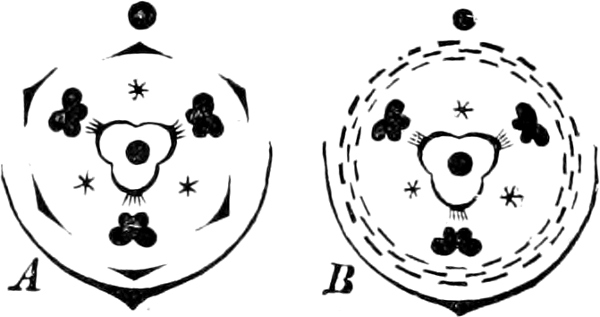
Fig. 284.—Diagram of structure of: A Scirpus silvaticus; B Eriophorum angustifolium.
A regular perianth, with 6 scale-like perianth-leaves in 2 whorls, is found in Oreobolus. In Scirpus littoralis the perianth-leaves are spreading at the apex, and divided pinnately.
The branching of the inflorescence is often the same as in the Juncaceæ, and supports the theory that these two orders are related. In Rhynchospora and others, the “spikelets” are really only “spike-like” and to some extent compound.
A. Scirpeæ. Hermaphrodite Flowers.
1. Spikelets cylindrical, the bracts arranged spirally (in many rows). The lower ones are often barren, each of the others supports a flower.—Scirpus (Club-rush). The spikelets are many-flowered; the perianth is bristle-like or absent, and does not continue to grow during the ripening of the fruit (Fig. 286 A). Closely allied to this is Heleocharis, with terminal spikes.—Eriophorum (Cotton-grass) differs chiefly in having the perianth-hairs prolonged, and forming a bunch of white, woolly hairs (Fig. 284 B).
Cladium and Rhynchospora (Beak-rush) differs especially in the few-flowered, compound spikelets which are collected into small bunches; the latter has received its name from the fact that the lowermost portion of the style remains attached to the fruit as a beak.
2. Spikelets compressed, the bracts arranged only in two rows; the other characters as in the first-mentioned. Cyperus (spikelets many-flowered); Schœnus (Bog-rush); spikelets few-flowered; S. nigricans has an open sheath.
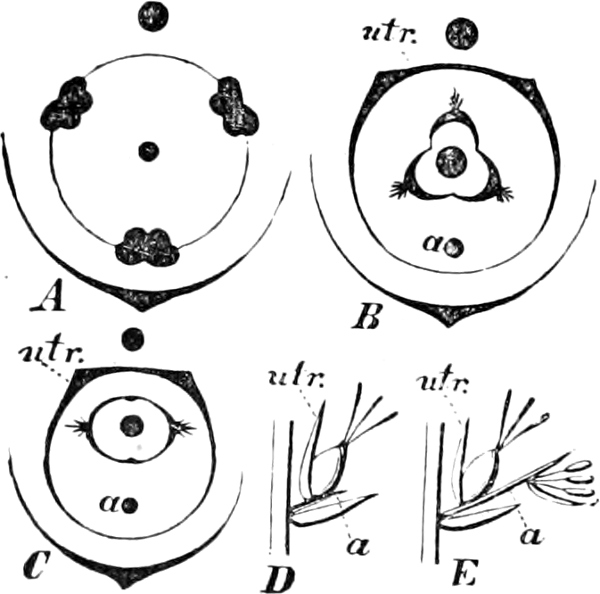
Fig. 285.—Carex: A diagram of a male flower; B of a female flower with 3 stigmas; C of a female flower with 2 stigmas; D diagrammatic figure of a female flower; E similar one of the androgynous (false) spikelet of Elyna. The ♂ is here represented placed laterally; it is terminal, according to Pax.
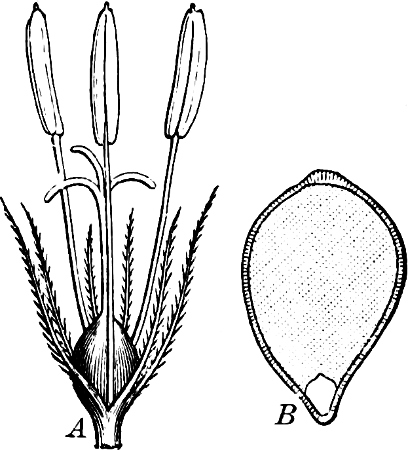
Fig. 286.—A Flower of Scirpus lacustris. B Seed of Carex in longitudinal section.
B. Cariceæ. Unisexual Flowers.
In the ♂-flowers there is no trace of a carpel, and in the ♀ no trace of a stamen. Floral-leaves in many rows. In some (Scleria, certain Carex-species), ♂-and ♀-flowers are borne in the same spikelet, the latter at the base or the reverse; in the majority each spikelet is unisexual.
Carex (Fig. 285) has naked, most frequently monœcious flowers. The ♂-spikes, which are generally placed at the summit of the whole compound inflorescence, are not compound; in the axil of each floral-leaf (bract) a flower is borne, consisting only of a short axis with three stamens (Fig. 285 A). The ♀-spikes are compound; in the axil of each floral-leaf is borne a very small branch (Fig. 285 D, a) which bears only one leaf, namely, a 2-keeled fore-leaf (utriculus, utr. in the figures) which is turned posteriorly (as the fore-leaves of the other Monocotyledons), and being obliquely sheath-like, envelopes the branch (in the same manner as the sheath of the vegetative leaves), and forms a pitcher-like body. In the axil of this leaf the ♀-flower is situated as a branch of the 3rd order, bearing only the 2–3 carpels, which are united into one gynœceum. The style protrudes through the mouth of the utriculus. The axis of the 2nd order (a in Fig. 285 D) may sometimes elongate as a bristle-like projection (normally in Uncinia, in which it ends as a hook, hence the name); this projection is in most cases barren, but it sometimes bears 1–several bracts which support male-flowers; this is normal in Elyna (or Kobresia) and Schœnoxiphium; the axis (a in 285 E) bears at its base a female-flower supported by the utriculus, and above it a male-flower supported by its bract.
Pollination by means of the wind. Protogynous. Sometimes self-pollinated. The order embraces nearly 3,000 species, found all over the world. Carex and Scirpus are most numerous in cold and temperate climates, and become less numerous towards the equator. The reverse is the case with Cyperus and other tropical genera. They generally confine themselves to sour, swampy districts; some, on the other hand, are characteristic of sand-dunes, such as Sand-star (Carex arenaria). There are about 70 native species of Carex.
Uses. In spite of their large number, the Cyperaceæ are of no importance as fodder-grasses, as they are dry and contain a large amount of silica; hence the edges of many of the triangular stems or leaves are exceedingly sharp and cutting. Cyperus esculentus has tuberous rhizomes, which contain a large amount of fatty oil and are edible (earth-almonds); it has its home in the countries of the Mediterranean, where it is cultivated.
Cyperus papyrus (W. Asia, Egypt, Sicily) attains a height of several metres, and has stems of the thickness of an arm which were used by the ancient Egyptians for making paper (papyrus). Some serve for plaiting, mats, etc. (Scirpus lacustris, etc.). Isolepis is an ornamental plant.
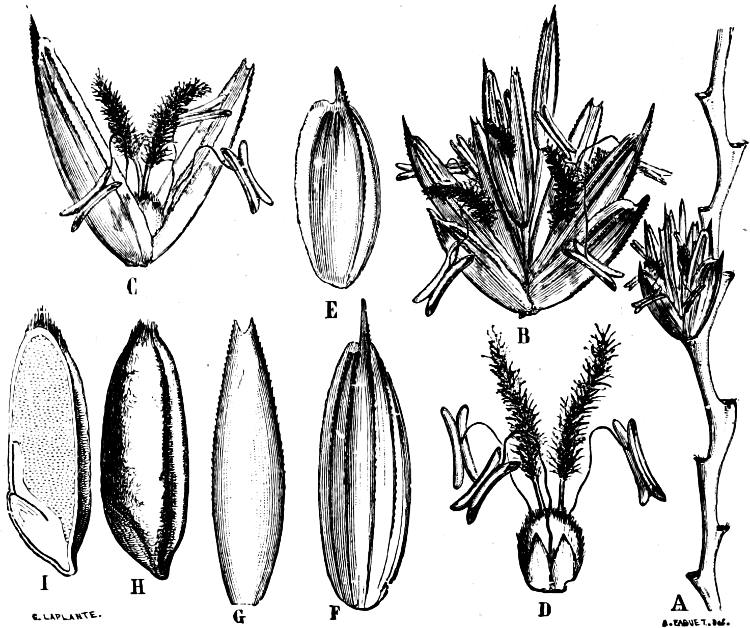
Fig. 287.—Triticum: A axis (rachis) of ear showing the notches where the spikelets were inserted; B an entire spikelet; C a flower with the pales; D a flower without the pales, showing the lodicules at the base; E glume; F outer pale; G inner pale; H fruit; I longitudinal section of fruit.
Order 3. Gramineæ (Grasses). The stems are cylindrical, generally hollow with swollen nodes, that is, a swelling is found at the base of each leaf which apparently belongs to the stem, but in reality it is the swollen base of the leaf. The leaves are exactly alternate; the sheath is split (excep. Bromus-species, Poa pratensis, P. trivialis, Melica, Dactylis, etc., in which the sheath is not split), and the edges overlap alternately, the right over the left, and vice versâ; the ligule is nearly always well developed. In general, the flowers are hermaphrodite; they are borne in spikelets with alternate floral-leaves, and the spikelets themselves are borne in either spikes or panicles. The two (seldom more) lowest floral-leaves in each spikelet (Fig. 289 øY, nY) are barren (as the covering-leaves in many umbels and capitula); these are termed the glumes. The succeeding floral-leaves, each of which supports one flower as its bract, are called the outer pales (nI); these sometimes each bear an “awn” (a bristle-like body which projects in the median line either from the apex or the back); sometimes the upper ones are barren. Each flower has a bracteole, which is placed on the inside opposite the main axis; it is thin, binerved or two-keeled, and never has an awn; it is known as the inner pale (øI). Immediately succeeding the bracteole are: (a) some small, delicate scales (lodicules, Figs. 287 D, 288 C, 290 L); (b) three stamens with anthers versatile, so as to be easily moved, and usually notched at each end (Fig. 287 C); and (c) a simple gynœceum formed of one carpel with two styles having generally spirally-branched stigmas (Figs. 287 D, 288 C). The ovary is unilocular, and contains one ascending or pendulous, anatropous ovule. Fruit a nut, whose seed is always firmly united with the thin pericarp (“caryopsis”). The embryo is larger than in the Cyperaceæ and is placed at the base of the seed, but on the outer convex surface of the pericarp (Figs. 287 I, 288 288 D, 291), outside the endosperm; plumule large with several leaf-primordia. On germination the cotyledon remains in the seed.
The majority of Grasses are annual or perennial herbs; tree-like forms being only found in the Tropics, for example, the Bamboos; they branch (in tufts), especially from the axils of the basal-leaves, while those which are borne higher on the stem are separated by longer internodes and have no vegetative branches in their axils, though a few forms, like Bambusa and Calamagrostis lanceolata, produce branches in these axils.
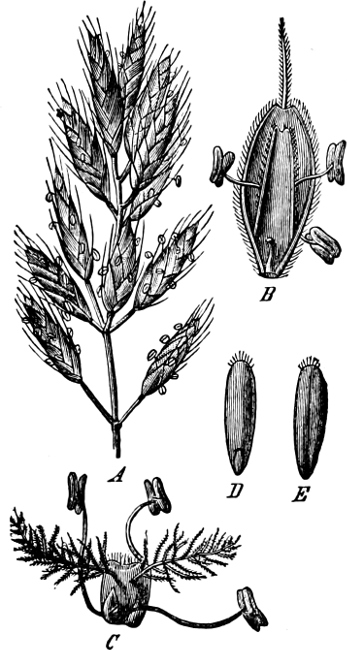
Fig. 288.—Bromus mollis: A inflorescence; B the uppermost flower of a spikelet, with its axis turned forward; in front is seen the two-keeled inner pale (bracteole) and the stamens protrude between this and the outer pale (bract); C an ovary with the 2 stigmas on its anterior side, the 2 lodicules, and the 3 stamens; D the fruit seen from the dorsal side; E the same from the ventral side.
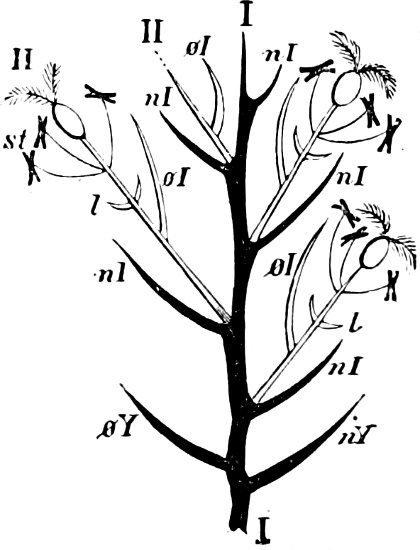
Fig. 289.—Diagrammatic outline of a spikelet: n Y lower glume; ø Y upper glume; n I upper pale; ø I the inner pale; l-l lodicules; st stamens; I-I main axes; II lateral axes.
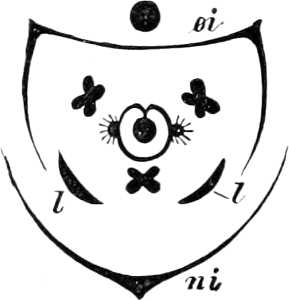
Fig. 290.—Diagram of the Grass-flower: ni outer pale; øi inner pale; l-l lodicules.
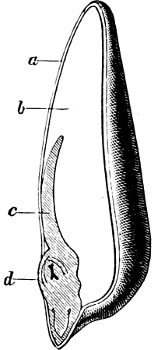
Fig. 291.—Longitudinal section of an Oat-grain: a the skin (pericarp and testa); b the endosperm; c the cotyledon; d the plumule.
Only a few Grasses have a solid stem, such as Maize, Sugar-cane, and Andropogon. The blade is flat in the meadow-grasses, but the Grasses which live on dry places (“prairie-grass”) exposed to the sun, often have the blade tightly rolled up and almost filiform or bristle-like, with anomalous anatomical structure. A closed tubular sheath is found in Melica uniflora, Bromus-species, Poa pratensis and trivialis, Briza and some Glyceria-species. The sheath is developed for the purpose of supporting the young internodes while their growth is proceeding at the base. The “nodes” (the swollen joints which are seen on stems of Grasses) are not really part of the stem but are formed by the base of the leaf-sheath. They play a part in assisting the haulms to regain a vertical position when laid prostrate by wind or rain. The awn on the pale is homologous with the blade of the Grass-leaf, and the pale itself is the sheath. The arrangement of the leaves in the spikelet is similar to that in Cyperus and other Cyperaceæ, their floral-leaves being borne in several rows in Streptochæta. More than two barren “glumes” are found in Streptochæta, several Phalarideæ and others. The spikelets, too, are again arranged in two rows in the axils of suppressed floral-leaves. The inflorescence becomes a “compound spike” (ear) when the spikelets are sessile. In the majority of instances the spikelets are borne on long stalks; when these branch, then the secondary branches, and similarly all branches of higher order, are placed so far down upon the mother-axis that they all appear to be of equal value and to arise in a semicircle from the mother-axis itself, though in reality they arise from each other (Panicle, Fig. 288 A). Sometimes the main axis and branches of different orders unite together as in Alopecurus, Phleum, and some other Grasses, and hence the single (short-stalked) spikelets appear to arise singly and spirally, or without any definite order, directly from the main axis, with the production of a cylindrical inflorescence bearing “spikes” on all sides, that is, a “spike-like panicle.”—Many inflorescences are somewhat dorsiventral. The flower is rarely unisexual (Zea mais) or barren. Considerable difficulty is experienced in reducing the Grass-flower to the ordinary 3-merous Monocotyledonous type. Some authorities consider the lodicules, which are present in all Grasses but absent in the Cyperaceæ, to be homologous with a perianth. According to a more recent theory they are bracteoles, and hence the Gramineæ, like many of the Juncaceæ, have 2–3 bracteoles placed in two rows in the median plane. If this theory be correct, the flower is naked. The lodicules expand quickly and cause the opening of the flower (i.e. the two pales become separated from each other). Generally only 3 stamens belonging to the outer whorl are present (Fig. 290), as in Iris (Fig. 279), certain Juncaceæ and Cyperaceæ (Fig. 284), but in some, such as the Rice and certain species of Bamboos, all 6 are found. Pariana has more than 6. Only 1 of the carpels is present, namely, the anterior (of those in Fig. 284), so that the ventral suture and the place of attachment of the ovule are situated at the back of the ovary. The number of styles does not correspond with the number of carpels, and the styles may therefore be supposed to arise from the edges of the leaf to the right and left—a position which is not without analogy. In addition, a stylar projection is sometimes found on the anterior side and in the median line (e.g. in Phragmites), and the solitary style in Nardus has exactly this position; a similar arrangement is found in some species of Bambusa which have only one style; other species of Bambusa have three styles. A tripartite style is found in Pharus.
[The Grass-flower may be reduced to the ordinary Monocotyledonous type thus:—The outer pale is the bract of the flower since it bears in its axil the floral shoot; the inner pale occupies the customary position of the bracteole. The fact that it is binerved can be explained by its having been pressed against the main-axis during development. Similar binerved bracteoles are found in Iris (Fig. 279). These bracteoles in both Grass and Iris arise from single primordia, and are not produced by the coalescence of two leaves. The lodicules are the only parts of the perianth remaining, the outer whorl having been suppressed, and also the posterior leaf of the inner whorl; a posterior lodicule, however, is found in the Rice and some species of Bamboo. The outer whorl of stamens is usually absent, though this again is present in the Rice and Bamboo. The three carpels are reduced to one with two or sometimes three stigmas.]
The Flowering. In the panicles the flowers open in basipetal order; the flowers in the spikes situated somewhat above the middle, commence to open first, and the flowering proceeds upwards and downwards. A few Grass-flowers never open (cleistogamic); Leersia oryzoides, Stipa-species, and e.g. Wheat and Rye in cold damp weather; some open their pales so wide that the anthers and stigmas may protrude at the top; most frequently the lodicules expand and force the pales suddenly and widely apart. The filaments elongate considerably, so that the anthers are pendulous and the stigmas unfold. In some Grasses e.g. Wheat, the blooming of each flower only lasts a short time. Pollination is generally effected by the wind. The Rye separates the pales very widely in the morning, and allows the anthers and stigmas to appear; it is almost entirely sterile when self-pollinated. The Wheat flowers at any time of the day, each flower lasting only a quarter of an hour. The pales open suddenly, but only half way, and the anthers scatter one-third of the pollen in their own flower and two-thirds outside. Self-pollination is effectual, but crossing gives better results. In Hordeum vulgare (all flowers ☿) the flowers of the 4 outer rows behave as in the Wheat, but those in the two central rows always remain closed. The ☿-flowers in the two central rows of H. distichum remain closed and fertilise themselves; they open exceptionally, and may be pollinated by the ♂-flowers in the 4 lateral rows. H. hexastichum is cleistogamic. Oats pollinate themselves.
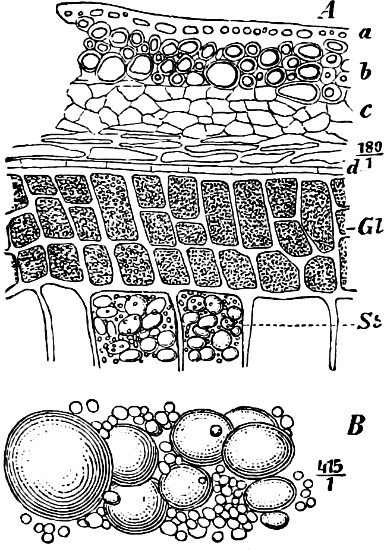
Fig. 292.—Barley grain: A section through the skin (a-d) and the most external part of the endosperm; Gl the “aleurone layer”; st starch-containing cells; B starch grains.
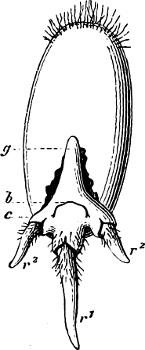
Fig. 293.—Wheat-grain germinating: g the plumule; b the first leaf succeeding the cotyledon; r1 the primary root; r2 lateral root.
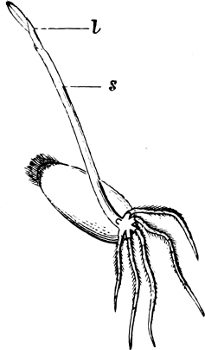
Fig. 294.—Older seedling of the Wheat: s the second sheathing-leaf; l first foliage-leaf.
The ripe Grass-fruit, in some species of Bamboo, is a berry; in some other Grasses a nut with loosely lying seed, in some even a capsule, but otherwise a “caryopsis.” In some instances it is loosely enveloped by the pales (Oat), in others firmly attached to these (Barley), and finally, in others, “naked,” i.e. it is entirely free from the pales (Wheat and Rye). On the ventral side there is a groove (Fig. 288 E); on the anterior side (dorsal suture), which is turned towards the inner pale, it is convex, and at the base on this side, inside the testa, lies the embryo (Fig. 288 D). The apex of the fruit is often hairy (Fig. 293). The skin (Fig. 291, a) is formed by the pericarp and testa, and in some cases (Barley) the pales also form the outer portion. The endosperm (b) is large, and formed of parenchymatous, starch-containing cells: aleurone (proteid) grains may also be found among them. When the starch-grains and the aleurone-grains adhere together the endosperm becomes “horny,” but is “floury” when the starch-grains lie loosely with air between them. In the most external region, just beneath the skin, 1–several layers of nearly cubical cells (filled principally with aleurone-grains and fat) are found, the aleurone-layer (Fig. 292). The embryo (Fig. 291 c-d) contains large quantities of fatty oil; the large shield-like structure, attached to the embryo and turned inwards towards the endosperm (c), is the cotyledon (scutellum); it remains enclosed in the seed during germination, and dissolves the endosperm by means of the peculiar epithelial cells developed on the dorsal surface. The radicle, on germination, is obliged to perforate a mass of cells derived from the suspensor and which form the “root-sheath” (coleorhiza, Fig. 293) round its base. In addition to the tap-root, lateral roots are frequently developed before germination; these quickly break through, and later on are followed by others which appear at the base of the leaf (Figs. 293, 294).
The DISTRIBUTION OF THE FRUIT is most frequently effected by the wind. The spirally-twisted and hygroscopic awn which persists on the fruits of some species (Avena, Stipa, etc.) assists in their dissemination, and even helps to bury them in the ground.
The two preceding orders are more closely related to each other than they are to the Gramineæ.
The generic differences are chiefly founded on the form of the inflorescence, the number and sex of the flowers in the spikelets, the shape and relative length of the pales, awns, etc. In addition to these the structure of the fruit and seed presents a great many differences; some have compound starch-grains, while in others they are single; some have 1 layer of aleurone-cells, others have several (Fig. 292), etc.
1. Bambuseæ. Tall Grasses with woody, very siliceous stems which bear many branches in the axils of the leaves. 6 stamens. Bambusa (Bamboo).
2. Oryzeæ. Oryza sativa (Rice) is a herbaceous marsh-plant, with panicle and small, 1-flowered spikelets, with two small glumes and two large, boat-shaped, strongly siliceous pales. 6 stamens.—Leersia. Lygeum. Pharus. Zizania aquatica.
3. Maydeæ. Zea mais (Indian-corn, Maize); the spikelets are unisexual; the ♂-spikelets in a terminal panicle; the ♀-spikelets closely crowded and arranged in many rows in a thick, axillary spike, enclosed by large sheathing-leaves. The ♀-spikelets are 1-(2-) flowered; the ovary bears one, long, filamentous style, with bifid stigma.—Euchlæna; Coix.
4. Andropogoneæ. Saccharum (Sugar-cane); the spikelets are exceptionally small, 1-flowered, and borne in pairs in many-flowered, long-haired panicles. Tall grasses with solid, sappy stem.—Andropogon.
5. Festuceæ. Grasses with panicle (or spike-like panicle) and 2–several-flowered spikelets. Glumes small, in each case shorter than the spikelet.—Festuca (Fescue) and Bromus (Brome, Fig. 288) have the awn placed at the apex of the pale, or slightly below it. Festuca has perennial species, with only a sparsely-branched panicle with branches solitary or in pairs, and round spikelets; the leaf-sheath is widely open. Bromus has the branches borne in half whorls, and the leaf-sheath scarcely half open. Brachypodium has very short-stalked spikelets in a raceme.—Poa (Meadow-grass), Briza (Quaking-grass) and Glyceria have awnless spikelets; these in Poa are ovoid, compressed, and with sharply-keeled glumes; in Briza they are broad, cordate and drooping, with boat-shaped glumes; in Glyceria round, long, many-flowered, linear or lanceolate; some species of Glyceria have closed leaf-sheaths.—Dactylis (Cock’s-foot) differs from all others in the somewhat crowded and unilateral (subsecund) spikelets, which are compressed and oblique (i.e. one side more convex than the other).—Phragmites (P. communis, Reed); the lowermost flowers of the spikelet are ♂; its axis is covered with long, silky hairs; pales without awns, but acuminate. Perennial marsh-plants.—Melica; panicle small, sparsely-branched with round, awnless, few-flowered, usually drooping spikelets. The upper pales, with arrested flowers, are generally united into a club-like mass.—Molinia, Eragrostis, Koeleria, Catabrosa.—Cynosurus (Dog’s-tail) has a small, spicate panicle with unilateral spikelets, some of which are fertile, some barren, each supported by a pectinate scale. Arundo. Sesleria. Gynerium. Triodia.
6. Aveneæ. Panicles with 2–many-flowered spikelets; at least one of the glumes is quite as long as the entire spikelet.—Avena (Oat). The pale is boat-shaped, often bifid, and at about the middle of the back has a twisted, bent awn.—Aira (Hair-grass) has a long-branched panicle with small, 2-flowered spikelets; the pale has a dentate apex and bears an awn on the posterior side close to the base.—Weingærtneria.—Holcus (Yorkshire-fog); a soft, hairy Grass with an open panicle, keeled glumes; 2 flowers in the spikelet, of which the lower one is ☿, the upper ♂; the pale which supports the ☿-flower has no awn, but that which supports the ♂-flower, on the contrary, is awned.
7. Agrostideæ. Panicles or spike-like panicles with 1-flowered spikelets. Generally 2 glumes and only 1 pale.—The following have PANICLES: Milium with square panicle-branches and round spikelets; Agrostis (Fiorin), with compressed, glabrous spikelets, whose glumes are longer than the pales. Calamagrostis differs in having a chaplet of long hairs at the base of the pale.—Stipa (Feather-grass) has a long, twisted awn.—The following have SPIKELIKE PANICLES: Phleum (Cat’s-tail, Timothy-grass) has sharply pointed, entirely free glumes, which are much longer than the awnless pales. Alopecurus (Fox-tail); glumes united below; pale with awn. Ammophila (Psamma). A. arundinacea; pales hairy at base; perennial, stiff-leaved, glaucous sand-grass with creeping rhizome. Aristida. Sporobolus.
8. Phalarideæ. Panicles and spike-like panicles. The spikelet has in the upper part a single fertile flower; below it are placed 4 pales, of which the upper 1–2 sometimes support ♂-flowers. On the whole, 6 floral-leaves of the first order are present.—Phalaris (P. canariensis, Canary-grass) has an ovate, spike-like panicle, the spikelets are compressed, convex on the outer side, concave on the inner. The large glumes are winged on the back.—Digraphis (D. arundinacea) is closely allied to Phalaris, but the keel of the glumes is not winged.—Anthoxanthum (A. odoratum, Sweet-vernal) has a small, lanceolate, open, spike-like panicle; the spikelets have below 2 barren flowers, and above these an ☿-flower with 2 stamens. The upper glume is longer than the flower.—Hierochloa.
9. Chlorideæ. The spikelets are arranged in the form of a spike in two rows on one side of an often flatly-compressed axis; they are mostly 1-flowered.—Chloris; Ctenium; Cynodon; Eleusine; Microchloa.
10. Paniceæ. The spikelets are borne in panicles or spikes, which may be arranged like fingers or in a raceme. There is a centrally-placed ☿-flower; below it is sometimes a ♂-flower.—Panicum; Paspalum; Oplismenus; Setaria has an almost cylindrical spike-like panicle with several barren branchlets, which project as stiff, rough bristles.—Cenchrus; Pennisetum.
11. Hordeæ. Spikes compound; spikelets sessile in the notches of a toothed axis.
A. Spikelets solitary.—Triticum (Wheat, Fig. 287) has in each tooth of the main axis, a several-flowered spikelet which turns its flat side towards the central axis. The cultivated species (true Wheat) are 1-2-annual, the wild ones (T. repens, Couch, also as an independent genus, Agropyrum) are perennial, with creeping rhizome and lanceolate glumes.—Lolium (Rye-grass) has in each tooth of the main axis a many-flowered, compressed spikelet, which is placed edgewise towards it and (with the exception of L. perenne) has only one outwardly-turned glume (L. temulentum has a rudiment of the inwardly-turned lower glume); the terminal spikelet has two glumes.—Secale (Rye). A two-flowered spikelet in each tooth; small, lanceolate, acuminate glumes. Nardus and Lepturus have very narrow spikes, the former with unilateral spikelets.
B. In each notch of the axis 2 or more spikelets are placed close together.—Hordeum (Barley). In each tooth three 1-flowered spikelets. H. hexastichum (6-rowed Barley), has 6 rows of fruits, since all the spikelets are fertile, and H. distichum (2-rowed Barley) 2 rows, since the lateral spikelets are (♂, and barren (p. 292).—Elymus has 2–6 many-flowered spikelets in each joint of the main axis. Ægilops has awns upon the glumes.
Distribution. 315 genera with 3,500 species. The order is distributed over the whole world, and as regards number of individuals is perhaps the richest. In the Tropics, large, broad-leaved, tree-like forms are found (Bambuseæ, Olyreæ, Andropogoneæ, etc.; in S. Europe, Arundo donax); in England, next to the Compositæ, it is the order most rich in species (about 134).—The origin of some of the cultivated Grasses is lost in obscurity. The Maize, no doubt, was indigenous to America, where its nearest relatives are found, and where it has also been discovered in ancient Indian graves; Durra or Guinea-corn, Millet and Sugar-cane are South Asiatic plants, and our own cereals no doubt have sprung primarily from Western Asia and South-Eastern Europe (Barley from Armenia and Persia, where a very closely related wild species is found; Wheat from the same districts; Rye from the perennial species S. montanum). Panicum altissimum and Rice have come from Africa.
Uses. The Grasses play a very important part as cereals and fodder plants. The following are the most important of the cultivated ones: Triticum vulgare (common Wheat), turgidum, amyleum, polonicum, spelta, durum, etc.; Secale cereale (Rye); Barley (Hordeum-species, see under the genus); Maize; Oats (Avena sativa, orientalis, nuda); Millet (Panicum miliaceum); Durra (Turkish Millet, or Guinea-corn, Sorghum vulgare, cernuum and saccharatum); Manna-grass (Glyceria fluitans). As fodder-plants especially: Rye-grass (Lolium perenne); Oat-grass (Avena elatior); Timothy (Phleum pratense); Fox-tail (Alopecurus pratensis); Cock’s foot (Dactylis glomerata); Dog’s tail (Cynosurus cristatus); Sweet-vernal (Anthoxanthum odoratum); Soft grass, or Yorkshire-fog (Holcus lanatus and mollis); Quaking-grass (Briza media); species of Meadow-grass (Poa); Fescue (Festuca) and Brome (Bromus).—Several cultivated species of Grass are also used in the preparation of fermented liquors, the starch in the seeds being transformed to sugar (beer from “Malt,” i.e. the germinated Barley; arrack from Rice); or the stem becomes specially saccharine before flowering: the Sugar-cane, Sorghum saccharatum.
Officinal. The rhizome of Triticum repens, Oat-grain, flour of Barley, and the starch of Wheat, also sugar.
The seeds of Lolium temulentum are considered poisonous.—The stems of many species (including our common grains) are used in the manufacture of paper, especially “Esparto grass” (Stipa tenacissima) from Spain and N. Africa, and the sheathing-leaves of the ♀-spike of Maize. Sand Lyme-grass (Elymus arenarius), and especially Psamma arenaria, are important.—But few Grass-species are sweet-scented: Anthoxanthum odoratum and Hierochloa odorata contain coumarin; Andropogon-species have essential oils (“Citronella oil”).—Ornamental plants are: the “Ribbon-grass” (a variety of Digraphis arundinacea), Stipa pennata (whose awn is exceedingly long and feathery), Gynerium argenteum (Pampas-grass), Lagurus ovatus, Hordeum jubatum, Bromus briziformis.
Family 3. Spadicifloræ.
The primitive form resembles that of the preceding family. In it we find the typical, perfectly developed, Monocotyledonous flower, sometimes even with free carpels and with a dry or somewhat fleshy, but never petaloid perianth; and this passes over into very different forms by the suppression of the floral-leaves, perianth and sporophylls (unisexual flowers are common), and by the close aggregation of the flowers in the inflorescence. The flower is hypogynous in every case. The inflorescence is a spike which may be either single or branched, and has often a thick and fleshy axis (a spadix). In Palms and Araceæ it is enveloped, at any rate prior to the opening of the flowers, by a very large floral-leaf, the spathe, which may be petaloid (Figs. 297, 301).
The fruit is most frequently fleshy (berry, drupe) or a nut, never a capsule. The embryo is small, with large, fleshy endosperm (Fig. 299 C); very rarely the endosperm is wanting.
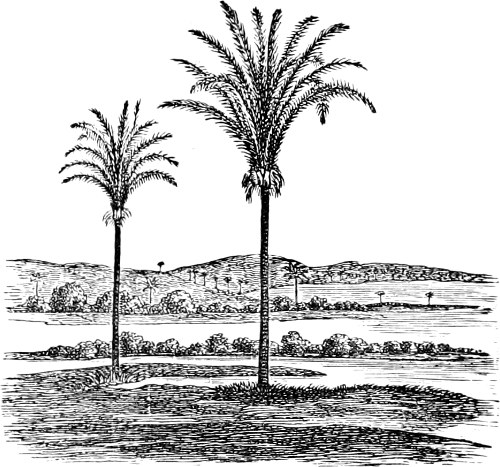
Fig. 295.—Piassava (Attalea funifera).
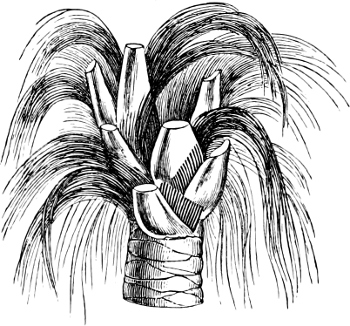
Fig. 296.—A portion of the stem of Attalea funifera with persistent leaf-bases.
The numerous plants belonging to this family are large, herbaceous or tree-like, and the leaves seldom have the usual Monocotyledonous form, i.e. linear with parallel venation, but most frequently have pinnate or palmate venation.
Order 1. Palmæ (Palms). The majority are trees with an unbranched, cylindrical stem, having short internodes and covered with leaf-scars or the bases of the leaf-stalks (Fig. 296), and at the summit a rosette of large leaves closely packed together (Fig. 295). An exception to this is found in Calamus (Cane, “Rotang”), whose thin, creeping or climbing stems have long internodes; sparsely[28] branched is, e.g. the African Doum-palm (Hyphæne). Notwithstanding their often enormous stems the Palms have fibrous roots, like the bulbous Monocotyledons. The leaves are pinnate (Feather-palms, Fig. 298) or palmate (Fan-palms, Fig. 295) and often very large; they have a well-developed petiole with an amplexicaul sheath, which is often more or less separated into a large number of fibres. In the bud the blade is entire but folded, as the leaf expands the lines of folding are torn, either those which are turned upwards (thus ∨ ∨ ∨ ∨, e.g. Pritchardia, Livistona, Phœnix, Chamærops) or those turned downwards (thus ∧ ∧ ∧ ∧, e.g. Cocos, Chamædorea, Calamus). The inflorescence is usually lateral; when, as in Sago-palm (Metroxylon rumphii) or Talipot (Corypha umbraculifera) it is terminal, the plant is monocarpic, and dies after flowering; it is often a very large and branched spadix with numerous flowers either borne externally or embedded in it, and enclosed either in one woody, boat-shaped spathe (Fig. 297) or several spathes, in the latter case one for each branch. The flowers are sessile or even embedded, regular, generally unisexual (monœcious or diœcious) with the usual diagram (Fig. 278); the perianth is inconspicuous, green or yellow, persistent, and more or less leathery or fleshy. 6, rarely 3 or many stamens. The 3 carpels remain either distinct or form one, generally 3-locular, ovary. The style is short. There is one ovule in each carpel. Often during ripening 2 carpels with their ovules are aborted. The fruit is a berry, drupe or nut, generally one-seeded, with a large horny or bony endosperm with hard thick-walled cells (e.g. Date-palm). In some (e.g. Cocoanut) it is thin-walled, soft, and oily; in several “ruminate.”
When germination commences in the Cocoanut, Date, etc., the apex of the cotyledon remains in the seed and developes into a spongy mass to withdraw the endosperm; in the Cocoanut it attains a considerable size (Fig. 299 C) and assumes the form of the fruit. The endosperm in the Cocoanut is hollow and the interior is filled with “milk.” In the Date-palm and the Vegetable-ivory (Phytelephas) the cell-walls of the hard endosperm serve as reserve material.
1. Phœniceæ. Phœnix (Date-palm) has pinnate leaves with channeled leaflets and diœcious flowers with 8 free carpels, of which usually only one developes into a berry with membranous endocarp; the large seed has a deep furrow on the inner side, and horny endosperm.
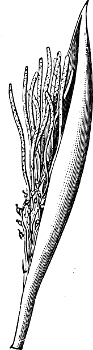
Fig. 297.—Inflorescence of a Palm with spathe. At the top ♂-, at the base ♀-flowers.
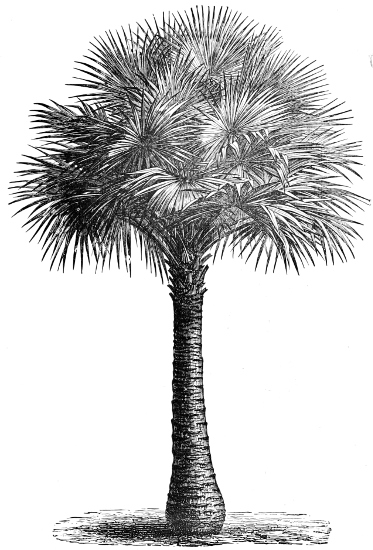
Fig. 298.—Livistona australis.
2. Sabaleæ. These have fan-like leaves with channeled segments; flowers ☿ or polygamous, rarely diœcious, with 3 separate or only slightly united carpels, all of which are sometimes developed into fruits (berry or drupe, with thin stone).—Chamærops, the Dwarf-palm. The pericarp is externally fleshy, internally more fibrous, and provided with a membranous inner layer. The endosperm is ruminate (that is, the testa is several times deeply folded into the endosperm).—Sabal, Copernicia, Livistona (Fig. 298), Thrinax, Corypha, Brahea, and others.
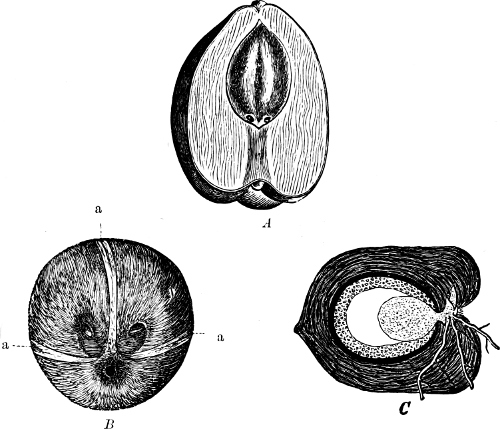
Fig. 299.—A Longitudinal section of a Cocoanut (diminished), the inner layer only (the stone) not being divided B End view of the stone, showing the sutures for the 3 carpels (a), and the 3 germ-pores; the embryo emerges from the lowest one when germination begins. C Germinating; inside the stone is seen the hollow endosperm and the enlarging cotyledon.
3. Cocoineæ. With pinnate leaves. Monœcious inflorescence. The carpels are united into a 3-locular ovary. The fruit is most frequently 1-locular, only 1 of the loculi becoming developed, rarely 3-locular; it is a drupe with a large, fibrous, external layer (mesocarp) and most frequently a very hard inner layer (endocarp, stone) which has 3 germ-pores, the 2 of these, however, which correspond to the suppressed loculi are closed; internal to the third lies the small embryo (Fig. 299). Endosperm containing abundance of oil. Cocos (the Cocoanut-palm), Attalea, Elæis, Acrocomia, Bactris.
4. Lepidocaryinæ. The floral-leaves and flowers are borne in 2 rows on the spadix. The carpels are united into one 3-locular ovary; the fruit is coated by a layer of hard, shining, imbricate scales. The majority of the species are thorny, and climb by means of the thorny leaves. Some have fan-like (Mauritia), others pinnate leaves (Raphia, Calamus, Eugeissonia, Metroxylon; the stems of the latter die after the first flowering).
5. Borassinæ. Large Fan-palms without thorns, with 3-locular ovary. Drupe with separate stones. Latania and Lodoicea have many stamens; Hyphæne; Borassus (Palmyra-palm).
6. Arecineæ. The most numerous group. Feather-palms. Berry. Areca, Euterpe, Oreodoxa, Ceroxylon, Chamædorea, Geonoma, Caryota with bipinnate leaves.
7. Phytelephantinæ. Flowers with rudimentary perianth united in close capitula. Phytelephas (Vegetable-ivory). Nipa.
Distribution. About 1,100 species are known. In Europe only the Dwarf-palm (Chamærops humilis) is wild (Western Mediterranean). The Date palm (Phœnix dactylifera) belongs to North Africa and West Asia. Other African genera are Hyphæne (Doum-palm) and Elæis (E. guineensis, Oil-palm). A large majority of the genera are found in South America and in the East Indies. The following are American:—Mauritia, Acrocomia, Bactris, Chamædorea, Oreodoxa, Euterpe, Attalea, etc. Asiatic:—Metroxylon, Calamus, Areca, Borassus, Lodoicea (“Double-cocoanuts,” Seychelles) and others. The Cocoanut-palm has perhaps an American origin; all the other species of the same genus being endemic in America; it is the only Palm found on the coral islands of the Pacific Ocean, and is also the only one which is common to both hemispheres.
Uses. Palms belong to the most useful plants; they contain no poison, and are of little medicinal interest, but are largely employed in the arts and manufactures, the hard timber being adapted for many purposes on account of the hard tissue in which the vascular bundles are embedded. “Cane” is the stem of Calamus-species (from India). Sago is obtained from the pith of Metroxylon rumphii (Sago-palm, Sunda-Is., Moluccas), Mauritia flexuosa, etc. Sugar-containing sap (“palm wine”) is obtained from the American Mauritia vinifera and flexuosa, Borassus flabelliformis (Asiatic Palmyra-palm), Arenga saccharifera, etc., by cutting off the young inflorescences, or by perforating the stem before the flowering (arrack is distilled from this). Vascular strands for the manufacture of mats and brushes, etc., are obtained from the outer covering (mesocarp) of the Cocoanut, and from the detached leaf-sheaths of Attalea funifera (Brazil) (Fig. 296). Wax is yielded by the leaves of Copernicia cerifera (carnaueba-wax, Amazon region), and by the stem of Ceroxylon andicola (palm-wax, Andes); East Indian Dragon’s blood is from the fruit of Calamus draco; the young buds of many species, especially Euterpe, Cocos, Attalea, etc., are used as “cabbage.” Palm-oil is obtained from the oily mesocarp of the plum-like fruits of Elæis guineensis (W. Africa), and from the seeds, when it is largely used in the manufacture of soap. Edible Fruits from the Date-palm (Phœnix dactylifera, Arabia, Egypt, W. Africa), and the endosperm of the Cocoanut (Cocos nucifera). The seeds and the unripe fruits of the Areca-palm (Areca catechu) are chewed with the leaves of the Betelpeper, principally in Asia. Vegetable Ivory from the hard endosperm of Phytelephas macrocarpa (S. America.)—Many species are cultivated in the tropics as ornamental plants, but in this country only Chamærops humilis, Livistona australis and chinensis are generally grown. In addition to the few just mentioned, many others are of importance, but these are much the most useful.
Order 2. Cyclanthaceæ. This is a small order related to the Palms (44 species from Tropical America), with fan-like, folded leaves. The flowers are unisexual and arranged in whorls or close spirals on an unbranched spadix. Ovary unilocular, ovules numerous. To this belongs Carludovica palmata, whose leaves are used for Panama hats.
Order 3. Pandanaceæ (Screw-pines) is another small order, forming a transition to the Araceæ. The woody, (apparently) dichotomous stem is supported by a large number of aerial roots, which sometimes entirely support it when the lower portion of the stem has decayed. The leaves are closely crowded together, and arranged on the branches in three rows, which are often obliquely displaced, with the formation of three spiral lines; they are, as in the Bromeliaceæ, amplexicaul, long, linear, the edge and lower midrib often provided with thorns. The ♂-flowers are borne in branched, the ♀ in unbranched spadices or capitula, which resemble those of Sparganium, but have no floral-leaves. Perianth absent. The drupes or berries unite into multiple fruits.—About 80 species in the islands of the Indian Ocean.—Pandanus, Freycinetia.—Fossils perhaps in the chalk of the Harz.
Order 4. Typhaceæ. The flowers are unisexual, monœcious, and borne on a cylindrical spike or globose capitulum; ♂ inflorescences above, the ♀ below. The perianth consists of a definite number of scales (Sparganium), or in its place numerous irregularly-arranged hairs are found (Typha); in the ♂-flower there are generally three stamens; the gynœceum is formed of 1–2 carpels with 1 prolonged style; 1 pendulous ovule. The seeds are furnished with a seed-cover, which is cast off on germination.—The few species (about 20) which belong to this order are marsh plants with creeping rhizome (and hence grow in clusters); the leaves on the aerial shoots are borne in two rows, entire, very long and linear.
Sparganium (Bur-reed). The flowers are borne in globose capitula; the perianth distinct, generally consisting of 3 small scales; pistil bicarpellate. Drupe, dry and woody. The stalk of the lower ♀ capitula is sometimes united with the main axis, and consequently the capitula are situated high above their subtending-leaf.
Typha (Bulrush, Reed-mace) has a long, cylindrical, brown spike, the lower portion bearing ♀-flowers, and the upper ♂-flowers, which is divided into joints by alternate leaves. The ♀-flowers have 1 carpel. The perianth is wanting, represented by a number of fine, irregularly-placed hairs; pistil unicarpellate. Fruit a nut.
The two genera, according to some, are related to the 2nd order. In both genera native species are found. The pollination is effected by the wind, and consequently the anthers project considerably, and the stigma is large and hairy. Typha is protandrous, Sparganium protogynous. The small, fine hairs surrounding the nut of Typha assist in its distribution by the wind.—Fossil Typhas in the Tertiary.
Order 5. Araceæ (Arums). The flowers are small, and always borne without bracts or bracteoles on an unbranched, often very fleshy spike, which is enclosed by a spathe, often petaloid and coloured (Fig. 301). The fruit is a berry. Outer integument of the seed fleshy.—The leaves have generally sheath, stalk, and blade with distinctly reticulate venation; they are chiefly cordate or sagittate (Fig. 302), seldom long with parallel venation as in the other Monocotyledons (Acorus, Fig. 300). The Araceæ are quite glabrous, generally perennial herbs with tubers or rhizomes. Many have latex.—For the rest the structure of these plants varies; for example, while some have a perianth, in others it is wanting; in some the perianth-leaves are free, in others united; some have hermaphrodite flowers, but the majority unisexual (monœcious); some have free, others united stamens; the ovules are orthotropous, anatropous, or campylotropous, erect or pendulous; the ovary is 1–many-locular; some have seeds with endosperm, others without. In habit there are great differences. While some, e.g. Colocasia (Fig. 302), have a thick, more or less upright stem, with leaf-scars, but not woody, others are climbers, epiphytic, and maintain themselves firmly by means of adventitious roots, on the stems and branches of trees, or even on steep rocks, e.g. Philodendron; the cordate, penninerved leaf is the most common (Fig. 302), but various branched forms appear; the pedate leaves of Helicophyllum, Dracunculus, etc., are cymosely branched; the leaves of Monstera deliciosa, perforated by tearing, should be noticed (the vascular bundles while in the bud grow faster than the tissue between them, causing the latter to be torn, and the leaf perforated). With regard to the anatomical structure, the presence or absence of latex, raphides, resin-passages, groups of mucilage-cells should be noted. Engler makes use of these anatomical peculiarities for a scientific arrangement of the order.
A. Orontieæ, Calamus-group. ☿, hypogynous flowers of a completely formed monocotyledonous type (number in the whorls 2, 3, or 4).—Acorus (A. calamus, Sweet-flag) has a regular, 3-merous, pentacyclic flower (Fig. 300 C, D). They are marsh-plants, with creeping rhizome, triangular stem, and long, sword-like leaves (Fig. 300 A); the inflorescence is terminal, apparently lateral, being pushed to one side by the upright, sword-like spathe (Fig. 300 B).—Anthurium (Pr2+2, A2+2, G2); Pothos; Orontium (unilocular ovary with one ovule), etc.
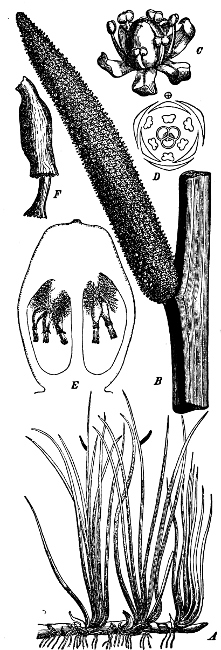
Fig. 300.—Acorus calamus: A habit (much reduced); B inflorescence; C a flower; D diagram; E longitudinal section of an ovary; F an ovule.
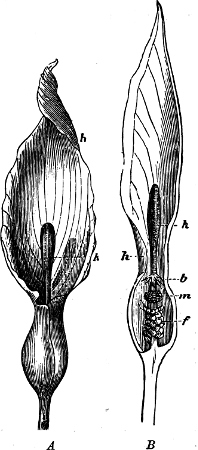
Fig. 301.—Arum maculatum. The spathe (h) in B is longitudinally divided.
B. Calleæ. Flowers hypogynous, naked, ☿.—Calla (C. palustris). All flowers in the spike are fertile, or the upper ones are ♂; 6–9 stamens; ovary unilocular with many basal ovules. Marsh-plants with creeping rhizome and cordate leaves.—Monstera, Rhaphidophora, etc.
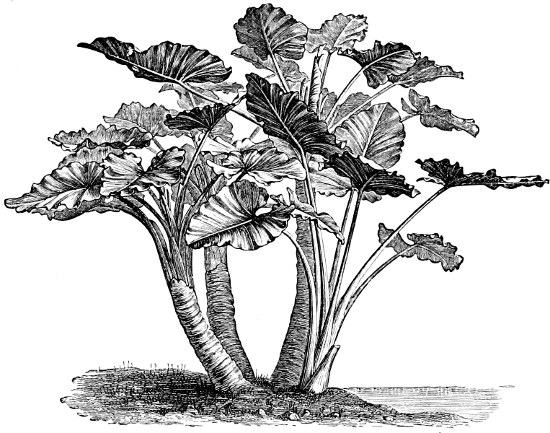
Fig. 302.—Colocasia Boryi.
C. Arineæ. Flowers monœcious, naked, ♂-flowers on the upper, ♀ on the lower part of the spadix.—Arum (Fig. 301). The spadix terminates in a naked, club-like portion (k); below this is a number of sessile bodies (rudimentary flowers), with broad bases and prolonged, pointed tips (b); underneath these are the ♂-flowers (m), each consisting only of 3–4 short stamens, which eject vermiform pollen-masses through the terminal pores; then follow, last of all, ♀-flowers (f), each of which consists of one unilocular ovary, with several ovules. Perennial herbs, tuberous, with cordate leaves.—Dracunculus; Biarum; Arisarum; Pinellia (Atherurus) ternata with leaves bearing 1–2 buds. Zantedeschia æthiopica (Richardia, Nile-lily); ♂, 2–3 stamens; ♀ with 3 staminodes, 1–5-locular ovary (S. Africa.)—In some genera sterile flowers are present between the ♂ and ♀ portions of the spadix (e.g. in Philodendron); in Ambrosinia a lateral, wing-like broadening of the axis of the spadix divides the cavity of the spathe into two chambers, the anterior containing one ♀, and the posterior 8–10 ♂-flowers in two series; in some the stamens in the single ♂-flowers unite and form a columnar “synandrium” (e.g. in Dieffenbachia, Colocasia, Alocasia, Caladium, Taccarum, Syngonium). A remarkable spadix is found in Spathicarpa; it is united for its entire length, on one side, with the spathe, and the flowers are arranged upon it in rows, the ♀ to the outside, and the ♂ in the middle (Zostera has a similar one).—Pistia similarly deviates considerably, it is a floating water-plant, with hairy, round rosettes of leaves; in it also the spathe and spadix are united; at the base a ♀-flower is borne, which consists of one unilocular ovary, and above several ♂-flowers, each composed of two united stamens.
Biology. The inflorescences are adapted for insect-pollination; they are protogynous, since the viscous, almost sessile stigmas come to maturity and wither before the pollen, which is generally dehisced by apical pores, is shed; some pollinate themselves freely by the pollen from the higher ♂-flowers falling upon the ♀-flowers below them, and in some it is conjectured that the pollination is effected by snails. The coloured spathe, and the naked end of the spadix (often coloured) of certain genera function as the coloured perianth in other orders; during flowering a very powerful smell is often emitted. Arum maculatum is worthy of notice; small flies and midges creep down into the spathe, between the sterile flowers (Fig. 301 b), which are situated where the spathe is constricted, and pointing obliquely downwards prevent the escape of the insects; in the meantime, the stigmas are in a condition to receive any pollen they may have brought with them; after pollination the stigmas wither, and exude small drops of honey as a compensation to the flies for their imprisonment; after this the anthers (m) open and shed their pollen, the sterile flowers wither, and the insects are then able to escape, and enter and pollinate other inflorescences.—In many, a rise of temperature and evolution of carbonic acid takes place during flowering; a spadix may be raised as much as 30°C. above the temperature of the surrounding air.—Again, under certain conditions, many species absorb such large quantities of water by their roots that water is forced out in drops from the tip of the leaf; this may often be observed in Zantedeschia.
About 900 species in 100 genera. Home, the Tropics, especially S. America, India, and the Indian Islands, preferably in shady, damp forests growing as epiphytes upon trees, and on the banks of streams. Outside the Tropics few are found. Acorus calamus was introduced into Europe from Asia about 300 years ago; it, however, never sets any fruit, as the pollen is unfertile. In England Arum maculatum is a very common plant; this and A. italicum are the only native species. Colocasia antiquorum comes from Polynesia and the Indian Islands, and also Alocasia macrorrhiza. Fossils in Cretaceous and Tertiary.
Uses. Many species have pungent, and even poisonous properties (e.g. Dieffenbachia, Lagenandra, Arum), which are easily removed by boiling or roasting; the rhizomes of many species of Caladium, Colocasia (C. antiquorum, esculenta, etc.), are very rich in starch, and in the Tropics form an important source of food. An uncommon occurrence in the order is the highly aromatic rhizome of Acorus calamus; this contains calamus-oil and acorin which are used in perfumery. Many are ornamental plants, e.g. Zantedeschia æthiopica (South Africa), generally known as “Calla,” and Monstera deliciosa; many other species are grown in greenhouses.
Order 6. Lemnaceæ (Duck-weeds). These are the most reduced form of the Spadicifloræ. They are very small, free-swimming water-plants. The vegetative system resembles a small, leaf-like body (Fig. 303 f-f), from which roots hang downwards; this branches by producing a new, similar leaf-like body, which springs from a pocket-like hollow (indicated by a dotted line in the figure) on each side of the older one, at its base (or only on one side). The branching is thus dichasial or helicoid (Fig. 303 A, where f, f′, f″, f″′ indicate shoots of 1st, 2nd, 3rd, 4th generations respectively). The leaf-like bodies are, according to Hegelmaier, leaf-like stems, and thus Lemna has no other leaves than the spathe and the sporophylls; according to the investigations of Engler they are stems whose upper portion (above the “pocket”) is a leaf, which is not sharply separated from the underlying stem-portion. The inflorescence is a very much reduced Araceous-spadix, consisting in Lemna of 1 or 2 stamens of unequal length (1-stamened ♂-flowers), 1 unilocular carpel (♀-flower), and 1 thin spathe (B). [The same is found in Spirodela polyrrhiza, etc., whose daughter-shoots begin in addition with 1 basal-leaf. Wolffia arrhiza, etc., have no roots, no spathe, and only 1 ♂-flower in the inflorescence (Engler).]—On the germination of the seed a portion of the testa is thrown off as a lid, so that an exit is opened for the radicle.—19 species. In stagnant fresh water, both Temp. and Tropical.—In Europe the species are Lemna minor, trisulca, gibba; Spirodela polyrrhiza, and Wolffia arrhiza, the smallest Flowering-plant.
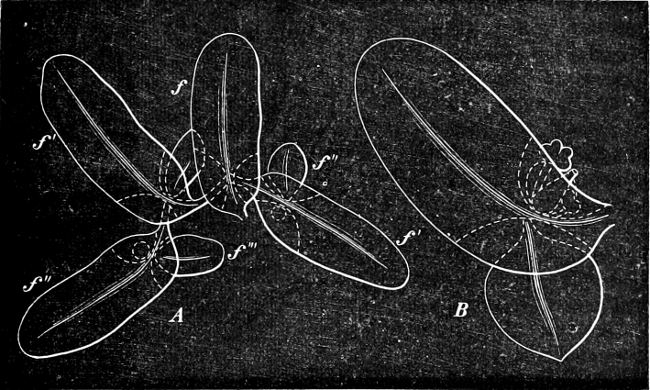
Fig. 303.—Lemna: A vegetative system; B portion of a plant with flowers; one stamen and tip of the carpel project; the remaining portions being indicated by the dotted line.
Family 4. Enantioblastæ.
The flowers in this family are hypogynous and have in part the general monocotyledonous type with 5 trimerous whorls completely developed in a regular hermaphrodite flower, and in part the flowers so much reduced that the type is very difficult to trace. On the one hand the family is well developed and has capitate inflorescences (Eriocaulaceæ) and on the other hand it is distinctly reduced (Centrolepidaceceæ). This family has taken its name from the fact that the ovule is not, as in the Liliifloræ and nearly all other Monocotyledons, anatropous, but orthotropous, so that the embryo (βλάστη) becomes placed at the end of the seed opposite (ἐναντίος) to the hilum. Large, mealy endosperm.—The orders belonging to this family are by certain authors grouped with the Bromeliaceæ and Pontederiaceæ, etc., into one family, Farinoseæ, so named on account of the mealy endosperm, the distinguishing character of the Liliifloræ then being that the endosperm is fleshy and horny.
Order 1. Commelinaceæ. The complete Liliaceous structure without great reductions in the number of whorls, but with generally few ovules in each loculus of the ovary, is found in the Commelinaceæ, an almost exclusively tropical order with about 317 species; herbs, some of which are introduced into our gardens and greenhouses. The stems are nodose; the leaves often clasping; the flowers are arranged in unipared scorpioid cymes, often so that they form a zig-zag series falling in the median line of the bracts, and after flowering they bend regularly to the right or left, outwards or inwards. They are more or less zygomorphic, particularly in the stamens, which in the same flower are of different forms or partially suppressed. The outer series of the perianth is sepaloid, the inner petaloid, generally violet or blue; the filaments are sometimes clothed with hairs formed of rows of bead-like cells (well known for showing protoplasmic movements). Fruit a trilocular capsule with loculicidal dehiscence (generally few-seeded); in some a nut. The radicle is covered by an external, warty, projecting covering which is cast off on germination.—The abundant raphides lie in elongated cells whose transverse walls they perforate.—Commelina, Tradescantia, Tinantia, Cyanotis, Dichorisandra.
Order 2. Mayacaceæ. This order is closely allied to the Commelinaceæ. 7 species. American marsh- or water-plants.
In many of the following orders of this family the flowers are united into compound inflorescences, with which is accompanied a reduction in the flower.
Order 3. Xyridaceæ (50 species). Marsh-plants with radical, often equitant leaves arranged in 2 rows, and short spikes on long (twisted) stalks. The flowers, as in the Commelinaceæ, have sepals (which however are more chaffy) and petals, but the outer series of stamens is wanting. Capsule (generally many-seeded).
Order 4. Rapateaceæ. Marsh-plants with radical leaves, usually in two rows, and several spikelets on the summit of the main axis, clustered into a capitulum or unilateral spike. Each spikelet has numerous imbricate floral-leaves and one flower. 24 species. South America.
Order 5. Eriocaulaceæ. The “Compositæ among Monocotyledons,” a tropical order. The flowers are borne in a capitulum surrounded by an involucre, very similar to that of the Compositæ. The flowers are very small, unisexual, ♂ and ♀ often mixed indiscriminately in the same capitulum; they have the usual pentacyclic structure; the leaves of the inner perianth are often connate and more membranous than the outer; in some the outer series of stamens are suppressed; in each of the 3 loculi is one pendulous ovule. Capsule. The leaves are generally radical and grass-like.—335 species; Eriocaulon, Paepalanthus, etc., E. septangulare on the west coast of Scotland, and Ireland, and in North America.
Order 6. Restiaceæ. A small, especially S. African and S. Australian, xerophilous order (about 235 species), which is quite similar in habit to the Juncaceæ and Cyperaceæ. The leaves are often reduced to sheaths. The flowers are diœcious, the perianth as in Juncus, but the outer series of stamens suppressed. The ovary and fruit as in Eriocaulaceæ; the ovary, however, may be unilocular, and the fruit a nut. Restio, etc.
Order 7. Centrolepidaceæ. These are the most reduced plants in the family; small grass- or rush-like herbs. The flowers are very small, naked. Stamens 1–2, carpels 1–∞. 32 species. Australia.—Centrolepis (flowers generally ☿ with 1 stamen and 2–∞ carpels).
Family 5. Liliifloræ.
The flower is constructed on the general monocotyledonous type, with 5 alternating, 3-merous whorls (Fig. 278), but exceptions are found as in the Iridaceæ (Fig. 279) by the suppression of the inner whorl of stamens; in a few the position in relation to the bract differs from that represented in Fig. 278, and in some instead of the trimerous, di- or tetramerous flowers are found (e.g. Majanthemum, Paris). Flowers generally regular, hermaphrodite, with simple, petaloid, coloured perianth (except, for example, Bromeliaceæ); ovary trilocular, generally with 2 ovules or 2 rows of ovules in the inner angle of each loculus (Fig. 304 C, D). Endosperm always present.—A very natural family, of which some divisions in part overlap each other. The habit varies; the leaves are however long, entire, with parallel venation, except in Dioscoreaceæ (Fig. 313).
In the first orders of this family the flowers are hypogynous, and in the first of all the styles are free, and the capsule dehisces septicidally; in the following the flowers are epigynous and in some reduced in number or unisexual; capsule with loculicidal dehiscence, or a berry.
Hypogynous flowers: Colchicaceæ, Liliaceæ, Convallariaceæ, Bromeliaceæ (in part).
Epigynous flowers: Amaryllidaceæ, Iridaceæ, Bromeliaceæ (in part), Dioscoreaceæ.
Order 1. Colchicaceæ. The flower (Fig. 304 A) is ☿, regular, hypogynous, trimerous in all five whorls (6 stamens); anthers usually extrorse. Gynœceum with 3 free styles (A, D); fruit a capsule with septicidal dehiscence (E); embryo very small (F). The underground stem is generally a corm or rhizome, seldom a bulb.
A. Veratreæ.—Veratrum; perennial herbs, stem tall with long internodes and broad, folded leaves; the flowers andromonœcious, with free, widely opening perianth-leaves (Fig. 304 A), and globular anthers; inflorescence a panicle.—Zygadenus, Melanthium, Schœnocaulon, Uvularia, Tricyrtis.
B. Tofieldieæ.—Narthecium and Tofieldia have leaves alternate (arranged in two rows), sword-like and borne in rosettes; racemes or spikes. Narthecium forms an exception to the order by having a simple style and fruit with loculicidal dehiscence; Tofieldia by the introrse anthers. In this they are related to the Liliaceæ. Narthecium has poisonous properties, like many other Colchicaceæ.
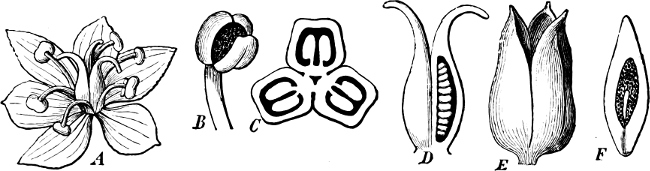
Fig. 304.—Veratrum: A flower; B stamen; C transverse section of ovary; D gynœceum, with one carpel bisected longitudinally, and the third removed; E fruit after dehiscence; F longitudinal section of a seed.
C. Colchiceæ.—Colchicum (Autumn Crocus); perennial herbs, with a long, funnel-shaped, gamophyllous perianth, and introrse anthers. The flowers of C. autumnale spring up immediately from the underground stem, which is in reality a corm formed of one internode. Colchicum autumnale flowers in autumn without leaves; in spring the radical foliage-leaves appear simultaneously with the fruit. The flower is protogynous, and is pollinated by insects (humble-bees, etc.) which seek the honey secreted by the free part of the stamen a little way down the tube. The length of the tube protects the fruit, and not, as in other cases, the nectary.—Bulbocodium and Merendera have unguiculate perianth-leaves, free, but closing together like a tube.
175 species; chiefly in North America and South Africa. Tofieldia is an Arctic plant. The order is rich in pungent, poisonous alkaloids (veratrin, colchicin, etc.). Officinal; the seeds of Colchicum autumnale (Europe) and Schœnocaulon officinale (Mexico), and the rhizome of Veratrum album (mountains of Central Europe).
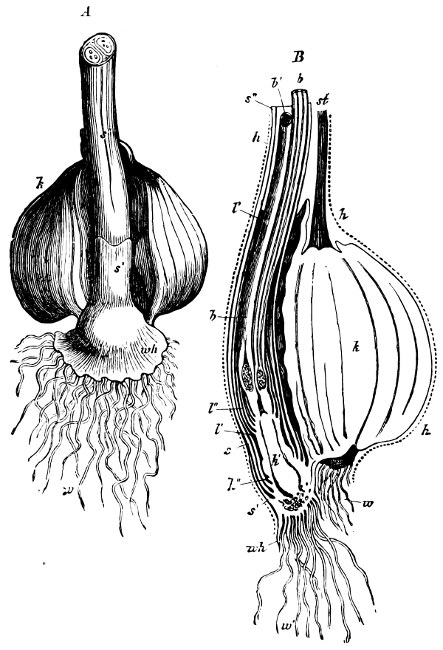
Fig. 305.—Colchicum autumnale. A Corm seen from the front: k corm; s′ s″ scale-leaves embracing the flower-stalk; wh base of flower-stalk with roots (w). B Longitudinal section of corm and flower-stalk: hh brown membrane surrounding the underground portion of the plant; st flower-and leaf-stalk of previous year, the swollen basal portion forming the reservoir of reserve material. The new plant is a lateral shoot from the base of the corm (k) and has the following parts: the base bearing the roots (w), the central part (k’) which becomes the corm in the next year, the axis bearing the scale-leaves (s’, s″), the foliage-leaves (l, l′″), and the flowers (b, b’) which are borne in the axils of the uppermost foliage-leaves.
Order 2. Liliaceæ (Lilies). Flowers as in the Colchicaceæ but with introrse anthers; ovary free, 3-locular, with single style; capsule 3-locular with loculicidal dehiscence.—The majority are herbs with bulbs; the inflorescence is terminal. In many species reproduction takes place by means of bulbils (small bulbs) formed in the axils of the foliage-leaves (e.g. Lilium bulbiferum, lancifolium, etc., Gagea lancifolia, etc.), or in the bracts of the inflorescence (many species of Allium); in many species several buds are developed as bulbs in the axils of the bulb-scales themselves (accessory buds arising close together), and in some the formation of buds is common on the leaves.
A. Tulipeæ, Tulip Group. Bulbs. The aerial, elongated stem bears the foliage-leaves. Flowers few but generally large, with free perianth-leaves. Tulipa; style absent, no honey; flowers generally solitary, erect.—Fritillaria perianth campanulate with a round or oblong nectary at the base of each perianth-leaf.—Lilium; perianth widely open, generally turned back with a covered nectary-groove in the centre of each segment. Anthers versatile.—Lloydia; Erythronium.
B. Hyacintheæ, Hyacinth Group. Bulbs. Leaves radical; aerial stem leafless with raceme or spike. In some the perianth-segments are free, in others united. Honey is produced often in glands or in the septa of the ovary (septal glands).—Ornithogalum has a leafy stem; Scilla; Eucomis has a tuft of floral-leaves above the raceme; Agraphis; Hyacinthus; Puschkinia; Chionodoxa; Muscari; Veltheimia; Urginea.
C. Allieæ, Onion Group. Generally bulbs. Leaves radical. Stem leafless with a compound umbellate or capitate inflorescence of unipared helicoid cymes, which before flowering are surrounded by two broad involucral leaves.—Allium. Filaments often petaloid and bidentate; in many species bulbils are found in the inflorescence.—Some species have flat leaves: A. sativum, Garlic; A. porrum, Leek; A. ursinum; others have round, hollow leaves: A. cepa, Onion; A. fistulosum, Winter Onion; A. ascalonicum, Eschalot; A. schænoprasum, Chive.—Gagea; honey is secreted at the base of the perianth, no special nectary; inflorescence few-flowered.—Agapanthus; Triteleia.
D. Anthericeæ. Rhizome; raceme; the leaves not fleshy and thick.—Anthericum; Asphodelus; Bulbine; Chlorophytum; Bowiea has an almost leafless stem with curved, climbing branches.
E. Aloineæ, Aloes. Stem generally aerial and tree-like, bearing on its summit thick, fleshy leaves, often with a thorny edge (Fig. 306). Raceme branched or unbranched.—Aloë; Gasteria; Yucca (has secondary thickening, p. 274).
F. Hemerocallideæ. Phormium, (Ph. tenax. New Zealand Flax); Funckia (Hosta); Hemerocallis.
At this point the following are best placed: Aphyllanthes (A. monspeliensis); Xanthorrhæa (Black-boy); Xerotes; Lomandra; Kingia; the very membranous, dry perianth of the last resembles that of the Juncaceæ, and also there are only 1–few ovules in the loculi.
Pollination by insects. Honey in some is produced on the perianth (see Tulipeæ), in others by glands on the carpels (in the septa and parietal placentæ, septal glands): Hyacinthus, Allium, Anthericum, Asphodelus, Yucca, Funckia, Hemerocallis, etc. Some Allium-species are protandrous. Fritillaria is visited by bees, Lilium martagon by moths, L. bulbiferum by butterflies, Phormium (New Zealand) by honey-birds.
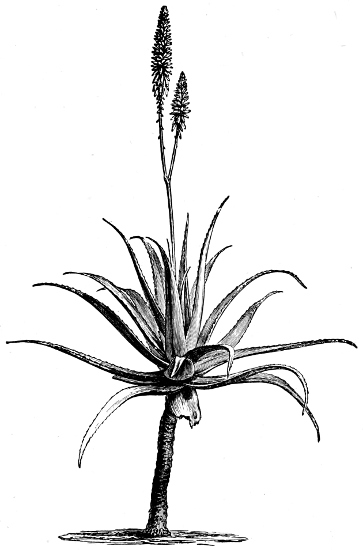
Fig. 306.—Aloë.
About 1,580 species; rare in cold climates; their home is in sunny plains with firm, hard soil, and warm or mild climate, particularly in the Old World (S. Africa; As. Steppes; Mediterranean); at the commencement of spring the flowers appear in great profusion, and after the course of a few weeks disappear; during the hot season their life lies dormant in the bulb, hidden underground. The woody species are tropical.—The majority of the introduced Liliaceæ (Fritillaria imperialis, Crown-imperial; Lilium candidum; Tulipa gesneriana; Hyacinth; Muscari-species; Scilla-species; Ornithogalum nutans; Hemerocallis fulva and flava; Asphodelus luteus and albus) come from the Mediterranean and W. Asia; Funckia from China and Japan; several Lilies from Japan and the Himalayas; Agapanthus from the Cape; Allium sativum is a native of the Kerghis-Steppes; A. cepa from Persia (?); A. ascalonicum is not known wild (according to others a native of Asia Minor), perhaps a form of A. cepa; A. schænoprasum from the N. temp. region.
Many bulbs have pungent properties; many Onions are used as culinary plants. The bast fibres of Phormium tenax (New Zealand Flax) are used technically. Dyes are obtained from the Aloe; gum for varnish from the stem of Xanthorrhæa hostile and australe. Officinal; “Aloes,” the dried sap of S. African species of Aloe (A. Africana, A. ferox, etc.); the bulb known as “Squills” from Urginea (Scilla) maritima (Mediterranean).
Order 3. Convallariaceæ. This order differs from the Liliaceæ in having the fruit a berry (Fig. 308) and in never being bulbous; the seeds are less numerous.
A. Convallarieæ, Lily of the Valley Group. Rhizome (Fig. 307) and normal foliage-leaves.—Polygonatum: rhizome creeping; aerial shoot leafy, bearing the flowers in racemes in the axils of the foliage-leaves; perianth tubular. P. multiflorum (Solomon’s seal), P. officinale, etc.—Majanthemum: flower 2-merous; perianth almost polyphyllous, spreading. Smilacina. Streptopus (S. amplexifolius; the flowers or inflorescence unite with the entire succeeding internode).—Convallaria (1 species C. majalis, Lily of the valley); flowers in terminal racemes; 2 basal foliage-leaves; perianth globose, bell-shaped. Reineckea carnea (Japan, China) in gardens.—Paris (P. quadrifolia, Herb-Paris); flowers solitary, terminal, 4-merous, polyphyllous; styles 4, free (approaching the Colchicaceæ; it is also poisonous); a whorl of 4 (-more) 3-nerved, reticulate leaves on each shoot.—Ornamental plants: species of Trillium, Aspidistra elatior (Japan).
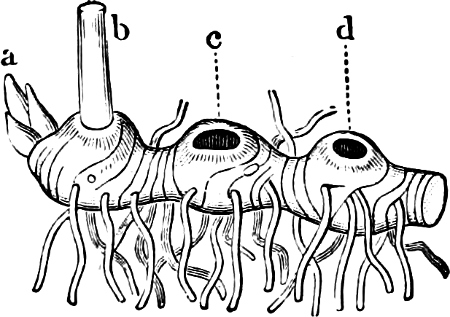
Fig. 307.—Rhizome of Polygonatum multiflorum: a bud; b shoot; c d scars left by shoots of previous years.
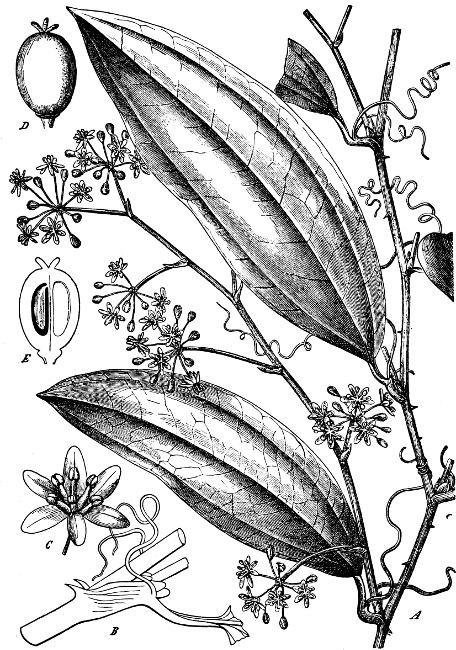
Fig. 308.—Smilax pseudosyphilitica: A shoot of male plant; C ♂-flower; D berry, almost ripe; E the same in longitudinal section. B Smilax syphilitica: portion of branch with base of leaf and tendrils.
B. Asparageæ, Asparagus Group. Scale-like leaves and green assimilating branches.—Asparagus: horizontal rhizome. The aerial shoots are very richly branched; the numerous needle-like bodies upon the plant are leafless shoots, which are crowded together in double scorpioid cymes in the axils of the scale-leaves; the two first lateral axes, placed outside to the left and right, generally bear flowers. Polygamous.—Ruscus (Butcher’s broom) is a S. European shrub with leaf-like, ovoid or elliptical shoots (phylloclades) which are borne in the axils of scale-like leaves, and bear flowers on the central line. Diœcious. Stamens 3, united, anthers extrorse. Semele androgyna bears its flowers on the edge of the flat shoot.
C. Smilaceæ. Smilax (Sarsaparilla) (Fig. 308); climbing shrubs with the leaf-sheath produced into tendrils. The leaves have 3–5 strong nerves proceeding from the base, and are reticulate. Orthotropous or semi-anatropous ovules. Diœcious (Fig. 308 C, E).
D. Dracæneæ. Fruit in some a berry, in others a capsule. The stem of Dracæna, when old, has the appearance of being dichotomously branched; it has the power of increase in thickness, and may become enormously thick. The Dragon-tree of Teneriffe, measured by Humboldt, attained a circumference of 14 m. and a height of 22 m.; the leaves are large, linear or linear-lanceolate.—Cordyline (East Asia), various species in gardens and greenhouses (Yucca is closely allied). Astelia.
Pollination. Paris quadrifolia and Convallaria majalis have no honey, and are chiefly visited by pollen-collecting bees (in the absence of insect visits self-pollination takes place); Polygonatum multiflorum has honey secreted by septal glands and protected by the base of the tubular perianth; it is pollinated by humble-bees, etc. Asparagus officinalis has small, polygamous, greenish, honey-bearing flowers; the ♂-flower is almost twice as large as the ♀; both have rudiments of the opposite sex.
About 555 species; especially from N. America, Europe, and Central Asia.
Officinal: “Dragons’-blood,” a red resinous juice from the stem of Dracæna and the roots of some Central American species of Smilax. The tuberous stems of the Eastern Asiatic Smilax glabra are officinal. The flowers of Convallaria majalis have been lately used as a substitute for Digitalis. Pungent, poisonous properties are possessed by Paris. None of the species are used as food, except the young annual shoots of Asparagus officinalis, a shore-plant which is used as a vegetable.
Order 4. Pontederiaceæ. Flowers generally zygomorphic, hypogynous, ☿, with handsome, white or violet, petaloid perianth which forms a tube at its base. The stamens are inserted at different heights in the perianth-tube, and are reduced to three (in Heteranthera seldom to one). In some the ovary is trilocular with ∞ ovules (Eichhornia), in others reduced to one loculus with one ovule (Pontederia). Fruit a capsule or nut. Embryo as long as the abundant, mealy endosperm.—Tropical water-plants (22 species) with peculiar sympodial branching, nearly the same as in Zostera. Spikes without floral-leaves. Many intercellular spaces in the stem and leaf.—In greenhouses: Eichhornia azurea, E. crassipes (both from tropical and sub-tropical S. America); the latter has swollen petioles which serve as floats and enable it to float freely on the water, sending down its roots into the mud. Heteranthera reniformis, H. zosterifolia. Pontederia cordata.
Order 5. Amaryllidaceæ (Narcissi). The flower is epigynous, otherwise exactly the same as in the Liliaceæ (6 stamens). The majority, like these, are also perennial herbs with bulbs and scapes. The fruit and the other characters as in the Liliaceæ. The external appearance is, however, very different.
A. Amarylleæ have bulbs and the leaves generally arranged in two rows; the flowers are borne singly or in umbel-like inflorescences on lateral scapes, while the main axis of the bulb is unlimited. Beneath the inflorescence is an involucre (Fig. 309).—Galanthus, Snowdrop, has a polyphyllous perianth without corona; the three inner perianth-leaves are emarginate and shorter than the outer; the anthers dehisce apically. Leucojum differs in having the perianth-leaves equal in length.—Amaryllis has a funnel-shaped perianth, entirely or nearly polyphyllous, but somewhat zygomorphic. Crinum; Hæmanthus; Clivia.—Narcissus has a tubular corona, a ligular structure arising from the perianth-tube exterior to the outer stamens. In Pancratium (Fig. 309) the corona is united with the filaments which appear to spring from its edge. Eucharis amazonica.
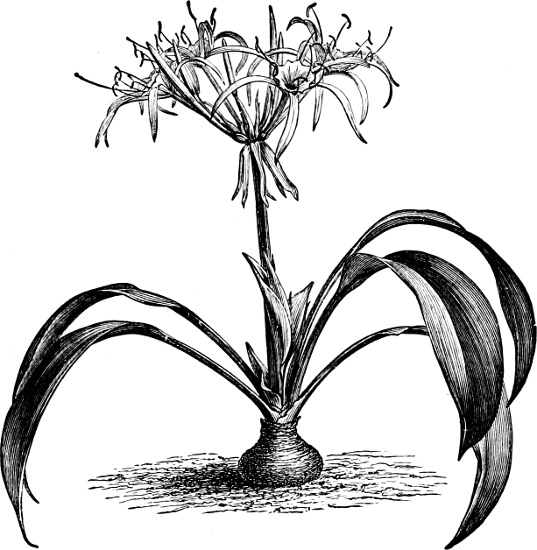
Fig. 309.—Pancratium caribæum.
B. Hypoxideæ. The leaves, which are grass-like, dry, folded, and in some hairy, spring from a rhizome, generally with a divergence of 1/3. Flowers small, perianth polyphyllous, persistent, on which account perhaps the Hypoxideæ may be considered as the least altered type. The chief characteristic is that the embryo is separated from the hilum. Hypoxis; Curculigo (C. recurvata, a favourite ornamental plant; S.E. Asia).
C. Alstrœmerieæ. (Alstrœmeria, Bomarea); stems long, leafy, often climbing.
D. Vellosieæ (Vellosia, Barbacenia); stem woody, usually dichotomously branched, with terminal, single flowers; it bears numerous aerial roots which pierce the leaves and surround the stem. Stamens often (by splitting) 6–18. High table-lands of S. America and S. Africa.
E. Agaveæ. Very similar to the Bromeliaceæ both in their distribution (nearly all American) and in external appearance. They appear as gigantic bulbous plants with perennial, aerial, generally short stem, and perennial, large, lanceolate or linear, stiff, thick, and often thorny leaves, which form a large rosette; after the course of several (8–20) years the terminal inflorescence is developed, which is 10–12 m. high, paniculate, and freely branched. Before the inflorescence expands, a large quantity of sugar-containing sap is collected from A. americana by removing the terminal bud; this on distillation yields “pulque,” the national drink of Mexico. After flowering the entire shoot dies, but the subterranean lateral shoots survive and reproduce the plant.—Agave americana, etc.; Fourcroya; Polianthes tuberosa (Tuberose; Central America).
Distribution. The 650 species are chiefly natives of S. Africa and S. America. Clivia, Hæmanthus, Amaryllis are from the Cape; Narcissus from S. Europe, whence many species have been introduced; Galanthus and Leucojum are especially from S. and Central Europe, and from the Caucasus.
Uses, few, except as ornamental plants: Galanthus nivalis; Leucojum; Narcissus pseudonarcissus, N. poeticus, N. jonquilla, N. tazetta, etc.; Amaryllis, Alstrœmeria, Eucharis, Crinum, Vallota, etc. The vascular bundles of the various species of Agave (Agave rigida, var. sisalana, sisal hemp,) are used for cordage, etc.
Order 6. Bromeliaceæ. The flowers are hypogynous, epigynous or semi-epigynous; the perianth is divided into calyx and corolla; stamens 6. The fruit is a capsule or berry with many seeds. Endosperm mealy, embryo small, at the edge of the endosperm, but not enclosed by it.
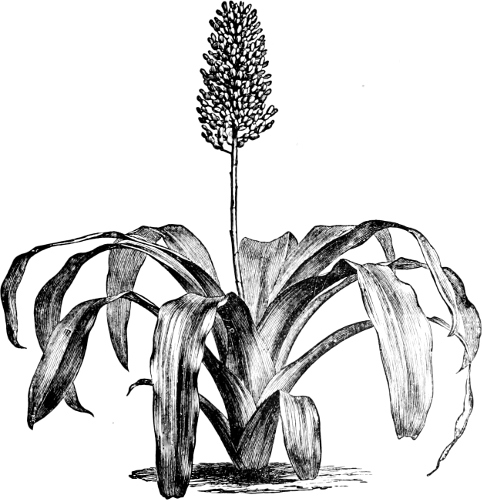
Fig. 310.—Aechmea miniata.
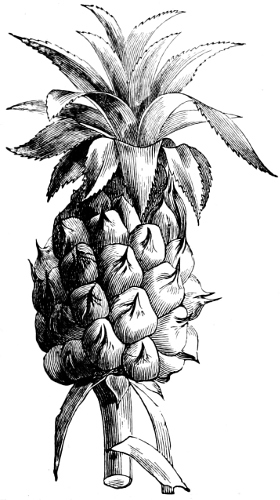
Fig. 311.—Multiple-fruit of Ananassa sativa.
Perennial herbs with a very characteristic appearance (Fig. 310); the stem is most often short, thick, and crowned by a rosette of many leaves, which are long, often very narrow, leathery, stiff, and with a spiny edge; they are usually channeled, completely closing round each other, with their edges forming a tightly closed hollow, in which generally water is collected (this among other things insulates the inflorescence and thus prevents the access of creeping insects, such as ants). The presence of numerous stellate, water-containing hairs often gives the leaves a grey appearance, and the layers of cells beneath the upper epidermis of the lamina form an “aqueous tissue,” which serves as a protection against the rays of the sun and regulates the evaporation. The stomata are often situated in furrows on the underside of the leaf, and hence cause a striped appearance. They are all American (525 species), especially from S. America, where they live partly as epiphytes on trees, partly in the clefts of rocks, often on the steepest slopes, to which they firmly attach themselves by aerial roots; some are terrestrial. The stem is seldom tree-like or many metres in height (Puya, in Chili; Hechtia, in Mexico). The inflorescence is a terminal spike, raceme, or panicle, often with large and brightly-coloured floral-leaves. The flowers are without scent. The seeds, in the species whose fruit is a capsule, are often provided with wings (hairs, expansions, etc).—Ananassa sativa, Pine-apple (W. Indies, Central America) is cultivated for the sake of its juicy, aromatic fruits, which coalesce with their fleshy bracts and form a large spike-like fruit-cluster (multiple-fruits,[29] Fig. 311) bearing on its apex a leafy shoot, which may be used as a cutting. Seeds very rarely developed.—Tillandsia (T. usneoides is a filamentous, richly branched, rootless epiphyte hanging in masses from trees; Trop. Am.), Aechmea, Billbergia, Pitcairnia, etc.