DIVISION V. ANGIOSPERMÆ. (continued 7)
Michael Cresse Potter translation
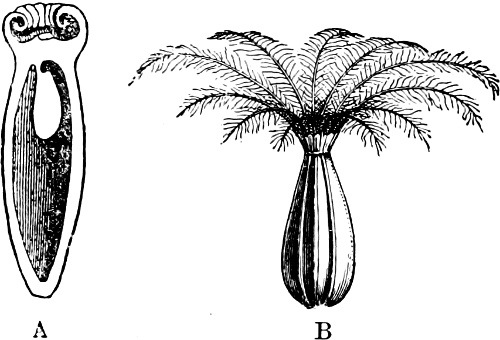
Fig. 594.—Valeriana: A ovary (longitudinal section); B ripe fruit.
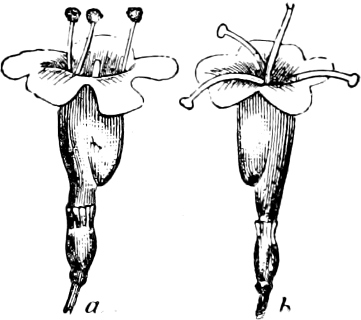
Fig. 595.—Valeriana: a flower in the ♂ stage; b in the ♀.
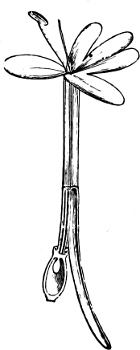
Fig. 596.—Centranthus ruber. Flower, its lowermost portion (the ovary and spur) in longitudinal section. (Mag.)
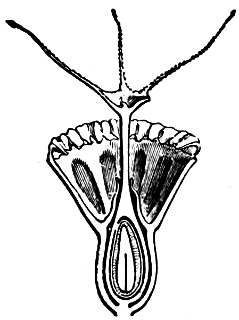
Fig. 597.—Scabiosa atropurpurea. Fruit in longitudinal section. Inside the “epicalyx” may be seen the fruit drawn out into a beak, with straight embryo and radicle directed upwards.
Order 2. Dipsacaceæ (Teasels). Herbs with opposite leaves without stipules. The flowers are situated in compact capitula each with an involucre. A characteristic feature of the order is that each flower of the capitulum has a gamophyllous “epicalyx” (Figs. 597, 599, 600), which envelopes the inferior ovary. The flowers (Figs. 599, 600) are ☿, 5-merous (S5, P5, stamens typically 5, G2), but the calyx often expands at the edge into a membrane with 5, or an indefinite number of bristles or teeth (pappus, Figs. 597, 600), and the zygomorphic, funnel-shaped corolla is sometimes 5-lobed and bilabiate (2/3), but most frequently 4-partite (Fig. 599), the two lobes of the upper lip coalescing into one lobe, as in certain Labiatæ, Veronica and Plantago; the æstivation is imbricate.
Figs. 598–600.—Dipsacus fullonum.
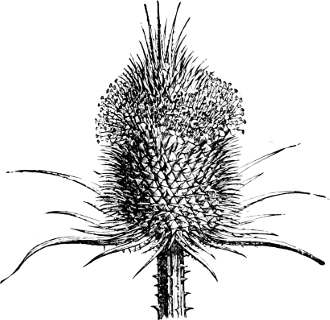
Fig. 598.—Inflorescence (the flowers in a zone below the apex commence to flower first).
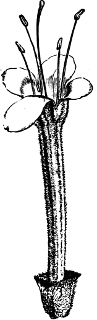
Fig. 599.—Flower (4/1).
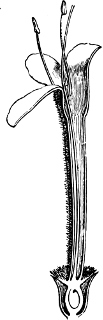
Fig. 600.—The same in longitudinal section.
The stamens are never more than 4, the posterior one remaining undeveloped; they usually have free anthers which generally project considerably (Fig. 599). The ovary is unilocular with 1 pendulous ovule and bears 1 undivided style; fruit a nut with 1 seed, containing endosperm and with the radicle turned upwards (Fig. 597).
The flowers do not always open in centripetal order, a fact which may be observed especially in the Dipsacaceæ, in which a zone of flowers round the centre of the capitulum opens first, and the flowering then proceeds both upwards and downwards (Fig. 598). This has probably some connection with the fact that the capitulum has arisen from the coalescence of several dichasial inflorescences. In species of Scabiosa the flowers open simultaneously at the circumference, or in a zone at the centre.—The morphological explanation of the “epicalyx” is not quite certain; in all probability it is formed from two united bracteoles, for an “epicalyx” is distinctly formed in this way in one of the Valerianaceæ, Phyllactis.—The ray-flowers are larger and more irregular, labiate or ligulate, than the disc-flowers, yet not in so high a degree as in the Compositæ.
A. A scarious bract to each flower. Scabiosa has a 5-lobed corolla; the “epicalyx” has a dry, scarious, often finally large collar, and the true calyx is formed of long bristles (generally 5) (Fig. 597). Succisa pratensis (Devil’s-bit) has a 4-lobed corolla, the collar of the “epicalyx” is herbaceous; the calyx as in the preceding.—Pterocephalus.—Dipsacus (Teasel); large, spiny and stiff-haired herbs with capitula, or short, thick spikes on which both the involucral-leaves and bracts project considerably, and are stiff and spinose (Fig. 598). The “epicalyx” has short teeth, or is almost entire. The leaves of the stem unite together in pairs, so that shallow cups are formed round the stems in which rain-water may collect.—Cephalaria.—Morina: the flowers are falsely verticillate as in the Labiatæ; the calyx has 2 laterally-placed, entire, or emarginate lobes; 2 stamens, or 2 large and 2 small ones.
B. Bristles, but no true bract to each flower. Knautia; the corolla is 4-partite, the calyx cup-like, with many bristles or teeth on the edge.
Pollination is in many species effected by insects. The honey is secreted by a ring round the base of the style. The flowers in our native species are considerably protandrous. Gynodiœcious flowers also occur.—150 species; especially in the Mediterranean and the Orient; the order is not represented in the South Sea Islands, Australia and America.—The heads of the true Teasel (Dips. fullonum) are used for carding wool, on account of the elastic bracts, which are hooked at the point. The order has bitter properties; tanin, etc.; but no species are used in medicine or the household.—Scabiosa atropurpurea, etc., are used as ornamental plants.
Order 3. Calyceraceæ. This order resembles the Compositæ in the valvate æstivation of the corolla and the more or less united stamens, and the Dipsacaceæ in the undivided style, pendulous ovule and endosperm. The calyx is frequently composed of 5 distinct scales. An “epicalyx” is wanting.—20 species; America.
Family 35. Campanulinæ.
The flower is epigynous, perfect, with 5 sepals, 5 petals, and 5 stamens in regular alternation, and 3 (2–5) carpels. The sepals in all cases are distinct, but narrow and pointed, so that the æstivation is open. The corolla is gamopetalous with (as in the Compositæ) valvate, or slightly infolded-valvate æstivation. The stamens are nearly always situated on the torus without being united to the corolla (Figs. 601, 604). The anthers adhere or unite and form a tube with introrse anthers from which the pollen is swept out by the projecting, brush-like hairs on the style (as in the Compositæ). The ovary is 3-(2–5) locular, many ovules in each loculus. The fruit is generally a many-seeded capsule (or berry). Embryo in the centre of a fleshy endosperm.—The majority are herbs with scattered leaves, without stipules. The presence of latex and inulin, together with the tubular formation of the anthers, the pollination, etc., indicate a relationship with the Compositæ.
The Cucurbitaceæ are by some authorities placed in this family as being most closely related to the Campanulaceæ. Although the corolla is most frequently gamopetalous, and other similarities to the Campanulaceæ are present, yet on account of the structure of the ovule, and for other reasons, the Cucurbitaceæ are here placed in the Choripetalæ. The Campanulinæ without doubt proceed upwards to the Compositæ, with which, in addition to the occurrence of inulin and laticiferous vessels (Cichorieæ), there are many corresponding features both in the structural and biological relations (epigyny, valvate æstivation of the corolla, tendency of the anthers to adhere or unite, protandry with a stylar-brush, etc.) The inflorescence of Jasione is almost identical with that of the Compositæ.
Order 1. Campanulaceæ (Campanulas). The flowers are regular and in some only semi-epigynous, 5-merous, except in the gynœceum which is 3-merous (the unpaired, median carpel being generally posterior), more rarely 2–5-merous, and has a corresponding number of stigmas and loculi in the ovary; the placentation is axile with a large number of ovules. The median sepal is posterior. The stamens frequently have broad, free bases (Fig. 601 H) which cover the nectariferous upper surface of the ovary; the anthers only fit loosely together, and become separated as soon, as the pollen is shed (Fig. 601 G), 1 long style, which is studded by sweeping-hairs (stylar-brush), which ultimately become invaginated; the stigmas do not unfold until the stamens have shed the pollen (Fig. 601 E, G). Fruit a capsule.—Herbs, more rarely under-shrubs or shrubs, with latex and scattered, undivided leaves without stipules. The inflorescence is most frequently a raceme or spike with terminal flower.
A. Capsule opening at the side by pores and small valves: Campanula (Canterbury-bell); the corolla is bell-shaped, rarely almost rotate; capsule obconical. The pores of the capsule are found near the top of the fruit when it is erect, and near the base when it is pendulous, so that the seeds are not liberated unless the capsule is forcibly shaken, and they are thus ejected to a considerable distance.—Phyteuma (Rampion) has free petals, which for a long time adhere at the apex and form a tube round the stamens (Fig. 601); inflorescence compact, spike-like or capitate, in the latter case resembling that of the Compositæ, and frequently with an involucre similar to the one possessed by this order. Specularia (rotate corolla, prismatic capsule), Michauxia (flower 8-merous).—Symphyandra has syngenesious anthers.
B. Capsule with valves at the apex, loculicidal dehiscence: Jasione; the petals are almost free. The anthers are united at the base (syngenesious). The flowers are situated in capitate umbels with involucres.—Wahlenbergia; Platycodon.
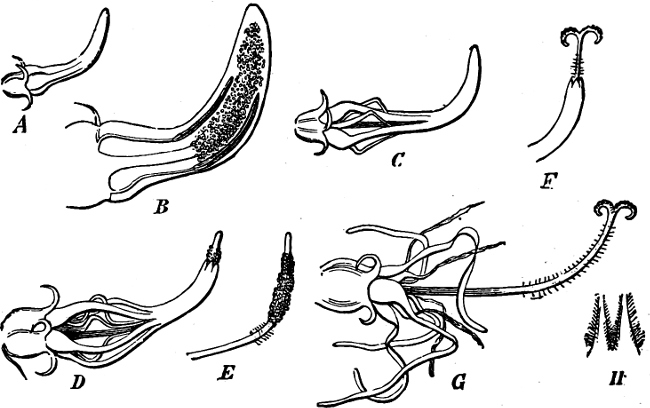
Fig. 601.—Phyteuma spicatum. Flowers and parts of flowers in various stages of development.
C. Berry: Canarina; flower, 6-merous; leaves opposite.
Protandry is general (Fig. 601). 510 species; principally in temperate countries. Several genera furnish ornamental plants, but are of little use for other purposes. The roots of some Campanula-and Phyteuma-species are large and may serve as pot-herbs (C. rapunculus, P. spicatum).
Order 2. Cyphiaceæ. In this order the corolla is zygomorphic and the stamens free, hence it is intermediate between orders 1 and 3.—About 24 species; Africa.
Order 3. Lobeliaceæ (Lobelias). This order may briefly be described as Campanulaceæ with zygomorphic flowers and anthers united into a tube, in most cases slightly bent; generally 2 carpels and an inverted position of the flower, i.e. the median sepal is turned anteriorly (Fig. 602) (a position which is found to occur within the Campanulaceæ). A twisting of the peduncle takes place even before flowering (as in the Orchids) so that the ordinary position of the 5-merous Dicotyledons appears to be restored. The zygomorphy of the flower is especially present in the corolla, which has a bipartite under-lip and a tripartite upper-lip, and is, in Lobelia, anteriorly (apparently posteriorly) deeply cleft (Fig. 602). There is 1 style, but the stigma is capitate and bilobed and surrounded at its base by a whorl of hairs, which assists in pollination (as a stylar-brush) in the same manner as the sweeping-hairs in the Campanulaceæ and Compositæ. There is no terminal flower in the spicate, or racemose inflorescences.—Lobelia has a capsule, several others have berries. Isotoma (regular flower); Heterotoma has a spur; Siphocampylos; Lysipoma (pyxidium); Clintonia (1–locular fruit). Metzleria (all the petals are free).
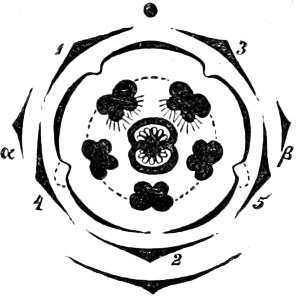
Fig. 602.—Diagram of Lobelia fulgens.
Figs. 603, 604.—Lobelia syphilitica.
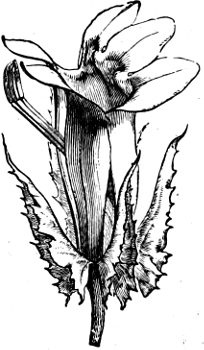
Fig. 603. Flower (2/1).
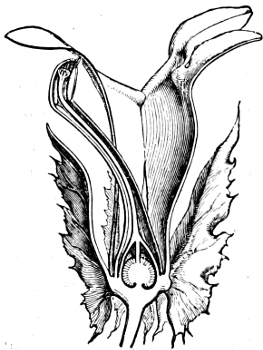
Fig. 604.—Longitudinal section of the same.
Entomophilous and protandrous. About 500 species, especially in the Tropics; in this country, L. dortmanna (margin of lakes).—Several are cultivated in gardens and conservatories as ornamental plants (Lobelia bicolor, erinus, fulgens, etc., Siphocampylos, Centropogon). The latex of several species of Tupa is poisonous; caoutchouc is also obtained from them. Officinal: “herba Lobeliæ” (the alkaloid lobeline) from the poisonous L. inflata (N. Am.).
Order 4. Goodeniaceæ. Chiefly Australian (200 species), closely related to Orders 3 and 5, but without latex. The style is provided with a “collecting-cup” which receives the pollen before the flower opens; it has a small, hairy aperture through which the pollen is forced out by the stigmas, and through which they emerge when the pollen is shed; it is sensitive and exhibits movements when touched.—Herbs, under-shrubs, less frequently shrubs. Goodenia, Leschenaultia, Scævola.
Order 5. Stylidiaceæ (or Candolleaceæ); 100 species, the majority Australian; zygomorpbic flowers, but with the ordinary position. The anterior petal is very small. The chief characteristic feature is the presence of only 2 stamens (with extrorse anthers) which are united with the style and form a stylar-column; this is bent like a knee and sensitive at the bend to such a degree that when touched it jerks violently across the flower to the opposite side and then loses its sensitiveness.—Herbs, less frequently under-shrubs. Stylidium (Candollea).
Family 36. Aggregatæ.
The flowers, which are borne in “capitula” (Figs. 605, 610), are epigynous (Fig. 605 C, D), 5-merous in the calyx, corolla and andrœcium, the corolla is valvate in æstivation, with 2 carpels (S5, P5, A5, G2). The anthers are united into a tube (syngenesious) (except Ambrosieæ) which surrounds the bifid style. There is never more than 1 loculus in the ovary, with 1 erect, anatropous ovule. The fruit is a 1–seeded nut (cypsela), with thin pericarp, the calyx generally persists as a tuft of hairs (pappus) (Fig. 606) on the summit of the fruit. Embryo without endosperm; the radicle directed downwards.
Only 1 Order: Compositæ.
With respect to the inflorescence and the development of the individual flowers, there is a very close resemblance to the Dipsacaceæ, which stand on the same plane of progression as the Compositæ. But while the latter are allied to Campanulinæ as the last stage in the process of evolution, the Dipsacaceæ form the final stage of the Rubiales-Dipsacales.
Order Compositæ. (For the principal characteristics compare those of the family.) The Compositæ are chiefly herbs, but trees and shrubs also occur in tropical countries. The leaves may be scattered or opposite, but have no stipules. The outer leaves of the involucre as a rule are barren, especially when numerous and imbricate, while the innermost ones support the ray-flowers of the capitulum; in a few instances all are fertile (e.g. Tragopogon, Tagetes). The CAPITULA are many-flowered, with the exception, e.g. of Echinops, which has 1-flowered capitula (see page 570). The capitula are again arranged in inflorescences, most frequently corymbose with centrifugal order of development. The form of the receptacle is an important character for the division of the genera (flat, convex, conical), and also the presence of scales; these may be one scale (bract) for each flower (Fig. 610 br), or a large number of bristles, which do not each correspond to a leaf, or the receptacle may be entirely without covering (naked). The flowers open in acropetal order in each capitulum. All the flowers in a capitulum may be of the same sex, and their form and colour are in that case the same, or the sexes may be different, in which case the form and colour are also most frequently different: the ray-flowers have projecting labiate or ligulate corollas, while the disc-flowers have tubular corollas. As a rule in the latter case the ♀ flowers are at the circumference, and the ☿ in the centre, less frequently ♀-flowers at the edge and ♂-flowers in the centre. The ray-flowers in some genera are neuter (e.g. Centaurea). Some are diœcious.
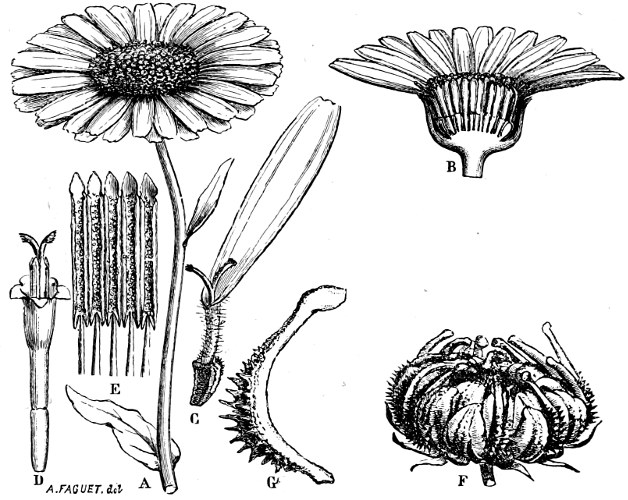
Fig. 605.—Calendula arvensis: A capitulum; B capitulum in longitudinal section; C ♀-flower; D ☿-flower; E the stamens; F capitulum with ripe fruits; G ripe fruit.
There is no trace of an epicalyx (in contrast to the Dipsacaceæ, which they generally so resemble). The formation of the CALYX is very varied. The calyx always consists of a very small cushion-like structure, most frequently developed later than the corolla; the 5 corners, which correspond to the 5 sepals, in a few instances are raised as 5 large, flat, membranous bodies, e.g. in species of Xeranthemum, Catananche, Sphenogyne, etc.; in other instances each of these bears a shorter or longer bristle on its apex, followed by others in rather uncertain numbers and with but slight indications of order, on the edge and on the outer side of the calyx between the 5 points; in other instances, again, the calyx is covered with bristles and hairs without any indication of order or definite number (Fig. 606 a, b); finally instances occur in which the edge is raised as a membranous collar, irregularly toothed and notched, or divided into small scales. There are naturally differences in the means of distribution corresponding to the differences in structure of the calyx. The fruits a and b represented in Fig. 606 are distributed by the wind, those like c, on the other hand, by attaching themselves to animals and human beings. The rays of the pappus are termed rough when special cells project a little beyond the surface, but if these grow out, and are hair-like, the pappus is said to be feathery. In some genera the pappus is raised on a long stalk, which is developed from the upper part of the fruit, and termed a beak (Fig. 606 a). The pappus does not attain its full development till the ripening of the fruit, i.e. until it is about to be of use.
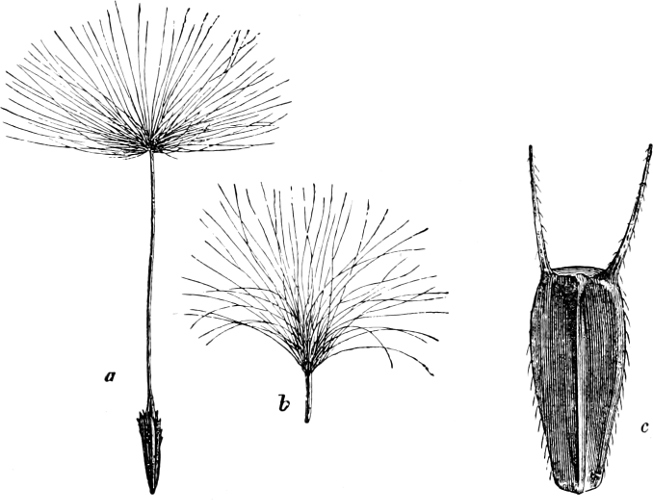
Fig. 606.—a Fruit of Taraxacum; b of Senecio; c of Bidens.
The COROLLA has various forms: (a) tubular (Fig. 605 D), with a shorter or longer tube, not always of the same bore throughout and especially slightly widened at the top to form a bell-shaped opening, with 5 regular teeth: (b) labiate after 2/3, i.e. with 2 petals in the upper and 3 in the under lip: (c) ligulate, i.e. the corolla is split for a considerable distance on the posterior side (as in the Labiate genus Teucrium) and prolonged into a long, strap-like portion (Fig. 609 A), which projects upwards. A distinction must, however, be drawn between the true and false ligulate corolla. In the first case the corolla has 5 teeth at the apex (Fig. 609 A) and is made up of all the petals of the corolla united together; this is the usual condition in the Ligulate-flowered. In the latter case (Fig. 605 C) the tongue has only 3 teeth (or is more irregularly 2–3-dentate), and is only formed of 3 petals; the corolla is then truly bilabiate, the tongue is the large under lip, and the upper lip is very slightly developed, or even at an early stage quite suppressed. This false “ligulate” corolla is found among the ray-flowers; sometimes the upper lip is seen quite plainly, e.g. in Tagetes, especially in the double capitula. The VENATION of the corolla is peculiar; there are always commisural veins which branch dichotomously at the angles between the teeth of the corolla, and send a branch into the edge of the two nearest teeth. The midrib is frequently absent, but may be present, and then it has sometimes no connection with the other veins of the corolla.
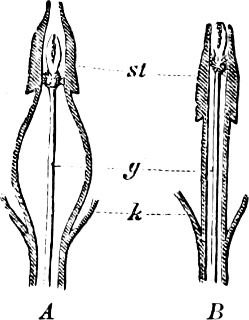
Fig. 607.—Centaurea cyanus: A the anther-tube (st) with the crescentic curved filament before irritation; g the style; k the base of the corolla; B the same after irritation, the anthers are drawn further down.
The STAMENS are attached to the corolla, and have free filaments (Silybum has united filaments), but the anthers, which at first are free, adhere together and form a tube (Fig. 605 E: only Ambrosieæ have free anthers). The connective is generally prolonged, and protrudes above the anthers as a thin, brown membrane of various forms (Fig. 605 E); appendages of various forms may also be found at the base of the anthers. The anthers open introrsely, and the pollen must be carried out at the top of the tube by upward growth of the style, and by means of the “stylar-brush” (Figs. 607, 608, 609); the filaments are sometimes sensitive (e.g. in the Corn-flower, Fig. 607), and shorten on being touched, so that the anther-tube is pulled downwards, and the pollen swept out at the top (Figs. 607, 608 A, B).
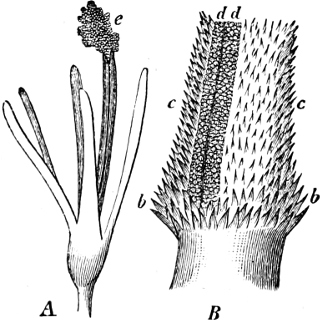
Fig. 608.—Cirsium arvense: A the upper portion of a flower, the pollen (e) is being ejected; B part of the upper portion of the style with stylar-brush (b, c) and the stigmatic papillæ (d).
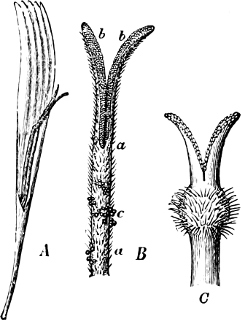
Fig. 609.—Leontodon autumnale: A ligulate flower; B extremity of the style with stylar-brush (a), stigma (b) and pollen-grains (c). C Centaurea cyanus.
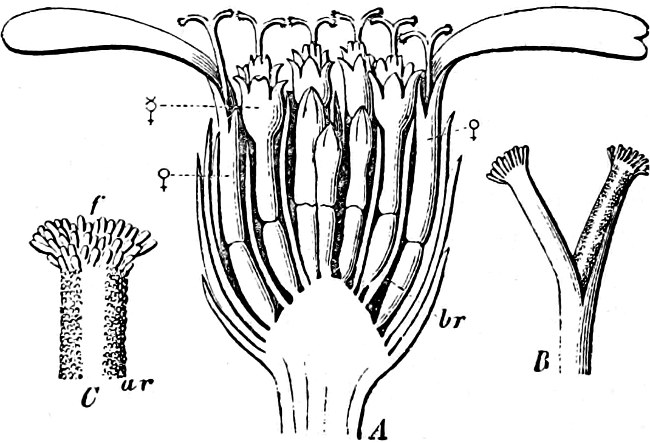
Fig. 610.—Achillea millefolium.
The STYLE divides at the apex into two branches (Figs. 609, 610), both of which generally bear on the inner surface two lines of stigmatic papillæ (Fig. 610 B, C) and being in shape, etc., very varied, are therefore employed as systematic characters.—The most important types are: A. The style is uniformly cylindrical; its branches are semi-cylindrical, long, and with long hairs, and finally bend backwards; the stylar branches bear slightly projecting stigmatic papillæ on the inner side. This form is characteristic of the Cichorieæ (Fig. 609 A B). B. The style is uniformly cylindrical; the branches are long, cylindrical or club-like, short, not rolled back, with fine hairs externally; the stigmatic lines do not reach beyond the centre, and do not meet together. Characteristic of Eupatorium, Petasites, Tussilago. C. The style is thickened beneath the stigmatic branches in the form of a knob, or very hairy (Fig. 609 C); the stigmatic lines reach as far as the apex of the branches and then converge; sometimes the stigmatic branches are united as far as the apex. Characteristic of the Cynareæ. D. The stylar branches are lanceolate, or linear, pointed; externally flat and thickly covered with hairs in the upper portion; the stigmatic lines cease where the hairs commence externally. Characteristic of Aster, Bellis, Inula, Dahlia, etc. E. The stylar branches are linear, with long, brush-like hairs at the apex, where they are either abruptly cut off or prolonged into a very hairy, conical appendage; the stigmatic lines are broad, reach as far as the brush-like hairs, and do not meet together (Fig. 610). Characteristic of Senecio, Helianthus, Xanthium, Gnaphalium, Artemisia, Anthemis, and others related to these.
A ring-like nectary is found round the base of the style.
The thin-walled cypsela (Fig. 606), with seeds fitting closely to the pericarp, has many different forms (smooth, ribbed, spined, etc.); its point of attachment generally lies at the lowest end but sometimes it is drawn obliquely up the side (Centaurea, etc.). The calyx, persistent on the apex of the fruit, has been described above. Some genera have two or three different forms of fruits in each capitulum.—The embryo is straight, with the radicle turned downwards, and without endosperm, but is rich in oil.
The variously flowered capitula, whose normal tubular disc-flowers have been changed to ligulate flowers, may be termed “double flowers.”
The relationship of the Compositæ to the Campanulinæ has been described above (page 561). The alliance with the Dipsacaceæ is more apparent than real. Similar capitate inflorescences also occur as the final stage in other lines of descent, as in Eryngium among the Umbelliferæ.
1. Cynareæ, Thistle Group. Flowers all ☿, regular, with tubular corollas. The receptacle is covered with numerous bristles, which surround the flowers without any definite order, or the edges of the grooves in which these are placed have a well-marked fringe. The involucral leaves are numerous, imbricate, and are either prolonged into a thorn or terminate with a membranous edge. The style has been described on page 568 (Fig. 609 C). Nearly all have a hairy or feathery pappus. The filaments are sensitive.
Carduus (Thistle); capitula ovoid; involucral leaves compact, imbricate, with thorny points; the pappus-rays are hair-like and united at the base by a ring (i.e. the calyx), and fall off together.—Cirsium (Fig. 608) has a feathery pappus, in other respects it is like Carduus. C. arvense reproduces and passes the winter by means of suckers.—Cynara (Artichoke) has a feathery pappus and large, solitary capitulum, with broad involucral leaves; these have a fleshy base like the receptacle (edible).—Silylum has united filaments. S. marianum (Milk-thistle), has leaves with numerous white spots. Onopordon (Cotton-thistle). Cnicus (C. benedictus) has a large, many-spined thorn on the involucral leaves; pappus trimorphic.—Lappa (Burdock) is easily recognized by the hooked involucral leaves, which assist in the distribution of the fruit; in this respect it differs from the other inflorescences, and also in the fact that the pappus is short, and quickly falls off, without serving as a means of distribution.—Carlina; the external involucral leaves are leafy, thorny, with branched or unbranched spines standing straight out or bent backwards; the internal ones are dry, and prolonged as dry, coloured, radiating scales. The well-developed bristles on the receptacle and edge of the calyx are deeply cleft and lobed.—Centaurea (Knap-weed, Fig. 607). The ray-flowers are neuter, and generally larger than the disc-flowers; the involucral leaves are regularly imbricate, but are frequently provided at the apex with a dry, chaffy, often lobed, fringed appendage. The attachment of the fruit is lateral. Serratula (Saw-wort).—Carthamus, the outer and inner involucral leaves differ very much.—Echinops (Globe-thistle) is characterised by having “compound capitula,” i.e. there is only one flower in each capitulum, but many such capitula are collected into a spherical head, which at the base may also have a few involucral leaves. The individual capitula have narrow, linear involucral leaves. (There are altogether about 150 species of Compositæ with 1-flowered capitula, all from warm countries.)—Xeranthemum, Staehelina, Jurinea, Saussurea, etc.
2. Mutisieæ, Labiate-flowered Group. Tropical (S. American) forms whose zygomorphic flowers have a bilabiate corolla (2/3). The involucre is nearly the same as in the Thistles.
3. Cichorieæ, Chicory Group (or Ligulifloræ). The flowers are all ☿ and have a ligulate, 5-dentate corolla. The stylar branches are thin and prolonged (Fig. 609 B). Laticiferous vessels occur in the majority (in this feature they resemble the Lobeliaceæ and Campanulaceæ).
A. The pappus is wanting, or it is scale-like, but not long and hairy.—Cichorium (Chicory); capitula with blue flowers, borne singly or a few together in the leaf-axil; there are two whorls of involucral leaves, an outer one of short and radiating, an inner of more numerous, longer and erect leaves; pappus, scale-like.—Lapsana (Nipplewort). The few involucral leaves are nearly of the same size, and persist forming a sort of capsule round the fruits, which are entirely without a pappus. There are only a few flowers in the small capitula.—Arnoseris (Swine’s-succory), Catananche, etc.
B. The pappus is long and hairy (not branched), generally fine and snowy-white. There are no scales on the receptacle. The two genera first considered have beaked fruits.—Taraxacum (Dandelion) (Fig. 606 a); the capitula are many-flowered, and borne singly on the top of a leafless, hollow stalk.—Lactuca (Lettuce) has many small, few-flowered capitula borne in panicles.—Crepis (Hawksbeard).—Hieracium (Hawk-weed) has many imbricate involucral leaves, and a stiff, brittle, brownish pappus.—Sonchus (Sow-thistle); the capitula, when a little old, have a broad base, and are abstricted above in the form of a jug; involucral leaves imbricate; the fruit is compressed, without a beak, ridged. The soft, white pappus falls off collectively.
C. The pappus is feathery and branched; no scales on the receptacle.—Tragopogon (Goat’s-beard) generally has 8 involucral leaves in one whorl. The fruit has a long beak; the rays of the pappus are interwoven in the form of an umbrella.—Scorzonera has fruits like the preceding, but almost without any beak; involucral leaves many, imbricate.—Leontodon (Hawkbit) has a slightly feathery pappus, rays not interwoven; beak absent.—Picris.
D. Long, chaff-like, deciduous scales on the receptacle; pappus feathery.—Hypochœris (Cat’s-ear).
4. Eupatorieæ, Hemp-agrimony Group. All the flowers are most frequently ☿; corollas tubular and regular; the involucral leaves are not stiff and spiny; the receptacle is not covered with stiff bristles. The stylar branches are long, club-like, or gradually tapering. There is no swelling below the stigma.
Eupatorium (Hemp-agrimony); all the flowers are ☿.—Petasites (Butterbur); ray-flowers ♀, disc-flowers ☿ or ♂; sometimes diœcious. Capitula in racemes or panicles. The leaves develop after the flowering.—Tussilago (T. farfara, Colt’s-foot) has a solitary capitulum borne on a scaly, scape-like stem; the ray-flowers are ♀ with ligulate corollas, disc-flowers ♂. The leaves unfold after the flowering. Ageratum, Mikania, Vernonia.
5. Astereæ, Aster Group (or Radiatæ, Ray-flowered). The flowers are of two forms and different sexes; the ray-flowers are ♀ (sometimes neuter), most frequently with irregular, falsely ligulate, radiating corollas; the disc-flowers are ☿, regular, with tubular corollas (Fig. 610). Sometimes only tubular flowers are present, as e.g. in Senecio vulgaris (Groundsel), and the exterior of the capitulum is then as in the Eupatorieæ. The stylar branches are straight, more or less flat and short (Fig. 610).
A. Anthemideæ. Involucral leaves imbricate, generally membranous at the edge; pappus wanting, or at most a membranous margin to the calyx, but without hairs.
[+]. Chaff-like bracts on the receptacle are found in Anthemis (Chamomile), Anacyclus (A. officinarum), Achillea (Milfoil, Fig. 610), Santolina, etc.
[++]. A naked receptacle is found in the following: Bellis (Daisy) has solitary capitula on leafless stalks with white ray-flowers.—Matricaria (Wild Chamomile) has a conical receptacle. (M. chamomilla has a very high, hollow receptacle; M. inodora has large, odourless capitula, and the receptacle is not hollow.)—Chrysanthemum (Ox-eye) most frequently large, solitary capitula; flat receptacle.—Pyrethrum; pappus scanty.—With these are classed Tanacetum (Tansy) and Artemisia (Wormwood) with tubular corollas only.
B. Heliantheæ. Most frequently a bract to each flower is found on the receptacle. The pappus is never exactly hairy, but consists of scales, spines, etc., and the fruits are most frequently compressed (Fig. 606 c).—Helianthus (Sun-flower); H. tuberosus (Jerusalem Artichoke) has tuberous underground stems. Dahlia has tuberous roots (Am.). Bidens (Bur-marigold, Fig. 606 c); the fruits are compressed with 2 (or more) spines provided with reflexed barbs.—Calliopsis; Rudbeckia; Zinnia; Tagetes has united involucral leaves, and yellow, transparent oil-glands. Spilanthes, Galinsoga, Melampodium, Silphium (Compass-plant), Helenium, Gaillardia.
C. Calenduleæ have 1–2 rows of involucral leaves, a naked receptacle, and large, crescent-shaped, irregularly warted fruits, of different forms in the same capitulum; pappus absent (Fig. 605).—Calendula (Marigold); ray-flowers ♀, disc-flowers ♂.
D. Senecioneæ, have a fine, hairy, white pappus; no bracts, otherwise as in Anthemideæ. The involucral leaves are most frequently in 1–2 rows.—Senecio (Groundsel) has two whorls of involucral leaves, which most frequently have black tips, the external being much shorter than the internal ones (S. vulgaris has all flowers ☿ and alike).—Cacalia, Doronicum, Cineraria, Ligularia, Arnica (A. montana; large, long-stalked capitula; leaves opposite, forming a kind of rosette).
E. Astereæ have a bristle-like, unbranched pappus, often of a dingy brown; receptacle naked; involucral leaves numerous, imbricate.—Solidago (Golden-rod); capitula small, yellow-flowered, borne in panicles. Aster; disc-flowers most frequently yellow, ray-flowers violet; Callistephus; Erigeron (Flea-bane)—Inula.—All the corollas are tubular in: Gnaphalium (Cud-weed); involucral leaves dry, rattling, often coloured; the foliage-leaves and stem often white with woolly hairs; ray-flowers ♀, with narrow, tubular corolla; disc-flowers ☿ (few). Antennaria (Cat’s-foot; diœcious), Filago, Helichrysum, Ammobium, Rhodanthe and others. Leontopodium (L. alpinum, “Edelweiss”).
F. Ambrosieæ, a very reduced type of Compositæ, differing from the others in having free anthers; the capitula are generally unisexual, monœcious, the ♂ borne in a terminal inflorescence, the ♀ in the leaf-axils. In other respects they are most closely related to Heliantheæ.—Xanthium. In the ♂-capitula there are many flowers without calyx, but with tubular corolla and free involucral leaves. In the ♀-capitula there are only 2 flowers, which are entirely destitute of both calyx and corolla; involucral leaves 2-spined, united to form an ovoid, bilocular envelope, each compartment containing one flower. The envelope of involucral leaves unites with the fruits, enclosing them at maturity with a hard covering from which numerous hook-like spines project, assisting very greatly in the distribution of the fruit. The whole structure thus finally becomes a 1- or 2-seeded false nut.—Ambrosia, the ♀ capitulum 1-flowered.
Pollination. The flowers are somewhat insignificant, but become very conspicuous owing to a number being crowded together in one inflorescence. The corollas of the ray-flowers, being often very large (Astereæ; Centaurea), frequently render the capitula still more conspicuous. The capitula display many biological phenomena similar to those often shown by the individual flowers in other orders, e.g. by periodically opening and closing, in which the involucral leaves resemble the calyx in their action. (The name “Compositæ” originates from the term “flos compositus,” composite flower). An abundance of honey is formed, which to some extent fills up the corolla-tube, and since insects may visit a number of flowers in the course of a short period they are very frequently visited, especially by butterflies and bees. The pollination has been described on page 567. Protandry is universal. In the bud the tips of the styles, covered by the sweeping-hairs, lie closely enveloped by the anther-tube; in the next stage the style grows through the tube and sweeps out the pollen as it proceeds; ultimately the stylar branches expand and the stigma is then prepared to receive the pollen. In many, the sensitiveness of the filaments assists in sweeping out the pollen at the exact moment of the insect visit. Regular self-pollination is found e.g. in Senecio vulgaris; wind-pollination e.g. in Artemisia and the plants related to it.
This extremely natural and well-defined order is the largest (and no doubt one of the youngest?); it embraces 10–12,000 known species (in 770 genera), or about one-tenth of all Flowering-plants. They are distributed over the whole globe, but are most numerous in temperate countries; the majority prefer open spaces; a smaller number are forest-forms. They abound especially in open districts in America.
Among the substances frequently found may be mentioned: Inulin (especially in the subterranean parts), Bitter materials, Tannin, volatile oils, fatty oils in the fruits. Medicinal:[40] “Herba” of Artemisia absinthium (Wormwood) and maritima[+] (Sea-wormwood), Achillea millefolium; the leaves of Cnicus benedictus and Tussilago farfara; the unopened capitula of Artemisia maritima, var. stechmanniana; the capitula of Tanacetum, Matricaria chamomilla[+] (wild Chamomile), Anthemis nobilis[+] (common Chamomile); the separate flowers of Arnica; the roots of Arnica montana[+], Taraxacum officinale[+], Anacyclus officinarum[+], Lappa major, minor, nemorosa and tomentosa, Inula helenium and Artemisia vulgaris; the latex of Lactuca virosa[+]. The following are cultivated for food:—Lactuca sativa (Lettuce), Cichorium endivia (from E. Asia, for salads), Cynara scolymus (Artichoke, Mediterranean), Scorzonera hispanica (S. Eur.), Helianthus tuberosus (Jerusalem Artichoke, from N. Am., introduced into Europe 1616), Cichorium intybus (roots as “chicory,”) Tragopogon porrifolium (Salsafy), Artemisia dracunculus. Oil is extracted from the following (the seeds): Helianthus annuus (Peru), Madia sativa (Chili), Guizotia oleifera (Abyssinia). Dyes from: Carthamus tinctorius (Safflower, used in the preparation of rouge; Egypt), Serratula tinctoria. Insect-powder from: Pyrethrum cinerariifolium (Dalmatia) and roseum (Persia, Caucasus). The following are cultivated in houses and gardens for the sake of their scented leaves:—Tanacetum balsamita (Balsam), Artemisia abrotanum (Southernwood) and A. argentea. A great many of the genera enumerated are cultivated in dwelling-houses for the sake of the flowers; e.g. Pericallis cruenta (generally termed “Cineraria”). Asteriscus pygmæus is supposed to be the genuine “Rose of Jericho”; the involucral leaves envelop the fruits after their ripening and keep them enclosed for 8–10 months until rain occurs.