DIVISION V. ANGIOSPERMÆ. (continued 6)
Michael Cresse Potter translation
About 270 species. Several species are ornamental plants. Several plants of the order are more or less narcotic. Ledum palustre has been used as a substitute for hops.
Order 4. Diapensiaceæ. Hypogynous flower. 3 floral-leaves beneath the flower (S5, P5, A5 + 0, G3). Stamens on the throat of the corolla. Pollen-grains single. Disc absent. Capsule loculicidal.—9 species from the Arctic regions. It is doubtful whether this order should be included in the Bicornes; perhaps it would be more correctly assigned to the Polemoniaceæ.
Order 5. Epacridaceæ. This order comprises those species of the family which are confined to Australia and the South Sea Islands. They are shrub-like plants, resembling the Ericaceæ in habit, in the inflorescence, and in the structure, form, and colour of the flower. They differ especially in having only 1 whorl of stamens (placed opposite the sepals) and in the anthers having only 2 loculi, and opening by a longitudinal slit. Fruit most frequently a drupe (or loculicidal capsule). Epacris-and Styphelia-species are ornamental plants. About 325 species.
Order 6. Vacciniaceæ (Bilberries). The flower (Fig. 546) is epigynous, the corolla gamopetalous, and the fruit a berry. The latter is most frequently spherical, and bears on its apex the calyx, which is generally very low, almost entire, and with a disc-like expansion inside. The flower is 4- or 5-merous (Fig. 546 B, D). The anthers have 2 pores, and are most frequently 2-horned (Fig. 546 F, G). Small shrubs; the leaves are scattered, not needle-like.
Vaccinium (Bilberry, Whortleberry) has an urceolate, gamopetalous, only slightly dentate corolla, and horn-like appendages to the anthers (Fig. 546). V. vitis idæa (Cowberry) is evergreen, with flowers in racemes, and bright red berries; V. myrtillus (Bilberry) and V. uliginosum (Bog Whortleberry) both have black berries with a blue bloom, leaves deciduous.—Oxycoccus has a polypetalous corolla with the petals projecting backwards. Anthers without appendages. O. palustris (Cranberry) has a slender, creeping stem, and is evergreen. Dark red berry.
Pollination essentially the same as the preceding order.—320 species; especially in N. Am. Some are useful on account of their edible fruits, especially Vaccinium myrtillus and V. vitis-idæa, and in a less degree Oxycoccus, etc. The fruits of V. myrtillus are officinal.
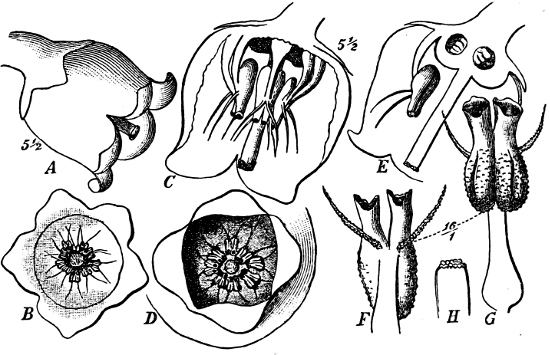
Fig. 546.—Vaccinium uliginosum (var. microphyllum). The parts of the flower A-E are enlarged 5–6 times; C and E are longitudinal sections; B and D the flower seen from above; F and G a stamen seen from the back and front; H the style and stigma.
Family 27. Diospyrinæ.
The flowers are regular, gamopetalous, typically diplostemonous, with the same number throughout all 5 whorls, thus: Sn, Pn, An + n, Gn, where n most frequently =5 (4–6), rarely 3, 7 or 8. Of the two whorls of stamens the one opposite the sepals is often present only as rudiments or is entirely suppressed, and the completely developed stamens are thus placed opposite the petals. The carpels are generally placed opposite the sepals. The ovary is multilocular with the ovules attached in the inner angles. The fruit is most frequently a berry. The seeds are large, generally solitary, or a few in each loculus.—All plants belonging to this family are trees or shrubs with scattered, single, most frequently entire, penninerved and leathery leaves without stipules; the majority are tropical (America, Asia), some are found in N. Am. and the Mediterranean.
Order 1. Sapotaceæ. Plants with latex; anthers extrorse, 1 erect ovule in each loculus; fruit a berry; the seeds with bony, shiny brown testa have a large, lateral hilum. The leaves are frequently covered with silky hairs.—A useful order in several respects (400 tropical species). The wood of some genera, such as Sideroxylon (Iron wood) and Bumelia, is as hard as iron. The latex of Palaquium (P. oblongifolium, P. gutta, and other species), Mimusops and Payena (Sumatra, E. Ind.), is the raw material of gutta percha. The following have very delicious fruits: Lucuma mammosa, Achras sapota, Chrysophyllum cainito (Star-apple), etc. The seeds of Bassia (E. Ind.) contain a large quantity of a fatty oil. Isonandra, Mimusops schimperi are often found in the Egyptian royal tombs.
Order 2. Ebenaceæ. Plants without latex, often diœcious; flowers with a more or less leathery perianth. The number of stamens is sometimes increased (by splitting?); ovules 1–2, pendulous in each loculus. Fruit a berry.—250 species; chiefly tropical. Some are well known on account of their hard and black-coloured heart-wood, e.g. Maba ebenus (the Moluccas) and Diospyros ebenum (Ebony-wood, from Tropical Asia) and others.—The fruits are edible e.g. of Diospyros lotus (Date-plum, Asia), which is also cultivated as an ornamental shrub, together with several other species.
Order 3. Styracaceæ. The flower is more or less epigynous, and the corolla is almost polypetalous. The stamens (by splitting?) are more than double the number of the petals, and often united at the base. Stellate hairs are frequent.—235 species; Tropical Asia and America, a few for example in the East.—Officinal: Gum-benzoin from Styrax benzoin and perhaps other species (Sumatra and Siam). Halesia tetraptera (N. Am.) is an ornamental shrub with 4-winged fruits.
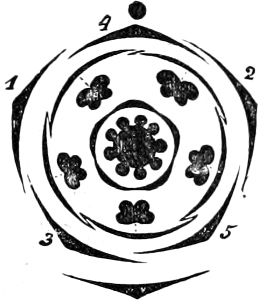
Fig. 547.—Diagram of Primula.
Family 28. Primulinæ.
The flowers are regular, ☿, hypogynous, and gamopetalous. The stamens are equal in number to the petals (Fig. 547) and are placed opposite to them. The ovary is unilocular, with a free, central placenta with 1–many ovules.—The flower is a further development of the Diospyrinæ; the suppression of the calyx-stamens, which commenced in this family, is carried further in the Primulinæ, so that in the majority of cases no trace of them is present, but in certain species and genera (Samolus, Lysimachia thyrsiflora, Soldanella, certain Myrsineæ) some small bodies (scales, teeth, etc.) are found in the position of the suppressed stamens. Again, the lateral portions of the carpels are suppressed, so that the ventral placentæ with the ovules are separated from the dorsal portions, and are united into a free central placenta; this theory is supported by the branching of the vascular bundles, the development, and various comparative considerations.—Sn, Pn, A0 + n, Gn; where n = 4–8, generally 5. The carpels are placed opposite the sepals (Fig. 547).
Order 1. Primulaceæ (Primroses). This order has many ovules attached to a thick, free, central placenta (Fig. 547); style undivided with a capitate stigma; ovules semi-anatropous; fruit a capsule with many seeds.
All the plants belonging to this order are herbs; stipules wanting; the flower is most frequently 5-merous (S5, P5, A0 + 5, G5; except Centunculus and Trientalis). The corolla and capsule have various forms, but the capsule generally opens by teeth at the apex. The ovules are semi-anatropous (in Hottonia they are anatropous), and the seeds are therefore peltate, with the hilum situated in the centre of one side. The endosperm is fleshy or horny. The flowers are borne either in racemes or in umbels; as bracteoles are typically absent (Fig. 547), cymose branching does not occur.
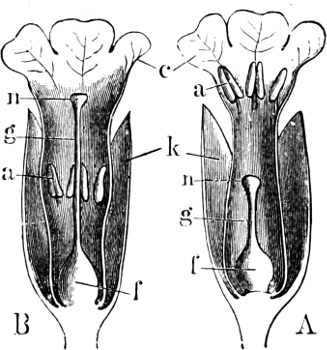
Fig. 548.—Primula: dimorphic flowers. A short-styled; B long-styled.
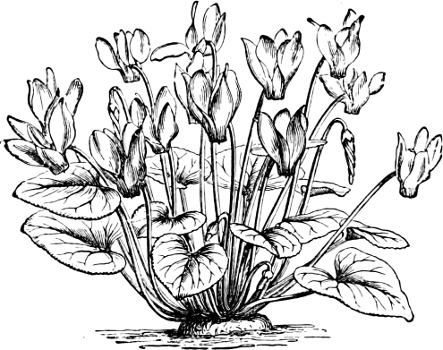
Fig. 549.—Cyclamen persicum.
Primula (Primrose) has most frequently a vertical rhizome, bearing a rosette of leaves at its summit, and long-stalked umbels; corolla rotate or slightly funnel-shaped; the capsule opens at the apex by 5 teeth. The flowers in some species are heterostyled (long-styled or short-styled; Fig. 548). Closely allied are Androsace (with ovate, cup-shaped corolla-tube and ligular scales, alternating with the corolla-lobes) and Soldanella (funnel-shaped corolla with laciniate lobes and most frequently ligular scales).—Hottonia (Water-Violet) is an aquatic plant with pectinate leaves and heterostyled flowers.—Cortusa. Dodecatheon. Cyclamen (Fig. 549) has solitary, long-stalked flowers, and a rotate corolla with the lobes reflexed; the stalk of the capsule rolls up spirally; the tuberous rhizome is formed by the hypocotyledonary internode. Only 1 cotyledon.—Lysimachia (Money-wort); stem-internodes well developed, leaves opposite or verticillate, calyx almost polysepalous, corolla deeply 5-partite (Fig. 550). The flowers are solitary or in racemes.—Anagallis (Pimpernel), leaves opposite, flowers solitary; the fruit a pyxidium (Fig. 551); similarly in Centunculus, which is 4-merous.—Trientalis, the flowers are most frequently 7-merous.—Glaux (Sea Milk-wort) is a creeping maritime plant with opposite leaves; flowers solitary in the leaf-axils, corolla absent, but with coloured calyx. The petals are usually developed later than the stamens in the Primulaceæ; but in this instance they are entirely suppressed.—Samolus (Brookweed) differs from all the others in having an epigynous flower; barren sepal-stamens are also present. The bracts in the racemose inflorescences are displaced along the flower-stalks.
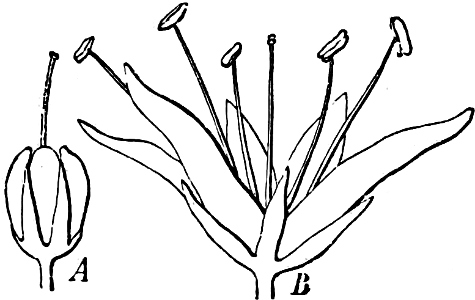
Fig. 550.—Lysimachia thyrsiflora.
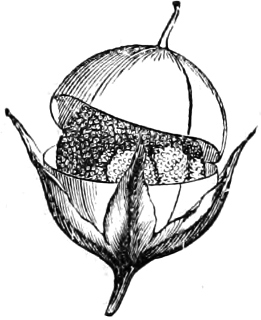
Fig. 551.—Anagallis arvensis. Fruit dehiscing.
Pollination. Insect-pollination in the majority; cross-pollination is promoted in some by heterostyly (Fig. 548).—300 species; especially in northern temperate zones; the majority on mountains (Soldanella, Androsace, etc.); almost absent in the Tropics. A large number are ORNAMENTAL PLANTS, e.g. Primula auricula (from the Alps), P. sinensis (China), P. elatior (Oxslip, a native) and grandiflora, etc. Cyclamen europæum (Alpine Violet); the tubers are poisonous.
Order 2. Myrsinaceæ. Trees or shrubs; evergreen, tropical Primulaceæ with fleshy fruits and few seeds, embedded in the placenta. The leaves are nearly always dotted with yellow glands (schizogenous resin-receptacles).—550 species; especially Am.—Ornamental plants: Ardisia crenulata (W. Ind.); other genera: Clavija, Maesa, Theophrasta (barren sepal-stamens), Myrsine, Jacquinia (barren sepal-stamens), etc.—Ægiceras, allied to this order, comprises arborescent plants, often growing with Rhizophora in tropical forests, along the shore. The embryo germinates while still in the fruit.
Order 3. Plumbaginaceæ. This order has a position of the stamens similar to that in Primulaceæ (S5, P5, A0 + 5, G5), but it differs from these in the flower, which has generally a membranous, dry, thin, coloured, folded, almost entire calyx and an almost entirely polypetalous corolla, which, as a rule, has twisted æstivation and is only united with the stamens at its base; but more especially it differs in the ovary, which bears 5 free or almost free styles and only 1 basal ovule with a long, twisted funicle (the placenta of the Primulaceæ is here so much reduced that it bears only 1 ovule). The fruit is a nut or capsule. The radicle is turned outwards. Endosperm mealy.—To this order belong herbs or under-shrubs, which are especially natives of the sea-coast and of salt-steppes; they also resemble the Primulaceæ in the scattered, undivided, entire leaves (without stipules), often in rosettes, and the inflorescence borne on a long stalk. In opposition to the Primulaceæ, the bracteoles are typically present, and hence the branching is generally cymose (scorpioid).
Armeria (Thrift) has a round capitulum, composed of closely-packed dichasia, surrounded at its base by an involucre with peculiar prolongations, directed downwards, and united into a sheath protecting the intercalary zone of growth. The pericarp is finally ruptured at the base, and drops off like a hood.—In Statice (Sea-lavender), the unipared scorpioid cymes are prolonged and collected into panicle-like inflorescences.—Plumbago is the genus which approaches nearest to the Primulaceæ, and differs most from the characters given above. It has capitate or spike-like inflorescences, a salver-shaped corolla, and the stamens are not attached to the corolla. The style is only divided at the extremity; the calyx is not membranous, but is covered with sticky, glandular hairs.
250 species; chiefly in the Mediterranean and about the Caspian Sea, on salt-steppes and beaches. Some are Tropical; a few are ornamental plants.
B. Tetracyclicæ.
a. Tetracyclicæ with hypogynous flowers.
Family 29. Tubifloræ.
The flower is regular, ☿, and hypogynous. The gamopetalous type is present in this family with great uniformity, without suppression or splitting; S5, P5, A5, G2 (3–5). The stamens are all fertile, alternating with the lobes of the corolla. Gynœceum with 2, more seldom 3–5 syncarpous carpels. Style nearly always simple; 2 dorsal stigmas. In each carpel 2–∞ ovules. At the base of the ovary is found a yellowish ring-like nectary (Fig. 552 C), sometimes 5-sinuate or 5-partite.—The leaves are nearly always scattered; stipules are absent.—The Solanaceæ, which formerly were classed here, are so closely allied to the Personatæ, that it would be unnatural not to place them first in this family; and the Boraginaceæ (which were also placed in the Tubifloræ) appear to be best united, with the Labiatæ and others, into one family Nuculiferæ.
Order 1. Polemoniaceæ. The flowers are regular; S5, P5, A5, G3. The calyx and corolla have united leaves, the petals twisted to the right in æstivation (all the left edges being covered). The ovary is 3-locular with 2–∞ ovules in each loculus; the style is trifid at the apex; the fruit is a 3-valved capsule. Embryo straight; endosperm fleshy. The inflorescences are dichasia passing over into unipared helicoid cymes (the shoot of the lower bracteole being the more strongly developed).—Herbs without latex. 150 species; especially Western N. Am.—Phlox (salver-shaped corolla; entire, opposite leaves), Polemonium (campanulate or almost rotate corolla; scattered, pinnate leaves), Leptosiphon, Gilia, Collomia, Cobæa (climbing, like the Vetches, by tendrils at the ends of the leaves), etc. They are frequently ornamental plants.
Order 2. Hydrophyllaceæ. This order approaches very closely to the Boraginaceæ. Herbs with pinnate or palmate leaves; S5, P5, A5, G2. The lobes of the corolla are imbricate in æstivation. Generally 2 median carpels. The ovary is most frequently unilocular, and the seeds are situated on 2 parietal placentæ; capsule 2-valved; embryo straight; endosperm fleshy. In the corolla-tube, opposite the corolla-lobes, there are frequently appendages of various forms, which resemble those of Cuscuta. The inflorescences correspond exactly with those of the Boraginaceæ, being unipared scorpioid cymes, which, prior to opening, are tightly rolled up.—130 species, especially in N. Am. (California, etc.). Many annual species of Phacelia, Nemophila, Whitlavia, Eutoca, Cosmanthus, etc., are cultivated in gardens as ornamental plants. Hydrolea (has a bilocular ovary, and two free styles).
Order 3. Convolvulaceæ (Bindweeds). The flower is regular, hypogynous, with 5 almost free sepals (quincuncial æstivation), P5, A5, G2 (rarely 3–5). The corolla is very characteristic; it is (with various forms) almost entire, or slightly 5-lobed, and folded longitudinally in the bud in such a way that 5 projecting, flat portions, tapering towards the top and frequently differing in colour and hairiness from the rest, are visible externally and applied close together, while the remainder of the corolla is folded inwards (Fig. 552 A); and hence the whole corolla is strongly twisted to the right in the bud. The gynœceum most frequently has a bilocular ovary; in each loculus there are only 2 (erect) anatropous ovules on the placenta, which is not especially thickened (Fig. 552 D, E); each loculus is sometimes divided into two by a false septum (a relationship with the Boraginaceæ, etc.); style simple with most frequently a bilobed stigma, or a bipartite style. The fruit is nearly spherical, most frequently a capsule. The seeds are erect, and have a large hilum at the base. The embryo is curved, with leaf-like, thin, bilobed, most frequently folded cotyledons; endosperm absent or mucilaginous.
1. Convolvuleæ, Bindweed Group. The majority are twining (to the left) herbs, with latex. The leaves are scattered, without stipules, often long stalked, and nearly always with cordate base; some are palmately lobed. The flowers are most frequently solitary in the leaf-axils, large, quickly withering.—Convolvulus (Fig. 552), Calystegia (unilocular ovary, 2 large bracteoles), Ipomœa, Batatas, Evolvulus (with a doubly bifid style), Calonyction, Pharbitis, etc.
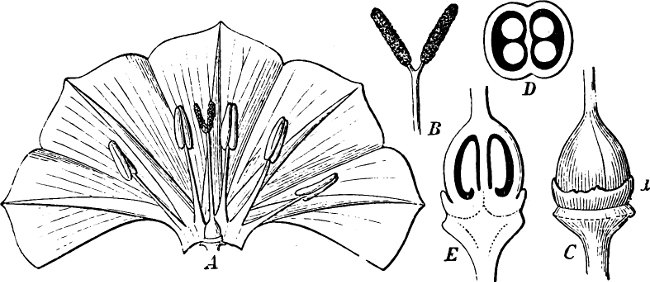
Fig. 552.—Convolvulus scammonia.
2. Dichondreæ. This group is a more primitive form, not twining, and without latex. It has 2 free carpels with basal style (as in Boraginaceæ) and valvate corolla.
3. Cuscuteæ, Dodder Group (Fig. 553). Parasites, with round, filamentous stems, bearing only scale-like leaves and almost destitute of chlorophyll (they are reddish or yellowish); they are parasitic upon other plants, around which they twine, first with narrow, compact coils from which haustoria (Fig. 553 A) are developed which enter the host-plant, and then with wider coils by which they raise themselves to other portions of their host or try to reach other plants. On germination a very temporary primary root is developed, which bears root-hairs as far as the tip (rootcap is wanting); it only serves as a kind of reservoir for water, and perishes very soon after the seedling has fastened on to a host. The embryo is filamentous and rolled up spirally (Fig. 553 C), and is sometimes destitute of cotyledons. The flowers are crowded into capitulate inflorescences, complicated by accessory shoots (Fig. 553 A); they have S5, P5 (imbricate æstivation), A5 (and beneath the stamens 5 scales on the corolla-tube), G2. Fruit a capsule opening by a lid.—Cuscuta europœa, C. epilinum (Flax-Dodder), C. epithymum (Lesser-Dodder), C. trifolii (Clover-Dodder), etc., are parasitic on different hosts, or parasitic each on its own particular host.
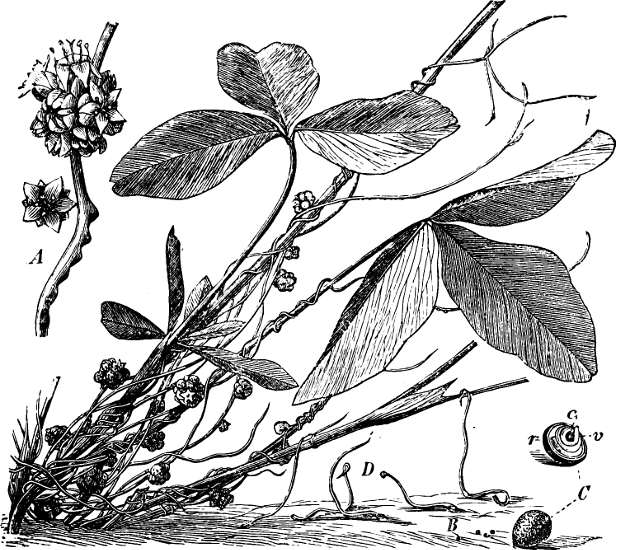
Fig. 553.—Cuscuta trifolii, parasitic on Red Clover. A A portion of the stem with an inflorescence and haustoria (mag.); B seed (nat. size); C seed (mag.); D embryo (nat. size).
840 species; the majority in the Tropics, especially Am. Many are ornamental plants. Officinal: some on account of their purgative properties: the tuberous roots of Ipomæa purga (Jalap, from Mexico) and the dried latex (“Scammony”) of Convolvulus scammonia (from the East). The tuberous roots of Batatas edulis (Trop. S. Am.) are used as a common vegetable (Sweet Potato) in the Tropics.
Family 30. Personatæ.
The type of the flower is: S5, P5, A5 (of which one, or in some cases several, are suppressed), and G2. The flowers are hypogynous, ☿, perfect with gamopetalous corolla, but most frequently irregular (medianly zygomorphic, except Solanaceæ), the corolla being bilabiate (divided into a posterior part of two lobes and an anterior part of three lobes), and the stamens 4, didynamous (the posterior being suppressed). The ovary has 2 loculi (only 1 in Utriculariaceæ, Gesneriaceæ, Orobanche); the placenta in the first-named orders (1–7) is most frequently very thick, and bears a great many ovules (Figs. 554, 555, 557, 562); the number of ovules in the last orders (8–9) is considerably reduced (Fig. 570).
Special mention may be made of the apparently 4-merous flower which is found, e.g. in Veronica and Plantago (Figs. 567, 562 C, 570, 571), and which arises from the typical 5-merous flower by the suppression of the posterior sepal and the posterior stamen, and by the union of the two posterior petals into one.—Terminal flowers very seldom occur on the main axis, and would not harmonise well with the very irregular form of the flower. When they do occur, they are, as a rule, “peloric,” i.e. regular (in Linaria vulgaris two kinds of peloric flowers occur,—one with 5 spurs, and one without spurs). The halves of the anthers are often divided as far as the base, and laterally so widely separated from each other as to assume an almost straight line (Figs. 563, 564). There is generally a nectary (“disc”) round the base of the ovary, often 5-lobed (or divided into free glands).—A common vegetative characteristic is the absence of stipules.
The 9 orders of the Personatæ are: 1, Solanaceæ; 2, Nolanaceæ; 3, Scrophulariaceæ; 4, Utriculariaceæ; 5, Gesneriaceæ; 6, Bignoniaceæ; 7, Pedaliaceæ; 8, Acanthaceæ; 9, Plantaginaceæ.
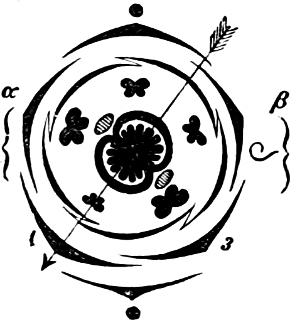
Fig. 554.—Diagram of Petunia.
Order 1. Solanaceæ. The flower (Figs. 554, 555, 559) is hypogynous, regular (zygomorphic in Hyoscyamus), ☿, and gamopetalous, with S5, P5 (most frequently imbricate or valvate), A5, G2, the 2 carpels being placed obliquely (Fig. 554); the bilocular ovary has a very thick axile placenta (Figs. 554, 555 H, 557), which extends almost as far as the wall of the ovary. The fruit is a capsule or berry; the seeds are more or less reniform, and the embryo is curved (rarely straight), in a fleshy endosperm (Figs. 555 F, G; 561).—Both arborescent and herbaceous forms are found in the order; leaves scattered without stipules, but with variously formed laminæ (always penninerved). A peculiar leaf-arrangement is found in many species, viz. the leaves are borne in pairs, a large and a smaller one together; these pairs stand in 2 rows, and the flowers are then situated between the individual leaves in each pair, apparently not in a leaf axil. The inflorescences are frequently unipared scorpioid cymes without floral-leaves.
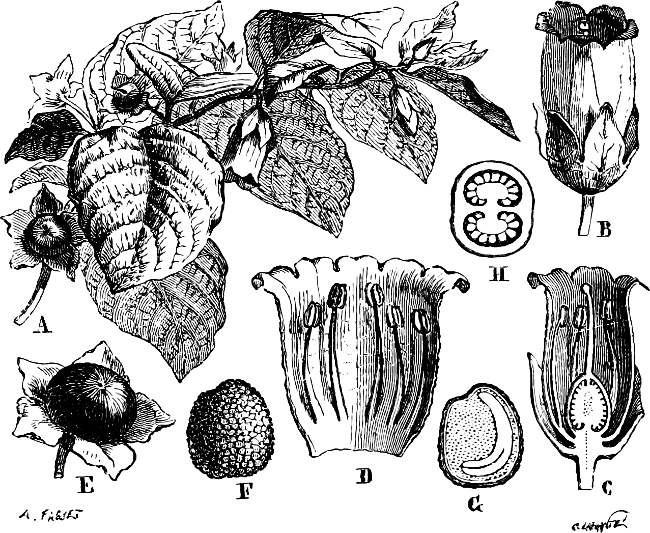
Fig. 555.—Atropa belladonna: A is reduced.]
Zygomorphic flowers occur, and thus form a transition to the closely allied Scrophulariaceæ; the zygomorphy sometimes shows itself only in the relative length of the stamens, sometimes also in the corolla (Hyoscyamus).—Nicandra is 5-merous throughout all the whorls.—The peculiar relative leaf-arrangement in this order occurs from sympodial branching and displacement. The most simple is, e.g. Datura (Fig. 556 A); each shoot-generation in the floral parts of the plant has only 2 foliage-leaves (f1 and f2), and then terminates in a flower; the axillary buds of both the foliage-leaves are developed and form a dichasium, but since the leaves are displaced on their axillary-shoots as far, or almost as far, as the first leaf of these axillary-shoots, the flowers are borne singly on the dichasial branches, and all the branches appear to be without subtending leaves (Shoot I is white, II shaded, III white, etc., diagram A). Scopolia and others (Fig. 556 B) differ in that the lowest and smallest (f1) of the two leaves on each shoot is barren, and is therefore not displaced; but the upper one (the second bracteole, f2) is displaced as in the first instance, and consequently it assumes a position near the first leaf (the shaded leaf f2 of shoot I being placed near the white leaf f1 of shoot II, etc.,) of the next youngest shoot-generation, and hence the leaves are borne in pairs; the flower placed between the two leaves of a pair is therefore the terminal flower of the shoot to which the smaller of the two leaves belongs, and the larger leaf is the subtending leaf for the floral shoot itself.
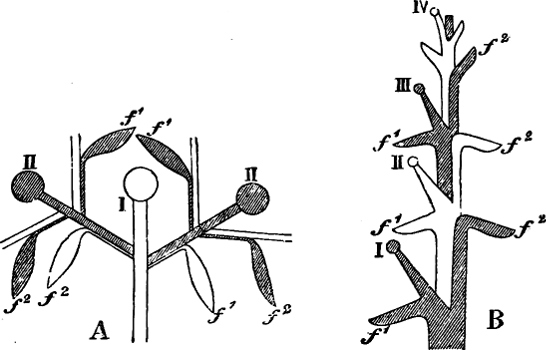
Fig. 556.—Diagrammatic representation of the branching in Solanaceæ. The various shoot-generations are white or shaded.
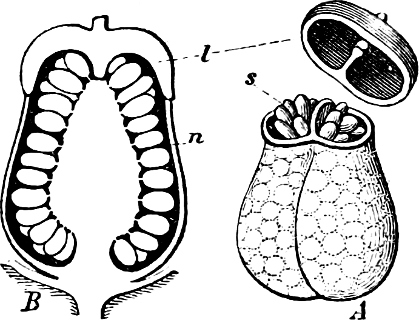
Fig. 557.—Fruit of Hyoscyamus niger after removal of calyx.
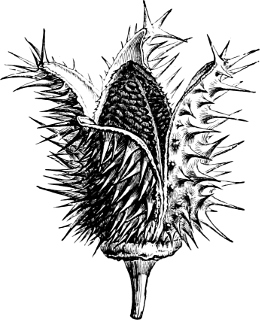
Fig. 558.—Fruit of Datura stramonium.
A. Fruit a capsule. Nicotiana (Tobacco) has a 2-valved capsule with septifragal dehiscence; the valves separate at the apex; the corolla is funnel-shaped, tubular, salver-shaped or campanulate. The flowers in panicles.—Datura (D. stramonium, Thorn-apple) has a (frequently spiny) capsule (Fig. 558), which is falsely 4-locular (at the top, bilocular) and opens septifragally with 4 valves. The lower part of the calyx persists as a thick collar (see Fig. 558). The corolla is funnel-shaped. The flowers are solitary, large.—Hyoscyamus (H. niger, Henbane) has a pyxidium (Fig. 557) enclosed in the campanulate, completely persistent, thick-walled calyx. The flowers are slightly zygomorphic, and borne in unipared scorpioid cymes. Scopolia (pyxidium); Fabiana (Heather-like shrub); Petunia (slightly zygomorphic flower; funnel-shaped corolla); Nierembergia; Brunfelsia (almost a drupe); Franciscea; Browallia.—Among those with capsular fruits are found the most anomalous forms, which by their zygomorphic flowers and often didynamous stamens present the transition to the Scrophulariaceæ: Salpiglossis; Schizanthus (lobed petals; 2 perfect, and 3 rudimentary stamens).
Figs. 559–561.—Solanum tuberosum.
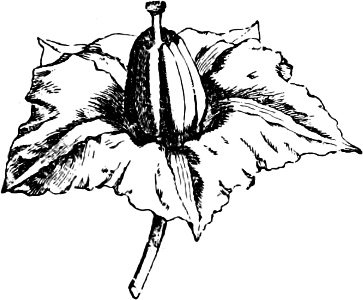
Fig. 559.—Flower (1/1).
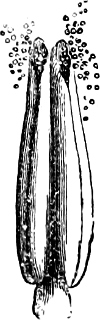
Fig. 560.—Stamen, ejecting pollen.
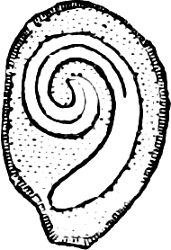
Fig. 561.—Longitudinal section of seed.
B. Fruit a berry. Solanum (Nightshade); rotate corolla (Fig. 559). The stamens have short filaments, the anthers stand erect, close together round the style, like a cone in the centre of the flower, and open by pores at the apex (Fig. 560). S. tuberosum (the Potato-plant); the Potato-tuber is a swollen, underground stem; the “eyes” are buds, situated in the axils of its scale-like, quickly-perishing leaves.—Lycopersicum resembles Solanum in the flower, but the united anthers open by longitudinal clefts and have an apical appendage. The cultivated species, L. esculentum (Tomato), has often a higher number than 5 in the flower, and in the fruit several loculi of unequal size.—Physalis (Winter Cherry); the calyx ultimately swells out in the form of a bladder, becomes coloured, and loosely envelopes the spherical berry.—Capsicum (Guinea Pepper-plant); some species have very large, irregular, rather dry (red, yellow, black) berries, which are unilocular in the upper part.—Lycium (false Tea-plant); the corolla is salver- or funnel-shaped; shrubs; often thorny.—Atropa (A. belladonna, Deadly Nightshade, Fig. 555); corolla campanulate; the calyx projects beneath the spherical, black berry. The flowers are borne singly.—Mandragora; (Mandrake); Nicandra (ovary often 5-locular).—A small tropical group: Cestreæ (Cestrum, Habrothamnus, etc.) has an almost straight embryo, which may also be found e.g. in species of Nicotiana. Related to the Scrophulariaceæ.
About 1,500 species; the majority within the Tropics, outside these limits especially in America. Solanum nigrum is a common weed.—The Potato-plant (Solanum tuberosum), from Peru and Chili, was introduced into Europe in 1584 by Sir Walter Raleigh. (Potatoes = Batatos). The fruits of several serve as condiments: Chilies or Pod-pepper (Capsicum annuum and longum), and the Cayenne-pepper (C. baccatum and others), whose fruits also are officinal, were brought to Europe from S. America by Columbus, and are commonly cultivated in Tropical America; Lycopersicum esculentum (Tomato) and others from Peru; Solanum ovigerum (Egg-plant); Solanum melongena, etc. Poisonous, acrid, narcotic properties (alkaloids, etc., solanine, nicotine, atropine, hyoscyamine) are found in many: Atropa belladonna (from S. Europe; the roots and leaves are officinal); Solanum dulcamara (Bitter-sweet; formerly officinal), S. toxicarium (Guiana); Datura stramonium from Asia (leaves and seeds officinal), D. sanguinea, metel, tatula, and others; Hyoscyamus (officinal: the leaves and seeds of H. niger); Nicotiana tabacum (Virginian tobacco, officinal: the leaves), N. rustica and others from Trop. America (Tobacco was introduced into Europe in 1560); Cestrum-species. Duboisia myoporoides (Australia); the leaves contain hyoscyamine and are used in medicine. A number of species of these genera are ornamental plants.
Order 2. Nolanaceæ. These most resemble the Convolvulaceæ in the corolla, but the Solanaceæ in their branching, and leaf-arrangement (in pairs, etc.). The diagram is the same as in Nicandra with 5 carpels, but the fruits of this order most frequently form, by invaginations in various directions, an ovary (with 1 style) consisting of numerous and irregularly grouped, 1-ovuled cells; the fruit is a schizocarp with many 1-seeded fruitlets.—Nolana (Western S. America): a few are ornamental plants.
Order 3. Scrophulariaceæ. The flower is hypogynous, ☿, zygomorphic, with the usual type: S5, P5, A5, and G2, the latter placed in the median plane; some genera have all 5 stamens developed (Fig. 562 A), but most frequently the posterior one is suppressed and the flower becomes didynamous (Fig. 562 B). The fruit, as in the capsular-fruited Solanaceæ, is a bilocular, 2-valved capsule, with a thick, axile placenta, and most often septicidal dehiscence (Fig. 563 C). The numerous seeds are not reniform as in many Solanaceæ, and have a straight, or only slightly curved embryo, with abundant endosperm (Fig. 563 D).—The majority are herbs; some are arborescent; the leaves are opposite or scattered, but stipules are wanting as in the whole family.
The Scrophulariaceæ are closely allied to the Solanaceæ, and there is, properly speaking, no characteristic feature which absolutely separates them. The somewhat irregular corolla, with five stamens of unequal length in Verbascum, is also found in Hyoscyamus; curved and straight embryos are found in both orders. The activation of the corolla in the Scrophulariaceæ is simple imbricate, in the Solanaceæ most frequently folded imbricate (in Atropa and those allied to it, imbricate without folding). The genera (about 164) are distinguished according to the form of the corolla, number of stamens, inflorescence, arrangement of the leaves, etc. Verbascum belongs to the most primitive 5-stamened forms, and from it proceed a long series down to Veronica, with only two stamens and most frequently the posterior sepal suppressed.
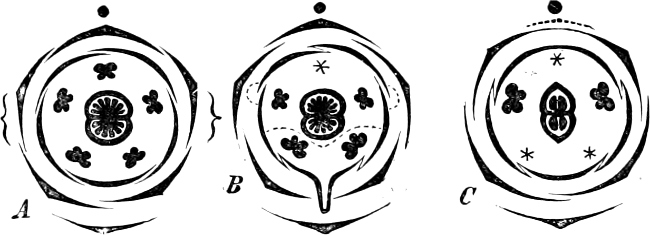
Fig. 562.—Diagrams. A Verbascum; B Linaria; C Veronica.
1. Antirrhineæ, Snapdragon Group. This has most frequently a descending æstivation of the petals (the posterior petals are outside the lateral ones, which again enclose the anterior; Fig. 562 A, B). The plants belonging to this group are not parasites.
a. 5-stamened.—Verbascum (Mullein, Fig. 563 A) has a slightly irregular, rotate corolla; five stamens (frequently covered with woolly hairs), of which the two anterior ones are the longer and differ often also in other respects. The inflorescences are racemose, often with several series of accessory dichasia in the axil of each primary floral-leaf. The leaves are scattered and, together with the stems, are often covered with a grey felt of branched hairs.
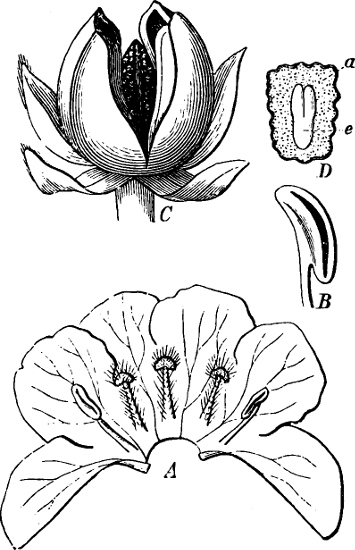
Fig. 563.—Verbascum thapsiforme.
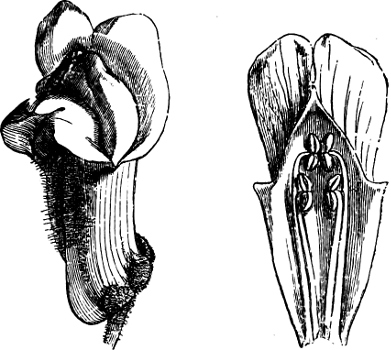
Fig. 564.—Antirrhinum majus. A flower, and the upper lip of a flower with the stamens.
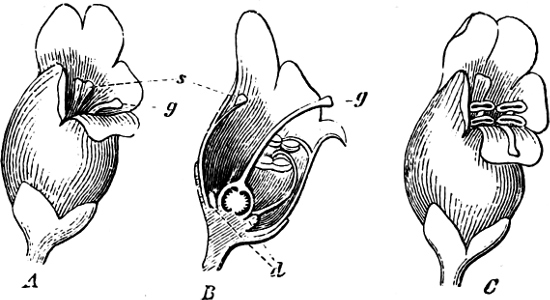
Fig. 565.—Scrophularia nodosa. Protogynous flower in various stages: A ♀ stage; g the stigma projecting from the throat of the corolla; B the same in longitudinal section; C ♂ stage, the stigma is bent down and its former position occupied by the stamens; s staminode; g stigma; d nectary.
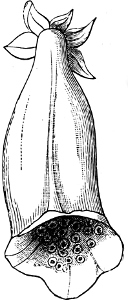
Fig. 566.—Digitalis purpurea.
b. 4-stamened, didynamous (Fig. 564).—Scrophularia (Fig-wort, Fig. 565) has cymose inflorescences in a panicle; the corolla (Fig. 565) is urceolate, short two-lipped; the posterior stamens are present as a scale below the upper lip of the corolla (Fig 565 s). S. nodosa has a tuberous rhizome.—Pentstemon; the posterior stamen is barren and very long.—Antirrhinum (Snapdragon). The corolla (Fig. 564) is personate, i.e. bilabiate, but with the under lip arched to such an extent that it meets the upper lip, closes the corolla throat, and entirely conceals the stamens and style; the corolla-tube is produced into a short pouch at the base on the anterior side. The capsule is oblique and opens by 2–3 pores, formed by small, dentate valves. In Linaria (Toad-flax) the pouch is produced into a spur. Sometimes there are traces of the posterior stamens. The capsule opens by large pores (one for each loculus), produced by large, many-partite valves. L. vulgaris reproduces by suckers.—Digitalis (Foxglove, Fig. 566) has long racemes with drooping flowers; the posterior sepal is small (a step towards complete suppression, as in Veronica); the corolla is obliquely campanulate, and generally nearly 4-lobed, the two posterior petals coalescing.—Alonsoa; Nemesia; Chelone; Herpestis; Mimulus; Torenia; Vandellia; Limosella (L. aquatica, Mud-wort, native); Scoparia; Capraria; Erinus (found on the Roman Camp at Chesters, Northumberland, and supposed to have been introduced from Spain by the Roman soldiers); Celsia (near Verbascum); Maurandia; Lophospermum; Rhodochiton; Collinsia; Nycterinia, etc.
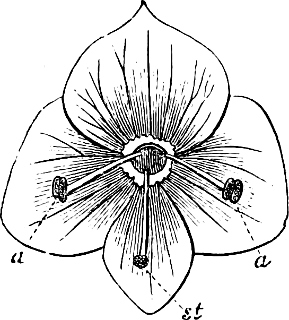
Fig. 567.-Flower of Veronica.
c. 2-stamened.—Gratiola (Water-hyssop). 5-partite calyx. The upper lip of the corolla is undivided or slightly bifid; the two anterior stamens are either entirely absent or are reduced to staminodes (a transition to Veronica).—Veronica (Speedwell), most frequently 4-partite calyx; 4-lobed, rotate, zygomorphic corolla with 2 perfect stamens and no trace of the others (Figs. 567, 562 c); capsule with loculicidal dehiscence. Calceolaria; the corolla has two slipper-like lips.
2. Rhinantheæ, Yellow-rattle Group. Herbs, all of which (with the exception of Lathræa) are annual parasites with green foliage-leaves. They attach themselves by haustoria to the roots of other plants and draw nourishment from them. The majority turn black when dried. Racemose inflorescences. In many the calyx is 4-partite, the posterior sepal being absent, or very small. The corolla is distinctly bilabiate (Fig. 568), with most frequently ascending æstiration; in the majority it does not become detached at the base, but by means of a ring-like cut some distance up the tube; 4 didynamous stamens; pollen-grains dry, easily falling out; the anthers are often furnished at the base with bristles or hairs (Fig. 568) which play a part in the pollination, the probosces of the insects, being forcibly pushed against them, agitate the anthers and shake out the pollen-grains. Capsule with loculicidal dehiscence.—Euphrasia (Eye-bright), Melampyrum (Cow-wheat), Rhinanthus (Yellow-rattle), Odontites (Bartsia), Pedicularis (Louse-wort), and Lathrœa (Tooth-wort) all have native species. The last named is pale yellow, or reddish (without chlorophyll); it is a parasite on the roots of the Hazel, Beech and other shrubs, having an aerial stem, and an underground, perennial rhizome, covered with opposite, scale-like, more or less fleshy leaves with a number of internal glandular, labyrinthine cavities. The inflorescence is a unilateral raceme. It approaches Gesneriaceæ in having a unilocular ovary with two parietal placentæ.
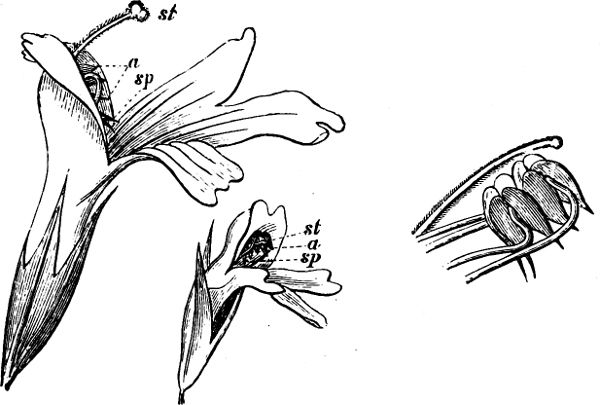
Fig. 568.—Euphrasia officinalis. Flower of the large and the small-flowered forms; showing the anthers and stigmas.
The mechanical contrivances for POLLINATION are so numerous that no general principle can be laid down. Personate flowers, like those of Antirrhinum are only accessible to strong insects, such as humble-bees, which can force themselves between the two lips, and so become dusted with pollen on the back. In Euphrasia and other Rhinantheæ the insects become covered with smooth, powdery pollen when they shake the anther-apparatus in touching the hairs and bristles mentioned above. Scrophularia nodosa is protogynous (Fig. 565). Digitalis purpurea, however, is protandrous. Mimulus luteus and some others have sensitive stigmatic lobes, which shut up on being touched. The Veronica-species constitute a series, from large-flowered down to small-flowered forms, and parallel with them are found various gradations from insect-to self-pollination. In some (as Euphrasia officinalis, Rhinanthus crista galli) there are two kinds of flowers: large, which are pollinated by insects, and small, which are self-pollinated (Fig. 568). Lathræa squamaria (Tooth-wort) is a protogynous spring-flowering plant, largely visited by humble-bees. Others have cleistogamic flowers. Nycterinia capensis opens its flowers at night.
2,000 species; chiefly from the Temp. Officinal: Digitalis purpurea (the leaves; Europe), a poisonous plant. Verbascum thapsus and thapsiforme, Veronica officinalis (“Herba V.”), Gratiola officinalis (“Herba”) have medicinal uses. The whole of the Scrophulariaceæ are more or less suspicious, if not actually poisonous, and none serve as food. Many are ORNAMENTAL PLANTS: Mimulus luteus (N. America), Paulownia imperialis (the only species; in Japan; a tree), Antirrhinum vulgare (S. Eur.), Linaria, Pentstemon, Veronica, Calceolaria (Peru, Chili, etc.).
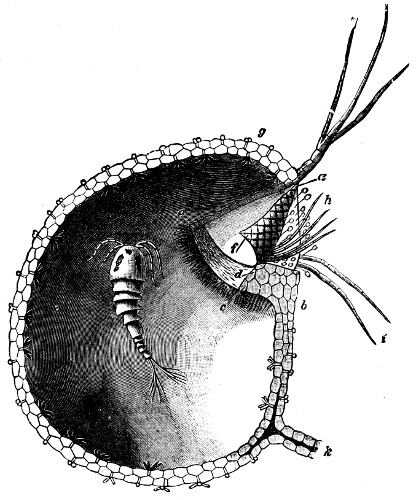
Fig. 569.—Leaf of Utricularia vulgaris, with bladder. Median longitudinal section through a bladder containing a Cyclops. At a a hair of the upper-lip, at i 2 bristles of the under-lip of the entrance (a, b); in the latter are placed 4 bristles h; k stalk of the bladder, in which is seen a vascular bundle. (After Cohn.)
Order 4. Utriculariaceæ. To this order belong only perennial, insectivorous, aquatic, and marsh-plants (200 species) with a more or less characteristic appearance. They differ from the Scrophulariaceæ, especially in having 2 stamens (the anterior) and a unilocular ovary, with free, central placenta (like that of the Primulaceæ). For the rest the flower is distinctly bilabiate, both in the calyx and corolla. Two-valved capsule; no endosperm.
Pinguicula (Butter-wort) has a rosette of leaves close to the ground; these are sticky, covered with glandular hairs, and roll round any small insects which may be caught upon them; flowers solitary, terminal on a long scape; calyx, 5-partite; corolla with spur. The embryo germinates with 1 cotyledon.—Utricularia (Bladder-wort). Our native species are floating, without roots, with hair-like, divided leaves, studded with peculiar bladders (in the Tropics there are terrestrial species, with ordinary foliage). The bladders (Fig. 569) have an aperture, closed by a valve opening inwards, so that small aquatic animals are allowed to enter, but are not able to escape; they are thus entrapped in the bladders, and are probably used as food. Calyx bipartite; corolla personate with spur.
The embryo of Utricularia is very imperfect, scarcely more than a spherical, cellular mass, with a few slight leaf-rudiments. On the germination of U. vulgaris, several bristle-like leaves develop into a compact rosette; the stem then develops, and also the finely-divided, bladder-bearing leaves. A primary root is not developed. The stems branch copiously and in a very peculiar manner. The growing-point of the stem is rolled spirally.—The stigmatic lobes are sensitive and close on being touched; self-pollination often takes place, however, in Pinguicula.
Order 5. Gesneriaceæ. The flower in this order may be both epigynous (Gesnerieæ) and hypogynous (Cyrtandreæ), but otherwise is nearly the same as in Scrophulariaceæ, only that the ovary is unilocular, with 2 parietal, often bifid, placentæ. Of the 5 stamens the posterior is rudimentary, or (more rarely) entirely wanting, and the others are didynamous (Cyrtandreæ have often only 2 stamens); their anthers are generally glued into a quadrangular mass. The majority are herbs with juicy stems, opposite, verticillate or scattered leaves without stipules, often, like the stems, thick and juicy, soft-haired or glabrous. The corollas are often highly-coloured (scarlet, red-yellow, etc., and spotted internally), large and magnificent, so that many species are ornamental plants. Gesnerieæ (often epigynous) have endosperm; S. Am.—Cyrtandreæ, hypogynous, without endosperm; Asia, S. Africa.—Streptocarpus, neither the primary root nor primary shoot attains development; one of the cotyledons dies, while the other grows and becomes a very large foliage-leaf, from which spring adventitious roots and adventitious inflorescences.
500 species. Gloxinia, Achimenes, Gesneria, Alloplectus, Tydæa, Columnea, Nægelia, Æschynanthus, and others, especially in the forests of tropical America. Some are epiphytes on trees, others prefer the leaf-mould of the forest and crevices of cliffs. Several genera have peculiar, catkin-like, underground shoots, with scale-like compact leaves; others have tubers.
Orobanche (Broom-rape) is allied to this order as a parasitic form. It is a parasite on the roots of other plants, not like Lathræa by means of thin rootbranches with haustoria, but growing with the base of its stem in close contact with its host, and probably even often protruding a kind of thallus into it, in a manner similar to the Loranthaceæ. Its aerial shoots are not entirely destitute of chlorophyll, but are not green; they only bear scale-leaves and terminate in a raceme or spike-like inflorescence.—Some Orobanche-species are detrimental to various cultivated plants (Hemp, Lucerne, Tobacco, etc.). The flowers are strongly zygomorphic; the posterior sepal is often wanting, and the anterior are united to the two lateral ones. Ovary unilocular, as in Gesneraceæ, with 2 or 4 parietal placentæ.—The exceedingly small seeds have a very rudimentary embryo, formed of an ellipsoidal, cellular mass, without indication of cotyledons or other organs.—About 100 species; especially in the Mediterranean region.
Order 6. Bignoniaceæ. 500 species; nearly all trees and shrubs, and to a great extent lianes, climbing by tendrils (modified leaves), which are sometimes terminated by a special clasping apparatus. These lianes have, as a rule, an anomalous stem structure, the wood being either divided into four wedges at right angles to each other, separated by four grooves filled with secondary wood-parenchyma, or a greater number of wedges occur, by the cambium ceasing to form wood in several places. The leaves are most frequently opposite and compound; the flowers in the main are similar to the didynamous Scrophulariaceæ, and especially resemble those of Digitalis purpurea; they are bilabiate, large, and beautiful, campanulate or trumpet-shaped, many of the prettiest ornamental plants in the Tropics belonging to this order. The fruit is most frequently a large, woody, 2-valved, siliqua-like, septifragal capsule, whose valves separate from the flat and broad partition-wall, which bears the large, generally winged seeds: Tecoma; Bignonia.—In gardens: Catalpa syringæfolia (Trumpet-wood); Tecoma radicans (from S. Am.).—“Palisander”-wood is from Jacaranda (S. Am.).—Eccremocarpus (N. Am.) forms, by its unilocular capsule, a transition to the Gesneriaceæ (E. scaber; herbaceous).
Crescentia is allied to this order; C. cujete (Calabash) is its best known species. The fruit (unilocular with 2 parietal placentæ) is a very large, spherical or ellipsoidal berry, with a firm, finally woody outer layer. After the removal of the juicy interior, these are commonly used as drinking vessels in Tropical America.
Order 7. Pedaliaceæ. Sesamum (orientale and indicum); very important oil-plants, which from olden times have been cultivated in tropical Asia and Africa for food and as medicinal plants, and are now cultivated in America also. The seeds are used as a raw material in the manufacture of soap in Europe.—To this order also belong Martynia and Craniolaria, which have a long horned capsule and sensitive stigmas.—46 species.
Order 8. Acanthaceæ. 1,500 species; mostly erect, slender, branched herbs or shrubs, rarely arborescent, especially in S. Am. and Ind. The branches frequently have swollen nodes; the leaves are opposite, penninerved, undivided, more or less lanceolate or elliptical, and generally leave a distinct scar when they fall off. Stipules are wanting. The flowers are solitary or in dichasia, which are arranged in 4-rowed spikes or racemes, each flower with its subtending bract, which may be brightly coloured, and most frequently also with two bracteoles. With regard to the corolla (which is often labiate, in any case irregular, and frequently prettily coloured), the 2 or 4 didynamous stamens (of whose anthers one half is inserted lower than the other, or suppressed) and the gynœceum, the Acanthaceæ are true Personatæ, approaching most nearly to the Scrophulariaceæ: they differ from the other orders especially in the fruit, which is a bilocular, 2-valved, often elastically dehiscing capsule, which never has more than 2 rows, and in some only 2 seeds in each loculus, the seeds being often compressed and borne on strong, curved or hook-like funicles (retinacula) which persist after dehiscence. Embryo curved without endosperm; radicle pointed downwards.—Cleistogamic flowers are found in several species. Cystoliths are common.
The following grow wild in Europe: Acanthus (spinosus and mollis, whose pinnatifid leaves served as models for the capitals of the Corinthian columns). The posterior sepal is the largest of all the leaves of the flower, and covers the other parts like a helmet; the 2 anterior sepals are united, and the two lateral ones are small and greenish; the corolla has no upper-lip, but only a 3-lobed under-lip. The anthers are bilocular; the filaments ultimately become very firm.—Justicia, Eranthemum, Goldfussia, Thunbergia (a twiner), Ruellia, Dicliptera, etc.—Ornamental plants in conservatories.
Order 9. Plantaginaceæ (Plantains). The flowers (Figs. 570, 571) are regular, ☿, hypogynous, with a 4-partite, persistent calyx, a gamopetalous, scarious corolla with 4 projecting lobes, 4 stamens, incurved in the bud, later on projecting considerably, about equal in length, and a bilocular ovary with one long, filamentous, undivided, feathery, papillose style (see Fig. 571). The ovary is most frequently bilocular with 1–few ovules in each loculus. An hypogynous disc is wanting. The fruit is a pyxidium with 1–few peltate seeds attached in each loculus (Littorella is in several respects an exception). All species are herbs, the majority with leaf-rosettes near the ground, and the flowers in spikes or capitula.
The labiate-like flowers are in this case entirely concealed under a regular, apparently 4-merous exterior. The structure of the flower, however, is the same as in the Scrophulariaceæ, only the reduction, which is found in Veronica (compare Figs. 562 C, 567 with 570, 571), is also present in this instance and the lobes are also more equally developed; the posterior petal corresponds to the bilobed upper-lip; the posterior stamen and the posterior sepal also are entirely wanting. In the development of the flower there is no trace of posterior sepal or stamen, and the posterior petal arises from one primordium, but the two anterior sepals arise before the lateral ones. The position of sepals and petals does not agree with that of a true 4-merous flower, which is represented in Fig. 361 E. The bracteoles are always suppressed in Plantago.
Plantago (Plantain, Rib-grass). The foliage-leaves are most frequently scattered, entire, with curved veins, arranged in a rosette close to the ground on an unlimited rhizome; the spike-like inflorescence is borne on a long scape; in some (P. psyllium) the leaves are opposite on a stem with well-developed internodes, and the inflorescences are borne in their axils. The order also presents a transition from insect-pollinated to wind-pollinated flowers. The flowers are protogynous, wind-pollinated in P. major and P. lanceolata, partly also in the other species, but insect pollination also occurs, and P. media has three kinds of flowers, some of which are adapted for wind-pollination (Fig. 571), others, with short filaments, for insects. Littorella lacustris (Shore-weed) is the most reduced of the Plantaginaceæ: an aquatic plant with rosettes of round, awl-like leaves and diclinous (monœcious) flowers. In the axils of the foliage-leaves is a very short 3-flowered spike, formed by 2 sessile ♀-flowers, and above them a long-stalked ♂-flower; all the flowers are lateral, the terminal one being absent, as in Plantago. The ♂-flower is essentially the same as in Plantago, but the ♀-flower has a scarious corolla, with a narrow, 3–4-dentate mouth, which closes tightly round the nut-like fruit.
Figs. 570, 571.—Plantago media.
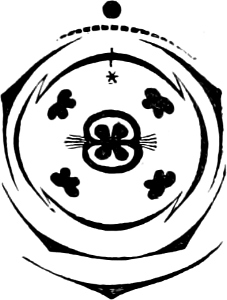
Fig. 570.—Diagram of Plantago media.
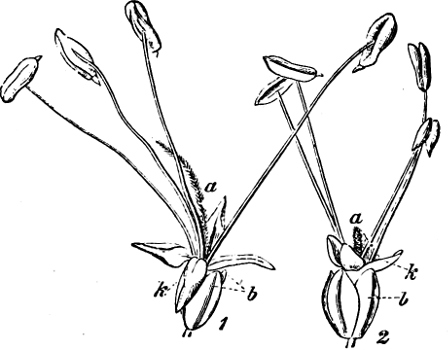
Fig. 571.—Two different forms of the flower (magnified): 1, chiefly adapted for pollination by wind; 2, for insect-pollination. a The stigma; b the calyx; k the corolla.
The genus Plantago constitutes nearly the entire order (200 species). Some are widely distributed weeds (e.g. P. major, “The white man’s footstep”). In P. psyllium (S. Eur.) the integument of the seeds is mucilaginous, and swells considerably in water.
Family 31. Nuculiferæ.
The flowers are hypogynous and zygomorphic (in Boraginaceæ and Cordiaceæ, however, they are regular, except Echium and Anchusa arvensis). The calyx is gamosepalous, the corolla bilabiate (except in the two orders mentioned), mostly after 2/3, i.e. divided into a 2-leaved posterior portion, and a 3-leaved anterior portion. The æstivation of the corolla is nearly always descending.—In Boraginaceæ and Cordiaceæ there are 5 stamens of equal length; in the other orders 4 didynamous ones, or only 2 fertile; the posterior stamen is sometimes developed as a staminode, sometimes fertile (in Stilbaceæ). The ovary is formed of 2 median carpels (except some Verbenaceæ), with (1-) 2 ovules on each carpel; in the majority of the orders it is, however, divided by a false partition-wall between the dorsal and ventral sutures, into 4 loculi, each of which is often raised independently, causing the style to be situated in the depression between the four lobes (“gynobasic” style, Figs. 572, 573, 575, 579). The fruit in these orders most frequently becomes a 4-partite schizocarp with nut-like fruitlets. The other orders have a 1(-2)-locular ovary.—The leaves are simple, without stipules.
The family is related to (and proceeds from) the Tubifloræ, especially Convolvulaceæ, which has an almost similar construction of the ovary. It is doubtful whether the Cordiaceæ and Boraginaceæ should be classed with the others.
The orders are: 1, Cordiaceæ; 2. Boraginaceæ; 3, Verbenaceæ; 4, Labiatæ; 5, Selaginaceæ; 6. Globulariaceæ; 7, Stilbaceæ.
Order 1. Cordiaceæ unites Convolvulaceæ and Boraginaceæ. Tree-like plants with 5-(4–10) merous flowers, doubly bifid style, and drupe with 4 or less loculi. No endosperm; cotyledons folded.—185 species; tropical.
Order 2. Boraginaceæ. The vegetative parts are very characteristic: herbs with cylindrical stems and scattered, undivided, nearly always sessile, entire leaves, without stipules, and generally, together with the other green portions of the plant, covered with stiff hairs, consequently rough and often even stinging (hence the other name for the order Asperifoliæ). The inflorescences are unipared scorpioid cymes with the branches coiled spirally (“helicoid,” Fig. 573) before the flowers open. The flower is perfect, regular (obliquely zygomorphic in Echium and Anchusa arvensis), hypogynous, gamopetalous: S5, P5 (often with ligular outgrowths), A5, G2, but each of the two loculi of the ovary becomes divided by a false partition-wall into two, each of which contains one pendulous anatropous ovule with the micropyle turned upwards; the four loculi arch upwards, so that the ovary becomes 4-lobed, and the style is then, as in the Borageæ, placed at the base (“gynobasic”) between the four projections (Figs. 572, 573). The fruit is a 4-partite schizocarp with four nut-like fruitlets (Fig. 572).—Endosperm is wanting (except in Heliotropium); the radicle is turned upwards.
The INFLORESCENCES are often double unipared scorpioid cymes; the bud of the second bracteole is developed, that of the first suppressed; in some cases both the bracteoles are suppressed (Myosotis, Omphalodes, etc.), but in other instances all the first bracteoles (a) only are suppressed, and the others are then situated in two rows towards the under side of the coiled axis, while the flowers are situated on the upper side. Displacement of the branches or of the floral-leaves sometimes takes place. The flowers are often red at first, and later on become blue or violet; they hardly ever have any smell. The fruit entirely resembles that of the Labiatæ, but the radicle of the latter is turned downwards. The fruitlets present small differences which have systematic importance; they are hollow or flat at the base, attached to a flat or columnar receptacle, etc.
1. Heliotropieæ. This group deviates from the characteristics mentioned above in the undivided ovary and terminal (“apical”) style. In this, as well as in the fact that in some genera (Tournefortia, Ehretia, etc.) the fruit is a drupe, it connects this order with the Cordiaceæ. Heliotropium, Tiaridium, and others have schizocarps.
2. Borageæ, Borage Group. Style gynobasic; fruit a schizocarp.
A. The throat of the corolla is without ligules, or with very small ones.—Pulmonaria (Lung-wort); funnel-shaped corolla; a whorl of hairs in the corolla-throat.—Echium (Viper’s-bugloss) has zygomorphic flowers, the plane of symmetry almost coinciding with that of the very well-developed inflorescence (through the fourth sepal); the corolla is obliquely funnel-shaped, the style is more deeply cleft at the apex than in the others; stamens 2 longer, 2 shorter, and 1 still shorter.—Cerinthe has a tubular corolla with five small teeth and two bilocular fruitlets. The bracts are large and leafy, and, like all the rest of the plant, are almost glabrous.—A few Lithospermum-species have a naked corolla-throat; others have small hairy ligules, which do not close the corolla-throat. The fruitlets are as hard as stone, owing to the presence of carbonate of lime and silica.—Mertensia (Steenhammera); Arnebia; Nonnea (small ligules).
B. The corolla-throat is closed by, or in any case provided with ligules, i.e. scale-like bodies or small protuberances, situated in the throat of the corolla opposite the petals, and which are invaginations or internal spurs of the petals (Fig. 572 D).—The nuts in Cynoglossum (Hound’s-tongue) bear hooked bristles over the entire surface, or, in Echinospermum, only on the edge. The following have smooth nuts:—Symphytum (Comfrey) has a cylindrical, campanulate corolla, and prolonged-triangular, pointed ligules.—Borago (Borage) has a rotate corolla with projecting, emarginate ligules; the stamens have a horn-like appendage, projecting upwards from the back of the filament. The fruitlets are hollow below.—Anchusa (Alkanet, Fig. 572). The corolla is salver-shaped; the ligules small, hairy protuberances. A. (Lycopsis) arvensis has an S-curved corolla-tube.—Myosotis (Forget-me-not, Fig. 573); rotate corolla with small (yellow) protuberances in the throat; scorpioid cyme without floral-leaves; fruitlets flat.—Omphalodes; fruitlets hollow at the back, with a scarious, turned-in, toothed edge.—Asperugo (Mad-wort); the calyx grows after flowering, becoming large, compressed, and deeply bifid.
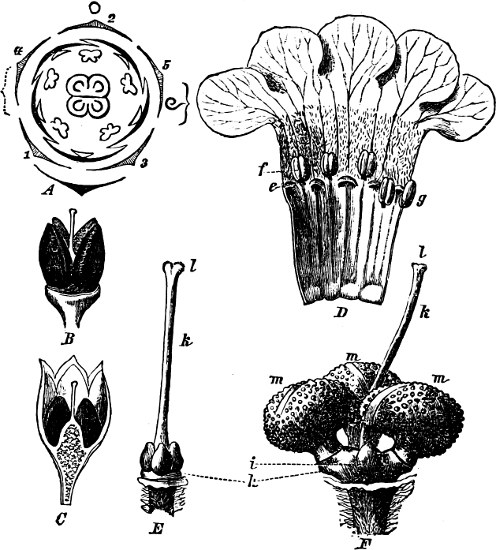
Fig. 572.—Anchusa officinalis: A diagram; the brocteole a is suppressed (dotted); β supports a flower. B, C Myosotis, the fruit, entire and with the calyx in longitudinal section. D, F Alkanna tinctoria: D the corolla opened (4/1); e the ligule; f, g the anthers; E gyncœceum (3/1); F fruit, with three fruitlets; i an aborted loculus; h disc.
Cross-pollination is most commonly effected by insects (especially bees). There are a great many contrivances for pollination; some flowers are protandrous (Echium vulgare, Borago officin.), others are heterostylous (long-and short-styled: Pulmonaria officin.); the corona (ligules) is a protection against rain, and excludes certain insects. Some are barren when self-pollinated (Pulmonaria officinalis, Echium vulgare); others which have but little honey, may, failing insect-pollination, fertilise themselves, and in Myosotis versicolor this regularly occurs by the growth of the corolla during flowering, so that the anthers are brought into contact with the stigma. Honey is secreted on the hypogynous disc.—About 1,150 species, growing especially in the northern temperate zone, Mucilage is found (e.g. in the officinal root of Cynoglossum officinale, in the root of Symphytum): red dyes are found in some roots (e.g. Alkanet-root, the root of Alkanna tinctoria, which is also medicinal; S. E. Europe, Asia Minor); some are poisonous: Cynoglossum, Echium, Anchusa, etc. Several species are ornamental plants. Heliotropium (Peru) is cultivated chiefly on account of its pleasant scent; essential oils are otherwise very rare.
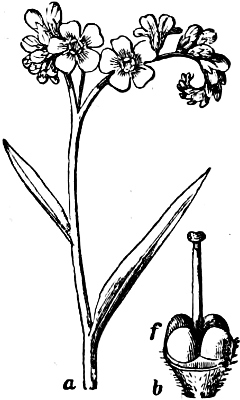
Fig. 573.-Myosotis. Inflorescence and gynœceum.
Order 3. Verbenaceæ. The majority are shrubs; a few are herbs or trees (Teak-tree); some are lianes. The branches are often square. The leaves are opposite or verticillate, without stipules; in some compound. The inflorescences are racemes, spikes, capitula, or dichasia. Five sepals; five petals in a gamopetalous, zygomorphic corolla, which is often bilabiate, but rarely to such an extent as in the Labiatæ, and the upper lip in some is larger than the under, in others smaller; stamens four didynamous, or two; the ovary is entire (not grooved or divided), 1- or 2-locular, or, as in the Labiatæ, divided into four loculi with an erect ovule in each, but in some the anterior carpel is suppressed. One terminal style. The fruit is, e.g. in Verbena, a 4 partite schizocarp with nut-like fruitlets; in Vitex (digitate leaves) a drupe with a 4-locular stone; in Clerodendron a similar fruit, with four free stones; in Lantana a bilocular stone, or two unilocular stones. The radicle is turned downwards. Endosperm small or absent.—Lippia, Stachytarpheta, Bouchea, Priva, Citharexylon, Callicarpa, etc.—The Verbenaceæ are closely allied to the Labiatæ; they differ especially in the ovary not being 4-lobed with gynobasic style, but undivided, almost spherical or ovoid with a terminal style. Again, the leaves are not so constantly opposite, and the inflorescences are various.
730 species; especially in the Tropics; there are several in America, especially Lantana-species; shrubby weeds.—Many of those mentioned are ORNAMENTAL PLANTS, especially Verbena; Vitex agnus castus is a S. European shrub. Lippia citriodora (S. Am.) etc., have strongly-scented leaves; the Teak tree (Tectona grandis) is one of the largest trees in East India, and has a very hard wood.
Avicennia is allied to this order; it inhabits the Mangrove swamps on tropical coasts. The endosperm emerges from the ovule, carrying the embryo with it; the embryo ultimately bursts the endosperm and lies free in the loculus of the fruit; this is then filled by the embryo with its large, green cotyledons, which are borne on an already hairy or rooted stem. The seedling thus developed falls from the tree, together with the fruit, and strikes root in the mud. One special cell of the endosperm at an earlier period becomes a highly-developed organ of suction, growing into a much-branched sac, very rich in protoplasm.
Order 4. Labiatæ. The special characteristics are: the square stem, the opposite leaves (without stipules), the inflorescences which are formed by two double unipared scorpioid cymes, the labiate corolla, the 4 didynamous stamens (the posterior being entirely suppressed) (Fig. 574), and the 4-partite schizocarp with nut-like fruitlets. The floral formula is S5, P5, A5 (the posterior stamen is generally absent), G2.
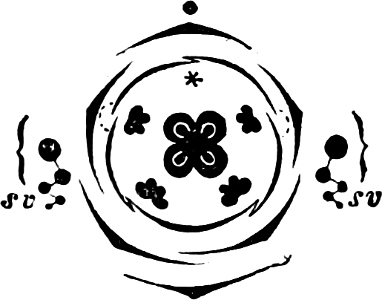
Fig. 574.—Diagram of Lamium album: sv dichasia.
They are chiefly aromatic plants (herbs, shrubs, e.g. Lavender, or trees), volatile oil being formed in internal cells or in the glandular hairs, which cover all green parts. The stem is always more or less markedly square; the leaves are borne upon the flat sides, and are simple and penninerved, but vary in the other characters. The inflorescences are double unipared scorpioid cymes, which may be situated at some distance from one another in the axils of the foliage-leaves (Fig. 575 A), but frequently when the subtending leaves are bract-like, they are crowded into spike-like inflorescences (Lavandula, Mentha, Salvia, etc.), each of the so-called “whorls” (verticillaster, glomerulus) being a double unipared scorpioid cyme (Fig. 574). (Solitary flowers are found in e.g. Scutellaria, and Origanum). The calyx is strongly gamosepalous, 5-toothed, often bilabiate (Fig. 575 B). The corolla is strongly bilabiate (Figs. 575, 576, etc.), with 2 lobes in the upper lip and 3 lobes in the under lip (an approach to regularity occurs only when the upper lip is small, and thus resembles one lobe, as in Mentha (Fig. 578) and Lycopus, so that the corolla approaches the 4-merous corolla of Veronica and Plantago). The posterior stamen in the diagram (Fig. 574*) is entirely suppressed; in most of the genera the posterior lateral stamens are the smaller (Fig. 575 D), and are entirely suppressed in some (see below); in others, e.g. Nepeta, they are the longer. 2 stamens are found in Salvia, Rosmarinus, Lycopus, etc. The two halves of the anthers are often separated from one another, and are placed at an angle with each other. The gynœceum has 1 style with a bifid extremity (Fig. 575 C) bearing the stigma; the true bilocular ovary is divided by a false partition-wall into 4 loculi, each with 1 erect ovule (Fig. 575 H). These 4 loculi project so strongly that the ovary becomes deeply 4-lobed with the style situated in the centre of the lobes and at their base, “gynobasic” (Figs. 575, 579). A ring-like, often crenate, nectary surrounds the base of the ovary (Fig. 575 G, H). The embryo in this order, as in the Verbenaceæ, is directed downwards (Fig. 575 J) (it is directed upwards in the Boraginaceæ, which have an entirely similar fruit). Endosperm absent.
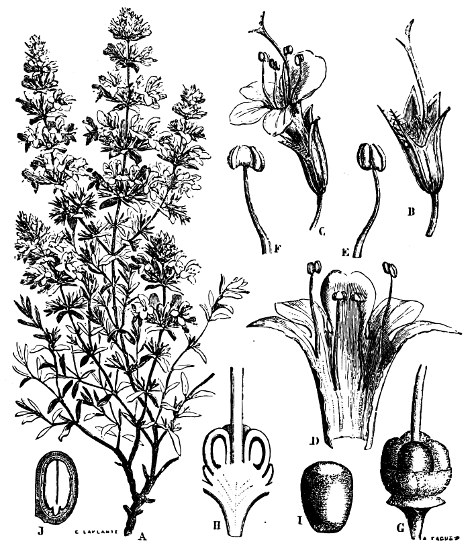
Fig. 575.—Thymus vulgaris.
The 142 genera are mainly distinguished according to the form of the calyx and corolla, the number, direction, and length of the stamens, the forms of the nuts, etc.
1. Ajugeæ, Bugle Group. Calyx 10-nerved; the upper lip is small; 4 stamens. The ovary is not so strongly lobed as in the following group, so that it is most nearly allied to the Verbenaceæ. The nuts are reticulately wrinkled. Ajuga (Bugle) has a very small upper lip. The upper lip of Teucrium (Germander) is deeply cleft, and the two lobes are bent on their respective sides towards the under lip, which in consequence appears to be 5-lobed, and the upper lip to be wanting.
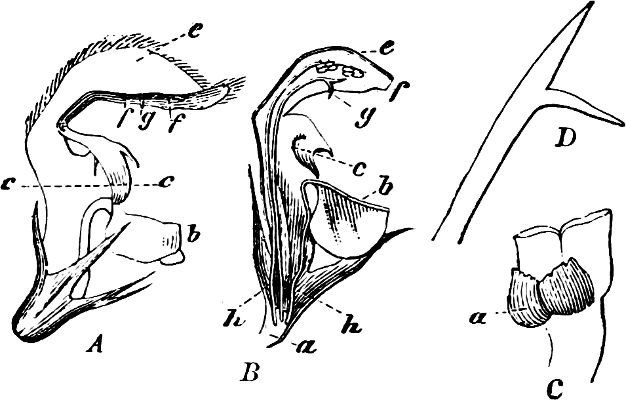
Fig. 576.—Lamium album: A lateral view of flower; B longitudinal section; C ovary with nectaries (a); D the apex of the style; e, upper lip of corolla; c, b, c the three petals of the lower lip; f anthers; g stigma.
2. Stachydeæ, Betony Group. The calyx is 5- or 10-nerved. The upper lip of the corolla is most frequently strongly arched or helmet-shaped; 4 stamens, the anterior pair the longer (Fig. 576).
a. A somewhat regular and 5–10-dentate calyx with projecting stamens.—Stachys (Betony, Woundwort); the lobes of the under lip are rounded off. The anterior filaments, after pollination, bend outwards. Betonica—Ballota (Horehound); the calyx is funnel-shaped, and has triangular, long, pointed, awn-like teeth.—Galeopsis (Hemp-nettle) has two conical protuberances on the under lip between the lateral and the central lobes. The anthers open by 2 unequal valves. Lamium (Dead-nettle, Fig. 576) has dentate, lateral lobes on the under lip. L. album (White Dead-nettle), L. rubrum, etc. Galeobdolon.—Leonurus; Phlomis.
b. Tubular, regular, often 10-toothed calyx and concealed stamens.—Marrubium vulgare (Fig. 577); 10 calyx-teeth, hooked at the apex; many almost spherical whorls of flowers in the axils of the foliage-leaves, at some distance from one another.—Sideritis.
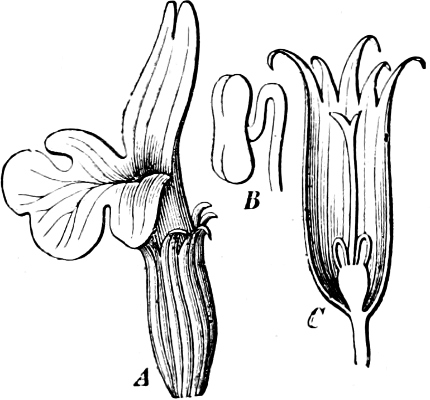
Fig. 577.—Marrubium vulgare.
c. Strongly bilabiate calyx, the lips closing together after flowering.—Scutellaria (Skull-cap); the two lips of the calyx are entire, the upper lip has a large spur, and drops off on the ripening of the fruit. The flowers are generally solitary and turned to one side.—Prunella (Heal-all); the calyx is compressed, its two lips are strongly dentate, the upper lips closing slightly round the under. The stamens have a tooth-like projection beneath the anthers.
3. Nepeteæ, Catmint Group. 13–15 nerves in the calyx; this deviates from the other groups in the posterior stamens being the longer. The upper lip is slightly arched. Nepeta (Catmint), also Glechoma (Ground Ivy), with regular, and Dracocephalum with irregular calyx.
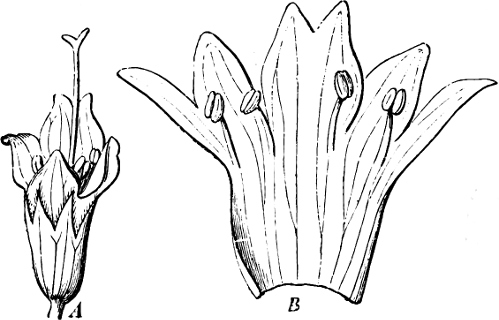
Fig. 578.—Mentha aquatica, var. crispa.
4. Satureieæ, Mint Group. The upper lip is flat, most frequently ovate, or almost spherical, and emarginate (Fig. 578). The calyx is most frequently 5–10-nerved. 4 stamens, the anterior being the longer; rarely, 2 stamens only.—Mentha (Mint, Fig. 578) has a regular, 5-dentate calyx, a small, almost regular, 4-partite corolla, and 4 erect stamens of nearly equal size. The verticillasters are many-flowered, and are often collected into cylindrical inflorescences. Herbs.—Lycopus (Gipsy-wort); corolla almost regular. 2 stamens, the posterior lateral ones are wanting. Preslia: 4-dentate calyx, 4-partite, regular corolla; 4 stamens of equal size.—Thymus (Thyme, Fig. 575) has a strongly bilabiate calyx, the throat being closed by a whorl of hairs (Fig. 575 B). The corolla is distinctly labiate. Under-shrubs, with small entire leaves; verticillasters few-flowered and separate.—Origanum (Marjoram); spike or capitate inflorescences with the flowers solitary in the axils of the rather large and distinctly 4-rowed (often slightly coloured) floral-leaves. Melissa. Calamintha. Clinopodium (Wild Basil). Satureia. Hyssopus (Hyssop); small, entire leaves; the verticillasters are situated unilaterally in a slender, spike-like inflorescence. Lavandula (Lavender); shrubs with verticillasters collected in cylindrical, long-stalked inflorescences; the calyx is tubular, has 13–15 nerves, the posterior tooth is much larger than the others. Stamens and style do not project. Coleus differs, among other characters, in having united filaments; the stamens and style are bent down and concealed in the boat-shaped under lip.
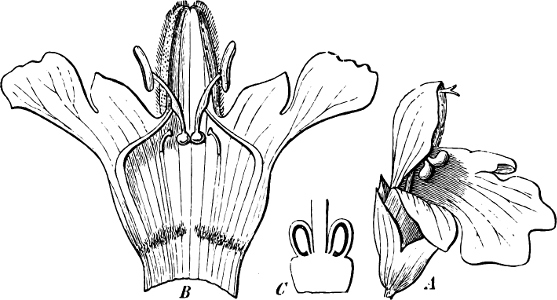
Fig. 579.—Salvia officinalis.
5. Monardeæ, Salvia Group. Only the 2 anterior stamens are developed.—Salvia (Fig. 579); calyx deeply bilabiate; the upper lip of the corolla is generally strongly compressed. Rudiments of the two lateral stamens are present. The connective in the two fertile stamens is long and filamentous, and bears at the upper end a normal half-anther, but at the lower one a barren, often broader portion, against which the insect is obliged to push its proboscis during its visits to the flowers, causing the pollen-bearing half-anther to be pressed down against its back. Floral-leaves often coloured.—Rosmarinus (Rosemary); a shrub with leathery linear leaves, with rolled back edge. A small tooth on the filament represents the barren half of the anther. Monarda.
The POLLINATION is generally effected by insects, especially bees; the under-lip is the landing-stage and the pollen is deposited on their backs. Cross-fertilisation is promoted by dichogamy; honey is secreted by an hypogynous disc and collected in the corolla-tube. Some genera are homogamous (Lamium, Galeopsis, etc.); others are dichogamous (protandrous); a few are gynodiœcious: ♀-and ☿-flowers in various relative sizes (Glechoma hederaceum, Thymus, Salvia pratensis, and others). The entrance of uninvited guests to the honey is often rendered difficult by whorls of hairs, etc. In numerous instances the upper lip protects the pollen from rain. Cleistogamy is found e.g. in Lamium amplexicaule.
2,700 species; distributed over the entire globe, but the greater number in Mediterranean countries (especially in the Eastern regions), where many are shrub-like.—Poisonous and acrid properties are absent. On account of their volatile oils they are principally used as condiments, for perfumery and in medicine (the officinal parts are therefore nearly always “folia” and “herba,” in Lavandula the flowers, and the volatile oils extracted from them). Such are:[39]Mentha piperita [+] (Peppermint)—menthol is obtained from this species and from M. arvensis—M. viridis [+] (Spearmint), M. crispa (Curly-mint), Thymus vulgaris (Garden Thyme), Melissa officinalis (S. Eur.), Hyssopus officinalis (Hyssop, S. Eur.), Origanum majorana (Marjoram, from the Mediterranean), O. vulgare (Wild Marjoram), creticum, smyrnæum, etc., Salvia officinalis (S. Eur.), Rosmarinus officinalis (oil of Rosemary, S. Eur.), Lavandula vera [+] (oil of Lavender, S. Eur.). Also: Satureia hortensis (S. Eur.), Ocimum basilicum (E. India), Pogostemon patchouli (E. India), etc.—As ornamental plants, e.g. Monarda, Plectranthus, and Coleus (foliage-plants, often with red stems and leaves), Stachys lanata (white, woolly), Phlomis, Salvia-species, Perilla, etc.
Order 5. Selaginaceæ. 130 species; small, most frequently heath-like shrubs or herbs, mainly from S. Africa. They differ from the other Nuculiferæ especially in the bilocular, transversely-placed anthers of the 4 stamens (2 stamens divided as far as the base (?)). The ovary has 2, or by suppression only 1 loculus, each with 1 ovule, and the fruit is a schizocarp dividing into two, or is a 1-seeded nut. Radicle turned upwards.—A few are ornamental plants (Selago, Hebenstreitia).
Order 6. Globulariaceæ. 12 species; especially in the Mediterranean. They form an analogy to the Compositæ, and in the main resemble Jasione montana in appearance, the flowers being crowded into a spherical head (hence their name) and supported by bracts, but without involucre; the ovary is unilocular with 1 pendulous ovule. The 1-seeded nut is enveloped by the persistent calyx. The corolla is more or less labiate, the upper-lip is often absent as in the ligulate corollas of the Astereæ; stamens 4, didynamous, with transversely placed anthers opening by one transverse cleft. The leaves are scattered, simple, entire, and generally form a rosette. Globularia.
Order 7. Stilbaceæ. Heath-like shrubs. The ovary is bilocular; 1 erect seed in each loculus, or the posterior cell is empty. Stilbe. 7 species. S. Africa.
Family 32. Contortæ.
Hypogynous, regular, ☿, gamopetalous flowers (Figs. 581, 582), which are generally 5- or 4-merous, with 5 or 4 stamens (with the exception of Oleaceæ and Jasminaceæ which have only 2 stamens, alternating with the carpels). The gynœceum is formed of 2 (nearly always median) carpels. The corolla very frequently has twisted æstivation (the upper edges of the petals being free; Fig. 581 A), and hence the individual lobes of the corolla are oblique, but the flower as a whole is regularly actinomorphic. A nectary, in the form of a honey-secreting ring or glands, is often found round the base of the ovary.—The leaves, with a few exceptions, are opposite and without stipules. Endosperm large (Fig. 581 C), except in Jasminaceæ and Asclepiadaceæ.
The Apocynaceæ and the Asclepiadaceæ, on account of the free ovaries, without doubt represent a more primitive form, but the Asclepiadaceæ on the other hand form an offshoot on account of their peculiar pollen-masses. The Loganiaceæ form a transition to the Rubiaceæ.
The orders are:—
A. Stamens 5. 1, Gentianaceæ; 2, Apocynaceæ; 3, Asclepiadaceæ; 4, Loganiaceæ.
B. Stamens 2. 5, Oleaceæ; 6, Jasminaceæ; 7, Salvadoraceæ.
Order 1. Gentianaceæ (Gentians). Glabrous herbs, without latex; the opposite, undivided and entire leaves are often slightly united at the base; many have rosette-like radical leaves. Stipules absent. The flowers are generally borne in regular, dichotomously-branched dichasia (Figs. 580, 581 A), which finally become transformed into unipared scorpioid cymes; the parts of the flower are 4–5-merous as far as the gynœceum, which is 2-merous; the calyx frequently is almost polysepalous; the corolla has distinctly twisted æstivation (the upper edges being free) (Fig. 581 A), except Menyantheæ. The carpels are entirely united, and most frequently form a 1-locular ovary with 2 parietal placentæ bearing many ovules (often in several rows, Fig. 581 D, F). Capsule, 2-valved, with septicidal dehiscence, the incurved edges bearing the seeds (Fig. 581 D, F).
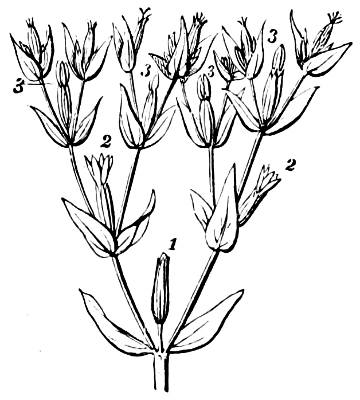
Fig. 580.—Erythræa. Inflorescence. 1, 2, 3, etc., the successive shoot-generations.
1. Gentianeæ.—Gentiana (Gentian) has most frequently a tubular, campanulate or funnel-shaped corolla, sometimes with teeth between the corolla-lobes and fringed in the throat of the corolla; G. lutea has a rotate, yellow corolla.—Swertia: rotate corolla; each lobe has at its base 1–2 nectaries, with fringed edges.
Erythræa (Centaury, Fig. 581); corolla most frequently salver-shaped. The anthers ultimately become spirally twisted (E). The style prolonged, deciduous. The flower has the Lobelia-arrangement, i.e. the median sepal is anterior; the corolla is rose-coloured (in the native species). The capsule is semi-bilocular (Fig. 581 F, G).—Cicendia has a low creeping stem, fine as a thread, and small, yellow flowers, 4-merous (without twisted anther).—Chlora (Yellow-wort) 6–8-merous.
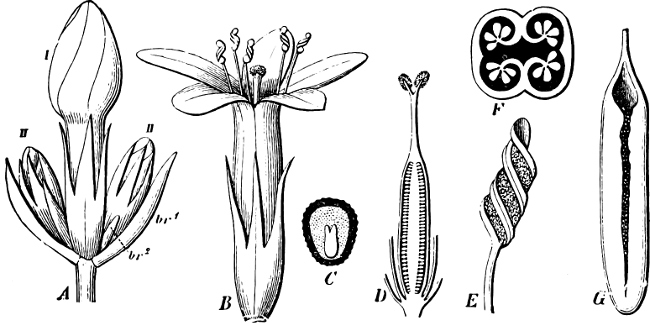
Fig. 581.—Erythræa centaurium. Inflorescence, flower and fruit: br1, br2 floral-leaves of the 1st and 2nd order; G a valve of the capsule separated from its fellow.
2. Menyantheæ. Menyanthes (Buck-bean) deviates in several respects from the type of the order. The leaves are scattered and, in M. trifoliata, trifoliate; the corolla has valvate æstivation; the testa is also very hard (thin in the true Gentians). They are aquatic plants with creeping rhizome; the flowers borne in racemes, with terminal flower, heterostylous. The corolla is funnel-shaped with a very hairy throat.—Limnanthemum with floating leaves, like the Water-lilies.
575 species; distributed over the entire globe, but most numerous in Alpine districts. Neither poisonous nor nutritive plants are found, but several are used in medicine on account of the bitter properties so prevalent amongst them. Officinal: the roots of Gentiana lutea. The roots of other species, e.g. G. purpurea, punctata and pannonica (Europe) and the leaves of Menyanthes trifoliata are medicinal. Some are grown as ornamental plants on account of the pure (often deep blue) colour of the flowers.
Order 2. Apocynaceæ (Periwinkles). Trees and shrubs (also lianes), less frequently herbs, generally with latex. The leaves are opposite, simple, entire, without stipules; the flowers are regular; corolla-lobes oblique, æstivation twisted. The stamens are individually free, and the pollen-grains are free or at most united in fours (see Asclepiadaceæ). The two carpels have 2–∞ ovules, in all cases there is only 1 style and a capitate stigma, which towards the base is widened out into a disc-like table (stigma-disc) abstricted in the centre; but the carpels in most of the genera (e.g. those mentioned below) are entirely separate, and the fruit consists of two follicles, the seeds of which often have a tuft of woolly hairs projecting from the micropyle, less frequently of two drupes. In some other genera there is a 1-locular (provided with 2 parietal placentæ) or a 2-locular ovary becoming a 2-valved capsule or a berry. Endosperm abundant.
Vinca (Periwinkle) has a salver-shaped corolla, which is twisted to the left in æstivation (i.e. the left edge of the petals is free); nectaries 2, alternating with the carpels; the summit of the style is hairy. Follicles; seeds without hairs. Mostly creeping, perennial, evergreen plants, whose large flowers are apparently axillary; in reality they are terminal, but by the development of the bud in the axil of one of the two uppermost leaves, they are thus displaced over the other leaf of the pair (a helicoid sympodium being formed).—Plumeria, Tabernæmontana, Cerbera (drupe). Aspidosperma.
Nerium (Oleander). The leaves are in whorls of 3. Corolla funnel-shaped, in æstivation twisted to the right, and with a corona resembling that of Lychnis. The anthers are prolonged at the base and each also bears at the apex a long, linear, hairy appendage; these finally become spirally twisted. Follicles; seeds hairy. Apocynum, Echites, etc. Epigynum is epigynous.
124 genera, 1,000 species; principally in the Tropics. Only 2 species of Vinca are natives of this country; the following are cultivated as ornamental plants:—Vinca minor, V. major, V. (Lochnera) rosea, Amsonia salicifolia, Nerium oleander (Eastern Mediterranean). The latex of some is poisonous (Tanghinia venenifera, Cerbera). Caoutchouc is obtained from others (Hankornia, Landolphia, Vahea, etc.). Tough bast is frequently developed. The bark of Aspidosperma quebracho and the seeds of Strophanthus hispidus are used in medicine (also for African arrow-poison), the latter is officinal.
Order 3. Asclepiadaceæ. A natural and easily recognised order, closely allied to the Apocynaceæ, having, like it, frequently a poisonous latex, opposite, single, entire leaves and fundamentally the same floral diagram and floral structure (S5, P5, A5, G2); but in some the æstivation of the corolla is valvate. The carpels here also have free ovaries, but are united for some distance above into a large, shield-like, 5-angular head, having on its underside the true stigmas, and the fruit always consists of 2 follicles; seeds most frequently numerous and hairy at the micropyle (“vegetable silk”); endosperm scanty.—The order is distinguished from the Apocynaceæ and from all other plants also, except the Orchids, by having all the pollen-grains in each of the 2 loculi of the anthers (true 2-locular anthers) united into one waxy, club-shaped pollen-mass (“pollinium”), for the purpose of pollination by insects. These heavy masses, in order to secure pollination (as in the case of the Orchids), must be attached to sticky discs (corpuscula); there are 5 corpuscula, one at each of the corners of the 5-angular stylar-head (alternating with the anthers), and to each of these are attached 2 pollinia, one from each of the anthers situated on either side (thus each anther gives its right pollinium to one corpusculum and its left to another). The stamens are frequently united at the base, and each bears on the back a variously formed, petaloid appendage, termed a “cucullus.”
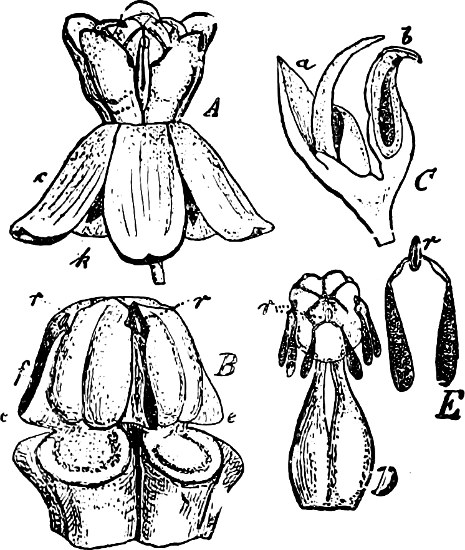
Fig. 582.—Asclepias cornuti. A An open flower with the calyx (k) and corolla (c) turned down; the stamens are bent together and surround the gynœceum. B The andrœcium after removal of the sterile part (cucullus) of the anther, which functions as a nectary: e the lateral expansions of the fertile portion of the anthers; f the slit between the expansions of two contiguous anthers, through which the insect’s foot, and later a pollinium which is caught by it, is dragged, and behind which the only receptive part (stigma) is hidden; above the slit f is the gland (r), which secretes the horny corpusculum, which is split at its base and joined on either side with a pollinium (this is more distinctly seen in D and E). When the foot of the insect is caught in the slit (f) and is drawn upwards, it becomes entrapped in the slit of the corpusculum, which is then pulled out together with the pollinia firmly attached to it. In walking over the flowers the insect will draw its foot through other slits (f) and so leave the pollinia on the stigmas. C, D The gynœceum with the pollinia hanging freely. E A corpusculum and two pollinia.
A peculiar relative position (and therefore a good, distinctive characteristic) is often found in the inflorescence, which is cymose; it is placed between the two leaves of a whorl, nearer to one than to the other. The leaf-pairs are placed obliquely in the floral region, at acute and obtuse angles, and not at right angles (as in the purely vegetative parts); the inflorescences are placed in two rows only which are nearly 90° from each other, and the two contiguous to one another are antidromous; they are in reality terminal, each on its own axis, and the entire floral portion of the shoot is a unipared scorpioid cymose sympodium; in addition, complications also arise through individual parts becoming united.—Herbs and shrubs, some twining or climbing.
In Asclepias the corolla is bent back and there is a cup-like cucullus, from the base of which protrudes a horn-shaped body, bent inwards.—Vincetoxicum has a rotate corolla and a ring-like, 5-lobed cucullus, without internal prominences.—Stapelia (especially from S. Africa) is remarkable on account of its Cactus-like, leafless stems and large, brownish flowers, often with carrion-like smell. Periploca has more powdery pollinia (S. Eur., etc.); Hoya carnosa (Wax-flower; Trop. Asia) is a climber, and has small, annual, flower-bearing dwarf-branches. Ceropegia.
201 genera with 1700 species, distributed over all tropical countries; few outside these limits: no native species. Several are used in medicine on account of the pungent properties of the latex. Condurango-bark of Gonolobus condurango is medicinal. Caoutchouc is obtained from the latex of some (e.g. from Cynanchum). The seed-hairs, which are most frequently shining, silk-like, and white, are not sufficiently pliant to be of much value. Ornamental plants in our gardens: Asclepias-species, etc.
Order 4. Loganiaceæ. Ovary single, with two loculi, in structure resembling the Rubiaceæ, but superior. 360 species are included in this order; the majority are tree-like, some lianes which climb by tendril-like branches. The interpetiolar stipules of some species are very characteristic (as in Rubiaceæ, to which they maybe considered to be closely related). The fruit is a capsule or berry. The most familiar genus is Strychnos, which has spherical berries with an often firm external layer, and compressed seeds with shield-like attachments; endosperm abundant. The leaves have 3–5 strong, curved nerves proceeding from the base.—Spigelia.—They have no latex, as in the two preceding orders, but many are very poisonous (containing the alkaloid “strychnine,” etc.); the South American arrow-poison, urare or curare, is made from various species of Strychnos, also an arrow-poison in the East Indian Islands (Java, etc.). Officinal, the seeds of Strychnos nux vomica (“Vomic nut,” Ind.). The seeds of Strychnos ignatii (Ignatius-beans, medicinal), and others are poisonous.
Order 5. Oleaceæ. The leaves are always opposite. The inflorescences are racemes or panicles. The calyx and corolla are 4-merous, more or less united, free in some species; the corolla has most frequently valvate æstivation. All four forms of fruit occur (see the genera). Ovules pendulous, 2 in each loculus (Fig. 583 C). Endosperm oily.—Syringa (Lilac) and Forsythia (anthers somewhat extrose) have capsules with loculicidal dehiscence and winged seeds.—Fraxinus (Ash) has winged nuts (samara) (Fig. 583 D); trees with most frequently imparipinnate leaves; the flowers are naked and sometimes unisexual (polygamous), the Manna Ash (F. ornus) has however a double perianth with 4 free petals (Fig. 583 a); in the native species, F. excelsior, the flowers open before the foliage appears.—Ligustrum (Privet) has berries.—Olea (O. europæa; Olive) has drupes; the pulp and seeds of the ellipsoidal fruits are rich in oil. The lanceolate leaves are grey on the under surface, being covered with stellate hairs. In the wild state it is thorny (modified branches).—Phillyrea; Chionanthus.—Few species of Linociera have 4 stamens.
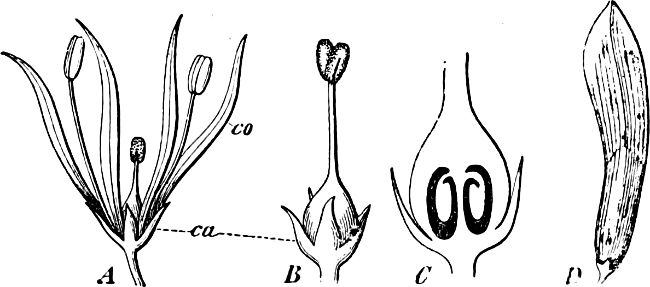
Fig. 583.—Fraxinus ornus: A flower; ca calyx; co corolla; B gynœceum and calyx; C longitudinal median section of gynœceum; D fruit.
180 species; chiefly in the northern temperate zone. The Olive-tree (Olea europæa) has been an important cultivated plant from ancient times (Olive oil, Provence oil, “Sweet oil”). The best oil is extracted from the fruit-pulp. The fruits are edible. Home: Western Asia, Eastern Mediterranean. Timber: the Ash (Fr. excelsior). Officinal: the Manna Ash (Fr. ornus), cultivated in the Mediterranean countries for the sake of its saccharine juice, which flows out and coagulates into “Manna.”—The following are ornamental plants: species of Ligustrum and Syringa (introduced in the 16th century, from S.E. Europe and Asia), Forsythia (China, Japan; the large, yellow flowers are borne on dwarf-branches with scale-like leaves, before the opening of the foliage-leaves), Chionanthus.
Order 6. Jasminaceæ. The æstivation of the corolla is imbricate; the ovules are erect; seeds almost without endosperm; radicle directed downwards. The number of lobes in the calyx and corolla is not 4, but e.g. 5, 8, 10, and variations are sometimes found in the same individual. The fruit is a berry or capsule. Many species are twiners, and their scattered or opposite leaves are most frequently imparipinnate.—120 species; especially in Trop. Asia (E. India). Some Jasminum-species are cultivated as ornamental shrubs in the warmer districts on account of their elegant foliage, and beautiful, sweet-scented flowers, the essential oil of which is also used in perfumery; the best known are: J. sambac and grandiflorum. Nyctanthes arbor-tristis opens its sweet-scented flowers only at night (E. India).
Order 7 (?). Salvadoraceæ. 8–9 species; Asia, Africa.—Salvadora.
b. Tetracyclicæ with epigynous flowers.
Family 33. Rubiales.
The leaves are always opposite or verticillate. The flower is epigynous, ☿, 5-(or 4-) merous, with the usual sympetalous diagram; 2–5 carpels. The inflorescences are frequently dichasial. The sepals are small, reduced to teeth, and become almost entirely suppressed in the higher forms.—The flower is regular in Rubiaceæ and some Caprifoliaceæ, but in other genera of this latter order (especially of Lonicereæ) it is unsymmetrical. In several genera of the order first mentioned the loculi of the ovary contain many ovules, but in the last the number of loculi and ovules becomes reduced. This is to some extent connected with the nature of the fruit which is many-seeded in most instances, namely a capsule or berry, but in others nut-like. Endosperm is present.
The family on one side is allied to the Contortæ (not only through the Loganiaceæ but also through the Apocynaceæ), and may be regarded as an epigynous continuation of this family; on the other side it is allied to the Valerianaceæ and Dipsacaceæ. Many points of agreement with the Cornaceæ and Araliaceæ are also found, and in fact several Caprifoliaceæ are distinguished from these by hardly any other feature than the gamopetalous corolla.
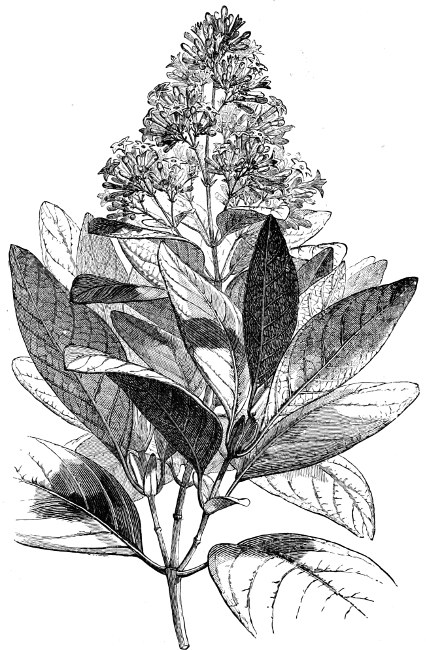
Fig. 584.—Cinchona calisaya. Flowering branch.
Order 1. Rubiaceæ. Leaves opposite (or verticillate), undivided and entire, with interpetiolar stipules (Fig. 586). Flowers epigynous and hermaphrodite, regular, 4- or 5-merous with the usual arrangement (Figs. 585, 588–590); corolla gamopetalous, in æstivation often valvate; ovary frequently 2-locular.
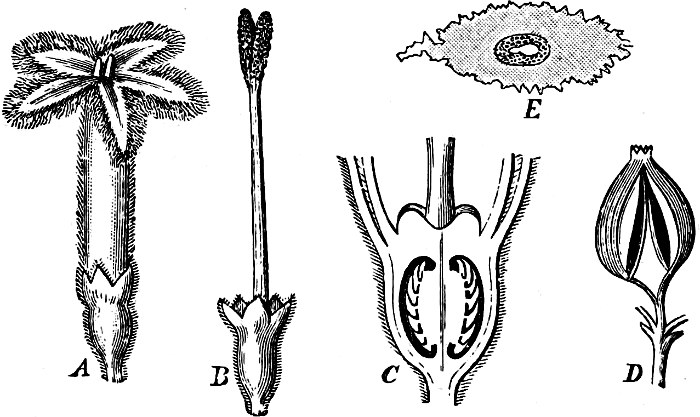
Fig. 585.—Cinchona calisaya. A entire flower; B after removal of the corolla; C longitudinal section of ovary; D fruit; E seed.
There are no external characters which at once distinguish this exceedingly large order, as in many other natural orders (Compositæ, Umbelliferæ, etc.), but the opposite leaves with interpetiolar stipules form an excellent mark of recognition. It is divided into many sub-orders and groups, especially characterised by the nature of the ovary (1 or several ovules in each loculus), and of the fruit (schizocarp, berry, drupe, capsule).—The corolla is bilabiate in 4 genera; its æstivation in some is twisted; in Capirona, etc., the filaments are of unequal size. The ovary is semi-epigynous in Henriquezia, etc. In Morinda all the fleshy fruits coalesce into one multiple fruit.
1. Cinchoneæ. The fruit is a 2-valved capsule, with many winged seeds (Fig. 585). Cinchona (Quinine, Fig. 584). Trees and shrubs with the foliage and inflorescence somewhat resembling Syringa; the corolla also being of a lilac colour, more or less salver- or funnel-shaped, and frequently edged with a fringe of hairs (Fig. 585), is somewhat similar to that of Menyanthes. Their home is the Andes from Bolivia to Venezuela, varying in altitude from 1–3000 metres. There are now large plantations in Java and E. India. (The name “quinine” is of Indian origin; that of the genus “Cinchona,” is from the Spanish Duchess Cinchon, who in 1638 first introduced the bark into Europe.) The following are closely allied: Cascarilla, Remijia, Ladenbergia, Manettia, Bouvardia, etc.
2. Gardenieæ. Trees and shrubs, frequently having a many-locular berry. Randia, Gardenia, Genipa, Hamelia, etc.
3. Coffeeæ. Only 1 seed in each of the two loculi of the ovary; the fruit is a drupe with 2 stones. Coffea has an ellipsoidal fruit about the size and colour of a cherry; the two thin-shelled, parchment-like stones are enclosed by a thin layer of pulp; the two seeds are flat on the side turned to one another, which has also a deep, longitudinal groove curving to the sides. The endosperm is hard, horny and greyish (without starch); the small embryo lies in the lower end near the circumference. The Coffee-plant (C. arabica) is a small tree, or more frequently, and especially in plantations, a shrub with large dark-green leaves and scented, white flowers. Its home is in Tropical Africa; it is now cultivated in many tropical countries. C. liberica, W. Africa.—Cephaëlis (C. ipecacuanha, Fig. 586; the roots are officinal).—Psychotria, Chiococca, Ixora, Hydnophytum, Myrmecodia, etc.
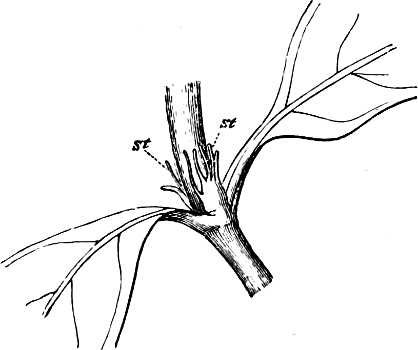
Fig. 586.—Cephaëlis ipecacuanha. Portion of a branch: st stipules.
4. Spermacoceæ. Chiefly small shrubs and herbs, many of which are weeds in tropical countries. The stipular sheaths bear numerous bristles at the edge. Spermacoce, Borreria, Diodia, Richardsonia, etc.
5. Stellatæ. Herbaceous plants with verticillate leaves (Figs. 587, 588–590); the stipules are large, leaf-like, and resemble the lamina of the leaves, so that the leaves appear to be placed several in a whorl, while in reality there are only two opposite leaves, the stipules of which project freely, and are not erect (Fig. 587).
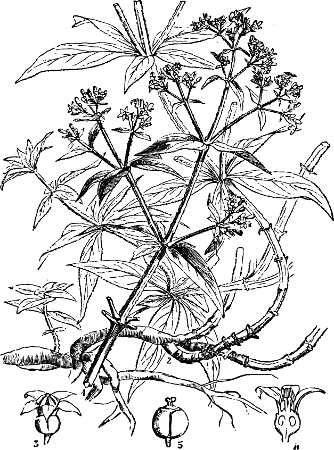
Fig. 587.—Rubia tinctorum.
In some cases there are apparently 4 leaves in the whorl, and then 2 of these are leaves, and the other two are their interpetiolar stipules. When there are apparently 6 leaves, then the two of these which are opposite each other are leaves, and the other four are stipules; if there are several members in the whorl, then a division of the stipules has taken place. The proof of this theory is founded upon the fact that not more than 2 of the leaves of the whorl ever support buds (which, in addition, are seldom of equal vigour), and also that the whorls do not alternate with each other, which, according to the rules of the position of the leaves, they should do if all the members of a whorl had equal value. If there are, for instance, 4 members in two successive whorls, they stand right above one another, and do not alternate. The development and anatomical relations (the branching of the vascular bundles) also point to the same conclusion.—All the other groups of the order have only 2 small scale-like interpetiolar stipules, or they form at the base of the leaf-stalks an interpetiolar sheath, having often a toothed edge (Fig. 586).—Another characteristic feature in this group is that the calyx is rudimentary, the corolla valvate (Fig. 588), and that each of the two loculi of the ovary has only 1 ovule. The fruit is a schizocarp dividing into 2 fruitlets (Fig. 590). The forms of the fruit, as well as many other characters, as, for example, the epigynous flower, the rudimentary calyx, the two free or almost free styles, present interesting analogous resemblances to the polypetalous order of the Umbelliferæ. This group has its home chiefly in the temperate regions of the northern hemisphere, especially about the Mediterranean; it is the only group which occurs in this country, represented by 4 genera.
Figs. 588–590.—Rubia tinctorum.
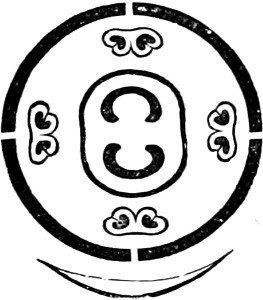
Fig. 588.—Diagram.
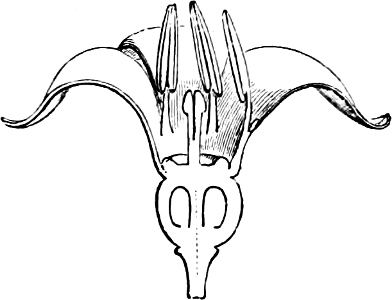
Fig. 589.—Longitudinal section of flower.
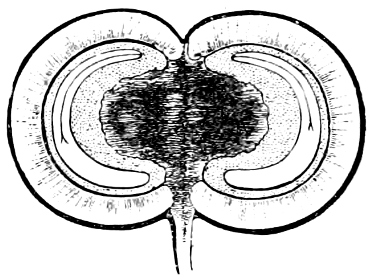
Fig. 590.—Longitudinal section of fruit (3/1).
Galium (Cleavers) is almost destitute of a calyx; it has a small 4-partite, rotate corolla, 4 stamens, and 2 free styles. The fruitlets are nut-like. The inflorescence is a paniculate dichasium passing into helicoid cymes.—Asperula (Woodruff) is distinguished from the above by its salver- or funnel-shaped corolla. 1 style.—Rubia (Madder, Figs. 587–590) has almost the same form of corolla as Galium, but (most frequently) a 5-merous flower, and the fruitlets are “drupes.” Sherardia (Field Madder); the flowers are clustered in closely arranged cymes surrounded by an involucre; the calyx has 6 distinct teeth, while the number of petals and stamens is 4. The corolla is funnel-shaped.—Vaillantia. Crucianella.
The DISTRIBUTION OF SEEDS, in some instances, is promoted by hooked appendages on the fruitlets (e.g. Galium aparine).
The small flowers of the Stellatæ are frequently collected in compact inflorescences, and are therefore rendered more conspicuous; slight protandry is found in some, self-pollination in the species which are less conspicuous. Many species are heterostylous. Myrmecodia, Hydnophytum, and other genera have large tubers (hypocotyledonous stems), whose labyrinthine cavities and passages are inhabited by ants.
About 4,500 species; tropical or sub-tropical except the Stellatæ; especially American. The tropical ones are mostly trees.—Several are OFFICINAL on account of the large amount of alkaloids and glycosides which they contain. The most important are the Cinchonas (Cinchona calisaya, C. succirubra, C. officinalis, C. micrantha, etc.), whose bark contains the well-known febrifuge and tonic, Quinine, Cinchonin, etc.; Quinine is also found in Exostemma, Ladenbergia, and Remijia. The root “Ipecacuanha” (an emetic) from Cephaëlis ipecacuanha (Brazils). Caffeine is officinal. The use of the seeds of the coffee plant (“the beans”) was first known in Europe in 1583.—There are only a few which contain aromatic properties, principally among the Stellatæ (coumarin in Asperula odorata, the Woodruff), in which group colouring materials are also found. The root and root-stalks of Rubia tinctorum, the Madder (S. Eur., Orient., Fig. 587), were formerly largely used for dyeing, but are now superseded by the analine colours. Red dyes are also obtained from the roots of species of Asperula and Galium. Gambier is a splendid colouring material, obtained from Uncaria gambir (S.E. Asia), which is used in dyeing and tanning.—The order does not furnish many ornamental flowers.
Order 2. Caprifoliaceæ. This order agrees with the Rubiaceæ in having opposite leaves and an epigynous flower, most frequently 5-merous with the ordinary tetracyclic diagram, but in some species it is zygomorphic; the corolla has imbricate æstivation, carpels 3–5, most frequently 3 (not 2, which is the most usual number in the Rubiaceæ). The fruit is generally a berry or a drupe, but the most important, and in any case most easily recognisable feature, is the absence of stipules; in exceptional cases, where they are present, they are not interpetiolar, and are most frequently small.—The majority of plants belonging to this order are shrubs or trees. Compound leaves sometimes occur. Stipules only appear in a few species of Lonicera, Sambucus and Viburnum; in the common Elder (Sambucus nigra) they are in some instances glandular and small, but in other cases larger and more leaf-like (upon long, well-developed shoots); in the Dwarf Elder (S. ebulus) they have the normal leaf-like form; in Viburnum opulus they are present as narrow lobes at the base of the petiole; in others they are completely absent. The leaves are frequently penninerved, rarely palminerved. The calyx, as in the Stellatæ and Aggregatæ, is often very insignificant.
1. Lonicereæ, Honeysuckle Group. This has campanulate or tubular corollas which are often zygomorphic; in connection with the length of the corolla the style is long, filamentous, and most frequently has a large, capitate stigma. There are several ovules in the loculi of the ovary, and the fruit is most frequently a berry.
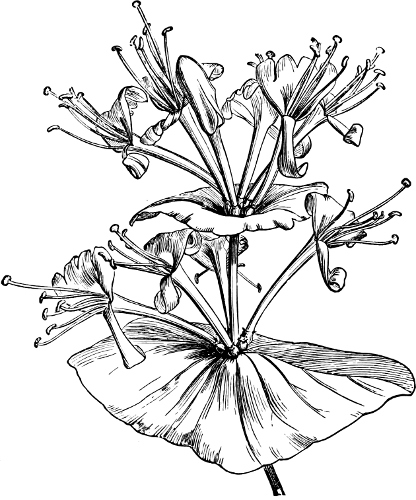
Fig. 591.—Lonicera.
Lonicera (Honeysuckle). Shrubs, sometimes twiners. The corolla in some species is considerably bilabiate (Fig. 591), with 4 lobes in the upper lip, and 1 in the under lip, but in others more regular, tubular, or campanulate. The flowers are either borne in capitate inflorescences, which are compound and formed of closely compressed 3-flowered dichasia (sect. Caprifolium), or in dichasia with 2 flowers (the terminal flower is wanting). The ovaries and fruits coalesce in some (sect. Xylosteum). The opposite leaves in some species unite with each other and form a broad collar encircling the stem (Fig. 591). Above the primary bud 1–2 accessory buds are often found in the leaf-axils.—Diervilla (Weigelia); with a 2-locular, 2-valved capsule.—Symphoricarpus (Snowberry) has an almost regular, funnel-shaped corolla; a peculiar feature is found in the ovary which has 4 loculi, the 2 median having many ovules in 2 rows, all of which are aborted; the 2 lateral ones, on the other hand, each have only 1 ovule which is developed. Different forms of leaves are frequently found on the same branch; they are entire or lobed.
2. Sambuceæ, Elder Group (Fig. 592). This has a rotate, regular corolla, extrorse anthers, a very short and thick (or almost absent) style, with tripartite stigmas, and only 1 pendulous ovule in each of the 3 (-5) loculi of the ovary. The fruit is a “drupe” with 1–3 (-5) stones. The inflorescence is made up of cymes grouped in an umbel-like arrangement.
Sambucus (Elder, Fig. 592) has imparipinnate leaves and a “drupe” with 3 (-5) stones. Between the calyx and the style a disc remains on the apex of the fruit. S. nigra with black fruit; S. racemosa with red fruit; S. ebulus is a perennial herb; the others are woody.—Viburnum (Guelder-rose) has simple leaves (penninerved or palminerved, entire, dentate or lobed), and a “drupe” with only 1 stone, which is compressed, cartilaginous, and parchment-like; 2 of the loculi of the ovary are aborted. (In V. opulus the marginal flowers of the inflorescence are barren, and in that case their corollas are generally specially large; the cultivated Viburnum has only barren flowers, with large corollas.)
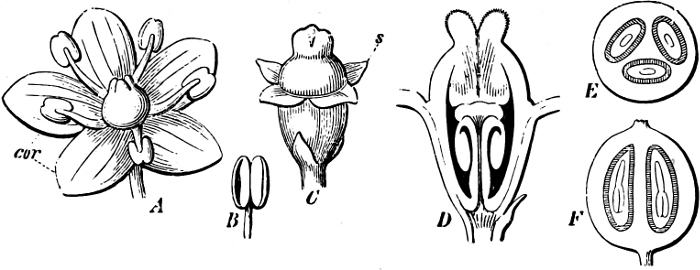
Fig. 592.—Sambucus nigra: cor corolla; s calyx.
3. Linnæeæ. Linnæa borealis (the only species) is an extreme form of the order; it has a 2-flowered dichasium, funnel-shaped, slightly bilabiate corollas (2/3); 4 didynamous stamens. Two of the 3 loculi of the ovary have several ovules which are not developed, while the third has only 1 ovule, which developes into a seed. The fruit is a nut, which is enveloped by the two large bracteoles, which are covered by sticky, glandular hairs, and serve as a means of distribution. It is a small undershrub.
[Adoxa, which was formerly classed in this order, appears, according to recent investigations, to be more properly placed among the Saxifraginæ.]
In cases where the flowers are small, as in Sambucus and Viburnum opulus, they are rendered conspicuous by being arranged in closely-packed inflorescences; they are massed together and form large surfaces, and in the last named are still more conspicuous on account of the barren, but large ray-flowers, which are of service in this respect. Honey is secreted in the nectaries at the base of the styles. In the genera with rotate flowers, as Viburnum and other Sambuceæ, the honey lies so exposed and in such a thin layer, that only flies and insects with short probosces can procure it; bees, however, visit these flowers for the sake of the pollen. There is hardly any nectar in the Elder; self-pollination frequently takes place. The flowers of the Caprifoliaceæ, which, with their long corolla-tube are adapted for evening-and night-flying insects with long probosces, open in the evening, and at that time give off their strongest scent.
Distribution. 230 species; especially outside the Tropics in the Northern Hemisphere. In this country they are found especially in hedges and as under-shrubs.—Officinal: the flowers and fresh fruits of the Elder (S. nigra), the fruits (“berries”) being also used in the household. Ornamental shrubs: species of Lonicera, Symphoricarpus, Diervilla, which are chiefly from N. Am., Abelia and Viburnum.
Family 34. Dipsacales.
The leaves are opposite and without stipules. The flower (Figs. 593, 595, 598, 599, 600) is epigynous, zygomorphic or asymmetrical, 5-merous with S5, P5, stamens typically 5, but by suppression never more than 4, sometimes less, carpels 3–2. The calyx is more or less insignificant, and almost suppressed in the extreme forms. The ovary has 3–1 loculi, but only one loculus has an ovule, which is pendulous with the micropyle turned upwards (Fig. 594). Fruit a nut. Embryo straight, with the radicle pointing upwards (Fig. 597), without or with endosperm.
The inflorescences are distinct dichasia in Valerianaceæ, but in Dipsacaceæ and Calyceraceæ they are crowded together into capitula.
This family is closely allied to the Rubiales through the Valerianaceæ, which have almost the same structure as many of the Caprifoliaceæ. It attains the highest development in the Dipsacaceæ, which are composite plants, but differs from Compositæ in the position of the ovule, etc.
Order 1. Valerianaceæ. Herbaceous plants or under-shrubs with opposite leaves, often pinnate; stipules absent. The flowers are borne in dichasia and in scorpioid cymose inflorescences and are entirely without any plane of symmetry (Fig. 593). The calyx and corolla are 5-merous, but the calyx is frequently very insignificant and ultimately a pappus, as in Compositæ; the corolla is frequently saccate or produced into a spur at the base. Most frequently, only 3 (4–1) of the 5 stamens are developed; these are free. Carpels 3, which form an inferior ovary, often with 3 loculi, but only 1 of the loculi contains 1 pendulous, anatropous ovule (Figs. 593, 594 A), the other loculi are empty and shrink up more or less completely. (Compare Fig. 593 A, B). Style 1, stigma tripartite. Endosperm absent; embryo straight, with the radicle directed upwards.
The inflorescences are dichasia, or unipared scorpioid cymes with the branches developed in the axil of the second bracteole. Both the bracteoles are generally present and frequently form 4 very regular, longitudinal rows on the branches of the inflorescence.—5 stamens do not occur (except perhaps in Patrinia). The suppression of stamens and carpels takes place most readily on the anterior side of the flower and that turned towards the first bracteole (a) (Fig. 593), whose branch is suppressed in the dichasium; after this the posterior median stamen is next suppressed.
By the vegetative characters as well as by the inflorescence and the flower, the order is allied to the Caprifoliaceæ and especially to the Sambuceæ.
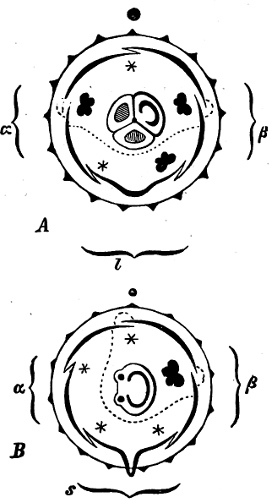
Fig. 593.—A Diagram of Valeriana officinalis. B Diagram of Centranthus.
In the least modified (oldest) forms, Patrinia and Nardostachys, there is an almost regular flower, a 5-merous calyx, 4 stamens, and 3 loculi in the ovary, 2 of which however are barren. The stamens in Valerianella are reduced to 3, in Fedia to 2 (posterior), and the calyx is less distinctly 5-dentate; the 2 empty loculi in the ovary are still visible. Fedia has a small spur at the base of the corolla. Valeriana has a very reduced, hair-like calyx (pappus), an unsymmetrical, salver-shaped corolla with a sac-like, nectariferous spur at the base, 3 stamens and only 1 loculus in the ovary (Figs. 594, 593). Centranthus (Fig. 593) is still further reduced. The corolla has a spur and only 1 stamen; unipared scorpioid cymes with 4 rows of bracteoles. In the last two genera there is a peculiar wall in the corolla-tube, which divides it longitudinally into two compartments (indicated by a dotted line in Fig. 593), one of which encloses the style. This wall is low in Valeriana, but in Centranthus it reaches as far as the throat.—The rays of the pappus are pinnately branched and rolled up before the ripening of the fruit. 12–20 in number (Fig. 594 A, B).
Val. officinalis and others are protandrous: in the first period the stamens project from the centre of the flower (Fig. 595 a), the stigmas in the second (b) when the stamens have become bent backwards. (V. dioica is diœcious with large ♂-and small ♀-flowers).—275 species; especially from the temperate and colder parts of the northern hemisphere of the Old World, Western North America and the Andes.—Bitter properties are characteristic, such for instance as the volatile acid and volatile oil of Valeriana; these occur especially in the rhizomes. Officinal; the rhizomes of V. officinalis.—The true Indian “Nardus,” an important medicine and perfume in India, is extracted from Nardostachys (Himalaya). A variety of Valerianella olitoria is sometimes used as salad.