DIVISION V. ANGIOSPERMÆ. (continued 3)
Michael Cresse Potter translation
Distribution. 1,100 species, especially in temperate climates, fewer in the colder zone, less still in the Tropics. The Paronychieæ are especially found in dry, sandy fields.
Uses. “Soap-root” (with Saponin, forming a lather in water) from Saponaria officinalis was formerly officinal, and Gypsophila struthium. The seeds of Agrostemma githago are said to be poisonous.—The following are ornamental plants: species of Pinks (D. caryophyllus, garden Pink, often with double flowers; D. barbatus, plumarius, etc.). Lychnis, Gypsophila, Silene, Cerastium (C. tomentosum as edging for borders), Saponaria officinalis (often coronate).—Spergula arvensis is sometimes cultivated.
Order 2. Amarantaceæ. The flowers are essentially the same as in the Chenopodiaceæ and the extremely reduced Caryophyllaceæ (Fig. 361 F); they are regular, hypogynous, generally ☿, have 5 free (rarely slightly united) perianth-leaves; in front of these 5 stamens, which are often united at their base into a shorter or longer tube and have stipule-like teeth between them (the division Gomphreneæ has 2-locular anthers, each of which opens longitudinally); and a 2–3 carpellate gynœceum with one loculus and most frequently one, more rarely several ovules; the fruit is a nut, more rarely (in Celosia, Amarantus, Gomphrena) a capsule, dehiscing irregularly, or like a pyxidium. The characters which especially separate them from the allied orders are found in the perianth. The perianth-leaves are not green and herbaceous, but membranous, dry, and often coloured; they are frequently produced into a bristle or awn; they have also both subtending floral-leaves and 2 large bracteoles similar to the perianth; all these dry leaves persist without alteration after the withering of the flower.—The flowers are without scent. They are arranged in spike- or capitulum-like inflorescences; sometimes placed singly, sometimes aggregated in the panicle-like inflorescences; in others, on the contrary, in dichasia. The majority are herbs, some are shrubs. The leaves are scattered, or opposite, but always simple and without stipules; some are smooth, others hairy.
450 species; especially in the Tropics, principally S. Am. and E. Ind.: few are found outside these countries.—Only a few are used; some, chiefly E. Indian species, are cultivated as ornamental plants: Amaranthus (Fox-tail); Gomphrena globosa; Celosia cristata (Cock’s-comb) remarkable for its fasciated inflorescence; Alternanthera. Some are employed as culinary plants in the Tropics, and in a few of the E. Indian species the seeds are farinaceous, and used for food.
Order 3. Chenopodiaceæ. Generally herbaceous plants like the Caryophyllaceæ, but the leaves are arranged spirally (except Salicornia), and are simple, exstipulate; they are generally fleshy and like the stem “mealy,” that is, covered with small hairs, whose large spherical terminal cell readily falls away; otherwise they are seldom hairy. The inflorescences are generally flower-clusters borne in panicles. Bracteoles generally absent. Flowers generally unisexual: with the single exception of Beta the flowers are hypogynous; they are regular, small and inconspicuous, with single, green, 5-leaved, but more or less united perianth; 5 stamens opposite the perianth, and a 2–5-carpellate, unilocular ovary with 1 basal, curved ovule; but in some genera the number of the perianth-leaves and stamens is reduced to 3–2–1–0. The fruit is generally a nut,—thus this flower and fruit are the same as in the reduced Caryophyllaceæ (Fig. 361 F). The seed is similar to that generally found in the family (for exceptions see the genera).
The floral diagram most frequently present is the same as in Fig. 361 F. There is no indication of corolla or of corolla-stamens, which may be supposed to have belonged to the plant, but which are now entirely and completely suppressed. This order appears to have been an offshoot from the Caryophyllaceæ.—The perianth persists after the withering of the flower, and envelopes the nut; it is very variable, and, together with the position of the seed, the form of the embryo, the sex of the flowers, etc., gives the characters of the genera.
1. Chenopodieæ, Goosefoot Group (Fig. 365), has ☿ (or polygamous) flowers, with regular 5-parted perianth (C); the embryo is ring-like (H). The leaves have the ordinary flat forms.—Chenopodium (Goosefoot). The flower is hypogynous, and the fruit (which is compressed) perfectly free; Mulberry-like collections of fruits are formed in some species (sub-genus Blitum) by the perianth becoming finally fleshy and coloured.—Beta (Beet, Mangold, Fig. 365) differs from all genera in the perianth, which finally becomes cartilaginous, being epigynous (D). Small, most frequently 2–3-flowered clusters without bracteoles, situated in a long, interrupted axis (A, B); the flowers and fruits in each cluster are more or less united individually, and fall off together—they are commonly known as seeds (E, F). The seed lies horizontally.—Hablitzia (H. tamnoides).
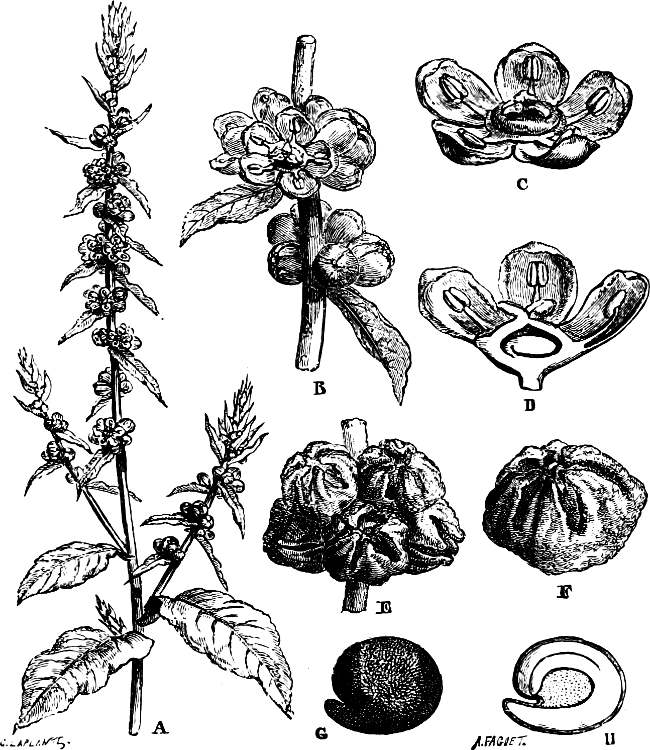
Fig. 365.—Beta vulgaris.
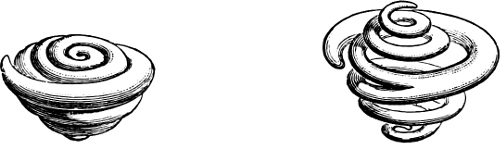
Fig. 366.—Salsola soda: embryo.
2. Salsoleæ, Saltwort Group, has cylindrical or semi-cylindrical leaves. Perianth as in the preceding group; the fruit is most frequently compressed. The two first mentioned genera differ from most of the others in the order in having a spirally-coiled, and not a ring-like embryo, so that the endosperm is slight or wanting (Fig. 366). These plants are sometimes placed as a group by themselves, Spirolobeæ—in contradistinction to which the others are termed Cyclolobeæ.—Salsola (Saltwort); leaves subulate, with spiny tips; the flowers have 2 spinous bracteoles: during the ripening of the fruit a tough leathery wing is developed transversely to the back of the perianth.—Chenopodina deviates from Chenopodium chiefly in the embryo and want of endosperm.—Kochia has a somewhat similar perianth to Salsola, but a ring-like embryo; it differs from the others in being hairy.
3. Salicornieæ, Glasswort Group. Salicornia (Glasswort) has a very different appearance. The stems are succulent, jointed, and almost leafless; the leaves opposite, very small, sheath-like and connate; there is a depression in the axil of each leaf, in which a small 3-flowered dichasium without bracteoles is sunk; the flowers have a trimerous perianth, 1–2 stamens and 1 carpel. No endosperm. S. herbacea on clayey beaches.
4. Atripliceæ. This group has most frequently unisexual flowers; the ♂-flower has a 4–5 partite perianth, but the ♀-flower differs from it. Atriplex is monœcious or polygamous, the ♀-flower is naked, but has 2 large, herbaceous bracteoles which expand during the ripening of the fruit, and often become warted and fringed, enveloping the compressed nut. The section Dichospermum has two kinds of ♀-flowers, one like those just described, the other similar to the Chenopodium-flowers, which have been deprived of their stamens, and the fruits of which are depressed, not pressed together from the sides; some (e.g. A. hortensis) have even three kinds of nuts. All the flowers of Atriplex, which present vertical fruits, are accessory shoots, which stand beneath the ordinary flower-clusters, a rather singular relation.—Spinacia (Spinach) is diœcious; ♂-flower: perianth, 4 (-5); stamens, 4 (-5); ♀-flower: tubular, 2–4-partite perianth, hardening during the ripening of the fruit, and uniting with the compressed nut; in S. oleracea, it also forms thorns; 4 long stigmas.—Halimus has the 2 long bracteoles almost entirely united and ultimately adhering firmly to the fruit.
5. Baselleæ. A somewhat exceptional group with more or less perigynous flowers and 2 bracteoles. Basella, Boussingaultia, Ullucus. The perianth is sepaloid; ovary 1-ovuled. In Basella the perianth is fleshy, enveloping the nut, and the cotyledons are so rolled together that a tranverse cut divides them in two places (as in Spirolobeæ). Herbaceous climbing plants.
Pollination. Wind-and self-pollination, as far as is known; the insignificant flowers, devoid of honey, appear to exclude insect-pollination.—520 species. Most of them are annual (out of 26 native species only 5 are perennial); inhabiting salt-marshes and salt-steppes, and growing as weeds (most frequently on garden or field soil containing manure) in this country, especially species of Chenopodium and Atriplex. The majority are found outside the Tropics, and play a very important part, for example, in the Asiatic salt-steppes. They grow gregariously in large masses.
Uses. Comparatively few. The only important one is Beta vulgaris (from the Mediterranean basin), with its different varieties, viz. Beet-root, Cattle-beet or Red-beet, Sugar-beet, and others. These are biennial, making in the first year a root which acts as a reservoir of reserve material, with a rosette of leaves, and in the second year using this material in the production of a long stem, leaves and flowers. The primary root has been developed by cultivation into a very thick and fleshy tap-root; its mode of increase in thickness deviates from that of other roots, concentric rings of vascular bundles being formed from a cambial ring developed outside the previous ring. In this way several rings of vascular bundles separated by medullary rays, alternating with rings of parenchyma, may be found in the root of a Beet. Besides Beta vulgaris, var. hortensis (Beet-root), the following are also cultivated: var. cicla (Leaf-beet, “Mangold,” or “Roman Spinach ”), Spinacia oleracea and Atriplex hortensis as Spinach; a form of the latter and of Spinach are grown as ornamental plants. The tubers of Ullucus tuberosus are used as potatoes; Chenopodium quinoa, in Chili and Peru, is an important farinaceous plant. Soda is made from some (Salsola kali, Chenopodina maritima and others). Aromatic properties are rare: Chenopodium ambrosioides and botrys.
Order 4. Batidaceæ. Batis maritima, a bushy West Indian maritime plant.
Order 5. Phytolaccaceæ. The ☿ (sometimes unisexual), regular, sometimes slightly perigynous flowers are inconspicuous and have a single sepaloid or coloured 4–5-leaved perianth (generally united at the base); stamens either in 1 whorl in the spaces between the perianth-leaves or in 1 whorl opposite the perianth-leaves, or in 2, one of which alternates with these; but the number may be increased by the splitting of one or of both the whorls to as many as 10–15–20–25. Carpels sometimes only one, sometimes many (4–10) placed in a whorl, either free or united into a gynœceum with a corresponding number of loculi in the ovary; but in all cases each carpel bears only its own style and 1 ovule. The fruit is a berry (or nut, capsule, or schizocarp).—Mostly herbs or herbaceous shrubs, with scattered, simple leaves without stipules (Petiverieæ; have stipules). Inflorescences, most frequently racemes or spikes, which in some instances are apparently placed opposite to a leaf, being displaced by a more vigorous growth of the axillary bud. Embryo always bent.—Petiveria has a straight embryo with rolled cotyledons.—Phytolacca, Pircunia, Microtea, Seguieria, Rivina (Pr4, A4, G1; berry), and others.
The following plant is, with some doubt, placed near this order: Thelygonum cynocrambe; monœcious. ♂-flowers: perianth, 2-leaved; stamens indefinite. ♀-flowers: perianth-leaves united, 3-toothed; G1, style gynobasic. Fruit a drupe. An annual plant; Mediterranean. Branching anomalous.
About 90 species; in tropical and temperate countries, principally America and Africa.—The red juice in the fruits, especially of Phytol. decandra, is used for colouring wine.
Order 6. Portulacaceæ (Portulacas). The flowers are regular (except Montia), hypogynous (except Portulaca) and ☿. The diagram which applies to the majority of genera is that in Fig. 367, but with all the 5 stamens completely developed: it may be considered as the Chenopodiaceous diagram with the addition of 2 bracteoles in the median line (m-n, these by some are considered as sepals), and with a petaloid perianth (usually designated “corolla”). The “petals” fall off very quickly, and are sometimes wanting. Most frequently 5 stamens, situated opposite the “petals,” but in other genera the number varies; Montia has only 3 stamens (by suppression of the two anterior and lateral, Fig. 367), others again have more than 5, some a large and indefinite number. This may be explained partly by the appearance of a second whorl of stamens alternating with the first, and partly by the splitting (dédoublement) of the stamens. Gynœceum most frequently tricarpellate, ovary unilocular with 1–several basal ovules (sometimes on a branched placenta, as in certain Caryophyllaceæ). The fruit is a capsule, more rarely a nut.—The majority are annual herbaceous plants with scattered, entire leaves, often fleshy and smooth, with or without rudimentary stipules (dry, membranous, modified into hairs). Inflorescence cymose.
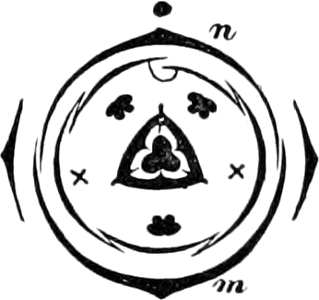
Fig. 367.—Montia.
Diagram of flower.
Portulaca (Portulaca): flower, epigynous or semi-epigynous; fruit, a pyxidium. The stamens vary in number, and are most frequently placed in groups (in consequence of splitting) opposite the petals.—Montia: the corolla is slightly gamopetalous, but cleft on the posterior side (Fig. 367), and as a consequence of the larger size of the lateral petals, slightly zygomorphic; 3 stamens.—Calandrinia; Talinum; Anacampseros; Claytonia.
125 species; mostly in warm and temperate countries, especially the arid parts of S. Am. and the Cape. Montia fontana (Blinks) is a native plant. Portulaca oleracea is cultivated as a pot-herb in the south of Europe. A few species of Portulaca and Calandrinia are ornamental plants.
Order 7. Nyctaginiaceæ. The characteristic feature of this order is the single, regular, united, and often petaloid perianth, the lower part of which generally persists after flowering and embraces the fruit as a false pericarp. The upper portion is most frequently valvate and folded, or simply valvate in æstivation. The number of stamens varies. The free gynœceum is unicarpellate and has 1 ovule. The fruit is a nut, but becomes a false drupe, since the lower persistent portion of the perianth becomes fleshy (as in Neea, where this fleshy part is almost always crowned by the upper persistent part of the perianth. In the majority of the Mirabileæ the lower part becomes the dry anthocarp, while the upper petaloid part falls away after flowering). Finally, a peculiar involucre is formed around the flowers by free or united floral-leaves.—The majority are herbs, some are trees (Pisonia, etc.); Bougainvillea is a liane. The stems are often nodose and swollen at the nodes; the leaves are simple, penninerved, scattered, or opposite, without stipules. In some, the vascular bundles are scattered; stem anomalous.
Mirabilis; the structure of the stem is abnormal. Dichasial branching with continuation from the second bracteole, thus forming unipared scorpioid cymes. The perianth is petaloid, funnel-shaped, and has a folded and twisted æstivation resembling that of the corolla of the Convolvulaceæ; the upper coloured portion falls off after the flowering. Outside, and alternating with it, is a 5-partite, sepaloid involucre of 5 spirally-placed floral-leaves.—Oxybaphus; the involucre envelops 1–3 dichasial flowers.—Bougainvillea; the involucre is rose-coloured, 3-leaved, and envelops 3 flowers (placed laterally; the terminal flower wanting). The leaves of the involucre in Boerhaavia, Pisonia, Neea, and others are reduced to teeth or scales.
157 species; mostly in tropical countries, and especially S. Am. Species of Mirabilis (Am.) are ornamental plants. Theïn is found in Neea theïfera Oersted (discovered by Lund in Lagoa Santa, Brazil), which may be used as a tea-plant.
Order 8. Aizoaceæ. Only 3 whorls are found in the flower, which alternate with one another when their leaves are equal in number. The first is sepaloid, the third one the carpels, and the intervening one is either uncleft, in which case it is developed as stamens, or it is divided into a large number of members which then all become stamens (arranged in groups), or the outermost ones become developed as petals. The fruit is most frequently a capsule with several loculi. Most of the species are herbs with thick, fleshy stems, and exstipulate leaves. The structure of the stem is usually anomalous.
1. Aizoideæ have hypogynous or perigynous flowers with (4–) 5 perianth-leaves; stamens single, or (by splitting) in groups of 2–3, alternating with the perianth-leaves. The gynœceum (with 3–5 carpels) has 3–5 loculi in the ovary, and most frequently numerous ovules in each loculus, borne on the central placenta formed by the edges of the carpels. The fruit is a capsule. The inflorescences are dichasia and unipared scorpioid cymes.—Aizoon, Mollugo, Sesuvium, and others are herbs or bushes, most frequently hairy.
2. Mesembrianthemeæ have semi- or wholly-epigynous flowers.—Tetragonia. The perianth is 4 (more rarely 3–5–6)-merous. Stamens single, or (by splitting) in groups alternating with the perianth-leaves. There is an indefinite number of carpels, and each loculus of the ovary contains only 1 pendulous ovule. Fruit a nut or drupe. The flowers arise singly in the leaf-axils, with an accessory foliage-bud below them; in some instances there is also an accessory flower between this bud and the flower. Southern hemisphere, especially at the Cape; T. expansa, New Zealand Spinach, is a fleshy plant which is cultivated as a pot-herb (Japan, Austr., S. Am.).—Mesembrianthemum: the flowers are 5-merous; the numerous linear petals and the still more numerous stamens all arise by the splitting of 5 or 4 protuberances (primordia) alternating with the sepals. The ovary presents another characteristic peculiarity: the carpels alternating with the 5–4 stamens form an ovary (with several loculi) with the ovules at first borne, as in other cases, on the inner corner of the inwardly-turned carpels; but during the subsequent development the whole ovary is so turned round that the placentæ become parietal and the ovules assume, apparently, a position very rarely met with in the vegetable kingdom: on the dorsal suture of the carpels. Shrubs or under-shrubs, more rarely herbs with fleshy stems and simple, entire, more frequently thick or triangular leaves, containing a quantity of water. The flowers open about noon, and are brightly coloured, generally red or red-violet, but odourless. The capsules dehisce in rainy weather. 300 species, mostly found at the Cape. Some are ornamental plants. M. crystallinum (the Ice-plant) and others are covered with peculiar, bladder-like, sparkling hairs, the cell-sap of which contains salt—these serve as reservoirs of water.
Family 8. Cactifloræ.
The position of this family is very doubtful; but it seems in many respects to approach Mesembrianthemum. Some botanists place it near to the Ribesiaceæ; others, again, to the Passifloraceæ. Only 1 order.
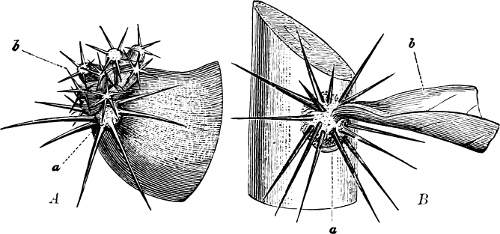
Fig. 368.—A Echinocactus: a position of a leaf-lamina; b a lateral shoot on the displaced axillary bud. B Pereskia: b a foliage-leaf on a small thorny branch which is subtended by a foliage-leaf which has fallen off and left a scar(a).
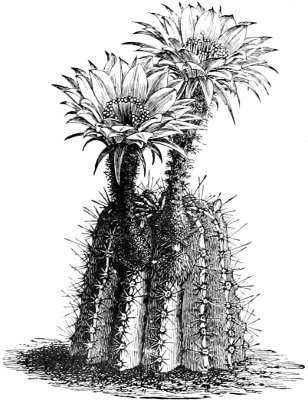
Fig. 369.—Echinopsis.
Order Cactaceæ (The Cacti). The flower is epigynous, ☿, regular, and remarkable for its acyclic structure; there are, for instance, a large number of spirally-placed sepals and petals, which gradually pass over into one another, and which in some species, to a certain extent, arise from the walls of the ovary as in Nymphæa (Fig. 383 A, B). The petals are free; rotate, opening widely in Opuntia, Pereskia, and Rhipsalis; erect and united at their base into a shorter or longer tube in Cereus, Epiphyllum, Mammillaria, Echinocactus, Melocactus, and others (Fig. 369). Stamens numerous, attached to the base of the corolla; gynœceum formed of many carpels, with one style, dividing into a number of branches corresponding to the number of carpels; the ovary has one loculus with many parietal placentæ; the ovules are anatropous, on long and curved funicles. Fruit a berry with exendospermous seeds. The fruit-pulp is mainly derived from the funicles.—The external appearance of the Cactaceæ is very peculiar; Pereskia, which has thick and fleshy leaves (Fig. 368), deviates the least; foliage-leaves of the usual form are wanting in the other genera, or are usually very small, and quickly fall off and disappear (Opuntia), or are modified into thorns; the stem, without normal foliage-leaves,—so characteristic a feature in this order,—makes its appearance after the two normally developed cotyledons. The stems are fleshy, perennial, and may finally become woody. In some they are elongated, globose, pointed, and more or less dichotomously branched, e.g. in several of the Rhipsalis species, which live mostly as epiphytes on trees; in others, elongated, branched, globose, or, most frequently, more or less angular (prismatic) or grooved and provided with wings, and either columnar and erect (as much as about 20 metres in height and 1 metre in circumference, as in C. giganteus in New Mexico) or climbing by roots (Cereus and Rhipsalis-species); in others again, compressed, more or less leaf-like, often with a ridge in the centre (winged), branched and jointed: Epiphyllum, Phyllocactus, Opuntia, some species of Rhipsalis; others are thick, short, spherical or ovoid, unbranched or only slightly branched, and either studded with prominent warts (mammillæ) each of which supports a tuft of thorns (Fig. 368 A; Mammillaria and others) or with vertical ridges, separated by furrows (rows of mammillæ which have coalesced) in Melocactus, Echinocactus, Echinopsis (Fig. 369); at the same time the ovary in some is embedded in the stem so that leaves or leaf-scars, with tufts of thorns in their axils, may be observed on the ovary just as on the stem.—The flattened shoots of the Cactaceæ are formed in various ways, either by the compression of cylindrical axes (Opuntia) or, as in Melocactus, etc., from winged stems in which all the wings are suppressed except two.
The thorns are produced directly from the growing points of the axillary buds, and are modified leaves. The axillary bud is united at its base with its subtending leaf, which as a rule is extremely rudimentary; and these together form a kind of leaf-cushion, larger in some genera than in others. This leaf-cushion attains its highest development in Mammillaria, in which it is a large, conical wart (see Fig. 368 A), bearing on its apex the tuft of thorns and rudimentary lamina.—The seedlings have normal cotyledons and a fleshy hypocotyl.
All the species (1,000?) are American (one epiphytic species of Rhipsalis is indigenous in S. Africa, Mauritius and Ceylon), especially from the tropical table-lands (Mexico, etc.). Some species, especially those without thorns, as Rhipsalis, are epiphytes. Opuntia vulgaris, the fruits of which are edible, is naturalized in the Mediterranean. The cochineal insect (Coccus cacti) lives on this and some closely allied species (O. coccinellifera, etc.), particularly in Mexico and the Canary Islands. Several are ornamental plants.
Family 9. Polycarpicæ.
The flowers as a rule are ☿, regular and hypogynous; however in some orders they are unisexual, e.g. in the Myristicaceæ, or zygomorphic (in Monkshood and Larkspur in the Ranunculaceæ); in the Lauraceæ, (Fig. 386) for example, perigynous, and in Nymphæa (Fig. 383) even partially epigynous flowers are typical.—The flowers are acyclic in very many of the genera of the two first orders, if not completely so, at any rate in the numerous stamens and carpels, thus denoting an old type. It is a remarkable characteristic that in the majority of the orders the number 3 prevails in the calyx and corolla; the number 5 also occurs, but the number 2 is seldom met with. Most orders have a double perianth; chorisis does not occur, suppression is rare, and the parts of the flower are developed in acropetal succession. The most characteristic feature in the order is the free, one-leaved, as a rule numerous carpels (apocarpous gynœceum). The number of carpels in some of the last mentioned orders dwindles down to 1 (e.g. the Berberideæ and Myristicaceæ). The carpels in Nymphæaceæ become united into one pistil (syncarpous), a condition which we also find distributed among the other orders.
Endosperm occurs in almost all the orders (except e.g. Lauraceæ). The nutritive tissue in Cabombeæ and Nymphæeæ is chiefly perisperm.
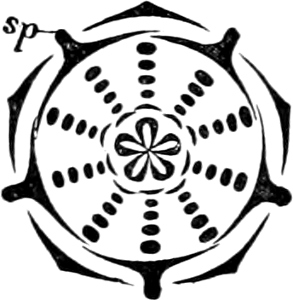
Fig. 370.—Diagram of Aquilegia vulgaris: sp spur. A cyclic flower.
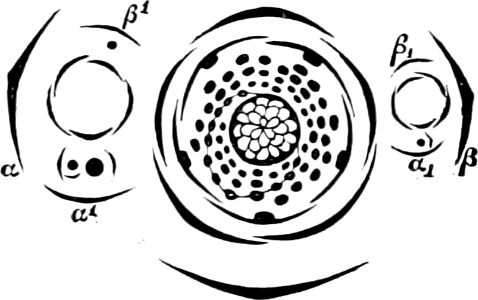
Fig. 371.—Diagram of a dichasium of Ranunculus acer: α1, α1, and β1, β1, bracteoles (the buds in the axils of the bracteoles, α and α1, are continued antidromously). The flower has cyclic calyx and corolla, bub acyclic (8/21) stamens.
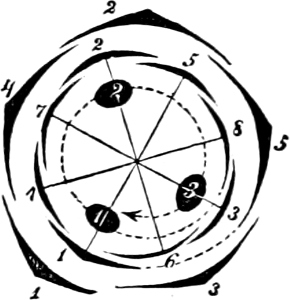
Fig. 372.—Diagram of an acyclic Ranunculaceous flower (only 3 stamens are indicated). The spiral of the sepals has a divergence of 3/5; that of the corolla and subsequent leaves 3/8.
Order 1. Ranunculaceæ. Nearly all are herbs (except Clematis). The leaves are scattered (except Clematideæ), they have a large sheath with broad base (no stipules), and are most frequently palminerved with palmate lobes. The flowers are hypogynous, with most frequently a well pronounced convex receptacle (Figs. 374 B, 380), ☿, regular (except Delphinium and Aconitum); their structure varies very much; in some the leaves are verticillate, in others arranged spirally; in others, again, both modes of arrangement are found. It is a characteristic feature that the various series of leaves (especially calyx and corolla) are not so distinct or so sharply divided as is usual. The leaves of the perianth are free, imbricate (except Clematideæ); stamens numerous, with most frequently extrorse anthers; gynœceum free, apocarpous (except Nigella and partly Helleborus), with 1 or several ovules (Figs. 373, 378, 379) borne on the ventral suture. The fruit is either a nut or a follicle (Actæa has berries). The seed has a large, oil-containing endosperm and a small embryo (Fig. 374).
The main axis generally terminates in a flower, and the lateral axes branch in a cymose manner (Fig. 371). The flowers show the following differences in construction: VERTICILLATE (EUCYCLIC), i.e. constructed all through of alternating whorls: Aquilegia (Fig. 370), Xanthorhiza, and sometimes Eranthis. Semiverticillate (HEMICYCLIC) i.e. with sepals and petals in alternate whorls, and the others arranged spirally: Ranunculus (Fig. 371), Myosurus, Pæonia and several other genera entirely, or in certain species only. Spiral-flowered (ACYCLIC) i.e. all the leaves are arranged spirally, so that sepals and petals do not alternate the one with the other, even though they are the same in number: Adonis (Fig. 372), Aconitum, Delphinium-species, Nigella-species, Helleborus. The leaves of the calyx are in this instance arranged on a spiral of 2/5; those of the corolla on 2/5, 3/8, 5/13 or 8/21, and stamens and carpels likewise on higher fractions of the same series.
The genera Caltha, Anemone, Thalictrum and Clematis have a single perianth, which is most frequently petaloid; it is thus apparent that the sepals are petaloid, and the leaves, which in other genera have developed as petals, are in these instances stamens. The calyx is similarly petaloid in the genera Helleborus, Eranthis, Nigella, Delphinium and Aconitum; but the petals are present in these instances in unusual (horn-like) forms, and almost entirely given up to the function of nectaries, a function they already possess in Ranunculus. According to a more recent theory the “honey-leaves” are transformed stamens, which have lost the function of reproduction; the perianth is then single, and most frequently petaloid. [Those leaves in the flowers of many Ranunculaceæ which bear nectaries are termed by Prantl honey-leaves, and comprise those leaf-structures of the flower whose essential function lies in the production of nectar, and which, independent of the differentiation of the perianth into calyx and corolla, are derived from the stamens by the loss of their reproductive functions. Clear transitional forms are found between the two series of the perianth (e.g. between the sepaloid and petaloid perianth-leaves of Anemone japonica, A. decapetala, Trollius-species) while transitional forms are never found between perianth-and honey-leaves (with the exception of Aquilegia vulgaris, var. stellata). In Anemone and Clematis the honey-leaves pass gradually into the stamens, and agree with the stamens in the other Ranunculaceæ in their arrangement, development, and scant system of veins (except Nigella). In Delphinium, sect. Consolida, the two honey-leaves placed in front of the unpaired perianth-leaf are united into one, as shown by the veins (twice three veins arranged symmetrically). The honey-leaves of Aquilegia, Callianthemum, and the majority of the Ranunculus-species serve by reason of their large circumference, as organs of attraction, and on this account are considered as petals by other authors.—The same position in the flower which the honey-leaves assume is found occupied by staminodes, without nectar, in some Coptis-species, in Anemonopsis, Actæa sect. Euactæa, (e.g. A. racemosa), Clematis sect. Atragene; in the last-named they closely surround the stamens, in Actæa they are petaloid.—A perianth, sharply differentiated into calyx and corolla, and destitute of honey-leaves, is found in Anemone, sect. Knowltonia (Cape),
Adonis, Pæonia.—The perianth of the Ranunculaceæ is considered by Prantl to be usually petaloid.—The nectaries arise in the Ranunculaceæ (1) on normal stamens (Clematis sect. Viorna), (2) on the honey-leaves (this is generally the case), and (3) on the carpels (Caltha and the majority of Trollius-species).—As the result of his researches upon the Ranunculaceæ, Prantl does not agree with the view advanced by Drude (Schenk, Hand. d. Bot. iii.) that the petals in general have proceeded from the metamorphosis of the stamens (K)].
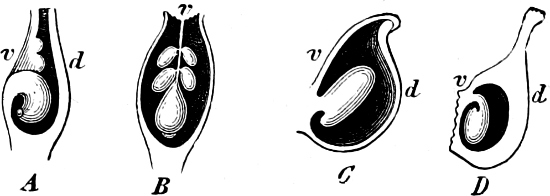
Fig. 373.—Ovaries in longitudinal section: v the ventral suture; d the dorsal suture: A, B Clematis; C Ranunculus; D Myosurus.
The most primitive form of fruit is undoubtedly the pod formed by one carpel, on the edges of which (along the ventral suture) two rows of ovules are situated: Pæonieæ, Helleboreæ, Delphinieæ (Fig. 379). In a great many genera the number of ovules has been limited to one perfect one, which is placed in the central plane under the united leaf-edges, and sometimes also some barren ovules above it (Fig. 373). The fruitlets in this case become achenes, and are present in much larger numbers than when there are follicles.
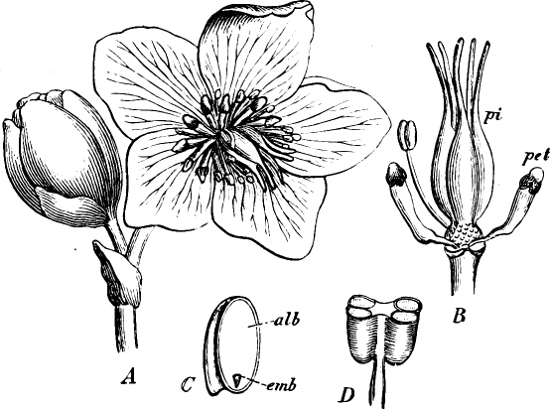
Fig. 374.—Helleborus niger: A flower; B receptacle; pet petals (honey-leaves); pi stamens and carpels; C seed; D anther (cross section); alb endosperm.
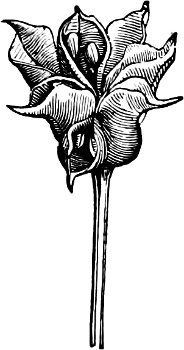
Fig. 375.—Caltha palustris: fruit.
The following have Follicles: Pæonieæ, Helleboreæ (except Actæa) and Delphinieæ; Achenes: Ranunculeæ, Anemoneæ and Clematideæ.
A. Follicles (Figs. 375, 379), with many ovules, situated in two rows along the ventral suture. Actæa has berries, Nigella has capsules of several loculi.
1. Pæonieæ, Peony Group. This has regular, acyclic flowers with a normal, most frequently 5-leaved, imbricate calyx; large, coloured petals, and introrse anthers. Slightly perigynous. Surrounding the base of the carpels a ring-like swelling of the receptacle (“disc”) is present, which is largest in P. moutan. The follicles are more or less fleshy or leathery. Mostly herbs, with pinnatisect or decompound leaves and large, solitary flowers; a gradual transition may be traced from the foliage-leaves to the petals. Pæonia; Hydrastis.
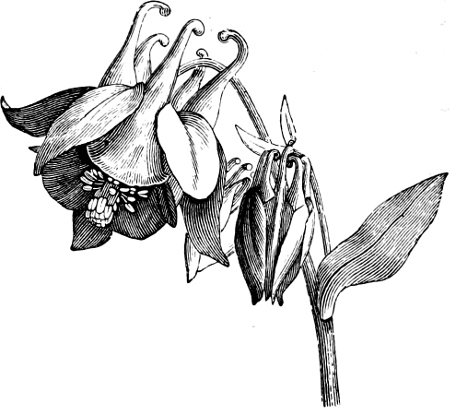
Fig. 376.—Aquilegia vulgaris.
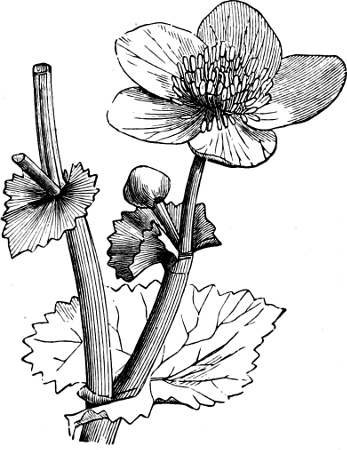
Fig. 377.—Caltha palustris (nat. size).
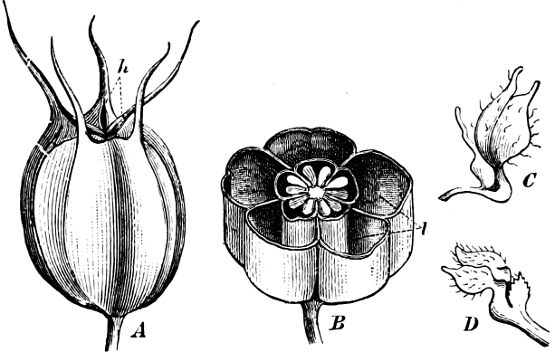
Fig. 378.—Nigella: A, B fruit of N. damascena, entire, and cut transversely. C Petal (honey-leaf) of N. arvensis. D Petal of N. damascena.
2. Helleboreæ, Hellebore Group. This has regular flowers with most frequently a coloured calyx. The petals (honey-leaves) are modified into nectaries; they may be horn-like, provided with a spur, or of a similarly unusual form, or they may be entirely absent. Anthers often extrorse.—Trollius (Globe-flower[36]). The flower is acyclic: many petaloid sepals, succeeding these, most frequently, several linear, dark yellow petals, which bear a naked nectary at the base; finally, many stamens and carpels arranged in a spiral (3/8, 8/21).—Caltha (Marsh-marigold, Figs. 375, 377); 5 (-7) yellow sepals, no petals. The foliage-leaves have a large amplexicaul sheath.—Helleborous (Hellebore) has pedate leaves. The flower is acyclic, with 5 large, regular, persistent, often petaloid sepals (2/5); small, horn-like petals (honey-leaves; most frequently 13, divergence 8/13) and generally few carpels (Fig. 374).—Coptis.—Isopyrum.—Eranthis (Winter Aconite), like Anemone, has a 3-leaved involucre and most frequently trimerous flowers, 6 large petaloid sepals, 6 petals (tubular honey-leaves), 6 oblique rows of stamens, 3–6 carpels. Aquilegia (Columbine, Fig. 376); the flower is entirely cyclic and has large spurs on all the 5 petals (funnel-shaped honey-leaves); S5 coloured, P5, A5 × (8–12), G5 in regular alternation (Figs. 376, 370); the innermost stamens are often staminodes (Fig. 370).—Nigella (Love-in-the-mist, Fig. 378) has 5 sepals and 8 small, two-lipped petals cleft at the apex (the nectary is covered by the under-lip; Fig. 378 C, D). The 5 carpels are more or less completely united; and a many-carpellate ovary with free styles is formed in some. Large air-chambers in the external wall of the ovary are formed in N. damascena (Fig. 378).—Actæa (Baneberry) has coloured sepals, either no petals or an indefinite number, and only 1 carpel. The fruit is a berry (or follicle).—Cimicifuga, Garidella, Xanthorhiza (S5, P5, A5 + 5, G5).
3. Delphinieæ, Larkspur Group. Zygomorphic flowers with coloured calyx; the 2 posterior petals (honey-leaves) are transformed into nectaries, the others are small or absent altogether.—Aconitum (Monkshood); 5 sepals, of which the posterior one (Fig. 379 A) is helmet-shaped; most frequently 8 petals (as in Fig. 372), of which the two posterior ones (honey-leaves) are developed into long-clawed nectaries (Fig. 379 A, k) enveloped by the helmet-like sepal; the others are small, or are to some extent suppressed. Stamens on a spiral of 3/8–5/13; generally 3 carpels. Perennial herbs.—Delphinium (Larkspur); very closely allied to Aconitum, but the anterior 4 petals are most frequently wanting, and the 2 posterior ones have each a spur, which is enclosed by the posterior sepal, the latter being also provided with a membranous spur. Stamens and carpels arranged on a spiral of 3/8, 5/13, 8/21. In D. ajacis and consolida there is apparently only 1 petal (by the fusion of 4) and 1 carpel.
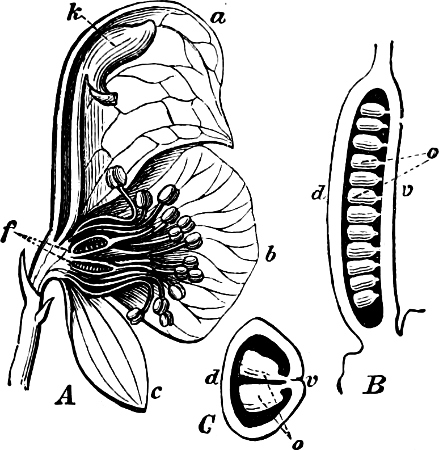
Fig. 379.—Aconitum napellus. A Flower in longitudinal section, below are the 2 bracteoles; a half of helmet-like sepal; b and c other sepals; k nectary; f carpels. B Ovary in longitudinal section; C the same transversely; d dorsal suture; v ventral suture.
B. Fruit achenes. Many carpels, each with only 1 ascending (Fig. 373 C), or pendulous (Fig. 373 D), perfect ovule; often also rudimentary ovules above it (Fig. 373 A, B). Fruit achenes.
4. Ranunculeæ, Buttercup Group, has double perianth. Myosurus and Adonis have pendulous ovules as in Anemoneæ (Fig. 373 D); Ranunculus, with Batrachium and Ficaria, erect ovules (Fig. 373 C) and downwardly-turned radicle.—Ranunculus. Most frequently S5, P5, many spirally-placed stamens and carpels (Figs. 371, 380). The petals (honey-leaves) have a nectary at the base, covered by a small scale. Batrachium, Water Ranunculus, deviates by the achenes being transversely wrinkled; dimorphic leaves. Ficaria has 3 sepals and 7–8 petals arranged in 2/5–3/8. F. ranunculoides (the only species) has tuberous roots, which spring from the base of the axillary buds, and together with these, serve as organs of reproduction. The embryo has only 1 cotyledon.—Myosurus (Mouse-tail) has small prolongations from the 5 sepals; 5 narrow petals which bear the nectaries near the apex; sometimes only 5 stamens, and an ultimately very long receptacle, with numerous spirally-arranged achenes (Fig. 381).—Adonis is acyclic (Fig. 372); most frequently 5 sepals with a divergence of 2/5, 8 petals of 3/8, indefinite stamens and carpels of 3/8 or 5/13. The corolla has no nectary.
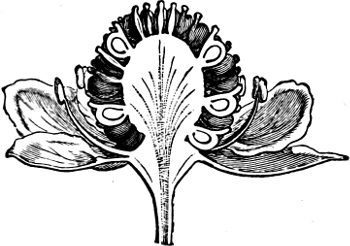
Fig. 380.—Flower of Ranunculus sceleratus in longitudinal section.
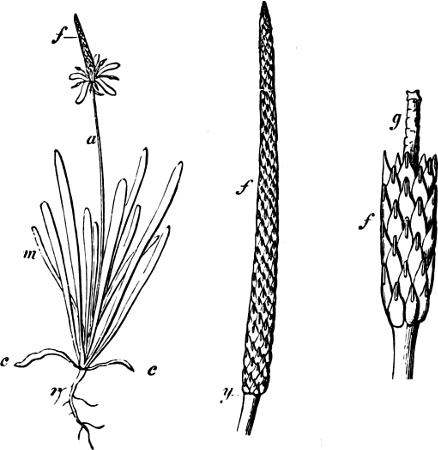
Fig. 381.—Myosurus minimus: c cotyledons; m the foliage-leaves; f the floral axis with the carpels, and g the same without; y insertion of perianth.]
5. Anemoneæ, Anemone Group, has a single perianth. (Pendulous ovules (Fig. 373 D), radicle turned upward).—Anemone has a single, petaloid, most frequently 5–6-leaved perianth, and beneath the flower most frequently an involucre of 3 leaves, placed close together in the form of a whorl. In A. nemorosa, ranunculoides, etc., the involucral leaves resemble foliage-leaves; in A. hepatica they are situated close under the perianth, and resemble sepals, and in the sub-genus Pulsatilla they stand between the foliage-leaves and floral-leaves. The style of Pulsatilla finally grows out in the form of a feather. The main axis of A. hepatica has unlimited growth (it is biaxial), and the flowers are borne laterally in the axils of the scale-leaves; in the others (uniaxial) the flower is terminal, and the rhizome becomes a sympodium after the first flowering.—Thalictrum (Meadow Rue) has no involucre; 4–5-leaved, greenish perianth. The receptacle is flat. The stamens are brightly-coloured and have long filaments; 1–5 accessory flowers may occur in the leaf-axils of the panicle-like inflorescence.
6. Clematideæ, Clematis Group. This differs from all the others in the valvate æstivation of the calyx and its opposite leaves. There are 4 (-several) petaloid sepals; petals are absent, or linear (Atragene). Ovule 1, pendulous. Achenes, often with prolonged, feathery style. The majority of the genera are shrubs, and climb by their sensitive, twining leaf-stalks.—Clematis; Atragene.
Pollination. The flowers are conspicuous either by coloured petals (honey-leaves) (Ranunculus, Pæonia) or coloured sepals (Helleborus, Anemone, Caltha, etc.), or by both (Aquilegia, Delphinium), or by the coloured stamens (Thalictrum). Some have no honey (Clematis, Anemone, Thalictrum), and are generally visited by insects for the sake of their pollen. Others have nectaries on the corolla (Ranunculus, Trollius, Helleborus, Nigella, Aconitum, etc.), more rarely on the stamens (Pulsatilla, Clematis-species), or the carpels (Caltha), or the calyx (certain species of Pæonia). The honey is readily accessible in the flat, open flowers, and these flowers also may easily pollinate themselves. There is marked protandry where the honey lies deeply hidden, as in Aquilegia, Delphinium, and Aconitum. Helleborus and some Ranunculus-species are protogynous.
About 680 species; especially in northern temperate climates, and extending to the Polar and Alpine regions. Only the Clematideæ are tropical.
The order has an abundance of acrid, vesicant properties (R. acer, sceleratus, etc.), and poisonous alkaloids (Helleborus niger is poisonous). Officinal: Aconitum napellus (aconitine; leaves and tuberous roots); the rhizome of Hydrastis canadensis from N. Am. (the alkaloid hydrastine). The order, however, is best known for its ornamental plants; almost all the genera have species which are cultivated for their beauty. Sweet-scented flowers are absent.
Order 2. Nymphæaceæ (Water Lilies). Water Plants; generally with large, floating leaves, and large solitary flowers; sepals 3–5, petals 3–∞, stamens 6–∞, carpels 3–∞. The flower is hypogynous, but in the Nymphæeæ different degrees of epigyny are found, and from this fact, as well as from the carpels being united into one pistil, the family forms a lateral offshoot from the Ranunculaceæ, with much greater modification. The seed often has an aril, and, in the majority, a farinaceous nutritive tissue, partly endosperm, partly perisperm (Fig. 383 C). The embryo has 2 thick cotyledons and a small hypocotyl; the plumule is well developed, with 2–4 leaves.
1. Cabombeæ. 3–4 species (Tropical S. Am.), resembling the Water Ranunculus, with two kinds of leaves, the submerged being dissected and the aerial peltate. The flowers are eucyclic, trimerous, with 2–3 free, epigynous carpels. The ovules are situated on the central line of the carpel—an almost unique circumstance. Endosperm and perisperm. Cabomba; Brasenia.
2. Nelumboneæ. The leaves are peltate, raised on long stalks high above the water. Large, hypogynous flowers (Fig. 382); sepals 4–5; petals numerous; stamens numerous; carpels several, distinct. The receptacle is very remarkable, being raised above the stamens, and developed into an inverted conical body on the apex of which the nut-like fruits are embedded in pits. Endosperm is wanting, but the embryo is large and has well developed cotyledons.—Nelumbo, 2 species. N. lutea (N. Am.); N. speciosa (E. Ind.) was sacred amongst the ancient Hindoos and Egyptians, (the Lotus flower); its seeds are used as food.
3. Nymphæeæ, Water Lily Group. The carpels are united into one, many-locular ovary, whose numerous ovules are situated on the surface of the partition walls (as in the Poppies); the stigma is sessile and radiating, the number of rays corresponding to the number of carpels (Fig. 383). The fruit is a spongy berry with many seeds, which have a large perisperm in addition to the endosperm (Fig. 383 C).
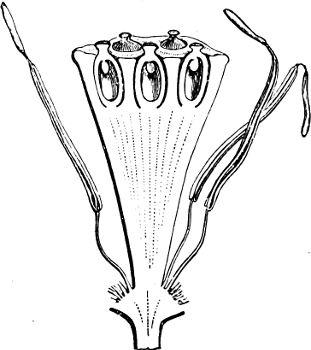
Fig. 382.—Nelumbo nucifera: vertical section through the receptacle.
Sepals, petals, and stamens often pass gradually over the one into the other, the petals becoming narrower by degrees, and bearing anthers on each side of the apex, which gradually become larger anthers in proportion to the filament, until the perfect stamen is developed. The long-stalked leaves are floating, and most frequently cordate, elliptical, leathery, with a shiny surface, sometimes (as in Victoria regia and Euryale ferox) with strongly projecting thorny ribs on the lower surface. In the intercellular passages of the leaves are some peculiar, stellate cells.
Nuphar has 5 sepals, and an hypogynous flower. The petals, which are small, have a nectary on the back; the coloured inner side of the sepals functions as petals; the ovate gynœceum is quite free.—N. luteum is a native plant (Yellow Water-Lily), with, most frequently, 13 petals and 10–16 loculi in the ovary. The rhizome is horizontal, as much as 5–6 cm. in thickness, and bears on its under surface a number of roots, which on dying-off leave deep scars; the leaves are borne in spiral lines, and the flowers are solitary in certain leaf-axils. The construction of the rhizome is very peculiar; the vascular bundles are scattered and closed as in a monocotyledonous stem.
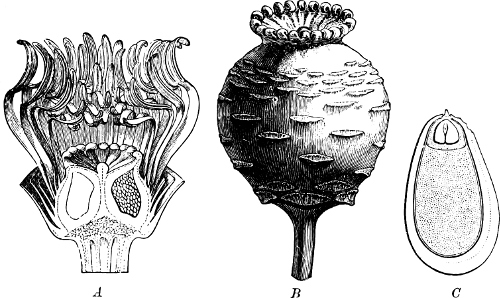
Fig. 383.—Nymphæa: A flower in longitudinal section, the most external leaves being removed; B fruit; C seed of Nuphar (longitudinal section); the perisperm at the base, the endosperm at the top surrounding the embryo.
Nymphæa has 4 sepals, and the flower is more or less epigynous. Petals and stamens are inserted at different heights on the ovary to just beneath the stigma (Fig. 383). Nymphæa alba (White Water-Lily). Victoria regia from the Amazon, and Euryale ferox from Asia, have entirely epigynous flowers. The shield-like leaves of Victoria are as much as 2 metres in diameter, and the edge is bent up to a height of 5–14 cm.; the flowers are 20–40 cm. in diameter, and change in twenty-four hours from white to rose-red. A development of heat, as much as 14°C. above the temperature of the air, together with a strong formation of carbonic acid, has been observed during flowering.
Pollination. Nymphæa alba and other species of the sub-genus Symphytopleura are self-pollinated; the sub-genus Leptopleura is insect-pollinated. Nuphar and Victoria can effect self-fertilisation; Euryale is self-fertilised, often in entirely closed and submerged flowers.—The dissemination of the seeds in Nuphar luteum is effected by the fruit, which rests on the water, becoming detached from its stalk, and dehiscing from the base upwards so that the seeds are set free; while in Nymphæa alba the spirally-twisted stalk draws the fruit under water, and it dehisces by its upper part being thrown off as a hood, and the seeds which are enclosed in air-tight sacs rise to the surface of the water. In this condition they are able to float and can only sink to the bottom when the air has disappeared.
53 species; in fresh water in all parts of the world, but especially in the Tropics.—The rhizomes and seeds of some may be used as food; Euryale ferox is even cultivated. Nymphæa cœrulea and Lotus were sacred among the Egyptians.
Order 3. Ceratophyllaceæ. About 3 species. Aquatic plants, submerged, rootless; leaves cartilaginous, verticillate, dissected into repeatedly dichotomous branches which are finely toothed; only one of the leaves in a whorl supports a vegetative branch. The flowers are monœcious, axillary. Inside the 6–12 perianth-leaves are situated in the ♂-flower 10–20 stamens with thick connective, and in the ♀-flower a gynœceum formed by one carpel, with one orthotropous and pendulous ovule, which has only one integument. Fruit a nut, which, in some species, bears on each side a pointed horn, and at the apex a similar one, formed by the persistent style.—The embryo has an unusually well developed plumule with several whorls of leaves. The plant is rootless throughout its whole life.—Ceratophyllum (Horn-wort).
Order 4. Annonaceæ. Sepals 3; petals 3+3 (most frequently valvate); succeeding these (as in the Ranunculaceæ) are numerous acyclic stamens and an apocarpous gynœceum; the flowers are hypogynous, regular and ☿, generally very large (2–3 cm. in diameter), and the leaves of the perianth are more or less fleshy or leathery. The majority have syncarps with berry-like fruitlets, but in Annona and some others the carpels fuse together into a large, head-like fruit—a kind of composite berry. The seeds have ruminate endosperm as in Myristica.—Trees or shrubs with alternate, simple, entire, penninerved leaves without stipules. 450 (700?) species; especially tropical. The best known are Anona cherimolia, squamosa and reticulata (all from America) cultivated on account of their large, delicious fruits. Some have acrid and aromatic properties (Xylopia, Cananga—the flowers of the latter yield Ylang-ylang); Artabotrys odoratissimus; Asimina (N. Am.).
Order 5. Magnoliaceæ. Trees or shrubs with scattered, often leathery, entire leaves, generally with stipules, which (as in Ficus) are rolled together and form a hood round the younger internodes above them, and are cast off by the unfolding of the next leaf, leaving a ring-like scar. The endosperm is not ruminate. Corolla imbricate. Fruit a syncarp.
A. Magnolieæ. The flowers are borne singly, and before opening are enveloped in an ochrea-like spathe which corresponds to the stipules of the foliage-leaves. The perianth generally consists of 3 trimerous whorls, the external one of which is sometimes sepaloid (Liriodendron, and the majority of Magnoliaspecies), sometimes coloured like the others; the perianth is sometimes many-seriate. Numerous spirally-placed stamens and carpels. The latter are situated on the elongated, cylindrical receptacle, and are individually more or less united, except in Liriodendron, where they are free. This last genus has winged achenes; the fruitlets in Magnolia open along the dorsal and ventral sutures, and the seeds then hang out, suspended by elastic threads formed from the vascular bundles of the funicle and raphe; they are red and drupaceous, the external layer of the shell being fleshy—a very rare occurrence.
B. Illicieæ has no stipules. The carpels are situated in a whorl on a short receptacle. Follicles, one-seeded. The leaves are dotted by glands containing essential oil. Illicium; Drimys.
70 species; in tropical or temperate climates; none in Europe or Africa. They are chiefly used as ornamental plants, e.g. the Tulip-tree (Liriodendron tulipifera, N. Am.), Magnolia grandiflora (N. Am.), M. yulan and fuscata (China), and others. The remains of Liriodendron occur as fossils in the Cretaceous and Tertiary periods.—The fruits of Illicium anisatum (Star-aniseed from Eastern Asia) are OFFICINAL. The bark of Drimys winteri (S. Am.) is also strongly aromatic.
Order 6. Calycanthaceæ. These are very closely related to the Magnoliaceæ, but differ in having perigynous flowers with many perianth-leaves, stamens and (about 20) carpels in a continuous spiral, seeds almost devoid of endosperm with rolled up, leaf-like cotyledons, and leaves opposite on a square stem.—There are some species in N. America (Calycanthus florida, occidentalis, etc.) and 1 in Japan (Chimonanthus præcox), all strongly aromatic.
Order 7. Monimiaceæ. Aromatic shrubs with opposite leaves. Perigynous flowers. The anthers dehisce by valves like those of the Lauraceæ, and the Monimiaceæ may thus be considered as an apocarpous form of this order. They are also closely related to Calycanthaceæ. 150 species, tropical.—Hedycarya, Mollinedia, Monimia.
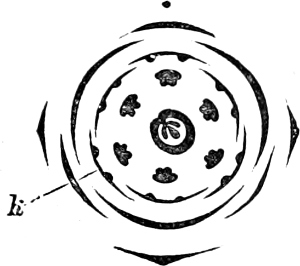
Fig. 384.—Diagram of Berberis.
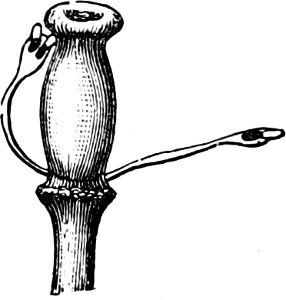
Fig. 385.—Berberis: carpel with 2 stamens.
Order 8. Berberidaceæ (Barberries).—The regular, ☿, hypogynous flowers are dimerous or trimerous and have regularly alternating whorls of free sepals, petals, and stamens and 1 unilocular carpel; the corolla and stamens have each 2 whorls, the calyx at least 2. The anthers open, as in Lauraceæ, by (2) valves, but are always introrse (Fig. 384). The pistil has a large, disc-like, almost sessile stigma (Fig. 385), and in the ovary several erect ovules are placed close to the base of the ventral suture. The fruit is most frequently a berry. Seeds endospermous.—Shrubs or herbs with scattered, most frequently compound leaves (without stipules), and racemose inflorescences.—They show a relationship to the Lauraceæ in the number of the parts of the flower and the dehiscence of the anthers.
Berberis is a shrub; it has sepals 3 + 3, petals 3 + 3, stamens 3 + 3 (Fig. 384). The petals (honey-leaves) bear internally at the base 2 darkish-yellow nectaries. The filaments are sensitive at the base, and suddenly bend inwards if touched at that spot (Fig. 385). The racemes often have a terminal, 5-merous flower; they are borne on dwarf-branches. The leaves on the long-branches develope into thorns, but the buds in their axils, in the same year as themselves, develope as the short-branches with simple foliage-leaves, articulated at the base, from which fact some authorities have considered that the leaf is compound with a single, terminal leaflet.—Mahonia has imparipinnate leaves. The flower has 3 whorls of sepals. Otherwise as in Berberis.—Epimedium; herbs with spurred petals; the flowers dimerous; 4–5 whorls of sepals, 2 of petals and stamens. Fruit a capsule. Leontice, fruit dry. The anthers of Podophyllum dehisce longitudinally.—Nandina. Aceranthus.
100 species; North temp., especially Asia: fossils in Tertiary. Berberis vulgaris is a native of Europe. This and other species, together with Mahonia aquifolium (N. Am.), Epimedium alpinum, etc., are cultivated as ornamental plants. Several have a yellow colouring matter in the root and stem. Officinal: the rhizome of Podophyllum peltatum (from N. Am.) yields podophyllin.
Order 9. Menispermaceæ. This order has derived its name from the more or less crescent-like fruits and seeds. Diœcious. The flowers are 2–3-merous, most frequently as in Berberis (S3 + 3, P3 + 3, A3 + 3), with the difference that there are 3 free carpels, each with 1 ovule; in some genera, however, the number is different. Stamens often united into a bundle (as in Myristica); anthers dehiscing longitudinally; fruit a drupe.—The plants (with herbaceous or woody stems) belonging to this order are nearly all twining or climbing plants, and have scattered, palmate or peltate, sometimes lobed leaves without stipules. Structure of stem anomalous. Cocculus, Menispermum, Cissampelos, Anamirta.
150 species; Tropical; very rich in bitter and poisonous properties. Officinal: Calumba-root from Jateorhiza columba (E. Africa). The following are cultivated as ornamental plants:—Menispermum canadense (N. Am.) and M. dahuricum (Asia). The fruits of Anamirta cocculus (E. Ind.) are very poisonous (“Grains-of-Paradise”; the poisonous matter is picrotoxine).
Order 10. Lardizabalaceæ. This order, by the free, apocarpous carpels, belongs to a more primitive type, and by the united stamens to a more developed one. Akebia; Holbœllia; principally climbing or twining shrubs. About 7 species in S.E. Asia and S. Am.
Order 11. Lauraceæ (True Laurels). Trees or shrubs; the leaves, always without stipules, are simple, most frequently scattered, lanceolate or elliptical, entire, penninerved, finely reticulate (except Cinnamomum with 3–5-veined leaf), leathery and evergreen (except, e.g. Cinnamomum); they are frequently studded with clear glands containing volatile oil. The flowers are borne in panicles and are small and of a greenish or whitish colour. They are regular, perigynous, with most frequently a bowl or cup-shaped receptacle (Fig. 386), usually ☿, and trimerous (rarely dimerous) through all (most frequently 6–7) whorls; viz. most frequently, perianth 2 whorls, stamens 3–4 and carpels 1 (P3 + 3, A3 + 3 + 3 + 3, G3) in regular alternation (Fig. 387). Each of the 2 or 4 loculi of the anthers open by an upwardly directed valve (Fig. 386); of the stamens, the 2 outermost whorls are generally introrse, the others extrorse, or 1–3 whorls are developed as staminodes (Fig. 387 g). The gynœceum has 1 loculus with 1 style and 1 pendulous ovule (Fig. 386), and may be considered as formed of 3 carpels. The fruit is a berry (Fig. 388) or drupe, which often is surrounded at its base by the persistent receptacle (as an acorn by its cupule), which becomes fleshy and sometimes coloured during the ripening of the fruit. The embryo has 2 thick cotyledons, but no endosperm (Fig. 388).
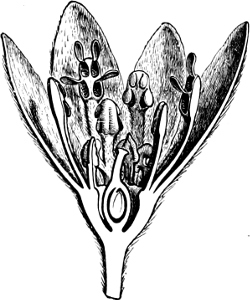
Fig. 386.—Flower of the Cinnamon-tree (Cinnamomum zeylanicum) (longitudinal section).
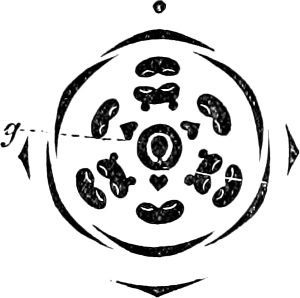
Fig. 387.—Typical diagram of the Lauraceæ: g staminodes.
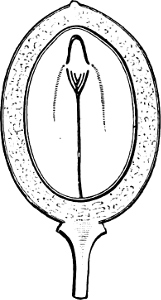
Fig. 388.—Laurus nobilis: longitudinal section of fruit.
The Lauraceæ present affinities with the Polygonaceæ, in which there is found perigyny, as well as a similar number of parts in the flower and a similar gynœceum, but with erect and orthotropous ovule. From their general characters they should be classed among the Polycarpicæ, but stand, however, isolated by the syncarpous gynœceum, if it is in reality formed by 3 carpels and not by 1 only. Hernandia, which has epigynous monœcious flowers, deviates most.—Cassytha is a Cuscuta-like, herbaceous, slightly green parasite with twining, almost leafless stems. The flower however agrees with the diagram in Fig. 387. Some Lauraceæ have curved veins or palminerved and lobed leaves (often together with entire ones) e.g. Sassafras.
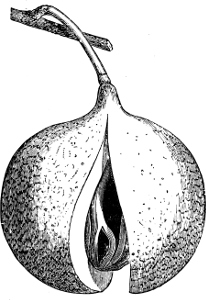
Fig. 389.—Myristica: fruit.]
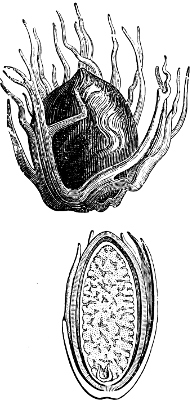
Fig. 390.—Seed with aril entire and in longitudinal section.
There are 1000 species; especially in the forests of tropical S. America and Asia, of which they form the principal part. Only Laurus nobilis is found in Europe, and there is little doubt that its proper home is in Western Asia. They are rare in Africa.—On account of the volatile oil found in all parts of the plant, they are used as spices, e.g. the false Cinnamon-tree (Dicypellium caryophyllatum, in the Brazils). The OFFICINAL ones are—the Cinnamon-tree (Cinnamomum zeylanicum from Ceylon, E. India, Eastern Asia), which is also cultivated; the Camphor-tree (Cinnamomum camphora, Eastern Asia). The Laurel-tree (Laurus nobilis, Mediterranean), the berries and leaves of which give laurel oil, is medicinal.—Scented wood for furniture, etc., is obtained from Sassafras officinalis (from N. Am.). The wood from its roots is officinal. Pichurim “beans” are the large cotyledons of Nectandra pichury, whilst the famous “Greenheart” wood of Demarara is the wood of Nectandra rodiæi. The pulp and seeds contain a fatty oil. The pear-like fruit of Persea gratissima (Mexico, also cultivated) is very delicious. Lindera benzoin is a garden shrub; Laurus nobilis likewise.
Order 12. Myristicaceæ (Nutmegs). In this order there is only 1 genus, Myristica. Trees or shrubs. The leaves agree closely with those of the Lauraceæ, with which this order has many points in common. The majority of the species are aromatic, having in their vegetative parts pellucid glands with volatile oils. The flowers are regular, diœcious, trimerous, and have a single gamophyllous (cupular or campanulate) 3-toothed, fleshy perianth. In the ♂-flowers the anthers vary in number (3–15), and they are extrorse and borne on a centrally-placed column; in the ♀-flower the gynœceum is unilocular, unicarpellary, with 1 ovule. The FRUIT (Fig. 389) has the form of a pear; it is a fleshy, yellow capsule, which opens along the ventral and dorsal sutures, exposing the large seed. This seed has a large, red, irregularly branched aril—the so-called “mace”; the “nutmeg,” on the other hand, is the seed itself with the inner thin portion of the testa, which has pushed its way irregularly into the endosperm, and causes the marbled appearance of the cut seed (Fig. 390); the external, dark brown, hard, and brittle part of the seed-shell is however removed. Mace and nutmeg contain volatile and fatty oils in abundance.—80 species. Tropical. The majority are used on account of their aromatic seeds and aril, the most important being M. fragrans (moschata), from the Moluccas. This is cultivated in special plantations, not only in its native home, but in other tropical countries also. Nutmegs were known as commodities in Europe in very ancient times (e.g. by the Romans), but it was not until the year 1500 that the tree itself was known. The seed is OFFICINAL.
Family 10. Rhœadinæ.
The plants belonging to this family are almost exclusively herbaceous, with scattered, exstipulate leaves. The flowers are eucyclic di- or tetramerous, with the calyx and corolla deciduous, hypogynous, ☿, regular, the gynœceum with 2–several carpels (generally 2, transversely placed) (Figs. 391, 392, 393, 397). The ovary is unilocular with parietal placentæ, but in Cruciferæ and a few others it becomes bilocular by the development of a false, membranous wall between the placentæ. The stigmas in the majority of cases are commissural, i.e. they stand above the placentæ, and not above the dorsal line of the carpels. The fruit is nearly always a capsule, which opens by the middle portions of the carpels detaching themselves as valves, bearing no seed, whilst the placentæ persist as the seed-bearing frame. Endosperm is found in Papaveraceæ and Fumariaceæ, but is absent in Cruciferæ and Capparidaceæ.—This family through the Papaveraceæ is related to the Polycarpicæ (the Nymphæaceæ), through the Capparidaceæ to the Resedaceæ in the next family.
Exceptions to the above are: Eschscholtzia, Subularia (Fig. 403) and a few Capparidaceæ, in which perigynous flowers are found. A few Papaveraceæ and Fumariaceæ have trimerous flowers. In Fumaria and certain Cruciferæ, the fruit is a nut. The Fumariaceæ have zygomorphic flowers. Trees and shrubs are almost entirely confined to the Capparidaceæ, in which order stipules also are found.
Order 1. Papaveraceæ (Poppies). Herbaceous plants with stiff hairs and latex; flowers regular (Fig. 391) with generally 2 (-3) sepals (which fall off as the flower opens), 2 + 2 petals (imbricate and crumpled in the bud) without spur, numerous stamens in several alternating whorls (generally a multiple of 2); carpels 2–several, united into a unilocular gynœceum. Trimerous flowers also occur. Capsule with very numerous seeds on the parietal placentæ; embryo small, with large, oleaginous endosperm (Fig. 392).—The leaves have no stipules and are generally pinnately lobed.
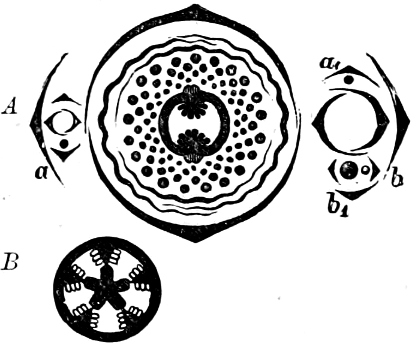
Fig. 391.—A Diagram of the flower of Glaucium and the dichasium (which becomes transformed into a scorpioid cyme). B Papaver argemone, transverse section of the ovary with indication of the position of the stigmas.
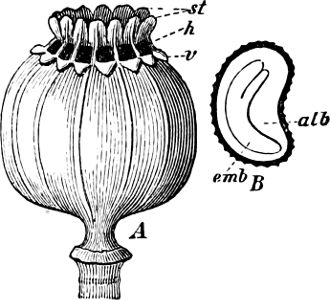
Fig. 392.—Papaver somniferum: A capsule; st the stigma; v valves; h pores; B seed in longitudinal section; alb endosperm; emb embryo.
Papaver (Poppy) has large, solitary, terminal flowers; petals firmly and irregularly folded in æstivation; gynœceum formed by many (4–15) carpels; stigmas velvety, sessile and stellate (the rays stand above the placentæ) (Fig. 391 B). The edges of the carpels project deeply into the ovary, but do not meet in the centre, so that it remains unilocular. The capsule opens by pores placed close beneath the stigma, and formed of small valves alternating with the placentæ and the rays of the stigma (Fig. 391). P. dubium, P. argemone, P. rhœas.—Chelidonium (Greater Celandine) has yellow latex, flowers in umbellate cymes (the terminal, central flower opening first) and only 2 carpels; the fruit resembles the siliqua of the Cruciferæ in having two barren valves, which are detached from the base upwards, and a seed-bearing frame, but there is no partition wall formed between the placentæ. Ch. majus.—The majority of the other genera have, like Chelidonium, 2 carpels (lateral and alternating with the sepals: Fig. 391 A) and siliqua-like fruit, thus: Eschscholtzia (perigynous) with a linear, stigma-bearing prolongation extending as far above the placentæ as above the dorsal suture of the carpels; Glaucium (Horn-Poppy); G. luteum, whose extremely long, thin capsule differs from that of Chelidonium by the formation, during ripening, of a thick, spongy (false) replum, which persists when the valves are detached; Sanguinaria with red latex, the 2 petals divided into 8–12 small petals (perhaps by dédoublement); Macleya and Bocconia (1-seeded capsule) with 2 sepals and no petals.—Trimerous flowers are found in Argemone and Platystemon (with a curious fruit, carpels free, and transversely divided and constricted into joints which separate as nut-like portions).—Meconopsis.—Hypecoum (Fig. 393 C) has tri-lobed and three cleft petals, 4 free stamens with 4-locular anthers and a jointed siliqua; it presents a transitional form to the Fumariaceæ, with which order it is sometimes included.
Pollination. Papaver and Chelidonium have no honey, and are without doubt only visited by insects for the sake of the pollen. The anthers and stigmas mature about the same time.—There are 80 species; especially from warm climates. Officinal: Papaver somniferum (Opium-Poppy); the latex of its unripe capsules is obtained by incisions, and dried (opium); it contains many alkaloids: morphine, papaverine, narcotine, thebaine, etc. The oleaginous seeds are also used in the manufacture of oil. Its home is in the East, where it is extensively cultivated. The petals of the Corn-poppy (P. rhœas) are also officinal. Several species are cultivated as ornamental plants.
Order 2. Fumariacæ (Fumitories). This order differs from the closely allied Papaveraceæ in the absence of latex, a poorer flower, generally transversely zygomorphic (Fig. 393 B), in which case one or both of the outer lateral petals are gibbous, or prolonged into a spur; the stamens are especially anomalous. Sepals 2, caducous; petals 2 + 2; stamens 2, tripartite; each lateral anther is bilocular (Figs. 393 A, B; 395); gynœceum bicarpellate. The fruit is a nut or siliqua-like capsule. Endosperm.—Herbs with scattered, repeatedly pinnately-divided leaves without stipules, generally quite glabrous and glaucous; the flowers are arranged in racemes with subtending bracts, but the bracteoles are sometimes suppressed.
Dicentra (syn. Dielytra) and Adlumia have a doubly symmetrical flower, with a spur or gibbous swelling at the base of each of the laterally-placed petals (Figs. 393 A, 394). Corydalis has a zygomorphic flower, only one of the lateral petals having a spur, and consequently there is only one nectary at the base of the bundle of stamens, which stands right in front of the spur (Fig. 393 B, 395, 396). The fruit is a many-seeded siliqua-like capsule. A peculiarity of the flower is that the plane of symmetry passes transversely through the flowers, whilst in nearly all other zygomorphic flowers it lies in the median line. Moreover, the flower is turned, so that the plane of symmetry ultimately becomes nearly vertical, and the spur is directed backwards.—Many species have subterranean tubers; in these the embryo germinates with one cotyledon, which is lanceolate and resembles a foliage-leaf. The tuber is in some the swollen hypocotyl (C. cava), in others a swollen root (C. fabacea, etc.), which grows down through the precisely similar swollen root of the mother-plant. The sub-genus Ceratocapnos has dimorphic fruits (nuts and capsules) in the same raceme. Fumaria differs from Corydalis only by its almost drupaceous, one-seeded nut (Fig. 395).
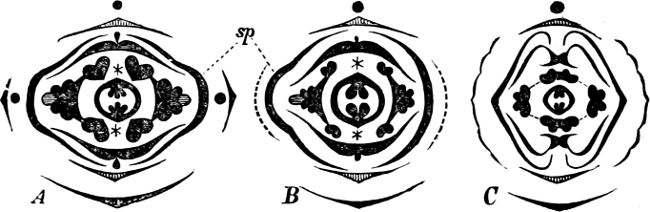
Fig. 393.—Diagram of Dicentra (A), Corydalis (B), and Hypecoum (C).]
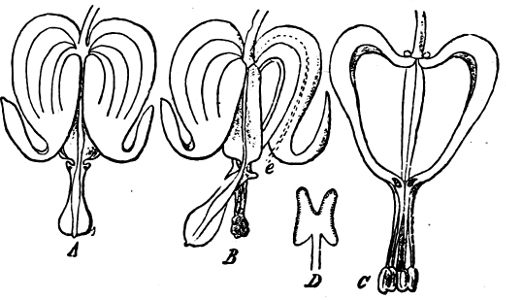
Fig. 394.—Dicentra spectabilis: A flower (2/5); B the same, after removal of half of one outer petal; the cap, formed by the inner petals, is moved away from the anthers and stigma; the insect does this with the lower side of its abdomen, and thus rubs the stigma on the hairs of its ventral surface; the dotted line at e indicates the direction of the proboscis; C andrœcium and gynœceum; D stigma.
The structure of the flower. Hypecoum among the Papaveraceæ is the connecting link with the Fumariaceæ. The diagram (Fig. 393 C) corresponds both in number and in the relative position of its members with that of most of the other Papaveraceæ (Fig. 391), except that there are only four stamens (with extrorse anthers). In Dicentra (Fig. 393 A), the two central (uppermost) stamens are absent, but each of the two lateral ones are divided into three filaments, of which the central one bears a four-locular anther, and each of the others a two-locular (half) anther. Corydalis and Fumaria stand alone in the symmetry of the flower, differing from Dicentra in having only one of the lateral petals (Fig. 393 B, sp) prolonged into a spur, while in Dicentra both the petals are spurred. This structure has been interpreted in various ways. According to Asa Gray the median stamens are absent in the last-named genera, and the lateral ones are split in a similar manner to the petals of Hypecoum. Another, and no doubt the most reasonable theory (adduced by De Candolle), is: that two median stamens are split, the two parts move laterally, each to their respective sides and become united with the two lateral stamens; this affords a natural explanation of the two half-anthers, and establishes a close relationship to the Cruciferæ. A third interpretation, held by Eichler and others, is as follows: the median stamens are always wanting; when they appear to be present, as in Hypecoum, it is due to the fact that the side portions of the lateral stamens approach each other (as interpetiolar stipules) and coalesce into an apparently single stamen.
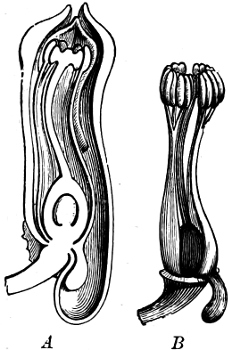
Fig. 395.—Fumaria officinalis: A the flower in longitudinal section; B the andrœcium and gynœceum; nectary to the right.
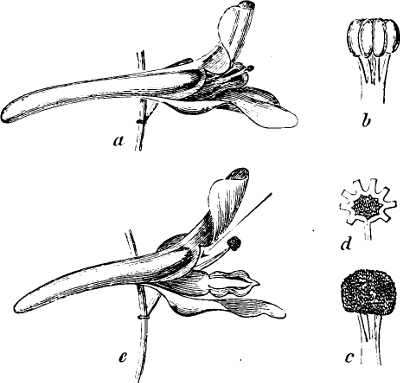
Fig. 396.—Corydalis cava: a a flower (lateral view); b the anthers lying round the stigma; c the anthers shortly before the opening of the flower; d the head of the stigma; e relative position of the parts of the flower during the visit of an insect.
130 species; mostly from the northern temperatures.
Pollination. Fumaria, with its inconspicuous flowers, has to a great extent to resort to self-pollination. Corydalis, on the other hand, is dependent on cross-pollination; C. cava is even absolutely sterile with its own pollen. Corydalis is pollinated by insects with long probosces (humble-bees, bees), which are able to reach the honey secreted in the spur; as they alight on the flowers they press the exterior petals on one side (Fig. 396 e), so that the stigma, surrounded by the anthers, projects forward; the proboscis is introduced in the direction of the arrow in the figure, and during this act the under-surface of the insect is covered with pollen, which is transferred by similar movements to the stigma of another (older) flower.—Ornamental plants; Dicentra (spectabilis and eximia), Adlumia, Corydalis.
Order 3. Cruciferæ (Crucifers). The flowers are regular, ☿; sepals 4, free (2 + 2), deciduous; petals 4, free, deciduous, unguiculate, placed diagonally in one whorl, and alternating with the sepals; stamens 6; the 2 outer are short, the 4 inner (in reality the two median split to the base) longer, placed in pairs (tetradynamia of Linnæus); gynœceum syncarpous formed by 2 (as in the previous order, lateral) carpels, with 2 parietal placentæ, but divided into two loculi by a spurious membranous dissepiment (replum) (Fig. 397). Style single, with a capitate, usually two-lobed stigma, generally commisural, that is, placed above the parietal placentæ (Fig. 397), but it may also be placed above the dorsal suture, or remain undivided. Ovules curved. The fruit is generally a bivalvular siliqua (Fig. 398 B, C), the valves separating from below upwards, and leaving the placentæ attached to the replum; other forms of fruits are described below. The oily seeds have no endosperm (endosperm is present in the two previous orders); the embryo is curved (Figs. 398 E, F; 399, 400).—In general they are herbaceous plants, without latex, with scattered, penninerved leaves, without stipules; the inflorescence is very characteristic, namely, a raceme with the flowers aggregated together at the time of flowering into a corymb, and destitute of both bracts and bracteoles.
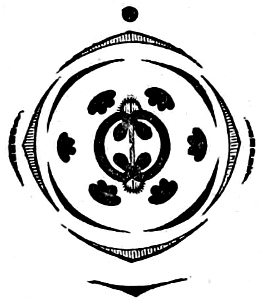
Fig. 397.—Diagram of a Cruciferous flower.
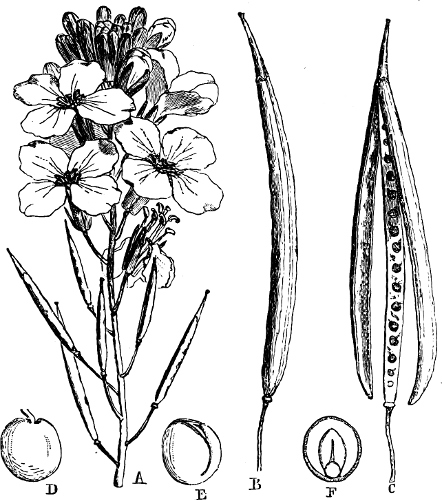
Fig. 398.—Brassica oleracea: A raceme; B, C siliqua; D seed; E embryo; F transverse section of seed.
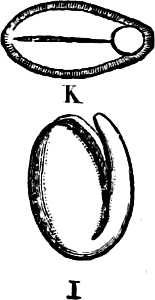
Fig. 399.—Transverse section of seed and embryo of Cheiranthus cheiri.
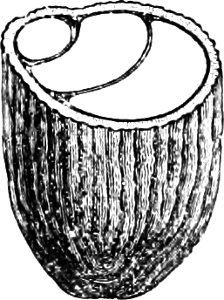
Fig. 400.—Transverse section of seed of Sisymbrium alliaria.
Many are biennial, forming in the first year a close leaf-rosette. By cultivation the tap-root can readily be induced to swell out into the form of a tuber (Turnips, Swedes, etc.). Stipules are found indicated by small glands on the very young leaves; in Cochlearia armoracia they are fairly large triangular scales. Stellate hairs often occur. Floral-leaves are occasionally developed. Terminal flowers are never found in the inflorescences. Iberis and Teesdalia have zygomorphic flowers. Subularia (Fig. 403) is perigynous. The 2 external sepals (Fig. 397) stand in the median plane; it may therefore be supposed that there are two bracteoles outside these which, however, are suppressed, and can only in a few instances be traced in the young flower; the two lateral sepals are often gibbous at the base, and serve as reservoirs for the nectar secreted by the glands placed above them; they correspond in position to the external petals of the Fumariaceæ. The 4 petals which follow next arise simultaneously, and alternate with the 4 sepals; if it could be shown that these are merely 2 median petals, which have been deeply cleft and the two parts separated from each other and displaced to the diagonal position, there would be a perfect correspondence with the Fumariaceous flower; then the petals would be followed in regular alternation by the 2 lateral small stamens, the 2 median long stamens, which it has been proved are split into 4 and placed in couples, and the 2 laterally-placed carpels,—in all 6 dimerous whorls. But the formation of the corolla by the splitting of 2 petals does not agree with the development of the flower or bear comparison, and hence the only fact in favour of this theory is the otherwise prevailing correspondence with the Fumariaceæ. Yet it may be observed that in special cases each pair of long stamens clearly enough arises from one protuberance and even later on may be considerably united or entirely undivided (e.g. Vella); in other instances they are quite distinct from the beginning, and it is possible that this latter condition has become constant in the corolla. Lepidium ruderale and others have no corolla. Senebiera didyma has only 2 median stamens. Megacarpæa has several stamens, no doubt by dédoublement, as in Capparidaceæ.—The number of carpels may also be abnormally increased; Tetrapoma barbareifolium has normally 4 carpels with an equal number of placentæ and repla. It is supposed to be a variety of Nasturtium palustre.—The 2–4–8–10 greenish glands, which are found at the base of the stamens, are nectaries, morphologically emergences, and not rudimentary stamens. The forms of fruits are of great systematic significance, see the genera. In some species dimorphic fruits are present, e.g. Cardamine chenopodiifolia which has both ordinary Cardamine-siliquas and 1-seeded siliculas.
The curved embryo appears in five forms, which have systematic importance: 1. To the Pleurorhizæ belong those genera whose radicle (with the hypocotyl) lies bent upwards along the edge of the flat cotyledons (Fig. 399); to this group belong Cardamine, Nasturtium, Cheiranthus, Matthiola, Cochlearia, Draba, Iberis, Thlaspi, etc.; diagrammatic transverse section: ◯=.—2. To Notorhizæ belong those whose radicle lies in an upward direction along the back of one of the flat cotyledons (Figs. 400, 413); e.g. Hesperis, Sisymbrium, Lepidium, Capsella, Camelina: ◯‖.—3. Orthoploceæ differ from the Notorhizeæ in having the cotyledons folded (not flat) (Fig. 398 E, F); to this belong Brassica, Sinapis, Raphanus, Crambe, etc.: ◯>>.—4. Spirolobeæ: the radicle lies as in the Notorhizæ, but the cotyledons are so rolled together that a transverse section of the seed cuts them twice; Bunias: ◯‖‖.—5. Diplecolobeæ: the cotyledons are folded forward and backward so that a transverse section cuts them several times; Subularia, Senebiera: ◯‖‖‖.
On germination the cotyledons appear above the ground as green leaves; in the Orthoploceæ they are bilobed, in the Lepidium-species divided.
1. Silicula, broad replum (Siliculosæ latiseptæ), valves flat or slightly vaulted, and the replum extends through the greatest width of the silicula (Fig. 404). The seeds are situated in two rows.
◯=: Cochlearia (Horse-radish): the siliqua is nearly spheroid; glabrous herbs, generally with fleshy, stalked leaves, and white flowers.—Draba has an oblong, lanceolate, somewhat compressed silicula; herbs with small rosettes of leaves, most frequently with stellate and long-stalked racemes.—Alyssum and Berteroa are whitish, on account of the stellate hairs; they have a more compressed and round or elliptical silicula. Vesicaria; Aubrietia. Lunaria (Honesty, Fig. 401): very broad and flat silicula with long stalk (the receptacle as in Capparidaceæ).
◯‖: Camelina (Gold-of-pleasure) has a spheroid, pear-shaped siliqua with a small rim passing right round (Fig. 402). Subularia (Awlwort), an aquatic plant with perigynous flower (Fig. 403) and folded cotyledons.
2. Silicula, narrow replum (Siliculosæ angustiseptæ), i.e. the replum is much shorter than the arched, more or less boat-shaped valves (Figs. 405, 406, 407).
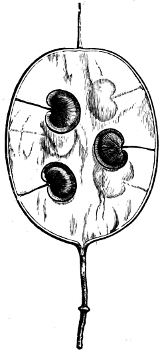
Fig. 401.—Lunaria biennis. Fruit, the valves of which have fallen off.
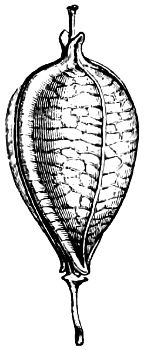
Fig. 402.—Camelina sativa. Fruit.
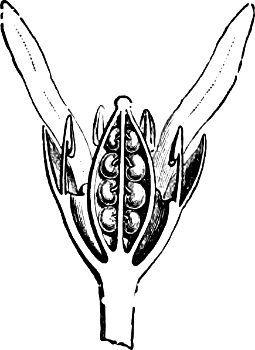
Fig. 403.—Subularia aquatica. Longitudinal section through the flower.
◯=: Thlaspi (Penny-Cress) has a flat, almost circular silicula, emarginate or cordate, with a well-developed wing round the edge (Fig. 406). Iberis and Teesdalia: the racemes during flowering are especially corymbose, and the most external petals of the outer flowers project radially and are much larger than the other two (the flower is zygomorphic).—Biscutella, Megacarpæa.
◯‖: Capsella (Shepherd’s-Purse) has a wingless, obcordate or triangular silicula (Fig. 407). Lepidium (Pepperwort) has a few–(2–4) seeded, slightly winged, oval silicula. Senebiera has a silicula splitting longitudinally into two nut-like portions; its cotyledons are folded.—Anastatica hierochuntica (“Rose of Jericho”) is an annual, silicula-fruited, desert plant (Arabia, Syria, N. Africa). After the flowering all its then leafless branches bend together upwards, forming a kind of ball; this spreads out again on coming in contact with water, and the fruits then disseminate their seeds, which germinate very quickly, often in the fruit.
3. Siliqua (Siliquosæ). The fruit is a true siliqua, several times longer than broad. The seeds in most are borne apparently in one row.
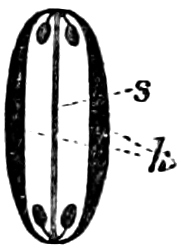
Fig. 404.—Transverse section of a silicula with broad replum: s replum; k the valves.
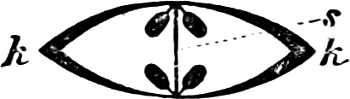
Fig. 405.—Transverse section of a silicula with narrow replum.
◯>>: Brassica (Cabbage). The seeds are placed apparently in one row in each loculus (Fig. 398 C); the style is long and round; the valves have only 1 strong, longitudinal rib.—Melanosinapis (M. nigra, Black-mustard); the style is compressed, two-edged; the valves of the siliqua are one ribbed.—Sinapis (Mustard); quadrangular or flat style (in which in most cases there is a seed) and 3–5 strong, longitudinal ribs on the valves.—Eruca differs from Brassica by the shorter siliqua, broad, sword-like “beak” and seeds in two rows.
◯= (Fig. 399): Cardamine (Bitter Cress) has a long, linear siliqua, with flat, unribbed, elastic valves. The leaves are most frequently pinnatifid or pinnate. C. pratensis reproduces by buds formed in the axils of the leaves.—Arabis (Rock Cress); Matthiola (Stock); Cheiranthus cheiri (Wallflower); Barbarea (Winter Cress) (double-edged, quadrangular siliqua); Nasturtium (N. officinale, Water-cress); the siliqua of the latter genus is in some species short, in others long.
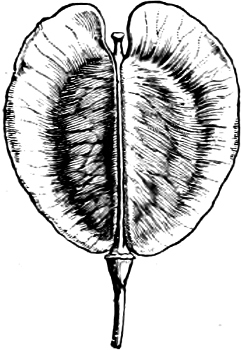
Fig. 406.—Thlaspi arvense.
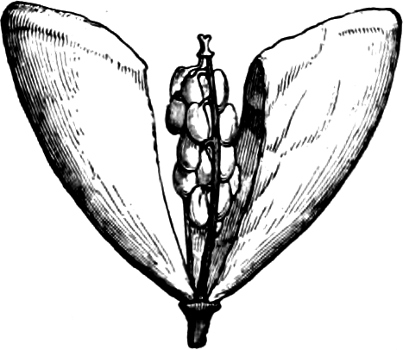
Fig. 407.—Silicula of Capsella bursa-pastoris.
◯‖ (Fig.400): Sisymbrium (Hedge Mustard) the valves of the siliqua are 3-ribbed.—Erysimum; Hesperis; Schizopetalum (with fimbriate petals).
4. Fruit jointed (Lomentaceæ). The fruit is divided by transverse walls into as many spaces as there are seeds, and dehisces at maturity, generally transversely, into a corresponding number of nut-like joints (“articulate-siliqua.”)
◯=: Crambe (Kale, Fig. 408). The fruit has only 2 joints. The lower one resembles a short, thick stalk, and is barren, the upper one is spherical, and has 1 seed.—Cakile (C. maritima, Sea-kale); the lower node is triangular, 1-locular, the upper one more ensiform, 1-locular (Fig. 409).
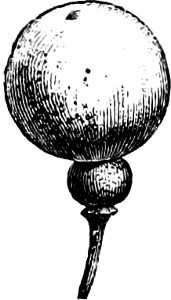
Fig. 408.—Fruit of Crambe maritima.
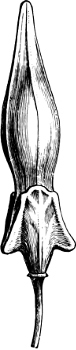
Fig. 409.—Cakile maritima. Fruit (2/1).

Fig. 410.—Raphanus raphanistrum.

Fig. 411.—Raphanus sativus.
◯>>: Raphanus has a long siliqua, which, in the garden Radish (R. sativus), is spongy and slightly abstricted (Fig. 411), but neither opens nor divides transversely (a kind of dry berry), and which in the Wild Radish (R. raphanistrum) (Fig. 410) is abstricted in the form of a string of pearls, and separates into many joints. R. sativus; the “Radish” is formed by the hypocotyl, after the bursting of its external, cortical portions (of which there are generally two patches at the top of the Radish).
5. Siliqua indehiscent (Nucumentaceæ). The fruit is a short, unjointed, unilocular and 1-seeded nut, and the fruit-stalks are often long, slender, and drooping. (Sometimes a thin endosperm is present).—Isatis (Woad) has most frequently an oblong, small-winged nut; ◯‖ (Figs. 412, 413).—Bunias; Neslia.
[The systematic division of this order given above is founded upon that of A. P. de Candolle. Prantl (Engler and Prantl, Nat. Fam.), 1891, adopts a somewhat different system, which may briefly be summarised as follows:—
A. Hairs unbranched or absent; no glandular hairs.
1. Thelypodieæ. Stigma equally developed on all sides; style undivided or prolonged above the middle of the carpels, or turned back.—Stanleyinæ; Heliophilinæ.
2. Sinapeæ. Stigma strongly developed above the placenta; style beaked or two-lobed.
a. Cotyledons arising behind the bend of the embryo.—Lepidiinæ.
b. Cotyledons arising at the bend of the embryo.
α. Only lateral nectaries. Generally a silicula or indehiscent fruit.—Cochleariinæ.
β. Generally a siliqua, more rarely a silicula or transversely-divided or indehiscent fruit. Nectaries generally lateral and median.—Alliariinæ; Sisymbriinæ; Vellinæ; Brassicinæ; Cardamininæ.
B. Hairs collectively or partially branched, very rarely entirely absent; glandular hairs are sometimes also present.
1. Schizopetaleæ.
2. Hesperideæ. Stigma strongly developed above the placenta; style undivided or prolonged above the placentæ into shorter or longer lobes.
a. Surface cells of the replum, not divided diagonally.—Capsellinæ; Turritinæ; Erysiminæ; Alyssinæ.
b. Surface cells of the replum divided diagonally.—Malcolmiinæ; Hesperidinæ; Moricandiinæ.
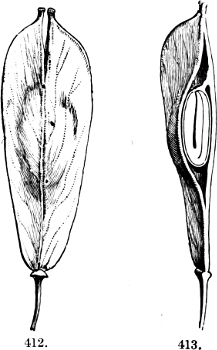
Fig. 412.—Isatis tinctoria. Fruit (Fig. 412); and in longitudinal section (Fig. 413). (Mag.)
Pollination. Honey is secreted by the nectaries mentioned above; but the position of the stamens is not always the most favourable for pollination by insects (in these flowers the honey-seeking insect must touch the anthers with one of its sides and the stigma with the other), and self-fertilisation is common. In some species (Cardamine pratensis) the long stamens turn their anthers outwards towards the small stamens, so that 3 anthers surround each of the two large entrances to the nectaries.
1200 species (180 genera), especially in the cold and temperate parts of the Old World (Europe, W. Asia). Many are weeds in this country, e.g. Wild Cabbage (Brassica campestris), Charlock (Sinapis arvensis), Wild Radish (Raphanus raphanistrum) and others.—The order is acrid and oleaginous. Oil is obtained from many of the oil-containing seeds, especially of the Rape (Brassica napus), Summer-Rape (the oil-yielding cultivated form of the Field-Cabbage) and Camelina. Several are pot-herbs or fodder plants, e.g. Cabbage
(Brassica oleracea) with its numerous varieties: Cauliflower (var. botrytis; the entire inflorescence is abnormally branched and fleshy), Kohlrabi (var. gongylodes, with swollen, tuberous stem), Kale, Red-Cabbage, White-Cabbage, etc.; B. campestris, var. rapifera (Turnip); B. napus, var. rapifera (Swede); Raphanus sativus (Radish from W. Asia), R. caudatus (long Radish); Nasturtium officinale (Water Cress), Lepidium sativum (Garden Cress), and Barbarea præcox (Early Cress); Crambe maritima (Sea-Kkale). The seeds of the following are especially used as spices: (the flour of) Melanosinapis (Black-mustard), and Sinapis alba (White-mustard), which are officinal like the root of Cochlearia armoracia (Horse-radish, E. Eur[**.]). The herbaceous parts of Cochlearia officinalis and danica are medicinal.—A blue dye (woad) is extracted from Isatis.—Ornamental plants: Cheiranthus cheiri (Wallflower), Matthiola (Stock), Iberis, Hesperis, Lunaria, and others (especially from S. Eur.). Sweet-scented flowers are rare.
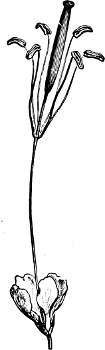
Fig. 414.—Gynandropsis pentaphylla.
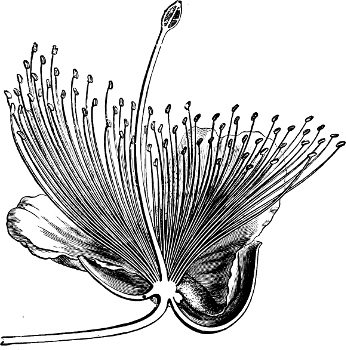
Fig. 415.—Capparis spinosa.
Order 4. Capparidaceæ (Capers). The relationship with the Cruciferæ is so close that certain forms are with difficulty distinguished from them. The diagram of the flower is the same in the number and position of its parts, but it differs in the modifications which occur in the development of the stamens. In some genera all 4 stamens are undivided; in others both the 2 median ones are divided as in the Cruciferæ (6 stamens, but not tetradynamous) (Fig. 414); in other genera only 1 of these; in other instances again they are divided into more than 2; and finally the 2 lateral ones also may be found divided, so that indefinite stamens occur (Fig. 415). The bicarpellate gynœceum is unilocular (without replum), but more than 2 carpels may occur. The ovary is elevated on a stalk (sometimes as much as 1 foot in length); also between the stamens and corolla a similar stalk may be found (Fig. 414). The fruit is long and siliquose (Cleome, Polanisia, Gynandropsis), or a berry (Capparis). Endosperm absent. Some have zygomorphic flowers. Gamosepalous calyx and perigynous flowers also occur.—350 species; especially in the Tropics. The majority are trees and shrubs, and they differ also from the Cruciferæ in having distinct stipules present in some species.
“Capers” are the flower buds of the climbing, thorny shrub, Capparis spinosa (Fig. 415), which grows in the Mediterranean.
Family 11. Cistifloræ.
The flowers in this family are perfect, regular (except Resedaceæ, Violaceæ), hypogynous, the perianth-leaves free (a few have them slightly united), æstivation most frequently imbricate; they are eucyclic in the andrœcium, and most frequently in the other parts, and generally 5-merous with S5, P5, A5 + 5, G3, but other numbers also occur; several have indefinite stamens, but the stamens arise (where the development is known) in centrifugal order and are arranged, often very distinctly, in bundles; in other words, the large number of stamens is formed by the splitting of a small number (most frequently 5); a true spiral arrangement is never found. Gynœceum syncarpous, multicarpellary (Dilleniaceæ and a few Resedaceæ are apocarpous), most frequently the number of carpels is 3, forming a unilocular ovary with parietal placentæ, but parallel with this, multilocular ovaries, with the ovules placed in the inner angle of the loculi, are also found, and a few genera have a free, centrally-placed placenta. The fruit is most frequently a capsule. The dehiscence is never with a “replum,” i.e. the persistent frame of the placenta, as in the family Rhœadinæ. One half of the orders has endosperm (Violaceæ, Cistaceæ, Droseraceæ, Bixaceæ, Ternstrœmiaceæ, etc.), the other has no endosperm (Resedaceæ, Hypericaceæ, Elatinaceæ, Tamaricaceæ, etc.); some have a curved, the majority a straight embryo. The family is scarcely quite natural; in the future the orders will probably be arranged differently.
Order 1. Resedaceæ (Mignonettes).—Herbs or small shrubs with spirally-placed leaves and very small, gland-like stipules (as in Cruciferæ); the ☿, hypogynous flowers are zygomorphic, and arranged in racemes or spikes typically without bracteoles. The zygomorphic structure is produced by the greater development of the posterior side of the flower, especially the petals and the nectary (“disc,” in Fig. 416 d) which is situated between the petals and stamens; in general there are 5–8 free sepals and petals, the latter consisting of a large scale-like sheath with a fimbriated blade (see Fig. 416); stamens numerous; carpels 6–2 united together; ovary unilocular with parietal placentæ, but the cavity of the ovary is not closed at the top. In Astrocarpus the gynœceum is apocarpous. The fruit is most frequently a capsule; the seeds are reniform, without endosperm, and the embryo is curved.
This order connects the Rhœadinæ with the Cistifloræ. It is closely allied to the Rhœadinæ by its external appearance, even by the smell and taste, the parietal placentation, structure of the seeds, the inflorescences, etc., whilst by the irregular flowers and the disc placed at the posterior side of the flower, it is allied to Capparidaceæ, but differs from this order in not having its characteristic number (2–4) and by the very different mode of dehiscence of the fruit, etc. It differs from the other orders of this family chiefly in the fact that the number of the perianth-leaves is not constantly 5. In Reseda luteola both the calyx and corolla appear to be 4-leaved, because the posterior sepal is suppressed, and the 2 posterior petals are united. Where there are 10 stamens, they stand in 2 whorls, i.e. in front of the sepals and petals; if there are several, their position depends upon the splitting.—Astrocarpus is remarkable for its apocarpous fruit and the position of the ovules on the dorsal suture of the carpel.
The yellow, flat disc at the back of the flower serves as a nectary, the honey being protected by the lobes of the petals. If pollination by insects is not effected, then self-pollination may take place, at all events in R. odorata.
45 species; the majority in the Mediterranean and in Persia. Reseda odorata (from Egypt) is cultivated on account of its sweet scent; R. luteola (“Dyer’s Weed”) yields a yellow dye.
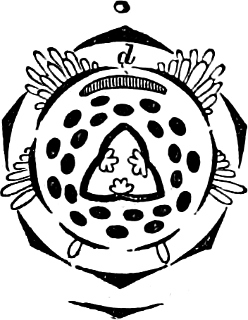
Fig. 416.—Diagram of Reseda odorata.
Order 2. Droseraceæ (Sundews). Herbs, chiefly living on moors or in water, and whose leaves are adapted to catch and digest small animals. With regard to the flower, they are closely allied to the Violaceæ, especially to those with regular flowers. Drosera (Sundew) has a long-stalked scorpioid cyme with regular, ☿, hypogynous flowers, 5-merous as in Viola. S5, P5, A5, G3 (in a syncarpous gynœceum, with free, bifid styles and basal or parietally-placed ovules in the unilocular ovaries). The capsule opens also as in Viola, but, among other differences, the styles are free, the seeds very small, and surrounded by a loosely lying, thin shell. Drosera has radical, long-stalked leaves with the blade (Fig. 417) covered by numerous strong glandular hairs, placed on the edge and in the middle; when small animals are caught by these hairs, the latter and the entire blade close slowly over them dissolving and absorbing all the digestible matter as nourishment.
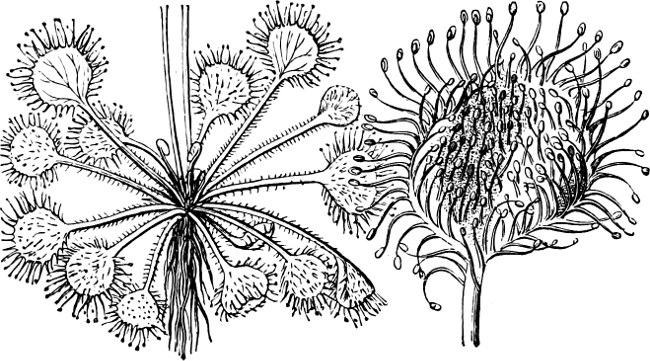
Fig. 417.—Leaf-rosette of Drosera rotundifolia (nat. size), and a leaf (magnified).
Dionæa muscipula (Fly-trap; N. Am.) has the same appearance as Drosera, but the leaves are constructed as in Fig. 418. The stalk is flat and winged, the blade small, circular, with powerful, pointed teeth along the edge, and on its surface are 6 small bristles (A), which are very sensitive. When these are touched the blade quickly closes, folding along the midrib (B, C) and imprisoning the irritating object, the teeth round the edges fitting like the teeth of a trap. If it happens to be an insect or similar body, a digestive fluid is secreted which, like the gastric juice, dissolves the digestible portions. Aldrovandia vesiculosa (Central and S. Europe) captures small aquatic animals in a similar manner; it is a floating, aquatic plant, the two halves of its leaves also close together when irritated (Fig. 419).—Drosophyllum.
About 110 species; most of them in the temperate regions.
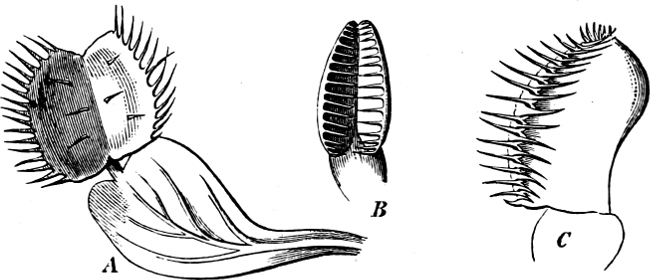
Fig. 418.—Dionæa muscipula. Leaves (nat. size).
Orders 3 and 4. Sarraceniaceæ and Nepenthaceæ. These two orders are perhaps most closely allied to the Droseraceæ and agree with these, among other things, in the manner of taking nourishment. Like the Droseraceæ they absorb nitrogenous food from dissolved animal matter by means of their leaves, which are specially constructed both to catch, to retain, and to digest any small animals which may be caught. The Sarraceniaceæ are North American marsh-plants (10 species) which have pitcher-like leaf-stalks, in the cavity of which a fluid (with properties approaching those of gastric juice) is secreted, and which bear at the apex a small, lid-like blade; these leaf-stalks are the catching and digestive organs.—Sarracenia, Darlingtonia.
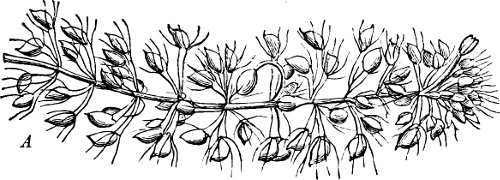
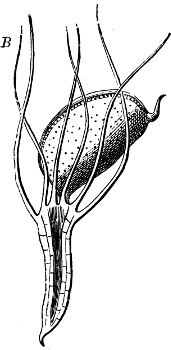
Fig. 419.—Aldrovandia vesiculosa: A a plant (nat. size). B Leaf (mag.); the blade is closed; the winged stalk is prolonged into 4–6 irritable bristles.
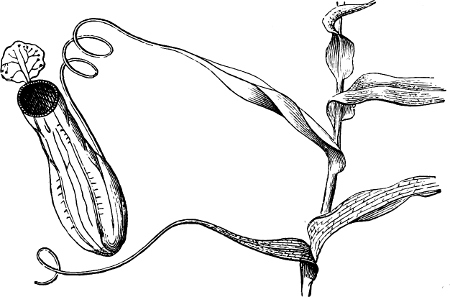
Fig. 420.—Nepenthes (reduced).
Nepenthaceæ has only 1 genus, Nepenthes (the Pitcher-plant; about 35 species), especially found in tropical E. Asia; the majority are climbing shrubs. The leaf-stalks are twining organs, and terminate either simply in a tendril, or in addition to this, with a pitcher-shaped body (which in some species may be as much as a foot in length) on whose upper edge a lid-like structure is found (Fig. 420). In this pitcher, as among the Sarraceniaceæ, a fluid is secreted which is able to digest the animals captured (sometimes rather large) and which corresponds in some degree to the gastric juice.
Order 5. Violaceæ (Violets). The flowers are ☿, and generally zygomorphic, hypogynous, with S5, P5, A5, G3 (Fig. 421). The stamens are closely applied to the ovary, they have a very short filament, and at their summit generally a membranous appendage formed by the prolongation of the connective (Fig. 422 g). The ovary is unilocular with 3 parietal placentæ; style undivided (Fig. 422 B). The fruit is usually a 3-valved capsule, opening along the dorsal sutures (Fig. 423). Embryo straight; endosperm fleshy (Fig. 425).—Many are herbaceous plants (e.g. Viola), but in the Tropics shrubs are also found (e.g. Ionidium); a few are lianes; the leaves are scattered, with stipules, and involute in the bud.

Fig. 421.—Diagram of Viola.
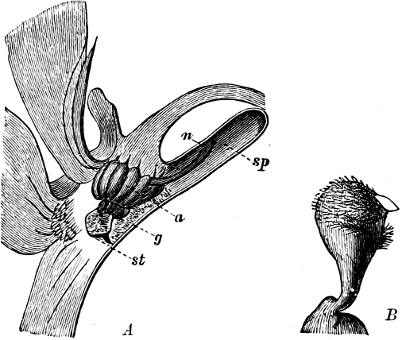
Fig. 422.—The large-flowered form of Viola tricolor: A the flower in median longitudinal section; B the gynœceum.
Viola. The sepals are prolonged backwards beyond the point of insertion (appendiculate); the corolla is polypetalous, descending imbricate, and zygomorphic, its anterior petal being larger than the others and provided with a spur (Fig. 421). The 2 anterior of the 5 almost sessile stamens are provided with a spur-like nectary, which protrudes a considerable distance into the petaloid spur (Figs. 421, 422 n, sp). The style is club-like, and bears the stigma in a groove on the anterior side (Fig. 422 st). Herbs with rhizomes, or annuals; flowers solitary. V. odorata, canina, etc., have cleistogamic flowers which produce fruit in addition to the large, coloured (violet) flowers. The Pansy (V. tricolor) has large flowers adapted for insect-pollination, and also smaller, less conspicuous ones designed for self-pollination. The stigma, as in Fig. 422 A, st, and B, is situated on the anterior side of the stylar-head, immediately in front of the channel leading down to the spur (sp); below it is situated a valve, easily covered with pollen when the proboscis of an insect is introduced into the spur, but which closes upon its withdrawal; cross-pollination is thus secured.—The sweet-scented V. odorata is visited by the honey-bee, which insures cross-pollination, and in the absence of insect visits it effects self-fertilisation by cleistogamic flowers. The conspicuous but scentless V. tricolor, var. vulgaris, is less frequently visited by insects (humble-bees). In V. silvatica and V. canina the pollen is carried on the head or proboscis of the honey-sucking bee.—The fruits of V. odorata bury themselves slightly in the soil. In the others the fruits are raised above the ground; the 3 boat-shaped valves close together along the central line, and eject the seeds, one by one, with much violence, so that they are thrown to a great distance.
Figs. 423–425.—Viola Tricolor.
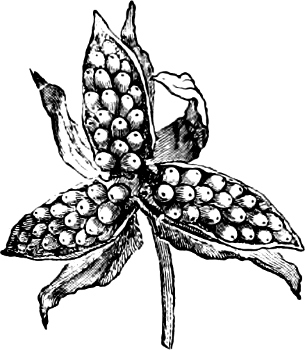
Fig. 423.—Capsule after dehiscence (nat. size).]
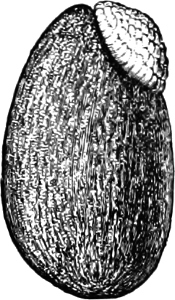
Fig. 424.—External view of the seed.
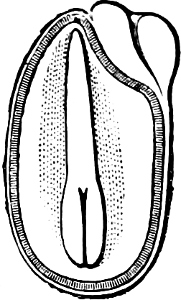
Fig. 425.—Seed in longitudinal section.
The Alsodeia-group has regular or almost regular flowers. Gamopetalous corollas are found in Paypayroleæ. Sauvagesieæ differs the most by its regular corolla, and 5–∞ free or united staminodes.
250 species; especially in the Tropics.—The Ionidium-species are used as ipecacuanha. A number of Viola-species are cultivated as garden plants, especially V. odorata (sweet-scented Violet) and V. tricolor, which have a large number of varieties.
Order 6. Frankeniaceæ. A small order with doubtful relationships. Perennial herbs or shrubs; beach plants with nodose stem. Sepals united, petals free. Unilocular ovary, with 3–4 parietal placentæ. Fruit a capsule. Embryo straight, endospermous. Especially in S. Europe, Africa, on the shores of the Mediterranean and Atlantic.
Order 7. Tamaricaceæ (Tamarisks). To this order belong only Tamarix and Myricaria. They are shrubs of a cypress- or heather-like appearance, as the scattered leaves are very small, sessile, scale-like or linear, adpressed, entire, and usually glaucous, and the branches are slender and whip-like. The flowers are borne in small spikes or racemes, and are small, reddish or whitish, regular, ☿, hypogynous and polypetalous; formula S5, P5, A5 + 0 (Tamarix, which often has stipular teeth at the base of the filaments), or A5 + 5 (Myricaria, in which the stamens are united at the base); the number 4 may appear instead of 5, but in either case there is usually a tricarpellate gynœceum, which is unilocular and has either parietal placentæ (Myricaria) or a small basal placenta (Tamarix); 1 trifid style, or 3 styles. Capsule dehiscing along the dorsal suture, and resembling the Willows in having a unilocular ovary with numerous woolly seeds; but the seed-wool in this case is borne on the chalaza, and may be attached to a long stalk.—Some Tamarix-species shed part of their branches in the winter.—40 species; North Temperate, on the sea-shores or steppes, especially in Asia. Ornamental shrubs: Myricaria germanica, and Tamarix gallica.
Order 8. Cistaceæ. Shrubs or herbs, natives especially of the Mediterranean region. Flowers generally in raceme-like scorpioid cymes, regular, ☿, hypogynous; sepals 5, free, twisted in the bud, of which the two outer are generally much smaller than the others; petals 5, free, twisted in the bud (in the direction opposite to the sepals), fugacious; stamens numerous; gynœceum syncarpous, carpels usually 3–5, style simple, ovary unilocular, with parietal placentation (seldom divided into loculi, with axile placentation). The ovules are orthotropous in opposition to some of the other orders of this family. The capsule dehisces along the dorsal sutures; embyro curved. The leaves are simple, undivided, generally opposite and stipulate.—They are Violaceæ with regular flowers, numerous stamens, and curved embryo. The numerous stamens are in reality only one or two 5-merous whorls, divided into a large number of stamens; these are formed, therefore, in descending order, like the lobes of many compound foliage-leaves.
Helianthemum (Rock-Rose), has 3 carpels.—Cistus has 5 (-10) carpels.
About 70 species; temperate climates, especially about the Mediterranean. The resin of the Cistus-species has been used medicinally (ladanum).
Order 9. Bixaceæ. This order is closely allied to the Cistaceæ and Ternstrœmiaceæ; like these it has regular, 5-merous, hypogynous flowers with numerous stamens, unilocular ovary and parietal placentæ; sometimes unisexual flowers; it differs in having anatropous ovules, in the æstivation of the sepals, etc. All species (about 180) are trees or shrubs, with scattered, simple leaves, which usually have stipules, and are occasionally dotted with pellucid oil-glands.—Bixa orellana (Trop. Am.) is the best known species; it has a 2-valved capsule; the seeds are enclosed in a shiny red, fleshy testa, which contains the well-known orange or yellow dye, annatto.
Order 10. Dilleniaceæ. Gynœceum usually apocarpous, seed arillate. The flower has most frequently S5, P5, and compound stamens (one or more bundles); sometimes irregular. 200 species; Tropical; woody plants, many lianes.—Dillenia, Candollea, Pleurandra, Davilla, etc.
Order 11. Elatinaceæ (Water-worts). About 25 species belong to this order; especially in temperate climates. They are small, creeping, rooted, aquatic plants, with opposite or verticillate leaves and stipules. The flowers are solitary or situated in small dichasia in the leaf-axils, they are small, regular, ☿, hypogynous, with free petals, the same number in all 5 whorls (Sn, Pn, An + n, Gn), 3-merous (e.g. Elatine hexandra), 4-merous (e.g. E. hydropiper), or 5-merous (Bergia); the corolla-stamens are sometimes suppressed; petals imbricate without being twisted; the ovary is 3–4–5-locular, with 3–4–5 free styles; the capsule dehisces septicidally. The seeds are orthotropous or curved, often transversely ribbed, endosperm wanting. The order is most nearly allied to Hypericaceæ, whose primitive form it appears to represent.
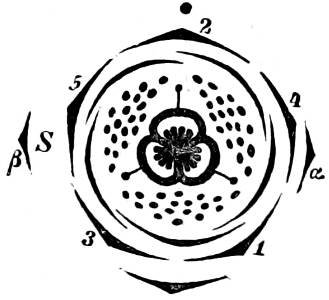
Fig. 426.—Diagram of Hypericum quadrangulum: S indicates the bud of the helicoid cyme in the axil of the bracteole β.
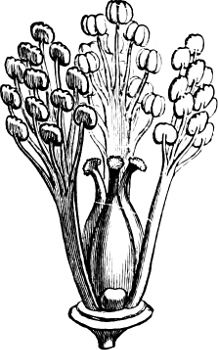
Fig. 427.—Hypericum. Flower with three bundles of stamens.
Order 12. Hypericaceæ (St. John’s-worts). This order is recognised by its always opposite or verticillate, simple, and entire, penninerved leaves, without stipules, and usually dotted with pellucid glands; by the always ☿, regular, hypogynous flowers in a cymose inflorescence; the generally 5-merous calyx and corolla, with sepals and petals free; the stamens 3–5, numerously branched (Figs. 426, 427); and the gynœceum, 3–5-carpellate, styles usually free. The ovary is 3–5-locular, or unilocular with 3–5 parietal placentæ. Fruit a capsule (dehiscing septicidally) or berry. Endosperm absent.
The inflorescence is a dichasium or helicoid cyme. The structure of the flowers is the same as that of the foregoing orders: S5, P5; succeeding these in some cases are two 5-merous whorls of stamens in regular alternation, of which the inner is epipetalous; but the outer whorl is only represented by 5 small scales (Fig. 427), or is altogether absent (Hypericum calycinum, H. hircinum), and the inner divided into numerous stamens, that is, these 5 stamens are so deeply divided that 5 epipetalous groups bearing anthers are found (as in the Cistaceæ); in other cases the flower becomes 3-merous after the petals, stamens 3 + 3 following in regular alternation (Figs. 426, 427), the outer whorl of stamens in these cases is also present as staminodes (Fig. 427), or may be altogether suppressed. Carpels 3–5. The petals are often twisted in the bud, and are then oblique.
Hypericum. Some species have a square stem; in these cases the leaves are placed opposite the edges. Fruit a capsule.—Vismia has a berry.—The flowers of Hypericum have no honey, and supply only pollen; self-pollination often takes place.
About 240 species; the tropical ones being often shrubs or trees; the others generally perennial shrubs.—Hypericum, St. John’s-wort, contains a resinous, red matter, which can be extracted with alcohol. The American gamboge is the dried sap of species of Vismia.
Order 13. Guttiferæ, or Clusiaceæ. Closely allied to the Hypericaceæ and Ternstrœmiaceæ. Leaves opposite or verticillate. The flowers are often unisexual; stamens united; the gynœceum has most frequently a sessile, radiating or shield-like stigma.
370 species; chiefly in the Tropics (Am.). They are principally woody plants and their bark contains a yellow gum resin, “gamboge,” which is extracted from Garcinia morella (E. Ind.) and others. Mangosteen (Garcinia mangostana S.E. Asia), and Mammea americana (W. Ind.), have very delicious fruits. To this order also belong Platonia insignis, Pentadesma butyracea (the Butter-tree), Clusia, Calophyllum, Cataba, etc.
Order 14. Ternstrœmiaceæ. Trees and shrubs with scattered, simple, and often more or less leathery, evergreen, penninerved leaves, without stipules (Fig. 428). The two most important genera are: Camellia and the closely allied Thea (by some authorities these are united into one genus). The flowers are regular, hypogynous, and situated singly on very short stalks. A number of green floral-leaves are placed below the calyx and gradually pass over into the sepals, and the leaves (5–6) of the calyx again gradually pass over into the corolla (this being especially marked in Camellia), of which the number of leaves varies (5, 6, 7 and upwards); the calyx and the corolla are acyclic or eucyclic; the petals are slightly united at the base; stamens numerous in many whorls, the external ones are arranged in bundles and united with the petals as in the Columniferæ; gynœceum syncarpous; styles often free nearly to the base; ovary 3–5-locular, ovules numerous in each loculus. The fruit is a woody capsule.—Other genera show more distinctly than these the same structure as in the preceding orders, namely: S5, P5, A5 + 5, of which the calyx-stamens are often suppressed, and the petal-stamens divided into numerous stamens.—Kielmeyera (S. Am.)