DIVISION V. ANGIOSPERMÆ. (continued 4)
Michael Cresse Potter translation
260 species; especially in the Tropics (E. Asia, Am.) The leaves of Thea chinensis (or Camellia thea), the Tea-tree (E. Asia), are cultivated for the well-known “tea,” and contain theine: the best are the young, still hairy leaves, of greyish colour; there are many varieties. Ornamental plants, Camellia japonica and Actinidia.
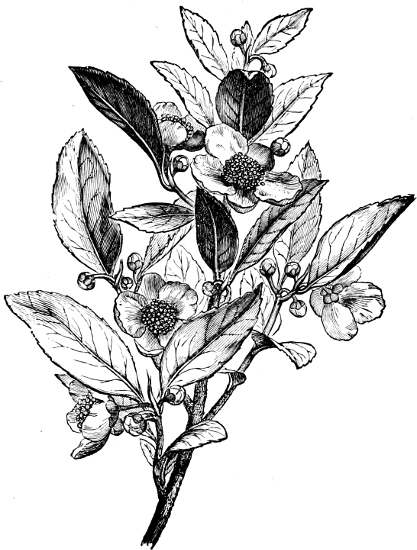
Fig. 428.—Thea chinensis (reduced).
Closely allied to this order are: Order 15. Rhizoboleæ (with enormously large hypocotyl—hence the name), and Order 16. Marcgraviaceæ (partly epiphytes, with dimorphic leaves and cup- or helmet-like, coloured, honey-secreting floral-leaves, which serve to attract insects).
Order 17. Dipterocarpaceæ. This order has taken its name from the large wings attached to the fruits in Dipterocarpus (the wings being largely developed sepals); trees and shrubs from Trop. Asia. 180 species. Camphor ready prepared is found in the stem of Dryobalanops camphora. Hopea; Vateria.
Family 12. Gruinales.
The flowers are hypogynous, ☿, polypetalous, usually regular (except Pelargonium, Tropæolaceæ, Balsaminaceæ) and throughout 5-merous: S5, P5, A5 + 5, or 5 + 0, G5 (epipetalous). The stamens soon fall off and are obdiplostemonous, often united at the base (monadelphous); the corolla-stamens are in some completely suppressed (e.g. Balsaminaceæ, Fig. 438), in others reduced to teeth (Linum, Fig. 431; Erodium). The Tropæolaceæ have 3 carpels and only 8 stamens (Fig. 437). Ring-like nectaries are not present, but at most only glandular bodies, borne outside the base of the stamens. Ovaries many-locular. The ovules as a rule are pendulous, with the micropyle directed outwards (Fig. 431, B), and the radicle therefore also points outwards. Usually herbs. Related to the Columniferæ.
Order 1. Oxalidaceæ. Most of the species are herbs with rhizomes; the leaves are stalked, compound, with entire leaflets which are folded and bent backwards in the bud (and in the sleep position), exstipulate; some species have sensitive leaves. The flowers (Fig. 429) are regular, and have S5, P5, which are twisted to the left or right in æstivation, A5 + 5, all united at the base (monadelphous), gynœceum 5-carpellate, styles 5 free, stigmas capitate, ovary 5-locular, ovules numerous. The fruit is a capsule opening with clefts on the dorsal sutures through which the seeds are ejected, while the fleshy, external layer of the testa springs off elastically. Embryo straight. Endosperm.
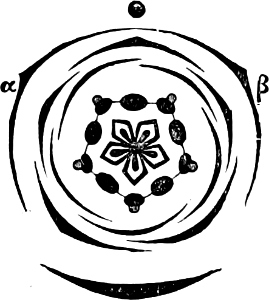
Fig. 429.—Diagram of Oxal’s acetosella.
Oxalis (Wood-Sorrel). Leaves digitate. Species also occur with phyllodia, i.e. leaf-like petioles placed vertically without lamina; a few have pinnate leaves. The flowers are situated singly or in dichasia, and unipared scorpioid cymes. The pollination is effected by insects. Some species are trimorphic (long-, short-, medium-styled flowers) and some, e.g. O. acetosella, have cleistogamic flowers in addition to the ordinary ones. Glands are found on the outer side of the corolla-stamens or of all the stamens. O. tetraphylla and others have adventitious edible roots, resembling tap-roots.—Averrhoa is a tropical tree, with berries and pinnate leaves.
235 species (205 belong to Oxalis); chiefly in S. Africa and Trop. America.—Oxalate of potash is contained in the leaves of Oxalis.
Order 2. Linaceæ. Herbs with scattered or opposite, sessile, simple, small, entire leaves, without (rarely with small) stipules. The flowers (Fig. 430) are regular, 5- or 4-merous. Petals are free, twisted, quickly falling off. Stamens united at the base; the petal-stamens are either reduced to teeth (Fig. 431 A, m) or entirely suppressed. Styles free. The (5–4) epipetalous loculi of the ovary are incompletely halved by false divisional walls, each half contains one ovule (Fig. 431 C). The fruit is a spherical capsule, dehiscing along the divisional wall (Fig. 432); the 10 (-8) seeds have a straight embryo and very slight endosperm (Fig. 433).
Figs. 430–433.—Linum usitatissimum.
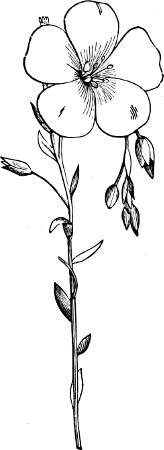
Fig. 430.—The Flax plant.
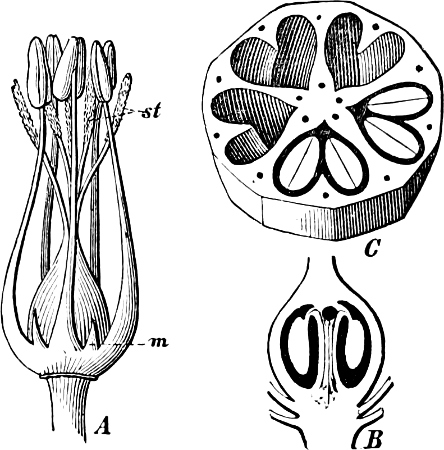
Fig. 431.—A Flower after removal of sepals and petals; m petal-stamens reduced to teeth. B Longitudinal section of ovary. C Transverse section of capsule.
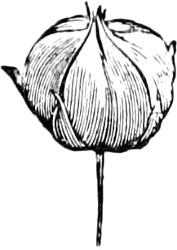
Fig. 432.—Capsule (nat. size).
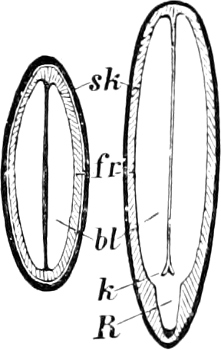
Fig. 433.—Transverse and longitudinal section of seed: bl the cotyledons; k the plumule; R the radicle; fr the endosperm; sk the testa.
Linum (Flax) has 5-merous flowers. The main axis terminates in a flower; and the succeeding branching is cymose, or unipared scorpioid branching by unilateral development, and the flowers in consequence of the vigorous sympodial development of the lateral axis (and also by the leaves being displaced and pushed aside), assume a position apparently lateral (i.e. racemose) without bracts; each branch of the sympodium generally has 2 leaves. The testa is shining and smooth when dry, but its external cellular layer becomes mucilaginous in water.—Radiola has a 4-merous flower. It is a small herb with opposite leaves, and regular, dichasial branching.
The anthers and stigmas in L. catharticum and usitatissimum develop simultaneously, and cross-pollination as well as self-pollination takes place. L. grandiflorum, perenne, and others, are dimorphic (short-and long-styled). There are 5 nectaries outside the stamens.
130 species; Linum and Radiola are native genera.—L. usitatissimum is extensively cultivated in Europe (especially in Russia and Belgium), N. America and elsewhere (its home no doubt being Asia), partly on account of the oil (linseed oil) which is extracted from the seeds, and partly on account of the bast of the stem, which has very thick-walled cells. The seeds and oil are OFFICINAL. The species cultivated in ancient times was L. angustifolium. Several species are cultivated as ornamental plants.
Order 3. Geraniaceæ. The majority are herbs with dichasial branching, and scattered or opposite, stalked, palminerved (rarely penninerved) leaves with small stipules. The flowers are regular (except Pelargonium) and 5-merous, with 10 or 5 stamens, which are slightly united at the base. Nectaries alternate with the corolla-stamens. The ovary is most frequently 5-locular, deeply 5-grooved, and bears 1 well developed style (“beak”), which towards the apex divides into 5 branches bearing stigmas; ovules 1 in each loculus, pendulous or ascending. The 5 carpels become detached from one another when ripe, and bend or roll back (Fig. 434) or become spirally twisted in the upper “beak-like” part (Figs. 435, 436), whilst a central column (septal column) persists; each carpel, in consequence, remains either closed, and the fruit is a 5-merous schizocarp whose nut-like lower portion, containing the seed, is forced into the ground, thus burying the seed by the movements of the spirally-twisted, hygroscopic “beak” (Figs. 435, 436); or it opens along the ventral suture, so that the seeds may fall out, and it is then a 5-valved capsule, with septicidal dehiscence (Fig. 434) and the rolling up often takes place so suddenly and violently that the seeds are shot out to considerable distances. The embryo is usually green and curved, and the cotyledons are folded; endosperm is wanting.
Geranium (Crane’s-bill) has 5 + 5 stamens,and a septicidal capsule; the carpels most frequently remain suspended from the apex of the column (Fig. 434). The leaves are most frequently palminerved. The flowers are situated solitarily or 2 together (2-flowered scorpioid cyme).—Erodium (Stork’s-bill); inflorescence a many-flowered unipared scorpioid cyme, stamens 5 + 0 (petal-stamens are wanting), and fruit a schizocarp whose carpels become detached; their beaks are hairy on the internal surface and twist themselves spirally (Fig. 436). The umbellate inflorescences are composed of multiflowered scorpioid cymes. The leaves are often penninerved.—The most primitive type is represented by Biebersteinia: S5, P5, A5 + 5, G5 (ovaries free, and styles united above); fruit 5 small nuts. The most advanced type is Pelargonium, which has zygomorphic flowers, the posterior sepal being prolonged into a spur which becomes adnate to the peduncle; the petals are unequal in size; some of the petal-stamens are often wanting. (Erodium may be slightly zygomorphic).
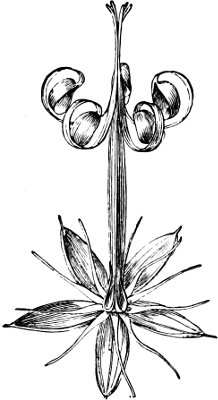
Fig. 434.—Geranium sanguineum. Fruit (3/1).
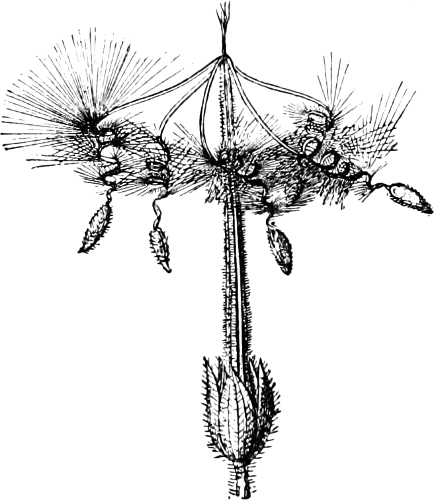
Fig. 435.—Pelargonium.
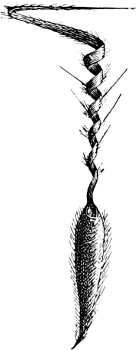
Fig. 436.—Erodium cicutarium, detached carpel.
Pollination. The large-flowered Geranium-species are protandrous, e.g. G. pratense (one whorl of stamens opens first, and then the other, and succeeding these the stigmas, after shedding the pollen the stamens bend outwards); the small-flowered are also adapted, with various modifications, for self-pollination.—470 species; moderately hot climates, especially S. Africa.—Several Pelargonium-species, with numerous varieties, are ornamental plants (from S. Africa).
Order 4. Tropæolaceæ. Herbaceous, juicy plants which have scattered, long-stalked, peltate leaves without stipules, and often climb by their sensitive petioles. The flowers are situated singly in the axils of the foliage-leaves on long stalks, and are zygomorphic, the receptacle under the posterior sepal being prolonged into a spur; there are also differences between the posterior and anterior petals, the 2 posterior petals situated on the border of the spur being perigynous, and the edge of the anterior petals adjoining the claw fringed. After the 5 sepals (which are more or less coloured) and the 5 petals, follow 8 stamens (as the 2 median ones are suppressed, one from each whorl) and a gynœceum formed of 3 carpels; in each of the 3 loculi of the 3-grooved ovary is 1 ovule. The fruit is a schizocarp and divides into 3 1-seeded, drupe-like fruitlets, which do not (as in the Geraniaceæ) leave any pronounced column between them. Endosperm is wanting. The cotyledons are thick and sometimes slightly coalescent. Tubers often occur.
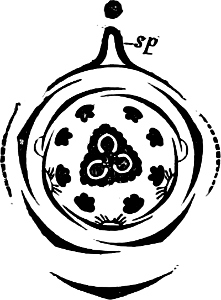
Fig. 437.—Diagram of Tropæolum: sp, spur.
Tropæolum.—About 40 species; all from America.
Pollination.—The spur is the receptacle for the nectar; the flowers are protandrous; the anthers open first, and one by one take up a position in front of the entrance to the spur, resuming their original position when the pollen is shed; the stigma finally takes their place after the filaments have bent backwards.—These plants have an acrid taste (hence the name “Nasturtium,” “Indian Cress”), on which account the flower-buds and young fruits of T. majus are used as capers. Some species are ornamental plants.
Order 5. Balsaminaceæ. Herbaceous, chiefly annual plants with juicy, brittle stems, so transparent that the vascular bundles may be distinctly seen. The leaves are simple, usually scattered, penninerved and dentate; stipules are wanting, but sometimes large glands are present in their place at the base of the petioles. The flowers are strongly zygomorphic; of their five 5-merous whorls the petal-stamens are suppressed (S5, P5, A5 + 0, G5); the sepals are coloured, the 2 anterior ones (Fig. 438 3, 5) are very small or entirely suppressed, the posterior one is very large and elongated into a spur, and the 2 lateral ones pushed forward; sometimes the weight of the spur turns the flower completely round, so that the posterior leaves assume an anterior position; apparently only 3 petals, since the lateral and the posterior petals become united in pairs, and the anterior is larger and differently shaped; the 5 stamens have very short and thick filaments united at the base, and their anthers finally adhere together and remain in this condition, covering over the gynœceum; the filaments ultimately rupture at the base, and the entire anthers are raised on the apex of the gynœceum as it grows up. The gynœceum has a sessile stigma and a 5-locular ovary. The fruit is a capsule which, on maturity, opens suddenly when irritated, dividing into valves from the base upwards, and as the 5 valves roll up elastically, the seeds are shot out on all sides to considerable distances; a central column persists (Fig. 439). The embryo is straight, and without endosperm.
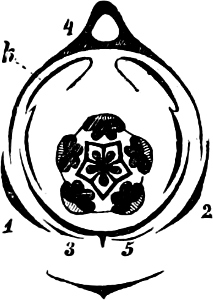
Fig. 438.—Diagram of Impatiens glanduligera.
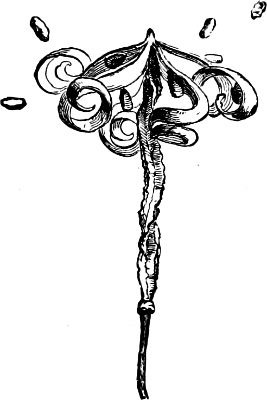
Fig. 439.—Fruit of Impatiens.
Impatiens; in Europe only I. noli-me-tangere. 225 species; especially from Asia. Several species have two kinds of flowers: small, cleistogamic, but fertile; and large, coloured flowers, which in I. balsamine (ornamental plant, E. Ind.) are protandrous and pollinated by hive-and humble-bees, as they suck the honey from the spur.
Order 6. Limnanthaceæ. The flowers are regular and differ from all the other orders in the family by having the carpels not in front of the petals, but in front of the sepals (which are valvate), and further, the loculi are nearly free individually, but with a common gynobasic style; the ovules are ascending and apotropous (anatropous with ventral raphe). The fruit is a schizocarp, with nut-like cocci.—Limnanthes (4 species; N. Am.) perhaps belongs to another family.
Order 7. Humiriaceæ. Trees and shrubs; about 20 species; Trop. Am.
Family 13. Columniferæ.
The chief characteristics of the orders belonging to this family are the ☿, regular, generally 5-merous, hypogynous flowers with 5-merous calyx, sepals united and valvate in the bud; petals 5, free (often twisted in the bud); stamens ∞ e.g.: 10, in two whorls, but one of these is more or less suppressed, often altogether wanting, or replaced by 5 staminodes, while the other (inner whorl) is generally divided more or less deeply into a large number of anther-bearing filaments. The filaments too (except Tiliaceæ) are united into a tube, which, especially in the Malvaceæ, forms a long column in the centre of the flower, surrounding the gynœceum (Figs. 445, 448); in this case, which is the most pronounced, the filaments are united into one bundle (monadelphous), in other instances, polyadelphous. The number of carpels varies greatly (2 to about 50), but they are nearly always united and form a syncarpous multilocular gynœceum.—The vegetative characters also closely agree, the leaves are always scattered and generally stipulate; all the green portions very often bear stellate hairs, and the bark in all the 3 orders is rich in tough bast. Mucilage is often present in cells or passages.—This family is connected with the Ternstrœmiaceæ, from which it is very hard to draw a sharp line of demarcation, and it is also allied to the Cistaceæ and to the Gruinales.
Order 1. Sterculiaceæ (including Buettneriaceæ). This is, no doubt, the least modified order, and one in which the stamens occur undivided. Obdiplostemonous. The 10 stamens in two whorls are most frequently united at the base into a short tube, and have 4-locular, extrorse anthers. The calyx-stamens are nearly always simple, tooth-like staminodes, situated on the edge of the tube, or are entirely suppressed. The same relation is found, for instance, in the Ampelidaceæ and Rhamnaceæ, namely 5 stamens in front of the 5 petals; not infrequently the 5 stamens are doubled (Fig. 441). Unisexual flowers are found in Sterculia, Cola, Heritiera. The corolla is often wanting, or developed in an unusual manner. Each loculus of the ovary (generally 5) always contains more than one ovule. Fruit a capsule. Androgynophore often present (Helicteres; Sterculia, etc.).
Hermannia, Mahernia, Melochia, etc., have flat petals with twisted æstivation; 5 undivided stamens, which usually are but slightly united at the base, and most frequently, without staminodes. Thomasia; Helicteres; Sterculia (free follicles).—Theobroma, Rulingia, Buettneria, Commersonia, Guazuma, etc., have petals concave at the base, and terminating in a limb abruptly bent back, and at the boundary between them most frequently ligular outgrowths, as in certain genera of the Caryophyllaceæ; stamens 5–15–∞, anthers at the edge of a short tube and 5 linear staminodes (Fig. 441).—The Cocoa-tree (Theobroma), (Fig. 440) bears large, reddish-yellow, berry-like fruits, resembling short cucumbers, but ultimately becoming leathery to woody; in each of the 5 loculi are 2 (apparently only 1) rows of horizontal, oily seeds, as large as almonds. Cotyledons large, thick, and irregularly folded. Endosperm absent (Fig. 442).
49 genera, with about 750 species; almost entirely confined to the Tropics; none in Europe or in N. Asia.—The seeds of the Cocoa-tree (T. cacao, bicolor, glaucum, etc., natives of Trop. Am., especially north of the Equator) are used for chocolate and are also officinal (“Cocoa-beans,” “Cocoa-butter,” “Oil of Theobroma”). Theobromine. Cola acuminata, Africa.
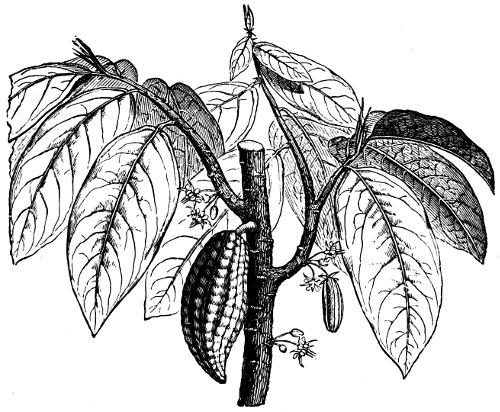
Fig. 440.—Theobroma cacao. Branch with flowers and fruits (⅙).
Figs. 441–442.—Theobroma cacao.
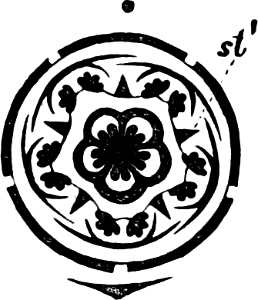
Fig. 441.—Diagram of the flower: st barren stamens.
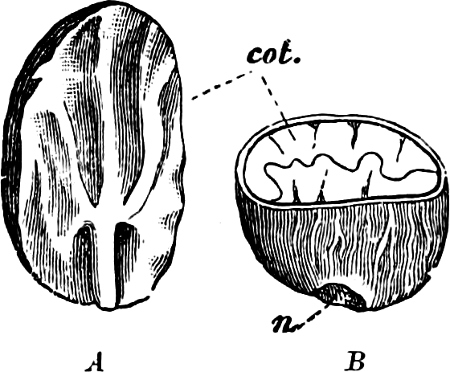
Fig. 442.—B Seed in transverse section: n hilum. A Embryo after the removal of one of the cotyledons.
Order 2. Tiliaceæ. This differs from the other orders of the Columniferæ chiefly in the stamens being entirely free from each other, and also divided into many filaments, as far as the base, or at all events very far down, so that the flower appears to have numerous stamens or to be slightly polyadelphous (Fig. 443); in addition to this, it may be observed that the anthers are 4-locular and introrse. In Luehea the groups of stamens alternate with the petals. In a few genera (Corchorus, Triumfetta) 10 free and single stamens are found in 2 whorls; but, in the majority, groups of free stamens in separate bundles. The stamens are more or less united in Apeiba, Luehea. Style simple. Ovary 2-locular. The ovules are pendulous; raphe turned inwards. The calyx readily falls off; the æstivation of the entirely free petals is slightly imbricate (not twisted).
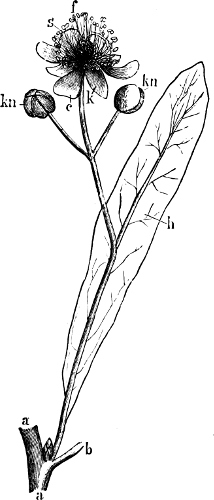
Fig. 443.—Inflorescence of Tilia, with its winged bracteole (h); a, a axis of the shoot; the vegetative bud is seen between the inflorescence and the axis of the shoot; b petiole of foliage-leaf.
Tilia (Figs. 443, 444). Calyx and corolla 5-merous; the 5 staminal leaves (opposite the petals) divided as far as the base into a large number of stamens which are free or united into groups; gynœceum with 5 loculi in the ovary (opposite the sepals); there are 2 ovules in each loculus, though the ovary ripens into a 1-seeded nut, which is not detached from the axis of the inflorescence, but is carried away by the wind, whirling round and round, its large-winged bracteole serving as a parachute (Fig. 443).—Only trees, with alternate, obliquely heart-shaped and dentate leaves; stellate hairs, as in the other Columniferæ, are often present. The terminal bud of the branch always fails to develop, and the growth is then continued sympodially by the uppermost axillary buds. The INFLORESCENCE (Figs. 443, 444) is a 3–7-flowered dichasium (Fig. 444 t, d, e), which is developed in the axil of a foliage-leaf (Fig. 444). The first of its 2 bracteoles (a) is large, thin, leaf-like, and united with the inflorescence, the lower portion of which forms a broad wing, its so-called “bract”; the second bracteole (b), on the other hand, remains scale-like, and supports a winter foliage-bud covered with bud-scales which thus is situated at the base of the inflorescence, and is a bud of the 2nd order, in relation to the vegetative shoot. This bud is always found beneath the inflorescence on the branch placed horizontally, and the winged bracteole is always found above it, a relation which is connected with the fact that the 2 rows of shoots on the sides of a branch are antidromous with regard to each other.—The dichasium itself (Fig. 444) terminates with the flower (t); it has 3 floral-leaves (c, d, e), which soon fall off; c is barren: the other two bear flowers, or few-flowered dichasia, or unipared scorpioid cymes (indicated in the figure).—The foliage-leaves are folded in the bud upon the median line (1, 2, 3 in Fig. 444 are foliage-leaves with their 2 stipules), the inner half is broader than the outer, and after unfolding is turned away from the mother-axis (the position of the new inflorescences and vegetative buds is indicated in their axils on the figure).—The cotyledons on germination appear above the ground as large, lobed leaves.
Of the other genera some have a bell-shaped, gamosepalous calyx, some have no corolla, the anthers of some open at the apex (Aristotelia, Elæocarpus, etc.), the majority have a capsule, some have berries, or drupes, some separate into fruitlets, etc.—Corchorus, Triumfetta (nut, with hooked bristles), Luehea, Apeiba, etc. Sparmannia is an African genus; 4-merous flowers; fruit a warted capsule; filaments numerous and sensitive to touch, the external ones are without anthers and moniliform above. The plant is covered with numerous soft and stellate hairs, and at the apex of the branches bears several cymose umbels.
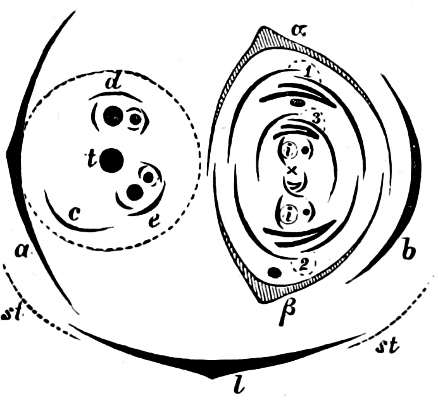
Fig. 444.—Diagram of the inflorescence of Tilia and the vegetative bud; the position of the leaves is indicated, and also the position of the inflorescences, which develop from their axils in the following year.
Pollination in Tilia is effected by insects, especially bees and Diptera, which swarm round the tree tops, allured by the numerous strongly-scented flowers and the easily accessible honey (formed in the hollow sepals). As the flowers are pendulous, the nectar is protected from ruin; and, in addition, the inflorescence is more or less concealed beneath the foliage-leaf. Self-pollination is impossible, on account of protandry.—About 470 species (nearly all trees and shrubs); especially in the Tropics, only a few being found in the temperate, none in the polar regions, or in high mountainous districts.—The inflorescence of the native species of Tilia is medicinal. The wood is used for charcoal.—The majority are used for timber, and for the sake of the bast (“Bast,” “Jute,” the bast of Corchorus textilis, Luehea, and others).
Order 3. Malvaceæ (Mallows). The plants are easily recognised by the scattered, simple, palminerved, most frequently lobed, stipulate leaves, folded in the bud; the perfect, regular, hypogynous flowers, with gamosepalous, persistent, 5-merous calyx with valvate æstivation; the 5 petals twisted in the bud and united with one another at the base, and by the 5 apparently numerous stamens (Figs. 445, 448), with the filaments united into a tube, with reniform bilocular anthers opening by a crescentic slit (in 2 valves). Carpels 3–∞ united into one gynœceum; the embryo is curved and the cotyledons are folded (Figs. 447, 451); endosperm scanty, often mucilaginous.—Most of the plants belonging to this order are herbs, often closely studded with stellate hairs. The leaves are most frequently palmatifid or palmatisect.
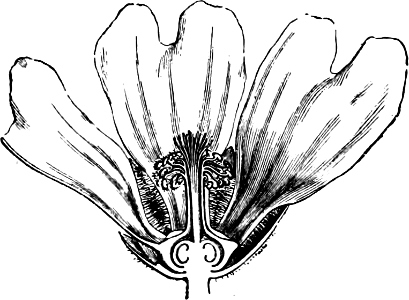
Fig. 445.—Longitudinal section through the flower of Malva silvestris.
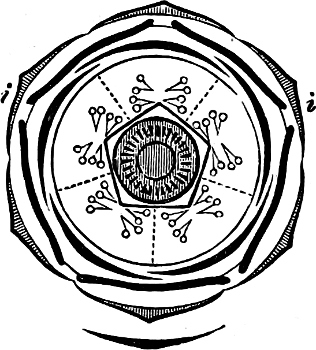
Fig. 446.—Diagram of Althæa rosea: i the epicalyx.
An epicalyx is often found formed by floral-leaves placed close beneath the calyx, in some 3, in others several. The median sepal is posterior in the species without epicalyx, often anterior in those which have an epicalyx.—The petals are twisted either to the right or to the left in accordance with the spiral of the calyx; they are most frequently oblique, as in the other plants with twisted corollas, so that the portion covered in the æstivation is the most developed. The corolla drops off as a whole, united with the staminal tube.—Only the 5 petal-stamens are developed, but they are divided into a number of stamens, placed in 2 rows, and provided only with half-anthers (leaf-segments, see Fig. 446; the sepal-stamens are completely suppressed); these 5 staminal leaves are then united into a tube, frequently 5-dentate at the top, and bearing the anthers on its external side. The pollen-grains are specially large, spherical and spiny. There are from 3 to about 50 carpels united into one gynœceum and placed round the summit of the axis which most frequently projects between them. There is only 1 style, which is generally divided into as many stigma-bearing branches as there are carpels (Figs. 445, 448). The fruit is a schizocarp or capsule. Endosperm (Figs. 447 A, 451) scanty, often mucilaginous round the embryo, which is rich in oil.
The order is the most advanced type of Columniferæ; it stands especially near to the Sterculiaceæ, but is separated from these and from the Tiliaceæ, among other characters, by its 2-locular (ultimately 1-chambered) anthers.
The sub-orders may be arranged as follows:—
I. Carpels in one whorl.
A. The fruit a capsule, most frequently with loculicidal dehiscence, and many seeds in each loculus.
1. Gossypieæ. The staminal-column is naked at the apex, blunted, or 5-dentate.—Gossypium (the Cotton plant) has an epicalyx of 3 large ovate-cordate leaves, an almost entire, low and compressed calyx. Solitary flowers. Large, most frequently yellow, corollas. A 3–5-valved capsule with many spherical seeds. “Cotton” is the seed-hairs developed upon the entire surface of the seeds (Fig. 447), and consists of long, 1-cellular hairs, filled with air (and therefore white); these are thin-walled, with a large lumen, and during drying twist spirally, and come together more or less in the form of bands. They consist of cellulose, and have a cuticle.—Hibiscus has several, most frequently narrow, epicalyx-leaves, a distinct 5-toothed or 5-partite calyx.—Abutilon; Modiola.
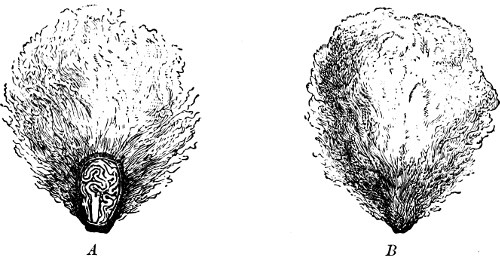
Fig. 447.—A Seed of Gossypium with hairs; B the same in longitudinal section.
2. Bombaceæ. The staminal tube is more or less deeply cleft into bundles, sometimes almost to the base; pollen smooth, style simple with capitate, lobed stigma. Almost all plants belonging to this group are trees, and in many instances have large barrel-shaped stems, that is, swollen in the centre, and sometimes covered with large warts. The wood is exceptionally light and soft. The flowers are often enormously large, and have beautiful petals; in some they unfold before the leaves. The capsule-wall is sometimes closely covered on its inner service with long, silky, woolly hairs, while the seeds themselves are generally without hairs. These hairs, however, on account of their brittle nature, cannot be used like those of the Cotton-plant. Digitate leaves are found in the Baobab-tree (Adansonia) from Africa, noted for its enormously thick, but short stem, and in the American Silk-cotton trees (Bombax, Eriodendron, Chorisia). Ochroma, Cheirostemon, Durio, and others also belong to this group. Durio is noted for its delicious fruits, which have a most unpleasant smell.
[Bombax malabaricum is diplostemonous; the five sepal-stamens repeatedly branch, and the filaments bear unilocular anthers; the five petal-stamens bear bilocular anthers.]
B. Schizocarps, with 1-seeded fruitlets, most frequently nut-like and reniform (Figs. 449, 451).
3. Malveæ, Mallow Group. The carpels are arranged in one whorl (Fig. 449); the number of stylar-branches equals that of the carpels; fruitlets 1-seeded, reniform, indehiscent, but detaching themselves from one another and from the persistent central column (Figs. 450, 451).—Malva has an epicalyx of 3 free leaves. A flower with 2 suppressed bracteoles is situated in the axil of the foliage-leaves; one of these supports a homodromous foliage-shoot which forms a repetition of the main axis, the other an antidromous flower which continues the branching as a unipared scorpioid cyme.—Althæa, Rose Mallow, has an epicalyx of 6–9 leaves united at the base.—Lavatera, Sida, Anoda, Bastardia, etc., have no epicalyx.
Figs. 448–451.—Malva silvestris.
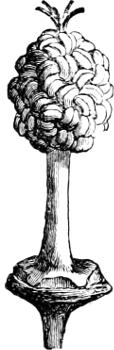
Fig. 448.—The flower after removal of the perianth (5/1).]
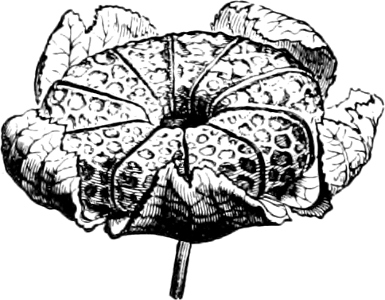
Fig. 449.—The fruit (5/1).
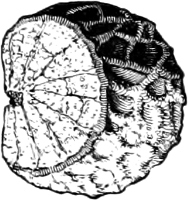
Fig. 450.—A fruitlet (5/1).
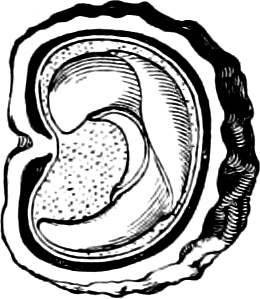
Fig. 451.—The same in longitudinal section.
4. Ureneæ, have always only 5 carpels arranged in 1 whorl, with 1 ovule in each loculus, and the fruit a schizocarp, generally with nut-like fruitlets provided with warts and hooks; but in some they dehisce by 2 valves (capsule). They differ principally from the other groups in having twice as many stylar-branches as carpels; the staminal tube is naked at the point, blunt or 5 toothed.—The genera Urena, Pavonia, Malachra, Malvaviscus (with berry-like fruits) belong to this group.
II. Carpels arranged in a spherical head in five groups opposite to the petals.
5. Malopeæ, differ from all the others in having a large number of fruitlets arranged irregularly in a round head, and separating considerably from each other even before maturity; there is, however, only 1 style, divided into a corresponding number of branches (this condition may be considered to have arisen from the branching [dédoublement] of 5 carpels). Malope has 3 large, heart-shaped (Kitaibelia 6–9) epicalyx-leaves, united at the base. Palava has no epicalyx.
Pollination. The majority have protandrous flowers, and are pollinated by insects. Between the basal portions of the 5 petals, there are 5 nectaries, protected from the rain by hairs, e.g. in Malva silvestris. When the flower first opens the numerous anthers occupy the centre of the flower, and the still undeveloped stigmas are concealed in the staminal tube; in the next stage the anthers are withered and empty, and the stigmas protrude and assume their places (Fig. 452). The large-flowered forms, it appears, are pollinated only by insects; but self-pollination takes place in small-flowered forms, as, for example, in Malva rotundifolia, in which the stylar-branches, twisting themselves, place the stigmas in between the undeveloped anthers.
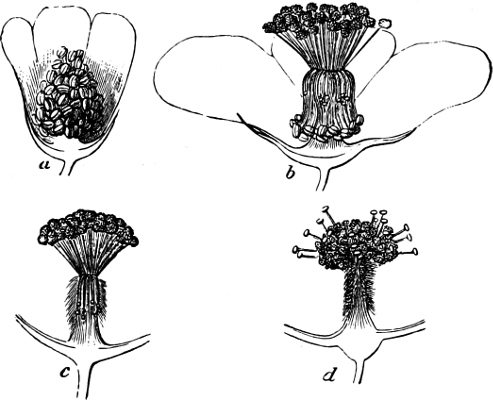
Fig. 452.—Anoda hastata: a the bud just opened, the stigmas are concealed by the anthers; b fully opened flower in ♂-stage; the upper stamens are developed first, and then the others in descending order; the stylar-branches are now visible, and lie bent back on the staminal column; c all the stamens project upwards, and all the anthers are open, but the stylar-branches are still bent back; d the anthers are emptied and the filaments shrunk together, but the styles have now straightened themselves upwards, and the stigmas are in the receptive condition.
Distribution. 800 species (63 genera), most of which are natives of the Tropics, especially America. Althæa and some of the species of Malva are natives of the temperate regions of the Old World, the latter is also found in North America. Gossypium is tropical, no doubt especially Asiatic (G. herbaceum from India; G. arboreum from Upper Egypt). Cotton was introduced into Greece in the time of Herodotus, and was cultivated in America before the arrival of the Europeans.
Uses. Pungent and poisonous properties are entirely wanting; mucilage, on the other hand, is found in abundance in all parts of the plant. Medicinal: the root of Althæa officinalis, leaves and flowers of Malva-species (M. silvestris vulgaris and borealis) and Gossypium.—The seeds contain a large quantity of fatty oil, which is in some cases extracted (Cotton-seeds and others). The seed-hairs of the Cotton plant are the most important product of the order. The cultivated forms of Cotton belong to several species: G. barbadense, herbaceum, religiosum, arboreum (Nankin), hirsutum, and others. According to other botanists, there are only 3 species. Bast is obtained from e.g. Hibiscus cannabinus (Gambo-hemp, Africa), Paritium tiliaceum and Sida retusa. The fruits of certain species of Hibiscus (e.g. H. esculentus, from Tropical Africa) are used in tropical countries as a vegetable before they are ripe.—The colouring matter in the flowers of Althæa rosea, var. nigra, is used for colouring wines, and hence is extensively cultivated in certain parts of Europe.—Ethereal oils and sweet-scented flowers are rare; but several species possess a peculiar musk-like odour (Malva moschata, Hibiscus abelmoschus, and others).—Many are cultivated as ornamental plants on account of the large flowers, e.g. Hollyhock (A. rosea, etc.), Lavatera trimestris, Malope grandiflora and trifida, Malva-species, Hibiscus rosa sinensis, syriaca; Sphæralcea, etc.
Family 14. Tricoccæ.
The very large order Euphorbiaceæ and three smaller ones belong to this family. They have in common: unisexual, hypogynous, frequently regular flowers, the perianth most frequently single, rarely double, or entirely wanting; there is such a great variety in the structure and parts of the flower that one only can be cited as the rule: viz. the simple gynœceum composed of 3 carpels forming a 3-locular ovary, which is frequently more or less deeply grooved (hence the name, Tricoccæ); in the inner angles of the loculi are found 1 or 2 (never several) pendulous (except Empetraceæ), anatropous ovules, with upward and outwardly turned, frequently swollen, micropyle (Fig. 455). The seed most frequently has a large endosperm and a straight embryo (Figs. 455 B, 464).—The family approaches the nearest to the Gruinales and Columniferæ; it may perhaps be regarded as an offshoot from the Sterculiaceæ.
Order 1. Euphorbiaceæ. Flowers unisexual. In each of the loculi of the ovary, generally 3, there are 1 or 2 pendulous ovules with upward and outwardly turned micropyle. The placenta protrudes above the ovules (Figs. 454, 461 B). On the ripening of the capsule the 3 carpels separate septicidally, frequently with great violence, ejecting the seeds and leaving a central column. Endosperm copious.—For the rest, the flowers present all stages, from genera with calyx and corolla, to those which are the most reduced in Nature, namely the naked, 1-stamened flowers of Euphorbia.
The same variety which is found in the flower is also present in the vegetative parts. Some are herbs, as our Spurges, others are shrubs and trees; some African Euphorbia-species even resemble the habit of a Cactus. Leaf-like branches with rudimentary leaves are found in Phyllanthus (sub-genus Xylophylla) (Fig. 456). The leaves are scattered or opposite, often stipulate; they are nearly always simple. Large, highly-branched cells containing a great quantity of pungent latex are found in many, and watery juice in others. Glands and glandular hairs are general.—Only a few genera can be considered in this book.
As an example of the most perfect flowers (which partly reproduce the Geraniaceous type) may be mentioned, Croton, Manihot, and Jatropha; 5 sepals, 5 petals, sometimes gamopetalous, andrœcium diplostemonous, or many-stamened, often monodelphous.
Figs. 453–455.—Ricinus communis.
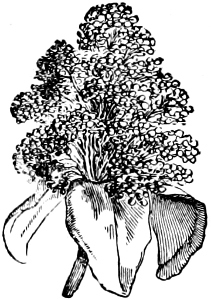
Fig. 453.—♂-flower (magnified).
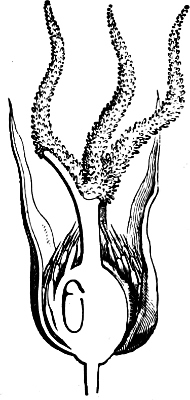
Fig. 454.—♀-flower in longitudinal section.
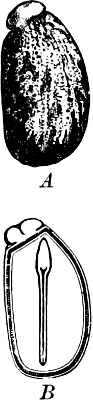
Fig. 455.—A seed entire; B in longitudinal section.
Ricinus (Castor-oil) (Figs. 453–455); monœcious; the ♂-flowers, situated in the lower portion of the inflorescence, have 5 perianth-leaves and a large number of branched stamens; the ♀-flower has 3–5 perianth-leaves; 3 bifid styles. Leaves peltate, palmately lobed. The seeds (Fig. 455) contain an abundance of fatty oil and large aleurone grains.—Mercurialis (Mercury): the perianth is most frequently 3-merous; in the ♂-flowers 9–12 stamens; in the ♀-flowers most frequently a 2-locular gynœceum.—Phyllanthus: Pr3 + 3, A3, united in some and forming a column in the centre of the flower (Figs. 457, 458); Xylophylla is a section of this genus.— Hura crepitans (Sand-box tree) has a many-carpellate gynœceum, which separates with great violence when ripe.—A drupe is found in Hippomane mancinella (the Mancinil-tree, W. Ind.)—Alchornea (Coelebogyne) ilicifolia is well known on account of its “parthenogenesis”; only the ♀-plant has been introduced into Europe, but it nevertheless produces seeds capable of germination; these have generally several embryos.
Figs. 456–458.—Phyllanthus (Xylophylla) angustifolius.
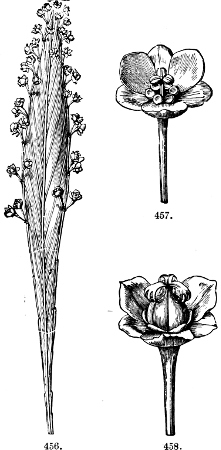
Fig. 456.—Leaf-like branch with flowers (nat. size).
Fig. 457.—♂-flower; and
Fig. 458, ♀-flower (mag.).
Euphorbia (Spurge) has the most reduced flowers, which are borne in a very complicated inflorescence. Each ♂-flower (Fig. 460 B) is naked, and consists of one stamen only (terminal on the axis). In the closely allied genus Anthostema, a small perianth is situated at the place where, in Euphorbia, there is a joint in the “filament,” (Fig. 461 A). The ♀-flowers (Fig. 460) are naked, with a 3-locular ovary and 3 bifid styles. (Anthostema has a distinct perianth (Fig. 461 B); in a few Euphorbias traces of a perianth are present). In Euphorbia the ♂-and ♀-flowers are grouped into flower-like inflorescences termed “cyathia.” Each cyathium consists of a centrally placed ♀-flower which is first developed, surrounded by 5 groups of ♂-flowers (stamens) placed in a zig-zag, with a centrifugal order of development (Figs. 459, 460 B), that is, in unipared scorpioid cymes; these flowers are surrounded by an involucre of 5 leaves united into a bell-shaped structure (Fig. 459, 1–5) (resembling a calyx); on its edge are placed 4, generally crescent-like, yellow glands, one in each of the intervals, except one, between the lobes of the involucre (shaded in Fig. 459; see also Fig. 460 A). Scale-like thin structures (floral-leaves?) are situated between the ♂-flowers. The ♀-flower has a long stalk, and finally bends down on one side, namely to the place on the edge of the involucre where the gland is not developed. These cyathia are again arranged in an inflorescence which commences as a 3–5-rayed umbellate cyme (pleiochasium), the branches of which ramify dichasially and finally as scorpioid cymes.—Latex, with peculiar-shaped starch-grains, is found in laticiferous cells (especially in the Cactus-like, leafless species.)
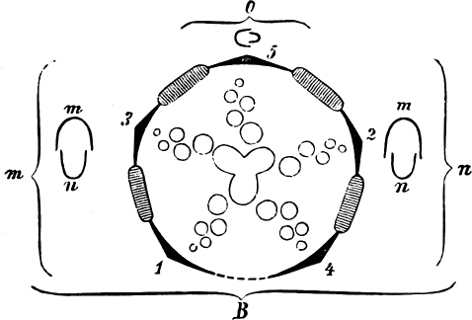
Fig. 459.—Diagram of an inflorescence (cyathium) of Euphorbia with 3 floral-leaves, m, n, o, supporting other cyathia which are subtended by 2 floral-leaves (bracteoles; m, n). 1–5, the involucral leaves in their order of development; the shaded portions are the crescentic glands.
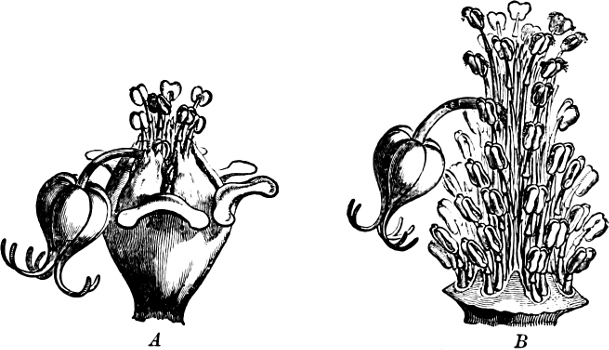
Fig. 460.—Euphorbia lathyris: A an (entire) inflorescence (cyathium); B the same after the removal of the involucre.
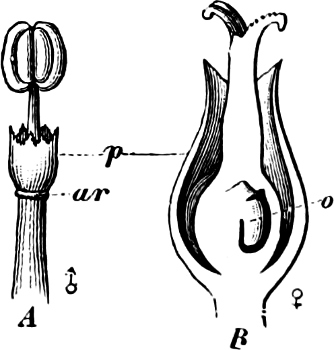
Fig. 461.—Anthostema: ♂- (A) and ♀-(B) flowers; p the perianth; ar the node; o the ovule.
205 genera; more than 3,000 species; especially in the Tropics.—Many are used on account of the oil, and of the pungent (aperient, poisonous, anthelmintic, etc.) properties in the latex or the seeds. Officinal: “Cascarilla-bark” of Croton eluteria; the fatty oil of the seeds of Croton tiglium (Trop. Asia); “Castor oil” from Ricinus communis (Africa, and cultivated in all warm climates throughout the world); the glandular hairs of Mallotus philippinensis (“Kamala”); this also yields a red dye. Gum “Euphorbium” is the hardened (resinous) latex of the Cactus-like Euphorbia resinifera (Morocco).—Nutritive plants: Manihot utilissima and other species (Maniok, Am.). Their large, farinaceous roots form a very important article of food in the Tropics (Cassava-flour, Tapioca or Brazilian arrowroot). The fresh latex of the root in some species is a powerful poison; but the poisonous properties are diminished by roasting or cooking. Caoutchouc is obtained from Siphonia elastica (Trop. S. Am.). The vegetable tallow of the Chinese tallow-tree (Stillingia sebifera) is used in large quantities in soap factories. An indigo-like dye is obtained from Crozophora tinctoria, and is also found in Mercurialis perennis. Shellac is obtained from Aleurites laccifera. Ornamental plants: Acalypha, Croton, Dalechampia.—Hippomane is poisonous.
Order 2. Buxaceæ. This order differs from the Euphorbiaceæ in having the micropyle turned inwards; the ♂-flower has a 4-partite perianth and 4 stamens; the ♀-flower a 6-partite perianth and 3 carpels. Capsule with loculicidal dehiscence, the inner layer being detached elastically from the outer.—30 species. Shrubs without latex and with evergreen leaves.—Buxus sempervirens (Box) is an ornamental shrub (poisonous); it has a very hard and valuable wood which is used for wood-engraving and carving.
Figs. 462–464. Callitriche stagnalis.
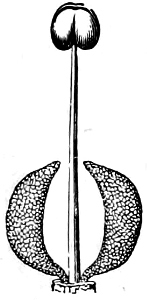
Fig. 462.—♂-flower with the 2 bracteoles and the solitary stamen.
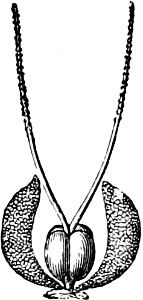
Fig. 463.—♀-flower.
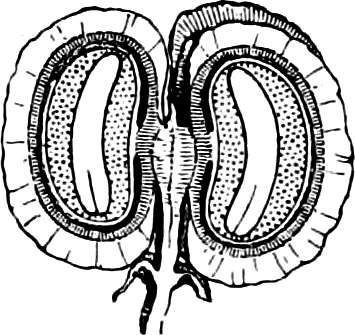
Fig. 464.—Longitudinal section of the ripe fruit.
Order 3. Callitrichaceæ. Aquatic plants, growing at the bottom of shallow water, with opposite, simple, undivided, entire, exstipulate leaves, which are generally crowded and form a rosette in the apex of the branches. The flowers are unisexual (monœcious) and borne singly in the leaf-axils; they have no perianth, but are provided with two delicate bracteoles; the ♂-flowers consist of only 1 terminal stamen (Fig. 462); the ♀-flowers of a bicarpellate gynœceum (Fig. 463) which is originally 2-locular, but later on becomes 4-locular, as in the case of the gynœceum of the Labiatæ, by the formation of a false partition-wall; in each loculus there is 1 pendulous ovule with the micropyle turned outwards. Fruit a 4-partite schizocarp (Fig. 464). 25 species.—Callitriche.
Order 4 (?). Empetraceæ. 4 species. Empetrum; E. nigrum (Crowberry) is a heather-like, moorland, evergreen undershrub with linear leaves, having a deep groove closed with hairs, on the under side. The erect ovules show the greatest deviation from the Euphorbiaceæ. Diœcious (and ☿); S3, P3; in the ♂-flower, 3 stamens; in the ♀-flower, a 6–9-locular ovary. Fruit a drupe.
Family 15. Terebinthinæ.
The diagram of the flower (Figs. 465–467) is the same as in the Gruinales, namely S, P, A2 and G in whorls of 5 (less frequently 3, 4, 6, 8), and the same modifications also occur with the suppression of the petal-stamens, etc. But a ring or sometimes cup-like glandular structure (disc) is found between the andrœcium and the gynœceum (Figs. 465, 466). The flowers similarly are regular, hypogynous, ☿ and polypetalous, though exceptions are found to all these characters: thus, for example, united sepals and petals frequently occur, and, in some orders, unisexual flowers by the suppression of one sex. In most cases the flowers are small, greenish-yellow, and arranged in paniculate inflorescences. The carpels (most frequently 5) are free in a few, but generally united into a multilocular gynœceum; rarely more than 1 or 2 ovules in each loculus. The gynœceum in the Anacardiaceæ is so reduced that it has only 1 fertile loculus with 1 ovule.—The ovules are epitropous, i.e. anatropous with outward-turned raphe (except the Anacardiaceæ).—The majority of the species are trees and shrubs with scattered, often compound (pinnate) leaves without stipules, and as in addition they frequently contain aromatic, especially turpentine-like substances, they assume a certain resemblance to the Walnut trees, and were formerly classed with them mainly on this account. In a series of genera the volatile, scented oils are found in special glands in the bark of the branches and in the leaves, in the latter case appearing as pellucid dots. This family includes several orders which are somewhat difficult to distinguish from each other.
Order 1. Connaraceæ. This order forms the connecting link between Terebinthinæ and Rosifloræ (Spiræa) as well as Leguminosæ, with which they are sometimes classed. The flowers have 5 5-merous whorls; 2 ovules in each loculus; micropyle turned upwards. Fruit a follicle, rarely a collection of follicles. Seed with aril. Shrubs with scattered (most frequently pinnate) leaves, without stipules. 170 species. Tropical.
Order 2. Meliaceæ. Trees and shrubs with scattered, often pinnate leaves without pellucid dots and exstipulate; the leaflets are nearly always entire. Flowers small in paniculate inflorescences. Calyx and corolla 4–5-merous; 2 whorls of stamens; 3–5 carpels in the gynœceum. A very characteristic feature is the union of the filaments into a tube, on the edge of which stipule-like teeth are often found. There are most frequently 2 ovules in the loculi; fruit a capsule with many winged seeds in Swietenia (Mahogany tree; Trop. Am.), Cedrela, etc.; berries in others. The wood of Cedrela is used for making cigar boxes. 550 species; tropical.
Order 3. Rutaceæ. Leaves glandular with pellucid dots. The type is the same as that of the family. Flowers 4–5-merous. The ovary is most frequently 4–5-grooved. Disc well pronounced, often appearing as a “gynophore.” The majority are shrubs with alternate or opposite, compound, more rarely simple, leaves.
A. The ovary is deeply 2–5-cleft with basal styles which are more or less united; the carpels in some genera are entirely free (groups 1, 2). The fruit is capsular and most frequently dehisces like follicles along the ventral suture or septicidally, so that a horn-like internal layer (endocarp) separates elastically from the external layer.
1. Zanthoxyleæ. Zanthoxylum; Choisya; Evodia.
2. Boronieæ. Australia.—Correa.
3. Diosmeæ. Heather-like shrubs; Africa.—Diosma, Coleonema, Empleurum and Barosma. Officinal: Barosma crenulata and betulina, “broad Buchu leaves” (B. serratifolia and Empleurum serrulatum, “narrow Buchu-leaves”).
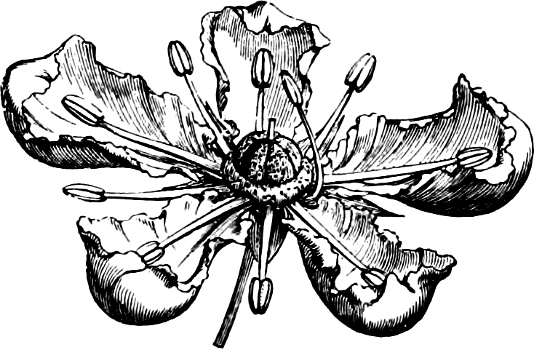
Fig. 465.—Ruta. Flower (mag.).
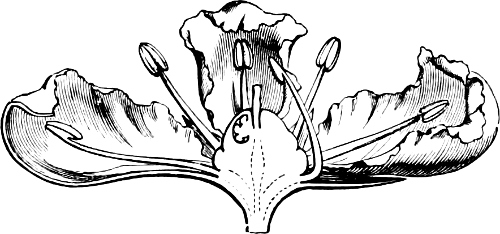
Fig. 466.—Ruta. Longitudinal section of flower.
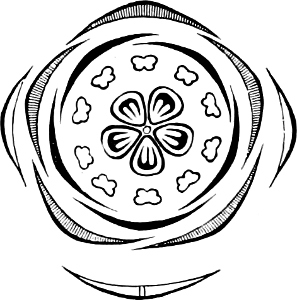
Fig. 467.—Ruta. Floral diagram.
4. Ruteæ. Ruta (Figs. 465–467) graveolens is an herbaceous, glaucous, strongly smelling plant with bipinnate leaves and yellow flowers; the terminal flower is 5-merous, the others 4-merous (S. Eur.).—Dictamnus; zygomorphic flower. The individual carpels of the fruit separate from each other, and dehisce like follicles, upon which the internal layer is detached elastically and springs out, carrying the seeds with it. Several species are ornamental plants.
5. Cusparieæ. American. Flowers often zygomorphic with gamopetalous corolla; stamens 5.—Ticorea; Galipea (G. officinalis; S. Am.; “Cortex angosturæ”); Cusparia; Almeidea.
B. The ovary is entire or only slightly grooved; the style is terminal, undivided. The fruit is most frequently a drupe or berry.
6. Toddalieæ. Ptelea; winged fruit. The buds are enclosed in the leaf-sheath. Skimmia; Phellodendron.
Figs. 468–470.—Citrus vulgaris.
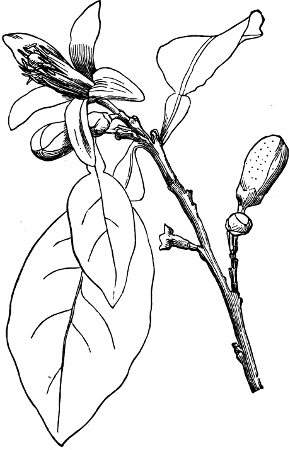
Fig. 468.—Branch with compound leaves.
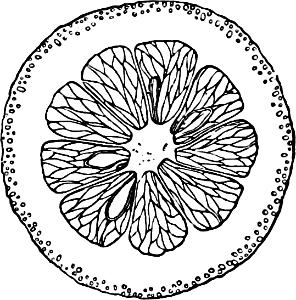
Fig. 469.—Transverse section of fruit.
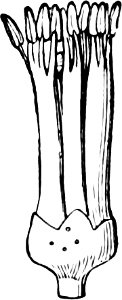
Fig. 470.—Flowers (after the removal of the petals).
7. Aurantieæ, Orange Group. Fruit a berry with a leathery external layer.—The most typical flower is found for example in Limonia: S5, P5, A5 + 5, G5 (2–5).—Citrus has 4–5–8-merous flowers, a gamosepalous, dentate calyx, free petals, one whorl of stamens which are split irregularly into several bundles (Fig. 470). The fruit is a multilocular berry provided with a thick, tough, outer layer. The juicy pulp, which fills up the loculi and envelopes the seeds, is formed from many large-celled, juicy hair-structures which arise on the inner side of the walls of the loculi and by degrees entirely fill them up; the dissepiments remain thin, and form the partitions so easily separating from each other (Fig. 469). The seeds in many instances are remarkable for containing several embryos. The blade of the leaf is separated from the frequently winged stalk by a node (and hence is a compound leaf with only the terminal leaflet developed?) (Fig. 468); in other genera, as Triphasia, there is a fully developed trifoliate leaf. Thorns are frequently developed.—The species of this genus, which is a native of the warmer parts of S. E. Asia, are very hard to separate. The differences are found in the forms of the fruit, the leaves and the leaf-stalks, and in the number of stamens. Citrus medica, “Cedrat” (Ind.); C. limonum, “Citron,” “Lemon” (introduced into Italy in the 3rd to 4th century). Officinal: the fruits and essential oil of Lemon. C. aurantium from E. Asia, the Orange (introduced into Italy in the 14th century). C. vulgaris (Fig. 468), Bitter Orange (introduced into Europe at the time of the Crusades); the unripe Bitter Oranges, and peel of the Bitter Orange is officinal; it is from the flowers of this species especially that the essence of Neroli is made. C. limetta, C. bergamia, Bergamot; essence of Bergamot is officinal. C. decumana, Pomalo, a native of the Islands of the Pacific. About 780 species; chiefly tropical.
Order 4. Burseraceæ. Fruit a drupe; 1–5 stones. The bark, as well as the other parts, contain strong aromatic resins and balsams, and hence several species are used: the Myrrh tree, Commiphora (Balsamodendron) from Arabia and Africa; Officinal: Myrrha (Commiphora myrrha). Mecca-balsam from C. opobalsamum, Arabia; E. Africa. The Incense-tree (Boswellia) from the same parts of the globe and E. India. The incense of B. carteri is medicinal (Frankincense). The resin (Elemi) of Protium-species is officinal, and is used technically for varnish (S. Am.). Takamahaka-resin from Elaphrium (S. Am.) Protium (Icica); Amyris (1 carpel). 270 species; tropical.
Order 5. Zygophyllaceæ. The majority have opposite, pinnate leaves with stipules. Leaves without pellucid dots. The filaments have a scale on the inner side. The most important is Guaiacum officinale (West India), the wood (Lignum Vitæ) of which is very hard and heavy, this wood and Gum-guaiacum are officinal. Others have a peculiar repulsive smell and taste: the Creosote shrub (Larrea mexicana) and Zygophyllum simplex. Tribulus terrester is a common weed in S. Europe. Fagonia. Peganum harmala (South of Russia) yields a red dye.—110 species; especially in the Tropics; several species in sandy deserts. Nitraria.
Order 6. Simarubaceæ. This order is distinguished by the abundance of bitter substances which it contains (Quassine) especially in the bark and the wood. The wood of Quassia amara (Guiana, Antilles) is officinal; Picraena excelsa yields Jamaica Quassia; the bark of Simaruba, Simaba-species and others is used. Ailanthus glandulosa is a garden plant (pinnate leaves, winged fruit).—110 species. Tropical.
Order 7. Ochnaceæ. Flowers diplostemonous, 5-merous. The unilocular ovaries, which are individually free, project considerably into the air around the gynobasic style; 1 ovule in each loculus; the fruitlets are drupes. Shrubs; leaves alternate, with stipules. Ochna; Ouratea.—160 species; tropical; especially American.
Order 8. Anacardiaceæ. The ovary rarely contains more than 1 ovule, even though there be several loculi and several carpels; in Anacardium all the 10 stamens except one become suppressed. Resin passages.—Anacardium. The most peculiar feature is the development of the flower-stalk into a fleshy body about the form and size of a pear (A. occidentale from Trop. Am. and A. orientale from E. Ind.) which bears the kidney-shaped nut (the so-called “Cashew-nut”) on its apex. Mangifera indica (the Mango-tree, from E. Ind.) is cultivated in several tropical countries on account of its delicious drupe. Similarly, species of Spondias (S. dulcis, Pacific Islands, S. lutea). Several species of Rhus are ornamental shrubs in this country, for instance, R. typhina (N. Am.), R. cotinus (the Wig-tree, the barren flower-stalks of the panicles being feather-like and hairy); R. toxicodendron (Poisonous Sumach, from N. Am.) is poisonous. Chinese galls are produced by the sting of a leaf-louse (Aphis chinensis) on R. semialata (China), and Japanese wax is from the seeds of R. succedanea (Japan). Considerable quantities of Sumach (R. coriaria) are used in tanning and as a black dye. Officinal: the mastic resin of Pistacia lentiscus (the Mastic-tree, from the Mediterranean). The fruits of Pistacia vera (Syria) are edible; P. terebinthus and others yield turpentine.—450 species; tropical.
Order 9. Icacinaceæ. Flowers 4–5-merous; haplostemonous; receptacle convex or cup-like surrounding the gynœceum; in the (single) loculus of the ovary, 2 anatropous, pendulous ovules.—200 species; tropical.
Family 16. Aesculinæ.
The essential characters of this family are in the main the same as those of the Terebinthinæ and Gruinales. The flowers are hypogynous, perfect, with free petals, 5-merous (S5, P5, typically A5 + 5, all of which, however, are not generally developed; in our native orders there are only 7–8 stamens), and most frequently a 3-merous, 3-locular gynœceum (less frequently 2 or 5 carpels with as many loculi). In each loculus there are usually only 1–2 ovules. A deviation from the preceding families is the frequent zygomorphy of the flower, with, as a rule an oblique plane of symmetry (Fig. 471). When a disc is developed it is placed outside the stamens. The majority have no endosperm (Fig. 473).—The members of the family are nearly all trees.
The family is closely allied to the Terebinthinæ, but unlike this it never has aromatic properties, and differs also in the position of the nectary, in the flowers, which are often irregular with a reduction in the number of stamens, and in the ovule which is usually ascending with micropyle pointing downwards (the Terebinthinæ having the micropyle turned upwards), etc. It is also related to Frangulinæ, the Staphyleaceæ being the chief connecting link; but the Æsculinæ generally have compound leaves.
Order 1. Staphyleaceæ. Leaves opposite, often compound. Flowers regular, ☿, 5-merous in calyx and corolla, 5-stamened. The stamens are placed outside the nectary. Ovary syncarpous or 2–3-partite with free styles. The capsule is thin, bladder-like, 2–3-locular, opening at the apex, and has several very hard seeds with a shining testa without aril. Endosperm. Staphylea pinnata (S. Europe) and trifoliata (N. Am.) are cultivated in gardens; they have white flowers in pendulous, axillary racemes or panicles.—16 species.—Staphylea is found in the Tertiary of N. America.
Order 2. Melianthaceæ. Glaucous shrubs with scattered, pinnate leaves, and large stipules. Melianthus.—8 species; S. Africa.
Order 3. Sapindaceæ. Trees or shrubs, often climbing by tendrils (lianes with anomalous structure of the stem) and with compound leaves. The flowers, in most cases, are small, insignificant, and without scent, and in some polygamous and zygomorphic. S4–5, P4–5, A8 (less frequently 5–10) inside the nectary (disc); ovary generally 3-locular, with 1–2 ovules in each loculus (raphe ventral, micropyle turned downwards). Seed without endosperm, often with an aril. The embryo is often thick and curved (Fig. 473).
Figs. 471–473.—Æsculus hippocastanum.
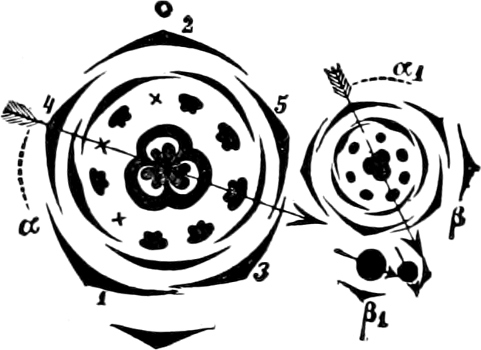
Fig. 471.—Diagram of the flower and of a scorpioid cyme.
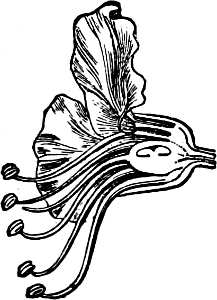
Fig. 472.—Flower in longitudinal section.
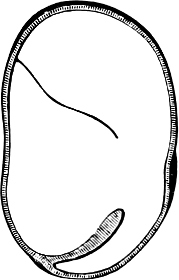
Fig. 473.—Seed in longitudinal section.
Æsculus (Horse-Chestnut). Trees with opposite, digitate, dentate leaves without stipules; the inflorescence is composed of unipared scorpioid cymes arranged in a pyramidal panicle (termed a thyrsus). The flowers are irregular, with an oblique plane of symmetry (through the 4th sepal, Fig. 471); there are 5 sepals, 5 free petals, of which the one lying between S3 and S5 is the smallest (see Fig. 471) and may be absent; stamens 7 (5 + 2), three being suppressed; gynœceum simple, 3-carpellary and 3-locular, with single style; of the two ovules one is ascending, the other descending (Fig. 472).—The fruit is a 3-valvate, sometimes spiny, capsule, with loculicidal dehiscence, the seed having a large hilum, a curved embryo without endosperm and united cotyledons (the radicle lies in a fold of the testa, Fig. 473). Æ. hippocastanum (Greece, Asia), introduced into cultivation about 300 years ago; the majority of the other species, e.g. Æ. pavia, etc., several of which are frequently cultivated in gardens, are from N. America. The flower of the Horse-Chestnut is adapted for bees, whose abdomen touches the anthers or style when visiting the flower. The flowers are protogynous.
The other Sapindaceæ have most frequently 4 sepals, 8 stamens, various fruits (septicidal capsule, nuts with or without wings, schizocarp), etc. Serjania, Cardiospermum, Sapindus, Koelreuteria, etc. (about 118 genera, 970 species). The seeds of Paullinia sorbilis contain caffeine, and are used as “Pasta guaranà,” in the North Western Brazils in the manufacture of a common drink. Nephelium (or Euphoria) litchi (with edible aril), and other species, from Asia.
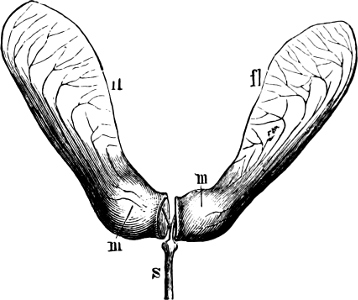
Fig. 474.—Samara of Acer platanoides.
Order 4. Aceraceæ. This order is so closely allied to the Sapindaceæ, that some authorities have classed it with them. The main difference is in the regularity of the flowers, and the 2-merous gynœceum (in abnormal cases several carpels occur).—They are trees, and, like the Horse-Chestnuts, have opposite leaves without stipules; in Acer the leaves are palminerved, but imparipinnate in Negundo, a plant frequently cultivated in gardens. The flowers are often unisexual, polygamous (some species have ☿-, ♂-and ♀-flowers); sepals 5, petals 5 free, stamens 8 (that is, 5 + 5, but the two median ones are absent) inside a large disc. Fruit a samara (schizocarp) with 2 winged, nut-like fruitlets (Fig. 474). In each of the 2 loculi of the ovary are 2 ovules. Embryo curved, with thin, folded cotyledons. Endosperm absent.—The inflorescences are racemes with a more or less elongated main axis and terminal flower (which sometimes has 10 stamens); when the lateral branches are developed they are similar to the main axis. In some species both corolla and petal-stamens are suppressed. Acer is pollinated by insects, Negundo by the wind.—88 species; North Temperate zone. Acer in the Tertiary from the Oligocene. The following are native plants: Maple (Acer campestre), Sycamore (A. pseudoplatanus, doubtful native). Important as avenue trees and timber. Sugar is obtained from the spring sap of the Sugar Maple (N. Am.).
Order 5. Malpighiaceæ. A tropical (especially American) order closely related to the Aceraceæ, having often the same form of fruit (but 3-partite). Some species are lianes with anomalous stem-structure. Leaves opposite. The flowers are regular or obliquely zygomorphic (the plane of symmetry passing through sepal 3), with S5, P5, A5 + 5, G3; 1 pendulous ovule in each loculus. Important characteristics for identification are the numerous grandular structures on the sepals. Peculiar 2-spined hairs are found in some. Malpighia, Bunchosia, Galphimia, Tetrapterys, Heteropterys, etc.—About 600 species.
Order 6. Erythroxylaceæ. Sepals 5, petals 5 (with a ligular corona), 10 stamens in one bundle. Gynœceum 3-locular. Fruit a drupe. Tropical (especially American) trees and shrubs, the Coca-plant (Erythroxylon coca) being best known. Its leaves are considered by the inhabitants of Chile and Peru to be one of the indispensable necessaries of life; they are chewed, and possess intoxicating, exhilarating properties, and contain the alkaloid cocaine, which is frequently employed as a local anæsthetic.—103 species; chiefly in America.
Order 7. Vochysiaceæ. Trees; Trop. Am. 1 stamen.—140 species.
Order 8. Trigoniaceæ. Shrubs; Trop. Am.—30 species.
Order 9. Tremandraceæ. Polygalaceæ with regular flowers.—27 species. Australia.
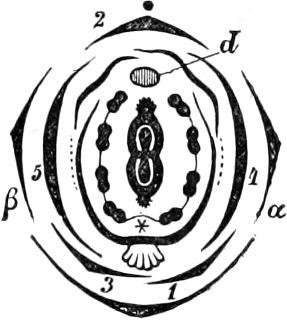
Fig. 475.—Diagram of Polygala: d a gland in the posterior side of the flower; α and β the two caducous bracteoles.
Order 10. Polygalaceæ. Herbs or shrubs (some tropical species are lianes) with scattered (rarely opposite), simple and most frequently quite entire leaves, without stipules. The flowers are usually borne in terminal spikes or racemes, and are strongly zygomorphic (the plane of symmetry being median); they have 5 free sepals, the 2 lateral ones of which (4 and 5 in Figs. 475, 476) are very large, petaloid, and frequently project on each side like the “wings” of a Pea-flower; petals 5, of which the two lateral ones are wanting or rudimentary (dotted on Fig. 475), and the anterior “the keel” (Fig. 476 c) is large, hollow and boat-shaped, and frequently with a lobed or fimbriated edge (Fig. 476 A and B, c); stamens 8, the two median ones being absent, all united into a tube split along the back, which is also slightly united to the keel (the anthers, often 2 locular, open by pores, Fig. 476 B, st); the 2 median carpels form a bilocular ovary. 1 pendulous ovule in each loculus (Figs. 476 C, 475); capsule compressed with loculicidal dehiscence, rarely a nut. Polygala (Milk-wort).
470 species; distributed over the whole globe (none Arctic). Officinal: the root of P. senega, from N. Am. Some are used as ornamental plants.
Pollination. The flowers of Polygala are pollinated by insects (chiefly bees). The fimbriated processes of the anterior petal support the insect when it alights. The anthers lie on each side of the stigma in the pouch of the anterior petal; the apex of the style is spoon-shaped, and immediately behind it is a viscid stigmatic lobe. In reaching the honey the proboscis of the insect must come in contact with the pollen and the viscid stigma, by which it is rendered sticky; this ensures the pollen adhering to the proboscis and so being carried to other flowers.
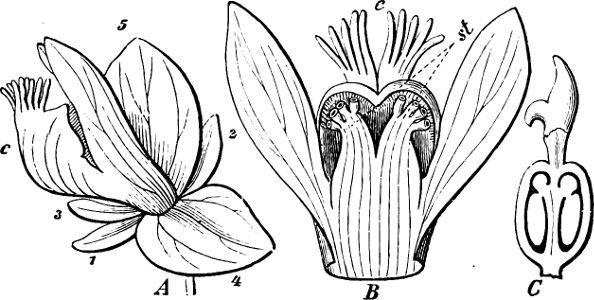
Fig. 476.—Polygala amara. Parts of the flower (mag.) A Flower from side, 1-5 sepals: c keel; B flower from above spread out: st the 8 stamens; c fimbriated edge of “keel”; C ovary with style and stigma.
Family 17. Frangulinæ.
The plants belonging to this family, with very few exceptions, are trees or shrubs. The leaves are usually simple; stipules may be absent or present. The flowers in almost all the orders are small, green or whitish; they are always regular, 4-or 5-merous with 2–5 carpels, but never have more than 1 whorl of stamens, which in Rhamnaceæ and Ampelidaceæ are placed opposite the petals (typically 5 + 5 or 4 + 4 stamens, of which however either the external or internal whorl is always wanting); hypogynous or slightly perigynous, in Rhamnaceæ only strongly perigynous or epigynous; generally ☿; the calyx is inconspicuous; petals free or slightly united. Gynœceum simple; ovary generally multilocular; style short or entirely wanting. A disc is nearly always developed in the flower, but is found sometimes inside the staminal whorl, sometimes outside it or between the stamens. The ovules are apotropous (anatropous with dorsal or ventral raphe).
Order 1. Celastraceæ. Euonymus europæa (Spindle-tree) may be chosen as a type. It is a shrub with simple, opposite leaves and small caducous stipules. The small, greenish-yellow flowers, borne in regularly-branched dichasia, are regular, ☿, with 4 whorls, 4-(or 5-) merous in regular alternation. There is a thick disc upon which the polypetalous corolla (imbricate in the bud) and the stamens are borne, with a slightly perigynous insertion. The style is short and thick; the ovary has 2 erect ovules in each loculus. The fruit is a red, 4-valvate capsule with loculicidal dehiscence; the seeds are few in number, and have a large, red-yellow aril (developed from the micropyle). Embryo green, in a large, fleshy, white endosperm. The dingy yellow flowers are generally visited only by flies and ants for the sake of the honey secreted by the disc, and while they run about on the flowers they touch the anthers and stigmas, now with one part of the body, now with another. The flower is protandrous. The stigmas are not developed till several days after the opening of the anthers.—Celastrus, Cassine, Catha, etc.
38 genera; 300 species. Distributed over the entire globe, with the exception of the colder districts, and especially in the Tropics. Some are ornamental bushes (Euonymus japonica). The leaves of Catha edulis are used by the Arabs and Abyssinians in the same way as those of Coca by the Peruvians.
Order 2. Hippocrateaceæ. 150 species; tropical; chiefly lianes. S5, P5, A3, G3. Anthers extrorse.
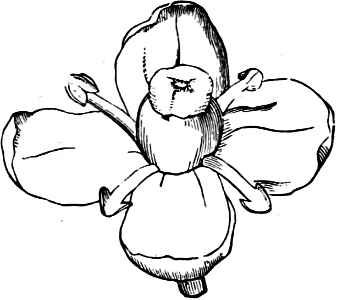
Fig. 477.—Ilex aquifolium: magnified flower.
Order 3. Aquifoliaceæ (Hollies). The genus Ilex forms almost the entire order. (175 species out of 180; especially from S. Am.) They are shrubs or trees with scattered, leathery, simple leaves (in Ilex aquifolium, spiny) with very small stipules. The flowers are small, white, and borne in few-flowered inflorescences in the axils of the foliage-leaves; they are most frequently unisexual and diœcious. There are 4–5 sepals, petals, stamens and carpels in regular alternation; the calyx and corolla have their leaves slightly connate; stamens slightly adnate to the corolla; the ovary is generally almost spherical with a thick, sessile stigma (Fig. 477). This order deviates especially from Celastraceæ in the absence of the disc and in having only 1 (pendulous) ovule in each of the 4 loculi of the ovary, and in having a drupe with generally 4 stones. Embryo extremely small, at the apex of the large endosperm, with the radicle directed upwards.—3 genera.—I. aquifolium (Holly) principally on the coasts of European countries; from Norway to W. Denmark, and further westward. It is a common garden shrub with stiff, shining leaves and red fruits. Several South American species contain so much caffeine that they may be used as a beverage in the place of tea (I. paraguayensis, Paraguay tea, or Maté). The Holly does not contain caffeine.
Order 4. Ampelidaceæ (Vines). Shrubs with the stem swollen at the insertion of the petioles and climbing by tendrils borne opposite the leaves (Figs. 478, 479). The leaves are scattered (generally 1/2), stalked, stipulate, frequently palminerved and lobed, divided or compound. The small, greenish flowers are generally borne in paniculate inflorescences, whose position is the same as that of the tendrils (Fig. 478); they are hypogynous or slightly perigynous, ☿, with 4–5 sepals, petals, stamens (which, as in the Rhamneæ, are opposite the petals; Fig. 480 A, B) and 2 carpels. The calyx is very small, entire, or slightly dentate; corolla valvate, and in some falling off as a hood, since the individual parts remain united at the summit (Fig. 480 A). Between the stamens and gynœceum is situated an hypogynous disc, with 5 lobes alternating with the stamens (Fig. 480 A, B, E). In each loculus of the 2-locular ovary there are 2 erect ovules (E); the style is short or wanting. The fruit is a berry. The embryo is small and lies in a horny, sometimes slightly folded (ruminate) endosperm (Fig. 480 C, D).
Figs. 478–481.—Vitis vinifera.
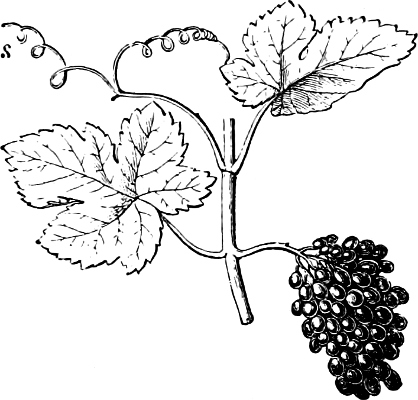
Fig. 478.—Branch with bunch of grapes.
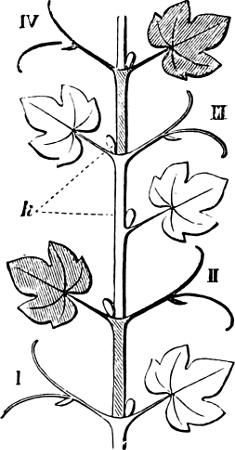
Fig. 479.—Diagram of the position of leaf and tendrils. The branch is divided into sections on the sympodial theory (the successive generations, I, II, III, IV, are alternately white and shaded); k buds.
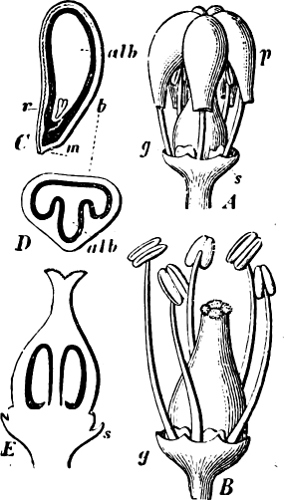
Fig. 480.—A Flower throwing off the corolla; B flower after the removal of the corolla; C, D longitudinal and transverse section of seed; E longitudinal section of gynœceum; s calyx.
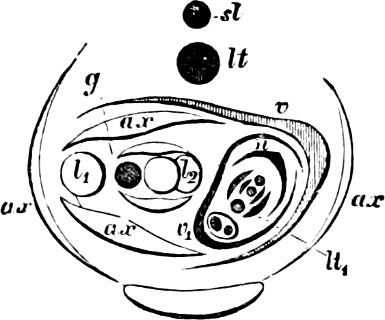
Fig. 481.—Diagram of branch and position of leaves; sl tendril; lt the main axis; ax stipules of the foliage-leaf shown below; g axillary-bud (the dwarf-branch); v its fore-leaf; l1 l2 its first two foliage-leaves with their stipules; lt1 long-branch in the axil of v (everything appertaining to this branch is entirely black); v1 the first leaf of this branch.
Vitis and Ampelopsis (5-merous flowers); Cissus (4-merous flower); Leea (without stipules, corolla gamopetalous). The inflorescence in Pterisanthes (E. Ind.) has a peculiar, flat, leaf-like axis, on the edges of which ♂-flowers are borne, and on the surface ♀-flowers.
The TENDRILS in Ampelidaceæ are modified branches, since they bear leaves and may be abnormally developed as branches with foliage-leaves, and finally the inflorescences are borne in the position of the tendrils, and tendrils are met with which are partly inflorescences. The explanation of the position of the tendril, namely, right opposite the foliage-leaf but without a subtending-leaf, has been much disputed. The relative positions are as follows: in Vitis vinifera the following two kinds of shoots and relative positions are found (the other species deviate in one or other particular), (a) Long-branches, which have 2 scale-leaves and a large number of foliage-leaves with a divergence of 1/2; opposite the lowest 3–5 foliage-leaves no tendrils are found, then follow: 2 foliage-leaves with tendrils, 1 without a tendril, 2 with and 1 without, etc., with great regularity. Buds are developed in the axils of the foliage-leaves (Fig. 479): these develop into (b) DWARF-BRANCHES, which commence with 1 laterally-placed scale-leaf (fore-leaf; Fig. 481 v) succeeded by several foliage-leaves with a divergence of 1/2 (in a plane at right angles to that of the mother-shoot), but the whole shoot is extremely small, and often dries up and drops off in the autumn, so that only the scale-leaf, v, with the bud (Fig. 481 lt1) in its axil remains. This bud in the following year developes into a new long-branch, and since its leaves lie in a plane at right angles to that of the dwarf-branch, their plane coincides with that of the long-branch from which it is developed (the grandmother axis).—The tendrils no doubt may most correctly be regarded as the modified main axis which has been pushed aside by a lateral branch. The branches are then sympodia, whose successive shoots bear alternately 1 and 2 foliage-leaves: thus, on the figure there are portions altogether of 5 shoots (I.-V.), the 1-leaved ones are shaded, the 2-leaved ones are white. The following facts however are adverse to this theory: (1) the first leaf on an axillary bud is then situated 180° from the subtending leaf (e.g. the lowermost shaded leaf, Fig. 479, 180° from the lowermost white leaf), whilst the rule in the Dicotyledons is that it is placed only about 90° to one side. (2) The buds (Fig. 479 K) from which the dwarf-branches develop, must then be accessory and sister-buds to the sympodial shoots, but their first leaves have a different relative position to this, which is very peculiar, and a still more remarkable fact is that the buds, K, etc. are similar in structure and present in all the axils; thus we only find accessory buds in the cases where no tendrils are opposite to the leaves, and the main bud must then be considered to be suppressed. (3) The development proves that the tendrils arise on the side of a vigorous growing-point of the stem or by its division, and do not develop, as might be expected, from the apex of the shoot. But these relations however, find their analogues and are all capable of explanation, whereas other less natural modes of explanation are opposed to them.
435 species; especially in the Tropics; they are rarer in America. In N. Am. some Vitis-species and Ampelopsis quinquefolia are found. Vitis vinifera is supposed to have originated in the districts East and South of the Caspian Sea. Wine is obtained from Vitis-species, especially V. vinifera, and “raisins,”—(the name “currants,” given to a special variety with small, seedless fruits, is derived from Corinth).—The species of Ampelopsis (Virginian Creeper) are cultivated as ornamental plants.
Order 5. Rhamnaceæ. The stamens are placed opposite the petals as in the Ampelidaceæ (Fig. 482), but the flowers are much more perigynous or entirely epigynous. The trees and shrubs belonging to this order have simple, most frequently penninerved leaves with stipules; frequently thorny (modified branches). The flowers are inconspicuous, sometimes unisexual (Fig. 482), and have 5 (-4) sepals, petals, stamens, and generally 3 (2–5) carpels. The calyx has valvate æstivation. The petals are very small (generally less than the sepals), often spoon-like, hollow, and embracing the stamens; a disc covers the inner surface of the thalamus or the base of the style in the epigynous flower; gynœceum simple, with one style and one erect ovule in each loculus. The fruit is most frequently a drupe. The embryo is large, often green or yellow, with endosperm.
Rhamnus (Buckthorn) has a juicy drupe with 3 (2–4) stones, surrounded at the base by the persistent portion of the receptacle; the disc is thin. R. cathartica (common Buckthorn): diœcious, with opposite, serrate leaves. R. frangula (Alder Buckthorn): flowers ☿, with scattered, entire leaves.—Ceanothus (N. Am., with richly-flowered inflorescences and a fruit closely resembling that of the Euphorbias). Phylica, Pomaderris (Austr., fruit a capsule). Zizyphus, Paliurus, Colletia (S. Am.) are thorny shrubs; C. spinosa has thorny shoots with small, caducous leaves; the seedling has normal foliage-leaves. Others climb by tendrils as in the Ampelidaceæ, e.g. Gouania.
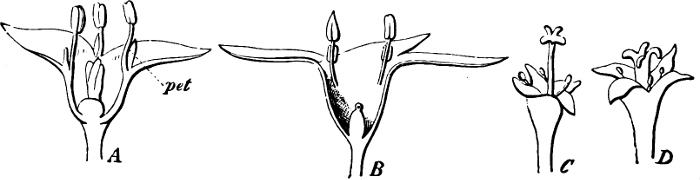
Fig. 482.—Rhamnus cathartica: A long-styled ♂-flower; pet petals; B short-styled ♂-flower; C long-styled ♀-flower; D short-styled ♀-flower (after Darwin).
475 species, 40 genera; chiefly in temperate and tropical climes. Some are medicinal plants, the bark and fruit having purgative properties (the bark of Rhamnus frangula and “Cascara Sagrada” from the bark of R. purshiana are officinal). The fruits and seeds of others are edible, for example, the fruits of Zizyphus lotus, Z. vulgaris, Z. spina Christi, etc. Green and yellow dyes are obtained from the fruit of R. cathartica, infectoria and others (Avignon grain). Ceanothus-, Rhamnus- and evergreen Phylica-species are ornamental shrubs.
Family 18. Thymelæinæ.
Exclusively trees or shrubs with simple, entire, scattered leaves without stipules. They have a strongly perigynous, regular, 4-merous flower. The receptacle (often coloured) envelopes a simple gynœceum formed of 1 carpel and with, in most cases, 1 ovule, bearing on its edge 4 (or 5) petaloid sepals and, but rarely at the same time, small, scale-like petals. The corolla is most frequently entirely wanting (and hence these plants were formerly reckoned among the Monochlamydeæ); frequently only one of the 2 whorls of stamens, which are situated on the inner side of the edge of the receptacle, is developed. The fruit is most frequently a 1-seeded berry or drupe, or a nut which may be falsely berry-like, the partly persistent receptacle being fleshy and enveloping it.
This family appears the most nearly allied to the Frangulinæ, especially the Rhamnaceæ, and may be considered as a further development of these in the direction of the petaloid development of the receptacle and reduction of the corolla and gynœceum, which in this instance only consists of one carpel. Another deviation is that both the whorls of stamens are present, while one of these is always wanting in Frangulinæ. They also appear to be related to the Lauraceæ (see page 391).
Order 1. Thymelæaceæ. The flowers are most frequently ☿ (Fig. 483). The receptacle is high, generally tubular, coloured, and bears on its edge the 4-(or 5)-merous calyx, with imbricate æstivation. The corolla is wanting or is represented by small scales. The stamens are situated on the inside of the receptacle, and number 4 + 4 (or 5 + 5); stigma capitate. 1 pendulous ovule (Fig. 483 B), the radicle pointing upwards. The fruit is most frequently a berry. A disc is sometimes developed. Endosperm wanting or very slight.
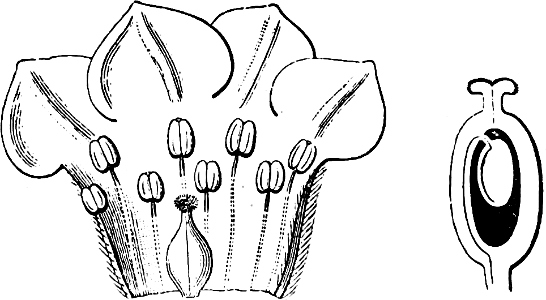
Fig. 483.—Daphne mezereum: A flower; B longitudinal section of pistil.
Daphne (Spurge-Laurel, Fig. 483) has a deciduous receptacle, often coloured; sepals 4; petals absent; stamens 4 + 4. Berry.—Gnidia (corolla); Pimelea (2 stamens); Thymelæa; Passerina and others.
400 species; chiefly in the warm, sub-tropical zone, especially the Cape and Australia. Only Daphne and Thymelæa in Europe. In the fruit and bark of some, for example Daphne, pungent, burning and poisonous properties are found. The bark of D. mezereum (native and cultivated) and D. laureola is officinal. A specially tough bast is found in some species, for example Lagetta lintearia (Lace-tree, Jamaica), which is used in weaving. Some are cultivated in gardens as ornamental shrubs, especially species of Daphne.
Order 2. Elæagnaceæ. Shrubs or trees, which are easily recognised by the covering of peltate hairs found upon almost all parts of the plant, causing them to assume a silvery or rusty-brown appearance. Stipules are absent; the leaves are simple, most frequently scattered. Flowers (Figs. 484, 485) frequently unisexual. The sepals are valvate, 2-4; the corolla is wanting; stamens 4 + 4 or 0 + 4. The ovule is erect and the radicle turned downwards (Fig. 486). The fruit is a nut, but becomes a false fruit, being surrounded by the persistent receptacle or the lower part of it, and thus assuming a berry- or drupe-like appearance (Fig. 486). Endosperm insignificant.—Shepherdia (opposite leaves) has 4 sepals, 4+4 stamens, as in Daphne. Diœcious.—Elæagnus (Silver-leaf) is ☿, has 4–6 sepals, and 4–6 stamens alternating with them. Hippophaë is diœcious; it has 2 sepals and 4 stamens in the ♂-flower (perhaps properly speaking 2+2 stamens); thorny (stem-structures).
16 species; especially ornamental shrubs, e.g. Elæagnus argentea, angustifolia; Hippophaë rhamnoides and Shepherdia canadensis. Northern Temp.
Figs. 484–486.—Elæagnus angustifolia.
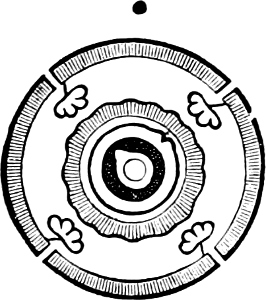
Fig. 484.—Floral diagram.
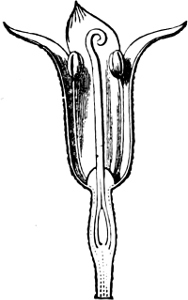
Fig. 485.—Longitudinal section through the flower.
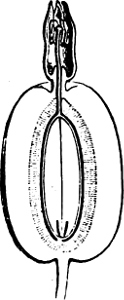
Fig. 486.—Longitudinal section through the fruit.
Order 3 (?). Proteaceæ. This order has its chief centre in the dry regions of Australia (6/10–7/10 of about 1,000 species), a smaller number in S. Africa (2/10–3/10). a few species in S. Am. Trees or shrubs, leaves generally scattered, without stipules, and more or less dry, leathery, evergreen, and often of very different forms on the same plant (undivided, compound, etc.) The flowers are ☿ (rarely unisexual), and 4-merous in the single, petaloid perianth and in the staminal whorl; 1 carpel; sometimes zygomorphic. The perianth-leaves are generally almost free, with valvate, æstivation, often leathery. Small scales alternating with the perianth are often found at the base of the ovary. The stamens generally have extremely short filaments, and are situated opposite, sometimes quite on the tip of the perianth-leaves, in a spoon-like groove. The gynœceum is 1-locular, has 1–several ovules, and is often raised on a stalk-like internode. The fruit is a follicle or nut. The seeds, most frequently winged, have no endosperm.—Protea, Manglesia, Hakea, Banksia, Grevillea, etc. 50 genera; about 1,000 species. Several species are cultivated in our conservatories for the sake of the flowers, which are beautifully coloured and arranged in crowded inflorescences. Protandrous. It is doubtful whether they were existent in Europe in the Tertiary Period. The true systematic position of the order is doubtful. They are related to the Leguminosæ and Rosifloræ, but more closely no doubt to the two preceding orders.
Family 19. Saxifraginæ.
The flower is generally perfect, regular and polypetalous, usually perigynous or epigynous, eucyclic and 5-merous; most frequently S5, P5, A5 + 5 or 5 + 0 and G2-5, but other numbers are found, especially 4; the flowers are very frequently obdiplostemonous. The calyx is sometimes large and the corolla small; the carpels in some are entirely free, in others more or less united. Endosperm is found in the majority. The hypogynous forms approach the Cistifloræ, the others the following families, especially the Rosifloræ. This family is not, upon the whole, so well defined and natural as most of the others. The Saxifragaceæ proper, approach very near to the Rosaceæ, especially Spiræa, and form a transition to it. The forms with opposite leaves, as Philadelphus, etc., approach the Myrtifloræ, just as the Escalloniæ appear to be closely allied to Bicornes, especially Vacciniaceæ. Finally through Pittosporaceæ, they pass over to the Frangulinæ. The family terminates in very reduced forms, on the one hand in the arborescent orders with crowded inflorescences, on the other perhaps in the very remarkable order Podostemaceæ.
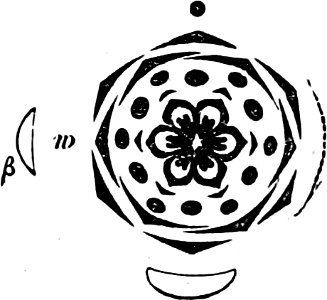
Fig. 487.—Diagram of a 6-merous flower (Sedum hispanicum): w branch of scorpioid cyme in the axil of the bracteole β.
Order 1. Crassulaceæ. Nearly all are herbs or small shrubs with round, succulent branches and scattered, fleshy, often more or less round leaves, which are very rarely incised, and never have stipules. The flowers are generally borne in dichasia or unipared scorpioid cymes, which again may be arranged in racemes, umbels, etc.; they are regular, ☿, hypogynous or perigynous, and most frequently have free sepals and petals (gamopetalous corollas with sessile stamens are found in Cotyledon, Bryophyllum, Echeveria, and others); the floral formula is Sn, Pn, An + n, Gn, where n may have very different values, partly depending upon the size of the flower (e.g. 4–7 in Sedum, Fig. 487; 6–30 in Sempervivum; 4 in Rhodiola, Bryophyllum, and Kalanchoë; 5 in Echeveria, Umbilicus, Cotyledon). The carpels are free and are placed opposite the petals (Fig. 487). Fruit a syncarp composed of follicles containing many, small seeds without endosperm. Outside each carpel is found a small, nectariferous scale (Fig. 487). The northern genus, Rhodiola, is diœcious. The petal-stamens are wanting in some (Crassula, Bulliarda, and others). The floral-leaves are very often displaced upon their axillary branches. A multicarpellary gynœceum also occurs.
Sedum (Stonecrop) is generally 5-merous with 10 stamens; Sempervivum tectorum (House-leek), 12-merous, and with 24 stamens. The leaves of Bryophyllum calycinum very readily form buds, and also frequently exude water from the edges.
485 species; especially Temp. (Cape, Europe). Principally used as ornamental plants.
Order 2. Saxifragaceæ. The flowers are 4–5-merous with 2 (-3) carpels, most frequently: S5, P5, A5 + 5 (obdiplostemonous), G2. They are regular, ☿, polypetalous, hypogynous, perigynous or most frequently more or less epigynous (Fig. 488). The carpels may be individually quite free, but are more frequently united at the base, or the entire portion enclosing the ovules is united into a 1- or 2-locular ovary, the styles, however, are always free. Fruit a capsule with many seeds; endosperm present.—They are herbs, most frequently with scattered leaves without stipules; but the leaf-base is broad. The inflorescences are most frequently cymose, and a displacement of the floral-leaves is frequent (e.g. Chrysosplenium).—Some Saxifraga-species, e.g. S. sarmentosa, have irregular flower with an oblique plane of symmetry. The petal-stamens in some may be wanting: Heuchera, species of Saxifraga and Mitella. The corolla is wanting in others.
Saxifraga (Saxifrage): S5, P5, A5 + 5, G2 (Fig. 488); capsule bilocular, opening along the ventral suture between the 2 persistent styles. S. granulata has small tubers at the base of the stem.—Chrysosplenium (Golden Saxifrage): 4 sepals, no corolla, 4 + 4 stamens; 1-locular capsule.
Protandry is most frequently found in Saxifraga, with the stamens successively bending towards the gynœceum; protogyny is more rare. In other genera there is protogyny without any movement of the stamens; Chrysosplenium is homogamous.—About 300 species; mostly in temperate climates. Saxifraga is especially Alpine. S. crassifolia and other species, Hoteia japonica, Tellima, etc., are ornamental plants.
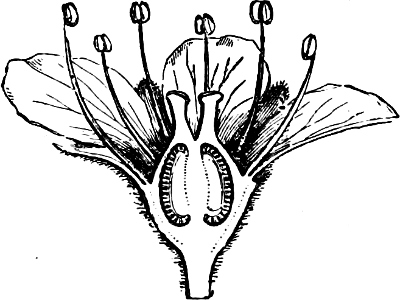
Fig. 488.—Saxifraga granulata. Longitudinal section of flower.
The following genera are allied to the Saxifragaceæ:—
1. Parnassia (about 14 species; P. palustris, Grass of Parnassus). The flower is slightly perigynous, and has S5, P5, 5 fertile sepal-stamens, and 5 petal-stamens, which are developed as barren staminodes, palmately-lobed, and (3–) 4 carpels united in a 1-locular ovary with (3–) 4 parietal placentæ. Capsule.—Protandrous. The flower has a slightly oblique plane of symmetry, which is especially shown during its development and in the order of sequence in which the anthers dehisce: originally they lie closely round the gynœceum; the anthers dehisce extrorsely, first the one which is placed opposite the most external sepal (the 2/5 arrangement is very distinct in the calyx), the filament elongating so that the anther lies over the ovary, and this is followed successively by the 4 others in a zig-zag line; the filaments bend backwards after the pollen is shed and the anthers drop off, and the stigmas are not developed until this is completed. The barren stamens are palmately divided into an uneven number (7, 9, 11) of lobes, tapering from the centre towards the edge, and bearing apparently glandular tips; their gland-like appearance is supposed to allure flies to visit the flower, or they may act as a kind of fence which compels the insects to enter the flower in a certain way, and thus effect pollination; the honey is secreted on their inner side, and not by the gland-like tips.
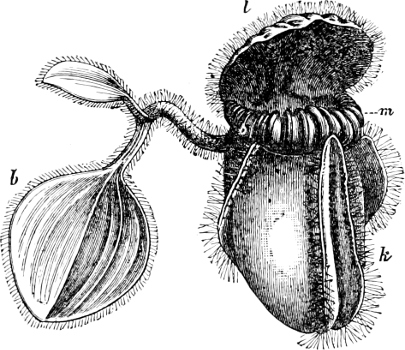
Fig. 489.—Portion of Cephalotus follicularis: k pitcher-like leaf with thick corrugated edge (m) and lid (l); b foliage-leaf of the ordinary form.]
2. Adoxa moschatellina (Moschatel). This is a perennial, creeping herb; the horizontal rhizome has an unlimited growth, and bears, in a scattered arrangement, both foliage-leaves, and white, fleshy scale-leaves. The aerial stem bears 2 opposite foliage-leaves and a capitate inflorescence of 5 flowers, 4 placed laterally (in opposite pairs) and 1 terminally. The flower is semi-epigynous, the calyx gamosepalous, corolla absent. The stamens are divided to the base, so that each filament bears a bilocular anther. The style is free, deeply cleft. The terminal flower has 2 bracteoles, 4 sepals, 4 stamens, cleft to the base, and a 4-locular ovary. The bracts of the lateral flowers are displaced on the flower-stalk, as in Chrysosplenium, and united with the 2 bracteoles into a kind of 3-leaved involucre; these flowers have 5 sepals, 5 split stamens with 2-locular anthers, and a 5-locular ovary. 1 pendulous ovule in each loculus. Fruit a drupe, green-coloured, with 1–5 stones.—This plant, which would perhaps be best placed in a special order, has also been classed with the Araliaceæ and Caprifoliaceæ.
The following are also allied to this order: Escalloniaceæ (arborescent plants with simple, scattered, leathery leaves), Cunoniaceæ (arborescent with opposite leaves), Cephalotaceæ (with pitcher-like, insect-catching leaves; Australia; Fig. 489) and Francoaceæ. These have respectively 85, 107, 1 and 3 species.
Figs. 490–492.—Ribes rubrum.
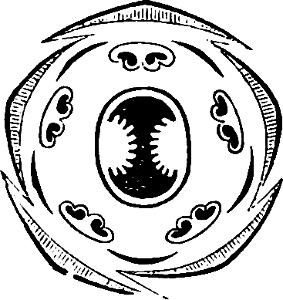
Fig. 490.—Floral diagram.
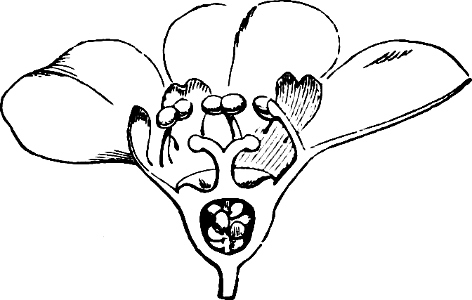
Fig. 491.—Flower in longitudinal section.
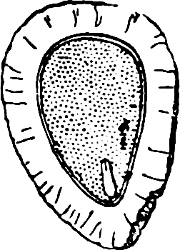
Fig. 492.—Seeds in longitudinal section.
Order 3. Ribesiaceæ (Currants). 5-stamened Saxifragaceæ with epigynous flowers.—Moderately sized shrubs with scattered, stalked and palminerved, and generally palmilobed leaves, with a large leaf-sheath. The flowers (Figs. 490, 491), most frequently borne in racemes, are regular, epigynous, and have often, above the ovary, a cup- or bell-shaped, or tubular prolongation of the receptacle, on which the sepals, petals and stamens are situated; they have 5 sepals (often large, coloured), 5 small, free petals, only 5 stamens (opposite the sepals) and a 2-carpellate gynœceum with a unilocular ovary and 2 parietal placentæ bearing many ovules. The fruit is a berry, whose seeds have a fleshy and juicy outer covering (Fig. 492). In some species, for example Ribes grossularia, there is found an unbranched, or a 3–5-branched spine, very closely resembling the spiny leaves of the Berberis, but which, however, are emergences springing from the base of the petiole. Ribes has two kinds of branches: long-branches and dwarf-branches, the latter alone bearing the flowers.—Ribes (Figs. 490–492). The blades of the leaf are folded or rolled together in vernation. R. alpinum is diœcious.
75 species; especially from the N. Temp. regions (especially N. Am.).—The receptacle secretes honey on its inner surface. The Gooseberry-flower is slightly protandrous, others are homogamous; insect-and self-pollination are found. The following are FRUIT BUSHES: R. nigrum (Black Currant), R. rubrum (Red Currant), R. grossularia (Gooseberry), originating in Northern Europe and Asia. Ornamental bushes: the North American R. aureum (Golden Currant) and R. sanguineum (Blood-red Currant), etc.
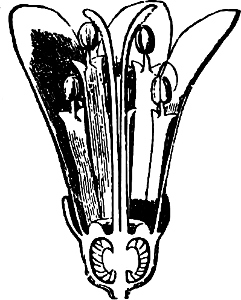
Fig. 493.—Deutzia crenata. Longitudinal section of flower.
Order 4. Hydrangeaceæ. Shrubs, with simple, opposite leaves, without stipules; flowers generally epigynous, 4–5-merous (Fig. 493).—Hydrangea (H. hortensia, etc.). Shrubs from N. Am. and E. Asia; corolla often valvate. The inflorescence, as in the case of the inflorescence of Viburnum opulus (Guelder Rose), has often irregular, large, but barren flowers at the circumference, whilst the others are much smaller, regular and ☿; the barren flowers are mostly 4-merous; in these cases it is the calyx which is large and petaloid, while the other parts of the flower are more or less suppressed. The branches of the inflorescence appear to be partially devoid of floral-leaves, since they are displaced upon the main axis.—Philadelphus; racemes (with terminal flower), sepals 4 (valvate), petals 4 (twisted), stamens many, and carpels 4 (opposite the petals), forming a 4-locular ovary. The numerous stamens (20–30) occur by the splitting of the sepal-stamens and are often therefore placed in distinct bundles. Fruit a capsule. Ph. coronaria (Syringa, Mock Orange-blossom), from S. Eur., is a common ornamental shrub, as also is Deutzia (Fig. 493) from N. Am. and E. Asia. The latter has S5, P5, A5 + 5, G3.—About 70 species.
Order 5 (?). Pittosporaceæ. This order has its home especially in Australia (90 species). The flower has S5, P5, A5 (episepalous), G2 (3–5), most frequently a unilocular ovary with many ovules in 2 rows, borne on 2 parietal placentæ, or a bilocular ovary. Some have berries, others capsules. Pittosporum, Citriobatus, Sollya, Billardiera.
Order 6. Hamamelidaceæ. Flowers more or less epigynous, with S4, P0 or 4, 4 fertile sepal-stamens, and 4 barren petal-stamens, bilocular ovary with 1–2 ovules in each loculus. Fruit a capsule. Hamamelis: one species in Japan and one in N. Am. Fothergilla. Liquidambar: monœcious; flowers in capitula or spikes; ♂-flowers without perianth, stamens indefinite; ♀-flower: slight perianth, 2-locular ovary with many ovules. Officinal: “Styrax-balsam,” which is obtained by boiling the bark of Liq. orientalis, from Asia Minor. Liquidambar and Parrotia are found as fossils in the Upper Oligocene; Hamamelis perhaps in the Chalk.
Finally two orders with very reduced flowers are included in this family.
Order 7. Platanaceæ. Trees, with large, scattered, palminerved and lobed leaves, and ochreate stipules; the buds are concealed in a hollow at the base of the petiole. The bark falls off in large scales. ♂-and ♀-flowers (monœcious) in crowded, spherical inflorescences which are placed at wide intervals on a terminal, thin, and pendulous axis. The flowers have an insignificant calyx and corolla; the ♂-flower has few stamens; ♀-flower, perigynous, with 4 free carpels, 1 pendulous, orthotropous ovule in each. Fruit a nut; endosperm absent. 5 species; frequently grown in avenues and parks. P. occidentalis (N. Am.); P. orientalis (W. Asia.).
Order 8. Podostemaceæ. Aquatic plants, especially in swiftly running water, with somewhat of an Alga-like, Moss-like, or thalloid appearance; they show themselves in many ways to be adapted to their mode of life and situations (having a dorsiventral creeping stem, the flowers sunk in hollows, a formation of haptera upon the roots, and thalloid assimilating roots and thalloid stems, etc.). Tropical; 100 species.
Family 20. Rosifloræ.
The leaves are scattered, stipulate, or have at least a well developed sheath, which is generally prolonged on each side into a free portion (“adnate stipules”). The flowers are regular, perigynous or epigynous. Calyx and corolla 5 (-4)-merous with the usual position. The corolla is always polypetalous. The stamens are present in very varying numbers (5–∞) and position, but always placed in 5-or 10-merous whorls; they are frequently 20 in 3 whorls (10 + 5 + 5; see Figs. 494, 502, 505); the nearer they are placed to the circumference, the longer they are; they are generally incurved in the bud, or even rolled up. The number of the carpels is from 1–∞; in most cases all are individually free (syncarp), and when they are united it is in every case with the ovaries only, whilst the styles remain more or less free (Pomaceæ, species of Spiræa). The seeds have a straight embryo, and usually no endosperm.
The perianth and stamens are most frequently perigynous on the edge of the widened receptacle; its form varies between a flat cupule and a long tube or a cup (Figs. 495, 496, 498, 499, 500); the carpels are situated on its base or inner surface, in some instances on a central conical elongation of the floral axis (Fig. 496). The carpels in Pomaceæ also unite more or less with the hollow receptacle, or this grows in and fills up the space between the carpels, so that a more or less epigynous flower is formed (Fig. 504).—The following numbers of stamens occur: 5, 10 (in 1 whorl), 15 (10 + 5), 20 (10 + 5 + 5), 25 (10 + 10 + 5), 30-50 (in 10-merous whorls)—compare the diagrams. The theoretical explanation of this relation of the 10-merous whorls and their alternation with the 5-merous whorls is not definitely determined; a splitting of the members of the 5-merous whorls may be supposed, but the development shows no indication of this, and it is not supported in any other way. Several genera have “gynobasic” styles, that is, the style springs from the base of the ovary (Fig. 497 A, B).
The Rosifloræ are on one side closely related to the Saxifragaceæ (especially through Spiræa) from which it is difficult to separate them, and to the Myrtifloræ; on the other side they are allied, through the Mimosaceæ with the large number of stamens, and through the Amygdalaceæ with its single carpel, to the Leguminosæ. The family begins with forms which have many-seeded follicles, and passes on the one side to forms with nuts and drupes in perigynous flowers, and on the other side to the Pomaceæ.
Order 1. Rosaceæ. Herbs or shrubs, generally with compound leaves and persistent (adnate) stipules, flower perigynous, gynœceum formed of many free (therefore oblique) carpels, syncarps with fruitlets of various kinds. The exceptions are noted under the genera.

Fig. 494.—Diagram of Comarum palustre.
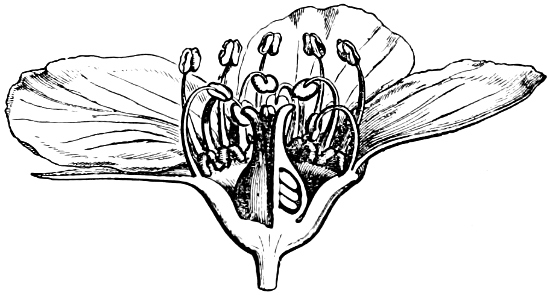
Fig. 495.—Flower of Spiræa lanceolata.
1. Spiræeæ (Fig. 495) has 2–many ovules in each ovary, while in the other groups there is generally only 1, and never more than 2 ovules in each loculus. There are generally 5 cyclic carpels and the fruit is 5 follicles, which are not enclosed by the receptacle. The majority are shrubs. Stipules are often wanting.—Spiræa (Meadow-Sweet). The flowers are generally borne in richly flowered inflorescences of various forms. The carpels, in some species, unite together and form a simple gynœceum with free styles (an approach to the Pomaceæ).—Closely allied to Spiræa are the East Asiatic shrubs: Kerria japonica, which has solitary flowers, in this country nearly always double (the fruit a nut), and Rhodotypos kerrioides which has opposite leaves, a remarkable feature among the Rosifloræ; it has a 4-merous flower, a well developed disc inside the andrœcium, and a drupe. Closely allied also is Gillenia (N. Am.) differing chiefly in the ascending ovules, Spiræa having pendulous ovules, and a more tubular receptacle.
The groups Quillajeæ and Neuradeæ form a transition from Spiræa to Pomaceæ. In the first group, which contains only trees or shrubs with generally simple leaves, the carpels are either free or united (into a capsule); in the second the receptacle unites with the carpels, which are themselves often united together; in this case, too, the fruit is a capsule. Quillaja (S. Am.); Exochorda (China).
2. Potentilleæ (Figs. 494, 496, 497). The flower has an “epicalyx” (Fig. 494 C) alternating with the sepals and formed by their stipules which are united in pairs, and hence its leaves are often more or less deeply bifid. The receptacle is cupular and often quite insignificant. The sepals are valvate in the bud. The large number of fruitlets are achenes, borne on a well-developed convex portion of the receptacle (the Ranunculeæ resemble the Potentilleæ, but have no epicalyx, no enlarged receptacle, and spirally-placed stamens). Most of the species are herbs with dichasial inflorescences, often arranged in racemes.—Potentilla (Cinquefoil). The achenes are borne on a dry, hairy receptacle; the style is situated towards the apex of the ovary, and is not prolonged after flowering. Herbs with digitate, in some, however, pinnate leaves, and generally yellow flowers.—Comarum (Fig. 494) (Marsh Cinquefoil) forms, by its fleshy-spongy receptacle, a transition to the next genus.—Fragaria (Strawberry) (Fig. 496). The receptacle becomes finally fleshy, coloured, and falls off (biologically it is a berry); the numerous fruitlets (drupes with thin pericarp) have basal styles (Fig. 497); leaves trifoliate; long, creeping runners.—Geum (Avens) has a terminal style which after flowering elongates into a long beak, with the apex (after the uppermost part has been thrown off) bent back into a hook, thus furnishing a means of distribution for the fruits. Leaves pinnate.—Dryas comprises 3 Arctic or Alpine species with simple leaves and solitary flowers, the calyx and corolla 8–9-merous, the fruit resembles that of Geum, but the styles become still longer and feather-like (a flying apparatus).
Figs. 496, 497.—Fragaria vesca.
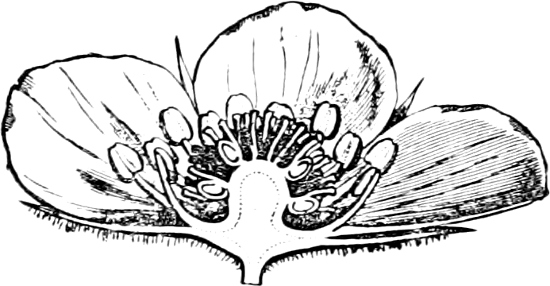
Fig. 496.—Longitudinal section of flower.
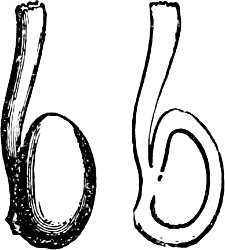
Fig. 497.—A carpel, entire, and in longitudinal section.
3. Rubeæ. Rubus (Bramble) has the same form of receptacle as the Potentilleæ, but no epicalyx; the fruitlets are drupes, not enclosed by the persistent calyx. Most frequently shrubs or undershrubs with prickles (emergences), glandular bristles and compound leaves. In the Raspberry (R. idæus) the fruitlets unite together and detach themselves from the receptacle.
4. Roseæ. Rosa; the receptacle is hollow, ovoid and contracted beneath the insertion of the calyx (Fig. 498), ultimately fleshy and coloured; it encloses a large number of fruitlets which are achenes as hard as stones (“hip,” biologically a berry).—Shrubs with imparipinnate leaves and adnate stipules. The sepals show clearly the order of their development (a divergence of 2/5), the two outer ones on both sides are lobed, the third one on one side only, and the two last, whose edges are covered by the others, are not lobed at all. Prickles (emergences) are generally present and in some species are placed in regular order, being found immediately below each leaf (usually two) although at somewhat varying heights.
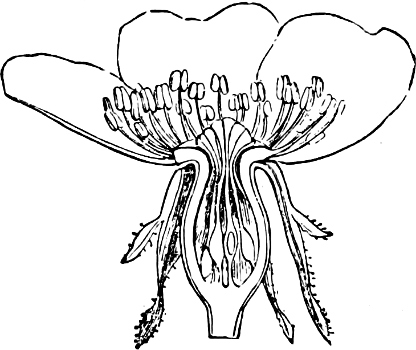
Fig. 498.—Longitudinal section of flower of Rosa.
Figs. 499, 500.—Agrimonia eupatoria.
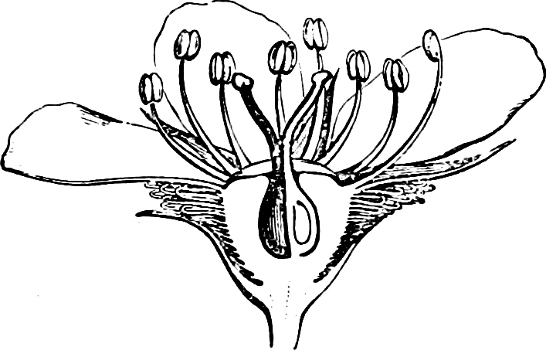
Fig. 499.—Flower in longitudinal section.
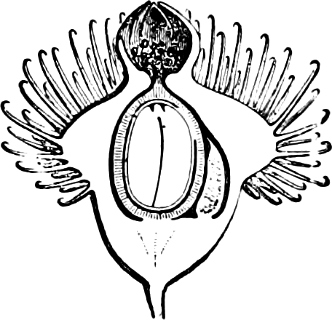
Fig. 500.—Fruit and receptacle in longitudinal section.
5. Agrimonieæ. The receptacle is more or less cup- or bell-shaped, and almost closed at the mouth; it is persistent and envelopes the nut-like fruitlets, but is dry, and in some species hard, the fruitlets being firmly attached to it. In biological connection with this the number of the carpels is generally only 1 or 2, and the whole becomes a false nut (Fig. 500). Herbs.—Agrimonia (Agrimony; Figs. 499, 500); the perianth is 5-merous, stamens 5–20. The receptacle bears externally, on the upper surface, a number of hooked bristles which serve as a means of distribution for the 1–2 achenes which are enclosed in it, and hence the entire flower finally falls off. The inflorescence is a long upright raceme. These bristles are arranged in whorls of 5 and 10, of which the uppermost alternate with the sepals.—Alchemilla (Ladies-mantle; Fig. 501) has 8 green perianth-leaves in two whorls (some authorities consider the four outer as an epicalyx, and the flower therefore apetalous), and 4 stamens alternating with the innermost whorl. There is only one carpel with a basal style and capitate stigma. The flowers are small and greenish, the filaments jointed. The anthers open by one extrorse cleft. The leaf-sheath entirely envelops the stem; the leaves are palminerved. A. aphanes has often only 1–2 stamens. The following genera, with 4-merous flowers borne in short spikes or capitula, are allied to this group. Sanguisorba has entomophilous, ☿-flowers with 4(-20) stamens, 1 carpel; stigma papillose.—Poterium; spike or capitulum, the uppermost flowers are ♀, the lowermost ♂, and some intermediate ones ☿ (the order of opening is not always centripetal); S4, P0, A20–30, G2, the long styles having brush-like stigmas (wind-pollination). Leaves imparipinnate.
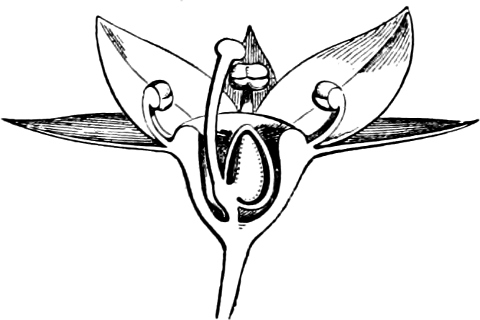
Fig. 501.—Flower of Alchemilla in longitudinal section.
Pollination. A yellow ring on the inner side of the receptacle, inside the stamens, serves as a nectary when any honey is formed; this, for instance, is not the case in Rosa, Agrimonia, Spiræa ulmaria, S. filipendula, S. aruncus, etc., to which the insects (especially flies and bees) are allured by the quantity of pollen. Homogamy and slight protogyny are frequent, in many instances self-pollination also is finally possible. Poterium, with the long-haired stigma, is wind-pollinated.—About 550 (1100?) species, especially in northern temperate regions.—Uses. Officinal: the petals of Rosa centifolia and gallica, the fruits of the Raspberry (Rubus idæus), the rhizome of Geum urbanum, the flowers of the Koso-tree (Hagenia abyssinica or Brayera anthelmintica).—The bark of Quillaja saponaria (Chili) is used as soap and contains saponin. “Attar of Roses” from Rosa damascena, centifolia and other species, especially from the southern slopes of the Balkans. Many species and varieties of Roses are ORNAMENTAL plants: from S. Europe, Rosa lutea (the Yellow Rose), R. gallica (the French Rose) and R. rubrifolia; from W. Asia, R. centifolia, of which the Moss Roses (R. muscosa and cristata) are varieties, and R. damascena; from India and N. Africa, R. moschata (the Musk Rose); from China, R. indica (Tea Rose) etc., besides the native species and the varieties which have been derived from them. In addition, Kerria japonica, species of Potentilla, Rubus odoratus from N. Am., and many species of Spiræa from South-eastern Europe and N. Am. Esculent: the “hips” of R. mollissima, R. pomifera, etc.; the fruits of Rubus-species: Raspberry (R. idæus), Cloudberry (R. chamæmorus), Blackberry (R. fruticosus), etc.; of Fragaria-species (F. vesca, collina, grandiflora, etc).
Order 2. Amygdalaceæ. Trees or shrubs with rosaceous flowers; leaves simple with caducous stipules; a regular, perigynous flower, the receptacle being partly thrown off by a circular slit; sepals 5, petals 5, stamens 20–30; gynœceum simple, formed of 1 carpel (hence oblique, Fig. 502), with terminal style and 2 pendulous ovules, ripening into a drupe (Fig. 503).—The leaves are penninerved and frequently have glands on the stalks and edges; thorns (modified branches) often occur, i.e. dwarf-branches, which, after producing a few leaves, terminate their growth in a thorn (e.g. Prunus spinosa). The vernation of the foliage-leaves varies in the different genera; in the Almond, Peach, Cherry, and Bird-Cherry they are folded; in the Apricot, Plum, Sloe and Bullace, rolled together. In some the flowers unfold before the leaves (Amygdalus, Armeniaca). That the gynœceum is formed of 1 carpel is evident in this as in other instances (e.g. in the Leguminosæ, which are closely related to this order), from the fact that the carpel is oblique, and has only one plane of symmetry, and similarly in the fruit there is a longitudinal groove on one side which indicates the ventral suture. It is only exceptionally that both ovules are developed. In abnormal instances more than 1 carpel is developed.
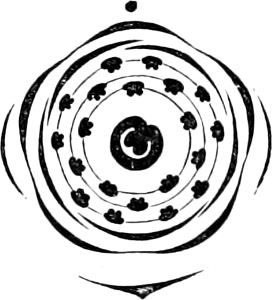
Fig. 502.—Diagram of Prunus virginiana.