DIVISION V. ANGIOSPERMÆ. (continued 2)
Michael Cresse Potter translation
Uses. The leaves of the Pine-apple, in its native country, are used for the manufacture of cloth.
Order 7. Hæmodoraceæ. 120 species; in all parts of the world except Europe; perennial, often tomentose and resembling the Bromeliaceæ, Iridaceæ and Amaryllidaceæ. Hæmodorum (Australia).—To this order belong Ophiopogon, Peliosanthes, Sanseviera, and others.
Order 8. The Iridaceæ have epigynous, hermaphrodite flowers with petaloid perianth as in the Amaryllidaceæ, but the interior whorl of stamens is entirely suppressed, and the 3 developed outer stamens have extrorse anthers (Fig. 279); there is 1 style with 3 large, generally more or less leaf-like branches bearing the stigmas. Ovary and capsule as in the Amaryllidaceæ and Liliaceæ.—Perennial herbs; bulbs are rarely found, but horizontal rhizomes, corms, etc., take their place. The leaves are (except Crocus) as in the Iris, two-rowed, equitant and sword-like. Flowers or inflorescences terminal.
The Iris (Flag) has a horizontal rhizome. The flowers are borne in the leaf-axils in fan-like inflorescences (rhipidium). The branches of the style are large and petaloid; on their under surface may be seen a small projecting shelf (Fig. 312 a) having on its upper surface the stigmatic hairs. Beneath the branches of the style are 3 well protected stamens, and immediately outside these the external perianth-leaves. The honey is secreted in the perianth-tube, and the insects, endeavouring to obtain it through the narrow passages at the base of the stamens, settle upon the outer perianth-leaves, which are bent backwards and often very hairy along their central line. The insects then rub their backs on the anthers just above them, beneath the branches of the style; they readily deposit the pollen on the stigma of another flower as they enter it, but cannot do so in withdrawing, since the stigma is pushed back, and self-fertilisation is thus avoided. The stylar branches lie close to the outer perianth-leaves, which are just beneath them, or separated by a distance of only 6–10 mm.; the first form of flower is adapted for Rhingia rostrata, the latter for bees.—Crocus has vertical, tuberous, underground stems surrounded by the leaf-sheaths (corms), and terminal flowers; the linear leaves are not equitant, but have two longitudinal furrows on the under side. The perianth is gamophyllous and funnel-shaped. The stylar branches (stigmas) are fleshy, rolled together in the shape of a horn, and split along the edge.—Gladiolus has corms like the Crocus; spikes with slightly zygomorphic, almost bilabiate flowers, most frequently turning to one side. Position of the leaves as in the Iris.—Diplarrhena has 2 fertile and 1 barren stamen; Hermodactylus has a unilocular ovary with 3 parietal placentæ. Cypella and Tigridia have bulbs.
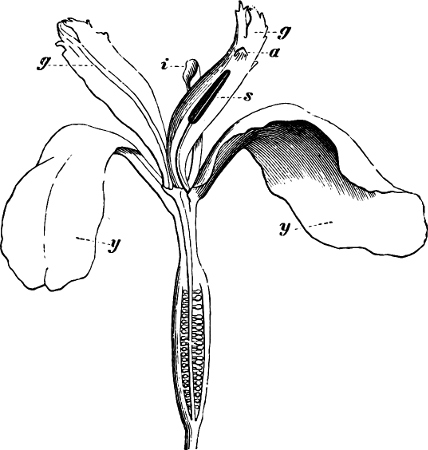
Fig. 312.—Iris pseudacorus. One external and two internal perianth-leaves, and one of the stylar-branches have been removed, y The outer, i the inner perianth-leaves; g stylar-branch; a stigma; s anther. The ovary is seen in longitudinal section.
770 species; chiefly in the countries round the Mediterranean, and in Africa, especially the Cape (Gladiolus, Ferraria, Moræa, Galaxia, Sparaxis, Antholyza, Tritonia, Ixia, etc.), Australia and Tropical America (Sisyrinchium, Tigridia, Cipura, Cypella, etc). A great number are ornamental plants: the cultivated Crocus-species are from the South of Europe and Asia; Gladiolus communis from S. Europe; the other species principally from S. Africa. The native species of Iris are I. pseudacorus (yellow) and I. fœtidissima.
Officinal: the stigmas of Crocus sativus (Oriental, cultivated in France, Spain, Italy, and Austria), used as a colouring matter, saffron; the rhizomes of the S. European Iris florentina, pallida, and germanica (“Orris-root”).
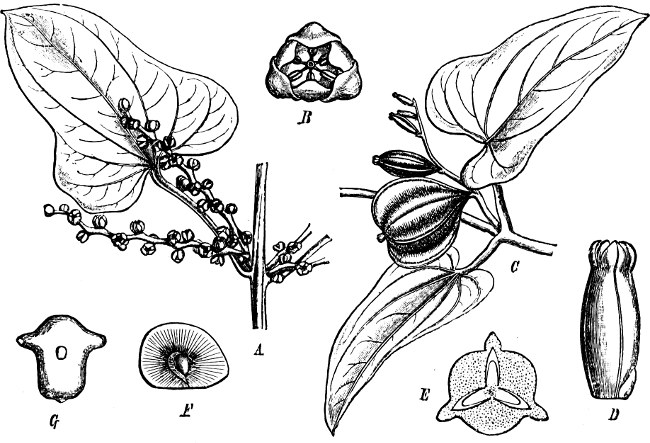
Fig. 313.—Dioscorea batatas: A ♂-plant; B ♂-flower; C ♀-plant (nat. size); D, E ♀-flowers (mag.); F seed; G embryo.
Order 9. Dioscoreaceæ. Perennial herbs with fleshy, often very large tuberous rhizomes (or roots); twining stems; leaves stalked, often arrow- or heart-shaped, lobed, palminerved and finely reticulate as in the Dicotyledons (Fig. 313). The flower is diclinous (most frequently diœcious), regular, epigynous, small, and of a greenish colour, but otherwise typical (Pr3 + 3, and A3 + 3, or G3); in most instances 2 ovules are placed one above the other in each loculus. The inflorescence is a spike or raceme, sometimes richly branched and paniculate.—The order approaches most nearly to the Amaryllidaceæ.
Tamus (Bryony) has a berry, Dioscorea (Yam) a thin-walled, 3-edged or 3-winged capsule (Fig. 313). Both have subterranean or aerial tubers; the Yam very often also developes tubers in the axils of the foliage-leaves; tuberous roots are said to occur in D. batatas. The tubers of many species of Yams (D. batatas from China and Japan, D. alata, South Sea Islands and India, D. bulbifera) are a very important source of food in the Tropics, especially the first-named.—Testudinaria; Rajania.—The tuberous stem of Tamus communis and Testudinaria elephantipes, and some species of Dioscorea is formed from one single internode (epicotyl), and the aerial shoots are developed from adventitious buds; in T. elephantipes the stem is aerial, and covered with thick scales of cork, regularly arranged, and separated by grooves.
Tropical order (167 species); 2 species (Tamus communis and Borderea pyrenaica) in Europe.
Family 6. Scitamineæ.
The flowers belong to the ordinary monocotyledonous type. They are hermaphrodite, epigynous, and have either a petaloid perianth, or calyx and corolla; they are, however, zygomorphic or unsymmetrical, and of the stamens most frequently only one is completely developed, the others being generally represented by petaloid staminodes. The ovary has 3 loculi, more rarely it is unilocular with the suppression of 2 loculi. Endosperm is absent (except Zingiberaceæ); but, on the other hand, there is a large perisperm. To this family belong large, glabrous, especially perennial herbs with rhizomes; leaves large, distinctly divided into sheath, stalk, and blade, the latter being more or less elliptical or lanceolate, entire, with pinnate venation, and always with a very well-pronounced midrib, gradually tapering towards the apex, and giving off numerous branches, which run outwards, towards the margin, at a larger or smaller angle; these lateral veins are closely packed, and parallel, but with only weak, connecting branches between them; the leaves, therefore, are easily torn pinnately (Figs. 314, 317). The leaf-sheaths close tightly round each other and form a false stem.
This very natural family comprises orders closely connected with each other, but is not itself nearly allied to any other family. First in the series stands:—
Order 1. Musaceæ. The petaloid perianth is strongly zygomorphic, the anterior leaf being very large (a kind of “labellum”), the posterior one small; only the posterior stamen is wanting, or is rudimentary, the other five are developed, and have quadrilocular anthers; ovary, 3-locular. Seed with straight embryo in mealy perisperm.
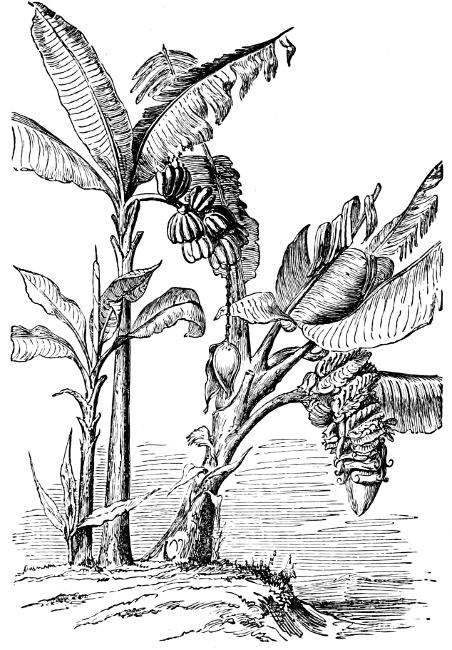
Fig. 314.—Two Musa-species.
The best-known genus is Musa, the Banana (Fig. 314). From the short rhizome arise enormously large, spirally-placed leaves, whose sheaths envelope one another, and form an apparently aerial stem, several metres in height. The inflorescence is a terminal spike with floral-leaves placed spirally, and sometimes magnificently coloured; in the axils of each of these several flowers are situated in two transverse rows (accessory buds); the lowest flowers in the inflorescence are ♀, the central ones ☿, the upper ones ♂, so that fruits are only found in the lower region of the inflorescence, the remaining portion persisting as a naked axis after the floral-leaves and flowers have fallen off; the inflorescence terminates in an ovoid bud formed by the flowers which have not yet opened (Fig. 314, the left-hand figure). The perianth-leaves are united (except the posterior one). The fruit (known as a “Banana”) is a berry, having the form of a smooth, short, three-cornered Cucumber (as much as 30 cm. in length); inside the tough skin is found a farinaceous, aromatic pulp. No seed is developed in the cultivated species.—Several Musa-species are cultivated in the Tropics for the sake of the fruit (M. paradisiaca, M. sapientum); for the fibrovascular bundles, M. textilis (Manilla Hemp).—Their home is, no doubt, the Tropics of the Old World; they were introduced into America before the arrival of Europeans. Musa ensete has dry, leathery fruits; an ornamental plant.
In Musa the barren, posterior stamen belongs to the inner whorl; and also in Strelitzia and Ravenala; the latter may have all 6 stamens developed. In Heliconia, on the contrary, it belongs to the outer whorl; in Heliconia the perianth-leaves are differently arranged, and there is only one ovule in each loculus. The three latter genera have dry fruits and leaves arranged in two rows. In the “Travellers’ Palm” (Ravenala madagascariensis) the foliage-leaves form an enormous fan.—Tropical; about 50 species.
The order may be divided as follows:—1. Museæ: Musa, Ravenala, Strelitzia in the Old World. 2. Heliconiæ: Heliconia in the New World.
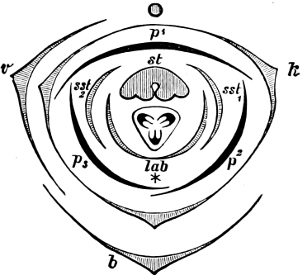
Fig. 315.—Diagram of a Zingiberaceous flower (Kæmpferia ovalifolia): b bract; v bracteole; k calyx; p1, p2, p3 the petals; sst, lateral staminodes (“wings”); lab labellum (formed of two staminodes); st the fertile stamen; * position of suppressed stamen. The ovary is in the centre of the diagram.]
Order 2. Zingiberaceæ. Perianth most frequently divided into calyx and corolla. Calyx gamosepalous. Only 1 fertile stamen (the posterior, Fig. 315, belonging to the inner whorl) with quadrilocular anther, which encloses the style in a furrow; the 2 stamens in the outer whorl are staminodes, the median one (the anterior) is wanting. The 2 lateral staminodes of the inner whorl form the “labellum” (Fig. 315 lab), which usually is the largest segment of the flower, and is often bilobed. Ovules many. The fruit in some is a leathery, 3-valved capsule, with loculicidal dehiscence; in others it is more or less berry-like and indehiscent, or irregularly dehiscent. Straight embryo.—The aerial stem is seldom developed to any extent, and the inflorescences, which are (compound) spikes or racemes, often with coloured floral-leaves, spring in some (e.g. Zingiber officinale) directly from the rhizome. The leaves are arranged in two rows.—The ovary in a few instances (Globba and others) is unilocular, with 3 parietal placentæ.
They are perennial herbs with fleshy and tuberous rhizomes, which are used as condiments and in medicine on account of their pungent and aromatic properties and also for starch, dyes, etc. Officinal: rhizomes of Zingiber officinale (Ginger, unknown wild, but cultivated generally in the Tropics), of Curcuma longa (Turmeric, a dye, E. India) and C. zedoaria, of C. angustifolia and others (as E. India Arrowroot), of Alpinia officinarum, China (galangal). “Preserved Ginger” from Alpinia galanga. Similar aromatic materials (volatile oils) are present also, for example, in the fruits; Cardamom fruits and seeds (from Elettaria cardamomum, China, seldom from E. major).
315 species; Tropics, preponderating in the Eastern Hemisphere, India, and especially S. Asia, whence all the aromatic species originate; they are now commonly cultivated in the Tropics. Some are ornamental plants in greenhouses, e.g. Hedychium, Costus, etc. Globba (with axillary buds in the inflorescence, as in Ficaria), Renealmia, Kæmpferia.
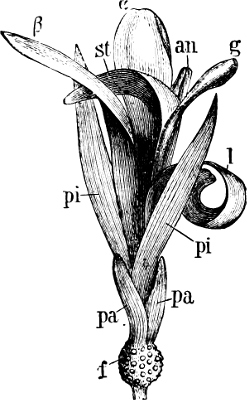
Fig. 316.—Flower of Canna: f ovary; pa calyx; pi corolla; l labellum; st stamens; an anther; g stigma; α and β staminodes.
Order 3. Cannaceæ. American herbs without aromatic properties. Flowers asymmetric (Fig. 316). Calyx polysepalous. The stamens are petaloid (Fig. 316 st) and barren with the exception of one (the posterior), which bears on one of its edges a bilocular anther; another, which is especially large and coloured, is termed the labellum. The style is compressed and leaf-like, with a small stigma at the apex. Ovules numerous in the 3 loculi. The capsule is furnished with warts or soft prickles. Embryo straight.
Canna (30 species; Trop. Am.). The inflorescence is a terminal spike with 2-flowered unipared scorpioid cymes in the axils of the floral-leaves. Ornamental plants: Canna indica, etc.
The diagram of the andrœcium of the Cannaceæ and Marantaceæ may be represented in the following manner (calyx, corolla and gynœceum being omitted):—
Cannaceæ. Marantaceæ.
w w w w
st st
w lab wi c
* *
w The lateral staminodes, “wings;” st fertile stamen; * the suppressed stamen; lab labellum; c hood; wi inner-wing.
The labellum of the Cannaceæ corresponds with the hood of the Marantaceæ and not with the labellum of the Zingiberaceæ.
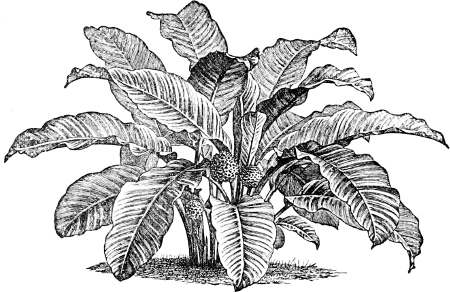
Fig. 317.—Calathea zebrina.
Order 4. Marantaceæ. The flower is asymmetrical. Only 1 or 2 of the 3 stamens in the outer whorl are present as staminodes; in the inner whorl 2 are petaloid and of the sixth stamen one-half is developed as a staminode and the other half bears a bilocular anther. One ovule only in each loculus. The style is strongly curved and at first enclosed in one of the staminodes (hood) of the inner whorl; later on it springs elastically forward towards the other staminode (inner-wing) of the same whorl. The stigma is very oblique or 2-lipped. Two of the three loculi of the ovary, in some (Maranta, Thalia) become small and empty. Embryo curved. Leaves in two rows, with sheath, stalk, and blade (Fig. 317); at the base of the last is a characteristic swelling (articulus).—Phrynium, Calathea, Stromanthe, Ctenanthe, Saranthe, etc. About 150 species; tropical, especially America. The starch of the rhizome of Maranta arundinacea is OFFICINAL, “West Indian Arrowroot.”
Family 7. Gynandræ.
The flowers are hermaphrodite and constructed on the ordinary 3-merous, pentacyclic type with petaloid, epigynous, strongly zygomorphic perianth, and generally one-stamened by the suppression of the other 5 stamens. The family has derived its name from the fact that the stamen is united with the style into a “stylar column” (except Burmanniaceæ). All are herbs; many grow as epiphytes on other plants.
This family and the Scitamineæ occupy correspondingly high positions among the Monocotyledons; these two families may therefore be placed close together, although one cannot be derived from the other. The first of the two orders is very small, but the second is very rich in species. The Apostasieæ are best classed with the Orchidaceæ and have no independent place.
Order 1. Burmanniaceæ. This order forms a transitional link between the Gynandræ and the epigynous Liliifloræ (Amaryllidaceæ), in having a 6-leaved perianth, and 6–8 stamens; but some have a labiate perianth (the median perianth-leaf of the outer whorl being very large). The ovary is most frequently unilocular with three parietal placentæ; but in some it is 3-locular with axile placentation. Capsule. Seeds ∞, small, with endosperm. The relationship to the Orchidaceæ is shown especially in the very imperfectly developed embryo and in the ovary. Small, tropical herbs (59 species); some are saprophytes.
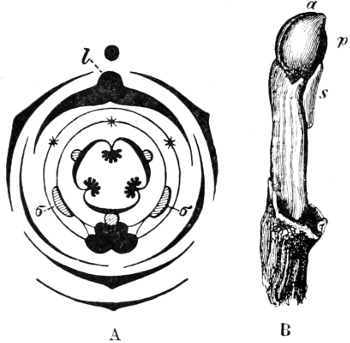
Fig. 318.—A Diagram of an Orchid-flower. B, Cephalanthera. Stylar-column: a anther; s stigma; at the foot are seen scars indicating the position of the parts which have been removed.
Order 2. Orchidaceæ. The epigynous, petaloid perianth is strongly zygomorphic in having the posterior leaf of the interior whorl, the lip (labellum), differing from all the other leaves in form, size, and colour (except Apostasieæ); the position of the labellum is very frequently reversed, being turned forwards and downwards by the twisting of the ovary (Fig. 318 A). Only 1 of the stamens—the anterior of the external whorl—is developed and bears an anther (by the twisting of the ovary it is turned posteriorly and upwards); the others are entirely wanting (indicated by * in Fig. 318 A) or present as staminodes (Fig. 318 A, δ δ) (except Apostasieæ, Cypripedileæ); the filaments are united with the style to form a column (Fig. 318 B), the stylar-column[30] (gynostemium), and the anther (a) is thus placed on its apex and exactly behind or over the stigma (s). The anther is 4-locular; the pollen-grains do not separate (except Apostasieæ, Cypripedileæ) but remain united either in tetrads or in masses, which correspond to a pollen-mother-cell (Fig. 320 C, D, E); or the pollen-grains, formed in each of the two anther-halves, remain united and form one or a few wax-like masses (pollen-masses, pollinia). The 3 carpels form a unilocular ovary with 3 parietal, deeply bifid placentæ (except Apostasieæ, Selenipedilum). Only the two lateral carpels are prolonged and developed into the stigma (Fig. 318 B, s), while the one lying in the median line, which is situated just within the anther (Fig. 318 A), becomes either rudimentary or developed into the “rostellum” (“a small beak”), on which the sticky bodies (glandulæ) arise; by aid of these the heavy, connected pollen-masses may be glued to the insects which visit the flower, and pollination is thus secured (in Apostasieæ and Cypripedileæ the 3 carpels each contribute to the formation of the stigma). The fruit is a capsule which most often dehisces by 6 valves, 3 of which are broader and bear the placentæ, and 3 alternating with them are narrower and barren (except Vanilla). The very numerous and exceedingly small seeds have no endosperm, and have a somewhat spherical embryo without any trace of external organs. The testa is membranous and loose.
The Orchids are all perennial herbs with diverse habits and varying morphological structure (see the genera); the leaves are scattered, of the usual Liliaceous form, and the inflorescences in all cases are racemes or spikes (sometimes branched), with subtending bracts, but without bracteoles.
The forms which are the least modified are described first.
1. Apostasieæ. The perianth-leaves are almost alike and free. The column is straight, with 3 equally-developed stigmas. Neuwiedia has 3 perfect stamens (1 median of the outer whorl, and 2 lateral of the inner whorl); Apostasia has only 2 perfect (inner lateral) and one barren (the median of the outer whorl), which however may be entirely wanting. The 3 posterior stamens are entirely suppressed. The pollen is powdery. The ovary is 3-locular with axile placenta. 7 species (Tropical East India, Australia).
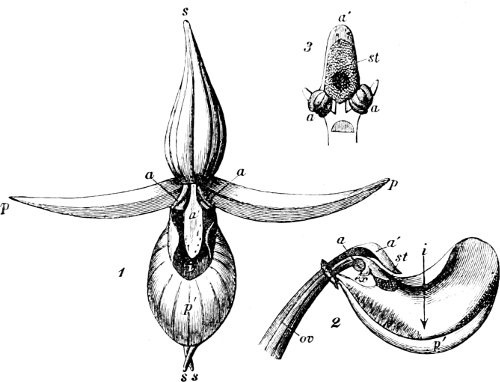
Fig. 319.—Cypripedilum calceolus: 1 front view of the flower; 2 lateral view, after the removal of all the perianth-leaves with the exception of the labellum, which has been divided longitudinally; 3 the stylar-column; ov ovary; s-s exterior, p interior perianth; p’ the labellum; a the two fertile stamens; a’ the staminode; st the stigma; i entrance for the insects; ex exit.
2. Cypripedileæ.[31] The flower is strongly zygomorphic with a large boat-shaped labellum. There are two perfect stamens belonging to the inner whorl, and the median anterior (later on the posterior) stamen of the outer whorl is transformed into a large, barren, shield-shaped body (Fig. 319). Selenipedilum has a 3-locular ovary, but Cypripedilum (Ladies’-slipper) has a unilocular ovary with 3 parietal placentæ—the typical structure for the Orchids. The pollen-grains are separate (not in tetrads) and all the 3 lobes of the stigma are constructed to receive them. This group is therefore, next to the Apostasieæ, the least modified among the Orchids; in all the following groups, one of the lobes of the stigma is differently developed from the others, and there is only one stamen.—Terrestial Orchids.—The pollination of C. calceolus is effected by the forcible entrance of insects into the boat-shaped labellum (Fig. 319 p’) at i, and their escape at ex (in 2) where the anthers are situated; in this way the stigmas will first be touched and then the anthers. The pollen-grains are surrounded by a sticky mass in order that they may adhere to the insects.
3. Neottieæ. The majority are terrestrial Orchids with creeping, sympodial rhizomes; the blades of the leaves are not detached from the stem at joints, and have convolute vernation. The anthers do not drop off, but persist in the withered condition; their apex is brought in contact with the rostellum (acrotonous Orchids). The pollen-grains are united in tetrads, which, however, often hang loosely together in pollinia, attached to a sticky part of the rostellum (“adhesive disc”), so that they adhere to the insects, and are by them transferred to the stigmas. Spiranthes. Listera; Neottia. N. nidus-avis (Bird’s-nest) is brown (it has little chlorophyll) in colour, has no foliage-leaves, and lives mainly as a saprophyte; the rhizome is studded with unbranched, fleshy roots which may form buds at their extremities.—Vanilla climbs by aerial roots. The fruit is fleshy and hardly opens, or does so irregularly.—Epipactis, Cephalanthera.—Epipogon and Limodorum are saprophytes without chlorophyll.
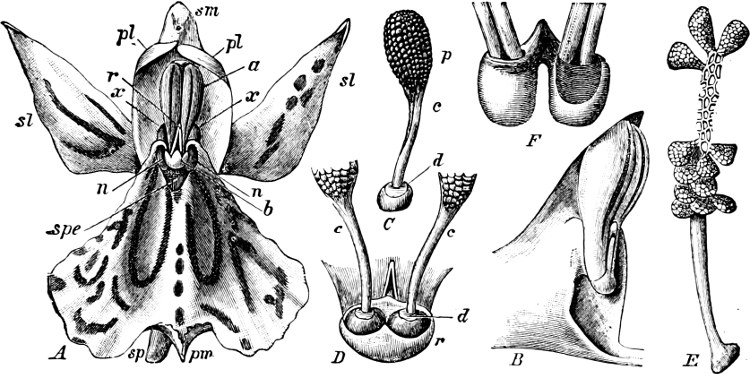
Fig. 320.—A Flower of Orchis maculata (front view): a stamen; b the cup; n the stigmas; x staminodes; sp the spur; spe the entrance to it; sm-sl-sl exterior perianth-leaves; pm the labellum, and pl-pl the other 2 interior perianth-leaves. B-E Orchis mascula: B lateral view of the column; C a pollinium with massulæ (p), caudicle (c) and adhesive disc (d); D caudicles with the cup (r), front view; the latter is depressed so that the adhesive disc is seen lying inside it; E a pollinium, more highly magnified; some massulæ are removed. F Ophrys aranifera: rostellum and the base of the anther-loculus; an adhesive disc is seen on the right.
4. Ophrydeæ. Anthers 2-locular, not falling off, on a very short column. The anther is united at its base with the rostellum (basitonous Orchids, Fig. 320 A, B), while in all other Orchids it is connected at the apex (acrotonous Orchids). The pollen-grains in each loculus are united into small “masses” (massulæ), each of which corresponds to a pollen-mother-cell in the anther, and which hang together by elastic threads (Fig. 320 C, E). Each pollinium is attached at the base by a stalk (caudicle) to an adhesive disc, formed by the modified stigma (rostellum), and is easily liberated from it (Fig. 320 C, D, F). The pollinium, which is formed in an anther-loculus, together with its caudicle and adhesive disc, is termed “pollinarium” (Fig. 320 C).—All Ophrydeæ are terrestrial with tuberous roots, two of which are present in the flowering period, an older one (from the preceding year) containing the nourishment for the flowering-shoot of the year, and a young one which is intended to contain the reserve material for the following year. Inflorescence terminal.
Orchis. The lip has a spur; each of the club-like pollinia is attached to its own adhesive disc, the discs being enclosed in a common pouch formed by the rostellum (Fig. 320 C, D). Tubers ovate, undivided: O. morio, mascula; tubers palmate: O. incarnata, maculata, majalis.—Ophrys; no spur, the two adhesive discs are each enclosed in a separate pouch (Fig. 320 F).—Anacamptis and Serapias have one adhesive disc.—Habenaria, Gymnadenia, Platanthera, Herminium, Nigritella, Cœloglossum, etc., have naked adhesive discs (no rostellum).
5. Epidendreæ. Acrotonous Orchids with deciduous anthers (except Malaxis); 2-8 wax-like pollinia, with or without caudicles; generally no adhesive discs. Malaxis (the flower is twisted through a complete circle, causing the labellum to be turned upwards), Sturmia and Corallorhiza[32] (Coral-root); the latter has a creeping, coral-like rhizome without roots, and is destitute of chlorophyll except in the ovary. The other two somewhat resemble the tropical Orchids in having the lower internodes of the axis of the inflorescence tuberous. Liparis; Calypso. Most of the genera are tropical epiphytes and many have aerial, green tubers formed from one or more stem-internodes; Dendrobium, Eria, Phaius, Bletia, Epidendrum, Cattleya, Lælia, Pleurothallis, Restrepia, Masdevallia, Bulbophyllum, etc.
6. Vandeæ. These resemble the preceding but have only 2 wax-like pollinia in each anther, which are attached by a caudicle to the adhesive disc of the rostellum. Nearly all are tropical epiphytes. Stanhopea, Catasetum, Maxillaria, Oncidium, Vanda, Polystachya, etc.
6,000 (10,000?) species. The majority live in the Tropics and occur, especially, as epiphytes on trees or in the crevices of rocks, to which they are attached by aerial roots. These aerial roots, like those of Araceæ, are covered by several layers of spirally-thickened cells (tracheides) which contain air and form the velamen—an apparatus to absorb moisture from the air. The roots have a white appearance when the cells are filled with air, which changes to a greenish hue when they are filled with water, the chlorophyll then shining through. They generally have horizontal rhizomes; the ascending shoots, which bear the foliage-leaves, may vary, but they very often swell and assume the form of a tuber, which persists for several years fresh and green after the leaves have fallen off (Fig. 321). Vanilla is an exception (see above). Our Orchids are all terrestrial (or marsh-plants); the largest number of species is found in calcareous soils.
Pollination takes place principally by means of insects, but self-pollination occurs in some. The lip serves as a landing-stage for the insect visitors, which, on sucking the honey, cause the adhesive discs, with the pollinia attached to them, to adhere to their bodies (generally to the probosces) and so carry them away to other flowers. In some species parts of the flower are sensitive or irritable, which has some connection with the pollination. Without doubt there are a great many biological differences which are closely connected with the infinite multiplicity of forms; Darwin (1862) has already shown an enormous variety, never even dreamt of before, in the European species. The genus Catasetum has ♂-♀-and ☿-plants with flowers of such different appearances that they have been classed in various genera (Myanthus, Monacanthus). Platanthera is pollinated by hawk-moths; Ophrys, by flies; Epipactis latifolia, by wasps; Orchis, by bees, especially humble-bees, etc.
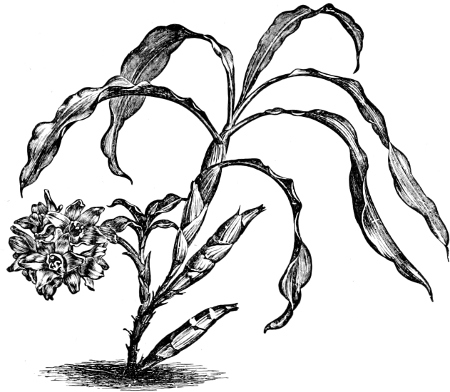
Fig. 321.—Chysis bractescens.
The DISTRIBUTION OF SEEDS is effected by the wind, the seeds being so exceedingly small and light. Many species moreover have peculiar, elater-like, fine, hygroscopic hairs in the ovary, which eject the seeds in a manner similar to the elaters of the Liverworts.
The USES are few, mostly as ornamental plants in conservatories. The tubers of several Orchis-species are OFFICINAL; they contain starch and mucilage and are used us “salep.” The fruits of Vanilla planifolia are used as condiments and differ from other Orchid-fruits in being rather fleshy and in dehiscing irregularly; the seeds are very small, shining and black.
Class II. Dicotyledones.
In this class THE EMBRYO has 2 seed-leaves, a rule from which there are few exceptions (e.g. Ficaria, Cyclamen, Pinguicula, certain species of Corydalis, with only 1; and a few, mostly parasitic forms, e.g. Monotropa, Orobanche, Pyrola, entirely without cotyledons). On germination the cotyledons nearly always raise themselves above the ground as green, assimilating leaves and are then termed aerial or epigean, in contradistinction to the underground or hypogean which are always buried. The structure of the seed varies (endospermous or exendospermous); the embryo may be straight or curved. In many instances the primary root grows as a vigorous tap-root, with weaker branches arising acropetally (in annuals, biennials, many perennials, especially woody plants); but in a large number of herbaceous perennials, which have rhizomes, the root behaves very much as in the Monocotyledons. The roots generally increase in thickness by means of a cambium.
The stem, when seen in transverse section, has its vascular bundles arranged in a ring; in reality, however, they form a kind of cylindrical network in the stem; the bundles are open, and thickening takes place by means of a cambium; annual rings are formed in the perennial stems. There is a rich and very varied form of branching. The two first leaves of a shoot (fore-leaves) are placed nearly always to the right and to the left; the same arrangement is found in the two first leaves developed on the flower-stalk, and these are, as a rule, the only two; they are found below the calyx and are usually termed the “bracteoles.” It has become customary to indicate the bracteoles by the letters α and β, according to their sequence of growth, and in that sense these letters will be employed in the following diagrams.
The arrangement of the leaves varies very much; there is also a great variety of shapes in the leaves and their venation, but the linear leaves, with parallel venation, so frequent in the Monocotyledons, are seldom met with, as also the large sheaths (though the sheath is well developed in the Umbelliferous plants); stipules occur much more frequently.
The flower is most commonly cyclic, but acyclic or hemicyclic forms also occur. The type which may be taken as a basis consists in the majority of instances, as in the Monocotyledons, of 5 whorls, of which the 4 outer ones (calyx, corolla, and the 2 whorls of stamens) are most frequently 4 or 5 in number and placed in regular alternation, whilst the innermost one (the carpels) has generally fewer members, probably on account of space (Figs. 360, 361, 421, 429, 487, etc.). Trimerous (Figs. 384, 387, etc.) flowers, or those in which the members of the flower are in threes or a multiple of three, also occur, as well as dimerous flowers; other numbers are rare. It is of the greatest importance in connection with the relative position of the members of the flower to the axis and bract (orientation), whether the bracteoles are typically present (even though they may not be developed), or are typically absent. If there are 2 bracteoles present, then their position in a pentamerous flower is often as follows: the first sepal turns obliquely forward, the second is posterior and median, the third obliquely forward, the fourth and fifth obliquely backward; quincuncial æstivation is often found in these buds (Figs. 360, 429, 471, 475, 584). The first and third leaves, in the following chapters, are most frequently alluded to as the “anterior,” the fourth and fifth as the “lateral” leaves. The reversed arrangement, with the median sepal in the front, occurs for instance in Papilionaceæ (Fig. 511), Lobeliaceæ (Fig. 594), Rhodoracecæ. If any bracteoles are present below a tetramerous flower, the relation is generally that 2 sepals (the first ones) stand in the median plane, the two next ones transversely (Fig. 393), and the corolla then adopts a diagonal position (Fig. 397); but a diagonal position of the calyx generally shows that the flower is not, strictly speaking, tetramerous, as in Plantago (Fig. 567), Veronica (Fig. 559 C) and others.
If the bracteoles are not typically present, then the position of the sepals is changed accordingly, and the two outer sepals endeavour to assume the position which the bracteoles would otherwise have occupied, e.g. in Primula (Fig. 547). Other positions are also found when the number of bracteoles is more or less than two.
The leaves which follow the sepals occupy definite positions with regard to them, which we may consider later. An arrangement must, however, be mentioned here; when the flower is “diplostemonous” that is, has two whorls of stamens (thus, Sn, Pn, An + n), these may be arranged in two ways. Either the first-formed whorl of stamens, which are termed the “calyx-stamens,” stands directly in front of the sepals (that is “episepalous”), and is the outermost whorl, and in this case a regular alternation takes place between sepals, petals and the two whorls of stamens, which is also continued into the carpels if their number is the same as that of the other whorls: the carpels are then placed opposite the sepals (Fig. 278) and the flower is isomerous and Gn should be added to the formula above. Or, the calyx-stamens form the innermost whorl, and the corolla-stamens, which are subsequently formed (“epipetalous” stamens), stand outside these (Figs. 360, 429); if the number of carpels is the same as that of the preceding whorls, they are often placed right in front of the petals and the corolla-stamens. The first-mentioned arrangement is termed Diplostemonous, and the second Obdiplostemonous. Both arrangements may be found in one and the same order, e.g. Caryophyllaceæ. The size and relation of the members of the flowers, and also the contact with other members in the early stages of their development, play an important part in determining the arrangement.
The great number of structural arrangements found in this enormously large class, may, as is the case in the Monocotyledons, be further varied by suppression and division of certain leaves (especially the stamens). Instances of this will occur in the following (Figs. 559, 568.—426, 441, 445, etc.).
The Dicotyledons were formerly divided into 3 sub-classes: Apetalæ (those without corolla), Sympetalæ or Gamopetalæ (those with the petals united), and Choripetalæ or Polypetalæ (the petals not united). This division has now been abandoned because it has been proved that the Apetalæ were merely reduced or incomplete forms of the Choripetalæ, and they have therefore been distributed among the various families of the latter sub-class.
With regard to the Sympetalæ (or Gamopetalæ) it may be stated that they form to a very great extent a closely connected and natural group, having in common not only the character that the corolla is gamopetalous and the stamens united with it (this being also found in the Choripetalæ), but also a great many others (such as persistent calyx, cyclic flowers with the formula S5, P5, A5 and as a rule G2, the two carpels being united to form the ovary; seeds with a thick integument and a very small nucellus). They are therefore considered as an independent sub-class, and must be placed at the close of the system of classification as the forms which presumably have arisen the latest. In the future systems of classification this arrangement will very probably be changed, and the first families of the Sympetalæ, the Bicornes and others will for instance be to a certain extent united with the families or orders of the Choripetalæ. The Sympetalæ may certainly be considered as the youngest types, the strongly pronounced metamorphosis supporting this theory, as also the formation of the integument of the ovule, the one thick integument being undoubtedly derived from the coalescence of two—a holochlamydeous ovule, etc.
The Apetalæ and Choripetalæ are united into one sub-class. The leaves of the perianth in this case are, as a rule, free from each other, the structure of the flowers presents many differences, and the ovules have as a rule 2 integuments and a large nucellus. Considerable uncertainty still prevails regarding the arrangement and the relationship of the individual families of the Choripetalæ, and some of the following families are hardly quite natural; but the best arrangement arrived at so far has been adopted here.
At the beginning of the book a review of the orders of the Dicotyledons will be found.
Sub-Class 1. Choripetalæ. Petals free.
Family 1. Salicifloræ.
Trees and shrubs, which, in the structure of the vegetative shoot and the catkin-like inflorescences, resemble the Quercifloræ, but the structure of the flower differs so much from them, that the only order brought under this heading—Salicaceæ—well deserves to be separated and to form a family of its own, the nearest relatives of which are still doubtful. As Juglandaceæ and Myricaceæ also deserve to be placed in a special family, the name Amentaceæ (Catkin-bearers), hitherto applied to all of these plants, cannot be retained as the name of a family.
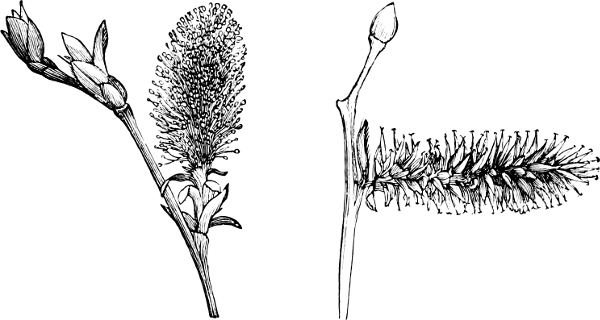
Fig. 322.—Male and female catkins of Salix caprea.
There is only one order.
Order. Salicaceæ (Willows). Trees with simple, scattered, stipulate leaves. Diœcious. The flowers are arranged in simple inflorescences (spikes or racemes) which are termed catkins, and which fall off as a whole after flowering (♂) or after the ripening of the fruit (♀) (Fig. 322). The perianth is very imperfect[33] or wanting, particularly in Salix (Fig. 323 o); the ♂-flower with 2–several stamens and without any trace of a carpel (a, b, c): the ♀-flower has a free bicarpellate ovary, unilocular, and formed from 2 lateral carpels with 2 parietal (median) placentæ and generally ∞ ovules; the style divides into two stigmas (d, e, f). The fruit is a two-valved capsule and the very small seeds bear a tuft of hairs at the base. Endosperm absent.—The catkins are situated on dwarf-branches, which in some species often develop before the leaves and bear at their base only scale-leaves; in others foliage-leaves are borne beneath the catkins. The vegetative bud commences with 2 bud-scales which are united on the anterior side into a scale. The capsule opens by the dorsal suture. The seed-hairs spring from the funicle.
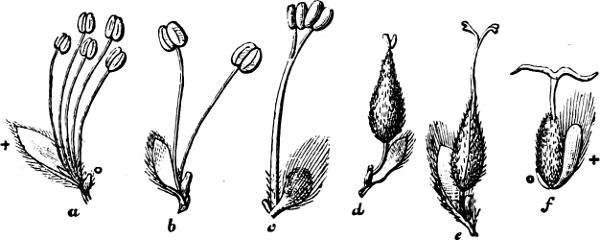
Fig. 323.—Salix: male flowers of S. pentandra (a), S. aurita (b), S. rubra (c), female flowers of S. aurita (d), S. nigricans (e), S. mollissima (f).
Salix (Willow) has short-stalked, most frequently lanceolate leaves and erect catkins with undivided bracts (Fig. 322). The flowers are naked; 1 (o in a-f) or 2 yellowish glands situated in the median line. In the ♂-flower generally two stamens, situated laterally like the carpels in the ♀-flower. Various forms are seen in Fig. 323.—The terminal bud of the branches often aborts regularly, the uppermost lateral bud taking its place.
Populus (Aspen, Poplar) has long-stalked, more or less round or cordate leaves with drawn-out apex; catkin pendulous; lobed bracts; perianth cup-like with oblique edge; stamens usually numerous; stigmas often divided.—P. tremula (Aspen) has received its name from the tremor of the leaves: cf. “to shake like an aspen leaf.”
Pollination. The Poplars are wind-pollinated. The Willows have sticky pollen and are pollinated by insects. The catkins of the Willows, especially the ♂, are more conspicuous, from the numerous, closely-packed, yellow flowers, rich in honey and pollen. The catkins often appear before the foliage and so are much more easily seen, whilst at this time of the year the number of competing honey-flowers is smaller, and the insect visits consequently more numerous. On many catkins of the Willow the flowers open earliest on the side which is turned towards the sun and in descending order, i.e. the upper flowers develop before the lower ones. Hybrids frequently appear.
There are about 180 species existing in the northern, cold and temperate latitudes. Some in the Polar regions are scarcely more than an inch in height, and have a creeping rhizome (Salix herbacea, polaris, reticulata). Fossil forms are found in the Tertiary and perhaps also in the Upper Cretaceous.
Uses. Principally for ornamental trees, as they grow very quickly and are easily propagated by cuttings, S. babylonica, Weeping Willow; S. purpurea; Populus alba, Silver Poplar; P. pyramidalis, Pyramid Poplar—a form of P. nigra; P. monilifera, Canadian Poplar. The wood is very poor and little used; the branches of many Willows are cultivated for basket-making, etc. The wood of the Aspen is used for matches. The bark contains tannin and, in many Willows, a very bitter extract, Salicin (S. pentandra, fragilis). Salicylic acid (officinal) is obtained from Salix. Balsam is extracted from the buds of many Poplars, especially when the leaves are shooting.
Family 2. Casuarinifloræ.
Trees with verticillate, scale-like leaves forming sheaths at the nodes. Monœcious. Flowers unisexual. ♂-flowers in catkins; ♀ in short spikes. Pollen-tube entering the ovule at the chalaza, and not through the micropyle. Ovary 1-seeded, unilocular. Carpels uniting into a multiple fruit. Only one order.
Order. Casuarinaceæ. Trees (30 species), from Australia and certain parts of S.E. Asia, with peculiar, equisetum-like appearance. The leaves are verticillate, scale-like and united into sheaths. The internodes are furrowed. Branching verticillate. The unisexual flowers are situated in catkins or short spikes. The ♂-flower has a central stamen, surrounded by 2 median, scale-like perianth-leaves and 2 lateral bracteoles. The ♀-flower has a 1-chambered ovary (2 ascending, orthotropous ovules), no perianth, but 2 large, lateral bracteoles which finally become woody and form two valves, between which the nut-like fruit is situated. The multiple-fruits therefore resemble small cones.—Casuarina equisetifolia, cultivated, gives “iron-wood.”
[The Casuarinas differ from the ordinary Dicotyledons in many important respects which may be briefly summarised thus:—The bicarpellate ♀-flower has a well-pronounced stylar-cylinder terminated by two stigmas, but the cavity of the ovary closes very soon after its formation, and in it are developed two parietal ovules; these are united by a bridge of cellulose to the stylar-cylinder or summit of the ovary, and hence the ovules are connected with the walls of the ovary by the bridge (above), as well as by the funicle (below). The archespore is developed from the hypodermal cells at the summit of the nucellus, two primordial mother-cells are first formed and from these by tangential divisions a central cylindrical mass of cells (sporogenous-tissue) is produced which is surrounded by tapetal cells. The cells of the sporogenous tissue correspond to the mother-cells of the embryo-sac of other Angiosperms; they divide transversely and from 16–20 macrospores are formed together with inactive cells which are not crushed together as in the case of other Phanerogams. The sexual apparatus is developed from a single cell, but the number of cells composing this apparatus is subject to variation, the oosphere being accompanied by one or two neighbouring cells which resemble canal-cells rather than synergidæ. The sexual apparatus is found in the majority of the macrospores, but in most of these it remains as a number of naked cells; while in the fertile macrospores the cells are invested by walls of cellulose (usually only one fertile macrospore is found in each ovule). Antipodal cells are never developed. The macrospores elongate considerably towards the chalaza, into which some penetrate. The pollen-tube traverses the stylar-cylinder and enters the ovules at the chalaza, its passage through the tissue of the nucellus being assisted by the prolongation of the macrospores. About the centre of the nucellus the pollen-tube is ruptured; the apical portion which alone takes part in the fertilisation being firmly attached to the macrospore. Although the actual impregnation has not been observed, Treub considers that the endosperm begins to be formed before fertilisation.]
Family 3. Quercifloræ.
Trees and shrubs with small, unisexual, monœcious flowers, having no perianth or a simple inconspicuous one. The ♂ and ♀ flowers are very different and generally placed in separate inflorescences. The ♂-flowers are most often adnate to the bracts. The stamens are placed opposite the perianth-leaves, when they are present in equal numbers. The ♀-flower is naked, or has a superior perianth. The ovary at the base is 2- or 3-(-6) locular with 1 or 2 pendulous ovules in each loculus, only one of which is developed; the fruit is a one-seeded nut; endosperm absent; embryo straight. The inflorescences, which are either compound and mixed (small dichasia in spikes) or simple, are here also termed catkins; but, strictly speaking, this term is applied to the ♂-inflorescences only. In all Quercifloræ the leaves are scattered (usually in 2 rows) simple, and penninerved, and with deciduous stipules.
It is worthy of remark that in Betulaceæ, Corylaceæ and Quercus the ovules, and to some extent the loculi of the ovary are not developed till after pollination, so that the development of the pollen-tube proceeds very slowly. The smallness of the flowers, the absence of honey, the dryness and lightness of the pollen, the size of the stigma and the abundance of hairs found on many stigmas are all adaptations for wind-pollination. It is also an advantage that the flowers are generally pollinated before the foliage-leaves are developed, thus preventing the pollen being entangled by the leaves.
The two orders Betulaceæ and Corylaceæ mentioned here are by other authors united into one order. [It is doubtful whether these two should be retained in the family Quercifloræ, as recent researches (p. 273) have shown that they differ from the Cupuliferæ in many important points, and agree with the Casuarinas in the fact that the pollen-tube enters the ovule through the chalaza.]
Order 1. Betulaceæ (Birches). Monœcious, with thick, cylindrical, compound ♂ and ♀ inflorescences (2- or 3-flowered dichasia in a spike with spirally-placed floral-leaves) (Figs. 324, 326, 328). When the perianth in the ♂-flower is completely developed, it is composed of 4 somewhat united leaves, which are placed opposite the 4 stamens (Figs. 325, 326 A). The female flowers are naked; the ovary is bilocular, with two styles and one pendulous ovule in each loculus. The subtending floral-leaves unite with the bracteoles and form a 3–5-lobed cover-scale, which is not attached to the fruit (Figs. 325 D, 326 B). Fruit a nut without cupule (see Corylaceæ and Cupuliferæ). In the bud the leaves are flat. The stipules are deciduous. On germination the cotyledons are raised above the ground. Terminal buds are only found on old Alder trees; the Birch has sympodial branches.
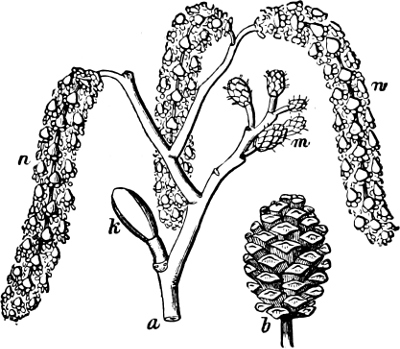
Fig. 324.—Alnus glutinosus. Branch of Alder with ♂-(n) and ♀-(m) catkins: k bud; b fruit-bearing catkin (“cone.”)
Alnus (Alder) (Figs. 324–326). In the majority of species the ♂-and ♀-catkins are both developed in the year previous to their flowering, and pass the winter naked and bloom before the leaves expand. ♂-flower: 4 stamens. ♀-flower: the 5-lobed cover-scales of the ♀-catkin are woody and remain attached to the axis, so that the entire catkin when ripe resembles a small cone (Fig. 324 b). Each cover-scale supports two winged or wingless nuts. In the native species of Alder the buds are stalked (Fig. 324 k). The bud-scales are formed by the stipules of the lowest leaves.
Betula (Birch). The ♂-catkins, in the native species, appear in autumn, the ♀-catkins in the flowering year on leaf-bearing, short-lived shoots. ♂-flowers: 2 stamens, divided (Fig. 328 A). The 3-lobed cover-scales (Fig. 327 a) of the ♀-catkin are detached from the axis; each cover-scale supports 3 broadly winged nuts (b). The stem has cork with annual rings. The young twigs and leaves have aromatic resin glands.
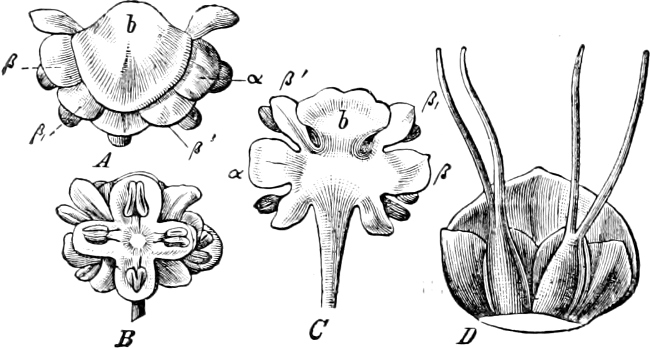
Fig. 325.—Alnus glutinosa: A dichasium of ♂-flowers seen from the front; B the same from inside; C the same from the back; D dichasium of ♀-flowers with subtending-leaf and four bracteoles. The letters b, α, β, β′, β are the same as in Fig. 326 A.
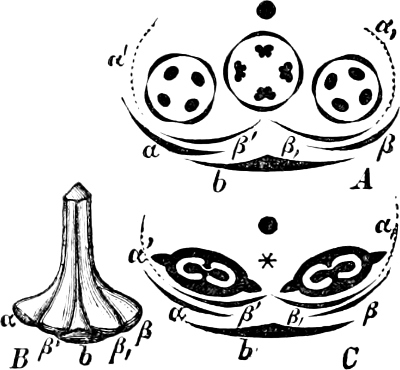
Fig. 326.—Alnus glutinosa: diagram of dichasia of ♂ (A) and ♀ (C) catkins; B a cone-scale. All the bracteoles in A and C are slightly pressed from their normal position.
The Inflorescences of the Alder.—In the axil of each cover-scale [b in the Figs] is situated, in the ♂-catkins (Figs. 326 A, 325 A-C) a 3-flowered dichasium, the flowers of which have a 4-partite perianth, the posterior perianth-segments being sometimes almost suppressed, and 4 stamens with undivided filaments. In the ♀-catkin (Figs. 325 D, 326 C) a 2-flowered dichasium is found, the middle flower being suppressed (indicated by a star in C). In both instances the inflorescences have two bracteoles (α-β) and the flowers borne in their axils have each one bracteole (β′), the other one (α′) being suppressed and therefore in 326 A and C only represented by a dotted line; these four bracteoles unite with the cover-scale (b) which supports the entire dichasium, to form the 5-lobed “cone-scale” (Fig. 326 B) which in the ♀-catkin eventually becomes woody.
The Inflorescences of the Birch.—A 3-flowered dichasium is situated in the axil of the cover-scale in both ♂-and ♀-catkins (Fig. 328 A, B); only the central flower has bracteoles (α-β) (the lateral flowers having no bracteoles), and these bracteoles unite, as in the Alder, with the supporting cover-scale (b), and form a three-lobed cone-scale (Fig. 327 a).
While the ♀-flower exactly resembles that of the Alder, the reduction of the ♂-flower, already described in the Alder, is carried further, so that often only the 2 median perianth-leaves are developed (Fig. 328 A); there are also only 2 stamens, these being deeply cleft, while the other 2 are suppressed.
About 50 species; N. Temp.—Fossil-forms certainly occur in the Oligocene. During the Glacial period the Dwarf-birch (B. nana) extended over Europe; at the present time it is confined to the moors and mountains of N. Europe and N. America and Asia. Wind-pollinated.
Uses.—Important forest trees. The bark contains tannic acid. The tar of the Birch is used in the preparation of Russia leather; whilst its spring sap is very saccharine, and is used in some places for making a fermented drink. Its external bark is used for roofing, for baskets, etc.
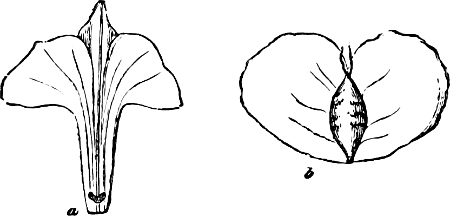
Fig. 327.—Betula verrucosa: a cone-scale; b fruit.
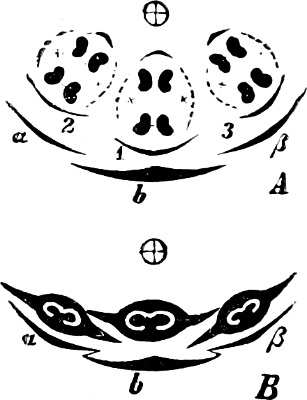
Fig. 328.—Diagrams of dichasia in the ♂-(A) and ♀-(B) catkins of Birch.
Order 2. Corylaceæ (Hazel-nuts). Monœcious. The ♂-catkins are long and cylindrical; the ♂-flowers are placed singly in the axil of the subtending-leaf (cover-scale); they are naked and formed of a number of divided stamens, which are partly united with the cover-scale, 4 in the Hazel, apparently 8 (Figs. 330 A, 329 B, C), more on the Hornbeam. The ♀-flowers have a very small, superior perianth; in the axil of each cover-scale a 2-flowered dichasium (Fig. 329 D) is present, of which the central flower (* in Fig. 330 B) is suppressed. The gynœceum is bicarpellary as in the Birches; the ovary is bilocular, with two long styles (Fig. 329 D-F); the loculi have 1 (-2) ovules (Fig. 330 B). Each single ♀-flower and fruit is surrounded by a leaf-like covering, the cupule (husk), which is formed of three floral-leaves (namely, the bract of a lateral flower, and its own bracteoles; thus in Fig. 330 B, α, α′, β’ form the cupule for the left-hand flower, and β, α1, β1, the cupule for the right-hand).
Corylus (Hazel-nut, Fig. 329). The long, cylindrical ♂-catkins pass the winter naked, 2–3 together, on short branches. The very small ♀-catkins are enclosed in buds, in which they pass the winter; these buds are situated in the axils of the fallen foliage-leaves, and it is only by their larger size that they may be distinguished from the ordinary foliage-buds. In spring the ♀-catkins are easily recognised by their red, projecting stigmas (Fig. 329 A). The cupule—the “husk”—is tubular, fringed, and envelopes the nut. The leaves are alternate and unsymmetrical, the external side being larger than the internal; this is connected with the vernation, the blade being conduplicate in the bud; the stipules are deciduous. The bud-scales are formed of stipules, the most internal having a leaf-blade attached to them which is suppressed in the external ones. The cotyledons remain underground on germination.
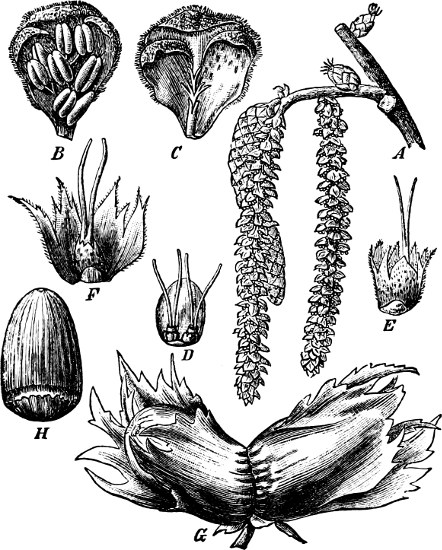
Fig. 329.—Corylus avellana: A branch at the time of flowering with ♂-and ♀-catkins; B ♂-flower with subtending-leaf (bract) and two bracteoles; C the same without the anthers; D view of interior of ♀-dichasium shortly after fertilisation; E young fruit with cupule; F similar one with the cupule opened; G mature ♀-fruits; H nut.
Carpinus (C. betulus, Hornbeam). The ♂-and ♀-catkins do not appear till the leaves are shooting. The ♀-catkin in this instance is also long and cylindrical. The cupule in C. betulus is 3-lobed, and to a slight extent only embraces the base of the ribbed nut (Fig. 331); each lobe corresponds to a floral-leaf. Whilst the carpels are placed medianly in Corylus, in Carpinus, on the other hand, they are situated transversely, as in the case of the Betulaceæ. The lamina of the leaf is not conduplicate in the bud, but flat, and folded only along the lateral veins, which are also indicated in the form of the fully-developed leaf; otherwise the vegetative characters are essentially the same as in the Hazel. The cotyledons are aerial.—Ostrya resembles the Hornbeam, but the cupule completely envelopes the nut, as a sac open at the apex (Eur., N. Am., Japan).
N. Am., Asia, and Europe; 25 species.—Fossil forms in the Oligocene. Wind-pollinated. Uses. As timber (Carpinus betulus) and firewood. The fruits of C. avellana (ordinary Hazel-nut), C. tubulosa (Lambert’s nut) and C. colurna (Turkish Filbert) are edible.
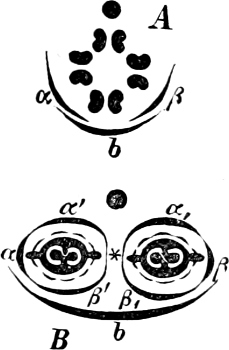
Fig. 330.—Diagrams of the ♂-flower (A) of Corylus and the dichasium of the ♀-flowers (B).
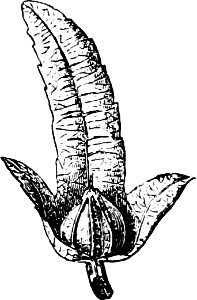
Fig. 331.—Nut of the Hornbeam with cupule.
Order 3. Cupuliferæ. Monœcious. The inflorescences make their appearance with the leaves, arising in the axils of the leaves of the same year. A woody cupule furnished externally with scales or spines is common, and surrounds 1-several flowers (the cupule in the Corylaceæ never encloses more than a single flower or fruit). The ♂-flower has a united perianth, which is, however, 4–6 partite, and encloses an indefinite number of undivided stamens. The ♀-flower has a superior, 6-merous perianth (3 + 3, compare Figs. 332 D, 334); the gynœceum is formed of 3 (or in Castanea 4–6) carpels with a corresponding number of stigmas (Figs. 332 D, H; 334, 335); and the ovary has at the base 3 (-6) loculi (Fig. 333), each of which has 2 pendulous anatropous ovules; the fruit is a one-seeded nut (Figs. 332 H, 336).
The cupule of the Cupuliferæ, according to the opinion of Eichler, is formed by united bracteoles, (compare Fig. 333, where the four valves in the cupule of Castanea are considered as bracteoles of the lateral flowers of the dichasium); according to another view (see Prantl, in Engler’s Bot. Jahrb., viii., 1889), it is a ring-like axial outgrowth independent of the bracteoles of the flower, whose scales and spines are floral-leaves. The cupule in the Oak only encloses the base of the fruit, but in the Eating-chestnut and Beech the fruit is completely enclosed, and consequently the cupule must divide into a number of valves (generally 4) to allow the fruit to escape. In the 3-flowered dichasia of Pasania, Sect. Eupasania (Trop. Ind.), each individual flower has its own cupule of the same structure and development as in Quercus; and, moreover, each group of flowers has externally the typical six bracteoles.
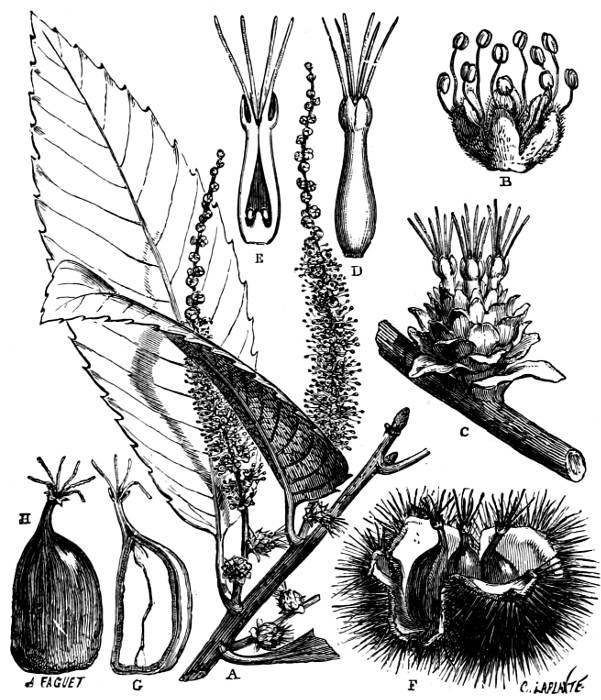
Fig. 332.—Castanea vesca: A branch with inflorescences; B ♂-flower; C young cupule with three ♀-flowers; D ♀-flower; E the same in longitudinal section; F cupule with 3 nuts (diminished); G, H nuts (G in longitudinal section to show embryo).
Castanea (Eating-chestnut, Fig. 332). The catkins are erect (A), cylindrical, with the ♀ at the base and the ♂ at the top, or some are entirely ♂ and composed of small dichasia. The cupule (C, F) is 4-valved, provided with spines, and entirely envelops the 3 nuts; it is already developed at the time of flowering.—♂-flowers are most frequently borne in 7-flowered dichasia, and have a well developed perianth, most frequently consisting of 6 leaves in two whorls (Fig. 332 B), and a large number of stamens. ♀-flowers are most frequently borne in 3-flowered dichasia (Figs. 332 C, 333); the letters in Fig. 333 indicate the older theory, according to which the 4 bracteoles (α′-β′) of the two lateral flowers are thick and united into a single 4-valved, woody cupule, which surrounds the 3 nuts, and is furnished externally with spines; the spines are well developed hair-structures.—6 carpels in two whorls.—The leaves in the vertical shoots have a divergence of 2/5, 3/8, 5/13; on the horizontal shoots they are alternate. The cotyledons remain underground on germination.
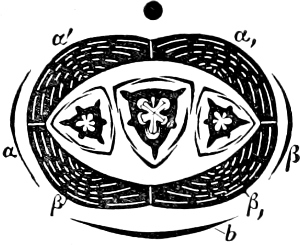
Fig. 333.—Diagram of the cupule of Castanea.
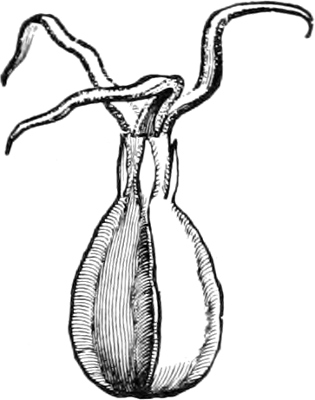
Fig. 334.—Female flower of Fagus (mag.)
Fagus (Beech). The ♂-catkins are pendulous, capitate; the ♂-flowers have an obliquely bell-shaped, fringed perianth, with 6–20 stamens. ♀-catkins erect, 2-flowered, borne singly in the axil of foliage-leaves of the same year; the ♀-flower has a gynœceum formed of 3 carpels, bearing an epigynous, 6-leaved perianth (Fig. 334). In this genus the dichasium has only 2 flowers, the central one being suppressed. The cupule contains, therefore, only 2 triangular nuts (“mast”). All the shoots have the leaves arranged in two rows; the rows are on the underside, being only about 90° distant from each other; the buds on the other hand approach each other towards the upper side. The bud-scales are stipules without laminæ; in vernation the laminæ are folded along the lateral ribs, the upper lateral portion being the largest (as in Hornbeam and Chestnut). The cotyledons are folded, and at germination are aerial, large, and reniform. 4 species (Europe, Japan, N. Am.)—Nothofagus (S. Am., New Zealand, S. Austr.)
Quercus (Oak, Fig. 335). Catkins simple. ♂-catkins long, thin, pendulous, few-flowered. ♀-catkins erect; the cupule is cup-like, entire, and encloses only the base of the solitary nut (“acorn”).—The ♂-flower has a similar construction to that of the Chestnut. The ♀-catkin has not more than 5 flowers (single-flowered dichasia, in which only the central flower is developed). The scales on the cupules are no doubt leaf-structures in this case also. According to another theory, the scales are hair-structures; they arise on the internal face of the young cupule apparently in descending, but really in ascending order. The rim of the cupule gradually expands. In the ♀-flower (Fig. 335) the loculi of the gynœceum, together with the ovules, are not developed until after pollination.—The leaves in all cases have a divergence of 2/5; the lowermost leaves on the shoots are reduced to stipules which serve as the bud-scales (5 rows). The laminæ are conduplicate, as in Corylus, and the external side is the broadest. The cotyledons are fleshy and remain underground. 200 species.—Pasania (100 species).
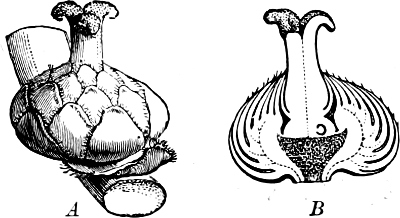
Fig. 335.—Quercus: A ♀-flower in its cupule (mag.); B longitudinal section through A, showing cupule, perianth, and inferior ovary.
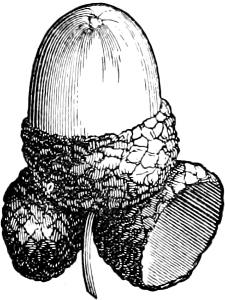
Fig. 336.—Fruit of Quercus.
368 species, in temperate climates, especially in Europe and N. America. Authenticated forests have been found in the Oligocene. The Beech has one species, Fagus sylvatica, in Europe; it is a most important forest tree (in Denmark the most important) and reaches its most northern limit near Alvesund in Norway (60° N.L.), its northern boundary line passing from Alvesund in a zig-zag line through Ludwigsort, south of Königsberg, in Prussia, towards the Crimea. According to Steenstrup and Vaupell, the Beech did not make its appearance in Denmark until a comparatively recent time, the Oak then being partially supplanted. Other species of Beech are found in N. America and Japan. Several species of Nothofagus occur in the South West of S. America, and in the colder regions of the southern hemisphere. The Oaks grow especially in temperate regions, e.g. in Western Asia, N. America, and the mountains of Mexico. Evergreen species are found in Tropical Asia, Himalaya, Japan and the Mediterranean region. In this country there is one species of Oak (Q. robur), of which there are three varieties (Q. pedunculata, intermedia, sessiliflora). The Eating-chestnut is found in the South of Europe, but is cultivated in the midland and southern counties of England.—Uses. The wood of these trees is very useful as timber. The wood of Q. tinctoria has a yellow colouring matter (Quercitron-wood). The bark of the Oak contains a large quantity of tannic acid, and is used for tanning; for this purpose also the cupules of Q. vallonea, ægilops, græca, and others from the Eastern Mediterranean, are used under the name of “Valloons.” The Cork-oak (Q. suber; S.W. Europe) is the most important tree from which cork is obtained,
its bark being very largely developed and stripped for cork. Gall-nuts are found on many species; those of Q. lusitanica, var. infectoria (Eastern Mediterranean) are officinal, and likewise the fruits (acorns) and the bark of Quercus pedunculata and sessiliflora. Oil is obtained from the Beech “mast.” The nuts of the Chestnut tree are edible.
Family 4. Juglandifloræ.
This family resembles the Quercifloræ in the catkin-like inflorescences, the imperfect, unisexual flowers, the epigynous perianth and the woody shoots with scattered leaves, etc., though it is in other respects very dissimilar; one point of difference is the presence of aromatic compounds, but a more important divergence is found in the structure of the gynœceum, which is formed of two carpels with one loculus and has one basal, orthotropous and erect ovule, which, as in the Quercifloræ, does not become developed until after pollination; the fruit too is very different, being generally a drupe. Endosperm absent.
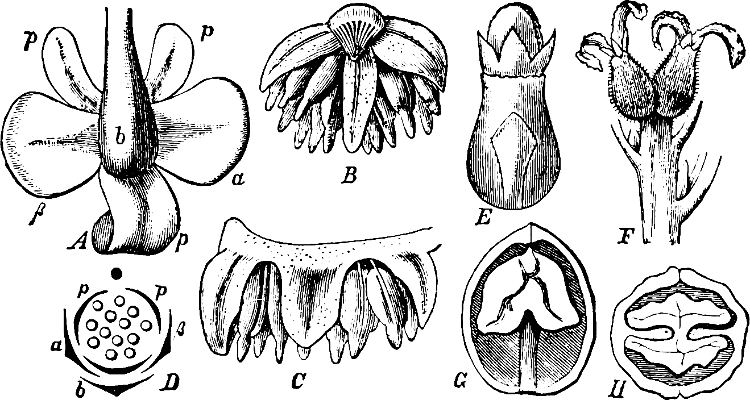
Fig. 337.—Juglans regia: A ♂-flower seen from below with bract (cover-scale) (b), bracteoles (α and β), perianth-leaves (p); B the same from the front; C lateral view of the same; D diagram of A; E ♀-flower with bract, the bracteoles are united with the ovary, their edge being visible as an indented line below the perianth; F 2 ♀-flowers at the end of a foliage-shoot; G fruit (without the fleshy covering) in longitudinal section; H transverse section of the same.
Order 1. Juglandaceæ (Walnuts). Leaves scattered, imparipinnate, rich in aromatic compounds. Stipules absent. Flowers unisexual. Monœcious. The ♂-catkins are lateral, generally on naked branches of the previous year, cylindrical, pendulous, many-flowered; the two bracteoles and the 2–4-leaved perianth of the ♂-flower unite with the subtending bract; the ♂-flower has indefinite stamens (6–20 in Juglans, Fig. 337 A-D). The ♀-catkins are terminal, generally on branches of the same year, few-flowered (Fig. 337 F); the ♀-flowers have a superior, 4-leaved perianth, a bicarpellate gynœceum, two styles with stigmas on the internal surface. The ovary, bracteoles and bract all unite together (Fig. 337 E). The fruit is generally a green or black drupe,[34] whose flesh (outer soft portion) in Carya and Juglans ruptures more or less irregularly, and frees the stone (“Walnut”).—The stone in Juglans is divided internally by one true (Fig. 337 H) and by several false, low partition walls into several incomplete compartments, so that the two large cotyledons become lobed and incised to fit like a cast into the irregularities of the inner surface of the stone; the embryo is exendospermous and covered with a thin testa.—The leaf scars are large and cordate with 3 groups of vascular bundles. The PITH in Juglans and Pterocarya is divided into chambers. The stone ruptures, on germination, along the dorsal suture into 2 valves; the cotyledons remain underground. In Juglans regia a long row of accessory buds is found on the lowest internode (epicotyl) above the axils of the cotyledons. Pollination by the wind. Both protogynous and protandrous examples of Juglans regia occur.—33 species, mostly in temperate North America.—Uses. Walnuts are obtained from J. nigra and regia; Hickory from North American species of Carya. The oil-containing seeds of several species are edible. Pterocarya and others are cultivated as ornamental plants.
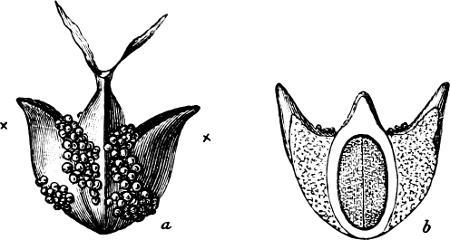
Fig. 338.—Myrica gale: a young fruit; × the bracteoles with numerous glands; b longitudinal section of fruit.
Order 2. Myricaceæ. To this order belong shrubs or trees which have penninerved, simple, at most lobed or pinnatifid leaves, with or without stipules, and with yellow, aromatic, resin glands (Fig. 338 a). The flowers, situated in catkin-like spikes, are unisexual and naked, and supported by scale-like floral-leaves. ♂-flower: 4–6 (–16) stamens with short filaments; ♀: generally situated singly. The gynœceum has a short style with 2 long stigmas, and unites with the bracteoles, which form wing-like outgrowths on the ripe drupe as in Pterocarya in the Juglandaceæ (Fig. 338). Cotyledons fleshy (Fig. 338 b).—Myrica; Comptonia.
40 species; Temperate.—Myrica gale (Sweet-gale, Bog-myrtle) has been used in the preparation of beer (Sweet-willow beer) on account of its resinous essential oil. M. cerifera (N. America) and species from the Cape, M. quercifolia and others, form wax on the fruit which is used in the preparation of candles.
Family 5. Urticifloræ.
The flowers are regular, hypogynous, nearly always unisexual, small and insignificant, with single, green perianth of 4–5 leaves. Stamens 4–5, placed opposite the leaves of the perianth. Ovary formed of 1 or 2 carpels, most frequently unilocular, with one ovule (Fig. 340). The fruit is a nut, more rarely a drupe, with one seed, generally endospermous. The Nettles are the sole order in the family which has only one carpel (1 stigma); this turns the posterior side to the front (Fig. 340). The others have two carpels (2 stigmas) but the anterior only is fertile (Fig. 346) except in a few Ulmaceæ and Moraceæ.
The majority are trees or shrubs with petiolated leaves, stipulate; rough hairs are very frequently developed upon the leaves. The flowers are very often crowded together in the inflorescence, which is rarely catkin-like. Peculiar aggregations of fruits are found in some orders. Latex and tough bast, which is used technically, are also frequently found. Cystoliths are found in the epidermis of many species of Ficus, Urtica, and others. Wind- or self-pollination is most common, as in the Quercifloræ and Juglandifloræ. In the Urticaceæ, Morus and some others, the stamens lie incurved in the bud, and when ripe straighten themselves suddenly and elastically, and thus small clouds of pollen-grains are ejected with considerable violence on to the stigmas, which are often provided with brush-like hairs (Fig. 341). The formation of honey does not take place.
Order 1. Ulmaceæ (Elms).—Trees or shrubs without latex. Leaves simple, arranged in two rows (divergence 1/2), oblique (the inner side, nearer the axis, being the larger), strongly penninerved, dentate, hispid; stipules deciduous. In opposition to the other Nettle-like plants the flowers are often ☿ with a united cup- or saucer-like, generally 4–(5)–6-divided perianth, and a corresponding or larger number of opposite erect stamens. The gynœceum has two carpels (2 stigmas), generally one loculus with one pendulous, anatropous or amphitropous ovule,[35] seldom two loculi and 2 ovules. Fruit one-seeded (nut or drupe). Embryo without endosperm.
A. Ulmeæ. The fruit is a winged nut (Fig. 339), the embryo straight, without endosperm. Anthers extrorse.—Ulmus (Elm). The flowers are situated in inflorescences which develop from the lower buds of the shoot of the preceding year. The lowermost bud-scales are empty, the uppermost support either solitary flowers, or small, dichasial or unipared scorpioid inflorescences. The terminal bud on the vegetative shoot quickly falls off, and the upper lateral bud continues the growth sympodially. Flowering takes place before the leaf-buds open. The flowers are wind-pollinated and have no honey. Fossil species have been found in the Oligocene.
20 species; North Temp. (2 species in this country). Important as timber. The Cork-elm (U. suberosa) has a rather thick cork, which, however, is of no technical use. The bast is used as Lime-bast.
B. Celtideæ. The fruit is a drupe, the embryo curved, with folded or rolled up cotyledons, with or without endosperm. The anthers are introrse. The flowers are borne on a shoot of the same year. Planera (N. America); Zelkova.—About 114 species; especially N. Temp., Trop.
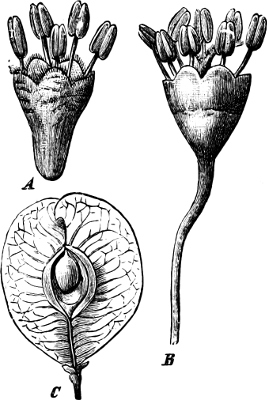
Fig. 339.—A Ulmus campestris, flower with exceptionally aborted gynœceum; B, U. effusa, flower with 8 stamens; C, U. campestris, fruit opened in front to show the seed pendulous from the apex of the loculus; one loculus is aborted.
Order 2. Urticaceæ (Nettles).—The majority of species are herbs with simple, stipulate leaves; they have no latex; stinging hairs abundant. The flowers (Fig. 340) are unisexual, generally 2-merous and arranged in clusters, which are united into catkin-like inflorescences. The perianth is composed very often of 4 (2 + 2) free, or in the ♀-flowers generally united, green leaves; the 4 (2 + 2) stamens are opposite the perianth-leaves, the filaments are bent inwards in the bud and throw themselves elastically towards the outside. The gynœceum has one style and one stigma (capitate or brush-like, Fig. 341); the ovary is unilocular, with one orthotropous, erect ovule (all other orders of this family have inverted or curved ovules). Fruit, a nut or drupe. Endosperm present (in Urtica very little), oily. Embryo straight. The STINGING HAIRS are club-shaped, very turgid, and provided with a siliceous, brittle apex, which breaks off in an oblique direction and allows the poisonous cell-sap to be forced out. In many tropical Nettles this is so strong that it may produce partial paralysis. There is no rudiment of an ovary in the ♂-flowers (Fig. 340 A). The PERIANTH in the ♀-flower differs from that of the ♂ in having the two internal leaves generally much larger and enveloping the fruit (Fig. 340 B); it often happens that all the perianth-leaves are united to form a gamophyllous envelope. ☿-flowers may occur among the others.—The inflorescences among our native species are dichasia, which become transformed into unilateral scorpioid cymes by the development of the bud of the 2nd bracteole. In Parietaria they are more pressed together, and the floral-leaves at the same time are also raised on their axillary shoots to just beneath the flower. As a rule, not only in this order but also in those related to it, a small vegetative branch is situated in the axil of the foliage-leaf, and this bears an inflorescence on each side at its base.
Urtica (Nettle) has opposite leaves with distinct stipules and stinging hairs. The perianth-leaves of the ♀-flower are free (Fig. 340).—Parietaria (Pellitory) has scattered leaves without large stipules, and stinging hairs are absent. The ♀-perianth is 4-toothed, flask- or bell-shaped.—Pilea is a tropical genus with trimerous, zygomorphic ♀-flowers, the posterior perianth-leaf being much larger than the two others, and more or less hood shaped.—The flower of Forskohlea is the most reduced; the ♂-flower has only one stamen, and the ♀-as well as the ♂-flowers have a one-sided, tongue like perianth (?). Pouzolzia.
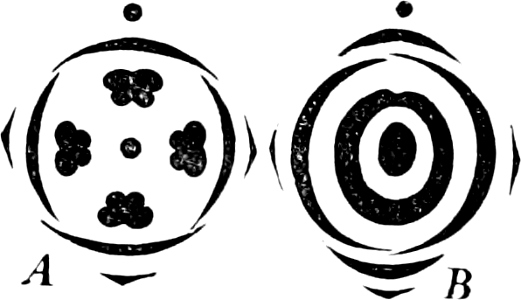
Fig. 340.—Diagram of ♂-and ♀-flowers of Urtica dioica.
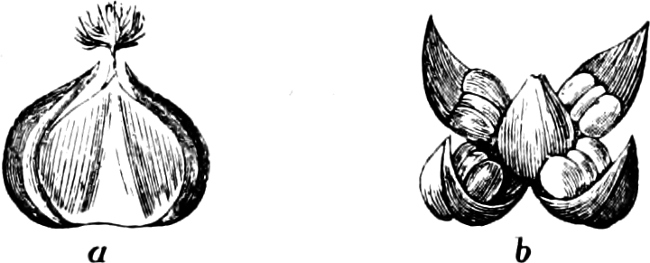
Fig. 341.—Parietaria diffusa; hermaphrodite flower: a in the female, b at the commencement of the male stage; the stigma has fallen off, but the anthers have not yet dehisced.
Wind-Pollinated. The pollen is shot out of the anthers, when they spring forward, and is caught by long stigmatic hairs. Parietaria diffusa is protogynous (Fig. 341).
500 species; chiefly in the Tropics, although the few species which occur in Europe are represented by a much larger number of individuals.—Uses. The bast of the native species Urtica dioica and urens, of U. cannabina (Siberia), etc.; of Boehmeria nivea “Ramié” and “China-grass” (from Sunda Is., China), and others, is used in the manufacture of muslin.
Order 3. Moraceæ (Mulberries). Nearly all trees or shrubs, seldom herbs, generally with latex. The leaves are scattered, and not infrequently lobed. The flowers are unisexual (monœcious or diœcious) and arranged in catkin- or capitulum-like, compound inflorescences. Perianth-leaves 2–6, generally 4, with an equal number of stamens opposite to them, as in the Nettles. The ovary is 1–seldom 2-locular, and has 2 stigmas (it is thus formed from 2 carpels) seldom only one style with one stigma. One ovule in each loculus, more or less curved, and pendulous; micropyle directed upwards. Fruit usually a drupe. The embryo is generally curved inside the fleshy endosperm, or it is exendospermous.
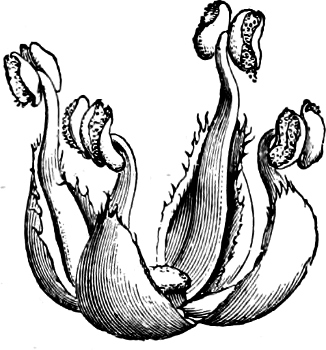
Fig. 342.—Morus alba ♂ flower (6/1).
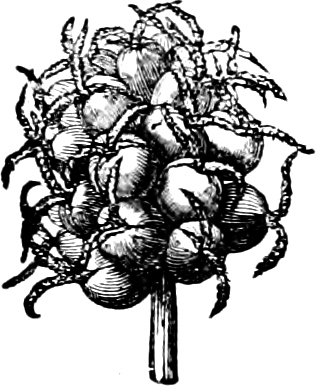
Fig. 343.-Morus alba ♀ inflorescence.
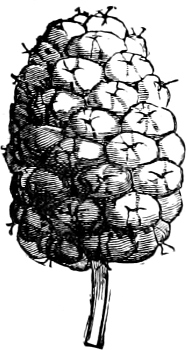
Fig. 344.—Morus nigra fruits.
A. Moreæ. The filaments are incurved in the bud. Leaves folded in the bud—Morus (Mulberry) (Figs. 342–344). Monœcious. The inflorescences are catkin-like in appearance, but in reality composed of many small dichasia. The flowers are similar to those of the Nettle, but with 2 carpels: in the ♂ with perianth 2 + 2, and stamens 2 + 2 (Fig. 342), in the ♀, perianth 2 + 2, and 2 carpels in regular alternation. The small drupes are enveloped by the perianth, which eventually becomes fleshy, and as all the flowers on the axis very accurately fit together, the collection of fruits is formed, which we call a Mulberry (Fig. 344). The leaves are folded in the buds, and have small stipules. The following are allied to Morus:—Maclura, Broussonetia (the Paper-mulberry tree) which has spheroid ♀ inflorescences (made up of dichasia), etc.
Dorstenia presents an interesting transitional form to the Fig in its flat, open, and, in some instances, lobed inflorescence on which the ♂ and ♀ flowers are sunk in grooves. Indications of a somewhat similar structure are found in certain Nettles, the sympodial axes of the dichasia becoming flatly expanded. The fruits are 1-seeded, but, nevertheless, spring open and eject their seeds.
B. Artocarpeæ. Filaments straight in the bud; foliage-leaves with convolute vernation. An interpetiolar leaf-sheath (ocrea) formed in the axil of each leaf by the connate stipules, covers the younger leaves as a hood. It falls off as the leaf expands, and leaves a ring-like scar on the stem.—Ficus (the Fig). The inflorescence (the so-called syconus) has a pear-shaped, fleshy, but hollow axis, on the interior surface of which the flowers are situated (Fig. 345). It is a kind of capitulum, with a hollow receptacle, whose “involucral” leaves close over the entrance to the interior; it is not, however, a simple capitulum, but a coalescence of cymose inflorescences. The edible parts are the fleshy stem-portion and perianth-leaves. The ♂-flower has a 2–6 divided perianth, 1–2 (–6) stamens; the ♀-flower has an oblique ovary. The fruits are drupes, with thin flesh.—Many species have aerial roots, and some live as epiphytes on trees. Pollination, in the edible Fig, is effected by a small Gall-wasp (Cynips psenes L.), which lays its eggs in the Fig, and hence carries the pollen away. Even in very ancient times it was customary to hang infected wild Figs on the branches of cultivated ones, so that the young Gall-wasps, as they emerged, could immediately effect the pollination (caprification). Ficus carica, and other species, have two kinds of ♀-flowers, besides the ♂-flowers. One kind has a short style and no stigmatic hairs, and it is only in the ovaries of these that the wasps lay their eggs (gall-flowers); the other kind has a long style and well-developed stigmatic-hairs, but the wasps cannot reach their ovaries—these are “seed-flowers.” There are, moreover, two kinds of plants of Ficus carica; ♀-plants, which have only seed-flowers, and bear the edible Figs, and ♂-plants (called “Caprificus”), which bear inedible fruits, and have ♂-flowers at the upper part of the Fig, but gall-flowers at the base. [The Caprificus, at Naples, bears three crops of inedible Figs each year, viz. Mamme (April), Profichi (June), Mamnoni (August). The ♂-flowers are produced especially in June, the first Figs being almost entirely ♀, and the last having but few ♂-flowers. Each crop produces a new generation of Fig-wasps. The female wasp enters the Figs on the Caprificus, and lays one egg in each flower, with the result that the flower developes into a kind of gall. The mother-wasp dies within the Fig. The male wasp is wingless; it bites a small passage into the ovaries containing the female wasps, and impregnates them; the female wasps then escape from the Fig, those in the Profichi carrying pollen away with them as they pass out. They then enter another Fig, lay their eggs, and die. The edible Fig-tree similarly has three crops in the year, Fiori di fico, Pedagnuoli, Cimaruoli. The wasps, entering these Figs, are unable to lay their eggs in the ovary, but, nevertheless, they effect cross-pollination on entering the Pedagnuoli, which bear fertile seeds.]
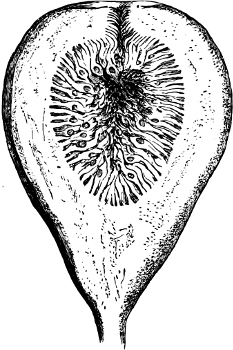
Fig. 345.—A Fig in longitudinal section.
The flowers of Brosimum are the most reduced. The perianth is wanting, and the ♂-flower has only 1 stamen. Cecropia (Trumpet-tree), in S. Am., has its pith divided into chambers; these are inhabited by ants, which feed upon small food-bodies formed on the swollen base of the petioles. The leaves are petiolated, often shield-like, fringed or lobed, and sometimes with white felted hairs. They serve as food for Bradypus (the Sloth). Sorocea; Castilloa.
About 300 species exclusively in the warmer climates. The white Mulberry (M. alba, from China, India, Mongolia) is cultivated for the sake of its leaves, which are the indispensable food for silkworms. The black Mulberry (M. nigra, W. Asia) is cultivated for its fruits, which are used for the officinal Mulberry juice. The ordinary Fig-tree (Ficus carica) is from the Mediterranean. The fruit of the well-known Oriental Sycamore (F. sycomorus) is edible. The Bread-fruit tree (Artocarpus incisa) and the Jack (A. integrifolia) have their home in the South Sea Islands, and are cultivated in tropical countries. The Bread-fruit is morphologically the same as the Mulberry. It has a very large, spheroid inflorescence, whose floral-leaves and perianth become fleshy and united into one nutritious mass, together with the axis, which is also fleshy. The milky juice of the India-rubber tree (Ficus elastica, East Indies, a common house-plant), and of Castilloa elastica (Am.) is the raw material of India-rubber. The milky juice of Galactodendron utile (Cow-tree, S. Am.) is saccharine and nutritious, but in Antiaris toxicaria (the Upas-tree, of Java) it is a strong poison. The bast of the Paper-Mulberry tree (Br. papyrifera, Eastern Asia); is used in Japan for paper. Shellac is obtained from a small, hemipterous insect (Coccus lacca), which lives upon Ficus laccifera and F. religiosa (the Bo-tree, sacred to Buddha), E. India. The wood of Maclura aurantica (Am.) has a yellow colour, and is known as yellow Brazilian wood.
Order 4. Cannabaceæ. The plants which belong to this order are aromatic herbs, either annuals or perennials, without latex. Leaves palminerved, and more or less divided, hispid, and with free, persistent stipules. Flowers always diœcious; ♂-flowers in panicles, formed of dichasia, passing over into uniparous scorpioid cymes. They differ from the Nettles, particularly in the 5-leaved perianth of the ♂-flower, the 5 stamens (Fig. 346–351) with filaments erect in the bud, and in the ♀-flower by the small, entire, cup-like perianth, which surrounds the base of the ovary (Fig. 346, p. 352). The ovary has two styles, or one divided into two, with two stigmas and a pendulous, curved ovule (Fig. 346 B, 352 B); the fruit is a nut; the embryo is curved (Hemp, Fig. 353), or rolled (Hop, Fig. 349), without endosperm.
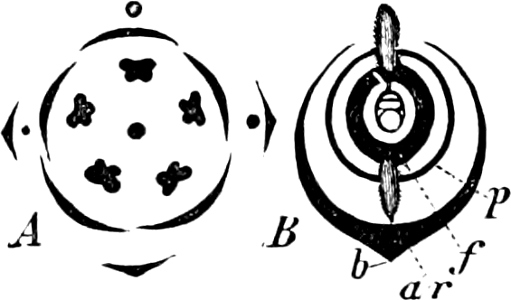
Fig. 346.—Diagram of male and female flowers of the Hop and Hemp: b the bract, p the perianth. The position of the embryo is indicated.
Only 2 genera with 3 species (Asiatic), of which two are cultivated.—Humulus lupulus (Hop, Figs. 347–349) is a twining, perennial plant, twisting to the right, with opposite, palmilobed, rough leaves, and large, interpetiolar stipules. The ♀-flowers are situated in closely-flowered, cone-like, compound inflorescences, with ultimately large, thin, imbricate floral-leaves (Fig. 348) which bear the yellow, glandular hairs, containing lupulin. This inflorescence is made up as follows:—The most external floral-leaves are situated in pairs, and are the persistent stipules of a leaf, the blade of which has become suppressed, or in any case is rudimentary. Such a pair of stipules supports 4 (2–6) flowers in a double uniparous cyme, whose central axis does not develope into a flower. The bracts of these flowers (bracteoles of the partial inflorescence) become, at maturity, very large, spathe-like, and, together with the stipules, produce a cone-like appearance.
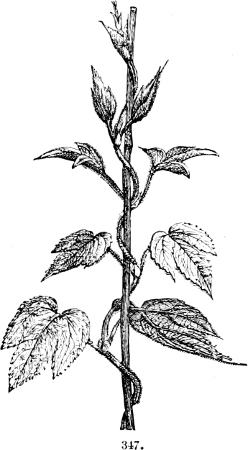
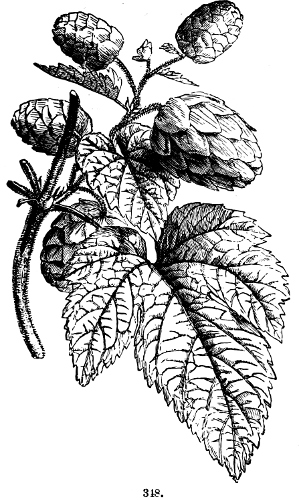
Fig. 347–348.—Humulus lupulus: 347, twining stem; 348, branch with strobiles.
Cannabis sativa (Hemp, Figs. 350–353) is an East Indian herb, with palmilobed leaves, and differs from the Hop in being annual, erect, and in having its leaves opposite at the base and scattered above. The ♀-inflorescence is not cone-like as in the Hop, but the flowers are similar in construction. The main difference is to be found in the axillary shoot, which was suppressed in the Hop, and is in the Hemp developed into a leaf-bearing shoot which on each side bears only one ♀-flower, and in the fact that the bracts are not so strongly developed.
The “Hops” (the female inflorescences) are used in brewing, and medicinally on account of the yellow glands which contain lupulin. The Indian variety of Cannabis sativa contains an abundance of glandular hairs and resin. The withered inflorescences are used in medicine and are officinal. The bast of the stems of the Hemp is also used and the fat oil of the seeds. In Oriental countries the entire plant is used in the preparation of an intoxicating drink (haschisch), the narcotic material being found in the glandular hairs.
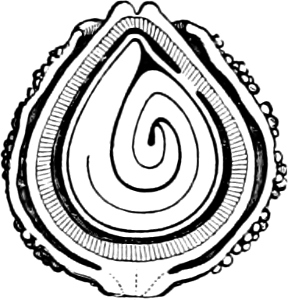
Fig. 349.—Humulus lupulus: fruit in longitudinal section.
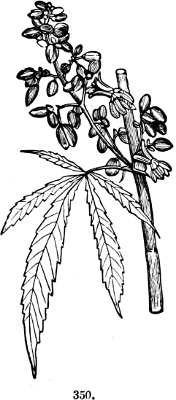
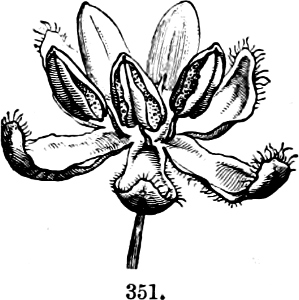
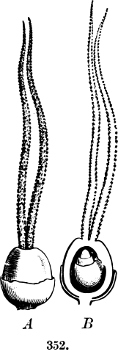
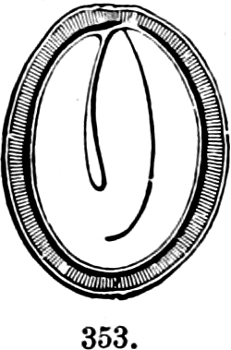
Figs. 350–353.—Cannabis sativa: 350, ♂-plant; 351, ♂-flower; 352, ♀-flower, entire and in longitudinal section; 353, fruit in longitudinal section.
Family 6. Polygonifloræ.
This family is on one side closely allied to the Urticaceæ by its solitary, basal, vertical, and straight ovule, and by the conical ocrea which envelopes the younger leaves in the bud, similar characters being present in the Urticaceæ. On the other side it is related to the Curvembryæ. The flowers are small, often trimerous, regular and slightly perigynous (in Chloranthaceæ, if they properly belong to this family, and Houttuynia, more or less epigynous). Syncarps are present in some Piperaceæ, but the fruit is generally a single fruit, one-seeded berry, nut or drupe. The leaves are generally scattered.
Order 1. Polygonaceæ. The majority are herbaceous plants with round, often jointed stems, scattered leaves and ocrea, that is a membranous, tubular, ligular or stipular structure inside the base of the leaf, which clasps the stem and axillary bud; the edges of the lamina are rolled backwards in the bud. The flowers are regular, small, generally ☿, slightly perigynous, with inconspicuous, simple, green or white perianth of 5–6 free segments; stamens 5–9 (Fig. 354) sometimes arranged in two series; gynœceum 2–3 carpels, ovary unilocular with one basal, straight (orthotropous) ovule, 2–3 free styles. The fruit is a 2–3-angular nut; the embryo, with mealy endosperm, is straight or curved (Fig. 355 H), often unsymmetrical.—The inflorescences are compound, and generally branch from the axils of the bracteoles, so that the last partial-inflorescences become coiled, uniparous scorpioid cymes; in Polygonum the two bracteoles unite into a membranous tube; in Rheum and Rumex there is only one bracteole.
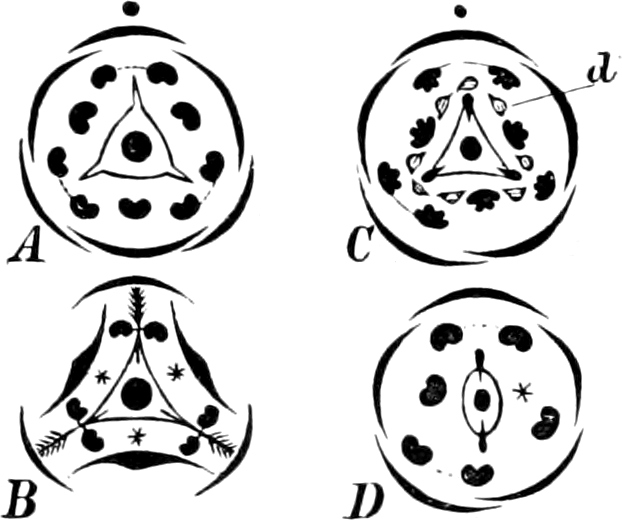
Fig. 354.—A Diagram of Rheum; B of Rumex; C of Polygonum fagopyrum; D of P. lapathifolium. The ovules are indicated inside the ovaries; bracts and bracteoles are not shown.
Rheum (Rhubarb, Fig. 354 A) has a 6-leaved, petaloid perianth (Pn 3 + 3) and 9 stamens (A 32 + 3). The 3-winged nut is not enclosed by the perianth.
Rumex (Dock, Fig. 354 B) has 6 stamens (A 32 + 0); the perianth is 6-leaved (Pr 3 + 3), green or red, and the triangular nut is enveloped by the 3 interior perianth-leaves, which point upwards and continue to grow after flowering. These perianth-leaves often have warts on their outer surface. The following are monœcious: R. acetosa and R. acetosella.
Polygonum (Knot-grass, Figs. 354 C, D; 355). The petaloid perianth is most frequently 5-merous (2/5 spiral); 5–8 stamens. The nut is triangular (Fig. 354 C, 355), or lenticular (Fig. 354 D). There are two whorls of stamens, the external with introrse, and the internal with extrorse anthers. The gynœceum is often bicarpellate (Fig. 354 D).
The flowers may be considered as constructed upon the monocotyledonous type. Pterostegia has a perfectly monocotyledonous flower with 5 trimerous whorls. Rheum likewise, but here the external staminal whorl is doubled (Fig. 254 A). Oxyria has a dimerous Rheum-flower (4-leaved perianth, 6 stamens, 2 stigmas). Rumex has a Rheum-flower with the suppression of the internal whorl of stamens (Fig. 354 B); Emex is a dimerous Rumex. Polygonum, to which Coccoloba, Muehlenbeckia and others are related, differs from Rheum chiefly in having one of the leaves, which in the latter takes part in the formation of the perianth, developed in this case into a bracteole (so that the perianth is reduced to five members), and several or all the stamens in the inner whorl become suppressed.—The perianth in Coccoloba and Muehlenbeckia is more or less perigynous and becomes fleshy, enclosing the fruit. Muehlenbeckia platyclada has flat branches with rudimentary leaves; sometimes branches with normal, arrow-shaped leaves are found. Atraphaxis.
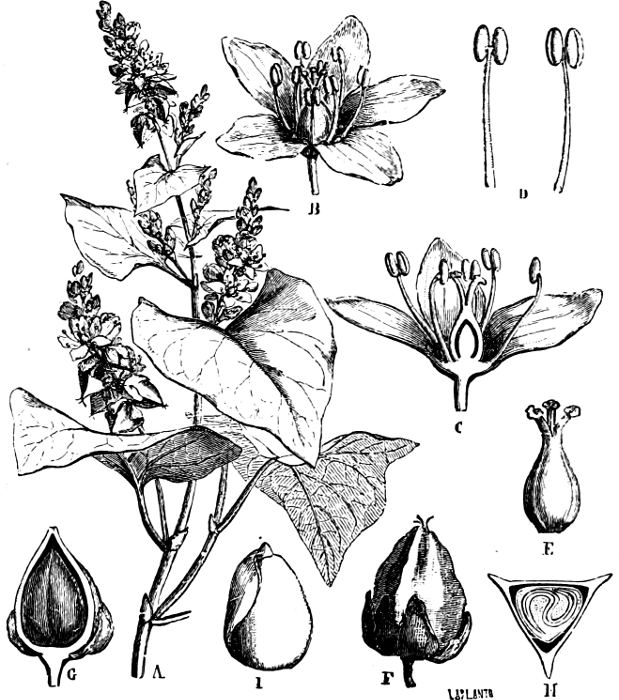
Fig. 355.—Polygonum fagopyrum: A branch with flower and fruits (nat. size); B flower; C the same in longitudinal section; D anterior and posterior view of stamen; E gynœceum; F fruit (mag.); G fruit in longitudinal section; H transverse section, showing the curved cotyledons embedded in the endosperm; I the embryo.
Pollination. Rumex is wind-pollinated, the stigmas are therefore large and brush-like (indicated in Fig. 354 B). Rheum and Polygonum are insect-pollinated and have therefore capitate stigmas, etc.; honey-glands are situated at the base of the stamens (d, in Fig. 354 C, and n in Fig. 356); a few small-flowered Polygonum species are self-pollinated; Buckwheat (P. fagopyrum) is dimorphic and has long-styled and short-styled flowers (Fig. 356). Pol. bistorta is protandrous and homostyled.
About 750 species, most of which are found in the temperate regions of the Northern Hemisphere, some reaching as far as the snow line or into the Arctic regions (Oxyria, Kœnigia). Trees and shrubs are found in the Tropics: Coccoloba, Triplaris. Rheum is Central Asiatic.—The thick rhizomes of R. officinale (Rhubarb) are officinal. The rhizomes of the ordinarily cultivated species, R. undulatum and rhaponticum, are used in veterinary medicine. The following are cultivated as culinary plants for the sake of their leaves:—Rumex acetosa (Sorrel), R. patientia, R. scutatus, and Rheum undulatum (petioles). Several species of Polygonum (P. hydropiper and others) have a sharp, pungent taste. “Buckwheat” is the mealy fruit of Polygonum fagopyrum (Central Asia) and is of value as a farinaceous food. P. cuspidatum (P. sieboldi, Japan) is an ornamental plant.—Calligonum in sandy and stony deserts.
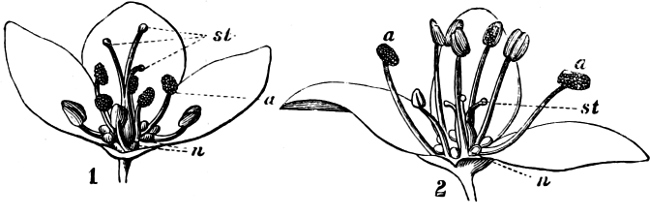
Fig. 356.—Flower of Polygonum fagopyrum in longitudinal section: 1, long-styled; 2, short-styled; a the anthers; st the stigmas; n nectary.
Order 2. Piperaceæ (Peppers). Shrubs or herbs, often with nodose, jointed stem; leaves simple, entire, often with curved veins; stipules wanting (Peperomia) or intrapetiolar and cap-like, often enclosing the terminal buds (Piper). The flowers in the group Pipereæ (Piper, Fig. 357, and Peperomia) are borne in spikes with fleshy axes (club-like), seldom in racemes, the outer ones are crowded and are ☿ or unisexual, always small, naked and without bracteoles; generally stamens 3 + 3, and gynœceum 3, but the number of the stamens may be reduced by suppression to 2, and the carpels to 1. The flowers are situated in the axils of the small, generally shield-like floral-leaves. The ovary is always unilocular and has one upright, orthotropous ovule. Fruit a berry or drupe. Both endosperm and perisperm are present, the latter being especially well developed (Fig. 359).
Piper; generally shrubs with scattered leaves, and terminal inflorescences which are crowded to one side by the development of the highest lateral bud, so that they are situated opposite the leaves (Fig. 357). Many species have stems with an abnormal anatomical structure.—Peperomia; chiefly succulent herbs, often epiphytes, with opposite or verticillate leaves having aqueous tissue on the upper side.
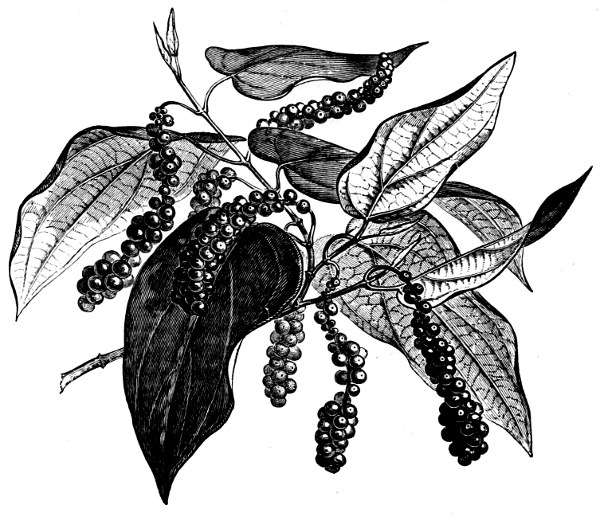
Fig. 357.—Piper nigrum: branch with fruit (½)
The group Saurureæ (considered by some as an order, and perhaps representing a more original type) has 3–4 carpels with many ovules. Lactoris stands the highest with regular 3-merous perianth, 3 + 3 stamens and 3 carpels, which are united at the base. Fruit a capsule with several seeds. (It has one species from the island of Juan Fernandez, and is also placed in an order of its own, Lactoridaceæ, allied to the Magnoliaceæ, through Drimys).—Saururus has naked flowers; most frequently 6 stamens, and 4 carpels, free or united at the base, each with 2-4 orthotropous ovules. Fruit, small berries.—Houttuynia; stamens situated a little upward on the ovaries; placentation parietal; capsule many-seeded.
About 1,000 species; entirely tropical, especially from South America and East India. They are found chiefly among the underwood in damp, shady places; some, which are fleshy (Peperomia), live as epiphytes on trees; a few climb by roots.—Uses. Several Piperaceæ are used medicinally and for spices on account of their pungent properties and the essential oils found in nearly all parts of the plant. The following are officinal: “Black-pepper” (the unripe, dried fruits) and “White-pepper” (the seeds of the ripe fruits) of Piper nigrum (climbing shrub, East Indian); “Cubeb” berries of P. cubeba (climbing shrub, Java). “Long-pepper” is the unripe inflorescence of P. longum, East India. The leaves of P. angustifolia (Matico) are officinal. The leaves of the Betelpepper (East India) are used together with the nuts of the Areca-palm to form the well-known East Indian intoxicating compound “Betel.” A good many others are also used.
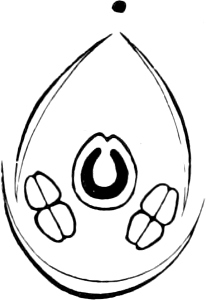
Fig. 358.—Piper nigrum (Diagram). In addition to the bract there are two structures resembling bracteoles.
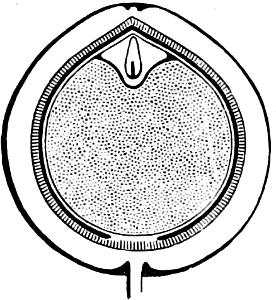
Fig. 359.—Piper nigrum: Fruit in longitudinal section, showing the endosperm, perisperm, and pericarp.
Order 3. Chloranthaceæ. (Chloranthus, Hedyosmum) have opposite leaves, with stipules more or less united at the base, and inferior “drupes.” Ovules pendulous. Only endosperm. About 33 species, Tropical.
Family 7. Curvembryæ.
The plants in this family have a curved ovule, and most frequently a kidney-shaped seed (generally provided with fine, cuticular, projecting warts, Fig. 362 B), with a curved, peripheral embryo enclosing the endosperm which is most frequently floury (Figs. 362 C, 365 H; for exceptions, see Fig. 366); the seeds in all cases are borne on a centrally-placed, and in most cases free, placenta (they are “basal” when there is only 1 ovule in the ovary, Fig. 364). The flower is regular, hypogynous or perigynous (Fig. 364) (only rarely epigynous) and usually 5-merous. The flower which is most complete has 5 whorls (S5, P5, A5+5, G2-3–5), as in some genera of the Caryophyllaceæ (Figs. 360, 361); but from this type it becomes reduced, the petals and stamens being suppressed, so that finally 5 perianth-leaves, 5 stamens (opposite the perianth-leaves), and 2 carpels (Fig. 361 F) only are present; for example, in certain genera of the Caryophyllaceæ, in the Chenopodiaceæ, Amarantaceæ, and others. When the number of stamens is increased to more than 5 in the whorl, it is always possible to show that some of the stamens have been divided. The number of the carpels and ovules also becomes reduced; in the highest there is a central placenta, not free in its early stages, with a large number of ovules; in those which are most reduced there is only a single ovule, which is placed centrally at the base of the ovary [Fig. 364]. Somewhat corresponding changes are found in the fruit, which is a many-seeded capsule in those which have many ovules, but a one-seeded nut where there is one ovule. In the most reduced forms the flowers are generally unisexual.—Similar features are also present in the vegetative parts. Almost all the species are herbaceous, the leaves are simple and most frequently without stipules. The structure of the stem, especially in Chenopodiaceæ, Amarantaceæ, Nyctaginiaceæ and others, often differs from that of the ordinary Dicotyledon. In the woody portion of the stem and root several rings are sometimes formed which resemble annual rings but which are formed by new cambium-rings arising outside the old ones which then cease to divide.
Order 1. Caryophyllaceæ. Herbaceous plants, with round, nodose stem; leaves opposite, slightly amplexicaul, simple, with sessile, undivided, entire lamina; stipules nearly always absent; the inflorescences are dichasia passing over into unipared scorpioid cymes. The flowers are regular, ☿ or unisexual, hypogynous or perigynous, 5-(or 4-) merous with 2–3–4–5 carpels; calyx persistent; corolla polypetalous. The ovary is unilocular (or originally, and sometimes also in the later stages, plurilocular below, e.g. Viscaria), with free styles and 1–several curved ovules on a central, free placenta. The fruit is a nut or a capsule opening apically with long or short valves (teeth, Fig. 362), equal to or double the carpels. For the seeds refer to the family. In Dianthus the embryo is straight.
The flowers which are most complete have Sn, Pn, An + n (obdiplostemonous), Gn where n = 5 (Figs. 360, 361 A) or 4 (Fig. 361 B); the carpels may be placed opposite to the sepals (Fig. 360) or opposite to the petals (Fig. 361 A, B). Without any change taking place in the position of the other whorls, the carpels are next found reduced to 2–3–4 (see the genera); their number may easily be recognised by that of the styles. This is the construction in the majority of the genera in the two first groups. Stellaria media differs considerably. It may have (a) the flower as described above, with G3; (b), the corolla only absent, or (c) only the petal-stamens (A5 + 0, Fig. 361 C), or (d) all these as well as some of the sepal-stamens. The same applies to Sagina, Alsine, Cerastium, and others, and, finally, a series of genera are formed, with certain conditions of reduction which have become constant, and by a gradual series of steps lead to the most reduced form, which has only 5 sepals and 5 (or even as far as only 1) sepal-stamens (Fig. 361 D, E, F).—The PETALS in the Alsineæ are often deeply bifid. The sepal-stamens are most frequently the longest, and bear nectaries at the base (Fig. 363 st). In the most complete forms the ovary has partition-walls in the lower portion (Fig. 360); these do not, however, reach to the top, and generally soon disappear. The ovules, when numerous, are situated on the placenta in as many double rows as there are carpels. In the number of ovules a reduction from many to 1 takes place (Fig. 361). A comparison proves that the “free, centrally placed” placenta is formed by the ventral portion of the carpels. The single basal ovule in Herniaria (Fig. 364), Scleranthus, and others, is also borne on the carpels.
The vegetative branching is characteristic. One of the leaves in a pair is formed before the other, and has a more vigorous axillary bud; these stronger leaves stand in a ¼-spiral, the fifth above the first one, and the branches are consequently arranged in the same manner. In the inflorescence, however, it is the upper or second bracteole (β) whose axillary bud (w in Fig. 361) is most advanced. The bud of the first bracteole (α) becomes sometimes entirely suppressed, or in some this bracteole itself is suppressed.
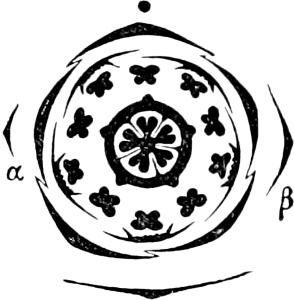
Fig. 360.—Diagram of Lychnis: α, β bracteoles.
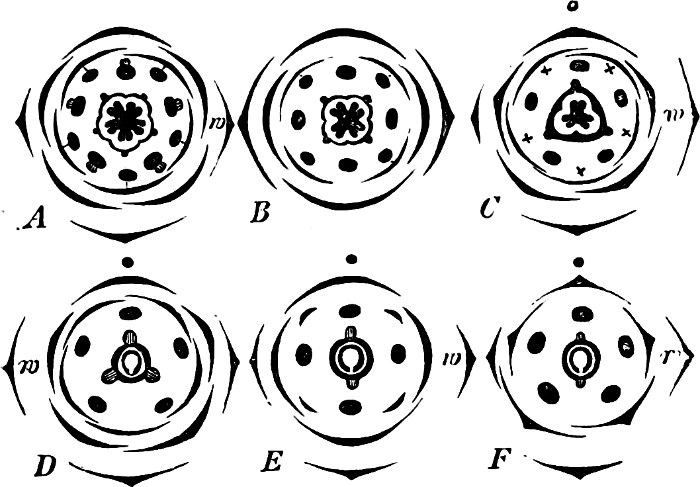
Fig. 361.—A-F Diagrams of flowers of the Caryophyllaceæ: A Agrostemma; B Sagina; C Stellaria; D Corrigiola; E Paronychia; F Herniaria.
The most original type appears to be represented by the Alsineæ. From this form on one side the Sileneæ, adapted in a higher degree for insect-pollination, are developed, and on the other side the Paronychieæ, with various reductions.
1. Alsineæ, Stitchwort Group. Sepals free, and connected with them stellately expanded, slightly unguiculate (white or inodorous) petals; these, however, often become suppressed (Fig. 363). The fruit is a capsule.
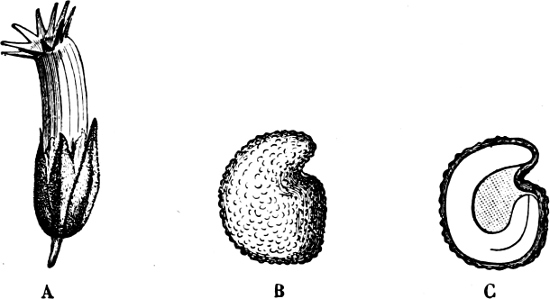
Fig. 362.—Cerastium arvense: A fruit; B seed; C section of seed.
a. As many carpels as sepals (4 or 5). Cerastium (Chickweed). The petals are bifid. Capsule cylindrical, frequently curved at the top, and opening by 10 teeth (Fig. 362).—Malachium differs only in the 5-toothed capsule with bifid teeth.—Spergula (Spurry). The petals are not bifid, capsule 5-valved; seeds winged. The leaves are linear, and appear as if placed in large numbers in a whorl, a branch being situated in the axil of each with leaves placed very close together at its base; stipules membranous.—Sagina has Sn, Pn, An + n, or An, Gn, where n = 4 or 5. The corolla is often wanting.
b. 3 (rarely 2) carpels (Fig. 361 C). Stellaria (Stitchwort) has deeply cleft petals. The number of stamens varies (see above).—Arenaria has entire petals. (To this group belong Alsine, Moehringia, Halianthus, or Honckenya (Fig. 363), which differ from each other, especially in the form of the seed and number of the capsular valves.) Spergularia has membranous stipules, as in Spergula.—Holosteum.
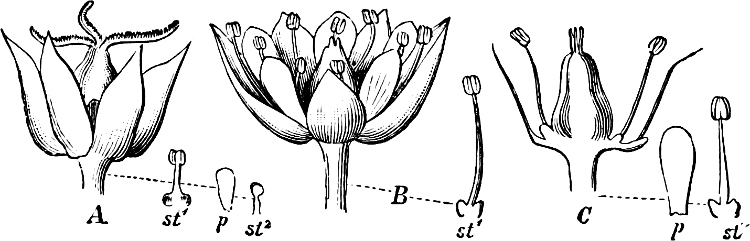
Fig. 363.—Arenaria (Halianthus) peploides: ♀-(A) and ♂-flower (B, C).
2. Paronychieæ (Figs. 361 D, E, F; 364). Small, greenish plants. The leaves, in the majority, are opposite, with membranous stipules. The flowers are most frequently arranged in small dichasia; they are small and insignificant, perigynous (Fig. 364) or hypogynous. The corolla is in most cases wanting, and when present is very small; in general the calyx-stamens are developed, but the corolla-stamens may be represented by small scales (Fig. 364). Ovary most frequently with 1 ovule. Fruit, a nut, rarely a capsule; it is enclosed by the strongly perigynous floral axis (torus).
Scleranthus (Knapwell) is perigynous with bell-shaped torus; no corolla; corolla-stamens are wanting or rudimentary; some calyx-stamens may also be absent.—Corrigiola (Fig. 361 D); Illecebrum; Paronychia (Fig. 361 E); Herniaria (Figs. 361 F, 364).
3. Sileneæ, Pink or Carnation Group. This has a gamosepalous calyx and unguiculate, white or red, petals, with outgrowths (ligule, corona, paracorolla) at the throat of the corolla. These structures are not found in the other groups, and are merely outgrowths at the junction of the limb and claw. The corolla, stamens and ovary are frequently raised above the calyx, upon a lengthened internode (gynophore). The flower has S5, P5, A5 + 5; fruit a capsule with many seeds.
a. 5-(rarely 3–4) carpellate ovary.—Lychnis (Campion, Fig. 360). The corolla is longer than the calyx; corona present. The capsule is 10- or 5-toothed, completely 1-chambered or 5-chambered at the base,—the genus has been divided accordingly into several genera: Melandrium, Lychnis, Viscaria. Some species are unisexual by the abortion of stamens or carpels (L. vespertina, diurna). Agrostemma (A. githago, Corn-cockle, Fig. 361 A) has a long-toothed calyx, the teeth exceeding the corolla; corona absent; 5-toothed capsule.
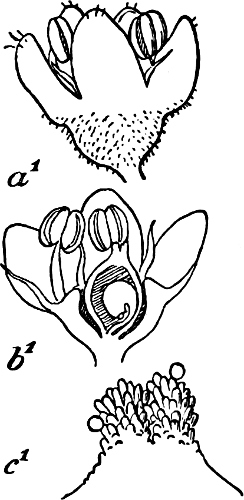
Fig. 364.—Herniaria glabra: a1 flower; b1 longitudinal section through the flower; c1 stigma with two pollen-grains.
b. Tricarpellate.—Silene (Catch-fly). Six-toothed capsule; corona present in the majority.—Cucubalus has berry-like fruits which finally become dry but do not dehisce.
c. Bicarpellate (2 styles, 4-toothed capsule).—Dianthus (Pink); at the base of the calyx 1–several pairs of floral-leaves are situated; corona absent. The straight embryo is a peculiar exception.—Gypsophila has a campanulate, open calyx, 5-nerved, membranous between the nerves; corona absent; the flowers are generally small and numerous, in a large, paniculate dichasia.—Saponaria (Soapwort) has corona.
Pollination. Alsineæ has ordinary nectaries at the base of the calyx-stamens (Fig. 336): they are frequently protandrous but may often, in the absence of cross-pollination (in the less conspicuous species) pollinate themselves. Their open flowers are accessible to many kinds of insects (particularly flies and bees). Gynodiœcious flowers are found in several species, and the ☿-flowers are then generally more conspicuous than the ♀-flowers. That the ♀-flowers have descended from ☿-flowers is seen by the large staminodes found in them (Fig. 363). Arenaria peploides is diœcious (Fig. 363). The Sileneæ are as a rule adapted for pollination by insects with long probosces—especially butterflies,—and they are frequently protandrous, so that at first the calyx-stamens open, later on the corolla-stamens, then the stigmas expand. The honey is secreted by a ring-like nectary round the base of the ovary or by nectaries at the base of the stamens. Some only blossom and emit scent at night or in the evening (Lychnis vespertina, Silene nutans, Saponaria officinalis) and, like other night-flowers, are of a white or pale colour.