DIVISION IV. GYMNOSPERMÆ.
Michael Cresse Potter translation
The following characters should be added to those already given on page 2:—
The Gymnosperms comprise only trees or shrubs. The flowers are always unisexual and destitute of perianth (except Gnetaceæ); the female plant of Cycas is the only one which has no flower. The MALE FLOWERS are constructed on the same type as the cones of the Horsetails and Club-Mosses, and are most frequently long shoots (Figs. 243, 258, 260 A, 267 J) bearing a number of spiral or verticillate stamens. The FEMALE FLOWERS are of a more varied structure (see the orders). The OVULE is orthotropous (except Podocarpus which is anatropous) and projects from the carpel uprightly, inverted, or horizontally; it has usually only one integument (compare however Taxaceæ) which proceeds from the upper part of the nucellus, so that the embryo-sac in part is placed below the integuments (Figs. 251, 264). The drop of mucilage which catches the pollen-grains dries up and draws the pollen-grain through the micropyle to a space just above the nucellus—the pollen-chamber—in which the germination of the pollen-grain commences.
In each seed, only one of the many embryos which are formed proceeds to its full development. The seed is always endospermous, and the embryo has one, two, or a whorl of several cotyledons. A vigorous primary root is developed on germination. The vascular bundles in the stem are arranged in a ring, and increase in thickness takes place by a closed cambium-ring which forms bast (phlœem) externally, and wood (xylem) internally with distinct annual rings, as in the Dicotyledons. Only certain of the Cycadeæ deviate from this arrangement. The secondary wood is very uniform, as it is almost exclusively formed of tracheides with bordered pits, but true vessels are wanting; this also indicates a relationship with the Pteridophyta (see page 202).
The Gymnosperms are biologically lower than the Angiosperms; they are wind-fertilised, and without extra floral-nectaries.
This Division embraces three classes: Cycadeæ, Coniferæ, And Gneteæ. It is no doubt monophyletic, and has taken its origin from heterosporous Ferns, now extinct, most nearly related to the Ophioglossaceæ and Marattiaceæ. The Cycadeæ appear to be the oldest class. The Coniferæ are related to these through Ginkgo. The Gnetaceæ are more isolated. The Division is not continued into the higher Flowering-plants; it has evidently attained its highest development, and is now in a retrograde condition. The similarity which has often been pointed out between certain Coniferæ and Lycopodinæ is only in analogous resemblances, and does not entitle one to suppose that there is a nearer relationship, or that the former take their origin from the latter.
Class 1. Cycadeæ.
The stem is very rarely ramified. The leaves are large, pinnate, and arranged spirally. The flowers are diœcious, without perianth.
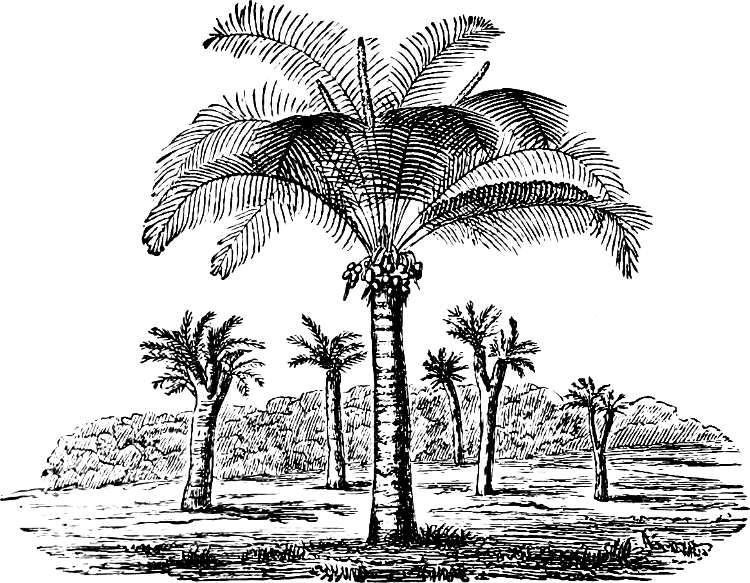
Fig. 256.—Cycas circinalis (female plant). The carpels are seen hanging from the top of the stem. Three leaves with the leaflets still rolled up project almost vertically into the air, from the centre of the crown.
There is only one order, the Cycadaceæ.—In habit they resemble the Ferns, especially the Tree-Ferns (compare Figs. 207 and 256). The stem is tubercular (Fig. 258), or cylindrical (Fig. 256), but not very tall (as much as about 12 metres), and very rarely ramified. [In Ceylon, unbranched specimens of Cycas are rarely met with in the wild state. The stems of C. circinalis occasionally branch in greenhouses.]
The LEAVES are arranged spirally, and so closely together that no free stem-surface is left between them, and have only a slight sheath (which is not amplexicaul, as in the Palms). They are compound (most frequently pinnate; in Bowenia, bipinnate); in some genera the leaves are rolled up in various ways, resembling the vernation in Ferns (Fig. 257); they are leathery and perennial. In some, stipules are present, as in the Marattiaceæ. Groups of scale-leaves alternate in the majority with groups of foliage-leaves.
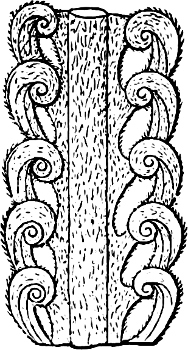
Fig. 257.—Cycas circinalis. Part of a young leaf with circinate leaflets.
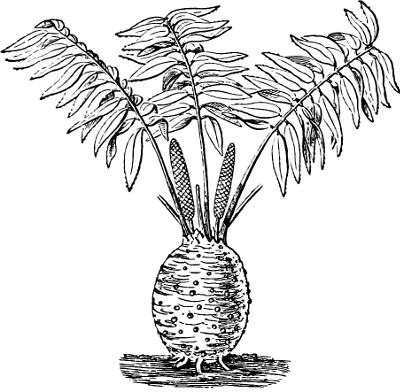
Fig. 258.—A male plant of Stangeria paradoxa (about 1/15 nat. size).
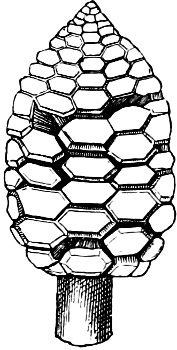
Fig. 259.—Female cone of Zamia integrifolia (½-⅓ nat. size). The male cone is very similar externally.
The FLOWERS are without perianth. The MALE FLOWER is sometimes an enormous collection of stamens (Fig. 258), which are flat in some (Cycas, Fig. 241), shield-like in others (Zamia, Ceratozamia) like the sporophylls in Horsetail (Fig. 259); but in all, the pollen-sacs are situated in large and varying numbers on the back of the stamens, and arranged in groups of 2–5, like the sporangia in the sori of the Ferns (Fig. 241 b, c). Female flowers are wanting in Cycas, because the carpels do not terminate the apical growth of the stem. After a group of foliage-and of scale-leaves, a group of carpels is developed, which are pinnate and resemble the foliage-leaves, bearing on their edges a number of ovules (most frequently 5–6) (Figs. 245, 256); the same stem produces successively scale-leaves, foliage-leaves, and carpels. The differentiation is not much more advanced than in certain Ferns (Struthiopteris, Blechnum), where barren and fertile leaves of different form regularly alternate. The other genera have female flowers; the carpels are shield-like in Zamia and Ceratozamia (Fig. 246), and collected into cone-like flowers, which terminate the growth of the stem (Fig. 259). The number of ovules in these instances is two to each carpel.
The SEEDS are large (most frequently 2–6 centimetres long) and plum-like; the external layer of the testa is fleshy, while the internal one is hard and horny. There are two systems of vascular bundles in the testa, one outside, the other inside the stone. The embryo is straight, attached to the end of the suspensor, which is often long, filamentous, and rolled up; it has one or two cotyledons.
The embryo in Ceratozamia and others is very slightly developed, at the time when the ripe seed is detached from the carpel; and it is not until after sowing that its further development and germination proceed. This calls to mind the Cryptogams, especially Selaginella, whose macrospores are thrown off filled with endosperm; but the oosphere is not fertilised till after the separation of the macrospore from the parent-plant, while in the Cycadeæ fertilisation is effected before the separation. In Cycas the testa may rupture, and the endosperm grow and become green in the light, even though no embryo has been formed. This also is an indication of its prothalloid nature.
Gum-passages are present in all organs. Collateral vascular bundles, with spiral and scalariform tracheides, are found; and normal thickening takes place by means of a cambium. An exceptional mode of growth is found in Cycas and Encephalartos, the cambium ceases to divide after a time and is replaced by a new cambium which arises in the cortical parenchyma just outside the bast, and which forms a new ring of xylem and phlœem. This may be repeated so that a number of concentric rings are produced. In Ceratozamia, structures resembling corals extend from the roots in a vertical direction and appear on the surface of the soil; these are peculiar roots, in which a symbiotic Alga (Anabæna) is found.
The Cycadeæ were formerly (from the Coal period to the Later Cretaceous) far more numerous than at the present day. They appear to have been most numerous in the Trias and Jurassic. The remnant (75 species) which have persisted to the present time are found in all tropical countries. Cycas (Trop. and Sub-trop., Eastern Hemisphere); Dioon (Mexico); Macrozamia (Australia); Encephalartos (Trop. and S. Africa); Stangeria (Fig. 258, Sub-trop. South and East Africa); Bowenia (Trop. Australia); Ceratozamia (Mexico, New Granada, Western Brazil); Microcycas (Cuba); Zamia (Trop. and Sub-trop. N. America.)
Uses. Sago is made from the starch-containing pith of Cycas revoluta and circinalis. The leaves are often used at funerals and church festivals, under the name of “palm-branches.”
Class 2. Coniferæ (Pine-trees).
The stem branches freely. The leaves are entire, relatively small, linear or reduced to scales. The flowers are without perianth. The ovules naked. It is seldom that the female flower is reduced to only one carpel.
Whilst the Cycadeæ principally resemble the Ferns, the Conifers partly resemble the Lycopods, and partly the Equisetums—the former especially in the needle- or scale-like, leathery, simple, and often perennial leaves (“evergreen plants”), which never possess stipules (Figs. 263, 270, 272). Ginkgo deviates from this, being no doubt the oldest, and the Conifer which stands nearest to the Cycadeæ (Fig. 260). The resemblance to the Equisetums is especially owing to the fact that the stem ramifies abundantly, and often very regularly, forming a pyramid with verticillate branches. In addition to the foliage-leaves, scale-leaves (bud-scales) are present in the majority of species.
The FLOWERS are monœcious or more rarely diœcious. Perianth is wanting. The stamens of the catkin-like male flowers (Fig. 267, J) are of different forms, but as a rule more or less shield-like. As in the Cycadeæ, the pollen-sacs are in all cases situated on the underside. There are, as a rule, two pollen-sacs (the Abietaceæ, Fig. 267), or 3–5, (the Cupressaceæ and Taxaceæ, Fig. 243); a few have more, e.g. Araucaria (Fig. 242); they dehisce by clefts.
If, in commencing our consideration of the female flower, we begin with that of Ginkgo, we shall observe in the corner of a scale- or foliage-leaf a small flower, which consists of two carpels, each bearing one ovule, and reduced almost to the ovule itself (Fig. 260 C, D). The flower in Podocarpus is still further reduced, viz. to a single carpel with one ovule, which is anatropous and has two integuments. This ovule is situated in the axil of a cover-scale (c, in Fig. 262 D), and several female flowers of this description are collected in a small cone, the stalk and bracts of which become fleshy (Fig. 262 C). The external integument also becomes fleshy (an aril). Dacrydium, which is clearly related to Podocarpus, has an external integument which developes more independently as a fleshy aril (Fig. 262 B, B’). Microcachrys also is clearly allied to these: the bracts are more fleshy, and the ovule (i.e. the female flower) is protruded beyond the bract (Fig. 262 A, A’). Taxus stands in a more isolated position: a flower which has been reduced to an ovule is situated, in this instance, on the apex of a secondary branch which is studded with floral-leaves (Figs. 263, 264); an external integument is developed on all sides and surrounds the seed as a scarlet aril. According to this conception the aril corresponds to an external integument, and the Taxoideæ thus possess a partly dichlamydeous ovule. Only Ginkgo and Cephalotaxus appear to deviate from this, as in these there is only one integument (unless the small outgrowth indicated by ar, in Fig. 260 D, really is a rudimentary, external integument); in Cycadeæ, to which Ginkgo is most closely related, there is likewise only one integument. But in these genera the testa is differentiated into two layers, and the seed resembles a drupe; like the Cycadeæ there is an external fleshy covering and an internal hard one, and these two layers may probably be considered homologous with the two integuments. This theory is also borne out by the arrangement of the vascular bundles in Cephalotaxus and Podocarpus, which present the xylem in the fleshy external layer to the outside of the testa, which is therefore the upper side of the integument (Celakovsky).
The coalescence of the integuments into one is only slight in Torreya, more pronounced in Podocarpus and strongest in Cephalotaxus and Ginkgo. Celakovsky terms these ovules “holochlamydeous.”
If we pass from these to the order Pinoideæ, we find the female flowers collected into catkin-like cones, which have been considered from various points of view to be sometimes single flowers, at other times compound inflorescences. The structure in Abietaceæ is as follows: a number of spirally arranged, scale-like leaves, cover-scales (Figs. 267, 268), are situated on a long axis. In the axil of each cover-scale a larger leaf-like projection, the ovuliferous scale, is borne, which turns the upper side towards its cover-scale (which is shown by the fact that the wood of its vascular bundles is turned downwards and towards the wood in the bundles of the cover-scale: Fig. 269). Two ovules, with micropyles turned towards the central axis, and with apparently only one integument (Fig. 268), are situated on the dorsal side of each ovuliferous scale, i.e. the side turned away from the cover-scale. The ovuliferous scales grow after fertilisation, into the woody or leathery “cone-scales,” which are usually much larger than the cover-scales. This ovuliferous scale with its axis may, according to Celakovsky, be considered as a dwarf-branch which is situated in the axil of the cover-scale, and bears two ovules (in the same way as in Ginkgo, one long-stalked flower, reduced to two ovules, is situated in the axil of a leaf), and in this case the external integument of the ovules is expanded into leaf-like bodies, which have united to form one “symphyllodium” (ovuliferous scale) which is inverted so that its dorsal side is turned upwards and bears the nucellus and the other integument (“hemichlamydeous” ovules). The carpel itself is therefore in this instance extremely reduced. The keel, or (in Pinus) “mucro” (Fig. 268 B), which is found in several genera, represents then a third carpel, which is sterile. In the other orders of the Pinoideæ the cover-scales and ovuliferous scales grow more and more together and finally form one structure, which also is termed a “cone-scale,” although from its development it cannot be homologous with the cone-scales of the Abietaceæ. This connation is least in the Taxodiaceæ and Araucariaceæ and may be traced on the upper surface of the “cone-scale” by the presence of a stronger or slighter ridge or pad, the free portion of the ovuliferous scale (Figs. 256, 266, 269). It is most strongly pronounced in the Cupressaceæ, in which the two scales form one single structure, the cone-scale (Fig. 274). The vascular bundles in the under portion corresponding to the cover-scale, have the xylem towards the upper side as usual in leaves, whilst the bundles present in the upper side of the cone-scale, which thus represents the ovuliferous scale, turn their xylem downwards. The hemichlamydeous ovules are then situated on the upper side of this cone-scale. According to this theory the Cupressaceæ appear to be the youngest type, a view which corresponds with their vegetative structure. If there is only one ovule in these orders as in Agathis (Fig. 265) and Araucaria, then the flower is reduced to a single carpel and one ovule, as in the case of Dacrydium and Microcachrys. If two or more ovules are present, then the same number of carpels may be supposed to exist, the external integuments of their ovules being developed into leaf-like structures which collaterally coalesce to form a “symphyllodium,” or are suppressed.
According to this theory, which is based on the researches of Celakovsky, the female flowers of the Coniferæ may be classed thus:—
1. In all cases situated in the axil of a bract and collected into cones, with numerous flowers or with few or one flower. In Ginkgo only, are they situated in the axil of foliage- or scale-leaves.
2. It is only in Taxus that bracteoles are present.
3. They are formed only from rudimentary carpels, in which the stem takes no part.
4. The number of carpels in each flower varies from one to many, most frequently three, of which the central one remains sterile.
5. Each carpel bears only one ovule. The flower which is formed of only one carpel appears to consist of only one ovule.
6. The ovule has in Taxaceæ either a double integument (Podocarpeæ, Taxeæ), of which the external is the “aril,” or, as in the Cycadeæ, a single one, which is homologous with the two united together.
7. The external integument in the Pinoideæ is expanded to form a leaf-like structure—the ovuliferous scale—and bears on its dorsal side the ovules, which are thus only provided with one, and that the inner, integument.
This later interpretation of the female cones in the Coniferæ is more probably correct than the older ones; that, however, which appeared in the former issues of this book, may also be stated. It was to the effect that each catkin-like female cone is in reality a single flower; the cone-scales in the Cupressaceæ were single leaves, namely carpels, which bore the ovules on the side which is turned upwards; the division into two parts which makes its appearance in the other orders, and becomes most prominent in the Abietaceæ, was compared with the division of a leaf into a barren and a fertile portion, which is found especially in Ophioglossaceæ and Marsiliaceæ, or with the ligule in Isoëtes.
Pollination is accomplished by means of the wind. At the period of pollination the leaves are always so widely separated from one another, that the ovules can catch the pollen-grains carried to them by the wind; this is often effected by the mucilaginous drops which appear at the micropyle, and by the evaporation of which the pollen-grains are brought in contact with the nucellus. The entire cone grows considerably as soon as fertilisation has taken place, and the cone-scales in Pinoideæ close together so that the seeds while maturing are enclosed, and it is not until the seeds are ready for distribution that the cone-scales again become separated. In the Pinoideæ, the fully developed ovuliferous scales are hard and woody; and in this condition the collection of female flowers is termed a cone. In the Taxoideæ, true cones are the exception. 2–15 cotyledons are present, arranged in a whorl.
The characteristic feature of this class is the abundance of resin, which is to be found in isolated cells (especially in the cortex), partly in intercellular glands or passages (both in the cortex and wood). Taxus is the only genus which has no resin.
There are about 350 species, mostly from the Northern Temperate zone (especially North America and Siberia), where they grow gregariously and form the most northern forests. The Juniper, Scotch Fir, and Yew are natives of Great Britain.
This class may be divided into two families:—
1. Taxoideæ. The ovules have either one integument, the external part of which is fleshy, and the internal hard and stone-like; or two integuments, of which the external is the fleshy and coloured “aril.” “Ovuliferous scales” are wanting. The cones are never woody, but are generally succulent, the bracts become fleshy, or cones usually are not developed. The seeds project more or less freely beyond the bracts.
2. Pinoideæ. The ovules have two integuments, the external one of which is leaf-like and becomes developed as the “ovuliferous scale”; if there are several of these in each flower they unite and form a “symphyllodium.” This may remain free or unite with the bract. The cones are most frequently woody, rarely succulent. The seeds are hidden among the cone-scales.
Family 1. Taxoideæ.
This family, considered to be most nearly related to the Cycadeæ, also made its appearance at a very early period. There is only one order.
Order. Taxaceæ. The characters have been given above.
A. Cephalotaxeæ is the oldest group, presumably the connecting link between the Cycadeæ and the other Coniferæ. The flower consists normally of two ovules. Aril wanting. One integument. Seeds drupaceous.—The flowers in Ginkgo biloba (Salisburia) are situated in the axil of foliage- or scale-leaves. The stamens bear only two pollen-sacs (Fig. 260 A). The female flower has two ovules, placed together at the end of a long, bare axis (Fig. 260 C). Round the base of the ovule a small collar (ar, in Fig. 260 D) is found, which may probably be considered homologous with the collar-like outgrowth which surrounds the base of the Cycas-ovule. The seed resembles a Plum, and has a fleshy external coat, surrounding a hard internal layer. The embryo is developed after the seed has fallen off. The Ginkgo-tree has long-stalked, fan-shaped leaves, more or less indented, with dichotomous veins resembling certain Ferns—the Adiantums. It is a native of East Asia, and the only surviving species of a genus which in earlier times was very rich in species, and distributed over the entire Northern Hemisphere. Cephalotaxus (Eastern Asia) is related to it.
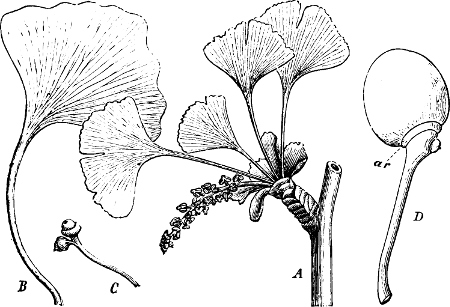
Fig. 260.—Ginkgo (nat. size): A a branch with a small flowering dwarf-branch (male flower); B a leaf; C a flower with two ovules; D a ripe seed; ar collar.
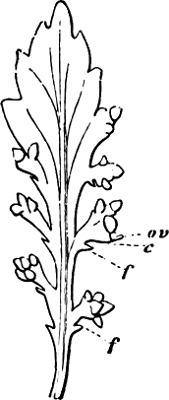
Fig. 261.—Phyllocladus glaucus: a branch with female flowers (nat. size).
B. Podocarpeæ. The female flower is reduced to one ovule, placed in the axil of a bract, or a little forward upon it. The ovule has an aril (2 integuments).—Phyllocladus (Fig. 261), from New Zealand and Tasmania, has obtained its name from its flat, leaf-like branches, the leaves proper being scale-like (f). The ovules stand erect in the axil of the scale-like leaves (c), and several are collected at the end of short branches.—Microcachrys tetragona (Tasmania) has a small female catkin with several spirally-placed, fleshy bracts, at the end of which the inward and downward turned ovule is attached (Fig. 262 A, A’). The ripe cones are red, succulent, and resemble Strawberries.—In Dacrydium (Tasmania, New Zealand, Malaysia) the female cone has most frequently only 1–2 (–6) bracts, which resemble the vegetative leaves; they have also a fleshy aril (Fig. 262 B, B’).—Podocarpus (40 species, East Asia, S. Temp.); the bracts of the female flowers become fleshy, and unite together; only 1 or 2 are of use in supporting the flowers. The ovules project high above the apex of the bract, and are anatropous, the micropyle being turned downwards (Fig. 262 C, D). An aril commences to develope in the flowering period as an external coating, and later on it becomes fleshy and coloured.
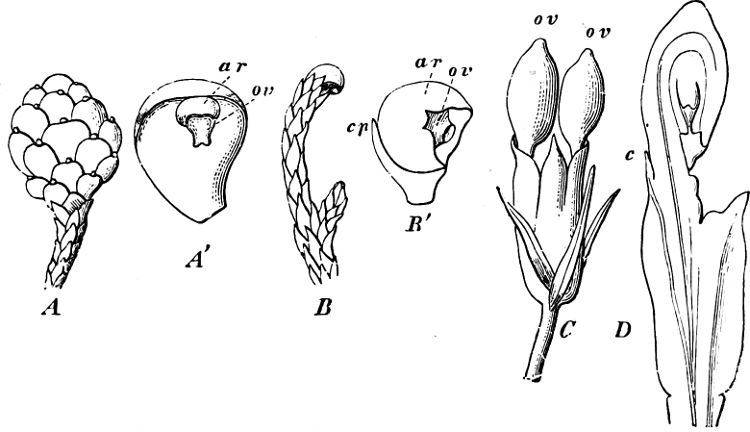
Fig. 262.—A Microcachrys: female cone (2/1). A’ A single carpel with its ovule. B Dacrydium: branch with female flower (3/1). B’ The flower; cp the bract; ar the aril; ov ovule. C Podocarpus: female flower with 2 ovules. D Another female flower with 1 ovule, in longitudinal section.
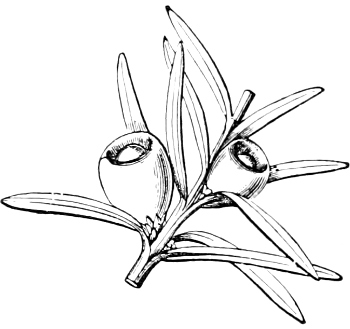
Fig. 263.—Taxus baccata: branch with two ripe seeds (nat. size).
C. Taxeæ. The female flower is reduced to one ovule, which is situated terminally on an axis which bears 2–3 pairs of opposite, scale-like bracteoles; on this account the Taxeæ form a very isolated group among the Coniferæ.—Taxus (T. baccata, the Yew-tree). Diœcious. The female flower consists of only one ovule, placed at the end of a short secondary branch (Fig. 264), which is studded with scale-like leaves. The aril when ripe is thick, fleshy, and scarlet (sometimes yellow), and only loosely envelopes the seed (Fig. 263). The leaves are scattered, flat, linear, and pointed (Fig. 263, 264). The short male flowers have 5–8 pollen-sacs, pendent from the stamens, and are surrounded at their bases by scale-like bracteoles (Fig. 243). Torreya (4 species, N. America and Japan) is closely allied to Taxus. The aril ultimately fuses with the woody inner integument, and hence the ovule becomes drupaceous, as in Cephalotaxaceæ.
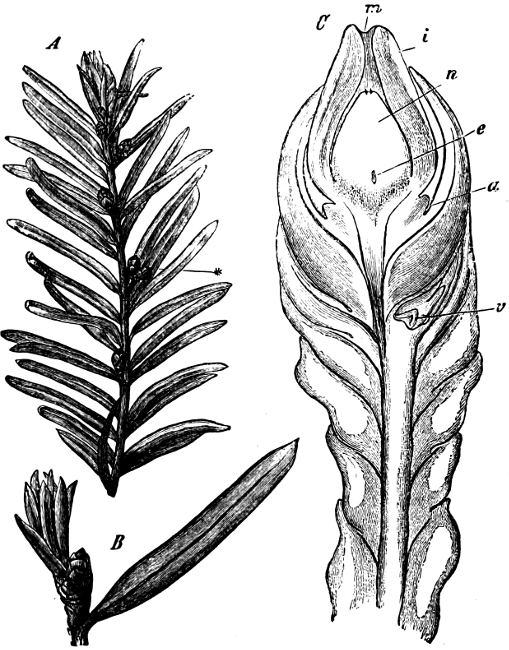
Fig. 264.—Taxus baccata: A shoot of Taxus with female flowers at the time when the ovules are ready for pollination. B Leaf with flower in its axil (nat. size). C Longitudinal median section through a female shoot; v growing point of primary shoot; a commencement of aril; i integument; n nucellus; m micropyle.
Uses. Taxus baccata is usually planted in gardens, especially in hedges. Its wood is very hard and is used for wood-carving. The shoots are poisonous, but not the aril, which is often eaten by children and by birds.
Family 2. Pinoideæ.
The four orders differ from one another partly in the arrangement of the leaves (Cupressaceæ have opposite or verticillately placed leaves, flowers, and inflorescences; in the others they are placed spirally), but chiefly in the greater or less degree of union which takes place between the female flower (the leaf-like “symphyllodium”) and its supporting cover-scale, and in the position of the ovules (the micropyle being turned upwards or downwards). The “cone-scales” in Abietaceæ are formed by “symphyllodia” alone, in the others by their union with the cover-scale.
Order 1. Araucariaceæ. This order most frequently has solitary ovules, turned downwards and attached to the centre of the cone-scales. In Agathis (Dammara) the arrangement is the most simple, a winged seed (Fig. 265), which hangs freely downwards, being borne in the centre of the undivided cone-scale. In Araucaria, the stamens with the free, pendulous pollen-sacs have been represented in Fig. 242; the ovuliferous scale is united for nearly its whole length with the bract, and projects from its apex in the shape of a sheath-like, dentate scale, resembling the ligule in Isoëtes, and may therefore be termed a “ligule.” Araucaria (S. America, Australia) has often rather broad leaves (A. brasiliensis). The ovuliferous scale in Cunninghamia is more distinct, and stretches transversely over the entire cover-scale; it bears three inverted ovules (Fig. 266) (Eastern Asia).
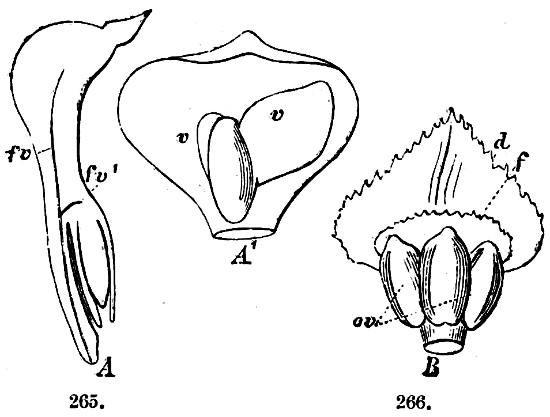
Fig. 265.—Agathis (Dammara) australis. Cone-scale with the seed. A Longitudinal section; A’ from within; fv, fv’ vascular bundles; v wing.
Fig. 266.—Cunninghamia sinensis. Cone-scale with three ovules, interior view: d cover-scale; f ovuliferous scale.
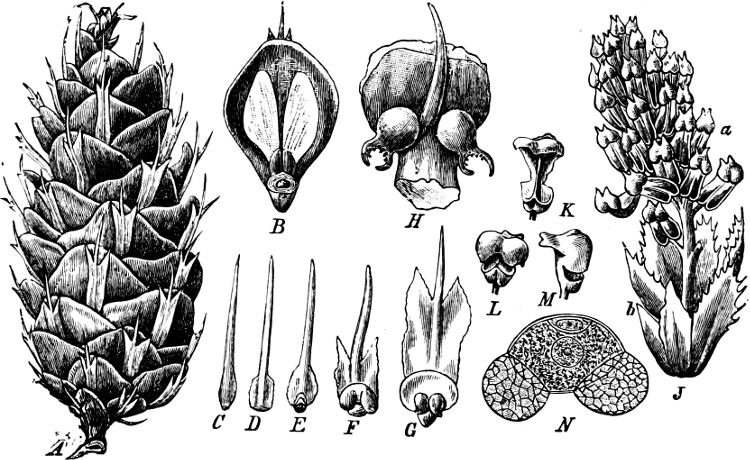
Fig. 267.—A-G Pseudotsuga douglasii: A cone, B cone-scale, with the inner side turned forward; the points of the cover-scale are seen behind it; C-G transitions from the acicular leaf to the cover scale, from the base of a ♀ cone. H Pinus montana. Young ovuliferous scale, with the inner side turned forward; the ovules are now in the stage for pollination. J-M Abies alba: J male cone; b bud-scale; a anthers; K L M individual anthers.—Pinus montana: N pollen-grain; the two lateral expansions are the air-bladders; in the upper part of the interior of the grain a vegetative cell may be seen, and in the centre the large cell-nucleus.
Dammara-resin, which is used for varnish, is obtained from Agathis (Dammara) species (New Zealand, Philippine Islands).
Order 2. Abietaceæ (Pine and Fir Trees). The leaves are spirally arranged and needle-like. The flowers are monœcious. The male flowers are long, and catkin-like, with numerous stamens, each bearing two oblong pollen-sacs. The pollen-grains are most frequently tri-lobed, having two bladder-like appendages, formed as outgrowths of the exospore, to assist in their distribution by the wind (Fig. 267 N). The bracts are arranged spirally. The union between the bract and the ovuliferous scale, which is found in the preceding order, is not in this instance so complete; these scales make their appearance as two free parts, and are attached only at their bases (Fig. 268); the lower portion, that is the cover-scale, in most instances remains quite small (Fir, Red Pine, and others), it is only in the “Noble Pine” (Abies) and Pseudotsuga douglasii, that it attains a greater length than the ovuliferous scale (Fig. 267, B-G). On the other hand the upper part, the ovuliferous scale (the vascular bundles of which have the bast turned upwards), grows strongly and elongates, especially after fertilisation, becoming woody or leathery; it is commonly termed the “cone-scale,” but is in reality only homologous with a part of the “cone-scale” in the other order of Pinoideæ. On the side of the ovuliferous scale, turned towards the axis, are situated two ovules with micropyles directed inwards. The seeds are most frequently provided with a false wing (a tissue-like part of the surface of the ovuliferous scale). Cotyledons, more than 2, verticillate. Fertilisation does not take place until some time after pollination. In Pinus, for instance, the pollen-tube only penetrates the nucellus for a short distance during the year of pollination, and then ceases its further growth, fertilisation not taking place until after the middle of the next year; whilst the seeds ripen about a year and a half after pollination. In the Larch and others, the seeds are mature in the autumn succeeding pollination.
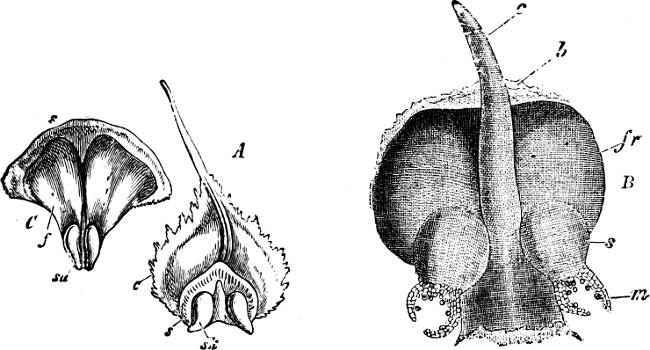
Fig. 268.—A Abies: c the cover-scale; s ovuliferous scale, or “cone-scale”; sk ovules in a young condition. B Pinus: ovuliferous scale with two ovules (s); m the two-lobed micropyle; c “mucro”; b the cover-scale behind. C Abies: ripe “cone-scale” with two seeds (sa); f wing of seed.
Abies (Fir). The leaves are often (e.g. Ab. pectinata) displaced into 2 rows, flat and indented at the apex, with 2 white (wax-covered) lines on the under surface, in which the stomata are situated. The leaf-scars are nearly circular and do not project. The cones are erect. The cover-scales and the ovuliferous scales separate from the axis, to which they remain attached in other genera.—Tsuga has leaves like Abies, but by the slightly projecting leaf-scars, and cones with persistent scales, it forms the transition to Picea.—Pseudotsuga has leaves similar to those of Abies and persistent carpels as in Picea, but the cover-scales grow as in Abies and project beyond the ovuliferous scales (P. douglasii, Fig. 267). These two genera are considered as sub-genera of Abies.—Picea. The leaves project on all sides, square and pointed; the leaf-scars are rhombic, on projecting leaf-cushions. The cones are pendulous. The cover-scales are much shorter than the leathery, persisting ovuliferous scales.—The genus Larix (Larch) differs from all the others in having deciduous leaves (the three preceding have leaves which persist for eleven to twelve years). It has long-branches with linear foliage-leaves and short, thick, perennial dwarf-branches, which each year form a new rosette of foliage-leaves, similar to those on the long-branches. The male flowers and the erect cones resemble those of Picea, and are borne on dwarf-branches.—Cedrus (Cedar) resembles Larix to some extent, but has persistent leaves (C. libani, C. deodara).—Pinus (Pine) has long-branches and dwarf-branches. The leaves of the long-branches are scale-like and not green; the dwarf-branches have very limited growth, and persist for three years; they arise in the axils of the scales borne on the long-branches of the self-same year, and each bears 2–5 foliage-leaves, they are also surrounded at the base by a number of membranous bud-scales. The cone-scales have a thick, rhomboid extremity (the “shield”).
The buds which develope into long-branches arise at the apex of other long-branches, and being very close together, form false whorls. The female cones occupy the position of long-branches, and take about two years for their development. The male flowers arise close together, and form a spike-like inflorescence at the base of a long-branch of the same year. The male flowers occupy the position of dwarf-branches, so that a female cone may be considered to be a modified long-branch, and a male cone a modified dwarf-branch. The main axis of the seedling has needle-like leaves, similar to those found on the older parts, and on dwarf-branches; it is not until some time later that the dwarf-branches are developed and the permanent arrangement attained.
Uses. Several species are commonly cultivated in this country, partly on heaths and moors, and partly in plantations and as ornamental trees, such as Mountain Pine (Pinus montana, Cen. Eur.); Austrian Pine (P. laricio, Eur.); Scotch Fir (P. silvestris, Eur.); Weymouth Pine (P. strobus, N. Am.); common Red Pine (Picea excelsa, Cen. and N. Eur.); White Pine (P. alba, N. Am.); Abies pectinata (Common Fir, S. and Cen. Eur); A. nordmanniana (Crimea, Caucasus); A. balsamea (N. Am.); Tsuga canadensis (N. Am.); Pseudotsuga douglasii (N.W. Am.); Larch (Larix europæa, Alps, Carpathians); L. sibirica (N.E. Russia, Siberia).—The wood of many species, especially Pine, on account of its lightness and because it is so easily worked, is very well adapted for many useful purposes. The wood of the Yew-tree is very hard and is used for ornamental turning. Resin and Turpentine (i.e. Resin with essential oils, the name being derived from the Terebinth-tree, from which formerly a similar material was obtained) are extracted from Pinus laricio and P. pinaster. Oil of Turpentine is obtained by distillation of turpentine with water; Tar by dry distillation of Pine-wood. Canada-balsam is from North American Abies-species (A. balsamea and Fraseri). The officinal Turpentine is mainly obtained from Pinus pinaster (South of France), P. tæda, australis, strobus (Weymouth Pine) and other North American species; more recently also from P. silvestris (Scotch Fir), maritima, laricio, Picea excelsa, and others; Venetian Turpentine, from Larch (S. Eur.) Amber is resin from a Tertiary plant (Pityoxylon succiniferum), closely related to the Pine, which grew especially in the countries round the South-East coast of the Baltic. Pinus pinea (the Pine, S. Eur.) has edible seeds and also P. cembra (in Cen. Eur. and Siberia).
Order 3. Taxodiaceæ. The vegetative leaves and cone-scales are arranged spirally. The ovules (2–9) are situated either at the base of the ovuliferous scales, in which case they are erect; or at their centre, when they are generally more or less inverted. The ovuliferous scale is more or less united with the cover-scale, and projects beyond the surface of the cone-scale, like a comb (Fig. 269). The vascular bundles, which extend into the cover-scale, have the usual leaf-arrangement, viz. the wood placed above the bast; while those bundles which enter the ovuliferous scale have this arrangement of the bundles reversed.
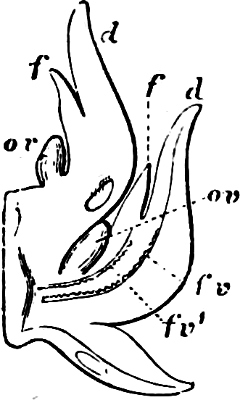
Fig. 269.—Cryptomeria japonica. Portion of longitudinal section through female flower. d cover-scale; f ovuliferous scale; ov ovules; fv and fv’ vascular bundles; the xylem is indicated by a wavy line, and the phlœm by a straight line.
Taxodium distichum (the North American “Swamp Cypress”) has annual dwarf-branches, with distichous leaves, and cone-like “pneumathodia.” In the Tertiary period it was very common in the Polar regions. Sequoia (Wellingtonia) gigantea is the famous Californian Giant-Fir, or Mammoth-Tree, which attains a height of 300 feet, a diameter of 36 feet, and is said to live for 1,500 years. Cryptomeria japonica (Japan, China) has the least adnate ovuliferous scales; Glyptostrobus (China); Arthrotaxis (Tasmania); Sciadopitys verticillata (the only species in Japan) has, like Pinus, scale-like leaves on the long-branches, of which those which are situated at the apex of the annual shoots support “double needles,” i.e. dwarf-branches similar to the two-leaved dwarf-branches in Pinus, but without bud-scales, and with the two leaves fused together at the edges into one needle, which turns its upper surface away from the long-branch.
Order 4. Cupressaceæ (Cypresses). The leaves are opposite or verticillate, sometimes acicular, but most frequently scale-like (Fig. 270). In the species with scale-like leaves, the seedlings often commence with acicular leaves (Fig. 272), and branches are sometimes found on the older plants which revert to this form, seeming to indicate that the acicular leaf was the original form (atavism). The so-called “Retinospora” species are seedling-forms of Biota, Thuja, Chamæcyparis, which have been propagated by cuttings, and retain the seedling-form. The flowers are monœcious or diœcious. The male flowers are short, and have shield-like stamens, bearing most frequently several pollen-sacs. The cover-scales and ovuliferous scales are entirely fused together and form undivided cone-scales, opposite or whorled; the ovuliferous scales have slight projections near the base on which 1–2–several erect ovules are developed (Fig. 274). Most frequently 2 cotyledons.—Evergreen trees and shrubs.
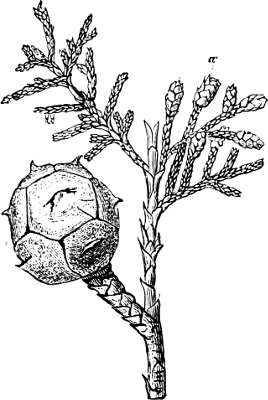
Fig. 270.—Cupressus goveniana.
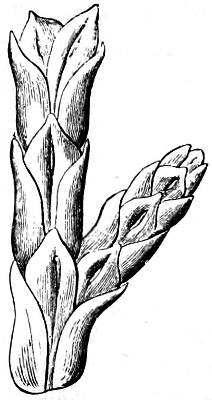
Fig. 271.—Portion of a branch of Thuja orientalis (magnified). The leaf at the base on the right has a branch in its axil.
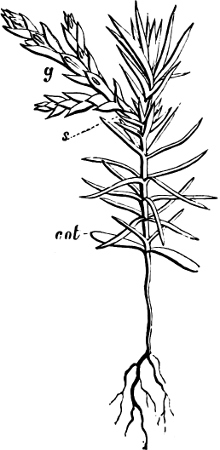
Fig. 272.—Seedling of Thuja occidentalis. The branch (g) is borne in the axil of the leaf s.
Juniperus (Juniper). Diœcious. The cone-scales become fleshy and fuse together to form most frequently a 1–3 seeded “berry-cone.” J. communis (Common Juniper) has acicular leaves, borne in whorls of three, and the “berry-cone” is formed by a trimerous whorl of cone-scales (Fig. 273). J. sabina and J. virginiana have “berry-cones” formed from several dimerous whorls of cone-scales; the leaves are connate and opposite, needle-and scale-like leaves are found on the same plant.
Cupressus (Cypress). Monœcious. The cones are spherical; the cone-scales shield-like, generally five-cornered and woody (Fig. 270), each having many seeds. The leaves are scale-like.—Thuja. Monœcious. Cones oblong. The cone-scales are dry, as in the Cypress, but leathery and imbricate, and not shield-like; each cone-scale bears 2–3 seeds. The leaves are most frequently dimorphic; those leaves which are situated on the edges of the flat branches are compressed, and only these bear buds, which are developed with great regularity, generally alternately, on both sides of the branch; those which are situated on the flattened surfaces are pressed flat and broad, and never bear branches (Fig. 271). Along the central line of each leaf there is a resin-canal (Fig. 271).—Chamæcyparis, Callitris, Libocedrus, Thujopsis (1 species: T. dolabrata; in Japan).
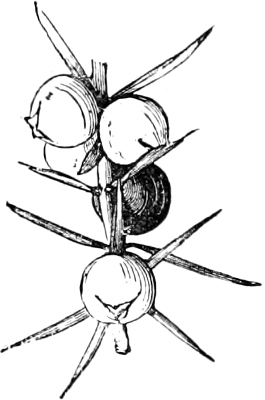
Fig. 273.—Branch of Juniper with “berry-cones.”
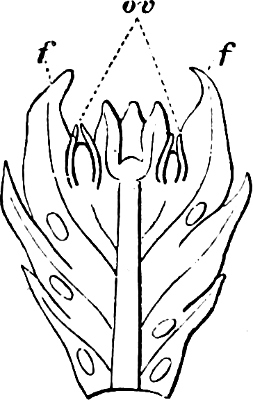
Fig. 274.—Cupressus lawsoniana. Longitudinal section through female cone. Two ovules (ov) are bisected; f ovuliferous scales.
Officinal. Juniperus sabina from Central and South of Europe (the young branches yield an essential oil). The wood of J. communis is used in the production of an essential oil, and J. oxycedrus in the production of empyreumatic oil. The “berry-cone” of J. communis is officinal, and is also used for gin.—The wood of J. virginiana (N. Am.) is known as red cedar, and is used for lead-pencils. Sandarack resin is obtained from Callitris quadrivalvis (N.W. Africa).
The following are cultivated in gardens:—Thuja occidentalis (Arbor vitæ) (N. Am.), and orientalis (China, Japan); Juniperus sabina and virginiana; Thujopsis dolabrata (Japan); Cupressus lawsoniana (California), C. sempervirens (S. Eur., W. Asia), and other species, are grown especially in conservatories, and in Southern Europe particularly in cemeteries.—The Retinospora species which are so often planted, do not belong to an independent genus, but are obtained from cuttings, taken from seedling-plants with acicular leaves (see page 267).
Class III. Gneteæ.
This class, independent of extinct forms, comprises the most highly developed of the Gymnosperms, partly from the circumstance that a perianth of 2–4 members encloses the terminally placed ovule, which is provided with one, or (in Gnetum) two, integuments, and partly owing to the fact that the wood has true vessels. There is only one order.
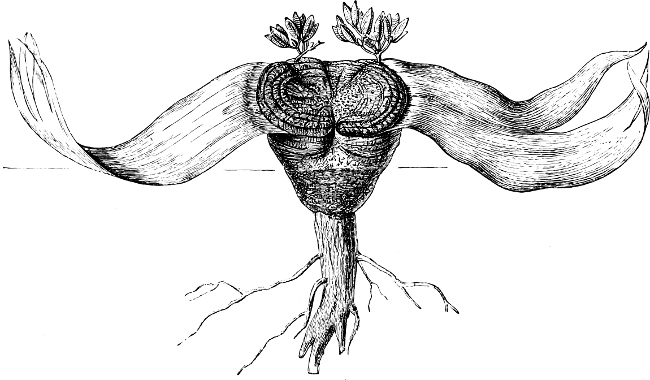
Fig. 275.—Welwitschia mirabilis (considerably reduced). The horizontal lines indicate the surface of the soil.
Order. Gnetaceæ. The three known genera differ very much in appearance. Welwitschia mirabilis (from the deserts of South Western Africa) is the oldest (?) genus now living. It resembles a giant radish, in that the hypocotyl is the only part of the main axis of the stem which becomes developed. It attains a circumference of upwards of four metres with a length of 1/2½-⅔ of a metre. It bears only two oblong, leathery leaves (Fig. 275) which are torn into segments at the apex and lie on the surface of the soil; these are the two first foliage-leaves which succeed the cotyledons, and they are remarkable for their enormous length (upwards of two metres) as well as for their long duration, living as long as the plant itself. In their axils are situated the 4-rowed, spike-like male and scarlet-coloured female cones, upon dichotomous branches. The perianth consists in the ♂ of 2 alternating pairs of leaves, the inner ones of which are slightly united. The andrœcium likewise consists of 2 whorls: the external (transverse) with 2, the internal with 4 stamens; the lower halves of the 6 filaments uniting to form a cup. Each of the terminal anthers corresponds to a sorus of 3 sporangia, the sporangia being fused together, and opening at the top by one three-rayed cleft. In the centre of the ♂-flower there is a sterile ovule. In the ♀-flower a perianth of two connate leaves is present.—Ephedra (desert plants, especially in the Mediterranean and W. Asia) at first sight resembles an Equisetum; the stems are thin, long-jointed, and the leaves opposite, small, and united into a bidentate sheath; ♂-perianth of two connate leaves (median leaves); 2–8 stamens united into a column. Each anther is formed of 2 sporangia (is bilocular). ♀ mainly, as in Welwitschia. The seeds are surrounded by the perianth which finally becomes red and fleshy. There are 30 species.—Gnetum has opposite, lanceolate, pinnately-veined, leathery leaves. They are mostly climbers (Lianas) from Tropical Asia and America. The ♂-flowers have a tubular perianth, (formed from two median leaves) which surrounds a centrally-placed filament, bearing 2 anthers. In the ♀-flower there is a similar perianth, surrounding an ovule provided with 2 integuments. The perianth becomes fleshy and envelops the hard seed. 20 species.
From the circumstance of Welwitschia having ♂ flowers which, besides stamens, possess also a rudiment of an ovule, Celakovsky draws the inference that the earliest Gymnosperms had hermaphrodite flowers which from this structure became differentiated entirely into ♂-and ♀-flowers, with the exception of Welwitschia only, in which this differentiation was only carried out in the ♀-flower. This theory has so far been scarcely proved.
Fossil Gymnosperms.
The earliest continental plants which are known belong to the Cordaitaceæ, a group of plants which existed as early as the Silurian period; they were Gymnosperms, but it has not yet been determined whether they were Cycads or Conifers. The Cycads, even in the Coal period, were scarce; they attained their fullest development in Jurassic and Cretaceous periods, during which they were rich in species and genera, and extended as far as the Polar regions. In addition to these, Taxaceæ, Abietaceæ, and Taxodiaceæ appeared in the Carboniferous period. The Taxaceæ appear to have attained their culmination in the Jurassic and Cretaceous periods; Ginkgo appears in the Rhætic; Torreya, in the Cretaceous; Taxus and Podocarpus in the Tertiary periods. The Abietaceæ also appear in the Carboniferous; Pinus was first known with certainty in the English Weald and in the Cretaceous; almost all other contemporary genera are represented in this latter period. The Araucariaceæ first appear, with certainty, in the Jurassic. The Taxodiaceæ may be traced back as far as the Carboniferous (?); Sequoia is first found in the lowest Cretaceous, at that period it spread throughout the entire Arctic zone, and being represented by a large number of species, formed an essential part of the forest vegetation. Sequoia played a similar part in the Tertiary period. The Cupressaceæ are first known with certainty in the Jurassic, but they appeared more frequently and numerously in the Tertiary period, in which most of the present living genera were to be found. The Gnetaceæ, according to a theory advanced by Renault were represented in the Coal period by the genus Stephanospermum, which had four ovules enclosed by an envelope.