VIII THE END OF THE EXPEDITION
Reading edition
439
THE END OF THE EXPEDITION
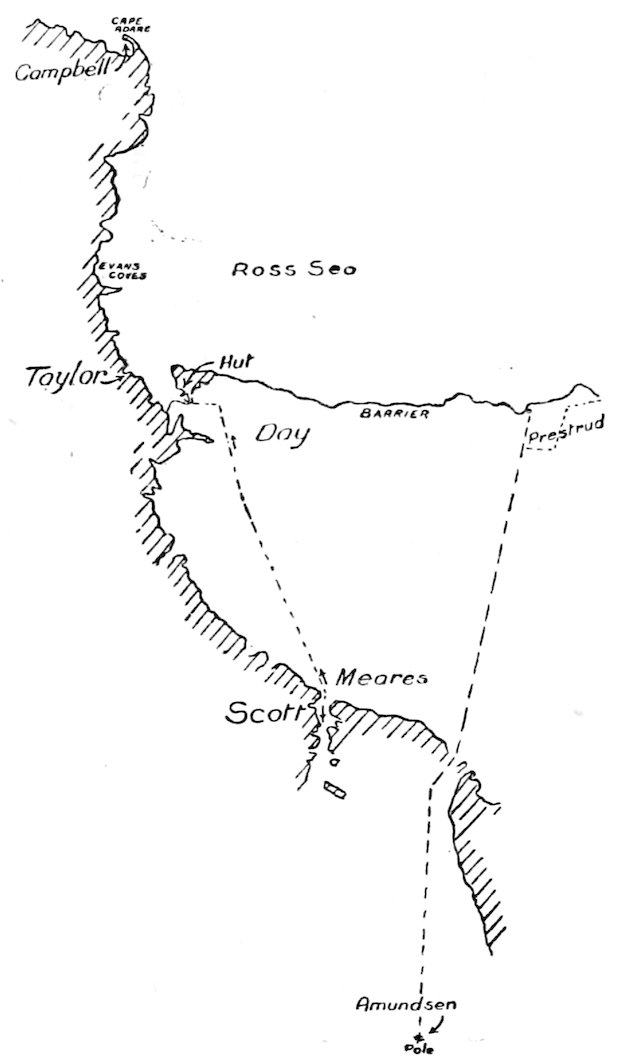
Chart of parties, December 14, 1911 (Amundsen reaches the Pole).
I have brought the story of the Expedition up to April, 1912, so far as my own part in it is concerned. But it will be of interest to give a brief résumé of the much more arduous journeys of the other divisions of the Expedition.
Let us consider the distribution of the personnel in the middle of December. In the far north at Cape Adare, Campbell and his five mates were awaiting the arrival of the Terra Nova to take them to fresh fields of work. The sea-ice had blown out early in spring, and they had been cooped up on the rocky promontory unable to explore the hinterland, just as had Borchgrevinck ten years earlier. The ship was not due until early in January, but Levick’s penguin studies and Priestley’s ice-notes testify to the industry of the scientific staff during their imprisonment.
Further south my own party was preparing to climb the Mackay Glacier, as recorded previously. We were to be taken north on the ship to Evans Coves (to spend five weeks 440there during January and February) as soon as the Terra Nova could reach us.
At Headquarters Simpson was completing his meteorological log—certainly the most valuable record of Antarctic weather which has yet been obtained by any of the numerous expeditions to the southern continent. Ponting was living at Cape Royds, and obtaining many of his most successful studies of animal life.
To the south stretches the Great Ice Barrier, and somewhere off White Island a party of two men are doggedly pursuing their homeward path. They are dragging a queer contraption—a sledge burnt in half—and each night have great difficulty in erecting their four-man tent. Neither Day nor Hooper understands navigation, and their plight, if they miss one of the old pony shelters, will be pitiable. They lie up during a heavy blizzard, and then start off, desperate, through the drifting snow. They arrive safely, and a few days later, returning on their path, see their blindfold tracks passing along the narrow ridge between two huge crevasses!
Another stage of some two hundred miles shows us, at the foot of the Beardmore Glacier, a second supporting party, which has just bidden farewell to Captain Scott. Meares, with Demetri and the dog teams, is proceeding north again for his last journey on the Great Ice Barrier. For three months he has been forwarding stores ahead of the pony parties, and now the Pole party pushes on, unsupported by ponies or dogs, on the two hardest stages to the Pole.
Scott has just finished the hardest day’s work he experienced on the ascent of the Beardmore. “A most damnably dismal day,” he calls it. Next day, the 14th—which is that on which all the positions in the preceding figure have been charted—they begin to reach better surfaces, and the three parties, under Evans, Bowers, and the leader, swing along at an encouraging rate.
Far to the south—indeed, at the uttermost south—five Norwegians have reached their goal: Amundsen, Bjaaland, Hanssen, Hassel, and Wisting. After a few days’ rest they have verified their position, and made sure of the Pole by a circular journey round the apparent site. And now they are preparing to return to Framheim and the north.
Prestrud, Amundsen’s lieutenant, has just carried out his 441trip to King Edward VII. Land. There, beyond the Barrier, he reached high land. Rocky cliffs appeared in a few nunatakker above the snow mantle. To these they gave Scott’s name.
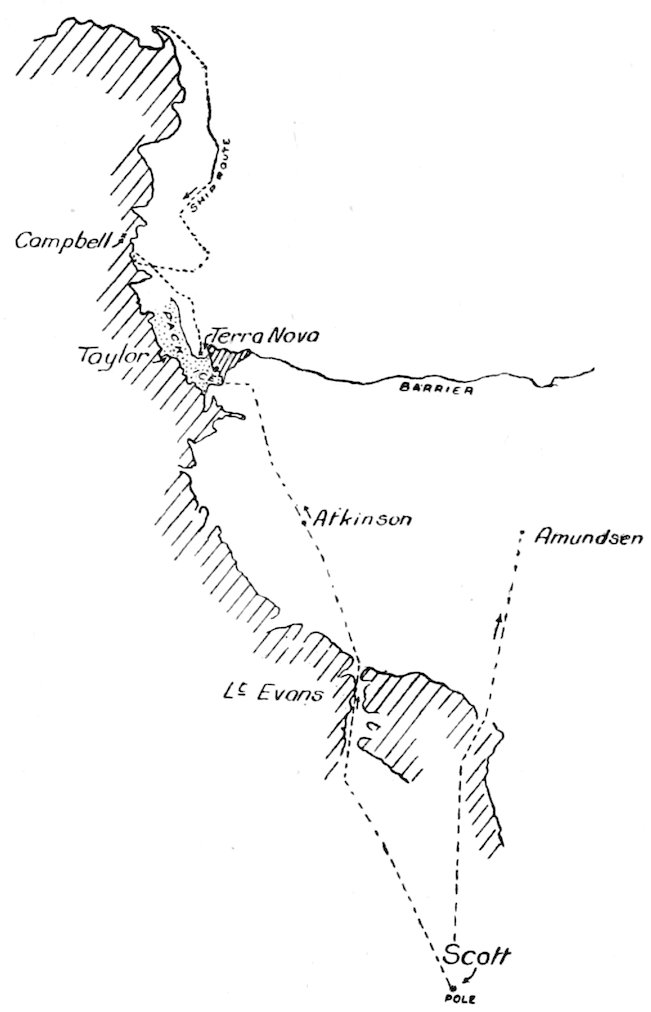
Chart of parties, January 18, 1912 (Scott reaches the Pole).
The next chart shows the position of the parties on the 18th of January, 1912. Cape Adare is now deserted. Campbell has been picked up by the Terra Nova, and safely landed at Evans Coves for five weeks’ exploration between Mount Nansen and Mount Melbourne. Then the ship sails south to pick up the western party at Granite Harbour, and to communicate with Headquarters. The pack-ice is still solid in MacMurdo Sound; the ship can do nothing till well into February. The western party are waiting on Cape Roberts some twenty miles from the ship. As narrated previously, they realize that there is no hope of relief in that quarter, and later march overland to the hut.
Day and Meares have reached the hut, and Atkinson is now halfway home across the Great Barrier. They have had an anxious rush to keep the balance between food and time. Only one day—Christmas—has been different from the many weary days of sledge-hauling. Among the moraines near the “Cloud-maker,” Wright discovered a piece of marble containing the first large Archæocyathine fossil from Antarctica. Although vastly larger than Shackleton’s specimens, this is only a centimetre long!
442Lieutenant Evans has now also turned northward, and, with Lashley and Crean, is nearing the foot of the Beardmore. For him worse troubles are approaching. Worn out by constant sledging and unsuitable food, he is attacked by scurvy, and only saved by the gallant devotion of his naval mates.
Captain Scott has accomplished his task, and within the time he had allotted to it. Realizing that if Amundsen came successfully through the winter his methods must be speedier than those of the English party, Scott proceeded steadily along the lines he had decided upon when he left England. It was a bitter disappointment. Since Amundsen had reached the Pole the year 1911 had passed away; and so the record stands: “The South Pole: Amundsen 1911, Scott 1912.” How few will realize that but a few weeks intervened between the two achievements!
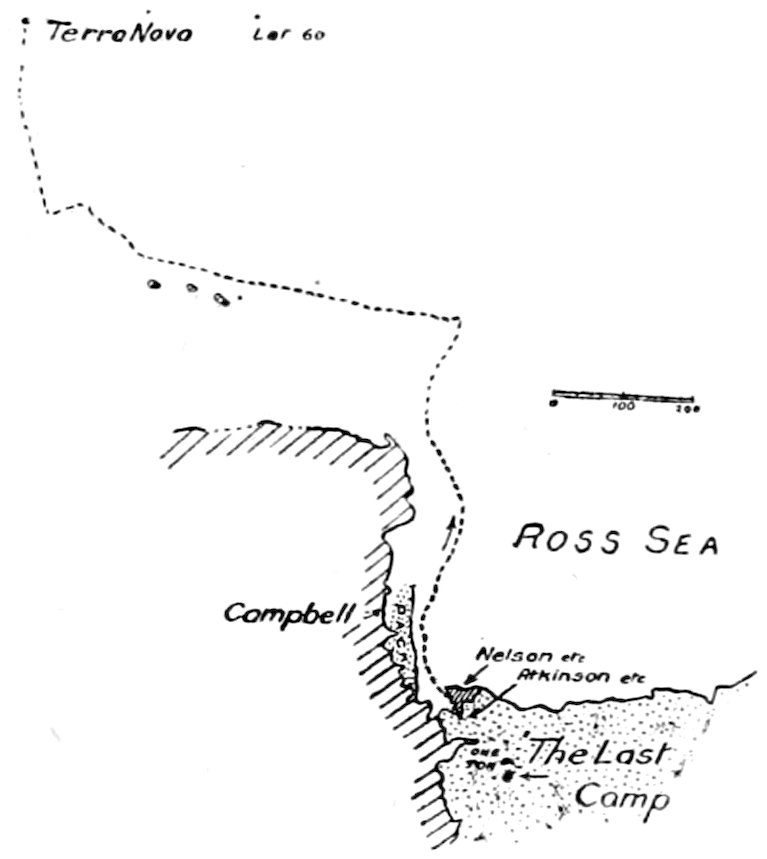
Chart of parties on March 21, 1911 (the last camp).
Meanwhile the Norwegian is speeding back to the Fram, and already the hardest part of his journey is over. In mid-January the conditions of the Barrier bear no remote resemblance to those in mid-March. No one who has not experienced it can picture the enormous difference due to the lapse of those two months.
The third chart shows the scene of the last tragedy. Far to the north the ship is nearing civilization. Campbell’s party is isolated at “Hell’s Gate,” their cheerless home at Evans Coves. Here in a hole in the snow they wear out a weary existence for eight never-ending months. No other Antarctic party has ever experienced such a test of courage and endurance. Even Mawson’s three weeks alone gave less opportunity for utter despair than the life of these six men from March to October, 1912.
All communication is now cut off between Cape Evans and the Barrier. At the 1910 Hut are Nelson, Debenham, Wright, and Gran with some of the men, and fourteen miles 443south in the old Discovery Hut are Atkinson, Cherry-Garrard, Keohane, and Demetri. But two of these are invalids—worn out by wild weather on the Barrier when they carried further supplies to One Ton Depôt.
Eleven miles south of this depôt—and just beyond where Bowers and Gran reached in the depôt trip of February, 1911—is the last camp of the Pole party. All the world has been moved by Scott’s messages from this formless yet historic site. It would be presumption in me to try and describe it.
Why did the tragedy occur? I am convinced that no reason beyond that of Seaman Evans’ illness is required. When Wilson was coaching us as to how we should meet the hazards of Antarctic sledging, he told us of frostbites, chills, blizzards, and so forth. I said that these seemed surmountable, but I added, “What are we to do if one of the party breaks his leg?” which seemed by no means impossible in the rough rocky region before us. Dr. Bill replied, “Well, you will have to make a more or less permanent camp, kill plenty of seals, and wait there until you are relieved, or until the leg is usable again.” Two factors were vital—rest for the invalid, and seal meat for the party’s sustenance. When Evans met with his accident, there could be no rest for any, sick or well. It was a race with famine, in which only strong men had any chance. There was no need for a severe accident to handicap the party hopelessly, as in the case of Dr. Mertz. A slight ailment rapidly becomes mortal. A sick man must be kept warm, and in the Antarctic the only warming agent is the human one. Very literally a man “keeps himself warm” with the most wonderful furnace in nature—fed with fuel in the form of biscuits and pemmican. And so, I believe, that, short of abandonment, the party had no hope with a sick man on their hands. Scott and Wilson would remember, however, that they had managed to bring back Shackleton to safety in 1903, and would hope to do the same again, even though the distance was four hundred miles instead of a hundred and fifty.
With each hour’s delay each man grew weaker. Each day the weather grew worse than the preceding. The sun now sank below the horizon at night and the Antarctic cold, unopposed by his warm beams, spread resistless through both 444animate and inanimate nature. Each night was longer, each march a harder fight against the blizzard drift.
I used to wonder how Shackleton managed his wonderful feat with an unsupported party. He told me that he would never have got through if it had been calm, nor if the wind had been but a trifle different. For days, on their return Barrier journey, they were marching through drift which did not rise to their eyes and so block their view; but was due to a southern blizzard wind just strong enough to fill their sail and push them to the north. Captain Scott met with no such fortune. He was a month later than Shackleton, and when Oates fell sick their chance had gone.
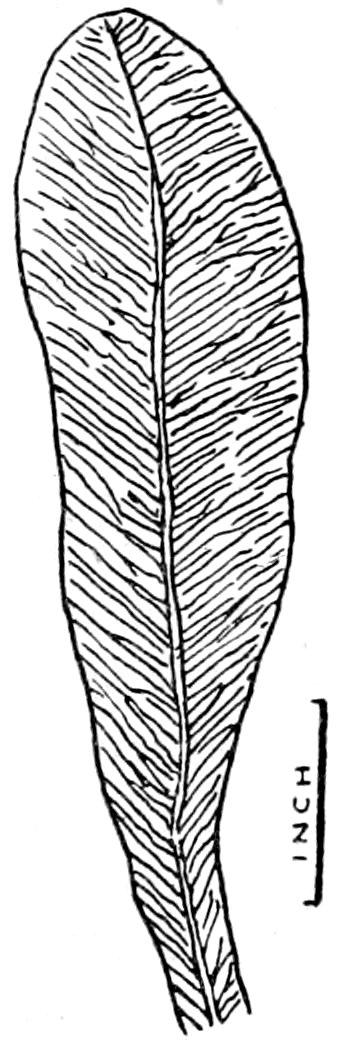
Glossopteris, a Permo-Carboniferous fern from the Upper Beardmore Glacier.
I do not believe that unaided the three men would have survived even if they had reached One Ton Depôt. There was no chance of thorough rest there, and nothing else could have saved them. At their slow rate of marching they were still ten days from Discovery Hut, and such a period of exposure would have been too much for them. Their journey was a supreme struggle against all the powers of Nature, and when all human effort had been expended they succumbed, winning a deathless renown which has aroused the envy of all brave men and the admiration of the world.
On their last few marches, when everything was fighting against them, they kept the specimens gathered by Wilson at the head of the Beardmore Glacier. Scott writes, “The geological specimens carried at Wilson’s request will be found with us or on our sledge.” It is pleasant to think that these specimens, which must have a greater sentimental value than any others of their kind, have also a greater scientific value than any hitherto obtained in the Antarctic. At the Australian meetings of the British Association Professor Seward gave two lectures dealing with the fossil leaves which they contained. Perfect examples of the fern-like plant Glossopteris were preserved—closely related to those occurring in India, Australia, South Africa, and South America. In fact, this plant is the emblem of the ancient 445continent of Gondwanaland; and the Polar specimens give positive and invaluable evidence of the condition of the world in Permo-Carboniferous times, of a sort which can truly be called epoch-making.
I can here give no account of the doings of the small band during the last months spent by the expedition in Antarctica. The record of the survey of Erebus by Priestley and Debenham and of the search for the Polar party can be read in other volumes.
However the world knew nothing of this disaster until the ship returned in February, 1913. Remembering the pleasure I had felt from Professor David’s gift of “Queed,” I sent down a few books by the ship in the preceding December. In each case I tried to suit the recipient’s taste. Thus Nelson received “Queed” (Harrison); to Wright I sent “Marriage” (Wells); to Cherry “The Dreadnought on the Darling,” in memory of his Australian travels. To Debenham and Uncle Bill I sent books in the writing of which I had had a part. To Bowers (in the character of “Farmer Hayseed”) I sent Bean’s fine book “On the Wooltrack”; and to Priestley, “We of the Never Never” (Gunn). Atkinson, I hope, had a fellow-feeling for pugilist “Shorty McCabe”; while Gates would have been carried back to Africa by “The Dop Doctor.” I knew Rex Beach would attract Gran—so he was furnished with “The Silver Horde.”
I was carrying out a geological survey at the Federal capital, and in the solitary evenings I managed to pile up a huge budget of letters for my returning mates. Some of them, alas! were returned unopened.
In February Bernard Day reached Australia and was in Sydney with me when we heard the sad news. I had never anticipated any serious accident to the Pole party—chiefly, I expect, because Shackleton had managed to pull through safely. But I should not have been surprised to hear of disaster in Campbell’s northern party, for no one had lived through a winter in such fashion before.
A solemn service was held in the Cathedral at Sydney, and later at a meeting to initiate a memorial fund, Professor David gave an eloquent justification of Antarctic exploration and paid a touching tribute to the characters of the lost men. As a 446result of similar appeals in this and other states, the Empire contributed most generously to the Captain Scott Fund.
The Federal Government kindly granted me leave to collaborate with the scientific members in London; and Priestley and I returned home in the Mongolia. We arrived in London in time for the Albert Hall meeting in May. Commander Evans here described to the large and deeply interested audience the chief features of the 1910 Antarctic Expedition.
The office in Victoria Street was the rendezvous of the surviving members of the Expedition, who were nearly all reunited within the next month or two. Simpson was too busy in India to visit England, Day was in Sydney; but with these exceptions we were all present at Buckingham Palace when the King’s medal was presented in July. The men under Lieutenant Rennick marched from Victoria Street, and joined the officers in the Palace. Here we were marshalled in three lines—naval officers, scientific and other officers, and seamen. Lady Scott and Mrs. Wilson, Mrs. Bowers, Mrs. Evans, and Mrs. Brissenden,[12] were received first by His Majesty. The others were presented by Prince Louis of Battenberg, and as each advanced the King shook hands, gave him the medal, and said a word or two.
We returned to the Caxton Hall, and after drinking some farewell healths, the expedition, as a whole, was disbanded.
But the scientific work will take several years to complete, and thanks to the generosity of the public, the means for carrying this out are adequate. No less than £75,000 was placed at the disposal of the Committee, while in addition to this the Government is paying out various sums from the Pension Fund.
Some £34,000 was allocated from the Public Fund to the widows and dependants of the lost explorers. A bonus was paid to the officers and men; the debt of the Expedition was paid, and £17,500 was set apart for the publication of the scientific results.
Some £18,000 remains for a memorial to the men who died. Of this amount half will be expended on a suitable monument, which will probably be placed in Hyde Park, and on a tablet in Saint Paul’s. The balance will be devoted to 447an endowment fund in aid of future Polar research. “This is an object which it is believed would have commended itself greatly to the late Captain Scott.” So concludes the report of the Mansion House Committee.
This narrative began amid the Colleges of Cambridge, and may very fittingly close there. Dear Uncle Bill will never return to his rooms in Caius College; but on the old archway through which he reached his quarters, are blazoned the names of Wright and Debenham. For Debenham has joined Caius, and “keeps” just below his sledge-mate, between the Gates of Wisdom and Honour.
In a spacious room in the Old Court of John’s, Lillie ponders over problems of Antarctic Biology. Priestley is a Fellow Commoner of Christ’s, and for a time I had diggings in the Hostel at Emmanuel. Priestley and I “kept” almost next door to each other, and almost always had our meals together; and during the day Debenham joined us in the huge “Antarctic Room” in the Sedgwick Museum. Here the specimens from the South were labelled, sectioned, and described. Here often appeared Wright and sometimes Lillie, while Pennell, Nelson, Atkinson, and others visited us not infrequently.
The various researches are being carried out under the supervision of the British Museum authorities, while Captain H. G. Lyons is acting as general editor of the scientific publications.
I have finished. In this account I have tried to show that a Polar expedition is a microcosm in its own peculiar way. Here are labours of a strenuous type, but not insuperable in the main. Here are dangers which the city dweller never meets, but which lose half their terrors with familiarity. Here are pleasures—like the labours and the danger—more concentrated than those met with in times of ease. Here, lastly, is fellowship, which is the chiefest charm of exploration.
It is a truism to declare that friends of the sledge-trace and sleeping-bag are friends for aye. My mates, in the 1910 Expedition, have forged yet a closer bond for our future sledge journeys. When this cruel war is past, we trust that Priestley will join forces with a relative of Debenham’s, while Wright and I have started anew on life’s journey with Priestley’s sisters to help us in the traces!
448I shall, in all probability, never again see the Antarctic; but my advice to any volunteer, who has that opportunity offered him, is to take it. Especially is this the case if he be a scientist or writer, for the present tendencies of modern life are all opposed to the multiplication of such experiences. Only in Polar lands is to be found the joy of a “real return to the primitive,” in association with the best types of strenuous youth. There, if anywhere, is life worth while, and effort sure of recognition. To few explorers is it given to serve under a leader with Scott’s kindly sympathy for every detail of his work; but after each and every expedition, the heavy cloud of discomforts, dangers, and disaster gradually fades from memory, and nought remains but the brightness of the silver lining.
[Click on map for high resolution image.]
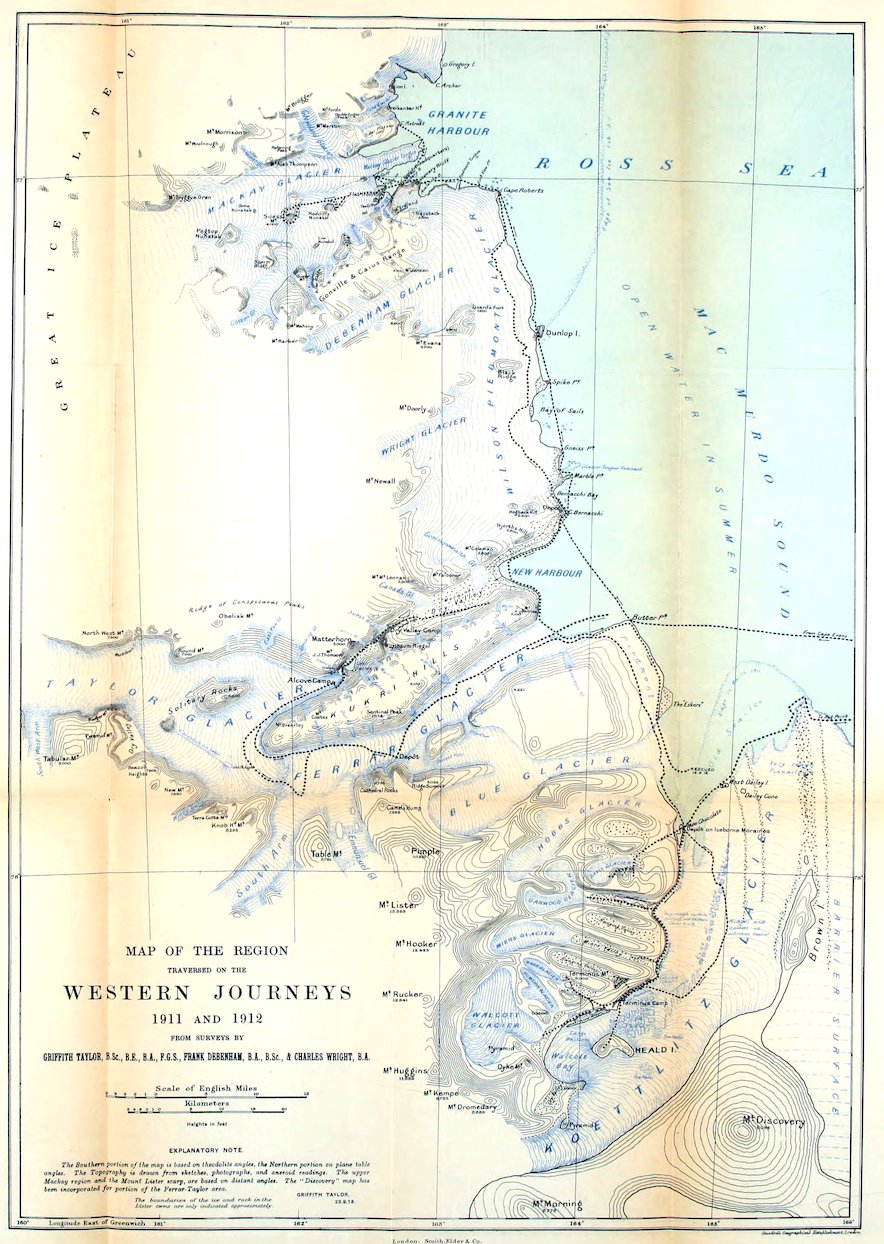
MAP OF THE REGION TRAVERSED ON THE WESTERN JOURNEYS 1911 AND 1912 FROM SURVEYS BY GRIFFITH TAYLOR, B.Sc., B.E., B.A., F.G.S., FRANK DEBENHAM, B.A., B.Sc., & CHARLES WRIGHT, B.A. EXPLANATORY NOTE The Southern portion of the map is based on theodolite angles, the Northern portion on plane-table angles. The Topography is drawn from sketches, photographs, and aneroid readings. The upper Mackay region and the Mount Lister scarp, are based on distant angles. The “Discovery” map has been incorporated for portion of the Ferrar-Taylor area. GRIFFITH TAYLOR 23.9.13. The boundaries of the ice and rock in the Lister cairn are only indicated approximately.
449